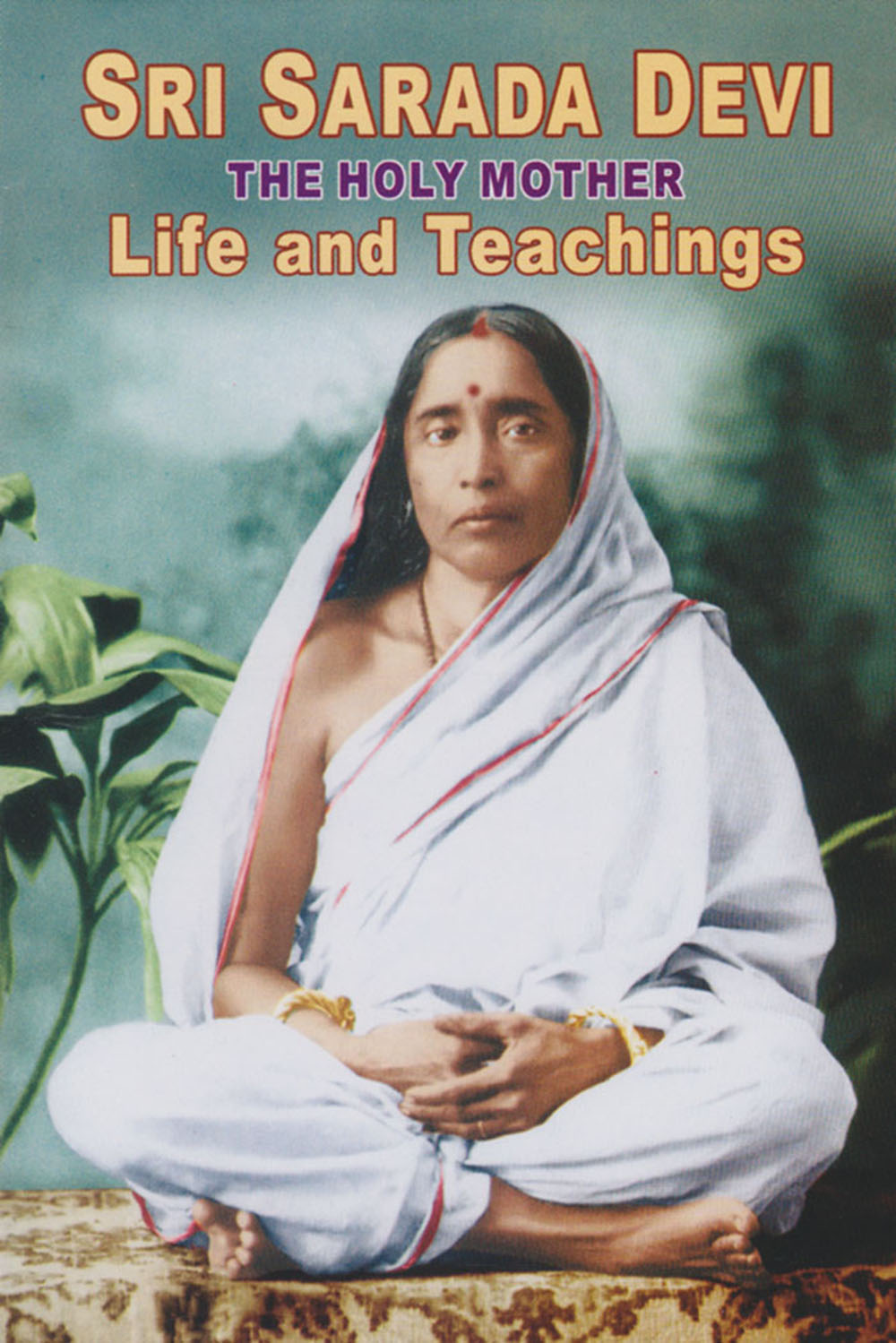
Sri Sarada Devi - The Holy Mother Life and Teachings
Author
Swami Tapasyananda
Publisher
Sri Ramakrishna Math Chennai
Description
This compact book by Swami Tapasyananda is all about Sri Sarada Devi, the consort and first disciple of Sri Ramakrishna. The first part covers an intimate account of her life with some of the author’s interpretations of the events; the second part is an analysis of her as the Motherhood of God; and the third and final part educate us about her teachings. Swami Tapasyananda was an erudite scholar and has many books to his credit, including translation of many scriptures. He was the vice-president of the Ramakrishna Math and Ramakrishna Mission from 1985 to 1991.
Sri Sarada Devi the Holy Mother was the Divine Consort and first disciple of Bhagavan Sri Ramakrishna and thus an integral part of his spiritual self and of the saving message he delivered unto mankind. Unlike the spiritual counterparts of the past incarnations like Rama, Krishna and Buddha and some others, Sri Sarada Devi was born in a poor but cultured Brahmana family of Bengal in the village of Jayrambati in the Bankura District, situated about sixty miles to the west of Calcutta. Born on 22nd December, 1853, as the eldest daughter of Ramachandra Mukherjee and Shyamasundari Devi, her early girlhood was spent, as in the case of most girls of rural upbringing, in various domestic chores like caring for younger children, looking after cattle and carrying food to her father and others engaged in work in the field. She had absolutely no schooling, though she learnt the Bengali alphabet and practised a little of reading and writing in later days by herself. But the domestic environment of a pious Brahmana family supplemented by the holy associations she had in later days imparted to her—to one with such high natural endowments as she—an education that was far more relevant than instruction in the three R’s.
She entered into Sri Ramakrishna’s life as his partner in it when she was aged only five. The strange marriage of Gadadhar of twenty three years of age with Sarada of five was part of a divine dispensation, and took place in a way that can only be described as Providential. When Gadadhar, as Sri Ramakrishna the Great Master used to be known in those days, was passing through the early phase of his spiritual adventure, his near and dear ones thought that marriage would have a resettling and stabilising effect on his mind, which had lost all interest in worldly affairs. But their search for a suitable bride met with failure every time they started on it, until Gadadhar himself came to their rescue. The relatives had kept their plans unknown to Gadadhar, as they feared a vehement protest from him, but upsetting all their worldly-wise calculations, Gadadhar himself came to the rescue of his disconcerted relatives. In an ecstatic mood he declared: ‘Why are you searching for a bride here and there? She who is “marked” for me is waiting at the house of Ramachandra Mukherjee at Jayrambati.’ And that ‘marked one’ they found was none other than Sarada Devi, the five year old daughter of Ramachandra Mukherjee and Shyamasundari Devi of Jayrambati.
There is a tradition of an incident of an earlier day indicative of the divinely ordained nature of this alliance. It was the occasion of a temple festival in the neighbourhood where quite a number of families from Kamarpukur and Jayrambati had gathered. Among them were young Gadadhar and infant Sarada. Some womenfolk on such occasions indulge in the pastime of preplanning possible marriage alliances for the future. It seems when infant Sarada was asked whom she would marry, she pointed to the boy Gadadhar.
After the marriage, Sarada had occasion, when she was seven and again at thirteen and fourteen, to meet Gadadhar and be with him for a few days each time. Though on these occasions she had the happy experience of serving him, a really meaningful meeting between them took place only later, when she went to Dakshineswar to meet him under strange circumstances. Hearing the rampant rumour that the village gossips bandied about regarding Sri Ramakrishna’s mental condition, young Sarada, now eighteen, felt much upset, and a sense of her duty to be by her husband’s side to serve him in his ailment began to dominate her mind. So under the guise of a pilgrimage to the holy Ganga, she went with her father to Dakshineswar Temple at Calcutta where the Master was then staying. Trudging most of the sixty miles to Calcutta, she arrived unannounced at Dakshineswar one night in March 1872, stricken with fever on the way, to boot.
It was in every way a very strange meeting. Sri Ramakrishna had been passing through a mood of intense longing for God, and his spirit of renunciation of what he called ‘Woman and Gold’ was raging in his mind with the tempo of a whirl-wind. An ascetic in that mood is the last man one can expect to meet a situation of this type with composure. We expect him to flee the place or put on a very rude and cruel attitude of disregard. But the Master’s response now was as unexpected as when the proposal for marriage was made. He extended a very warm welcome to his wife, made arrangements for her stay and medical treatment, and in every way behaved towards her as a devoted husband should do.
This great event took place in March, 1872. From now onward, with breaks of short intervals for visits to her mother at Jayrambati, Sarada Devi was by the side of Sri Ramakrishna at Dakshineswar and later at Cossipore till 1886 when death separated them in a physical sense. It was a period of training and discipleship, during which the Mother in her became more and more manifest, making her ready to take up the leadership of the spiritual movement that the Master inaugurated. She became the first and foremost of his disciples. This transformation was effected through her service of the Master and the practice of devotional disciplines he prescribed for her. It was a silent and profound process, about the details of which the world knows so little. The type of personality into which she was shaped through that training was one characterised by inexhaustible patience and peace, extreme simplicity combined with dignity, a non-turbulent but compelling spiritual fervour, a loving temperament that knew no distinction between friend and foe, and a maternal attitude of a spontaneous type towards all that charmed and brought under her influence everyone who came near her.
She spent nearly the whole of the Dakshineswar period of her life of thirteen years, extending from 1872 to 1885, except when she went to Jayrambati periodically, in a small room in the northern side of the temple compound called the Nahabat, from where she could get a view of the room in which the Master lived.
The ground floor of the Nahabat or Concert House was a small low-roofed room of about nine and a half feet by eight, with a verandah four and a quarter feet wide surrounding it. Besides being her living room, it served as her provision store, kitchen and reception room too—a surprising combination of functions for such a small enclosure. But so patient and long-suffering she was that what would have been impossible for others, was no problem to her. Several aristocratic women of Calcutta, fat and plumply, would stand at the door of the Nahabat, and leaning forward, holding the door frame, would say: ‘Ah! What a tiny room for our good girl! She is, as it were in exile, like Sita.’ In later days the Holy Mother would, while recounting the experiences of her early days, tell her nieces, ‘You won’t be able to live in such room even for a day.’
Appreciating the extreme inadequacy of her accommodation, a devotee by name Sambhu Mallick built in April, 1874, a small house on a plot very near the temple for her to stay. She stayed there for about one year, but left it for the Nahabat when the Great Master fell ill with dysentery, as she wanted to be by his side for nursing him. After that, however, she never went back to that house.
Her life began every day at three a.m., and being a strict observer of the Purdah, she finished her ablutions in the Ganges long before daybreak when people began moving about. Till it was broad daylight, she spent her time in meditation and Japa. She never came out till about one p.m., when there would be no one round about. She would then sit out drying her long and luxuriant locks in the sun. In fact she lived so quietly and unobserved there that the temple Manager said once, ‘We have heard that she lives here, but we have never seen her.’ The Master appreciated her extreme reserve, but none the less felt anxious for her health, as continuous stay in that small room carried with it grave health hazards. The verandah round the room was also screened for making the place fit for a strict Purdah lady to live in. She used to stand behind the screen on the damp floor of her house and watch through holes in the screen the Master singing and dancing in ecstasy beyond the open northern door of the room. All this brought rheumatic pain in her legs. Afterwards, on the Master’s advice, she began to go out of the room and meet the ladies of some known houses in the neighbourhood.
During the day much of her time was taken up with cooking for the Master and devotees. Sri Ramakrishna’s stomach was very delicate and could not stand the temple food. So Sri Sarada Devi prepared the diet for him and personally served it to him, coaxing him to take sufficient quantities of it. She also did the other personal services for the Master like cleaning his room, washing clothes, etc. The Master’s mother was also staying at Dakshineswar in her last days, and Sarada Devi attended on her as well with meticulous care. Although in the earlier years her cooking work was limited, it gradually swelled to enormous proportions, as the number of the Master’s devotees began to increase. Many of them stayed overnight or sometimes for a whole day with him. They had to be fed, and the Mother took upon herself that duty too. It is said that daily she made chapaties out of seven pounds of wheat flour, and prepared the condiments required for them. Besides, betel rolls for the Master and devotees were required, and countless were the rolls she prepared every day.
All through the day quite a large number of women devotees, who came to see the Master, made the Nahabat their first place of halt and spent much time in conversation. Some of them also stayed overnight with her in that small room. Besides attending to her household duties, she also spent hours in watching from the Nahabat the scenes of devotional fervour that went on in the Master’s room. During nights she spent long hours in meditation. Her whole time was thus occupied with acts of service of the Master and his devotees and with the practice of devotional disciplines. It was an ideal way of living in which work and worship went hand in hand, and led to a harmonious development of personality.
The Master took great care to help her in the development of her talents both in the secular and the spiritual fields of life. He taught her how to conduct herself with dignity and success in everyday life. While the Master gave her an all-round education, the emphasis of course was on the spiritual side. We do not know of the details of the spiritual practices she underwent, but we know that under the guidance of the Master she practised Japa and meditation with great intensity everyday in the morning and at night. In an admonition given to her niece Nalini, she once gave a hint about the intensity of her practices amidst the discharge of the heavy duties of life. She said to Nalini, ‘What a lot of work I did when I was of your age! And yet I could find time to repeat my Mantra a hundred thousand times every day.’ That is indeed a tremendous performance by any exacting ascetic standard.
Beyond a few glimpses of this kind, we have little record of the Master’s spiritual instructions to her and the way in which he imparted them. The Holy Mother seldom spoke on this subject to others. But we know for certain that the Master’s teachings had a tremendous effect on her pure mind. To a disciple she gave a glimpse of her inner life in the following words: ‘During my days at Dakshineswar, I used to get up at 3 o’clock in the morning and sit in meditation. Often I used to be totally absorbed in it. Once, on a moonlit night, I was performing Japa, sitting near the steps of the Nahabat. Everything was quiet. I did not even know when the Master passed that way. On other days I would hear the sound of his slippers, but on this night, I did not. I was totally absorbed in meditation. In those days I looked different. I used to put on ornaments and had a cloth with red border. On this day the cloth had slipped off from my back owing to a breeze, but I was unconscious of it. It seems “son Yogen” went that way to give the water-jug to the Master and saw me in that condition. Ah! the ecstasy of those days! On moonlit nights I would look at the moon and pray with folded hands, “May my heart be as pure as the rays of the yonder moon!” Or “O Lord, there is stain even in the moon, but let there not be the least trace of stain in my mind!” If one is steady in meditation, one will clearly see the Lord in one’s heart and hear His voice. The moment an idea flashes in the mind of such a one, it will be fulfilled then and there. You will be bathed in peace. Ah! what a mind I had at that time! Brinde, the maid servant, one day dropped a metal plate in front of me with a bang. The sound penetrated into my heart. In the fullness of one’s spiritual realization, one will find that He who resides in one’s heart, resides in the heart of others as well—the oppressed, the persecuted, the untouchable and the out-caste. This realization makes one truly humble.’
There is ample evidence to make one believe that she attained to exalted states of spiritual consciousness during this period of her life. But she was by nature so modest and unassuming that she would seldom speak to others of such facts of her life as might glorify her in their eyes. Sometimes certain happenings leaked out when any of her companions happened to be by her side. One such instance we come across in the account left by Yogin-Ma, of an exalted spiritual mood she witnessed personally in the Holy Mother. We give below her own words, a little abridged:
‘When the Mother, first came to Dakshineswar, she had not experienced Samadhi. Though she practised meditation and Japa every day with utmost devotion, we did not hear of her going into Samadhi at that time. On the other hand she even felt frightened at the sight of the Master’s Samadhi in the days when she slept near him. After I had been acquainted with her for some time, she said to me one day, “Please speak to the Master that through his grace I may experience Samadhi. On account of the constant presence of devotees, I hardly get any opportunity to speak to him about it myself.” I thought it was quite right that I should convey to him her request.
‘Next morning Sri Ramakrishna was seated on his bed alone when I went to his room, and after saluting him in the usual way, communicated the Mother’s prayer to him. He listened to it, but did not give any reply. Suddenly he became very serious. When he was in that mood, no one dared to utter a word before him. So I left the room after sitting there silently for a while. Coming to the Nahabat, I found the Mother seated for her daily worship. I opened the door a little and peeped in. Strange to say, she was now giggling and the next moment weeping. This went on alternately for some time. Tears were rolling down her cheeks in an unceasing stream. Gradually she became very much withdrawn into herself. I knew she was in Samadhi. So I closed the door and came away.
‘A long while after, I went again to her room. She asked me, “Are you just returning from the Master’s room?” I replied, “How is it, Mother, that you say you never experience Samadhi and other high spiritual moods?” She was abashed and smiled.
‘After that event I used sometimes to spend the night with her at Dakshineswar. Though I wanted to sleep on a separate bed, she would never listen to it. She would drag me to her side. One night somebody was playing the flute outside. That brought on her a high spiritual mood. She was laughing at intervals. With great hesitation I sat in one corner of the bed. I thought that, being a worldly person, I should not touch her at that time. After a long while her mind came to the ordinary state.’
In later days, after the passing away of the Master, she had more frequent experiences of this exalted state. This will be dealt with in detail in the proper place. Suffice it to say here that soon after her contact with the Master, her mind, pure and disciplined as it was, attained to great heights of concentration and illumination. Ecstasies and visions are only the by products of spiritual realization. They may or may not appear according to an aspirant’s temperament. The essence of realization, however, consists in a transformation of the inner life, and not in any external manifestation. The Holy Mother was speaking from experience when she put this idea so beautifully in the following words: ‘What else does one obtain by realization of God? Does one grow a pair of horns? No, our mind becomes pure, and through that pure mind, comes enlightenment.’
In conclusion it may be stated here that the training that the Master imparted to her did not exclude secular matters, especially the way of conducting oneself in everyday life. He instructed her that in arranging articles of domestic use, one must think out before hand where particular things were to be kept. Those that were frequently required must be kept near at hand and the others at a distance. When a thing was temporarily removed from a place, particular care should be taken to see that it was put back exactly in the same place, so that one might not fail to locate it even in darkness. He taught her also the way of rolling wicks, dressing vegetables, making betel rolls, cooking, and doing other items of domestic work. He instructed her that while travelling in a boat or a carriage she should always be the first to get in and the last to get out, for then only one could properly check whether all the luggage had been taken in or taken out. The secret of one’s success in social relationships, he told her, depended entirely on one’s capacity to adjust one’s conduct according to time, place, circumstances and the nature of the people one had to deal with. Physically every one was made of flesh and bones, but the mind within was constituted in entirely different ways. So one should be very careful in selecting one’s friends and associates. With some, one might mix freely, with others only a nodding acquaintance was advisable, and with still others it was better not to talk at all.
Thus the Master took pains to make the Holy Mother efficient in both spiritual and secular matters, and prepared her for the great mission that he was to entrust to her at the close of his life.
By careful education he helped to make her a true Sahadharmini, a fellow-seeker in the quest for the higher values of life. It was the resuscitation of the Vedic ideal of the Pativrata, according to which man and woman got fused into a common ideal and purpose in life. The man and the woman, brought together as husband and wife, are like the two wheels of a vehicle moving together on a common track towards a common ideal. Dharma is that path of higher evolution, and the discharge of one’s social and spiritual duties in the scripture-ordained way is the way of progress along it. The Sahadharmini of a spiritually oriented personage like Sri Ramakrishna must necessarily be one with that same outlook, if the objective of that ideal is to be fulfilled. It was because of this mutually complementary nature of their characters, that they have become perfect ideals of both the married state and the monastic values.
An examination of several incidents of the Master’s life would amply prove that this idea was always in his mind. The extraordinary way in which their marriage was arranged has already been narrated. It is known from the Master’s own statement that he had prayed to the Divine Mother to free Sarada from all bodily passions and make her a suitable mate for himself. It was found that his prayer was amply answered when, after Sarada’s arrival at Dakshineswar, the Master pointedly put her a question: ‘Do you want to drag me down into Maya?’ Sarada Devi’s answer was equally prompt and to the point. She replied: ‘Why should I do so? I have come only to help you in the path of religious life.’ A noble answer indeed by a Pativrata and a true Sahadharmini! Only a woman of immaculate purity of mind could have given such a reply. There was no artifice in it, no hypocrisy or attempt to please anybody. It was the spontaneous expression of her lofty nature, of the lofty ideal of life that had unconsciously become hers as much as her husband’s.
The seriousness and sincerity behind this challenging reply she proved before long when Sri Ramakrishna decided to subject himself to what may be called a fiery ordeal. His teacher Totapuri had told him on knowing him to be married, that this was not much of a risk for him. For a sincere Sadhaka, an earnest aspirant struggling in the spiritual path, it is highly necessary to keep aloof from the company of women. But if and when he attains to realisation, his moral purity will not be of the cloistered type based on difference, but on the apprehension of the one Self in man and woman alike—an apprehension which helps one to surmount the identification of the self with the body.
The Master therefore utilised the presence of Sarada Devi at Dakshineswar to allow her the right of a wife in the fullest sense as well as to test how far his Brahman-knowledge had raised him above the bodily sense. For a period of about six months this ascetic of ascetics had his wife sleep in his own room and the spiritual awareness of them both put to the acid test. They stood it wonderfully well. The Master’s mind went only into deep Samadhi and was never assaulted by the bodily passion. He also gave equal credit to Sarada Devi when he said: ‘Had she not been so pure, who knows whether I would not have lost my self-control? After marriage I had prayed to the Divine Mother, “O Mother! Remove even the least trace of carnality from the mind of my wife.” When I lived with her, I understood that the Mother had really granted my prayer.’
And as for the Holy Mother herself, we have her statement regarding her experiences of those memorable nights: ‘The divine state in which the Master used to be absorbed, passes all description. In an ecstatic mood, he would smile or weep, or at times remain perfectly still in Samadhi. This would sometimes continue throughout the night. In that divine presence, my whole body would tremble with awe and I would anxiously await the dawn. For I knew nothing of ecstasy in those days. One night his Samadhi continued for a very long time. Greatly frightened, I sent for Hriday. He came and began to repeat the name of the Lord in the Master’s ears. When he had done this for a little while, external consciousness reappeared. After this incident, the Master came to know of my difficulty and taught me the appropriate names that should be uttered in the ear in particular states of Samadhi. Thenceforth my fear was very much lessened, as he would invariably come to earthly consciousness on the utterance of the particular divine names. But even after this I sometimes kept awake the whole night, as there was no knowing when he would fall into Samadhi. In course of time he came to know of my difficulty. He learnt that even after the lapse of a considerable length of time I could not adjust myself to his Samadhi temperament. So he asked me to sleep separately at the Nahabat.’
Another memorable event in the life of this holy couple that took place about this time was the Shodasi Pooja, in which the Master offered actual ceremonial worship to the Holy Mother, seating her on the pedestal of the Deity. It took place during her first visit to Dakshineswar when she stayed there continuously from March 1872 to October 1873, for more than a year and a half. Authorities differ about the exact date of this incident. According to some it was about a month and a half after the Mother’s arrival at Dakshineswar; according to others it was one and a half years later. The latter is more likely. It took place on the night of Phalaharini-Kali Pooja day, when the Divine Mother is worshipped as the consumer of the Karmas of the devotee. Arrangements for worship were made in the Master’s room, and Sarada was requested to be present at the worship. After the Master had gone through the preliminary rites of worship, he beckoned to Sarada Devi to sit on the seat set apart for the Deity. He then invoked the presence of the Divine Mother in her with the Mantra: ‘O Divine Mother! Thou eternal virgin, the mistress of all powers, and the abode of all beauty! Deign to unlock for me the gate to perfection. Sanctifying the body and mind of this woman, do Thou manifest Thyself through her and do what is auspicious.’
Then he went through all the procedures of a full ritualistic worship with sixteen ingredients. He first performed the Nyasa which consists in touching the different parts of one’s body with appropriate Mantras and identifying them in meditation with the corresponding parts of the Deity. After that he offered worship with sixteen items with appropriate Mantras. In the course of it he applied red paint to the soles of Sarada Devi, put a vermilion mark on her forehead, put on her a new cloth, put a little of sweets and betel-leaf in her mouth, and performed the Arati (light-waving ceremony) before her. The bashful Sarada received all these acts of adoration without the least feeling of hesitation. The sense of identification with the Deity must have come on her. Both the Master and the Mother were in a state of ecstatic and semiconscious absorption in the course of the worship, and by the time it came to an end they were in complete Samadhi in which the worshipper and the worshipped realised the identity of their being as Existence-Knowledge-Bliss Absolute. After a considerable length of time, when the second watch of the night had fairly advanced, the Master regained external consciousness. Then he resigned himself completely to the Divine Mother, and in a supreme act of consecration, offered to the Deity manifest before him, the fruits of his austerities, his rosary, himself and everything that was his. He then uttered the following Mantra: ‘O Goddess, I prostrate myself before Thee again and again—before Thee, the eternal consort of Siva, the three-eyed, the golden-hued, the indwelling spirit in all, the giver of refuge, the accomplisher of every end, and the most auspicious among all auspicious objects.’
The significance of this rite in the lives of these two great personages can hardly be over-estimated. For Sri Ramakrishna it signified the final triumph of the spirit over the body, and the recognition of Divinity in all. It marked the successful conclusion of his spiritual strivings, and his establishment in the state of the ‘divine man.’ In the life of Sri Sarada Devi the Holy Mother, too, it had a deep significance. When Sri Ramakrishna, the Divine Incarnation of the age, invoked the presence of the Divine Mother in her, and worshipped her as such, she was elevated in truth and in reality from Sarada, the daughter of Ramachandra, to Sarada, the Holy Mother, the manifestation of the Eternal Mother of the Universe, for all humanity to worship. It has been already stated how the Master had from the time of his marriage been praying to the Mother of the Universe to divinise the person of his wife, and how her answer to a leading question he put to her as a test proved that the transformation was largely effected, and how she was in all respects a partner in life well-matched with him in all respects. And now by the performance of this rite of Shodasi Pooja in which he identified the Deity with Sarada and surrendered all his spiritual practices and their fruits to her, he virtually made her a participant of all his austerities and spiritual attainments. It is sometimes asked why the Holy Mother did not perform Sadhanas like the Master. She did perform much in this field, but the real answer is in the Shodasi Pooja, by virtue of which the Holy Mother became a full sharer in the spiritual glory of the Master. As the spiritual counterpart of the great world-teacher Sri Ramakrishna. She had no need to reenact the same scenes of the one common drama which they were together staging before mankind. She had other parts to play by way of fulfilling and supplementing the Master’s work.
In another sense also the Shodasi Pooja was a landmark in her life. It made her a vital part of Sri Ramakrishna’s Mission. In that rite the Master invoked in her the presence of the Divine Mother—the same Supreme Energy that was manifesting in him. Henceforth, just as in the Master’s case, her body and mind became the venue of expression for that Energy. For the rest of her life she served the Master and helped in his Mission, and after his passing away, his mantle fell on her, and through a long period of spiritual ministry, she completed what he had left unfinished.
The Master’s life combined in itself the highest ideals of the monastic life and those of the householders. The Master always taught man the gospel of renunciation of Kamini-Kanchana (translated literally as ‘Woman and Gold,’ but meaning ‘lust and greed’), and had it not been for the advent of the Holy Mother into his life, he would have been taken to be only a hard-baked ascetic and nothing more. But his very cordial and affectionate relationship with the Mother, treating her as the first and foremost of his disciples and attendants, has lifted married life above the level of sex and made it a potent spiritual relationship. The crusader against ‘Kamini-Kanchana’ showed the highest consideration and respect to the Holy Mother. The welcome he extended to her on her first appearance was in itself an unexpected mark of cordiality. Not only was he particular about keeping her in comfort, he even thought of providing something for her future. Calculating the minimum amount required monthly for her maintenance as Rupees six, he had six hundred rupees deposited with the Zamindari Office of Balaram Bose, the interest of which was to go for her maintenance. He divined her liking to wear ornaments and spent three hundred rupees to have a pair of bracelets made for her. There is a tradition according to which Sri Ramakrishna had a vision of Sita at the Panchavati. He found her wearing a pair of bracelets with many tiny facets like diamonds. It was in imitation of these that he made for her gold bracelets which she wore till the last. Yogin-Ma, describing her appearance in those early days, says: ‘She wore a piece of cloth with broad red borders and put vermilion at the parting of her hair. Her thick black tresses almost touched her knees. She wore a gold necklace, a big nose ring, earrings and bracelets. Most of these were what Mathur Babu made for the Master when he practised spiritual disciplines assuming the role of a handmaid of the Divine Mother.’ It seems Manomohan’s wife criticised her for wearing these ornaments while being the wife of a man of such great renunciation. Thenceforth she put aside most of them.
While receiving all her loving services, and moving with her in all frankness and childish innocence, the Master always maintained an attitude of profound respect towards her as his spiritual counterpart and fulfiller of his life’s Mission. This attitude was generally implicit, but sometimes expressed itself in striking little actions. One day the Holy Mother entered the Master’s room with his meal. He thought it was his niece Lakshmi, and asked her casually to shut the door, addressing her as ‘tui’, an expression meaning ‘thou’, but used with reference to juniors or inferior persons. When the Holy Mother responded, the Master felt very much embarrassed and said, ‘Ah! is it you? I thought it was Lakshmi. Please pardon me.’ But the Holy Mother tried to pacify him, saying there was nothing wrong in his addressing her like that. But the Master was not satisfied. Next morning he went to the Nahabat and said to the Holy Mother: ‘Well, I could not sleep all the night. I was so worried because I spoke to you rudely.’ Referring to this incident, she often said in later times, especially when some of her senseless relations behaved disrespectfully, ‘I was married to a husband who never addressed me as “tui.” Ah! how he treated me! Not even once did he tell me a harsh word or wound my feelings. He did not strike me even with a bunch of flowers!’
It will thus be seen that Sri Sarada Devi received from her husband all that a Hindu wife expects. But some may perhaps object, that she had no issue. Her own mother Shyamasundari Devi once lamented: ‘My Sarada has been married to an ascetic. She will never know the happiness of being addressed as “mother.”’ The Master, who heard it, remarked: ‘Your daughter will have so many children that she will be tired of being addressed day and night as “Mother.”’ And countless indeed were her spiritual ‘sons’ and ‘daughters.’ She was the Sahadharmini, a companion in life, not of an ordinary man, but of the Incarnation of the age, who came to generate Bhakti and Jnana among man, and whose main teaching inculcated renunciation of lust and possessions. In conformity with his ideal, which was hers too, the children born of her were not physical but spiritual, and of these she had a countless number.
The period of thirteen years that the Mother served the Great Master was inwardly characterised by her absorption in the Master’s ideal and fusion of her life with his, and outwardly by her periodic migration from Dakshineswar to Jayrambati and back. During this period she went seven times to Jayrambati and back to Calcutta, a journey of about sixty miles, which she had often to do on foot. These visits were generally occasioned by ill-health or for rendering assistance to her mother during the Jagaddhatri Puja. But as her services were very much needed by the Master, her stay at Jayrambati was perforce not very long. In 1874 her father died and her mother and brothers were reduced to poverty. The family had to be supported by her mother with wages earned by husking paddy, in which she was helped by her daughter Sarada also whenever she was at Jayrambati. After the performance of Jagaddhatri Pooja was instituted in the family, their condition improved.
It was during one of these journeys to Calcutta that the Mother had to run the risk of facing some brigands after dusk. As she could not walk fast enough, the party she was accompanying had gone in advance, and she was left alone at about dusk half way across a solitary wilderness. A man who looked like a brigand and his wife converged on her path and halted her. In that precarious situation, the Mother, then a young woman of about twenty-four, did not lose her presence of mind. She addressed the couple as ‘father’ and ‘mother’ in a tone that roused the parental instinct in them, and she narrated to them how she had been left in that helpless condition. The ‘brigand’ couple reciprocated the filial confidence she put in them, and behaved in a very tender manner towards her. They took good care of her for the night, and enabled her to join her party in the morning.
During this period she once fell ill seriously. In 1875 she had a severe attack of dysentery, so severe that she was given up for lost. When all human remedies failed, as a last and desperate act of prayer and supplication for divine intervention, she resolved to perform the rite of Hatya before the Deity Simhavahini, according to which one observes the vow of starving unto death if no divine assistance comes. Within a few days of her fast, the Goddess is said to have revealed the name of some simple medicines, taking which she was cured. Some time after, she had a severe attack of malaria, with enlargement of the spleen, for which she was subjected to the curious countryside treatment of branding with a red hot iron in the region of the spleen—with what effect, no one knows.
It was on her fourth visit to Dakshineswar along with her mother in 1881 that she had to return the very next day owing to the rude behaviour of Hriday, a nephew and a caretaker of the Master. But the injured feeling of the Mother had instantaneous repercussion on Hriday. A few days after this, he indiscreetly worshipped with flowers the feet of a young daughter of Trailokyanath, the proprietor of the temple. As such an act of worship was supposed to be very harmful to the girl concerned, her father dismissed Hriday from the temple service, with the order that he should no more enter the temple precincts. This was a corroboration of the warning that the Master had given to Hriday, who had been for sometime past behaving discourteously towards her. He told him that one might insult him (the Master) with impunity, but ‘dire consequences’ would follow, if the Holy Mother were so treated.
The Mother stayed at Dakshineswar till about September 1885, when her happy days there ended with the transfer of the Master for treatment, first to Shyampukur in Calcutta, and afterwards to Cossipore, where he passed away in August 1886. While the men disciples arranged for the nursing and general treatment of the Master the Holy Mother took upon herself the duty of preparing the diet of the Master and feeding him. Though for a Purdah lady like herself it was very inconvenient to stay in those places, she put up with everything with a sense of satisfaction derived from the feeling that she was of service to the Master, and she threw herself heart and soul into the work.
There are two incidents of importance recorded about the Holy Mother’s experiences during her attendance on the Master at Cossipore. The Master was then lying in a weak and exhausted condition, unable to move without the assistance of others. But one day the Holy Mother saw him running out of the room. Startled the Mother went inside the room to verify her observation, and she found the Master’s cot empty. Shortly after, she found him returning. She made enquiries of him about this the next day. The Master at first made light of it, saying it was all the result of her heated brain. But when she pressed for an explanation, he informed her that Niranjan and some other disciples had gone to make palm juice from a date palm, that there was then a cobra on the palm, and that he went there in advance, using his higher powers, to drive away the cobra and protect them. This event, looking strange and miraculous, has to be accepted as it comes from the Mother’s lips. It also raises interesting issues regarding the Master’s ailment.
Another occurrence was her experience at Tarakeswar Siva Temple where she had gone to pray and seek Divine remedy for the Master’s illness, which had been declared incurable by medical men. For two days she lay before the Deity without food and drink, supplicating for some remedy. During the night of the second day she was startled to hear a sound resembling the breaking of a pile of earthen pots at one blow. She woke up from her torpor, and the idea flashed in her mind: ‘Who is husband and who is wife? Who is my relative in this world? Why am I about to kill myself?’ Freed from all personal attachments, her mind was full of an intense spirit of renunciation. She had another vision in which she saw that the image of Mother Kali was bent to one side. When she asked the Deity, ‘Mother, why do you stand like that?’ she got the reply, ‘It is because of this (pointing to the Master’s diseased throat). I also have it in my throat.’ All such experiences prepared her mind for the exit of the Master from his earthly sojourn, which took place on the 16th August, 1886. With the passing of the Master, this phase of the Mother’s life came to a close.
AFTER THE MASTER’S PASSING: PILGRIMAGE TO BRINDAVAN
The Master’s demise brought about a drastic change in the Holy Mother’s life. She reacted to his passing with extreme fortitude, exclaiming, ‘O Mother Kali! Have you left me!’ She shed no tears, though her heart was heavy with the sorrow of separation. Soon after the cremation, she was removing her golden bracelets and tearing off the red border of her wearing cloth in order to be dressed in the pattern of a Hindu widow. Immediately, she had a vision of the Master, telling her, ‘What are you doing? I have not gone away. I have only passed from one room to another.’ A reassuring experience indeed for her griefstricken heart! All through life she wore her bracelets and a thin-bordered cloth in acceptance of the assurance of her experience that her Lord and Master is the Eternal Being, who never dies.
About a fortnight after the Master’s Mahasamadhi, the Cossipore establishment was disbanded, and the Holy Mother had to shift to the house of Balaram Bose. As a measure for assuaging her grief and as a holy act in itself, she started, about two weeks later, on a pilgrimage with a party consisting of several disciples of the Master including Lakshmi-Didi and Golap-Ma. After visiting Banaras and Ayodhya, they halted at Brindavan where they stayed for about a year. The stay was a very highly rewarding experience from the spiritual standpoint for the Holy Mother. The association of the place with the story of Radha’s passionate grief in separation from her beloved Krishna brought home to her the similarity of her own situation after the Master’s passing, and added a spiritual poignancy to the sorrow she was feeling in her heart from the bereavement. All her pent up feelings found expression as an upsurge of passionate longing for the Divine and in a torrential flow of tears that continued almost unremittingly during the early part of her life at Brindavan. This mood in which love and grief blend in full harmony bringing about a gradual transformation of personality, continued for several days with her until she had a wonderful vision in which the Master appeared to her and said: ‘Why are you weeping so much? Here I am. Where have I after all gone? Only from one room to another.’ The experience assuaged her grief very much, as she began to feel the nearness of the Master more and more. The anguish of separation gradually turned into a sense of utter peace and radiant joy. Often she began to fall into exalted moods in which she would walk away over the sandy banks until her companions went after her and brought her back; Her temperament changed from that of an adult into that of a little girl of seven or eight.
Her life at Brindavan was one of constant worship, meditation and spiritual experiences. She and Yogin-Ma would sit in meditation with such absorption that they ceased to be disturbed by flies that produced sores on their faces. She visited all the numerous temples in the place and also undertook the circumambulation of the whole area of Brindavan involving a walk of several miles. At Radharamana’s temple she prayed to the Deity: ‘O Lord, remove from me the habit of finding fault with others. May I never find fault with anybody.’ Her prayer was answered to the letter, and in later life one of the distinguishing features of her character was the complete absence of the faultfinding tendency. She maintained that this tendency only corrupted one without improving others.
She had several spiritual experiences during this time, though she never revealed them to anyone. But some of them could not escape the notice of her companions. Thus Yogin-Ma one day found her absorbed in Samadhi. Even repeating the Divine name in her ears several times had not the effect of bringing her to the body-consciousness. Then Swami Yogananda tried the same technique for some time, which brought her to a semiconscious state in which she said, ‘I must eat something’—even as Sri Ramakrishna used to mutter in order to bring his mind to the worldly plane. She then partook of a little sweet as the Master would do. Even in taking betel rolls, she threw away the tip in the manner of the Master. Swami Yogananda put to her several questions in that mood, and received replies from her as if the Master himself were answering him. Afterwards she told her companions that the consciousness of the Master was upon her during that state. During this period she gave initiation to Swami Yogananda under the express command of the Master both to her and to the Swami. She gave the initiation in a highly exalted mood bordering on Samadhi. After visiting Hardwar and some other places, she along with the party returned to Calcutta by August 1887.
The nine months following 1887 may be described as the dark period in the Holy Mother’s life from the material point of view, although spiritually she was in an exalted mood. Now that the Master was no more, the Holy Mother could not stay on in Calcutta. She was a young widow of about thirty-three. Though the Sannyasin disciples of the Master and a few of the lay ones respected her, men at large had not yet come to recognise her spiritual status. She had therefore to go through all the difficulties which a young widow in her situation was bound to face. A few days after her return to Calcutta from her pilgrimage, she had to go to Kamarpukur to take her permanent residence there. The Master too had told her towards the close of his life: ‘After my time, you go to Kamarpukur and live upon whatever you get, be it mere boiled rice and greens, and spend your time in repeating the name of Hari.’ These words of his came to be literally fulfilled. She took her residence in the small cottage that had been assigned to the Master in the family campus. For her maintenance she had only some paddy which she could process into rice and eat without any condiments. For something to eat with rice, she had herself to dig the ground and grow some greens. She had absolutely no cash even to procure some salt. Ramlal, Sri Ramakrishna’s nephew, who was legally her guardian, left her in utter neglect. It is said that he even positively contributed to her sufferings. The temple authorities had set apart a monthly pension of ten rupees to the Master which used to be paid to the Mother. But Ramlal, for reasons of his own, is supposed to have interfered and got it stopped. He even effected a partition, and assigning the Master’s cottage to her, rid himself of all responsibilities. The other members of the family like Sivaram and Lakshmi-Didi were of no help to her, as they stayed at Calcutta with their uncle Ramlal who was the officiating priest at Dakshineswar. She had therefore to live alone in that hut. To add to the misery that neglect and loneliness caused, she became the butt of criticism of the village diehards who vilified her as a ‘merry widow’ because she put on a red bordered cloth which custom strictly prohibited for widows. In the midst of all these depressing influences, there were two factors that sustained her. One was the sympathy and support she got from Prasannamayi, an aged lady of the Laha family and a friend of Sri Ramakrishna when he was the boy Gadadhar of Kamarpukur. The other was the vision of the Great Master which she got now and then in difficult situations and the mood of spiritual exaltation in which she lived.
This state of affairs did not, however, continue for long. Her mother Shyamasundari Devi came to know of it, and through her son Prasanna Kumar, she remonstrated with Ramlal for the neglect of her daughter and also informed Golap-Ma of it. Golap-Ma at once took up the matter seriously, carried on a vigorous propaganda among the disciples of the Master, raised some funds, and invited the Holy Mother in the name of all the devotees of the Master to come to Calcutta and stay there. After some hesitation, arising from fear of public opinion attributing impropriety to a young widow staying amidst strangers, she finally arrived in Calcutta in April 1888 to the great joy of all the disciples and devotees.
It has to be pointed out that in the early days, several of the lay disciples attached no more importance to the Holy Mother than as the ‘Wife of the Guru.’ One is said to have actually remarked: ‘I know Sri Ramakrishna, but I know nothing of his wife.’ But hearing much from Yogin-Ma, Golap-Ma and Swami Yogananda about the highly exalted states of the Mother at Brindavan, most of them veered round in their estimate of the Mother, and fully cooperated in the efforts made to provide for her stay at Calcutta.
From now (1888) onwards till her exit in 1920, the Mother stayed at Calcutta and Jayrambati alternately. She went to Kamarpukur also a few times in the early part of this period. At Calcutta she used to be accommodated at the houses of the devotees Balaram Bose or Mahendranath Gupta whenever her stay was short, and at rented houses when the stay was long. This arrangement went on until Swami Saradananda built the Udbodhan House as her Calcutta residence in 1909. She was attended upon by Swami Yogananda and Swami Trigunatita at first, and after Swami Trigunatita left India, Swami Saradananda took full charge of her responsibility. The lady disciples of the Master like Yogin-Ma and Golap-Ma kept company with her often.
It was a few months after her coming to Calcutta, that she went on another pilgrimage in April 1888 to Gaya accompanied by Swami Advaitananda. On this occasion she also visited Bodh Gaya, the place of the Buddha’s enlightenment, where an event of great future significance took place. She saw there the well established monastery of Hindu Sannyasins, which provided the monks with good accommodation and food. The contrast between this and the poverty-stricken condition of her own ‘children’, the monastic disciples of the Master, evoked strong sentiments in her mind. About this incident she said as follows: ‘Ah! for this have I shed tears and prayed to the Master! And only through that this Math (Belur Math) came into existence now. When the Master left the body, the boys gave up the world and gathered together in a rented shelter for some days. Then they scattered about independently and went on roaming about here and there. Then I felt intensely sad and prayed to the Master, ‘O Lord! You came, disported with a few and then went away. Should everything end with that? If so, what was the need for coming down and undergoing so many travails? I have seen in Banaras and Brindavan many holy men who get their food by alms and move about from one place to another. There is no dearth of holy men of that type. I shall not be able to bear the sight of my “sons”, who have come out in your name, moving about begging for food. My prayer is, that those who leave the world in your name may never be in need of bare sustenance. They will all live together holding to your ideas and ideals, and the people afflicted by the worries of the world will resort to them and be solaced by hearing from them about you. That is why you came. My heart is pained at seeing them wandering about.’
Indeed a remarkable prayer for the monks, while she herself was in utter poverty and neglect! Her insight into the implications of the Master’s advent too is profound and prophetic.
From the time of her return to Calcutta from Kamarpukur in 1888, her visits to that place were few, although she took care to see that the house that stood in the Master’s name was kept in good condition. Her time was taken up by frequent visits to, and stay at, her paternal home at Jayrambati, and with disciples at Calcutta. Her companions Yogin-Ma and Golap-Ma noticed a great spiritual transformation in her after the Master’s lifetime. Yogin-Ma noticed that she had become remarkably indrawn and was radiating an unearthly lovelines. During her stay at Calcutta in 1888, she saw the Mother in a state of Samadhi while meditating on the roof of Balaram Babu’s house. About her experience in that state, the Mother said: ‘I found in that state that I had travelled into a distant country. I cannot describe the nature of the ecstatic joy I felt. When my mind came down from that exalted mood, I found my body lying there. I thought, “How can I possibly enter into this ugly body?” I could not at all persuade my mind to do so. After a long while it did, and the body became conscious again.’
Another day she was meditating in the house of Nilambar Mukherjee along with Yogin-Ma and Golap-Ma. After finishing her meditation, Yogin-Ma looked at the Mother and found her seated motionless as before, absorbed in meditation. It look a long time for her mind to come down to physical consciousness, and when it actually regained traces of it, she began to say, ‘O Yogin! Where are my hands and feet?’ Yogin-Ma pressed her limbs and directed her attention to them in a loud voice, but it took much time for her to be conscious of the whole body.
Another vision she had was of Sri Ramakrishna getting down into the Ganga and his body dissolving into its sacred waters. She found Narendra taking that water and sprinkling it everywhere. This was a prophetic vision of what was to take place soon—of Narendra as Swami Vivekananda spreading the Master’s universal message broadcast. The vision created a very vivid impression on her, for it filled her mind with a sense of purpose. She began to see that the Master lived in his Mission and that he worked through those whom he made his instruments in its fulfilment. Her own part in it began to dawn on her mind little by little.
It would thus be seen that after the Master’s demise, in spite of various worldly difficulties, her mind was getting more and more detached from worldly concerns and was drifting towards Samadhi. So long as the Master was alive, serving him in every way filled her life with a meaning. But once he was no more, there was no other definite worldly purpose to hold her consciousness to the body, and Samadhi became, a more frequent experience with her. Thus, it was the firm view of her close associates like Yogin-Ma that she would have given up her body soon in the absence of a worldly purpose, and her services in the great work of propagation of the Master’s message would not have been available, had it not been for certain domestic entanglements that forced her mind back to the world.
The force that diverted her mind to the world was the entry of Radhu or Radhi, a niece of hers, into her life. To understand the nature of this connection, it is necessary to have some acquaintance with the domestic set up in the Holy Mother’s paternal home at Jayrambati, with which she became intimately connected after she left Kamarpukur. That family consisted of her mother Shyamasundari Devi and her four sons—Prasanna Kumar, Barada Prasad, Kali Kumar and Abhay Charan, who were all called ‘uncles’ by the devotees. Being the eldest of the family, the Holy Mother had much to do in her early days in the upbringing of these brothers of hers, and therefore there was a strong tie of affection uniting her with them. None of these brothers had any of the great spiritual qualities that distinguished the Holy Mother, but grew into just the ordinary men of the world, and some of them even represented an extreme type of worldliness. None of them except the last had enough talents to prosper in life. All of them and their children looked to the Mother for help, and on account of this, there was bitter rivalry among them for the Mother’s favour. So in her later days at Jayrambati she was in the midst of this not very pleasant domestic environment on the one hand, and on the other, in the midst of her all-renouncing monastic attendants and highly devoted lay disciples. The picture of the Holy Mother in the midst of this contrasting environment is that of one living a life of utter detachment and renunciation, discharging at the same time whatever duties she had to perform to her kith and kin.
Among her brothers, the youngest Abhay Charan was the most talented, but in the end he became the cause of the devolution of heavy responsibilities on the Mother. He passed out of the Medical School, but died all of a sudden, leaving behind him his expectant widow who was a little unbalanced in mind. The brother made a dying request to his sister that she should take complete charge of his weak wife and her expected child, and she agreed. The child born of this ‘mad aunt’ was Radhu or Radhi, on whom the Mother pinned her affection, and who thus became that prop spoken of earlier, for sustaining her life in this world.
This interpretation of the Radhu episode is not any fanciful exaggeration of devotees. Antecedent events amply justify it. It was also the Mother’s conviction. To quote her own words: ‘How the Master has entangled me through Radhu! After the passing away of the Master, I did not at all relish anything in life. I became utterly indifferent to worldly things and kept on praying, “What shall I achieve by remaining in this world?” At that time I saw a girl ten or twelve years old walking in front of me dressed in red cloth. The Master pointed her out to me and said: “Cling to her as a support. Many children (disciples) seeking instruction will come to you.” The next moment he disappeared. I did not see the girl anymore. Later on I was seated in this very place (i.e. her brother’s house at Jayrambati). At that time Radhu’s mother was stark mad. She was dragging some rags tucked under her arms, and Radhu crawled behind her weeping. I said to myself, “Well if I do not look after this child, who else will take care of her? She has no father, and her mother is an insane woman.” No sooner had I taken the child in my arms than I saw the Master. He said “This is the girl, cling to her as your support. She is Yogamaya, the illusive power.” ’
Radhu was born in 1900. From that time till 1920, the year of the Holy Mother’s demise, she was the fulcrum on which the worldly life of the Holy Mother rested. After the above mentioned vision the Holy Mother took charge of Radhu. She never allowed Radhu to be parted from her till a few days before her demise in 1920. She could neither eat nor sleep without Radhu, so strong was the bond of affection with which she came to be tied to this girl all of a sudden. She practically assumed the role of her mother, ousting the girl’s own insane mother, the Chota-Mami-who made it the ground of her tirades against the Mother in later days. She became jealous of the Holy Mother when she found her daughter loving the Mother more than herself, and her insane imagination began to find various evil motives in the Mother’s love for Radhu, as a result of which she began to behave to the Mother with a rudeness verging on persecution.
Radhu, too, proved, as she grew up, to be somewhat abnormal like her mother. Physically she was weak and mentally a moron. Though there was a simplicity and innocence about her, she was utterly lacking in understanding and discrimination. The Mother arranged for her marriage in 1911, but even after that she and her husband continued to be with the Mother. Her first confinement was a period of great anxiety for the Mother, as the girl was practically insane before and after the event.
Besides Radhu and her insane mother, there were also Nalini and Maku, the two daughters of her brother Prasanna Kumar, who were also dependent on the Holy Mother. They stayed with her at the Jayrambati house, and often moved with her to Calcutta also, after Swami Saradananda built Udbodhan House in 1909 as the Calcutta residence of the Mother.
So in the scenario of the latter part of her life, as depicted in books on reminiscences about her by disciples, one will find the Holy Mother amidst the circle of these relatives—her brothers described as Mamas (uncles), their wives, as Mamis (aunts), her nieces Nalini and Maku as Didis (elder sisters)—and above all Radhu who is the central figure in this whole domestic set up. The selfishness of the brothers, the mutual jealousy of the nieces, Nalini’s mania for ceremonial purity, the perversity of Radhu, and the insanity of Radhu’s mother, all these together combine to produce a tangled domestic situation, in the intolerable atmosphere of which the Mother had to carry on her self-chosen duty without demur, sustained by her matchless patience, insight and power of detachment.
It is not that even some of her intimate associates did not feel the contradiction between her attachment to Radhu and other relatives, and the state of renunciation inculcated by the Master. Her very close friend Yogin-Ma was one such. She thought: ‘The Master was a man of such high renunciation and we see the Holy Mother behaving like a typical worldly-minded woman. Day and night she is restless about her brothers, nephews and nieces. I don’t understand it.’ Shortly after this doubt had arisen in her mind, she was one day meditating on the bank of the Ganges, when she saw in a vision the Master standing before her and saying, ‘Look there! Don’t you see something floating on the Ganges?’ She saw a newborn baby, entangled in its entrails, being carried along by the current. The Master then said to her, ‘Can anything ever make the Ganges impure? Can anything defile its waters? Regard her (the Holy Mother) too in the same way. Never have any doubt about her. Know that she and this (referring to himself) are identical.’
In striking contrast to this domestic circle around her, were the numerous spiritual aspirants who had been gathering about her. Originally consisting of Golap-Ma, Yogin-Ma and some of the other women devotees of the Master, their numbers swelled with the addition of her own disciples, whose number increased as her spiritual ministry gained momentum. Very senior Sannyasins of the older generation like Swami Yogananda, Swami Trigunatita and Swami Saradananda attended on her, besides several monastic disciples of her own. Countless numbers of initiation-seeking devotees also went to her both at Calcutta and at Jayramabati. They were all spiritual seekers who sought no worldly advantage from the Mother, but only an opportunity to offer her their services and whatever resources they had. It is a remarkable thing that the Holy Mother was able to satisfy both these types—her exacting and quarrelsome relatives on the one hand, and the devoted spiritual seekers on the other. In this sense she was really a Bhukti-Mukti-Pradayini—a descriptive epithet for the Divine Mother, meaning granter of both worldly goods and spiritual emancipation. The unique spirituality of the Mother can be recognised only when one comprehends the inherent contradictions of the demands that these two situations made on her. One who is doting on an eccentric niece—how could such a person bestow unrestricted and absolute maternal love even on utter strangers, not to speak of one’s disciples, and overwhelm them with the power and sincerity of it? This looks an insoluble mystery. But it is also a pointer to the lofty spiritual status of the Mother. None but one who is established in what is called Bhavamukha in the great Master’s teaching, is capable of it. For it is the nature of worldly love that the more one loves one’s kith and kin, the less becomes one’s concern for others. But here the Mother’s universal love stands undiminished even when it is diverted through diverse and contrary channels. The comprehensiveness and intensity of it is not at all affected by it bestowal on certain restricted circles also. The precious reminiscences about her vividly portray in variegated colours the scenes of the Mother pouring her abounding love on strangers, on criminals, on the rich, on the poor, on the sick and the suffering, on spiritual aspirants and on saints, all alike, even while living amidst relatives with their exacting demands for wordly advantages.
Let us resume the thread of the events of her life. During the period of her life from 1888 to 1920 , her time was mostly divided between Jayrambati and Calcutta, besides what she spent in short pilgrimages. Thus in April 1888 itself she went to Gaya and in November 1888 to the temples of Puri, both being places which the Master had not visited and to which he had advised her to go. In 1893 she performed the Panchatapa, an austere practice in which one has to subject oneself to the heat of five fires, these being four fires on the four sides with the hot sun above. In 1894 she again went to Banaras and Brindavan. In November 1898 the first of her monastic attendants Swami Yogananda, a disciple of Sri Ramakrishna, as also her own youngest brother Abhaycharan passed away, to the great sorrow of the Holy Mother. In 1900 was born Radhu or Radharani who became the prop of her life thenceforth. In 1906 her mother Shyamasundari Devi passed away.
The year 1909 was a great landmark in the Holy Mother’s life, because that year saw the opening of the Udbodhan House. Ever since Swami Saradananda took up the responsibility of the Holy Mother after the demise of Swami Yogananda, he was feeling the great inconvenience the Mother felt in being lodged in Calcutta in rented houses or in devotees’ residences, especially because with the passing of time, her entourage increased in number. So, raising a loan, the Swami built a city house for her in the Bagh Bazaar area. It was called Udbodhan Office, because the Udbodhan, the Bengali magazine of the Ramakrishna Order was published from there. In the upper storeys of the house the Mother with the ladies of her party stayed, while on the ground floor her monastic attendants and other disciples stayed. Swami Saradananda stayed in a room at the entrance as the ‘gate keeper’ of the Mother. While the Mother stayed at Calcutta, Swami Saradananda met all the expenses of her and her party. When she went to her village home with the ladies, Swami Saradananda put one monastic in charge of her to look after her safety and convenience. He also sent substantial contributions of money, though the Mother herself was supposed to meet the expenses of her household in the village with contributions from disciples and devotees.
At Jayrambati she stayed at the houses of one or the other of her brothers, until Swami Saradananda built a separate cottage for her. The city folk could meet her at Calcutta easily, but such meetings could be very formal only. On the other hand when she was at her village home, she was readily accessible and mixed freely with the devotees. So, many preferred to meet her in the village. As their numbers increased, a separate establishment for her became necessary. The Ashrama at Koalpara, situated about five or six miles from Jayrambati, provided a midway resting place for the Mother on her journey to Jayrambati. The monastic disciples of the Mother who stayed there looked upon themselves as the outpost to guard and serve the Mother through manual labour, shopping, going on errands etc.
Towards the end of February 1911, the Holy Mother started on a pilgrimage to Rameswaram, the trip being organised by Swami Ramakrishnananda, a direct disciple of Sri Ramakrishna and head of the Madras Centre. In spite of the language difficulty, she freely communicated with people, and during her stay of a month in the city of Madras, gave initiation to several devotees. From Madras she went to Rameswaram where she was allowed the unusual privilege of entering the sanctum sanctorum and worshipping the Deity with her own hands. Returning from Rameswaram, she visited Bangalore towards the end of March, where also the President of that Ashrama, Swami Nirmalananda, extended a very hearty and respectful reception to her. Her stay at Bangalore created a great enthusiasm among the people. On her way back to Calcutta she halted at Rajahmundry for a holy bath in the Godavari. She reached Calcutta back on 11th April, 1911. One more pilgrimage she undertook, and that was her third visit to Banaras, extending from November 1912 to January 1913. She went with a fairly big party consisting of monks, devotees and some relatives.
Her life from 1888 up to her demise in 1920 was one of active spiritual ministry. The Master had commanded her to carry on the work he had started. Speaking on the point, she said : ‘I have received all these Mantras from the Master himself. Through these, one is sure to achieve perfection.’ In his last days at Cossipore, Sri Ramakrishna said to her feelingly: ‘Well, won’t you do something? Am I to do all?’ To this the Holy Mother replied, ‘I am but a woman. What can I do?’ But the Master replied: ‘No, no, you have much to do,’ The Master’s vision, in this respect was prophetic. She was his partner in life and in ideals, and he left her in this world to continue and add momentum to the work of spiritual regeneration of man that he had started.
Her spiritual ministry had begun, in a way, even during the lifetime of the Master. Many of the women, who flocked to the Master, gathered round her and felt inspired by her. It is known that the Master himself asked his would-be Sannyasin disciple Sarada (Swami Trigunatita) to take initiation from her. But it is doubtful whether the initiation actually took place; but Swami Trigunatita was one of her earliest caretakers and attendants till he left for work in the West. Yogen, Swami Yogananda, another disciple of the Master, was initiated by her at Brindavan according to the instruction given to her and Yogen by the Master himself in dreams.
During her stay at Jayrambati and Calcutta, the stream of initiation-seeking disciples increased from a trickle to a voluminous flow as time went on and the Master’s name and message began to spread far and wide. She was very liberal in accepting disciples, without insisting too much on their competency, not because she could not assess the same, but because her motherly heart responded with sympathy and affection to whoever went to her calling ‘Mother’ and seeking refuge. In the ocean of her universal love, and relative statures of individual seekers had no meaning as far as their fitness to receive her blessings was concerned. Consequently the number of her disciples increased and many of them were not of any high standard of excellence. Referring to this, her companion Yogin-Ma once said: ‘Look at the Master’s disciples. Each one of them is a spiritual giant. And look at your disciples, Mother!’ To this the Mother replied: ‘Is it to be wondered at? He picked up the best type, and with what care he selected them! And towards me he has pushed all this small fry, coming in their hundreds like ants! Don’t compare his disciples with mine.’ Further she spoke to one disciple about the significance of her initiation: ‘Whatever I have to give, I give at the time of initiation. If you want peace immediately, practise the spiritual discipline prescribed. Otherwise you will achieve it only after the fall of the body.’ Another disciple protested against her liberality, saying that she was giving initiation sometimes even to boys of ten and twelve who might not even remember the Mantra, and that the number of these was so many that she hardly remembered them. Her reply to this was: ‘My child, the Master never forbade me to do so. He instructed me on many matters. Could he not have told me something about this as well? I give the responsibility of my disciples to the Master. Every day I pray to him, saying, “Please look after the disciples wherever they may be.” Further I received these Mantras from the Master himself. Through them one is sure to achieve perfection.’
Once when she was badly ill, a disciple noticed her getting up at 2.00 a.m. So he asked her whether she was not sleeping well. Her reply was, ‘How can I, my child? All these children come to me with much earnestness and take initiation, but most of them do not practise Japa regularly. Why regularly? They do not do anything at all. But since I have taken their responsibility, should I not see to their welfare? Therefore I do Japa for their sake and pray to the Master constantly, saying, “Oh Lord! Awaken their consciousness. Give them liberation. There is a great deal of suffering in the world. May they not be born again!” ’
How seriously she looked on her spiritual ministry, especially her work of initiation, is evident from her words quoted above. She practically assumed the spiritual responsibility of the disciple whom she initiated. Besides, it is believed that she took upon herself the sins of the disciples and vicariously suffered for them. Every disciple was a ‘son’ or a ‘daughter’ to her.
She was not very particular to observe any formal rituals when she gave initiation, although she generally gave it after her daily worship of the Master to previously fixed candidates. But often she overlooked all these conventions and initiated disciples at any hour and under any condition. There are instances of her initiating a lady, who was her intimate friend in her girlhood, while both were resting on a bed after lunch; of initiating another during the time of mourning which is considered as one of defilement; of still others on a verandah, beneath the eaves of a house, on an open meadow, or even in a railway yard with an umbrella to serve as roof and the rain water from a pit as purificatory water. It would look that she sometimes gave initiation as the result of an instantaneous impulse, as when she imparted a Mantra occasionally while standing, or when some one held her feet weeping with a heart yearning for initiation. Further there have been cases of devotees who had never seen even a picture of hers before, but on seeing her afterwards had recognised her as the ‘human goddess’ whom they had seen in dream affording them protection in critical situations of life. Some received initiation from her in dream, and found the Mantra given them tallying exactly with what she gave afterwards in the waking state.
An initiation took her only a very short time—a minute or two. This was so, not because she did it casually, but because her spiritual insight was so quick and unerring, resembling an inspiration. On this point she said once, ‘As soon as I want to impart a Mantra to some people then arises in the mind such thoughts as, “Give this” or “Give that”, whereas in other cases, it appears as though I know nothing, and nothing seems to come up. I keep on sitting. Then after some cogitation I visualise the Mantra. In the case of good aspirants, the Mantra springs up instantaneously.’
It is said that the Great Master left the Holy Mother on earth to demonstrate the Motherhood of God. If one prefers, one can understand it in a theological sense, but it will be evident that if universal love is the nature of God, then that trait is amply exhibited by the Holy Mother in her remarkable life on earth. Her spiritual ministry too exemplifies this. Just as a mother’s affection for an offspring is never inhibited by any weakness he may have, so the Mother too accepted all devotees who went to her for protection, irrespective of their merits. All were alike in the infinitude of her love—their comparative status in the moral and spiritual scales being obliterated in the very immensity of it.
After her pilgrimages in 1911 and 1912, there are no major incidents to record in her life. She spent her days partly at Calcutta and partly at Jayrambati, engaging herself in active spiritual ministry.
From the end of 1919 her health declined fast. She was getting an intermittent fever, the seriousness of which was not at first recognised. All local treatment was at first tried, but as it had little effect, she was brought to Calcutta in a very emaciated condition. It was diagnosed as Kala-Azaar (Black-water Fever) by doctors. There was no effective treatment for it in those days and she succumbed to it on 20th July 1920. Two remarkable happenings have to be recorded in connection with her last days. It has been mentioned that her attachment for Radhu was the main prop for her to sustain her physical life. Now it was noticed that a few days before her demise, she became entirely free from her strong bond of affection for Radhu. She who could not till then remain in a place without Radhu by her side, now asked her not to come near her. On the other hand she wanted her to go to Jayrambati immediately. When Radhu’s infant child went near her, she asked it to be carried away. When disciples and devotees pleaded with her on behalf of Radhu, she openly declared that she had completely taken her mind away from her. For Swami Saradananda and others, who knew the esoteric side of the Mother’s personality, it was an indication that she was leaving her physical frame soon.
She was now fast sinking. Five days before her passing, an old devotee named ‘Mother of Annapurna’ was called into her room. When the lady expressed her fears about the future, the Mother remarked: ‘Why do you fear? You have seen the Master. But I tell you one thing—if you want peace of mind, do not find fault with others. Rather see your own faults. Learn to make the whole world your own. No one is a stranger. The whole world is your own.’ Perhaps this embodies her last message to the world also.
During the last three days she practically spoke nothing beyond calling Swami Saradananda by her side and saying: ‘Sarat, I am going. Yogin, Golap and the rest are here. You look after them.’
Just before passing away, her face and body became dark and shrivelled, but to the astonishment of all, a great change took place after life was extinct. Her shrivelled form was found to relax and her face swelled up and assumed a radiant hue. Her countenance seemed to resemble the face of the image of the Goddess Durga used in worship—mellow and golden in colour, with the expression of calmness and serenity writ large on it. This expression lingered on her face for a long time.
The body was taken in procession to the Belur Math compound where it was cremated on the bank of the Ganga. A small beautiful temple now stands on the site. Another temple with a monastery attached stands at Jayrambati, the place of her birth, to commemorate her life and doings.
In her the world found a unique figure in its history, who combined in herself the roles of a perfect wife, nun, mother and teacher at the same time. In the endless procession of the members of the human species on this planet of ours, the Holy Mother stands out as a unique example, whose utter innocence could melt even the hardest of hearts, who never looked at the fault of others, whose love never made any distinction between the deserving and the undeserving, in whose eyes the saint and the sinner were alike her precious children, whose wide heart held all humanity in its maternal embrace, and who considered it a privilege to labour and to suffer for even the least of them. If we cannot see here the face of the all-loving Universal Mother, of God and Redeemer, where else can we? Only we should have the sensitiveness to recognise that the subtle potency of love transcends the obtrusive display of power.
THE HOLY MOTHER AS REVELATION OF THE MOTHERHOOD OF GOD
This imperfect account of the life and message of the Holy Mother may perhaps gain some measure of completion by the addition of the following explanation of what she means to mankind in the context of the comprehensive revelation of Divinity which we get in the life and teachings of Sri Ramakrishna. The Holy Mother herself declared that the Master left her on earth to reveal the Motherhood of God. Without a proper understanding of the significance of this statement, the personality of the Holy Mother would look enigmatic to a critical student.
To an ordinary Hindu, brought up in the theological conceptions of the prevailing cults like Vaishnavism, Saivism, and Saktaism, the Deity and His incarnations are always associated with a Female (Mother) element. Thus Vishnu and Lakshmi, Siva and Parvati, Rama and Sita, Krishna and Radha are distinct divinities forming the Male and the Female counterparts in the highly anthropomorphized conceptions obtaining in these cults. Anthropomorphism has gone to the furthest limit by conceiving each of these Deities as forming a regular family group consisting of a father, mother, children, servants, heavenly abodes and all kinds of special paraphernalia characteristic of each group. By describing Sri Sarada Devi as a revelation of the Motherhood of God, are we to look upon her merely as an addition to this already long list of Mother-Goddesses?
A naive Hindu mind, devoted to the cult centering on Sri Ramakrishna, may not see more meaning than this in the statement, and may feel satisfied that a votary pays the highest compliment to Sri Sarada Devi by recognising her as an incarnation of Lakshmi or Parvati. But the world culture today requires a theology spelt in more universally understandable terms than what is known to the language of Hindu mythology. Besides, anthropomorphism has its limitations. A liberal mind may accept its validity as an aid to human thought in its development towards higher stages of abstract thinking and subtle perception, but anthropomorphism as an end in itself and as unrelated to more universally understandable implications, has very little to commend itself in the modern cultural milieu.
The message of Sri Ramakrishna and Sri Sarada Devi is universal in its significance and should not be allowed to fall into narrow theological ruts. They convey the spirit of that universal philosophy of religion known today as the Vedanta, and accordingly even features that look merely personal in them are expressions of universal principles. In such a context, a striking statement as the one under consideration, that the Master left the Holy Mother in the world to reveal the Motherhood of God, must have far more universally acceptable and meaningful implications than what any mythological interpretation would yield.
The key to the interpretation of the Holy Mother’s message in this respect is to be found in the following words of advice she gave to a devotee five days before her passing, which have been described earlier in this book as her final message to mankind. ‘If you want peace’, she said to the Mother of Annapurna, ‘do not see the faults of others. Rather see your own faults. Learn to make the whole world your own. No one is a stranger, my child. This whole world is your own.’ These words are much more than a mere homily. They are an expression of her own innate nature and a summary of the tenor of her whole life. What is more, it is the point at which we get a gleam of her Divine nature bursting through the thick veil of her humanity. We are here face to face with God’s Motherhood.
In the first place we have to be clear about what we mean by calling God as Mother. It is not primarily to show a distinction of sex in Divinity, although as pointed out already, anthropomorphism tends to distinguish between ‘mother’ God and ‘father’ God. In the philosophic conception of Sakti, which forms the background of the Mother Cult, Sakti is the dynamic aspect of the Absolute while in the Cult itself this dynamic principle is anthropomorphized as the Consort of the Absolute, who is Himself pictured as male (Siva). Much of what goes under occult psychism (Siddhi) and esoteric sex-ritualism (Vamachara), which form the characteristic features of medieval Sakti cult, is the direct legacy of this bipolar notion of the Deity. It is one of the great contributions of Sri Ramakrishna to Indian religious tradition that his spiritual experience has identified the Sakti not as a mere female counterpart of the Absolute, but as the Absolute Himself personalised—the Saguna Brahman of the Vedanta who is the origin, the support and the end of the manifold universe. The Saguna Brahman is, in a devotional sense, Father or Mother, and, for the matter of that, can be invoked in any other loving relationship as Master, Friend, Lover, Teacher and so on. But the Master described the Saguna Brahman specially by the epithet ‘Mother’ and conceived and invoked Him as the Mother of all beings. In doing so, it must be clearly understood that he did not have in mind the contrast between masculinity and femininity or the bipolarity of a male and a female element in the Deity as in orthodox Sakta theologies, although he often used the current phraseology of the Sakta schools. In other words, when God is called Mother, the implication is not so much to give us a Female Deity as to remind men that in His function of redemption (Anugraha), Motherhood is the most adequate of all humanly understandable concepts to describe His unconditioned love to those who seek shelter in Him, abandoning all other support.
Human experience vouches for the fact, that the mother’s love is unconditioned by any consideration of merit or demerit, excellence or lack of it, in respect of another related as off-spring. The capacity to do so is the uniqueness of the mother’s heart. Hence Acharya Sankara has, in a well-known hymn to the Divine Mother, appealed to Her for Her grace in spite of all his shortcomings, on the ground that ‘a perverse son there can be, but never a bad mother.’ As a matter of fact a weak child is specially the pet of the mother, eliciting from her even a preferential treatment denied to those who are meritorious and strong enough to stand on their own feet.
In grasping the nature of the Deity, anthropomorphism rises to its noblest achievement when it helps us discover that this unique feature of human psychology is a clue to the understanding of the Supreme Being as the Redeemer (Anugraha Sakti). The merits and demerits, the wisdom and ignorance, the strength and weakness of the little self-conscious individual ego (Jiva) lose all their quantitative or even qualitative significance before the Infinite Power and Excellence of the Supreme Divine. A grain of sand and a hillock both become equally small in the unfathomed depths of the mighty Pacific Ocean in spite of the differences that the human scale of observation finds in them. The Jiva (the individual spiritual seeker) needs have only one excellence, and that is to recognise that, like a mother, God as Redeemer is all love, before the blazing splendour of which all considerations of merit and demerit become insubstantial and irrelevant, provided the devotee recognises in Him his eternal Mother and puts himself entirely and unconditionally under the mercy and protection of that Mother-love. It is this truth that is revealed in the Bhagavad Gita verse: ‘I am equal to all, none being specially inimical or dear to Me. But He who surrenders with all devotion and depends on Me entirely, he lives in Me and I in him.’ In other words God the Redeemer, who is the same as God the Mother, sees not the merit or demerit of a seeker, but His love and protection are open to all who seek it in absolute trust and self-surrender.
When the Holy Mother is spoken of as a revelation of Divine Motherhood, it is better to understand the statement in this psychological sense than in the usual theological way that she was some goddess like Lakshmi or Durga appearing on earth. A reader of the foregoing pages would have noted how she was incapable of seeing evil in any one and how it was the constant complaint of Golap-Ma that whoever went to her calling her ‘Mother’ got kind response from her without any consideration of his nature or attainments. Defect and shortcomings, however grievous, and merits, however significant from the worldly point of view, did not obstruct or regulate the even flow of the current of her universal benevolence, even as a mother’s love for her children is not affected by considerations of their merit or demerit. Devotees who went to her for initiation were accepted by her irrespective of all questions of their fitness.
Her conduct in this respect may at times look as born of indifference to quality. But a close acquaintance with her nature will show that the reason was quite different. She was the Mother of men and not their Judge. For, to judge is human, but to love, forgetting all shortcomings, is Divine. In the account of her Spiritual Ministry a detailed account has been given of how all who sought her blessings obtained it, though it meant suffering to her. The holy essence in her was highly sensitive to the repulsive aura of sinful people, which to, put it in her own words, she felt like ‘the sting of a wasp.’ An enlightened teacher takes upon himself the sins of disciples whose spiritual responsibility he assumes by initiation. Conscious of this, Swami Brahmananda, direct disciple of the Master and Head of the monastic Order, whose duty it was to give initiation, felt highly dismayed when so many unworthy men went for spiritual initiation. The Swami often directed such persons to the Holy Mother. Swami Premananda remarked once that they were sending to the Holy Mother the poison that they could not swallow. And she did swallow all that poison, which was enough to kill others, but which in her case became her brightest decoration, even as in the Great God Siva, whom Hindu mythology describes as having swallowed the virulent poison Kalakuta, which threatened the very existence of the world and sent a shudder of horror through all the gods, only to be transformed in the Great God’s throat into a distinguishing mark of embellishment.
In fact she was very conscious of the fact that the Master and herself, who was a part and parcel of His Divine manifestation, came to suffer vicariously for the sins of those who took shelter in them. It has already been narrated how, when a disciple hesitated to touch her feet thinking that it would cause her suffering, she remarked: ‘No my child, we are born for this purpose. If we do not accept other’s sins and sorrows and do not assimilate these, who else will do so? Who else will bear the responsibilities of the sinners and the afflicted?’ When, during her last illness, some one remarked that her physical sufferings were due to unholy contacts and that after her recovery, she should be completely protected from these, she remarked, ‘Why do you say so? Do you think that the Master only came to take Rasagullas? (a delicious sweet).’ She meant that the purpose of the Master’s and her lives was not to attain anything for themselves, but to sacrifice themselves for the enlightenment and salvation of others.
No narrow love, however noble from practical worldly consideration, could enter into her heart and obstruct her dominant sense of universal benevolence. Patriotism, for example, is unquestionably an ennobling sentiment for all men ordinarily, but not enough for the Holy Mother. Her reaction to the idea of boycott of foreign cloth is a remarkable example of this. A disciple was asked to purchase a particular kind of cloth to be given as a present. It happened to be of British make and not of Indian make. The disciple was deeply imbued with the prevailing sentiment against foreign cloth, the boycott of which was preached as a primary act of patriotism by the national leaders of India at that time. So he protested to the Mother that this particular brand of cloth was made by the British, who were the oppressors of Indians and therefore the enemies of India. But the Mother’s quick reply was: ‘No, I cannot be as narrow as that. They too are my children.’ But in order to respect the disciple’s sentiment, she exempted him from the work and asked some one else to purchase the cloth. The incident is thrilling to contemplate. It must be remembered that she was an absolutely old-world lady who knew nothing of modern political ideologies or international relations. The attitude she evinced in this instance was therefore neither tutored nor assumed. It was the spontaneous expression of her innate nature. Poised in the sense of Motherhood, she could view all humanity, whether of the East or of the West, Indian or foreign, righteous or erring, with an equal eye, maintaining an attitude of universal love that broke all barriers between man and man.
Another remarkable example of her same-sightedness, which set at naught all our usual human standards of excellence, is seen in the incident connected with the labourer Amzad, described in detail in her full biography. This Amzad, a Muslim labourer, along with others, was engaged for some construction work at her Jayarambati house. Amzad became familiar with the Mother and even began to take offerings to the shrine. At the close of the work, the Mother invited him for a parting feast. Her niece Nalini, owing to narrow caste prejudice, disliked the Muslim being fed in the verandah, and much more, his being served food personally. She was therefore throwing articles of food into his plate from a distance, when the Holy Mother, unable to bear this shocking exhibition of caste prejudice, herself took the serving vessels and began serving him with great affection. After the man finished eating his food, she herself removed the leavings and cleaned the place. Shocked at her aunt’s revolutionary heterodoxy, Nalini burst out into a wild exclamation. At this the Mother, explaining her attitude of mind, retorted: ‘Do you know that this Amzad is as much my son as Sarat is?’
The implications of this assertion are staggering, Amzad was an uncultured Muslim labourer belonging to a gang which, the villagers suspected, was given to robbery and house-breaking at night, while Sarat, alias Swami Saradananda, was a direct disciple of Sri Ramakrishna, a holy and learned monk respected by vast numbers of men of light and learning as a great spiritual luminary. He was, besides, the caretaker of the Holy Mother and the Secretary of the Ramakrishna Math and Mission. To equate them both in the claim of sonship to her, and behave towards them in that spirit, is possible only for those who are of the essence of God, the Father and Mother of all beings. No doubt, there are men aspiring for leadership and a place in history, who are prepared to make similar claims for universality of outlook in their platform speeches and autobiographies, if these would be blazed forth by the world publicity media. But as far as the above expressions of the Holy Mother’s sentiments were concerned, there was none by her side to hear and publicise it, besides the obscure person of an uneducated Nalini, and had it not been for the fact that it was recorded by a disciple in a diary, this revealing incident would not have even been known by the world at large after decades of its occurrence. It was therefore really a spontaneous revelation of her nature without any affectation in it. Universal benevolence had obliterated in her all distinctions of high and low, deserving and undeserving, through the comprehension of all in the relation of sonship. In the divine mode of evaluation, with Infinity as the unit, scales cease to tilt in favour of narrow values recognised by the world. Saint and sinner are alike in the utter holiness and love that is God. To abide in Him purifies even the worst.
It is in such little incidents of her life like the Amzad episode and the boycott of foreign cloth, in her constitutional incapacity to see the faults and bad sides of others, in her readiness to bless all alike irrespective of their merits and demerits, that we get a glimpse of God’s Motherhood as also a living commentary on the great but enigmatic verse of the Bhagavad Gita; ‘I am evenly disposed to all, being neither friendly nor inimical to any one. He who resigns himself to Me, he dwells in Me and I in him.’
Generally we are nowadays prone to consider only cataclysmic events and doings of powerful dictators, military men and political leaders as of importance in human history. Nothing is more symptomatic of our colossal ignorance of the trends of human evolution. These striking events of the day pass away like storms, their memories getting submerged and forgotten in the fathomless depths of time. Only historians remember them. On the other hand the little actions of the great Saviours like Krishna, Buddha and Christ, though seemingly of little significance in their own time, have continued to stimulate the thoughts of an ever-increasing circle of men. The reason for this is that these men have their egoes poised in the Supreme Being and therefore their thoughts and actions are charged with the power which is of God. The Holy Mother’s life and doings form an instance of the same kind. Her actions and words have transcended the obscurity of their domestic context and have entered into the thoughts of vast numbers of devotees, because they are suffused with the aroma of the redeeming love of her Divine Motherhood. In the countless procession of the members of the human species on this planet of ours, the Holy Mother stands out as a unique example of one whose utter innocence could melt even the hardest of hearts, who never looked at the faults of others, whose love never made a distinction between the deserving and the undeserving, in whose eyes the saint and the sinner were alike precious as her children, whose wide heart embraced all humanity in the sense of sonship, and who considered it a privilege to labour and to suffer for even the least of them. If we cannot see here the face of all-loving Universal Mother, or God the Redeemer, where else can we? Only we should have the sensitiveness to recognise that the subtle potency of love transcends the obtrusive displays of power.
It is significant in this context to note what she replied to a disciple who, being enchanted by her personality, enquired of her, ‘Mother, after seeing you, how will people respect all the Goddesses?’ Her significant reply was, ‘Why not? They are all my parts.’ To one who knows the character of the Holy Mother, so full of innocence and humility, this is no boastful speech. It is a revelation of her innate nature of Divine Motherhood of which she was an embodiment.
It may be fitting to conclude this topic with a hymn by Swami Abhedananda, a great disciple of Sri Ramakrishna, addressed to the Universal Divine Mother revealed through Sri Sarada Devi:
Let us meditate in the lotus of the heart on Mother Sarada Of golden hue; Seated cross-legged; Half of her dishevelled hair flowing down the chest; Wrapped in white cloth; Wearing golden bracelets; With two palms crossed and resting in the lap; Of steady gaze; With visage beaming with grace; And heart melting at the sorrows of living beings; Radiant light of purity; The bounteous; Come for the good of all; With life centred in Ramakrishna and mind ever delighting in his thought; Veritably an embodiment of his ideas; Manifestation of Universal Motherhood; Overflowing with universal benevolence, goodness and peace; Bestower of devotion and salvation; Redeemer of all Jivas; Giver of Divine Knowledge.
There is no treasure equal to contentment and no virtue equal to fortitude.
You see, my son, it is not a fact that you will never face dangers. Difficulties always come but they do not last forever. You will see that they pass away like water under a bridge.
Don’t be afraid. Human birth is full of suffering and one has to endure everything patiently, taking the Name of God. None, not even God in human form, can escape the sufferings of the body and mind. Even Avataras, saints, and sages have to undergo the ordeal of suffering, for they take upon themselves the burden of sins of omission and commission of ordinary human beings and thereby sacrifice themselves for the good of humanity.
Even a blade of grass cannot stir without the will of God, my son. When a creature falls on good times his thoughts turn to prayer; when he falls on bad times, all is evil. It is all according to God’s will. It is God alone who expresses His will through the actions of man. What powers did Naren (Swami Vivekananda) have by himself? It was because God acted through him that he achieved what he did. The Lord knows what He is about to perform. But should a man surrender himself totally at His feet, He will do everything for him. One must bear with everything, because it is all due to cause and effect, according to one’s Karma. And Karma counteracats the effects of one’s previous Karma. If you do a good act, it cancels the effects of your evil deeds. If one prays, takes the Name of God and thinks of Him, the effects of evil are cancelled.
Pray to God with tears in your eyes whenever you want illumination or find yourself faced with any doubt or difficulty. The Lord will remove all your impurities, assuage your mental anguish, and give you enlightenment.
Open your grief-stricken heart to the Lord. Weep and sincerely pray, ‘O Lord, draw me towards You; give me peace of mind.’ By doing so constantly you will gradually attain peace of mind.
One who makes a habit of prayer will easily overcome all difficulties and remain calm and unruffled in the midst of the trials of life.
Is faith so cheap, my child? Faith is the last word. If one has faith, the goal is practically reached.
God is one’s very own. It is the eternal relationship. He is everyone’s own. One realizes Him in proportion to the intensity of one’s feeling for Him.
God cannot be realized without love. Yes, sincere love.
Even the impossible becomes possible through devotion.
If one can regard God as one’s own and call on Him without seeing Him, that is God’s grace.
He who has really prayed to the Master, even once, has nothing to fear. By praying to him constantly one gets ecstatic love (Prema Bhakti) through his grace. This Prema, my child, is the innermost thing of spiritual life. The Gopis of Vrindavan attained to it. They were not aware of anything in the world excepting Sri Krishna. A line in one of Nilakantha’s songs says, ‘One should cherish with great care this precious jewel of Prema.’
A disciple asked if all men can get rid of desires. Mother replied, ‘How can they? If they could, then the creation would come to an end. The world is going on because not all can be free of desires. People with desires are born again and again.’
As long as a man has desires, there is no end to his transmigration. It is the desires alone that make him take one body after another. There will be rebirth for a man if he has even the desire to eat a piece of candy. Desire may be compared to a minute seed. It is like a big banyan tree growing out of a seed, which is no bigger than a dot. Rebirth is inevitable so long as one has desires. It is like taking the soul from one pillow-case and putting it into another. Only one or two out of many men can be found who are free from all desires.
How little intelligence does a man possess! He may require one thing, but asks for another. He starts to mould an image of Siva and often ends by making that a monkey. It is best therefore to surrender all desires at the feet of God. He will do whatever is best for us. But one may pray for devotion and detachment. These cannot be classed as desires. In one word, one should desire of God desirelessness. For, desire alone is at the root of all suffering. It is the cause of repeated births and deaths. It is the obstacle in the way of liberation.
There is no happiness while living in this body. The world is full of sorrow. Happiness is only an empty word. Only those who have received the grace of the Master can recognize him as God, and that is their real joy.
Everything, husband, wife, or even the body, is only illusory. These are all shackles of illusion. Unless you can free yourself from these bondages, you will never be able to go to the other shore of the world. Even this attachment to the body, the identification of the self with the body, must go. What is this body, my darling? It is nothing but three pounds of ashes when it is cremated. Why so much vanity about it? However strong or beautiful this body may be, its culmination is in those three pounds of ashes. And still people are so attached to it. Glory be to God!
The happiness of the world is transitory. The less you become attached to the world, the more you enjoy peace of mind.
These earthly ties are transitory. Today they seem to be the be-all and end-all of life, and tomorrow they vanish. Your real tie is with God.
If you love any human being you will have to suffer for it. He is blessed, indeed, who can love God alone. There is no suffering in loving God.
Always do your duty to others, but love you must give to God alone. Worldly love always brings in its wake untold misery.
The Master saw ducklings floating, diving and swimming in the water of Halder’s pond, but there would be not a drop of water sticking to them—they would just shake it off. He gave their example and said that in this world one should live like these—live in the midst of worldly possessions, but from one’s mind one should completely shake off the attachment for them. The Master used to teach everybody to live in the world completely unattached.
Don’t worry! Restlessness is the nature of the mind, as it is of the eyes and ears. Practise regularly. The Name of God is more powerful than the senses. Always think of the Master, who is looking after you. Don’t be troubled about your lapses.
Whenever the mind goes after anything other than God, consider that as transient and surrender the mind at the sacred feet of the Lord.
The mind naturally tends towards evil deeds. It is lethargic in doing good works. Formerly I used to get up at 3. a.m. and sit up for meditation. One day I felt disinclined to do so on account of physical indisposition. That one day’s irregularity resulted in the upsetting of my routine for a number of days. That is why I say that perseverance and tenacity are necessary for success in all good work.
Mother forbade a disciple to make pilgrimages without discrimination of time and company. Quoting from a song, she said, ‘ “Pilgrimage and excursion are causes of misery. Oh, my mind, don’t be restless about them.” You can attain more in your house, if you are really earnest.’
D: [1] Mother, my mind becomes restless now and then. It craves for enjoyments. That frightens me.
ⓘ [1] D — Disciple.
M: [1] Don’t be afraid. I tell you that in this Kali Yuga mental sin is no sin. Free your mind from all worries on this account. You need not be afraid.
ⓘ [1] M — Holy Mother.
D: However I may try to remove evil thought, I do not succeed.
M: This is the result of what you have done in your past life. Can one get rid of it by force? Cultivate good company, try to be good, and in time you will succeed. Pray to the Master. I, too, am here.
It is the nature of water to flow downwards, but the sun’s rays lift it up towards the sky. Likewise it is the very nature of the mind to go to lower things, to objects of enjoyment, but the grace of God can make the mind go towards higher objects.
Don’t puzzle the mind with too many inquiries. One finds it difficult to put one single thing into practice, but dares invite distraction by filling the mind with too many things.
The mind is everything. It is in the mind alone that one feels pure and impure. A man, first of all, must, make his own mind guilty and then alone he can see another man’s guilt. Does anything ever happen to another, if you enumerate his faults? It only injures you.
Whenever people discuss good or evil, all those who are present have to take a little share of the good or evil. Suppose some one tells you about his good and evil deeds. Every time you think of that person, you must perforce remember his good and evil deeds. In this manner his good and evil deeds both must leave some impression upon your mind,
All is in the mind—purity, as also impurity is in the mind.
There is evil in your mind. That is why you can’t find peace.
It is a complex always to be suspecting impurities. The more you emphasize your obsession, the more obsessed you become. It is true of all things.
He who has a pure mind sees everything pure.
Do the Master’s work, and along with that practise spiritual disciplines too. Work helps one to keep off idle thoughts. If one is without work, such thoughts rush into one’s mind.
How can one’s mind be healthy if one doesn’t work? No one can spend all twenty-four hours in thought and meditation. So one must engage oneself in work; it keeps the mind cheerful.
D: Some say that one achieves nothing through work. One can succeed in spiritual life only through Japa and meditation.
M: How have they known as to what will give success and what will not? Does one achieve everything by practising Japa and meditation for a few days? Nothing whatever is achieved unless Mahamaya clears the path. Didn’t you notice the other day that a person’s brain became deranged because he forced himself to excessive prayer and meditation? If one’s head becomes deranged, one’s life becomes useless. The intelligence of a man is very precarious. It is like the thread of a screw. If one thread is loosened, then he goes crazy. Or he becomes entangled in the trap of Mahamaya and thinks himself to be very intelligent. He feels that he is quite all right. But if the screw is tightened in a different direction, one follows the right path and enjoys peace and happiness. One should always recollect God and pray to Him for right understanding. How many are there who can meditate and practise Japa all the time? At first they earnestly practise these disciplines, but their brains become heated in the long run by sitting constantly on their prayer rugs. They become very vain. They also suffer from mental worries by reflecting on different things. It is much better to work than to allow the mind to roam at large. For when the mind gets a free scope to wander, it creates much confusion. My Naren thought of these things and wisely founded institutions where people would do disinterested work.
The mind keeps well when engaged in work. And yet Japa, meditation, prayer also are specially needed. You must at least sit down once in the morning and again in the evening. That acts as a rudder to a boat. When one sits in meditation in evening, one gets a chance to think of what one has done—good or bad—during the whole day. Next one should compare the states of one’s mind in the preceding day and the present. Unless you meditate in the mornings and evenings along with work, how can you know what you are actually doing?
It is very necessary to have a fixed time for these things. For it cannot be said when the auspicious moment will come. It arrives so suddenly. No one gets any hint of it beforehand. Therefore one should observe regularity, however busy one may be with duties. Even in the midst of the most intense activity, one should at least remember God and salute Him.
The Mantra purifies the body. Man becomes pure by repeating the Mantra of God. It is said, ‘The human teacher utters the Mantra into the ear; but God breathes the spirit into the soul.’
A devotee took a tiny banyan seed and said to Mother, ‘Look, Mother, it is tinier even than the tiniest seed we know. From this will spring a giant tree! How strange!’ ‘Indeed it will,’ Mother replied. ‘See what a tiny seed is the Name of God. From it in time come divine moods, devotion, love, and spiritual consummation.’
A devotee asked her, ‘Mother, what is the secret?’ She pointed to a small timepiece in a niche and said, ‘As that timepiece is ticking, so also go on repeating God’s Name. That will bring you everything. Nothing more need be done.’
One has to suffer the consequences of one’s deeds. But by repeating the Name of God, you can lessen its intensity. If you were destined to have a wound as wide as a ploughshare, you will get a pinprick at least. The effect of Karma can be counteracted to a great extent by Japa and austerities.
A disciple had written ‘I cannot calm my mind and concentrate’ and so on. Mother became agitated at these words and said, ‘It can be done if one repeats the Name fifteen or twenty thousand times each day. I have seen it actually happen. Let him do that first and talk afterwards if it fails. One must put one’s mind to it. But no, no one will do that. They only complain “Why does nothing come of it?” ’
The conjunction of day and night is the most auspicious time for calling on God. . . . The mind remains pure at this time.
True it is that there is no hard and fast rule about the time of Japa, yet morning and evening are the favourable periods. Whatever the time be, you must do Japa every day. It is not good to forgo it any day.
One should practise Japa and meditation at regular times, giving up idleness. While living at Dakshineswar I used to get up at 3 o’clock in the morning and practise Japa and meditation. One day I felt a little indisposed and left the bed rather late. The next day I woke up still late through laziness. Gradually I found that I did not feel inclined to get up early at all. Then I said to myself, ‘Ah, at last I have fallen a victim to idleness.’ Thereupon I began to force myself to get up early. Gradually I got back my former habit. In such matters one should keep up the practice with unyielding resolution.
D: I practise Japa, but I cannot concentrate my mind.
M: Repeat the Name of God, whether your mind is concentrated or not. It will be good for you if you can repeat the Name of God for a fixed number of times daily.
D: Mother, shall I practise the repetition of the holy Name having in mind a fixed number of repetitions?
M: If you repeat with an eye to number, your mind may be concentrated on the number alone. Therefore I would advise you to repeat the Name of God without being particular about the number.
Repeating the Name of God a fixed number of times, telling the rosary or counting on fingers, is calculated to direct the mind to God. The natural tendency of the mind is to run this way and that way. Through these means it is attracted to God. While repeating the Name of God, if one sees His form and becomes absorbed in Him, one’s Japa stops. One gets everything when one succeeds in meditation.
While performing Japa, take the Name of God with utmost love, sincerity, and self-surrender. Before commencing your meditation daily, first think of your utter helplessness in this world and then slowly begin the practice of Sadhana as directed by your Guru.
One should meditate on one’s chosen Deity as one goes on making Japa. In meditation the face of the chosen Deity of course comes first; but one should meditate on the whole figure, starting from the feet upward.
D: Why is it that our mind is not absorbed in God when we repeat His Name?
M: It will come about in due course. Even if the mind is not concentrated, do not give up the repetition of the holy Word. You do your duty. While repeating the Name, the mind will get fixed of itself on the ideal, like a candle flame in a place protected from the wind. It is the wind alone that makes the flame flicker. In the same way, our fancies and desires make our mind restless.
If meditation is not possible, do Japa. Realization will come through Japa. If the meditative mood comes, well and good, but by no means do it by force.
D: Is it of any use to be merely repeating His Name without intense devotion?
M: Whether you jump into water or are pushed into it, your cloth will get drenched. Is it not so? Meditate every day, as your mind is yet immature. Constant meditation will make the mind one-pointed. Discriminate always between the real and the unreal. Whenever you find your mind drawn to any object, think of its transitoriness, and thus try to withdraw the mind back to the thought of God. A man was angling. A bridal party was going along the road with music. But the angler’s eye remained fixed on the float. The mind of a spiritual aspirant should be steadfast like that.
The mind is by nature restless. Therefore, at the outset, to make the mind steady, one may practise meditation by regulating the breathing a little. That helps to steady the mind. But one must not overdo it. That heats the brain. You may talk of the vision of God, or of meditation, but remember, the mind is everything. One gets everything when the mind becomes steady.
In time the mind itself becomes the Guru. To pray to God and meditate on Him for two minutes with full concentration is better than doing so for long hours without it.
Repeating the Name of God once, with the mind controlled, is equivalent to a million repetitions with the mind away from God. You may repeat the Name for the whole day, but if the mind is elsewhere, that does not produce much result. The repetition must be accompanied by concentration. Then alone one gets the grace of God.
If a person is steady in meditation, he will clearly see the Lord in his heart and hear His voice. The moment an idea flashes in his mind, it will at once be fulfilled and he will be bathed in peace.
D: How does one get the vision of God?
M: It is only through His grace. But one must practise meditation and Japa. These remove the impurities of the mind. One must practise spiritual disciplines such as worship and so forth. As one gets the fragrance of a flower by handling it, or as one gets the smell of sandalwood by rubbing it against a stone, in the same way one gets spiritual awakening by constantly thinking of God. But you can realize Him right now if you become desireless.
Spiritual practices are meant to keep the mind steady at the feet of God, to keep it immersed in His thought. Repeat His Name.
If you practise spiritual discipline for some time in a solitary place, you will find that your mind has become strong, and then you can live in any place or society without being in the least affected by it. When the plant is tender it should be hedged around. But when it has grown big not even cows and goats can injure it. Spiritual practices in a solitary place are essential.
Sit for meditation in the morning and the evening. Keep your head cool and practise meditation and prayer. It is very difficult to do so. It is rather easy to dig the earth with a spade. Looking at the picture of the Master, she said, ‘You will achieve nothing without His grace.’
My child, you have been extremely fortunate in getting this human birth. Have intense devotion to God. One must work hard. Can one achieve anything without effort? You must devote some time for prayer even in the midst of the busiest hours of the day. I used to be very busy during my days at Dakshineswar; yet I did my prayer and meditation.
Everything, no doubt, happens by God’s will, yet man must work because God expresses His will through man’s action. Do not relax your spiritual practices.
D: Mother, why do I not see the Master?
M: Continue to pray without losing heart. Everything will happen in time. See how quite a number of Munis and Rishis could not find Him even after ages of searching, and you want to have Him for the mere asking!. Is God-vision such an easy thing? But fortunately the Master has chalked out an easier path this time; therefore it will be possible for all to realize God.
There is no such rule that the grace of God will fall on one simply because one is practising austerities. In olden days the rishis practised austerities for thousands of years with their feet up and head down and a lighted fire burning under them. Even then, only some received the grace of God.
Do you know, my child, what it is like? It is just like a candy in the hand of a child. Some people beg the child to part with it. But he does not care to give it to them. Still he easily hands it over to another whom he likes. A man performs severe austerity and spiritual practices throughout his life to realize God, but he does not succeed, whereas another man gets his realization practically without any effort. It depends upon the grace of God. He bestows His grace upon anyone He likes. Grace is the important thing.
Be sincere in your practice, words, and deeds. You will feel blessed! His blessings are always showered on all creatures on the earth. It is needless to ask for it. Practise meditation sincerely and you will understand His infinite grace. God wants sincerity, truthfulness and love. Outward verbal effusions do not touch Him.
How many are there who truly want to realize God? Where is that earnestness? They, no doubt, profess great devotion and longing, but they feel satisfied when they get even a tiny bit of enjoyment. They say, ‘Ah, how kind is God!’
If you don’t call upon God—indeed many people never even remember Him—what does it matter to Him? It is your own misfortune. Such is the Maya of God, He keeps them ignorant of Him saying, ‘They are happy enough, let them be so!’
My child, this world is like a deep marshy place. Once a man gets entangled there, it becomes very difficult for him to come out. Repeat the Name of God. If you do so, He will cut away your bondage some day. Can anyone get liberation, my child, unless He Himself removes the shackles? Have deep faith in God. Look upon the Master as your refuge, even as children regard their parents.
You may say that you have done so much of Japa or so much of work; but nothing will avail. Nobody can achieve anything unless Mahamaya clears the way. Oh, my children, take refuge, just take refuge. Then alone she will clear the way out of her mercy. . . . Once in summer at Kamarpukur, a heavy shower had filled up the fields, and water overflowed from the ponds. The Master was wading through water when proceeding by the side of the sweeper colony. As the catfishes came out of the ponds, the people around began to beat and catch them. One of the fishes kept swimming near about the Master’s feet. So he said, ‘Don’t you kill this one. See how it seeks my protection and plays around. It will be so good if one of you carries it to the Halder’s pond.’ Then he himself took it up and released it in the pond. Returning home he said, ‘Ah, if anyone seeks protection in this way, one is saved.’
Repeat the Name of God in the innermost core of your heart, and in all sincerity take refuge in the Master. Do not bother to know how your mind is reacting to things around. And do not waste time in calculating and worrying over whether or not you are progressing in the path of spirituality. It is Ahamkara to judge progress for oneself. Have faith in the grace of your Guru and Ishta.
D: There are devotees who surrender themselves to God but do not practise austerities. Will they attain to this state (of realization)?
M: That they surrender themselves to God, that they live placing implicit trust in Him, is their spiritual discipline. Naren said, ‘Let me have millions of births, what do I fear?’ It is true. Does a man of knowledge ever fear rebirth? He does not commit any sin. It is the ignorant person who is always seized with fear. He alone gets entangled. He becomes polluted by sin. For millions of births he suffers from endless miseries, he undergoes infinite pains, and at last he craves for God. . . . The calf makes the sound of ‘Ham Hai, Ham Hai,’ (I am, I am). He makes the same sound even after drums and other instruments are made from his hide and entrails. At last he goes into the hand of a carder and then he makes the sound ‘Tum Hai, Tum Hai’ (It is Thou, It is Thou).
People suffer endless miseries on account of their egoism and at last they say, ‘Not I, not I; it is Thou, O God! It is Thou!’
As you pray and meditate you will find the Master actually speaking to you, fulfilling all your desires immediately, and your mind will be filled with such deep peace. . . . You will realize that He who is in me, is in you too and in the humblest of men—only then humility will be born in your mind.
My child, if you can get perfect knowledge through my blessings, then I bless you with all my heart and soul. Is it ever possible for a man to free himself unaided from the clutches of Maya? It was for this that the Master performed spiritual austerities to the utmost extent and gave the results thereof for the redemption of mankind.
You are a living god. Who is able to renounce all for God’s sake? Even the injunctions of Destiny are cancelled if one takes refuge in God. Destiny strikes off with her own hand what she has written about such a person.
Will a man who has strong desires for worldly pleasures listen to me if I ask him to renounce them? But if a fortunate soul has realized the world to be the sport of Maya and God alone to be real, shall I not help him a little? Is there any end to the suffering in the world?
An unmarried person who leads a pure life will advance towards Him with rapid strides, whether he prays to Him or not. The others, being tied hand and foot, find it difficult to extricate themselves from the bondage of worldliness, even though they try to think of God.
What is there in the worldly life? What an inordinate attachment people have for it. See how out of one so many come out, and how one’s attention and energies are all dissipated. Is it possible for a person placed under such conditions to attain to spiritual greatness? Have you not seen crabs? The mother crab peeps out of her hole again and again, and then goes down. It struggles hard repeatedly to free itself, but fails. And why? Because of her attraction for her numerous progeny living in the hole. This attraction drags her into the hole in spite of all her efforts. Such is the case of those who are immersed in worldly life.
About a boy who wanted to embrace monastic life and was being encouraged by Swami Shivananda to do so, Mother said, ‘One needs good fortune, indeed, to accept the ideal of renunciation taught by the Master. Tarak (Swami Shivananda) is right. How few can be rescued from the world once they are entangled in it! The boy has real strength of mind.’
A woman devotee requested Holy Mother to order her daughter to marry. Mother replied, ‘Is it not misery to remain in lifelong slavery to another and always dance to his tune? Though there is some risk in being a celibate, still, if one is not inclined to lead a married life, one should not be forced into it and subjected to life long worldliness. Those girls that are drawn to the ideal of complete renunciation should be encouraged to lead a celibate life.’
He has done very well to become a Sadhu. What is there in this cage of flesh and bones? What is after all in this body? Why should one become enmeshed in this Maya? It will ultimately come to an end after a few days. Then when it is burnt, there will remain only a seer and a half of ash. Banku has become a Sannyasin, he has taken to the path of God. He has done well, he has done well indeed!
What is there in wealth, my dear? The Master could not bear even to touch money. His hand would twist away. He would say, ‘The world itself is unreal. Look here, if I believed that this world is real I would gild the whole of Kamarpukur with real gold before I go. But I know all that is unreal and God alone is real.’
Money always taints the mind. . . . Such is the fascination of money that if you involve yourself too much in it, you will feel attracted to it. You may think that you are above money and that you will never feel any attraction for it, as you have once renounced it. You may further think that at any moment you may leave it behind. No my child, never harbour this thought in your mind. Through a tiny little loop-hole it will enter into your mind and then strangle you gradually quite undetected. You will never know it. . . . Sri Ramakrishna could never bear the touch of money. . . . Always remember his words. Money is at the root of all the disasters you see in the world. Money may lure one’s mind into other temptations. Beware!
A monk should be above attachment and jealousy. He must be the same under all circumstances. Sri Ramakrishna used to say to Hriday, ‘You must bear with me and I must bear with you; then everything will go on well. Otherwise we shall have to summon the manager to make up our differences.’
D: Mother, all your children are learned but these beings (referring to the inmates of the Koalpara Ashrama) are your illiterate children. Sarat Maharaj has written books and. . . your other children are giving lectures. So much is being done to spread Sri Ramakrishna’s ideas.
M: What do you mean? Our Master did not know much of reading and writing. The real thing is devotion to God. Through you, much work will be done in this part of the country. The Master was born on earth this time to liberate all, the rich and the poor, the learned and the illiterate. The Malaya breeze is blowing here. He who will unfurl his sail and take refuge in the Master will be blessed indeed. . . . Why should you be worried? You are my own people. But remember this, that an educated Sadhu, is like an elephant whose tusks are covered with gold.
It is a monk’s duty to call on God. The monk cannot complain that God-vision is denied him in spite of hard struggle. God will reveal Himself at His will. He is not at anybody’s beck and call.
D: What is the aim of life?
M: To realize God and remain immersed in His contemplation. You are Sannyasins, you are His own. He takes care of your spiritual welfare both here and hereafter. What then is there for you to worry about? Is it possible to contemplate on God always? Sometimes work; at others think of God. . . . Always discriminate between the real and the unreal.
The Master will be your protector. It will be a heinous sin on the part of the Master if he does not protect those who have taken shelter at his feet, who have taken refuge in him renouncing all, and who want to lead a good life. You must live in a spirit of self-surrender to him. Let him do good to you if he so desires, or let him drown you if that be his will. But you are to do only what is righteous, and that also according to the power he has given you.
D: The Master said that those who would accept him as their spiritual ideal would not be born again. Again Swamiji said that no liberation is possible without being initiated into Sannyasa. What, then, will be the way out for the householders?
M: Yes, what the Master said is true and what Swamiji said is also equally true. The householders have no need of external renunciation. They will spontaneously get internal renunciation. But some people need external renunciation. Why should you be afraid? Surrender yourself to the Master and always remember that he stands behind.
Spiritual progress becomes easier if husband and wife agree in their views regarding spiritual practices.
Sri Ramakrishna used to say, ‘One must practise self-control after the birth of one or two children.’
Regarding earning money and accumulating it, Mother said, ‘You have your wife and children. You should lay by something for them. . . . What you have to consider, my boy, is that if you put by something, there will be some provision for your family and the future. Besides, you will be able to serve the holy men too. If you have nothing, what will you give to the holy men, my dear?’
To a young householder devotee who had spoken somewhat disrespectfully to a Sannyasin, Mother said, ‘Be careful about these three things: first, a house situated on the bank of a river; at any time the river may destroy that house and sweep it away in its current. Second, a snake; you must be very careful when you see one, for there is no knowing when it will come and bite you. Third, a Sadhu; you don’t know that one word or one thought of his may injure a householder. Whenever you see a Sadhu, you should show him respect. You should not show him disrespect by retorts or slighting remarks.’
To householders concerning their duties in the world, Mother said, ‘The household is the Lord’s and so in whatever work He has placed you, you should, depending entirely upon Him, do your best to perform it well. . . . If sorrows and troubles assail you call on the Master and he will show you the way.’
I tell you one thing—if you want peace, do not find fault with others. Rather see your own faults. Learn to make the world your own. No one is a stranger, my child; the whole world is your own.
To err is human. One must not take that into account. It is harmful for oneself. One gets into the habit of finding fault. . . . Do not look for faults in others, or your own eyes will become faulty.
Man finds faults in others after bringing down his own mind to that level. Does anything ever happen to another if you enumerate his faults? It only injures you. This has been my attitude. Hence I cannot see anybody’s faults. If a man does a trifle for me, I try to remember him even for that. To see the faults of others! One should never do it. I never do so. Forgiveness is Tapasya.
Everyone has to be accommodating. The Master used to say ‘sa, sa, sa.’ [1] Forbear everything. He is there to judge.
ⓘ [1] In colloquial Bengali Sa (saha) means forbear; and in the Bengali alphabet there are three ‘s’ sounds (sibilants) as shown above. Punning on these three letters, the Master emphasizes thrice the need of forbearance.
One shouldn’t lose oneself so much in uttering. If one sees the worst of everything, one feels pain. X—has got into such a habit of speaking out the truth that she no longer cares about what others will think. I, on the other hand, still care. One should never indulge in unpleasant truths.
One must live carefully. Every action produces its results. It is not good to use harsh words towards others or be responsible for their suffering.
Should anyone ever utter a thing that hurts another’s feelings? An unpleasant truth, though true, must not be uttered. For that grows into a habit. By indulging in rude words one’s nature becomes rude. One’s sensitivity is lost if one has no control over one’s speech. And once a man casts all consideration for others to the winds, he stops at nothing. The Master would say, ‘If you have to ask a lame man how he became lame, then you have to speak thus: “How did your leg come to such a condition?” ’
If one is without kindness, how can one be called a human being?
Let me tell you how to love all equally. Do not demand anything of those you love. If you make demands, some will give you more and some less. In that case you will love more those who give you more and less those who give you less. Thus your love will not be the same for all. You will not be able to love all impartially.
My son, work to remove the sufferings of the world.
The efficacy of one’s life is fulfilled only when one is able to give joy to another.
Though one gets a new body on account of desires, yet one does not completely lose spiritual consciousness if one has to one’s credit merits from previous births.
One who speaks out at the proper time is a true friend. There is no use for sympathy at the wrong time!
Everyone can break down something, but how many can build it up?
Whenever you go from one place to another, observe the things around you, and also keep yourself well informed about what happens in the place where you live. But keep your lips shut.
It is essential that one should work. It is through work alone that one may break asunder the bonds of Karma; only then is one free from desires. One shouldn’t be without work even for a single moment.
You must give each one his due share of honour. Even a broom must be shown some honour. The smallest work must be done with reverence.
One day the pet cat was lying on one side of the courtyard. A devotee was caressing it with her foot. Gradually she placed her foot on its head. At this the Mother said to her, ‘Oh my child, what are you doing? The head is the place of the Guru. One should not touch the head with the foot. Salute the cat.’
Is the value of a thing to be gauged by its price? It is the love and devotion with which a thing is offered that really counts.
A beggar arrived and began to cry for alms. The monks were annoyed and scolded him, ‘Go away, don’t bother us now.’ Mother heard this and said, ‘Just look at that! They have sent him away, just because they would have to leave their own work to bring him alms. Even this little thing they couldn’t do! How lazy of them! They couldn’t give a handful of alms to a beggar! Is it right to deprive a man of his just dues? Look at this vegetable peel—even this is the cow’s due; one must place it before the cow.’
Whatever you eat you must first dedicate to God; you should not take any other kind of food. The quality of your blood depends on the quality of the food you take. If you take consecrated food your blood and your mind will be purified; you will find strength. If your mind is pure, your faith and love will be pure.
Everyone should serve his mother. It is all the more incumbent upon you, because you have all come to me with the purpose of dedicating your life to the service of others. . . . Always talk to her about God. You will really fulfill the duty of a son if you can help her to gather the means for her ultimate journey. You have grown by sucking her milk. How much suffering she has undergone to raise you to manhood! Know that service to her is your highest duty. But it is quite a different matter if she stands in the way of your spiritual life. . . . Beware! Don’t involve yourself in worldliness on the plea of serving your mother.
Naren is of divine origin and full of purity from his infancy, and about whom the Master mentioned that he was a Rishi, a great sage. . . . Though fully imbued with the spirit of renunciation and an all-embracing love, and immersed in the eternal joy of communion with the Infinite, he has been suffering for the good of others. . . . He gave his life blood to the service of others. . . . He was specially brought by the Master. . . for preaching his lofty ideals, for the elevating of the masses and for the good of humanity.
Alas, how much did I weep and pray to the Master for my children! That is why you find everywhere Ashramas and monasteries through his blessings. After the passing away of the Master his disciples renounced the world, found temporary shelter and for a few days lived together. Then one by one they went out independently and began to roam hither and thither. That made me very sad. I prayed to the Master, saying, ‘O Lord, you have been embodied in human form, and you spent the period of your earthly existence with a few disciples. Now has everything ended with your passing away? In that case, what need was there for your embodiment entailing so much suffering? I have seen in Vrindavan and Banaras so many holy men living on alms and having the shade of trees for shelter. There is no lack of Sadhus of that type. I cannot bear to see my children, who have renounced all for your sake, wandering about for a morsel of food. It is my prayer, O Lord, that those who give up the world for your sake may not suffer for want of simple food and coarse clothing. It is also my prayer that my children should live together, clinging to you and your teachings, and people afflicted with the sufferings of the world should come to them and get peace of mind by hearing from them your words. That is why you incarnated yourself in a human form. My mind becomes restless, seeing my children roam about here and there.’ After that Naren started doing all this.
Naren brought his own mother to the Math at the time of the Durga Puja, She roamed from one garden to another and picked chillies, egg-plants, etc. She felt a little proud, thinking that it was all due to her son, Naren. Naren came to her and said, ‘What are you doing there? Why do you not go and meet the Holy Mother? You are simply picking up these vegetables. May be you are thinking that your son has done all this work. No, mother, you are mistaken. It is He who has done all this. Naren is nothing.’ Naren meant that the Math was founded through the grace of Sri Ramakrishna. What great devotion!
Swami Vivekananda once wrote a letter from America urging the monks of the Ramakrishna Order to renounce every thing in the service of God and man. When the Mother heard this, she said, ‘Naren is an instrument of the Master. It is the Master who writes through Naren about the future duties of his children and devotees for the good of the world. What he has written is all correct. You will see it bearing fruit in the course of time.’
What will you do day and night if you are not engaged in work? Can one practise meditation and Japa for twenty four hours? You referred to the Master. His case was different. Mathur used to supply him with proper diet. You are able to get your food because you are doing some work. Otherwise you would have to roam from door to door begging for a morsel of food. Perhaps you would fall ill. Besides, where are people today to give alms to the Sadhus? Never pay any heed to such words. Things will go on as the Master directs. The Math will be run on these lines. Those who cannot adjust themselves will go away.
When the Mother visited the Ramakrishna Mission Home of Service in Banaras and was asked what she thought of it she replied, ‘I saw the Master himself present there, and that is why this work goes on here. These are all his work.’
To care for these homeless old ladies is to care for the Lord. What a fine work these boys (of the Ramakrishna Mission) have built up!
All this is His wish. . . . He knows best how He is getting His plan executed and through what.
Love alone is the essential thing. Our organization is growing only through love. . . They are my children and have taken shelter with Sri Ramakrishna. Wherever they go the Master will look after them.
All the acts of Sri Ramakrishna were directed to God alone. . . . That was the nature of his teaching.
If you can but follow one of the Master’s teachings, you get everything.
I don’t know anything. I repeat only what I have heard from the Master. Read The Gospel of Sri Ramakrishna and you will know all you need.
In these miserable times one may find God only through steadfast truth. The Master used to say, ‘He who clings to truth, lies in the lap of God.’
My child, is the Master a part? He is the complete whole. Besides Brahman, there is nothing else in this world. Everything that appears before us is the manifestation of Brahman. It is His power which is present in all gods and goddesses. He it is who is the ‘Purusha’ and He again is the ‘Prakriti.’ The Master did not come to upset the old principles.
He is the Supreme God and the Supreme Goddess. He is the essence of all Mantras, the embodiment of all deities, and dwells in all creatures. One can worship all the gods and goddesses in and through him.
Do not make any distinction between the Master and me. Meditate on your Ishta and pray to Him. The meditation begins from the heart and ends in the head. Neither Mantra nor scripture is of any avail; Bhakti, love, accomplishes everything. The Master is everything—both Guru and Ishta. He is all in all.
D: Does the Master really live in the picture?
M: Of course, he does. The body and the shadow are the same. And what is his picture but his shadow?
D: Does he live in all the pictures?
M: Yes, if you pray to him constantly before his picture, then he manifests himself through that picture. The place where the picture is kept is a shrine. . . . The Master will pay special attention to such a place.
The birthplace of the Master is a sacred place, a seat of his constant presence and a holy resort for pilgrims.
Regarding the method of consecrating food the Mother said, ‘Look here, my dear, consider the Master as your very own and say, “Come, sit, take, eat.” And you should think that he has come, is seated, and is eating. What need is there of Mantras and such formalities with regard to one’s own? Those things are like the courtesies and considerations one has to show when one’s friends and acquaintances come on a visit; for one’s own, no such thing is necessary. He will accept your gift whatsoever way you may offer it.’
What else is spiritual life besides praying to the Master, repeating his name and contemplating him? And the Master? What is there after all about him? He is our own eternally.
Pray to the Master. He will do everything for you. He is your own, as the moon is the uncle of all children.
Lay the burden of your mind before Sri Ramakrishna. Tell him your sorrows with your tears. You will find that he will fill your hands with the desired objects.
Keep a picture of the Master before you, and know for certain that he is always with you. Open your grief-stricken heart to him. Shed tears and sincerely pray. ‘O Lord, draw me towards you, give me peace of mind.’ By doing so constantly you will gradually attain peace of mind. Have devotion for the Master, and whenever you are in distress, speak it out to him.
He used to say, ‘One who remembers me never suffers from want of food or from other physical privations.’ . . . By remembering him one gets rid of all sufferings.
The easiest and best way of solving the problems of life is to take the Name of God, of Sri Ramakrishna, in silence.
The Master regarded all creatures as manifestations of the Divine Mother. He left me behind to manifest the motherhood of God.
Do you think that even if this body passes away, I can have any release unless every one of those whose responsibility I have taken on myself is out of bondage? I must constantly live with them. I have taken complete charge of everything, good or bad, regarding them. Is it a trifle to give initiation? What a tremendous responsibility have we to accept! How much anxiety have we to suffer for them! Just see! Your father is dead, and that at once made me feel worried about you. I thought, ‘How is it that the Master is again putting him to test?’ That you may come out of this ordeal is my constant prayer. For this reason I gave you all this advice. Can you understand everything I say? If you could do so, that would lighten my worries to a great extent. . . . I cannot simply set aside those whom I have accepted as my own.
To a newly initiated disciple Mother said, ‘From now on the Master will take care of you. He is yours and you are his. He is your Guru, your Ishta. I have offered your life at his feet.’ ‘But how am I to think of you, Mother?’ the disciple asked. She paused for a while and said, ‘Well, think of me as one with him (meaning Sri Ramakrishna).’
He is here in this body in a subtle form. The Master himself declared, ‘I shall live within you in a subtle form.’ My son, the devotees say that in me the Master alone is present.
God loves to sport as a human being.
D: Well, Mother, do you always remember your real nature?
M: How could that be? How, then, could I perform all these duties? But even in the midst of my activities, whenever I wish I can understand by the slightest effort that all this is the mere play of Mahamaya.
One morning Holy Mother was assisting in husking paddy. It was almost her daily job. A disciple asked her, ‘Mother, why should you work so hard?’ ‘My child,’ she said in reply, ‘I have done much more than is necessary to make my life a model.’
When her devotees protested against the many personal services she rendered them, Mother silenced them by saying with overflowing feeling, ‘What after all have I done for you? Am I not your mother? Is it not the privilege of a mother to serve her child in every way—even to clean its dirt with her own hand?’
D: Mother, you have hundreds of children, and I am only one of them. But to me you are my only mother. Bless me so that I may be a worthy child of yours.
M: Well, my child, surely the Master will look after you. It is for your good that he has brought you here. Always think of the Master as your own. Think of me as your own mother and depend on us in all matters.
Do not fear, my child. Always remember that the Master is behind you. I am also with you. As long as you remember me, your mother, why should you be frightened? The Master said to me, ‘In the end I shall certainly liberate those who come to you.’
I am the mother of the wicked, as I am the mother of the virtuous. Never fear. Whenever you are in distress, just say to yourself, ‘I have a mother.’
Amjad, a Muslim bandit, built the wall for Holy Mother’s new house. One day she invited him for a meal, which was arranged on the porch of her house. . . . Nalini began to throw the food at Amjad’s plate from a distance. Mother noticed this and said, ‘How can one enjoy food if it is offered with such scorn? Let me wait on him properly.’ After he had finished his meal, Mother cleaned the place with her own hands. Nalini shrieked, ‘Aunt, you have lost your caste!’ ‘Keep quiet,’ said Mother. ‘As Sarat (Swami Saradananda) is my son, exactly so is Amjad.’
A college student used to visit Mother’s place quite frequently. One day, while taking leave of her he suddenly said, ‘Mother I am no good for this place; I am unfit to come to you. I am saying goodbye forever!’ He quickly left the house. Mother ran after him, caught his shirt, and pulling him toward her she put her hands on his shoulders. Looking at him eye to eye she said in a firm voice, ‘Whenever any disturbing thought comes to your mind, think of me. Don’t worry!’ With those words she let him go. While going home the boy repeated Mother’s words over and over again: ‘Think of me; think of me; think of me.’ He couldn’t forget those two beautiful compassionate eyes of the Mother. Constantly he thought of those eyes of the Mother and those words, ‘Think of me.’ [1]
ⓘ [1] He became a monk later on and led a very exemplary monastic life. He narrated this incident to a brother monk who is presently a senior member of the Ramakrishna Order.