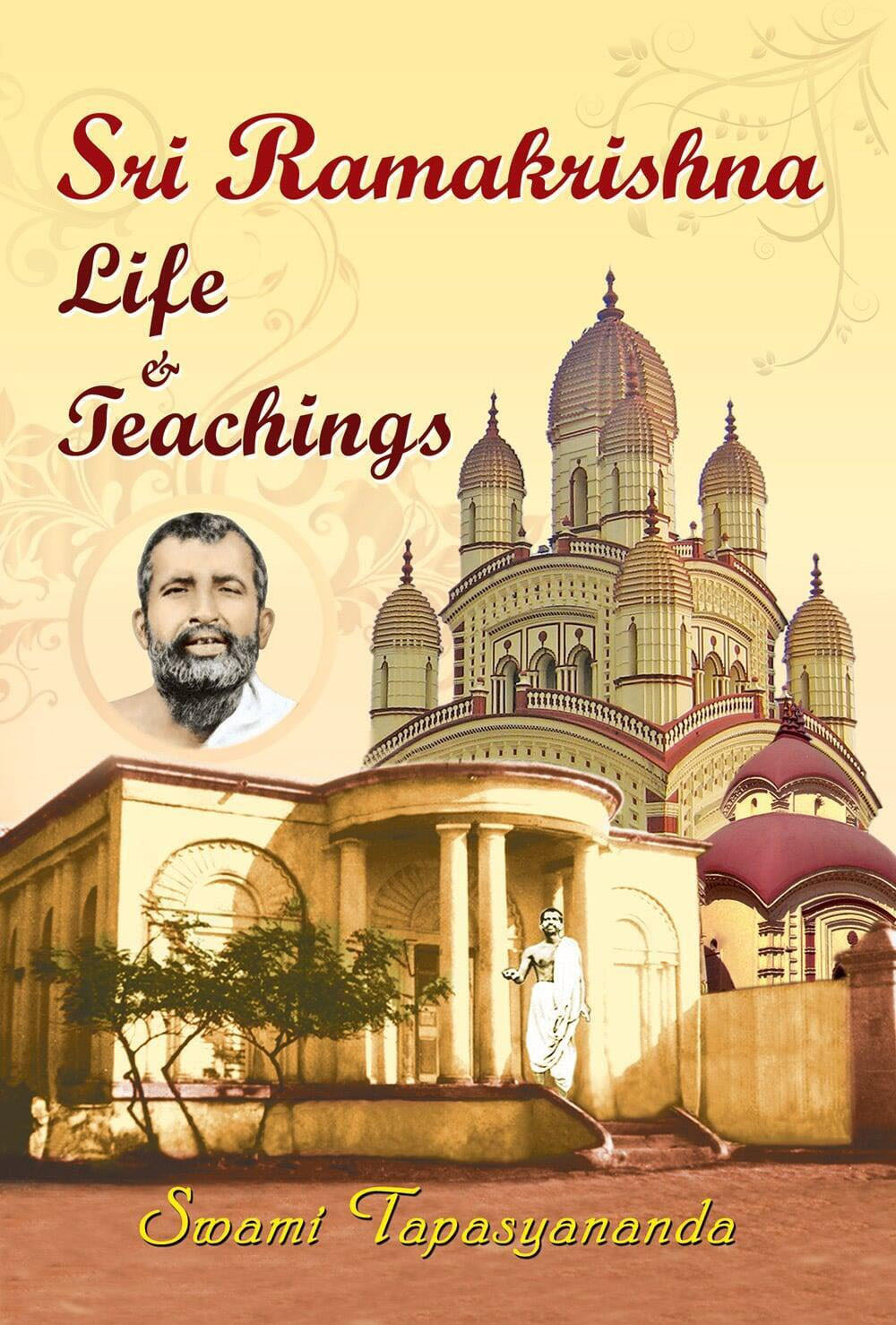
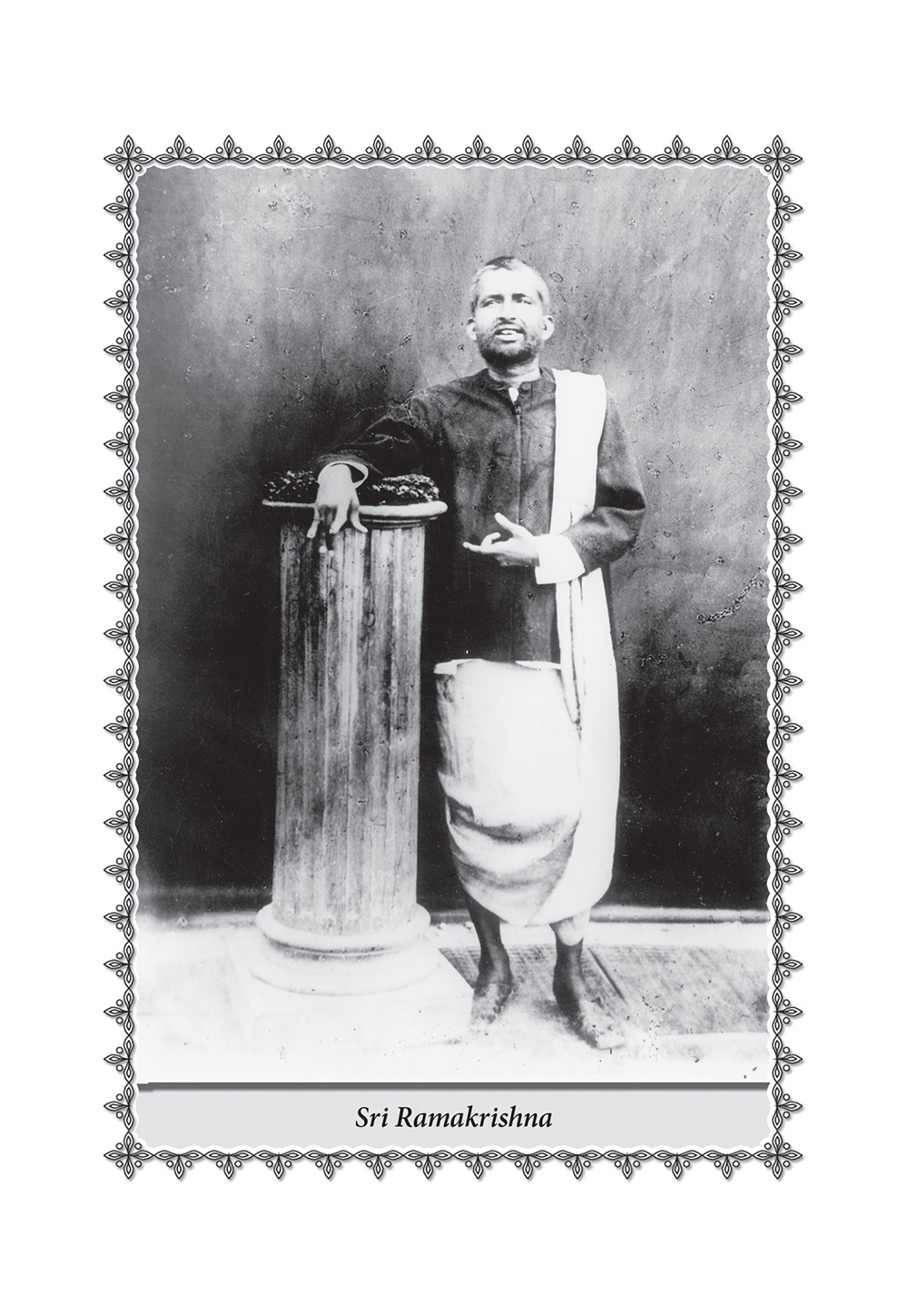
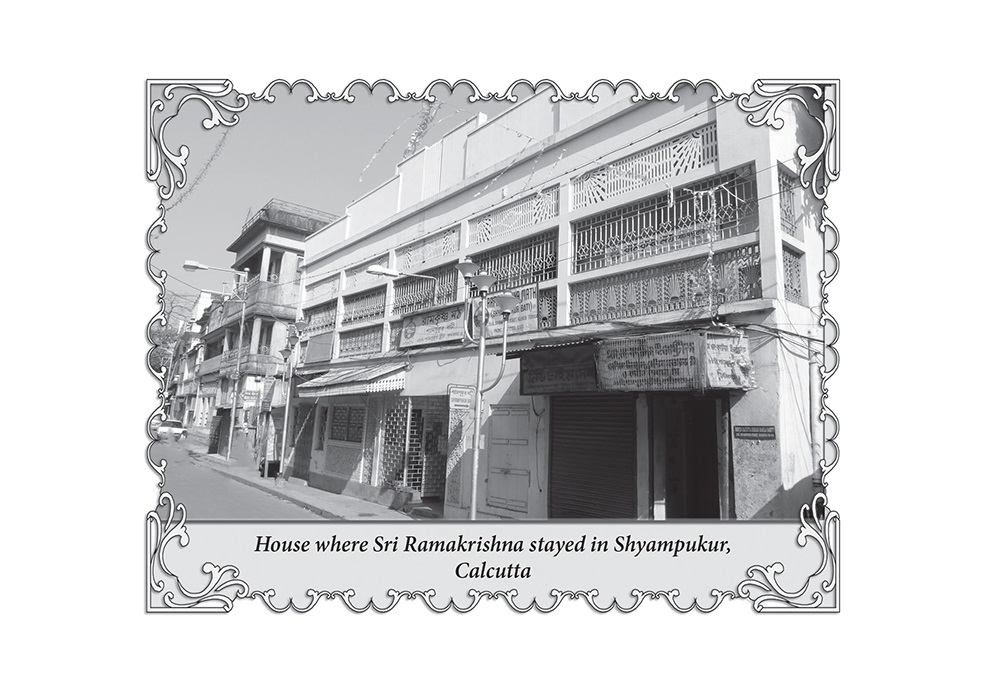
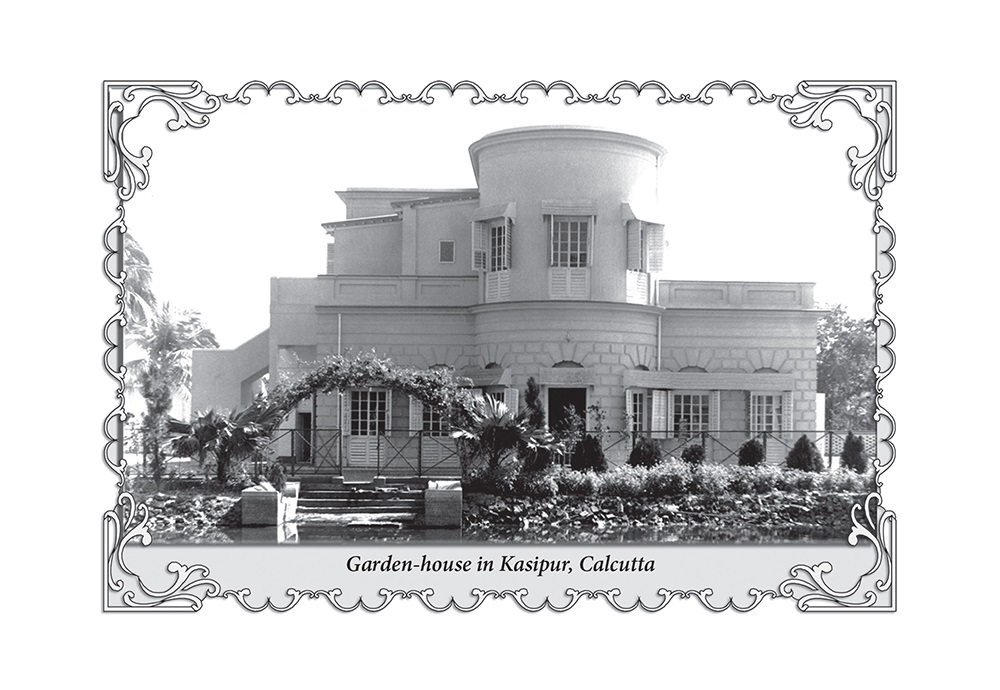
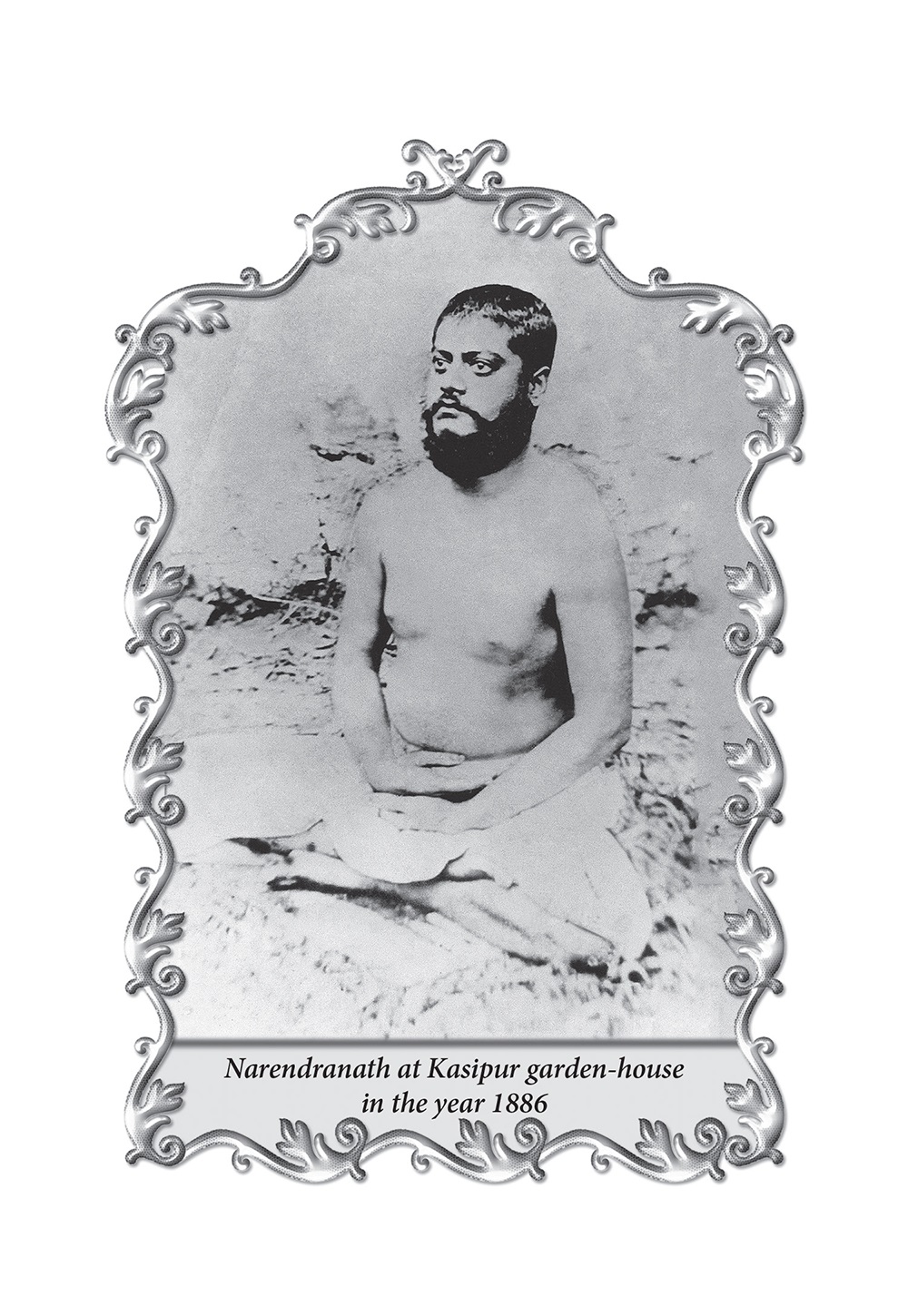
Sri Ramakrishna’s life and teachings have left an indelible mark on the religious history of the world. His life was one of constant communion with the divine. It is necessary to study and interpret his exalted life to understand the significance of his profound spiritual experiences. This task has been scholarly yet lucidly done by the author Swami Tapasyananda, who was a renowned scholar-monk and one of the vice-presidents of Ramakrishna Order. He has presented in an original and striking way a biographical narrative of Sri Ramakrishna, interspersing it with detailed analysis of his deep spiritual states. The book, therefore, serves as an excellent interpretation of the life and teachings of Sri Ramakrishna, for both devotees and scholars.
The story of Ramakrishna Paramahamsa's life is a story of religion in practice. His life enables us to see God face to face. No one can read the story of his life without being convinced that God alone is real and that all else is an illusion. Ramakrishna was a living embodiment of godliness. His sayings are not those of a mere learned man, but they are pages from the Book of Life. They are revelations of his own experiences. They, therefore, leave on the reader an impression which he cannot resist. In this age of scepticism, Ramakrishna presents an example of a bright and living faith which gives solace to thousands of men and women who would otherwise have remained without spiritual light. Ramakrishna's life was an object-lesson in Ahimsa. His love knows no limits, geographical or otherwise. May his divine love be an inspiration to all who read the following pages.1
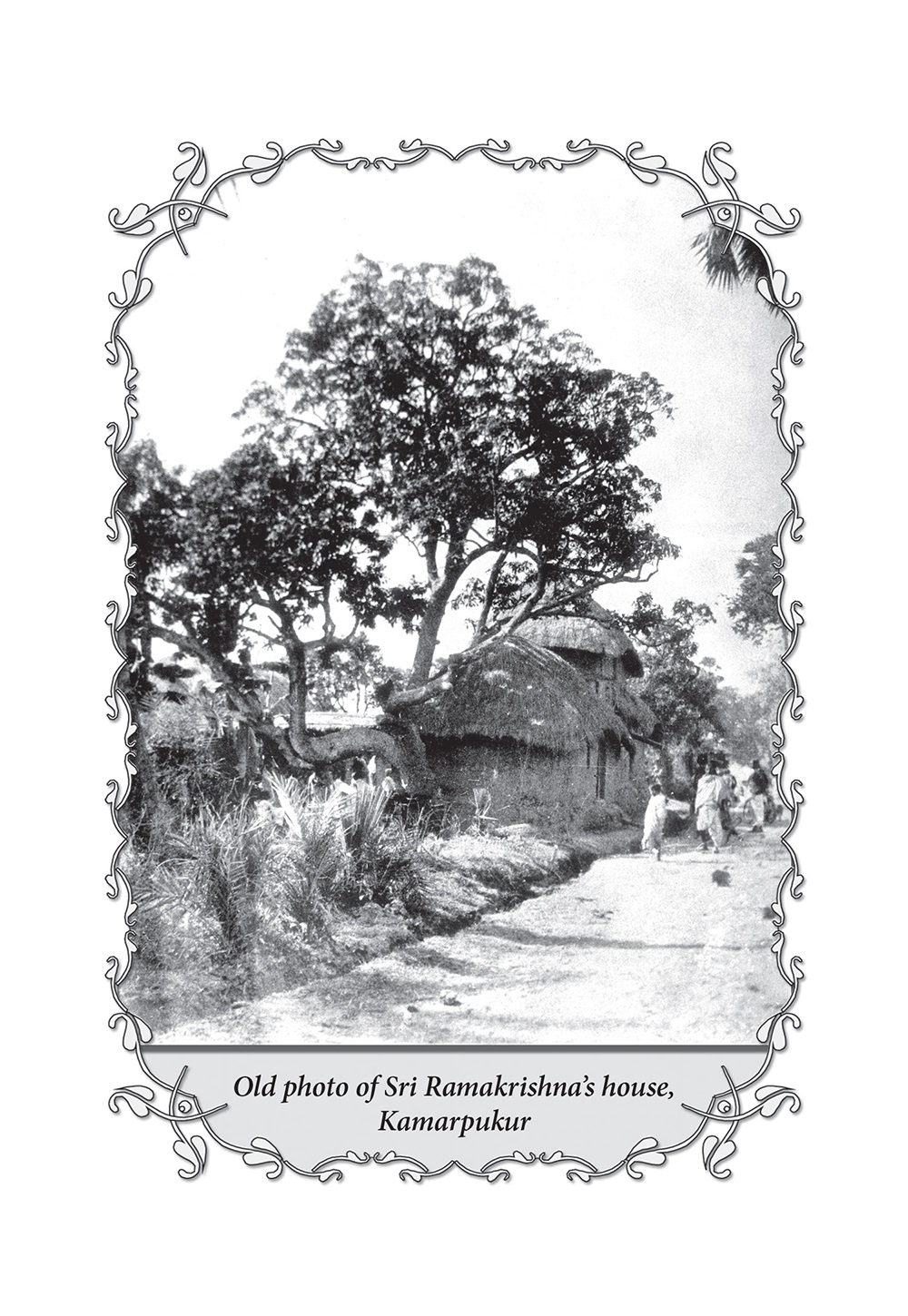
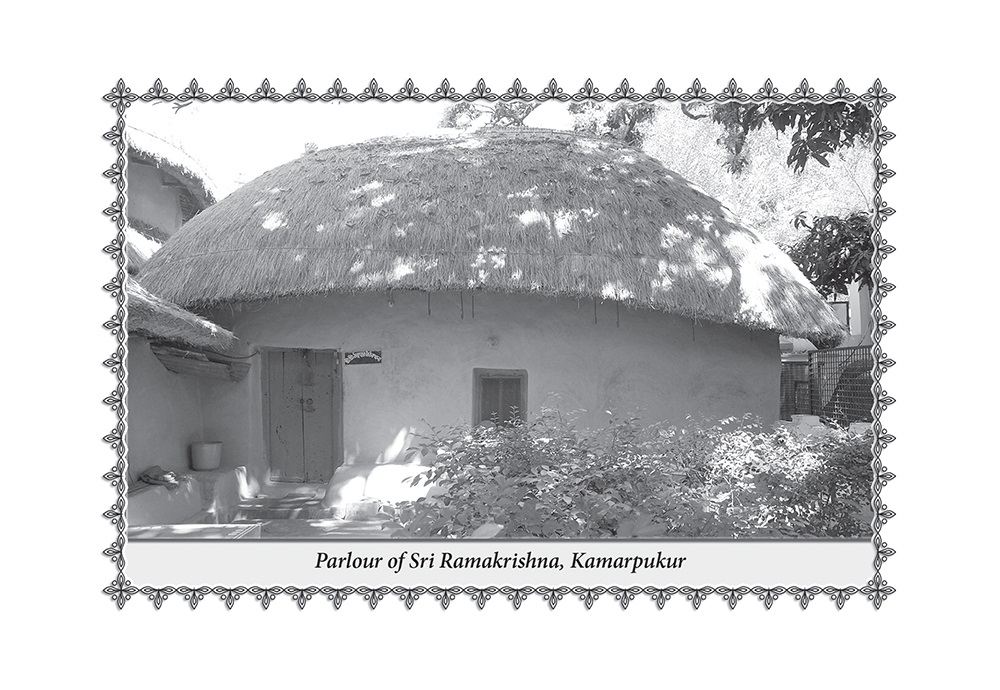
To trace to its very beginnings the life history of this great personage to whom Mahatma Gandhi paid the above encomium, we have to go back to the year 1814, when a pious brahmana [Brahmin] of the village of Dere [or Derepur] in Hooghly district of Bengal [now West Bengal] had to incur the wrath of his village zamindar. He had refused to bear false witness in favour of that village tyrant, and as a consequence he lost all the earthly property that he could call his own. He was thus compelled to migrate from his home village to another hamlet, known as Kamarpukur, in the same district. That pious and heroic brahmana, Kshudiram Chattopadhyaya, was the father of Bhagavan Sri Ramakrishna, whom the world today glorifies as a Divine Incarnation.
Kshudiram was not only a pious votary of truth, but also an intrepid pilgrim, who in those days of undeveloped communications went on an arduous pilgrimage of more than 1500 miles on foot to distant Rameswaram in the South about the year 1824. And it was on the occasion of another pilgrimage undertaken by him to Gaya in the year 1835 that Kshudiram got the divine message from Vishnu, the Deity of that temple, that He, the Supreme Being, would be born in his humble home as his son. His wife Chandramani Devi too had a similar forecast of a great birth through her.
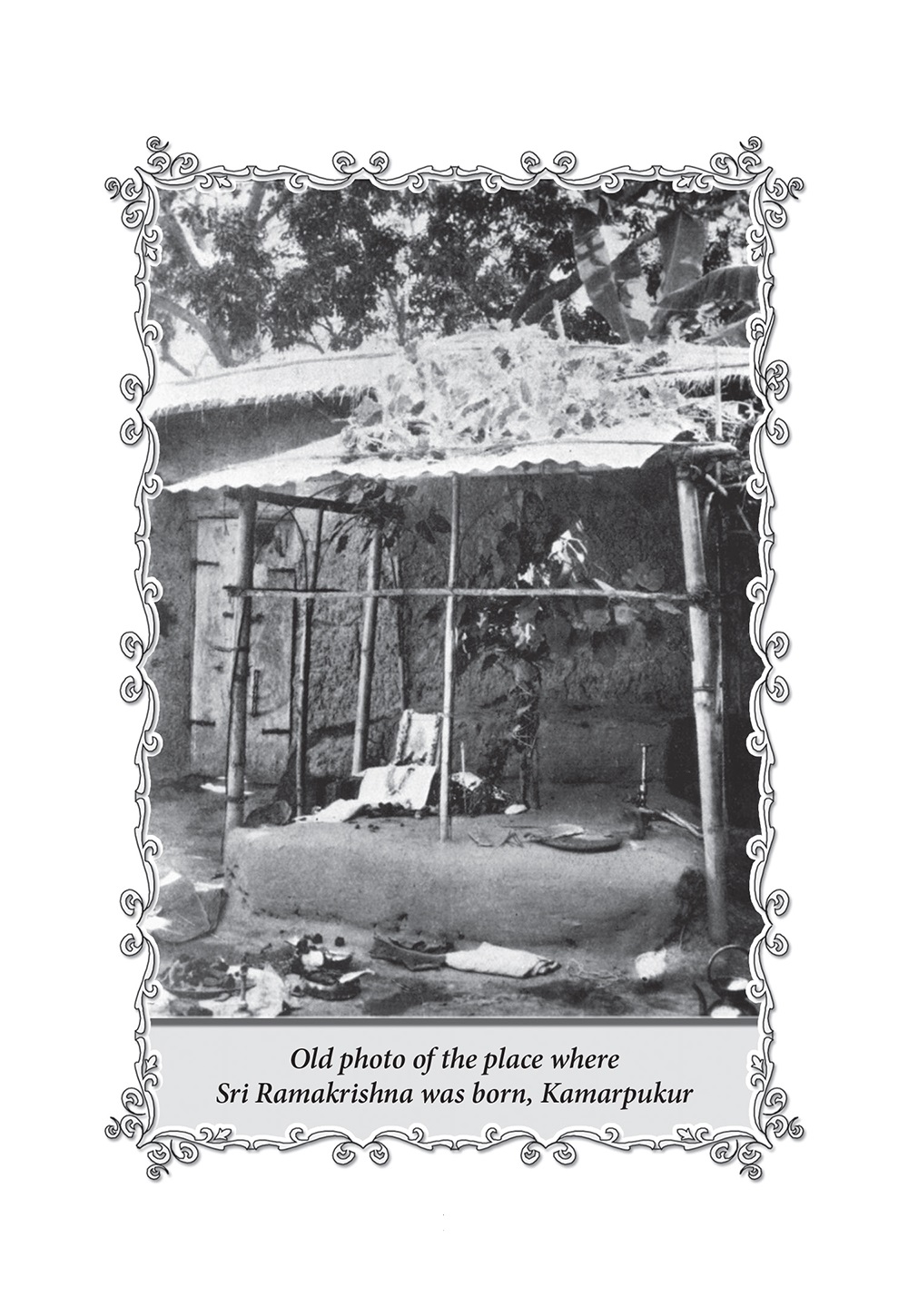
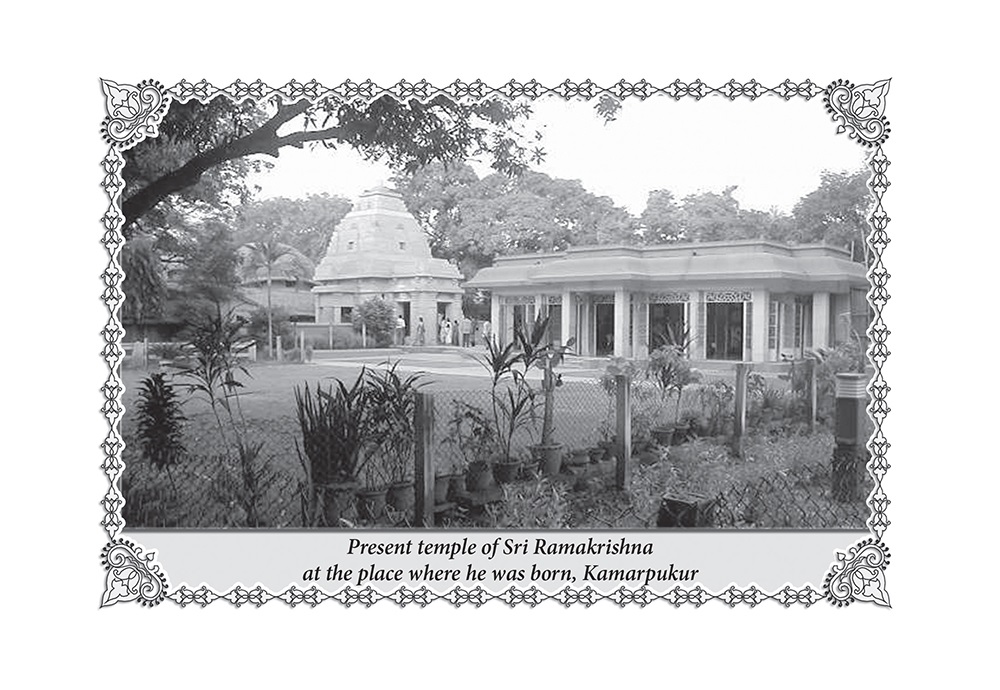
The earthly advent of this divinely announced son took place at about 5.00 a.m. [12 minutes before sunrise], on 18th February, 1836. The child was named Gadadhar, after Vishnu, the Deity of Gaya, who was the source of that Divine manifestation. The world has come to know him under the now famous name of Ramakrishna.
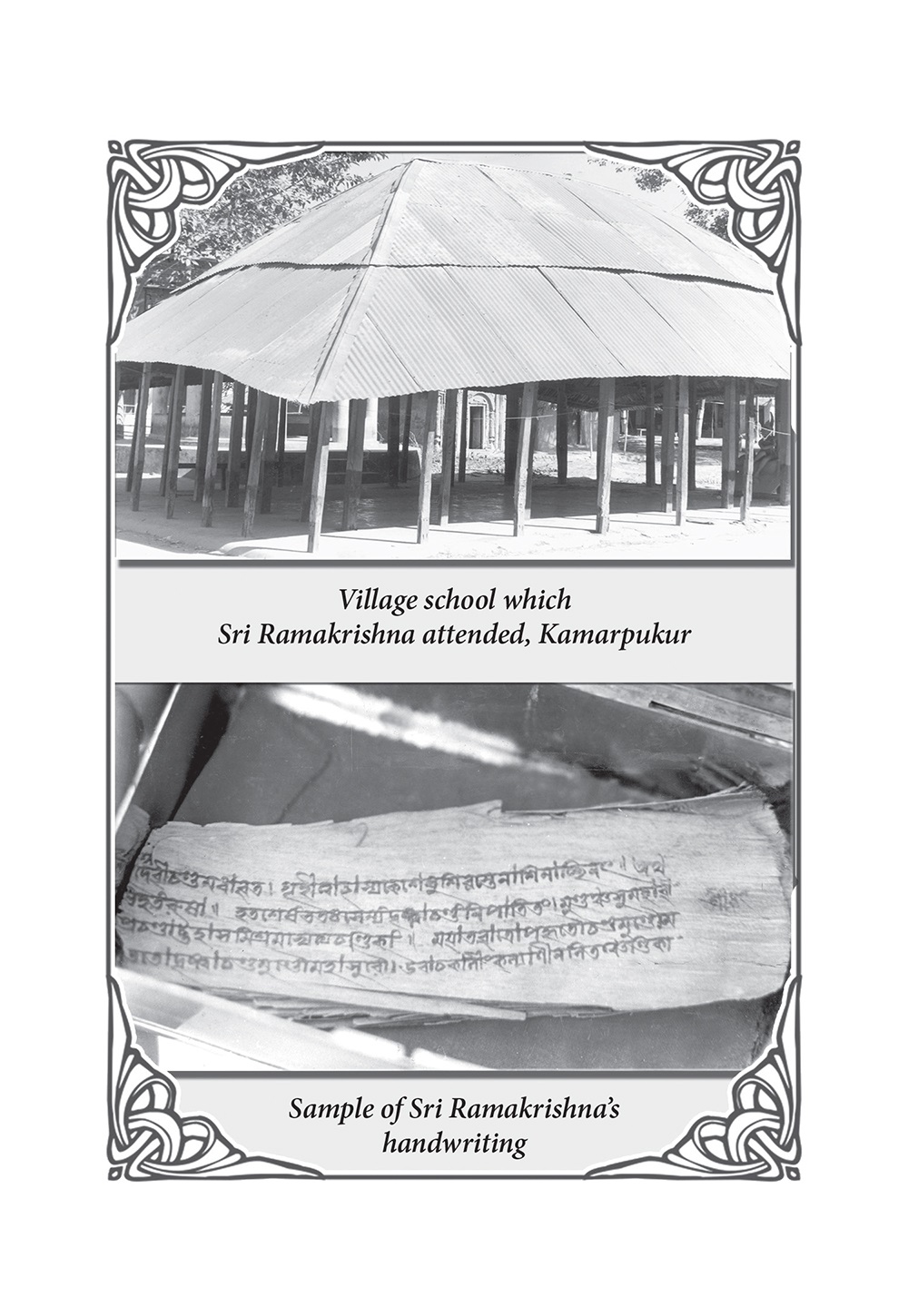
The infancy and boyhood of Gadadhar were marked by the seeds of those very characteristics which made people accept him in later days as a Redeemer of mankind, thus proving the truth of the old adage: ‘The child is the father of the man.’ He was remarkable for his great charm, like Sri Krishna. As an infant, he was the darling of the whole village, especially of the womenfolk; and as a boy—healthy, energetic, handsome, sociable and witty—he was the centre of attraction for all the boys and girls of his age. A sweet singer and possessor of great histrionic talents, as he proved to be with the advance of years, he became an amateur organiser of devotional dramas (yatras). Thanks to his prodigious memory, he mastered their songs after hearing them only once or twice during the performances given by professionals on festive occasions in the village. As for the formal education given in the village school, especially for the study of arithmetic, he showed little inclination; but he was not illiterate, as some platform orators make him out to be while describing his untaught wisdom. There are even now preserved copies of certain texts copied with his own hand. But his formal education did not progress much, as he was temperamentally artistic and therefore loved to spend his time in devotional music, yatra performances, clay modelling, etc., rather than to what in his mature years he branded as ‘bread-winning education’.
1. Life of Sri Ramakrishna, Swami Nikhilananda, Advaita Ashrama, Kolkata, 18th Reprint, 2011, Foreword by M. K. Gandhi.
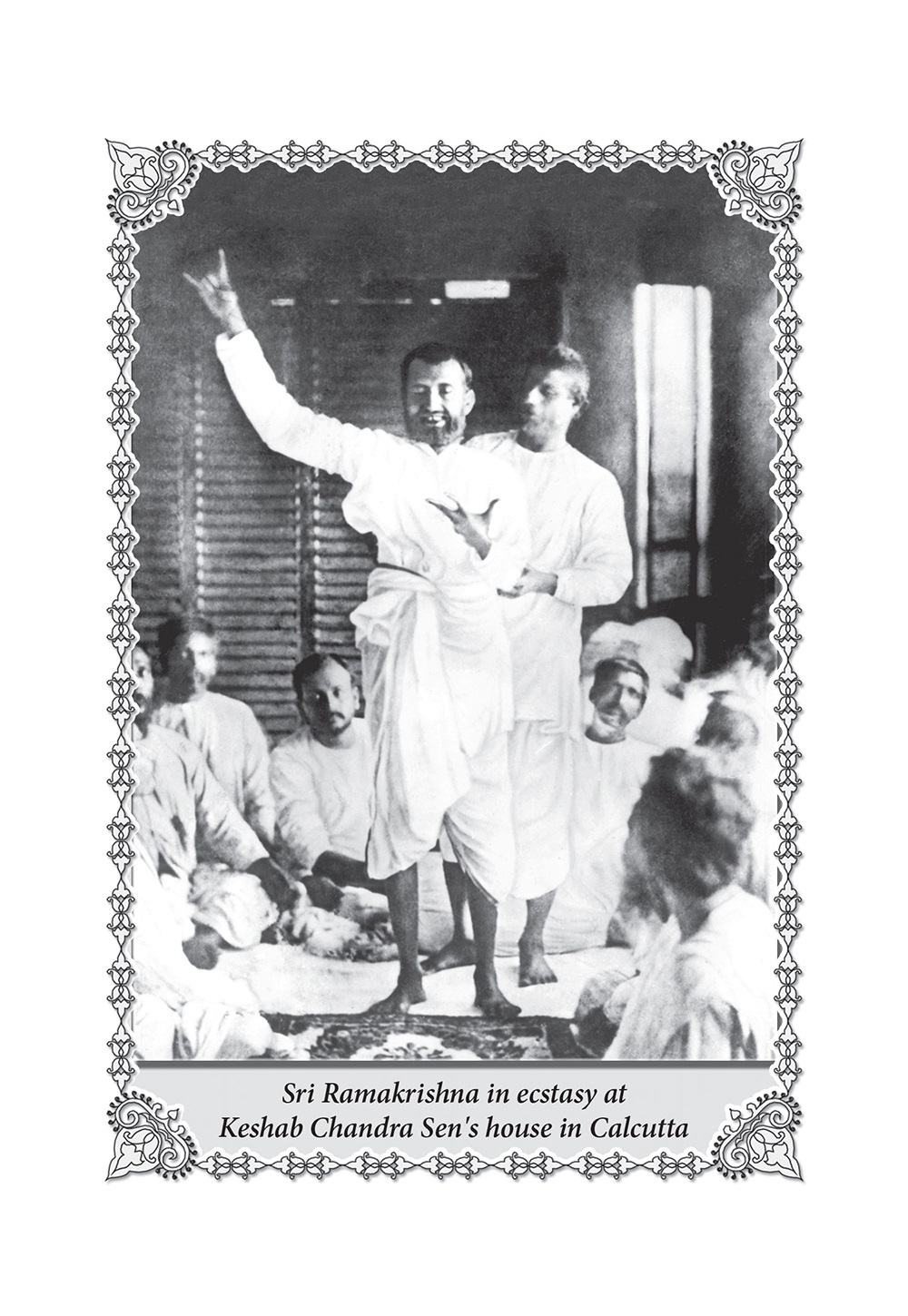
What distinguished Gadadhar most, from his early boyhood, was his intensely devotional temperament and his tendency to pass into spiritual ecstasies. The first instance of such ecstasies took place when he was six or seven. One day, he was walking along the baulk of a corn field, munching some parched rice given to him for his lunch on that day. Just then, he saw a mass of dark rain clouds overspreading the sky, with white cranes flying against that background. That enchanting contrast of colours and the beauty of Nature stimulated in young Gadadhar an intense awareness of Him, of whose glory Nature is but a faint reflector. Absorbed in the unspeakable joy of the new vista of trans-sensory Existence that had then opened out before him, he lost all external consciousness. It was his first taste of that state of superconsciousness in which he was to spend a large part of his later life.
Similar experiences, stimulated by situations of different types, came upon him in quick succession in the years that followed. One such instance was the experience he had a few months later, while on a pilgrimage to a neighbouring temple of Goddess Visalakshi in the company of a group of women pilgrims. As a sweet singer of devotional songs, and a versatile and attractive youngster, Gadadhar was already the darling of all the womenfolk of the village. So, the women pilgrims visiting the shrine of Visalakshi took him into their party. While trudging on, Gadadhar relieved his companions of the tedium of the journey by singing inspiring songs on Goddess with ecstatic fervour. The singing stirred the depths of his devotional nature so much that he lost his external sense through absorption in the divine consciousness that was then opened to him. It was only after a considerable time, with the ladies crying aloud the name of Visalakshi several times into his ear, that he could be restored to the ordinary level of consciousness. But as there was no evidence of physical exhaustion or disability arising from his supra-normal state, the pilgrim party continued its journey.
A year or two after this, he had another striking experience of this kind of ecstasy. The occasion was the Sivaratri festival, when the villagers had organised a yatra in adoration of Siva. The principal actor, who was to play the part of Siva, being unavoidably absent, Gadadhar, whose histrionic talents everyone in the village admired, was persuaded with great difficulty to play that part. When Gadadhar appeared on the stage dressed as Siva, his ecstatic fervour stimulated Siva-consciousness in everyone, and drew a loud, unanimous ovation from his audience. But in the pose of Siva in which he appeared, he continued to remain still; for, he had passed into an ecstasy in which he remained for the whole night. The audience had to disperse silently.
These spiritual and mystical proclivities of Gadadhar gained further intensity when he took up the worship of the Deity in the family shrine after his upanayana (investiture with sacred thread) at the age of nine. Besides, the sudden death of his pious father in 1843 had begun to make young Gadadhar more introspective, because of the impact of the profound questions about life and death on his impressionable mind. All these, together with his preoccupation with devotional songs and dramas and visiting sannyasins, and pilgrimages to holy shrines of the neighbourhood, gradually weaned him away from attending the village school.
Utterly neglecting his formal education, he grew up in this way till the age of seventeen, when he was required by his elder brother Ramkumar to go with him to Calcutta [now called Kolkata] to assist him in conducting a tol (a Sanskrit school) which he had organised there. Perhaps, the brother was also much concerned about Gadadhar's neglect of his studies and its consequences on his future worldly prospects. His own need and his concern for his younger brother must have induced Ramkumar to take Gadadhar to Calcutta in 1852, thus drawing down the curtain that closed the first chapter of his life.
In Calcutta, Gadadhar was entrusted with the worship in a family temple, which Ramkumar had undertaken as a source of supplementary income. Gadadhar was also expected to attend the Sanskrit school conducted by his brother. The former duty was very congenial to Gadadhar. Besides doing the worship with great devotion, he spent much of his time in devotional singing, and formed a circle of lady devotees and friends who eagerly sought his attractive and inspiring company to hear his soul-stirring songs, which they had never heard anyone else sing with such fervour and devotional abandon. As a consequence, he was left with no time to pursue his secular studies, which he continued to neglect as in his Kamarpukur days. His kind and loving brother tolerated his negligence for a few months as a compensation for Gadadhar's loss of his carefree village life. But at last, when he found in him no inclination to mend his ways, he remonstrated with him and admonished him for neglecting his studies. Gadadhar's sharp and uncompromising response to this is embodied in his now famous reply:
I do not want to learn the art of ‘bundling rice and plantain’ [i.e., bread-winning]. What I do want is an education which produces right knowledge and enables man truly to achieve the real aim of his life.2
This put the final seal on his educational career; and marked the diversion of his life from the beaten track to the adoption of a course which would lead him to the summits of spiritual ascent.
2. Sri Ramakrishna the Great Master, Swami Saradananda, Tr. Swami Jagadananda, Sri Ramakrishna Math, Chennai (hereinafter Great Master), Vol. I, 15th Print, 2009, p. 126
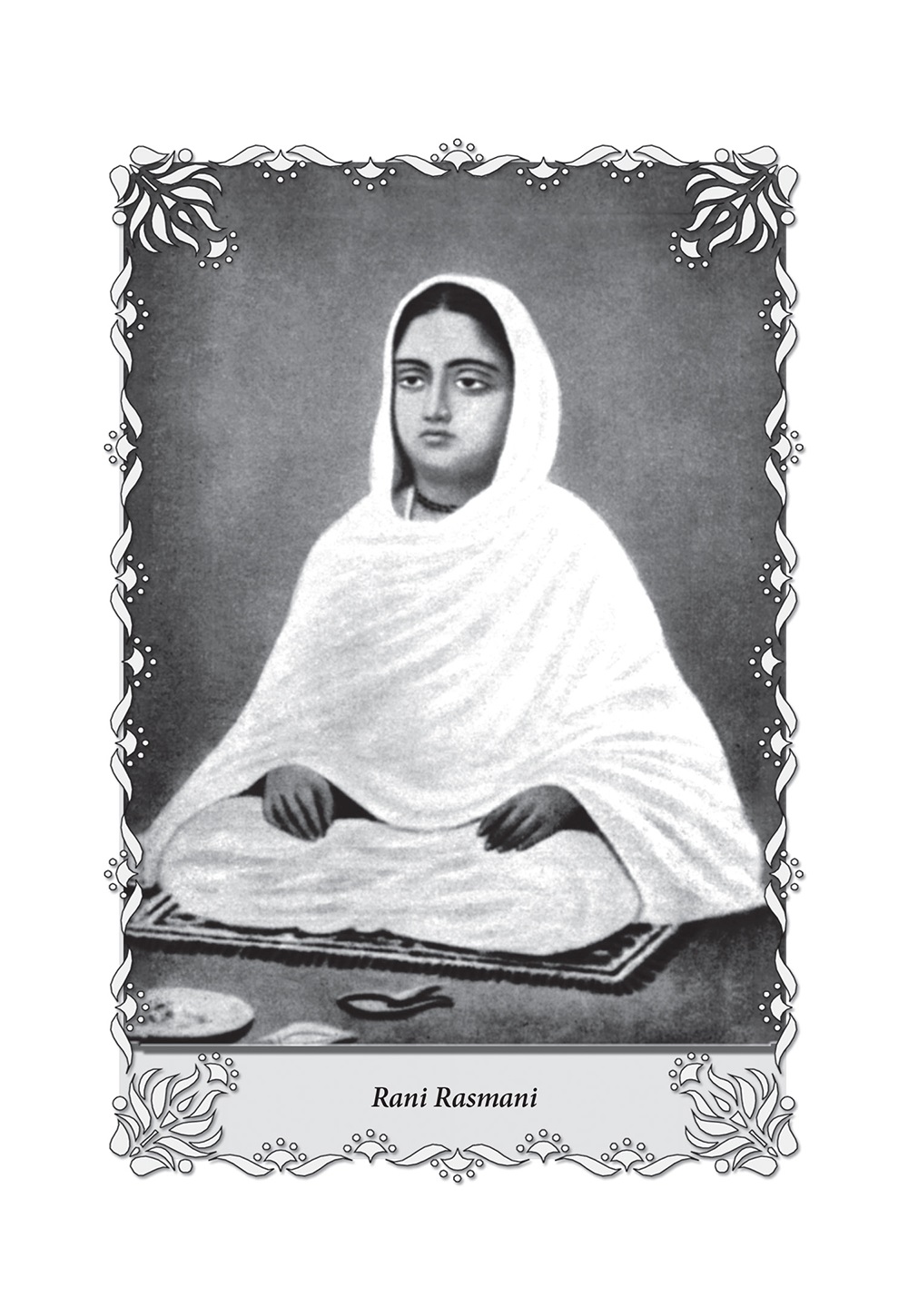
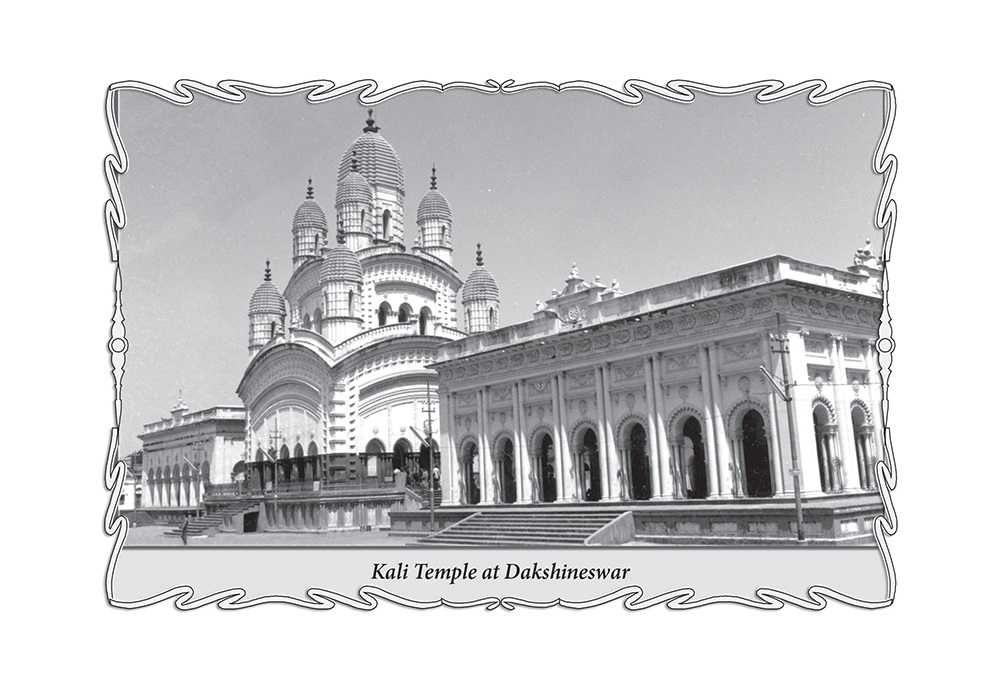
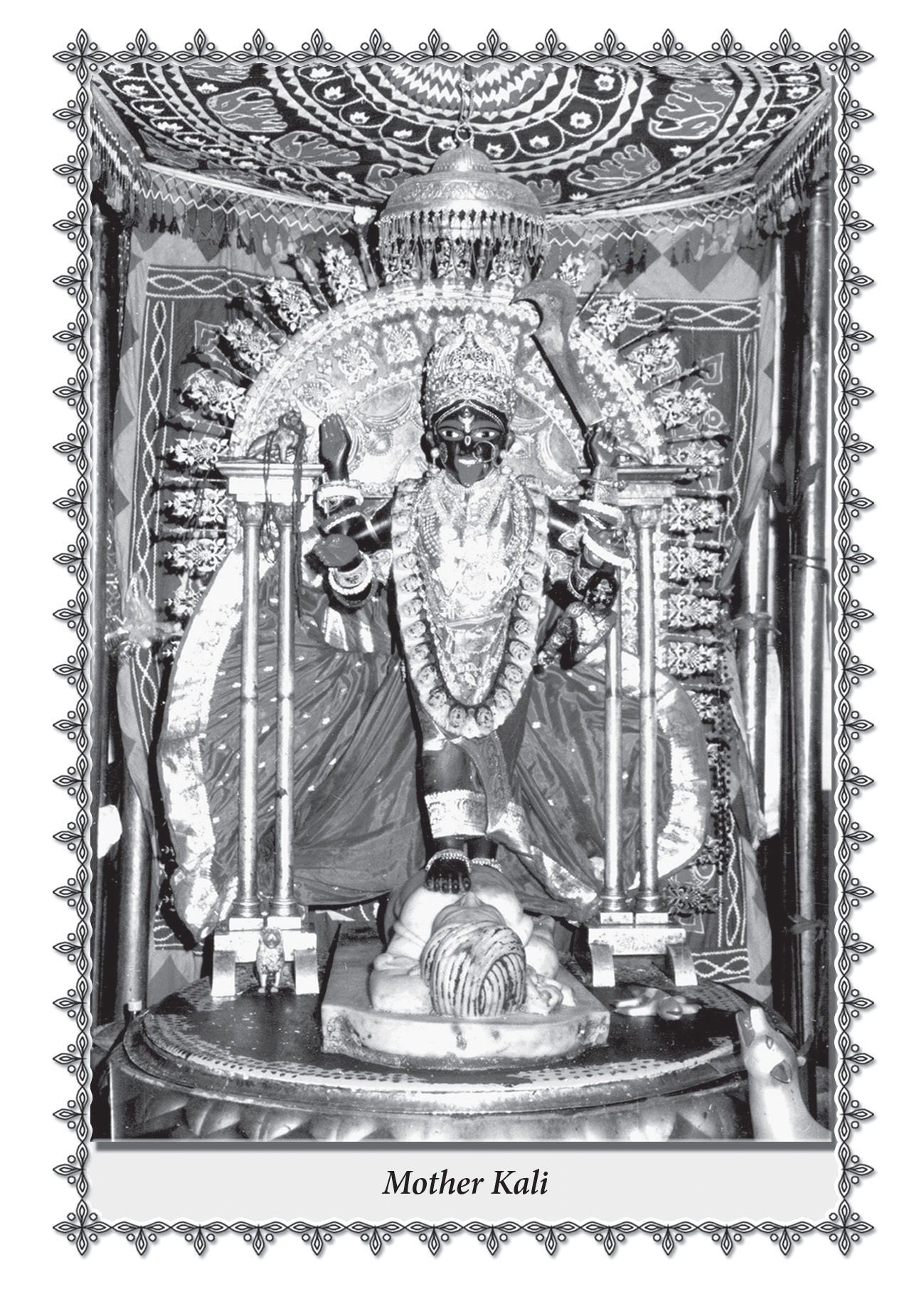
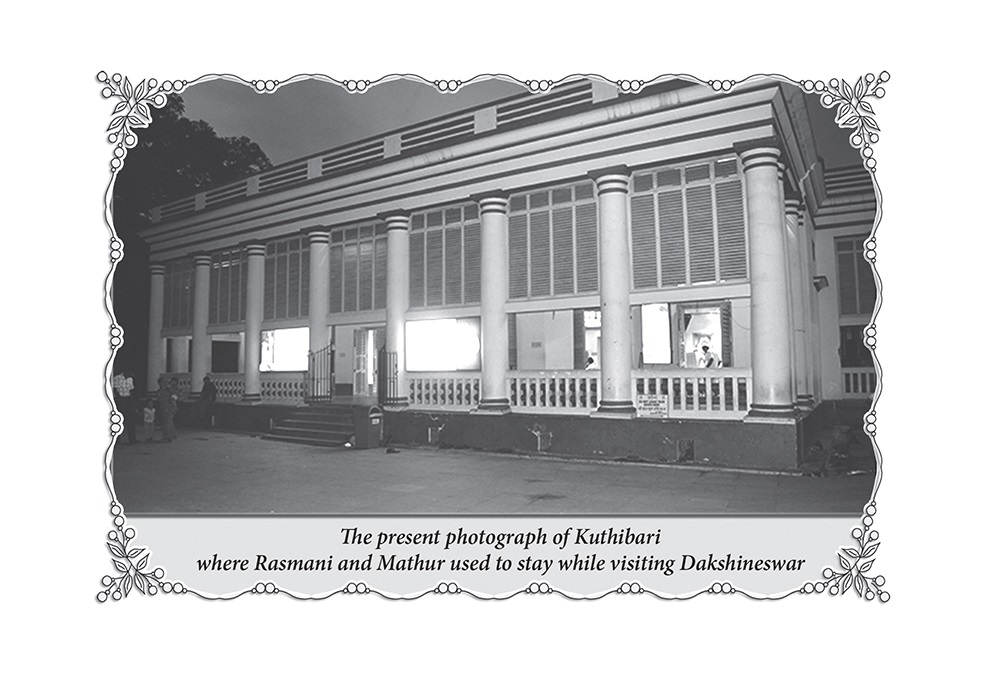
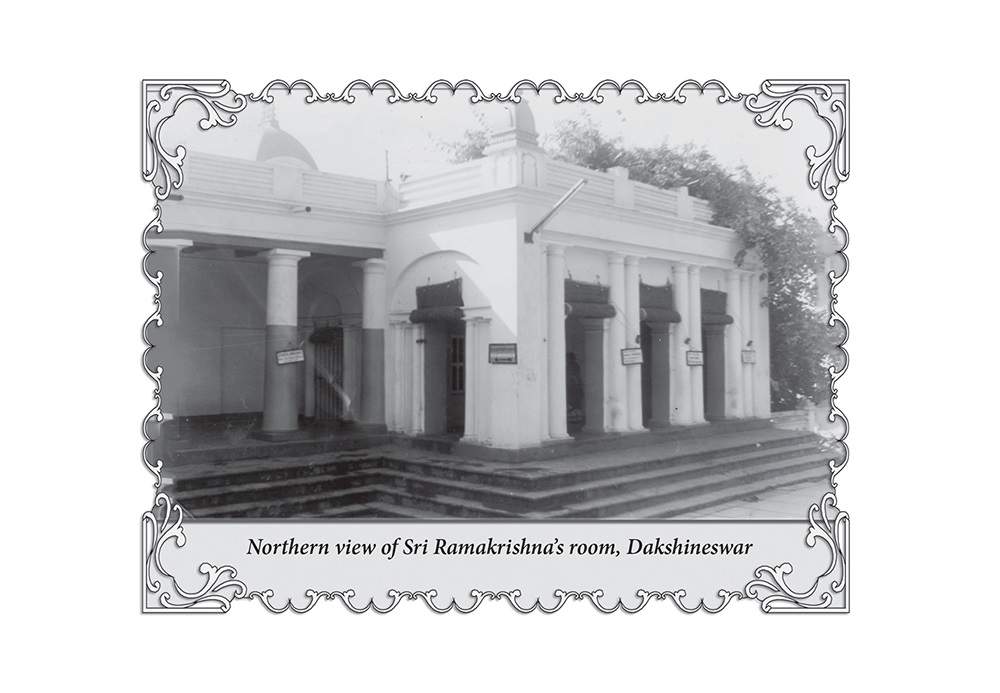
It was about three years after Gadadhar's arrival in Calcutta that there came into existence in 1855 a great temple of Kali at Dakshineswar, which was destined to be the venue for the unfoldment of the limitless spiritual potentialities of Gadadhar. The temple was built by a rich, pious, and philanthropic lady named Rani Rasmani, at a spot that was divinely ordained. When the Rani was on a pilgrimage to Varanasi, the fleet of boats which was carrying her and her party anchored one evening at Dakshineswar, a suburb of Calcutta. That night, the Rani had a dream in which Mother Kali commanded her to found a temple there on the adjacent bank—a pious act which, she was told, would be equal to her going to Varanasi. Hence arose the now famous temple of Dakshineswar, to which Gadadhar would move from the Sanskrit school in the year 1855, the year of the consecration of the temple. The priest who installed and consecrated the Divine Image and became its first officiating priest was none other than Gadadhar's brother Ramkumar, who on account of his new avocation had to close his Sanskrit school and take up his residence at Dakshineswar. Gadadhar followed him and settled in the temple complex, which continued to be his home for the next three decades, until the year 1885, when he was moved for treatment to Calcutta during his last illness.
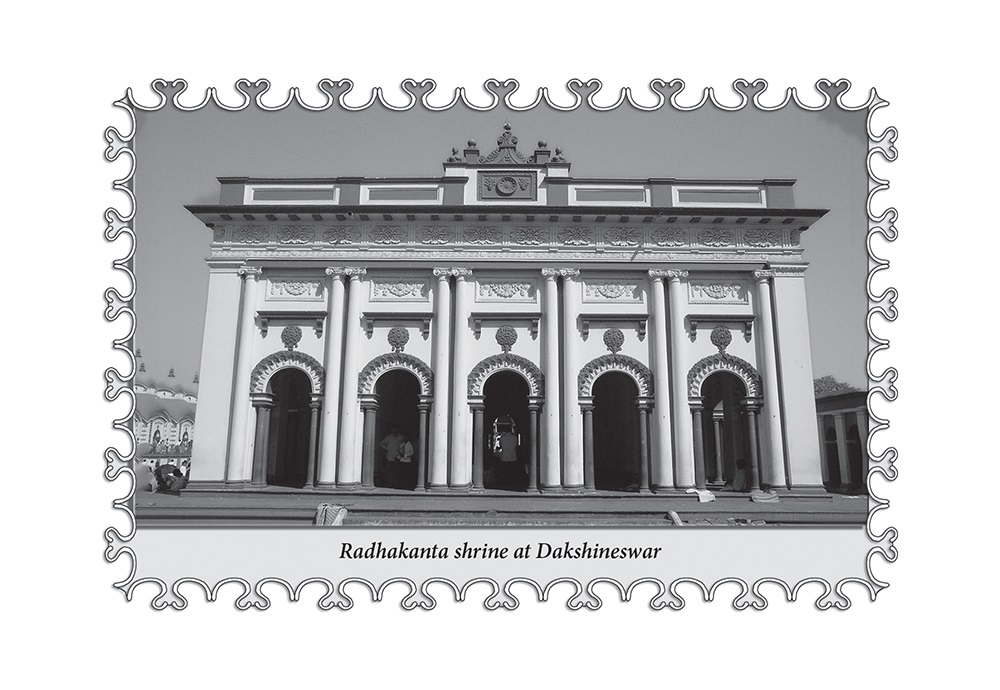
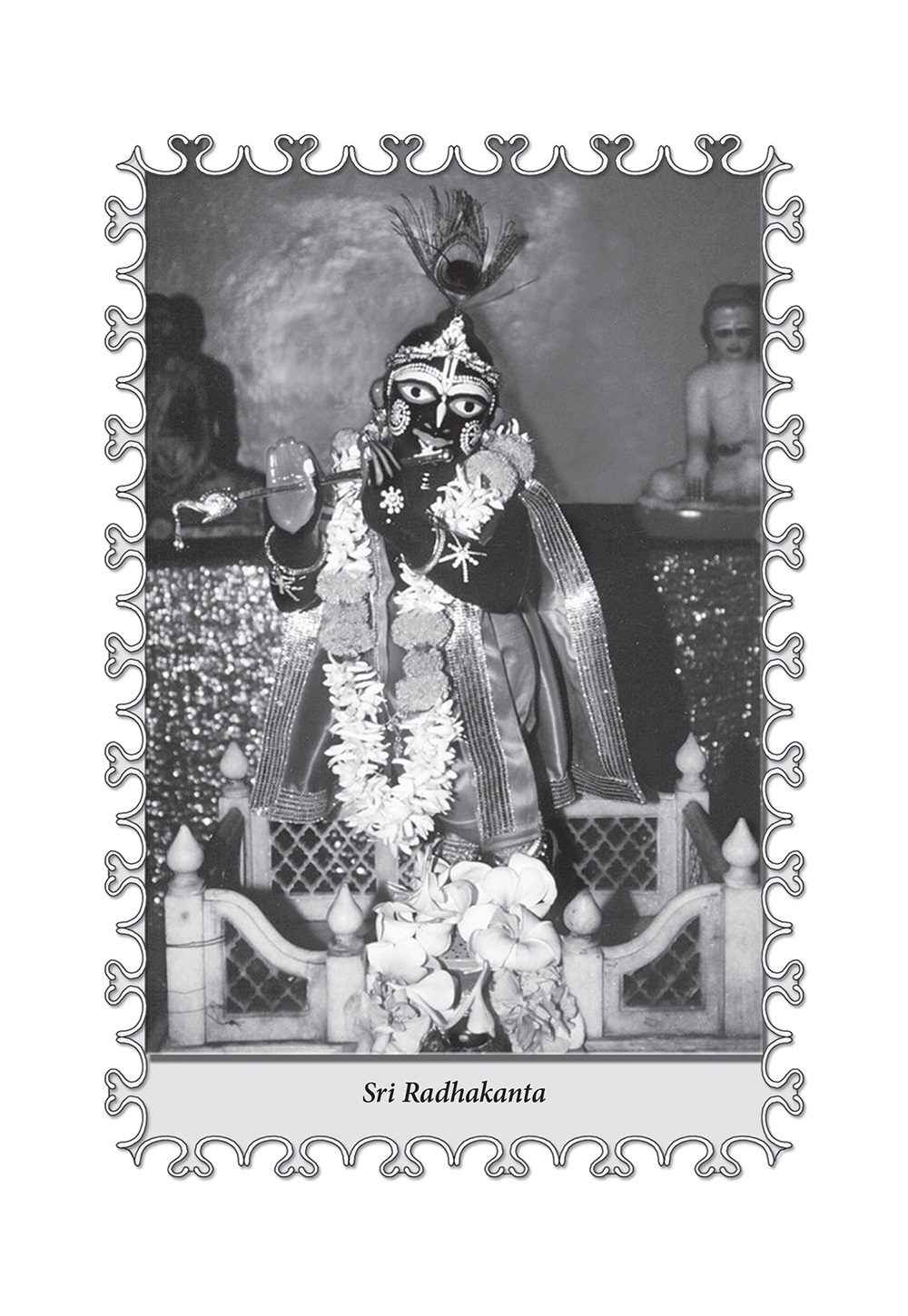
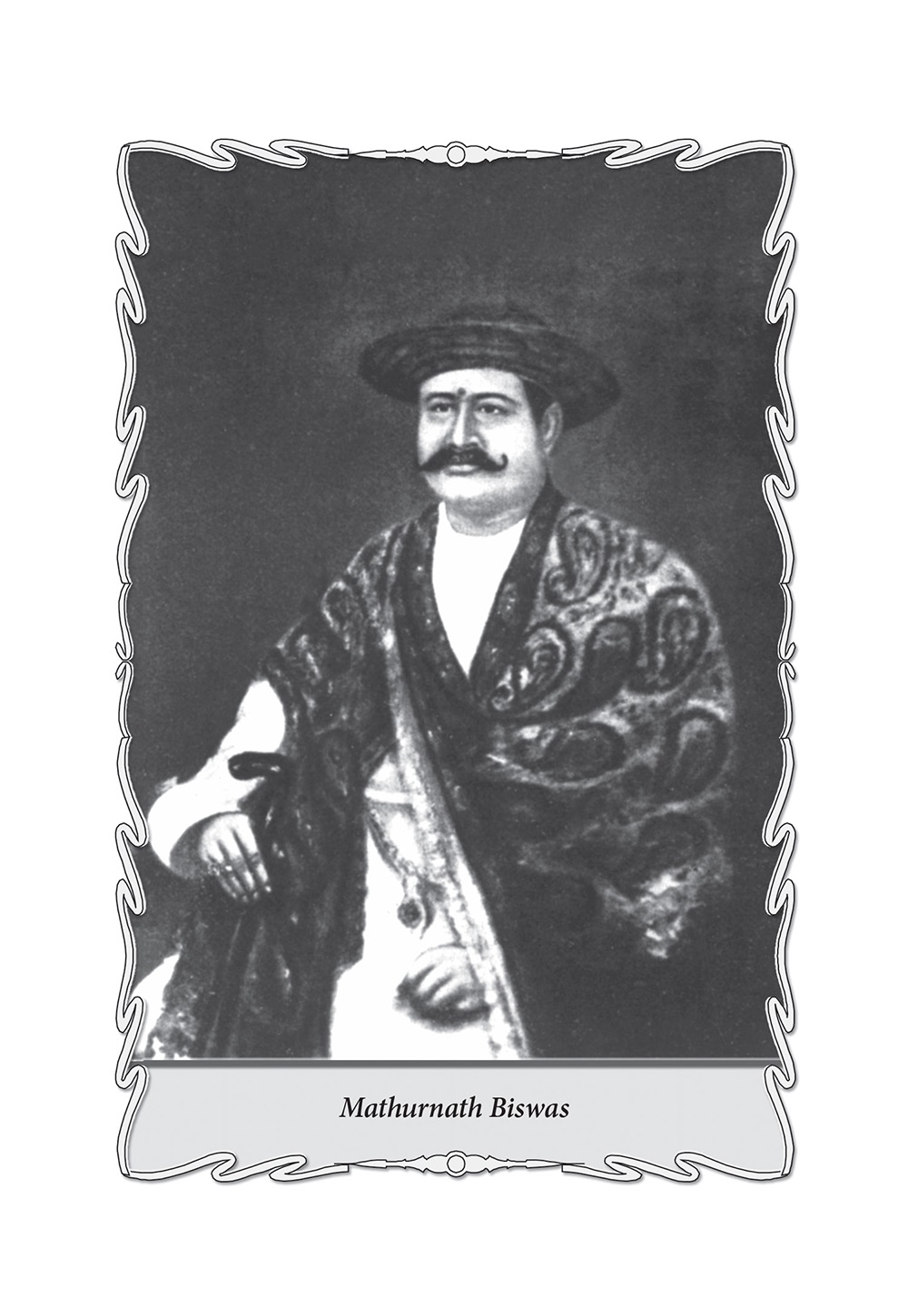
From the commencement of the association of the Chattopadhyaya family with the Dakshineswar temple, the devotional temperament and the striking personality of this younger brother of the temple priest Ramkumar had attracted the attention of the proprietress Rani Rasmani, and especially of her son-in-law and principal deputy, Mathuranath Biswas. They therefore wanted to appoint him as one of the temple priests; but Mathuranath had to take considerable pains before he could break the reluctance of Gadadhar to accept, at first the post of a priest in the minor shrine of Radhakanta, and later on, that of the chief assistant in the shrine of Mother Kali under Ramkumar. With the demise of Ramkumar in 1856, Gadadhar was appointed the principal priest in the Mother's shrine, with his nephew Hridayram as assistant.
The commencement of his priesthood in the Mother's temple marked a turning point in the life of Gadadhar. Even earlier, when he was being groomed in the duties of a temple priest and was initiated into the mantra of the Divine Mother, Gadadhar had, at the very utterance of the sacred syllables in his ear, gone into a state of deep concentration and ecstasy. His buoyant and cheerful nature turned into a grave and introspective one. Unlike ordinary priests, who followed only a mechanical routine of rituals with very little devotional fervour, Gadadhar was found to get absorbed in the worship, and at the end of it sing inspiring songs for hours in praise of the Divine with a devotional abandon that is seldom seen in others. Outside the hours of duty, especially at night, he was found to disappear from his room. When questioned by his nephew and assistant Hriday, he replied that he went into a neighbouring solitary spot to meditate on the Mother in the silence of the night. Hriday tracked him to his place of retreat, a bushy spot in the temple complex, and tried to frighten him by throwing stones from a distance. Failing in his objective, he one day went to the actual spot. He was aghast to see his uncle sitting stark naked, having put aside all his clothes and even his sacred thread. Since Gadadhar was completely oblivious of the external world, Hriday had to wait patiently for a long time before he could ask his uncle for an explanation of what seemed to him an unthinkably strange conduct. The startling reply he got was, ‘This is the way a devotee should call on God. Since our very birth, we have an eightfold fetter of hatred, shame, caste, culture, fear, fame, pride, and egoism. The sacred thread gives the feeling that one is a brahmana, superior to all. So, I remain setting even that aside, while contemplating on the Mother. I put it on afterwards.’3
Such conduct on his part, besides his behaviour during the time of worship, made Hriday fear that his uncle was heading for a mental upset due to his excessive devotional zeal.
All these strange developments in the behaviour of Gadadhar were the result of his inward spiritual experiences and the profound transformation that was gradually taking place in his outlook on life as a consequence. The daily worship of the Image of the Deity in the temple brought pointedly to his mind the question of questions: Is the Deity, prayed to and adored, true? Or, is it a mere imagination? To him, this question was neither merely conventional, as to ordinary persons, nor merely intellectual, as to rationalists. It grew into a matter of life and death as days rolled on. There are three hungers in a human being—the hunger of sex, the hunger of the stomach, and the hunger of the heart. In worldly-minded men, only the first two hungers operate, as in animals, while the third is almost absent. In a select few, the third makes a sporadic appearance; but in Gadadhar it became the constant and dominant urge—so dominant that it extinguished in him the other two, which he characterised in his teachings in his mature years as the pursuit of kamini-kanchana (lust and lucre). If God is real, He must be realised as the most substantial of all existences; and if He is an intelligent and responsive existence, He must respond to the yearning of the prayerful and adoring heart of His devo-tees. This way of thinking seized his soul with an intensity that made him constantly cry for his Mother, an act which looked like madness to the eyes of others.
In the days that followed, the intensity of his yearning grew into unheard proportions. Whole days and nights passed unnoticed on account of his mental absorption. When the close of the day was announced by the temple bell, the thought that a day in this short life had passed away, and yet he had not reached anywhere near the realisation of his spiritual ideal, filled him with such a tremendous sorrow of unsatisfied yearning that he would rub his face on the ground in agony and self-punishment. He cried aloud, ‘O Mother! One more day has passed in this short life, and You have not yet manifested Yourself to me.'
The intensity of that yearning, which he would describe in later days, was that of a man struggling for air when he is held underwater. It was something organic. Another metaphor with which he used to illustrate its continuing persistence was that of a robber who knows that he could reach the treasure in the next room by breaking the wall. The wall is analogous to the wall of maya that separates the jiva from the Lord.
Spending thus days and nights without food or sleep, thinking agonisingly about not having got the realisation of the Mother, he reached a point when life seemed to be meaningless. In a frenzy of divine madness, he was about to sacrifice himself [by slitting his throat] with the ritual sword kept in the shrine. That was the point at which the screen was drawn, and behind what was previously experienced as the world in space and time stood revealed the Supreme Being—the Sat-Chit-Ananda or the Universal Mother.
Explaining the rationale for this experience in his simple, homely way in later years, he would say that the Divine Mother is like a housewife who puts several children in the nursery to play and then disappears to attend to her work. The children spend long hours playing with the toys and eating the sweets that the mother has left for them. They forget the mother in their engrossment in play. At last, a child begins to be hungry, remembers the mother, and cries for her. The mother understands the cry of a really hungry child, and she cannot keep herself away from such a child. She comes and takes him up in her arms. The Divine Mother is like that. When a devotee abandons all interest in kamini-kanchana and cries for the Mother in agony of the soul, She responds by revealing Herself.
Then Nature, hitherto appearing as predominantly inert, all red in tooth and claw, stood revealed as Sat-Chit-Ananda, the Personal- Impersonal Divine.
Describing this encounter with the Divine, he said to his disciples afterwards:
It was as if the houses, doors, temples and all other things vanished altogether; as if there was nothing anywhere! And what I saw was a boundless, infinite, Conscious Sea of Light! However far and in whatever direction I looked, I found a continuous succession of Effulgent Waves coming forward, raging and storming from all sides with great speed. Very soon they fell on me and made me sink to the abysmal depths of Infinity. I panted and struggled, as it were, and lost all sense of external consciousness.4
I did not know what happened then in the external world—how that day and the next slipped away. But, in my heart of hearts, there was flowing a current of intense bliss, never experienced before, and I had the immediate knowledge of the Light that is the Mother.5
Such intense longing and extraordinary experiences had a shattering effect on the nerves of even Gadadhar, whose body and mind were highly sattvic, and it took some time for his bodymind to get adjusted to the new life that dawned on him through these experiences.
In place of following the code of rituals, Gadadhar gradually began to behave towards the Image as if it were a living person. He would talk with the Image, feed food to Its mouth, invite It to go to sleep, wave the light and the cowrie fan for indefinitely long periods, and thus perform all parts of worship quite forgetful of time and the surroundings, as if he were living in a world of his own.
Before long, the irregularities of worship came to the notice of the temple staff, who felt that by the breach of ritualistic procedure, the new priest was desecrating the Image. They made a report to the proprietor of the temple, Mathuranath, Rani Rasmani's son-in-law and deputy. So, Mathur came one day for a surprise inspection in order to study matters on the spot. Unlike the small- minded temple employees, Mathur could see that intense devotion was at the back of the strange conduct of the young priest and therefore ordered his subordinates, to their great disappointment, not to interfere with him in any way. Mathur's admiration for Gadadhar only increased tenfold by what he saw.
Within a few days, however, another shocking act of Gadadhar led to a very tense situation in the temple. One day, the proprietress Rani Rasmani came for worship, and at her request Gadadhar began to sing some devotional songs for her to listen to, while she herself sat nearby listening. Suddenly, Gadadhar sprang from his seat, and to the surprise of all, slapped her twice with the words, ‘Here also you are indulging in those same thoughts!’
The Rani was actually cogitating about some pending lawsuits, which Gadadhar had come to understand intuitively. The world-teacher in him was roused to consciousness. Rising far above the conventional chasm separating them as an employer and an employee, he saw the great Rani as an erring pupil or daughter to be chastised for her transgression of the path of devotion by indulging in worldly thoughts even during prayer and worship. The temple servants were happy, thinking that here was an opportunity to get rid of the troublesome priest, as the Rani, the proprietress, had just seen a demonstration of his eccentricity. But the Rani took the incident as a well-deserved corrective from the Mother Herself and ordered the temple manager to ignore the incident. Her regard and admiration for the young priest only increased all the more after the above incident.
In the meantime, Mathuranath, who had developed great love and reverence for Gadadhar, appreciated his difficulty in performing the ritualistic duties of the temple in that state of mind. He therefore allowed him to live in retirement to pursue his spiritual inclinations, and the worship in the main temple of the Mother was entrusted to Hriday.
Men see insanity in anyone whose behaviour is not in conformity with their own, forgetting that such discordance can arise from both abnormal and supra-normal conditions. In the former case, the man's personality splits and disintegrates, while in the latter, integration is achieved as a centre of power and wisdom. This was the case with Gadadhar. But these are matters too subtle for ordinary people to recognise; and so all, including Gadadhar's nephew Hriday, believed that his mind was getting deranged. Even Mathuranath, who had already become a great admirer of Gadadhar and befriended him in all situations, was veering round to the view that, due to devotional excesses, some physical and mental aberrations had set in. He put Gadadhar under the treatment of noted kavirajs (Ayurvedic physicians), but medicines had little effect on him. Later, one of these Ayurvedists, Durgaprasad Sen, declared that these were the symptoms of some spiritual state of mind, and medical treatment could do little to cure him. It remained for the Bhairavi Brahmani in later days to identify the cause and prescribe the cure for what appeared to others as the abnormal condition of Gadadhar.
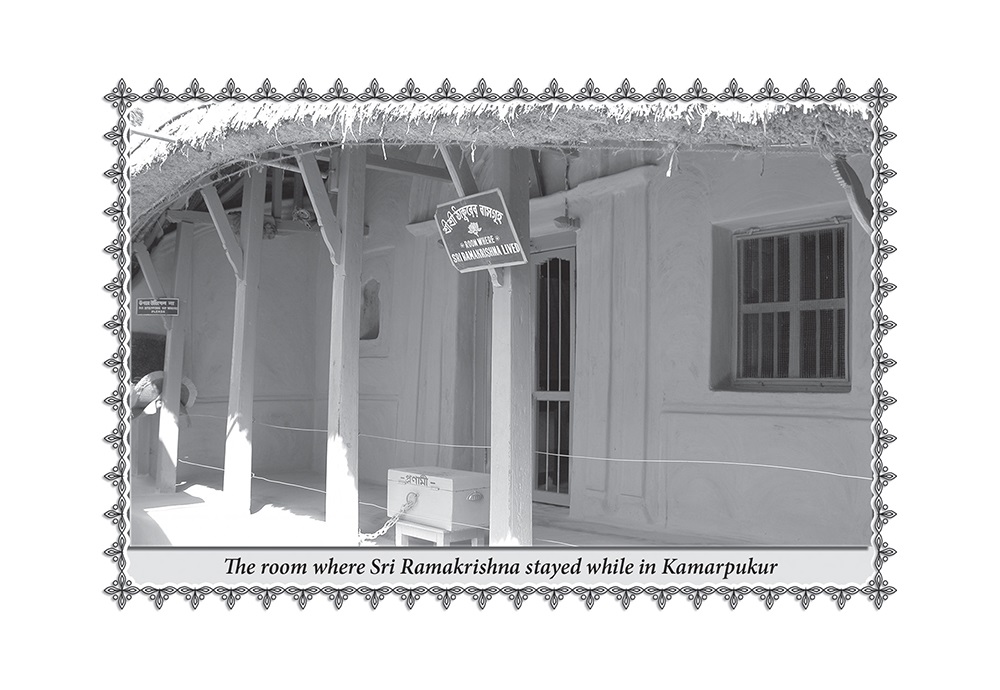
Meanwhile, the news of Gadadhar's ailment had reached his mother Chandramani and his second brother Rameswar, living in Kamarpukur; and they became anxious about his health. It was probably at their insistence that Gadadhar went to his village home in Kamarpukur for some rest and recuperation. Surrounded by the familiar atmosphere of the village, and free from the stimulation of his devotional duties in the temple, his spiritual moods ceased to be as strong as before. But in his behaviour towards others, except in moods of intense devotional absorption, he was found to be as loving, cordial, and normal as before. All of this encouraged his relatives to believe that if Gadadhar were burdened with some domestic responsibilities, he would settle down to the same type of life that they were all leading. Worldly wisdom suggested to them that the best way to do this was to get him married—the time-honoured antidote for spiritual yearning.
All of their efforts to find a suitable bride were in vain, as people had come to know that the bridegroom was abnormal in mind. However, the difficulty was finally solved in a strange way. Fearing vehement protests from Gadadhar, his relatives had kept their efforts a secret from him. But coming to know of it somehow, he himself gave them, in an ecstatic mood, the correct guidance to find the bride. He said:
It is useless to search here and there; go and search in the family of Ram Mukhopadhyaya of the village of Jayrambati; the bride has been ‘marked with a straw’ and kept reserved there.6
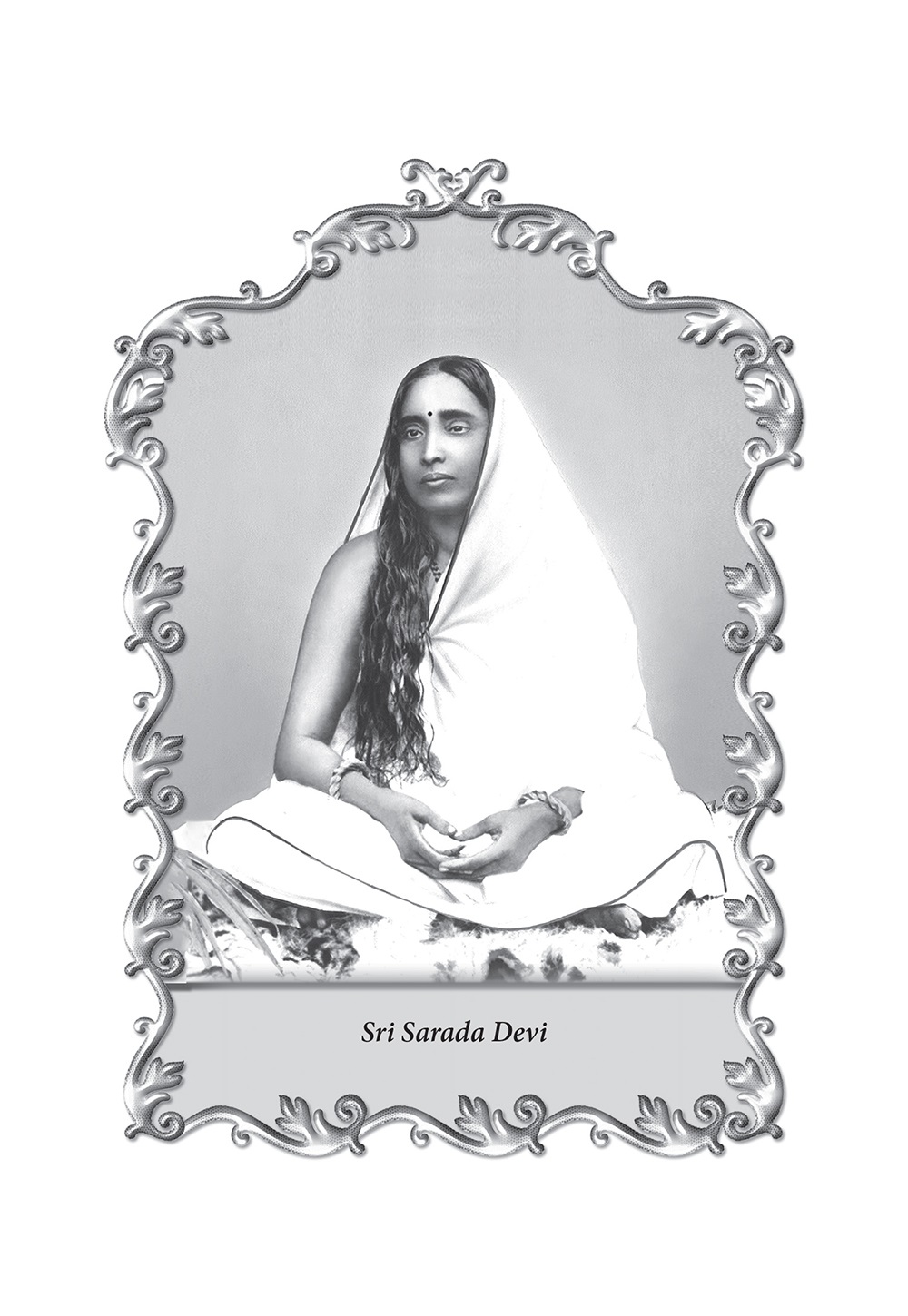
That little girl Sarada, five years of age, is now famous under the name of Sri Sarada Devi the Holy Mother. She was married to Gadadhar, aged twenty-three, in 1859. Though Sarada had opportunities to visit Kamarpukur in 1866 and 1867, her real meeting with Gadadhar as a woman took place only much later, in 1872, when she visited him at Dakshineswar.
After a stay of about two years in Kamarpukur, Sri Ramakrishna the Great Master—the now famous name by which we shall call Gadadhar hereafter—returned to Dakshineswar and resumed his devotional duties in the temple. Within a few days, that ‘divine madness’, which seemed to have abated, came upon him again with redoubled intensity. He passed through a period of most fervent prayer and extraordinary experiences, the depth of which is difficult for worldly-minded people to plumb.
Within a few days, he got so absorbed in devotional preoccupations that all thought of home and relatives got obliterated from his mind. His only concern then was how he could have the vision of the Divine Mother in all beings and at all times. His chest became reddish again on account of continuous japa, remembrance of God, meditation, and reflection. The world and all talk about it appeared like poison to him. Sleeplessness and a burning sensation all over the body, which he had once experienced under divine inebriation, reappeared. When he sat for meditation, he heard sounds from within as if his joints were being locked, and he could move his limbs again only upon hearing the unlocking sound much later. During such long intervals he would remain absorbed in meditation in such absolute stillness that small birds used to perch on his matted locks.
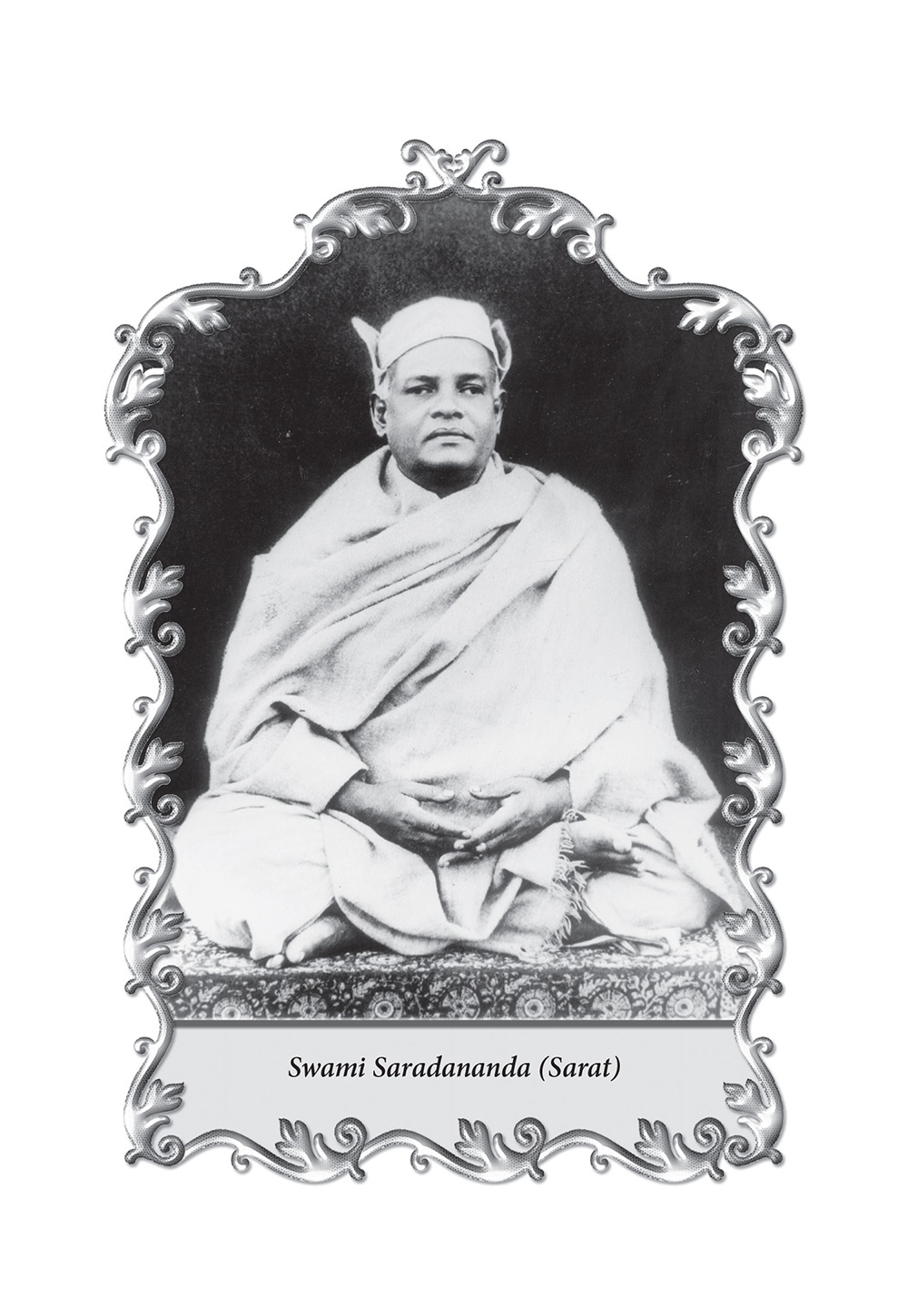
Describing this mental state he passed through, his disciple and biographer, Swami Saradananda writes:
Reminiscing about his experience of divine inebriation of those days, the Master used to tell us now and then, ‘Such a state is never produced in ordinary people. For even a fourth of its intensity would have destroyed their body and minds. I remained occupied with some vision or other of the Mother during the greater part of the day and night; that saved the situation; otherwise it would have been impossible for this sheath (showing his body) to survive. I had no sleep at all for six long years. The eyes lost the power of winking; I could not close the eyes in spite of all my efforts. I had no idea of the passing of time and was not at all conscious of the body. When the attention turned from the Mother to the body even a little, I felt apprehensive, and thought, ‘‘Am I on the verge of insanity? …Mother, is this the result of calling on Thee? Is it the result of my absolute reliance on Thee that Thou hast given this terrible disease to this body?’’ And the next moment I said, ‘‘Let anything happen to this. Let the body go, if need be, but see that Thou dost not forsake me. Do reveal Thyself to me and bestow Thy grace on me; for, Mother, I have utterly taken refuge at Thy lotus feet and have absolutely no support except Thee.’’ I used to weep thus for some time, when my mind would again be filled with an extraordinary ecstasy. The body appeared to be a trifling thing—something unworthy of attention. Then, I was blessed with Her vision and consoled by Her words, assuring me freedom from fear.’7
Everyone thought that the Master was really heading for insanity. His mother Chandramani Devi heard about the relapse of her son's mental ailment and, utterly distracted by sorrow, went to the temple of Siva of Mukundapur, where she sat in prayer before the Deity for His intervention, observing the vow of hatya or fast unto death. After two days of such prayer and fasting, she got Siva's commandment in a dream:
Don’t be afraid; your son is not mad; he is in that state on account of a tremendous awakening of the divine spirit in him.8
Hriday and Mathuranath too had doubts about Sri Ramakrishna's sanity. Mathur therefore put him under the treatment of a celebrated Ayurvedic physician named Gangaprasad Sen. But it was Durgaprasad, his brother and a physician himself, who was the first to recognise that the Master was in a state of divine inebriation and that his condition was not curable by medicines. It took, however, some more time for this verdict to be confirmed and accepted by men at large. It remained for the Master's first Guru, the Bhairavi Brahmani, to proclaim on scriptural authority that what the unregenerate world identified with symptoms of insanity were really indications of the most exalted state of bhakti known as mahabhava, which is manifested only in Incarnations.
It has already been pointed out that from the very start of their acquaintance, Mathur had developed a liking for Sri Ramakrishna, which gradually developed into great admiration. So he stood with the Master through thick and thin during this period of internal storm in him, despite his feeling that there was a strain of mental imbalance in him. Such doubts were set at rest when Mathur had an occasion to experience an act of self-revelation of the Master to him during those days. One day while Mathur was looking out from the proprietor's room in the temple premises, the Master was pacing up and down a verandah within Mathur's view. As Mathur watched, he saw the body of the Master as the form of the Divine Mother when he walked in one direction and as that of Siva when he turned in the opposite direction. After repeated scrutiny, Mathur could not help accepting it as a real experience in his waking state, with the background of the actual topography of the place, beyond all possibilities of a visual illusion.
Another incident revealing the uniqueness of the Master and thereby confirming Mathur's faith in him took place when a dispute arose between Mathur and the Master on the question of whether the omnipotence of God meant that He could also change Nature's laws. They were then walking in the garden together when Mathur challenged the Master on this point. Pointing to a red hibiscus plant, he asked the Master whether a white flower could blossom on it by God's will. The Master maintained it could. A few days later, two flowers, one red and another white, appeared on the same branch of that plant, and the Master triumphantly showed it to Mathur.
Such experiences of Mathur, and the ecstatic devotion he witnessed in the Master, made him a staunch devotee of the Master, ready to render help with men and any amount of money that the Master might need from time to time. The backing of a rich and influential man like Mathur and the service of a worldly-wise companion like Hriday were invaluable for the Master during the period of his sadhana, when his constant preoccupation with devotional concerns made him absolutely oblivious of all worldly situations. This was therefore divinely provided through Mathur and Hriday. The Master called Mathur the first of his Rasaddars, or ‘provision suppliers’, appointed by the Divine Mother.
About this time an event of great importance took place in the Master's life. And that was the arrival of the Bhairavi Brahmani, the Master's first formal Guru, in the year 1861. She was a middleaged ascetic woman of the Tantric school, as her title ‘Bhairavi’ indicated. Little is known of her antecedents. Immediately after she landed at the temple bathing ghat from a country craft, she was noticed by the Master, who was gathering flowers in the garden nearby.
A very affectionate and tender relationship grew between the Master and the Bhairavi from the very beginning. The Bhairavi was overcome with emotion when she met the Master. She explained the reason for this later. The Divine Mother had commissioned her to give spiritual instruction to three particular sadhakas. She had already met two of them in the eastern part of Bengal, and now she recognised the third one in the Master. The Master on his part felt a sort of filial affection for her and confided to her all the details regarding his spiritual strivings and experiences. The Bhairavi settled down in the neighbourhood of the temple and every day came to meet the Master. They spent several hours in conversation about spiritual matters.
The Bhairavi, who was an expert in the Tantras, both of the Sakta and the Vaishnava cults, made a thorough study of the mental and physical conditions of the Master in the light of the devotional scriptures, and came to a conclusion that flabbergasted all the wiseacres who regarded the Master as heading towards insanity. She declared that the mental and physical symptoms noticed in the Master were not abnormalities, but the manifestation of the supra-normal condition called mahabhava. In the devotional scriptures of the Vaishnavas, mahabhava is described as a state ‘of bliss and pain, arising respectively from the union with, and separation from, Krishna, of which all the happiness existing in crores of universes and also the pain produced by the biting of all the snakes and the stinging of all the scorpions are just a drop in the ocean, so to say’.9 She also proclaimed her considered view that mahabhava is seen only in Divine Incarnations and not in ordinary jivas. Thus, the upshot of the Bhairavi's findings was that the Master was raised from a madcap to a Divine Incarnation. What was more, she offered to prove it before any assembly of scholars that Mathur could call.
Mathur was persuaded to take these declarations of the Bhairavi seriously, because she had at the same time been able to relieve the Master of certain symptoms which had baffled reputed physicians. One of them was a burning sensation all over the body, which made the Master obliged to keep himself immersed in water for hours and roll on a cool marble floor. The Bhairavi's remedy was the application of sandal paste all over the body and the wearing of plenty of garlands of sweet smelling flowers. Three days of this treatment cured him of that unbearable burning sensation. Another symptom was a voracious hunger which could not be appeased by eating even large quantities of food. The Bhairavi's treatment for it was as simple and unique as the former. A room stocked with all kinds of sweets and other edibles was arranged for the Master to stay in. He was free to eat whatever he liked, and in any quantity. Three days' stay in this supercanteen cured the Master of this ailment too.
These experiences made everyone take the Bhairavi seriously, and Mathur resolved to call an assembly of pandits before whom the Bhairavi had offered to prove her findings regarding the Master. Accordingly, Vaishnavacharan, a celebrated Vaishnava scholar and saint of those days, and some other pandits were invited to meet the Bhairavi. Her description of the Master's experiences and the actual sight of his ecstatic condition convinced Vaishnavacharan that the Master's state was really that of mahabhava with its nineteen manifestations, the like of which had occurred earlier only in Sri Radha and Sri Chaitanya. He gave his verdict that, as the manifestation of mahabhava was perfect in him, the Master must be classed as an Incarnation.
In later days, Mathur invited the pandit Gauri of Indesh, a great scholar and a Tantric practitioner, to meet Vaishnavacharan and debate with him about the Master's condition. Gauri not only heartily agreed with the views of the latter, but also stayed on at Dakshineswar and became a devotee of the Master. Blessed by the Master, he left his home and hearth to become an ascetic.
Padmalochan, the court pandit of the Raja of Burdwan, was the third scholar and sadhaka who agreed with the view that the Master was an Incarnation. A fourth scholar-aspirant to recognise the divinity of the Master, at a later date, was Narayan Sastri hailing from Rajputana. He was an all-round scholar, who came to Dakshineswar on his way home after completing his study of Nyaya at Navadveep. But the Master's company had such a tremendous impact on him that all his scholarly ambitions subsided, and realisation of Brahman became his sole objective in life. He surrendered himself to the Master, took sannyasa, and went to Vasishthashrama to practise austerities.
The recognition of the Master's divinity by all these learned scholar-practitioners after its first proclamation by Bhairavi Brahmani is of great importance in the study of Sri Ramakrishna and his significance to mankind. His divinity, which is now widely proclaimed, is not a theory propounded by his later disciples who started what has come to be known as the Ramakrishna Movement. Long before those modern educated men who formed the nucleus of this Movement came to the Master, all these orthodox and erudite pandit-practitioners, who had nothing to do with the later Movement, had recognised his divinity after studying the question in the light of the scriptures. Their witness to the Master's divinity is of utmost importance to a critical student in estimating Sri Ramakrishna's relevance to the needs of modern humanity.
The years that followed the Bhairavi Brahmani's arrival formed a highly eventful period in Sri Ramakrishna's life from the spiritual point of view. Until then, the Master had been attempting to reach the spiritual pinnacle by the sheer power of his unaided aspiration; and by and large, he succeeded. But unlike ordinary spiritual aspirants; the Master's spiritual life was not meant for any purpose of his own. All human beings live for the fourfold ends of dharma, artha, kama, and moksha, which have reference to their own worldly welfare and salvation. But as an Incarnation has no such individual purpose, his actions can be correctly understood only if they are viewed in the perspective of their worldwide significance. Such is the case with the spiritual practices which the Master undertook with the guidance of the Bhairavi. He first demonstrated that by the power of aspiration alone a devotee can scale spiritual heights. Then, with the help of the Bhairavi and the other teachers who came to him one after another, he demonstrated the validity of the paths of sadhana laid down in the scriptures.
The Brahmani was an adept in the Sakta Tantras that deal with the various practices of the Mother cult. This school is monistic in its philosophy, but does not brush aside the world of duality as a mere appearance. The universe is a real evolution of the Power or Sakti of Brahman, and perfection in its course of spiritual disciplines means developing the insight by which the Divine presence is realised in all aspects of Nature— noble and ignoble, mild and terrifying, joyous and painful, beautiful and ugly, elevating and degrading—in fact, in all the irreconcilable pairs of opposites characterising the experiences of life. It is said that the Bhairavi guided the Master through the practices laid down in the various Tantric texts of Sakti worship.
Performance of japa and meditation accompanied by external worship formed the general feature of those practices. As the Master was a highly competent aspirant, it took him not more than three days to attain the realisations achieva- ble through any of these practices. Two mud platforms with the skulls of five creatures, including that of a man, were made in two places in the temple compound for the Master to sit for sadhana.
Swami Saradananda writes about these practices:
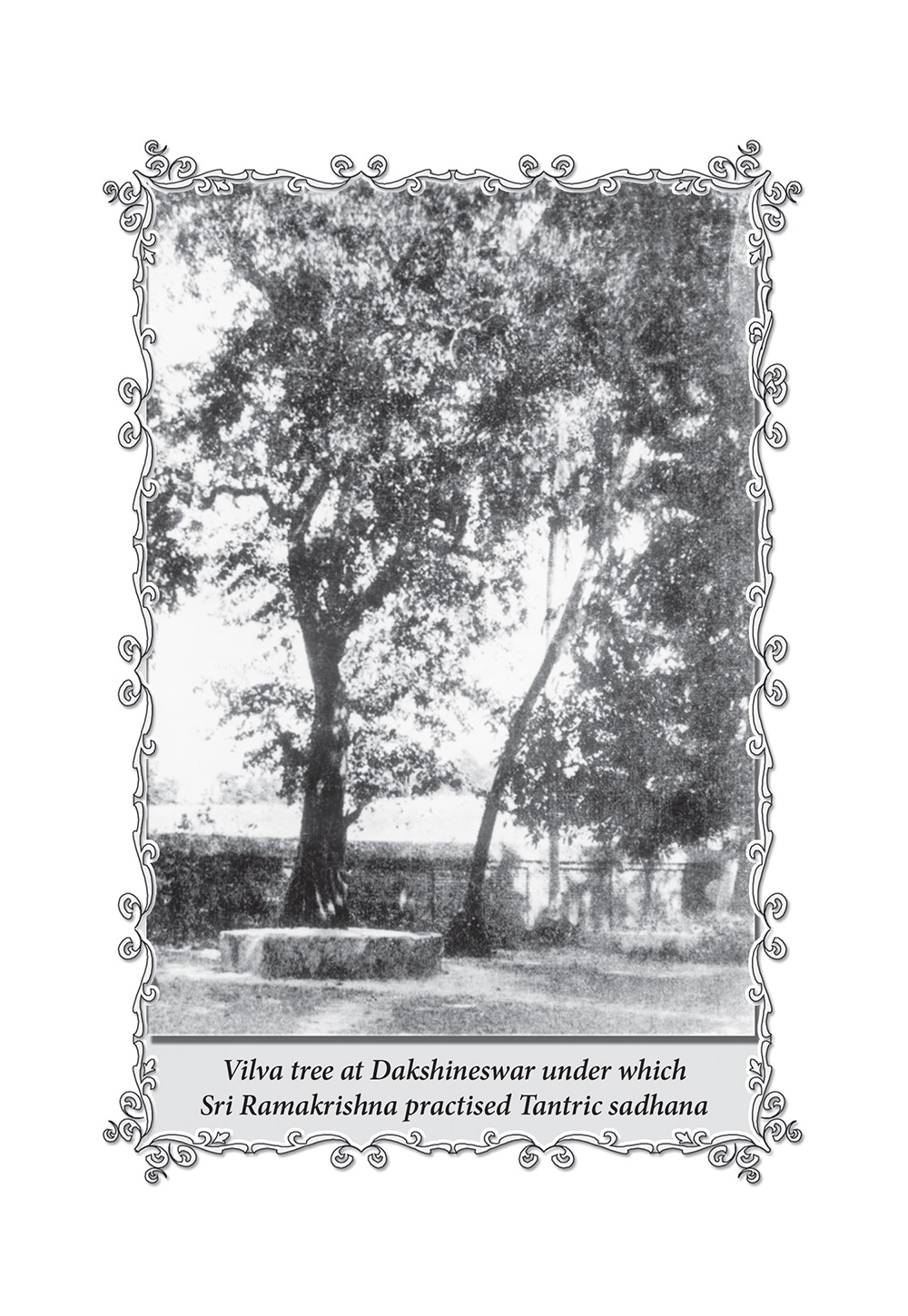
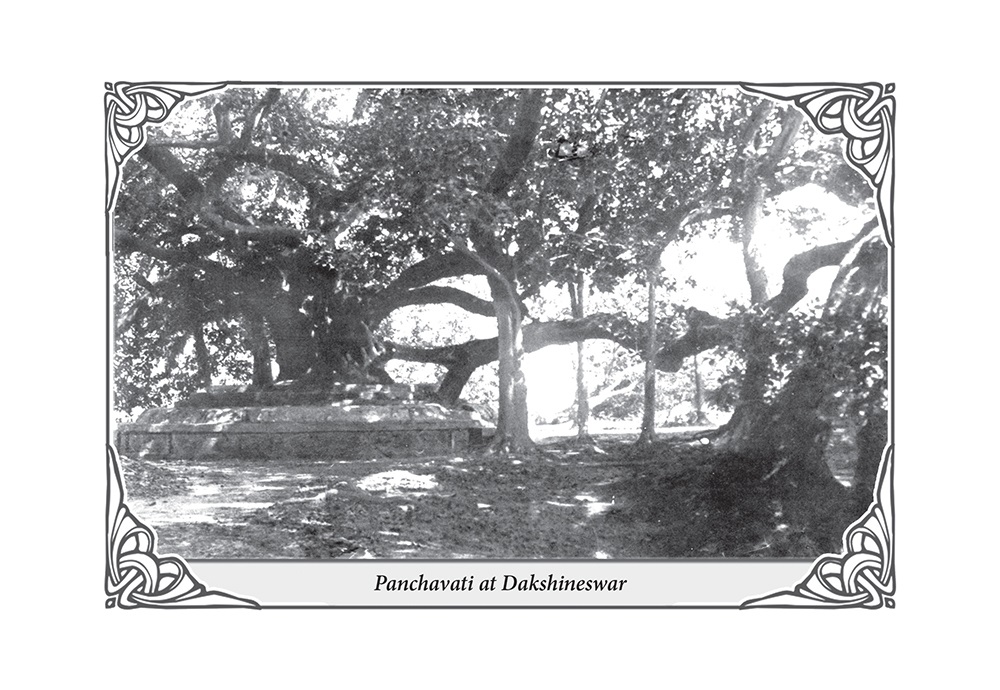
The Master said to us, ‘In the daytime the Brahmani went to various places far away from the temple-garden and collected and brought various rare articles prescribed by the Tantras. Placing them under the vilva tree or under the Panchavati at night, she called me, taught me how to make use of those things, and helped me in the performance of the worship of the Divine Mother according to the prescribed rules with their aid, asking me at last to merge in japa and meditation. I acted accordingly. But I had to perform almost no japa; for, hardly did I turn the rosary once when I merged completely in samadhi and realised the results proper to those rites. There was thus no limit to my visions and experiences, all very extraordinary. The Brahmani made me undertake, one by one, all the disciplines prescribed in the sixty-four main Tantras, all difficult to accomplish, in trying to practise which most of the sadhakas go astray.'10
The visions of gods and goddesses he had were numerous, ranging from the two-armed to the ten-armed forms of the Mother. Some of them, on their own, engaged in conversation with him and gave him various instructions. Although all the forms of the Mother were extraordinary in their beauty, the Master maintained that they were not worthy of comparison in that respect to that of Rajarajeswari, otherwise called Shodasi. The Master said about her.
I saw in a vision the beauty of the person of Shodasi which melted and spread all around illumining the quarters.11
He had also the vision of various male figures like Bhairava and other celestial beings. He heard the unceasing reverberation of the anahata, the cosmic sound of Pranava, as a consequence of which he got at that time an insight into the meanings of all sounds, including those of animals. Offering heartily his body, mind, and soul to the Divine Mother, he saw himself pervaded, inwardly and outwardly, by the fire of knowledge. He perceived the awakened kundalini proceeding upwards to the head through the sushumna. With its progress, all the chakras or centres of consciousness from the muladhara to the sahasrara, represented as lotuses, blossomed. Thereby, he acquired access to different dimensions of consciousness, conveying a wonderful experience of beings at higher levels of evolution.
From the time when the orifice of his sushumna opened, his nature was permanently converted into that of a boy. He could not, in spite of his efforts, retain his clothes on his body for any length of time because they slipped off unawares, as his body-consciousness was very much attenuated. His sense of non-duality developed so much that he practically lost the distinction between the holy and the unholy; the tulasi leaves and the drumstick leaves appeared equally holy to him. The splendour of his person increased so much that he became the cynosure of all eyes, until by repeated prayers to the Mother he withdrew it all within. He felt the Divine Mother was dwelling in every female form, whether of a virtuous or a vicious woman. What are called ashtasiddhis, or the eightfold psychic powers, developed in him; but he contemptuously set them aside, as the Divine Mother showed him that they are as despicable as excreta.
By the very nature of the Sakta philosophy, the practices prescribed by it put to the extreme test an aspirant's equanimity, imperturbability and capacity to see the Divine in everything, high and low, noble and ignoble. Some of these we shall describe as given in Swami Saradananda's biography of the Master.
He was instructed that the Mother sometimes took the form of a jackal, and that dogs were the mounts of Bhairava. So the Master regarded the remnants of food taken by those animals as sacred and partook of them as prasada.
Reminiscing about his experiences at various times of his sadhana, the Master said:
On one occasion, I saw that the Brahmani had brought at night—nobody knew whence—a beautiful woman in the prime of her youth, and said to me, ‘My child, worship her as the Devi.’ When the worship was finished, she said, ‘Sit on her lap, my child, and perform japa.’ I was seized with fear, wept piteously, and said to Mother, ‘O Mother! Mother of the Universe! What is this command Thou givest to one who has taken absolute refuge in Thee? Hast Thy weak child the power to be so impudently daring?’ But as soon as I said so, I felt as if I was possessed by some unknown power, and an extraordinary strength filled my heart. And no sooner had I, uttering the Mantras, sat on the lap of the woman, like one hypnotized, unaware of what I was doing, than I merged completely in samadhi...
On another occasion, I saw that the Brahmani cooked fish in the skull of a dead body and performed tarpana. She also made me do so and asked me to take that fish. I did as I was asked and felt no aversion whatever.
But, on the day when the Brahmani brought a piece of rotten human flesh and asked me to touch it with my tongue after tarpana, I was shaken by aversion and said, ‘Can it be done?'
So questioned, she said, ‘What's there in it, my child? Just see how I do it.’ Saying so, she put a portion of it into her mouth and said, ‘Aversion should not be entertained,’ and placed again a little of it before me. When I saw her do so, the idea of the terrible Chandika form of the Universal Mother was inspired in my mind; and repeatedly uttering ‘Mother’ I entered into bhava samadhi. There was then no aversion felt when the Brahmani put it into my mouth.
Having initiated me thus in purnabhisheka, the Brahmani made me perform daily Tantric rites too numerous to mention. I now don't remember all the details. But I remember the day when I was able, by the grace of the Mother, to view with perfect equanimity, the supreme pleasure of a pair of lovers, seeing nothing in it but the blissful sport of the Divine. The mind instead of descending even to the neighbourhood of ordinary human feelings, soared higher and higher, merging at last in deep samadhi. After regaining normal consciousness, I heard the Brahmani say, ‘You have reached the desired end of a very difficult Tantric sadhana and become established in the divine mood. This is the ultimate sadhana of the “heroic” mode of worship.’12
The Upanishad says Isavasyam idam sarvam— all this is to be covered by the Lord. A practitioner of the Sakta disciplines has got to do this literally. In our state of ignorance, we view all objects of senses from our personal point of view—the view in terms of survival and pleasure—and label them as high or low, attractive or repelling, pleasant or painful, noble or degrading, pleasing or terrifying. What the Master achieved through these practices was to rise to a divine level of perception in which the whole system of personal evaluation stands transformed, and everything becomes a symbol or a reminder of the Divine, whose Sakti or Power has evolved into the world-system with its pairs of contraries and contradictories.
Even before the Brahmani's coming, the Master had by himself undergone certain practices for this transformation of values. To get over the feeling of high and low, he cleansed the latrines of men treated as untouchables by society, and he partook of the leavings of beggars. To overcome the craving for wealth, he practised discrimination, holding a clod of earth and a coin in either hand, suggesting to his mind that both these are of equal value as far as God-realisation is concerned, and throwing them both into the Ganges to symbolise this realisation. By this practice, it became a habit for his entire nervous system to respond to his renunciation of possessions. He could not touch any money without feeling a painful sting, and when devotees like Mathur and Lakshmi Narayan offered to make endowments for his personal expenses, he felt as if strong blows were being delivered on his head. He rejected such offers with vehement protests. He symbolised his overcoming of sexuality by developing an instinctive recognition of the Divine Mother in all female forms, whether it be of a virtuous woman or of a fallen woman. He further demonstrated his realisation practically when, as we shall describe later, he worshipped his own wife, placing her on the pedestal for the Deity and surrendering all the fruits of his sadhanas at her feet.
A remarkable feature of Sri Ramakrishna's sadhana, distinguishing him from ordinary aspirants, was the insatiable gusto with which he followed the disciplines of different cults and religions. Persons, who are generally considered saintly, practise the disciplines of one tradition and attain peace by the realisation achievable through it. Sri Ramakrishna's case was entirely different from this ordinary rule, because he was an extraordinary personage—a Divine Incarnation who lived his life for others and not for himself. For this reason there are three unique features observable in his sadhana.
The first is the avidity with which he passed from one system of sadhana to another, unlike in the case of ordinary sadhakas, to which we have already referred above. Speaking about himself, he said that he was a glutton in the spiritual realm. A glutton likes to eat his fare stuffed, dressed, and spiced in different ways, and is not satisfied with only one kind of preparation. Similarly, he had a yearning to realise the Divine through all paths open to mankind, and he found that the same Divine was attained through every path.
The second unique feature is the speed with which he gained realisation. No system of discipline required more than three days for him to attain siddhi [perfection] in it, whereas an ordinary aspirant takes a whole lifetime or more for the same.
The third unique feature, allied to the first, is that he attained to the highest realisation, when he entered into samadhi in the temple, by the sheer strength of his aspiration, which made him feel that it was better to die than to live without realising the Mother. The sadhanas under the Bhairavi and other teachers came afterwards, only to prove the validity of the paths laid down in the scriptures. The Master illustrated this feature of his life in his saying that just as in the case of some plants, like pumpkins, the fruit comes first and then the flowers, so in the case of Incarnations, realisations precede the sadhanas.
Yet another distinguishing feature of his sadhana was the ease with which he changed his outlook and adopted a new mentality, sometimes quite the opposite of what he had cultivated till then. It is usually very difficult to set aside the particular mental proclivity one has cultivated for long and adopt another. But as we shall see, the Master was able to pass from being the worshipper of the Divine Mother to being a personality-shunning Advaitin, from an image- worshipping pious Hindu to an image-rejecting Muslim, and from the universalism of Hinduism to the exclusivism of Christianity. This could be done only because of the uniqueness of his mind, which will be explained in connection with the concept of bhavamukha.
While the Bhairavi Brahmani continued to stay at Dakshineswar, other teachers—each an adept in a particular form of spiritual practice—arrived at Dakshineswar one after another, commissioned as it were by the Divine to play their part in the unfoldment of the Master's spiritual genius.
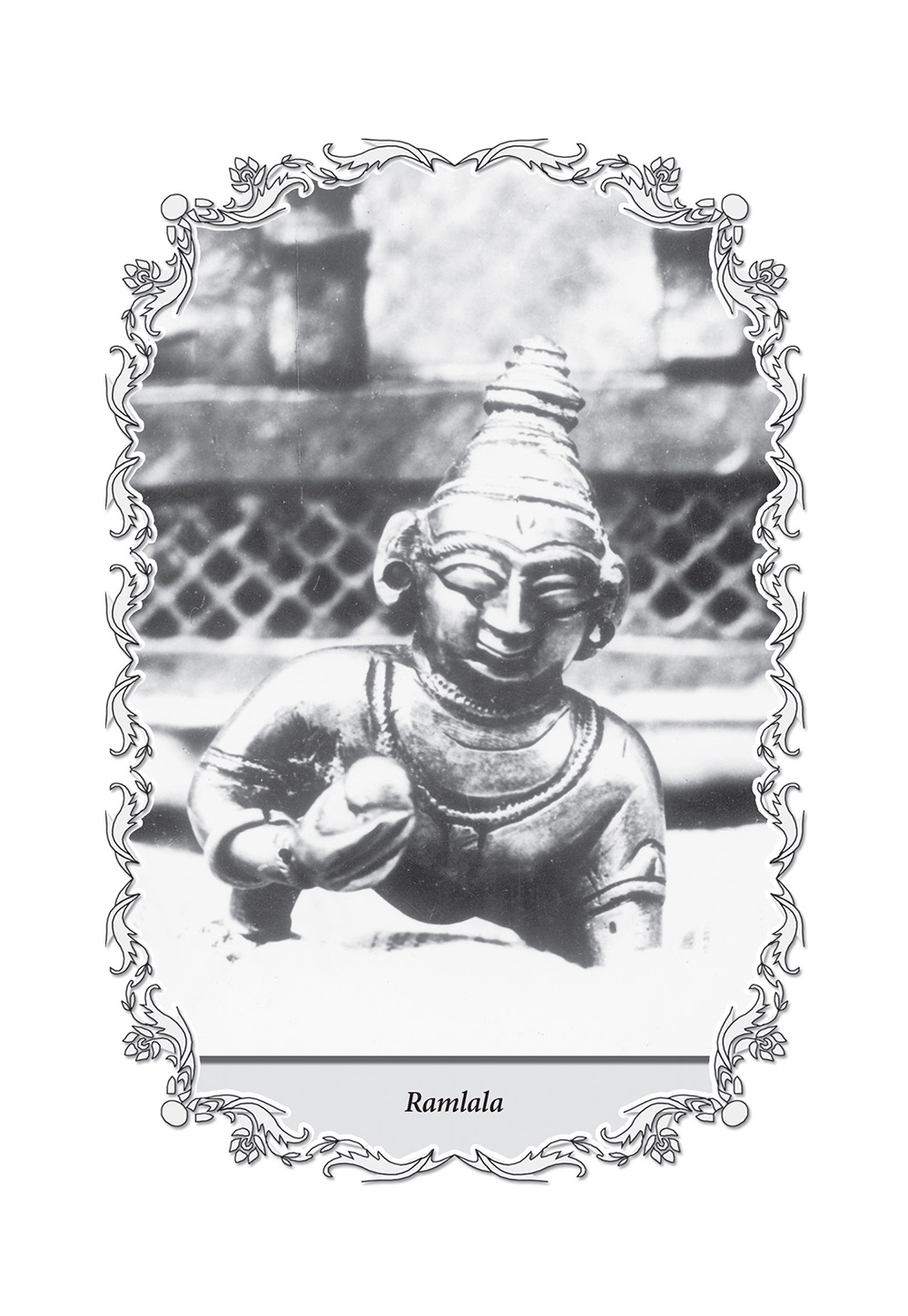
One of the earliest of such teachers to arrive was Jatadhari, a Vaishnava ascetic, devoted to Sri Rama. The Master's family deity was also Sri Rama, and so there was an affinity between his and the ascetic Jatadhari's devotional ideal. Besides, in earlier days, the Master had practised devotion to Rama by impersonating the great devotee Hanuman. Assuming the dasya-bhava, or the attitude of being the servant of God, like Hanuman, he had, in the waking state, a vision of Sita against the background of the surrounding topography. Sita's form merged into his own body. So, actuated by these Vaishnava affinities, he got friendly with the ascetic Jatadhari and soon came to know the secret of his devotional fervour. The ascetic carried with him a small image of Ramlala, on whose service his life centred. The actual presence of the Child Rama, accompanying him or playing around him, was for him a real experience. As the Master began to frequent the ascetic's company, Ramlala began to evince more and more interest in the Master.
Often, Ramlala began to leave the ascetic's company and go with the Master, with whom He became very intimate. A time soon came when the ascetic had to come and call Ramlala back from the Master, whenever he wanted to make the daily offering to Him. Attaining to his spiritual maturity in the Master's company, the ascetic Jatadhari now got the realisation of Ramlala's presence in all beings and no longer felt the necessity to worship Him in the image. So, the ascetic left Ramlala's image with the Master and took his leave, having realised the living presence of Rama everywhere. The Ramlala episode marks the perfection of the Master in the vatsalya-bhava or the practice of loving God as one's own child.
Next, we come to the Master's practice of madhura-bhava, or the way of looking upon the Deity as one's sweetheart, as the gopikas of Vrindaban did. Even in his boyhood, he had a foretaste of this form of love when he used to imagine himself to be a young virgin in love with Krishna, awaiting every day His visit, with delicious dishes prepared for His reception. This germinal aspiration then took the form of a fullfledged sadhana for the realisation of Krishna, the Lord of the universe, as one's husband or sweetheart, following the footsteps of the gopikas of Vrindaban in ancient days and of Sri Gauranga in recent times. The philosophy behind the practice is that Krishna is the one Paramapurusha (the Supreme Being) to whom all jivas—represented as Radha, the female counterpart of Krishna, His svarupa-sakti or inherent power—are attached by bonds of love. Love can take any form—dasya (the servant's love for the master), apatya (the son's love for the father or mother), sakhya (the intimacy of a comrade), and madhura (conjugal love). While all these forms of love are potent enough to take the devotee to the Lord, the madhura is considered the acme of spiritual love, inasmuch as it includes in itself all the other types of love and exhibits the most intimate form of it. Even in the conjugal form of love, the love of a woman for her paramour is considered the most intense form. For, it is in that kind of love that the lover renounces all worldly considerations of respectability, status, prestige, fortune, family relationships, and all other selfcentred values, and abandons himself to God in a total self-surrender. Radha, the svarupa-sakti of Krishna, is the very embodiment of this form of love, and it is only by her grace that a jiva can capture even a fraction of it.
So, the Master first meditated on Radha, and the form of Radha appeared to him and entered into him. After this, his nature gradually transformed itself into that of a woman, as he increasingly identified himself mentally with the beloved of Krishna. He extended this identification in the physical plane too, putting on women's robes and ornaments that Mathuranath supplied him with. Not only that, he spent a considerable amount of time amidst the womenfolk of Mathuranath's household. The womanly temperament had become so natural to him that neither he nor those women felt any embarrassment in each other's company.
Subsequent to his vision of Radha, his personality got completely identified with her, and in his mind arose an anguish of overpowering longing for Krishna. All of the nineteen mental and physical expressions of love in separation (viraha), technically known as mahabhava, which were said to have manifested in Radha and later in Sri Gauranga, were noticed in him, to the astonishment of the Bhairavi and the learned Vaishnava teacher, Vaishnavacharan. For, even in highly competent sadhakas, they had come across manifestations of only one or two of these signs.
The Master spent his time in ceaseless prayer, unaware even of the passing of day into night. His feeling expressed itself in copious tears and as a longing of the soul that developed into restlessness and anxious pining for the beloved, making him unmindful of food, sleep, and other vital concerns of the body. He experienced those delightful pangs of viraha, the state of love in separation, in which the soul feels alternately the intense delight of prospective union and the agony of separation. That state churns one's heart, plays havoc with one's mind, and devastates one's body and sense organs.
This state of mind also produced distressing bodily conditions in the Master. It generated an unbearable burning sensation in the body, bringing out tiny drops of blood from the pores. All the joints were felt to have become loosened and dislocated; the senses ceased to function; and sometimes the body lay motionless and unconscious like that of a dead man, all because of extreme anguish. After spending several months in this sense of identification with Radha and her state of mahabhava, the Master had the realisation of Krishna, the condensed essence of Sat-Chit- Ananda. As in the cases of other visions, the form of Krishna which he experienced entered into his own body. He lost himself completely in Krishnaconsciousness. He felt himself to be Krishna, and all beings to be pervaded by Krishna. In later days, based on his experience, he described the complexion of Radha as ‘bright yellow, like the pollen of nagakesara flowers’13; and of Krishna like the flower of a grass that he came across which he showed to his disciples.
This part of his sadhana closed with a wonderful vision he had. While listening one day to a recital of the Bhagavatam, he went into an ecstasy in which he experienced the shining form of Krishna, from whose feet came out a luminous cord of light which connected itself with all the three—Krishna, the Master's person, and the holy Text, thus demonstrating his saying that the three—the Bhagavata [the scripture], the Bhakta [the devotee] and the Bhagavan [the Lord]—are three in one and one in three.
Towards the close of 1865, some three or four months after the Master had completed the sadhana of madhura-bhava, there arrived at Dakshineswar an august personage who was to play an important role in the Master's life. That was Tota Puri, a sannyasin of the Naga sect, who was an adept in Advaita Vedanta, and who, as a symbol of his having overcome bodyconsciousness, went about naked from one holy place to another. The Master called him Nangta, or the Naked One. He is said to have practised Advaita discipline for forty years on the banks of the Narmada and to have attained nirvikalpa samadhi. After that, it was his habit to go about the country, always staying in the open, and never remaining in any place for more than three days. As Rani Rasmani's temple extended hospitality to all wandering ascetics, Tota Puri also halted there on his return journey from Gangasagar. The Master soon got acquainted with him, and Tota recognised in the former a highly competent spiritual aspirant to whom he felt inclined to impart the spiritual illumination he had gained.
Now, in the brand of Advaita which Tota Puri professed, there was not much room for a Personal God or the Divine Mother, who had hitherto been a part and parcel of Sri Ramakrishna's life. In this connection there is an interesting incident that took place later that reveals Tota Puri's attitude on this question. One day, while in Tota Puri's company, the Master, at the approach of dusk, began to clap his hands and take the Divine Name, as was his daily habit. Thereupon Tota, who could not appreciate such devotional habits, sarcastically asked him, ‘Are you making chapatis?’ Nevertheless, he offered to initiate him into sannyasa and teach him Vedanta, and the Master agreed to the proposal, provided he had the permission of his Mother. Tota Puri understood the term ‘Mother’ to mean his earthly mother, and with a suppressed cynicism, asked him to hurry to get that permission. The Master approached his Divine Mother and prayed to Her in an ecstatic mood to give him the right direction, and received the command: ‘Be initiated by him. Tota Puri has been sent here only for that purpose.'
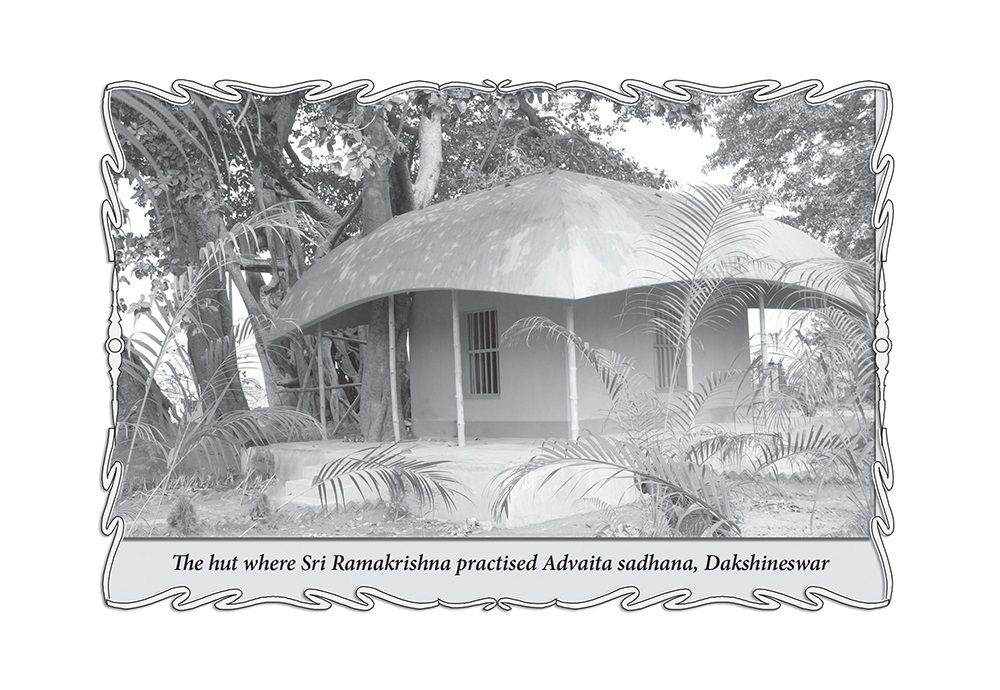
So, the day for initiation was fixed, and the ceremony took place in a hut under the Panchavati in the temple compound. After sannyasa, Tota imparted the teaching of Advaita Vedanta, the purport of which is that Brahman alone is real, that the world is a mere appearance projected by ignorance and having no ultimacy, and that the jiva in his real nature is Brahman Himself.
The teacher asked the pupil to practise discrimination along these lines and take the mind to a state of contentless self-awareness. When the Master attempted to do so, the form of the Divine Mother always arose before him. Under the persuasive compulsion of Tota Puri, he fixed the mind between the brows and, when the Mother's form appeared, he conceived of jnana (knowledge) as a sword with which he cut through that form, thus dissolving it in Pure Consciousness. His mind then merged in nirvikalpa samadhi or absorption in Unmodified Consciousness, the highest attainment of Advaitic spiritual discipline.
He remained in that summit state of Consciousness for three days continuously. Tota Puri was stupefied with wonder to see that his disciple had attained nirvikalpa samadhi so quickly and effortlessly, whereas he himself had taken forty years of strenuous practice to attain it.
All of those who came to teach Sri Ramakrishna got ample returns from his company in the form of completion of what was still imperfect in their spiritual attainments. Thus, Jatadhari came to realise in the Master's company that his Ishta, Ramlala, was not a mere presence in the image, but the Universal Being pervading everything. The Bhairavi Brahmani also had her knowledge perfected by the Master's association. It was, however, in the case of Tota Puri that a conversion was effected under conditions that looked like a miracle in a real sense.
We have already observed that Tota had little regard for a Personal God. He accepted only the Impersonal Absolute, the Brahman of the Vedanta, and considered the idea of a Personal God, a Divine Person, who is the Creator, Preserver, etc. of the universe and the bestower of grace on devotees, as a figment of the imagination, like the world of duality itself. This extreme and unbalanced form of Advaitic conviction got corrected in the Master's company. It happened this way:
Instead of his usual three days, Tota continued to stay at Dakshineswar for several months; and in the course of it he became the victim of an attack of an excruciating form of dysentery, which medicines failed to relieve. The suffering was so intense that even the disciplined mind of Tota found it difficult to keep itself above bodyconsciousness, absorbed in Brahman. He therefore thought it better to put an end to that stumblingblock of a body. With this end in view, he walked into the Ganges towards the deeper levels, where the water would be sufficient to drown him. But to his astonishment, he found that even though he waded almost over to the other bank, the water in the river was too shallow to drown him.
At this point, a new revelation came to the astonished mind of Tota. His conviction till then had been that the Ultimate Reality is Pure Being but he realised through a new revelation that It was Pure Will also. It is this Cosmic Will, the Power of Brahman, that Sri Ramakrishna knew as the Divine Mother and that Tota had denied so far. Now, from his incapacity to court even selfchosen death, he found that without the sanction of that Divine Will, the Reality of realities, not a leaf can move in this world. He realised the glory of the Divine Mother in everything, and became a changed man. By the Master's grace, his knowledge was completed when he thus came to understand that Brahman is Personal-Impersonal or Being-Will.
After Tota's departure from Dakshineswar, Sri Ramakrishna spent some six months continually absorbed in nirvikalpa samadhi without any awareness of the body and the external world. Of this condition, Swami Saradananda writes:
The Master was in that nirvikalpa state continually for six months. ‘I was,’ said the Master, ‘for six months in that state from which ordinary mortals never return, for, the body of one attaining to that state lives for twenty-one days only and then falls like a dry leaf from a tree. There was no consciousness at all of time, of the coming of day or the passing of night. Just as flies enter into the nostrils and the mouth of a dead man, so they entered into mine; but there was no awareness of it. The hair became matted on account of the accumulation of dust. Calls of nature were perhaps answered unconsciously. It was a miracle how the bodily life was sustained. It should have succumbed then and there. But a holy man came there to save it. He had a small stick like a ruler in his hand. He recognised my state as soon as he saw it, and came to know that much of the Mother's work was yet to be done through this body, that much good would be done to many if only it could be saved. Therefore, he would carry food in time, and by striking this body again and again, would try to bring it back to consciousness. The moment he saw signs of consciousness appearing, he would thrust some food into the mouth. Thus, on some days a little food found its way into the stomach and on others, it did not. Six months passed that way. Then the Mother's command was heard: “Remain in bhavamukha! For the spiritual enlightenment of man, remain in bhavamukha!” This was followed by illness, blood-dysentery; there was a wringing pain in the intestines and it was excruciating. It was after continually suffering for about six months that the mind gradually came down to the normal body- consciousness; before that it used to be merged in the nirvikalpa state always.’14
The commandment to remain in bhavamukha brings us to an important subject in the Master's life. Bhavamukha is a new expression unknown to religious texts in Sanskrit, and is for the first time given out by the Master himself, as he heard it from the command of the Divine Mother. Literally translated, it means ‘the threshold or gateway of Becoming or the world of change’. The idea is that just as a person sitting at the gate or threshold of a building has access at will to both within and without, and is in close touch with the affairs on both sides, so there is a state of consciousness which is a sort of a junction between the Absolute and the relative aspects of existence, between the nirvikalpa and the savikalpa states of consciousness.
The meaning and implication of the attainment of this state of bhavamukha have to be explained in the light of the Master's own teachings, as the concept is very new and forms a part of his contribution to Vedantic thought. According to the Master, a jiva, if he really attains nirvikalpa samadhi, never returns to relative consciousness. His body remains alive for about twenty-one days in that state, and then perishes. It is only the adhikarikas (prophets with divine missions) and avataras (Incarnations of the Lord) who come back to the relative consciousness from the nirvikalpa state. They are drawn back to the relative consciousness by their love for jivas grovelling in ignorance, and thus they are the expressions of God's redeeming love.
Sri Ramakrishna explains this with an analogy of his: There is a vast enclosure with high walls, from which very delightful sounds and fragrance are being wafted. There is a road around the enclosure, and there are a number of people going round and round along the road. Some of them are attracted by that delightful sound, and with difficulty they get up on the high wall and look down at the overpoweringly charming sights spread within the enclosure. They are so taken with it that they jump down into the enclosure, forgetting everything else, and they never come out. But occasionally there will be a few among them who remember the tragic fate of the numerous heedless men going round and round, and so go out to the road to give them the good tidings and to lead them to the higher destiny awaiting them within the enclosure. The Divine Incarnations and adhikarikas are such expressions of Divine mercy, and therefore form manifestations of His redeeming power. Such personages have no ends of their own to seek, not even salvation, and are entirely devoted to the welfare of all who are suffering in samsara.
The Master explains it in another way also, justifying the doctrine that the Ultimate Reality is Being-Will and not mere Being, as maintained in the classical Vedanta. Unlike the Master's theory about nirvikalpa samadhi, the classical Vedanta maintains that there can be jivas who attain the nirvikalpa state, and yet continue to retain the body. They are called jivan-muktas or the liberated-in-life. Vedanta explains this by the doctrine of prarabdha, the operative karma or the quantum of karma that has brought the present body into existence. While the sanchita (stored up) karma, and agami (accumulating and inoperative) karma are burnt up by knowledge (jnana), it is dogmatically maintained that the prarabdha remains undissolved until its momentum is exhausted. No argument is advanced for this beyond the analogy of an arrow released from a bow, which stops not until it has struck the target.
But the Master questions this doctrine. He contends that if karma, be it only prarabdha, is real and operative even after nirvikalpa samadhi, then the Divine Mother, the Personal God, who even according to the Vedanta is required to make insentient karma operative, must be accepted as a greater reality than prarabdha. The classical Vedanta is very much loath to accept such a position, because, according to its teaching, in nirvikalpa samadhi even God is sublated and non-dual Brahman alone is; and this non-dual Brahman, as expounded in the Vedanta, is Pure Being and not Being-Will, as it would be if this theory of the Master is accepted. According to him, however, the Divine Mother is not sublated in nirvikalpa samadhi. What happens is that She reveals Herself as the Impersonal also, holding Personality in abeyance. Reality is Being-Will. When the creative process is on, Will is dominant, and Being is latent as the substratum of change. When the creative process is withdrawn, Pure Being subsists, Will latent but not sublated. The Master illustrates this by the example of the snake in motion and the snake at rest. The snake in motion and the snake at rest are only two modes of the same snake. So, the Personal and the Impersonal are the modes of the one Being-Will, and there is no question of sublating either.
The Impersonal aspect is realised only when the individual ego and the entire karma sustaining it are dissolved. That is nirvikalpa samadhi. If the individuality is to be revived, it can be affected only by a factor outside the karma theory, which presupposes the chain of cause and effect. So the Master maintains that it is only by the will of the Divine Mother that a person merged in nirvikalpa samadhi regains individuality, and not by prarabdha. This individuality is not the old one, but a transformed one: God-centred, and not body-centred. Emerging from nirvikalpa samadhi by the Mother's will, the transformed individuality recognises that the one Sat-Chit- Ananda is sportively manifesting as the jiva (the sentient being) and the jagat (the insentient world).
From the view of ignorance, the jiva and the jagat form a multiplicity different from the Spirit. But enlightenment reveals that without Himself undergoing any change, the Sat-Chit-Ananda, who is Being-Will, has manifested Himself as the jiva- jagat, which continues to be one with Him. In the creative phase, He is God the Personal, along with the jiva-jagat, and when creation is withdrawn, He is the Impersonal Absolute. The Personal and the Impersonal are recognised as the obverse and the reverse of the same coin—a non-dual but coeval existence. The Master illustrates this by the example of the terrace and the steps of the staircase leading to it. Until the terrace is reached, the steps of the stairs are considered as distinct and different from the terrace, and are left behind as not being the terrace. But when the terrace is reached, it is found that the steps too are made of the same substance as the terrace.
The Master calls a person established in this kind of perfect enlightenment a vijnani, in contrast to jnani who rejects the world of jiva and jagat as an appearance and seeks the Brahman transcending them. The vijnani rejects nothing. He perceives the whole universe not as maya, but as leela (sportive manifestation) of the Personal-Impersonal, the Being-Will Divine. He accepts both the terrace and the staircase as real. In accepting a fruit, he takes the whole of it into account—the seeds, the flesh, and the rind; for they all together constitute the whole, and a complete knowledge and acceptance of the fruit involves the acceptance of the whole.
This knowledge of the totality cannot be had by mere talking or philosophising. It is attained by one only through the Mother's grace, for which one has to yearn and pant. This yearning and panting for the Divine, is according to the Master, the highest form of sadhana, and all the practices and disciplines given as sadhana in Yoga and Tantra are only the means for evoking it. For this feeling to mature, renunciation of all worldly attachments, or what the Master calls ‘kamini- kanchana’, is needed. Only then does the Mother's grace operate. The Master's illustration—the parable of children being left by their mother in the nursery to play by themselves until they begin to cry out of hunger—has already been referred to earlier.
Now, it has been pointed out that the vijnani gains back an ego when he emerges from the nirvikalpa state. But this ego or individuality is entirely different in quality from that of the unenlightened man. To put it briefly, the ordinary man's ego is body-centred, while the vijnani's is God-centred. The body-centred ego is based on a sense of absolute reality of difference, and expresses itself in terms of ‘I’ and ‘mine’ with regard to all objects and individuals. It evaluates everything and everyone in terms of their contribution to its pleasure and survival. An ego- centred man may love others, but it is in terms of his narrow self and the preservation of that narrow self and its interests is his primary concern in life. In contrast to this, the vijnani's ego is entirely based on a sense of intimate relationship with God as His son, servant, comrade, sweetheart, etc. He looks upon all beings and objects, irrespective of their attitude towards him as a friend, foe or neutral as manifestations of the Lord to be loved and served, and not as objects for his enjoyment and aggrandisement.
Apart from these ethical implications, the state of vijnana has its metaphysical and psychological significance. The state of mind of the vijnani is what is called bhavamukha. The mind of the ignorant man is circumscribed by his individuality,and he sees everything else as discrete objects outside himself, having their fixed contours. But the vijnani is aware of a Cosmic Whole, a Cosmic Mind, from whom the ideation known as the universe radiates and in whom all beings and objects are like bubbles in a layer of water, or waves on the ocean's surface—a part and parcel of the Whole, but with individualities that are of the stuff of ideas or fluid contents of Its own stuff or substance. He is not only aware of It but feels as one with It, either as a part of It or as Itself. So, when it is said that bhavamukha is the state of mind of the vijnani, it means that the vijnani is aware of his identity with the Cosmic Whole. As a consequence, a person in the state of bhavamukha shares the knowledge and outlook of the Cosmic Whole. Just as a spider stationed in the centre of its web can go to any part of it, similarly, he can at will go on the wings of ecstasy to any dimension in the cosmos. He can attune himself to every stratum of Consciousness, from the crudest to the most evolved, and share their characteristic experiences at will. Thus a vijnani's state of bhava- mukha enables him to be ‘all things to all men’.
Being one with the Cosmic Whole in consciousness, he becomes the conduit for the expression of Its powers in the relative world. As the vijnani can traverse the whole gamut of the manifestation of Consciousness, he may behave like the humblest of the humble when he is in the attitude of the devotee. But when his individuality gets attuned to a sense of identity with the Immense Cosmic ‘I’, his behaviour will be different. As a conduit of the will of that Universal ‘I’, he becomes a centre of immense spiritual energy capable of even making a sinner into a saint by an act of will.
In Sri Ramakrishna the Great Master, this alternation between the devotee-mood and the saviour-mood was often noted, because his life was recent and was subjected to study by men who closely observed and recorded it, unlike in the case of the past Incarnations, whose lives have been clothed, long after their passing away, in thundering miracles by poets and mythologists. This process of distortion was partly due to a studied effort on the part of their followers to hide their human side. For, they felt it detrimental to their glory as divinities if any human qualities were allowed to percolate through their divinities. But an Incarnation is man and God in one, and the concept loses all its significance when the Incarnate is made into a Deity. The Master's life has enabled us to understand the significance of Incarnation in the proper perspective.
The Immense ‘I’ or the Cosmic Whole, of which we have been speaking till now, is the junctionpoint between the Absolute and the relative, the Impersonal and the Personal, the nirguna and the saguna aspects of the Divine Mother—the universal Being-Will. And to be established in that is to be in bhavamukha, the threshold of relative consciousness—a state in which the mind can ever dwell in the Divine in both His absolute and relative aspects, and yet without the least distraction to this union, apply itself actively to everyday concerns. Established in that, the Master was in touch with all aspects of the Mother's evolution as the world of manifestation, combined with a keen sense of their unity with Her.
It must be clearly noted that the person in bhavamukha is not in touch with the manifestation of the Whole alone, which the Master called leela, but also with the unmanifested Absolute state of It, the nirguna, for which he used the term nitya. When he is in the awareness of the leela, the knowledge of the non-separate or hypostatic nature of the leela in relation to the nitya is fully present in his awareness. He is always in touch with It, the nitya, even while he is in the leela. That is the significance of being in the ‘threshold state’. But he could also be in the nirvikalpa state—that of full identity with the nitya, the Infinite and the Absolute as Pure Being, with Will not sublated, according to the Master, but in abeyance.
This is a point on which the Master's doctrine differs from the traditional Advaita represented by Tota Puri, the point on which Tota Puri got corrected by the Master's company. The Immense ‘I’, whose play is the leela, is not sublated, but is only held in abeyance or in latency in the nirvikalpa state. The vijnani, who is poised in the state of bhavamukha, can at will be merged in the nitya with no link to the leela. This is the state of nirvikalpa from which there is no return for the ordinary jiva. It is only the Incarnations, as the Master insists, who pass from the one state to the other, and who are in touch with both aspects. Hence their uniqueness, expressing itself simultaneously as jnana and bhakti of the highest order, which a jiva cannot attain in one and the same state. It looks somewhat contradictory, but the supreme truth can be expressed, though inadequately, only in the language of paradoxes.
On this point, the Master said, referring to his own condition, that the natural state of his mind was towards the nirvikalpa, wherein there is the total obliteration of multiplicity and the ‘I’-sense. In that state, one is lost to humanity at large, as any kind of communication is out of question. But the Will of the Divine Mother, which is operative even in the nirvikalpa state, unlike in the teaching of classical Vedanta, does not allow the Divine Incarnate to remain in that state. He is an expression of the Divine's grace, of His love for jivas in samsara. As such, in order to keep up his link to the external world, the Master used to create some small artificial desires in his mind, like: ‘I want to go to such and such a place’, ‘I want to meet such and such a person’, ‘I want to eat such and such a thing’, etc., and with the help of such created desires, he forced his mind to remain at the threshold of relative consciousness, bhavamukha, from where he could communicate with the world without losing hold of the nirvikalpa. In bhavamukha, he had no will separate from the Will of the Immense ‘I’ or the Universal Mother. As that Will directed, he could be in complete identification with that Will when he manifested the capacity to give enlightenment and liberation to jivas. He could also be at any lower levels of identification up to that of a humble devotee worshipping Her through images or participating in the weal and woe of fellow human beings.
It is said that, in the days of his intense physical suffering, Sri Ramakrishna expressed his willingness to take any number of such bodies and endure endless suffering if he could bring illumination and put an end to the sufferings of even a single jiva. This expression of all-consuming and universal love is the most significant implication of the Divine's command to him to remain in bhavamukha. For one whose natural state was the bliss of nirvikalpa samadhi, to come down, in order to serve suffering humanity, to the level of body-consciousness and inhabit a filthy human body subject to all kinds of ailments, trials, and tribulations, is a far greater act of mercy than anything we can conceive of—say, of an emperor abandoning his palace and living in a slum with all its filth and privations in order to serve the slum dwellers. Yet, this was what was done by Sri Ramakrishna, the greatest lover of mankind that the modern world has produced, when he held in abeyance the tendency of his mind to be merged perpetually in nirvikalpa samadhi and forced it to live in the state of bhavamukha in order to save mankind. Thus, he was a conspicuous expression of that redeeming power of God. That is the implication of calling him a Divine Incarnation.
Another unique episode of the Master's life is his experimentation of the non-Hindu faiths of Islam and Christianity. In 1866, he received initiation into Islam from a Sufi mystic named Govinda, who was a Hindu turned Muslim. He entered into the practices of this school of mystic Islam with the same zeal which he showed in the sadhanas of the Hindu cults. He repeated the namaz and lived like a Muslim, dressing himself like one of them, and taking the type of food common among them. He banished all ideas of Hindu deities from his mind, and he naturally became averse to visiting their shrines. Three days of practice brought him to the realisation that this path holds true. First of all, he saw a radiant person with a long beard and of impressive countenance. His mind then had the intuition of Saguna Brahman (Personal God with attributes) and then got absorbed in Nirguna Brahman.
Some seven years later, he practised Christianity. He used to visit the garden-house of a devotee named Sambhu Mallick. Though a pious Hindu, Sambu used to read the Bible, and Sri Ramakrishna would hear him read it. This introduced him to Christians and Christianity, and a strong desire to follow that path arose in his mind. His desire came to be fulfilled in a strange way. One day, he was sitting in the drawing room of a devotee named Jadu Mallick. The walls of the room were adorned with many pictures, one of which was of the Madonna with infant Jesus. The Master gazed at the charming picture for a considerable length of time, when the picture seemed to him to become luminous with the radiance of a conscious Presence. Soon, charges of luminous energy emerging from that Presence seemed to enter into him, causing revolutionary changes in his ideas and outlook. Similar to the time when he practised the discipline of Islam, all Hindu devotional moods were now swept away from him, and he ceased to attend the temple.
For three days, he remained completely absorbed in these new ideas, reliving in experience the two millennia old Christian devotionalism. At the end, while walking near the Panchavati, he saw the marvellous figure of a God-man of remarkable beauty, with long eyes, a slightly flat nose tip, and a very fair complexion. The figure steadfastly looked at him and shortly approached him. Thereupon, from the depths of the Master's pure heart came out in a ringing voice the words:
Jesus the Christ! The great Yogi, the loving Son of God, one with the Father, who gave his heart's blood and put up with endless tortures in order to deliver man from sorrow and misery!15
Jesus, the God-man, then embraced him and disappeared within his body. The Master then entered into samadhi and remained identified with Brahman with attributes for a long time.
Regarding the other great religions of the world, we do not find him practising them in the way he practised those described above, but he held views about them born of his deep spiritual insight. He considered the Buddha to be an Incarnation of the Lord, and his teachings to be identical with those of the Upanishads. The agnostic trend given to his utterances was a misinterpretation by his followers.
He had deep regard for the Tirthankaras of the Jains. In his room there were portraits of Mahavira, the first of the Tirthankaras, and of Jesus Christ, before which he burnt incense everyday. He looked upon the Sikh Gurus as the incarnation of the saintly Rajarishi Janaka.
The Master's practice of different religions and his realisation that there are ‘as many ways as there are religions’ are of great importance to humanity, as they give a solution to the problem posed by religious plurality. Because of the lack of insight into, and appreciation of, the essential teachings of different religions among their followers, conflicts between them and attempts at mutual destruction, either by force or by fraudulent conversions, have bedevilled the history of religions in the past. It is true that many of those conflicts really arose from man's cupidity and spirit of aggrandisement. The religious shibboleths they used were only smokescreens for cunning political and military leaders to hide their real intentions. Still, there was a tendency for one religion to stigmatise another as the work of the devil, and consider its followers as reserved for hell. That helped aggressors to find in religion a means for winning mass support and a sanction for their nefarious activities. The Master's realisation of all religions as leading to the same goal would force all honest religious leaders to eliminate from their theological vocabulary words such as heathen, kaffir, mlechcha, etc., indicative of contempt and disrespect. As a consequence, it would encourage their followers to consider the followers of all other religions as fellow pilgrims to the same destination, even though along different roads from different directions.
In the history of comparative religion also, the Master's way of experimenting with each religion—by living it as an actual believer—is far in advance of even the latest method of study used in that subject. Phenomenology is the order of the day in the study of comparative religion. A few decades ago, religions were studied from a critical point of view, and the object of study was to list the defects and merits of a religion. Phenomenology has abandoned this method as useless, and has brought into vogue the method of studying a religion not as an outsider, but as an insider—that is, to study it as a believer would do. The Master's method is in advance of even this, insofar as it involves not only intellectual sympathy, but a spiritual identification as well.
It should also be noted that his method frees religious cosmopolitanism from the charge of religious indifferentism, which is really the idea in the minds of most of those who speak on this subject. Men who are indifferent to religion are ready to admit that one may follow any religion according to one's whims or follow no religion at all. The implication of the Master's statement that there are as many paths as there are religions is very much different from this. It implies that a Hindu, or a Christian, or a Muslim must each follow his own religion most devotedly, but also at the same time accept the validity of all religions other than his own. It is not a question of a mere patronising toleration of others, but acceptance of the correctness of the others' path as much as one's own. It is not toleration but mutual acceptance that the Master's teachings demand. The problem created by religious plurality can be solved only on the basis of Sri Ramakrishna's realisations.
A question is always raised about the validity of the claim that the Master practised all these religions in a real sense. It is pointed out that to be a Muslim or a Christian it is not enough to live for three days following the practices of those religions. The allegiance should be life-long. You cannot absorb Islam or Christianity in three days, and at the end of it cease to be a Christian or a Muslim. Criticisms of this type are based on total ignorance of the extraordinary makeup of the Master's mind. He had such marvellous control over his mind that he could eliminate or induce any line of thinking at will. Being established in bhavamukha, the past, present, and future were to him not serial and mutually exclusive successions, but an expanse spread in the Cosmic Mind. He could therefore recapture the past, foresee the future, and live in any age, present or past, according to his will. So, it was within his capacity to relive in a short period the whole gamut of Islamic or Christian devotionalism and attain the summit-experiences they offer. It was not necessary for him to be a Christian or Muslim for life. That is the conception of religion held by dogmatic fundamentalists, for whom religion is a fanatical acceptance of a formalistic code of living. They are people who do not understand that true religion is realisation and not formalism. Thus, a proper understanding of the Master's establishment in the bhavamukha is needed to grasp how he could solve the problem of religious plurality.
In the year 1868, the Master undertook a pilgrimage to holy places in the company of Mathur. The chief places visited were Varanasi and Vrindaban. At Varanasi, he had a wonderful vision. He experienced the whole city to be actually made of gold, and not of mud and stone. The city appeared to him as formed of stratum after stratum of the gold of spiritual emotions emanating from the countless devotees who had been living there and meditating on the Lord from time immemorial.
Another wonderful vision he had was of how Siva imparted the taraka-brahma (the saving mantra) to jivas dying at Varanasi. Of this vision, which he had while passing by the side of Manikarnika Ghat where dead bodies are cremated, he said:
I saw a tall, white person with tawny matted hair walking with solemn steps to each pyre in the burning-ghat, raising carefully every jiva and imparting into his ear the mantra of Supreme Brahman. On the other side of the pyre, the all-powerful Mahakali was untying all the knots of bondage, gross, subtle and causal, of the jivas, produced by past impressions, and sending them to the indivisible sphere by opening with Her own hands the door to liberation. Thus did Visvanatha, the divine Lord of the Universe, endow the jiva in an instant with the infinite bliss of experiencing non-duality, which ordinarily results from the practice of Yoga and austerity for many cycles.16
At Varanasi, he also met the famous Advaitic saint Trailanga Swami.
At Vrindaban too, he had constant ecstasies in which he had visions of many episodes of Krishna's life. When he saw the image of Bankevihari, he ran towards it in ecstasy to embrace it. Among the cowherd boys returning home with their cattle, he had the vision of Krishna, dark-blue like a newly formed cloud, and bedecked with the feathers of peacock's tail on his crown. He visited Govardhan, Nidhuvan, etc., full of memories of Krishna, and went into ecstasies in all these holy places. At Vrindaban he became acquainted with the great Vaishnava ascetic woman Gangamata, whose company he liked so much that he even thought of continuing to stay there forever.
On his return, he visited Varanasi again, but refused to go to Gaya, because, as his Being had come out of Gadadhar, the Deity of that place, he was likely to merge in Him if he went into His presence. In 1870, he undertook a short pilgrimage in the company of Mathur to Kalna and Navadveep, both Vaishnava pilgrimage centres. Shortly after this trip, Mathur, who had been till then the Rasaddar (caretaker and provider of things) of the Master, passed away.
16. Great Master, 14th print, 2009, Vol. II, p.651
In 1872, there took place an important event in the Master's life. It was his first real meeting with his wife Sri Sarada Devi, whom the world today has come to know as the Holy Mother. Though Sarada had met and served the Master earlier when he visited Kamarpukur during the period of his sadhanas, she had been a young girl at that time. She had, in her paternal home, grown by then into a young woman of eighteen when she began to hear from village gossip that her husband was suffering badly in Calcutta from what looked like insanity. Feeling that it was her duty to be by his side to serve him in his ailment, she went in the company of her father to Calcutta in 1872.
In the natural course of events, an ascetic like Sri Ramakrishna might have been expected to shun his wife and avoid her when she came to his residence. But Sri Ramakrishna's reaction was just the opposite. He received her cordially. Not only that, as Sarada had contracted fever on the way from her village home, she had to be properly accommodated, fed and nursed. It was a wonder to all that the ascetic husband undertook to do all this without hesitation. After she recovered, she continued to stay in the Nahabat, the concert tower of the temple, attending on the Master and his old mother, who was then staying at Dakshineswar.
Sarada Devi's coming into the Master's life has made that life a hundredfold more significant for mankind. What would otherwise have been only an ascetic life of forbidding grandeur, was, by her coming, converted into an oasis, green with the graces of domestic affection that touched the peak of spiritual excellence. One day, Sri Ramakrishna asked his young wife, ‘Why have you come here? Do you want to drag me down to worldly life?’ Quick came the reply of that intelligent and spirited girl, ‘Why should I do that? I have come here to serve you, to learn from you, and to be of help to you in your spiritual life.’ The wife, on her part also, tested the husband on another occasion by putting to him the question, ‘How do you look upon me?’ The ready answer of the Master was, ‘The Mother who is worshipped in the temple, the mother who gave birth to this body, and you who are attending on me, are all the same for me.'
For more details about the supernal relation between this holy couple the reader may refer to the biography of the Holy Mother. But two striking episodes of the early days of his relationship with her have to be specially mentioned here to show that whatever Sri Sarada Devi and the Master had said above as answers to their mutual questions was a literal expression of their respective attitudes and outlooks, and not mere professions made in a casual manner to suit an occasion. The Master wanted to test himself about the extent to which he was established in the attitude of a child towards all women. For this, he took advantage of his wife's presence at Dakshineswar. For a period of about six months, she was asked to sleep with him in the same room, thus putting both the parties through a fiery ordeal. The mind of neither ever descended to the bodily level. As for the Master, he spent most of the nights in samadhi.
The other episode of immense importance in the Master's relationship with his wife was the way in which he worshipped her as the Divine Mother. On a Phalaharini-Kali Puja day17, the Master wanted her to be present in his room when the worship was to begin. He asked her to sit on the pedestal kept for Kali, and then performed the worship, identifying her with the Mother and making all offerings to her ritualistically. At the end, he surrendered all the fruits of his sadhanas and himself at her feet and passed into samadhi. This adoration which he paid to the Mother through his wife symbolises his attitude of filial reverence towards womankind as a whole. It also symbolises the fact that he thereby made her a participant in all his sadhanas and invoked the presence of the Divine Mother in her, thus making her a worthy helpmate in the fulfilment of his divine mission during his lifetime and beyond.
Henceforward, Sarada Devi, known among the followers of the Master as the Holy Mother, spent her time mostly at Dakshineswar, serving Sri Ramakrishna and practising sadhanas under his guidance as the first and foremost of his disciples. Sri Ramakrishna always showed great solicitude towards her, thought about her future, and even provided her with some ornaments for which she had shown interest. Sri Ramakrishna had taken sannyasa from Tota Puri; but overlooking the way of life usually followed by sannyasins, he allowed his wife to be by his side and attend on him. In this respect he can be called an atyashrami, one who has transcended all the four ashramas recognised by the Hindu sacred law codes. Unique Divine Incarnation that he was, he had to set an ideal for householders and sannyasins alike. This was achieved by his association with Sarada Devi, who in later times distinguished herself in being a wife, a nun, and a mother at the same time.
The reverential attitude of Sri Ramakrishna towards the Holy Mother and women in general should be kept in mind when considering his uncompromising teaching on the corrupting influence of kamini-kanchana, literally translated as ‘woman and gold’. What he meant was that women should be viewed as the symbol of the Divine Mother, and to view them with a sexstained eye is an insult to them. In pursuance of this, he maintained a filial attitude towards women throughout his Tantric sadhana (unlike the generality of the followers of that cult), besides adoring his wife as the embodiment of the Divine Mother and allowing her to stay with him all through his life. One cannot expect this from a woman-hater, as his tirades against ‘kamini- kanchana’ make some people think. What he criticised was sexuality in both men and women; and greed symbolised by gold. If the Holy Mother had not come into Sri Ramakrishna's life and become an integral part of it, the Master's teaching on this subject would have been considered merely academic and not understood in its practical significance.
17. There are two version regarding the exact date: on 25th May, 1873, according to Sri Ramakrishna the Great Master and on 5th June, 1872, according to Sri Sri Mayer Katha.
The Shodasi Puja is considered to be the last chapter of the Master's life as a sadhaka, and the beginning of his role as a teacher of men. This demarcation is in a sense a very vague one, as there was a strain of the teacher in the personality of the Master from his very early days. A Divine Incarnation is a strange juxtaposition of humanity and divinity in the same individual, with the one or the other predominating on certain occasions and at certain periods of life. Self-revelation, which was occasional in the Master's early days, became more and more marked and dominant with maturity. An Incarnation is not a Deity as He has been made out to be by the Puranas. Supernatural performances and superhuman exhibitions are generally considered touchstones of an Incarnation's divinity. But the Master's life has helped us to understand the core of truth behind the poetic exaggerations and the confusion that has thereby come to cloud the concept of Incarnation.
From the Master's life, we find that the process of self-revelation is a gradual one. The first such occasion in his life was when he revealed his divinity in his boyhood to Srinivas of Kamarpukur. Srinivas was a poor man of humble birth who lived by making shell bracelets. He was fond of Gadadhar, as the Master was then known, and used to hold discussions with him on devotional topics. He had a perception of the divinity in Gadadhar. One day, he took Gadadhar to a solitary place, worshipped him with flowers, made offerings of sweets, and prayed to him with tears in his eyes, saying, ‘I have become old and feel my end is approaching. I shall not have the good fortune to see the many wonderful things that You will do in the world. I only pray that You will ever look with compassion upon this unworthy servant of Yours.’
Just like the Master's absorption in ecstasy, this kind of self-revelation became more and more conspicuous as his sadhana period progressed. We have described elsewhere how he assumed the attitude of a teacher and corrected Rani Rasmani, and how he revealed himself as Siva and Kali in one to Mathuranath. It was the manifestation of this divine power through him that made pandits like Vaishnavacharan, Gauri of Indesh, Padmalochan, Narayan Sastri, etc., accept him as an Incarnation. Again, in his relation to his own Gurus, like the Bhairavi Brahmani, Jatadhari and Tota Puri, he corrected their imperfections and helped them to make their realisations complete.
With the Shodasi Puja, a new phase opened in the Master's life that saw the predominance of this teacher aspect in him.
The Master's natural mood was always that of a humble devotee, but he now began to feel more and more that he had a mission to fulfil, that he had something to give to the world as an instrument of the Divine Mother. He also developed more and more the power to bless devotees, and by an act of will to rouse their spiritual consciousness and bestow realisation on them. As a prelude to this phase of his life, we find a transformation taking place in his outlook. What was before an all-consuming aspiration for the Divine, got converted into an equally powerful urge to share his realisation with other lovers of God. In place of avoiding company, he began to long for the company of devotees and truth seekers. To put it in his own words:
When the day ended and the evening came, I could no longer control that surge of anxiety by any amount of patience; the thought arose that another day had passed away and none of them had come. When the temples rang with sounds of conchs, bells, etc., I got up to the roof of the ‘mansion’ of the proprietors. Being restless on account of the anguish of my heart, I called out at the top of my voice and with tears in my eyes, ‘Where are you, my children? Do come, one and all. I cannot rest any more without seeing you,’ and I filled the quarters with loud cries. So great were my anxiety and restlessness that it is doubtful whether a mother could desire so intensely to meet her child; nor had I ever heard of a pair of lovers or friends behaving that way in order to be united with each other.18
In course of time, the devotees did begin to come, one by one. He had had the prevision of several devotees who were to come, whom he recognised when they did arrive.
Sri Ramakrishna no doubt had many devotees before, even during his sadhana period. Besides Rasmani and Mathur, he had contacts with many pandits and sadhakas. Also, ascetics of many Orders were visiting Dakshineswar, thanks to the hospitality extended to them by the temple management. They used to halt there, and the Master had occasion to meet many a holy man and sincere aspirants among them. But all these, with the exception of Mathur, were persons of the old brand, without any contact with the new winds of change that had begun to blow with the beginning of education on Western lines in colleges and universities. Their mentality was entirely made up of the ancient lore and traditions of India, and their minds were cast in the medieval mould. New types of media were required for the Master to transmit his unique spiritual experiences for the benefit of humanity as a whole, and for generations to come. This was provided by the group of young moderneducated men who began to come to the Master roughly after 1875, the year in which he met Keshab Chandra Sen.
Keshab Chandra Sen, a leader of the Brahmo Samaj, was the idol of young Bengal in those days. He was highly westernised in his thought and Cwas a severe critic of the Hindu social system and modes of worship. In these respects, there was no meeting ground between him and the Master; and yet a point of agreement that transcended all these differences was found in the all-absorbing love for God, for which both of them stood.
From their very first meeting, Keshab became a great admirer of the Master. What was more, he became profoundly influenced by the Master's thought and personality, and as a consequence many of his views based on Western and Christian thought also changed. He also began to refer to the Master frequently from the Brahmo pulpit and to write about him in his periodicals. In those days, whatever Keshab spoke or wrote about was taken seriously by the modern-educated men of Bengal. Thus, it was Keshab's speeches and writings that introduced to the educated public of Calcutta the presence of a unique figure in the person of the Master at Dakshineswar. Among the people who were thus attracted to him were those who in later days became his householder and sannyasin disciples. Among the distinguished and well-known men of the day who met Sri Ramakrishna and held him in respect, mention may be made of, besides Keshab Chandra Sen, the names of Jadu Mallick, Maharaj Jatindra Mohan Tagore, Kristodas Pal, Pratap Chandra Mazumdar, Sivanath Sastri, Vijay Krishna Goswami, Devendranath Tagore, Iswar Chandra Vidyasagar, Bankim Chandra Chatterji, Michael Madhusudan Dutta, Viswanath Upadhyaya, and Aswin Kumar Dutta.
While all these worthy men respected the Master, and several of them even learnt from him, they were not of much significance in his life and in the propagation of his message among mankind. The ones who were significant in this respect were those who formed the group that became intimate with him as his devotees and disciples. It was formed of two sets of people—one of elderly married men and women settled down in life, and the other of young school and college boys who had not yet taken upon themselves the responsibilities of life. Among the former mention may be made of Ramachandra Datta, Manmohan Mitra, Surendranath Mitra, Kedarnath Chatterji, Suresh Chandra Datta, Girish Chandra Ghosh, Nag Mahashay and Mahendranath Gupta [and women like Gopaler-Ma and Gauri-Ma].
Among these, there are two outstanding names of special significance in the life of Sri Ramakrishna—one is that of Durga Charan Nag, better known as Nag Mahashay. He was in several respects a prototype of the Great Master himself. He was a married man, but he looked upon his wife as the Mother. But none the less, he allowed her to live with him. He had a home, and in that sense he was a true householder. He continued in that state not because he had any attachments, but because the Great Master had advised him to stay at home, wherein itself, he was assured, he would achieve the highest flights of spiritual life. But in renunciation and non-attachment there is hardly any sannyasin who would be a match for him.
Nag Mahashay was a homoeopathic doctor by profession, and had, until he gave up the practice, a very large clientele, to whom he gave more than he received as voluntary gifts. Often, he gave his patients free medicine, food, and even the blankets he needed everyday for his own use. If a rich patient gave him a big amount as a present, he would insist on returning the amount substracting the actual cost of medicine. After a time, he gave up medical practice, and had to subsist on a small income received for services rendered in the business of salt export. But his expenses were considerably high because of his extensive hospitality to guests and devotees. So, he generally ran into debt, but all the provision dealers in his home town gave him his requirements liberally, out of regard for him, and out of the belief that by favouring him, their total sales would be enhanced and their gains would more than compensate for what they gave him for free.
Nag Mahashay looked upon his guests as Narayana and served them in every way. He personally fanned them and attended to their needs. There were days when he was badly ill, but would nevertheless go to the bazaar to get provisions to feed them, carrying heavy loads himself. Once, in the rainy season, there was no dry fuel to cook for some guests, but he had no hesitation in pulling down some ridgepoles of his house to be used as fuel. Sometimes a guest coming in the heavy rainy season would be accommodated in the only leak-proof room in the house, and he himself would spend the night in the portico exposed to wind and rain.
Nag Mahashay's love extended to all creatures, including worms. Thus, he would not allow anyone to disturb the white ants eating into the pillars of the house, and in walking he would be very careful not to tread on any creature, however small. Though very mild and humble in disposition, he once fought with two Europeans who came for bird hunting to his village, and confiscated their rifles. He would never allow anyone to do any service for him, because he felt himself lower than the lowest. Once, when going to Calcutta [from his village, Deobhog], he gave away to a beggar woman the eight rupees he was given for his steamer fare, and walked all the way for twenty days. Fasting was natural to him, and he was content to eat whatever he got. Many a night he spent in japa and meditation, and often went into samadhi. He had reached a stage of spiritual maturity which enabled him to see God in everything. As a token of this perception, he always held his palms joined together in salutation to the God dwelling in everything. In all respects, he was a Bhagavatottama as described in the Bhagavata Purana.
The other householder disciple of special importance is Mahendranath Gupta, wellknown by the pen name of ‘M’. He is the author of the famous Gospel of Sri Ramakrishna, known in its original Bengali as Sri Sri Ramakrishna Kathamrita—a book to which the world owes its intimate understanding of Sri Ramakrishna's personality and way of life. He used to keep in shorthand a diary of the conversations he heard and the scenes he witnessed on the days he went to meet the Master, and on the basis of this and the recollection he got through profound meditation, he produced those precious volumes long after the Master's demise. Most of what has been published on the teachings of Sri Ramakrishna has been gleaned from M's book. He has thus been to Sri Ramakrishna what Vyasa was __to Sri Krishna. The teachings and the life story of all the past Incarnations have come to mankind through hearsay and the versions of poets and mythological writers. But thanks to ‘M’, we have an accurate account of the Master's teachings and a vivid pen-portrait of the Master's personality, his dealings with men, and his daily life.
The other class of disciples was his monastic followers, who inherited his spiritual mission and formed the nucleus of the body that developed into the monastic Order of Ramakrishna. The Ramakrishna Math and the Ramakrishna Mission of later days were the creations of this Order of monks. All of them formed, as it were, the spreading branches of the mighty tree of Ramakrishna. They were the creation of his spiritual genius, conduits through which his spiritual energy has gone forth to fertilise the inner life of mankind. These monastic disciples were sixteen in number, and the variety of talents and personality types represented by them are as countless as the facets of the Master's spiritual genius itself. In Swami Vivekananda (Narendranath), we get an apostle and world-teacher who has made an impact on the religious history of the world; in Swami Brahmananda (Rakhal), one who always lived in Atman-consciousness and yet possessed an all-sided wisdom that could solve complicated problems of monastic administration; in Swami Premananda (Baburam), a personality rich in faith, love and gentleness; in Swami Yogananda (Yogin), an embodiment of renunciation and nonattachment; in Swami Niranjanananda (Niranjan), a man of tremendous faith and courage; in Swami Turiyananda (Hari), a stern Vedantic ascetic, whose austere nature always held the body in subordination, and who remained aloof from all concerns of the world and yet was full of love and fellow feeling for men; in Swami Sivananda (Tarak), a tower of spiritual strength ever surrounded by an aura of love and knowledge and yet actively concerned with the welfare of men; in Swami Ramakrishnananda (Sasi), a scholar-devotee who made the service of his Master his sole tapasya; in Swami Abhedananda (Kali), an erudite scholar-cum-ascetic missionary who spent the best part of his life in preaching Vedanta abroad; in Swami Trigunatitananda (Sarada), a loving soul who took a vow to serve the Holy Mother; in Swami Advaitananda (Gopal Senior), a sage of great wisdom and practicality; in Swami Akhandananda (Gangadhar), an intrepid pilgrim and devout contemplative turned later into a servant of God in man; in Swami Saradananda (Sarat), a scholar- sannyasin of imperturbable temperament with great capacities for shouldering organisational responsibilities; in Swami Adbhutananda (Latu), a village shepherd boy transformed by the Master's grace into a saint of supreme wisdom; in Swami Subodhananda (Khoka), one who ever remained childlike in spite of his wisdom; and in Swami Vijnanananda (Hariprasanna), a true vijnani who, having ascended the summits of enlightenment, nonetheless adopted the nature of an innocent child.
Among these disciples, two of them are to be specially mentioned—Swami Saradananda and Swami Vivekananda. Swami Saradananda is the author of the monumental work Sri Ramakrishna the Great Master, known in its Bengali original as Sri Ramakrishna Leela-prasanga. It is the sourcebook of all biographical details about Sri Ramakrishna. It is highly authentic, being based on original research and the evidence of contemporary authorities. The chronology of all the main incidents of the Master's life is elaborately worked out in it. Besides being a biographical work, it is also a psychological study, as it explains in detail the Master's state of mind called bhavamukha in detail. A study of it is a ‘must’ for any student of Ramakrishna literature. Just like the Gospel of Sri Ramakrishna, it is a work that has made the Master a living reality to posterity.
The other, Swami Vivekananda, is a worldfamous figure who is by far the most important apostle of the Master. His significance in the context of the Master's life can never be overestimated. He is in one way a touchstone of the Master's realisations. Originally a rationalist, learned in science and philosophy, and a scorner of Hindu ways of life and worship, he came to Sri Ramakrishna as a critical enquirer. He came questioning the Master, ‘Have you seen God?,’ and got the reply, ‘I have seen Him, and I see Him in a way more real than I see you. And if you follow my instructions, I can also help you to see Him.’19
This perfect and uncompromising answer to his challenging question brought the impetuous Narendra, as Swami Vivekananda was then called, to his knees. His was literally a case of ‘he who came to scoff, remained to pray’. This young man of very powerful intellect and will was brought under subjugation by the power of the Master's realisations and the charm of his selfless love. But this was achieved only slowly, as Naren would accept anything only if he was convinced, and never on faith. So, he fought every inch of the ground with the Master. It was not, however, by argument but by the power of his illumined personality and overwhelming love that the Master conquered him. By an act of will the Master raised the level of Naren's consciousness and brought into him the awareness of the unity of all existence. A detractor of Advaita in the beginning, as Naren was, he became afterwards the most noted of its modern exponents, thanks to the revolution the Master effected in his outlook. In the same way, he who was once a scorner of all Hindu deities including Kali, and an uncompromising critic of image worship, became their champion in his role as the defender of the entire Hindu heritage.
This conversion of Vivekananda from a critical enquirer into an ardent disciple has a great significance in the correct understanding of the Master's life. Sri Ramakrishna's strength was not in scholarship, wealth or organisational power. He was egoless and as simple as a child. His strength lay entirely in his realisation of the spiritual verities and in his unselfish love. Now, there are critics who downgrade spiritual realisation as mere subjective imagination at the best and as rank schizophrenia at the worst. Those who hold such views have to answer the question: How was this person able to shape the powerful mind of a Vivekananda as a potter moulds clay, and make him an impassioned preacher of those very values of which he had been an uncompromising critic earlier? Unless Sri Ramakrishna's realisations were founded on the bedrock of reality, from where could he derive the power to do so?
19. See The Life of Swami Vivekananda, by His Eastern and Western Disciples, Advaita Ashrama, Kolkata, 6th edition, 1989, 14th reprint, 2015, Vol. 1, p.77
Sri Ramakrishna also had a number of women devotees. Though he preached ever and anon about the bondage of kamini-kanchana (literally, ‘woman and gold’), he had the deepest respect for womanhood, looking, as he did, on all women as embodiments of the Divine Mother. As he had transcended the sex instinct completely, women never felt any strangeness or hesitation in his company than they would with one of their own sex. Among the important women disciples of his, mention may be made of the scholarly Gauri- Ma, the mystic Yogin-Ma, the intrepid Golap- Ma, and the motherly Aghoremani, popularly known as Gopaler-Ma. Just as Nag Mahashay deserves special mention among his householder disciples, so does Aghoremani or Gopaler-Ma. A child widow in her worldly status, she spent most of her time in repeating the mantra of Gopala, the Child Krishna. On coming in contact with Sri Ramakrishna, her spiritual life came to fruition. Krishna as a little child became objectively manifested to her spiritual eye as her child, and she identified that Krishna with Sri Ramakrishna whom she thereafter called her Gopala. The story of her realisation of the Child Krishna and her tender relationship with Him in a state of bhava (mystical awareness) sounds extremely fanciful in this materialistic age.
Of all the women disciples, the most conspicuous, however, was the Master's nun-wife Sarada Devi, who came to be known as the Holy Mother. Some description of her supernormal relation with the Master has already been given. Ever since her arrival, she spent most of her time in preparing food for the Master and attending on him, besides practising meditation. Her life was one of untiring service to the Master and his devotees. Her quarters at Dakshineswar were the rendezvous for the women devotees, and after the Master's lifetime, most of them rallied around her for spiritual support. His mantle as a spiritual teacher fell on her after his lifetime, and she spent a busy life of spiritual ministry, giving support to the monastic disciples of Sri Ramakrishna in carrying out the mission he had entrusted to them.
Let us continue the thread of the Master's life after his introduction to the general public of Calcutta through Keshab Chandra Sen. The stream of visitors coming to meet him increased, and from among them, as referred to above, a body of close devotees and disciples gathered around him. The rest of his life was spent in teaching these devotees and in moulding their lives in the light of the highest spiritual ideal. The manner and method of his teaching, as well as his relationship, with his disciples, were in many respects unique. He never undertook the work of teaching in an egoistic sense. He was the humblest of men, without any sense of ego in him, and he attributed all that he achieved to the Divine Mother of the universe. And it was because of this very act of surrendering his ego completely to the Divine that the Guru-sakti (the redeeming power of the Lord) manifested itself through his body and mind in such a remarkable degree, sanctifying and enlightening all that came within its influence.
While his best teachings were given to individuals through personal contact, he used the spoken word with maximum effect. But this was not done through formal lectures and discourses or through scriptural expositions. On holidays, large groups of devotees gathered in his room to have the blessing of his company. He then engaged himself in informal conversations with them, sometimes as answers to questions, and sometimes as offhand talks on his experiences and ideas at the spur of the moment. He eschewed talk on worldly matters or news about society, nor would any one dare to raise such topics in his exalted company. Everything he spoke had reference to God and devotional life, and was delivered with telling effect because of their stamp of direct experience.
A remarkable feature of his talks was the interspersing them with soul-enthralling songs, devotional dances, and his passing into ecstatic states—states in which his glorious face radiated the power and the thrills of spiritual joy. Such scenes of public preaching took place not only in his room at Dakshineswar, but also in the houses of some devotees in Calcutta, where he used to be invited. On such occasions, very large numbers of devotees as well as newcomers used to assemble, and all who gathered there had occasion to partake of a veritable spiritual feast. The pages of the Gospel of Sri Ramakrishna will amply show the uniqueness of his way of preaching. In fact, the major part of his day was spent in teaching individuals or groups of people on matters relating to spiritual life. Thus, though he did not move away from Dakshineswar, except when he participated in devotional festivals at the houses of devotees, he was more of a missionary than most of those who called themselves such, inasmuch as he shared his rich spiritual experiences with others through the spoken word and loving personal contact.
Before he accepted people as disciples, he subjected them to very subtle tests and got a thorough understanding of their character. He would study their nature by observing their physical features—an art in which he was a past master. He would watch carefully the small actions of their daily lives during unguarded moments, and gauge their worth by putting questions to them and observing their reactions towards his teachings and ideals. In addition to these methods, he would also sometimes use his yogic powers to see into the hearts of men, or to put them into a sort of trance in which they revealed the innermost contents of their minds.
As for those whom he accepted as disciples, he made them his own by the power of his love, the like of which they had never received even from their parents. He spared no pains in instructing them, and in seeing that they carried out his instructions in practice. Often by a touch or through will, he would obliterate any undesirable tendency he found in them, and bestow on them the highest experiences of spiritual life. The very contact with his dynamic personality, radiant with the flame of holiness and divine love, imparted strength and steadiness to their aspiration for the divine life. He never entered into arguments with people or delivered academic discourses to them, but just stated his settled convictions on spiritual matters in all humility, and left each person to understand and accept whatever he liked, according to his capacity. He never forced his views on anyone. Those of his disciples who were critical-minded were free to criticise his teachings, and also to test him just as he himself had tested them. Such conduct on their part only evoked his praise, never his displeasure.
He had the strange capacity to make himself interesting and intelligible to people of diverse temperaments and stages of intellectual development. He could astound learned pandits like Sasadhar and Iswar Chandra Vidyasagar by the profundity of his wisdom, and he could also bring himself to the level of an ignorant village woman who went to him to get the wounds of her heart healed, or to have her simple doubts cleared. Himself an orthodox Hindu in his life and thought, and quite innocent of modern scientific and social ideals, he could yet have appreciation and sympathy for the ideals and aspirations of champions of reform and rationalism. In his room, one could therefore meet on friendly terms a Viswanath Upadhyaya and a Keshab Chandra, a Narendranath and a Nag Mahashay, a Dr. Mahendra Lal Sarkar and a Girish Chandra Ghosh. As in the practice of diverse religions with mutually conflicting traditions, his being established in the bhavamukha can alone explain the unparalleled catholicity of his mind, the wide range of his sympathy, and his appeal as a teacher to men of diverse temperaments and outlooks. Truly, he was the most universal yet the most individual of men.
There was in him none of the formal features usually characteristic of the relationship between Guru and disciple, nor did he demand any cringing reverence or any attitude of awful expectancy from those whom he taught. His disciples were more intimate with him than the members of a loving family, and he was to them dearer than their earthly parents. He preached no particular dogma, creed or philosophy. What he did was to convey to people a spirit that transformed their outlook on life and gave them an insight into the ultimate nature of the world and of the human personality. In doing this, he relied, not on formal sermons and discourses, but on loving contacts, illustrations drawn from Nature, a life of purity and self-control, and above all the practice of silent japa and meditation. He never failed to impress on his disciples that the scrupulous observance of truth and of absolute continence were the indispensable condition for the realisation of spiritual ideals.
We have described an Incarnation elsewhere as a meeting ground of humanity and divinity, revealing sometimes the one aspect and sometimes the other. We have also pointed out that in Sri Ramakrishna the Great Master, the human aspect was more prominent than the divine in the early part of his life. As the period of his role as the Guru began, the divine aspect came more and more into prominence in his relationships with the devotees and the disciples. What required many lives to achieve through the practice of sadhanas was given to most of these direct disciples by a touch or an act of his will.
By an act of will he drove away the clouds of scepticism from the mind of Narendranath (Swami Vivekananda) and induced the unitary consciousness in him. Girish Chandra Ghosh, a talented Bohemian, was transformed by him into a dedicated soul completely resigned to the Divine. A rowdy named Manmatha was in an instant converted by him into an enlightened man who spent the rest of his life uttering the divine name ‘Priyanath’. Most of his disciples, at one time or other, had the downward pulls in their nature erased by the Master's blessings and were thus helped to attain high states of spiritual consciousness. There were two conspicuous occasions of his self-revelation when large numbers of disciples had at one stroke high realisations in his exalted company by the power emanating from him. This is described elaborately elsewhere.
While in his ordinary human mood, he was the humblest of the humble, and even objected to being called a Guru. But he was an entirely different person when the divine mood was upon him. Great power then emanated from him, and even big men in worldly estimation appeared very small before him. What was more, he could in an instant raise men's centre of consciousness and give them the vision of their Ishta or the fruition of their spiritual endeavour.
Another remarkable feature of his method was its unconventionality, its intermingling of the serious and the funny, the sublime and the ordinary. His personality was so versatile that he could adjust his mood to the requirements of the moment, and inspire, entertain, instruct, and console his hearers. He would sing devotional songs with ecstatic abandon, and dance with the joy of the Mother's name. This might be followed by a simple and luminous exposition of abstruse metaphysical and ethical problems like the relationship between God the Impersonal and God the Personal, or the compatibility of God's goodness with the existence of evil in the world. From these thoughts of transcendental wisdom, he could, with the utmost ease, come down to sound practical instruction on conduct in the world.
He taught the simple-minded Yogin about the ways of bargaining in the market; checked the impetuous Niranjan in his rash actions; taught Hari, the disciple who hated women, to be considerate towards the fair sex; consoled old Mani Mallick in his bereavement at losing his only son; and reprimanded the brother of S— for neglecting his duty towards his wife and children. His instructions, whether on philosophy, devotion or conduct, would take the form of witty sayings, striking analogies, and illuminating parables couched in his rustic conversational Bengali of a highly expressive type, and delivered in his sonorous voice with a ‘slight though delightful stammer’.
Often these talks were punctuated with humorous remarks that created sidesplitting laughter among his hearers, and with masterly caricatures of men and things—of the kirtani (professional singer of religious songs) receiving rich visitors, of the idle talk of pilgrims going to bathe in the Ganges, of hypocritical devotees bargaining with fishmongers, of domineering widows asserting authority in their brothers' houses, of hen-pecked husbands submissive to their wives, and of several other features of daily life—revealed great powers of his observation and healthy criticism. In the midst of all this fun and frolic, a slight suggestion would raise his mind to a high spiritual pitch, and he would lose himself in devotional fervour, or in deep samadhi, radiating the influence of his powerful thought on all those who were around him.
But with all his ecstasy and divine intoxication, few men could excel him in attention to the minute details of life. He was very particular about personal cleanliness and about the orderliness of the things kept in his room. He disliked seeing people going about with torn clothes and shoes, or keeping their houses insufficiently lighted. Whenever he went anywhere on a visit, he always carried a few things required for his personal use, and he advised his disciples never to go to a place at a time or in a manner calculated to cause inconvenience to their host. It is also remarkable that never in his life did he go away from a place leaving behind any of his things in forgetfulness, be it his footwear, umbrella, or cloth. And in spite of all his samadhi and self-forgetfulness in the thought of God, the powers of his senses were so very keen that whenever he entered a room his eagle eyes would at a glance observe every object there. Even long after, he could give an exact description of the shape and position of even those things that had hardly been noticed by others who had accompanied him.
It was towards the summer of 1885 that he developed a sensation of heat along with a mild pain in the throat, which made him take ice frequently as a palliative. Medical men diagnosed it as ‘clergyman's throat’, the consequence of too much speaking, singing, and passing into ecstasies. But these were the very things that the Master would never stop. Teaching and relieving the spiritual ailments of men were the only purpose of his existence; and nothing, including a threat to his own health and life, would deter him from this divine mission of his. The love of a Bodhisattva that was surging in his heart made him openly declare that he was ready to endure the sufferings of any number of lives if he could only bring enlightenment to a single jiva grovelling in ignorance. So medical warnings went unheeded.
That summer he attended the religious festival at Panihati, where amidst a huge concourse of people, he sang and danced in ecstasy for hours. The inevitable consequence was the aggravation of his ailment, resulting in occasional bleeding in the throat. It was diagnosed as cancer of the throat. The devotees took the matter very seriously; and as medical attention at Dakshineswar was difficult, they took him to Calcutta in September 1885 and accommodated him in a rented house at Shyampukur for homoeopathic treatment under the renowned doctor Mahendra Lal Sarkar. But since the house was too small and situated in a crowded locality, the doctor advised them to take him to a more spacious place.
Accordingly, he was removed in December 1885 to a garden-house at Kasipur, where all arrangements for his treatment were made. Holy Mother Sri Sarada Devi came from Dakshineswar and assumed the responsibility of preparing the Master's diet. The householder disciples, especially Suresh Mitra, bore the monetary expenses, while the boy-disciples, who were to become monks later on, took up the work of nursing, staying by turns at first, and later continually, at the Kasipur garden-house. Several of them were students studying in colleges, while some others were free. But irrespective of their private affairs and parental objections, they gathered around the sickbed of the Master. They were originally twelve—Narendranath, Rakhal, Baburam, Niranjan, Yogin, Latu, Gopal Senior, Kali, Tarak, Sasi and Sarat, all of whom became sannyasins later, and also Gopal Junior. Narendranath, later Swami Vivekananda, was the leader of the group. Besides supervising all arrangements, he held together all these brethren as a body, persuading them to the view that the service of the Master was more important to them than their personal obligations. In the days when they were visiting the Master at Dakshineswar, they had mostly met together on holidays as casual friends, but the Master's illness integrated them into a community with a dedicated purpose. Thus was laid by the side of the Master's sickbed the foundation of the monastic Order of Ramakrishna, a Brotherhood cemented by the Master's ideals of renunciation, realisation, and service; and by their love for him as the very Deity Incarnate, whose service was the supreme end of man's life.
A puzzling question that is asked about Sri Ramakrishna is why a holy man like him suffered from such a deadly disease. The answer may be, as believed by many of his followers, and as verified by a vision of his, that he had taken upon himself the sins of those whom he had purified and saved. This belief is held on the basis of a vision he had at Shyampukur. One day, he saw his double coming out of his body and moving about. The back of that body was full of sores and this, it was revealed to him, was the effect of the sins of those whom he had saved. But a more important reason, far-reaching and worldwide in significance, is that it paved the way for the formation of the Ramakrishna Order and the Ramakrishna Movement which the Order initiated in later days. Had the Master lived only at Dakshineswar and received devotees there as in the earlier days, this would not have taken place. Hence, we have to assume that the Master's illness was according to the plan of the Divine Mother.
It was also remarkable that his spiritual powers were at their peak when his physical health was completely broken down by an incurable disease. Generally, with an increase of physical ailments, the mental powers of men also decline. The Master did suffer physically but his devotional fervour and his samadhi under spiritual stimulation continued as before. Besides, as he himself said, while formerly he had had to touch people in his teacher mood to rouse the spiritual consciousness in them, a mere wish on his part was now sufficient.
All the monastic disciples who gathered around him in those days were inspired to practise sadhana with great intensity. Swami Vivekananda had his first experience of nirvikalpa samadhi in the Kasipur days. Though restrictions were imposed on the number of people visiting, bhajan and kirtan went on as before in the Master's presence. In fact, his sick room did not have the depressing atmosphere characteristic of such places, but was filled with the spiritual vibrations of a place of tapasya.
The unyielding spirit of the Master was another touchstone of the genuineness of his realisations. A person who has the gift of the gab can speak of God and reel off high philosophy when he is physically well. However, when danger threatens or a painful ailment attacks, all that superficial intellectualism evaporates, and the consciousness of his body becomes his sole occupation. As the Master has put it, the parrot goes on repeating ‘Rama’, ‘Rama’, but when a cat appears, it forgets Rama and reverts to its natural cry. On the cross, even Jesus Christ is said to have cried, ‘My God, my God, why have You forsaken me? ’ But not so Ramakrishna on the cross of an incurable physical ailment.
The Master's mission in life was to fortify man's faith in God by giving an unquestionable proof that God can be actually realised even in this life. Thus, realisation is the proof. But all persons cannot immediately attain realisation. They have to start with faith. Faith requires the testimony of an absolutely reliable authority— in this case a person whose realisation has been proved to be real up to the hilt.
Now, had it not been for the test of life, all the realisations of Sri Ramakrishna might have been questioned by a psychologist of the abnormal as purely subjective illusions. But here is a man, simple and egoless, who has nothing but his realisation as his power; and it is found that this realisation endows him with such power of will that even when his body is desperately ill, not an iota of doubt clouds his mind. Not only that, his will becomes so integrated and powerful that he could transform groups of men by an act of will. How did his will become so integrated that on his sickbed he could be more powerful than he was when in good physical health? To show the hollowness of the argument of the psychologists, who equate realisation with the subjective illusions of a schizophrenic, nothing more is required than to cite this mental power of Sri Ramakrishna on his sickbed.
Not for a moment did he waver from unitary consciousness. When his disciples asked him to pray to the Divine Mother for his recovery from illness, his answer was that such a prayer would never come from his lips, as he had surrendered his body and mind to the Mother long before. When his dear Naren (Swami Vivekananda) however persisted, he said he would try. Soon he communicated the result. He said, ‘I prayed to the Mother, “I am unable to take any food. Permit me to take a little.” The Mother's reply was, “Are you not taking food through all these mouths? Why do you think of taking food through this one mouth alone?” ’
The world has never seen such an example of being established in unitary consciousness—sarvatma-bhava. Nobody in his right senses can call the realisation of such a person a subjective illusion, the consequence of which can only be the disintegration of personality, and not its integration into a tremendous force.
During the period of his illness there took place some events, of an almost miraculous nature, that made several devotees think that the illness was only assumed, and not real. One was the experience of Vijay Krishna Goswami, a noted preacher of the Brahmo Samaj. He declared that while he was in Dhaka, engaged in his prayers, he saw Sri Ramakrishna, who was then lying badly ill in Calcutta, present in flesh and blood in his prayer room. Another was a strange experience of the Holy Mother. One day at Kasipur, while the Master was lying seriously ill, she noticed him going out quickly from his room. To find out whether it was a fact or mere fancy, she went into the room and saw that he was not there. Some time later, she went back there, and found the Master on his bed. She asked him where he had been a while ago. At first, he gave an evasive reply, saying that it was all a fabrication of her heated brain. But when she pressed him for an answer, he finally said that he felt that Niranjan [along with others] was going to take the sweet juice from a date palm, on which a snake was lying hidden. To save Niranjan [and others] from danger, he ran out to drive away the snake. This of course was not a feat that a person as sick as the Master was at that time could normally perform. Such incidents smack of the miraculous, but they are facts as testified by reliable authorities. These incidents convinced several devotees that the Master was much more than a frail body.
Two other significant events took place in those days when the Master was on his sickbed at Shyampukur and at Kasipur. At Shyampukur on a Kali Puja day, the Master wanted arrangements to be made for the worship of Kali in his room. Accordingly, all arrangements were made and the time for worship approached. But the Master gave no instructions as to who should do the puja and when it should start. Instead, he sat absolutely silent, and the devotees sat there puzzled. At last, an idea struck Girish, who had tremendous faith. He guessed that the Master's idea must be that the devotees should worship him as Kali and thus be blessed. Immediately, he took flowers and sandal paste, and offering them at the Master's feet, cried, ‘Glory to the Divine Mother!’ At once a thrill passed through Sri Ramakrishna's body and he passed into samadhi, with his hands in the divine pose of granting boons and freedom from all fear. All the devotees then offered worship.
In the meantime, the Master's appearance had undergone a sublime transformation. His face was luminous, and a divinely sweet smile played upon his lips. His inspiring presence then made everyone feel that the Divine Mother was manifesting through him. The room was filled with the enraptured clamours of the devotees, all of whom were in an ecstatic mood. When the Master regained his normal consciousness after this samadhi, he partook of a little of the food offering kept for the Deity, and had the rest distributed. He blessed one and all. The devotees felt that they had seen the Master to be identical with the Mother, and that they were safe under his protection. They spent the greater part of that night ecstatically singing devotional songs, something hard to imagine in a sick man's room.
A similar incident in which the Master revealed himself took place while he was under treatment at Kasipur. The day on which it happened is now celebrated as Kalpa-taru day or the day on which the Master fulfilled the devotional longings of the hearts of the assembled devotees like the fabled wish-fulfilling tree of heaven.
It took place on 1st January, 1886. Feeling a little better, the Master went for a stroll in the garden there. Since it was a Sunday, a large number of devotees had gathered. The Master walked into their midst and suddenly asked Girish, ‘Well, Girish, what have you seen in me that makes you declare everywhere that I am an Incarnation?’
Unhesitatingly and with great devotion, Girish replied, ‘What can an insignificant creature like me say about One whose glory even sages like Vyasa and Valmiki could not measure?’
This roused in the Master the sense of his identity with the Divine, and he declared in partial samadhi, ‘What more shall I say?! I bless you all. Be illumined!’ All the devotees began to fall in prostration at his feet, and most of them were touched by the Master. The effect of his touch on every one of them was marvellous. All of them felt a current of deep spiritual bliss springing up from them and engulfing them in it. It revolutionised the minds of everyone. Some experienced a clear vision of their Ishta as spiritual consciousness, which they had never been able to do so far despite their best efforts. One devotee, Vaikunthanath, later described that at the Master's touch on his chest his consciousness was transformed, and he began to experience, for days on end, the blissful form of the Master in everything. It persisted for some days, till he prayed to the Master to withdraw its intensity so that he could attend to his work.
During this period there was another impressive episode of his self-revelation to quell the doubt of Narendra; and through him, of the world at large. Sitting by his Master's bedside, when the latter was suffering excruciatingly, Narendra thought to himself, ‘If he now says in the midst of the throes of death, in this terrible moment of human anguish and physical pain, ‘‘I am God Incarnate’’, then I will believe.’ Just an instant after this thought arose in Narendra's mind, the Master collected all his energy and said distinctly, ‘He who was Rama and Krishna is now Ramakrishna in this body—but not in you Vedantic sense.’
This very clear yet enigmatic saying is rather difficult to interpret. The meaning might be this: Vedanta declares the inherent divinity of everyone. But Sri Ramakrishna's divinity is not to be taken in that sense. God the Creator is also the Redeemer—the Anugraha-sakti. That Redeeming Power manifests as Incarnations like Rama and Krishna in different ages for the salvation of man. All these Incarnations are in essence one, being the Lord as Redeemer. And he, Sri Ramakrishna, is the manifestation of that Power for the modern age.
Narendra was specially trained by the Master along the lines on which he was to continue the work of spiritual regeneration that the Master had started. The Master often used to seat Narendra alone by his bedside and commune with him for long hours, probably on these matters. One day, he seated Narendra by his side, and gazing at him, fell into samadhi. Narendra felt that a subtle force was penetrating into him, and he too lost his outward consciousness. After a while, the Master returned to normal consciousness and told Narendra with great feeling that he had transmitted to him all his powers. With those powers, Narendra would in future do immense good to the world.
On another occasion, the Master asked Narendra what his ideal in life was, and Narendra replied that it was to always remain merged in samadhi. Then, the Master told him that samadhi was too small a thing for him. He was destined to be like a great banyan tree, affording shade and protection to countless numbers of people. It was during these memorable days at Kasipur that Naren had the experience of nirvikalpa samadhi through the Master's blessing. And when Naren met him afterwards, the Master said, ‘Now the Mother has shown you all. But this realisation of yours shall be locked up for the present, and the key will remain with me. When you have finished doing the Mother's work, this treasure will again be yours.’
During his illness, the Master was thus consciously preparing the young men attending on him for the life of sannyasa. One day, Gopal Senior expressed a desire to distribute some ochre robes and rudraksha rosaries to some sannyasins. Pointing to these young men, the Master told him that he would not find better sannyasins anywhere. Gopal placed the bundle of clothes before the Master, who distributed them among the young disciples. One evening, the Master made these young men undergo a ceremony, and asked them to receive holy alms from anyone, without any distinction of caste, which they did one day by going into the streets with begging bowls. Thus, the Order of Ramakrishna was practically formed beside his sickbed. He commissioned Naren to be their leader, telling him, ‘I leave them all in your care. See that they practise spiritual exercises and do not return home.’
How could all these events of far-reaching significance have taken place at the bedside of a fatally sick man, unless that very sickness was a part of the plan of the Divine Mother, which She was revealing by manifesting Herself in his form?
What was the kind of talk that took place at his bedside amidst his acute suffering? Certainly not the type of talk one hears by the bedside of one at death's door. We give below some relevant portions of these conversations, taken from M's Gospel:
Sri Ramakrishna: ‘The illness is of the body.That is as it should be; I see that the body is made of the five elements.’
Turning to Girish, he said: ‘I am seeing many forms of God. Among them I find this one also [meaning his own form].’
[On another occasion] Sri Ramakrishna (to the devotees): ‘Do you know what I see right now? I see that it is God Himself who has become all this. It seems to me that men and other living beings are made of leather, and that it is God Himself who, dwelling inside these leather cases, moves the hands, the feet, the heads. I had a similar vision once before, when I saw houses, gardens, roads, men, cattle—all made of One Substance; it was as if they were all made of wax.
‘I see that it is God Himself who has become the block, the executioner, and the victim for the sacrifice.’
As he describes this staggering experience, in which he realizes in full the identity of all within the One Being, he is overwhelmed with emotion and exclaims, , ‘Ah! What a vision!’
Immediately Sri Ramakrishna goes into Samadhi. He completely forgets his body and the outer world. The devotees are bewildered. Not knowing what to do, they sit still.
Presently the Master regains partial consciousness of the world and says: ‘Now I have no pain at all. I am my old self again.’
The devotees are amazed to watch this state of the Master, beyond pleasure and pain, weal and woe. …
A few minutes later he says to M.: ‘If the body were to be preserved a few days more, many people would have their spirituality awakened. ’ …
The devotees eagerly await the Master's next words.
‘Such is not the will of God. This time the body will not be preserved, lest, finding me guileless and foolish, people should take advantage of me, and lest I, guileless and foolish as I am, should give away everything to everybody. In this Kaliyuga, you see, people are averse to meditation and japa.’20
Does the Master mean that the Son of God, the Divine Incarnation, is the embodiment of God's love for mankind, and that the world cannot be kept going if all human beings, who are expected to perpetuate the species, came to realise God through His Son, and thus bring a cessation to it?
[To quote further from the Gospel:]
Sri Ramakrishna (to Narendra and the others): ‘There are two persons in this. One, the Divine Mother—’
He pauses. The devotees eagerly look at him to hear what he will say next.
Sri Ramakrishna: ‘Yes, one is She. And the other is Her devotee. It is the devotee who broke his arm, and it is the devotee who is now ill. Do you understand?’
The devotees sit without uttering a word.
Sri Ramakrishna: ‘Alas! To whom shall I say all this? Who will understand me?’ …
After a few minutes he says:
‘Suffering is inevitable when one assumes a human body.’
‘Every now and then I say to myself, “May I not have to come back to earth again!” But there is something else. After enjoying sumptuous feasts outside, one does not relish cheap home cooking.’
‘Besides, this assuming of a human body is for the sake of the devotees.’21
Placing his hand on his heart, he said:
‘I see that all things—everything that exist— have come from this.’22
These are not the types of scenes and conversations that ordinarily take place at the bedside of a very sick person, much less if he be one with a will weakened by a split personality and subjective illusions. Those who have eyes to see will easily realise that the Master's illness was in the design of the Mother, a touchstone with which Her dear son was tested, so that humanity could get a firm and unquestionable proof of God's existence. For many today who are trained in the modern scientific spirit and historical traditions, the accounts of the lives of great men of the world given in religious texts are not very convincing. For one thing, these persons lived in the distant past, when accurate historical recordings were not in vogue. Their teachings and biographical facts have come down to us through a long process of elaboration at the hands of poets, mythologists and sectarians, so that they fail to provide many a man today with a secure foundation for building up his faith. To such people especially, Sri Ramakrishna's life and teachings come with much greater credibility. They [his life and teachings] were very recent and have been recorded carefully by well-educated people who have strictly avoided poetic exaggerations and attempts at hiding human limitations to enhance the glory of the Incarnation's divinity. In Swami Saradananda's Sri Ramakrishna the Great Master we get an elaborate, well-documented, and explanatory biography of the Master, while in M's Gospel of Sri Ramakrishna, now famous all over the world, we get a detailed pen-portrait of his way of life, his interactions with various people, and the conversations he held with devotees and others. In addition, the life of Sri Ramakrishna excavates, as it were, the spiritual glory of all Deities and Incarnations through the instrumentality of his realisations, and thus helps the man of today to recover the faith he might have lost in the Deities and past Incarnations. Thus, as Mahatma Gandhi has indicated in his tribute to the Master, which has been quoted at the beginning of this book, his relevance for the modern age is immense.
After a period of about nine months' stay at Kasipur, Sri Ramakrishna attained his mahasamadhi on 16th August, 1886, leaving behind him a new spirit to be broadcast to the world by his disciples—especially by the young men who, following in his footsteps, took to the life of renunciation. But that spirit was at that time like a tiny seed which required time to grow into a world-spreading tree. Many of the devotees believed that with the Master's passing, his work was over; and they even advised his young monastic disciples to go back to their homes. But with Naren as their leader, the boys had faith that great things were in store for his teachings, though for the time being they could not see their way.
They had only an old dilapidated building to serve as the locale for sheltering their small monastic community. Narendranath (Swami Vivekananda) tried his best to get a small plot on the banks of the Ganges to build a chapel to enshrine the Master's sacred relics; but to his great disappointment, he could not get one. But within a century of his passing, great temples have arisen for his worship, and his life history and teachings have become the topic of books by savants of worldwide reputation like Max Muller, Romain Rolland, and Aldous Huxley. His Gospel has been translated into many world languages, besides most of the languages of India. Several lakhs of copies of it have been sold within a few decades.
The first Incarnation of Mahavishnu originated as a very tiny fish, but in course of time grew to such a size that only the sea could contain it. So also Vamana began his mission as a dwarfish brahmacharin, but soon grew into cosmic proportions, big enough to measure the whole universe in three strides. In line with these, the Ramakrishna Incarnation too is developing from a humble, egoless devotee into a divinity of cosmic dimensions.
20. The Gospel of Sri Ramakrishna (hereafter Gospel), Tr. Swami Nikhilananda, Sri Ramakrishna Math, Chennai, Indian Edition, 1996, pp. 941–942
Sri Ramakrishna lived Vedanta, the perennial philosophy, instead of teaching it as a set doctrine. This is not to deny that he never spoke. But his words were not delivered in the form of learned writings, lectures, or discourses, but as informal conversations with devotees who flocked to him. These would have been lost to mankind had it not been for the diary kept by his talented lay disciple, Mahendranath Gupta, known by the pen name M—a pseudonym he adopted as the author of his great book containing these conversations, now known as the Gospel of Sri Ramakrishna. Even these cannot claim to exhaust his teachings, as they contain only reports of the talks that took place on the days M visited the Master during the last few years of his life. In addition, there is Swami Saradananda's great biography of the Master; and above all, there are the lectures of Swami Vivekananda, who declared from world platforms that if there was anything true and beneficial in them, they were what he had learned at the feet of Sri Ramakrishna.
What did Sri Ramakrishna teach? Evidently he taught more by his life than by words. The following brief summary should not be taken as the statement of a creed—for the Master taught no special creed or dogma—nor as an exhaustive exposition of his teachings, but only as a guide to their detailed study.
Reality is in essence a principle of Intelligence. It is this one Intelligent Principle that is variously known as God, Allah, Buddha, Siva, Vishnu, Brahman, etc., in different religions of the world. It is both Personal and Impersonal, with attributes and without attributes. Impersonal does not mean less than Personal, but without the limitations of personality.
While Reality transcends every form of relationship in Its absolute nature, in Its cosmic aspect It is intimately related to the world of living and non-living beings as their Cause, Support and Substratum. In this aspect, the Intelligent Principle is spoken of as He or She, as Father or Mother of the universe. Both the jivas (living beings) and the jagat (non-living entities), are the manifestations of this Father-Mother Divinity, which is the source alike of what is pleasing and what is terrible in Nature.
For the devotee, however, He is the God of Love, the pains and terrors of life being only the devices He employs to draw His careless and forgetful children to His feet. He is present in every being, but is very near to a devoted heart in a special sense. He hears the sincere prayers that well up from the heart of man, and responds to them in His infinite mercy.
As the Impersonal, He can be approached through knowledge, and as the Personal, through love. But the path of love and self-surrender is easier and more natural, and on one who treads this path, He also confers the fruit of knowledge— the sense of identity with the Absolute. In the path of love He may be looked upon as Father, Mother, Friend, Child, Lover, or in any other intimate form of human relationship. According to the devotee's attitude, He manifests Himself in various forms of beauty and holiness to his purified vision.
A special form of divine mercy is the Incarnation. From time to time, He embodies Himself as a human being of great holiness and spiritual power in order to show mankind the way of holy and righteous living. The founders of all the great religions, who have opened new paths of spiritual life to men of different ages and climes, are either such special divine manifestations, or are souls specially commissioned by Him. To worship them and to meditate on their lives and actions form one of the most effective means of spiritual uplift.
The human personality is intimately related to the Cosmic Intelligence in spite of the limitations of material adjuncts. Every soul is therefore potentially divine, and the goal of life is to manifest this indwelling divinity by controlling Nature within and without. All forms of righteous activity in life can aid this process, provided the proper attitude of mind is brought to bear upon it. Religion embodies the methods evolved by mankind for the attainment of life's goal, and does not consist in mere intellectual assent to dogmas or creeds, or performance of rituals. Religion in a vital sense means the realisation or the actualisation of the great spiritual truths in our consciousness and daily activities. We shall have to do this through work, worship, psychic control, or philosophy— through one or all of these.
Strength is one of the most essential requirements of spiritual life. For, strength is virtue and weakness is sin. Faith is the source of all strength—faith in God and faith in oneself. Selfdepreciation, or morbidly dwelling upon one's essential sinfulness, is no part of true religion, and should, by all means, be avoided—for sin is overcome not by dwelling on thoughts of sin, but by contemplating the inherent divinity of the soul. Man is no sinner, but a child of God. An abiding consciousness of this is the true faith, the source of all strength and therefore of all virtue.
Spiritual life is impossible without a sound moral basis. The underlying principle of all morality is unselfishness. A man cannot be unselfish unless he is imbued with the spirit of renunciation. Renunciation means the giving up of kama and kanchana, i.e., lust and greed. The spirit of renunciation manifests in life as purity of character, as devoted service to fellow beings, and as a strong and steady aspiration for the Divine. The vision of God dawns in a heart in which the spirit of renunciation and the intensity of aspiration have reached their maturity. If a man does not reach this goal, or at least make some progress towards its realisation, his life on earth, as a man, has surely been in vain.
1) You see many stars in the sky at night, but not when the sun rises. Can you therefore say that there are no stars in the heavens during the day? O man, because you cannot find God in the days of your ignorance, say not that there is no God. (1)
2) He is born in vain who, having attained the human birth, so difficult to get, does not attempt to realise God in this very life. (2)
3) Know the One, and you will know the all. Ciphers placed after the figure one get the value of hundreds and of thousands, but they become valueless if you wipe out that figure. The many ciphers have value only because of the One. First the One and then the many. First God, and then the jivas (the creatures) and the jagat the universe. (5)
The number at the end of a saying refers to the saying number in the book titled Sayings of Sri Ramakrishna, Sri Ramakrishna Math, Chennai.
4) Little children play with dolls in the outer room just as they like, without any care or fear or restraint; but as soon as their mother comes in, they throw aside their dolls and run to her crying, ‘Mamma, mamma.’ You too, O man, are now playing in this material world, infatuated with the dolls of wealth, honour, fame etc., and do not feel any fear or anxiety. If, however, you once see your Divine Mother, you will not afterwards find pleasure in all these. Throwing them all aside, you will run to Her. (12)
5) There are pearls in the deep sea, but you must hazard all perils to get them. If you fail to get at them by a single dive, do not conclude that the sea is without them. Dive again and again, and you are sure to be rewarded in the end. So also in the quest for the Lord, if your first attempt to see Him proves fruitless, do not lose heart. Persevere in the attempt, and you are sure to realise Him at last. (13)
6) God is the Infinite Being, while the jiva is only a finite being. How then can the finite grasp the Infinite? It is like a doll made of salt trying to fathom the depth of the ocean. In doing so the salt doll is dissolved into the sea and lost. Similarly the jiva, in trying to measure God and know Him, loses his separateness and becomes one with Him. (25)
7) The Lord Himself is playing in the form of man. He is the great Juggler and this phantasmagoria of jiva and jagat is His great jugglery. The Juggler alone is true, the jugglery is false. (26)
8)The human body is like a pot, and the mind, the intellect and the senses are like water, rice and potato. When you place a pot containing water, rice and potato on fire, they get heated, and if anyone touches them, his finger is burnt, even though the heat does not really belong to the pot, or the water, or the potato or the rice. Similarly, it is the power of Brahman in man that causes the mind and the intellect and the senses to perform their functions; and when that power ceases to act, these also stop work. (27)
9) As the snake is separate from its slough, even so is the Spirit separate from the body. (30)
10) There are three dolls—the first made of salt, and second made of cloth, and the third of stone. If these dolls are immersed in water, the first one will become dissolved and lose its form, the second will absorb a large quantity of water but retain its form, and the third will remain impervious to water. The first doll represents the man who merges his self in the universal and allpervading Self and becomes one with It; he is the liberated man. The second represents the bhakta or the true lover of God, who is full of divine bliss and knowledge. And the third represents the worldly man who will not admit even a particle of true knowledge into his heart. (36)
Death and reincarnation:
11) Man suffers so much simply for want of devotion to God. One should therefore adopt such means as would help the thought of God to arise in the mind at the last moment of one's life. The means is practice of devotion to God. If this is done during one's life-time, the thought of God is sure to occur to one's mind even at the last hour. (44)
12) When an unbaked pot is broken, the potter can use the mud to make a new one; but when a baked one is broken, he cannot do the same any longer. So when a person dies in a state of ignorance, he is born again; but when he becomes well baked in the fire of true knowledge and dies a perfect man, he is not born again.(46)
Maya as the binding and liberating power:
13)In God there are both vidya maya and avidya maya. The vidya maya takes man towards God, whereas the avidya maya leads him astray. Knowledge, devotion, dispassion, compassion— all these are expressions of vidya maya; only with their help can one reach God. (62)
14) What is maya? It is lust which forms an obstacle to spiritual progress. (66)
15) Those who wish to attain God or make progress in their devotional practices should particularly guard themselves against the snares of lust and wealth. Otherwise they will never attain perfection. (75)
16)‘Woman and gold’ have drowned the whole world in sin. Woman is disarmed when you view her as the manifestation of the Divine Mother. God cannot be seen so long as one's passion for ‘woman and gold’ is not extinguished. (86)
17) He is truly a man to whom money is only a servant; but, on the other hand, those who do not know how to make a proper use of it, hardly deserve to be called men. (98)
Ahamkara or egotism:
18) The sun can give heat and light to the whole world, but he cannot do so when the clouds shut out his rays. Similarly, as long as egotism veils the heart, God cannot shine upon it. (99)
19) Rain-water never stands on high ground, but runs down to the lowest level. So also the mercy of God remains in the hearts of the lowly, but drains off from those of the vain and the proud. (105)
20) Egotism is so injurious to man that as long as it is not eradicated there is no salvation for him. Look at the young calf and the troubles that come upon it through egotism. As soon as it is born, it cries, ‘hamba’—‘I am,’ ‘I am.’ The result of its egotism is that, when it grows up, if it is an ox, it is yoked to the plough, to drag carts full of heavy load; if a cow, it is kept tied to its post and is sometimes even killed and eaten. But still, in spite of all this punishment, the animal does not lose its egotism; for, drums that are made of its hide produce the same sound of ‘ham’, ‘I’. The creature does not learn humility until the cotton-carder makes bow-strings out of its entrails; for it is then that the animal's intestines sing out ‘Tuhu’—‘You are.’ The ‘I’ must go and give place to ‘You’; and this is not achieved until man becomes spiritually awakened. (106)
21) There are two types of ‘egos’: one ‘ripe’ and the other ‘unripe’. ‘Nothing is mine, whatever I see or feel, or hear, nay, even this body itself, is not mine; I am always eternal, free and all-knowing’—such ideas arise from the ‘ripe’ ego. ‘This is my house, this is my child, this is my wife, this is my body’—thoughts of this kind are the manifestation of the ‘unripe’ ego. (115)
22) After the attainment of samadhi some still retain the ego—the ‘I’ of the servant or worshipper of God. Sankaracharya kept the ego of Vidya (Knowledge) for the purpose of teaching others. (134)
23) Hanuman was blessed with the vision of God, both with form and without it (sakara and nirakara). But he retained the ego of a servant of God. Such was also the case with Narada, Sanaka, Sanatana, and Sanatkumara. (135)
Learning, true and false:
24) To explain God after merely reading the scriptures is like explaining to a person the city of Banaras after seeing it only in a map. (145)
25) Grantha does not always mean a holy scripture, but often it comes to mean a ‘granthi’ or a knot. If a man does not read it with an intense desire to know the Truth, and renouncing all vanity, the mere reading of books only gives rise to pedantry, presumption, egotism, etc., which will be an encumbrance on his mind like so many knots. (149)
26) Para-vidya, i.e., higher knowledge, is that by which we know God. All else, scriptures, philosophy, logic, grammar, etc., only burden and puzzle the mind. The granthas (books) are sometimes granthis (knots). They are good only when they lead to the higher knowledge. (160)
How to live in the world:
27)If you first smear your palms with oil and then cut open the jack fruit, the milky exudation of the fruit will not stick to your hands and inconvenience you. If you first fortify yourself with the true knowledge of the Universal Self, and then live in the midst of wealth and worldliness, surely they will in no way affect you. (277)
28) The magnetic needle always points to the north, and hence it is that the sailing vessel does not lose her direction. So long as the heart of man is directed towards God, he cannot be lost in the ocean of worldliness. (278)
Aids in spiritual life:
29) While raising a building, the scaffolding is indispensable; but when the work is completed, no one feels the necessity of it. So also imageworship is necessary in the beginning but not afterwards. (322)
30) The milk of the cow in reality pervades the whole body of the animal through its blood, but you cannot milk it by squeezing the ears or the horns; you can get the milk only from the teats. Similarly, God pervades the universe everywhere, but you cannot see Him everywhere. He manifests Himself more readily in sacred temples, which are full of the spirit of devotion generated by the lives and spiritual practices of the devotees of former times. (333)
31) As the blacksmith keeps alive the fire of his furnace by blowing the bellows, so the mind should be kept clean and glowing with the help of pious company. (343)
32) Why, is the ‘name’ insignificant? He and His ‘name’ are not different. Satyabhama failed to balance the Lord with gold and jewels. But Rukmini succeeded when she placed a tulasi leaf and the ‘name’ of Krishna in the other pan of the balance. (351)
33) If you wish to see God, have firm faith in the efficacy of repeating the ‘name’ of Hari and try to discriminate the real from the unreal. (352)
34) Sing with bhakti the hallowed ‘name’ of the Lord, and the mountain of your sins will vanish, just as a mountain of cotton will burn to ash and disappear if but a spark of fire falls on it. (357)
All religions lead to the same God:
35) As one and the same water is called by different names by different people, some calling it ‘water’, some ‘vari’, some ‘aqua’, and some ‘pani’, so the one Sat-Chit-Ananda— Existence-Intelligence-Bliss Absolute—is invoked by some as God, by some as Allah, by some as Hari, and by others as Brahman. (457)
36)Different creeds are but different paths to reach the one God. Diverse are the ways that lead to the temple of Mother Kali at Kalighat in Calcutta. Similarly, various are the paths that take men to the house of the Lord. Every religion is nothing but one of these paths. (464)
Resignation to God:
37) The young of a monkey clings to its mother tightly when she moves about. The kitten on the other hand does not do so but mews piteously, and the mother grasps it by the neck. If the young of the monkey lets go its hold of its mother, it falls down and gets hurt. This is because it relies upon its own strength. But the kitten runs no such risk, as the mother herself carries it about from place to place. Such is the difference between self-reliance and complete resignation to the will of God. (520)
38) What is the nature of absolute reliance on God? It is like that happy state of relaxation felt by a fatigued worker when, reclining on a pillow, he smokes at leisure after a day's hard work. It is the cessation of all anxieties and worries. (523)
Concentration and meditation:
39) As it is very difficult to gather the mustard seeds that escape out of a torn package and get scattered in all directions, so it is not a very easy affair to ingather and concentrate the mind which runs after worldly things in diverse directions. (595)
40) Meditate on God either in an obscure corner, or in the solitude of forests, or within the silent sanctuary of your own heart. (596)
41) Deep meditation brings out the real nature of the object of meditation, and infuses it into the soul of the meditator. (606)
Yearning for God:
42) If you must be mad, be it not for the things of the world. Be mad with the love of God. (615)
43) Some men shed streams of tears because sons are not born to them; others eat away their hearts in sorrow because they cannot get riches. But alas! How many are there who sorrow and weep for not having seen the Lord! Very few indeed! Verily, he who seeks the Lord, who weeps for Him, attains Him. (616)
44) He finds God quickest, whose concentration and yearning are strongest. (629)
45) In this age of Kali three days' ardent yearning to see God is enough for a man to obtain divine grace. (630)
Divine grace:
46) The darkness of centuries is dispersed as soon as a light is brought into a room. The accumulated sins of countless lives vanish by a single glance of God. (674)
47) The wind of God's grace is incessantly blowing. Lazy sailors on the sea of life do not take advantage of it. But the active and the strong always keep the sails of their minds unfurled to catch the favourable wind and thus reach their destination very soon. (678)
48) However much you may try, without God's grace nothing can be attained; He cannot be realised without divine grace. (685)
Divine Incarnation:
49) Think not that Rama and Sita, Krishna and Radha, are mere allegories and not historical personages, or that the scriptures are true only in their inner or esoteric meaning. Nay, those personages were human beings of flesh and blood just as you are; but because they were divinities, their lives can be interpreted both historically and allegorically. The avataras are to Brahman what waves are to the ocean. (704)
50) The avatara is always one and the same. Having plunged into the ocean of life, the one God rises up at one point and is known as Krishna, and when after another plunge, He rises up at another point, He is known as Christ. (705)
51) God is indeed infinite. But He is omnipotent. He may so ordain that His divinity as love may be manifest in flesh, and be among us as God Incarnate. Love streams to us from God Incarnate. (715)
Bhakti and jnana:
52) Pure knowledge and pure love are both one and the same. (791)
53)Though the non-dualistic knowledge is the highest, you should proceed in your devotion first with the idea of the worshipper and the worshipped (i.e., with the feeling, ‘God is the object of worship and I am his worshipper’); then you will easily attain knowledge. (798)
54) My Divine Mother (the Personal phase of Brahman) has declared that She is the Brahman of the Vedanta. It is within Her power to give Brahma- jnana, which She does by causing the effacement of the lower self. Thus, in the first place, you may, my Mother willing, come to Brahman through right discrimination (vichara). Again, you may come to it through bhakti. The essence of bhakti consists in unceasing prayer for light and love, and self-surrender to Her. First, come to my Divine Mother (the Personal God) through these. Take my word for it that, if your prayer is really heartfelt, my Mother will respond to it, if you will only wait. Pray to Her again if you want to realise Her Impersonal Self. Should She deign to grant your prayer—for She is omnipotent—you will be in a position to realise Her Impersonal Self in samadhi. This is precisely the same thing as Brahma-jnana. (803)
What is Karma Yoga?
55) Karma Yoga is communion with God by means of work. Ashtanga Yoga or Raja Yoga is also Karma Yoga, if practised without attachment. It leads to communion through meditation and concentration. The performance of the duties of householders (i.e., selfish as well as altruistic work, social and political)—doing them without attachment to the end that God may be glorified— is Karma Yoga. Again, worship according to the scriptures, silent repetition of the ‘name’ of God and other pious duties of this kind are Karma Yoga, if done without attachment and for the glorification of God. The end of Karma Yoga is the same (as of other Yogas), namely, the realisation of God, Impersonal or Personal or both. (814)
Brahman (the Impersonal or Supra-personal Absolute):
56) The Vedas, the Tantras, the Puranas and all the sacred scriptures of the world have become uchchhishta as it were (i.e., defiled like the food thrown out of the mouth), because they have come out of, and have so often been repeated by, human mouths. But Brahman or the Absolute has never been so defiled, for no one has yet been able to express It by speech. (836)
57) Brahman is beyond mind and speech, beyond concentration and meditation (dharana and dhyana), beyond the knower, the known and knowledge, beyond even the conception of the real and the unreal. In short, It is beyond all relativity. (840)
58) Let not the Advaitin say, ‘My position is the only correct, rational and tenable one; those that believe in a Personal God are wrong.’ The personal manifestations of God are by no means less real, but infinitely more so, than the body, the mind, or the external world. (850)
59) No sooner do you talk of Advaita (monism), then you postulate Dvaita (pluralism). Talking of the Absolute, you take for granted the ‘relative’. For, your Absolute, until realised in samadhi, is at best the correlative of the ‘relative’, if not indeed a mere empty word. You cannot possibly put It as It is; for in doing so you cannot but enamel It with a foreign element, that is, with your own personality. (851)
60) So long as there is the ‘I’ in me, there is the Personal God also before me, revealing Himself through various forms of glory, and as the world and living beings. (852)
61) When the Supreme Being is thought of as actionless—neither creating, sustaining nor destroying—I call Him by the name of Brahman or Purusha. But when I think of Him as active— creating, sustaining and destroying—I call him by the name of Sakti or Maya or Prakriti. (853)
62) The distinction between Brahman and Sakti is really a distinction without a difference. Brahman and Sakti are one (abheda), just as fire and its burning power are one. Brahman and Sakti are one, just as milk and the whiteness of milk are one. Brahman and Sakti are one, just as a gem and its brightness are one. You cannot conceive of the one without the other, or make a difference between them. (857)
63) My Divine Mother is the one Being manifested as many. Of infinite power Herself, She has differentiated Herself into the jiva and the jagat (living being and the universe) of manifold powers—physical, intellectual, moral and spiritual. And my Divine Mother is no other than the Brahman of the Vedanta. She is the Personal aspect of the Impersonal Brahman. (861)
64) As water, when congealed, becomes ice, so also the visible form of the Almighty is the materialised manifestation of the all-pervading formless Brahman. It may be called in fact Sat-Chit- Ananda solidified. As the ice, which is part and parcel of water, remains in water and afterwards melts into water itself, so the Personal God, who is part and parcel of the Impersonal, rises from the Impersonal, remains there and ultimately merges into It and disappears. (881)
Vijnana which comes after Samadhi:
65) Jnana is the realisation of the Atman by the elimination of all phenomena. By eliminating the phenomena through the process of discrimination, one attains samadhi and realises the Atman.
And vijnana means knowing with greater fullness. Some have only heard of milk, some have seen it, while others have tasted it. He who has only heard of it is an ignorant man. He who has seen it is the jnani. But only he who has tasted it has attained vijnana, that is, has known it in its entirety. To see God and have intimate relation with Him as with a near kinsman, is what is called vijnana.
First, you have to follow the process of ‘neti, neti’—‘not this, not this’. He is not the five elements. He is not the senses, nor the mind, nor the intelligence, nor the ego—He is beyond all categories. To get up to the roof you have to leave below all the steps of the staircase one by one. Of course, the steps are not the roof. But when you reach the roof, you find that the roof is made of the same brick, lime, mortar and sand as the staircase. That which is the Supreme Brahman, has become the jiva and jagat—the twenty four categories of the philosophers. (926)
Anugraha-sakti—The gracious Power (of the Lord) that redeems people.
Artha—Wealth—one of the fourfold ends of man—to be earned ethically.
Ashtasiddhis—The eight supernatural powers: Anima (ability to become smaller); Mahima (ability to become bigger); Garima (ability to become heavier); Laghima (ability to become lighter); Prapti (ability to acquire anything); Prakamya (ability to get anything desired); Ishitva (ability to have lordship over the entire creation); and Vashitva (ability to have everything under control).
Avidya Maya—The power of ignorance and delusion that makes a person more worldly.
Banke-vihari—One of the names of Sri Krishna who is bent at three places. There is an important temple for this Deity in Vrindavan.
Bhagavata Purana [_Bhagavatam]—_One of the most important among the eighteen Puranas written by Vyasa, dealing with devotion to Sri Krishna and other Incarnations of Vishnu.
Bhagavatottama—According to Srimad Bhagavatam (XI.2.45), ‘He who sees the Atman in all creatures as a glory of the worshipful Supreme Lord, and sees all creatures as grounded in the Lord, the soul of all—he is a bhagavatottama, the best among the devotees.’
Bhava samadhi—Spiritual ecstasy in which the devotee retains his or her ego and enjoys communion with the Personal God.
Bhava—Feeling or ecstasy. Also denotes the feeling of a devotee considering God as Parent, Child, Master, Friend, or Lover.
Brahma-jnana—The knowledge of Brahman (Existence- Knowledge-Bliss Absolute—the Supreme Being according to Vedanta).
Chakras—Centres of consciousness along the spinal column in the body. The centres are: muladhara (between the base of sexual organ and anus); svadhisthana (at the base of sexual organ); manipura (at navel); anahata (at heart), vishuddha (at the base of throat); ajna (between the eyebrows); and sahasrara (at the crown of the head). Passing of the kundalini through these centres produces various experiences.
Dharma—Ethical conduct—one of the fourfold ends of man—to be known through the teachings of the scriptures or saints.
Gopikas—The girls who tend the cows.
Ishta—The chosen form of the Lord to which a devotee has special attraction and devotion.
Jagat—The insentient universe.
Jiva(s)—The sentient being(s).
Kalpa-taru—A celestial tree which fulfils the desires of people sitting under it. Sri Ramakrishna is symbolically considered so as he fulfilled the spiritual desires of the devotees who took shelter under him.
Kama—Desire—one of the fourfold ends of man—to be enjoyed ethically.
Maya—The power that veils God or Brahman, as it were, and projects the names and forms.
Moksha—Liberation—the highest of the fourfold ends of man.
Muladhara—a chakra or centre of consciousness located between the base of sexual organ and anus. See chakras.
Nagakesara—Mesua ferrea, also called Indian Rose Chestnut.
Nirguna—Without qualities or attributes.
Nirguna Brahman—Brahman without attributes, usually referred to as the Absolute.
Nirvikalpa—A state of consciousness with the sense of oneness, that is, the absence of manifoldness.
Nirvikalpa samadhi—The exalted ecstasy in which the aspirant’s mind is absorbed in nondual consciousness, completely free of thought waves.
Pranava—The sound of Om heard by the aspirant, arising spontaneously and unceasingly. This sound combines all individual sounds in the universe.
_Purnabhisheka—_The highest initiation into Tantric rites and practices given only to adepts.
Rudraksha—A seed of Elaeocarpus ganitrus which is associated with Lord Shiva and used as prayer beads in rosaries.
Saguna—With qualities or attributes.
Saguna Brahman—Brahman with attributes; Personal God.
Sahasrara—a chakra or centre of consciousness located at the crown of the head. See chakras.
Sat-Chit-Ananda—Refers to Brahman as Sat (Existence Absolute), Chit (Consciousness Absolute), Ananda (Bliss __Absolute).
Savikalpa—A state of consciousness with the sense of manifoldness.
Sushumna—The hollow canal that runs through the centre of the spinal cord. Awakened kundalini moves upwards through this canal passing through six centres of consciousness or chakras.
Tapasya—A process through which the body and mind is restrained and directed towards a purpose to burn away the bad tendencies.
Tarpana—A ritual of offering water mixed with sesame to please the gods, ancestors or sages.
Vatsalya-bhava—The attitude in which one thinks of God as one’s child.
Vidya maya—The power of knowledge and discrimination that helps a person become more spiritual.