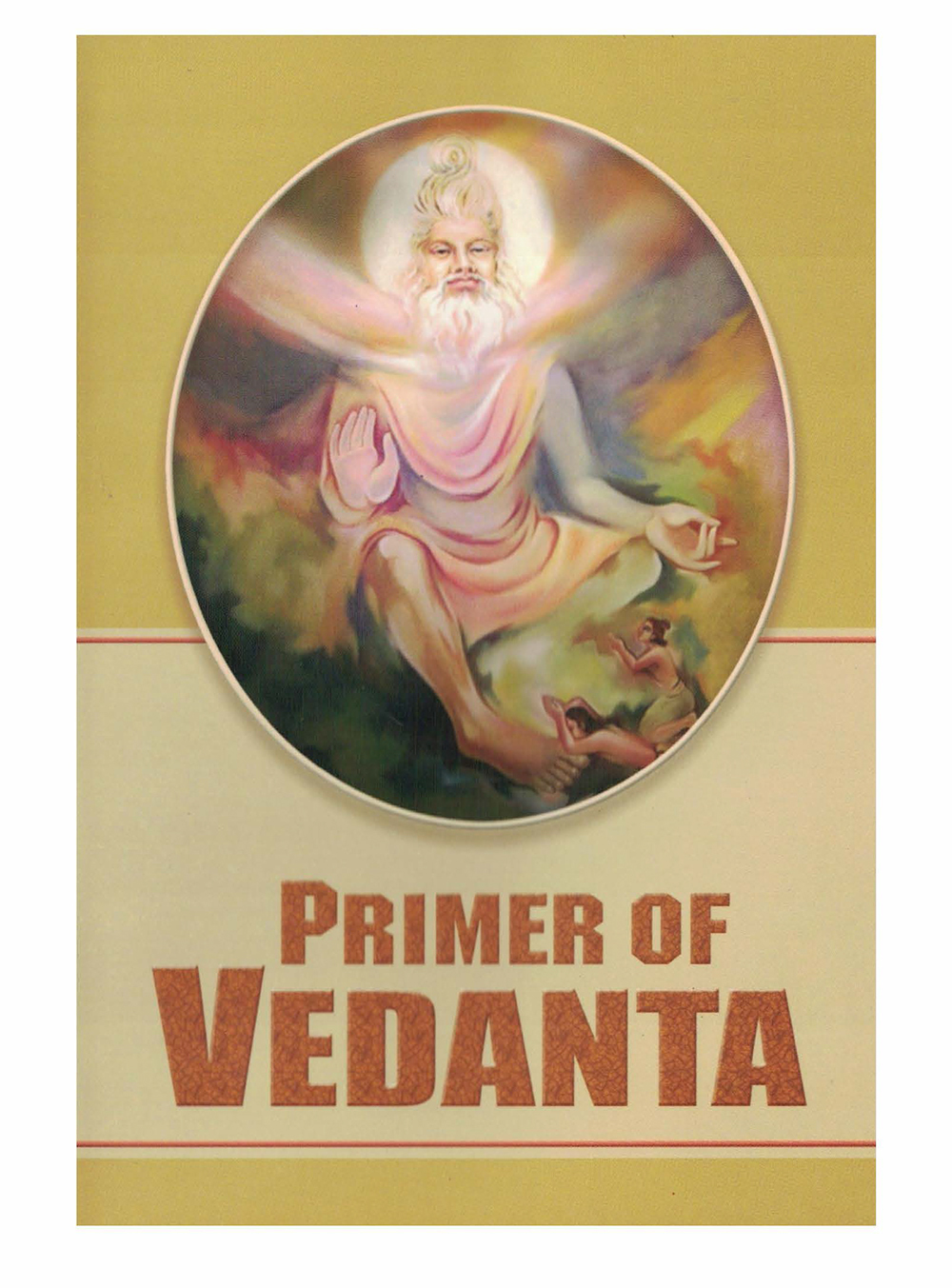
This book is based on the notes dictated by Swami Tyagisanandaji Maharaj. For any serious student of our scriptures, a clear grasp of the terms of the Vedanta and its epistemology is essential. The notes are lucid and logical.
By twodifferent derivations it has two meanings. According to one, Veda means abstract knowledge of truth, by the second, it means that which enables us to arrive at the highest truth. Veda, therefore, means the highesttruthaswellasthemeansto arriveatit.Technically it is used to denote the grandhas or works which are records of the highest spiritual truths realized by the sages in ancient times and of themeans by which wealso may realize thesame truth.
Vedanta
The word Vedanta is a combination of two words, Veda and Anta. Veda is the record of the spiritual truths and the means of attaining them as well as knowledge cf truth in the abstract. Anta means either the end or goal; it also means the inner core or essence. Vedanta, therefore, means either the inner essence of all the Vedas or the end or goal of all our knowledge or the final portion in the textual arrangement of the Vedas. In the last sense it refers technically to the Upanishads as well as their teachings. The Vedanta is the end of all knowledge because it treats about the highest truth by knowing which everything else will be known and after knowing which there is no possibility of a knowledge higher than that. It is th_e inner essence of all the Vedas, because, all the Vedas and their teachings are meant only to lead to this highest of knowledge, namely the realisation of God. Just as Veda is a record both of the spiritual truths as well as the means of realising them, so, Vedanta also being but the essence of all the Vedas, necessarily contains a record of the highest spiritual truths as well as the best means to achieve them. Upanishads contain both these and so pre-eminently Vedanta means Upanishads and their teachings. Hence Vadanta also means both religion and philosophy based upon the spiritual experiences of the realised souls of the past, which have been developed and systematised by Vyasa and Sri Krishna and others in the Brahmasutras, Gita etc.
Sruti
The word Srnti is derived from the root sru meaning to hear. Sruti is either that which is heard or which is fit
only to be heard. Technically the word Sruti is used to include all those works which come under Veda According to the Westerners the Vedas are called Sruti because, writing was unknown in those days and therefore, the teaching was carried on by word of mouth and the sishya or the disciple had, therefore, to grasp it through hisears. But this may notbe acorrect interpretationasit is notprovedthat there was no writing in those days. Theword may be explainedbetter if weconsider that the Srutis are records of theteachings of God Himself, the socalledinner voiceofGod heard bythe sagesinthe depthsoftheirsamadhiorspiritualexperience.Inanother sensealsothese worksdeserveto becalledSrutibecause, it is they which had to be heard from the Guru in the initial stage of sadhana namely Sravanam. Moreover, thetruthsrecordedthereinbeingnotwithinthereach of thedisciple arefit only to be known through the oral teaching and exposition of theGuru and they cannot be understood either through mere reason orperception.For all theabove reasons, all theworks that come under the Vedas are also called Srutis.
Mantra
The word Mantra is derived as 'mananat trayateti mantrah'. From its derivation it is clear it means such wordsorsentencesaswouldsaveoneifmananamor meditationismadeuponthemeaningofthewordor sentence.
Sravanam
Theword Sravanam is derived from the root STUmeaning to hear. Therefore, Sravanam literally means hearing. Thehearing, study and upto understanding the meaning of thewords or sentences is Sravanam. In its technical sense Sravanam includes not only hearing but also study etc.
Pramana
Pramana means pramajanakam. Prama means correct knowledge and the means that gives a correct knowledge is pramana.
Pratyaksha
Pratyaksha meansdirectperception.Anyknowledge youget without the interference of anyoutsideagency is Pratyaksha. Theknowledge the Atman gets by itself, or with the help of themind or with the help of themind and the external senses isPratyaksha. Arriving at correct knowledgethroughdirectperceptionorobservation is Pratyaksha-pramana. Theknowledge thus arrived atis Pratyaksha Jnana. Pratyaksha is the means through which correct knowledge is obtained. It is also some times used to denote the knowledge got through pratyakshapramana.
Agama
ThewordAgamais derivedfromtherootgam with a preposition 'a' added Gam means to go. Agama means,tocome.Anyknowledgethatcomesfromanother, any reliable knowledge onegetsfrom another which the latter hasa mindto communicate isAgama.Agama also means to derive some knowledge from another through words, signs or symbols etc.
Brahmana
The word Brahmana means the meansof realising Brahman. It comes from two words, Brahma and theroot 'nee' (nay). It may mean either a man who having realised Brahman can help others to realise Him, or it may mean a class of literary works which help us to realiseBrahman. Inthe formersense itisusedasmasculine and in the latter sense it is used as neuter,Brahmanah and Brahmanam.Brahman meansnot onlyGod,but also theVedas. Therefore, Brahmana may also mean one who helps the study of the Vedas. It is mostly in this sense that the word is used to denote the Brahmin caste. The Brahmanas . are a certain class of literary works which form the second division of the Veda, the first being the mantra portion. These Brahmanas form a sort of commentary in prose dealing with the various aspects of ritual, devotion and philosophy based on the mantra portion. Brahmanas are generally divided into three portions which are known as Brahmana, Aranyaka and Upanishad It is this first portion technically known as Brahmana proper that is generally indicated by the word. This portion deals mainly with the rituals which took the form of thevarious Yajnas or sacrifices. This portion is henceknown also as thekarmakanda. It isthis that is mainlyusefultohelp thespiritualpractices ofgrihasthas.
Upanishad
The word Upanishad is a compound of three elements upa + ni + sad. Upa means near, ni means surely, totally and sad means to go, to sit, to know, to scatter or to destroy. The word Upanishad, therefore, means going near and sitting near and knowing some thing and thereby scattering or destroying completelyand surely something. Or it may mean that which helps these. Technically Upanishads are certain granthaswhichformthethirdsubdivisionoftheBrahmana. They aresocalled because they enable usto destroy our ignorance which is thebasis of all samsara and scatter away all our sufferings completely and surely. It is also usedtomeanmeditationoryogaincertaincontexts. In certain other contexts it is also interpreted to mean a secret orrahasya. It is also used tomeanBrahmavidya and often as a synonym of Brahman itself, because, it is BrahmanorknowledgeorrealisationofBrahman knownasBrahmavidyathatreallydestroysignorance and which forms the secret of theVedas. Brahman is also hiddeninthesecretrecessesofourheartsandisthus the uttama rahasya or the greatest secret. The word Upanishad is also so called because that is thegreatest secretwhichasishyahastolearnfromhisGuruby sitting at his feet and serving him and which he has to realiseby his own meditation.
Mananam
Thewordmananamcomesfromtheroot'man' to think and to think is to understand intelligently. To understandintelligentlywe must use ourown reason and commonsense and see whether somethingwhich wetriedtounderstandisincomformity with(inagreement with) reason and experience. When we hear something from somebody, we have to test it in the light of reason and experience. So when we hear the Sruti also we can understand it intelligently only if we use our reason and common sense. Weigh everything contained in the Sruti andtestitinthe lightof reasonandexperience.Apparent contradictions havetoberesolvedandeachstatement of the Sruti has to be given its due place in the order of importance etc. This process of intelligently understanding the teachings of the Sruti in the light of reason, common sense and experience is what is called mananam. The process begins only after Sravanam is done and the disciple feels difficulties in correctly understanding the spirit of the Scriptures, the relative importance of their teachings etc. It ends when a working faith in the truth and efficacy of the scriptural teachings takes the place of confusion and doubt. Working faith means sufficient faith to make the disciple to put the teachings in practice and experiment for himself until conviction based on actual experience comes to him. Reason is thus made use of only for the purpose of understanding the Sruti and in support of it and not independently or against it.
Nididhyasanam
Nididhyasanam comes from the same root as Dhyanam. It means constant and continuous meditation on certain spiritual truths which have been found reasonable and probable as a result of mananam so as to make these truths part and parcel of our own lives and also bring them into our direct experience. Nididhyasanam can be only on the highest truth taught by the Scriptures and not on any imaginary object. Thus it can be only on the real nature of our own selves and on the world and on their substratum or basis viz. God, whereas in dhyana we can meditate not only on truths but also on any imaginary thing for the sake of developing the powers of concen tration To have imaginary figure of God with four hands and so on and to meditate on it may not be Nididhyasanam, but can be only Dhyana. Nididhyasana is thus a variety of Dhyana or meditation.
Anumanam
The word Anumanamisderivedfromtwo elements anuand mana. Anu means after; manam means measuring or knowing. Anumana, therefore, means knowing one thing after knowing another. This is the literal sense. Technically anumana denotes that process by which we arrive at the knowledge of a thing which is not present to our senses at that moment, through the knowledge of something else which is present to our senses at that moment. This knowledge of the object which is not before our senses, is based upon the knowledge that this object is always associated with the object which is observed at the moment. Thus to know that there is fire even if we do not actually observe it, merely on the ground of seeing smoke is a case of inference or anumana. Both fire which is inferred as well as smoke, which is seen must have heen seen and observed as associated together as cause and effect previously as in a kitchen and other places. When the same phenomenon is seen, in many places a eneralization takes place in the mind which takes the form of 'wherever there is smoke, there must be fire'. When we see a smoke now it is this invariable association or concomitance that helps us to associate the smoke seen at present to the fire which is not seen at present. Thus anumana depends on the idea of invariable concomitance between two objects based upon previ ous observation and generalization.
DirectPerception
Directperceptionisperceptionwhichcomesdirectlywithoutthemediationofanythingelse.Init, reallyeventhemindandthesensesarenotinvolved. This direct perception can be only of one's own Self. The Self does not require any other means or mediation of anything else to know itself. Even when the mind is not active as in dreamless sleep or in samadhi the Self knows itself. This we know, because, after coming back from sleep we remember that we enjoyed the sleep and that we perceived nothing else. Such memory is not possible unless we had experience of it as all memory depends upon experience. Since we are conscious that we did not see anything during deep sleep and still we remember the deep-sleep experience that the Self must have existed in deep sleep and must have experienced itself and enjoyed itself. Similar is the case with Ninnkalpa Samadhi also. Even in our ordinary waking consciousness, we do not require the help of anything else to know ourselves. Therefore, the Self's knowledge of itself (or perception of the Self by itself) may be considered direct perception. Every other perception which involves the useofthemindandthesensescanbeconsideredonlyas indirect perception; because the perception comes in theSelfthroughtheinstrumentalityofthemindandthe senses. It is this direct perception that is generally known as Yogi Pratyaksha or Samadhi or Prajna or SamadhiPrajna or intuition etc.
InductionandDeduction
Induction and deduction are names given to two varieties of inference in western logic. When we observe individual facts a number of times and note the similarity between them as well as certain uniformity of behaviour, we arrive at a general proposition. This process of arriving at a general proposition based on the observation of uniformity among certain groups of individual facts is called induction. On the other hand, when we know a general proposition to be true, we arrive at the truth of an individual fact, because the particular must necessarily be included in the general. This process is called deduction. Thus when we say that all men are mortal on the basis of our observation of many men dying, we have a case of induction. When we arrive at the conclusion that all men must die, we have a case of deduction. Thus, in induction we proceed from the particular to the general, in deduction we proceed the opposite way, from the general to the particular. These two processes can lead to a knowledge of truth only if they satisfy certain conditions. Otherwise they will lead to fallacies. These two processes are not treated of as two separate processes in Indian logic. To the Hindu logicians, as to the ancient Greek logicians, inference means only deduction and the process _of generalization is accepted only as a step in induction. The inductive process, therefore, comes only as subsid iary to deduction, since no deduction is possible unless we believe in the truth of a general proposition.
Prasthanatraya
The word Prasthanatraya means the three Prasthanas i.e., thereputed foundations. The word is technically used to denote three classes of works which are accepted by theHindus as the Scriptural founda tions on which the Hindu religion and philosophy are built. The three reputed foundations arethe Upanishads, theBrahmasutrasandtheGita.The Upanishadsrepresent theessenceofthe Sruti,theVedantasutras (Brahmasutras) represent the essence of all philosophies or Darsanasandthe Gita representsthe essence oftheclassofscriptures known as Itihasapurana. The Upanishads are merely records of spiritual experiences of various enlightened souls called Rishis. They are useful for the practice of Sravanam, the firststepinspiritual practice.Theysupply the traditional background of Hinduism and the Brahmasutras are helpful in the second step of spiritual practice, namely mananam. They are systematic and argumentativeinnature.Reasonisherefullymade use of to understand intelligently the teachings of the Upanishads. It, thus makes use of thereason in support of faith and the truth of spiritual experience. The Gita helps us in the last stage of spiritual practice viz. Nididhyasana i.e., meditation and actual realization ofthespiritual truths realized by theancient sages. Thus the Upanishads answer to tradition, the Vedantasutras answer to logic and the Gita to life.
Aranyaka
Theword Aranyaka comesfrom the word aranya meaning forest. The Aranyakas form one part of the Brahmanas. They are so called because they deal mainly with the spiritual practices which are expected to be performed by the Vanaprasthas or forest-recluses (hermits) i.e., people who. have entered the third stage of spiritual life according to the Vamashrama order of social and spiritual organisation. They might have been also composed by these recluses or hermits in the forest and learnt by them after their retirement to the forest. They deal mainly with the symbolisms behind rituals which the grihasthas had to perform and it is in these works that the devotional element in spiritual life is emphasized. Thus we mayconsider thisastheUpasana kanda or Bhakti-kanda just as the ritualistic portion is known as Kamia-kanda.
What are the various works which come under the Vedas-Sruti?
The Vedas
The Vedas consists of two parts viz, the mantra and the brahmana. The mantras have been collected into Samhitas and we have four such Samhitas, viz, the Rik Samhita, Yajuh Samhita, Sama Samhita and the Adharva Samhita. These collections were made mainly from the standpoint of the necessities of four kinds of priests employed in the ritualistic sacrifices. The Rig Veda is meant for the use of the Hotru priest, the Yajurveda is meant for the use of the Adhvaryu priest, the Sama Samhita is meant for the Udgatru priest: these were the only Samhitas in existence at first. The Atharva Samhita is historically a later collection although the mantras themselves contained in it may be as old as the others. This Samhita is appropriated by the Brahman priest. The business of the Hotru priest was to invoke the gods when the offering is made. The Adhvaryu was an assistant who got ready all the preliminaries necessary for the sacrifice. The Udgatru priest formed the choir of musicians and the Brahman was the supervisor of all these. The Rik Samhita contains hymns of praise and it is so called because Rik means only a hymn of praise. All the mantras in the Rigveda are in verse. The Yajurveda consists of short prose passages which help to remind the assistant priest of the various duties to be performed by hiill- This contains the oldest prose in the world. The Samaveda consists of all the songs which are set to music and sung at the sacrifice. The Atharva Samhita consists of a heterogeneous collection of mantras, some of them highly philosophical and others magical. Many of the mantras there are used in a sort of witchcraft; sometimes for warding off evils, sometimes to injure enemies and so on. Because we find in the Atharva Veda a very large number of philosophic hymns and because it is used by the Brahman priests, the Atharva Samhita is sometimes known as the Brahmaveda or Brahmasamhita. There are two methods of arrangement that are current, one according to Ashtakas and the other into mandalas. In quoting references from the . Rigveda for instance, one shouid be very careful to mention whether the number of chapter and verse is according to the mandala arrangement or ashtaka arrangement.
Brahmanas
The Brahmanas form a sort of commentary in prose on the Samhita portion. They sometimes explain the meanings of some mantras, sometimes offer mytho logical explanations, the origin of Gods, mantras, various types of rituals etc. and sometimes how and where the various mantras should be used in rituals. The Brahmana consists of three subdivisions which deal with karma, bhakti and jnana corresponding to Brahmanas proper, Aranyakas and Upanishads. Each of these Brahmanas is attached to one Samhita or other and there are many Brahmanas attached to each Veda. Sometimes the Vedas are considered to have some subsidiary texts attached to them which are called Upavedas and Vedangas. Upavedas mean subsidiary Veda and under this class come Ayuroeda or the science of life, Gandharoaveda or the science of music, Dhanuroeda or the science of war, and the Sthapatyaveda or the science of engineering etc. Vedangas mean limbs of the Veda and they consist of all the subsidiary sciences necessary for the proper study and application of the teachings of the Veda. The Vedangas are said to be six in number and they are classified as Kalpa, Nirukta, Chhandas, Jyotisha, Vyakarana and Siksha. They are supposed to have subsidiary Angas or Upangas under which come the six systems of philosophy or Darsanas viz. Nyaya, Vaiseshika, Sankhya, Yoga, Puroa and Uttara Mimamsas and over and above the four Vedas and their subsidiaries and auxiliaries, there is in common parlance, a fifth Veda or Panchamaveda. This name is given to the Mahabharata because it is supposed to contain all the teachings of the Vedas in popular language and form.
Sruti
Sruti is only a synonym of Veda ordinarily. But when the word is used by particular schools of thought it refers only to different parts of the Veda. Thus, when the Vedantin uses the word, he means the Upanishads; but when the Puroamimamsakas or ritualists use the word, they mainly refer to the Kannakanda of the Vedas.
The Upanishads contain the inner essence of the Vedas. All the ideas contained in the earlier portions of the Vedas as well as all the philosophical speculations and ritualistic prescriptions only lead up to the realiza tion of the highest truth taught by the Upanishad . All the subsequent scriptures such as Smritis, ltihasapuranas, the six systems of the Darsana etc. were based upon the teachings of the Upanishads. Thus the teachings of the Smritis or Dharmasastras and the practices prescribed by them, whether social or ritualistic, are no authority at all, if they go against the teachings of the Upanishads in any respect. The Dharma prescribed by them is only a means to realize the Brahman preached by the Upanishads and Dharma can never be Dharma unless it is effective in the realization of Brahman. So also in the case of the Puranas and Itihasas. They are meant to give concrete illustrations of the abstract truths preached by the Upanishads. Facts, historical or symbolic, are made use of in these treatises only to illustrate the Upanishadic principles. What was given by way of precept is found here in the form of example. The Puranas and ltihasas derive their authority only from this. Anything that goes against the spirit of the Upanishads cannot be considered as authoritative and may be rejected as interpolation. So also the six systems of philosophy known as the Shaddarsanas derive their authority only because of their capacity in helping us to understand the highest teaching of the Upanishads, viz., God, from a rational standpoint. Thus the whole superstructure of Hinduism is built on the solid rock of the spiritual realizations of innumerable Rishis or sages recorded in the Upanishads. Without understanding the Upanishads one cannot, therefore, understand Hinduism. All interpretations of the other scriptures that go against these spiritual realizations which are facts and not mere guesses, are useless from the spiritual standpoint.
The Upanishads and their teachings are considered by the Hindus to be authoritative for various reasons. The ultra orthodox people believe that the Upanishads form the word of God and should, therefore, be beyond question and implicitly accepted. Although at first sight it appears quite unphilosophical and unreasonable to consider the Upanishads as representing the word of God, there seems to be an element of truth behind this belief. If we once accept the state of Samadhi or highest spiritual experience as plausible and accept that in that state the human soul becomes one with God, or in other words, regains its natural and inherent perfection or divinity, the persons who have realized this state may reasonably be considered as veritable gods on earth. There is nothing wrong, if this is accepted, in believing that the Rishis who record their spiritual experience, are themselves Gods or as good as Gods and their teachings may, therefore, be considered as the word of God Him self. Moreover, in another sense, the teaching represents the truth as revealed in the depths of samadhi and theUpanishads record, as it were the dictates of God or the Antaryamin. It is often referred to as the small inner voice or conscience when it relates to the subject of morality. Thus, there seems to be an element of truth in the view of the orthodox Hindus that the Upanishads form the word of God, only we should be careful not to take it literally, but only figuratively. The authority of the Upanishads on this ground, however, is based merely on faith and is liable to be rejected by the unbelievers. The authority of the Upanishads is not based on this ground alone. From a rational standpoint, we can under stand the value of all records of past experiences of the human race, whether it be in the region of science or religion or ethics, politics or education etc. It is practically impossible for any man to have firsthand experience and verification in the short span of his life, of every item of knowledge. He must, by sheer necessity, have recourse to secondhand knowledge. All education and instruction where a human child is put in possession of all the knowledge and experience of his predecessors are based upon this necessity. If everybody has to begin afresh, and will not rest contented until he has firsthand knowledge of everything, one life will not be sufficient to gather firsthand experience of all that our forefathers knew and no new knowledge will be possible. In many instances, firsthand experiences are impossible as, for example, that poison will kill man. If one wants to experience for himself the effect of poison, there will be no possibility of further knowledge of anything. Again in such instances as the knowledge of one's own parentage, one has to rely upon the testimony of others. Thus reason tells us that there is no escape from the fact that man must be prepared to accept and benefit by experiences of others however rationally inclined he may be. The Upanishads form only a record of the spiritual experiences of the human race, in exactly the same way as the political history or economic history records the political or economic experiences of the race, or as science text book records the results of all scientific experiments conducted by scientists, or a work of an explorer such as Arctic explorer or a Himalayan explorer is the record of the new discoveries made by him. If these latter text books can be taken as authoritative and acted upon, there is nothing which can prevent a rational man from accepting the Upanishads and acting upon the truths. Unlike other religions and philosophical systems, which claim authority for their scriptures on all the experi ences or opinions of only one particular man, the Hindus claim authority for the Upanishads on the ground that they record the common experiences of many sages. When many people experience the same thing under similar circumstances and conditions, there is a better likelihood of the experiences being true or real. But, if it is claimed that the experiences are peculiar to one·man and that nobody else would have it under any circum stances, one is apt to reject such experiences as halluci nations of a deranged brain and it will be unsafe to accept such records as authoritative as there is no possibility at all of verification The teachings of the Upanishads are not only corroborated by the various sages of the past whose experiences are recorded there, but they have been subsequently experimented upon and verified by many sages and saints in succession during its long history and it is claimed by the Hindus that they can be verified even now by anybody who is prepared to experiment for himself.
Moreover, as in a Court of Law; the Judge must rely upon the written records pertaining to the case supplemented by oral evidence submitted by witnesses has to use his own reason and intelligence for drawing logical conclusions before finding out whether a fact is true or not, in spiritual matters also we, who have to judge, are not prevented from making use of all the evidences available, written or oral and to use our own reason and intelligence for drawing conclusions logically from the facts presented. The Upanishads are to be treated only as records in a case and their authority rest on the fact that they can stand the test of other evidences in the matter. Our religious practice makes it incumbent upon us to sit and learn the Upanishads at the feet of a Guru who supplies the oral expert evidence necessary for its support. A present realized man's opinion is made to support the past experiences of realized men. In the mananam stage we are also asked to use our own reason to understand these teachings intelligently. In the nididhyasanam stage we have to experience it ourselves, before we finally accept the truth of these teachings. Thus all safeguards are provided to separate the true from the false. Again, as in a case before the judge, the judge has to work within certain limitations prescribed by the law of evidence, several rules and regulations are provided in spiritual matters also to help us to arrive at spiritual truths. We have to use all these guidances provided for our safety and it is only such of the statements in the Upanishads that can stand all these tests, deserve to be considered as teachings. When we examine the Upanishads to find out the essence of their teachings, we shall find that the inherent perfection of the human soul will stand all test and the expert evidence given by the Rishis about it may safely be taken as authoritative. The natural perfection of the soul not being realized now, the Upanishads give us the cause of our present imperfection and the means of escaping from this imperfection and the regaining or realizing of its inherent perfection. These two, therefore, form a complement to its funda mental teaching. The cause of imperfection is given as kama or ahamkara or selfishness or ajnana or ignorance. The way of escape must naturally be the destruction of ajnana or the killing of ahamkara or kama. This is called technically Tyaga. Thus in technical language the teach ings of the Upanishads may be summarized into three words the atman, Brahman and tyaga or dharma which correspond to the finite self as it is now, the perfect or infinite Self which it has to realize and the means _of realization. When we speak of the authoritativeness of the Upanishads we mean only its teachings with regard to these matters and everything which can naturally and reasonably be considered as corollaries of these. Every other statement of the Upanishads may be accepted or rejected as authoritative or not according as one likes. Differences of opinion on various details reflect only the differences in the capacities and viewpoints of different people. They cannot affect the reliability of fundamental teachings.
What are the limitations of Pratyaksha, Anumana and Agama?
Pramanas, as we have seen, are the means of arriving at true knowledge. Pratyaksha, anumana and agama are said to be such means.Can these provide correct knowl edge always and can each of them give such knowledge independently of the others? What are the limits within which they can function so that the knowledge provided by them may be true? Let us take each of these pramanas separately and find out their limitations.
PRATYAKSHA
Pratyaksha, we have seen, is direct knowledge and we have also seen that there are three varieties of pratyaksha. Of these, the knowledge of Atman by itself is the most direct knowledge. This direct knowledge has no limitations at all. When the Atman observes itself, that direct perception must always be valid and true. The only difficulty with regard to this perception is that the Atman does not observe itself directly under ordinary circumstances. It always looks at itself unfortunately only through the medium of the mind. And naturally its knowledge of itself under ordinary circumstances is affected by the defects and limitations of the mind. It then sees itself, not as it really is, but as having many of the attributes and limitations of the medium, which is technically known as Upadhi. To have a correct or true knowledge of the Self, the Self must free itself from the trouble of looking at itself through the mind. Or, in other words, the mind must be purified and concen trated and so to say it must destroy itself. This is what is known as Yoga, and the various sadhanas are meant only to enable the Self to look at itself and know itself as it really is.
In the case of internal perceptions where the Atman observes the mind, its contents, its characteristics etc., it is acting under various limitations. First, it is looking at these facts not directly, but through the mind. Mind is thus observed only through the mind itself and the observation must necessarily be affected by the limita tions and defects of the instrument. Over and above this, it is a little difficult to observe also, since the mind is only an instrument and one cannot observe the instru ment itself through the instrument. If at all, therefore, one has to observe the mind as it is, one has to get rid of the instrument and when the instrument is got rid of, it is not possible to study or observe the instrument. So, in observing the mind as it really is, the Atman will be looking not at the mind, but at itself. All our ordinary perceptions of the mind are, therefore, false-perceptions and the knowledge gained about the mind as such by the psychologists cannot, therefore, be relied upon as absolutely true, although from the relative standpoint, it may be true in a way. As long as one is not able to dispense with the instrumentality of the mind, all the observations made can only be relatively true and these may be useful in practical life in this world. Again, the mind cannot function by itself. It must have the physical medium such as the brain and the nervous system and when the physical health is shattered so as to affect the brain or the nervous system, the mind cannot function properly. All observations, therefore, of mental phenomena made through the mind itself must necessarily be dependent upon the health of the body also. It is not, thus, possible for a nervous wreck or a lunatic to study the mind and to observe and know truly the real state of his mind. It is only because of this, that we find in many such cases, even pain being mistaken for pleasure and misery for happiness and vice versa. When internal perception is thus subject to the health of the body, when the mind itself is not at rest or is perturbed, how much more difficult it must be to observe properly. So, mentally and morally also one must be healthy before internal perception can give true results. Thus, we can understand the view of Vedanta that it is the mind that is the cause of all bondage and release. The saying of Milton that 'the mind can make a hell of heaven, or a heaven of hell' also becomes understandable.
Again, all perceptions, even though they are internal, must be affected by the previous mental contents, which remain in the form of samskaras or impressions and tendencies. It is only on this ground that we understand the differences between individuals in their likes and dislikes.
Then we pass on to the third kind of perception where the Atman observes through the mind, with the help of the external senses. In all perceptions of external objects and phenomena, it is the senses that somehow come in contact with these objects. The senses by them selves, however cannot give rise to perception. The stimuli given by the external objects are received by the senses and carried through the ·nervous system to the brain and then they are interpreted by the mind in terms of its past experiences and it is this interpretation that is put by the mind that inheres in the mind in the form of certain impressions and perception takes place when the Atman looks at these impressions through the mind If any of these is absent, no perception of an external object can take place. The senses by themselves can receive only physical stimulus and it is only physical stimulus that is carried to the brain. The mind must be there to react if any sensation is to be felt or known. If the mind is engaged otherwise, whatever impression might be made in the brain, it will not be noticed by us. The various sensations coming through the various senses have to be observed, unified and interpreted by the mind. It is thus seen that the mind is the important element even in external perceptions. Naturally, there fore, the limitations which we have been considering with regard to internal perceptions hold good in the case of external perception also. Over and above these, external perception is subject to some more limitations. Thus, the senses must be healthy and they must be under control before observation becomes possible. If there are any defects in them as when the eye is blind or suffering from jaundice, such defects must affect the perception also. Again, there must be proper contact between the object and the senses. It is because of want of contact that an object is not perceived, e.g., when it is behind a screen or a wall. There must again be proper medium for the stimulus to affect the senses. Thus, a sound cannot be heard when there is no medium, whether solid, liquid or gas through which the vibration can be carried to the ear. When an electric bell is rung inside a bell-jar from which air has been expelled it cannot be heard Again, sometimes it is not possible to see certain things because they are too small or at too great a distance. In such cases observation and perception become possible with the help of certain physical instruments such as the microscope or the telescope and if the instruments are defective or if one does not know how to use them, the observations recorded may not be correct. Again, proper conditions of light, temperature, the atmospheric pressure, distance! differences in perspective etc. affect perception. A stump of a tree is perceived as a ghost or a rope is seen as a snake only because of want of light. The various views of a table that an artist draws is explained from the standpoint of differences in perspective. Again, there are certain objects which cannot be perceived at all through the senses and only their effects can be noted as, for example, an electron. No instrument has been invented as yet, by which an electron could be perceived through the senses. Similarly, many of the forces, like electricity are beyond perception. The fact that we know them still is due to the fact that they exist as ideas in our mind. To the same category belongs God also. He cannot be seen through the senses because that will make Him one among the many physical and material objects. There is still another great difficulty. Even if all the conditions are satisfied, how to know that our observation is correct? The same object can be perceived differently under different conditions. Which. of the observations can be taken as correct observation? The only possibility appears to be to take each observation as correct under that particular set of conditions. But even this cannot give us a correct view of what the object really is. All the views can be only relative and partial. If we want to get a totally correct view of an object by perception, we have to perceive it a number of times under different conditions and try to find out the harmony among all the observations obtained and whatever may be found to be common characteristics may be taken as representing the real object. But this takes us beyond the power of the senses and mere ordinary perception depends upon other powers of the mind to give a correct knowledge of an object. Again, any number of observations by the same man may be invalidated because of the presence of the same defects every time he observes, as, for example, in the observation that the earth is round or the observation of a man with defective vision. We have therefore, to have recourse to other tests also to find out whether our observations are correct. Thus the observation that the earth is round has to be checked in the light of many other observations, not only by himself, but by others; not only of the same facts but of other facts; it is only when we find that our observation is not inconsistent with or contradictory to other observations made by us as well as others, that we can rely upon its correctness. Not only that: it should not go against valid inferences also. It is only because there are large number of observations which are more consistent with the truth of the roundness of the earth that we accept that fact as true and consider the flatness observed as false. Thus, we have to check all our observations in the light of all other observations, made by ourselves, as well as others, as well as the knowledge acquired by valid inferences and accepted expert opinion. But, to check perception by another perception, we must know that the other perception is valid and to check that perception, there must be other valid perceptions ad infinitum. So, it may not be possible to arrive at the correctness of one perception merely because of its agreement with another perception in as much as the validity of that perception itself is not proved. When it is not possible to find out correctly, whether our perception is true or not, it is much more difficult to find out whether the observation of another is correct or not. Therefore, it is not reasonable to check our own observation by another man's observation. Inference also being based upon perception, to check the perception in the light of inference will be putting the cart before the horse as validity of the inference itself depends upon the validity of the perception. If we say that perception can be taken as true if it corresponds with facts, that test cannot be applied because we will have to find out what the facts are first and that we cannot do without perception. If we say that non-contradiction is a test of truth, the truth will always remain truth until it is contra dicted and there is no knowing when an accepted truth may be contradicted by other observations as is amply evidenced in the history of science. Thus, there is no possibility of our having any certainty of the truth of an observation as a possibility of future contradiction can never be negated. Taking all these things into consideration, the only observation or perception which you can take as correct is the perception of the Self by itself, since it is not possible to think of its incorrectness or untruth. If any perception is valid and true, for all times, for all persons in all places and under all conditions, it can be only perception of the Self by itself. Every other perception is incapable of being absolutely true or being proved to be true. They are all, at best, only relative truths and most of them half truths or untruths.
For practical everyday life, however, we have to rely upon the truth of our observations as otherwise life will be impossible. For this, however, certain precautions are to be taken so that we may be as near truth as possible under the limitations under which we have to work.
1. We must take care that our mind is not prejudiced in favour or against anything.
2. The mind is properly concentrated.
3.The observation is deliberately made and it is not casual. ·
4. The observation may be repeated under different known conditions as in experiments.
5. The senses, the instruments as well as the mind itself must be properly trained by constant practice.
6. We must see that our observation is not contradicted by any other facts known as true.
7. We may also see tha_t it does not go against the findings of other people under similar conditions, especially of people who are known to be experts.
8. We may make use of our knowledge and see how far it satisfies our actual requirements.
9. We must see that it does not go against reason.
10.We must also see that the observation is made about something which is possible of being observed.
11. We must see that no foreign element is imported into the observation, especially from imagination as in the case of poets or artists.
12. We must make sure that the mind and the senses as well as the nervous system are all healthy and capable of discharging their normal functions.
13. If any physical instruments are used, we must make sure that the instruments are in proper order.
14. We must make sure that the observation is not made through a medium which is not necessary.
15. We must make sure that the observations are made under normal conditions. If all these precautions are taken, there is likelihood of our knowledge being true for our practical purposes. This kind of truth is known as Vyavaharika Satta or relative as different from Paramarthika or absolute truth.
ANUMANA
Limitations of Anumana : Anumana, as we have already seen must always be based upon observed facts which are known to be true. All the limitations there fore, of pratyksha must affect anumana also in as much as the pratyaksha is defective, the anumana built upon such pratyaksha must also be defective. Hence the necessity for making sure of pratyaksha at every step should not be forgotten. Deduction depends upon induction and induction depends upon observation of individual facts. A number of facts have to be observed first and the knowledge gained has to be generalized. The generalization has again further to be tested by fresh observations. In every anumana, therefore, perception comes in the beginning to find out the invariable concomitance between two objects or facts. Perception, again, comes in to give us a knowledge of the presence of one of these objects as a characteristic of some other perceived object as in the perception of smoke on the hill where both hill as well as smoke and the relation between the two have to be observed. Even after the inference of fire is made, the matter can be finally settled only after fresh observation. If any of these observations go wrong, knowledge gained from inference also may go wrong. Moreover, every inference is dependent for its efficacy on the truth of the general proposition such as wherever there is smoke, there must be fire. But the general proposition itself is open to question. The generalization is correct only so far as it relates to or agrees with observed facts. It cannot be extended so as to include facts which have not been observed. A universal proposition, therefore, is not based upon observed facts and is therefore, not reliable. The history of science shows us how many of such generalizations have been exploded by subsequent discoveries of facts. There is, therefore, an element of doubt still present with regard to the validity of all universal propositions and if a universal proposition is not valid, the deduction that follows from it also cannot be relied upon as valid As a universal proposition is impossible because all individual facts past, present and future are not capable of being observed, all cases of inference must also neces sarily be impossible. Again, in the ordinary inference, nothing fresh is proved or known. The thing which has to be inferred is already taken for granted in the general proposition. Thus, when we say 'all smoke' the 'all' must necessarily include the smoke on the hill also, as otherwise there is no meaning in using the word 'all'. If thus it is already known, there is nothing further to be known by the inference and since it does not give us any new knowledge, how can it be treated as a pramana? Moreover, all process of inference is defective in so far as it takes for granted what is yet to be proved. Again, there are many inferences possible from the observation of the same facts. The different lines of argument followed by lawyers on behalf of two contending parties in a Court of Law would not have been possible had there not been many possibilities. If there are many possibilities, how are we to decide which of them is the correct knowledge? To decide this, again, we will have to take recourse to the help of the evidence of experts or people who have actually observed the fact and thus have direct knowledge. Even for arriving at a general proposition, we have to call in the evidence of other observers. If a uniformity of behaviour or an invariable concomitance is based only on the observation of one man, it cannot b a reliable universal proposition such as must necessarily lead to the conclusion to be proved. Thus, inference stands in need of support from Agama-pramana also. The mutual dependence of the various. pramanas thus leads to the conclusion that none of them can be relied upon. Again, because a universal proposition can be arrived at only with reference to facts or objects which are capable of being known by perception, inference must necessarily be confined to facts or things which are capable of being perceived. Any inference, therefore, with regard to things which are beyond the power of perception cannot be a subject or object of inference also. Thus, any inference about such entities as God or heaven or hell or Devas which are beyond perception cannot be relied upon. They will always remain open to question.
Over and above this, some psychological conditions must be present in a man who can use this pramana. Thus, ordinarily, no inference takes place unless there is some doubt with regard to some fact. If psychologically a man is certain of anything he will never have recourse to inference at all, whatever may be the basis of his certainty. For example, if a man knows as certain something by means of perception, he will not be tempted to infer that thing. There must be a will to infer also and find out the truth. Thus, for example, a man might see smoke on the hill any number of times and yet he may not be interested in finding out whether there is fire at all and so he does not use his will to infer. But in certain cases, even if there is certainty, one may draw an inference, if there is a will to infer for the sake of convincing others. So, inference may take place if that condition, viz., the desire is present. But no anumana is possible where there is both certainty and the absence of the will to infer. Again, no inference can be relied upon if it is vitiated by any of the fallacies, which vitiate an inference. Again, any inference which contradicts any true knowledge gained from any other source may not be safely accepted unless the truth of it is proved by its being in consistency with the majority of facts known to be true. Thus, for example, the earth is inferred to be round although it is against our perception of it as flat only because such an inference will be consistent with and be able to explain many more facts than the other. On the other hand, if a man proves by ingenious logic that fire is cold or 2 + 2 = 5, such inferences will not be accepted as true, however plausible the arguments might appear.
In spite of the very serious difficulties one has to meet with in drawing a conclusion by an inference, one cannot escape inferring and being guided in everyday life by the knowledge gained by inference. For all vyavaharika purposes, inference is helpful, although from the paramarthika standpoint knowledge gained by inference may be defective. For practical purposes, therefore, anumana may be accepted as one of the pramanas. We should however take care to see that the conclusion drawn is as plausible and as reasonable as possible. For this, certain precautions may be taken.
1. Make sure that facts are observed clearly with as much definiteness and precision as is within our capacity under the particular circumstances.
2. See that the generalization is based upon as many observations as possible under the circumstances; the larger the number of observations, the greater the reliability of the generalization.
3. The observations may be made in as many different conditions and circumstances before generalization is made.
4. As far as possible a genuine search may be made for facts which are opposed to generalization.
5. The natural deduction and corollaries that follow from the general proposition may be put to fresh tests in experiments.
6. The conclusion drawn from an inference may be put to practical test and it may be seen how far it is useful for practical life (e.g., the mirage. You may see waves, reflections etc., but see whether it can quench your thirst).
7. See that the conclusion does not go against facts which are scientifically known to be true.
8. See that the generalization from which the conclusion is drawn is not a mere empirical one and as far as possible try to find out an explanation for it, consistent with other scientifically tested laws and generalizations.
Agama-pramana
Like other pramanas, Agama-pramana also has its limitations. We know that it consists in deriving knowl edge from somebody else. In the first two pramanas, one relies mostly upon oneself. One has, therefore, to reckon with only the personal defects and limitations of oneself. But here we have to provide for the liability of error because of the defects and limitations of somebody else also. The man from whom the knowledge comes or by whom it is communicated must have derived his knowledge only through pratyaksha or anumana. There is no knowing whether the knowledge that he is communicating is based upon proper observation or inference. There is, therefore, greater risk in accepting knowledge from others than in knowing for oneseif through the first two pramanas. There is another great danger. Knowledge that is conveyed to us must be through some medium such as language or gestures etc. All the difficulties in interpreting this language or gestures in such a way as to understand, have to be reckoned with. As one author has humorously put it, 'language is not a means of communication of thought but it is a means of concealing thoughts'. Many of the quarrels of this world are based upon misunderstandings and there is no such universal language which will prevent all misunderstanding. The presence of ambiguous words in the absence of real synonyms coupled with the necessity of each one understanding the meanings of words in the light of his own experiences makes it very difficult to grasp another's meaning. The difficulty is much greater in the case of words which denote qualities and other abstract ideas. For example, when a man says a thing is good or beautiful, it is very difficult for another to understand what he exactly means, because these terms relate to ideas which are relative to particular persons, places, conditions, circumstances etc. It is also difficult to find out whether the words are used in their ordinary or figurative senses. One has again to find out whether a statement made by another exactly conveys his thoughts which is very difficult. There is no knowing also whether the statement is meant to convey some new knowledge or whether it is meant only as a deliberate joke or for cheating. It also goes without saying that only ideas and feelings which can be conveyed through language that can properly be the subject of agama. That which is inexpressible and beyond words cannot be known through agama also. The reliability of a knowledge derived from agama, therefore, depends not only on the capacities and qualifications of the man who gets the knowledge, but also on the capacities and qualifications of the man who communicates, as well as the nature of the knowledge communicated. To test one's own capacity is difficult; to test another's capacity must be much more difficult. For testing another's capacity also one has to rely upon observation, inference and other peoples' testimony. Thus, agama-pramana depends upon the other pramanas also. If the reliability of one statement must be supported by the reliability of another man's statement, it will be impossible to establish the reliability of any statement. There is no possibility of our making sure whether the man who communicates the knowledge is prejudiced or not or whether he has got any ulterior motive.
In spite of all these difficulties, we have to rely upon the statements made by others and act upon them in our ordinary lives. Such statements may be accepted as true under certain conditions. The following precau tions may be taken:
1. See that the statement is made by a recognized expert.
2. See that the statement is based upon his own observation and inference and does not convey the opinion of another.
3. Make sure that the statement is not a casual statement, but one deliberately made for conveying some new knowledge for the benefit of those to whom it is communicated.
4. See that he has no selfish purpose of his own and that the statement is not vitiated by innate prejudices etc.
5. See that the statement is with reference to a subject in which he is recognized as an expert; no opinion of an expert which does not deal with facts within his province, should be accepted on his authority.
6. See that his statement does not contradict the knowledge that one has already got through one's own pratyaksha or anumana. For example, even if an expert says that fire is cold, we cannot accept it.
7. See that we have opportunity to cross examine the man who makes the statement, before it is accepted
When a statement is a written one as in the case of scriptures or books on science or history etc. The following additional precautions may be taken:
1. That the statement made is reasonable.
2. That the materials on which the expert opinion is based is open to our inspection also.
3. That the opinions recorded are corroborated by other written records or writings of other experts in the same field.
4.Whether the truth is vouchsafed for by a reliable man in whom you have confidence and whom you have the opportunity to cross examine. (Here a proper Guru is meant).
5. Take care to try yourself by adopting the means which the writers say they have adopted. When the first steps in practice give us the same experiences as are recorded in the scriptures, it gives us confidence in the other statements also which we have yet to realize.
6. Make sure that you have sufficient knowledge of the language in which the statement is recorded and that you do not rely upon the interpretations or explanations of the statement made by others.
Show how no knowledge of truth can be derived from any of these pramanasseparatelyandhoweachrequiresthehelpoftheothers.
Thepramanas are means of arriving at true knowl edge. It is ordinarily thought that each pramana by itself can give us true knowledge. But this is nota fact. Each pramana,no doubt gives some knowledge;butbefore we could rely upon the truth or correctness of such knowledge, we are forced to have recourse to the use of otherpramanas also for testing thecorrectness or truthof the knowledge arrived at by one pramana only. To know something is different from knowing it as true or knowingthe truth of it.It isvery difficult to beconvinced ofthetruthofanyitemof knowledge,ifoneissufficiently sceptic and prone to doubt. Every knowledge except the knowledge of one's ownSelf is open to doubt. But even a doubter or sceptic cannot question his knowledge of himself But,for ordinary purposes, unless we are convinced of the truth of our knowledge, it will be impossible for us to live. So, everybody has to arrive at the truth of his knowledge, before he acts upon it. To find out the truth of a fact for practical purposes, it will be safe for us if we make use of all the means at our disposal.
From the various tests prescribed for the reliability of the knowledge gained by any of these pramanas, we can understand how every item of knowledge could not betakenas true and actedupon. Among thevarious testsprescribed,maybementionedthefollowingviews:
1. Correspondencetest.
2. Thecoherencetest.
3. Thetest ofnon-contradiction.
3. Thetestofpragmaticutility.
The first test tells us that knowledge may be taken as true if it corresponds with facts. But how are we to find outwhether it corresponds with fact? Even for this, a knowledge of fact is necessary and if that knowledge is also to be tested with reference to this correspondence test, there is no possibility of coming to a conclusion. Even if it is possible, one knowledge istobetested inthe lightofanotherknowledgeand thatknowledgehas to be gained either through pratyaksha, anumana or agama. Therefore, whether the first knowledge isgained through pratyaksha, anumana or agama, it must have the support of other knowledge gained through pratyaksha, anumana or agama.
If we are to test the truth of a knowledge with reference to the coherence test, we again feel the same necessity. With what could the first knowledge cohere? It must be with other knowledge which has been found true already. How could the second knowledge be arrived at without the help of pratyaksha, anumana or agama? How again can we know whether it coheres or not except through other pratyaksha, anumana or agama? Coherence, if it is to be a test, again, should not be mere agreement with any other item of knowledge, but with the whole body of knowledge coming through all the pramanas and known to be true. Thus, in using this test also, we must have the help of the other pramanas.
With regard to thenexttest,viz., non-contradiction, the very same necessity is felt. Non-contradiction with the whole body of existing knowledge is included in or coveredby thecoherence test. Thenon-contradiction test wants to see that it is not contradictednot only by anyof the existing items of knowledge, but such itemsof knowledge as may come hereafter also. As various items ofknowledge cancomehereafter,througheither pratyaksha, anumana or agama, it would be safer to use all these pramanastofindoutbeforehand,ifthereisanypossibility of contradiction as far as circumstancespermit.
With regard to the pragmatic test, what the test requires is to put the knowledge to use in practical life and see whether this is actually useful. Even to apply this test, we must know whether the knowledge is useful and to find out whether it is useful, again, all the pramanas have to be used. Thus we see the various tests provided cannot work without the help of all these pramanas. So the knowledge of the truth of a fresh item of knowledge depends upon the use of all the pramanas.
This is with reference to the views of certainschools of thought like theNaiyayikas or Bouddhaswho are not willing to accept the validity of truth of any item of knowledge without independent proof. Other schools of thought however, such as the Sankhyas, Mimamsakas and Vedantins are of the view that all items of knowledge must be taken to. be valid or true unless the contrary is proved. Even according to this view, it will be very unsafe to act upon every knowledge that comes to us as true, for, unless we make sure that there are no conditions or circumstances vitiating the knowledge acquired or the me:;ins of such acquisition, there is every chance of what was consideredtrueturning out to befalse in the end. You do well, therefore, to apply as many tests as possible for acting upon any item of knowledge.
Let us now try to see how far pratyaksha stands in need of the help of other pramanas. When a man sees an object, how is he to make sure that he has seen it correctly? You must first of all, make sure that all the proper conditions for correct observation are present, such as proper training, necessary attention, healthy condition of the organs, proper light etc. How to make sure of all these things without the help of anumana? Again, unless one's own observation corroborates that of another similarly situated, one cannot be sure that one has observed correctly. Thus the agama-pramana also comes into play.
Similarly, takethe caseof anumana. No anumana is valid, as we have seen already, unless it is based upon properobservation.And,the truthofananumana requires the support of subsequent verification such as in experi ments. Until various subsequent experiments corroborate the inference made, the inference will always remain only a guess which may or may not be true. Thus pratyaksha comes to the help of anumana. As there is every likelihood ofonesown observations andinferences being defective and prejudiced, it is safe to see whether they corroborate the opinion of others, especially of experts in thefield. Thus agama also is helpful to anumana.
Take again the case of agama. It is very unsafe to accept the opinion of anybody and everybody unless it appearsreasonableandiscapableofcorroborationby ourown observation. Thus, each pramana is capable of giving us correct knowledge by itself; but it is very difficult and unsafe to rely merely upon one pramana. One would do well to test every item of knowledge through the various pramanas and rely only on such of those as can stand the test of all thethree. When we analyze and test thevarious items ofknowledgethat we got, we shall find that only theknowledge of Self by itself can stand all the tests. All other items of knowledge may be accepted, if at all, only for purposes of ordinary life. The purpose of Vedanta Philosophy is to show us that all the pramanas agree in this one fact, viz., that the Atman and the knowledge of the Atman are the only realities on which we can rely as true.
Substantiate the statement with proper illustrations that faith is the basis of all trueknowledge.
All true knowledgeis derivedthroughone or more pramanas. The various items of knowledge coming through these are either retained in themind for future action or find an outlet in immediate action. Thus, the first tendency of an ordinary child who sees a fruit or a flower is at once to take possession of it and enjoy it. Similarly, the immediate tendency of a man also, whenheseesa dog running towardshimis torun away.Similarly, one, who hears from another of any scandal about some body immediatelyreacts by avoiding his company.
Sometimes, on the other hand, knowledge finds expressionin some activity or other only at a futuretime. In any case science tells us that the biological necessity and function of knowledge is to adapt oneself to the environment. No knowledge will be acted upon unless theknower is conscious of thetruth of it. The veryfactthatamandoesnotactuponaknowledge when he knows it to be doubtful or false shows the necessity for being convinced of thetruth of it. When, therefore, we find people acting upon some knowledge which have come to them through any of thepramanas, wemaybe suretheremustbeatthebackoftheir action, some conviction of its truth. This conviction of truth, whatever the source of information might be, is what is known as faith. If all correct knowledge is meant for successful adaptations tothe environment,theremust be this faith behind it.
The correctness of knowledge if not known intuitively by faith, it will not be possible to know it by means of any external tests. Various external tests such as correspondence, coherence, practical utility, non contradictability etc. can be made use of only after some knowledge is ascertained to be true. Without ascertaining one knowledge to be true, a second knowledge cannot be tested by the first knowledge. Thus, all external tests are vitiated by Anavasthadosha i.e., regresses ad infinitum.
Again, they are vitiated by Anyonyasraya, i.e., mutual dependence. For, unless Ais known to be true, it will be difficult toknowwhetherBis true, andunless Bistrue, it will be difficult to find out whether A is true. This is speciallytrue ofthecoherencetest. Again,taking each test by itself, we have found how far it is unsatisfactory. With regard to thepragmatic test, if a knowledge is put to use and yields satisfactory results, how can that make the knowledge itself true? Suppose, for example, a man tells you that he has just seen hisfriend in a certain place and suppose he hadsaid it only in joke and had not really methim there, you believe his word and go to theplace to meet the friend Suppose the friend comes there accidentallyforsomeotherpurpose,butwasnot present there at the time when you were informed of his presence there. Even though the knowledge that was conveyed to you wasfalse, your activity in going to your friend was successful as you were able to meet your friend there. Thus, the fact of your meeting him does not make the first knowledge true.
Again, we have experience of many theories which have worked well in practice becoming exploded later on. This shows the knowledge cannot be taken as true merely because it works well in practice. Even in such cases, therefore, as where we test the truth of a knowl edgebypragmatictest,we have toadmit thatwe have to fall backupon faith.
Then, when you adopt the correspondence test, you have to accept first that there is something which actuallyexists. We cannottestwhetherourknowledge correspondswiththe actualobjectofknowledge unless wearesurethatsuchanobjectexists.Howdo weknow thatsuch anobject exists, except on merefaith, especially when we know that we have knowledge of certain thingswhich do not exist asinadream? Neither pratyaksha, anumanaoragamawhicharetheonlysourcesavailable can help us to know what the object in itself is. More over, the test is meant to find out whether the knowl edge gained through thesesources iscorrect or not and to test the knowledge in the light of other knowledge will not be a correspondence test. The correspondence test, therefore, presupposes the real existence of the objects, the correctness of the knowledge of which is being tested. As no proof of the existence of such an object, apart from the knowledge of it;isavailable, the correspondence test must be considered to be based upon faith.
Again, what guarantee is there that the knowledgeis correct merely because there is correspondence? Is it not possible for two false facts to correspond with each other?So, if at all we base the correctness of theknowl edge on correspondence, that must be merely a simpleact of faith.
Then about the coherence test. The coherence test says that one item of knowledge is true if it coheres with the sum total of existing knowledge. In the first place, itis notpossible to find out whether one item of knowl edgecohereswithallotherknowledgebecauseno man is in possession of all the knowledge available to mankindEach man is in possession of only a portion of it and it is impossible for any single individual to know everything. Life istoo short and the powers of the mind too limited to make one a master of all the sciences, philosophies, arts, religion etc. How then can a man test whether a new knowledge coheres with the existing human knowledge? In practice, he has to be satisfied with seeing that it coheres with that part of theknowl edge which he has acquired. There is every possibility that it may not cohere with the knowledge that others have acquired. When there issuch a possibility, if a man believes in the correctness of his knowledge, it must be by an act of faith. Moreover, how to know whether it coheres or not? That again requires some other proof. The knowledge of coherence itself must be proved. But as no proof of coherence is available, we can have knowledge of coherence only by an act of faith.
Next the test of non-contradiction. This test also is not practicable. It is not possible for anybody to find out whether any item of knowledge contradicts any other item of knowledge, because, as we have seen before, a man cannot be master of all existing knowledge. Even if it does not contradict all the knowledge that we have acquired, there is still a possibility of its contradicting some knowledge which is accepted as true by some other scientist or philosopher. If, for example, a villager honestly believes that his knowledge of the earth as flat does not contradict any other knowledge he has got, does it prove that his knowledge is really correct and true? Moreover, even if it does not contradict any other item of existing human knowledge, there is no knowing that it will not be contradicted in future. History of science gives us many examples of the possibility of future contradictions as in the case of the Phlogiston· theory being contradicted by the discovery of oxygen.
Moreover, it is very difficult toprove whetherthereisrealoppositionbetweentwofactsknown. There is always the likelihood that contradiction or opposition can be reconciled by a higher unifying or harmonizingprinciplewhich is not yet discovered. Thus, even if you make use of thenon-contradictiontest,itcannotgiveus definiteproofofthecorrectness of the knowledge. It is only by an act of faith that we believe in thecorrectness and act upon it for all practical purposes.
Knowledge is, therefore, to be accepted as self certifying in its nature. Every item of knowledge is naturallyfelttobetrueforallpracticalpurposesunless some other fact steps in to throw some doubt. All proofs are valuable only in making sure that all thenecessary conditions for knowledge are satisfied and that there is nothing, so far as we know at present, which can throw doubt as to its correctness. In actual analysis, we have found, when we considered the question of pramanas, how there is possibility of doubt as to whether the conditions for knowledge are satisfied in the case of all thepramanas except in the case of Self-knowledge, the knowledgeoftheSelfbyitselfwithoutthemediation of anything else. Therefore, all knowledge that we act uponinourordinarylifeis simplyacceptedbyanact of faith to be true for all practical purposes. We should always bear in mind that such knowledge cannot be accepted as true really.
The very possibility of their being something true which is capable of being known is based only on faith. Every attempt to know anything is based only on this faith as well as faith in ones own capacity to know and to use the various pramanas to arrive at correct knowledge. The instinct of curiosity is inherent in every man. Man does not need to be argued, coaxed, induced or forced into being curious or inquisitive about things. Instinc tively he feels that there is something worth knowing and capable of being known. There is a natural urge in him to know the truth of things and makes him restless until it is known. It is this which is at the basis of all attempts to rea1ize truths in science, religion, philosophy etc. This instinct cannot work unless there be at the back ground an unconscious faith in the existence of some thing to be known and capable of being known and unless there be faith in his own capacity to know it. Again, the belief that the pramanas can give correct knowledge is only a matter of faith, faith in the capacity of theinstruments and faith in one's capacity to use the instruments. We have seen also thevarious limitations within which various pramanas can work and how imprudent it is to rely upon the verdict given by these. The very law of theuniformity of nature upon which all possibility of knowledge is based and on which all the sciences and philosophies are built up-, without whichno logic can work, or problem be solved, is merely an assumption. There is nothing that can prove it because every proof is based upon this assumption.
We have seen what is meant by faith. It consists of the conviction that something which we know is true and can be relied upon. It has got two stages. The first stage, it is a means or basis for further action and further experiment. Such faith may be called 'working faith'. Here we only take the knowledge as tentatively true and try to put it into practice; and the second stage is a conviction of truth which arises by actual direct first hand experience. In this sense, the word is an equivalent for correct knowledge itself which is beyond doubt. This faith is not a means, but an end. When this is reached no further enquiry or experiment is felt as necessary nor undertaken.
When we speak of reason also, we use the word in different senses. In its limited sense, it is used as an equivalent for inference. In its widest significance, reason means the capacity of the mind to know the truth. In speaking about the relation between faith and reason also, we have to take the words in both their significances as otherwise the description may not be complete.
When we scrutinize the relation between these two, we shall find that there is no necessary and inevitable contradiction between these two; there is no conflict between these two; but they mutually supplement each other.
Thus, taking reason in its first sense, viz., inference and taking faith also in the first sense, viz., a preliminary working conviction of truth, it is quite clear that there is no opposition between the two, for, as we have already seen, no inference is possible unless we are convinced of the truth of the knowledge given by pi-atyaksha. Unless we are convinced that the knowledge of the smoke derived by actual sight or observation is felt to be true, there is no likelihood of one's inferring the presence of the fire on the hill. Again, unless there is conviction of the truth of a generalization, there is no likelihood of some new fact being deduced from it. Again, unless there is some conviction that nature is a cosmos and its workings are orderly and uniform, there is no possibility of any generalization being taken to be true. Again, unless one has a working faith in one's own capacity to find out the truth and the capacity of the process of inference to lead to some new truth, there is no chance of anybody resorting to inference. We thus see how inference depends at every stage of the process on working faith in the truth of some fact or other. Conversely, inference gives rise to working faith as, for example, when a man believes in the correctness of the inference of fire by merely seeing smoke and runs to quench the fire, unless he has a working faith in the correctness of the knowledge derived from inference, it would not lead to this action on his part. Similar is the case with all correct inference. It gives rise to working faith and urges the man to act upon the knowledge. It is only after he acts upon the inferred fact and finds by actual experi ence that his inference was correct that real conviction comes. Thus, inference leads to working faith and working faith helps inference, and so there is no contradiction between the two.
If we take reason in the second sense, we includeall our intellectual activities which give us correct knowledge,itmaybetakentoberoughlyequivalent to the pramanas. It needs no argument at this stage to convinceushowallthepramanas helpto giveusworking faith which makes us undertake theexperiments andgain firsthand knowledge of truth for ourselves. We_ have also seen, how in the last analysis theconviction of truth given by pramanas can be taken only tentatively as working faith and how we should not rely upon them as absolute truths except in the case of the direct percep tion of the Atman by itself known as Aparokshanubhuti. Wehavealsoseen,howthe workingofallthese pramanas dependsuponworkingfaithorconvictionoftruth of some knowledge taken for granted as, for example, belief in the capacity of thehuman mind to know the truth or belief in theexistence of some facts which are capable of being known. Thus mutual help of working faith and pramanas is quite clear.
If we take faith in the second sense of an absolute conviction of truth, we have seen how all the pramanas are helpful to the attainment of this conviction through creating a working faith which enables us to experiment and find out for ourself. We have also seen how Self realization is really possible only through pratyaksha pramana in its form of aparokshanubhuti or firsthand experience. Thus, there is no contradiction between an absolute conviction of truth and reason in its second sense and so there cannot be· contradiction between such faith and inference also as inference is only one of the pramanas.
In the religious field especially, we have to bear in mind how reason and faith are both necessary and inevitable. Provision has been made for both in Hindu Religion when our Sastras insist upon the necessity of Sraddha and mananam. Sraddha is an intense hankering for knowing the truth which makes one make use of all the available means to achieve his object. This involves faith in something to be realized, faith in one's own capacity to realize it, faith in the means employed etc. A disciple is expected not to be a mere sceptic, but to have a working faith in the teachings of the man whom he chooses as his Guru as well as the teachings of the Scriptures. He is not expected, however, to accept anybody and everybody as his guide in spiritual matters; he is expected to use his own intelligence and reason to find out as far as possible whether the Guru deserves such faith and confidence on his part. He is also not expected to accept everything that he is told unless his reason and judgment tell him that it is worthwhile to act upon them and to try to get firsthand realization for himself. Real Gurus are expected to give such freedom of thought and judgment to the disciple as well as many opportunities to the disciple to test them at every step. Thus, one has to use reason and one's own judgment before selecting a Guru and before accepting any of his teachings, but when once his judgment and reason tell him that a Guru is fit to be implicitly obeyed in matters of practice, he should have sufficient faith to put the teachings into practice and know for himself. If one continues to doubt everybody at every step he will never try any experiment for himself and will never reach the goal. Similarly in the case of Sastras also. A disciple is not expected to take every letter and syllable of every written book as -a sastra and have an implicit faith in what they say. One should use one's reason in making a choice between Scriptures and not allow mere tradition or habit and custom to prejudice him in favour of one or the other. When two Scriptures differ, it is for reason to act as umpire and to decide which of them is to be accepted. Even after accepting the Scriptures of one's religion, one is expected to use his own reason in finding out which portion of the Scripture is authoritative or not. The Mimamsa system is meant only to enable a disciple to use his reason in finding out the comparative importance and authority of the various parts of the Scripture. If the Scripture goes against pratyaksha or anumana, one is free to throw away such portions of the Scripture or use his reason to interpret that portion in such a way that it does not disagree with the verdict of the other pramanas. But, when once one finds out the true import of the Scriptures, one is expected to have working faith in it and try to put the teachings jnto practice and realize for oneself. Here also, if one begins to doubt at every step, his doubt will lead him now where.
Thus, in the case of scripture also ample provision is made for the cooperation of faith and reason. Over and above this, the insistence on the fact that religion consists in realization or direct experience of truth for oneself shows us how this working faith as well as reason of the preliminary stage should lead to the final conviction of truth through direct experience. It is only after this direct experience, one is expected to have the real faith.
Even this real experience is not admitted to be against reason; although the real experience is above reason, it can never be against reason. Reason works in the field of intellect. For the highest realization, we have to go beyond the limitations of the intellect. The power by which the direct experience of the highest truth can be gained is a special power and it comes only when the limitations of the intellect bound by the sense-world are transcended. There is no objection even to consider this as a higher stage of one and the same power that manifests itself as instinct in its lowest stage as in animals or as reason in man. Those who consider it to be of a distinct nature call it intuition; those who consider it only as a variety of the same power call it higher reason or pure reason. There are still others who consider this intuition as something which involves not only the intellect, but a harmonious and synthetic working of all the powers of the mind In whatever way we may look at it, the Hindus always insist that this higher realization is the province of real religion and that science is the province of reason as ordinarily understood It is also insisted upon that this higher realization, even if it can come only after the lower sphere is transcended, it can never go against reason. The higher experience which is beyond thought and words, which is experi enced in Samadhi, has to be understood and interpreted in terms of intellect and reason, if a man should understand it after he comes down from samadhi and teach it to others. So, any verbal expression of this highest experience can work only within the limits of reason and intellect. It is, therefore, impossible to accept any such experience as anything better than imagination if it goes against reason. Thus reason helps in higher realization and no true higher realization can go against reason.
If, as the Hindus say, theVedas are the records of such spiritual experiences of the sages, it goes without saying that it falls within the province of reason andmustnotthereforecontradictreason. Thatiswhywe are required to use our reason in themananam stage to understandthescriptures.We thus find,howinHindu Religionthismutualcooperationoffaithandreasonis recognized and provided for. This also gives us the reason why there is no such thing as a conflict between Science and Religion.
Wehave known what Vedanta is. It is a system of philosophy based upon the spiritual realizations of our ancient seers, recorded in the Upanishads, systematized by the Great Vyasa in the Vedanta sutras and made practical by Bhagavan in the Gita and further elaborated by the Great Acharayas in their Bhashyas on these scriptures.
The question now is how far can the teachings of Vedanta claim to be scientific in the modem sense of the term 'Science'. The claim of Vedanta is that it is not only a philosophy but a science and religion as well. To examine the justification for this claim, we have to find out what religion, philosophy and science mean. When we correctly understand the significance of these terms, we shall see how it is possible for Vedanta to be all these.
In the West it is often thought that there is a real opposition between these. Their systems of philosophy taughtandexpoundedmainly in universities andacademic circles, have no doubt no bearing at all on their Religion nor hastheir science any relation to their Religion. There isoftenaconflict between thescientists and the philosophers, theformer calling the latter 'mere dreamers' or 'idlers', and the latter retorting that no science could be possible without some sort of philosophy behind.
Let us now examine the meanings of these terms as well as their respective claims of these three depart ments of knowledge. First of all, let us take science. Science deals with the objective world and tries to find out the truths behind all objects of knowledge. It deals with things which can be observed and compared, qualities which can be weighed and measured and makes use of the methods of analysis and synthesis. It relies mostly on observation, experiment and inference. It is more or less inductive in procedure and deduction comes in only as a sort of help. When all the knowledge of the objective world, which have been specially gathered by the methods which are considered to be peculiar to science, is verified and tested, classified and systematized under general laws and principles, such systematized knowledge is what is known as science in the West. Although science is thus one, it has got many sub-divisions based on the differences in nature of the objects studied. Thus the Science of life is called Biology, Science of the composition of matter is called Chemistry, the Science of energy and the various forces is called Physics, Science of the mind is called Psychology etc. Each of the sciences has its own sub-divisions.
Philosophy begins where science ends ordinarily. Science aims at a description of facts and how theywork. All the general laws and principles of science proper are concise ways of summarizing facts observed andhowtheywork.Science,therefore,attemptsonly to describe the 'how' of things. When the scientist goes out of his way to expound the 'why' of the facts and processes discovered by him, he is transcending the limits of science and trespasses on the province of the philosopher. It is the special province of philosophy to discover and expound the 'why' of things and process,the 'how' of which is described by science. Its main instrument is reason. Onthe basis of re son, he guesses the fundamental principles of the universe which must necessarily beaccepted and on the basis of these principles, he tries tounderstand the'why' of thefacts discovered byscience.Itisscience,therefore,thatprovidesthe raw material for philosophy and philosophy is only an intellectual construction 1?ased upon the raw materials and foundations supplied by science. It is thus seen how philosophy cannot go against science and how science depends upon philosophy for a proper criticism of the postulates of science and for the interpretation and explanationofscientificfactsinthelightofthefirst principlesevolved by philosophy. Philosophy, again, does not confine itself to the postulates or the facts and discoveries of any particular branch of science. Its province is thewhole knowable world. It is notmerely thescience of sciences, butinvolves within its scope much that is not cared for by the scientists. Unlike the scientist, again,thephilosopherisnotsatisfiedbyproviding an explanation of the facts of waking experience, but he deals with the totality of human experience including dream and sleep as well as spiritual experiences. His field, therefore, is wider than that of the ordinary scientist. The systems of philosophy, which are erected on the foundations of the ordinary Western scientists whosevisionislimitedtothewakingstateandthe facts which are capable of being sensed, weighed and measured is no philosophy at all as they are not based upon the totality of human experience.
But even the highest philosophy cannot afford to neglect science and the methods of science and it is the adoption of the scientific method which makes the knowledge derived scientific and as scientific method has to be followed by the philosophers also, philosophy is not opposed to science, but it may be said to constitute the real science, which is the science of all the sciences. Vedanta is not afraid of science or its discoveries; it is not afraid to make use of all the material provided by science; neither are its methods other than those of science. It is not mere speculation but is grounded on the facts of spiritual experience and therefore, the teachings of Vedanta are capable of being verified by observation and experiment as any other fact.
That system of philosophy which is based upon the facts of natural phenomena supplied by the observation of Nature is called Natural Philosophy. That system of philosophy which is based upon spiritual experiences is called Philosophy of Religion. That system of philosophy which attempts to find out a rational explanation of a particular man's spiritual or religious teachings contained in particular scriptures which are accepted on faith to be true is called Theology. That which is based upon the interpretation of texts is called Scholasticism.
That which is based upon one's own inner spiritual experiences which are not open to the observation or inspection by others is called Mysticism. Each of these, by itself does not deserve the name of Philosophy. At best, they are only partial views; real Philosophy must be an interpretation not of this text or that, or this man's teachings or that man's, or a systematization or rationalization of particular branches of knowledge, but it must deal with the totality of human experience. In this sense, there is only one Philosophy and that is the Vedanta Philosophy.
Llke all other philosophies, the Vedanta Philosophy is also built up with the raw materials supplied by science. Vedanta does not prevent a man &om adopting the most up-to-date methods of science for finding out facts; nor does it fight shy of all the accurate and systemtised knowledge supplied by the various branches of modern science. It is prepared to accept every item of true knowledge wherever it may come &om and is also prepared to reject everything which is proved by science to be false. Observation and experiment, analysis and synthesis, generalization and classification under universal laws and principles, all form part of Vedanta. But whereas the modern sciences are content with demarcating or limiting their jurisdiction to external physical phenomena which are capable of being observed by all alike at the same time, Vedanta in its scientific aspect would have no such limitations, but would extend its domain to internal spiritual phenomena also. It is prepared to go as far as the physical sciences as well as the mental and moral sciences such as psychology, logic, ethics etc. go or take us; but its special province is the study of the Self or the Atman. It also forms part of the universe which persists unchanged in the midst of all the changes observed as the Dri.k or the witness or the Seer. It also studies the relations of the Seer with the Seen and only at the end of its enquiry it finds out that it is the substratum of the whole universe and that it is identical with the universe. It finds out that the Atman is the highest and the only reality and everything else is its manifestation or appearance. The very reality of all the objects studied by science is discovered as in the case of any other scientific discovery to be dependent upon Atman. Thus, there is no difference between Vedanta and modem science either in its objective or aim which is finding out truth or reality nor in its methods, but only in its wider scope and its determination not to stop short until the highest reality is discovered, the One out of which the many have come. Vedanta is thus not only not opposed to modem Science, but only one higher step which modem science has yet to take consistent with the aims set by itself and the methods adopted by itself in the pursuit of its aim. The Vedanta insists upon the scientific mood as much as the modem scientists and is not prepared to accept anything unless it is proved beyond contradiction. The highest reality of truth being reached only when the duality is transcended, Vedanta lays claim to the title of 'the Science of Reality'..
Just as we have found before that there can be no conflict between science and philosophy, thereisnoconflict between Vedanta asScience and Vedanta as Philosophy. Vedanta, however, is both at the same time as it satisfies theconditions and tests of philosophyand science.
In addition to this, it is religion as well. Philosophy and Religion are obverse and the reverse of the same coin. If philosophy is theory, religion is practice. Mere understanding of principles theoretically does not satisfy Vedanta. It requires its votaries and devotees to live upto the ideals and truths and principles arrived at by Vedanta in its aspects of science and philosophy. The sincere, genuine attemptby an aspirant,notonly to grasp this intellectually, but also to putit into practice and make it part of his ownbeing, to live in the light of truth as discovered and enunciated by the science and philosophy of Vedanta, constitutes the religion of Vedanta. True religion is reached only when the highest reality is experienced. It is theguarantee of this highest experience given by Vedanta that makes it differentfrom all Western Philosophies and Sciences, which do notinsistuponthepracticeoftruthsor thepossibility of .thehighest truths being actually realized or experienced. Vedanta isthus in itsthree aspects, science, philosophy and religion, one. Looked at from the stand point of science, we thus see how its claim to be the science of reality is justified.
Philosophy, science and religion, all aim at the discovery of the highest reality. But pure science and pure philosophy end with an intellectual or sensual grasp of whatever truths or realities are capable of being thus grasped. But there is a higher domain of reality or truth which is beyond the senses and the intellect. This is not within the reach of philosophy or science. The aspirant has to leave both the senses and the mind behind. It is 'a flight of the Alone to the Alone', as a Christian mystic puts it. This is entirely the province of pure religion and every attempt at the cultivation of the mind and the senses through philosophy and science as well as all the relative truths arrived at by these two, merely helps in producing the proper conditions which enable the aspirant to escape from the limitations set by the mind and the senses and realize the highest truth which religion alone discovers. Until the aspirant reaches this stage of pure religious realization of the highest truth of the unity of all being, he has to ascend step by step along the ladder provided by philosophy and science. It is only through a study of the Seen that one can ascend to the realization of the Seer or Drik. Vedanta, therefore, insists upon the cultivation of the various mental faculties and senses through science and philosophy. Thus, science and philosophy are given their due place in the system of Vedanta as helps or handmaids to religion which consists in the highest realization.
Religion, however, has not only this highest aspect, but its lower aspects also. It takes on various lower forms in the course of evolution such as mythology, rituals and ceremonies, witch-craft and incantations etc. These, however helpful they might be in the early stages of the ascent, cannot bear the searchlight of science and philosophy. All the so called conflicts, which history records are really conflicts between science and philoso phy on the one hand and these lower aspects of religion. Religion does not want its votaries to be blind supersti tious fools believing in all kinds of unverifiable facts and unintelligible miracles. It does not require them to leave their brains behind or to stifle the purest of their emotions or to perform all kinds of mummeries without understanding their significance, simply because some superstitious people like priests want them to do so.It requires of them an open mind ready to accept everything that it finds to be true, a readiness or willing ness or eagerness to find out the truth for themselves directly and not through intermediaries. It expects of them to use all their mental faculties and senses in the search for truth. Science and Philosophy, therefore, enable them to achieve these things and as such they are given their proper place as the handmaids of religion.
The Vedanta is the end of all knowledge becauseittreatsaboutthe highesttruth by knowing which everything else will be known and after knowing which there is no possibilityofaknowledgehigherthan that.