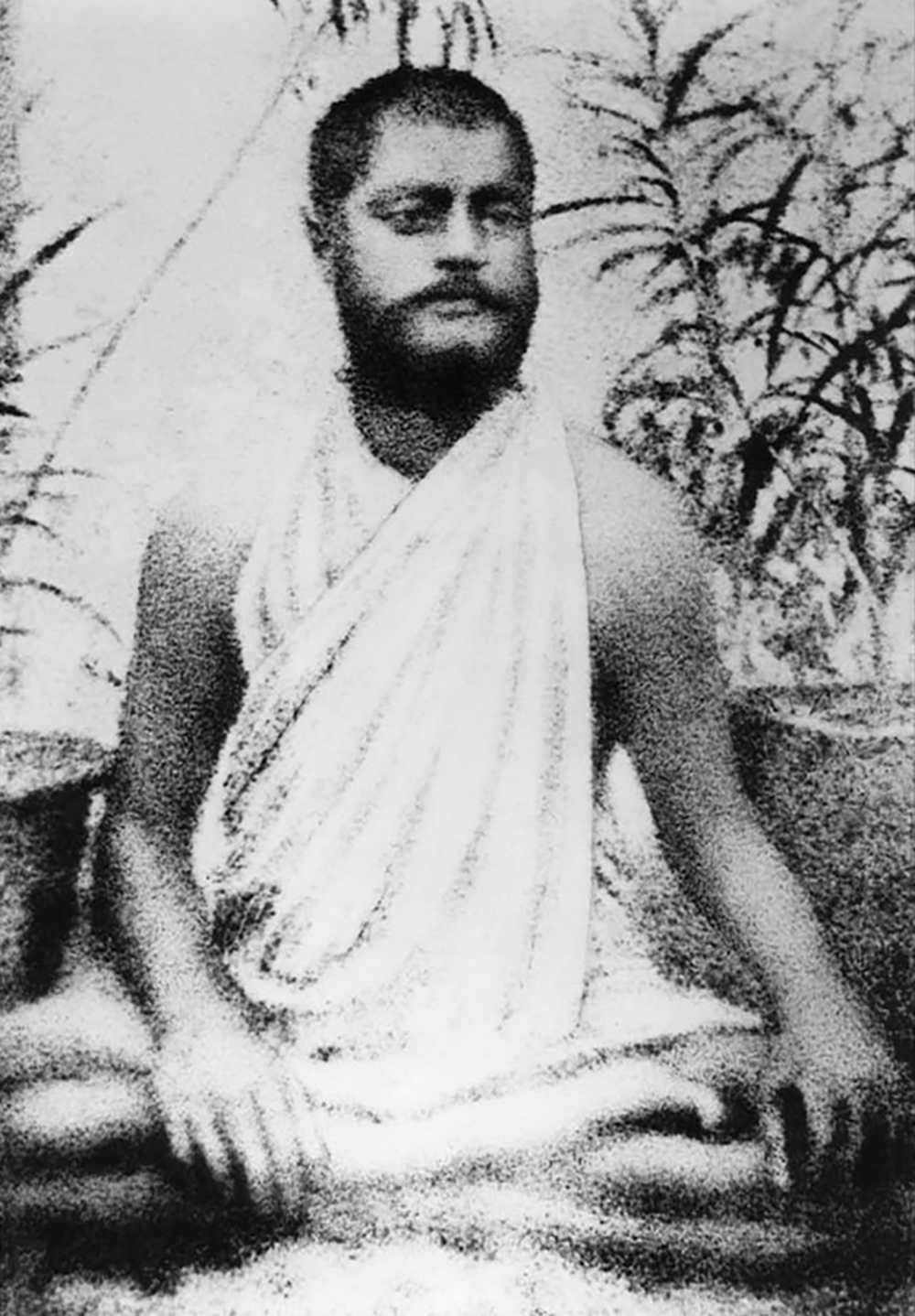
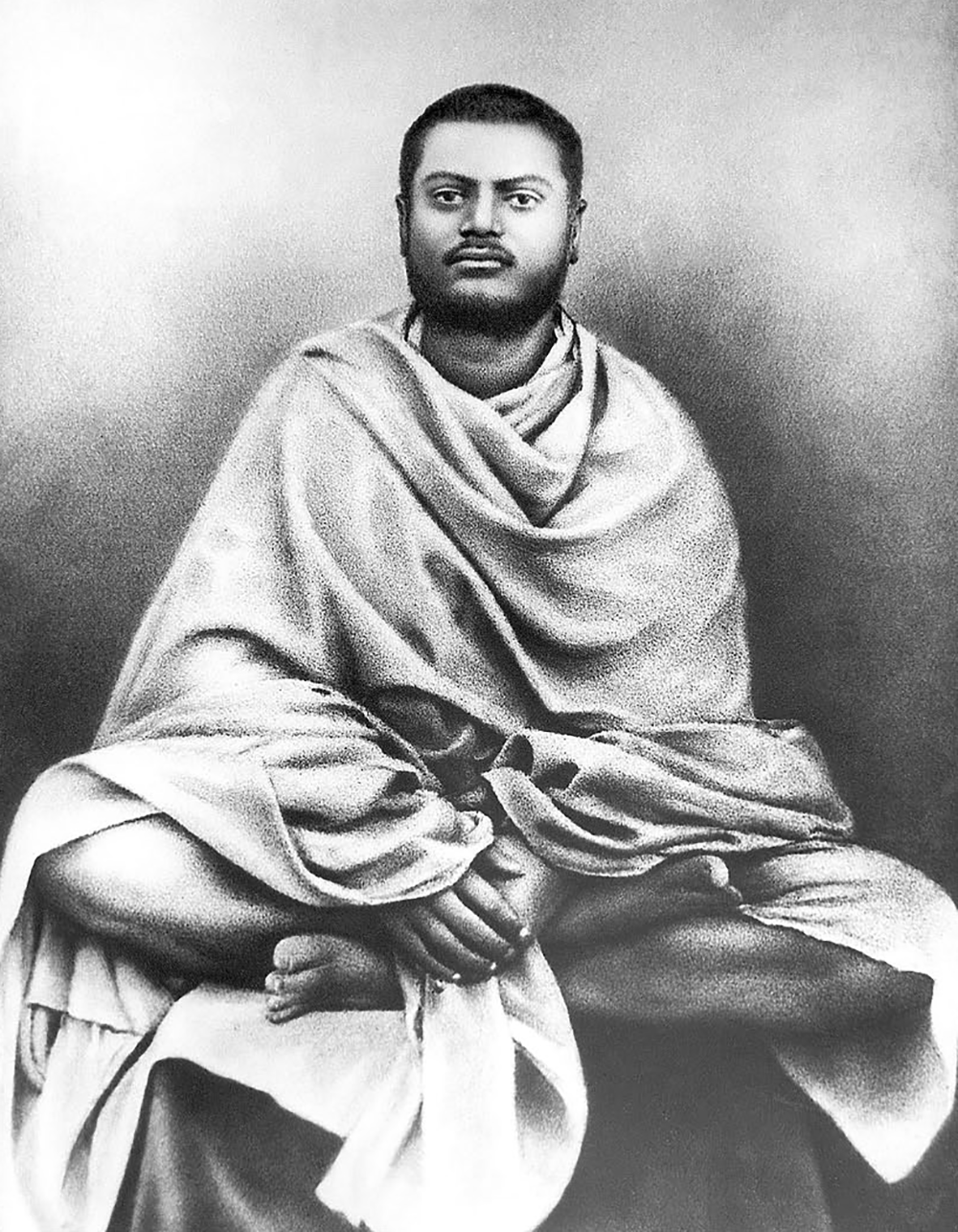
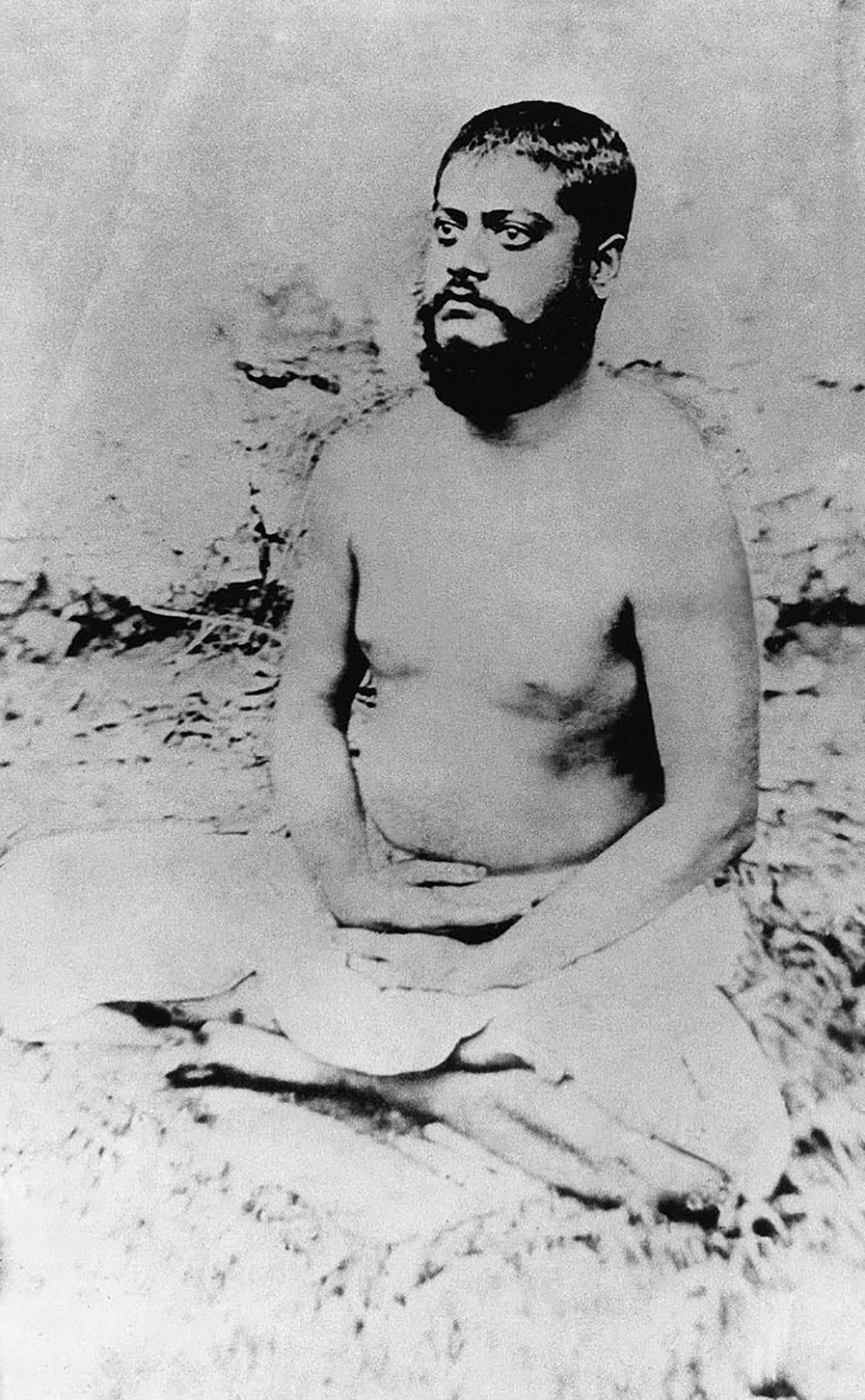
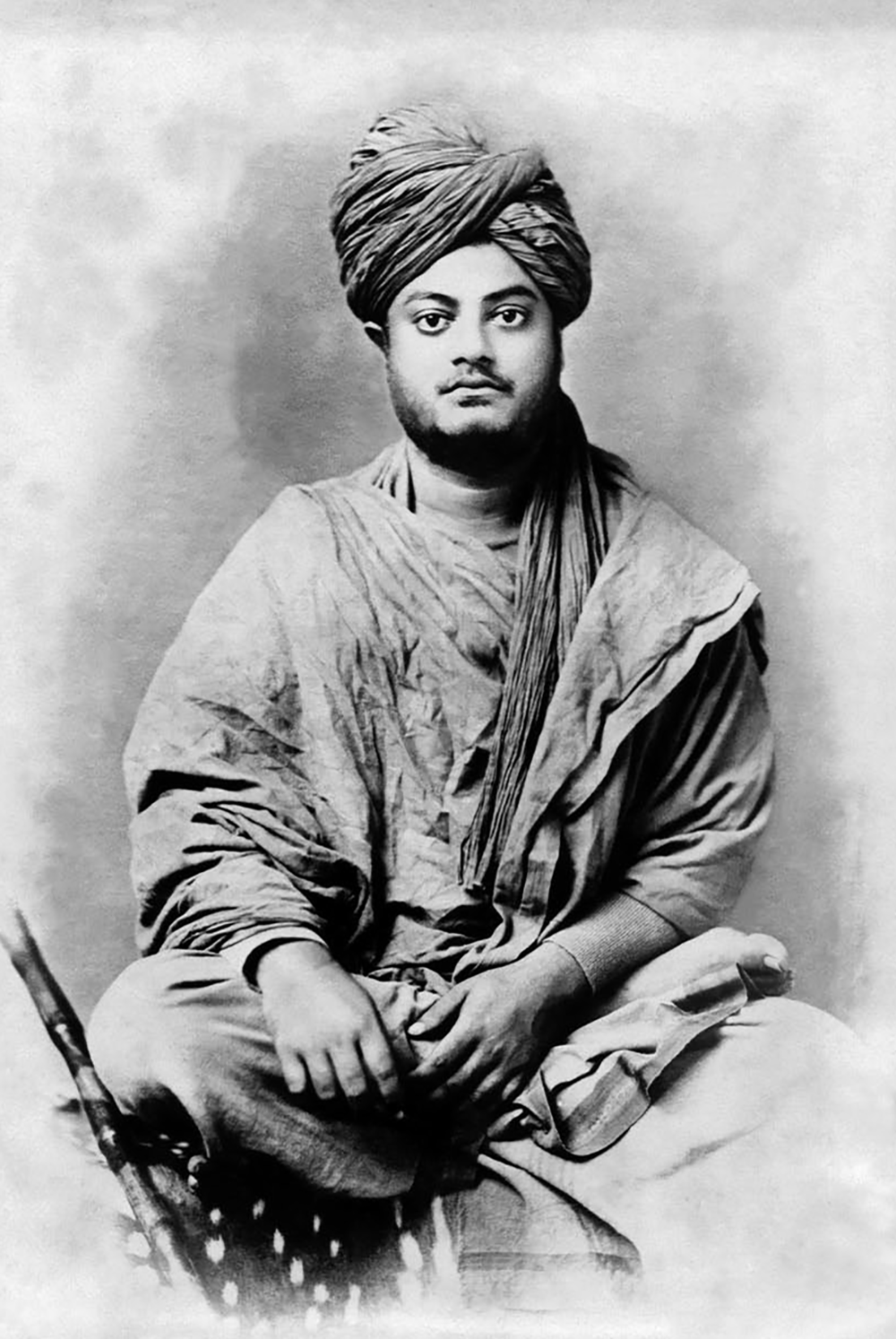
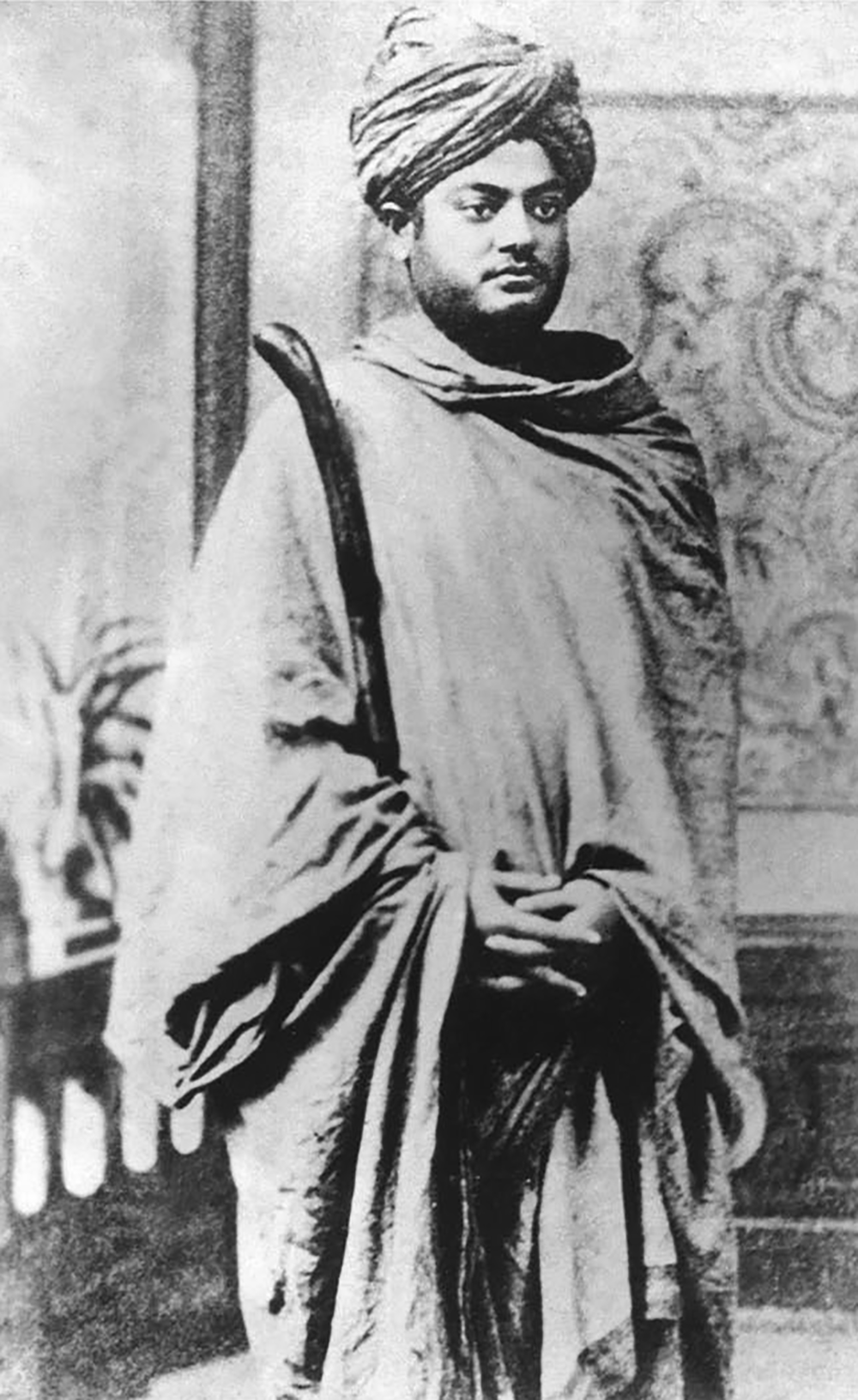
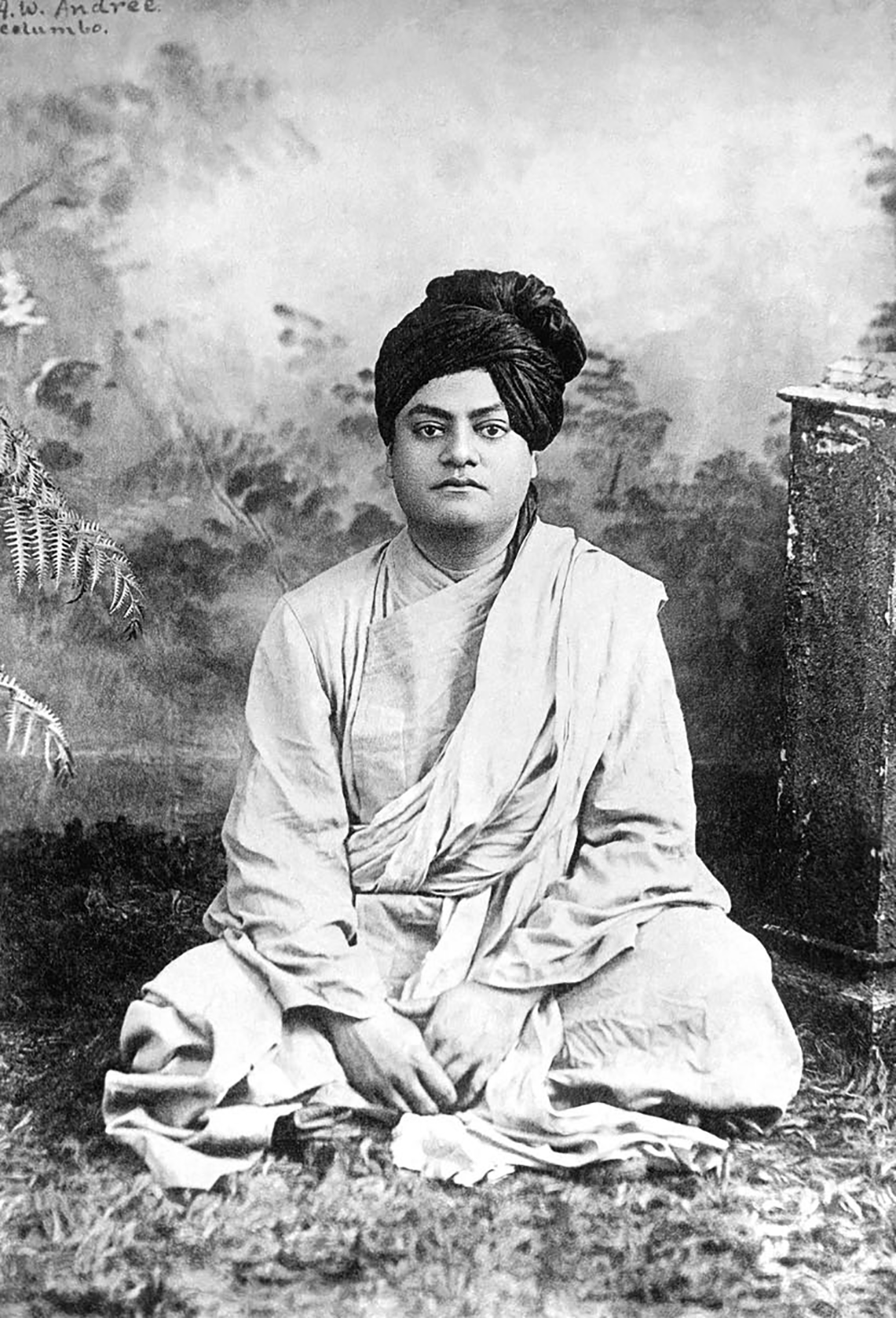
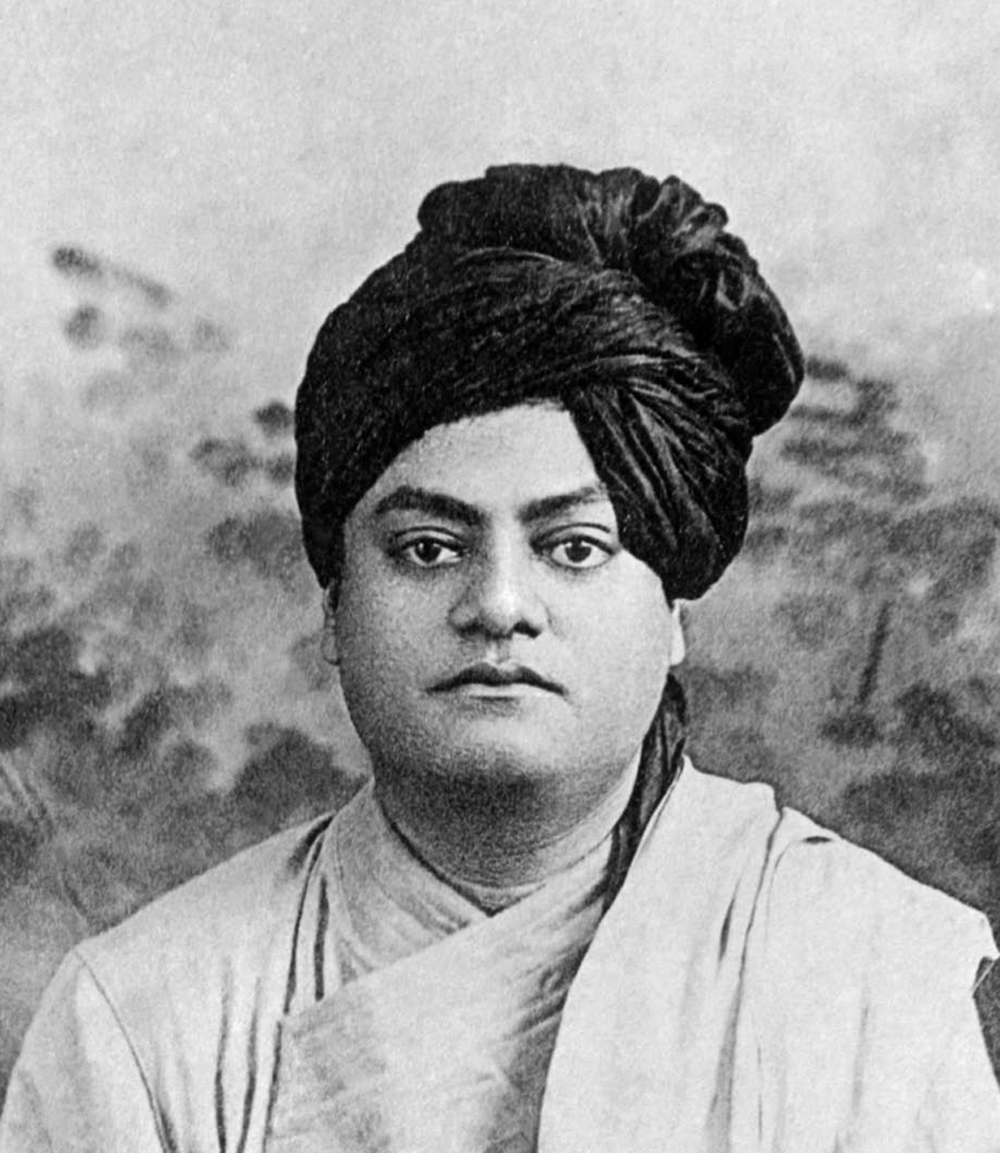
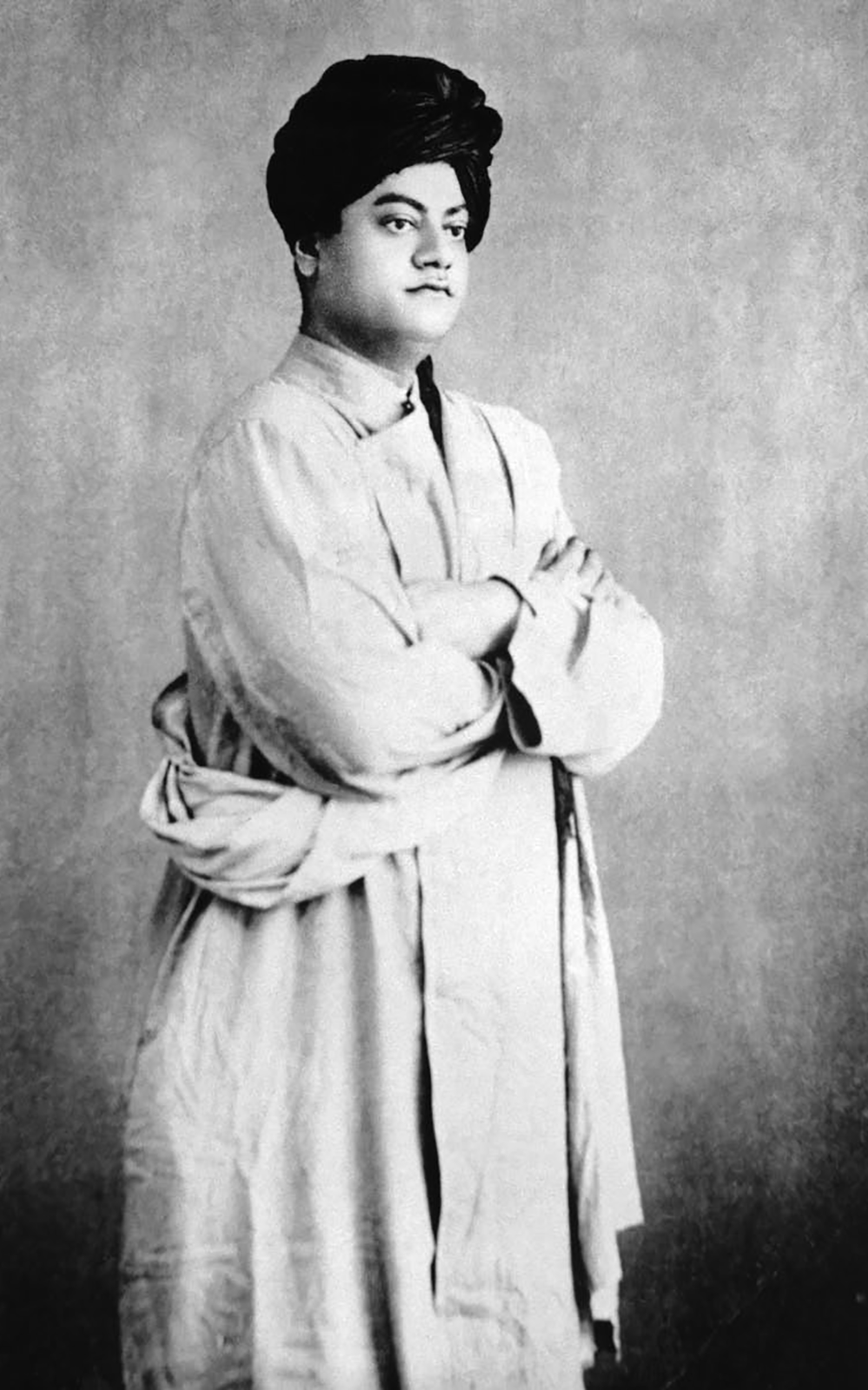
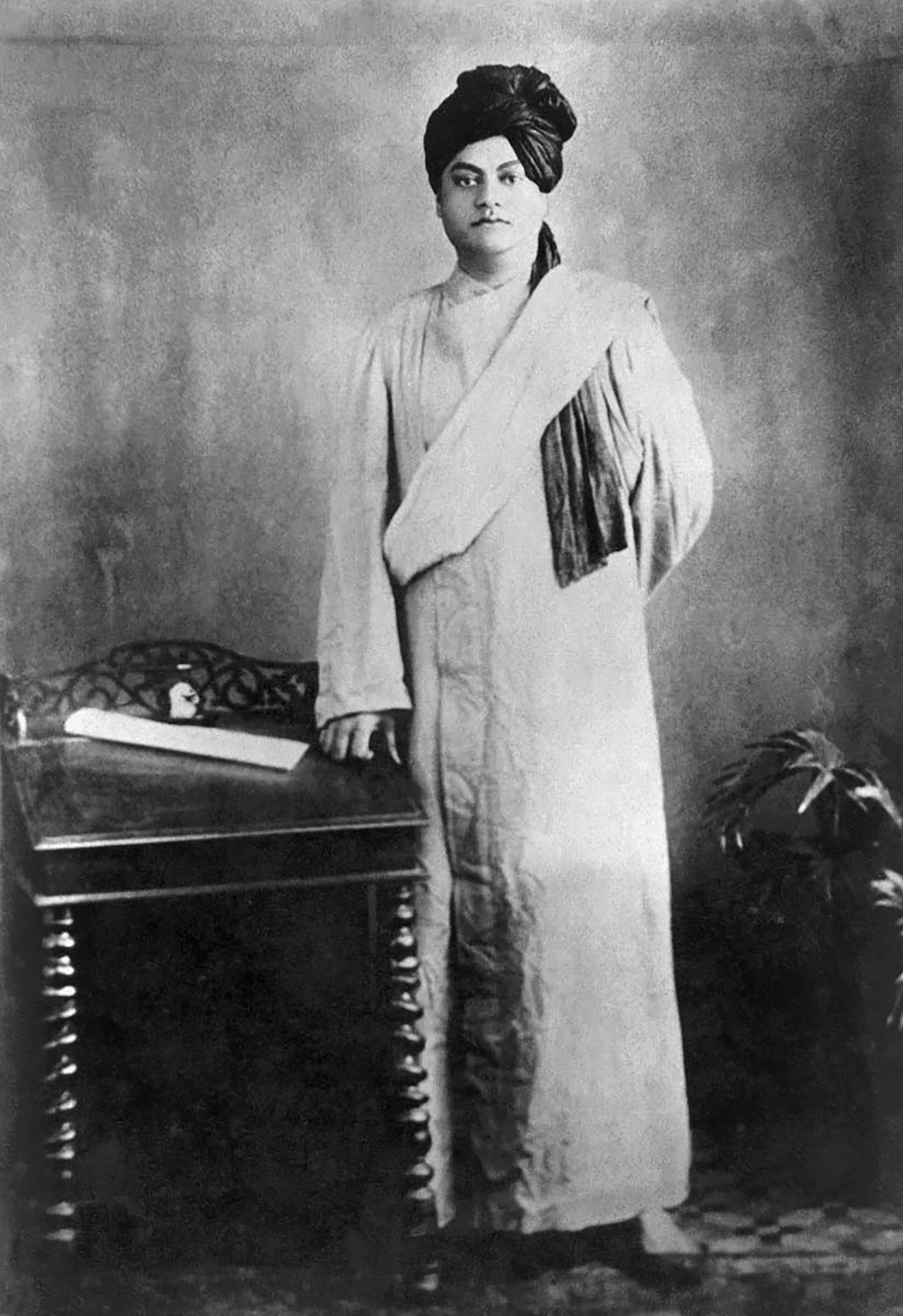
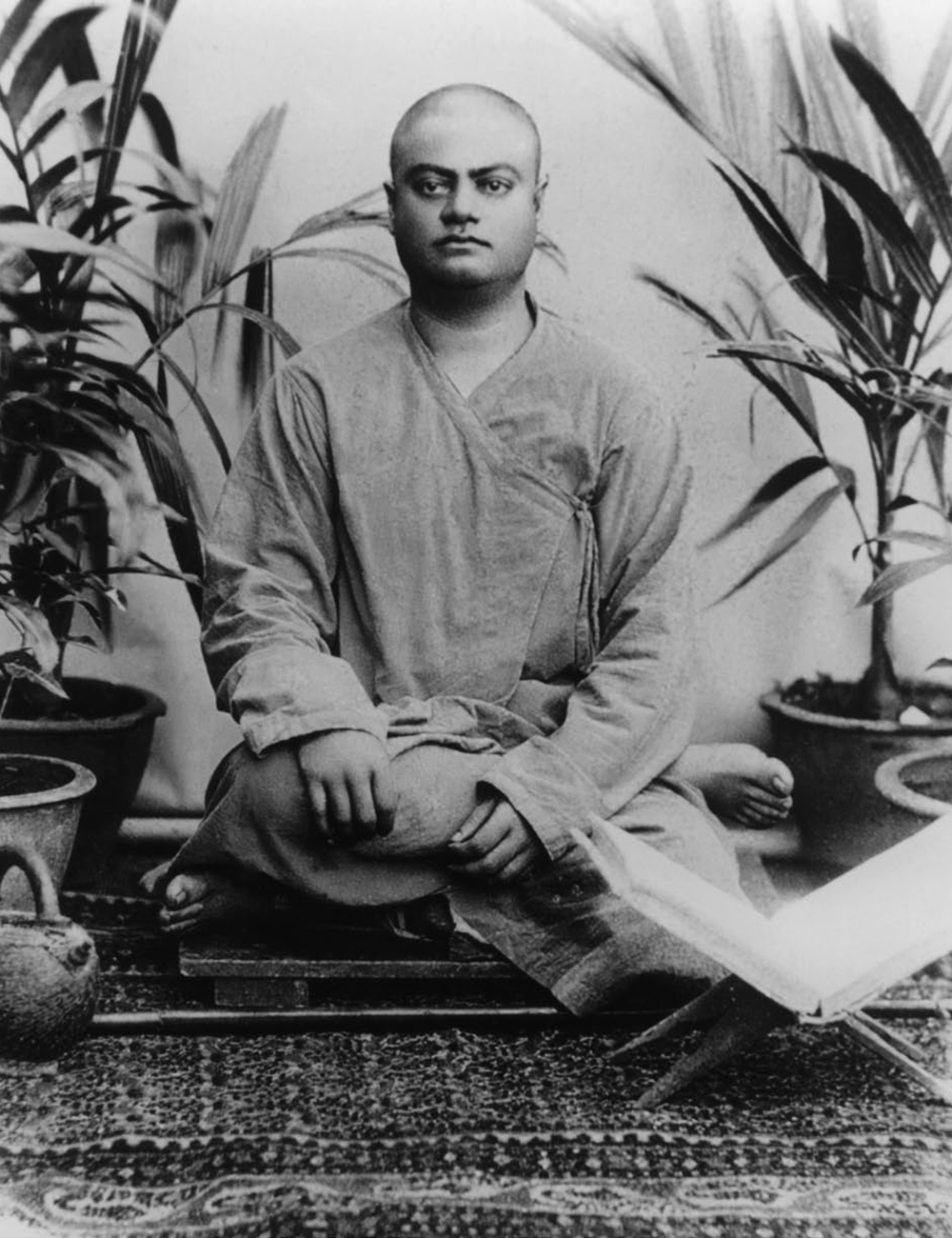
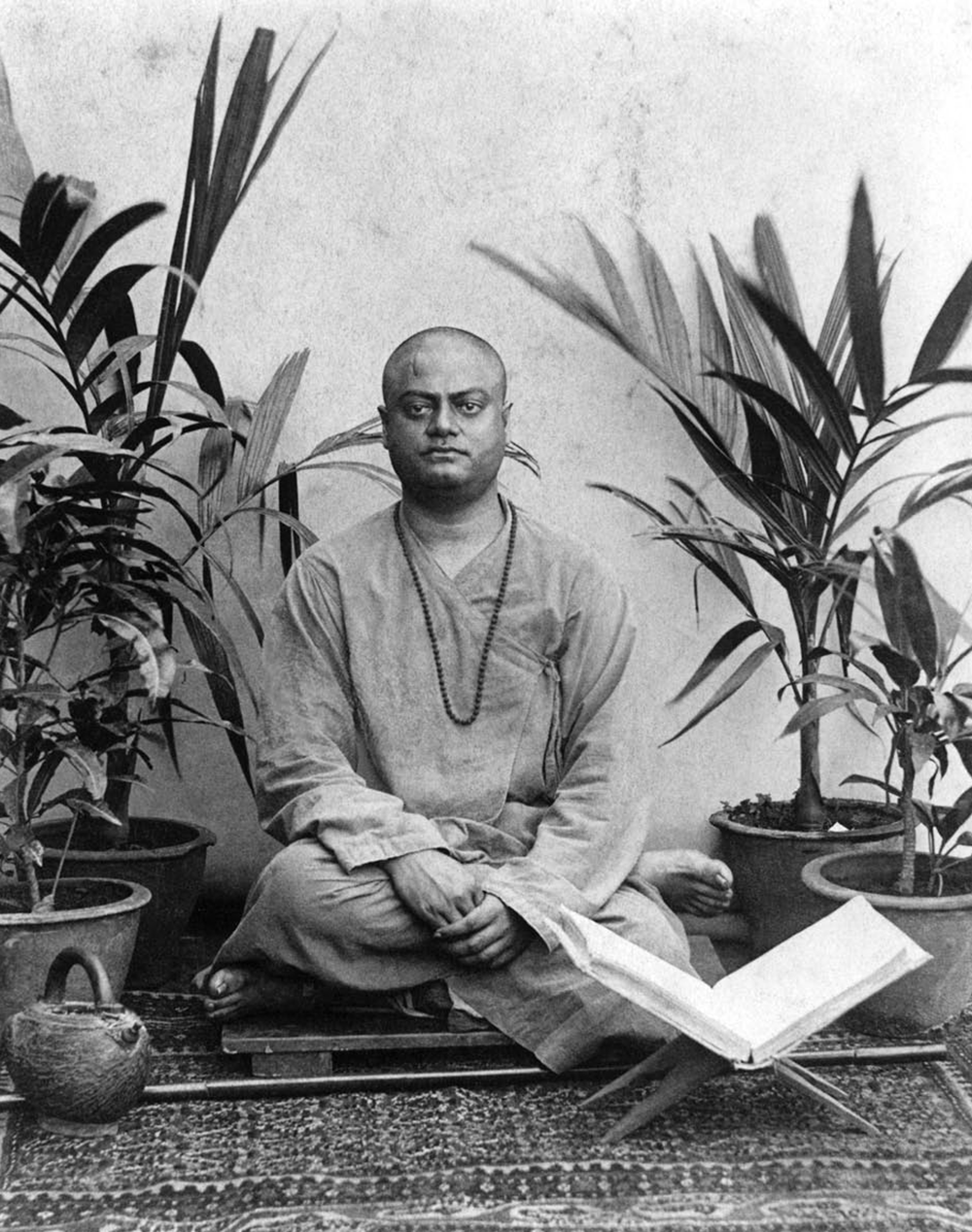
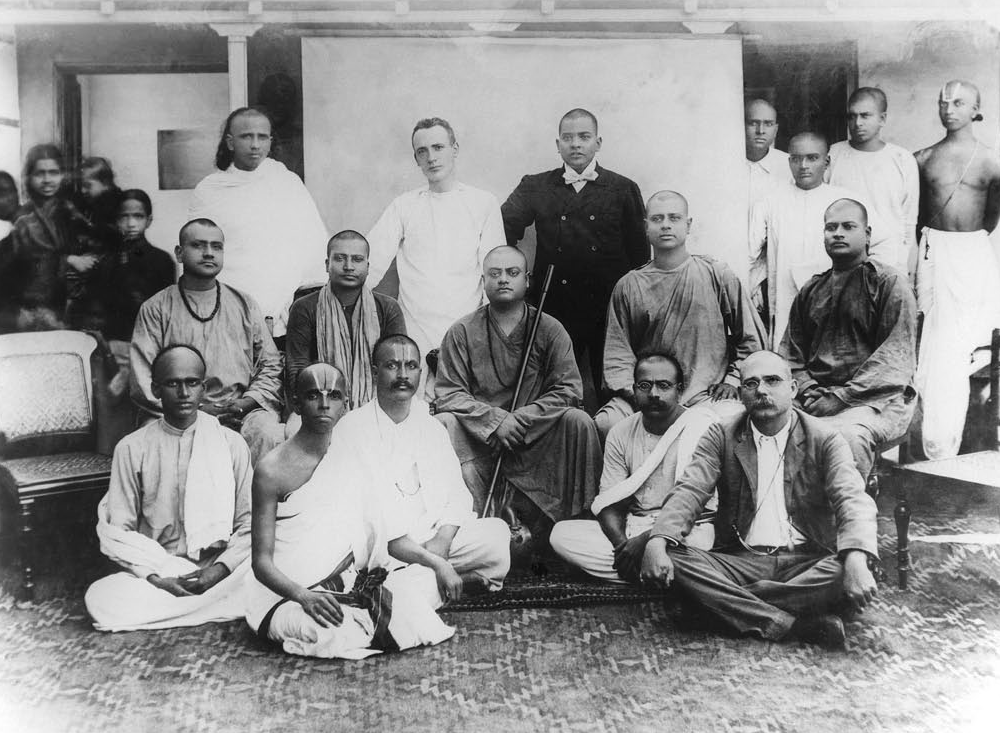
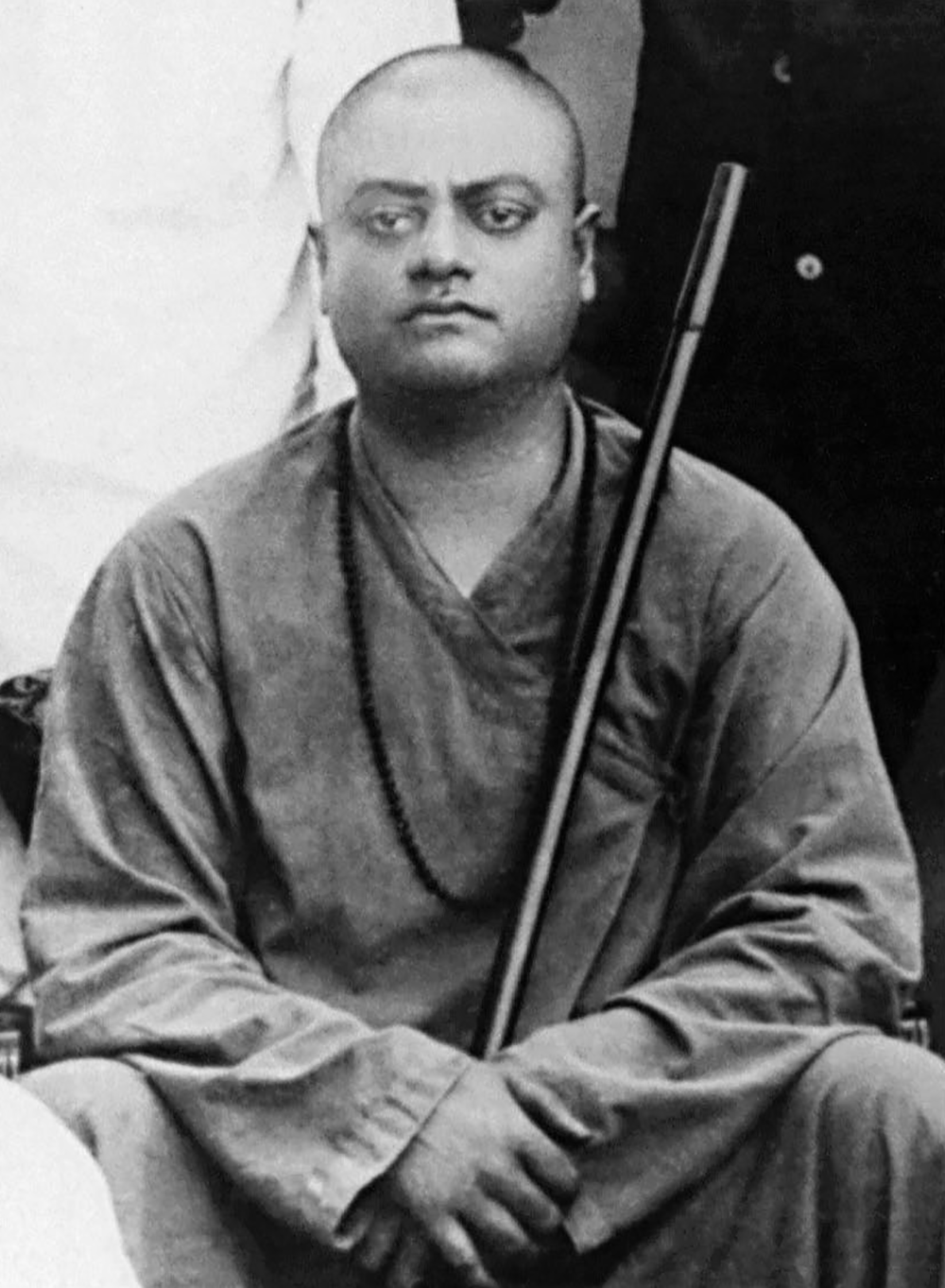
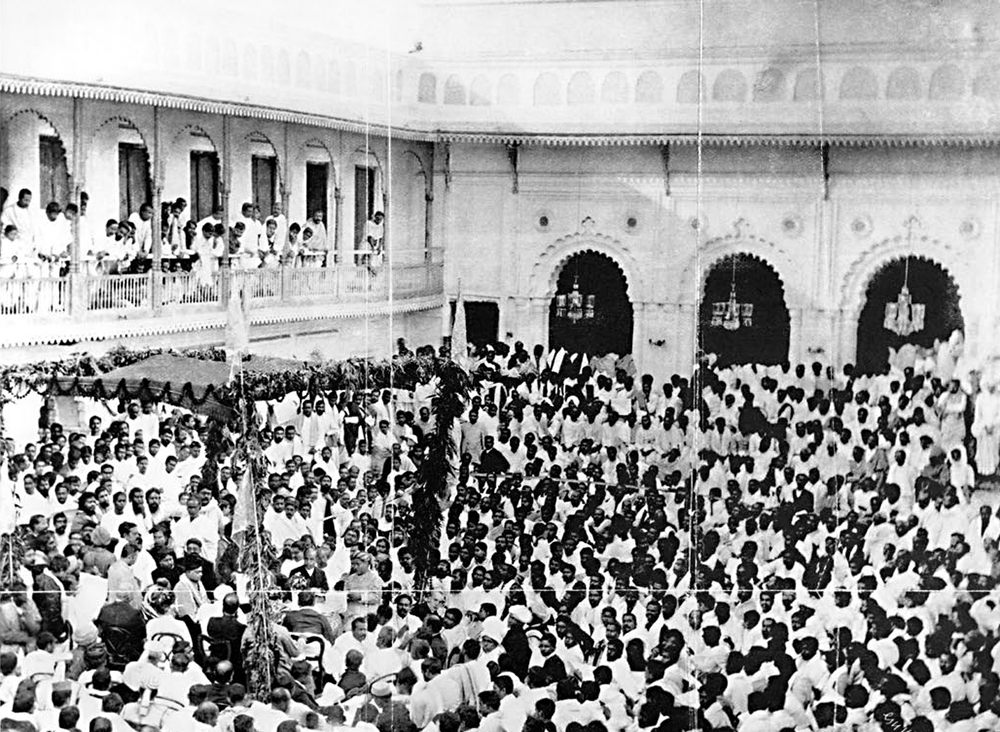
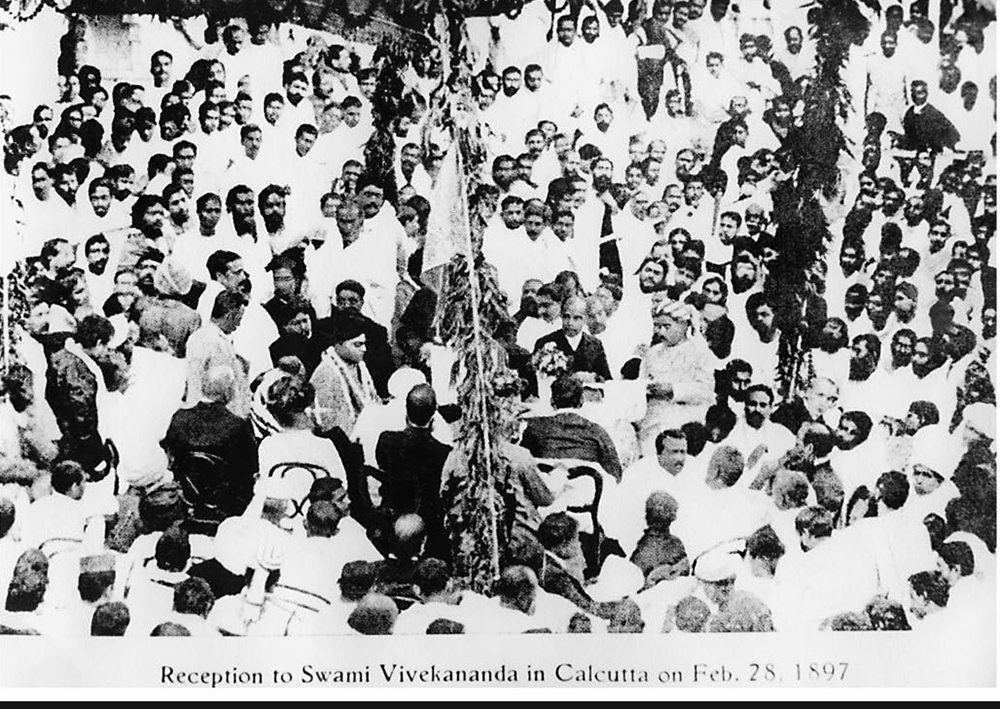
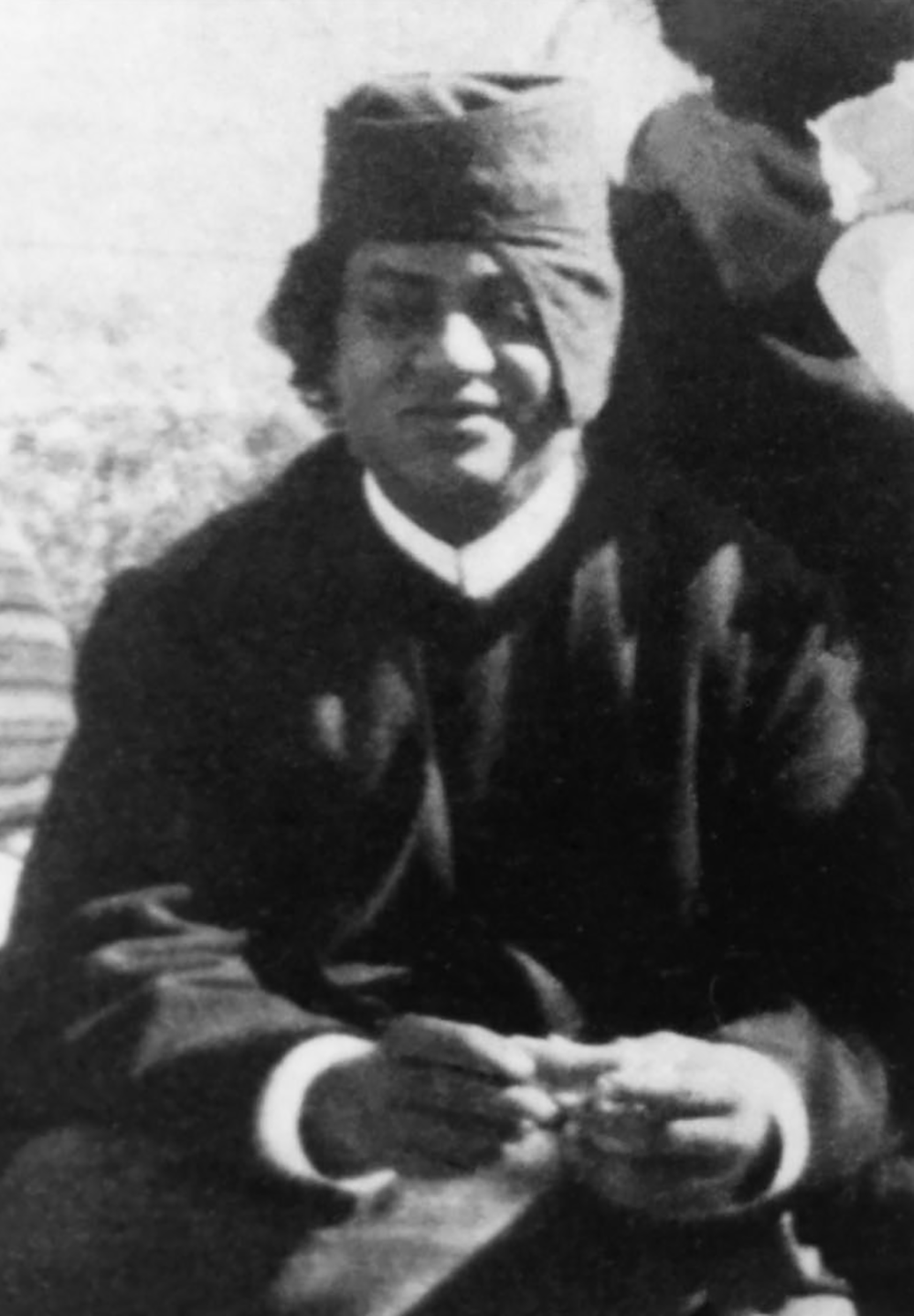
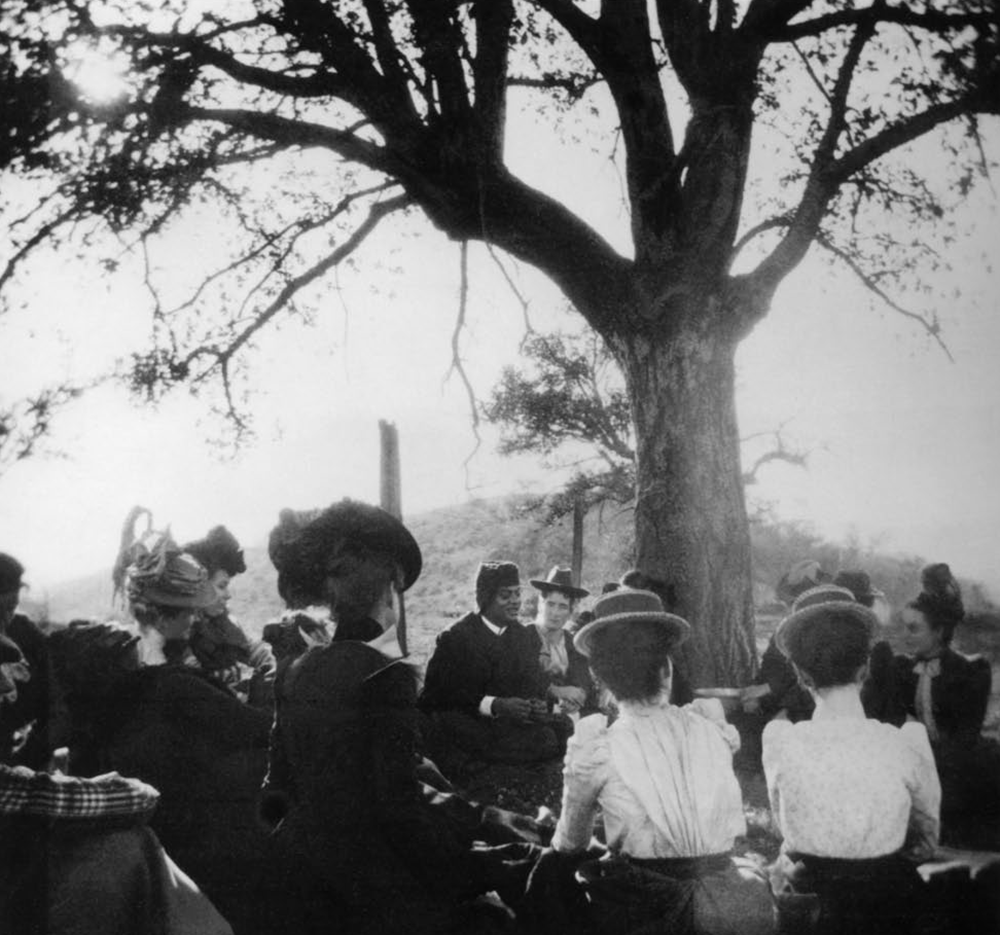
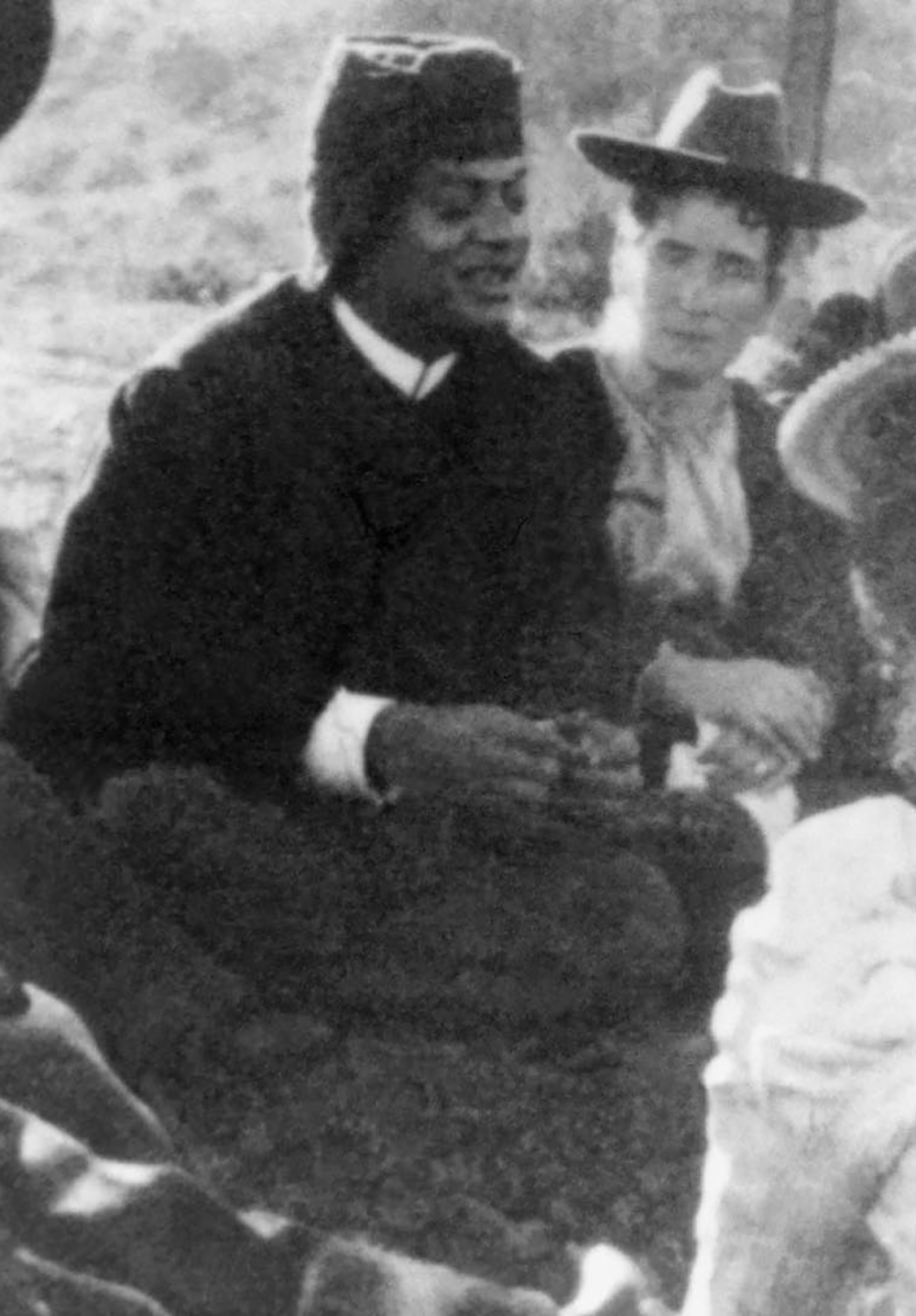
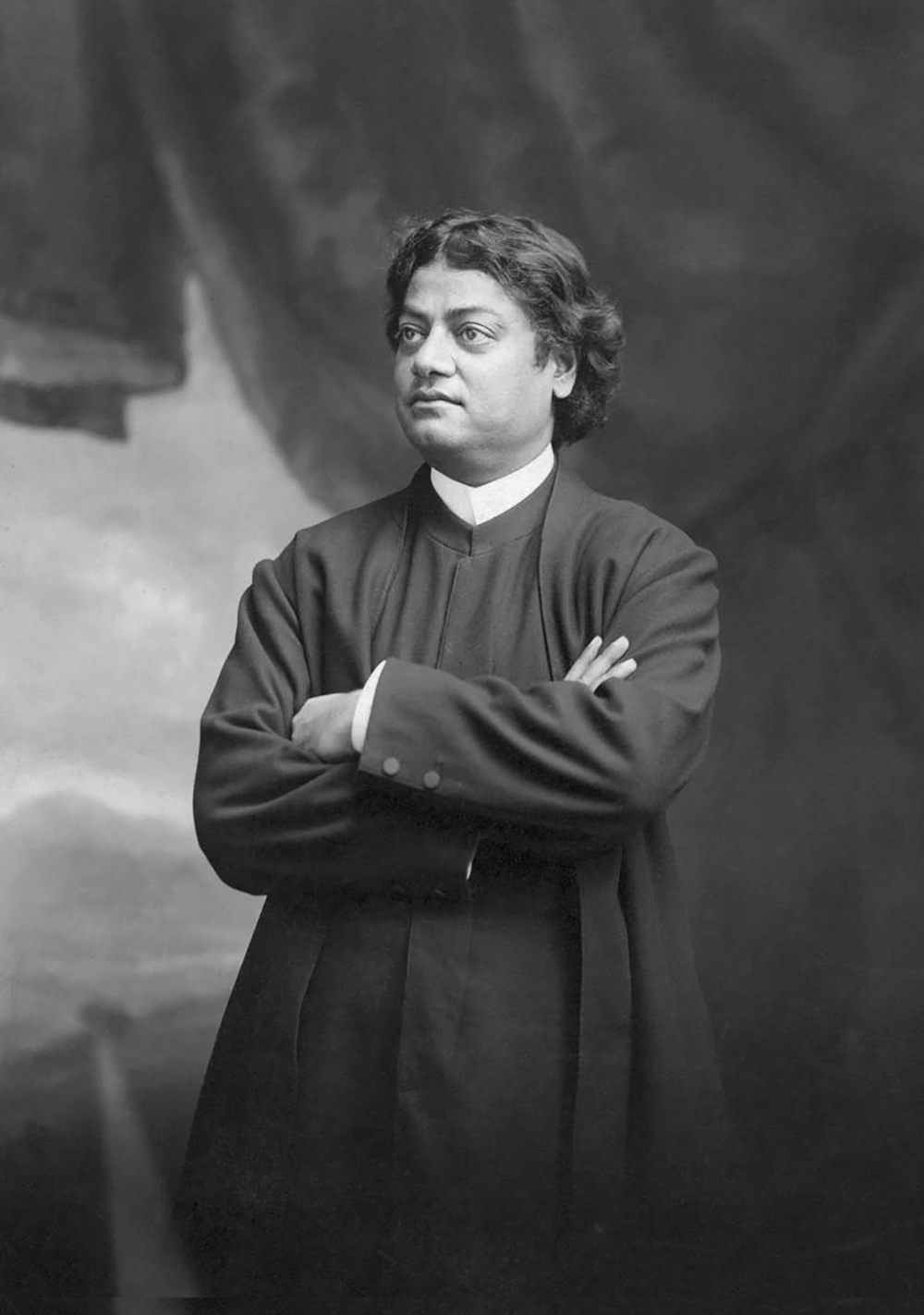
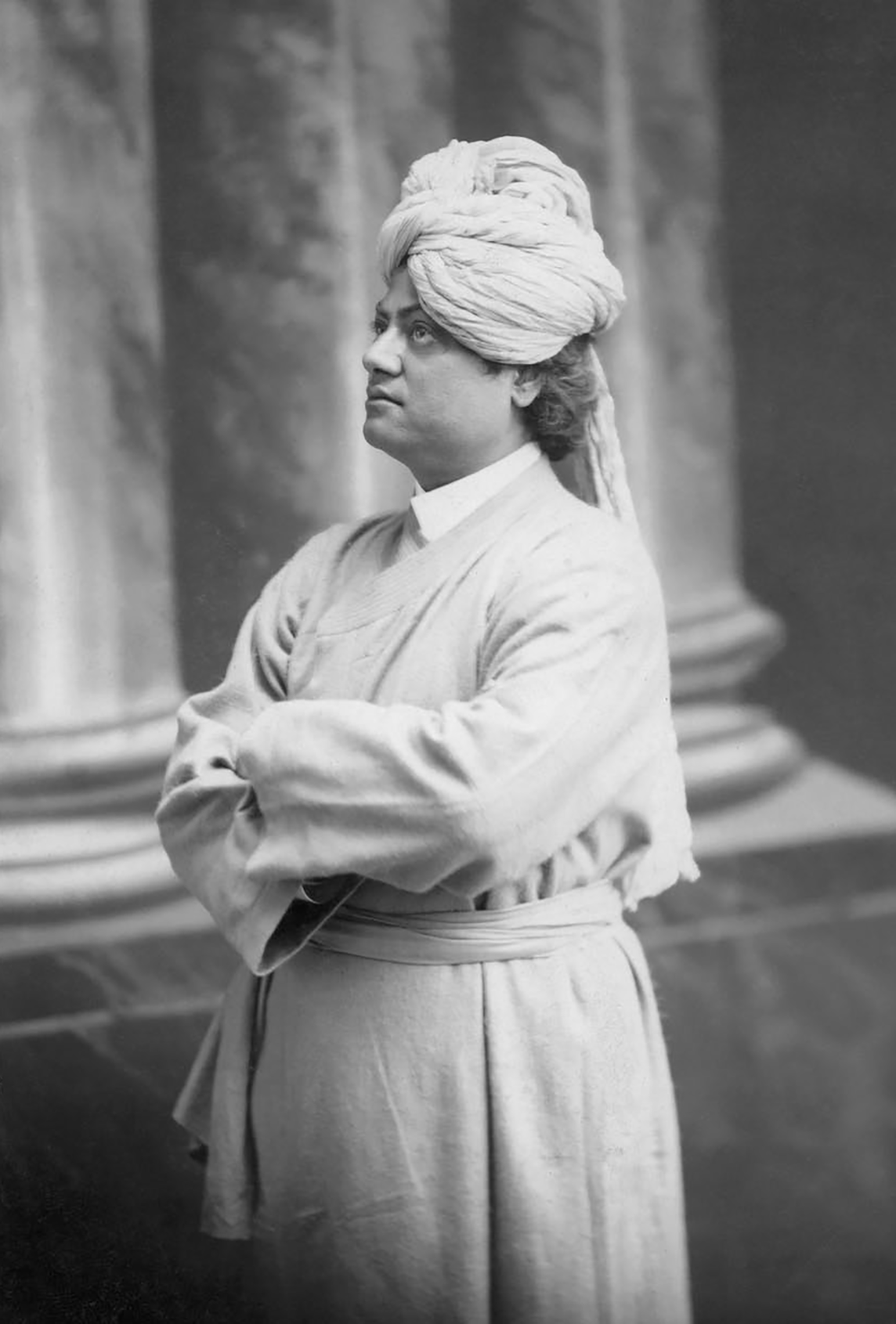
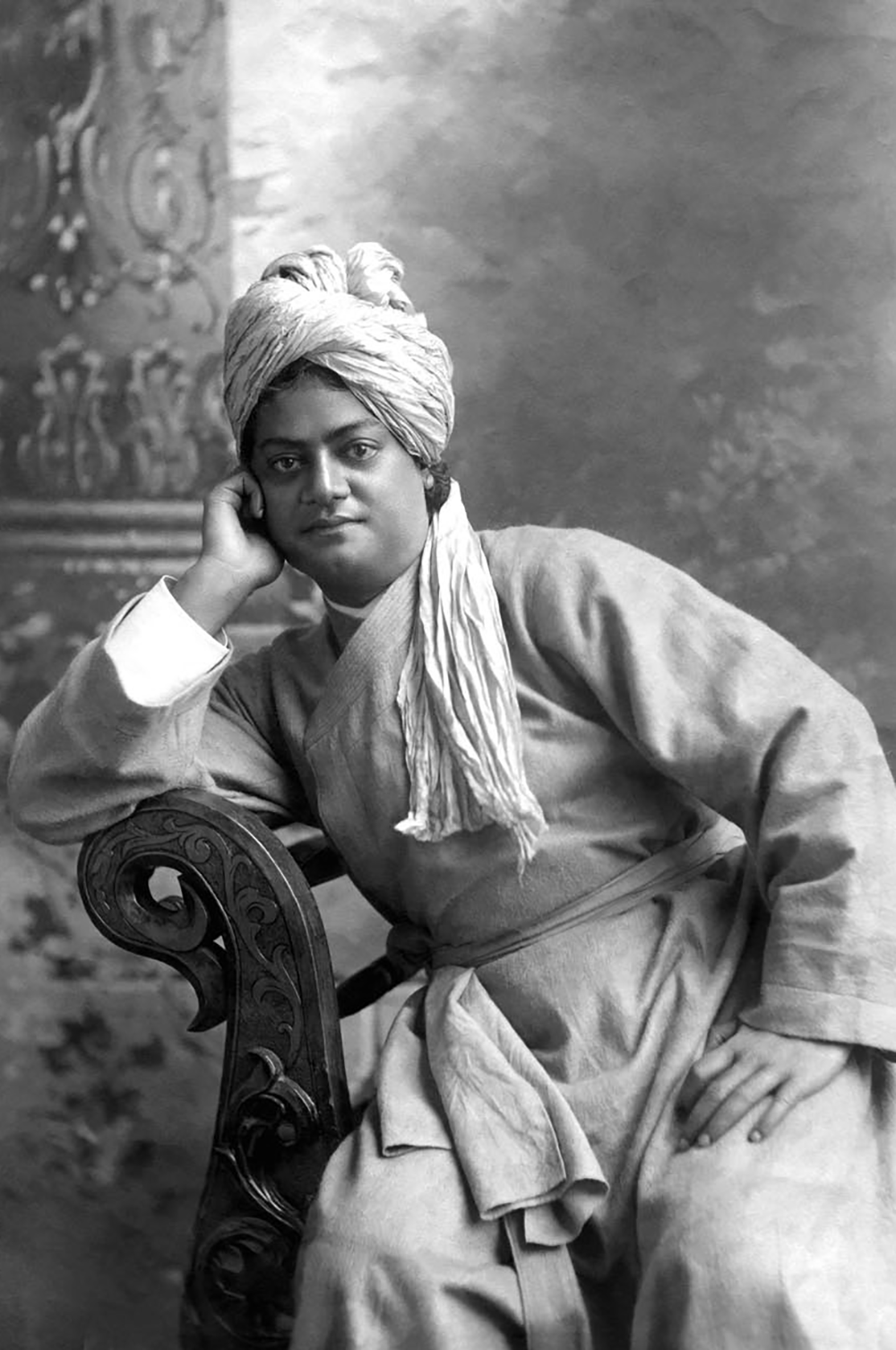
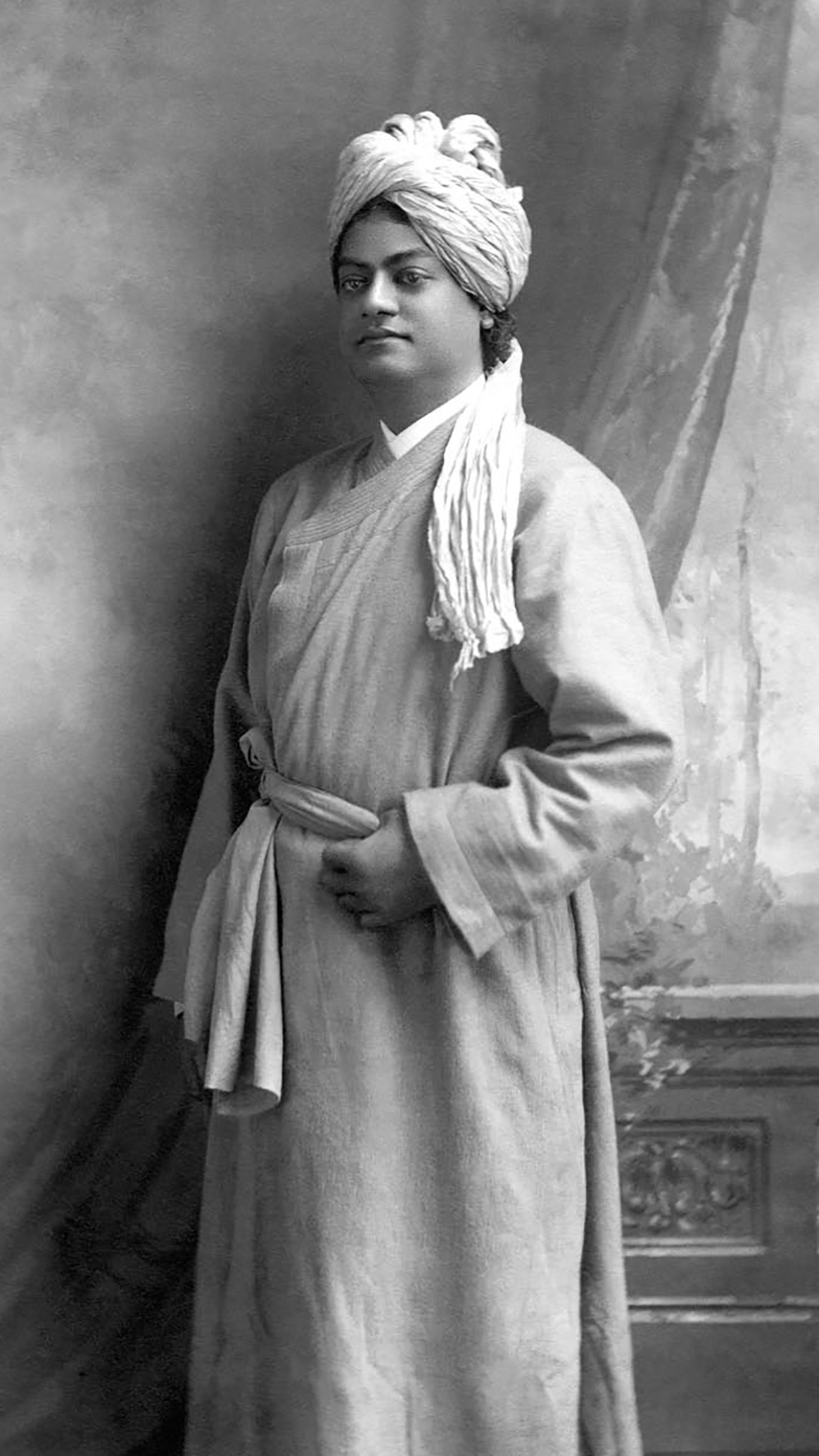
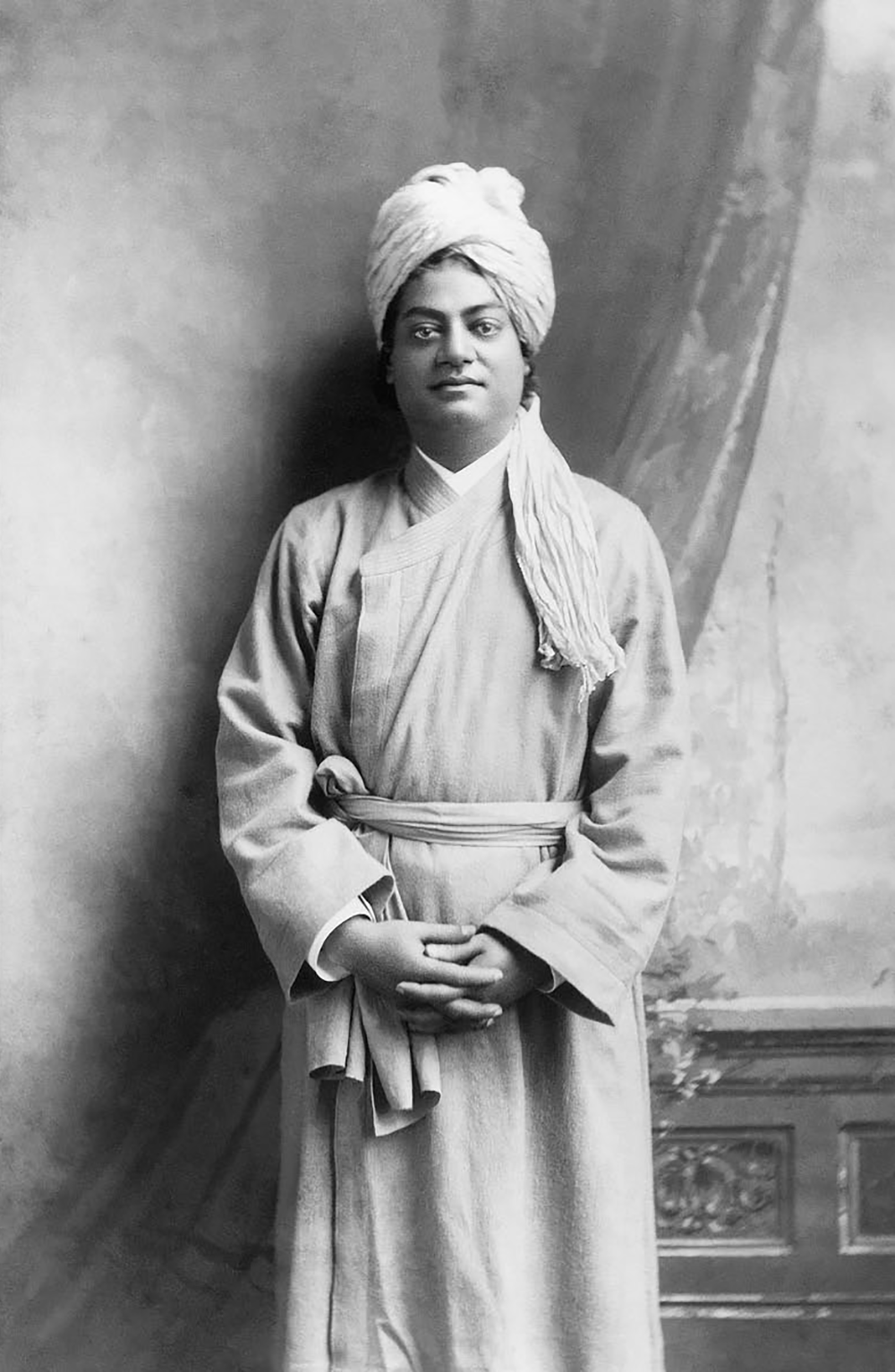
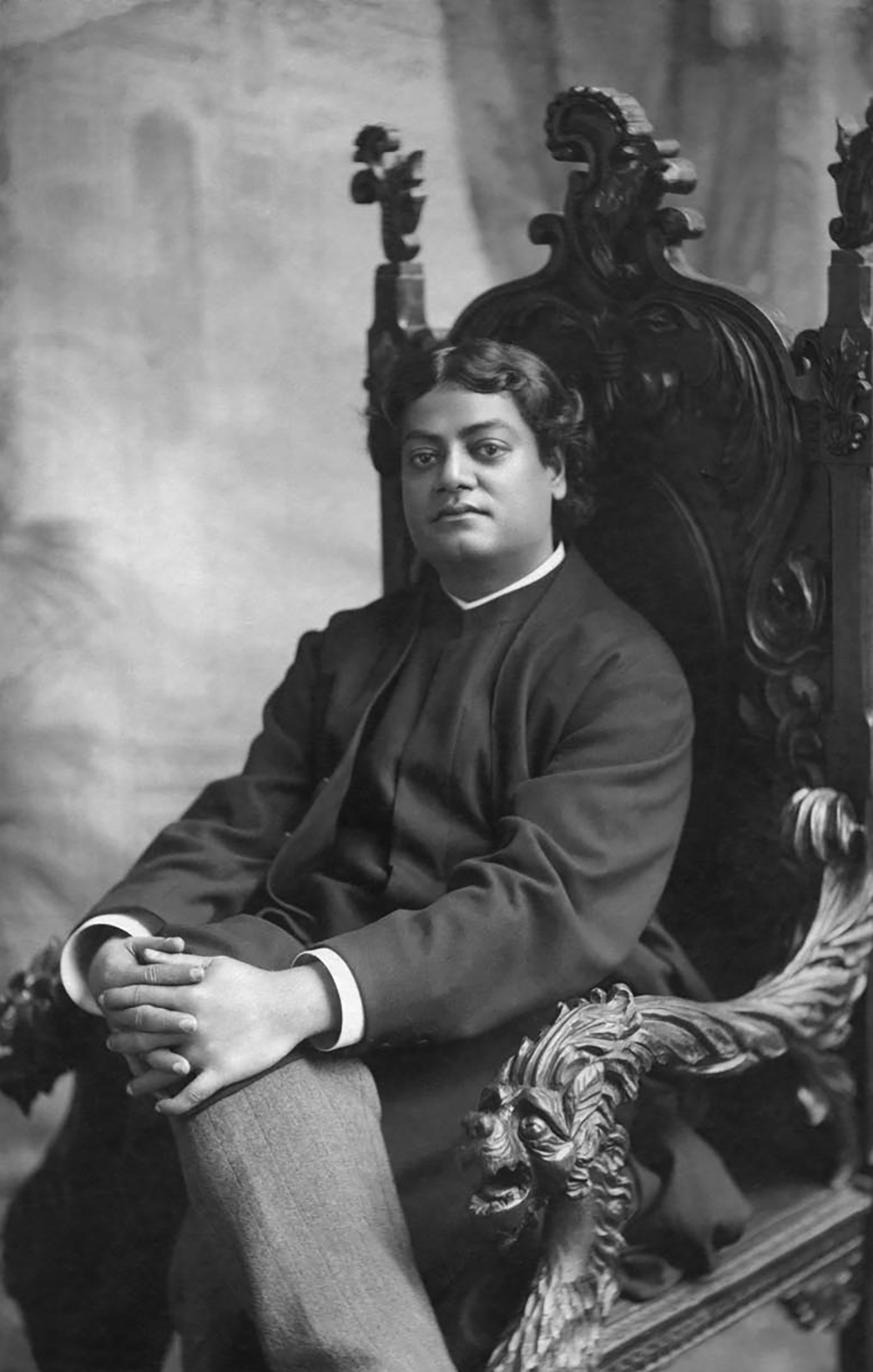
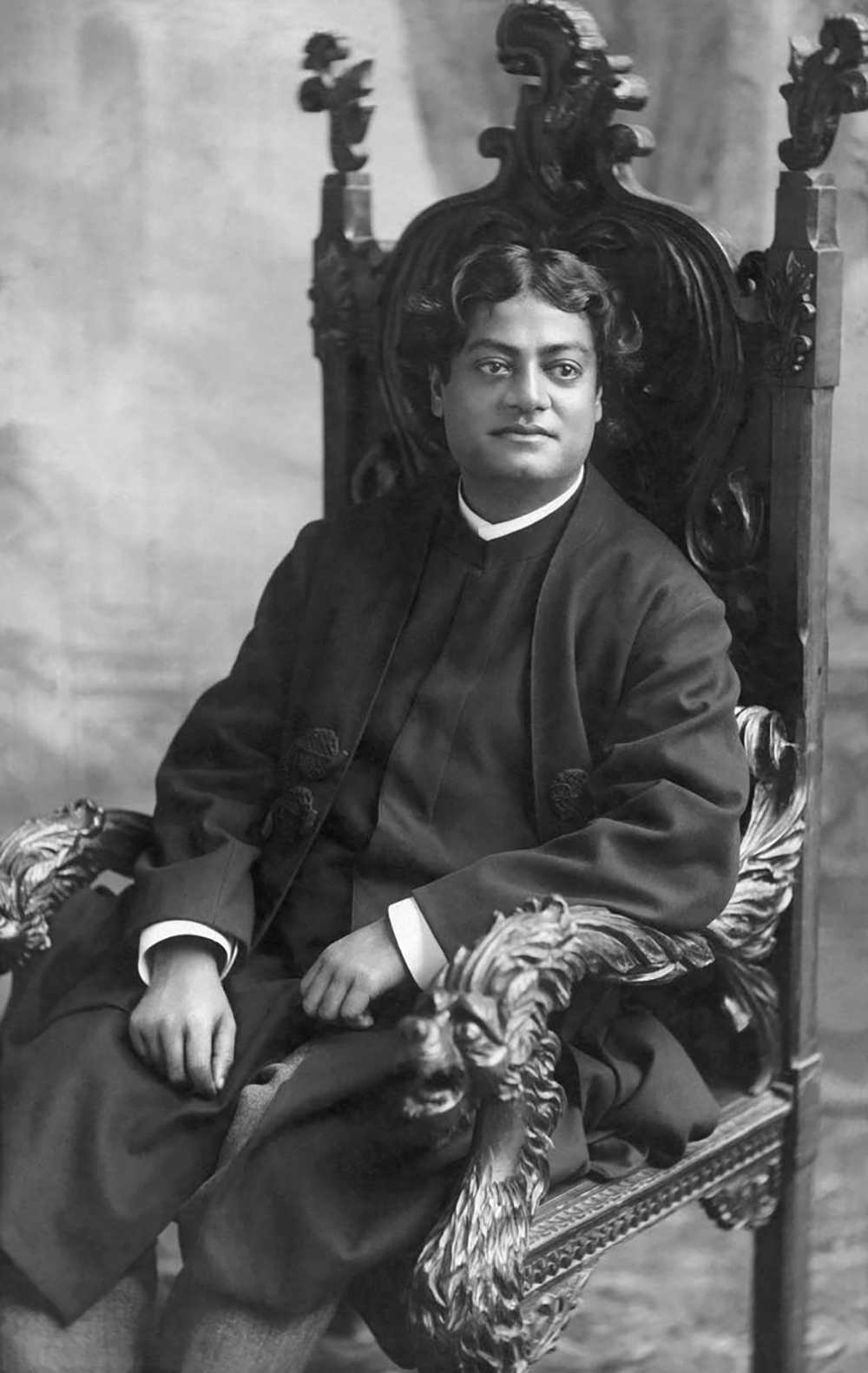
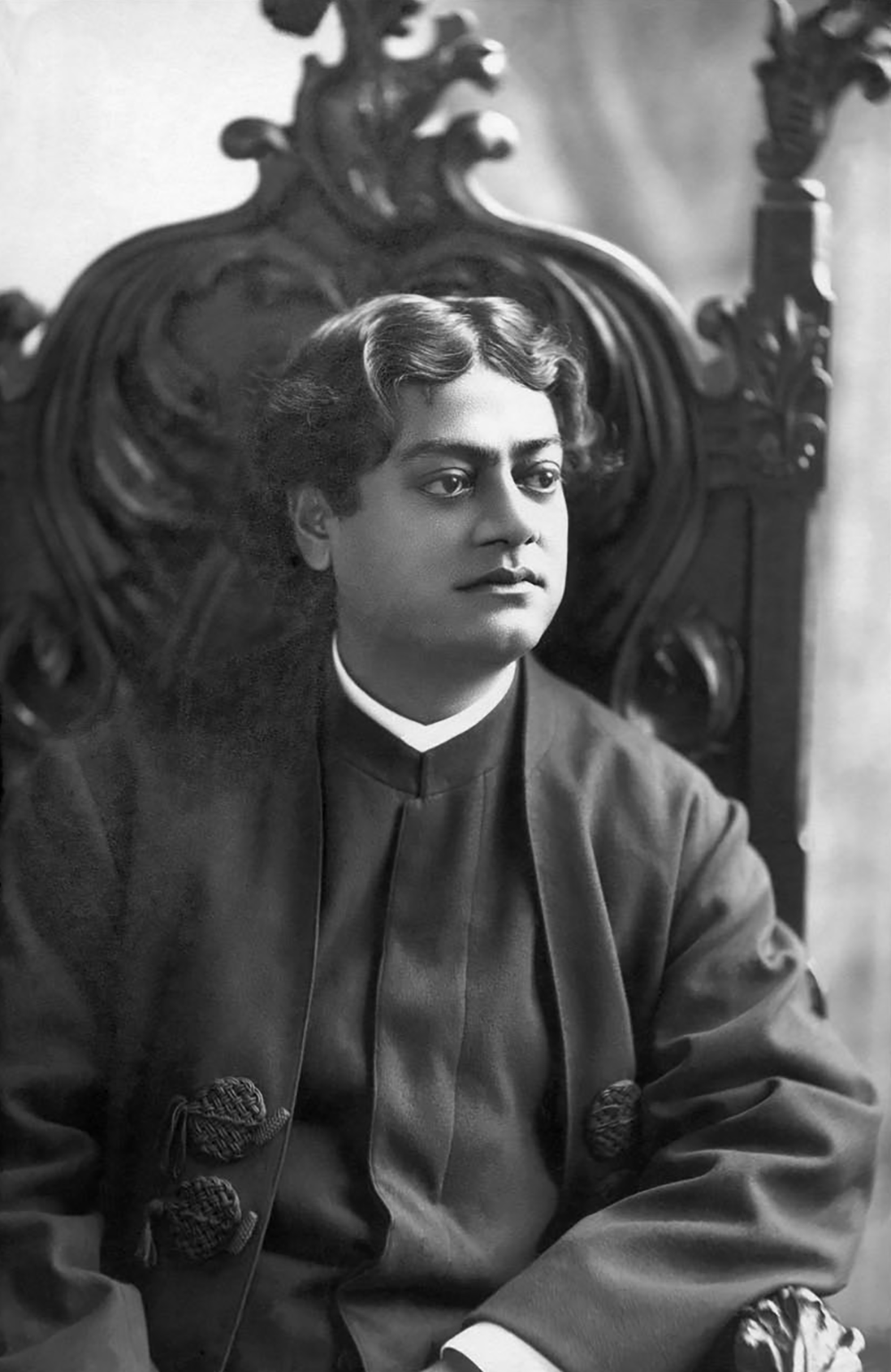
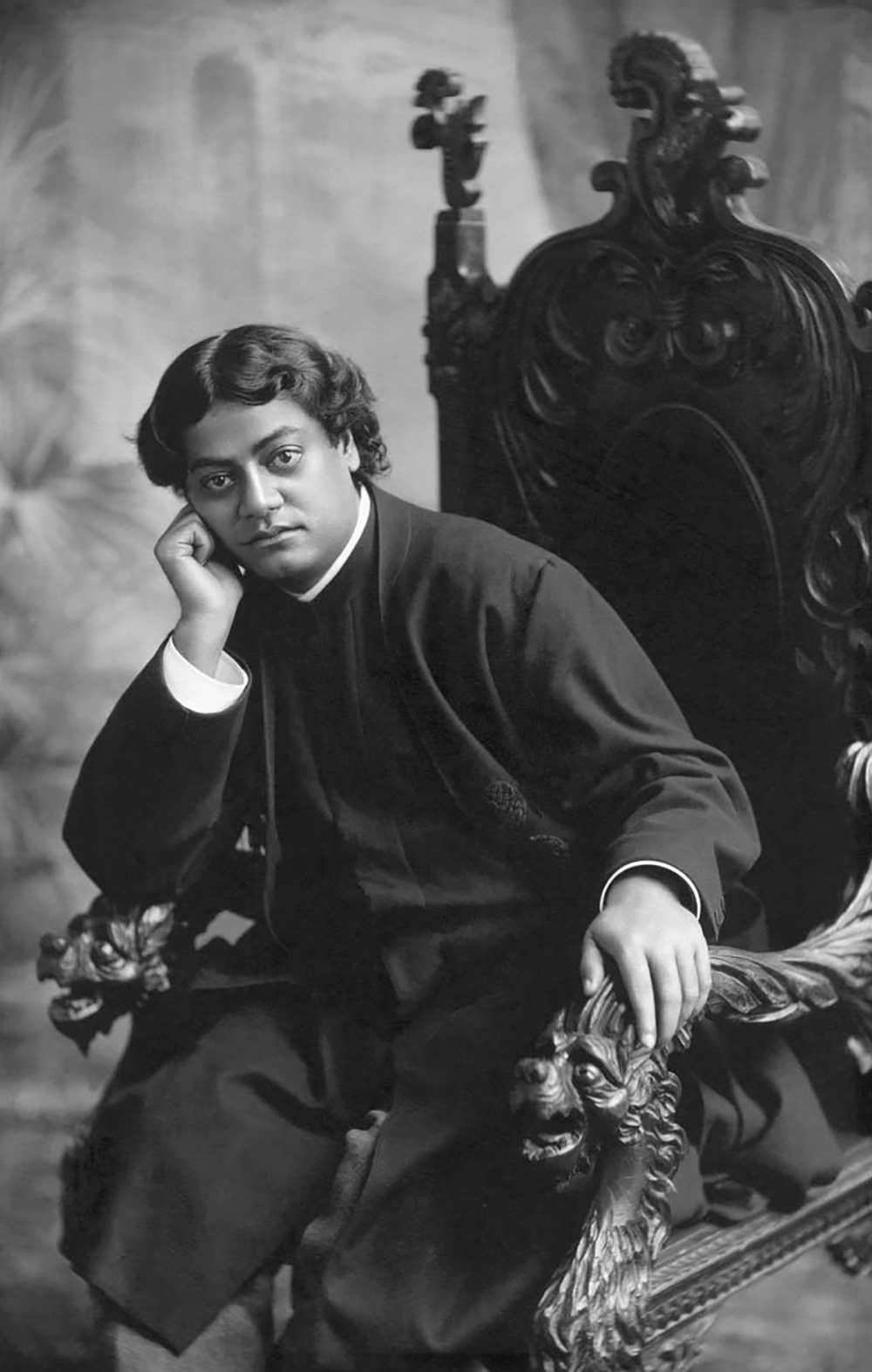
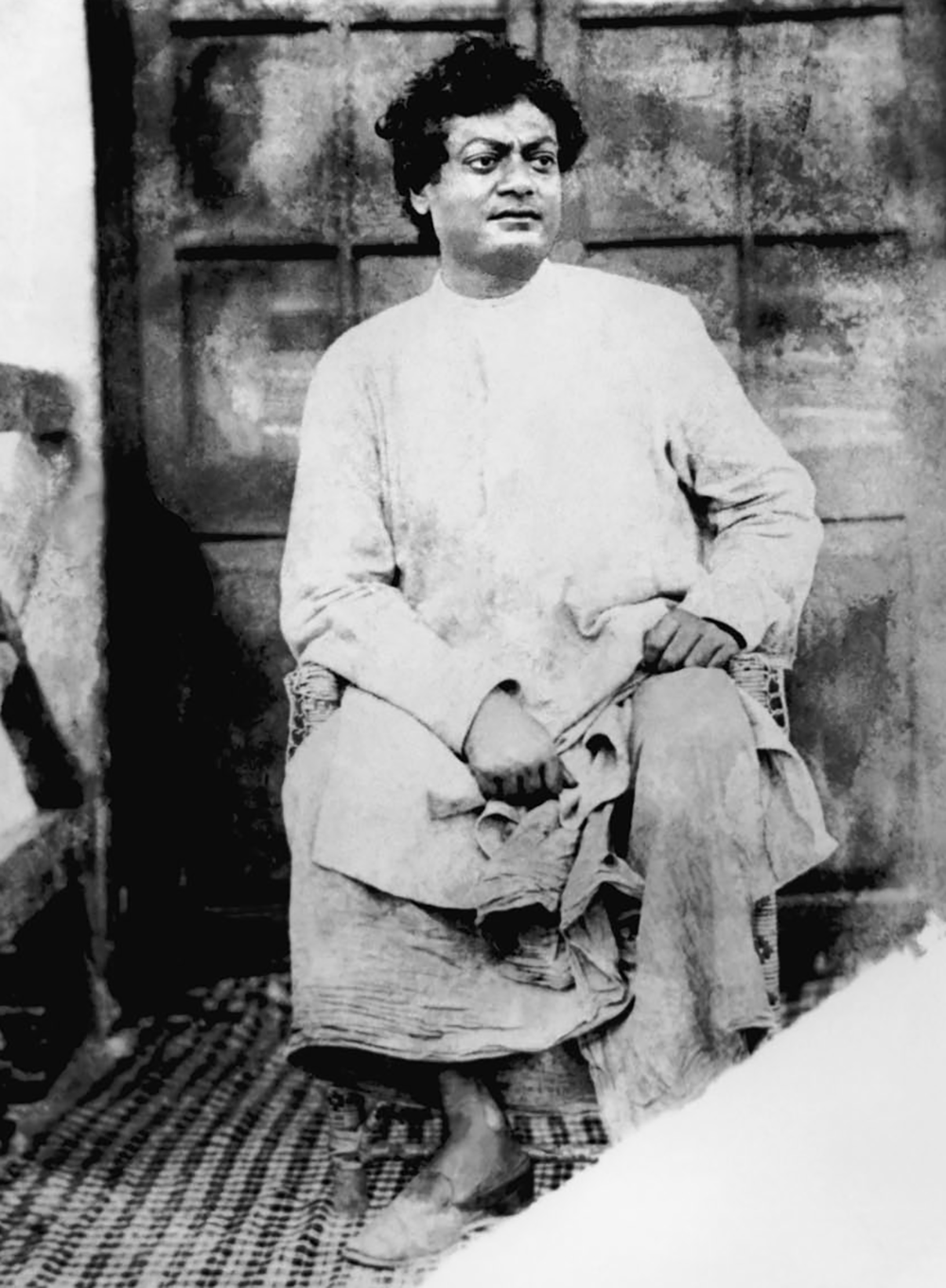
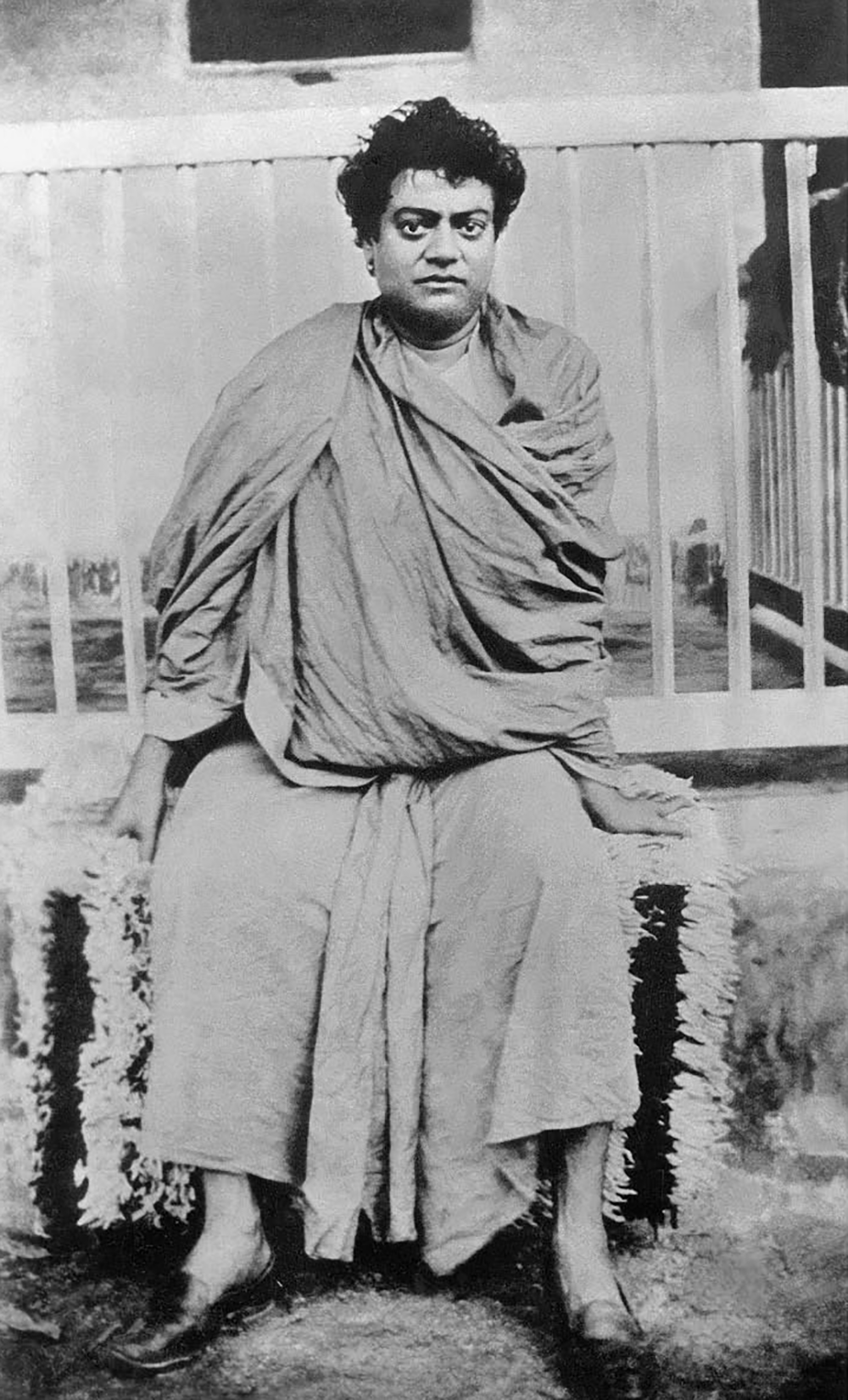
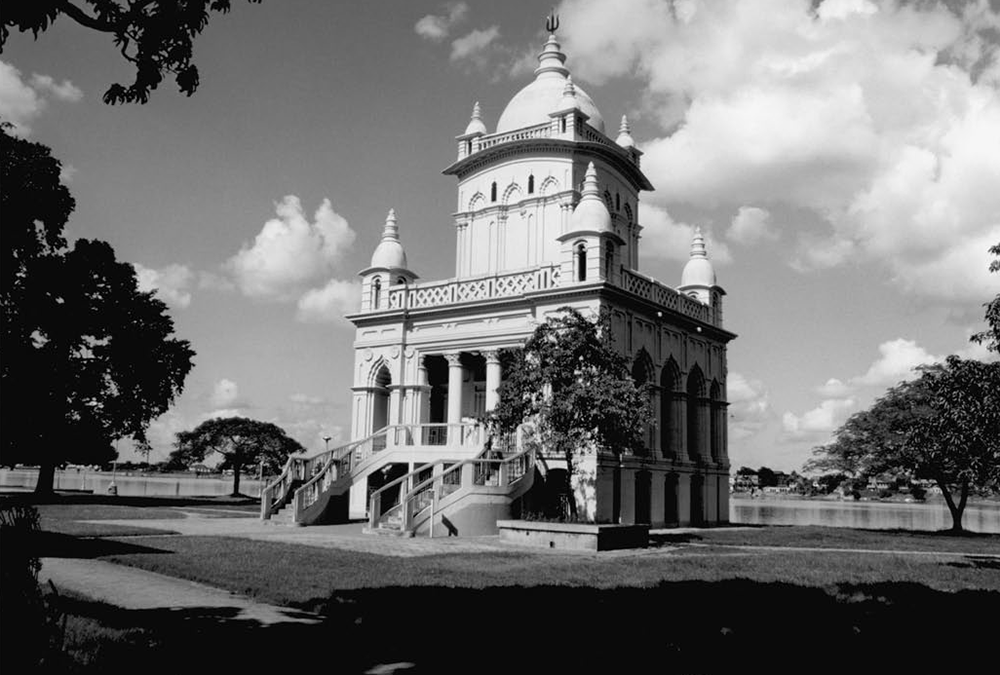
Photographs Of Swami Vivekananda

Chapter 1

The Wandering Years

INDIA, 1886 - 1893

On one occasion Sri Ramakrishna told Dr. Mahendralal Sarkar: “They say that the fiery appeal of Advaita Goswami brought about the incarnation of Sri Gauranga at Nadia. Similarly everything that you see here [meaning his own advent] is on account of him [Narendranath].”

Having met his master, Sri Ramakrishna, in 1881, Narendra had accepted him as his spiritual guide, indeed as his all in all, from the moment he had earnestly asked him: “Sir, have you seen God?” Straight came the answer. “Yes, I see Him just as I see you here, only in a much more intense sense. God can be realized. One can see and talk to Him as I am seeing and talking to you.” One can well imagine what a commotion, what an upheaval this answer raised in Narendra’s mind. On many occasions he had asked some of the religious ministers and leading

thinkers of his time like Devendranath Tagore and others, whether they had had any direct experience of the transcendental Truth. But wherever he turned, he could not get positive answers to the soul-searching questions that were tormenting him. But at last here was a man who had seen God and even more amazing than that, had indicated that he, Narendra, could also see Him. Our story begins here. 

In 1885 Sri Ramakrishna’s divine drama on earth was slowly nearing its end. By this time Naren had received a thorough training from Sri Ramakrishna; this training coupled with his own arduous spiritual efforts and the Master’s grace had intensified the burning desire for God realization, for attaining a higher state of consciousness beyond the sense world. At the same time, though initially Narendra was unaware of his larger role in Sri Ramakrishna’s divine mission, the Master was lovingly and artfully leading him to an acceptance of his spiritual responsibility for men and women everywhere, that they might find shelter in him as they could under a huge banyan tree.

Even before Narendra began to wander across the face of his beloved motherland in search of further spiritual awakening, he was roaming inwardly, both mentally and spiritually. The conflagration that was now raging in his heart for the vision of God could only be extinguished by his own inner experience. Fortunately he was blessed, even in Sri Ramakrishna’s lifetime, with profound spiritual realizations including, at least on one occasion that has been recorded, nirvikalpa samadhi at the Cossipore garden house. This taste of the exalted state of God-consciousness in which he experienced an uninterrupted flow of bliss only increased his desire to remain merged forever in that realization. However, the Divine Mother had other plans for him. Narendra was not destined to attain merely his own liberation or to remain immersed eternally in his own blissful Self. He had to do the Divine Mother’s work which was to interpret and spread Sri Ramakrishna’s life-giving message: God can be seen.

Sri Ramakrishna’s extraordinary statement that his incarnation was because of Narendra is indeed a remarkable revelation of Narendra’s own divine status, though it was concealed from Naren in the beginning. Sri Ramakrishna stated that when Naren recalled his true nature he would return to that transcendental realm from which he had come. He told some of his close disciples:

I have prayed that the Divine Mother may keep the realization of the Absolute veiled from Naren. There is much work to be done by Him. But this veil is so thin, so very thin that it may give way at any time.

Fortunately for all of us the veil did not give way until the Divine Mother’s task had been accomplished: Naren (then Swami Vivekananda) had spread broadcast Sri Ramakrishna’s message of the innate divinity of man—that the realization of one’s divine nature is the goal of life, and that all religious paths lead to this common goal of mankind.

It is not by chance that Naren (henceforth often referred to as Swamiji) was molded in the way that he was. The need of the times dictated it. In order for modern men and women throughout the world to respond to a divine prophet, it was essential that he not only be an extraordinary spiritual being, but that he speak their language; that he be an ideal man. The divine being, it is said, assumes a form as necessity demands. This is exactly what happened. Swamiji openly declared that he was an “Incarnation of Man.” His fiery, rational, and scientific mind had scrutinized, argued, and fought with his Master “every inch of the way for six long years.” He had refused to accept anything as true unless he had had firsthand experience of it. All of these qualities and, especially, his all-loving heart made him the personification of the ideal man that people in both the East and West could relate to.

It was such a man that Sri Ramakrishna, shortly before his death, prophesied would teach others. When Narendra, still uncertain and doubtful about his part in the drama, flatly refused to do so, Sri Ramakrishna told him that his very bones would make him do it. Having imparted tremendous spiritual power to Narendra and entrusting his young disciples to his care, the Master slipped from this mortal existence into the infinite abode of eternal light on August 16, 1886. As far as Narendra and the other disciples were concerned, the sun had been eclipsed. Temporarily they experienced an aching void; darkness enveloped their hearts. Their affectionate mother, father, friend, and guide was no more. Even the Holy Mother gave vent to her grief, crying, “O Mother Kali! Where have you gone?”

As Holy Mother had received consolation from a vision she had of Sri Ramakrishna in which he told her: “Why are you grieving so much? Where have I gone? I am just here. It is like passing from one room to another,” so also the bereaved hearts of the other disciples were assuaged by the inspiring words of Narendra, who spoke continually of their beloved guru. Narendra was bound to Sri Ramakrishna through an inseparable tie of love, and through his love for his Master he was bound to his brother disciples and ultimately to every single one of us.

Before Sri Ramakrishna passed away, he had foreseen that around his universal teachings a monastic order would grow up inspired by his living presence working through Narendra, the leader of the group. In the future this monastic order would be a reservoir of tremendous spiritual power that would be centered in the organization and would flow from there to the rest of humanity. In fact while he was living at the Cossipore garden house, he had initiated the monastic community by encouraging the boys to beg for their food and by distributing ochre clothes and rosaries to some of them. He had told Naren, “I see that preparations are going on for a grand renunciation.”

The beginnings of this monastic organization, however, were extremely humble. In order to keep the young disciples from dispersing, Naren began to search for a place where they could live together as monastic brothers, practice austerities for God-realization, and keep Sri Ramakrishna’s memory alive in their hearts. To his great relief, through the encouragement and financial assistance of devoted Suresh Chandra Mitra, the monastery at Baranagore was founded on October 19, 1886. Now the young monks began a chapter in the history of the Math that defies description and staggers the imagination.

In a dilapidated dwelling that was reputed to be haunted, infested with snakes and various other forms of life, the monks spent their time blissfully in intense spiritual austerities which were so rigorous that they called themselves the danas or daityas—the ghost and demon companions of Lord Shiva. Totally indifferent to worldly pleasures and oblivious to all earthly comforts or conveniences, each one strove to realize God—to make the Master’s teachings his own. Through their stern disciplines, which culminated in various spiritual realizations, and with their hearts filled with the spirit of renunciation in the company of their beloved Narendra, the young monks gradually filled the void in their hearts. Many of the young men took the formal vows of sannyas while living at Baranagore. The community was housed in Baranagore from October 1886 until February 1892, when the monastery was shifted to another residence at Alambazar. Narendra, their cherished leader, began to live there permanently around June 1887.

In spite of the ridicule and opposition of suspicious neighbors and even of some of Sri Ramakrishna’s householder disciples, who did not understand the lives the monks were living, they continued to live the life and slowly put down the roots for the permanent organization which would follow in years to come. Their physical hardships and privations only inflamed their dispassion and love for God. One conspicuous element that ran throughout their lives was the deep, pure love and respect that they bore for one another. Swami Saradananda once remarked that the intense spirit of self-sacrifice and love for the ideal helped them to form a close-knit community. It was this love that held them together in spirit when one by one, with the exception of Swami Ramakrishnananda, each of them left the monastery to live the life of a wandering monk.

For four years Swamiji remained with his brothers, guiding them, inspiring them, and instructing them in all matters after Sri Ramakrishna’s passing away. Within that period he, along with other monks, went occasionally on short visits to pilgrimage centers and places of historic interest such as Varanasi, Ayodhya, Lucknow, Agra, Vrindavan, and Hrishikesh, imbibing from each holy place its own particular sacred associations. On one such visit to Varanasi in 1888 Swamijji met the renowned Sanskrit scholar Pramadadas Mitra, to whom he would write many letters full of penetrating questions concerning Indian philosophy, the interpretation of various Hindu scriptures, and other abstruse metaphysical matters. He had a deep regard for Pramadadas Mitra which developed into a close relationship. Swamiji, open and ingenuous as he was, often sought his advice even in personal matters. During these days Swamiji’s mind was furiously active. He was struggling hard to grasp the significance and import of the various scriptures in an attempt to reconcile their apparent contradictions and resolve them into a unified whole. Intuitively he felt that there was unity in and through the apparent diversity on all levels. Spiritually he was like a seething cauldron; he was dissatisfied and restless.

At the end of 1888 Swamiji returned to the Math with his new disciple Sharat Chandra Gupta (the future Swami Sadananda) from Hrishikesh and Hathras where both of them had been quite ill. Swamiji remained at the Math for nearly a year. Drawn by the responsibility that he felt for his brother monks, Swamiji would return to the Math periodically between pilgrimages. Whenever he was residing at the monastery, a joyful atmosphere pervaded the entire compound. There was never a dull moment when Swamiji was there. The Baranagore of those days was a university—a temple of learning—with Swamiji guiding the monks, broadening their outlook and deepening their understanding by exposing them to various branches of knowledge. Delighted to have their Naren amongst them, the young monks would gather around him day and night absorbing his inspiring words. The whole Math vibrated with an intensity of spiritual fervor as Swamiji inflamed their hearts with the ideal placed before them by their Master.

In December 1889 Swamiji again left the Math for Vaidyanath intending to take up one-pointed spiritual practices. But hardly had he arrived there when he heard that Swami Yogananda was lying ill in Allahabad. Thus forced to relinquish his own practices, he hurried to Allahabad. It was here that a signal event took place in Swamiji’s life—he heard about Pavhari Baba, the famous saint of Ghazipur. In the absence of his dear Master, Swamiji’s soul was athirst for divine company. Perhaps that was the underlying reason for his desire to meet and take instructions from Pavhari Baba, although he had expressed his wish to learn various yoga practices from him. It is a fact that at this time Swamiji was being tormented by repeated attacks of lumbago which were extremely painful and distracting. In addition to this, the responsibility he continually felt for his brother disciples was weighing heavily on his mind. Whatever his intention might have been in meeting the Babaji, doubtless he wanted to learn some methods whereby he could be free from both mental and physical distractions. However Sri Ramakrishna had other plans for Swamiji; his attempts to be initiated by Pavhari Baba were thwarted again and again. Swamiji understood from Sri Ramakrishna’s intervention that his taking discipleship from the Babaji was not meant to be. This experience galvanized Swamiji’s inner attitude. He expressed his allegiance to his Master once and for all when he declared:

To no big person am I going any longer—“Remain, O mind, within yourself, go not to anybody else’s door; whatever you seek, you shall obtain sitting at your ease, only seek for it in the privacy of your heart.” . . . So now the great conclusion is that Ramakrishsna has no peer; nowhere else in this world exists that unprecedented perfection, that wonderful kindness for all that does not stop to justify itself, such intense sympathy for man in bondage. Either he must be the Avatara [Incarnation] as he himself used to say, or else the ever-perfect divine man, whom the Vedanta speaks of as the free one, who assumes a body for the good of humanity. This is my conviction sure and certain.

Although time and again Swamiji resolved to lose himself in meditation and exclusive sadhana, and indeed managed to visit many holy places with this intention, for one reason or another, in spite of himself, he kept being recalled: the sickness of one of his brother disciples; the deaths of Balaram Bose and Suresh Mitra, both close devotees of Sri Ramakrishna and dear friends and supporters of the Math; the proximity of his relatives, who were in straitened circumstances; and various concerns of the monastery. All of these repeatedly pulled him back into the mainstream. With so many drags on his tender heart, burning with a raging fire of monastic detachment and desire for God-realization, he confided his inner feelings to Pramadadas Mitra:

There’s no help, you see; I am so weakhearted, so much overmastered by the distractions of love. Bless me that I may harden. What shall I say to you about the condition of my mind! Oh, it is as if hell-fire were burning there day and night. Nothing, nothing could I do yet! And this life seems muddled away in vain. . . . Oh, what can I do? Who will see deep down into my mind? Who will know how much I am suffering day and night?

With the deaths of the two main supporters of the Math, Swamiji sought assistance from Pramadadas. Perhaps Divine Providence was driving home the truth to Swamiji: “The sky thy roof, the grass thy bed, and food what chance might bring.” For the only thing he got from Pramadadas Babu was a cold response advising that the monks break up into small groups to fend for themselves. It was clear that he was not going to help. As was typical of Swamiji, he digested this unexpected disappointment and thereafter the relationship between them cooled. This incident reveals a very touching side of Swamiji that surfaces frequently during his wandering days—his childlike confidence and complete trust in the innate goodness of everyone and his almost heartbreaking vulnerability and openness of heart. On many occasions Swamiji, as was his wont, gave unstintedly, freely, to anyone and everyone in need, be it material or spiritual, regardless of what inconvenience it caused him personally or whether the person was deserving or not. It was his nature to give out of his own bounty without any thought of return and this he always did.

After the blow he received from Pramadadas Mitra, Swamiji’s mind again turned to retirement. “I am longing for a flight to the Himalayas,” he wrote to Swami Saradananda on July 6, 1890. Shortly thereafter he left on pilgrimage with Swami Akhandananda, who had traveled extensively in the Himalayas and through Tibet, and whom Swamiji declared was “his man.” Full of determination, Swamiji told his brother monks that he would not return until he had acquired such realization that his very touch would transform a man. In fact Swamiji did not come back to the Math until 1897 after he had returned from the West the first time. By that time, even his look could transform a man.

Meanwhile, Swamiji and Swami Akhandananda happily roamed in the Himalayas for the next six months, unencumbered like free children. Swamiji was in his element; he found the clear mountain air invigorating and in the stillness and beauty of the mountainous region his spirit soared. While traveling from Naini Tal to Almora they stopped at Kakrighat, a beautiful valley where the Koshi and Suial Rivers meet. There, seated in deep meditation under a peepul tree, Swamiji had an extraordinary spiritual experience of the oneness of the microcosm and the macrocosm. He told Swami Akhandananda that this profound realization had been one of the greatest moments of his life; he had actually perceived the whole universe within an atom. How many such tremendous revelations Swamiji must have had during his wanderings can only be inferred from the hints that he himself gave in later years.

In Almora they met Swami Saradananda and Vaikunthanath Sannyal who were undergoing austerities there. Periodically, throughout his travels, Swamiji would cross paths with one or another of his brother monks. It was but natural since all of them were practicing tapas and frequenting the same famous sacred places made holy over the centuries by the presence of saints and sages. While in Almora Swamiji entered a cave and undertook some of the severest practices he was to perform—so intense was his all-consuming longing for Self-realization.

Toward the end of 1890 the party of monks, which now consisted also of Swami Saradananda and Vaikunthanath Sannyal, met Swami Turiyananda near Rajpur. Swamiji and his companions had been living on the banks of the Ganga in bliss and solitude; but Swami Akhandananda had become quite ill, so abandoning that heavenly spot, they proceeded to Dehra Dun seeking medical help. Having reached there Swami Akhandananda and Vaikunthanath were sent to Allahabad, while the other swamis, including Swami Turiyananda, continued on to Hrishikesh.

In Hrishikesh another momentous event took place. Swamiji suddenly became so ill that it appeared as if he were going to die. His brothers, at a loss as to what to do, panicked. Miraculously an unknown sadhu appeared on the scene and administered a simple natural remedy. By the time Swamiji recovered, which was quite quickly, the monk had vanished. Swamiji reassured his brothers that he wasn’t going to die. He told them that he had been in an elevated state of consciousness, supremely blissful, in which he also had a premonition of his future mission. Exactly what Swamiji had foreseen, he did not reveal. But clearly a great storm was brewing and many forces were operating within him. 

One thread that was woven throughout Swamiji’s wandering days was the unfolding within himself of his great mission in life. He had felt the call much earlier, but to what extent it is impossible to say. Doubtless during those private talks that he had with Sri Ramakrishna at Cossipore he had received many instructions; but, even more important, he had been infused with such tremendous spiritual power that Sri Ramakrishna remarked he would, in time, shake the world to its foundation. Swamiji knew that he had a mission, but exactly what form it would take and when he would receive the command to begin his work appears to have been uncertain at this time. K. S. Ramaswami Iyer who had met Swamiji during his wanderings said “that he looked like one who had a tryst with destiny and was not quite sure when or where or how he was to keep that tryst.” When he met Swamiji in 1897 he remarked: “He looked like one who had kept that tryst with destiny, who clearly knew his mission, and who was confident about its fulfillment.” 

Significantly, on at least three occasions between 1888 and 1890, Swamiji referred to his future mission. While in Hathras in 1888 during one of his sojourns from the Math, Swamiji told Sarat Chandra Gupta, who had asked him why he looked downcast, that he had been entrusted with a mission and recognizing the enormity of it was at a loss as to how to carry it out. The second incident, mentioned above, was Swamiji’s revelation at Hrishikesh. The third acknowledgment Swamiji gave of his future mission was at the end of his stay in Meerut with his brother monks before he ventured out alone. Swamis Brahmananda and Advaitananda, both independently practicing sadhana, had come to meet Swamiji. Swamis Saradananda and Turiyananda had come from Hrishikesh with Swamiji to be with Swami Akhandananda, who was now recuperating in Meerut. They all stayed in a garden house belonging to a man named Sethji. Here in this miniature Baranagore Math the monks had a joyful reunion—singing, talking, reminiscing—in the sylvan surroundings of the quiet garden house.

Gradually, however, the all-renouncing spirit took possession of Swamiji and he longed, as all monks do, for absolute freedom. He felt that by wandering alone he could deepen his dispassion and his reliance on God; that he could become totally fearless. To carry out the gigantic work of the Lord he required silent preparation. On one hand he was seized with an ardent desire for further spiritual realizations and on the other hand, humanly speaking, undoubtedly he wanted to be free from the botheration of organizational life with all its complications. In addition to this he felt that his brother monks had become a bondage for him; he urged them to become self-reliant and spiritually independent. He wanted to sever all chains, even the golden ones that bound him to his brother disciples. Thus, at Meerut, he told them that he had finalized his course of action; that he had received a divine command regarding his future and was now, in accordance with that command, going to live the life of a solitary monk. With this end in view, Swamiji set out in January 1891 to wander alone through the length and breadth of his motherland.

Although it is of interest to students of Swamiji’s life to trace and reconstruct his route as he traveled across India, the main intent throughout this review of his wanderings has been to form an idea, howsoever limited it may be, of the moods, feelings, and thoughts that were churning within him during this critical period of his life. Clearly much of what Swamiji experienced during this time will remain forever unknown to others, for this was an intensely inward silent wandering of a great soul in the realm of the Spirit. We can, however, catch glimpses of his inner life from what he said—sometimes during unguarded moments and at other times quite openly to his brother disciples, his own disciples, and friends. Besides his conversations there are his letters—he wrote at least seventy letters between 1888 and May 1893, shortly before he left for America. There are also the journals of some of his brothers, especially Swami Akhandananda, who spent more time with him than anyone else, as well as letters, firsthand accounts, and reminiscences of those who either lived with him or met him. Therefore, even though this itinerant period of Swamiji’s life is not thoroughly documented, especially after 1891, it is possible to piece together the wanderings of this prophet-in-the-making.

Between 1891 and early 1893 Swamiji traversed a large part of India. Beginning from Delhi he journeyed through Rajputana (Rajasthan) and from there through the Mumbai Presidency (Gujarat and Maharashtra) and then through part of central India. Finally he proceeded south, ending up in Chennai in January 1893. Swamiji, indifferent to recording his thoughts or movements, did not keep any personal diary. In fact his whole intent was to remain in obscurity, a nameless unknown monk. Frequently he changed his name to escape recognition from his brother disciples and from others who knew him. He strove his utmost to lose himself among India’s masses. Swamiji had wanted to gain firsthand experience of as much of India as he could during his travels. He succeeded in doing this to an uncommon degree; it would not be an exaggeration to say that he entered into the very soul of India.

India was a tower of spiritual strength, but disintegrating socially and culturally. Gradually Swamiji realized the immensity of this problem. With his penetrating intellect and spiritual insight, he went straight to the heart of it. The root of the trouble was multi branched and tenacious, but the central difficulty was the country’s need for a spiritual renewal. Many of the problems that India was facing—the neglect of the common man and of women, caste inequality, outdated social customs, regional conflicts, meaningless religious observances—all indications of a collapsing society stemmed from this one central defect. As Swamiji saw it, education based on character building was essential for India’s uplift. The society certainly had to be restructured, modernized, but not at the cost of her spiritual culture. Both had to go hand in hand. This unique comprehensive vision of India’s renewal and the wider implications of this renewal for the rest of the world gradually evolved in Swamiji’s mind as he moved throughout his motherland, which he held in the deepest reverence.

Simultaneous with this experience of India’s glories and her troubles, Swamiji had to face his own difficulties as a monk—sickness, near starvation, lack of shelter, insults, and neglect. However, all these trials and tribulations only strengthened him, deepened his already unfathomable love and devotion to Sri Ramakrishna, and in his usual generous manner made him all the more empathetic to others’ needs. His consciousness continued to expand as he mixed intimately with people from all strata of society—from the humblest to the wealthiest and most influential, to holy men and ascetics from various traditions. Everywhere he befriended people, entering their lives and sharing their joys and sorrows.

Early in his travels he had recognized the value of collective effort for achieving a common end. Swamiji knew that rulers of state had the power and material means to effect a change in society, so he never missed an opportunity to discuss India’s reconstruction with the maharajas and princes of the various kingdoms throughout British India. In fact some of the well-known statesmen such as the Maharaja of Khetri, Haridas Viharidas Desai of Junagadh, and countless others became his disciples or devoted friends and admirers. Tirelessly he tried to rouse his people to unite India once again.

All of Swamiji’s attempts at remaining unknown, however, proved futile. How can the sun conceal its luster? It’s impossible—as was the case with Swamiji. Wherever he went his spiritual brilliance gave him away. During these years of travel Swamiji spent his time meditating; studying India’s ancient spiritual heritage, her unique culture, history, and people; reflecting on the future of the brotherhood; and contemplating his larger mission—all of which proved to be immensely educational. His heart expanded tremendously and a superabundance of spiritual energy accumulated within him to such an extent that he could hardly contain it. When Swami Akhandananda happened to meet Swamiji at Mandavi, he remarked what a great change in appearance Swamiji had undergone, and that his beauty illuminated the whole room.

The news that a remarkable English-speaking sannyasin was coming to a place would often precede Swamiji’s visit. Hundreds of people would flock to see him and would remain spellbound for hours by his powerful, inspiring words. His prodigious intellect, versatile genius, and force of character made their mark on all those who came into contact with him. Whoever met Swamiji was impressed with his vast learning and dazzling spiritual radiance, which illumined his face with a celestial fire. He would hold discussions in Sanskrit with local pundits one moment and the next moment, with equal ease, discuss the intricacies of Buddhist philosophy, the ancient epics, Indian music, Asian art, or perhaps some point of Western science. Truly his integrative intellect was a marvel, but perhaps more arresting was his majestic appearance—his regal bearing, his lofty dignified manner, and his large luminous eyes. Still more compelling was Swamiji’s immensely compassionate heart. The farther he traveled the more his sympathy and love increased, making him restless to find some tangible solution for the upliftment of his fellowmen.

It was sometime during 1892 in Junagadh, Porbandar, and Khandwa, among other places, that Swamiji heard about the Parliament of Religions which was to be held in Chicago in 1893. Many of his influential acquaintances and friends, such as Pandit Sankar Pandurang of Porbandar and others, strongly urged him to go to the West, stating that his genius would be more readily appreciated there. This thought of going to the West was already incubating in his mind; perhaps, however, for a different reason. Swamiji was a practical man; his initial goal for his country was financial assistance and material uplift. By the time he reached Kanyakumari in December 1892, the intensity of Swamiji’s mood was so overpowering that he plunged into the sea in an effort to reach the tip of his motherland. Swimming through choppy waters he reached the area where three oceans meet. There, seated on a rock, lost to the world for three days, his meditation culminated in a cosmic vision: “Everywhere is the same God, the All-Love; these are His manifold forms before thee. Rejecting them, where seekest thou for God? ”

After he returned to the mainland, Swamiji soon reached Chennai in January 1893. When he entered the city walking down Beach Road his wanderings were coming to a close— in India at least. Within six months his wanderings in the West would begin.


Have thou no home.

What home can hold thee, friend? 

The sky thy roof; the grass thy bed; and food, 

What chance may bring, well cooked or ill, judge not. 

No food or drink can taint that noble Self 

Which knows itself. Like rolling river free 

Thou ever be, Sannyasin bold! Say— 

“Om Tat Sat, Om!”

Photographs

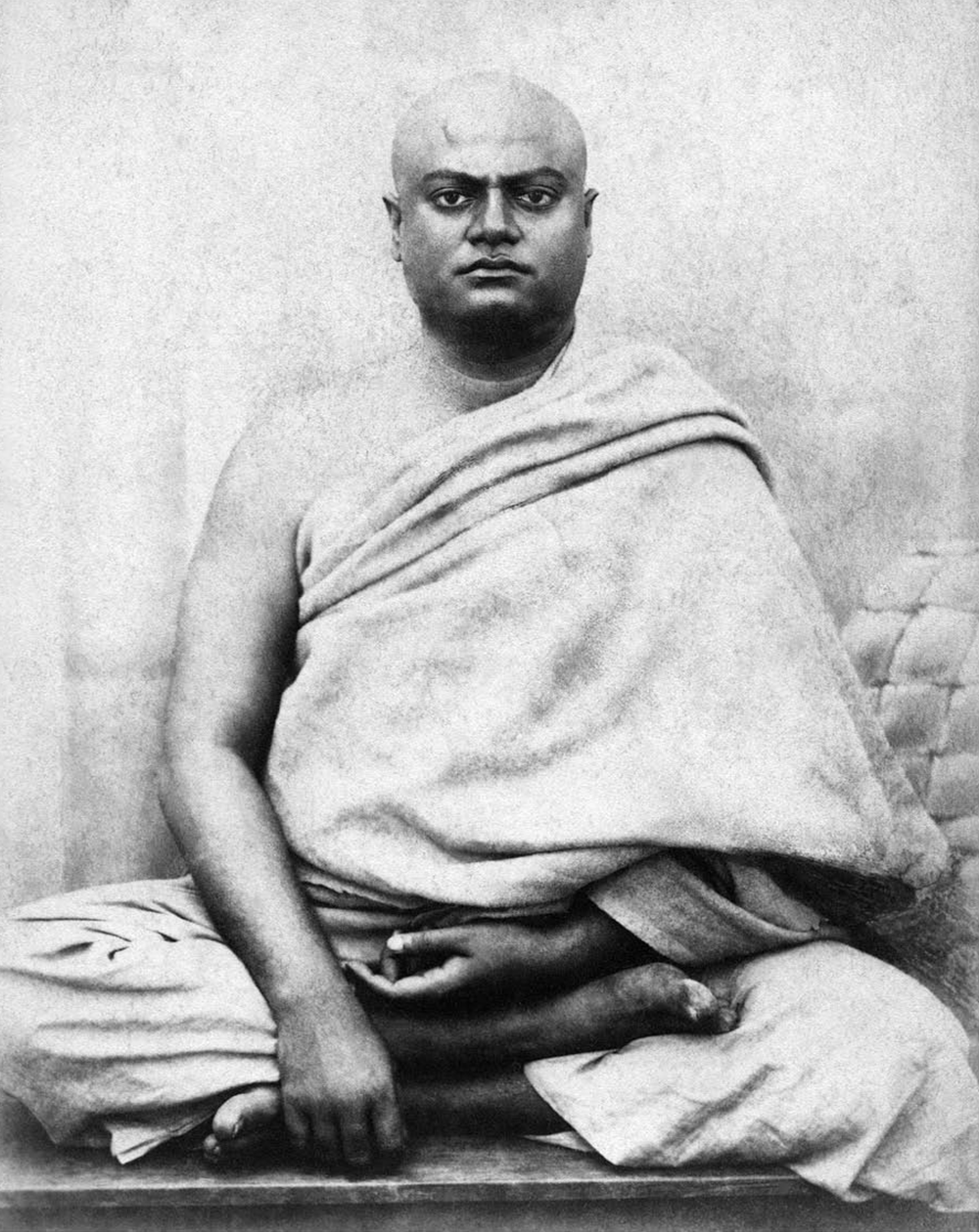
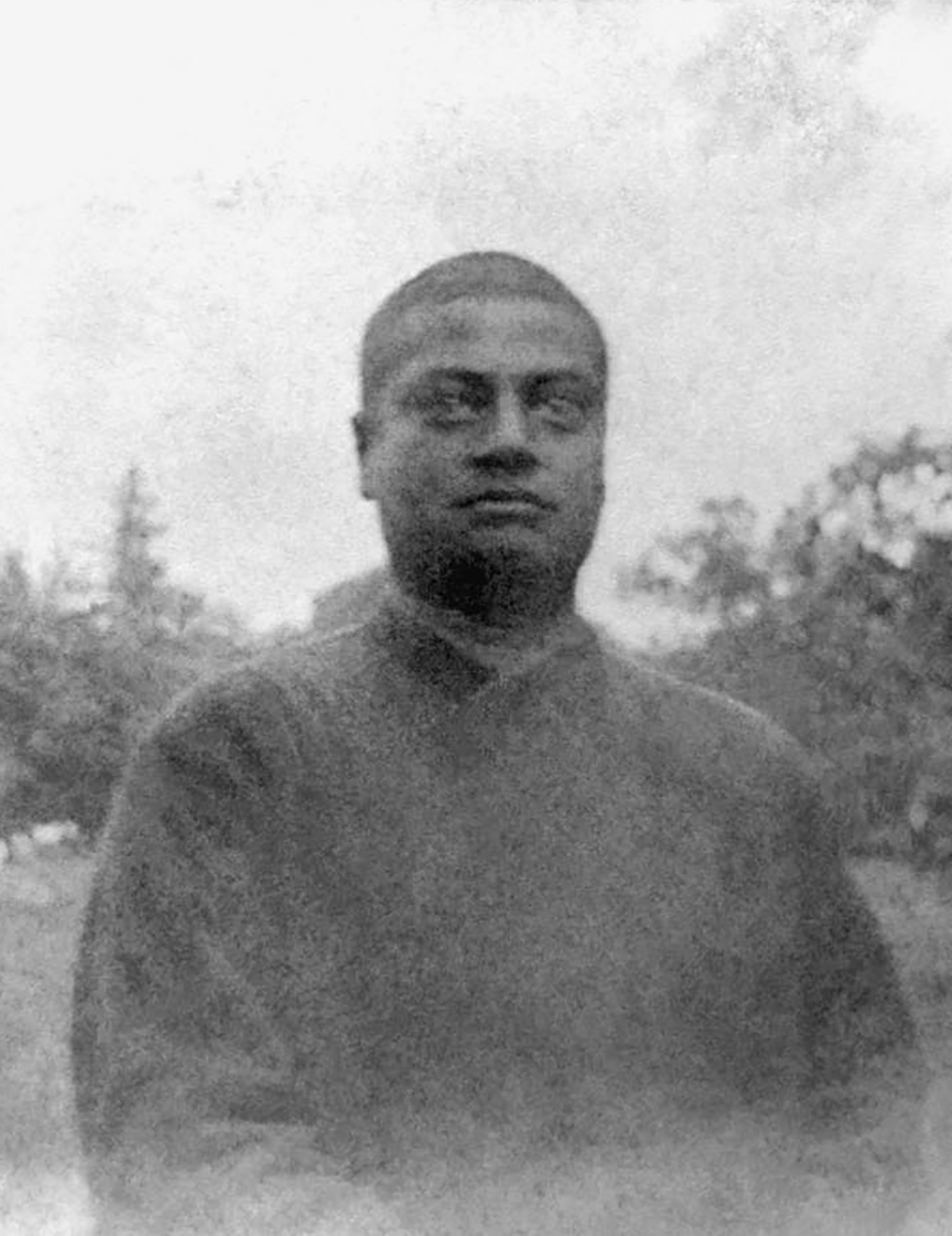
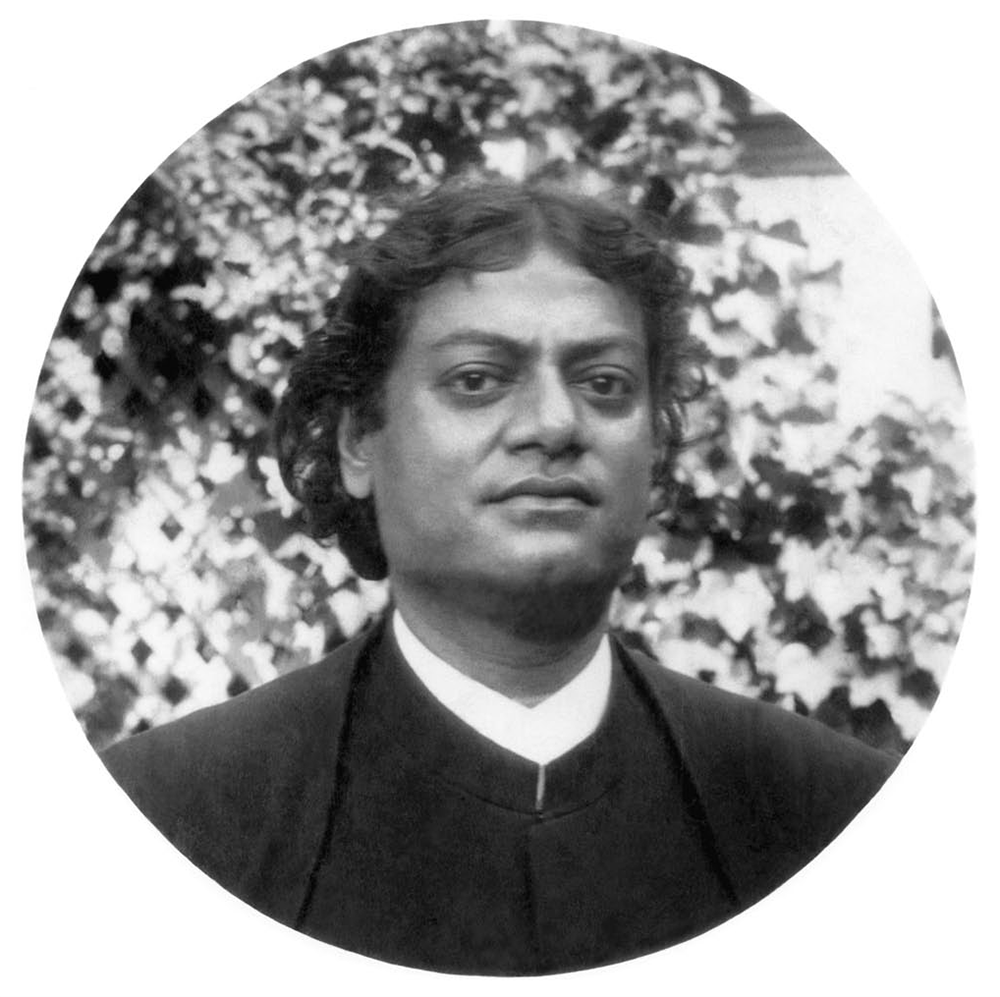
Photograph 1 

KOLKATA, circa 1886

The best descriptions of Swamiji around this time have been given by his master, Sri Ramakrishna. On a certain occasion the Master said to the disciples present, pointing to Narendranath, “Behold! Here is Naren. See! See! Oh what power of insight he has! It is like the shore less sea of radiant knowledge! The Mother, Mahamaya Herself, cannot approach within less than ten feet of him! She is barred by the very glory which She has imparted to him!"[1]

Friday, April 9, 1886 

Master: (By a sign) I have seen that He and the one who dwells in my heart are one and the same Person. 

Narendra: Yes, Yes! Soham—I am He. 

Master: But only a line divides the two—that I may enjoy divine bliss. 

Narendra: (to M.) Great souls, even after their own liberation, retain the ego and experience the pleasure and pain of the body that they may help others to attain liberation. (GSR, 949)


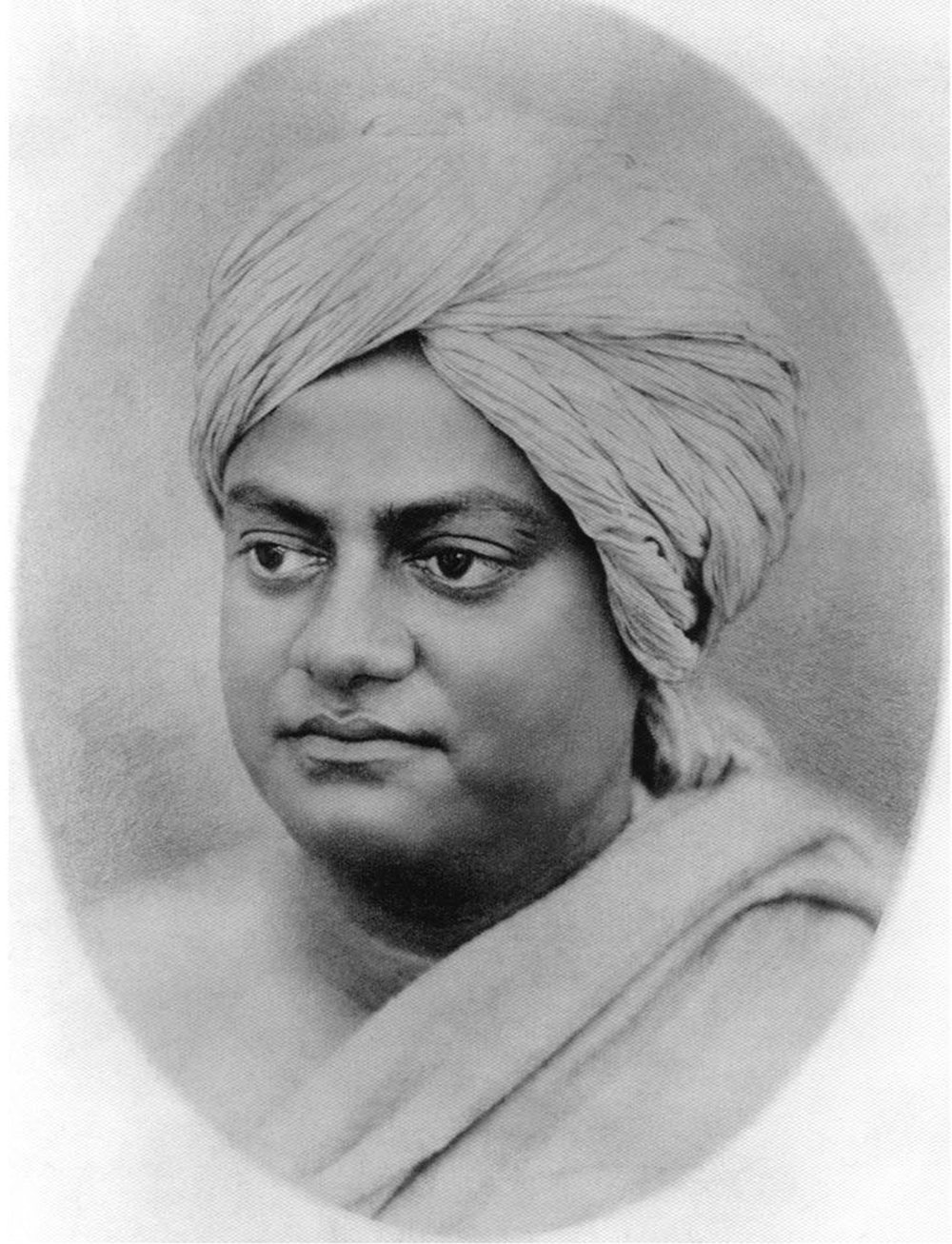
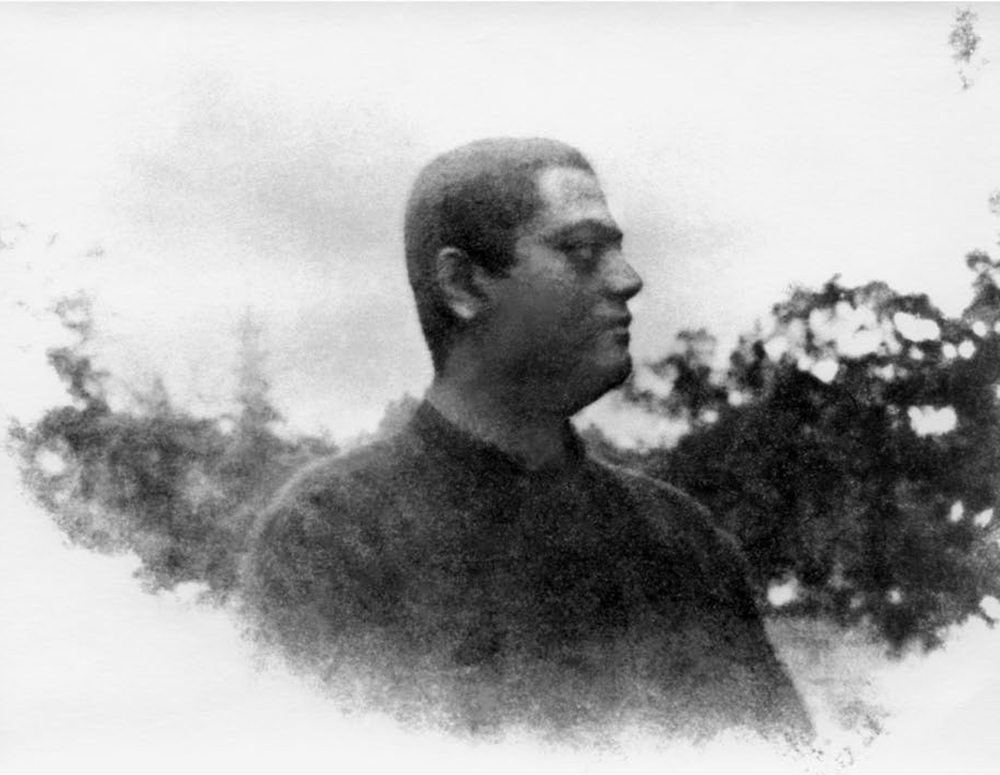
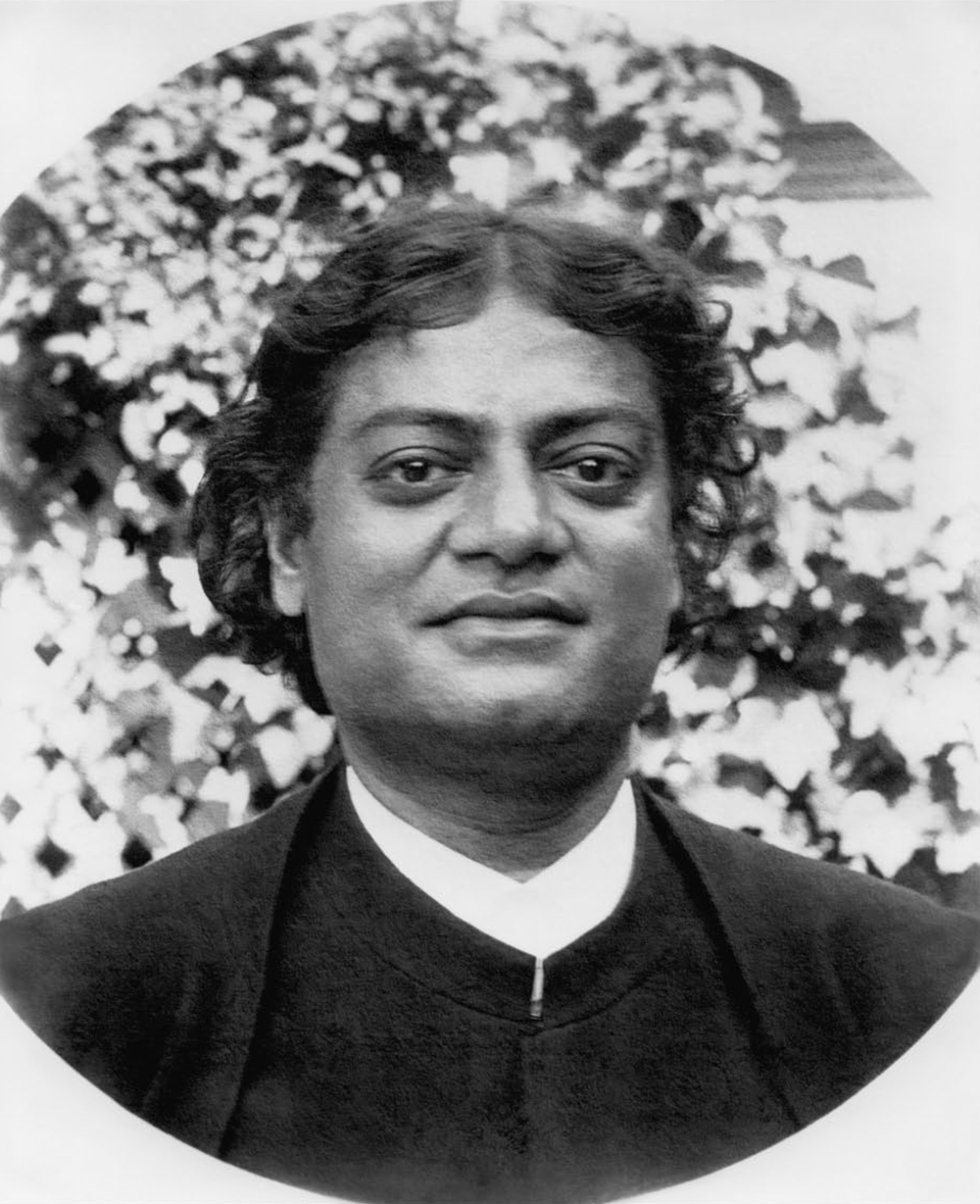
Photograph 2

KOLKATA, circa 1886

On another occasion Sri Ramakrishna said of Swamiji:

He is a burning, roaring fire

consuming all impurities to ashes[2].

Monday, January 4, 1886 

Narendra: I went to my study at my grandmother’s. As I tried to read I was seized with a great fear, as if studying were a terrible thing. My heart struggled within me. I burst into tears: I never wept so bitterly in my life. I left my books and ran away. I ran along the streets. My shoes slipped from my feet—I didn’t know where. I ran past a haystack and got hay all over me. I kept on running along the road to Cossipore.

Narendra remained silent a few minutes and then resumed. 

Narendra: Since reading the Vivekachudamani I have felt very much depressed. In it

Sankaracharya says that only through great tapasya and good fortune does one acquire these three things: a human birth, the desire for liberation, and refuge with a great soul. I said to myself: “I have surely gained all these three. As a result of great tapasya I have been born a human being; through great tapasya, again, I have the desire for liberation; and through great tapasya I have secured the companionship of such a great soul.” 

M: Ah!

Narendra: I have no more taste for the world. I do not relish the company of those who live in the world—of course, with the exception of one or two devotees.

Narendra became silent again. A fire of intense renunciation was burning within him. His soul was restless for the vision of God. . . .

M. said to himself: Sri Ramakrishna said that one must pant and pine for God; only then may one have the vision of him. (GSR, 936)


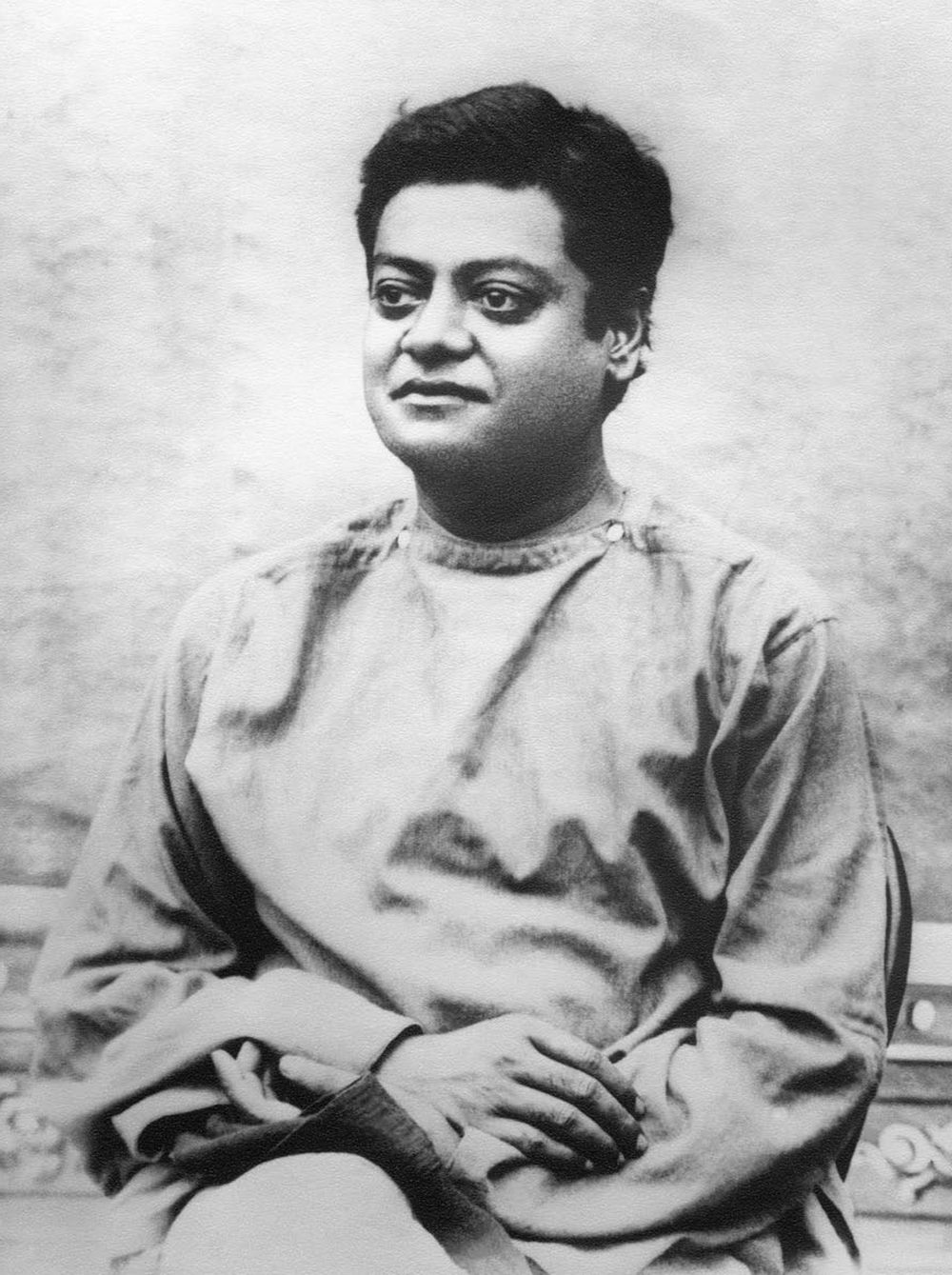
Photograph 3 

COSSIPORE GARDEN HOUSE, 1886

Judging from Swamiji’s appearance, this photo seems to have been taken around the same time as the two following photographs, 4 and 5.

Shortly before Sri Ramakrishna gave up his body at Cossipore, Swamiji had an exalted spiritual experience there. Seeing him Sri Ramakrishna said: “Now then, the Mother has shown you everything. Just as a treasure is locked up in a box, so will this realization you have just had be locked up and the key shall remain with me. You have work to do. When you have finished my work, the treasure box will be unlocked again; and you will know everything then, as you did just now.[3]” 

Cossipore, Wednesday, April 21, 1886 

Narendra: I want truth. The other day I had a great argument with Sri Ramakrishna himself. 

M. (smiling): What happened? 

Narendra: He said to me, “Some people call me God.” I replied, “Let a thousand people call you God, but I shall certainly not call you God as long as I do not know it to be true.” He said, “Whatever many people say is indeed truth; that is dharma.” Thereupon I replied, “Let others proclaim a thing as truth, but I shall certainly not listen to them unless I myself realize it as truth.” (GSR, 962)


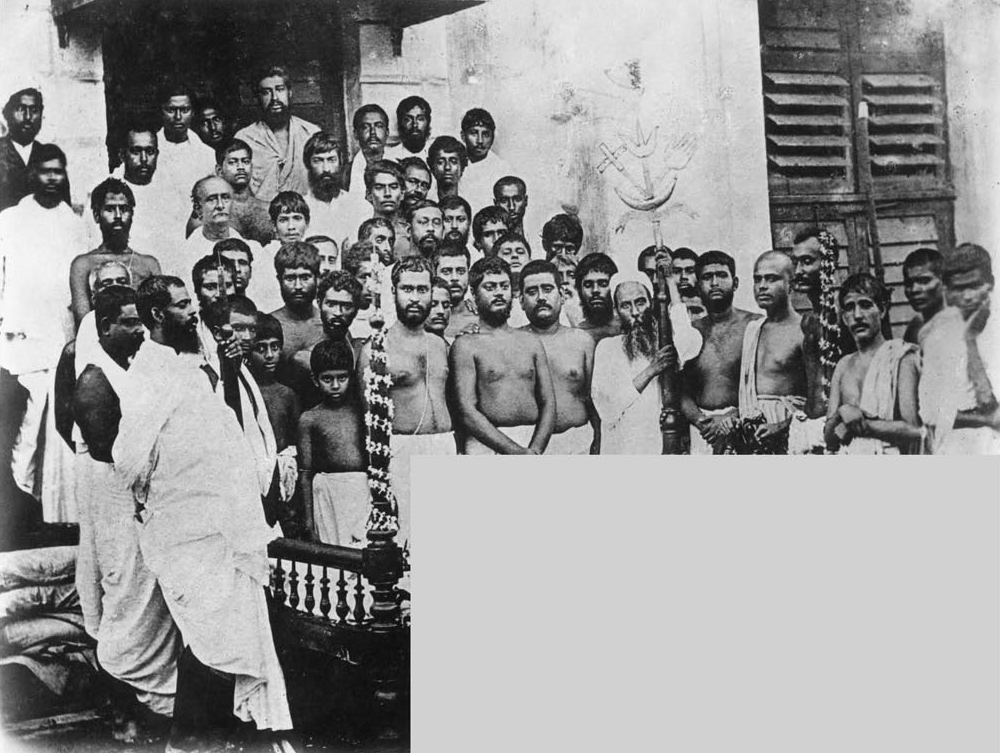
Photographs 4

COSSIPORE GARDEN HOUSE, AUGUST 16, 1886

(Mahasamadhi of Sri Ramakrishna)

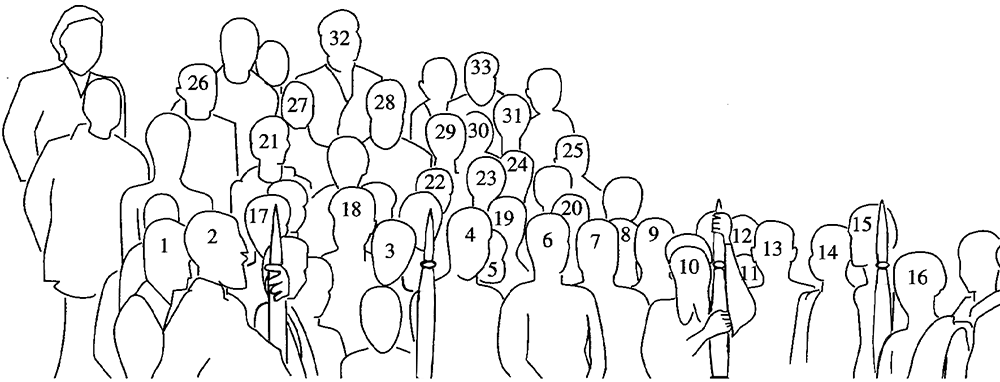
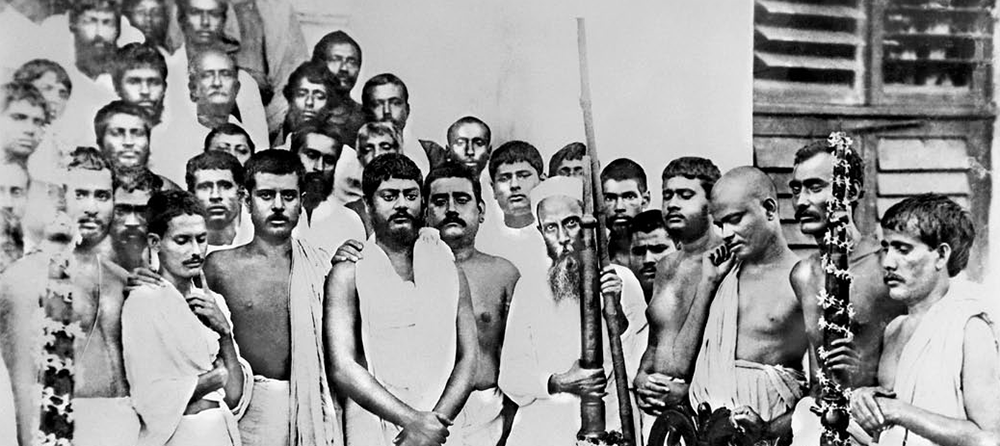
“The pictures [4 and 5] show the following: . . . There are at the four corners of the cot [cot not shown] upright members for supporting a mosquito curtain. The top and bottom uprights of the cot’s left side are tied with garlands. Part of the Cossipore garden house is shown behind. A pile of bedding (possibly bedding used by Ramakrishna, set out to sun) can be seen on the left. More than fifty people—devotees and friends—are seen in the picture, ranged behind the cot. About half of these people have been identified.


1. Atul 2. Amrita 3. Vaikuntha Nath Sannyal 4. Bhavanath Chatterjee 5. Baburam (Swami Premananda) 6. Narendra (Swami Vivekananda) 7. Ram Chandra Datta 8. Gopal Ghosh (Swami Advaitananda) 9. Sharat (Swami Saradananda) 10. Balaram Bose 11. Latu (Swami Adbhutananda) 12. Shashi (Swami Ramakrishnanda) 13. Rakhal (Swami Brahmananda) 14. Nityagopal 15. Jogindra (Swami Yogananda) 16. Devendra Nath Mazumdar 17. Tarak (Swami Shivananda) 18. Young Gopal 19. Nitya Niranjan (Swami Niranjanananda) 20. Narayan 21. Manilal Mallick 22. Fakir 23. Surendra 24. Bhupati 25. Harish 26. Girindra 27. Binod 28. M. (Mahendra Nath Gupta) 29. Kali (Swami Abhedananda) 30. Navagopal Ghosh 31. Gangadhar (Swami Akhandananda) 32. Mahimacharan 33. Manomohan Mitra[4].

“Balaram Basu is seen holding a staff with a symbol on the top of it. Chakrabarty identifies this as a symbol of the harmony of religions. In the symbol the trident of the Shaivites, the Om of the Advaitists, the kanthi (a hand holding a necklace of tulsi beads) of the Vaishnavas, the half-moon of the Muslims, and the cross of the Christians are seen. [This symbol seems to have been drawn on the top of one of the posts of the cot that Balaram Basu is holding on to.]

“The two photos are similar except that some of the devotees have changed their positions; and in one Narendra is wearing a chaddar over the upper part of his body, while in the other [4] he is bare from the waist up. . . .

“[After the Master entered mahasamadhi] the news had spread all over Kolkata and people came in large numbers to have a last look at the Master’s form. It was hoped by some that the Master was not dead but only in an unusually deep samadhi. At about noon Dr. Mahendralal Sarkar, who had been attending Sri Ramakrishna, arrived. He examined the body and said that life had departed only half an hour before. Dr. Sarkar’s opinion was accepted as final[5].”

Swami Vidyatmananda of Gretz copied the following excerpt from Dr. Sarkar’s handwritten diary, which had been in the possession of the late Swami Advayananda, Advaita Ashrama:

Monday, August 16, 1886: His disciples, some at least, were under the impression that he was in samadhi, not dead. I dispelled this impression. I asked them to have his photograph taken and gave them Rs. 10/ as my contribution[6].

Afterwards about 5:00 p.m. when Sri Ramakrishna had been dressed in an ochre cloth and decorated with sandal paste and flowers, the photographs were taken.

Swami Abhedananda gave the following account of the incident: Gradually the news of the Master’s passing away spread and people began to flock to the Cossipore garden house. At 10:00 a.m. Dr. Mahendralal Sarkar came. He checked the Master’s pulse and examined him carefully. Then he declared that the Master had breathed his last a half hour earlier. . . . Listening to the doctor’s report, we lost all hope. Arrangements were then made for cremation of the Master’s divine body. Dr. Sarkar gave ten rupees so a photograph could be taken and then left with a heavy heart. At that time we all felt completely helpless. We

felt that our entire source of strength and hope had gone. We thought: Now what shall we do? On whom shall we depend? And how shall we pass our days? . . . 

The Bengal Photographers Studio was called to take photographs of the Master’s mahasamadhi. Sri Ramakrishna’s body was placed on a cot which was decorated all over with flowers. Then the Master’s body was adorned with sandal paste on his face and garlands around his neck. Ram Datta stood in front of the cot and asked Narendra to stand by his side. The rest of us stood silently behind on the staircase. The Bengal Photographers took two group photographs[7].

Cossipore, Friday, April 23, 1886 

The Master was resting in his room and Narendra, Sarat, and M. were conversing downstairs.

Narendra: How amazing it is! One learns hardly anything though one reads books for many years. How can a man realize God by practicing sadhana for two or three days? Is it so easy to realize God? (To Sarat) You have obtained peace. M., too, has obtained it. But I have no peace. (GSR, 972)

[Cossipore, August 1886] 

And in the night, while they stood about the form of the Master with their countenances wrapt in death-like stillness and seriousness, as revealed by the flickering lamplight, the thought flashed across the mind of Noren, “He has said he is Divinity Incarnate. If he now says in the midst of the throes of death, in this terrible moment of human anguish and physical pain, ‘I AM the God Incarnate,’ then I will believe!” It was but a dare he had ventured to make in the inmost recesses of his own mind, without thinking for one single moment as to the results. Suddenly the Master turned towards him and summoning all his energy, said, “O my Noren, are you not yet convinced! He who was Rama and Krishna is now Ramakrishna in this body—not, however, from the standpoint of your Vedanta, but literally so!” (LSV [Mayavati, 1912] 1:429-30)


Photograph 5

COSSIPORE GARDEN HOUSE, AUGUST 16, 1886

(See photo information under photograph 4.)


Cossipore, Monday, March 15, 1886

Master (smiling, to Narendra): Well, what do you think of me? 

Narendra: You are a hero, a handmaid of God and everything else.

These words fill Sri Ramakrishna with divine emotion. He places his hand on his heart and is about to say something

He says to Narendra and the other devotees: I see that all things—everything that exists—have come from this.

He asks Narendra by a sign: What did you understand?

Narendra: All created objects have come from you.

The Master’s face beams with joy. He says to Rakhal: Did you hear what he said? (GSR, 944-45)


[Cossipore, August 1886]

Three or four days before the Master’s mahasamadhi Sri Ramakrishna called Naren to him. Looking steadfastly at him he entered into deep meditation. Naren felt as though a subtle force, resembling an electric shock, were entering his body. He lost outer consciousness. When he came to, he found the Master weeping. Wondering, Naren asked him why he wept, and was told, “O Naren, today I have given you my all and have become a fakir, a penniless beggar. By the force of the power transmitted by me, great things will be done by you; only after that will you go where you came from.” (LSV [Kolkata, 1979] 1:182)


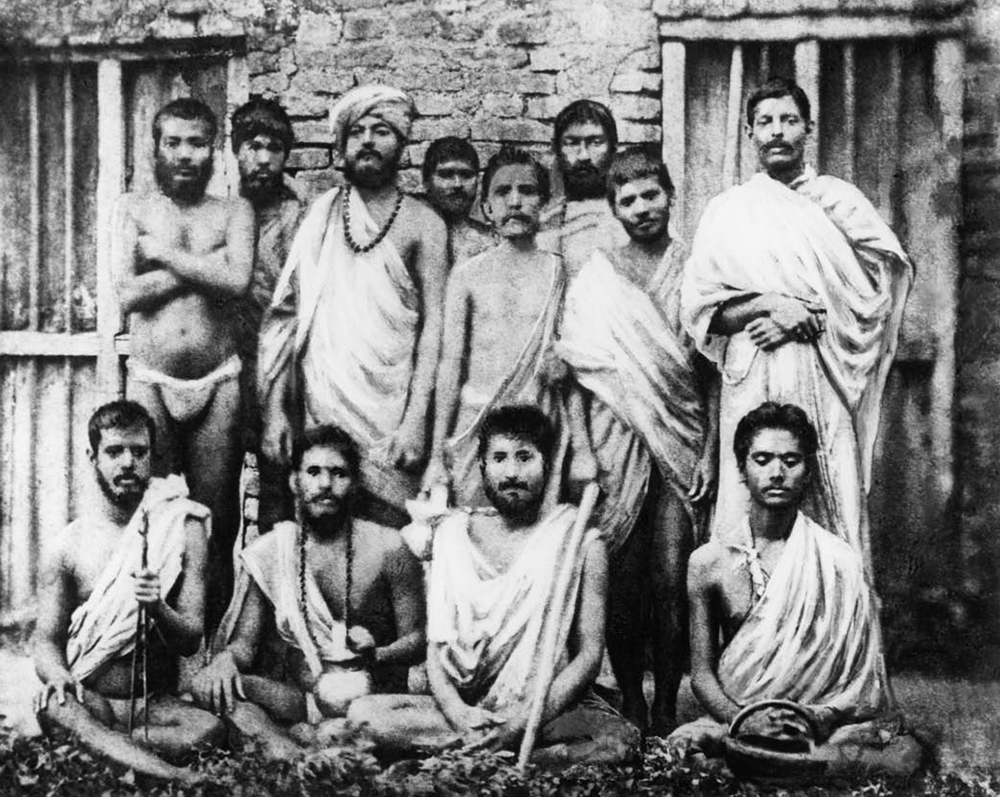
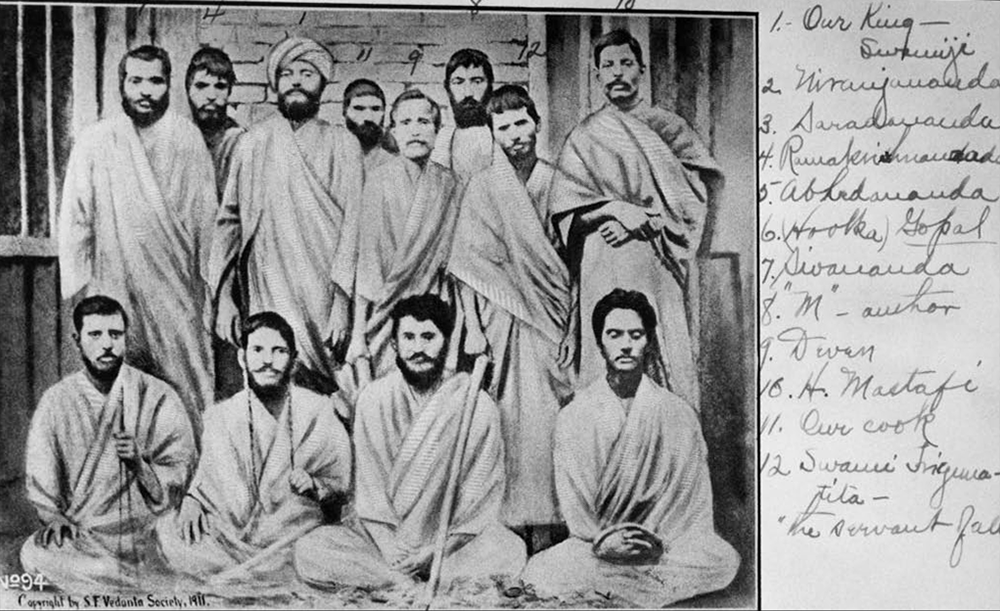
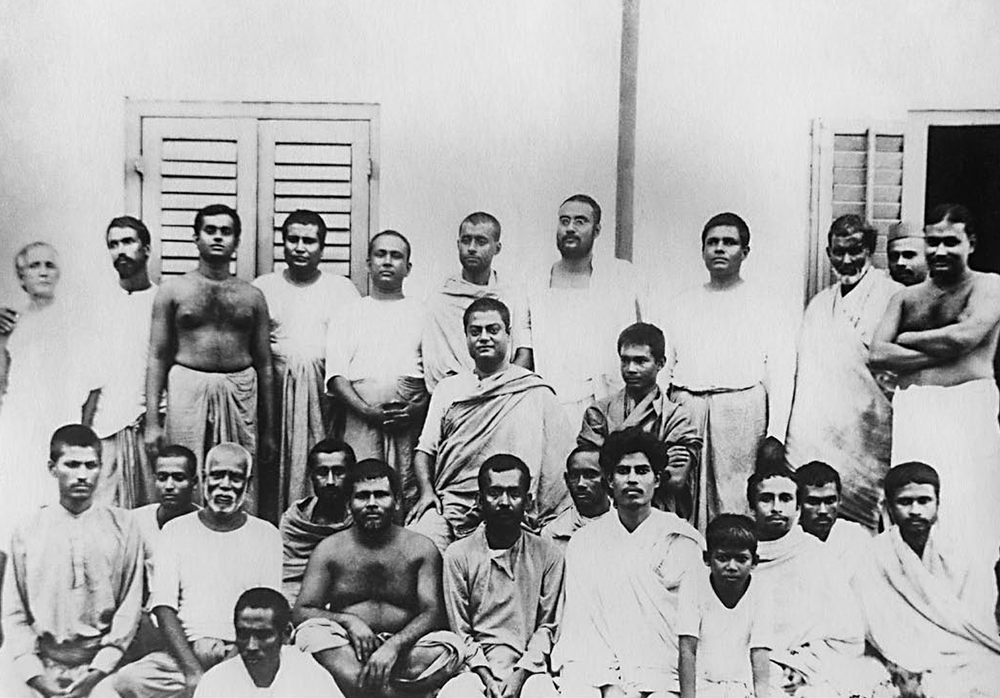
Photograph 6

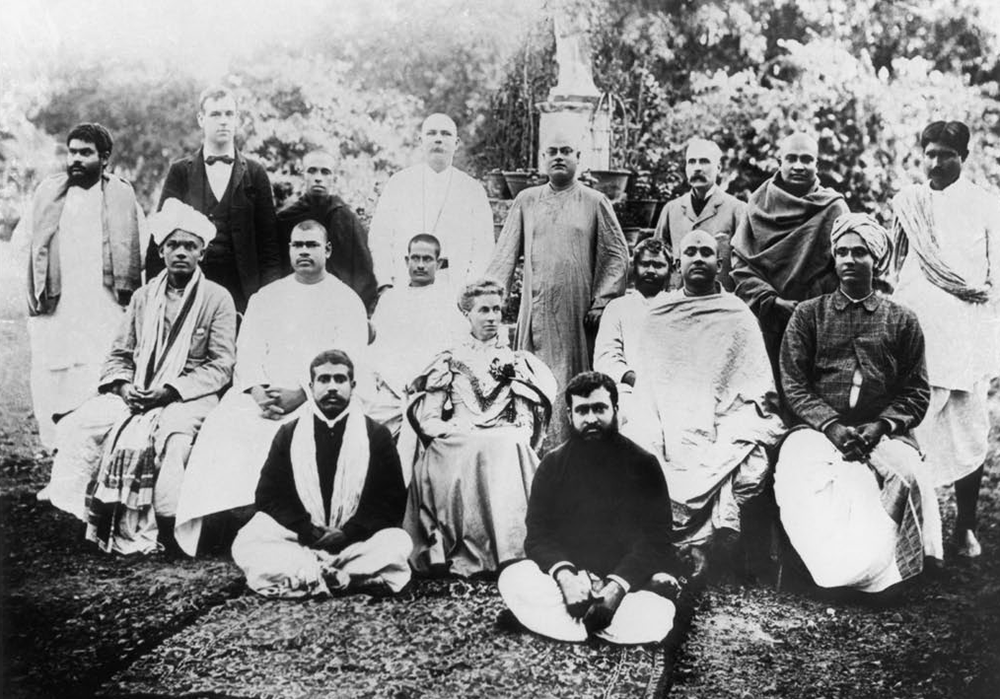
BARANAGORE MATH, JANUARY 30, 1887

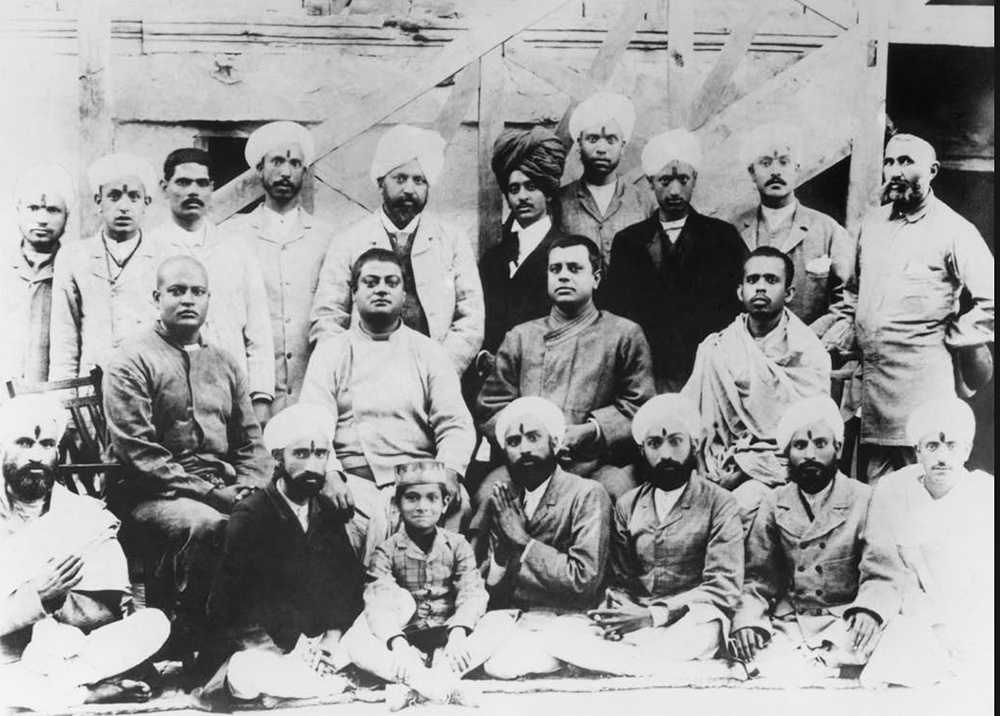
The Gospel of Sri Ramakrishna was published by the San Francisco Vedanta Society in 1912 under Swami Trigunatita’s direction. A quaint variation of this Baranagore Math photograph was printed in the 1912 edition of the Gospel. Perhaps Swami Trigunatita, not wanting to offend Western sensibilities, had this photo reproduced with the monks and devotees fully clothed. On a photo removed from one of the Gospels, Swami Trigunatita made the following identification in his own handwriting:

1. Our King—Swamiji 2. Niranjanananda 3. Saradananda 4. Ramakrishnananda 5. Abhedananda 6. (Hootka) Gopal* 7. Sivananda 8. ‘M’—author 9. Devan 10. H. Mastafi 11. our cook[*] 12. Swami Trigunatita—‘the servant of all.’ 

[*] in some publications (Hootka) Gopal has often been misidentified as Swami Brahmananda and the cook as Swami Premananda.

In one of his articles on the Baranagore Math, Swami Prabhananda of the Ramakrishna Math and Ramakrishna Mission, Belur Math, said, “A group photo of the monks and a few householder devotees, taken on 30 January 1887 shows some of them wearing only a loin cloth and others wearing ochre cloth[8].” The following incident has been recorded about this photograph. “After the Master’s death Devendra [Devendra Nath Mazumdar] visited from time to time the Baranagore monastery and the Kankurgachi Yogodyana. Once when Devendra was at the monastery with his uncle [H. Mastafi], Swami Vivekananda asked him to become a monk. Devendra replied that Sri Ramakrishna had told him to lead the life of a householder. Swamiji himself then dressed Devendra in the ochre cloth of a monk, and a group photo was taken at the monastery. Devendra felt such intense renunciation that day that he told his uncle he would not return home. Only after much persuasion did Devendra finally consent to go back with his uncle, but his dispassionate mood continued for a month. Devendra later acknowledged that it was because of Swamiji’s power that he had felt that way[9].”

Saturday, April 9, 1887 [at Baranagore Math] 

M. said: You are all indeed blessed! You think of the Master day and night. 

Narendra: But how little it is! We don’t yet feel like giving up the body because we haven’t realized God. (GSR, 987)

[Swamiji] was intensely possessed by the vision of the sannyasi’s life and would cry out, “Let man-making be the goal of our lives! Let us make this our only spiritual discipline! Away with vain learning! Let not the glamour of the world captivate our minds even for a moment! Realization of God is the one and only thing in life! That is what Sri Ramakrishna’s life represented! We must realize God!” Inspired by these thoughts and fired by a oneness of purpose, the young men became aware of a sense of unity—a feeling that they were all linked by some wonderful spiritual power. (LSV [Kolkata, 1979] 1:195)


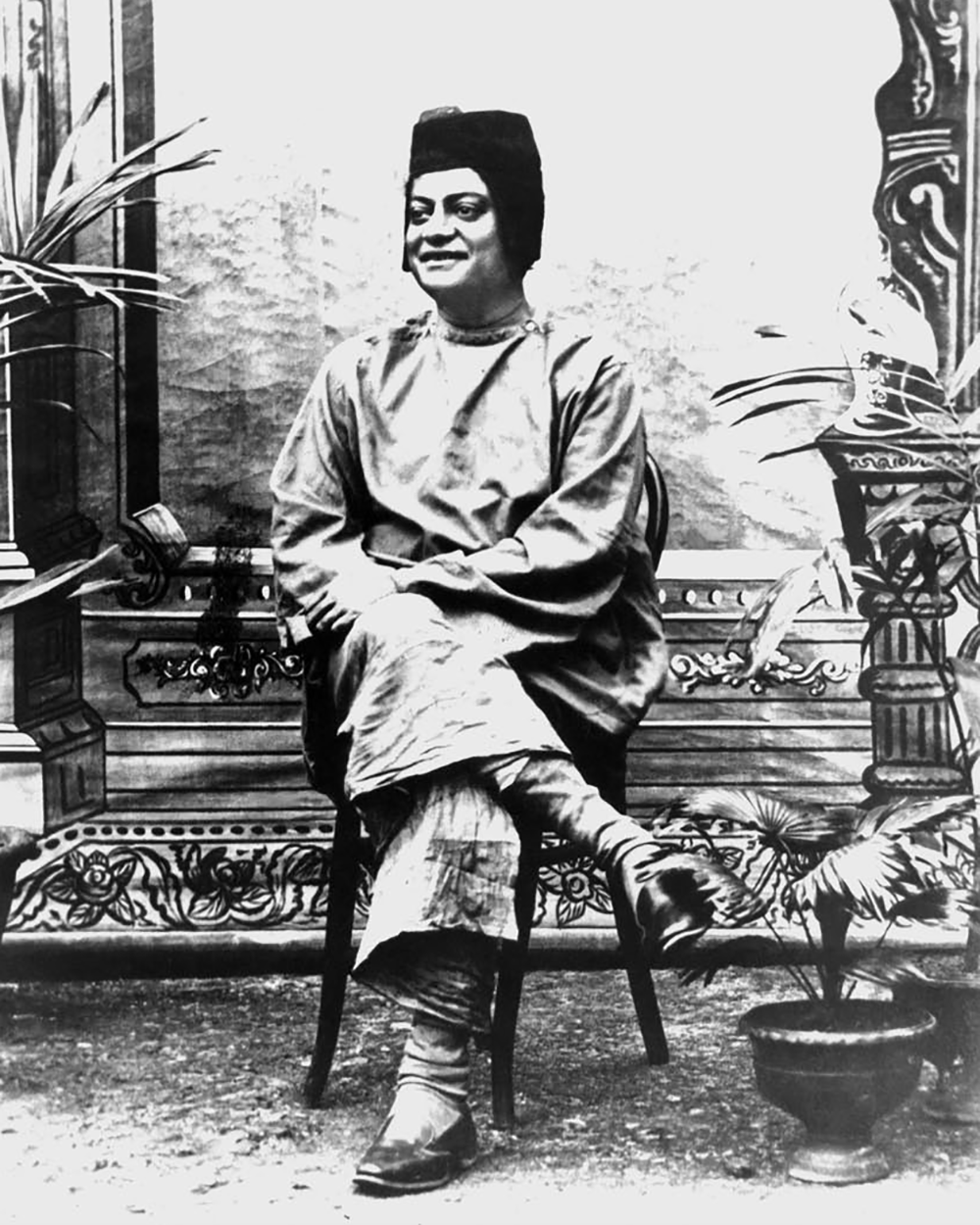
Photograph 7

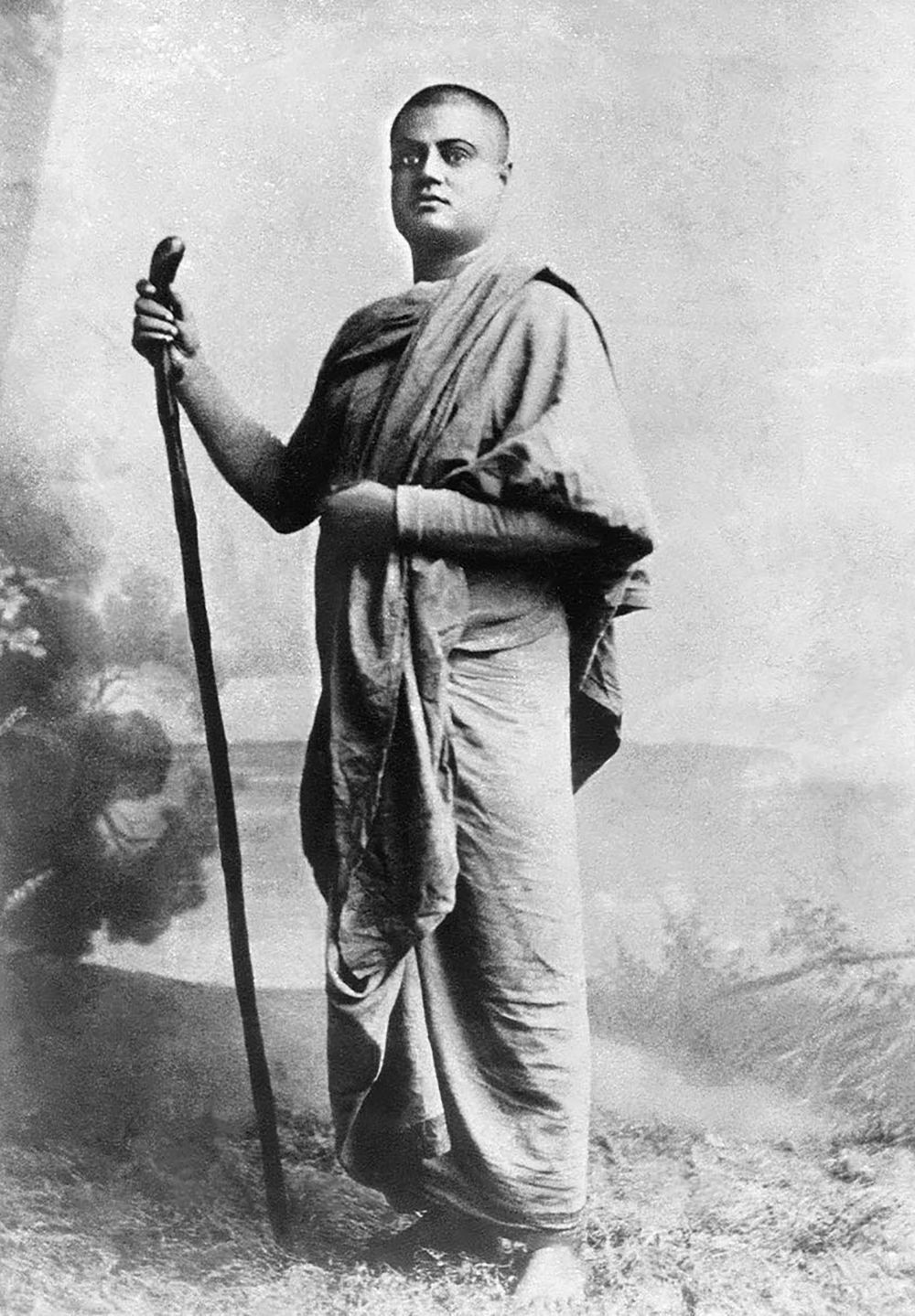
JAIPUR, 1891 (probably)

(Commonly known as the “wandering monk” pose)

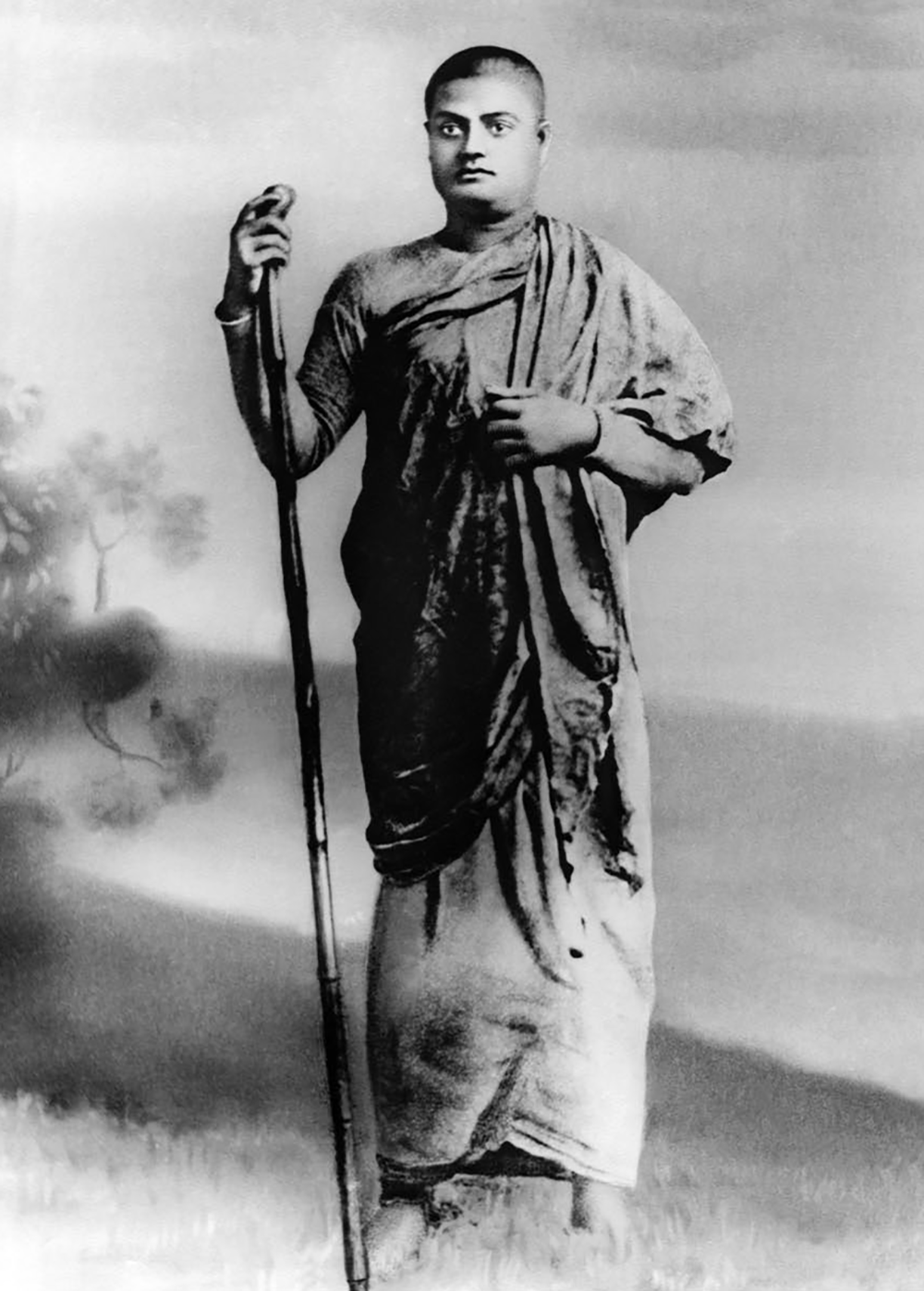
Photos 7 and 8 were probably taken on the same day in Jaipur, 1891. The Life mentions: “At Jaipur the disciple [perhaps Lala Govinda Sahai whom Swamiji initiated in Rajputana in 1891] insisted on the swami’s posing for a photograph. The swami, much against his wishes, finally consented. This was the first time that a photo of him as a wandering monk was taken[10].

Another reference to photo no. 7 having been taken in Jaipur appears in Swami Vivekananda: A Forgotten Chapter of His Life, by Beni Shankar Sharma: “Furthermore, very few people know that the turban that the swami always wore . . . was worn at the suggestion of Ajit Singh [the Maharaja of Khetri]. Swami Vivekananda being a Bengali did not wear a turban, or any headgear, and in the first of his photographs, which was taken at Jaipur at the request of his Alwar friends in 1891, before he met the Maharaja of Khetri, we find him without his now inseparable turban. It was after his meeting with the Maharaja and his visit to Khetri that we find him with his characteristic turban. When Swami Vivekananda visited Khetri as Vividishananda for the first time, it was summer and the loo, or hot winds of Rajasthan, during this period are well-known. Besides, from Swamiji’s letters, we find that he was mortally afraid of the loo. When the Maharaja saw his discomfort, he advised him to wear a turban, just as he himself and all the people of the locality wore, to save himself from the loo, a suggestion which the swami readily accepted. The Maharaja in fact himself taught him how to wind the turban[11].”

In all the subsequent photos of Swamiji during his wandering days he is, in fact, pictured wearing a turban.

These photos (nos. 7 and 8) have sometimes been identified as having been taken in various places other than Jaipur such as Trivandrum, Bangalore, or Mysore, 1892, and sometimes as Chennai, 1893. Photo 7 appears as the frontispiece in the 1901 edition of Inspired Talks published in Mylapore, Chennai, during Swami Ramakrishnananda’s stay in Chennai. It bears the caption: “From a photograph taken just before leaving Chennai for the Parliament of Religions at Chicago, showing the swami in the orange robe and with the shaven head of the sannyasin.” It is not known where this information originated. Some are of the opinion that the photo was taken in Chennai simply because it appeared in a book which was published during Swami Ramakrishnananda’s time. It should be noted, however, that Swami Ramakrishnananda was not in Chennai in 1893 when Swamiji was there, but was sent there after Swamiji returned from the West the first time in 1897.

Another reference to the possibility of this photo having been taken in Chennai can be found in the reminiscences of A. Srinivas Pai, who was a student in the Presidency College, Chennai, in 1893. He mentions: “The bare-headed photographs in the book, Swami Vivekananda’s Speeches and Writings, published by Messrs. G. A. Natesan & Co. give a good idea of the appearance of the swami. But no photograph or description can give a correct idea of the power of his eyes. They were wonderful. Like the ‘Ancient Mariner’ in Coleridge’s famous poem he ‘held you by the eye[12].’” This is one of the photographs that appears in that book.

Clearly there are diverse interpretations as to where these photos (7 and 8) were taken.

Throughout his wandering days Swamiji was asked a variety of questions about himself. While in Rajputana in 1891 someone said:

Sir, why do you wear gerua [ochre cloth]?” He would reply, “Because it is the garb of beggars. Poor people would ask me for alms if I were to wear white clothes. Being a beggar myself, most times I do not have even a single pice to give them. It causes me pain to have to refuse one who begs of me. But seeing my ochre cloth, they understand that I also am a beggar. They would not think of begging from a beggar.” (LSV [Kolkata, 1979] 1:266)


Photograph 8

JAIPUR, 1891 (probably)

(See photo information under photograph 7.)

While Swamiji was staying with a Muslim in Rajputana he was asked by Munshi Jagmohanlal, private secretary to the Raja of Khetri, who seemed doubtful of his authenticity:

“Well, Swamiji, you are a Hindu monk. How is it that you are living with a Muslim? Your food may now and then be touched by him.” At this question the swami flared up. He said, “Sir, what do you mean? I am a sannyasi. I am above all your social conventions. I can dine even with a bhangi [sweeper]. I am not afraid of God, for He sanctions it; I am not afraid of the scriptures, for they allow it; but I am afraid of you people and your society. You know nothing of God and the scriptures. I see Brahman everywhere, manifested even in the meanest creature. For me there is nothing high or low. Shiva, Shiva!” (LSV [Kolkata, 1979] 1:280)


Photograph 9

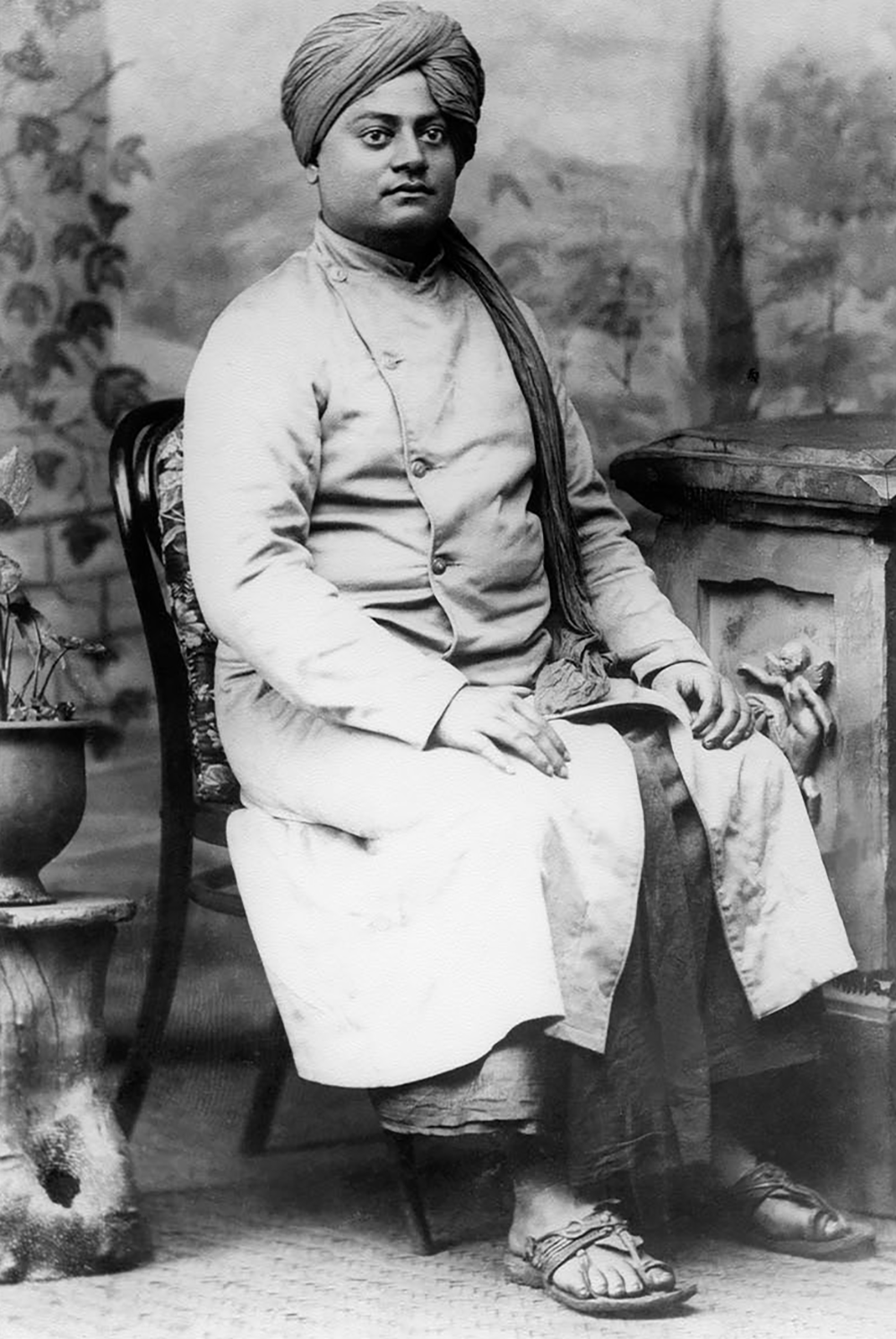
BELGAUM, OCTOBER 1892 

Haripada Mitra was one of Swamiji’s hosts while he was staying in Belgaum in 1892. In his reminiscences, he recalled his first impression of Swamiji when he was told:

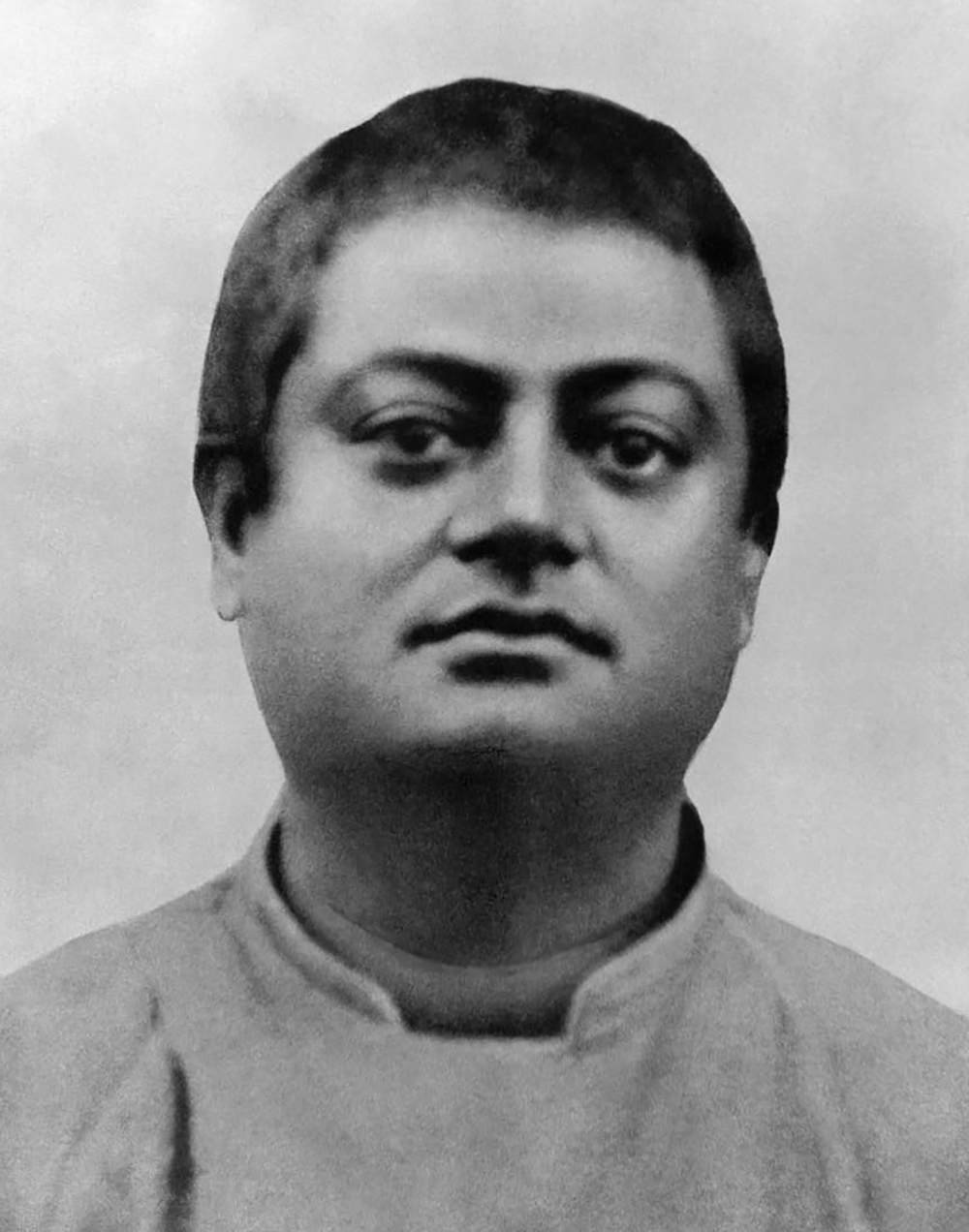
“Here is a learned Bengali sannyasin who has come to meet you.” I turned back and found a serene figure with his eyes flashing like lightning and a face clean shaven. His body was covered with an ochre robe, in [on] his feet he had strapped sandals of the Maharashtrian type; and on his head was an ochre turban. The figure was so impressive that it is still vivid in my memory[13].

Haripada convinced Swamiji to accept both him and his wife as disciples. In his reminiscences, he remarked further:

I had a desire to have his photograph. He would not agree. I persisted, and after a long-drawn tussle, he gave his consent and a photograph was taken on the 28th. [This photo was taken prior to the twenty-eighth, since Swamiji is reported to have left Belgaum on the twenty-seventh.] As Swamiji had not agreed to be photographed on an earlier occasion, in spite of the earnest request of another gentleman, I had to send two copies of this one to him on request[14].

Another source states:

The small wooden stand that can be seen at the left corner is still preserved at the studio[15]. The name of the studio was “S. Mahadev & Son” and the photograph was taken by one Govinda Shrinivas Welling (d. 1926). The studio still exists (Welling Camera Works, Welling House, B.C. 86, Belgaum Cantt. 590-001), but is no more in business, having closed down in 1970[16].

Another reference that certainly seems to apply to this photo is given in Sailendra Nath Dhar’s biography on Swamiji. Around this time Mahendra Nath Datta, Swamiji’s brother, received a photograph in the mail from someone who preferred to remain anonymous, but who had obviously been directed by Swamiji to send it. Dhar says:

The photo was of the swami dressed in a long coat reaching up to his knees and stuffed with cotton which made them happy specially because it showed that he had improved in health.

This photograph is the only one taken during Swamiji’s wanderings that fits this unique description.

While in Belgaum, Swamiji met one Dr. V. V. Shirgaonkar and expressed to him his wish to visit some seminaries in Goa so that he might study Christian theology from some old Latin manuscripts. Swamiji then proceeded to Margaon in Goa. Dr. Shirgaonkar contacted his friend Subrai Naik in Margaon, requesting him to assist Swamiji. Naik warmly welcomed Swamiji, helped him to visit one of the oldest Catholic seminaries, which was about four miles from Margaon, and also took him into his own home and accommodated him “in a room adjoining the temple of Damodarji, his family deity. The room, together with whatever furniture Swamiji used, has been preserved to this day as a memorial to his visit. Before Swamiji’s departure Naik asked him for his photograph. The photograph presented to him by Swamiji has also been preserved by the descendants of Naik[17].” The photograph that Swamiji gave Naik is most likely this one which was taken in Belgaum.

Haripada Mitra, an avowed atheist, was skeptical of wandering monks. His outlook changed drastically during the course of Swamiji’s visit:

As I sat there after saluting him, I was thinking, “Is he a man or a god?” . . . When I said that faith is the basis of all religions, Swamiji smiled a little and said, “A man goes beyond all wants once he becomes a king; but the difficulty is how to become one. Can faith be infused from outside? Nobody can have real faith unless he has personal experience.” (RSV, 25, 27)


Photograph 10

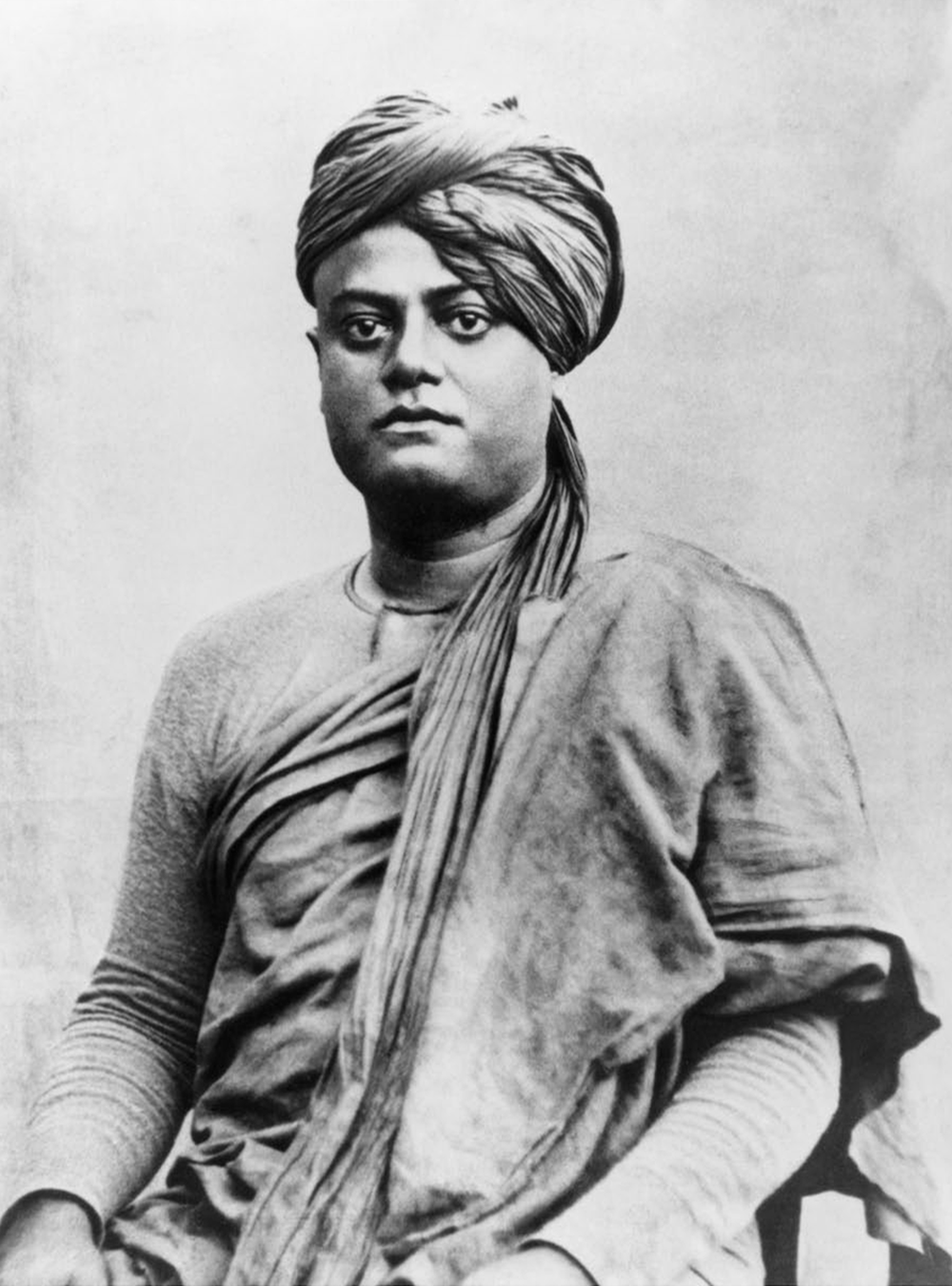
TRIVANDRUM, DECEMBER 1892

This photo was taken by Prince Martanda Varma of Travancore. K. Sundararama Iyer, the tutor of Prince Martanda Varma (the first prince of Travancore), remarked in his reminiscences: “The Prince was struck, like all others who had come into contact with him, with the swami’s striking figure and attractive features; and being an amateur photographer, asked the swami for a sitting and took a fine photograph which he skillfully developed into an impressive picture and later on sent as an interesting exhibit to the next Fine Arts Exhibition held in the Chennai Museum[18].”

The son of K. Sundararama Iyer, K. S. Ramaswami Sastri, who met Swamiji in Trivandrum in 1892, mentioned in his reminiscences these fiery words that Swamiji told him:

Man alone, out of all living beings, has a hunger in his heart to know the whence and whither, the whys and wherefores of things. There are four key words which you must remember, [namely] abhaya (fearlessness), ahimsa (non-injury), asanga (non-attachment), and ananda (bliss). These words really sum up the essence of all our sacred books. Remember them. (RSV, 101)


Photograph 11

PLACE UNKNOWN (at present), circa 1892 or early 1893

This photo is usually identified as “probably Belgaum,” 1892 and the next photo, no. 12, as Hyderabad, 1893. This information seems doubtful. Upon close examination it appears that both of these photographs were taken on the same day, wherever it may have been. There are reasons to believe that photo no.11 was not taken in Belgaum. Haripada Mitra, Swamiji’s disciple in Belgaum, with whom he stayed for nine days (October 19-27, 1892), arranged for photo no. 9. Initially Swamiji resisted being photographed, so it is not likely that he would have agreed to have a second and a third photograph taken while in Belgaum. (See note under photo no. 9)

Vivekananda: A Biography in Pictures mentions another account which says that this photo (no. 11) was the first one taken of Swamiji in Chennai. It is said that when Swamiji saw this photo, he remarked that “it looked like the picture of a leader of a gang of dacoits!”

Within the last couple of years, Swami Chetanananda of the Vedanta Society of St. Louis found a Bengali reference in the Udbodhan archives that he thinks refers to this photo. It reads: “Swamiji’s sitting pose: Jaipur after Alwar beginning of April 1891.” There was no actual photo with this description.

The photographs of Swamiji during his wandering days in 1892 and early 1893 clearly confirm the accounts given by those who met him at that time. When Swamiji first arrived in Belgaum, he stayed with the father of G. S. Bhate who remembered that the swami “was rather striking in appearance and appeared to be even at first sight somewhat out of the common run of men. . . . Though he wore clothes bearing the familiar color of a sannyasin’s garments, he appeared to be dressed differently from the familiar brotherhood of sannyasins. He used to wear a banyan [tee shirt]. Instead of the danda he carried a long stick, something like a walking stick. His kit consisted of the usual gourd, a pocket copy of the Gita, and one or two books[19].” B. G. Tilak remarked: “The swami avoided mixing with society. There was absolutely no money with him. A deerskin, one or two clothes and a kamandalu were his only possessions[20].”

Practical patriotism means not a mere sentiment or even emotion of love of the motherland but a passion to serve our fellow countrymen. I have gone all over India on foot and have seen with my own eyes the ignorance, misery, and squalor of our people. My whole soul is afire and I am burning with a fierce desire to change such evil conditions. Let no one talk of karma. If it was their karma to suffer; it is our karma to relieve the suffering. If you want to find God, serve man. To reach Narayana you must serve the daridranarayanas— the starving millions of India. (RSV, 100)


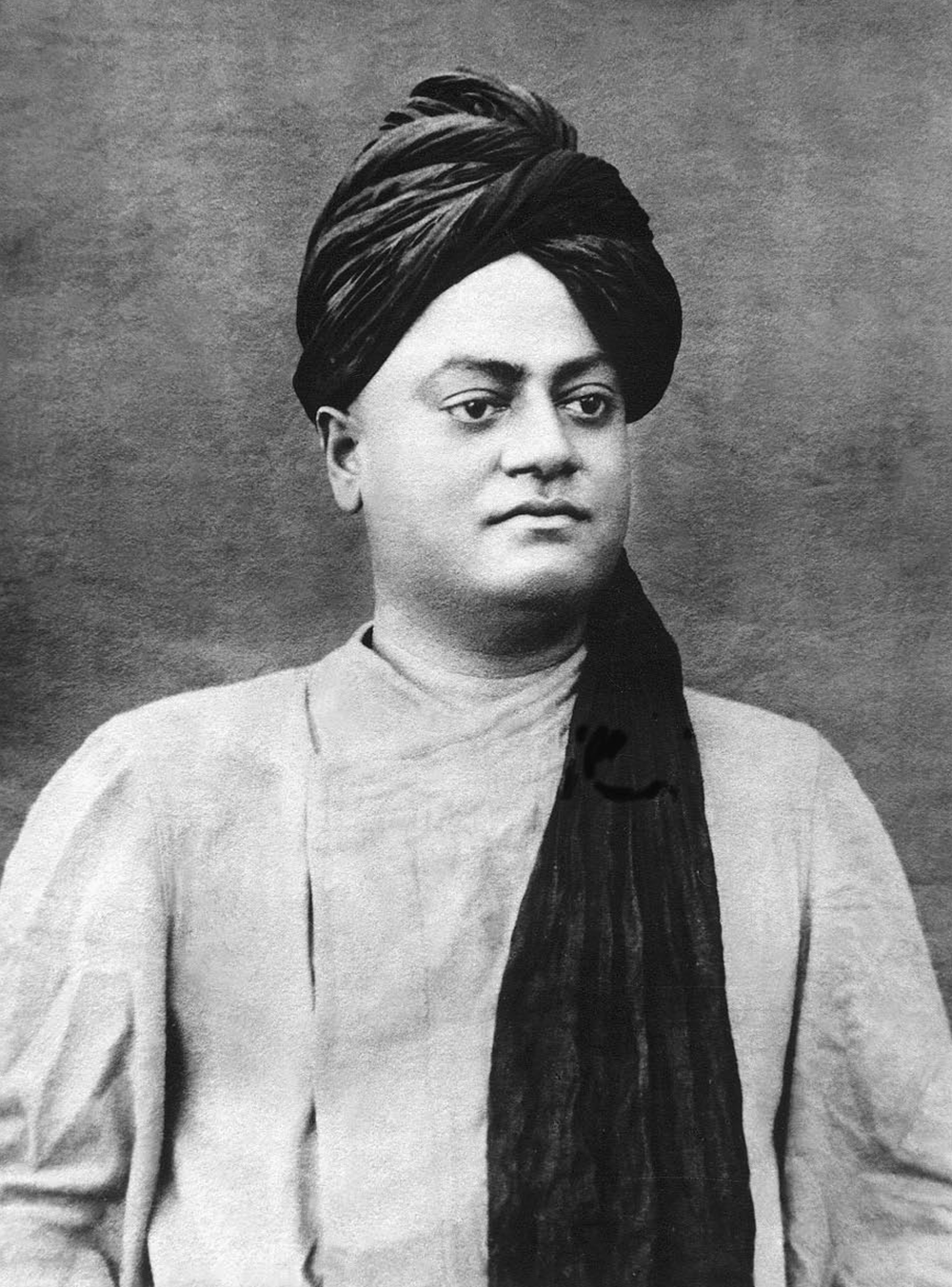
Photograph 12

PLACE UNKNOWN (at present), circa 1892 or early 1893

Another interesting anecdote about Swamiji’s appearance around this time comes from D. B. Raghunath Rao, the youngest son of D. R. Balaji Rao of Chennai, who was a close friend of Swamiji. Balaji told his son: “Swamiji was an arresting personality with handsome features, always smiling and had a robust constitution. His voice had a pleasant ringing tone.” Raghunath Rao continues: “My father who was fond of tying his turban in various modes, presented one such length of cloth to Swamiji. It is this that adorns his head in the popular photographs published; and the sash around his waist which we also see in the photos [Chicago, 1893] was presented to him by the Maharaja of Khetri[21].”

[Swamiji] spoke no harsh words against anyone; on the other hand he did not refrain from criticism when it was necessary. For example, there was the pandit who asked him if there was any harm in giving up sandhyavandana (ritualistic prayers performed in the morning, noon and evening) because of lack of time. “What!” exclaimed the swami, almost ferociously, “those giants of old, the ancient rishis, who never walked but strode, of whom if you were to think but for a moment you would shrivel up into a moth, they, sir, had time—and you have no time!”

On that same occasion, when a Westernized Hindu spoke in a belittling manner of the “meaningless teachings” of the Vedic seers, the swami fell upon him with thunderbolt vehemence, crying out, “How dare you criticize your venerable forefathers in such a fashion! A little learning has muddled your brain. Have you tested the science of the rishis? Have you even as much as read the Vedas? There is the challenge thrown by the rishis! If you dare oppose them, take it up; put their teachings to the test.” (LSV [Kolkata, 1979] 1:364-65)


[1] LSV (Kolkata, 1979) 1:134.

[2] Ibid., 134.

[3] P. 178.

[4] Swami Chetanananda, Vivekananda: East Meets West (St. Louis: Vedanta Society of St. Louis, 1995), 24.

[5] Swami Vidyatmananda, “The Photographs of Sri Ramakrishna,” as quoted in Swami Chetanananda, Ramakrishna as We Saw Him (St. Louis: Vedanta Society of St.Louis, 1990), 472-73.

[6] Ibid., 62.

[7.] Swami Chetanananda, Ramakrishna As We Saw Him (St. Louis: Vedanta Society of St. Louis, 1990), 226.

[8] Swami Prabhananda, “The Austere Baranagore Math,” VK, 190, no.77 (May 1990).

[9] TLG, 315.

[10] LSV (Kolkata, 1979) 1:277.

[11] Beni Shankar Sharma, Swami Vivekananda: A Forgotten Chapter of His Life (Kolkata, 1963), 42-43.

[12] RSV, 108.

[13] Ibid., 23-24.

[14] P. 32.

[15] Editorial, “Swami Vivekananda in South India: The 1892 Visit,” VK, 286.

[16] Ibid., 291.

[17] P. 288.

[18] RSV, 61-62.

[19] Ibid., 52.

[20] P. 20.

[21] D. B. Raghunath Rao, “Vivekananda in Chennai—Some Anecdotes,” Samvit no. 9 (March, 1984): 25-26.

Chapter 2

The Lightning Orator

On July 25, 1893, Swami Vivekananda set foot in Vancouver, British Columbia, to begin his remarkable journey in the West. He came to ask for help for the Indian nation—to tell the affluent West that the crying need in India was not for more religion— Hinduism was the mother of religions—but for bread for her starving masses. He had traveled widely in his motherland, and his whole being was dedicated to her upliftment. From Vancouver he traveled by train to Chicago, and took in the wonders of the World’s Fair. Although he was some months early for the Parliament of Religions, he was still too late to register as a delegate, and moreover lacked the necessary authorization to do so. At a loss as to how to proceed, Swamiji was advised to spend the summer in Boston, where the cost of living was far less expensive. Thus he came to Breezy Meadows, the home of Katherine A. Sanborn, whom he had met on the train, and then to Annisquam and the summer cottage of Professor and Mrs. John Henry Wright. It was from the Harvard professor that Swamiji received the credentials that would gain him entrance as a delegate to the Parliament of Religions. He remained in Massachusetts for the summer until a few days before the commencement of the parliament. He made a deep impression upon the people among whom he lived, and was asked to speak about India several times. America was getting its first glimpse of Swami Vivekananda, and he was in the process of discovering a new world. It was becoming clear to him that the people of America were also in need; they had need of the genuine spirituality that Eastern thought and experience could supply.

When Swamiji returned to Chicago in early September, he had in hand a letter of introduction to the chairman of the committee on selection of delegates to the parliament, but he had lost the address of the place where he was supposed to present that letter. He was unable to find a way out of his predicament, and so, experienced parivrajika that he was, he slept that first night in a boxcar in the railroad yard. The next day, seeking help, he walked along Lake Shore Drive, knocking on the doors of the mansions that lined it. Unsuccessful and weary, he sat down on the sidewalk to rest, and a wonderful thing happened. Mrs. George W. Hale saw him from the window of her home and, quickly grasping the situation, came out to assist him. Thus began Swamiji’s lifelong friendship with the Hale family. Mrs. Hale herself accompanied the swami to the offices of the Parliament of Religions.

On September 11, 1893, the Parliament of Religions opened its doors. The delegates, representing all of the world’s organized religions, marched to the platform before an audience of what contemporaries said was 7, 000 men and women. That afternoon Swami Vivekananda, representing the universal religion of the Vedas, would nervously take the podium and begin his address, “Sisters and Brothers of America,” which would receive a long standing ovation. Throughout the twelve days of the parliament, Swamiji remained a favorite with an audience that grew in size with every passing day. They would wait for hours to hear him speak; they would approach the platform to touch the hem of his orange robe. Swamiji gave twelve addresses at the parliament; he spoke of religious tolerance, of universal consciousness, of the innate divinity of every human being. In his “Paper on Hinduism,” delivered on September 19, he said: “To the Hindu, the whole world of religions is only a traveling, a coming up, of different men and women, through various conditions and circumstances, to the same goal. Every religion is only evolving a God out of the material man, and the same God is the inspirer of all of them. Why, then, are there so many contradictions? They are only apparent, says the Hindu. The contradictions come from the same truth adapting itself to the varying circumstances of different natures.” He also spoke critically of the Christian missionaries’ role in India; his remarks were well-received by the audience, who applauded when he pointed out that the most insistent needs of India were material, not spiritual.

And so through the vehicle of the Parliament of Religions, Swamiji was introduced to the American nation. He himself had earlier predicted it to his gurubhai, Swami Turiyananda. For about two months he remained in the Chicago area, sometimes staying with Mr. and Mrs. John B. Lyon, but mostly with his beloved Hale family, whose home became his headquarters. Swamiji became a keen observer of the American lifestyle—he visited museums, institutions, and universities. He also found himself in great demand as a lecturer, and so decided that he would use his newfound fame to obtain his goal of raising money for India. To this end Swamiji signed a three-year contract with the Slayton Lyceum Bureau of Chicago. The tour began in Madison, Wisconsin, and extended to the larger cities of the Midwest and South. The next several months, November to March, were spent in a whirlwind of activity, Swamiji moving from Minneapolis to Des Moines, to Memphis, Chicago, and Detroit. Wherever he went he spoke of religious tolerance, of the underlying principles of all religions, and of the divinity of man. He spoke tirelessly of India, her manners, customs, and religions; he wanted to establish the truth of what India stood for and what she had to offer the world. One newspaper article called him, admiringly, “a man of his people.” At the same time he was letting fly some very accurate criticism of Western culture and of its Christian missionaries. In a Detroit newspaper he was quoted as saying, “Morally, India is head and shoulders above the United States or any other country on the globe.” Detroit had an especially intense reaction to Swamiji, and he was to visit that city twice during the winter of 1894—from February 12 to 23 and from March 9 to 30. It was said that for weeks on end one could not pick up a daily paper without seeing the name Vivekananda.

Swamiji was by now becoming increasingly disillusioned with the lecture bureau, realizing that he was being cheated at every turn. Finally, Thomas W. Palmer, a businessman with whom Swamiji was staying in Detroit, went to Chicago and managed to get Swamiji released from his contract. Even so, the invitations to appear before various groups kept pouring in and he continued his backbreaking schedule. He accepted all the invitations he could, sometimes giving twelve or more lectures in a week. If, at night, he would find himself at a loss for words to speak the next day, he would hear a voice loudly telling him exactly what he should say.

During the spring of 1894 Swamiji visited New York and Massachusetts. He probably met Mrs. Ole Bull at this time. In June he decided to return to Chicago, to the Hale home, for some well-deserved rest. What a grueling life he must have led all these months, traveling for hours, even days, in a train. Yet, how many people were able to come into contact with him as he “rode the rails,” and what a rare glimpse he must have been given of the common man in America.

By the end of June Swamiji had returned to New York, and, in mid-July, was staying with friends in the town of Fishkill on the Hudson. He wrote to Mrs. Hale that he was thinking of going to England, but “between you and me, I am a sort of mystic and cannot move without orders and they have not come yet.” However, other orders did come, and toward the end of July he attended the Green Acre Religious Conferences in Maine, which proved to be a gathering of some of the freethinkers of the day, broad-minded and receptive to new ideas. Swamiji taught there for about two weeks, and it is thought to be the first time he preached Advaita Vedanta. He delivered several addresses in the main arena and held daily classes under a pine tree in the woods. It was a joyful time for him—in a letter to Isabelle McKindley, he refers to the “atmosphere of heaven”—but certainly not a restful one, for he sometimes spoke seven or eight hours in a day. Among the people who heard him were Sara Bull and Dr. Lewis G. Janes, President of the Brooklyn Ethical Society.

After Green Acre Swamiji’s life continued along its usual course, at least ostensibly. During the latter part of the summer and most of the autumn he traveled, delivering lectures in Plymouth, Boston, New York, Baltimore, and Washington, D. C. However, a new current had begun to run parallel to the old—in December he was invited by Mrs. Bull to hold classes in Cambridge. Daily, for three weeks, he taught Advaita Vedanta and raja yoga. When he returned to New York in late December to deliver a series of lectures at the Brooklyn Ethical Society, he was enjoined by its members to hold regular classes in Brooklyn. These classes were later moved to some rooms which Swamiji had rented with Leon Landsberg in a poor neighborhood in Manhattan.

So, the beginning of 1895 could be said to mark another phase in Swamiji’s sojourn in the West. For, although there had been signs that his work was leading in this direction, it could be said that at this point he was able to fully focus his attention on a few earnest students who were eager to partake of his knowledge and experience. By the end of January the room where he taught mornings and evenings would be filled with people, and they would overflow into the hall and down the stairs. By now had come to him some of his most devoted followers: Sarah Ellen Waldo, Josephine MacLeod, Betty Sturges, and Francis Leggett. He was living in his own element, sharing simple quarters and food with Leon Landsberg. The classes dealt with raja yoga and jnana yoga, and he had sent to India for the necessary texts. Meditation techniques were demonstrated by the swami, sometimes so well that he could not easily be brought back to normal consciousness. In order to augment his students’ donations to the payment of the rent he occasionally gave public lectures.

In April Swamiji took some retreat time at Mr. Leggett’s country home on the Hudson River, known as Ridgely Manor. Returning to Manhattan after two weeks there Swamiji continued with his classes, which he considered to be of great spiritual value. He was working intensely to establish something deep and permanent. He wrote in a letter in 1894, “Everything proceeds slowly, by degrees. Purity, patience, and perseverance are the three essentials to success, and, above all, love.” Swamiji’s power was becoming more and more manifest. Now that the opportunity to work on an intimate level had presented itself he made the most of it. His genius had found an avenue of expression free of the demands of society people and of the limitations inherent in the value system of Western culture. Day by day he was seeing the beneficial results of his life and teachings, so much so that he wrote to Mary Hale in February, 1895: “I have a message, and I will give it after my own fashion. I will neither Hinduize my message, nor Christianize, nor make it any ‘ize’ in the world. I will only my-ize it and that is all. Liberty, Mukti, is all my religion, and everything that tries to curb it, I will avoid by fight or flight.”

Again Francis Leggett came forward to offer Swamiji an opportunity for rest. In June they went to his fishing lodge, Camp Percy, in the White Mountains of New Hampshire. Swamiji was very glad to be out of the city rat race, and to be able to read and meditate immersed in the beauty of the New England woods. It was an apt preparation for the work he had to do at Thousand Island Park.

As had been previously arranged Swamiji traveled next to a small village on an island in the St. Lawrence River, called Thousand Island Park, after the group of Thousand Islands to which it belonged. He wanted to gather several of his disciples there and finish their training in the yogas, so that they could assist in carrying on the work. This plan was part of a larger vision which Swamiji had written of earlier in 1895—that everywhere there were signs a “new leaf would be turned in the story of humanity,” and that he was “to create a new order of humanity here [the United States] who are sincere believers in God and care nothing for the world.” He arrived at the cottage of Mary Elizabeth Dutcher on June 18, and the next morning commenced his classes, although only three or four of what would become twelve disciples had as yet arrived. He came with Bible in hand to begin the teaching with the Christian scriptures. From there he moved into the Upanishads, the Bhagavad Gita, the Brahma Sutras, Narada Bhakti Sutras, and Avadhuta Gita, explaining them in the context of the three divisions of the Vedanta philosophy, which he considered to be the three stages of spiritual growth.

The classes lasted for seven weeks; they began at eight in the morning and lasted late into the night. Among those attending were: Mary Elizabeth Dutcher, Sarah Ellen Waldo, Ruth Ellis, Doctor Wight, Leon Landsberg, and Marie Louise. Christine Greenstidel and Mary Funke, coming all the way from Detroit in search of Vivekananda, arrived on July 20. Swamiji put his whole heart, soul and hard-won experience into the work at hand; “he taught as one inspired.” This was to be one of the greatest periods of his life, and he was later to say that he was at his best at Thousand Island Park. He preached oneness, truth, freedom and love; he was able to incorporate a multitude of ideas into a cohesive whole. For the first time he spoke at length of Sri Ramakrishna and of his own life with his guru.

This dedicated band of disciples were well rewarded for the long journey they had made to be with Swamiji. For, he poured out to them the highest truths, expressing, as it were, the inexpressible. For a time they lived with him in a higher state of consciousness. He initiated all of them, several taking the vows of brahmacharya, and two the vows of sannyasa.

On his last day on the island what began as a farewell walk with Christine Greenstidel and Mary Funke became an occasion for Swamiji to enter into samadhi. They had stopped to meditate under a tree, “like Buddha,” and Swamiji quickly lost all outward consciousness. He remained in that state even during a violent thunderstorm, from which Mary Funke protected him with her umbrella as best she could, until the others came in search of them. That evening of August 7 Swamiji departed for New York.

Upon his return to Manhattan Swamiji resumed his classes, probably at the home of Mary A. Phillips. He would be there for a month before sailing for Europe. Earlier in 1895, he had received two invitations to visit England, the first from Henrietta Muller, the second from Edward T. Sturdy. More recently Francis Leggett and Betty Sturges had expressed the wish that he attend their wedding which was to take place in Paris. He was therefore ready to go, believing that the orders for which he always waited had come. Francis Leggett and Swami Vivekananda sailed from New York on August 17 and arrived in Paris on August 24, where the swami would spend two weeks. Josephine MacLeod and Betty Sturges took him on tour showing him all the sights of the city; he visited cathedrals, museums, and universities making a careful study of all he saw. For he was now a man of all people; he found the need for the message of Truth everywhere he went.

By September 10 Swamiji had arrived in London where he was met by Edward T. Sturdy who escorted the swami to his home in Reading, thirty-six miles to the southwest. For six weeks Swamiji remained there with Sturdy studying Sanskrit and translating the Narada Bhakti Sutras. As was his custom he also took a close look about him, visiting places of historic and cultural interest. It was Sturdy’s plan that Swamiji move slowly, for a scandal involving the Theosophical Society was still fresh in people’s minds, and Sturdy wanted to avoid any association with that group. In the latter part of October Swamiji began to make public appearances, and on October 22 he delivered a lecture entitled “Self-Knowledge” at Prince’s Hall in London, which proved to be a triumph. His acceptance by the cultured and educated members of London society was total. It astonished him, for he had journeyed to this country with trepidation, a member of a nation that had been conquered by the British and was still under their rule, but they immediately appreciated the preacher and the message he preached.

By the end of October Swamiji was holding classes in his own lodgings in the city, as well as lecturing before various societies and small groups. It was at one of these latter meetings, in the home of Lady Isabel Margesson, that he was heard by an idealistic young educator, Margaret Noble, who later became the great Sister Nivedita. Her initial reaction to his ideas was not especially positive, but something within her urged her to probe further, and to that end she attended two of his London classes.

This was a time of great fulfillment for Swamiji. To his surprise he felt more at home in England than anywhere outside of India; for their part, people accepted him on all fronts. The universal principles he preached were enthusiastically received, and his vision of Vedanta as crossing all cultural and philosophical barriers took on a gratifying reality. Many heads of churches were sympathetic to his views. He wrote at this time, “I found my ground all prepared.” Infinite possibilities were opening before him—that Vedanta could serve as part of the infrastructure of every religion and could be redefined in ways that would offer practical help to every man; that the vast universe of Hindu thought and experience could be organized and scientifically applied so that it would empower both the common man and the man of highly developed intellect. Feeling that “the seed was well sown in England,” Swamiji set sail for New York on November 27.

As soon as Swamiji returned to New York he began holding classes. Kripananda [Leon Landsberg] was living in a lodging house at 228 West 39th Street, and Swamiji made that his headquarters. He moved with great intensity, his energy totally focused on building a firm philosophical foundation for those who would carry on the work. To systematize his message was the goal. Each of the four yogas was taught in separate classes, with a beginner and an advanced class for each. Josiah John Goodwin, as his stenographer, and Sarah Ellen Waldo, as housekeeper, secretary, and general assistant, were now with Swamiji and they began preparations to publish these class talks in small textbooks. They were subsequently published as Karma Yoga, Bhakti Yoga, Raja Yoga, and The Science and Philosophy of Religion. Swamiji was very keen on this, saying they would “form the basis of the work” when he was gone.

After spending the Christmas holidays with the Leggetts at Ridgely Manor Swamiji returned to Manhattan and gave a series of Sunday lectures at Hardman Hall. All but the first of these were published in pamphlet form under the auspices of Swamiji, Miss Waldo, and Goodwin, and sold at ten cents per copy. The lectures and classes continued through January and February. Swamiji initiated many disciples during this period, and gave the vows of sannyasa to a Doctor Street, who became Swami Yogananda. An executive committee had been formed within the New York Vedanta Society which took charge of the business aspects of the work. Swamiji, now called the “lightning orator,” was pouring heart and soul into the establishment of a spiritual ground which would endure. He traveled to Brooklyn, New York, and Hartford, Connecticut, accompanied by the steadfast Goodwin. He delivered his last series of lectures to capacity crowds in the Concert Hall of Madison Square Garden. With a lecture on Sri Ramakrishna, entitled “My Master,” he closed the work in New York. All in all he felt the effort had been successful. Deep roots had been struck and the work could go on despite his absence.

There were disciples and friends in other cities that also called out to Swami Vivekananda, and he came at their request. First was Detroit, where Christine Greenstidel and Mary Funke had engaged rooms for the swami and Goodwin. He gave classes and talks during the two weeks that he was there; he also gave initiation to many disciples. He left the city in triumph having delivered a superb lecture at the Temple Beth-El, where he had been invited to speak by Rabbi Louis Grossman. The lecture was entitled “The Ideal of a Universal Religion,” a subject that Swamiji took up in every city he visited; it contained the crux of his message of religious harmony. Mary Funke wrote in her reminiscences, “Never have I seen the Master as he looked that night.”

Next Swamiji came to Boston where, by popular demand, the private classes which had been arranged for him had to be opened to the public and a larger hall rented for that purpose. It was during this visit that he was invited to speak before the Graduate Philosophical Club of Harvard University on “The Vedanta Philosophy,” and to dine with Professor William James. Finally Swamiji came to Chicago and spent ten days there giving talks as arranged for him by Florence J. Adams. On April 11 he returned to New York to quickly make final preparations for his voyage to England. He set sail on April 15 with many of his disciples and friends at the dock to see him off.

Arriving in England on April 20 Swamiji went first to the home of E. T. Sturdy. He found that Swami Saradananda had already arrived from India and was staying there. The two gurubhais had a joyful reunion. After visiting with Sturdy and then with Henrietta Muller they settled in the home of Lady Isabel Margesson in Southwest London, which had been leased temporarily by Sturdy. A most unconventional household came into existence consisting of Swamiji, Swami Saradananda, J. J. Goodwin, John Fox, Mahendra Nath Datta, E. T. Sturdy, and Miss Muller. On May 7 Swamiji began his preaching work, holding five classes each week plus a discussion class. Beginning with the history of the Vedanta philosophy he moved into raja yoga, bhakti yoga, and Advaita Vedanta. Attendance grew steadily until the classes were attracting between 70 and 120 people. Among Swamiji’s most earnest students were Margaret Noble and Captain and Mrs. John Henry Sevier; Goodwin, too, was there, faithfully recording the swami’s words. Besides this grueling schedule Swamiji was also lecturing before many clubs and organizations, and in private drawing rooms. On May 28 he met with Professor Max Muller of Oxford University at his home in Oxford. Swamiji’s influence was spreading and he was very pleased with the result. As he wrote to Francis Leggett on July 6, “My power of work is immensely increasing and becoming immensely effective.” He worked incessantly until July 18 when he gave his final lecture before the London Hindu Association. Then, on July 21, he himself became the subject of two sermons preached by one of his ardent admirers, an Anglican clergyman by the name of Reverend Hugh Reginald Haweis. The Reverend had announced Swamiji’s arrival in his home by shouting to his guests, “The Master is here!” 

On July 19 Swamiji accompanied Henrietta Muller and Captain and Mrs. Sevier on a tour of Europe that was to last nine weeks. Once on the continent they traveled by train to Geneva and from there into the Swiss Alps. While there Swamiji was reminded of the monastery he wished to establish in the Himalayas with the Seviers’ help. After a number of treks through the mountains the travelers came to a village called Saas-Fee, where they spent two weeks, August 4 through 19. Swamiji wrote to Goodwin on August 8, “This rest, eternal, peaceful rest, I am catching a gimpse of now in this beautiful spot. ‘Having once known the Atman alone, and nothing else, exists, desiring what, or for whose desire, shall you suffer misery about the body?’” 

The next stop on their journey was Lucerne where Miss Muller left them and returned to London. The three travelers went on through Germany, to Berlin, and finally to Kiel, arriving there on September 8. Swamiji had an appointment there with Professor Paul Deussen; they spent the next two days together discussing philosophy and often conversing in Sanskrit. When Swamiji and the Seviers departed for England Deussen joined them and accompanied them to Amsterdam. Here too, as in Switzerland and Germany Swamiji proved to be an eager student of European history and culture. 

On September 16 they landed in England and Swamiji took up residence at Miss Muller’s home in Wimbledon, where Swami Abhedananda having come from India at Swamiji’s request joined him. Professor Deussen staying nearby visited him often. By October 8 Swamiji had returned to his classes in London, now held in a room rented by Sturdy at 39 Victoria Street. Soon Swamiji and Swami Abhedananda had moved into a flat nearby where Goodwin joined them upon his return from the United States on October 20. Between October 8 and December 10 he would give forty-two classes and lectures, including those that would subsequently be published as Jnana Yoga and Practical Vedanta. Margaret Noble came often to these classes, having become wholeheartedly devoted to the “Master” and his teachings. Indeed, he was the lion of Vedanta arousing men’s spiritual consciousness. As he wrote to Goodwin from Switzerland on August 8, “This is the only work, to call upon mankind to ‘Awake, arise, and stop not till the goal is reached.’ ” He would speak forcefully on the necessity of strength and faith in oneself. He taught from the highest Vedantic standpoint filling what he saw as a vacuum in the religious thought of Europe; he could present the most complex ideas in extraordinarily simple and precise language. Taking the most modern theories he would point out the rationale behind them, and show how they were already extant in their purest form in the philosophy of Vedanta. He preached Brahman as the fundamental principle of Knowledge, the One Existence appearing as the many. Through his efforts religion was reinstated in its rightful place in the world of ideas.

Swamiji continued to give himself unreservedly, but his mind was turning more and more toward India. In mid-November he asked Mrs. Sevier to book passage for the trip home. She purchased tickets for Swamiji, Goodwin, Captain Sevier, and herself on a steamer that would sail from Naples, Italy, at the end of the year. Now with his brothers from India teaching in the West and his Western disciples eager to take up the work in India Swamiji’s dream of opening the doors between the East and West was becoming a reality.

On December 10 Swamiji delivered his last lecture in London entitled “Advaita Vedanta.” On December 13 a farewell reception was held for him at the Royal Institute of Painters in Water Colours. For the last time the Master stood before them, a living example of the power of Truth. He had opened their eyes and broadened their hearts and changed the thought current of their country.

Swamiji and the Seviers left England on December 16. On the continent they traveled by train visiting the important cities in Italy and spending Christmas week in Rome. As always Swamiji was a keen observer of his surroundings. When Goodwin joined them in Naples Swamiji rejoiced saying, “Now, at last, it will be India, my India!” They set sail on December 30. The son was returning home to his Mother, a world teacher and an international hero.

Where seekest thou?

That freedom, friend, this world

Nor that, can give. In books and temples vain

Thy search. Thine only is the hand that holds

The rope that drags thee on. Then cease lament,

Let go thy hold, Sannyasin bold! Say—

“Om Tat Sat, Om!”


Photographs

Photograph 13

EARLY DAYS IN AMERICA

(Place and date unknown at present)

This photo is often referred to as probably at the Hale residence, Chicago, 1893. But “Mrs. Herbert E. Hyde (Mary Hale’s niece) could not recognize this as being a room in the Hale’s house or in the Walton Place flat—both of which places she knew very well as a child[1].” Sister Gargi (Marie Louise Burke) has speculated that if the photo were taken in 1893 before the Parliament of Religions, then it could possibly have been taken in the Lyon’s house in Chicago.

The organizers of the Parliament of Religions lodged Swamiji in the home of Mr. and Mrs. John B. Lyon. When Swamiji first came to their home, Mrs. Lyon was a little apprehensive about how he would be received by their other guests. In those days there was strong racial prejudice. However, Mr. Lyon cleared the air. He had found Swamiji in his library one morning before breakfast. He later told his wife: “I don’t care a bit, Emily, if all our guests leave! The Indian is the most brilliant and interesting man who has ever been in our home and he shall stay as long as he wishes[2].”

Everybody is so kind here to me who am nothing—that it is beyond my power of expression. Glory unto Him in the highest in whose sight the poor ignorant monk from India is the same as the learned divines of this mighty land. And how the Lord is helping me every day of my life, brother— I sometimes wish for a life of million million ages to serve Him through the work, dressed in rags and fed by charity.” (Letters, 49)
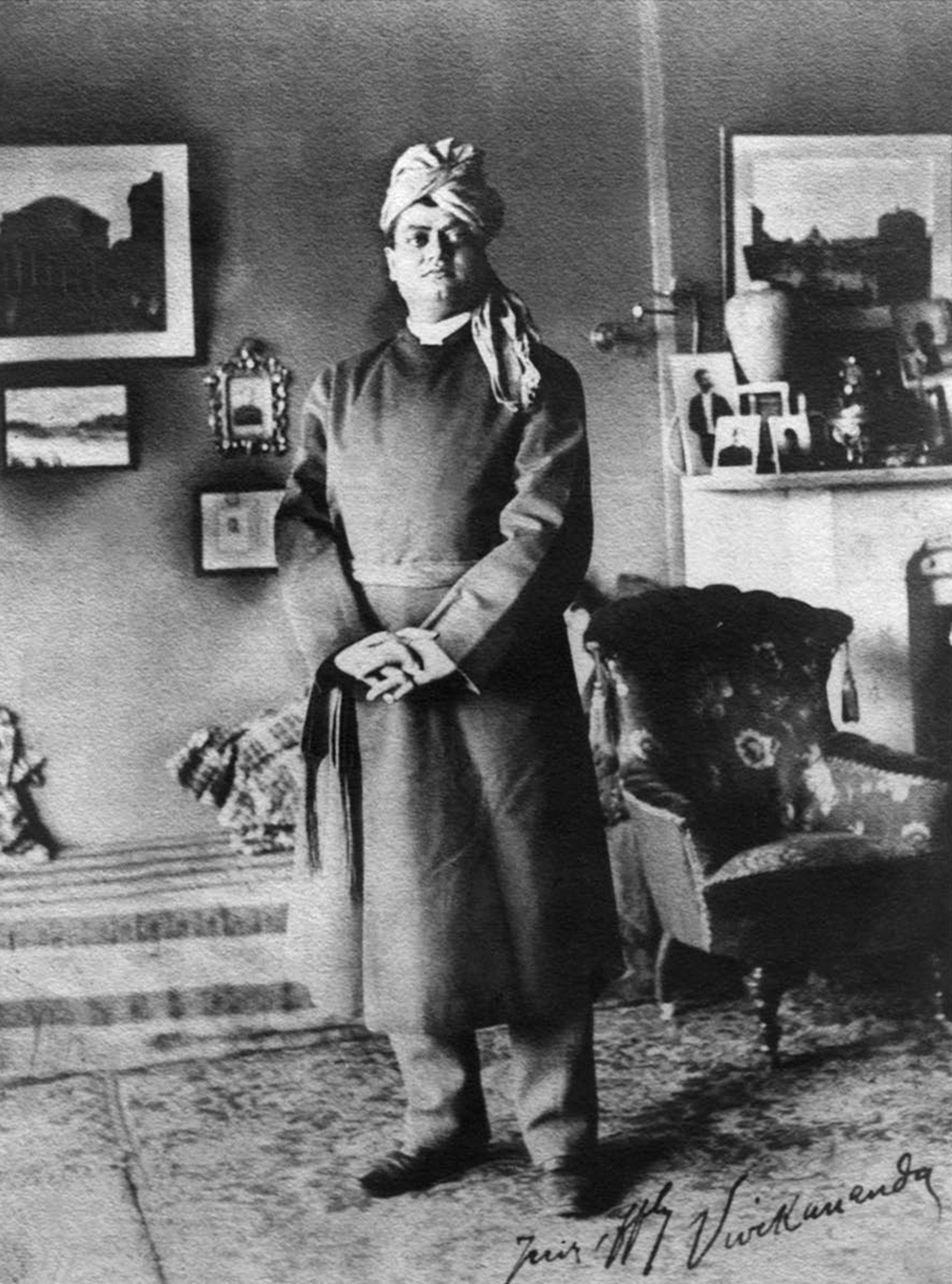

Photograph 14

CHICAGO, SEPTEMBER 1893

The East Indian Group[3]

This photograph appeared for the first time in Neely’s History of the Parliament of Religions and Religious Congresses at the World’s Columbian Exposition published in Chicago in 1893. From left to right: “Narasimha Chaira [Narasimhacharya of Chennai], Lakeshnie Narain [Lakshmi Narain, a barrister from Lahore], Swami Vivekananda, H. Dharmapala [Anagarika Hewivitarne Dharmapala, a Buddhist from Ceylon and later the founder of the Mahabodhi Society in Kolkata], and Vichand Ghandi [Virchand Gandhi, a lawyer of Mumbai and the chief exponent of the Jain religion.]”[3] 

This same photograph, as it appears in The World’s Congress of Religions, edited by J. W. Hanson, and published in 1894, is stamped WB Conkey Co., Chicago. According to the Prints and Photographs Division of the Library of Congress in Washington, D. C., “WB Conkey was one of the many ‘official’ publishing companies involved in the World’s Columbian Exposition. Charles Dudley Arnold was the official photographer for the WCE, however, many other photographers took photographs at the fair.”

I am here amongst the children of the son of Mary, and the Lord Jesus will help me. They like much the broad views of Hinduism and my love for the Prophet of Nazareth. I tell them that I preach nothing against the Great One of Galilee. I only ask the Christians to take in the Great Ones of Ind along with the Lord Jesus, and they appreciate it. (Letters, 39)
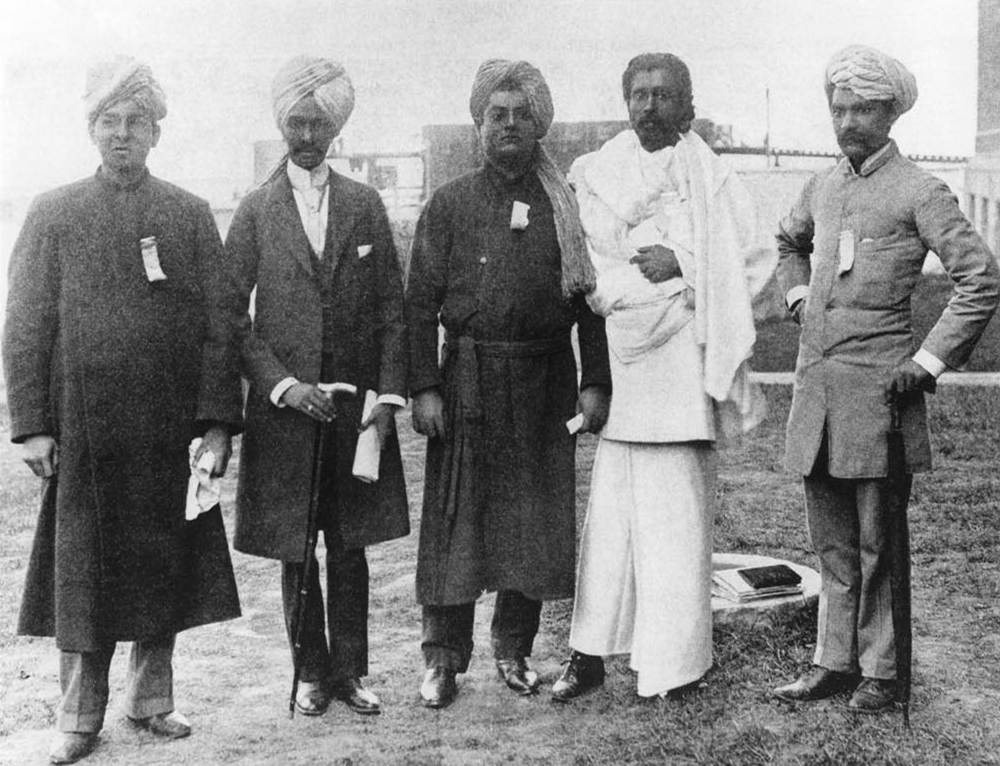

Photograph 15 

CHICAGO, SEPTEMBER 1893

Swami Vivekananda, Hindu Monk[4]

This photograph of Swamiji as a delegate to the Parliament of Religions also appeared in Neely’s History of the Parliament of Religions. It appears to have been taken not only on the same day as the East Indian Group, but at the same time. Swamiji is holding a piece of paper in his hand (although in this photo it is in his right hand, in the group photo it is in his left hand) and his official delegate tag is pinned to his robe in both photos. The drape of his turban and his general stance suggest that the two photos were taken one after the other.

On the morning of the opening of the Parliament, we all assembled in a building called the Art Palace. . . . Men from all nations were there. . . . There was a grand procession, and we were all marshaled on to the platform. Imagine a hall below and a huge gallery above, packed with six or seven thousand men and women representing the best culture of the country, and on the platform learned men of all nations of the earth. And I, who never spoke in public in my life, to address this august assemblage!! (Letters, 53)
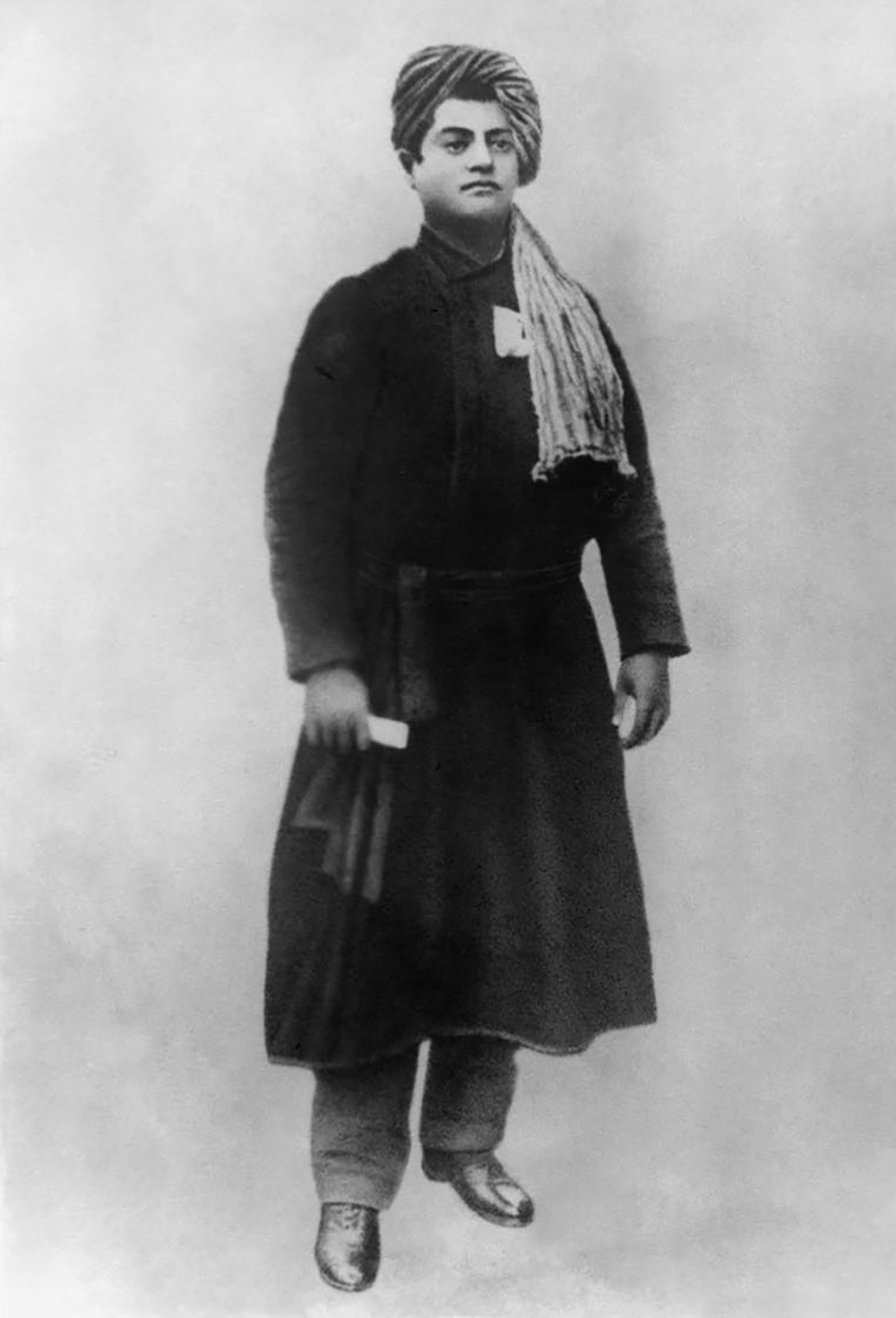

Photograph 16 

CHICAGO, SEPTEMBER 1893

Swami Vivekananda on the Platform of the Parliament[5]

From left to righ:

Virchand Gandhi, Hewivitarne Dharmapala, Swami Vivekananda, and (possibly) G. Bonet Maury.

From all appearances this photo seems to have been taken on the afternoon of the opening day of the parliament, September 11, 1893. Swamiji appears apprehensive.

“Through all this [the parliament proceedings] Swamiji remained seated, meditative and prayerful, letting his turn to speak go by time and again. It was not until the afternoon session, after four other delegates had read their prepared papers, that, urged by the kindly and scholarly French pastor, G. Bonet Maury, who was seated next to him, Swamiji, inwardly bowing down to Devi Sarasvati (the Goddess of Knowledge), arose to address the Congress and, through it, the world[6].”

Sister Gargi has an interesting footnote on G. Bonet Maury which bears quoting in full:

This information comes from a letter written by Swami Siddheswarananda to Miss Josephine MacLeod, dated June 11, 1946. The relevant passage reads: “For a long time I have been in contact with a man of science (Paul Bennet-Maury) . . . The other day the old mother of Paul Bennet-Maury came to see me. She is about 80 years old and she told me that her father-in-law, a Protestant pastor, was one of the delegates to the Chicago Parliament of Religions and a very close friend of Swamiji. In the dais of the Parliament Pastor Bennet-Maury [G. Bonet Maury] had his place next to Swamiji and she told me how she had heard from him that when Swamiji was each time giving his place to another to speak, it was Bennet-Maury, the pastor, that encouraged Swamiji to get up and speak in spite of the hesitation that Swamiji had. And as the old lady told me the story she got up from her seat and with trembling emotion told me of what she had heard of the tremendous impression produced by Swamiji when he addressed the audience as ‘Sisters and Brothers of America[7].’ ”

Dear Brother, I was so, so afraid to stand before that great assembly of fine speakers and thinkers from all over the world and speak; but the Lord gave me strength, and I almost every day heroically faced the platform and the audience. If I have done well, He gave me the strength for it; if I have miserably failed—I knew that beforehand—for I am hopelessly ignorant. (Letters, 49)
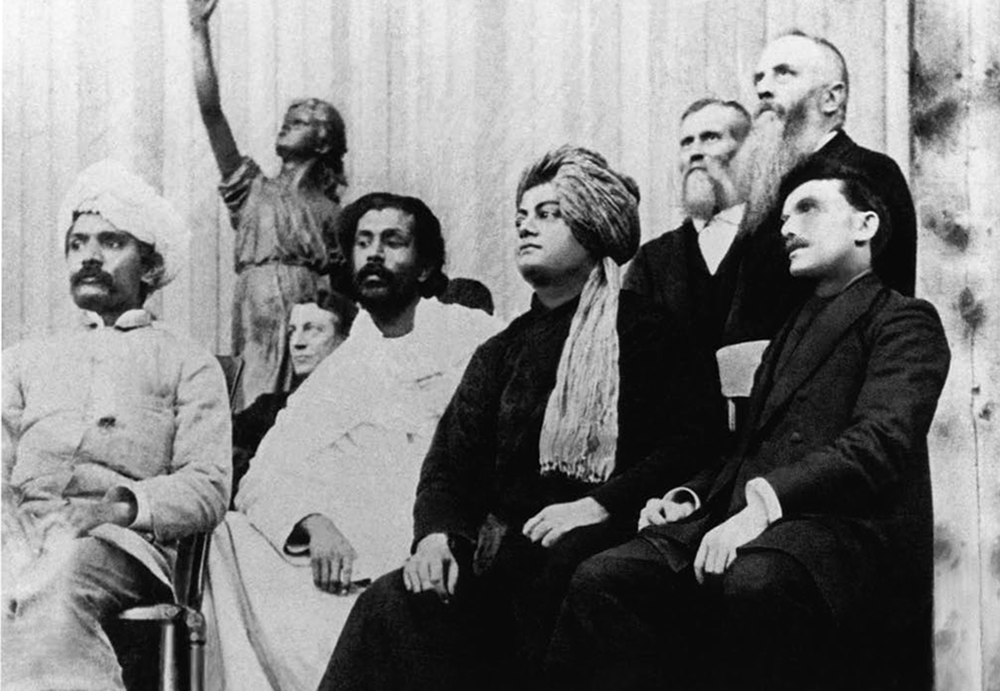

Photograph 17

CHICAGO, SEPTEMBER 1893

Swami Vivekananda and Narasimhacharya[8]

This unposed snapshot is one of the first pictures of Swamiji in America. “Perhaps it is not so clear as one would like his pictures to be, but it nonetheless belongs to his history[9].” It can be reasonably assumed that it was taken in the room marked “No. 1—keep out.” 

The following appeared in the Boston Evening Transcript on September 30, 1893:

There is a room at the left of the entrance to the Art Palace marked “No. 1—keep out.” To this the speakers at the Congress of Religions all repair sooner or later, either to talk with one another or with President Bonney, whose private office is in one corner of the apartment. . . . The most striking figure one meets in this anteroom is Swami Vivekananda, the Brahmin monk. He is a large, well-built man, with the superb carriage of the Hindustanis, his face clean shaven, squarely molded regular features, white teeth, and with well-chiseled lips that are usually parted in a benevolent smile while he is conversing. His finely poised head is crowned with either a lemon colored or a red turban, and his cassock (not the technical name for this garment), belted in at the waist and falling below the knees, alternates in a bright orange and rich crimson. He speaks excellent English and replied readily to any questions asked in sincerity[10].

“In a letter dated November 2, 1893, Swamiji asked his Chennai disciple Alasinga Perumal for information regarding a Chennai boy called Narasimhacharya, who ‘has cropped up in our midst.’ ‘He has been loafing about the city for the last three years,’ he wrote. ‘Loafing or no loafing, I like him, but please write to me all about him, if you know anything. He knows you. He came in the year of the Paris Exhibition [1889] to Europe.’ 

“This ‘boy called Narasimhacharya’ is without question the same Narasimhacharya who is pictured peering intently over Swamiji’s shoulder in [this photograph] and who was described in the Boston Evening Transcript as ‘often seen in the anteroom, leaning with graceful abandon on the table in the center of the room, his bright boyish face lighting up as he freely airs his opinions upon the Indian civilization and ours[11].’ ”

I addressed the assembly as “Sisters and Brothers of America,” a deafening applause of two minutes followed, and then I proceeded, and when it was finished, I sat down, almost exhausted with emotion. (Letters, 54)

Actual words of the address:

Sisters and Brothers of America,

I t fills my heart with joy unspeakable to rise in response to the warm and cordial welcome which you have given us. I thank you in the name of the most ancient order of monks in the world; I thank you in the name of the mother of religions; and I thank you in the name of millions and millions of Hindu people of all classes and sects. (CW [1984] 1:3)
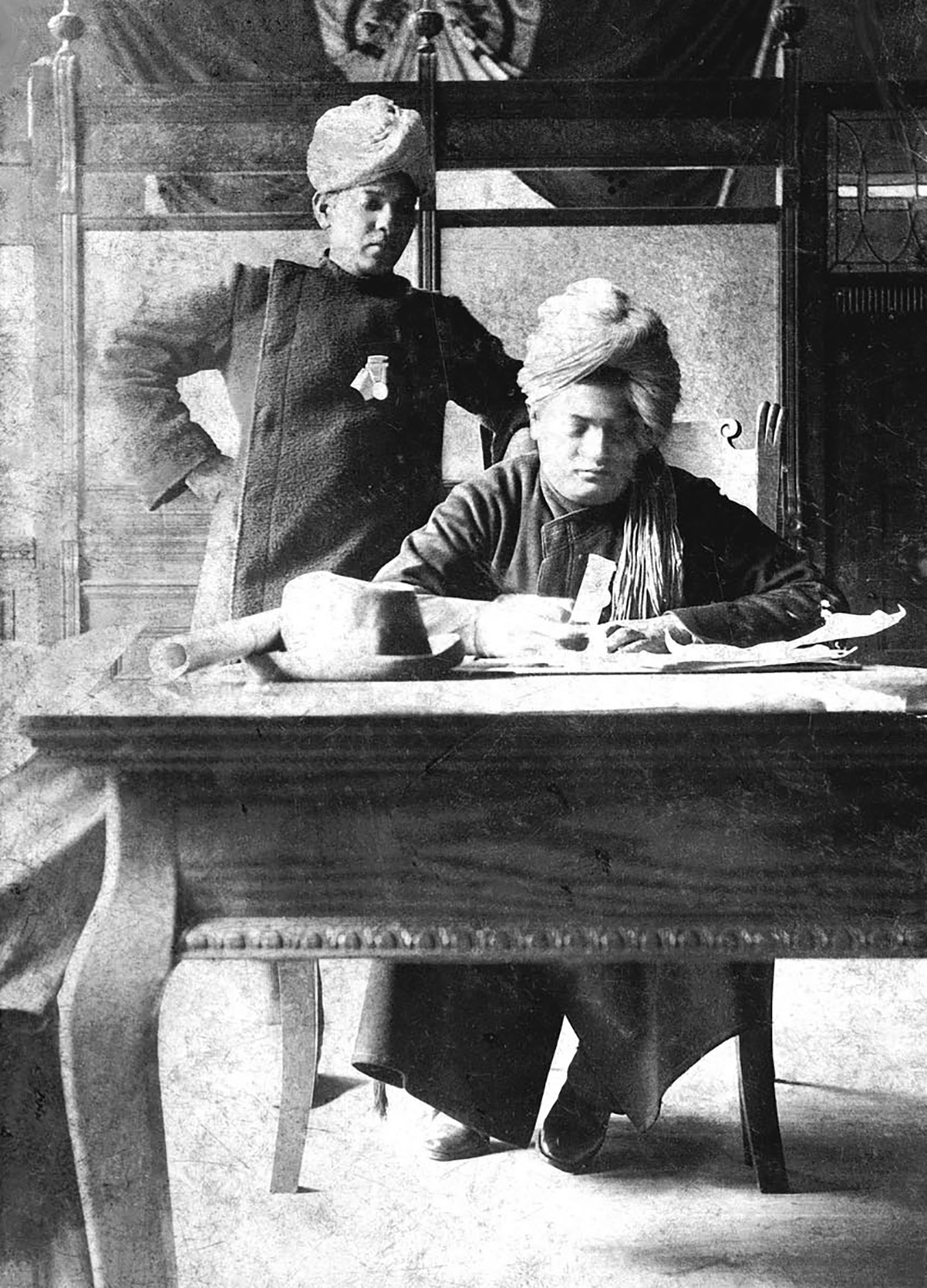

Photograph 18

CHICAGO, SEPTEMBER 1893

An Actual Scene at One of the Sessions of the Parliament[12]

This photograph was taken on the morning of September 21, 1893—the eleventh day of the parliament. It was published in 1893 as the frontispiece of John Henry Barrows’, The World’s Parliament of Religions, Volume 1

In New Discoveries we find this reference: 

In passing it should be noted that in Barrows’ history there are three published photographs of the “historic group on the platform.” These were taken on the morning of September 14, the morning of September 21, and the evening of September 27. In the second of these, [photo 18] which has been reproduced in the second edition of the Life, Swamiji has been tentatively identified in the front row of the delegates; I am sorry to say that a comparison with an enlarged and annotated copy of the same picture shows that this is not Swamiji but that “loafer” Narasimhacharya[13].

Swamiji wrote regarding the Parliament of Religions and his coming to America in general:

I am doing the Lord’s work, and wherever He leads I follow. . . . He who makes the dumb eloquent and the lame cross a mountain. He will help me. I do not care for human help. He is ready to help me in India, in America, on the North Pole, if He thinks fit. If He does not, none else can help me. Glory unto the Lord for ever and ever. (Letters, 60)
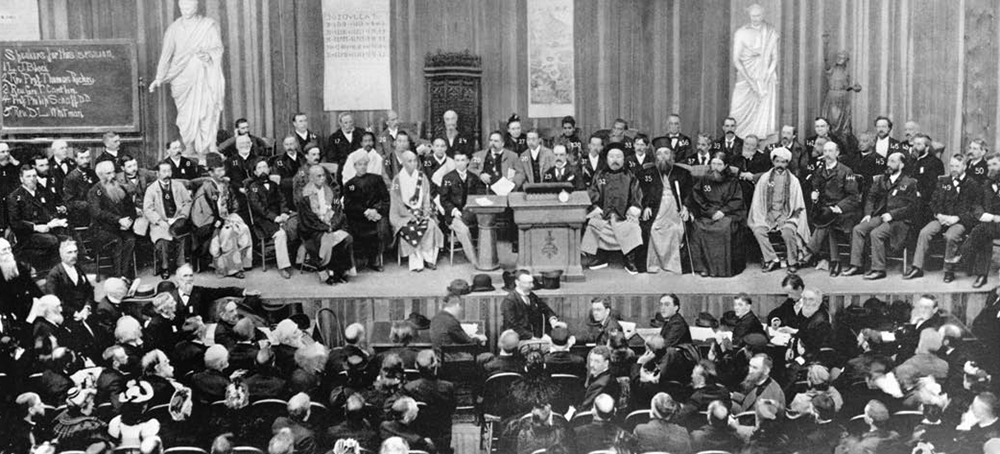

Photograph 19

CHICAGO, SEPTEMBER 1893

Swami Vivekananda, India[14]

This photograph was published for the first time in volume two of Barrows’ history in connection with Swamiji’s talk on “Hinduism” which was given on the ninth day of the parliament, September 19. But to date, there is not sufficient proof that it was taken on that day.

The present convention, which is one of the most august assemblies ever held, is in itself a vindication, a declaration to the world of the wonderful doctrine preached in the Gita: “Whosoever comes to Me, through whatsoever form, I reach him; all men are struggling through paths which in the end lead to Me.” (CW [1984] 1:4)
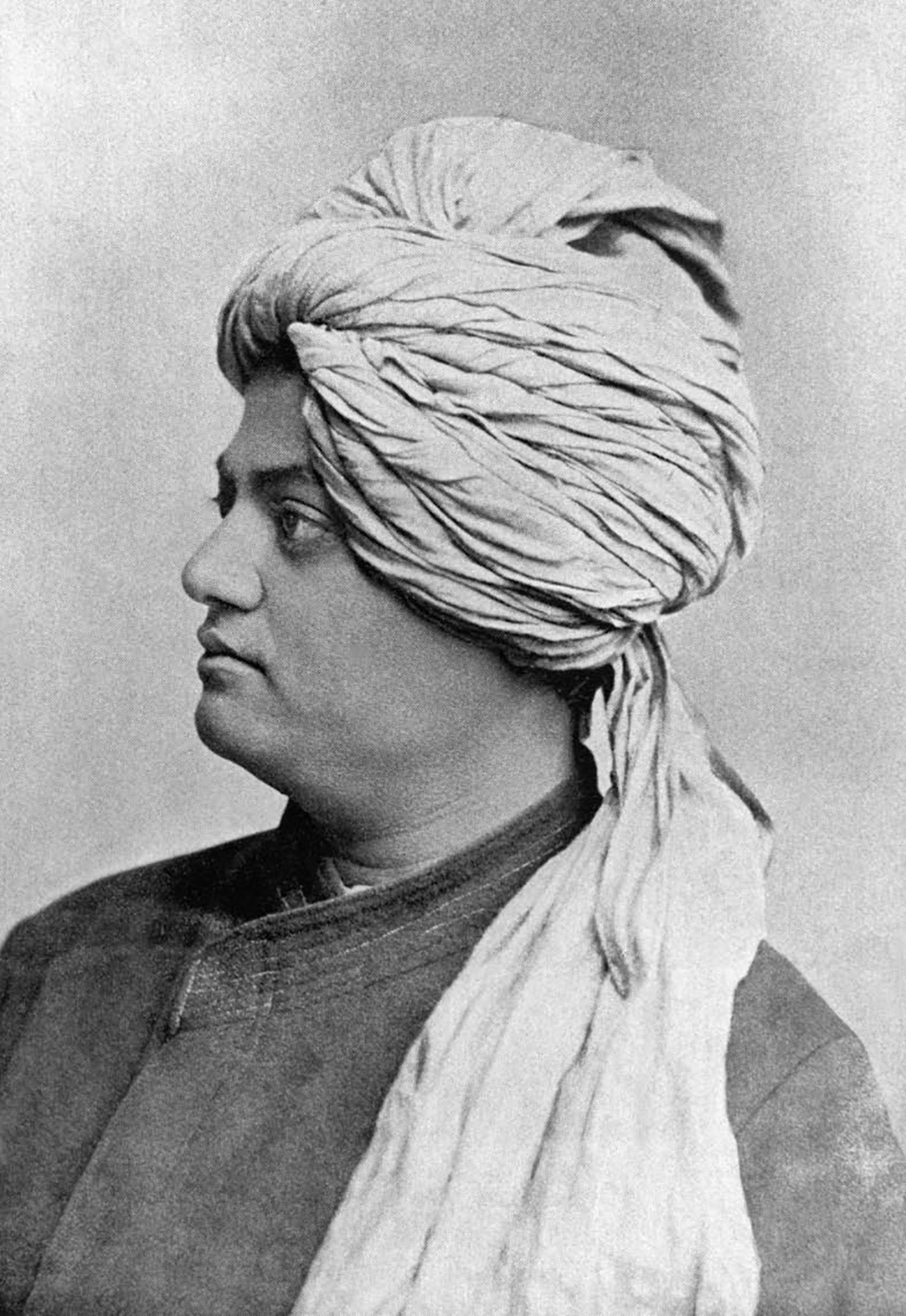

Photograph 20

CHICAGO, SEPTEMBER 1893 (Harrison)

This is the famous Chicago pose. The next seven photographs are part of what the Vedanta Society of Northern California calls the “Harrison series.” Swamiji has autographed five of these photos and inscribed them with English translations of Sanskrit sayings, some of which have the original Sanskrit written in Bengali characters. These photographs were taken by a photographer named Thomas Harrison, who was located in Chicago at that time at “Central Music Hall, Cor. State & Randolph Sts.” Most of the Harrison photographs in the Vedanta Society’s collection have this information at the bottom of the pictures.

According to listings of photographers from 1847 to 1900 in the Chicago city directories, Thomas Harrison was in business from about 1873 through 1900. The Chicago Historical Society states: “He had several addresses [“Central Music Hall” is listed as his 1893 address] and probably went into business with D. R. Coover for a short time. We have many cabinet card portraits of Chicagoans taken at the Harrison studios, all with the same identification stamp.” 

The original photos of Swamiji taken at Harrison’s studio were actually cabinet card portraits, which were the predominant type of media that Harrison used. The cabinet card was a new style of portrait photography which came into vogue around 1867. It had several new features including various styles of posing, improved lighting, and the use of background scenery or props to add flair to the photograph. The various poses of Swamiji taken at Harrison’s studio show his successful use of these different techniques.

I fervently hope that the bell that tolled this morning in honor of this convention may be the death-knell of all fanaticism, of all persecutions with the sword or with the pen, and of all uncharitable feelings between persons wending their way to the same goal. (CW [1984] 1:4)
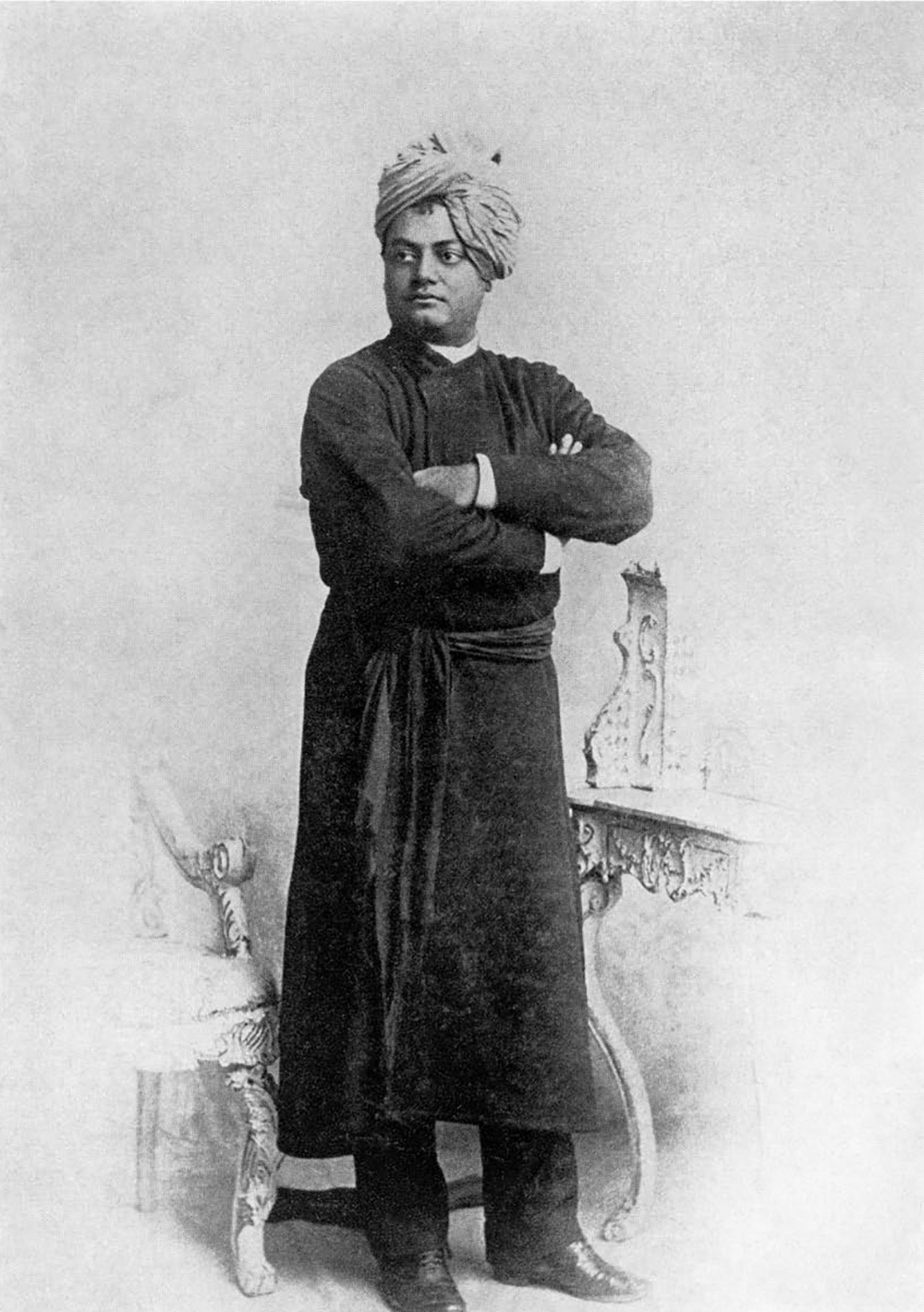

Photograph 21

CHICAGO, SEPTEMBER 1893 (Harrison)

Swamiji has written in Bengali characters, as well as in English: “One infinite pure and holy—beyond thought beyond qualities I bow down to thee Swami Vivekananda” 

I t was reserved for America to proclaim to all quarters of the globe that the Lord is in every religion. (CW [1984] 1:19)
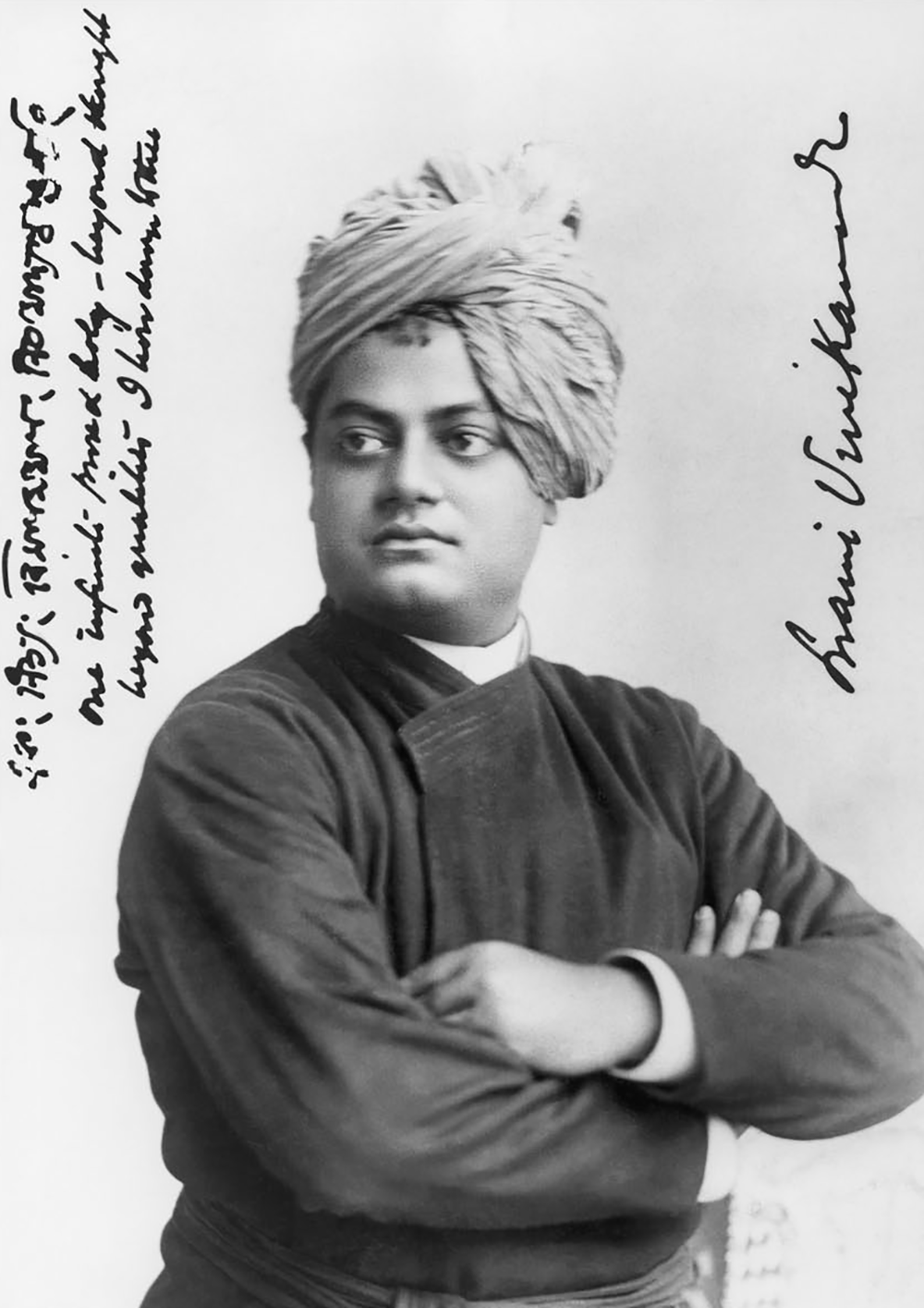

Photograph 22

CHICAGO, SEPTEMBER 1893

During the Parliament of Religions, this poster of Swamiji (based on photo 21) was made by the Goes Lithographic Co., Chicago, 1893. It was posted throughout the city to draw people’s attention to the fair. Swamiji had become famous overnight and was a major attraction.

This copy of the poster, which was made from one of the original posters now in the possession of the Vedanta Society, Berkeley, bears the following inscription: “To Hollister Sturges—All strength and success be yours is the constant prayer of your friend, Vivekananda” 

Hollister Sturges was the son of Mrs. Betty (Sturges) Leggett—the family members of whom were all dear to Swamiji’s heart.

Another reference to this poster can be found in New Discoveries, volume 5:199:

In Chicago Mrs. Blodgett acquired a large colored poster of him [Swamiji], which she hung in her home in Los Angeles, never dreaming that he would one day be her guest. This poster, hanging incredibly over her [Miss Josephine MacLeod’s] dying brother’s bed, had greeted Miss MacLeod when she had arrived from Ridgely Manor. Astounded, she had asked Mrs. Blodgett, “What do you know about him?” and Mrs. Blodgett had told her story. “I know him,” Miss MacLeod had said, and then, “Why don’t you ask him here?” “To my cottage?” “He will come.” And in her memoirs she relates: “In three weeks my brother was dead and in six weeks Swamiji was there.” (Later on Miss MacLeod brought this poster, which showed Swamiji standing in his robe and turban, to Ridgely Manor, where she mounted it in a toweringly high-backed Gothic chair. For years it remained thus in her bedroom. “One would hardly dare go into her room,” Mrs. Frances Leggett told me,“—this enormous thing appearing there!”) 

Hail, Columbia, motherland of liberty! It has been given to thee, who never dipped her hand in her neighbor’s blood, who never found out that the shortest way of becoming rich was by robbing one’s neighbors, it has been given to thee to march at the vanguard of civilization with the flag of harmony. (CW [1984] 1:20)
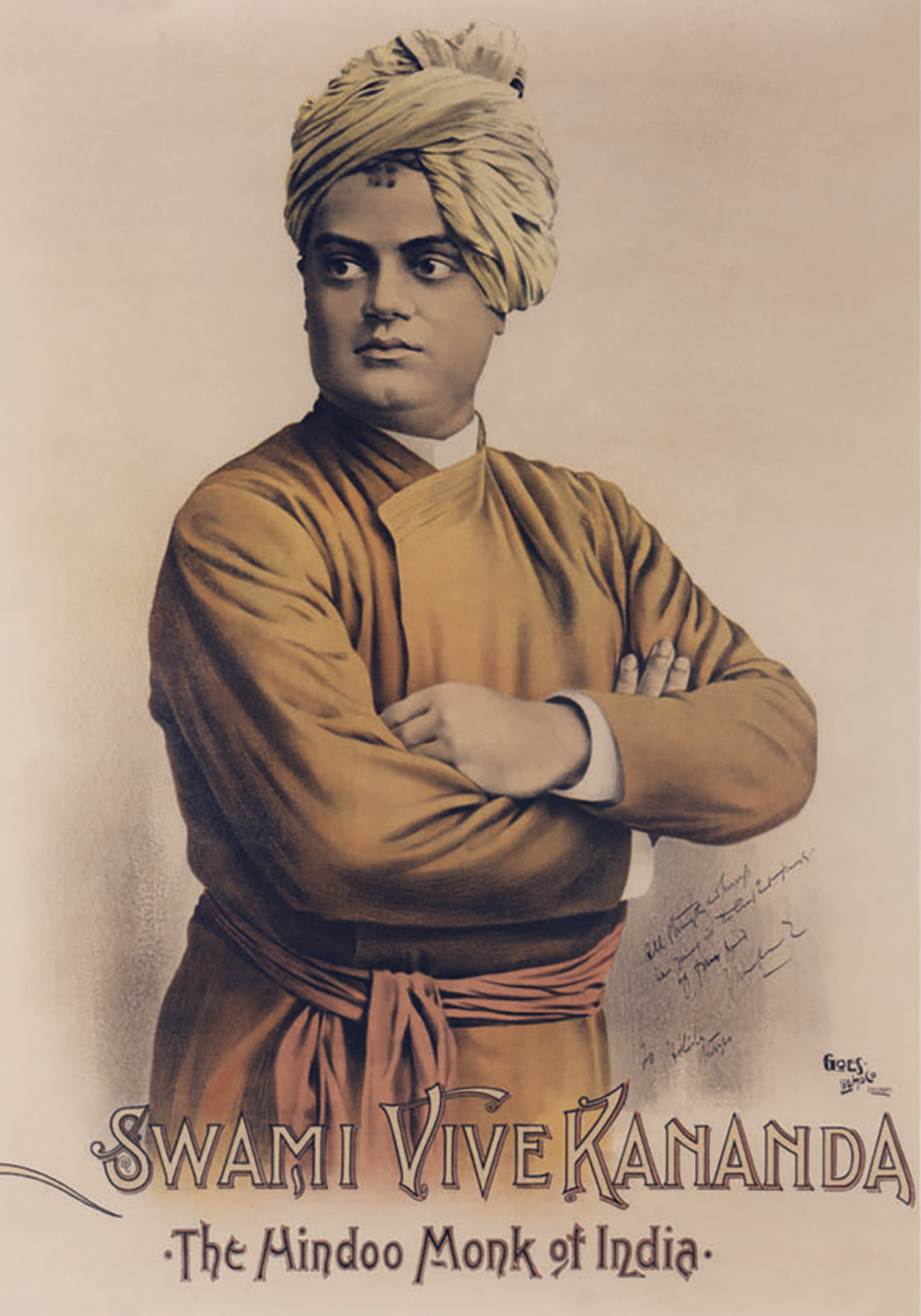

Photograph 23

CHICAGO, SEPTEMBER 1893 (Harrison)

Swamiji has inscribed this photo: 

“Samata sarvabhuteshu etanmuktasya lakshanam. Equality in all beings this is the sign of the free Vivekananda” 

Children of immortal bliss—what a sweet, what a hopeful name! Allow me to call you, brethren, by that sweet name—heirs of immortal bliss—yea, the Hindu refuses to call you sinners. Ye are the Children of God, the sharers of immortal bliss, holy and perfect beings. (CW [1984] 1:11)
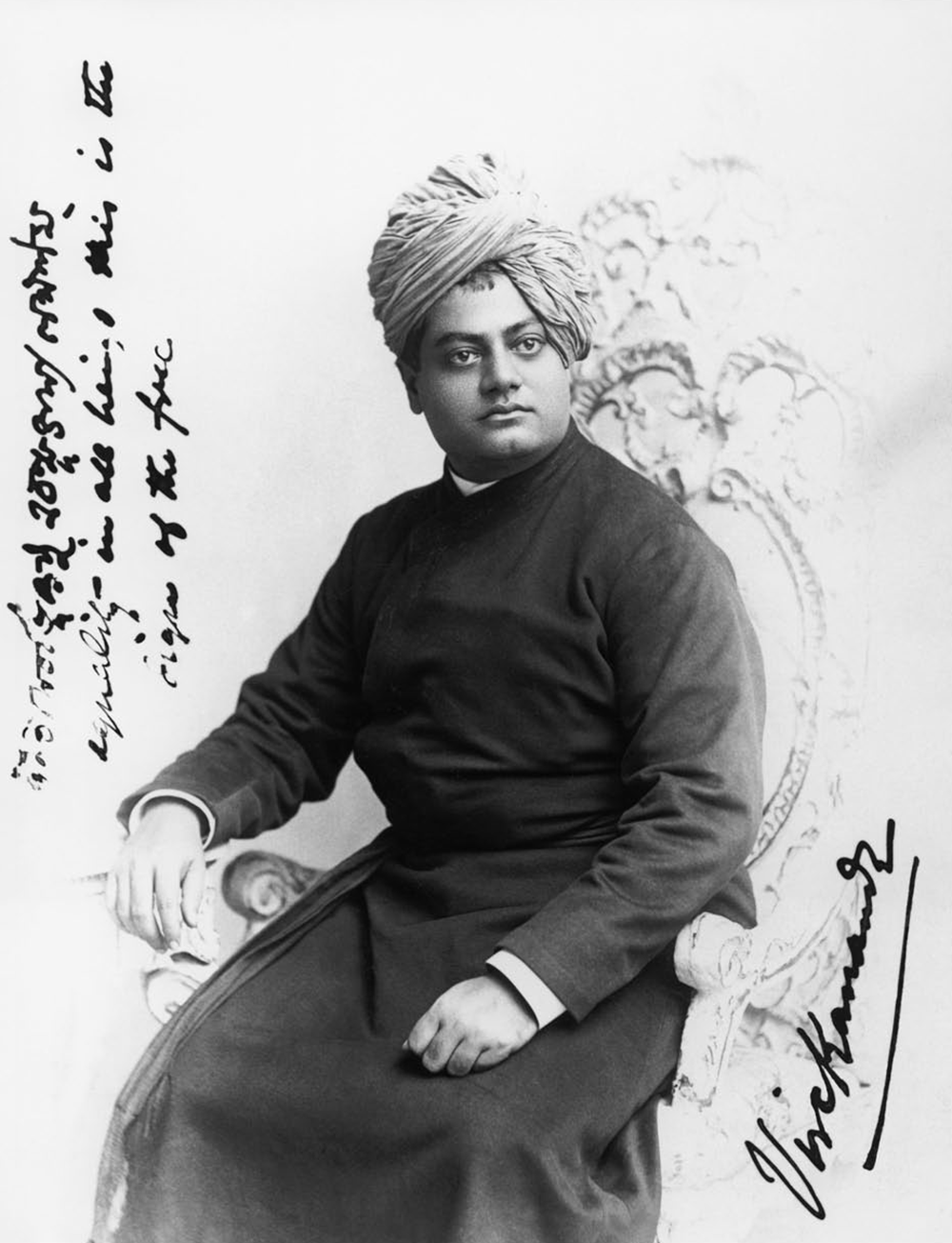

Photograph 24

CHICAGO, SEPTEMBER 1893 (Harrison)

This photograph of Swamiji bears the inscription:

“Thou art the only treasure in this world Vivekananda” 

Come up, O lions, and shake off the delusion that you are sheep; you are souls immortal, spirits free, blest and eternal; ye are not matter, ye are not bodies; matter is your servant, not you the servant of matter. (CW [1984] 1:11)
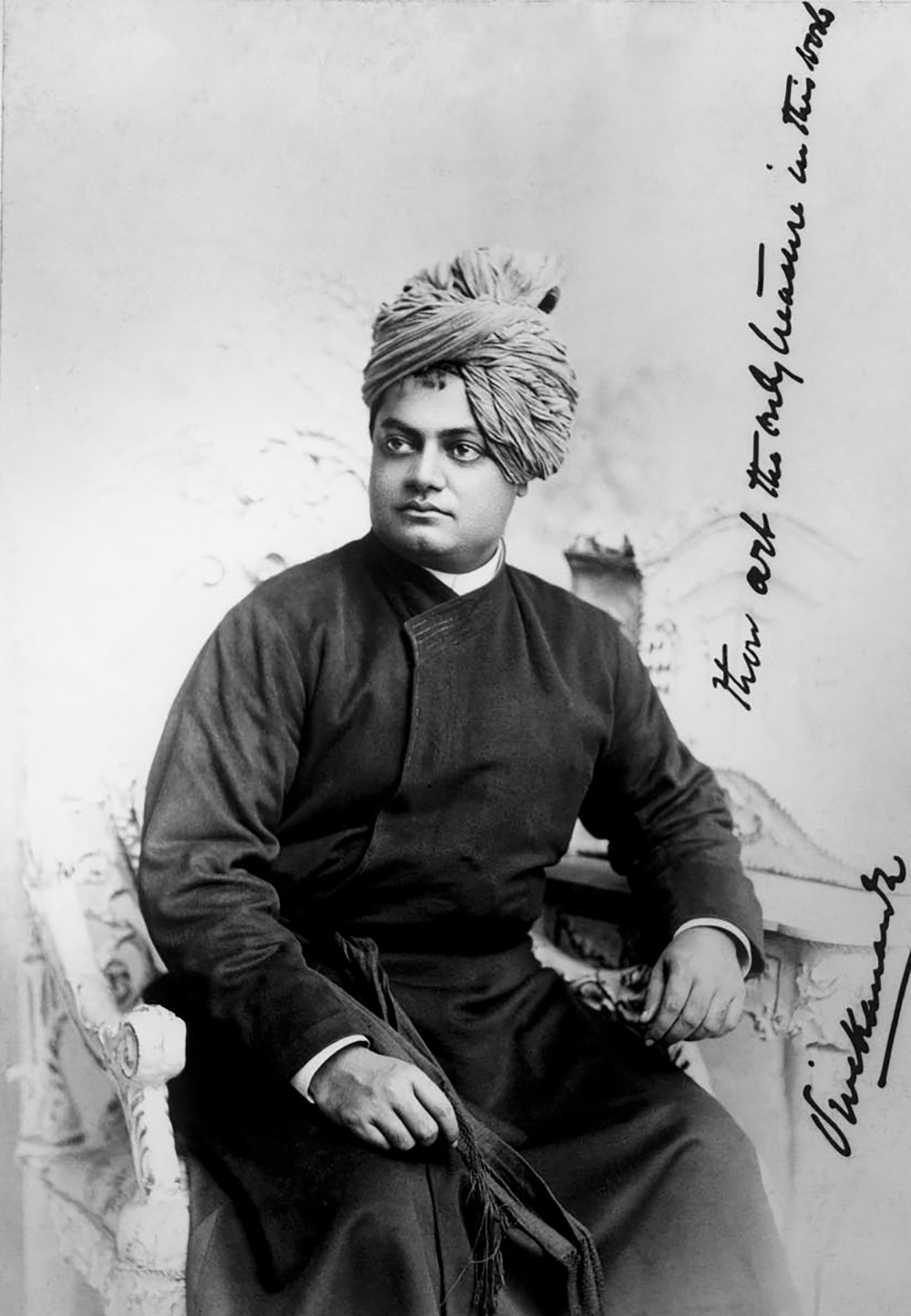

Photograph 25

CHICAGO, SEPTEMBER 1893 (Harrison)

Swamiji has inscribed this photo: 

“Thou art the father the lord the mother the husband and love Swami Vivekananda” Swamiji mentioned the Harrison photographs early on to Alasinga Perumal, particularly with reference to stimulating an interest in his work amongst some of his admirers in India, such as Ajit Singh, the Maharaja of Khetri, and His Highness the Maharaja of Mysore (Shri Chamarajendra Wadiyar). In a letter written to Alasinga from Chicago on November 2, 1893, he mentioned that he had sent one of these photos to the Maharaja of Khetri.

Again on May 28, 1894, he wrote to Alasinga from Chicago: “As for the photographs, I have not them at present. I will ask for some to be sent over. In the meantime, you apply to the Maharaj of Khetri for some copies he has had printed from those I sent over to him.” Then again on July 11, 1894, he wrote to Alasinga: “I have sent a letter to H. H. of Mysore and some photographs. You must have got yours by this time. Present one to the Raja of Ramnad. Work on him as much as you can. Keep correspondence with Khetri and try to spread.”

Swamiji also mentioned the Harrison photographs, often in a somewhat surly manner, in a number of his letters written to Mrs. George Hale, who seems to have handled Swamiji’s Harrison photo orders. In mid-July 1894, Swamiji wrote to Mrs. Hale from Fishkill Landing, New York:

As to the photographs, the first time the Babies got a few copies, and the second time you brought a few copies; you know they are to give 50 copies in all. Sister Isabelle knows better than I.

Swamiji makes this humorous remark about the Chicago pose (photo 20) and this photo (25) in a letter dated August 5, 1894, to Mrs. Hale written from Greenacre Inn, Eliot, Maine:
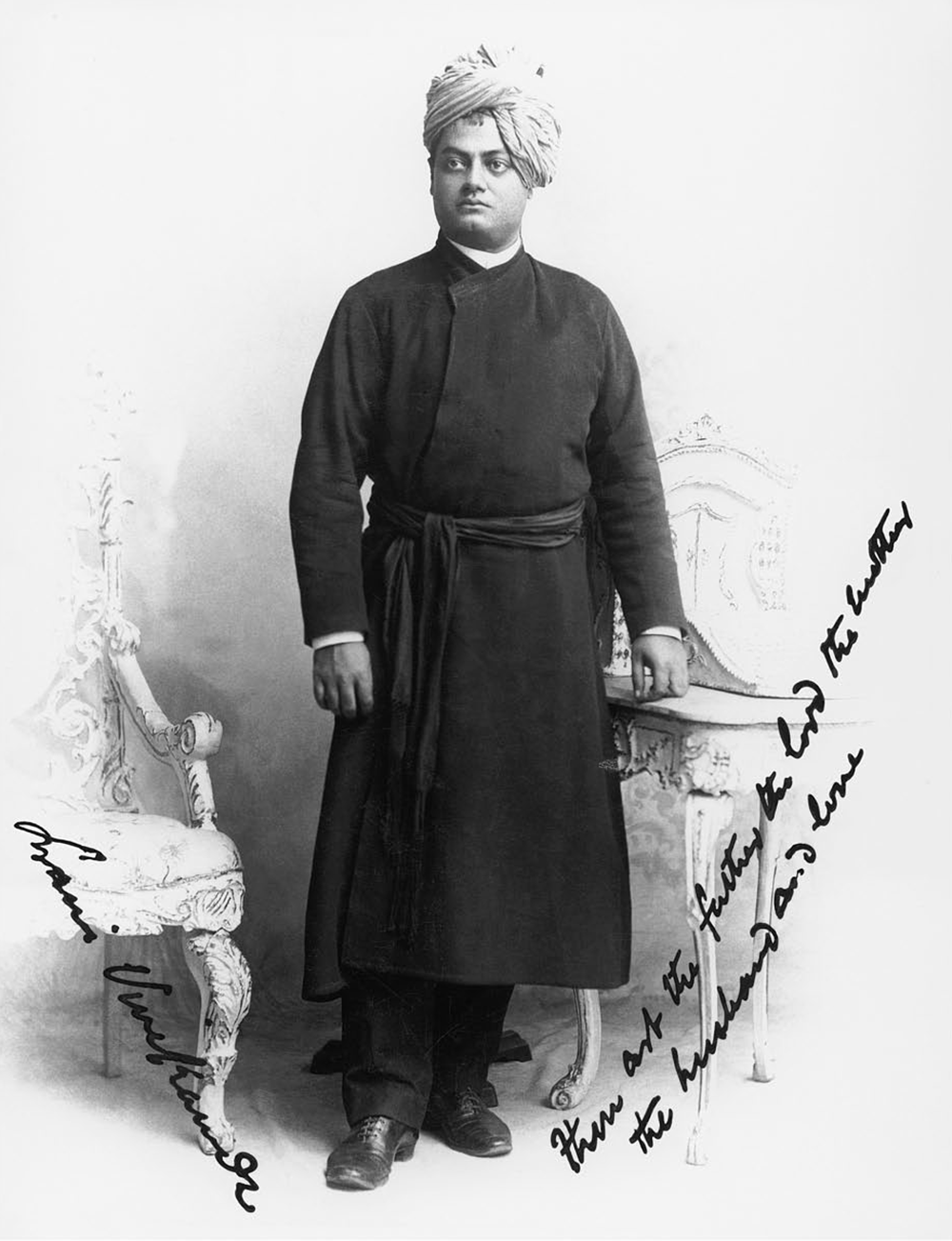
The Harrison people sent me two “nasty standing” photos—that is all I have out of them, when they ought to give me 40 minus the 10 or 15 I have got already!!!

Again he wrote to Mrs. Hale from Annisquam on August 20, 1894: 

The photographs have not reached me—except two of Fishkill when I was there last.

Three days later he wrote: 

The photographs reached safely yesterday. I cannot tell exactly whether Harrison ought to give me more or not. They had sent only two to me at Fishkill— not the pose I ordered though.

Clearly, Swamiji was having his difficulties with Harrison. And yet we are deeply indebted to Harrison for the beautiful, soul-stirring images he produced of Swamiji during his early days in America.

He penned a letter to Mary Hale from Annisquam on August 31, 1894, “I sent two pictures to Mother Church yesterday and hope you will like them.” On the same day he wrote to Alasinga: “I have sent over my photograph and written to the Raja of Mysore.” Five days later in a letter to Mrs. Hale, he mentioned: “The new arrival of the phonograph from Khetri has not come yet. But I am not anxious because I just now got another letter from India wherein there is no mention of the photographs I sent showing that parcels reach later than letters.”

Obviously the Harrison photographs had made their way to India as early as November 1893. In a letter written to Alasinga on September 27, 1894, he says:

Bhattacharya [Manmatha Nath Bhattacharya of Chennai] writes he has not got any of my photos. I have none at present. I will have to order for some new ones & then will send them over.

Yet another request came from Kolkata. Swamiji wrote to Mrs. Hale on October 27, 1894: 

Will you kindly [order] for a 100 photographs to Harrison and send them over to India to Ramdayal Chakravarty, c/o Swami Ramakrishnananda, Varahanagar Math, Alambazar, Kolkata. I will pay for it when I come to Chicago.

Although it is not certain which two photos (if they are still extant) the following remark of Swamiji refers to, it is ingenuous and candid and worth repeating. From Detroit he wrote on March 10, 1894, to Mrs. Hale:

The photographer here has sent me some of the pictures he made. They are positively villainous. Mrs. Bagley does not like them at all. The real fact is that between the two photos my face has become so fat and heavy—what can the poor photographers do? Kindly send over four copies of photographs.

In this case Swamiji seems to have decided that Harrison’s photos were the best of a bad bargain!

He is everywhere, the pure and formless One,

the Almighty and the All-merciful.

“Thou art our father, Thou art our mother, Thou art our beloved friend,

Thou art the source of all strength; give us strength.

Thou art He that beareth the burdens of the universe;

help me bear the little burden of this life.” (CW [1984] 1:11)


Photograph 26 

CHICAGO, SEPTEMBER 1893 (Harrison)

Swamiji’s inscription reads:

“Eka eva suhrid dharma nidhanepyanuyati yah. Virtue is the only friend that follows us even beyond the grave. Everything else ends with death. Vivekananda”

This photograph was first published in Neely’s History of the Parliament of Religions and Religious Congresses at the World’s Columbian Exposition in 1893 without the inscription, but bearing the caption Swami Vivekananda. It is interesting to note that Neely published more photographs of Swamiji than any other delegate to the parliament.

If there is ever to be a universal religion, it must be one which will have no location in place or time; which will be infinite like the God it will preach, and whose sun will shine upon the followers of Krishna and of Christ, on saints and sinners alike; which will not be Brahminic or Buddhistic, Christian or Mohammedan, but the sum total of all these, and still have infinite space for development. . . . It will be a religion which will have no place for persecution or intolerance in its polity, which will recognize divinity in every man and woman, and whose whole scope, whose whole force, will be created in aiding humanity to realize its own true, divine nature. (CW [1984] 1:19)
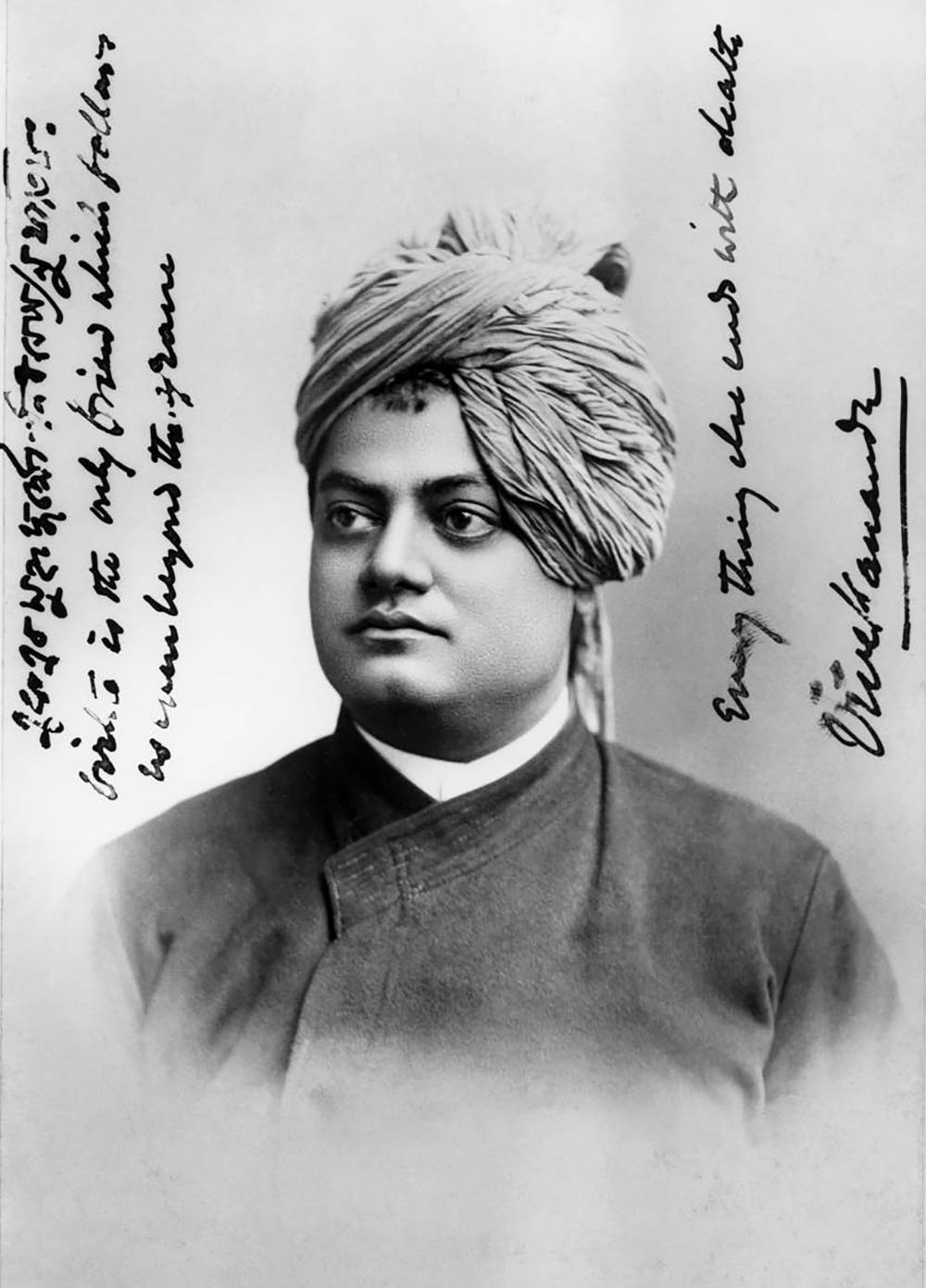

Photograph 27

CHICAGO, SEPTEMBER 1893 (Harrison)

Sister Devamata related a story of how she first heard about Swamiji. After the Parliament of Religions, she along with her mother and sister met a Swedenborgian minister in Ohio, who had attended the parliament in Chicago. He enthusiastically described various aspects of the sessions to them: “ ‘But,’ he continued, ‘there was one speaker who stood out above all others, because of his learning, his eloquence and his impressive personality. No other could compare with him except two or three Roman Catholic prelates, and they had sent their best men.’ He paused, leaving his brilliant figure without name or nationality. ‘Who was he?’ I asked eagerly. The minister replied quietly: ‘A Hindu—Swami Vivekananda[15].’ ”

The World’s Parliament of Religions has become an accomplished fact, and the merciful Father has helped those who labored to bring it into existence, and crowned with success their most unselfish labor. (CW [1984] 1:23)
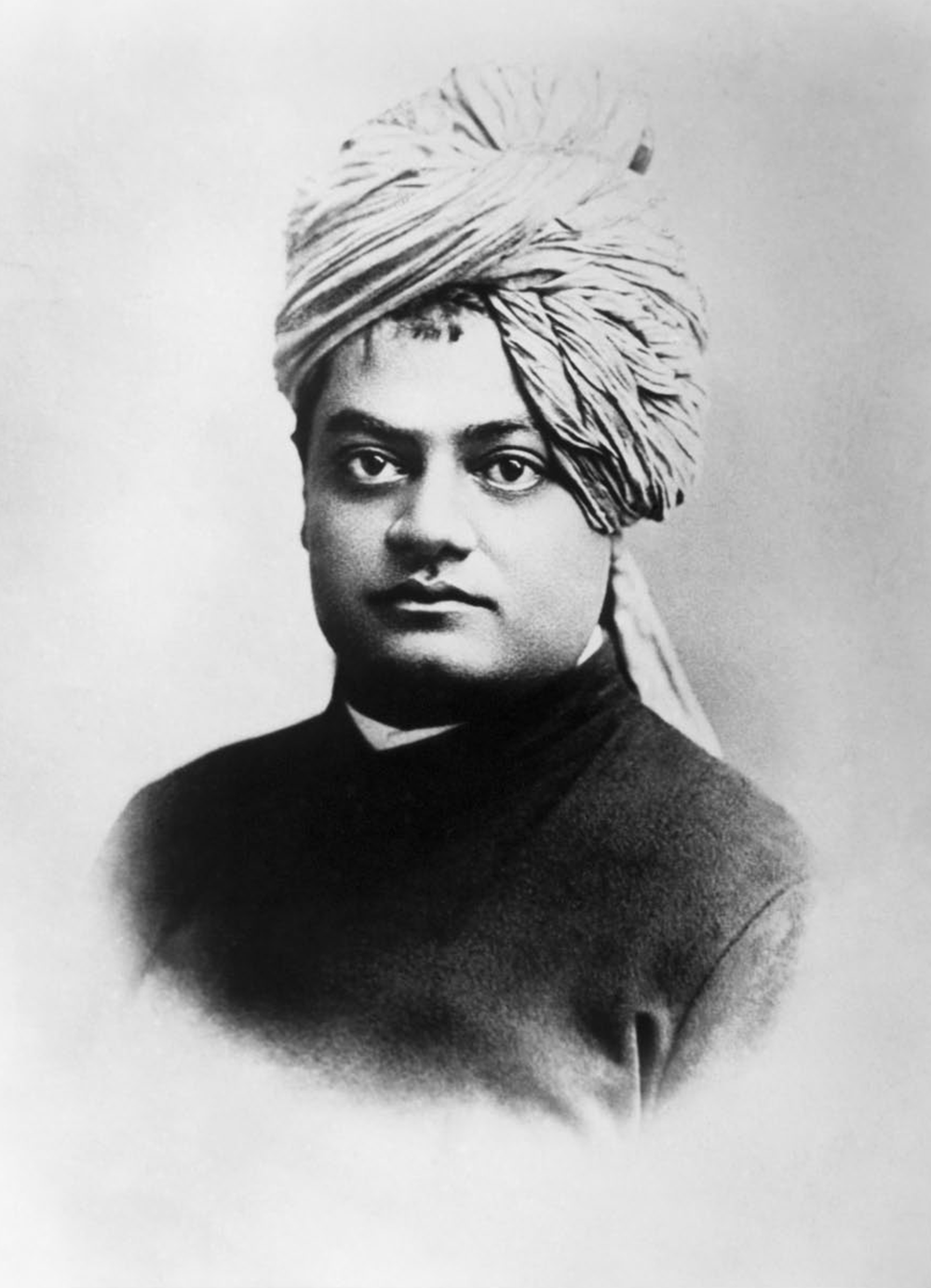

Photograph 28

CHICAGO, SEPTEMBER 1893

Scene at the Parliament on the Evening of the Last Day, September 27th[16]

This photograph was taken during the closing session of the parliament on the evening of September 27. We know that Swamiji was present on the platform that evening because he had been invited to give one of the final addresses. It was in this talk that he made his famous sweeping remark: “The Christian is not to become a Hindu or a Buddhist, nor a Hindu or a Buddhist to become a Christian. But each must assimilate the others and yet preserve its individuality and grow according to its own law of growth.”

According to New Discoveries (1:134, 36) “it is probable, though not at present certain, that Swamiji does indeed appear, seated with regal unconcern in the second row of delegates.” To date it has not been ascertained for sure that the person in the second row, left of center, is in fact Swamiji

Barrows’ history describes the last session:

More than seven thousand persons were crowded into the Halls of Washington and Columbus [Barrows writes]. For more than an hour before the time announced, the eager crowds swept up against the doors of the Art Palace. The throng extended from the doorways to Michigan Avenue and thence for half a block in either direction. . . . An eyewitness reports: “. . . The last and closing scene of the great Parliament of Religions is one that will live forever in the memory of those who were so fortunate as to be spectators. The great Hall of Columbus was illuminated by a myriad of lights. Every inch of room was used by the greatest crowd that ever sat within its walls. On the stage, beneath the folds of the flags of all nations, were the representatives of all religions. The dull, black and somber raiment of the West only intensified the radiantly contrasted garbs of the Oriental priests.” Twice during the evening flashlight photographs were taken of the historic group on the platform[17].

If the Parliament of Religions has shown anything to the world it is this: It has proved to the world that holiness, purity and charity are not the exclusive possessions of any church in the world, and that every system has produced men and women of the most exalted character. In the face of this evidence, if anybody dreams of the exclusive survival of his own religion and the destruction of the others, I pity him from the bottom of my heart, and point out to him that upon the banner of every religion will soon be written, in spite of resistance: “Help and not Fight,” “Assimilation and not Destruction,” “Harmony and Peace and not Dissension.” (CW [1984]1:24)
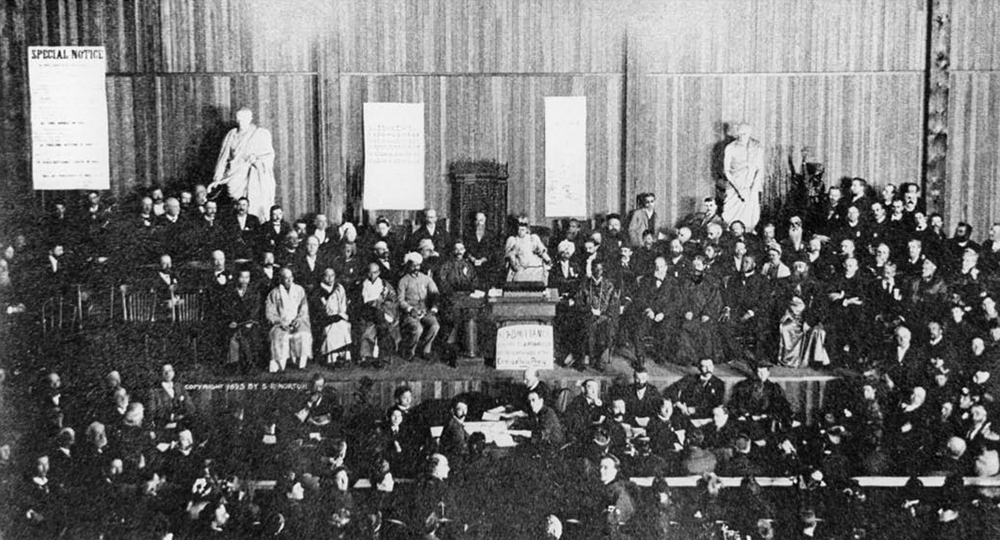

Photograph 29

CHICAGO, 1894 

After the parliament, Swamiji’s luminous personality radiated his inner serenity. Those who were fortunate enough to meet him at this time said what a blessing it was to be with him. Years later Mary Hale recalled Swamiji as: 

. . . the great and glorious soul that came to the Parliament of Religions, so full of love of God, that his face shone with divine light, whose words were fire, whose very presence created an atmosphere of harmony and purity, thereby drawing all souls to himself[18].

When one looks at this photograph one can easily understand what Mary meant, for as Sister Gargi says:

One cannot fail to be moved by the childlike tenderness of Swamiji’s appearance, and by the wonderful peace and calm of his expression[19].

This photo was taken by E. B. Snow in Chicago in 1894 and was copyrighted. Swamiji’s inscription reads:

Ajaramaravat prajnah vidyam arthancha chintayet/ Grihitva iva kesheshu mrityuna dharmam acharet. When in search of knowledge or prosperity think that you would never have death or disease, and when worshipping God think that death’s hand is in your hair.

Early prints of this photo, and of photos 21 as well as 23 to 26 (copies of which are in the present volume), were acquired originally by Swami Vishwananda.

It was through the kindness of the late Swami Vishwananda, then in charge of the Vivekananda Vedanta Society in Chicago [1937-1965], that these photographs and other invaluable material regarding Swamiji came to our hands, and the story of how this material was discovered by the swami is worth telling here, for it is an example of those coincidences that occur so frequently in matters concerning Swamiji. Swami Vishwananda told us that a young man, unconnected with Vedanta, had received from his grandmother a bundle of unpublished letters, photographs and other material, all pertaining to Swami Vivekananda. Knowing that his grandmother had cherished them, the young man had kept them, and indeed might still possess them, or perhaps by this time have discarded them, had it not been that a friend of his was a student of Swami Vishwananda. How this friend came to know of the bundle of old documents is not known, but one day she told Swami Vishwananda of its existence. The swami forthwith visited the young man and found, with what joy we can imagine, a veritable feast of hitherto unknown material! The young man gladly gave him the bundle, which had originally belonged, the swami learned, to the McKindley sisters, nieces of Mr. and Mrs. Hale. It is such unlooked-for and fortuitous discoveries which give us hope that eventually more hidden material regarding Swamiji will come to light, slowly pushing its way up through the years[20].

[Letter to Swamiji’s Chennai disciples, January 24, 1894]

My whole ambition in life is to set in motion a machinery which will bring noble ideas to the door of everybody, and then men or women will settle their own fate. Let them know what our forefathers and other nations have thought on the most momentous questions of life. Let them see what others are doing now specially, and then decide. We are to put the chemicals together, the crystallization would be done by nature according to her laws.
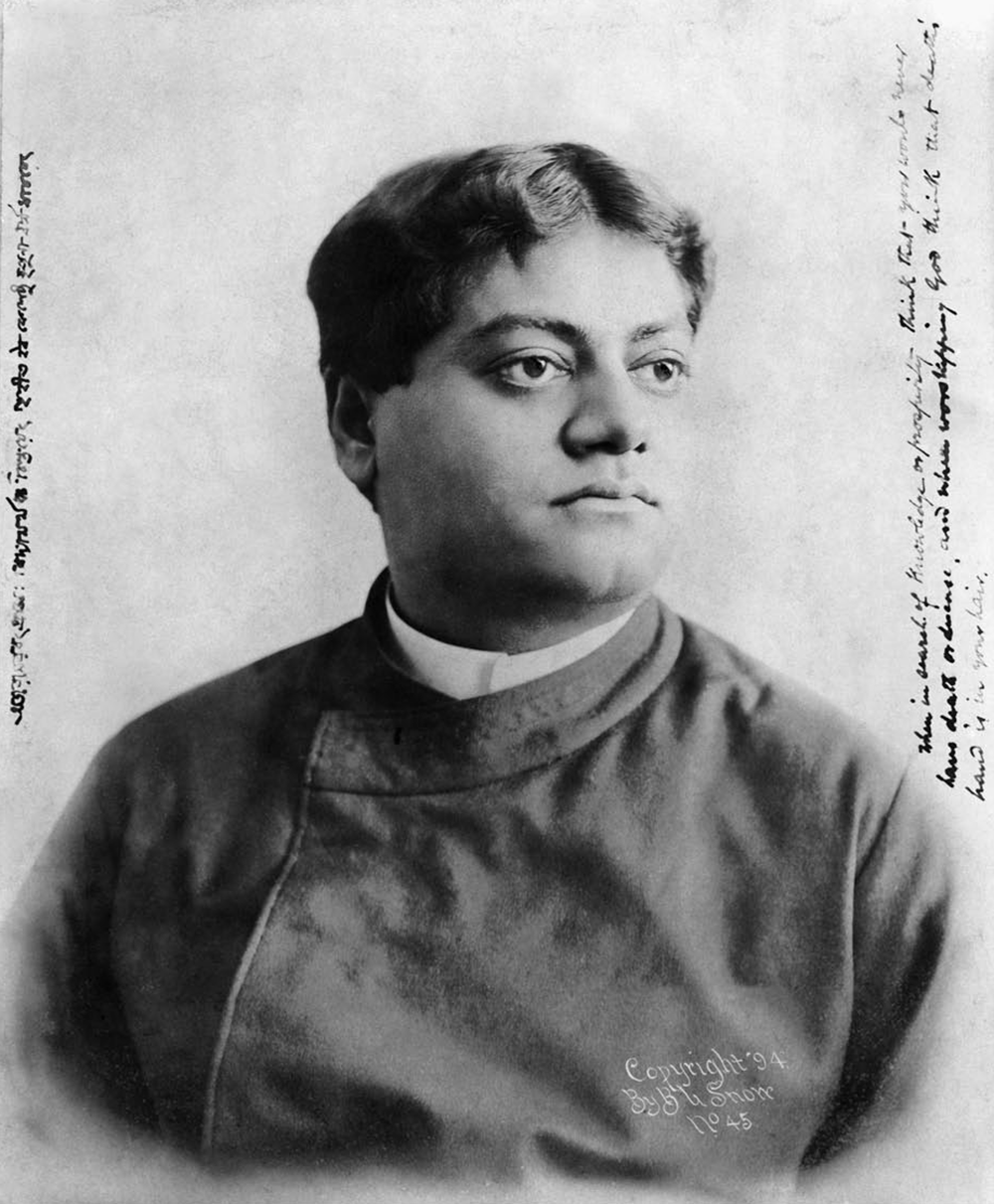

Photograph 30

GREEN ACRE, AUGUST 1894

Swami Vivekananda seated in front. Ralph Waldo Trine (standing) in cowboy hat.

In this photo Swamiji is seated under the “Swami’s Pine” with his class. “This photograph was discovered by Elva Nelson [of the Ramakrishna Vedanta Society, Boston] and may well be the photograph he spoke of in his letter to the Hale sisters: ‘Herewith I send a photograph Cora Stockham took of the group under the tree. It is only a proof and will fade away under exposure, but I cannot get anything better at present.’ Very likely a more durable print was made for both pictures [30 and 33] which have been taken from finished photographs[21].”

“Instead of materializing the spirit, i. e. dragging the spiritual to the material plane as these fellers do,” [Swamiji] wrote to the Hale sisters, “convert the matter into spirit—catch a glimpse at least every day of that world of infinite beauty and peace and purity, the spiritual, and try to live in it day and night.” (ND [1984] 2:153)
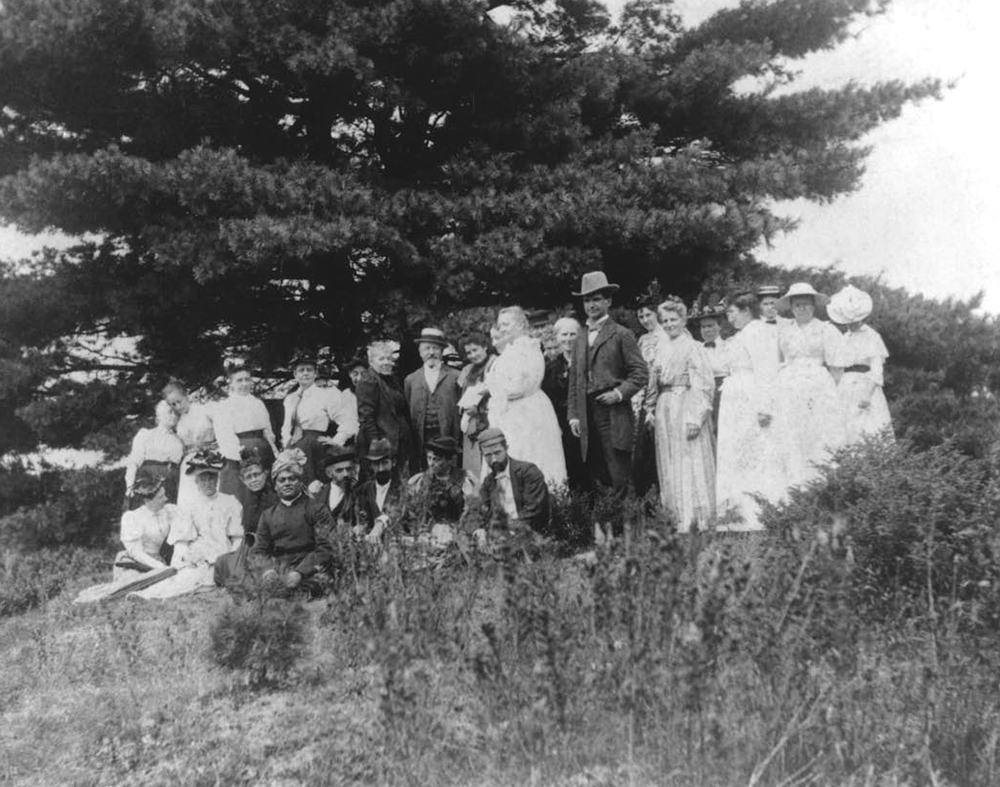
 

Photograph 31

GREEN ACRE, AUGUST 1894

Swami Vivekananda, Sarah Farmer (seated to his left), Charles Malloy (standing), with white hat and walking stick.

This is yet another, heretofore unknown, picture of Swamiji seated under his pine with one of his classes. Elva Nelson acquired this photo, as well as 32, from the Baha’i Archives now located at Green Acre in Eliot, Maine.

“On July 28 an article headed VIVEKANANDA AT GREENACRE appeared in Boston’s brahminical and world-famous Evening Transcript. It was almost certainly written by Ralph Waldo Trine, who was later to become a well-known author on metaphysical subjects. (At that time, he was a special correspondent for the Transcript at Greenacre, where he had built for himself ‘a little cabin . . . on the edge of a pinegrove.’) The article read in part:

Friday an extra lecture will be given by Swami Vivekananda of India, who is spending a few weeks at Greenacre. He is deeply interested in this unitary work which has been inaugurated, and each morning may be seen, attired in his flowing red robes and yellow turban, sitting cross-legged on the ground near a wide-spreading pine, and surrounded by a group of eager listeners, men and women, to whom he pours out freely his treasures of knowledge and experience. It is a rich opportunity to us who are privileged to enjoy it, and our only regret is that so many hungry souls are missing it.

Greenacre is very full, as are also a half-dozen or more cottages in the vicinity: still there is room. The townspeople are opening their rooms to accommodate the numbers who desire to attend the lectures, which are free to all[22].”

On July 31 Swamiji wrote to the Hales’ daughters and nieces from the Green Acre Inn: “The Inn people are more or less well-to-do, and the camp people are healthy, young, sincere, and holy men and women. I teach them all Shivo’ham, Shivo’ham, and they all repeat it, innocent and pure as they are and brave beyond all bounds.”

Later, in September 1894, Swamiji wrote a letter to Mr. Manmatha Nath Bhattacharya, who had been his host in Chennai in 1893. In this letter he mentioned: “A while back several hundred intellectual men and women were gathered in a place called Greenacre, and I was there for nearly two months. Every day I would sit in our Hindu fashion under a tree, and my followers and disciples would sit on the grass all around me. Every morning I would instruct them, and how earnest they were.”
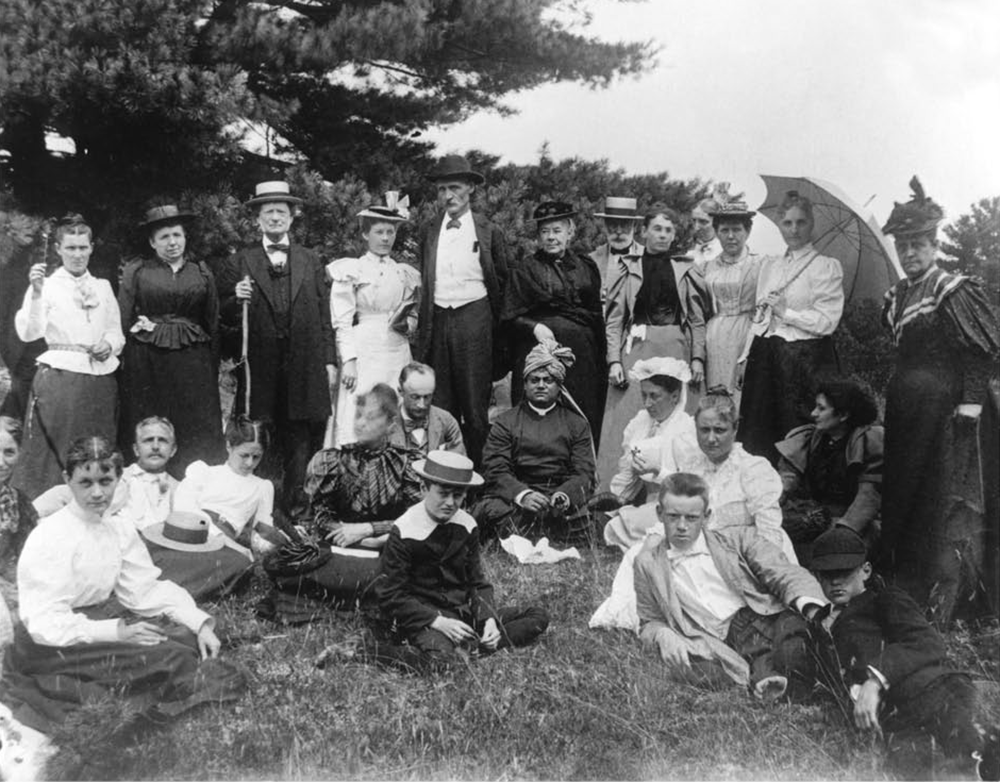

Photograph 32

GREEN ACRE, AUGUST 1894

From left to right: 

Swami Vivekananda, Sarah J. Farmer, M. H. Gulesian, and Dr. Edward Everett Hale.

In New Discoveries a reference is made to another photo that Cora Stockham took at Green Acre. “From the Portsmouth Daily Chronicle of August 9 one learns that Miss Stockham took another group picture (yet to be unearthed) in which Swamiji was present. This time it was in the Tent following a lecture given by Dr. Edward Everett Hale on Thursday, August 2. The pertinent passage reads in part:

. . . Swami Vivekananda, as a representative of the far east, sat upon the platform, gorgeous in his scarlet and gold. At the close of the lecture he and Dr. Hale, Mr. Gulesian [a native of Armenia] and Miss Farmer were photographed in a group by Miss Stockham of Chicago[23].”

This photo from the Baha’i Archives certainly seems to be the picture that was lying “unearthed” until now.

There is a mass of thought which is at the present time struggling to get expression. It teaches us that higher direction and not destruction is the law. It teaches us that it is not a world of bad and good, but good and better— and still better. It stops short of nothing but acceptance. It teaches that no situation is hopeless, and as such accepts every form of mental, moral or spiritual thought where it already stands, and without a word of condemnation tells it that so far it has done good, now it is time to do better. . . . It above all teaches that the kingdom of heaven is already in existence if we will have it, that perfection is already in man if he will see it. (ND [1984] 2:158)
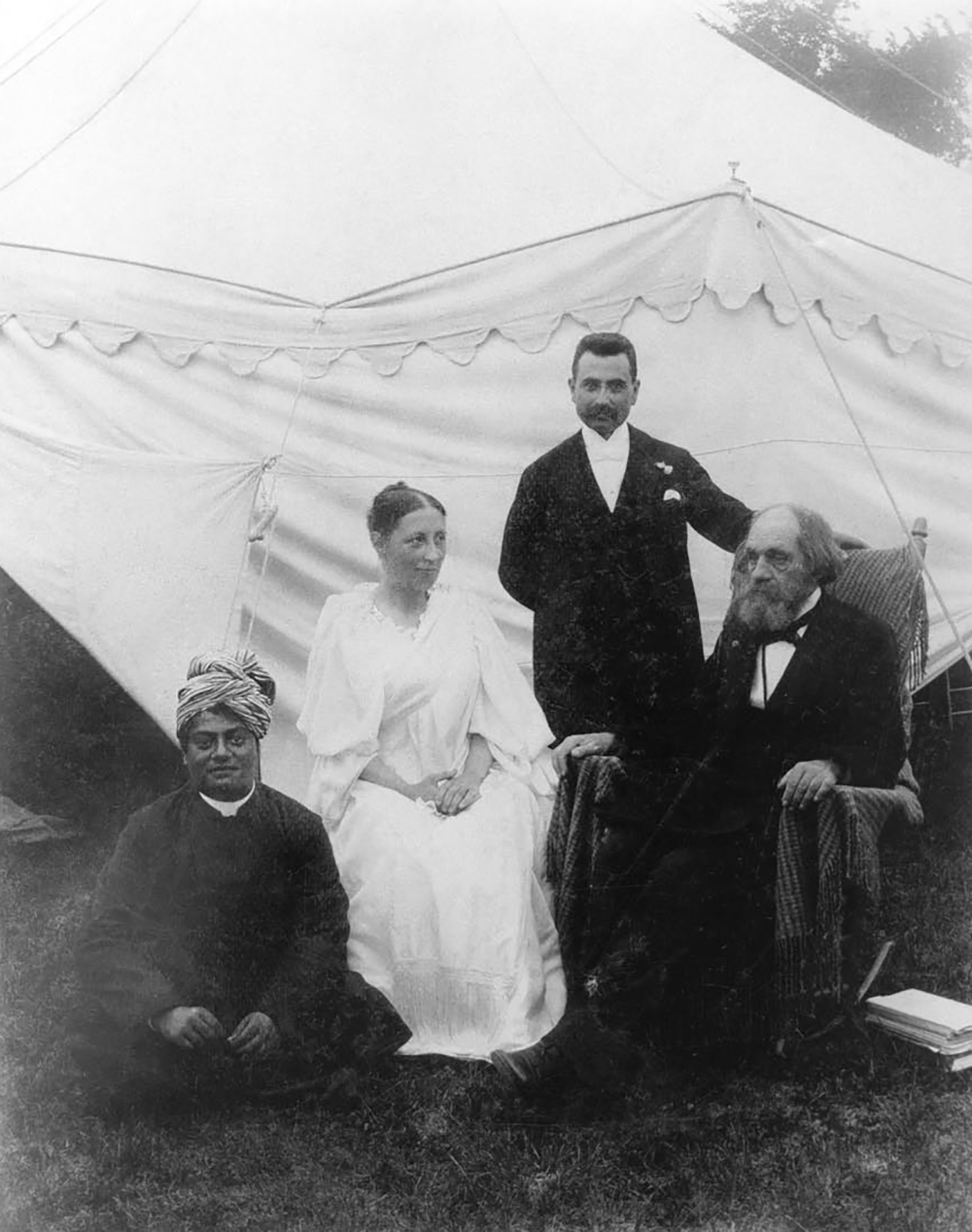


Photograph 33

GREEN ACRE, AUGUST 1894

We now have three photos of Swamiji taken at Green Acre under his pine. Sister Gargi poetically describes this photo: “One of these, which was among Isabelle McKindley’s treasures, shows him standing with folded arms, his eyes looking as eyes look when the whole world is seen as permeated by Divinity[24].”

During one of the outdoor meetings,

Swamiji in an inspired mood said:


I am without form, without limit,

beyond space, beyond time;

I am in everything,

I am the basis of the universe—

everywhere am I.

I am Existence Absolute.

Bliss Absolute. Knowledge Absolute.

I am It. I am It.

(ND [1984] 2:149-50)
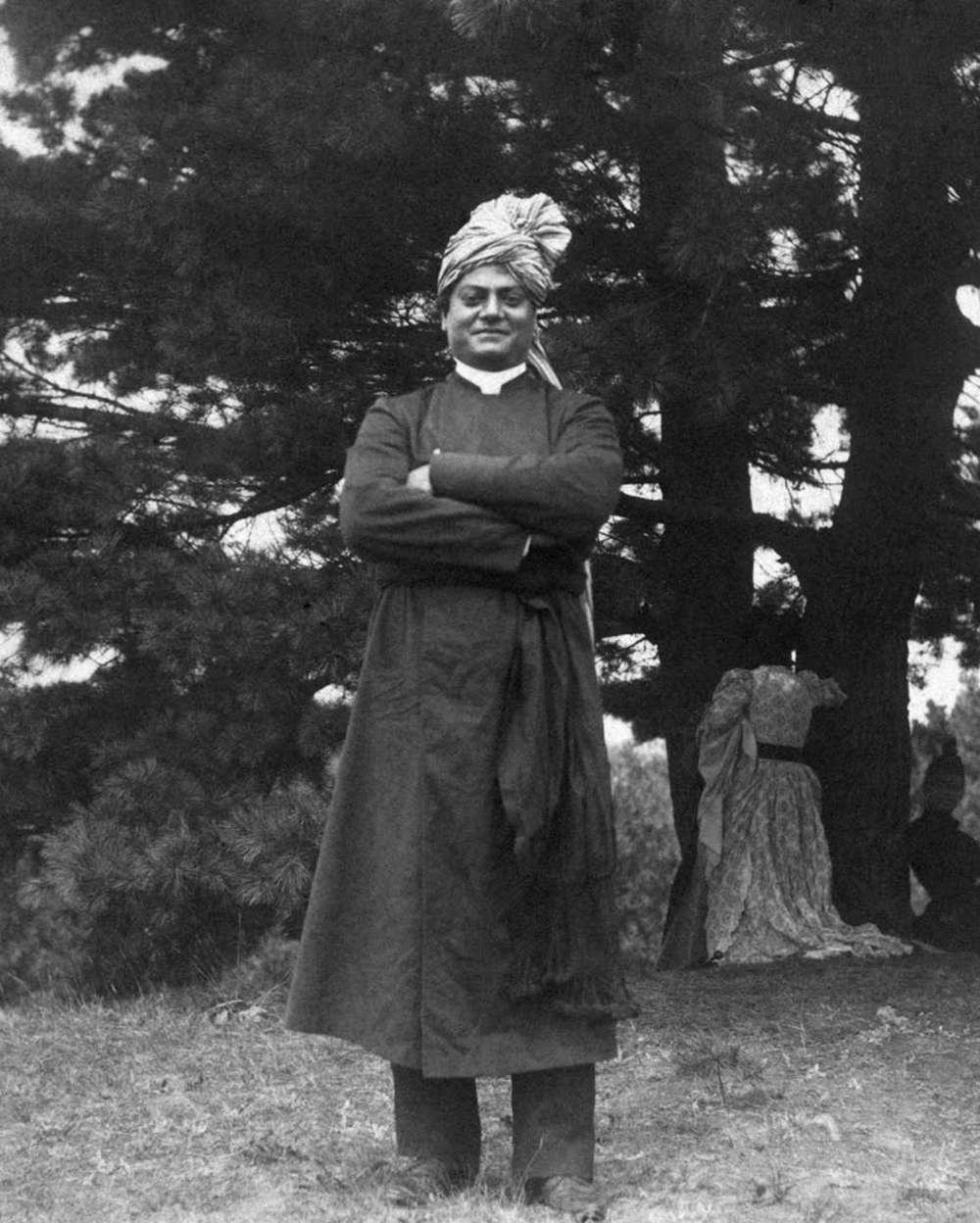

Photograph 34

GREEN ACRE, 1894

This picture was taken during Swamiji’s stay at Green Acre in 1894, but was reproduced in 1899 in a Watertown, Massachusetts newspaper article on Green Acre.

[Letter to the Hale’s daughters and nieces, July 31, 1894]

Sweet One! Many people offer to You many things, I am poor—but I have the body, mind, and soul. I give them over to You. Deign to accept, Lord of the Universe, and refuse them not.”—So have I given over my life and soul once for all.
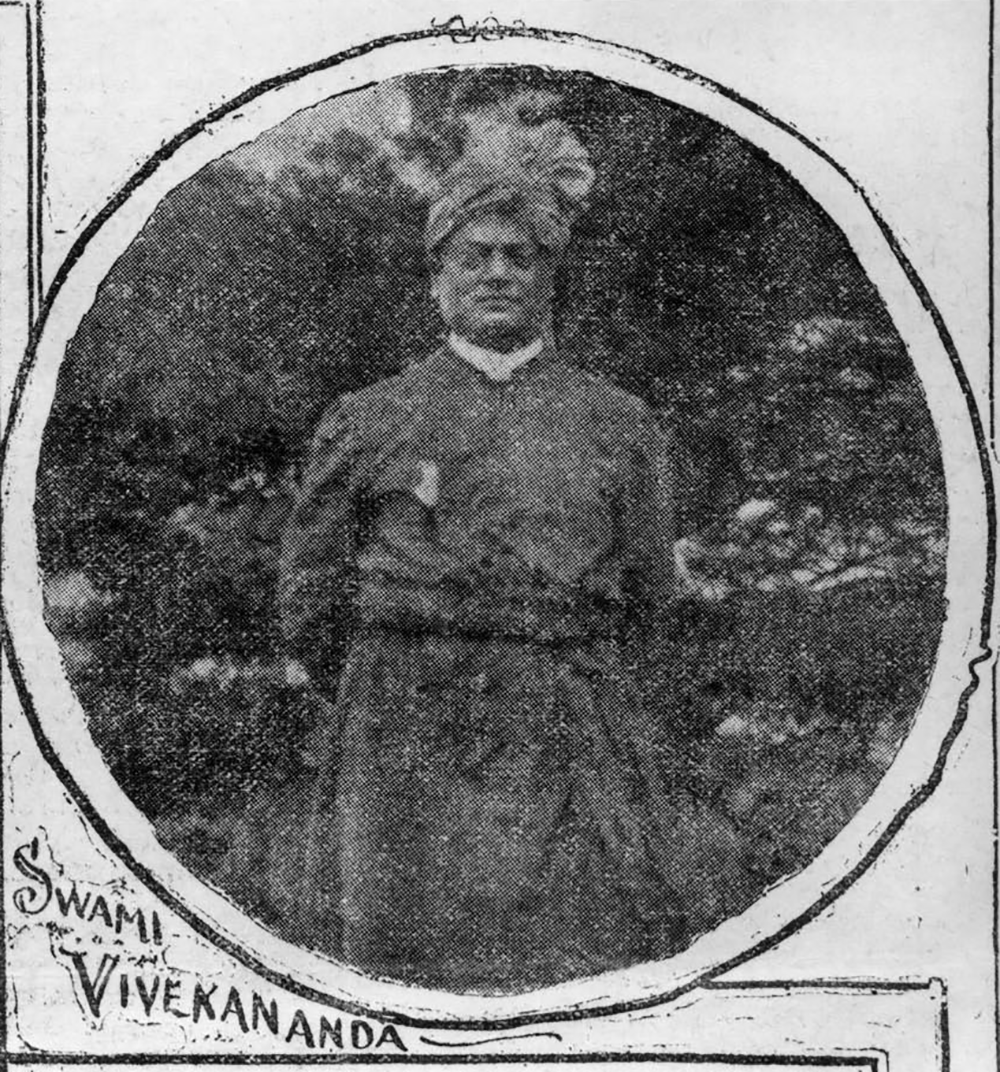

Photograph 35

NEW YORK, 1895 (probably between February and June)

Photos 35 to 37 were taken at the Prince Studio, 31 Union Square, New York. A report of Swamiji’s first talk of a lecture series that he was to give in January of 1896 appeared in the New York World Telegram, January 6, 1896. It was entitled:

SWAMI VIVEKANANDA LECTURES

The Hindoo Monk tells New Yorkers about the Truth and Utility of Religion.

This report “was accompanied by a line drawing of ‘Swami Vivekanand,’ [based on this photo] standing solidly on the platform of the hall, his hands behind his back. The drawing is hardly that of a ‘tall man, of handsome face and figure,’ but it is reproduced in this book [New Discoveries] for the readers’ amusement or indignation, as the case may be. Swamiji himself may have thought it a good likeness. Rarely aware of his body, he apparently did not know what it looked like. A story in illustration of this was told to Sister Devamata by Miss Waldo and took place in the front drawing room of 228 West Thirty-ninth Street—a long, narrow room with two tall windows facing the street, between which hung a mirror ‘reaching from floor to ceiling.’ 

This mirror [Devamata wrote] seemed to fascinate the swami. He stood before it again and again, gazing at himself intently. In between he walked up and down the room, lost in thought. Miss Waldo’s eyes followed him anxiously. ‘Now the bubble is going to burst,’ she thought. ‘He is full of personal vanity.’ Suddenly he turned to her and said: ‘Ellen, it is the strangest thing, I cannot remember how I look. I look and look at myself in the glass, but the moment I turn away I forget completely what I look like[25].’ 

[Letter to Mary Hale, February 1, 1895]

Dream no more! Oh, dream no more, my soul! In one word, I have a message to give, I have no time to be sweet to the world, and every attempt at sweetness makes me a hypocrite. I will die a thousand deaths rather than lead a jellyfish existence and yield to every requirement of this foolish world, no matter whether it be my own country or a foreign country. You are mistaken, utterly mistaken, if you think I have a work, as Mrs. Bull thinks; I have no work under or beyond the sun. I have a message, and I will give it after my own fashion. I will neither Hinduize my message, nor Christianize it, nor make it any “ize” in the world. I will only my-ize it and that is all. Liberty, Mukti, is all my religion, and everything that tries to curb it, I will avoid by fight or flight. (CW [1979] 5:72)
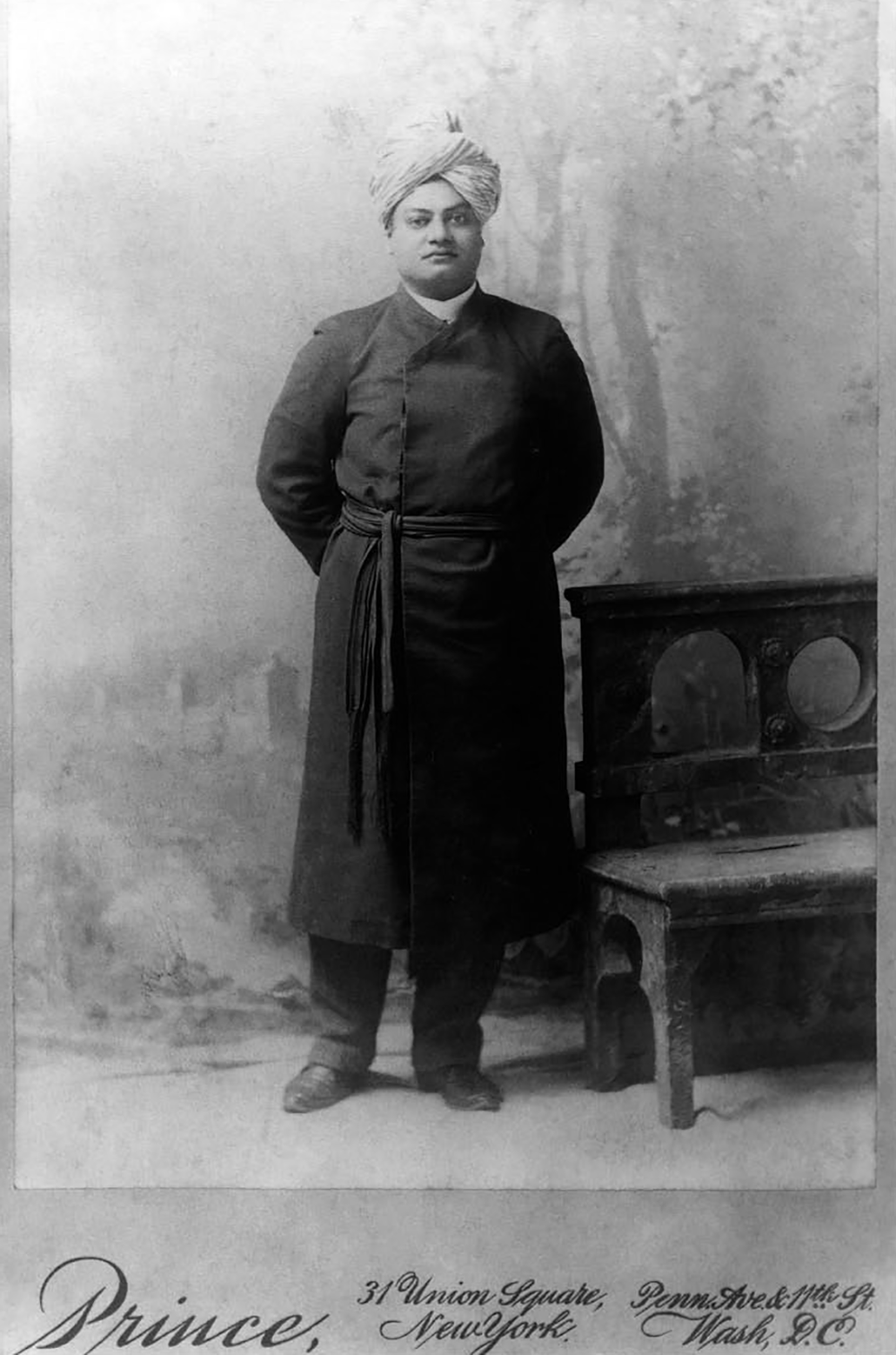

Photograph 36

NEW YORK, 1895

In various publications this photo is often mistaken for Chicago, 1893. The background studio setting is the same as no. 35.

Josephine MacLeod’s life was revolutionized by her meeting with Swamiji during the early part of 1895 in New York. She remarked that when she heard Swamiji speak:

Instantly to me that was truth, and the second sentence he spoke was truth, and the third sentence was truth. And I listened to him for seven years and whatever he uttered was to me truth. From that moment, life had a different import. It was as if he made you realize that you were in eternity. It never altered. It never grew. It was like the sun that you will never forget once you have seen. . . . His presence, you see, was dynamic. You cannot pass that power on unless you have it[26].

The end of all religions is the realizing of God in the soul. That is the one universal religion. If there is one universal truth in all religions, I place it here—in realizing God. Ideals and methods may differ, but that is the central point. . . . There is that beyond all books, beyond all creeds, beyond the vanities of this world, and it is the realization of God within yourself. (CW [1984] 1:324-25)
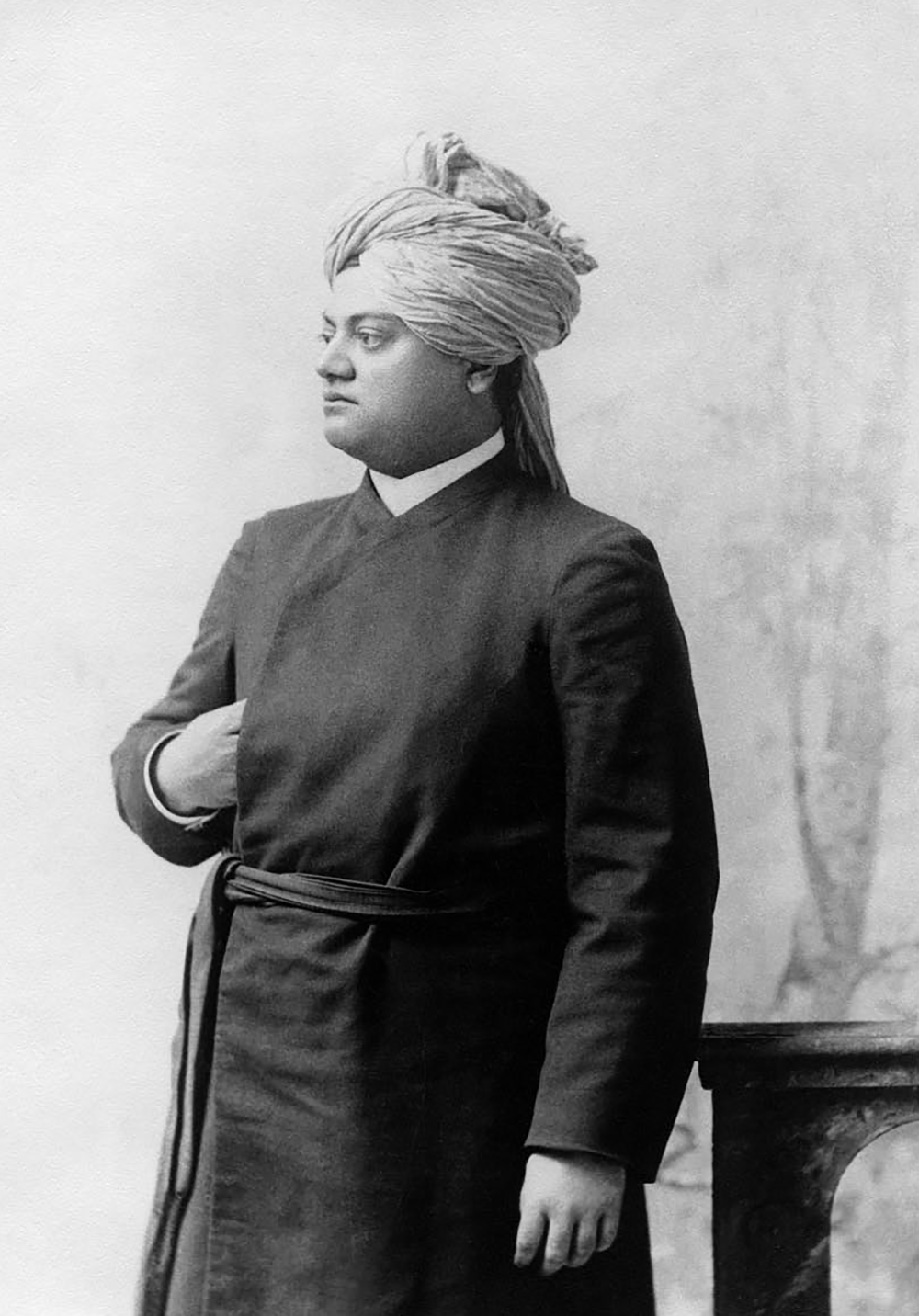

Photograph 37 

NEW YORK, 1895

This photograph has also been mistaken for Chicago, 1893. One reason for the misidentification of photo nos. 36 and 37 may be their resemblance to Swamiji’s 1893 Chicago photographs. However in full reproductions of both of these photos, it is clear that they were taken in the same New York studio as no. 35.

Sister Devamata recalled in her reminiscences her first impression of Swamiji when she heard him speak in New York in 1895:

A sudden hush, a quiet step on the stairs, and Swami Vivekananda passed in stately erectness up the aisle to the platform. He began to speak; and memory, time, place, people, all melted away. Nothing was left but a voice ringing through the void. It was as if a gate had swung open and I had passed out on a road leading to limitless attainment. The end of it was not visible; but the promise of what it would be shone through the thought and flashed through the personality of the one who gave it. He stood there—prophet of infinitude[27].

I ndividuality is my motto. I have no ambition beyond training individuals up. I know very little; that little I teach without reserve; where I am ignorant, I confess it as such, and never am I so glad as when I find people being helped by Theosophists, Christians, Mohammedans, or anybody in the world. I am a sannyasin; as such I consider myself as a servant, not as a master in the world. . . . Truth will preach itself, it will not die for the want of the helping hands of me! “Making happiness and misery the same, making success and failure the same, fight thou on” (Gita). It is that eternal love, unruffled equanimity under all circumstances, and perfect freedom from jealousy or animosity that will tell. That will tell, nothing else. (CW [1979] 7:487-88)
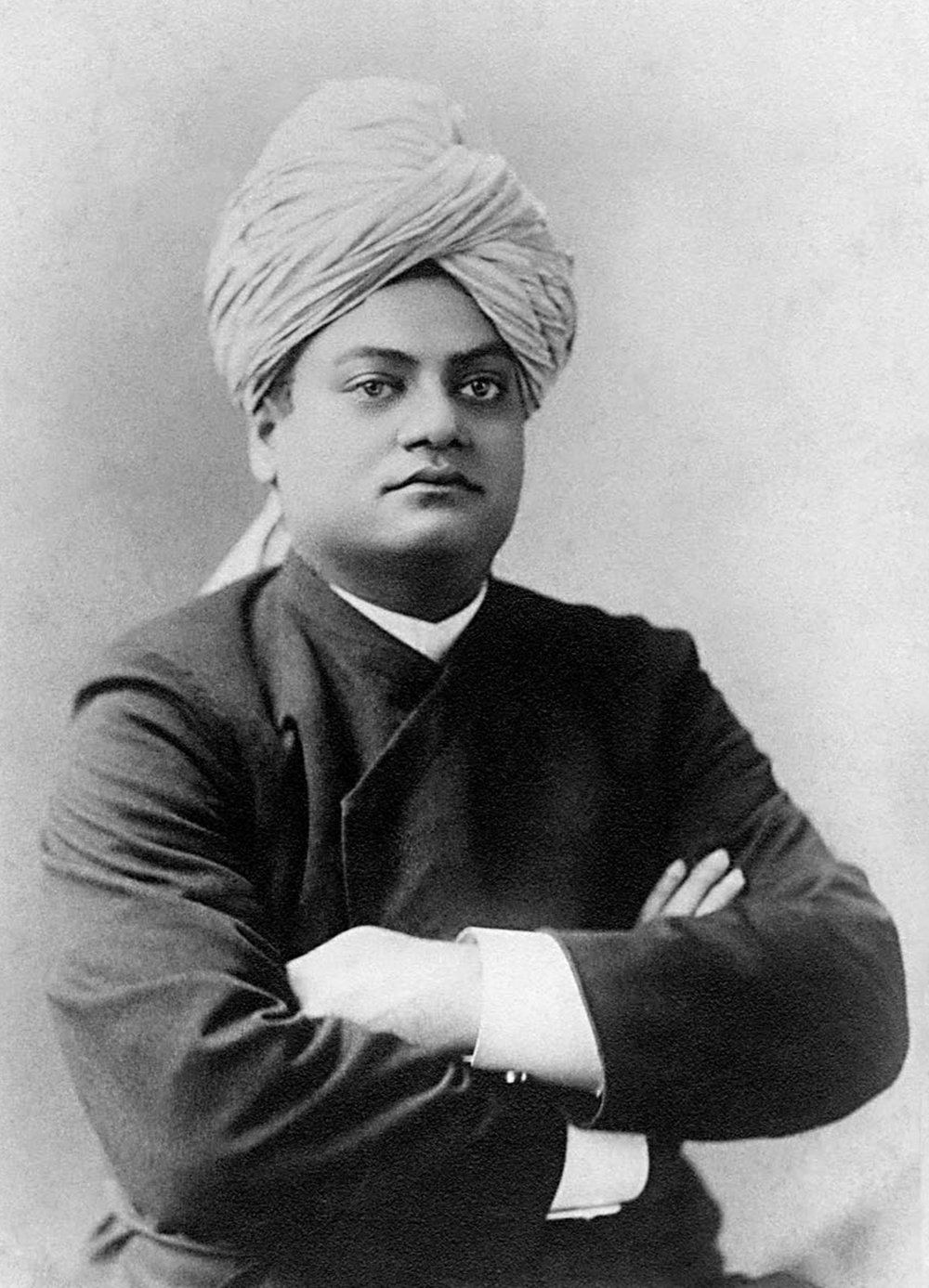

Photograph 38

NEW YORK, APRIL 6, 1895

Swamiji’s palm impression appeared in the book Language of the Hand by Cheiro. Cheiro was a famous palmist in the late nineteenth and early twentieth centuries. No doubt, one of Swamiji’s wealthy friends in New York took him to Cheiro to have his palm read.

We have been trying to locate Language of the Hand, which is out of print, to check for details that Cheiro might have given about the line tracing of Swamiji’s palm. So far we have been unable to find the book.

When Swamiji was young he and other boys would try to foretell the future by reading each other’s palms. “Naren was the chief palmist of them all. He told them that he would be a monk: there was no mistake about it. ‘See!’ he would say triumphantly, ‘there is the sure sign of a sannyasi.’ And he would point out certain lines on his hand which an old man had once told him were characteristic of the tendency to monkhood[28].”

We must plunge heart and soul and body into the work. And until we be ready to sacrifice everything else to one Idea and to one alone, we never, never, will see the light. Those that want to help mankind must take their own pleasure and pain, name and fame, and all sorts of interests, and make a bundle of them and throw them into the sea, and then come to the Lord. This is what all Masters said and did. (CW [1978] 6:301-302)
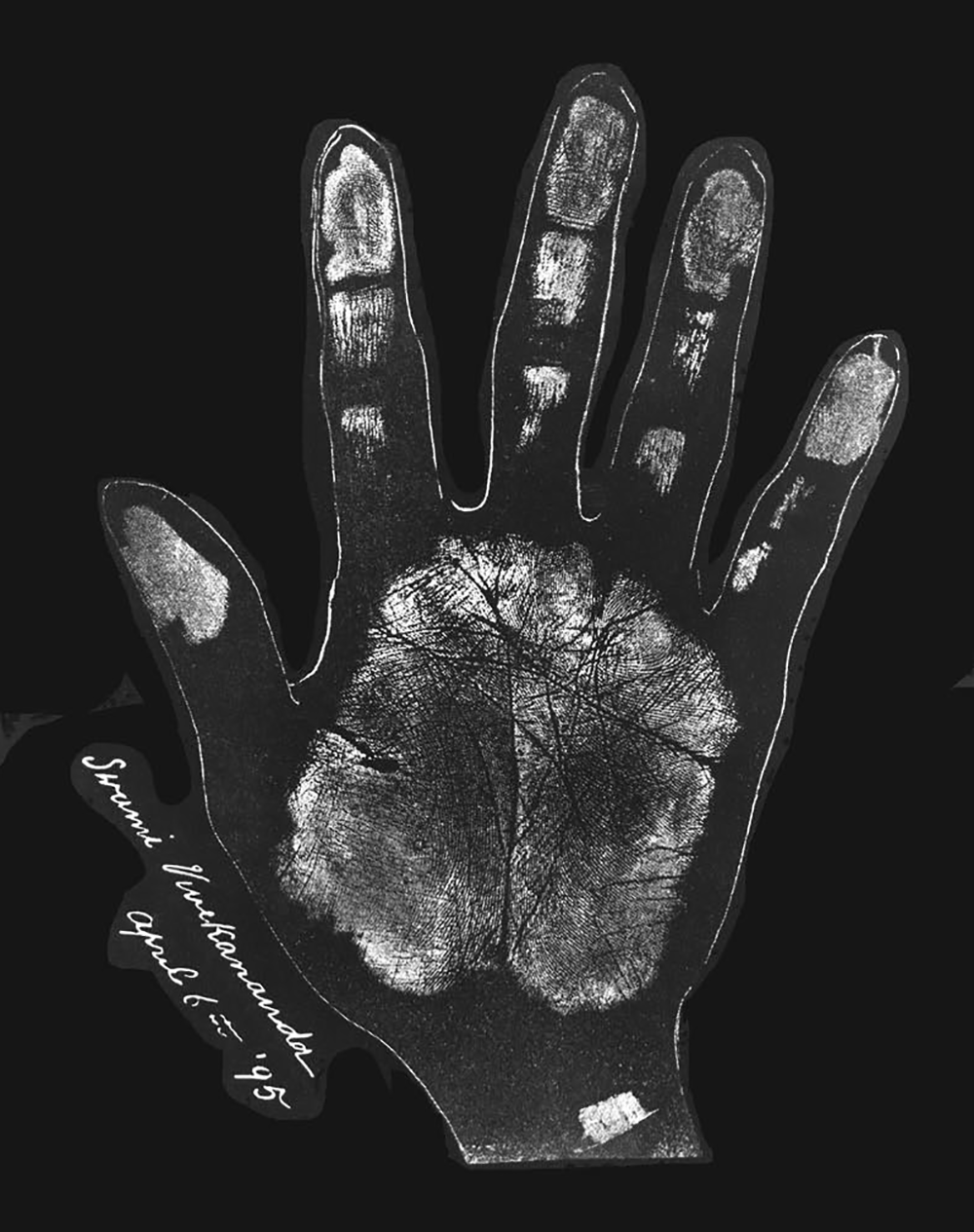

Photograph 39

THOUSAND ISLAND PARK, JULY 1895

Swamiji used to take walks in the village of Thousand Island Park with his students, Sister Christine, and others.

We know of two such walks the group took through the village. One of them took place before the morning class and perhaps before many people were abroad. They stopped at the Thousand Island Park Studio, which specialized in “Portrait Photography, Instantaneous Pictures, [and] Thousand Island Park Views,” and at the request of his students Swamiji had tintypes taken of himself, two of which may well have been this pose—one full-length with a painted river-view for a backdrop, and the other [no. 40] a simple head and shoulders. “He was so full of fun, so merry,” Mrs. Funke wrote of this occasion[29].

Wednesday, June 19, 1895

Really good and evil are one and are in our own mind. When the mind is self-poised, neither good nor bad effects it. Be perfectly free; then neither can affect it, and we enjoy freedom and bliss. Evil is the iron chain, good is the gold one; both are chains. Be free, and know once for all that there is no chain for you. Lay hold of the golden chain to loosen the hold of the iron one, then throw both away. (CW [1979] 7:4-5)
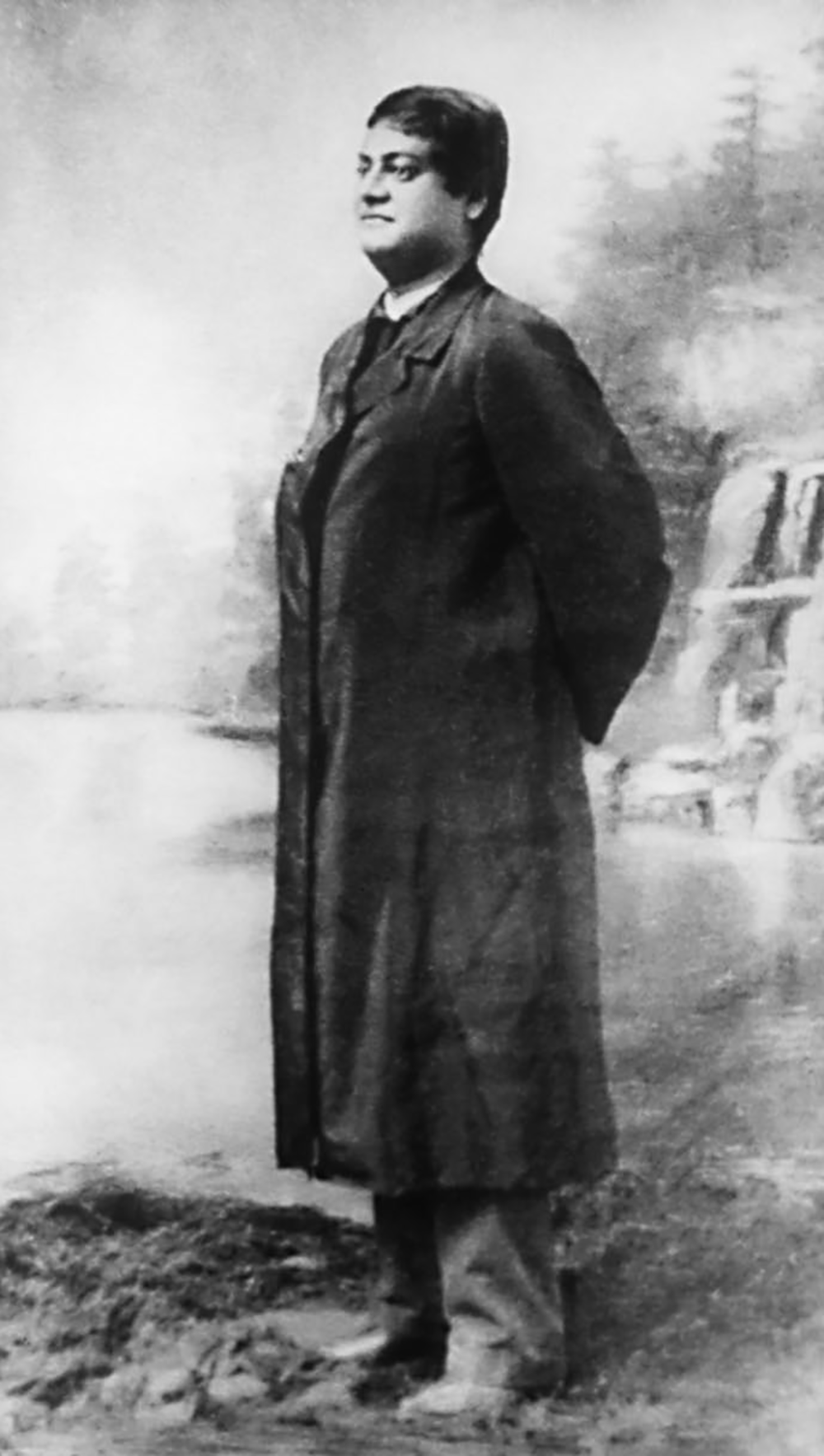

Photograph 40 

THOUSAND ISLAND PARK, JULY 1895

This is the “head-and-shoulders” print made at Thousand Island Park. “The original print of this head-and-shoulders photo bears the name of the studio: Lamson & Van Camp, 1000 Island Park, N.Y[30].”

Wednesday, June 19, 1895

In the world take always the position of the giver. Give everything and look for no return. Give love, give help, give service, give any little thing you can, but keep out barter. Make no conditions, and none will be imposed. Let us give out of our own bounty, just as God gives to us.

Thursday, August 1, 1895

Give as the rose gives perfume, because it is its own nature, utterly unconscious of giving. (CW [1979] 7:5,86)
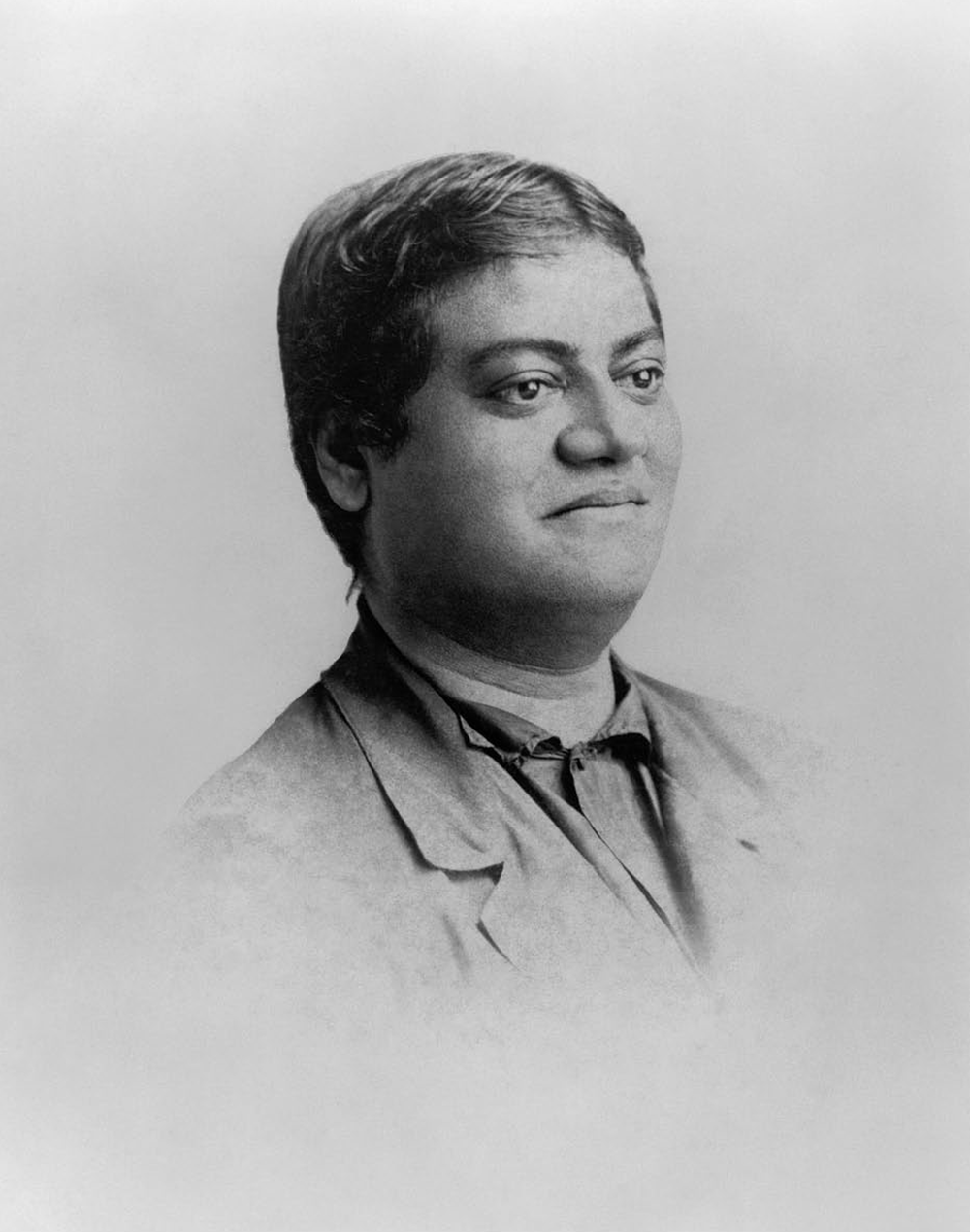

Photograph 41

LONDON, 1895

“The formal meeting between Swami Vivekananda and England—the beginning of what was to be a long and mutually satisfactory friendship—took place on the evening of Tuesday, October 22, in Prince’s Hall, London. Fittingly, Swamiji chose for his subject ‘Self-Knowledge,’ the key, as he said in an interview, to his philosophy[31].”

Announcements began to appear in various London newspapers. “In addition, the Daily Graphic, a smaller paper than the Gazette, but, as it said of itself, ‘The most popular home newspaper in the world,’ published on October 21 [actually 22] a brief article about Swamiji accompanied by a photograph. (The Daily Graphic also boasted that it was ‘the only illustrated morning newspaper published in the world.’) Its article [“An Indian Monk in London”] reads:

SWAMI VIVEKANANDA 

An interesting figure has lately arrived in this country in the person of Swami Vivekananda, an Indian Yogi—one who formally renounces the world, and gives himself to study and devotion. He left India to express his interpretation of the Vedanta philosophy to Western people at the Parliament of Religions held at Chicago in 1893. Since that event he has been teaching and lecturing in America. He has now reached England, but will, after a short visit, return to America to carry on his self-appointed task there during the winter.

He will lecture at Prince’s Hall, Piccadilly, tomorrow evening[32].”

In New Discoveries it is mentioned that “the portrait of Swamiji that accompanied the above [41] was taken at the Walery Photographers, then located on Regent Street in London, and is all the proof needed that this now well-known picture, which shows him in profile, wearing a black astrakhanlike hat and a clerical collar, was taken in London in 1895 and not, as had long been supposed, in Cairo five years later. We may judge, incidentally, that Swamiji had come into London some time before Sunday, October 19, to sit for his photograph, for on Monday, the twentieth, he wrote from Caversham to Miss MacLeod, who had recently arrived in the city, that he would not be able to come in to see her until the day of the lecture[33].”

It can be reasonably assumed that the next five photographs (42 to 46) were taken at the same sitting. In two of these photographs Swamiji is without his cap, but in every other detail he appears the same, including his robe and buttoned clerical collar.

The greatest force is derived from the power of thought.

The finer the element, the more powerful it is.

The silent power of thought influences people even at a distance, because mind is one as well as many. The universe is a   cobweb; minds are spiders. (CW [1977] 8:225)
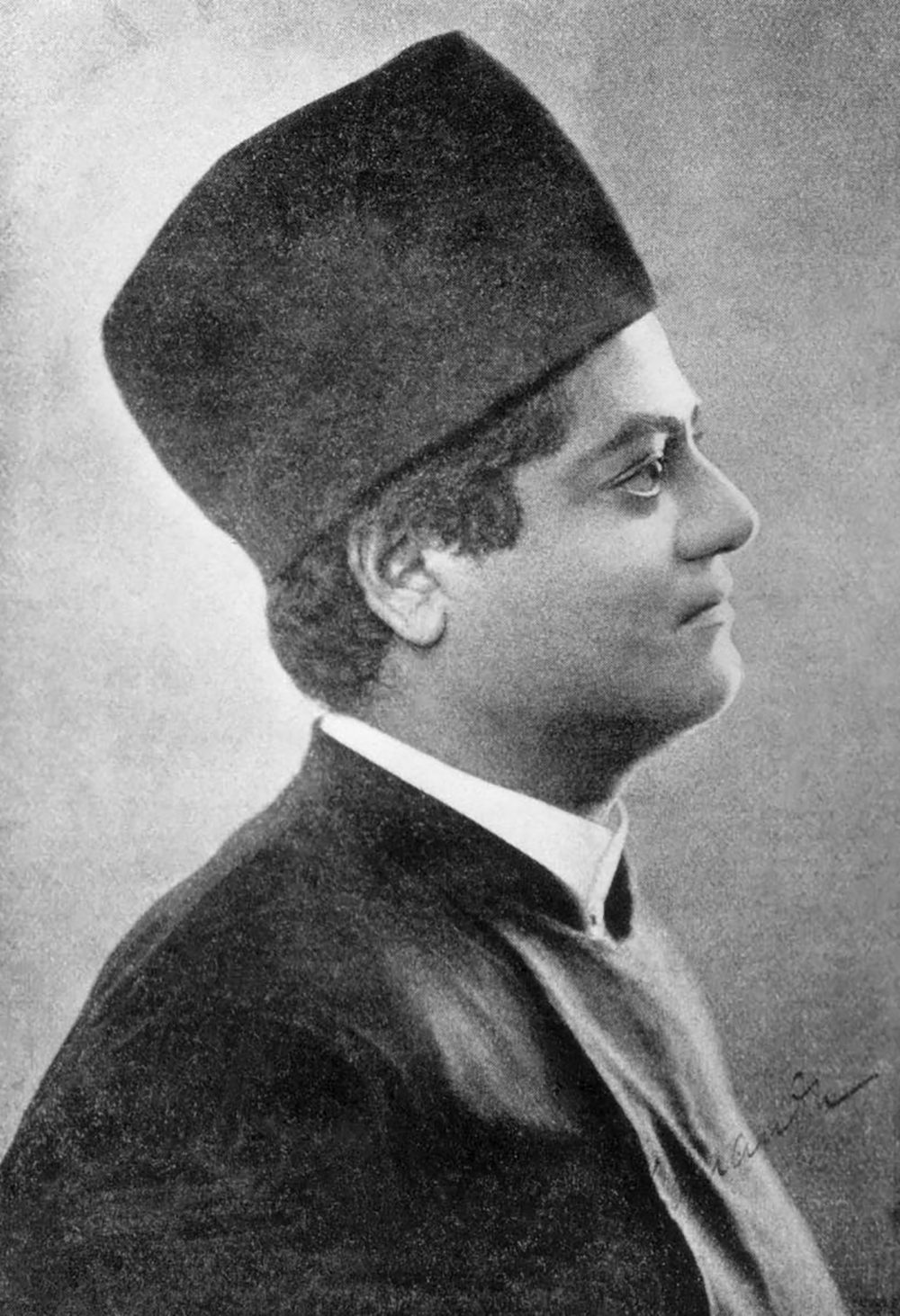
Photograph 42

LONDON, 1895

Mr. Desai who attended Swamiji’s first public lecture in London recalled:

That was the first time I saw the commanding figure of the great swami. He looked more like an Indian Prince than a sadhu (holy man). He had a bhagva patka (ochre colored turban) on his head. He electrified the audience by his grand and powerful oratory. The next day the report appeared in the papers that he was the next Indian after Keshab Chandra Sen, who had surprised the English audience by his magnificent oratory. He spoke on the Vedanta. His large eyes were rolling like anything, and there was such an animation about him that it passeth description. After the meeting was over, the swami took off his turban and put on a huge and deep Kashmiri cap looking like a big Persian hat[34].

[From an interview that appeared in The Westminster Gazette, October 23, 1895]

“And what is your attitude towards the Western religions, Swami?” 

“I propound a philosophy which can serve as a basis to every possible religious system in the world, and my attitude towards all of them is one of extreme sympathy—my teaching is antagonistic to none. I direct my attention to the individual, to make him strong, to teach him that he himself is divine, and I call upon men to make themselves conscious of this divinity within. That is really the ideal—conscious or unconscious—of every religion.”

“And what shape will your activities take in this country? ” 

“My hope is to imbue individuals with the teachings to which I have referred, and to encourage them to express these to others in their own way; let them modify them as they will; I do not teach them as dogmas; truth at length must inevitably prevail.” (CW [1979] 5:187-88)
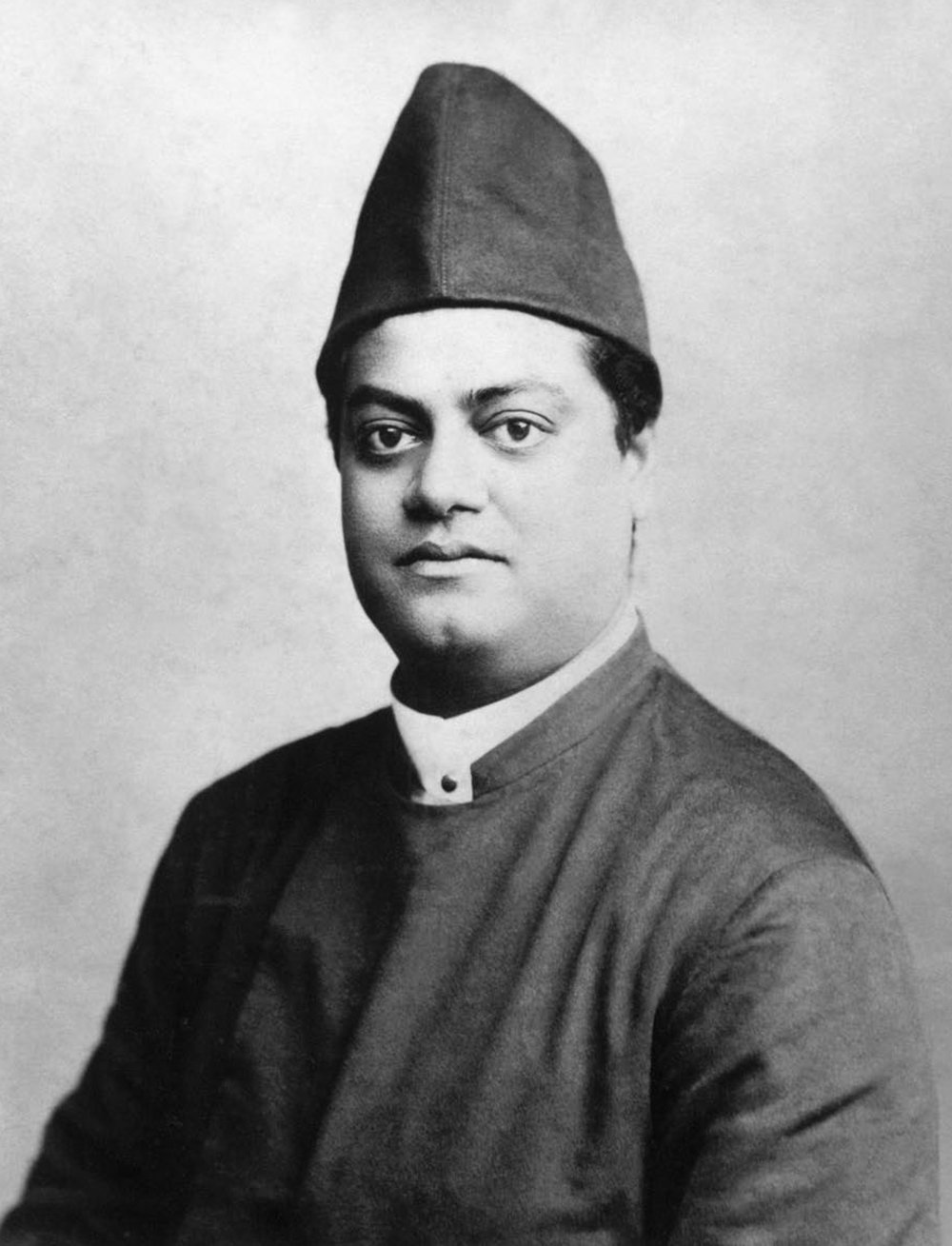

Photograph 43

LONDON, 1895

An excerpt from an article that appeared in the London Daily Chronicle of October 23, on Swamiji’s lecture stated:

THE SWAMI VIVEKANANDA: Attired in picturesque Oriental costume, this famous preacher last night addressed an audience at Prince’s Hall on “Self-Knowledge.” He is an Indian Yogi, that is to say, one who has formally renounced the world and gives himself to study and devotion, and not, as he amusingly pointed out last night, one who did juggling tricks or flew through the air[35].

Does renunciation demand that we all become ascetics? Who then is to help the others? Renunciation is not asceticism. Are all beggars Christs? Poverty is not a synonym for holiness; often the reverse. Renunciation is of the mind. How does it come? In a desert, when I was thirsty, I saw a lake. It was in the midst of a beautiful landscape. There were trees surrounding it, and their reflections could be seen in the water, upside down. But the whole thing proved to be a mirage. Then I knew that every day for a month I had seen this; and only that day, being thirsty, I had learnt it to be unreal. Every day for a month I should see it again. But I should never take it to be real. So, when we reach God, the idea of the universe, the body and so on will vanish. It will return afterwards. But next time we shall know it to be unreal. (CW [1977] 8:226)
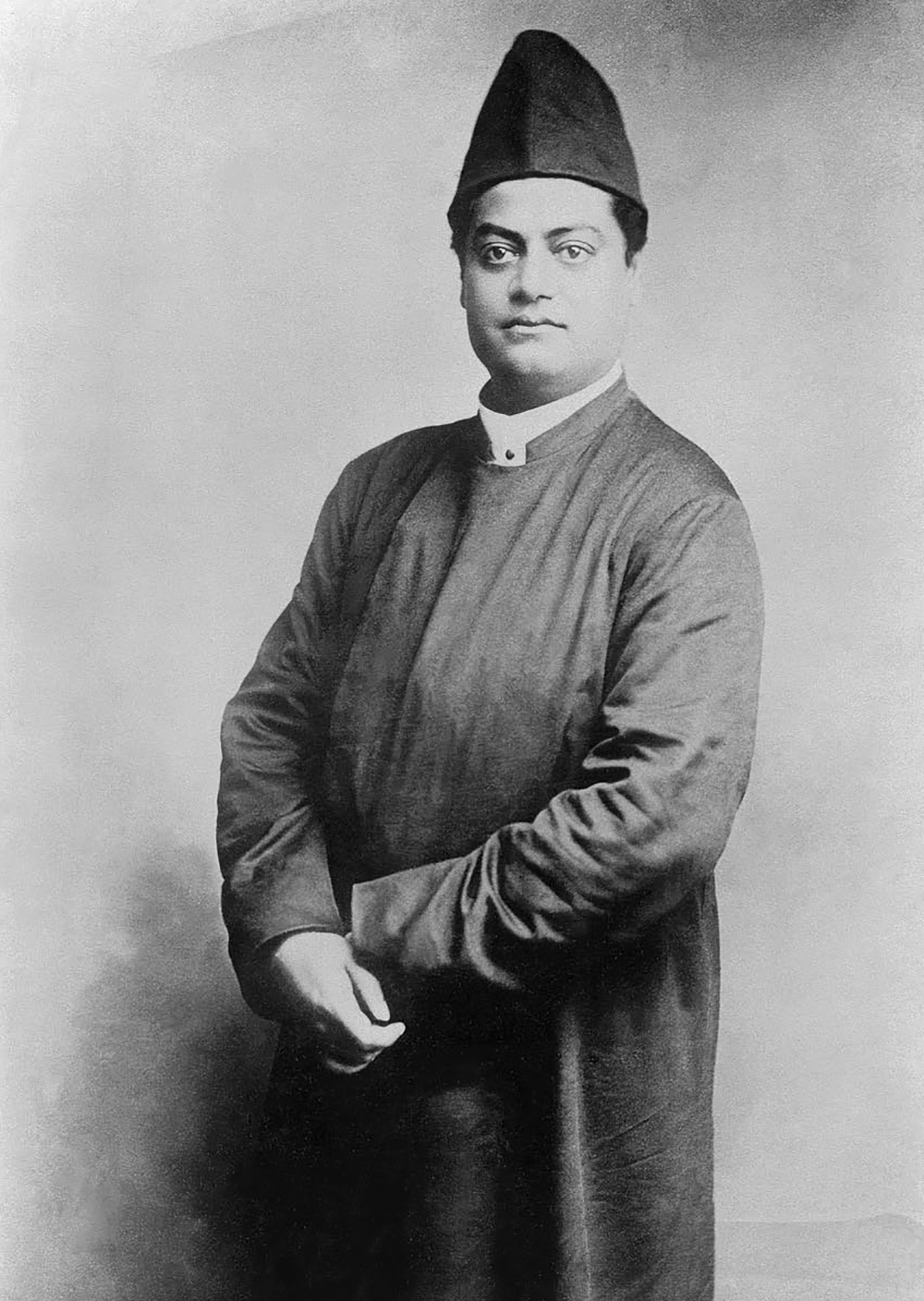

Photograph 44

LONDON, 1895

On November 19, 1895, the Westminster Gazette ran an article on Swamiji entitled: “An Indian Yogi in London.” The following is an excerpt from that article:

The Swami Vivekananda is a striking figure with his turban (or mitreshaped black cloth cap) and his calm but kindly features.

On my inquiring as to the significance, if any, of his name, the swami said: “Of the name by which I am now known (Swami Vivekananda), the first word is descriptive of a sannyasin, or one who formally renounces the world, and the second is the title I assumed—as is customary with all sannyasins—on my renunciation of the world; it signifies, literally, the bliss of discrimination[36].”

Deepen your own power of thought and love. Bring your own lotus to blossom: the bees will come of themselves. Believe first in yourself, then in God. A handful of strong men will move the world. We need a heart to feel, a brain to conceive, and a strong arm to do the work. Buddha gave himself for the animals. Make yourself a fit agent to work. But it is God who works, not you. One man contains the whole universe. One particle of matter has all the energy of the universe at its back. In a conflict between the heart and the brain follow the heart. (CW [1977] 8:223)
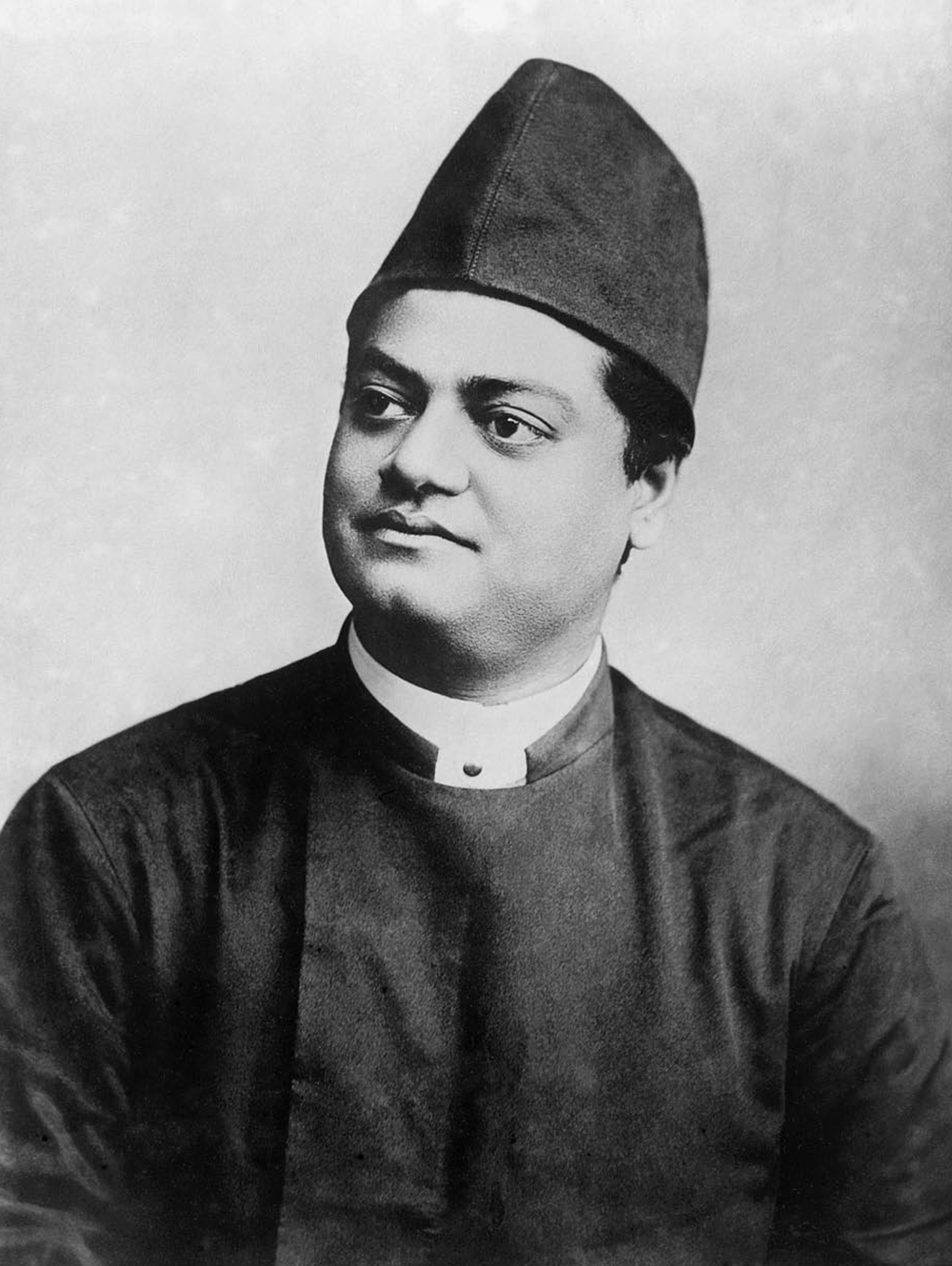

Photograph 45

LONDON, 1895

Reverend H. R. Haweis—one of the leaders of the Anglican Church in the late 1800s— made a penetrating comment about Swamiji which gives us insight into his first season in London:

This remarkable person appeared in England in the autumn of 1895, and although he led a very retired life, [he] attracted numbers of people to his lodgings, and created everywhere a very deep impression. He seemed completely indifferent to money, and lived only for thought. He took quite simply anything that was given to him, and when nothing came he went without, yet he never seemed to lack anything[37].

[Letter to Swami Brahmananda, October 4, 1895]

I give you a bit of my mind; don’t be angry, pray. I am your slave so long as you are his—step a hair’s breadth outside that, and you and I are on a par. . . . What on earth do we want? He has given us refuge, what more do we want? Bhakti is verily its own reward—what else is needed? My brother, he who made men of us by feeding and clothing and imparting wisdom and knowledge, who opened the eyes of our self, whom day and night we found the living God— must we be traitors to him!!! And you forget the mercy of such a Lord! The lives of Buddha and Krishna and Jesus are matters of ancient history, and doubts are entertained about their historicity, and you in spite of seeing the greatness of Sri Ramakrishna’s life in flesh and blood sometimes lose your head! Fie on you! I have nothing to say. His likeness is being worshipped in and out of your country, by godless and heartless men, and you are stranded at times on disbelief! In a breath he will create for himself hundreds of thousands of such as you are. Blessed is your birth, blessed your lineage, and blessed your country that you were allowed to take the dust of his feet. (CW [1978] 6:346-47)
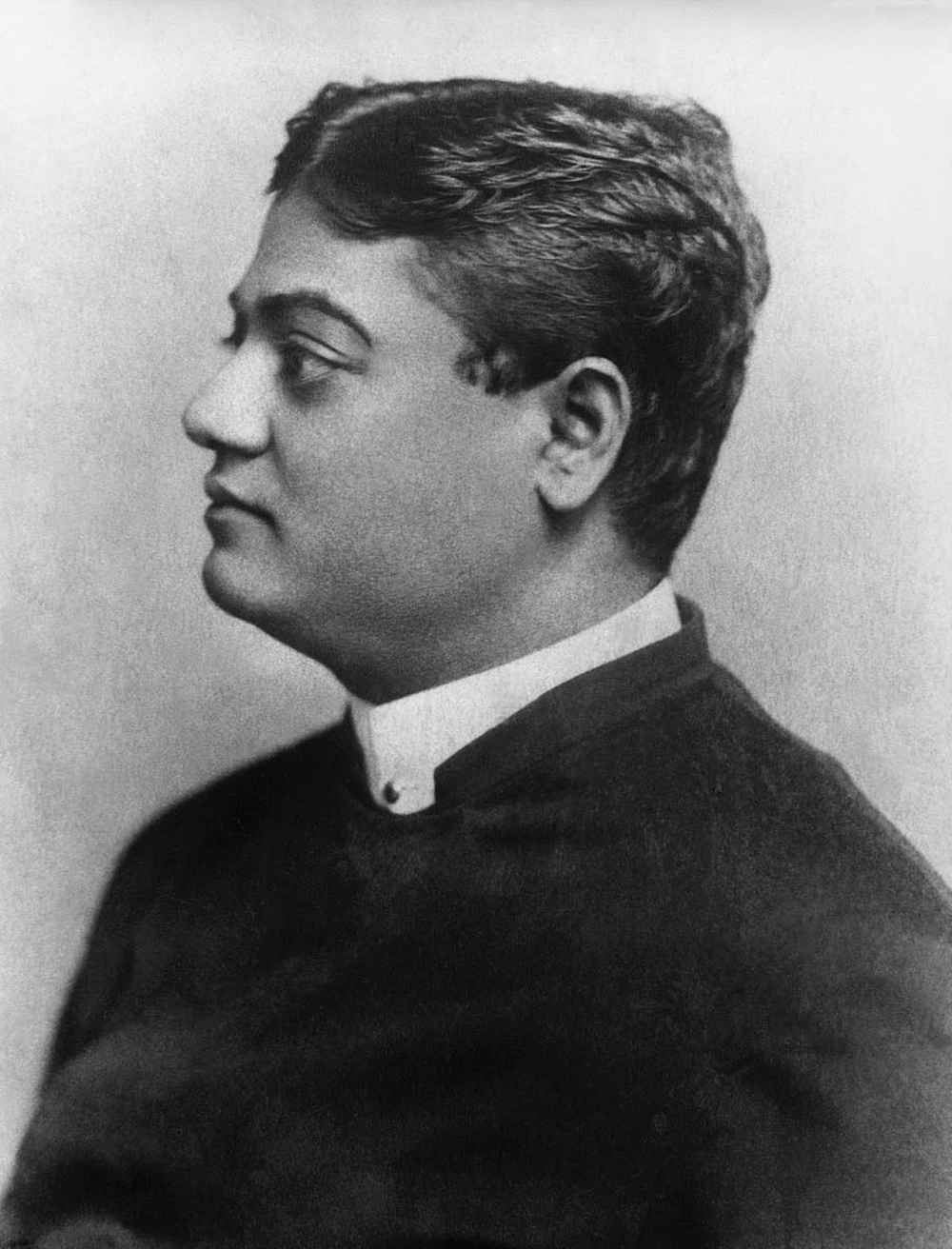

Photograph 46

LONDON, 1895

Swamiji had a deep and subtle influence on the hearts and minds of the English people.

It was such characteristics as these—his immense personal magnetism, his directness, his lucidity, his vision—which gave convincing force to his utterances and bound indissolubly to himself large groups of the very finest and the most devout disciples[38].

The history of the world is the history of a few men who had faith in themselves. That faith calls out the divinity within. You can do anything. You fail only when you do not strive sufficiently to manifest infinite power. . . . All will in the end be made perfect. Say, day and night, “Come up, my brothers! You are the infinite ocean of purity! Be God! Manifest as God!” (CW [1977] 8:228)
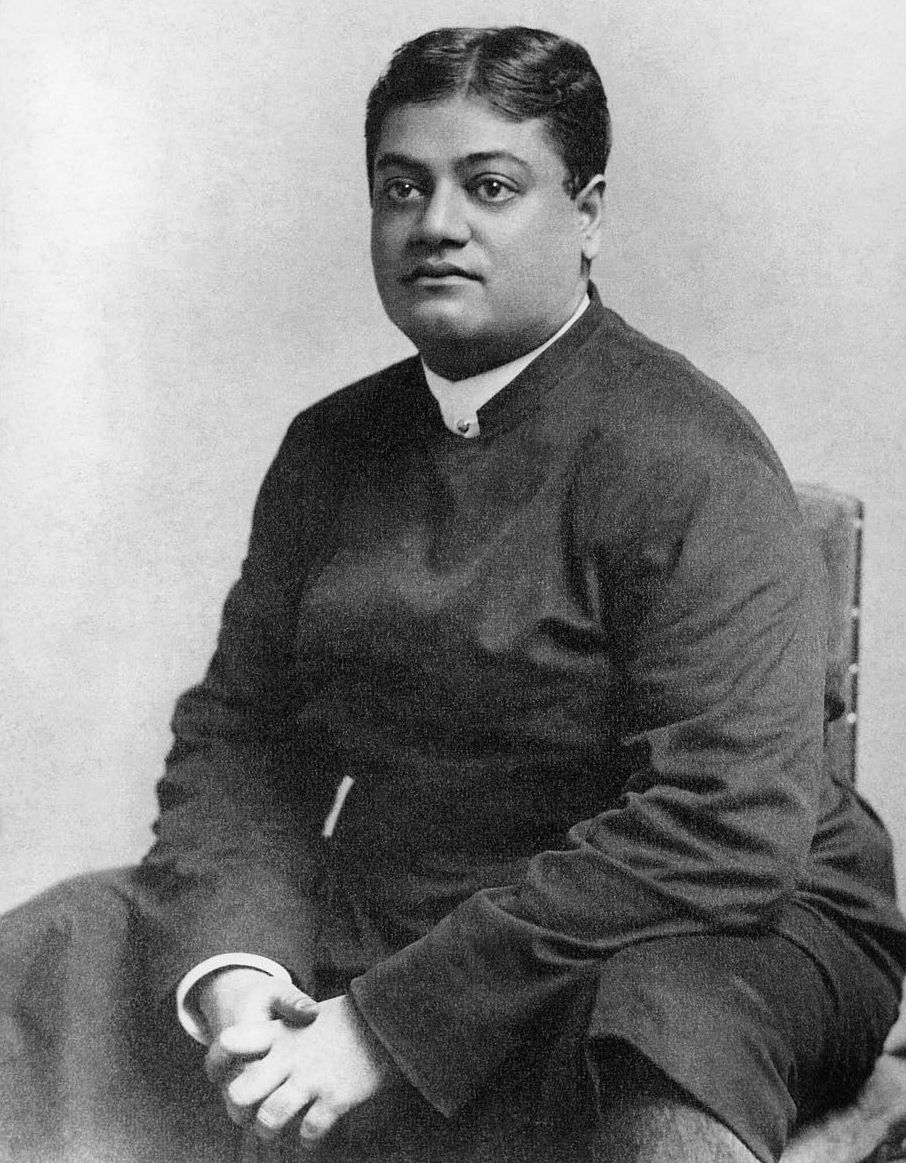

Photograph 47

LONDON, 1896

Swamiji returned to England the second time in April of 1896. He remained in England until July 19, when he left with a party of three (Captain and Mrs. Sevier, and Miss Henrietta Muller) for a European tour. On September 19, 1896, he came back to England once again, to remain until he left for India in December of the same year. Swamiji continued to attract and deeply influence people in England as the following excerpt from an article in the Indian Mirror published in the July 1896 issue of Prabuddha Bharata clearly illustrates:

He who has once listened to the great swami, is tempted to attend every lecture that he delivers. We cannot but own that the man possesses a great magnetic power or some power divine by which he even draws so many Londoners towards him.

My ideal indeed can be put into a few words and that is: to preach unto mankind their divinity, and how to make it manifest in every movement of life. (Letters, 294)
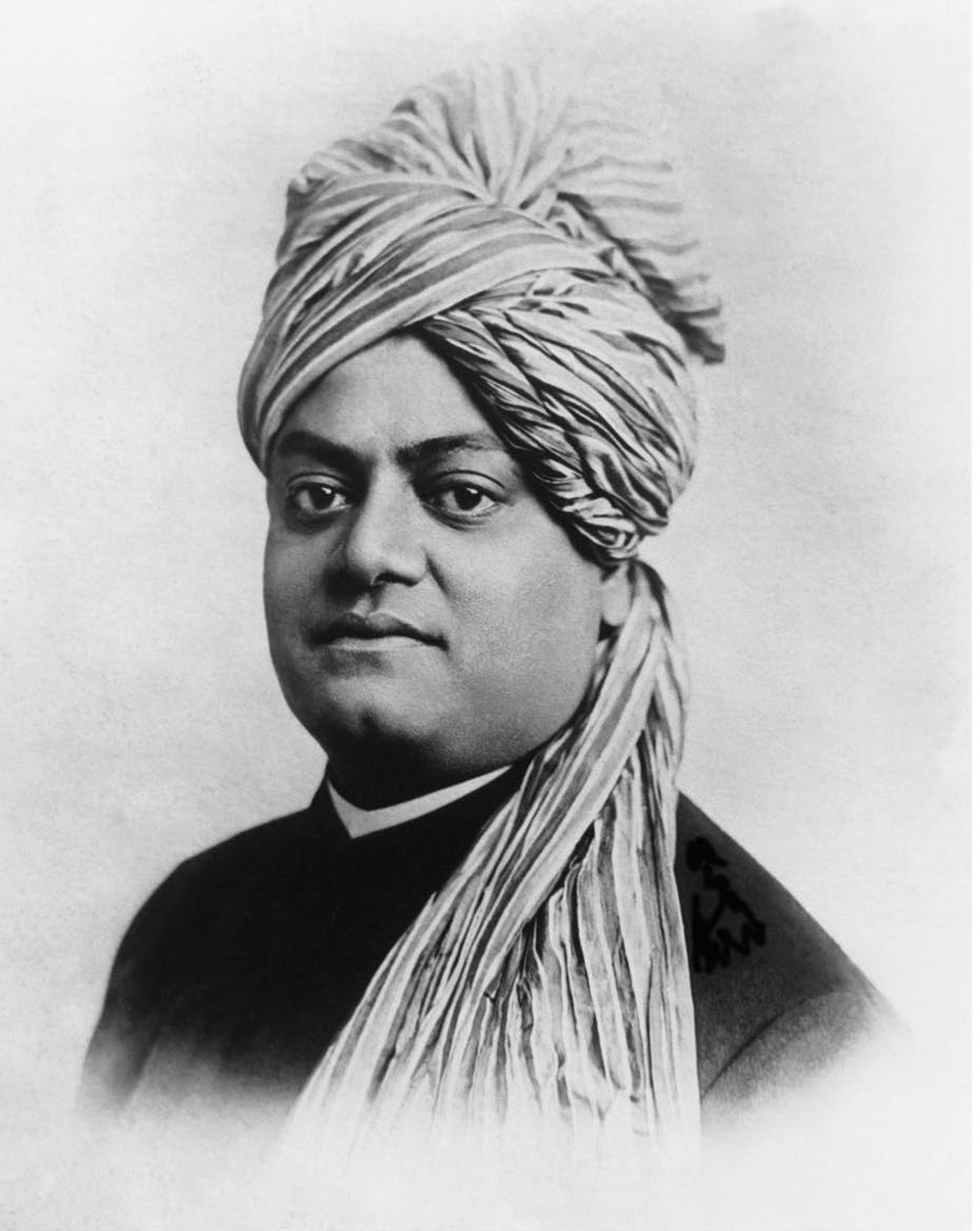

Photograph 48

LONDON, DECEMBER 1896

Miss Emmeline Souter, an admirer of Swamiji and a wealthy friend of the Reverend Hugh R. Haweis, arranged for some photographs to be made of Swamiji. In a letter written from Kolkata on May 5, 1897, to Margaret Noble (Sister Nivedita), Swamiji said: “The only help I got in the world was in England, from Miss Souter and Mr. Sturdy.”

According to New Discoveries Miss Souter had Swamiji professionally photographed before he left for India: “As the time for Swamiji’s departure from England drew near, Miss Souter, as though to stay the sun in its passage, had the professional photographer, Alfred Ellis, take [about] twelve studio pictures of him[39].”

However, “in recent years a proof sheet from the photographic studio of Alfred Ellis has come to light in which six (not twelve) poses of Swamiji are shown[40].” They are: (no. 48) the well-known meditation pose; (nos. 49 and 50) two full-length with robe and turban; (no. 51) one bust with robe and turban (right profile); (no. 52) one bust with bare head; and (no. 53) one full-length with robe and bare head. Three of the original photographs from the Ellis studio (nos. 49, 52, and 53) are in the archives of the Vedanta Society of Northern California.

There is another view regarding where this photo (no. 48) was taken. According to Swami Prabhananda of the Ramakrishna Mission Institute of Culture, oral tradition has it that this photograph (which is worshipped in many shrines of the Ramakrishna Order) was taken when Swamiji went into samadhi while demonstrating asanas during a raja yoga class in London.

This pursuit of the Infinite, this struggle to grasp the Infinite, this effort to get beyond the limitations of the senses—out of matter, as it were— and to evolve the spiritual man—this striving day and night to make the Infinite one with our being—this struggle itself is the grandest and most glorious that man can make. (JY, 14)
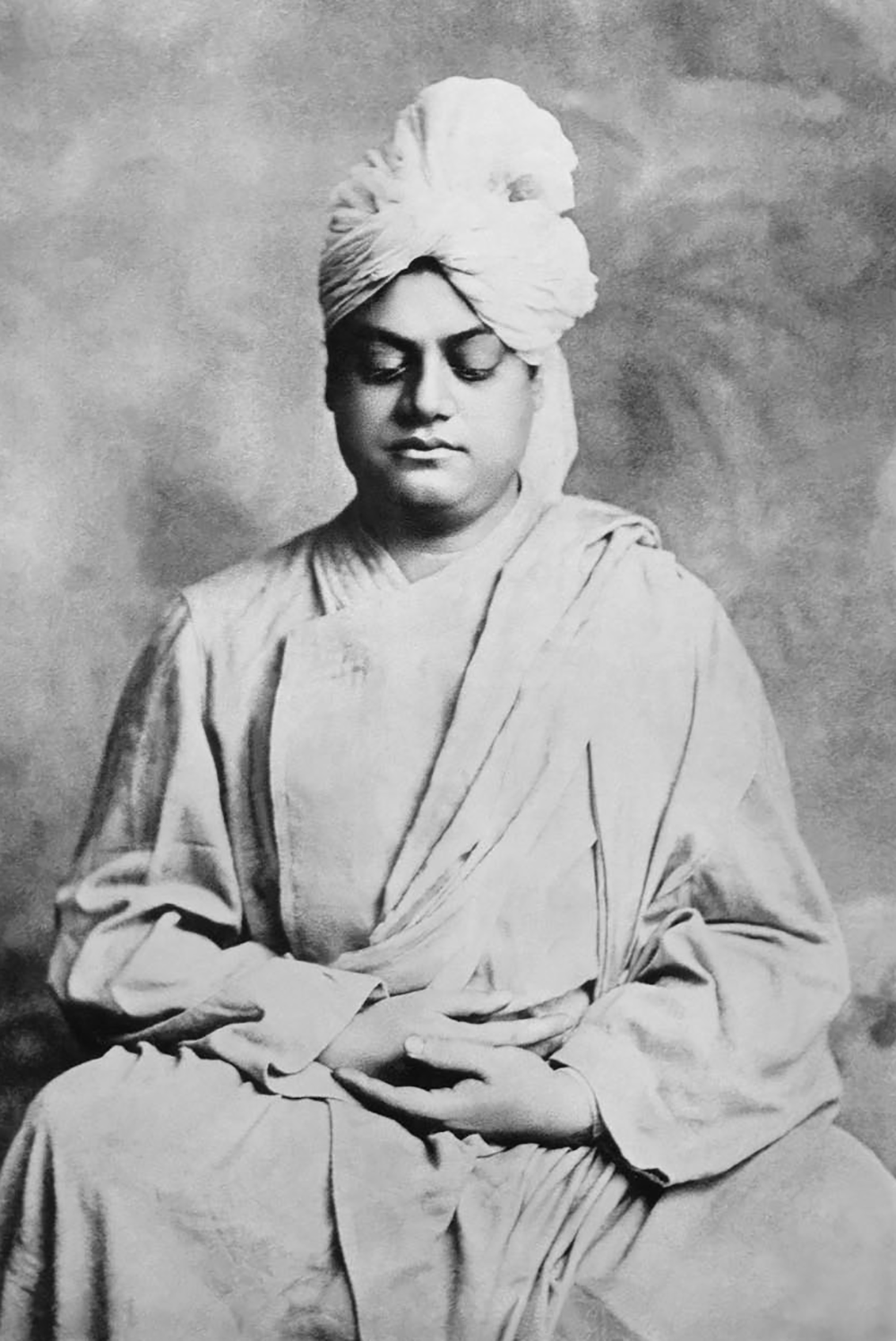

Photograph 49

LONDON, DECEMBER 1896

Eric Hammond in his reminiscences of Swamiji in London describes his appearance while lecturing:

It was a novel sight, a memorable experience. His dark skin, his deep glowing eyes, even his costume, attracted and fascinated. Above all, eloquence acclaimed him, the eloquence of inspiration[41].

The earth’s bravest and best will have to sacrifice themselves for the good of many, for the welfare of all. Buddhas by the hundred are necessary with eternal love and pity. . . . The world is in need of those whose life is one burning love, selfless. That love will make every word tell like thunderbolt. (Letters, 295)
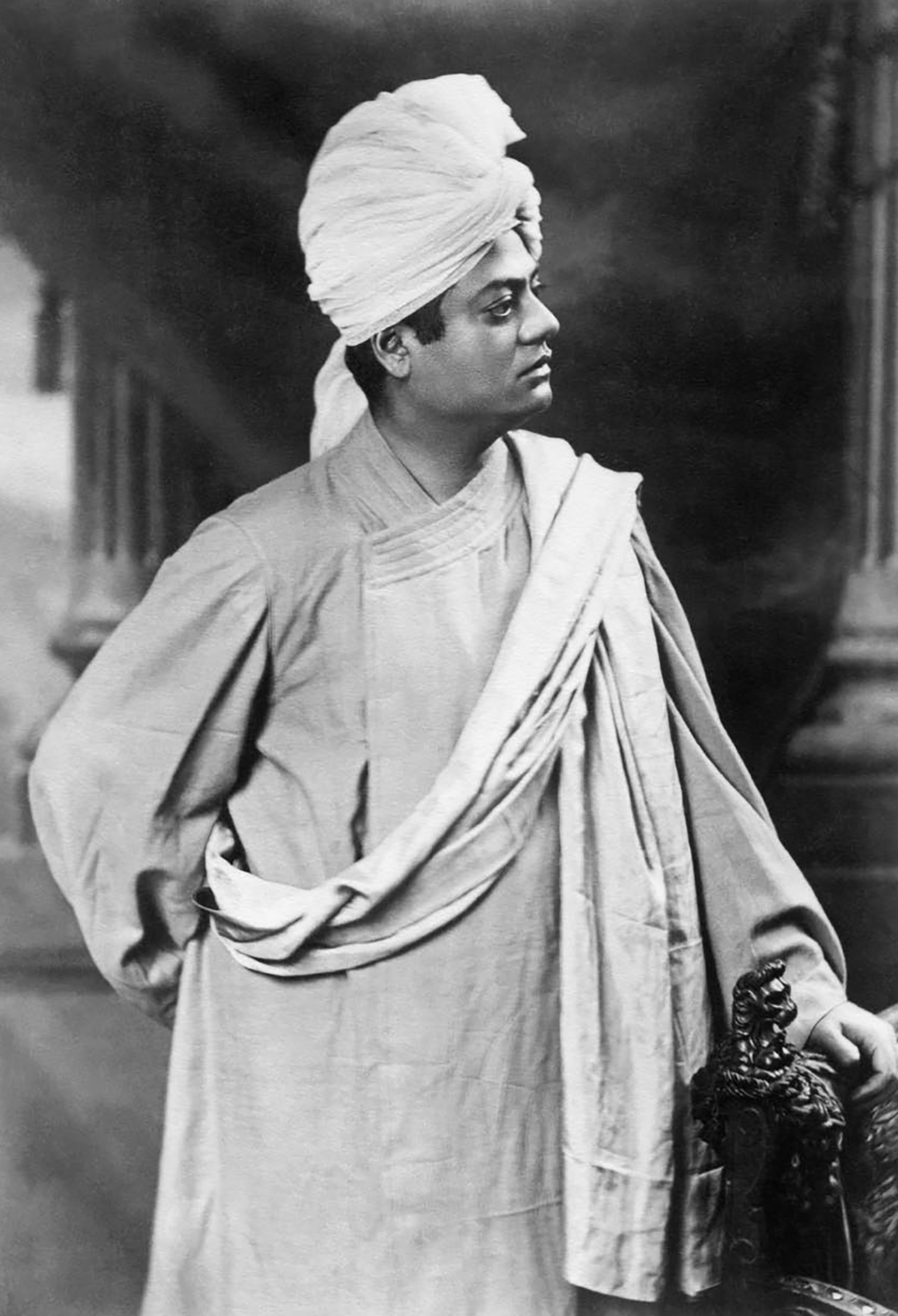

Photograph 50

LONDON, DECEMBER 1896

During his classes on jnana yoga:

Swamiji seemed to rise to a state bordering on the divine—awesome and yet infinitely gracious. [Mahendra Nath Datta, one of Swamiji’s younger brothers, remarked] “Face shining, he had lost his human nature and seemed like someone from a higher plane, as if his previous self had vanished and in its place there stood a powerful being[42].”

When it is all One, who is there to hate, who is there to struggle with? When it is all He, with whom can you fight? This explains the true nature of life; this explains the true nature of being. This is perfection, and this is God. (JY, 265)
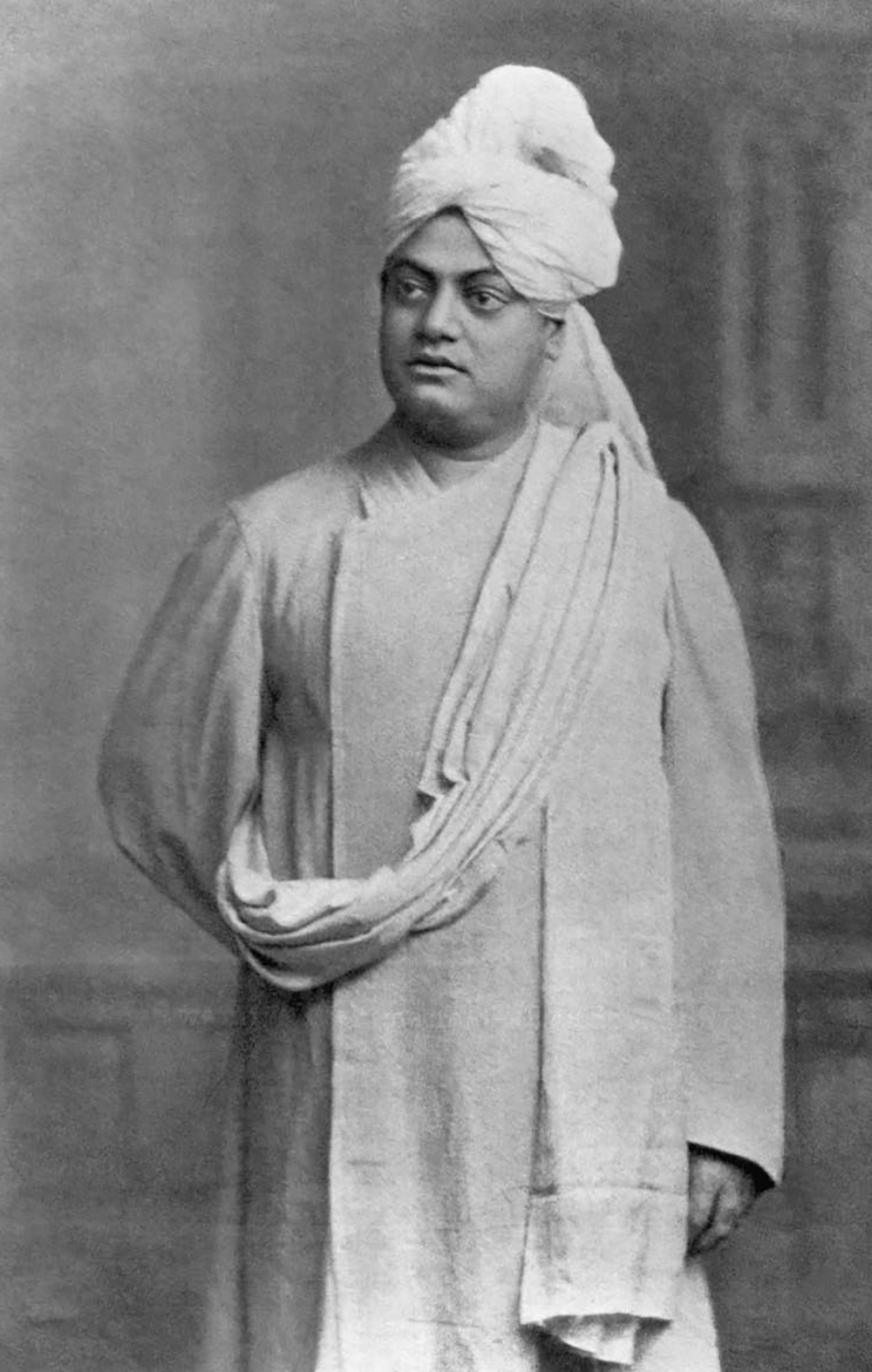

Photograph 51

LONDON, DECEMBER 1896

A charming story has come down to us that when Swami Abhedananda was to give his maiden speech in London in 1896, he said to Swamiji, who had just delivered his magnificent class-lecture, “God in Everything”: “You know, Naren, I don’t think I will speak this afternoon. Some other time. . . .” And Swamiji, who was a good deal more strongly built than Swami Abhedananda, replied fiercely, “Kali, you must speak, or I will throw you out that window!”[43]

This little separate self must die. Then we shall find that we are in the Real, and that Reality is God, and He is our own true nature, and He is always in us and with us. Let us live in Him and stand in Him. It is the only joyful state of existence. Life on the plane of the Spirit is the only life, and let us all try to attain to this realization. (JY, 173)
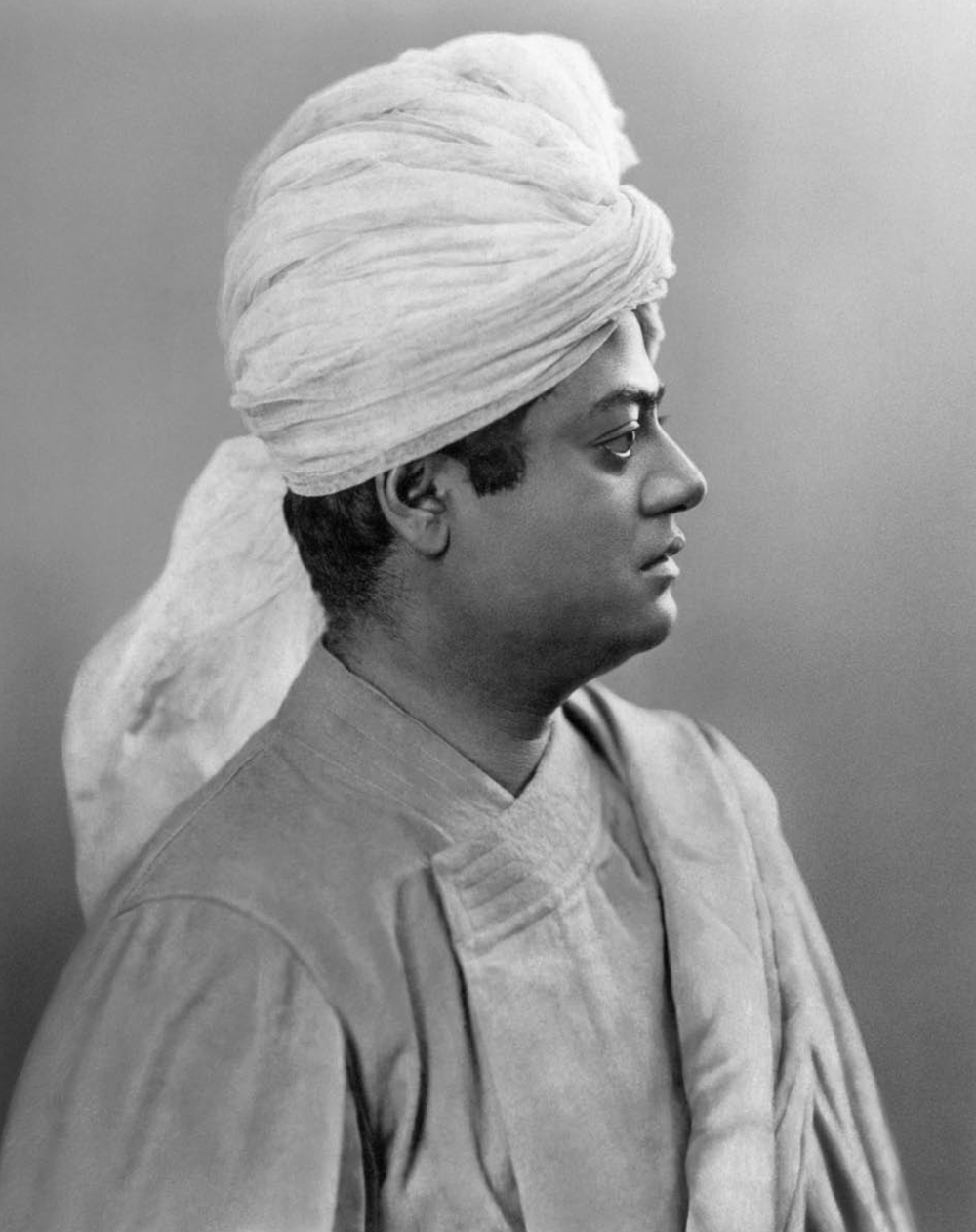

Photograph 52

LONDON, DECEMBER 1896

In his Bengali book, Londone Swami Vivekananda, Mahendra Nath has given us an insight into Swamiji’s inner world at this time:

“You see,” Swamiji said, “at night I go to my room and lie down. I keep quiet for a while, and then within me so much ananda arises that I cannot stay lying down. I see the Blissful Mother. Men, animals, the sky and earth—all are saturated with bliss. I cannot lie down any longer; so I get up and dance in the middle of the room. That bliss can no longer be confined within my heart. The whole world becomes filled with it, as it were.” Even as he said this, Swamiji began to dance like a child for a little while. Then he said with affection to those who were present, “Be happy, don’t be depressed; the Mother is everywhere; all will be filled with bliss!”[44]

The whole world is full of the Lord.

Open your eyes and see Him.

This is what Vedanta teaches. (JY, 133)
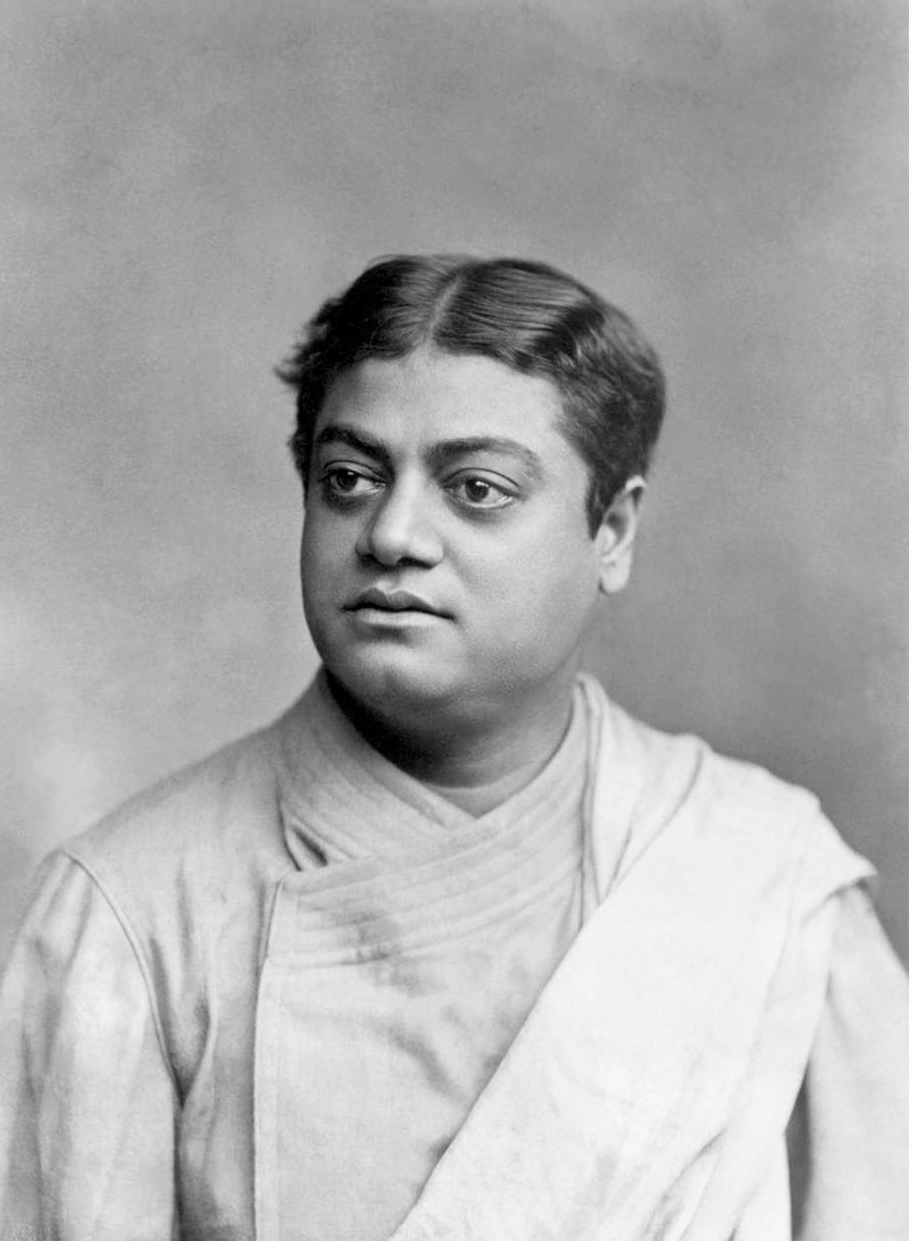

Photograph 53

LONDON, DECEMBER 1896

“Another day when sobersided Mr. Sturdy was not there, Swamiji and Swami Saradananda themselves tried (without much success) to ride a bicycle in front of the house. ‘That day,’ Mahendra, [who was with Swamiji in London at that time] recalled, ‘he was his boyish self, all jokes, and in a sweet voice he sang a Bengali song[45].’ ”

Some days I get into a sort of ecstasy. I feel that I must bless everyone, everything, love and embrace everything, and I do see that evil is a delusion. (Letters, 296)
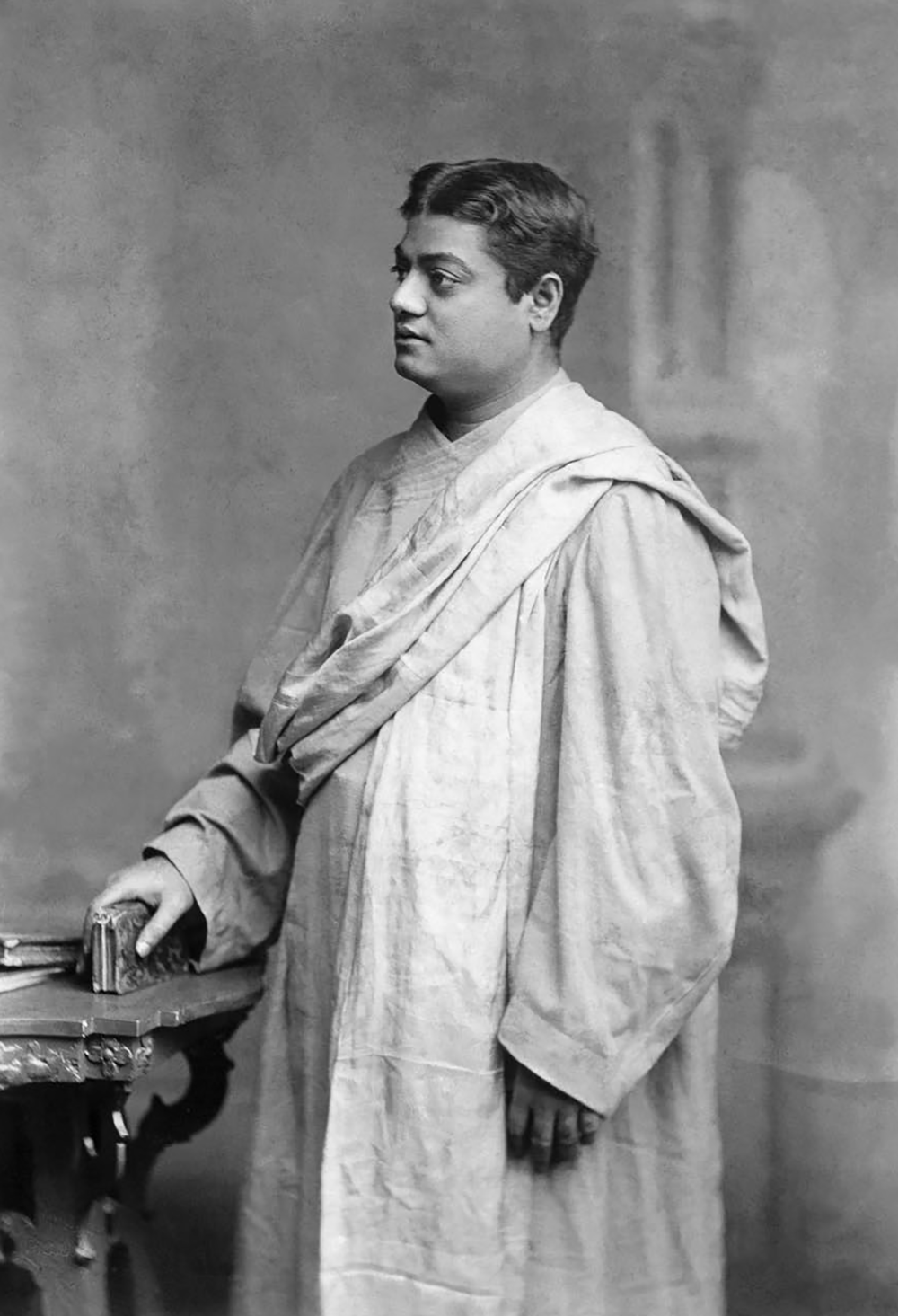
[1] Mrs. Herbert E. Hyde told to Marie Louise Burke (Sister Gargi), September 22, 1969.

[2] ND (1983) 1:152.

[3] PRRC, 532.

[4] Ibid., 504.

[5] ND (1983) 1:89.

[6] Ibid., 81.

[7] Pp. 142-43.

[8] P. 88.

[9] P. 90.

[10] Pp. 87-88.

[11] Pp. 90-91.

[12] WPR, 1:frontispiece.

[13] ND (1983) 1:134.

[14] WPR, 2:973.

[15] RSV, 122.

[16] WPR, 2:1582.

[17] ND (1983) 1:133-34.

[18] ND (1985) 3:34.

19. ND (1983) 1:172.

[20] Ibid., 173.

[21] ND (1984) 2:154.

[22] Ibid., 141-42.

[23] P. 154.

[24] Pp. 153-54.

[25] ND (1985) 3:391-92.

[26] Ibid., 25-26.

[27] RSV, 122-23.

[28] LSV (Kolkata, 1979) 1:29.

[29] ND (1985) 3:162-63.

[30] Ibid., 181.

[31] P. 240.

[32] Pp. 240-41.

[33] P. 241.

[34] RSV, 296.

[35] ND (1985) 3:248-49.

[36] VIN, 81.

[37] ND (1985) 3:257.

[38] LSV (Kolkata, 1981) 2:52.

[39] ND (1996) 4:521.

[40] Ibid., 529-30.

[41] RSV, 293.

[42] ND (1996) 4:189.

[43] Ibid., 387.

[44] P. 194.

[45] P. 142.

Chapter 3

The Prophet Returns

That Swami Vivekananda was a prophet for all mankind shines out from every facet of his being. We see it in his spoken word—his speeches and conversations; in his written word—his letters and his poems. We see it in his appearance as he is described by contemporaries, and as the camera caught him: his clothes, his posture, his eyes. One disciple, Swami Shuddhananda, remembered him shining in broad daylight. We see it in his chosen companions and correspondents, in his adversaries. We see it in the places he went, the subjects he liked, the books he read, the problems that concerned him. We see it even in his dreams. Sailing by the island of Crete in the Mediterranean Sea on his journey home from the West, he suddenly awoke from a dream-vision in which an ancient sage indicated to him the Buddhist origins of Christianity.

As the prophet returned home his large mind pondered the spiritual and social history of mankind, its great leaders, countries, and ideals, and how these could be used for the upliftment of all people of the world for centuries to come. He felt that India had made an enormous contribution to the world’s spiritual history; that India’s spiritual power, though dormant, was essential for mankind’s regeneration. Yet India was then in darkness; its educated men and women had lost faith in their heritage, and its masses and women were oppressed. What could he do? These were not simply problems for Swamiji’s mind; they were heartaches, and the large heart of a prophet drove him to find solutions. So as he headed toward India at the very beginning of 1897 he was brooding over what he had accomplished in the West and what he had learned from the West to help him in the Indian part of his mission to awaken his people to their heritage and to lift oppression from women and the masses. He wanted the spiritual message of India—man’s innate divinity and freedom—to spread everywhere. All along Swamiji knew the divine power as embodied in his master, Sri Ramakrishna, was behind him, and that his work was part of an international, indeed a cosmic scheme to liberate the people of the world from their bonds. He wrote in January 1898 to a Bengali woman: “To advance oneself towards freedom, physical, mental and spiritual, and to help others to do so is the supreme prize of man.” With his successful teaching in the West he felt he had completed at least half of his grand mission. But he had given his best energies to the West, especially America, and now as he approached his homeland he was tired and working against time. He had told his friends that he had just a few more years to live.

In regard to Swami Vivekananda’s Indian work in the two and a half years between his visits to the West we have such a wealth of descriptions and photos that we, over a hundred years later, can almost see him directly. We can see his countrymen welcoming him, his traveling companions and their reactions to him, what he looked like and how he felt. We can see his plan unfolding and virtually completed before our very eyes. First, let us study the pictures of his arrival at Colombo in January of 1897 and his triumphal journey to his native city of Kolkata. In one photo we have of Swamiji at Colombo he looks like a world prophet, a conqueror in the realm of the Spirit. He wears a combination of Western lecture robes with Indian chaddar and what must have been a bright gerrua turban; his expression is serious and his eyes inward. By the time he reaches Kolkata we see him pictured with the shaven head, unseamed garments and bare shoulder of a classical monk; he has the same commanding look of a spiritual emperor.
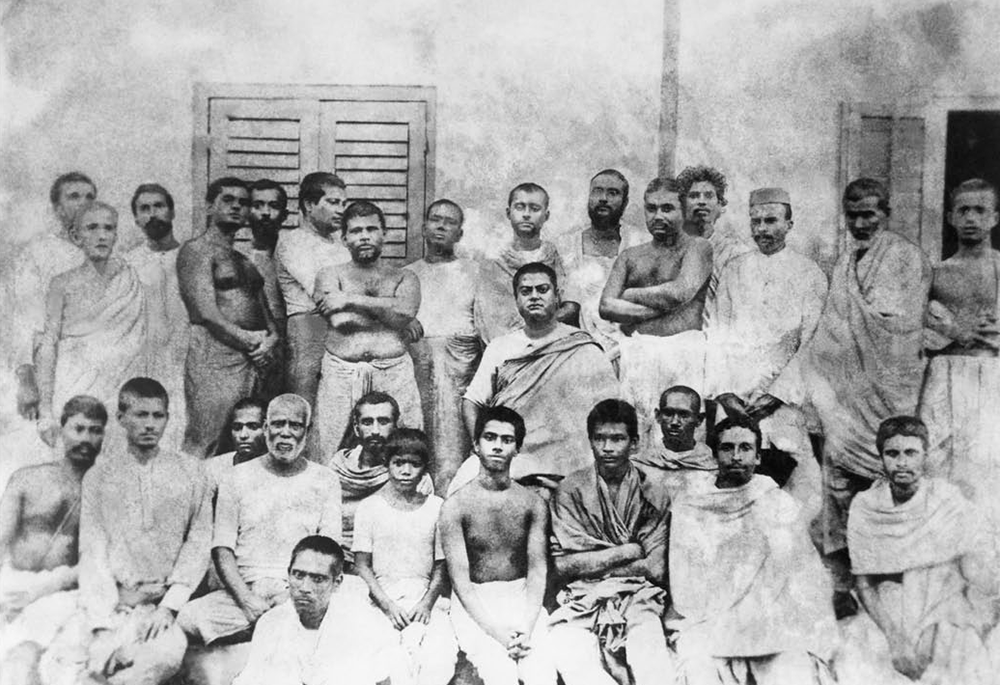
As for the reception of Swamiji from Colombo to Kolkata and his reaction to it, we have accounts from his traveling companions, newspapers, and the letters of Swamiji himself. Thousands of people, rajas, speeches, gifts, elaborate decorations and music gave him a deity’s welcome. Everywhere he went the reception was tremendous, but the honor only impressed him because it showed by paying such tribute to a sannyasin that India was spiritual to the core. Writing from Ramnad on the tip of India to his American sister, Mary Hale, he described his huge reception and foretold the coming events: “Chennai and Kolkata are on the tiptoe of expectation as if the whole nation is rising to honor me. So, you see, Mary, I am on the very height of my destiny, yet the mind turns to quietness and peace, to the days we had in Chicago, of rest, of peace, and love, and that is why I write to you just now, and may this find you in health and peace.” Swamiji’s traveling companions have given us glimpses of Swamiji and his welcoming. His English disciples, J. J. Goodwin and Captain and Mrs. Sevier, who gave up everything including homeland to follow Swamiji, spoke of the adoration given him as an avatar of Shiva and the near-worship accorded them as his followers. They also spoke of the punishing austerities Swamiji and they themselves had to undergo while speaking from place to place among the crowds in the primitive travel conditions of those days. His other traveling companions, Swami Shivananda and Swami Niranjanananda, who came from North India to welcome him, give us another glimpse of Swamiji. They witnessed their great brother going again and again into short “samadhis” even as he sat conversing with people.
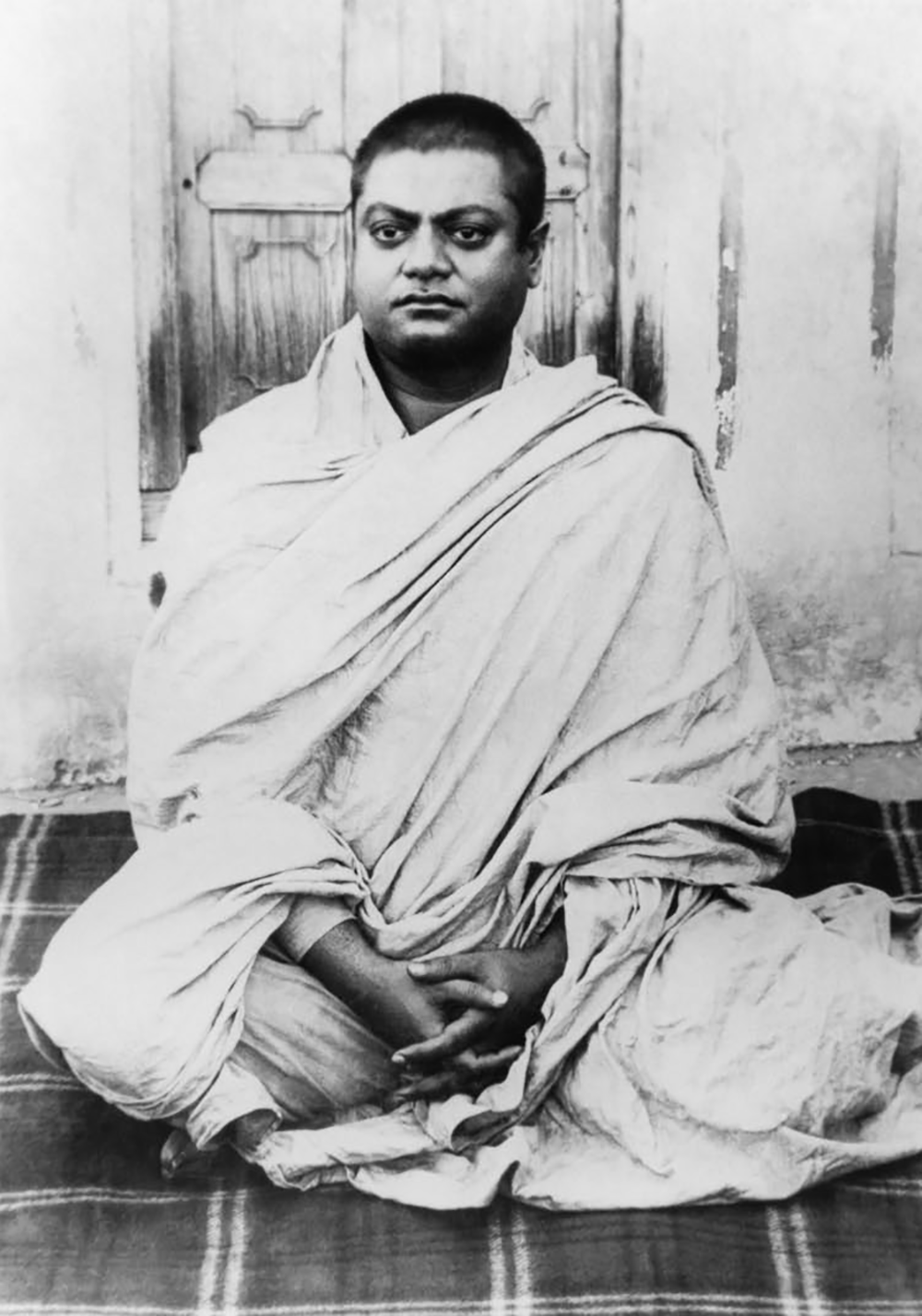
Now before we study the photos for all of the India work, 1897 to 1899, we should get an overall picture from Swamiji himself of his plan. From his letters and talks we see that he wanted to get what he liked to call his “machine” in working order so that it would go on benefiting mankind for centuries to come. Some of the crucial parts of the machine were as follows: the monastery based in Kolkata with branches in the Himalayas and Chennai, his Western women disciples’ work for the benefit of women, publications in English and Bengali, a mission organization for teaching and for relief work in India and the world, centers in the villages for helping people and spreading the message, teaching centers in the West and well-trained teachers for India and the West. Each of these parts of the machine was to be geared to the practice of service of God in people, especially those in distress, and centered around Sri Ramakrishna, who embodied the ideals of the movement. This service, or worship of the divine in people as Swamiji liked to call it, was to be dynamic in both the server and the person served. Spiritual and secular education as well as physical help were to be given by the server, and self-help and self-knowledge were to be developed by the receiver. And thus in time the receiver of help would become another giver of help and the work would spread.
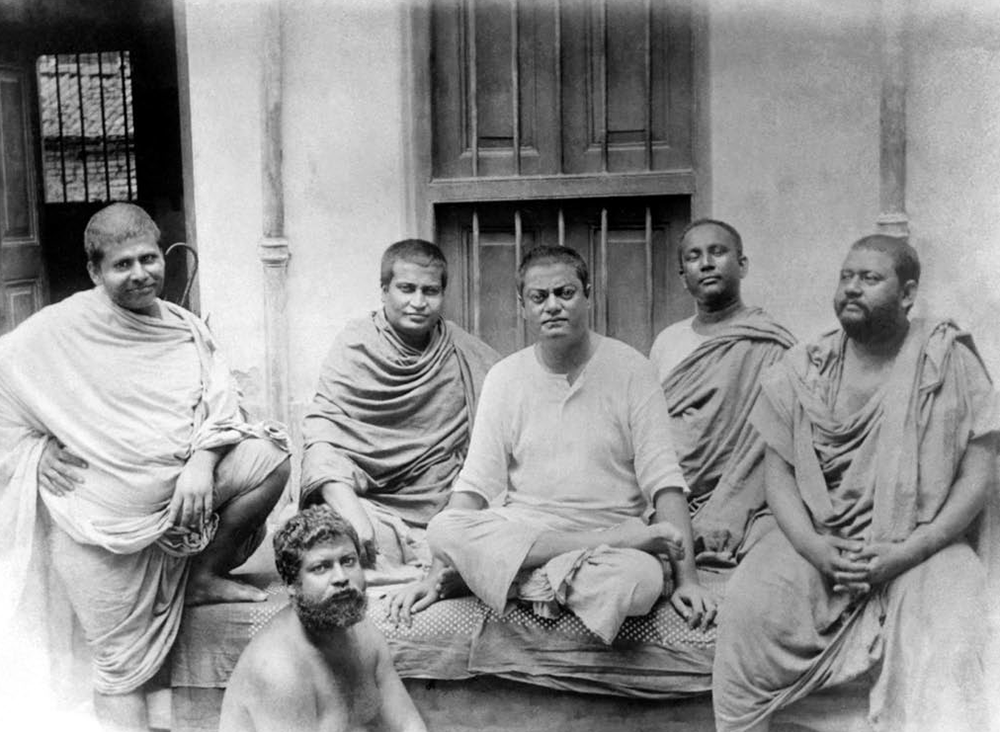
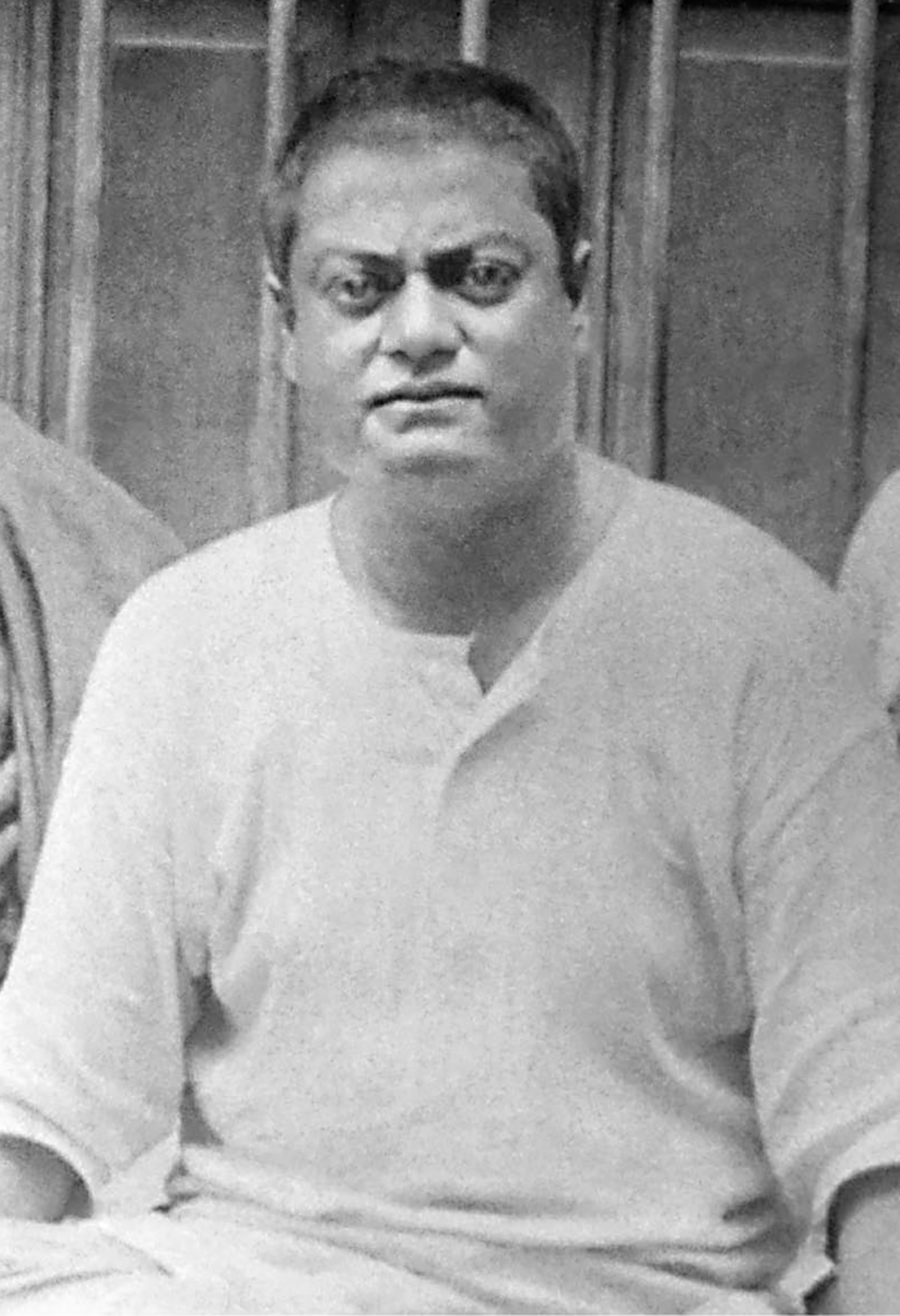
Swamiji believed the beginnings, especially the first leaders of the whole organization and of each unit, were very important. Writing to Swami Akhandananda in February of 1900, Swamiji would give his mature thinking on the subject: “When a great work is being done, when the foundations are laid . . . when superhuman energy is needed, it is one or two extraordinary men who silently and noiselessly work through a world of difficulties. When thousands of people are benefited there is a great hue and cry, and the whole country is loud in notes of praise. But then the machine has already been set agoing and even a boy can work it or a fool add to it some impetus. Grasp this, that that benefit done to a village or two with its 20 orphans, those 10 or 20 workers—that these are enough, that they form the nucleus, never to be destroyed. From these hundreds of thousands of people will be benefited in time. Now we want half a dozen lions, then excellent work will be turned out by even hundreds of jackals.” From this we can see why Swamiji gave so much of his superhuman energy to the beginnings, to the selecting and training of the leaders—his lions. Through his thoughts and meditations, his letters, talks and actions he trained the leaders and started the units so that by the time he went to the West in June of 1899 he felt his machine was sound and running.

During these years, 1897-99, Swamiji spent roughly half of his time working in Kolkata and the rest traveling in North India and the Himalayas. In 1897 he spent a few days in Chennai, a south Indian city important to the Ramakrishna movement, and soon sent his brother monk, Swami Ramakrishnananda, to build up the work there. In the same summer the doctors ordered him to take rest in the Himalayas because his health was failing, but even then he carried on the work through correspondence and other activities. We see from the letters of this period that he was enjoying himself immensely. From Almora on July 10 he wrote to Josephine MacLeod: “I had a great mind to go to Tibet this year, but they would not allow me, as the road is dreadfully fatiguing. However I content myself with galloping hard over precipices on mountain ponies. That is more exciting than your bicycle even.” And we hear from a firsthand observer that the Almora folks were delighted with their mounted sadhu. Everywhere he went, of course, Swamiji attracted people—from rajas to little servant girls—and he was doubtless his own best ambassador for his philosophy of seeing God in man. We can imagine nothing more engaging than his letter about the work to Swami Akhandananda from Almora which concludes: “Do this kind of work, and I shall carry you on my shoulders—bravo! You will see that by degrees every district will become a center—and that a permanent one. I am soon going down to the plains. I am a fighter and shall die in the battlefield. Does it behoove me to sit up here like a zenana lady?”

For a picture of his Kolkata work we have the words of many keen observers besides Swamiji himself, including his brother monks and his Indian and Western women disciples. One of the best reporters of both Swamiji’s teachings and activities was Sarat Chandra Chakravarti who later recorded them in the wonderful book, Talks with Swami Vivekananda. So vast are Swamiji’s ideas and the scope of his work during these Kolkata days that we can do no more than recommend the reading of these accounts and list here a few of the outstanding events they speak of. On May 1, 1897, the Ramakrishna Mission was started. In the beginning of 1898 Mrs. Ole Bull, Josephine MacLeod, and Sister Nivedita came to live in a cottage on the newly purchased Belur Math grounds. Sri Sarada Devi, the revered Mother of the Ramakrishna movement, defied orthodoxy and accepted Swamiji’s Western women disciples as her own daughters. Sarada Devi also came to bless the new monastery at Belur as well as Sister Nivedita’s new school. In May of 1898 a successful relief program for plague victims was carried on by members of the Math and Mission. Sister Nivedita took the vows of brahmacharya in the Ramakrishna Order at a beautiful ceremony in the monastery shrine presided over by Swamiji. Swamiji made several new sannyasins who would later become great workers in the order. In early 1899 the Bengali magazine Udbodhan was started under the editorship of Swami Trigunatita. On December 9, 1898, Swami Vivekananda carried on his shoulders the relics of the Master from the temporary math at Nilambar Babu’s garden house to the new monastery grounds, which have become the grand Belur Math headquarters of today.

Swami Vivekananda’s stays in the Himalayas during these years were also memorable, full of events and teachings that would have far-reaching consequences for his mission, and indeed for his own inner being. Along with his brother monks and his disciples, both Indian and Western, he stayed long periods in places like Almora, Darjeeling and Kashmir. Probably the best-chronicled of these tours, and the most eventful, is the one which ran from June to November 1898. He had with him a large party of monks and men disciples as well as a smaller party of Western women disciples to whom he gave a very intensive training while enjoying the mountains and shrines, and carrying on his usual international correspondence. Swamiji loved the Himalayas, especially the Vale of Kashmir, which he considered the most beautiful place in the world. He seemed to be at home in the mountains; some of the photos taken there show him to be serene and happy

Sister Nivedita’s Notes of Some Wanderings with the Swami Vivekananda is an excellent source book of Swamiji’s methods of training a worker and disciple, as well as of his own thoughts and experiences during the 1898 tour. This small but powerful book tells what Nivedita and her fellow disciples learned from him about personal spiritual practice and general Indian religion and culture, both aspects of their training as workers. In writing this book, as with all her writings about her master, Nivedita was very much aware that she was handing down a precious legacy to future Vedantins.

Swami Vivekananda reacted to the experiences that he had during this stay in the mountains by composing poems, which he gave to the fortunate disciples who were with him. “Requiescat in Pace” was written in memory of his beloved disciple Goodwin, to whom all of us are deeply indebted for his verbatim transcripts of Swamiji’s lectures. In this poem Swamiji pays tribute, perhaps for all of us, to the unselfish souls who give their lives for others. “The Fourth of July,” composed for an Independence Day party given for his American disciples, is a tribute to America’s contribution to human freedom. Who could predict on that happy occasion that he would pay a second tribute to the Fourth of July by giving up his body on that day four years later? “To the Awakened India” he wrote in honor of the first issue of the English language magazine Prabuddha Bharata from its new Himalayan place of publication; it is clearly a tribute to India’s contribution to the spiritual freedom of mankind. Swamiji’s tremendous spiritual experiences in Kashmir—his vision of Shiva at Amarnath, and of the Divine Mother at Kshir Bhavani—inspired the writing of “Kali the Mother,” whose heroic theme is the worship of the terrible aspect of the one divine power behind the universe. On this trip in the Himalayas Swamiji emphasized to his Western disciples the deities Shiva and the Divine Mother, because, as he said, their devotees make the best workers. He took Nivedita, whom he wanted to become a real “lioness” in her work with Indian women, to the sacred cave of Amarnath to dedicate her to Shiva.

Swamiji himself was very much moved by his experiences in the Himalayas, and, it is interesting to note, he read aloud his poetry to the monks when he returned to the Kolkata monastery. A permanent center in the mountains was an essential part of his great plan, and since their arrival in India with their guru, the Seviers had earnestly been searching for an appropriate site. The swami wanted a place with a congenial climate where his Eastern and Western disciples could individually engage in pure monistic practices and together work on the publications of the Mission. He was therefore overjoyed when Mayavati was found by the Seviers and was finally dedicated on the occasion of Sri Ramakrishna’s public birthday celebration, 1899. One unhappy consequence of his 1898 trip to the mountains was that his tremendous spiritual experiences told on his health. Swami Brahmananda, who was now managing the monastery at Belur, was very worried. Eventually it was decided that a sea voyage to the West would help him recover his health; so in June of 1899 Swamiji, along with Swami Turiyananda and Sister Nivedita, sailed for the West.

Before we conclude this section let us study the group photos for this period. We can see from the variety of people pictured with Swamiji that he belonged to just about everybody in the world. There are turbaned or bareheaded Indian gentlemen in Western suits, turbaned Kashmiri men in Indian coats and trousers, a smiling little boy in a fancy fez and Western coat, a serious little boy with bangs in a tee shirt and dhoti, an orthodox South Indian with Vaishnava headdress and costume. There are Western men and women in Indian dress or Western dress, both fashionable and plain, sitting beside Indian monks who are clean-shaven or bearded and in all manner of garb. Conspicuously absent from the photos are servants, laborers, and Indian women and girls. But they are very much in the picture as far as Swamiji was concerned; so descriptions of them abound in the literature. Sister Nivedita describes their Kashmiri boatman’s tiny daughter, whom Swamiji regarded as the Divine Mother, Uma, and who found no task too difficult to perform for the great swami. One could write a whole essay on the photo of Swamiji in Kashmir with his Western women disciples. Each individual is a study, each a manifestation of the same unchanging Soul, “the same mad-cap Atman,” as Swamiji was to say a few months later about himself, “mad upon one idea, intent and intense.”


❊ ❊ ❊

There is but One⎯The Free⎯Knower—Self !

Without a name,

without a form or stain.

In Him is Maya,

dreaming all this dream.

The Witness,

He appears as nature, soul.

Know thou art That,

Sannyasin bold! Say—

“Om Tat Sat, Om!”

❊ ❊ ❊


❊ ❊ ❊

We shall crush the stars

to atoms,

and unhinge the universe.

Don’t you know who we are?

We are the servants

of Sri Ramakrishna.

❊ ❊ ❊

Photographs

Photograph 54

COLOMBO, JANUARY 1897

Swamiji returned from the West for the first time in January 1897. It was a triumphal time of great rejoicing. He never expected such a tremendous reception from his countrymen. Arriving in Colombo on January 15, he left on the nineteenth for Kandy. Sometime during this four-day period three photographs of Swamiji were taken (nos. 54, 56, and 57). An early print of no. 54 bears the name of the photographer “A. W. Andree, Columbo.” Since Swamiji was in Colombo such a short time, it seems reasonable that the other two photos were taken at the same sitting. His appearance also suggests this. In all three pictures the tail of his turban, which is draped over his left shoulder, is tucked under his chaddar.

Upon request Mrs. Poomani Gulasingam, a devotee of the Ramakrishna Mission in Colombo and a lecturer at Colombo University, researched the provenance of Swamiji’s photos taken in Colombo. Mrs. Gulasingam reviewed newspapers of the period and tried to contact Andree’s descendants with no luck.

For months she, along with others, exhaustively pursued various avenues of information about the photos, including contacting some of the descendants of the families who had come into close contact with Swamiji during his visit, some of whom had participated in the reception accorded to Swamiji. Collections of old photographs and documents, both public and private, as well as the Colombo Archives were thoroughly searched. Mrs. Gulasingam had said earlier: “There is a strong belief among old devotees that one of these photographs was taken on 16 January 1897 during the public lecture in the Floral Hall and the others on 19 January 1897 at the Public Hall.” So far her research has not substantiated this.

Although it is true that Swamiji gave talks in both of these places in Colombo, it remains to be seen if the photographs were actually taken in these halls on those occasions. From all appearances they seem to be studio photographs.

“ That which exists is One; sages call It by various names.” It is not that Shiva is superior to Vishnu, not that Vishnu is everything and Shiva is nothing, but it is the same one whom you call either Shiva, or Vishnu, or by a hundred other names. The names are different, but it is the same one. (CW [1973] 3:113)


Photograph 55

COLOMBO, JANUARY 1897

Crop of photograph 54.

The one great lesson, therefore, that the world wants most, that the world has yet to learn from India, is the idea not only of toleration, but of sympathy. Well has it been said in the Mahimnah-stotra: “As the different rivers, taking their start from different mountains, running straight or crooked, at last come unto the ocean, so, O Shiva, the different paths which men take through different tendencies, various though they appear, crooked or straight, all lead unto Thee.” (CW [1973] 3:114)


Photograph 56

COLOMBO, JANUARY 1897 

This pose of Swamiji is reminiscent of the famous Chicago pose of 1893. J. J. Goodwin, one of Swamiji’s beloved English disciples who was with him at the time, wrote a letter on January 22, 1897, to Mrs. Ole Bull in which he described their reception in Colombo. On Sunday, January 17, Swamiji and his party visited a local temple in the Tamil quarter of the city. In his elaborate account of the honor accorded Swamiji, Goodwin makes an interesting comment: “The Seviers and I, but particularly myself, have come in for an enormous amount of attention. We are always sprinkled with rose water and given sandalwood. One man wanted me to be photographed with the swami so that he might worship me with Swamiji.” 

The question naturally arises: on this occasion was a photograph actually taken of Swamiji, either with Goodwin or just by himself? Since the letter is not published in full, an answer to this question is not known at present; however, future research may throw more light on this incident.

Each race has a peculiar bent, each race has a peculiar raison d’etre, each race has a peculiar mission to fulfill in the life of the world. Each race has to make its own result, to fulfill its own mission. Political greatness or military power is never the mission of our race; it never was, and, mark my words, it never will be. But there has been the other mission given to us, which is to conserve, to preserve, to accumulate, as it were, into a dynamo, all the spiritual energy of the race, and that concentrated energy is to pour forth in a deluge on the world whenever circumstances are propitious. (CW [1973] 3:108)


Photograph 57

COLOMBO, JANUARY 1897

An excerpt from a Colombo local paper, the Ceylon Independent, describes how Swamiji was received when he arrived there: “As the day was closing and the night approached, when the auspicious and sacred hour of ‘sandhya’ noted by the Hindu shastras as the best suited for devotion came round as the harbinger of the coming great events of the day, the sage of noble figure, of sedate countenance with large, luminous eyes, arrived, dressed in the orange garb of a sannyasin, accompanied by the Swami Niranjanananda and others. . . . No words can describe the feelings of the vast masses and their expressions of love, when they saw the steam launch bearing the sage, steaming towards the jetty[1].”

At the beginning of this century [twentieth century], Schopenhauer, the great German philosopher, studying from a not very clear translation of the Vedas made from an old translation into Persian and thence by a young Frenchman into Latin, says, “In the whole world there is no study so beneficial and so elevating as that of the Upanishads. It has been the solace of my life, it will be the solace of my death.” This great German sage foretold that, “The world is about to see a revolution in thought more extensive and more powerful than that which was witnessed by the Renaissance of Greek Literature,” and today his predictions are coming to pass. (CW [1973] 3:109)


Photograph 58

CHENNAI, FEBRUARY 1897

A quaint and charming article appeared in the April 1897 issue of Prabuddha Bharata concerning photos 58 and 59:

THE PHOTO-TYPE OF SWAMI VIVEKANANDA: Herewith, we gladly send the photo-type of Swami Vivekananda. It is the best likeness we have been able to send to our subscribers. It is from a half-tone block prepared for us by Messrs. S. K. Lawton and Co., of Jaffna, Ceylon, from a photograph specially taken here by Mr. T. G. Appavan Mudaliar, No. 3, Veeraraghava Mudali Street, Triplicane, Chennai. We are sure many would be glad to have the likeness of the swami in his simple Indian sannyasi dress and position. We are sorry to announce that many of our subscribers have not as yet sent us the small amount of two annas, we asked of them, to meet the extra cost in printing these photo-types on separate sheets. Nevertheless, we have sent a copy of the above photo-type to each of our subscribers, in the fullest hope that such of our subscribers as have not already remitted the amount, will not fail to remit the same at their earliest convenience. We can never bring ourselves to believe that any of the subscribers of the “Awakened India” will fail to send this small amount of two annas for both the photo-types. We tender our thanks to those of our subscribers who have already remitted the amount so promptly; we regret that we cannot find space to publish their names.

We, of course, tender our thanks to Mr. T. G. Appavan Mudaliar for taking such beautiful photos of Swamiji. In the February 1897 issue of Prabuddha Bharata there is some information about Mr. Mudaliar. He was a well-known photographer of South India of those days and was himself a bhakta or devotee. The subject matter of his photographs which was mainly religious—temples and images—reflected his own religious temperament. He could not have found a more divine being than Swamiji to photograph and he surely must have recognized that.

The Sri Ramakrishna Math, Chennai, was consulted as to whether they knew anything further about Mr. Mudaliar. The Chennai Math researched the matter. Apparently the house which is located at Mudaliar’s old address was built in the 1920s; it is uncertain what existed on that lot before 1920. Another possibility is that No. 3 Veeraraghava Mudali Street (in the 1890s) may have been renumbered later. Renumberings have taken place in many parts of the city. Unfortunately the Math has been unable to trace Mudaliar’s residence or family.

In future if the Mudaliar descendants could be located, perhaps further information about Swamiji’s Chennai photos could be brought to light. Investigating the company in Ceylon that prepared the halftone blocks for Swamiji’s photos is precluded by the present political situation in that area.

❊ ❊ ❊

Let the sages blame

or let them praise;

let the goddess of fortune come

or let her go wherever she likes;

let death come today,

or let it come in hundreds of years;

he indeed is the steady man

who does not move one inch

from the way of truth.

(CW [l973] 3:226)

❊ ❊ ❊


Photograph 59

CHENNAI, FEBRUARY 1897

It is not known to date who arranged for Mr. T. G. Appavan Mudaliar to take these two photos. However, it seems likely that one of Swamiji’s admirers was behind it, like K. Sundararama Iyer, or Biligiri Iyengar, who provided his residence—Castle Kernan (later named Vivekananda House)—for Swamiji’s nine-day stay in Chennai, or perhaps one of Swamiji’s ardent Chennai disciples. K. Sundararama Iyer said of Swamiji at that time: 

I enjoyed the infinite pleasure and privilege of once more looking at his wonderful eyes direct, recalling to my recollection all he had achieved and mentally running over what his future career might be as the future minister of the Vedic religion[2].

Chennai, 1897 

This has first to be heard, then thought upon, then meditated upon. Let the people hear first, and whoever helps in making the people hear about the great truths in their own scriptures cannot make for himself a better karma today. Says our Vyasa, “In the Kali Yuga there is one karma left. Sacrifices and tremendous tapasyas are of no avail now. Of karma one remains, and that is the karma of giving.” (CW [1973] 3:221)


Photograph 60

CHENNAI, FEBRUARY 1897

Sitting on chair (left to right): 

Tarapada (a monk from another order), Swami Shivananda, 

Swami Vivekananda, Swami Niranjanananda, and Swami Sadananda.

Standing (left to right): 

Alasinga Perumal, J. J. Goodwin, M. N. Banerjee, and other local devotees.

Front row (left to right): 

(second) Biligiri Iyengar, (fourth) M. C. Nanjunda Rao[3].

This photo appears to have been taken a few days after the two single ones (nos. 58, 59) of Swamiji. In all respects his appearance is the same, except that his shaven head shows signs of a few days’ growth. It seems quite possible that Mr. Mudaliar took this group photo as well. One can well imagine that he could have come to Castle Kernan where Swamiji was staying. It seems unlikely that so many people, especially the local devotees, would go to a studio to have an official photograph taken.

Mr. Sundararama Iyer mentioned in his reminiscences: At last the train steamed into the station to the great delight of all who had gathered there and been kept waiting owing to the lateness of its arrival. The swami alighted in company with two of his fellow disciples of Sri Ramakrishna [Swamis Shivananda and Niranjanananda] and another who was his own disciple [Swami Sadananda] and had been attracted to him while he was formerly a stationmaster in some railway line in North India. They had gone to Colombo to meet him and to give him new kashaya (ochre) clothing for his wear as an Indian sannyasin in lieu of his European costume. The swami was also accompanied by Mr. Goodwin, the Englishman who had been engaged to take down in shorthand his lectures in America and who had become his disciple and refused to accept any wages for his work and now had got himself attached to the swami for the rest of his life. He was clothed in purely Indian and brahmin costume to the surprise of us all[4].

He goes on to say that when Swamiji was with his brother disciples at Castle Kernan: “Their simple ways and hearty greetings, their easy manners and frank unconventional behavior towards each other, were very attractive to all who had the privilege of getting into the interior of Castle Kernan[5].”

❊ ❊ ❊

Go back to your Upanishads—

the shining, the strengthening,

the bright philosophy—and part from

all these mysterious things, all these weakening things.

Take up this philosophy; the greatest truths

are the simplest things in the world,

simple as your own existence.

The truths of the Upanishads are before you.

Take them up, live up to them.

(CW [1973] 3:225)

❊ ❊ ❊


Photograph 61 

CHENNAI, FEBRUARY 1897

Crop from previous group photo.

I s it such a bad choice in this world to think not of matter but of spirit, not of man but of God? That intense faith in another world, that intense hatred for this world, that intense power of renunciation, that intense faith in God, that intense faith in the immortal soul, is in you. I challenge anyone to give it up. You cannot. (CW [1973] 3:221)


Photograph 62

KOLKATA, FEBRUARY 28, 1897 

This photograph was taken at a reception in Kolkata, February 28, 1897. 

The following is an excerpt from The Amrita Bazar Patrika of March 1, 1897, which published a report of the reception accorded to Swamiji:

Welcome address to Swami Vivekananda As announced before a meeting was held yesterday evening at the residence of the late Rajah Sir Radhakanta Deb Bahadur to present Swami Vivekananda with an address of welcome. The meeting was very largely attended, the specious [archaic meaning] natmandir where the meeting was held, its wings and passages leading to the place, being filled with an expectant crowd to hear for the first time the swami. Among those present we noticed Raja Rajendra, Narayan Deb Bahadur, Mr. Justice Chundra Madhab Ghose, Raja Peary Mohun Mookerjee, Rajha [sic] Benoy Krishna, the Hon’ble Guru Prasad Sen, and others. Punctual to time, the swami accompanied by some of his disciples, including a European lady and gentleman [Captain and Mrs. Sevier], arrived and was escorted to [the] dais raised in the northern extremity of the quadrangle. On account of the unavoidable absence of the Maharaja of Durbhanga, Raja Benoy Krishna took the chair. After making a few suitable remarks he read out an address to Swami Vivekananda who, on rising to reply, was received with loud applause. He said he was glad to be again among them and asked them to take him as the same Kolkata boy he was[6].

Brothers, you have touched another chord in my heart, the deepest of all, and that is the mention of my teacher, my master, my hero, my ideal, my God in life—Sri Ramakrishna Paramahamsa. If there has been anything achieved by me, by thoughts, or words, or deeds, if from my lips has ever fallen one word that has helped anyone in the world, I lay no claim to it, it was his. But if there have been curses falling from my lips, if there has been hatred coming out of me, it is all mine and not his. All that has been weak has been mine, and all that has been life-giving, strengthening, pure, and holy, has been his inspiration, his words, and he himself. (CW [1973] 3:312)


Photograph 63

KOLKATA, FEBRUARY 28, 1897

Crop of photograph 62. 

(The “x” identifies Swamiji.)

Renunciation, that is the flag, the banner of India, floating over the world, the one undying thought which India sends again and again as a warning to dying races, as a warning to all tyranny, as a warning to wickedness in the world. Aye, Hindus, let not your hold of that banner go. Hold it aloft. (CW [1973] 3:344)


Photograph 64

KOLKATA, FEBRUARY 1897

This austere and somewhat awesome photograph of Swamiji was taken at the Kolkata Art Studio, 185 Bow Bazar Street in Kolkata. Early prints of this photograph, some of which may well be originals, have the above information stamped on the back. This photo is usually labeled as “probably Gopal Lal Seal’s.” However, from all appearances this photo, as well as the next (no. 65), was taken in the same studio on the same day. The negative of photograph no. 65 includes the same studio’s logo. The speculation that no. 64 was taken at Gopal Lal Seal’s may have arisen from Swamiji’s custom of spending his days with his disciples and friends at that devotee’s riverside garden home in Cossipore during this period.

Be bold and fear not. It is only in our scriptures that this adjective is given unto the Lord—abhih, abhih. We have to become abhih, fearless, and our task will be done. (CW [1973] 3:318)


Photograph 65

KOLKATA, FEBRUARY 1897

This photograph also bears the same photographic studio’s name, i. e., the Kolkata Art Studio. As in no. 64, except for the turban, Swamiji is without a shirt and his cloth is draped over his left shoulder.

Judge for yourselves; in the heart of your hearts is the Eternal Witness, and may He, the same Ramakrishna Paramahamsa, for the good of our nation, for the welfare of our country, and for the good of humanity, open your hearts, make you true and steady to work for the immense change which must come, whether we exert ourselves or not. For the work of the Lord does not wait for the like of you or me. He can raise His workers from the dust by hundreds and by thousands. It is a glory and a privilege that we are allowed to work at all under Him. (CW [1973] 3:316)


Photograph 66

KOLKATA, FEBRUARY 1897

This photograph has been published as London, 1896. However, from all appearances it certainly seems to have been taken in Kolkata in 1897. It is said that having reached his motherland, Swamiji shaved his head during his nine-day stay in Chennai. The photographs of this period testify to this fact. It is obvious, even in this photo where Swamiji is pictured with a turban on, that he is shavenheaded. In this photograph (66) Swamiji looks the same as he does in the following group photo (67), minus the turban. Several notices appeared in the Indian newspapers about both photographs, 66 and 67.

The March 4, 1897, issue of The Statesman and Friend of India had this advertisement: 

SWAMI VIVEKANANDA: The Art Workers’ League, 34, College St., have taken two photographs of Swami Vivekananda. One [66] is a cabinet-size photograph of the swami, who is dressed in a long chapkanlike garment, but wearing a puggree much after the style of a Chennai. The other is a group picture [67] of the swami and his disciples, which include Mr. & Mrs. Xavier [sic] and Mr. Goodwin, who have arrived from England. Both photographs are clear and distinct, and indeed, very well developed[7].

The Bengalee paper ran this notice in its July 24, 1902, issue: 

PHOTOS OF SWAMI VIVEKANANDA: With reference to an announcement made sometime ago in these columns about the photos of Swami Vivekananda available at the Art Workers’ League at 56-1, Sukea’s Street [the manager’s address], we are informed that the bust of the swami is of simple cabinet-size and that the group (comprising both European gentlemen and ladies as well as Indian gentlemen) is in panel size or 12 x 10. The prices are Rs. 1 and Rs. 2 respectively[8].

Be not afraid of anything. You will do marvelous work. The moment you fear, you are nobody. It is fear that is the great cause of misery in the world. It is fear that is the greatest of all superstitions. It is fear that is the cause of our woes, and it is fearlessness that brings heaven even in a moment. Therefore, “Arise, awake, and stop not till the goal is reached.” (CW [1973] 3:321)


Photograph 67

KOLKATA, FEBRUARY 1897

At Gopal Lal Seal’s Garden House

Standing (left to right): 

Shantiram Babu, Mr. Turnbull, Swami Prakashananda, unidentified person, 

Swami Vivekananda, Captain Sevier, Swami Shivananda, unidentified person. Sitting (left to right):

Alasinga Perumal, Swami Ramakrishnananda, Swami Premananda, Mrs. Sevier, 

Swami Adbhutananda, Swami Turiyananda, G. G. Narasimhachariar. 

Floor (left to right): unidentified person, Mr. Harrison of Colombo[9].

The announcement that The Bengalee made “sometime ago in these columns” about photos of Swamiji referred to a short notice which was published in 1902: “THE LATE SWAMI VIVEKANANDA’S PORTRAIT—The Art Workers’ League have executed very good cabinet-size photos of a group consisting of Late Swami Vivekananda with his colleagues and European disciples. The photos are to be had of the Manager of the League at No. 56-1, Sukea’s Street[10].”

In From Holy Wanderings to the Service of God in Man, Swami Akhandananda said: “Afterwards, at Gopal Lal Seal’s garden house in Cossipore, Swamiji had a group photograph taken with Mother Sevier, some of his gurubhais on two sides of her and some devotees such as Alasinga and G. G. seated on chairs, and himself standing behind Mother Sevier. In that photo Dr. Turnbull can be seen standing[11].” From Swami Akhandananda’s remark it is clear that Swamiji had the photographer from The Art Workers’ League come to Gopal Lal Seal’s garden house to take the photo.

Take away the form and shape, and you and I are all one. But we have to guard against the word, “I.” Generally people say, “If I am the Brahman, why cannot I do this and that? ” But this is using the word in a different sense. As soon as you think you are bound, no more you are Brahman, the Self, who wants nothing, whose light is inside. All His pleasures and bliss are inside; perfectly satisfied with Himself, He wants nothing, expects nothing, perfectly fearless, perfectly free. That is Brahman. In That we are all one. (CW [1973] 3:347-8)


Photograph 68

KASHMIR, 1897

Sitting on chairs (left to right): 

Swami Sadananda, Swami Vivekananda, Swami Niranjanananda, Swami Dhirananda[12].

This photograph has often been dated 1898. However it appears to have been taken during Swamiji’s first visit to Kashmir in 1897. In a letter to Swami Brahmananda from Amritsar dated September 2, 1897, Swamiji mentioned that his party which consisted of Niranjan (Swami Niranjanananda), Latu, Krishnalal (Swami Dhirananda), Dinanath, Gupta (Swami Sadananda), and Achyut were accompanying him to Kashmir. Krishnalal was the familiar name of Swami Dhirananda. There is no mention of Swami Dhirananda being in the party that visited Kashmir in 1898.

During this first visit to Kashmir, Swamiji was trying to acquire some land for the Math. He was received by various officials of high rank and nobility, for example, the brothers of the Maharaja of Kashmir, Rajas Rama Singh and Amar Singh. “Raja Rama Singh received the Swami with marked cordiality and honor, seating him on a chair, and himself sitting with officials on the floor. The interview lasted two hours. Matters of religion, and the problem of improving the condition of the poor, were discussed[13].” He was literally besieged by visitors and “was busy filling many engagements, private and public, and visiting places of historic interest with which Kashmir abounds[14].”

No doubt this photograph was taken on one of these occasions where people had assembled to meet Swamiji. His second visit to Kashmir in 1898 was under entirely different circumstances and was prompted by another mood, which was sparked by the sudden death of his beloved disciple, J. J. Goodwin.

[Letter to Sister Nivedita written from Kashmir, October 1, 1897]

I t is absolutely necessary for the work that I must have the enthusiastic personal love of as many as possible; at the same time, mine must be entirely impersonal, otherwise jealousy and fight will smash up everything in no time. The leader must be impersonal. I am sure you understand this perfectly. I do not mean that one should be a brute, and simply make use of others’ devotion for his own ends, laughing in one’s sleeve all the time. What I mean is what I am—intensely personal in my love, but having the power to pluck out my own heart with my own hand if it becomes necessary “for the good of many, for the welfare of many,” as Buddha said. Madness of love, and yet in it no bondage. Matter changed into spirit by the force of love.


Photograph 69

KASHMIR, 1897

Crop of Swamiji from previous Kashmir group.

[Letter to Sister Nivedita, October 1, 1897] 

Everyone is not born to lead. The best leader, however, is one who leads like the “baby.” The baby, though apparently depending on everybody, is the king of the household. At least, that is my secret.


Photograph 70

KASHMIR, SEPTEMBER 20, 1898—In a houseboat

Barely visible in the houseboat (left to right):

Josephine MacLeod, Swami Vivekananda, Mrs. Ole Bull, Sister Nivedita[15].

Swamiji received the terrible news of Goodwin’s death while he was staying at Almora. Apparently he had become impatient and restless to leave the place where he had received this sad news. According to the Life, “It was decided to spend some time in Kashmir. On June l1, 1898, therefore, with the women disciples who had come with him from Kolkata, he left Almora for Kashmir[16].”

Although not shown in the photograph, Mrs. Patterson, wife of the American consul general in Kolkata and friend and admirer of Swamiji, was also in the party. In the four dungas (houseboats) their memorable travel began. Josephine MacLeod “was fascinated by the practicality of the dungas. She described them:

These boats called dungas are about seventy feet long [perhaps thirty feet] and broad enough to have two single beds in them and a corridor between, covered with a matting house; so wherever we wanted a window we only had to roll up the matting. The whole roof could be lifted in the daytime and thus we lived in the open, yet knew there was always a roof over our heads. We had four of these dungas, one for Mrs. Ole Bull and me, one for Mrs. Patterson [who accompanied them only to Anantnag and then left them to join her husband] and Sister Nivedita and one for swami and one of his monks. [Until the end of their stay in Kashmir Vivekananda was alone in the boat. It was only just before they left the valley that Swami Saradananda was sent for to join them.] We stayed in Kashmir four months, said Joe, the first three in these simple little boats until after September, when it got so cold, we took an ordinary houseboat with fireplaces and there enjoyed the warmth of a real house[17].”

The Western pilgrims were in raptures. In the words of Sister Nivedita, “The whole was a symphony in blue and green and white, so exquisitely pure and vivid that for a while the response of the soul to its beauty was almost pain!”[18] They were all enchanted by the company of Swamiji who charmed them with his knowledge of the countryside and its history. He was often so deeply absorbed in his own thoughts and various exalted moods that he completely forgot all thought of food or drink.

And so you see, all this is but a feeble manifestation of the great ideas which alone are real and perfect. Somewhere is an ideal you, and here is an attempt to manifest it! The attempt falls short still in many ways. Still—go on! You will interpret the ideal some day. (Master, 118)


Photograph 71

KASHMIR, SEPTEMBER 20, 1898

Left to right: 

Josephine MacLeod, Mrs. Ole Bull (sitting), Swami Vivekananda, Sister Nivedita.

While in Kashmir and the surrounding area, Swamiji and his companions made many excursions to shrines, palaces, the ruins of old temples, and other places of historic interest. From Sister Nivedita’s diary we learn: “The travelers left Acchabal on September 12 and slowly made their way back to Srinagar, arriving on September 15. General and Mrs. Patterson were still there. On September 20, some friends came and took photographs of them and their boats and so on before lunch. In the group photo, Sara is sitting on the ground, not at all willing to be photographed. She had a cold and her heart was heavy with grief for her granddaughter [who had recently passed away]. The next day, Vivekananda gave a ceremonious farewell banquet to General and Mrs. Patterson[19].” Perhaps the same friends who took this photo (71) and photo 70 of the houseboat also took the following ones (nos. 72-73) with a roll-film box camera, which had become the rage in the late 1800s. George Eastman of Rochester, New York, had come out with the first roll-film box camera in 1888. During this time in India it seems more likely that Westerners, rather than some of Swamiji’s Indian friends, would have had such a luxury item like a camera.

[To Sister Nivedita] 

You ask me to criticize, but that I cannot do. For I regard you as inspired, quite as much inspired as I am. You know that’s the difference between other religions and us. Other people believe their founder was inspired, and so do we. But so am I, also, just as much so as he, and you as I, and after you, your girls and their disciples will be. So I shall help you to do what you think best. (NSW, 115)


Photograph 72

KASHMIR, 1898

This picture has often been misidentified as “Annisquam” and as the first photo taken of Swamiji in the United States in August of 1893. However, in some correspondence between Mrs. Gertrude Emerson Sen, wife of Sri Boshi Sen, the famous scientist of Almora, and Swami Ashokananda, she wrote that this photo (as well as no. 73) were taken in Kashmir[20].

Entering one of the houseboats, Swamiji blessed those present saying: “ 

No more ‘Hari Om!’ It is all ‘Mother’ now!” he said with a smile. We all sat silent. Had we tried to speak we should have failed, so tense was the spot with something that stilled thought. He opened his lips again. “All my patriotism is gone. Everything is gone. Now it’s only ‘Mother, Mother!’ ” (Master, 132)


Photograph 73

KASHMIR, 1898

Sister Nivedita relates that while in Kashmir, one morning “when they woke up, they found themselves in the midst of the beautiful valley, surrounded by the snow-peaks of the Himalayas on the horizon. They took a long walk in the morning across fields and came to a huge chenar tree in the middle of a pasture. The tree provided ample shade and the Swami fantasized on how it could be used as a dwelling-place for a hermit. Then he talked about the subject to which he always seemed to gravitate: meditation[21].”

You do not now understand. But you have made the pilgrimage, and it will go on working. Causes must bring their effects. You will understand better afterwards. The effects will come. (NSW, 124)


Photograph 74

BELUR MATH, JUNE 19, 1899

Standing (left to right): 

Devendranath Mazumdar, Swami Nirmalananda, Swami Virajananda, Swami Shivananda, Swami Turiyananda, Swami Akhandananda, Swami Vijnanananda, Swami Saradananda, Swami Satchidananda, a friend of Sri U. N. Dev, [*]Mahendranath Datta [alternative identification for “a friend of Sri U. N. Dev”], Sri U. N. Dev.

Sitting on chairs (left to right): 

Swami Vivekananda and Nadu (Brahmachari Harendranath). [Nadu might be kneeling.]

Sitting on a bench [or on the edge of the veranda] (left to right): 

Swami Somananda, Swami Kalyanananda, Swami Advaitananda, Swami Atmananda, Swami Trigunatita, Swami Sureswarananda, Swami Bodhananda, *Br. Nandalal, *Kheda, Swami Prakashananda, Brojen, Swami Suddhananda. Below: Swami Nishchayananda, *probably Haru Thakur [alternative identification for “Swami Nishchayananda”][22].

* Cited in Prabuddha Bharata, vol. 86 (March 1981)115

This photo was taken at Belur Math on June 19, the day before Swamiji and Swami Turiyananda sailed for the West (the second time for Swamiji). In Swami Shraddhananda’s book, The Story of an Epoch, which is based on his Bengali book Atiter Smriti (Swami Virajananda and Contemporary Memoirs), he mentions:

As Swamiji’s departure time approached, excitement spread among sadhus, devotees and admirers, both in the Math and in Kolkata. It was not known how long he would be away, and all were eager to have his company. True, his body was broken, yet Swamiji knew no weariness. Tirelessly, without rest, he discussed ideals and plans for the samgha, and instructed, encouraged and enlivened all those about him. . . . On the afternoon of June l9th, a photograph was taken of all the sadhus with Swamiji. Virajananda, busy preparing food to be served to Swamiji, was repeatedly called and at last hurried to join the group. He had no time to don a shirt and appeared in the picture barechested. After the photograph was taken, he returned once more to his duty—but he felt like bursting into tears, for the good fortune of serving his guru would end in a few short hours[23].

Swamiji told the monks on the eve of his departure:

You must feel for the millions of beings around you, and yet you must be strong and inflexible and you must also possess obedience; though it may seem a little paradoxical—you must possess these apparently conflicting virtues. If your superior orders you to throw yourself into a river and catch a crocodile, you must first obey and then reason with him. . . . You must be as free as the air, and as obedient as this plant and the dog. (CW [1973] 3:448)


Photograph 75

BELUR MATH, JUNE 19, 1899

This photo was also taken at the Math on the same day as photograph no. 74.

The sannyasin is to love death. Are we to commit suicide then? Far from it. For suicides are not lovers of death, as it is often seen that when a man trying to commit suicide fails, he never attempts it for a second time. What is the love of death then? We must die, that is certain; let us die then for a good cause. Let all our actions—eating, drinking, and everything that we do—tend towards the sacrifice of our self. You nourish your body by eating. What good is there in doing that if you do not hold it as a sacrifice to the well-being of others? You nourish your minds by reading books. There is no good in doing that unless you hold it also as a sacrifice to the whole world. For the whole world is one; you are rated a very insignificant part of it, and therefore it is right for you that you should serve your millions of brothers rather than aggrandize this little self. (CW [1973] 3:446)


Photograph 76

BELUR MATH, JUNE 19, 1899

This photo is usually published as Kolkata, 1901. However, in Sailendra Nath Dhar’s, A Comprehensive Biography of Swami Vivekananda, he mentions:

On 19 June, a day before sailing, photographs were taken, singly of the swami and, in group [nos. 74 and 75], of him and the Brotherhood. One can easily understand from these pictures how deplorable was the state of Swamiji’s health and why, as we are told, his friends and disciples, who went to receive him at his landing in London, were shocked at the sight of him[24].

This appears to be the photo of Swamiji taken “singly” on the occasion of the farewell gathering held in honor of him and Swami Turiyananda. Swamiji certainly looks unwell in this photo, as well as the following one, no. 77.

The knowledge of Brahman is the one goal of all beings but the various ideas are the various paths to it. Although the real nature of the jiva is Brahman, still as he has identification with the qualifying adjunct of mind, he suffers from all sorts of doubts and difficulties, pleasure and pain. But everyone from Brahma down to a blade of grass is advancing towards the realization of his real nature. (CW [1979] 7:192-93)


Photograph 77

KOLKATA, (JUNE 20?), 1899

From left to right:

Swami Trigunatita, Swami Shivananda, Swami Vivekananda, Swami Turiyananda, Swami Brahmananda, Swami Sadananda (seated below). 

This photo was taken at 8 Bosepara Lane in Kolkata at the rented house of Sri Boshi Sen’s family. The Holy Mother was living in this house at that time. Although this photograph is published as having been taken in 1897, from the appearance of Swamiji, Swamis Turiyananda, Shivananda, and Trigunatita, it seems to have been taken in 1899 around the same time as the previous three photos, nos. 74 to 76. It is quite possible that it was taken on June 20, the day that Swamiji and Swami Turiyananda sailed for the West with Sister Nivedita and Swami Saradananda’s brother. According to the Life, “On the day of departure the Holy Mother gave a sumptuous feast to the swami, Swami Turiyananda, and all her sannyasi children of the Math, at her Kolkata house[25].”

In The Story of an Epoch, it is mentioned: “June 20, 1899, was the date of departure. On that day, the Holy Mother, who was then living in Kolkata (in Bosepara Lane, Baghbazar), had invited Swamiji and all the sadhus of the Math for the noonday meal. In two large boats all the monks crossed the Ganga to Baghbazar. There they were royally entertained by Sarada Devi.”

The Life also mentions: “Sometime in the second week of June, Nivedita left her house at 16 Bosepara Lane and moved to the Holy Mother’s residence at 8 Bosepara Lane (Baghbazar), where she lived till she left for the West[26].”

On June 18, two days before she left India, Sister Nivedita visited Belur Math accompanied by Swami Sadananda and Mr. Mohinimohan Chatterji. At the Math she was given a farewell tea party in her honor. Swami Sadananda returned with her to the Holy Mother’s residence. From this reference it is clear that Swami Sadananda was at the Holy Mother’s house at this time.

Another point to note is that Swami Shivananda was only in Kolkata for part of the time in 1897. Sometime after Swamiji returned from the West, the first time in January 1897, he sent Swami Shivananda to Ceylon to do some preaching work. The swami remained in Ceylon for about seven months, returning to Belur Math in February 1898.

The Bosepara Lane group photograph was taken by Haripada Mitra, who, it may be remembered, arranged to have Swamiji’s photograph taken while in Belgaum in October 1892. It is probable that Haripada took the photos (74 to 76) at Belur Math on June 19 as well.

Mrs. Cara French, a disciple of Swami Trigunatita, mentions this group photograph in her reminiscences. She visited India after the death of Swami Trigunatita. While at Belur Math she met Haripada. She said: “Mr. H. Mitra, of Vivekananda Kutir, Burdwan, Bengal, called a number of times to see Tantine [Josephine MacLeod], pausing frequently to visit me also. He told me he and his wife were the first lay disciples of Swami Vivekananda; and that it was he who took the photographs of the various groups of disciples shown in M’s Gospel. And while talking of them, he autographed his name and address on one of the pictures, in my personal copy of the Gospel of Sri Ramakrishna[27].”

Mrs. French’s Gospel (Chennai, 1907) does, indeed, have the following inscription on this photo: “Photo taken by H. Mitra, Viveka Kutir, Bhaita P. O. (Burdwan), Bengal, E. J. R. Saktistur Station.” 

When asked if he knew anything about H. Mitra, Swami Prabhananda remarked:

Please note that H. Mitra is no other than Haripada Mitra. His wife was Indumati Mitra. They belonged to the village Bhaita in the district of Burdwan. Mr. Mitra, a Government Forest Officer, and his wife met Swamiji at Belgaon [Belgaum]. Mrs. Indumati Mitra was very probably the first female disciple of Swamiji but Mr. Haripada Mitra was not the first male disciple (householder) of Swamiji. Before Swami went to Belgaon [Belgaum], he, during his travel in Rajputana had initiated [a] few persons (pg. 314 of Vol. I, 1st ed. of Yuganayak Vivekananda by Swami Gambhirananda). One of them is Lala Govinda Sahai to whom Swamiji had addressed a letter on the 14th April 1891.

Mrs. French’s reminiscences continue, giving another tantalizing bit of information: “He [Haripada Mitra] invited me most cordially to visit his home, saying that his wife had known and admired Sister Nivedita; and he was sure she would be pleased to meet me. He said he would send me a youthful and almost unknown picture of Swamiji. After his return, he wrote me, his wife joining in the invitation renewal to visit them in their home. He apologized for not being able to send the specified photograph; but sent as substitute another I had never seen[28].” It is not known to date exactly which two photographs are being referred to.

Another charming reference to this photo occurs in the “Reminiscences of Swami Shivananda” by Swami Shraddhananda (VK, 295, no.79, May 1990). One day Swami Shivananda came into Swami Vivekananda’s room at Belur Math. “Then he looked at a group photo hanging on the south wall. Swamiji, Hari Maharaj, Swami Brahmananda, and also Mahapurushji were in it. When his eyes fell on his figure in the photo, he said laughing, ‘Who is this villain? He was a villain, indeed. In the company of these holy men, he became a sadhu.’ ” This photo is presently hanging on the westward facing wall of Swamiji’s room.

❊ ❊ ❊

The truth is this.

The knowledge of Brahman is the ultimate goal—

the highest destiny of man.

But man cannot remain absorbed in Brahman all the time!

When he comes out of it, he must have something to engage himself.

At that time he should do such work as will

contribute to the real well-being of people.

Therefore do I urge you in the service of jivas in a spirit of oneness.

(CW [1979] 7:197)


Photograph 78

CALUTTA, (JUNE 20?), 1899

Crop of Swamiji from the Bosepara Lane group

The highest ideal of Ishvara which the human mind can grasp is the avatara. Beyond this there is no relative knowledge. Such knowers of Brahman are rarely born in the world. And very few people can understand them. They alone are the proof of the truths of the scriptures—the towers of light in the ocean of the world. By the company of such avataras and by their grace, the darkness of the mind disappears in a trice and realization flashes immediately in the heart. (CW [1979] 7:199)


[1] LSV (Kolkata, 1981) 2:166-67.

[2] RSV, 79.

[3] Identification based on BP, 74 and VSSL.

[4] RSV, 74.

[5] Ibid., 76.

[6] VIN, 316.

[7] Ibid., 651.

[8] P. 270.

[9] VSSL.

[10] VIN, 269.

[11] Swami Akhandananda, From Holy Wanderings to the Service of God in Man (Chennai: Sri Ramakrishna Math, 1979), 132.

[12] BP, 79.

[13] LSV (Kolkata, 1981) 2:283.

[14] Ibid.

[15] BP, 78.

[16] LSV (Kolkata, 1981) 2:355.

[17] Pravrajika Prabuddhaprana, Tantine, The Life of Josephine MacLeod (Kolkata: Sri Sarada Math, 1990), 53.

[18] NSW, 71.

[19] Pravrajika Prabuddhaprana, Saint Sara: The Life of Sara Chapman Bull, the American Mother of Swami Vivekananda, (Kolkata: Sri Sarada Math, 2002), 306-07.

[20] Gertrude and Boshi Sen Collection, Vedanta Society of Northern California Archives, San Francisco.

[21] Pravrajika Prabuddhaprana, Tantine, The Life of Josephine MacLeod, (Kolkata: Sri Sarada Math, 1990), 55.

[22] VSSL.

[23] Swami Shraddhananda, The Story of an Epoch: Swami Virajananda and His Times (Chennai: Sri Ramakrishna Math, 1982), 79.

[24] Sailendra Nath Dhar, A Comprehensive Biography of Swami Vivekananda, 2 vols. (Chennai: Vivekananda Prakashan Kendra, 1976) 2:1150-51.

[25] LSV (Kolkata, 1981) 2:456.

[26] Ibid., 455.

[27] CMF.

[28] Ibid.

Chapter 4

The ‘I’ Has All Become

Swamiji’s second voyage to the West was a long and restful one, just as Swami Brahmananda had hoped. Very soon he felt like a new man. He was writing articles for the new Bengali magazine about his trip to Europe with all its ports of call, and was obviously enjoying it tremendously. With him were two of his best workers, Swami Turiyananda and Sister Nivedita. Swamiji continued their training in conversations throughout the voyage to England and even up through his stay in Ridgely, New York, a total period of about five months. The sources for this period are rich. Sister Nivedita recorded his talks in her book, The Master as I Saw Him; several people have written of his brief stay in England and at Ridgely Manor; and in later years Swami Turiyananda made many references to Swamiji in his own conversations.

One of the most significant things Swami Turiyananda said about Swami Vivekananda is that he never thought of himself as the little self, that when he used the word ‘I’ he meant the Atman. All the portraits we have of Swamiji during this period, whether through the camera’s eye, the artist’s brush, or the observer’s pen, all declare boldly, “This is a noble soul, this is a great man. He views the world from a lofty vantage point.” Nivedita tells us that when their ship passed through the Straits of Messina with Mount Etna in slight eruption against a dramatic sunset, Swamiji remarked, “Messina must thank me. It is I who give her all her beauty.” And this reminds us of his remark toward the end of his stay in America when he was teaching in California: “I am not in Alameda, Alameda is in me.” When Swamiji stopped in England he visited briefly with Nivedita’s family, and all of them—mother, brother and sister—adored him. Her brother likened him to Christ, and later wrote: “One had only to see and to hear Swamiji, and to say to oneself, ‘Behold the Man.’ . . . Swamiji brought certainty with him, he gave assurance and confidence to the inquirer.” Josephine MacLeod once made a similar analysis when she said that Swamiji’s greatness lay in bringing out one’s own greatness when one was near him.

It was summertime, the off-season for lecturing in both London and New York, so Swamiji did not stay in either city. Besides, on his arrival in London, Swamiji could see that the work was somehow faltering; its leaders, including Sturdy, as Swamiji punned, were shaky. However Swamiji was delighted when he landed in England to find that his American disciples Sister Christine and Mary Funke had come all the way from Detroit to meet him. Very soon Swamiji sailed for America with Swami Turiyananda and these Detroit disciples. Mary Funke describes this journey as ten glorious never-to-be forgotten days. Every morning there was a Gita class and recitations of poems and Vedic hymns. Even the surrounding sea and sky were beautiful, and one night on deck she remembers Swamiji saying, “And if all this Maya is so beautiful, think of the wondrous beauty of the Reality behind it!”

From New York City Swamiji went directly to the Leggetts’ country home, Ridgely Manor, in New York State. His stay of about three months at Ridgely was also restful for him. He relaxed while playing with the children and learning to draw. His teacher, Maud Stumm, made a wonderful drawing of him in a turban. Even this sketch, which we still have, brings out his noble bearing. Many of his friends came to see him there—Harriet and Isabelle McKindley, Mrs. Bull, Miss Waldo, and Nivedita. His brother monks, Swamis Turiyananda and Abhedananda, stayed with him in a special guest house for the swamis when they were not away teaching in the city. It was only at the end of his stay at Ridgely that Swamiji himself was persuaded to give some talks in the new Vedanta Society center in New York City. Swami Atulananda, then a young man, attended these talks and later wrote his impression of Swamiji: “What a giant, what strength, what a personality!” When Swamiji at this same time in New York said to Swami Abhedananda that he felt he had only a few more years to live, his brother protested, “No, Swamiji, you should not talk like that; see how your health has improved with rest.” But Swamiji replied, “You don’t understand me, brother. I feel that I am growing very big. My self is expanding so much that I feel the body cannot contain me any more.” Soon after this remark this gigantic soul went to California.

One could ask at this point in the narrative, “If Swamiji had finished his mission on earth, as he frequently said he had, why come to the West again? If he needed a restful sea voyage could he not have gone to Japan, as he himself sometimes proposed?” But don’t ever ask that of Californians, because they believe that Swamiji came a second time for them. They will tell you it was a divine dispensation, and that all the evidence—visual, literary and esoteric—proves it. Just see the miraculous circumstances connected with Swamiji’s coming to what Josephine MacLeod called “Kali-fornia.” From Ridgely Josephine MacLeod had been called to the deathbed of her brother in Los Angeles. As she was leaving, Swamiji called to her, “Get up some classes and I’ll come,” which she did. When Swamiji got there he found that the woman in whose house Jo’s brother died had heard him at the Parliament of Religions in Chicago, and was delighted to be his hostess. Then there was the Mead family with whom he lived for a month or so in Pasadena. This loving family—three grown sisters, their old father, and two children— became just as much his own as the Hale family in Chicago. Alice Hansbrough, one of the Mead sisters, became his secretary for the San Francisco work. Before she met Swamiji she had been on a trip to Alaska during which she pored over his newly published Raja Yoga, and was astonished to find when she arrived home in Pasadena that Swamiji was lecturing nearby.

California Vedantins will point out that whatever succeeds as well as Vedanta has in California, and lasts as long, must have divine backing. They will give you material evidence of this: cherished photos, firsthand reports, personal belongings of Swamiji, the Vedanta Societies themselves. Consider the picture taken of Swamiji standing in front of the Mead home in Pasadena. The Southern California devotees will take you to that house, which they now own, and which they have restored to what it must have been when Swamiji lived there. His bedroom has been made into a shrine for meditation. They will show you Swami Vivekananda’s pipe which he gave to the Mead sisters. If you go north to San Francisco, as Swamiji did in February of 1900, the devotees there will show you their Vedanta Society, which Swamiji himself started in April of 1900; and they will take you to Camp Taylor in Marin County where Swamiji camped and gave a retreat in May of 1900. They will perhaps drive you to Shanti Ashrama, which was deeded to Swamiji and where Swami Turiyananda was sent to establish the first Vedanta ashrama in the Western world. They will also take you to see the temple built by another brother of Swami Vivekananda, Swami Trigunatita. None of these things would be here today if Swamiji had not come or been sent to California. When he came to California, his devotees confidently feel, he wrapped up his gift to mankind and tied it with a bow.

We have a very fine source book on Swami Vivekananda in the West written by a San Francisco devotee. It is in six volumes and covers both of his visits—the places he went, and what he wrote and spoke and did. If one were to read these volumes and study Swamiji’s writings and photos in the West one would have to concede that the California ones are at least among the most beautiful and exalted. The photo we have of Swamiji on a picnic with some Los Angeles devotees seems to radiate joy and fun. It reminds us of what he said to a lady in California when she stated that we are souls going to school in this world, learning our lessons. He corrected her saying that we are tumblers, clowns tumbling just for fun. In the posed photos from a San Francisco studio we see much strength behind the serenity in his face, and we are reminded of how he began one of his group meditations at Camp Taylor: “You may meditate on whatever you like, but as for me, I shall meditate on the heart of a lion; that gives strength.” In all of the photos posed or candid there is in his eyes a majesty that is not of this earth, and in almost all of them there is the bliss that comes from deep meditation. In one of his San Francisco lectures he said, “Permanence is nowhere except in yourself. There is the infinite joy unchanging. Meditation is the gate that opens that to us.” In the first of the Alameda candid shots, where Swamiji’s head is framed by the leaves of a plant, he looks quite irritated. One remembers that Swamiji became impatient sometimes in his work, and then quickly recovered himself just as he did for the second picture. One letter he wrote in January 1900 from California shows this quick transition: “I am afraid that the rest and peace I seek for will never come. But Mother does good to others through me, at least to some in my native land, and it is easier to be reconciled as a sacrifice.”

The letters which Swamiji wrote toward the end of his stay in California are a wonderful story of Self-realization. It is almost as though Swamiji were telling us what it is to be a realized soul at the end of a life of sacrifice. To his friend in Chicago, Mary Hale, he writes on March 28, 1900: “I am attaining peace that passeth understanding, which is neither joy nor sorrow, but something above them both. . . . Now I am nearing that Peace, the eternal silence. Now I mean to see things as they are, everything in that peace, perfect in its way. . . . ‘Alone through eternity, because I was free, am free, and will remain free forever.’ This is Vedantism. I preached the theory so long, but oh, joy! Mary, my dear sister, I am realizing it now every day. Yes, I am. ‘I am free.’ ‘Alone, alone, I am the one without a second.’ ”

Swamiji returned to India in December of 1900, stopping at New York and going through Europe. His exalted mood continued, and from Paris on August 28 we have another beautiful letter which ends with this jolly note: “We play our parts here—good or bad. When the dream is finished, and we have left the stage, we shall have a hearty laugh at all this—of this only I am sure.” 

❊ ❊ ❊

Thus, day by day, till karma’s powers spent release the soul forever.

No more is birth, nor I, nor thou, nor God, nor man. The ‘I’ has All become,

the All is ‘I’ and bliss. Know thou art That, Sannyasin bold! Say—

“Om Tat Sat, Om!”

❊ ❊ ❊

From dreams awake, from bonds be free!

Be not afraid. This mystery, My shadow, cannot frighten me!

Know once for all that I am He!


Photographs

Photograph 79

RIDGELY MANOR, NEW YORK, SEPTEMBER 1899

Standing (left to right): 

Swami Turiyananda, Swami Abhedananda

Sitting (left to right):

Swami Vivekananda, Alberta Sturges, Besse Leggett (hidden), Josephine MacLeod, friend of Alberta’s [sometimes mistaken for Sister Nivedita][1].

During the “great summer” of 1899 at Ridgely Manor, when Swamiji spent ten weeks vacationing at Mr. Francis Leggett’s estate, two group photos were taken on the circular portico at the back of the main house. These photos had to be taken sometime between September 8 and 17 or 18 because it was during that time that Swami Abhedananda was staying at Ridgely Manor. Swami Abhedananda’s diary entry for September 8, 1899, reads:

Arrived at Kingston at 7:30 p.m. drove to Ridgely and arrived there at 9:30 p.m. Saw Swami V. and T. and lived with them[2].

Swami Abhedananda left on September 17 or 18 for New York.

I do not love Religion. I have become identified with it. It is my life. So no man loves that thing in which his life has been spent, in which he really has accomplished something. That which we love is not yet ourself. (ND [1987] 5:132)


Photograph 80 

RIDGELY MANOR, NEW YORK, SEPTEMBER 1899

This photograph was taken of the same people on the same day, at the same place (as in no. 79). Here “one sees Swamiji standing and looking unwell and Alberta with her face in her hands, shielding her eyes from the afternoon sun[3].”

[Letter to Sister Christine from Ridgely Manor] 

It seems there is a gloom over your mind. Never mind, nothing is to last forever. Anyhow life is not eternal. I am so, so thankful for it. Suffering is the lot of the world’s best and bravest—yet, for aeons yet—till things are righted, if possible, here—at least it is a discipline which breaks the dream. In my sane moments I rejoice for my sufferings. Someone must suffer here—I am glad it is I, amongst others of nature’s sacrifices.


Photograph 81

RIDGELY MANOR, NEW YORK, 1899

This is a photograph of a pastel drawing of Swamiji au Bedouin by Maud Stumm, a young artist who was one of the Leggett’s house guests during the “great summer.” “On a hot summer day Miss Stumm and others asked Swamiji to show how he wound his turban—a demonstration he had given perhaps countless times in the West for fascinated children and grownups alike. Now at Ridgely Manor he wound and unwound the length of silk, disclosing the mysteries not only of his own turban but of other kinds as well. ‘When he arranged it as the desert people do, to keep the neck from the great heat,’ Miss Stumm recounted, ‘I asked him to pose, and he did, talking all the time. That was the day he talked to us of purity and truth[4].’ 

“ ‘The lines of the mouth were so simple and lovely and yet so very difficult!’ Miss Stumm wrote of her attempts to draw him[5].”

A charming sequel to this account is that Swamiji himself took drawing lessons from Miss Stumm. She recalled:

At an appointed hour he came, promptly, bringing to me, with a curious little air of submission, a huge red apple, which he laid in my hands, bowing gravely. I asked him the significance of this gift, and he said, “in token that the lessons may be fruitful”—and such a pupil as he proved to be! Once only did I have to tell him anything; his memory and concentration were marvelous, and his drawings strangely perfect and intelligent for a beginner. By the time he had taken his fourth lesson, he felt quite equal to a portrait; so . . . Turiyananda posed, like any bronze image, and was drawn capitally—all in the study of Mr. Leggett, with its divan for our seat, and its fine light to aid us[6].

[From Maud Stumm’s reminiscences]

“ Nearly every day Swami was wonderful in a new way! And now it would be music that he dwelt upon, now art, and once he burst into the morning room, declaring for ‘liberty.’ ‘What do I care if Mohammed was a good man, or Buddha! Does that alter my own goodness or evil? Let us be good for our own sake on our own responsibility! Not because somebody way back there was good!’ ” (RSV, 265-66)


Photograph 82

RIDGELY MANOR, NEW YORK, 1899

Swami Vivekananda and Mrs. Ole Bull

This photograph was thought to have been taken in Green Acre in 1894. However, the Eliot Baha’i archivist in Green Acre has indicated that it was taken at Ridgely Manor in October 1899:

[The photo of] Swami Vivekananda and Sara Bull at Green Acre is a mystery for me. Some have suggested that it is at her cottage at Green Acre, however the cottage was not built until 1897 and Vivekananda did not visit after 1896. One might think that it is on the porch of the [Green Acre] Inn but the railing finials are not of that design! I do not believe it was taken at Green Acre. Joseph Frost, of Eliot, has in his possession a glass slide taken by his deceased relative Ralph S. Bartlett on which he has written “Mrs. Ole Bull and Swami Vivekananda at home of Francis H. Leggett, Stoneridge, NY—October 1899.” It appears to be the same photograph. 

Swamiji and Mrs. Bull are standing on the porch of the “Inn,” which was a building on the Ridgely property where Mrs. Bull and Sister Nivedita stayed. Swamiji had been earnestly requesting Mrs. Bull to join the group who had gathered at the Leggett’s home during his stay there. Various obstacles kept cropping up which prevented Mrs. Bull’s coming. Eventually, the way cleared and she arrived on October 7 and remained there until Swamiji left on November 7. Mrs. Bull’s stay during October corroborates the Baha’i Society’s information that the photo was taken at that time.

A print made from Mr. Frost’s glass slide has verified that the photo was taken at Ridgely Manor. This photo, as well as the next, no. 83, are scans of the original glass positives, which are currently in the collection of the Sri Sarada Society, New York.

❊ ❊ ❊

Meditation is the greatest service-the most direct-that can be rendered.

(ND [1987] 5:129)


Photograph 83

RIDGELY MANOR, NEW YORK, OCTOBER 1899

This photograph was previously thought to have been taken in Kashmir in 1898 perhaps because of Swamiji’s Kashmiri dress, but it has been identified in Pravrajika Prabuddhaprana’s publication Saint Sara: The Life of Sara Chapman Bull, The American Mother of Swami Vivekananda, as “Swami Vivekananda at Stoneridge [Ridgely Manor], New York, photographed by Ralph S. Bartlett in mid-October 1899[7].” According to Pravrajika Prabuddhaprana this information is from the label on the glass slide, which was loaned to her by Joseph Frost from his collection through the Eliot Baha’i archivist in Green Acre (who had also provided the same information about photo 82). Ralph Bartlett, a friend of Mrs. Bull’s daughter Olea, arrived in Ridgely Manor a few days after Mrs. Bull, who arrived on October 7; he stayed several days and then left. Olea wrote him a letter from Ridgely Manor on October 28[8]. The two photographs that he took of Swamiji were taken sometime during this period.

[Ridgely Manor, 1899] 

In the evening, sitting around the great fire in the hall of Ridgely Manor, he would talk, and once after he came out with some of his thoughts a lady said, “Swami, I don’t agree with you there.” “No? Then it is not for you,” he answered. Someone else said, “O, but that is where I find you true.” “Ah, then it was for you,” he said showing that utter respect for the other man’s views. (RSV, 238)


Photograph 84

MOUNT LOWE, CALIFORNIA, JANUARY 1900

Echo Mountain House Funicular, Mount Lowe


Swami Vivekananda, second row, fifth from left[9].

“ ‘Tomorrow if it be fine,’ Miss MacLeod had written on December 15 to Sister Nivedita, ‘Mr. & Mrs. Baumgardt, Swami, & I go to Mount Lowe where there is a fine observatory, and we shall have a rare sight looking through the telescope—& do some fine excursions in the neighborhood, returning home here about 5 on Sunday afternoon.’ As it had happened December 16 had not been fine, and the outing had been postponed. It was not until the second weekend in January that Swamiji made the trip up Mount Lowe, a high peak of the San Gabriel Range that rose just northeast of Pasadena[10].”

Sister Gargi remarks: “In a photograph taken unquestionably at Mount Lowe (not, as has generally been supposed, in Switzerland), one sees Swamiji standing in the very center of a funicular-load of excursionists and looking, at the moment, none too happy. The people around him are unidentified, but just behind his right shoulder appears a man whose photograph resembles one of Mr. Baumgardt. The funicular is about to ascend the first steep slope of the mountain by way of the Great Cable Incline, a track that climbed straight up for a dizzy half mile to Echo Summit—a small plateau from which one could halloo once and be answered by the friendly mountains thirteen times[11].”

The group stayed overnight on Echo Summit in the Echo Mountain House on Saturday, January 13 and descended the mountain the next day, Sunday, January 14. This photograph must have been taken on Saturday the thirteenth.

Man is an infinite circle whose circumference is nowhere, but the center is located in one spot; and God is an infinite circle whose circumference is nowhere, but whose center is everywhere. He works through all hands, sees through all eyes, walks on all feet, breathes through all bodies, lives in all life, speaks through every mouth, and thinks through every brain. (CW [1976] 2:33)


Photograph 85

SOUTH PASADENA, CALIFORNIA, JANUARY 1900

While in South Pasadena Swamiji stayed at the home of the Mead sisters—Mrs. Alice Hansbrough, Mrs. Carrie Wyckoff, and Miss Helen Mead. The other members of the household were Mr. Mead (the sisters’ father), his two grandchildren—Mrs. Hansbrough’s daughter, Dorothy, and Mrs. Wyckoff ’s son, Ralph, and the housekeeper, Miss Fairbanks. “How so many people could fit comfortably into so small a house is a marvel. But even with guests, they managed with apparent ease[12].”

In this photo Swamiji is shown standing, leaning on an umbrella, at a corner of the Meads’ house, the rose vine at his back, “while Mrs. Wyckoff, standing on the porch, peeps from behind a pillar. Only a portion of the house is visible in this particular photograph; but in the book Swami Turiyananda by Swami Ritajananda there is a full view of it.” 13 The house, now known as the Vivekananda House, located at 309 Monterey Road, South Pasadena, was purchased in 1955 by a devotee and was deeded over to the Vedanta Society of Southern California. It was restored to its original state preserving its Victorian flavor and was dedicated in 1956. Since that time it has been further renovated. In 1989 the Vivekananda House was made an official Historic Landmark.

It seems possible that one of the members of the Mead household could have taken this photo as well as the following one, no. 86.

In her reminiscences recounted in 1941 Mrs. Alice Hansbrough said with regard to her first meeting with Swamiji: “It was a few days after his second lecture—as I mentioned, Miss MacLeod had arranged for us to call on him at Mrs. Blodgett’s home, and my sister Helen and I went one morning, about the middle of September (?). He was dressed to receive us in the long, knee-length coat we see in the picture where he stands with Sister Lalita [Mrs. Wyckoff]. He wore a kind of minister’s collar with what must have been a clerical vest; and his hair was covered by a black turban which rolled back something like those the women wear here now. This was the dress he always wore on the street[14].”

I n the history of mankind, you will find that there come these Messengers, and that from their very birth their mission is found and formed. . . . Because they come with a mission, they come with a message, they do not want to reason. . . . They speak direct. . . . They see the Truth. And not only do they see it but they show it! . . . When they speak the world is bound to listen. When they speak, each word is direct; it bursts like a bombshell. . . . They come to give. They command, they are the Messengers. (CW [1978] 4:122-24)


Photograph 86

SOUTH PASADENA, CALIFORNIA, JANUARY 1900

According to the Vedanta Society of Southern California, this photo of Swamiji standing with an umbrella was taken on Monterey Road, South Pasadena. The tree and the house in back of Swamiji are no longer standing.

Mrs. Hansbrough mentioned in her reminiscences in response to Swami Ashokananda’s question:

“What would Swamiji wear to the [public] meetings? Would he wear his robe?” She replied, “No, he wore the black garment we see in several of the pictures of him, something like a clerical frock, but looser. Sometimes if it were not too warm he would wear his overcoat over this. He would take his gerua robe and turban in a suitcase, and put them on when he arrived at the meeting place.”

Mrs. Hansbrough also recalled:

When Mrs. Bowler had invited him to speak in Pasadena, she had specifically asked that he wear his turban. “Do you have to wear the turban?” I asked him, for by that time he had given it up. “Don’t you understand?” he said, “She wants the whole show!”[15]

We are all sacrifices—each in his own way. The great worship is going on—no one can see its meaning except that it is a great sacrifice. Those that are willing, escape a lot of pain. Those who resist are broken into submission and suffer more. I am now determined to be a willing one. (Letters, 408-9)

Photograph 87

SOUTH PASADENA, CALIFORNIA, JANUARY 1900

Swami Vivekananda in center; on his right, a Mrs. Bruce; behind him, Carrie Wyckoff; on his left, Alice Hansbrough. The others are unknown[16]. In Vivekananda: A Biography in Pictures, some of the other picnickers are identified. As the source of these identifications cannot be verified, these people have not been listed.

The two Pasadena picnic photos (nos. 87 and 89) were taken on the hill above the Meads’ house. This hill is now known as “Monterey Hill.” Mrs. Hansbrough mentioned the picnics that Swamiji and others used to have on this hill. “It seems as if there were always something going on. This was always true on Sunday mornings. But during the week, if he did not have a formal meeting somewhere, we would often go for a picnic lunch to the top of a hill about four city blocks’ distance from our house. You have seen that photo of Swamiji in a picnic group; that was taken on top of that hill. We would make up a party of people who were attending his meetings more or less regularly—or Swami would even hold some of his smaller class groups there. Naturally the talk was always on spiritual subjects[17].”

Sister Gargi gives a colorful description of the hilltop picnic pictured here: “In this photograph, Swamiji is sitting cross-legged at what might be called the head of the picnic cloth; on his left sits Mrs. Hansbrough (identified by her daughter, Mrs. Cohn); behind him stands Mrs. Wyckoff; and on his right, a Mrs. Bruce ( also identified by Mrs. Cohn). On either side one can see two or three of the guests—ladies with the long skirts, tight bodices, leg-of-mutton sleeves, and overburdened hats of the period. The photograph was taken at a relaxed moment; two of the women talk together, and Swamiji appears to be reading with amusement a scrap of paper, about the size of a fortune from a Chinese cookie, while Mrs. Bruce reads over his shoulder. To judge from the absence of coats, shawls, or wraps, the weather was pleasant, as it was almost every day that winter[18].”

J ust as your ideal is, so shall you be. If your ideal is mortal, if your ideal is of this earth, so shalt thou be. If your ideal is matter, matter shalt thou be. Behold! Our ideal is the Spirit. That alone exists, nothing else exists; and like Him, we live forever. (CW [l977] 8:72)


Photograph 88

SOUTH PASADENA, CALIFORNIA, JANUARY 1900

Crop of Swamiji from picnic photo 87.

In her reminiscences about Swamiji’s stay at their house, Mrs. Hansbrough mentioned that Swamiji would come to the breakfast table with his hair tousled. Although he was very careful about his dress when he went out, while at home he was careless about his appearance. He would jokingly remark: “Why should I be careful of my dress at home? I don’t want to get married!”[19] When she was questioned about Swamiji’s hair, Mrs. Hansbrough replied that his black hair was long and wavy. “And as one can see from photographs taken of him at this period, it was fairly long. This was not by chance, but was, rather, a concession to popular demand. ‘His hair was beautifully wavy,’ Mrs. Hansbrough recalled. ‘In fact, it was so beautiful and it set off his features so well that we would not let him cut it. Swamiji himself,’ she continued, ‘did not object. He was wholly devoid of self-consciousness[20].’ ”

Another interesting reference to Swamiji in his picnic photos comes from Mrs. Allan during Swamiji’s stay at Alameda in 1900. “At other times, Swamiji would entertain a group of friends with jokes and stories, or suddenly growing serious in response to a need or a question, would discourse on some aspect of spiritual reality or spiritual practice. Mrs. Allan, for instance, told of the moonlit evening of Easter Sunday, when a small group gathered on the wide, wisteria-curtained porch. Swamiji sat on the railing, smoking his after-dinner pipe. The air was cool, and someone thought he should have a hat. ‘All right,’ he said. ‘Bring the red one.’ (This was the hat with ear flaps, Mrs. Allan recalled, that one sees him wearing in the picnic photograph taken in South Pasadena[21].)”

What is meant by renunciation? That there is only one ideal in morality: unselfishness. Be selfless. The ideal is perfect unselfishness. . . . For it is not only the end, but also the means. To be unselfish, perfectly selfless, is salvation itself; for the man within dies, and God alone remains. (CW [1978] 4:150)


Photograph 89

SOUTH PASADENA, CALIFORNIA, JANUARY 1900

(Swami Vivekananda in center. Other picnickers are not identified[22].)

“There are no known records of Swamiji’s talks and informal classes on this sunny hilltop. Yet from a snatch of conversation that Mrs. Hansbrough remembered, it is clear that he was seeing all the world—its good and its evil alike—as a divine play, all supremely Good. On one of the picnics a young woman, a Christian Scientist, put forth the belief that one should teach people to be good. Swamiji smiled and waved his hand to indicate the trees and the countryside, ‘Why should I desire to be good ?’ he asked. ‘All this is His handiwork. Shall I apologize for His handiwork? If you want to reform John Doe, go and live with him; don’t try to reform him. If you have any of the Divine Fire, he will catch it.’ 

“In those still, warm days of January, seated where they could overlook the rich valley with its escarpment of snow-peaked mountains, the picnickers listened to his words and felt themselves lifted into another level of existence altogether—a level in which they surely caught the ‘Divine Fire’ that blazed in their midst. ‘When he had talked for some time,’ Mrs. Hansbrough said, ‘the air would become surcharged with a spiritual atmosphere.’ And she spoke of one occasion in particular when, absorbed in some subject he was discussing, ‘he talked for six hours without interruption—from ten in the morning until four in the afternoon.’ ‘The air,’ she said, ‘was just vibrant with spirituality by the time it was over[23].’ ”

This is, therefore, true knowledge: that the Soul of our souls, the Reality that is within us, is That which is unchangeable, eternal, ever-blessed, ever-free. This is the only solid ground for us to stand upon.

This, then, is the end of all death, the advent of all immortality, the end of all misery. And he who sees that One among the many, that One unchangeable in the universe of change, he who sees Him as the Soul of his soul, unto him belongs eternal peace—unto none else. (CW [1976] 2:402)


Photograph 90

SOUTH PASADENA, CALIFORNIA, JANUARY 1900

Crop of Swamiji from picnic photo 89. 

Mrs. Hansbrough said of Swamiji: “He always looked bright, especially when he was particularly interested in something. Then his eyes actually sparkled[24].”

Wherever there is love, wherever there is a spark of joy, know that to be a spark of His presence because He is joy, blessedness, and love itself. Without that there cannot be any love. (CW [1978] 4:129)

It is only a few that understand the language of the brain, but everyone, from the Creator down to a clump of grass, understands the language that comes from the heart. (Letters, 410)


Photograph 91

CALIFORNIA, 1900

Two photographs [91 & 92] of Swami Vivekananda were discovered at the Vedanta Society of Southern California’s Hollywood center. This photo was published in the June 2002 issue of Vedanta Voices, the southern California newsletter. The other photo, no. 92, was published in the July 2002 issue. It seems that over the last seventy years many photographs and other materials have accumulated in the Society’s archives. The archive committee is in the process of sorting through the collection. The archives’ director continues the story: “Sorting through the box of photos, I noticed two pictures of Swamiji I hadn’t seen before. The photographs are in excellent condition, but there is no descriptive information to give us a date or the circumstances surrounding the origin of the photos. Suspecting they might be new discoveries, we printed one of them in last month’s newsletter, hoping to get feedback from scholars who are more familiar with the life of Swami Vivekananda. Since then we have heard from several researchers who believe the photographs were probably taken in San Francisco in 1900.” 

The July newsletter states: “It appears that the photographs were donated to the Vedanta Society by Ida Ansell (Ujjvala), a devoted follower of Swamiji, who transcribed some of his talks in San Francisco. Ujjvala eventually moved to Los Angeles, where she became active at the Hollywood center. When she died in 1955, she left some of her personal belongings to the center, where she had been living for some time. About twenty-five years ago, her belongings were sorted in a preliminary manner and put in storage with other archival material. Calls from researchers over the past few weeks concur that Ujjvala is the most likely source of these photos.”

It is not yet certain exactly where or when these two photos were taken. They certainly resemble the photos taken in San Francisco, except Swamiji looks heavier and his hair longer than in the other San Francisco photos [nos. 93-99]. His turban also is wound a little differently. In addition to his personal appearance, the studio backdrop in both photos differs from the other seven photos. This does not, of course, preclude the possibility that they were taken sometime during his stay in San Francisco possibly in a different studio, or the same studio at another time. Perhaps the Vedanta Society of Southern California will discover the details behind these photos in the future. We are indeed grateful that they have generously given their permission to publish these beautiful photos of the great swami.

What we want is to see the man who is harmoniously developed great in heart, great in mind, great in deed. . . . Why not have the giant who is equally active, equally knowing, and equally loving? Is it impossible? Certainly not. This is the man of the future.” (CW[1978]6:49-50)


Photograph 92

CALIFORNIA, 1900

Ida Ansell recalled as she was leaving Camp Taylor in northern California: “He [Swamiji] took me up the steep steps to the railroad track and flagged the train for me. There was no station and the train stopped only on signal. Swamiji’s carriage was magnificent. His eyes were always turned skyward, never down. Someone said of him that he never saw anything lower than a telegraph pole. When the engine passed us, as the train slowed down, I heard the fireman say to the engineer, ‘Hellow! Who is this sky pilot?’ I had never heard the expression and was puzzled at first as to its meaning. Then I realized that it must mean a religious leader, and that it was evident to anyone who saw him that Swamiji was such a leader.” 

(RSV, 371-72)

[Camp Taylor, California, May 1900] 

The first night around the campfire Swamiji told his companions: “‘Imagine that you are yogis, living in the Indian forest. Forget your cities, forget everything. Think only of God. See,’ he said, pointing to the stream flowing nearby, ‘here is Mother Ganges.’ And they lighted the Dhuni and sat around it and he taught them how to meditate and to make japam. And facing the stream he would shout: ‘Hara, Hara, Vyom, Vyom! Hara, Hara, Vyom, Vyom!’ until that sound vibrated in every mind and the world was forgotten and the soul soared into regions unknown before.” 

(ND[1987]6:150-51)


Photograph 93

SAN FRANCISCO, CALIFORNIA, 1900

Miss Blanche Partington, a reporter from the San Francisco Chronicle, visited the Turk Street flat where Swamiji was staying to interview him. Her report of this interview, “A Dusky Philosopher From India” was published in the Chronicle of March 18, 1900.

When Miss Partington asked for a photo to publish along with her article, she was given one which she referred to as being like Othello.

“ ‘I asked for a picture to illustrate this article, and when someone handed me a certain ‘cut’ which has been extensively used in lecture advertisements here he uttered a mild protest against its use. [One might well remember Swamiji’s earlier reference to Harrison’s “nasty standing photos.”]

‘But that does not look like you,’ said I.

‘No, it is as if I wished to kill someone,’ he said smiling, ‘like—like—’ 

‘Othello,’ I inserted rashly. But the little audience of friends only smiled as the swami made laughing recognition of the absurd resemblance of the picture to the jealous Moor. But I do not use that picture[25].’ ”

In New Discoveries we learn: “As for the picture of Swamiji which Miss Partington likened to Othello, it may have been one of those taken during the Parliament of Religions in 1893, showing him standing with his arms folded and looking like the heroic warrior-monk that he was. The photograph which she chose to accompany her article was in another mood entirely. Here Swamiji is seated in his robe and turban, his right elbow rests on the arm of his settee, he leans slightly to the right, his head supported by his hand. This picture was one of several [seven] taken professionally in San Francisco [at Bushnell Studio], perhaps at Mrs. Hansbrough’s urging and certainly before March 17[26].”

To reach the eternal consciousness, that is the goal of man! There emotion has no place, nor sentimentalism, nor anything that belongs to the senses—only the light of pure reason. There man stands as spirit. . . . You are infinite, deathless, birthless. Because you are infinite spirit, it does not befit you to be a slave. . . . Arise! Awake! (CW [1984] 1:460-61)


Photograph 94

SAN FRANCISCO, CALIFORNIA, 1900

The Vedanta Society of Northern California secretary’s minutes for February 9, 1903, read: “A move was made and seconded that Miss Ansell, Mr. French, and Mr. Juhl be appointed a committee of three to inquire regarding copyright of photographs. Carried. Moved and seconded that Mr. French apply for copyright for Swami Vivekananda’s photos—7 sittings.” However, a copyright was never acquired by the Society.

All weakness, all bondage is imagination. Speak one word to it, it must vanish. Do not weaken! There is no other way out. . . . Stand up and be strong! No fear. No superstition. Face the truth, as it is! (CW [1984] 1:479-80)


Photograph 95

SAN FRANCISCO, CALIFORNIA, 1900

“ ‘The beauty of Swamiji nobody can imagine,’ Mrs. Allan once said. ‘His face, his hands, his feet, all were beautiful. Swami Trigunatita later said that Swamji’s hands were far more beautiful than any woman’s. His color would seem to change, some days being darker and some days lighter, but usually there was about it what can best be described as a golden glow[27].’ ”

God is true. The universe is a dream. Blessed am I that know this moment that I have been and shall be free all eternity; . . . that I know that I am worshipping only myself; that no nature, no delusion, had any hold on me. . . . I know myself. I am the Infinite. . . How can there be death for me, or birth? . . . I am the one Existence. Nothing else exists. I am everything. (CW [1984]1:501)


Photograph 96

SAN FRANCISCO, CALIFORNIA, 1900

Sister Gargi’s thorough research has revealed that “two sets of photographs had been taken at the same studio [Bushnell]. In one set [nos. 93-95] Swamiji wears his robe and turban; in the other, [nos. 96-99] which shows him seated in an ornately carved chair, his head is bare, he wears his clerical collar and loose black coat. In all these photographs, he seems piercingly beautiful, the embodiment—almost translucently so—of grace in every meaning of the word. . . . 

“Attempts were made in San Francisco to recover the original negatives of these photographs, but to no avail. It seems fairly certain that they were destroyed by the Earthquake and Fire of 1906. Fortunately, however, the Vedanta Society of Northern California possesses some of the original prints and has made negatives from these prints. The two sets are the only pictures we have of Swamiji in San Francisco, and as Miss Partington has let us know, it is these photographs, not earlier ones, which show us how he was when he was here, how he looked when he lectured, when he talked to friends and interviewers, when he walked these streets[28].”

[Letter to Swami Brahmananda, March 12, 1900] 

Victory to the Guru! Victory to the Guru! You are my only refuge—you are my only refuge! Now that my mind is steady, let me tell you that this resignation is the permanent attitude of my mind. All other moods that come are, you should know, only disease. (Letters, 415)


Photograph 97

SAN FRANCISCO, CALIFORNIA, 1900

“As was the case everywhere, Swamiji met people of all kinds in San Francisco, and, as was the case always, he was equally friendly to all. ‘He seemed to like all people,’ Mrs. Hansbrough once said. ‘He was most compassionate; it seemed as if he never saw distinctions between people—almost as if he didn’t see the difference between a duck and a man!’[29] ”

This world is a play. You are His playmates. Go on and work, without any sorrow, without any misery. . . . It is blasphemy to think that you can help anyone. First root out this idea of helping, and then go to worship. . . . You are His servant. . . . Serve the living God! (CW [1984]1:441-42)


Photograph 98

SAN FRANCISCO, CALIFORNIA, 1900

“‘The Swami’s personality impressed itself on the mind with visual intensity,’ Mr. [Frank] Rhodehamel was to write some ten years later. ‘The speaking eyes, the wealth of facial expression and gesticulation; the wondrous Sanskrit chanting, sonorous, melodious, impressing one with the sense of mystic potency; the translations following in smiling confidence—all these set off by the spectacular apparel of the Hindu sannyasin—who can forget them?[30]’”

In his reminiscences of Swami Shivananda, Swami Shraddhananda has this entry for January 28, 1931: “When I was cleaning Swamiji’s room, Mahapurushji entered. On the north wall hung a big framed photograph of Swamiji sitting on a chair in a Western dress, his hair long, black and curly. Mahapurush Maharaj: ‘See in this photograph what a grand appearance Swamiji had! Nivedita used to call him King. He indeed looks like a King. In America they used to call him a ‘Prince among Men[31].’” This photo is still hanging on the northern wall in Swamiji’s room at Belur Math.

This is the question: 

With every sense and every organ active, have you that tremendous peace so that nothing can disturb you? Standing on Market Street, waiting for the car with all the rush . . . going on around you, are you in meditation—calm and peaceful? In the cave, are you intensely active there with all quiet about you? If you are, you are a yogi, otherwise not. (CW [1984] 1:476)


Photograph 99

SAN FRANCISCO, CALIFORNIA, 1900

Ida Ansell in her reminiscences recalled the first impression of Swamiji that she and her friends had when they met him in February 1900:

We were startled and astonished at what we heard, amazed and enraptured at the swami’s appearance. He was surely a Mahatma or a divine being, more than human. No one had ever been so sublimely eloquent or so deliciously humorous, such an entrancing storyteller, or such a perfect mimic[32].

The whole universe is a tremendous case of unity in variety. There is only one mass of mind. Different states of that mind have different names. They are different little whirlpools in this ocean of mind. We are universal and individual at the same time. . . . In reality this unity is never broken. . . . We always know truth, only our reading of truth is mistaken at times. (CW [1984] 1:504-5)


Photograph 100

ALAMEDA, CALIFORNIA, APRIL 1900

“Charles Neilson was another Alameda friend whom Swamiji visited. It is indeed to him that we owe what many feel to be one of the most beautiful, ‘speaking’ photographs of Swamiji that we possess. Among Mr. Allan’s papers one finds an account of the circumstances under which it was taken.

‘Swamiji with a party of friends,’ Mr. Allan wrote, ‘was invited to lunch at the home of Mr. Charles Neilson. After lunch they adjourned to the garden, and Swamiji stretched out on the lawn.

‘Mr. Neilson, wishing to take a picture of Swamiji, asked him to pose. Swamiji being indifferent about having his picture taken was loath to get up.

‘Mrs. Emily Aspinall, one of the party, said, ‘Swami, Mr. Neilson wants to take your picture, why not let him?’ Swamiji then stood up in front of the summer house and Mr. Neilson took the picture, and that is how Swamiji has the flowers [actually a vine-covered lattice] for a background.’ . . .

“It can be added to Mr. Allan’s account that Mr. Neilson took two pictures of Swamiji, the first [100] of which has not been generally known; it shows him looking not at all pleased[33].”

A single sentence revealed his transcendental mode of consciousness, when in reply to Mr. Allan’s jovial greeting—“Well, Swami, I see you are in Alameda!”—he had gravely said, “Mr. Allan, I am not in Alameda; Alameda is in me.” (ND [l987] 6:136)


Photograph 101

ALAMEDA, CALIFORNIA, APRIL 1900

“According to Mrs. Allan someone then said, ‘Oh Swami, please smile for us!’ Whereupon, Swamiji smiled, and as he did so the second photograph [101] of which Mrs. Allan once said, ‘You will see everything in it,’ was taken. Both pictures are reproduced here: the cross one and the all-inclusive one.

“One does indeed find everything in Swamiji’s smiling picture, and it is small wonder; for throughout his stay in Alameda he was in an exceedingly exalted state of mind. All anxiety in connection with his work had long since fallen from him[34].”

Another reference to this photograph was found in a letter that Mrs. Allan wrote to Ida Ansell from San Francisco dated October 27, 1945:

I did not take the picture of Swamiji you refer to. It was taken by the Artist Charles Neilson. The flowers shown back of Swamiji’s head are on the summerhouse of Charles Neilson. Dr. Plum had a copy of that picture and did not care to keep it when she left Vedanta and gave it to Tom [Mr. Allan] who had a negative made from it from which all other copies have been made. I do not know whether the Temple has any pictures. Miss Hansen who kindly makes prints for the Temple has all our negatives we had made and of various Swamis etc. She says she will make some prints bye and bye. In the meantime I have the enclosed print you are welcome to if you want it.

The sweetest moments of my life have been when I was drifting; I am drifting again—with the bright warm sun ahead and masses of vegetation around—and in the heat everything is so still, so calm—and I am drifting languidly—in the warm heart of the river! I dare not make a splash with my hands or feet—for fear of breaking the marvelous stillness, stillness that makes you feel sure it is an illusion!

Behind my work was ambition, behind my love was personality, behind my purity was fear, behind my guidance the thirst of power! Now they are vanishing and I drift. I come! Mother, I come! In Thy warm bosom, floating wheresoever Thou takest me, in the voiceless, in the strange, in the wonderland, I come—a spectator, no more an actor. (Letters, 423)


[1] ND (1987) 5:112.

[2] Ibid., 115.

[3] P. 116.

[4] P. 126.

[5] P. 127.

[6] RSV, 265.

[7] Pravrajika Prabuddhananda, Saint Sara: The Life of Sara Chapman Bull, the American Mother of Swami Vivekananda, (Kolkata: Sri Sarada Math, 2002), plate 53.

[8] Ibid., 342-43.

[9] ND (1987) 5:200.

[10] Ibid., 244-45.

[11] P. 245.

[12] P. 251.

[13] P. 248.

[14] AH.

[15] Ibid.

[16] ND (1987) 5:256.

[17] AH.

[18] ND (1987) 5:257.

[19] Ibid., 251.

[20] P. 252.

[21] ND (1987) 6:130.

[22] ND (1987) 5:256.

[23] Ibid., 257-58.

[24] AH.

[25] ND (1987) 5:390.

[26] Ibid., 395.

[27] ND (1987) 6:56.

[28] ND (1987) 5:395.

[29] ND (1987) 6:42.

[30] Ibid., 56.

[31] Swami Shraddhananda, "Reminiscences of Swami Shivananda," VK 294-95, no. 79 (August 1992).

[32] RSV, 363.

[33] ND (1987) 6:133-34.

[34] Ibid., 134.

Chapter 5

The Setting Sun

On December 12, 1900, Swami Vivekananda returned to his motherland for the last time. Arriving at Mumbai he left immediately for Kolkata and Belur Math. Finding the gates of the monastery already locked for the night, he simply went over the top and hurried to join his brother monks at their evening meal. When Swamiji appeared before them great excitement ensued as they joyfully greeted him. He spoke to them for hours, relating his adventures in the West, and they listened with rapt attention to their beloved leader.

Swamiji now learned that his premonition was correct—Captain Sevier had passed away on October 28. Although his health was almost totally broken down, he decided to leave for Mayavati as soon as possible to be with Mrs. Sevier. Accompanied by Swamis Shivananda and Sadananda he traveled by train as far as the hill station of Kathgodam, where Swami Virajananda and some hired bearers met them and guided them to the ashrama, arriving there on January 3. The trip took its toll on Swamiji, who told Virajananda, “You see, my son, now I am come to the end.”

During his stay at Advaita Ashrama he suffered continuously, having several attacks of asthma. Despite his health problems Swamiji gave many talks and was a great inspiration to the residents; he spoke of Captain Sevier as a “martyr to the cause.” One evening he reprimanded the monks for performing the worship there, since ritual of any kind was forbidden in that ashrama. They soon discontinued it. Later at Belur Swamiji mentioned the incident saying, “I thought of having one center at least where external worship of Sri Ramakrishna would not find a place. But going there, I found that the old man had already established himself ! Well! Well!”

Swamiji spent two weeks at Mayavati and returned to Belur Math on January 24. For the next several weeks he remained at the monastery, attending to its affairs. He set about executing a deed of trust through which all powers over the Math properties would be vested in a Board of Trustees, to be composed entirely of the direct disciples of Sri Ramakrishna—Swami Brahmananda became president of the Math, and Swami Saradananda its general secretary. Then on February 24, the birthday of Sri Ramakrishna was celebrated publicly for the first time and tens of thousands came to pay homage. That day Swamiji felt well enough to receive many visitors.

The swami had been invited to lecture in East Bengal, and he now decided to go there accompanied by his mother, who had expressed the wish to visit the holy places of that area. On March 18 a large party left for Dacca, East Bengal’s chief city. While there Swamiji had an especially severe asthma attack. During the episode he was heard to remark, “What does it matter? I have given them enough for fifteen hundred years.” People flocked to the swami and he was unable to rest. He delivered two public lectures: “What I Have Learnt” and “The Religion We Are Born In.” Next he traveled to Assam, where he delivered three more lectures. Thousands came to hear their Patriot-Saint speak on the regeneration of India. At this point his health was so poor that he decided to go to the hill station of Shillong for several days rest. Even there he was busy discussing the problems of India with Sir Henry Cotton, the chief commissioner of Assam, who was an admirer of the swami. On May 12 he returned to Kolkata, having made his last public tour.

When he returned to Belur Math his brother monks prevailed upon him to remain with them and to rest as much as possible. This he did, although he continued to give daily instruction, to keep in touch with the work of the various centers, and to watch closely over the day-to-day activities within the Math. Visitors came from far and near to see him and hear his words of wisdom. Although his body was broken down his mind would scale the heights of truth, and he could still speak fire. He seemed totally uninterested in his physical welfare saying, “For the few days more that it lasts, I will continue to work for you all and die in harness.” Sometimes Swamiji would walk on the grounds of the monastery dressed only in a loin cloth. Then he would sit under the bilwa tree, beside which now stands his memorial temple, to rest or meditate. Many were the times he would be lost to external consciousness. It was the great delight of all to have him in their midst. Even the servants would vie for the opportunity to be in his company. He was very involved in the lives of the monks and they joyfully moved about in the atmosphere created by his presence. He would join them at meals, sometimes himself preparing special dishes for them. Together they would sing kirtana or take walks along the village paths.

At first his health seemed to improve, but then he began experiencing swelling in his feet and periods of hypersensitivity, symptomatic of his diabetic condition. His brothers urged him to decrease his activities—a very difficult request to make of this dyed-in-the-wool teacher of men. Yet, to ease their anxiety, he tried to rest as much as possible, writing to Mary Hale on August 27, “I do nothing except trying to eat and sleep and nurse my body the rest of the time.” By September his condition was somewhat improved. He wrote to Sister Christine on the seventh, “I try to keep down the spring, but something or other happens and the spring goes whirr, and there you are—thinking, remembering, scribbling, scrawling and all that!” That fall at the Math Swamiji introduced the celebration of Durga Puja. For months he researched the orthodox methods to be used in the worship, telling no one of his intentions until a few days before the festivities were to begin, when both Swami Brahmananda and he had visions relating to Mother Durga and her worship which prompted them, with Holy Mother’s permission, to make preparations for the celebration. It was a grand affair except for the fact that Swamiji was too ill to attend most of the services. Other holy days were also observed with strict adherence to scriptural injunctions. This helped greatly in the acceptance of the Ramakrishna sannyasins by the orthodox people of the area, as well as demonstrating Swamiji’s approval of religious ritual as beneficial to spiritual development.

In October Swamiji was placed under the care of a noted Kolkata physician, Dr. Saunders, who advised him to restrict his activities even more. When he began to feel better he would work in the garden or care for his pets. At this time a number of Santal laborers were working on the Math grounds, and Swamiji would speak freely with them. Inquiring after their welfare and hearing of their miseries would cause him to weep. One day he held a feast for them, he himself supervising its preparation. He told them, “You are Narayanas; today I have entertained the Lord Himself by feeding you.” Afterwards the swami spoke of them to the monks: “See how simplehearted these poor illiterate people are! Can you mitigate their misery a little? If not, of what use is your wearing the ochre robe?” For some time he spoke to them in this vein.

As December approached, the arrival of some of Swamiji’s Western disciples became imminent. Mrs. Sevier reached Kolkata from England on December 9. Josephine MacLeod was due to come from Japan before the year’s end, and Sara Bull and Sister Nivedita were due early in 1902. Swamiji had written to Christine Greenstidel on December 12, inviting her to India as well; he himself would pay her travel expenses. Meanwhile another event occurred to interfere with Swamiji’s rest. The Indian National Congress was being held in Kolkata, and every afternoon many of its delegates were coming to the Math to question Swamiji on the issues of the day, as well as on the future of India, and he would discuss with them his plans for the regeneration of their homeland. He strongly felt that if the traditional culture of India would be revived something could be achieved. He believed that her development must come through religion.

Early in 1902 Josephine MacLeod came to Belur Math accompanied by two Japanese Buddhists, Mr. Okakura Kakuzo and Mr. Hori. They wished to personally invite Swamiji to the Congress of Religions that was to be held in their country. Okakura was then on his way to Bodh-Gaya and invited Swamiji to accompany him. The pilgrims remained there for one week, Swamiji visiting the temple daily, and then they traveled to Varanasi, where Swamis Shivananda and Niranjanananda had prepared accommodations for them. After Okakura had left to continue his tour, Swamiji stayed in Varanasi for another month, hoping that its dry climate would prove beneficial to his health. However, his condition continued to worsen. Although he returned to Belur to take part in the celebration of Sri Ramakrishna’s birth anniversary, which fell on March 11, Swamiji was not well enough to attend.

Once again Swamiji tried to take up his usual activities at the Math, but his health would not permit it. His feet were so swollen, he could hardly walk. He was examined by an Ayurvedic doctor and advised not to take salt or drink water. For the sake of his brother monks, Swamiji followed these instructions implicitly; it gratified him to find his strength of will still intact. This treatment proved beneficial, and Swamiji was able to continue his training of the monks. He became especially strict about cleanliness and discipline in the Math, and himself set the example. He continually enjoined them to adhere closely to the rules and regulations of the Math, and to hold on firmly to the ideal. He spent the largest part of his time with them, conducting classes, explaining the methods of meditation, and giving spiritual counseling. He also continued to see his lay disciples and friends and to carry on a correspondence with them.

Still, Swamiji was well aware of his approaching death. On March 28 he said to Josephine MacLeod, “I will not live to be forty.” When she protested, he said, “I delivered my message and I must go.” “Why go?” she asked. “The shadow of a big tree will not allow smaller trees to grow up. I must go to make room,” was his unselfish reply. After his return from Varanasi, Swamiji had written to all his sannyasin disciples, expressing the wish that they visit him, even for a short time. Some were wise enough to leave everything and run to him, as he had run to Sri Ramakrishna; others, not realizing the end was near, felt they could not leave their posts. For a few days, during the week before his death, he was busy consulting the almanac, searching (it was later understood) for an auspicious day on which to leave his body.

By the end of June Sister Nivedita was in Kolkata, making preparations for her school. Swamiji came to her residence, looked carefully at everything, and blessed her and her work. The next day she went to Belur, where he spoke to her for several hours. Again, on Wednesday, July 2, she visited him. He insisted upon serving her the morning meal, commenting playfully on each dish as he placed it before her. At the end of the meal, he poured water over her hands and dried them with a towel. When she protested, he said, “Jesus washed the feet of his disciples.” The significance of these words was not lost on her. Yet, despite the foreshadowings, no one expected he would leave them so soon.

The last day of his life is now seen as a most remarkable one. After bolting all the doors and windows in the room, he spent the morning alone in meditation. He joined his brothers for the noon meal, rather than following his usual practice of eating in his room, and in the afternoon taught Sanskrit grammar, intermingled with jokes and stories, for three hours. He talked animatedly to Swami Premananda as they walked together, particularly of his wish to start a Vedic College at the Math, and then spent some time talking to the monks. No one could have imagined that they were about to lose the very one who gave meaning to their lives. “How often,” he had once said, “does a man ruin his disciples by remaining always with them. When men are once trained, it is essential that their leader leave them, for without his absence, they cannot develop themselves.” He was about to give up his life for their sake.

At 7:00 p.m. he retired to his room for meditation. At the end of an hour, he called in an attendant to fan him. He lay quietly on his bed appearing to be asleep, but after about an hour his attendant saw his hand tremble and heard him breathe deeply. For a few minutes all was quiet; then Swamiji took another deep breath and entered mahasamadhi. It was a few minutes past 9:00 p.m. Called to his bedside, first his brothers and then the doctors tried to revive him, but to no avail. A pall of shock and sorrow enveloped Belur.

The next day the grief-stricken monks prepared his body for cremation. There was a little blood about the eyes, mouth, and nostrils, a sign that his life breath had passed out of the sahasrara, the opening at the top of the head, as would that of an illumined soul. The body was brought down at 2:00 p.m., covered with ochre robes and decorated with flowers. Aratrika was performed and then amid cries of, “Jai Sri Guru Maharajji Ki Jai! Jai Sri Swamiji Maharajji Ki Jai!” a procession was formed which moved slowly across the lawn until it reached the bilwa tree, to the place where Swamiji had often come to meditate. Only a few days earlier, he had indicated this spot to Swami Premananda, saying, “When I give up the body, cremate it there.” Today his temple stands on that very spot. Swami Vivekananda died the way he had lived— sacrificing himself for others. It was a grand sacrifice, the highest and best, because to him these “others,” every man and woman, were nothing less than God Himself. How fully he had realized this is illustrated by an incident which took place at Belur Math early in 1902. Swamiji came into the courtyard where some monks were working. From a higher state of consciousness, his eyes luminous, he spoke to them, exclaiming, “And where will you go to seek Brahman? He is immanent in all beings. Here, here is the visible Brahman! Shame on those who, disregarding the visible Brahman, set their minds on other things! Here is the Brahman before you as tangible as a fruit in your hand! Can’t you see! Here—here—here is the Brahman!” The very air became charged with his words and the depth of his realization from which they emanated. The monks were stopped in their tracks, completely wonderstruck; he had shown them, in a tangible way, his own inner experience. Swami Premananda, who was passing by on his way to the shrine, heard these words and also stood motionless, absorbed in a superconscious state. Finally, Swamiji turned to him and said, “Now go for worship.”

He stood for all that was excellent in mankind and he called upon all to assert their true nature, the divinity within. More than that, he exhorted those who had ears to hear, to serve. On the day that he had prepared a meal for the Santal laborers, Swamiji remarked to the monks, “After so much tapasya, I have understood this as the highest truth: ‘God is present in every being. There is no other God besides that. He who serves all beings serves God indeed!’ ” In conformance to this ideal, he lived a life that was an incredible blessing to all, an infinite unfolding of this truth. He was a master in the sense that he had seen into the very essence of things, and so held himself as a servant in this world, but as a servant of nothing less than the Supreme Lord.

❊ ❊ ❊

Heed then no more how body lives or goes,

Its task is done. Let Karma float it down;

Let one put garlands on, another kick

This frame; say naught. No praise or blame can be

Where praiser, praised, and blamer, blamed are—one.

Thus be thou calm, Sannyasin bold! Say—

“Om Tat Sat, Om!”

❊ ❊ ❊

Photographs

Photograph 102

SHILLONG, 1901

In March 1901 Swamiji went on tour in East Bengal and Assam. Swamiji’s health, which was by this time already declining, went from bad to worse. It was decided that a change of air would be beneficial to him and the party proceeded to Shillong, a beautiful hill station and the capital of Assam. Sir Henry Cotton, the chief commissioner, was a well-known sympathetic friend of India. Sir Henry Cotton was anxious to meet Swamiji, who had by now become famous throughout the country. He arranged for Swamiji to give a public speech before the resident English officials and Indian gentlemen. Afterwards the two of them spent some time discussing India and her national problems. Noticing that Swamiji was not well, Sir Henry Cotton made all arrangements for his medical care. 

This photo as well as the following one, no. 103, were both taken in the same studio, although in the second one Swamiji has donned a cap. The ornate studio background is the same in both photos. One of the swamis of the Ramakrishna Order, who is from Shillong, said that there was a well-known photographic company in Shillong during those days called Ghosal Brothers. This company specialized in photography of Assam and of important government officials and other noteworthy people. It is possible that Sir Henry Cotton, who had been much impressed with Swamiji, arranged for Ghosal Brothers to take these two studio photographs.

Sacrificing everything for the good of others—this is true sannyasa. (LSV [Kolkata, 1981] 2:617)


Photograph 103

SHILLONG, 1901

(See photo information under photograph 102.)

Swamiji’s playful and boyish nature became increasingly transparent. He wrote to Sister Christine in July 1901 after returning from Shillong:

I am trying to be as dull as possible. I have got a few goats and sheep, one deer, and several cows. Then there are the flower beds, fish ponds, and kitchen gardens. I rise very early, then milk my goats, feed them. A dog puppy and a beautiful black kid are my special favorites. I take some exercise on a pair of dumbbells, and then, the heat having got great, I loll about on a stretcher till ten a.m.

Who can understand the nature of a great prophet? On the day of his mahasamadhi while Swamiji was returning from the shrine, Swami Premananda heard this same childlike Swamiji say:

If there were another Vivekananda, he would have understood what Vivekananda has done! And yet, how many Vivekanandas shall be born in time! (LSV [Kolkata, 1981] 2:652)


Photograph 104

SHILLONG, 1901

While in Shillong Swamiji was very ill, as this photo, as well as the next, indicates. Swamiji told Sharatchandra Chakravarty:

The Shillong hills are very beautiful. There, I met Sir Henry Cotton, the chief commissioner of Assam. He asked me, “Swamiji, after traveling through Europe and America, what have you come to see here in these distant hills?” Such a good and kind-hearted man as Sir Henry Cotton is rarely found. Hearing of my illness, he sent the Civil Surgeon and inquired after my health mornings and evenings. I could not do much lecturing there, because my health was very bad[1].

To one of his disciples, who was attending on him toward the end of his life, Swamiji remarked: 

What is the use of giving way to sorrow, my boy? This body was born, and it will die. If I have been able to instill into you all, even to a small degree, some of my ideas, then I shall know that I have not lived my life in vain! Always remember that renunciation is the root idea. (LSV [Kolkata, 1981] 2:631)

[1] LSV [Kolkata, 1981] 2:590.


Photograph 105

SHILLONG, 1901

(Taken after a long illness) 

Swamiji wrote to Swami Swarupananda on May 15, 1901: “I have just returned from my tour through East Bengal and Assam. As usual, am quite tired and broken down.” And in a letter to Josephine MacLeod he wrote from Belur Math on June 14, 1901, “As for me, I was thrown hors de combat [disabled] in Assam. The climate of the Math is just reviving me a bit.” 

Sometimes Swamiji’s well-wishers would try to protect him from too many visitors. On one occasion full of sympathy for all Swamiji exclaimed:

Look here! What good is this body! Let it go in helping others. Did not the Master preach till the very end? Shall I not do the same? I do not care a straw if the body goes! You cannot imagine how happy I am when I find earnest seekers after truth to talk to. In the work of waking up the Atman in my fellow men I shall gladly die again and again! (LSV [Kolkata, 1981] 2:635-36)


Photograph 106

BELUR MATH, 1977 

Swamiji’s Temple

Three days before his passing away, as the swami [Swamiji] was walking up and down on the spacious lawn of the monastery in the afternoon with Swami Premananda, he pointed to a particular spot on the bank of the Ganga, and said to his brother monk gravely, “When I give up the body, cremate it there!”[2]

Swamiji entered mahasamadhi on July 4, 1902. This memorial was erected in his honor on the very spot where he was cremated.

It may be that I shall find it good to get outside my body—to cast it off like a worn-out garment. But I shall not cease to work! I shall inspire men everywhere, until the world shall know that it is one with God! (LSV [Kolkata, 1981] 2:661)

[2] LSV [Kolkata, 1981] 2:650.


तं देशिकेन्द्रं परमं पवित्रं

विश्वस्य पालं मधुरं यतीन्द्रम् । 

हिताय नृणां नरमूर्तिमन्तं 

'विवेक-आनन्द'-महं नमामि ।।


❊ ❊ ❊

To that Teacher of teachers,

supremely pure,

the guardian of the world,

the sweet one,

the prince of yogins,

who took up the human form

for the good of mankind—

to that Vivekananda,

we offer our salutations.

—Swami Ramakrishnananda,

from Hymn to Vivekananda

❊ ❊ ❊