Volume I
COVER
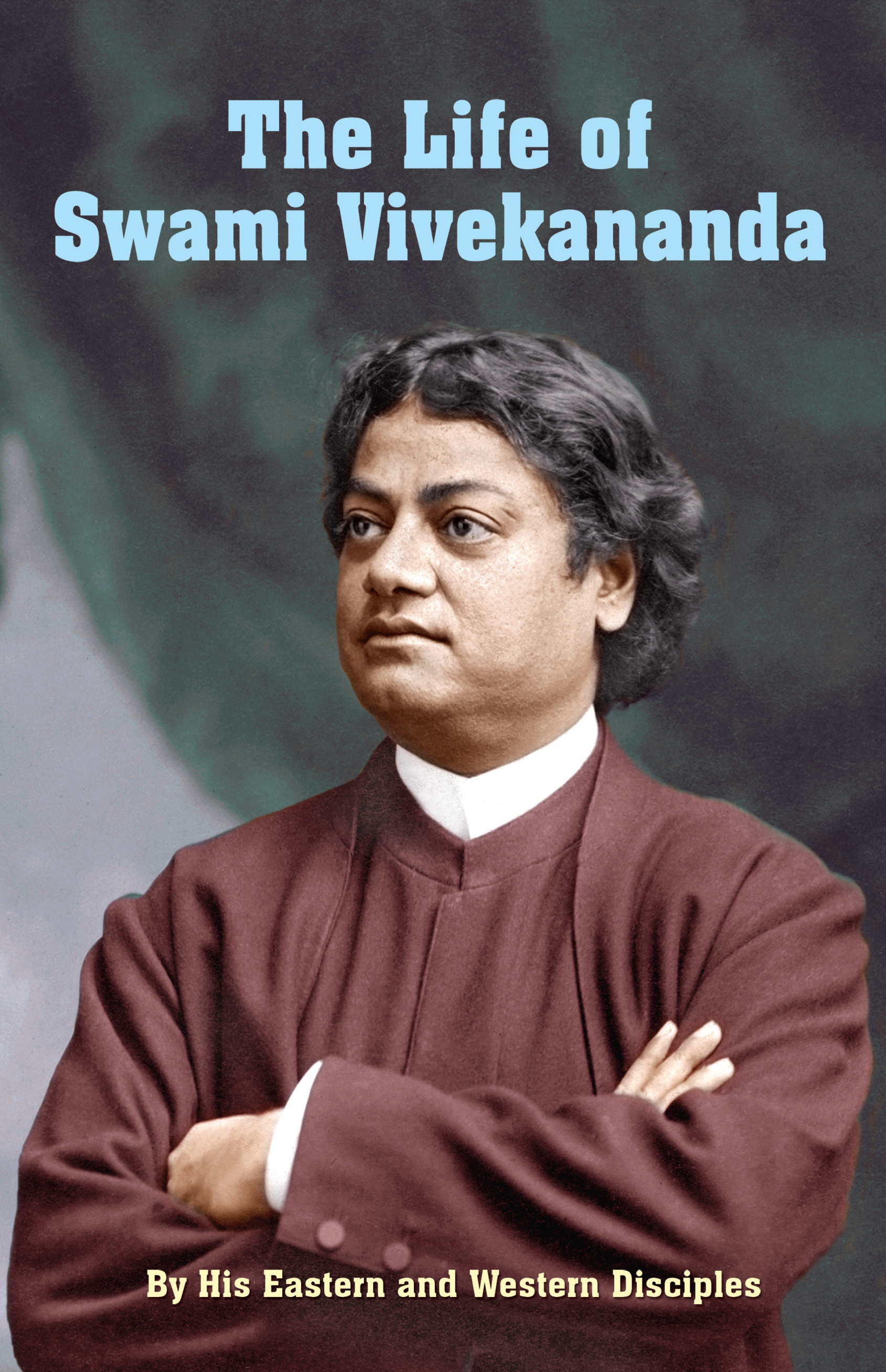
| Title | Life of Swami Vivekananda His Eastern and Western Disciples |
| Author | Eastern and Western Disciples |
| Publisher | Advaita Ashrama Kolkata |
| Description | This two-volume set provides the most exhaustive and authoritative biography of a man whom the world knows as a giant intellect, a great scholar and orator, a patriotic Hindu, a powerful preacher of Vedanta, and above all, a mystic par excellence–Swami Vivekananda. This biography presents the Swami, a multi-faceted personality, in all his moods and varied illumination so as to reveal the man as he was. A must for all the admirers of the Swami. |
↑ Contents
1.1 ANCESTRY
Coming from afar are the voices of the Silence. Rarely are they heard, save by mystics and sages. And when one of these voices becomes embodied as sound audible to mortal hearing, blessed is the time and blessed are those who hear. Formless is the Spirit and subjective is the vision thereof; dense is the illusion that hangs as the cosmic veil before Reality! How divine, therefore, must be the personality that makes objective the vision of the Spirit! How priceless the history of one who has lifted even a fringe of the veil! The illusion becomes transparent in the effulgence of such a spiritual personality. Verily, the Spirit Itself becomes revealed; and those who see are brought face to face with Reality!
To introduce the life of Swami Vivekananda is to introduce the subject of spiritual life itself. All the intellectual struggle, all the doubts, all the burning faith, all the unfolding process of spiritual illumination were revealed in him. As a man and as a Vedantist he manifested the manliness that is sanctity, and the sanctity that is manliness; he manifested the patriotism that proceeds from the vision of the Dharma and the universality that comes when God is seen in everything; and through the true insight of divine wisdom, he lived a life of both intense activity and Supreme Realization. Indeed, his life revealed throughout, the glory of the supersensuous life.
To the task of writing his life, we fervently set ourselves, conscious of unworthiness; for who can know the inner self of even the least of men, much less that of a Vivekananda! And who can sound the depths of his realization! The task is, in a way, beyond us, yet the world must know the greatness of the life that has thrilled it through its Eastern heart and Western mind. 'The Datta family of Simla (or Simulia), a northern district in Calcutta, was rich and powerful, renowned for many generations for its charity, learning and strong independent spirit. Rammohan Datta, the great-grandfather of the subject of this chronicle, was the managing clerk and associate of an English solicitor. He amassed a great fortune in the exercise of his profession, and lived happily, surrounded by a large family in a mansion in Gourmohan Mukherjee Lane. The house is still standing, but because of the subsequent straitened circumstances of the family, that part of it which had once been used as a temple has passed into the hands of strangers. The doorway that fronts on the street is massive. The covered hall, with a room on one side and seating space on the other, leads to a second doorway, beyond which are the courtyard and the living quarters. To the right are the rooms for the male members of the family. Across the courtyard and facing the doorway rises the women's quarter, two storeys high, the lower floor containing the kitchens, the upper the living apartments. From the latticed enclosure the purdah ladies in the olden days could look onto the courtyard when religious ceremonies on special occasions were being performed to the beating of drums and the blowing of conchs.
Rammohan Datta left two sons, Durgaprasad and Kaliprasad. Durgaprasad was a gifted youth, well versed in Persian and Sanskrit, and so skilled in law that his father made him a partner in his legal profession. But he had such a strong leaning towards monastic life that after the birth of a son in 1835 he renounced the world, becoming a monk at the age of twenty-five, and was not heard of by any member of the family until the twelve years of spiritual practices prescribed by monastic rule had been completed.
In the meantime his son, Vishwanath, who had been left as an infant with his mother, required bringing up. The mother, Shyamasundari, was fearless, devout and worthy in every way of accepting the great responsibility that had fallen upon her. When Vishwanath was three years old she took him on a pilgrimage to the holy city of Varanasi. As there was no railway in those days, the entire party set out by boat on the five hundred mile trip. What a thrilling adventure that excursion was—a combination of hardships and romance! New cities; new scenes, new customs, new peoples, even new languages, were encountered as the boat with its precious freight glided on. One morning, as Vishwanath was playing about on the deck, he fell into the Ganga. Without a second's hesitation Shyamasundari, though she could not swim, jumped overboard fully clothed; to save him. Fortunately, she was in time and held her tiny son up by the hand until they were both hauled aboard. So tight was her grip on him that he bore the marks of it for many years.
At last Varanasi was reached. Delighted with the holy atmosphere of the place, Shyamasundari visited all the temples, including that of Vireshwar Shiva. One day after she had bathed and was on her way to the temple of Vishwanath she slipped and fell with enough force to make her lose consciousness. A passing monk came to her assistance, picked her up and laid her on the temple steps. When she opened her eyes, what was her amazement to find that the monk was her husband! Instantly both were overwhelmed with a tremendous emotion. But worldly attachments were not for them. She, as well as he, had renounced. In a moment he disappeared, murmuring "Oh, Maya, Maya!" And she continued her pious round.
An interesting story is told of Durgaprasad's return to his birthplace, one that reveals the essential strength and quality of the man. Quite unostentatiously he made his way into Calcutta and, instead of going to his former home, put up at the house of an old friend, begging him not to let anyone know of his return. But the friend was unable to contain the joyous news and informed Durgaprasad's relatives, who at once came and forcibly took him away with them. The monk, without a word, seated himself in a corner of the room provided for him, the door of which had been locked so that he might not escape. For three days he stayed there without giving any sign or tasting a bite of food. The relatives, fearing that he might die, finally opened the door. Later, the monk disappeared and, except for a rumour that he had become the head of a monastery in Varanasi, was never again heard of by the Datta family. When Vishwanath had come of age and was earning his own livelihood, he once went to Varanasi in search of his father, but could not trace him.
In striving to account for the exceptional genius of Swami Vivekananda, one must not lose sight of the impressive figure of his grandfather, the man who deemed the world well lost in his search for God. Vivekananda's pronounced tendency towards the monastic life was "in his blood"—as we say to explain those inexplicable outcroppings of family traits and tendencies that are at times so remarkable that, in order to satisfy ourselves, we must accept either the theory of reincarnation or that of heredity.
After his father had renounced the world, Vishwanath's uncle, Kaliprasad, became the head of the family. Since he had no income of his own, the Dattas' accumulated wealth had to be spent to maintain the large joint family. Thus they gradually became poorer and poorer. Nor was Kaliprasad a generous-hearted person, which would explain why Vishwanath's courageous mother had to bring up her son in considerable difficulty, though legally he was the inheritor of half the family property. To add to his misfortune, when Vishwanath was ten years old, his mother passed away. Thenceforth, the orphaned boy received at the hands of his uncle the kind of treatment that orphans generally receive in this world. Yet, all through his life Vishwanath reverenced and generously helped the uncle, though he was well aware that he had been cheated by him at every step.
As Vishwanath grew to manhood he became the pride of the Dattas, who, in high hopes and expectation, looked to him to carry on the family tradition of learning. Nor were they disappointed. He became proficient in Bengali, English, persian, Arabic, Urdu and Hindi. He also studied Sanskrit in a tol, a traditional Sanskrit school. History was his forte, but in addition he acquired a fairly good knowledge of astrology, and later on was himself able to cast the horoscopes of some of his children. He was also a great lover of music. Like his father, Durgaprasad, he had a sweet voice, and at one time he took lessons in singing from an Ustad, a music expert. There was a time when, every Saturday and Sunday, he used to hold a musical soiree and entertain his guests with a pilau-feast.
After passing the final examination at Gourmohan Adhya's school (which afterwards came to be called The Oriental Seminary), Vishwanath at first tried his hand at business, but was not successful. He then began apprenticeship under a British attorney, Mr. Temple by name. He passed the attorneyship examination in 1866 and set up practice in partnership with Ashutosh Dhar, under the firm name of "Dhar and Datta". After some time he settled in the legal profession independently and was enrolled as an attorney-at-law in the High Court of Calcutta.
As an attorney, Vishwanath made a considerable reputation, and his field of work spread over the whole of northern India. His practice took him to such distant places as Lucknow, Lahore, Delhi, Rajputana, Bilaspur, Raipur and so on. In those days journeys were not simple, for the railway line extended only up to Mughal Sarai, from where one had to travel to further distant places by other means. While in Lahore, he performed the worship of the Divine Mother Durga, in a portrait, and entertained many people with the consecrated food.
On the one hand, Vishwanath earned a great deal of money through his professional work of attorney; on the other hand, he spent money liberally. Surrounded by friends and relatives, attended by many servants, owning carriages and horses, he enjoyed living in affluent style. He was a connoisseur of good cooking and was himself expert in the art, preparing various kinds of dishes for his friends and relatives. He was of the opinion that growing children needed to be well fed; otherwise their brains would not develop properly; thus he spared no expense in providing good and nourishing food for his children. He thought it was not necessary to leave behind an enormous patrimony; for if money were spent in giving his sons a taste for a high standard of living, a good education, and healthy bodies, in due course they would be compelled to make suitable arrangements for themselves-and would be able to do so. But if, on the other hand, they were to inherit much wealth, they would remain indolent and would squander all the money. We may well imagine that the experience of his own rise to affluence, together with his observation of the do-nothing members of the joint family, gave him this philosophy of life. He had observed his uncle Kaliprasad, son of an affluent father, engaged in spending the inherited wealth, while earning nothing. Whereas, he himself, a poor orphan, had become wealthy through his own manly efforts.
Aside from his intellectual attainments, Vishwanath was endowed with many good qualities that endeared him to all. In whatever situation he might have been, he never lost the nobility of his nature. He was independent in spirit, generous in disposition, devoted to his friends, a protector of the needy. His keen understanding of his fellowmen resulted in deep compassion and extensive charity. At the sight of anyone in distress he would himself feel afflicted and would help him unstintingly. Many students who were distant relatives used to stay at his house and receive a good education at his expense, all of them becoming successful in life: Nor would any neighbour who sought his help ever go away disappointed. Little wonder, then, that the people of the locality used to call him data Vishwanath (charitable Vishwanath)! One of his sons later wrote of him: "Extending charity to the poor and the distressed was like a disease with him." Vishwanath used to say, "There is no need to worry about my sons. They will themselves make their own living; but these poor people have not that strength; that is why it is necessary to help them."
Indeed Vishwanath spent his ample means without thought of the morrow, giving to all who asked. And here it was that he showed a lack of discretion, for he maintained some of his relatives in idleness-even in drunkenness. Criticized at one time by his eldest son, Naren, for bestowing charity upon such worthless persons, Vishwanath replied, "How can you understand the great misery of human life? When you realize it, you will sympathize with the poor creatures who try to forget their sorrows in the momentary oblivion obtained through intoxicants!"
Although Vishwanath's behaviour with people was warm-hearted and sweet, his temperament was basically grave. He would meet contrary or illogical arguments with reasoned answers. His outlook was broad and his knowledge vast. Being a liberal Hindu with a receptive mind, he desired to know the essential and universal teachings of all religions, and thus he carefully studied the Bible and the Dewan-i-Hafiz.
But though liberal-minded by temperament, Vishwanath was averse to indiscriminately rushing into newly started movements. He was, nevertheless, progressive in his views. In 1882 he wrote in both Bengali and Hindi a book entitled Sishtachar Paddhati (Canons of Good Conduct), in two parts, in which he stated that during his travels in northern and central India he had noticed that there persisted a lot of social superstitions harmful to the people. Owing to Vishwanath's premature death the second part of the book was not published. This was the second of two known books written by Vishwanath. The first was his Bengali novel Sulochana, published in 1880, in the name of his uncle, Gopalchandra Datta. Vishwanath also defended the remarriage of girl-widows, as championed by Ishwarchandra Vidyasagar. When a strong agitation centring on two such marriages raged in the neighbourhood, Vishwanath and his wife supported the remarriages. In fine, though Vishwanath was like other Hindus in manners and conduct, his catholic outlook, born of his liberal education and acquired culture, saved him from a narrow orthodoxy.
This was a transitional period of India's history. The new civilization that had grown through the intermingling of Hindu and Islamic cultures was still prevalent, but European culture had also entered the stream of Indian life. The educated Indians of the time naturally came under these three influences. Vishwanath was no exception. His profession brought him into intimate contact with high-ranking Muslim families in northern India, many of whom were his clients. As a result, he used to follow, in dress and deportment, eating and drinking, manners and etiquette, traditional Hindu-Islamic ways. He also had many friends among the Europeans, and in some matters of daily life would follow the British, as was the vogue among the elite. Hence his conduct was marked by Hindu-Islamic culture on the one hand and European culture on the other. Both Brahmins and Muslim fakirs used to receive alms as well as sympathy from him. The Dattas were Shaktas by faith; and Vishwanath, though so liberal in outlook, did not make any change in the traditional ways of the family, with regard to the practice of religion.
Vishwanath was blessed with a wife who was his peer in every respect. At the age of sixteen, he had been married to Bhuvaneshwari Devi, the only child of Nandalal Basu of the renowned Basu family of Simla, Calcutta. Bhuvaneshwari, born in 1841, was only ten years old at the time of her marriage. Being the only child of her parents, she inherited the paternal property, which afterwards accrued to her children. As she grew older, she became expert in the management of household affairs and cheerfully shouldered the responsibility of her husband's large family. She was exceptionally intelligent and found time, even in the midst of her many chores, for sewing music and the daily study of the Ramayana and the Mahabharata. Graceful, devoted and full of the fire of one born to regal estate, she commanded the respect and veneration of all who came in contact with her, and her judgement was followed in all matters of importance. Above all, Bhuvaneshwari Devi was deeply religious in temperament, and used daily to perform herself the worship of Shiva. She was not given to much talking. Calm resignation to the will of God in all circumstances, power, and reserve characterized this noble Hindu woman. The poor and the helpless were the special objects of her solicitude. Like Vishwanath, Bhuvaneshwari Devi had a very sweet voice and could beautifully sing the songs on Sri Krishna as heard in religious dramas. When beggars singing religious songs came to the house to beg, she could learn their songs by listening only once. She was, indeed, noted for her unusual memory and knew by heart long passages from the Ramayana and the Mahabharata. More important, she had absorbed the essence of these timeless epics, and that essence, together with the culture to which it was the key, she passed on to her children as their great heritage.
It was, then, to these two, Vishwanath and Bhuvaneshwari Devi, that the boy who was to become the greatest man of his age, whose influence was to shake the world, and who was to lay the foundation of a new order of things, was born.
↑ Contents
1.2 BIRTH AND CHILDHOOD
Whoever knows the longing of a mother that a son should be born to her, enters into the world of Bhuvaneshwari, the wife of Vishwanath Datta. Though she had been blessed with motherhood at an early age, her first child, a son, and her second, a daughter, had died in their childhood. Her next three children were all daughters-Haramohini (also called Haramoni), Swarnamayi, and another who also died in childhood. So, she longed for a son to carry on the family tradition, to be the link, forged out of the materials of love and suffering, between the past and the future. It has been the practice of Hindu women down the ages to place their wants and complaints before the household Deity, and to practise austerities while waiting to receive the blessings of the Lord. Thus, as Bhuvaneshwari went about her daily tasks, she prayed silently that her desire might be fulfilled. Now, it was customary in those days—and still is—or one in dire need, or anxious that some special event should come to pass, to make offerings and sacrifices to Shiva in Varanasi. Those who lived a long distance from that holy city could make their offerings through a relative or friend who might be resident there. Accordingly, Bhuvaneshwari Devi wrote to an old aunt of the Datta family in Varanasi, asking her to make the necessary offerings and prayers to Vireshwar Shiva that a son might be born to her. It was arranged that on Mondays the aunt would offer worship to Vireshwar Shiva, while Bhuvaneshwari would practise special austerities on those same days. It is said that by observing a vow of this sort for one year, one is blessed with a son. Thus Bhuvaneshwari was content to wait in perfect assurance that her prayers would be answered. She spent her days in practising Japa and meditation. She observed fasts and intensified her many other austerities, her whole soul given over to constant recollectedness, her heart fixed in love on the Lord Shiva. Often did her mind go to Varanasi, uniting in thought with the venerable aunt as the latter poured the sacred Ganga water on the symbol of Shiva, or worshipped Him with flowers and Mantras. One night Bhuvaneshwari had a vivid dream. She had spent the day in the shrine and, as evening deepened into night, she fell asleep. The household was hushed in silence and rest. Then in the highest heavens the hour struck; the time had come for the pious woman to receive the special grace of the Lord. In her dream she saw the Lord Shiva rouse Himself from His meditation and take the form of a male child who was to be her son. She awoke. Could this ocean of light in which she found herself bathed be but a dream? Shiva! Shiva! Thou fulfillest in various ways the prayers of Thy devotees! From the inmost soul of Bhuvaneshwari a joyous prayer welled up, for she was confident that her long months of supplication were over and that the vision was an announcement that her prayers were to be answered. Her faith was justified; for in due course a son was born to her.
The light of the world dawned for the first time upon the future Swami Vivekananda on Monday, January 12, 1863. It was the holy morning hour—33 minutes and 33 seconds after six, a few minutes before sunrise. At the time of his birth, the constellation Sagittarius was rising in the east, the moon was in the constellation Virgo, the planet Jupiter was in the eleventh house, and Saturn was in the tenth from that of his birth. It was the seventh day of the new moon (Krishna Saptami) and, as chance would have it, the last day of the ninth Bengali month Poush, known as Makara Sankranti day—a great Hindu festival. The millions of men and women who were observing the festival unknowingly greeted the new-born babe with prayers and worship. They little knew that he had just been born, who was to usher in a new age of glory for his country, who was to reorganize the spiritual and national consciousness of India, and who was to become a great apostlea St. Paul/preaching unto the world another gospel of redemption, namely the message of Vedanta. And only a few miles north of Calcutta, in the garden of Dakshineshwar, a great seer was waiting for the coming of this babe, who was to grow into manhood to carry on his great work.
The household members were surprised at the features of the new-born babe. They believed that they resembled in many ways those of his grandfather, Durgaprasad, who had renounced the world; and they wondered if the monk had been born again. Thus when the time came for a name to be given to the infant, there was much discussion. Some thought it should be Durgaprasad. But when they asked the mother, she looked into the depths of the child's eyes, as if she would see into his very soul. There was a strange stillness for some moments; then she turned to them and with much feeling said: "Let his name be Vireshwar! So shall he be called." Those who heard this were satisfied. They called him Bileh for short. Later he came to be called Narendranath or Naren.
As Bhuvaneshwari would gaze unblinking at the face of the lovely, healthy babe in her lap, her heart would fill with pride and she would shed tears of joy; for she at last held in her arms her much-longed-for darling of many prayers. But this was no ordinary babe; in him was hidden a tremendous power, and she was faced with the difficult problem of containing his irrepressible restlessness. He was hardly three, but already complaints against him for breach of peace were mounting.
Narendranath was a naughty child, subject to fits of restlessness during which he was beyond control. At such times he would wear the family out. Bribes, threats, everything was tried—nothing was of any avail. Finally, Bhuvaneshwari found that if she poured cold water on the head of the screaming child, chanting the name of Shiva in his ears at the same time, or if she threatened him with "Shiva will not let you go to Kailas if you do not behave," he would quiet down and become his eager, joyous self again. It was after such scenes that the mother used to say, "I prayed to Shiva for a son and He has sent me one of His demons!" In her old age, Bhuvaneshwari once told this to a group of disciples whom her son had brought from the West. There was laughter, and the mother smiled in a reminiscent way. "Was he turbulent?" asked one of the Western disciples. "Well, I had to have two nurses for him constantly", she replied. But aside from these outbursts, he was a sunny-tempered, sweet and loving child, and would scamper to anyone who would take him on his lap. He was one of those children who trust all implicitly, and feel joy each moment of that period during which the world is a constant surprise.
Naren had a great fancy for wandering monks; whenever a sadhu came to the door, the boy was delighted and rushed towards him. One day a monk came and asked for alms. All that Naren had was a hand-embroidered dhoti wrapped round his waist. He was proud of his new cloth, for it was his first garment marking his passage out of infancy, but straightway he gave it to the sadhu, who tied it round his head and went away blessing the boy. When asked what had become of the cloth, the boy replied, "The sadhu begged for alms and I gave it to him." Many sadhus came to the house, knowing that they were always welcome there. Vishwanath Datta was very hospitable; and there was with him the memory of his own father, who had become a monk. But after the above incident, a close guard was kept on Naren. Whenever any sadhu put in an appearance, Naren was kept locked up until the wanderer had left. Still, that did not disconcert the child; he would throw out of the window to the caller anything the room contained, as an offering. He would have his way and then he would dance with glee.
What a tease he was! There were his two elder sisters, whom he would tease, and tease, and tease! The sisters would be furious, and there would be a chase. He would fly to the open drain, where they could not follow. And from that refuge he would grin and make faces at them, and would further infuriate them with his triumphant challenge, "Catch me! Catch me!"
Naren had a number of pet animals, whom he loved playing with—a monkey, a goat, a peacock, pigeons, and two or three guinea-pigs. He was also especially fond of the family cow, and would join his sisters on the festive occasion when they adorned the "mother cow" with garlands, put a vermilion mark on her forehead, and bowed down to her. He would pat her with his little hands and talk to her sweetly.
Of the servants, the coachman was his special friend. The ambition of his childhood was to become a syce or groom. To him the syce with his turban, his grand livery, and his whip, which he flourished as the carriage rolled on, was a magnificent person. He was wont to make the stables his headquarters and to watch every turn of men's duties. And how he loved horses!
The first education is always at the knee of the mother, and immense was Bhuvaneshwari's eagerness to educate her son well. It was in her lap that Narendranath first became aware of the glory of the gods and goddesses, the greatness of the sages of India, and that of his ancestors, among whom was his grandfather, the sannyasi Durgaprasad. It was also from his mother that he first heard the tales of the Ramayana and Mahabharata. At the Datta home these epics were read every day at noon. One elderly lady-sometimes Bhuvaneshwari herself would read aloud, and the ladies of the family, who for the time being had finished their duties, would sit round her. In this small congregation, turbulent Naren would be found sitting quietly throughout the reading and listening with rapt attention: There can be no doubt that the stories from the epics exerted a great influence on his mind.
Naren also learnt many things from his maternal grandmother and her mother: One of his younger brothers, Mahendranath, later wrote that their maternal grandmother's mother belonged to the Vaishnava sect and knew many teachings and anecdotes from the epics, the Bhagavatam, and from Vaishnava lore. The maternal grandmother told many anecdotes of the Bhagavatam. Indeed most of the stories that Swami Vivekananda later told to his Western audiences he had heard in his childhood from these two elderly ladies.
Even the singers in the street contributed to young Naren's education. Fascinating are those singers. Sometimes they come in large parties perhaps as a family in straitened circumstances; but they are always joyous. Some carry with them an image of the Divine Mother; or it may be that a father will come with his son dressed as Sri Krishna: the boy's silver anklets ringing as he dances, while the father sings in a deep basso, beating time on his tom-tom. From house to house the singers go, joyously singing of the Lord or telling sacred stories in song. Beggars though they are, in the ecstasy they arouse, they are givers, enhancing the spiritual sense of the people. Often they would come to Naren's house, and for her son's sake, his mother always made them welcome, for she realized that the more often and intimately a child is exposed to the national culture, the better and truer man does he become.
The first seed of spiritual life was sown during this period of Naren's early education. Again and again he had heard of Rama and Sita. He had listened enrapt to readings from the Ramayana, and had followed the long story of Rama's struggle and conquest with all the thrill of personal romantic adventure. He had, as well, observed the elder members of the family sitting in worship and meditation, and it occurred to him that he, too, should worship Rama. One day, he and a little Brahmin boy named Hari purchased a clay image of Sita-Rama, and when no one was about, they climbed the stairs that led to a room on the roof above the women's quarters. After securely closing the door; they installed the image, and sat down to meditate. Meanwhile parents of both the boys noticed their prolonged absence, and an anxious search for them was begun. The hunt led at last to the little locked room on the roof. The searchers knocked and shouted, but there was no response. At last their strong blows smashed the latch, and the door flew open. Hari, his meditation disturbed at the first ominous signal, fled down the stairs. But Naren had not heard anything. He was seated before the flower decked image, motionless in deep meditation. When he did not respond on being called by name, he was shaken out of his meditation; but he insisted on being left alone. So they let him remain, knowing not what to make of it all; for it seemed strange at his age.
Shortly after this, the all-knowing syce created a disturbance in Naren's immature mind. One day when the boy was visiting the stable, the talk drifted to marriage, which was something intolerable to this man. With the memory of some bitter personal experience, he forcefully denounced married life, telling his young listener of its difficulties, absurdities, and of the terrible bondage it entails. Naren stood as if terror-struck; as if the spectre of matrimony were already before him. And what of his image of Sita-Rama? He had given all the love and loyalty of his heart to these two very pure personages and worshipped them with all devotion. He had learnt to respect deeply their wonderful characters, had admired their loyalty to one another. But the syce had thrown too dreadful a meaning over the idea of marriage. And Rama and Sita were married -that was enough!
The irreconcilable conflict between the words of the syce and his regard for the image of Sita-Rama caused deep anguish in his heart, which burst forth in tears. One of the golden dreams of childhood was broken. Naren ran to the women's quarters. The mother saw his tears and inquired what made him sad. There was silence-then loud sobbing. "How can I worship Sita-Rama? Was not Sita Rama's wife?" he asked. Intuitively, Bhuvaneshwari understood the anguish of her son. But how to console him? Then, as light bursts upon darkness, the thought of Shiva came to her mind. She addressed her son not as Naren but as Vireshwar, and said, "There is Shiva to worship!" These words of the mother settled deeply in Naren's heart.
Shortly afterwards Naren left the room and climbed the stairs to the roof, unseen in the gloom of the evening. Overhead was the canopy of sparkling stars. He opened the door of the room where he had installed the image of Sita-Rama. He paused for a moment, then clasped the image and went to the edge of the roof. The next moment, the image of Sita-Rama was smashed on the pavement below.
On the following day Naren bought an image of Shiva with the money given by his mother. At once he enthroned it on the very spot from which Rama and Sita had been dethroned; and he was soon seated before Shiva with eyes closed to all outer things, in the depth of meditation.
But what suffering this had entailed! Poorer than a man despoiled of his wealth is the mind of a child bereft of its illusion. And yet this incident not only shows the fearlessness and sincerity of the boy who gave up his cherished ideal when he found it did not match with his conception of the truth; but also makes evident the deep desire of his soul for freedom from the bondage of the senses, which he expressed later in these words: "Ever shall the soul be free! We must have freedom from bondage, however sweet."
Nevertheless, his devotion to Sita-Rama was never destroyed, and the Ramayana had still a great fascination for him. Whenever it was read in the neighbourhood he was sure to be there, rapt in the thrilling episodes of Rama's life. Particularly was that matchless devotee, the great hero Hanuman, attractive to him. Once when the reader told of how Hanuman lived in banana groves, Naren, who was anxious to meet the monkey chief, asked, "Shall I be able to see him if I go there?" "Yes why not go and see!" said the reader rather sarcastically in reply to the boy's naive question. On his way back, the boy remembered a banana-grove near his home and made his way there, sat down under a banana-tree, and prayed to Hanuman to show himself. He sat and sat, but Hanuman did not come. He was bitterly disappointed. But they told him at home that Hanuman had more than likely gone forth on some urgent mission of Shri Rama, and that solaced him.
But it was Shiva, the god of renunciation, whom now he worshipped. Even in childhood he had the fancy of becoming a sannyasi. One day he was found moving about nude except for an ochre loin-cloth which he had put on in the manner of sadhus. "What is this?" asked his mother in alarm. "Why Naren, what are you up to?" "I am Shiva! Look, I am Shiva!" cried out Naren in triumph.
The elders of the household had told him, in fun, that if one meditated, one's hair would become as long and matted as the monks', and would gradually enter deep into the earth like the roots of a banyan tree. So the simple child, seated in meditation, would once in a while open his eyes to see if his hair had grown long and matted. But when his expectations were not fulfilled, he ran in bewilderment to his mother, and asked, "I have meditated; but why bas no matted hair grown?" His mother consoled him: "It is not grown in an hour or a day. It takes many many days, yes, many many months, before matted locks can be grown." Then the talk drifted to other things. It turned to the Shiva-image he had bought a few days before. He said that while he had sat before the image that morning, the thought of his mother's words—that he had been sent away from the real Shiva because he had been naughty—had come to him very forcibly. Reincarnation is accepted, unconsciously, as a fact by every Hindu child; so he added, "I think I have been a sadhu once. Will Shiva let me go back to Him if I am good?" The mother answered, "Yes." But her heart sank at the thought that perhaps he, like his grandfather, would renounce the world and return to Shiva. Then she banished the thought, thinking that there were many years yet before he could grow into that discrimination in which he would feel all the joys of the world as an intolerable burden, knowing joy only in the thought of God.
From this time on, the family often found little Naren playing at meditation. Though it was play, it awakened in him deep spiritual emotions. They would see him quietly sitting for a long time, absorbed. So deep was this absorption that sometimes he had to be shaken from it back to the normal condition of a child; and it grew more and more difficult sometimes to rouse him on such occasions. The boys of the neighbourhood sometimes joined him in this pastime. One evening when the crescent moon was in the sky and they had seated themselves in meditation posture in the worship-hall, one of the boys noticed a big cobra gliding along the stone paved floor. With a shout he announced the newcomer. Others sprang to their feet in terror, but Naren remained lost in meditation. His friends shouted to him, but there was no response; so they ran to his parents, who came in haste. What horror was theirs when they saw a cobra with its hood spread, as if strangely fascinated! They were afraid to call out lest they disturb the snake and provoke it to strike. Then suddenly it glided away; and a moment later it was nowhere to be found. When his parents inquired why he did not run away, Naren said, "I knew nothing of the snake or of anything else; I was feeling inexpressible bliss."
Every night brought some strange vision to Naren. Singular was the manner in which he fell asleep. As soon as he closed his eyes, there would appear between his eyebrows a wonderful spot of light of changing hues, which would expand and burst and bathe his whole body in a flood of white radiance. As his mind became preoccupied with this phenomenon, his body would fall asleep. It was a daily occurrence which he would court by lying down on his chest; as soon as drowsiness overtook him, the light appeared. Thinking it to be a perfectly natural thing which happened to everybody, he did not mention it until long after, when he asked a schoolmate, "Do you see a light between your eyebrows at night when you go to sleep?" The friend said he did not. "I do", said Naren. "Try to remember. Do not fall into sleep as soon as you go to bed & on the alert for a while and you will see it."
In later years, there was to be someone who would put that very question to Naren himself: "Naren, my boy, do you see a light when you go to sleep?" This questioner was his spiritual teacher, Shri Ramakrishna; but of this later. The phenomenon remained with him until the end, although in the latter part of his life it was not so frequent or so intense. It told, assuredly, of a great spiritual past in which the soul had learnt so well to sink itself deep in meditation that the meditative state had become spontaneous with him.
At the age of six, Naren went to the pathshala, the traditional type Indian school. He was in a brand-new dhoti. He carried a mat under his arm, for each child had to bring his own to sit on; and from his waist dangled a little reed-pen held fast by a long string. He felt himself very superior; as do all boys on their first day of school.
Indeed, that day was an important one for him. Early in the morning, the priest of the family had called him for the ceremony that is performed when a boy first goes to school. All the family were present. After the recitation of a few prayers, and the dedication of the lad to Saraswati, the presiding goddess of learning, the priest took Naren's right hand, putting into it a kind of red-tinged writing chalk called Ramkhadi, and then, guiding it, wrote on the ground the Bengali alphabet saying, "This is Ka, this is Kha"; and Naren repeated after him, "This is Ka, this is Kha."
But schools are places where one is apt to meet with all sorts of comrades, and within a few days Naren had acquired a vocabulary which quite upset his family's sense of propriety. Never again, determined all the household, should he go to school. Instead, a private tutor was engaged, who conducted classes in the family worship-hall for Naren and other boys some of whom were his cousins, and others the sons of his father's friends.
Soon Naren was noticed for his exceptional intelligence. He learned to read and write while other boys were wrestling with the alphabet. His memory was prodigious. He had a peculiar way of his own of closing his eyes and sitting motionless or lying down when attending the classes. The private tutor who had been engaged did not understand his peculiarity in his charge at first; and atlast he became quite provoked. He caught hold of his pupil, shaking him rudely, to rouse him from his seeming sleepiness. Naren opened his eyes in wounded surprise. He listened to the angry words of the tutor. Then, in self-defence, he recited word-for-word the whole text that had been read in the preceding hour. Ever afterwards the tutor regarded this pupil with admiration; for in his long acquaintance with boys, never had he found such a remarkable memory.
Though Naren's schooling started in this way, his learning at his mother's knee did not stop. As to book-learning, he learned from his mother the Bengali alphabet and the First Book of English by Pyaricharan Sarkar. It was from his mother again that he learned how to hold aloft his moral standards, even while struggling in the eddies of the world, and how to take refuge at the feet of God, knowing Him to be the best support in life.
The mother also taught Naren; "Remain pure all your life; guard your own honour and never transgress the honour of others. Be very tranquil, but when necessary, harden your heart." Throughout his life Narendranath loved his mother with all his heart and remembered her precepts. He used to say, "He who cannot literally worship his mother can never become great." On many occasions he proudly declared, "I am indebted to my mother for the efflorescence of my knowledge."
Other members of the household also contributed to Naren's education. At night he slept under the protecting presence of an old relative—Nrisimha Datta, the father of Ramachandra Datta, who was to become a lay devotee of Shri Ramakrishna. This man, who was very learned in Sanskrit lore, thought that the best way of training a youth in mind and character was to get him to memorize difficult intellectual subjects. At night, therefore, he taught the boy the aphorisms of the Sanskrit grammar Mugdhabodha, the genealogy of his family, hymns to gods and goddesses, as well as passages of great length from the Ramayana and Mahabharata. Thus, in a year's time Naren had acquired considerable grounding in Sanskrit, and certainly this training in early boyhood constituted one of the formative elements in that passion for Sanskrit learning which he possessed in later years.
On a certain occasion a party of wandering singers, who earned their livelihood by chanting the Ramayana, came to Naren's house. They made a number of mistakes in reciting the text. Naren stopped them and pointed out their errors, greatly surprising and pleasing them.
Naren's father also played a significant part in his son's education. It was he who insisted that the boy should study music, for he looked upon it as a source of much innocent joy. Perhaps the deep attraction of his family for music helped turn Narendranath into an accomplished singer.
In his attitude towards his children Vishwanath showed considerable wisdom. He believed in inspiring them to develop self-,respect and politeness. If any of them misbehaved, he did not reprimand him, but in order to produce the required reform, exposed him to the ridicule of his friends. To cite an instance, one day Naren behaved very rudely to his mother. The father, instead of scolding the boy, wrote on the door of the room where Naren received his friends: Naren Babu said these words today to his mother—followed by the words actually said. Every time Naren or his friends entered that room they were confronted with this statement. It was not long before Naren showed signs of repentance.
Even at an early age, Naren asserted himself as leader among his fellows. Whenever occasion offered, he put himself at their head. One such occasion came on the Makara Sankranti day, the last day of poush (the Bengali month corresponding to December-January), and a holiday when boys worship Mother Ganga, and everyone thinks it most auspicious to bathe in the sacred waters. Naren had insisted that this festival should be celebrated, and obtained permission from his father, together with the necessary expenses. Then he gathered together a group of boys, and the father instructed the private tutor, or the Guru Mahashaya, as he was called, to teach them songs to Mother Ganga. On the appointed day the procession of little fellows headed by Naren set out from the Datta home. Marching with flying flags and garlands of flowers in their hands, they went through the streets to the Ganga, singing all the while. When they reached the river, they burst into that song which all Hindu children in Bengal know so well—"Worship the Mother Ganga"—and they then threw their garlands upon the flowing waters. That evening they again repaired to the river, and after improvising toy boats out of sheaths of banana stems, they fastened at their prows the lights of reverence. What a pretty sight! All along the river floated these toy boats. Naren's party was only one of many; for miles the Mother Ganga's waters were lighted by the love of the children.
Acknowledged as leader wherever he went in the course of his life, peerless among his contemporaries, in early manhood the prince of the disciples who sat at the feet of his Master, unmatched in intellect, East or West, Naren was also king among his playmates. He was the all-in-all of their world. "I am the Samrat, the King of kings", Naren would shout as he scampered up the stairs that led from the ground floor of the courtyard to the veranda of the Puja-hall, and would sit himself down as the lord of men. Pointing to the steps below, he would tell two of his fellows to stand before him as prime minister and commander-in-chief. Lower on the stairs he bade five others stand as tributary princes. To his courtiers he gave the privilege of sitting one step lower than the princes. He would then formally open his durbar. One by one the princes, the higher officials of state and the courtiers would prostrate themselves in proper oriental fashion before the Imperial Presence, addressing him as Son of Solar Splendours, the Lord of Lands and Seas, and the Protector of Dharma. The ceremony over, the king would ask about the welfare of his realm and listen to the grievances of his subjects. A criminal was perhaps then brought before him, and the grave accusations against him being proved, His Majesty would exclaim, "Off with his head! Ho, guards!" and then ten guards would spring upon the offender. So went Naren's favourite game of "King and the Court", in which he administered justice with royal dignity and put down the slightest insubordination by a disapproving frown.
There used to come to Naren's house many of his father's clients. They would sit together chatting until their turn for consultation came. They were of various castes; there was even a Mohammedan, with whom Naren was particularly friendly, and each was provided with his own hookah. Caste was a mystery to the boy. Why should not a member of one caste eat with a member of another or smoke his hookah? What would happen if one did? Would the roof fall in on him? Would he suddenly die? He decided to see for himself. Boldly he went round the hookahs and took a whiff from each and everyone. No, he was not dead! Just then his father entered. "What are you doing, my boy?" he questioned. "Oh, father! why, I was trying to see what would happen if I broke caste! Nothing has happened!" The father laughed heartily and with a knowing look on his face walked into his private study.
Naren's boyish exuberance expressed itself in all sorts of ways, naughty and otherwise. One day while romping with his comrades, he fell from the veranda of the worship-hall, striking his head against a stone. To his death he carried the scar of this on his forehead just above his right eye. The Sage who was his teacher in his later life once said: "Had Naren's powers not been checked by this accident, he would have shattered the world!" As it was, he raised the world.
We have already mentioned that Naren was the leader among his fellows. Indeed, leadership was innate in him, and very early in life he demonstrated the truth that leadership means self sacrifice. One day when he was about six years old, he went with a younger relative to a Charhak fair at which Lord Shiva is worshipped. He purchased some doll-images of Shiva at the fair, and as the two boys were returning home in the dusk, they became slightly separated in the crowd. At that moment a carriage came dashing along. Naren, who thought his companion was immediately behind him, turned at the noise and to his horror saw that it was a question of life or death for the little lad, who stood terrified in the middle of the road about to be run over. Putting his dolls underneath his left arm Naren rushed to the lad's help, heedless of his own safety, and grabbing him with his right hand, pulled him almost from under the horses' hoofs. Those close by were wonder struck. The danger had appeared so suddenly that there was little chance for another to have run to the small boy's assistance. Some patted Naren on the back, while others blessed him; and when, on his return home, his mother heard the story, she wept for happiness and said, "Always be a man, my son!"
There were those who saw marks of Naren's future greatness even at this time. In the year 1869, Kaliprasad, Naren's grand-uncle and once the head of the Datta house, lay on his death bed. When he found that he was to live but a few hours more, he called in his whole family, and then asked any one of the children to read to him passages from the Mahabharata, so that his soul could pass on to another sphere with the thoughts contained in that great epic. All except Naren and one of his sisters felt too shy to read aloud to the dying elder. So Naren took up the heavy volume and placing it on his lap, turned page after page, while his voice, loud and clear, rang with the glories of the heroes and the Lord. As he was reading that particular portion where Garuda flew off with his mother Vinata on his shoulders, which symbolizes the soul's rising on the wings of knowledge to blessedness, the breathing of Kaliprasad became slower and slower. Then he spoke in an undertone-yet with all the burning certainty of vision that the dying sometimes show-"Child, you have a great future before you." Having uttered these words his soul passed out into higher spheres.
There is a saying, morning shows the day. Likewise by observing the sum total of qualities manifested in a child one can have a preview of the life that is yet to be. About Naren one can say that the morning of his life was auspicious indeed! With his well-shaped graceful form, fair complexion, large bright eyes, and face bearing the impress of budding genius, he naturally attracted everyone's love. His mind filled with a hundred soaring visions, heart soaked in affection, intellect razor-sharp, courage boundless, inventive genius astounding, working capacity un-reckoned, and enthusiasm irrepressible -Naren was peerless even from childhood. Above all was his spontaneous inclination towards God. From his very childhood he was an adept in meditation, and had delight in worship, prayer, and search for God. When we have deeply studied his life, we shall find ourselves having to admit that the foregoing account of Narendranath is not only not exaggerated, but is rather a pale representation of the truth.
Those who are to change the thought of the world as did Plato and Aristotle, or alter its destinies as did Alexander and Caesar, are from their childhood conscious of their power; they are instinctively aware of the greatness which is to come. Narendranath, too, felt the spirit of greatness within him; he saw things to which others of his age were blind, and he felt already, in the feeble and yet certain way of a child, the struggle which was to be his in giving expression to his vision.
↑ Contents
1.3 EARLY EDUCATION AND GLIMPSES OF SPIRITUALITY
In 1871, when Narendranath was eight years old, he entered the ninth class (equivalent to the present primary class two), in the English Department of Pandit Ishwarchandra Vidyasagar's Metropolitan Institution, then situated on Sukia Street. Vidyasagar's school was famous at the time, and so it was that boys of Naren's family used to be students there. During the first days of Naren's attendance at the Metropolitan Institution his father dressed him in trousers, but every day they got torn owing to his high spirits. He was unusual in his restlessness. At school he never really managed to sit at his desk. It was a sort of compromise between sitting and standing with frequent change of position. When he played, he played furiously. Among the games were marbles, jumping, running, boxing and cricket, at the last of which he had been proficient from his early youth. It was left to him to arrange the play-programme for the following day. Quarrels often arose as they do among boys; and it was to Naren that the others came for settlement. He disliked quarrelling; above all, he could not bear to witness a physical fight. If such a climax occurred he would rush between the contending parties, often at the risk of blows from both sides; but he was master of such situations, for he had learnt boxing even at this early age. He was the foremost boy amongst them all, in all things. His exceptional intelligence was at once recognized by both teachers and classmates. He was the first not only in play but in studies as well.
To those whom he loved among his fellows, he was kindness itself. Should anyone become hurt or ill in a party he had taken for a boyish excursion, he would give up the prospect of fun to attend on him. For instance, one day he went with twenty or more boys to see the Calcutta Fort. One of the parties complained of pain, while others joined in a laugh at the sick boy’s expense, and went ahead. Left alone, the boy sat down on the ground, his pain growing worse. Naren had gone with the party, but suddenly he turned and said, "It may be that he is seriously ill. You boys run on. One of us must go back to him; so I will go." He retraced his steps just in time. The boy had been overtaken with fever. Naren assisted him, half carrying him to a carriage nearby, and took him home.
Around this time he also saved a child and its mother from being run over by a carriage and seriously injured. Hastily snatching the child with one hand, he pulled the mother out of danger with the other.
It was this spirit of self sacrifice in Naren that made him the idol of his fellows, and so deep was the impression he made upon most of them that later on in their college days they followed his lead in matters of grave importance.
The two traits, restlessness and kindness, were among the prevailing characteristics of Naren's family and of Naren himself. Naren's restlessness, so-called, was the visible expression, it seems, of an immense dynamism, an immense energy and aspiration. It took various forms: high spirits, adventurousness, ardour, thirst for knowledge and travel, and dissatisfaction with monotony and stagnation. It was this dynamism that later took him round India, and then round the world. It was this dynamism again that created. in him a spiritual restlessness, the same restlessness that is at the back of the Hindu monk's struggle for complete liberation, and is only satisfied by the realization of the Infinite. Kindness also, as we have seen and shall see, was a quality of Naren's throughout his life.
Soon after his entrance into the Metropolitan Institution Naren was told he would have to learn the English language. But he was unwilling to do so. It was a foreign language, he said, so why should one learn it? Why should one not first of all become master of one's own tongue? He refused flatly and went home crying to his father and mother. But they, too, said it was necessary, and again he refused. Then his old relative, Nrisimha Datta, of whom Naren was especially fond, heard of his obstinacy. He took Naren aside and talked quietly to him, at first to no purpose. Only after several months did he follow his advice and start to study English. But once started, he studied it with an earnestness that surprised everyone; and later became master of the language. And this was indeed imperative. His words in English have since become a new gospel. Through English he gave voice to his mission and expression to that which he himself was the centre of a spiritual world impulse.
Many are the stories told of Narendranath's school-days, revealing him as full of force and vitality, fond of play and boyish delights. Like other lads he played pranks and called his friends by nicknames of his own devising, picking some from story books and fables, or various other sources.
Naren was still the devout admirer of mendicant monks. To see one was a moment of pleasure for him. If the meeting took place at his home, he would anticipate and fulfil the sadhu's needs as far as he could. And the monks always blessed him, for his eyes spoke volumes, and it is in the eyes that the monks see the soul reflected. The longing to be a monk himself was always in Naren. He often thought of the time when he would be free to follow that life. In his boyish fervour he would tell his friends what he would do, where he would go, and so on, enthusing his companions also. Often would he ask a newcomer to the Metropolitan Institution if there was an ancestor in the family, more particularly a grandfather, who had adopted the sannyasi's life. If the reply was positive, Naren would regard the new lad with special favour. Sometimes the boys would get together and in play try, by reading one another's palms, to foretell the future. Naren was the chief palmist of them all. He told them that he would be a monk: there was no mistake about it. "See!" he would say triumphantly, "there is the sure sign of a sannyasi." And he would point out certain lines on his hand which an old man had once told him were characteristic of the tendency to monkhood. Others were also eager to learn their fate in this respect. All of them wanted to be sannyasis because Naren wanted to be one. But as fate would have it, they were to be disappointed.
Even at this early age Naren evinced impatience with superstition and fear, no matter how hallowed by popular tradition. As he himself expressed it to a disciple in later years, "From my boyhood I have been a dare-devil; otherwise could I have attempted to make a tour round the world, almost without a penny in my pocket?" An incident that occurred around this time is illustrative of his "dare-devilry", which is to say, courage and independence of thought and action. To the house of a certain friend he would often have recourse as to a refuge from the monotonous moments that come even to boys. There was in their compound a favourite tree from which he loved to dangle head down. It was a Champaka (Michelia Champaca) tree, the flowers of which are said to be liked by Shiva, and which Hindu boys would go a long way to collect. It was the flowers of this tree that Naren also loved. One day as he was swinging from the tree, the old and nearly-blind grandfather of the house recognized his voice, which he knew and loved so well. The old man was afraid that the boy might fall, and that he himself might lose his Champaka flowers; he called Naren down and told him that he must not climb the tree again. Naren asked the reason. The old man answered, "Because a Brahmadaitya [a ghost of a Brahmin] lives in that tree, and at night he goes about dressed all in white, and he is terrible to look at." This was news to Naren, who wanted to know what else this ghost could do besides wander about. The old man rejoined, "And he breaks the necks of those who climb the tree."
Naren said nothing, and the old man went away smiling to himself in triumph. As soon as he had gone some distance Naren climbed the tree again just to spite the ghost of the Brahmin. His friend remonstrated, "The Brahmadaitya is sure to catch you and break your neck." Naren laughed heartily, and said, "What a silly fellow you are! Don't believe everything just because someone tells you! Why, my neck would have been broken long ago, if the old grandfather's story were true." Only a boyish lark it was, true, but significant when viewed in the light of later developments: a forecast of the time when, as Swami Vivekananda, he was to say to large audiences, "Do not believe a thing because you read it in a book! Do not believe a thing because another has said it is so! Find out the truth for yourself! That is realization!"
The father of this friend of Naren's loved him very much and had great hopes for his future. On one occasion, finding him dangling from the "forbidden" tree, he called him into the house and asked, "Do you play all day, going from one house to another? Do you never read?" Naren answered, "Sir, I both read and play." Then he was put to the test. He was examined in Geography and Mathematics, and was made to recite poems. To the surprise of the strenuous examiner, he acquitted himself well. Then the questioner blessed him and asked, "Who is there to guide you, my son? Your father is in Lahore." Naren assured his friend's father that he read in the morning and that his mother guided him. The man, though he said little for fear of flattering Naren, saw the greatness of the boy's intellect at once. He watched Naren's career with keen interest and saw fulfilled what he had predicted when he gave his blessing "My boy, you will be a man among men. I give you my blessings."
Naren could indeed both read and play. He manifested remarkable alacrity in preparing his daily lessons, one hour being sufficient for him to master them. He had a prodigious memory; he could read through a book very fast and in no time have it memorized. Small wonder, then, that he could be the foremost student in his class at school, and still have long hours left for fun! Only during two or three months before examinations did he apply himself strenuously to his studies. He showed proficiency in English, History, and Sanskrit, but had great distaste for Mathematics, and in this he was like his father who was wont to speak of Mathematics as "grocer's craft".
Although Naren generally kept good health, he suffered from chronic dyspepsia for some years during this time at the Metropolitan Institution. He became very thin, and felt a strong craving for certain foods that were specially harmful to him. This, however, in, no way depressed his nature-neither his studies nor his vitality suffered. He was as energetic as ever, and as merry, as kind and as courageous.
Not all of Naren's recreation involved strenuous physical activity. In childhood he had a fine hand for drawing pictures. He also had a melodious voice and could pick up a song by listening to it once at a theatrical performance.
With his class fellows Naren mingled intimately. Whenever there was leisure at school he either played with them, told stories, sang songs, or made them laugh with his expert mimicry. Often he teased his friends or played pranks on them, but he never harmed anyone, and through it all he would draw everyone to him, making them his own. In five minutes he could win anyone over, He could outwit anyone in talk, and none could outwit him: He had wonderful presence of mind and seemingly endless capacity to extemporize. And never would Naren be morose. He knew very well how to make others laugh, and he kept all his class-mates charmed.
In him there was immense pent-up strength. In London, many years later, Swami Vivekananda told Mr. E. T. Sturdy (one of his English disciples): Well, Sturdy, in my childhood I used to observe an inexhaustible force arising in me, overflowing my body, as it were. I used to become restless and could not keep quiet. This was why I used to fidget all the time. If I had nothing to read, I would turn to making mischief. If I had been made to sit quietly for three or four days, I would have either become seriously ill or have gone mad. My insides would all the time vibrate, as it were, and make me restless to do something.
But even in the midst of extreme restlessness, he was occasionally noticed to have been overwhelmed by some inspiration, as though his mind had travelled far away from his body. He then appeared to be gazing at something in the air, and his face would turn so grave that, to the dismay of those watching him, all his laughter and fun would vanish. Sometimes, after keeping quiet for a while, he would speak out: "I shall become a king. I shall do this. I shall do that." Or he would go on prattling: "This has to be done that way. This will be done this time." It would seem that his words at those times had no relation to anything he had been saying or doing just before. Sometimes he would burst into loud soliloquy. At these times he would become a different boy, as it were. When that mood would pass, he would return to normal and stand blinking and wrinkling his face in embarrassment; and then he would become the same naughty Bileh again. Observing him behave like this now and then, his playmates, either out of affection or mockingly, would often call him "Pagla Bileh (crazy Bileh)". "Bileh is a very good boy", they would say; "he is great in laughter, fun and merry-making, but he is a bit crazy. Sometimes there is no knowing what he will say."
There were many trying experiences in Naren's boyhood, but none more to than that which he had one morning in the class-room. The incident shows the boy's innate fortitude and the difficulty of intimidating him. One of the teachers of the Institution was a man of very ugly temper and given to beating the boys severely when he thought that discipline was needed. One day, as he was severely castigating a boy, Naren began to laugh from sheer nervousness, so revolted was he by the exhibition of brutality. The teacher now turned his wrath on Naren, raining blows on him, and demanded that he promise never to laugh at him again. When Naren refused, the teacher not only resumed the beating, but seized him by the ears as well, even going as far as lifting the boy up from the bench by them and damaging one ear, so that it bled profusely. Still Naren refused to promise. Bursting into tears of rage, he cried out, "Do not pull my ears. Who are you to beat me? Take care not to touch me again."
Luckily, at this moment Pandit Ishwarchandra Vidyasagar came in. Naren, weeping bitterly, told him what had happened; then, taking his books, he declared that he was leaving the school for good. Vidyasagar took him to his office and consoled him. Later, an investigation was made of the disciplinary measures obtaining in the school and steps were taken to prevent any repetition of such incidents. When Naren's mother, in whom he always confided, heard of it, she was greatly incensed. She begged the boy not to return to the school; but he went the following day as though nothing had happened. For a long time his ear did not heal.
Even as a boy Naren was strong-minded and fearless. Before the incident just mentioned, he had been assaulted by another teacher who thought he had made a mistake in geography. Naren insisted that he was in the right. Angered, the teacher ordered him to stretch out his hand. Naren did so and was struck on his palm time and again. He did not murmur. Shortly after, the teacher saw that it was he himself who had been in error. He apologized to the boy, and thenceforth held him in respect.
On this occasion as well Naren went to his mother, who consoled him and said, "If you are right, my boy, what does it matter? It may be unjust and unpleasant, but do what you think right, come what may." Many times he suffered, many times he was misunderstood even by those nearest and dearest to him when he adopted a course which to them seemed strange, but which to him was inevitable because, in his opinion, it was right. The maxim he had learned, and which he followed always in life was, "Stick to your guns, dead or alive!"
Since Naren hated monotony, every day he had to invent new pastimes. But he was so pure, and the training he had received in the family was so excellent, that he never took a false step. Truthfulness was the very backbone of his life, and his fun was always innocent. Further as he grew older, his liking for meditation grew ever more intense and serious. He was beginning to meditate during the night and soon was blessed with some wonderful visions and this even as his daytime activities and restlessness continued unabated.
For fun, Naren organized an amateur theatrical party, and presented plays in the worshiphall of his home. But after a few performances his uncle became annoyed and broke up the stage.
Next, Naren started a gymnasium in the courtyard of the house, where his friends used to do regular physical exercise. This venture flourished for some time, until one of his cousins broke his arm. Again the uncle showed lack of sympathy, this time destroying the equipment of the gymnasium. Thereupon Naren, along with his friends, joined the gymnasium of a neighbour, Shri Navagopal Mitra. Finding this suitable place, which was situated on Cornwallis Street, Naren applied himself earnestly to physical culture, and gradually attained proficiency in lathiplay (playing with long sticks), fencing, rowing, swimming, wrestling and other sports. Once, at a physical training show and handicrafts fair, he carried off first prize for boxing-- a handsome silver butterfly. At the same fair one of his sisters won the first prize for needlework on velvet.
Naren had special enthusiasm for lathi-play. In this sport he took lessons from a number of Mohammedan experts, and acquired considerable mastery. When ten years old and a student of the Metropolitan Institution, he was present at a display of gymnastics. After some time, when lathi-play was going on and interest was sagging, Naren suddenly challenged anyone to cross lathis with him. The strongest of the participants took up his challenge and soon the lathis of the two were clashing. Naren's opponent was an older and stronger person, and so the outcome of the bout seemed to be a foregone conclusion. Yet, such was Naren's skill and courage that he won the enthusiastic applause of the audience. Unmindful of it and deftly manoeuvring himself, Naren all on a sudden gave such a resounding blow that his opponent's staff broke in two and fell on the ground, signifying total defeat. Naren had graduated, so to say, in his training. He won the day, and there was no end to the rejoicing of the spectators.
Ever averse to passivity, Narendranath always led an active life. When he was not busy at the gymnasium, he would show magic-lantern pictures at home. Or he would go out in the evening on his pony, which his father had bought for him. Riding was one of his favourite pastimes, and gradually he mastered the art.
Besides his fondness for animals noted earlier, Naren also kept pigeons, white mice with tiny bells, and parrots. He also used to amuse himself in making toy gas-works and aerated waters, which had been newly introduced in Calcutta at that time. He even interested himself in manufacturing toy railways and all sorts of machinery. About the gas-works his younger brother writes as follows:
With old zinc tubes, earthen cooking-pots and straw he made his gas-works in the outer courtyard of the house. The straw when lighted gave out a peculiar smoke, but to his mind it was a miniature gasworks, which lighted the whole city of Calcutta. It was amusing to see his gas-works and himself as he stood with arms akimbo, gravely looking at his contrivance as the smoke issued forth. Sometimes, however, he would express disapproval by turning up his nosea family peculiarity and impatiently ordering his playmates to put more fuel on the fire, or to blow more fiercely whenever the smoke rose up too sluggishly.
At this time he conceived the idea of learning to cook. He induced his playmates to subscribe towards the project, he himself bearing the greater part of the expense. He was the chief cook and the others were his assistants. He cooked different sorts of Khichuri, meat curries and other good things. Although he was inclined to use too much chilli (cayenne-pepper), his cooking was excellent, and the group of gastronomists remained together for a long time, enjoying their art thoroughly.
With every family in the locality, of whatever caste or means, Naren established some sort of relationship, and they looked on him as their own. Did any boy nearby suffer bereavement, Naren would be there to console him. At other times he kept everybody amused, elders included, with his ready wit and merrymaking. His handsome appearance, his musical voice, his jolly temperament, his good taste and manners, endeared him to all. He was a sort of life-giving spirit to everyone of the locality.
Naturally, Naren was also greatly loved by his brothers and sisters, whom he in turn loved dearly. At night, before going to bed, they would pester him for stories. The stories which he had heard from his mother, maternal grandmother, and her mother, had become his own. And by this time he himself had become a fine story-teller and actor.
His little brothers and sister would also importune Naren for a hand-shadow show, and he would readily oblige. An earthen lamp on a brass stand used to be the light in their bedroom. By interlocking his thumbs and moving the other fingers against the light he would show on the wall a flying bat, a rider on a galloping horse, and the figures of deities like Durga, Kartika, Saraswati, Lakshmi and Ganesha. While Naren's talents for shadow graphing were unquestionably bright, the little onlookers had also to use their imagination!
Often Naren took his friends to various interesting places in Calcutta. Sometimes it was a garden, another time the Ochterlony Monument, or again the Museum. One day, he set out with a party by way of the Ganga for the Nawab's Zoological Gardens at Metiabruz, a suburb of Calcutta. When they were returning, one of the boys became sick and vomited in the boat. The boatmen were annoyed and insisted that they should immediately clean up the boat. They refused to do so, offering instead to pay double. The offer was rejected. On reaching the ghat, the men would not allow the boys to land and threatened them. While the boatmen were abusing the boys, Naren jumped ashore and asked two British soldiers walking near by for help. In broken English he told his tale of woe. Slipping his small hands into theirs, he led them to the scene. The soldiers understood the situation, and ordered the boatmen to release the boys. Terrified at the sight of the soldiers, the boatmen set the boys free without a word. Fascinated with Naren, the soldiers invited him to go with them to the theatre. But he declined and took leave after thanking them for their kindness.
Another delightful story is told of him, when he was about eleven years old. A British man-of war, the Syrapis, visited the Port of Calcutta when the Emperor Edward VII came to India as the Prince of Wales. Naren's friends urged him to try and secure a pass for them all to see the ship. For this it was necessary to see an English official. When, Naren made his appearance, application in hand, the attendant at the door, thinking him too young, refused him entry. As Naren stood aside wondering what to do, he noticed that applicants who passed the porter proceeded to a room on the first floor. Realizing that that must be the room where permits were issued, he set about to find another entrance. In the rear was a staircase. Stealthily he made his way to the top, pushed aside a curtain, and found himself in the room. He took his place in the line and when his turn came the application was signed without question. As he passed the door-keeper on his way out, the latter said in amazement, "How did you get in?" "Oh, I am a magician", Naren answered.
As we have seen earlier, Naren and his friends were members of the gymnasium of Shri Navagopal Mitra, who had practically left its management in their hands. One day while they were trying to set up a very heavy trapeze, a crowd gathered to watch. Amongst them was an English sailor, whom Naren asked to help. But as the obliging sailor was lifting the trapeze to help the boys, it fell and knocked him unconscious. Nearly everyone but Naren and one or two of his friends disappeared from the scene, thinking the sailor had been killed. Immediately Naren tore a piece off his dhoti, bandaged the wound, sprinkled the sailor's face with water, and fanned him gently. When the sailor regained consciousness, Naren and his friends lifted him up and took him to a neighbouring schoolhouse. A doctor was sent 'or, and Navagopal Mitra was informed. After a week's nursing the sailor recovered, and Naren presented him with a modest purse, which he had collected from his friends.
Another occasion which revealed the boy as the man in the making was when Naren, about fourteen years of age, saved a theatrical performance from disruption. The drama was progressing nicely, when suddenly, right in the midst of the performance, a bailiff came onto the stage with a warrant to arrest one of the leading actors on some charge. He advanced to the actor, saying, "I arrest you in the name of the law!" That very moment a voice called out, "Get off the stage! Wait until the end of the performance! What do you mean by disturbing the audience like this?" It was a shrill voice with an unmistakable tone of command and it was the voice of Naren. Immediately a score of voices burst out in support: "Get off the stage! Get off the stage!" And the bailiff retreated in bewilderment. Those about Naren patted him on the back saying, "Well done! Well done! We should not have had our money's worth but for you."
Naren's bold, generous, compassionate nature shines out from these and similar incidents, together with his presence of mind, incredible energy, and love of fun and adventure—it was such qualities as these that made him the leader of his companions.
As Naren grew older a definite change in his temperament was noticeable. He began to show a preference for intellectual pursuits, to study books and newspapers, and to attend public lectures regularly. He was able to repeat the substance of what he had read or heard to his friends with such original criticism that they were astonished, and he developed a power of argumentation which none could withstand.
One day, hearing a friend singing like a professional, Naren said, "Mere tune and keeping time are not all of music. It must express an idea. Can anyone appreciate a song sung in a drawling manner? The idea underlying the song must arouse the feeling of the singer, the words should be articulated distinctly, and proper attention be given to tune and timing. The song that does not awaken a corresponding idea in the mind of the singer is not music at all."
We have already seen that Naren's father used to travel to various places in central and northern India in connection with his professional work. In 1877, when Naren was fourteen years old and a student of the third class (equivalent to the present class eight), his father went to Raipur in the Central Provinces. Knowing that he would have to live there for quite a long time, his father, Vishwanath, had his family brought there shortly afterwards. The place was not then connected by railway; so one had to travel by bullock-cart for more than a fortnight through dense forests full of beasts of prey. Naren was charged with taking the family there.
Although he had to suffer many hardships, he did not feel them at all on account of the wonderful beauty of these forest regions of central India. His heart was charmed with the boundless power and endless love of Him who had adorned the earth with such incomparable robes and ornaments. He said later:
What I saw and felt when going through the forest has for ever remained firmly imprinted in my memory, particularly a certain event of one day. We had to travel by the foot of the Vindhya mountains that day. The peaks of the ranges on both sides of the road rose very high in the sky; various kinds of trees and creepers bending under the weight of fruits and flowers produced wonderful beauty on the mountainsides. Birds of various colours, flying from tree to tree, filled the quarters with sweet notes. I saw all these and felt an extraordinary peace in my mind. The slow-moving bullock-carts arrived at a place where two mountain peaks, coming forward as though in love, locked themselves in an embrace over the narrow forest path. Observing carefully below the meeting-points I saw that there was a very big cleft from the crest to the foot of the mountain on one side of the path; and filling that cleft, there was hanging in it an enormous honeycomb, the result of the bees labour for ages. Filled with wonder, as I was pondering over the beginning and the end of that kingdom of bees, my mind became so much absorbed in the thought of the infinite power of God, the Controller of the three worlds, that I completely lost my consciousness of the external world for some time. I do not remember how long I was lying in the bullock-cart in that condition. When I regained normal consciousness, I found that we had crossed that place and come far away. As I was alone in the cart, no one could know anything about it.
This was perhaps the first time that, with the help of a strong power of imagination, Naren entered the region of deep meditation and was completely merged in it.
Another characteristic of his mind was described by him in these words:
From my very boyhood (Naren, as Swami Vivekananda, said later], whenever I came in contact with a particular object, man or place, it would sometimes appear to me as if I had been acquainted with it beforehand. But all my efforts to recollect were unsuccessful, and yet the impression persisted. I will give you an instance: One day I was discussing various topics with my friends at a particular place. Suddenly something was said, which at once reminded me that in some time past in this very house I had talked with these friends on that very subject and that the discussion had even taken the same turn. Later on I thought that it might be due to the law of transmigration. But soon I decided that such definite conclusions on the subject were not reasonable. Now I believe that before I was born I must have had visions somehow, of those subjects and people with whom I would have to come in contact in my present birth. Such memories have come every now and then throughout my life.
In those days there was no school in Raipur. This gave Naren the time and opportunity to become very intimate with his father—a great privilege, for his father had a noble mind. Vishwanath attracted the intellect of his son. He would hold long conversations with him upon topics that demanded depth, precision and soundness of thought. He gave the boy free intellectual rein, believing that education consists in stimulating, and not in superimposing ideas. To his father, Naren owed his capacity for grasping the essentials of things, of seeing truth from the widest and the most synthetic standpoint, and of discovering and holding to the real issue under discussion.
Many noted scholars used to visit Vishwanath at Raipur. The boy would listen to their discussions, and occasionally join them, introducing his personal views. Sometimes the elders, astonished at his cleverness, would treat him on an equal footing —a sight which gladdened his father's heart. With one friend of his father, a great authority on Bengali literature, Naren joined in conversation and took the man by storm; quoting verse after verse and paragraph after paragraph from standard works. So impressed was the man that he said, "My lad, we shall hear of you some day." And the prediction has come true, for Narendranath, as Swami Vivekananda, became a significant writer in the Bengali language. His English writings have been praised as well, both in the East and in the West.
Even in his youth, Naren sought, nay demanded, intellectual equality with and recognition from everyone. So ambitious was he in this respect that if his mental powers were not given recognition, he would fly into a rage, not sparing even his father's friends; and nothing short of an apology would quiet him. Nachiketa of Katha Upanishad fame had also this sense of self respect, refusing to be belittled. "Among many I am the first;" he said, "and among many others I am the middlemost. (But certainly I am never the last.)" Of course, Vishwanath could not tolerate such outbursts of Naren, especially against elderly persons, even though they proceeded from a sense of self respect. So Naren was each time severely reprimanded; but in his heart the father was glad that his son was so spirited.
Indeed, during this period Naren had acquired a keen sense of personal dignity, and when he returned to Calcutta from Raipur, he was a changed boy. Even his physical appearance was becoming manly. He had always been physically perfect, but he was now acquiring that regal bearing which made him, in after years, a notable figure wherever he went. Further, he was beginning to discriminate in the choice of his friends, accepting only his intellectual peers. But however his temperament might conflict with circumstances and with people, he was consistently large-hearted and generous, for such was his nature and heritage, and he was always loved.
In Raipur Naren learned the old Indian game of chess, and often came out victorious in many hard contests. Again, it was at Raipur that he was taught the secrets and mysteries of the culinary art by his father; for Swami Vivekananda was, like his father, an excellent cook.
We have already mentioned that Vishwanath was a lover of music and used to sing himself. He also created in his house an atmosphere suitable for the cultivation of music. As mentioned in a foregoing chapter, he had noticed Naren's love of music and his musical potentialities from early in the boy's life and had nurtured them carefully. He was of the opinion that unless one received proper training in a traditional manner under masters of music, one could not really earn competency in the art. He himself had given Naren his first training in music, and now while at Raipur, where he had more intimate contact with his son; he taught him many songs of various kinds. Later, after the family's return to Calcutta, he arranged for Naren's training in classical vocal and instrumental music under reputed masters like Beni Gupta (also known as Beni Ostad), and later under the latter's Mohammedan teacher, Ahmad Khan. (According to some researchers, Beni Ostad's real name was Beni Adhikari.) From Ahmad Khan, Narendranath learnt many Hindi, Urdu and Persian songs, most of them devotional. Ujir Khan, Senior and Junior Dunni Khan, Kanailal Dhendi and Jagannath Mishra are also named by some as his music teachers. We do not have conclusive information about his teachers in instrumental9 music. It has been said that Kasi Ghoshal, who used to play the Pakhawaj at the Adi Brahmo Samaj, taught him Pakhawaj and Tabla; but according to others Beni Ostad taught him these instruments. It is also said that he learnt Esraj from Jagannath Mishra. Though Naren learnt to play with mastery on Pakhawaj, Tabla, Esraj and Sitar, his forte was vocal music, in which he even excelled the masters who taught him singing. He was taught and trained until he became widely known as an accomplished singer of high calibre. He himself became infatuated with music and with song, and practised for hours in a small room on the first floor of his maternal grandmother's house, or at the house of a friend. His companions would often assemble to listen to his music. Naren's own family was charmed with his voice, and he often sang to his father, now seriously, now gaily, as the mood took him. Of all his earlier attainments, music must be counted as one of the most remarkable, because his musical attainments at this time were rather striking.
Naren's voice was so lively and sweet that whenever he rendered a tune in a song, the spirit of it became incarnate, as it were, in cadence and beauty. In fact, with Naren music became a wonderful instrument for the adoration of the Divine. It was through music that his first communion with Shri Ramakrishna took place. On listening to his singing, the latter would be deeply moved and go into Samadhi.
Besides training Naren in music, Vishwanath also taught him some lessons in manliness. On one occasion, Narendranath went to his father with the question: "What have you done for me?" Instantly came the reply, "Go, look at yourself in the mirror." And there was immediate understanding for the son. He knew that his father was a king amongst men, verily as the Vedas say, "a bull among the herd".
There was another time when Naren came to his father for instruction in the ways of the world, asking him what were the elements of real good manners. "Never show surprise!" said the father, Was it this laconic counsel, deeply understood and assimilated, that made it possible for Vivekananda in his later life to walk with equal dignity into the palaces of the East and West and into the huts and hovels of the poorest of India's poor?
When Vishwanath returned to Calcutta with his family in 1879, there was some difficulty about getting Naren into school, for he had been absent for nearly two years; but his teachers loved him and, remembering his ability, made an exception in his case. The boy then gave himself up to study, mastering three years' lessons in one, and passed the Entrance examination in the first division. He was the only student in the school to attain that distinction. His father gave him a watch as a reward.
While Naren was still a student at the Metropolitan Institution, a ceremony took place at which prizes were distributed to the outstanding, and honour was paid to one of the teachers who was about to retire. Naren's class wanted to give the teacher an address of thanks and appreciation. Mr. Surendranath Banerjee, the foremost national leader of the day, was to be in the chair. Since he was known as the greatest orator of the time, the students felt understandably diffident about speaking before such a distinguished man. They came to Naren in their quandary, and he promised that he would speak. When the time came, he rose in the gathering and spoke for almost half an hour, telling the retired teacher how the boys felt towards him and how they regretted his departure from the Institution. When he sat down, Mr. Surendranath Banerjee rose and, in his speech, praised the young speaker. Later in life this gentleman, at a time when his reputation as an orator was at its height, referred to Swami Vivekananda as the greatest public speaker India had ever known.
By the time Naren had passed the Entrance examination, he had acquired extensive knowledge. While in the Entrance Class, he had mastered a great many standard works of English and Bengali literature. Besides mathematics in the usual school curriculum, he knew something of higher mathematics. He was well versed in Sanskrit for his age, and had studied with much success the history of his own land, especially the standard works on Indian history by such authors as Marshman and Elphinstone. As he paid little attention to textbooks, sometimes he had to work hard on the eve of the examinations. Once he said, ` Just two or three days before the Entrance examination I found that I hardly knew anything of geometry. So I began to study the subject, keeping awake the whole night, and in twenty-four hours I mastered the four books of geometry."
At this time he acquired a special power of reading which he described as follows: "It so happened that I could understand an author without reading his book line by line. I could get the meaning by just reading the first and the last line of a paragraph. As this power developed I found it unnecessary to read even the paragraphs. I could follow by reading only the first and last lines of a page. Further, where the author introduced discussions to explain a matter and it took him four or five or even more pages to clear the subject, I could grasp the whole trend of his arguments by only reading the first few lines."
The playtime of boyhood with its joys and sorrows was over for Naren, and a new life with a more serious outlook dawned for him when, in 1879, at the age of sixteen, he passed the Entrance examination and entered the Presidency College early the next year. Hereafter one sees him as a student, intensely intellectual. A vast change in his personal life was in the offing as he stepped from boyhood to youth, and into a world of new ideas and experiences.
↑ Contents
1.4 COLLEGE DAYS
Narendranath entered the first year Arts class of the general department of Presidency College in January 1880. He had just turned seventeen and had grown to manhood's stature. He was muscular, agile and inclined to stoutness. Since the college was run by the Government and the professors were for the most part Europeans, it was incumbent upon the students to attend in either European dress or in Indian Chapkan and trousers. They were also required to wear a wrist watch. Of these two, Narendranath preferred to dress himself in alpaca Chapkan (a kind of loose and long robe) and trousers, and wore a Swiss made wrist watch.
He regularly attended the Presidency College for one year; but in the second year he contracted malaria, as a result of which his class attendance fell short, and he was not allowed to appear in the First Arts (F.A.) examination. But the General Assembly's Institution, founded by the Scottish General Missionary Board and now known as the Scottish Church College, accepted him, and sent him up for the F.A. examination.
Hard study on the eve of the Entrance examination together with his ascetic practices had already impaired his health to some extent. So before taking the F.A. examination Narendranath went to Gaya for a change to recover his health and returned to Calcutta only a few months before the examination. In 1881 he passed the First Arts examination in the second division, and continued to study in the same Institution until he passed his Bachelor of Arts examination in 1884. In connection with this Scottish Church College, it may be mentioned here that when Narendranath returned to Calcutta from the West in January 1897 as the famous Swami Vivekananda, it was the students of the College who stopped the carriage in which he was riding with some of his European and Indian admirers, unharnessed the horses, and drew the carriage themselves. The memory of Narendranath, as a student, is still with the Institution.
Narendranath's college days were marked by tremendous intellectual ferment and spiritual upheaval, which will reveal themselves as we review these years in more detail. The curriculum he had pursued for the F.A. examination was almost an extension of the subjects he had offered for the Entrance examination. In addition to English, Second language, History and Mathematics, he had offered Logic and Psychology for his F.A. examination. He had chosen the same subjects for his B.A. examination also only with the difference that Logic and Psychology had been replaced by Philosophy in the advanced course. He preferred these subjects for study because, with the guidance of his father, he believed that they, best of all, conduced to the development and refinement of the mind and sensibility. He was devoted to literature and made great headway in the arts of composition and rhetoric. He evinced keen interest in philosophy and logic and in some forms of higher mathematics. He grew more reserved while following these studies, discovering that his development lay along the fines of intense learning. He made great efforts to master the English language and more specially in the arts of conversation and debating, in which he excelled. Indeed, he became virtually the leader of the college in this regard.
Narendranath was not in the habit of limiting his studies to the university curriculum. During the first two years of college he acquired a thorough grasp of the masterpieces of Western logic, and in the third and fourth year he set himself to mastering Western Philosophy as well as the ancient and modern history of different nations of Europe.
It was in November 1881, while Narendranath was in the second year of the F.A. classes, that he met for the first time Shri Ramakrishna Paramahamsa at the house of Shri Surendranath Mitra of Simulia. It will be interesting to note here how he first came to hear of the great saint. Professor William Hastie, the noted scholar, was at that time the Principal of the General Assembly's Institution. One day during the absence of the professor of English he took over the literature class. He was explaining Wordsworth's Excursion, where the state of trance is referred to, and of which the poet had had a glimpse while contemplating the beauties of nature. But the students did not understand what he meant by trance. Professor Hastie then said, "Such an experience is the result of purity of mind and concentration on some particular object, and it is rare indeed, particularly in these days. I have seen only one person who has experienced that blessed state of mind, and he is Ramakrishna Paramahamsa of Dakshineswar. You can understand if you go there and see for yourself." It was thus that Naren first heard of his future Master, and not through the Brahmo Samaj, of which he was a member.
Those who were Narendranath's friends and acquaintances at college remembered him as regal in his bearing, and self confident, as though royally born. He attracted the attention of both Indian and English professors, who recognized his ambitious mind and the latent powers of his personality. About him Principal William Hastie said, "Narendranath is really a genius. I have travelled far and wide but I have never yet come across a lad of his talents and possibilities, even in German universities, amongst philosophical students. He is bound to make his mark in life!" After passing the F.A. examination Narendranath developed a remarkable originality in his intellectual pursuits. He would test everything by argument. Even in the hours of recreation he would continue discussions that had commenced in the hours of study. He would argue with those who challenged his point of view, and invariably argued with success.
He was a lion among the students, defiant of conventional thought. He was vehement, of untiring energy, and his topics of conversation were endless.
During his college days he underwent a wonderful psychological transformation. His mind became intensely analytical, and it was in this becoming that he subordinated imagination to the demands of reason. He related himself, also, to the needs and spirit of his times, and subjected Hinduism to a severe analysis. It will be seen later on to what this led. He demanded that his own freedom of belief be respected, whatever the character of that belief, and he was literally voracious of information.
Furthermore, he was a born idealist and seeker of truth, not content with mere worldly enjoyments. He longed to pierce the veil of nature, but his reason had to be satisfied at the same time. Beneath the surface of his conscious mind ran the strong current of desire for Reality, which made him aware from his earliest years that his life was to be different from the rest of mankind.
Let it not be imagined, however, that Narendranath had grown unduly serious in other things. There was another side to him that relieved the seriousness of his intellectual temperament. He was as keen for adventure as ever; he was the wit among the students, and the first to see the humorous side of a situation. They were a cheerful lot that mixed with him in his college days; and, out for an excursion, there was no one jollier than he. Many were the times when they would pack themselves into a hackney-carriage and go singing through the streets. When the occasion was a religious festival, they would repair to the Ganga for a bath and swim, making religion a joyful matter. On other public festivals they would go out at night through the lighted streets, in eager pursuit of interesting sights and festivities. Naren was always the leader; he saw that they had full measure of fun and benefit from every occasion. The recreations in which they indulged were of the manly sort. During these days Narendranath unconsciously wove about himself the threads of many warm friendships which remained with him to the end.
One of his specialities during college life was a dislike of foppishness. He could not tolerate the dandy and would speak openly to the fellow who made it his sole business to dress well. He hated any tendency to effeminacy in manner or apparel.
A characteristic of Narendranath was his solicitude for others. For instance, it was customary in those days for the General Assembly's Institution to help those who, for lack of funds, could not pay the required fees; there was also provision for exemption from college dues in special cases. But the need of an applicant for funds or for exemption had to be substantiated before his name could be put on the free list. Rajkumar, a senior clerk, was in charge of making decisions in such matters. Now, it so happened that Haridas Chattopadhyaya, a classmate of Narendranath, was in great financial difficulty before the examination. He could not pay the accumulated college dues, nor was it easy for him to pay the examination fees. Narendranath assured his friend that he would see what could be done.
After one or two days, when a crowd of students had assembled at the counter in Rajkumar's office to deposit dues and fees, Narendranath made his way through the crowd and said to Rajkumar, "Sir, Haridas is incapable of paying his dues. Will you kindly exempt him? If you send him up for the examination he will pass with credit; otherwise he will be undone." "Your presumptuous recommendation is uncalled for", said Rajkumar; "you had better `oil your own machine'! I won't send him up unless he pays his dues." Thus rebuffed Narendranath left the place, and his friend was naturally disappointed. But Narendranath consoled him saying, "Why are you giving way to despair? The old man is in the habit of giving such rebuffs. I tell you, I shall find a way out for you so be at rest."
After college hours, instead of returning home, Narendranath searched out the opium-smoking den to which Rajkumar usually resorted. As the darkness of the evening gathered, sure enough, Rajkumar was espied stealthily advancing towards the den. With surprising suddenness Narendranath presented himself before the old man and stood in his way. Rajkumar, though puzzled at the sight of Narendranath at such a place and time, kept his nerve and said as calmly as he could, "What's the matter, Datta? You are here!" Narendranath again presented his plea on behalf of Haridas, and added that, if the request were ignored, he would publicize in the college Rajkumar's frequenting the opium-smoking den. "Well, my dear, why are you so angry?" said the old man: "What you want will be done. Can I ever ignore your request?" And he conceded that the arrears of the college dues of Haridas would be remitted, but he would be required to pay the examination fees. Narendranath agreed to this and took leave of him.
Early next morning, before sunrise, Narendranath went to Haridas's house and after knocking at the door sang the song:
In this pure pellucid dawn,
Meditate on Brahman of incomparable glory.
Behold the newly risen sun,
The light of its lovely face
Showing on the mountain top.
The sweet breeze blowing on this auspicious day
Pours nectar while singing His glory.
Let us all go to the abode of God
With offerings of love in our hearts.
Then he said to Haridas, "Come, be of good cheer, your work is done. You will not have to pay the college dues." And he narrated the incident of the previous evening with all his mimicry and dramatic skill and raised a storm of laughter.
A friend of Narendranath's refers to him in a manner that gives one an insight into the nature of the feelings that all his friends bore for him at this time:
It was delightful to listen to him. His voice was like music to us. We would often open a subject for discussion just for the pleasure of hearing him. He was so interesting and, above all, so original. We learned much from listening to him. Did anyone oppose him, however, he would fall upon him with all his power of thought and language, and would vanquish the opponent in no time. Even in those days he detested any sort of weakness. He was a great admirer of Napoleon and tried to impress upon us that the followers of any great cause must give the unquestioning obedience which Marshal Ney showed to his emperor. He was kindness itself to us. I remember one striking instance of this. Having heard that he was ill with fever, I repaired to his grandmother's house. I found him almost helpless, yet he insisted upon serving me. I was his guest, he said, and he was the host. I remonstrated but he persisted. He rose from the floor and busied himself preparing the hookah for me with his own hands. A servant of the family entered the room and was horrified to see Naren at this. The servant looked upon his master as a devotee looks upon a saint. To him Narendranath was everything, and he scolded his charge, urging him to rest.
Examinations are a trial to students in every country. In India, they are especially a trial because so much depends on them, as doors both to status and to a lucrative career. In preparation for them an extraordinary amount of energy is put forth. Yet Narendranath was ready to give only as much time to academic examinations as was unavoidable. The rest of his time and energy went, as we have seen, to meditation, to extracurricular studies, to music, to exercise, to debates and discussions. Above all, the ever blazing inner spiritual urges did not permit him to set great value on the worldly prosperity a university degree would afford him. Academic competition and high grades interested him not in the least. Only at the time of his examinations did he busy himself in assigned reading, and then only to pass. Indeed, his academic study was generally a last-minute affair and dependent upon his prodigious memory.
Up until a month before the B.A. examination he had not read a single page of Green's Short History of the English People, which was one of the textbooks prescribed. He did not even own a copy. So he procured one and vowed that he would not leave his room until he had mastered its contents. In three days he knew the book thoroughly. But there were other books to read and studies to master. Thus when the days for the Examination drew near, Narendranath retired to his maternal grandmother's home nearby, where there were lees noise and fewer distractions. There he confined himself for days at a time, studying day and night. He took a vow to the effect that he would not leave the room until he had mastered the daily task which he had chalked out for himself. In later years he described his pre-examination trials as follows: "I sat in the room, book in hand, with a pot of strong tea or coffee by my side to keep the brain from getting overtired. When I felt inclined to sleep at night, I would tie a rope to my foot. Then, if I fell asleep and moved to make myself more comfortable, the rope would jerk me, and I would awake with a start."
In this room Naren often used to sing between his bouts of study. There was a young widow in the house opposite, across the lane. She often came and stood by her window, unknown to him, and listened to him singing. On one occasion she crossed over from her house, and in the dim light Narendranath saw her standing in the doorway of his room. She was young, and she had come. She had seen him often without his knowledge, and bore great love for him. She had heard him singing this night. To her it was romantic. Narendranath was amazed. He had never seen the girl before. He fell at her feet. "Mother! Mother!" he exclaimed, emphasizing the word; "why have you come? Let me regard you as I would my own mother." The girl understood. A moment later, and Naren was alone. The next day he changed his quarters and was never seen again in that room. Already his great renunciation was being foreshadowed.
On the morning before the B.A. examination we find Naren in a strange mood: "Fling away all books, for what shall learning be in the presence of the Lord!"—this was how he felt. The deeper self in him had risen and had asserted itself. We find him standing outside his collegemates' rooms, singing absorbedly, almost ecstatically, his face radiant. He began with the opening verse of the song: "We are like children, with little understanding. Shall we not rely upon Him, the Ocean of Wisdom!" Again, it was a song of praise:
Sing ye, O mountains, O clouds, O great winds!
Sing ye, sing ye, His Glory!
Sing with joy all ye, the suns and moons and stars!
Sing ye, sing ye, His Glory!
He sang and talked until nine o'clock. A friend intervened and reminded him of the examination. Narendranath paid no heed. Yet he appeared for the examination the next day and passed.
Narendranath had become adept in music by this time. It had indeed become second nature to him, and a source of joy and inspiration to his family, his friends, as well as to himself. Frequently the students at the General Assembly's Institution gathered round him to hear him sing, there would be perfect silence except for the singer's voice.
Not only was Narendranath a great musician, he was as well an authentic theoretician of music. This fact is proved by a treatise on music entitled Sangita-Kalpataru, in Bengali, published by Shri Chandicharan Basak in 1887. The book was mostly compiled by Narendranath, and later completed by Shri Vaishnavcharan Basak. In its elaborate Introduction various aspects of the science and art of vocal and instrumental Indian music are discussed with masterly knowledge and insight. The major part of the book named Sangita-Sangraha contains devotional and inspirational songs composed in various languages of India. In the appendix of the book biographical information is provided about the composers of the songs. Scholars are of the opinion that this learned Introduction was written by Narendranath. Though at the time Narendranath hiself was struggling against poverty, he compiled this book solely to help the poor publisher.
On the creative side also, Naren was strong. Later in life he composed several songs and hymns that are now used in religious worship by the devotees of Ramakrishna-Vivekananda.
From ancient times in India the art of dancing has been considered an art of the gods, revealed by Brahma himself. And of the gods, Shiva, known in south India as Nataraja, King of Dancers, is the most dynamic dancer of all. It seems almost inevitable that Narendranath, devoted as he was to Shiva, would have learned this manly, nay, godly, art, as well as that of music. He had a strong, beautiful body, and more than that, a beautiful mind and a highly developed aesthetic sense. Thus, when he was dancing and simultaneously singing, every movement of his limbs scintillated beauty, and the eyes and ears of those who watched would be filled with a unique experience of gracefulness.
Those were days of the first stirrings of political awakening in India, and physical culture was considered to be a hall-mark of patriotism. Surendranath Banerjee and Ananda Mohan Basu were thundering from the "Students' Association" founded by them, that young Bengalis must be physically strong and aggressive. Narendranath, who was always quick to catch what was constructive in the time-spirit, joined Ambu Guha's gymnasium to practise wrestling. Many young men from respectable families used to throng the gymnasium, and Rakhal (later, Swami Brahmananda) was one of them.
Narendranath began now to interest himself in the issues of the day, especially in the views of the Brahmo Samaj. The activities of the Brahmo Samaj were dynamic and new in sharp contrast to the moribund state of Hindu society; and its leader, Keshabchandra Sen, the eloquent hero of a hundred platforms, was the idol of young Bengal. We shall state here very briefly the underlying principles of the Brahmo movement.
A nation's travail in passing through a new birth brings in its train movements of reform. A new vision seeks expression, while the established order wants to conserve its traditions. From the clash between these two, come the reformers and the reactionaries. In brief, the Brahmo Samaj was the outward expression of an endeavour to liberalize and at the same time conserve the evolved traits of the Hindu race. Its coming into existence in the year 1828 was the result of the awakening inspired by the illustrious Raja Rammohan Roy, a man of gigantic intellect and inflexible will; and a man who had the courage and prestige necessary to lead an attack on the evils which threatened the very existence of the nation. He saw that if Hinduism were to survive, it would have to be at the cost of many religious and social customs. Later, Maharshi Devendranath Tagore and Keshabchandra Sen became his most powerful followers; indeed, it was owing to these two influential persons that the life of the movement was assured.
This movement protested against certain forms and tenets of orthodox Hinduism, such as polytheism, image worship, the doctrine of Divine Incarnations, and the need for a Guru. It offered a monotheistic religion which repudiated all these. On the social side, it demanded the eradication of the caste system, the recognition of the equality of man, the education and emancipation of women, with the raising of the marriageable age. It was a tremendous task which the Brahmo Samaj assigned itself, one requiring endless patience and wisdom. But it lacked the means to carry out these reforms; nor did it recognize that reforms must come from within, that imposing them from outside can have no lasting effect.
The movement, however, was progressive in its views; and it is not to be wondered at that it captured the imagination of young Bengal. In Narendranath it aroused a tumult of thought and feeling, and he came to regard the Samaj, whose meetings he often attended, as an ideal institution which might help to solve all life's problems, individual or national. He was imbued with the same ideas as the Brahmo leaders. He knew the burden of caste and had chafed under its rigidity; he had no sympathy with polytheism and image worship. He also felt that the women of his nation must be educated. Thus he espoused the cause of the Samaj with all earnestness, and it was his fervent hope that the strength of thought, depth of feeling, enthusiasm, and personal magnetism, which were characteristic of Keshachandra Sen, and through which he influenced his numerous followers, would one day be his.
In 1878 there was a split in the Brahmo Samaj, and a number of its members headed by Pandit Shivanath Shastri, and Vijaykrishna Goswami formed a new society on May 15, 1878, called the Sadharan Brahmo Samaj. Narendranath identified himself with the new organization, and his name can still be seen on the roll of the original members. He also joined at this time a movement for the education of the masses, irrespective of caste, creed or colour. His intense desire for freedom made him willing to identify himself with anything that promised liberation from obsolete methods and willing to cast aside whatever might interfere with his gaining a larger vision. He was not content with passivity; he wanted to know the "why" and "how" of every phenomenon, mental or spiritual.
Indeed, it would appear that Narendranath's versatile mind sought to encompass the entire range of the renaissance— religious, cultural and national-f his time. It is said that he also used to frequent the Hindu Mahamela of Navagopal Mitra, whose gymnasium has been mentioned in a foregoing chapter. The Hindu Mahamela was an organization devoted to the all-round welfare of Hindu life and of the Hindus as a nation.
The chief element of Narendranath's character was purity. He was inexorable in this respect. In youth, one is often open to many influences of a dubious nature; the opportunities for questionable adventures are many. But Narendranath's mother had made him understand that goodness was a matter of personal loyalty to herself and to the family. Then, too, something always "held him back", as he himself later remarked. Though a boy to the core of his heart, delighting in all that called forth the spirit of manliness, he stood as one of another world when it was suggested that he enter upon devious paths. In this connection, the testimony of a college-mate of Narendranath's may be cited. This person, who, in his youth, did not have a particularly fine moral sense, later on changed his ways and became a disciple of Swami Vivekananda. Speaking of college days, he said that even then Narendranath was a flame of spirituality. Though this person frequently made sport of his college-mate as being overpuritanical, yet, he said, there were times when he felt depressed beyond words in Narendranath's presence; for he would then feel his own moral deficiency in its fiercest colour and in all its degrading reality. He said that spirituality literally radiated from Narendranath as an overwhelming influence. He was not alone in saying so; other companions of Narendranath also said they perceived the same radiance of purity. All through his life this virtue continued to characterize him. It was the background of all his thought and feeling.
He always considered purity the cardinal virtue and made it so in his life. As he came to know the principles of the Vedanta philosophy, he believed that without chastity, or better said, without purity spiritual life is impossible. To him, in his manhood, purity was not a state of resistance to evil, but an over whelming passion for good, in each and every aspect. It was a burning, radiant, spiritual force. It related itself to all forms of life. It became the keynote of his message. It outgrew for him its special definitions, developing far beyond the idea of sex into the actual vision of divinity and truth. He realized the truth of the great teaching of Jesus: "Blessed are the pure in heart, for they shall see God!" Yes, he knew it was only they, only the pure in heart, who see God.
The spirit of manliness-or was it something vaster, higher, more profound?-ran through all the experiences of his youth. One becomes conscious of him as a power. It was not through weakness that he was good, but through strength. Brahmacharya (absolute continence) was his ideal for the student stage of life-Brahmacharya viewed as hard intellectual labour combined with and governed by a great personal purity. This is the stage of preparation in mind and heart for the divine vision which shall come, as the scriptures say, to those who lead that life.
The boy Narendranath had become a Brahmacharin in spirit. He had accustomed himself to regard every woman, as all monks should, as "Mother". His purpose was fixed, so far as intention and character went. But though he had entered into a serious mood, he did not understand as yet the full purport of life, and his enthusiasm, though deep and abiding, had not as yet been tested by difficulties and doubts that were to come. He had not yet known, nor could even begin to know, that struggle of soul which inevitably comes with a tempest of thought. He was all idealist; his spirit nourished itself upon idealism and ideal things. He had not, even for a moment, known the pang of disillusionment; the horizon was roseate for him. Youth sees only the ideal as in a dream. It requires much pressure of circumstance, much thought and much overcoming of the sense of defeat to make the vision of the ideal an actuality in the domain of the real.
The inward spiritual urge was becoming very strong now. During his youth, two strikingly dissimilar visions of life would come up before his mind's eye as he would go to sleep. One was of a life of ease and luxury, the life of the senses, of the enjoyment of wealth, power, name and fame, and, along with all this, the love of a devoted wife and family; in short, the worldly life. The other picture was of the sannyasi, a wandering monk having no possessions, established in the consciousness of Divine Reality, drifting in the current of God's will, eating only such food as chance might bring, and resting at night with the sky for roof, in the forest or on the mountainside. He believed himself capable of realizing either of these ideals, and he often pictured himself in one or the other, for he felt these two were within him, two painters, one, the spirit of desire, the other the spirit of renunciation. But the more inward he became, the clearer became the picture of renunciation, while the worldly one began to fade until finally it disappeared. Thus the spiritual self of Narendranath gained mastery, choosing the renunciation of desire—the only way to the vision of God.
For a time the intellectual atmosphere of the Brahmo Samaj satisfied him; he felt uplifted during the prayers and devotional songs. True to his uncompromising nature, he strictly observed the Samaj's tenets. Indeed, it is said that when he came under the influence of the movement he took to vegetarianism. An interesting anecdote is told in this connection, which throws some light on the relationship between Narendranath and his father. One day Narendranath quarrelled with his sister Swarnamayi, charging her with serving him a fish curry from which the fish had been taken out. Vishwanath, who was bathing in the courtyard, overheard their altercation and angrily shouted, "His ancestors for fourteen generations lived on ‘clams and snails’; now he has become a Brahmadaitya [lit. ghost of a Brahmin; here, a critical allusion to Brahmo influence on Narendranath] and will not eat fish!" But though Vishwanath said this, he never curbed the liberty of his son in this matter. In fact, the notable Brahmo leaders, Maharshi Devendranath, Pandit Shivanath Shastri and others, visited the Datta family at one time or another.
With the rest of the Brahmo Samaj, Narendranath believed in a formless God with attributes (as distinguished from the Absolute of the Advaita Vedanta), but, unlike the others, he was convinced that if God really existed He would surely appear in answer to the sincere prayers of the devotees. He felt that there must be a way of realizing him, else life would be futile. And presently it began to dawn on him that if God was to be realized, he was no nearer the goal than before he had joined the Samaj.
In his longing to know the Truth Narendranath turned to Maharshi Devendranath Tagore, who was regarded by many as one of the best spiritual teachers of the time. He had been to see the Maharshi before, in company with some friends, and the latter had advised them to practise meditation with great intensity. Later, when the Maharshi was living in retirement in a boat on the Ganga, Narendranath went to him alone, burning with the desire to know God. His sudden appearance startled the venerable old man. Before he could say a word, Narendranath, tense with excitement, flung out the question: "Sir, have you seen God?" The Maharshi was unable to answer and contented himself with: "My boy, you have the Yogi's eyes." Narendranath came away disappointed. He went to the leaders of other religious sects, and not one of them could say that he had seen God. Where then should he go?
He then remembered Shri Ramakrishna, whom he had met for the first time in November of 1881, at the house of a devotee of his, named Surendranath Mitra. Narendranath had gone there to sing, and the Master, greatly attracted by his music, had made inquiries about him, and had even invited him to Dakshineswar. So Narendranath decided now to go to Dakshineswar and put this question to him.
This decision was reinforced by the following incident: When Narendranath had refused to marry, Ramachandra Datta and other relatives had tried in various ways-all in vain-to persuade him to bow to his father's wishes. But when Ramachandra, who had already been visiting Shri Ramakrishna at Dakshineswar, came to know that Narendranath had declined to marry for the sake of pursuing spiritual enlightenment, he said to him, "If you have a real desire to realize God, then come to the Master at Dakshineswar instead of visiting Brahmo Samaj and other places." Around this time, Surendranath Mitra, who was a neighbour, also invited him to accompany him to Dakshineswar in his horse-drawn carriage. Narendranath accepted the invitation and in the company of two of his friends went for the first time to Dakshineswar one day in December of 1881.
We shall see later what happened there and what was Shri Ramakrishna's answer to the question. This meeting was to open a new chapter in the spiritual life of Narendranath.
↑ Contents
1.5 SHRI RAMAKRISHNA
Adjustment is the law of nature, whether in the domain of spirit or matter. Through an inscrutable law, East and West offer two fields of activity, one mainly in the domain of spirit and the other largely in the domain of matter, for the glorious consummation of the ideal to which all humanity has been moving through its science, philosophy, metaphysics and religion. The West has mostly devoted itself to researches in and discovery of the nature of material things; the East from time immemorial has experimented in religion in order to learn the laws that rule the realm of spirit. Both ideals are necessary for the progress of humanity, whose future rests on co-operation and mutual understanding between East and West.
In the last century one more adjustment on the spiritual plane was needed. Materialistic ideas were at the height of their glory and power. The rampant growth of materialism, uninspired by higher idealism, governed the world. While the West was running after worldly enjoyments, the East had fallen from its true ideals. Devoid of the spirit of renunciation, the Eternal religion of the Vedas was broken up into conflicting sects. The world was awaiting the birth of a divine Incarnation in whose mind, purified of all worldly taint, the great truths underlying all the religious systems of the world would be revealed once more; an Incarnation whose life would harmonize all the apparently contradictory religious ideals and the various national and social ideals of different races and countries, thus uniting humanity by the ties of love and toleration into a single brotherhood.
At this psychological moment of the world's history, the Lord, true to His promise that whenever virtue subsides and vice prevails He bodies Himself forth, incarnated Himself as Shri Ramakrishna, combining in a single personality the wonderful love and compassion of Buddha and Christ with the keen intellect of Shankara to demonstrate what true religion is.
On Wednesday, February 18, 1836, at Kamarpukur, a village of Bengal, a child was born of poor Brahmin parents. Both father and mother were venerated as living saints by the simple villagers. The child was named Gadadhar. He grew up amid the simplicities of a village - the cows, the fields and the typical rural life - yet he manifested even in his early boyhood remarkable traits. It is said that religious songs in praise of the gods or the discussing of religious topics would often send him into a trance. When the father passed away, the family fell into straitened circumstances. The eldest son, Ramkumar, came to Calcutta and opened a school. Soon Gadadhar joined his brother there.
Here for the first time Shri Ramakrishna - for that is the name by which Gadadhar has become famous all over the world - came in touch with modern ideas. His brother wanted him to have the education usual for a Brahmin boy in those days; but Ramakrishna, who was already beginning to realize that he was born for a definite purpose, asked himself, "Shall I attain piety, devotion and divine fervour by pursuing this education?" "No", was the emphatic reply of his mind. "Will it enable me to be as God-fearing and upright as my father?" "No", echoed his innate religious instinct. "Shall I be able to realize God through this education and escape from universal ignorance and the glamour of material enjoyments?" The same reply came from his heart. "Then what shall I do with this education which will not help me realize God or overcome the miseries of the world? I would rather remain ignorant all my life and follow the path of God, than throw away my cherished ideals", was his conclusion. To his brother's persuasion he emphatically replied, "Brother, what shall I do with a mere breadwinning education? I would rather acquire that wisdom which will illumine my heart, getting which one is satisfied for ever."
About this time the Kali temple at Dakshineswar, some four miles to the north of Calcutta on the east bank of the Ganga, was founded by Rani Rasmani, a pious Hindu lady of great wealth and influence. Mathuranath Biswas, her son-in-law, was the manager of her estate. Ramkumar was invited to be the priest at the temple. He accepted; and so, with his brother Ramakrishna, came to live at Dakshineswar. In course of time Ramakrishna was appointed as a priest at the Kali temple. The proximity of the holy Ganga, the quietness and solitude of the templecompound in contrast with the turmoil of the busy metropolis, and above all, the living presence of Kali, the Divine Mother of the Universe, filled the mind of Ramakrishna with a strong desire for the realization of God.
There came a great change in him. The boy became the devotee; the devotee became the ascetic; the ascetic became the saint; the saint became the man of realization; the man of realization became the prophet; the prophet often became merged in the Divine Nature which is God. And all this happened in the course of twelve years. It is impossible to give an idea of Ramakrishna's passionate yearning for realization, his utter renunciation of worldly enjoyments, his sincerity, his single-minded devotion, and the ecstasies of soul, which characterized the early period of his spiritual life. He was innocent of scriptures and the intricacies of religious practices. He hardly received any help from spiritual guides at this stage. All he possessed was the extreme eagerness of the child to see his mother, and a strong dispassion for worldly enjoyments. The day was spent in worship, prayer and song; in the twilight of the early morning and dusk he would stroll along the bank of the Ganga absorbed in the contemplation of the Divine Mother; the nights were spent in meditation. Thus while those about him were wasting time in all sorts of frivolity, he was burning day and night with this consuming thirst for God. The vision of the Divine Mother became the one passion of Ramakrishna; but he had not, as yet, realized Her. Days and months passed in this way, with no abatement of his zeal. The agony of longing for his Divine Mother was gradually increasing. In the evening on the bank of the Ganga he would cry aloud, "Another day is gone in vain, Mother, for I have not seen Thee.
Another day of this short life has passed, and I have not realized the Truth." Then doubts would cross his mind, and he would say, "Art Thou real, Mother, or is it all fiction, mere poetry without any truth? If Thou dost exist, why can I not see Thee? Is religion just a phantasy, a mere castle in the air?" But this scepticism was only momentary; in a flash he would recall the lives and the struggles of those who had been blessed with the vision of God, and he would redouble his efforts.
One day the agony became unbearable. It was an excruciating pain. Feeling that life was useless without the vision of God, and determining to put an end to it, he seized the sword that was hanging in the Mother's temple. All on a sudden the Divine Mother, illuminating everything with Her effulgent splendour, revealed Herself to him. He fell unconscious to the floor. What happened after that he did not know, nor how that day or the next passed, for within him was a constant flow of ineffable bliss altogether new; and he felt the direct presence of the Divine Mother. After this vision Shri Ramakrishna became intoxicated with God. The period subsequent to this was replete with thrilling spiritual experiences. He was just stepping into a new, limitless realm. He had many and various visions, in trance and also in normal consciousness. It was as if he were living in another region where he held communion with strange beings. To people about him all this looked like madness.
Though the young priest had been blessed with the vision of the Divine Mother, he was not happy, for it was not continuous. He put fresh energy into his struggles and intensified his prayers. As his realizations deepened, his vision of the Mother began to be continuous; the image in the temple disappeared, and in its place there stood the living Mother Herself, smiling and blessing him. He even felt Her breath on his hand, and heard Her anklets tinkling as She went to the upper storey of the temple. The sense of separation from his Divine Mother gradually vanished, and he became Her child.
His whole mind and nervous system thus became attuned to the Highest Reality, unable to respond to any worldly stimulus. Sex consciousness was completely erased from his mind. Mathuranath even contrived to tempt him secretly; but he passed through such trials quite unscathed, embodiment of purity and self-control that he was. He himself said that in his whole life not even in dream did he look upon a woman other than as the visible representation of the Divine Mother.
The strain of intense spiritual practices and austerities before the first vision of the Mother was so great that for a time his body became subject to various ailments. He went back to Kamarpukur at the request of his mother, and there his relatives, anxious on account of his health and in order to divert his mind to worldly affairs, arranged his marriage with a young girl from a neighbouring village. He readily agreed to the proposal, seeing it as the will of the Divine Mother. This stay at Kamarpukur did him much good; but soon he returned to Dakshineswar and was plunged once more into stormy struggles, forgetting his mother, wife and relations. Days, weeks and months passed in this search for Truth through other spiritual paths. At this time there came to Dakshineswar a nun who was an adept in the Path of Devotion as well as in the intricacies of the Tantrika Sadhana (spiritual practice according to the class of scriptures called Tantras). She was the first to diagnose the cause of Shri Ramakrishna's maladies and his so-called madness. She saw that he was in the state which is known in the Vaishnava scriptures as Maha-bhava and that his experiences were the result of his extreme love for God. Happy the man who had them! She was convinced that in his trances he had scaled the ultimate heights of spiritual realization. She came to the conclusion that Shri Ramakrishna was an Incarnation of God, and this she established before an assembly of pundits, giving the, scriptures as her authority, Ramakrishna accepted her as his guru and practised under her guidance the devotional and Tantrika methods of Sadhana (spiritual practices), in which he attained perfection in an incredibly short time.
Later there came to Dakshineswar a Vaishnava saint, an itinerant monk and a devotee of Rama. Ramlala, or the Child Rama, was his favourite deity, and he had already had a vision of Him. He carried a metal image of Ramlala with him which he showed to Shri Ramakrishna. But Ramakrishna saw the living Rama in it, and soon established a loving relationship with it. He saw Ramlala as vividly as he saw anyone else—now dancing, now jumping up on his back or insisting on being taken in his arms. The latter became so attached to Ramakrishna that he refused to go with the monk, who was finally obliged to leave him behind, glad to see him happy in Ramakrishna's company.
Shri Ramakrishna next took up the highest form of Vaishnava Sadhana, the Madhura Bhava, or intensest love of a woman for her lover. All the Vaishnava disciplines centre on love. In this particular one the closest union between worshipper and worshipped is found. Not the grandeur of the Ideal but the sweetness and closeness of the relationship is what counts here. The most beautiful example of this form of worship is found in Shri Radha's life; and the perfect devotee in this path is one who looks only to the comfort of the Beloved, regardless of his or her own personal pleasure or convenience. This discipline roots out the sex idea. The soul has no sex; it is neither male nor female. Sex is of the body. The man who desires to reach the Spirit must get rid of sex distinctions. Shri Ramakrishna took up this discipline with his usual zeal. He brought femininity into everything, He dressed and spoke like women, and lived with the women in Mathuranath's family. He made every detail of their life his own till at last he found that the Truth could be gained as a woman too.
About this time Totapuri, a sannyasi of the highest Vedantic realization, came to Dakshineswar. Appreciating the spiritual gifts of Shri Ramakrishna he asked if he might teach him the secret of the Advaita (Non-dual) philosophy. Under his guidance Ramakrishna attained Nirvikalpa Samadhi, the state in which the soul realizes its identity with Brahman, the Absolute Truth. Shri Ramakrishna later said: "I was for, six months in that state from which ordinary mortals never return. Their body lives for twenty-one days only and then falls like a dried leaf from a tree; and the soul that was embodied realizes its identity with Existence Absolute." It had taken Totapuri forty years to attain this Supreme Consciousness; but Ramakrishna attained it in a single day!
A wandering monk who hitherto had never stayed at one place for more than three days, Totapuri remained at Dakshineswar for eleven months, imparting his knowledge to this wonderful disciple, setting him firmly on the lofty heights of Advaita. The disciple, in turn, became the guide of his teacher and enlightened him regarding the reality of the personal aspects of Truth which Totapuri had hitherto refused to recognize.
Shri Ramakrishna next sought to realize the ideals of religions other than Hinduism. He found from personal experience that they also led to the same goal which he had already attained through Hinduism. In his association with people of various sects, and in comparing their realizations with his own, he arrived at the conclusion that the ultimate aim of all religions was the realization in different aspects of one and the same Truth.
Meanwhile, strange stories that Shri Ramakrishna had gone mad were current in his native village. His wife Saradamani Devi resolved to learn the truth for herself so she set out and walked to Dakshineswar, where she was very cordially received by her husband. He accommodated her in his own room for three or four days, and then made arrangements for her to live with his mother in the Nahabat (concert room) near by. When Saradamani saw how loving her husband was, the anxiety caused by the rumours was removed from her mind.
Whenever opportunity arose, Shri Ramakrishna used to teach Saradamani a variety of things, from housekeeping to the knowledge of Brahman. Once he told her, "Just as `uncle' moon is the uncle of all children, so God is everybody's own. Whoever calls on Him will be blessed with His vision. If you call on him, you also will see Him." On another occasion he asked her, with the intention of testing her, "Did you come here to drag me into the world?" Saradamani, pure and noble soul that she was, at once understood and replied without hesitation, "No, why should I drag you into the world? I have come here to help you on your spiritual path."
One day during this period, Saradamani, while massaging Ramakrishna's feet, asked him, "How do you look on me?" He replied, "The Mother who is in the temple, the mother who gave birth to this body and now resides in the Nahabat-it is the same Mother who is now massaging my feet. Truly, I always look upon you as a form of the blissful Divine Mother."
On another occasion, seeing Saradamani asleep by his side, Ramakrishna addressed his own mind, discriminating: "This, O mind, is a female body. People look upon it as an object of great enjoyment, a thing to be highly prized, and they die for the sake of enjoying it. But if one goes after it, one has to remain confined in the body, and cannot realize God, who is Existence-Knowledge-Bliss. O mind, do not have one thought within and a contrary attitude without. Say in truth whether you want to have this or have God. If you want it, it is here before you; take it." Scarcely had he entertained the idea of touching the person of Saradamani than his mind recoiled. At once he was so deeply lost in Samadhi that he did not regain normal consciousness that night. He had to be brought back with great care the next morning by repeating the divine name in his ears.
Later on Shri Ramakrishna used to say, "Had she (Saradamani) not been so pure and, losing herself, assailed me, who knows that my self control would not have broken down and bodyconsciousness arisen? I had importunately asked the Divine Mother after my marriage to keep her mind absolutely free from lust. After living with her at that time, I knew that the Divine Mother had really granted my prayer." Saradamani was thus endowed with rare spiritual fervour, and she became Ramakrishna's first disciple.
Some months after this, there arose in Shri Ramakrishna's mind a desire to worship Saradamani as a symbol of the Divine Mother Shodashi Mahavidya (a form of Kali), and to offer himself to her. This he did on the new-moon day of the month of Jyaishtha (May 25, 1873), when Phalaharini Kalika Devi is worshipped. While the worship was going on Saradamani went into Samadhi; and so did Ramakrishna after finishing the ritual. Priest and Goddess were joined in a transcendental union in the Self. When the Master recovered, he surrendered himself, the fruits of his lifelong spiritual practices, and his rosary, with appropriate Mantras, at the feet of Saradamani. It was the consummation of his spiritual disciplines. Everything now became to him a symbol of God.
Among the innumerable aspects of divinity which Shri Ramakrishna realized, the one that stands out most prominently is that of Kali, the Divine Mother whose emblem is death and destruction. She, as time, engulfs all things; as Death She destroys all. Therefore Her garland is a necklace of skulls, Her girdle is made of human arms, and in Her hand She holds a bleeding head. And yet Kali is Brahman; for does not the eternal Consciousness, the background of the mind, remain when all ideas, temporal and mortal, have been eliminated?
Shri Ramakrishna worshipped Kali both as the Mother and as Brahman; in Her terrible forms as well as in the blessedness and bliss of Brahman. The Personal Kali merged, in his realization, in the Impersonal. To Ramakrishna, She was also the giver of immortality. She puts down the mighty from their seats and exalts those of low degree; She fills the hungry with good things and the rich She sends empty away. To Her devotee the Mother reveals Herself as the Ocean of Reality: Her heart throb is that of the Infinite Soul. For him, Kali held the scales of life and death, and the keys of wisdom and ignorance. At Her bidding the world begins the whirl of creation and at Her bidding it ends in destruction. Yet She is, also, ineffable Peace. Shri Ramakrishna saw the Mother in all things. He likewise realized Her as the indwelling Divinity in all souls. Though change, time, death and destruction are aspects of Her, She is the everlasting, unchanging Reality-Brahman. His ideas of Her took on their intrinsic reality as his conscious mind was transcended, and his soul shone forth as the Mother Herself. Lost in Samadhi, his whole body stiff, his hands automatically took the form of Varabhaya-offering boons with one hand and protection with the other. The vastness of nature was seen by Shri Ramakrishna as the living reality of the Mother. Of what was embodied, She was the embodiment; of what was ensouled, She was the soul. Beyond all and as all She dwelt incarnate as the active power of Supreme Reality. "Brahman and Shakti are one", Ramakrishna would say, "As fire and its heat, or milk and its whiteness, are one. When static the reality is Brahman; when active it is Shakti, the Mother." She is beyond speech and thought; verily, She is the Brahman of the Vedas and the Vedanta.
In the higher forms of Samadhi, Ramakrishna merged in the impersonal aspect of the Divine Mother. But for the fulfilment of the divine mission his mind had to be brought down, as if by force, to the phenomenal plane of consciousness. Then he regarded the world as the play of the Divine Mother. He, like a child, placed implicit trust in Her and, as will be seen, followed Her guidance in everything.
Living in intimate union with the Divine Mother Shri Ramakrishna had a number of intuitive experiences towards the close of his period of spiritual disciplines: some of them concerned himself, while others related to spiritual life in general. About himself Ramakrishna came to know that he was an Incarnation of God, a specially commissioned person, whose realizations were for the benefit of others, to usher in a new age of spirituality for mankind. Further, that he had always been a free soul, and so the aim of Mukti (freedom) had no meaning for him; at the same time he understood that he would not attain final liberation like an ordinary mortal, but would be born again and again to show humanity the way to freedom. Lastly, he foresaw the time of his own passing away and spoke of certain signs which would precede it. These signs were in due course seen and their import verified.
About spiritual matters in general, the following were his convictions: As the result of his realizations through all forms of discipline, he was firmly convinced that all religions were true, that every religious system was a path to God. Secondly, the three great systems of thought known as Dualism, Qualified Nondualism, and Nondualism-Dvaita, Vishishtadvaita, and Advaita were not contradictory but complementary to one another; they were stages in man's progress towards the Goal. With regard to activity and inactivity he said, "A man whose mind is absolutely pure naturally goes beyond action. He cannot work even if he tries to; or the Lord does not allow him to work. But the ordinary man must do his duties unattached, depending on the Lord—like the maidservant in her master's house. She does everything for her master, but knows in her heart that her home is elsewhere." Thirdly, Ramakrishna realized that through him the Mother would found a new monastic Order, comprising those who would put into practice the doctrines of universality illustrated in his life. Lastly, his spiritual insight told him that those who were in their last incarnation, those who had sincerely prayed to 'he Lord at least once must come to him. This statement may be taken in a universal or in a personal way, as one chooses.
Firmly established in the consciousness of God and totally unified with the Cosmic Will, Shri Ramakrishna was eager to disseminate the results of his realizations to all earnest seekers of Truth. He literally burned with that desire. He would say later: "There was no limit to the yearning I had then. In the day-time I managed somehow to control it. The ordinary talk of the worldly-minded was galling to me, and I would look wistfully to the day when my beloved, allrenouncing spiritual companions [his future apostles] would come. I hoped to find solace by telling them about my realizations, and so unburdening my mind. Every little incident would make me think of them. I used to arrange in my mind what I should say to one, give to another, and so on. But when the day came to a close, I could not curb my feelings. Another day had gone by and they had not come! When during the evening service the temple precincts rang with the sound of bells and conchs, I would climb to the roof of the building in the garden, and writhing in anguish of heart, cry at the top of my voice, `Come, my boys! Oh, where are you all? I cannot bear to live without you!' A mother never longed for her child so intensely, nor a friend for his companions, nor a lover for his sweetheart, as I did for them! Oh, it was indescribable! Shortly after this yearning the youngsters began to come."
To the fragrant full-blown lotus of the soul of Ramakrishna also came, like bees, Gauri Pandit, Padmalochan, Vaishnavacharan, Shashadhar Tarkachudamani and a host of other great pundits and aspirants; Keshabchandra Sen and Pratapchandra Mazumdar, Vijaykrishna Goswami and the great Nag Mahashaya; Christians, Mohammedans, Sikhs and Hindus, hundreds of them. There came poets and thinkers, preachers and theologians, professors and leaders of public opinion, rich and poor, great devotees and fit disciples. It was at this time that Narendranath was pining for the vision of Truth. Unconsciously attracted by the wonderful aroma of Shri Ramakrishna's realizations, he also came to Dakshineswar—he and that group of young men who were later to become the first monks of the Ramakrishna Order.
↑ Contents
1.6 AT THE TOUCH OF THE MASTER
The Incarnations bear a special message for the world. Moved by compassion at the sight of the sorrows and miseries of humanity, the Lord, who is beyond the contamination of ignorance, incarnates Himself in this world, acknowledging a temporary allegiance, as it were, to all powerful Maya, His own inscrutable Power. His is only a translucent veil, and he is aware, even from his very birth, of the special mission he has for the world. After intense spiritual practices of some years the veil is rent and his real self shines forth, a consummation which takes an ordinary mortal thousands of births to attain. Then his power becomes irresistible. He revolutionizes the world. His very presence radiates spirituality; his look and touch work miracles. But an Incarnation, constituted as he is of pure Sattva (light and wisdom), does not always have a widespread effect on humanity. Another personality is required, with more Rajas (activity), who is capable of giving the ideas of the Perfect One to the world. The inscrutable power which brings the Lord down from His high abode to take birth as an Incarnation also projects a portion of Him as a complementary being for the fulfilment of His mission. At the right time, the Incarnation seeks him out and makes him the conduit for his Gospel. The spiritual history of the world demonstrates the truth of this. Though having a number of disciples and devotees, Christ chose Peter as the rock on which to build his Church. Shri Krishna had Arjuna, Buddha had Ananda, Gauranga had Nityananda—all giving further evidence of this phenomenon. For Shri Ramakrishna, Narendranath played this complementary role.
At their first meeting Shri Ramakrishna instantly knew that Naren was the one who was to carry his message to the world. Through his Nirvikalpa Samadhi, Shri Ramakrishna had gained the power to identify himself with the Cosmic Mind in which this universe rises and disappears like a bubble in the ocean. Past, present and future held no secrets for him. It was thus that Shri Ramakrishna knew of the devoted souls who were born specially to assist him, and of the measure of help he would get from each.
Shri Ramakrishna represented traditional India, with its spiritual perspective, its asceticism and its realizations-—the India of the Upanishads. To him came Naren with all the doubts and scepticism of the modern age, unwilling to accept even the highest truths of religion without verification, yet with a zeal for Truth burning within him. Naren had yet to learn that reason, though the best instrument in the relative world, could not carry one beyond relativity to the Absolute where the truth of religion abides. The result of this contact of Shri Ramakrishna with Narendranath was Swami Vivekananda—he who was to become the heart and mind of a New India, its ancient spiritual perspective heightened, widened, and strengthened to include modern learning. The intense activity of the West was to be combined with the deep meditation of the East. Asceticism and retirement were to be supplemented by work and service to others. From the merging of these two currents came the New Hinduism—the faith of a glorious Tomorrow, in which all should be fulfilment and nothing denial.
On the personal level the meeting was also extraordinary. Here is Shri Ramakrishna's own account of it:
Narendra entered this room by the western door. He seemed careless about his body and dress, and unlike other people, not mindful of the external world. His eyes bespoke an introspective mind, as if some part of it were always concentrated on something within. I was surprised to find such a spiritual soul coming from the material atmosphere of Calcutta. A mat was spread on the floor. He sat on it just near the place where you now see the big jar containing Ganga water. The friends with whom he had come appeared to be ordinary young men with the usual tendencies towards enjoyment. On inquiry, I came to know that he had learnt three or four Bengali songs only. I asked him to sing them. He began singing the Brahmo song which begins:
O my mind, go to your own abode.
In the foreign land of this world
Why roam uselessly like a stranger!
He sang the song with his whole heart and put such pathos into it that I could not control myself, but fell into an ecstatic mood.
Then he took leave. But after that I felt such a constant agonizing desire to see him! At times the pain would be so excruciating that I felt as if my heart were being squeezed like a wet towel! Then I could no longer check myself. I ran to the northern quarter of the garden, a rather unfrequented place, and there cried at the top of my voice, "O my darling, come to me! I cannot live without seeing you!" After some time, I felt better. This state of things continued for six months. There were other boys who also came here; I felt greatly drawn to some of them, but nothing like the way I was attracted to Narendra.
Narendra too was profoundly moved on his first visit to the Master at Dakshineswar. He told some of his friends of it later, though with a touch of reserve:
Well, I sang the song; but shortly after, he suddenly rose and, taking me by the hand, led me to the northern veranda, shutting the door behind him. It was locked from the outside; so we were alone. I thought that he would give me some private instructions; but to my utter surprise he began to shed profuse tears of joy as he held my hand, and, addressing me most tenderly as one long familiar to him, said, "Ah, you come so late! How could you be so unkind as to keep me waiting so long! My ears are well-nigh burnt by listening to the profane talk of worldly people. Oh, how I yearn to unburden my mind to one who can appreciate my innermost experience!" Thus he went on amid sobs. The next moment he stood before me with folded hands and began to address me, "Lord, I know you are that ancient sage, Nara, the Incarnation of Narayana, born on earth to remove the miseries of mankind," and so on!
I was altogether taken aback by his conduct. "Who is this man whom I have come to see "I thought, "he must be stark mad! Why, I am just the son of Vishwanath Datta, and yet he dares to address me thus!" But I kept quiet, allowing him to go on. Presently he went back to his room, and bringing some sweets, sugar candy, and butter, began to feed me with his own hands,.In vain did I say again and again, "Please give the sweets to me, I shall share them with my friends!" He simply said, "They may have some afterwards", and desisted only after I had eaten all. Then he seized me by the hand and said, "Promise that you will come alone to me at an early date." At his importunity I had to say "yes" and returned with him to my friends.
To the other devotees the Master said, "See! how Naren beams with the light of Saraswati (the Goddess of learning] !" Those who heard him say this looked upon Naren with wonder. Not only was it strange that the Master should speak thus, it was still more strange that he should have seen such profound spirituality in the boy. "Do you see a light before falling asleep?" asked Shri Ramakrishna. Narendra said, "Yes, sir." The Master cried, "Ah! everything is tallying. He is a Dhyana Siddha [an adept in meditation] even from his very birth."
Regarding his conflicting thoughts about the strange words and conduct of Shri Ramakrishna, Narendranath used to say:
I sat and watched him. There was nothing wrong in his words, movements or behaviour towards others. Rather, from his spiritual words and ecstatic states he seemed to be a man of genuine renunciation; and there was a marked consistency between his words and life. He used the most simple language, and I thought, "Can this man be a great teacher?" I crept near him and asked him the question which I had asked so often: "Have you seen God, sir?" "Yes, I see Him just as I see you here, only in a much intenser sense." "God can be realized," he went on; "one can see and talk to Him as I am seeing and talking to you. But who cares? People shed torrents of tears for their wife and children, for wealth or property, but who does so for the sake of God? If one weeps sincerely for Him, He surely manifests Himself" That impressed me at once. For the first time I found a man who dared to say that he had seen God, that religion was a reality to be felt, to be sensed in an infinitely more intense way than we can sense the world. As I heard these things from his lips, I could not but believe that he was saying them not like an ordinary, preacher, but from the depths of his own realizations. But I could not reconcile his words with his strange conduct with me. So I concluded that he must be a monomaniac. Yet I could not help acknowledging the magnitude of his renunciation. "He may be a madman," I thought, "but only the fortunate few can have such renunciation. Even if insane, this man is the holiest of the holy, a true saint, and for that alone he deserves the reverent homage of mankind!" With such conflicting thoughts I bowed before him and begged leave to return to Calcutta.
Though Naren considered Shri Ramakrishna to be a madman, he was at a loss to account for the strange feeling of blessedness that came over him as he sat near the Master. But it was all strange—the number of adoring devotees, the unaccountable religious ecstasy of the Master, his return from ecstasy, the atmosphere of intense blessedness, his words, the uplifting of his own soul—all these were bewildering to Naren. But in spite of the impression made on him, Naren was slow to accept the Master as a teacher. He allowed the various preoccupations of his daily life to prevent him from keeping his promise to repeat the visit; and it was not until nearly a month later that he set` out alone on foot to the temple-garden of Dakshineswar. The following is the description of this meeting given by Narendra to some of his brother-disciples:
I did not realize then that the temple-garden of Dakshineswar was so far from Calcutta, since on the previous occasion I had gone there in a carriage. The road seemed to me so long as to be almost endless. However I reached the garden somehow and went straight to Shri Ramakrishna's room. I found him sitting alone on the small bedstead. He was glad to see me and, calling me affectionately to his side, made me sit beside him on the bed. But the next moment I found him overcome with a sort of emotion. Muttering something to himself, with his eyes fixed on me, he slowly drew near me. I thought he might do something queer as on the previous occasion. But in the twinkling of an eye he placed his right foot on my body. The touch at once gave rise to a novel experience within me. With my eyes open I saw that the walls, and everything in the room, whirled rapidly and vanished into naught, and the whole universe together with my individuality was about to merge in an all-encompassing mysterious void! I was terribly frightened and thought that I was facing death, for the loss of individuality meant nothing short of that. Unable to control myself I cried out, "What is it that you are doing to me! I have my parents at home!" He laughed aloud at this and stroking my chest said, "All right, let it rest now. Everything will come in time!" The wonder of it was that no sooner had he said this than that strange experience of mine vanished. I was myself again and found everything within and without the room as it had been before.
All this happened in less time than it takes me to narrate it; but it revolutionized my mind. Amazed, I wondered what it could possibly be. It came and went at the mere wish of this amazing man! I began to question whether it was mesmerism or hypnotism. But that was not likely, for these acted only on weak minds, and I prided myself on having just the reverse. I had not as yet surrendered myself to the stronger personality of the man. Rather I had taken him to be a monomaniac. So to what might this sudden transformation of mine be due? I could not come to any conclusion. It was an enigma, I thought, which I had better not attempt to solve. I was determined, however, to be on my guard and not to give him another chance to exert a similar influence over me.
The next moment I thought, how can a man who shatters to pieces a resolute and strong mind like mine be dismissed as a lunatic? Yet that was just the conclusion at which one would arrive from his effusiveness on our first meeting—unless he were an Incarnation of God, which was indeed a far cry. So I was in a dilemma about the real nature of my experience as well as about the truth of this wonderful man, who was obviously as pure and simple as a child. My rationalistic mind received an unpleasant rebuff at this failure in judging the true state of things. But I was determined to fathom the mystery somehow.
Thoughts like these occupied my mind during the whole of that day. But he became quite another man after that incident and, as on the previous occasion, treated me with great kindness and cordiality. His behaviour towards me was like that of a man who meets an old friend or relative after long separation. He seemed not to be satisfied with entertaining and taking all possible care of me. This remarkably loving treatment drew me all the more to him. At last, finding that the day was coming to a close, I asked leave to go. He seemed very dejected at this and gave me permission only after I had promised to come again at my earliest convenience.
A few days after the above experience, Narendranath paid his third visit to the Master at Dakshineswar. Though he was determined not to be overpowered this time, yet he fared no better than previously. Shri Ramakrishna took him that day to the adjacent garden of Jadunath Mallik. After a stroll they sat down in the parlour. Soon Shri Ramakrishna went into a trance and in that state touched Narendranath. In spite of his precautions Naren was totally overwhelmed and immediately lost all outward consciousness. When he came to himself after a while, he found the Master stroking his chest. Naren had no idea of what had happened during this period; but it was then that the Master learned many strange things about him.
Referring to this incident, Shri Ramakrishna later said: "I put several questions to him while he was in that state. I asked him about his antecedents and where he lived, his mission in this world and the duration of his mortal life. He dived deep into himself and gave fitting answers to my questions. They only confirmed what I had seen and inferred about him. Those things shall be a secret, but I came to know that he was a sage who had attained perfection, a past master in meditation, and that the day he knew his real nature, he would give up the body through Yoga, by an act of will."
These revelations did not come as a surprise to the Master; for wonderful things had been revealed to him about Naren even before this great disciple came to Dakshineswar. This is how Ramakrishna spoke of them:
One day I found that my mind was soaring high in Samadhi along a luminous path. It soon transcended the stellar universe and entered the subtler region of ideas. As it ascended higher and higher I found on both sides of the way ideal forms of gods and goddesses. The mind then reached the outer limits of that region, where a luminous barrier separated the sphere of relative existence from that of the Absolute. Crossing that barrier, the mind entered the transcendental realm where no corporeal being was visible. Even the gods dared not peep into that sublime realm, but had to be content to keep their seats far below. The next moment I found seven venerable sages seated there in Samadhi. It occurred to me that these sages must have surpassed not only men, but even the gods, in knowledge and holiness, in renunciation and love. Lost in admiration I was reflecting on their greatness, when I saw a portion of that undifferentiated luminous region condense into the form of a divine child. The child came to one of the sages, tenderly clasped his neck with his lovely little arms, and addressing him in a sweet voice attempted to drag his mind down from the state of Samadhi. The magic touch roused the sage from his superconscious state, and he fixed his unmoving, half open gaze upon that wonderful child. His beaming countenance showed that the child must have been the treasure of his heart. In great joy the strange child said to him, "I am going down. You too must go with me." The sage remained mute, but his tender look expressed his assent. As he kept gazing on the child, he was again immersed in Samadhi. I was surprised to find that a fragment of the sage's body and mind was descending on earth in the form of an effulgent light. No sooner had I seen Naren than I recognized him to be that sage. [Subsequent inquiry elicited from Shri Ramakrishna the admission that the divine child was none other than himself].
On another occasion, Shri Ramakrishna saw in a vision a streak of light flash across the sky from Varanasi towards Calcutta. In great joy he exclaimed, "My prayer has been granted and my man must come to me one day."
It would seem that Naren's inability to discover what had happened during his trance was due to the will of the Master, who thought it best that his disciple should not know of the highest state too soon. He was not as yet prepared for it and would only have been terrified by it. And when Naren was in that state of Samadhi, the Master turned the subconscious currents of Naren's nature by force as it were into the super-conscious channel, working a great transformation in his mind. So it was that, little by little, he began to regard Shri Ramakrishna not as a madman, but as the only sane man among the myriad lunatics of the world, who dwell in an asylum of selfishness and desire, bound down in a prison-house of lust and gold. Still, the strange words Shri Ramakrishna addressed to him during the first meeting at Dakshineswar were an anomaly to him. The full significance of the part he was to play with the Master dawned on him only later, after repeated tests and trials.
Naren was the Master's, from the moment the latter touched him. It was a possession, however, which meant the highest freedom for Naren's soul. He lost many of his cherished convictions: for instance, that a Guru (spiritual teacher) was not necessary. How could a man; he had reasoned, necessarily weak and short-visioned, be the unerring guide that the principle of implicit obedience implied! Now he realized that it was possible for such a man to exist and for his help and influence to be of inestimable value. His faith in asceticism and renunciation was strengthened by coming in contact with the Master. He devoted himself heart and soul to the endeavour of realizing God. After a searching analysis of the Master's realizations and mode of life, he accepted from him the advice and help which appealed to his (Naren's) reason.
Narendra was at that time a sceptic, with no faith in the Hindu gods. He laughed at many of the injunctions of the Hindu scriptures. Nor was he one to silence the questionings of his mind, or drive off a doubt with the lash of a fanatic creed. His soul was open to all that might come to it. At first came darkness, appalling darkness, intensified by anguish. Even here he tried to see; and, when the gloom was blackest and he was beginning to ask himself whether he might not be chasing phantoms, a faint light as of the dawning of Truth became apparent. This gave him hope to go on in the face of failures and persisting darkness. To allay his doubts he demanded direct vision. The more Naren struggled against doubt, the more insistently it arose within the silence of the soul. He was, however, a born sailor on the ocean of the struggle for Reality, and his sailor's instinct kept him afloat. He was confident that the beatific knowledge would come as a triumphant climax to all his struggles and sufferings.
Shri Ramakrishna understood and loved Naren the better for all this turmoil, for he himself had had to pass through upheavals which, though they were tempests of the soul rather than of the mind as in Naren's case, were similar in their cause and intensity. He saw that Naren's intellect, because of the very intensity of his desire for the Truth, would for long doubt; but he saw also that Naren would conquer in the end, that he would transcend all limitations and become a spiritual giant. So he continued to guide and instruct him with love and patience.
Hereafter Naren's life is that of the saint-in-the-making. It is no longer his mind to which one's attention is chiefly drawn, though that does indeed become more and more luminous as the years go on: it is his heart, his soul, his vision, that captures attention. A time was to come when the orb of his soul was to shine with the radiance and glory of the full moon. He was to attain to the highest possibilities of the mystical consciousness, wherein the soul and the Supreme Reality are revealed as a perfect and distinctionless Unity. In the imperious question asked by Naren of the Maharshi Devendranath-"Mahashaya [Venerable Sir], have you seen God?"—was the dawn of his spiritual life. Prior to that the intellect ruled and doubt was supreme; though even then were to be seen, if faintly, the streaks of an approaching dawn. These grew into the day of glorious vision in the effulgent presence of Shri Ramakrishna, the Sun of Truth.
↑ Contents
1.7 GURU AND DISCIPLE
During his training with Shri Ramakrishna, the story of Naren's life is to be told in terms of ideas and realizations. Wonderful was the relationship between Guru and disciple, a full account of which can never be given. So close, so deep was their love and regard for each other, that their followers always think of them as one soul-Ramakrishna-Vivekananda-; for thought of the one involves awareness of the other. Theirs was a spiritual relationship without a touch of worldliness. From the moment Naren came to the Master and asked, "Sir, have you seen God?" began the spiritual growth of the disciple ending in his illumination. The climax was reached when the spirit of the Master, before he left the body, descended upon the disciple. This relationship served a great impersonal purpose-the revival of the religion of the Vedas and the preaching of a New Gospel suited to the needs of the modern world.
Great teachers who have themselves realized the highest Truth, when they come in contact with a fit disciple, are eager to impart that Truth. Shri Ramakrishna recognized Naren's spiritual potentialities. Nevertheless Naren needed time to ripen, as we see from his terror of losing his individuality when the Master tried to put him into Nirvikalpa Samadhi. Referring humorously to this incident later on one occasion, Ramakrishna said to Naren: "A man died and became an evil spirit. Anxious to have a companion, whenever the spirit heard that someone had passed away it would at once go to that place hoping to get a companion; but every time it returned disappointed, because the soul had been liberated through some act or other of piety. Such is the case with me. As soon as I saw you I thought I had a friend, but you too said that you had your father and mother at home! I am therefore living alone without a companion, like the spirit in the story.
"Shri Ramakrishna's love for Naren was so deep that if Naren failed to come to Dakshineswar for some days he would become disconsolate. He would weep and pray to the Divine Mother, begging Her to make him come, and refusing to be comforted in the meantime. The other devotees did not understand, nor did Naren. Sometimes he regarded Shri Ramakrishna as an old man subject to hallucinations; at other times he was overcome by the Master's affection and lovingly responded to it. It was really the Master's love which enabled Naren to hold on until he could appreciate him intellectually. Something "held" him, as it were. As Naren said at that time, "It is his love for me that binds me to him."
Once Narendra did not appear at Dakshineswar for several days and Shri Ramakrishna was much disturbed. One day during this period, two devotees, Ramdayal and Baburam (later Swami Premananda), came to see the Master. Shri Ramakrishna asked Ramdayal about Narendranath, and said, "Well, he has not come here for a long time. I long to see him. Will you please ask him to come here soon? You won't forget it?" The visitors remained there for the night. About I1 o'clock, when everyone had retired to bed, Shri Ramakrishna with his cloth under his arm suddenly came to them and said to Ramdayal, "Well, are you asleep?" "No, sir", replied Ramdayal, and both he and Baburam at once sat up. "Look here. Please tell Naren to come, I feel as if somebody were wringing my heart like a wet towel", said Shri Ramakrishna, twisting his cloth to give force to his words. Ramdayal, who was familiar with Shri Ramakrishna's childlike simplicity, consoled him in various ways and assured him that he would persuade Naren to come to Dakshineswar. The same scene was repeated several times during the night, and the two
devotees could not but be astonished and puzzled by Ramakrishna's eagerness to see Narendra.
Another devotee of Shri Ramakrishna, Vaikunthanath Sanyal, once found the Master very restless on account of the prolonged absence of Narendranath. Vaikuntha said later: "The Master was that day full of praise for Narendranath. Talking about him made him so desirous of seeing him that he was completely overwhelmed, and could no longer control himself; he hurried to the adjacent veranda and cried out, ‘Mother dear, I cannot live without seeing him.' When he returned, he said to us, in a voice full of grief, ‘I have wept so much, and yet Narendra has not come. My heart is being squeezed as it were, so excruciating is the pain at not seeing him. But he does not care.' He left the room again, but soon returned and said, `An old man pining and weeping for the boy! What will people think of me? You are my own people; I do not feel ashamed to confess it before you. But how will others take it? I cannot control myself.' But his joy was correspondingly great when Naren came." At one time when the devotees were celebrating the Master's birthday at Dakshineswar, and the beloved disciple did not come until noon, he asked about him again and again. When Naren finally appeared and bowed down before him, the Master leaned on his shoulder and fell into deep Samadhi. When he returned to normal consciousness, he fed and caressed Naren. Often, the mere sight of Naren would send the Master into Samadhi. Once, when he had not seen him for some time, he went to meet him at the landing ghat at Dakshineswar. Touching the disciple's face, he began to chant the most holy word of the Vedas, and went into Samadhi.
During about five years of Narendra's discipleship he went to see the Master once or twice a week. Sometimes he would stay on for a few days. During the later years family troubles prevented him from going to Dakshineswar as frequently as he would have wished. Shri Ramakrishna consoled himself during those days with the thought, "It is good that Naren does not come, for I experience a commotion of feeling when I see him, His coming is a great event here.'
Shri Ramakrishna's greatest attractions in Naren's eyes were his renunciation, purity and constant devotion to God; whereas, in the disciple the Master respected the unbounded self reliance, manly spirit and single-minded devotion to Truth. It is impossible to describe Shri Ramakrlshna's faith in Naren. Ordinary people looked upon Naren's self reliance as foolhardiness. His manliness appeared to them as obstinacy. His uncompromising regard for Truth was taken as evidence of an immature intellect. People could not understand his supreme disregard for praise or contumely, his childlike frankness and, above all, his spirit of freedom and fearlessness in thought, speech and action. But Shri Ramakrishna from the very outset knew the apparent vanity and obstinacy of Narendranath to be manifestations of self reliance and consciousness of uncommon mental powers; his freedom in thought and action to be the outcome of self control; and his indifference to praise or blame to be due to purity of heart. He foresaw that when the latent genius of Narendranath matured, the apparent pride and stubbornness would be transformed into love for the afflicted, his self reliance would inspire the despondent with courage, and his love of freedom would show mankind the way to liberation.
He used to call Naren, Rakhal, Baburam, Yogen, Niranjan and Purna, Ishwara-Kotis, persons who assume bodies to aid God in His mission on earth. "What training they go through," he used to say, "they do not need for themselves; it is for the good of the world." Indeed the Master thought so highly of Naren that if anybody spoke disparagingly of him, he would remonstrate with the reviler saying, "What are you doing! You are committing Shiva ninda!" meaning that to speak slightingly of Naren amounted to blasphemy against Shiva. He would also say, "Let no one judge Naren. No one will ever be able to understand him fully." Once when a devotee brought the news to him that Naren was falling into evil ways by mixing with persons of questionable character, Shri Ramakrishna took him sharply to task saying, "That is not true. Mother has told me that Naren can never fall into evil ways. If you talk to me in that strain any more, I shall never see your face again." Shri Ramakrishna never hesitated to praise Naren in front of his devotees. He knew well that such praise might give rise to pride and vanity in weaker minds, but he was convinced that Narendra was above such small-mindedness.
One day Shri Ramakrishna was seated in his room with Keshabchandra Sen, Vijaykrishna Goswami and other celebrated leaders of the Brahmo Samaj. Narendranath was also present. The Master, in an exalted mood, cast his eyes upon the Brahmos and then on Naren, and, as a picture of the latter's future greatness flashed before his mind, he was filled with tenderness for the disciple. After the meeting was over he said to some devotees, "Well, if Keshab is possessed of one sign of greatness which has made him famous, Naren has eighteen such signs. In Keshab and Vijay I saw the light of knowledge burning like a candle-flame, but in Narendra it was like a blazing sun, dispelling the last vestige of ignorance and delusion." An ordinary man would have become inflated at such compliments; but Naren was different. In comparison with Keshab and Vijay he thought himself very insignificant and he protested to the Master, "Sir, why do you say such things! People will think you mad. How can you compare the world-renowned Keshab and the saintly Vijay with an insignificant young student like me? Please do not do so again." At this Shri Ramakrishna was pleased and said, "I cannot help it. Do you think those were my words! The Divine Mother showed me certain things which I simply repeated. And She never reveals to me anything but the truth." This reference to divine revelation for support did not impress Narendranath. He doubted, saying frankly and boldly, "Who knows whether these are revelations from the Mother or mere fancies of your brain! If I were in your position I should attribute them to imagination, pure and simple. Western science and philosophy have demonstrated that we are often deceived by our senses, and the chances of deception are much more when it ministers to a personal predisposition. Since you love me and always wish to see me great, it is but natural that these fancies should come into your mind." When the Master's mind was on higher planes, he would take no notice of Naren's words; at other times Naren's apparently incontrovertible reasoning upset him. In his perplexity the Master appealed to the Divine Mother, and was comforted when she replied, "Why do you care for what he says? In a few days he will admit every word of it to be true."
But the high opinion of Shri Ramakrishna was a source of strength and inspiration to Naren, especially in later years when, as the Swami Vivekananda, he was preaching his message to the world.
Once, when several days had elapsed since Naren's last visit to Dakshineswar, Shri Ramakrishna became very anxious and sent for him; but Naren did not come. Thereupon Shri Ramakrishna set out for Calcutta himself guessing that Naren would be at the evening service of the Sadharan Brahmo Samaj, he directed his steps there. He had often visited the Samaj and knew intimately many of its prominent members. The service was already in progress when Shri Ramakrishna in a semi-conscious state made his appearance. The preacher broke off his sermon, and the congregation stared at the newcomer. Shri Ramakrishna, unmindful of the commotion his presence was causing, advanced slowly to the pulpit, going into a superconscious state! This further heightened the curiosity of the assembly and the disorder increased. Some of the leading Brahmos present, connecting Shri Ramakrishna with a recent split in their camp because Keshab and Vijay had changed their views under his influence, considered this visit an intrusion. They turned off the lights in order to restore order. This only added to the confusion and everybody rushed towards the door. Naren, who was in the choir, guessed the reason for the Master's visit and went instantly to his rescue. He conducted him through the crowd to the backdoor and took him to Dakshineswar. Shri Ramakrishna paid no heed to Naren's expostulations on the wisdom of his action and was not in the least repentant. About this, Naren said later:
It is impossible to describe the pain I felt to see the Master thus ill-treated on my account that day. Ah, how much did I scold him for that action of his! But he? Neither did he feel hurt at the humiliation nor did he give ear to my words of reproach, supremely satisfied as he was at having me with him.
Seeing that the Master gave no thought to himself on account of me, I did not hesitate on occasion to use harsh words about his blind love for me. I used to warn him, saying that if he constantly thought of me, he would become like me, even as King Bharata of the old legend, who so doted upon his pet deer that even at the time of death he was unable to think of anything else, and, as a result, was born as a deer in his next life. At these words, the Master, so simple was he, became very nervous, and said, "What you say is quite true. What is to become of me, for I cannot bear to be separated from you?" Dejected, he went to the Kali temple. In a few minutes he returned smiling and said, "You rogue, I shall not listen to you any more. Mother says that I love you because I see the Lord in you, and the day I no longer do so, I shall not be able to bear even the sight of you." With this short but emphatic statement he dismissed once for all everything that I had ever said to him on the subject.
This was really the key to Shri Ramakrishna's overwhelming love for Naren and his other disciples: it was beyond any human or personal sentiment.
On another occasion, referring to his relationship with Naren and the other young boys, Shri Ramakrishna said: "Hazra took me to task because I was anxious to see the boys. He said, `When do you think of God?' I felt uneasy and said to Mother, ‘Hazra asks why I think so much of Naren and the other boys.’ And Mother at once showed me that She Herself was in all human forms. She manifests Herself specially in pure bodies. When I came out of this Samadhi, I felt angry with Hazra. I said to myself, ‘That rascal! how he unsettled my mind!’ Then I thought, ‘Why blame the poor fellow! How could he know!’”
The Master continued: “I regard these boys as embodied Narayana. When I saw Naren for the first time I noticed that he had no body-idea. As soon as I touched him in the region of the heart he lost outward consciousness. Gradually intense longing came over me to see him again and again, and it filled my heart with pain. Then I asked Bholanath [an officer of the Kali temple], ‘How is it that I feel this, and that for a boy, a Kayastha by caste?’ And Bholanath said, ‘Sir, that is all right. It is explained in the Mahabharata that when the mind of a man of Samadhi comes down to the normal plane, it finds recreation only in the company of men of Sattva quality, men of the highest spirituality.' This comforted me."
Shri Ramakrishna himself explained on various occasions why Naren was so dear to him. Here is one recorded by Swami Saradananda: "Speaking with Ratan, the chief officer of the garden house of Jadunath Mallick, and pointing to us, the Master said, ‘These boys are good. . . But I have not seen another boy like Narendra. He is as proficient in music, vocal and instrumental, as in the acquisition of knowledge; as gifted in conversation as in religious matters. He loses normal consciousness in meditation for whole nights. My Narendra is a coin with no alloy whatever: it rings true. I see, other boys somehow pass two or three examinations after straining to their utmost: there it ends; they are a spent force. But Narendra is not like that; he does everything with ease; to pass an examination is a trifle for him. He goes to the Brahmo Samaj also and sings devotional songs there; but he is not like other Brahmos-he is a true knower of Brahman. He sees light when he sits for meditation. Is it for nothing that I love
Narendra so much?"
On another occasion, while giving an eloquent description of Naren's qualities in comparison with those of others, he said: Narendra belongs to a very high plane—the realm of the Absolute.
He has a manly nature. So many devotees come here, but there is not one like him.
Every now and then I take stock of devotees. I find that some are like lotuses with ten petals, some like those with sixteen petals, some like those with a hundred petals; but among lotuses Narendra is a thousand-petalled one. Other devotees may be like pots or pitchers; but Narendra is a large water-barrel. Others may be like pools or tanks; but Narendra is a huge reservoir like the Haldarpukur. Among fish, Narendra is a huge red-eyed carp; others are like minnows or smelts or sardines. Tarak of Belgharia may be called a bass. Narendra is a very big receptacle, one that can hold many things. He is like a bamboo with a big hollow space inside.
Narendra is not under the control of anything. He is not under the control of attachment or sense pleasures. He is like a male pigeon. If you hold a male pigeon by its beak, it breaks away from you; but the female pigeon keeps still. Narendra has the nature of a man; so he sits on the right side in a carriage. Bhavanath has a woman's nature; so I make him sit on the other side. I feel great strength when Narendra is with me at a gathering.
Once Naren was seated in his study with a few of his friends. He had not visited Dakshineswar for some time. During the conversation a voice was heard calling, "Naren! Naren!" All started to their feet. Naren hastened downstairs to receive Shri Ramakrishna, for it was he who had come. His eyes were filled with tears. "Naren, why do you not come to see me these days?" he asked. He was as simple as a child. He had brought some sweetmeats with which he fed Naren with his own hands. Ah! wonderful is the way of the Lord in pointing out the path of illumination to the struggling seeker! The Lord Himself comes to him who looks for Him, the Teacher to the disciple when the latter is prepared. "Come!" Shri Ramakrishna urged, "sing me one of your songs." Naren took the Tanpura and began a song to the Divine Mother. The others sat still. Soon Shri Ramakrishna became unconscious of all outward things.
On one of Naren's early visits to Dakshineswar, Shri Ramakrishna said to him, "Look! In you is Shiva! In me is Shakti! And these two are One!" Naren, of course, was not able to understand the meaning of such utterances then. In this connection it is noteworthy that Naren was rarely allowed to do any personal service for the Master, such as fanning and the like-services which it is customary for the disciple to render the Guru. Was it that Shri Ramakrishna saw Shiva-the Divine-so intensely in Naren, that to have accepted service from him would have been to accept it from one too exalted? Seva (service) is for the purification of heart; what need has he for Seva whose heart is already pure! Let it not be thought, however, that Naren did not feel this as a deprivation. He would insist on offering service in some way or other, for love of the Master and because of his own sense of humility; but the Master would seldom allow it, saying, "Your path is different!"
Shri Ramakrishna's relationship with Narendra differed a great deal from that with the other disciples. He expected them to observe restrictions as regards food, meditation, prayer, sleep and other affairs of daily life. There were no such restrictions for Naren. He would say, "Naren is a Nitya-siddha, perfect in realization even from his very birth; Naren is a Dhyanasiddha, an adept in meditation; the roaring fire of knowledge, always ablaze in Naren, burns to ashes whatever impure food he may take. Impurity of food can never tarnish his pure mind. He is always cutting to pieces the veils of Maya with the sword of knowledge. The inscrutable Maya can never bring him under Her control." When any admirer came to Dakshineswar with offerings of fruits and sweetmeats for the Master, they would be set aside, not to be eaten by himself or given to the disciples unless he were sure that the donor was pure in character and unselfish in motive. But he allowed Naren to take them. Nothing could affect him, he said, and sometimes, when Naren did not make his appearance, the Master would even send the delicacies to Naren's home. Sometimes after eating at a hotel Naren would say to the Master, "Sir, I have eaten today what is considered forbidden food." Shri Ramakrishna, realizing that Naren was not just speaking in a spirit of bravado, would say, "That will not affect you in the least. If one can keep one's mind steadily on God after eating beef or pork, these things are as good as Havishyanna [rice specially prepared and taken with clarified butter only]. But vegetables eaten by a man engrossed in worldliness are no better than beef or pork. That you have taken forbidden food does not make any difference to me. But if any of these [pointing to the other devotees] had done so, I could not bear to have them even touch me."
Narendra wondered at this discrimination exercised as to food and the receiving of presents from certain persons. He thought it was perhaps superstitious eccentricity or puritanical squeamishness. But Shri Ramakrishna insisted that when he refused to accept offerings it was because the giver was of questionable character. This interested Naren. Was it true? He determined to find out for himself. He observed and studied the characters of those whose offerings the Master had rejected. He found that in every case Shri Ramakrishna had been right. Amazed, he said to himself, "What a wonderful man! His purity is past understanding, How he can read the minds of others!"
Shri Ramakrishna was delighted when Naren engaged in arguments with the other devotees. Naren would storm their minds, startling them with the profundity of his knowledge as he cited Eastern and Western philosophers. It was not mere learning that Naren revealed: it was the spirit of learning itself that seemed to be incarnate in him. The Master's delight knew no bounds when he found others much older than Naren unable to withstand Naren's reasoning power.
As a member of the Brahmo Samaj, Naren was committed to belief in a formless God with attributes. He had thus turned his back on the gods of Hinduism. In his enthusiasm he had persuaded Rakhal, another of Shri Ramaknshna's great disciples, to embrace the Brahmo creed. But Rakhal was really a devotee whose latent devotional fervour was roused when he came in contact with Shri Ramakrishna. When he went with the Master to the Kali temple, he bowed down before the images. This was against the Brahmo creed. One day Naren saw him doing so, and took him to task. Rakhal possessed a gentle nature, and rather than argue he avoided Naren. Shri Ramakrishna intervened, saying to Naren, "Please do not intimidate Rakhal. He is afraid of you. He believes now in God with forms. How are you going to change him? Everyone cannot realize the formless aspect of God at the very beginning." That was enough for Narendra; and he never interfered with Rakhal's attitude again.
Sometimes Naren revealed a tendency to fanaticism. Shri Ramakrishna would admonish him: "My boy, try to see the Truth from all angles and in every perspective." This tendency to bigotry disappeared when Naren realized the oneness of all spiritual endeavour and religious belief. But he continued to argue against image worship with Shri Ramakrishna. One day the Master, tired of trying to convince him that the images worshipped were the presentment of spiritual ideals, said, "Why do you come here if you won't acknowledge my Mother?" Naren, undismayed, replied, "Must I accept Her simply because I come here?" "All right," said the Master; "before long you will not only acknowledge my beloved Mother, but weep in Her name." Then to the other devotees he said, "This boy has no faith in the forms of God and tells me that my supersensuous experiences are hallucinations; but he is a fine boy of pure tendencies. He does not believe anything unless he gets direct proof. He has studied much and is possessed of great judgement and discrimination."
One of the bones of contention between the Master and Naren was the Radha-Krishna episode of the Hindu tradition. In the first place Narendra doubted its historicity, and in the second, he considered the relationship of Krishna with Radha immoral and objectionable. Unable to convince him, Shri Ramakrishna said one day, "Even if it is agreed that Radha was not a historical personality and that the episode is imagined by some lover of God, why not fix your mind on the intense yearning of Radha and the Gopis for the Supreme? Why dwell on the expression? This may appear human to you, but the yearning and vision you must take as divine."
However, the Master was glad at heart that Naren was a rebel, for without intellectual questioning and struggle no one can arrive at illumination; besides, Naren's own struggles would later on be a help to him in understanding and solving the difficulties of others. At the same time, the overcoming by Naren of his difficulties and his progressive realization of Truth, prove the rare quality of Shri Ramakrishna's teaching, and reveal him as the living Incarnation of Hinduism in this modern age.
From the first it was Shri Ramakrishna's idea to initiate Narendra into the truth of the Advaita Vedanta. With that end in mind he would ask Naren to read aloud passages from the Ashtavakra Samhita and other Advaita treatises in order to familiarize him with the teaching. To Narendra, a staunch adherent of the Brahmo Samaj, these writings seemed heretical. He would rebel saying, "It is blasphemous, for there is no difference between such philosophy and atheism. There is no greater sin in the world than to think of myself as identical with the Creator. I am God, you are God, these created things are God—what can be more absurd than this! The sages who wrote such things must have been insane." Shri Ramakrishna would be amused at this bluntness and would only remark, "You may not accept the views of these seers; but how can you abuse them or limit God's infinitude? Go on praying to the God of Truth and believe in any aspect of His which He reveals to you." But Naren did not surrender easily. Whatever did not tally with reason, he considered to be false, and it was his nature to stand against falsehood. Therefore he missed no opportunity to ridicule the Advaita philosophy.
But the Master knew that Narendra's was the path of Jnana (knowledge); for this reason he made it a point to continue to talk Advaita to him. One day he tried to bring home to him the identity of the individual soul with Brahman, but without success. Narendra left the room, and going to Pratapchandra Hazra said, "How can this be? This jug is God, this cup is God and we too are God: nothing can be more preposterous!" On hearing Naren's laughter, Shri Ramakrishna, who was in his room in a state of semi-consciousness, came out nude, with his cloth under his arm like a child. "Hallo! what are you talking about?" he said smiling. He touched Narendra and plunged into Samadhi. The effect of the touch Naren described as follows:
The magic touch of the Master that day immediately brought a wonderful change over my mind. I was astounded to find that really there was nothing in the universe but God! I saw it quite clearly, but kept silent to see whether the impression would last; but it did not abate in the course of the day. I returned home, but there too, everything I saw appeared to be Brahman. I sat down to take my meal, but found that everything.--the food, the plate, the person who served, and even myself was nothing but That. I ate a morsel or two and sat still. I was startled by my mother's words, "Why do you sit still? Finish your meal", and then began to eat again. But all the while, whether eating or lying down, or going to College, I had the same experience and felt myself always in a sort of trance. While walking in the streets, I noticed cabs plying, but I did not feel inclined to move out of the way. I felt that the cabs and myself were of one stuff. There was no sensation in my limbs, which seemed to be becoming paralysed. I did not relish eating, and felt as if somebody else were eating. Sometimes I lay down during a meal; after a few minutes I got up and again began to eat. The result would be that on some days I would take too much, but it did no harm. My mother became alarmed and said that there must be something wrong with me. She was afraid that I might not live long. When there was a slight change in this state, the world began to appear dream-like. While walking in Cornwallis Square, I would strike my head against the iron railings to see if they were real or only a dream. This state of things continued for some days. When I became normal again, I realized that I must have had a glimpse of the Advaita state. Then it struck me that the words of the scriptures were not false. Thenceforth I could not deny the conclusions of the Advaita philosophy.
Such was Shri Ramakrishna's teaching and such the training of Naren. Little by little the disciple was led from doubt to certitude, from darkness to light, from anguish of mind to the peace of vision, from the seething vortex of the world to the grand expanse of universal Oneness. He was taken, little by little, and by the power of Shri Ramakrishna, from bondage to spiritual freedom, from the pale of a little learning into that omniscience which is the consciousness of Brahman. He was lifted out of objective conceptions of the Godhead to awareness of the beyond-subject-object nature of True Being—above form, above sense, above thought, above all relative good and evil, to the sameness and absoluteness of Brahman. Now Naren's regard for the Master was increasing a thousand fold; he was beginning to accept him as the highest ideal of spirituality. The scene of the young hero's highest realization was to be the Cossipore garden; and the time: the immediate future.
Again and again the Master told his disciples to test him and his realizations. "Test me as the money-changers test their coins. You must not accept me until you have tested me thoroughly." One day whilst the Master was absent in Calcutta, Naren came to Dakshineswar and found Shri Ramakrishna's room empty. The desire arose to test Shri Ramakrishna's renunciation of gold. So he hid a rupee under the Master's bed and then went to meditate under the Panchavati. Soon Shri Ramakrishna returned, and as usual sat on the bed. But no sooner did he touch it than he started up in great pain. Naren, who had returned by then, stood watching silently. An attendant at once examined the bed; as he pulled off the cover the coin fell to the ground. Naren left the room without a word. Shri Ramakrishna realized that he had been tested by Naren and rejoiced.
But the disciples were tested in their turn by Shri Ramakrishna. Even Naren had to go through many tests before the Master accepted him. One day, after examining Naren's body thoroughly, the latter remarked, "Your physical signs are good. The only fault I find is that you breathe rather heavily while asleep. Such a man, the Yogis say, is short-lived." On another occasion the Master said, "Your eyes show that you are not a dry Jnani [man of knowledge]. In you tender devotion and deep knowledge are blended." As a result of these investigations Shri Ramakrishna concluded that Naren possessed to a rare degree spirituality, boldness, restraint and the spirit of self sacrifice; that never in the midst of the most adverse circumstances would his actions be ordinary.
At one time Shri Ramakrishna tested Naren severely for an extended period. We have already seen how his very presence at Dakshineswar filled the Master with intense joy. Even to see Naren at a distance would move him deeply. Sometimes he would go into Samadhi at the mere sight of him. A day came, however, when all this was changed: Ramakrishna began to treat Naren with utter indifference. Narendra came, saluted the Master, and sat down before him. He waited for a while but the Master did not speak. Thinking that perhaps he was absorbed, Naren left the room, went to Hazra, and began to chat and smoke with him. Then, when he heard the Master talking with others, he went back, only to be met with worse treatment; for not only did the Master not greet him, but he deliberately turned his face away, towards the wall. When Narendranath left for Calcutta there was no change in the Master's attitude.
A week later, Naren came to Dakshineswar again to find the Master's manner towards him as it was on the previous visit; so he spent the day talking with Hazra and other devotees, and returned home at nightfall. The third and the fourth time it was the same; but Narendranath kept going to Dakshineswar, and showed no resentment. Between these visits the Master would sometimes send to Calcutta to enquire about Naren's health, but without changing his demeanour in Naren's presence. At the end of a month, during which time there was no reaction from Naren, the Master said to him, "Though I do not exchange a single word with you, you still continue to come! How is that?" Narendranath replied, "Do you think that I come here only to listen to you? I love you and want to see you. This is why I come to Dakshineswar." Shri Ramakrishna was highly pleased at the reply and said, "I was only testing you to see if you would stay away when I did not show love and attention. Only one of your calibre could have put up with such neglect and indifference. Anyone else would have left me long ago, never to come again."
On another occasion Shri Ramakrishna called him to the Panchavati and said, "Through the practice of severe spiritual discipline I have acquired supernatural powers. But of what use are they to me? I cannot even keep my body properly covered. Therefore, with the Mother's permission, I am thinking of transmitting them to you. She has made known to me that you will have to do much work for Her. If I impart these powers to you, you can use them when necessary. What do you say?" Narendra knew that the Master possessed powers. After a moment's thought he said, "Will these help me to realize God?" "No," replied the Master, "they will not help you to do that; but they will be very helpful to you when, after realizing God, you will be engaged in doing His work." Naren said, "I do not want them. Let me realize God first; maybe I shall then know whether I need them or not. If I accept them now, I may forget my ideal and, making use of them for some selfish purpose, come to grief." We do not know whether Shri Ramakrishna really wanted to impart his powers to Naren or whether he was simply testing him; but we do know that he was much pleased when Naren refused them.
It is not possible to give the reader an adequate idea of the relationship between these two; of the love and liberty which Naren enjoyed at the hands of the Master. Shri Ramakrishna confided the secrets of his heart to Naren. He helped him develop independence of thought, thus increasing a thousandfold Naren's self reliance, regard for truth and innate spirituality. The Master's love for and faith in Naren acted as a restraining force on the freedom-loving young disciple and proved an unconscious protection from temptations.
↑ Contents
1.8 THE MAN IN THE MAKING
The weaving of the web of a great personality is a wonderful and unique process. The days are the weavers and every experience a thread; intellect and heart with their variations are the warp and woof; and of these elements the pattern is made by the awakening soul. The spiritual stature of the person in question and his realizations of the Truth, however, depend entirely on his awareness that his real nature is spiritual; with that must go the will to renounce the whole world, if need be, to uncover that nature. Not less clearly does the mandate of renunciation ring from the mouth of the sage who walked the hills of Judea: "What doth it profit a man if he gain the whole world and lose his own soul?" than it does from the Indian sages centuries earlier: "All this is Maya—unreal. The real alone matters."
A survey of Naren's youth shows three main factors shaping his character and destiny: his innate spiritual tendency, or, in the terms used above, his awareness of his real nature; the influence of his family and of his studies; and thirdly, the guidance of his spiritual teacher Shri Ramakrishna, who raised him from the mire of unhappiness and scepticism to certainty and Peace. In the foregoing pages we have given an idea of his innate spiritual tendency, evident from his purity, his thirst to know God, his search for one who had seen Him, and his final surrender at the feet of the Master at Dakshineswar.
The influence of his family, exerted mainly through his parents, was far-reaching in its effects. It was his mother who imbued him with the ideals of feeling nobly, thinking highly and acting rightly. At her knee he gained his wide knowledge of the Ramayana and the Mahabharata, the two great Hindu epics, as she read them aloud to him in the twilight. To his father he owed his broadmindedness, manliness and respect for any genuine national tradition. His father's influence served to widen the scope of Naren's learning by directing his attention to the cultures of other lands, This was as it should be, for, as Swami Vivekananda in the making, he needed to develop a sympathetic understanding broad enough to include all cultures and all religions. So we find Naren desirous of encompassing all knowledge, Eastern and Western, in philosophy and history, in the arts and sciences, but especially in Western philosophy. He threw himself into these studies with his usual intensity, determined to discover and master their underlying principles and value.
He was aware that most philosophical systems are only intellectual diagrams, giving no place to the emotions of man, thereby stifling his creative and responsive faculties. Moreover, it requires as great an act of faith to believe in a speculative system of thought as to "believe without understanding" in theological dogmas. Naren did not want diagrams of Truth, no matter how clever: he wanted the Truth. True philosophy should be the mother of spiritual action, the fountain-head of creative energy, the highest and noblest stimulus to the will. Short of that, it was worthless.
The philosophy of Herbert Spencer interested him particularly, and later on he used the Spencerian mode of reasoning in his discussion of the doctrines of the Upanishads and the Vedanta. From such study Naren gained a power of thought, penetrating discrimination, and spirit of search for a scientific basis, that stood him in good stead when delivering his message in later years. The philosophy of Spencer is dangerous to traditional theological conceptions. It pulverizes the foundations of belief itself. Only an innate idealism, and the power of a poetic and imaginative temperament, could save any part of Naren's former outlook. It was his inherent capacity for the broader vision that saved him from becoming a fatalist and atheist. The mystic was latent in him, and his spirited soul could not stop its questionings at the agnostic's half way house. He studied the systems of the German philosophers, particularly those of Kant and Schopenhauer: He studied also John Stuart Mill and Auguste Comte, and delved into Aristotelian analysis and speculations. For a time he found satisfaction in the Positivist philosophy of Comte which embraces a wide ethical outlook. But never did his enthusiasm for exploration beguile him into accepting any newer and greater vision of Truth without subjecting it to the same keen-eyed scrutiny he had given his earlier beliefs, and comparing it with the systems of his own land.
He now was in full rebellion against the Hindu social system. He saw that the whole nation was in bondage to the priestly caste. The net of caste and creed became intolerable to him. With most persons, particularly those of a romantic temper, this phase of revolt is critical, for there is the danger of a dulling of the moral sense. When gods and religious duties, ascetic and spiritual ideals, go, what is left to curb the senses? Truly this was a period of conflict and perplexity for Naren, involving his whole personality; but wonderful was the inner strength which bore him up. His mind was carried beyond the perilous realm of the senses into the world of intellectuality, by his subconscious determination to find a way out of the net of ignorance entangling him—ignorance of his own real nature. To find a way to God—if God existed —was for him the imperative need. To a mind of his mould agnosticism was only a mood. The mystical temperament cannot stop at "I do not know". The problem of life for such a one has to be solved; the Truth has to be attained. His mind is swept by currents peculiar to itself, which, if he is fortunate, carry him past doubts and agnosticism to the haven of realization. Naren, though for the time being lost in a maze of agnosticism, did not lose heart. If philosophy could not help him, if it was not the door to undistorted vision, he felt it would have to be discarded as an abstraction which, interesting though it might be, was not of ultimate worth.
Empirical science cannot enable one to transcend the realm of the intellect and senses and realize that Eternal Reality which is the foundation and cause of all phenomena. Naren was in accord with the views of Western science and philosophy, that what man knows of the world is the result of the interaction between physical objects and his senses, after the application to sense-data of the categories of the understanding, such as time and space. The external world as it is in itself, is thus unknown and unknowable. This last is also true of the internal nature of man. He can never truly know his inner reality, because it is "beyond" the categories of time and space. Narendranath was aware that the sense-organs, mind and intellect are incapable of enabling man to solve the riddle of the ultimate nature of the universe, because the sense-perceptions and still more the ideas which he forms from them, on which he bases his various speculations and theories, are not free from a large quota of subjectivity, and hence are unreliable as representing what is originally given in sense experience. Western savants have failed to establish the existence of the Self apart from objective consciousness and consequently have failed to come to a final conclusion regarding the ultimate Truth.
Nevertheless, Narendra had a great respect for Western material science and its analytical processes. He used them to test Shri Ramakrishna's various supernatural experiences and accepted only those which stood the test. Though he was literally pining for Truth, yet he would not accept anything through fear or because of outside pressure. He was even willing to become an honest atheist if that was to be the end of all reasoning. So eager was he to solve the mystery of the universe that he was willing to surrender all the pleasures of the world, nay, even life itself, for a vision of the Truth. In this frame of mind, he pursued his study of Western science and philosophy, accepting whatever was good in them. He did not pursue learning for the sake of material power, but because he desired to realize Truth. Rebelling against his inherited faith, he was forced into much wandering and intellectual struggle, only to return to it in his final illumination.
His researches were not confined to philosophy and physical science. He took a course in Western medicine to acquaint himself with the working of the nervous system-especially the brain and spinal cord. He had a passion for history—the story of the conditions under which human character and human events developed. History was, to him, the record of the aspirations and realizations of nations through the centuries.
Poetry, because it is the language of ideals, made a strong appeal to Naren. Wordsworth was the fixed star of his poetic firmament. He lived in a world of ideals, where history and philosophy, poetry and all the sciences, are recognized as phases of Reality. He possessed a prophetic vision of learning, wherein thought was seen as subservient to the real purpose of life, ideas and ideals being the fuel which the soul burned in its supreme effort to go beyond intellect, beyond thought.
With all his seriousness there was another side to Naren. He had a great love of fun and gave himself up to it wholeheartedly. Thoroughly human and interested in human ways, he was known in college as "a good fellow" because of his stories, wit and merry-making. He was the leader in all innocent revels, and no party was considered complete without him; but amusements were not allowed to interfere with studies. Often, after spending the day with friends, he would plunge late at night into the study of some historical or philosophical treatise, not giving over until he had mastered it. His brain was always clear, even when his health was impaired and he was physically weak. In the last days of a life in which he had often subjected his body to the utmost strain, he used to say, "Though my body is worn out, my brain is as clear as ever." Naren's was a personality made up of a variety of moods and qualities. In recreation a boy, in song an artist, in intellectual pursuits a scholar, and in his outlook on life a philosopher.
Naren did whatever was to be done because he saw and understood the fitness of the doing, and not because of some external pressure. Freedom, he was convinced, was the basis of all true self development; but that freedom had to be supplemented, and its use guided, by a right and matured discrimination. Then one obeyed moral laws as a master, not as a slave. He possessed that qualification needed for the attainment of the spiritual consciousness—a passion for good. Though his mind plunged into agnosticism, he hated a materialistic outlook on life.
The monastic tendency was natural to him; yet he was a jubilant lover of life. He had the physical vitality of a child with the intellect and detachment of a spiritual genius. It is not strange, therefore, to find him rising from his study, when he was preparing for the B.L. examination and saying to a friend, "Yes, I must abandon the idea of appearing for the examination. What does it all mean! I must be free!" In early youth he recognized marriage to be a barrier to spirituality and said to this same friend, "You are married. You are under the bondage of the householder's life. I am free. Mine will be the monastic life, I am sure." He knew life to be a dream. His very agnosticism had impressed on him the meaninglessness of all things. Hence he looked on the monastic life as the only method of protest against the falseness of it all.
The great barrier to his final realization at this period was the intellect. But it had to be silenced, not by stunting its growth through the acceptance of some sort of belief, not by suppressing it as one would an evil thought or desire, but by developing it to its highest capacity. It had to have dealt successfully with all phases of uncertainty and to have won through to the perception of reality, before it would be able to join the emotions in the living of the spiritual life. How Naren arrived at this consummation is a mystery. How his intellect became illuminated, no one knows. It was perhaps due to his contact with his teacher Shri Ramakrishna, whose realization was the fulfilment and solution of all intellectual searches and doubts. Do not the scriptures say that when one knows God one knows the universe in its essence? Nature cannot withhold from such a one her secrets. But Naren had still to grope in darkness for some time to come. There were difficulties to be faced, doubts to be settled, before he could resign himself to a teacher and accept his teachings without question. He was to fight every inch of the way, accepting nothing until it was no longer rational to deny it. When any point was gained it became insight, illumination. Through all his struggles and sufferings of mind and heart he felt that victory was to be his. He was pure in heart, and such, we are taught, shall see God.
To gain a still clearer view of Naren's personality and the early stage of his mental development, it would be well to quote the observations of one of his fellow-students, Dr. Brajendranath Seal, a leading intellect of India in his day. In an article written for the Prabuddha Bharata (April 1907, and reproduced in the Brahmavadin the following month), he says:
When I first met Vivekananda in 1881, we were fellow-students of Principal William Hastie, scholar, metaphysician, and poet, at the General Assembly's College. He was my senior in age, though I was his senior in the College by one year. Undeniably a gifted youth, sociable, free and unconventional in manners, a sweet singer, the soul of social circles, a brilliant conversationalist, somewhat bitter and caustic, piercing with the shafts of a keen wit, the shows and mummeries of the world, sitting in the scorner's chair but hiding the tenderest of hearts under that garb of cynicism; altogether an inspired Bohemian but possessing what Bohemians lack, an iron will; somewhat peremptory and absolute, speaking with accents of authority and withal possessing a strange power of the eye which could hold his listeners in thrall.
This was patent to all. But what was known to few was the inner man and his struggle—the Sturm und Drang of soul which expressed itself in his restless and Bohemian wanderings.
This was the beginning of a critical period in his mental history, during which he awoke to self-consciousness and laid the foundations of his future personality. John Stuart Mill's Three Essays on Religion had upset his first boyish theism and easy optimism which he had imbibed from the outer circles of the Brahmo Samaj. The arguments from causality and design were for him broken reeds to lean upon, and he was haunted by the problem of the Evil in Nature and Man which he, by no means, could reconcile with the goodness of an All-wise and All-powerful Creator. A friend introduced him to the study of Hume's scepticism and Herbert Spencer's doctrine of the Unknowable, and his unbelief gradually assumed the form of a settled philosophical scepticism.
His first emotional freshness and naivete were worn out. A certain dryness and incapacity for the old prayerful devotions, an ennui which he concealed under a nonchalant air of habitual mocking and scoffing, troubled his spirit. But music still stirred him as nothing else could, and gave him a weird unearthly sense of unseen realities which brought tears to his eyes.
It was at this time that he came to me being brought by a common friend, the same who had introduced him to the study of Hume and Herbert Spencer. I had had a nodding acquaintance with him before, but now he opened himself to me and spoke of his harassing doubts and his despair of reaching certitude about the Ultimate Reality. He asked for a course of Theistic philosophic reading suited to a beginner in his situation. I named some authorities, but the stock arguments of the Intuitionists and the Scotch common-sense school only confirmed him in his unbelief. Besides, he did not appear to me to have sufficient patience for humdrum reading —his faculty was to imbibe not so much from books as from living communion and personal experience. With him it was life kindling life and thought kindling thought.
I felt deeply drawn towards him, for I now knew that he would grapple with difficulties in earnest.
I gave him a course of readings in Shelley. Shelley's Hymn to the Spirit of Intellectual Beauty, his pantheism of impersonal love and his vision of a glorified millennial humanity moved him as the arguments of the philosophers had failed to move him. The universe was no longer a mere lifeless, loveless mechanism. It contained a spiritual principle of unity.
I spoke to him now of a higher unity than Shelley had conceived, the unity of the Para Brahman as the Universal Reason. My own position at that time sought to fuse into one, three essential elements, the pure monism of the Vedanta, the dialectics of the Absolute idea of Hegel and the Gospel of Equality, Liberty and Fraternity of the French Revolution. The principle of individuation was with me the principle of Evil. The Universal Reason was all in all, Nature, life, history being the progressive unfolding of the Absolute idea. All ethical, social and political creeds and principles were to be tested by their conformity to Pure Reason. The element of feeling appeared to me merely pathological, a disturbance of sanity and order. How to overcome the resistance of matter, of individuality and of unreason, to the manifestation of the Pure Reason was the great problem of life and society, of education and legislation. I also held with the ardour of a young inexperienced visionary that the deliverance of the race from the bondage of unreason would come about through a new revolutionary polity of which the watchwords were Equality, Liberty and Fraternity.
The sovereignty of Universal Reason, and the negation of the individual as the principle of morals, were ideas that soon came to satisfy Vivekananda's intellect and gave him an assured conquest over scepticism and materialism. What was more, they furnished him with the card and compass of life, as it were. But this brought him no peace. The conflict now entered deeper into his soul, for the creed of Universal Reason called on him to suppress the yearnings and susceptibilities of his artist nature and Bohemian temperament. His senses were keen and acute, his natural cravings and passions strong and imperious, his youthful susceptibilities tender, his conviviality free and merry. To suppress these was to kill his natural spontaneity almost to suppress his self. The struggle soon took a seriously ethical turn—reason, struggling for mastery with passion and sense. The fascinations of the sense and the cravings of a youthful nature now appeared to him as impure, as gross and carnal. This was the hour of darkest trial for him. His musical gifts brought him associates for whose manners and morals he had bitter and undisguised contempt. But his convivial temperament proved too strong for him. It was, therefore, some relief to him when I occasionally kept him company of an evening when he went out for a musical soiree.
I saw and recognized in him a high, ardent and pure nature, vibrant and resonant with impassioned sensibilities. He was certainly no sour or cross-grained puritan, no normal hypochondriac; he would indulge cynically in unconventional language except when he would spare my innocence. He took an almost morbid delight in shocking conventionality in its tabernacles, respectability in its booths; and in the pursuit of his sport would appear other than he was, puzzling and mystifying those outside his inner circle of friends. But in the recesses of his soul he wrestled with the fierce and fell spirit of Desire, the subtle and illusive spirit of Fancy.
To his repeated quest for some power which would deliver him from bondage and unavailing struggle, I could only point to the sovereignty of Pure Reason and the ineffable peace that comes of identifying the self with the Reason in the Universe. Those were for me days of a victorious Platonic transcendentalism. The experience of a refractory flesh or rebellious temperament had not come to me. I had not sufficient patience for the mood or attitude of mind which surrenders the sovereign right of self-government to artificial props or outside help, such as grace or mediation. I felt no need of conciliating feeling and nature in the cult of Reason, nor had had any experience of a will divided in its allegiance to the Self. The experience of a discord between the Ideal and the Real, between Nature and Spirit, had indeed come to me already in an objective way as an outstanding reality and was to come afterwards in subjective fashion though in forma quite other than what obtained in Vivekananda's case. But at the time, his problems were not mine, nor were my difficulties his.
He confessed that though his intellect was conquered by the universal, his heart owned the allegiance of the individual Ego and complained that a pale bloodless reason, sovereign de jure but not de facto, could not hold out arms to save him in the hour of temptation. He wanted to know if my philosophy could satisfy his senses, could mediate bodily, as it were, for the soul's deliverance; in short, he wanted a flesh and blood reality visible in form and glory; above all, he cried out for a hand to save, to uplift, to protect, a Shakti or power outside himself which could cure him of his impotence and cover his nothingness with glory—a Guru or master who by embodying perfection in the flesh would still the commotion in his soul.
At the time, this appeared to me a weakness born of unreason, this demand for perfection in the flesh and for a power out of ourselves to save this sacrifice of reason to sense. My young inexperienced self, confronted with this demand of a soul striving with itself, knew not wherewith satisfy it, and Vivekananda soon after betook himself to the ministers and missionaries of the Brahmo Samaj, asking Brahmos with an unconscious Socratic Irony for an ideal made real to sense, for truth made visible, for a power unto deliverance. Here he had enough, he bitterly complained, of moral disquisitions, principles, intuitions for pabulum which to him appeared tasteless and insipid. He tried diverse teachers, creeds and cults, and it was this quest that brought him, though at first in a doubting spirit, to the Paramahamsa of Dakshineswar, who spoke to him with an authority as none had spoken before, and by his Shakti brought peace into his soul and healed the wounds of his spirit. But his rebellious intellect scarcely yet owned the Master. His mind misgave him and he doubted if the peace which would possess his soul in the presence of the Master was not illusory. It was only gradually that the doubts of that keen intellect were vanquished by the calm assurance that belongs to ocular demonstration.
I watched with intense interest the transformation that went on under my eyes. The attitude of a young and rampant Vedantist-cum-Hegelian-cum-Revolutionary like myself towards the cult of religious ecstasy and Kali-worship, may be easily imagined; and the spectacle of a born iconoclast and free-thinker like Vivekananda, a creative and dominating intelligence, a tamer of souls, himself caught in the meshes of what appeared to me an uncouth, supernatural mysticism, was a riddle which my philosophy of the Pure Reason could scarcely read at the time. But Vivekananda, "the loved and lost" was loved, and mourned most in what I could not but then regard as his defection; and it was personal feeling, after all, the hated pathological element of individual preference and individual relationship, which most impelled me, when at last I went on what to a home-keeping recluse like myself was an adventurous journey to Dakshineswar, to see and hear Vivekananda's Master, and spent the greater part of a long summer day in the shady and peaceful solitude of the Temple-garden, returning as the sun set amidst the whirl and rush and roar and the awful gloom of a blinding thunder-storm, with a sense of bewilderment as well moral as physical, and a lurking perception of the truth that the majesty of Law orders the apparently irregular and grotesque, that there may be self mastery in apparent self alienation, that sense even in its errors is only incipient Reason and that faith in a Saving Power ab extra is but the dim reflex of an original act of self determination. And a significant confirmation of all this came in the subsequent life history of Vivekananda who, after he had found the firm assurance he sought in the saving Grace and Power of his Master, went about preaching and teaching the creed of the Universal Man, and the absolute and inalienable sovereignty of the Self.
Naren yearned sincerely for knowledge, sure, real, permanent and satisfactory. He wanted to get out of the quagmire of doubt and uncertainty. To him the voice of agnosticism was the voice of anguish, causing him much mental tribulation and stress of soul. A feeling of emptiness and sadness obsessed him. Why, he could not explain. He entered that world in which every glance and every step is suffering, because it is the world of uncertainty in which man says, "I do not know the way". The ordinary philosopher says this with indifference; the saint-to-be, with a laden heart. The worldly man is heedless whether the world of idealism and tradition stands or falls; he is unaware of the suffering which disillusionment gives rise to.
In all this agnosticism and confusion of intellect Naren continued his spiritual exercises. He practised meditation. It gave him great mental peace, this effort to quiet the mind in meditation. And when silence and stillness came, he would sometimes pass into the innermost recesses of himself. There the doubting mind could not follow. During this period the visions he had had on the first few visits to Dakshineswar helped him keep his mind firm in the belief in an ultimate Reality. Shri Ramakrishna's words were comforting and steadying, no matter what the tumult of his mind: "God listens to the sincere prayer of the human mind. I swear that you can see Him more intensely than you see me. You can talk to Him more intimately than you talk to me. One can hear His words and feel His touch." Again: "You may not believe in various divine forms and may discard them as products of the human imagination. But if you believe in some ultimate Reality which is the regulator of the universe, you can pray thus: `O God, I do not know Thee. Graciously reveal to me Thy real nature!'-He must listen to you if your prayer is sincere." These words of the Master encouraged Naren a great deal and helped turn his mind more and more to the practice of spiritual exercises. He had been impressed with the view of Hamilton that the human intellect can only gain hints of the truth of a God who regulates the universe. It is beyond the power of intellect to arrive at a correct knowledge of God. Here philosophy ends and religion begins. Naren would often refer to this. Though he was now giving much time and energy to spiritual practices, he did not throw away his philosophical books. Study, music and meditation wholly occupied his mind.
Naren took a new method of mediation. Formerly he used to meditate on God, following the Brahmo belief, as formless but endowed with attributes. Now he prayed from the bottom of his heart, "O God, be gracious and reveal to me Thy real nature, which is the embodiment of Truth!" Then he would banish from his mind all other thoughts. After a while his mind would dive so deeply into his soul that he would lose consciousness of body and of time. He would meditate in this manner at night when everybody in the house had retired. He would feel an ineffable peace within; and afterwards, a sort of intoxication which made it difficult for him to leave his seat. On one such occasion as he was thus seated after meditation, he was blessed with the vision of the Buddha. This is how Swami Saradananda remembers him to have related what happened:
When I kept my mind still and devoid of all objects, there flowed in it a current of serene bliss. Under its influence, I felt a sort of intoxication for a long time even after the end of the meditation; so I did not feel inclined to leave my seat and get up immediately. One day when I was sitting in that condition at the end of the meditation, I saw the wonderful figure of a monk appear suddenly-from where I did not know-and stand before me at a little distance, filling the room with a divine effulgence. He was in ochre robes with a Kamandalu (water-pot) in his hand. His face bore such a calm and serene expression of inwardness born of indifference to all things, that I was amazed and felt much drawn to him. He walked towards me with a slow step, his eyes steadfastly fixed on me, as if he wanted to say something. But I was seized with fear and could not keep still. I got up from my seat, opened the door, and quickly left the room. The next moment I thought, "Why this foolish fear?" I became bold and went back into the room to listen to the monk, who, alas, was no longer there. I waited long in vain, feeling dejected and repenting that I had been so stupid as to flee without listening to him. I have seen many monks, but never have I seen such an extraordinary expression on any other face. That face has been indelibly printed on my heart. It may have been a hallucination; but very often I think that I had the good Fortune of seeing Lord Buddha that day.
Time passed and the days were marked by various higher experiences. The man was in the making, stern with himself in his search for Reality. All the passionate longing, which, in ordinary persons, is related to the senses, was in Naren directed to the understanding of life and its problems. Where there is such sincerity of effort realization must come. The result of his study in the wisdom of man brought him to the conclusion that all worldly knowledge and experience is vanity and vexation of spirit. He gradually became convinced; by an intellectual process, of the existence of an Ultimate Reality, conscious and indescribable, from which all phenomena have emanated. The gods might be false, thought Naren, but not God.
It must be remembered, however, that there were other factors as important as his power of thought and discrimination, in Naren's finding of this intellectual, or rather spiritual, position. He began to build, though slowly at first, an enlightened life, under the watchful eye of an ever-wakeful spiritual guide. It was a long way from the agnostic to the prayerful state; but prayer and contemplation were gradually awakened in Naren as he began to lead the life of the quieting of the senses and of renunciation, and to centre the strength and intensity of his thought upon these noble ideals. Indeed, was not such concentration of thought, in itself, prayer? There came a longing for divine vision, where thought has become direct perception. The idea that God exists must become the direct perception that God is. And when one has that perception, who can say to him, "This is true and this is not true"? Intellectual truth is debatable; spiritual Truth is beyond debate. To feel such a longing, even just to believe in such an exalted state of consciousness, is spirituality.
Naren pondered deeply on the idea of God. He would reflect day after day on the infinite consciousness. Meditation became a habit with him. The Desire to see, to know, the Truth had become so intense that the thought-built walls of his intellect were being undermined and washed away, leaving the way open for the intuitive mind, the chief servant of the soul. In the dream consciousness he would see dimly things which were beyond mortal dreaming, or in the morning would wake up with a feeling of exaltation—xperiences which could only be explained on the ground that his dream and sleep were not of the ordinary kind. The exaltations, the temporary glimpses of Reality, were daily happenings with him. Frequently at this time it seemed to him that he was separate from his body.
When he met the Master, his spiritual guide and companion, he felt that he had found a haven of peace and the end of all his struggles; but he was unable to accept the teacher in him in toto. As the Master tried to kindle the sleeping spirituality of his disciple, the latter brought his intellectual strength to bear. He opposed and he fretted. But the Master, to use his own expression, was not a harmless water-snake: he was a deadly cobra whose bite was fatal. Gradually Naren's opposition died away in complete surrender.
The inner history of Naren's conversion and illumination is too subtle to be described: the Guru brought about these in an inscrutable manner. Only the outer strife and intellectual struggle Naren's friends observed and knew. But the inner processes are a mystery, known only to the teacher and, perhaps, the disciple.
↑ Contents
1.9 STRUGGLES AND HARDSHIPS
By this time, Narendranath's father, Vishwanath Datta, had made a name for himself in Calcutta society. Even as a lawyer he had earned such a reputation that he often had to spend months in various cities of northern India for professional purposes. He made a good living; but as he had to maintain a large joint-family, and also was in the habit of spending lavishly on musical soirees and entertaining friends, his expenses were proportionate. Moreover, his uncle Kaliprasad, who was head of the joint-family and had no income of his own, not only spent from the ancestral property, but used to claim from Vishwanath's earnings as well. Towards the end, Vishwanath was not able even to supervise his own firm of attorneys in Calcutta owing to his practice outside. Taking advantage of his long absence, his partners drew large loans in Vishwanath's name and spent the money on themselves. Therefore, even though outwardly Vishwanath's family lived in style, their actual financial position had so deteriorated that at any moment there was the risk of bankruptcy. The hope of the family naturally centred on Vishwanath's earnings and on a little ancestral property that was left in the hands of Kaliprasad. But this property also became the cause of quarrels later; and towards the end of Vishwanath's life, owing to disputes in the joint-family, he had to leave the ancestral house along with his wife and children, and make his own arrangements for living. During this period, he moved to a rented house at 7 Bhairava Biswas Lane. Narendranath was then preparing for his B.A. examination, commencing on December 31, 1883. As the rented house was near his maternal grandmother's, he used to live in a room all to himself on the first floor of her house, and pass his days in study and meditation. Often he went to Dakshineswar to see Shri Ramakrishna.
On January 30, 1884, the B.A. examination results were announced, and Narendranath learned that he had passed in the second division. Following this, at the instance of his father, whose ambition it was to see his son with a good position in the legal profession, Narendranath entered the firm of Nimaichandra Basu, attorney-at-law, as an articled-clerk, in order to qualify himself as an attorney. Recent research shows that in 1883, he had gained admission to the three-year Law course in the Metropolitan Institution (now Vidyasagar College). This was a year before his graduation, and was a regular practice in those days. It is said that Narendranath had a mind to go to England to complete his Law studies, and that his father had agreed to the proposal; but this did not materialize, since the father passed away suddenly.
For the sake of his future career Vishwanath made Narendranath become a Freemason, for by this time he had reached the minimum age-limit of 21 years. On February 19, 1884, he joined the Anchor and Hope Lodge, No. 234 (now the Grand Lodge of India No. 1). In those days, it was the fashion for educated Indians, mainly lawyers, judges, and government officials, to become Freemasons; and Vishwanath's friends, W. C. Banerjee, the most distinguished advocate at that time, and Nimaichandra Basu, the attorney-at-law, were active members of that Lodge. When Narendranath's uncle asked Vishwanath why he wanted Narendranath to be a Freemason, the father replied that it would help him in later life; and in fact it did help. For, when, as Swami Vivekananda, Narendranath was facing difficult days in America in 1894, Mr. G. C. Connor, the Freemason who had examined him in "the English work" at the Anchor and Hope Lodge, at Calcutta in 1884, gave letters of introduction to certain Freemasons in Chicago, so that the Swami would receive "cordial consideration", as he (Mr. Connor) had received in India. After joining the Masonic Lodge, Narendranath "passed" their test on April 5, 1884, and was raised to "the sublime degree of Master Mason" on May 20 of the same year. It is probable that he ceased to be a Freemason soon after, on account of financial difficulties and the change in his way of life.
Vishwanath wanted his son to marry. But strange to say, every time the subject of marriage came up some unforeseen difficulty would arise, or events would take a turn that made it necessary to abandon the matter for the time being. Shri Ramakrishna was greatly opposed to Naren's marriage. He prayed to the Mother that it might never take place. Holding, as he did, that Naren was not born for the love of any one person, or to rear a family, but for the saving of souls, he used to feel greatly relieved when such negotiations fell through. However, in spite of all this, Naren's father did manage to make an arrangement with an influential and wealthy Calcutta family who were ready to give a magnificent dowry and send Naren to England to take the Civil Service examination. But Naren rebelled; and the marriage also could not take place owing to the sudden demise of his father. Naren now became his own master. His determination to remain unmarried was inflexible. The ideal of celibacy became a principle with him as his passion for purity became stronger. And when the members of his family repeatedly urged him to marry, he said to them with vehemence, "What, are you going to drown me? Once married, it will be all over with me!"
Naren often spoke about the glory of the monastic life to his friends; they did not understand, and tried to induce him to turn his attention to worldly pursuits. "Why not settle down to definite plans, Naren? You have a fine career before you if you only look more to the prospects which the world holds out", said a friend. Naren met this remark with a shrug and said that he had often desired reputation, position and popularity, with wealth and power; but reflection had shown him that death came and engulfed all. Why then build up a greatness that can be destroyed by death? "The life of the monk is really great, for he seeks to push aside the power of death. He seeks a changeless reality, while the world deals with what changes and is conditioned by change." The friends were not convinced. "The trouble is", said one of them, "that Naren has met an old man who goes into trances and lives a monk's life in the grounds of the Kali temple at Dakshineswar on the banks of the Ganga. He is always meditating and talking about God and knows nothing about the world. This man is upsetting all Naren's ambitions. He is turning his mind from worldly affairs and ruining his future. The name of this old man is Ramakrishna Paramahamsa: Naren, if you have any sense, give up going to see him. It is hampering your studies, and it will ruin your whole future if you continue. You have great talents. You can attain anything if you set your will to it and give up going to Dakshineswar." Naren replied gravely, "You see, you do not understand. I myself do not understand. No, even I do not understand, but I love that old man, that saint, Shri Ramakrishna."
If Narendra did not go to Dakshineswar for several days, the Master would go to his disciple in Calcutta and give him counsel regarding meditation and other spiritual exercises. He was afraid Naren, unable to bear the importunities of his parents and relatives, would accept the bondage of married life. He encouraged him to live the strict life of Brahmacharya. One day he said, "A man develops a subtle power as a result of the strict observance of celibacy for twelve years. Then he can understand and grasp very subtle things which otherwise elude his intellect. Through that understanding the aspirant can have direct vision of God. That pure understanding alone enables him to realize Truth."
The ladies of the family concluded that Naren was averse to marriage as a result of his intimacy with Shri Ramakrishna. Referring to this, Naren said later: "One day when the Master came to my study and was instructing me in the observance of life long celibacy, my grandmother overheard everything and informed my parents accordingly. From that day they began making great efforts to get me married lest I should become a monk as a result of mixing with sadhus. But of what avail was all that? All their efforts against the strong will of the Master failed. Even when, as happened at times, everything was settled, the marriage negotiations broke down on account of differences between the two parties over trifling matters."
In the early part of 1884, Narendranath suddenly came face to face with the grim reality of the world; his light heartedness and boyish spirits received a rude shock. On the afternoon of February 25 he went to Baranagar, about two miles from Calcutta, invited by his friends. He was occupied in singing devotional songs till about eleven at night. He then lay down in the same room after taking his meal with the friends, and was talking on different topics. About 2 a.m. his friend Hemali came with the news that Naren's father had died suddenly of heart failure. Overwhelmed by the news, Narendranath hastened to Calcutta at once. The body of his father lay ready to be taken to the burning-ghat on a funeral cot. His mother, two young brothers and sisters were weeping and wailing. When Naren came, he was dazed. At first he could neither weep nor speak: later, he burst into tears. Being the eldest son, he performed the last rites for his father-according to the Hindu custom.
It is said that while engaged in professional activities outside Bengal, Vishwanath contracted a severe urinary disease. A month before his death he had a heart attack and had to rest in bed on the doctor's advice. On the day of his death he had to go out for some work. Returning home, he told his wife that a client had taken him to Alipore to show some documents; as a result he was feeling pain in the heart. After taking his meal that night, he rubbed some medicament into his chest and engaged himself in writing, taking a smoke the while. About nine o'clock he vomited; at ten his heart stopped functioning. He had planned to go next day to select a bride for Narendranath; but that came to naught.
Vishwanath's sudden death placed the entire family in a desperate condition, for he was the only earning member and, moreover, always spent more than he earned. Soon the creditors were knocking at the door. ‘Though Narendra had no income he had to maintain seven or eight people. Days of suffering came. From comfort Naren was suddenly thrown into direst poverty, at times facing virtual starvation. Later he tried to forget those terrible days, but in vain—so dark were they, so heavy the clouds of misery. Yet he is the real man who meets fate undaunted and with energy: he is the captain of his soul. This Naren did. He had passed his B.A. examination and was studying Law. In college he was the poorest of the poor. Even shoes became a luxury; his garments were of the coarsest cloth, and many times he went to classes without food. Often he became faint with hunger and weakness. His friends now and then invited him to their homes. He would chat happily with them for long hours, but when food was offered, the vision of the desolation at his home would come up in his mind and prevent him from eating. He would leave with the excuse that he had a pressing engagement elsewhere. On reaching home he would eat as little as possible in order that the others might have enough.
After the passing away of her son in 1902, Bhuvaneshwari told many stories of the sacrifices that Narendranath made for her at this time. Often he would refuse to eat on the plea that he had already eaten at the house of a friend, when the fact was, he did not eat at home for fear of depriving the others of a full meal. Such was the character of this young man! At the same time he tried to be his usual happy self and make light of his trials. Out of pride the Datta family concealed its misery. Naren's friends, sons of wealthy families of Calcutta, drove up in magnificent carriages to take him for drives and pleasure trips, never suspecting that his wasting away physically was due to any other cause than an exaggerated grief at the loss of his father.
To make matters worse, the relatives who had been indebted to Vishwanath in so many ways now turned into enemies. They even deprived the family of their ancestral house. On some far-fetched basis a case was made out against them, and the matter taken to court. Indeed, disputes had already started while Vishwanath was living, and his family had been staying in a rented house since then. After his father's death Narendranath continued to stay in the same rented house for some days. Later, he moved to his maternal grandmother's at 7 Ramtanu Bose Lane.
The litigation dragged on for a long time. It was a blow for Narendranath, and his mother was greatly dismayed that their family affairs were to be aired in public. She had tried to settle matters by compromise, but Kaliprasad's wife was not prepared to do so on reasonable terms. During this critical time, Vishwanath's friends, Nimaichandra Basu and W. C. Banerjee, the barrister, were of great help. In these affairs Narendranath himself showed legal talent, which the English lawyer of the opposite party appreciated whole-heartedly. The case was finally decided in favour of Narendranath's family, and they secured their legal share in the property. Later on, they returned to their ancestral house, but by that time Narendranath had renounced the world.
After the lawsuit was over, things became somewhat easier, but by no means comfortable. For several years it was a struggle for them to obtain the coarsest food and clothing. Yet they were happy when they remembered that the house was theirs and that, they were together. Naren made every effort to make both ends meet. He had to give up the articled clerkship in the attorney's office in order to go in search of a job to maintain the family. For quite some time he could not get employment. But recent research has revealed that some time in 1884, Narendranath served as a teacher for a few months in the main Metropolitan Institution, then situated in Sukea Street, Calcutta. (Later, in June 1886, he was appointed headmaster of the newly-opened branch of the same Institution in Siddheswar Chandra Lane, Champatala, Calcutta; but after working there' or a few weeks he was compelled by circumstances to leave the post.) It was a hand-to-mouth existence for Naren and his family. There were moments when he despaired, but he was too brave to show it. In other trying times later, the memories of these struggles and hardships were to give him strength, for nothing could be worse than the evils through which he had already successfully passed.
The relationship between mother and son deepened a hundredfold through these tempestuous experiences and through them she came to see that Naren had a trait which she especially admired in his father—never, never to acknowledge defeat. This critical period showed what Bhuvaneshwari was made of too. About her, Swami Saradananda writes:
Fallen on bad days after her husband's death, she was put on her mettle and showed wonderful patience, calmness, frugality and adaptability to sudden change of circumstances. She who was used to spending a thousand rupees monthly to manage the household had now only thirty rupees to maintain her sons, daughters, and herself. But never for a day was she seen dejected. She managed all her family's affairs with that meagre income in such a way that those who saw how things went on took her monthly expenditure to be much higher. One shudders indeed to think of the miserable condition into which Bhuvaneshwari fell at the sudden death of her husband. There was no certain income with which to meet the needs of her family; yet she had to maintain her old mother, her sons and daughters brought up in opulence, and meet the expenses of their education. Her relatives, who had lived well by her husband's generosity and influence, now found an opportunity to their liking and, far from helping her, were even determined to deprive her of her just possessions. Her eldest son, Narendranath, possessed of many good qualities, failed to find a job in spite of his best efforts in various ways; and losing all attraction for the world; he was getting ready to renounce it for ever. One naturally feels respect and reverence for Bhuvaneshwari Devi when one thinks of the manner in which she performed her duties even in these straitened circumstances.
Narendranath often related the experiences of this darkest period to his brother-monks. Swami Saradananda recalls him saying:
Even before the period of mourning was over I had to go about in search of a job. Starving and barefooted, I wandered from office to office under the scorching noonday sun with an application in hand, one or two intimate friends who sympathized with me in my misfortunes accompanying me sometimes. But everywhere the door was slammed in my face. This first contact with the reality of life convinced me that unselfish sympathy was a rarity in the world; there was no place in it for the weak; the poor and the destitute. I noticed that those who only a few days ago would have been proud to have helped me in any way, now turned their face against me, though they had enough and to spare. Seeing all this, the world sometimes seemed to me to be the handiwork of the devil. One day, weary and footsore, I sat down in the shade of the Ochterlony Monument [the present Shahid Minar) on the Maidan. A friend or two were with me that day or maybe met me there by chance. One of them, I remember distinctly, sang by way of consoling me: "Here blows the wind, the breath of Brahman, His grace palpable! . . . " It was like a terrible blow on my head. I remembered the helpless condition of my mother and brothers, and exclaimed in bitter anguish and despondency, "Will you please stop that song? Such fancies may be pleasing to those who are born with a silver spoon in their mouth and have no starving relatives at home. Yes, there was a time when I too thought like that. But today, before the hard facts of life, it sounds like grim mockery."
My friend must have been wounded, how could he fathom the dire misery that had forced these words out of my mouth? Sometimes when I found that there were not provisions enough for the family and my purse was empty, I would pretend to my mother that I had an invitation to dine out and remain practically without food. Out of self respect I could not disclose the facts to others. My rich friends sometimes requested me to go to their homes or gardens and sing. I had to comply when I could not avoid doing so. I did not feel inclined to express my woes before them nor did they try, themselves, to find out my difficulties. A few among them, sometimes, used to ask me, "Why do you look so pale and weak today?" Only one of them came to know about my poverty, and now and then, unknown to me, sent anonymous help to my mother, by which act of kindness he has put me under a deep debt of gratitude.
Some of my old friends who earned their livelihood by unfair means, asked me to join them. A few among them, who had been compelled to follow this dubious way of life by sudden turns of fortune as in my case, really felt sympathy for me. There were other troubles also. Various temptations came my way. A rich woman sent me an ugly proposal to end my days of penury, which I sternly rejected with scorn. Another woman also made similar overtures to me. I said to her, "You have wasted your life seeking the pleasures of the flesh. The dark shadows of death are before you. Have you done anything to face that? Give up all these filthy desires and remember God.
In spite of all these troubles, however, I never lost faith in the existence of God or in His divine mercy. Every morning, taking His name, I got up and went out in search of a job. One day my mother overheard me and said bitterly, "Hush, you fool! you have been crying yourself hoarse for God from your childhood, and what has He done for you?" I was stung to the quick. Doubt crossed my mind. "Does God really exist?" I thought, "And if so, does He really hear the fervent prayer of man? Then why is there no response to my passionate appeals? Why is there so much woe in His benign kingdom? Why does Satan rule in the realm of the Merciful God?" Pandit Ishwarchandra Vidyasagar's words —"If God is good and gracious, why then do millions of people die for want of a few morsels of food at times of famine?"rang in my ears with bitter irony. I was exceedingly annoyed with God. That was also the most opportune moment for doubt to creep into my heart.
It was ever against my nature to do anything secretly. On the contrary it was a habit with me from my boyhood not to hide even my thoughts from others through fear or anything else. So it was quite natural for me now to proceed to prove to the world that God was a myth, or that, even if He existed, to call upon Him was fruitless. Soon the report gained currency that I was an atheist and did not scruple to drink or even frequent houses of ill fame. This unmerited calumny hardened my heart still more. I openly declared that in this miserable world there was nothing reprehensible in a man who, seeking for a brief respite, should resort to anything; not only that, but that if I was once convinced of the efficacy of such a course, I should not, through fear of anybody, shrink from following it.
A garbled report of the matter soon reached the ears of the Master and his devotees in Calcutta. Some of these came to me for first-hand knowledge of the situation and hinted that they believed some of the rumours at least. A sense of wounded pride filled my heart on finding that they could think me so low. In an exasperated mood I gave them to understand plainly that it was cowardice to believe in God through fear of hell and argued with them as to His existence or non-existence; quoting several Western philosophers in support. The result was that they took leave of me convinced that I was hopelessly lost and I was glad. When I thought that perhaps Shri Ramakrishna also would believe that, I was deeply wounded at heart. "Never mind," I said to myself "if the good or bad opinion of a man rests upon such flimsy foundations, I don't care." And I was amazed to here later that the Master had, at first, received the report coldly, without expressing an opinion one way or the other. But when one of his favourite disciples, Bhavanath, said to him with tears in his eyes, "Sir, I could not even dream that Narendra could stoop so low", he was furious and said, "Hush, you fool! The Mother has told me that it can never be so. I shan't be able to look at you if you speak to me like that again."
But notwithstanding these forced atheistic views, the vivid memory of the divine visions I had experienced since my boyhood, and especially since my contact with Shri Ramakrishna, would lead me to think that God must exist and that there must be some way to realize Him. Otherwise life would be meaningless. In the midst of all these troubles and tribulations I must find that way. Days passed and the mind continued to waver between doubt and certainty. My pecuniary needs also remained just the same.
The summer was over, and the rains set in. The search for a job still went on. One evening, after a whole day's fast and exposure to rain I was returning home with tired limbs and a jaded mind; overpowered with exhaustion and unable to move a step forward, I sank down on the outer plinth of a house by the roadside. I can't say whether I was insensible for a time or not. Various thoughts crowded in on my mind, and I was too weak to drive them off and fix my attention on anything in particular. Suddenly I felt as if by some divine power, the coverings of my soul were being removed one after another. All my former doubts regarding the coexistence of divine justice and mercy, and the presence of misery in the creation of a Blissful Providence, were automatically solved. By a deep introspection I found the meaning of it all and was satisfied. As I proceeded homewards I found there was no trace of fatigue in the body, and the mind was refreshed with wonderful strength and peace. The night was well-nigh over.
Thenceforth I became deaf to the praise and blame of worldly people. I was convinced that I was not born like ordinary people to earn money and maintain a family, much less strive for sensepleasures. I began secretly to prepare myself to renounce the world like my grandfather. I fixed a day for the purpose and was glad to hear that the Master was to come to Calcutta that very day. "It is lucky", I thought; "I shall leave the world with the blessing of my Guru." As soon as I met the Master, he pressed me hard to spend that night with him at Dakshineswar. I made various excuses, but to no purpose. I had to accompany him. There was not much talk in the carriage. Reaching Dakshineswar I was seated for some time in his room along with others, when he went into a trance. Presently he drew near me and, touching me with great tenderness, began to sing a song, with tears in his eyes:
I am afraid to speak
And am afraid not to speak.
The doubt arises in my mind
Lest I should lose you
(Ah! my Rai, lest I should lose you).
I had suppressed my feelings for so long, but now they overflowed in tears. The meaning of the Master's singing the song was apparent—he knew of my intentions. The audience marvelled at this exchange of feeling between us. When the Master regained his normal mood, some of them asked him the reason for it. He replied with a smile, "Oh, it was something between him and me." Then at night he dismissed the others and calling me to his side said, "I know you have come for the Mother's work, and won't be able to live a worldly life; but for my sake, stay in the world as long as I live." Saying this he burst into tears again. The next day, with his permission, I returned home. A thousand thoughts about the maintenance of the family assailed me. I began to look about again for a living. By working in an attorney's office and translating a few books, I got just enough to live on—from hand to mouth, not permanent. There was no fixed income to maintain my mother and brothers.
One day the idea struck me that God listened to Shri Ramakrishna's prayers; so why should I not ask him to pray for me for the removal of my pecuniary needs—a favour the Master would never deny me? I hurried to Dakshineswar and insisted on his making the appeal on behalf of my starving family. He said, "My boy, I can't make such demands. But why don't you go and ask the Mother yourself? All your sufferings are due to your disregard of Her." I said, "I do not know the Mother; you please speak to Her on my behalf. You must "He replied tenderly, "My dear boy, I have done so again and again. But you do not accept Her, so She does not grant my prayer. All right, it is Tuesday; go to the Kali temple tonight, prostrate yourself before the Mother, and ask of Her any boon you like. It shall be granted. She is Knowledge Absolute, the Inscrutable Power of Brahman. By Her mere will She has given birth to this world. Everything is in Her power to give." I believed every word and eagerly waited for the night. About 9 o'clock the Master asked me to go to the temple. As I went, I was filled with a divine intoxication. My feet were unsteady. My heart was leaping in anticipation of the joy of beholding the living Goddess and hearing Her words. I was full of the idea. Reaching the temple, as I cast my eyes on the image, I actually found that the Divine Mother was living and conscious, the perennial fountain of Divine Love and Beauty. I was caught in a surging wave of devotion and love. In an ecstasy of joy I prostrated myself again and again before the Mother and prayed, "Mother, give me discrimination! Give me renunciation! Give me knowledge and devotion! Grant that I may have the uninterrupted vision of Thee!" A serene peace reigned in my soul. The world was forgotten. Only the Divine Mother shone within my heart.
As soon as I returned, the Master asked me if I had prayed to the Mother for the removal of my worldly needs. I was startled at this question and said, "No sir, I forgot all about it. But is there any remedy now?" "Go again," said he, "and tell Her about your needs." I again set out for the temple, but at the sight of the Mother again forgot my mission, bowed to Her repeatedly and prayed only for love and devotion. The Master asked me if I had done it the second time. I told him what had happened. He said, "How thoughtless! Couldn't you restrain yourself enough to say those few words? Well, try once more and make that prayer to Her. Quick!" I went for the third time, but on entering the temple a terrible shame overpowered me. I thought, "What a trifle I have come to pray to the Mother about! It is like asking a gracious king for a few vegetables! What a fool I am!" In shame and remorse I bowed to Her respectfully and said, "Mother, I want nothing but knowledge and devotion." Coming out of the temple I understood that all this was due to the Master's will. Otherwise how could I fail in my object no less than three times? I came to him and said, "Sir, it is you who have cast a charm over my mind and made me forgetful. Now please grant me the boon that my people at home may no longer suffer the pinch of poverty." He said, "Such a prayer never comes to my lips. I asked you to pray for yourself; but you couldn't do it. It seems that you are not destined to enjoy worldly happiness. Well, I can't help it "But I wouldn't let him go. I insisted on his granting that prayer. At last he said, "All right, your people at home will never be in want of plain food and clothing."
The above incident is, no doubt, a landmark in Naren's life. Hitherto he had not realized the significance of the Motherhood of God. He had had nothing but contempt for image-worship. From now on, the meaning and purpose of the worship of God through images, and the concept of God as Mother were brought home to him, thus making his spiritual life richer and fuller. Shri Ramakrishna was delighted beyond measure at this transformation. The following account of Vaikunthanath Sanyal, another devotee of the Master, who visited Dakshineswar the next day, bears this out:
Arriving at Dakshineswar at noon I found the Master alone in his room and Narendra sleeping outside. Shri Ramakrishna was in a joyful mood, and as soon as I saluted him he said, pointing to Narendra, "Look here, that boy is exceptionally good. His name is Narendra. He would not accept the Divine Mother before, but did so yesterday. He is in straitened circumstances nowadays; so I advised him to pray to the Mother for riches; but he couldn't. He said he was put to shame. Returning from the temple he asked me to teach him a song to the Mother, which I did. The whole of last night he sang that song. So he is sleeping now." Then with unfeigned delight he said, "Isn't it wonderful that Narendra has accepted Mother?" I said, "Yes." After a brief pause he repeated the question, and thus it went on for some time.
About four in the afternoon Narendra came to Shri Ramakrishna before leaving for Calcutta. No sooner had the Master seen him than he went closer and closer to him and sitting almost on his lap said, pointing first to himself and then to Narendra, "Well, I see I am this [himself] and again that [Naren]. Really I feel no difference just as a stick floating on the Ganga seems to divide the water, which in reality is one. Do you see the point? Well, what exists after all, but Mother? What do you say?" After talking a few minutes like this, he wished to smoke. I prepared tobacco and gave him the hookah. After one or two puffs at it he said he would smoke from the bowl [of the hookah]. Then he offered it to Naren saying, "Have a pull through my hands." Naren of course hesitated. How could he defile the hands of his Guru by touching them with his lips? But Shri Ramakrishna said, "What foolish ideas you have! Am I different from you? This is myself and that [Naren] too is myself" He again put his hands in front of the lips of Narendra, who had no alternative but to comply with his request. Narendra took two or three puffs. Shri Ramakrishna was about to smoke when Narendra hurriedly interrupted saying, "Please wash your hands first, sir." But his protest was in vain. "What silly ideas of differentiation you have!" the Master said and smoked without washing his hands, talking all the while in an exalted mood. I was surprised to see Shri Ramakrishna, who could not take any food if a part of it had already been offered to somebody else, making this remarkable exception in the case of Narendranath. It gave me an idea of his love for Narendra and of his feeling of kinship with him. When, about eight at night, he was in his normal mood again, Narendra and I took leave of him and walked to Calcutta.
Afterwards Narendra often said: "Shri Ramakrishna was the only person who, ever since he met me, believed in me uniformly throughoute—even my mother and brothers did not do so. It was his unflinching trust in me and love that bound me to him for ever. He alone knew how to love another. Worldly people only make a show of love for selfish ends."
↑ Contents
1.10 DAYS OF ECSTASY AT DAKSHINESWAR AND SHYAMPUKUR
To be with Shri Ramakrishna was itself a kind of austerity and spiritual discipline. It was a rising beyond all ideas of the body, beyond the limitations of the senses. It required concentration and character of the highest order to follow the Master in his flights of thought. The whole soul of the devotee was stirred to realization and ecstatic fervour. He was called to enter the sphere of divine emotion. Shri Ramakrishna tried to depict this in words; but in it he often soared beyond all words to God. The company of Shri Ramakrishna was itself a compelling stimulus to spirituality. Spiritual emotion blazed there, and the very soul of things shone forth.
Only those who have sat at the feet of the Master can know the ocean of sweet intimacy and oneness with him in which the disciples were bathed. It was a tender, natural, human and easy relationship, free from the affectation, egoism and aloofness which tend to mark the atmosphere surrounding the Guru. The atmosphere was indeed divine; the presence of God was palpable; and yet there was much laughter and fun beneath the spreading trees of Dakshineswar and in the Master's room. The Master and the disciples would often sit under the trees in sweet and intimate talk. And every now and then some remark of the Master would change the human joy into divine blessedness.
Referring to those days Naren used to say:
It is impossible to give others any idea of the ineffable joy we derived from the presence of the Master. It is really beyond our understanding how he could train us, without our knowing it, through fun and play, and thus mould our spiritual life. As the master wrestler proceeds with great caution and restraint with the beginner, now over powering him in the struggle with great difficulty as it were, again allowing himself to be defeated to strengthen the pupil's self confidence in exactly the same manner did Shri Ramakrishna handle us. Realizing that the Atman [Self], the source of infinite strength, exists in every individual, pigmy though he might be, he was able to see the potential giant in all. He could clearly discern the latent spiritual power which would in the fullness of time manifest itself Holding up that bright picture to view, he would speak highly of us and encourage us. Again he would warn us lest we should obstruct this future consummation by becoming entangled in worldly desires, and moreover he would keep us under control by carefully observing even the minute details of our life. All this was done silently and unobtrusively. That was the secret of his training of the disciples and of his moulding of their lives. Once I felt that I could not practise deep concentration during meditation. I told him of it and sought his advice and direction. He told me his personal experience in the matter and gave me instructions. I remember that as I sat down to meditate during the early hours of the morning, my mind would be disturbed and diverted by the shrill note of the whistle of a neighbouring jute mill. I told him about it, and he advised me to concentrate my mind on the sound of the whistle itself. I followed his advice and derived much benefit from it. On another occasion I felt difficulty in totally forgetting my body during meditation and concentrating the mind wholly on the ideal. I went to him for counsel, and he gave me the very instruction which he himself had received from Totapuri while practising Samadhi according to Vedantic disciplines. He sharply pressed between my eyebrows with his fingernail and said, "Now concentrate your mind on this painful sensation!" I found I could concentrate easily on that sensation as long as I liked, and during that period I completely let go the consciousness of the other parts of my body, not to speak of their causing any distraction hindering my meditation: The solitude of the Panchavati, associated with the various spiritual realizations of the Master, was also the most suitable place for our meditation. Besides meditation and spiritual exercises, we used to spend a good deal of time there in sheer fun and merry-making. Shri Ramakrishna also joined in with us, and by taking part enhanced our it meant pleasure. We used to run and skip about, climb on the trees, swing from the creepers and at times hold merry picnics. On the first day that we picnicked the Master noticed that I myself had cooked the food, and he partook of it. I knew that he could not take food unless it was cooked by Brahmins, and therefore I had arranged for his meal at the Kali temple. But he said, "It won't be wrong for me to take food from such a pure soul as yourself." In spite of my repeated remonstrations, he enjoyed the food I had cooked that day.
Naren was in his element at Dakshineswar. All his boyish enthusiasm was let loose there. He was like a young lion sporting joyously in the presence of a strong but indulgent parent. All his pent-up energy of mind and heart which had brought on anguish and tempest when it had partially revealed itself before, was now free to express itself fully. It manifested as a torrent of spiritual energy. Shri Ramakrishna understood and was delighted beyond words. The flights of Naren's soul were visible to him. Like a king grown venerable in long years of spiritual experience, was the older man; and Naren was like a young prince and heir, full of fire and vigour because of his spiritual inheritance. The Master let Naren's mind work under the pressure of its intrinsic force; he allowed it to become its own Guru. He held that sincerity of heart brings on, of itself, the gradual illumination of the mind. He allowed Naren to doubt him, to sound him. He said, "Do not accept anything because I have said so; but test everything for yourself. It is not in assent or dissent that the goal is to be attained, but in actual and concrete realization." And this Naren did, though often it called for extraordinary patience on the part of the Master and involved him in much suffering.
It is true to say that only Narendranath, amongst the disciples, understood the greatness of Shri Ramakrishna. He alone dared to doubt. He alone had an ascertained conviction with regard to the Master, which came of having weighed the Master's words in the balance and transcended doubt. The others hung with rapt attention on every word that fell from his lips. They were Bhaktas (devotees), they loved the Master; theirs was the conviction which comes of love. They knew Shri Ramakrishna only through their burning love for him. But Naren would question him, would smile at his statements and criticize them. Naren, too, had love for the Master, love such as no other disciple had, and it was this love which made him revere and adore him. But he was not satisfied until he had completely satisfied himself of the truth of Shri Ramakrishna's teachings, so far as the analytical intellect was capable of sanctioning the utterances of a saint and seer.
It was Naren's power, partly intellectual and partly spiritual, of searching out and arriving at truth, which filled the Master with respect for Naren. Yes, this was the "Shiva-nature" or the "Shiva-power" in Naren, as Shri Ramakrishna used to call it. On a certain occasion the Master said to the disciples present, pointing to Narendranath, "behold! Here is Naren. See! See! Oh what power of insight he has! It is like the shoreless sea of radiant knowledge! The Mother, Mahamaya Herself, cannot approach within less than ten feet of him! She is barred by the very glory which She has imparted to him!" Then he prayed that the Mother might dim that radiance in order that Naren might be able to work. "O Mother," he prayed, "put a little of Thy Maya into Narendra!" For otherwise, by the natural tendency of his soul, he would he concerned only with the highest reaches of personal realization; he would be immersed in eternal meditation and be mindful only of the Supreme Reality. He would thus be lost to the world.
The other disciples accepted Shri Ramakrishna's valuation of Naren as indisputable. Had he not gauged the depths of their own natures also? Had he not, at first sight, had the vision of the special forms of Divinity to which their minds tended! Had he not told every one of them his hidden tendencies! By mere touch he had imparted powers and realizations to them! Who were they to doubt when he said of Naren, "He has eighteen extraordinary powers, one or two of which as sufficient to make a man famous in the world"; or "He is a burning, roaring fire consuming all impurities to ashes"; and added, "Even should Naren live on beef and pork, it could not harm in the least the great power of spirituality within him!"
Wonderful was Shri Ramakrishna's method of teaching. He would seldom enter into the argument of his disciples. With a word, a glance or a song, he would teach, and the teaching was always: "Realization is the only goal. When realization comes into the heart, all arguments cease and divine knowledge shines forth." One day Naren and other disciples were engaged in a heated argument: "Is God Personal or Impersonal? Does God become incarnate or is divine Incarnation a myth?" On and on the argument raged, until it covered all points of theological inquiry. Naren was the victor. He had overwhelmed all their positions. Shri Ramakrishna approached the gathering, and they heard these opening notes of a song come from his lips:
O my mind, what avail thy efforts to realize that Being!
Groping about, as thou dost, like a madman in a dark room?
The song continued:
Go to the six schools of philosophy:
There that being thou shalt not find;
Neither in the Tantras, nor in the Vedas.
That being is fond of the sweet essence of love.
The disputatious disciples sat silent and ecstatic. Yes, here was the answer to all their questionings. Indeed, Shri Ramakrishna was a teacher who spoke only in the language of realization. He was not a metaphysician. He had seen; he had actually seen the Truth. So, what need of splitting hairs over questions that must remain for ever debatable to the human mind? Like the Buddha of old, Shri Ramakrishna had little use for logic. Spirituality is not the capacity to put fine theories into words. It is realization. It is character. It is the conquest of lust and gold. Shri Ramakrishna took the concern with realization from the plane of discussion into the sphere of personal striving, of austerities, and of a realistic endeavour for vision. Whenever the discussion grew heated, he became impatient of "much talk". Often he would compare the argumentative scholars who soared on the wings of discussion to vultures which, whilst soaring high, kept their eyes on the carrion beneath. The minds of these scholars were likewise fixed on the carrion of name and fame, lust and gold.
The Master did not normally interfere, however high the matter discussed. He let them talk. They would learn better, he would say: and sometimes he enjoyed the discussion. By it he sensed the spiritual insight of his disciples. Truly the Master's company was a grand school for the soul. It was a stimulus to personal growth. Everyone was free to discover and realize his own potentialities. But there were certain occasions when Shri Ramakrishna did intervene: for example, when Naren's towering thought overwhelmed the limited vision of another. There was that instance when Naren attacked faith as a means to liberation. He spoke of "blind faith". The Master said, "Naren, what do you mean by ‘blind faith’? Faith is always blind. Has faith an ‘eye’? Why say ‘blind faith’? Either simply say ‘faith’ or say ‘Jnana’ [knowledge]. What do you mean by classifying faith one kind having an eye, the other being blind?"
Slowly but surely Naren came to understand that it was realization that was true religion: man must see God. Thinking of Reality was good, but better was the vision of it—to attain which took time and much loving patience. But in time Naren discovered that the silence of insight was Shri Ramakrishna's most eloquent teaching. Sometimes, during conversations, Shri Ramakrishna would hold forth in soul-stirring utterances. At other times he would leave the disciples to themselves and their argumentative moods. Discussion ended, they would find him in deep Samadhi. This, they came to know after a time, was his way of protesting against their heated discussion. His character and the spiritual radiance of his personal life were the power behind his teaching. The man who preached universal love and toleration lived it. Shri Ramakrishna did not attack any social custom. He did not preach against caste. Himself a Brahmin, he had love for the downtrodden millions who were lowest in the social scale. By performing the most menial of all services, which even the lowest of the outcastes would shrink from doing, he revealed his utter humility.
What were Shri Ramakrishna's answers to questions pertaining to God-vision and methods of realization? How to pray? "Pray in any way," he would say, "for the Lord hears even the footfall of an ant." How to find God? "By the conquest of lust and gold." Sincerity was the main theme of his teaching. Without sincerity nothing was possible; with sincerity all was possible. He would say to Naren and others that if they carried out but one-sixteenth of what he had done to realize God, they would be blessed for ever. Is God Personal or Impersonal? "He is both," said Shri Ramakrishna, "and yet He is beyond both; beyond any intellectual or theological dogmas. He is manifest to the soul in its own inmost realization. He assumes any form for the pleasure of His devotee. He is inexpressible. . . . He is not to be found between the covers of a book or within the walls of a temple." Is image-worship right or wrong? Such a question, to Shri Ramakrishna, was an idle one. Worship of anything which helped one to see God was right. Intense longing was the one thing needful.
Shri Ramakrishna was intimately acquainted with the various spiritual paths that led to the realization of God. The all-comprehensive Hindu scriptures prescribe certain methods of worship suited to particular temperaments, which appear indecent to others. Once the conversation drifted to such modes of spiritual discipline. The Master said to Naren: "These people cannot rightly pursue their course of spiritual practices. Most of them satisfy their base passions in the name of religion. Well, Naren, you need not hear about these things. As for myself, I look upon all women as my Mother. This is a very pure attitude of mind. There is no risk or danger in it. To look upon a woman as one's sister is also not bad. But the other attitudes are very difficult and dangerous. It is almost impossible to keep to the purity of the ideal. There are various ways to reach God. Some of these are dirty like the scavenger's entrance to a house. It is really better to enter the house by the front door." Then in an exalted mood he said: "There are many opinions and many ways. I do not like these any more. The aspirants of different ways quarrel among themselves. You are my own people. There are no outsiders here. I tell you, I clearly find that He is the whole and I am a part of Him. He is the Lord and I am the servant. Again sometimes I think that He is I and I am He."
Shri Ramakrishna's manner of teaching charmed Narendranath. It modified the puritanical view of life which he as a Brahmo had. Shri Ramakrishna could not bear the word "sin"; he had no such phrase in his spiritual vocabulary as "born in sin". He admitted that man was born with limitations; but whereas others fixed their attention upon the limitations, he saw that the destiny of every soul was the conquest of all limitations. On one occasion when Naren was denouncing certain weaknesses of schoolboys, the Master chanced to overhear and said, "Why talk of these matters? Talk of the Lord and nothing else." Such was his method of teaching and its substance. '
Among the disciples, Narendranath was unique in the way he was able to arrive at the true spirit of the Master's teachings. His soul was the best attuned to the spiritual vibrations of the Master's words. Where others read pages, he read volumes, of the Revelation which the life and gospel of Shri Ramakrishna were. For instance, one day in 1884, Shri Ramakrishna was seated in his room at Dakshineswar surrounded by his disciples, among whom was Naren. The conversation drifted to the Vaishnava religion. The Master gave the gist of the cult of Lord Gauranga and finished by saying: "This religion enjoins upon its followers the practice of three things: relish for the name of God, compassion for all living creatures, and the service of the Vaishnavas, the devotees of the Lord. The real meaning of these precepts is this: God is not different from His name; therefore one should always repeat His name. God and his devotee, Krishna and the Vaishnava, are not separate from one another; therefore one should show respect to all saints and devotees. Realizing that this world belongs to Shri Krishna, one should show compassion to all creatures." Hardly had he uttered the words "compassion to all creatures", when he went into Samadhi. After a while he came back to a semiconscious state of mind and said to himself: "Compassion for creatures! Compassion for creatures! You fool! An insignificant worm crawling on earth, you to show compassion to others! Who are you to show compassion? No, it cannot be. Not compassion for others, but rather the service of man, recognizing him to be a veritable manifestation of God."
Everyone present there, no doubt, heard those words uttered from the Master's inmost consciousness, but only Naren could gauge their meaning. When Naren left the room he said to the others:
What a wonderful light I have discovered in those words of the Master! How beautifully he has reconciled the ideal of Bhakti with the knowledge of the Vedanta, generally interpreted as dry, austere, and incompatible with human sentiments! What a grand, natural and sweet synthesis! The usual idea is that the practice of the knowledge of Vedanta demands a complete withdrawal from society and a rooting out of all such sentiments as love, devotion and compassion. Cherishing hatred of the world and of fellow creatures, thinking them impediments to spiritual attainment, the aspirant goes astray. But from those words of wisdom that the Master uttered in an ecstatic mood, I have understood that the ideal of Vedanta lived by the recluse outside the pale of society can he practised even at home and applied to allaspects of daily life. Whatever a man's vocation, let him understand and realize that it is God alone who has manifested Himself as the world and created beings. He is both immanent and transcendent. It is He who has become all the diverse beings, objects of our love, respect or compassion, and yet He is beyond all these. Such a realization of Divinity in humanity leaves no room for arrogance. By realizing it, a man cannot be jealous of, or have pity for, any other being. Serving man, knowing him to be the manifestation of God, purifies the heart; and in a short time the aspirant who does this realizes that he is a part of God—Existence-Knowledge-Bliss Absolute.
Those words of the Master throw an altogether new light upon the path of devotion. Real devotion is far off until the aspirant realizes the immanence of God. By realizing Him in and through all beings and by serving Him in them, the devotee acquires real devotion. Those following the paths of work and Yoga are similarly benefited by these words of the Master. The embodied being cannot remain even for a minute without activity. All his activities should be directed to the service of man, the manifestation of God upon earth, and this will accelerate his progress towards the goal. If it be the will of God the day will soon come when I shall proclaim this grand truth to the world at large. I shall make it the common property of all, the wise and the fool, the rich and the poor, the Brahmin and the Pariah.
It must be constantly borne in mind that the Master's life and teaching were true to the essence of Hinduism: not to sectarian Hinduism, but to that deep and all-comprehending attitude of soul which has in a marked degree been the Hindu ideal at all times. On the surface, Hinduism may seem to be a rigid framework of rituals and a congeries of myths. But with the Advaita philosophy as background the whole setting and details are seen in a different light. Therefore when Naren came to Shri Ramakrishna he found in it a new theology. True, it was the same theology that he had been taught from his infancy, but he was now approaching it with understanding, whereas, as a child, he had imbibed it without question, as a matter of custom and heritage. Formerly when the intellect bestirred itself, doubt also arose; but now, in the light of the new outlook that had been opened up, the Master's own life revealed to him potentialities and realities in Hinduism that he had not dreamt of. The Hinduism of Shri Ramakrishna was a positive, practical and living realization. However much Naren might question the spiritual ideals and the existence of the gods in which Hinduism abounded, he could not doubt the earnestness of his Master, who laid bare the living spirit of Hinduism. It might be superstition, Naren at first thought; the Master himself might be a madman; but it could be no ordinary superstition that enabled this madman to transmit spirituality by just a touch! To Shri Ramakrishna Hinduism was alive. How, superior it was, thought Naren, to the spiritually-lifeless Brahmoism! Indeed, this was more a social reform movement even though the members, considered individually, might be possessed of spiritual aspirations. And did not Keshabchandra Sen, the leading spirit of the Brahmo movement, come and sit at the feet of Shri Ramakrishna?
To Shri Ramakrishna Naren was indebted for his understanding of Hinduism. This understanding was gained by watching the Master engaged in worship, in teaching, and absorbed in ecstasy. It was communicated to Naren in spite of himself. The Master injected his own consciousness, his own personal realization of the Mother and of Hinduism, into the soul of Naren. How he did this is not known; it was a process too subtle to be explained. The doubting Naren was passing away; the devoted Naren, the spiritual Naren, was being born—Naren the Hindu and more than Hindu.
In those days Naren, in common with many Brahmos, was uneasy about the consequences of intense meditation and of inebriation resulting from divine love. Shri Ramakrishna reassured him on this point, saying, "God is like an ocean of syrup. Would you not dive into it? Suppose, my boy, there is a vessel with a wide mouth containing syrup, and suppose you are a fly anxious to sip the syrup. How would you like to do so?" Naren said that he would sit on the edge and sip, for, if he chanced to fall in, he would be sure to be drowned. Thereupon the Master said, "You forget, my boy, this is the Ocean of Sachchidananda (Existence-Knowledge-Bliss Absolute). There need be no fear of death; this is the Ocean of Immortality. Only fools say that one should not go to excess in one's love of God. Can anybody ever go to excess in divine love? Therefore I say to you, dive deep into the Ocean of God." This advice Naren followed in his life. Though his intellect may at times have questioned, his heart went straight to the goal.
At this time, strange experiences came to him. Many times he saw Shri Ramakrishna in meditation when he himself was at home and the Master in Dakshineswar. One night Naren dreamt that Shri Ramakrishna came to him and said, "Come! I will show you Gopi Radha!" Naren followed him. After going some distance the Master turned to him and said, "Where else will you go?" Saying this, Shri Ramakrishna transformed himself into the beautiful personality and exquisite form of Radha herself. This so affected the conscious mind of Naren that whereas formerly he had only sung the songs of the Brahmo Samaj relating to the Formless Brahman, he now sang songs on the intense spiritual love of Radha, the individual soul, for Shri Krishna, the indwelling Beloved One. When he narrated this dream to his brother-disciples, they were amazed. One asked him, "Do you believe in the significance of this?" Naren answered, "Surely I do."
Naren once longed to be lost, forgetful of all outer things, in Bhava (ecstasy). He saw how the devotees of the Master, such as Nityagopal and Manomohan, would fall to the ground seemingly lifeless at the chanting of the names of God. He was depressed that he was not able to enter these states himself, and complained about it to Shri Ramakrishna. The Master, regarding him with tenderness, replied: "My child, do not be disturbed. What does it matter? When a huge elephant runs into a pond, it sets up a great commotion there; but if it goes into the waters of a huge lake, little commotion is set up. These devotees are, as it were, small ponds. A little of this great power of Divine Love going into these small ponds lashes the water into a fury; but you are like the huge lake."
About this time Naren passed through a test which proved that he was a roaring fire of spirituality and renunciation. Some of his wealthy friends one day invited him for a drive to their garden in the suburbs of Calcutta. He consented joyfully, having no idea what sort of an evening drive it would be. They stopped in front of a house, and all alighted and entered the grounds where a garden party was being held. These people were merry-makers. Naren enjoyed their singing, and sang himself. After a time he grew tired and was told that he might rest comfortably in a room close by. His friends, seeing him alone, sent a dancing girl to amuse him. He was as simple as a child and talked to her like a brother. She told him many interesting things about her life, about her sorrows and misfortunes. Seeing that she had engaged all his interest and sympathy, she misinterpreted his feelings and sought to entice him. Instantly he remembered Shri Ramakrishna and thought of God. He became serious, started to his feet, and said to the girl, "Excuse me, I must be going now. I have a genuine sympathy for you and wish you well. If you know that it is a weakness to lead such a life, you will get over it some day."
They parted. The girl returned in bewilderment and said to Naren's friends sarcastically, "A nice trick you have played on me—sending me to tempt a sadhu?" Such was the influence Shri Ramakrishna had on Naren.
One cannot bask in the radiance of a great personality without one's inner powers and potentialities being aroused. This happened to Naren. The words of hope and strength which the Master spoke concerning him had an invigorating effect. He became conscious of his future greatness. Once he said to his friends, "What! At best you will be lawyers or doctors or judges. Wait, I will chalk out my own path." He felt sure of himself because the Master was so sure of him. He saw outstanding men-physicians, lawyers, scholars and religious teachers coming to the Master, attracted by his personality. Physicians tested his trances. They observed that, even when outward consciousness had receded, the Master's body would recoil if it came in contact with metal. Scholars noted down his sayings and found them to give expression to the highest realizations. All were convinced of the spiritual greatness of Shri Ramakrishna, Naren included. That the Master had given him the foremost place among his disciples and devotees—hough from a worldly point of view Naren knew that he was nothing when compared with many of these enhanced Naren's faith in himself. The Master was not guided by worldly considerations in his estimation. To one who was enormously rich and had won the title of Raja, he said, "People call you Raja, but I cannot do so! That would be a lie on my part." To another, a self styled philanthropist, he said, "You are a small-minded man, low born as you are."
Thus Naren's all-round development, physical, intellectual and spiritual, was fostered by Shri Ramakrishna. Physically, he had the graceful bearing and supple movements of a wild animal. He would walk along, now slowly, now briskly, his mind absorbed in thought. And yet there was a boyishness about him, and a spontaneity of manner, which were a delight to all who knew him. His appearance was that of a young man full of vigour and vitality, slightly above the average in height, and somewhat thickset in the shoulders. His chest was well developed. His head was broad towards the front, indicating mental power and development; and it was well shaped all over. Indeed, he was one of those few men of whom it can be said, without implying femininity, that he was graceful. His eyes were his most striking feature. They were shaped like lotus petals. Rather prominent, though not protruding, they varied in colour according to the feelings of the moment. They revealed a keen, alert mind. At the time of steady gaze they were luminous and deep; at other times they would sparkle with joy and vivacity. When he spoke, it was as if, for the time being, only the person spoken to existed; one could not but feel pleased. Some accused him of intellectual avarice, if such a term can be used. They said that his interest in anyone ceased when, to use their expression, "he had wrung him dry". But it was always true of him that he gave more than he received: it was an intellectual exchange.
Although he was muscular and athletic in build, and of striking carriage, one forgot all that in the interest of studying the face. He had a strong jaw, evidence of a resolute nature. To some he seemed a happy dreamer, to others an intense thinker, to others again, one who lived in a world rich with ideal love and beauty; but to all he seemed a young man of high breeding. His smile was benign and engaging. But when he grew serious, his face would strike awe in his companions. There were times when he seemed a child to his brother-disciples; and they loved him all the more when, in that mood, he was cantankerous or exacting or impetuous. When he became excited in discussion, his face and eyes would glow, revealing the tremendous power in him. But when he was absorbed in his own thoughts, he could surround himself with such a repelling reserve that no one would dare approach him. In fact intense aloofness was one of his striking traits.
His was the temperament of a genius. Various moods would come upon him: now a strange impatience with his environment; again a sweet and loving patience as of one who is indifferent to results, who has eternity at his back. And considering the difficulties under which he laboured and suffered, and the scant appreciation he received from those for whom he laboured and suffered, it was a wonder that his heart did not become like steel. But love and a gentle bearing remained with him throughout. He would say to himself, "Why should one expect to be understood? It is sufficient that they love me. After all, who am I? The Mother knows best. She can manage Her work. Who am I to think myself indispensable?"
The love which Shri Ramakrishna bore for Naren had this as one of its fruits, that a balance was struck between intellect and heart; for it was above all through the vehicle of love that Naren could be taught and influenced. By nature Naren was a philosopher: Shri Ramakrishna made him a devotee also. But lest it be thought that the Master developed only devotional fervour in his disciple, it should be remembered that the highest metaphysical realization which Naren ever came to experience was likewise owing to the Master. Intellectual insight, tempered and softened by spiritual love, was the nature of Naren's spirituality. Though in general appearance he was a philosopher, the Master used to say that only a Bhakta, a devotee of God, could have such amiable and pleasing features. "Jnanis are generally dry in their appearance; but Bhaktas are pleasing to look at." But perhaps Naren's own words are the best guide to discerning his true nature. As Swami Vivekananda, he once compared himself with the Master: "He was all Bhakti without; but within he was all Jnana. I am all Jnana without; but in my heart all is Bhakti." He meant that a mantle of love hid the spiritual intellect of the Master, and a mantle of intelligence covered the devotion within himself.
One side of Naren's character was nurtured by his afflictions and poverty, another by his associations. Shri Ramakrishna perfected these two sides of Naren's character and moulded him according to the ideal he had in view—the ideal which became incarnate in the Swami Vivekananda. Shri Ramakrishna said that had Naren been brought up in luxury he would have certainly drifted in some other direction. He might have become a great statesman or lawyer, or a great orator or social reformer. But poverty had given Naren sympathy with the poor. And from his Master he had learned that there was a difference between intellectuality and spirituality. Not that he denounced intellect; he acclaimed it. But hereafter he made reason subordinate to spiritual realization; he made philosophy the handmaid of it. Prayer and meditation were the wings upon which Naren now rose to spiritual consciousness.
How wonderful was the Master's love! After the passing away of Naren's father, Shri Ramakrishna said to an influential devotee, "Naren's father is dead. They are starving at home. Now it will be good if his friends help him." When the gentleman had taken his departure, Naren said, rather piqued, "Sir! Why did you tell him that?" The Master, seeing that he had hurt his disciple's sense of family pride in having thus made mention of their misfortune, exclaimed with tears in his eyes, "O my Naren, do you not know that I would do anything for you; that for you I would even go about begging from door to door!" Naren was overpowered. This was love indeed-overwhelming and selfless love. As Naren said of his Master long afterwards, "He made me his slave by his great love for me!"
Shri Ramakrishna, as we have already noted, was much alarmed when Naren's relatives were planning for his marriage. His love for Naren, his desire to save him from worldly life, made the Master prostrate himself at the feet of the Divine Mother. He prayed to Her many times, "O Mother, do break up all these plans! May Naren not sink!" But however great the Master's love, he would be strict with Naren if at any time he associated with evil companions, even though he did not do so of set purpose. Did the slightest shadow of an unworthy thought cross Naren's mind, the Master at once detected it. When Naren came to him after having associated with some questionable person, the Master would not even look at him, still less eat from his hand.
Naren's illustrious future was always present to Shri Ramakrishna's vision. He knew that Naren's was the path of renunciation, and trained him to this end. In that light he scrutinized his disciple's every movement. Once he found that Naren was associating intimately with a devotee who had led a worldly life, and warned him; but Naren protested that the devotee had given up his questionable habits. The Master said:
However much you may wash the pot where garlic has been kept, still some smell will linger. The boys are pure. They are as yet uncontaminated by any idea of lust and gold. You have seen mangoes that have been pecked by crows. Such mangoes cannot be offered to God or eaten by man. The devotees who have tasted worldly pleasure belong to another group.
A group of monks was seated together thinking of God. Some women passed by. One of the monks opened his eyes wider and cast oblique glances at them: he had renounced the world after being the father of three children. You cannot expect figs from thistles. Worldly men have no leisure to think of God; but do you think I hate them? No, not at all. I find God has become all these. I look upon all women as my Mother. So I find no difference between a chaste woman and a girl of ill fame. . . . I find everyone seeks glass beads: no one wants diamonds. Man is enchanted by lust; he is caught by the glamour of riches; but to one who has seen God, these are worthless trifles. Someone said to Ravana, "You go to Sita assuming all sorts of forms in order to intimidate or seduce her. Why don't you take the form of Rama so that she may take you for her husband?" Ravana replied, "If I meditate on Rama, even the moat exquisite beauty of the world appears as mere straw."
Devotion to God is impossible without purity of heart. An impure man cannot have singleminded devotion. His mind is diverted to various things. You cannot expect anything when you are attached to lust and gold. It is extremely difficult for a worldly man to be perfectly unattached. He is a slave to his wife, slave to his money, and slave to his master.
Then looking at Naren, he said, "My dear boy, you will never attain your goal if you are attached to lust and gold." Verily as the sun is far above the earth, so was this Guru above other Gurus. The Master and Naren transcended all conventional ideas of Guru and disciple. It is not surprising that Naren should have counted these days of ecstasy at Dakshineswar as days of blessedness.
Such was the teaching Shri Ramakrishna gave Naren during the first four years of their relationship, and such was the environment in which Naren grew beyond the confines of his former spiritual hopes. It is difficult to say just when Naren became the Master's disciple. From a mystical point of view he had become the disciple when Shri Ramakrishna touched his heart. It was then that the Master can be said to have taken possession of him. But consciously Naren became the disciple only when his intellect had been convinced—a process which took some time. This process was part of his training. Had he accepted the Master from the beginning, without question, he would not have become Swami Vivekananda, possessed of the power of convincing others because he himself had not been easily convinced.
But when conviction had come, and Naren did become the disciple, it was to him irrevocable. For five years he had living contact with his Guru, Every time he visited Dakshineswar it was a stirring event both for himself and for the Master, serving to intensify their relationship and as an occasion for the further absorption of ideas and ideals by the disciple. He was becoming saturated with spirituality. The Master gave him all that was to be given, all that he had. Shri Ramakrishna was like one, who had struggled hard against almost insuperable difficulties to acquire a great treasure, and Naren was the son and heir who was to inherit this treasure. Shri Ramakrishna had won a spiritual empire by conquering the chief foes, lust and gold; Naren was to extend this empire over the earth. Shri Ramakrishna had dived deep into the ocean of Spirit; Naren was to show the world the treasures the Master had found there. Shri Ramakrishna was the realization and revelation, and Naren the utterance thereof.
Through Naren one is able to enter the group of devotees first at Dakshineswar, later on at Shyampukur and Cossipore, and witness the spiritual experiences and observe the Master's methods of teaching. The training was directed to making the disciples gradually aware that all religions are paths to God and that all are essentially in harmony.
Whether Shri Ramakrishna was in fact an Incarnation of God or not, did not at this time occupy Naren's attention. It was the character of the Master that he saw: that told a more complete tale in the way of revelation than all the theories put together. Naren's views at this time were broad, in fact too broad for the average understanding. He viewed Shri Ramakrishna in a larger perspective than most of those about him. He often grew impatient of their tendency to a partisan and exclusive acceptance of the Master. He held him in too high a reverence to appraise him only in terms of the Incarnation doctrine. He unconsciously accepted Shri Ramakrishna's life as the demonstration of means to all spiritual end —not just to the spiritual ends of one religion or sect. He saw him as a spiritual path-finder. The Master's words were to him veracious utterances in regard to the highest possibilities of the spiritual life. He sensed, from his association with the Master, what he later understood from spiritual science, namely, that human personality can transcend its own bounds by the intensification of transpersonal ideals.
All the efforts of the saints had been to this end. In Shri Ramakrishna Naren saw these efforts brought to their highest realization. He saw him as the preserver and rejuvenator of the Hindu Dharma. He saw in Shri Ramakrishna a new Chaitanya, a new Shankaracharya, a new Buddha; yes, and even more, for the difficulties which stood in the way of the rejuvenation of Hinduism were more numerous and serious in the nineteenth century than at any previous time. Intuitively Naren was aware of all this, and of the greatness of Shri Ramakrishna. This understanding grew in him at Shyampukur, and came to maturity at the Cossipore garden house.
In the summer of 1885, seeing the Master suffer from the excessive heat, the devotees requested him to take ice. Finding that it gave him relief many of them now began to bring ice for him when they came to Dakshineswar. He liked to take it with sugared drinks, which he enjoyed like a boy. But after a month or two a pain started in his throat. It was probably in April that he felt the pain for the first time.
More than a month elapsed, but the pain did not abate; and scarcely had the month of May come when the disease developed new symptoms. It increased when he spoke much or went into ecstasy. It was at first diagnosed as inflammation of the throat due to cold, and an ordinary plaster was prescribed. But finding it not efficacious after a few days' use, a devotee brought Dr. Rakhal of Bowbazar, who was known to be an expert in such diseases. The doctor diagnosed the disease and prescribed an unguent and medicine for application inside and on the outside of the throat. He asked those attending on the Master to see that as far as possible he did not talk much for some days and did not often go into ecstasy.
The thirteenth day of the bright fortnight of Jyaistha (May-June) was drawing near, when a fair of the Vaishnava community is held annually in the village of Panihati on the east bank of the Ganga, a few miles north of Calcutta. The Master went there, persuaded by the devotees, and spent the whole day singing and dancing, often going into Samadhi. The result was aggravation of the disease. The doctors now diagnosed it as "clergyman's throat". The Master followed the physician's instructions in all matters but two. Whenever there was occasion for spiritual converse, he would lose body-consciousness and go into ecstasy; and when afflicted people came to him for solace he would talk, no matter what it cost him. At the same time his communion with God intensified; he had no regular hours for food or drink; most of his time was spent in meditation and prayer, which with him meant Samadhi. Thus the last year of his life became a slow crucifixion.
The devotees naturally became anxious. Narendra realized the gravity of the situation. He remarked to a friend, "I am afraid the object of our love and adoration will not live for long. I have read the medical books and consulted some doctor friends about his disease, and I am afraid his throat trouble has turned into cancer, the cure for which has not yet been discovered." Shri Ramakrishna readily agreed to moving to Calcutta for systematic treatment. Accordingly a small house was rented at Durgacharan Mukherjee Street in Baghbazar, but the Master did not like it and straightaway left for Balaram Bose's place. Within a week he was moved to a better house at 55 Shyampukur Street in Shyampukur. Doctor Mahendralal Sarkar, the leading homoeopath of Calcutta, agreed to treat him. Naren organized the nursing; the Holy Mother came from Dakshineswar to do the cooking. Naren's love for the Master, his selfsacrifice and enthusiasm, influenced the other disciples, and they all resolved to devote themselves to the service of their spiritual guide and to the realization of God. They forgot studies and home. Their parents and guardians began to intervene; and, but for the zeal and encouragement of Naren, it would have been almost impossible for them to have continued the course they were intent on.
As none of the householder devotees was rich enough to bear the expenses single-handed, at times the faith of the boys wavered, and they wondered where the money to meet the expenses was to come from. They feared that they might even have to give way to their families and return home. Whenever this happened some fresh proof of Shri Ramakrishna's divinity would be given them. Then they would reproach themselves saying, "Why this baseless apprehension, this anxiety about funds? The Master himself will provide the means." The devotees were convinced that any service rendered to him would conduce to their spiritual welfare, and they looked on his illness as an opportunity to serve the Guru, each according to his capacity. So the householders resolved to spend money in the service of the Master, and the boys gave themselves in personal service. All were caught up in an enthusiasm which was stimulated and strengthened by Shri Ramakrishna's revelation of spirituality. Many who were unable to go to Dakshineswar to see him found the opportunity at Shyampukur.
Naturally, there was much speculation among the devotees as to the reason for the Master's illness. Some ascribed it to the will of the Divine Mother: they held that it was necessary for the fulfillment of some unknown purpose. Others thought that it was self imposed, as the Master was a divine Incarnation, for the good of mankind. A third group concluded that as birth, disease, decay and death are inevitable phases of human life, the disease of the Master was a perfectly natural phenomenon, and that it was foolish to seek a supernatural explanation for it. At the same time these last were willing to sacrifice everything in the Master's service and to mould their lives in the light of the lofty spiritual ideal set before them by him. It hardly needs saying that Narendranath was the leader of the last group: it consisted mostly of young men reading in schools and colleges. Though the various groups of devotees regarded the Master differently—as an Incarnation of God, or as a superman, or as a man of God-all of them were convinced beyond doubt that the goal of life would be realized if they could follow his example and render him service.
Naren was not a fanatic. Yet he had to admit that the loving, suffering human person whom he saw before him, could be, and often actually was, transformed the next moment into a divine person. In Shri Ramakrishna the human and the divine, he began to see, were inseparable. He came to see religion as consisting in realistic efforts for the conquest of human limitations and as the achievement of that conquest. He saw this lived before him daily by Shri Ramakrishna. In the face of it, belief was neither here nor there: attaining to the same conquest and realization was the thing that mattered. Sitting thus at the feet of the Master, Naren read in him the essential meaning of the Vedas and the Upanishads.
Narendranath, however, did not look on Shri Ramakrishna either as an Incarnation of God, or as an ordinary being. One day (October 27, 1885) in reply to certain criticisms of Dr. Mahendralal Sarkar, Narendranath said, "We think of him [meaning the Master] as a person who is like God: Do you know, sir, what it is like? There is a point between the vegetable creation and the animal creation where it is very difficult to determine whether a particular thing is a vegetable or an animal. Likewise, there is a stage between the man world and the God-world where it is extremely hard to say whether a person is man or God." He concluded by saying, "I do not say that he is God. What I am saying is that he is a Godlike man. Hence we offer him worship."
The Master, knowing that he was approaching the end of his mortal existence, was all the more eager to kindle in his young disciples a burning desire for the realization of God. Since this can only be attained by reducing to ashes all attachment to lust and gold, his utterances at Shyampukur were replete with the spirit of renunciation. Besides spiritual teaching, Shri Ramakrishna also gave his disciples the strength to follow the teaching. His own life, the force of his utterances, his communion with divine realities, and the ease with which he passed into the highest Samadhi—all these were as a great Light drawing them on to a glorious spiritual consciousness. Coming at a time when Naren was being buffeted on all sides, the Master's teaching sank deep into his heart to remain there for ever, a beacon light to show him the way through the wilderness of illusion.
When Doctor Mahendralal Sarkar, the Master's attending physician, met Naren, he was delighted with his conversation and invited him to dinner. Later when the doctor heard Naren sing at Shyampukur, he was so pleased that he embraced and blessed him. He said to Shri Ramakrishna, "I am very glad to see that it is boys like him who come here for religious instruction. Naren is a real gem, fit to shine in any sphere of life." The Master replied, "They say that the fiery appeal of Advaita Goswami brought about the incarnation of Shri Gauranga at Nadia. Similarly everything that you see here [meaning his own advent] is on account of him [Narendranath]."
Of all the disciples of the Master, Naren, though young, possessed the most penetrating intellect, as was shown by his power of discrimination and comprehensive outlook on life. This was one of the qualities that made him their natural leader, competent to chide as well as to guide, as will be seen from what follows.
While association with Shri Ramakrishna and wholehearted service to him gave the devotees increased faith and devotion, they were unwittingly walking on a dangerous road. The emotions of the boys were stirred by the tragic picture unfolding before their eyes. To the more sentimental among them, these emotions were insidiously replacing the sterner ideals of renunciation and self restraint which are the bed-rock of spirituality. Emotion is good in its place, but it is not the goal and too much indulgence in it might even cause one to miss the object to be attained. Of course, there were some reasons for their taking this mistaken view of spirituality. The mind naturally seeks the line of least resistance, trying to make a compromise between God and the world, between renunciation and enjoyment. Few realize their contrary natures; most are satisfied with a partial success in spiritual matters. Shri Ramakrishna, knowing this, tested newcomers to see if their idea was of a comfortable religion, one that would not interfere with the satisfaction of their worldly desires. In such cases he never gave the entire spiritual truth but contented himself with imparting as much as they would find easy to accept and assimilate. This entailed individual training. Of course, his instruction to householders was different from that given to his young boys not yet contaminated by the world. His general instructions were still different. There we find him saying, "In this Kali-Yuga the only way to cultivate spirituality is by chanting the name of the Lord and following the path of devotion as marked out by the sage Narada." The devotees however, did not realize the full, significance of this, that Narada taught complete renunciation of the world by a gradual process, through love of God.
Another cause of the devotees' error seems to have been their lack of comprehension of the significance of Shri Ramakrishna's life. They would see the Master weep and dance before he became lost in Samadhi; but his emotion, unlike theirs, had as its background a life of austerity and renunciation, and was evidence of strength rather than weakness. The situation took a new turn when Girishchandra Ghose arrived on the scene. Girish openly proclaimed the Master to be an Incarnation of God, and he tried to induce everyone to share his conviction. This proved nearly fatal to some of the disciples. Girish's case was unique; but there were others, with none of his sincerity, who went about declaring that, like Girish, they had given Shri Ramakrishna the "power of attorney" in spiritual matters and had therefore no need of any discipline. Girish was soon supported in his view by Ramchandra Datta, who declared the Master to be the Incarnation of Shri Krishna and Shri Gauranga. Encouraged by Girish's public announcement, Ramchandra busied himself with working out an Incarnation theory of his own, and even went so far as to assign to different devotees the roles they had—so he said—played with these Incarnations. Those who displayed the greatest amount of sentiment were, in his estimation, spiritually the highest.
Matters were brought to a head by Vijaykrishna Goswami, the noted Brahmo preacher, who, though not a disciple of the Master, had had a vision of him as he sat in meditation in his room in Dacca. He lost no time in going to see the Master (on October 25, 1885) to tell him, "I have travelled all over the country and met many spiritual persons; but I have found none like you. Here is the full amount of sixteen annas, whereas at other places I have found but two, three or four annas at most. I saw you at Dacca in a vision and I have no doubt about you. People do not understand you because you are so easy of access. You live very near to Calcutta. The mere wish takes us to you; there is no difficulty of conveyance. Therefore we cannot properly estimate your value. But had you been seated on the summit of a high mountain, the journey to which would mean much trouble and hardship, then we should have regarded you in a different light. Now we think that if such a very spiritual man lives near us, how much greater must be the spirituality of those who live far off! That is why we roam hither and thither in quest of spirituality instead of coming to see you."
It is not surprising that Vijay's presence at Shyampukur should have caused the smouldering embers to burst into flame. Belief in the Master as a divine Incarnation spread among the devotees like wild fire. Some of them waited eagerly for miraculous manifestations of Shri Ramakrishna’s power; others would fall into partial trances accompanied by convulsions on hearing devotional music or the like.
Narendranath was the first to realize the dangers of the path the devotees were taking. He tried to warn the young ones of the danger by saying; "The sentimentalism that does not produce a permanent change in human life, that makes man eager to realize God at one moment but does not give him power to desist from seeking lust and gold at the next, has no depth in it, and is therefore of little value in life. Though under its influence some may shed tears and experience horripilation and other bodily changes, or even a temporary withdrawal of normal consciousness, it is, I am perfectly convinced, the result of nervous weakness, A man should by all means eat nutritious food and take the help of a physician if he cannot suppress his feelings through the exercise of his will, There is much of artificiality in those bodily changes and absence of normal consciousness. As our control over ourselves grows firmer, our sentiments become deeper and more genuine. It is only in the lives of rare persons that spiritual sentiments become so powerful as to assume the form of tidal waves, overflowing even a firm dam of control, and become manifest as bodily changes and temporary cessation of normal consciousness. Foolish men cannot understand this and reverse the process: depth of spiritual sentiments, they think, is the result of those bodily changes and that loss of consciousness; so they make efforts to produce those effects in themselves. That intention and effort of theirs gradually develop into a habit and weaken their nerves increasingly as days pass by, so that in the course of time those changes come on them at the slightest experience of sentiment. In the end they become insane or afflicted with a chronic malady by indulging freely in them. In trying to practise religion, eighty per cent of people turn charlatans and about fifteen per cent become mad; only the remaining five attain the immediate knowledge of the infinite Truth, and are blessed. Hence beware!"
That Naren was right became evident when it transpired later that some of those emotional outbursts had been carefully rehearsed at home; others were simply imitation. More and better food, and sustained efforts at self control, proved sufficient medicine in most cases. But where these methods failed, Naren would make that person the butt of ridicule. He hated the weakness that permitted the surrender of straightforwardness and discrimination. He placed positive ideals before the young disciples and appealed to their innate strength. He would gather them together and through songs of renunciation and devotion would help them keep their minds surcharged with the ideals of austerity and of dispassion for the things of the world. Or he would narrate in glowing colours soul stirring incidents from the life of the Master to illustrate his profound love of God. Sometimes he revealed the Master's glory in a way that amazed the disciples. At other times he would quote passages from the Imitation of Christ and say, "The life of anybody who truly loves the Lord will be perfectly moulded in His pattern. Therefore, whether we truly love the Master or not will be proved by this fact." He reminded the devotees of the Master's saying, "First tie the nondual knowledge in the corner of your cloth; then do whatever you like." He explained to them that the Master's emotional intoxication had that knowledge as its basis, and exhorted them to make efforts to attain the nondual knowledge first.
While Naren was thus engaged in his own spiritual pursuit and in shaping the character of his young brother-disciples, the condition of the Master was going from bad to worse. Medicines proved of no avail. Dr. Mahendralal thought that it might be due to the foul air of Calcutta and advised removal to some garden-house in the suburbs. After a search the garden-house belonging to Gopalchandra Ghosh at Cossipore was hired at eighty rupees a month. On the afternoon of December 11, 1885, the Master was moved to the new place where he felt much refreshed on account of its pleasing surroundings, clean air, and seclusion.
↑ Contents
1.11 COSSIPORE AND THE PASSING AWAY OF THE MASTER
The move to Cossipore ushered in the last scene of the Master's life. These were days of intense physical suffering for him, yet days of bliss too, for he felt that he had fulfilled his mission on earth and was leaving a number of youthful, all-renouncing, determined disciples, who would make his message known. His great hope lay in Narendranath, and even on his deathbed he devoted himself to the task of moulding the lives of Naren and the other youngsters. Of his approaching end he gave ample hints: "I shall make the whole thing public before I go"; "When people in large numbers begin to whisper about the greatness of this body, then the Mother will take it back"; "The devotees will be sifted into inner and outer circles towards the end"; and so on.
Naren grew in spiritual power from day to day, while Shri Ramakrishna grew physically worse, although in his mind and heart the same divine flame burned, all the brighter for his sufferings. The disciples nursed him faithfully, making their service to the Guru an act of worship; but nothing could stay the course of the disease. The Master was again ordered by his physician not to strain his throat by talking; but he did not resist the urge to transmit his knowledge to the many religious seekers who flocked to him at all hours.
Day by day the Master's body grew weaker. The boys, under the direction of Naren, gave all their time to nursing him. This required them to stay day and night at the Cossipore garden. It gave rise to strong opposition from their relatives. Naren was at that time studying for the Law examination, and then also there was the lawsuit with some of his relatives, which, as we have mentioned, had been pending. This latter made it imperative for him to be in Calcutta part of the time; but he resolved to do his studying in the time left to him at Cossipore.
Shri Ramakrishna was now practically alone with these young men. Having left their homes for the time being at the instance of Naren, they were giving themselves in devoted service to the Master. Naren was a constant source of inspiration to them. During their leisure periods, he would gather them together, and the time would be spent in study, devotional singing, and discussions about the Master and other serious matters. The blazing fire of Naren's personality by its heat welded the heterogeneous elements to be found among the boys into a homogeneous whole of one body and one soul, as it were. They were twelve in number, every one of them a tower of strength in consecration and single-minded devotion. Their names were Narendra, Rakhal, Baburam, Niranjan, Yogin, Latu, Tarak, Gopal Senior, Kali, Shashi, Sharat and Gopal Junior. Sarada, owing to the opposition of his father, could come only now and then, and stay for a day or two. Harish stayed for only a few days, after which his brain became deranged and he went home. Hari and Gangadhar practised Tapasya at home and came from time to time.
As the end of the Master approached, Narendranath's hankering after the realization of God intensified. One night, after deciding to go home for a day or two to settle some family affairs, he went to bed, but could not sleep. Calling Sharat, Gopal Junior, and a few others to him, he said, "Come, let us have a walk in the garden." As they walked about Naren said, "The Master's disease is extremely serious. May he not intend to lay down his body! Strive your best for spiritual enlightenment through service to him and prayer and meditation, while there is yet time. After his passing away, there will be no end to your repentance. We are wasting our time in the foolish thought that we shall pray to God after finishing this or that piece of business. That is only fastening more chains of desire on us, and desire means death. We must root that out at once."
On that cold starry night they felt a great urge to meditate. A heap of straw and dry twigs was lying near. Naren said, "Set fire to it. It is at this hour that the monks light their Dhuni fires. Let us do the same and burn our desires." The fire was lighted and the boys sat round it, feeling that they were really making a bonfire of their desires and being purged of all impurities.
One day Shri Ramakrishna initiated Naren with the name of Rama, telling him that it was the Mantra which he had received from his own Guru. In consequence of this, Naren's emotions were tremendously stirred. Towards evening he began to circle the house, repeating the name of the Lord, "Rama! Rama!", in a loud and animated voice. Outward consciousness had apparently left him, and he was full of ecstatic fire. When the Master was informed of this, he simply said, "Let him be; he will come round in due course." The emotional storm subsided in a few hours, and Naren became his old self again.
According to another version, when Shri Ramakrishna came to know of Naren's ecstatic state, he said to someone: "Go and ask Naren to come here." But the messenger could not manage Naren alone, and sought help from others. When they brought Naren, the Master said, "Oh, why are you going on like this? What good will it do?" After a pause he said, "See, I passed twelve long years in the state you are experiencing now. What are you going to attain in a single night?"
The Cossipore garden-house became a temple and a university hall in one. At times philosophy held the floor, at others, devotion. Singing and chanting would go on when time could be snatched from nursing. Naren would say to the Master, "Sir, give me a medicine that will cure all the illness of my mind and heart." The Master would respond by sending him and the other disciples to meditate; or he would ask him to sing. While singing, waves of rapturous love for God would sweep over Naren, carrying him to realms of ecstasy.
On January 1, 1886, something remarkable happened. Dr. Rajendralal Datta, a well-known homoeopath of Calcutta, examined the Master carefully and administered Lycopodium 200. The medicine alleviated the symptoms to some extent. Feeling better, Shri Ramakrishna expressed the desire to have a stroll in the compound. This was in the afternoon about 3 o'clock. Most of the young disciples who served him, and who used to practise meditation at night, were resting in the hall on the ground floor. It being New Year's Day, there was a holiday, and many householder devotees had come to the Cossipore garden to see the Master. Girishchandra Ghosh, who had also come, was conversing with Ramachandra Datta and a few others under a mango tree. Accompanied by some devotees the Master slowly approached Girish and said, "Girish, what have you seen in me as a result of which you say publicly so many things [that I am an Incarnation, and so on] to one and all?"
Girish, who had wonderful faith in the Master's divinity, said to him with folded hands in a choking voice, "What can I say of Him, a fraction of whose glory even Vyasa and Valmiki failed miserably to express [in their epics]?" At Girish's words the Master's mind ascended to a high plane and he went into Samadhi. Girish cried out with joy, "Glory to Ramakrishna, glory to Ramakrishna!" and took the dust of the Master's feet again and again.
Meanwhile the Master came down to a semi-conscious state and said, smiling: "What more shall I say to you? May you all be spiritually awakened!" When the devotees heard these words of blessing, they cried out, "Glory to Ramakrishna!" Some of them saluted the Master, some offered him flowers, while others took the dust of his feet, one by one. The Master in turn touched the chest of each devotee who approached him, and said, "Be spiritually awakened!" That day, most of the householder devotees of the Master had spiritual experiences of some sort or other. The Master became, as it were, the fabled Wish-fulfilling Tree (Kalpataru) on this day, and granted them spiritual realizations according to their path and capacity. In memory of this incident, Kalpataru day is celebrated every year on January 1 at the Cossipore garden and elsewhere.
One day (January 4, 1886) the Master asked Naren, "Won't you continue your college studies?" With emotion the latter replied, "Sir, I shall feel greatly relieved if I find some medicine that will make me forget all I have studied."
Naren's frame of mind at this time is also seen from the record of a conversation he had with Mahendranath Gupta in the evening of that day. Narendra: "I was meditating here last Saturday [January 2, 1886], when suddenly I felt a peculiar sensation in my chest." Mahendra: "It was the awakening of the Kundalini." Narendra: "Probably it was. I clearly perceived the Ida and Pingala nerves. I asked Hazra to feel my chest. Yesterday I saw him [meaning the Master] upstairs and told him about it. I said to him: `All the others had their realization [on the Kalpataru day]; please give me something. All have succeeded; shall I alone remain unsatisfied?' He said, `Why don't you settle your family affairs and then come to me? You will get everything. What do you want?' I replied, `It is my desire to remain absorbed in Samadhi continually for three or four days, only once in a while coming down to the sense plane to eat a little food.' Thereupon he said, `You are a small-minded person. There is a state higher even than that. "All that exists art Thou"; it is you who sing that song. Settle your family affairs and then come to me. You will attain a state higher than Samadhi.'
"I went home this morning. My people scolded me, saying: `Why do you wander about like a vagabond? Your Law examination is near at hand and you are not paying any attention to your studies. You wander about aimlessly.' I went to my study at my grandmother's. As I tried to read I was seized with a great fear, as if studying were a terrible thing. My heart struggled within me. I burst into tears: I never wept so bitterly in my life. I left my books and ran away. I ran past a haystack and got hay all over me. I kept on running along the road here [Cossipore].”
About nine o'clock on the same evening Niranjan and Shashi were sitting near the Master. Every now and then he talked of Narendra: "How wonderful Narendra's state of mind is! You see, this very Narendra did not believe in the forms of God; and now you see how his soul is panting For God! You know that story of the man who asked his teacher how God could be realized. The teacher said to the disciple: `Come with me. I shall show you how one can realize God.' Saying this he took the disciple to a lake and held his head under the water. After a short time the teacher released him and asked, `How did you feel?' `I was dying for a breath of air', said the disciple. When your soul longs and yearns for God like that, then you will know that you do not have to wait long for His vision. The rosy colour on the horizon shows that the sun will soon rise."
In this way Shri Ramakrishna gave a hint that Naren was soon to reach the goal. That very night Naren with some of his brother-disciples left for Dakshineswar to practise meditation.
There was nothing unnatural in Naren's entreaty for Samadhi. It is the heartfelt desire and ambition of every sincere Sadhaka of all ages and climes to be merged in God through Samadhi. But Naren was born for the fulfillment of a higher and greater purpose. He was to be not only a Siddha-purusha— perfected soul—but a saviour of souls. He was not only to cross the ocean of Maya himself, but to help others do so. In this light, Naren's own liberation was of comparatively minor significance. That Shri Ramakrishna was fully aware of this was shown by his telling Naren that he would enable him to realize a higher and nobler state than Samadhi. He wanted Naren to be a Jnani and a Bhakta in one, to see God in His various forms as well as experience the Absolute.
At this time Naren was practising many austerities and meditating a great deal, spending night after night in the Panchavati before a Dhuni fire. The Master had initiated him into various paths of spiritual discipline, and in carrying out these instructions Naren attained remarkable results.
Shri Ramakrishna was quietly preparing him to be the leader of the group of youngsters who were to consecrate their lives in the near future to the carrying out of his mission. One day the Master expressly commissioned him to look after them, saying, "I leave them in your care. See that they practise spiritual exercises even after my passing away, and that they do not return home."
One day, in preparation for the monastic life, the Master instructed the boys to beg their food from door to door. They immediately complied with enthusiasm; and with the name of the Lord on their lips went forth to beg in the neighbourhood. They had various experiences: some were abused for neglecting their duties in the world; the sight of others caused mothers to shed tears. The food which they collected in this manner was cooked in the garden and offered to the Master, who was overjoyed. He took a grain of rice and said, "Well done! This food is very pure." He knew that soon these young boys would put on the ochre cloth of renunciation and go forth empty-handed in quest of God, begging from pious householders such food as was necessary.
Naren was looked up to by the other young disciples because of Shri Ramakrishna's estimate of his spiritual worth. Then, too, he was the most intellectual of them all. He combined reason and a wide range of knowledge with a devotional nature; and was, besides, more strongly fortified in his religious convictions. When the Master's teaching and the monastic tendencies of himself and his fellow disciples were challenged his explanations were irresistible. In speaking for himself, he spoke for his fellow disciples. It was he who fired them with enthusiasm by the power of his personality. If any differences or difficulties arose, they would come to him for a solution.
Shri Ramakrishna encouraged this central position of Naren in innumerable ways. He told them that Naren was their leader, and made them feel that the spiritual understanding of his chief disciple should be their guide in days to come. They for the most part understood the Master the better through Naren. He explained that great life to them. His understanding of the Master became their understanding and strength.
In the midst of all his striving and hankering for the realization of Truth,. Naren did not lose sight of the fact that it was through the grace of the Master that he was being prepared for the realization of God. The illness of the Master—his friend, philosopher and Guru—s constantly in his mind. One day, about this time, Pandit Shashadhar Tarkachudamani, a great scholar and a devotee of Ramakrishna, came to Cossipore. In the course of conversation the pandit said, "Sir, it is written in the scriptures that perfect souls like you can cure any physical malady by mere wish. If you will concentrate your mind on the affected part, determined that it shall be cured, the cure will take place. Why don't you try it, sir?" Shri Ramakrishna replied without a moment's hesitation, "You are a scholar and yet you make such a senseless proposal! I have given my mind once for all to God. How is it possible for me to take it away and concentrate it upon this cage of rotten flesh and blood?" The pandit was silenced. After he had left, Naren and a few disciples begged the Master to heal himself saying, "Sir, you must get rid of this disease, at least for our sake."
Shri Ramakrishna: "Do you think that I undergo this suffering voluntarily? I should like to see it cured; but it is still there. Everything depends on the sweet will of the Divine Mother."
Naren: "Then please ask the Mother to cure you. She cannot but listen to your prayer."
Shri Ramakrishna: "It is easy for you to talk like that; but I can never ask for such things."
Naren: "That will not do. You must tell the Mother about it at least for our sake."
Shri Ramakrishna: "Very well. Let me see what can be done."
After a few hours, Naren came back and said, "Did you ask the Mother about it? What was Her reply?" The Master said, "I said to Her, pointing to my throat, `I cannot eat anything on account of sore here. Please see that I am able to eat a little.' The Mother replied, pointing to you all, `Why! are you not eating through so many mouths?' I was so ashamed that I could not utter another word."
aren was startled at these words. What an absence of body-consciousness! What a firm realization of the Truth of Advaita! Naren knew then that the Master was unique in his realizations.
The meditative mood was becoming more and more spontaneous with Naren, and was manifest in the power to plunge into deep concentration on any subject. Sometimes, following meditation, Naren would see his double. It would appear as someone just like himself, and he would wonder, "Who is this?" It would respond to all his actions like an image reflected in a mirror, and remain with him sometimes for more than an hour. He told Shri Ramakrishna of it, but the Master passed it over lightly, saying, "It is only an incident in the higher stages of meditation."
Naren was now becoming aware of the spiritual power within him. There were moments when he, as it were, touched divinity and became almost physically conscious of Reality by the spiritual transmutation of the internal faculties of sense. His thought became a sweeping power. On one occasion he displayed it: It was on Shivaratri (the Night of Shiva) in March 1886. Naren was seated with three or four brother-disciples in a room in the compound of the Cossipore garden-house. They had fasted the whole day and intended to spend the night in meditation, worship and prayer. A mild shower of rain fell in the evening and the starlit sky was in parts fleeced with clouds. After finishing the worship, Japa and meditation proper to the first quarter of the night, Naren was resting and conversing with others, sitting on the worshipper's seat. One of the brother disciples went out to prepare a smoke for him and another went to the main residence on a piece of work. Just then a feeling of divine power came to Naren. He wanted to test it out that night, and said to Kali (later Swami Abhedananda) who was sitting close to him, "Just touch me after a while." When the brother disciple who had gone to prepare tobacco entered the room, he saw Naren sitting motionless in meditation and Kali, with his eyes shut, touching Naren's right knee with his right hand. He noticed that Kali's hand was trembling. After a minute or two Naren opened his eyes and said, "That is enough. How did you feel?" Kali answered, "I felt a shock as though from an electric battery. My hand was shaking all the while." The brother disciple asked Kali, "Was your hand trembling because you were touching Naren?" Kali answered, "Yes, I could not keep it steady, though I tried."
A little later the young men applied themselves to the worship and meditation proper to the second quarter of the night. Kali entered into deep meditation at that time. He was never seen to enter into such deep meditation before. His whole body became stiff, with his neck and head inclined slightly forward. Consciousness of the outer world seemed to have completely left him for some time. Everyone present thought that he was having such meditation as a result of having touched Naren a little while previously. Naren also noticed that state and indicated it to a companion by a sign.
After the last quarter's worship was over at four in the morning, Shashi came to the worshiproom and said to Naren, "The Master wants you." Naren went upstairs with Shashi to the Master. No sooner had the Master seen Naren than he said, "What is this? Spending with hardly anything accumulated! Allow it first to accumulate sufficiently in yourself; then you will know where and how to spend it. Mother Herself will teach you. Don't you see what harm you have done to him by injecting your attitude of mind into him? He has been progressing till now with a particular mental attitude, the whole of which has now been destroyed, like a miscarriage during the sixth month of pregnancy. What's done is done. Don't act so thoughtlessly from now on. The boy, however, is lucky that greater harm has not befallen him." Naren said afterwards, "I was completely flabbergasted. The Master was able to know whatever we did at the time of worship. What else could I do but keep silent when he scolded me like that!"1
Shri Ramakrishna was sinking daily. The anxiety and grief of the devotees knew no bounds. They redoubled their efforts to serve him. The young men made the cossipore garden-house their home, much to the chagrin of their relatives. The householder disciples defrayed all expenses ungrudgingly. All felt that the chief support of their life was going to be taken away. The sight of the haemorrhage would send a thrill of horror through their hearts. But the Master, in the midst of the suffering, looked as cheerful as ever, for he recognized the benign hand of the Divine Mother in it all. When the pain became unbearable, he would whisper with a smile, "Let the body and the pain take care of each other: you, O mind, be always in bliss!" One night he whispered to Mahendra, "I am bearing all this because otherwise you would be weeping. If you all say that it is better that the body should go rather than suffer so, let it go." To other devotees he said, "The disease is naturally of the body. I see many forms of God, and this too [his own form] is one of them."
On March 15, 1886, about seven o'clock in the morning, Shri Ramakrishna felt a little better. He talked to the devotees, sometimes in a whisper, sometimes by signs. Narendra, Rakhal, Latu, Mahendra, Gopal Senior, and others were in the room. They sat speechless and looked grave, thinking of the Master's suffering of the previous night.
Shri Ramakrishna: "Do you know what I see right now? I see that it is God Himself who has become all this. It seems to me that men and other living beings are made of leather, and that it is God Himself who, dwelling inside these leather cases, moves the hands, the feet, the heads. I had a similar vision once before, when I saw houses, gardens, roads, men, cattle—all made of one Substance; it was as if they were all made of wax.
"I see that it is God Himself who has become the block, the executioner, and the victim for the sacrifice."
As he described this experience, in which he realized in full the identity of all in the One Being, he was overwhelmed with emotion and exclaimed "Ah! what a vision!"
Immediately Shri Ramakrishna went into Samadhi. He completely forgot his body and the outer world. The devotees were bewildered. Not knowing what to do, they sat still. Presently he regained partial consciousness of the world and said:
"Now I have no pain at all. I am my old self again." He cast his glance on Latu and said: "There is Leto. He bends down his head, resting it on the palm of his hand. I see that it is God Himself who rests His head on His hand."
The Master looked at the devotees and his love for them welled up in a thousand streams.Like a mother showing tenderness to her children he touched the faces and chins of Rakhal and Narendra. A few minutes later, he said to Mahendra, "If the body were to be preserved a few days more, many people would have their spirituality awakened."
After a pause: "But this is not to be. This time the body will not be preserved." The devotees eagerly awaited the Master's next words:
"Such is not the will of God. This time the body will not be preserved lest, finding me guileless and foolish, people should take advantage of me, and lest I, guileless and foolish as I am, should give away everything to everybody. In this Kali Yuga, you see, people are averse to meditation and Japa."
Rakhal: "Please speak to God that he may preserve your body some time more."
Shri Ramakrishna: "That depends upon God's will." Narendra: "Your will and God's will have become one." Shri Ramakrishna remained silent, evidently thinking about something. Then he said: "And nothing will happen if I do speak to God. Now I see that I and the Mother have become one. . . ."
He paused. The devotees looked at him eagerly to hear what he would say next.
Shri Ramakrishna: "There are two persons in this. One, the Divine Mother. (Pause) Yes, one is She. And the other is Her devotee. It is the devotee who broke his arm, and it is the devotee who is now ill. Do you understand?"
The devotees sat without uttering a word.
Shri Ramakrishna: "Alas! to whom shall I say all this? Who will understand me? (Pausing a few moments) God becomes man, an Incarnation, and comes to earth with His devotees. And the devotees leave the world with Him."
Rakhal: "Therefore we pray that you may not go away and leave us behind."
Shri Ramakrishna smiled and said: "A band of minstrels suddenly appears, dances, and sings; and it departs in the same sudden manner. They come and they return, but none recognizes them."
The Master and the devotees smiled. After a few minutes he said: "Suffering is inevitable when one assumes a human body. Every now and then I say to myself, `May I not have to come back to earth again!' But there is something else. After enjoying sumptuous feasts outside, one does not relish ordinary home cooking. Besides, this assuming of a human body is for the sake of the devotees."
Shri Ramakrishna looked at Naren very tenderly and said to him: "An outcast was carrying a load of meat. Shankaracharya, after bathing in the Ganga, was passing by. Suddenly the outcast touched him.
Shankara said sharply: `What! you touched me!' `Revered sir,' replied the outcast, `I have not touched you nor have you touched me. Reason with me: Are you the body, the mind, or the Buddhi? Analyse what you are. You are pure Atman, unattached, and free, unaffected by the three Gunas --Sattva, Rajas, and Tamas.'
"Do you know what Brahman is like? It is like air. Good and bad smells are carried by the air, but the air is unaffected." Narendra: "Yes sir." .
Shri Ramakrishna: "He is beyond the Gunas and Maya— beyond both the `Maya of knowledge' and the `Maya of ignorance'. Lust and lucre are the `Maya of ignorance'. Knowledge, renunciation, devotion, and other spiritual qualities are the splendours of the `Maya of knowledge'. Shankaracharya kept this `Maya of knowledge'; and that you and these others feel concerned about me is also due to this `Maya of knowledge'.
"Following the "Maya of knowledge' step by step, one attains the Knowledge of Brahman.
This `Maya of knowledge' may be likened to the last few steps of the stairs. Next is the roof. Some, even after reaching the roof, go up and down the stairs; that is to say, some, even after realizing God, retain the `ego of knowledge'. They retain this in order to teach others, to taste divine bliss, and to sport with the devotees of God."
Narendra: "Some people get angry with me when I speak of renunciation."
Shri Ramakrishna: "Renunciation is necessary. (Pointing to his limbs) If one thing is placed upon another, you must remove the one to get the other. Can you get the second thing without removing the first?"
Narendra: "True sir."
Shri Ramakrishna: "Didn't I say just now: `When one sees everything filled with God alone, does one see anything else'? Does one then see any such thing as the world? . . ."
The Master looked tenderly at Narendra and became filled with love. Looking at the devotees, he said, "Grand!" With a smile
Narendra asked: "What is grand?"
Shri Ramakrishna: "I see that preparations are going on for a grand renunciation."
Narendra and the devotees looked silently at the Master. Rakhal said: "Narendra is now beginning to understand you rather well."
Shri Ramakrishna laughed and said: "Yes, that is so. I see that many others, too, are beginning to understand. . . . '
A few moments later the Master said: "I see that all things--everything that exists—have come from this."
He asked Narendra by a sign, "What did you understand?" Narendra: "All created objects have come from you."
The Master's face beamed with joy. He said to Rakhal, "Did you hear what he said?"
his remarkable conversation was illuminating to Naren in a number of ways. He had come to the Master with many doubts, regarding the very existence of God, the nature of God, and the Incarnations of God. The Master at first tried to convince Naren through intellect. Therefore, he expounded to him the Advaita Vedanta, which makes an irresistible appeal to reason. Naren assimilated this teaching quickly; but he longed the direct experience of Brahman, beyond name and form and all relativity. He wanted to realize the Self in Samadhi.
However, the Master promised to take him to a higher plane than that: to the realization that Brahman not only transcends the universe, but is also immanent in it; that all that exists is Brahman. The universe is then seen as the manifestation of truth, the relative as a phase of the Absolute. The man of highest realization passes easily from the plane of the relative to that of the Absolute, and back to the relative. Naren had now come to see that it is possible for the transcendental Truth to embody Itself in a human form; that to embrace the universe after transcending it is the ultimate goal. Naren had thus come to see Shri Ramakrishna in a new light; and further, that the paths of Devotion and Knowledge lead to the same goal, that Love is the consummation of Realization.
At one time (April 1885) the chief topic of discussion and meditation among the disciples had been the life and gospel of the Buddha, the Enlightened One. The main speaker and the inspirer had of course been Naren. He had saturated himself with Buddhist lore. For the time being he was a Buddhist in spirit. The towering intellect of the Enlightened One, the eminent sanity of his views, his uncompromising demand for Truth, his burning renunciation, his compassionate heart, his sweet, deep and luminous personality, his sublime morality, and the manner in which he struck the balance between metaphysics and human character—all these had aroused tremendous enthusiasm in Naren, and this had spread to the other disciples. They were all determined, like Buddha, to realize Truth even at the sacrifice of life itself. They inscribed in bold characters upon the wall of the meditation room, "Let this body dry up on its seat; let its flesh and bones dissolve: without attaining the Enlightenment which is difficult to achieve even in aeons, this body shall not rise from its seat." Not surprisingly Naren's mind had turned to Buddha Gaya, the place of the Tathagata's Illumination, where these words were uttered: he determined to go there and meditate under the sacred Bo-tree. Only to Tarak and Kali did he confide this.
It was about the beginning of April 1886 that Naren, with Tarak and Kali, crossed the Ganga for the railway station at Bally. Tarak had arranged for their railway fare. Since they left no information about their destination, their friends became very anxious, thinking that they might have renounced the world to take up the life of the wandering monk and that they might never return. Subsequently it was learned that they had gone to Buddha Gaya, dressed in ochre ' cloth, to practise austerities.
The three friends alighted at Gaya and walked the seven miles to the place of the Buddha's Illumination. The solitude of the place and its wonderful associations gladdened their hearts beyond expectation. One evening when all was silent and hushed, they repaired to the stone seat under the sacred Bodhi Tree and sat in meditation. The serenity of the evening hour and the solemnity of his thought stirred Naren's nature to its depths. Suddenly he burst into tears and putting his arm about Tarak seated next to him, he embraced him with great tenderness. Startled, Tarak asked him the reason. Naren said that as he meditated, the sublime character of the Buddha, his wonderful compassion, his humane teachings, and the subsequent history of India transformed by the magic wand of Buddhism all these presented themselves before his vision in such glowing colours that he could not control his feelings.
The other young disciples at Cossipore were so attracted to Naren that it was painful for them to be without him. When they heard that he had gone to Buddha Gaya, some of them even thought of following him there. When news of all this reached the Master, he said to them: "Why are you anxious? Where can he go? How long can he be away? You will see that he will come back very soon." Afterwards he said, "Though you may journey to the four corners of the world, you will find nothing anywhere. Whatever is there is also `here' (showing his body)." The word "here", it seems, was used by the Master in two senses: Firstly, that spirituality was not at that time manifest anywhere else in the degree that it was in himself; and secondly, that God existed within everyone, and that if devotion to Him had not been awakened within, there was no benefit in seeking Him outside by travelling to various places. The disciples to whom the Master spoke these words took them in the first sense, and were firmly convinced that spirituality was nowhere manifest in the same degree as it was in the Master.
Shri Ramakrishna knew that Naren had perceived something in him (the Master) which he would not find elsewhere and that that would suffice to ensure his speedy return. Indeed, this escapade rejoiced the Master, for he knew that Naren would appreciate him and his worth all the better for this experience.
Meanwhile, the uneasiness of Naren's brother-disciples at Cossipore had reached such a pitch that they went to the Master, praying that Naren might return. Drawing a circle on the floor he said, "Farther than this Naren shall not go." The disciples took this to mean that the Master's-will would influence events and the thoughts in Naren's mind. And it so happened that Naren and his companions did return shortly afterwards.
For three or four days they stayed at Buddha Gaya as guests of the Mahant (Abbot) of the temple. At the end of that time they had a desire to see the Master again. Part of the return fare was obtained from the Mahant. On reaching Gaya town, Naren met an old acquaintance of his father, a practising lawyer there, who invited the three young monks to a soiree at his home. 'The invitation was accepted; and Naren added to the enjoyment of the evening by singing a number of songs. The remainder of their return fare was contributed by the kindly host, and soon they were back at the Cossipore garden. The Master was overjoyed to see his beloved Naren and made him tell all that he had seen, heard, felt and thought at Buddha Gaya.
Naren was indelibly impressed with what he had seen and realized there, and for some days could talk of nothing else.
On April 9, 1886, while Shri Ramakrishna was sitting on his bed in the big hall upstairs with Mahendra and Latu, Narendra entered and took his seat. Shashi, Rakhal, and some others also came in. The Master asked Naren to stroke his feet.
Master (smiling to Mahendra): "He [Naren] went there [to Buddha Gaya]."
Mahendra (to Naren): "What are the doctrines of the Buddha?"
Narendra: "He could not express in words what he had realized by his spiritual practices; so people say he was an atheist."
Master: "Why atheist? He was not an atheist. He simply could not express his inner experiences in words. Do you know what `Buddha' means? It is to become one with Bodha,
Pure Consciousness. It is to become Pure Consciousness Itself."
Narendra: "Yes sir. There are three classes of Buddhas: Buddha, Arhat, and Bodhisattva."
Master: "This too is a sport of God Himself, a new Lila [sport] of God. Why should the Buddha be called an atheist? When one realizes one's own Real Nature, one attains a state that is something between existence and non-existence."
Narendra (to Mahendra): "It is a state in which contradictions meet. A combination of hydrogen and oxygen produces cool water; and the same hydrogen and oxygen are used in the oxyhydrogen blowpipe. In that state both activity and non-activity are possible; that is to say, one then performs unselfish action. Worldly people, who are engrossed in sense-objects, say that everything exists. But the Mayavadis [those who hold to the doctrine of Maya] say that nothing exists. The experience of a Buddha is beyond both ‘existence’ and ‘non-existence’."
Master: "This ‘existence’ and ‘non-existence’ are attributes of Prakriti. The Reality is beyond both."
The devotees remained silent a few minutes.
Master (to Naren): "What did the Buddha preach?" Narendra: "He did not discuss the existence or non-existence of God. But he showed compassion for others all his life. A hawk pounced upon a bird and was about to devour it. In order to save the bird, the Buddha gave the hawk his own flesh. How great his renunciation was! Born a prince, he renounced everything! If a man has nothing, no wealth at all, what does his renunciation amount to?
"After attaining Buddha hood and experiencing Nirvana, the Buddha once visited his home and exhorted his wife, his son, and many others of the royal household to embrace the life of renunciation. How intense his renunciation was! But look at Vyasa's conduct. He forbade his son Shukadeva to give up the world, saying, ‘My son, practise religion as a householder.’
"The Buddha did not care for Shakti [God as Power] or any such thing. He sought only Nirvana. Ah, how intense his dispassion was! When he sat down under the Bodhi-tree to meditate, he took this vow: ‘Let my body wither away here if I do not attain
Nirvana.’ Such a firm resolve! This body, indeed, is a great enemy. Can anything be achieved without chastening it?"
Shashi: "But it is you who say that one develops Sattva [purity] by eating meat. You insist that one should eat meat."
Naren: "I eat meat, no doubt, but I can also live on rice, mere rice, even without salt."
A little afterwards the Master said to Naren: "Well, here you find everything—even ordinary red lentils and tamarind. Isn't that so?"
Naren: "After experiencing all those states, you are now dwelling on a lower plane."
Master: "Yes, someone seems to be holding me to a lower plane."
Saying this, Shri Ramakrishna took the fan from Mahendra's hand and said, "As I see this fan directly before me, in exactly the same manner I have seen God. And I have seen . . . that He
and the one who dwells in my heart are one and the same Person."
Narendra: "Yes, yes, Soham—I am He."
Master: "But only a line divides the two—that I may enjoy divine bliss."
Narendra (to Mahendra): "Perfected souls, even after their own liberation, retain the ego and experience the pleasure and pain of the body that they may help others to attain liberation. It is like coolie work. We do coolie work under compulsion, but great souls do so of their own sweet pleasure."
The few days that were left to Shri Ramakrishna on this mortal plane were memorable ones for the disciples. One day in January 1886, Gopal Senior, one of the disciples, expressed his wish to distribute ochre cloths and Rudraksha beads to sadhus who would be passing through Calcutta to attend the annual festival at Gangasagar, where the Ganga meets the sea. When the Master came to know of it, he said to Gopal, "Here are boys [meaning his young disciples] full of renunciation. It is useless to search for purer souls outside. You will earn merit by distributing the things to these boys." Accordingly Gopal handed over twelve sets of ochre clothing and Rudraksha beads to the Master, who in turn distributed them amongst his eleven monastic disciples—Naren, Rakhal, Baburam, Niranjan, Yogindra, Tarak, Shashi, Sharat, Kali, Latu and Gopal Senior. These were to be the foundation of the Ramakrishna Order. After the ceremony they were permitted to take food from all, irrespective of caste and creed. The remaining set of ochre clothing was given to Girishchandra Ghosh, according to some; while according to others it was given to Gopal Junior. Thus the Master himself initiated these boys into monastic life, fulfilling their heart's desire; and by that act also the seed of the Ramakrishna Order was sown.
Now we come to the greatest moment of Naren's spiritual disciplines and the crest of his spiritual realizations. Ever since the Master had opened the door of the Advaita Vedanta to him, ho had been pining for experience of the Absolute. He prayed to feel Divinity; to have the whole of Nature erased from the tablets of perception. To lose the ‘I’ in True Being, beyond thought—such was Naren's prayer to Shri Ramakrishna. Naren wanted to realize the central truth of the Upanishads and to be able to say from his own experience, "Aham Brahmasmi", "I am Brahman".
Naren had pestered the Master for this realization. One evening it came unexpectedly. He was meditating, when suddenly he felt a light at the back of his head, as though a torchlight were playing there. It became more and more brilliant, and, larger and larger. Finally it seemed to burst. His mind became merged in it. What transpired then in his consciousness was beyond words, for that Absolute State is beyond description. Some time after this realization he wrote some verses, "The Hymn of Samadhi", which hint at the nature of that exalted state.
All was still and quiet in the room where Naren and Gopal Senior were meditating. Suddenly Gopal heard Naren cry out, "Gopal-da, Gopal-da, where is my body?" In coming down from that state Naren was at first conscious only of his head; his body seemed lost. "Why, Naren, there it is. It is there", answered the startled Gopal as he looked at Naren's rigid body, lying prostrate. He then hastened for help to Shri Ramakrishna, whom he found in a state of intense calm, his countenance deeply serious as though he knew what was happening in the next room. In reply to Gopal's entreaty he said, "Let him stay' in that state for a while. He has teased me long enough for it."
According to another version, it was Niranjan, one of the monastic disciples, who went to the Master on seeing Naren in Samadhi, and said, "Naren is dead. His body is ice-cold." At these words Shri Ramakrishna laughed.
About nine o'clock at night Naren began to show faint signs of returning consciousness. When he regained full consciousness of the physical world he found himself surrounded by his anxious brother-disciples. Memory came back. He felt as though he were bathed in ineffable peace. His heart was full to overflowing with ecstasy. He realized that the Absolute of Vedanta alone could reconcile all philosophies. When he presented himself before the Master, the latter said, looking deep into his eyes, "Now then, the Mother has shown you everything. Just as a treasure is locked up in a box, so will this realization you have just had be locked up and the key shall remain with me. You have work to do. When you have finished my work, the treasure box will be unlocked again; and you will know everything then, as you did just now." He warned him to be careful about his body for some time, and to exercise the utmost discretion in his choice of food and companions, accepting only the purest.
Afterwards Shri Ramakrishna said to the other disciples, "Naren will pass away only of his own will. The moment he realizes who he is, he will refuse to stay a moment longer in the body. The time will come when he will shake the world to its foundations through the strength of his intellectual and spiritual powers. I have prayed that the Divine Mother may keep this realization of the Absolute veiled from Naren. There is much work to be done by him. But this veil is so thin, so very thin that it may give way at any time."
It was Naren's intense desire to realize the absolute Brahman that decided Shri Ramakrishna to give it to him, but the Master had no intention of permitting him to stay there. As Naren's work was to be in the form of compassion and service to humanity, he could not remain in Nirvikalpa Samadhi if he was to do it. It is only a Ramakrishna who is able to merge in and come from the Absolute at will; and even he assured his return to ordinary consciousness by creating some desire of the simplest kind before going into Samadhi and repeating it so that nothing was left to chance. He would say, "I-I-I shall smoke", "I shall have water to drink."
This was not the only occasion on which Narendranath experienced Nirvikalpa Samadhi. At least three other occasions are well known when, as Swami Vivekananda, he experienced it during his first visit to America: at Chicago, on the shore of the Lake Michigan; at Camp Percy, in New Hampshire; and at the Thousand Island Park. As we have noted, Shri Ramakrishna had said, "But this veil [covering the realization of the Absolute] is so very thin that it may give way at any time." These are occasions when it is known to have given way. Being an Ishwarakoti, he could return from this state to serve the Divine Mission; or it may be that Shri Ramakrishna himself unlocked the treasure-box occasionally, when Naren's mind simply panted for that experience. Who knows how many more such occasions there may have been!
The days passed in devotion, in service, in sorrow, in ecstasy —Naren leading, the others following. Few were the days left before Shri Ramakrishna would pass into Mahasamadhi, when the light of that great life would leave the body. The disciples were untiring in their attention, despite sleepless nights and busy days. What did it matter if their own bodies succumbed in his service? In August of that year, 1886, people came and went by scores; it seemed as if everyone who had ever known the Master felt that the end was drawing near; and of them all, Naren felt this most. His sorrow at the approaching separation was mixed with a spiritual consciousness and sense of power springing from the knowledge that he had been made the particular heir to Shri Ramakrishna's spiritual inheritance.
Naren remembered that the Master had had to wait three or four years before he (Naren) would accept the Mother and could be made over to Her. Only after this could the Master give him (Naren) the whole treasure of his realizations and be free to depart. Naren used to say, later, "From the time that he gave me over to the Mother, he retained his vigour of body only six months. The rest of the time he suffered." Indeed, the power of the Master was being diverted into a new channel into Naren who had been prepared for this by more than four years of spiritual training.
Naren, at this time, was meditating with great intensity. One day he and Girish Ghosh sat under a tree to meditate. There were mosquitoes without number, and Girish was so disturbed that he became restless. On opening his eyes he was amazed to see that Naren's body was covered as if with a dark blanket, such was the number of mosquitoes on him; but Naren was unconscious of them.
An unpleasant, but significant incident occurred at Cossipore which shows how much the Master loved and trusted Narendranath. Ramchandra Datta, Kalipada Ghosh, and Surendranath Mitra, householder disciples of the Master, were the chief contributors towards the expenses at Cossipore during the Master's illness; and the young boys used to spend the amount according to need. Gopal Junior was asked to keep the accounts, which Rambabu used to check from time to time. Once these householder devotees scolded the boys for extravagance. The situation took such a serious turn that Naren. had to approach Shri Ramakrishna and report everything to him. The Master said to Naren: "Wherever you take me on your shoulders, there I shall stay." The conversation has been well depicted in the well-known Bengali poetical work, Sri Sri Ramakrishna Punthi:
Seeing Naren thus worried, the Master said:
"Come, I shall go wherever you take me.
In whatever condition you keep me, in that I shalt live."
"On my shoulders I shall take you," said Naren,
"And begging from door to door I shall feed you." Again and again the Master then said,
"No more from these devotees shall I take any money."
Hearing this resolve of the Master, the boys became worried. How were they to meet the expenses? Lakshminarayan Marwari, a rich businessman of Calcutta, came to know of this, and offered money; but the Master did not accept it. He called Girishchandra Ghosh and asked him to bear all the expenses alone. Directed thus, Girish was overwhelmed with emotion and said, "I shall sell, if necessary, my house and land to meet the expenses." After this the young disciples did not allow those three householder devotees to meet the Master; but later on the Master pacified them and the two parties were reconciled with one another.
Towards the end of July, the condition of the Master's throat had become so bad that he could speak only in a whisper, or else had to communicate by signs. The disciples were grief stricken that he, their father, their guide, he who loved them all as a mother loves her children, who had borne patiently with them, was sinking daily. They loved every shade of his personality. Naren, speaking in later life of him, said frequently: "Why speak of refinement! I have not yet found anyone more refined than my Master. His manner of walking, talking, resting, sitting, seeing to the arrangement of things in his room, his practical common sense—all were beautiful and perfect." The young men had really made him their own; and the Master had made them his own. Often he would call them to his side, would caress them lovingly, and by means of signs indicate the love he bore them. His constant thought was, "What will become of them without me?" But there was Naren!
Now that the last days were approaching, the Master set himself with greater energy than ever to mould, in a calm and silent way, the spiritual life of these boys, particularly that of Naren. Every evening he would call Naren to his room and for two or three hours at a time would impart final instructions to him on various spiritual practices, and would advise him on how to keep his brother-disciples together, how to guide and train them so that they would be able to live the life of renunciation:
A significant incident that took place at Cossipore during this period is known from a letter which J. J. Goodwin wrote to Mrs. Bull on May 23, 1897. Mr. Goodwin, as we shall see, was to play a vital role in Swami Vivekananda's life. He evidently learnt of the incident either from the Swami himself, or from one of the other direct disciples of Paramahamsa Ramakrishna. He wrote: "When the Paramahamsa was passing away he called in all his disciples but Swamiji [Naren] and gave them an express command that they were always to pay every attention to Swamiji, and never to leave anything undone that could add to his health or comfort. Then sending them out and calling in Swamiji (Naren] he committed all his other disciples into his charge."
About this time Naren was called to the side of the Master, now suffering intensely and scarcely able to speak. The Master wrote on a piece of paper, "Narendra will teach others." Naren hesitated and said, "I won't do that." But the Master replied, "You shall have to do it." Some time before he had told Naren, "My Siddhis [powers] will manifest through you in time", meaning that in later years as a teacher, Naren would turn many of the worldly-minded to spiritual life.
It was now only three or four days before the Master's Mahasamadhi. Shri Ramakrishna called Naren to him. Looking steadfastly at him he entered into deep meditation. Naren felt as though a subtle force, resembling an electric shock, were entering his body. He lost outer consciousness. When he came to, he found the Master weeping. Wondering, Naren asked him why he wept, and was told, "O Naren, today I have given you my all and have become a Fakir, a penniless beggar. By the force of the power transmitted by me, great things will be done by you; only after that will you go where you came from."
Naren had suddenly become the possessor of the spiritual wealth of his Guru, acquired by years of superhuman effort and by means of the sternest austerities. Shri Ramakrishna willingly deprived himself of his powers in order that Naren might be endowed with spiritual omnipotence. When that which was Ramakrishna had completed its task in its human manifestation, it gave itself wholly to Naren, for the good of the world.
A couple of days before the Master's passing away, when Narendra and a few others were standing by his bed at night, a curious thought flashed across Naren's mind: "The Master has said many a time that he is an Incarnation of God. If he now says in the midst of the throes of death, in this terrible moment of human anguish and physical pain, ‘I am God Incarnate’, then I will believe." No sooner had Naren thought this than the Master turned towards him and, summoning all his energy, said, "O my Naren, are you not yet convinced? He who was Rama, He who was Krishna, He Himself is now Ramakrishna in this body: not in your Vedantic sense [according to which each soul is potentially divine], but actually so."
Naren was dumbfounded. He was stricken with remorse and shame for having doubted his beloved teacher even for a moment, in spite of so many revelations he had had from him (the Master) in the past. By these words Shri Ramakrishna conveyed to his disciples the momentous truth that the personalities of all the divine Incarnations of the past were the same Personality (the Purushottama), revealing Itself variously in different human forms according to the needs of the time: nay more, that he himself (Shri Ramakrishna) was that Personality—which is called God.
The last two days were sad ones for the disciples. They knew that all would soon be over. Earlier that month the Master had asked a disciple to read out from the almanac the days of the Bengali calendar. When the disciple had reached the end of Shravan, which fell on August 15, the Master had asked him to stop. Now, on the evening of the l5th, when a Dr. Navin Pal came to see him, the Master said, "Today my suffering has become too intense. No medicine is proving of any use. The disease has become incurable." The doctor said, "Yes." The Master said, "I feel like eating barrels full of rice and dal [lentils]." The physician was unable to do anything to give him relief. A little before dusk the Master complained of difficulty in breathing. Suddenly he entered into Samadhi, which was of rather an unusual kind. Narendranath asked the disciples to chant "Hari Om Tat Sat". The chanting continued for a long time. After midnight, Shri Ramakrishna regained consciousness of the physical world and said he was hungry. He ate a small quantity of porridge and seemed better. Leaning against five or six pillows supported by Shashi he talked up to the last moment with Naren, and gave him his last counsel in a low voice. Then uttering the name of Kali thrice he lay back gently on the bed. Suddenly, at two minutes past one that night (August 16), a thrill passed through the Master's body, the hair stood on end, the eyes became fixed on the tip of the nose, a divine smile lit up the face, and the Master again entered into Samadhi.
The disciples thought the Master would regain normal consciousness as usual. Narendranath started chanting "Hari Om Tat Sat" in a loud voice, and the others joined in. The chanting continued throughout, the night, hour after hour, but there was no sign of the regaining of physical consciousness. Shashi rubbed cow ghee over the backbone of the Master, but it proved useless. In the dead of night Ramlal, the Master's nephew, was called from Dakshineswar to see what had happened. He hastened to Cossipore immediately. After examining the Master, he said, "The top of the head is still warm. You had better send for the Captain Vishwanath Upadhyaya [a devotee of the Master]." The Captain came promptly in the morning in response to their call. He found that the Master's body had become rather stiff, that the hair all over it was standing on end, and that his eyes were fixed on the tip of his nose; but the backbone was still warm. The Captain asked them to apply cow ghee all over the body and to call Dr. Mahendralal Sarkar. The doctor came and, after examination, declared that the Master had left the body. The trance into which he had entered on the previous night thus proved to have been Mahasamadhi, from which there was no return.
The curtain had fallen on a great spiritual life. The immortal spirit, so long confined in a physical case, had burst through its limitations of name and form, and become one with the Infinite Spirit. The barriers of time and space had been broken down, and he who had been the light and guide of a few souls, had now become a spiritual beacon for the universe. Though the disciples knew all this, they were overwhelmed with grief. That smile would bewitch them no more; that radiant face would no longer inspire them, except as a memory; the lips which had spoken such words of wisdom and love were now sealed in death.
When the Holy Mother came upstairs to the bedside of the Master, she cried out, "O Mother Kali Where have you gone?" Such a scene it was as to print itself for ever on the memories of the young disciples who witnessed it. After a time the Mother was helped back to her room downstairs. That evening, when she was removing her ornaments and the other signs of a married woman from her person, as is the custom of the Hindu widow, the Master appeared before her and forbade her, saying, "Where have I gone? I am just here. It is like passing from one room to another." On two subsequent occasions, when she tried to take away her ornaments, Shri Ramakrishna caught hold of her hands and forbade her to do so. Thus it was that to the last day of her life she wore bracelets on her wrists and a sari with a red borderthough a border thinner than usual.
That morning (August 16), on being informed of the passing -away of the Master, the devotees assembled at the garden-house. They decorated the body and the cot on which the Master lay, with flowers and garlands, and sang devotional songs. About five in the afternoon a procession was formed and, to the sound of devotional music it moved towards the Cossipore burning-ghat on the bank of the Ganga, a little distance away. · All took turns in carrying the beloved burden. Some held flags in their hands, others the signs of various religions, such as Om, the Cross, the Crescent, and so on. At the cremation ground the Master's body was bathed with Ganga water, clad in new ochre clothes, and decorated and worshipped again with flowers and garlands. The body was tenderly laid on the pyre prepared for it. The pyre was lighted; clarified butter and incense were poured on it; and in a couple of hours everything was finished.
The ashes and other remains of the body were collected and put into an urn. Slowly and heavily they retraced their steps and entered the garden-house that night shouting "Jai Ramakrishna!' "Glory to Ramakrishna!" The urn was placed on the bed of the Master in the room upstairs. The disciples spent the night in discussing the holy life of the Master and meditation. Narendranath occasionally soothed them by telling stories of Shri Ramakrishna's wonderful life. Thereafter the Master's relics were worshipped daily by the disciples in the garden-house until they were removed elsewhere.
A spirit of calm resignation settled on the hearts of the disciples, and somewhat assuaged their grief. Had he really gone? He who had sacrificed his life for their welfare, could he have left them for ever? Was he not their Lord, the Soul of their souls, the same in death as in life? Had not he himself said that he had simply passed from one room to another? Bereavement was transformed into the ecstasy they had so often felt while the Master was alive.
ⓘ
[1] Swami Abhedananda (Kali) narrates this same incident in his autobiography. The gist of his account is as follows: On the Shivaratri night, when Naren and I were meditating, Naren's body suddenly began to shake. He asked me to put my hand on his thigh and see if I felt anything. When I put my hand there, I felt as though I had touched an electric battery, and as though a magnetic current were causing a violent tremor in his body. Gradually this current became so strong that my hand too began to shake. Naren did not infuse any power into me on this occasion; he only thought that he could do so. In order to disabuse Narendra of this illusion the Master said to him later, "This is the time to gain power, not to spend it"
↑ Contents
1.12 THE BARANAGORE MATH
The death of Mahapurushas (great souls), whilst an incident of sorrow, generates a great urge towards the attainment of the highest ideals. So it was after the passing away of Shri Ramakrishna. His disciples and devotees were inspired with a powerful desire to attain the most exalted consciousness, and they found themselves strengthened by a Presence which they knew to be that of their departed Master. His work, they knew, was not to end with the death of the body. It was to express itself in an eternal flow of spiritual life and knowledge. And the channels of this flow were to be the hearts of the devotees and the souls of these young men who at the touch of the Master had renounced the world in search of Truth. The young, disciples were at first riceoo bewildered to know what to do. The Mahasamadhi of the Master, though long expected, yet caught them unprepared. Their grief knew no bounds. Moreover there was hardly a fortnight left before the expiry of the agreement on the Cossipore gardenhouse. The rent had been paid to the end of August. All the young disciples wished to continue staying there and to pass their time in spiritual practices and the worship of the Master's relics. But who would pay the rent? Tarak, Latu and Gopal Senior had no place to lay their heads.' The young disciples asked Rambabu and others who used to pay the rent where they would stay and where the Master's relics would be kept and worshipped. They replied, "You should all go back to your own homes." Rambabu also said that the holy ashes would be interred and worshipped at his retreat at Kankurgachi, a suburb of Calcutta.
Narendranath and the other young disciples were sorry to hear this. They wanted to build a place for the relics on the bank of the Ganga, as the Master had wished. A controversy arose, but it was then agreed that the ashes would be kept at the Cossipore garden-house until a place had been built on the bank of the Ganga. But this proposal had to be dropped for lack of money. The householders headed by Ramchandra Datta, Devendranath Mazumdar and Nityagopal then demanded the ashes in order to bury them at Kankurgachi.
However, the young disciples refused to hand them over, and the dispute took a serious turn, characterized by intense feeling and high words. Shashi and Niranjan had constituted themselves guardians of the Master's relics. They were giants, the one in resolution, and the other in appearance; and they held themselves ready to stand their ground at any cost. They were determined not to give the ashes to the householders, and they were supported by others. Narendranath was appealed to. "Brothers, be reasonable!" he said; “We should not quarrel like this; otherwise people will say that the disciples of Ramakrishna fought over his relics. Moreover it is not certain where we shall be staying. Let them have the ashes. After all, Rambabu is going to dedicate the retreat 'in the name of Shri Ramakrishna. Is it not good? We can very well go there and worship the Master. Let us mould our lives according to our Master's teachings. If we are true to his ideals, if we live up to them, we shall have done more than merely worship the relics."
But the young men thought that certainly the householders should not have all of the Master's relics. With Narendra nath's consent, they transferred more than half of the ashes and bones to another pot. Narendra and his brother-disciples each swallowed a minute portion of the ashes and as a result had deep meditation that night. The pot into which the ashes were transferred was sealed and sent to Balarambabu's house where they would be worshipped regularly. The young disciples resolved that some day they would build a place on the bank of the Ganga for the preservation of their portion of the Master's remains. Of what had taken place the householders were not told. Ultimately everyone agreed to Rambabu's proposal to install the ashes at Kankurgachi, and the birthday of Shri Krishna, that year falling on August 23, was fixed for the ceremony.
There was still a week before the ashes were to be taken to Rambabu's retreat. During this period, Latu, Tarak and Gopal Senior stayed at the Cossipore garden-house, while the other young disciples went to their homes. But they and the householder disciples used to come to the Cossipore garden house1 and spend their time in meditation, singing devotional songs, and conversation, the topic of which was one only their Master. There in that very house he had lived. They recalled again and again his last days, and the former days at Dakshineswar. Narendra thrilled them by recounting incidents in the Master's life, and by speaking of his mission and teachings, until they were filled with ecstasy. The place throbbed with a wonderful vitality and power.
During this week Narendranath had a vision of Shri Ramakrishna, which he could never forget. He and a brother -disciple named Harish were one evening standing beside the pond of the garden-house of Cossipore, talking, probably, of the loss with which their hearts were then so occupied. It was about eight o'clock. Suddenly, as they stood there, Narendra saw a luminous figure covered with a cloth. It was coming slowly towards them up the drive from the gate. Could it be the Master? He kept quiet, fearing that he was the victim of a hallucination, when he heard his companion say in a hoarse whisper, "What is that? Naren, look! look!" At this, Narendra called out loudly, "Who is there?" Hearing his voice, others hurried from the house to see what was happening; but they were too late. When the apparition came to a thick jasmine bush within ten yards of where the two were standing, it vanished. Lanterns were brought, and every nook of the garden was searched, but nothing could be found. The vision left a profound impression on Narendranath.
When the birthday of Shri Krishna came, the monastic and householder disciples took part in the removal of the Master's ashes. The procession made its way to Kankurgachi, Narendranath leading. They all joined in the singing of devotional songs. Shashi took the urn on his head; Rambabu and others followed. At the retreat the ashes were buried with due ceremony. Shashi's eyes were filled with tears when he saw earth and stones falling on the urn and being stamped down. Afterwards he said, "It seemed as though they were hammering and crushing the very heart out of us." Later an altar and temple were built on the spot, which came to be known as the Yogodyana.2 On this day every year a celebration is held there in honour of Shri Ramakrishna.
Balarambabu had taken the Holy Mother from Cossipore to his house on August 21. He also arranged for her pilgrimage to Vrindavan. She started on August 30, accompanied by Kali, Latu, Yogen and some women devotees of the Master. Tarak joined them later. She took the urn containing the young disciples' share of the Master's ashes with her, daily doing her worship before it, and feeling therein the presence of the Master. Portions of the relics were sent to Hardwar and other sacred places to be consigned to the Ganga according to Hindu custom. A year later, on her return to Calcutta, she handed over the urn of relics to Narendranath.
Before leaving the Cossipore garden-house the young monks took to Balarambabu's house, besides the Master's relics, his bedding, clothing, furniture, and the utensils which had been used in serving him. In all their subsequent moves these valuable treasures have gone with them. To this day they are devotedly preserved by the monks of the Order at the Belur Math. The Cossipore garden-house had to be vacated by the end of August. Some of the young monks had left for Vrindavan; others had gone home and resumed their college studies. The master had already made them monks, and had entrusted them to the care of Narendranath. Naturally the question arose, what was to become of them? Narendra was determined that they should lead the life of renunciation without delay; but some of the householders discouraged them from doing so, thinking: "How will they get on? We cannot leave them to wander about like ordinary sadhus. They are still boys with bright prospects before them. Let them stay in their homes; that is the wisest course. It will make them, as well as their relatives, happy." The young men had already clashed with the householders over the ashes, so most of the latter were not sympathetic. But a few, like Balaram, Surendra and Mahendra, clearly saw that it was impossible for those who had left their homes to go back to them, and for those who had gone back to resume their studies, to remain at home-imbued as they now were with Shri Ramakrishna's ideal of renunciation. But these householder devotees felt helpless to do anything for the boys.
Later, in 1895, remembering these critical days, Narendranath was to write to Swami Brahmananda: "Rakhal, you remember, I suppose, how, after the Master's passing away, all forsook us as so many worthless, ragged boys. Only people like Balaram, Suresh [Mitra], Master [Mahendra] and Chunibabu were our friends in that hour of need. And we shall never be able to repay our debts to them." And still later (January 27, 1900), while speaking at Pasadena (America) on "My Life and Mission", he was to say: "Then came the sad day when our old teacher (Shri Ramakrishna] died. . . . We had no friends. Who would listen to a few boys, with their crank notions? Nobody. . . . Just think, of it-a dozen boys, telling people vast, big ideas, saying they are determined to work these ideas out in life. Why, everybody laughed. From laughter it became serious; it became persecution... Who would sympathize with the imaginations of a boy—imaginations that caused so much suffering to others? Who would sympathize with me? None except one. . ." That one, as we shall see, was a woman-Shri Sarada Devi, the Holy Mother.
The leaders of the householders were not only unsympathetic; they differed from the monks in their understanding of Shri Ramakrishna's teaching. Some of them were of the opinion that he had not preached the ideal of Sannyasa (the monastic ideal), and that therefore it was of no use establishing a Math (monastery). Even among the young disciples there were differences of understanding. Not all of them then felt the need to spread the Master's message in the world, or to serve man regarding him as a manifestation of God. Some, among whom was the house holder disciple Mahendra, who sympathized with the young monks, were of the view that they should realize God first, and then take up preaching and other works of service; but Narendra held that the monks should serve mankind in a spirit of worship for the purification of their hearts, and that this would ultimately lead to the realization of God.
Even though the devotees believed that the Master had come for the regeneration of mankind, very few had appreciated the originality of his message, and that this would usher in a new age. Very few had understood that this religion for the modern age preached by the Master, though based on and developed from the eternal religion of the Vedas, was by no means a repetition or imitation of that religion. They did not see that it would give rise to a new current of thought and culture in the world, which would act as a force for the unification of mankind as a whole. Of those few who had understood this, Narendranath was the leader; and they were ready to lay down their lives for their vision.
The Holy Mother had understood all this. She always stood behind the boys—her sons. At a later date in 1890, the contrast between the wealth of the monastery at Buddha Gaya and the living conditions of her boys was to wring this prayer to Shri Ramakrishna from her: "O Lord, You came in human form, sported with the devotees, and went away! Should everything end with that? What then was the need to come and undergo so much suffering? I saw in Varanasi and Vrindavan many sadhus who get their food by begging, and shift their residence from the shade of one tree to that of another. There is no dearth of sadhus of that type. I cannot any more bear to see my children, who have given up everything for your sake, going from door to door for food. I pray that those who renounce the world in your name may never be in need of at least coarse food and clothing. They will live together, taking your name and holding to your ideas and ideals; and people afflicted with the sufferings of the world will resort to them and get relief by hearing your teachings from them. Was this not what you really came for? I am greatly pained at heart to see them wandering about like this!"
The young men's prospect was dark at this critical time, and they became disheartened. But unknown to them, Shri Ramakrishna was making arrangements for the fulfilment of their aspiration. One day, when Surendranath Mitra, a devotee of the Master who used to bear a part of the expenses at the Cossipore garden-house, returned home from office and sat for meditation in his shrine, Shri Ramakrishna appeared before him and said: "Oh! what are you doing? My children are wandering in the streets. Look at their sad plight! Make some arrangement for them without delay." Hearing this command of the Master, Surendra hastened to Narendra's home, which was near by, and with tearful eyes told him what had happened. He said, "Brother, where will you go? Let us rent a house. You will live there and make it our Master's shrine; and we householders shall go there from time to time to share your bliss and pacify our hearts. . . . I used to spend a sum of money for the Master at Cossipore. I shall gladly give it now for your expenses." Narendra was overpowered with emotion on hearing this.
He started out in search of a house, and wrote to Taraknath to be ready to come and take charge of the new Math when he should receive a telegram. Tarak accordingly came to Varanasi from Vrindavan and awaited word from Narendra. After an energetic search a house was found at Baranagore, midway between Dakshineswar and Calcutta. It was a dreary, deserted place, sadly in need of repairs, very old, and with the reputation of being haunted. It had two storeys, the lower one the resort of snakes and lizards. The gateway had long since tumbled down. The veranda which ran along the front of the upper storey showed signs of decay. The main room where the monks were to live was in a most dilapidated state; indeed, nobody else would have lived there. To the east of the house was another room which had been used as a shrine; to the west was a jungle-like garden overgrown with weeds and shrubs; at the back was a pond covered with green scum which was a breeding-place for mosquitoes. There was something weird about the place. It was chosen because of its cheapness and its nearness to the holy Ganga and the Cossipore burning-ghat where the body of the Master had been cremated. The monks were pleased with it, for it provided not only a retreat from the turmoil of city life, but a solitude where their meditation would have few or no interruptions. The house was taken at a monthly rent of Rs. 11 /- inclusive of tax. A cook was engaged at Rs. 6/-per month.
Gradually the young disciples began to gather at the monastery. Taraknath came from Varanasi as soon as he received the telegram from Narendra, and began to stay there with Gopal Senior. Gopal Junior took the bedding and the other belongings of the Master there from Balarambabu's house. After a month, when he got news of the place in Baranagore, Kali returned from Vrindavan and began staying there. Thus the monastery came into existence within six weeks of the Master's passing away.
At this time Narendranath would go to the homes of those young brother-disciples who had resumed their studies and, in a whirlwind of enthusiasm, would try to induce them to join the monastery. He would argue with them for hours in his efforts to persuade them to go with him to Baranagore, not desisting until he had gained his point. Once at the monastery, they could not resist the spiritual exaltation of Narendra's songs and discourses. He would talk of their departed Master and his life of renunciation in such vivid language and with such intensity of spirit that none could withstand him.
The brother-disciples of Narendranath looked upon him as their leader, not only because the Master had taught them to do so and because his personality had become interwoven with their every thought and desire, but because he seemed to be the true mouthpiece of the Master; and yet Narendra was their brother and comrade. He was like a spiritual lion; and hence their love for him amounted almost to reverence. The Master's words about him were constantly in their minds. Did they in their zeal for realization disobey him and go to excess in the practice of austerities, all that he would say was, "Did not the Master himself give all of you into my charge?" They could not escape the magnetism of his personality. His eyes, his face, his speech, the manner in which he walked, the ways in which he showed his confidence in them and cheered and spurred them on, even his methods of admonishing them, made him seem the spirit of the Master incarnate.
When the Baranagore Math was in this initial stage, with Tarak, Gopal Senior and Kali as permanent inmates, an event occurred which clinched the determination of the boys to renounce the world. In the middle of December, Baburam's mother, Matangini Devi, invited the young monks to visit her native village, Antpur, during the Christmas vacation. At first it was decided that only Narendra, Baburam, and one or two more would go; but when the others came to know, they also joined the party. Narendra, Baburam, Sharat, Shashi, Tarak, Kali, Niranjan, Gangadhar and Sarada boarded the Tarakeswar train at Howrah Station. They had taken musical instruments with them; so as soon as the train moved off, Narendra started singing, and the others joined in. They got down at Haripal station, and went to Antpur in a carriage. Baburam's mother received them as warmly as though they were her own children.
In the calm and quiet of the village; the spiritual fire in the young monks blazed up into a conflagration. Narendra's enthusiasm fanned the flames. The spirit of the Master as it were spoke and worked through him. He was intensely possessed by the vision of the sannyasi's life and would cry out, "Let man-making be the goal of our lives! Let us make this our only spiritual discipline! Away with vain learning! Let not the glamour of the world captivate our minds even for a moment! Realization of God is the one and only thing in life! That is what Shri Ramakrishna's life represented! We must realize God!" Inspired by these thoughts and fired by a oneness of purpose, the young men became aware of a sense of unity—a feeling that they were all linked by some wonderful spiritual power. During their stay at Antpur they seemed to grow into one body, one mind and one soul. The days passed in sadhana. Ramakrishna was in their minds; his name on their lips. Upon all alike there seemed to descend a spirit of renunciation, a desire to take the sannyasi's vow, each in the presence of the others. The monastic spirit seemed to be intensified in their hearts, both for their own liberation and for the good of the world. Each disciple saw in his brother-disciples a world of spiritual force; and that vision intensified the love among them. This was as it should have been, for the Master's spirit was destined to be perpetuated, not through one or several individual disciples having disciples of their own, which is what happens usually, but in a definite organized form.
Thus at Antpur, in still hours, subtle things were happening, knitting the brothers together. It all found expression one night before a huge Dhuni (sacred fire) in the compound. Overhead was the clear night sky, and all around was quiet. Meditation lasted a long time. When a break was made Narendra began to tell the story of Jesus, beginning with the mystery of his birth, through to his death and resurrection. Through his eloquence, the brother-disciples could catch something of the apostolic fervour that had impelled Paul to spread the Christian gospel far and wide in the face of adversities. Narendra charged them to become Christs themselves, and so aid in the redemption of the world; to realize God and to deny themselves as Jesus had done. Standing there before the sacred fire, their faces lit up by the flames, the crackling of the wood the sole disturbing sound, they took the vows of renunciation before God and one another. The very air was vibrant with their ecstatic fervour. Strangely, the monks discovered afterwards that all this had happened on Christmas-eve!
In later years, Swami Shivananda (Taraknath), recalling these days, used to say: "As a matter of fact, our resolve to become organized became firm at Antpur. The Master had already made us sannyasis. That attitude was strengthened at Antpur." After staying there for a week, they returned to Calcutta by way of Tarakeswar, where they worshipped Shiva, Lord of Monks, at the famous temple.
As a result of the Antpur forgathering, and soon after it, Shashi, Sharat, Sarada, Niranjan, Subodh and Baburam, one after the other, left their homes for good and came to live in the Baranagore Math. Rakhal was in Monghyr when the Math started. He seems to have returned by January 1887 and joined them. (According to another version, when Tarak arrived from Varanasi, Narendranath took Rakhal and Tarak in the same carriage from Balarambabu's house to the Math, where they thenceforth lived.) Gangadhar could not bear to be separated from Narendra; he used to come and stay at the Math occasionally, until he went on pilgrimage to Tibet, setting out from the Math in February 1887. He joined the Math permanently after his return on June 9, 1890. Latu returned from Vrindavan within six months of going there, and started living at the Math. Yogen joined after about a year, on his return from Vrindavan with the Holy Mother. Hari joined sometime in 1887. Hariprasanna came into the Order much later, in 1895, when the Math was at Alambazar. Another name which should be mentioned is that of Tulsi. He had seen the Master more than once, but had not associated with him intimately enough to be his disciple. At one period of his life he prided himself on being the first disciple of Swami Vivekananda; and the Swami's brother disciples too looked upon him as such: but later on he claimed to be a disciple of the Master. He joined the Baranagore Math probably sometime in the summer of 1887.
This formation of the Ramakrishna Brotherhood was largely the work of Narendranath. Apart from short trips here and there, for the three years until he became a wandering monk Narendra was steadily guiding and inspiring them. He had to go home frequently in order to arrange his family affairs before finally taking to the monastic life in its outward forms also. A case was pending in the court involving his ancestral home, and Narendra, as eldest of the family, had to be present at the hearings. But he spent most nights and much of the days at the monastery.
The monastery was in Baranagore from 1886 to 1892. From 1892 to 1897 it was in Alambazar, near Dakshineswar. From there it was moved to the garden-house of Nilambar Mukherjee at Belur, where it was until 1898. This garden-house is on the west bank of the Ganga, exactly opposite Cossipore on the east bank. From there the Math was moved a quarter of a mile northward to its present site, where the Belur Math has been established since December 1898. This spacious site on the west bank of the Ganga was secured by Swami Vivekananda himself, and, as we shall see, it was he who was to carry and install the Master's relics there.
In the shrine of the Baranagore Math the Master seemed to be alive, ever ready to bless his children. He was worshipped daily, and soul-stirring devotional songs were sung before him. Ritual worship was done, Mantras were recited, lights waved, incense burned, conchs blown, and gongs beaten, in joyous adoration. Offerings of flowers and pure food were made, In the evening twilight the monks united their voices in prayer and praise. As Shiva, the Supreme Monk, was one of their Ideals, they would at that hour chant before the picture of Shri Ramakrishna a certain inspiring verse. It was adapted from the hymn chanted in Varanasi at the Vishwanath temple, and runs as follows:
Jaya Shiva Omkara! Bhaja Shiva Omkara!
Brahma, Vishnu, Sadashiva! Hara, Hara, Hara, Mahadeva!
Sometime in January 1887, Narendranath sought the opinion of his brother-disciples on going through the scripturally-prescribed ritual for initiation into Sannyasa. They gladly agreed to his proposal that they should observe it. Kali had already obtained from a sannyasi of the Puri denomination information about the performance of the Viraja-homa, and other matters connected with the Sannyasa rite. That he should have this seemed to them nothing but the grace of the Master and a sign of his will. A day was fixed in the third week of January. Early in the morning of that day the young men bathed in the Ganga and then assembled in the shrineroom of the Math, where the Master's photograph and relics were being regularly worshipped. Shashi did the worship of the Master as usual, and then the Viraja-homa was performed. Narendra asked Kali to chant the Mantras prescribed for the occasion. The brothers offered the oblations one by one to the fire as the Mantras were chanted. At first Narendranath, and then Rakhal, Niranjan, Sharat, Shashi, Sarada and others repeated the Mantras and offered the oblations. Afterwards Kali did the same. Shri Ramakrishna had already given them ochre cloths at Cossipore, making them monks: this ceremony was the ritual and traditional confirmation of that. It is probable that it was on this occasion that Baburam also went through the ceremony.
Afterwards Narendranath gave to Rakhal, Baburam, Shashi, Sharat, Niranjan, Kali and Sarada the names Swamis Brahmananda, Premananda, Ramakrishnananda, Saradananda, Niranjanananda, Abhedananda, and Trigunatitananda (or Trigunatita). Tarak and Gopal Senior went through the rite a few days later and were named Swamis Shivananda and Advaitananda. On the Shivaratri day (February 21, 1887) Mahendra saw them as sannyasis. Latu and Yogen went through the ceremony later, at different times, after their return from Vrindavan. They were named Swamis Adbhutananda and Yogananda. Hari did so sometime in 1887, and was named Swami Turiyananda. Gangadhar performed the rite in the first week of July 1890, after his return from Tibet, and became, Swami Akhandananda. When Subodh was ritually initiated into Sannyasa is not known, but he was named Swami Subodhananda.
Narendranath wanted to take the name Ramakrishnananda for himself; but seeing Shashi's devotion to Shri Ramakrishna he gave him that name, and, according to Swami Abhedananda, himself took the name Vividishananda, which he seldom used. During his days as a wandering monk, Narendranath changed his name twice—first to Vivekananda (February 1891-October 1892) and then to Sachchidananda (October 1892 /May 1893) to prevent his brother-disciples following him. But on the eve of his departure for the West in May 1893, he took back the name Vivekananda for good, perhaps at the request of the Maharaja of Khetri.
Even though the young boys had formally taken Sannyasa, they used to wear ochre clothes only in the monastery, and plain clothes outside. Nor did they use their monastic names in the early days. It may have been because of social hostility then prevalent in Bengal to the institution of Sannyasa. Moreover, the Sannyasa of the Dashanami tradition founded by Shri Shankaracharya was not current in Bengal in those days. In the case of Narendranath there was the additional reason that he had to attend the lawsuit which was pending. But in spirit and for all practical purposes they were true sannyasis.
The transformation of Naren the disciple into Swami Vivekananda the world-renowned teacher was not an easy one. Starvation had to be faced, and much physical and mental suffering endured. It was a gradual; not a miraculous process, this development of the disciple of Shri Ramakrishna who sought spiritual illumination into the Vivekananda who was himself a focus of contagious spirituality. The story is intensely human and of great interest to all seekers after Truth.
From now on we find ourselves in a world where the unlimited energy of the great soul whose life we are studying is manifest in a tremendous will, which builds and expands his lifework to proportions of far-reaching significance. We are brought into contact with a powerful, fiery and yet most human personality, whose presence is suggestive of the great peace beyond the strife of life. There is laughter and human sentiment too, for he enjoyed life and had a sense of humour and fun. At heart he was, in a way, ever the boy of Dakshineswar; but one never knew when some illumination, intellectual or spiritual, some sudden transition from fun to spiritual revelation, would come. And yet he was at all times the monk, the prophet, the teacher. His soul, it seemed, was constantly with God, and his thought and love always in the service of man.
In the life of the Baranagore Math, it was Shashi who spent himself in constant service of the Master. Treating Shri Ramakrishna as though he were physically present, he used to offer the purest and the choicest food that could be procured for the few pice which their poverty limited them to. Recalling those blessed days to a disciple many years later, Swami Vivekananda said: "After the passing away of the Master we underwent a lot of spiritual practices at the Baranagore Math. We used to get up at 3 a.m. and after washing our face etc: some after bath, and others without it, we would sit in the worship-room and become absorbed in Japa and meditation. What a strong spirit of dispassion we had in those days! We had no thought even as to whether the world existed or not. Shashi busied himself day and night with the duties pertaining to the Master'.s worship and service, and occupied the same position in the Math as the mother of the house does in a family. It was he who would procure, mostly by begging, the articles needed for the Master's worship and our subsistence. There were days when Japa and meditation continued from morning till four or five in the afternoon. Shashi waited and waited with our meals ready, till at last he would come and snatch us from our meditation by sheer force. Oh, what a wonderful constancy of devotion we noticed in him!"
The young men faced dire poverty; but it had no terrors for them. So rapt were they in their desire to follow in the steps of their Master that, forgetting sleep, they spent the nights in spiritual practices. Unwilling to beg, they lived on what chance might bring. They vied with one another in doing the household tasks, even the most menial ones. Many were the days when there was nothing to eat; but the spiritual discourses, meditation and singing went on as though their bodies did not exist. Their only clothes were the Kaupin (loin cloth) and a few pieces of ochre cloth; a mat on the floor sufficed for their bed: their beads, a Tanpura (stringed musical instrument), and a few pictures of gods, goddesses, and saints, hung from the walls. Their entire library ran to about a hundred books in all. One piece of cloth, and a wrapper to be worn about the shoulders, were common property. These were hung on a line so that whoever had to leave the premises might have wherewith to be clothed respectably. Surendranath Mitra, or Sureshbabu as he was called by the community, was its ministering angel; he looked after the bodily needs of the monks. The small sum of Rs 30/- which he at first gave being insufficient, he increased it to Rs. 100/- per month. Not satisfied with this, he kept himself secretly informed of the conditions in the Math, and often sent extra money or provisions to alleviate their extreme poverty.
Sometimes, however, there were visitors of a different sort. These were the relatives of the young monks, who came hoping to induce them to return to life in the world. They would implore, weep, threaten, but to no avail; the monks were inexorable. Their renunciation was complete and final. Not even the thought of their mothers was allowed to stand in the way of their realization of God. They flatly refused to recognize parental authority and took refuge in silence. The relatives would then say, "Naren is at the root of all this evil. The boys had returned home and resumed their studies, but he came and upset all our plans."
If a householder asked what they were achieving by such a way of life, Narendranath would reply, "What! even if we do not see God, shall we return to the life of the senses? Shall we degrade our higher nature?" There were times when Naren would cry out: "Of what value are my realizations! I have seen the Mantra in letters of gold and shining with effulgence! Many times have I seen the form of Kali and of other aspects of the Personal God! But, where, oh where, is Peace! I am dissatisfied with everything. Everything, even talking to devotees, has become distasteful to me. It seems that there is no such thing as God. Let me starve to death if I cannot realize the Truth." Was the memory of his Nirvikalpa Samadhi in Cossipore the cause of this discontent? Had he not experienced the Formless? No wonder he was dissatisfied with Forms!
At Baranagore it was indeed a life of spiritual endeavour and fervour. Often Sankirtana (religious songs sung in chorus) would begin in the morning and continue till evening with no thought of food or rest. In their burning desire for God-vision, Prayopaveshana (uninterrupted meditation, and so ignoring the body that death ensues) did not seem to be out of the question.
The best description of those days comes from the lips of Narendranath himself. Years later, at Belur Math, a disciple asked him, "Maharaj, how did you maintain yourselves at that time?"
As the Swami's mind travelled back, his face took on an expression sad yet triumphant. Of a sudden he turned on the disciple with: "What! silly question! We were sannyasis, don't you see? We never thought of the morrow. We used to live on what chance brought. Sureshbabu and Balarambabu have passed away. Were they alive they would dance with joy at the sight of this Math!" He continued, "You have heard of Sureshbabu's name, I dare say. Know him to be the source of this Math. It was he who helped to found the Baranagore Math. It was Suresh Mitra who supplied our needs. Who can equal him in devotion and faith?" Musing, he went on; "There were days at the Baranagore Math when we had nothing to eat. If there was rice, salt was lacking. Some days that was all we had, but nobody cared. Leaves of the Bimba [Momordica monadelpha] creeper boiled, salt and rice—this was our diet for months! Come what might, we were indifferent. We were being carried along on a strong tide of spiritual practices and meditation. Oh, what days! Demons would have run away at the sight of such austerities, to say nothing of men! Ask Rakhal, Shashi and others; they will tell you. The more circumstances are against you, the more manifest becomes your inner power. Do you understand?" It was only with his own disciples in whom he desired to kindle the same fire of devotion and renunciation that the Swami was so frank; with others he was reticent about those days.
Besides regular meditation, singing and study the young monks observed the religious festivals. The following account of how they celebrated Shivaratri for the first time at the Baranagore Math is mainly based on Mahendra's diary. He was present for the occasion, which fell that year 1887 on Monday, February 21.
Narendra, Rakhal, Niranjan, Sharat, Shashi, Kali, Baburam, Tarak, Gopal Senior, Sarada and Harish were present. The day began with a song in praise of Shiva. Tarak and Rakhal sang "Tathaiya, Ta-thaiya, dances Bhola", composed by Narendra, and danced to its tune. Shashi performed the worship of the Master. Then Sharat sang another song of Shiva. They fasted the whole day, and spent the time in meditation and worship.
In the afternoon, preparations were made for the night worship. Leaves of the Bilva tree were gathered and Bilva wood was chopped for the Homa (sacred fire ritual). In the evening Shashi burnt incense before the pictures of the various gods and goddesses. The worship of Shiva was to take place under a Bilva tree in the monastery compound. He was to be worshipped four times, once in each of the four watches of the night. About nine at night the brothers assembled under the tree. One of them was in charge of the worship. Kali was reading the Gita. Now and then he argued with Narendra: "I am everything: I create, preserve, and destroy." Narendra said: "How is it possible for me to create? Another power creates through me. Our various actions—even our thoughts-are caused by that power." Kali reflected in silence and then said, `The actions you are talking about are illusory. There is no such thing as thought. The very idea of these things makes me laugh." Narendra replied: "The `I' that is implied in `I am He' is not this ego. It is that which remains after one eliminates mind, body, and so on." After completing the recital of the Gita, Kail chanted "Shantih! Shantih! Shantih!"
Narendra and others, their bodies smeared with holy ashes, stood up and at intervals circled round the tree, singing and dancing. Now and then the classic chant rang out "Shiva Guru! Shiva Guru! Hara! Hara! Vyom! Vyom!" as they repeated it in chorus, clapping their hands at the same time. It was midnight, the fourteenth day of the dark fortnight of the moon. Pitch darkness filled all the quarters. Men, birds, and animals were hushed in silence. The young monks were clad in ochre robes. The words "Shiva Guru!" chanted in their fullthroated voices, rose into the starlit sky like the rumbling of thunder clouds and disappeared in the Infinite Sachchidananda. At the close of the worship of the last quarter oblations were offered into the sacred fire in the names of all gods, goddesses, and Incarnations of all peoples. The sun, about to rise, was painting the eastern horizon crimson. In the sacred twilight hour the young monks bathed in the Ganga.
In the morning they all went to the shrine room of the Math and prostrated before the Master; then they gradually assembled in the hall. Mahendra writes: "Narendra was clad in a new ochre cloth. The bright orange colour of his apparel blended with the celestial lusture of his face and body, every pore of which radiated a divine light. His countenance was filled with fiery brilliance and yet touched with the tenderness of love. He appeared to all as a. bubble that had risen up in the Ocean of Absolute Existence and Bliss and assumed a human body to help in the propagation of his Master's message. Narendra was then just twenty-four." Balaram had sent fruit and sweets to the monastery for the monks' breakfast. Narendra and a few others partook of the refreshments saying: "Blessed indeed is Balaram!" And blessed too were those monks who occupied themselves day and night with God and His service.
There was an intense spiritual atmosphere at Baranagore in those days. Everyone marvelled at the austere life of Narendranath and his brother-monks. Yet they themselves were not satisfied with their spiritual progress. In their distress at not realizing God, they would sigh, "Oh, wonderful were Shri Ramakriahna's renunciation and longing for God! We are not able to attain even one-sixteenth part of what he attained!"
Hours would be consumed in the study of philosophy. The theories of Kant, Hegel, Mill, Spencer, and even those of the atheists and materialists, were discussed. Religion, history, sociology, literature, art and science received attention. One day Narendra would prove that God was a myth; the next day he would argue that God was the only reality. The Sankhya, Yoga, Nyaya, Vaisheshika, Mimamsa and Vedanta—each in turn was matched against the others, and their points of agreement and difference were brought out with analytical acumen. The Vedanta was compared with Buddhist philosophy, and vice versa. Occasionally Christian missionaries would come to the Math to argue with the monks. After defeating them at every point Narendra would hold forth to them on the greatness of Christ. He would develop original lines of thought, bringing out the historical importance of Shri Ramakrishna's life and teachings, and their significance for present and future generations of Hindus. He would show how that life was destined to alter their theological outlook by giving them a truer understanding of Hindu ideals.
Though outwardly a man of Jnana, Narendra was full of Bhakti within. One day, he said to a young brother-disciple who was disturbed because of his failure to realize God: "Have you not read the Gita? God is residing in the hearts of all creatures. He is, as it were, revolving the wheel of life to which we are tied. You are more insignificant than even the crawling worm. Can you really know God? Try to think for a minute of the real nature of man. Of these innumerable stars, every one is a solar system. We see only one solar system and know only an infinitesimal fraction of that. The earth compared with the sun is like a little ball and man but an insect moving on its surface." Then he burst into a song, resigning himself to God and beseeching His aid in steering clear of the pitfalls and temptations of the world. Again he said to the brotherdisciple: "Take refuge in God. Resign yourself completely at his feet. Don't you remember the words of Shri Ramakrishna? God is like a hill of sugar. You are an ant. One grain of sugar is sufficient for you. Yet you want to carry home the entire hill. Shukadeva was at most a bigger ant. Therefore I would say to Kali, `Do you want to measure God by your foot-rule?' God is the infinite ocean of mercy! He will shower His grace on you. Pray to Him; `Protect us always, O Lord, by Thy benign mercy. From the unreal lead us to the Real, from darkness lead us to Light, from death lead us to Immortality!' "
"How should one pray to God?" the brother-disciple asked. "Why," Narendranath replied, "you need only repeat His Name. That is what the Master told us." Then the young monk said, "You say now that God exists; and in another mood you tell us that according to Charvaka and other philosophers the world was not created by any extraneous agency, that it has evolved of itself." Narendra said, "But have you not read chemistry? Hydrogen and oxygen do unite to form water and so forth, but not without the intervention of the human hand or some intelligence. Everybody, admits that there must be an Intelligent Force guiding all these combinations, an Omniscient Being directing this phenomenal universe." "But how can we know that He is merciful?" Narendra said, " `Your benign face', the Vedas say. John Stuart Mill echoes this. He must be an ocean of mercy who has infused one little spark of mercy into the human heart. The Master used to say, `Faith is the one essential thing.' God is very near us. You only require faith to realize this." Then the young disciple said good humouredly, "Sometimes you say that God does not exist. Now you are telling us that He does. You cannot be true in your statement when you change your opinions so often." Narendra replied, "I shall never change these words: We do not have faith in God so long as we are assailed by egotism and desire. Some sort of desire always persists." Then, overwhelmed with emotion he began to sing: "He is the merciful Parent always giving shelter to those who take refuge in Him." The devotional fervour of the songs that followed was enhanced by the quality of Narendra's voice-a voice which was the delight of all who heard him. Had not the Master said: "As the snake remains spellbound with its hood up on hearing the sweet notes of the flute, so does He who is in the heart, the Antaryami, when Naren sings!"?
In those days all were filled with the spirit of the Master. His personality was felt as living among them. There was neither day nor night, neither hours nor moments, for them: they dwelt in an ecstasy of spiritual zeal; indeed they were mad, road for God-vision. All sorts of spiritual experiences were theirs. Some would sit motionless for hours plunged in meditation, whilst others sang themselves into devotional rapture. The nights of some were spent at the burning-ghat deeply absorbed in meditation; others would tell their beads all day and all night, or sit night after night before a Dhuni, in their determination to realize God.
Narendra was as intense as the rest, but his sense of responsibility for them caused him to be watchful. When .he found any of them practising austerities that were too severe, he would say, "Do you think you are all going to be Ramakrishna Paramahamsas? That will never be. A Ramakrishna Paramahamsa is born once in an age!"
Swami Sadananda, an early disciple of the Leader, speaking later of these days as they were lived by his Guru, said: "During these years Swamiji would work twenty-four hours at a time. He was like a lunatic in his activity. Early in the morning, whilst it was still dark, he would rise and call the others, singing, `Awake! Arise, all ye who would drink of the divine nectar!' And long after midnight he and the other monks would still be sitting on the roof of the monastery building, singing hymns of praise. The neighbours expostulated, but to no avail. And the musical voice of Swamiji would lead the chanting of the names of `Sita-Rama' or of `Radha-Krishna'.
Those were strenuous days. There was no time for rest. Outsiders came and went. Pandits argued and discussed. But he, the Swami, was never for one moment idle, never dull."
To the devotees of Shri Ramakrishna and Swami Vivekananda the name "Baranagore" is synonymous with "spiritual fervour". And all who came in contact with these young monks at Baranagore were caught up in their God-intoxication. Each one of these young monks, whom Shri Ramakrishna had made his own, represented a phase of the Master himself.
↑ Contents
1.13 ITINERANT DAYS IN NORTHERN INDIA
Thus the monks lived the spiritual life; and the monastic Order of Ramakrishna was consolidated too. But even as the Order was twofold in its provision, blending the ideal of personal freedom that itinerant monk hood had insisted on, with that of a brotherhood bound by a shared love for the Master and organized to further his mission, so there was a corresponding twofold tendency in each member of the Baranagore Math. In Narendranath especially, these two tendencies were seen, and at times were at war with one another. At these times he was torn between loyalty to the Math and its mission, and loyalty to the traditional vision of the wandering monk. And it was the same with his brother-monks. Indeed, there were times when it seemed that the traditional ideal would draw them apart to the isolated sannyasi's life in spite of themselves. However, if we view what happened from the standpoint of the Order as a unity, it will be seen that it was consistent throughout, for there was always a group at the Math, constituting the Ramakrishna brotherhood, even when most of the monks were out in different places. Some of them were continuously at the monastery for several years, whilst others were almost constantly wandering. From July 1890, for nearly seven years, Narendranath was himself absent; but for some four years immediately following the passing away of Shri Ramakrishna he was most of the time with his monastic brothers, either at Baranagore, or on various short pilgrimages, which will be mentioned presently.
A love of pilgrimage characterizes the Hindu monk. As the proverb has it, "A wandering monk and flowing water do not become dirty": by not remaining in any one place for long the wandering monk remains free from blemish. Moreover, who does not aspire to visit the places of pilgrimage, made more holy by the visits of saints and countless others, where God is accepting the worship of his devotees and showering grace on them? It is but natural for those who have renounced the world with the aim of realizing God, to seek Him where He is especially present; and this was so with the monks of the newly established Baranagore Math. As we have seen, the itinerant tendency was manifest in some of them even when the Master was at Cossipore; and immediately after his passing away some went with the Holy Mother to Vrindavan, where they stayed for several months.
Towards the end of February 1887, Saradananda, Abhedananda and Premananda went to Puri; and Akhandananda left for Tibet. In the first week of May, Trigunatita suddenly disappeared from the monastery, saying that he was going away somewhere, but confiding his plans to no one. Narendranath, on hearing of this when he returned to the Math from Calcutta —where he had been for the day— became agitated; for he knew that the young monk had no experience of the world and might meet with some serious misfortune, or might foolishly go to an extreme in his ascetic zeal. Narendra said to a brother disciple, "Why did Raja [Brahmananda] allow him to go? Let Raja come back to the monastery! I shall scold him. Why did he allow Prasanna [Trigunatita] to go away? Couldn't you prevent his going away?" The brother-disciple replied, "Brother Tarak asked him not to go, but still he went away." Narendra said to Mahendra, who was present there, "You see what a lot of trouble I am in. Here, too, I am involved in a world of Maya. Who knows where this boy has gone?" When Brahmananda returned from Dakshineswar, he handed over the note left by Trigunatita on the eve of his departure. The note read: "I am going to Vrindavan on Foot. It is very risky for me to live here. Here my mind is undergoing a change. Formerly I used to dream about my parents and other relatives. Then I dreamt of woman, the embodiment of Maya. I have suffered twice; I had to go back to my relatives at home. Therefore I am going far away from them. The Master once told me, `Your people at home are capable of doing anything; never trust them."' Brahmananda said, "These are the reasons for his going away. We have achieved nothing by staying here. The Master always exhorted us to realize God. Have we succeeded? Let us go to the Narmada."
Narendranath said, "What will you achieve by wandering about? Can one ever attain the Knowledge, that you are talking about it so much?" A devotee said, "Then why have you renounced the world?" Narendra replied, "Must we live with Shyam because we have not seen Ram? Must we go on begetting children because we have not realized God? What are you talking about?" To everyone's surprise Trigunatita returned to the monastery within a day or two. He could not go far.
But as the days passed, Narendra also became restless for pilgrimage. He felt his attachment to the brother-disciples as a chain—a golden one no doubt, but still a chain—impeding his progress to the realization of God. Therefore he resolved to strike out into the unknown paths of the monk's life. Trigunatita's eagerness to respond to the call of the wandering life was as a small cloud on the horizon compared to the storm that the same call was to raise in Narendranath. At times the latter held forth to his brother-monks on the glory of that life. Concerning them his attitude was: "Let them have their own experiences. They must break free from the monastery and test their own strength. Their experiences of the new life will make men of them, absolutely fearless and invincible, and spiritually independent; thus they will become giants." And one by one all the brother-disciples were to go on pilgrimage, except Ramakrinhnananda. About him Narendra used to say in later years: "I used to fire them [his brother-monks] to break it up and go about the world begging. But on no account could I make Shashi yield. He would hear of nothing of the kind. You must know him to be the backbone of our Math."
Until the middle of 1888, Narendranath did not leave the Baranagore Math except for short visits to near-by places. For instance, in January 1887 he went to Antpur again with Brahmananda, Premananda and Advaitananda. In the summer of 1887 he had fever owing to kidney trouble, and subsequently went to Simultala and Vaidyanath at the request of his brother disciples. They felt that he needed a short rest from the strenuous life of the monastery, and a change of environment. These and the other expeditions of Narendra prior to mid-1890 turned out to be only temporary absences. He would sally forth on them, but for some reason or other would return soon, against his will. When he left he would say, "It will be for good and all this time", but something brought him back. In two instances it was the serious illness of certain of his brother monks; in another it was the death of Balaram Bose, a lay devotee of the Master.
However, when he left the monastery in July of 1890, he did not come back until February 1897, after his triumphant return from the West. This time he made up his mind to break with the monastery in order to test his own strength, to gather experience of another way of life, to make himself fearless, and at the same time to force his brother-disciples to stand alone on their own feet, in self reliance. It was a struggle for him to free himself: his mind for some time wavered between the desire for the wandering life and his sense of responsibility for the brotherhood.
As wandering monk, Narendranath's very appearance was striking; indeed, it was regal. His body and bodily movements were instinct with grace. His luminous eyes and imperious personality, together with the suggestion of greatness that there was about him, made him conspicuous wherever he went. Staff and monk's water-pot in hand, a copy of the Gita and of The Imitation of Christ in his bundle, and ochre-clothed, he journeyed on in silence, joyful at heart. These were glorious days in the life of Narendranath. He did not assume any fixed name during his wanderings in India. Hereafter we shall call him "the Swami".
There are some blanks in this part of the Swami's life-story, for he himself was indifferent about keeping a note of his journeys and doings, and afterwards spoke of them vaguely and casually. As to his spiritual experiences during this time, he held them too sacred to be discussed even with his brothers. Yet something is known of him as a wandering monk. Sometimes one or other of the monks accompanied him; and those lay people whom he met and initiated as disciples on his long tours through his motherland, kept records of his stay with them, and even of his conversations on some occasions. Then there are his letters written occasionally to his brother-disciples and his own disciples. Thus it is possible to reconstruct his life from 1887 to 1893 with some accuracy. Each of his brother-monks, excepting Ramakrishnananda and Adbhutananda, was with him on one or other of his travels up to the time when he broke off communication with the Baranagore Math, and these have given verbal accounts—particularly Akhandananda, who was with him longer than any of the others were, from the latter part of July 1890 until the latter part of the autumn that year.
At the beginning of 1891, he said goodbye to his brother-monks at Delhi, and resolved to wander alone. When his brother-disciples later met him accidentally on two or three occasions, he rebuked them and forbade them to do so. During these days, he would conceal his learning, and wander like an ordinary monk. No one could guess that he had a good command of English, unless he happened to express himself in that language. At times he determined not to beg from door to door, but to accept whatever chance might bring. He told someone that the longest time he had to go without food, under this austerity, was five days. Many times his abode was a jungle, a temple, or a ruined wayside rest-house. Many times he was alone under the stars, or on foot in rain or scorching heat. On these travels he took the vow of not touching money. Sometimes at a devotee's earnest request he would avail himself of a railway ticket; at other times he would go on foot.
The remarks just made relate to the Swami's wandering days in general. Coming now to such details as we have of his extended pilgrimages, the first of these was to Varanasi, the home of monks, the centre of learning, and the Seat of Shiva. He set out from the Baranagore Math, accompanied by Premananda and Fakirbabu, a lay devotee of the Master. The sacred Ganga, the praying votaries, the numerous temples, especially those of Vishwanath, Annapurna and Durga, the atmosphere of holiness, the thought that it was here that the Buddha and Shri Shankara had preached—all these made a vivid impression on him.
One day he went to Sarnath, close to Varanasi, where, in the Deer Park, the Buddha had preached the first of his Sermons. But in those days, when the Swami visited the place, the Stupa or Topa, and the ruins of the Buddhist monastery, were still overgrown with jungle.
One morning, after visiting the temple of Mother Durga, the Swami was passing through a place where there were a large tank of water on one side and a high wall on the other. Here he was surrounded by a troop of large monkeys. They were not willing to allow him to pass along that way. They howled and shrieked and clutched at his feet as he strode. As they pressed closer, he began to run; but the faster he ran, the faster came the monkeys, and they began to bite at him. When it seemed impossible for him to escape, he heard an old sannyasi calling out to him: "Face the brutes." The words brought him to his senses. He turned and boldly faced the irate monkeys. As soon as he did that, they fell back and fled. With reverence and gratitude he gave the traditional greeting to the sannyasi, who smilingly responded with the same, and walked away. In a New York lecture years later, the Swami referred to this incident and pointed to its moral: "That is a lesson for all life—face the terrible, face it boldly. Like the monkeys, the hardships of life fall back when we cease to flee before them. If we are ever to gain freedom, it must be by conquering nature, never by running away. Cowards never win victories. We have to fight fear and troubles and ignorance if we expect them to flee before us."
At Varanasi the Swami stayed at the Ashrama of Dwarakadas, where he met many sannyasis and scholars. This gentleman introduced him to the celebrated pandit and Bengali writer, Bhudev Mukhopadhyaya. The Swami and the pandit held long conversations on the merits of various Hindu ideals. When they parted, the pandit said, "Wonderful! Such vast experience and insight at such an early age! I am sure he will be a great man."
The Swami also visited the great saint Trailanga Swami, who lived in a Shiva temple, lost to all outward activity, absorbed in the deepest meditation, eating only when anyone fed him. It was only in his later days that he sometimes came down from that state to answer in writing a question which had been put to him. Shri Ramakrishna had also visited him many years before, and had put the question whether Jiva and Brahman were one or two entities. Trailanga Swami had answered by sign that they were two so long as duality was seen, but that ultimately they were one.
The Swami next went to Swami Bhaskarananda, a celebrated ascetic of great learning, who lived almost nude in his Ashrama. The conversation between them drifted to the subject of the conquest of lust and gold. This was one of the main conditions insisted on by the Master for the realization of God. Bhaskarananda, speaking ex cathedra as it were, said, "No one can completely renounce lust and gold." The Swami replied, "What do you say, sir! There have been many who have done so, for this is the very basis of the sannyasi's life and aspiration. And I myself have seen at least one who had completely conquered lust and gold." Bhaskarananda smiled and declared, "You are but a child. What do you know!" Finding his Master's life, his own aspiration, and the basic principle and norm of the monk's life challenged, the Swami rose to the occasion in animated defence. Bhaskarananda and his disciples were struck by his fire and eloquence. Turning to those who were present the renowned monk said, "This man has Saraswati [the Goddess of Iearning] on his tongue. His mind is like a great light." But the Swami, fuming, left the place.
After spending about a week in the holy atmosphere of Varanasi, he left the city; and those monks and devotees who had made his acquaintance wondered where the Swami Vividishananda —the name the Swami was then using—had gone. He had returned to the Baranagore Math, there to spend days with his brother-disciples in meditation, study and discussion. As his out look widened as the result of his travels and his contacts with various people, so he desired that that of his brother-disciples also should. Sometimes a dim vision of the missionary life, of ministering to the poor and downtrodden at the urge of the inner self, would present itself to the Swami's mind. This idea of service of man as the manifestation of God engrossed him at times. What better way could there be of applying the ideas of Vedanta to practical life? And he strove to inspire his brother disciples with this new idea of religion. Even in those early days he would urge them to go to the locality of the outcastes to preach; but the monks were quite averse to preaching. Their ideal was the realization of God, first and foremost; after that, their example would be the teacher even as their Master's had been; and the former urgings of the Swami had confirmed them in this. Now, though he continued to insist on the necessity of making oneself fit by realization for preaching, yet sometimes the spirit of the preacher would take hold of him. Once, when this mood was on him, he said to a brother-monk who was inveighing against lectures and sermons: "Everyone is preaching; what they do unconsciously I will do consciously. Ay, even if you, my brother-monks, stand in my way, I will go and preach among the Pariahs in the lowest slums. Preaching means expression. Because Trailanga Swami remains silent and never talks, do you think he does not preach? His very silence is a sermon! Even trees and plants are preaching!" And that is what happened later on: Swami Vivekananda preached consciously and with soul-stirring eloquence what the saints had hithorto done in silence. At Baranagore, this work commenced, and his first audience was the small group of monks and devotees there.
The Swami's stay this time at the Baranagore Math was a short one, for he was eager to take up again the meditative life of the sannyasi, avoiding society. He soon started on pilgrimage to holy places in northern India. His first halt was at Varanasi, where he met Babu Pramadadas Mitra, the noted Sanskrit scholar, who was acquainted with Akhandananda. Through Akhandananda, Pramadadas had learnt of the Swami. The two became close friends, and the Swami wrote Pramadadas a number of letters asking his advice on the interpretation of the Hindu scriptures.
Next he visited holy Ayodhya, which had at one time been the capital of the divine king Ramachandra. Since childhood the Swami had loved Rama and Sita, and been delighted by the chanting of the Ramayana. Now, in the same Ayodhya, he must have reconstructed, out of the materials of his learning and imagination, the scenes and events of long ago. From Ayodhya he went to Lucknow, where he was lost in admiration of the splendours bequeathed by the Nawabs of Oudh, and of the city's gardens and mosques. From Lucknow on to Agra, of Mogul memories and grandeur. The artistry and workmanship of the Indian artisans astounded him; the beauty of the Taj Mahal overpowered him. He visited it many times, seeing it from different angles, in every light, and above all in the perspective of his love for India. He used to say, "Every square inch of this wondrous edifice is worth a whole day's patient observation, and it requires at least six months to make a real study of it!" The magnificent fort of Agra stimulated his historical imagination. Walking through the streets of the city with its palaces and tombs, he saw the whole Mogul era unfold before him.
From Agra he went on to Vrindavan, reaching it during the early part of August 1888. The last thirty miles he did on foot. About two miles from Vrindavan, he saw a man contentedly smoking a pipe (Chillum) by the wayside. The Swami, weary, felt that a smoke would do him good; so he asked the man to allow him to have a pull or two at the pipe. The smoker shrank back and said diffidently, "It would defile you, sir. I am a Bhangi [a sweeper]". The Swami, conditioned by caste-consciousness, shrank back too, and went his way, After going a short distance, the thought struck him, "What! I have taken the sannyasi's vow and have given up all ideas of caste, family prestige and so forth: yet I fell back into caste ideas when the man told me that he was a sweeper! And I could not smoke the pipe which he had touched! That was due to ages of habit." The thought made him so restless that he turned back and found the man still seated there. Sitting down beside him, he said, "Brother, do prepare me a Chillum of tobacco." But the man humbly expostulated, "Sir, you are a holy man: I am an outcaste!" But the Swami would not listen to his objections and insisted on having a smoke from that pipe.
Many days later, when Girishchandra Ghosh heard of this incident, he said to the Swami, "You are addicted to hemp. That's why you could not avoid the temptation of smoking even from a sweeper's pipe." The Swami said in reply, "No, G. C., truly, I wanted to test myself. After taking Sannyasa, one should test oneself, whether one has gone beyond the limitations of caste and colour. It is very difficult to observe the vows of Sannyasa strictly: there should be no contradiction between word and deed."
In speaking of Sannyasa to a disciple later on, the Swami cited this incident and said, "Do you think the ideals of Sannyasa are easy to practise in life, my boy? There is no other path of life so arduous and difficult. Let your foot slip ever so little on the edge of a precipice, and you fall to the valley below. If one has taken the sannyasi's vow, one has to examine oneself every moment to see if one is free from the ideas of caste, colour and so forth. That incident taught me the great lesson that I should not despise anyone, but must think of all as children of the Lord."
Arrived at Vrindavan, the Swami stayed at Kalababu's Kunja, a temple erected by the ancestors of Balaram Bose. Here he felt as though the flood-gates of his heart were suddenly opened. The place's association with the lives of Shri Krishna and his divine consort Radha evoked in him intense feelings of devotion. The acts of Krishna came to life for him, and he resolved to visit the environs of Vrindavan, where many of them had taken place.
While going round the Govardhan Hill, the Swami vowed that he would not beg his food from anyone, that he would eat only what was offered to him without asking. During the first day he became exceedingly hungry at noon. To add to his discomfort, heavy rain began to fall. He grew faint with hunger and with much walking, out still went on and on, without asking for food. Suddenly he heard someone calling him from behind, but he did not answer. Nearer and nearer came the voice, that of a devotee, calling out that he had brought food for him. The Swami began to run as fast as he could, to test this apparent act of Providence. The man, running after him for nearly a mile, overtook him and insisted that he accept the food. The Swami accepted it, saying nothing. Shortly after, the man disappeared among the trees. Ecstatic with devotion at this miraculous act of the Lord, and with tears streaming from his eyes, the Swami cried out, "Glory to Shri Radha! Glory to Shri Krishna!" In the wilderness the Lord had taken care of His devotee.
From Govardhan the Swami went on to Radhakunda, sacred for its association with Shri Radha. At this time he was wearing only a Kaupin (narrow strip of cloth about the loins). Having no other to wear after his bath, he took it off, washed it, and left it on the side of the tank to dry whilst he was bathing. When he had bathed, he found the Kaupin missing. In his search he chanced to look up in a tree; there he saw a monkey sitting, the Kaupin in its hands. When the monkey refused to surrender it, the Swami was filled with anger against Shri Radha, the presiding deity of the place. He vowed that he would go into the recesses of the forest and starve himself to death. As he advanced into the jungle in pursuance of his plan, a man, who probably had seen the whole incident, came up with a new ochre cloth and some food, which the Swami accepted. The Swami was no doubt astounded; it seemed like a miracle. When he retraced his steps to the tank, to his surprise he found his Kaupin lying just where he had put it to dry. Such incidents convinced him that he was beloved of the Lord and protected by Him wherever he was.
After his pilgrimage to Vrindavan the Swami had a mind to go to Hardwar, and from there to Kedar-Badri in the Himalayas; but he remained at Vrindavan a few days more, since one of his brother-disciples (Advaitananda) was expected there.
Next, we find the Swami seated in a secluded corner of Hathras railway station, on his way to Hardwar, evidently rather weary and in need of food. His figure caught the eye of the Assistant Station-master, Sharatchandra Gupta, as the latter was attending to his duties. Now this Sharatchandra was a remarkable person: a Bengali who had grown up among the Muslims of Jaunpur, and spoke Hindi and Urdu more fluently than his mother tongue. His character could be summed up in three words: sweetness, sincerity and manliness. At first sight he was attracted by the appearance of the young monk and could sense the aura of spirituality about him; so Sharat went up to him to find out whether he could be of service. After an exchange of greetings, Sharat asked, "Swamiji, are you hungry?" The Swami replied, "Yes, I am." "Then please come to my quarters", said Sharat. The Swami asked, with the simplicity of a boy, "But what will you give me to eat?" Promptly quoting from a Persian poem, Sharat replied, "O beloved, you have come to my house! I shall prepare the most delicious dish for you with the flesh of my heart." The Swami was delighted to hear this reply and accepted the invitation.
When the tasks of the day were over, Sharat spent the time with the Swami, whose eyes attracted him beyond measure. He begged him to stay in Hathras for some days. Sharat's first words, almost, were, "Sir, teach me wisdom." The Swami answered him with a Bengali song in which the loved one says to her lover, "If you wish to attain knowledge, go and cover your moon face with ashes; otherwise find your own way." Sharat immediately replied, "Swamiji, I am at your service. I am ready to renounce everything and follow you." Saying these words he disappeared, to return divested of his official clothes, with ashes on his face. Sharat's elder brother was already a sannyasi, so this was not something quite new for him.
Soon after his arrival at Hathras, the Swami learnt of one Brajenbabu, an old acquaintance of his. This gentleman lived close by. When the Swami went to his residence, Brajenbabu recognized him at once, greeted him heartily, and insisted on his staying with him for several days at least. The Swami agreed, promising to go and stay with Sharat shortly. Whilst at the house of Brajenbabu, the entire Bengali population of the town poured in to meet the Swami. Prior to his arrival, there had been some differences amongst the resident Bengalis; but these were laid aside in their longing to come and hear the Swami. He spoke to them of religion and of their motherland with such fervour that most of the visitors spent hours in the house of Brajenbabu. During these days the Swami often visited the quarters of Sharat and of his friend,
Natakrishna. These two became more and more attached to him and earnestly begged him to be their guest. He consented and went to live with them later. In a letter recalling those days Natakrishna writes:
Thus we with others spent the most blessed days of our life in constant spiritual conversations with him. By the power of his holy company, the sectarian quarrels and ill-feeling amongst the different factions of the Bengalis vanished. Those who entertained pride of age or high position in society, used to come and sit like children before the young monk, forsaking their conceit of knowledge and, position, and asking him questions on religious matters. The evening was generally spent in music, and all the gentlemen who assembled there was simply charmed with his sweet voice, and sat for hours as if spellbound. The more they heard him, the more they thirsted in their souls to hear him.
One day Sharat asked the Swami, "Why do you look so sad?" After a pause the Swami replied, "My son, I have a great mission to fulfil and I am in despair at the smallness of my capacity. I have an injunction from my Guru to carry out this mission. It is nothing less than the regeneration of my motherland. Spirituality has fallen to a low ebb and starvation stalks the land. India must become dynamic and effect the conquest of the world through her spirituality." Sharat, spellbound at these words, said with all the ardour of his soul, "Here I am, Swamiji; what do you want me to do?" The monk demanded, "Are you prepared to take up the begging bowl and the Kamandalu and work for the great cause? Can you beg from door to door?" "Yes", was the bold reply. The Swami was greatly pleased to see the courage and determination of Sharat. He spent many days at Sharat's house, speaking to groups of devotees and admirers.
One morning the Swami decided to leave Hathras. He said to Sharat, "I cannot stay here longer. I am a sannyasi and should never remain long in any one place. Besides, I am feeling a sort of attachment for you all. This is also a bondage in spiritual life." To attempts to dissuade him, he only replied, "Don't press me." Sharat became grief-stricken: he had fallen in love with the Swami. "Swamiji, make me your disciple", was his entreaty. The Swami replied, "Why, do not think that everything in spiritual life will be gained by becoming my disciple. Remember that God is in everything; and then whatever you do will make for your progress. I shall come and be with you now and then. For the present I must be going to the Himalayas." Sharat repeated his entreaty time and again, until at length he spoke out: "Swamiji, say what you will, wherever you go I shall follow you." Seeing his determination and sincerity, the Swami said, "Can you really follow me? Then take my begging-bowl and go and beg our food from the porters of the station." No sooner was the order given than Sharat went to beg from his own subordinates. Having collected some food he brought it to the Swami, who in turn blessed him heartily, and accepted him as his disciple.
Sharat soon found a substitute to take over his duties, and accompanied the Swami to Hrishikesh; but the journey proved too much for the disciple. Accustomed to a good deal of comfort, he found that the sannyasi's life was one of constant spiritual discipline, and full of uncertainties and hardships. "Once in our wanderings in the outlying districts of the Himalayas," said Sharat much later, "I fainted with hunger and thirst. The Swami carried me and thus undoubtedly saved me from certain death. On another occasion, like a syce he led the horse, which someone had kindly lent us for the journey, across a mountain river which was very dangerous to ford because of its swiftness and slippery bottom. He risked his life several times for my sake. How can I describe him, friends, except by the word Love, Love, Love! When I was too ill to do anything but stagger along, he carried my personal belongings including my shoes." It is not strange, then, that in later life feeling forlorn once and asking the Swami whether he was going to give him (Sharat) up, the Swami should answer with a sweet severity, "Fool, do you not remember that I have carried even your shoes!"
Still another time, as the Swami and his disciple were moving through the jungle, they came across some bleached human bones, with pieces of rotting ochre cloth lying here and there. "See," said the Swami, "here a tiger has devoured a sannyasi! Are you afraid?" The disciple promptly replied, "Not with you, Swamiji!" Even in those early days when he was an unknown monk, the force of the Swami's character and his power to inspire others could be plainly seen.
At Hrishikesh the Swami and the disciple lived like other monks. The Swami was in his element here, where the very atmosphere breathed the monastic life. The foot-hills were about them, but they longed to ascend the distant peaks of the Himalayas. The murmuring of the sacred Ganga was a delight to hear. They lived there in the company of other sadhus, and passed their time in spiritual disciplines. After a few days' stay at Hrishikesh, the Swami became very eager to go to KedarBadri; but because of his disciple's health and his inability to stand the hardships he kept his desire suppressed. But on one occasion, as though the monk in him had become awakened, he said to Sharat, "You have become a sort of chain on my feet. I was wandering alone so long. You came and became a source of botheration to me. Now I am going my own way. I shall stay here no more." Taking his staff and water-pot, the Swami set out alone on pilgrimage. Sharat was then cooking Khichuri for both of them. He became remorseful and sat silently in one place. After three or four hours, the Swami returned and, standing behind Sharat, said, "O Sharat, can you give me something to eat? I am terribly hungry." Sharat was very happy to see him back, and said, "Yes, I shall give you something just now." The Swami: "Did you not take your meal?" Sharat: "When you were not here, how could I!" The Swami: "You have really become like a chain round my feet. I had gone a long way, but then I remembered that you were alone here and were such a fool. I could not be sure what you might do. Look, it was for you I had to return." Then the disciple served the Khichuri, and they both ate it with joy.
The Swami, as we have seen, was longing to go up into the Himalayas, but now Sharat fell seriously ill, and there was no other course but to take him back to Hathras. Back at Hathras, the Swami himself fell ill, having contracted malaria at Hrishikesh. Both master and disciple became very weak and had a difficult time. Somehow the news of the Swami's illness reached the brothers at the Baranagore Math and they requested him to return to Calcutta. Just at this time, Shivananda, on his way to some holy places in northern India, reached Hathras. Hearing of the illness of his brother-disciple, he gave up his intention and brought the Swami back to the Baranagore Math. Before leaving Hathras, the Swami told Sharat to follow him to Baranagore as soon as he felt all right. In due course Sharat gave up his job and joined the monastery, where he was received with open arms. He was subsequently initiated into Sannyasa and given the name Sadananda.
Most of the monks were away on pilgrimage when the Swami reached the Baranagore Math towards the end of 1888. But those who were there, and all the householder disciples of the Master who used to visit the Math, were delighted to have him with them. With the exception of two short visits to near-by places, he remained at the Baranagore Math for a whole year. The first of those visits was with the Holy Mother and a few of his brother-monks to the Master's native village of Kamarpukur. They went via Antpur, arriving there on February 5, 1889, and stayed about a week. On the way to Kamarpukur the Swami had fever and vomiting. He returned to Calcutta unwell, and had homoeopathic treatment. (According to another account he did not even reach Kamarpukur because of illness.)
In the summer of 1889, still feeling very weak, he made the second of these visits. It was to Simultala (near Vaidyanath), a place noted for its healthy climate, where the Swami went for his health and also to see his relatives. But as the summer advanced he had an attack of acute diarrhoea and returned to Calcutta.
The days at the Math passed in worship, prayer, meditation, devotional singing and strenuous study, especially of the Hindu scriptures. Through loving discipline the Swami infused into his brother-monks his own fire, together with a wider appreciation of the mission that was before them—the mission that had been entrusted to them by the Master. Most of the sublime ideas which he gave to the world in the time of his fame were not new, except in mode of expression, to his brother-monks, for they had heard them in these Baranagore days. He broadened their horizon and made them think of India as an indivisible unit. He initiated them into his vision of a living, integrated Hinduism capable of meeting the requirements of the best modern minds on the intellectual and all other sides. He made them capable of being defenders of the Faith against bigoted and ignorant criticism. And he read with them and expounded the sacred books of the Hindus.
Too poor to buy books, the Swami borrowed some Vedanta literature from his friend Babu Pramadadas Mitra of Varanasi, together with a copy of Panini's grammar, so that his brother disciples might study the Vedas. On November 19, 1888, he wrote thus to Babu Pramadadas: "The Vedas may well be said to have fallen quite out of vogue in Bengal. Many here in the Math are quite conversant with Sanskrit and are able to master the Samhita portion of the Vedas. They are of opinion that what has to be done must be done to a finish. So believing that a full measure of proficiency in the Vedic language is impossible without first mastering Panini's grammar, which is the best available for the purpose, a copy of the latter is felt to be a necessity. This Math is not wanting in men of perseverance, talent and penetrative intellect. I can hope that by the grace of our Master, they will acquire in a short time Panini's system and thus succeed in restoring the Vedas to Bengal."
The Swami at this time was passing through a phase of enquiry into social customs and into the inconsistencies of many scriptural passages. In his wanderings he saw for himself what a load and drag the social system was on the masses: even the scriptures forbade the study of the Vedas by Shudras. The caste system, which originally rested on individual merit and qualification, had now hopelessly degenerated into slavish insistence on birth and heredity. The Swami was convinced that the regeneration of India demanded the throwing open of the immortal truths of the Vedas and the Upanishads to the masses.
He voiced his doubts to Pramadadasbabu, who was a great Sanskrit scholar. He also asked many searching questions regarding the nature of the highest realization, the authority of the Vedas, the law of Karma, the apparent contradictions to be found in various schools of Indian philosophy, the real import of certain apparently meaningless injunctions of the Smritis, and other matters. These doubts and questions reflect only the intellectual aspect of his reaching out towards the wisdom which was his in after years. His faith in the ideal of Truth and in the realizations of the ancient seers as recorded in the scriptures was unshaken: he was striving to understand their real significance. He wanted to reach a standpoint from which he could reconcile all contradictions and differences. "I have not lost", he wrote to Pramadadasbabu, "faith in a benign Providence nor am I ever going to lose it-; my faith in the scriptures is unshaken. But by the will of God, the last six or seven years of my life have been full of constant struggles with hindrances and obstacles of all sorts. I have been vouchsafed the ideal Shastra; I have seen the ideal man; and yet I fail myself to get on with anything to the end—this is my profound misery."
But there were times when the Swami felt much "agitated and cramped" in mind. He was close to his mother and brothers who were living in abject poverty. The litigation over their ancestral property left them almost destitute. This seemed, sometimes, too much for the Swami. to bear. "Living near Calcutta", he wrote in the same letter to his friend Pramadadasbabu, "I have to witness their adversity, and with the quality of Rajas prevailing; my egotism sometimes develops into a desire to plunge into action. In such moments, a fierce combat ensues in my mind, and so I wrote that my mind was terrible. Now the lawsuit is settled. So bless me that after staying in Calcutta for a few days more to settle matters, I may bid adieu to this place for ever. Bless me that my heart may wax strong with supreme strength divine and that all forms of Maya may drop from me for aye: `We have taken up the Cross. Thou hast laid it upon us; and grant us strength that we bear it unto death. Amen.' "
At such times the Swami would feel the strong desire to go on pilgrimage, to pass his days in meditation and austerity. Often he would resolve to go to Varanasi and spend time in the sacred city of Vishwanath. The presence of Pramadadasbabu there was an added attraction, for with him he might discuss many intricate problems having to do with the scriptures. Life in Calcutta was becoming unbearable to him. Akhandananda was wandering in the Himalayas, and several times wrote of crossing over to Tibet. He gave interesting descriptions of the Tibetan people and their customs. Four other brother-monks were also in the Himalayas; and so the Swami was irresistibly drawn there.
In the last part of December 1889, the Swami left the monastery for Vaidyanath, on his way to places of pilgrimage in northern India. His mind was longing for Varanasi. "My idea", he wrote to Pramadadasbabu from Vaidyanath on December 26, "is to remain there [at Varanasi] for some time and to watch how Vishwanath and Annapurna deal it out to my lot. And my resolve is something like `either to lay down my life or realize my ideal—so help me, Lord of Kashi."
But Providence decreed otherwise. At Vaidyanath the Swami learnt that Yogananda, one of his brother-disciples, was down with chicken-pox at Allahabad. He at once started for Allahabad, but was relieved to find on arrival there that Yogananda had completely recovered, having been cared for by the local doctor and his Bengali friends. These were pious men devoted to the service of sadhus. Here too the Swami received marked attention from the Bengalis of the town; they were astounded at his learning and wonderful character. The conversation centred chiefly around social and spiritual matters. He vehemently criticized the social abuses and iniquities of the Hindus; but with no less fervour would he speak to them of the glory of the eternal religion of the Hindus. These Bengali gentlemen were charmed by the Swami's personality and pressed him to pass the month there.
At Allahabad he came across a Mohammedan saint, "every line and curve of whose face showed that he was a Paramahamsa". Here also, he heard of Pavhari Baba, the famous saint of Ghazipur, of whom he had learnt years earlier at Dakshineswar. He had a longing to see him, and so he left Allahabad for Ghazipur in the third week of January 1890.
At Ghazipur the Swami stayed with Babu Satishchandra Mukherjee and Rai Gaganchandra Roy Bahadur. Satishchandra was an old friend of the Swami's Calcutta days. At his house many people came to see and hear the young monk. The Swami was pained to find his countrymen fallen from the ideals of the Hindu seers to the level of materialistic Western life. "Everything here" he wrote on January 24, 1890, to Pramadadasbabu at Varanasi, "appears good. The people are all gentlemen, but much westernized; it is a pity. I am thoroughly against the affectation of the West. Luckily my friend is not much inclined that way. What a frivolous civilization it is indeed that the foreigners have created! What a materialistic illusion have they brought with them! May Vishwanath save these weak hearted!" In a postscript to the letter he adds, "Alas for the irony of fate, that in this land of Bhagavan Shuka's birth renunciation is looked down upon as madness and sin!" He asked the local social-reform champions to refrain from violent denunciation and to carry on their work of mass education with love and patience, so that growth might be natural, from within. He pitied those who had lost sight of the spiritual standards of the Hindu civilization.
But this was by the way. The Swami's main object was to see Pavhari Baba. Who was this Pavhari Baba? He was born of Brahmana parents at Premapur, a village near Jaunpur, and about thirty miles from Varanasi. In his boyhood he went to Ghazipur where, under the training of his uncle, a lifelong Brahmachari, he became versed in Vyakarana (grammar) and Nyaya (logic), and in the theology of the Ramanuja sect. On his uncle's death he resolved "to fill the gap with a vision that can never change". Determined to find Reality, he wandered throughout the land. At length he was initiated into the mysteries of Yoga on Mount Girnar in Kathiawar, holy both to Hindu and Jain devotees. From Girnar he journeyed to Varanasi, where he met a great sannyasi, who lived in a cave in the high bank of the Ganga. Here he mastered the Advaita Vedanta system, after which he travelled for many years, studying and leading a life of great austerity. Finally he came back to his old home, Ghazipur, where, emulating his teacher in Varanasi, he dug a hermitage in the ground, on the riverside. For many hours a day he remained in meditation; and the nights he spent on the other side of the river in ascetic and religious practices. His daily diet consisted of a handful of bitter Neem (margosa) leaves or of a few pods of red pepper. He held all work to be "worshipping the Lord"; and he would often give the food he had cooked, after offering it to his Chosen Deity, to the poor or to wandering monks, himself refusing to eat. So spare was his diet that he was called Pavhari Baba, "Aireating Father". As days went on, he spent more and more time in his cave, often months on end, until people wondered how he lived, or whether he was dead. After a time, however, the Baba would emerge. When not absorbed in meditation he would receive visitors in a room above the entrance to his cave. Later he would see no one. Finally, one morning, smelling burning flesh and seeing smoke rising from his retreat, people found that he had made an offering of his body to the Lord, his spirit having soared into the blessedness of Samadhi. But this last happened much later. When the Swami went there, Pavhari Baba was well known, and people used to go to Ghazipur to meet him. No wonder, then, that the Swami was also anxious to do so. He later admitted that he owed a deep debt of gratitude to the saint, and spoke of him as one of the greatest masters he had ever loved and served.
It was very difficult to get an interview with Pavhari Baba. When willing to speak at all, he would come only to the door, speaking from inside. The Swami could not meet him for several days, but when he did he was greatly struck with the Babaji's personality. "Through supreme good fortune, I have obtained an interview with Babaji", the Swami wrote to Pramadababu on February 4, 1890; "A great sage indeed! It is all very wonderful, and in this atheistic age: a towering representation of marvellous power born of Bhakti and Yoga! I have sought refuge in his grace; and he has given me hope-a thing very few may be fortunate enough to obtain. It is Babaji's wish that I stay on for some days here, and he would do me some good. So following this saint's bidding I shall remain here for some time."
The Swami moved to the garden-house of Gaganbabu in order to be nearer to Babaji's place, and began severe ascetic practices. In March 1890 he wrote to Akhandananda: "There is a beautiful bungalow in a small garden belonging to a gentleman here; I mean to stay there. The garden is quite close to Babaji's cottage. A brother of the Babaji stays there to look after the comforts of the sadhus, and I shall have my Bhiksha [alms] at his place." The Swami had been suffering from lumbago for the last two months, and therefore could not meet the Babaji sometimes, though he was staying so near him; but Babaji used to send someone to enquire about his health. To add to the Swami's trouble, he had an attack of diarrhoea, and could not digest the food which was given there as Bhiksha. However, because Babaji had given him hope, the Swami stayed on.
Pavhari Baba was a wonderful man, and full of humility. He never gave a direct reply to questions, saying only, "What does this servant know?" But fire would flash as the talk went on. If the Swami were too pressing the Babaji would say, "Favour me highly by staying here for some days." So he waited.
During these days the Swami met many persons, including some European officials. Some had been known to him before, others not. Gaganbabu introduced him to Mr. Ross, a Government official, who asked him many penetrating questions about the Hindu festivals, particularly about Holi and the Ramlila. He wanted to know whether there was any scriptural sanction for the practices associated with them. He also asked about Hindu social customs. The preacher in the Swami was roused by these questions, and he spoke with power and luminous insight, showing the relationship between Nature-worship and hero-worship and religious growth. He also explained the spiritual ideas at the bottom of each social custom until the astonished European scholar was convinced of the wonder of the Sanatana Dharma, acknowledging in it a vastness of spiritual perspective hitherto undreamed of by him. He asked the Swami to write a paper on the Hindu festival of Holi, which the latter did. Mr. Ross introduced the Swami to Mr. Pennington, the District Judge. This gentleman positively drew the Swami out, making him pour forth what he had come to understand of the revival of Hinduism and the trend of the modern transition in India. He spoke on the scientific basis of Yoga, on the ascetic disciplines of the Hindu sannyasis, and on many other subjects. The minds of his hearers were led into analytical study of the powers of the human faculties as awakened and manifest in the yogis. He considered these in the light of modern psychology. Mr. Pennington was so impressed by the Swami's exposition of Hindu religion and social customs that he asked him to go to England to preach the ideas there.
The Swami was also introduced to Colonel Rivett-Carnac, with whom he had lengthy discussions on the Vedantic ideals and their practicality in daily life. The Swami here revealed his genius. His spirit of renunciation, his insight, his power and personality, became radiant. He was, as it were, Vedanta incarnate to the astonished Westerners.
At Ghazipur the Swami was in regular correspondence with Akhandananda, who was sending him interesting descriptions of the Tibetans; and in February 1890 he wrote to Akhandananda explaining the Buddhist doctrines and the philosophy behind the Tantric rites. Being an admirer of the Buddha, he would have liked to go to Tibet to study the Buddhist scriptures. Although a little earlier he had asked Akhandananda to cease wandering and either to settle down at some place of his choice, or to return to the Math, he now, in March, suggested that Akhandananda should come to Ghazipur, and that from there they would set out together for Tibet via Nepal, where one of his friends was private tutor to the Maharaja. Entry into Tibet was very restricted. But with the help of this friend, the Swami wrote, it would be easy for them to enter Tibet with the Nepal Government officers who went annually to China via Lhasa. They might even be able to visit the holy seat of Tara Devi in China. But for one reason or another, the Swami was never able to visit Nepal, Tibet, or that part of China.
Let us turn now to the inner workings of the Swami's mind. Daily he went to Pavhari Baba, when his health allowed. His spiritual dissatisfaction and restlessness were unremitting. He was always seeking, always striving, always analysing. It was in this spirit that he had retired to Gaganbabu's solitary garden-house, though it was said to be haunted. (There were numerous lemon-trees here, loaded with fruit, and the Swami, then suffering from diarrhoea, took plenty of lemons to increase his digestive power.) In spite of ill health he practised hard spiritual discipline, and made every effort to plunge his soul into the highest Reality.
The Swami suffered at this time from various mental and physical agonies. The lumbago was giving him a good deal of trouble, sometimes making him frantic with pain. "I know not" he wrote, "how I shall climb up the hills. I find that the Babaji has wonderful endurance, and that is why I go to him." He was greatly upset to learn from Akhandananda, in the third week of February, that Abhedananda, his brother-disciple, was suffering from repeated attacks of malaria at Hrishikesh. The Swami sent a wire from Ghazipur to ask whether he was needed. On February 19, 1890, he wrote to Pramadababu: "Well, you may smile, sir, to see me weaving this web of Maya; and that is, no doubt, a fact. But then there is the chain of iron and there is the chain of gold. Much good comes of the latter, and it drops off by itself when all the good is reaped. The sons of my Master are indeed the great objects of my service, and here alone I feel I have some duty left for me." But a few days later he writes to Pramadababu again: "You know not, sir, I am a very soft-natured man in spite of the stern Vedantic views I hold. And this proves to be my undoing. At the slightest touch I give way. For however much I may try to think only of my own good, I begin, in spite of myself, to think of other people's interests." He had set out from the Math this time with the resolve to carry out his own plans, but he had had to give them up because of Yogananda's illness at Allahabad. Now there was this news from Hrishikesh. No reply to his telegram had come as yet from there. He was in a quandary, caught between monastic detachment and loving sense of responsibility for his brother-disciples. What form of Yoga would best enable him to remain serene amid these disturbing phenomena and to concentrate on Brahman? That was what he kept asking himself. It was to learn this Yoga that he had come to the Babaji.
But the Babaji was proving difficult and showed no inclination to pass on to the Swami the knowledge he craved. This is how, later on, the Swami described the struggle that was going on in his mind at that time: "Associating with Pavhari Baba I got to like him very much; and he also came to love me deeply. One day I reflected that I had not learnt any art for making this weak body strong, even though I had lived with Shri Ramakrishna for so many years. I had heard that Pavhari Baba knew the science of Hatha Yoga; so I thought that I would learn the practices of Hatha Yoga from him, and through them strengthen the body. You know, I have a dogged resolution, and whatever I set my heart on, I always carry out. On the eve of the day on which I was to take initiation, I was lying on a cot thinking; and just then I saw the form of Shri Ramakrishna standing on my right, looking steadfastly at me, as if very much grieved. I had dedicated myself to him, and at the thought that I was taking another Guru 1 felt much ashamed and kept looking at him. Thus perhaps two or three hours passed, but no words escaped my mouth: then he disappeared all on a sudden. Seeing Shri Ramakrishna that night my mind became upset, so I postponed the idea of initiation from Pavhari Baba for the day. After a day or two, again the idea of initiation from Pavhari Baba arose in the mind-and again at night Shri Ramakrishna appeared, as on the previous occasion. So when, for several nights in succession, I had the vision of Shri Ramakrishna, I gave up the idea of initiation altogether, thinking that since every time I resolved on it, I was having such a vision, no good, but only harm, would come of it."
Thus it was Shri Ramakrishna who in the end triumphed. Long afterwards, the Swami composed a song in Bengali entitled "A Song I Sing to Thee" in which one finds a glimpse of this experience. It reads in part:
Like to the playing of a little child
Is every attitude of mine to Thee.
Even at times I dare be angered with Thee;
Even at times I'd wander far away;
Yet there, in greyest gloom of darkest night,
Yet there, with speechless mouth and tearful eyes,
Thou standest fronting me, and Thy sweet Face
Stoops down with loving look on face of mine.
Then, instantly, I turn myself to Thee,
And at Thy Feet I fall on bended knee.
I crave no pardon at Thy gentle hands,
For Thou art never angry with Thy son.
Who else with all my foolish freaks would bear!
Thou art my Master. Thou my soul's real mate.
Many a time I see Thee-I am Thee!
Ay! I am Thou, and Thou, my Lord, art I!
The impact of this vision of Shri Ramakrishna on the Swami's mind was profound. After this he understood the Master better. He clearly saw that Shri Ramakrishna was the fulfillment of spirituality; that one who had sat at his feet and been blessed by him, stood in need of no other spiritual help. On March 3, 1890, he wrote to Pramadababu, referring to Pavhari Baba:
But now I see the whole matter is the opposite of what was expected! While I myself have come, a beggar, at his door, he turns round and wants to learn of me! This saint perhaps is not yet perfected—too much of rites, vows, observance, and too much of self-concealment. The ocean in its fullness cannot be contained within its shores, I am sure. So it is not good, I have decided, to disturb this sadhu for nothing, and very soon I shall ask leave of him to go. . . .
To no big person am I going any longer. "Remain, O mind, within yourself; go not to anybody else's door; whatever you seek, you shall obtain sitting at your ease, only seek for it in the privacy of your heart: There is the supreme Treasure, the philosophers' stone, and He can give whatever you ask for; for countless gems, O mind, lie strewn about the portals of His abode. He is the wishing-stone that confess boons at the mere thought "Thus says the poet Kamalakanta.
So now the great conclusion is that Ramakrishna has no peer; nowhere else in this world exists that unprecedented perfection, that wonderful kindness for all that does not stop to justify itself, such intense sympathy for man in bondage. Either he must be the Avatara [Incarnation] as he himself used to say, or else the ever-perfect divine man, whom the Vedanta speaks of as the free one, who assumes a body for the good of humanity. This is my conviction sure and certain; and the worship of such a divine man has been referred to by Patanjali in the aphorism, "Or the goal may be attained by meditating on the pure heart of a saint".
Never during his life did he refuse a single prayer of mine. Millions of offences has he forgiven me. Such great love even my parents never had for me. There is no poetry, no exaggeration in all this. It is the bare truth and every disciple of his knows it. In times of great danger, great temptation, I have wept in extreme agony with the prayer, "O God, save me", and no response has come; but this wonderful saint, or Avatara or whatever you may wish to call him, knew, through his power of insight into the human heart, of all my afflictions and removed them, in spite of myself, by bringing me to him.
The Swami was satisfied; no more was his mind distracted; and soon he was able to give himself over to single-minded meditation. Not that any of this indicates loss of faith in his Master: rather, it shows his aptitude for many-sided knowledge -an aptitude often viewed askance by his brother-monks. His position is clear from a letter to Akhandananda from Ghazipur in March 1890: "My motto is to learn to recognize good, no matter where I may come across it. This leads my Baranagore brothers to think that I may lose my devotion to the Guru (Shri Ramakrishna]. These are ideas of lunatics and bigots; for all Gurus are one, fragments and radiations of God, the Universal Guru." That the Swami's idea was only to learn Raja-Yoga from Pavhari Baba is clear from an earlier portion of the same letter. He writes, "Our Bengal is the land of Bhakti and Jnana. Yoga is scarcely mentioned there. What little there is, is but the queer breathing exercises of the Hatha-Yoga-which is nothing but a kind of gymnastics. Therefore I am staying with this wonderful Raja-Yogi-and he has given me some hope, too."
Premananda was one of those who mistook the Swami's devotion to Pavhari Baba for disloyalty to Shri Ramakrishna. He came to Ghazipur towards the middle of March, to persuade the Swami to go to Varanasi; moreover, he had set out in bad health. The Swami reproved him and sent him to Varanasi to look after Abhedananda. On March 31, he wrote to Pramadababu: "Another brother of mine [Premananda] has been with me, but has left for Abhedananda's place (at Varanasi]. The news of his arrival has not yet been received, and, his health being bad, I am rather anxious for his sake. I have behaved very cruelly towards him—that is, I have harassed him much to make him leave my company. There's no help, you see; I am so very weak-hearted, so much overmastered by the distractions of love! Bless me that I may harden. What shall I say to you about the condition of my mind! Oh, it is as if hell-fire were burning there day and night! Nothing, nothing could I do yet! And this life seems muddled away in vain. I feel quite helpless as to what to do. The Babaji throws out honeyed words and keeps me from leaving. My brother disciples must be thinking me very cruel and selfish. Oh, what can I do? Who will see deep down into my mind? Who will know how much I am suffering day and night?" The Swami was determined not to be overpowered any more by love for his monastic brothers. He had written to Akhandananda not to tell anyone at Baranagore that he was at Ghazipur.
The Swami, we have seen, was very anxious about Abhedananda, who was ill at Hrishikesh. As soon as he had mentioned the matter to his host, Gaganbabu, that gentleman had sent Abhedananda his fare to enable him to come down to Varanasi. The Swami had also asked Pramadababu to look after Abhedananda if he came down.
Ill and weak though he was, Abhedananda came alone to Varanasi towards the end of March. But rumours of his illness persisted, and so the Swami felt compelled to go to Varanasi himself in the first week of April. This fitted in with his plans, because he had had for some time the secret desire to practise spiritual disciplines in the holy city. He hastened to Varanasi as the guest of Pramadababu. After making every arrangement for the care of Abhedananda, he settled himself in Pramadababu's garden and devoted his entire time to spiritual practices. But soon he too fell ill, with influenza. Thanks to the care of Pramadababu and the ailing Abhedananda, he recovered in a couple of days. Then he served Abhedananda, who had a severe relapse of fever for the second time.
While at Varanasi the Swami received news of the passing away, on April 13, 1890, of Balaram Bose, the great devotee of the Master. He was deeply grieved to hear it. The memories of innumerable days of sweet companionship and of staunch friendship crowded in on him and made him lament the more. Pramadababu was struck to see a monk, a strict Vedantin, so upset by death. But the Swami said, "Please do not talk that way. We are not dry monks. What! do you think that because a man is a sannyasi he has no heart!" And with the intention of bringing solace to the bereaved family, who were all devotees of the Master, and also to inquire into the affairs of the Math, the Swami left Varanasi for Calcutta some time in the second week of April.
Back at the Baranagore Math, the Swami was, as ever, the guide and leader of the band of monks so dear to his heart. He set their souls afire with the memory of the Master's words and with rousing stories of his own life as a wanderer. His extensive learning went to the intellectual development of his monastic brothers. In giving up their university studies, they had lost nothing of importance. Indeed, they were now admitted to a richer intellectual life, for the Swami was in himself an encyclopaedia. Not that he set himself up as a teacher; he would simply talk for hours, sometimes continuing the same subject for days; as the others sat round him. There were no formal classes; he was just expressing himself.
The Swami's presence was sorely needed at the Math. Chiefly on his shoulders lay the responsibility of furthering his Master's mission; but circumstances were by no means favourable. There was not only the opposition of the social tradition, but the brotherhood was financially in a crisis. At times there was scarcity of food, and especially after the passing away of Balarambabu in April 1890, and of Surendranath Mitra on May 25 of the same year. Who was to bear the expenses? Where would the monks live? And where would the sacred relics of the Master be preserved? The Swami sought help from Girishbabu, Mahendranath, and others. They readily gave a helping hand; but they were not so rich. Moreover, at this time he was assailed by the thought that something should be done to perpetuate the memory of Shri Ramakrishna in Bengal, the land of his birth; for instance, a temple in his name built on the bank of the Ganga.
Caught in a vortex of untoward circumstances, and in great agitation of mind, the Swami sought the advice of Pramadababu on May 26 in a long and appealing letter. It reads in part:
I have already told you at the outset that I am Ramakrishna's slave. Having laid my body at his feet, . . I cannot disregard his behest.
Now his behest to me was that I should devote myself to the service of the order of all renouncing devotees founded by him, and in this I have to persevere, come what may, being ready to take heaven, hell, salvation, or anything that may happen to me.
His command was that his all-renouncing devotees should group themselves together, and I am entrusted with seeing to this. Of course, it matters not if any one of us goes out on visits to this place or that, but these shall be only visits. His own opinion was that absolute homeless wandering suited him alone who was perfected in the highest degree; before that state was reached, it was proper to settle somewhere to dive down into practice. . . . So in pursuance of this his commandment, his group of sannyasins are now assembled in the dilapidated house at Baranagore, and two of his lay disciples, Babu Sureshchandra Mitra and Babu Balaram Bose, so long provided for their food and house-rent.
For various reasons, the body of Shri Ramakrishna had to be consigned to fire. There is no doubt that this act was very blameworthy. His ashes, however, have been preserved, and if they be now properly enshrined somewhere on the bank of the Ganga I presume we shall be able, in some measure, to expiate the sin lying on our heads. These sacred remains, his seat, and his picture are every day worshipped in our Math in proper form; and it is known to you hat a brother disciple of mine, of Brahmin parentage, is occupied day and night with the task, The expenses of the worship used also to be borne by the two great souls mentioned above.
What greater regret can there be than this, that no memorial could yet be raised in this land of Bengal in the neighbourhood of the place where he lived his life of spiritual striving? he by whose birth the race of the Bengalis has been sanctified and the land of Bengal hallowed; he who came on earth to save Indians from the worldly glamour of Western culture, and who therefore chose most of his all-renouncing monks from university men.
The two gentlemen mentioned above had a strong desire to have some land purchased on the banks of the Ganga and to see the sacred remains enshrined on it, with the disciples living there together; and Sureshbabu had offered a sum of Rs 1,000 for the purpose, promising to give more; but for some inscrutable purpose of God he left this world last night! And the news of Balarambabu's death is already known to you.
Now there is no knowing where his disciples will go with his sacred remains and his seat (you know well people here in Bengal are profuse in their professions, but do not stir out an inch in practice). The disciples are sannyasins and are ready to depart forthwith anywhere their way may lie. But I, their servant, am in agony, and my heart is breaking to think that a small piece of land could not be had on which to install the remains of Bhagavan Ramakrishna.
It is impossible with a sum of Rs 1,000 to secure land and raise a temple near Calcutta. Such a piece of land would cost at least from five to seven thousand. You remain now the only friend and patron of Shri Ramakrishna's disciples. In the North-Western Province great indeed is your fame, your position, and your circle of acquaintance. I request you to consider, if you feel like it, the propriety of your seeing the matter through by raising subscriptions from well-to-do pious men known to you in your province. If you deem it proper to have some shelter erected on the banks of the Ganga in Bengal for Bhagavan Ramakrishna's sacred remains and for his disciples, I shall, with your leave, report myself to you; and I have not the slightest qualm about begging from door to door for this noble cause, for the sake of my Lord and his children.
If you ask: "You are a sannyasin, so why do you trouble over these desires?" I would then reply, I am Ramakrishna's servant, and I am willing even to steal and rob, if by doing so I can perpetuate his name in the land of his birth and spiritual struggle, and help even a little his disciples to practise his great ideals. . . . It would be the greatest pity if the memorial shrine could not be raised in the land of his birth and spiritual struggle. The condition of Bengal is pitiable. The people here cannot even dream what renunciation truly means—luxury and sensuality have so much eaten into the vitals of the race. May God send renunciation and unworldliness into this land! . . .
We can take it for granted that this letter did not bear fruit as expected. This is evident from the Swami's letter of June 4 to Pramadababu: "There is no doubt that your advice is very wise. It is quite true that the Lord's-will will prevail. We also are spreading out here and there in small groups of two or three." The last remark refers to the monks' decision to lead a wandering life. With the passing away of the two chief financial supporters of the Math, it had become very difficult to meet the expenses.
Though Pramadababu's coldness must have been something of a disappointment to the Swami, we find him writing on July 6, 1890, to Saradananda, who was living with a brother disciple at Almora: "Girishchandra Ghosh is bearing the expenses of the Math, and for the present the daily maintenance is being managed nicely." The buoyant tone of this letter is partly accounted for by this fact, partly by the Swami's now improved health, and partly because a certain buoyancy was natural to him. In another letter to Saradananda, on July 15, he is holding out a definite hope: "The best thing is for you both to come down and live here. The widow of Mohindra Mookherjey is trying head and heart to build a Math for you, and S. [Surendranath] Mitra has left another thousand; so that you are very likely to have a beautiful place on the river soon." But nothing came of this.
However, even in the midst of training his brother-disciples and planning to raise a memorial to the Master, the wandering spirit seized the Swami anew. He was "longing for a flight to the Himalayas". Day by day he found himself being more and more drawn into a web of relationships and responsibilities, and calls on his time and attention were coming from all sides. All this was interfering with his following the life of the itinerant monk, and through just that way of life becoming more confident of himself and of the message he was to give. He hoped to find some place in Garhwal, on the Ganga, where he could give himself up to contemplation. He must solve the problems of the soul, and of the land he was born in. "I am longing for a flight to the Himalayas", he wrote in the July 6 letter cited above; "This time I shall not go to Pavhari Baba or any other saint—they divert one from his highest purpose. Straight up!" And in the July 15 letter, also cited, he wrote: "I leave this place before the letter reaches you . . . I have my own plans for the future and they shall be a secret."
After a three months' stay in the monastery, the Swami set out, in the third week of July 1890, with the same old determination —not to return until he had achieved his spiritual goal. This time he was to be away from the Math and his brother-disciples for years. He had brought Akhandananda down from Kashmir to accompany him. "You are my man!" he said to Akhandananda: "You have faith! Come, let us be off together."
To his brother-disciples the Swami said, "I shall not return until I acquire such realization that my very touch will transform a man." Before leaving Calcutta he went with Akhandananda to Ghusuree, a village across the Ganga, where he sought out the Holy Mother to receive her blessings. He told her, "Mother, I shall not return until I have attained the highest Jnana." The Holy Mother blessed him in the name of the Master. She said, "My son, will you not see your own mother at home before leaving?" "Mother," he answered, "you alone are my mother." Seeing his spirit, the Holy Mother again blessed him. She blessed Akhandananda also, saying "My son, I am leaving my all [meaning the Swami] in your hands. You are familiar with life in the mountains: see that Naren has not to suffer for food."
On returning to the Math the Swami said to Akhandananda (whom he used to address out of affection as "Ganges"), "Look, Ganges, we shall not get down anywhere. We go straight to the North-West Province."
↑ Contents
1.14 WANDERINGS IN THE HIMALAYAS
With his heart rid of attachment, and intent on his purpose, the Swami was glad to be off once again to the Himalayas, in the middle of July 1890. He planned to travel on foot along the Ganga, to beg his food as an ordinary monk, and thus to make the journey a spiritual exercise and adventure. From the moment he left Calcutta he was happy. The solitude, the country air, the seeing of new places, the meeting of new people, and the abandoning of old impressions and worries delighted him.
The first place at which he and Akhandananda halted was Bhagalpur, which they reached in the first week of August. On arrival there they betook themselves to the bank of the Ganga, near the palace of Raja Shivachandra. They looked tired, but their faces glowed with the fire of dispassion. The attention of Kumar Nityananda Singh, one of the most prominent people there, was at once drawn to them. He could see that they were out of the ordinary; and a short conversation with them convinced him that this was so. Then they went to the house of Babu,Manmathanath Chowdhury. This Babu Mangentleman was much impressed by the Swami. It happened that one Mathuranath Sinha, a pleader, was a guest in the same house, and so had an opportunity of meeting and talking with the Swami. At a later date both of these gentlemen wrote their reminiscences of the Swami's visit at the request of one of his disciples. In his letter of August 11, 1905, Mathuranath wrote:
About fifteen years ago I was at Bhagalpur, as the guest of Babu Manmathanath Chowdhury. One morning I heard of a stir caused by the arrival of two sannyasins. They were seen by Kumar Nityenanda Singh. Something led the Kumar to suppose that they were not of the ordinary type of sadhu; and a short conversation confirmed his view and disclosed the fact that they were highly educated and that one of them who was later known as Swami Vivekananda, was marvellously gifted. The very sight of them prepossessed me in their favour. I remembered to have seen one of them in my college days at Calcutta, as often leading the choir at the Sadharan Brahmo Samaj. My conversation with him covered much ground, including literature, philosophy and religion. The main topics were the last two. It seemed that learning and spirituality were the very air he breathed. I discovered that the soul of his teaching was an intense and unselfish patriotism with which he invested and vivified his subjects. This was an abiding characteristic with him. When I read the growing descriptions of the success he had won at the Chicago Parliament of Religions, I felt that in him India had found her man.
Manmathababu, the Swami's host, was a staunch Brahmo, but became re-Hinduized by the Swami's eloquence and spiritual genius. The Swami explained to him the various aspects of Hindu religion and impressed him by his interpretations of the different episodes of Shri Krishna's life. In June 1906, Manmathababu wrote to a disciple of the Swami:
One morning in August of the year 1890, Swami Vivekananda with Swami Akhandananda came unexpectedly to my house. Thinking them to be ordinary sadhus, I did not pay much attention to them. We were sitting together after our noonday meal; and believing them to be ignorant, I did not enter into conversation with them, but began to read an English translation of a work on Buddhism. After a while, Swamiji asked me what book I was reading. In reply, I told him the title of the book and asked, "Do you know English?" He replied, "Yes, a little." Then I conversed with him on Buddhism, but after a short time I found out that he was a thousand times more learned than I. He quoted from many English works, and Babu Mathuranath Sinha of Danapur and myself were astonished at his learning and listened to him with rapt attention....
One day Swamiji asked me if I practised any special Sadhanas, and we conversed on the practice of Yoga for a long time. From this I was convinced that he was not a common man, since what he said of Yoga was exactly the same as that which I had heard from the Swami Dayannanda Sarasvati. Besides, he gave out many other important things on the subject which I had not heard before.
Then, to test his knowledge of Sanskrit; I brought out the Upanishads that I had with me and questioned him on many abstruse passages from them. By his illuminating replies I found that his mastery of the scriptures was of an extraordinary kind. And the way in which he recited from the Upanishads was charming. Thus, being firmly convinced of his wonderful knowledge equally in English, Sanskrit and in Yoga, I was greatly drawn towards him. Though he stayed in my house for only seven days, I became so devoted to him that I resolved in my mind that by no means whatever would I let him go elsewhere. So I strongly urged him to live always at Bhagalpur.
Once I noticed him humming a tune to himself. So I asked him if he could sing. He replied, "Very little." Being pressed hard by us he sang, and what was my surprise to see that as in learning so in music he was wonderfully accomplished! Next day I asked him if he were willing that I invite some singers and musicians; he consented, and I asked many musicians, several of whom were ostads, or adepts in the art, to come. Believing that the music would end by nine or ten at the latest, I did not arrange supper for the guests. Swamiji sang without ceasing till two or three o'clock in the morning. All without exception were so charmed that they forgot hunger and thirst and all idea of time! None moved from his seat or thought of going home. Kailashbabu, who was accompanying the Swami [on Tabla?] in his songs, was forced to give up finally, for his fingers had become stiff and had lost all sensation. Such superhuman power I have never seen in anybody, nor do I expect to set it again. The next evening, all the guests of the previous night, and many others, presented themselves without any invitation. The player on the instrument also came, but Swamiji did not sing that evening; so everyone was disappointed.
Another day I proposed that I introduce him to all the rich men of Bhagalpur, and that I myself should take him to them in my carriage so that it would not be any trouble to him. But he declined and said, "It is not the sannyasi's Dharma to visit the rich!" His fiery renunciation made a deep impression on me. Indeed, in his company I was taught many lessons which have always remained with me as spiritual ideals.
From my boyhood, I was inclined to live in some solitary place and engage in spiritual practices. When I met Swamiji, this desire grew strong. I often told him, "Let us both go to Vrindavan, and depositing three hundred rupees for each of us in the temple of Shri Govindaji we shall have Govindaji's Prasad for the rest of our lives as food. Thus, without being a burden to anyone, we shall practise devotion day and night in a sequestered spot on the banks of the holy Jamuna!" In reply to this he said, "Yes, for a special temperament or nature, this scheme is no doubt good, but not for all", meaning not for himself, who had renounced everything. Amongst his many new ideas, the two most impressive to me were:
"Whatever of the ancient Aryan knowledge, intellect and genius is still left can be mostly found in those parts which lie near the banks of the Ganga. The further one goes from the Ganga, the less one sees them. This convinces one of the greatness of the Ganga as sung in our scriptures.
"The epithet mild Hindu, instead of being a word of reproach, ought really to point to our glory, as expressing greatness of character. For see how much moral and spiritual advancement, and how much development of the qualities of love and compassion, have to be acquired before one can get rid of the brutish force of one's nature, which actuates the ruining and the slaughter of one's brother-men for self aggrandizement!"
Swamiji visited only two places while staying at Bhagalpur. The first occasion was when we went to see the holy man of Barari, the late Parvaticharan Mukhopadhya; the second was when we paid a visit to the Temple of Nathanagar, one of the holy places of the Jaina community; and there Swamiji talked with the Jaina Acharyas on their religion. He was much pleased with his visits, and was also delighted to see the beauty of the scenery on the banks of the Ganga. He remarked, "These spots are very suitable for spiritual practices."
It used to pain me very much when certain detractors criticized him for taking Sannyasa, because he had been born a Kayastha and not a Brahmana. They little knew what he was, and that birth had very little to do with the making of a saint. Of course, one has to look to the caste of a sadhu when his only qualification is the garb he wears; otherwise how can the Brahmanas reconcile themselves to offering worship to such a person, unless they have at least the consolation of knowing that the object of their veneration is a Brahmana by birth? The Swami was born with the Brahmanical consciousness, and thus is ten times more a Brahmana than he whose sole claim to Brahmanahood is the fact that he was born of Brahmana parents. And after all, who can resist worshipping what is of true worth and saintliness!
Swamiji well knew in his heart that I would not willingly or easily let him depart from Bhagalpur. So, one day when I was away on some important business, he grasped this opportunity of leaving, after taking Farewell of those at home. When I came back I made a strenuous search for him, but could discover no clue of him anywhere. And yet, why should I have thought that my will should prevail? Why should Swamiji be like a frog in the well, when his field of work was the whole wide world?
He had expressed to me his intention of going to Badrikashrama. Therefore, after he had left Bhagalpur, I even went up to Almora in the Himalayas in search of him. There Lala Badri Sah told me that he had left Almora some time before; and knowing that he must have already journeyed a long way in the direction of the Northern Tirtha, I was compelled to give up my idea of following him.
It was my heart's desire to bring him once more to Bhagalpur after his return from America, but he could not come, having then, perhaps, very little leisure or opportunity to do so.
The reconversion of Manmathababu to the Hindu faith gives a hint, by implication, of the powerful influence the Swami's words and personality were capable of exerting. Before leaving Bhagalpur he had discussions with the Jaina teachers concerning religious beliefs. He regarded the Jaina religion as a part of the Sanatana Dharma itself, and saw its kinship with Buddhist philosophy.
Manmathababu enjoyed the company of the Swamis, and pressed them to stay on, but after spending about a week in this manner, they suddenly left Bhagalpur. Their next halt was at Vaidyanath, where Akhandananda had not gone before. It was his wish that they should go there to visit the shrine of Vaidyanath Shiva. Here the Swami met Babu Rajnarayan Bose, the venerable old Brahmo preacher, veteran social reformer, and national leader. Born in 1826, this fiery old man had, in his youth, been enamoured of Western culture, and had started to hate everything Indian. But after the death of his parents, his faith in religion was restored, and he embraced Brahmoism, which he did not regard as separate from Hinduism. When in his mid thirties, he started a movement in Bengal to promote national Feeling among the educated. He preached that Indians should speak and write in their mother tongue, wear their national dress, and eat the food of their own country. In his Society he did not tolerate the use of the English language, English dress, or English food. His hatred of the English language had gone so far that he would fine any member one pice for the inadvertent use of one English word.'
The Swami must have known of the old man's eccentricities, for he had instructed Akhandananda beforehand not to let it be known that he (the Swami) knew English. He spoke eloquently in Bengali, and with a brilliance of thought which charmed Rajnarayanbabu. In the course of conversation, many ideas arose that required the use of English words, as for example "plus"; but the Swami got over the difficulty, making the plus sign by crossing his fingers. According to another version, it was Rajnarayanbabu who used the word "plus" by mistake, and thinking that the Swami might not have understood the meaning, made the sign by crossing his fingers. The Swamis were much amused at the behaviour of this old man, but suppressed their laughter until the visit was over. Not once did Rajnarayanbabu dream that the monk before him was as fluent in the foreign tongue as in his mother tongue; and was a graduate of Calcutta University.
Akhandananda had a hard time refraining from letting out the secret, for he delighted to extol the Swami. Much later when the latter had become famous throughout India, Rajnarayanbabu came to know who it was that had visited him years ago. Recalling his meeting with the Swami, he exclaimed, "What! not for an instant did I imagine, when he talked with me, that he knew English. He must indeed be a wonderful man." After spending the night with him, the monks left Vaidyanath.
They next went to Ghazipur, and from there to Varanasi, where they stayed with Pramadababu for a few days. The Swami spent hours in discussion of scriptural topics with this friend of his; but, being impatient to see the snow-capped Himalayas, he did not stay for long. On the eve of his departure he said to Pramadababu, in the presence of many others, "I am now leaving Kashi, and shall not return until I have burst on society like a bomb-shell; and it will follow me like a dog." And it is true, he did not return to that city until he had stirred the world with new modes of thought and had resurrected the spirit of the Indian sages.
Despite the Swami's eagerness to go straight to the Himalayas, Akhandananda said to him, "Swamiji, you must see the Mahant, Janakibar Saran of Ayodhya. You will find him a great man. He is full of Bhakti." The Swami answered, "What do I care for all this nonsense! I am through now. It will only mean more and more delay. Let me go to the Himalayas." However, Akhandananda bought two tickets for Ayodhya, and they both boarded the train for that place. The Swami did not speak a word; from which Akhandananda understood that the Swami was not pleased with the detour. Nevertheless, at Ayodhya, he took him next day and introduced him to the Mahant—a Vaishnava of great renunciation and devotion. The Mahant was also a Sanskrit and Persian scholar, and had charge of a temple there with large estates. He cordially welcomed the monks to his Ashrama, and they talked a great deal on Bhakti. The Swami was much impressed with the Mahant's learning and spiritual fervour, and said to his brother-monk, "I am glad you brought me here. I have seen a man, a real holy man."
Next, one sees the Swami and his brother-disciple as guests of Babu Ramaprasanna Bhattacharya in Naini Tal, which they had reached by walking through the foothills. They were there for six days. Then they started for Almora, on their way to Badrikashrama. They determined to do the whole distance on foot, without a pice, "eating what chance might bring". While on the way, the Swami asked Akhandananda to go by the footpath, and said that he would go by a short-cut through the forest alone, and meet him later. On the third day they stopped for the night under an old peepul tree, where the Koshi met another mountain river named Suial. This place, known as Kakrighat, is about fourteen and a half miles from Almora by road. The Swami said to his companion, "This place is charming. What a wonderful spot for meditation!" After bathing in the river, the Swami sat under the tree, absorbed in deep meditation for a long time. Later, returning to normal consciousness, he said to Akhandananda: "Oh, Gangadhar! I have just passed through one of the greatest moments of my life. Here under this peepul tree one of the greatest problems of my life has been solved: I have found the oneness of the macrocosm with the microcosm. In this microcosm of the body everything that is there (in the macrocosm), exists. I have seen the whole universe within an atom." For that whole day the Swami was in a high state of mind and discussed his realization with his companion. The fragments he wrote in Bengali in his notebook then, read:
In the beginning was the Word etc.
The microcosm and the macrocosm are built on the same plan. Just as the individual soul is encased in the living body, so is the universal Soul in the Living Prakriti (Nature)—the objective universe. Shiva (i.e. Kali] is embracing Shiva: this is not a fancy. This covering of the one [Soul] by the other [Nature] is analogous to the relation between an idea and the word expressing it: they are one and the same; and it is only by a mental abstraction that one can distinguish them. Thought is impossible without words. Therefore, in the beginning was the Word etc.
This dual aspect of the Universal Soul is eternal. So what we perceive or feel is this combination of the Eternally Formed and the Eternally Formless.
This realization of his seems to be reflected in the lectures he later on gave in the West under the title, "Cosmos—he Macrocosm and the Microcosm".
When the monks were about two miles from Almora, having gone for many hours without food, they sat down on the roadside opposite a Muslim cemetery. The Swami almost fainted with hunger, and sank to the ground from sheer exhaustion. Akhandananda went to fetch water at a distance. The keeper of the cemetery, a fakir named Zulfikar Ali, lived in a hut near by. Happening to see the plight of the Swami, he offered him a cucumber, which was the only thing in the shape of food that he could provide. The Swami asked the fakir to put the cucumber into his mouth, saying that he was too weak to do so himself. The man remonstrated, saying, "Holy sir, I am a Muslim!" "That does not matter at all," said the Swami with a smile; "are we not all brothers?" After having been fed by the fakir, the Swami felt refreshed. Speaking of this incident, he used to say, "The man really saved my life: I had never felt so exhausted.[1]
Seven years later, when he visited Almora again as the world-famous Swami Vivekananda, he was given a grand reception, and taken in procession through the town. As this was going on, the Swami happened to see the fakir peering at him from the crowd. The fakir had forgotten the Swami, but the latter recognized him at once. Telling those who were with him of the above incident when the man had practically saved his life, the Swami gave him some money in token of his grateful remembrance.
The long journey from the plains to Almora had been more than interesting. Amid the stillness and beauty of the hills the Swami found a quietude of heart and mind that he had rarely known before. The mountain air invigorated him; and in spite of physical weariness caused by the long trek and the want of food, this first part of his tour in the Himalayas was for him the acme of happiness.
The two monks arrived in Almora just before the end of August 1890. Akhandananda took the Swami to the garden of Amba Dutt, and went to inform Saradananda and Kripananda (Vaikunthanath Sannyal, a lay disciple of the Master) of their arrival. These two brother disciples had been in the Himalayas for some time, and the Swami had written to them in July from Calcutta. When they learnt of the Swami's arrival, they, along with their host Lala Badri Sah, hastened to Amba Dutt's garden. They were half way to the place when they met the Swami himself coming to see them. Lala Badri Sah welcomed the Swami, and took him to his house.
Here the Swami had a long discussion with one Shri Krishna Joshi, the Sheristadar (a Government official), on the need of becoming a sannyasi. He spoke of the glory of the life of renunciation, which to his mind was the ideal of all religions. He presented his arguments eloquently, backed up by reference to his personal experience. The gentleman was struck with the young monk's learning, and bowed down before him. During this visit, at the persistent request of the local people, the Swami relieved a man possessed by a demi-god.
The Swami lived for a few days at the house of Lala Badri Sah, and then left his devoted host and beloved fellow monks. Finding a solitary cave above a mountain village, he entered it to perform the most severe forms of spiritual practice day and night. He determined to find Truth. And there in the silence, with no one to disturb his meditation, he had higher and higher spiritual illuminations until his face shone with a celestial fire. And then, at the very climax of all his spiritual exercises, instead of abiding in the ultimate of personal bliss which he expected to do, he felt the impetus to work, and this, as it were, forced him out from his spiritual practice.
About this strange period through which the Swami passed, Akhandananda said in later years: "It seemed as though every time the Swami desired to retire into the life of silence and pure monasticism, he was compelled to give it up by the pressure of circumstances. He had a mission to fulfil, and the very essence of his nature would force him into the realization of this line of work."
After spending some days in this manner, the Swami returned to Badri Sah's house, where tragic news awaited him. A telegram had come from his brother telling of the suicide of one of his sisters. A letter which followed gave the details. This caused the Swami great anguish of heart; yet even in this grief he saw other realities. Through this perspective of personal woe he seems to have been rudely awakened to the great problems of Indian womanhood.
The Swami was much impressed with Badri Sah's devotion and hospitality, and remarked that he had rarely seen a devotee like him. After staying at his house for a few days, the Swami longed to go into Garhwal, which would be wilder country and further into the Himalayas, in order to practise spiritual disciplines. His inner predicament was a peculiar one: a mingling of the domestic and the monastic consciousness: but the latter prevailed. He left Almora for Garhwal on September 5, with Saradananda, Akhandananda, Kripananda and a coolie to carry their load. On the way to Badrikashrama the party reached Karnaprayag, where they were nicely entertained by a doctor of the Government hospital. Saradananda and Kripananda had severe stomach trouble, but fortunately it was soon put right with the help of the doctor.
After leaving Karnaprayag, the Swami and Akhandananda fell ill, and they were all compelled to halt in a roadside rest house for about a week. They came to know that the road leading to Badrikashrama and Kedarnath had been closed by the Government on account of famine in that part. This made the Swami cancel his plan of going to Badrikashrama, and the party proceeded towards Srinagar in Garhwal State. The waterfalls, streams, wild forests, and the peace and solitude of these parts, with occasional glimpses of the eternal snows, gladdened the Swami's heart.
At Rudraprayag, on their way, they met a Bengali monk, Purnananda by name, with whom they spent the night. Here the Swami and Akhandananda again had an attack of fever, this time worse than before; but fortunately, they met the Sadar Amin (a Government official), named Badri Dutt Joshi, who was on tour and had camped there. Seeing the suffering of the two monks he gave them some Ayurvedic medicines, and when they were sufficiently improved, sent them by Dandi (a chair-like device carried on the shoulders of coolies) to Srinagar, nine miles off, where they gradually recovered. Begging their food, meditating, having religious discussions, and in spite of recurring illness, they had yet covered the 120 miles from Almora in a little over two weeks.
At Srinagar the monks dismissed the coolies and took up their abode in a lonely hut on the banks of the Alakananda river, in which Swami Turiyananda had once lived. Here they stayed about a month and a half, living on Madhukari (food procured by begging from house to house, rather as a bee collects honey from different flowers). During these travels and specially here, the Swami instructed his brother-disciples in the Upanishads. The days passed happily in prayer, meditation and scriptural study. At Srinagar the Swami met a schoolmaster, a Vaishya by caste, who was a recent convert to Christianity. So eloquently did the Swami speak to him of the glories of Hinduism that he longed to return to the Hindu fold. He became greatly attached to the monks and often entertained them in his house.
From Srinagar they moved to Tehri. As they went they reached a village when it was quite dark. They were hungry and thoroughly exhausted, since they had not been able to get anything on the way. They took shelter in a dilapidated rest-house, and went into the village in search of food; but the villagers did not respond in spite of repeated calls. There is a saying: "There's no giver like a Garhwali (a resident of Garhwal); but he does not give anything unless he is threatened with a stick." Akhandananda remembered this; so, waving their staffs and shouting at the top of their voices, they threatened the villagers until food was brought. The monks had begged mildly at first, but that had not worked. Now the villagers meekly came forward with foodstuffs and placed them before the monks.
At Tehri they found two rooms specially built for wandering monks, in a deserted garden. Here on the bank of the Ganga they lived by begging, and spent most of their time in spiritual practices. They became acquainted with Babu Raghunath Bhattacharya, the Dewan of the Tehri State and an elder brother of Pandit Haraprasad Shastri of Calcutta. At his request the Swami stayed with him for a few days. The Swami was very eager to find a suitable place for meditation on the bank of the Ganga. The Dewan offered to help, and had a hut built for them at Ganeshprayag, at the confluence of the Ganga and Vilangana rivers. But Akhandananda had a severe relapse of bronchitis. The local physician examined him and advised him to go to the plains, since the mountain air was not suiting his health and winter was approaching. Though everything was settled for going to Ganeshprayag, the Swami immediately changed his plans and went at once to the Dewan to explain the reason for the change. He said that he would avail himself of the latter's kindness sometime in the future. The Dewan gave him a letter of introduction to the Civil Surgeon of Dehra Dun, and provided two ponies to take the Swami and Akhandananda to Mussoorie, and money for their expenses on the way. So, for the sake of his brother-disciple, whom Shri Ramakrishna had entrusted to his care, the Swami set out for Dehra Dun with his three brother-disciples, after some 15 or 20 days' stay at Tehri.
Leaving Tehri, the monks went to Rajpur via Mussoorie. Near Rajpur, some six miles from the broad valley, they were surprised to see a sannyasi walking near them. He looked like Turiyananda. When they went closer they cried out together, "Yes, it is Hari." There was great rejoicing at this unexpected meeting with their beloved brother-disciple. They all went down to Dehra Dun, where Akhandananda was taken to have his chest examined by Dr. Maclaren, the Civil Surgeon, to whom the Swami had brought the letter of introduction. The patient was found to be suffering from a slight attack of bronchitis. The doctor advised him not to return to the hills, but to live in the plains, taking precautions and having medical treatment.
Some sort of shelter had therefore to be found out for Akhandananda in Dehra Dun. The Swami went from house to house to ask for shelter, but no one was prepared to take them in. Ultimately, after much effort, they found shelter in the newly-built, but incomplete, house of a businessman. They somehow accommodated themselves there, but it was not good for the patient to be in that damp house. While they were searching for another place, they fortunately met one Hridaybabu, a class-mate of the Swami in the General Assembly's Institution in Calcutta. He was a Christian convert, and employed as a school-teacher. He willingly agreed to accommodate Akhandananda in his house; but Akhandananda, so long accustomed to Hindu modes of life, revolted against the Christian ways in this friend's house. He therefore returned to the previous house to live with his brother-monks. The Swami again went about the town in search of a suitable place, enquiring at many houses and saying, "My brother-disciple is ill. Can you give him a little space in your house and arrange for suitable diet for him?" He received cold replies and excuses. At last Pandit Ananda Narayan, a Kashmiri Brahmin and a pleader of the town, took charge of the sick monk. He rented a small house for him and provided suitable diet and warm clothing.
At Hridaybabu's house, the Swami once had a hot discussion with some Christian preachers. The Swami spoke to them of the higher criticism of the Bible, something they had never heard of. The Christian missionaries could not withstand the force of his arguments and left the place. The Swami afterwards begged his Christian friend to excuse him for conducting such a discussion in his house against the Christian faith.
The Swami remained in Dehra Dun for about three weeks, and then, advising Akhandananda to go to a friend's house at Allahabad, and leaving Kripananda to look after him, left for Hrishikesh with the others. Kripananda joined them later, when Akhandananda left for Saharanpur on his way to Allahabad. At Saharanpur Akhandananda's host Bankubihari Chatterjee, a pleader, advised him to go to Meerut instead of Allahabad, to the house of his friend, Dr: Trailokyanath Ghosh, the Assistant Civil Surgeon. Akhandananda accordingly went with a letter of introduction to Meerut and was under this doctor's treatment for a month and a half.
Hrishikesh, where the Swami now found himself again, is a place hallowed by Hindu legend and story. It is a picturesque spot and was then a secluded one, situated at the foot of the Himalayas, in a valley surrounded by hills and half circled by the Ganga. The whole place is monastic; the very air is pure and holy. Thousands of Yogis and sannyasis of diverse sects assemble there every year to spend the winter in reading the scriptures and practising Yoga and meditation. In those days it was almost a jungle. Here and there were thatched cottages put up by the sadhus to live in.
The Swami and his brother-disciples lived for some time in a hut erected by themselves, near the temple of Chandeshwar Mahadev. They lived by begging. Again the Swami wanted to engage in severe spiritual practices, but before he could plunge into them he fell ill. One day his brother-disciples had gone into the jungle to cut bamboo, in order to enlarge their hut. When they returned they found that the Swami had high fever and diphtheria. He grew worse and worse until his brethren became extremely fearful. His pulse sank low as time went on, and his body became cold. Then his pulse seemed to have stopped: it appeared that his last moments had come. He lay unconscious on a couple of rough blankets laid on the ground. His brothers; overwhelmed with grief and anxiety, did not know what to do. They lost all hope and started to weep. In those days no medical attention could be had there. Turiyananda chanted some hymns. While they were in this predicament, a sadhu, clad in a woollen blanket, came from somewhere near and said, "Why are you all weeping?" He took from his wallet some honey and some powdered peepul, and mixing them together, forced the medicine into the Swami's mouth. This seemed to be the one remedy, a godsend to be sure. Soon after, the Swami regained consciousness and his body became warm.
After a while he opened his eyes and attempted to speak. One of the brother-disciples put his ear near the Swami's mouth and heard the words: "Cheer up, my boys. I shall not die." Gradually he recovered: Later he told them that, during that apparently unconscious state, he had seen that he had a particular mission in the world to fulfil, and that until he had accomplished that mission, he would have no rest. Indeed, his brother-disciples noticed such a superabundant spiritual energy welling up in him that it seemed that he could hardly contain it. He was restless to find a proper field for its expression.
The experience that the brother-disciples went through on this occasion made them realize what the Swami was to them. The Master had left them: if he also should die, what would become of the Order? Where would they be? Without him, they would be alone in the world, and the world would be a wilderness.
In the meantime, Babu Raghunath Bhattacharya, the Dewan of Tehri State, along with the Maharaja of Tehri, passed through Hrishikesh on his way to Ajmer. He learnt of the illness of a Bengali Swami. Guessing that this must be the sadhu who had recently been his guest at Tehri, the Dewan went to see him. He advised the Swami to go to a particular Hakim (Mohammedan doctor) in Delhi, and gave him a letter of introduction. He also gave the party some money for the repair of their hut.
From Hrishikesh the Swami went alone to Hardwar for hard spiritual practice. Brahmananda was at this time engaged in spiritual practices at Kankhal. Hearing of the arrival of the Swami, he came to see him at Hardwar. Later on the other brother-disciples at Hrishikesh joined them at Hardwar. Then they went together to Saharanpur, and stayed at the house of Bankubihari Chatterjee. Here they learnt that Akhandananda had gone to Meerut; so they immediately set out for that place.
At Meerut they found Akhandananda at the house of Dr. Trailokyanath Ghosh. This was about the second week of November, that is, after the time of year when Mother Kali is offered special worship. (According to another view, based on Swami Akhandananda's letters of November 20 and December 5, 1890, Swamiji and party did not reach Meerut earlier than the first week of December. In the former letter Akhandananda had written to Shivananda about Swamiji and his party: "I came alone from Dehra Dun; since then I don't know anything about them, nor do they know anything about me." Even in Akhandananda's letter of December 5, there is no news of the party's arrival at Meerut.)
Akhandananda was very happy to see the Swami, and the other brother-monks; but he was dismayed to see the ravages that illness had made on their leader. "I had never seen him thinner," Akhandananda said; "he was worn to a shadow. It seemed that he had not as yet recovered from his terrible illness at Hrishikesh." The Swami stayed at the house of the doctor with Swami Akhandananda, while the others went to stay with one Yajneshwarbabu, who later on embraced the monastic life and became Swami Jnanananda, the well-known leader of the Bharat Dharma Mahamandal. After staying at the doctor's house for about a fortnight, the Swami and Akhandananda went to stay at a Shethji's garden-house, where the other brotherdisciples also joined them. The Shethji was a friend of Yajneshwarbabu, and gave them everything they needed. The monks cooked their own food, and spent their time in spiritual practices. The Swami was still taking medicine to help him recuperate from the recent illness, and the frequent relapses of fever that he had had since leaving Almora. The austere life he had led during his wanderings, and the haphazard eating, had weakened him greatly; but here he was growing stronger.
At this time Advaitananda, also on pilgrimage, came to Meerut; and the Shethji's garden was transformed into a second Baranagore Math, with the Swami, Brahmananda, Saradananda, Turiyananda, Akhandananda, Advaitananda and Kripananda living there. They passed their time in meditation, prayer, singing devotional songs, and study of the scriptures and other literature in Sanskrit and English. In the evening they used to go for a walk, and watch the sports and games of the troops on the parade ground. At the Swami's bidding, Akhandananda used to bring books for him from the local library. Once the Swami asked him to bring the works of Sir John Lubbock. Accordingly Akhandananda brought them, one volume each day. The Swami would finish a volume in a day and return it the next day, saying that he had read it. The librarian argued with Akhandananda that the Swami had surely returned the volume without reading it, and remarked that the latter was only making a show of reading. Hearing of this the Swami himself went to the librarian and said, "Sir, I have mastered all those volumes: if you have any doubt, you may put any question to me about them." The librarian then examined the monk, and by doing so became fully satisfied. Great was his astonishment. Later Akhandananda asked Swamiji, how he could do it. The Swami replied, "I never read a book word by word. I read sentence by sentence, sometimes even paragraph by paragraph, in a sort of kaleidoscopic form."
While in the Shethji's garden-house, Akhandananda brought to the Swami an Afghan gentleman who was a refugee Sardar and a relative of the Amir Abdar Rahaman of Afghanistan. In coming to see the Swami this gentleman took the same care as Hindus themselves do when approaching a sadhu. He had performed his ablutions, and then came with a basket of sweetmeats in his hand, to present to the Swami. During his talk he referred to a well known Muslim fakir of Swat. Many Bengali gentlemen and others also came to the garden to hear religious discourse from the Swami's lips.
After staying for some weeks at Meerut the Swami again grew restless. He remembered the free, stern life of the ascetics in the Hardwar and Hrishikesh areas. "I saw many great men in Hrishikesh", said the Swami in later life: `One that I remember was a man who seemed to be mad. He was coming nude down the street, with boys pursuing him and throwing stones at him. The whole man was bubbling over with laughter, while blood was streaming down his face and neck. I took him and bathed his wound, putting ashes (made by burning a piece of cotton cloth) on it to stop the bleeding. And all the time, with peals of laughter, he told me of the fun the boys and he had been having, throwing the stones. `So the Father plays', he said. Many of these holy men hide in order to guard themselves against intrusion. People are a trouble to them. One had human bones strewn about his cave and gave it out that he lived on corpses. Another threw stones, and so on." The Swami continued, "The sannyasi needs no longer to worship or to go on pilgrimage or perform austerities. What, then, is the motive of all this going from pilgrimage to pilgrimage, shrine to shrine, and austerity to austerity? He is acquiring merit, and giving it to the world!"
Such a life was calling the Swami, if not in all the severity of its outward form, at least in its spirit, and in its desire for realization and for solitude. His longing for Self realization became so great that his brother-disciples were struck with awe.
At Meerut the Swami told them that he had decided on the immediate course he was going to follow, and that he already knew his mission. He had received the command of God regarding his future, and was going to leave them in order to become a solitary monk.
On the eve of the Swami's departure, Akhandananda said to him, "It was for you that I cancelled my plan of going to Central Asia, and came to Baranagore Math; and now you are going away leaving me here!" The Swami replied, "The company of the brother-disciple is a great hindrance to spiritual practices. Just see, it was because of your illness that I could not practise any spiritual disciplines at Tehri. It is not possible to perform any spiritual disciplines, unless the Maya [bondage] of the brother-disciples is given up. Whenever I plan to practise disciplines, the Master puts some obstacle in my way. Now I shall go alone. I shall not tell anyone where I am staying." Akhandananda said, "Even if you go to Patal [the nether regions], I shall hunt you out."
And so, one morning in the latter part of January 1891, the Swami left his devoted brethren and journeyed on to Delhi by himself.
ⓘ
[1] In July 1971, a Vivekananda Resting Hall was built by the efforts of Mr. and Mrs. Boshi Sen of Almora, on the place where the fakir had fed the Swami with the cucumber
↑ Contents
1.15 IN HISTORIC RAJPUTANA
The Swami, with his scanty belongings and regal bearing, came to Delhi, for ages the capital of India under Hindu and Mogul dynasties, and the scene of numerous historic events. The royal sepulchres and palaces, the sites of deserted capitals, the ruins of imperial greatness, make Delhi the ancient Rome of India. Its very atmosphere is imperial. The crisp winter air, the grandeur of the place, its noble history, filled him with physical and spiritual elation. He put up at the residence of Seth Shyamaldas, where he was received with open arms.
Here in Delhi he went everywhere and saw everything. The ruins of royal and imperial greatness impressed on the young monk the ephemeral nature of all human glory and the permanence of the spirit, which neither comes nor goes. At the same time, the historian in him found in Delhi the symbol of the immortal glory of the Indian people, with its grand, composite culture.
After about ten days, the other brother-disciples at Meerut left for Delhi, where they inadvertently met the Swami again. The brethren were no doubt happy to meet him, but the Swami was not pleased. He said to them, "Brothers, I told you that I wanted to be left alone. I said that I had work to do. I asked you not to follow me. Now I insist that you obey me. I do not want to be followed. With this I leave Delhi. And he who follows me, does so at his peril; for I am going to lose myself to all old associations. Where the Spirit leads, there I shall wander, no matter whether it is a forest or a desert waste, a mountain region or a densely populated city. I am off." The brother-disciples, stunned by his resolve, said, "We did not know that you were staying here. We have come to Delhi to see the old imperial capital. Here we heard of a Swami Vividishananda, an English-speaking monk, and we were curious to see him. It is by accident that we have met you."
It appears that the Swami had introduced himself in Delhi as Swami Vividishananda, which, as we have seen, was the name taken at the time of his formal initiation into Sannyasa. But his brother-disciples seem to have almost forgotten the name. To them he was always their beloved "Naren". Nor, to their knowledge, had the Swami used the name openly before. Thus it was that when they went to meet Vividishananda, they found to their surprise that he was none other than the Swami. Even after this parting from his brothers, the Swami lingered on in Delhi for a few days more. Though they lived apart, they gathered at the Sethji's house to take their food.
One day Dr. Hemchandra Sen, a well-known Bengali physician of Delhi, spoke slightingly about the Swami to Akhandananda. A few days earlier, when the Swami had consulted him about his tonsils, the doctor's attitude had been distinctly antagonistic. The doctor now, however, expressed to Akhandananda a desire to meet the Swami again. One evening many professors of the local college assembled at the doctor's house, where the Swami and his two brother-disciples had also been invited. A great discussion ensued. Many questions were asked, and the Swami with his erudition impressed them all. As a result, Dr. Sen was attracted to the small group of monks. The following day he invited them to a feast at his house.
Shortly afterwards the brother-disciples left Delhi one after another. Saradananda went to Etawah; and because he was ill, Kripananda went with him. Brahmananda and Turiyananda left for the Punjab; Akhandananda made for Vrindavan; and the Swami set out for Rajputana (now Rajasthan). His brothers knew in which direction their Leader had gone, but they dared not follow him. They knew that his soul was in the grip of a great restlessness to fulfil the mission for which he had been born; they knew that it was under the guidance of the Master, by the will of the Mother, that he wanted to be left alone. So, with moist eyes and anguish in their hearts, they had bidden him farewell and sought his blessings. But the Swami himself was glad to cut this last attachment of his soul—his love for his brother-disciples. He remembered the words of the Dhammapada:
Go forward without a path!
Fearing nothing, caring for nothing,
Wander alone, like the rhinoceros!
Even as the lion, not trembling at noises,
Even as the wind, not caught in the net,
Even as the lotus leaf; unstained by the water,
Do thou wander alone, like the rhinoceros!
These words upheld and inspired him. Renouncing all ties, loosing all bonds, breaking down all limitations, destroying all sense of fear, the Swami went forth, even as the rhinoceros towards Alwar, in the beautiful and historic land of Rajputana.
Rajputana! What memories of heroes and chivalry the very name awakens! The Indian heart throbs at the mention of it. In Rajputana, Indian history is condensed, as it were. Here reigned dynasty upon dynasty of those Rajput princes who defied even Akbar; here were women each of whom was as a queen. And Alwar is the pearl of Rajputana: surrounded by hills, and with a back-drop of rugged peaks in the distant west, it is lovely to look on. The palaces are of marble; the land is fertile; and the landscape pleasing.
One morning at the beginning of February 1891, the Swami alighted at Alwar railway station. Walking along the road, fringed with gardens and verdant fields, and passing a row of fine houses, he arrived at the State dispensary. A Bengali gentleman, Gurucharan Laskar, was standing there: he proved to be the doctor in charge. The Swami enquired in Bengali whether there was a place where sannyasis could put up. The doctor, impressed by the remarkable appearance of the monk, bowed low before him, and joyfully accompanied him to the bazaar where he showed him a room above one of the shops. "This is for sannyasis, sir," he said: "Will you make yourself comfortable here for the present?". . . "Gladly!" responded the Swami. After seeing to the Swami's immediate needs, the doctor hastened to the house of a Muslim friend, a teacher of Urdu and Persian in the High School, and said, "O Moulavi Sahib! A Bengali dervish [wandering sadhu] has just arrived. Come immediately and see him. I have never seen such a Mahatma [great soul] before! Please talk with him while I finish my work, and I shall join you presently." Both hurried to the bazaar. Taking their shoes off, they entered the bare room in which the Swami had arranged his belongings, consisting of a few books tied up in a blanket, a piece of yellow cloth, a Kamandalu, and a staff. They saluted him with reverence.
The Swami called the Moulavi Sahib to his side and discoursed with much love on religious matters. Of the Koran, he said, "There is one thing very remarkable about the Koran. Even to this day, it exists as it was found eleven hundred years ago. It retains its pristine purity and is free from interpolations."
Gurucharan, on returning to his dispensary, spoke to everyone of the "great monk" who had come. The Moulavi likewise informed his Muslim friends. Soon a concourse of people had gathered. The Swami's room and the verandas were crowded. His discourse was interspersed with Urdu songs, Hindi Bhajana, Bengali Kirtana, and with songs of those great devotees, Vidyapati, Chandidas and Ramprasad. Sometimes he recited from the Vedas and Upanishads, or from the Bible, or from the Puranas. He illustrated his teaching of the scriptures with inspiring stories from the lives of Buddha, Shankara, Ramanuja, Guru Nanak, Chaitanya, Tulsidas, Kabir, Ramakrishna and others.
In a few days the number of devotees and admirers had become so great that it was arranged for him to stay at the house of Pandit Shambhunathji, a retired engineer of Alwar State. Here the Swami was able to regulate his life. He remained alone in meditation from early morning until nine, when he emerged from his room to find some twenty or thirty people of all castes, creeds and classes awaiting him. Some were Sunnis and Shahs of the Muslim fold, some were Shaivites and Vaishnavites; some were men of wealth and position and learning, while others were illiterate and poor. The Swami treated them all alike and answered their questions until noon. They were free to ask him what they liked. If one of them asked an irrelevant question, such as "Maharaj, to what caste does your body belong?" even while he was explaining a metaphysical point, he would immediately reply without vexation, "It is Kayastha!" Some monks would have evaded a direct reply, hoping to be taken for a Brahmin; but the Swami was above all thought of caste. Or another would ask him, "Sir, why do you wear Gerua [ochre cloth]?" He would reply, "Because it is the garb of beggars. Poor people would ask me for alms if I were to wear white clothes. Being a beggar myself, most times I do not have even a single pice to give them. It causes me pain to have to refuse one who begs of me. But seeing my ochre cloth, they understand that I also am a beggar. They would not think of begging from a beggar." This is an original and touching reason for wearing the sannyasi's robe. The popular explanation is, "Without Bhek [distinguishing garb of renunciation], no Bhiksha [alms] is to be had."
Sometimes, when the talk centred on Mother-worship, he would be so overwhelmed that he could say nothing but "Mother! Mother!" His chanting of the Mother's name, in a voice at first loud and full, would gradually become softer and softer as though it were travelling with his soul —far, far off. Finally it would die away, and the Swami with eyes closed would shed tears of joy, showing how close his communion with the Mother was. The devotees would share in his ecstasy and, with tears of joy, would cry out, "Jai Ma Kali! Jai Ma Kali!" Then the Swami would begin to sing, and it seemed as though a spring of divine love were welling up within his heart, carrying the devotees in its flow. In the afternoon, and particularly in the evening, the same transports would attend the song and prayer and conversation. Often many of those present would join the Swami in devotional singing. Sometimes, to ease the strain occasioned by metaphysical discourse and religious fervour, he would speak on the history of different countries, and also on the manners and customs peculiar to them in a way that would send his audience into roars of laughter.
On some days the Swami would sing of Shri Krishna's Vrindavan life. As he sang, tears would flow down the cheeks of both the Swami and the audience. Some of those present would feel: "Oh, he [the Swami] is enjoying the vision of Shri Krishna! Oh, how his singing carries away our hearts!" Finally the Swami's voice would become choked with intensity of feeling and his body motionless; his face would evince an unspeakable sweetness, radiant with the love of God. Someone present once remarked, "His face looked like that of a Gopi, ecstatic with love for Krishna." Before singing a Bengali song, the Swami would explain its meaning to them, and dictate the words so that these could be taken down in Devanagari script and committed to memory. The Rajasthanis are mostly devotees of Shri Krishna; hence his singing of Krishna to them.
Days slipped by in this manner: sense of time was almost lost. Sometimes the meetings would continue until midnight. Everyone became attached to the Swami, and each thought himself the Swami's favourite. He initiated some, giving them Mantras.
Of his new friends the Moulavi Sahib was one of the most devoted. He had a strong desire to invite the Swami to his house and feed him. He thought, "Swamiji is a great sadhu with no sense of caste; but then Panditji, with whom he is staying, may object." Nevertheless he went to the Panditji one evening and, with folded hands before all present, said, "Do allow me to have the Swamiji in my house for his meal tomorrow: To satisfy you all I shall have all the furniture in my sitting-room washed by Brahmins. The food offered to Swamiji will be bought and cooked by Brahmins in vessels brought from their homes." He added, "This Yavana [barbarian] will be more than compensated if he can but see the Swami, at a distance, eating his food." The Moulavi spoke these words with such sincere humility that all present were impressed. The Panditji clasped his hands in friendship saying, "My friend, Swamiji is a sadhu. What is caste to him! There is no need to take such trouble. I, for my part, have no objection. Any arrangement you may make will satisfy us. Indeed, under such conditions as you propose, I myself can have no qualms of conscience in eating at your house, to say nothing of Swamiji, who is a liberated soul." And so it happened that the Moulavi Sahib entertained the Swami in his own house and felt himself blessed. Many other devout Muslims followed the Moulavi's example and cordially invited the Swami to their homes also.
Some time later Major Ramchandraji, the Dewan to the Maharaja of Alwar, chanced to hear of the Swami's presence in the city, and invited him to his house. On better acquaintance he came to feel that the Swami would be a good influence on the Maharaja, Mangal Singhji, who had become much anglicized in thought and manners. He wrote to the Maharaja, who was at that time living in a palace two or three miles away, saying, "A great sadhu with a stupendous knowledge of English is here." The very next day the Maharaja came to the Dewan's house, where he met the Swami and bowed down before him, at the same time urging him to be seated. This was according to the Hindu tradition, which requires even princes to show respect to the sannyasi.
The Maharaja opened the conversation by saying, "Well, Swamiji Maharaj, I hear that you are a great scholar. You can easily earn a handsome sum of money every month. Why then do you go about begging?" The Swami replied with a home thrust: "Maharaja, tell me why you spend your time constantly in the company of Westerners, go on shooting excursions, and neglect your duties to the State?" Those present were taken aback. "What a bold sadhu! He will repent of this; they thought. But the Maharaja took it calmly; and after a little thought replied, "I cannot say why, but no doubt because I like to." "Well, for the same reason I wander about as a beggar", rejoined the Swami.
The next question the Maharaja asked was, "Well, Swamiji Maharaj, I have no faith in idolworship. What is going to be my fate?" He smiled as he spoke. The Swami seemed slightly annoyed and exclaimed, "Surely you are joking." "No, Swamiji, not at all. You see, I really cannot worship wood, earth, stone or metal, like other people. Does this mean that I shall fare worse in the life hereafter?" The Swami answered, "Well, I suppose every man should follow the religious ideal according to his own faith." The devotees of the Swami were perplexed at this reply, for they knew that the Swami sanctioned image-worship. But the Swami had not finished; his eyes lighted on a picture of the Maharaja which was hanging on the wall. At his desire it was passed to him. Holding it in his hand he asked, "Whose picture is this?" The Dewan answered, "It is the likeness of our Maharaja." A moment later they trembled with fear when they heard the Swami commanding the Dewan: "Spit on it." He continued: "Any one of you may spit on it. What is it but a piece of paper? What objection can you have against doing so?"
The Dewan was thunderstruck, and all eyes glanced in fear and awe from Prince to monk, from monk to Prince. But the Swami continued to insist, "Spit on it, I say. Spit on it." The Dewan cried out, "What, Swamiji! What are you asking me to do? This is the likeness of our Maharaja! How can I do such a thing?" "Be it so," said the Swami; "but the Maharaja is not bodily present in this photograph. This is only a piece of paper. It does not contain his bones and flesh and blood. It does not speak or behave or move in any way as the Maharaja does; yet all of you refuse to spit on it, because you see in this photo the shadow of the Maharaja. Indeed, in spitting on the photo, you feel that you insult your master, the Prince himself." Turning to the Maharaja he continued, "See, Your Highness; though this is not you in one sense, in another sense it is you. That was why your devoted servants were so perplexed when I asked them to spit on it. It is a shadow of you; it brings you into their minds. One glance at it makes them see you in it; therefore they look at it with as much respect as they would have in looking at your own person. Thus it also is with the devotees who worship stone and metal images of gods and goddesses. It is because an image brings to their minds their Ishta, or some special form and attributes of the Divinity, and helps them to concentrate, that the devotees worship God in an image. They do not worship the stone or the metal as such. I have travelled in many places, but nowhere have I found a single Hindu worshipping an image, saying, `O Stone, I worship Thee.
O Metal, be merciful to me.' Everyone, Maharaja, is worshipping the same one God who is the Supreme Spirit, the Soul of Pure Knowledge. And God appears to all according to their understanding and their representation of Him. Prince, I speak for myself. Of course, I cannot speak for you."
Mangal Singh, who had been listening attentively all this time, said, with folded hands, "Swamiji, I must admit that looking at image-worship in the light you have thrown on it, I have never yet met anyone who worshipped stone, or wood, or metal. Before this I did not understand its meaning. You have opened my eyes. But what will be my fate? Have mercy on me." The Swami answered, "O Prince, none but God can be merciful to anyone; and He is evermerciful! Pray to Him. He will show His mercy to you."
After the Swami had taken leave, Mangal Singh remained thoughtful for a while, and then said, "Dewanji, never have I come across such a great soul! Make him stay with you for some time." The Dewan promised to do so, adding, "I shall try my best; but I do not know whether I shall succeed. He is a man of fiery and independent character." After many entreaties the Swami consented to live with the Dewan, but only under one condition, that all those poor and illiterate people who often came to him should have the right to see him freely whenever they desired, even as the rich and those of higher positions had. The Dewan readily agreed, and so the Swami consented to stay with him.
Many of those who visited the Swami found their lives completely changed as a result of their contact with him. Daily an old man would come, who constantly asked for his blessings and mercy. Accordingly the Swami instructed him in certain practices; but the old man would not follow them. Finally, the Swami became impatient with him. One day, seeing the man coming at a distance, and wishing to be rid of him, he assumed an attitude of extreme reserve. He did not answer any of the old man's questions; nor did he respond to any of the greetings of the many friends gathered there. They could not understand what was the matter with him, an hour and a half passed in this way, and still the Swami sat like a statue. The old man became angry and left, swearing to himself. The Swami then burst into boyish laughter, in which those present joined. A young man asked, "Swamiji, why were you so hard on that old man?" The Swami replied lovingly," Dear sons, I am ready to sacrifice my life for you, for you are willing to follow my advice and have the power to do so. But here is an old man who has spent ninetenths of his life in running after the pleasures of the senses; now he is unfit for both spiritual and worldly life, and thinks he can have God's mercy for the mere asking! What is needed to attain Truth is personal exertion. How can God have mercy on one who is devoid of such exertion? He who is wanting in manliness is full of Tamas [inertia]. It was because Arjuna, the bravest of warriors, was going to lose this manliness that Shri Krishna commanded him to follow the course of life and duty proper to him, so that by fulfilling his duties without attachment to results, he might acquire the Sattvic qualities—purity of heart, renunciation of work, and self surrender. Be strong. Be manly. I have respect even for a wicked person so long as he is manly and strong, for his strength will some day make him give up his wickedness, and even renounce all work for selfish ends. It will thus eventually bring him to the Truth."
Following the Swami's advice, many young men of Alwar applied themselves to the study of Sanskrit. At times the Swami acted as teacher. He told them, "Study Sanskrit, but along with it study Western science as well. Learn accuracy, my boys. Study and labour, so that the time will come when you can put our history on a scientific basis. Now, Indian history is disorganized. It has no chronological accuracy. The histories of our country written by English writers cannot but be weakening to our minds, for they tell only of our downfall. How can foreigners, who understand very little of our manners and customs, or of our religion and philosophy, write faithful and unbiased histories of India? Naturally, many false notions and wrong inferences have found their way into them. Nevertheless the Europeans have shown us how to proceed in making researches into our ancient history. Now it is for us to strike out an independent path of historical research for ourselves; to study the Vedas and the Puranas and the ancient annals of India; and from this to make it our life-work and discipline to write accurate, sympathetic and soul-inspiring histories of the land. It is for Indians to write Indian history. Therefore set yourselves to the task of rescuing our lost and hidden treasures from oblivion. Even as one whose child has been lost does not rest until he has found it, so do you never cease to labour until you have revived the glorious past of India in the consciousness of the people. That will be the true national education, and with its advancement a true national spirit will be awakened."
The Swami's personality endeared him to everyone. There was a Brahmin boy who often came to him and who loved him as a disciple loves his master. He was of the age when he should have been invested with the sacred thread, but he lacked the means. When the Swami heard of this he could not rest. He spoke to the well-to-do among his devotees, "I have one thing to beg of you. Here is a Brahmin boy who is too poor to meet the expenses of his Upanayana [sacred thread ceremony]. As householders it is your duty to help him. Try to raise a subscription on his behalf. It is not proper for a Brahmin boy of his age not to know the obligatory religious duties of his caste. Moreover, it will be very good of you if you can provide for his education also." The devotees hastened to raise the necessary money. The Swami left shortly after this, but one can see from the letter which he wrote from Mount Abu on April 30, 1891, to his disciple Govinda Sahay at Alwar, that he did not forget the matter. The letter runs:
Have you done the Upanayana [thread-ceremony] of that Brahmin boy? Are you studying Sanskrit? How far have you advanced? I think you must have finished the first part. . . . Are you diligent in your Shiva Puja? If not, try to be so. "Seek ye first the kingdom of God and all good things will be added unto you." Follow God and you shall have whatever you desire. . . . My children, the secret of religion lies not in theories but in practice. To be good and to do good that is the whole of religion. "Not he that crieth Lord, Lord, but he that doeth the will of the Father". You are a nice band of young men; you Alwaris, and I hope in no distant future many of you will be ornaments of the society and blessings to the country you are born in.
Yours with blessings
Vivekananda.
One day the Swami asked the devotees whether there were any sadhus (holy men) in the neighbourhood. On being informed of an old Brahmachari who lived at some distance, he went to see him in the company of some admirers. But this old man was a Vaishnava with a violent dislike of monks of the Vedantic school; for as soon as the Swami entered, he began, in a fanatical outburst, to criticize the sannyasi life and the wearing of the ochre cloth. The Swami did not react, but simply asked to be taught something about God and religion. The Brahmachari, finding his purpose defeated, said, "Well, let that go. I have no anger against you. Have something to eat." The Swami respectfully declined, saying that he had had his food just before coming. The old man again grew furious and cried out, "Get away." The Swami bowed down before him and took leave. Emerging from the Brahmachari's Ashrama, the Swami laughed, saying, "Oh! what a peculiar saint you have shown me! What a grumpy old man!" He laughed more and more imitating the old man's way of speaking; and the Swami's companions joined in the fun.
Once a disciple invited the Swami to take food at his house. When the Swami went, the disciple was rubbing oil into his body before taking a bath. He welcomed the Swami and asked, ‘Swamiji, is there any advantage in rubbing in oil before taking a bath?" The Swami replied, Yes, one-sixteenth seer of oil rubbed into the body serves the purpose of eating one-fourth seer of ghee."
After finishing food the disciple said, "Swamiji, you teach us about truthfulness, honesty, courage, purity, selfless work and so on; but it is not possible for one who is in service to follow these teachings strictly. Since we are working in order to earn money, how can we call it selfless service? Service is after all a sort of slavery. Moreover, business life, these days, is such that truth and simplicity are almost impossible for a businessman. Swamiji, it is not possible to keep the moral side sound, if we have to work in this world."
The Swami said: "I, too, have thought about this matter a lot, and have at last come to the conclusion that no one really wants to earn money by keeping his character intact. No one even cares to think about the matter or feels it to be a problem, as you do. It is the fault of our present system of education. Personally, I feel that there is no harm if anyone makes agriculture his profession; but if you advise anyone to do so, he retorts, ‘Then why have I gone in for so much education? Is it necessary for everyone in the country to be farmers? The nation is already full of them; that is why it has come to such ruin.' But this is not so. Read the Mahabharata. The sage Janaka held the plough in one hand and studied the Vedas using the other. Our sages of old were farmers. Not only that: look how America has become so advanced by developing agriculture. I do not mean that we should follow this profession as the ignorant farmers of our country do. We have to learn the science of it, and apply that knowledge to the development of our agriculture. We have to work like intelligent people, after acquiring the necessary knowledge. But these days, no sooner do the village boys read a book or two of English than they run to the cities. In the village they may have plenty of land, but they do not feel satisfied. They want to enjoy city-life and enter service. That is why the Hindus have not progressed like other races. Our death-rate is very high; and if it continues the same, our nation is bound to meet its doom in no time. The main cause of all this is that our agricultural production is not enough. The inclination to go to the cities is noticeable among the villagers. A farmer's son, after getting a little education, leaves his ancestral profession, goes to the city, and takes a job under the white men. Longevity increases by staying in the villages; and disease is almost unknown there. If educated men go to live in the villages, even small villages will become developed; and if agriculture is carried on scientifically; then the yield will be more. In that way the farmers will be awakened to their duty; their intellectual faculties will develop; they will be able to learn more and better things; and that, which is very necessary for our nation, will be achieved."
he disciple asked, "What is that, Swamiji?"
The Swami replied, "What else but a sort of brotherly feeling developing between the higher and the lower castes. If educated men like you go to the villages, take up agriculture, mix with the village folk and treat them as your own, without hostility, then you will see, they will be so overwhelmed that they will sacrifice even their lives for you. And what is essential for us today—the education of the masses, the teaching of higher truths to people of the lower castes, and mutual sympathy and love-that also will be achieved."
The disciple asked, "How will that happen, Swamiji?"
The Swami replied, "Why! don't you see? If anyone mixes with the villagers, how eager they are for the company of the educated! Thirst for knowledge is in everybody. That is why, when they get the company of an educated man, they sit round him and listen with rapt attention to whatever he says. If educated people take advantage of this tendency of the villagers, invite a group of them to their homes each evening, and teach them with the help of stories and parables, then by means of such a national movement we shall be able to achieve a hundred times more in ten years than we could otherwise achieve in a thousand years."
So days grew into weeks. When seven weeks had passed in this manner, the Swami again felt the urge for the wandering life. In Alwar he had stayed so long because he had been pressed to do so by his disciples and admirers; but now he said to them, "I must be going. A sannyasi must always be on the move." So on March 28, 1891, he left, bidding them farewell. They could not bear the thought of parting from him. He also was affected, especially when they fell at his feet with tears in their eyes while he was taking leave of them. But he, the Teacher, had always to be wandering, teaching, preaching and helping mankind everywhere, with the Spirit of the Lord in his heart. His friends insisted that he travel by covered bullock-cart at least as far as Pandupol, some eighteen miles from Alwar, so as to avoid the heat and traverse the uninhabited areas. Several of his disciples begged to be allowed to accompany him for the first fifty or sixty miles; at first he objected, but was finally overcome by their pleading and gave way.
At Pandupol there is a well-known temple dedicated to Hanumanji. The Swami went straight there and slept the night in the temple-compound. On the following morning he abandoned the bullock-cart, and he and his party went on foot some sixteen miles through a mountainous region, infested with wild beasts, to a village called Tahla. But the members of the party were so occupied with the stories, now amusing, now serious, with which the Swami entertained them, and they felt so blessed in his presence, that they had no thought of danger. In this village they spent the night in a temple dedicated to Nilakantha Mahadeva.
The story of Shiva as Nilakantha Mahadeva runs thus. When the gods and demons churned the ocean, many wonderful things issued from out of the seething mass: for instance, a magnificent elephant, a stately chariot, a great horse, a beautiful maiden, a priceless jewel. Both gods and demons seized what they could. Then a poison, Halahala, whose very odour was fatal to life, came out. The gods and demons were faced with the problem of getting rid of it, in order to save their lives. They were directed by Vishnu to appeal to Mahadeva, who had all along remained indifferent to the prizes that the churning had produced, sitting far away in His abode, absorbed in meditation. On hearing their cries for help He arose, and, scooping up the poison in His hands, swallowed all of it. As a result His throat (Kantha) became blue (Nila). For this reason He is called Nilakantha Mahadeva-the Great God with the Blue Throat.
To this well-known story the Swami gave his own interpretation. All beings, he said, who dwell within the folds of earthly consciousness, churn the ocean of Maya, that is, human life, and obtain treasures that are pleasing to the senses; but soon the poison, death, must come to end the show. The monk, however, stands apart. Absorbed in the Self, he desires none of the enticing gifts which Maya offers; but like Mahadeva, he is ready to come to the assistance of those who lust after sense pleasures, when, in the presence of death, they come to him (the monk) to save their souls. Then he destroys their Maya their ignorance-and releases them from the fear of death. He also shows by this that the man of Realization has no fear of death.
Next morning the Swami and his companions walked some eighteen miles farther on, to the village of Narayani, where the Mother in one of Her many forms is worshipped. Every year a great Mela (fair) is held here, and from all parts of Rajputana people come to worship Her. The Swami now left the others and went on by himself to the next village, Baswa, some sixteen miles distant where he took the train for the city of Jaipur. He had been pressed to go there by a devotee who had met him at Alwar. This devotee had come from Jaipur to receive the Swami. He boarded the train at Bandikui and accompanied him for the rest of the journey to Jaipur. At Jaipur the disciple insisted on the Swami's posing for a photograph. The Swami, much against his wishes, finally consented. This was the first time that a photo of him as a wandering monk was taken.
The Swami remained at Jaipur for two weeks, during which time he met a noted Sanskrit grammarian. He decided to study grammar (Panini's Ashtadhyayi) with him. But the pandit, though very learned, had not the gift of teaching. For three days he tried to explain the commentary on the first Sutra (aphorism), but without success. On the fourth day, the pandit said, "Swamiji, I am afraid you are not deriving much benefit from studying with me, for in three days I have not been able to make you grasp the meaning of the Sutra." The Swami resolved to master the commentary by himself. In three hours he accomplished what the pandit could not do in three days. Shortly after, he went to the pandit and in a casual way explained the commentary and its purport. The pandit was amazed. After this the Swami proceeded to master Sutra after Sutra and chapter after chapter. Later he said, speaking of this experience, "If the mind is intensely eager, everything can be accomplished-even mountains can be crumbled into atoms."
At Jaipur the Swami became very intimate with Sardar Hari Singh, the Commander-in-Chief of the State. He passed some days in his home discussing spiritual and scriptural matters. One day the subject was image-worship. A strong believer in the doctrines of the Vedanta, Hari Singh did not believe in the value of images, and even after hours of discussion with the Swami he remained unconvinced. In the evening they went out for a walk. As they were going along the footpath they came on some devotees carrying the image of Shri Krishna and singing devotional songs as they went. The Swami and the Sardar watched the procession for a while. Suddenly the Swami touched Hari Singh and said, "Look there, see the living God!" The eyes of the Sardar fell on the image of the Lord Krishna, and he stood there transfixed, with tears of ecstasy trickling down his cheeks. When he returned to ordinary consciousness, he exclaimed, "Well, Swamiji, that was a revelation to me. What I could not understand after hours of discussion, was easily comprehended through your touch. Truly I saw the Lord in the image of Krishna!"
Another day the Swami was seated with a number of followers, giving them spiritual instructions, when a learned Sardar, Pandit Suraj Narain, honoured throughout the province for his erudition, came to see him. He caught the thread of the Swami's conversation and said, "Swamiji, I am a Vedantist. I do not believe in the special divinity of Incarnations—the Avataras of the Hindu mythology. We are all Brahman. What is the difference between me and an Avatara?" The Swami replied "Yes that is quite true. The Hindus count, a fish, a tortoise and a boar as Avataras. You say that you are also an Avatara; but with which of these do you feel yourself one?" There was a peal of laughter at this, and the Sardar was silenced.
Desirous of moving on, the Swami next went to Ajmer, replete with memories of the magnificence of its Hindu and Mogul rulers. The Swami visited the palace of Akbar and the famous Dargah, sacred alike to Hindus and Muslims, being the burial-place of the renowned Muslim saint, Mainuddin Chisti. Here he also visited the temple dedicated to the creator, Brahma. It is the only one of its kind in India.
On April 14 the Swami left Ajmer for Mount Abu, a celebrated hill-resort of western India and Rajputana, where there is one of the most wonderful temples in India. For the delicacy and beauty of its sculpture it is almost unrivalled in the land. It is a Jaina temple, known as the Dilwara Temple. It was built in the early part of the thirteenth century by two pious brothers, merchant princes, and is said to have taken fourteen years to build. The Swami spent days examining the glories of this temple. He would also stroll by the lake—the treasure of Mount Abu. By the lake are rocks of strange shape, one like a praying nun, and another like a toad about to spring into the waters, and so on.
The Swami soon gathered round him some devoted followers with whom he used to walk in the evening. One day they were going along Bailey's Walk, which commands a fine view of the hill-station. Below them stretched the lake of Mount Abu. The Swami with his friends left the Walk and sat down among the rocks. He began to sing, and his song went on for hours. Some Europeans, also taking an evening stroll, were charmed with the sweet music, and waited long for a glimpse of the singer. At last he came down, and they congratulated him on his sweet voice and ecstatic song.
It was here at Mount Abu that destiny put the Raja of Khetri in his path. The Swami was then living in an abandoned cave, where he was engaged in spiritual practices. His sole belongings were one or two blankets, a water-pot, and a few books. One day a Muslim, the Vakil (pleader) of the Prince of a Native State, happened to pass by, and saw the Swami. Struck with his appearance, the Vakil decided to speak to him. A few minutes conversation impressed him with the learning of the recluse, to whom he became much attached and whom he visited quite often. One day the Vakil asked the Swami if he could be of any service to him. The Swami said, "Look here, Vakil Saheb, the rainy season is fast approaching. There are no doors to this cave. You can make me a pair of doors, if you please." Gratified, the Vakil said, "This cave is a wretched one. If you will allow me, I shall make a suggestion. I live here alone in a nice bungalow. If you would condescend to come and live with me, I should feel greatly blessed." When the Swami agreed to the proposal, the Vakil said, "But I am a Muslim. I shall, of course, make separate arrangements for your food." The Swami brushed this aside and moved to the bungalow. Through the Vakil and his brother-officers of other States, the Swami made many friends in Mount Abu, including the Vakil of the Maharao of Kotah, and Thakur Fateh Singh, the Minister of that Prince. After a few days the Muslim Vakil invited Munshi Jagmohanlal, Private Secretary to the Raja of Khetri, to meet his guest. As it happened, the Swami was resting at the time, having on only a loin-cloth and piece of ochre cloth. When the visitor saw the sleeping monk, he thought, "Oh! here is one of those common monks who are no better than thieves and rogues!" Presently the Swami awoke. Almost the first thing that Jagmohanlal said to him was, "Well, Swamiji, you are a Hindu monk. How is it that you are living with a Muslim? Your food may now and then be touched by him." At this question the Swami flared up. He said, "Sir, what do you mean? I am a sannyasi. I am above all your social conventions. I can dine even with a Bhangi [sweeper]. I am not afraid of God, for He sanctions it; I am not afraid of the scriptures, for they allow it: but I am afraid of you people and your society. You know nothing of God and the scriptures. I see Brahman everywhere, manifested even in the meanest creature. For me there is nothing high or low. Shiva, Shiva!" A sort of divine fire shone about him. Jagmohanlal was silenced; but he wished the Raja to make the acquaintance of such a monk. "Swamiji," he said, "do come with me to the palace to meet the Raja Saheh." The monk replied, "Very well, I shall go the day after tomorrow."
Jagmohanlal told the Raja of what had happened. The Raja became so eager to meet the Swami that he said, "I will go myself to see him." When the Swami heard this he went instantly to the palace, where His Highness warmly welcomed him. After the usual formalities the Raja asked him, "Swamiji, what is life?" The Swami replied, "Life is the unfoldment and development of a being under circumstances tending to press it down." The Swami's own life of hardship and renunciation caused a world of feeling to appear in his words. Impressed, the Raja next asked, "Well, Swamiji, what then is education?" The response was, "I should say, education is the nervous association of certain ideas." And he went on to explain this statement, saying that not until ideas had been made instincts could they be reckoned as real and vital possessions of consciousness. Then he told of the life of Shri Ramakrishna. The Raja listened attentively, his soul rapt in a burning passion for Truth, as words of spiritual nectar fell from the Swami's lips.
From the Waqyat Register (State Diary) of Khetri State, the Swami's activities at this time are known in some detail. His first meeting with Raja Ajit Singhji of Khetri took place at the summer palace at Mount Abu, on the evening of June 4, 1891. On this occasion the Raja talked with the Swami on various subjects, and Hardayal Singhji of Jodhpur was also present. After taking dinner at the palace, the Swami left. On June 6, 11, 15, 22, and 23 he lunched and had discussions with the Raja, chiefly on education, religion and philosophy, usually in English and sometimes in Sanskrit. On some days the Swami sang. On June 24 the Swami reached the palace about 9.30 a.m. and had discussions with the Raja until lunch-time. About 5 p.m. they were joined by Thakur Mukund Singhji of Jaleswar (near Aligarh), and Har Bilas Sarda, President of the Arya Samaj at Ajmer. On June 27 the Swami lunched and talked with the Raja, and afterwards he sang while the Raja accompanied him on the harmonium. More or less the same routine was followed on July 4, 6, 8, 9, 11, 14 and 17. On July 18 the Raja invited some honoured guests for dinner. Besides the Swami were Thakur Fateh Singhji Rathor, Thakur Mukund Singhji Chouhan of Jaleswar, and Man Singhji of Jamnagar. They listened to the playing of the Sitar by one Choubeyji. Afterwards they took dinner about midnight.
Har Bilas Sarda, mentioned above, met the Swami more than once at Mount Abu, and again at Ajmer. He later distinguished himself as a historian of Rajputana, and as the member of the Central Legislative Assembly of India who championed the Child Marriage Restraint Act, popularly known as the `Sarda Act'. He writes of these days at Mount Abu as follows:
. . . I met Swami Vivekananda four times. The first time I met him was at Mount Abu. It was sometime in the year 1889 or 1890 [June 1891] in the month of May or June (I do not recollect which). I went to Mount Abu to stay with my friend T. [Thakur] Mukund Singh of Chhalasar [Jaleswar], Aligarh district, who was staying at Mount Abu for the hot season. When I reached there, I found Swami Vivekananda staying with T. Mukund Singh. T. Mukund Singh was an Arya Samajist and a follower of Swami Dayananda Saraswati. I stopped with my friend for about ten days and we, Swamiji and I, were together there and talked on various subjects. I was about 21 years old then and was impressed by Swami Vivekananda's personality. He was a most delightful talker and was very well informed. We used to go out for our afternoon walks. After dinner the first day, Swami Vivekananda gave a song at Thakur Sahib's request. He sang in a most melodious tone, which gave me a great delight. I was charmed by his songs, and every day I begged him to give one or two songs. His musical voice and his manner have left a lasting impression on me. We sometimes talked about Vedanta, with which I had some acquaintance. . . . Swami Vivekananda's talks on Vedanta greatly interested me. His views on various subjects were most welcome to me, as they were very patriotic. He was full of love of motherland and of Hindu culture. The time I passed in his company was one of the most pleasant times I have passed in my life. His independence of character particularly impressed me.
For days Raja Ajit Singhji of Khetri listened to the monk's words of wisdom. So devoted to him did he become that one day he said, "Swamiji, do come with me to my State. You will live with me there, and I shall serve you with my whole heart." The Swami, after reflecting for a moment, said, "Very well, Your Highness, I shall be glad to accompany you." Accordingly, when the Raja and his retinue left Mount Abu on July 24, the Swami went with him. Next morning they reached Jaipur, where they stayed at Khetri House. They were there for about ten days spending much of their time, as before, in talking on various subjects. On August 3 they left Jaipur for Khetri by train, halting at Khairthal for the night. Next day, in the Raja's state carriage, they started for Kot, where the party stayed for a day. On August 5 they left Kot for Khetri, which they reached on the 7th morning. On the way the Raja spent his time in the company of the Swami, asking him questions, and listening to his answers.
One day he asked, "Swamiji, what is Truth?" The Swami replied, "Truth, Your Highness, is One and Absolute. Man travels constantly towards it, from truth to truth, and not from error to truth." Then he went on amplifying his meaning, pointing out how all forms of knowledge and experience and all forms of worship and thought are paths to the same Truth. He showed how true monk and true householder could attain the same Truth by different paths. At Khetri, after some days, the Swami gave the Raja spiritual initiation. And what a wonderful disciple the Raja became! Memories still live of him kneeling in reverence before the Swami. The monk in his turn, knowing the depth and sincerity of the man, loved him dearly and expected much of him in the way of advancing the wellbeing of the country. Later, when in America, he kept the Raja informed of his progress and made him one of those who were privileged to receive letters from him. An idea of the Swami's regard for the Raja is given in a letter he wrote to Mrs. Ole Bull in 1895: "In India Raja Ajit Singh of Khetri and in America Mrs. Ole Bull-these are the two persons upon whom I can depend at any time. Of all the friends I have in the world you two show such wonderful steadiness of purpose and both are so calm and silent."
The Waqyat Register shows that the Swami stayed at Khetri from August 7 until October 27. He spent his time with the Raja and his royal guests, with the pandits and State officers, and with visiting sadhus and others: discussing scriptures, singing songs, studying books and teaching people. He showed great interest in science, and at his suggestion the Raja started a small laboratory on the top floor of his palace, equipped with a telescope and a microscope. The Swami and his disciple put these instruments to good use. It was from the Swami that the Raja learnt the fundamental principles of physics, chemistry and astronomy.
On October 4, which was the eve of the Navaratra festival, the Swami went with the Raja on horseback to visit the temple of Jin Mata (a well-known deity of Rajputana, in Sikar State). On the way they visited the Shiva temple sited on a hill at Gudha, and reached Signor the same day in the evening. They reached Sikar on the 6th, and from there went to visit the temple of Jin Mata, accompanied by the Maharaja Madho Singhji of Sikar. On the 10th they started back, and reached Khetri the next day. October 12 was Dasera. Special worship, a state procession, and state dinner were arranged by the Raja. His monastic guest took part in the celebrations.
At the Khetri palace the Swami became acquainted with Pandit Narayandas, the foremost Sanskrit grammarian of his time in Rajputana. Believing this to be a great opportunity, he decided to resume his study of the Mahabhashya (Patanjali's great commentary) on the Sutras of Panini, which he had begun at Jaipur. The pandit was pleased to have him as a pupil. At the end of the first day he remarked, "Swamiji, it is not often one meets a student like you!" One day the pandit questioned the Swami on a very long lesson given the day before. To his surprise the monk repeated it verbatim, adding his own comments. After a time the pandit, noting that his pupil was often forced to find the answer to his own questions in default of an answer from himself (the pandit), said, "Swamiji, there is nothing more to teach you. I have taught you all that I know, and you have absorbed it." And so the Swami, saluting the pandit respectfully, thanked him for his kindness, and became in many respects the teacher of the pandit.
On one occasion the Raja asked, "Swamiji, what is law?" Without a moment's hesitation the Swami replied, "Law is altogether internal. It does not exist outside; it is a phenomenon of intelligence and experience. It is the mind which classifies sense-observations and moulds them into laws. The order of experience is always internal. Apart from the impression received through the sense-organs and the reaction of intelligence upon these, in an orderly and consecutive manner, there is no law. The scientists say that it is all homogeneous substance and homogeneous vibration. Experience and its classification are internal phenomena. Thus law itself is intelligent and is born in absolute intelligence." Then the Swami spoke of the Sankhya philosophy and showed how modern science corroborated its conclusions.
Such was the devotion and reverence of the Raja for his spiritual teacher that he would serve him in various ways, even rubbing the Swami's feet gently while he slept, and, in the daytime, even doing acts of service before others; but the Swami forbade this last, saying that it would lower the dignity of the Raja in the eyes of his subjects.
One day the Raja expressed sorrow to the Swami for not having been blessed with a son and heir. "Swamiji," he said, "bless me that a son may be born to me. If you will only do so, there is no doubt that my prayer will be granted." Seeing his anxious longing, the Swami blessed him.
But the Swami did not spend all his time in the palace. He was often at the houses of his poorer devotees, and frequently ate at the house of Pandit Shankarlal, a poor Brahmin. The whole town of Khetri was enamoured of the Swami, and he treated the least of his admirers with the same love and affection as he bestowed on the Raja.
At Khetri an incident occurred which proved an eye-opener to the Swami. One evening the Raja was being entertained with music by a nautch-girl. The Swami was in his own tent when the music commenced. The Raja sent a message to the Swami asking him to come and join the party. The Swami sent word in return that as a sannyasi he could not come. The singer was deeply grieved when she heard this, and sang, as it were in reply, a song of Surdas, the Vaishnava saint. Through the still evening air, to the accompaniment of music, the girl's melodious voice reached the ears of the Swami.
O Lord, look not upon my evil qualities.
Thy Name, O Lord, is Same-sighted.
One piece of iron is in the image in the temple,
And another, the knife in the hand of the butcher;
But when they touch the philosophers' stone,
Both alike turn to gold.
So, Lord, look not upon my evil qualities, etc.
The Swami was deeply touched. The woman and her song told him something he was forgetting, that all is Brahman, that the same Divinity is back of all beings-ay, even of this woman whom he had despised. He forthwith went to the hall of audience and joined the party. Speaking of this incident later, the Swami said, "Hearing the song I thought, `Is this my Sannyasa? I am a sannyasi, and yet I have in me the sense of distinction between myself and this woman!' That incident removed the scales from my eyes. Seeing that all are indeed the manifestation of the One, I could no longer condemn anybody,"
After a little over two and a half months at Khetri, the Swami felt that he must go forth into the wide world again, unattached. He left Khetri towards the end of October, and made for Ajmer, where he stayed for about three weeks. First he stayed for three or four days with Har Bilas Sarda; and later with Sarda's friend, Shyamji Krishna Varma. Mr. Sarda's reminiscences, relating to the Swami's visit to Ajmer in November and December 1891, run as follows:
The next time I met him [the Swami] was at Ajmer. . . . He was my guest, so far as I remember, for two or three days or four: I remember asking Him what his name was before he became a sannyasi. He gave it to me. . . . He left me and went away to Beawar. Mr. Shyamji Krishna Varma, one of the most learned of men I have met, lived in Ajmer in those days, but had gone to Bombay, when the Swami was with me. On his return, I spoke to him about Swami Vivekananda's learning, eloquence and patriotism, and told him that he had left only two or three days ago and was in Beawar. P. Shyamji Krishna Varma had to go to Beawar the next day and promised to bring Swamiji with him back to Ajmer. The next day he returned to Ajmer with Swami Vivekananda. Swami Vivekananda was his guest for about fourteen or fifteen days and I met him every day at Mr. Shyamji's bungalow. We three used to go out together for our evening walk. I had the happiest time in the company of these two learned men. . . . I remember well that we had most interesting talks with Swami Vivekananda. His eloquence, his nationalistic attitude of mind and pleasant manner greatly impressed and delighted me. Very often I was a listener, when Mr. Shyamji and Swami Vivekananda discussed some Sanskrit literary or philosophic matters. . . .
He the Swami] had large luminous eyes and discoursed eloquently on religious and philosophical subjects. I was charmed by Vivekananda's songs and admired his eloquence and patriotism. We had long conversations and talks on various subjects during the day and during our afternoon walks. . . . But what delighted me was Vivekananda's singing. He had a musical and melodious voice and I was entranced by his songs. [And in his diary Mr. Sarda wrote of the Swami:] His discourses are most interesting to me. I greatly like him. He is a most pleasant companion. He will be something in the world if I err not greatly.
After spending about two weeks in this manner at Ajmer, the Swami seems to have proceeded towards what was then the Bombay Presidency (now Gujarat and Maharashtra).
↑ Contents
1.16 IN WESTERN INDIA
In the historic city of Ahmedabad the Swami wandered about for several days, living on alms. He was finally received as a guest by Lal Shankar Umia Shankar, a sub-judge of Ahmedabad District. During his stay here, he visited many places of historic interest, both in the city and in its environs. Previously known as Karnavati, it used to be the capital of the Sultans of Gujarat, and one of the handsomest cities in India. The Swami was fascinated by the Jaina temples, and by the splendour of Muslim culture as manifest in the mosques and tombs. Here he was able to add to his knowledge of Jainism, for Jaina scholars were in plenty.
After staying for a few days in Ahmedabad, he journeyed on to Wadhwan in Kathiawar, where he visited the old temple of Ranik Devi. The story behind the building of this temple runs thus: Ranik Devi was a beautiful girl born in the Junagadh territory, when Raja Sidh was ruling Patan State. She was betrothed to him, but the ruler of Junagadh, Ra Khengar, was in love with her. He abducted and married her. This caused a deadly feud between the two chieftains. In time Raja Sidh invaded Junagadh and slew Ra Khengar. When Ranik Devi heard of the death of her husband, and of the invader's wish to marry her, she performed sati; that is, to protect her chastity she oftered herself into fire at the cremation of her beloved hushand. In her memory the hroken-hearted conqueror raised the temple. Visiting it, and knowing how it came to be built, the Swami could not but ponder on the sanctity of the marriage relationship as viewed in the Hindu tradition.
After spending some days at Wadhwan, the Swami went on to Limbdi, the chief town of the cotton-producing State of that name. As he went, he begged his food from door to door, slept where he could find shelter, and lived as chance dictated. On arriving at Limbdi itself, he learned that there was a place where sadhus lived. It was somewhat isolated, but the sadhus welcomed him warmly and urged him to stay with them as long as he wished. Tired and hungry after his long marches, he accepted the invitation. He had no idea of the character of the place. What was his horror to find, after he had been in the house for a few days, that the inmates belonged to a degenerate group of sex-worshippers. He could hear the prayers and incantations of women as well as of men in the adjoining room. His first thought was to leave the place at once; but to his bewilderment he found that he was locked in, and that a guard had been set to prevent his escape. The high-priest of the sect summoned him and said, "You are a sadhu with a magnetic personality. Evidently you have practised Brahmacharya [celibacy] for years. Now you must give us the fruit of your long austerity. We shall break your Brahmacharya in order to perform a special type of spiritual practice, and thereby acquire for ourselves certain psychic powers."
The Swami was shaken; but he kept his presence of mind, showed no sign of anxiety, and seemingly took the matter lightly. Among the Swami's devotees was a boy who used to come frequently to see him. Through him the Swami sent a note to the Thakore Saheb, the Prince of the State, explaining his predicament and asking for help. The boy hurried to the palace and managed to deliver the note to the Thakore Saheb himself. The latter immediately sent some of his guards to the Swami's rescue. Afterwards, on the Prince's invitation the, Swami took up his residence in the palace. While in Limbdi, he held many discussions in Sanskrit with the local pandits. His Holiness the Shankaracharya of the Govardhan Math, Puri, bore witness to this. He was astonished at the young monk's learning, and at his breadth of understanding and sympathy.
The life of the Thakore Saheb Jaswant Singhji of Limbdi, written in Gujarati and published in l896 reveals that it was from the Thakore Saheb that the Swami first got the idea of going to the West in order to preach Vedanta. The Thakore Seheb, a strong upholder of the Sanatana Dharma and, at the same time a man of progressive views, had himself been to England and America a few years earlier. He was thrilled to hear the Swami's religious discourses and to have discussions with him on various matters.
After a short stay at Limbdi, the Swami left for Junagadh with letters of introduction from the Thakore Saheb to his friends there and elsewhere. The Prince entreated him to be cautious on his solitary wanderings, and the Swami too, after his experience at Limbdi, resolved to be more circumspect in accepting offers of lodging, and to be more discriminating as to the people with whom he came in contact. On his way to Junagadh he visited Bhavnagar and Sihor. At Junagadh he was the guest of Haridas Viharidas Desai, the Dewan of the State, who was so charmed with his company that every evening he, with all the State officials, used to meet the Swami and converse with him until late at night. The manager of the Dewan's office was one C. H. Pandya. He became the Swami's staunch admirer, and in his house the Swami stayed for a time. This is what he had to say:
The Swami's simplicity of life, his unostentatiousness, his profound knowledge of various arts and sciences, his catholicity of views and his devotion to religion; his stirring eloquence and his magnetic powers and extraordinary personality, influenced all of us in Junagadh. Added to these qualities he possessed a great proficiency in music and was conversant with all forms of Indian art. Ay, withal he was even an artist of the cuisine and could prepare excellent rasogollas. We were devoted to him.
In his talks at Junagadh the Swami spoke much of Jesus Christ. He said that he had long since come to understand the influence of Christ in regenerating the ethics of the Western world. Becoming fervent in his eloquence, he went on to relate how all the medieval greatness of Europe--the paintings of Raphael, the devotion of Saint Francis of Assisi, the Gothic cathedral, the Crusades, the political systems of the West, its monastic orders and its religious life--all were interwoven, in one way or another with the teachings of the sannyasi Christ. From this he went on to narrate the excellences of the Sanatana Dharma, illuminating and enlarging his listeners' understanding of it. And then, in a patriotic spirit, the Swami made clear to them the nature and extent of the influence exerted by Hinduism on the Western religious imagination, and showed how Central and Western Asia was the scene of this interracial exchange of ideas. He brought out the values for which their own culture stood, and the essential worth of the Hindu experience in the development of spiritual ideals throughout the world. He told them also about the life and teaching of the Saint of Dakshineswar; and thus Shri Ramakrishna came to be known and appreciated in those distant parts. At Junagadh, too, he had long discussions with many orthodox Hindu pandits.
Interested as he was in ancient monuments and ruins, the Swami found ample scope for study at Junagadh. Here, there are the old fortress called Uparkot, an old Rajput palace, two ancient wells, and the Khapra Khodia caves dating back to the Buddhist period and perhaps used as monasteries; but of chief interest is the Ashoka Stone. It is a huge rock just outside the town, in which the Edicts of the Emperor Ashoka and of two other emperors are cut.
Girnar, about two miles from Junagadh, is a place of pilgrimage, sacred to Buddhists, Jainas and Hindus because of its association with the traditions of all three religions. It is a group of some ten hills, the highest of which, known as Gorakhnath, is about 3,600 feet. Climbing starts from Girnar Taleti. There are 10,000 or more steps cut in the rock, leading to the many Jaina and Hindu temples built on the different hills. After the first half of the climb the way becomes very narrow, and at times turns on the edge of a great precipice. Used to mountain paths, the Swami made the ascent with ease. How many of the hills he climbed is not known; but his pilgrimage to the place brought on a yearning to be absorbed in spiritual practices; for he soon sought out a solitary cave, where he practised meditation for a few days. While he was there, the Dewan took all possible care of him. This is known from the letter the Swami wrote to him from Girnar:
Very kind of you to send up a man inquiring about my health and comfort. But that's quite of a piece with your fatherly character. I am all right here. Your kindness has left nothing more to be desired here. 1 hope soon to see you in a few days. I don't require any conveyance while going down. Descent is very bad, and the ascent is the worst part of the job, that's the same in everything in the world. My heartfelt gratitude to you. Yours faithfully, Bibekananda.
After a few days at Girnar the Swami, refreshed in mind, returned to his friends at Junagadh. From the signature to the letter just cited, it is evident that at Junagadh he gave his name as "Vivekananda". This is confirmed by Akhandananda who, as will be seen presently, was tracking the Swami down. At Wadhwan Akhandananda met someone recently arrived from Junagadh. This person said that at Junagadh he had met a learned monk named Vivekananda. The description of the monk tallied with that of Akhandananda's beloved "Naren".
Abhedananda was also wandering in Gujarat at this time. He happened to meet the Swami at Junagadh. This is the account that he gives in his autobiography of their meeting:
On arrival at Junagadh, I came to hear from people that a Bengali sannyasin with high English education was staying for some days at the house of Mansukhram Suryaram Tripathi, a Gujarati Brahmin, who was the Private Secretary of the local Nawab. . . . Elated with joy I reached the house of Mansukhram . . . by enquiry and immediately found that my conjecture was true. Narendranath brightened up with joy to see me unexpectedly. I too could not check my tears to meet him after a long time. Fortunately when I arrived there Narendranath was discussing some topic of non-dualistic Vedanta with Mr. Tripathi. . . . Mr. Tripathi requested me with courtesy to take rest and sent an order in his house for arranging food for me along with Narendranath. . . . I gladly stayed in his house for three or four days in the company of Narendranath, and then I got ready to start for Dwarka.
The Swami, we have noticed and shall be noticing, spent much of his time in the palaces of the Princes of India or with their Dewans. Many severely criticized him for doing so; others asked him why he did so. The Swami replied that his intention was to .influence the princes, and by turning their attention to the religious life, thus to ensure that they were true to their Swadharma (own duty), that is, government for the good of the people whose custodians they were. Upon these princes depended not only the present welfare, but the future advancement also, of the governed. They alone could inaugurate reforms, improve methods of education, and establish and foster charitable institutions in their territories. "If I can win over to my cause those in whose power are wealth and the administration of the affairs of thousands, my mission will be accomplished all the sooner; by influencing one Maharaja alone I can indirectly benefit thousands of people." With this intention he consented on occasion to reside in a palace. One day would find him strolling in the gardens of some prince, or driving with him in his carriage; the next, perhaps alone and afoot on the dusty road making for some poor devotee's house.
Soon after returning from Girnar to Junagadh, the Swami felt that he must be on the move. He therefore took leave of his friends, and with letters of introduction to officials at Bhuj, went on to that place. There he stayed with the Dewan, with whom he had long discussions, as he had had with the Dewan of Junagadh, on the industrial, agricultural and other economic problems of the country, and on the need for the spread of education among the masses. When the Dewan of Kutch was visited by a disciple of the Swami several years later, he (the Dewan) recalled the Swami's prodigious intellect, his gracious personality, and his power of presenting abstruse thought in such a simple way that all who met him were fascinated. The Swami was introduced to the Maharaja of Kutch by the Dewan. The long talks which the Swami had with the Maharaja made a great impression on the latter.
As usual, the Swami visited the places of pilgrimage in the vicinity, mingling with the pilgrims and sannyasis, and so gaining in knowledge and experience. From Bhuj he returned to Junagadh, rested there for a few days, and then was off to Veraval and Patan Somnath, popularly known as Prabhas. Veraval's title to fame is its antiquity; Patan Somnath's lies in its great ruined temple. Three times it was destroyed, and three times rebuilt. It is said that in olden times ten thousand villages were held by the temple as endowment, and that three hundred musicians were attached to it. The Swami paused by this great ruin and pondered over the greatness that had been India's in the past. The very dust for miles about is sacred to the devout Hindu, for, as the story goes, it was here that the Yadavas—the clan to which Shri Krishna belonged—slew one another, and thus their extensive kingdom was brought to ruin by Shri Krishna's divine will. After this, knowing that his time was come, Krishna sat in Yoga under the spreading branches of an ancient tree. He left his body as the arrow of an aboriginal, who mistook him for a deer, struck him.
The Swami visited the Somnath temple, the Suraj Mandir, and the new temple of Somnath built by Rani Ahalyabai of Indore; and he bathed at the confluence of the three rivers. At Prabhas he again met the Maharaja of Kutch and had many long conversations with him. The prince was deeply impressed by the monk's magnetic personality and was astonished at his vast knowledge. He used to say, "Swamiji, as after reading many books the head becomes dazed, even so after hearing your discourses my brain becomes dizzy. How will you utilize all this talent? You will never rest until you have done wonderful things!"
After a short time the Swami returned to Junagadh. This place seems to have been a centre from which he made a number of side trips through Kathiawar and to Ketch. Leaving Junagadh a third time, he now went to Porbandar with a letter of introduction to the Dewan. Porbandar is held to be the site of the ancient city of Sudamapuri, known to readers of the Bhagvta. Here the Swami visited the ancient temple of Sudama. He was cordially welcomed by the Dewan, Pandit Shankar Pandurang, who was the administrator of the State during the minority of the Prince. The Dewan was a great Vedic scholar and was at that time translating the Vedas; Struck with the Swami's scholarship, he often asked his help to explain some of the more abstruse passages of the Vedas, which the Swami did with his usual lucidity. At the request of the Dewan he stayed at Porbandar for some days to help him with his book. Both kept at the work constantly, the Swami becoming more and more engrossed in it as his perception of the greatness of Vedic thought grew still keener. He finished his reading of Panini’s Mahabhashya, and took up the study of French at the instance of the Dewan, who said, "It will be of use to you, Swamiji."
As he came to appreciate better the breadth and originality of the Swami's ideas, Pandit Shankar Pandurang said, "Swamiji, I am afraid you cannot do much in this country. Few will appreciate you here. You ought to go to the West where people will understand you and your worth. Surely you can throw a great light upon Western culture by preaching the Sanatana Dharma!" The Swami was glad to hear these words, for they coincided with his own thoughts, which, as yet vague, he had expressed to C. H. Pandya at Junagadh.
During this period the Swami was exceedingly restless. He was beginning to feel the truth of the Master's words, that he had power enough in him to revolutionize the world. Wherever he travelled and at all the courts he visited, the princes and pandits noticed in him the same "terrible restlessness" to do something for his country. The idea uppermost in his mind was the spiritual regeneration of India. He saw the limitations of orthodoxy, and those of the reformers too. Everywhere he found petty jealousies, animosity, and lack of harmony. He saw India, potentially supreme, glorious beyond words, and rich with its own ancient culture, being degraded by the stupid activities of the so-called "leaders"—demagogues who preached reforms which they were unable to incorporate into their own lives and who, blinded by the glare of a foreign culture and its ephemeral power, were trying to throw overboard the experience of the race. He confided to those who loved and admired him that the time had come for a new order of things. To the Indian Princes and their Prime Ministers he announced this message. And they, recognizing that he was a genius, and a man of realization gifted with an irresistible personality, listened to his words: He felt that to enable the civilized world to have a truer estimation of India, he must first preach the glories of the Sanatana Dharma to the West. The more he studied the Vedas and pondered over the philosophies which the Aryan Rishis had thought out, the surer he was that India was truly the Mother of Religions, the fountain-head of spirituality, and the cradle of civilization.
When the Swami was at Porbandar a curious thing happened. Swami Trigunatita had been for some time making the round of pilgrimages on foot. He had just then come from Gujarat to Porbandar, and was staying with some other wandering sannyasis. They wanted to make the pilgrimage to Hinglaj, but it was an arduous journey of many miles, and they were weary and footsore; so they thought of travelling to Karachi by steamer and thence to Hinglaj by camel. But they had no money. They were at a loss what to do, when one of the group said, "There is a learned Paramahamsa stopping with the Dewan of Porbandar. He speaks English fluently and is accounted a great scholar. Let Swami Trigunatita go and interview him. Perhaps the Mahatma [great soul] will intercede with the Dewan for us so that our expenses may be paid."
Trigunatita set out for the palace at the head of the group. It so happened that at that time the Swami was pacing the parapeted roof of the palace and saw at a distance the sadhus on their way to the palace. He was surprised to see Trigunatita among them, but assuming an air of indifference, he went to the ground floor to receive him. Trigunatita was exceedingly glad to meet the beloved Leader so unexpectedly; but the latter sternly rebuked him for following him (the Swami) about. Trigunatita protested that he had not had the slightest idea that the Swami was in Porbandar; that he and his friends had come to the palace solely to beg the passage money to Hinglaj. The Swami was able to arrange this, and then dismissed Trigunatita with a warning never to seek him again.
A little more information about the Swami in Porbandar has recently been gathered from a centenarian named Acharya Revashankar Anupama Dave, who vividly remembers the happenings of this period. He had the opportunity of observing and talking with the Swami when the latter was the guest of the Dewan Shankar Pandurang Pandit. Mr. Dave was then a young boy of sixteen. He used to frequent the Dewan's house and the guest-house with his friend Madhav, who had free access there. Mr. Dave says that the Swami used to stay in the Bhojeshwar Bungalow. His room was in the north-west corner of the building and was reached by turning right at the main staircase. He remembers that the Swami talked mostly in Hindi, but at times many Bengali and Sanskrit words used to creep in. On one occasion, at the request of the Swami, the students of the Sanskrit school were brought to him, among whom were Revashankar, Govindaji, and others. The Swami asked Govindaji, "How far have you studied?" Govindaji replied, "I went to Benares and have studied the Sama-Veda. I have learnt six Mantras [Shastras?]." The Swami asked him, "Why did you not study further? Why did you come back?" Govindaji replied, "I happened to have Karelu; so I had to come back." On hearing the word "Karelu" the Swami had a hearty laugh, and the place seemed to vibrate with it. "Karelu" means bitter gourd, but the boy had meant that he had had an attack of cholera. Then the Swami asked him to recite some Shlokas (verses), which he did. Next, he asked Revashankar, "What are you studying?" Revashankar replied, "Panchatantra and Aesop's Niti Katha [Fables]", and recited a verse from each. Swamiji smiled and seemed to be pleased with him. Then the Swami went for a walk. Revashankar remembers that he used to go for walks in the desert of Bhojeshwar with the Dewan. The Swami always had his staff with him, and the Dewan a spear.
The Swami now left Porbandar and went as a wandering monk to Dwarka, holy with memories and legends of Shri Krishna. Of its glories nothing visible remains today. The ocean roars in tumult where once stood the mighty city of Shri Krishna the King-maker. Gazing out over the ocean, waves of agony rose in the Swami's mind at the thought that nothing but ruins remained of that Great India. He sat on the shore and yearned ardently to fathom the contents of the future. Then rising as from a dream, he betook himself to the monastery founded by Shri Shankaracharya, known as the Sarada Math, where he was received by the Mahant (the head monk), and assigned a room. There, in the silence of his cell, on the ruins of that city of the Yadavas, he saw a great light—the resplendent Future of India.
It will be remembered that, on the eve of the Swami's departure from Delhi, Akhandananda had said to him, "Even if you go to the nether world, I shall hunt you out." And indeed he did follow the Swami. The story of that hunt has thrown light on the Swami's route. At Jaipur, Akhandananda learnt that the Swami had gone to Ajmer, after staying for some months at Khetri. When he reached Ajmer, he learnt that the Swami had gone in the direction of Ahmedabad. On his way Akhandananda passed through Beawar, where he learnt that the Swami had been there, but had returned to Ajmer some time before. However, Akhandananda went on to Ahmedabad, thinking that the Swami would be going there; but there he learnt that the Swami had left for Wadhwan. At Wadhwan he came to know that the Swami was at Junagadh as the guest of the Dewan. On reaching Junagadh he had the news that the Swami had left four days previously for Dwarka via Porbandar. At Dwarka he was told that the Swami had left for Beyt Dwarka. Akhandananda halted for the night at Dwarka, and next day went to Beyt Dwarka, where he learnt that the Swami had left for Mandvi in Kutch, on invitation from the Maharaja. At Mandvi, he heard that the Swami had gone to Narayan Sarovar. The way to Narayan Sarovar war infested with dacoits; but this did not deter Akhandananda. For the sake of meeting the Swami, he set out for that place. On the way he was beaten and robbed by dacoits. When he reached Narayan Sarovar, he fell ill; but he was cordially received by the Mahant there. He was told that the Swami had gone to Ashapuri, a place of pilgrimage. The Mahant gave him a horse and a guide for going to Ashapuri, which he reached with great difficulty, only to learn that the Swami had gone towards Mandvi. Next day Akhandananda went to Mandvi. He learnt that the Swami was staying at the house of a Bhatia gentleman.
On reaching the Bhatia's house, Akhandananda was overwhelmed with joy to meet the Swami at last. He was also surprised to see a change in the Swami's face, which had a sublime radiance. The Swami was astonished to see his beloved brother disciple after a long time. He heard with amazement the story of the chase. Noting the trouble that Akhandananda had taken to find him out, the Swami was afraid that this monastic brother would not leave him alone. He said to Akhandananda, "You see, I have a mission; and if you remain with me, I shall not be able to fulfil it." At first Akhandananda was adamant: he would not leave the Swami alone. It may have been because the Holy Mother had told him on the eve of their departure from Calcutta, "I am leaving my all [the Swami] in your hands. See that Naren does not suffer on the way for want of food."
The Swami then said to his brother-monk, "Look, I have become a spoiled man. You leave me." Akhandananda replied, "What would it matter to me even if you had lost your character? I love you, and that is not in any way affected by your good or bad character. But I do not wish to be in your way. I had a great longing to see you, and now I am satisfied. Now you can go alone." The Swami was happy to hear this from him, and next day left for Bhuj, which Akhandananda reached a day later.
At Bhuj, the Swami said to Akhandananda, "We should not stay here for long. The way in which the Raja is entertaining us will result in making us cankers in the eyes of his people. Let us leave this place tomorrow." Accordingly both of them returned to Mandvi, where they halted for a fortnight, and where the Swami made many friends. From there the Swami went to Porbandar. After about a week Akhandananda joined him. They stayed at the house of the Dewan Shankar Pandurang, with whom the Swami practised speaking in Sanskrit, and in that way increased his mastery of the language. From Porbandar the Swami went to Junagadh again. Akhandananda remained in Kathiawar, leaving the Swami to move on alone.
The Swami is next found at Palitana in Gujarat, where the holy mountain Shatrunjaya, sacred to the Jainas, is situated. Palitana is a city of temples, many of which date back to the eleventh century. High up on Shatrunjaya is a temple dedicated to Hanuman, and a Muslim shrine dedicated to Hengar, a Muslim saint. The Swami climbed to the top of the mountain to enjoy the view, which is magnificent. At Palitana he drew the attention of people because of his mastery of singing and playing on musical instruments. This was the last place in Kathiawar where he is known to have halted.
It appears from the Swami's letter of April 26, 1892, written from Baroda to Dewan Haridas Viharidas Desai, that his first stop after Palitana was Nadiad, where he stayed at the Dewanji's house. He wrote: "I had not the least difficulty in reaching your house from the station of Nadiad. And your brothers, they are what they should be, your brothers. May the Lord shower his choicest blessings on your family. I have never found such a glorious one in all my travels. . . . I have seen the Library and the pictures of Ravi Varma, and that is about all worth seeing here.
So I am going off this evening to Bombay. . . : More from Bombay."
The Swami next went to Baroda, the capital of the Gaekwad of Baroda. He stayed for a short time with Bahadur Manibhai J., one of the ministers of the State and a man of piety and noble character. Then, on hearing that the Thakore Saheb of Limbdi was at Mahabaleshwar, he went there to see that prince. V. R. Joshi, in his life of the Thakore Saheb, writes: "On 24 April 1892, Namdar Thakore Saheb Sri Jasvanta Singhji visited Mahabaleshwar. There he stayed for about three months. During this period he had the company of Swami Sri Vivekananda and on several occasions he discussed the subject of philosophy and self knowledge." From the personal diary (Nondh-Pothi) of the Thakore Saheb, which is published in the same life, it seems that the Swami reached Mahabaleshwar at the end of April or beginning of May 1892, and that he remained there until the middle of June. The relevant entries in the Thakore Saheb's diary run as follows:
4 and 5 May 1892: I have deeply pondered over the discussion which took place four days ago on reincarnation, and have also referred to several books on that subject. 9-11th May: I am pleasantly surprised at Swami Sri Vivekananda's deep knowledge of the Shastras. Whatever knowledge of the Shastras I had, has been much increased through discussions with him. 12 May: At the end of yesterday's discussion it was proved that in ancient times the caste system was based only upon Guna and Karma. . . . l8th May: There was a considerable discussion on Adharma or sin. Any action contrary to the ten characteristics (Lakshanas) of Dharma is to be considered as Adharma, that is, sin. Such actions are of three kinds—Bodily, oral and mental. 23 May: Different dispositions of men are caused due to the effect of Sattva, Rajas and Tamas. . . 25 May: Swami Sri Dayananda has stated that Jivas, Ishvara and Maya are beginningless (Anadi), but according to Vivekananda, Prakriti and Purusha are beginningless and the effect caused by their combination is the Jiva; I believe his opinion to be better.
Apart from his discussions with the Thakore Saheb, the Swami created a sensation at Mahabaleshwar. Narashimha Chintaman Kelkar, some time editor of the Maratha of Poona, calls to mind the Swami's visit in these words:
In 1892, he [the Swami] had come to our Bombay-Poona side; but he had not become well known then. I was at that time preparing for my LL. B. examination. In summer some pleaders had gone to Mahabaleshwar. On their return they said that they had had an opportunity to see a brilliant Bengali sannyasin there. His command of the English language was wonderful, which used to spellbind the hearers, and his philosophical interpretations were very lofty befitting a genius. They also said that they had invited the Swami to Satara, but till the end he could not go there, and I also could not see him then.
While the Swami was at Mahabaleshwar, he was again encountered by Abhedananda, who went there from Bombay. The latter writes in his autobiography:
After having seen Bombay, I went from there to Mahabaleshwar. I heard that Narottam Morarji Gokuldas was a hospitable gentleman in Mahabaleshwar. I went to Gokuldas's house by enquiry and on arrival there I found that Narendranath had already arrived there. . . . Seeing me Narendranath said with laughter, "Brother, why are you on my trail for nothing? Both of us have come out with the name of the Master. We had better travel independently." At this I said, "Why should I pursue you? I have come here, as you too have, in course of my wanderings. Through the will of the Master we have met again. I assure you that I am not deliberately after you." Narendranath reacted with loud laughter. . . At the request of Gokuldasji, however, I spent three days at his house with Narendranath and on the fourth day I resolved to set out for Poona.
Describing the Swami at this last meeting before his (the Swami's) departure for America, Abhedananda spoke of him as a soul on fire. He found him tortured with emotions and seething with ideas relating to the spiritual regeneration of the Hindus. The Swami's restlessness frightened Abhedananda. He was like a hurricane. The Swami told his brother-disciple, "I feel such a tremendous power and energy, it is as though I should burst."
After about two and a half months at Mahabaleshwar, the Swami went to Poona. In his letter of June 15, to Haridasbhai, the Dewan of Junagadh, he wrote, "I came down with the Thakore Saheb from Mahabaleshwar, and am living with him. I would remain here a week or two more and then proceed to Rameswaram via Hyderabad." From the address on this letter, it appears that at Poona he stayed at Ellapa Balaram's house in the Neutral Line, where the Thakore Saheb had accommodation. The Thakore Saheb, who had been initiated by the Swami, made this request: "Swamiji, do come with me to Limbdi and remain there for good." But the Swami replied, "Not now, Your Highness. For I have work to do. I cannot rest now. But if ever I live the life of retirement it shall be with you”. However, he could not carry out this intention, for he passed away in the midst of his work.
From the Swami's letters it is found that instead of going to Rameswaram via Hyderabad, he went to Khandwa in the Central Provinces, sometime in the later part of June 1892. Walking through that town, he came across the residence of Babu Haridas Chatterji, a pleader. This gentleman found the Swami standing at his door when he returned from court. At first he took him to be an ordinary sadhu; but he found, to his surprise, that this monk was the most learned man that he had ever met. He invited him to stay at his house, and treated him as a member of the family. The Swami was there for about three weeks. During this time he went on a brief visit to Indore, about forty miles north of Khandwa.
At Indore he stayed with a friend of the Dewan of Junagadh, who perhaps treated him coldly; for on August 22 the Swami wrote to the Dewan from Bombay, "About the kindness and gentlemanliness of your friend Mr. Bederkar of Indore . . . the less said the better." Here he saw the celebrated Chhattri (umbrella), a monument to Ahalyabai, the famous queen of Indore State, who had been one of the greatest administrators India had ever known. It is said, "Her charitable foundations extended all over India, from the Himalayas to Cape Comorin, and from Somnath to the Temple of Jagannath."
When he returned to Khandwa, many prominent people, including members of the Bengali community, met him. All were impressed with his knowledge of the scriptures and English literature. Here the Swami became acquainted with Babu Akshaya Kumar Ghose, whose family in Calcutta he had long known. (This young man later became an adopted son of one Miss Muller of England, and on her behalf he invited the Swami to England in October 1894, when the latter was in America.) Describing the Swami's manner, his host, Haridasbabu, said later: "There was not the least trace of affectation in his conversation. His elevated thought and noble sentiments showed in the choicest language in an easy and natural way. He had an earnestness about him which made him look as one inspired.”
Once Haridasbabu asked the Swami to give a public lecture, but the Swami said he felt that personal teaching, as found in the traditional guru-disciple system, was best; for in that way the disciple was fortunate enough to meet the teacher in an affectionate and personal relationship, like that between father and son. On being pressed by his host, however, he became half inclined to deliver a lecture, but said that he had never before given a public lecture and had no experience of how to modulate his voice on the platform; nevertheless, he did not mind trying if a gathering of earnest and sympathetic listeners could be convened; for this would help create the atmosphere necessary to arouse the latent powers of a speaker. "But as the conditions proposed", writes the host, "were not practicable in a backward place like Khandwa, the idea had to be abandoned."
During his stay there, Babu Madhavchandra Banerjee, the Civil Judge, gave a dinner for the Bengali residents in honour of the Swami. The Swami took with him some of the Upanishads, intending to expound them before and after the dinner. When the guests arrived, he read out some abstruse passages and then explained them in such a way that a child could understand. Among the guests was Babu Pyarilal Ganguly, a pleader and a Sanskrit scholar, who was inclined to play the role of critic; but when he heard the replies and comments of the Swami, he was completely disarmed. Afterwards he told Haridasbabu that the Swami's very appearance showed greatness.
At Khandwa one gets the first hint of the Swami's serious intention to be present at the World Parliament of Religions at Chicago. It was in Kathiawar that he had heard of this great religious convention which was to be held the following year. He now said to Haridasbabu, "If someone can help me with the passage money, all will be well, and I shall go."
Haridasbabu entreated the Swami to stay longer at Khandwa. The reply was: "I wish I could do so. Everyone is so kind, but I must be on my way to Rameswaram, to do the pilgrimage I have in mind. But if I go on in this way, halting for weeks in each town, it will never be done." Seeing that he was determined to leave, his host gave him a letter of introduction to his brother in Bombay, and said, "He will introduce you to Seth Ramdas Chhabildas, a noted barrister of Bombay [who later travelled with the Swami to Chicago from Yokohama]. Perhaps he will be able to help you. Really, Swamiji, you have a great future before you." "Well," the Swami replied, "I myself do not know; but my Master used to predict many things concerning me." Leaving many friends and admirers in Khandwa, and promising to return one day, he left for Bombay by train. His host had asked him to go by train and had bought him a ticket. He reached Bombay in the last week of July 1892.
In Bombay the Swami met Ramdas Chhabildas, to whom he was introduced by the brother of Haridas Chatterji of Khandwa. This gentleman received him cordially and asked him to be his guest. The Swami agreed. He used to spend most of his time there in further study of the Vedas. On August 22, 1892, he wrote to the Dewan of Junagadh: ". . . I have got here some Sanskrit books and help, too, to read, which I do not hope to get elsewhere, and am anxious to finish them. Yesterday I saw your friend Mr. Manahashukharam who has lodged a sannyasin friend with him. He is very kind to me and so is his son. After remaining here for 15 to 20 days I would proceed, toward Rameswaram, and on my return would surely come to you."
One day the Swami went to see a noted politician of Bombay, who showed him a Calcutta newspaper containing an account of the controversy over the Age of Consent Bill. The Swami hung his head in shame when he read that the bill was opposed by the educated section of the Bengali community, and bitterly criticized the iniquitous practice of early marriage.
From the hitherto unpublished "Memoirs" of Sister Christine (an American disciple of Swamiji) we understand that sometime during his stay at Bombay, the Swami visited Kanheri Caves, about twenty miles north of the city, on the island of Salute, which is, as a matter of fact, part of the mainland, but separated by a small stream. The ocean surrounds it on three sides. There are in all 109 caves, which were inhabited by Buddhist monks in the early years of the Buddhist era. It is said that Buddhaghosha lived here with his disciples for some time and later on went to Ceylon and Burma. About Swamiji's visit to these caves Swami Sadananda (Swamiji's first sannyasi disciple) told Sister Christine: "Swamiji in his wanderings in western India before he went to America, found these caves. The place stirred him deeply, for it seems that he had a memory of a previous life in which he lived there. At that time, the place was unknown and forgotten. He hoped that some day he might acquire it and make it one of the centres for the work which he was planning for the Future."
Sister Christine's Memoirs continue: "While he [Swami Vivekananda] was at Thousand Islands [in New York State, U.S.A.] he made plans for the future, not only for his disciples in India and work there, but for those of his followers in America who were hoping sometime to go to India. At that time we thought these plans only day-dreams. One day he said: `We shall have a beautiful place in India on an island with ocean on three sides. There will be small caves which will accommodate two each, and between each cave there will be a pool of water for bathing, and pipes carrying drinking water will run up to each one. There will be a great hall with carved pillars for the Assembly Hall, and a more elaborate Chaitya Hall for worship. 'Oh! it will be luxury.' According to Sister Christine, the Swami said this with reference to the Kanheri Caves.
The Swami remained in Bombay for about two months, and then went to Poona, again on his way to South India. At the station, when the Swami was leaving Bombay, he was introduced to Lokmanya Bal Gangadhar Tilak, the renowned scholar and patriot, who happened to be his fellow passenger. Later, in his reminiscences, Mr. Tilak wrote:
About the year 1892, that is, before the famous Parliament of Religions in the World's Fair at Chicago, I was once returning from Bombay to Poona. At the Victoria Terminus [Bombay] a sannyasin entered the carriage I was in. A few Gujarathi gentlemen were there to see him off. They made the formal introduction and asked the sannyasin to reside at my house during his stay at Poona. We reached Poona, and the sannyasin remained with me for eight or ten days. When asked about his name he only said he was a sannyasin. He made no public speeches here. At home he would often talk about Advaita philosophy and Vedanta. The Swami avoided mixing with society. There was absolutely no money with him. A deerskin, one or two cloths and a Kamandalu were his only possessions. In his travels someone would provide a railway ticket for the desired station. . . .
I was at that time a member of the Deccan Club in the Hirabag (Poona) which used to hold weekly meetings. At one of these meetings the Swami accompanied me. That evening the late Kashinath Govind Nath [Natu] made a fine speech on a philosophical subject. No one had to say anything. But the Swami rose and spoke in fluent English presenting the other aspect of the subject very lucidly. Everyone there was thus convinced of his high abilities. The Swami left Poona very soon after this.
On another occasion Mr. Tilak wrote:
After this incident [the Swami's discourse at the Deccan Club] many people of the city started flocking around the Swami. The Swami used to talk to them on the Gita and the Upanishads. But the Swami never told his name. . . . When people started coming to him in large numbers, he said to me one day, "I am leaving tomorrow"; and really he went next morning, before anyone in the house had woken up.
Bal Gangadhar Tilak had publicly and strongly opposed the age of Consent Bill, which, as we have already noted, the Swami had strongly approved of: hence it is sure that these two discussed other matters besides religion and philosophy. Mr. Tilak met the Swami again, at the Belur Math, when he went to Calcutta to attend a session of the Indian National Congress, in December 1901.
The Swami next visited the Maharaja of Kolhapur, to whom he had a note from the Maharaja of Bhavnagar. The Maharani of Kolhapur became greatly devoted to the Swami and was able to persuade him to accept a new ochre cloth. One Mr. Vijapurkar, in his reminiscences, has written of the Swami's visit to Kolhapur as follows:
In 1892, when he [the Swami] visited our holy place, each of us felt at the time that he would be a great orator in the future. Not only was he well read, but he had mastered the art of putting his subject in such a manner that it would impress the mind of the hearer. We had invited him to speak in our Rajaramiya Parishad. Had I not had the good fortune of spending about an hour and a half in his company, I should not have understood his power of fascinating his hearers. Before he spoke, we asked him whether he would need any help from our side. He did not take any notes for his lecture. We no doubt knew in general what he said, but when it came through his mouth, it had a unique power of attraction.
Raosaheb Lakshmanrao Golwalkar was the Private Secretary of the Maharaja. He had arranged for the Swami's stay at the Khasbag. We had learnt that a great sannyasi had come, and that he could speak English. On the way back from our evening walk, we went to see him. When we heard his voice from a distance, we could understand that he had a wonderful personality. When we approached and saluted him, he did not bless us by saying "Narayana" or anything else. He continued his talk without stopping. He would reply promptly when anyone asked a question. We then invited him to come to our Rajaramiya Parishad the next day. There also I witnessed the same thing. . . . I remember two sentences which he spoke on that occasion. He said, "My religion is that of which Buddhism is a rebel child, and Christianity but a far-fetched imitation. . . . How will the Europeans understand religion? They are running after luxury." Someone interrupted, saying, "How can flesh-eaters understand religion?" The Swami immediately reacted saying, "No, no; your ancient sages were flesh-eaters. Have you not read that in your Uttara Ramcharita?" Then he quoted some verses from that epic, in which there are clear references to flesh-eating. After hearing this statement, some doubted his caste; but who would dare to ask him about it?
After a short stay at Kolhapur, the Swami went south, reaching Belgaum about October 15, 1892. Here he was the guest of a Maharashtrian gentleman, whose son, Prof. G. S. Bhate, has left a record of those days. It reads in part:
The Swami came to Belgaum from Kolhapur with a note from Mr. Golvalkar, the Khajgi Karbhari [Private Secretary] of the Maharaja. . . . I remember him appearing one morning about six o'clock with a note from Mr. Golvalkar, who was a great friend of my father's. The Swami was rather striking in appearance and appeared to be even at first sight somewhat out of the common run of men. But neither my father nor anyone else in the family or even in our small town was prepared to find in our guest the remarkable man that he turned out to be.
From the very first day of the Swami's stay occurred little incidents which led us to revise our ideas about him. In the first place, though he wore clothes of the familiar sannyasi's colour, he appeared to be dressed somewhat differently from his brother sannyasis. He used to wear a banyan [thin, sleeveless vest]. Instead of the Danda [sannyasi's staff] he carried a long stick, resembling a walking-stick. His kit consisted of the usual gourd [for water), a pocket copy of the Gita and one or two [other] books. . . . We were not accustomed to a sannyasi using the English language as a medium of conversation, wearing a banyan instead of sitting bare-bodied, and showing a versatility of intellect and variety of information which would have done credit to an accomplished man of the world. . . . The first day after the meal the Swami asked for betel-nut and Pan [betel-leaf]. Then, either the same day or the day after, he wanted some chewing tobacco. One can imagine the horror which such demands from a sannyasi, who is supposed to have gone beyond these small creature comforts, would inspire. From his own admission we learned that he was not a Brahmin and yet he was a sannyasi; that he was a sannyasi and yet craved for things which only householders are supposed to want. This was really very upsetting to our preconceived notions, and yet he succeeded in making us accept the situation and to see that there was really nothing wrong in a sannyasi wanting Pan and Supari [betelnut], or chewing tobacco. The explanation he gave of his craving disarmed us completely. He said that he had been a gay young man, a graduate of the Calcutta University, and that his life before he met Ramakrishna Paramahansa had been very worldly. As a result of the teaching of his Guru he had changed his outlook on life, but some things he found impossible to get rid of and he let them remain as being of no great consequence. When he was asked whether he was a vegetarian or meat-eater, he said that as he belonged not to the ordinary order of sannyasis but to the order of the Paramahamsas, he had no option in the matter. The Paramahamsa, by the rules of that order, was bound to eat whatever was offered. When there was no offering he had to go without food. Further a Paramahamsa was not precluded from accepting food from anyone because of that person's religious beliefs. When asked whether he would accept food from non-Hindus, he told us that he had often taken food from Muslims.
The Swami appeared to be very well grounded in the old pandit method of studying Sanskrit. At the time of his arrival, I was learning the Ashtadhyayi (of Panini) by rote, and to my great surprise, his memory, even in quoting from the portions of the Ashtodhyayi which I had been painfully trying to remember, was much superior to mine. If I remember aright, when my father wanted me to repeat the portions that I had been preparing, I made some slips, which to my confusion the Swami, smiling, corrected. The effect of this was almost overwhelming as far as my feelings towards him were concerned. . . .
For a day or two after his arrival my father was busy trying to take the measure of his guest. Soon he came to the conclusion that the guest was not only above the ordinary, but was an extraordinary personality, He gathered a few of his personal friends together, to see what their opinion would be. They agreed that it was worth while to gather together the local leaders and learned men to meet and argue with the Swami. What struck us most in the crowded gatherings which began to be held every day after the presence of the Swami became known in Belgaum, was the unfailing good humour which the Swami preserved even in heated arguments. He was quick enough at retort, but there was never any sting in it: One day we had a rather amusing illustration of the Swami's coolness in debate. There was at that time in Belgaum an Executive Engineer who was the best informed man in our town. He was one of the not uncommon type of Hindu whose external life was most orthodox but who was at heart a sceptic with a strong leaning towards science. He felt that religion or belief in religion was a custom which had gained sanction only through practice through the ages. With these views he found the Swami rather a formidable opponent, armed with larger experience, more philosophy, and more science, than he could muster. Naturally, he lost his temper in argument and was discourteous, if not positively rude, to the Swami. My father protested, but the Swami smilingly intervened, saying that he did not mind. . . . Though the Swami soon got the best of the argument with all, his aim was not so much to be victorious as to create the feeling that the time had come to demonstrate to the country and to the whole world that the Hindu religion was not dying and to preach to the world the priceless truth contained in the Vedanta. . . . He complained that the Vedanta had been treated as the possession of a sect rather than as the perennial source of universal inspiration that it really was.
The diary of the Sub-divisional Forest Officer, Haripada Mitra, with whom, for nine days, the Swami also stayed at Belgaum, has these impressions:
It is the late evening of Tuesday, the l8th of October 1892. A stout young sannyasi of cheerful countenance came to see me with a friend of mine, a lawyer. Looking at him, I saw a calm figure, with eyes flashing like lightning, clean-shaven, garbed in a Gerua Alkhalla [a kind of ochre-dyed garment], with an ochre turban on the head, and Mahratta sandals on the feet. He was most prepossessing. I was at once attracted to him. At that time I believed every sannyasi to be a cheat, and was a sceptic in matters of religion and God. My first thought was that this man must have come to beg something or to ask me to take him into my house because it did not suit him to live with a Maharashtrian. When I entered into conversation with him, I was surprised to find that he was a thousand times superior to me in every respect, and that he asked for nothing! I begged him to come to live with me, but he said, "I am quite happy with the Maharashtrian; if I should leave after seeing a Bengali, he might be hurt. Besides, the whole family treats me with great love. But I will think about it and let you know later on." However, he promised to take breakfast with me the next morning.
Next morning Haripadababu waited for a long time. Eventually, since the Swami did not come, he went to Mr. Bhate's house to bring him. There he was surprised to find a large gathering of pleaders, pandits and prominent citizens asking the Swami questions. Saluting the Swami, Haripadababu took his seat among them. He was amazed at the ready replies which the Swami gave, without pausing, in English, Hindi, Bengali, or Sanskrit.
When the visitors left, the Swami said to Haripadababu, "I hope you will excuse me for not keeping the appointment. You see, I could not go without hurting many people's feelings." On again being pressed to go and live in Haripadababu's house, the Swami said, "I shall go if you can make my host agree to your proposal." After much persuasion Mr. Bhate agreed. Among the Swami's few belongings at this time was a book on French music which he was studying. In Haripadababu's house three days passed in constant discussion of religious matters with many educated people of the town; and doubts which had obsessed the host's mind for years were dispelled. On the fourth day the Swami said that it was high time for him to be on the move again. "Sannyasis", he remarked, "should not stay more than three days in a city, and one day in a village. If one stays for long in one place, attachment grows. We sannyasis should keep at a distance all the things that bind us to Maya." But the host protested, and the Swami consented to stay a few days more.
One day the Swami related to his host many incidents of his wandering life after he had taken the vow not to touch money. As the tale unfolded Haripadababu thought, "What pain and trouble and hardship have been his!" But the Swami regarded them lightly, as of no importance. He related how in one place he was very hungry and was given some food so hot with chillis that the burning sensation in the mouth and stomach did not subside for a long time; how he had been driven away with the remark that there was no place for sadhus and thieves; how for a time his movements were watched by detectives. To him these were laughing matters—“the play of the Mother", as he called them.
Haripadababu found the Swami well read not only in religion and philosophy, but in secular matters as well. To his surprise the Swami quoted at considerable length from The Pickwick Papers. Thinking it strange that a sadhu should be so familiar with profane literature, he asked the Swami how often he had read the book, and was astonished to learn that he had read it only twice. When asked how he could have memorized it in only two readings, the Swami answered that when he read anything he concentrated his entire attention upon it. "Power of mind arises from control of the forces of the body. The idea is to conserve and transform the physical energy into mental and spiritual energy. The great danger lies in spending the forces of the body in wanton and reckless pleasures, and thus losing the retentive faculties of the mind." "Whatever you do, devote your whole mind, heart and soul to it. I once met a great sannyasi who would clean his brass cooking vessels, making them shine like gold, with as much care and attention as he bestowed on his worship and meditation." Haripada Mitra continues:
Swamiji was a real teacher. Sitting before him was not like doing so before an austere schoolmaster. He was often merry in conversation, full of gaiety, fun and laughter, even while imparting the highest instruction. The next moment he would solve abstruse questions with such seriousness and gravity that he filled everyone with awe. Persons of various natures came to see him, some on account of his great intellect, some to test his learning, some from personal motives, others for instruction, still others because he himself was so interesting. Others, again, came because they desired to spend the time free from the troubles and vexations of worldly life. Everyone had free access to him and was cordially received. It was wonderful to see the Swamiji grasp the intentions and fathom the characters of those who came. No one could conceal anything from his penetrating eye. He seemed to read their inmost thoughts. There was a young man who often came to him thinking of becoming a sadhu, so that he might escape the trouble of preparing himself for his university examination. But on seeing the boy, Swamiji at once understood him and said with a smile, "Come for the monastic life after you have got the M.A. degree. It is easier to get an M.A. than to lead the life of the sannyasi." It was simply wonderful how Swamiji charmed our hearts. I shall never forget the lessons which he imparted while sitting under a sandal-tree in the courtyard of my house.
At this time Haripadababu was given to dosing himself with various medicines. The Swami advised him against it, saying that most diseases were purely of a nervous character and could be eradicated by vigorous and radically different states of mind. "And what is the use of thinking of disease always?" added the Swami. "Live a righteous life; think elevating thoughts; be cheerful, but never indulge in pleasures which tax the body or which cause you to repent; then all will be well. And as regards death, what does it matter if people like you and me die? That will not make the earth deviate from its axis! We should never consider ourselves so important as to think that the world cannot go on without us!" From that day Haripadababu gave up the habit.
Haripadababu had a coveted position and was drawing a handsome salary; but he used to get irritated when reprimanded at the office by his superiors, who were English. When the Swami heard this he said: "You have yourself taken this service for the sake of money and are duly paid for it. Why should you trouble your mind about such small things and add to your miseries by continually thinking, `Oh, in what bondage am I placed!'? No one is keeping you in bondage. You are quite at liberty to resign if you choose. Why should you constantly carp at your superiors? If you feel your present position helpless, do not blame them, blame yourself. Do you think they care a straw whether you resign or not? There are hundreds of others to take your place. Your business is to concern yourself solely with your duties and responsibilities. Be good yourself and the whole world will appear good to you. You will then see only the good in others. We see in the external world the image that we carry in our hearts. Give up the habit of fault-finding, and you will be surprised to find how those against whom you have a grudge will gradually change their entire attitude towards you. All our mental states are reflected in the conduct of others towards us." These words of the Swami made an indelible impression on the listener, and he turned over a new leaf.
Haripadababu had been studying the Bhagavad-Gita by himself, but had been unable to comprehend its teachings, and so gave up the study, thinking that there was no practical value in it. However, when the Swami read and explained some portions of it to him, he realized what a wonderful book the Gita is. He was now able to grasp its spirit and its relevance to daily life. Under the Swami's instruction he also came to appreciate the works of Thomas Carlyle and the novels of Jules Verne. Haripadababu's account continues:
I had never found in anybody such intense patriotism as his. One evening, reading in a newspaper that a man had died in Calcutta from starvation, the Swami was overcome with sorrow. On asking the cause of his grief, he told me what he had read, and said, "It is not surprising that in Western countries, in spite of their organized charitable institutions and charity funds, many people die every year from the same cause—the neglect of society. But in our country, where righteousness has always been upheld, every beggar receives something, if only a handful of rice; and so we do not often have people dying of starvation, except when there is a famine. This is the first time I ever heard of anyone dying of starvation." "But, Swamiji," I rejoined, "is it not a waste of money to give alms to beggars? My English education leads me to believe that instead of really benefiting them it only degrades their nature, for with the pice given to them they get the means to indulge in such bad habits as smoking Ganja [hemp] and so on. Instead, it is far better to contribute something towards organized charity." Then the Swami said with great intensity, "Why should you worry your head about what a beggar does with the pice or two you give him? Is it not better for persons like you who can afford it, to give him something than to drive him to steal? Suppose he spends the trifle on hemp, that affects only him; but when he resorts to stealing or something worse it affects the whole of society."
In his talks with Haripada Mitra the Swami anticipated those mature views on life which he expressed publicly later on. Even at that time one finds him advocating reform with regard to early marriage, advising all, especially young men, to take a bold stand against this custom, which was enervating Hindu society. Haripadababu writes in his diary:
Speaking of the Sannyasa Ashrama [stage and way of life], he remarked that it was best for a man to practise the control of his mind during his life as a student or as a householder before taking to the life of a wandering monk. "Otherwise," he said, "when the first glow of enthusiasm fades out, the man is likely to consort with those hemp-smoking, idle vagabonds who in the guise of sadhus parade the country.". . . I said to him, "Swamiji, if according to your advice I give up anger and pride and look upon all with an equal eye, then my servants and subordinates will be rude and disobedient to me, and even my relatives will not let me live in peace!" He replied, "Be like the snake of Shri Ramakrishna's parable. At first the terror of the village, the snake met a sadhu who spoke to him of his evil ways. The snake repented and the sadhu gave him a certain Mantra to meditate upon and advised him to practise non-violence. The snake retired to a solitary nook and did as he was told. It so happened that the sannyasi, in his wanderings, passed through this same village some time later. What was his surprise when he saw the snake half dead, as the result of violent beatings and maltreatment! He asked the snake how he had come to such a pass. He was met with the reply that by following the religious life he [the snake] had become harmless, and that those who had formerly feared him now pelted him with stones and beat him mercilessly. Then the Guru said, ‘My child, I asked you not to harm anyone, but I did not forbid you to hiss.' So the snake did as he was bid, and ever afterwards, though he injured none, none dared injure him." And applying this parable the Swami told me that, though it is necessary to appear worldly before worldly people, one's heart should always be given over to the Lord and the mind kept under firm control.
The Swami used to say, "Religion results from direct perception. Put in a homely way, the proof of the pudding is in the eating. Try to realize religion, otherwise you will gain nothing." Quoting the Lord Buddha he said, "Argument is as a desert and wilderness where one loses one's way and comes to grief. Realization is everything." It was not his habit to answer the same question in the same manner, citing the same illustration. Whenever the same question arose he made of it a new subject, as it were. One never felt bored by hearing him, but always wished to hear more and more.
All those who heard the Swami speak at Belgaum were struck with his knowledge of the physical sciences. It was that knowledge which he used so as to furnish his discourses with scientific parallels. He also showed that the aim of religion and of science was the same—the attainment of Truth, which is always one. From religion he would go on to discuss social questions, telling, with sorrow in his voice, of the sad condition of the villagers who, not knowing the principles of hygiene, used the same ponds for drinking, bathing and cleaning purposes. "What brains can you expect of such people!" the Swami would exclaim in despair.
During the discussions in Belgaum he often became impatient with those who were fanatical and did not care to follow the drift of his thought. Sometimes they were obstreperous, and then he would blaze away at them. He was like a thunderbolt: he spoke the truth; he spoke boldly; he did not mince matters. Regarding those who held to their own views obstinately and against all reason, the Swami told the following story: "There was once a king who hearing that the prince of a neighbouring territory was advancing upon his capital to lay siege to it, held a council, calling all the people for advice as to how to defend the country from the enemy. The engineers advised the building of a high earthen mound with a huge trench all around the capital; the carpenters proposed the construction of a wooden wall; the shoe-makers suggested that the same wall be built of leather, for ‘there is nothing like leather’, they said. But the blacksmiths shouted out that they were all wrong and that the wall should be built of iron. And then came in the lawyers with the argument that the best way to defend the State was to tell the enemy in a legal way that they were in the wrong and out of court in attempting to confiscate another's property. Finally came the priests, who laughed them all to scorn, saying, `You are all talking like lunatics! First of all the gods must be propitiated with sacrifices, and then only can we be invincible.' Instead of defending their kingdom they argued and fought among themselves. Meanwhile the enemy advanced, stormed and sacked the city. Even so are men."
One day, when they were alone, the Swami told his host that he intended to sail for America to attend the Parliament of Religions to be held at Chicago. He spoke so fervently that his soul became aglow with the fire of the Rishis, and prophecy was in his words. His host, carried away with enthusiasm, proposed then and there that he raise a subscription in Belgaum for the purpose; but the Swami did not agree to the proposal. He said, "Not yet, my son; not yet. Now I must be off for Rameswaram. I have made a vow to visit that holy place."
Some time before the Swami arrived at Belgaum, Haripadababu's wife had expressed the desire to be initiated by a Guru. Her husband had replied, "You should choose one whom I can venerate also, otherwise you will neither be happy nor reap any benefit. If we meet any really holy man, both you and I will take initiation from him." The wife had agreed to this. Now Haripadababu asked her whether she would like to be the Swami's disciple. This she had thought of many times, but had been afraid that the Swami would not accept her. She replied that she would consider herself blessed if the Swami would agree. Haripadababu said, "We must try anyway. If we let this opportunity pass, we may never find the like of him again." When Haripadababu spoke about the matter, the Swami protested, "It is very difficult to be a guru. A guru has to take on himself the sins of his disciple. Besides, I am a sannyasi. I want to free myself of all bonds and not to add new ones. Moreover, the disciple should see the guru at least three times before initiation." But Haripadababu was not to be put off. Finding them determined, the Swami finally initiated them.
On October 27, the Swami said to his host, "Now my son, I must be going. I must go to Rameswaram. If I proceed in this way I shall never reach there." Haripadababu entreated him to remain for a few more days, but the Swami was resolved to leave; so he prevailed on him to travel by train, and bought a ticket for him. On putting his guru into a railway compartment, the disciple fell at his feet and said, "Never before have I saluted anyone with heartfelt devotion and veneration. By saluting you I feel myself more than blessed." The Swami stretched out his hands and blessed his disciple.
Next we find the Swami at Margao, in Goa. This was then a Portuguese coastal colony. In his letter written during his stay at Margao (but wrongly dated 1893), he wrote to Haripada Mitra:
I have just now received a letter from you. I reached here safe. I went to visit Panjim and a few other villages and temples near by. I returned just today. I have not given up the intention of visiting Gokarna, Mahabaleshwar [different from the previous Mahabaleshwar, where the Swami had been that summer], and other places. I start for Dharwar by the morning train tomorrow. I have taken the walking-stick with me. Doctor Yagdekar's friend was very hospitable to me. Please give my compliments to Mr. Bhate and all others there. May the Lord shower His blessings on you and your wife. The town of Panjim is very neat and clean. Most of the Christians here are literate. The Hindus are mostly uneducated.
Yours affectionately,
Sacchidananda.
This is the first letter which the Swami is known to have signed "Sacchidananda". Evidently, during this period he changed to this name from "Vivekananda", which he had used in Rajasthan and Gujarat.
Something of the Swami's visit to Goa is also known from an article published in the Hindu of January 19, 1964. The author, Shri V. S. Sukhthanker, writes:
Swami Vivekananda, during his peregrination in India, happened to stop at Belgaum, where he expressed a desire to visit Goa to Dr. V. V. Shirgaonker, a prominent citizen of the city with whom he came into close contact. This was no ordinary visit, for he had a special purpose in mind. Dr. Shirgaonker wrote to Subrai Naik, his learned friend in Margao-Goa, to kindly be at the service of Swamiji.
The day on which Swamiji alighted at the railway station of Margao, he was received by hundreds of people who had come to accord him welcome. Seated in a horse carriage, he was taken in procession to the house of his host Subrai Naik.
Subrai Naik who was a scholar in Sanskrit and well versed in Hindu scriptures was naturally charmed by Swamiji's extraordinary intellect and the depth of his religious knowledge. Having come to know that the main object of his distinguished guest in visiting Goa was to study Christian theology from old Latin texts and manuscripts which were unavailable elsewhere in India, Subrai Naik invited a learned Christian friend, J. P. Alvares, and introduced him to Swamiji who had a talk with him on this subject in Latin [?]. Alvares who was greatly impressed by Swamiji's erudition, immediately made special arrangements for him to stay at the Rachol Seminary, the oldest convent-college of theology in Goa, four miles away from Margao, where rare religious literature in manuscripts and printed works in Latin [are] preserved.
Swamiji spent three days in this seminary assiduously perusing all the important theological works that he found there. His gigantic intellect and original views about Christianity based on sound knowledge were indeed a marvel to the Father Superior and to other Padres and also to all students of this Seminary.
On his return to Margao, visits to Swamiji from Padres even from distant places became a regular occurrence and they even took part enthusiastically in the farewell meeting organized by the Hindus in the town to honour this Hindu monk on the eve of his departure.
The Swami's host in Margao, Shri Subrai Naik, besides being a Sanskrit scholar, was a well known Ayurveda physician. The guest was put up in a room adjoining the temple of Damodarji, the Family deity. The room, together with whatever the Swami used, has been preserved to this day as a memorial of his visit. One day, it is said, the Swami sang some devotional songs and was accompanied on the Tabla by a reputed Tablaplayer named Kharupji. After the singing was over, the Swami spoke to Kharupji of his habit of distorting his face while playing on the Tabla. He said that one could play on the Tabla without making faces; but Kharupji said that that was impossible. Then the Swami himself played on the Tabla and showed that it is possible.
On the eve of the guest's departure Mr. Naik asked the Swami for a photograph of himself, to keep alive the memory of his visit. The photograph given by the Swami is still preserved by the descendants of Mr. Naik. Later, this gentleman took Sannyasa and became Swami Subramanyananda Tirtha. He passed away in the same room that had been occupied by the Swami.
↑ Contents
1.17 THROUGH SOUTH INDIA
From Margao the Swami went by train to Dharwar, and from there direct to Bangalore, in Mysore State. He was taken in as a guest by Dr. P. Palpu, the Municipal Medical Officer of Bangalore. Dr. Palpu belonged to the Ezhava community of Kerala[1] and as a result had had to suffer at the hands of the higher-caste Hindus. Though having the necessary qualification, he had not been able to get a Government post in Travancore State, because of the caste prejudice prevalent there. Subsequently he obtained a post in the Mysore State service. At a later date, Dr. Palpu's son, Shri Gangadharan, recounted to a Swami of the Ramakrishna Order how his father had told Swamiji about the tyranny of the higher castes over the lower-caste people in his native State. Then Swamiji had said to him, "Why do you go after the Brahmins? Find out some good noble person from among your own people and follow him." Dr. Palpu took Swamiji's advice seriously and discovered such a person in Shri Narayan Guru, who became well known as the guide and the leader of the Ezhava community. Dr. Palpu devoted most of his spare time and the greater part of his salary to the cause of his community.
It was not long before the Swami became acquainted with Sir K. Seshadri Iyer, the Dewan of Mysore State. A few minutes conversation was sufficient to impress this great statesman with the fact that the young sannyasi before him possessed "a magnetic personality and a divine force which were destined to leave their mark on the history of his country". It is not known where the Swami first met the Dewan, but recent findings show that he was the Dewan's guest for three or four weeks, at his house in Mysore City. There the Swami met officials and noblemen of the Court of Mysore. Later he stayed at the palace as guest of the Maharaja of Mysore.
Wherever the Swami went he was sought after not only by Hindus, but by people of other faiths as well. For instance, one Abdul Rahman Saheb, a Muslim Councillor of the State, found, to his surprise, that the Hindu sannyasi was well acquainted with the Muslim scriptures: he did not know that the Swami had made the Koran an intellectual and spiritual possession some years earlier. This Muslim came to have some doubts concerning the Koran cleared.
Sir Seshadri Iyer was delighted with "this learned sadhu" and said on one occasion, "Many of us have studied much about religion; and yet what has it availed us? Here is this young man whose insight exceeds that of anyone I have ever known. It is simply wonderful. He must have been born a knower of religion, otherwise how could he at such a comparatively young age have gained all this knowledge and insight?" Thinking that the Maharaja of Mysore might be interested in this "young Acharya", Sir Seshadri Iyer introduced the Swami to him. The Swami, clad in ochre robe, himself princely in bearing, entered the audience-room of the Maharaja, Shri Chamarajendra Wadiyar. The latter was delighted with him. "Such brilliancy of thought, such charm of personality, such wide learning and such penetrating religious insight" quite won him over. The Swami was then made a State guest and given an apartment in the palace itself. Often he was closeted with the Maharaja, who discoursed with him and sought his advice on many important matters.
One day, in the presence of his courtiers, the Maharaja asked, "Swamiji, what do you think of my courtiers?" "Well, I think Your Highness has a very good heart, but you are unfortunately surrounded by courtiers, and courtiers are courtiers everywhere!" came the bold answer. "No, no, Swamiji; ' the Maharaja protested, "my Dewan at least is not such. He is intelligent and trustworthy." "But, Your Highness," said the Swami, "a Dewan is one who robs the Maharaja and pays the Political Agent" The Prince changed the subject.
Afterwards he called the Swami to his private apartments, and said, "My dear Swami, too much frankness is not always safe. If you continue to speak as you did in the presence of my courtiers, I am afraid you will be poisoned by someone." The Swami burst out, "What! do you think an honest sannyasi is afraid of speaking the truth, even though it costs him his very life? Suppose, Your Highness, your son should ask me tomorrow, `Swamiji, what do you think of my father?' Am I to attribute to you all sorts of virtues which I am quite aware that you do not possess? Shall I speak falsely? Never!" But with what love and regard he spoke of this Maharaja in his absence! It was the Swami's habit to take a man to task for his weaknesses; but behind that man’s back he would have nothing but praise for his virtues, while his defects would be disregarded.
During his stay at the palace, the Swami was introduced to a noted Austrian musician with whom he had a discussion on European music. All were amazed at the Swami's knowledge of Western music. Another day he met an electrician who was engaged in the installation of electricity in the palace. Casually the talk turned to the subject of electricity; and here also the Swami proved himself more informed than the electrician.
During his stay at Bangalore an assembly of pandits was held in the palace-hall. The Prime Minister was in the chair, and the Swami was invited to be present. The topic was Vedanta. The pandits discussed the various theories relating to different aspects of it, but without coming to any agreement. Then the Swami was asked to express his views. He rose, and in that assembly gave out some of those grand ideas about the Vedanta which he was often to express later, in his lectures in the West and in India. His hearers were startled with the originality of his perception and treatment, and in one voice applauded him.
Pleased beyond measure with the Swami, the Prime Minister one day requested him to accept some presents. He ordered ode of his secretaries to take him to the best shop in the bazaar and to buy for him anything that he might like to have. To gratify his host the Swami went with the secretary, who took a cheque book with him, and was ready to write a cheque for a thousand rupees if need be. The Swami was like a child: he looked at everything, admired many things, and in the end said, "My friend, if the Dewan wishes me to have anything I desire, let me have the very best cigar in the place." Emerging from the store, the Swami lighted the cigar, which had cost about a rupee only. He was driven to the palace, eminently satisfied with the purchase.
One day the Swami was called to the apartment of the Maharaja, and the Prime Minister went with him. The Maharaja asked, "Swamiji, what can I do for you?" Evading a direct reply, the Swami burst forth with an account of his mission, which went on for more than an hour. He dwelt on the condition of India. Its great possessions, he said, were philosophical and spiritual: its great needs were of modern scientific ideas and a thorough organic reform. The Maharaja was spell-bound. It was for India, the Swami continued, to give the treasure she possessed to the peoples of the West. He intended going to America himself to preach the gospel of Vedanta. "And what I want", he added, "is that the West should help us in improving our material condition by providing us with the means of educating our peoples in modern agriculture, industries and other technical sciences." The Maharaja promised, then and there, the necessary money to defray his travelling expenses; but for reasons best known to himselfone perhaps being his vow to visit Rameswaram first-, the Swami declined the Maharaja's offer for the present. But from that day the Maharaja and his Prime Minister regarded him as "the man born for the regeneration of India".
The longer the Swami remained with the Maharaja, the greater became the latter's attachment to him. When the Swami spoke of departing, the Maharaja was visibly distressed and requested him to stay a few days more. He added, "Swamiji, I must have something with me as a remembrance of your personality. So, allow me to take a phonographic record of your voice." This the Swami consented to, and even now the record is preserved in the palace, though it has long since become indistinct. So great was the ruler's admiration for the Swami that he proposed to worship his feet, even as one worships those of one's guru; but the Swami did not allow it.
Some days later the Swami said that it was high time for him to depart. Hearing this, the Maharaja wanted to load him with costly presents. The Swami was not willing to accept anything; but the Maharaja insisted. At last the Swami said, "Well, Your Highness, if you persist in offering me something, then please give me a non-metallic hookah. That will be of some use to me." With that he was presented with a rosewood pipe, delicately carved. When the Swami took leave, the Maharaja bowed at his feet; and the Prime Minister made unsuccessful attempts to thrust a roll of currency notes into his pocket. The Swami finally said, "If you desire. to do anything for me, please buy me a railway ticket." Realizing that the Swami would not allow him to do more, the Prime Minister bought a second-class ticket and gave him a letter of introduction to Shri Shankariah, the acting Dewan of Cochin.
The next place the Swami is known to have visited was Trichur. In those days there was no railway in Cochin and Travancore States; and the nearest railway station for Trichur was Shoranur; so he travelled the twenty-one miles from Shoranur to Trichur by bullock-cart. It is said that when the bullock-cart passed in front of the house of one D. A. Subrathanya Iyer, an officer in the Education Department of Cochin State; Swamiji got down and asked Shri Iyer, who was standing at the door, whether there was any suitable place for bathing. Impressed by the Swami's personality, this gentleman provided him with facilities for a bath and then entertained him as a guest in an annexe to his house. Afterwards, Subramanya Iyer took him to the District Hospital run by the Government, where a Dr. De Souza treated him for sore throat.
At Trichur the Swami stayed only a few days. He next went to Cranganore (also called Kodungalloor), a place famous as a seat of learning and for its Kali temple. At Cranganore people saw him sitting, early one morning, under a banyan tree near the Kali temple. The Swami tried to enter the temple to offer worship to the deity; but the temple guards prevented him. Without getting annoyed, he returned to the tree after bowing down to the Devi from outside. His ochre robes and brilliant eyes attracted the attention of a young man, who approached him with the intention of having some fun; hut the young man came away disappointed, when he found that the Swami was not as, he had thought him to be. Just then two princes of the Cranganore palace, Kochunni Thamlburan and Bhattan Thampuran, came to the temple, and the young man just mentioned brought them to the Swami sitting under the banyan tree. The two princes were well versed in the scriptures. They could see from the Swami's features that he was not an ordinary person. When they approached him, he asked them why he was not allowed to enter the temple. They replied that it was difficult to know the caste of people, especially of those who came from outside Kerala, and therefore there was this custom. They had an argument in Sanskrit over the issue. The Swami, however, did not want to interfere with their local tradition, even though the princes were later prepared to allow a person of his calibre to enter the temple.
They argued with the Swami for two days, and were defeated. On the third day they approached the Swami with the desire to have his holy company. When they reached the place where he was, they found him meditating. They waited until he had finished. The glowing, calm appearance of the Swami reminded them of what the scriptures say about the man of meditation. After the Swami had come back to normal consciousness, he conversed with the princes in Sanskrit. When they took their leave, they made obeisance at his feet.
Then some of the learned women of the royal family came to meet the Swami and spoke with him in chaste Sanskrit.
The Swami was surprised to find women speaking Sanskrit so fluently. In no other part of India had he come across this. No doubt he was delighted to do so now.
On the fourth day the princes again went to the temple; but they were disappointed when they did not find the Swami under the banyan tree. He had left the town and gone towards Cochin. Some months later, when they saw the picture of Swami Vivekananda in the papers and read about his success in the Parliament of Religions at Chicago, they recognized him to be the monk with whom they had spoken under the banyan tree. Only then did they come to know his name.
Recent research discloses that at Ernakulam, in Cochin State, where the Swami is next found, he met Shri Chattambi Swami, the guru of the well-known Narayan Guru of Kerala. This meeting took place during December 1892. In 1971 Mr. Bodhashasran, who knew Chattambi Swami intimately, gave these reminiscences to Shri Shankari Prasad Basu:
I was very intimately connected with the Chattambi Swami. I have often heard from him about his meeting with the Swami.
It may have been before or after Swamiji's visit to Kanyakumari. At Ernakulam, one Mr. [Chandu] Lal and a Brahmin [Shri Ramaiya] used to go for a walk every morning and evening. One day, when they had been for a walk to the seaside as usual, they saw a boat coming. A sannyasi clad in ochre robes, and with staff in hand, got out of it. On seeing him they thought that he must be a great man, and a genuine sannyasi, so they must not miss meeting him. They went forward and approached the monk, who spoke with them in Hindi. One of them took the Swami to his house. They asked him, "Do you know English?" In broken Hindi the Swami replied, "I know a little." But later it was revealed that he was a master of the language. The news soon spread. Many people of Ernakulam flocked round him. At this time Chattambi Swami was also in Ernakulam. Once he came to meet the Swami, but on finding a crowd round him, he left, after seeing him from a distance. The local people told the Swami many things about Chattambi Swami; and some of them promised to bring Chattambi Swami to him so that they could be introduced to each ether. At this the Swami said, "If he is really a great man, as you tell me he is, why should he come to me? I shall go to see him." Chattambi Swami was then living at Shankar Menon's house. The Swami went to see him there. They talked in Sanskrit, since Chattambi Swami did not know Hindi. Chattambi took the Swami under a tree so that they could talk together in a secluded place. On the tree was a monkey, which had been reared by the host. When they were talking, the monkey became restless and started shaking the tree. The Swami looked up at the restless monkey and said, “Just like my mind." Chattambi Swami said, "Only a great person like you can say such a thing." Then both of them talked about "Chinmudra". The Swami asked, "Why is the Chinmudra like this?" Chattambi Swami was a scholar learned in Tamil literature; so he gave a proper reply. The Swami was very pleased with it. Catching hold of Chattambi Swami's hands, and bending his own head down, he said in Hindi, "Very good." Some may interpret this by saying that the Swami placed Chattambi Swami's hands on his [the Swami's] head; but Chattambi Swami said, "That [interpretation] is not right. It was a way of showing gratitude."
Whenever Chattambi Swami saw me, he used to talk of the Swami. He was charmed by the Swami's voice. He used to say, "When the Swami used to sing, it was just like the sound of a golden pot. Oh, how sweet a voice!" He used to praise the eyes of the Swami too.
Once when the Swami and Chattambi Swami were talking in Sanskrit, a Sanskrit scholar happened to be present. He pointed out a grammatical mistake in the Swami's language. The Swami immediately reacted: "I need not follow grammar; the grammar will follow me."
Chittambi Swami and Narayan Guru did not approve of the Swami’s meat eating. They used to say, "But for that, he was a divinely-inspired person,"
According to K. P. K. Menon, author of the short biography Chattambi Swamigal, the Swami's meeting with Chattambi Swami took place at the house of Rama Iyer, the Dewan's Secretary, who was a great admirer of the latter.
Research into the Swami's visit to Kerala has been done by Shri P. Seshadri. In the "Vivekananda Centenary Souvenir", published by the Vivekananda Centenary Central Committee of Trichur in 1963, he writes:
It is said that Swamiji met the great Chattambi Swami at Ernakulam. Both were impressed with each other and Swamiji asked Shri Chattambi Swami to go over to him alone. He did so and they were talking together one whole night. It is said that one of the topics they discussed was the Chinmudra. It is also said that Swamiji wrote down the name and address of Shri Chattambi Swami in his diary and told him, "I am writing that I have met a real man in Malabar [Kerala]." Shri Chattambi Swami often used to speak of Swamiji with great admiration. In a letter he wrote, with his characteristic modesty: "I doubt whether the difference between Vivekananda Swami and me is merely that between Garuda [the King of Birds] and a mosquito!"
Why did the Swami, so eager to visit Rameswaram, deviate from his direct route and go into Kerala at all? One Shri V. M. Korath, writing in the light of the researches of P. Seshadri in the Malayalam "Vivekananda Sataka Prasasti" (Vivekananda Centenary Souvenir), published in 1963 by the Ramakrishna Ashrama, Trichur, suggests a likely reason. We noted that in Bangalore the Swami was the guest of Dr. Palpu, and that this doctor had told him of the miserable condition of the lower classes in Cochin and Travancore States. Seshadri thinks that the Swami, moved by what he had been told, made a detour through these States to see for himself the condition of the people. It should be added, however, that even if the Swami had never been given this account of caste-tyranny in Cochin and Travancore States, there was sufficient reason for him to go there. It was his intention to gain first-hand acquaintance with as much of India as he conveniently could in the course of this pilgrimage. Since these States had made substantial and distinctive contributions to the civilization and culture of his motherland, it is not surprising that he took this circuitous route for Rameswaram.
Some are of opinion that the Swami's inspiration was behind the silent social revolution in Kerala, organized under the leadership of Narayan Guru, the disciple of Chattambi Swami. They say that the Swami inspired the lower classes of Kerala to improve their condition through education and other means. And when we remember the Swami's rousing call to all classes of the Indian people, made in South India and elsewhere on his return from the West in 1897, this opinion would seem to have substance.
From Ernakulam, the capital of Cochin State, the Swami went south into Travancore. The scenery there enchanted him. It is about 140 miles from Ernakulam to Trivandrum, and in those days the journey took about a week, whether one went by road or waterway. Now we know that he reached Trivandrum on December 13, since he stayed there nine days and left on December 22: therefore the date of his leaving Ernakulam must have been about December 6. In Trivandrum, die capital of Travancore, he stayed with Prof. Sundararama Iyer, who was tutor to the First Prince, the nephew of the Maharaja of Travancore. This gentleman writes of the Swami's nine days stay with him as follows:
I met Swami Vivekananda for the first time at Trivandrum in December 1892, and was privileged to see and know a good deal of him. . . . He came to me accompanied by his Mohammedan guide. My second son, a little boy of twelve, took him for, and announced him to me as, a Mohammedan too, as he well might from the Swami's costume, which was quite unusual for a Hindu sannyasin of Southern India.. . . Almost the first thing he asked me to do was to arrange for his Mohammedan attendant's meal. This companion was a peon in the Cochin State service and had been detailed to accompany him to Trivandrum by the Secretary to the Dewan, Mr.W. Ramaiya. . . . The Swami had taken almost nothing but a little milk during the two previous days; but it was only after his Mohammedan peon had been provided with food and had taken his leave that he gave any thought to his own needs.
After a few minutes' conversation I found that the Swami was a mighty man. Having ascertained from him that since leaving Ernakulam he had taken almost nothing, I asked him what food he was accustomed to. He replied, "Anything you like; we sannyasis have no tastes." We had some little conversation, as there was yet an interval of a few minutes for dinner. On learning that the Swami was a Bengali, I made the observation that the Bengali nation had produced many great men and, foremost of them all, the Brahmo preacher, Keshabchandra Sen. It was then that the Swami mentioned to me the name, and spoke briefly about the eminent spiritual endowments, of his Guru, Shri Ramakrishna, and took my breath completely away by the remark that Keshab was a mere child when compared with Shri Ramakrishna; that not only he, but many other eminent Bengalis of a generation past, had been influenced by the sage; that Keshab had in later life received the benefit of his inspiration and had undergone considerable change for the better in his religious views; that many Europeans had sought the acquaintance of Shri Ramakrishna and regarded him as a semi-divine personage; and that no less a man than the former Director of Public Instruction in Bengal, Mr. C. H. Tawary, had written a paper on the character, genius, catholicity and inspiring power of the great sage.
. . . The Swami's presence, his voice, the glitter of his eye and the flow of his words and ideas were so inspiring that I excused myself that day from attending at the Palace of the late Martanda Varma, the First Prince of Travancore, who was studying for his M.A. degree under my tuition. . . . In the evening we went to the house of Prof. Rangacharya, Professor of Chemistry in the Trivandrum College, . . . who was even then at the height of his reputation as a scholar and man of science throughout Southern India. Not finding him at home, we drove to the Trivandrum club. There I introduced the Swami to various gentlemen present, and to Prof Rangacharya when he came in later on; [also] to the late Prof. Sundaram Pillai, and others, among whom I distinctly remember a former Brahmana Divan Peshkar and my friend Narayana Memon. . . . [An incident occurred] which, however trifling in itself, brought out a prominent characteristic of the Swami, how he noted closely all that was passing around him, how he combined with his rare gentleness and sweetness of temper, the presence of mind and the power of retort which could quickly silence an opponent. Mr. Narayana Menon had, while leaving the Club earlier in the evening, saluted the Brahmana Dewan Peshkar, and the latter had returned it in the time-honoured fashion in which Brahmanas who maintain old forms of etiquette return the salute of Shudras, that is, by raising the left hand a little higher than the right. . . . As we were dispersing, the Dewan Peshkar made his obeisance to the Swami which the latter returned in the manner usual with the Hindu monks by simply uttering the name of Narayana. This roused the Peshkar's ire, for he wanted the Swami's obeisance in the fashion in which he had made his own. The Swami turned on him and said, "If you can exercise your customary form of etiquette in returning Narayana Menon's greeting, why should you resent my own adoption of the sannyasin's customary mode in acknowledging your obeisance to me?" This reply had the desired effect, and next day the gentleman's brother came to us to convey an apology for the awkward incident of the previous night. Short as his stay had been at the Club premises, the Swami's personality had made an impression on all. . . .
The Swami paid a visit the next day to Prince Martanda Varma, who had, when informed by me of the remarkable intellectual and imposing presence of my visitor, expressed a desire for an interview. Of course, I accompanied the Swami and was present at the ensuing conversation. The Swami happened to mention his visits to various native prince and courts during his travels. This greatly interested the Prince, who interrogated him regarding his impressions. The Swami then told him that, of all the Hindu ruling princes he had met, he had been most impressed with the capacity, patriotism, energy and foresight of H. H. the Gaekwar of Baroda, that he had also known and greatly admired the high qualities of the small Rajput Chief of Khetri, and that, as he came further south, he had found a growing deterioration in the character and capacity of Indian princes and chiefs. The Prince then asked him if he had seen his uncle, the ruler of Travancore. The Swami had not yet had time to arrange for a visit to His Highness, I may here mention that a visit was arranged for two days late through the good offices of the Dewan, Mr. Shankara Subbier. The Maharaja received the Swami, inquired after his welfare, and told him that the Dewan would provide him with every convenience during his stay both in Trivandrum and elsewhere within the State. The visit lasted only for two or three minutes, and so the Swami returned a little disappointed...
To return to the Swami's conversation with the Prince. . . . The Swami then made an earnest inquiry regarding Prince Martanda Varma's studies, and his aims in life. The Prince replied that he was taking an interest in the doings of the people of Travancore, and that he had resolved to do what he could, as a leading and loyal subject of the Maharaja and as a member of the ruling family, to advance their welfare. The Prince was struck, like all others who had come in contact with him, with the Swami's striking figure and attractive features: and, being an amateur photographer, asked the Swami for a sitting and took a fine photograph which he skillfully developed into an impressive picture and later on sent as an exhibit to the next Fine Arts Exhibition held in Madras Museum.
. . . The Swami found me much inclined to orthodox Hindu modes of life and belief. Perhaps that was why he spoke a good deal in the vein suited to my tastes and views, though occasionally he burst out into spirited denunciation of the observance of mere Deshachara, or local usage. . . .
The Swami once made a spirited attack on the extravagant claims put forth by science on men's allegiance. "If religion has its superstitions," the Swami remarked, "science has its superstitions too. Both the mechanical and evolutionary theories are, on examination, found inadequate and unsatisfying, and still there are large numbers of men who speak of the entire universe as an open secret. Agnosticism has also bulked large in men's esteem, but has only betrayed its ignorance and arrogance by ignoring the laws and truths of the Indian science of thought-control. Western psychology has miserably failed to cope with the superconscious aspects and laws of human nature. Where European science has stopped short, Indian psychology comes in and explains, and teaches how to render real the laws appertaining to higher states of existence and experience. Religion alone—and especially the religion of the Indian sages— can understand the subtle and secret workings of the human mind and conquer its unspiritual cravings so as to realize the one Existence and comprehend all else as its limitation and manifestation when under the bondage of matter." Another subject on which the Swami spoke was the distinction between the world of gross matter (Laukika) and the world of fine matter (Alaukika). The Swami explained how both kept man within the bondage of the senses, and only he who rose superior to them could attain the freedom which is the aim of all life and raise himself above the petty vanities of the world, whether of men or gods. The Swami spoke to me of the institution of caste, and held that the Brahmana would continue to live as long as he found unselfish work to do and freely gave of his knowledge and all to the rest of the population. In the actual words of the Swami which are still ringing in my ears, "The Brahmana has done great things for India; he is destined to do greater things for India in the future." The Swami also declared himself sternly against all interference with the scriptural usages and injunctions in regard to the status and marriage of women. Women, like the lower classes and castes, must receive a Sanskrit education, imbibe the ancient spiritual culture, and realize in practice all the spiritual ideals of the Rishis; and then they would take into their hands all questions affecting their status and solve them in the light thrown on them by their knowledge of the truths of religion and by the enlightened perception of their needs and requirements. . . .
On the third and fourth day of the Swami's stay with me, I sent information to a valued friend of mine in Trivandrum, . . . M. R. Ry. S. Rama Rao, Director of Vernacular Instruction in Travancore. . . . I remember vividly how once Mr. Rama Rao wished the Swami to explain Indriya-nigraha, the restraint of the senses. The Swami launched forth into a vivid story very much like that is usually told of Lila-Shuka, the famous singer of Krishna-Karnamritam. The picture he gave of the last stage in which the hero is taken to Vrindavan and puts out his own eyes in repentance for his amorous pursuit of a Sett's daughter, and of his resolve to end his days in unswerving meditation on the divine Shri Krishna at the place of His childhood on earth, remains with me, even after the lapse of twenty-one years, with somewhat of the effect of those irresistibly charming and undying notes on the flute by the late miraculous musician, Sarabha Sastriar, of Kumbakonam. The Swami's concluding words were, "Even this extreme step [of putting out the eyes] must, if necessary, be taken as a preliminary, to the restraint of the wandering and unsubjugated senses and the consequent turning of the mind towards the Lord."
On the third or fourth day of his stay, I made enquiries, at the Swami's request, regarding the whereabouts of Mr. Manmathanath Bhattacharya, who was then Assistant to the Accountant General, Madras, and who had come down to Trivandrum on official duty in connection with some defalcations alleged to have taken place at the Resident's Treasury. From that time on the Swami used to spend his mornings with Mr. Bhattacharya and stay for dinner. One day however, when I complained that he was giving all his time to Mr. Bhattacharya, the Swami made a characteristic reply: "We Bengalis are a clannish people." He said also that Mr. Bhattacharya had been his school or college mate, and that he had an additional claim for consideration as he was the son of the late world-renowned scholar, Pandit Maheshchandra Nyayaratna, formerly the Principal of the Calcutta Sanskrit College. The Swami also told me that he had long eaten no fish, as the South Indian Brahmanas, whose guest he had been throughout his South Indian tour, were forbidden both fish and flesh, and would fain avail himself of this opportunity to have his accustomed fare. I at once expressed my loathing for fish or flesh as food. The Swami said in reply that the ancient Brahmanas of India were accustomed to take meat and even beef and were called upon to kill cows and other animals in Yajnas or for giving Madhuparka [prepared with honey and meat etc.] to guests. He also held that the introduction and spread of Buddhism had led to the gradual discontinuance of flesh as food, though the Hindu scriptures had always expressed a theoretical preference for those who avoided the use of flesh-foods, and that the disfavour into which flesh had fallen was one of the chief causes of the gradual decline of the national strength, and of the final overthrow of the national independence of the united ancient Hindu races and states of India. . . . The Swami's opinion, at least as expressed in conversation with me, was that the Hindus must freely take to the use of animal food if India was at all to cope with the rest of the world in the present race for power and predominance among the world's communities, whether within the British
Empire, or beyond its limits. . . .
Once a visitor, the Assistant Dewan or Peshkar in the Huzoor Office, Trivandrum, Mr. Piravi Perumal Pillai, detained the Swami from his usual visit to his Bengali countryman, Mr. Bhattacharya. He came to ascertain what the Swami knew of the various cults and religions in India and elsewhere, and began by voicing objections to the Advaita Vedanta. He soon found that the Swami was a master from whose stores it was more important to draw what one could for inspiration without loss of time than to examine what were the depths and heights in which his mind could range. I saw the Swami exhibit on this occasion . . . his rare power of gauging in a moment the mental reach of a self confident visitor, and then turning him unconsciously to suitable ground and giving him the benefit of his guidance and inspiration. On the present occasion, the Swami happened to quote from lalita Vistara some verses descriptive of Buddha's Vairagya (dispassion), and in such an entrancingly melodious voice that the visitor's heart quite melted; and the Swami skillfully utilized his listener's passive mood to make a lasting impression of Buddha's great renunciation, his unflinching search after truth, his final discovery of it, and his unwearied ministry of forty-five years among men and women of all castes, ranks and conditions of life. The discourse occupied nearly an hour, and at its close the Swami's visitor was so visibly affected and acknowledged himself as feeling so much raised for the time being above the sordid realities and vanities of life, that he made many devout prostrations at the Swami's feet and declared, when leaving, that he had never seen his like and would never forget the discourse.
. . Once I happened to ask him [the Swami] to deliver a public lecture. The Swami said that he had never before spoken in public and would surely prove a lamentable and ludicrous failure. Upon this I inquired how if this were true, he could face the august assembly of the Parliament of Religions at Chicago at which he told me he had been asked by the Maharaja of Mysore to be present as the representative of Hinduism. The Swami gave me a reply which at the time seemed to me decidedly evasive, namely, that if it was the will of the Supreme that he should be made His mouthpiece and do a great service to the cause of truth and holy living, He surely would endow him with the gifts and qualities needed for it. I said I was incredulous as to the probability or possibility of a special intervention of this kind. . . . He at once came down on me like a sledge-hammer, denouncing me as one who, in spite of my apparent Hindu orthodoxy so far as my daily observances and verbal professions went, was at heart a sceptic, because I seemed to him prepared to set limits to the extent of the Lord's power of beneficent interposition in the affairs of the universe.
On another occasion, too, some difference of opinion existed in regard to a question of much importance in Indian ethnology. The Swami held that wherever a Brahmana was found with a dark skin, it was clearly a case of atavism, due to Dravidian admixture. To this I replied that colour was essentially a changeable feature in man and largely dependent on such conditions as climate, food, the nature of the occupation as entailing an outdoor or indoor life, and so on. The Swami combated my view and maintained that the Brahmanas were as much a mixed race as the rest of mankind, and that their belief in their racial purity was largely founded on fiction. I quoted high authority—C. L. Brace and others--against him in regard to the purity of Indian races, but the Swami was obdurate and maintained his own view.
During all the time he stayed, he took captive every heart within the home. To every one of us he was all sweetness, all tenderness, all grace. My sons were frequently in his company, and one of them still swears by him and has the most vivid and endearing recollections of his visit and of his striking personality. The Swami learned a number of Tamil words and took delight in conversing in Tamil with the Brahmana cook in our home. . . . When he left, it seemed for a time as if the light had gone out of our home.
Just as he was about to leave, accompanied by his Bengali companion, Mr. Bhattacharya—it was the 22nd December 1892—an incident happened which is worth recording. Pandit Vanchisvara Shastri-a master of that most difficult branch of learning, Sanskrit grammar, and highly honoured by all who knew him for his piety, learning and modesty—was a dependant of the First Prince. . . . During all these days of the Swami's stay he never once came to my house. As the Swami was leaving, he made his appearance and implored me to arrange for an interview, however short . . . The Swami and Mr. Bhattacharya were just then descending the stairs to get into their carriage and drive away. The Pandit entreated me in the most pressing manner to ask the Swami for at least a few minutes' delay. On being informed of this, the Swami entered into a brief conversation with him in Sanskrit, which lasted seven or eight minutes only. . . . The Pandit told me that it related to some knotty and controverted point in Vyakarana (grammar) and that even during that brief conversation, the Swami showed that he could display his accurate knowledge of Sanskrit grammar and his perfect mastery of the Sanskrit language.
With this the Swami's stay of nine days had come to a close. In my recollection of today, it seems to be somewhat of a nine days' wonder; the impression is one which can never be effaced. . . .
On the day of the Swami's arrival at Trivandrum, as we have seen, Prof. Sundararama Iyer introduced him to Prof. Rangacharya. This is how Shri S. K. Nair, of Travancore, wrote of these professors' association with the Swami and of the impression the latter made:
Both these gentlemen, who were themselves erudite scholars in English and Sanskrit, found great pleasure and derived much benefit by constant conversation with the Swami. Anyone who became acquainted with him could not but be struck with his powerful personality and be drawn to him. He had the wonderful faculty of answering many men on many questions at one and the same time. It might be a talk on Spencer, or some thought of Shakespeare or Kalidasa, Darwin's Theory of Evolution, the Jewish history, the growth of Aryan civilization, the Vedas, Islam or Christianity whatever the question, the Swami was ready with an appropriate answer.. .. Sublimity and simplicity were written boldly on his features. A clean heart, a pure and austere life, an open mind, a liberal spirit, a wide outlook and broad sympathy were the redeeming characteristics of the Swami.
Shri K. S. Ramaswami Shastri, the son of Prof: Sundararama Iyer whose reminiscences have just been quoted, was a college student when the Swami stayed in his home. He writes:
It was given to me to meet Swami Vivekananda and spend many days with him at Trivandrum towards the close of 1892 . . . Swamiji stayed in our house for nine days. . . .
[One day] he said to me and my father: "Practical patriotism means not a mere sentiment or even emotion of love of the motherland but a passion to serve our fellow-countrymen. I have gone all over India on foot and have seen with my own eyes the ignorance, misery and squalor of our people. My whole soul is afire and I am burning with a fierce desire to change such evil conditions. Let no one talk of Karma. If it was their Karma to suffer, it is our Karma to relieve the suffering. If you want to find God, serve man. To reach Narayana you must serve the Daridra Narayanas--the starving millions of India."...
Although Shri Ramaswami Shastri does not say so here, it is known that at Trivandrum the Swami taught in private the necessity of many reforms affecting the whole Indian nation, with special reference to improving the condition of the poor. But to continue with the reminiscence being cited :
On yet another day, Swamiji told me: "You are still a young boy. I hope and wish that some day you will reverentially study the Upanishads, the Brahma-Sutras and the Bhagavad-Gita which are known as the Prasthana-traya, as also the Itihasas, the Puranas and the Agamas. You will not find the like of all these anywhere else in the world. Man alone, out of all living beings, has a hunger in his heart to know the whence and whither, the whys and wherefores of things: . . ."
Swami Vivekananda went from Trivandrum to Kanyakumari (Cape Comorin) towards the close of 1892. . . . From Cape Comorin Swamiji went walking to Ramnad and thence to Pondicherry and finally reached Madras. . . .
It was formerly thought that the Swami went from Trivandrum to Rameswaram, and from there to Kanyakumari. The above memoirs of K. S. Ramaswami Shastri, published in 1953, controvert that view. That the Swami went to Kanyakumari direct from Trivandrum was also confirmed by Ramaswami Shastri in his letter of January 19, 1965, to the General Secretary of the Ramakrishna Math, in which he wrote: "On the eve of departure from our house in 1893 [1892] Swamiji Maharaj said that he was going to Kanyakumari.... When he came to Madras in January 1897, I met him. He told me that he stayed on the rock overnight." This testimony fits in with what G. G. Narasimhacharya, one of the Swami's disciples, said on July 27, 1902, in his speech at the memorial meeting of the Vedanta Society of Bangalore: "He [the Swami] . . . reached Trivandrum. Mr. Sundararama Iyer . . . and Mr. Rangachariar ... met him; the Swami was with them for some time and then joined the party of Mr. Bhattacharya, Assistant to the Accountant General, who then happened to be there. Both of them being Bengalis, they travelled together, visited Rameswaram, and reached Madras via Pondicherry."
There is no mention here of the Swami's having reached Madras via Kanyakumari, but of his having done so via Pondicherry, which was on the direct route from Rameswaram to Madras. That the shortest route from Trivandrum to Rameswaram is via Nagercoil and Madurai is further evidence in favour of the Swami's having gone first to Kanyakumari, since Nagercoil is so close to Kanyakumari. If it were sure that the Swami was meditating on the rock at Kanyakumari on Christmas Eve or Christmas Day, 1892, then the Swami's route is certain. He is known to have left Trivandrum on December 22; and only by going directly could he have reached Kanyakumari by Christmas; but the dates when he was at the Cape are not known for certain. However, as already noted, the greater weight of the evidence, apart from any consideration of dates, leads us to think that the Swami travelled the fifty-five miles to Kanyakumari with Manmathababu and party. It is said that there he worshipped the Mother of the Universe in the form of Manmathababu's little daughter.
This view is supported by the article "Srimat Swami Vivekanandante Kerala Darshanam (Swami Vivekananda's Visit to Kerala)" published in 1918 in the Malayalam journal Prabuddha Keralam (pp. 101-9). The relevant portion reads: "On 22nd December 1892 Swami Vivekananda left Travancore for Nagercoil. Mr. Bhattacharya also accompanied Swamiji. Swamiji's next stay was at Nagercoil. Shri Ratnaswami Iyer was then the Collector of Salt at Nagercoil. Swamiji stayed there as the guest of Shri Ratnaswami Iyer. . . . From Nagercoil Swamiji went to Kanyakumari on foot.... From there he went to Madurai en route to Rameswaram."
Kanyakumari is about twelve miles from Nagercoil. It is the southern extremity of India, the meeting-place of three seas, and a place of pilgrimage for Hindus. "Kanyakumari" means virgin girl. The famous temple there is dedicated to the Divine Mother manifest as a virgin girl. Eager as a child is to be back with its mother, so was the Swami to see the Mother in that seashore temple. Reaching the shrine he fell prostrate in ecstasy before Her image.
Some two furlongs out in the ocean from the tip of the mainland, where the Mother's temple is, are two rocks, known for the last few decades as the Vivekananda Rocks. According to the Puranas, the larger and farther of these two is the one that has been sanctified by the blessed feet (Shripada) of the Divine Mother; For it was here that, as Devi Kanya, She did Tapasya (disciplines and austerities) to win the hand of the Great God, Shiva. Hence the rock has long been considered by Shaktas a place highly favourable for spiritual practices.
After worshipping the Mother in the temple, it was to this holy rock that the Swami wanted to go for meditation. But how could he go? He had not a single pice for the boatman. Without more ado he plunged into those shark-infested waters and swam across. About him the ocean tossed, but in his mind was greater turbulence.
There, sitting on the last stone of India, he passed into a deep meditation on the present and future of his country. He sought for the root of her downfall. With the vision of a seer he understood why India had been thrown from the pinnacle of glory to the depths of degradation. Where only wind and surf were to be heard, he reflected on the purpose and achievement of the Indian world. He thought not of Bengal, or of Maharashtra, or of the Punjab, but of India and the life of India. The centuries were laid out before him. He perceived the realities and potentialities of Indian culture. He saw India organically and synthetically, as a master-builder might visualize in the concrete an architect's plans. He saw religion to be the life-blood of India's millions. "India", he realized in the silence of his heart, "shall rise only through a renewal and restoration of that highest spiritual consciousness that has made her, at all times, the cradle of the nations and cradle of the Faith." He saw her greatness; he saw her weaknesses as well—the central one of which was that the nation had lost its individuality. To his mind, the only hope lay in a restatement of the culture of the Rishis. Religion was not the cause of India's downfall; but the fact that true religion was nowhere followed; for religion, when lived, was the most potent of all forces.
The single-minded monk had become transformed into a reformer, a nation-builder, a world-architect. His soul brooded with tenderness and anguish over India's poverty. What use is a religion, he thought, from which the masses are excluded? Everywhere and at all times he saw that the poor had been oppressed by whatever power the changes of fortune had set over them. The dominance of the priesthood, the despotism of caste, the merciless divisions which these created in the social body, making outcasts of religion the majority of its followers—these the Swami saw as almost insurmountable barriers to the progress of the Indian nation. His heart throbbed for the masses, great in their endurance. He seemed to enter, in some high mode of feeling, their world. In their sufferings he found himself sharing; by their degradation he found himself humiliated. He longed to throw in his lot with theirs. Agony was in his soul when he thought how those who prided themselves on being the custodians of religion had held down the masses through the ages. In his letter of March 19, 1894, to Swami Ramakrishnananda, written from Chicago, one catches something of the ardour of the Swami's meditation on the rock:
In view of all this, specially of the poverty and ignorance, I got no sleep. At Cape Comorin, sitting in Mother Kumari's temple, sitting on the last bit of Indian rock, I hit upon a plan: We are so many sannyasis wandering about, and teaching the people metaphysics—it is all madness. Did not our Master use to say, "An empty stomach is no good for religion"? That those poor people are leading the life of brutes, is simply due to ignorance. We have for all ages been sucking their blood and trampling them underfoot.
But what was the remedy? The clear-eyed Swami saw that renunciation and service must be the twin ideals of India. If the national life could be intensified in these channels, everything else would be taken care of. Renunciation alone had always been the great dynamo of strength in India. So at this critical time he looked to the men of renunciation to uphold the cause of India's downtrodden masses. The plan he hit upon was this—to continue the same letter:
Suppose some disinterested sannyasis, bent on doing good to others, go from village to village, disseminating education and seeking in various ways to better the condition of all down to the Chandala [outcaste], through oral teaching, and by means of maps, cameras, globes, and such other accessories can't that bring forth good in time? All these plans I cannot write out in this short letter. The long and short of it — the mountain does not come to Mohammed, Mohammed must go to the mountain. The poor are too poor to come to schools and Pathashalas; and they will gain nothing by reading poetry and all that sort of thing. We as a nation have lost our individuality, and that is the cause of all mischief in India. We have to give back to the nation its lost individuality and raise the masses. The Hindu, the Mohammedan, the Christian, all have trampled them underfoot. Again the force to raise them must come from inside, that is, from the orthodox Hindus. In every country the evils exist not with, but against, religion. Religion, therefore, is not to blame, but men.
What could he do, a penniless sannyasi? In the midst of despair, inspiration came to him. He had travelled the length and breadth of India: he was sure that in every town he could find at least a dozen young men who would help him in the service of the masses. But where was the money to come from? He asked for help: he got only lip sympathy. "Selfishness personified—are they to spend anything!" the Swami exclaimed. In his anguish he looked out over the ocean. A ray of light shot across his vision. Yes, he would go to America in the name of India's millions. There he would earn money by the power of his brain. Returning to India, he would devote himself to the regeneration of his countrymen—or die in the attempt. Shri Ramakrishna would show him the way, even if nobody in the world would help the work.
Here, then, at Kanyakumari was the culmination of days and months of thought on the problems of the Indian masses; here the longing to find a way by which the wrongs inflicted on them could be righted, was fulfilled. He gazed over the waters through a mist of tears. His heart went out to the Master and to the Mother in prayer. From this moment his life was consecrated to the service of India, but particularly to the service of her outcast Narayanas, her starving Narayanas, her millions of oppressed Narayanas. To him, in this hour, even the direct experience of Brahman in the Nirvikalpa Samadhi, and the bliss attending it, became subservient to the overwhelming desire to give himself utterly for the good of the Indian people. His soul was caught up in the vision of Narayana Himself, the Lord of the Universe, transcendent, yet immanent in all beings—whose boundless love makes no distinction between high and low, pure and vile, rich and poor. To him religion was no longer a special province of human endeavour: it embraced the whole scheme of things—the Vedas, the sages, asceticism and meditation, the Supreme Vision, and the people, their lives, their hopes, their misery and poverty and sorrows. He saw that religion, without concern for the poor and suffering, was so much dry straw. Yes indeed, at Kanyakumari2 the Swami became the patriot and prophet in one!
And so his meditation confirmed him in his intention of going to the West. He would make that individualized and aggressively self conscious West bow down to the Oriental experience as embodied in India's message to the world. That on which the monks of India concentrate as the ideal of their race and as the consummation of their lives-that in its entirety he would preach to the West. In the wake of that preaching, by him and by others to come, India would rises great light illuminating the whole world.
He would renounce even the bliss of the Nirvikalpa Samadhi for the liberation of his fellow-men in India and abroad! Thus was the spirit of Shri Ramakrishna revealed to him in one of the most profound experiences of his life. No wonder he later spoke of himself as "a condensed India".
It would seem that the Swami meditated on the rock at Kanyakumari for three days. This view is supported by the evidence of two eye-witnesses. One of these was Shri Ramasubba Iyer. In 1919, when Swami Virajananda, a disciple of the Swami and a monk who came to be widely known and respected, went on pilgrimage to Kanyakumari, Shri Iyer told him that he had himself seen the Swami meditating on the rock for hours together, for three days consecutively. This came as a surprise to Swami Virajananda. In 1914, when he published Volume II of the first edition (in four volumes) of the present Life of Swami Vivekananda, he had not known it; hence he had there been uriable to give definite information about the length of time the Swami was on the rock.
In September 1970, the Vivekananda Mandapam, built as a memorial on the rock on which the Swami meditated, was consecrated and opened. The work was put through by the Vivekananda Rock Memorial Committee, Madras Years later, another eye-witness, Shri Sadashivam Pillai, told an admirer of Swami Vivekananda that the Swami had remained on the rock for three nights. The Swami had come to Kanyakumari on foot. Being impressed by the monk's personality, Shri Pillai had watched his movements. He had seen him swim over to the rock. When the Swami did not return in the evening, he became anxious. Next morning Shri Pillai went to the rock with food for the Swami. There he found him meditating; and when Shri Pillai asked him to return to the mainland, he refused. When he offered food to the Swami, the latter asked him not to disturb him. If Shri Pillai wished to give him some food, he could leave some fruit and milk in a hollow of the rock, so that he, the Swami, could take it at will. Shri Pillai was sure that the Swami spent three nights on the rock. Leaving Trivandrum on December 22, then, and in all probability going straight to Kanyakumari, the Swami was perhaps on the rock from December 24 to 26.
The Swami next made for Rameswaram, to the north. Going on foot, he stopped on the way at Madurai, where he met the Raja of Ramnad, Bhaskara Setupati, to whom he had a letter of introduction. This devout Prince, one of the most enlightened of Indian rulers, became an admirer and disciple of the Swami. To him the Swami expressed many of his ideas about the education of the poor, the improvement of agriculture, and about the problems and potentialities of India. The Raja persistently urged the Swami to go to the coming Parliament of Religions at Chicago, saying that that would be a most favourable opportunity for drawing the attention of the world to Indian spiritual thought, and also for laying the foundation of his future work in India. The Raja encouraged him and promised to help. Being eager to visit Rameswaram, the Swami took his leave, telling the Raja that he would let him know his decision about going to America in the near future.
Rameswaram is immortalized in the Ramayana. From Dhanushkodi, just close to it, Hanuman and his army bridged the strait between India and Lanka (now Sri Lanka), where Sita was held captive by Ravana. After Rama had recovered Sita, and on his return to the mainland, he is said to have set up with due ceremony a Shiva-lingam at Rameswaram. It is around this symbol of Shiva that the great temple of Rameswaram is built; and to it pilgrimage is made from all parts of India. The Rajas of Ramnad have from ancient times had dominion over Rameswaram and Dhanushkodi.
To this fact they owe the title "Setupati", or Lord of the Bridge; meaning that they control the approach to Rama's bridge, or more correctly, causeway, which, as mentioned, extended from Dhanushkodi to Lanka.
The pilgrimage to Rameswaram was the fulfillment of a cherished desire of the Swami. It was also the completion of his pilgrim journey through India, or, as we might say, of his pilgrimage to India herself. He had gone up into the Himalayas; had gone west to Dwarka; and now had come to Rameswaram, the southern of the four Dhamas, (sacred places at the four "corners" of India). He had not in fact reached Badrinath in the far north; and though he had started out east of Puri, he had not gone there: but what he had not traversed physically he had traversed in spirit by his self identification with the past and present conditions of India and her people, and by his self surrender to the cause of her future progress.
[1] Kerala was then common name for Cochin and Travancore States and some neighbouring districts, which comprise the present Kerala State
↑ Contents
1.18 FURTHER GLIMPSES OF PARIVRAJAKA LIFE
The life of a Parivrajaka, or wandering monk, is a chequered one. Though we have endeavoured to follow the Swami's journeying consecutively, there are a number of incidents, in those sections of it about which something is known, that have not been narrated so far. It was not the Swami's habit to speak about the adventures and experiences of his wandering days, unless asked to; hence the gaps in our knowledge; hence also the uncertainty as to the exact when or where of some of them. Before the account of his visit to Madras and of his doings afterwards is taken up, some of these disconnected incidents will be related. They further reveal the mind and inner stuff of the man.
Once he had a strange vision. He saw an old man standing on the banks of the Indus, and chanting Vedic hymns, in a way distinctly different from that which is normal in modern times. The passage that he heard was:
AYAHI VARADE DEVI THYAKSHARE BRAHMAVADINI
GAYATHRI CHANDASAM MATHA BRAHMAYONI NAMO’STU TE
"Oh come, Thou Effulgent One, Thou Bestower of Blessings, Signifier of Brahman in three letters! Salutation be to Thee, O Gayatri, Mother of Vedic Mantras, Thou who hast sprung from Brahman!" The Swami believed that through this vision he had recovered the musical cadences of the early Aryans. He also found some remarkable similarity to these cadences in the poetry of Shankaracharya.
There is next the incident that took place at Tari Ghat, now in Uttar Pradesh, which was then a railway station for Ghazipur where, as we have seen, the Swami met Pavhari Baba. The incident is related by a disciple of the Swami, who perhaps heard it from the Swami himself: It was one of those scorching summer noons, when the Swami alighted from the train at Tari Ghat station. A cloak dyed in the usual ochre colour, and a third-class ticket for a station some distance away, which someone had given him, were about his only belongings. He did not possess even a water-pot. He was not allowed by the porter to stay within the station-shed; so he sat down on the ground, leaning against a post of the waiting-shed for the third-class passengers.
Of the motley crowd assembled there, we need mention only a middle-aged man of the North India trading-caste, a Baniya, who sat on a cotton mat a little way off under the shelter of the shed, almost opposite the Swami. Recognizing the Swami's starving condition, he had made merry at his expense as they journeyed in the same compartment the previous night. And when they stopped at different stations and the Swami, who was suffering intensely from thirst, was unable to obtain water from the water-bearers because he had no money to pay for it, the Baniya bought water to satisfy his own thirst and, as he drank it, taunted the Swami, saying, "See here, my good man, what nice water this is! You being a sannyasi, and having renounced money, cannot purchase it, and so you have the pleasure of going without it. Why don't you earn money as I do, and have a good time of it?" He did not approve of Sannyasa; no, he did not believe in giving up the world and money-making for an idea. In his opinion it was only right that the sannyasi should starve, and so, when they both alighted at Tari Ghat, he took considerable pains to make it clear to the Swami, by means of arguments, illustrations and taunts, that he [the Swami] was getting just what he deserved; for the Swami was in the burning sun whilst the Baniya had seated himself in the shade. "Look here," he began again with a derisive smile curling his lips, "what nice Puris and Laddus I am eating! You do not care to earn money, so you have to rest content with a parched throat and empty stomach, and the bare ground to sit on!" The Swami looked on calmly, not a muscle of his face moved.
Presently there appeared one of the local inhabitants carrying a bundle and a tumbler in his right hand, a mat under his left arm, and an earthen jug of water in his left hand. He hurriedly spread the mat in a clean spot, put on it the things he was carrying, and called to the Swami, "Do come, Babaji, and take the food I have brought for you." The Swami was surprised beyond words. What did this mean? Who was this newcomer? The jeering Baniya's look was changed to one of blank amazement. The newcomer kept on insisting, "Come on, Babaji, you must come and eat the food." "I am afraid you are making a mistake, my friend", said the Swami: "perhaps you are taking me for somebody else. I do not remember having ever met you." But the other cried out, "No, no, you are the very Babaji I have seen." "What do you mean?" asked the Swami, his curiosity fully aroused, while his jeering companion sat gaping at the scene. "Where have you seen me?" The man replied, "Why, I am a sweetmeat vendor and was having my usual nap after my noon meal. And I dreamt that Shri Ramji was pointing you out to me and telling me that He was pained to see you without food from the day before, and that I should get up instantly, prepare some Puris and curry, and bring them to you at the railway station, with some sweetmeats, nice cold water, and a mat for you to sit on. I woke up, but thinking it was only a dream I turned on my side and slept again. But Shri Ramji, in His infinite graciousness, came to me again and actually pushed me to make me get up and do as He had said. I quickly prepared some Puris and curry, and, taking some sweets which I had prepared this morning, some cold water and a mat from my shop, I ran here direct and recognized you at once from a distance. Now do come and have your meal while it is fresh. You must be very hungry." One can imagine the Swami's feelings at this time. With all his heart the Swami thanked his simple host, while tears of love flowed from his eyes; but the kind man protested saying, "No, no, Babaji! Do not thank me. It is all the will of Shri Ramji." The jeering Baniya was quite taken aback. Begging the Swami's pardon for the ill words he had used towards him, he took the dust of his feet.
This is one of many incidents in the Swami's life clearly revealing Divine Providence at work. And now to relate an incident of a different kind which occurred in Rajputana. Once when he was passing through that province, he travelled with two Englishmen in the same railway compartment. They took him to be an ignorant monk and made jokes in English at his expense. The Swami sat as though he did not understand one word. When the train stopped at a station further on he asked the station-master in English for a glass of water. When his companions discovered that he knew English and had understood all that they had said, they were much embarrassed by their conduct and asked him why it was that he had not shown any sign of resentment. He replied, "My friends, this is not the first time that I have seen fools!" The men showed fight, but seeing the Swami's strongly-built frame and undaunted spirit, they thought better of it and apologized to him.
During one of his long railway journeys the Swami had as fellow-passenger a learned occultist, who besieged him with all sorts of questions. Had he been in the Himalayas? Had he met any Mahatmas there, possessed of supernormal powers? And so forth. The Swami, wishing to disabuse the man, encouraged him to talk. Then he himself gave such a spellbinding description of the miracles of the Mahatmas that his listener gaped in amazement. Had they told him anything about the duration of the present cycle?—the listener asked. Yes, the Swami said, he had had a long talk on chat with the Mahatmas; they had spoken to him about the coming end of the cycle, and about the part that they would play in the regeneration of mankind and the re-establishment of the Satya-yuga [Golden Age]; and so on and so forth. The man credulously hung on every word that fell from the Swami's lips. Gratified by the acquisition of so much new knowledge, he invited the Swami to have some food, which he readily consented to do, since he had not eaten anything for a whole day. His admirers had bought him a second-class ticket, but they had not been able to persuade him to take either money or food with him, for he was then living by the ideal of taking no thought for the morrow.
The Swami saw that the man had a good heart, but because of his credulous nature he had become entangled in pseudomysticism. When the meal was over, therefore, he spoke to him frankly and sternly: "You who boast so much of your learning and enlightenment, how could you unhesitatingly swallow such wild, fantastic tales?" The man hung his head at this reproof and said not a word. The Swami continued: "My friend, you look intelligent. It befits a person of your type to exercise your own discrimination. Spirituality has nothing to do with the display of psychical powers, which, when analysed, show that the man who occupies himself with them is a slave of desire and a most egotistical person. Spirituality involves the acquisition of that true power which is character. It is the vanquishing of passion and the rooting out of desire. All this chasing after psychical illusions, which means nothing in the solution of the great problems of our life, is a terrible waste of energy, the most intense form of selfishness, and leads to degeneracy of mind. It is this nonsense which is demoralizing our nation. What we need now is strong common sense, a public spirit, and a philosophy and religion which will make us men." On hearing this the man was overcome with shame, and understood the rightness of the Swami's attitude. He promised to follow his advice in future.
Speaking to Girish Ghosh about his wandering days, the Swami told of an event which happened at Khetri:
In the course of my wanderings I was in a certain place where people came to me in crowds and asked for instruction. Though it seems almost unbelievable, people came and made me talk for three days and nights without giving me a moment's rest. They did not even ask me whether I had eaten. On the third night, when all the visitors had left, a low-caste poor man came up to me and said, "Swamiji, I am much pained to see that you have not had any food these three days. You must be very tired and hungry. Indeed, I have noticed that you have not even taken a glass of water." I thought that the Lord Himself had come in the form of this lowcaste man to test me. I asked him, "Can you give me something to eat?" The man said, "Swamiji, my heart is yearning to give you food, but how can you eat Chapatis baked with my hands! If you allow me I shall be most glad to bring flour, lentils and other things, and you may cook them yourself" At that time, according to the monastic rules I did not touch fire; so I said to him, "You had better give me the Chapatis cooked by you. I shall gladly take them." Hearing this, the man shrank in fear; he was a subject of the Maharaja of Khetri and was afraid chat if the latter came to hear that he, a cobbler, had given Chapatis to a sannyasi, he would be severely dealt with and possibly banished from the State. I told him, however, that he need not fear, that the Maharaja would not punish him. He did not believe me; but out of the kindness of his heart, even though he feared the consequences, he brought me the cooked food. I doubted just then whether it would have been more palatable even if Indra himself, King of the Devas, had held a cup of nectar in a golden basin before me. I shed tears of love and gratitude, and thought, "Thousands of such large-hearted men live in lowly huts, and we despise them as lowcastes and untouchables!" When I became well acquainted with the Maharaja, I told him of the noble act of this man. Accordingly, within a few days the latter was called to the presence of the Prince. Frightened beyond words, the man came shaking all over, thinking that some dire punishment was to be inflicted upon him. But the Maharaja praised him and put him beyond all want.
Once it occurred to the Swami that going from place to place and begging for food from door to door was after all not the aim for the realization of which he had renounced his home. In a letter written about this time to one of his brother disciples he says dejectedly, "I am going about taking food at others' houses shamelessly and without the least compunction, like a crow." On the occasion in question, the thought came to him: "Let me beg no longer! What benefit is it to the poor to feed me? If they can save a handful of rice, they can feed their own children with it. Anyway, what is the use of sustaining this body if I cannot realize God?" A desperate spiritual dissatisfaction and ascetic mood came upon him, as sometimes happens with great souls. In this moment of despair he determined to plunge into a forest and, like some Rishi of old, let the body drop from starvation and exhaustion. Without more ado he entered a thick forest that stretched for miles before him, and walked the whole day without food. Evening approached. Faint with fatigue, he sank to the ground beneath a tree, fixing his mind on the Lord, and looking vacantly into the distance.
After some time he saw a tiger approaching. Nearer and nearer it came. Then it sat down at some distance from him. The Swami thought, "Ah! this is right; both of us are hungry. After all, this body has not been the means of the absolute realization. Therefore by it no good to the world will possibly be done. It is well and desirable that it should be of service at least to this hungry beast." He was reclining there all the while, calm and motionless, waiting for the tiger to pounce on him at any moment; but for some reason or other the animal made off of its own accord. The Swami thought that it might yet return, and waited; but it did not. He spent the night in the jungle, communing with his own soul. As dawn approached, a sense of great power came upon him. The content of this experience was known only to himself.
On another occasion also, he became dizzy from exhaustion and could walk no farther. The sun was intolerably hot. Managing to reach a tree near by, he sat down beneath it. A sense of unutterable fatigue came over his limbs. Then, as a light shines in the darkness, the thought came to him, "Is it not true that within the Soul resides all power? How can it be dominated by the senses and the body? How can I be weak?" With that there was a surge of energy through his body: His mind was flooded with light; his senses revived. He rose and journeyed on, determined that he would never again yield to weakness. Many times he was in a similar condition during his wandering life; but he asserted his higher nature, and strength flowed back to him. Later, in
none of his lectures in California, the Swami said:
Many times I have been in the jaws of death, starving, footsore, and weary; for days and days I had had no food, and often could walk no farther; I would sink down under a tree, and life would seem to be ebbing away. I could not speak, I could scarcely think, but at last the mind reverted to the idea: "I have no fear nor death; never was I born, never did I die; I never hunger or thirst. I am It! I am It! The whole of nature cannot crush me; it is my servant. Assert thy strength, thou Lord of lords and God of gods! Regain thy lost empire! Arise and walk and stop not!" And I would rise up, reinvigorated; and here I am today, living! Thus, whenever darkness comes, assert the reality, and everything adverse must vanish. For, after all, it is but a dream. Mountain-high though the difficulties appear, terrible and gloomy though all things seem, they are but Maya. Fear not, and it is banished. Crush it, and it vanishes. Stamp upon it, and it dies.
At another time, while travelling on foot in Kutch, he was passing through a desert. The sun scorched him; his throat was parched; and no human dwelling was to be seen. On and on he went, until he saw a village with inviting pools of water. He was happy at the prospect of finding food, drink and shelter there. He hastened forward, thinking that he would soon be there. After walking on for a long time he found the village as far off as ever. In despair, he sat down on the sands and looked about him. Where was the village? Where had it gone? Then he knew—sit had been only a mirage! "Such is life!" he thought: "Such is the deceptiveness of Maya!" He rose and journeyed on; and though he saw the mirage again, he was no more deceived, for he now knew it for what it was. When he gave a series of lectures in the West on Maya, he compared it to a mirage, using this experience for illustration.
Once he said in the presence of a disciple, as if speaking to himself: "Oh, the days of suffering I passed through! Once, after eating nothing for three days, I fell down senseless on the road. I do not know how long I was in that state. When I regained consciousness I found my clothing wet through from a shower of rain. Drenched, I felt somewhat refreshed. I arose and, after trudging along some distance, I reached a monastery. My life was saved by the food that I received there."
Many were the times when the Swami faced danger, hardship and want in solitude—with nothing in his possession save perhaps a photograph of Shri Ramakrishna and a copy of the Gita. In central India he had many trying experiences because people refused to give him food and shelter. It was in that period that he lived with a family of the sweeper' caste and saw the priceless worth and potentialities that could be found among those whom society rejected. It must have been contacts and experiences like this that made him realize the distressing condition of his country, and turned him into the champion of her depressed millions. Poverty and misery he saw on every side, and his heart was overwhelmed with compassion.
With all this he was in his heart of hearts the monk. As days went by, he came to see more and more that the fundamental requirements of the modern renaissance were spiritual. So, in his own life, he concentrated all the energies of his personality on following the monastic ideal. It is not surprising, then, that the monks who met him were impressed by him and loved him. How often did he not do them a service, regarding them as bearers of India's highest ideal! It is told that in the Himalayas he chanced to meet an old monk suffering from the extreme cold. He was one of those monks who wander about like lions, scorning any protection over their heads; but he was ill and miserably cold. The Swami was passing by and saw his plight. At once he took of the only, blanket that he had to cover himself with and put it over the monk. The latter looked up, and, with a smile of gratitude, uttered the words, "May Narayana bless you!"
Sometimes the monks would confide to the Swami their past life and express their repentance. For instance, when he was at Hrishikesh, he met a sannyasi of luminous realization. In the course of conversation this monk's voice became choked with feeling. He told the Swami the story of his life; and an amazing story it was. "Yes, I know Pavhari Baba", said the Swami in answer to the other's question. "I suppose", continued the monk, "you have heard of the thief who visited his Ashrama to rob him of his few belongings; how the Babaji ran after the fleeing robber, who dropped the stolen goods in haste; and how the Babaji picked them up and, catching up with the fugitive, implored him to take them as rightfully belonging to him, saying, `All these are yours, Narayana.'" "Oh yes," said the Swami, "I remember the story well. Wonderful indeed is Pavhari Baba." "Well," said the monk, overcome with feeling, "I was that thief!" The Swami was speechless with wonder. "I saw my wickedness," went on the monk, "and repenting of my ways, I adopted this life in order to gain that most priceless of all possessions, the Lord Himself." For hours their conversation continued, the monk pouring forth all the knowledge of spiritual life that he had acquired since becoming a sadhu. It was late at night when the two parted, with peace in their hearts. The Swami pondered for days over their meeting. When, later in America, he spoke of sinners as potential saints, he must have had in mind this thief who had gained realization.
At a place of pilgrimage in northern India the Swami was for a time the guest of a police inspector. This man was of a devout nature, and used to read the scriptures every day. He took a fancy to the Swami. His salary was a hundred and twenty-five rupees a month; but the Swami found that with his way of living he must have been spending not less than double his pay. When he became well acquainted with his host, he asked him how he could manage all that expenditure. The host smiled, and said in a confidential tone "Swamiji, it is you sadhus who really help me." "What do you mean?" asked the Swami. "You see," said the police officer, "many sadhus come to visit this place of pilgrimage, and most of them are not so good as you. Those who give cause for suspicion, I search. Sometimes a good deal of money is found on their persons, hidden in all sorts of strange ways. I put pressure only on those whom I suspect to possess it by unlawful means. They are thankful to me for letting them go, and leave behind them all their money." "But Swamiji," proudly added this custodian of the law, "I swear to you, I do not take bribes in any other way."
At one time, during his wanderings in the Himalayas, the Swami lived with a family of Tibetans, among whom polyandry prevails. The family consisted of six brothers with but one common wife. When the Swami came to know them welt enough, he argued with them about polyandry, becoming fervent in his denunciation of it. One of the men became vexed with the Swami and asked him "How can you, a monk, bring yourself to teach others to be selfish! 'This is a thing which only I should possess, to the exclusion of anyone else is not such an idea wrong? Why should we be so selfish as to have each a wife for himself? Brothers should share everything among themselves, even their wives." Though the argument may have had its weaknesses, the Swami was astonished at this reply from simple-minded hill people. It was such encounters as these that caused him to think deeply over the differences in the customs and manners of the various peoples that he came across in his travels through India. His perspective broadened, and he developed the ability to see the ethical and social standards of the races of the world through the eyes of those to whom the standards belonged.
Before closing this chapter it will be in place to note some of the changes that the Swami's outlook had undergone since he had started out from Baranagore. Before then, he had not seen much of the outside world. The wandering life was of great educational value to him. It gave him opportunities for first-hand observation and original thought: it also opened up to him a situation where the synthetic ideas absorbed at Dakshineswar were relevant and needed putting into practice. As one of his brother-disciples said of him, "He was constantly on the look-out for new experiences at this time, constantly gathering ideas, making contrasts and comparisons, saturating his mind with the religious and social ideas of every province, studying various systems of theology and philosophy, and finding out the inherent worth of all the varied Indian peoples whose life he closely observed."
The Swami was tirelessly in search of unity in the world of Indian ideals. He finally came to see that underlying all the diversity of customs and traditions was the oneness of the spiritual vision. The differences between the Muslim and Hindu worlds he found to be more apparent than real; for the Muslims as a race were as generous and human, and at heart as Indian, as the Hindus. The enlightened among them appreciated Hindu culture, and were aware that there was an affinity between Sufism and Advaita Vedanta. To him Muslims and Hindus were Indians first; hence the distinction between them by reason of their different beliefs was subordinate to their identity as compatriots.
The Swami's horizon had now so widened that he saw the intrinsic perfection, and could sympathize with the aspirations, of all forms of religion. He saw that, given a spirit of brotherhood, the peoples and sects and castes of India could unite in an organized civic life, especially if a feeling of responsibility to the poor were cultivated by the educated classes. He felt that the choice of religious ideal, and the practice of it, should be a personal matter, neither affecting nor affected by the affairs of the State; and further, that the several latter-day religious movements which were tinged with Western religious thought or Western culture, were also, though perhaps unconsciously, contributing to the crystallization of the modern transition. It was his hope that, with more discrimination between essentials and nonessentials, sectarian bitterness would die out and all would join together in the common task of reappraising and restating, according to modern needs, the content and significance of the ancient Indian culture. With this integrative outlook on the Indian world, and faith in the soundness of its ideals, the Swami arrived in Madras. His wandering life had practically come to an end.
↑ Contents
1.19 IN MADRAS AND HYDERABAD
The beginning of 1893 found the Swami plodding up to Madras from Rameswaram, staff and Kamandalu in hand. This, the thirty-first year of his life, was to be one of the most important in it.
It will be remembered that the Swami had parted from Manmathanath Bhattacharya on reaching Kanyakumari. It so happened that Manmathanath chanced to meet the Swami as the latter journeyed north. He insisted that the Swami travel with him to Madras via Pondicherry and be his guest there. They stayed at Pondicherry for some days, until Mr. Bhattacharya had completed the work for which he had gone there.
It was at Pondicherry that the Swami had a heated discussion with a bigoted pandit on topics relating to Hinduism and its reform. The pandit, being of the old school, opposed the Swami at every turn. He was more bellicose than learned, and he became fierce in his denunciation of the Swami's progressive ideas. The conversation turned to the question of going overseas. The Swami told the pandit that the time had come for Hinduism to take a look at itself; for it to contrast its glories, culture and worth with those of Western civilization; and for it to adjust itself to modern needs and problems, without sacrificing essentials. The pandit met these remarks with violent denunciation, saying that Hinduism was not in need of any reform, that Westerners were all Mlechchhas, and that contact with the West would pervert the Hindu people. Evidently the pandit had seen nothing outside his own province, and knew no better. The Swami felt that it was this narrow conservatism, characteristic of many, that was ruining the country. The argument became bitter, and both contestants excited. "My friend," the Swami cried out at last, "what do you mean? Upon every educated Hindu devolves the responsibility of submitting the contents of Hinduism to the test. For this reason we must come out of the limited grooves of the past and take a look at the world as it moves onwards to progress at the present day. And if we find that there are hide-bound customs which are impeding the growth of our social life or disturbing our philosophical outlook, it is time for us to advance a step by eschewing them." The Swami spoke also of the uplift of the masses, and said that the time was at hand when the Shudras (labouring class) would rise and demand their rights. He insisted that it was the duty of educated Indians to help the downtrodden classes by giving them education, to spread the ideal of social equality, and to root out the tyranny of priestcraft and the evils that pervasion of the caste system and of the higher principles of religion had brought about. This was altogether too much for the pandit. While the Swami was speaking, the man made insulting gestures, as much as to say, "What can a wandering beggar monk know? He [the Swami] is only a child!" He kept interrupting by blurting out "Kadapi na! Kadapi na!'---"Never! Never!"
It was natural for the pandit to be opposed to reform of any kind, for he was himself embedded in caste distinctions and rigid social customs. Nevertheless the Swami did not let up, but endeavoured to show him how Hinduism itself sanctioned a broadening of outlook and the breaking down of social barriers. He spoke of the levelling influence of Buddhism as the logical development of Hinduism in the social sphere; for the Vedantic ideal of oneness called for a social body imbued with the spirit of equality and fraternity: but of course the groundwork and orientation of reform were to be strictly Hindu. In the end the pandit was able to appreciate the force of the Swami's reasoning, though he still maintained that the Kalapani, or "black water" of the ocean, was the great dividing-line between the land of the Hindus and the lands of the Mlechchhas, and was never to be crossed. It seems that what had particularly annoyed him was that a young man like the Swami should have dared to question his (the pandit's) learning and orthodox beliefs.
A few days before leaving Pondicherry, Manmathanath had written to a friend in Mysore that the Swami was with him and would be going to Madras. This friend in turn informed his own friends in Madras. So when the Swami arrived with his host in Madras, there were, awaiting his coming, a dozen or so of the city's finest young men; and these in time became his disciples.
Soon, word spread through the city that "a remarkable English-speaking sannyasi has come". Indeed, from the time the Swami reached Madras, he may be said to have been on the high road to public recognition. In Madras many progressive young men became his devoted adherents. The funds for him to go to America were largely secured by them. It was in Madras that his formulation of the ideals of Hinduism was really appreciated, and where the message of his Master gained a ready hearing. It was here, later on, that his work in India in the way of organization and publication was to start. And it was his Madrasi disciples who were to spread his message widely even before his return from the West.
One of the first to meet the Swami on arrival at Madras was G. G. Narasimhachari. In a paper read at Bangalore in 1906, and published in the Brahmavadin the same year, he wrote:
My first acquaintance with him [the Swami] began at the beginning of the year 1893 of Chicago Religious Parliament, when he came as a wandering sannyasi to Madras, in the company of one Babu Manmathanath Bhattacharya, the then Deputy Accountant General of Madras. Mr. Bhattacharya picked him up on his way to [from] Rameswaram as a beggarly sannyasi plodding on the road with a staff and Kamandalu. Forewarned by a kind Mysore friend of ours of a remarkable English-speaking sannyasi travelling in the company of Mr. Bhattacharya at Pondicherry, half a dozen picked friends went to meet him at the Babu's on the day of his arrival at Madras. Each one of my friends may be said to have represented a fair knowledge in a branch of modern Western culture, my humble self a large share of the curiosity to see a modern sannyasi of a new type. The very fact that these young men were very good friends was a proof that they all possessed a decent amount of general culture. .After we were welcomed by the Babu and left in the presence of the Swami with a bright smiling face and wonderful flashing, rolling eyes, my friends introduced themselves to the Sadhu through questions. After a few preliminary enquiries of ordinary etiquette, he was hemmed in with all sorts of questions literary and scientific, historical and metaphysical. I was the wisest of the lot; I silently sat and enjoyed the fruits of their conversation. The Swami's pithy and melodious answers came like flashes silencing his questioners. Quotations were freely made from all sorts of classical authors, literary and scientific, historical and philosophical. Late in the evening when my friends returned home, leaving the travel-worn sannyasi to rest, they began to indulge in all sorts of conjectures about his proficiency. . . . From that day onward the house of Manmathanath Babu became a place of daily pilgrimage, to the young and old of the city, till the Swami left for America.
The same disciple, in an earlier issue of the Brahmavadin, wrote as follows:
Swamiji was comfortably lodged in Mr. Bhattacharya's residence at St. Thome. Within a few days his intellectual attainments came to be known to all and his first introduction to the Madras Public was in the Literary Society at Triplicane, where a conversazione was held. From that day, he became more and more known. Educated men of all ranks and position began to gather in his room and listen with enrapt attention to the mellifluous discourses of the Swami on all matters. His conversational power was marvellous. Even abstruse metaphysical subjects were handled by him in a very pleasing way and in simple language.... Coming again to his discourses in Mr. Bhattacharya's residence, we used to gather there every evening. People whose minds were not settled and who were hating every form of religious faith began to take a peculiarly lively interest in his instructions so much so that from 4 to 10 p.m. there used to be a regular crowd at his residence, people that came to know him being unwilling to miss his company even for a day.
C. Ramanujachari, who was later to devote his life to the work started by the Swami in Madras, remembers the Swami's first visit in these words:
I had three occasions to meet him [the Swami] during my life. First in February 1893, when he was in Madras as a Parivrajaka [wandering monk]. He was then a guest of one Mr. Bhattacharya the Accountant General of Madras, who lived in a bungalow called "Rahmat Bhag", on the Beach Road, St. Thome. He was given a suite of rooms in the western portion of the house. We, as students then, had heard of a monk called Satchidananda Swami, who had come from the North, who was remarkably intelligent, and had an amazing personality, We had heard of his having met some young men at Madras—Messrs. M. C. Alasinga Perumal (of the Pachaiyappa's College), G. Venkataranga Rao, D. R. Balaji Rao . . , G. G. Narasimhachari and some young men, who were members of the Triplicane Literary Society-a very virile association of young men, who had been active in inviting prominent men to speak at the Society's premises. The Swami must have been introduced to them through Mr. Bhattacharya. The Swami spoke at the Literary Society of Triplicane first to a small audience. The impression he created then was that he was a remarkable speaker, and by this chiefly young men were first attracted to him. Then followed immediately the realization by the elders that within this magnificent personality were treasured a prodigious intellect, profound learning, fire of sincere patriotism, sparkling wit and above all unbending spirit of renunciation. Soon Madras came to know that here was a man who had power to lift him above all others, and everybody vied with each other to have a glimpse of him. It was one morning, when he, followed by nearly 15 or 20 young men, was walking majestically, with staff in hand, along the Luz Church Road, Mylapore, towards the west, to Sir S. Subramania Iyer's house to see him and to place before him a proposal of sending him to America for the Parliament of Religions, that I saw him for the first and last time on that occasion. I followed him to the end of the road, but, as he proceeded, a large crowd gathered, who, including myself, had to be kept out when the main party entered Sir S. Subramania Iyer's house. I had no chance to see more of the Swami on that occasion, except hearing that he was a great sadhu, who was being sent to America for the Parliament of Religions.
These reminiscences show that hardly had the Swami settled in his lodging at Madras, when he was besieged by eager enquirers and listeners. The discussions would range over psychology, science, literature, history and other subjects, besides religion and philosophy. The Swami seemed to gauge a newcomer's personality at a glance. He was full of ideas. He had the whole contents of Hinduism held in a grand perspective made possible by wide learning. One day some of those who came to the house of Mr. Bhattacharya, finding the Swami in an exalted mood, which his every thought and word reflected, asked him, "Swamiji, why is it that in spite of their Vedantic thought the Hindus are idolaters?" With flashing eyes the Swami turned on the questioner and answered, because we have the Himalayas!" He meant that, surrounded by Nature so sublime, man cannot but fall down and adore.
The Swami's personality towered over everything. His thrilling musical voice, his songs, his strength of soul, his power of intellect, his luminous and ready replies, his scintillating wit, his epigrams and eloquence—these all held his hearers spellbound. Day by day the number of those who came to the house of Mr. Bhattacharya increased. The Swami combined humility with outspokenness and authority. Now perhaps he would beg pardon of a pandit who had been insulting to him; at another time he would burst like a hurricane on his audience, giving them no chance to escape the logic of his thought; but it was all unostentatious and spontaneous. He spoke no harsh words against anyone; on the other hand he did not refrain from criticism when it was necessary. For example, there was the pandit who asked him if there was any harm in giving up Sandhyavandana (ritualistic prayers performed in the morning, noon and evening) because of lack of time. "What!" exclaimed the Swami, almost ferociously, "those giants of old, the ancient Rishis, who never walked but strode, of whom if you were to think but for a moment you would shrivel up into a moth, they, sir, had timeand you have no time!" On that same occasion, when a Westernized Hindu spoke in a belittling manner of the "meaningless teachings" of the Vedic seers, the Swami fell upon him with thunderbolt vehemence, crying out, "How dare you criticize your venerable forefathers in such a fashion! A little learning has muddled your brain. Have you tested the science of the Rishis? Have you even as much as read the Vedas? There is the challenge thrown by the Rishis! If you dare oppose them, take it up: put their teachings to the test."
Those in Madras who heard the Swami were amazed. This was the Vedas and Vedanta exhibited as science and at the same time brought to life in personal realization. Each day new gifts and areas of knowledge came to light. Today he would be speaking of Valmiki, Kalidasa and Bhavabhuti in almost the same breath as of Homer and Virgil, Shakespeare and Byron; tomorrow it would be of the Trojans and of the Pandavas, of Helen and of Draupadi. Now he would descant on the idealization of the sensuous in Greek art, and then would go on to contrast it with the whole trend of Hindu art and culture towards the supersensuous. In discussing Hindu psychology he would give his hearers entree into worlds of heightened perception of which they had not dreamed.
To relieve the strain put on him by the constant influx of people, the Swami used to walk in the evening on the seashore. One day, when he saw the half starved children of the fishermen working with their mothers, waist-deep in the water, tears filled his eyes, and he cried out, "O Lord, why dost Thou create these miserable creatures! I cannot bear the sight of them. How long, O Lord, how long!" Those who were in his company were overcome and shed tears.
One evening a party was arranged in his honour. The intellectual luminaries of Madras were present. The Swami boldly, almost challengingly, declared himself to be an Advaitin. A group of intellectuals asked him, "You say you are one with God. Then all your responsibility is gone. What is there to check you when you do wrong, and when you stray from the right path?" The Swami replied crushingly, "If I honestly believe that I am one with God, I shall abominate vice and no check is needed."
A few weeks earlier, when the Swami had been at the palace of the Raja of Ramnad, the discussion had taken a similar turn. Someone had ridiculed the assertion that it was possible for a human being to see Brahman, the Unknown. Roused at once, the Swami had exclaimed, "I have seen the Unknown!"
Many of the young men who came to the Swami belonged to the social reform movement in Madras. But he saw that they were taking the wrong line, that of sweeping condemnation. Repeatedly he urged on them the need to analyse foreign ideals critically and to guard against assimilating the materialistic foreign culture. They should preserve and make the most of all that was great and glorious in their country's past; otherwise the foundations of the national structure would be undermined. He was not an enemy of social reform; on the contrary, he himself yearned for reform: but it must come from within, not from outside, India; it must be constructive, not destructive.
The Swami held several conversaziones at the Literary Society of Triplicane, a noted and flourishing association; and these introduced him to the public. A report of one of them, one which took place in the third week of January 1893, was given in the Indian Social Reformer, a weekly edited by Kamakshi Natarajan, one of the most powerful journalist writers in India at that time. Although that report is not now to be had, it was extensively quoted in the Madurai Mail of January 28, 1893. This latter report (reproduced in Prabuddha Bharata, August 1974) began:
A BENGALI SADHU ON HINDU RELIGION AND SOCIOLOGY
A young Bengalee sannyasi of about thirty-two years of age, and a Master of Arts [sic] of the Calcutta University was last week interviewed at the Triplicane Literary Society by about a hundred educated Indians among whom was Dewan Bahadur Raghunath Rao. A summary of what was stated by the sadhu is published by the Indian Social Reformer, from which we make the following extracts: . . .
The report then summarizes what the Swami said, under the headings of Vedic Religion, Hindu Ideal of Life, Sradha (i.e. Sraddha) Ceremony, Education of Women, and Emancipation of the Hindus. The chairman of the meeting, Dewan Bahadur Raghunath Rao, was a national figure. Besides being the author of a number of legal treatises, he was for long General Secretary of the Hindu National Social Conference, and had come out strongly in support of the Age of Consent Bill, when even a section of the social reformers had been hesitant about it. That the Swami strongly supported this bill, we have already noted.
These days in Madras were referred to by Kamakshi Natarajan, mentioned above, when he spoke at Bombay on the occasion of the Swami Vivekananda Birthday Anniversary in 1920. The relevant portion of the report of his speech (Prabuddha Bharata, March 1920) runs:
Mr. K. Natarajan . . . said that it was his privilege to meet Swami Vivekananda on the very first occasion on which he appeared in Madras as a poor mendicant monk and he took pride in saying that it was Madras that had discovered Swami Vivekananda, after he had wandered all over India and apparently did not feel that the call had come. He then alluded to the vigorous discourse that Swami Vivekananda, then an obscure sannyasi of 28 [sic], gave to an audience presided over by Dewan Bahadur Raghunath Rao, in which he expounded upon the Western interpretation of the Eastern culture. It was here that it was decided that the Swamiji should be sent to the Chicago Congress, where the Swamiji showed that his great interest lay in the application of the great spiritual principles to the interpretation of life in terms of modern civilization. . . .
There came to the Swami one day an atheist, the Assistant Professor of Science in the Christian College. His name was Singaravelu Mudaliar. He saw the practical value of Christianity and criticized Hinduism. He. came to argue, but conversation with the Swami changed him into a devoted disciple. The Swami loved him very much, and called him "Kidi". He used to say, "Caesar said, `I came, I saw, I conquered.' But Kidi came, he saw, and he was conquered!" After a time Kidi devoted his life to his Master's cause. When, at the Swami's suggestion, the Prabuddha Bharata was started in Madras; Kidi became its honorary manager. He later renounced the world to lead the life of a recluse, and died a saintly death.
V. Subramanya Iyer says that he went with some of his class-fellows to the house of Mr. Bhattacharya, with the idea of having some fun. They found the Swami smoking his hookah in a sort of half awake, half-dreamy state; in deep contemplation, as it seemed to them. One bolder than the others advanced and asked, "Sir, what is God?" The Swami smoked on as if entirely unconscious of the question. Then he raised his eyes and asked, "Well, my friend, what is energy?" When neither the boy nor his companions were able to give a definition, the Swami, all attention now, exclaimed, "What is this! You cannot define a simple word like ‘energy’, which you use every day of your life, and yet you want me to define God!" They asked other questions, only to receive equally crushing replies. After a time they left, except for the young Iyer. He, greatly impressed, remained and accompanied the Swami and his disciples on their daily walk to the beach, Casually the Swami asked Subramanya Iyer, "Well, my boy, can you wrestle?" Receiving an answer in the affirmative the Swami said in fun, "Come, let us have a tussle." It was with this athleticism of the Swami in mind that Mr. Subramanya Iyer used to call him "Pahalwan Swami", that is "Athlete Swami".
One day the Swami found Mr. Bhattacharya's cook looking wistfulty at the hookah that the Maharaja of Mysore had given him; so he asked the cook, "Would you like to have this?" Seeing the man afraid to say "yes" even after he had repeated the question, the Swami then and there handed it to him. The man could not believe that the Swami had meant what he said. When he actually had the hookah in his own hands, he was grateful beyond words; and to those who came to know of the incident, the Swami's renunciation was manifest for that hookah was his only comfort. As a matter of fact, it was a custom with him, throughout his life, to give away whatever there was in his possession that anyone specially admired. For instance, in America, a young Mr. Prince Woods coveted the staff which the Swami had used during his wandering days. The latter had brought it all the way from India and prized it for its sacred associations; but he gave it away without hesitation, saying, "What you admire is already yours!" And to Prince's mother, Mrs. Kate Tannatt Woods, of Salem, with whom he stayed for a few days in September 1893, he gave his trunk and blanket.
The Swami had a strange experience about this time. For some days he was bothered by waves of psychic disturbance sent by some spirits. The spirits reported all sorts of false things to make his mind uneasy, which statements he learned later to be untrue. When they had thus annoyed him for some days, he remonstrated with them, whereupon they told him of their miserable condition. The Swami thought over the matter. One day, repairing to the seashore, he took a handful of sand as a substitute for rice and grain, and offered it, praying with his whole heart that these spirits might find rest. After that they ceased to disturb him.
In Madras the Swami drew many who became followers. The experience that he had had in Alwar was repeated here, but in an intensified form. People flocked from all parts of the city to hear him. His strength; purity, and effulgence of soul were more and more manifest; and his personality captivated their hearts even as his ideas captivated their minds. K. Vyasa Rao speaks as follows of the impression the Swami created:
A graduate of the Calcutta University, with a shaven head, a prepossessing appearance, wearing the garb of renunciation, fluent in English and Sanskrit, with uncommon powers of repartee, who sang "with full-throated ease" as though he was attuning himself to the Spirit of the universe, and withal a wanderer on the face of the earth! The man was sound and stalwart, full of sparkling wit, with nothing but a scathing contempt for miracle-working agencies...; one who enjoyed good dishes, knew how to appreciate the hookah and the pipe, Yet harped on renunciation with an ability that called forth admiration and a sincerity that commanded respect. The young Bachelor and Masters of Arts were at their wits end at the sight of such a phenomenon. There, they saw the man and saw how well he could stand his ground in wrestling and fencing in the arena of the Universal Soul; and when the hour of discussion gave way to lighter moods, they found that he could indulge in fun and frolic, in uncompromising denunciation and in startling bons mots. But everything else apart, what endeared him to all was the unalloyed fervour of his patriotism. The young man, who had renounced all worldly ties and freed himself from bondage, had but one love, his country, and one grief, its downfall. These sent him into reveries which held his hearers spellbound. Such was the man who travelled from Hooghly to Tamraparny, who bewailed and denounced in unmeasured terms the imbecility of our young men, whose words flashed as lightning and cut as steel, who impressed all, communicated his enthusiasm to some, and lighted the spark of undying faith in a chosen few.
The same Vyasa Rao says that when the world discovered Vivekananda it discovered Ramakrishna Paramahamsa too: it was through the disciple that the master was known. The people of Madras had hopes of Vivekananda not because of what Shri Ramakrishna had said about him, but because of what they themselves saw of this young sannyasi, who had not previously been known to them.
To many the Swami seemed the embodiment of the spirit of the Darshanas, the Agamas, and the Yogas. He was saturated not only with the Hindu spiritual experience, but also with the philosophical and scientific outlook of the West. One who was highly cultured, and who became his disciple in these days, spoke of him thus:
The vast range of his mental horizon perplexed and enraptured me. From the Rig-Veda to Raghuvamsha, from the metaphysical flights of the Vedanta philosophy to modern Kant and Hegel, the whole range of ancient and modern literature and art and music and morals, from the sublimities of ancient Yoga to the intricacies of a modern laboratory—everything seemed clear to his field of vision. It was this which confounded me, made me his slave.
Another disciple writes: He frequently had to descend to the level of his questioners and to translate his soaring thoughts into their language. He would often anticipate several questions ahead and give answers that would satisfy the questioners at once. When asked how he so understood them, he would say with a smile that sannyasis were "doctors of men", and that they were able to diagnose their cases before they administered remedies to them.
At times many men's thoughts were his. He would answer scores of questioners at one time and silence them all.
Soft and forgiving as he was to those on whom his grace rested, one had to live in his presence as in the vicinity of a dangerous explosive. The moment a bad thought entered one's mind, it would flash across his also. One could know it from a peculiar smile that lit his lips and from the words that would casually escape from his mouth in the course of conversation.
Already the Swami had announced his intention of going to the West. He said to all those who knew him in Madras: `"The time has come for the propagation of our Faith. The time has come for the Hinduism of the Rishis to become dynamic. Shall we stand by whilst alien hands attempt to destroy the fortress of our ancient Faith? Are we satisfied with its impregnability? Shall we remain passive, or shall we become aggressive, as in days of old, preaching unto the nations the glory of the Dharma? Shall we remain encased within the narrow confines of our social groups and our provincial consciousness, or shall we branch out into the thought worlds of other peoples, seeking to influence these for the benefit of India? In order to rise again, India must be strong and united, and must focus all its living forces."
Those who listened understood that the preaching of the Dharma was for him an imperative call. They understood the Swami's intentions in sailing for the West: nay more, they positively exhorted him, saying, "It must be done, Swamiji, and you are the one man to do it. You will work wonders." With that, they went about to raise subscriptions for the purpose. He himself had long had it in mind to attend the Parliament of Religions, but he had taken no definite step in the matter, preferring to wait for the will of the Mother to become evident. Those who went out had soon collected a good amount. About this, G. G. Narasimhachari said: "When it was three (actually eight] months for the Parliament of Religions to commence its sitting at Chicago, the Swami expressed his desire to attend it to represent Hinduism. A few devoted to him went round to collect subscriptions. A philanthropic gentleman whose official position and rank is the pride of Southern India headed the list with Rs.500, though another gentleman richer than the one mentioned above refused to give a pie, and even suspected the bona fides of sannyasins in general and Vivekananda in particular. . . ."
But the Swami, when he saw the money, grew uneasy. He said to himself, "Am I following my own will? Am I being carried away by enthusiasm? Or is there a deep meaning in all that I have thought and planned?" He prayed, "O Mother, show me Thy will! It is Thou who art the Doer. Let me be only Thy instrument." He, a sannyasi, inexperienced in the ways of the world; was about to sail, alone and unknown, for distant lands, to meet strange peoples and deliver to them a strange message. And so he said to the astonished disciples, "My boys, I am determined to force the Mother's will. She must prove that it is Her intention that I should go, for it is a step in the dark. If it be Her will, then money will come again of itself Therefore, take this money and distribute it among the poor." His disciples obeyed him without a word, and the Swami felt as though a great burden had been taken off his shoulders.
The "another gentleman", mentioned by G. G. Narasimhachari, who "refused to give a pie" and even doubted the bona fides of the Swami, was, almost certainly, the Raja of Ramnad. This is known from the reminiscences of Swami Shivananda, the Swami's brother-disciple. In later years (January 1925), Swami Shivananda told a disciple of his that when the Swami had been at Ramnad, the Raja had requested him to attend the Parliament of Religions at Chicago and represent Hinduism. The Raja had promised Rs.10,000, but the Swami had not accepted anything then. Later on, when the Madras disciples wrote to the Raja for a contribution, he flatly refused, saying, "I am unable to send any money for this purpose."
Not only that, the Raja, swayed by others, even suspected that the Swami, being a Bengali, and an educated one too, might indulge in politics and scheming to his (the Raja's) detriment. We can imagine how pained the Swami was to hear of this. He had had hopes of the Raja of Ramnad: it was therefore natural for him now to feel that his plans had been "dashed to the ground". His response was complete surrender to the Mother's will, as can be seen from the letter he was shortly to write to Alasinga from Hyderabad. It is dated "2lst February" 1893; but since the Swami was back in Madras on February 21, it is probable that the letter was written on February 11, the day after his arrival at Hyderabad. He wrote:
Your friend, the young graduate, came to receive me at the station, so also a Bengali gentleman. At present I am living with the Bengali gentleman; tomorrow I go to live with your young friend for a few days, and then I see the different sights here, and in a few days, you may expect me at Madras. For I am very sorry to tell you that I cannot go back at present to Rajputana. It is so very dreadfully hot here already. I do not know how hot it would be at Rajputana, and I cannot bear heat at all. So the next thing I would do, would be to go back to Bangalore and then to Ootacamund to pass the summer there. My brain boils in heat.
So all my plans have been dashed to the ground. That is why I wanted to hurry off from Madras in the beginning. In that case I would have months left in my hands to seek out for somebody amongst our northern princes to send me over to America. But alas, it is now too late. First, I cannot wander about in this heat—I would die. Secondly, my fast friends in Rajputana would keep me bound down to their sides if they get hold of me and would not let me go over to Europe. So my plan was to get hold of some new person without my friends' knowledge. But this delay at Madras has dashed all my hopes to the ground, and with a deep sigh I give it up, and the Lord's will be done! It is my "Praktana" [fate]; nobody to blame. However, you may be almost sure that I shall see you in a few days for a day or two in Madras and then go to Bangalore and thence to Ootacamund to see "if" the Mysore Maharaja sends me up. "If", because you see I cannot be sure of any promise of a Dakshini [southern] Raja. They are not "Rajputs". A Rajput would rather die than break his promise. However, man learns as he lives, and experience is the greatest teacher in the world.
"Thy will be done on earth as it is in heaven, for Thine is the glory and the kingdom for ever and ever."
My compliments to you all,
Yours &c
Sachchidananda
In these days at Madras, waiting for the Mother's call--the "Mother" and the "Lord", mentioned in the above letter, were interchangeable terms with the Swami—the monk of prodigious intellect and patriotic fire was outwardly, as he always was inwardly, the ardent devotee. His soul grew tense with the determination to make Her speak Her will. He carried on with his life of teaching, but prayed to the Mother and the Master for direction. He meditated intensely. Often he would go on singing to the Mother, and be carried away in ecstasy while doing so. Those who were with him would also be caught up in waves of spiritual fervour.
While he was in this devotional state of mind, people in Hyderabad, who had heard of the Swami from their Madras friends, begged him to go there on a brief visit. He readily agreed, thinking that there might be a hidden purpose in this unexpected call. His host at Madras telegraphed to a friend, Babu Madhusudan Chatterjee, Superintending Engineer to His Highness the Nizam, saying that the Swami was to arrive at Hyderabad on February 10 and would be his guest. On the 9th, a public meeting of the Hindus of Hyderabad and Secunderabad was called to arrange a fitting reception for the Swami; so when he arrived at Hyderabad the following day, he found, to his surprise, about five hundred people assembled on the station platform to receive him, including some very distinguished members of the Court of Hyderabad, several of the nobility, and many pandits, pleaders, and rich merchants. Notable among them were Raja Srinivas Rao Bahadur, Maharaja Rambha Rao Bahadur, Pandit Rattan Lal, Captain Raghunath, Shams-ul-Ulema Syed Ali Bilgrami, Nawab Imad Jung Bahadur, Nawab Dula Khan Bahadur; Nawab Imad Nawaz Jung Bahadur, Nawab Secunder Nawaz Jung Bahadur, Mr. H. Dorabjee, Mr. F. S. Mundon, Rai Hukum Chand, the bankers Seth Chaturbhuj and Seth Motilal, the host, and the host's son, Babu Kalicharan Chatterjee. The last, who had been known to the Swami in Calcutta, introduced them to him. Garlands of flowers were heaped on the monk. An eyewitness writes:
The Swami, then a young man of robust health, alighted from a first-class compartment, in the robes of a Paramahamsa, a Kamandalu in hand. He was conveyed to the bungalow of Babu Madhusudan, and was followed thither by many of the gentry. Those who could not go to the station came to have interviews at the bungalow. Surely we have not witnessed such crowds before to receive a Swami in Hyderabad. It was a magnificent reception, befitting a reigning Prince.
On the morning of February 11, a committee of one hundred Hindu residents of Secunderabad approached him with offerings of sweets, milk and fruits, and asked him to deliver a lecture at the Mahaboob College in their city. The Swami consented, fixing the l3th as the day. Then he drove with Kalicharanbabu to the fort at Golconda, of historic note and famous for its diamonds. On returning, the Swami found awaiting him a bearer from the Private Secretary to Nawab Bahadur Sir Khurshid Jah, Amiri-i-Kabir, K.C.S.I., the foremost nobleman of Hyderabad and the brother-in-law of His Highness the Nizam, requesting him to come to the palace for an interview the following morning. At the appointed hour the Swami, accompanied by Kalicharanbabu, went to the palace, where he was received by an aide-de-camp of the Nawab. Sir Khurshid Jah was noted for religious tolerance and was the first Muslim to visit all the Hindu places of pilgrimage from the Himalayas to Cape Comorin. He received the Swami warmly and offered him a seat by his side.
For more than two hours the interview lasted, the Swami discussing the contents of Hinduism, Christianity and Islam. The Nawab took exception to the idea of the Personal God as presented in Hinduism, himself believing in the Impersonal Ideal. Then the Swami spoke to him of the evolution of the idea of God, and showed the need for the conception of Him as a Person, since human experience was personal by nature, and therefore the highest conception to which human thought could rise had to be personal. He pointed out that every religion but Hinduism depended on the life of some person as its founder: that Vedanta, on the other hand, was based on eternal principles and did not depend on persons: and that it was on this fact that its claim to universality was founded. The Swami then explained to the Nawab how the whole range of religious ideas arrived at by mankind had arisen from the depths of human nature as a result of its readings of the Truth. All ideals, he said, were true: the religious systems were paths for the attainment of these various ideals: and any one of them, when practised intensely, was certain to make manifest the Divinity already in man. Then, bringing in the Vedantic idea of the Absolute, he stated that man was the greatest of all beings, for it was by the spiritualized human intelligence that the truths of the universe had been discovered. In his essence, man transcended all limitations and was divine.
As the Swami spoke, his eyes were brilliant, his face luminous, and from his personality power emanated. Almost in spite of himself, he gave out his intention of going to the West to preach the Eternal Religion. His eloquence, and what he said, deeply impressed the Nawab, who interrupted to say, "Swamiji, I am ready to help you in your undertaking with one thousand rupees." But the Swami declined to accept the money just then, saying, "Your Highness, the time has not yet come. When the command comes from on high, I shall make you aware of it."
Taking leave of the Nawab, the Swami went to see the Mecca Masjid, Charminar, Falaknama, Nizam's palaces, Bashirbagh, and other places of interest. On the morning of the l3th he met by appointment Sir Ashman Jah, K.C.S.I., the Prime Minister of Hyderabad, the Maharaja Norendra Krishna Bahadur, Peshkar of the State, and the Maharaja Shew Raj Bahadur; and all these noblemen offered to support his proposed preaching in America. In the afternoon he spoke at the Mahaboob College on "My Mission to the West". Pandit Rattan Lal was in the chair. More than a thousand people attended the lecture, including many Europeans. The Swami's command of the English language, his eloquence, his learning, his power of exposition, were a revelation to all. He spoke of the merits of the Hindu religion, of the greatness of Hindu culture and society in former days, and gave an outline of Vedic and post-Vedic thought. He spoke of the Rishis as the great law-givers, and as the authors and arrangers of the Shastras. He showed how the Puranas incorporated high ethical ideals. Finally he spoke of his mission, "which is nothing less than the regeneration of the Motherland". He declared his feeling that it was imperative on him to go out as a missionary from India to the farthest West, to reveal to the world the incomparable glory of the Vedas and the Vedanta.
On the next day the well-known bankers of the Begum Bazar, headed by Seth Motilal, interviewed him. They promised to help him with his passage money. Some members of the Theosophical Society, and of the Sanskrit Dharma Mandal Sabha, also came. On February 15 the Swami received a telegram from Poona, signed by leading citizens in the name of the Hindu societies of the place, urging him to go there on a visit. He replied that he could not go then, but that he would be happy to go when he could. The next day he went to see the ruins of the Hindu temples, the famous tomb of Baba Saraf ud-din, and also the palace of Sir Salar Jung.
In Hyderabad the Swami met a yogi famous for his psychic powers. In his lecture on "The Powers of the Mind", delivered at Los Angeles in 1900, he described what happened at this meeting:
Another time I was in the city of Hyderabad in India, and I was told of a Brahmin there who could produce numbers of things from where, nobody knew. This man was in business there; he was a respectable gentleman. And I asked him to show me his tricks. It so happened that this man had a fever, and in India there is a general belief that if a holy man puts his hand on a sick man he will be well. This Brahmin came to me and said, "Sir, put your hand on my head, so that my fever may be cured." I said, "Very good; but you show me your tricks." He promised. I put my hand on his head as desired and later he came to fulfil his promise. He had only a strip of cloth about his loins, we took off everything else from him. I had a blanket which I gave him to wrap round himself, because it was cold, and made him sit in a corner. Twenty-five pairs of eyes were looking at him. And he said, "Now, look, write down anything you want." We all wrote down names of fruits that never grew in that country, bunches of grapes, oranges and so on. And we gave him those bits of paper. And there came from under his blanket, bushels of grapes, oranges and so forth, so much that if all that fruit were weighed, it would have been twice as heavy as the man. He asked us to eat the fruit. Some of us objected, thinking it was hypnotism; but the man began eating himself--so we all ate. It was all right.
He ended by producing a mass of roses. Each flower was perfect, with dew-drops on the petals, not one crushed, not one injured. And masses of them! When I asked the man for an explanation, he said; "It is all sleight of hand."
Whatever it was, it seemed to be impossible that it could be sleight of hand merely. From where could he have got such large quantities of things?
The Swami studied the man, pondering long over the phenomena that he had witnessed. He came to the conclusion that they were of a subjective character; but the individual mind is part of a universal mind: therefore "each mind is connected with every other mind". Hence the yogi who had "systematically studied, practised, and acquired" these extraordinary powers of the mind could cause other minds to perceive what he wished them to perceive.
On February 17 the Swami left Hyderabad. More than a thousand people came to the railway station to bid him farewell. "His pious simplicity, unfailing self control and profound meditation", writes Kalicharanbabu, "made an indelible impression on the citizens of Hyderabad."
When the Swami returned to Madras, he was accorded an ovation at the station by his many disciples. He seemed more self confident. He had tested his oratorical powers before the assembly at the Mahaboob College and found that he could sway large assemblies as well as small gatherings. At Belgaum, it will be remembered, he had told Haripada Mitra that a large audience draws out the powers of a speaker; and this is what had happened on the above occasion.
Back in Madras the Swami continued his religious discourses and his conversations on a wide variety of subjects. Each day brought new disciples and devotees. He became more and more engrossed with the idea of going to America. Sometimes he felt that in America he would be handicapped; at other times he would thrill with the anticipation of extending the field of his work, and with eagerness for new experience. He had at times an intuition of the opportunity and success that awaited him, and he would talk with his disciples about his mission to the West. Those who gave money for the voyage were moved to do so not only by devotion to him, but also by the conviction that he was destined to accomplish great things. They did not know of Shri Ramakrishna's prophecies concerning the Swami's future greatness, for he never spoke of them to these people.
During March and April the Swami's disciples in Madras took definite steps to raise subscriptions for his passage to America. Some went even to Mysore, Ramnad and Hyderabad for the purpose. They visited those whom the Swami had made his disciples, or who were his avowed admirers. Those who had organized themselves into a subscription committee, had, as their leader, Alasinga Perumal, a devoted follower of the Swami. He did not hesitate to beg from door to door. It was he and the young men under him who collected the major portion of the funds. They went for the most part to the middle classes, for the Swami had told them, "If it is the Mother's will that I go, then let me receive the money from the people! Because it is for the people of India that I am going to the West—for the people and the poor!"
From the Swami's letter of May 1893 to the Dewan of Junagadh, it is clear that by the middle of April the people of Madras, in conjunction with the Maharaja of Mysore and the Raja of Ramnad, had contributed the money to send him to Chicago. We know from a letter of Swami Shivananda dated February 13, 1894, that the Swami's Madrasi disciples "collected through subscription about Rs.4,000". Swami Shivananda also told one of his disciples years later (January 1925): "Subramanya and Manmathababu paid Rs.500 each, and then started collecting from other people." He further said that when the Raja of Ramnad saw that many big Government officials were contributing, he also sent Rs.500 at the request of Manmathababu.
But the Swami was still in a tumult over whether to go at all. We have noted what steps he took, when he was at Madras before going to Hyderabad, to force the Mother to tell him directly Her will. Returning to Madras and finding his disciples eager to collect funds and urging him to go to the West, he thought, "Well, their readiness is perhaps the first sign." Then, for some reason, he seems to have passed again through a period of uncertainty, in spite of being convinced of the necessity and utility of going.
In this state of mind the Swami prayed again to the Mother and to his Master for guidance. He felt assured that he ought to go, but he demanded actual vision: he wanted the direct command. Several days later, as he lay half asleep one night, the command did come, in a symbolic dream. He saw the figure of his Master, Shri Ramakrishna, walking from the seashore into the waters of the ocean, and beckoning him to follow. Peace and joy filled his whole being as he became fully awake: the order "go" had been impressed on his mind, as it were. The vision convinced him. He knew it to be a divine command. His doubts and misgivings were dispelled.
When plans for going to the West were taking shape, the Swami became disturbed in mind as a result of a dream he had. Narrating the incident to a disciple five years later, he said:
Once while I was putting up at Manmathababu's place, I dreamt one night that my mother had died. My mind became much distracted. Not to speak of corresponding with anybody at home, I used to send no letters in those days even to our Math. The dream being disclosed to Manmatha, he sent a wire to Calcutta to ascertain the facts of the matter. For the dream had made my mind uneasy, on the one hand; and on the other, our Madras Friends, with all arrangements ready, were insisting on my departing for America immediately: yet I felt rather unwilling to leave before getting any news of my mother. So Manmatha, who discerned this state of my mind, suggested our repairing to a man [named Govinda Chetti] living some distance from the town, who, having acquired mystic powers over spirits, could tell fortunes and read the past and future of a man's life. So at Manmatha's request, and to get rid of my mental suspense, I agreed to go to this man. Covering the distance partly by railway and partly on foot, we four of us—Manmatha, Alasinga, myself and another—managed to reach the place. There, what met our eyes was a man with a ghoulish, haggard, soot-black appearance, sitting close to a cremation ground. His attendants used some jargon of a South Indian dialect to explain to us that this was a man with perfect power over ghosts. At first the man took absolutely no notice of us; and then, when we were about to retire from the place, he requested us to wait. Our Alasinga was acting as interpreter, and he explained the request to us. Next the man commenced drawing some figures with a pencil, and presently I found him becoming perfectly still in mental concentration. Then he began to give out my name, my genealogy, the history of my long line of forefathers, and said that Shri Ramakrishna was keeping close to me all through my wanderings, intimating to me also good news about my mother. Furthermore, he foretold that I should have to go very soon to far off lands to preach religion.
Receiving the good news about his mother, the Swami, with his party, returned to Madras. After arrival there, a wire came from Calcutta saying that his mother was doing well.
During his stay in Madras the Swami spoke at least twice at the headquarters of the Theosophical Society. The news that appeared in The Theosophist of March 1893, though it contains a few factual errors, shows that the Swami was making an impression on the educated people of Madras, The report, written by W. R. Old, runs as follows:
During the absence of the President-Founder and Mr. Edge, the monotony of routine work has been agreeably broken by several gatherings of Theosophists and friends upon various occasions. The arrival of Sannyasi Sachchidananda Swami in Madras, and his subsequent visits to the Headquarters of the .T.S. [Theosophical Society] has [have] been the cause of much local interest. The sannyasi is possessed of great versatility, a thorough knowledge of Pali [sic], Sanskrit, English, French [sic] and Hebrew [sic] being among his many accomplishments. He is also an M.A. [sic] of the Calcutta University. To these Nature has added a fine stalwart physique and dignified presence. He has travelled a great deal and, among other places, has visited Lhassa and other cities in Thibet [sic]. In his teaching he follows Sri Sankaracharya. But what sets him off from all others of his Holy Order, is the fact that he travels far and wide, mixing freely with the people, holding public meetings and discussions upon religious philosophy. The Sannyasi has had audiences from among the highest intellects in Madras, and has shown himself to be equally facile with arguments from Western philosophy and well versed in modern science.
Sachchidananda expressed himself pleased with some experiments in "localization" and "impression-reading" conducted at Headquarters. . .
In anticipation of his visit to America, the Swami approached Colonel Olcott, the leader of the Theosophical Society there, for a letter of introduction. This is the account the Swami gave later:
Four years ago, when I, a poor, unknown, friendless sannyasin, was going to America, going beyond the waters to America without any introductions or friends there, I called on the leader of the Theosophical Society. Naturally I thought he, being an American and a lover of India, perhaps would give me a letter of introduction to somebody there. He asked me, "Will you join my Society?" "No," I replied, "how can I? For I do not believe in most of your doctrines." "Then, I am sorry, I cannot do anything for you", he answered.
Even as, when he had first set out on the wandering life, he had sought the blessings of the Holy Mother, Sarada Devi, so now he yearned for her blessings on this longer journey. Accordingly, he wrote to her for them, requesting her at the same time to be silent about his plans. The feelings of the Holy Mother, when she received her "Naren's" letter, may well be imagined. For many, many months she had not heard from him who had been the most beloved disciple of the Master, and for whom she cherished a special affection. Moreover, she had had a vision regarding him after the passing away of the Master, in which she saw the form of Shri Ramakrishna entering into the body of Narendra, signifying that the Master would thenceforth work in and through his chief disciple. The maternal instinct of the Holy Mother prompted her to prevent the Swami's going to unknown lands: at the same time she recognized that it was the will of the Master. She therefore set her personal feelings aside and sent him her blessings together with loving counsel. She also informed him of the above mentioned vision that she had had.
When the Swami received the Holy Mother's letter, he alternately danced and wept with joy. He went into his room to conceal his elation, and later on, to the seashore. He said to himself,
"Ah! it is all right now. It is the will of the Mother!" When he returned to the house of Manmathababu, he was radiant. Just then quite a number of his disciples had assembled as usual to hear him discourse on religious topics. When the Swami entered, they were surprised to hear him saying, "Yes, now it is the West, the West! Now I am ready. Let us go to work in right earnest. The Mother Herself has spoken!" The disciples were fired with his enthusiasm and eagerly continued their efforts to raise money, As we have noted they had collected a substantial amount.
↑ Contents
1.20 AT KHETRI AND BOMBAY AGAIN
When arrangements for sailing had been made by the Swami's disciples at Madras, Munshi Jagmohanlal, the Private Secretary to the Raja Ajit Singh of Khetri unexpectedly appeared on the scene, sometime in the second week of April. His appearance put a stop to preparations for the time being.
It will be recalled that nearly two years previously when the Swami had been at Khetri, the Raja there had sought his blessings so that a son might be born to him. On January 26, 1893, a son had indeed been born to him, and been named Rajkumar Jaisingh. The Raja, elated that through the blessings of the Swami, there was now an heir to the ancient Raj of Khetri, wished to celebrate the event, and to have the Swami there for the occasion. Having learnt that the Swami was at Madras, and that his disciples were collecting money for his voyage to the West, he sent Jagmohanlal to bring him to Khetri. He also said that if the Swami fell short of funds, he (the Raja) was prepared to contribute from his personal account, since he heartily agreed with the Swami's intention of going to the West.
Arrived at Madras, Jagmohanlal learnt that the Swami was the guest of Manmathanath Bhattacharya. After much effort he found the residence of this gentleman, but the Swami was not at home. His first question to Mr. Bhattacharya's servant was, "Where is Swamiji?" The man answered, "He has gone to the sea." "What! has he left for the West, then? What do you mean?" cried Jagmohanlal in despair; but the next moment his eyes fell on the Swami's ochre robes hanging on a peg, and he thought, "He cannot have gone." Jagmohan had not understood the servant's meaning. Just then a carriage drew up at the front of the residence, and to his delight he saw the Swami alighting from it: he had gone for an afternoon drive to the beach with his host. Instantly the devoted Jagmohanlal prostrated himself full length on the ground. The Swami was surprised to meet him so unexpectedly. After having the matter explained to him he said, "Dear Jagmohan, I am making preparations to embark for America on May 3lst, and hardly a month and a half is left. How can I go to see the Maharaja now?" But the envoy persisted, saying, "Swamiji, you must come to Khetri, even if only for a day. Rajaji will be overwhelmed with disappointment if you fail to come. You need not trouble yourself further about making arrangements for your going to the West. The Maharaja himself will see to it. You simply must come with me." The Swami at length consented, and after some discussion it was decided that he should sail from Bombay.
When all was ready for him to start for Khetri, there was a touching farewell scene. His Madras disciples fell prostrate before him and sought his blessings. They went with him to the railway station. As the train started, the name of the Lord, issuing from scores of devotees, rent the air. They saw him standing at the carriage door with his right hand raised in benediction.
On his way to Khetri the Swami stopped at Bombay, Vapingana and Jaipur. At Bombay he stayed at first with a pandit, at whose house Swamis Brahmananda and Turiyananda unexpectedly came to meet him. In the course of their pilgrim travels these two had come to Bombay from Karachi by boat. Thinking that the pandit might not show proper regard to his brother-disciples, the Swami said, "Haribhai, I won't stay here any more. Let us go to Kalida's house: he will entertain all of us lovingly." Kalipada Ghosh, a disciple' of the Master, was then living in Bombay because of his employment there. He gladly received them, and showed them various places in Bombay. One day the Swami said to Turiyananda, "Haribhai, I am going to America. Whatever you hear of as happening there [meaning preparations for the Parliament of Religions], is all for this [striking his own chest]. For this [me] alone everything is being arranged."
In the evenings many people used to gather round the Swami, and he would discourse on religious topics. One evening the Swami felt unwell; so he asked Turiyananda to speak to the gathering. Very unwillingly the latter spoke a few words. Afterwards the Swami said to him, "Oh, they are all householders! Why did you speak to them about absolute renunciation and dispassion? You may be a monk, but they are all householders. You ought to have told them something that would be useful to them. They will be terrified to hear such things, and their minds will be disturbed. You could have told them something that they could understand and grasp." On being reproached like this, Turiyananda said, "I thought that you were there listening to whatever I said, and so I should not tell them anything at random. In taking that precaution, I became confused."
After staying for a few days at Bombay, the Swami and Jagmohanlal started for Khetri. Brahmananda and Turiyananda went with them as far as Abu Road, and got out there. Khetri was reached about nine in the evening of April 21. The palace was en fete and all lit up. Indeed, the festivities had been going on for three or four days, and the whole town was decorated. Singing and dancing were in full swing on all sides. As the carriage bringing the Swami drew up, the guard presented arms. The Raja was at the time in his state barge, which was adorned with jewels, and with flowers, garlands and palms. Seated round him were state guests, some of them princes and chiefs of Rajputana. When Jagmohanlal presented the Swami, the Raja rose and prostrated himself before his guru. The Swami blessed him and, taking him by the hand, raised him up. All present rose to their feet and bowed before the monk. The musicians sang a song of welcome as he was led to a seat of honour. Then the Raja formally introduced him to the assembled guests, and made known to them how the Swami had given his blessing so that a son might be born to him (the Raja of Khetri). He told them also of the Swami's intention of visiting the West to preach the doctrines of the Sanatana Dharma. At this the whole court applauded. Then the babe was brought to receive the blessings of the Swami. The Raja was beside himself with joy.
This time the Swami stayed at Khetri for almost three weeks. He spent much of his time with the Raja, talking on various matters. When, in due course, the Swami told the Raja that he must be leaving for Bombay to make preparations for the voyage, the latter said, "Well, Swamiji Maharaj, it wrings my heart to part with you; but I must bow to Providence. I shall, however, accompany you as far as Jaipur." On the Swami's remonstrating with him, the Raja said, "It is a host's duty to see his guest off, at least to the confines of his residence." The day before his departure, the Swami was taken to the women's apartments in the palace to bless the Rajkumar, the infant prince.
On May 10, with due ceremony observed, the Swami made his departure by the state bullock-cart, accompanied by Jagmohanlal. From the Waqyat Register of Khetri state, it would seem that the Raja did not go to Jaipur, as was earlier thought. Jagmohan had orders to go with the Swami to Bombay, and had been given sufficient money to meet all expenses and to provide him with whatever he needed for the voyage. At the Raja's request the Swami reassumed the name Vivekananda for good, in place of Sachchidananda, which he had been using in South India.
On their way the Swami and Jagmohan stopped off at Abu Road, and spent the night in the house of a railway employee who had put the Swami up in the days of his wandering. Here he met Swamis Brahmananda and Turiyananda again. They had been staying at Mount Abu, in the summer palace of the Raja of Khetri, and, on being informed that the Swami would be passing through Abu Road, had come all the way by bullock-cart to meet him. When they reached the station, the Swami asked, "Oh, you came in a bullock-cart? Did they make a hay mattress for you in the cart?" When the brother disciples replied in the negative, and told him that because of the jolting that they had had, their bodies were aching, the Swami took them to task, saying, "Had you paid four annas to the driver, he would have prepared a soft seat of hay for you. You do not have such simple common sense as that!"
On the eve of leaving them, the Swami said to Turiyananda, "You leave Brahmananda alone and go to the Math. Do the Master's work there and try for the improvement of the Math." Of this meeting, Swami Turiyananda said later: "I vividly remember some remarks made by Swamiji at that time. The exact words and accents, and the deep pathos with which they were uttered, still ring in my ears. He said, `Haribhai, I am still unable to understand anything of your so-called religion.' Then with an expression of deep sorrow on his countenance and intense emotion shaking his body, he placed his hand on his heart and added, `But my heart has expanded very much, and I have learnt to feel. Believe me, I feel intensely indeed.' His voice was choked with feeling; he could say no more. For a time profound silence reigned, and tears rolled down his cheeks." In telling of this incident Swami Turiyananda was also overcome. He sat silent for a while, his eyelids heavy with tears. With a deep sigh he said, "Can you imagine what passed through my mind on hearing the Swami speak thus? `Are not these', I thought, `the very words and feelings of Buddha?' . . . I could clearly perceive that the sufferings of humanity were pulsating in the heart of Swamiji: his heart was a huge cauldron in which the sufferings of mankind were being made into a healing balm."
Swami Turiyananda relates another incident indicative of the profound love for all men that there was in the Swami's heart. Although it happened after his first visit to America, it will be in place to mention it now, while this side of our subject's personality is before us. It took place at Balaram Bose's home in Calcutta, where the Swami was staying for a time. Swami Turiyananda said:
1 came to see Swamiji and found him walking alone on the veranda lost in such deep thought that he did not perceive my arrival. I kept quiet, lest I should interrupt his reverie. After some time Swamiji, with tears rolling down his cheeks, began to hum a well-known song of Mirabai. Then, with his face in his hands and leaning on the railings, he sang in anguished tones, "Oh, nobody understands my sorrow! Nobody understands my sorrow!" The sad strains, and Swamiji's dejection, seemed to affect even the objects around him! The whole atmosphere vibrated with the sad melody: "No one but the sufferer knows the pangs of sorrows." His voice pierced my heart like an arrow, moving me to tears. Not knowing the cause of Swamiji's sorrow I was very uneasy. But it soon flashed upon me that it was a tremendous universal sympathy with the suffering and oppressed that was the cause of his mood.
To return to our story: At Abu Road station, before resuming his journey, the Swami had rather an unpleasant experience with a European ticket-collector. A Bengali gentleman, an admirer of the Swami, was sitting with him in the compartment, when the ticket-collector rudely ordered the former out of the carriage, citing an alleged railway regulation. The gentleman, who was also a railway employee, mildly protested and pointed out that there was no regulation requiring him to leave. This only enraged the European all the more. Then the Swami himself intervened. This did not improve matters, for the man turned on him and said sharply "Tum kahe bat karte ho?", which means, "Why do you meddle?" The Hindi word "Tum" is used to address intimate friends or inferiors, while "Ap" is used to one's equals and superiors. So at this the Swami became annoyed and said, "What do you mean by `Tum'? Can you not behave properly? You are attending to first and second-class passengers, and you do not know manners! Why do you not say `Ap'?" The ticket-collector, seeing his mistake, said, "I am sorry. I do not know the language well. I only wanted this man. . . . " The Swami interrupted him: ` Just now you said you did not know Hindi well. Now I see that you do not even know your own language well. This `man' of whom you speak is a gentleman!" The ticket-collector, finding himself in the wrong, left the compartment. Speaking of this incident to Jagmohanlal, the Swami said, "You see, what we need in our dealings with Europeans is self respect. We do not deal with men according to their position, and so they take advantage of us. We must keep our dignity before others. Unless we do that, we expose ourselves to insult."
The Swami had written to his Madras disciples on April 27, confirming his intention of embarking at Bombay, and not at Madras. Alasinga Perumal had therefore come all the way from Madras to see the Swami off to the West. So when his guru, accompanied by Jagmohanlal, reached Bombay from Khetri, Alasinga was at the station to meet them. Jagmohan, as we have noted, had been instructed by the Raja of Khetri to make all necessary arrangements. He now took the Swami to the best shops in the city and bought all manner of things for him. When the Swami found costly silk materials and suiting being ordered for the robes and turbans that he would wear when lecturing in the West, he protested. A simple ochre robe would do, he said: but Jagmohan would hear nothing of the kind. The Swami found himself helpless in face of the well-meaning and devoted intentions of his disciples, and could only submit. The result was that he was fitted out in royal style, and presented with a handsome purse. A first-class ticket had been bought for him on the Japan-bound P. and O. steamer Peninsular, Jagmohan maintaining that the guru of a Raja should travel like a Raja. From Japan to Vancouver he was booked in another steamer. Jagmohan seems to have made the arrangements through Thomas Cook and Son. Even after reaching America, the Swami for some time had his letters addressed to him in the United States care of these agents.
The few remaining days were spent in meditation, in going to see friends of earlier days, and in giving religious discourses. But often his mind travelled to Baranagore in far-off Bengal. The Swami wondered how the monastery and his brother disciples were faring, and hoped that all was well. He did not know that they often spoke of him with loving solicitude, and asked themselves "Where is Naren?"; that they raised their hearts in prayer to the Master for his welfare. All he knew was that he was doing the will of the Master in sailing for the West.
Finally May 31, 1893, the day of sailing, arrived. The ship, the farewells, the uncertainties and formalities of foreign travel, and so many belongings to care for—all these were new to the Swami. Then too, his Friends had made him dress in a robe and turban of silk. Like a prince he indeed looked; but in his heart were various emotions. Jagmohan and Alasinga went up the gangway with him and remained on board until the ship's gongs gave warning of imminent departure. There were tears in their eyes as they prostrated themselves at his feet in final salutation, and left the ship. Mr. Chhabildas, who had been one of the Swami's hosts in Bombay, sailed for Japan by the same ship.
The Swami stood on deck and gazed towards land until it faded from sight, sending his blessings to those who loved him and those whom he loved. His eyes were filled with tears, his heart overwhelmed with emotion. He thought of the Master, of the Holy Mother, of his brother-disciples. He thought of India and her culture, of her greatness and her suffering, of the Rishis and of the Sanatana Dharma. His heart was bursting with love for his native land. As the waters of the ocean encompassed him he murmured under his breath, "Yes, from, the Land of Renunciation I go to the Land of Enjoyment!" But it was not to be enjoyment for him. It was to be work, work: arduous, stupendous work attended with much difficulty and self sacrifice. That work was to shatter his body; he was not to know rest. But nine years of life were left him, and those in service and often in anguish. Now he breathed the names of his Master and of the Mother of the Universe almost audibly. Yes, he, the Seer of the Vedic Wisdom, was always and everywhere the child of the Mother and disciple of his Master. The ship moved on its way southward to Ceylon, while the Swami remained alone with his thoughts and the vastness of the sea.
This chapter can be suitably concluded with the words of a well-known writer. They enable us to see how well the Swami was fitted to represent India and her spiritual culture at the World Parliament of Religions:
During his travels, by turns he realized, the essence of Buddhism and Jainism, the spirit of Ramananda and Dayananda. He had become a profound student of Tulsidas and Nischaldas. He had learned all about the saints of Maharashtra and the Alwars and Nayanars of Southern India. From the Paramahamsa Parivrajakacharya to the poor Bhangi Mehtar disciple of Lalguru he had learnt not only their hopes and ideals, but their memories as well. To his clear vision the Mogul supremacy was but an interregnum in the continuity of Indian national life. Akbar was Hindu in breadth of vision and boldness of synthesis. Was not the Taj, to his mind, a Shakuntala in marble? The songs of Guru Nanak alternated with those of Mirabai and Tansen on his lips. The stories of Prithvi Raj and Delhi jostled against those of Chitore and Pratap Singh, Shiva and Uma, Radha and Krishna, Sita-Ram and Buddha. Each mighty drama lived in a marvellous actuality, when he was the player. His whole heart and soul was the burning epic of the country, touched to an overflow of mystic passion by her very name. He held in his hands all that was fundamental, organic, vital; he knew the secret springs of life. There was a fire in his breast, which entered into him with the comprehension of essential truths, the result of spiritual illumination. His great mind saw a connection where others saw only isolated facts; his mind pierced the soul of things and presented facts in their real order. His was the most universal mind, with a perfect practical culture. What better equipment could one have who was to represent before the Parliament of Religions, India in its entirety-Vedic and Vedantic, Buddhistic and Jain, Shaivic and Vaishnavic and even Mohammedan? Who else could be better fitted for this task than this disciple of one who was in himself a Parliament of Religions in a true sense?
↑ Contents
1.21 ON THE WAY TO AND EARLY DAYS IN AMERICA
The Swami accustomed himself gradually to life on board ship. At first he was much worried over having to take care of the many things that his voyage made necessary. This proved to be one of his great crosses. He, the wandering monk, going about with his staff and Kamandalu, with hardly any other possessions worth the name, was now burdened with a tourist's outfit of trunks, valises and wardrobe! Aside from this, the Swami enjoyed his novel experiences. His rich imaginative nature saw beauty in a thousand forms, in the swelling and falling of the waters, in every gust of wind, in every cloud. The mighty expanse of ocean, the invigorating air, the carefree atmosphere, and the courtesy of all aboard reconciled him to his new surroundings. He soon accommodated himself to the strange food, strange environment and strange people, and by watching others, he acquainted himself with the manners and customs of the Europeans. As for his fellow passengers, they admired the orange-robed Oriental of luminous countenance and commanding presence. His courtly manner, his intelligent face and manly bearing made him popular with them, and often the Captain, when at leisure, would join the Swami on his solitary walks. He showed him the entire ship, and explained to him the working of the engines.
It was not long before the steamer reached Colombo, where it halted for almost a whole day. The Swami took the opportunity to visit the city. He drove through the streets, visited a temple rich with Buddhist imagery, and was fascinated at seeing the gigantic figure of the Buddha in a reclining posture, entering Nirvana. The next stop was Penang, a strip of land along the sea in the body of the Malay Peninsula. The Swami learned that the Malayans were Muslims and that the place had been infested in olden days with pirates. "But now", he writes, on July 10, 1893, in a letter from Yokohama, "the leviathan guns of modern turreted battleships have forced the Malays to look about for more peaceful pursuits." On his way from Penang to Singapore, he had glimpses of Sumatra, with its high mountains, and the Captain pointed out to him several favourite haunts of pirates in days gone by. The next port was Singapore, then the capital of the Straits Settlements, where he went to see the museum and the Botanical Garden with its beautiful collection of palms. The Swami was happy as a child at seeing these strange new lands.
Next, the ship stopped at Hong Kong, giving him the first glimpse of China. The name conjured up the land of dreams and romance, but he found that there were no people more commercial than the Chinese. He was interested to see the rush of craft that swarmed about the steamer, and was amused by the way their owners implored the travellers in various dialects and in broken English to go ashore in their boats. It was a busy, restless scene. In a humorous vein, the Swami writes in his letter of July 10 mentioned above:
These boats with two helms are rather peculiar. The boatman lives in the boat with his family. Almost always the wife is at the helms, managing one with her hands and the other with one of her feet. And in ninety per cent of cases you find a baby tied to her back, with the hands and feet of the little Chin left free. It is a quaint sight to see the little John Chinaman dangling very quietly from his mother's back whilst she is now setting with might and main, now pushing heavy loads, or jumping with wonderful agility from boat to boat. And there is such a rush of boats and steam-launches coming in and going out. Baby John is every moment in danger of having his little head pulverized, pigtail and all; but he does not care a fig. This busy life seems to have no charm for him, and he is quite content to learn the anatomy of a bit of rice-cake given to him from time to time by the madly busy mother. The Chinese child is quite a philosopher and calmly goes to work at an age when your Indian boy can hardly crawl on all fours. He has learnt the philosophy of necessity too well. Their extreme poverty is one of the causes why the Chinese and the Indians have remained in a state of mummified civilization. To an ordinary Hindu or Chinese, everyday necessity is too hideous to allow him to think of anything else.
The halt of three days at Hong Kong gave the passengers an opportunity to visit Canton, eighty miles up the Si Kiang river. The Swami's impressions, given in the same letter continue:
. . . What a scene of bustle and life! What an immense number of boats almost covering the waters! And not only those that are carrying on the trade, but hundreds of others which serve as houses to live in. And quite a lot of them so nice and big! In fact, they are big houses two or three storeys high, with verandahs running round and streets between, and all floating!
. . . Around us on both sides of the river for miles and miles is the big city—a wilderness of human beings, pushing, struggling, surging, roaring.
Canton proved to be a revelation to the Swami. He learned that the high-caste Chinese lady could never be seen and that there was as strict a zenana in China as was then in vogue amongst the Hindus of northern India. He found that even many of the women of the labouring classes had "feet smaller than those of our youngest child, and of course they cannot be said to walk, but hobble". In Canton, the Swami visited several of the more important temples, the largest of which was dedicated to the memory of the first Buddhist Emperor and the first five hundred disciples of the Buddha. Entering the temple he found an imposing image of the Blessed One in the central position; beneath him was the figure of the Emperor in reverent and meditative attitude, and about him were grouped the images of his five hundred disciples. The Swami studied the ancient Buddhist carvings and wondered at the artistry of the wooden images. He noted the points of similarity and dissimilarity between Buddhist and Indian temples, and delighted in the originality that he found here.
But as a monk, his earnest desire was to visit a Chinese monastery. Unfortunately, these monasteries were forbidden ground to foreigners. What could be done? When he asked the interpreter, he was told that a visit was impossible. But this served only to intensify his desire: he must see a Chinese monastery! He said to the interpreter, "Suppose a foreigner should go there, what then?" and received the reply, "Why, sir, they would be sure to maltreat him!" The Swami thought that if the monks knew him to be a Hindu sannyasi, they would not molest him. So he persisted, and finally induced the interpreter and his fellow passengers to tread "forbidden ground", saying laughingly, "Come, let us see if they will kill us!" But they had not gone far when the interpreter cried out, "Away! Away, gentlemen! they are coming, and they are infuriated!" Two or three men with clubs in their hands were approaching rapidly. Frightened at their menacing appearance; all but the Swami and the interpreter took to their heels. When even the latter was on the point of fleeing, the Swami seized him by the arm and said with a smile, "My good man, you must not run away before you tell me the Chinese word for Indian Yogi," Having been told this, the Swami loudly called out that he was an Indian Yogi. And lo, the word for "Yogi" acted like magic! The angry expression of the men changed to that of deep reverence and they fell at his feet. They rose, stretched out their joined palms in most respectful salutation, and then said something in a loud voice, one word of which the Swami understood to be "Kabatch". He thought that it was undoubtedly the Indian word meaning amulet; but to be sure of what they meant, he shouted a question to the interpreter, who stood at a safe distance, confounded at these strange developments-as well he might be, for never in all his experience had he witnessed such a spectacle as this. For an explanation he said, "Sir, they want amulets to ward off evil spirits and unholy influences. They desire your protection." The Swami was taken aback for a moment. He did not believe in charms. Then he took a sheet of paper from his pocket, divided it into several pieces, and wrote on them the word "Om" in Sanskrit, the most holy word of the Vedas and the symbol of the highest truth. He gave them the pieces of paper, and the men, touching them to their heads, led him into the monastery.
In the more isolated portions of the building he was shown many Sanskrit manuscripts, written, strange to say, in old Bengali characters. And then it occurred to him that when he had visited the temple dedicated to the first Buddhist Emperor he had been struck with the unmistakable resemblance between the faces of the Blessed One's five hundred followers and those of Bengalis. These evidences, as also his past study of Chinese Buddhism, convinced him that Bengal and China had at one time been in close communication, that there must have been a great influx into China of Bengali Bhikkhus (Buddhist monks), who brought to that distant country the gospel of the Blessed One, and that Indian thought had influenced Chinese civilization to a significant extent.
From Hong Kong the ship sailed to Nagasaki in Japan, where the Swami was greatly impressed with everything he saw. In the same letter he continues:
The Japanese are one of the cleanliest peoples on earth. Everything is neat and tidy. Their streets are nearly all broad, straight and regularly paved. Their little houses are cage-like, and their pine-covered evergreen little hills form the background of almost every town and village. The short-statured, fair-skinned, quaintly-dressed Japanese, their movements, attitudes, gestures, everything is picturesque. Japan is the land of the picturesque! Almost every house has a garden at the back, very nicely laid out according to Japanese fashion with small shrubs, grass-plots, small artificial waters and small stone bridges.
In order to see the interior of Japan, the Swami left the ship at Kobe and took the land route to Yokohama, where he would be boarding another. He visited three of the larger cities: Osaka, the great manufacturing town; Kyoto, the former capital; and Tokyo, the present capital. During his visit to Japan he penetrated into the essential elements of its national life and acquainted himself with the customs and the culture of the people. But what struck him most was the modern rage for progress, which was spontaneous in every department of knowledge. He writes further:
The Japanese seem to be fully awakened to the necessities of the present times. They have now a thoroughly organized army equipped with guns, which one of their own officers has invented, and which is said to be second to none. Then, they are continually increasing their navy. I have seen a tunnel nearly a mile long, bored by a Japanese engineer.
The match factories are simply a sight to see, and they are bent upon making everything they want in their own country. There is a Japanese line of steamers plying between China and Japan, which shortly intends running between Bombay and Yokohama.
In all these cities he made a point of seeing the important temples and of studying the rituals and ceremonies observed in them. To his amazement he found that here also the temples were inscribed with Sanskrit Mantras in old Bengali characters, though only a few of the priests knew Sanskrit. He found that the modern spirit had penetrated even the priesthood; but he was delighted to discover that "to the Japanese, India is still the dreamland of everything high and good."
In this letter from Yokohama to the group of disciples in Madras, one finds the Swami vigorously denouncing the evils of his own country and trying to rouse Indians from the inertia into which they had sunk through priest-craft and social tyranny. He had done this often before, but once out of India he gained a much clearer perspective and found that a system that disregarded the masses and trampled them underfoot was at the root of all her evils. He did not rant against the Brahmanical culture; indeed, he revered it. What he desired was that Indians should be "men". He wrote in the same letter:
I want that numbers of our young men should pay a visit to Japan and China every year. Especially to the Japanese, India is still the dreamland of everything high and good. And you, what are you? . . . talking twaddle all your lives, vain talkers, what are you? Come, see these people, and then go and hide your faces in shame. A race of dotards, you lose your caste if you come out! Sitting down these hundreds of years with an ever-increasing load of crystallized superstition on your heads, for hundreds of years spending all your energy upon discussing the touchableness or untouchableness of this food or that, with all humanity crushed out of you by the continuous social tyranny of ages-what are you? And what are you doing now? . . . promenading the sea-shores with books in your hands--repeating undigested stray bits of European brainwork, and the whole soul bent upon getting a thirty-rupee clerkship, or at best becoming a lawyer—the height of young India's ambition—and every student with a whole brood of hungry children cackling at his heels and asking for bread! Is there not water enough in the sea to drown you, books, gowns, university diplomas, and all?
This intense note of criticism, enthusiasm, and inspiration which came from Yokohama stirred the Swami's disciples in Madras. The letter shows that his heart was always Indian. His outburst is that of a patriot who, finding in other nations a more modern, organized, and self reliant public life, desires it for his native land.
Having disembarked from the Peninsular at Kobe, the Swami now boarded the new 6,000ton Empress of India, which left Yokohama on July 14 and sailed for Vancouver. The voyage was not a comfortable one. Although he had been provided with a handsome wardrobe, it had not occurred either to him or to his disciples that the summer voyage by the northern Pacific would be cold; and so he suffered much from want of warm clothing. From Vancouver, in British Columbia, where the ship landed on the evening of July 25, he travelled to Chicago. His train passed through the scenic Canadian Rockies to Winnipeg and thence down into the rolling lake country of Minnesota and Wisconsin. It was a beautiful trip, but a long one; not until the evening of the fifth day, probably July 30, did he reach his destination.
The state of the Swami's mind when he found himself in a teeming railway station of Chicago can well be imagined. He was burdened with unaccustomed possessions; he did not know where to go; his strange dress made him conspicuous, and prankish boys ran after him in amusement. He was weary and confused. The porters demanded exorbitant charges for having carried his luggage from the train to the waiting-room; and on all sides there were crowds of people, chiefly visitors to the World's Fair. The Swami at length went with one of the hotel agents, who had assured him that his hotel was the best in every way. Feeling that in a strange land he should put up at a first-class hotel, he consented. After a short drive, he entered the marbled lobby of one of the fashionable hotels and was soon taken up by elevator to his room. When the porters had brought his luggage and he found that he would no longer be interrupted, he sat down amid his luggage and tried to calm his mind.
On the following day he set out to visit the World's Fair. He was struck with amazement at the wonders he saw. Here all the latest products of the inventive and artistic mind of the entire world had been brought to a focus, as it were, for examination and admiration, He visited the various exposition palaces, marvelling at the array of machinery, at the arts and products of many lands, and, above all, at the energy and practical acumen of the human mind as manifested by the exhibits. Yet, among the streams of visitors to the Fair, he at first felt desperately lonely; for in all that vast crowd, indeed in the whole continent of North America, he had not one friend. Soon, however, people now and then approached the Swami, desiring to know who he was. He continued to frequent the fair, eager to absorb all that was of value. He was fascinated by the splendour and perfect organization of it all.
While he was on the fair-ground one day, a funny incident occurred. It is best narrated in the Swami's own words. In his letter of August 20, 1893, he writes, shortly after leaving Chicago:
The Raja of Kapurthala was here and he was being lionized by some portion of Chicago society. I once met the Raja in the Fair grounds, but he was too big to speak with a poor fakir. There was an eccentric Mahratta Brahmin selling nail-made pictures in the Fair, dressed in a dhoti. This fellow told the reporters all sorts of things against the Raja that he was a man of low caste, that those Rajas were nothing but slaves, and that they generally led immoral lives, etc. etc. And these truthful (?) editors, for which America is famous, wanted to give the boy's stories some weight; and so the next day they wrote huge columns in their papers, giving an elaborate description of "a man of wisdom" from India, meaning me--extolling me to the skies, and putting all sorts of words in my mouth, which I never even dreamt of, and ascribing to me all those remarks made by the Mahratta Brahmin about the Raja of Kapurthal! And it was such a good brushing that Chicago society gave up the Raja in hot haste. . . . These newspaper editors made capital out of me to give my country man a brushing. That shows, however, that in this country intellect carries more weight than all pomp of, of money and title.
Yes, such a conspicuous figure as the Swami was not to escape the notice of news-devouring reporters; inevitably they found him out. Some learned about him from the manager of the hotel where he was stopping; others sought him out on the fair-ground, besieging him with questions.
Gradually the Swami became accustomed to his strange surroundings; yet there were moments when he felt depressed. Those whom he had met were only casual acquaintances; he had made no friendships. Still, beyond both the excitement and the depression of his experiences, he always felt sure in his heart that he had a divine command and that the Lord would guide him.
But his hopes received a rude shock when, after few days in Chicago, he inquired at the Information Bureau of the Exposition as to the details of the Parliament of Religions. To his dismay he learned that it would not open until the second week of September, that no one would be admitted as a delegate without proper references, and that, in any event, the time for being so admitted had gone by. This almost broke the Swami's spirit. To have come all the way from India for nothing! It was too much. He also discovered that he should have come as a representative of some recognized organization. He wondered why he had been so foolish as to have listened to his ingenuous and rhapsodical followers in Madras, who were ignorant of the formalities involved in becoming a delegate. "To their unbounded faith it never occurred", writes Sister Nivedita, "that they [the disciples] were demanding what was, humanly speaking, impossible. They thought Vivekananda had only to appear, and he would be given his chance. The Swami himself was as simple in the ways of the world as these his disciples; and when he was once sure that he was divinely called to make the attempt, he could see no difficulties in the way. Nothing could have been more typical of the unorganizedness of Hinduism itself than this going forth of its representative unannounced, and without formal credentials, to enter the strongly guarded doors of the world's wealth and power."
Even to attend the Parliament as a spectator, the Swami had over a month to wait, and his purse was being rapidly emptied. The hotel charges were very high; indeed, he found that in America everything was expensive. To make matters worse, he had no idea of the value of money and was cheated right and left wherever he went. Fortunately, he was not entirely without help; one of his Madras friends, Varada Rao, wrote to a lady of his acquaintance in Chicago about the Swami. She and her husband belonged to the highest Chicago society, and were very kind to the Swami. Thus began a friendship that lasted as long as the Swami lived. All the members of the family came to love him dearly, to appreciate his brilliant gifts, and to admire the purity and simplicity of his character, to which they often bore loving testimony. We, however, do not definitely know their names; but in the opinion of some researchers they were Mr. and Mrs. Milward Adams.
Meanwhile, he had learned that Boston was the, Athens of America and also that it was much less expensive than Chicago. So after living in Chicago for twelve days, most of which he had spent at the Fair, he took the train for Boston, accompanied by a Mr. Lulloobhoy. Mysterious are the ways of the Lord! The Swami, who had been helped in a score of wonderful ways as the wandering monk, was also helped here. Travelling with him in the same carriage was a Miss Katherine Abbott Saaborn. Attracted by his noble bearing, she approached and entered into conversation with him. She was more than interested to know that he was a Hindu monk and had come to America to preach the truths of the Vedanta. She said, "Well, Swami, I invite you to come to my home and live there. Perhaps something will turn up in your favour!" He readily consented and accordingly found himself lodged in a beautiful country house, called "Breezy Meadows", near Metcalf, a town in Massachusetts not far from Boston.
Although in a letter to India the Swami wrote of his hostess as an "old lady", in 1893 she was fifty-four and, by Western standards, more middle-aged than old. Her name was not unknown in America. Kate Sanborn was a lecturer and author of note, and numbered among her friends many prominent thinkers of the time. Her cousin was Franklin Benjamin Sanborn, a well-known journalist, an author of many books, and a philanthropist. As a young boy, Mr. Sanborn had discovered Transcendentalism, then well past its prime, and was profoundly attracted to its ideals. Later he founded the Concord Summer School of Philosophy and became a biographer of many of the famous Transcendentalists of the previous generation, such as Emerson, Thoreau and Alcott. It was only to be expected that he would deeply appreciate the Swami. Through Kate Sanborn, the Swami was to meet not only her cousin but, among others, Dr. John Henry Wright, a professor of Greek classics at Harvard University, who, as we shall see shortly, was to be instrumental in helping him to fulfil the purpose for which he had come half way round the globe. Indeed, the Swami's trip to New England was, as it turned out, not a move away from the Parliament of Religions but a move toward it.
At first, however, the outlook appeared bleak; the Swami had much difficulty in adjusting to his new environment. Winter was coming on, and he had no warm clothing. Even August in New England seemed cold to him. He was hooted at in the streets of Boston on account of his dress and on one occasion was pursued by a group of ruffians. Indeed, his Hindu clothes were so conspicuous that his hostess urged him to dress in American fashion. But even moderately priced winter clothing cost him at least one hundred dollars, leaving him very little margin for living expenses. The financial uncertainty was a great strain upon him, and he sometimes feared he might have to telegraph his Madras disciples for the wherewithal either to remain in America or to return to India. But he would return to India only as a last resort, for he was determined to make every effort to succeed in America, and. if he failed there, to try in England; should failure be his in England too, he could then go back to India and wait for further commands from the Lord. In the meanwhile he patiently bore with various difficulties that beset him, knowing that nothing worthwhile was ever accomplished without suffering and sacrifice.
At "Breezy Meadows" his hostess delighted in showing him off as "a curio from India", and many of those who came to see him at her invitation plied him with all sorts of queer and annoying questions, thinking him a "pagan". Yet thoughtful people also came, and here too, as in Chicago, he was learning about the customs and institutions of the West. Among others who called on him at the wish of his hostess was the superintendent of the Women's Reformatory in the near-by town of Sherborn. Later, she invited him to visit the prison, and he was much impressed with that institution. To a disciple he wrote on August 20, giving his thoughts:
They do not call it prison but reformatory here. It is the grandest thing I have seen in America. How the inmates are benevolently treated; how they are reformed, and sent back as useful members of society; how grand, how beautiful, you must see to believe! And oh, how my heart ached to think of what we think of the poor, the low, in India., They have no chance, no escape, no way to climb up...
In the same letter the Swami wrote, "I am here amongst the children of the Son of Mary and Lord Jesus will help me." He saw that the more sympathetic and thoughtful of his visitors came to see him because of his love for the Prophet of Nazareth and through that love were able to understand the broadness of Hinduism. He was invited to speak at a large women's club in Boston, the members of which were interested in the Indian-Christian social reformer, Ramabai. Although the supporters of Ramabai were later to oppose him, this lecture was a success, and many people became interested in him.
Slowly the way was opening up. Distinguished persons called on the Swami, among them Mr. Franklin Sanborn, who, sceptical at first, was soon completely won over by his radiant personality and brilliance of mind. Indeed, he was so impressed by the young Hindu monk that he invited him to speak during the first week of September at a convention of the august and scholarly American Social Science Association at Saratoga Springs, New York. In the meanwhile, Professor John Henry Wright, who no doubt had heard a great deal about the Swami from the Sanborns, invited him to spend the week-end of August 26 and 27 at Annisquam, Massachusetts, a small and quiet village resort on the Atlantic seaboard, some thirty miles north-east of Boston, where he and his family were vacationing. The Swami and the professor, whose learning was said to be encyclopaedia, had long conversations at Annisquam, discussing all manner of subjects for hours on end.
The Swami had given up all hope of speaking at the Parliament of Religions, but Professor Wright was so deeply impressed with the Swami that he insisted he represent Hinduism at that important gathering, saying, "This is the only way you can be introduced to the nation at large." The Swami explained his difficulties and said that he had no credentials. Whereupon Professor Wright exclaimed, "To ask you, Swami, for credentials is like asking the sun to state its right to shine!" He then assured the Swami that he would take it upon himself to see that he had a place as a delegate. The professor was acquainted with many distinguished people who were connected with the Parliament. He wrote at once to the Chairman, of the Committee for the Selection of Delegates, stating, "Here is a man who is more learned than all our learned professors put together." Knowing that the Swami had very little money, he presented him with the fare to Chicago, and also gave him letters of introduction to the Committee in charge of accommodating and providing for the Oriental delegates. This was, indeed, a godsend! The Swami rejoiced at this indubitable manifestation of Divine Providence. Yes, the purpose for which he had come so far was to be fulfilled in a way that could not have been foreseen.
But before returning to Chicago, he was to spend a busy week in New England. On Sunday, August 27, he delivered his first public lecture in the Western world at the little village church in Annisquam, speaking with such convincing eloquence of the needs of the Indian people for an industrial rather than a religious education that, as Mrs. Wright wrote to her mother with great amusement, these staid New Englanders took up a collection for "a heathen college" in India, "to be run on strictly heathen principles"! With his first lecture, the Swami had carried the day!—a foreshadowing, as it were, of things to come.
We shall give here a vivid description of the Swami in these early days, written by the professor's wife. It is taken from a long sketch Mrs. Wright wrote, using notes that she had made during the Swami's brief visit:
One day, at an unfashionable place by the sea, the professor was seen crossing the lawn between the boarding-house and his cottage accompanied by a man in a long red coat. The coat, which had something of a priestly cut, descended far below the man's knees, and was girded around his waist with a thick cord of the same reddish orange tint. He walked with a strange, shambling gait, and yet there was a commanding dignity and impressiveness in the carriage of his neck and bare head that caused everyone in sight to stop and look [at] him; he moved slowly, with the swinging tread of one who had never hastened, and in his great dark eyes was the beauty of an alien civilization which might—should time and circumstances turn it into opposition-become intolerably repulsive. He was dark, about the colour of a light quadroon, and his full lips, which in a man of Caucasian race would have been brilliant scarlet, had a tint of bluish purple. His teeth were regular, white and sometimes cruel, but his beautiful expressive eyes and the proud wonderful carriage of his head, the swing and grace of the heavy crimson tassels that hung from the end of his sash, made one forget that he was too heavy for so young a man, and that long sitting on the floor had visited him with the fate of the tailor.
. . . He seemed very young, even younger than his twenty-nine years, and as he seated himself he covered his legs carefully with his flowing robe, like a woman or a priest; but the hoary ancient turn of his thought belied his childlike manner. . . .
... And then, having said his say, the Swami was silent... . Occasionally he cast his eye up to the roof and repeated softly "Shiva, Shiva, Shiva!" . . . And a current of powerful feeling seemed to be flowing like molten lava beneath the silent surface of this strange being. . . .
He stayed among them, keenly interested in all practical things; his efforts to eat strange food were heroic and sometimes disastrous to himself. He was constantly looking about for something which would widen the possibilities of feeding his people in times of famine. Our ways seemed to inspire him with a sort of horror, meat-eating cannibals that we seemed to be! But he concealed it, either with absolute dumbness, or by a courteous flow of language which effectually hid his thoughts.
He had been brought up amidst polemics, and his habit of argument was mainly Socratic, beginning insidiously and simply by a story, or clear statement of some incontestable fact, and then from that deriving strange and unanswerable things. All through, his discourses abounded in picturesque illustrations and beautiful legends. To work, to get on in the world, in fact any measure of temporal success seemed to him entirely beside the subject. He had been trained to regard the spiritual life as the real thing of this world! Love of God and love of man! . . . "The love of the Hindu", he told us, "goes further than the love of the Christians, for that stops at man; but the religion of Buddha goes on towards the beasts of the field and every creeping thing that has life."
At sixteen he had renounced the world and spent his time among men who rejoiced in these things and looked forward to spending day after day on the banks of the Ganges, talking of the higher life.
When someone suggested to him that Christianity was a saving power he opened his great dark eyes upon him and said, "If Christianity is a saving power in itself, why has it not saved the Ethiopians, the Abyssinians?" He also arraigned our own crimes, the horror of women on the stage, the frightful immorality in our streets, our drunkenness, our thieving, our political degeneracy, the murdering in our West, the lynching in our South, and we, remembering his own Thugs, were still too delicate to mention them.
... He cared for Thomas a Kempis more than for any other writer and had translated a part of the "Imitation of Christ" into Bengali and written an introduction to it; as for receiving the Stigmata, he spoke of it as natural result of an agonizing love of God. The teaching of the Vedas, constant and beautiful, he applied to every event in life, quoting a few verses and then translating, and with the translation of the story giving the meaning. His mouth, also, was full of wonderful proverbs. "Of what use is the knowledge that is locked away in books?" he said, in speaking of the memories of Hindu boys.
Himself a Hindu monk, he told, once, of a time when he turned into a forest, a trackless forest, because he felt that God was leading him, of how he went on for three days, starving and how he was more perfectly happy than he had ever been before because he felt that he was entirely in the hands of God. "When my time comes," he said, "I shall like to go up the mountain and there, by the Ganges, lay myself down, and with the water singing over me, I shall go to sleep, and above me will tower the Himalayas—men have gone mad for those mountains!" There was once a monk, he told us, who went far up into the mountains and saw them everywhere around him; and above his head towered their great white crests. Far below, thousands of feet, was the Ganges—narrow stream at the foot of a precipice. "Shall I then like a dog die in my bed when all this beauty is around me?" the monk thought, and he plunged into the chasm....
All the people of that little place were moved and excited by this young man, in a manner beyond what might be accounted for by his coming from a strange country and a different people. He had another power, an unusual ability to bring his hearers into vivid sympathy with his own point of view. It repelled, in some cases, however, as strongly as it attracted, but whether in support or opposition, it was difficult to keep a cool head or a level judgement when confronted with him.
All the people of all degrees were interested; women's eyes blazed and their cheeks were red with excitement; even the children of the village talked of what he had said to them; all the idle summer boarders trooped to hear him, and all the artists longingly observed him and wanted to paint him.
He told strange stories as ordinary people would mention the wonders of electricity, curious feats of legerdemain, and tales of monks who had lived one hundred, or one hundred and thirty years; but so-called occult societies drew down his most magnificent contempt. . . . He spoke of holy men who at a single glance converted hardened sinners and detected men's inmost thoughts. . . . But these things were trifles; always his thoughts turned back to his people. He lived to raise them up and make them better and had come this long way in the hope of gaining help to teach them, to be practically more efficient. We hardly knew what he needed; money, if money would do it; tools, advice, new ideas. And for this he was willing to die to-morrow.
His great heroine was the dreadful Rani of the Indian Mutiny, who led her troops in person. . . . Whenever he mentioned the Rani he would weep, with tears streaming down his face. "That woman was a goddess," he said, "a Devi. When overcome, she fell on her sword and died like a man."
In quoting from the Upanishads his voice was most musical. He would quote a verse in Sanskrit with intonations and then translate it into beautiful English, of which he had a wonderful command. And, in his mystical religion, he seemed perfectly and unquestionably happy.
And yet, when they gave him money, it seemed as if some injury had been done him and some disgrace put upon him. "Of all the worries I have ever had," he said, as he left us, "the greatest has been the care of this money!" His horrified reluctance to take it haunted us. He could not be made to see why he might not wander on in this country, as in his own, without touching a medium of exchange, which he considered disgraceful, and the pain he showed when it was made clear to him that without money he could not even move, hung round us for days after he left, as if we had hurt some innocent thing or had wounded a soul. . . . And we saw him leave us after that one little week of knowing him, with fear that clutches the heart when a beloved, gifted, passionate child fares forth, unconscious, in an untried world.
By now the Swami had made some friends in New England and was receiving invitations to visit arid to lecture. Leaving Annisquam, he went to Salem, Massachusetts, near Boston, where he had been invited by Mrs. Kate Tannatt Woods to be her house guest. Like Miss Sanborn, Mrs. Woods was an energetic lecturer and writer; she was also the founder and president of the Thought and Work Club in Salem, a women's club of high standing. The Swami stayed at Mrs. Woods's home for a week, from August 28 to September 4. During this time he lectured twice: on August 28 before the members of the Thought and Work Club at the Wesley Church, and on the evening of Sunday,. September 3, at the East Church. In addition, he spoke one afternoon in Mrs. Woods's garden to a group of children and young people.
Certain reactions to the Swami's first lecture in Salem, in which he told of India's urgent need for a technological education, must have served him as an eye-opener to the more dreary side of America's religious climate. During the course of the lecture he was interrupted many times and questioned in the most acrimonious manner by two members of the Christian clergy., His replies were courteous and unperturbed; yet this brief and unpleasant encounter surely forewarned him of the powerful opposition he would have to face in months to come.
On September 4, the Swami left Salem for Saratoga, New York, where he was to keep his engagement to speak before the convention of the American Social Science Association, of which Mr. Franklin Sanborn was Secretary. He spoke three times before this assembly of eminent men, and twice at a private home at Saratoga. It was a singular honour paid to a young, unknown Hindu monk, whose only credentials were his brilliance of mind and nobility of thought and character. But those qualities were, as Professor Wright had pointed out, credentials enough and to spare. Indeed, the Swami was by no means at a loss to speak before this secular and highly learned gathering, and his subjects were suited to the occasion. The titles of two of his three talks—the third title is not known—were "The Mohammedan Rule in India" and "The Use of Silver in India". (The silver standard was then a critical issue in American politics.)
And now, after some three weeks on the East Coast, the Swami turned back to Chicago and to the Parliament of Religions. He was provided with the necessary credentials, and he was joyful in spirit that the Lord had cleared away the obstacles before him and enabled him to present his message to the people of the West.
It so happened that on the train he met a merchant who promised to direct him to his proper destination. But at the Chicago station the merchant was in such a hurry that he forgot to instruct the Swami how to reach that part of the city where Dr. John Henry Barrows, Chairman of the Parliament's General Committee, had his office; and the Swami, to his dismay, found that he had lost the address! He made inquiries of passers-by, but it being the north-east side of the city where mostly Germans lived, no one could understand him. Night was coming on. He could not even make anyone understand that he wanted a hotel. He was lost and knew not what to do. At length, he lay down in a huge empty box in the railway yards and, trusting to the guidance of the Lord, soon freed himself of all anxieties and fell asleep. Two days later he was to shake America with his address at the Parliament; but now, so destiny decided, he had to sleep like some outcast—unknown, unaided, and despised—or perhaps, more truly, like some sannyasi in his own land, sleeping where the evening found him. Morning came; he arose and "smelling fresh water", as he said, followed the scent and found himself in a short time on Lake Shore Drive, the most fashionable residential avenue in the city, where millionaires and merchant-princes dwelt. He was extremely hungry and, like the true sannyasi he was, commenced begging from house to house, asking for food and for directions to the offices of the Parliament Committee. Because of his strange and rumpled clothes and travel-worn appearance, he was rudely treated; at some houses he was insulted by the servants, at others the door was slammed in his face. His heart sank; he knew nothing of city directories or telephones, so he could not seek help in that way. On and on he trudged. At length exhausted, he sat down on the street-side determined to abide by the will of the Lord.
At this juncture the door of a fashionable residence opposite him opened and a regal-looking woman came across to him. She addressed him in a soft voice and accents of refinement, "Sir, are you a delegate to the Parliament of Religions?" The Swami told her his difficulties. Immediately she invited him into her house and gave orders to her servants that he should be taken to a room and attended to in every way. She promised the Swami that after he had had his breakfast she herself would accompany him to the offices of the Parliament of Religions. The Swami was grateful beyond words. His deliverer was Mrs. George W. Hale; she, her husband, and children became his warmest friends.
A new spirit now took possession of him. He was convinced beyond doubt that the Lord was with him, and with the spirit of a Prophet he awaited the coming of events. With Mrs. Hale he called on the officers of the Parliament, gave his credentials, and was gladly accepted as a delegate. He was housed for a short while with the other Oriental delegates, and later he was assigned a lodging at the house of, Mr. and Mrs. John B. Lyon, at 262 Michigan Avenue. He felt with the passing of each moment that the Parliament of Religions would be the great test, the crucial experience for him. The time glided by in prayer, in meditation, and in earnest longing that he might be made the true instrument of the Lord, the true spokesman of Hinduism, the true bearer of his Master's message. He became acquainted with many distinguished persons who were to attend the Parliament. In this grand circle of ecclesiastics he moved as one lost in rapture and in prayer. He had no personal feelings in the matter save as related to the carrying out of the mission entrusted to him by his Master and perceived by him as a command from on high.
↑ Contents
1.22 THE PARLIAMENT OF RELIGIONS
The Parliament of Religions, which was held in connection with the World's Columbian Exposition in the city of Chicago from September 11 to 27, 1893, was undoubtedly one of the great epoch-making events of the world, marking as it did an era in the history of religions, especially in that of Hinduism. From all parts of the world delegates came, representing every form of organized religious belief. It was not only a Parliament of Religions, it was a parliament of humanity. To unify the religious vision of mankind was the motive of the workers who made possible this assembly of religious ideas and creeds, and if the Parliament had done nothing more than make the whole of human society aware of the "Unity in diversity" and the "diversity in Unity" of the religious outlook of man, it would still have been unequalled among ecumenical conventions in character and importance. But it did far more than that. It roused a wave of new awareness in the Western world, causing it to be conscious of the profundity and vitality of Eastern thought. In the language of the Honourable Merwin Marie Snell, President of the Scientific Section of the Parliament:
One of its chief advantages has been in the great lesson which it has taught the Christian World, especially to the people of the United States, namely that there are other religions more venerable than Christianity, which surpass it in philosophical depth, in spiritual intensity, in independent vigour of thought, and in breadth and sincerity of human sympathy, while not yielding to it a single hair's breadth in ethical beauty and efficiency. Eight great non-christian religious groups were represented in its deliberations Hinduism, Jainism, Buddhism, Judaism, Confucianism, Shintoism, Mohammedanism and Mazdaism.
Some of the highest ecclesiastical dignitaries in America had preached the necessity and the advantages of such a Parliament for some time: and when the Chicago World's Fair was being planned, it seemed to be the proper medium and opportunity. In the words of the Rev. John Henry Barrows, one of the principal organizers of the Parliament and Chairman of the General Committee: "Since faith in a Divine Power to whom men believe they owe service and worship, has been like the sun, a life-giving and fructifying potency in man's intellectual and moral development; . . . it did not appear that Religion any more than Education, Art, or Electricity should be excluded from the Columbian Exposition."
News that the Parliament was to be held was heralded to all parts of the globe. Committees of various kinds were formed to organize it on a proper basis, and invitations were sent out to the heads or executive bodies of all acknowledged religious organizations the world over. Stipulations were made and instructions given, and the process of sending delegates was mapped out. Every religious creed was to send its own delegate or delegates, as the case might be, and reception committees were to receive them on their arrival in Chicago. There were many necessary formalities to be observed in order to systematize the movement. Unfortunately, as has been seen earlier, the group of disciples who had sent the Swami as a representative of Hinduism to the Parliament were unaware of these. They had simply recognized the worth of the man and his ideas, and they felt sure that he could introduce himself, as, in one sense, he did.
The historic and unprecedented Parliament of Religions was held in Chicago's newly constructed and imposing Art Institute on Michigan Avenue. Here, during the seventeen days of the Parliament proper, assembled a great concourse of humanity, which included in its midst many of the most distinguished people of the world: the audience was sprinkled liberally with eminent men of every profession, many of the greatest philosophers of the West were in daily attendance, and among the delegates were high ecclesiastics of various faiths. The main sessions of the Parliament were held morning afternoon and evening in the large Hall of Columbus, whose floor and gallery had a combined seating capacity of 4,000. Generally, the Hall of Columbus was full to overflowing; indeed, at times the overflow was so great that it nearly filled the adjoining twin Hall of Washington, where the speakers repeated their lectures to a second vast audience. Hundreds of papers and addresses were delivered during the main sessions. In addition, many talks were given before the thirty-five denominational congresses and auxiliary sections, which were held either in the Hall of Washington or in smaller halls of the building. One of the most important auxiliary sections was known as the Scientific Section, where papers and addresses of more scientific and less popular character were delivered, and were often followed by conferences on the topics treated. As will be seen later, the Swami was to speak several times here, in addition to his scheduled addresses and impromptu talks in Columbus Hall.
A noted American author wrote of the Parliament of Religions and of Swami Vivekananda:
Prior to the convention of the Parliament of Religions, adjunct to the World's Columbian Exposition in 1893, which was convened in Chicago, little was known of Vivekananda in this country. On that auspicious occasion, however, he appeared in all his magnificent grandeur. It was on Monday, September 11th, at 10 a.m. ... On that memorable ... morning there sat upon the platform of the great Hall of Columbus representatives of the religious hopes and beliefs of twelve hundred millions of the human race. It was indeed impressive. In the centre sat Cardinal Gibbons, highest prelate of the Roman Catholic Church on the Western Continent. He was seated upon a Chair of State and opened the meeting with prayer. On the right and left of him were gathered the Oriental delegates, whose brilliant attire vied with his own scarlet robes in brilliancy. Conspicuous among the followers of Brahma, Buddha and Mohammed was an eloquence monk from India, Vivekananda by name. He was clad in gorgeous red apparel and wore a large turban, his remarkably fine features and bronze complexion standing out prominently in the great throng. Beside him sat Nagarkar of the Brahmo Samaj, representative of the Hindu Theists; next was Dharmapala, Ceylon's Buddhist representative; next came Mazoomdar, leader of the Theists [Brahmo Samaj] in India. Amongst the World's choicest divines . . . many more, whose names would be more or less familiar, must be left out for want of space. This will suffice to show the setting with which our subject was surrounded. "In contact with the learned minds of India we have [been] inspired [by] a new reverence for the Orient." In numerical order Vivekananda's position was number thirty-one.
The Swami himself describes in a letter dated November 2, to his disciple Alasinga Perumal, the opening of the Parliament and his own state of mind in replying to the address of welcome offered to the delegates:
On the morning of the opening of the Parliament, we all assembled in a building called the Art Palace, where one huge, and other smaller temporary halls were erected for the sittings of the Parliament. Men from all nations were there. From India were Mazoomdar of the Brahmo Samaj and Nagarkar of Bombay, Mr. Gandhi representing the Jains, and Mr. Chakravarti representing Theosophy with Mrs. Annie Besant. Of these men, Mazoomdar and I were of course old friends, and Chakravarti knew me by name. There was a grand procession, and we were all marshalled on to the platform. Imagine a hall below and a huge gallery above, packed with six or seven thousand men and women representing the best culture of the country, and on the platform learned men of all nations on the earth. And I who never spoke in public in my life to address this august assemblage!! It was opened in great form with music and ceremony and speeches; then the delegates were introduced one by one, and they stepped up and spoke! Of course my heart was fluttering and my tongue nearly dried up; I was so nervous, and could not venture to speak in the morning. Mazoomdar made a nice speech-Chakravarti a nicer one, and they were much applauded. They were all prepared and came with ready-made speeches. I was a fool and had none, but bowed down to Devi Saraswati and stepped up, and Dr. Barrows introduced me. I made a short speech, . . . and when it was finished, I sat down almost exhausted with emotion.
Indeed, that sea of faces might have given even a practised orator stage fright. To speak before such a distinguished, critical and highly intellectual gathering required intense self-confidence. The Swami had walked in the imposing procession of delegates, had seen the huge assembly, the keen, eager Faces of the audience, the shrewd, authoritative and dignified countenances of the princes of the Christian churches who sat on the platform. He was, as it were, lost in amazement by the splendour of it all. What had he, the unsophisticated wandering monk, the simple Indian sadhu, in common with this grand function and these high functionaries? As was shortly to be seen, he had much to do with them. His very person had attracted the attention of thousands. Among archbishops, bishops, priests and theologians, the people singled him out, by reason of both his apparel and his commanding presence. He himself was alternately rapt in silent prayer and stirred by the eloquence of the speakers who had preceded him. Several times he had been called upon to speak, but he had said "No, not now", until the Chairman was puzzled and, wondered if he would speak at all. At length, in the late afternoon the Chairman insisted, and the Swami arose.
His face glowed like fire. His eyes surveyed in a sweep the huge assembly before him. The whole audience grew intent; a pin could have been heard to fall. Then he addressed his audience as "Sisters and Brothers of America". And with that, before he had uttered another word, the whole Parliament was caught up in a great wave of enthusiasm. Hundreds rose to their feet with shouts of applause. The Parliament had gone mad; everyone was cheering, cheering, cheering? The Swami was bewildered. For full two minutes he attempted to speak, but the wild enthusiasm of the audience prevented it.
When silence was restored, the Swami began his address by thanking the youngest of nations in the name of the most ancient order of monks in the world, the Vedic Order of sannyasins, and by introducing Hinduism as "the Mother of Religions, a religion which has taught the world both tolerance and universal acceptance". He quoted two beautiful, illustrative passages, taken from the scriptures of Hinduism: "As the different streams having their sources in different places all mingle their water in the sea, so, O Lord, the different paths which men take, through different tendencies, various though they may appear, crooked or straight, all lead to Thee!" And the other: "Whosoever comes to Me, through whatsoever form,
I reach him; all men are struggling through paths which in the end lead to Me!"
It was only a short talk, but its spirit of universality, its fundamental earnestness and broadmindedness completely captivated the whole assembly. The Swami announced the universality of religious truths and the sameness of the goal of all religious realizations. And that he did so, was because he had sat at the feet of a Man of Realization, in far-off Dakshineswar, and had learnt from his Master, through both his teachings and his life, the truth that all religions were one, that they were all paths leading to the self-same goal, the self-same God. When the Swami sat down almost exhausted, as he wrote, with emotion, the Parliament gave him a great ovation significant of its approval.
Commenting on the reception accorded to the Swami's first appearance before the Parliament, the Rev. John Henry Barrows wrote in The World's Parliament of Religions, "When Mr. Vivekananda addressed the audience as ‘Sisters and Brothers of America’, there arose a peal of applause that lasted for several minutes." Another eyewitness, Mrs. S. K. Blodgett, later recalled: "When that young man got up and said, ‘Sisters and Brothers of America,’ seven thousand people rose to their feet as a tribute to something they knew not what. When it was over I saw scores of women walking over the benches to get near him, and I said to myself, `Well, my lad, if you can resist that onslaught you are indeed a God!"'
On September 15, the Swami gave a short address on "Why We Disagree". Here he pointed out, by referring to the frog in the well who thought his little well to be the whole universe, that the insularity of religious outlook was the source of fanaticism. With the exception of this brief talk, the Swami did not speak formally before the Parliament proper until September 19. On this date he read his celebrated paper on "Hinduism" —a summary of the philosophy, psychology, and general ideas and statements of Hinduism. Though the Swami was not the only Indian or even the only Bengali present, he was the only representative of Hinduism proper. The other Hindu delegates stood for societies or churches or sects, but the Swami stood for Hinduism in its universal aspect. He gave forth the ideas of the Hindus concerning the soul and its destiny; he expounded the doctrines of the Vedanta philosophy, which harmonizes all religious ideals and all forms of worship, viewing them as various presentations of truth and as various paths to its realization. He preached the religious philosophy of Hinduism, which declares the soul to be eternally pure, eternally free, only appearing under the bondage of matter as limited and manifold. He spoke of the attainment of the goal—the perception of Oneness—as the result of innumerable efforts of many lives. He asserted that the soul was never created. And he went on to say that death meant only a change of centre from one body to another, and that one's present was determined by one's past action, and one's future by the present. He said that in order to realize Divinity, the self that says "I" and "mine" must vanish. This, however, did not mean the denial of true individuality; it meant, rather, its utmost fulfillment. By overcoming the small egoistical self, centred in selfishness, one attained to infinite, universal individuality. "Then alone", he said, "can death cease when I am one with life; then alone can misery cease when I am one with happiness itself; then alone can all errors cease when I am one with knowledge itself; and this is the necessary scientific conclusion. Science has proved to me that physical individuality is a delusion, that really my body is one continuously changing mass in an unbroken ocean of matter; and Advaita (Unity) is the necessary conclusion with my other counterpart, the soul." The pervasive spirit of his address was the sense of Oneness. And he insisted that the realization of the Self-that is, becoming and being Divinity—inevitably led to seeing Divinity manifest everywhere.
And inspired with this vision like another Vedic sage, he addressed the vast mass of humanity before him as "heirs of Immortal Bliss" and exclaimed with apostolic power:
Yea, the Hindu refuses to call you sinners! Ye are the children of God, the sharers of immortal bliss, holy and perfect beings. Ye divinities on earth—sinners? It is a sin to call a man so; it is a standing libel on human nature. Come up, O lions, and shake off the delusion that you are sheep; you are souls immortal, spirits free, blest and eternal; ye are not matter, ye are not bodies; matter is your servant, not you the servant of matter.
Thus it is that the Vedas proclaim not a dreadful combination of unforgiving laws, not an endless prison of cause and effect, but that at the head of all these laws, in and through every particle of matter and force, stands One, "by whose command the wind blows, the fire burns, the clouds rain, and death stalks upon the earth." And what is His nature? "He is everywhere, the Pure and formless One, the Almighty and the All-merciful. . . ." [And the Swami had said earlier:] "Knowing Him alone you shall be saved from death over again", and attain Immortality.
But what of the polytheism in Hinduism? He explained the psychological necessity of lower forms of religious ideas and worship; of prayers and ceremonies as aids to the purification of mind, and image-worship as a help to spiritual concentration. There can be no idolatry where the image stands as an objectified symbol of Divinity. And he said that with the Hindus, moreover, religion is not centred in doctrinal assent or dissent, but in realization. Surveyed in this light, forms and symbols and ceremonials are seen to be the supports, the helps of spiritual childhood, which the Hindu gradually transcends as he progresses towards spiritual manhood; even these helps are not necessary for everyone or compulsory in Hinduism. The Swami saw Unity in variety in religion, and said, "Contradictions come from the same truth adapting itself to the varying circumstances of different natures. And these little variations are necessary for purposes of adaptation. But in the heart of everything the same truth reigns." In conclusion he presented the ideal of a universal religion, having no temporal, spatial, or sectarian bounds but including every attitude of the human mind, from the savage to the most enlightened, in a grand synthesis, all going in their own way towards the Goal. The Swami closed his address with the following words:
Offer such a religion and all the nations will follow you. Asoka's council was a council of the Buddhist faith. Akbar's, though more to the purpose, was only a parlour-meeting. It was reserved for America to proclaim to all quarters of the globe that the Lord is in every religion.
May He who is the Brahman of the Hindus, the Ahura-Mazda of the Zoroastrians, the Buddha of the Buddhists, the Jehovah of the Jews, the Father in Heaven of the Christians, give strength to you to carry out your noble idea. The star arose in the East; it travelled steadily towards the West, sometimes dimmed and sometimes effulgent, till it made a circuit of the world, and now it is again rising on the very horizon of the East, the borders of the Sanpo, a thousand-fold more effulgent than it ever was before.
Hail Columbia, motherland of liberty! It has been given to thee, who never dipped her hand in her neighbour's blood, who never found out that the shortest way of becoming rich was by robbing one's neighbours, it has been given to thee to march at the vanguard of civilization with the flag of harmony.
Certainly it is not going beyond the bounds of just appreciation to say that the Swami's paper on Hinduism was the most far-reaching and prophetic utterance in the history of religions, pointing out as it did the truth of Oneness, of Realization, and of the Divinity of Man. Its ringing declarations of an all-inclusive ideal sounded the death-knell of the sectarianism which had drenched the earth so often with human blood and barred the progress of civilization in the name of religion. Its unique features were its acceptance of all faiths and creeds as valid paths, and its spirit of religious cooperation and harmony. It had no note of criticism or of antagonism. It went counter to many of the dogmas of the various sects; yet none were attacked; indeed his definition of a universal religion, so startling in its novelty, struck at the very root of all sectarian thought. He spoke with authority, for he was a man of realization. In all the solemnity of direct vision, he preached the realization of spiritual truth as opposed to the blind credulity that most creeds uncompromisingly demand. Through him the whole import and effulgence of Divine consciousness bore in upon the Parliament, and thousands of those who were brought up in a particular religious belief saw on that day the universality of Truth and the oneness of all religious realization.
The Swami was undoubtedly in that hour at the summit of his illustrious career, preaching, through the Parliament, to all peoples of the earth, the sovereignty of human nature, its divinity, and the unity of all souls. And in that hour he was acclaimed by this vast representative assembly of nations an apostle of a new order of religious thought; he became a world figure, his name ever to be associated with the gospel of the divinity of man. He made Christianity itself revalue its contents.
But his greatest service was to India, for by revealing the unity of Indian religious ideals, a unity that had not yet found self conscious expression in the communal consciousness of Hinduism, he conferred a great dignity upon the Hindu outlook on life. Definitely stated, the principal contribution to Hinduism that the Swami's address embodied was: first, his philosophical and religious synthesis of the faith of his forefathers; second, the idea of the Mother-Church, embracing all the forms, from the lowest to the highest, of its religious vision; and third, though not least, the unshakeable position that he won for Hinduism by his scholarly and spiritual interpretation, thus giving it prestige among the enlightened thinkers and theologians of the West and raising it in the estimation of the whole Western world. And the most eloquent elements in all these triumphs were his commanding personality, his supreme personal realization, and the unimpeachable authority of his statements.
In her introduction to the Complete Works of Swami Vivekananda, Sister Nivedita has with great insight best described the general import of his address at the Parliament:
Of the Swami's address before the Parliament of Religions, it may be said that when he began to speak, it was of the religious ideas of the Hindus; but when he ended, Hinduism had been created. . . .
For it was no experience of his own that rose to the lips of the Swami Vivekananda there. He did not even take advantage of the occasion, to tell the story of his Master. Instead of either of these, it was the religious consciousness of India that spoke through him, the message of his whole people, as determined by their whole past. And as he spoke in the youth and noonday of the West, a nation, sleeping in the shadows of the darkened half of earth, on the far side of the Pacific, waited in spirit for the words that would be borne on the dawn that was travelling towards them, to reveal to them the secret of their own greatness and strength.
Others stood beside the Swami Vivekananda, on the same platform as he, as apostles of particular creeds and churches. But it was his glory that he came to preach a religion to which each of these was, in his own words, "only a travelling, a coming up, of different men and women, through various conditions and circumstances to the same goal." He stood there, as he declared, to tell of One who had said of them all, not that one or another was true, in this or that respect, or for this or that reason, but that "All these are threaded upon Me, as pearls upon a string. Wherever thou seest extraordinary holiness and extraordinary power, raising and purifying humanity, know thou that I am there." To the Hindu, says Vivekananda, "Man is not travelling from error to truth, but climbing up from truth to truth, from truth that is lower to truth that is higher." This, and the teaching of Mukti—the doctrine that "Man is to become divine by realizing the divine," that religion is perfected in us only when it has led us to "Him who is the one life in a universe of death, Him who is the constant basis of an ever-changing world, that One who is the only soul, of which all souls are but delusive manifestations"—may be taken as the two great outstanding truths which, authenticated by the longest and most complex experience in human history, India proclaimed through him to the modern world of the West.
For India herself, the short address forms, as has been said, a chief Charter of Enfranchisement. Hinduism in its wholeness, the speaker bases on the Vedas, but he spiritualizes our conception of the word, even while he utters it. To him, all that is true is Veda. "By the Vedas," he says, "no books are meant. They mean the accumulated treasury of spiritual laws discovered by different persons in different times." Incidentally, he discloses his conception of the Sanatana Dharma. . . . To his mind, there could be no sect, no school, no sincere religious experience of the Indian people—however like an aberration it might seem to the individual—that might rightly be excluded from the embrace of Hinduism. And of this Indian Mother-Church, according to him, the distinctive doctrine is that of the Ishta-devata, the right of each soul to chose its own path, and to seek God in its own way. . . .
Yet would not this inclusion of all, this freedom of each, be the glory of Hinduism that it is, were it not for her supreme call, of sweetest promise: "Hear, ye children of immortal bliss! Even ye that dwell in higher spheres! For I have found that Ancient One who is beyond all darkness, all delusion. And knowing Him, ye also shall be saved from death." Here is the word for the sake of which all the rest exists and has existed. Here is the crowning realization, into which all others are resolvable.
On September 20, the day following his paper on Hinduism, the Swami commented on the fact that it was not religion of which the Indians were in crying need, but bread. It was a short impromptu address—later entitled "Religion Not the Crying Need of India"but it embodied his solution of India's pressing problems. He stated also, that what had brought him to the far West was to seek aid for his impoverished people. By his forthright words the Parliament was made aware that the man who stood before it was not only a monk, but a patriot as well.
We have seen earlier that in addition to speaking at the plenary session of the Parliament, the Swami gave a number of addresses before the Scientific Section, whose President, the Honourable Merwin-Marie Snell, became a great friend of his and an ardent advocate of Hinduism. The first time the Swami spoke in these conferences, as recorded in the Rev. J. H. Barrows's The World's Parliament of Religions, was on the morning of September 22, when he discussed "Orthodox Hinduism and the Vedanta Philosophy". "Hall III was crowded to overflowing," the Chicago Interocean wrote of this occasion, "and hundreds of questions were asked by auditors and answered by the great sannyasi with wonderful skill and lucidity." That same afternoon he spoke on "The Modern Religions of India". Another conference was held on the 23rd on the subject of the foregoing addresses, and on the 25th the Swami spoke in the afternoon session on "The Essence of the Hindu Religion". The reader should know that, in addition, four other addresses in these conferences were given by the Swami.
On the afternoon of September 22 the Swami also spoke on "Women in Oriental Religion" at a special session organized by Mrs. Potter Palmer, President of the Woman's Branch of the Auxiliary, in Hall VII of the Art Institute.
On September 23, the Swami gave a talk before a session of the Universal Religious Unity Congress, one of the congresses held in conjunction with the Parliament. His days were crowded indeed; yet while the Parliament was in session he spoke on invitation at least once outside its halls, delivering on Sunday, September 24, a lecture entitled "The Love of God" at the Third Unitarian Church in Chicago. This was the first of many lectures he was to give from a Unitarian pulpit in the United States.
On the 26th the Swami delivered before the Parliament a short address called "Buddhism, the fulfillment of Hinduism". He pointed out that Hinduism was divided, as it were, into two branches, one being the ceremonial and the other the purely spiritual. The Buddha interpreted the spiritual elements of the dharma, with their natural social conclusions, to the people. He was the first Teacher in the world to carry on missionary work and to conceive the idea of proselytizing. "Shakya Muni", said the Swami, "came not to destroy, but he was the fulfillment, the logical conclusion, the logical development of the religion of the Hindus." At the close he said, "Hinduism cannot live without Buddhism, nor Buddhism without Hinduism", and he emphasized that the need in India today was to "join the wonderful intellect of the Brahmin with the heart, the noble soul, the wonderful humanizing power of the Great Master".
In addition to delivering addresses before the Parliament at the plenary sessions, the Scientific Section, and the Universal Religious Unity Congresses, to attending, as he undoubtedly did, many other daily sessions, and to lecturing on invitation at the Third Unitarian Church, the Swami was certainly present at the several receptions given in honour of the delegates, thus becoming acquainted with countless eminent men and women of both America and abroad. The first of these gala receptions was held on the evening of the opening day of the Parliament. It was given for the foreign delegates by the Rev. J. H. Barrows at the spacious residence of Mr. and Mrs. Bartlett, the halls and rooms of which were, it is said, "appropriately decorated with many hundreds of flags of all nations". The following evening (September 12) a huge public reception was given by the President of the Parliament, the Hon. Charles C. Bonney, in the halls of the Art Institute. And on Thursday evening, September 14, Mrs. Potter Palmer, President of the Board of Lady Managers of the Columbian Exposition, gave a reception to all the delegates at the Woman's Building of the Fair. On this last occasion, the Swami, in response to Mrs. Palmer's request, gave a short talk on the condition of women in his country. Still another large reception was given to the delegates on Saturday afternoon, September 16, by Mr. and Mrs. E. W. Blatchford at their home on La Salle Avenue. Besides them many other leading residents of Chicago, including prominent Christian ministers and Jewish rabbis, extended their hospitality in their homes and churches to the foreign delegates, and from the Chicago newspaper reports it is evident that the Swami was always one of the notables present on these occasions.
Day after day the Parliament went on, the Swami speaking extemporaneously at ift main sessions many times. He was allowed to speak longer than the usual half hour, and being a popular speaker, he was always scheduled last in order to hold the audience. The people would sit from ten in the morning to ten at night, with only a recess of a half hour for lunch, listening to paper after paper, in which most of them were not interested, to hear their favourite. Such was their enthusiasm. Months later, the Boston Evening Transcript of April 5, 1894, recalled this evidence of the Swami's popularity:
At the Parliament of Religions they used to keep Vivekananda until the end of the programme to make people stay until the end of the session. On a warm day, when a prosy speaker talked too long and people began going home by hundreds, the Chairman would get up and announce that Swami Vivekananda would give a short address just before the benediction. Then he would have the peaceable hundreds perfectly in tether. The four thousand fanning people in the Hall of Columbus would sit smiling and expectant, waiting for an hour or two of other men's speeches, to listen to Vivekananda for fifteen minutes. The Chairman knew the old rule of keeping the best until last.
On September 27, the Swami delivered his "Address at the Final Session", and here he again rose to one of his most prophetic and luminous moods; he declared:
The Christian is not to become a Hindu or a Buddhist, nor a Hindu or a Buddhist to become a Christian. But each must assimilate the spirit of the others and yet preserve his individuality and grow according to his own law of growth. . . .
If the Parliament of Religions has shown anything to the world it is this: It has proved to the world that holiness, purity, and charity are not the exclusive possessions of any church in the world, and that every system has produced men and women of the most exalted character. In the face of this evidence, if anybody dreams of the exclusive survival of his own religion and the destruction of the others, I pity him from the bottom of my heart, and point out to him that upon the banner of every religion will soon be written, in spite of resistance: "Help and not Fight", "Assimilation and not Destruction", "Harmony and Peace and not Dissension".
Thus did an unknown monk blossom into a world figure, the wandering monk of solitary days in India become the Prophet of a New Dispensation!
On all sides his name resounded. Life-size pictures of him were seen posted in the streets of Chicago, with the words "The Monk Vivekananda" beneath them, and passers-by would stop to do reverence with bowed head. "From the day the wonderful Professor [the Swami] delivered his speech, which was followed by other addresses, he was followed by a crowd wherever he went", a contemporary newspaper reported. "In going in and coming out of the building, he was daily beset by hundreds of women who almost fought with each other for a chance to get near him, and shake his hand." The press rang with his fame. The best known and most conservative of the metropolitan newspapers proclaimed him a Prophet and a Seer. Indeed, the New York Herald spoke of him in these words: "He is undoubtedly the greatest figure in the Parliament of Religions. After hearing him we feel how foolish it is to send missionaries to this learned nation."
The Boston Evening Transcript wrote of him on September 30:
He is a great favourite at the Parliament from the grandeur of his sentiments and his appearance as well. If he merely crosses the platform he is applauded; and this marked approval of thousand he accepts in a childlike spirit of gratification without a trace d conceit.
Other leading newspapers of the United States, such as the Rutherford American, the Press of America, the Interior Chicago, and the Chicago Tribune, were eloquent about Swami Vivekananda. Well-known periodicals quoted his talks in full. The Review of Reviews described his address as "noble and sublime” and the Critic of New York spoke of him as "an orator by Divine right". Similar accounts of the Swami's triumph appeared in other papers too numerous to quote here. Amongest personal appreciations, the Honourable Merwin-Marie Snell wrote some time after:
No religious body made so profound an impression upon the Parliament and the American people at large, as did Hinduism. . . And by far the most important and typical representative of Hinduism was Swami Vivekananda, who, in fact, was beyond question the most popular and influential man in the Parliament. He frequently spoke, both on the floor of the Parliament itself and at the meeting of the Scientific Section, over which I had the honour to preside, and, on all occasions he was received with greater enthusiasm than any other speaker, Christian or "Pagan". The people thronged about him wherever he went and hung with eagerness on his every word. . . . The most rigid of orthodox Christians say of him, "He is indeed a prince among men!" . . .
And the Rev. John H. Barrows said, "Swami Vivekananda exercised a wonderful influence over his auditors." Dr. Annie Besant, giving her impression of the Swami at the Parliament, wrote long after:
A striking figure, clad in yellow and orange, shining like the sun of India in the midst of the heavy atmosphere of Chicago, a lion head, piercing eyes, mobile lips, movements swift and abrupt--such was my first impression of Swami Vivekananda, as I met him in one of the rooms set apart for the use of the delegates to the Parliament of Religions. Monk, they called him, not unwarrantably, warrior-monk was he, and the first impression was of the warrior rather than of the monk, for he was off the platform, and his figure was instinct with pride of country, pride of race-—he representative of the oldest of living religions, surrounded by curious gazers of nearly the youngest, and by no means inclined to give step, as though the hoary faith he embodied was in aught inferior to the noblest there. India was not to be shamed before the hurrying arrogant West by this her envoy and her son. He brought her message, he spoke in her name, and the herald remembered the dignity of the royal land whence he came. Purposeful, virile, strong, he stood out, a man among men, able to hold his own.
On the platform another side came out. The dignity and the inborn sense of worth and power still were there, but all was subdued to the exquisite beauty of the spiritual message which he had brought, to the sublimity of that matchless evangel of the East which is the heart, the life of India, the wondrous teaching of the Self Enraptured, the huge multitude hung upon his words; not a syllable must be lost, not a cadence missed! "That man a heathen!" said one, as he came out of the great hall, "and we send missionaries to his people! It would be more fitting that they should send missionaries to us."
Hundreds of enlightened and liberal-minded persons, Emersonians, Transcendentalists, NeoChristians, Theosophists, Universalists, Congregationalists, either hearing him personally while in attendance at the Parliament, or reading the glowing accounts about him, felt that the Swami was, indeed, another Oriental Master come to them with a new message. And so meteoric was the transformation of the Swami from obscurity to fame, that it can be truly said that he "awoke one morning to find himself famous".
But to the Swami the recognition of his eloquence and the glorification of his name, far from touching or elating him, made him weep like a child at the thought that for him the joy of the free life of the unknown monk was at an end. In spite of his hatred of name and fame, he was destined to be "thrown out" of his quest for forgottenness. He was the monk with a message and he had been "dragged out" by Divine Providence. He could no longer be the itinerant monk. There was to be no more the quiet, solemn peace for him; it was to ' be strenuous, ceaseless labour with a terrible and constant demand upon his time and personality.
But the Swami took himself and his message seriously, and he was inspired with the courage to fulfil his Master's will. He had become bold. An incident that occurred in the Parliament is told in the second volume of The Times's Historian's History of the World, on pages 547 and 548. These were substituted in deference to the violent objection taken by the Indian subscribers to some serious calumnies that had appeared in it against Hinduism. The following passage, later reproduced in Prabuddha Bharata of June 1908, illustrates the Swami's boldness of spirit and self-confidence:
A striking illustration of what in another case would be termed insularity of outlook was brought to view by, a noted Hindu when addressing a vast audience at the World's Congress of Religions in America, in the city of Chicago, in 1893. Pausing in the midst of his discourse, the speaker asked that every member of the audience who had read the sacred books of the Hindus, and who therefore had firsthand knowledge of their religion, would raise his hand. Only three or four hands were raised, though the audience represented, presumably, the leading theologians of many lands. Glancing benignly over the assembly, the Hindu raised himself to his full height, and in a voice every accent of which must have smitten the audience as a rebuke, pronounced these simple words, "And yet you dare to judge us!"
The Swami was not only brilliant but strong in the hour of his unparalleled success. Just before reading his paper on Hinduism he again took the Parliament to task. Of this incident the Chicago Tribune of September 20 wrote:
Dr. Noble presented Swami Vivekananda, the Hindu monk, who was applauded loudly as he stepped forward to the centre of the platform. He wore an orange robe, bound with a scarlet sash, and a pale yellow turban. The customary smile was on his handsome face and his eyes shone with animation. Said he; "We, who have come from the East, have sat here day after day and have been told in a patronizing way that we ought to accept Christianity because Christian nations are the most prosperous. We look about us and we see England the most prosperous Christian nation in the world, with her foot on the neck of 250,000,000 Asiatics. We look back into history and see that the prosperity of Christian Europe began with Spain. Spain's prosperity began with the invasion of Mexico. Christianity wins its prosperity by cutting the throats of its fellow men. At such a price the Hindoo will not have prosperity. I have sat here today and I have heard the height of intolerance. . . . Blood and the sword are not for the Hindu, whose religion is based on the law of love."
When the applause had ceased, Mr. Vivekananda went [on] to read his paper.
Never catering to popularity, the Swami could assume a severely critical attitude. But his love was too deep and sincere to be misunderstood, and his rebukes were accepted by a large majority of the audience in the same spirit of brotherhood in which he gave them. So also was accepted his valiant defence of Hinduism. He found that India and her spiritual ideas had indeed been misrepresented and felt that he must constantly reveal and uphold the merits of the Hindu religion. He always sought to give Hinduism its rightful status in the West. And to the incredulous jubilation of the Indian people he succeeded.
Though the news about the proceedings of the Parliament of Religions, and about the Swami, had been coming out in the Indian newspapers since mid-September of 1893, it did not catch the attention of the Indian people till November, when a long article entitled "Hindus at the Fair", first published in the Boston Evening Transcript of September 23, appeared in the leading papers of Bombay, Calcutta and Madras. This article, reproduced in the Indian Mirror of Calcutta on November 11, contained a behind-the-scenes interview with the Swami. It told of the grandeur of his ideals and mentioned his wonderful oratorical power, which was electrifying the great gathering of the Parliament. The article brought to India the first inkling that something extraordinary was taking place half way round the globe. It read in part:
There is a room at the left of the entrance to the Art Palace marked "No. I-keep out". To this the speakers at the Congress of Religions all repair sooner or later: . . . Only delegates are supposed to penetrate the 'sacred precincts, but it is not impossible to obtain an "open sesame", and thus to enjoy a brief opportunity of closer relations with the distinguished guests than the platform in the Hall of Columbus affords.
The most striking figure one meets in this ante-room is Swami Vivekananda, the Brahmin monk. He is a large well-built roan, with the superb carriage of the Hindustanies, his face clean shaven, squarely moulded, regular features, white teeth, and with well-chiselled lips, that are usually parted in a benevolent smile while he is conversing. His finely poised head is crowned with either a lemon-coloured or red turban, and his cassock (not the technical name for this garment), belted in at the waist and falling below the knees, alternates in a bright orange and rich crimson. He speaks excellent English and replies readily to any questions asked in sincerity. . . .
Vivekananda's address before the Parliament was broad as the heavens above us; embracing the best in all religions, as the ultimate universal religion--charity to all mankind, good works for the love of God, not for fear of punishment or hope of reward. He is a great favourite at the Parliament, from the grandeur of his sentiments and his appearance as well. If he merely crosses the platform he is applauded, and this marked approval of thousands he accepts in a childlike spirit of gratification, without a trace of conceit. It must be a strange experience, too, for this humble young Brahmin monk, this sudden transition from poverty and self-effacement to affluence and aggrandizement. . .
From that time on, as news of Swami Vivekananda's spectacular success at Chicago came from the American Press, it was reprinted in the leading Indian newspapers, notably the Indian Mirror, with enthusiastic editorial comments. Some journals, it is true, commented sourly upon the Swami's popularity, their religious affiliations and views being unable, for one reason or another, to accommodate it. But whether the information was given grudgingly or jubilantly, it was not long before all of India knew that a young sannyasi had crossed the ocean, mixed with foreigners, and conquered the great international Parliament of Religions.
Almost daily, articles summarizing the Swami's formal talks at the Parliament, as well as those that had fallen unannounced upon the audience like thunder rolls from some Himalayan sky, were relayed to an astonished Indian public.
On December 6, the Indian Mirror editorialized:
. . . But the one figure among the audience, the one Indian representative, on whom were riveted all eyes, and who conquered as he went, was Swami Vivekananda, who appeared in the robes of the sannyasi, of handsome presence, somewhat portly form, and with eyes glittering like large brilliants . . . But when he spoke, when the inner man emerged from the shell, then the power was doubled, and the vast audiences heard his fervid exposition of the Vedic faith of the Hindus with rapture. We can well understand the enthusiasm of the Americans over Swami Vivekananda. . . .
Again, on December 12, after the news of the close of the Parliament of Religions had reached India, the Indian Mirror wrote:
Among those who created the greatest stir at Chicago was Swami Vivekananda, a Hindu. His utterances on Hinduism created widespread interest, and some sensation even. The majority of his audiences heard of Hinduism, for the first time, from his lips. Other Hindus also spoke of that [their] religious creeds at Chicago, though their speeches were not listened to, perhaps, with much interest as those of Vivekananda. . . . The Parliament of Religions at Chicago is, we believe, the beginning of the movement that will come into greater prominence by and by for unification of all nations into a common religious bond. That was the impression, at least, of all those who attended the Parliament of Religions, and listened intelligently to the presentment of the different religious creeds by their representatives. We must own that the holding of the Parliament of Religions was a splendid idea, splendidly carried out.
As early as November 15, the Indian Mirror had identified the Swami as "a Bengali Graduate of the Calcutta University, Norendro Nath Dutt by name, who became a disciple of the late venerable Paramahamsa Ramakrishna of Dakshineswar" and one cannot but think that his brother-disciples at Alambazar Math had long been well aware that the famous and muchlauded Vivekananda was their own Naren. A letter to the editor of the Indian Mirror, printed on December 27 and signed "Trigunatita"—Swami Trigunatita, one of Shri Ramakrishna's monastic disciples—makes it certain that the identity was known to them at least by that date. For the interest of the Mirror's many readers the letter contained quotations in appreciation of the Swami from "New York Critique” (the Critic] and the New York Herald.
Four waves of amazement at the Swami's success rolled over India from the great bouldersplash in Chicago. The first came from the aforesaid eyewitness news of his highly appreciated talks before the Parliament. The second came two months later on the publication of the Rev. John Henry Barrows's two-volume work, The World's Parliament of Religions—an official and detailed history of the event. The book was reviewed exhaustively in the January issue of the American periodical the Review of Reviews, which account was, in turn, commented upon at length in an editorial in the Indian Mirror of February 21, 1894. The fact that Barrows had given a prominent place to Swami Vivekananda and to his paper on Hinduism in his history put an official and impressive seal on the Swami's great accomplishment. His achievement could no longer be brushed aside as a passing sensation by Christian missionaries and others to whose interest it was to discredit him. The deep mark he had made was now a matter of solid historical record. The Mirror's editorial read in part:
. . . Dr. John Henry Barrows, the President of the Parliament of Religions, has just published the official report of the Parliament, and from the pretty exhaustive resume of the report, which Mr. W. T. Stead gives in the current number of the Review of Reviews, it appears that a prominent place has been accorded to Swami Vivekananda in the report. "This speaker", says Dr. Barrows, "is a high-caste Hindu and representative of orthodox Hinduism. He was one of the principal personalities in the Parliament as well as one of the most popular of guests in the Chicago drawing rooms." The report gives select extracts from the address the Swami delivered before the Parliament. . . . Dr. Barrows characterizes the Swami's address as "noble and sublime," and it was so much appreciated for its breadth, its sincerity and its excellent spirit of toleration, that the Hindu representative soon came to be as much liked outside the Parliament as within it. . . . With the Fact before us of this outburst of enthusiasm and admiration for the teachings of Hinduism by hundreds of Americans, shall we not be justified in advancing the opinion that these Christian people have found in the essence of Hinduism a higher and truer ideal of religious life than Christianity could supply them [with]?
Whatever may be the practical outcome of Swami Vivekananda's Mission to America there can be no question that it has already had the effect of immensely raising the credit of true Hinduism in the eyes of the civilized world, and that is, indeed, a work for which the whole Hindu community should feel grateful to the Swami.
Editorials such as the above not only created jubilation and gratitude in the Hindu community as a whole, they also fanned the destructive flames of fear and jealousy which licked at the Swami's mission. But he was never without defenders. Mr. Merwin-Marie Snell, President of the Scientific Section of the Parliament, wrote in the goodness of his heart and the courage of his convictions a long letter to the editor of the Pioneer, an Anglo-Indian newspaper of Allahabad. His letter, dated January 30, 1894, was printed in the Pioneer on March 8 of the same year. Subsequently it was reprinted in the Indian Mirror of March 9 and the Amrita Bazar Patrika of March 10, with accompanying editorials in, respectively; agreement and disagreement with its views. This laudatory letter, written by a highly-respected Western scholar, together with editorial reactions to it, constituted the third wave of amazement and journalistic attention relating to the Swami's success at the Parliament of Religions. A passage from Mr. Snell's letter has been quoted earlier in this chapter; other portions read as follows:
There having been an occasional note of discord in chorus of praise which the delegates from India in the World's Parliament of Religions -and especially the Swami Vivekananda elicited from the American Press and People, I have felt inspired to acquaint your people with the true state of the case, to voice the unanimous and heartfelt gratitude and appreciation of the cultured and broadminded portion of our public, and to give my personal testimony, as the President of the Scientific Section of the Parliament and of all the Conferences connected with the latter, and therefore an eyewitness, to the esteem in which he is held here, the influence that he is wielding and the good that he is doing. . . . Intense is the astonished admiration which the personal presence and bearing and language of Paramahamsa, Vivekananda have wrung from a public accustomed to think of Hindus—thanks to the fables and half-truths of the missionaries—as ignorant and degraded "heathen"; there is no doubt that the continued interest is largely due to a genuine hunger for the spiritual truths which India through him has offered to the American people. . . .
All the Hinduizing forces hitherto at work have received a notable impulse from the labours of Swami Vivekananda. Never before has so authoritative a representative of genuine Hinduism—as opposed to the emasculated and Anglicized versions of it so common in these days-been accessible to American inquirers: and it is certain that the American people at large will, when he is gone, look forward with eagerness to his return, or the advent of some of his confreres of the institute of Sankaracharya. . . America thanks India for sending him.
Mr. Snell's letter was widely circulated, and thus the Swami's achievement, confirmed again and again by highly reputable sources, was becoming deeply impressed upon the mind of the Indian people.
The fourth wave from the Parliament of Religions to sweep over India was the publication in Madras and Calcutta of the text of the Swami's paper on "Hinduism"—his official address, which he had delivered on September 19, 1893. The Calcutta pamphlet was distributed on March 11, 1894, at Dakshineswar, on the birthday celebration of Shri Ramakrishna. The Swami's address created, perhaps, the greatest sensation of all, for it left no doubt of what, precisely, he had said to the American people, and in what, precisely, his achievement consisted. On March 21, the Indian Mirror printed a lengthy excerpt from his paper, commenting in part:
The spirit that reigned over the Parliament and dominated the soul of almost every religious representative present, was that of universal toleration and universal deliverance, and it ought to be a matter of pride to India, to all Hindus specially, that no one expressed, as the American papers say, this spirit so well as the Hindu representative, Swami Vivekananda. His address, in every way worthy of the representative of a religion, such as Hinduism is, struck the keynote of the Parliament of Religions. . . . The spirit of catholicity and toleration which distinguishes Hinduism, forming one of its broad features, was never before so prominently brought to the notice of the world, as it has been by Swami Vivekananda, and we make no doubt that the Swami's address will have an effect on other religions, whose teachers, preachers and Missionaries heard him, and were impressed by his utterances.
As the Swami's "Paper on Hinduism" circulated through India, the tremendous historical significance of his mission became apparent to all—to the gratification of some, to the chagrin of others. A correspondent wrote to the editor of the Mirror in a letter dated April 12, 1894:
I am extremely sorry to see that the unprecedented success of Swami Vivekananda has created a strong jealousy and heart-burning among the Christians and the Brahmos, who are trying their best to damage his reputation. They have commenced regular warfare in writing and speaking against the Swami in his absence. But they are fighting a losing battle. Swami Vivekananda is a mighty power now. His culture, his eloquence and his fascinating personality have given to the world a new idea of Hindu religion. . . . The Swami’s address on Hinduism, which has been printed and circulated, is a precious gem. It should be read, pondered over and thoroughly grasped. Every sentence uttered by him is a museum of thoughts, and it is a wonder how he succeeded in giving such a remarkable picture in half an hour's time. . . .
The Swami's epoch-making representation of Hinduism at the Parliament was to raise India not only in the estimation of the West but in her own estimation as well, and was eventually to bring about a profound change in her national life. Years later, on the Swami's passing from this world, the Brahmavadin commented:
. . . Had the late lamented Swami Vivekananda done nothing more than attend the Parliament of Religions in Chicago, and deliver that one speech which brought India and America together in juxtaposition almost immediately, he will still have been entited to our fullest gratitude. That speech compelled attention both in method and substance: To Swami Vivekananda belongs the undying honour of being the pioneer in the noble work of Hindu religious revival.
The Swami's appearance at the Parliament of Religions had without question made him irreversibly famous throughout the world. Never again was he to wander alone, unknown through his beloved country. His world mission in its public aspect had begun. But in the midst of all the immediate acclaim and popularity that his appearance at the Parliament had brought him; he had no thought for himself; his heart continued to bleed for India. Personally he had no more wants. The mansions of some of the wealthiest of Chicago society were open to him, and he was received as an honoured guest. On the very day of his triumph, he was invited by a man of great wealth and distinction to his home in one of the most fashionable parts of the city. Here he was entertained royally; a princely room fitted with a luxury beyond anything he could have conceived was assigned to him. But instead of feeling happy in this splendid environment, he was miserable. Name and fame and the approval of thousands had in no way affected him; though sumptuously cared for, he was the same sannyasi as of old, thinking of India's poor. As he retired the first night and lay upon his bed, the terrible contrast between poverty-stricken India and opulent America oppressed him. He could not sleep for pondering over India's plight. The bed of down seemed to be a bed of thorns. The pillow was wet with his tears. He went to the window and gazed out into the darkness until he was well-nigh faint with sorrow. At length, overcome with emotion, he fell to the floor, crying out, "O Mother, what do I care for name and fame when my motherland remains sunk in utmost poverty! To what a sad pass have we poor Indians come when millions of us die for want of a handful of rice, and here they spend millions of rupees upon their personal comforts! Who will raise the masses in India! Who will give them bread? Show me, O Mother, how I can help them."
Over and over again one finds the same intense love for India shining out in his words and actions. The deep and spontaneous love that welled in his heart for the poor, the distressed and the despised, was the inexhaustible spring of all his activities. From now on, the student of the Swami's life is led into a world of intense thought and work. He will discover that hand in hand with giving the message of Hinduism to the West the Swami was constantly studying, observing, and trying to turn to advantage, every new experience in seeking to solve the problems of his country. Though the dusty roads and the parched tongue and the hunger of his days as a wandering monk were ascetic in the extreme, the experiences he was to undergo in foreign lands were to be even more severe. He was to strain himself to the utmost. He was to work until work was no longer possible and the body dropped off from sheer exhaustion.
↑ Contents
1.23 AFTER THE PARLIAMENT - 1
The unknown young wandering monk of India had suddenly become a famous man of his time; but it was not as if Swami Vivekananda had been yearning for name and fame. From his letters written immediately after the Parliament, as well as from his recorded conversations, we learn how often he intensely longed to return to the days of his lonely wanderings, of his meditation and his studies. The divine mandate, however, had ordained otherwise; he was to preach the message of the Lord in various lands as a world teacher and to sacrifice himself in the process. And behind all his undertakings was his limitless faith in God and his firm resolve to move and act according to His will. Moreover, the question of how to bring about the uplift of India and to remove the poverty of his people always occupied his mind. Thus, although in the early part of his stay in America his accustomed manner of thinking and living was in conflict with Western ways, he soon realized. that it was possible to live according to Indian ideals even in this strange environment. On October 2, 1893, he wrote to Professor Wright :
I am now going to be reconciled to my life here. All my life I have been taking every circumstance as coming from Him and calmly adapting myself to it. At first in America I was almost out of my water. I was afraid I would have to give up the accustomed way of being guided by the Lord and cater for myself and what a horrid piece of mischief and ingratitude was that. I now clearly see that He who was guiding me on the snowtops of the Himalayas and the burning plains of India is here to help me and guide me. Glory unto Him in the highest. So I have calmly fallen into my old ways. Somebody or other gives me a shelter and food, somebody or other comes to ask me to speak about Him, and I know He sends them and mine is to obey. And then He is supplying my necessities, and His will be done!
"He who rests [in] Me and gives up all other self assertion and struggles I carry to him whatever he needs" (Gita).
So it is in Asia. So in Europe. So in America. So in the deserts of India. So in the rush of business in America. For is He not here also? And if He does not, I only would take for granted that He wants that I should lay aside this three minutes' body of day and hope to lay it down gladly.
But although the Swami was thus able to remain rooted in the mental attitudes befitting a sannyasi, he had to make changes in the methods of his contemplated work. He wanted to propagate the essential tenets of Indian thought, to remove the prevailing misconceptions about India, and to acquire funds for his Indian work. His actual experience in America, however, made him relinquish for the time being his decision to ask for money in public. In this connection he wrote to Professor Wright from Chicago on October 26, 1895:
You would be glad to know that I am doing well here and that almost everybody has been very kind to me, except of course the very orthodox. Many of the men brought together here from far-off lands have got projects and ideas and missions to carry out, and America is the only place where there is a chance of success for everything. But I thought better and have given up speaking about my project entirely—because I am sure now-—the heathen draws more than his project. So I want to go to work earnestly for my own project, only keeping the project in the background and working like any other lecture.
He who has brought me hither and has not left me yet will not leave me ever I am here. You will be glad to know that I am doing well and expect to do very well in the way of getting money. Of course I am too green in the business but would soon learn my trade. I am very popular in Chicago. So I want to stay here a little more and get money. . . .
In other words, the Swami decided to earn money for his contemplated work in India through his own labour, without appealing publicly for contributions.
The first intimation of the character of the Swami's work following the Parliament of Religions was an invitation from the Slayton Lyceum Lecture Bureau to make a tour of America. He accepted it as the best way to enable him broadcast the ideas with which his mind teemed and to disillusion the Western people of their erroneous notions about India and its religion. It was also a way to get funds for the various educational, philanthropic and religious works in India that he had in mind. We now see him travelling here and there in America, visiting numerous cities and towns, telling of the glories of Indian culture. He lectured in most of the larger cities of the eastern, mid-western, and southern states, including Chicago, Iowa City, Des Moines, Memphis, Indianapolis, Minneapolis, Madison, Detroit, Hartford, Buffalo, Boston, Cambridge, Baltimore, Washington, Brooklyn and New York. Unfortunately, our knowledge of the Swami's tour is not yet complete, but as time goes on, more and more information comes to light. In the contemporary daily newspapers, for instance, or in the reminiscences of those who met him and heard him lecture, one finds records of his illuminating utterances or glowing descriptions of his personality. One also discovers details of his itinerary. It is now known, for instance, that through October and most of November of 1893 the Swami remained in Chicago, lecturing in and around that city.
"His stay in Chicago has been a continual ovation", the Evanston Index reported on October 7; and as we have seen, nearly three weeks later he himself wrote to his friend Professor Wright, "I am very popular in Chicago." Although surprisingly little is known at present of his lecture engagements in and near the city during these seven or eight weeks, we do know that at the end of September he gave a course of three lectures in near-by Evanston in conjunction with one of the liberal delegates of the Parliament of Religions, a Dr. Carl van Bergen of Sweden. The Swami spoke on "Hindu Altruism" (September 30), "Monism" (October 3), and "Reincarnation" (October 5). On October 7 he lectured in Streator, Illinois, taking as his subject "The Customs of India"; and on October 27 he spoke on "The History of Buddhism" at the Fortnightly of Chicago, one of the most influential women's clubs of the Midwest.
Through these engagements in and outside Chicago some money came to the Swami. He wrote in a letter to Mrs. Tannatt Woods on October 10, from Chicago:
Just now I am lecturing about Chicago-and am doing as I think very well; it is ranging from 30 to 80 dollars a lecture, and just now I have been so well advertised in Chicago gratis by the Parliament of Religions that it is not advisable to give up this field now. To which I am sure yon will agree. However I may come soon to Boston, but when I cannot say. Yesterday I returned from Streator where I got 87 dollars for a lecture. I have engagements every day this week. And hope more will come by the end of the week. . . .It does not appear that the Swami had any fixed residence at this time. We have seen earlier that during the Parliament he stayed with Mr. and Mrs. Lyon: But in his letter of October 2, 1893, to Professor Wright he wrote, "I am moving about just now. Only when I come to Chicago, I always go to see Mr. and Mrs. Lyon, one of the noblest couples I have seen here. If you would be kind enough to write me, kindly address it to the care of Mr. John B. Lyon, 262 Michigan Ave., Chicago."
From about the middle of November we find his letters carrying the address of the Hales, 541 Dearborn Avenue, Chicago and thereafter the Hale house became his headquarters. The members of the Hale family looked upon him as an ever-welcome son and brother; and to him they were like his own. He often spoke of their loving kindness to him. But before this the Swami's permanent address was the Lyons's.
We have already told in some detail of his stay with Mr. and Mrs. Lyon when the Parliament was in session. We have also noted that even after the Parliament, when he moved about lecturing, his relationship with them was not severed; indeed, his letters show that at that later time he visited them at least twice. In her "Memoirs" of Swami Vivekananda, Cornelia Conger, granddaughter of the Lyons, throws some interesting sidelights on the Swami's personality, tastes and character. She wrote in part:
He seemed to feel especially close to my grandmother, who reminded him of his own mother. She was short and very erect, with quiet dignity and assurance, excellent common sense, and a dry humour that he enjoyed. My mother, who was a pretty and charming young widow, and I—who was only six years old—lived with them. My grandmother and my mother attended most of the meetings of the Congress of Religions and heard Swamiji speak there and later at lectures he gave. I know he helped my sad young mother who missed her young husband so much. . . .
My memories are simply of him as a guest in our home of a great personality who is still vivid to me! His brilliant eyes, his charming voice with the lilt of a slight well-bred Irish brogue, his warm smile! He told me enchanting stories of India, of monkeys and peacocks, and flights of bright green parrots, of banyan trees and masses of flowers, and markets piled with all colours of fruits and vegetables. . . . I used to rush up to him when he came into the house and cry, "Tell me another Story, Swami," and climb into his lap. . . . He was always wonderful to me! Yet because a child is sensitive—I can remember times when I would run into his room and suddenly know he did not want to be disturbed—when he was in meditation. He asked me many questions about what I learned in school and made me show him my school-books and pointed out India to me on the map—it was pink, I recall and told me about his country: He seemed sad that little Indian girls did not have, in general, the chance to have as good an education as we American children. . . . My grandmother was president of the Women's Hospital at home and he visited it with lively interest and asked for all the figures in infant mortality, etc.
When he began to give lectures, people offered him money for the work he hoped to do in India. He had no purse. So he used to tie it up in a handkerchief and bring it bac—like a proud little boy!—pour it into my grandmother's lap to keep for him. She made him learn the different coins and to stack them up neatly and count them.
Once he said to my grandmother that he had had the greatest temptation of his life in America. She liked to tease him a bit and said, "Who is she, Swami?" He bum out laughing and said, "Oh, it is not a lady, it is Organization!" He explained how the followers of Ramakrishna had all gone out alone and when they reached a village, would just quietly sit under a tree and wait for those in trouble to come to consult them. But in the States he saw how much could be accomplished by organizing work. Yet he was doubtful about just what type of organization would be acceptable to the Indian character and he gave a great deal of thought and study how to adapt what seemed good to him in our Western world to the best advantage of his own people. . . . I spoke earlier of his delightful slight Irish brogue. . . . My grandmother used to joke him about it., But Swami said it was probably because his favourite professor was an Irish gentleman, a graduate of Trinity College, Dublin. . . .
After Swami left us, my mother was eager to do some studying along the lines of Oriental philosophy, as she realized she had not enough background to understand his teachings as fully as she wished. A Mrs. Peake held some classes in Chicago that following winter and, in the course of them, mother discovered much to her surprise that if she held a letter torn up into fine bits between her hands, she received a brief but vivid impression of the writer, both physically and mentally. When Swamiji returned to Chicago a year or so later to give lectures, mother asked him about this strange gift and he said, he had it also, and that when he was young he used to have fun doing it to show off, but Ramakrishna had rapped his knuckles and said, "Don't use this great gift except for the good of mankind! Hands that receive these impressions can also bring relief from pain. Use this gift to bring healing!"
Swamiji was such a dynamic and attractive personality that many women were quite swept away by him and made every effort by flattery to gain his interest. He was still young and, in spite of his great spirituality and his brilliance of mind, seemed to be very unworldly. This used to trouble my grandmother who feared he might be put in a false or uncomfortable position and she tried to caution him a little. Her concern touched and amused him and he patted her hand and, said, "Dear Mrs. Lyon, you dear American mother of mine, don't be afraid for me! It is true I often sleep under a banyan tree with a bowl of rice given me by a kindly peasant, but it is equally true that I also am sometimes the guest in the palace of a great Maharajah and a slave girl is appointed to wave a peacock feather fan over me all night long! I am used to temptation and you need not fear for me!"
It is said that Western women were sometimes so fascinated by the Swami's personality that some actually proposed marriage to him. One such, an heiress to a fortune, said, "Swami, I offer myself and all my riches at your feet!" His reply was "Madam, I am a sannyasin; what is marriage to me! To me all women are as my mother!" Verily, everywhere and in all situations of life, he was a sannyasi.
The Swami was loved not only by the Lyons and Hales but by everyone he visited, His hosts always showed him every consideration, and, aside from the charm and inspiration of his personality, he was a perfect guest, making every effort to fit himself in with Western customs and manners. East and West, so different in all other things, are different also in their forms of etiquette, and it was touching to many who met him in America to see how he would often turn to his host or hostess, questioning with all the simplicity of a child as to the right social form. "How is it?" he would ask: "Does the gentleman or the lady precede in coming up or going down the stairs?" As a guest he was given complete personal liberty. It was understood that at any moment the mood of insight might come upon him, making him oblivious of what was happening about him. As with his Master, even the simplest phenomenon of life would remind him of revelations and spiritual truths. The states of meditation and recollection were always with him. Writes Sister Nivedita of his early days in the West:
The Swami never seemed, it must be remembered, to be doing Tapasya (austerity), but his whole life was a concentration so intense that for any one else it would have been a most terrible Tapasya. When he first went to America, it was extremely difficult for him to control the momentum that carried him into meditation. "When he sits down to meditate," had said one whose guest he was in India, "in two minutes he feels nothing, though his body be black with mosquitoes." With this habit thus deeply ingrained, he landed in America, that country of railroads and tramways, and complicated engagement lists; and at first it was no uncommon thing for him to be carried two or three times round a tram-circuit, only disturbed periodically by the conductor asking for the fare. He was very much ashamed of such occurrences, however, and worked hard to overcome them.
Yet ingrained though the Swami's habit of meditation was, he missed nothing of importance in his surroundings. Just as he made every effort to give the American people a true picture of India and Hinduism, so he lost no opportunity to study the methods of the industrial and economic systems of the West, so that he could apply them later on in definite and practical ways to relieve the wants of his own people. Thus while lecturing in and around the city, he was also gathering all kinds of information regarding the working of Western civilization. Chicago offered him a broad field of study, for in many respects it was a representative city of the West, as it continues to be even today.
Referring to this period of the Swami's life, the Chicago newspaper Interocean wrote in September of 1894, almost a year after the Parliament:
. . . Vivekananda lingered in Chicago for several months after the great Parliament of Religions closed, studying many questions relating to schools and the material advancement of civilization in order to carry back to his own people as convincing arguments regarding America as he brought to this country concerning the morality and spirituality of his own people.
In Chicago the Swami visited museums, universities, schools and art galleries, trying to comprehend the spirit of Western life. Gazing. at some work of art, or studying some signal engineering or architectural achievement, his thought would leap in admiration of the greatness of the human mind. He became a keen student of the public and social life in America. Often he would gaze in wonder at the mad rush of energy on all sides and view with astonishment the massive, towering palaces of industry. And the contrast between the pomp and power of the Western world, with its complicated and highly sophisticated social and industrial life, and the poverty and crowded misery of the Indian cities, with here and there some naked sadhu covered with ashes, would be borne in on him. The greatness of his spirit enabled him to hold the balance between the two worlds, the East and the West. He saw each clearly and to its depths, and the result of his continued and penetrating observations was later embodied in his two studies, "The East and the West" and "Modern India", written in Bengali.
Because of the various congresses held in connection with the World's Fair, Chicago was at this period a meeting-place of some of the best minds of the day. Inevitably, the Swami came in contact with many thinkers, famous and influential in their own fields. In September of 1893, immediately following his appearance at the Parliament, he was introduced to a group of noted scientists who had gathered in the city to attend the Electrical Congress, held from August 21 through 25. A vegetarian dinner was given especially in his honour by Professor Elisha Gray, the inventor of electrical equipment, and his wife in their beautiful residence in Highland Park, Chicago. Among the distinguished guests invited to meet him were Ariton Hopitallia, Sir William Thomson, afterwards Lord Kelvin, Professor Hermann von Helmholtz, the last two of whom were eminent in the field of physics. The Swami's knowledge of electricity amazed the scientists, and his shining repartee bearing on matters of science was greeted with sincere pleasure. With one voice they acclaimed him a sympathetic confrere.
It was no doubt also in Chicago that the Swami first met the famous agnostic and orator Robert Ingersoll and more than once discussed religious and philosophical matters with him. During the course of these conversations the great agnostic cautioned the Swami not to be too bold and outspoken, to be careful in his preaching of new doctrines and in his criticisms of the ways of life and thought of the people. When asked why, Mr. Ingersoll replied, "Fifty years ago you would have been hanged if you had come to preach in this country, or you would have been burned alive. You would have been stoned out of the villages if you had come even much later:" The Swami was surprised; he could not believe that there was so much fanaticism and bigotry in the American nation, and he told Mr. Ingersoll as much. But there was a difference in the approaches of these two great preachers; for Mr. Ingersoll was antagonistic toward all religious ideals, whereas the Swami, though presenting a new order of religious thought, was tolerant of all religions and was a devotee of Christ. The difference between these two great men is best shown in an anecdote told by the Swami himself in the course of a class talk: "Ingersoll once said to me, `I believe in making the most out of this world, in squeezing the orange dry, because this world is all we are sure of' I replied, `I know a better way to squeeze the orange of this world than you do; and I get more out of it. I know I cannot die, so I am not in a hurry. I know that there is no fear, so I enjoy the squeezing. I have no duty, no bondage of wife and children and property; and so I can love all men and women. Everyone is God to me. Think of the joy of loving man as God! Squeeze your orange this way and get ten thousand-fold more out of it. Get every single drop!' "
During his first year in America, the Swami met and became friends not only with philosophers and scientists, but with artists as well. Madame Emma Calve, the celebrated opera singer, who later became his ardent devotee, wrote in her autobiography (My Life, New York: D. Appleton and Co., 1922) of her first meeting[1] with Swami Vivekananda and of the profound effect his teaching had had upon her life:
It has been my good fortune and my joy to know a man who truly "walked with God", a noble being, a saint, a philosopher and a true friend. His influence upon my spiritual life was profound. He opened up new horizons before me, enlarging and unifying my religious idea and ideals; teaching me a broader understanding of truth. My soul will bear him eternal gratitude. . . . He was lecturing in Chicago one year when I was there; and as I was at that time greatly depressed in mind and body, I decided to go to him, having seen how he had helped some of my friends. An appointment was arranged for me and when I arrived at his house, I was immediately ushered into his study. Before going I had been told not to speak until he addressed me. When I entered the room, I stood before him in silence for a moment. He was seated in a noble attitude of meditation, his robe of saffron yellow falling in straight lines to the floor, his head swathed in a turban bent forward, his eyes on the ground. After a pause he spoke without looking up.
"My child," he said, "what a troubled atmosphere you have about you! Be calm! It is essential."
Then in a quiet voice, untroubled and aloof, this man who did not even know my name talked to me of my secret problems and anxieties. He spoke of things that I thought were unknown even to my nearest friends. It seemed miraculous, supernatural.
"How do you know all this?" I asked at last. "Who has talked of me to you?"
He looked at me with his quiet smile as though I were a child who had asked a foolish question.
"No one has talked to me," he answered gently. "Do you think it is necessary? I read in you as in an open book."
Finally it was time for me to leave.
"You must forget," he said as I rose. "Become gay and happy again. Build up your health. Do not dwell in silence upon your sorrows. Transmute your emotion into some form of external expression. Your spiritual health requires it. Your art demands it."
I left him, deeply impressed by his words and his personality. He seemed to have emptied my brain of all its feverish complexities and placed there instead his clear and calming thoughts. I became once again vivacious and cheerful, thanks to the effect of his powerful will. He did not use any of the hypnotic or mesmeric influences. It was the strength of his character, the purity and intensity of his purpose that carried conviction. It seemed to me, when I came to know him better, that he lulled one's chaotic thoughts into a state of peaceful acquiescence, so that one could give complete and undivided attention to his words.
He often spoke in parables, answering our questions or making his points clear by means of a poetic analogy. One day we were discussing immortality and the survival of individual characteristics. He was expounding his belief in reincarnation which was a fundamental part of his teaching.
"I cannot bear the idea," I exclaimed. "I cling to my individuality, unimportant as it may be; I don't want to be absorbed into an eternal unity. The mere thought is terrible to me."
"One day a drop of water fell into the vast ocean," the Swami answered. "When it found itself there, it began to weep and complain just as you are doing. The great ocean laughed at the drop of water. 'Why do you weep?' it asked. `I do not understand. When you join me, you join all your brothers and sisters, the other drops of water of which I am made. You become the ocean itself , If you wish to leave me, you have only to rise up on a sunbeam into the clouds.
From there you can descend again, little drop of water, a blessing and a benediction to the thirsty earth."'
In addition to writing of Swami Vivekananda in her autobiography, Mme Calve often spoke to her friends of him, revealing in later years her memory of episodes long passed. One of these was a story of an encounter between the Swami and John D. Rockefeller, the fabulously wealthy American financier. Emma Calve related the incident, which may have taken place in the early part of 1894, to her close friend, Mme Paul Verdier, herself an ardent devotee. The latter's notes, taken down during a conversation with Mme Calve, read as follows:
Mr. X, in whose home Swamiji was staying in Chicago, was a partner or an associate in some business with John D. Rockefeller. Many times John D. heard his friends talking about this extraordinary and wonderful Hindu monk who was staying with them, and many times he had been invited to meet Swamiji, but, for one reason or another, always refused. At that time Rockefeller was not yet at the peak of his fortune, but was already powerful and strong-willed, very difficult to handle and a hard man in advise.
But one day, although he did not want to meet Swamiji, he was pushed to it by an impulse and went directly to the house of his friend, brushing aside the butler who opened the door and saying that he wanted to see the Hindu monk.
The butler ushered him into the living room, and, not waiting to be announced, Rockefeller entered into Swami's adjoining study and was much surprised, I presume, to see Swamiji behind his writing table not even lifting his eyes to see who had entered.
After a while, as with Calve, Swamiji told Rockefeller much of his past that was not known to any but himself, and made him understand that the money he had already accumulated was not his, that he was only a channel and that his duty was to do good to the world —that God had given him all his wealth in order that he might have an opportunity to help and do good to people.
Rockefeller was annoyed that anyone dared to talk to him that way and tell him what to do. He left the room in irritation, not even saying goodbye. But about a week after, again without being announced, he entered Swamiji's study and, finding him the same as before, threw on his desk a paper which told of his plans to donate an enormous sum of money toward the financing of a public institution.
"Well, there you are," he said. "You must be satisfied now, and you can thank me for it."
Swamiji didn't even lift his eyes, did not move. Then taking the paper, he quietly read it, saying: "It is for you to thank me." That was all. This was Rockefeller's first large donation to the public welfare.
On the morning of November 20, 1893, the Swami left Chicago to begin his arduous lecture tour through the wintry mid-western and southern States. The first city he visited was Madison, Wisconsin, where he lectured on the evening of November 20. The next day one finds him in the much larger city of Minneapolis, Minnesota, where, to his delight, he was at once plunged into the severe mid-western winter. "The day I came here," he wrote to Mrs. Hale on November 24, "they had their first snow, and it snowed all through the day and night, and I had great use for the arctics [a type of winter boot]. I went to see the frozen Minihaha Falls; they are very beautiful. The temperature today is 21 below zero, but I had been out sleighing and enjoyed it immensely though. I am not the least afraid of losing the tips of my ears or nose. The snow scenery here has pleased me more than any other sight in this country. I saw people skating on a frozen lake yesterday."
The Swami spoke twice in Minneapolis at the First Unitarian Church, on 24th afternoon and 26th morning. On November 26th he travelled to Des Moines, the capital city of Iowa. The following excerpt from the Iowa State Register of December 3, 1893, shows how appreciatively he was received in Des Moines. One catches a glimpse here also of his personality, sharp as a rapier one moment, warm as a friendly hand the next:
Swami Vivekananda, the Hindu monk, spoke three times in Des Moines. During his stay in the city, which was happily prolonged by the cancellation of engagements farther west, Vivekananda met many of the best people in the city, who found their time well spent discussing religious and metaphysical questions with him. But it was woe to the man who undertook to combat the monk on his own ground, and that was where they all tried it who tried it at all. His replies came like flashes of lightning, and the venturesome questioner was sure to be impaled on the Indian's shining intellectual lance. The workings of his mind, so subtle and so brilliant, so well stored and so well trained, sometimes dazzled his hearers, but it was always a most interesting study. He said nothing unkind, for his nature would not permit that. Those who came to know him best found him the most gentle and loveable of men, so honest, frank, and unpretending, always grateful for the many kindnesses that were shown him. Vivekananda and his cause found a place in the hearts of all true Christians.
Although the Swami's itinerary for December of 1893 and the first part of January of 1894 has not yet been traced, we know that his lecture engagements carried him far and wide. "Necessity makes me travel by rail to the borders of Canada one day, and the next day finds me lecturing in South America!" he wrote in January of 1894 to his brother monks. By "South America" he no doubt meant the southern States of America. And to be sure, in mid January he travelled as far south as Memphis, Tennessee, where he had been invited by the members of the Nineteenth Century Club, some of whom had heard him lecture at the Parliament of Religions. As in other cities where he stopped over for a week or more, the Swami gave a number of lectures in Memphis to large and enthusiastic audiences and was interviewed at length by the local newspapers. He pleaded, as he did everywhere, for universal acceptance of all religions and for love; he explained the underlying unity of the world's rich variety of creeds, and he emphasized the basic divinity of man. Indeed, wherever he went, he not only spoke of the merits of Hinduism, but, like a great sower, spread his Master's message. "Wherever the seed of his power will fall," he wrote to his brother monks, on October 22, 1894, "there it will fructify, be it today, or in a hundred years." He was always aware that a great power was working in and through him. "I am amazed at His grace", he wrote again to them in the early part of 1894: "Whatever town I visit, it is in an uproar. They have named me `the cyclonic Hindu'. Remember it is His will---I am a voice without a form."
Almost everywhere the Swami went during his lecture tour, he went as a guest; but despite the cordiality with which he was received in many homes, the tour was not an altogether pleasant experience. Unaccustomed to the severe winters of the Midwest, he suffered intensely from cold; travelling by train from each one-night stand to the next was gruelling; accommodations in small-town hotels, where he sometimes had to stay, were primitive in the extreme. Then, too, the constant demands of the lecture platform told on him. Everywhere he went people flocked about him, and clergymen--particularly Unitarians--beseeched him to lecture from their pulpits. But if the Swami spoke time and again to enthusiastic audiences, he also had to run the gauntlet of innumerable irritating questions that disclosed both a monumental ignorance of Hindu culture and erroneous ideas of Indian life. Some questioners flatly contradicted him on subjects on which they were in entire ignorance; then he fell upon them like a thunderbolt. Or perhaps he would retort with sarcastic humour as he did in Minneapolis when asked if Hindu mothers threw their children to the crocodiles. "Yes, Madam?" he replied: "They threw me in, but like your fabled Jonah I got out again."
Perhaps one of the most trying experiences that the Swami had on his lecture tour occurred when he was visiting a small town in the Midwest. Hearing him speak of Indian philosophy, a number of university men who had taken up ranch life and become cowboys wanted to put him to the test. Did he not say that a person who had realized the Highest is equable under all conditions? So they invited him to lecture to them. When he arrived they escorted him to a wooden tub, which they had placed bottom up to serve as a platform in the public square of their town. The Swami commenced his discourse and soon became absorbed in it. Suddenly there was the deafening noise of firing, and shots whizzed past his ears! But he went on with his lecture to the end, as though nothing had happened. He had withdrawn into that innermost consciousness of which he was speaking. When he had finished, the cowboys crowded round him and in their own boisterous way pronounced him "a right good fellow". If he had shown the faintest sign of being alarmed, they would have branded him "a tenderfoot" —their derisive term for an inexperienced Easterner newly come to the cattle country of the "wild West".
Indeed, the Swami had many odd experiences. One, which he related as a joke on himself, also took place in a small town, in the mid-western States. It was in the days when he was lecturing most strenuously, moving on from one place to another, with only a gladstone bag, sometimes giving as many as three lectures a day, arriving at one place, giving his lecture, and then proceeding immediately to another place. He was exhausted when he arrived at the town in question. The secretary of the reception committee showed him courteously into a small room, which happened to be dark. It contained a rather frail and rickety armchair. Seeing it only dimly, the Swami sat down on it, when, to use his own words, "Lo! it gave way, and that, too, in the most awkward manner possible. I went down backwards and could not for the life of me extricate myself. The more I tried, the more danger there was of my hurting myself and ruining my clothes. So I just had to stay in that uncomfortable position and wait for the secretary to come to escort me to the platform. At last he came, calling, `Come, Swami; the audience is waiting for you!' `Well, then,' I cried out, `it will have to wait till you break this chair and extricate me from the nice plight I am in!' He then helped me to get up, and we had a hearty laugh over it." The manner in which the Swami told the story on himself sent his friends and disciples into fits of laughter.
But this amusing incident is complemented by another, which for its dignity and genuine human touch reveals the quality of the man. Being an Oriental, his skin seemed dark to an American, and in the South he was often mistaken for a Negro. Sometimes he was even insulted. But the Swami invariably received rude remarks and rude glances with a grand indifference and what one might call a spiritual hauteur. What was race-prejudice to him who saw in every man his brother? Once a Negro porter, who had seen him being welcomed by a reception committee, came up to him and said that in him one of his own people had become a great man and that he would like to have the privilege of shaking hands with him. The Swami warmly clasped his hand and exclaimed, "Thank you! Thank you, brother!" He related many similar confidences made to him by Negroes. He never minded being taken for one of them. In barbers' shops of northern as well as southern cities, he was for this reason not infrequently shown the door with scant courtesy. Several times in important cities of the south he was brusquely refused admittance to hotels because of his dark colour, but even in such situations he refused to say that he was an Oriental; whereupon the manager of his tour would have to make other arrangements for him. When the hotel proprietors who had turned him away, read of his lectures in the papers the next morning or heard his name spoken everywhere with deference they would be mortified and hurry to him to apologize. Long afterwards a Western disciple, referring to these incidents, asked him in surprise why he had not told them who he was. "What!" he replied, "rise at the expense of another! I did not come to earth for that!" Nor was he ever ashamed of his own race. On the contrary, he was proud that he was an Indian; and when any Westerner showed a feeling of his own superiority because of the colour of his skin, he did not escape the Swami's stern reproof. Sister Nivedita writes:
He was scornful in his repudiation of the pseudo-ethnology of privileged races. "If I am grateful to my white-skinned Aryan ancestor," he said, "I am far more so to my yellow-skinned Mongolian ancestor, and most so of all, to the black-skinned Negritoid!"
He was immetuely proud, in his own physiognomy, of what he called his "Mongolian jaw", regarding it as a sign of "bulldog tenacity of purpose"; and referring to this particular raceelement, which he believed to be behind every Aryan people, he one day exclaimed, "Don't you see? The Tartar is the wine of the race! He gives energy and power to every blood!"
Throughout the course of his lecture tours the Swami found his name blazoned in the papers. Reporters and editors literally besieged him. He was made to answer endless questions with regard to his habits of life, his religion, his philosophy, his views on Western civilization, his plans for future work, his diet, his antecedents, the manners and customs of his people, the political conditions of his land, and a host of other matters. The newspapers acquainted the American public with many details of his personal as well as his country's history-particularly of the latter, for India was his love; and the welfare of his country was his deep concern, of which he never tired of speaking.
Indeed, besides the fundamental, divinely ordained mission of giving his message to the West, about which he rarely spoke, the main object of his coming to America was to further the cause of his people. In his letter of December 28, 1893, to Haripada Mitra, he says:
I came to this country not to satisfy my curiosity, nor for name or fame, but to see if I could find any means for the support of the poor in India. If God helps me, you will know gradually what those means are.
A notable feature of the Swami's addresses at this time, which the newspapers did not fail to notice, was his patriotism. To quote from one of them: "His patriotism was perfervid. The manner in which he speaks of `My country' is most touching. That one phrase revealed him not only as a monk, but as a man of his people."
The Swami received invitation after invitation to speak in churches and to clubs and private gatherings. Most of these he accepted, thinking each to be an opportunity of spreading the truths of Vedanta, of giving spiritual help, and of presenting the true needs of India before the American people. He gave himself and his time unstintingly in service. He gave and gave, until the mental and physical strain became intense.
Often he had to deliver extempore twelve to fourteen lectures a week, sometimes even more. The exertion was so great that after a time he felt as though he had exhausted himself intellectually. At such times he asked himself, "What is to be done! What shall I say in my lecture tomorrow!" In this difficulty he was aided in wonderful ways. For instance, at dead of night he would hear a voice shouting at him the thoughts that he was to speak on the following day. Sometimes it would come as from a long distance, speaking to him down a great avenue; then it would draw nearer and nearer. Or it would be like someone delivering a lecture alongside of him, as he lay on his bed listening. At other times two voices would argue before him discussing at great length subjects that he would find himself repeating the following day from the platform or the pulpit. Sometimes these discussions introduced ideas that he had never heard of or thought of previously.
He was not, however, puzzled at these strange happenings, and interpreted them as manifestations of the wider powers of the mind. He spoke of them as subjective, as automatic workings of the mind. Given certain forms of thought, the mind naturally works on and enlarges on them, calling to its aid the creative faculties for their perfect presentation and utterance. It was perhaps an extreme case of the mind becoming its own guru. The Swami believed that the Rishis of old must have had such revelations in composing the Upanishads. Commenting upon these experiences to his more intimate disciples, he would remark that they constituted what is generally regarded as inspiration. Yet, though the Swami ascribed only a highly developed subjective character to them, it must be noted that some people living in the same house with him would ask him in the morning, "Swami, with whom were you talking last night? We heard you talking loudly and enthusiastically, and were wondering!" He would smile at their bewilderment and answer in an evasive manner, leaving them mystified; but to his close disciples he would explain that these experiences revealed the powers and potentialities of the self; he would deny that there was anything miraculous about them.
During this time and also later, the Swami felt extraordinary Yoga powers spontaneously manifest in him. He could change, if he so wished, the whole trend of the life of anyone by a simple touch. He could see clearly things happening at a great distance. Some of his intimate disciples, to whom he spoke casually of this fact, prevailed upon him, despite his abhorrence of displaying psychic powers, to allow them to test him, and they invariably found his words to be true. On many occasions his students would find him answering and solving the unexpressed doubts and unasked questions that were troubling them at the moment. He could see a person's past life and read the contents of his mind at a glance. Once a wealthy citizen of Chicago chaffed him rather flippantly about his Yoga powers and challenged him to demonstrate them saying, "Well, sir, if all this that you say be true, then tell me something of my mental make-up, or of my past!" The Swami hesitated a moment, then fixed his eyes upon those of the man as though he would pierce, by some quiet irresistible power, through the body to the naked soul. The man at once became nervous. His flippancy gave way to sudden seriousness and fear, and he exclaimed, "Oh, Swami, what are you doing to me? It seems as if my whole soul is being churned and all the secrets of my life are being called up in strong colours!" But the Swami did not consider these powers to be marks of spirituality, and very rarely did he deliberately exercise them. Whenever he did so, it was for grave reason and always for the benefit of others.
We left the Swami a while back at Memphis, Tennessee. He remained there from January 13, 1894, to the 22nd, when he returned to Chicago. After this, his travels and his stays in various cities and towns have been Fairly well traced, leaving but few gaps. In the early hours of the morning of February 13, we find him arriving at Detroit, Michigan, his train seven hours late, having been blocked by snow-drifts on the way. "I enjoyed the novelty", he wrote to Mrs. Hale the following day: "Several men cutting and clearing the snow and two engines tugging and pulling was a new sight to me." In February, from the l3th to the 23rd, and most of March, from the 9th to the 30th, he lectured in Detroit, primarily at the Unitarian Church. During these two periods he was the guest for about four weeks all told of Mrs. John J. Bagley, the widow of the ex-Governor of Michigan and a lady of rare culture and unusual spirituality. Of the Bagley family the Swami wrote to Mrs. Hale on February 14, "They are very rich, kind and hospitable. Mrs. Bagley is especially interested in India. The daughters are very good, educated and goodlooking. The eldest gave me a luncheon at a club where I met some of the finest ladies and gentlemen of the city." On the evening following his arrival in Detroit, Mrs. Bagley, who had met the Swami five months earlier at the Parliament of Religions, honoured her guest with an enormous, gala reception to which the whole town, as it were, was invited. The imposing invitation list included the names of bishops, clergymen, rabbis, professors, the mayor and his wife, and at least three hundred of the cream of Detroit society. The Detroit Journal of February 14 reported, "The social lion of the day is Swami (brother) Vive Kananda." Mrs. Bagley often said that during his visit with her he constantly expressed the highest in word and action, and that his presence was a "continual benediction".
When in March the Swami came to Detroit for the second time, he at first stayed for nearly a week with the Honourable Thomas W. Palmer, President of the World's Fair Commission, and formerly United States Senator and Minister of his country to Spain. While the Swami was his guest Mr. Palmer gave a dinner to a group of his friends, each more than sixty years of age, which he called his "old boys' club". "I am pulling on well with old Palmer", the Swami wrote to a friend; and indeed Mr. Palmer, "a spirituous gentleman but very good," made his guest "laugh the whole day" by his conviviality. The Swami found the following newspaper report the funniest thing said of himself while he was in Detroit:
The cyclonic Hindu has come and is a guest with Mr. Palmer. Mr. Palmer has become a Hindu and is going to India; only he insists that two reforms should be carried out: firstly that the Car of Jaggernath [Jagannath] should be drawn by Percherons raised in Mr. Palmer's Loghouse Farm, and secondly that the Jersey cow be admitted into the pantheon of Hindu sacred cows.
What assurance the Swami could give Mr. Palmer in the matter we do not know. But soon his host was to be sad. On March 17 the Swami wrote to Harriet McKindley of Chicago: "I have returned today to Mrs. Bagley's as she was sorry that I would remain so long with Mr. Palmer. Of course in Palmer's house there was real `good time'. He is a real jovial heartwhole fellow, and likes `good time' a little too much and his `hot Scotch'. But he is right along innocent and childlike in his simplicity. He was very sorry that I came away, but I could not help. . . ."
In February and March of 1894, the Swami lectured three times, in three small towns, outside Detroit. On February 23 he spoke in the Opera house of Ada, Ohio, where his lecture, entitled "Divinity of Man", was attended by a large audience. On March 20 he spoke in Bay City, Michigan, on "Hinduism", and on the following evening (March 21) in Saginaw, Michigan, on "The Harmony of Religions". But the main scene of his activities during the months of February and March was Detroit. In this lively metropolis, where opinions both conservative and liberal were strongly held and emphatically expressed, he became the centre of a swirl of heated controversy. Ever since his triumph at the Parliament of Religions, where the sublimity and breadth of his thought had clearly given the lie to the prevalent misrepresentations of India, resentment toward him had been smouldering among the more orthodox and narrow members of the Christian clergy. From time to time, in the wake of his tour through the Midwest, that resentment had flared up in whispered slander and acrimonious sermons. But in Detroit, as though it could contain itself no longer, the opposition exploded in full and unrestrained force. Ministers of the Gospel openly and vehemently denounced the Swami and "his false doctrines" from their pulpits. The Detroit newspapers flamed with letters to the editors, bitterly attacking him on the one hand, fervently supporting him on the other.
The Swami made no effort to defend himself or to pacify his detractors. On the contrary, he had no patience with smallmindedness or fanaticism. He had great reverence for Christ and his teachings. When a distinguished clergyman wondered how he could understand the Christ Ideal so well, he replied, "Why, Jesus was an Oriental! It is therefore natural that we Orientals should understand Him truely and readily." But he pointed out the faults and defects of Christian civilization in unmistakable terms and occasionally was sternly critical, condemning with remarkable penetration the aggressive and destructive characteristics of Western civilization. "I am a rather plain-spoken man," he once said, "but I mean well. I want to tell you the truth. I am not here to flatter you; it is not my business. If I wanted to do that I would have opened a fashionable church in Fifth Avenue in New York. You are my children. I want to show you the way out of self to God by pointing out to you your errors, your defects, and your vanities. Therefore you do not hear me praising your current Christianity or your ideals of civilization, or the peculiar forms of character and life that are developed by Western ethical standards." An instance of the Swami's straightforwardness may be cited from one of his February 1894 lectures in Detroit:
One thing I would tell you, and I do not mean any unkind criticism, You train and educate and clothe and pay men to do what? —to come over to my country and curse and abuse all my forefathers, my religion and my everything. They walk near a temple and say, "You idolators, you will go to hell!". . . But the Hindu is mild; he smiles and passes on saying, "Let the fools talk." That is the attitude. And then you who train men to abuse and criticize, if I just touch you with the least bit of criticism, with the kindest of purpose, you shrink and cry, "Do not touch us; we are Americans, we criticize, curse and abuse all the heathens of the world, but do not touch us, we are sensitive plants." You may do whatever you please, but we are content to live as we do; and in one thing we are better off--we never teach our children to swallow such horrible stuff: "Where [Though] every prospect pleases, and [only] man is vile". And whenever your ministers criticize us let them remember this: if all India stands up and takes all the mud that is at the bottom of the Indian Ocean and throws it up against the Western countries, it will not be doing an infinitesimal part of that which you are doing to us. And what for? Did we ever send one missionary to convert anybody in the West? We say to you, "You are welcome to your religion, but allow us to have ours!" You call yours an aggressive religion. You are aggressive, but how many have you converted? Every sixth man in the world is a Chinese subject, a Buddhist; then there are Japan, Tibet, and Russia, and Siberia, and Burma, and Siam; and it may not be palatable, but this Christian morality, the Catholic Church, and many other things are derived from them. Well, and how was this done? Without the shedding of one drop of blood ! With all your brag and boasting, where has your Christianity succeeded without the sword? Show me one place in the whole world. One, I say, throughout the history of the Christian religion—one; I do not want two. I know how your forefathers were converted. They had to be converted or killed, that was all. . . . "We are the only one." And why? "Because we can kill others." The Arabs said that; they bragged. And where is the Arab now? He is the Bedouin. The Romans used to say that, and where are they now? And we have been sitting there on our blocks of stone. '`Blessed are the peacemakers; for they shall be called the children of God!" Such things tumble down; they are built upon sand; they cannot remain long.
Everything that has selfishness for its basis, competition for its right hand and enjoyment as its goal, must die sooner or later. If you want to live, go back to Christ. Go back to Him who had nowhere to lay His head. . . . Yours is a religion preached in the name of luxury. What an irony of fate! Reverse this if you want to live; reverse this it is all hypocrisy that I have heard in this country. If this nation is going to live, let it go back to Him. You cannot serve God and Mammon at the same time. All this prosperity, all this from Christ? Christ would have denied all such heresies. . . . If you can join these two, this wonderful prosperity with that ideal of Christ, it is well; but if you cannot, better go back to Him and give up these vain pursuits. Better be ready to live in rags with Christ than to live in palaces without Him.
Again in Detroit the Swami mercilessly asked, "Where is your Christianity? Where is there a place for Jesus the Christ in this selfish struggle, in this constant tendency to destroy? True, if He were here today, He would not find a stone whereon to lay His head."
It is no wonder that utterances like these aroused bitter opposition from Christian propagandists. They tried to injure his reputation by abusing and vilifying him. They even went to the length, the Swami said, of tempting him with young women, promising them recompense if they succeeded. They desisted when they found him as simple and pure as a child. It seems almost incredible that they should have gone so far in the name of religion. Sometimes notes and letters that declared that he was not what he represented himself to be, and that contained all kinds of calumnies against him, were sent to persons who had invited him to their homes. Occasionally this malice had the desired effect, and the Swami would find the doors of his hosts-to-be closed to him! But in most instances, the error would be discovered after a time, and those who had rebuffed him would call and apologize and become greater friends than ever.
It should be noted here (although we shall deal with this topic fully in the following chapter) that for many months after the Parliament of Religions the Swami had no united support or recognition from India. An unaccredited delegate to the Parliament, long unrecognized officially by his own country, he stood alone against all opposition and criticism. He was indeed himself the proof of his rightness, but his ostensible position at this time as a religious teacher without credentials gave great advantage to those who would harm him and cast doubt upon his standing in India and upon his honour. Yet amid all these difficulties and distractions the Swami kept his equanimity, trusting the Lord and consoling himself with the thought that the highestminded Christians--clergymen and distinguished laymen alike—were his avowed admirers. Many espoused his cause and were even his followers. Above all, he knew that if it was the will of God that his message should be broadcast, nothing on earth could stand against him. His was the spirit of the Rishis (sages) of old. Inwardly he remained always the meditative sannyasi, the spiritual genius, the man who had been a wandering monk, the child of the Mother of the Universe, awaiting her commands and guidance. To his many friends who answered his critics and urged him to do likewise, he replied, "Why should I attack in return? It is not the monk's place to defend himself. Besides, Truth will have its way, believe me; Truth shall stand." Sometimes his only reply, when he was told of some baseless assertions newly made against him, would be a prayer.
But while the Swami refused to reply to the malicious charges made against himself, he gave battle over his Motherland, vindicating her in his own terms, in his own way. Unperturbed by critics, he continued in his Detroit lectures to present the religious and social customs of India in their true light and to shower upon his listeners the grand spiritual truths of Hinduism. Through his lectures and talks the generality of Americans were able to see the depth and beauty of Hindu religion and culture for the first time. "I am the one man who dared defend his country," he was to write on May 6, 1895, to an Indian disciple, "and I have given them such ideas as they never expected from a Hindu." Indeed, the Swami was himself a revelation. His powerful and radiant personality was refutation enough of the "benighted-heathen" myth that had become ingrained in nineteenth-century American thinking. Single-handed, he was able to dispel that national fallacy, for through him worked a power that nothing could withstand. "The power behind me", he was to write later in his letter of July 9, 1897, when speaking of his mission, "is not Vivekananda but He the Lord."
The Swami was, without question, the fiery champion of his Motherland. But to thousands of Americans he was also much more than this, he was a prophet of divine truths, awakening them to the life of the Spirit.
People who had listened for years with increasing dissatisfaction to numerous preachers of modern cults, came to hear him and had their souls animated and their spiritual hopes fulfilled. His utterances were authoritative, his realization genuine; he spoke of what he had felt and had himself seen. Those who had knocked long at the gates of wisdom found him opening those gates for them. Those who had him as their guest or came in intimate contact with him, spoke of him as a kaleidoscopic genius, enriching his surroundings with his many-sided greatness; they said that his was a soul of unutterable beauty and grandeur, that he transcended their previous notions of greatness or of saintship.
Of the Swami's first visit to Detroit, Mrs. Mary C. Funke; who was to become his ardent disciple, wrote many years after:
February l4th, 1894, stands out in my memory as a day apart, a sacred, holy day; for it was then that I first saw the form and listened to the voice of that great soul, that spiritual giant, the Swami Vivekananda, who, two years later, to my great joy and never-ceasing wonder, accepted me as a disciple.
He had been lecturing in the large cities of this country, and on the above date gave the first of a series of lectures in Detroit, in the Unitarian church. The large edifice was literally packed and the Swami received an ovation. I can see him yet as he stepped upon the platform, a regal, majestic figure, vital, forceful, dominant, and at the first sound of the wonderful voice, a voice all music-now like the plaintive minor strain of an Eolian harp, again, deep, vibrant, resonantthere was a hush, a stillness that could almost be felt, and the vast audience breathed as one man,.
The Swami gave five [actually eight] public lectures and he held his audiences, for his was the grasp of the "master hand", and he spoke as one with authority. His arguments were logical, convincing and in his most brilliant oratorical flights never once did he lose sight of the main issue-the truth he wished to drive home.
During the five weeks or so that Swami Vivekananda lectured in Detroit, the press made the most of this extraordinary, famous, and controversial visitor 'from the East. It would be well to quote here what the Detroit Free Press, one of the leading journals not only of the city but of the nation, wrote concerning him, for the description of the Swami given in this paper, on February 11, 1894, was typical of what was printed of him throughout his tour:
Since the Parliament he has spoken to immense audiences in many towns and cities, who have but one opinion of praise and are enthusiastic over his magnetic power and his way of giving light and life to every subject he touches upon. Naturally his views of great questions, coming like himself from the other side of the globe, are refreshing and stirring to American people. His hearers are pleasantly astonished when the dark-hued, dark-haired, dignified man rises in rich yellow robes and speaks their own language with fluency, distinctness and correctness.
Commenting on his lecture of February 17, 1894, the same paper reports:
Swami Vivekananda, Hindu philosopher and priest, concluded his series of lectures, or, rather, sermons, at the Unitarian church last night, speaking on "The Divinity of Man". In spite of the bad weather, the church was crowded almost to the doors, half an hour before the Eastern brother—as he likes to be called—appeared. All professions and business occupations were represented in the attentive audience—lawyers, judges, ministers of the Gospel, merchants, a Rabbi—not to speak of the many ladies who have, by their repeated attendance and rapt attention, shown a decided inclination to shower adulation upon the dusky visitor, whose drawing-room attraction is as great as his ability in the rostrum.
The lecture last night was less descriptive than preceding ones, and for nearly two hours Vivekananda wove a metaphysical texture on affairs human and divine, so logical that he made science appear like common sense. It was a beautiful logical garment that he wove, replete with as many bright colours and as attractive and pleasing to contemplate as one of the manyhued fabrics made by hand in his native land and scented with the most seductive fragrance of the Orient. The dusky gentleman uses poetical imagery as an artist uses colours, and the hues are laid on just where they belong, the result being somewhat bizarre in effect, and yet having a peculiar fascination. Kaleidoscopic were the swiftly succeeding logical conclusions, and the deft manipulator was rewarded for his efforts from time to time by enthusiastic applause.
During this period the Swami discovered that the Slayton Lyceum Lecture Bureau was exploiting and defrauding him. For example, at one lecture the returns were $2,500, but he received only $200. At first, in order to hold him, the manager of the lecture bureau had given him as much as $900 for a single engagement, but after a time he lowered the rate until it became apparent, even to one as unworldly as the Swami, that he was being cheated. On February 20, he wrote from Detroit to Mrs. Hale, "I am thoroughly disgusted with this Slayton business and am trying hard to break loose. I have lost at least $5,000 by joining this man.... I hope to do some private lecturing here and then go to Ada [Ohio] and then back to Chicago. . . . President Palmer has gone to Chicago to try to get me loose from this liar of a Slayton. Pray that he may succeed. Several judges here have seen my contract—and they say it is shameful fraud and can be broken any moment, but I am a monk-no self defence. Therefore I had better throw up the whole thing and go to India." But by the time the Swami returned to Detroit in March; Mr. Palmer had dealt with the lecture bureau and got the fraudulent contract annulled. Thus the Swami's tour with the lecture bureau through the midwestern and southern States of America came to an end between the first and second visits to Detroit, and he was free.
The Swami's break with the lecture bureau marks an important step in his post-Parliament life in America. He returned to Detroit on March 9 and remained until March 30, lecturing now independently. His letters of this period disclose the working of his mind. On March 12, he wrote the Hale sisters from Detroit: "To tell you the truth, the more I am getting popularity and facility in speaking, the more I am getting fed up. My last lecture was the best I ever delivered. Mr. Palmer was in ecstasies and the audience remained almost spellbound, so much so that it was after the lecture that I found I had spoken so long. A speaker always feels the uneasiness or inattention of the audience. Lord save me from such nonsense. I am fed up."
At the peak of his success as a lecturer the Swami was getting "fed up"! This paradox is explained in another letter to the Hale sisters written three days later:
So far all is well; but I do not know-I have become very sad in my heart since I am here-—do not know why.
I am wearied of lecturing and all that nonsense. This mixing with hundreds of varieties of the human animal has disturbed me. I will tell you what is to my taste; I cannot write, and I cannot speak, but I can think deep, and when I am heated, can speak fire. It should be, however, to a select, a very select-few. Let them, if they will, carry and scatter my ideas broadcast—not I. This is only a just division of labour. The same man never succeeded both in thinking and in scattering his ideas. A man should be free to think, especially spiritual thoughts.
Just because this assertion of independence, this proving that mars it not a machine, is the essence of all religious thought, it is impossible to think it in the routine mechanical way. It is this tendency to bring everything down to the level of a machine that has given the West its wonderful prosperity. And it is this which has driven away all religion from its doors. Even the little that is left, the West has reduced to a systematic drill.
I am really not "cyclonic" at all. Far from it. What I want is not here, nor can I longer bear this cyclonic atmosphere. This is the way to perfection, to strive to be perfect, and to strive to make perfect a few men and women. My idea of doing goal is this: to evolve out a few giants, and not strew pearls before swine and so lose time, health and energy.
. . . Well, I do not care for lecturing any more. It is too disgusting, this attempt to bring me to suit anybody's or any audience's fads. . . .
It would appear that for a while the Swami thought of leaving America. Continuing in the same letter he wrote, "However, I shall come back to Chicago for a day or two at least before I go out of this country."
But notwithstanding the Swami's weariness and disgust for lecturing, the Divine will did not seem to concur just then with his ideas and provide for "a just division of labour"; he had rather to continue lecturing and scattering his ideas himself in wider regions. His desire, rising in his mind like a prophecy, perhaps, to teach "a select, a very select-few" was to be carried out later, but not until he had fully completed the first part of his mission—the wide spreading of his message. Whatever the personal predilections that he might occasionally give expression to, and whatever remonstrances he might make against the course of events, he always acted under direct guidance, even when it went counter to his declared intentions. On many occasions, particularly in his letters, he mentioned this fact.
A study of the Swami's post-Parliament life in America as a preacher, especially during and after his Detroit days of battle, reveals in him a unique fusion of manliness and resignation to the Divine will. He has been called a "militant mystic"; but his powerful manliness looked militant only to the casual observer: it was seldom divorced from gentleness. Those who could not see beyond the militant side of him, did not know that in all his activities he sought and received divine guidance. In his many letters written from America one finds evidence enough of his habitual communion with the Lord—a communion in no way incompatible with awareness of his identity with the Supreme Spirit.
Sometime in 1894 (after he had written to the Hale sisters as quoted above) he wrote to Swami Ramakrishnananda:
Through the Lord's will, the desire for name and fame has not yet crept into my heart, and I dare say never will. I am an instrument, and He is the operator. Through this instrument He is rousing the religious instinct in thousands of hearts in this far-off country. Thousands of men and women here love and revere me. . . . "He makes the dumb eloquent and makes the lame cross mountains." I am amazed at His grace. Whatever town I visit, it is in an uproar. They have named me "the cyclonic Hindu". Remember, it is His will—I am a voice without a form.
The Lord knows whether I shall go to England or any other blessed place. He will arrange everything. . . .
And in a rare disclosure of specific divine guidance received or not received, he wrote to Mrs. Hale on July 19, 1894, "Most probably I will go to England very soon. But between you and me, I am a sort of mystic and cannot move without orders, and that has not come yet."
Thus, carried by the will current of the Lord, Swami Vivekananda continued to work on resolutely. Henceforth, though he was to return often to Chicago, he lectured primarily in the eastern States, where he travelled about freely. He accepted with equal willingness invitations to lecture before small private gatherings and before large public audiences, and he exerted as great an influence in private as in public life.
From the Swami's letters it would seem that his programme of visits on the East Coast was probably fixed, at least in part, while he was still in Detroit. On March 15, he wrote from that city to the Hale sisters, "Your mother asked me to write to a lady in Lynn (Massachusetts). . . . Where is Lynn?" And in his letter of March 30, he wrote to Mary Hale, "Mrs. Breed (the lady in Lynn] wrote to me a stiff burning letter first, and then today I got a telegram from her inviting me to be her guest for a week. Before this I got a letter from Mrs. Smith of New York writing on her behalf and another lady Miss Helen Gould and another Dr. (forgot his name) (Guernsey] to come over to New York. As the Lynn club wants me on the l7th of next month, I am going to New York first and come in time for their meeting at Lynn."
Thus the Swami, without the help of a lecture bureau, was able to make his own way and fix his own engagements. One acquaintance or friendship led to another, one invitation to the next. Even as he went, the path opened, as though by the magic of his walking on it: "There was a certain Mrs. Smith in Chicago", he wrote from New York to Mrs. Hale on April 10; "I met her at Mrs. Stockham's. She has introduced me to the Guernseys. Dr. Guernsey is one of the chief physicians of this City and is a very good old gentleman."
Around the first of April, the Swami arrived in New York where he stayed at the home of his new friends, Dr. and Mrs. Egbert Guernsey, who were shortly to become devoted to him. Dr. Guernsey was the founder and editor-in-chief of the Medical Times, and a founder of the prestigious Union League Club of New York. The Swami remained in New York for almost two weeks, making many other friends, including Miss Helen Gould, the daughter of Jay Gould, one of the fabulously wealthy tycoons of the era. Although the Swami gave no public lectures in New York during this period, he very probably gave a talk to a number of invited guests in Dr. Guernsey's home. Of this he wrote to Mrs. Hale on April 2:
The lady of the house is very very kind and good. They are trying to help me as much as they can, and they will do a good deal, I have no doubt.
Awaiting further developments. This Thursday [April 5] they will invite a number of the brainy people of the Union League Club and other places of which the doctor is a member and see what comes out of it. Parlour lectures are great feature in this city and more can be made by each such lecture than even platform talks in other cities.
As seen above, the Swami had an engagement to lecture in Lynn, Massachusetts, on April 17. Meanwhile, however, he had been invited to lecture at Northampton, Massachusetts, on April 14. Accordingly, he left New York on April 13 and arrived in Northampton the same day. At this quiet college town the Swami put up at a boarding-house where four girls of Smith College were living. Of the deep influence that he everywhere exerted, we get an example on this occasion. One of the girls, Martha Brown Fincke, never forgot his brief stay. Many years later the impression the Swami had made on her mind was still vivid. In her memoirs she wrote:
Of [the Swami's] lecture that evening I can recall nothing. . . . But what I do remember was the symposium that followed. To our house came the College President, the Head of the Philosophy Department and several other Professors, the ministers of the Northampton churches and a well-known author. In a corner of the living-room we girls sat as quiet as mice and listened eagerly to the discussion which followed. . . . One felt that he was being challenged. Surely these leaders of thought in our world had an unfair advantage. . . . How could one expect a Hindu from far-off India to hold his own with these, master though he might be of his own learning? The reaction to the surprising result that followed is my purely subjective one, but I cannot exaggerate its intensity.
To texts from the Bible, the Swami replied by other and more apposite ones from the same book. In upholding his side of the argument he quoted English philosophers and writers on religious subjects. Even the poets he seemed to know thoroughly, quoting Wordsworth and Thomas Gray (not from the well-known Elegy). Why were my sympathies not with those of my own world? Why did I exult in the air of freedom that blew through the room as the Swami broadened the scope of Religion till it embraced all mankind.’ Was it that his words found an echo in my own longings, or was it merely the magic of his personality? I cannot tell, I only know that I felt triumphant with him.
The repercussion of the triumph that filled me then is with me to this day.
On the evening of April 14 the Swami spoke at Northampton City Hall. He started by proving that all races are close cousins to one another, differing only a trifle in colour, language, customs and religion. With easy freedom he then passed on to the customs of the Hindu people, and compared them with those of the English-speaking nations. He emphasized the point that the Hindu ideal of womanhood was divine motherhood. Though the .Northamptan Daily Herald of April 16 could not agree with the speaker on all points, it approved his "rebuke to the greed for gain, the national vice of luxury-seeking, self seeking, the `dollar-caste' sentiment which taints the dominant white European and American races to their mortal danger, morally and civilly" — a rebuke which was "only too just and superbly well-put, the slow, soft, quiet, unimpassioned musical voice embodying its thought with all the power and fire of the most vehement physical utterance, and [going] straight to the mark like the `Thou art the man' of the prophet."
The editorial further conceded: "To see and hear Swami Vive Kananda is an opportunity which no intelligent fair-minded American ought to miss if [he] cares to see a shining light of the very first product of the mental, moral, and spiritual culture of a race which reckons its age by thousands, where we count ours by hundreds, and [which] is richly worth the study of every mind."
On the following afternoon, Sunday April 15, the Swami spoke on invitation at the vesper service at Northampton's Smith College, one of America's most famous colleges for women. The Smith College Monthly summarized his remarks as follows: We say much of the brotherhood of man and the fatherhood of God, but few understand the meaning of these words. True brotherhood is possible only when the soul draws so near to the All-Father that jealousies and petty claims of superiority must vanish because we are so much above them. We must take care lest we become like the frog in the well of the old Hindoo story, who, having lived for a long time in a small place, at last denied the existence of a larger space.
From Northampton the Swami went to Lynn, Massachusetts, an industrial city some ten miles from Boston, known primarily for its manufacture of shoes and also as the early home of Mary Baker Eddy, the nineteenth-century founder of Christian Science. At Lynn the Swami was the guest of Mrs. Francis W. Breed, wife of a prominent shoe manufacturer, and a distinguished club woman.
The Swami gave two lectures at Lynn. The first, which had as its subject "The Manners and Customs of India", was given on April 17 at the North Shore Club-a woman's club of which Mrs. Breed was president. The second, the subject of which is not known, was given the following evening before the general public in Oxford Hall. At Lynn, as in many other p1aces during 1894, he spoke on the manners and customs of India, answering with the utmost patience, though at times with an irrepressible wit, the questions hurled at him: "Do the people of India throw their children into the jaws of crocodiles?" "Do they kill themselves beneath the wheels of Juggernaut?" "Do they burn their widows alive?" Wherever he went he shed the light of reason and truth onto the West's dark and disfigured picture of his country.
Belonging as much to near-by Boston as to Lynn, Mrs. Breed also ran a home in that city; and thus, during the week that the Swami was her guest, he visited Boston, where he not only renewed his friendship with Professor John Henry Wright, but made some new acquaintances. In a letter of April 26, written from New York to Isabelle McKindley, the Swami wrote: "I had a good time in Boston at Mrs. Breed's-- and saw Prof. Wright. I am going to Boston again. . . , I am going to speak at Cambridge [Harvard] University and would be guest of Prof. Wright then-they write grand welcomes to me in Boston papers." In the same letter he gave vent to his growing dislike of continuous lecturing; but this dislike coexisted with and was overpowered by his profound urge to awaken the spiritual consciousness of the American people. He said incidentally in the letter, "Do not expect to make money at Boston. Still I must touch the Brain of America and stir it up if I can."
The Swami did return shortly to Boston to give several lectures. In the meanwhile, however, he had engagements in New York where, on April 24 and May 2, he gave his first talks in. that largest and most important city of the United States.
In the first of these two New York lectures, that of April 24, the, Swami spoke on "India and Hinduism" before Mrs. Arthur Smith's "Conversation Circle" at the Waldorf Hotel. In reporting the lecture the New York Daily Tribune of April 25 wrote, "The theory of reincarnation was discussed. The speaker said that many clergymen who were more aggressive than learned asked : `Why [is one] unconscious of a former life if such a thing had been?' The reply was that, `It would be childish to lay a foundation for consciousness, as man is unconscious of his birth in this life, and also of much that has transpired.' The speaker said that `no such thing' as `a Judgement Day' existed in his religion, and that his God neither punished nor rewarded. . . . The soul, he added, passed from one body to another, until it had become a perfect spirit, able to do without the limitation of the body."
The Swami remained in New York from April 24 to May 6, probably giving informal talks and meeting many people. His second lecture in the city was given on the evening of May 2 at the home of Miss Mary Phillips, who had been among those present at his lecture at the Waldorf Hotel. Miss Phillips became one of his ardent followers, and he often used her' home in New York at 19 West 38th Street as a sort of headquarters, giving it as his return address on many letters to India.
The subject of the May 2 speech was "India and Reincarnation". As reported in the New York Daily Tribune of May 3: "The Karmic Law of cause and effect was explained, also the external and internal values in their close relations to each other. The actions in this world, as governed by previous life and the change to still another life, were dwelt upon in detail."
Among those who attended the Swami's first two lectures in New York City were men and women who were to befriend him and serve his cause loyally when, later on, he started and got established the Vedanta Society of New York—namely, Dr. and Mrs. Egbert Guernsey, Miss Emma Thursby, the famous singer, Miss Mary Phillips, Mrs. Arthur Smith, and Mr. Leon Landsberg.
In his letter of May 1, 1894, to Isabelle McKindley, the Swami wrote, "From 7th to l9th [of May] there are engagements in Boston . . . I am going to speak to the students of the Harvard University. Three lectures at Boston, three at Harvard —all arranged by Mrs. Breed." He arrived in Boston from New York on Sunday, May 6, and the next day lectured before the New England Women's Club, of which the famous Mrs. Jutia Ward Howe was president. During the following nine days the Swami gave five more lectures in Boston and Cambridge before various groups, drawing large and enthusiastic audiences. "The brahmin monk has become a fad in Boston, as he was in Chicago last year," the Boston Herald of May 15 put it, "and his earnest honest cultured manner has won many, friends for him." Among those who made him welcome in the ultra-conservative city of Boston was not only Julia Ward Howe, the tireless originator and champion of innumerable social reforms, but Thomas Wentworth Higginson, also a famous reformer and one of the last followers of Transcendentalism. There were also, of course, the Swami's friends of his first days in America —Professor John Henry Wright, Franklin B. Sanborn, and others who had recognized his merit when he was still unknown.
On May 8 the Swami spoke on religion to the younger generation of Bostonians at Radcliffe, then a recently founded college for women, associated with Harvard University. His third lecture in Boston was given on May 10 at "Mr. Collidge's Round Table", and on May 14 he spoke at Association Hall on "The Manners and Customs of India". It was characteristic of the Swami that this lecture was given for the benefit of the Tyler-Street Day Nursery, for although at this period he was trying to raise funds for his contemplated work in India, he could never say no to those who asked him to contribute his earnings to various American charities. His lecture of May 16 on "The Religions of India" was also given in aid of the same nursery school. The time of this lecture was fixed late-—rom 3:30 till 5:30 -so that businessmen may attend." But this gave the Swami little time for rest, for on the same day, May 16, he delivered a second lecture at eight in the evening at Harvard University, in Sever Hall, under the auspices of the Harvard Religious Union. In this talk before the Union the Swami said in part:
There are various sects and doctrines in India, some of which accept the theory of a personal God, and others which believe that God and the Universe are one; but whatever sect the Hindoo belongs to he does not say that his is the only right belief, and that all others must be wrong. He believes that there are many ways of coming to God; that a man who is truly religious rises above the petty quarrels of sects or creeds. In India if a man believes that he is a spirit, a soul, and not a body, then he is said to have religion and not till then.
In his lectures in both Boston and Cambridge, the Swami dwelt on the profound spiritual meaning that underlay and suffused every facet of the Hindu's daily life. Nor did he fail during the course of his lectures to point out the implicit immorality of much Western behaviour. Many of his listeners, perhaps particularly those who had stood in judgement on India, smarted under his rebukes, for his aim was true and his arrows penetrating. But his motive was never to condemn or to wound; always it was to awaken and uplift.
During his stay in Boston, the Swami visited Lawrence, Massachusetts, a city some twentyfive miles to the north. Here on the evening of May 15, he lectured on the religion and customs of India, and here also, as the Lawrence Evening Tribune remarked, "He did not hesitate to criticize adversely some Western customs, especially some connected with the position of woman: ' The status and treatment of Hindu women was one of the aspects of Indian society most blatantly and crudely misrepresented in the West. As a consequence, almost everywhere the Swami went he spoke of the purity and selflessness of Indian women and of the respect that was both traditionally and in fact accorded to them. Sometimes, the better to make his point, he would draw a contrasting picture of the Western wife and Hindu mother. But for all this he did not fail to appreciate the virtues and achievements of Western women; on the contrary, he had nothing but admiration for their culture and spirit of independence, and, as will be seen later, he fervently wanted similar opportunities for education and self development to be given to the women of his own country.
The hot summer season now descended on America, putting a stop in the cities to all social, cultural, and even religious pursuits, sending hundreds of city-dwellers to their country homes or to summer resorts in the mountains or at the seaside. The Swami stayed in Chicago till June' 28, living in the house of the Hale family—now a nearly empty house, for some of the family were out of town. In some respects this summer month was not a bright one for him, for, as we are about to see, the circumstances attending his mission in the West were not then altogether favourable.
ⓘ
[1] An undated entry in one of the recently discovered travel diaries of Mme Calve (vide Prabuddha Bharata, 1977, p. 191) has made it rather doubtful when this first meeting took place. From the description of the Swami given by her in the autobiography it should have taken place sometime in late March of 1894; but from what she has written in her diary and from other evidences, it appears to have taken place on November 28, 1899. The Swami his written in his letter from Chicago on November 30, 1889 to Mrs. Bull, 'Madame Calve came to see me day before yesterday. She is a great woman" As the description of the Swami in her narrative corresponds more to the earlier period, it has been given here.
↑ Contents
1.24 AFTER THE PARLIAMENT - 2
The news of the unparalleled success of the Swami in America began to reach India by the beginning of November 1893, about two months after the great Parliament of Religions had commenced in Chicago. As has been seen in a previous chapter, leading Indian journals reprinted the American reports of his talks at the Parliament, and these extracts, quotations and comments were avidly read by Hindus, from Madras to Almora, from Calcutta to Bombay. The general public was transported with joy at the glowing accounts of the welcome accorded to the Swami and to the message of Hinduism that he preached. This was a new experience for India-to receive recognition of her greatness, to be vindicated as "the Spiritual Teacher of the World".
But although the Indian people wholeheartedly applauded the Swami's work in America, their recognition of him as a bona-fide spokesman of Hinduism was more jubilant than organized and was thus generally unknown in the West. Indeed, until far into the second half of 1894 no word had reached the American public that the Swami was honoured in his own country; and this long failure on the part of Hindu society to give united voice to its recognition of him as a true representative of Hinduism caused him many months of anxiety, if not despair; for through the silence of his countrymen his entire mission in the West was jeopardized. Without the backing of his country his standing as an accredited representative of Hinduism remained insecure, and his enemies in both America and India could thus proceed undeterred in their persistent campaign to cut the ground from under his feet.
From the day of the Swami's extraordinary and spectacular success at the Parliament of Religions, when he thrilled the American public with his lofty thought and luminous personality from that day forward the number of his enemies steadily grew. That a monk of India could stand up before the august Parliament and speak words of the highest moral and spiritual idealism, and this with eloquence and authority, that this young, unknown Hindu could be publicly acclaimed "an orator by divine right", was enough to strike terror into the heart of bigotry. In the preceding chapter we have touched on the almost hysterical reaction of the more narrow sections of the Christian clergy to the Swami's sudden, comet-like appearance on the horizon. Let us here enlarge somewhat on this distasteful theme, for it not only formed a part of the religious climate in which he worked and preached, it constituted as well a chapter of his life that revealed his character in bold relief. As we have pointed out elsewhere, it was not his personality alone that gave the lie to the Christian missonaries portrayal of India as a benighted land of heathen rites. The Swami did not spare any words in presenting the true picture of his country's highly refined culture. In simple language he beautifully explained the traditions governing the everyday life of the Hindu people-—raditions rooted deep in an ancient religious idealism, in which a life of renunciation and self sacrifice was everywhere more highly honoured than one of kingship or affluence. Nor did the Swami hesitate to criticize openly the proselytizing methods of the Christian missionaries in India. He informed the American people that the money being spent in India to convert the "heathen" to Christianity was bearing little fruit; he pointed out that the most ignorant Indian villager was as rich in religious knowledge and faith as was the Western farmer in political knowledge and opinion. Indeed, in the Swami's every lecture delivered after the Parliament, hit startling words at that assembly, "Religion is not the crying need of India", were underscored again and again with unmistakable strokes.
But perhaps the blow that fell most painfully upon the Missionary Societies was the sharp decrease in monetary contributions to their causes. An official statement of the missionaries themselves read: "As a consequence of Vivekananda's success and teaching, the contributions to the Indian missionary funds have decreased in one year by as much as one million pounds." This was indeed cause for alarm. But instead of devoting themselves to improving and chastening their methods of work, the better to serve the Indian people, the Swami's detractors set themselves to destroy him, employing every means to bring about his personal ruin and to discredit his teaching. They attempted to show that he was a man without character and hence unfit to be a guest in any respectable American home; simultaneously, they made a concerted effort to prove that his teachings in America represented his personal religious views only and not those of any Hindu sect or society, that they were, in fact, entirely unacceptable to the Hindu and could not, therefore, be looked upon in the West as representative. The Swami was, in short, said to be a disreputable charlatan. That was the burden of the smear campaign against him.
The Christian missionaries were not without their Indian and American allies. Without conscious effort or intention on his part, the Swami's dazzling success in America had eclipsed the influence previously exerted by the Brahmo Samaj and the Theosophical Society. Of these the latter, though not a large organization in the United States at the time, was a growing one and had attained considerable recognition. Among the leaders of both these groups jealousy of the Swami was rampant, and their consequent animosity towards him played directly into the hands of his Christian traducers, In this connection we may mention Mr. Pratap Chandra Mazoomdar, a prominent leader of the Nava-vidhan (New Dispensation) Brahmo Samaj, who had attained great popularity in America as a preacher of a kind of Indian-flavoured Christianity and whose book The Oriental Christ was well known to the West. At the Parliament of Religions, where he had represented the Brahmo Samaj, he had been well received; but it was Swami Vivekananda, not he, who had swept the Parliament off its feet.
"As it pleased the Lord," the Swami wrote to his brother-disciple, Swami Ramakrishnananda, in January of 1894, "I met here Mr. Mazoomdar. He was very cordial at first, but when the whole Chicago population began to flock to me in overwhelming numbers, then grew the canker in his mind! Brother, I was astonished to see and hear these things.... Mazoomdar slandered me to the missionaries in the Parliament of Religions, saying that I was a nobody, a thug, and a cheat, and he accused me of coming here and pretending to be a monk. Thus he greatly succeeded in prejudicing their minds against me. He so prejudiced President Barrows that he didn't even speak to me decently. In their books and pamphlets they tried their best to snub me, but the Guru is my help; what could Mazoomdar say?"
The calumny spread against the Swami did not become particularly fruitful at the time of the Parliament; indeed, only by persistent, unscrupulous efforts could his name be smeared and his teachings somehow discredited, for the Swami was not without friends in America. The following story provides an example of the resistance Mazoomdar's campaign encountered. At an evening gathering where he had been speaking disparagingly of the Swami and his Master, one of the guests handed him a pamphlet written by him some fifteen years earlier in high and reverential praise of Shri Ramakrishna. "Did you not write this?" the guest asked. Mr. Mazoomdar's reply is not recorded. There was, after all, little he could say.
But Mr. Mazoomdar continued to stoke the flames of his envy, and after returning to India applied himself in earnest to vilifying the Swami. In a letter dated March 18, 1894, the Swami wrote to Mary Hale: "Mazoomdar has gone back to Calcutta and is preaching that Vivekananda is committing every sin under the sun in America--especially `unchastity' of the most degraded type!!! Lord bless his soul." And to his Madras disciple Alasinga Perumal, the Swami wrote on April 9: "Of course, the orthodox clergymen are against me; and seeing that it is not easy to grapple with me, they try to hinder, abuse and vilify me in every way; and Mazoomdar has come to their help. He must have gone mad with jealousy. He had told them that I was a big fraud and a rogue! And again in Calcutta he is telling them that I am leading a most sinful life in America, specially unchaste! Lord bless him!"
It is clear from his letters that the Swami was by no means unaware of the malicious attacks that were being directed from all sides against his work and against his probity as a man and a religious teacher. Yet for many months he took no action in his own defence. Rather, sannyasi that he was, he depended on the Lord. Indeed it might be said that he had received divine guidance in this matter, as in others, and was well assured that he was divinely protected. One incident that could have served to underscore his innate faith was related by Swami Vijnanananda, one of his brother-disciples. At a dinner in Detroit, when the Swami was about to sip from his cup of coffee, he saw Shri Ramakrishna standing by his side, saying, "Don't drink! That is poison!" In an atmosphere so clouded with malice, he could not easily discount that warning; for it would have been a wonder if people so mean-minded as to carry on a smear campaign against a holy man were not bent on destroying his life as well!
The Swami's long imperturbability in the face of such virulence is clearly shown by a letter written to his disciples in Madras on January 24, 1894:
I am surprised that so much about me has reached you. The criticism you mention of the Interior is not to be taken as the attitude of the American people. That paper is almost unknown here, and belongs to what they call a "blue-nose Presbyterian paper", very bigoted. Still all the "blue-noses" are not ungentlemanly. The American people, and many of the clergy, are very hospitable to me. That paper wanted a little notoriety by attacking a man who was being lionized by society. That trick is well known here, and they do not think anything of it. Of course, our Indian missionaries may try to make capital out of it. If they do, tell them, "Mark, Jew, a judgement has come upon you!" Their old building is tottering to its foundation and must come down in spite of their hysterical shrieks. I pity them—if their means of living fine lives in India is cut down by the influx of oriental religions here. But not one of their leading clergy is ever against me. Well, when I am in the pond, I must bathe thoroughly.
Gradually, however, the campaign to destroy the Swami and his mission assumed such menacing proportions that if unchecked it could defeat the very purpose of his coming to America. Seeing this, he at last took measures to counteract it. Even then, he did not become directly involved in publicly refuting the scandalous charges against his character and conduct; rather, he asked the Hindu people to vouch for him with united voice, to announce publicly that his message was the message of India's soul, and that Hindu society acknowledged his views as its own.
The Swami well knew that the failure of his countrymen to give official recognition to his accomplishment during and after the Parliament of Religions was not due to a lack of appreciation on their part, and that their silence was not by any means studied. Having lived long under foreign domination, the Hindus had forgotten the methods of organized action —had forgotten, indeed, the need for it. Thus the Swami, seeing his mission jeopardized and his enemies emboldened, attempted to channel the disorganized enthusiasm and jubilation in India over his American success into a united force. He was constrained not only to remind the Hindus of their duty but to advise a way of action. In his letter of April 9, 1894, to Alasinga he wrote:
One thing is to be done if you can do it. Can you convene a big meeting in Madras getting Ramnad or any such big fellow as the President, and pass a resolution of your entire satisfaction at my representation of Hinduism here, and send it to the Chicago Herald, Inter-Ocean, and New York Sun, and the Commercial Advertiser of Detroit? Chicago is in Illinois. New York Sun requires no particulars. Detroit is in the State of Michigan. Send copies to Dr. Barrows, Chairman of the Parliament of Religions, Chicago. I have forgotten his number, but the street is Indiana Avenue. One copy to Mrs. J. J. Bagley of Detroit, Washington Ave.
Try to make this meeting as big as possible. Get hold of all the big bugs who must join it for their religion and county. Try to get a letter from the Mysore Maharaja and the Dewan approving the meeting and its purpose--so of Khetri—in fact, as big and noisy a crowd as you can.
The resolution would be of such a nature that the Hindu community of Madras, who sent me over, expressing its entire satisfaction in my work here, etc.
Now try if it is possible. This is not much work. Get also letters of sympathy from all parts you can and print them and send copies to the American papers-as quickly as you can. That will go a long way, my brethren. The Brahmo Samaj fellows here are trying to talk all sorts of nonsense. We must stop their mouths as fast as we can.
In this same letter the Swami also advised that efforts be made to hold similar meetings in Calcutta. He, however, received no answer to this important letter till the second week of July. Alasinga's reply, directed to one of the Swami's temporary addresses, rather than to his headquarters at the Hales's house in Chicago, was long delayed in reaching him. "More than two months ago", the Swami wrote to another Madras disciple on June 28, "I wrote to Alasinga about this [convening a public meeting in Madras]. He did not even answer my letter. I am afraid his heart has grown lukewarm." As far as the Swami knew, his advice had been ignored; and no public meeting had been held anywhere in his country. No news of any kind had reached America; and in this prolonged silence his traducers thrived.
One of the Indian attacks against him had been published in Unity and the Minister, the organ of the Nava-vidhan Brahmo Samaj, conducted under the leadership of Mazoomdar. This, together with other derogatory remarks about the Swami, was quoted in the Boston Daily Advertiser of May 16, 1894, when, as we have seen, the Swami was lecturing in Boston. The article, which implied that he was a fraudulent monk who preached a pseudo-Hinduism, ran as follows:
The Indian Mirror has published several long leaders in praise of the Neo-Hindu BABU NORENDRA NATH DUTT alias VIVEKHANANDA [sic] in some of its late issues. We have no objection to the publication of such panegyrics on the sannyasi (monk), but since the time he came to us to act on the stage of the Nava-Vrindavan Theatre or sang hymns in one of the Brahmo Samajs of this city we knew him well that no amount of newspaper writing could throw any new light on our estimate of his character. We are glad our old friend lately created a good impression in America by his speeches, but we are aware that Neo-Hinduism of which our friend is a representative is not orthodox Hinduism. The last thing which the latter would do is to cross the Kalapani (ocean), partake of the Mlechha food (i.e., food of outcasts, i.e. of Christians and foreigners) and smoke endless cigars and the like. Any follower of modem Hinduism cannot command that respect from us which we entertain for a genuine orthodox Hindu. Our contemporary may try to do his best to promote the reputation of VIVEKHANANDA, but we cannot have patience with him when he publishes glaring nonsense.
The insinuations are clear: although the Swami called himself `Vivekananda' he was in fact Babu Narendra Nath Dutta. Secondly, he was not a genuine Hindu: he took forbidden food, smoked cigars, crossed the ocean, was a singer and an actor—was, in fine, a wayward Bohemian! But the article suppressed the fact that Keshabchandra Sen had also acted in the same play, which, it so happened, was a religious drama put on by the members of the Brahmo Samaj, of which Keshab was the leader. Narendra, then a member of the rival Sadharan Brahmo Samaj and an accomplished singer, had been persuaded to take the part of a Yogi.
While the Swami, a sannyasi, still scorned to defend himself publicly, he felt that an explanation was due from him to the intimate friends in America who had so generously and trustingly helped and supported him these many months. Indeed, if he did not give them some assurance, his silence could be construed as a tacit admission of fraudulence, and it would be impossible for him to remain in America. Even if for the continuance of his work an explanation was not required the demands of friendship called for one. To Professor John Henry Wright, who had made possible his appearance at the Parliament of Religions by vouching for his fitness to be a delegate, the Swami sent every scrap of favourable Indian testimony that he could gather. Some of it had only recently come into his hands. In May he wrote from his hotel in Boston to the Professor:
By this time you have got the pamphlet and the letters. If you like, I would send you over from Chicago some letters from Indian Princes and ministers---one of these ministers was one of the Commissioners of the late opium commission that sat under Royal Commission in India. If you like, I will have them write to you to convince you of my not being a cheat. But, my brother, our ideal of life is to hide, to suppress, and to deny. . . . I am morally bound to afford you every satisfaction, my kind friend; but for the rest of the world I do not care what they say the sannyasin must not have self defence. So I beg of you not to publish or show anybody anything in that pamphlet or the letters.
At the close of the Swami's letter one finds words that come from his sorrow-stricken heart: "I was never a missionary," he wrote, " nor ever would be one—my place is in the Himalayas. I have satisfied myself so far that I can with a full conscience say, `My God, I saw terrible misery amongst my brethren; I searched and discovered the way out of it, tried my best to apply the remedy, but failed. So Thy will be done.' " But if he could not (as he thought) rescue his mission from the onslaught of his enemies, at least he was able to reassure his friends; for he was not without influential admirers in his own country. The pamphlet mentioned in the letter to Professor Wright quoted above was without doubt the one that he had received two weeks earlier from India. Of this he had written on April 26 to Isabelle McKindley, who had forwarded it to him: ". . . the mail you sent yesterday from India was really . . . good news after a long interval. There is a beautiful letter from Dewanji [Haridas Viharidas Desai, the Dewan of Junagadh and the Opium Commissioner whom Swamiji had mentioned to Prof. Wright]. . . . Then there was a little pamphlet published in Calcutta about me—revealing that once at least in my life the prophet has been honoured in his own country. [It contains] extracts from American and Indian papers and magazines about me. The extracts printed from Calcutta papers were especially gratifying, although the strain is so fulsome that I refuse to send the pamphlet over to you. They call me illustrious, wonderful, and all sorts of nonsense, but they forward me the gratitude of the whole nation."
But Indian articles in praise of Swamiji were not published in the American papers; only those detrimental to him were printed and widely read. As far as the American public knew, the Swami was not honoured in his own country and was as suspect as ever.
It would appear that Professor Wright was not altogether satisfied by the "fulsome" pamphlet and letters that Swamiji sent him; or so the Swami felt. Thus on May 24 he wrote to him again, from Chicago, enclosing further testimony of his being "no fraud". His letter reads in part:
Herewith I forward to you a letter from one of our ruling princes of Rajputana, His Highness the Maharaja of Khetri, and another from the opium commissioner, late minister of Junagad, one of the largest states in India, and a man who is called the Gladstone of India. These I hope would convince you of my being no fraud. . . . I am bound, my dear friend to give you every satisfaction of my being a genuine sannyasin but to you alone. I do not care what the rabbles say or think about me. . . .
The letter from the Maharaja of Khetri that Swamiji sent to Professor Wright was found years later among the professor's papers. It was written on April 7, 1894, and read in part:
My dear Guroo . . . I see there is no need of advising one who is far more wise, but still I dare say that you ought not to feel disgusted by the backbiting of our countrymen for you should see "Kraya-vikiayavelayam kachah kachah maneh manih" (At the time of buying and selling, that is, true appraisal, glass is only glass, a jewel is a jewel). If a man like you would give up your long cherished design for bettering your mother-country by getting some help from the noble civilized people of West, who else could ever attempt to fulfil it?. . . My eagerness for seeing your holy self urges me to write to you to come back soon, but at the same time something else checks my pen and makes me write something quite contrary to that i.e. to ask you to remain still there where the people are jewellers of human beings. . . .
As far as we know, the letter the Swami sent to Professor Wright from the Dewanji of Junagadh is no longer extant. Bat it was to this latter noble friend that the Swami now poured out the despair of his heart. His letter, dated June 20, 1894, read in part:
The backbiters, I must tell you, have not indirectly benefited me; on the other hand, they have injured me immensely in view of the fact that our Hindu people did not move a finger to tell the Americans that I represented them. Had our people sent some words thanking the American people for their kindness to me and stating that I was representing them! Mr. Mazoomdar and a man called Nagarkar from Bombay and a Christian girl called Sorabji from Poona have been telling the American people that I have donned the sannyasin's garb only in America and that I was a cheat, bare and simple. So far as reception goes, it has no effect on the American nation; but so far as helping me with funds goes, it has a terrible effect in making them take off their helping hands from me. And it is one year since I have been here, and not one man of note from India has thought it fit to make the Americans know that I am no cheat. There again the missionaries are always seeking for something against me, and they are busy picking up anything said against me by the Christian papers of India and publishing it here. . . . a year has rolled. by, and our countrymen could not even do so much for me as to say to the American people that I was a real sannyasin and no cheat, and that I represented the Hindu religion. Even this much, the expenditure of a few words, they could not do! Bravo, my countrymen!
It was perhaps in response to this letter that the Dewanji, Haridas Viharidas Desai, wrote to Mr. G. W. Hale in staunch defence of his beloved Swami Vivekananda. His letter, which was dated August 2, 1894, has come to light only recently. He wrote:
Sir, I hope you will excuse my troubling you with this letter.
I learn with regret that some people have given out m America that Swami Shri Vivekanandaji is not what he appears to be in public there. Allow me to tell you as a friend of his that the Swami is known to me for some years. I respect and revere him very much. He is sincere to the avocation he has disinterestedly taken up for the good of the people at large. He has given up his family and social connections since about 12 years and has devoted himself entirely to the good of his own soul and that of others. He went to Chicago only with the avowed object of enlightening the American nation with the true religion of the Hindus, the knowledge of which he has acquired so much as to win the admiration of those who are in a position to appreciate it. He is a true friend of the Hindus and a staunch advocate of their religion. I saw his house, mother & brothers in Calcutta where I was in November and December last, to serve as a member of the Royal Commission on Opium. He does not keep any connection with his relations &c, because he has long renounced the worldly connections andbecome a sannyasi. I send you by Book Post a small pamphlet, the perusal of which will introduce my humble-self to you.
You are welcome to make use of this letter in any way you think proper for the sake of truth and fair play.
I remain Yours very faithfully
Haridas Viharidas
"Your kind note to G. W. Hale has been very gratifying," Swamiji was to write in September to the Dewanji, "as I owed them that much." Yet it is, doubtful whether Mr. Hale was himself in need of reassurance in regard to the Swami's authenticity and honour. The story goes that once he received an anonymous and scandal-filled letter, warning him to keep his daughters from associating with the Swami. On reading this unsolicited advice, Mr. Hale dropped the letter into the flames of his hearth, as one might drop into the fire some vermin-ridden piece of trash.
But let us return to the dark month of June 1894, when the Swami was living in the Hale house in Chicago. By mid June, Professor Wright seems to have been satisfied by the many assurances the Swami had given himif ever he had been in doubt. But now another close friend had, the Swami thought, given him up. On June 18 he wrote to the professor, "I do not know whether I will come to Annisquam or not.... Mrs. Bagley seems to be unsettled by that article in the Boston paper against me. She sent me over a copy from Detroit and has ceased correspondence with me. Lord bless her. She has been very kind to me." The article referred to was of course, that quoted above from the Boston Daily Advertiser of May 17, 1894, which had been reprinted in the Detroit Free Press of June 11.
The Swami must have been much hurt to think that his good friend and hostess had lost faith to the extent of cancelling an invitation to him to visit her summer home in Annisquam, Massachusetts. Happily, he was mistaken. Only a Few days after he had written the above letter to Professor Wright, one finds Mrs. Bagley writing to a friend in eloquent defence of the Swami. Her letter, written from Annisquam, was dated June 22, and read as follows:
You write of my dear friend, Vivekananda. I am glad of an opportunity to express my admiration of his character, and it makes me most indignant that any one should call him in question. He has given us in America higher ideas of life than we have ever had before. In Detroit, an old conservative city, in all the Clubs he is honoured as no one has ever been, and I only feel that all who say one word against him are jealous of his greatness and his fine spiritual perceptions; and yet how can they be? He does nothing to make them so.
He has been a revelation to Christians, . . . he has made possible for us all a diviner and more noble practical life. As a religious teacher and an example to all I do not know of his equal. It is so wrong and so untrue to say that he is intemperate. All who have been brought in contact with him day by day, speak enthusiastically of his sterling qualities of character, and men in Detroit who judge most critically, and who are unsparing, admire and respect him. . . . He has been a guest in my house more than three weeks, and my sons as well as my son-in-law and my entire family found Swami Vivekananda a gentleman always, most courteous and polite, a charming companion and ever-welcome guest. I have invited him to visit us at my summerhome here at Annisquam, and in my family he will always be honoured and welcomed. I am really sorry for those who say aught against him, more than I am angry, for they know so little what they are talking about. He has been with Mr. and Mrs. Hale of Chicago much of the time while in that city. I think that has been his home. They invited him first as guest and later were unwilling to part with him. They are Presbyterians, . . . cultivated and refined people, and they admire, respect and love Vivekananda. He is a strong, noble human being, one who walks with God. He is as simple and trustful as a child. In Detroit I gave him an evening reception, inviting ladies and gentlemen, and two weeks afterwards he lectured to invited guests in my parlour. . . . I had included lawyers, judges, ministers, army-offices, physicians, and businessman with their wives and daughters. Vivekananda talked two hours on "The Ancient Hindu Philosophers and What They Taught." All listened with intense interest to the end. Wherever he spoke, people listened gladly and said, "I never heard man speak like that." He does not antagonize, but lifts people up to a higher level—they see something beyond man-made creeds and denominational names, and they feel one with him in their religious beliefs.
Every human being would be made better by knowing him and living in the same house with him. . . . I want everyone in America to know Vivekananda, and if India has more such let her send them to us....
The above letter stands as clear evidence that Mrs. Bagley had by no means turned from the Swami, though the very fact that he thought she had, shows how despairing he was at this period of his American mission. As late as the end of June 1894 we find him still without word from India; still without defence in the face of his enemies; still in despair. To one of his disciples in Madras he wrote on June 28:
Now as to my prospects here it is well-nigh zero. Why, because although I had the best purpose, it has been made null and void by these causes. All that I get about India is from Madras letters. Your letters say again and again how I am being praised in India. But that is between you and me for I never saw a single Indian paper writing about me, except the three square inches sent to me by Alasinga. On the other hand everything that is said by Christians in India is sedulously gathered by the missionaries and regularly published, and they go from door to door to make my friends give me up. They have succeeded only too well, for there is not one word for me from India. Indian Hindu papers may laud me to the skies, but not a word of that ever came to America, so that many people in this country think me a fraud. In the face of the missionaries and with the jealousy of the Hindus here to back them, I have not a word to say.
. . . I came here without credentials. How else to show that I am not a fraud in the face of the missionaries and the Brahmo Samaj? Now I thought nothing so easy as to spend a few words; I thought nothing would be so easy as to hold a meeting of some respectable persons in Madras and Calcutta and pass a resolution thanking me and the American people for being so kind to me and sending it over officially, i.e. through the Secretary of the function, to America, for instance, sending one to Dr. Barrows and asking him to publish it in the papers and so on, to different papers of Boston, New York, and Chicago. Now after all I found that it is too terrible a task for India to undertake. There has not been one voice for me in one year and every one against me, for whatever you may say of me in your homes, who knows anything of it here?. . . . . .
Every moment I expected something from India. No, it never came. Last two months especially I was in torture at every moment. No, not even a newspaper from India! My friends waited-waited month after month; nothing came, not a voice. Many consequently grew cold and at last gave me up. But it is the punishment for relying upon man and upon brutes, for our countrymen are not men as yet. They are ready to be praised, but when their turn comes even to say a word, they are nowhere.
But while the Swami's countrymen were indeed slow in paying public tribute to him after the Parliament of Religions and in expressing their gratitude to the American people for having so warmly welcomed him, they were not so slow as the delay in news from India had led him to believe. Even as, in this connection, he was writing his first letter known to us of advice to his Madras disciple Alasinga, the thought of holding public meetings in his honour was stirring in India. The idea may have been communicated in some unknown letter of the Swami written to his Madras disciples or the brother-disciples, which might have reached India by March end at the latest. But by whatever medium it was conveyed, the power of Swamiji's thought seems to have awakened his countrymen to their duty. His letter to Alasinga was dated April 9; the response was as swift as thought itself! On April 10—the very next day-the following editorial comment appeared in the Indian Mirror, a leading Calcutta newspaper sympathetic to the Swami:
That a prophet is not honoured in his country is a commonplace which is often illustrated in life. It is doubtful whether Swami Vivekananda would have become so widely known, if he had not visited America. The broad-hearted Americans are to be thanked for whatever success the Swami met with in his exposition of Hinduism in the Parliament of Religions at Chicago. How far Swami Vivekananda succeeded in impressing his American hearers with the intrinsic worth of Hinduism is well known to us. . . . In view of the glorious success, achieved by Swami Vivekananda in his missionary tour in America, we think that Hindus will be doing a grateful duty by presenting an address to the Swami, and also to the organizers of the Parliament of Religions but for whose help the Swami would have found it difficult to obtain such a strong footing in America. We hope, our Hindu brethren all over the country will heartily join the movement. Swami Vivekananda is still in America, and the address ought to be sent to him there without delay. We must also let our American friends know that we are not ungrateful for the good offices which they rendered to our Hindu brother. There should be no loss of time to get up the addresses, and we should like to have the views of our Hindu brethren in all parts of the country on the subject.
The people of Madras were the first to arrange such a public meeting in his honour, under the presidentship of Dewan Bahadur S. Subramania Iyer, C.I.E., in Pachaiyappa's Hall in Madras, on Saturday, April 28, 1894-days before the Swami's letter of April 9 to Alasinga could have reached India. Raja Sir Ramaswamy Mudaliar and many other distinguished citizens and scholars took part in this important event, and stirring speeches were made in official tribute to the Swami. The proceedings of this public meeting as reported by the local press in Madras, were later published in the Indian Mirror of September 5, 1894. The account read in part:
A public meeting of the Hindus of Madras was held in Pachaiyappa's Hall on Saturday [April 28, 1894] at 5-30 p.m. to thank Swami Vivekananda for his representing Hinduism in the Parliament of Religions at Chicago, and the American public for the cordial reception they accorded to him. The meeting was very largely attended by many Hindu gentlemen and students. . . . On the motion of Rajah Sir Ramaswamy Mudalliar, Dewan Bahadur S. Subramania Iyer, C.I. E., was voted to the chair. The Rajah of Ramnad sent a telegram and Rai Bahadur S. Seshayya, B.A., and a few other Native gentlemen wrote sympathizing with the object of the meeting.
The Chairman, in opening the proceedings of the meeting said that . . . he had no doubt that all present were agreed that for a long time to come they must simply be learners and students, and endeavour to learn and assimilate what was good and excellent in the civilization of the West. . . . But he believed there was one matter about which there was so much to be found in Indian literature in this country which would preclude their having to go to the West for information for example or for study. . . . He referred to the philosophy and religion of Hindus. He did not mean to pretend that in practice, that even in the matter of theoretical knowledge the people of this country generally understood their great philosophy and their great religious tenets. He only said that however much they might have to learn from the great civilized nations of the West in other matters, they would hardly find very much to learn from them in regard to this great question. . . . If the position which he had taken was agreed to, they would agree with him in saying that the visit of Swami Vivekananda to America and his work and success there was of the utmost importance to the Americans and the Hindus. . . , It has become possible for a son of the soil acquainted with the language of the East to preach the truth of Vedanta not for the purpose of conversion or proselytism, but simply to place it before the great American people. The great advantage in placing such truths before the Western races was that they examined the matter with great ability and energy characteristic of them and once they were convinced that they were well founded they endeavoured to communicate it to all under their sway and influence. In that view Vivekananda himself was one of the noble souls that could be entrusted with such a task. It was necessary that the Western nations should assimilate the truths of Vedanta; for as the Indian adage says "as is the King, so are the subjects." If the Western races accepted the philosophy of the East, it seemed to the Indians the more readily to accept the position. . . . For the reception given to the Swami in America he found that the time for the endeavour that was being made by Swami was more propitious than it was half a-century ago, in the days of Rajah Ram Mohun Roy. With the above observations the Chairman called upon Mr. C. Ramachandra Rao Saheb to move the first Resolution, viz: "That this meeting tenders its thanks to Swami Vivekananda for having represented India at the Parliament of Religions at Chicago, and for his lucid exposition of Hinduism before the same.". . .
The next proposition was moved by Mr. M. O. Parthsarathy Iyengar, which ran thus: "That this meeting tenders its thanks to the American people for the cordial and sympathetic reception they have accorded to Swami Vivekananda."
He said: Mr. Chairman and Gentlemen, In moving the proposition I shall presently read to you, I am conscious I am only giving expression to the unanimous feeling of the hearts here assembled. The Chicago Parliament of Religions marks a great epoch in the history of the world —an epoch, the like of which could never be seen in the vast expanse of the past. . . . With what poetic rapture will the future historian record the noble act of generous hearts that cordially welcomed nationalities of every creed—made possible for all religions to meet on common grounds as friends and brethren and to hear with kindly patience the friendly criticisms of coreligionists. Hinduism is mostly criticized without a sufficient preparatory knowledge of its principles. Nobody takes the trouble to study the religion he would gladly scoff at. Few like to give even an opportunity [to] Hinduism to express itself. . . . It was left for Swami Vivekananda, the Americans, the gentlemen assembled at Chicago to make many people realize the fact that Hinduism is well able to hold its own against any religion. . . .
Mr. T. P. Kodanda Rama Iyer, B. L., proposed and Mr. D. R. Bahsji Rao, B.A. B.L., seconded
"that this meeting requests the Chairman to forward copies of the above Resolutions to Swami Vivekananda, and Dr. Barrows, President of the Parliament of Religions, held at Chicago in 1893." The Resolution was put to the meeting and carried.
As has been seen, throughout the whole of May and June the Swami had no inkling that this meeting had taken place. Meanwhile, another meeting in his honour was held in Calcutta. The inspiration for this, it appears, came from the Buddhist H. Dharmapala, Secretary of the Maha Bodhi Society of Calcutta, who had been a delegate to the Parliament of Religions and who, unlike Mr. Pratap Chandra Mazoomdar, had been full of admiration for the Swami and enthusiastic over his message to the Western people. Returning to India, Dharmapala had spoken in high praise of the Swami's work. "The Buddhist representative", said the Indian Mirror of April 12, "truly remarks that all Hindus should be proud of the honour accorded to their representative by the American people, and that blessings and good wishes should be sent to him from every Hindu home. Mr. Dharmapala is of opinion that the success of the Religion Parliament was, to a great extent, due to Swami Vivekananda." In April Dharmapala visited the Swami's brother-disciples at Alambazar Math, no doubt giving them details of their beloved Naren's dazzling success in America. On May 14 he delivered a lecture in Calcutta entitled "Hinduism in America and Swami Vivekananda". This event, at which the Buddhist Archbishop of Japan, His Holiness Utoki, also spoke, was presided over by Maharaja Bahadur Sir Norendra Krishna, K.C.I.E. and attended by many dignitaries of the Hindu community. It took the form of a public meeting in honour of the Swami. A report of the occasion appeared in the Indian Mirror of May 18, 1894, and read in part as follows:
The subject of Mr. Dharmapala's lecture at the Minerva Theatre, Calcutta, on Monday evening last, was "Swami Vivekananda and Hinduism in America" and the manner in which the theme was treated, proved the good feeling and friendliness which the Buddhists bear towards the Hindus and Hinduism. . . . The audience, met at the Minerva Theatre, was very large, and by their plaudits showed not only that they relished the discourse, but...recognized the signal services which Swami Vivekananda has been tendering to the cause of Hinduism among the great American people. This is all the more pleasant to us, for our own writings on the subject and estimate of the Swami's American work have been now publicly and unmistakably upheld. This is all the more pleasant to us, we say, because most unworthy efforts had been made in some quarters to belittle Swami Vivekananda's brilliant doings in the Parliament of Religions at Chicago and in other important American centres of intellectual activity. Those attempts, miserably as they did originate, have as miserably failed and this Buddhistic testimony, unsought and unanticipated, as to Swami Vivekananda's worth must make all similar efforts in the future abortive. And not only Mr. Dharmapala has borne testimony to the value of the Swami's work in America, but a far more eminent man, no less a personage than His Holiness the Buddhist Archbishop of Japan, has done the same. . . .
The above reference to "unworthy efforts . . . to belittle Swami Vivekananda's brilliant doings" at the Parliament was, of course, to the efforts of, specifically, Mr. Mazoomdar. Over two years later a letter addressed to the editor of the Indian Mirror and dated December 3, 1896, recalled the occasion: "The Calcutta public may remember how he [Mr. Mazoomdar] was frustrated in his malicious attempt by Mr. Dharmapala and a High Priest of Japan, who happened to be in Calcutta at that time. When he was thus exposed before his countrymen, the ignominy of his conduct called forth the denunciation of every right-minded man."
A letter telling the Swami of this Dharmapala's meeting reached him around July 9 and seems to have been the first news of India's public action on his behalf that he had so far received. The letter that he subsequently wrote to the Hale sisters can alone adequately tell of his joy and immense relief: O My Sisters, Glory unto Jagadamba [Mother of the Universe]! I have gained beyond expectations. The prophet has been honoured and with a vengeance. I am weeping like a child at His Mercy-He never leaves His servant, sisters. The letter I send you will explain all, and the printed things are coming to the American people. The names there are the very flower of our country. The President was the chief noble man of Calcutta, and the other man Mahesh Chandra Nyayaratna is the principal of the Sanskrit College and the chief Brahmin in all India and recognised by the Government as such. The letter will tell you all. O sisters! What a rogue am I that in the face of such mercies sometimes the faith totters-seeing every moment that I am in His hands. Still the mind sometimes gets despondent. Sisters, there is a God---Father—a Mother who never leaves His children, never, never, never. Put uncanny theories aside and becoming children take refuge in Him. I cannot write more—I am weeping like a woman.
Blessed, blessed art Thou, Lord God of my soul!
Yours affectionately,
Vivekananda.
Almost simultaneously with thenews of Dharmapala's lecture and function of May 14, the Swami received a letter from Alasinga informing him of the Madras Meeting of April 28. On July I1 he wrote in reply:
You must never write to me anywhere else but 541 Dearborn Ave., Chicago. Your last letter travelled the whole country to come to me, and this was only because I am so well known. Some of the resolutions are to be sent to Dr. Barrows with a letter thanking him for his kindness to me and asking him to publish the letter in some American newspapers-as that would be the best refutation of the false charges of the missionaries that I do not represent anybody.
News of the Madras Meeting reached the American public at the end of August 1894, and the event was given full publicity in some of America's leading newspapers, such as the Boston Evening Transcript, the Chicago Inter ocean, the New York Sun, and the New York Daily Tribune. There could no longer be the slightest doubt in America that, however inconvenient the Swami's teachings and influence might be to missionary interests, he was a bona-fide and honoured representative of the mainstream of Hinduism at its highest and best. His voice was the voice of India's soul.
On reading the account of the Madras Meeting in the Boston Evening Transcript of August 30, the Swami wrote the following day to Alasinga:
So far you have done wonderfully, my boy. Do not mind what I write in some moments of nervousness. One gets nervous sometimes alone in a country 15,000 miles from home, having to fight every inch of ground with orthodox inimical Christians. You must take those into consideration, my brave boy, and work right along, . . . Rejoice that you have done so much. When you feel gloomy, think what has been done within the last year. How, rising from nothing, we have the eyes of the world fixed upon us now. Not only India, but the world outside, is expecting great things of us. Missionaries or Mazoomdar or foolish officials—none will be able to resist truth and love and sincerity. Are you sincere? unselfish even unto death? and loving? Then fear not, not even death. Onward, my lads! The whole world requires Light. . . . Have faith that you are all, my brave lads, born to do great things ! Let not the barks of puppies frighten you--no, not even the thunderbolts of heaven--but stand up and work!
The Swami's name soon became a household word in every province in India. Other large and influential meetings were held in many places in the year 1894 to congratulate him on his success in America and applaud his work in the cause of Hinduism. On August 22 a public meeting was held in Kumbakonam, of which the Hindu (as quoted in the Indian Mirror of September 1, 1894) wrote in part:
A meeting of the public of Kumbakonam was held in the Porter Town Hall on Wednesday, the 22nd instant, to convey to Paramahamsa Swami Vivekananda their grateful appreciation of his valuable services in America on behalf of Hinduism, and of his spirited defence of Hinduism in the Parliament of Religions at Chicago. There was a large number of students who marked by their presence their sympathy with the objects of the meeting. Dewan Bahadur R. Ragonatha Rao was proposed to the chair.
On the morning of August 26, 1894, a large public meeting was held in Bangalore in the Lecture Hall of the Central College, with Sir K. Seshadri Iyer, K.C.S.I., Dewan of Mysore, in the chair.
Everywhere in India enthusiasm for the Swami's achievements ran high, but in Calcutta, his birthplace, it reached a pitch of frenzy, and it can be said that the public meeting held there in September of 1894 carried the greatest weight of all. Not only was Calcutta the Swami's native city and the then capital of India, it was as well the fountainhead of Mazoomdar's malicious propaganda and its most fertile ground. Recognition of the Swami's achievements could not matter so much from any other city in the whole of India. The great Calcutta Meeting, held to thank the Swami and the American people, took place in the Town Hall on September 5. It was organized by the Swami's brother-disciples, together with the most representative members of the Hindu community, and was attended by some 4,000 people of all shades of opinion. Some of the most well-known pandits as well as members of the landed aristocracy, High Court judges, noted public men, pleaders, politicians, professors and prominent men in many other walks of life took part. It was presided over by Raja Peary Mohun Mookerjee, C.S.I. The following resolutions were made and adopted with eloquent speeches eulogizing the Swami's work and his contribution to the dissemination of Hindu culture among the Western nations:
- That this meeting desires to record its grateful appreciation of the great services rendered to the cause of Hinduism by Swami Vivekananda at the Parliament of Religions at Chicago, and of his subsequent work in America.
- That this meeting tenders its best thanks to Dr. J. H. Barrows, the Chairman [of the Parliament of Religions], and Mr. Merwin Marie Snell, the President of the Scientific Section of the Parliament of Religions at Chicago, and to the American people generally, for the cordial and sympathetic reception they have accorded to Swami Vivekananda.
- That this meeting requests the Chairman to forward to Sreemat Vivekananda Swami, Dr. Barrows and Mr. Snell copies of the foregoing Resolutions together with the following letter addressed to Swami Vivekananda.
TO SREEMAT VIVEKANANDA SWAMI
Dear Sir,
As Chairman of a large, representative and influential meeting of the Hindu inhabitants of Calcutta and the suburbs, held in the Town Hall of Calcutta, on the 5th of September, 1894, I have the pleasure to convey to you the thanks of the local Hindu community for your able representation of their religion at the Parliament of Religions that met at Chicago in September, 1893.
The trouble and sacrifice you have incurred by your visit to America as a representative of the Hindu Religion are profoundly appreciated by all whom you have done the honour to represent. But their special acknowledgements are due to you for the services you have rendered to the cause they hold so dear, their sacred Arya Dharma, by your speeches and your ready responses to the questions of inquirers. No exposition of the general principles of the Hindu Religion could, within the limits of a lecture, be more accurate and lucid than what you gave in your address to the Parliament of Religions on Tuesday, the l9th September, 1893. And your subsequent utterances on the same subject on other occasions have been equally clear and precise. It has been the misfortune of Hindus to have their religion misunderstood and misrepresented through ages, and therefore they cannot but feel specially grateful to one of them who had the courage and the ability to speak the truth about it and dispel illusions, among a strange people, in a strange land, professing a different religion. Their thanks are due no less to the audiences and the organizers of the meetings, who have received you kindly, given you opportunities for speaking, encouraged you in your work, and heard you in a patient and charitable spirit. Hinduism has, for the first time in its history, found a Missionary, and by a rare good fortune it has found one so able and accomplished as yourself. Your fellow-countrymen, fellow-citizens and fellow-Hindus feel that they would be wanting in an obvious duty if they did not convey to you their hearty sympathy and earnest gratitude for all your labours, in spreading a true knowledge of their ancient faith. May God grant you strength and energy to carry on the good work you have begun!
Yours faithfully,
Peary Mohun Mookerjee,
Chairman.
The lectures that were delivered on the occasion by such prominent men as Mr. Nagendranath Ghosh, Sir Surendranath Banerjee, and others created a great wave of spiritual enthusiasm. It was as if the spirit of the Sanatana Dharma (Eternal Religion of the Hindus) were there, thrilling and electrifying the utterances of the speakers. The following are brief e
xtracts from some of the talks.
On taking the chair, Raja Peary Mohun Mookerjee said:
We are assembled here this evening to express our thankfulness, not to one who has distinguished himself by his meritorious services to the State, or to one who has won the reputation or triumphs of statesmanship; but we assemble in this grand meeting to express our high sense of appreciation and deep gratitude to a simple sannyasin, only thirty years old, who has been expounding the truths of our religion to the great American people with an ability, tact and judgment, . . . which have elicited the highest admiration. Brother Vivekananda has opened the eyes of an important section of the civilized world by explaining the great truths of Hindu religion, and convinced them that the most valuable products of human thought in the region of philosophy and religion, are to be found not in Western science and literature but in our ancient Shastras. . . . I am very glad to find so large and influential a gathering to do honour to such a distinguished benefactor of our country. . . .
Babu Norendra Nath Sen, the editor, Indian Mirror, spoke in part as follows:
The present meeting is one which is unique of its kind in this city, as we have met here to honour not a high state functionary, as we usually do, but a Hindu ascetic, who, by crossing the ocean, has done so much to further the cause of Hinduism by his eloquence and learning. . . . Such success has given almost a new lease of life to the Hindus as a nation. It has been a brilliant gleam of light in the dark pages of the contemporary history of the Hindus, and has buoyed them up with hope, such as they never experienced before. Circumstances had, for some time, gone so badly with us that we were driven almost to despair until the triumph, which has been attending the cause of Hinduism in America, through the efforts of a gifted Hindu, relumed our darkened spirits, and fed them with expectant longings. . . .
It is impossible to overestimate the importance of Swami Vivekananda's services to this country; and we should not have deserved to be called Hindus, if we had failed to gather here this evening to testify our respect and gratitude to him. . . .
Rai Jatindra Nath Chowdhury, a landowner of Taki, Bengal, said, during his address, that it had been stated in some quarters that Hinduism was not fully represented at the Parliament; but he thought that a meeting such as they were holding in Calcutta would give the lie direct to a statement like the above. In proposing the resolution, Mr. N. N. Ghose, the editor of the Indian Nation, said in part:
No success could be more sudden or brilliant than Vivekananda's. Indeed, there is hardly anything more striking in the history of oratorical achievements. There was a Hindu monk, unknown to fame, addressing, in semi-Oriental costume, an assembly, the majority of whom could hardly pronounce his name, upon a subject removed, as far as possible, from their thoughts, and securing at once their applause and esteem. The merits of the speaker and the performance must have been great and surprising. But let us not forget that credit is at least equally due to those who appreciated him, encouraged him, found opportunities for his speaking, and gave him a patient and kind hearing. . . . I am informed that the delegates had, as a rule, been invited. Vivekananda had not been invited, and therefore it would have been a very easy thing to exclude him on technical grounds from speaking at the Parliament. But Dr. Barrows, by a special act of kindness, waived all technical objections, introduced him to the audience, and permitted him to speak. Vivekananda did not say altogether fine and smooth things about Christianity, but gave occasionally hard knocks. His audience, at any rate the American section of it, nevertheless gave him an indulgent hearing, and were warm in their acknowledgement of his merits. . . .
Vivekananda's achievements in America, remarkable as they have been, I regard, however, rather as promises than as performances. His real work will have to be done in India. The redemption of India, I feel persuaded, lies not through her politics, but through her religion. Politics are in this country a superficial garb, put off and put on at pleasure. They sit loosely on the people. Religion is vital and essential, and inherited with their blood. It reaches the inmost depths of their nature, touches the marrow of their bones. This meeting is only a small testimony to its reality in this town. It has been organized by men unused to the arts of agitation. Most of the active workers have been sannyasins who go about barefooted, in characteristic yellow costume. If they had only known how to employ the machinery, customarily used for getting up political demonstrations, the meeting, large as it is, might have been ten times larger. . . .
These lectures clearly bespoke the attitude of Hindu society toward the Swami's mission and its potentialities. behind these progressive, far-sighted, and brilliant speakers lay the full support and sympathy of the people at large, who were eager for an onward march. True, as in every society, there existed a handful of people who stood against all change, opposing the flood-tides of progress; but we are not thinking of such people here. The striking fact was that the name Vivekananda rang with acclaim throughout the length and breadth of India; everywhere he was recognized as a great Acharya (Teacher), the man who had come to fill a need. He roused the spirit of Hinduism from the lethargy into which it had fallen; and in these meetings could be discerned the gleam of that approaching dawn when India, as of old, would become conscious other glory and might, not through warfare and streams of blood, but through the infinitely greater power of the truths enshrined in the Vedas and Vedanta.
The proceedings of the Calcutta Meeting and the lectures that had been delivered were published in brochures, two thousand in number, from the New Calcutta Press. The reports, which were also published in due course in the American papers, greatly pleased the Swami. The resolutions and the President's letter echoed many ideas close to his heart; he was, moreover, exceedingly happy to learn that behind the success of the meeting were the untiring efforts of his brother-disciples Swami Abhedananda, Swami Ramakrishnananda, and others. Further, the resolution thanking the Swami as a preacher of religion silenced for good the calumny of his detractors in that particular regard. Aside from spreading slander about him, they had circulated the lie that Vivekananda was not preaching religion in America but was politicizing. The Swami, who was aware of this, wrote on September 27, 1894, to Alasinga:
One thing I find in the books of my speeches and sayings published in Calcutta. Some of them are printed in such a way as to savour of political views; whereas I am no politician or political agitator. I care only for the Spirit—when that is right everything will be righted by itself. . . . So you must warn the Calcutta people that no political significance be ever attached falsely to any of my writings or sayings. What nonsense! . . . I heard that Rev. Kali Charan Banerji in a lecture to Christian missionaries said that I was a political delegate. If it was said publicly, then publicly ask the Babu for me to write to any of the Calcutta papers and prove it, or else take back his foolish assertion. This is their trick! I have said a few harsh words in honest criticism of Christian governments in general, but that does not mean that I care for, or have any connection with politics or that sort of thing. Those who think it very grand to print extracts from those lectures and want to prove that I am a political preacher, to them I say, "Save me from my friends.". . .
Tell my friends that a uniform silence is all my answer to my detractors. If I give them tit for tat, it would bring us down to a level with them. Tell them that truth will take care of itself, and that they are not to fight anybody for me.
In another way the meetings held in Madras, Bangalore and Calcutta were a help to the Swami: they confirmed and put on record that his work in America was successful; thus they indirectly acknowledged the necessity of his continuing the work there. The Swami's devotees, friends and well-wishers in India had repeatedly requested him to return to the Motherland. Referring to this, he wrote to Alasinga on April 9, 1894, "Secretary Saheb writes me that I must come back to India, because that is my field. No doubt of that. But, my brother, we are to light a torch which will shed a lusture over all India. So let us not be in a hurry; everything will come by the grace of the Lord." Though many requests came to the Swami to return to India, he did not deviate from his path. Neither the opposition of his detractors nor the advice of his wellwishing friends could cause him to give up his resolve. He well knew that the poor of India could not, and the wealthy Indians would not, help him financially to translate into action his plans for the uplift of his country; whereas by staying in America he would be able to earn money for his cause. Further, in order to raise a dependent and weak nation—nation given to imitating others —t was necessary to give that nation confidence in its own ideals. And one way of doing that was, surely, to make those ideals known to the West, where they would be appreciated and respected. In regard to this last, the Swami wrote on September 13, 1894, to Mrs. Hale in a letter that has only recently come to light:
I do not think the Lord will allow his servant to be inflated with vanity at the appreciation of his countrymen. I am glad that they appreciate me not for my sake but that I am firmly persuaded that a man is never improved by abuse but by praise and so with nations. Think how much of abuse has been quite unnecessarily hurled at the head of my devoted poor country and for what? They never injured the Christians or their religion or their preachers. They have always been friendly to all. So you see, Mother, every good word a foreign nation says to them has such an amount of power for good in India. The American appreciation of my humble work here, has really done a good deal of benefit to them. Send a good word, a good thought at least to the down-trodden vilified poor millions of India instead of abusing them day and night. This is what I beg of every nation. Help them if you can, if you cannot at least cease from abusing them.
Thus the public meetings held in India in 1894 to honour the Swami and acknowledge the significance of his mission in the West, well served that mission and were of vital importance to its advancement.
The Swami by no means became "inflated with vanity" at the appreciation of his countrymen. He took the sanction that India had given to his work and message not so much as a personal appreciation of himself, but as an indication that her grasp on the national ideal still remained firm, that the nation's spiritual foundation stood unshaken, strong as ever. He accepted the appreciation of his work in this spirit and replied to the various addresses that were sent to him. The most notable and stirring of his replies was that written to the Hindus of Madras.
Once the various meetings had been held and the ensuing publicity had played its part in aid of the Swami's work, he grew weary of "newspaper blazoning". The avalanche of newspaper clippings from India was hard to stop. In a letter to Mary Hale dated November 1, 1894, he wrote, "I got vexed at getting loads of newspapers from India; so after sending a cart-load to Mother Church and another to Mrs. Guernsey, I had to write to them to stop sending their newspapers. I have had `boom' enough in India. Alasinga writes that every village all over the country now has heard of me. Well, the old peace is gone for ever and no rest anywhere from heretofore [henceforth]. These newspapers of India will be my death, I am sure." But still they kept coming. Almost two months later the Swami wrote to a Madras disciple, "I have written to you before and I write again, that I shall not pay heed to any criticism or praises in the newspapers. They are consigned to the fire. Do you the same. Pay no attention whatsoever to newspaper nonsense or criticism." And on January 12, 1895, to Alasinga, "I am sorry you still continue to send me pamphlets and newspapers, which I have written you several times not to do. I have no time to peruse them and take notice of them. Please send them no more."
Indeed even before news of the public meetings in India had reached the American press the Swami had had enough. In a letter to Mrs. Hale dated August 23, 1894, he wrote:
In India I have become horribly public; crowds will follow me and take my life out. . . . Every ounce of fame can only be bought at the cost of a pound of peace and holiness. I never thought of that before. I have become entirely disgusted with this blazoning. I am disgusted with myself. Lord will show me the way to peace and purity. Why, Mother, I confess to you-no man can live in an atmosphere of public life even in religion without the devil of competition now and then thrusting his head into the serenity of his heart. Those who are trained to preach a doctrine never feel it for they never knew religion. But those that are after God and not after the world feel at once that every bit of name and fame is at the cost of their purity. It is so much gone from that ideal of perfect unselfishness, perfect disregard of gain, or name or fame.
Even as the Swami had no use for personal fame; so he had no rancour against those who were jealous of it and tried to destroy it. How much had he not suffered from the malice of Mazoomdar! Yet on July 10, 1894, he could write to Mrs. Hale, "I got the ‘Interior’ [a ‘blue-nose’ Christian periodical] and am very glad to see my friend Mazoomdar's book spoken of so highly. Mazoomdar is a great and good man and has done much for his fellow beings."
Although neither the Swami nor the American people were to learn of India's public recognition of him as a bona-fide representative of Hinduism until the end of August 1894, when news of the Madras Meeting was published in the American newspapers, he became satisfied, as we have seen, in the first part of July that his countrymen were taking at least some action on his behalf. The letter telling him of the well-attended meeting convened by H. Dharmapala in Calcutta had ended his long and harrowing wait. Like the first drops of rain after an oppressive drought, the first sounds of India's acclaim were the breaking of her prolonged and misleading silence. To his friends he could now offer these first clear notes of acclaim as proof that he was not a "fraud". He stood vindicated, and well could he write in his letter of July 9 to the Hale sisters, "The prophet has been honoured and with a vengeance."
On June 28, the Swami arrived from Chicago in New York, where he stayed for a few days with Leon Landsberg in the latter's room in the Theosophical Society, and then moved to the residence of Miss Mary Phillips at 19 West 38th Street. From there, on July 1, he wrote to Mrs. Hale, "I am now with Miss Phillips, will move off from here on Tuesday [July 3] to another place." Most of the Swami's friends were out of town in this hot summer month, and he, too, soon left the city, it not being the season for lectures.
We next find him in the middle of July, at Fishkill Landing on the Hudson, New York, at the summer home of his friends Dr. and Mrs. Egbert Guernsey. They, as we have seen, had met him in April that year and, like many others, had come to look upon him both as a great man of God and as a beloved son. From the Guernseys's home the Swami wrote to Mrs. Hale on July 19, "It is a lovely summer place this Cedar Lawn of the Guernseys'. Miss Gaernsey has gone on a visit to Swampscott. I had also an invitation there but I thought better to stay here in the calm and silent place full of trees and with the beautiful Hudson flowing by and mountain in the background."
Soon, however, he visited Swampscott, a seaside resort town in Massachusetts, where he saw once again, among other friends, Mrs. Francis W. Breed of Boston and Lynn. From Swampscott he wrote to Mrs. Hale on July 23, "I am enjoying this place very much; going to Greenacre today or tomorrow." Actually, however, he did not leave Swampscott until Thursday, July 26, arriving at Greenacre, near Eliot, Maine, the same day.
Now took place a highly important episode in the Swami's work and mission in the West. On a wooded acreage by the broad Piscataqua River, the Greenacre Religious Conferences, a symposium of liberal and unorthodox religious groups, had been recently inaugurated by Miss Sarah Farmer, whom the Swami had met in New York. Inspired in part by the Parliament of Religions, the Greenacre Conferences were open to all religious lecturers with something to say and to all men and women with a desire to learn. Many came—earnest teachers and eager students alike—, among them Mrs. Ole Bull, Dr. Lewis G. Janes, and others who were to become dear and close friends of the Swami's. Invited by Miss Farmer, he stayed at Greenacre from July 26 through August 13, 1894. Here he held a series of classes, expounding the Vedanta philosophy to a group of enthusiastic students who sat around him in oriental fashion under a venerable pine tree, since called the "Swami's Pine". As far as is known, this was the first course of classes that the Swami held in the West, and it was a foreshadowing of the shape his American work was later to take. "I teach them all Shivoham, Shivoham," he wrote on July 31 to Mary and Harriet Hale, of his Greenacre classes, "and they all repeat it innocent and pure as they are and brave beyond all bounds:" He sometimes took as his text the Avadhuta Gita, and according to some recently discovered notes jotted down by a student under the "Swami's Pine", he taught Raja-yoga as well.
The Swami lived and taught at Greenacre for more than two weeks. "Between lecturing-teaching-picnicking and other excitements the time is flying rapidly", he wrote to Mrs. Hale on August 5. He had wanted rest, and though the days were strenuous he had, in a way, found it, for there by the broad river, under the trees, he was doing what he liked best. "I want a little quiet, but it is not the will of the Lord it seems", he wrote again to Mrs. Hale on August 20: "At Greenacre I had to talk on an average 7 to 8 hours a day; that was rest if it ever was! But it [the talk] was of the Lord and that brings vigour along with it."
On Monday, August 13, he went directly from Greenacre to Plymouth, Massachusetts, where he had been invited to speak that same day before the Free Religious Association, an organization founded by Ralph Waldo Emerson and dedicated to liberalizing contemporary religious thought and practice. Many of the members of the Association were well-known and distinguished men and women, and some were the Swami's friends and admirers. Among them were its President, Thomas Wentworth Higginson, Julia Ward Howe, Ednah Cheney and Dr. Lewis G. Janes. The last, who was to become one of the Swami's most sturdy defenders, was at this time President of the illustrious Brooklyn Ethical Association, of which more later. "The meeting is composed of the best professors of your country," the Swami had written from
Greenacre to Mrs. Hale on August 8, "so I must attend it . . ."
From Plymouth the Swami travelled to the seaside village of Annisquam, Massachusetts, around August 16, where almost a year earlier, in the days before the Parliament of Religions, he had been the guest of Dr. and Mrs. J. H. Wright. This time, he visited the summer home of Mrs. John Bagley, his Detroit hostess and ever-loyal friend, where he remained for over two weeks. During that time he made a three-day visit, at the invitation of a Mrs. Percy Smith, to another seaside resort town, named Magnolia, and there delivered a lecture. On Tuesday evening, September 4, he also gave a talk in the little village of Annisquam on "The Religion of India". At this meeting Dr. J. H. Wright, who was there at this time, introduced the Swami to the audience. But for the most part he rested, waiting for the autumn season when he would once again lecture in the cities; he sat for his portrait, painted by a friend; he went boating; and one evening he attended an evening clambake-picnic on the beach.
Around the 6th of September 1894, the Swami left Annisquam. The summer was now over, and a new season of lecturing was about to begin. Without delay, he plunged into work, going directly to Boston to fill three weeks of lecture engagements, both in the city and in outlying towns. Then, wanting, as he said "a place where I can sit down and write down m thoughts", he accepted an invitation from Mrs. Bull to spend a few days in her Cambridge house at 166 Brattle Street, where she lived with her daughter, a companion, and, generally, many guests. Mrs. Bull, widow of the famous Norwegian violinist and nationalist, was a patron of arts and letters in her own right and was to become one of the Swami's most ardent supporters in America, and a friend on whom he could always count. Her house in Cambridge was to be in some respects a headquarters for him on the East Coast, even as the Hales's house in Chicago was his headquarters in the Midwest.
After a quiet stay from October 2 to 12 in Cambridge, the Swami travelled to Baltimore, Maryland. Here he was the guest of three energetic young ministers known as the Vrooman Brothers, who had invited him to speak at two of their meetings on "Dynamic Religion", on October 14 and 21. The Swami drew large crowds, particularly at the second meeting; when, scheduled as the main speaker, he delivered a talk on Buddhism to an audience that "filled the Lyceum Theatre from pit to dome". "Fully 3,000 persons were present", the Baltimore Morning Herald of October 22 reported, and went on to give a brief sketch of the Swami, which enables us to catch a fleeting glimpse of him as he appeared in 1894 to so many thousands of people in concert halls, lecture auditoriums, theatres, and churches throughout a large part of the United States:
The speakers of the evening were seated on the stage, the Rev. Vivekananda being an object of particular interest to all.
He wore a yellow turban and a red robe tied in at the waist with a sash of the same colour, which added to the Oriental cast of his features and invested him with a peculiar interest. His personality seemed to be the feature of the evening. His address was delivered in an easy, unembarrassed manner, his diction being perfect and his accent similar to that of a cultured member of the Latin race familiar with the English language.
From Baltimore, the Swami went to near-by Washington, where he was the guest of Colonel and Mrs. Enoch Totten, the latter, as he wrote to Mrs. Bull, "an influential lady here and a metaphysician". He delivered three lectures in Washington. The first two were given at the People's Church, both on Sunday; October 28 morning and afternoon: Being unplanned, the titles of these two Sunday lectures were unannounced; their subjects, however, were respectively "the common spiritual source of all religions" and "the Aryan race". On November 1 he spoke on "Reincarnation". The following day the Swami returned to Baltimore, where he spoke on "India and Its Religion" at the Harris Academy of Music Concert Hall. He donated the proceeds from this lecture to a proposed "International University", a project of the Vrooman brothers of Baltimore.
The Swami was scheduled to give a lecture in Baltimore on November 5, and one in Washington on November 6. But neither of these were delivered; for on November 4 he returned unexpectedly to New York.
The Swami had by now decided to remain for a while in the West, teaching those who came to him and establishing his work on a firm basis. His one fervent hope was to gain some disciples whose spiritual earnestness and sincerity would form a centre from which his gospel would be disseminated.
As we saw in the preceding chapter, he had for some time wanted to teach "a select, a very select-few", rather than lecture publicly to huge audiences. But the divine Will had been different. He had had to undertake months more of sowing his message broadcast to the American public before he could settle in one place to teach intensively. His desire, however, persisted. "I am going to lecture in New York in Autumn "he had written to Mrs. Hale from Boston on September 13, "but I like teaching small circles better, and there will be enough of that in Boston." Over a month later he was even more definite in respect of his future work. On October 27 he wrote to Alasinga, "I think I have worked enough, now I want rest and to teach a little to those that have come to me from my Gurudeva. . . . Here is a grand field. What have I to do with this `ism' or that `ism'? I am the servant of the Lord, and where on earth is there a better field than here for propagating all high ideas?" To present the ideals of the civilization and the religious consciousness of his own race to the peoples of the West, to enhance the spiritual vision of all with whom he came into contact, to enlighten the Western mind with the knowledge of the Advaita Vedanta—these were the ideas which possessed him. "The whole world requires Light", he had written at the end of August to the same disciple: "It is expectant! India alone has that Light, not in magic mummeries, and charlatanism, but in the teaching of the glories of the spirit of real religion of the highest spiritual truth. That is why the Lord has preserved the race through all its vicissitudes unto the present day. Now the time has come." The spiritual side of his message was constantly in the foreground, and he found that though India might be seriously in need of material aid, the West stood infinitely more in need of spiritual assistance. So he decided that he should give himself to the West as well as to the East—that he should give himself, in fact, to the whole world.
As we have seen before, the Swami returned to New York from Baltimore on November 4, spent most of the month in the city, and while there, organized the nucleus of a Vedanta Society. Its purpose, aside from the immediate one of managing the organizational and financial aspects of his work, was to serve as a centre from which the knowledge of Vedanta would flow outward and into which funds for the educational institutions he wished to start in India might be gathered.
If earlier he had sown the seeds of his message broadcast, giving abundantly of his power and knowledge wherever he went, he had done so for one purpose only-the spiritual uplift of mankind. Now, with the same purpose, he wanted to remain in one place, establishing a permanent centre, holding classes, and giving intensive spiritual training to a few earnest disciples so that his work would strike deep roots and continue to grow even after he had gone. But of this intensive work we shall speak later.
Before the Swami settled down in New York in the first part of 1895. he again visited . Cambridge, where Mrs. Bull had arranged a series of classes for him, from December 5 to 27 of 1894. Speaking about the Swami and his activities of this period, she wrote on December 27 to her friend Dr. Lewis G. Janes: "We had had him with us three weeks and he has given two lessons daily,. and three formal talks. The lessons heard included the eight Upanishads, several renderings from the Gita and from Sankhya books of Realization. The interest awakened has been very unusual and the effect is to be deep and permanent with many. . . . Roman catholics, Swedenborgians, agnostics, and Episcopalians all paid him the tribute of expressing their best thought; and he has helped students who were bewildered by their course of philosophy at Harvard. . . . We have had a Greenacre annex. Seven lectures with classes. . . . The Greenacre spirit prevailed. . . . Mr. Vivekananda as a guest and friend has endeared himself to all. He is so very human and so much of a boy with it all."
In addition to his classes, the Swami gave three formal talks at Mrs. Bull's house, one of which was on "The Ideals of Indian Women". This lecture, given at Mrs. Bull's special request, was deep, stirring and patriotic. It dwelt on the beauty of character and the ideals of Indian womanhood in general and the idea of Indian motherhood in particular. It was as well, though unconsciously, a reply to the remarks that many ignorant or self-interested persons had circulated concerning the "degraded" condition of Indian women. So much impressed was the gathering of Cambridge women with the Swami's address that in the time of the approaching Christmas they sent, unbeknown to the Swami himself, the following letter to his mother, in far-off India, together with a beautiful picture of the Child Jesus in the lap of the Virgin Mary:
To
The Mother of Swami Vivekananda,
Dear Madam,
At this Christmas-tide, when the gift of Mary's son to the world is celebrated and rejoiced over with us, it would seem the time of remembrance. We, who have your son in our midst, send you greetings. His generous service to men, women, children in our midst was laid at your feet by him, in an address he gave us the other day on the Ideals of Motherhood in India. The worship of his mother will be to all who heard him an inspiration and an uplift.
Accept, dear Madam, our grateful recognition of your life and work in and through your son. And may it be accepted by you as a slight token of remembrance to serve in its true inheritance from God, of Brotherhood and Unity.
Referring to this lecture on "The Ideals of Indian Women", Mrs. Bull has written:
Having given from the Vedas, from Sanskrit literature and the dramas these Ideals, and having cited the laws of today favourable to the women of India, he paid his filial homage to his own mother as having enabled him to do the best he had done, by her life of unselfish love and purity, that caused him by his very inheritance to choose the life of a monk.
It was conspicuous in the Swami that wherever he went he paid the highest tribute to his mother, whenever occasion arose. One of his friends, recalling the few happy weeks that he had. spent with the Swami as fellow guest in the house of a common friend, writes:
He spoke often of his mother. I remember his saying that she had wonderful self control, and that he had never known any woman who could fast so long. She had once gone without food, he said, for as many as fourteen days together. And it was not uncommon for his followers to hear such words upon his lips as: "It was my mother who inspired me to this. Her character was a constant inspiration to my life and work."
The Swami spent Christmas day at Mrs. Bull's home and on December 28 left for Brooklyn, where he had been invited by Dr. Lewis G. Janes, to give a series of lectures before the Brooklyn Ethical Association. When Dr. Janes, who was President of the Association, had met the Swami earlier in the year at Greenacre, he had been much struck by his unusual attainments as well as by his message. On his part, the Swami had deeply appreciated Dr. Janes's sincerity and nobility of character. Thenceforth he and Dr. Janes were fast friends. Later on, in 1896, Dr. Janes resigned from the presidentship of the Ethical Association and became the Director of the Cambridge Conferences—an annual series of lectures for the comparative study of religion and philosophy that was sponsored by Mrs. Bull. Dr. Lewis Janes was also to become Director of the Monsalvat School of Comparative Religion at Greenacre, a development of the Greenacre Religious Conferences.
Another officer of the Brooklyn Ethical Association who was much interested in the Swami was Mr. Charles M. Higgins, owner of the then well-known Charles M. Higgins & Co., manufacturer of inks and adhesives. As early as July 19, 1894, the Swami had written to Mrs. Hale from Fishkill-on-the Hudson, where he was visiting Dr. and Mrs. Guernsey, "Mr. Higgins, a rich young lawyer and inventor of Brooklyn is arranging some lectures for me. I have not settled whether I will stop [in America] for them or not." Now in November Mr. Higgins, who was a member of the Association's Committee on Comparative Religion, got out a ten-page pamphlet of American and Indian newspaper articles regarding the Swami and, perhaps by way of sponsoring his coming lectures at the Ethical Association, distributed it "among those interested in the study of Oriental Religions".
The Swami's first lecture before the Brooklyn Ethical Association ensured him immediate success. An overflowing and enthusiastic audience greeted him on that night—the last night but one of the year—to listen to his lecture "The Religions of India", "and as the Swami, in long robe and turban, expounded the ancient religion of his native land, the interest grew so deep that at the close of the evening there was an insistent demand for regular classes in Brooklyn."
On his appearance before the Brooklyn Ethical Association the Brooklim Standard Union wrote on December 31 :
It was a voice of the ancient Rishis of the Vedas, . . . that held spellbound every one of those many hundreds who had accepted the invitation of the Brooklyn Ethical Society and packed the large lecture hall and the adjoining rooms of the Pouch Gallery on Clinton Avenue to overflowing on the 30th December 1894. '
. . . Men of all professions and callings--doctors, and lawyers and judges and teachers together with many ladies, had come from all parts of the city to listen to his strangely beautiful and eloquent defence of the Religion of India. . . .
And they were not disappointed. Swami (i.e. Master or Rabbi or Teacher) Vivekananda is even greater than his fame. . . . He was a splendid type of the famous sages of the Himalayas, a prophet of a new religion combining the morality of the Christians with philosophy of the Buddhists. . . .
The Swami acceded to the demand for regular classes in Brooklyn and agreed also to give a series of three public lectures on the "Religions and Social Customs of India". The lectures were at the Pouch Mansion, where the Ethical Association held its meetings. Their titles and dates were: "Ideals of Womanhood—Hindu, Mohammedan, and Christian", January 20, 1895; "Buddhism as Understood in India", February 3; and "The Vedas and Religion of the Hindus. What is Idolatry?", February 17. According to the announcement of this series, the lectures were given "for the joint benefit of the Swami Vivekananda's Educational Work, and the Publication Fund of the Ethical Association". The Swami gave a fourth lecture in Brooklyn in February of 1895. "The Brooklyn course ended yesterday [Sunday, February 17]", he wrote: "Another lecture I have there next Monday [February 25] . . . Mr. Higgins is full of joy. It was he who planned all this for me and he is so glad that everything succeeded so well."
As for the Swami's Brooklyn classes, little is known of them at the present time. On the afternoon of January 25 he held "an introductory lecture and conversation" entitled "The Upanishads, and Doctrine of the Soul" at the residence of Mrs Charles Auel, 65 Lefferts Place. We know also that he held another "parlour lecture" in Brooklyn on January 29. But our present knowledge does not extend beyond this bare information.
It seems almost inevitable that the Swami should raise a storm of controversy wherever he lectured, for his ideas certainly did not run in established grooves; they were a force that met head-on the wall of orthodox opinion and misconception and broke through it. Almost everywhere he met with the sounds of collision. In Brooklyn it was the Ramabai Circle that vociferously protested against his portrayal of Indian life, customs, and ideals, particularly in connection with the treatment and condition of women. The followers of the Pandita Ramabai, a Christian convert, had been told by her that the sufferings of the young and childless Hindu widows were unspeakable, and this description they chose to believe. In an attempt to discredit the Swami's statements in regard to Indian women, the usual whispering campaign against him was employed. "I am astonished", he wrote to Mrs. Bull on March 21, "to hear the scandals the Ramabai circles are indulging in about me. Among others, one item is that Mrs. Bagley of Detroit had to dismiss a servant-girl on account of my bad character! ! ! Don't you see, Mrs. Bull, that however a man may conduct himself, there will always be persons who will invent the blackest lies about him? At Chicago I had such things [spread] every day against me. And these women are invariably the very Christian of Christians!"
Earlier in this chapter we have quoted at length one of Mrs. Bagley's eloquent letters (dated June 22, 1894) written in defence of the Swami. Let us here quote another, dated March 20, 1895, in which she writes to the same friend apropos of the slander spread by the Ramabai Circles:
Let my first word be that all this about Swami Vivekananda is an absolute falsehood from beginning to end. Nothing could be more false. We all enjoyed every day of the six weeks he spent with us. . . . He was invited by the different clubs of gentlemen in Detroit, and dinners were given him in beautiful homes so that greater number[s] might meet him and talk with him and hear him talk . . . and everywhere and at all times he was, as he deserved to be, honoured and respected. No one can know him without respecting his integrity and excellence of character and his strong religious nature. At Annisquam last summer I had a cottage and we wrote Vivekananda, who was in Boston, inviting him again to visit us there, which he did, remaining three weeks, not only conferring a favour upon us, but a great pleasure I am sure, to friends who had cottages near us. My servants; I have had many years and they are all still with me. Some of them went with us to Annisquam, the others were at home. You can see how wholly without foundation are all these stories. Who this woman in Detroit is, of whom you speak, I do not know. I only know this that every word of her story is as untrue and false as possible. . . . We all know Vivekananda. Who are they that speak so falsely?. .
This dignified and powerful refutation of the scandals circulated against the Swami was supplemented by another letter written on the following day by Mrs. Bagley's daughter Helen. It read:
I am glad to know that the story was not circulated by R . . . . If I find it possible I wish to see Mrs. S . . . and ask her what her authority for such a statement was. I shall do it quietly of course, but I am going to find out for once, if possible, who starts these lies about Vivekananda. These things travel fast, and if once one is uprooted, perhaps these women will stop to think before they circulate a story so readily. If only they would investigate them they would find how false they all are. . . .
So vociferous was the antagonism of the Ramabai Circles against the Swami and, more important to him, against India, that on April 7, 1895, he delivered an additional lecture at the Pouch Mansion in Brooklyn, entitled "Some Customs of the Hindus: What They Mean and How They Are Misinterpreted". To make it quite clear that he had nothing against the aid and education of India's child-widows, as such, the Swami's lecture was given free, with a collection taken for the benefit of Babu Sasipada Banerjee's school for Hindu widows; but the lecture was as clearly a reply to the defamers of his country. During its course, he spoke strongly in defence of India and thundered fearlessly at the West's thoughtless and often malicious criticism of her religions and culture. At the close he cried: "It matters not as long as India is true to herself and to her religion. But a blow has been struck at her heart by this awful godless West when she sends hypocrisy and atheism into her midst. Instead of sending bushels of abuses, car-loads of vituperation and ship-loads of condemnations, let an endless stream of love go forth. Let us all be men!" Although the Swami did not directly retort to the women of the Ramabai Circle, this lecture seems to have effectively silenced them, for one finds no further protests from them in the Brooklyn press.
As we have seen the Swami's scheduled lectures before the, Brooklyn Ethical Association overlapped the start of his classes in New York and Brooklyn; nevertheless they marked the close of the period of his mission during which he had lectured far and wide, defending the religion and customs of India, giving the lie to the Christian critics of this country, and spreading the lofty ideals of Hinduism at its best.
On the New Year's day of 1895, he paid a surprise visit to the Hale family at Chicago. By the third week of January he came to stay for a time in New York, to hold an intensive course of classes, and, as he had long wanted, to train a few disciples. "I did a good deal of platform work in this country last year, and received plenty of applause," he wrote to a friend on April 24, 1895, "but found that I was only working for myself. It is the patient up building of character, the intense struggle to realize the truth, which alone will tell in the future of humanity. So this year I am hoping to work along this line-training up to practical Advaita realization a small band of men and women. I do not know how far I shall suceed. The West is the field for work, if a man wants to benefit humanity, rather than his own particular sect or country." Thus early in 1895 began a new phase of Swami Vivekananda's mission in the West.
↑ Contents
1.25 SETTING THE INDIAN WORK IN MOTION
The year 1894 was the most battle-torn of Swami Vivekananda's life in the West. But it was also one of the most creative years of his mission in regard not only to his American work, but to the work he was to start in India as well. The early phase of his work in America has been described; but the way in which he simultaneously set in motion his future work in India through the power of his thoughts and words should here be told, if a gap is not to be left in the story of his life.
This story is unfolded mainly in the letters the Swami wrote to India from America in 1893-94. probably no other of his writings are so charged with apostolic fire as his letters; and of all his letters, those written at this time to his Indian disciples, friends and brother-disciples are particularly dynamic. Written when he was besieged by powerful forces bent on destroying him and his work; they reveal that his vision remained ever crystal-clear regarding the mandate that his Master had given him. Even in the battle at its thickest he never deviated from the "Mother's work" that he had been commissioned by Shri Ramakrishna to do and that he had started to do immediately after the Master's passing away. Although it is not known whether or not he consciously planned everything he said and did, one can discover in these letters an evolving pattern of prophetic leadership, which combined supreme idealism dedicated to the emancipation of mankind with the realistic approach of one who has to deal with the hard facts of the world. That leadership was steeped in an oceanic love for Man.
The "Mother's work" consisted primarily and essentially in the communication of spirituality. Once, speaking of Shri Ramakrishna, the Swami said:
My Master taught me this lesson hundreds of times, yet I often forget it. Few understand the power of thought. If a man goes into a cave, shuts himself in, and thinks one really great thought and dies, that thought will penetrate the walls of that cave, vibrate through space, and at last permeate the whole human race. Such is the power of thought; be in no hurry therefore to give your thoughts to others. First have something to give. He alone teaches who has something to give, for teaching is not talking, teaching is not imparting doctrines, it is communicating. Spirituality can be communicated just as really as I can give you a flower. This is true in the most literal sense.
This "communication of spirituality" was the unshakeable aim of the Swami's mission from start to finish. It was not that he was unconversant with the new socio-economic thinking of his times; he was well up in such matters. But he also knew, in accord with ancient Indian wisdom, that whatever system was not built on spirituality—be it religious or social, political or economic— was not built on strong, enduring foundations. Moreover, even before his Master’s passing away, he had already become spiritually illumined, knowing reality by direct experience and perceiving the purpose of human life in the light of that experience. It is only the illumined person, fully aware of the dimensions of man, who can understand human problems in right perspective; and Shri Ramakrishna had deliberately, one could say forcibly, turned the mind and heart of the Swami toward humanity, charging him to teach. This was the task laid on him by his guru, and as Shri Ramakrishna had set no limit to this task, it had ultimately to become a global one.
Even before the Master set before him this mission, young Naren had in his days of Sadhana (spiritual practices) at Dakshineswar manifested some predilection for it. After hearing from Shri Ramakrishna the words "not compassion to Jivas but service to them as Shiva", Naren had, in effect, declared, unprompted by anyone, that he had a world mission, namely, as he said, to "proclaim everywhere in the world this wonderful truth that I have heard today".
The mandate, that Shri Ramakrishna directly gave his great disciple was along the same lines. A few days before his passing away, he wrote on a piece of paper: "Naren will teach others." Young Naren rebelled; yet in his heart did he not know that his Master could not be denied? That he had renounced the world keenly aware that a great mission awaited him, requiring total sacrifice, is borne out by a letter he wrote from America on January 29, 1894, to Haridas Viharidas Desai, Dewan of Junagadh. The latter, while in Calcutta, had gone to see the Swami's mother and his monastic brothers. The Dewan's report of this visit gave rise to a revelation of the workings of the Swami's mind and heart. He wrote in reply:
You had been to see my poor mother and brothers. I am glad you did. But you have touched the only soft place in my heart. You ought to know, Dewanji, that I am no hard-hearted brute. If there is any being I love in the whole world, it is my mother. Yet I believed and still believe that without my giving up the world, the great mission which Ramakrishna Paramahamsa, my great Master, came to preach would not see the light, and where would those young men be who have stood as bulwarks against the surging waves of materialism and luxury of the day? These have done a great amount of good to India, especially to Bengal, and this is only the beginning. With the Lord's help they will do things for which the whole world will bless them for ages. So, on the one hand, my vision of the future of Indian religion and that of the whole world, my love for the millions of beings sinking down and down for ages with nobody to help them, nay, nobody with even a thought for them; on the other hand, making those Who are nearest and dearest to me miserable; I chose the former. "Lord will do the rest." He is with me, I am sure of that if of anything. So long as I am sincere, nothing can resist me, because He will be my help.
Although the Swami renounced the world with an overpowering sense of divine mission, it was to take years for him to be clear in his mind about, and carry into practice the full implications of his Master's command. During those years, in the days of his wandering, he did indeed enter caves and think great, world-moving thoughts; but it was not thus that his mission was to be fulfilled. As he himself said later on, every time he entered a cave, some force before long threw him out, back into the concourse of men—suffering men, seeking men. There was profound meaning in this. Shri Ramakrishna had fashioned him with infinite care so that he would remove the miseries of people and teach mankind, and Shri Ramakrishna was now seeing to it that the disciple did just that.
Moving through India from July 1890 onward the Swami was, just by his presence and the power of his thoughts and words, setting his work in motion. He was even then functioning in the role of a teacher of men and giver of light. His thought and efforts were never for himself, but always for the good of the many, for the happiness of the many. During his wanderings over India the Swami noticed that when a society became stagnant, all kinds of tyranny developed within it. This was the state of Hindu society at that time. Referring to the contemporary situation the Swami wrote to Pandit Sankarlal of Khetri on September 20, 1892:
And over and above all, we must cease to tyrannize. To what a ludicrous state are we brought! If a Bhangi comes to anybody as a Bhangi, he would be shunned as the plague; but no sooner does he get a cupful of water poured upon his head with some mutterings of prayas by a Padri [padre], and get a coat on his back, no matter how threadbare, and come into the room of the most orthodox Hindu—I don't see the roan who then dare refuse him a chair and a hearty shake of hands ! Irony can go no further. And come and see what they, the Padris, are doing here in the Dakshin (south). They are converting the lower classes by lakhs; and in Travancore, the most priest-ridden country in India-where every bit of land is owned by the Brahmins . . . nearly one-fourth has become Christian! And I cannot blame them; what part have they in David and what in Jesse? When, when, O Lord, shall man be brother to man?
Even while he was on his way to America the Swami's mind was occupied as much with the regeneration of India as with what he would see or say in a foreign land. From Yokohama he wrote on July 10, 1893, to his Madras disciples and friends:
Come, be men! Come out of your narrow holes and have a look abroad. See how nations are on the march! Do you love man? Do you love your country? Then come, let us struggle for higher and better things; look not back, no, not even if you see the dearest and nearest cry. Look not back, but forward!
India wants the sacrifice of at least a thousand of her young men—men, mind, and not brutes. . . . How many men unselfish, thorough going men, is Madras ready now to supply, to struggle unto life and death to bring about a new state of things—sympathy for the poor, and bread to their hungry mouths, enlightenment to the people at large-and struggle unto death to make men of them who have been brought to the level of beasts, by the tyranny of your forefathers?
In America, as in India, the urgency of raising his country's submerged millions was always in his mind. His visit to an American reformatory inspired him with nation-building ideas. He communicated some of these to his followers in Madras when, on August 20, 1893, he wrote to Alasinga from Breezy Meadows:
Yesterday Mrs. Johnson, the lady superintendent of the women's prison, was here. They don't call it prison but reformatory here. It is the grandest thing I have seen in America. How the inmates are benevolently treated, how they are reformed and sent back as useful members of society; how grand, how beautiful, you must see to believe! And, oh, how my heart ached to think of what we think of the poor, the low, in India. They have no chance, no escape, no way to climb up. The poor, the low, the sinner in India have no friends, no help—they cannot rise, try however they may. They sink lower and lower every day, they feel the blows showered upon them by a cruel society, and they do not know whence the blow comes. They have forgotten that they too are men. And the result is slavery. Thoughtful people within the last few years have seen it, but unfortunately laid it at the door of the Hindu religion, and to them, the only way of bettering is by crushing this grandest religion of the world. Hear me, my friend, I have discovered the secret through the grace of the Lord. Religion is not in fault. On the other hand, your religion teaches you that every being is only your own self multiplied. But it was the want of practical application, the want of sympathy—the want of heart. The Lord once more came to you as Buddha and taught you how to feel, how to sympathize with the poor, the miserable, the sinner, but you heard Him not. Your priests invented the horrible story that the Lord was here for deluding demons with false doctrines True indeed, but we are the demons, not those that believed. And just as the Jews denied the Lord Jesus and are since that day wandering over the world as homeless beggar, tyrannized over by everybody, so you are bond-slaves to any nation that thinks it worth while to rule over you. Ah, tyrants! you do not know that the obverse is tyranny, and the reverse slavery. The slave and the tyrant are synonymous.
The Swami envisaged a national regeneration in which all, particularly the downtrodden masses, would be given every opportunity and assistance to achieve all-round progress and well-being. When the Swami wrote in the letter just quoted that the Buddha came to teach us "how to feel, how to sympathize with the poor, the miserable, the sinner", was not the compassion and enlightenment of the Buddha once more finding its way into the national consciousness of India through his words? Was not the same Spirit that worked through the Buddha now working through the Swami? The ultimate goal towards which all were to move, according to both teachers, was spiritual salvation. By and large the world, accustomed to political uprisings devoid of all concepts of spiritual salvation, would take ages to learn the need of spiritual values in social and political movements; but India was, through the Swami, being shown that need. The leader-sage wrote in this same letter of August 20:
A hundred thousand men and women, fired with the zeal of holiness, fortified with eternal faith in the Lord, nerved to lion's courage by their sympathy for the poor and the fallen and the downtrodden, will go over the length and breadth of the land, preaching the gospel of salvation, the gospel of help, the gospel of social raising-up—the gospel of equality.
No religion on earth preaches the dignity of humanity in such a lofty strain as Hinduism, and no religion on earth treads upon the necks of the poor and the low in such a fashion as Hinduism. The Lord has shown me that religion is not in fault, but it is the Pharisees and Sadducees in Hinduism, hypocrites, who invent all sorts of engines of tyranny in the shape of doctrines of Paramarthika [absolute] and Vyavaharika [relative].
When the Swami emphatically wrote "The Lord has shown me . . ." he meant what he said. It was the Lord-shown way he was treading and Lord-given words he was speaking. He was ever aware that the Lord stood directly behind his movements. In this letter of August 20, when he had yet to find his bearings in America, he wrote:
A hundred times I had a mind to go out of the country and go back to India. But I am determined; and I have a call from Above; I see no way, but His eyes see. And I must stick to my guns, life or death. . . Despair not—remember the Lord says in the Gita, "To work you have the right, but not to the result." Gird up your loins, my boy. I am called by the Lord for this.
Across continents and oceans the Swami's mind was always awake at the sick-bed of his Motherland. "There are some", he wrote, "who see, feel, and shed tears of blood in their hearts , who think that there is a remedy . . . and who are ready to apply this remedy at any cost, even to the giving up of life." He who penned these words was himself ready to give up his life without question for the cause. That was why his letters were to those who read and re-read them a galvanizing force. Who could withstand their appeal and charge? Who would not be quickened to the depths of his being, if he had any manhood left in him? And who, among those who had, would not answer the Swami's call to action? To do so was to move forward in spirituality; for purity, sincerity, and selfless love were what his call demanded. They were to work as the instruments of God. In a letter to Alasinga, dated November 2, 1893, he wrote:
Day by day I am feeling that the Lord is with me, and I am trying to follow His direction—His will be done. . . . We will do great things for the world, and that for the sake of doing good and not for name and fame
"Ours not to reason why, ours but to do and die." Be of good cheer and believe that we are selected by the Lord to do great things, and we will do them. Hold yourself in readiness, i.e., be pure and holy, and love for love's sake. Love the poor, the miserable, the down. trodden, and the Lord will bless you.
And in his earlier letter of August 20, 1893, from Breezy Meadows, the Swami had also told them what was required of them:
Trust not to the so-called rich, they are more dead than alive. The hope lies in you—in the meek, the lowly, but the faithful. Have faith in the Lord; no policy, it is nothing. Feel for the miserable and look up for help-it shall come. I have travelled twelve years with this load in my heart and this idea in my head. I have gone from door to door of the so-called rich and great. With a bleeding heart I have crossed half the world to this strange land, seeking for help. The Lord is great. I know He will help me. I may perish of cold or hunger in this land, but I bequeath to you, young men, this sympathy, this struggle for the poor, the ignorant, the oppressed. . . . Vow, then, to devote your whole lives to the cause of the redemption of these three hundred millions, going down and down every day.
Swami Vivekananda, in setting his Indian work in motion, was intent to see that it would not stop until the goal was reached. He did not make his appeal sweet. His demand was total because nothing less would suffice for the task of India's regeneration. In the same letter he continued:
It is not the work of a day, and the path is full of the most deadly thorns. But Parthasarathi [Shri Krishna] is ready to be our Sarathi [charioteer]—we know that. And in His name and with eternal faith in Him, set fire to the mountain of misery that has been heaped upon India for ages—and it shall be burned down. Come then, look it in the face, brethren, it is a grand task, and we are so low. But we are the sons of Light and children of God. Glory unto the Lord, we will succeed. Hundreds will fall in the struggle, hundreds will be ready to take it up. I may die here unsuccessful, another will take up the task. You know the disease, you know the remedy, only have faith. Do not look up to the so-called rich and great; do not care for the heartless intellectual writers, and their cold-blooded newspaper articles. Faith, sympathy—fiery faith and fiery sympathy! Life is nothing, death is nothing, hunger nothing, cold nothing. Glory unto the Lord—march on, the Lord is our General. Do not look back to see who falls—forward--onward!
Thus and thus we shall go on, brethren. One falls, and another takes up the work.
This was the call and message that suited India's history and destiny. How thoroughly the Swami had steeped himself in the spirit of India to be sending forth these thoughts and words!
They touched responsive chords in the Indian heart and set the nation growing and achieving.
The Swami's letter to Alasinga of November 2, 1893, was the first known letter to his countrymen in which he reported his success at the Parliament of Religions. He told of the tribute paid him by the American people, but soon turned to the theme of his heart—the uplift of India:
The Hindu must not give up his religion, but must keep religion within its proper limits and give freedom to society to grow. All the reformers in India made the serious mistake of holding religion accountable for all the horrors of priest-craft and degeneration, and went forthwith to pull down the indestructible structure, and what was the result? Failure! Beginning from Buddha down to Ram Mohan Roy, everyone made the mistake of holding caste to be a religious institution and tried to pull down religion and caste all together, and failed. But in spite of all the ravings of the priests, caste is simply a crystallized social institution, which after doing its service is now filling the atmosphere of India with its stench, and it can only be removed by giving back to the people their lost social individuality. Every man born here knows that he is a man. Every man born in India knows that he is a slave of society. Now, freedom is the only condition of growth; take that off, the result is degeneration. With the introduction of modern competition, see how caste is disappearing fast! No religion is now necessary to kill it. The Brahmana shopkeeper, shoemaker, and wine-distiller are common in Northern India. And why? Because of competition. No man is prohibited from doing anything he pleases for his livelihood under the present Government, and the result is neck and neck competition, and thus thousands are seeking and finding the highest level they were born for, instead of vegetating at the bottom.
Among the Swami's ideas for the regeneration of India, those that chiefly found expression through these letters to his Indian followers were: (1) the need to raise the masses, giving them opportunities for all-round development "without injuring their religion"; (2) the need to remove untouchability; (3) the need for the well-to-do to assist the suffering millions; (4) the need to give women opportunities for proper education and self improvement; (5) the need for the universal spread of the right kind of education; (6) the need to cultivate the material sciences; (7) the need for technological and industrial development; and, above all, (8) the need to give freedom to society for its onward movement. On these themes he did not write a thesis; he simply spoke from the depth of his at—one—ment with the suffering millions as occasion required. For example, on India's need to better the condition of her women, he wrote on December 28, 1893:
Do you know who is the real "Shakti-worshipper"? It is he who knows that God is the omnipresent force in the universe and sees in women the manifestation of that Force. Many men here [in America] look upon their women in this light. Manu, again, has said that gods bless those families where women are happy and well treated. Here men treat their women as well as can be desired, and hence they are so prosperous, so learned, so free, and so energetic.
But why is it that we are slavish, miserable, and dead? The answer is obvious.
And how pure and chaste are they here! Few women are married before twenty or twentyfive, and they are as free as the birds in the air. They go to market, school and college, earn money, and do all kinds of work. Those who are well-to-do devote themselves to doing good to the poor. And what are we doing? We are very regular in marrying our girls at eleven years of age lest they should become corrupt and immoral. What does our Manu enjoin? "Daughters should be supported and educated with as much care and attention as the sons." As sons should be married after observing Brahmacharya up to the thirtieth year, so daughters also must observe Brahmacharya and be educated by their parents. But what are we actually doing? Can you better the condition of your women? Then there will be hope for your well-being. Otherwise you will remain as backward as you are now.
The main idea, on which pivoted all his other ideas, was the need for freedom of thought and action thoughout Indian society. This basic need he expounded with special clarity in a letter to his disciples in Madras, dated January 24, 1894:
My idea is to bring to the door of the meanest, the poorest, the noble ideas that the human race has developed both in and out of India, and let them think for themselves. Whether there should be caste or not, whether women should be perfectly free or not, does not concern me. "Liberty of thought and action is the only condition of life, of growth and well-being." Where it does not exist, the man, the race, the nation must go down.
Caste or no caste, creed or no creed, any man, or class, or caste, or nation, or institution which bars the power of free thought and action of an individual—even so long as that power does not injure others-is devilish and must go down.
These words of awakening that the Swami spoke to the soul of his nation from afar were to roll through its consciousness as a healing and strengthening power, working from within outward. He continued:
My whole ambition in life is to set in motion a machinery which will bring noble ideas to the door of everybody, and then let men and women settle their own fate. Let them know what our forefathers as well as other nations have thought on the most momentous questions of life. Let them see specially what others are doing now, and then decide. We are to put the chemicals together, the crystallization will be done by nature according to her laws. Work hard, be steady, and have faith in the Lord. Set to work, I am coming sooner or later. Keep the motto before you-- `Elevation of the masses without injuring their religion."
Among those whose thoughts have changed the course of history, few perhaps understood the need to improve the lot of people without injury to their religious faith. Among modern Indian thinkers, it was Swami Vivekananda who first gave the highest priority to the elevation of the masses through means that would not disturb their inherent spiritual culture. It was he who saw that regeneration of the nation would be otherwise impossible: only a basic, religion-oriented restoration of the downtrodden would do. In the same letter he went on:
Remember that the nation lives in the cottage. But, alas! nobody ever did anything for them. Our modern reformers are very busy about widow remarriage. Of course, I am a sympathizer in every reform, but the fate of a nation does not depend upon the number of husbands the widows get, but upon the condition of the masses. Can you raise them? Can you give them back their lost individuality without making them lose their innate spiritual nature? Can you become an occidental of occidentals in your spirit of equality, freedom, work, and energy, and at the same time a Hindu to the very backbone in religious culture and instincts? This is to be done and we will do it. You are all born to do it. Have faith in yourselves, great convictions are the mothers of great deeds. Onward for ever! Sympathy for the poor, the downtrodden, even unto death-this is our motto.
If the Swami. was planning a revolution, it was to be a God-centred revolution in which everyone was to share in the benefits. He did not say just how human society was to be organized. He wanted for every individual, a man-making education and freedom of thought and action, so that all might grow and achieve well-being. Provided that people on all levels of society had these opportunities, it did not matter much what shape the socio-political and economic systems took. Institutions—social, political, and economic-were for human beings, not human beings for institutions. Though, in the India of his time, his revolutionary ideas were unsettling to the privileged, they were acceptable to the people at large, and this because he taught like a prophet, with authority. God was always central in his thought and so he spoke in the language of all, from the highest to lowest. He advocated such methods as would be for the good of everyone who adopted them. If some sections of Indian society failed at the time to comprehend the broad, beneficent sweep of his vision, he did not care. In his letter of January 29, 1894, to Haridas Viharidas Desai the Swami wrote :
Many and many in India could not understand me; and how could they, poor men? Their thoughts never strayed beyond the everyday routine business of eating and drinking. I know only a few noble souls like yourself appreciate roe. Lord bless your noble self. But appreciation or no appreciation, I am born to organize these young men; nay, hundreds more in every city are ready to join me; and I want to send them rolling like irresistible waves over India, bringing comfort, morality, religion, education to the doors of the meanest and the most downtrodden. And this I will do or die.
In his teachings the Swami anticipated the socio-economic revolutions of the future and suggested measures by which their violence and bloodshed would be avoided. "Three things", he wrote in the same letter, "are necessary to make every man great, every nation great: (1) Conviction of the powers of goodness. (2) Absence of jealousy and suspicion. (3) Helping all who are trying to be and do good."
Fully conversant with the disheartening realities of the Indian situation though the Swami was, his sturdy and reasoned faith in the destiny of the nation never wavered. In the sweep of the gaze that he cast across the oceans from Chicago, India stood, in prospect, resplendent and unshackled. Thus he continues:
Three men cannot act in concert together in India for five minutes. Each one struggles for power, and in the long run the whole organization comes to grief. Lord! Lord! When will we learn not to be jealous! In such a nation, and especially in Bengal, to create a band of men who are tied and bound together with a most undying love in spite of difference, is it not wonderful? This band will increase. This idea of wonderful liberality joined with eternal energy and progress must spread over India. It must electrify the whole nation and must enter the very pores of society in spite of the horrible ignorance, spite; caste feeling, old boobyism, and jealousy which are the heritage of this nation of slaves.
The Swami's call to action, his marching-orders addressed through certain individuals to the nation, reached India through his letters. And the wonder of it was that these nation building letters were written in the midst of his hectic lecture tours and drawn-out battle in America. The West was in need of the precious and potent message of Vedanta, and the Swami was giving it; but to do so he was “having to fight every inch of the ground with orthodox inimical Christians". At the same time he was preparing the Indian mind, so long sterile, to receive the seeds of his reawakening message.
It was not only to his disciples and friends that the Swami wrote from America. He poured even more energy and fire into the letters written to his brother-disciples at the Baranagore Math. It was they—the monastic brotherhood of Shri Ramakrishna-who were to form the heart of his Indian work and, of course, of his world mission as a whole. To them he looked for total cooperation. To them he expressed his anguish of heart and his hopes for his country, and to them he wrote in detail about methods of work, of organization, and about the place of Shri Ramakrishna and his Order in the future of India. All of this came upon the monks at Baranagore as a surprise, for their Naren had not before spoken to them in any detail—if at all of these dreams and plans. Certainly, he had not spoken of these things with such practical seriousness, nor had he spoken as a leader intent on giving a new shape, a new purpose, and a new meaning to Indian monasticism.
As readers will recall, he had left the Baranagore Math in the middle of 1890 to wander through India. Even before leaving the monastery, he had made it clear to his brothers that he wanted to be alone. Although in the first phase of his wandering Swami Akhandananda had accompanied him, after a few months the Swami had insisted on travelling alone. Occasionally, by chance, he had met one or another of his brother-disciples in the expanses of northern and western India. From February 1891 onwards he was rarely in touch with them. Mostly by himself, he roamed over his own country as the inner spirit guided him, learning, teaching, practising austerities, and witnessing at first-hand the heart-rending condition of the Indian people. Thus even while he was still in India, his brother-disciples were so much out of touch with him that they did not quite know how his mind was working and at what he was aiming. Nor was the Swami's uncommunicativeness accidental: for had he not written to Swami Saradananda on July 15, 1890, "I have my own plans for the future, and they shall be a secret"?
Then again, it was not his brother-disciples who were the first to hear from him after the news of his success at the Parliament of Religions had burst over India. Rather, as we have seen above, it was his disciples in Madras to whom he wrote during his early months in America. The Chicago Parliament was over on September 27, 1893; his first letter to the monks at Baranagore Math, addressed to Swami Ramakrishnananda, was written not earlier than January of 1894. After this, however, the flow of his letters to his brother-disciples continued until he returned to India in January 1897.
That steady current of written words was a spontaneous welling forth of the Swami's mind, heart, and soul. It brought before the brothers their beloved Naren, but now grown incredibly beyond the greatness of his that was familiar to them. Writing in Bengali, he poured out-now with great depth of feeling, now in prophetic vein, now in powerful exhortation, now with merry humour—a message that was awe-inspiring and soul-stirring. It naturally took them time to understand him rightly.
Even as, in the preceding six months or so, he had been infusing into the hearts of his Madras disciples his own compassion, and awakening in their minds his own keen awareness of the inhumanity of India's prevailing social system, in the same way he now set to work on his brother-disciples. But to them he at once sketched out a remedy in the application of which they were to be the primary instruments. In his first letter to the Baranagore Math from America he told of his vision and his plan. It was his brothers' first inkling of how he intended to carry out the mission laid on him by their Master:
A country where millions of people live on flowers of the Mohua plant, a million or two of sadhus and a hundred million or so of Brahmins suck the blood out of these poor people, without even the least effort for their amelioration-—is that a country or hell? Is that a religion, or the devil's dance?. . .
My brother, in view of all this, specially of the poverty and ignorance, I had no sleep. At Cape Comorin sitting in Mother Kumari's temple, sitting on the last bit of Indian rock—I hit upon a plan: We are so many sannyasins wandering about, and teaching the people metaphysics—it is all madness. Did not our Gurudeva[Divine Master] use to say, "An empty stomach is no good for religion"? That those poor people are leading the life of brutes is simply due to ignorance. We have for all ages been sucking their blood and trampling them underfoot.
. . . Suppose some disinterested sannyasins, bent on doing good to others, go from village to village, disseminating education and seeking in various ways to better the condition of all down to the Chandala, through oral teaching, and by means of maps, cameras, globes, and such other accessories—can't that bring forth good in time? All these plans I cannot write out in this short letter. The long and the short of it is—if the mountain does not come to Mohammed, Mohammed must go to the mountain. The poor are too poor to come to schools and Pathashalas, and they will gain nothing by reading poetry and all that sort of thing. We, as a nation, have lost our individuality, and that is the cause of all mischief in India. We have to give back to the nation its lost individuality and raise the masses. The Hindu, the Mohammedan, the Christian, all have trampled them underfoot. Again the force to raise them must come from inside, that is, from the orthodox Hindus. In every country the evils exist not with, but against, religion. Religion therefore is not to blame, but men.
To effect this, the first thing we need is men, and the next is funds. Through the grace of our Guru I was sure to get from ten to fifteen men in every town. I next travelled in search of funds, but do you think the people of India were going to spend money! . . . Selfishness personified are they to spend anything? Therefore I have come to America, to earn money myself, and then return to my country and devote the rest of my days to the realization of this one aim of my life.
As our country is poor in social virtues, so this country is lacking in spirituality. I give them spirituality, and they give me money. I do not know how long I shall take to realize my end. . . . These people are not hypocrites, and jealousy is altogether absent in them. I depend on no one in Hindusthan. I shall try to earn the wherewithal myself to the best of my might and carry out my plans, or die in the attempt. . . . When death is certain, it is best to sacrifice oneself for a good cause."
You may perhaps think what Utopian nonsense all this is! You little know what is in me. If any of you help me in my plans, all right, or Gurudeva will show me the way out. . . .
In the summer of 1894 the Swami again wrote to his brothe -disciples, now at the Alambazar Math, in regard to the immediate putting into effect of his plan:
I am giving you a new idea. If you can work it out, then I shall know you are men and will be of service. . . . Make an organized plan.
A few cameras, some maps, globes, and some chemicals, etc., are needed. The next thing you want is a big hut. Then you must get together a number of poor, indigent folk. Having done all this, show them pictures to teach them astronomy, geography, etc., and preach Shri Ramakrishna to them. Try to have their eyes opened as to what has taken place or is taking place in different countries, what this world is like, and so forth. You have got lots of poor and ignorant folk there. Go to their cottages, from door to door, in the evening, at noon, any time and open their eyes. Books etc., won't do—give them oral teaching. Then slowly extend your centres. Can you do all this? Or only bell-ringing?. . .
Come ! Apply yourselves heart and soul to it. The day of gossip and ceremonials is gone, my boy, you must work now.
. . . We must electrify society, electrify the world. Idle gossip and barren ceremonials won't do. Ceremonials are meant for householders, your work is the distribution and propagation of thought currents. If you can do that, then it is all right. . . .
. . . He alone is a child of Shri Ramakrishna who is moved to pity for all creatures and exerts himself for them even at the risk of incurring personal damnation. "Others are vulgar people". Whoever, at this great spiritual juncture, will stand up with a courageous heart and go on spreading from door to door, from village to village, his message, is alone my brother and a son of his. This is the test, he who is Ramakrishna's child does not seek his personal goal.
In his letters to the brother-disciples one recurring command was: Go from village to village, go from door to door of the poor! Awaken them, teach them, serve them, help them to grow and to solve the problems of their lives. In a letter written in 1894 (probably in March or April) to Swami Akhandananda, the Swami reiterates this theme, combining it with his revolutionary ideas of monastic life:
Go from door to door amongst the poor and lower classes of the town of Khetri and teach them religion. Also, let them have oral lessons on geography and such other subjects. No good will come of sitting idle and having princely dishes, and saying "Ramakrishna, O Lord!" —unless you can do some good to the poor. Go to other villages from time to time, and teach the people the arts of life as well as religion. Work, worship, and Jnana [knowledge]—first work, and your mind will be purified; otherwise everything will be fruitless like pouring oblations on a pile of ashes instead of in the sacred fire. When Gunanidhi comes, move from door to door of the poor and the destitute in every village of Rajputana. If people object to the kind of food you take, give it up immediately. It is preferable to live on grass for the sake of doing good to others. The Gerua robe is not for enjoyment. It is the banner of heroic work. You must give your body, mind and speech to "the welfare of the world". You have read, "Look upon your mother as God, look upon your father as God" but I say, "The poor, the illiterate, the ignorant, the afflicted-—let these be your God." Know that service to these alone is the highest religion.
These unconventional ideas of Hindu monasticism and its purpose flowed from the Swami's pen with bewildering force. They would perhaps have been unacceptable to his brother disciples, whose lives were tending to become cast in the traditional monastic mould—the practice of austerities and devotions, with no concern for the world-, had it not been that these same letters flamed with proof of their great brother's fathomless devotion and loyalty to Shri Ramakrishna. They could not dismiss his startling ideas as merely the effects of occidental influence on his mind; for they, themselves advanced in spirituality, could read between the lines that Naren's devotion to his Master was without compare, and that the Master's teachings were the unalloyed source of his inspiration.
Moreover, they had not forgotten what Shri Ramakrishna had repeatedly prophesied about Naren's future work and achievements; nor had they forgotten that Naren had been chosen leader of the brotherhood by the Master himself. Though some of the brother-disciples were not fully convinced of the rightness and efficacy of his ideas until he himself cleared their doubts on his return to India in 1897, they by and large believed that he was working as an instrument in the Lord's hands: His letters to them were replete with evidence of his own conviction in this respect, and his convictions were, they knew, characteristically rational and objective in nature. In his letters, such passages as the following could not but carry conviction into the hearts of the brothers who read them:
. . . The priests tried their utmost to snub me. But the Guru is with me, what could anybody do? And the whole American nation loves and respects me, pays my expenses, and reveres me as a Guru. . . . It was not in the power of your priests to do anything against me.
To work, with undaunted energy! What fear! Who is powerful enough to thwart you! "We shall crush the stars to atoms, and unhinge the universe. Don't you know who we are? We are the servants of Shri Ramakrishna." Fear?. . . "It is those foolish people who identify themselves with their bodies, that piteously cry, `We are weak, we are weak, we are low.' All this is atheism. Now that we have attained the state beyond fear, we shall have no more fear and become heroes. This indeed is the theism which we, the servants of Shri Ramakrishna, will choose.
"Giving up the attachment for the world and drinking constantly the supreme nectar of immortality, for ever discarding that self seeking spirit which is the mother of all dissension, and ever meditating on the blessed feet of our Guru which are the embodiment of all well-being, with repeated salutations we invite the whole world to participate in drinking the nectar.
"That nectar which has been obtained by churning the infinite ocean of the Vedas, into which Brahma, Vishnu, Shiva, and the other gods have poured their strength, which is charged with the life-essence of the Avataras—Gods incarnate on earth---Shri Ramakrishna holds that nectar in his person, in its fullest measure!" [September 25, 1894]
I am very sorry to hear of Mazoomdar's doings. One always behaves thus in trying to push oneself before all others. I am not much to blame. Mazoomdar came here ten years ago, and got much reputation and honour; now I am in flying colours. Such is the will of the Guru, what shall I do?. . . It is the will of the Lord that people of this land have their power of introspection roused, and does it lie in anybody to check His progress? I want no name—I want to be a voice without a form. I do not require anybody to defend me—who am I to check or to help the course of His march? And who are others also?. . . I am an instrument and He is the operator. Through this instrument He is rousing the religious instinct in thousands of hearts in this far-off country. Thousands of men and women here love and revere me. . . . "He makes the dumb eloquent and makes the lame cross mountains.'.' . . . I am a voice without a form. . . .
A movement which half a dozen penniless boys set on foot and which now bids fair to progress in such an accelerated motion—is it a humbug or the Lord's will? [(Beginning of?) 1894]
We have just noticed the Swami calling the work of himself' and his brothers a "movement". That he regarded this movement as dedicated to the service of Shri Ramakrishna, and that he held up Ramakrishna before his brother-servants as a divine manifestation, incarnate for the good of all mankind, were in no way incompatible with his unflinching adherence to Advaita as the movement's philosophy, inspiration, and fulfilment. It was, indeed, Shri Ramakrishna himself who had taught him to experience the ultimate truth of Advaita while being at the same time a lover of God. Further, although the Swami insisted on devotion to the guru as the movements source of spiritual power, he was anxious that its members should not fall into sectarian narrowness, which was directly opposed to the purpose for which the Master came. He therefore wanted a broad Advaitic catholicity to permeate their understanding and preaching of Shri Ramakrishna. Early in 1894 he wrote to his brother-disciples:
I tell you brother, let everything go on as it is, only take care that no form becomes necessary—unity in variety-see that universality be not hampered in the least. Everything must be sacrificed, if necessary, for that one sentiment, universality. Whether I live or die, whether I go back to India or not, remember this specially, that universality perfect acceptance, not tolerance only—we preach and perform. Take care how you trample on the least rights of others. Many a huge ship has foundered in that whirlpool. Remember, perfect devotion minus its bigotry—this is what we have got to show. Through His grace everything will go all right.
And in the summer of the same year:
Great sages come with special messages for the world, and not for name but their followers throw their teachings overboard and fight for their names--this is verily the history of the world. I do not take into any consideration whether people accept his [Shri Ramakrishna's] name or not, but I am ready to lay down my life to help his teachings, his life, and his message spread all over the world.
And a little later, on September 25:
We must mix with all, and alienate none. All the powers of good against all the powers of evil-this is what we want. Do not insist upon everybody's believing in our Guru. . . . Wherever you go, you must start a permanent preaching centre. Then only will people begin to change. . . . Always remember that Shri Ramakrishna came for the good of the world—not for name or fame. Spread only what he came to teach. Never mind his name—it will spread of itself. Directly you insist on everybody's accepting your Guru, you will be creating a sect, and everything will fall to the ground—so beware! Have a kind word for all—it spoils work to show temper. Let people say whatever they like, stick to your own convictions, and rest assured, the world will be at your feet. They say, "Have faith in this fellow or that fellow", but I say, "Have faith in yourself first", that's the way.
Though the Swami instructed his brother-disciples not to insist on everyone's accepting Shri Ramakrishna, and though his own mission, as he saw it, was to spread "his [Shri Ramakrishna's] teachings, his life, and his message"—not his name -all over the world, he was, as we know, by no means unmindful of the Master's identity. In the winter of 1894 he wrote to Swami Shivananda:
My dear brother, that Ramakrishna Paramahamsa was God incarnate, I have not the least doubt; but then you must let people find out for themselves what he used to teach—you cannot trust these things upon them—this is my only objection.
Let people speak out their own opinions, why should we object? Without studying Ramakrishna Paramahamsa first, one can never understand the real import of the Vedas, the Vedanta, of the Bhagavata and the other Puranas. His life is a searchlight of infinite power thrown upon the whole mass of Indian religious thought. He was the living commentary to the Vedas and to their aim. He had lived in one life the whole cycle of the national religious existence in India.
Whether Bhagavan Shri Krishna was born at all we are not sure; and Avataras like Buddha and Chaitanya are monotonous; Ramakrishna Paramahamsa is the latest and the most perfect--the concentrated embodiment of knowledge, love, renunciation, catholicity, and the desire to serve mankind.. So where is anyone to compare with him? He must have been born in vain who cannot appreciate him! My supreme good fortune is that I am his servant through life after life. A single word of his is to me far weightier than the Vedas and the Vedanta. . . . Oh, I am the servant of the servants of his servants. But narrow bigotry militates against his principles, and this makes me cross. Rather let his name be drowned in oblivion, and his teachings bear fruit instead! Why, was he a slave to fame? Certain fishermen and illiterate people called Jesus Christ a God, but the literate people killed him. Buddha was honoured in his lifetime by a number of merchants and cowherds. But Ramakrishna has been worshipped in his lifetime towards the end of this nineteenth century—by the demons and giants of the university as God incarnate. . . . Only a few things have been jotted down in the books about them (Krishna, Buddha, Christ, etc.). "One must be a wonderful housekeeper with whom we have never yet lived!" so the Bengali proverb goes. But here is a man in whose company we have been day and night and yet consider him to be a far greater personality than any of them. Can you understand this phenomenon?
Whether or not the reader agrees with the Swami's estimate of his Master vis-a-vis other world teachers, we have here his, uninhibited view of Shri Ramakrishna, expressed in the candid language of his heart and sanctioned by his thoroughly rational intellect. It was indeed Swami Vivekananda who revealed even to his brother-disciples the true proportions of Shri Ramakrishna's greatness; but at the same time he repeatedly and emphatically warned them against sliding into the narrow groove of sectarianism and barren ritualism.
The Swami's concept of worship had little to do with ceremonial piety, but was directed towards the spiritual transformation of the worshipper. It harmonized with the new spirit of monasticism that he was inculcating in his brother-disciples—a monasticism in which the service of man "knowing him as the manifestation of God" was a potent form of spiritual discipline, as meditation and other devotional practices also were. He was fully aware of the important role this new monasticism was to play in the regeneration of India. In fact his "plan" hinged upon it. In his letters, therefore, he wrote of the reorientation of the age-old institution of monasticism that would be needed. He wanted the followers of Shri Ramakrishna to cultivate a new kind of spirituality, at once vigorous and transcendental. To his brother-disciples he wrote in a letter dated 1894:
You have renounced everything. Come! Now is the turn for you to banish the desire for peace, and that for Mukti [liberation] too! Don't worry in the least; heaven or hell, or Bhakti [devotion] or Mukti—don't care for anything, but go, my boy, and spread the name of the Lord from door to door! It is only by doing good to others that one attains to one's own good, and it is by leading others to Bhakti and Mukti that one attains them oneself. Take that up, forget your own self for it, be mad over the idea. As Shri Ramakrishna used to love you, as I love you come, love the world like that. Bring all together. . . .
Remember these few points:
1. We are sannyasins, who have given up everything—Bhakti, and Mukti, and enjoyment, and all.
2. To do the highest .good to the world, everyone down to the lowest—this is our vow. Welcome Mukti or hell, whichever comes of it.
3: Ramakrishna Paramahamsa came for the good of the world. Call him a man, or God, or an incarnation, just as you please. Accept him each in your own light.
4. He who will bow before him will be converted into purest gold that very moment. Go with this message from door to door, if you can, my boy, and all your disquietude will be at an end. Never fear where's the room for fear? Caring for nothing whatsoever is a part of your life. You have so long spread his name and your character all around, well and good. Now spread them in an organized way. The Lord is with you. Take heart!
Whether I live or die, whether I go back to India or not, you go on spreading love, love that knows no bounds....'When death is so certain, it is better to die for a good cause."
In his Western work, at least in its initial stages, the Swami did not stress the organizational aspect of it, the emphasis characterizing the work and the circumstances attending it being what they were. But he was convinced that for the Indian work a strong organizational structure based on spiritual values was important. The Hindu monasticism that he envisioned was to be organized, and this organization was to be founded on utter selflessness and such other spiritual virtues as conduce simultaneously to "the liberation of the spirit and the good of the world". He wanted this organization moreover to spread, widely. In his letters of 1894 to his brother-disciples, he emphasizes again and again the need to imbue the educated youth of the country with the ideal of monasticism. In September 1894 he writes:
We must work among the English educated young men. "Through renunciation alone some (rare ones) attained immortality." Renunciation! Renunciation!—you must preach this above everything else. There will be no spiritual strength unless one renounces the world.
And in the summer of 1894:
What is wanted is a power of organization—do you understand me? . . . Brother Tarak, Sharat, and Hari [Swamis Shivananda, Saradananda and Turiyananda] will be able to do it —has got very little originality, but is a very good workman and perseverin—which is an essential necessity, and Shashi has great executive ability. . . . We want some disciples—fiery young men—do you see? intelligent and brave, who dare to go to the jaws of Death, and are ready to swim the ocean across. Do you follow me? We want hundreds like that, both men and women. Try your utmost for that end alone. Make converts right and left, and put them into our purity-drilling machine. . . .
Let character be formed and then I shall be in your midst. Do you see? We want two thousand sannyasins, nay ten, or even twenty thousand-men and women, both. What are our matrons doing? We want converts at any risk. Go and tell them, and try yourselves, heart and soul. Not householder disciples, mind you, we want sannyasins. Let each one of you have a hundred heads tonsured—young educated men, not fools. Then you are heroes, We must make a sensation. Give up your passive attitude, gird your loins, and stand up. Let me see you make some electric circuits between Calcutta and Madras. Start centres at Places, go on always making converts. Convert everyone into the monastic order, whoever seeks for it, irrespective of sex, and then I shall be in your midst. A huge spiritual tidal wave is coming —he who is low shall become noble, and he who is ignorant shall become the teacher of great scholars—through HIS grace.
And a little earlier he had written to his brother-disciples:
Remember my previous letter—we want both men and women. There is no distinction of sex in the soul. It won't do merely to call Shri Ramakrishna an Incarnation, you must manifest power. Where are Gour-Ma, Yogin-Ma, and Golap-Ma? Tell them to spread these ideas. We want thousands of men and thousands of women who will spread like wild fire from the Himalayas to Cape Comorin, from the North Pole to the South Pole—all over the world. It is no use indulging in child's play—neither is there time for it. Let those who have come for child's play be off now, while there is time, or they will surely come to grief. We want an organization. Off with laziness. Spread! Spread! Run like fire to all places. Do not depend upon me. Whether I live or die, go on spreading, yourselves.
We have mentioned earlier the Swami's emphasis on making possible the elevation of the women of India. In line with this was the importance he gave to the role of women in his Indian work. His idea was that women's monasticism in modern Hinduism would grow with the Holy Mother as its centre, as men's monasticism was already growing with Shri Ramakrishna as centre. Among the disciples of the Master, Swami Vivekananda was the first to realize the greatness of the Holy Mother and her importance for the regeneration of India and all mankind. His words in this connection must have come as a revelation even to his brother-disciples, who were themselves by no means deficient in comprehension of her greatness. He wrote in a letter to Swami Shivananda in 1894:
You have not yet understood the wonderful significance of Mother's life—none of you. But gradually you will know, Without Shakti [Power] there is no regeneration for the world. Why is it that our country is the weakest and the most backward of all countries? Because Shakti is held in dishonour there. Mother has been born to revive that wonderful Shakti in India; and making her the nucleus, once more will Gargis and Maitreyis be born into the world. Dear brother, you understand little now, but by degrees you will come to know it all. Hence it is her Math that I want first. . . . Without the grace of Shakti nothing is to be accomplished. What do I find in America and Europe? the worship of Shakti, the worship of power. Yet they worship Her ignorantly through sense-gratification. Imagine then, what a lot of good they will achieve who will worship Her with all purity, in a Sattvika spirit, looking upon Her as their mother! I am coming to understand things clearer every day, my insight is opening out more and more. Here we must first build a Math for Mother. First Mother and Mother's daughters, then Father and Father's sons—can you understand this?. . . To me, Mother's grace is a hundred thousand times more valuable than Father's. Mother's grace, Mother's blessings are all paramount to me. . . . Please pardon me. I am a little bigoted there, as regards Mother. If but Mother orders, her demons can work anything. Brother, before proceeding to America I wrote to Mother to bless me. Her blessings came, and at one bound I cleared the ocean. There, you see. In this terrible winter I am lecturing from place to place and fighting against odds, so that funds may be collected for Mother's Math. . . . I shall be relieved when you will have purchased a plot of land and established there the living Durga, the Mother. . . . As soon as you can do that, I shall heave a sigh of relief after sending the money.
The Swami repeatedly urged his brother-disciples to purchase a suitable plot of land, promising to send money for it, so that the Holy Mother could have a place of her own. That he gave the establishment of a home for the Holy Mother the highest priority on his schedule of work, revealed how deeply concerned he was about the cause of womanhood in India and, for that matter, in the world at large. He was convinced that women had a vital part to play in the mission of Shri Ramakrishna.
As to his conception of organization, the Swami wrote to his brothers: "The term organization means division of labour. Each does his own part, and the parts taken together express an ideal of harmony." Besides stating the theory of organization, he pointed out the principles governing this division of labour and explained where a spiritual organization's source of strength lay. It lay not in numbers or temporal power, but in the living, dynamic current of spirituality:
Without an unbroken chain of discipleship-Guruparampara -nothing can be done. . . . Nothing, I say, can be done without the chain of discipleship, that is, the power that is transmitted from the Guru to the disciple, and from him to his disciple, and so on.
He impressed on his brother-disciples the knowledge that they were instruments in the Lord's work and as such were irresistible—provided there was perfect unity among them and obedience to leadership. After the Calcutta Town Hall Meeting of September 5, 1894, he wrote to Swami Abhedananda:
May you have exceeding love for one another among yourselves, and it would be enough to have an attitude of indifference towards public criticisms. . . . So long as there is no feeling of disunion amongst you, through the grace of the Lord, I assure you, there is no danger for you, . . . "be it in battle, in the forest, or on the top of mountains". . . . All noble undertakings are fraught with obstacles." It is quite in the nature of things. . . . So long as you gird up your loins and rally behind me, there is no Fear even if the whole world combines against us.
The Swami did not believe in numerical strength if it was at the cost of quality. There must be integrity of character among those who were to form the brotherhood. He had written to Swami Ramakrishnananda at the beginning of 1894:
That jealousy, that absence of conjoint action is the very nature of enslaved nations. But we must try to shake it off. . . .
At any cost, any price, any sacrifice, we must never allow that to creep in among ourselves. Whether we be ten or two, do not care, but those few must be perfect characters.
And again on October 22, 1894:
From all of you I want this that you must discard for ever self aggrandizement, faction mongering, and jealousy. You must be all forbearing, like Mother Earth.
And he warned the brothers that sannyasis should beware of pride. In his letter addressed to Swami Ramakrishnananda he had written:
A besetting sin with sannyasis is the taking pride in their monastic order. That may have its utility during the first stages, but when they are full-grown, they need it no more. One must make no distinction between householders and sannyasis—then only one is a true sannyasi. . . .
The Swami exhorted his brother-disciples to be perfect in every respect. For strong souls he used strong language. A little later in 1894 he wrote:
There is no hope for our nation. Not one original idea crosses anyone's brains, all fighting over the same old, threadbare rug-that Ramakrishna Paramahamsa was such and such-and cock-and-bull stories-stories having neither head nor tail. My God! Won't you do something to show that you are in any way removed from the common run of men!-Only indulging in madness! . . . Today you have your bell, tomorrow you add a horn, and follow suit with a chowry the day after; or you introduce a cot today, and tomorrow you have its legs silver-mounted, and people help themselves to rice-porridge, and you spin out two thousand cock-and-bull stories—in short, nothing but external ceremonials. This is called in English imbecility. Those into whose heads nothing but that sort of silliness enters are called imbecile. Those whose heads have a tendency to be troubled day and night over such questions as whether the bell should ring on the right or on the left, whether the sandal-paste mark should be put on the head or anywhere else, whether the light should be waved twice or four times—simply deserve the name of wretches, and it is owing to that sort of notion that we are the outcasts of Fortune, kicked and spurned at, while the people of the West are masters of the whole world. . . . There is an ocean of difference between idleness and renunciation.
Notwithstanding this kind of remorseless but constructive criticism, of which the Swami was a past master, no one knew better than he the spiritual worth of his brother-disciples. It was his profound love for them and his conviction that they were to be instruments for the fulfilment of Shri Ramakrishna's mission that made him speak so mercilessly. He knew for sure, as he himself wrote, that they would catch his fire:
"Arise! Awake!" Great Lord! He is at our back. I cannot write any more Onward! I only tell you this, that whoever reads this letter will imbibe my spirit! Have faith! Onward! Great Lord! . . . I feel as if somebody is moving my hand to write in this way. Onward! Great Lord! Everyone wilt be swept away! Take care, he is coming! Whoever will be ready to serve him—no, not him but his children —the poor and the downtrodden, the sinful and the afflicted, down to the very worm—who will be ready to serve these, in them he will manifest himself. Through their tongue the Goddess of Learning Herself will speak, and the Divine Mother—the Embodiment of all Power—will enthrone Herself in their hearts. Those that are atheists, unbelievers, worthless, and foppish, why do they call themselves as belonging to his fold?. . .
The Swami's words proved true. The brother-disciples who read his letters did imbibe his spirit. The successful meeting organized by them in Calcutta on September 5, 1894, was the first evidence he received that they had begun to imbibe his spirit, that the dynamic spirit that he had been striving to arouse in them had been aroused. Born leader that he was, he sought at once to harness the awakened enthusiasm of his brothers to the fulfilment of the Master's mission. On October 22 he wrote toSwami Ramakrishnananda:
Now you have come to know your own powers. Strike [while the iron] is hot. Idleness won't do. Throw overboard all idea of jealousy and egotism, once for all. Come on to the practical field with tremendous energy; to work, in the fullness of strength! As to the rest, the Lord will point out the way. The whole world will be deluged by a tidal wave. Work, work, work—let this be your motto. I cannot see anything else. . . . You must work in sympathy with all, then only will it lead to quick results. . . .
But he warned his brothers against too much newspaper blazoning of his cause. To Swami Shivananda he wrote late in 1894:
Too much of everything is bad. This newspaper booming has given me popularity no doubt, but its effect is more in India than here. . . . Now try to organize yourselves in India on the lines of these meetings. . . .
Everything will come all right. Be the servant if you will rule. That is the real secret. Your love will tell even if your words be harsh. Instinctively men feel the love clothed in whatever language.
This described the Swami's own method of work. He wrote harsh things in his letters to India, but every word sprang from his love for Shri Ramakrishna, his brother-disciples, and for all mankind; so there was no mistaking that what he meant was for the good for all.
Meanwhile, the Swami's letters to his Madras disciples and others flowed forth. And even as his brother-disciples imbibed his spirit, so also did his disciples and friends; for to them he wrote with the same fire. His letters had almost the value of his presence, inspiring all who read them to constructive thought and action. To Alasinga he wrote on May 28, 1894:
I do not know whether I shall go away this summer or not, most probably not. In the meantime try to organize and push on our plans. Believe you can do everything. Know that the Lord is with us, and so, onward, brave souls! . . .
Act on the educated young men, bring them together, and organize them. Great things can be done by great sacrifices only. No selfishness no name, no fame, yours or mine, nor my Master's even! Work, work the idea, the plan, my boys, my brave, noble, good souls—to the wheel, to the wheel put your shoulders! Stop not to look back for name, or fame, or any such nonsense. Throw self overboard and work. Remember, "The grass when made into a rope by being joined together can even chain a mad elephant." The Lord's blessings on you all! His power be in you all—as I believe it is already. "Wake up, stop not until the goal is reached", say the Vedas. Up, up, the long night is passing, the day is approaching, the wave has risen, nothing will be able to resist its tidal fury. The spirit, my boys, the spirit; the love, my children, the love; the faith, the belief; and fear not! The greatest sin is fear.
The Swami believed that only by awakening the higher self in his direct followers, and through them the higher self in many individuals, could his oppressed nation be stirred; and stirred the nation eventually was. At the stage of which we are speaking this was done by giving great ideas from half way round the world. Continuing in the same letter, he wrote:
My blessings on all. Tell all the noble souls in Madras who have helped our cause that I send them my eternal love and gratitude, but I beg of them not to slacken. Throw the idea broadcast. Do not be proud; do not insist upon anything dogmatic; do not go against anything—ours is to put the chemicals together, the Lord knows how and when the crystal will form. Above all, be not inflated with my success or yours. Great works are to be done; what is this small success in comparison with what is to come? Believe, believe, the decree has gone forth, the fiat of the Lord has gone forth—India must rise, the masses and the poor are to be made happy. Rejoice that you are the chosen instruments in His hands. The flood of spirituality has risen. I see it is rolling over the land resistless, boundless, all-absorbing. Every man to the fore, every good will be added to its forces, every hand will smooth its way, and glory be unto the Lord!
The Swami's approach to age-old problems was refreshingly modern. The way to the goal lay, he knew, through doing rather than through writing and talking; and he urged the same line of action on his brothers and followers, asking them, at the same time, to be content with small beginnings. The letter continued:
I do not require any help. Try to get up a fund, buy some magic-lanterns, maps, globes, etc., and some chemicals. Get every evening a crowd of the poor and low, even the Pariahs, and lecture to them about religion first, and then teach them through the magic-lantern and other things, astronomy, geography, etc., in the dialect of the people. Train up a band of fiery young men. Put your fire in them, and gradually increase the organization, letting it widen and widen its circle. Do the best you can, do not wait to cross the river when the water has all run down. Printing magazines, papers, etc., are good no doubt, but actual work, my boys, even if infinitesimal, is better than eternal scribbling and talking. Call a meeting at Bhattacharya's. Get a little money and buy those things I have just now stated, hire a hut, and go to work. Magazines are secondary, but this is primary. You must have a hold on the masses. Do not be afraid of a small beginning, great things come afterwards. Be courageous. Do not try to lead your brethren, but serve them. The brutal mania for leading has sunk many a great ship in the waters of life. Take care especially of that, i.e. be unselfish even unto death, and work. I could not write all I was going to say, but the Lord will give you all understanding, my brave boys. At it, my boys! Glory unto the Lord!
It was this consecrated, selfless, co-operative, organized work under the banner of the Divine that the Swami prescribed for India, rather than uncoordinated free-lancing. His idea was to organize his monastic and lay followers for conjoint work. Through co-ordination of wills, he said, comes "that accumulation of energy and power that is going to make the future India". "Let me see you make some electric circuits between Calcutta and Madras", he wrote in the summer of 1894 to his brothers at
Alambazar Math. And in July to Alasinga:
Try to expand. Remember the only sign of life is motion and growth. . . . Keep on steadily. So far we have done wonderful things. Onward, brave souls, we will gain! Organize and found societies and go to work, that is the only way.
Since an organization was to be the central force in the Swami's scheme for future work in India, he carefully taught his lay followers as well as his brother-disciples how to build one, stressing the spirit that should guide it and the methods and responsibilities of its leaders. He wrote to Alasinga on August 31, 1894:
Now organize a little society. You will have to take charge of the whole movement, not as a leader, but as a servant. Do you know, the least show of leading destroys everything by rousing jealousy?
Accede to everything. Only try to retain all of my friends together. Do you see? And work slowly up. Let G. G. and others, who have no immediate necessity for earning something, do as they are doing, i.e. casting the idea broadcast. G. G. is doing well at Mysore. That is the way. . . .
So the sooner you organize yourselves and you be ready as secretary and treasurer to enter into direct communication with my friends and sympathizers here, the better for you and me. Do that quickly, and write to me. Give the society a non-sectarian name.
On November 30, 1894, the Swami wrote again to Alasinga: You need not send any more newspaper cuttings. I have been deluged with them. Enough of that. Now go to work for the organization. I have started one already in New York and the Vice-President will soon write to you. Keep correspondence with them. Soon I hope to get up a few in other places.
The Swami's mention of a direct liaison between his followers in India and those in America seems to indicate that he was thinking of an international organization. He continued in the same letter: "We must organize our forces not to make a sect-—not on religious matters, but on the secular business part of it. A stirring propaganda must be launched out. Put your heads together and organize."
Further elucidating his idea of organized work, the Swami wrote to Haridas Viharidas Desai in November of 1894:
The secret of success of the Westerners is the power of organization and combination. That is only possible with mutual trust and cooperation and help. Now here is Virchand Gandhi, the Jain, whom you well knew in Bombay. This man never takes anything but pure vegetables even in this terribly cold climate, and tooth and nail tries to defend his countrymen and religion. The people of this country like him very well, but what are they doing who sent him over? They are trying to outcast him. Jealousy is a vice necessarily generated in slaves. Again it is jealousy that holds them down.
"Expansion is life; contraction is death." This was one of the energizing ideas that the Swami transmitted to the soul of his prostrate, stupor-bound country. Elaborating on it, he wrote to Manmathanath Bhattacharya on September 5, 1894:
Keeping aloof from the community of nations is the only cause for the downfall of India. Since the English came, they have been forcing you back into communion with other nations, and you are visibly rising again. Everyone that comes out of the country confers a benefit on the whole nation; for it is by doing that alone that your horizon will expand. And as women cannot avail themselves of this advantage, they have made almost no progress in India. There is no station of rest; either you progress upwards or you go back and die out. The only sign of life is going outward and forward and expansion. Contraction is death. Why should you do good to others? Because that is the only condition of life; thereby you expand beyond your little self; you live and grow, All narrowness, all contraction, all selfishness is simply slow suicide, and when a nation commits the fatal mistake of contracting itself and of thus cutting off all expansion and life, it must die. Women similarly must go forward or become idiots and soulless tools in the hands of their tyrannical lords. The children are the result of the combination of the tyrant and the idiot, and they are slaves. And this is the whole history of modern India. Oh, who would break this horrible crystallization of death? Lord help us!
The Swami was himself a powerful agent of God in breaking the "horrible crystallization of death" that had come over India. As early as September 1892 he had written, "So you sec, we must travel, we must go to Foreign parts. We must see how the engine of society works in other countries, and keep free and open communication with what is going on in the minds of other nations, if we really want to be a nation again." But his mission was not only to gather the riches of technological and sociological knowledge from other nations of the world; it was also to give abundantly of India's vast spiritual treasure. As has been well said, Swami Vivekananda's going forth proved that India was alive not only to survive but also to conquer; and this conquest was not with weapons but with lofty ideas and ideals. Lest any of his countrymen should undervalue the treasures that India already possessed and madly rush after things foreign and exotic, with grievous hurt to themselves, he pointed out in unmistakable terms even at the risk of being misunderstood—that India had her own strength, had her own lessons to teach.
He wrote to Haridas Viharidas Desai in September 1894:
I have been travelling all over this country all this time and seeing everything. I have come to this conclusion that there is only one country in the world which understands religion—it is India; that with all their faults the Hindus are head and shoulders above all other nations in morality and spirituality; and that with proper care and attempt and struggle of all her disinterested sons, by combining some of the active and heroic elements of the West with calm virtues of the Hindus, there will come a type of men far superior to any that have ever been in this world.
This was the Swami's appraisal of the role of India's religion in the future of man. At the same time he was sensible of where India had erred and of how her faults were to be corrected. He wrote to Alasinga on September 29:
Liberty is the first condition of growth. Your ancestors gave every liberty to the soul, and religion grew. They put the body under every bondage, and society did not grow. The opposite is the case in the West—every liberty to society, none to religion. Now are falling off the shackles from the feet of Eastern society as from those of Western religion.
Each again will have its type; the religious or introspective in India, the scientific or out-seeing in the West. The West wants every bit of spirituality through social improvement. The East wants every bit of social power through spirituality. Thus it was that the modem reformers saw no way to reform but by first crushing out the religion of India. They tried, and they failed. Why? Because few of them ever studied their own religion, and not one ever underwent the training necessary to understand the Mother of all religions. I claim that no destruction of religion is necessary to improve the Hindu society, and that this state of society exists not on account of religion, but because religion has not been applied to society as it should have been. This I am ready to prove from our old books, every word of it. This is what I teach, and this is what we must struggle all our lives to carry out. But it will take time, a long time to study. Have patience and work. "Save yourself by yourself"
It is the Swami who in the present age has most clearly shown the creative role of religion in bringing about the desired evolution of modern civilization, not only in India but in the whole world. This was his most original contribution to modern Indian thought. True, his voice has not yet been fully heard, either in India or abroad; but there are signs that thinkers all over the world are slowly veering round to his views. But even as the Swami was a fervent exponent of the application of essential religion to social problems, he was at the same time a forthright critic of the excessive emphasis laid by Hindu society on certain religious attitudes and traditions. In the postscript to the letter last quoted he wrote:
The present Hindu society is organized only for spiritual men, and hopelessly crushes out everybody else. Why? Where shall they go who want to enjoy the world a little with its frivolities? Just as our religion takes in all, so should our society. This is to be worked out by first understanding the true principles of our religion and then applying them to society. This is the slow but sure work to be done.
This liberal and understanding attitude was that of a man of illumination, of one who had faith in the power of essential religion and in the divine potential within all men.
His simple practical philosophy he stated to Alasinga on October 27, 1894. It is faithful to the highest truth, yet down to earth in its practicality:
I believe in God; and I believe in Man. I believe in helping the miserable. I believe in going even to hell to save others. . . .
I am a Tyagi [detached] monk. I only want one thing. I do not believe in a God or religion which cannot wipe the widow's tears or bring a piece of bread to the orphan's mouth. However sublime be the theories, however well-spun may be the philosophy—I do not call it religion so long as it is confined to books and dogmas. The eye is in the forehead and not in the back. Move onward and carry into practice that which you are very proud to call your religion, and God bless you!. . .
What have I to do with this "ism" or that "ism" ? I am the servant of the Lord. . , .
Love never fails, my son; today or tomorrow or ages after, truth will conquer. Love shall win the victory. Do you love your fellowmen? Where should you go to seek for Godare not all the poor, the miserable, the weak, gods? Why not worship them first? Why go to dig a well on the shores of the Ganga? Believe in the omnipotent power of love. Who cares for these tinsel puffs of name? I never keep watch of what the newspapers are saying: Have you love? You are omnipotent. Are you perfectly unselfish? If so,, you are irresistible. It is character that pays everywhere. It is the Lord who protects His children in the depths of the sea. Your country requires heroes; be heroes! God bless you!
The Swami went straight to the root of human ills and there applied remedial measures. And these remedies were not such as would themselves create other problems in the future, as measures based on partial views of reality and lacking in universal love tend to do.
"The only way", he wrote, "is love and sympathy. The only worship is love." The Swami's work sprang from love. Love was its method. And its end was to bring men in all parts of the world to greater love.
In this chapter we have seen how, in the midst of intense activity in America, the Swami set in motion his work in India; and have seen too the lines on which he wanted the work conducted. How it in fact developed after his return there in 1897 will be seen in later chapters. Meanwhile we must resume the interrupted account of his life and mission in the West.
↑ Contents
Volume II
2.1 THE BEGINNING OF AMERICAN WORK
In the last days of January 1895, Swami Vivekananda established himself in lodgings at 54 West 33rd Street in the city of New York. It was a poor and unfashionable neighbourhood, but he was tired and disgusted with the fame he had acquired, and he felt that the interest he had awakened was not what he wanted; to his mind it was too superficial. He desired earnest-minded followers whom he could teach freely, while living in a place of his own. Thus he announced that he would hold classes free of charge in his own quarters. Many came, some from curiosity, others in earnest sincerity, "to learn the ancient teachings of India and the all-embracing character of its philosophy... and, above all, to hear the constant lessons of the Swami on world-wide universal toleration". Miss Sarah Ellen Waldo of Brooklyn, who became one of the Swami's foremost disciples, writes as follows, taking up the thread of her narrative, from the time of his lectures before the Brooklyn Ethical Association:
A few of those who had heard him in Brooklyn now began to go to the place where he lived in New York. It was just an ordinary room on the second floor of a lodging house. The classes grew with astonishing rapidity, and as the little room filled to overflowing it became very picturesque. The Swami himself sat on the floor and most of his audience likewise. The marble-topped dresser, the arms of the sofa and even the corner wash-stand helped to furnish seats for the constantly increasing numbers. The door was left open and the overflow filled the hall and sat on the stairs. And those first classes! How intensely interesting they were! Who that was privileged to attend them can ever forget them! The Swami so dignified yet so simple, so gravely earnest, so eloquent, and the close ranks of students, forgetting all inconveniences, hanging breathless on his every word! I
It was a fit beginning for a movement that has since grown to such grand proportions. In this unpretentious way did Swami Vivekananda inaugurate the work of teaching Vedanta philosophy in New York. The Swami gave his services free as air. The rent was paid by voluntary subscriptions; and when these were found insufficient, the Swami hired a hall and gave secular lectures on India and devoted the proceeds to the maintenance of the classes. He said that Hindu teachers of religion felt it to be their duty to support their classes and the students too, if they were unable to care for themselves, and the teachers would willingly make any sacrifice they possibly could to assist a needy disciple..
The classes began in February [1] 1895, and lasted until June; but long before that time they had outgrown their small beginnings and had removed downstairs to occupy an entire parlour floor and extension. The classes were held nearly every morning [from eleven to one o'clock] and on several evenings in every week. Some Sunday lectures were also given, and there were "question" classes to help those to whom the teaching was so new and strange that they were desirous to have an opportunity for more extended explanation.
It is touching to find the Swami teaching Americans in the fashion of the ancient gurus. Though many who attended his classes had ample money, he would charge no fees for teaching, Religion, to his mind, should be given free, for it is something not to be bartered but realized. In addition to his regular classes, visitors flocked to him constantly, some treating him with great personal reverence, others scrutinizing his character and his theories; still others were newspaper reporters and editors of magazines, interested in his name and teachings. The Swami now felt that he was carrying on his message slowly, perhaps, but surely and on right footing.
As we have seen in an earlier chapter, he had grown tired of moving here and there, spreading his message over a wide area; he had wanted for many months to teach and give intensive training to a "select few". Now at last he was able to do so. Formerly, he had stood in the limelight of public attention, and to a superficial-minded person that might have spelled success But the Swami knew better, for he had the sannyasi's instinct for sounding the reality and true worth of things. Others in his position might never have ventured to break with the lecture bureau and thereby incur financial loss; nor would they have readily abandoned the surroundings and invitations of persons of wealth and social position for the simple and yet intense life that he deemed necessary for giving his message. Indeed, he far preferred his simple fare to the most sumptuous of meals, though seldom did he lack the opportunity to dine out. "I am doing well," he wrote to Mrs. Hale on February 18, "only some of these big dinners kept me late and I returned home at 2 o'clock in the morning several days. Tonight I am going to one of these. This will be the last of its kind. So much keeping up the night is not good for me.... Between [the] Swells and Delmonico's [an epicurean restaurant of New York] and Waldorf [Hotel] dinners my health was going to be injured. So I quickly turned a thorough vegetarian to avoid all invitations." Bean soup, barley, and rice, cooked in his poor quarters was, by choice, the Swami's general diet. "I am very happy now," he had written to Mrs. Bull a few days earlier. "Between Mr. Landsberg [later Swami Kripananda] and me, we cook some rice and lentils or barley and quietly eat it, and write something or read or receive visits from poor people who want to learn something, and thus I feel I am more a sannyasin now than I ever was in America."
Trusting in Truth and in God, knowing that he was being guided, he now worked strenuously on. He gave his whole time to teaching by means of talks and lectures, and regularly everyday he trained some chosen followers to quiet the mind in the silence of meditation. Teaching his students how to meditate, he would himself drift into the meditative state, often so deeply that he could not readily be brought back to normal consciousness, and one by one his students would steal quietly away. When the Swami emerged from such states, he would feel impatient with himself, for he desired that the teach er should be uppermost in him, rather than the yogi; he tried hard therefore to avoid such incidents. While meditating privately with one or two, he would instruct them how to bring him back by uttering a Mantra or a divine name should he be carried by the force of meditation into Samadhi. Often he would be found singing Sanskrit hymn in gentle tones, or murmuring to himself some of the great verses of the Vedas and the Upanishads. He literally radiated spirituality. Indeed, the same atmosphere of ecstasy and insight that hovered about the Master at Dakshineswar now hovered about the Swami in these strange surroundings in a far-off land. An atmosphere of benediction, of peace, of power, and of inexpressible luminosity was felt by all who came to his classes.
It is interesting to read the description of the Swami written by an Edger C. Beall, M.D. for the Phrenological Journal of New York. The following is an extract from the article, which was reproduced in part in the Indian Mirror of October 5, 1895:
Swami Vivekananda is in many respects an excellent specimen of his race. He is five feet eight and a half inches in height and weighs one hundred and seventy pounds. His head measures twenty-one and three-fourths inches in circumference by fourteen from ear to ear across the top. He is thus very well proportioned as regards both body and brain. His instincts are too feminine to be compatible with much conjugal sentiment. Indeed, he says himself that he never had the slightest feeling of love for any woman. As he is opposed to war and teaches a religion of unmixed gentleness, we should expect his head to be narrow in the region of the ears at the seat of combativeness and destructiveness, and such is the case. The same deficiency is much marked in the diameters a little farther up at secretiveness and acquisitiveness. He dismisses the whole subject of finance and ownership by saying that he has no property and does not want to be bothered with any. While such sentiment sounds odd to American ears, it must be confessed that his face, at least, shows more marks of contentment than the visages of Russell Sage, Hetty Green, and many others of our multi-millionaires.Firmness and conscientiousness are fully developed. Benevolence is quite conspicuous. Music is well indicated in the width of the temples. The prominent eyes betoken superior memory of words and explain much of the eloquence he has displayed in his lectures. The upper forehead is well developed at causality and in comparison to which is added a fine endowment of suavity and sense of human nature. Summing up the organization, it will be seen that kindness, sympathy, and philosophical intelligence, with ambition to achieve success in the direction of higher educational work are his predominant characteristics. Being a graduate of the Calcutta University, he speaks English almost as perfectly as if he were a native of England. If he does no more than continue the development of that splendid spirit of charity which was displayed at the World's Fair, his mission among us will certainly prove eminently successful.?
The Swami's New York classes, held during the first part of 1895, dealt largely with Raja-yoga and Jnana-yoga. Through Raja-yoga he taught the students the path of practical spirituality—how to acquire inner control of the senses, how to still the mind, how to subordinate sense impulses to reason, in short, how to spiritualize the whole personality. He held regular classes in which he taught the students to concentrate the mind; for meditation, he held, was the key to spirituality. The Swami himself spent long hours in. meditation, sitting cross-legged on the floor in yogi fashion. He was indeed pre-eminently fitted to teach the practices of meditation. Having lived in a constant atmosphere of spiritual austerity with his Master, having practised many forms of meditations under his guidance, his life a "roaring fire of spirituality", and his mind informed with all the details and intricacies of the different states of meditation, he was qualified to know the tendency of each disciple and to develop each according to his special tendencies, giving each a special ideal and a special form of meditation. Thus, under his systematic and always inspired guidance, the students undertook physical and spiritual exercises by which equilibrium of body and mind could be established. They learnt how to overcome physical consciousness and to discover divinity within; they learnt that religion was not a question of belief but of practice and realization. In order that they might achieve success and avoid physical and mental disorders even insanity in the practice of Raja-yoga, the Swami enjoined his students to lead absolutely pure lives and to eat simple, Sattvika food. Thus his classes took on the aspect of monastic gatherings, permitting the highest flights of philosophy and of spiritual recollectedness, He warned his students against the occult, pointing out that psychic powers were impediments to real spiritual progress and only diverted one from the right path. Indeed, he was vehement in his denunciation of sects or persons who subordinated spirituality to the acquirement of such powers. He knew that a man becomes divine if he strives to be so; for this reason he said, following the manner of his own Master, "Seek only after one thing, and that, God!"
But inspired teacher though he was—a prophet whose utterances were themselves scriptures, as the passage of time was amply to prove, he yet did not forsake the age-old Indian tradition in which all valid preaching is firmly laid on the foundation of the authentic Sanskrit scriptures. Thus, as he settled down in New York for a season of intensive teaching, he felt the need of books unavailable in America. Earlier, he had sent to India for the necessary volumes and expected them to arrive by mid-February of 1895. "Sister Isabelle has sent me the French books and the Calcutta pamphlets have arrived," he wrote to Mrs. Hale on February 18, "but the big Sanskrit books ought to come. I want them badly." And in the same letter: "Kindly tell baby to send me a little Sanskrit book which came from India. I forgot to bring it over." The Swami waited impatiently; but it was not until May that almost all scriptures he needed for his classes, as well as for his own pleasure, arrived in New York. "I have plenty of books now to read from India," he wrote to Mrs. Hale on May 16, "and I will be quite engaged this summer.... A large package of books also I expect soon—the original Upanishads; there is no duty on them."
Apart from the purely academic and psychological character of his teaching of both Jnana and Raja-yoga, the Swami was a man who put into practice what he preached. He was a scientist and a mystic in one. As a mystic, his mind constantly concerned itself with super mundane realities. He was always solving problems of thought in relation to the vision of the soul. And here in the West, as the Teacher, he spoke as he did because he felt and had realized what his voice gave forth so eloquently; whatever he taught he said that he had himself seen. And his scientific turn of mind gave him a deep insight into the psychology and rationale of yoga exercises; he was therefore a careful analyzer of his own exercises as well as those of his disciples. His counsel was to test everything by reason.
While his more intimate disciples were concerned with the spiritual rather than the academic side of religious study, his description of the anatomy of the nervous system and of its relation to the brain, his statements about the relation between states of mind and nervous changes drew the attention of a number of noted American physicians and physiologists, several of whom championed his theories, avowing that though his statements were bold, they contained ideas concerning the functions of the body which were worthy of careful investigation. His claim that meditation brought about the extension and development of human faculties and produced supernormal experiences, hitherto classified as miraculous phenomena, interested the foremost American psychologists, particularly Professor William James of Harvard University.
Aside from holding daily classes at his quarters on Thirty-third Street, the Swami occasionally spoke to small gatherings elsewhere. In February of 1895, for instance, he was invited to hold classes at the home of a Miss Corbin, the daughter of Mr. Austin Corbin, a wealthy and socially prominent railway magnate. "Here is a very rich railway gentleman called Mr. Corbin," he wrote to Mrs. Hale on February 18: "His only daughter, Miss Corbin, is very much interested in me. And though she is one of the leaders of the 400, she is very intellectual and spiritual too in a way.... Behind her parlour she has a long arbour with all sorts of palms and seats and electric light. There I will have a little class next week of a score of long-pockets." But these classes, which the Swami held on Sundays in Miss Corbin's conservatory, lasted less than a month. He cared nothing for rich or poor; he cared only for earnestness in those who attended his classes, and this quality he found, perhaps, more prominent in those who came to his own poor quarters than in the "long-pockets" who came to Miss Corbin's. In any case, the Swami wrote to Mrs. Bull on March 21: "I went to Miss Corbin's last Saturday [March 16] and told her that I would not be able to come to hold classes any more. Was it ever in the history of the world that any great work was done by the rich? It is the heart and brain that do it ever and ever and not the purse." It is probable that the Swami held other classes outside his rooms. On April 10 he wrote to Mr. Francis Leggett, regretting an invitation for the following day: "Tomorrow I have a class at Miss Andrews at 40 W. 9th Street.... Miss Andrews came to tell me that she cannot by any means stop the class tomorrow or even give notice to the members who are about fifty or sixty in number."
In addition to his classes, the Swami, as has been seen, sometimes gave public lectures in New York. At first, these were given, as he wrote to Mrs. Bull, in large downstairs rooms of the lodging house. In February and March, he lectured twice on "The Vedanta Philosophy" at the home of a Mrs. A. L. Barber at 871 Fifth Avenue. These two lectures (to which the Swami referred in a letter as "the Barbar House lectures") constituted parts of a heterogeneous lecture series given under the auspices of Mrs. Ole Bull and were more or less private and invitational. He spoke also before public gatherings, notably before the People's Church in New York (known also as the Dixon Society), whose progressive leader, the Reverend Thomas Dixon, had recently resigned from an orthodox Baptist pastorate to establish his own independent church "on a broad and popular platform".
The Swami was also invited to lecture before the Meta- physical Society at Hartford, Conn.; he accepted, and spoke on "Soul and God" on March 8. Of this lecture the Hartford Daily Times wrote: His lectures are more in consonance with those of Christ than those of many so-called Christians. His broad charity takes in all religions and all nations. The simpli- city of his talk last night was charming.
In May, and perhaps also in April, the Swami lectured in the Motts Memorial Building, a small hall at 64 Madison Avenue, New York. Only two titles of these talks are at present known: "The Science of Religion" and "The Rationale of Yoga".
The Swami no doubt gave other public lectures during the first part of 1895. "I have a good many lectures planned ahead in New York, which I hope to deliver by and by," he wrote to Mrs. Hale on February 18. But unfortunately, we have at present no exact records or notes of any of his talks, private or public, delivered during this period. Yet his lectures and classes lived vividly in the memories of those who heard them. Miss Laura Glenn, who in later years was to be known as Sister Devamata, recalled in her article "Memories of India and Indians" her first hearing of Swami Vivekananda. The time was probably the spring of 1895:
One day, as I was walking up Madison Avenue, I saw in the window of the Hall of the Universal Brotherhood a modest sign. saying: "Next Sunday at 3 p.m. Swami Vivekananda will speak here on 'What Is Vedanta?' and the following Sunday on 'What Is Yoga?" I reached the hall twenty minutes before the hour. It was already over half full. It was not large, however—a long, narrow room with a single aisle and benches reaching from it to the wall; a low platform holding reading desk and chair at the far end; and a flight of stairs at the back. The hall was on the second storey and these stairs gave the only way of access to it—audience and speaker both had to make use of them. By the time three o'clock had arrived, hall, stairs, window-sills, and railings, all were crowded to their utmost capacity. Many even were standing below, hoping to catch a faint echo of the words spoken in the hall above.
A sudden hush, a quiet step on the stairs and Swami Vivekananda passed in stately erectness up the aisle to the platform. He began to speak; and memory, time, place, people, all melted away. Nothing v left but a voice ringing through the void. It was as if a gate had swung open and I had passed out on a road leading to limitless attainment. The end of it was not visible; but the promise of what would be shone through the thought and flashed through the personality of the one who gave it. He stood there—prophet of infinitude.
The silence of an empty hall recalled me to myself. Everyone was gone except the Swami and two others standing near the platform. I learned later that they were Mr. and Mrs. Goodyear, ardent disciples of the Swami. Mr. Goodyear made the announcements at the meetings.
Indeed, to his listeners it would often seem as if the veils that blind the spiritual vision were rent, and the Swami would stand before them a veritable knower of the Self.
Another person who wrote of the profound impact of his lectures of this period was the well-known author and poet Ella Wheeler Wilcox. Referring to her meeting with the Swami in an early month of 1895, she wrote as follows in the New York American of May 26, 1907:
Twelve years ago I chanced one evening to hear that a certain teacher of philosophy from India, a man named Vivekananda, was to lecture a block from my home in New York.
We went out of curiosity (the Man whose name I bear and I), and before we had been ten minutes in the audience, we felt ourselves lifted up into an atmosphere so rarefied, so vital, so wonderful, that we sat spellbound and almost breathless, to the end of the lecture.
When it was over we went out with new courage, new hope, new strength, new faith, to meet life's daily vicissitudes. "This is the philosophy, this is the idea of God, the religion which I have been seeking," said the Man. And for months afterwards he went with me to hear Swami Vivekananda explain the old religion and to gather from his wonderful mind jewels of truth and thoughts of helpfulness and strength. It was that terrible winter of financial disasters, when banks failed and stocks went down like broken balloons and businessmen walked through the dark valleys of despair and the whole world seemed topsy-turvy—just such an era as we are again approaching. Sometimes after sleepless nights of worry and anxiety, the Man would go with me to hear the Swami lecture, and then he would come out into the winter gloom and walk down the street smiling and say, "It is all right. There is nothing to worry over." And I would go back to my own duties and pleasures with the same uplifted sense of soul and enlarged vision.
When any philosophy, any religion, can do this for human beings in this age of stress and strain, and when, added to that, it intensifies their faith in God and increases their sympathies for their kind and gives them a confident joy in the thought of other lives to come, it is good and great religion.
The flow of life in the Western world interested the Swami; when his hours were not employed in meditation, in private or class teachings, in lecturing, or in replying to various correspondents, they were consumed in the pursuit of secular knowledge, which he absorbed and turned to spiritual account.
Thus day after day, living in the midst of the turbulent metropolis of New York, he was in a constant atmosphere of intense recollectedness and deep intellectual work. That he maintained the meditative habit throughout his Western life was remarkable, for disturbances were innumerable. Yet one sees him in his New York retreat, in the morning or the evening quiet, or at dead of night meditating. And apart from his meditation practices and meditative states, he was often lost to the outer world. His face often took on that far-off look, showing his mind withdrawn from all mortal concerns and merged in the thought of the Absolute. While those about him would be talking vivaciously, it would be noticed that his eyes would grow fixed, his breath would come slower and slower till there would be a pause, and then a gradual return to consciousness of his environment. It is said of him:
His friends knew these things and provided for them. If he walked into the house to pay a call and forgot to speak, or if he was found in a room, in silence, no one disturbed him, though he would sometimes rise and render assistance to an intruder, without breaking the train of thought. Thus his interest lay within, and not without. To the scale and range of his thought his conversation was of course our only clue.
As time went on, the Swami found himself winning, to a greater and still greater extent, the confidence, the respect, and even the reverence of large numbers of people in America. Many of these devoted themselves heart and soul to his work and became his followers in a definite sense, while a number of liberal-minded Christian clergymen greatly admired him and stood behind his cause. Yet, in spite of the appreciation of the beauty of his character and of the grandeur of his mission and teachings, the path before the Swami was never a smooth one. With his great veneration for Jesus the Christ, which all who knew him were aware of, it is almost unbelievable that he was continuously persecuted by sectarian and bigoted Christians, who, not satisfied with criticizing his work and philosophy, made attacks upon his character. In the last chapter we have seen how virulent were the Swami's detractors and how they were subdued only by the public recognition in India of his Western work. But though his critics became powerless to harm him, they never entirely abandoned their efforts to do so. For instance, we have seen that in the early part of 1895 the Brooklyn followers of Ramabai, the Christianized Hindu social reformer, publicly denounced the Swami because of his denial that the Hindus regularly mistreated their child widows. But if the Swami was never without his detractors, he was also never without his defenders—those who recognized his intellectual and spiritual genius, his impeccable purity. It had been, for example, Dr. Lewis G. Janes, President of the Brooklyn Ethical Association, who had championed him against the ladies of the Ramabai Circle, using his pen as his lance in strong and telling letters to the editors of the leading Brooklyn newspapers.
Even before settling in New York, the Swami had, of course, made ardent admirers and disciples of many distinguished persons. It was his earnest desire to initiate a few as sannyasis and to train them so that they would be fitted to carry on his American work in his absence. Two had already become "his proclaimed disciples", though they had not as yet received actual initiation into Sannyasa. These were Madame Marie Louise (whose last name is not known) and Leon Landsberg, the latter of whom lived for about two and a half months with the Swami in his New York quarters on West Thirty-third Street, helping him with the organizational aspect of his work. The description of these two followers of the Swami is best given in the New York Herald a few months after they received Sannyasa in the summer of 1895. To quote from the paper:
The Swami Abhayananda is a Frenchwoman, but naturalized and twenty-five years resident of New York. She has a curious history. For a quarter of a century she has been known to liberal circles as a materialist, socialist.... Twelve months ago she was a prominent member of the Manhattan Liberal Club. Then she was known in the press and on the platform as Mme Marie Louise, a fearless, progressive, advanced woman, whose boast it was that she was always in the forefront of the battle and ahead of her times.
The second disciple is also an enthusiast. With that skill which Vivekananda shows in all his dealings with men, the Hindu has chosen his first disciples well. The Swami Kripananda, before he was taken into the circle and took the vows of poverty and chastity, was a newspaper man, employed on the staff of one of the most prominent New York papers. By birth he is a Russian Jew, named Leon Landsberg, and, if it were known, his life history is probably as interesting as that of Swami Abhayananda.
Among the many people who were devoted to the Swami's teachings at this time were Mrs. Ole Bull of Cambridge, whom we met in the preceding chapter, Dr. Allan Day, Miss S. Ellen Waldo, Miss Mary Phillips, Professor Wyman, Professor John Henry Wright, a Dr. Street, who was later to take the vows of Sannyasa from the Swami and be known as Swami Yogananda, and many clergymen and other laymen of note. Mr. Francis Leggett, Mrs. Sturges (later Mrs. Francis Leggett), and Miss Josephine MacLeod, well-known society people of New York, were numbered among his most intimate friends and helped him in various ways. Dr. and Mrs. Egbert Guernsey, at whose house in the Fifth Avenue the Swami often stayed, looked upon him as a son. The Austin Corbins were also among his followers, as was the internationally famous singer, Emma Thursby. The members of the Dixon Society before which, as we have seen above, he was invited many times to lecture, became champions of his ideas.
In the second week of April the Swami went on invitation to Mr. Leggett's country home, Ridgely Manor on the Hudson River in New York State, for about two weeks. The trip did him good; he enjoyed the countryside and the mountains, and Mr. Leggett's large estate. On his return to New York, he was surprised to find that Mr. Landsberg, who had been staying with him, had left without leaving any information behind. About this the Swami wrote to Mrs. Bull: "Poor Landsberg has gone from this house. Neither has he left one his address. May the Lord bless Landsberg wherever he goes! He is one of the few sincere souls I have had the privilege in this life to come across." The Swami also wrote to Miss Mary Hale on April 22, "Landsberg has gone away to live in some other place, so I am left alone. I am living mostly on nuts and fruits, and find it very nice and healthy too." Mr. Landsberg, however, was to reappear later at the Thousand Island Park, where he was initiated into Sannyasa by the compassionate Swami, and named Kripananda.
With the exception of this vacation in April, his classes continued steadily from the end of January through the month of May. "The classes are going on with a boom," he wrote to Mrs. Hale on April 26, "almost every day I have one and they are packed full." But from a financial point of view, the work was not at all successful. Indeed, it hardly could have been, for, as was said earlier, the Swami charged nothing for the classes in his rooms, and although some of his followers were wealthy, most were poor and could make only few and small contributions, barely enough to maintain the classes themselves. The money earned from his public lectures, moreover, was meagre, for the lectures had "to go through so many hands". The rent of a hall, for instance, took a large toll. "Financially, the winter's work was no success at all," he wrote to Mrs. Hale on May 16 towards the close of the season. "I could barely keep myself up. But spiritually [it] was very great." And the Swami's students, poor though they were, came forward to keep the classes going. "My pupils have come round me with help," he wrote to Mrs. Bull in May, "and the classes will go on nicely now no doubt." He was happy that it was so. "I was so glad at it, because teaching has become a part of my life, as necessary to my life as eating or breathing."
The spiritual aspect of his work was, of course, the Swami's main concern. He could readily have commanded a large following had he wanted, but his greatest endeavour during this period was the training of those deeply earnest souls on whom he could count to carry on his work. This was the year of his hardest work and highest hopes in this direction. He went to the very heart of things in his efforts to make at least a few men and women see his vision and become free. He did not believe in external success; he was truly ready to wait even for centuries.
His immediate hope, however, was to break down religious sectarianism and superstition, to do away with spiritual dependence, and to place before men the truths of the Advaita Vedanta—truths which make one stand on one's own feet, afraid of nothing, desirous of nothing, indifferent to the blows. of fate. He wanted each individual to realize the One Reality, both within as the immeasurable Self, and without as the divine oneness of all life.
The Swami was also eager to spread the ideals underlying the highest spiritual realizations of all religions, making of each Saviour and World-teacher a refulgent torchlight of truth. He himself could worship at all altars, seeing the same light within the forms of every religious belief. His personality was literally saturated with all great ideals and his spirituality was of unlimited richness, the treasures of which he freely distributed.
He deplored the narrowness of creedal religions. "My Master used to say that these names as Hindu, Christian, etc., stand as great bars to all brotherly feelings between man and man," he wrote to Mrs. Bull in a letter dated March 21, 1895. He further wrote:
We must try to break them down first. They have lost all their good powers and now only stand as baneful influences under whose black magic even the best of us behave like demons. Well, we will have to work hard and must succeed. That is why I desire so much to have a centre. Organization has its faults, no doubt, but without that nothing can be done. And here, I am afraid, I will have to differ from you —that no one ever succeeded in keeping society in good humour and at the same time did great works. One must work as the dictate comes from within, and then if it is right and good, society is bound to veer round, perhaps centuries after one is dead and gone. We must plunge heart and soul and body into the work. And until we be ready to sacrifice everything else to one Idea and to one alone, we never, never will see the Light.
As we have seen in the preceding chapter, the Swami already had a centre, but the Vedanta Society that he had founded in New York in November of 1894 was still a bare nucleus, a committee of his friends, who attempted to help. him in various ways. He evidently hoped it would grow into a full-fledged, though loosely organized, society to represent his universal and unifying teachings—and later on it was indeed to do so. In the mean while, however, the Swami, living and working in the freedom of the true sannyasi, ready to sacrifice everything, even his life, for his cause, did not easily suffer any attempt to restrict his independence of action. He found that some of his helpers, devoted and well meaning as they might be, interfered in his method of carrying out his work. Perhaps some stilted Boston lady would ask him- he who had shaken the very soul of the Parliament of Religions and was a born teacher of men—to take elocution lessons! Another would worry him about how to organize; another would say: Swami, you must do so and so; you must live in better surroundings, you must be fashionable in order to reach and influence society people; or another: you must pacify the Christian ministers. At all this the Swami would become fierce with indignation and exclaim, "Why should I be bound down by all this nonsense!" He would come out with words of power, revealing the stuff he was made of. In a letter dated February 1, 1895, he wrote to Mary Hale:
Dream no more! Oh, dream no more, my soul! In one word I have a message to give, I have no time to be sweet to the world, and every attempt at sweetness makes me a hypocrite. I will die a thousand deaths rather than lead a jelly-fish existence and yield to every requirement of this foolish world, no matter whether it be my own country or a foreign country. You are mistaken, utterly mistaken if you think I have a work, as Mrs. Bull thinks; I have no work under or beyond the sun. I have a message, and I will give it after my own fashion. I will neither Hinduize my message, nor Christianize it, nor make it any "ize" in the world. I will only my-ize it and that is all. Liberty, Mukti, is all my religion, and everything that tries to curb it, I will avoid by fight or flight. Pooh! I try to pacify the priests! Sister, do not take this amiss. But you are babies and babies must submit to be taught. You have not yet drunk of that fountain which makes "reason unreason, mortal immortal, this world a zero, and of man a God". Come out if you can of this network of foolishness they call this world. Then I will call you indeed brave and free. If you cannot, cheer those that dare dash this false God, society, to the ground and trample on its unmitigated hypocrisy; if you cannot cheer them, pray be silent, but do not try to drag down again into the mire with such false nonsense as compromise and becoming nice and sweet.
I hate this world, this dream, this horrible nightmare with its churches and chicaneries, its books and blackguardisms, its fair faces and false hearts, its howling righteousness on the surface and utter hollowness beneath, and above all, its sanctified shopkeeping. What! measure my soul according to what the bond-slaves of the world say?—Pooh! Sister, you do not know the sannyasin. "He stands on the heads of the Vedas!" say the Vedas, because he is free from churches and sects and religions and prophets and books and all of that ilk!
Such words show the Swami's spirit: bent on giving his message, bent on working for the world, not according to its terms but in his own light. In a letter to Mrs. Bull, he wrote on April 11, 1895:
Miss Hamlin wants me to be introduced to the "right kind of people". This is the second edition of the "hold yourself steady" business, I am afraid. The only "right sort of people" are those whom the Lord sends—that is what I understand in my life's experience. They alone can and will help me. As for the rest, Lord bless them in a mass and save me from them!
He went on to say that even though he lived in poor quarters, the right kind of people did come to him, even she who had criticized him. Then he launched into an eloquent appeal to Lord Shiva, in which he dedicated himself entirely to the will of the Lord, writing in anguish and burning love: "Lord, since a child I have taken refuge in Thee. Thou wilt be with me in the tropics or at the poles, on the tops of mountains or in the depth of oceans.... Thou wilt never leave me, never.... And may I never, never seek for help from any being but Thee." And a few days later he writes, "The less help from man, the more from the Lord." And again, three days later: "It is the duty of a teacher always to turn out the 'right sort' from the most unrighteous sort of persons.... Through the mercy of Ramakrishna my instinct 'sizes up' almost infallibly a human face as soon as I see it...."
Dissatisfied with those who mistook what he meant by the term "organization" and who did not catch his spirit, thinking, perhaps, that he wanted to "make a success" of his work, he wrote in this regard to his Western disciple Swami Abhayananda in the autumn of 1895:
We have no organization, nor want to build any. Each one is quite independent to teach, quite free to preach whatever he or she likes.
If you have the spirit within, you will never fail to attract others....
Individuality is my motto. I have no ambition beyond training individuals. I know very little; that little I teach without reserve; where I am ignorant I confess it as such...I am a sannyasin. As such I hold myself as a servant, not as a master in this world.
And he adds that whether people love him or hate him, they all alike are welcome. He says that he seeks no help, nor rejects any, that he has no right to be helped and that if he is helped by others it is their mercy. He avers that when he became a sannyasi, he did so with his whole mind welcoming anything, even starvation and the utmost misery.
Gradually his disciples came to understand his ideal. Possessed with the Western consciousness of the necessity of external organization, it took some time for them to see that what he desired was a spiritual rather than a temporal organization, a union of noble, pure, persevering, and energetic souls, bent on personal realization and moved to work by a genuine interest in and love for humanity: He carried on his work in this spirit, resolutely rejecting interference.
By the month of June 1895, the Swami began to feel himself wearing out. His work had been exceedingly strenuous; lecturing both privately and publicly, and always at a tension, he had become exhausted; his nerves were racked, his brain tired, his whole body overtaxed. He longed for a brief period of rest and recuperation. But personally, he was satisfied. His message was being kindly received, and he had a few hundred followers, many of whom he had never seen. In his rushing hither and thither over the United States the previous year, he had everywhere sown his ideas. Though it might be that he received no credit for them, he saw that they were being echoed from pulpits and rostrums, and he was satisfied that the ideals of the Sanatana Dharma were spreading and percolating through the whole thought-world of America. On July 9, 1895, he wrote to the Raja of Khetri: "I have planted a seed in this country; it is already a plant, and I expect it to be a tree very soon. I have got a few hundred followers. I shall make several sannyasins, and then I go to India, leaving the work to them. The more the Christian priests oppose me, the more I am determined to leave a permanent mark on their country."
To have impressed the American nation with a new thought, to have propagated new ideas among those who were brought up in a different ideal of life and religion, had been no easy task. And to have done so within two years was all the more wonderful. The Swami had, no doubt, the Divine Power behind him; he had intense sincerity, great ability, and unwearying perseverance. Above all, he had Realization. That was the secret.
Having almost exhausted himself by the uninterrupted work of class and public lecturing, the Swami in the beginning of June 1895, accepted the invitation of Mr. Francis Leggett to his fishing lodge, Camp Percy, beside a lake in the White Mountains of New Hampshire. There he rested for nearly two weeks, reading the Gita and meditating alone for hours together in the silence of leafy birch and maple woods. "This is one of the most beautiful spots I have ever seen," he wrote to Mrs. Bull on June 7. "Imagine a lake, surrounded with hills covered with a huge forest, with nobody but ourselves, So lovely, so quiet, so restful! And you may imagine how glad I am to be here after the bustle of cities. It gives me a new lease of life to be here.... I will meditate by the hours and days here and be all alone to myself. The very idea is ennobling." His one idea was to be in communion with the Highest, and indeed this was a time for him of profound experience. The story was later told by Miss Josephine MacLeod, who, with her widowed sister, Mrs. William Sturges, was also a guest of Mr. Leggett, that one day a workman found the Swami lying on the shore of the lake-to all appearances dead. Rushing to the spot, Mr. Leggett and the two women did everything in their power to rouse him. Failing, they were about to give up, when signs of life appeared, and gradually he returned to normal. The Swami had presumably entered into Samadhi. It is little wonder that he came forth from the solitude of Camp Percy a veritable avalanche of spirituality, ready to make his disciples realize many forms of Truth at but a glance, a touch, or wish.
Before he had left for Camp Percy, his students had expressed their eagerness for him to return at once to New York and continue his work of teaching. But being too tired, he had demurred at prolonging his classes through the hot summer months. Many of his students, moreover, had arranged to leave the city for seaside or mountain resorts.
The problem, however, solved itself. One of his New York students owned a small cottage at Thousand Island Park, a village situated on Wellesley Island, the second largest island in the Thousand Island group of the St. Lawrence River. She offered the use of the cottage to the Swami and as many students as it would accommodate. This plan appealed to him, and he agreed to join the students there after his brief visit to Camp Percy in New Hampshire. (And this he was to do, as it turned out, on June 18.) He said that those who were willing to put aside all other interests and devote themselves to studying the Vedanta, travelling more than three hundred miles to a suitable spot, were the ones really in earnest; he would recognize them as disciples. He did not expect many would take so much trouble, but if any responded, he would do his share in helping them on the path. And indeed the classes he was to hold at Thousand Island Park would outshine in spiritual inspiration even those he had held in New York. But it should be mentioned here that other students of Swamiji's, though less fortunate, were also earnest; for to their credit they continued to hold the New York class by themselves. He was much pleased by it. "Our class in New York is going on," he was to write to Betty Sturges on July 29, "they have bravely carried it on, although I was not there."
On May 28 the Swami wrote to Mrs. Bull, telling her that he had an invitation to speak at a Parliament of Religions at Toronto, Canada. "I will go there", he said, "from Thousand Island Park and return...." The trip would not have been a long one, Toronto being on the north shore of Lake Ontario, some hundred and fifty miles from the effluence of the St. Lawrence River, where the Thousand Islands were clustered. The invitation, however, was later cancelled. On July 13 the Swami was to write to Mrs. Bull from Thousand Island Park: "The Toronto affair has fallen through, because the clergymen objected to a heathen. There is one invitation from the Christian Union of Oak Beach (a small resort town near New York City]. I do not know whether I will go there, As I intend to go to Chicago in August, I ought to give to the people here all the time I can." For this same reason, the Swami declined an invitation to visit the Greenacre Conferences that summer. He wished to devote all the time he could to those loyal and deeply earnest students who would follow him to the retreat at Thousand Island Park. In an earlier letter to Mrs. Bull, he had written on April 25: " I want to manufacture a few 'yogis' out of the materials of the classes, and a busy fair like Greenacre is the last place for that, and it [Thousand Islands] is quite out of the way, and none of the curiosity seekers will dare go there."
It should not be thought, however, that Swamiji did not consider the "busy fair" of Greenacre a worthwhile underaking, deserving of encouragement and support. With characteristic magnanimity, he had written to Mrs. Bull on February 14, 1895: "How can I express my gratitude to you for what you have already done for me and my work, and my eternal gratitude to you for your offering to do something more this year. But I sincerely believe that you ought to turn all your help to Miss Farmer's Greenacre work this year. India can wait as she is waiting centuries and an immediate work at hand should always have the preference."
Feeling that a special sanctuary should he prepared for the Thousand Island Park retreat, Miss Dutcher, the student to whom the cottage belonged, built as a love offering to her Teacher a new wing that was nearly as large as the original cottage[1]. The house was ideally situated on high ground, overlooking a wide sweep of the beautiful river with many of its far-famed Thousand Islands. The town of Clayton could be dimly discerned on the New York shore, while the Canadian shore bounded the view to the north. The cottage stood on the side of a hill, which on the north and west sloped down abruptly towards the river and a little inlet that lay like a small lake behind the house. The house was literally "built upon a rock", and huge boulders lay all around it. The new wing stood on the steep slope of the rock like a great lantern tower with windows on three sides, three storeys deep at the back, and only two in front. The lowest room was occupied by one of the students. The one over it opened out of the main part of the house by several doors, and being large and convenient became the classroom, where for hours each day the Swami gave the students informal instructions. Over this room was the one devoted exclusively to the use of the Swami. In order that it might be perfectly secluded, Miss Dutcher had supplied it with a separate outside staircase, although there was also a door opening upon the second-storey piazza.
This upstairs piazza played an important part in the lives of the students, as all the Swami's evening talks were given here. Wide, roomy, and roofed over, it extended along the south and west sides of the cottage. Miss Dutcher had the west side carefully screened off by a partition, so that none of the strangers, who frequently visited the piazza to see the magnificent view it commanded, could intrude upon their privacy. Every day, immediately after the evening meal, they all repaired to the upper piazza and awaited the coming of the Swami. Nor had they long to wait, for hardly had they assembled than the door of his room would open and he would quickly step out and take his accustomed seat by his door. There, every evening the beloved Teacher would commune with the disciples who sat silent in the darkness, eagerly drinking in his inspired words. The place was a veritable sanctuary[2]. At their feet, like a sea, waved the leaves of the treetops, for the entire place was surrounded by thick woods. Not one house of the large village could be seen; it was as if they were in the heart of some dense forest, miles away from the haunts of men. Beyond the trees spread the wide expanse of the St. Lawrence, dotted here and there with islands, some of which gleamed bright with the lights of hotels and boarding houses. All these were so far away that they seemed more like a pictured scene than a reality. Not a human sound penetrated their seclusion; they heard but the murmur of the insects, the sweet songs of the birds, or the gentle sighing of the wind through the leaves. Part of the time the scene was illumined by the soft rays of the moon, and her face was mirrored in the shining waters beneath. The Swami always spent two hours with them and more often much longer. One glorious night, when the moon was about full, he talked to them until it set below the western horizon, apparently as unconscious as were his listeners of the lapse of time
In this scene of enchantment, "the world forgetting, by the world forgot", the devoted students spent seven blessed weeks with their beloved Teacher, listening to his words of inspiration. Speaking of the Swami and his stay Miss S. E. Waldo, one of the students, writes:
To those who were fortunate enough to be there with the Swami, those were weeks of ever-hallowed memory, so fraught were they with unusual opportunity for spiritual growth. No words can describe what that blissful period meant (and still means) to the devoted little band who followed the Swami from New York to the island in the St. Lawrence, who daily served him with joy and listened to him with heartfelt thankfulness. His whole heart was in his work, and he taught like one inspired.
Of these talks it was not possible to take notes. They are preserved only in the hearts of the hearers. None of us can ever forget the sense of up lift, the intense spiritual life of those hallowed hours. The Swami poured out all his heart at those times, his own struggles were enacted again before us; the very spirit of his master seemed to speak through his lips, to satisfy all doubts, to answer all questioning, to soothe every fear. Many times the Swami seemed hardly conscious of our presence, and then we almost held our breath for fear of disturbing him and checking the flow of his thoughts. He would rise from his seat and pace up and down the narrow limits of the piazza, pouring forth a perfect torrent of eloquence.
The Swami did not appear to address us directly, but rather seemed to be speaking to himself in words of fire, as it were, so intense were they, and so convincing, burning into the very hearts of his listeners, never to be forgotten.
Never was he more gentle, more lovable than during these hours. It may have been much like the way his own great Master taught his disciples, just allowing them to listen to the outpourings of his own spirit in communion with himself.
It was a perpetual inspiration to live with a man like Swami Vivekananda. From morning till night it was ever the same, we lived in a constant atmosphere of intense spirituality. Often playful and fun-loving, full of merry jest and quick repartee, he was never for a moment far from the dominating note of his life. Everything could furnish a text or an illustration, and in a moment we would find ourselves swept from amusing tales of Hindu mythology to the deepest philosophy. The Swami had an inexhaustible fund of mythological lore, and surely no race is more abundantly supplied with myths than those ancient Aryans. He loved to tell them to us, and we were delighted to listen; for he never failed to point out the reality hidden under myth and story and to draw from it valuable spiritual lessons. Never had fortunate students greater cause to congratulate themselves on having so gifted a Teacher!
Those ideas were new and strange to us, and we were slow in assimilating them, but the Swami's patience never flagged, his enthusiasm never waned. In the afternoons he talked to us more informally, and we took usually a long walk.
By a singular coincidence just twelve students followed the Swami to Thousand Island Park, and he told us that he accepted us as real disciples and that was why he so constantly and freely taught us, giving us his best. All the twelve were not together at once, ten being the largest number present at any one time. Two of our number subsequently became sannyasins....
The ceremony of initiation was impressive from its extreme simplicity. A small altar fire, beautiful flowers and the earnest words of the Teacher alone marked it as different from our daily lessons. It took place at sunrise of a beautiful summer day and the scene still lives fresh in our memories....
On the occasion of the consecration of the second sannyasin, the Swami initiated five of us as Brahmacharinis.
It was decided, when they went to Thousand Island Park, that they would live as a community, each doing his or her share of the housework in order that no alien presence should mar the serenity of the household. The Swami himself was an accomplished cook and often prepared for them delicious dishes.
Every morning, just as soon as the various tasks were over (and often before), the Swami called the students together in the large parlour that served as a classroom and began to teach. Each day he took up some special subject, or expounded from some sacred book, such as the Bhagavad-Gita, the Upanishads, or the Vedanta-Sutras of Vyasa.
In these morning lessons the point of view presented was sometimes that of pure dualism as represented by Madhva, while on another day it was that of the qualified non-dualism taught by Ramanuja, known as Vishishtadvaita. Most frequently, however, the monistic commentary of Shankara was taken up, but because of his subtlety he was more difficult to understand. So to the end Ramanuja remained the favourite among the students.
Sometimes the Swami took up the Bhakti-Sutras of Narada. They are a short exposition of devotion to God, which gives one some conception of the lofty Hindu ideal of real, all-absorbing love for the Lord, love that literally possesses the devotee to the exclusion of every other thought.
In these talks the Swami for the first time spoke to them at length about Shri Ramakrishna, of his daily life with the Master and of his struggles with his own tendency to unbelief, which at times drew tears from his Master.
As the days and weeks passed by, the students began to really understand and grasp the meaning of what they had heard, and they gladly accepted the teaching. Every one of the students there received initiation by Mantra at the hands of the Swami, thus becoming his disciples, the Swami assuming towards them the position of the guru.
Mrs. Funke speaking of her delightful experience at Thousand Island Park writes as follows:
We [she and Miss Christine Greenstidel] had no chance to meet him in a personal way at the time [during his first visit to Detroit], but we listened and pondered in our hearts over all that we heard him say, resolving to find him sometime, somewhere, even if we had to go across the world to do it. We lost trace of him completely for one year and a half and thought that probably he had returned to India, but one afternoon we were told by a friend that he was still in this country and that he was spending the summer at Thousand Island Park. We started the next morning, resolved to seek him out and ask him to teach us.
At last after a weary search we found him. We were feeling very much frightened at our temerity in thus intruding upon his privacy, but he had lighted a fire in our souls that could not be quenched. We must know more of this wonderful man and his teaching. It was a dark and rainy night, and we were weary after our long journey, but we could not rest until we had seen him face to face. Would he accept us? And if he did not, what then could we do? It suddenly seemed to us that it might be a foolish thing to go several hundred miles to find a man who did not even know of our existence, but we plodded on up the hill in the rain and darkness, with a man we had hired to show us the way with his lantern. Speaking of this in after years, our guru would refer to us as "my disciples, who travelled hundreds of miles to find me, and they came in the night and in the rain." We had thought of what to say to him, but when we realized that we had really found him, we instantly forgot all our fine speeches, and one of us blurted out, "We come from Detroit and Mrs. P. sent us to you." The other said, "We have come to you just as we would go to Jesus if He were still on the earth and ask Him to teach us." He looked at us so kindly and said gently, "If only I possessed the power of the Christ to set you free now!" He stood for a moment looking thoughtful and then turning to his hostess who was standing near, said, "These ladies are from Detroit, please show them upstairs and allow them to spend the evening with us." We remained until late listening to the Master who paid no more attention to us, but as we bade them all goodnight we were told to come the next morning at nine o'clock we arrived promptly, and to our great joy were accepted by the Master and were
29 cordially invited to become members of the household. In a letter to a friend at this time she writes:
So here we are—in the very house with Vivekananda, listening to him from 8 o'clock in the morning until late at night. Even in my wildest dreams I could not imagine anything so wonderful, so perfect. To be with Vivekananda! To he accepted by him!
Oh, the sublime teaching of Vivekananda! No nonsense, no talk of "astrals", "imps", but God, Jesus, Buddha. I feel that I shall never be quite the same again for I have caught a glimpse of the Real.
Just think what it means to listen to a Vivekananda at every meal, lessons each morning and the nights on the porch, the eternal stars shining like "patines of bright gold"! In the afternoon, we take long walks, and the Swami literally, and so simply, finds "books in the running brooks, sermons in stones, and good (God) in every- thing." And this same Swami is so merry and fun-loving. We just go mad at times.
Later we have been soaring on the Heights, since I last wrote you. Swami tells us to forget that there is any Detroit for the present that is, to allow no personal thoughts to occupy our minds while taking this instruction. We are taught to see God in everything from the blade of grass to man——“even in the diabolical man".
Really, it is almost impossible to find time to write here. We put up with some inconveniences as it is so crowded. There is no time to relax, to rest, for we feel the time is all too short as the Swami leaves soon for England. We scarcely take time to array ourselves properly, so afraid are we of losing some of the precious jewels. His words are like jewels, and all that he says fits together like a wonderfully beautiful mosaic. In his talks he may go ever so far afield, but always he comes back to the one fundamental, vital thing—"Find God! Nothing else matters."
1 especially like Miss Waldo and Miss Ellis, although the whole household is interesting, some unique characters- One, a Dr. Wight of Cambridge [of New York], a very cultured man, creates much merriment at times. He becomes so absorbed in the teaching that he,invariably at the end of each discourse, ends up with asking Swamiji, "Well, Swami, it all amounts to this in the end, doesn't it? I am Brahman; I am the Absolute." If you could only see Swami's indulgent smile and hear him answer so gently, "Yes, Dockie, you are Brahman, you are the Absolute, in the real essence of your being." Later, when the learned doctor comes to the table a trifle late, Swami, with the utmost gravity but with a merry twinkle in his eyes, will say, "Here comes Brahman" or "Here is the Absolute."
Swamiji's fun-making is of the merry type. Sometimes he will say, "Now I am going to cook for you!" He is a wonderful cook and delights in serving the "brithrin". The food he prepares is delicious but for "yours truly' too hot with various spices; but I made up my mind to eat it if it strangled me, which it nearly did. If a Vivekananda can cook for me, I guess the least I can do is to eat it. Bless him!
At such times we have a whirlwind of fun. Swamiji will stand on the floor with a white napkin draped over his arm a la waiter on the dining cars, and will intone in perfect imitation their call for dinner— “Last call for' the dining 222. Dinner served." Irresistibly funny, And then, at table such gales of laughter over some quip or jest, for he unfailingly discovers the little idiosyncrasies of each one—but never sarcasm or malice—just fun.
Since my last letter to you when I told you of Swamiji's capacity for merriment, so many little things have occurred to make one see how varied are the aspects of Vivekananda. We are trying to take notes of all that he says, but I find myself lost in listening and forget the notes. His voice is wondrously beautiful. One might well lose oneself in its divine music. However, dear Miss Waldo is taking very full notes of the lessons, and in that way they will be preserved.
Some good fairy must have presided at our birth—Christine's and mine. We do not, as yet, know much of Karma and reincarnation, but we are beginning to see that both are involved in our being brought into touch with Swamiji.
Sometimes I ask him rather daring questions, for I am so anxious to know just how he would react under certain conditions. He takes it so kindly when I in my impulsive way sometimes rush in where angels fear to tread. Once he said to someone, "Mrs. Funke rests me, she is so naive." Wasn't that dear of him?
One evening, when it was raining and we were all sitting in the living room, the Swami was talking about pure womanhood and told us the story of Sita. How he can tell a story! You see it and all the characters become real. I found myself wondering just how some of the beautiful society queens of the West would appear to him—especially those versed in the art of allurement—and before I took time to think, out popped the question and immediately I was covered with confusion. The Swami, however, looked at me calmly with his big, serious eyes and gravely replied, "If the most beautiful woman in the world were to look at me in an immodest or unwomanly way, she would immediately turn into a hideous, green frog, and one does not, of course, admire frogs!"...,
Now he has closed the class for the morning, and he has turned to me, "Mrs. Funke, tell me a funny story. We are going to part soon, and we must talk funny things, isn't it?"
We take long walks every afternoon, and our favourite walk is back of the cottage down a hill and then a rustic path to the river.... Sometimes we stop several times and sit around on the grass and listen to Swami's wonderful talks. A bird, a flower, a butterfly, will start him off, and he will tell us stories from the Vedas or recite Indian poetry....
Recalling those wonderful days at Thousand Island Park, Miss Christine Greenstidel (later Sister Christine) wrote of them at some length. Her memoirs read in part:
All that winter [in New York] the work went on, and when the season came to an end, early in the summer, this devoted group was not willing to have the teaching discontinued. One of them owned a house in Thousand Island Park on the St. Lawrence River, and a proposal was made to the teacher that they all spend the summer there. He consented, much touched by their earnestness. He wrote to one of his friends that he wanted to manufacture a few yogis out of the materials of the classes. He felt that his work was now really started and that those who joined him at Thousand Islands were really disciples....
Early in June three or four were gathered at Thousand Island Park with him and the teaching began without delay. We came on Saturday, July 6, 1895. Swami Vivekananda had planned to initiate several of those already there on Monday. "I don't know you well enough yet to feel sure that you are ready for initiation," he said on Sunday afternoon. Then he added rather shyly, I have a power which I seldom use—the power of reading the mind. If you will permit me, I should like to read your mind, as I wish to initiate you with the others tomorrow." We assented joyfully. Evidently he was satisfied with the result of the reading, for the next day, together with several others, he gave us a Mantra and made us his disciples. Afterwards, questioned as to what he saw while he was reading our minds he told us a little. He saw that we should be faithful and that we should make progress in our spiritual life. He described something of what he saw, without giving the interpretation of every picture. In one case, scene after scene passed before his mental vision which meant that there would be extensive travel apparently in Oriental countries. He described the very houses in which we should live, the people who should surround us, the influences that would affect our lives. We questioned him about this. He told us it could be acquired by anyone. The method was simple at least in the telling. First, think of space—vast, blue, extending everywhere. In time, as one meditates upon this space intently, pictures appear. These must be interpreted. Sometimes one sees the pictures but does not know the interpretation. He saw that one of us would be indissolubly connected with India. Important as well as minor events were foretold for us nearly all of which have come to pass. In this reading, the quality of the personality was revealed— the mettle, the capacity, the character. Having passed this test, there can be no self-depreciation, no lack of faith in one's self. Every momentary doubt is replaced by a serene assurance. Has the personality not received the stamp of approval from the one being in the world...?
Of the wonderful weeks that followed, it is difficult to write. Only if one's mind were lifted to that high state of consciousness in which we lived for the time, could we hope to recapture the experience. We were filled with joy. We did not know at that time that we were living in his radiance. On the wings of inspiration, he carried us to the height which was his natural abode. He himself, speaking of it later, said that he was at his best in Thousand Islands. Then he felt that he had found the channel through which his message might be spread, the way to fulfil his mission, for the guru had found his own disciples. His first overwhelming desire was to show us the path to Mukti, to set us free. "Ah", he said with touching pathos, "If I could only set you free with a touch!" His second object, not so apparent perhaps, but always in the undercurrent, was to train this group to carry on the work in America. On his own little veranda, overlooking the treetops and the beautiful St. Lawrence, he often called upon us to make speeches. It was a trying ordeal. Each in turn was called upon to make an attempt. There was no escape. At these intimate evening gatherings often he soared to the greatest height as the night advanced. What if it was two o'clock in the morning? What if we had watched the moon rise and set? Time and space had vanished for us.
There was nothing set or formal about these nights on the upper veranda. He sat in his large chair at the end, near his door. Sometimes he went into a deep meditation. At such times we too meditated or sat in profound silence. Often it lasted for hours and one after the other slipped away. For we knew that after this he would not feel inclined to speak. Or again the meditation would be short, and he would encourage us to ask questions afterwards, often calling on one of us to answer. No matter how far wrong these answers were, he let us flounder about until we were near the truth; and then in a few words, he would clear up the difficulty. This was his invariable method in teaching. He knew how to stimulate the mind of the learner and make it do its own thinking. Did we go to him for confirmation of a new idea or point of view and begin, "I see it is thus and so", his "Yes?" with an upper inflection always sent us back for further thought. Again we would come with a more clarified understanding and again the "Yes?" stimulated us to further thought, perhaps after the third time when the capacity for further thought along that particular line was reached,he would point out the error—an error usually due to something in our Western mode of thought. And so he trained us with such patience, such benignity. It was like a benediction.
It was a strange group—these people whom he had gathered around him that summer at Thousand Islands. No wonder the shopkeeper, to whom we went for direction upon our arrival, said, "Yes, there are some queer people living up on the hill, among whom is a foreign-looking gentleman." There were three friends who had come to the Swami's New York classes together—Miss S. E. Waldo, Miss Ruth Ellis, and Doctor Wight. For thirty years, they had attended every lecture on philosophy that they had heard of, but had never found anything that even remotely approached this. So Doctor Wight gravely assured us, the newcomers.......
.....We in our retirement seldom saw anyone except now and then someone who came for the view. The conditions were ideal for our purpose. One could not have believed that such a spot could be found in America. What great ideas were voiced there! What an atmosphere was created, what power was generated! There the Teacher reached some of his loftiest flights, there he showed us his heart and mind. We saw ideas unfold and flower. We saw the evolution of plans which grew into institutions in the years that followed. It was blessed experience—an experience which made Miss Waldo exclaim, "What have we ever done to deserve this?" And so we all felt.
The original plan was that they should live as a community, without servants, each doing a share of the work. Nearly all of them were unaccustomed to housework and found it uncongenial. The result was amusing; as time went on, it threatened to become disastrous. Some of us who had just been reading the story of Brook Farm felt that we saw it re-enacted before our eyes. No wonder Emerson refused to join that community of transcendentalists! His serenity was evidently bought at a price. Some could only wash dishes. One whose work was to cut the bread, groaned and all but wept whenever she attempted the task. It is curious how character is tested its these, little things. Weaknesses which might have been hidden for a lifetime in ordinary intercourse, were exposed in a day of this community life. It was interesting. With Swamiji the effect was quite different. Although only one among them was younger than himself, he seemed like a father or rather like a mother in patience and gentleness. When the tension became too great, he would say with the utmost sweetness, "Today, I shall cook for you." To this Landsberg would ejaculate in an aside, "Heaven save us!" By way of explanation he said that in New York when Swamiji cooked, he, Landsberg, would tear his hair, because it meant that afterwards every dish in the house required washing. After several unhappy experiences in the community housekeeping, an outsider was engaged for help, and one or two of the more capable ones undertook certain responsibilities, and we had peace.
But once the necessary work was over and we had gathered in the class room, the atmosphere was changed. There never was a disturbing element within those walls. It seemed as if we had left the body and the bodily consciousness outside. We sat in a semicircle and waited. Which gate to the Eternal would be opened for us today? What heavenly vision should meet our eyes? There was always the thrill of adventure. The Undiscovered Country, the Sorrowless Land opened up new vistas of hope and beauty. Even so, our expectations were always exceeded. Vivekananda's flights carried us with him to supernal heights. Whatever degree of realization may or may not have come to us since, one thing we can never forget: We saw the Promised Land. We, too, were taken to the top of Pisgah and the sorrow and trials of this world have never been quite real since.
... When he saw how deep the impression was which he had made, he would say with a smile, "The cobra has bitten you. You cannot escape." Or sometimes, "I have caught you in my net. You can never get out."
Miss Dutcher, our hostess, was a conscientious little woman, a devout Methodist. How she ever came to be associated with such a group as gathered in her house that summer would have been a mystery to anyone who did not know the power of Swami Vivekananda to attract and hold sincere souls. But having once seen and heard him, what could one do but follow? Was he not the Incarnation of the Divine, the Divine which lures man on until he finds himself again in his lost kingdom? But the road was hard and often terrifying to one still bound by conventions and orthodoxy in religion. All her ideals, her values of life, her concepts of religion were, it seemed to her, destroyed. In reality, they were only modified. Sometimes she did not appear for two or three days. "Don't you see," Swami said, "this is not an ordinary illness? It is the reaction of the body against the chaos that is going on in her mind. She cannot bear it." The most violent attack came one day after a timid protest on her part against something he had said in the class. "The idea of duty is the midday sun of misery scorching the very soul," he had said. "Is it not our duty," she began, but got no farther. For once that great free soul broke all bounds in his rebellion against the idea that anyone should dare bind with fetters the soul of man. Miss Dutcher was not seen for some days. And so the process of education went on. It was not difficult if one's devotion to the guru was great enough, for then, like the snake, one dropped the old and put on the new. But where the old prejudices and conventions were stronger than one's faith, it was a terrifying, almost a devastating process.
For the first time we understood why all religions begin with ethics. For without truth, non-injury, continence, non-stealing, cleanliness, austerity, there can be no spirituality....
Continence—Chastity: This subject always stirred him deeply. Walking up and down the room, getting more and more excited, he would stop before someone as if there were no one else in the room. "Don't you see," he would say eagerly, "there is a reason why chastity is insisted on in all monastic orders? Spiritual giants are produced only where the vow of chastity is observed. Don't you see there must be a reason? The Roman Catholic Church has produced great saints, St. Francis of Assisi, Ignatius Loyola, St. Teresa, the two Catherines and many others. The Protestant Church has produced no one of spiritual rank equal to them. There is a connection between great spirituality and chastity. The explanation is that these men and women have through prayer and meditation transmuted the most powerful force in the body into spiritual energy. In India this is well understood and yogis do it consciously. The force so transmuted is called Ojas and is stored up in the brain. It has been lifted from the lowest centre of the Kundalini—the Muladhara—to the highest." To us who listened, the words came to our remembrance: "And I, if I be lifted up, will draw all men unto me."
... How touchingly earnest Swami Vivekananda was as he proposed this subject. He seemed to plead with us, as if to beg us to act upon this teaching as something most precious. More, we could not be the disciples he required if we were not established in this. He demanded a conscious transmutation. "The man who has no temper has nothing to control," he said. "I want a few, five or six, who are in the flower of their youth."...
It is needless to repeat the formal teaching, the great central idea. These one can read for oneself. But there was something else, an influence, an atmosphere charged with the desire to escape from bondage—call it what you will—that can never be put into words, and yet was more powerful than any words. It was this which made us realize that we were blessed beyond words. To hear him say, "This indecent clinging to life", drew aside the curtain for us into the region beyond life and death, and planted in our hearts the desire for that glorious freedom. We saw a soul struggling to escape the meshes of Maya, one to whom the body was an intolerable bondage, not only a limitation but a degrading humiliation. “Azad, Azad, the Free”, he cried, pacing up and down like a caged lion. Yes, like the lion in the cage who found the bars not of iron but of bamboo. "Let us not be caught this time," would be his refrain another day....
We seemed to be in a different world. The end to be attained was Freedom—Freedom from the bondage in which Maya has caught us, in which Maya has enmeshed all mankind. Sooner or later the opportunity to escape will come to all. Ours had come. For during these days every aspiration, every desire, every struggle was directed towards this one purpose—consciously by our Teacher, blindly, unconsciously by us, following the influence he created.
Wednesday, June 19, marked the beginning of the regular teaching given daily by the Swami to his group of disciples at Thousand island Park. He came on this first morning with the Bible in his hand and opened it at the Book of John, saying that since the students were all Christians, it was proper that he should begin with the Christian scriptures.
Though not all the talks of the Swami during his stay at Thousand Island Park were written down, some were, and these have been embodied in the book known as Inspired Talks. It is to Miss Waldo that the followers of the Swami are indebted for these immortal words, and the title of the book was well chosen, for those talks were inspired indeed. The Swami threw light upon all manner of subjects, historical and philosophical, spiritual and temporal. It was as if the contents of his nature were pouring themselves forth as a grand revelation of the many-sidedness of the Eternal Truth. Certainly the seven weeks at Thousand Island Park were one of the freest and the greatest periods in the Swami's life. He was there in the uninterrupted stillness of the island retreat, in an atmosphere similar to that in which his Master had lived and taught in the Dakshineswar days of old. There he walked in the woods or along the river; there he happily studied the huge Sanskrit tomes that he had earlier sent for to India. And there on the banks of the St. Lawrence, in a mood of supreme ecstasy, he one day entered while meditating into Nirvikalpa Samadhi as he had done in the days of blessed 'memory at Cossipore. Though at the time he spoke of it to no one, he reckoned this experience as one of the most exalted in his life. The whirlwind of spiritual rhapsody and ecstasy that had swept the souls of devotees in Dakshineswar on the bank of the Ganga, swept here anew the souls of other devotees in the island retreat of the beautiful St. Lawrence River, and the spirit of the Master and the realization of the Swami burned constantly in vast, ignorance-destroying flames.
In a letter dated August 1895 to Alasinga Perumal, he wrote, in the glory of his realizations at Thousand Island Park: "I am free, my bonds are cut, what care I whether this body goes or does not go?... I have a truth to teach, 1, the child of God. And he that gave me the truth will send me fellow-workers from the earth's bravest and best." Now and then the MONK in him would come out in protest against his surroundings and distraction. His poem "The Song of the Sannyasin", considered by some to be his masterpiece, was written in such a state of protest and spiritual fervour. He had received a letter criticizing his determination to work among the people instead among the rich. As we have seen earlier, the Swami had long since rebuffed such attempts to interfere with his work, but just as the sight of a butterfly or a flower was occasion for an exalted discourse, so the slightest attempt to bind him down to the dictates of society could arouse in him the lion of renunciation and call forth a grand roar of freedom, "One afternoon," Mrs. Funke wrote, "when he had been telling us of the glory of renunciation, of the joy and freedom of those of the ochre robe, he suddenly left us and in a short time he had written his 'Song of the Sannyasin', a very passion of sacrifice and renunciation." The Swami sent the poem by return mail in reply to the letter that had evoked it. Three verses selected from that great song afford an insight into the ardour and the power.of his spirit of sannyasa and the profundity of his realization:
Strike off thy fetters! Bonds that bind thee down,
Of shining gold, or darker, baser ore;
Love, hate—good bad—and all the dual throng
Know, slave is slave, caressed or whipped, not free;
For fetters though of gold, are not less strong to bind;
Then off with them, sannyasin bold! Say—
“Om Tat Sat, Om”!
Heed then no more how body lives or goes,
Its task is done. Let Karma float it down;
Let one put garlands on, another kick
This frame; say naught. No praise or blame can be
Where praiser, praised—blamer, blamed—are one.
Thus be thou calm, sannyasin bold! Say—
"Om Tat Sat, Om!"
Few only know the Truth. The rest will hate
And laugh at thee, great one; but pay no heed.
Go thou, the free, from place to place, and help
Them out of darkness, Maya's veil. Without
The fear of pain or search for pleasure, go
Beyond them both, sannyasin bold! Say—
“Om Tat Sat, Om!” [3]
With August 6, 1895, ended the Swami's inspired talks and divine companionship at that blessed island in the St. Lawrence. On the following day he left for New York. In the letter written by Mrs. Funke that we have quoted from earlier, she wrote of that last day:
Wednesday, August 7th. Alas, he has departed! Swamiji left this evening at 9 o'clock on the steamer for Clayton where he will take a train for New York and from there sail for England.
The last day has been a very wonderful and precious one. This morning there was no class. He asked C. [Christine] and me to take a walk as he wished to be alone with us. (The others had been with him all summer, and he felt we should have a last talk.) We went up a hill about half a mile away. All was woods and solitude. Finally he selected a low-branched tree, and we sat under the low-spreading branches. Instead of the expected talk, he suddenly said, "Now we will meditate. We shall he like Buddha under the Bo Tree." He seemed to turn to bronze, so still was he. Then a thunderstorm came up, and it poured. He never noticed it. I raised my umbrella and protected him as much as possible. Completely absorbed in his meditation, he was oblivious of everything. Soon we heard shouts in the distance. The others had come out after us with raincoats and umbrellas. Swamiji looked around regretfully, for we had to go, and said, "Once more am I in Calcutta in the rains."
He was so tender and sweet all this last day. As the steamer rounded the bend in the river he boyishly and joyously waved his hat to us in farewell and he had departed indeed.
And while leaving the islands he said, "I bless these Thousand Islands".
The Swami had been exhausted when he had left New York at the end of the season's work. Yet after barely two weeks' rest at Camp Percy, he had once again entered upon the strenuous task of continual teaching. Again he gave utterly of himself, letting no moment of his attention lapse from the instruction and training of these students who had come to the retreat, though most of them were novices on the spiritual path, new to its psychological demands and trials; and none were his own countrymen. And yet they were all his own; for all mankind had become his own. "What little can be done for my brethren [brother-disciples] and my work is all the help I want from you now," he wrote to Mrs. Bull from Thousand Island Park in connection with the help she had been giving his family. "Now for the world that gave me this body—the country that gave me the ideas, and humanity which allows me to be one of them. The older I grow, the more I see behind the idea of the Hindus that man is the greatest of all beings." And it was to man—not to any particular individual or nation—that he gave himself.
But despite the Swami's overflowing, impersonal love for all humanity, despite his monistic vision and intense spirit of renunciation, he never failed in deep personal tenderness and affection for his friends. Even in his most exalted moods he was intensely human. In his correspondence with Mrs. Hale one finds him endlessly anxious over the delayed arrival in Chicago of the shawls, mats, carpets, Rudraksha beads, and so on sent by the Raja of Khetri and the Dewanji of Junagadh as gifts for his devoted friends. "Why do you not write to me about the duty if you had to pay it," he wrote to Mrs. Hale from Thousand Island Park, when a bundle from India finally came. "I insist upon paying it myself. The Raja's things seem to come very quick. I am so glad too [as] I will have something to present to Mrs. Bagley, Mrs. Bull, etc."
The Swami had given himself tirelessly to the teaching of his students, and it is small wonder that when his work at Thousand Island Park came to a close, he was again exhausted. One indication of this is that he slept soundly through the night on the train journey back to New York, even though at one point the engine was derailed. "I did not know anything of it," he wrote to Christine Greenstidel, on August 9 from New York. How dead asleep with exhaustion he must have been; for the derailing of an engine could not have been a silent or smooth event! "After the hard work at the Thousand Islands, I am taking a few days quiet and preparation for my departure," he wrote to Mrs. Bull on the same day. The Swami's departure was, of course, for Paris with Mr. Leggett and thence on to England for strenuous preaching work. Though his body seemed exhausted, he went on and on, serving humanity, as his Master had long before ordained and as his universal, unending love now demanded.
ⓘ
[1] We are indebted to Miss Waldo for her charming description of Thousand Island Park and of the Swami's sojourn there. The following narrative is based on her reminiscences
[2]Miss Dutcher's cottage, sanctified by the Swami's stay, was acquired by the Ramakrishna-Vivekananda Centre of New York in December 1947 and extensively restored without interfering with the original design. It is now used as a summer retreat by the Swamis of the Ramakrishna Order and the students of Vedanta. It has been dedicated as "Vivekananda Cottage", and Swami Vivekananda's room has been set apart as a shrine for the devotions of the retreatants.
[3]When the original manuscript of the poem, written in pencil, surfaced at the cottage at Thousand Island Park in September of 1955, it was found that on the back of the third page was written in Swami Vivekananda's hand. "To His Highness the Maharaja Bahadoor of Khetri." When sending the poem to Alasinga Perumal, the Swami wrote to him on July 30, 1895, "'The Song of the Sannyasin' is my first contribution to your journal." The poem was first published in the September 28,1895 issue of the Brahmavadin (1:2).
↑ Contents
2.2 THE FIRST VISIT TO ENGLAND
Having finished his great work of training and initiating disciples at Thousand Island Park, the Swami returned to New York on August 8, 1895, and prepared to sail for France and thence to England, where his long-held idea of carrying his message to the English people was to be fulfilled. The Swami's first known invitation to visit England had come to him from Miss F. Henrietta Muller, who in 1893 had spoken at the Theosophical Congress at the Parliament of Religions, and met the Swami there. In the latter part of 1894, her adopted son, Akshoy Kumar Ghosh, who, it so happened, was a disciple of the Swami's, extended an invitation to him on behalf of Miss Muller to visit London and there he her house-guest. On October 27, 1894, the Swami wrote from Washington, D.C. to Alasinga Perumal, "Akshoy Kumar is in London. He sent a beautiful invitation from London to come to Miss Muller's. And I hope I am going in January or February next." As we know, however, it was not until later that the Swami left America.
Meanwhile, a second invitation had come to him from Mr. E. T. Sturdy, an Englishman and erstwhile Theosophist, who had lived for a time in India. While undertaking religious austerities at Almora, a hill station in the Himalayas, Mr. Sturdy had become intimately known to Swami Shivananda, and had heard from him about his brother-disciple, Swami Vivekananda. Returning to England, Mr. Sturdy had begun in March of 1895 to correspond with the Swami, who was then in New York. Learning from Miss Muller that she had invited the Swami to London and that he was coming, Mr. Sturdy also sent his own cordial invitation, urging the Swami to visit England and he his guest. He assured him that London was a great field for his work. Around this time, Mr. Francis Leggett invited the Swami to accompany him on a voyage to Paris, where he and his fiancee, Besse MacLeod Sturges, were to be married.
The Swami's response to these invitations was characteristic. On July 7, 1895, he wrote to Mr. Leggett: "Since leaving Percy, I have invitations to come over to London from unexpected quarters, and that I look forward to with great expectations. I do not want to lose this opportunity of working in London. And so your invitation, coupled with the London one, is, I know, a divine call for further work."
On August 17 he and Mr. L, Eeggett sailed from New York.by S. S. Touraine, reaching Paris on the twenty-fourth after a delightful trip. The ocean voyage rested his nerves and brain, which had been exhausted by his strenuous work of nearly two years in America. During his stay of more than a fortnight in Paris, he acquired in his wonted way as much information as possible, asking, studying, observing. Mrs. Sturges and her sister, Miss MacLeod, both of whom knew Paris well, conducted him on various tours of the city, taking him to its museums, churches, cathedrals, and art galleries. He was pleased to note how artistic instincts were highly developed in the French nation. The tomb of Napoleon and other memorials of that great man, which were scattered everywhere in Paris, filled him with admiration. He was introduced to some of the enlightened friends of his companions and discoursed with them on themes that ranged from the most learned of studies to the highest of spiritual subjects. They became his friends and enjoyed his company, for in himself he combined the historian, philosopher, wit, and engaging conversationalist.
But though the Swami had come to Paris for recreation, thoughts of his work and mission were never far from his mind. Just before sailing from America he had received a letter from his disciples in India, warning him that missionary activity was strong against him in his native land and that articles and pamphlets were appearing, criticizing his life, his teaching, and his conduct. Evidently the missionaries had been criticizing his eating habits in the West, and some orthodox Hindus, as well as some members of the Brahmo Samaj, who had read such criticism had become opposed to him and had attacked him in strong terms. Naturally he was vexed. On September 9, the day before his departure for London, he wrote to Alasinga from Paris:
I am surprised you take the missionaries' nonsense so seriously... If the people in India want me to keep strictly to my Hindu diet, please tell them to send me a cook and money enough to keep him. This silly bossism without a mite of real help makes me laugh. On the other hand, if the missionaries tell you that I have ever broken the two great vows of the sannyasin—chastity and poverty—tell them that they are big liars....
As for me, mind you, I stand at nobody's dictation. I know my mission in life, and no chauvinism about me; I belong as much to the world as to India, no humbug about that.... What country has any special claim on me? Am I any nation's slave?
... I see a greater Power than man, or God, or devil, at my back. I require nobody's help. I have spent all my life helping others....
Do you mean to say I am born to live and die one of those caste-ridden, superstitious, merciless, hypocritical, atheistic cowards, that you find only amongst the educated Hindus? I hate cowardice. I will have nothing to do with cowards or political nonsense. I do not believe in any politics. God and truth are the only politics in the world, everything else is trash....
This letter shows the Swami as the true sannyasi, free and fearless. He was like another prophet scourging the Pharisees of his own land. Being of little minds, some of the Swami's-countrymen even allowed themselves to take seriously the slanderous statements of those who worked against him with a view to breaking the backbone of the burgeoning Hindu renaissance. Indeed, by this time Christian missionary activity in India against him had reached a high pitch. But he was a strong man, and he could be a strong adversary when necessary. He had to be; for otherwise his religion, his people, his name, and his teachings would have been discredited by malicious opponents. He had literally to fight his way for recognition. And when his character was attacked, he was, for the sake of his teaching, unequivocal in his replies. Sometimes, however, he felt like a child and would weep in solitude, praying to the Mother for protection and for help. On one occasion, during his early days in America, he was actually seen in tears, reading a baseless assertion against his character. When asked.why he wept, he had replied, "Oh! How deep is the wickedness of the world and to what lengths men go, in the name of religion, to cast aspersion upon another worker in God's vineyard!"
Now he was bound for England! He was with both expectations and apprehension. He had often dreamed of visiting the great metropolis of London, particularly to preach Hinduism; yet he wondered how the British public would receive him— a Hindu belonging to a subject race, come to preach to them his religion, which they had known of only in misrepresented forms from unsympathetic critics. Later on, this uncertainty would give place to wonder and gratification at his singular and immediate success. Meanwhile, the very sight of London thrilled him. He was received by friends, among them Mr. Sturdy and Miss Henrietta Muller. At first he stayed as a guest at Miss Muller's place at Juan Duff House, Regent Street, Cambridge. After a few days, he moved to Mr. Sturdy's house at High View, Caversham, Reading, some thirty-six miles by rail southwest of London. "Mr. Sturdy", the Swami wrote to a brother-monk, "is a very nice gentleman, a staunch Vedantist, and understands a smattering of Sanskrit."
The Swami lived with Mr. and Mrs. Sturdy in the ancient town of Reading for six weeks. During this time he paid visits to every place of historic or artistic interest; he held long philosophical discussions with his host, helped him to study Sanskrit and to translate the Narada Bhakti Sutras into English and write a commentary on them. Most likely he also paid a visit to Miss Muller, who was then living in Maidenhead, an ancient market town twelve miles down the Thames.
The Swami spent September and most of October living quietly in Reading. “I have not done any visible work yet," he wrote to Mrs. Bull on September 24, The London Season is not open yet. Then again Mr. Sturdy wants to go slowly—and build on a sure foundation rather than make a good deal of noise for nothing. So we are slowly moving on.... So far it is all right, waiting for the next wave. ‘Avoid not and seek not—wait for what the Lord sends’, is my motto.”
From the very beginning he was surprised to find that the English people received him warmly and gladly. His comment on this is all too revealing of the treatment he had been accorded in America by some Americans and earlier in India by some of the British. “I have found already several retired Generals from India,” he wrote in early September from Reading; “they were very civil and polite to me. That wonderful knowledge of the Americans that identifies every black man with the Negro is entirely absent here, and nobody even stares at me in the street. I am very much more at home here than anywhere out of India.” And at a later date, January 6, 1896: “The English people received me with open arms and I have very much toned down my ideas about the English race.... Some of the best men of England belong to the English Church and some of the highest in position and fame became my truest friends.”
It was not until October that one or two of the Swami’s newly made friends arranged for him to give. a public lecture in London on the evening of the twenty-second at Prince's Hall in Piccadilly, Mr. Sturdy bearing the major part of the expenses. The lecture, entitled "Self-Knowledge", was a tremendous success. When he rose to speak, he faced a large gathering of people, representing all walks of life and comprising some of the best thinkers in London. "He electrified the audience by his grand and powerful oratory", one listener wrote. And the next morning the journals were filled with complimentary comments. The Standard wrote:
Since the days of Ram Mohan Roy, with the single exception of Keshab Chandra Sen, there has not appeared on an English platform a more interesting Indian figure than the Hindu who lectured in Prince's Hall.... In the course of his lecture, he made some remorselessly disparaging criticism on the work that factories, engines, and other inventions and books were doing for man, compared with half-a-dozen words spoken by Buddha or Jesus. The lecture was evidently quite extemporaneous, and was delivered in a pleasing voice free from any kind of hesitation.
The London Daily Chronicle wrote:
Vivekananda, the popular Hindu monk, whose physiognomy bore the most striking resemblance to the classic face of Buddha, denounced our commercial prosperity, our bloody wars, and our religious intolerance, declaring that at such a price the mild Hindu would have none of our vaunted civilization.
After an interview with the Swami, one of the correspondents of the Westminster Gazette wrote the following under the title "An Indian Yogi in London":
... The Swami Vivekananda is a striking figure with his turban (or mitre-shaped cap) and his calm but kindly features.... His face lights up like that of a child, it is so simple, straightforward and honest.
During the course of a long discussion, the Swami told this interviewer why he had renounced the world and adopted the sannyasi’s life. He mentioned the name of his Master, and said that he had come to organize no sect, to teach no sectarian doctrine, but to give the general outline of the universal principles of the Vedanta and to let each apply them to his own concrete forms. "I am the exponent of no occult societies," he said, "nor do I believe that good can come of such bodies. Truth stands on its own authority, and truth can bear the light of day.... I propound a philosophy which can serve as a basis to every possible religious system in the world, and my attitude towards all of them is one of extreme sympathy—my teaching is antagonistic to none. I direct my attention to the individual, to make him strong, to teach him that he himself is divine, and I call upon men to make themselves conscious of this divinity within." The correspondent of the Westminster Gazette wrote of the Swami's ideals and of his success in America and concluded by re-marking, "I then took my leave from one of the most original of men that I have had the honour of meeting." Thus, after the Swami's London lecture, the public were informed of his status and his teachings, and scores gathered at his quarters, seeking instruction, or desiring to satisfy their curiosity.
It was a novel and, satisfying experience for the Swami to have the English people endorse his teaching and his character by this demonstration of enthusiasm. And though his stay in London extended hardly more than a month from his lecture at Prince's Hall, it was during this time that he laid a strong foundation for future work and made a deep and lasting impression upon those whom he met. Indeed, his teaching work in England began with this London lecture of October 22.
According to a letter the Swami wrote to India towards the end of October, he intended to give a parlour talk around this time in the Chelsea residence of the Reverend H. R. Haweis, the well-known and highly popular cannon of St. James's, Marylebone, who had heard him speak at the Parliament of Religions in 1893 and who greatly admired him. The Swami also held a number of class talks during the last week of October at a Mr. Chemier's and sometime during this same month spoke in Maidenhead, a town some twenty miles west of London, where Miss Henrietta Muller had arranged a lecture for him. On October 29 he took lodgings of his own for a month in London at 80 (now 61) Oakley Street, Chelsea.
"I had eight classes a week apart from public lectures," the Swami wrote later on in regard to this period, "and they (his classes) were so crowded that a good many people, even ladies of high rank, sat on the floor and did not think anything of it." In addition to his classes, the Swami now and then lectured at clubs, societies, and private drawing rooms. We learn, for instance, that on November 5 he spoke on "Indian Philosophy and Western Society" at the Balloon Society, to a select group of scientists from various fields, all of whom were men of erudition and culture and held in common an interest in aeronautics. Probably reporting on this same lecture the Indian Mirror of December 1, 1895, wrote in part:
At the weekly meeting of the Balloon Society, an address on "Man and Society in the Light of Vedanta" was given by Swami Vivekananda.... He said that religion was the most wonderful factor in the social organism. If knowledge was the highest gain that science could give, what could be greater than knowledge of God, of the soul, of man's own nature, which was given by the study of religion? It was not only impossible that there should be one religion for the whole world, but it would be dangerous. If the whole of religious thought was at the same level, it would be death to religious thought; variety was its life. There were four types of religion—(1) the worker [active], (2) the emotional, (3) the mystical, and (4) the philosophical. Each man unfortunately became so wedded to his own type that he had no eyes to see what existed in the world. He struggled to make others of the same type. That religion would be perfect which gave scope to all the different characters. The Vedanta religion took in all, and each could choose what his nature required.
On November 10, the Swami spoke on "The Basis of Vedanta Morality" before the Ethical Society of Moncure Conway at South Place Chapel. Mr. Conway, an American, had been a well-known Unitarian minister and an active abolitionist in the United States. He was also the author of many novels, biographies, and articles. Under his long and brilliant leadership, the South Place Chapel, where, Keshab Chandra Sen had had his first London hearing, had out-distanced even Unitarianism in its liberal outlook and had become a centre of adult education.
Indeed, the Swami worked day in and day out, even as he had in New York, without respite, giving his whole spirit to those who came to him to be taught. His circle of influence steadily increased. Not only did Mr. Sturdy introduce him to many people and immensely assist him in forming his classes, but Miss MacLeod and the Leggetts, who were now in London, brought many others to meet him and helped him to widely propagate the Vedanta teachings
Among the early visitors to the Swami's Oakley Street classrooms was Lady Isabel Margesson, who was a strong advocate of social and educational reform and Secretary of the forward-looking Sesame Club. One Sunday afternoon in November she invited the Swami to speak at her home at 63 St. George's Road (now St. George's Drive) to a chosen few of her friends. Among these, it so happened, was Miss Margaret Noble—later known as Sister Nivedita. Miss Noble was struck by the breadth of the Swami's religious culture and the intellectual freshness of his philosophical outlook, as also by the fact that "his call was sounded in the name of that which was strongest and finest, and was not in any way dependent on the meaner elements in man." Both before she met him and for some time after, Miss Noble was highly interested in educational work. She was the Principal of a school of her own, and was one of the outstanding members of the Sesame Club, which had been founded for the furtherance of educational reform. She moved in quiet but distinguished intellectual circles and was deeply interested in all modern trends and thought. Miss Noble carefully weighed the Swami's words and at first found some difficulty in accepting his views. But this in his eyes was a sign of the power of true penetration, for he knew that though she might at first hesitate, when once she accepted his ideas there would be no more ardent champion of them than she. It required many months, she herself confesses, for her to accept the Swami's philosophy in toto..
Her description of her first meeting with the Swami at the home of Lady Isabel Margesson is charming. She writes:
Even in far-away London indeed, the first time I saw him, the occasion must have stirred in his mind, as it does in mine, recalling it now, a host of associations connected with his own sun-steeped land. The time was a cold Sunday afternoon in November, and the place, it is true, a West end drawing-room. But he was seated, facing a half-circle of listeners, with the fire on the hearth behind him, and as he answered question after question, breaking now and then into the chanting of some Sanskrit text in illustration of his reply, the scene must have appeared to him, while twilight passed into darkness, only as a curious variant upon the Indian garden, or on the group of hearers gathered at sundown round the sadhu who sits beside the well, or under the tree outside the village-bounds. Never again in England did I see the Swami as a teacher, in such simple fashion. Later, he was always lecturing, or the questions he answered were put with formality by members of larger audiences. Only this first time we were but fifteen or sixteen guests, intimate friends many of us, and he sat amongst us, in his crimson robe and girdle, as one bringing us news from a far land, with a curious habit of saying now and again "Shiva! Shiva!" and wearing that look of 'mingled gentleness and loftiness, that one sees on the faces of those who live much in meditation, that look, perhaps, that Raphael has painted for us, on the brow of the Sistine, Child.
That afternoon is now ten years ago, and fragments only of the talk come back to me. But never to be forgotten are the Sanskrit verses that he chanted for us, in those wonderful Eastern tones, at once so reminiscent of, and yet so different from, the Gregorian music of our own churches.
Miss Noble's virtual acceptance of discipleship can best be described in her own words:
It is difficult at this point to be sufficiently explicit. The time came, before the Swami left England [end of November 1895], when I addressed him as "Master". I had recognized the heroic fibre of the man, and desired to make myself the servant of his love for his own people. But it was his character to which I had thus done obeisance. As a religious teacher, I saw that although he had a system of thought to offer, nothing in that system would claim him for a moment, if he found that truth led elsewhere. And to the extent this recognition implies, I became his disciple. For the rest, I studied his teaching sufficiently to become convinced of its coherence, but never, till I had had experiences that authenticated them, did I inwardly cast my lot with the final justification of things he came to say. Nor did I at that time, though deeply attracted by his personality, dream of the immense distance which I was afterwards to see, as between his development and that of any other thinker or man of genius whom I could name.
In the many talks and private lectures the Swami gave in aristocratic houses and before several clubs during his first stay in London, he invariably discoursed on the important tenets of the Hindu faith, and especially of the Vedanta philosophy. As in America, so here in London, he found himself besieged with questions of all sorts, and invariably he was the same brilliant master of repartee and the same profound spiritual teacher. Instead of using the word "faith" he would emphasize the word "realization", and speaking of sects, he quoted an Indian proverb, "It is well to be born in a church, but it is terrible to die there." He dwelt on the infinite power of man. And he declared that the one message of all religions lay in the call to renunciation. On the question of his own position as a wandering teacher, he explained the Indian diffidence with regard to religious organisation, or as someone expressed it, "with regard to a faith that ends in a church". He prophesied that certain religious developments then much in vogue in the West would speedily die, owing to love of money. And he declared that "Man proceeds from truth to truth, and not from error to truth."
The lectures and talks of the Swami were sometimes thrilling and always illuminating. It might be the tense expression of his face or the sudden light of insight in his eyes, or an overpowering consciousness of higher things revealed in a spontaneous and brilliant remark, or the fact that one lost sight entirely of his physical personality in his glowing and fervid portrayal of the beyond-body outlook—it might be one or all of' such characteristics that carried the audiences off their feet.. Probably no other instance sets forth his eloquence and spirit more clearly than that which occurred in a Westend drawing-room where he lectured one evening to a highly cultured audience, composed mostly of fashionable young mothers. He was speaking on the greatness of the path of love, showing to what heights of selflessness it leads and how it draws out the very best faculties of the soul. In elucidating his remarks, he said, "Suppose a tiger should suddenly appear before you in the street. How terror-stricken you would be and how eager to fly for your very lives! But"—his tone changed, and his face of a sudden lighted up with that strength and fearlessness which the 'spiritual fire alone endows in fullest measure—"suppose there were a baby in the path of the tiger! Where would your place be then? At the mouth of the tiger—any one of you—I am sure of it." His hearers were carried away by this splendid remark, at once a compliment to the possibilities within them and a challenge charged with the power of arousing their very highest spiritual nature. It was such characteristics as these—his immense personal magnetism, his directness, his lucidity, his vision—which gave convincing force to his utterances and bound indissolubly to himself large groups of the very finest and the most devout disciples. The remarkable way in which he classified religious ideas, the great breadth of his intellectual and spiritual culture, the newness and profundity of his ideas, the great ethical import attached to all he said, and, finally, his strength, manliness, and fearlessness of spirit, each and all of these were bound to create an indelible impression. Indeed, in some instances an intellectual upheaval would be created by his profound remarks on the metaphysics of the Vedanta, and many of his hearers admitted that it had never before fallen to their lot to meet with a thinker who in one short hour was able to express all that was very highest in the way of religious thought and to present new ideas so varied and yet so harmonious that they could form the basis of a broad and all-inclusive spiritual life.
Thus in the Swami's first visit to London was laid an unshakable foundation for any future work he might find fit to initiate. At first he had thought his visit to England would be "just to probe a little", but he soon found that his work there was not experimental but immensely and practically successful beyond all expectation. The press had welcomed and heralded his ideas; some of the most select clubs of the city, as well as some leaders of its prominent clerical institutions had invited him to lecture and had received him with marked admiration. He was moving in the best circles of English society, and members of the nobility were glad to reckon him as their friend. This acceptance of himself and of his teachings completely revolutionized his ideas of English men and women. In America he had found that the public was most enthusiastic and responsive in taking up new ideas; but in England he discovered that though his hearers were more conservative in their declarations of acceptance and praise, they were all the more fervent and staunch, once they had convinced themselves of the worth of a teacher and his.ideas. Before he left London to return to America and take up the thread of work there, he had the joyous satisfaction of being able to count many men and women as his sincere friends and earnest supporters. By November 18 he could write to a disciple in Madras:
In England my work is really splendid.... Bands and bands come and I have no room for so many; so they squat on the floor, ladies and all.... I shall have to go away next week, and they are so sorry. Some think my work here will be hurt a little if I go away so soon. I do not think so. I do not depend on men or things. The Lord alone I depend upon and He works through me.
... I am really tired from incessant work. Any other Hindu would have died if he had to work as hard as I have to.... I want to go to India for a long rest.....
A correspondent of a daily journal, who attended the class lectures of the Swami, writes.
It is indeed a rare sight to see some of the most fashionable ladies in London seated on the floor cross-legged. of course, for want of chairs, listening with all the Bhakti of an Indian chela [disciple] towards his guru. The love and sympathy for India that the Swami is creating in the minds of the English-speaking race is sure to be a tower of strength for the progress of India.
In the very midst of his English work, however, the Swami was receiving many letters, saying that the opportunity for American work. was on the increase, and begging him to return to America for the sake of his disciples there. His English friends, on the other hand, were urging him to remain and to settle permanently in London.
Having himself witnessed its success, Swami Vivekananda was perfectly aware of the importance of his work in England and cherished a fervent faith in its possibilities. His message had found a permanent place in the hearts of the people; he had gained a worker like Mr. E. T. Sturdy; and Miss Margaret Noble had expressed leanings to the cause. The.interest evinced by many others also filled him with the hope of getting greater help for the work in his Motherland. Yet he could not contemplate staying longer in England to the neglect of America.
The Swami, moreover, was hoping for a helping hand from India. As early as September 24 he had written to his brother-disciples, to send a competent monk for the work in England. This he had done partly at the request of Mr. Sturdy, who not only wanted to continue in the Swami's absence, but knew that he would need the help of a Sanskrit scholar in translating the Hindu scriptures. In writing to India, the Swami first asked for Swami Ramakrishnananda, a learned and staunch disciple of Shri Ramakrishna. But when medical advice went counter to this proposal—for Swami Ramakrishnananda was then suffering from a severe skin disease—he asked insistently for either Swami Abhedananda, or Swami Saradananda, or Swami Trigunatitananda, forwarding money for travel expenses and giving detailed instructions regarding dress, passage, and so on. As late as November 18 the Swami expected Swami Saradananda to arrive in London before he himself set sail for America. But he was disappointed; for one reason or another, his brother-disciple could not come until the following year. Thus before he left London, the Swami advised those of his followers who were particularly interested in his teachings to form themselves into a group and to meet regularly to read the Bhagavad-Gita and other Hindu scriptures, and he promised to return to England the following summer to continue his work.
On November 27 the Swami sailed on the R.M.S. Britannic. He was gratified with what he said the Lord had accomplished through him, and with renewed enthusiasm he now turned his face again to his ardent followers in America. A rich Boston lady had promised to support his work throughout the coming winter in New York, and everything seemed bright and prosperous.
Writing to the Brahmavadin in February 1896, Mr. Sturdy said of the Swami's visit to England:
The visit of the Swami Vivekananda to England has demonstrated that there exists a thoughtful, educated body of people here, which has only. to be found and properly approached, to benefit very largely from the life-giving stream of Indian thought....
... Again, from pulpit utterances, making reference to Swami Vivekananda's expositions here, it was not difficult to see how, through him, some of the more open-minded of the Western clergy, who were fortunate enough to make application, to their own system of religion, of pure Vedanta teachings.... Swami Vivekananda's classes drew together considerable numbers from the various ranks of English life. The great majority of these, carried away with them a clear conviction of his capacity as a teacher. Upon his return to America, in order to keep together the introductory work thus accomplished, classes were set on foot for the reading and study of the BhagavadGita and other kindred subjects.... These classes continue.... No introduction is needed.... No society is formed, or will be formed, nor is any money consideration accepted....
The Swami's success was due to his great art of presenting the supreme insight he possessed. The above writer expressed it well when he wrote of him as "a yogi coming with love in his heart and the tradition of ages in his memory”...... In the course of a single interview the Swami would often present to the audience a series of new ideas for the basis of a broad and all-inclusive spiritual life.
All felt that they were verily in the presence of an apostle with a message, one who was by no means, as are so many religious teachers, merely the propounder of philosophical titbits and intellectual sophistries. They were irresistibly drawn to pay obeisance to the overwhelming character of the man before them. To them he was the herald of advanced ideas, claiming as he did that all religions were true in a very real sense, though they were not true in so far as they drew lines of demarcation and exclusiveness. Though some there were who at first hesitated in accepting his teaching in full, they ended by calling the Swami “Master”.
↑ Contents
2.3 ESTABLISHING THE AMERICAN WORK
During Swami Vivekananda's absence from America of nearly four months, his work had continued as best it could without him, carried on and even spread to some extent by his disciples. The following report, published in the Brahmavadin of January 18, 1896, gives Swami Kripananda's account of its progress.
While our beloved Swami Vivekananda was away in England disseminating his sublime teaching with well-deserved success, the seed of truth sown in America did not die away as many were afraid it would in the absence of the Master, but developed and is now beginning to ripen its beautiful fruit. His followers continued his work eagerly, holding regular well-attended meetings, in which they endeavoured to enlighten each other on the difficult questions of Vedanta philosophy, urged one another to make the moral lessons it inculcates a living reality in their daily lives, and, by expanding the circle of its followers, awakened a widespread interest in, and love of, the Hindu people from whom this divine philosophy emanated. Some of the Swami's disciples who, following the example of their great sannyasin teacher, had renounced the world in order to devote themselves entirely to the service of their fellow-men, carried the Swami's message to other cities, and, as our people after a long period of religious indifference and crude materialism are beginning to thirst after spiritual truth, found a ready hearing and succeeded in forming new centres for the propagation of the doctrine of love to God and of universal brotherhood of man. Such independent circles were formed at Buffalo (New York), and Detroit (Michigan), and other cities of the Union where earnest truth-seeking men and women are carrying on the work with a devotion and zeal worthy of our great cause.
The renouncing disciples of the Swami mentioned in the above report were Madame Marie Louise and Leon Landsberg, to both of whom he had given Sannyasa at Thousand Island Park and who were thenceforth known, respectively, as Swami Abhayananda and Swami Kripananda. Both tried in their own enthusiastic ways to keep the message of Vedanta a living force until the Swami returned. Miss S. Ellen Waldo, the devoted follower of the Swami, also played her role in keeping the inspiration of the movement alive, though it would not appear that she engaged herself in any preaching work until October of 1896, when the Swami authorized her to do so.
Swami Vivekananda arrived at New York on Friday, December 6, 1895, in excellent health and spirits, not withstanding the seasickness he had suffered during the voyage. His visit to England and his energetic work there, though a strenuous experience, had been most pleasant. Together with Swami Kripananda, he now made his headquarters at 228 West Thirty-ninth Street, a lodging house, where the latter had been living and holding classes during November. The Swami and his disciple occupied two spacious rooms, which could accommodate as many as one hundred and fifty people, and which were used for the Swami's regular scriptural classes. Later on, as will be seen, halls of larger capacity were rented for his Sunday lectures.
The lady referred to in the previous chapter who had promised him financial help for his winter work was hindered in giving it. But he did not depend on men and external things for his success. Almost at once he set himself to the task of teaching, taking as his subjects, even as he had done the previous season, the four Yogas—Karma, Bhakti, Raja, and Jnana. After starting his classes on the evening of December 9,.he worked incessantly until the Christmas holidays, regularly holding two classes daily. In addition, he carried on a voluminous correspondence; dictated his commentary on Patanjali's Yoga-Sutras, which was embodied in his famous work Raja-Yoga; and granted many private interviews. He also wrote some articles on Bhakti for the Brahmavadin.
The disciples of the Swami were eager from the first to have his extempore lectures and class talks recorded as he made little effort to preserve his own teachings. Therefore in December of 1895 the office bearers of the New York Vedanta Society, which the Swami had founded the previous year, engaged a stenographer to take down his lectures. But it was found that due to a lack of familiarity with the subject he was unable to keep up with the Swami's flow of words. Another was engaged with the same result. Finally, a young man named Josiah J. Goodwin, who had recently come to New York from England, offered himself for the work. His credentials were excellent. Besides having been a court reporter, he had had eleven years of journalistic training and experience in editing three news-papers. He was engaged, and the result was remarkable: he transcribed exactly all the Swami's utterances. Further, although he had been a man of the world, with a variegated experience, he forsook the worldly life and all worldly pursuits almost from the moment his eyes fell upon the Swami. The Swami told him many incidents of his past, and this created such a moral revolution in him that his whole life was changed. He became a most ardent disciple, even to the point of attending to the Swami's personal needs. He would work day and night over the lectures, taking them down stenographically and then typing them the same day, in order to hand over the manuscripts to the newspapers for publication and to be prepared for the same work on the following day. Goodwin's transcripts also served the Brahmavadin in far-off India. "Herewith I send some advance sheets on Bhakti and one lecture on Karma", the Swami wrote to Alasinga Perumal on December 20. "They have engaged a stenographer now to take down all the talks in my classes. So you will have plenty of material [for the magazine] now." The Swami prized "My faithful Goodwin", as he was wont to speak of him, and Goodwin accompanied him wherever he went, visiting Detroit and Boston when he went to those cities in the spring of 1896 and later following him to England and even to India. Without his tireless work, much of the Swami's thought and teachings would have been lost to us; for the Swami was comparatively little given to writing.
Towards the end of December of 1895 the Swami took advantage of the Christmas holidays and the invitation of his friends Mr. and Mrs. Francis Leggett, to make a ten-day visit to Ridgely Manor [1],"" their country estate in Ulster County, New York. Returning from there he at once commenced in New York a series of stirring free Sunday afternoon lectures at Hardman Hall, beginning on January 5 with "The Claims of Religion: Its Truth and Utility". On the following three Sundays the Swami's subjects were "The Ideal of a Universal Religion", January 12; "The Cosmos: the Macrocosm", January I 9; and "The Cosmos, the Microcosm", January 26. In addition, he lectured on the evening of January 12 before the Metaphysical Society in Brooklyn, taking as his subject "Immortality". In January he also lectured before the People's Church in New York. On the last day of the month he spoke in Hartford, Connecticut, on "The Ideal of a Universal Religion".
Besides giving these public lectures, all of which drew crowds of highly appreciative listeners, the Swami continued to hold his twice-daily classes at his lodgings on Thirty-ninth Street, adding now to his classes on the Yogas a series of seven classes on "Sankhya and the Vedanta". He continued as well the dictation of his free translation and running commentary on Patanjali's Yoga-Sutras.
The manner in which he wrote this commentary is of exceeding interest. His staunch disciple Miss Sarah Ellen Waldo of Brooklyn, who came to New York everyday to cook, keep house, and act as all-round secretary for the Swami, was his amanuensis. She says:
It was inspiring to see the Swami as he dictated to me the contents of the work. In delivering his commentaries on the Sutras, he would leave me waiting while he entered deep states of meditation or self-contemplation, to emerge therefrom with some luminous interpretation. I had always to keep the pen dipped in the ink. He might be absorbed for long periods of time and then suddenly his silence would be broken by some eager expression or some long deliberate teaching.
The attendance at the Swami's daily classes was increasing beyond all expectations, as was the attendance at his public lectures, which were replete at this time with the deepest philosophical insight as well as extraordinary outbursts of devotion, revealing his nature as essentially a combination of the Jnani and the Bhakta, the saint and true mystic in one. Often there was not even standing room in Hardman Hall when he spoke there. Indeed, both his lectures and classes were arousing an enormous wave of enthusiasm. Reporting on January 19, 1896, on the character of the Swami's work the New York Herald, the leading paper of the city, said:
Swami Vivekananda is a name to conjure with in certain circles of New York society today—and those not the least wealthy or intellectual. It is borne by a dusky gentleman from India, who for the last twelve months has been making name and fame for himself in this metropolis by the propagation of certain forms of Oriental religion, philosophy and practice. Last winter his campaign centred in the reception-room of a prominent hotel on Fifth Avenue. Having gained for his teaching and himself a certain vogue in society, he now aims to reach the common people and for that reason is giving a series of free lectures on Sunday afternoons at Hardman Hall.
Sufficient success has attended the efforts of Swami Vivekananda.... Of his early life he never speaks, save to talk in a general way about the great Master who taught him the doctrines and practices he is now trying to introduce in this country.
... His manner is undoubtedly attractive, and he is possessed of a large amount of personal magnetism. One has but to glance at the grave, attentive faces of the men and women who attend his classes to be convinced that it is not the man's subject alone that attracts and holds his disciples....
After giving a description of the Swami and his work in the United States, the New York Herald continued as follows:
When I visited one of the Swami's classes recently, I found present a well-dressed audience of intellectual appearance. Doctors and lawyers, professional men and society ladies were among those in the room.
Swami Vivekananda sat in the centre, clad in an ochre-coloured robe. The Hindu had his audience divided on either side of him and there were between fifty and a hundred persons present. The class was on Karma-Yoga....
Following the lecture or instruction, the Swami held an informal reception, and the magnetism of the man was shown by the eager manner in which those who had been listening to him hastened to shake hands or begged for the favour of an introduction. But concerning himself the Swami will not say more than is absolutely necessary. Contrary to the claim made by his pupils, he declares that he has come to this country alone and not as officially representing any order of Hindu monks. He belongs to the sannyasins, he will say, and is hence free to travel without losing his caste....
We should pause here to remind the reader that the Swami's success in America had not been easily come by. The way had been exceedingly hard, and the obstacles he had to face were enormous keeping him constantly on edge. While it is true that on the East Coast the antagonism towards him was by no means as concerted or bigoted as it had been in the Midwest, he nevertheless everywhere encountered the weighty opposition of sheer ignorance. Some idea of the difficulties may be gleaned from a letter written from New York to the Brahmavadin on January 12, 1896, by Swami Kripananda. The letter is quoted here at some length to show the Swami's mettle:
The wonderful success, which the Swami Vivekananda achieved in spreading the religious and the philosophical ideas of the Hindus in America, may lead one to the erroneous conclusion that this happy result was due to a coincidence of favourable circumstances, rather than to his extraordinary ability. It is only by studying the fin de siecle condition of our country, by taking cognisance of the antagonistic forces that had to be coped with, and considering the numerous difficulties to be overcome in this attempt, that we come to fully appreciate the grandeur of the work accomplished, and to realize that the great success accompanying it, is solely due to the personality of the Teacher, to his extraordinary moral, intellectual, and spiritual endowments, and to his exceptional energy and will-power.
It is true that, on the occasion of the Parliament of Religions at Chicago, many Indians succeeded in calling the attention of the world to the light from the East, and caused a wave to pass over our country; but this wave would have died away as quickly as it had come, without leaving any lasting effect, had it not been for the efforts of this one man who unremittingly persisted in grafting the Hindu religious ideas on Western materialism and never rested until his work was crowned with success.
At the time the American mind was coated with thick layers of' superstition and bigotry that had come down from olden times, and there was no humbug, no charlatanry, no imposition which had not left there an impress extremely difficult to eradicate. The Americans are a receptive nation. That is why the country is a hotbed of all kinds of religious and irreligious monstrosities. There is no theory so absurd, no doctrine so irrational, no claim so extravagant, no fraud so transparent, but can find their numerous believers and a ready market. This morbid craving for the abnormal, the occult, the sensational, has practically brought about a revival of the Middle Ages. To satisfy this craving, to feed the credulity of the people, hundreds of societies and sects are born for the salvation of the world and to enable the prophets to pocket $25 to $100 initiation fees. Hobgoblins, spooks, Mahatmas, and new prophets were rising every day. In this bedlam of religious cranks, in this devil's kitchen of fraud, imposture, and knavery, the Swami appeared to teach the lofty religion of the Vedas, the profound philosophy of the Vedanta, the sublime wisdom of the ancient Rishis. The most unfavourable environment for such a task! Before even starting this great mission, it was necessary to first perform the Herculean labour of cleansing this Augean stable of imposture, superstition, and bigotry, a task sufficient to discourage the bravest heart, to dispirit the most powerful will. But the Swami was not the man to e deterred by difficulties. Poor and friendless, with no other support than God and his love for mankind, he set patiently to work, determined not to give up until the message he had to deliver would reach the hearts of truth-seeking men and women.
In the beginning crowds of people flocked to his lectures, consisting partly of curiosity-seekers, partly of the representatives of the cranky and fraudulent elements mentioned before, who thought that they had found in the Swami a Proper tool to forward their interests. Most of the latter type of persons tried to induce him to embrace their cause, first by promises of support, and then by threats of injuring him if he refused to ally himself with them. But they were all grievously disappointed. For the first time they had met with a man who could be neither bought nor frightened—"the sickle had bit on a stone", as the Polish proverb says. To all these propositions his only answer was, "I stand for Truth. Truth will never ally itself with falsehood. Even if all the world should be against me,. Truth must prevail in the end." He denounced fraud and superstition in whatever guise they appeared, and all thoses hid themselves, like bats at the approach of daylight, in their haunts before this apostle of Truth.
The methods and tactics of the Christian missionaries are well known. They would have liked to have the Swami preach Christianity as they understood it, but "It could not, should not be", as runs the refrain of the German folksong. Indifferent to the filthy stories they set in circulation about him, he peacefully continued to preach God and Love and Truth, and their gossip had only advertised his lectures, and gained him the sympathy of all fair-minded people....
A worthier antagonist, though not commensurate with his strength, he had to meet in another class of people, the so-called Free-thinkers, embracing the atheists, materialists, agnostics, rationalists, and all those who, on principle, are averse to anything that savours of religion. They thought that this Hindu monk was an easy match for them, and that all his theology would be crushed under the weight of Western civilization, Western philosophy, and Western science. So sure were they of their triumph, that they invited him, in New York, to lecture before their society, anxious to show to their numerous followers how easily religious claims could be refuted by the powerful arguments of their logic and pure reasoning. I shall never forget that memorable evening when the Swami appeared single-handed to face the forces of materialism, arrayed in their heaviest armour of law, and reason, and logic, and common sense, of matter, and force, and heredity, and all the stock phrases calculated to awe and terrify the ignorant.Imagine their surprise and consternation when they found that, far from being intimidated by these big words, he proved himself a master in wielding their own weapons, and as familiar with the arguments of materialism as with those of the Advaita philosophy. He showed them that their much-vaunted Western civilization consisted principally in the development of the art to destroy their fellow-men, that their Western science could not answer the most vital questions of life and being, that their immutable laws, so much talked of, had no outside existence apart from the human mind, that the very idea of matter was a metaphysical conception, and that it was the much-despised metaphysics upon which ultimately rested the very basis of their materialism. With an irresistible logic he demonstrated that their knowledge proved itself incorrect, not by comparison with knowledge which is true, but by the very laws upon which it depends for its basis; that pure reasoning could not help admitting its own limitations and pointed to something beyond reason; and that rationalism when carried to its last consequences must ultimately land us at a something which is above matter, above force, above sense, above thought and even consciousness, and of which all these are but manifestations.
The powerful effect of this lecture could be seen on the following day, when numbers of the materialistic camp came to sit at the feet of the Hindu monk, and listened to his sublime utterances on God and religion.
Thus the Swami gathered around himself, from among the most heterogeneous classes of society, a large and ever-increasing following of sincere men and women animated with the only desire to pursue truth for truth's own sake.
This is a delineation of the negative side of the Swami's work. He had first to clear the ground and lay a deep Foundation for the grand edifice to be built.
It should be mentioned here that the Swami did not fully approve of the publication of the above letter in the Brahmavadin of February 15, 1896; for its critical tone was not one that he held or encouraged. In March of 1896 he wrote to Alasinga, who was publishing the magazine:
A letter you published from Kripananda in the Brahmavadin was rather unfortunate. Kripananda is smarting under the blows the Christians have given him and that sort of letter is vulgar,' pitching into everybody. It is not in accord with the tone of the Brahmavadin. So in future when Kripananda writes, tone down everything that is an attack upon any sect, however cranky or crude. Nothing which is against any sect, good or bad, should get into the Brahmavadin. Of course, we must not show active sympathy with frauds.
The Brahmavadin was one of the Swami's important works that he had initiated and directed from America. After he had started his work in New York in the beginning of 1895, he had constantly urged his disciples in Madras to launch a magazine on Vedantic lines. He had helped them to undertake this project by sending them enough money from the proceeds of his secular lectures, and thus the magazine called Brahmavadin had come into existence in the September of 1895.
So widely had the Swami's fame as a public lecturer spread in New York—he was called the "lightning orator"—that it was deemed wise to rent Madison Square Garden, on the corner of Madison Avenue and Twenty-sixth Street, a huge hall with a seating capacity of over fifteen hundred, for his second series of Sunday lectures, which he gave in February. The subjects of this series were "Bhakti-Yoga", February 9; "The Real and the Apparent Man", February 16; and "My Master, Shri Ramakrishna Paramahamsa", February 23.
During this month of February the Swami spoke on invitation before a crowded audience at the Ethical Association of Brooklyn, taking as his subject "The Hindu Conception of God: the Atman".
Describing the Swami's personality at this time, Helen Huntington wrote on March 2, 1896, to the Brahmavadin, from Brooklyn:
.... But it has pleased God to send to us out of India a spiritual guide—a teacher whose sublime philosophy is slowly and surely permeating the ethical atmosphere of our country; a man of extraordinary power and purity, who has demonstrated to us a very high plane of spiritual living, a religion of universal, unfailing charity, self-renunciation, and the purest sentiments conceivable by the human intellect. The Swami Vivekananda has preached to us a religion that knows no bonds of creeds and dogmas, is uplifting, purifying, infinitely comforting, and altogether without blemish—based on the love of God and man and on absolute chastity....
Swami Vivekananda has made many friends outside the circle of his followers; he has met all phases of society on equal terms of friendship and brotherhood; his classes and lectures have been attended by the most intellectual people and advanced thinkers of our cities; and his influence has already grown into a deep, strong undercurrent of spiritual awakening. No praise or blame has moved him to either approbation or expostulation; neither money nor position has influenced or prejudiced him. Towards demonstrations of undue favouritism, he has invariably maintained a priestly attitude.of inattention, checking foolish advances with a dignity impossible to resist, blaming not any but wrong-doers and evil-thinkers, exhorting.only to purity and right living. He is altogether such a man as "kings delight to honour".
In a letter dated February 19, 1896, to the Brahmavadin, Swami Kripananda described the influence exercised by the Swami during this period as follows:
Since my last letter (of January 31) an immense amount of work has been accomplished by our beloved teacher in the furtherance of our great cause. The wide interest awakened by his teaching is shown in the ever-increasing number of those who attend the class lessons and the large crowds that come to hear his public Sunday lectures....
... The strong current of religious thought sent out in his lectures and writings, the powerful impetus given by his teachings to the pursuit of truth without regard to inherited superstitions and prejudices, though working silently and unconsciously, is exercising a beneficial and lasting effect on the popular mind and so becoming.an important factor in the spiritual uplifting of society. Its most palpable manifestation is shown in the growing demand for Vedantic literature and the frequent use of Sanskrit terms by people from whom one would least expect to hear them. Atman, Purusha, Prakriti, Moksha, and similar expressions have acquired full citizen-ship, and the names of Shankaracharya and Ramanuja are becoming with many almost as familiar as Huxley and Spencer. The public libraries are running after everything that has reference to India; the books of Max Muller, Colebrooke, Deussen, Burnouf, and of all the authors that have ever written in English on Hindu philosophy, find a ready sale; and even the dry and tiresome Schopenhauer, on account of his Vedantic background, is being studied with great eagerness.
People are quick to appreciate the grandeur and beauty of a system which, equally as a philosophy and a religion, appeals to the heart as well as to the reason, and satisfies all the religious cravings of human nature; especially so, when it is being expounded by one who, like our teacher with his wonderful oratory, is able to rouse at will the dormant love of the divinely sublime in the human soul, and with his sharp and irrefutable logic to easily convince the most stubborn mind of the most scientific matter-of-fact man. No wonder, therefore, that this interest in Hindu thought is to be met with among all classes of society....
Yes, many famous philosophers and scientists, and the very best of New York's social representatives attended the Swami's lectures or came to his rooms to see him and went away filled with a new spiritual vision and a luminous insight. The great electrical scientist, Nicola Tesla, hearing the Swami's of the Sankhya philosophy, was much interested in its cosmogony and its rational theories of the Kalpas (cycles), Prana, and Akasha, to which, he said, modern science might well look for the solution of cosmological problems. He told the Swami that he thought he could prove them mathematically. The Swami wrote on February 13, 1896, to E. T. Sturdy: "Mr. Tesla was charmed to hear about the Vedantic Prana and Akasha and the Kalpas. which according to him are the only theories modern science can entertain. Now both Akasha and Prana again are produced from the cosmic Mahat, the Universal Mind, the Brahma or Ishvara. Mr. Tesla thinks he can demonstrate mathematically that force and matter are reducible to potential energy. I am to go and see him next week, to get this new mathematical demonstration. In that case, the Vedantic cosmology will be placed on the surest of foundations...."
It was at this time that Sarah Bernhardt, the famous French actress, the "Divine Sarah", as she was called, also sought an interview with the Swami and expressed her admiration and intense interest in the sublime teachings of the philosophy he so eloquently and truly represented. Among other people of note whom the Swami met and with whom he conversed were, of course, many liberal Christian clergymen. The well-known and influential Dr. Lyman Abbott, for instance, invited him to lunch more than once, and the two must have talked at length together. Dr. Abbott was pastor of the fashionable Plymouth Congregational Church in Brooklyn and editor-in-chief of the Outlook, then an important and widely read periodical. Through the Swami's contact with such people his message spread out in ever widening circles, unbeknown even to him.
In a letter dated February 17 he wrote to his friends in India that he had succeeded in rousing the very heart of American civilization. This was literally true; thousands of all classes had not only heard his message, but had actually proclaimed themselves as his disciples. Many, moreover, expressed a strong desire to be initiated by him into Brahmacharya. Thus his desire of reaching the people was fulfilled.
On Thursday, February 20 several young men and women took Mantras, and on the preceding Thursday, the 13th, Dr. Street, a devout disciple, was initiated by the Swami as a sannyasi, with the name of Yogananda. The impressive ceremony was performed in the presence of the other sannyasi and Brahmachari disciples. The fact that the Swami had made three sannyasis within one year, that three persons representing learning, position, and culture should have abandoned the world and the worldly life, taking the vows of chastity and poverty and obedience, showed how he had brought home, to some at least in that land of worldly enjoyment, a strong conviction of the necessity of renunciation as the only means of realizing the Truth. This fact was rightly regarded as "one of the most marvellous evidences of the Swami's powerful influence of good" over those who came into personal contact with him. Indeed, so many were the men and women in America who had come under the Swami's beneficent influence and who called him "Master" that Swami Kripananda concludes his letter to the Brahmavadin, quoted above, by saying in a half-humorous way:
By the by, India had better at once make clear her title to the ownership of the Swami. They are about to write his biography for the national Encyclopaedia of the United States of America, thus making of him an American citizen. The time may come when, even as seven cities disputed with each other for the honour of having given birth to Homer, seven countries may claim our Master as theirs, and thus rob India of the honour of producing one of the noblest of her children.
The Swami closed his public lectures at Madison Square Garden on February 23 with an inspired lecture on "My Master", which has become famous as a masterpiece of eloquence and as a glorious tribute to Shri Ramakrishna. By this time the Swami had concluded his class lectures on Karma-Yoga, Raja-Yoga, Bhakti-Yoga and Jnana-Yoga. The first two of these class-series were, by the labours of Mr. Goodwin, ready for publication and were shortly to come out in book form, constituting two of the Swami's great works, Karma-Yoga and RajaYoga. On the whole, the American journals received and reviewed these books favourably, and they attained a wide circulation, Raja-yoga arousing considerable discussion among the psychologists and physiologists of some of the leading universities. Bhakti-Yoga was soon to be published in India, and, in addition, several of the Swami's Sunday lectures, which were later to form a part of his book, Jnana-Yoga, had already appeared in pamphlet form.
Aside from creating a great legacy of literature during this season in New York, the Swami had reorganised the fledgling Vedanta Society, into a more definite form, establishing within it an Executive Committee to handle all business matters, such as the management of lectures and classes, the publishing and distributing of his books, and the keeping of accounts. Although the Society did not open a membership roll until later, its officers were dedicated to carrying on organized work and to forwarding the study and propagation of Vedanta. It invited members of all religious creeds and organizations to become students of Vedanta without a change of faith; Toleration and acceptance of all religions were its watchwords and described its general character. The Swami made Mr. Francis H. Leggett, one of the wealthy and influential residents of the city, the President of the Vedanta Society. For Secretary, he chose Miss Mary Phillips, a lady prominent in many circles of charitable, and intellectual work. The other offices were held by the Swami's initiated disciples. And among those who counted themselves as eager workers in his cause at this time were Miss Waldo, Mrs. Arthur Smith, Mr. and Mrs. Walter Goodyear, and Miss Emma Thursby, the famous singer.
One of the Swami's main purposes in organizing his classes into a society, besides carrying on the spiritual work he had commenced, was to bring about an interchange of ideals and ideas between the East and the West. He wanted to create centres of vital and continual communication between the two worlds and to make "open doors, as it were, through which the East and the West could pass freely back and forth, without a feeling of strangeness, as from one home to another." The officers and close friends of the Society had been urging upon him the advisability of sending for one of his brother-disciples to conduct his classes and work in general during, his absence, and indeed he already had in mind the plan of bringing some of his brothers from India to teach and preach in the West. As has been seen in the previous chapter, when he was in England, he had written to Swami Saradananda that he desired him to come, but for one reason or another his departure had been delayed. Swami Saradananda, however, finally sailed from Calcutta late in February, and in the first part of April arrived in England, where he was to be the guest of Mr. E. T. Sturdy. Later in July 1896 he would come to America. In the meanwhile the Swami, impatient for workers from India,. had tried to enlist a lay disciple from Madras. On November 18, 1895 he had written to Alasinga: "I have sent for a sannyasi from Calcutta to leave him in London. I want one more for America. Can't you send a strong fellow from Madras? Of course, I will pay everything.... I want my own man. Guru-bhakti is the foundation of all spiritual development." But this attempt had not borne fruit.
The Swami also wanted some of his American and English disciples to go to India to teach and preach there. In America it would be a religious teaching; and in India it would be a practical teaching, a message of science, industry, economics, applied sociology, organization and co-operation. Day and night the Swami pondered on the ways and means of reconciling these two great worlds—the East and the West; and in a form of prophetic vision, he would often tell his American followers that the time would come when the lines of demarcation, both in thought and in ideal, between the two would be obliterated.
This reconciliation between these two worlds needed a basis. In the Swami's view, Vedanta was, of course, that basis, particularly in its most broad and all-inclusive interpretation, which the Swami had "read", as he once said, in the great life of Shri Ramakrishna, who "had never a word of condemnation for any". The Master had opened the doors to all people in all ways of life. In his inspired mood at Thousand Island Park the Swami had spoken about this. "Ramakrishna came to teach the religion of today, constructive, not destructive. He had to go afresh to Nature to ask for facts, and he got scientific religion, which never says 'believe', but 'see'; 'I see, and you too can see.' Use the same means and you will reach the same vision. God will come to everyone, harmony is within the reach of all...”
The world needed to receive these ideas, "the new lights for this day" in all their freshness and, abundance. This message had to reach the people of all lands, and for this purpose, as the Swami said, some "self-adjusting organization is the great need of our time." This was the motive that actuated him, the practical Vedantist, to organize his New York work all the sooner. New York being the metropolis of America, and London being the metropolis of England, he knew that if he could leave organized societies in both these cities, the work of acquainting the whole English-speaking Western world with his message would in time become a definite possibility. With this object in view, he not only founded a Vedanta Society, but was also training such of his disciples as he could depend upon. Thus upon Miss S. E. Waldo, who became known as "Sister Haridasi", the Swami later on conferred spiritual powers and authority, saying that she alone, of all others, was best able to preach Vedanta. Then, too, he had been carefully training Swamis Kripananda, Abhayananda, Yogananda, and a number of Brahmacharis to have an intimate and learned acquaintance with the Vedanta philosophy in its threefold aspects. And there were those of his disciples who were achieving true insight into his message. Upon all these he was relying to further the cause of the Vedanta during his intended absence in England and subsequently in India.
Having finished his work in New York on February 23 with his public lecture "My Master", the Swami left on Tuesday, March 3 for Detroit, where he had been invited to hold classes. Two years earlier he had drawn crowds to his lectures in Detroit and had been the subject of prolonged and heated controversy in the newspapers. And when he arrived in Detroit this time, he found that a similar controversy had been revived in the Press.
He had many good friends in the city, among them Mrs. John Bagley, his erstwhile hostess. (Unfortunately Mrs. Bagley was not in town during his present visit; nor was he ever to see her again, for two years later she passed away.) The Swami remained in Detroit for about two weeks, during which short time he held twenty-two classes. In addition, he gave three public lectures, speaking twice on Wednesday, March 4 morning and evening, on "The Ideal of a Universal Religion", and on Sunday, March 15 on "India's Message to the World". Of this period Mrs. Mary Funke writes:
... He was accompanied by his stenographer, the faithful Goodwin. They occupied a suite of rooms at The Richelieu, a small family hotel, and had the use of the large drawing-room for class work and lectures. The room was not large enough to accommodate the crowds and to our great regret many were turned away. The room, as also the hall, staircase and library were literally packed. At that time he was all Bhakti—the love of God was a hunger and a thirst with him. A kind of divine madness seemed to take possession of him, as if his heart would burst with longing for the Beloved Mother.
His last public appearance in Detroit was at the temple Beth-El of which the Rabbi Louis Grossman, an ardent admirer of the Swami was the pastor. It was Sunday evening, and so great was the crowd that we almost feared a panic. There was a solid line reaching far out into the street and hundreds were turned away. Vivekananda held the large audience spellbound, his subjects being "India's Message to the West", and "The Ideal of a Universal Religion". He gave us a most brilliant and masterly discourse. Never had I seen the Master look as he looked that night. There was something in his beauty not of earth. It was as if the spirit had almost burst the bonds of flesh, and it was then that I first saw a foreshadowing of the end. He was much exhausted from years of overwork, and it was even then to be seen that he was not long for this world. I tried to close my eyes to it, but in my heart I knew the truth. He had needed rest but felt that he must go on.
Of the Swami's success in Detroit, another disciple wrote in the Brahmavadin of April 25, 1896.
... In spite of the many attacks of the missionaries, his classes and public lectures were attended to overcrowding. Rabbi Grossman proffered the use of the temple Beth-El, which could not hold the great crowd, so that hundreds of people had to leave without hearing the great Hindu preacher. The Rabbi, in other respects too, proved his liberality and great friendship for the Swami by taking up his defence against the attacks of the clergymen in the newspapers. His introduction of the Swami in the temple was one grand eulogy of the Hindus and Hinduism....
"The attacks of the clergymen in the newspapers", mentioned above, had reference to a newspaper battle that was raging between the Swami's detractors—specifically a diehard antagonistic Christian missionary—and his ardent supporters. This heated newspaper controversy gave so much publicity to the Swami's presence in Detroit that his classes, originally intended only for earnest students of Vedanta, were at the beginning packed with strangers and curiosity seekers. All but a few of the Swami's friends were crowded out. To remedy the situation, three of his classes during his stay in Detroit were opened to the public; the rest were kept private. It was in order to give rejoinder to those who attacked him that the Swami delivered his third and last public lecture in Detroit on Sunday, March 15. His subject, as we have seen, was "India's Message to the World".
Our next glimpse of the Swami reveals him in Boston, where he worked for nearly two weeks in the second half of March 1896. During this period, one of the most remarkable incidents of his whole mission took place; we find him speaking before the professors and students of the Graduate Philosophical Club of Harvard University. According to a report appearing in the Brahmavadin, April 25, 1896, this engagement, together with other lectures and classes in Boston, were "arranged by one of his followers, a noble lady and an enthusiastic adherent of the Vedanta philosophy." The reference is, of course, to Mrs. Bull. Early in the year the arrangements had already been under way. "I have received your letter," the Swami had written to Mrs. Bull in the first part of January, "and also another from the Secretary of the Harvard Metaphysical Club." These letters no doubt requested him to speak at Harvard; for on January 15 we find a Mr, John P. Fox[*] writing to Mrs. Bull: "I had a note from Vivekananda Monday [January 13], saying he expects to come to Boston in March or perhaps in February and will he only too glad to speak to the students. It will be not before the Harvard Religious Union, but the Graduate Philosophical Club — the most philosophical organization at Harvard — so that the audience will be the best the University can afford." The audience was, indeed, the best, intellectually speaking, that America could afford, for the Harvard Graduate Philosophical Club was then one of the foremost intellectual bodies in the world, numbering among its members such distinguished thinkers as George H. Palmer, William James, Josiah Royce, Hugo Munsterberg, and the then young George Santayana. The Swami had accepted the invitation, and on March 25 he spoke before the Club on "The Vedanta Philosophy". It was a trying experience for him to speak before this great critical gathering, but he was at his best, and his interpretation of his philosophy created an indelible impression on the minds of the professors and excited the most hearty commendation. Indeed, they offered him the chair of Eastern Philosophy in the University. But he could not accept this as he was a sannyasi.
In the introduction to the pamphlet entitled "Vedanta Philosophy", which embodied the Swami's address, together with a record of his answers to questions during the discussion that followed, the Reverend C. C. Everett, D.D., LL.D., Dean of the Harvard Divinity School, writes:
... Vivekananda has created a high degree of interest in himself and his work. There are indeed few departments of study more attractive than the Hindu thought. It is a rare pleasure to see a form of belief that to most seems so far away and unreal as the Vedanta system, represented by an actually living and extremely intelligent believer. This system is not to be regarded merely. as a curiosity, as a speculative vagary. Hegel said that Spinozism is the necessary beginning of all philosophizing. This can be said even more emphatically of the Vedanta system. We Occidentals busy ourselves with the manifold. We can, however have no understanding of the manifold, if we have no sense of the One in which the manifold exists. The reality of the One is the truth which the East may well teach us; and we owe a debt of gratitude to Vivekananda that he has taught this lesson so effectively.
The Swami's answers to the Harvard Graduate Philosophical Club were full of penetrating wit, eloquence, and philosophical freshness and vitality. In his address he had given a remarkably clear exposition of the cosmology and general principles of the Vedanta, showing the points of reconciliation between the theories of science and those of the Vedanta concerning matter and force. He then answered questions asked in a critical spirit pertaining to the influence of Hindu philosophy on the Stoic philosophy of the Greeks, to caste, to the relation between Advaita and Dvaita, to the theory of the Absolute, and to the contrast between self-hypnotism and Raja-Yoga. Speaking of the last, the Swami remarked that Oriental psychology was infinitely more thorough than Occidental; it asserts that man is already hypnotized and that yoga is an effort at de-hypnotization of self He said: "It is the Advaitist alone that does not care to be hypnotized. His is the only system that more or less understands that hypnotism comes with every form of dualism. But the Advaitist says, throw away even the universe, throw away even your own body and mind and let nothing remain, in order to get rid of hypnotism perfectly...." Asked about the yoga powers, the Swami replied that the highest form of yoga power manifested itself in a Vedanta character and in the continuous perception of divinity, as exemplified in the instance of the yogi Pavhari Baba. "He was bitten by a cobra," the Swami related, "and... fell down on the ground. In the evening he revived, and when asked what had happened he said, 'A messenger came from my Beloved.' All hatred and anger and jealousy had been burned out of this man. Nothing could make him react; he was infinite love. That is the real yogi." Hi. added that the highest spiritual power embodied itself in a demonstration of spiritual freedom and in a constant accession of spiritual vision and insight, Nirvikalpa Samadhi being the climax thereof. When asked by the professors, "What is the Vedantic idea of civilization?" the Swami answered that true civilization was the manifestation of the divinity within man, and that that land was the most civilized wherein the highest ideals were made practical.
Prior to this famous lecture at the Harvard University the Swami gave two afternoon talks to a group of Harvard students at Mrs. Bull's house in Cambridge on March 22 and 24. He also spoke at the prestigious and social-reform-conscious Twentieth Century Club in the afternoon of March 28, on "The Vedanta: Its Practical Bearing; How It Differs from Other Philosophies".
In Boston, the Swami was one of the distinguished guests of the Procopeia Club, a metaphysical society of high standing. He delivered five public lectures at this Club before large audiences, on the evenings of March 21, 23, 26, 27, and 28. His subjects were respectively: "The Science of Work", "Devotion", "The Ideal of a Universal Religion", "Realization or the Ultimate of Religion", and "The Upanishads". "The Ideal of a Universal Religion" was one of his most favourite subjects on which he spoke almost in every city and town he visited. It was a title that encompassed one of his basic teachings—the fundamental unity of all religions and the necessity for variety in religious expression and practice. He pointed out that if a universal religion could ever exist, it must be a religion of principles whose background should be Advaita and which should vary according to the individual temperaments of nations and personalities.
The Harvard professors, and, indeed, all those who came into contact with him, found that Swami Vivekananda's philosophy was more highly moral and emotional than purely intellectual. True, it included logic and philosophical form, but in its essential nature it was religion, holding up realization and spiritual freedom as its aim. His Harvard experience was only one of many hundreds; wherever he went, whenever he taught, he was always confronted with a host of questions, and his answers, being always extempore, kept him constantly on the intellectual qui vive. Whatever the question asked, his answer invariably related it to his own actual realization. In all his teaching in America and, for that matter, in England, the Swami's main theme is found to be that of the Advaita Vedanta, the philosophy of Infinite Oneness. In the Advaita, he taught, there is no dependence, all manifoldness is lost, all fear is blotted out, and only light shines forth—the Light of the self-manifesting Soul. Human personality is transfigured in the revelation of Pure Divinity.
Let us quote here excerpts from the Boston Evening Transcript of March 30, for that journal noted the Swami's activities during his stay in Boston and gave a summary, of the lectures delivered there:
The Swami Vivekananda has, during the past few days, conducted a most successful work in connection with the Procopeia. During this time he has given four class lectures for the Club itself, with constant audiences of between four and five hundred people, at the Allen Gymnasium, 44 St. Botolph Street; two at the house of Mrs. Ole Bull in Cambridge; and one before the professors and graduate students of the philosophical department of Harvard University.
... One of his lectures during the week has been, "The Ideal of a Universal Religion".... The Swami is not a preacher of theory. If there is any one feature of the Vedanta philosophy, which he propounds, which appears especially refreshing, it is its intense capability of practical demonstration. We have become almost wedded to the idea that religion is a sublime theory which can [not?] be brought into practice and made tangible for us only in another life, but the Swami shows us the folly of this. In preaching the Divinity of Man he inculcates a spirit of strength into us which will have none of those barriers between this life and actual realization of the sublime that, to the ordinary man, appear as insurmountable.
Quoting the sum and substance of the Swami's lectures during the month of March on Karma-Yoga, Bhakti-Yoga, and the one on the Vedanta philosophy before Harvard University, the journal concludes with the following brief resume of his lecture on Raja-Yoga at Boston:
In discussing Raja-Yoga, the psychological way to union with God, the Swami expanded upon the power to which the mind can attain through concentration, both in reference to the physical and the spiritual world. It is the one method that we have in all knowledge. From the lowest to the highest, from the smallest worm to the highest sage, they have to use this one method. The astronomer uses it in order to discover the mysteries of the skies, the chemist in his laboratory, the professor in his chair. This is the one call, the one knock, which opens the gates of nature and lets out the floods of light. This is the one key, the only power—concentration. In the present state of our bodies we are so much distracted, the mind is frittering away its energies upon a hundred sorts of things. By scientific control of the forces which work the body this can be done, and its ultimate effect is realization. Religion cannot consist of talk. It only becomes religion when it becomes tangible, and until we strive to feel that of which we talk so much, we are no better than agnostics, for the latter are sincere and we are not.
The Twentieth Century Club had the Swami as their guest on Saturday [March 28], and heard an address from him on the "Practical Side of the Vedanta Philosophy".
During his stay in Boston the Swami of course saw many of his old friends, among them Professor John Henry Wright, with whom he had a long talk on the afternoon of March 27. The Swami recounted his many experiences since last meeting the Professor, speaking as a son to a proud father; for, as the Swami had once written, he had been the first man to stand as his friend in America. The Professor was delighted to see the Swami again. To his wife he wrote: "He [the Swami] is become so much gentler, and wiser, and sweeter. Indeed, he is most charming.... [He] has evidently swept Professor James off his feet. Miss Sibbens told me this evening that he [Professor William James] was going in to Boston to hear his talk at every opportunity."
From Boston the Swami travelled on March 30 to Chicago, the city of his first triumph in the Western world. Here he now held a number of successful classes, arranged by his friends. He remained in Chicago about two weeks, and then on April 11, returned to New York. There he worked on his Harvard lecture on the Vedanta Philosophy, which was going to be printed, adding explanatory notes to it. On April 13 he gave a brief talk to the students of the Vedanta Society on, "The Chief Principles of Vedanta and Its Prospects in America".
More and more as time had gone on during his stay in the West, the Swami found it necessary to systematize his religious ideas. To do so, he felt he would necessarily have to reorganize the entire Hindu philosophical thought and group its distinctive features around the leading tenets of the Hindu religious systems, thus making it more intelligible to Western minds. He wanted to bring out, according to different schools of Vedanta, the ideas of the soul, God, and the final goal; the relation of matter and force, the Vedantic conception of cosmology and evolution, and how some of the most wonderful discoveries of modern science were "only rediscoveries of what had been found ages ago".He also intended to draw up a classification of the Upanishads according to the passages which have a distinct bearing on the Advaita, the Vishishtadvaita, and the Dvaita conceptions, in order to show how all of them can he reconciled. He planned to write a book, carefully working out all these ideas in a definite form.That he had long had this in mind is shown by a letter he had written to Alasinga Perumal on May 6 of 1895, in which he had said:
Now I will tell you my discovery. All of religion is contained in the Vedanta, that is, in the three stages of the Vedanta philosophy, the Dvaita. the Vishishtadvaita and Advaita; one comes after the other. These are the three stages of spiritual growth in man. Every one is necessary. This is the essential of religion: The Vedanta, applied to the various ethnic customs and creeds of India, is Hinduism. The first stage, i.e. Dvaita, applied to the ideas of the ethnic groups of Europe, is Christianity; as applied to the Semitic groups, Mohammedanism. The Advaita, as applied in its yoga-perception form, is Buddhism etc. Now by religion is meant the Vedanta; the applications must vary according to the different needs, surroundings, and other circumstances of different nations. You will find that, although the philosophy is the same, the Shaktas, Shaivas, etc. apply it each to their own special cult and forms. Now, in your journal write article after article on these three systems, showing their harmony as one following after the other, and at the same time, keeping off the ceremonial forms altogether. That is, preach the philosophy, the spiritual part, and let people suit it to their own forms. I wish to write a book on this subject, therefore I wanted the three Bhashyas [commentaries]...
Again in May of 1895 he had written to Mrs. Bull: "The different books on Vedanta are now being sent over to me from India. I expect to write a book in English on the Vedanta philosophy in its three stages, when I am at Thousand Islands...." As we saw in the preceding chapter, in the early part of 1895 he had been writing for the Vedanta-Sutras with the Bhashyas of all sects.
But, his first, immediate task was, he felt, to remodel the Indian thought-forms they contained along lines acceptable to the modern intellect of the West. Writing to Alasinga on February 17, 1896 he expressed this desire:
To put the Hindu ideas into English and then make out of dry philosophy and intricate mythology and queer startling psychology, a religion which shall be easy, simple, popular, and at the same time meet the requirements of the highest minds—is a task which only those can understand who have attempted it. The abstract Advaita must become living—poetic—in everyday life; out of hopelessly intricate mythology. must come concrete moral forms; and out of bewildering yogism must come the most scientific and practical psychology — and all this must be put into a form so that a child may grasp it. That is my life's work. The Lord only knows how far I shall succeed. To work we have the right, not to the, fruits thereof. It is hard work, my boy, hard work!
Yes, the task the Swami had set for himself was Herculean; but certainly he succeeded in a large measure. Although his teachings were firmly based on Vedantic scriptures, they were remarkably clear and modern in their expression. Whensoever he made comments in his classes upon the Vedas or other Hindu scriptures, he threw a whole world of light and revelation upon the texts. Such was the case also in his many public lectures during this fruitful and intensive season of his work in America.
Indeed, the Swami's experience in the West and his constant meditation on, and study of, religious matters drew out of him surprisingly original observations upon Indian philosophy, which culminated in his bringing about later in India itself a thorough restatement of Indian ideas. And it may be said without dispute that in a special sense he was the first of Indian philosophers to show that Hindu spiritual ideas were truly scientific as well. Further, it was he alone who pointed out the philosophical truths behind the Puranic and mythological forms of Hinduism.
The Swami's health was not good during his stay in Chicago, and by the time he returned to New York in mid April of 1896, he was physically worn out. He had worked to the point of exhaustion. Indeed, sometimes, after he had made a railway journey, it seemed for days as though the wheels of the train revolved with their noise in his brain; and though his head was always clear, at times he grew exceedingly nervous. The strain of the years of his Sadhana in the East and teaching in the West had been too much for him.His friends who knew that he had given himself wholly and unstintedly for the good of those who made his message the gospel of their lives, could not help seeing the cost to his body. As Mrs. Funke had noted in Detroit, "it was even then to he seen that he was not long for this world." And, as a matter of fact, slowly but surely his body was failing. He himself was aware that it could hardly bear such long continuing and excessive strain, and in a number of letters of this period he made reference to this fact. On March 23, 1896 he wrote from Boston to Alasinga Perumal: "I am going to England next month. I am afraid I have worked too much; my nerves are almost shattered by this long continued work. I don't want you to sympathize, but only I write this so that you may not expect much from me now. Work on, the best way you can. I have very little hope of being able to do great things now. I am glad, however, that a good deal of literature has been created by taking down stenographic notes of my lectures. Four books are ready.... Well, I am satisfied that I have tried my best to do good, and shall have a clear conscience when I retire from work and sit down in a cave."
But "born as a sacrifice to the Mother" as he was, retiring from work and sitting down in a cave was never to be his lot. Indeed, he only worked harder than ever. In the spring of 1896 letters had come pouring in to him, beseeching him to come to England again and to systematize the work he had initiated there. He felt the urgent need of doing so, and thus on April 15 at 12 noon, he sailed on the White Star Line's S.S. Germanic for England, there to take up another season of strenuous teaching. "A number of us went to see him off," Sister Haridasi wrote in a letter to a friend, "and as long as the eye could follow, he waved an orange scarf to us, in response to those we waved to him."
Though he had been in a constant whirlwind of work during his visit in America, Swami Vivekananda had delighted in hours of leisure when he could throw off his burden of teaching and preaching. At such times he would enjoy himself like a child. The giving of his message was, for him, the giving of his life's blood, and thus in hours of mental and physical weariness nothing interested him more than to "talk nonsense" and be amused. He would take up a copy of Punch or some other comic paper and laugh till the tears rolled from his eyes. He demanded diversion of mind because he knew his tendency to drift into serious moods of thought, and those who loved him were glad at heart when they saw him joyous as a child at play.
He heartily enjoyed a good story. He never forgot any such told to him and would tell it himself to the amusement of others when occasion arose. A few may here be told. A lady whose husband was a friend of the Swami and who took him for his first sleigh ride came to know him closely when she and the Swami were guests of Mrs. Bagley at Annisquam in August of 1894. She writes to Sister Nivedita:
We were friends at once.... He lectured only once at Annisquam. It was his holiday time.... He used to turn to me and say, "Tell me a story." I remember he was greatly amused by a tale about a Chinaman who had been arrested for stealing pork and who, in reply to the justice who remarked that he thought Chinamen did not eat pork, said, "Oh! Me Melican man now. Me, sir, me steal, me cat pork, me everything." How often I have beard Vivekananda say, sotto voce, "Me Melican man". These things would seem trifling to anyone who does not know the Swami as you do. But nothing which concerned him could seem trivial or of poor report to you I am sure.
I had lived for three years on a [Red] Indian, Reservation in Canada. The Swami was never tired of listening to anecdotes about the Red men. One I remember amused him greatly. An Indian whose wife had just died came to the parsonage for some nails for her coffin. While waiting he asked my cook if she would marry him! Naturally she was very indignant, and in reply to her sorrowful refusal the man only said, "Wait, you see." The following Sunday much to our amusement he came and sat upon one of the gate posts. He had a feather stuck jauntily in his hat, and hair oil, of which he had been most prodigal, was trickling down his checks. It happened that the Swami was giving sittings for his portrait just then, and we went to the studio to see how the portrait was progressing. Just as I entered, the Studio, a little oil ran down the cheek of the portrait, and the Swami seeing it said, "Getting ready to marry the cook!"... Knowing the Swami as you did, you must have realized what an exquisite sense of humour he had....
But of all stories there were two which he relished most and which sent him into fits of laughter: one was of a new Christian missionary to a cannibal tribe, and the other of the "darky" clergyman, preaching on "Creation". As to the former: There was once a Christian missionary newly arrived in a far-off island inhabited by cannibals. He proceeded to the chief of the place and asked him, "Well, how did you like my predecessor?" The reply was, "He was de-li-cious." And as for the "darky" preacher: He was shouting out, "Yo' see, God was makin' Adam, and he was makin' 'im out o' mud. And when he got 'im made, he stuck 'im up agin a fence to dry. An' then." "Hold on dere, preacher," suddenly cried out a learned listener. "What about dat dere fence? Who make dat fence?" The preacher replied sharply, "Now you listen 'ere, Sam Jones, don' you be gwine to ask dem questions. Youse'll smash up all theology."
Great souls are not always serious. This power of complete relaxation was as much a part of the Swami's greatness as were his intellectual powers and spiritual realizations. One would like to know the personal temperament, the personal incident, the human side of a teacher as well as his words of revelation. Those who live in the personal environment of great men love them for their human qualities, and it was so with the disciples and admirers of Swami Vivekananda. They made every effort to divert his mind and found that the diversion made him deliver his message all the clearer. Several of his most intimate friends, persons of positions and wealth in the Western world, understood his need for rest and recreation, and invited him to spend short holidays at their residences. There he was allowed absolute personal freedom.Did he desire to talk, they would listen with rapt attention. Did he desire to sing the song of his own land, he could do so freely. If he sat in silent abstraction they left him to his mood. There were times when he would break the silence of days in a rhapsody of divine eloquence, and then again he would talk on matters that required no mental concentration. After giving some lecture that throbbed with spiritual power and realization, he would often dance in glee saying, "Thank God, it is over!" He would come down unexpectedly from the mountaintops of insight to the levels of childlike simplicity in a moment.
With those in the West with whom he was particularly free, he would say frankly whatever came into his mind. He called them oftentimes by familiar names, as he did Mr. and Mrs. Hale, whom he styled "Father Pope" and "Mother Church"; another he called "Yum" or "Jojo", and so on. When his friends prepared some delicious recipe he would look pleadingly at it, his eyes beaming with joy—and then he would eat with his fingers as he was wont to do in India, saying that he liked to do so and that he enjoyed it more that way. At first it was shocking to the Westerners, but when they understood, it gave them pleasure to let him have his own way. They would be specially amused when in the privacy of their homes he would take off his collar and throw off the boots which made him uncomfortable and slip his feet into a pair of house-slippers, and as to starched cuffs, they were an abomination in his eyes.The sannyasi nature in him would resent at times all conventions and etiquette. His indifference to money was characteristic. It is told by his American disciples how he would often look with dread upon money he had received from friends for his own use and would give it away freely to the poor or to those in need. Or it might be that he would immediately purchase presents for his friends and disciples, as was the case at Thousand Island Park when he was given a handsome purse at the end of his class work. The whole sum was spent in this way.
The Swami demanded personal freedom on all occasions; if he did not receive it, he shook himself free. He could not tolerate to be patronized, and when a certain woman of wealth endeavoured to make him do as she desired in matters of plans and arrangements, he disrupted them all. She would be irritated for the time being and then later say of him laughingly and lovingly, "At the last moment he upsets all my plans for him. He must have his own way. He is just like a mad bull in a chinashop." While he would go to any length in matters of service or loyalty, he never allowed anyone to compel him to do anything. And he certainly displayed wonderful patience with some who attempted to manage his work, for in spite of personal irritation he believed them to be instruments of the Lord in the furthering of His cause. Otherwise, his first impulse would be to throw them overboard. He could not tolerate restraint.
There were times when he would say, "Oh! The body is a terrible bondage!" or "How I wish that I could hide myself for ever!" and it would seem to all as though the spirit in him were chained in agony to the fetters of the flesh. Such moments often came to him, as for example, when he wrote his poems "My Play Is Done" and "The Song of the Sannyasin"; and here and there in scores of his letters this divine restlessness is evident.To cite his words from a letter dated January 25, 1896 to Mrs. Bull:
I have a notebook which has travelled with me all over the world. I find therein these words written seven years ago: "Now to seek a corner and lay myself down to die!" Yet all this Karma remained. I hope I have worked it out.
It appears like a hallucination that I was in these childish dreams of doing this and doing that. I am getting out of them.... Perhaps these mad desires were necessary to bring me over to this country. And I thank the Lord for the experience.
When his disciples found him in such moods, they feared that the hour of deliverance might come suddenly and the body drop. So they rejoiced to see him in his lighter moods.
An illustrative incident of the Swami's human side as told by one of his disciples took place in the city of Detroit. On a certain occasion he went to the house of one of his admirers and, with that unique sense of freedom and frankness which was his, asked to be allowed to cook an Indian meal. The request was immediately granted, and then, to the amusement of everyone present, he gathered from his pockets some score or more of tiny packets filled with finely ground condiments and spices. These had been sent all the way from India, and wherever he went these packets went with him. At one time, one of his choicest and most prized possessions was a bottle of chutney some gentleman had thoughtfully sent him from Madras. His Western disciples delighted to have him cook his own dishes in their kitchens.They helped also in this,' and thus time would pass by in merriment and making new experiments. He would make the dishes so hot with spices that they were not palatable to Western taste, and many times the preparations took so long that when the food was ready to be served the party was literally ravenous. Then there would be much talk and laughter, and he would take the keenest delight in seeing how the Western tongue stood the hot-spiced dishes of distant India. They were, no doubt, soothing to his high-strung temperament and tired nerves, but certainly not "good for his liver" as he insisted they were. This human side of the Swami bound his disciples to him in deep human love.
Nothing he enjoyed so much at times as to be seated cozily near a fire in winter-time and plunge into reminiscences of his early days. Or he would spend the morning or evening in reading comic papers and magazines from cover to cover. As for the newspapers, he betrayed the reporter's instinct by reading only the headlines. Such things were his diversion; but at any moment the saint and prophet in him might emerge. One disciple who could not understand him at first, having been in his presence only in his times of recreation, was one day suddenly made conscious of the Swami's true nature. The Swami was enjoying himself heartily, but when the disciple asked him a question concerning religion, his countenance instantly changed; fun gave place to the revelation of the highest spiritual truths."It seemed", the disciple later said, "as though the Swami had of a sudden cast aside the layer of that consciousness in which he had been enjoying himself and made me aware of other layers behind the network of changing personality." But it was more than the power to transfigure his consciousness suddenly from fun to holiness and Jnana that he manifested. He was actually possessed of a dual consciousness. While he might he playing, as it were, on the surface of his personality, one was made aware at the same moment of the mighty flow of the immense depths beneath.
As may be readily imagined, there were many aspects of the Swami's personality and teachings during his stay in America, prior to his second visit to England, which must remain unknown forever. According to his disciples: "Each hour of the day there would be some new idea, some new human sweetness, some illuminating thought on the vastness of the soul and, the divinity of man, some new, boundless hope, some startling original plan that, would radiate from his personality." One disciple said, "Simply to walk on the city streets with him meant to be translated to marvellous worlds of thought or power suddenly from the sheerest fun." Still another records, "He always made one feel that he was all spirit and not body, and this in spite of the fact that his magnificent physical frame irresistibly attracted the attention of everyone." All his friends recognized in him "a grand Seigneur", as Mrs. Francis Leggett so aptly remarked. This lady also said, "In all my experience I have met but two celebrated personages that could make one feel perfectly at ease without themselves for an instant losing their own dignity—one the German Emperor, the other, Swami Vivekananda." Truly he was, as the American papers spoke of him, "the Lordly Monk". And on occasions, this innate majesty of the Swami could assume almost super-human proportions. In the words of a disciple..
It would be impossible for me to describe the overwhelming force of Swamiji's presence. He could rivet attention upon himself: and when he spoke in all seriousness and intensity — though it seems wellnigh incredible — there were some among his hearers who were literally exhausted. The subtlety of his thoughts and arguments swept them off their feet. In one case I know of a man who was forced to rest in bed for three days as the result of a nervous shock received by a discussion with the Swami. His personality was at once awe-inspiring and sublime. He had the faculty of literally annihilating one if he so chose.
On many an occasion he would draw out one who differed from him only to bewilder and confuse him. And yet those who were thus "prostrated by that radiant power" were the very ones who attested most to his sweetness. They said, he was “a marvellous combination of sweetness and irresistible force, verily a child and a prophet in one". Many are the descriptions of his ideas and personality at this period; indeed, if they all were recorded they would of themselves constitute a complete volume.
All through his American work the Swami's mind was full of plans. It was his intention, when he had once gained a learned and extensive hearing and established his mission on solid basis, to found a "Temple Universal", as he styled it, wherein should congregate, in harmony, all the religious sects of the world, worshipping but one symbol, "OM", which represents the Absolute. But his intense, all-absorbing work in founding his own Vedanta movement prevented him from carrying out this noble ideal. Still another plan, about which he had written to Mrs. Bull in the beginning of the year 1895, was to purchase land in the Catskill Mountains to the extent of one hundred and eight acres, where his students could go for Sadhana during summer holidays and build camps or cottages as they liked, until permanent buildings could be erected. He said that he would himself contribute the funds to buy the land.
Since we have related in an earlier chapter and in some detail the slanders that were heaped upon the Swami by self-seeking and malicious people, we should mention here that by 1896 most of his detractors had been silenced and his reputation as a religious teacher of absolute purity and unparalleled integrity had been established. True, now and then he was still attacked but he well knew that he had little cause to feel either himself or his work seriously harmed. Indeed, the only occasion during this period that he was really incensed was when photograph of his Master was printed in one of the leading papers of Detroit, together with slurring comments upon his appearance and upon Hinduism and Hindu yogis in general. Then he was heard to exclaim, "Oh! This is BLASPHEMY!" In striking contrast to such unpleasantness, reports of his teaching and of its influence came pouring in from every quarter. He was reverenced and loved by some of the finest minds in the land, and prominent men and women in all fields of thought — scientists, artists, philosophers—respected him. Even before his public reception at Harvard University in 1896 he had, as we have seen earlier, been received privately in September of 1894 by some members of the University faculty and by many of the graduate students of philosophy. Following close upon this, Columbia University offered him the chair of Sanskrit, but being a sannyasi, this honour he declined.[*]
It was at this time that the Swami met the distinguished Professor, William James of Harvard at dinner at the residence of Mrs. Ole Bull. After dinner the Swami and the Professor drew together in earnest and subdued conversation. It was midnight when they rose from their long discourse. Eager to know the result of the meeting of these two great minds, Mrs. Bull asked "Well, Swami how did you like Professor James?’’ He replied, in a sort of abstracted way, "A very nice man, a very nice man!" laying emphasis on the word nice. The next day the Swami handed a letter to Mrs. Bull with the casual remark, "You may be interested in this." Mrs. Bull read and to her amazement saw that Professor James, in inviting the Swami to meet him at his own residence for dinner a few days later, had addressed him as "Master". The tribute Professor James’s regard for the Swami is evinced, on many occasions, in his writings, ad he speaks of him deferentially as "that paragon of Vedantists", in connection with monistic mysticism in his book Pragmatism. He also quotes from the Swami's Raja-yoga and Jnana-Yoga in the Varieties o[ Religious Experience. In his celebrated essay, "The Energies of Man", he speaks of a university professor who underwent the Raja-Yoga practices as a cure for nervous disorders, and who received thereby not only physical benefits, but intellectual and spiritual illumination as well. There were many who believed that in this essay Professor James was describing his own experiences of the Raja-Yoga practices as instructed by the Swami.
Indeed, the Swami never sought fame and honour; on the contrary, his fearless utterance of truth often alienated that general approval for which so many public workers slave, and to win which they sacrifice their true views and principles. World Teacher that he was, he never hesitated to speak openly to the Americans of what he felt were the drawbacks of their civilization. It so happened that he once spoke in Boston before a large audience gathered to hear him on "My Master". Full of the fire of renunciation, when he saw before him the audience composed, for the most part, of worldly-minded men and women lacking in spiritual sympathy and earnestness, he felt that it would be a desecration to speak to them of his understanding of, and his real feelings of devotion for, Shri Ramakrishna. So, instead, he launched out on a terrible denunciation of the vulgar physical and materialistic ideas which underlay the whole of Western civilization. Hundreds of people left the hall abruptly, but in no way affected, he went on to the end. The next morning the papers were filled with varying reports—some highly favourable, others severely critical in their analysis of what he had said, but all commenting on his fearlessness, sincerity, and frankness. When he himself read the report of his lecture, he was stung with remorse. He wept bitterly for having denounced others and said. "My Master could not see the evil side of a man. He had nothing but love even for his worst vilifiers. It is nothing short of sacrilege on my part to abuse others and wound their feelings while speaking about my Master. Really, I have not understood Shri Ramakrishna and am totally unfit to speak about him!" But that he ever denounced American women, as some of his bitter antagonists have said. is a gross libel. The Swami's own words live to testify to his high opinion of them and to his sincere gratitude for the uniform kindness they had shown him.
It was inevitable that the Swami had enemies, for his purpose was not to placate world-thought but to lift it, and in this purpose he never temporized. In less than two and a half years of work in the United States, he had made a profound and indelible impression on the American mind; he had broken the back of the malignant and deep-rooted bigotry that had existed toward India and Hinduism; he had spread his Master's message throughout a large part of the nation; he had set thousands of people thinking; he had given them the courage to break loose from old, meaningless forms of religion; and he had enabled them to discover the harmonizing essence of religion itself in the eternal truths of Vedanta. He had devoted his concentrated and illumined thought to the formulation of those truths, so that the modern Western mind could grasp them and adapt them to its scientific and rationalistic culture; he had taken endless pains to teach a few disciples with great intensity as well as to sow his message liberally over the land. He had bestowed upon hundreds, perhaps thousands, the in-comparable and invaluable gift of spiritual awakening, and he had left behind a distilled legacy of literature that has today taken its place among the great religious works of the world.
As time goes on, more and more details of Swami Vivekananda's life and work during his first visit to the West are being discovered, and perhaps dozens of his lectures, now unknown, will some day come to light. But whether or not research uncovers every detail of his days during this period, the substance of his work in America was not, and never can be, lost; on the contrary, it has become a dynamic spiritual heritage of the nation. Surveying the history of his work, one sees the Swami moving through the West as some mighty and resplendent light. A Plato in thought, a modern Savonarola in his fearless outspokenness, adored as a Master and as a Prophet, he moved among his disciples as some great Bodhisattva. Some looked upon him as a Rishi of the Upanishads, some as a Shankaracharya, others even as a Buddha, or a Christ, and all regarded him as the embodiment of Highest Consciousness, as one speaking with authority, having realized the Divinity he preached. His hands raised in continual benediction, his voce murmuring or thundering the Gospel of Vedanta, his face beaming with love and goodwill, Swami Vivekananda lives in the memory of America as the man with message, “one who walked with God”.
ⓘ
[1] Recent study has established that the Swami spent the Christmas holidays of 1895 at Ridgely Manor, leaving New York on Christmas Eve, rather than as a guest of Mrs. Ole Bull at Cambridge, Massachusetts, as has been previously thought.
*See Appendix for new findings
↑ Contents
2.4 BACK TO LONDON - 1
On April 15, 1896 Swami Vivekananda sailed from New York for Liverpool on the S.S. Germanic of the White Star Line. From Liverpool he travelled to Reading, for he was again to be the guest of Mr. Edward T. Sturdy. The journey had been uneventful; he wrote, shortly after his arrival, to Mary Hale on April 20: "The voyage has been pleasant and no sickness this time. I gave myself treatment to avoid it. I made quite a little run through Ireland and some of the Old English towns, and now am once more in Reading amidst Brahman and Maya and Jiva, the individual and the universal soul, etc. The other monk is here; he is one of the nicest of men I see, and is quite a learned monk too. We are busy editing books now. Nothing of importance happened on the way. It was dull, monotonous, and prosaic as my life."
The "other monk" was Swami Saradananda. As we have seen in an earlier chapter, the Swami had been trying for several months to persuade one or another of his brother-disciples to come from India in order to assist him in the Western work. Hence it gave him great joy to find Swami Saradananda awaiting him in Reading, particularly since he had seen none of his brother-disciples for about three years. Swami Saradananda brought all the news from India and told about the monastery in Alambazar and about each of its members. Swami Vivekananda, in turn, communicated his many plans to his brother monk, who was lost in wonder at his indefatigable energy and apostolic fervour. The information the Swami received from Swami Saradananda about the Alambazar Math made him think that the procedure of work at the newly founded monastery deserved his greater attention. Thus on April 27, he wrote from Reading at length to his brother-disciples in India, giving them detailed instructions in regard to running the Math along practical and organizational lines. But of these instructions, which pertain to his Indian work and his everpresent concern with its beginning and development, we shall see later.
It would not appear that the Swami stayed in Reading for more than a week or so. To facilitate his work, Mr. Sturdy had rented Lady Isabel Margesson's house at 63 St. George's Road, in Southwest London. Here the Swami made his home, together with Swami Saradananda, Mr. Josiah J. Goodwin, his devoted disciple, who had taken the vow of a Brahmachari and served him as secretary and personal attendant, Mr. John P. Fox, whom he had known in America, and the Swami's younger brother, Mahendranath Datta, who had reached London earlier for the purpose of higher education. Mr. Sturdy also came occasionally and stayed. In addition Miss Henrietta Muller, who shared the expenses of maintaining this establishment, had sublet a number of rooms under the same roof. In early May, Swamiji wrote to Mary Hale. "We have a whole house to ourselves, you know, this time. It is small but convenient, and in London they do not cost so much as in America.... Some old friends are here, and Miss MacLeod came over from the Continent. She is good as gold, and as kind as ever. We have a nice little family, in the house, with another monk from India. Poor man! — a typical Hindu with nothing of that pluck and go which I have, he is always dreamy and gentle and sweet! That won't do. I will try to put a little activity into him. I have had two classes already — they will go on for four or five months and after that to India I go."
Before starting his London work, the Swami spent a few days, along with Swami Saradananda, at Miss Muller's home at Towers Lodge in Pinkney's Green, Maidenhead, a municipal borough on the Thames, twelve miles northeast of Reading. It was probably during one such visit outside of London in the English countryside that an incident occurred which shows his courage in the face of danger. As he was walking with Miss Muller and an English friend across some fields, a mad bull came tearing towards them. In the words of Sister Nivedita:
The Englishman frankly ran, and reached the other side of the hill in safety. The woman ran as far as she could, and then sank to the ground, incapable of further effort. Seeing this, and unable to aid her, the Swami — thinking "So this is the end, after all" — took up his stand in front of her, with folded arms. He told afterwards how his mind was occupied with a mathematical calculation, as to how far the bull would be able to throw. But the animal suddenly stopped, a few paces off, and then raising his head, retreated sullenly.
A like courage — though he himself was far from thinking of these incidents — had shown itself, in his early youth, when he quietly stepped up to a runaway horse, and caught it, in the streets of Calcutta, thus saving the life of the woman who occupied the carriage behind.
By the end of the first week in May the Swami had settled down at 63 St. George's Road. He had already prepared the working field in London. He was now ready for the hard labour that he knew would be necessary to meet the earnestness of many seekers of truth — not only those with whom he had already become acquainted the previous year and who now welcomed him back most eagerly, but those whom he would newly come to know. On May 7 he began holding classes in his quarters, and in a short time the fame of his personality and utterances spread far and wide. New people sought his acquaintance and visited him — among them, many persons of distinction. He talked to them of the philosophies of India and their relation to modern life and explained to them the various forms of yoga. And soon there gathered around him a number of men and women who desired to study seriously the problems of human existence in the light of Eastern wisdom.
From May 7 to July 16 the Swami regularly held five classes a week — two on Tuesdays at 11.30 a.m. and 8.30 p.m., two on Thursdays at the same hours, and one on Friday evenings at 8.30, the last of which was a particularly instructive question- and-answer class. In addition, he received visitors on Friday afternoons. In his first series of class lectures he dealt mainly with the history of the Aryan race, its development, its religious advance, and the diffusion of its religious influence. Following this, he held classes on Jnana-Yoga, the path of Knowledge. He also gave a course of lessons on Raja-Yoga and a series of discourses on Bhakti-Yoga, many of which were recorded by Mr. Goodwin. At first, the attendance at the Swami's classes was not as large as had been expected, considering its over-flowing size at the close of the previous season, but slowly and steadily it grew, until within a month the Swami could write to Mary Hale, "The classes are very big." And to Mrs. Bull on June 5, "My classes are going on splendidly."
On the afternoon of Sunday, June 7 the Swami opened a series of three Sunday lectures in one of the three art galleries on the upper floor of the Royal Institute of Painters in Water Colours at 191 Piccadilly. The subjects of this series were "The Necessity of Religion" (June 7), "A Universal Religion" (June 14), and "The Real and the Apparent Man" (June 21). These three lectures, shorthand reports of which were taken down by Goodwin, proved a great success, and another course was at once arranged. The lectures of this second Sunday afternoon series were "Bhakti-Yoga" (June 28), "Renunciation" (July 5), and "Realization" (July 12).
But the Swami's many classes, his six Sunday lectures, and his uncounted private interviews did not by any means cover the whole of the work he was doing in England. He lectured also in many drawing rooms and at several well-known clubs. One of the first of the lectures he gave on invitation was at the Sesame Club, where on May 12, he delivered an address on "Education". Swami Saradananda, writing to the Brahmavadin of June 6, said:
Swami Vivekananda has made a good beginning here. A large number of people attend his classes regularly and the lectures are most interesting. Canon Haweis, one of the leaders of the Anglican Church, came the other day and was much interested. He had seen the Swami before at the Chicago Fair, and loved him from that time. On Thursday [Tuesday] last the Swami lectured on "Education" at the Sesame Club. It is an important club organized by women for the education of their sex. In this he dealt with the old educational systems of India, pointed out clearly and impressively that the sole aim of the system was "man-making" and not cramming, and compared it with the present system.
On June 10 the Swami delivered an address on "The Hindu Idea of Soul" at the residence of Mrs. John Biddulph Martin, at 17 Hyde Park Gate in South Kensington, London. Mrs. Biddulph Martin, the former Victoria Woodhull, was an American by birth; thus the lecture given in her home was attended by many of her countrymen. "There were also present", wrote the London American of June 13, 1896, "some members of the Royal Household, but these were strictly incognito"
On July 9 at the invitation of Annie Besant, the Swami spoke at the Theosophists' Blavatsky Lodge in Avenue Road, St. John's Wood, a district of London, choosing "Bhakti-Yoga" as his subject. He also spoke at the Notting Hill Gate residence of a Mrs. Hunt, as well as at Wimbledon, where a good deal of helpful discussion followed the lecture. Several other meetings of a similar nature were arranged. The Swami was also warmly received at the residence of Canon Basil Wilberforce at Westminster, and a reception was held there in his honour, at which many distinguished ladies and gentlemen took part.
In his reminiscences of the Swami's visit to London, Mr. Erie Hammond writes of a lecture on "Education", that the Swami delivered on short notice at the Sesame Club. This was the first lecture of the Swami's that Mr. Hammond had attended — it was, indeed, his first sight of him. He writes in part:
... Most of those present were, we discovered, schoolmasters and schoolmistresses, tutors and the like. The subject announced for lecture (sic) was "Education". Soon he, Swamiji, appeared. He had little, if any, notice and his speech could not have been in any wise prepared. Yet, then, as always, he proved himself more than equal to the occasion. Collected, calm, self-possessed, he stood forward. A Hindu, primed in heart and tongue with Hindu lore and Hindu faith, backed by the prestige of an ancient civilization and culture which inspired him! It was a novel sight, a memorable experience. His dark skin, his deep glowing eyes, even his costume, attracted and fascinated. Above all, eloquence acclaimed him, the eloquence of inspiration. Again, his surprising command of the English language delighted and held his audience, an audience it must be remembered which consisted largely, as we have said, of men and women whose profession it was to teach English students their mother-tongue and through the medium of that tongue instruct them in other branches of knowledge. More, Swamiji soon showed that he was equally versed in .history and political economy.He stood among these people on their own ground. Without fear, beseeching no favour, he dealt them blow upon blow enforcing the Hindu principle that the teacher who taught for the money-making was a traitor to the highest and deepest truth. "Education is an integral part of religion, and neither one nor the other should be bought nor sold." His words, rapier-like, pierced the armour of scholastic convention; yet no bitterness spoilt his speech. This Hindu, cultured, gracious with his notable smile that disarmed unkindly criticism, held his own and made his mark. He had come, sent by the spirit of Shri Ramakrishna, to make that mark; and he had succeeded at the first attempt. The idea that teachers should work with their pupils for love, and not for the love of lucre, not even for the love of livelihood.
Discussion followed, climatic and other reasons for charges for teaching were set forth, but Swamiji maintained his position.
Such then was our first meeting with him; a meeting which resulted in, reverent friendship, in genuine admiration and in most grateful remembrance.
In another reminiscence of the Swami, Mr. Eric Hammond describes what appears to have been another lecture. Where and when it was given is not clear, but the event was particularly memorable. Mr. Hammond wrote:
On his arrival in London, Swami Vivekananda was welcomed in the quiet, thoughtful, semi-calculating way to which Londoners generally habituate themselves. Perhaps the missionary, everywhere, is met by an atmosphere not exactly antagonistic, but, at the best, doubtful. That Swamiji recognized this element of doubt and of wonderment is certain, and it is certain too, that his winning personality cleared a way through it and found glad welcome in many hearts.
Clubs, societies, drawing-rooms opened their doors to him. Sets of students grouped themselves together in this quarter and that, and heard him at appointed intervals. His hearers, hearing him, longed to hear further.
At one of these meetings, at the close of his address, a white haired and well-known philosopher said to the Swami, "You have spoken splendidly, sir, and I thank you heartily, but you have told us nothing new." The lecturer's sonorous tones rang through the room in reply: "Sir, I have told you the Truth. That, the Truth, is as old as the immemorial hills, as old as humanity, as old as the Creation, as old as the Great God. If I have told it in such words as will make you think, make you live up to your thinking, do I not do well in telling it?" The murmur of "Hear!" "Hear!" and the louder clapping of hands showed how completely the Swami had carried his audience with him. One lady present on that occasion, and on many more, said.. "I have attended church services regularly all my life. Their monotony and lack of vitality had made them barren and distasteful. I went to them because others went and one hates to be peculiar. Since I heard the Swami, light has flooded into religion. It is real; it lives; it has a new glad meaning and is altogether transformed for me."
"I will tell you how I came to know the Truth," continued the Swami, and in the telling they learned something of the earth-life of Shri Ramakrishna; the sublime simplicity of his character; his indefatigable search for Truth in this religious phase and that; his discovery and his fine proclamation of it.. "Where I am, there the Truth is!"
"I found Truth," said the Swami, "because I had it in my heart already. Do not deceive yourselves. Do not imagine you will find it in one creed or in another creed. It is within you. Your creed will not give it to you, you must give it to your creed. Men and priests give it various names. They bid you believe one thing and another thing. Listen: You have it within yourself, this pearl of great price. That which exists is one. Listen: ‘Thou art That!’”
From first to last of this address he dwelt on the message of his Master, Shri Ramakrishna. He had, he said, not one little word of his own to utter, not one infinitesimal thought of his own to unfold. Everything, every single thing, all he was himself, all he could be to us, all he might be to the world, came from that single source; from the pure soul, from the illimitable inspiration who, seated "there in my beloved India, had solved the tremendous secret and bestowed the solution broadcast, ungrudgingly, with divine prodigality."
In passages of exquisite eloquence he dilated upon Shri Ramakrishna. Self was utterly forgotten, altogether ignored: "I am what I am, and what I am is always due to him, whatever in me or in my words is good and true and eternal came to me from his mouth, his heart, his soul. Shri Ramakrishna is the spring of this phase of the earth's religious life, of its impulses and its activities. If I can show the world one glimpse of my Master, I shall not live in vain."
One cannot read the above eloquent tribute of the Swami to his Master without noting a beautiful phase of his character — how even in the midst of his triumphs, when he was himself hailed on all sides as Master, he again and again pointed out in all humility that he was only a disciple of Shri Ramakrishna, at whose feet he had learned everything, that the credit for his teaching was due not to himself but to his Master. Indeed, only a true disciple can be a true master.
The Indian students resident in London naturally looked to the Swami for guidance. He endeared himself to them all by making them feel quite at home with him and helping them in various ways. And so when a social conference of Indians in Great Britain and Ireland was held on Saturday, July 18 under the auspices of the London Hindu Association, at Montague Mansion, Museum Street, W.C., it was the Swami who was asked to preside. The subject of the discourse was "The Hindus and Their Needs". During his talk, at which many English ladies and gentlemen were also present, the Swami appealed to the young Hindus to give up European dress and manners on their return to India and to mingle with the people in an effort to help them. He strongly denounced caste restrictions and spoke eloquently on the position of Hindu women.
One of the memorable events during the Swami's stay in London was his meeting with the celebrated Orientalist, Professor Max Muller of Oxford University. By invitation, the Swami visited Professor Muller at his residence in Oxford on May 28. Of that pleasant experience the Swami himself wrote to the Brahmavadin, on June 6, 1896:
... What an extraordinary man is Professor Max Muller! I paid a visit to him a few days ago. I should say that I went to pay my respects to him, for whosoever loves Shri Ramakrishna, whatever be his or her sect, or creed, or nationality, my visit to that person I hold as a pilgrimage....
The Professor was first induced to inquire about the power behind, which led to sudden and momentous changes in the life of the late Keshab Chandra Sen, the great Brahmo leader; and since then, he has been an earnest student and admirer of the life and teachings of Shri Ramakrishna. "Ramakrishna is worshipped by thousands today, Professor," I said. "To whom else shall worship be accorded, if not to such?" was his answer. The Professor was kindness itself, and asked Mr. Sturdy and myself to lunch with him. He showed us several colleges in Oxford, and the Bodleian Library. He also accompanied us to the railway station, and all this he did because, as he said, "It is not every day one meets with a disciple of Ramakrishna Paramahamsa."
The visit was really a revelation to me. That nice little house, its setting of a beautiful garden, the silver-headed sage, with a face calm and benign, and forehead smooth as a child's in spite of seventy winters, and every line in that face speaking of a deep-seated mine of spirituality somewhere behind; that noble wife, the helpmate of his life through his long and arduous task of exciting interest, over-riding opposition and contempt, and at last creating respect for the thoughts of the sages of ancient India — the trees, the flowers, the calmness, and the clear sky—all these sent me back in imagination to the glorious days of ancient India, the days of our Brahmarshis and Rajarshis, the days of the great Vanaprasthas, the days of Arundhatis and Vasishthas.
It was neither the philologist nor the scholar that I saw, but a soul that is every day realizing its oneness with the Brahman, a heart, that is every moment expanding to reach oneness with the Universal....
... And what love he bears towards India! I wish I had a hundredth part of that love for my own motherland. Endued with an extraordinary, and, at the same time, an intensely active mind, he has lived and moved in the world of Indian thought for fifty years or more, and watched the sharp interchange of light and shade in the interminable forest of Sanskrit literature with deep interest and heartfelt love, till they have all sunk into his very soul and coloured his whole being. Max Muller is a Vedantist of Vedantists....
"When are you coming to India? Every heart there would welcome one who has done so much to place the thoughts of their ancestors in the true light," I said. The face of the aged sage brightened up—there was almost a tear in his eye, a gentle nodding of the head, and slowly the words came out. "I would not return then; you would have to cremate me there." Further questions seemed an unwarrantable intrusion into realms wherein are stored the holy secrets of man's heart.
This letter was written by the Swami shortly after the Professor had completed an article on Shri Ramakrishna entitled "A Real Mahatman". The article, which appeared in the August 1896 issue of the Nineteenth Century, had been written out of information and material gathered from India. Now, in the enthusiasm with which the Swami had inspired him, Professor Muller was eager to know more about the Master and asked, "What are you doing to make him known to the world?" He said that he would be glad to write a larger and fuller account of his life and teaching, provided more facts and details were given to him. The Swami at once commissioned Swami Saradananda to communicate with India and to collect as much as possible of the sayings of Shri Ramakrishna and the facts concerning his life. This was done;.and the Professor set to work embodying them in a book that was published under the title Ramakrishna: His Life and Sayings. This volume, which contains a number of the Master's sayings, breathes a fervid devotional and yet critical spirit and has aided materially in giving the Swami's mission a firmer hold on the Englishspeaking world. He and the Professor were frequent correspondents and fast friends; only in matters of philosophical criticism did they sometimes differ.
As the success of the London work took clearer shape, the Swami felt that a sannyasi was needed to stay in London permanently. At the same time, however, the work in America could not be neglected; it, too, required the guidance and inspiration of a resident sannyasi. Perhaps this is why the Swami decided to send Swami Saradananda to America at the end of June and to request Swami Abhedananda to come from India for the work in London. On June 24 he wrote to Swami Ramakrishnananda: "Sharat [Swami Saradananda] starts for America tomorrow. The work here is coming to a head. We have already got funds to start a London centre. Next month I go to Switzerland to pass a month or two there, then I shall return to London. What will be the good of my going home? This London is the hub of the world. The heart of India is here. How can I leave without laying a sure foundation here? Nonsense! For the present I shall have Kali [Swami Abhedananda] here, tell him to be ready. Let him start as soon as he receives my letter. Organization is strength, and obedience is its hidden secret."
The Swami was in the highest of spiritual moods during his stay in London. Often he was all radiance and ecstasy, showering infinite love and sympathy on everyone and every-thing. Nothing better illustrates this than the following letter dated July 6, 1896, which he wrote to Mr. Francis H. Leggett, addressing him affectionately as "Frankincense":
... Things are going on with me very well on this side of the Atlantic.
The Sunday lectures were quite successful, so were the classes. The season has ended, and I too am thoroughly exhausted. I am going to make a tour in Switzerland with Miss Muller....
... Well, the work is growing silently yet surely in England. Almost every other man or woman came to me and talked about the work. This British Empire with all its drawbacks is the greatest machine that ever existed for the dissemination of ideas. I mean to put my ideas in the centre of this machine, and they will spread all over the world. Of course, all great work is slow and the difficulties are too many, especially as we Hindus are the conquered race. Yet that is the very reason why it is bound to work; for spiritual ideals have always come from the downtrodden. Jews overwhelmed the Roman Empire with their spiritual ideals. You will be pleased to know that I am also learning my lessons every day in patience and, above all, in sympathy. I think I am beginning to see the Divine, even inside the haughty “Anglo-Indians”.I think I am slowly approaching to that state when I would be able to love the very “Devil” himself, if there were any.
At twenty I was the most unsympathetic, uncompromising fanatic; I would not walk on the footpath on the theatre-side of the streets in Calcutta. At thirty-three I can live in the same house with prostitutes and never would think of saying a word of reproach to them. Is it degenerate? Or is it that I am broadening out into that Universal Love which is the Lord himself? Again, I have heard that if one does not see the evil around one, one cannot do good work — one lapses into a sort of fatalism. I do not see that. On the other hand, my power of work is immensely increasing and becoming immensely effective. Some days I get into a sort of ecstasy. I feel that I must bless every one, everything, love and embrace everything, and I do see that evil is a delusion. I am in one of these moods now, dear Francis, and am actually shedding tears of joy at the thought of your and Mrs. Leggett's love and kindness to me. I bless the day I was born. I have had so much of kindness and love here; and that Love Infinite that brought me into being, has guarded every one of my actions good or bad (don't be frightened). For what am I, what was I ever but a tool in His hands, for whose service I have given up everything — my beloved ones, my joy, my life? He is my playful darling, I am His playfellow. There is neither rhyme nor reason in the Universe! What reason binds Him? He the Playful One is playing these tears and laughter’s over all parts of the play! Great fun, great fun, as Joe says.
It is a funny world and the funniest chap you ever saw is He — the Beloved Infinite! Fun, is it not? Brotherhood or playmatehood—a school of romping children let out to play in this playground of the world! Isn't it? Whom to praise, whom to blame, it is all His play! They want explanations, but how can you explain. Him? He is brainless, nor has He any reason. He is fooling us with little brains and reason, but this time He won't find me napping.
I have learnt a thing or two: beyond, beyond reason and learning and talking is the feeling, the "Love", the "Beloved". Aye, sake [Saki], fill up the cup and we will be mad.
Yours ever in madness,
Vivekananda
Here one has Swami Vivekananda himself. As he speaks of his beloved Lord, we see him in a mood akin to the ecstasy of Saint Francis of Assisi or bordering on that divine madness which possessed the Sufis of old.
But to return to the Swami's work, the reader will remember that during his previous visit in England he had devoted a good deal of his time to helping Mr. Sturdy in his translation of the Narada-Sutras on Bhakti-Yoga. The book, which contained commentaries by the Swami, was published in April of 1896 and was deservedly popular. As has been mentioned in the last chapter, three of the Swami's great works were published this same year: in America, Karma-Yoga, which consisted of eight of his New York class talks on that subject, had been brought out in February; in London, his New York classes on Raja-Yoga, together with his translation of and commentary on Patanjali's Yoga Aphorisms, were published in July under the title Raja-Yoga by Longmans, Green, and Company. This last mentioned work did not appear without some preliminary difficulty between Swamiji's English and American followers regarding copyrights and so on. "So much redtape about printing a little book!" the Swami wrote in exasperation to Mrs. Bull on May 8. But soon the trouble was resolved, and the first English edition of Raja-Yoga came out on July 13, 1896. In Madras, the Swami's New York classes on Bhakti-Yoga were to he brought out in book form by September of the same year.
Before proceeding to evaluate the Swami's work in London, we may present here information and certain incidents of his life as recorded by his younger brother Mahendranath Datta in his Bengali work Londane Vivekananda ("Swami Vivekananda in London"). Mahendranath had arrived in London, perhaps in the second week of April 1896, a few days earlier than his illustrious elder brother. When the Swami came to live in the rented house at 63 St. George Road, Mahendranath shifted, as we have seen, to the same house. He had ample opportunity therefore of observing the Swami at close quarters; added to this, he had a penchant for noting down interesting small details, such as are normally ignored by hagiographers.
Mahendranath had come to London to study law. But the Swami did not approve of this. In a letter dated June 5, 1896 to Mrs. Bull he explained why, and incidentally through this letter he not only evinced how powerfully he himself was influenced by his Master's teachings, but also how he combined with his devotion to his guru his advanced ideas for the material betterment of India.In this letter he wrote:
You know my brother Mohin is here in London for the last two months. He intends to become a barrister. He has also a liking, he says, for electrical engineering.
Now I do not like anyone of my blood would become a lawyer although my father was one. My Master was against it, and I believe that family is sure to come to grief where there are several lawyers. Secondly — the country is full of lawyers, the universities turn them [out] by hundreds with the uniform result that they starve. Again, what my nation wants is pluck and scientific genius. So I intend him to be an electrician. Even if he fails in life, still I will have the satisfaction that he strove to become great and really useful to his country.
There are good schools for training electricians here no doubt. But in America alone there is that something in the air which brings out whatever is best in everyone. So I want him to go to America and be put under some good electricians and try his venture. The Raja of Khetri will send him some money. I have £300 with me, I can give him the whole of it. You promised me £100 a year. I do not want it. I want my brother to be daring hold and struggle to cut a new path for himself and his nation.... Pluck is what my nation wants and scientific education....
Meanwhile, Mahendranath was noting down his observations. We learn from him, for instance, how bad the Swami's health was during this period of hard work. One day after lunch the Swami was seated on his reclining chair, thinking or meditating. Suddenly his face reflected a sensation of pain. After a while he exhaled his breath and said to Fox: "Well, Fox, I was feeling intense pain in my heart; it was about to stop functioning. My father died of a heart attack. That is the disease of my lineage."
Another incident recorded by Mahendranath gives one a glimpse into the Swami's thoughts. One day when he was again reclining on his chair, he suddenly sat up straight and said to Fox: "Saint Paul was an educated religious fanatic; I am also an educated religious fanatic and want to create a band of scholar fanatics. You will notice that those who are mere religious fanatics — they are of no use; it is only a brain disease which is very harmful. But when a scholar turns into a religious fanatic, he accomplishes a lot. Paul was a scholar-fanatic; so he could reverse the course of Greek philosophy and Roman civilization."
On a different occasion he said to Sturdy: "Vedanta teaches the basic philosophy of all religions; this philosophy is no monopoly of any particular religion. This is why Vedanta will become the universal religion; convert it into universal treasure. The Vedanta must not remain as the closed preserve of a group of narrow-minded people."
Mahendranath related how, on the one hand, the Swami used to mix with the high-born nobility, was invited even by a duke for dinner, and how, on the other hand, he would mingle with the common people as one of their very own. They used to tell him tales of their weal and woe and at times seek his counsel without any of that hesitation commonly felt in regard to aliens. He would become just like one of them.
The London lectures of the Swami were very popular. But there are cranks in every country, and England was no exception. One might number among her eccentrics some Englishmen who had returned home after serving in India and who thenceforth were ostentatiously discourteous to Indians. In this connection, Mahendranath relates an unpleasant incident that occurred one evening at a lecture-meeting.
The Swami had just started a profound and inspiring lecture on Raja-Yoga. Goodwin was making himself ready to take notes; SwamiSaradananda, Sturdy, Fox, and Mahendranath were seated on the sofa at the other end of the hall. The Swami had hardly spoken for five minutes, when a retired Anglo-Indian shouted from the audience with great derision, "Oh, thank you!" Many startled listeners turned toward the man but said nothing, for they were more interested in listening to the lecture. When the heckler repeated the same kind jeering remark at intervals, the audience became visibly annoyed, but the Swami went on speaking unperturbed, without wasting even a glance at him. Presently he assumed the role of critic. When the Swami eulogized the Buddha, he railed against the Buddha. Again, when the Swami claimed that even at the time of his speaking there were in India monks who had attained to high spiritual states, the man declared them to be thieves and burglars. Sturdy and Goodwin became furious, but they could do nothing to stop the man, for the Swami went on without so much as a look at him. But a limit finally came. Somehow the heckler thought the speaker must be a Bengali Babu, and he tauntingly announced that during the Sepoy Mutiny the English had saved the Bengalis. And now, at last, the Swami turned towards him, his benign face grown fearful. For more than half an hour he went on cogently citing history, exposing the record of the English people's oppression and evil deeds in various countries of the world. One could not have thought of a more powerful and convincing impeachment, under the impact of which the man openly wept—and this so profusely that his three handkerchiefs became soaked with his tears.
Now, turning to the audience, the Swami said in a calm and soothing voice, "Now I come to Pratyahara and Dharana." And he gravely took up his topic where he had left off, as though there had been no disturbance or excitement in the hall.
After the lecture was over the audience rose and greeted him, saying: "Swami, you have taught us a grand lesson in forbearance. Should anyone have insulted us in this manner, we could not have withstood it at all. You are a saint. You are a truly great man."
The Swami worked indefatigably in these days in London, even more so than during his previous visit. If he formed no society or organization, it was not because he did not want his England work to take definite and permanent form. On the contrary, it was because he wanted its early stages to be slow, quiet, and sure; he wanted to build on firm and lasting foundations, attracting to his movement strong, serious, and intellectual men and women who would carry it on along the lines he was laying down. "Mr. Sturdy and I want to get a few of the best, say, strong and intelligent men in England to form a society, and therefore we must proceed slowly,", he had written to Mrs. Bull from Reading in September of 1895. "We must take care not to be run over with 'fads' from the first." And to Christine Greenstidel on October 4 of the same year, "All great things must of necessity be slow." The results of the Swami's formally unorganized, but by no means haphazard, work were satisfying to him. "The work in England bids fair to be much better and deeper than in the U.S.," he wrote to Mrs. Hale on July 7, 1896. "And here in London is the heart of India also." And again, three months later to his American disciple Miss Waldo, "My European work in fact is becoming more satisfactory to me than any other work, and it tells immensely on India."
The Swami's one concern, the central motive that flamed through his words and drove him to tireless activity, to endless giving of himself and of his light to others, was his desire to awaken all humanity to its own godhood, to free men every- where from the bondage of ignorance. This ideal he expressed in an inspired and inspiring letter to Miss Margaret Noble — she who was to become Sister Nivedita. His letter, written from St. George's Road, was dated June 7, 1896 the day he opened his public lectures.It is given here in full:
My ideal, indeed, can be put into a few words and that is: to preach unto mankind their divinity, and how to make it manifest in every moment of life.
This world is in chains of superstition. I pity the oppressed, whether man or woman, and I pity more the oppressors.
One idea that I see clear as daylight is that misery is caused by ignorance and nothing else. Who will give the world light? Sacrifice in the past has been the law, it will be, alas, for ages to come. The earth's bravest and best will have to sacrifice themselves for the good of many, for the welfare of all. Buddhas by the hundred are necessary with eternal love and pity.
Religions of the world have become lifeless mockeries. What the world wants is character. The world is in need of those whose life is one burning love, selfless. That love will make every word tell like thunderbolt.
It is no superstition with you, I am sure, you have the making in you of a world-mover, and others will also come. Bold words and bolder deeds are what we want. Awake, awake, great ones! The world is burning with misery. Can you sleep? Let us call and call till the sleeping gods awake, till the God within answers to the call. What more is in life? What greater work? The details come to me as I go. I never make plans. Plans grow and work themselves. I only say, awake, awake!
The Swami’s ideas, burning with selfless love, themselves told like the thunderbolt. And it is small wonder that hundreds were caught up in the grandeur and freshness of the thought he sent forth. Many distinguished Anglican clergymen, intellectuals, as well as society people were captivated, until it seemed as if some great movement was about to be born in his name. Yet because no formal organization to carry on his work came into being in London during his lifetime, it is hard to gauge the true import of his work: there are no records or statistics, no membership rolls or ledgers. It is only through the uncharted spreading of his influence that his work in England can be understood and evaluated, but this spreading, we know, was extensive and its effect lasting and profound.
But even apart from the overall public significance of the Swami's London work, his second visit is memorable; for during it he gathered to his fold some of the most diligent and heroic workers and helpers in his cause. During his previous visit he had, it is true, made acquaintances, which had ripened into friendship with such talented people as Miss Henrietta Muller, Mr. Edward T. Sturdy, and Miss Margaret Noble, but now these people became his disciples ready to sacrifice everything for him and his cause. To this group were added Captain and Mrs. James Henry Sevier, of whom we shall often have occasion to speak later. Captain Sevier, a retired army officer, and his wife, Charlotte, met the Swami soon after the start of his public lectures in June of 1896. Both of them were earnest students of religion and had sought for the highest truth in various sects and creeds, but none of these had satisfied the yearning of their souls. They were disappointed with the forms and theological dogmas that passed under the name of religion. Having heard from a friend that an "Indian yogi" was going to hold classes on Eastern philosophy, it was with expectant hearts that they came to listen to the exposition of a new religion. What was the surprise of the devoted couple to find, on comparing notes, that when hearing the Swami they had each felt intuitively and simultaneously: "This is the man and this is the philosophy that we have been seeking in vain all through our life!", What appealed to them most was the Advaita philosophy; but the personality of the Swami also captivated them. The very first time they met him in private, he addressed Mrs. Sevier as "Mother" and asked her, "Would you not like to come to India? I will give you of my best realizations." from that day forward they looked upon him not only as their guru but as their own son. Thus was established a relationship that was to bring forth fruit of inestimable value in the fulfilment of one of the Swami's great missions in the West. Indeed, he held his disciples Miss Noble (Sister Nivedita) and Captain and Mrs. Sevier as the fairest flowers of his work in England.
One might also say that J. J. Goodwin was an English disciple of the Swami's, for although his initiation and early training had taken place in New York, he was a native of England, and his loyal service was as invaluable to the Swami in London as it had been in America. Goodwin was of service also to the Swami's brother-disciple. Sailing from England on June' 25 he accompanied Swami Saradananda to the United States, where, at the repeated requests of the American students, Swami Vivekananda had sent him. Goodwin introduced Swami Saradananda to the Vedanta students in New York and Boston and helped him to find his way about the bustling cities of the New World. As for the preaching work that Swami Saradananda was to undertake on the East Coast, he was well prepared, having learned the art of presenting Vedanta to Western audiences through the example and instruction of his great brother-disciple.
July marked the end of the lecture season in London, and the Swami's classes were drawing to a close. As though to insure that he would be with them the following season, the members of the class readily subscribed to a fund for his autumn lectures. As we have seen earlier, the Swami had written on June 24 to Swami Ramakrishnananda, "The work here is coming to a head. We have already got funds to start a London Centre." Now, on July 8, he wrote to Mrs. Bull: "The English people are very generous. In three minute’s time the other evening, my class raised £150 for the new quarters for next autumn's work. They would have given £500 on the spot if wanted, but we want to go slow, and not rush into undue expense."
The Swami now accepted the invitation of three of his more intimate friends for a tour and a holiday on the Continent. Those who planned the Swami's holiday and accompanied him on his tour were Captain and Mrs. Sevier and Miss Henrietta Muller. For some time they had been urging the Swami to rest, for they felt that he could not endure much longer the strenuous exertion and strain of his work. Then, too, it being the holiday season, many of his students and admirers were leaving London for seaside or mountain resorts. The Swami was "as delighted as a child" at the prospect. He was particularly eager to visit Switzerland. When the idea of a trip to the Alps had been suggested, the Swami had joyfully exclaimed, "Oh, I long to see the snows and wander on the mountain paths! Above all, I must cross a glacier."
In the 1890s a trip to Switzerland was not the simple matter it is today. Much time, money, and physical exertion were required to visit that land of marvellous scenery, hazardous mountain ascents, deep snows, glacier crossings, and expensive resorts. Conveyances were primitive, and the roads were generally poor. Muleback, funicular, dandies, and horse-drawn stage-coaches were the usual methods of travel. Indeed the trip was like an adventure of sightseeing in some remote and strange land. All told, the journey was to last for nearly nine weeks. After visiting Switzerland, the party was to tour the old cities of Germany and then to return via Amsterdam to London.
On the morning of the departure the Swami was all excitement. He had unburdened himself of the very thought of responsibilities. Several of his London friends formed a farewell party; but there was no sadness in this farewell, as the Swami was to return within two months or so. At eleven o'clock on the morning of Sunday, July I 9, he and his companions left London with the best wishes of all his students and disciples. At Dover, the party took passage to Calais, crossing the English Channel, which, though often choppy, chanced on this occasion to be comparatively calm. In order to break the long train ride between Calais and Geneva the travellers spent the night in Paris, and on the following day resumed their journey, arriving in excellent spirits at Geneva. The hotel in which they found accommodations overlooked the beautiful and peaceful Lake Leman. The cool, invigorating air, the intense blue of the waters, the sky, and the fields, the picturesqueness of the houses, and the novelty of things about him deeply appealed to the Swami.
Though somewhat tired from the long journey, he was impatient, after a brief rest, to be out of doors. Accompanied by his friends, he spent the greater part of the day at a national exhibition of Swiss products and industries, which was being held that summer in Geneva. He was exceedingly interested in the local arts and crafts, particularly the celebrated wood-carvings. But the most fascinating feature of the whole exhibition, to the Swami's happy mind, was a large, captive balloon. As soon as he saw it, he exclaimed, "Oh, we must go up in the balloon!" The idea of floating in the air took possession of him, and until sunset, when the balloon was to ascend, he was as impatient as a boy. Mr. Sevier was also eager to take the balloon ride, but Mrs. Sevier preferred terra firma. The Swami Would hear nothing of her objections, and finally she acquiesced; whereupon they entered the balloon. Up — up — up! The day was perfect, the sunset gorgeous. There was not the slightest sensation of unpleasantness, for the balloon sailed steadily and smoothly in the evening air. They all enjoyed the experience immensely and were regretful when they found the balloon descending to its base. The Swami was eager to go up again, but other interests intervened, and after taking dinner at a near-by restaurant, they returned to the hotel, carrying with them as souvenirs of their aerial experience photographs taken of themselves on the exhibition grounds immediately after the balloon had made its descent. The Swami was seen therein with his smiling face. (Unfortunately, these photographs are not today available.)
Geneva is a great bathing-resort, and the Swami bathed twice in one of the spacious bath houses or protected swimming pools formed in the Lake Leman.
At the far end of the lake, some forty miles away, stands the Castle of Chillon, made famous by Lord Byron's poem "The Prisoner of Chillon", which tells of the long imprisonment there of a Swiss patriot. A visit to this romantic and picturesque spot ended the party's sojourn in the historic city. The travellers had originally intended to remain longer, but the programme was suddenly changed, and we next find them fifty-six miles southeast in the far-famed resort of Chamonix in southeast France.
Now as the party approached Chamonix the grand spectacle of Mont Blanc opened up to view, presenting a sight which the Swami said he had not enjoyed even in the Himalayas. "This is really wonderful!" he cried out. "Here we are actually in the midst of the snows !" "In India", he said, "the snow is so far distant that one walks and climbs for days and days to come near it. But then, the Alps are mere hills compared with those mighty peaks that tower on the borders of Tibet." "Yet," he continued, “this is beautiful! Come! Let us make the ascent of Mont Blanc!" But the guides told them that only skilled mountaineers should attempt such a feat. This was a disappointment to him, but as he gazed through the, telescope and saw the appallingly steep ascents, he granted that to climb them would be impracticable. However, he was bent on crossing a glacier at all costs. Without this, he felt, his visit to the Alps would be incomplete. Fortunately, the famous Mer-de-Glace, also in France, was within easy reach. Accordingly, several days later the party travelled on muleback to the village whence the passage over the glacier begins.The actual expedition was not so pleasant as the Swami had anticipated. It was difficult to keep his footing. Every now and then he would pause to gaze down the deep crevasses, or to admire the beautiful tints of green that were everywhere to be seen. When the glacier proper is crossed, a very steep ascent must be climbed to reach the village above. It was here that the Swami suffered from vertigo for the first time in his life; his foot slipped more than once, and he was glad when he reached the little chalet at the summit without accident and 'was restored by a cup of refreshingly hot coffee.
Observing the characteristics of the peasantry, the Swami remarked to his friends: "Why, these people in many of their manners and in their costumes remind me of the peasants in the hills of the Himalayas! Those long baskets that they carry on their backs are exactly like those used in the mountainous districts of my country." It was in these Himalayas of Europe that the Swami spoke to those who were to be the founders of the Advaita Ashrama and to dedicate their lives to it, of his cherished dream of establishing a monastery in the heart of his own beloved Himalayas. Even before starting 'on this tour he had written from London to the Hale sisters: "I am going with three English friends to the Swiss Hills. Later on, towards the end. of winter, I expect to go to India with some English friends who are going to live in my monastery there, which by the by, is in the air yet. It is struggling to materialize somewhere in the Himalayas." Now in the Alpine snows he cried. "Oh, I long for such a monastery where I can retire from the labours of my life and pass the rest of my days in meditation. It will be a centre for work and meditation, where my Indian and Western disciples can live together. I shall train them as workers, the former to go out as preachers of Vedanta to the West, and the latter to devote their lives to the good of India." A thought, something akin to a vision, also crossed the minds of the Seviers; and the Captain, speaking for himself and his wife, exclaimed, "We must have such a monastery!" At the time, it seemed only a passing remark, but as the months went by, those words spoken in the midst of the Alps were seen to have been prophetic. So deep had the idea sunk into the hearts of these two disciples that within three years the Swami's great desire was fulfilled through their practical help and co-operation.
From Chamonix, the travellers made a four-day mountainous trek to the village of Little St. Bernard. High above the village rises a pass, on the crest of which stood a hospice of Augustinian monks. At Little St. Bernard the Swami was shown a litter of Saint Bernard pups, offsprings of the famous dogs bred and trained at the hospice. Forgetting that the dogs could not stand a tropical climate, the Swami in his enthusiasm exclaimed, "I want one of those puppies to take with me to India!" Fortunately — for a Saint Bernard puppy would certainly have perished even before reaching India — all the dogs had been sold.
Later they visited the resort of Zermatt, one of the beauty-spots of Switzerland, set in the midst of glaciers and high mountains, including Monte Rosa, the famous Matterhorn, and Gornergrat. Here they hoped to climb the Gornergrat in. order to secure the view of the Matterhorn, but of the party only Captain Sevier succeeded in reaching the summit, the air being too rarefied for the others.
At the request of Miss Muller, the party next travelled to the little Swiss village of Saas-Fee in the Upper Rhone valley, where they made a sojourn of nearly two weeks. The Swami was at his best in this village nestling in the Alps. On all sides rose snow-capped peaks; all about was the silence and the peace of village life. No rude note of worldliness crept in. It was here that he enjoyed some of the most luminous spiritual moments of his life. He seemed far, far away from all worldly concerns. He was not even the Teacher, but the silent, meditating monk of old. Many times as he walked on the mountain paths or stood on some great elevation, the longing and the freedom and the supreme insight of the monastic life were imprinted on his face, and his companions seemed to be caught up with him in a world of meditation and peace.
His mood was reflected also in his letters of that period. To Mrs. Bull he wrote on July 25: "I am travelling in the most lonely nooks and corners of Switzerland. I want to forget the world entirely at least for the next two months and practise hard. That is my rest." And a week or so later, on August 5, he wrote to Christine Greenstidel from Saas-Fee: "I am in Switzerland constantly on the move getting a much needed rest. It is a miniature Himalayas and has the same effect of raising the mind up to the Self — and driving away all earthly feelings and ties. I am intensely enjoying it. I feel so uplifted. I cannot write, but I wish you will have the same forever — where your feet do not want as it were to touch the material earth. When the soul finds itself floating as it were in an ocean of spirituality."
The Swami seems, indeed, to have left this world behind. On August 8 he wrote to J. J. Goodwin from Switzerland: "The whole world is a mere child's play — preaching, teaching, and all included. 'Know him to be the sannyasin who neither hates nor desires.' And what is there to be desired in this little mud-puddle of a world with its ever-recurring misery, disease, and death?... This rest — eternal, peaceful rest — I am catching a glimpse of now in this beautiful spot. 'Having once known that the Atman alone, and nothing else, exists, desiring what, or for whose desire, shall you suffer misery about the body?' I feel as if I had my share of experience in what they call 'work'. I am finished. I am longing now to get out." And on August 23 from Lucerne he wrote to Mrs. Bull: "I think I have worked enough — I am now going to retire. I have sent for another man [Swami Abhedananda] from India who will join me next month. I have begun the work; let others work it out.... I am getting ready to depart to return no more to this hell, this world. Even its religions and variety are beginning to pall (on) me. May Mother gather me soon to Herself never to come back any more. These works and doing good etc. are, just a little exercise to cleanse the mind, I have enough of it. This world will be world ever and always. What we are, so we see it. Who works? Whose work? There is no world. It is God Himself. In delusion we call world — neither I nor Thou nor you, it is all He the Lord, all one."
One of those who were with him in the wondrous sojourn at Saas-Fee said: "There seemed to be a great light about him and a great stillness and peace. Never have I seen the Swami to such advantage. He seemed to communicate spirituality by a look or with a touch. One could almost read his thoughts which were of the highest, so transfigured had his personality become!"
This quiet life at Saas-Fee completely restored the Swami. There was only one incident of a slightly disturbing character. He had been walking one morning with his friends, reciting and translating passages from the Upanishads, creating in the Alps an Indian atmosphere, when, lost in reverent contemplation, he had gradually dropped behind. After a short time, they saw him approaching rapidly, calling out in great excitement, "I have been saved by the grace of the Lord!" Catching up with them he explained. "I was walking along, planting my alpenstock firmly on the ground. Suddenly it broke through into a deep crevice and I almost fell over the precipice. Certainly it was only a miracle that saved me!" His friends were greatly agitated when they heard this and congratulated themselves and the Swami on his marvellous escape. Thenceforth they took special care never again to leave him alone.
On the way home, there was a little mountain chapel. As the Swami saw it,' he said quietly, "Do let us offer some flowers at the feet of the Virgin!" His face shone with great tenderness and he went forth, one of the party accompanying him, and gathered some Alpine flowers. "Offer them at the feet of the Virgin", he said to Mrs. Sevier, "as a token of my gratitude and devotion." And with a strange note of religious certainty, he added, "For She also is the Mother." He would have offered them himself, but feared that his not being a Christian might cause trouble.
At this out-of-the-way village of Saas-Fee the Swami received a letter that changed the course of his continental tour. This was an invitation from the well-known German Orientalist, Paul Deussen, Professor of Philosophy at the University of Kiel. The Professor had been studying the Swami's lectures and utterances and had found in him an original thinker and a spiritual genius. Deeply interested in the Vedanta philosophy and having recently returned from India, he naturally desired to meet the Swami and to discuss philosophical questions with him. He had written to the Swami's London address, cordially inviting him and Mr. Sturdy to visit him at his residence in Kiel, and his letter had been forwarded to Saas-Fee. Though, as it turned out, Sturdy was unable to accept the Professor's invitation, the Swami did so. "Miss Muller telegraphed to Prof. Deussen last night," he wrote to Sturdy in a postscript to a letter dated August 8; "the reply came this morning, 9th August., welcoming me; I am to be in Kiel at Deussen's on the 10th September. Where will you meet me? At Kiel? Miss Muller goes to England from Switzerland. I am going with the Seviers to Kiel. I will be there on the 10th September" The Swami's travelling companions insisted, however, that before visiting Kiel he complete his Swiss tour, and they arranged that he also see something of Germany on the way.
From Saas-Fee the party travelled to Lucerne, which has one of the most beautiful settings of any town in Switzerland. There they visited all the near-by places of interest. With the exception of Mr. Sevier, all made the ascent of Mount Rigi by the mountain railway — a fascinating experience, the view from the summit commanding one of the finest snow vistas in the world. Among other things the Swami saw in Lucerne was the Lion Monument, the main feature of which is a dying lion hewn from live sandstone from a model by the famous Thorwaldsen and so reflected in the pool as to give a strange and majestic effect. He also passed through the two covered wooden bridges across the Reuss, one of which is ornamented with painted panels illustrating the history of Switzerland, and the other with paintings depicting the "Dance of Death". He visited the museum of Lucerne as well as the historic cathedral which contains the seventeenth-century organ with the celebrated "Vox Humana". He was much interested in this tone produced by a special stop and resembling in every respect the voice of a man. Indeed, on hearing it he thought that it was actually a human voice. One day the travellers went by steamer across the beautiful Lake Lucerne and were charmed with the scenery on its shores. When he saw the chapel dedicated to William Tell, he recalled the career of that great patriot. The Swami not only saw many pleasing and historic spots in Lucerne, he was also able to find there the hottest chillies he had ever eaten in the West.The vendor was astounded to see him eat them raw — and that with evident gusto, remarking the while, "Haven't you anything hotter?"
Urgent business compelled Miss Muller to leave the party at Lucerne, and the Swami, restless to proceed on, bade farewell to his disciple and journeyed with Captain and Mrs. Sevier to Schaffhausen, where the Rhine Falls are seen at their best. From Schaffhausen the three tourists crossed into Germany, travelling by rail to Heidelberg, where they stopped for two days. The city of Heidelberg is the site of one of the greatest and oldest German universities; founded in 1386, it is world-famous not only for its high academic standing but for its old world romance and charm as well. Visiting the university the Swami saw from the general character of the curriculum what splendid opportunities for education the students enjoyed and was much impressed by the great culture of the Germans. The party also visited the castle above Heidelberg and there saw the famous Great Tun, the largest wine cask in the world, having a capacity of 49,000 gallons. Then on to Coblenz, where a halt was made for the night. On the next day they boarded a steamer to journey down the Rhine as far as the city of Cologne. During the sixty-mile trip the Swami was enchanted with the charming scenery and in his imagination peopled the old castles on the heights along the river with characters from German folk tales. At Cologne, where the party spent several days, the, Swami attended Mass at the vast cathedral and marvelled at its magnificent Gothic architecture, its rich art treasures and tapestries.
Captain and Mrs. Sevier had planned to take their guest from Cologne direct to Kiel, but he was eager to see the city of Berlin. Anxious to please him, his hosts made a long detour, intending to visit not only Berlin, but Dresden as well. En route the Swami was struck with the general prosperity of the country and with the large number of its cities built in modern style. Berlin, with its wide streets, fine monuments, and beautiful parks, made him compare it favourably even with Paris. As for the ubiquitous German soldiery, he remarked, "What fine bearing and military appearance they have!" During their three days' stay in the city the Swami's friends took him to every place of historic or intellectual importance, in all of which he was interested. Indeed, the Swami had appreciation for everything. As Mrs. Sevier was to write: "Every phase of human activity, and every department of knowledge had interest for Swamiji, and his mental attitude of cheerfulness and kindness, combined with his fine intelligence and personal charm, made him the most delightful of travelling companions."
When the Swami was informed that their next destination was Dresden, he hesitated, saying, "Professor Deussen will be expecting us. We must not delay any longer." Accordingly the party proceeded to Kiel, arriving on September 8. A very interesting account of this visit was recorded by Mrs. Sevier, who, together with her husband, was also invited to be a guest of the Deussen family. Mrs.Sevier's account, as published in September 1905 in Prabuddha Bharata, is given here in part:
.. My recollection of Kiel, a town in Germany, which is beautifully situated on the Baltic, is bright with agreeable memories of a pleasant day spent in the society of Dr. Paul Deussen, Professor of Philosophy in the University there — a man of rare philosophical grasp, standing foremost in the rank of European Sanskrit scholars.
On hearing that the Swami had arrived at the hotel, the Professor immediately sent a note requesting his company at breakfast on the following day, courteously including my husband and myself in the invitation. Punctually at 10 o'clock the next morning we presented ourselves at his house, and were ushered into the library where we received a cordial reception from Dr. and Mrs. Deussen who were expecting us. After a few preliminary inquiries regarding the travels and plans of Swamiji, I noticed the Professor directing his eyes to some volumes lying open on the table, and with a scholar's appreciation of learning, he soon turned the conversation on books.... He considered the system of the Vedanta as founded on the Upanishads and Vedanta-Sutras, with Shankaracharya's commentaries, some of the most majestic structures and valuable products of the genius of man in his search for Truth, and that the highest and purest morality is the immediate consequence of the Vedanta....
It seems, the Professor added, that a movement is being made back towards the fountain-head of spirituality, a movement that will in the future, probably make India, the spiritual leader of the nations, the highest and greatest spiritual influence on earth.
The Swami interested himself in some translations Dr. Deussen was making, and a discussion arose on the precise significance and correct understanding of various obscure passages. The former pointed out that clearness of definition was of primary, and elegance of diction of very secondary, importance. The vigorous and lucid interpretations given by the Oriental exegetist with such firmness of conviction, and yet such delicacy of perception, eventually quite won over the German savant.
On two occasions, we prepared to take leave, but to this our kind host and hostess strongly objected, insisting that we must remain to dinner, and later on, join in a festivity to be held in honour of their daughter's fourth birthday. We could not but accept their warmhearted and generous hospitality, and it was very charming to watch the little Erica, amongst much chat and merriment, dispensing tea and cakes to her youthful guests. Dr. and Mrs. Deussen were unfailing in their entertainment of us, and we were favoured with a fascinating and animated account of their tour in India. Especially, they enjoyed old India, so rich in its historical associations. They discoursed on the Great Mother Ganga reverenced by all, and in whose sacred waters, thousands of people take their daily bath; on the motley crowds that surge all day long in the large cities situated on her banks, where hundreds of temples, shrines, and mosques testify to the ancient civilization and the old-world religions of Brahma, Buddha, and Mohammed; and where the children of the Orient look out upon the world with eyes that regard things in a totally different light to those of the Occidental races. We realized how thoroughly the Professor and his wife appreciated the fine sympathies and instincts so indissolubly connected with our ideas of things Indian. For cities are like human beings, with souls and temperaments of their own, and the soul of a city will reveal itself only to him who loves with a far-sighted emotion. In the bazaars they noted the old arts and crafts of Hindusthan still being plied, as they have been handed down from generation to generation. In the open street, they saw the barber shaving his clients and the worshipper praying with folded hands without fear or shame before his fellow-men. But there is a terrible poverty in India, of which the beggars who await you at every temple and street corner are but too genuine a sign. One of the first gestures learnt by the children of the poor is to hold out their hands for alms.
These and much more they told us, and of the never-to-be-forgotten kindness of the Indians towards their German visitors. However, the happiest day must come to an end, and it now only remains for me to close this trifling sketch, expressing the delight we experienced in seeing a philosopher happily surrounded by a peaceful home with wife and child, honour, and contentment, as well as many congenial friends. The friendship so well begun was further cemented by the companionship of our host on our return to England. The journey was enlivened by much brilliant conversation on the part of our philosophers, accompanied by kindly attentions, which never ceased whilst we were together.
At some time during that day spent with the Deussens, the Professor found the Swami turning over the pages of a poetical work. He spoke to him', but got no response. When the Swami came to know of it, he apologized, saying that he had been so absorbed in reading that he had not heard him. The Professor was not satisfied with this explanation until, in the course of conversation, the Swami quoted and interpreted verses from the book. Dr. Deussen was dumbfounded, and like the Raja of Khetri, asked him how he could accomplish such a feat of memory. Thereupon the conversation turned upon the subject of concentration as practised by the Indian yogi. From his personal knowledge, the Swami said that the yogi could attain such perfection in concentration that in that state he would he unaware of it, even if a piece of burning charcoal were placed on his body.
At this time an exhibition was being held in Kiel, which Dr. Deussen insisted that the Swami visit and to which he offered to take him. So immediately after tea the Swami's party accompanied their host to the exhibition, where some time was spent in studying the various arts and industries of Germany. After taking light refreshments, they returned to the Swami's hotel. The Professor suggested that he see the objects of interest in and about the city, and it was decided that on the next day they would all make an excursion to some of the outlying districts, notably the harbour of Kiel, opened only a few days previously by the Kaiser.
About six weeks had been spent in holiday touring, and the Swami felt that he could now take up his London work again with renewed vigour. Accordingly, he asked Captain and Mrs. Sevier to make plans to return immediately. Dr. Deussen had hoped that the Swami would prolong his visit, so that he could discuss many philosophical matters with him in the quiet retreat of his own residence, where his treasure-room of books would have added much to the interest of their talks. He tried to induce the Swami to remain if only for a few days, but when he was told that the Swami was anxious to put his work on a solid basis before returning to India, he understood and said: "Well, then, Swami, I shall meet you in Hamburg[1]," and thence, via Holland, we shall both journey' to London, where I hope to spend many happy hours with you."
Leaving Kiel, the Swami and the Seviers made Hamburg their next stopping place. Here they visited, among other places of interest, the famous Zoological Gardens. After a day in Hamburg, the party, with its additional member, Professor Deussen, travelled to Bremen, and thence, on September 12, went on to Amsterdam, where they spent three days sight-seeing and visiting art galleries and museums. The crossing of the North Sea from Amsterdam to Harwich was a most unpleasant voyage. Fortunately, it was soon over, and the travellers landed on September 17, 1896.
[1] According to another view the meeting took place in Bremen, not in Hamburg
↑ Contents
2.5 BACK TO LONDON - 2
Once again the Swami was on English shores. He accompanied Captain and Mrs. Sevier to their home in Hampstead, a borough of London; while Professor Deussen made his home with friends in St. John's Wood, also a section of the city. After his vacation of almost exactly two months (from July 19 to September 17), the Swami's health was, much improved, and he could again meet the demands of his work with energy and enthusiasm.
After a few days' stay with the Seviers in Hampstead, he moved to Airlie Lodge, Ridgeway Gardens, the residence of Miss Henrietta Muller and there commenced his work. Within the first two weeks of his stay he gave two drawing-room lectures, at the first of which a Mr. J. F. Schwann presided, and the audience, composed mainly of society women, crowded the room. The Swami spoke on "Vedanta as a Factor in Civilization". The lecture was a great success and was followed. by the opening of regular Monday afternoon classes in Wimbledon, in which the Swami gave both private and general instructions, teaching many people the principles of Raja-Yoga and the practices of meditation.
In London the Swami's weekday classes-were resumed on Thursday, October 8, and were now held in a large room at 39 Victoria Street, one of the best thoroughfares in London, which had been engaged by Mr. Sturdy in order to afford the general public an opportunity of attending. As we have seen earlier, the members of the Swami's summer class had subscribed to the rent for such autumn quarters. The room had ample accommodation; it could seat two hundred and had facilities for a small library.
Around the second week of October, the Swami, his brother-disciple Swami Abhedananda, who had just arrived from India at his urgent call, and J. J. Goodwin, now returned from America, moved into a roomy near-by flat at 14 Greycoat Gardens, Westminster, which had been taken for them by Mr. Sturdy as is suggested by Swamiji's letter dated November, 1899.
Swami Abhedananda had come to London to help in the work, and the Swami now did all in his power to impress him with the responsibilities of his new life. Day after day he trained his young brother-disciple; for he was thinking of sailing for India at the end of the year and was therefore eager to leave behind someone fitted both spiritually and intellectually to carry on the work.
At this time the Swami was also writing to his Indian disciples giving them instructions on various subjects and keeping them informed of the progress of his London work, which was growing apace. He was hopeful and enthusiastic, stating that, with twenty earnest-minded and capable preachers of Vedanta, he could convert the West in as many years. He realized the vast importance of his Western work in its influence on the Indian public. "One blow struck outside India", he wrote, "is equal to a hundred thousand struck within."
Professor Deussen often visited the Swami, discussing with him the principles of the Vedanta and gaining from him much clearer insight into the whole body of Vedantic thought. He was in agreement with the Swami when the latter pointed out to him that the difficulty for the Western mind in thoroughly understanding Vedanta metaphysics lay in the fact that the Western philosopher was apt to regard Indian idealism through the lens of preconceived ideas. And as he came to know the Swami more intimately, he understood that one must become de-Occidentalized, as it were, in order to master the spirit of Indian philosophical systems, for these were not so much systems of logic as methods of spiritual vision. For two weeks, during his stay in London, the Professor saw the Swami daily. At the same time Professor Max Muller of Oxford was also in communication with him. "He [Professor Deussen] is a very good friend," the Swami wrote to Mrs. Bull on October 8, "and so is Prof Max Muller. They will do all they can to help our movement."
From Switzerland the Swami had written on August 6, 1896, to an Indian disciple, "There is a big London work waiting for me next month," and so it proved to be. The most notable feature of his work during the months of October and November was his delivery of the message of the Vedanta in both its most practical and its highest metaphysical aspects.
His London classes, which he held on Tuesday and Thursday mornings and Wednesday evenings, were for the most part devoted to the exposition of the philosophical portions of the Vedanta known as Jnana-Yoga. He opened his lecture course with a masterly exposition of that most abstruse subject, the Vedantic doctrine of Maya, to explain which confounded not only the best Sanskrit scholars of the West but puzzled even the ancient philosophers of his own land. In fact, the burden of all his subsequent lectures in London was the definition and explanation of Maya. How successfully he achieved this most difficult task will be seen by everyone who carefully studies his lectures on "Maya and Illusion", "Maya and the Evolution of the Conception of God", "Maya and Freedom", and "The Absolute and Manifestation". In his other lectures delivered during the period which followed, such as "God in Every- thing", "Realization", "Unity in Diversity", "The Freedom of the Soul", and the last series of four lectures known as "Practical Vedanta", one sees the Swami full of the luminous theme of Advaita — that there is but One Infinite Existence, Sat-Chit-Ananda, Existence-Knowledge-Bliss Absolute. Sat-Chit-Ananda, he taught, is the innermost nature of man, and, as such, the soul of man is, in essence, eternally free and divine, all manifestations being but Its varying expressions. No better exposition of a rationalistic religion — upon which, the Swami believed, depended the salvation of Europe — could be conceived than these unique presentations of the highest truth. Extraordinarily equipped as he was to clothe the greatest metaphysical truths in a poetic language of wonderful profundity, he made the dizzy heights of Advaita appear like a land rich with the verdure of noblest human aspiration and fragrant with flowers of the finest emotions. All his lectures were delivered on the spur of the moment, without the least preparation, but the tremendous power of his personality behind his utterances made every word fall like a thunderbolt upon his audience. In one of his lectures on Maya he rose to such heights of feeling that his whole audience was transported, so much so that they lost all sense of personality, being merged, as it were, in the consciousness of the Highest for the time being. In such moments as these, his hearers admitted, a teacher can transmit his realization even by a spoken word.
In a letter dated October 24 to Miss Mary Phillips, Goodwin wrote, "The Swami is giving magnificent lectures in London now. He has benefited greatly by his rest." Nor, as time passed, was that benefit lost. Nearly a month later, Goodwin informed Mrs. Bull: "The Swami's lectures seem to be better and better every time. His lecture on Wednesday evening was a plea for the Vedanta in an entirely new way, which he has just recently thought out. It was really superb."The reference was to the last lecture in the series entitled "Practical Vedanta", delivered on November 18. Goodwin continued:
The theme was really this: (1) That theological religion has in every case received its hardest blows from science. But religion as explained through the Vedanta is a combination of religion and science-—religion becomes synonymous with science, and carries science to limits which science, from the physical or external basis alone, cannot reach. (2) That the idea of the Personal God is in itself and by itself irrational, but when explained by the Vedanta as the highest conception of the Impersonal, it becomes both rational and scientific. (3) That religion becomes scientific through the Vedanta, in that it is explained from itself, and not from outside. In other words the nature of a thing is explainable from its own nature only.
Aside from his Victoria Street lectures the Swami often spoke on invitation in private drawing-rooms, in fashionable clubs, and to other select audiences in London and Oxford. As he had done earlier in the year, he spoke before various intellectual societies; on October 20, for instance, he spoke at London's Sesame Club, some of whose members became his ardent followers. On four Sundays in November and the first Sunday in December, he lectured at the Unitarian Church in West Croyen at the invitation of its well-known minister, the Reverend John Page Hopps. and, as we have seen, he held regular Monday classes in Wimbledon.
Among many other persons of culture and enlightenment with whom the Swami came in contact were Frederic W. H. Myers, the author of several important psychological works and one of the founders of the Society for Psychical Research; the famous nonconformist minister, Moncure D. Conway; the Positivist and peace advocate, Dr. Stanton Coit; the Reverend Charles Voysey; Edward Carpenter, the author of Towards Democracy; and Canon Hugh R. Haweis. Not only many well-known nonconformist clergymen, such as the Reverend Mr. Haweis and Moncure D. Conway, but also high clerics of the Church of England were deeply impressed with the Swami's teachings. He could well write to Mrs. Bull on October 8, 1896, "Things are working very favourably here in England; that is a great gain. The work is not only popular but respectable." His teachings were, indeed, appreciated by the most orthodox. He made a friend, for instance, of Canon Basil Wilberforce, who, as we have seen earlier, received him at his residence in Westminster with great cordiality and marked attention, and who became a keen student of the Vedanta philosophy. On several occasions the Swami attended services at the Anglican Church and there listened to sermons the ideas of which were characteristic of the advanced religious thought he had himself propagated. He attended other lectures as well on subjects that were of interest to him. We learn, for example, from a letter written to Mrs. Bull by J. J. Goodwin on November 11, 1896, that the Swami "heard a lecture at the Royal Asiatic Society yesterday on Tao. I had told him... that Taoism was an offshoot of Vedantism.... There is, the Swami says, distinct evidence of Vedanta's missionary enterprise long before the advent of Buddha."
At this time the Swami's long-cherished desire to write was again pressing forward for fulfilment. He was now, as he wrote to Alasinga in October of 1896, "busy writing something big on the Vedanta philosophy". And even as he had earlier written to India from America for Sanskrit books, he was now requesting "passages from the various Vedas bearing on Vedanta in its threefold aspect". "It would be a pity", he wrote in this letter, "to leave the West without leaving something of the philosophy in book form." Although the Swami was unable to write a systematized statement of his philosophy in book form before leaving the West, it was a satisfaction to him to see that there was a great demand for his published lectures and class lessons, especially his Raja-Yoga, the first edition of which had been sold out in October. There were standing orders for several hundred copies, when the second edition went to press in November. But the idea of writing books on Hindu philosophy never left him, and even as late as January 1901, when he went to Mayavati, he told his disciples that he was seriously thinking of retiring from public life to devote the rest of his days to writing books in a secluded spot — and he said he could think of no other place more suitable for this than Mayavati.
Besides giving numerous private interviews, holding many classes a week, often lecturing publicly, and constantly writing, the Swami was still paying attention to his work in India. Indeed, shortly after his arrival in England in April of 1896, we find him writing a long letter, addressed to Swami Ramakrishnananda, in which he gave instructions to all his brother-disciples in regard to running the Alambazar Math on organizational lines. Swami Saradananda, having just arrived from India, had given him news of the Math, and the Swami had perhaps felt that the Indian work was being conducted in too traditional a way; it had to be given a more practical orientation in order to accord with the spirit of the age.In the introduction o is letter dated. April 27, 1896 he wrote:
... Let me write something for you all. It is not for gaining personal authority that I do this, but for your good and for fulfilling the purpose for which the Lord came. He gave me the charge of you all, and you shall contribute to the great well-being of the world—though most of you are not yet aware of it; this is the special reason of my writing to you. It will be a great pity if any feeling of jealousy, or egotism gain ground amongst you. Is it possible for those to establish cordial relations on earth who cannot cordially live with one another for any length of time? No doubt it is an evil to be bound by laws, but it is necessary at the immature stage to be guided by rules; in other words, as the Master used to say that the sapling must be hedged round, and so on. Secondly, it is quite natural for idle minds to indulge in gossip, and faction-mongering, and so forth. Hence I jot down the following hints. If you follow them, you will undoubtedly prosper, but if you don't do so, then there is a danger of all our labours coming to naught.
After writing about the management of the Math and giving ten directive principles for the purpose, he gave some broad rules for the following departments in the Math: (1) Study, (2) Propaganda, and (3) Religious Practice. Then, after some "general remarks" and some directions about the "office-bearers", he pointedly wrote:
If you consider it wise to be guided by my ideas and if you follow these rules, then I shall supply you all necessary funds.... Moreover, please show this letter to Gauri-Ma, Yogin-Ma, and others, and through them establish a Women's Math. Let Gauri-Ma be the President there for one year, and so on. But none of you shall be allowed to visit the place. They will manage their own affairs. They will not have to work at your dictation. I shall supply all necessary expenses for that work also.
In an earlier chapter we have shown how deeply occupied the Swami was with his Indian work, even while he was in the midst of hard, concentrated, and important work in America. A study of the above letter is evidence that in England he was still thinking of the great work that was to take place in India, that he was, indeed, now organizing and guiding it in great detail, having already set it in motion through the power of his written words. Nor was he writing to his brother-disciples alone. Even as he had written from America to his disciples in Madras, he was now writing to them from England, telling them that they must learn to stand on their own feet, must be filled with his enthusiasm, and must spread the new light all over India.
From Switzerland he had written to them on August 6: "Do not be afraid. Great things are going to be done, my children. Take heart.... In the winter I am going back to India and will try to set things on their feet there. Work on, brave hearts, fail not — no saying nay; work on — the Lord is behind the work.... Mahashakti is with you...."And in India the work was being pushed on by the Swami's disciples. The Brahmavadin was disseminating his ideas broadcast, and instilling into the hearts of the people the great ideas of Hinduism. In addition, Prabuddha Bharata, an English-language monthly, was started in Madras in July 1896, under his inspiration and direction. The magazine was intended to be a journal devoted to religion and philosophy, seeking to do for young students what was already being done so successfully for more advanced students by the Brahmavadin. In this same connection the Swami wrote in August to his Madras disciple who was bringing out Prabuddha Bharata. "When you have succeeded in this paper, start vernacular ones on the same lines in Tamil, Telegu, Canarese [Kannada], etc. We must reach the masses."
One of the events in London that satisfied the Swami immensely was the success of the maiden speech of Swami Abhedananda, whom he had designated to speak in his stead at the Christ Theosophical Society in Bloomsbury Square, on October 27. The newly arrived monk gave an excellent address on the general character of the Vedanta teaching, and the Swami was delighted to see that he possessed not only spiritual fervour, but the makings of a good speaker. A description of this occasion, written by Mr. Eric Hammond, reads:
Some disappointment awaited those that had gathered that afternoon. It was announced that Swamiji did not intend to speak, and Swami Abhedananda would address them instead.
An overwhelming joy was noticeable in the Swami in his scholar's success. joy compelled him to put at least some of itself into words that rang with delight unalloyed. It was the joy of a spiritual father over the achievement of a well-beloved son, a successful and brilliant student. The Master was more than content to have effaced himself in order that his Brother's opportunity should be altogether unhindered. The whole impression had in it a glowing beauty quite indescribable. It was as though the Master thought and knew his thought to be true: "Even if I perish on this plane, my message will be sounded through these dear lips and the world will hear it...... He remarked that this was the first appearance of his dear Brother and pupil, as an English-speaking lecturer before an English audience, and he pulsated with pure pleasure at the applause that followed the remark. His selflessness throughout the episode burnt itself into one's deepest memory.
At this time the Swami was also filled with joy to hear frequently, chiefly through newspaper cuttings, of Swami Saradananda's immediate success and constantly growing influence in America, and was happy to hear from private letters that the students' expectations of their new teacher were being fully satisfied. As we have seen, he had sent his brother-disciple to America at the end of June in the company of J. Goodwin. The sweet and gentle personality of the new teacher and his masterly exposition of Hinduism had at once drawn to him large numbers of men and women, "who were attracted to the Vedanta by the other Swami's [Swami Vivekananda's] eloquence and example, but who had not had sufficient opportunity for personal contact to become, what one would call, established in it." Soon after his arrival he had been invited to be one of the teachers in the Greenacre Conference of Comparative Religions, held in connection with the Greenacre Summer School, where Swami Vivekananda had spoken and held classes in August of 1894. Swami Saradananda began his work there with a lecture on Vedanta and held classes in Raja-, Bhakti-, and Karma-Yoga under the large pine, known as the "Swami's Pine", which had served as a canopy and open air pulpit for Swami Vivekananda two years earlier. After the close of the two-months Conference, Swami Saradananda spent the remainder of 1896 primarily in Cambridge, Massachusetts, delivering lectures for the Cambridge Conferences, where the teachings of various religions were ably represented. On October 25 he lectured in Brooklyn, New York, and on the 28th of that month he opened the work of the New York Vedanta Society for the season of 1896-97, announcing that Miss Sarah Ellen Waldo would conduct the classes in Vedanta philosophy through November and December. Everywhere the Swami made friends, winning their love and esteem, and, as the reports of his work at this time clearly testify, he was making an impression on the East Coast. From January of 1897 he was to divide his time between the Vedanta Society of New York and the Cambridge Conferences.
During the time Swami Saradananda was working in Cambridge, the New York Vedanta Society was without an authorized teacher. Accordingly, Swami Vivekananda wrote to Miss Sarah Ellen Waldo from London on October 8:
... Why do you not begin to teach? Begin boldly — Mother will give you all power — thousands will come to you. Plunge in. No clinging to this fellow or that. Wherever Shri Ramakrishna's children boldly come out, He is with them.... I will be a thousand times more pleased to see one of you start than any number of Hindus scoring success in America — even one of my brethren. "Man wants victory from everywhere, but defeat from his own children." I will begin from today sending out powerful thoughts to you all. Make a blaze, make a blaze.
To the Swami's joy, Miss Waldo organized weekly classes in the New York Vedanta Society during the last two months of 1896 and conducted them with great credit. Her first class, in which she gave a lucid exposition of the mission of Vedanta in relation to Christianity and other religions of the world, was held on November 11.The commented upon this occasion as follows:
Miss Ellen Waldo's first lecture of a series of lectures on Vedanta philosophy was listened to last evening by a large gathering of students at the home of Miss Mary Phillips, No. 19 West Thirty-Eighth St. Miss Waldo is regarded by Swami Vivekananda, who began teaching in this country, as one of the ablest pupils. It was at his earnest request that she consented to carry on the work, and this first effort before a class of her own had, therefore, a peculiar interest for all who were looking into the study of Eastern theories.
From London the Swami kept in close touch through Mrs. Bull, Miss Waldo, and others with the progress of the Vedanta work in America. That he was anxious for it to shape itself into a definite movement with a dynamic core of its own, rather than to be solely a diffused influence on the religious and intellectual thought of the time is clearly evidenced by the following lines he wrote to Mrs. Bull on October 8, in connection with the work of Swami Saradananda: "Although I am in all sympathy with the various branches of religious and social work, I find that specification of work is absolutely necessary. Our special branch is to preach Vedanta. Helping in other work should be subordinate to that one ideal. I hope you will inculcate this into the mind of S. [Swami Saradananda] very strongly." The Swami wanted the then existing Vedanta groups in the United States — particularly those in New York and Boston — to receive attention from his brother-disciple. "Can not Saradananda work at both places, i.e. both Boston and New York?" he wrote to Mrs. Bull in the same letter of October 8. "I will be very glad if that is possible; for New York is not to be neglected." Not only was the Swami eager for each group to grow into a strong centre in which the Vedanta philosophy would be taught and studied and from which it would spread in ever-widening circles, he hoped also that a strong sense of unity between the members of these independent and scattered centres would develop. He envisioned a magazine, edited and published in America, as a means of communication and mutual assistance between them. As early as June 4, 1896, Goodwin had written from London to Mrs. Bull: "The Swami recognizes with me that I am really wasting time here, and could do much more good in America. He has spoken two or three times of his wish that we had a magazine in the States to keep our people together and assist others in the study of the Vedanta. I have thought over the matter carefully... I propose to make it an eighty page magazine." It would appear that, even in the early days of the Vedanta movement in America, the Swami foresaw a united body of men and women inspired by, and dedicated to, a great ideal. And, indeed, although no Vedanta magazine was forthcoming at that time in the United States, the Vedanta movement, which had gathered undeterrable momentum under his leadership, continued in his absence to grow, "its people" held together by a common enthusiasm and aspiration.
That the interest in the Vedanta philosophy had gone on steadily increasing since the Swami had left America for England and that he was remembered with love and gratitude by his students is made clear by the following letter written to the editor of the Brahmavadin by Helen P. Huntington on. October 14, 1896 from Gainesville, Georgia:
I am sure you will be glad to know that the peaceable fruits of Swami Vivekananda's teachings have been all the while increasing; his influence is like sunshine—so quiet, so potent, and far-reaching. It will always be a marvel to us that an Oriental could take such a firm hold on us Occidentals, trained as we have been by long habits of thought and education to opposing views.... Our interest is not of the noisy effervescent quality often incited by passing fads; today it is stronger and deeper than ever before, and all of the Swami's followers endeavour earnestly to spread the truth according to the various opportunities afforded to them — some quietly within domestic circles, others more prominently, as the case may be. And who is able to estimate the measure of man's silent influence?...
Even down here, a thousand miles or more from the scene of the Swami's work, I hear mention of his name.... I hope the time is not far distant when the Vedanta will be as well known here as in New York City....
It is impossible not to wish for Swami Vivekananda's return to our midst, as he has endeared himself so deeply to all of us. As he said of his guru, Ramakrishna Paramahamsa, "His presence was a blessing to everyone, saint and sinner", so was his own life among us; for he influenced us to better living and brotherly kindness to all men....
Such letters added to the Swami's confidence that the work in America would not suffer by his absence. His friends and disciples, moreover, corresponded with him regularly, and he saw from the tone in which they addressed him that they were heart and soul for the Vedanta movement.
During the month of October 1896 the Swami's mind turned more and more towards India. He had been thinking for some time of returning there and had mentioned it to a few of his more intimate friends, particularly to Captain and Ms. Sevier. But there was nothing definite, his remarks being made only in passing. He had written also in a tentative way to Mrs., Bull concerning his intention. In reply he received a letter asking if he would be willing to accept a large sum of money with which to further his work in India, especially with regard to the founding of a permanent monastery as the headquarters of the brotherhood in Calcutta. The Swami replied a week before his sailing for India, to the effect that he was profoundly grateful for her generous offer, but that he did not feel at the time that he should encumber himself with such responsibilities; he wished to commence his Indian work on a small scale, and until he had found his bearings he could not accept her kindness. He promised, however, to write details from India. Around the same time a few of the Swami's friends in London also offered to contribute to the construction and maintenance of a permanent monastery.
The Swami's English friends contributed as well to another cause that was close to the Swami's heart. In November and December of 1896 India was struck by famine, brought on by the failure of the monsoon and the consequent failure of the autumn crops. The London papers were full of headlines and reports of the wide-spread disaster, which was threatening to become increasingly severe. The Swami's heart could not but have been wrung to read these accounts. He himself sent what money he could towards relief. On November 14, Mr. Goodwin wrote to Mrs. Bull: "The Swami is interesting himself a good deal in the Indian famine. He has sent a subscription towards relief to the Indian Mirror, and a lady here, a Miss (Emmeline) Souter, who is a most generous supporter, has just given him a large sum of money for the same purpose.’’ Thus even from the West the Swami was not only organizing the Ramakrishna Order, but was actually making the first token gesture in the famine relief work that the Order was to undertake on an increasingly large scale in the future.
On November 21, 1896 the Cambridge "Indian Majlis" gave a complimentary dinner at the University Arms Hotel to Prince Ranjitsinghji and Mr. Atul Chandra Chatterjee, two distinguished Indian students. The Swami was invited to attend the dinner and was called upon to respond to the toast of "India". The report of the Swami's talk in the Indian Mirror of December 16, 1896, ran thus:
Swami Vivekananda rose next to respond amidst loud and deafening cheers. The Swami began by saying that he did not know exactly why he should he chosen to respond to the toast, unless it be for the reason that he in physical bulk bore striking resemblance to the national animal of India (laughter). He desired to congratulate the guests of the evening and he took the statement which the Chairman had made that Mr. Chatterjee was going to correct the mistake of past historians of India, to be literally true. For out of the past the future must come, and he knew no greater and more permanent foundation for the future than a true knowledge of what had preceded before. The present is the effect of the infinity of causes which represent the past. They had many things to learn from the Europeans but their past, the glory of India which had passed away, should constitute even a still greater source of inspiration and instruction. Things rise and things decay, there is rise and fall everywhere in the world. And though India is fallen today she will assuredly rise again (loud cheers). There was a time when India produced great philosophers and still greater prophets and preachers. The memory of those days ought to fill them with hope and confidence. This was not the first time in the history of India that they were so low. Periods of depression and degradation had occurred before this, but India has always triumphed in the long run and so would she once again in the future.
It was after one of the class lectures in the second week of November that the Swami called Mrs. Sevier aside and asked her quite suddenly to purchase four tickets immediately for the most convenient steamer from Naples, as he desired to shorten the sea-voyage by travelling to Naples via the Continent. This came as a surprise to her, even though she knew the Swami intended sailing. That same day the Seviers secured berths for the Swami, Goodwin, and themselves on a new steamer of the North German Lloyd, which was to leave Naples for Ceylon on December 30. Subsequently, however, they were transferred to the S.S. as the new steamer was not ready to sail.
The Swami at once wrote to his Madras followers on November 16 informing them of his coming, stating casually that he wanted to establish two centres, one in Calcutta, the other in Madras, and that Mr. and Mrs. Sevier intended founding a Himalayan centre. He added: "We will begin work with these three centres; and later on, we will get to Bombay and Allahabad. And from these points, if the Lord is pleased, we will invade not only India, but send bands of preachers to every country in the world." The Swami's vision in regard to his mission was, indeed., not confined to India, America, and England. It seems clear from a number of references in. his letters of this period, as well as in the letters of his friends, that he was thinking on a global scale, wanting to visit and preach in Russia, Japan, and China. Though he had moments in which his feet barely touched this earth and during which he declared, "Now I am sure my part of the work is done, and I have no more interest in Vedanta or any philosophy in the world or the work itself," the divine power within him, through which his mission was being accomplished, drove him forward, filling him with ever-renewed enthusiasm and vigour. His work was by no means done! Nor was there any limit to his concept of its scope. "He intends to arrange lectures in Japan and China on his way back [from India] to the States," Goodwin wrote to Mrs. Bull on November 14 of 1896. And a few weeks earlier he had informed her that the Swami was "quite anxious to go [to Russia] " if a hearing could be arranged there.
His mind was full of plans, and he discussed them enthusiastically with Captain and Mrs. Sevier, particularly those for India. He seemed to he consumed with the desire to deliver his message to his motherland, and his disciples in their turn anticipated great results. Making up their minds to renounce the world to lead the Vanaprastha life and dedicate themselves to the furtherance of the Swami's mission, and to the practical realization of those of his teachings that they had made their own, they made quick preparations to settle their domestic affairs. In a short time they had disposed of their belongings, consisting, among other things, of ornaments, pictures, books, and furniture, and, true disciples that they were, handed over to their guru the entire proceeds of the sale. Having closed their Hampstead flat, they took temporary rooms elsewhere and were ready to start whensoever the Swami wished. His devoted disciple, Goodwin, was also to accompany him. Miss Muller, with her lady-companion Miss Bell, was preparing to follow him at a later date. In his plans of work in India the Swami, as a true patriot, did not forget the women of his own land. Simultaneously with his idea of founding the three monastic centres for the training of young men as preachers, he had thought of starting an institution for the education of girls on national lines, producing not only ideal wives and mothers, but Brahmacharinis working for the betterment of the woman-hood of the country. The Swami had inspired Miss Muller with the idea of being of service to the women of India, and she had gladly promised to support the proposed educational institution for Hindu girls. He had also in mind to bring Miss Margaret Noble to India in due time to put her in charge of his intended work for women. Thus from all points of view the prospects of launching a successful campaign in India seemed bright with promise, and the Swami was transported withjoy at seeing that the dearest dream of his life — rejuvenation of his motherland — was going to be fulfilled at last.
The Swami's last lecture given on Thursday, December 10, 1896 on Advaita Vedanta was the fitting culmination of the whole series, as it speaks the final word on the highest stage of realization. Though himself a firm Advaitin, he did, not limit his teachings to the Advaitic approach. His preaching was comprehensive, for his listeners were necessarily of all temperaments and inclinations, requiring various paths along which to pursue their spiritual quest. In regard to this closing lecture, one of the Swami's followers pointed out:
The subject was the Advaita Vedanta, or that one of the three views taken by the Vedanta system which maintains the Non-duality of what is Real and Permanent in an otherwise eternally changing universe. Those who attended the summer lectures on the Dvaita and Vishishtadvaita or the Dual and Non-dual-with-a-distinction aspects, will remember with what zeal the Swami entered into that side, in which Bhakti, love, and devotion find their fullest scope, as contrasted with Jnana or Knowledge, which has been emphasized in the series now concluded. Knowledge however does not imply dry intellectualism, against which the Swami has continually spoken, and to draw a line of complete demarcation between knowledge and love would he impossible.
Reporting on this last lecture of the Swami's and also commenting on his influence in London, the special correspondent to the Indian Mirror wrote on December 14 as follows:
The last lecture on the Advaita philosophy was given by the Swami Vivekananda to a crowded audience, which was anxious not to lose this last opportunity of hearing him for some time to come, on Tuesday [Thursday], December 10, 1896. The regularity with which these thoughtful people have attended the Swami's lectures in London is an indication of the serious attention which they have given to the whole of the present Vedanta exposition — an exposition which, in the hands of a personality which many have learned to very deeply respect and others to love, finds an application to every phase of Western life, as well as to that of Eastern life, where its first presentment was made. It is this liberal and wise interpretation, which has brought people of varying shades of opinion, including several of the clergy of the Church of England, to group themselves together in an effort to make the Swami's teaching as widely known as possible....
A deep spiritual teaching is not likely to move rapidly at first, but steadily the Eastern thought is being more and more understood through an army of conscientious and industrious translators, and a teacher like the Swami Vivekananda comes and gives a living force to this lore, wrapped up in books, and also adjusts discrepancies. Yet, notwithstanding all that has been done by various scholars the majority, probably, of those people who certainly may be called refined and educated, who have attended the Swami's lectures, have now had their attention called for the first time to the great treasures of Universal Thought and Wisdom, which India holds through the ages in trust, as it were, for the world.... If the Swami Vivekananda's work here may be called a missionary effort, it may be contrasted with most of the other missionary efforts of the day by its not having produced any bitterness, by its not having given rise to a single instance of ill-feeling or sectarianism. The reason of this is simple, and great is its strength. The Swami is not a sectarian; he is the promoter of Religion, not of one religion only. The exponents of single points in the vast field of religion can find nothing in him to fight....
When his English students came to know that the Swami was to leave in the middle of December, they were filled with sadness. It was decided that a farewell reception be held in his honour. The chief organizer of this final meeting was that indefatigable worker, E. T. Sturdy, who, with Goodwin, drew up the farewell address and sent invitations to all of the Swami's friends and followers.
On December 13 the final Sunday before the Swami's departure from London, the gathering at the Royal Society of Painters in WaterColours, in Piccadilly, where the meeting was held, was enormous. Scores of people from all parts of the city, and some even from the distant suburbs, poured into the hall, until there was hardly standing-room. Swami Abhedananda was there. He had now made a place for himself in the large metropolis, and it was to him that the gathering unconsciously turned for solace on this day of loss. The Swami's heart was full when he entered the hall amidst a stillness which spoke eloquently of the bond between him and his London followers.Mr. Eric Hammond describes this farewell gathering in the following words:
It was Sunday in London, when shops were shut, business at a standstill, and the city streets silenced for a while from some at least of the rattle and the rumble of their heavier traffic. Londoners wore their Sunday clothing, their Sunday bearing and manner, and grey, subdued, and semi-silent folk wended their way to church and chapel. This afternoon the friends of Swamiji were to say "Goodbye" to him whose coming had meant so much to them.In the hall of meeting, dedicated to the use of the artists, paintings hung upon the walls: palms, flowers, and ferns decorated the platform from which Swamiji would utter his final speech in England's great metropolis to the British people. All sorts and conditions of men were there, but all alike were filled by one' desire: to see him, to hear him, even it may be, to touch his garment once again.
On the platform musicians and singers at stated intervals "discoursed sweet sounds". Speeches illustrating the esteem and affection which Swamiji had won, were made by men and by women. Salvoes of applause punctuated and followed them. Many were silent, 144 tongue-tied, and sad at heart. Tears were very near to some eyes. Grey and gloom without were intensified and deepened by grey and gloom within. One form, one figure, fought and triumphed over sorrow; arrayed in garments, glistering as of amber, Swamiji passed among the people like a living shaft of sunshine.
"Yes, Yes," he said, "We shall meet again; we shall."
The Chairman of the meeting., Mr. E. T. Sturdy, presented the following address to the Swami:
The students of the Vedanta philosophy in London, under your remarkably able instruction, feel that they would be lacking in their duty and privilege if they failed to record their warm and heartfelt appreciation of the noble and unselfish work you have set yourself to do, and of the great help you have been to them in their study of Religion.
We feel the very deepest regret that you are so soon to leave England, but we should not be true students of the very beautiful philosophy you have taught us to regard so highly, if we did not recognize that [...] claims upon your work from our brothers and sisters in India. That you may prosper very greatly in that work is the united prayer of all, who have come under the elevating influence of your teaching, and no less of your personal attributes. which, as living example of the Vedanta, we recognize as the most helpful encouragement to us, one and all, to become real lovers of God in practice as well as in theory.
We look forward with great interest and keen anticipation to your speedy return to this country, but at the same time we feel real pleasure that India, which you have taught us to regard in an altogether new light, and, we should like to add, to love, is to share with us the generous service which you are giving to the world.
In conclusion, we would specially beg of you to convey our loving sympathy to the Indian people, and to accept from us our assurance that we regard their cause as ours, realizing as we do from you, that we are all one in God.
The Swami was much moved, and replied in terms of great endearment and glowing spiritual fervour. He pointed out the fact that history repeats itself, and that Christianity had been rendered possible only by the Roman Peace. "He perhaps meant", comments Sister Nivedita, "that there would yet to be seen a great army of Indian preachers in the West, reaping the harvest he had sown so well, and making ready in their turn new harvests, for the distant reaping of the future." But ringing out above all his public utterances at the time of his departure was that triumphant statement he made to Mr. Hammond: "It may that I shall find it good to get out of my body—to caste it off like a disused garment; but I shall not cease to work! I shall inspire men everywhere, until the world shall know that it is one with God." And it is remarkable how, here and there, ever since his death, persons who had never seen him in his lifetime, are now feeling his spiritualizing influence by communing with him through the great utterances he left behind.
To those who heard them, the effect of those utterances was tremendous. The manner and matter of his exposition of the Vedanta philosophy revealed to them an entirely new and encouraging view of life and of the eternal substratum beneath it. Sister Nivedita wrote:
To not a few of us the words of Swami Vivekananda came as living water to men perishing of thirst. Many of us have been conscious for years past of that growing uncertainty and despair, with regard to Religion, which has beset the intellectual life of Europe for half a century. Belief in the dogmas of Christianity has become impossible to us, and we had no tool, such as we now hold, by which to cut away the doctrinal shell from the kernel of Reality, in our faith. To these, the Vedanta has given intellectual confirmation and philosophical expression of their own mistrusted intuitions. "The people that walked in darkness have seen a great light."...
... It was the Swami's "I am God" that came as something always known, only never said before.... Yet again, it was the Unity of Man that was the touch needed to rationalize all previous experiences and give logical sanction to the thirst for absolute service never boldly avowed in the past. Some by one gate, and some by another, we have all entered into a great heritage and we. know it....
During his stay in England, both before and after his visit to the Continent, the Swami himself was pleased with the results of his work in London. To one of his closest American friends lie wrote (almost in a mood of prophecy concerning the future character and success of his mission') that he believed in the power of the English to assimilate great ideas; that though the process of assimilation might be slow, it would be all the more sure and abiding. He often spoke of the hold the Vedanta would eventually have in England and believed that the time would come when distinguished ecclesiastics of the Church of England, imbued with the truth and the idealism of the Vedanta, would form a liberal community within that Church itself, supporting the universality of religion, both in vision and in practice.
Before his departure for India, he wrote on November 20 to the Hale sisters in America:
The work in London has been a roaring success. The English are not so bright as the Americans, but once you touch their heart, it is yours for ever. Slowly have I won success, and is it not remarkable that by six months' work altogether I should have a steady class of about one hundred and twenty persons, apart from public lectures? Here everyone means work — the practical Englishman. Captain and Mrs. Sevier and Mr. Goodwin are going to India with me to work and spend their own money on it! There are scores here ready to do the same. men and women of position, ready to give up everything for the idea once they feel convinced! And last, though not least, the help in the shape of money to start my "work" in India has come and more will follow. My ideas about the English have been revolutionized. I now understand why the Lord has blessed them above all other races. They are steady, sincere to the backbone, with great depths of feeling—only with a crust of stoicism on the surface; if that is broken, you have your man.
Speaking of the secret of the Swami's "roaring success" in England and America, J. J. Goodwin wrote:
The readiness of so many men and women in the West to accept the teachings of the Swami Vivekananda was due more to the Swami's practical side than even to his unique eloquence and the grandeur of the philosophy he propounded. They found in him the living example of his own theories, and were ready to follow him, because they believed that a philosophy which had produced such a one, could, if they followed his example, do much also for them.
But though everywhere in the West the Swami had created a deep and abiding impression, his work in England was particularly satisfactory to him. About this he commented in his famous "Reply to the Address of Welcome in Calcutta", delivered on February 28, 1897:
My work in England has been more satisfactory to me than my work in America. The bold, brave, and steady Englishman,... if he has once an idea put into his brain, it never comes out, and the immense practicality and energy of the race makes it sprout up and immediately bear fruit. It is not so in any other country. That immense practicality, that immense vitality of the race, you do not see anywhere else. There is less of imagination, but more of work, and who knows the well-spring, the mainspring, of the English heart? How much imagination and feeling is there! They are a nation of heroes; they are the true Kshatriyas; their education is to hide their feelings and never to show them. From their childhood they have been educated up to that.... But with all this heroic superstructure, behind this covering of the fighter, there is a deep spring of feeling in the English heart. If you once know how to reach it, if you get there, if you have personal contact and mix with him, he will open his heart, he is your friend for ever, he is your servant. Therefore, in my opinion, my work in England has been more satisfactory than anywhere else....
In this same Calcutta lecture the Swami made a bold confession and declared:
No one ever landed on English soil with more hatred in his heart for a race than I did for the English, and on this platform are present English friends who can bear witness to the fact; but the more I lived among them, and saw how the machine was working, — the English national life, — and mixed with them, I found where the heartbeat of the nation was, and the more I loved them. There is none among you here present, my brothers, who loves the English people more than I do now.
On December 16 the Swami and Captain and Mrs. Sevier left London for the Continent, where they intended to visit some of the important cities of Italy. Goodwin was to sail from Southampton to meet them at Naples. Several intimate friends were at the London railway station to see them off. On that day of farewell E. T. Sturdy expressed the feeling of many of his fellow-disciples, when he penned the following lines in a letter to a friend in America:
Swami Vivekananda left today.... He had a magnificent reception in the Galleries of the Royal Institute of Painters in water-colours. There were about five hundred people there, and a good many friends were away from London. His influence has sunk very deep into many hearts. We are going straight ahead with his work. His brother Swamiji, a nice, attractive, ascetic-minded young man will help me in this....
Your presumption is correct. I am heavy-hearted today at the loss of the noblest friend and the purest teacher I have met in this incarnation. I must have stored some exceptional merit in the past to receive such a blessing now. What I longed for all my life I have found in the Swami.
Mr. Bepin Chandra Pal, a celebrated Indian publicist, speaking of the impression which Swami Vivekananda left in England, wrote from London to the Indian Mirror of February 15, 1899:
Some people in India think that very little fruit has come of the lectures that Swami Vivekananda delivered in England, and that his friends and admirers exaggerate his work. But on coming here I see that he has exerted a marked influence everywhere. In many parts of England I have met with men who deeply regard and venerate Vivekananda. Though I do not belong to his sect, and though it is true that I have differences of opinion with him, I must say that Vivekananda has opened the eyes of a great many here and broadened their hearts. Owing to his teaching, most people here now believe firmly that wonderful spiritual truths lie hidden in the ancient Hindu scriptures. Not only has he brought about this feeling, but he has succeeded in establishing a golden relation between England and India. From what I quoted on "Vivekanandism" from The Dead Pulpit by Mr. Haweis, you have clearly understood that, owing to the spread of Vivekananda's doctrines, many hundreds of people have seceded from Christianity. And how deep and extensive his work has been in this country will readily appear from the following incident.
Yesterday evening I was going to visit a friend in the southern part of London. I lost my way and was looking from the corner of a street thinking in which direction I should go, when a lady accompanied by a boy came to me, with the intention, it seemed, of showing me the way.... She said to me, "Sir, perhaps you are looking to find your way. May I help you?"... She showed me my way and said, "From certain papers I learned that you were coming to London. At the very first sight of you, I was telling my son, "Look, there is the Swami Vivekananda." As I had to catch the train in a hurry, I had no time to tell her that I was not Vivekananda, and was compelled to go off speedily. However, I was really surprised to see that the lady possessed such great veneration for Vivekananda, even before she knew him personally. I felt highly gratified at the agreeable incident, and thanked my Gerua [ochre] turban which had given me so much honour. Besides the incident, I have seen here many educated English gentlemen who have come to revere India and who listen eagerly to any religious or spiritual truths, if they belong to India.
Certainly there never acted a greater force to produce a sympathetic relation and co-operation between the Eastern and Western worlds than that wielded by the Swami, his brother-disciples, and his disciples.
↑ Contents
2.6 TOWARDS INDIA
Now London was left behind. It was as if a great burden had suddenly dropped from the Swami's shoulders. He was well satisfied with his work in England; he had planted there the seed of his Master's message and power, and, as he had earlier written in connection with his work in America, he knew without doubt that "wherever the seed of His power will find its way, there it will fructify — be it today or in a hundred years." He rejoiced that he was free again. He had, moreover, the satisfaction of knowing that his Western work was in the able hands of his brother-disciples Swamis Saradananda and Abhedananda. "Now I have but one thought and that is India," he said to Captain and Mrs. Sevier. "I am looking forward to India — to India!" On the eve of his departure an English friend asked, "Swami, how do you like now your motherland after four years' experience of the luxurious, glorious, powerful West?" His significant reply was: "India I loved before I came away. Now the very dust of India has become, holy to me, the very air is now to me holy; it is now the holy land, the place of pilgrimage, the Tirtha!"
The party travelled directly to Milan, via Dover, Calais, and Mont Cenis. During the journey the Swami, who was in his happiest mood, made the long hours pass rapidly. His mind was full of plans for his country and of thoughts of the crowded hours of public life he would probably have on reaching there. His companions entered heartily into his enthusiastic moods and plans of work, for they too were eagerly anticipating their Indian experience and entertained high hopes of what they might be able to do in helping the Swami establish the proposed Ashrama in the Himalayas. Railroad travel generally fatigued him, but on this occasion he seemed to enjoy it. He was like a boy, pleased with everything and keenly observant of everything on the way, and he made the journey a delight.
Across France and into Italy, the train travelled on, and atlast the party reached Milan. The Swami and his companions took accommodations at a hotel close to the Duomo of Milan in order to visit frequently this celebrated cathedral. This was the Swami's first experience in Italy; he saw many of Milan's great works of art and was particularly impressed with Leonardo da Vinci's "Last Supper". The party next visited Pisa, famous for its leaning tower, its cathedral, the Campo Santo, and its baptistery. In Milan and Pisa the Swami admired the rich marble work, which in Pisa, notably, is of both black and white. From Pisa they came to Florence. Its situation on the Arno and its surrounding of picturesque hills makes Florence a beautiful city, apart from its many art treasures and places of architectural and historic interest. The three travellers visited the renowned museums and art galleries, heard the history of Savonarola narrated, and took drives in the parks.
Here the Swami had a particularly pleasant experience. As he was driving in one of the parks, he met Mr. and Mrs. George Hale, who, as the reader will recall, had been his intimate friends in America, and whose Chicago residence he had made his home for some time. They were touring in Italy and knew nothing of his presence in Florence. Thus it was for all three a most agreeable surprise. The Swami spent some hours with them in lively reminiscences and told them his plans for his life and work in India.
As the train left Florence for Rome, the Swami was full of emotion, for of all cities in Europe he wanted most to see Rome. From the days of his college life, when he had become acquainted with the events and personalities of Roman history, he had often lived in imagination there. Rome, to his mind, like Delhi, was one of the ancient centres of the world — Delhi, the Eastern, Rome, the Western. Long before he arrived in Rome, he had been discussing with his companions the glories of the ancient Roman world, and before the minds of his hearers there arose in all its historic splendour the glorious pageant of past emperors. And there were other things besides the ruins of the imperial city.. there was the ecclesiastical Rome — medieval and modern — and there was the fabulous Renaissance Rome of architecture, painting, and sculpture. When the train drew into the city, there was none happier than he.
To judge from a letter the Swami wrote from Florence, the party reached Rome on the night of December 21 and put up at the Hotel Continental. They spent one week in the historic city and each day visited new places of interest. Before Mrs. Sevier had left London, Miss MacLeod had given her the address of Miss Edwards, who was well known in English circles in Rome. With her was staying Miss Alberta Sturges, a niece of Miss MacLeod, already known to the Swami. Both these ladies joined him and Captain and Mrs. Sevier in several of their excursions in and about the city. Miss Edwards became a warm admirer of the Swami and was especially taken with the idealism of his philosophy and with his immense knowledge of Roman history and of human culture in general.
Among other places of beauty and historic importance, they visited many ruins of the ancient city— the palaces of the Caesars, the Forum of Romanum, the Forum of Trajan, the Palatine Hill, the public baths of the ancient Romans, the Capitoline Hill, and the Colosseum, the last of which they revisited on a cool, clear evening to gaze at its silent grandeur in moonlight. At the Forum of Trajan, once adorned with most imposing buildings and now covered with relics of its former majesty, the Swami closely examined Trajan's Pillar, the most beautiful column in Rome. Its marble shaft together with its base, stands 125 feet high, and its spiralling bas-reliefs, which depict Trajan's conquest of Dacia, contain over 2,000 human figures. He saw also the Triumphal Arch of Titus on the Summa Sacra Via, which was erected in A.D. 81 to commemorate the conquest of Jerusalem and which is in a good state of preservation. Nor to be overlooked was the Temple of Vesta, one of the oldest and most revered, in which had been kept the sacred shield and sacred fire, always tended by the Vestal Virgins, her priestesses.[1] In addition to sightseeing in the city, Captain and Mrs. Sevier took the Swami on many pleasant drives on those beautiful old Roman highways, notably the Appian Way, permeated with a sense of history and antiquity, through country deserted except for a few shepherds with their flocks.
Viewing the ruins of Rome, the Swami was very quiet at first, but the more one watched him, the more convinced one became of the interest that lay behind his outward calm. He was thinking of the Rome of long ago — the Rome of wide-flung imperial might, which it expressed in architectural forms, marvellous for their size and beauty. As he went from place to place, he began to voice his observations, mingling with them such a wealth of knowledge of history and architecture that a glamour was thrown around the ancient monuments. His talk went flowing on as he traced the rise of the imperial idea under the Roman Empire, when in the heyday of its power the world seemed to lie conquered at its feet, and he described its decline, when the people and their rulers were alike corrupt. Thus he resurrected the inhabitants, the culture, and the events of the great past, and those who were with him remarked, "This is wonderful, Swami! You seem to know every stone in Rome!" And through his luminous consciousness and historical knowledge, they saw the whole meaning of Roman influence on our modern world.
Everything the Swami saw in Rome greatly interested him, and he was always absorbed, as it were, in its many-phased past. But he was especially interested in Christian Rome: he walked through its early catacombs; he visited the splendid palaces, churches, and basilicas of its medieval period; he was impressed with the immense Vatican, its chapels, and its magnificent Renaissance art treasures; he pondered over the wonderful organizing genius and missionary spirit of Christianity, as exhibited in Roman Catholicism. And beneath the vast dome of St. Peter's, before the shrines of the Apostles, he entered, in the silence of meditation, into that apostolic world in which Saint Paul preached and Saint Peter inspired the followers of Christ. One who stood near him, when he was studying the vast interior and the architectural glories, protested at the evident discrepancy between the religious spirit and such enormous pomp. "Swami," she said, "what do you think of this grand extravagance, for such it is? Why such a great outlay of expense for ceremonial and church splendours when millions are starving?" The Swami at once replied: "What! Can one offer too much to God! Through all this pomp the people are brought to an understanding of the power of a character like Christ, who, though Himself possessed of nothing, has by the supreme character of his personality inspired to such an extent the artistic imagination of mankind. But we must always remember", he added, "that external practices have value only as aids to the development of internal purity. If they have ceased to express life, crush them out without mercy."
But on Christmas Day, when he attended the imposing ceremony of High Mass at St. Peter's with Captain and Mrs. Sevier, he seemed after a time to be restless and whispered to them, "Why all this pageantry and ostentatious show? Can it be possible that the Church that practises such display, pomp, and gorgeous ceremonial is really the follower of the lowly Jesus who had nowhere to lay His head?" He could not help drawing a contrast between these splendours of the outward religious form at St. Peter's and the great spirit of Sannyasa which Christ had taught.
But the Christ spirit filled the air of Rome that Christmastide, and the Swami was caught up into it; many times he spoke touchingly of the Christ Child, comparing the stories of His birth with that of the beautiful Indian Christ Child, Shri Krishna. On Christmas Eve, the party visited the church of S. Maria di Ara Coeli on Capitoline Hill, which is noted for its Santissimo Bambino. (figure of the Holy Infant), which the faithful believe has miraculous curative powers. A festival is held in honour of the Bambino from Christmas Day to Epiphany, and the streets outside the church had the appearance of a fair, with their lines of stalls, filled with sweets and toys, fruits and cakes, and cheap pictures of the Bambino. The Swami was amused and said, it reminded him of a Mela (religious fair) in India. The Seviers steered their way through the throng, and helped him to select various articles and to buy cakes and sweets — which, it turned out, were not delectable.
But one cannot follow the Swami everywhere in Rome! Much must be left to the imagination of the reader if he would really enter into the world of the Swami's happiness in that city. He must know the overall charm of Rome and the beauty of its days and nights, when the weather is perfect in the winter time. He must know of Roman history and much of the Italian art that fills the many museums and churches. He must make himself one with the religious spirit of this citadel of Christianity. He must sense in the catacombs the dauntless, burning faith of the early Christians. He must see the grandeur and pomp of the ecclesiastic service and appreciate its significance. Then, too, he must know the Swami. The solemnity of Rome and the solemnity of his own personality mingled in a strange and glorious harmony in the minds of his companions. And in his comparisons between the Roman and the Indian world, they had intellectual illumination as gratifying as the study of Rome's immortal works of art and beauty, with which their days and his were filled.
When the party left Rome, however, the Swami was not sad, for he realized that each day was bringing him nearer to the desired event — the departure for India. The next move was to Naples, where the party was to embark. Several days remained before the day of sailing, giving them an opportunity to see Naples and its famous environs. A day was spent in visiting Vesuvius, the party ascending by the funicular railway to the crater, from which a mass of stones was obligingly thrown up into the air as they watched! Another day was devoted to visiting Pompeii, and the Swami was charmed with all he saw there. He was especially interested in a recently excavated house, in which frescoes, fountains, and statues had been left exactly as they had been found, rather than being removed to the National Museum at Naples. This Museum and the Naples Aquarium also attracted the attention of the party. But what most concerned them was the arrival of the ship from Southampton, which would bring Mr. Goodwin to join the party and then carry them all to India. When finally it came, the Swami was beside himself with joy and exclaimed, "Now, at last, it will be India — my India!"
The steamer, the Prinz Regent Luitpold, sailed from Naples on December 30, 1896, and was to reach Colombo on January 15, 1897. There were many days on the ocean, at least some of which were exceedingly rough. In a letter dated January 3, 1897 the Swami wrote from board ship: "We are nearing Port Said after four days of frightfully bad sailing from Naples. The ship is rolling as hard as she can, and you must pardon my scrawls under such circumstances. From Suez begins Asia. Once again Asia. What am I? Asiatic, European, or American? I feel a curious medley of personalities in me." Throughout the voyage the Swami was in excellent spirits, and despite the rough Mediterranean seas, which for a day or two gave him discomfort, he enrolled in some shipboard tournaments. He was greatly benefited by the rest.
Because of a certain incident, this voyage was most memorable. One night, shortly after he had retired, the Swami had a phenomenal dream, which made a profound impression upon his mind, so much so that he frequently spoke of it in after years.[2] He dreamed that a
In seeking a subjective cause for the Swami's dream, one must take into account that during the voyage, in conversations concerning religious subjects, Christianity was now and then in the foreground. Further, during his travels in Catholic Europe he was often startled to find the identity of Christianity and Hinduism in ceremonial details. In the language of Sister Nivedita:
The Blessed Sacrament appeared to him to be only, an elaboration of the Vedic Prasadam. The priestly tonsure reminded him of the shaven head of the Indian monk; and when he came across a picture of Justinian receiving the Law from two shaven monks, he felt that he had found the origin of the tonsure. He could not but remember that, even before Buddhism, India had had monks and nuns, and that Europe had taken her orders from the Thebaid. Hindu ritual had its lights, its incense and its music. Even the sign of the cross, as he saw it practised, reminded him of the touching of different parts of the body, in certain kinds of meditation. And the culmination of these series of observations was reached, when he entered some cathedral and found it furnished with an insufficient number of chairs and no pews! Then, at last, he was really at home. Henceforth he could not believe that Christianity was foreign.
But while the Swami's vivid dream on board ship may have had a subjective cause, it nevertheless set him thinking about the historicity of Jesus Christ, about which he had never before entertained any doubt. Now he saw that the Acts of the Apostles might be an older record than the Gospels themselves, and that views of the Therapeutae and those of the sect of the Nazarene might have commingled, thus conferring upon Christianity both a philosophy and a personality. But while these speculations could not be offered as evidence in support of this theory of the origin and history of Christianity, he knew that in Alexandria there had been a meeting of Indian, Greek, and Egyptian elements, which had contributed considerably towards the moulding of Christianity. It is said that the Swami wrote to a friend in England, an archaeologist, about his dream and asked him to find out if there was any truth in it. It was some time after the Swami's death that an item appeared in the statesman of Calcutta, stating that some Englishmen in the course of excavations in Crete had come across records containing wonderful revelations of the origin of Christianity.
But whatever doubts the Swami may have had on the matter, the dream did not make him yield a whit in his love and adoration of the Son of Mary. There was the instance when a Western disciple requested him to give his blessings to a picture of the Sistine Madonna; he touched the feet of the Divine Child instead. There was also the instance when he turned upon another and exclaimed with fire in his eyes, "Madam, had I lived in Palestine in the days of Jesus of Nazareth, I would have washed His feet, not with my tears but with my heart's blood!"
The Swami had an unpleasant experience with two of his fellow passengers on his way to India between Aden and Colombo. They were Christian missionaries who insisted on discussing the contrast between Hinduism and Christianity. Their methods of argument were most offensive; when they were beaten at every point, they lost their temper, became virulent and abused the Hindus and their religion. The Swami stood it as long as he could; then walking close to one of the speakers he suddenly seized him quietly but firmly by the collar and said half-humorously, half-grimly, "If you abuse my religion again, I'll throw you overboard!" The frightened missionary "shook in his boots" and said under his breath, "Let me go, sir, I'll never do it again!" From that time on he was most obsequious to the Swami on all occasions and endeavoured to remedy his misbehaviour by exceeding kindness.
Later, during the course of a conversation in Calcutta with a disciple, the Swami alluded to this singular incident. He had been pointing out that religion should be the basis for united action, and that true feeling for one's religion should bring about the manly spirit so much needed in India. It was then that he mentioned the incident and asked the disciple, “My dear Sinha, if anybody insulted your mother, what would you do?” "I would fall upon him, sir, and teach him a good lesson!" "Well said! But now if you had the same positive feeling for your own religion, the true Mother of our country, you could never bear to see any Hindu brother converted into a Christian. Nevertheless, you see this occurring every day, yet you are quite indifferent. Where is your faith! Where is your patriotism! Every day Christian missionaries abuse Hinduism to your face, and yet how many are there amongst you who will stand up in its defence? Whose blood boils with righteous indignation at the fact?"
A contrast to the unpleasant experience aboard ship occurred earlier at Aden. While visiting places of interest at this port, the party drove three miles inland to the huge reservoirs used for the storage of rain water. Espying a man at a distance busily engaged in smoking a hookah, the Swami left his English disciples and walked rapidly towards him. He was highly delighted at seeing an Indian face again. Addressing him as "Brother", he entered into conversation with him. The man happened to be a Hindusthani betel-leaf seller. Drawing near, the Swami's friends were greatly amused, when they heard him say boyishly to the stranger, "Brother, do give me your pipe," and to see him puffing away at it with great glee. Captain Sevier then made merry with him by saying, "Now we see! It was this that made you run away from us so abruptly!" The Swami had not had a hookah smoke for years. When the man learned who his guest was, he fell at his feet. Speaking of this incident the Swami's companions said: "The shopkeeper could not have resisted him, for he had such an endearing way about him when asking for anything that he was simply irresistible. We shall never forget that ingenuous look on his face, when he said with childlike sweetness, 'Brother, do give me your pipe!'
Nothing further of interest occurred on the voyage, except an event such as always sensational to travellers at sea. Signals of distress were sighted some distance from the Coast of Malabar, sent by a coasting-vessel that had been becalmed. It was discovered that the ship was without food or water, and its Captain requested immediate help. The Captain of the Prinz Regent Luitpold signalled back; the steamer slowed down; a boat was sent from the ship in distress and was fitted by the steamer with the needed supplies.
In the early morning of January 15, the coast of Ceylon could be seen in the distance. It was a beautiful sight in the roseate hues of the rising sun. Gradually the harbour of Colombo with its majestic cocoa palms and its yellow-sanded beach came into view. This was India,[3] and the Swami was beside himself with excitement. But he was totally unaware that he was going to meet representatives of various religious sects and social bodies who had come to welcome him home. Some months earlier the Swami had casually written of his intended return, and the news had spread rapidly through his disciples in South India and had been flashed to distant Ceylon. Soon all India knew of it. In many cities of the South the inhabitants were making ready to receive him with unprecedented honour and to offer him addresses of welcome. Swami Niranjanananda, one of his brother-disciples, had come to Ceylon to meet him; others were on the way; and in Madras and Calcutta there was great excitement over his expected arrival. Ever since his celebrated address at the Parliament of Religions, the Indian newspapers had been often filled with his praises, and now numerous telegrams of invitation and congratulation awaited him in Colombo. He was to find that he had become India's "national hero", and that his jubilant welcome in Ceylon was to be the first public ovation in a grand march of triumph from Colombo in the far south to Almora in the distant north.
ⓘ
[1] In this account of the Swami's visit in Rome we have drawn freely from Mrs. Sevier's reminiscences "Round about Rome with Swami Vivekananda", as published in Prabuddha Bharata of July and August 1910.
[2] Among those who directly beard about the dream from the Swami, two persons-Sister Nivedita and Surendranath Sen-left on record what he had separately told them. Sister Nivedita's record appears in her book The Master As I Saw Him. Surendranath Sen's record from his private diary has been published in volume five of The Complete Works of Swami Vivekananda. These two accounts, though basically the same, are not identical in all details. In the narration given here an bearded old man, venerable and Rishi-like in appearance, stood before him and said, "Observe well this place that I show to you. You are now in the island of Crete. This is the land in which Christianity began." The Swami then heard him say, "Do ye come and effect our restoration; I am one of that ancient order of Theraputtas (Therapeutae) which had its origin in the teachings of the Indian Rishis." And he added another word which escaped the Swami's memory. Sister Nivedita wrote, "It is my own belief that the other word was 'Essene'. But alas, I cannot remember the Sanskrit derivation!" The word Therapeutae unmistakably means "sons or disciples of the Theras," from thera, an elder among the Buddhist monks, and putra, which in Sanskrit means "son". The old man concluded: "The truths and ideals preached by us have been given out by the Christians as taught by Jesus; but for the matter of that, there was no such personality by the name of Jesus ever born. Various evidences testifying to this fact will be brought to light by excavating here." "By excavating which place can those proof and relics you speak of be found?" the Swami asked. And the hoary-headed one, pointing to a locality in the vicinity of Turkey, said, "See here." The Swami woke and at once rushed to the deck to ascertain the ship's whereabouts. He met a ship's officer turning in from his watch. "What is the time?" he asked him. "Midnight", he was told. "And where are we?" "Just fifty miles off Crete!"
↑ Contents
2.7 TRIUMPHAL MARCH THROUGH CEYLON AND SOUTH INDIA
The homecoming of Swami Vivekananda was a notable event in the history of modern India, for it was a united India that rose to do him honour. Looming as he did upon the national horizon as the Prophet and Apostle of a re-interpreted and re-invigorated Hinduism, Vivekananda was the Man of the Hour and the Harbinger of a New Era. No wonder, therefore, that his home-coming was keenly awaited by millions of his fellow-countrymen. For more than three years the people of India had been aware that the Swami was, with marked success, presenting and interpreting Hinduism to the Western nations. All India looked to him as to some mighty Acharya of old, born again to revivify the Eternal Religion, and to carry her banner through the civilized world. New forces had come into play in India ever since his triumph at the Parliament of Religions. Through study of the Swami's lectures and utterances, the eyes of educated Indians had been opened to the hidden treasures of their religion. They had come to see more and more how Vedanta alone could claim to be a universal religion. The Swami, they had discovered, was a man of powers and spiritual realizations. As a true patriot he had made a deep study of his country's complex problems. Many, among the educated, were eager to see him and hear his message. They had accepted him as the torch-bearer of the Indian nation.
When it was known that Swami Vivekananda had left Europe for India, committees were formed in the large cities to organize his reception. Two of his brother-disciples went south to meet him: Swami Niranjanananda met him when he landed at Colombo, and Swami Shivananda met him at Madurai. Others, disciples of the Swami himself, made their way from Bengal and the northern provinces to Madras, and awaited his arrival there. Newspapers and journals throughout the country commenced a series of editorials praising him and his work. This further aroused the nation's expectancy.
The Swami was in ignorance of these preparations in his honour. Indeed, from Goodwin's letter of November 14, 1896, it appears that he was distinctly doubtful about the reception that he would have in conservative India. In this letter Goodwin writes to Mrs. Ole Bull: "The Swami is feeling very uncertain as to the way in which he will be received in India, and expects to get the cold shoulder to a great extent, in which case he says that he will consider his proper course to be to revisit America and England after a short rest merely, in India. He intends to arrange lectures in Japan and China on his way back to the States.
During the voyage the Swami spent his time quietly in meditation, or in discoursing on the history of nations, or in resting. His conversation was much taken up with drawing comparisons and with reflecting on his experiences in Western lands. While he had been in the West, his mind had been habitually occupied with world history, with the relation of India to the world, and vice versa, and with the problems and destiny of India herself. More and more the spirit of an awakened national consciousness had stirred in him. In his letters he had tried to fire his brother-disciples and his own disciples with his enthusiasm. He had written to them of the means of awakening this national consciousness, and of how to set the Indian work in motion.
Besides the general reflections mentioned above, the Swami was always turning over in his mind, both when in the West and now on board the Prinz Regent Luitpold, plans for the re-animation and re-organization of the Indian Dharma. We get a glimpse of one of his plans from Goodwin's letter of November 20, 1896 to Mrs. Ole Bull: "I wonder if I can tell you of the Swami's biggest project in India.... It is the building of the Monastery in Calcutta as a training ground for Vedanta teachers.. Miss Muller... has offered him £200 per annum towards its maintenance. Miss Souter, a wealthy lady here who has done an immense lot for him in a very quiet and unostentatious way, is giving him £1000, Mr. Sturdy £500, and he has himself about £200 towards it. I am also writing to Miss MacLeod about this."
Many months before this time of his return to India, when in Detroit, the Swami was talking with some disciples about the difficulties he had met with in presenting Hinduism to Christian audiences, and was telling them how he had spent himself in creating, in the West, a reverence for India's spiritual and intellectual contributions to the world. Suddenly, as he was speaking, his body began to shake with emotion, and he cried out: "India must listen to me! I shall shake India to her foundations. I shall send an electric thrill through her national veins. Wait! You shall see how India will receive me. It is India, my own India, that knows truly how to appreciate that which I have given so freely here, and with my life's blood, as the spirit of Vedanta. India will receive me in triumph." As we are about to see, his fervent words were prophetic. Those who heard him realized that it was not recognition for himself that he was seeking, but recognition for what he felt must become the gospel of all nations, namely, India's gospel, the gospel of the Vedas and Vedanta.
The story of Swami Vivekananda's reception by his fellow countrymen can be conveniently told in the words of eye-witnesses, such as Goodwin, and by quoting from newspaper reports. This is how the Colombo reception was reported by the local paper Ceylon Independent.
The fifteenth of January [1897] will be a memorable day in the annals of the Hindu Community of Colombo, being the day on which the Swami Vivekananda, a teacher of wonderful abilities and attainments, a member of the most sacred Hindu spiritual Order, the sannyasins of India, was welcomed by them. His visit is an epoch-making one, heralding the dawn of an unprecedented spiritual activity.
As the day was closing and the night approached, when the auspicious and sacred hour of "Sandhya" noted by the Hindu Shastras as the best suited for devotion came round as the harbinger of the coming great events of the day, the sage of noble figure, of sedate countenance with large, luminous eyes, arrived, dressed in the orange garb of a sannyasin, accompanied by the Swami Niranjanananda and others.... No words can describe the feelings of the vast masses and their expressions of love, when they saw the steam launch bearing the sage, steaming towards the jetty.... The din and clamour of shouts and hand-clapping drowned even the noise of the breaking waves. The Hon. Mr. P. Coomaraswamy stepped forward, followed by his brother, and received the Swami garlanding him with a beautiful jasmine wreath. Then came a rush....... No amount of physical force could hold back the great multitude ........ At the entrance to Barnes Street, a handsome triumphal arch formed of branches, leaves, and cocoanut flowers bore a motto of welcome to the Swami. All too soon the splendid pair of horses that awaited his landing in front of the G. O. H. carried away the Swami to the pandal in Barnes Street. Every available carriage was in use and hundreds of pedestrians wended their way to the triumphal pandal which was decorated with palms, evergreens, etc. There the Swami, alighting from the carriage, walked in procession attended with due Hindu honours — the flag, the sacred umbrella, the spreading of the white cloth, etc. An Indian band played select airs. A host of persons joined the procession at Barnes Street, and then, together with the Swami, marched on to another beautiful and artistic pandal in front of the bungalow prepared for his temporary residence in Cinnamon Gardens. Both sides of the road leading from the first pandal to the second, a distance of a quarter of a mile, were lined with arches festooned with palm leaves. As soon as the Swami entered the second pandal, a beautiful artificial lotus flower unfolded its petals and out flew a bird. These charming decorations went unnoticed, for all eyes were on the Swami. In their struggle to see him, some of the decorations were destroyed. The sage and his disciples took their seats amidst a shower of flowers. After silence was restored, a musician played a charming air on his violin; then the sacred Tamil hymns, the "Thevaram", two thousand years old, were sung; a Sanskrit hymn composed especially in the Swami's honour was also intoned. The Hon. Mr. P. Coomaraswamy, stepping forward, bowed to the Swami in oriental fashion and then read an address[1] of welcome on behalf of the Hindus.
The Swami rose amidst deafening cheers and responded to the address in an eloquent and impressive style, peculiarly his own. The huge audience were carried away by his words, simple and plain though they were.
In the course of his reply he pointed out that the demonstration had not been made in honour of a great politician, or a great soldier, or a millionaire. "The spirituality of the Hindus", he said, "is revealed by the princely reception which they have given to a begging sannyasin." He was not a general, not a prince, not a wealthy man, yet men great in the transitory possessions of the world and much respected, had come to honour him, a poor sannyasin. "This", he said, "is one of the highest expressions of spirituality." He urged the necessity of making religion the backbone of the national life, if the nation was to live; and disclaimed any personal character in the welcome he had received, insisting that it was but the recognition of a principle.
The Swami then entered the house. Here another garland was placed around his neck, and he was escorted to a seat. The people who had taken part in the formal proceedings of the meeting were standing outside and were unwilling to disperse. Finding that many were waiting to see him again, Swamiji came out and after the manner of sannyasins he saluted and blessed them all.
The Overland Ceylon Observer of January 16, 1897 had the following:
Swami Vivekananda, the Hindu delegate, who proceeded to Chicago to represent the Hindus at the Parliament of Religions, and who had spent his time since in America and Europe, arrived here last evening by the Prinz Regent Luitpold. He was accompanied by three American and European converts. The Hindus of Colombo mustered in strong numbers at the jetty to give him a welcome. Several leading Hindus went on board and brought him ashore in a steam launch and on landing at the jetty [he] was received by the Hindus headed by the Hon. P. Coomaraswamy and Mr. P. Arunachalam. The Swami and his companions were driven then to the Cinnamon Gardens, the Hindus following in carriages. At the turn to Barnes Street a pandal had been put up. Here the Swami alighted and was taken in procession with Hindu flags, music, and torch lights along Barnes Street to the residence of Mr. Ratnasabapathy, which has been placed at his disposal during his stay here. On arrival here, after the singing of a Hindu song said to be 3,000 years old, the Hon.P. Coomaraswamy read and presented an address from the Hindu Community according him a hearty welcome. The Swami replied at length extolling the principles of their religion and how it had flourished from days immemorial, etc.
This is how Goodwin, writing on January 22, 1897, described their reception at Colombo to Mrs. Bull:
We reached Colombo at 4 o'clock on Friday, January 15, and caught sight of a steam launch coming out with a sannyasi on board, who proved to be Swami Niranjanananda. There were also with him Mr. T. G. Harrison (an English Buddhist) and three native gentlemen (Tamil Hindus). It took us a long time to put ashore, but when we did, we found a dense crowd waiting, who cheered the Swami vociferously. The Swami then entered a carriage drawn by two horses, and with coachman and syces in gorgeous crimson livery. With him sat Hon. Mr. P. Coomaraswamy, member of the Legislative Council, and Mrs. Sevier. Mr. Sevier and I followed in another carriage. We drove slowly through the city to the Cinnamon Gardens. There, in Barnes St., a new house, never before occupied, was placed at our disposal. I say "our" because the Colombo Reception Committee, or Sabba [Sabha], included us in everything done for the Swami. The road leading up to the house for a quarter of a mile was beautifully decorated with palm branches, and with, at either end, a very beautify triumphal arch of bamboo, and the words "Welcome to Swami Vivekananda". Flags and banners were everywhere. I should tell you that the procession was headed by the native band, tomtoms, etc., and the sacred umbrellas and banners brought out only when a god or idol is in procession, were also used. At the house an address was presented by Mr. Coomaraswamy and the Swami briefly replied. Then we had dinner and rest. All the meals were of native dishes... A sannyasin is supposed to identify himself with Shiva, and in that sense becomes Shiva himself. The Swami is worshipped therefore as God Himself (and I may add that I myself consider that they are perfectly right). On the Saturday [January 16] evening the Swami lectured to a crowded audience. The report I have sent you. I did it myself, because the reporters here made an awful mess of it, but you will see that they made lots of mistakes in setting it up.... On Sunday the Swami went to the temple to be worshipped. We drove through the City and in the Tamil street had to stop at nearly fifty houses while the inhabitants (Hindus) placed garlands of flowers round the Swami's neck, mostly tuberose and jasmine, and sprinkled him with rose-water, also giving him fruit or bouquets of flowers. Then we reached the gate of the temple. We all got out and a procession was formed, headed by their band, all of us marching barefoot round the outside of the temple, but all the time within the temple precincts. I had to stay just outside of the temple, as Europeans are not allowed within, but I could see all that went on. As soon as the Swami entered, accompanied by the largest crowd ever seen at the temple, the people shouted, "Jai Jai Mahadeva — All hail highest Deva", clapped their hands and cheered to the echo. More garlands and rose-water were given him, and he was offered sandalwood paste with which to touch the forehead between two eyes (representing the psychic eye). I may mention, if you will pardon me, two things relating to myself which interested me very much. The people here, especially the intelligent classes, are very much pleased at seeing the Swami bring with him some English disciples. The consequence has been that the Seviers and I, but particularly myself, have come in for an enormous amount of attention. We are always sprinkled with rose-water and given sandalwood. One man wanted me to be photographed with the Swami so that he might worship me with Swamiji.... Then again, outside the temple, I had a huge crowd round me, staring at me, and asking all sorts of questions about me.
On Monday the pilgrimage continued and in the evening the Swami lectured again...
During the Swami's stay at Colombo the bungalow, which lie occupied (from that time named "Vivekananda Lodge"), was incessantly thronged by visitors. It became, indeed, a place of pilgrimage, the honour and respect shown to the Swami being undreamt- of by those who are unaccustomed to the religious demonstrativeness of the East. Among the visitors were men of all stations in life, from high officials in Ceylon to the poorest of the poor. One incident may be mentioned. A poor woman, who was evidently in distress, came to see the Swami, bearing in her hand the customary offering of fruits. Her husband had left her in order that he might be undisturbed in his search for God. The woman wanted to know more about God, so that she could follow in his footsteps. The Swami advised her to read the Bhagavad-Gita, and pointed out to her that the best way for one in her station was the proper fulfilment of household duties. Her reply was significant. "I can read it, Swamiji," she said, "but what good will that do me if I cannot understand it and feet it?" This simple woman's knowledge of the truth that religion does not lie in the study of books was part of that fund of spiritual understanding to be found even among the poor and apparently uneducated of the East.
On the evening of the 16th the Swami gave a stirring address in the Floral Hall to an overflowing audience. The subject of this first public lecture in the East was "India, the Holy Land". The following day, Sunday, was again spent in receiving visitors until the evening, when the Swami paid the visit to the Shiva temple (at Kochchikade) mentioned in Goodwin's letter just quoted. After worshipping the Lord and having a short conversation with the priests of the temple and others who had assembled there, he returned to his bungalow. There he found a number of Brahmins with whom he conversed until half past two the following morning.
On Monday, January 18, the Swami paid a visit to Mr. Chelliah, whose house was artistically decorated for his reception. Hearing that the monk was coming, thousands of people were waiting for him. As his carriage drew near, the cheering grew more and more, and garlands and loose flowers were showered on him. He was seated in a place specially prepared for him, and sacred Ganga-water was sprinkled over him. The Swami then distributed sacramental ashes which all received with gladness. A picture of his own Master, Bhagavan Shri Ramakrishna, having caught his eye, he at once got up and with great reverence made obeisance to it. He partook of light refreshments, and expressed joy at finding that the house had pictures of saints. The occasion concluded with a few sacred songs.
That evening the Swami delivered a second lecture to another large audience, this time in the Public Hall of Colombo. As he stood on the platform in the gerua-coloured garb and turban of a sannyasi, with his well-built figure and with face radiating intelligence and spirituality, he made a striking sight. The audience was treated to a lucid exposition of the Advaita doctrine. His central theme was that of a universal religion based on the Vedas. In the course of his lecture the Swami noticed that many Indians were wearing European dress. He was evidently annoyed; and feeling it his duty, he cautioned them against slavish imitation. European dress, he said, did not suit Orientals. Not that he recommended any form of dress in particular: rather, it was his countrymen's unintelligent aping of foreign ways that called forth his criticism.
The Swami's original intention had been to take a steamer direct from Colombo to Madras; but so many telegrams poured in, begging him to visit towns in Ceylon and South India, even if only to pass through them, that he was induced to alter his plans and make the journey overland. On the morning of the 19th he left Colombo for Kandy by a special railway saloon. At Kandy station a large crowd awaited him with an Indian band and the temple insignia, to take him in procession to a bungalow where he could rest. When the cheering had subsided, an address of welcome was read. The Swami's reply was brief After rest and a visit to places of interest, the journey was resumed.
On Wednesday morning, January 20, a coach-ride of two hundred miles began. It was to take them to Jaffna, at the northern tip of Ceylon, through country outstanding for the beauty of its vegetation. A few miles beyond Dambool (Dambulla), one of the front wheels of the coach broke in half, causing a stop of three hours by the roadside. Fortunately the wheel was not smashed entirely, or the carriage would have overturned, since the horses were going at a gallop. After a long wait, only one bullock-cart could be secured from a distant village. In it Mrs. Sevier was put, with all the luggage. The Swami and his companions had to walk several miles before they could get other bullock-carts. They spent the night in the carts and, passing through Kanahari and Tinpani, reached Anuradhapuram some eight hours late.
About this trouble-beset journey Goodwin wrote to Mrs. Ole Bull on January 22, 1897 as follows:
On Tuesday [January 19] morning at 7.30 we left for Kandy, reaching there at 11.20 through marvellous scenery. At Kandy another address was presented and the Swami was feted; there was again a procession etc. In the afternoon we drove round to a Buddhist temple (in company with the Buddhist leader there), and round the lake. We left at 6.20 for Matala [Matale], sleeping there the night at the resthouse, a beautifully quiet spot. In the morning [Wednesday, January 20] we left by "coach", which was really a brake, for Anuradhapuram, seventy miles away. We went all right as far as Dambool, passing through pepper trees, fruit trees of all kinds (bread, jack, bananas, coconut, etc.) through irrigated lands which reminded me of Patanjali's aphorism — Evolution, or the manifestation of God is by the infilling of nature. Then we saw buffaloes, jungle birds of wonderful colour, and colour indeed everywhere. Well and justly has Ceylon been termed the world's brightest and choicest gem. At Dambool we had breakfast, and then proceeded with our journey. The first stage was all right, but then one of the pair of horses was a jibber and refused the hills. After ourselves pushing the carriage up half a dozen, the coachman sent the horses going at hand to hand gallop which ended in a bolt, and in the middle of this the front wheel broke in half. There we were, four miles from a house, stranded. If the wheel had not held good (or rather the spokes), we must almost surely have been killed. For three hours we were camped out by the side of the road, in the heat of the afternoon, waiting for a bullock-cart. This came at 5 and we went on to Kakariawa [Kekirawa]. Here we dined and at 10.30 at night, with great difficulty, got hold of a second bullock-cart. In this we started on a twenty-eight mile ride. The details of this I need not give you. Suffice it that any discomfort conceivable came in our way. I walked eighteen miles of the journey, from preference, and being hardy suffered nothing. Neither the two Swamis, beyond lack of sleep; but Mr. and Mrs. Sevier were completely knocked up and, indeed, have not yet recovered. We reached Anuradhapuram at 10 a.m., the Swami was received, and we slept. We went round the place in the evening and this morning [January 22] the Swami, Mrs. Sevier, and I went to offer reverence to the sacred Bo tree, 2,000 years old, and a shoot of the original Bo tree at Buddha Gaya. I send you a leaf of it....
Anuradhapuram is a marvellous place. Two thousand years ago it was larger than London is now, but the Tamils invaded it, famine ensued, the population deserted it, and it became a dead city. The ruins extend for many miles, and include palaces, temples, Dagobhas (monuments of solid brickwork and enormous size built to conceal jewels etc.). Very wonderful.... The Swami lectures here this afternoon. I also had an interesting experience. About thirty Hindus, mostly Brahmins, came to me to be told about the Swami and his work, and about his philosophy, and for an hour I was engaged in true sannyasin fashion under a Bodhi tree....
Under the shade of the sacred Bo tree the Swami gave a short address to a crowd of two to three thousand people. As he proceeded, interpreters translated his words into Tamil and Sinhalese. The subject was "Worship". He exhorted his hearers to give practical effect to the teachings of the Vedas, rather than pay attention to mere empty worship. When the Swami had got thus far, a large crowd of fanatical Buddhists, Bhikshus, and householders — men, women, and children — gathered round him and created such a noise by beating drums, gongs, cans, and so forth, in order to stop the lecture, that he was obliged to conclude abruptly. There might have been a serious clash between the Hindus and Buddhists. had the Swami not urged the Hindus to practise restraint, although they had been provoked. This led him to speak of the harmony of the various religions. In this stronghold of Buddhism, he urged that He who is worshipped as Shiva, as Vishnu, as Buddha, or under any other name, is one and the same; and that there is thus need, not only of tolerance among, but also of sympathy between, the followers of the different creeds.
The distance from Anuradhapuram to Jaffna is one hundred and twenty miles. As the road and the horses were equally bad, the journey was troublesome, and saved from being sheer penance only by the scenic beauty. On two successive nights they had no sleep. The reception of the Swami with all honour at Vavoniya (Vavuniya), and the presentation of an address, made a welcome break. After the Swami had replied briefly, the journey continued through the jungles of Ceylon to Jaffna. There was a reception of an informal nature early the following morning at Elephant Pass, where a bridge connects Ceylon with the island of Jaffna. Twelve miles from Jaffna town the Swami was met by many of the leading Hindu citizens, and a procession of carriages accompanied him for the remainder of the distance. Every street in the town, nay every house, was decorated in his honour. The scene, in the evening, when the Swami was driven in a torchlight procession to a large pandal erected at the Hindu College, was impressive. All along the route there was intense enthusiasm. At least ten to fifteen thousand people must have accompanied him. A local newspaper, the Hindu Organ, gave this report on February 3, 1897, of the Swami's visit to Jaffna:
It was arranged by the Reception Committee that the Swami was to be received privately at Uppar [Upar] on Sunday morning by a deputation of seven members, and that the public demonstration in the town in his honour should be reserved for the evening. But it was found that one hundred persons, the elite of the Hindu society, were collected at Uppar anxiously awaiting his arrival on Sunday morning. Till 9 a.m. the coach with the distinguished monk and party accompanying him did not make its appearance. It was then resolved to go ahead another five miles and wait at Chavakachari [Chavakachcheri]. No sooner had that place been reached than the Swami and his party arrived by the mail coach. A procession was then formed to drive to the town, with the Swami, his Gurubhai, Swami Niranjanananda, and Mr. (advocate) Nagalingam in the first carriage — a landau drawn by a pair — and the rest following in twenty carriages. It was 11.30 a.m., when the procession reached the town by the Central Road. In spite of the short time at the disposal of the Committee, grand preparation had been made to accord the Swami a fitting reception at the Hindu College in the evening. A magnificent pandal had been put up in front of the institution and most tastefully decorated. The whole way from the town to the College — a distance of about two miles — was festooned and illuminated, more especially that part of the route from the Grand Bazaar. Hundreds of banana palms were planted on both sides of the road, and bunting and flags adorned the whole route. The scene was exceedingly picturesque, and great enthusiasm prevailed among the people. Thousands from all parts of the Island came to the city to get a glimpse of the renowned monk, and gathered all along the route to give him welcome. From 6 p.m. to 12 p.m., the Jaffna Kangesantura Road, as far as the Hindu College, was impassable for carts and carriages.The torchlight procession, which started at 8.30 p.m., attended with Indian music, was unprecedentedly imposing. It is estimated that more than fifteen thousand persons, all on foot, took part in it. The whole distance of two miles was so densely crowded that it looked like a sea of heads, yet perfect order prevailed from start to finish. At the gate of almost every house on both sides of the road throughout the entire distance, were placed Niraikudam and lamps, the inhabitants expressing in this manner the highest honours that could be offered, according to the Hindu idea, to a great sannyasin. The Swami alighted from the carriage and worshipped at the Sivan and Kathiresan temples where he was garlanded by the temple priests. Along the way also, many garlands were offered him by the local residents, so that when he reached the College at 10 p.m., he was most beautiful to look upon. The pandal was crammed even hours before the Swami arrived. Hundreds were outside seeking admission. People of all denominations had come, Buddhists, Christians, Hindus, and Mohammedans. At the entrance to the pandal the Swami was received by Mr. S. Chellappa Pillai, retired Chief Justice of Travancore, who conducted him to a raised dais and garlanded him.
An address of welcome was then read, to which the Swami replied in a most eloquent way for about an hour. In the evening of the day following at 7 p.m., he spoke at the Hindu College, on Vedantism for one hour and forty minutes. There were present about four thousand persons composed of the elite of Jaffna society, and one and all were electrified with the Swami's stirring words. Following the lecture, Mr. Sevier at the request of the audience, addressed the assembly explaining why he had accepted Hinduism and why he had come to India with the Swami.
With this second address at the Hindu College at Jaffna, the Swami's visit to what is now Sri Lanka came to a close. At every place he visited, he was asked to send teachers of the Order to preach the gospel of Shri Ramakrishna. And from those towns in the interior which he had not visited, telegrams and letters poured in, begging him to pay them a short visit; but he had to refuse for want of time. Besides, he was tired.
"He would have been killed with kindness," as one of his companions remarked, "if he had stayed longer in Ceylon."
At the Swami's request arrangements were made to convey him and his party immediately to his native land. With the weather favourable, the voyage of about fifty miles was delightful. On Tuesday, January 26, about 3 p.m., the steamer carrying the Swami and his European disciples arrived in Pamban Roads. The Swami had been invited by the Raja of Ramnad to Rameswaram, and was about to land and proceed to that place when he heard that the Raja was coming in person to meet him at Pamban. On the Raja's arrival, the Swami and party transferred from the vessel in which they had come to the state boat. As soon as he entered it, the Raja and all his staff prostrated themselves before him. The meeting between the prince and the monk was a touching one. The Swami feelingly said that, as the Raja had been one of the first to conceive the idea of his going to the West, and had encouraged and helped him to do so, it was apt that he should meet the Raja first on returning to Indian soil. When the state-boat reached the shore, he was given a tremendous ovation by the people of Pamban. Under a decorated pandal, an address of welcome was read and presented to him. The Raja added to this a brief personal welcome which was remarkable for its depth of feeling. Then the Swami gave a short reply, pointing out that the backbone of the Indian national life was neither politics nor military power, neither commercial supremacy nor mechanical genius, but religion and religion alone; that it was this that India alone could give to the world. He concluded by thanking the people of Pamban for their kind reception, and expressed his gratitude to the Raja of Ramnad for all that he had done for him.
The meeting over, the Swami was seated in the state-carriage and driven towards the Raj bungalow, the Raja himself walking with his court officials. Then, at the Raja's command, the horses were unharnessed, and the people, with the Raja himself, drew the state carriage through the town. For three days the Swami remained at Pamban, to everybody's delight. On the day following his arrival he paid a visit to the great temple of Rameswaram. He recalled his visit there five years before, when, as an unknown sannyasi, footsore and weary, he had gone there and with that had brought to a close his pilgrimage through India. He was touched to think how different were the circumstances under which he now visited it. As the state-carriage, with the Swami in it, neared the temple, it was met by a procession which included elephants, camels, and horses. The temple insignia were brought out, and, to the accompaniment of the traditional music, those honours that the Hindu accords to a Mahatma were accorded to him. The temple jewels were shown to him and his disciples; and after they had been conducted through the building and shown its architectural wonders — particularly the galleries supported by a thousand pillars—the Swami was asked to address the people who had assembled.
Standing there on the sacred ground of that famous temple of Shiva, he spoke on the significance of a place of pilgrimage, and on the essential nature of worship, charging his eager listeners, and through them all his co-religionists, to worship Shiva not in images alone, but in the poor, in the weak, and in the diseased. S. Nagalingam Pillai translated his words into Tamil. The Raja of Ramnad was beside himself with the spirit of the occasion, and the very next day fed and clothed thousands of poor people. To mark the place where the Swami first set foot on Indian soil after his triumph in the West, the Raja planned to erect a victory monument, forty feet in height, bearing the following inscription:
Satyameva jayate
The monument erected by Bhaskara Sethupathi, the Raja of Ramnad, marks the sacred spot, where His Holiness Swami Vivekananda's blessed feet first trod on Indian soil, together with the Swami's English disciples, on His Holiness's return from the Western Hemisphere, where glorious and unprecedented success attended His Holiness's philanthropic labours to spread the religion of the Vedanta.
January 27, 1897
The Indian Mirror, on February 7, gave this report of the Swami's reception at Pamban and Rameswaram:
As intimated to us by a telegram from Jaffna, Swami Vivekananda, accompanied by Swami Niranjanananda, My. and Mrs. Sevier, Mr. Goodwin, and Mr. Harrison of Ceylon, arrived here [Pamban] about 3 p.m., by a special vessel chartered for the purpose. On the arrival of the vessel, a few respectable gentlemen of the place went on board the vessel, and, after ministering to the needs of the party, requested Swami Vivekananda to defer landing till 5 o'clock as the Rajah of Ramnad was expected to arrive to receive him. Punctual to the hour, the Rajah arrived in a nice, neatly decorated boat, specially prepared for the occasion, and reached the vessel in which Swami Vivekananda was, and landed him amidst much acclamation. At the landing place, there was a grand pandal erected, and a temporary jetty was put up, an immense crowd having gathered there. Swami Vivekananda was conducted to a beautiful platform in the pandal by the Rajah, who, after delivering a speech of welcome, asked Mr. Nagalingam Pillai, Agent, C.S.S. Co., to read the address of welcome on behalf of the public. That being done, Swami Vivekananda made a suitable reply, the whole of which was taken down in shorthand by the reporters of the Madras and Madura [now Madurai] newspapers. Then a grand procession was formed, and the landau, on which the Swami and party were seated, was drawn by men, the Rajah of Ramnad being the foremost, and marched to the bungalow belonging to the Rajah, which was intended for the residence of the Swami. On Wednesday [January 27], Swami Vivekananda and party inspected the temple at Rameswaram. On leaving the same, he gave a bit of advice to the immense crowd there in English, which was interpreted to the public. Even that was recorded verbatim by reporters. On Thursday, thousands of poor people were fed and cloths were freely distributed 'y the Rajah of Ramnad in honour of the Swami's visit to the Island. By the order of the Rajah. a tower of about forty feet is to be erected on the place where the Swami first put his sacred foot on the soil of His Highness's territory, and [a] slab to be affixed to the same. The Swami left this place for Ramnad via Tiruppullam in a boat belonging to the Rajah at 4 a.m. on Friday [January 291 and will probably arrive at Ramnad at 6 p.m....
The short trip from Pamban to the mainland was made in the early morning and breakfast taken in one of the rest-houses provided by the Raja for wayfarers. At Tiruppullam [Tiruppalani?] an informal reception was given to the Swami. It was almost evening when Ramnad came in sight. The journey from the coast proper was made by bullock-cart; but on nearing Ramnad the Swami and party entered the state-boat, which bore them across one of those large tanks that abound in South India. Thus the reception at Ramnad took place on the shore of a lake, heightening the dramatic effect of the occasion. The Raja, it goes without saying, took the leading part in the ceremony of welcome, and introduced the Swami to the elite of Ramnad.
The firing of cannon announced to the waiting thousands the arrival of the Swami. At the time of landing, and during the procession, rockets shot into the air. There was rejoicing everywhere. The Swami was driven in the state-carriage, accompanied by a bodyguard commanded by the Raja's brother, while the Raja himself, on foot, directed the procession. Torches flared on either side of the road. Both Indian and European music added life to the already lively proceedings. "See the Conquering Hero Comes" was played on landing, and as the Swami approached the state capital proper. When half the distance had been covered, he alighted at the request of the Raja and took his seat in the state-palanquin. Attended with all pomp, he reached the Shankara Villa.
After a short rest, he was led into the audience hall where many had gathered to hear his reply to their welcome. As he entered, the hall resounded with shouts of triumph and joy. The Raja opened the meeting with a speech in high praise of the Swami. His brother, Raja Dinakara Sethupathi, then read the address of welcome, which was presented in a massive, gold casket of exquisite workmanship.
The Swami began his reply with words that have taken their place in the history of India. To hear them spoken in his thrilling voice is not given to us, but even to read them, they have a thrilling quality:
The longest night seems to be passing away, the sorest trouble seems to be coming to an end at last, the seeming corpse appears to be awaking and a voice is coming to us — away back where history and even tradition fails to peep into the gloom of the past, coming down from there, reflected as it were from peak to peak of the infinite Himalaya of knowledge, and of love, and of work, India, this motherland of ours — a voice is coming unto us, gentle, firm, and yet unmistakable in its utterances, and is gaining volume as days pass by, and behold, the sleeper is awakening! Like a breeze from the Himalayas, it is bringing life into the almost dead bones and muscles, the lethargy is passing away, and only the blind cannot see, or the perverted will not see, that she is awakening, this motherland of ours, from her deep long sleep. None can resist her any more; never is she going to sleep any more; no outward powers can hold her back any more; for the infinite giant is rising to her feet.
Your Highness, and gentlemen of Ramnad, accept my heartfelt thanks....
Each nation, he said, has its own part to play in the harmony of nations. Spirituality is the special strength of India. Let her be true to that, and a glorious future lies before her.
In closing the proceedings, the Raja announced that the Swami's visit would be commemorated by a public subscription to the Madras Famine Relief Fund.
About the Pamban, Rameswaram, and Ramnad receptions, J. Goodwin wrote to Mrs. Bull on January 31 as follows:
At Pamban, our first place in India, the Rajah of Ramnad received him in person, prostrating himself at the Swami's feet, weeping for pure joy and afterwards helping to drag the Swami's carriage in place of horses. Here also an address was presented. During the three days we went to Rameswaram, one of the largest and holiest temples in India. Here also the Swami addressed the large crowd in the temple. I should also add that he was taken to the temple in a procession of elephants, camels, horses, etc. At Ramnad the rejoicing was tremendous.... The cheering and shouting of "Hara Hara Mahadev" was terrific. It made us very proud of our Swami, and we realized what he is to India. Everyone says that his work in the West has caused a tremendous Spiritual revival....
At Ramnad there were, as usual, many who came to meet the Swami personally. In the Christian Missionary School, lent for the purpose, he gave a lecture. And he attended a durbar at the palace held in his honour. The durbar hall was brilliantly lighted, and the Raja's own band playing. Here he received further addresses in Tamil and Sanskrit to which he replied. During the course of the function he conferred on the Raja the title "Rajarshi", meaning that the Raja was both a ruler (Raja) and a sage (Rishi). At the latter's request the Swami gave a short address into a phonograph on the need of Shakti-worship in India.
Following this visit to the palace on Sunday evening (January 31), the Swami and party set out on their journey northwards at midnight.
Paramakkudi (or Paramagudi), reached by coach, was the first stopping place. A demonstration on a large scale had been organized, thousands following the Swami in procession. In his reply to their address of welcome, he spoke in forceful words of the materialism of the West and the spirituality of India. While not unappreciative of Western materialism within the limits of its proper reference, he gave this warning: "The whole of Western civilization will crumble to pieces in the next fifty years if there is no spiritual foundation." With two World Wars falling within the fifty years of which he spoke, who will say that his words were wide of the mark!
At Manamadurai, where the next halt was made, the Swami was taken in procession to a huge pandal under which, amid deafening shouts of enthusiasm, an address of welcome from the people of that place and of neighbouring Shivaganga was read. To the contention, expressed in it, that Western materialism had nearly swamped Indian religious convictions, the Swami replied that if that was so, a good deal of the fault lay with Indians themselves. He went on to speak about their kitchen religion and cooking-pot God.
Again the journey was resumed. It was one long triumphal progress. At Madurai, the ancient city of learning and temples and royal memories, the Swami was accommodated in the bungalow of the Raja of Ramnad. An address of welcome was presented to him in a velvet casket. In his reply he spoke of the religious revival going on in India. She had to steer a course between the fanaticism of orthodoxy and the soullessness of Europe-inspired social reform. She had to distinguish between essentials and non-essentials in finding her true course.
Three weeks of continuous travelling, ovations, and speaking had told on him physically, but the vigour of his mind and spirit was unimpaired. Though, in some of the places he visited, he was not physically fit enough to deliver speeches and receive visitors at all times of the day, he waived all consideration of his body and was equal to the main demands of the occasion. Such tremendous enthusiasm centring on religion, as this was, gladdened his heart and led him to hope great things from his people in the future.
While in Madurai the Swami paid a visit to the Minakshi temple. He was received with great respect, spoke with the temple priests, and referred enthusiastically to the architecture and sculpture of the temple. The temple jewels were brought out and shown to him and his Western disciples. The Indian Mirror dated February 11 reported his visit to Madurai thus:
Madura, 3rd February: The Swami Vivekananda and party arrived at half-past ten yesterday. They were received by the public with temple Stalangam. In the afternoon, the Swami answered questions on Hindu philosophy. He visited the temple whence he drove to the College, where he received a public address and replied to it. The audience numbered upwards of two thousand. The Swami said, India has a mission, namely, that of spreading spirituality through the world. It is as impossible for Hindus to cast aside scores of centuries of spiritual training as for the Europeans to leave their few centuries of growth. When its Europeanization was complete, India will die as a nation.... Distinguish the permanent in Hinduism from the accidental, then India's mission in the world will be fulfilled. The Swami left at night. He stays at Kumbakonam today.
On the evening of February 2, the Swami entrained for Kumbakonam. Swami Shivananda, his brother-disciple, was now with him on his journey from Madurai northwards. All along the way at each station where the train stopped, crowds of people had gathered to welcome him with intense enthusiasm. Even small villages sent representatives. Garlands of flowers and addresses of welcome were presented, and the people pressed about the train to have a glimpse of their hero. The Swami replied to their addresses in a few words. He regretted that time did not permit a short stay with them. At Trichinopoly (now Tiruchirapalli), at four in the morning, there were over a thousand people on the platform to present him with an address. The Council of the National High School, Trichinopoly, and also the student population of the city, presented addresses. His replies had to he brief. At Tanjore (or Thanjavur), another large demonstration had. been arranged.
When the Swami was received at Kumbakonam, the people's rejoicing knew no bounds. The Hindu community and, separately, the Hindu students of the town, presented addresses of welcome. In reply the Swami spoke on "The Mission of the Vedanta". It was the first of those full-length calls to the nation, still unique in Indian history: unrivalled for their quality of thought, intensity of passion, and beauty of rhetoric.
The Swami remained in Kumbakonam three days, so that he could to some extent get rested in anticipation of the heavy work known to be awaiting him in Madras. During these days, a deputation led by K. S. Krishnamachari and S. M. Raja Ram waited on him at the Nilgiri Hall one morning. They tendered a memorial, signed by some 750 students of Trichinopoly, requesting him to stay at least a day or two in their midst.The Swami replied as follows:
Gentlemen, I have received your address with great pleasure and sincerely thank you for the kind expressions contained therein.
I much regret, however, that time effectually prevents my paying even a short visit to Trichinopoly at present. In the autumn, however, I propose making a lecture tour throughout India, and you may rely upon it that I shall then not fail to include Trichinopoly in the programme.
Again thanking you and with my blessings to all.
Sincerely yours,
Vivekananda
An incident took place at Kumbakonam which has recently come to light. It will be remembered that, when the Swami was in Madras in 1893, he dreamt that his mother had died. He became anxious on that account. Alasinga and Manmathanath Bhattacharya took him to a man called Govinda Chetti, who had power over ghosts. This man relieved the Swami of anxiety by assuring him that his mother was alive and well. That was four years ago. Now, when the Swami was being welcomed by the people of Kumbakonam, he recognized Govinda Chetti in the crowd, and asked him to meet him later. When the ghost charmer came, the Swami said: "I know you have psychic power. It has given you money and honour; but from the spiritual point of view, are you not where you started? Has your mind progressed towards God?" The man replied, "No, it has not progressed." Then the Swami said to him: "If that has not happened, what have you gained by this psychic. power? Once you taste the bliss of God, you will see that all these things are nothing." Saying this the Swami embraced him. To everybody's astonishment, the man's psychic powers disappeared from that day, and in their place came tremendous hankering for God, as a result of which he renounced the world.
On the way from Kumbakonam to Madras the Swami met with the same enthusiastic welcome. At Mayavaram (Mayuram) people gathered in large numbers, filling the whole of the station platform. A committee headed by D. Natesa Aiyer presented him with an address; and C. Venkata Row Sahib, the District Munsiff, garlanded him. In thanking those assembled, the Swami humbly said that he had only done what the Lord had commissioned him to do. He had not done anything great, and anybody else would have done better. Yet he was pleased to see that even his modest labours were being gratefully appreciated. After a short talk with the Munsiff, he was borne on his way amid exultant shouts of "Jai Swami Vivekananda Maharajji ki jai!"
An incident which speaks volumes for the adoration that the Swami had aroused in the hearts of the millions of South India, took place at a small railway station some miles from Madras. Many people had assembled there to get a glimpse of the "Great Teacher" and pay their homage to him. The train, a "through" train, was not to stop at that station. The crowds importuned the station master to flag the train to a stop, if only for a few minutes, but to no avail. At last, seeing the train coming in the distance, hundreds of people lay flat on the railway line, determined to stop the train. The station master was in a panic. However, the train came to a halt. People crowded round the Swami's carriage, sending forth shouts of triumph in his honour. Visibly moved by this expression of feeling, he appeared before them for a few moments. He thanked them with all his heart, and extended his hands in blessing.
ⓘ
[1]In those days, Ceylon, now known as Sri Lanka, was a part of British India.
↑ Contents
2.8 RECEPTION IN MADRAS
Great enthusiasm prevailed in Madras and its environs for weeks over the home-coming of Swami Vivekananda. A Vivekananda Reception Committee was organized some time in the frist week of January, with the Hon'ble Justice Subrahmanya Iyer as head. Many prominent persons of the city, such as Sir V. Bhashyam Iyengar, V. Krishnaswami Iyer, V. C. Seshachariar, Prof. M. Rangachariar, ' Prof. K. Sundararama Iyer, Dr. Nanjunda Rao, P. R. Sundara Iyer, were its active workers, in addition to Alasinga Perumal, Balaji Rao, P. Singaravelu Mudaliar, and other disciples of the Swami. The Committee prepared two or three leaflets for distribution throughout the city: the object was to give the people some account of the Swami's preaching work in the West. Subscriptions were raised and large-scale preparations made to receive him. For days in advance, the Madras papers carried editorials about him and announced the programme of welcoming him. The railway station and streets were lavishly decorated, and seventeen triumphal arches erected. Mottoes were blazoned on all sides: "Long Live the Venerable Vivekananda!" "Hail, Servant of God!" "Hail, Servant of all Great Sages of the Past!" "Hearty Greetings of Awakened India!" "Greetings to the Swami Vivekananda!" "Hail, Harbinger of Peace!" "Hail, Shri Ramakrishna's Worthy Son!" "Welcome, Prince of Men!" And in Sanskrit: "Ekam Sad Vipra Bahudha Vadanti!" The route selected was from Egmore Railway Station, through Chintadripet and Napier Park, into Mount Road, then along Pycrofts' Road and Beach Road to Castle Kernan, formerly called the Ice House and now, since the Vivekananda Centenary (1963), called "Vivekananda House". One floor of this palatial building had been put at the Swami's disposal during his stay in Madras by its owner, Biligiri Iyengar.
The day before the Swami arrived, Mr. and Mrs. Sevier, accompanied by Mr. Harrison, a Ceylonese Buddhist, arrived at Madras, were met at the station, and taken to Castle Kernan. The same evening a public reception was arranged for them, which was attended by Col. Olcott, among others. On this occasion Col. Olcott told Prof. K. Sundararama Iyer that he was a warm friend and sincere admirer of the Swami.
On the eve of the Swami's arrival the Madras Times had this to say:
For the past few weeks the Hindu public of Madras have been most anxiously expecting the arrival of Swami Vivekananda, the great Hindu Monk of world-wide fame. At the present moment his name is on everybody's lips. In the schools, in the colleges, in the High Court, on the Marina, and in the streets and bazaars of Madras, hundreds of eager persons may be seen asking everybody, "When will the Swami Vivekananda come?" Large numbers of students from the mofussil, who have come up for the university examinations, are staying here awaiting the Swami, and increasing their hostelry bills, despite the urgent call of their parents to return home immediately for the holidays. From, the nature of the receptions received elsewhere in this Presidency, from the preparations being made here, from the triumphal arches erected at Castle Kernan, where the "Prophet" is to be lodged at the cost of the Hindu public, and from the interest taken in the movement by the leading Hindu gentlemen of this city, like the Hon. Mr. justice Subrahmanya Iyer, there is no doubt that the Swami will have a grand reception. It was Madras that first recognized the superior merits of the Swami and equipped him for his journey to Chicago. Madras will now have again the honour of welcoming the undoubtedly great man who has done so much to raise the prestige of his motherland. Four years ago when the Swami came here, he was practically an obscure individual. In an unknown bungalow at St. Thome he spent some two months holding conversations on religious topics and teaching and instructing all comers who cared to listen to him. Even then a few educated young men with a "keener eye" predicted that there was something in the man, “a power” that would lift him above all others, and pre-eminently enable him to be the leader of men. These young men who were then despised as "misguided enthusiasts", "dreamy revivalists", have now the supreme satisfaction of seeing "their Swami", as they loved to Call him return to them with a great European and American fame. The mission of the Swami is, essentially, spiritual.... Whatever differences of opinion followers of other creeds may have with him... few will venture, to deny that the Swami has done yeoman service to his country in opening the eyes of the Western world to "the good in the Hindu". He will always be remembered as the first Hindu sannyasin who dared to cross the sea to carry to the West the message of what he believes in as a religious peace....
In 1892, when he visited Trivandrum the Swami met Prof. M. Rangacharya. This gentleman now had a post at the Kumbakonam College. From Kumbakonam he travelled to Madras with the Swami. At Chingleput, some thirty-six miles from Madras, representatives of the Madras Mail and The Hindu boarded the train. The interview that they reported as having had with the Swami was in fact the report of a series of questions asked by Prof. Rangacharya and answered by the Swami: these representatives simply took down what was said. The interview attracted wide attention, for in the course of it the Swami had some candid words to say about the "Missionaries" and "Churchy women" who had done their best to defame him in America.
When the train bringing the hero-monk steamed into Egmore Station, Madras, on the morning of February 6, 1897, there were thundering shouts of applause. The enthusiasm shown was unprecedented in the history of Madras. An account of the Swami's entrance into the city can be conveniently given in the words of one of the leading papers:
Due to previous information widely disseminated that Swami Vivekananda would arrive at Madras this morning by the South Indian Railway, the Hindus of Madras, of all ages and of all ranks, including young children in primary schools, grown-up students in colleges, merchants, pleaders and judges, people of all shades and varieties, and in some instances, even women, turned up to welcome the Swami on his return from his successful mission in the West. The railway station at Egmore, being the first place of landing in Madras, had been well fitted up by the Reception Committee who had organized the splendid reception in his honour. Admission to the platform was regulated by tickets rendered necessary by the limited space in the interior of the station; the whole platform was full. In this gathering all the familiar figures in Madras public life could be seen. The train steamed in at about 7.30 a.m., and as soon as it came to a standstill in front of the south platform, the crowds cheered lustily and clapped their hands, while a native band struck up a lively air. The members of the Reception Committee received the Swami on alighting. The Swami was accompanied by his Gurubhais [brother-monks], the Swamis Niranjanananda and Shivananda, and by his European disciple Mr. J. J. Goodwin. On being conducted to the dais, he was met by Captain and Mrs. J. H. Sevier, who had arrived on the previous day with Mr. and Mrs. T. G. Harrison, Buddhists from Colombo and admirers of the Swami. The procession then wended its way along the platform, towards the entrance, amidst deafening cheers and clapping of hands, the band leading. At the portico, introductions were made. The Swami was garlanded as the band struck up a beautiful tune. After conversing with those present for a few minutes, he entered a carriage and pair that was in waiting, accompanied by the Hon. Mr. Justice Subrahmanya Iyer and his Gurubhais, and drove off to Castle Kernan, the residence of Mr. Biligiri Iyengar, Attorney, where he will reside during his stay in Madras. The Egmore Station was decorated with flags, Palm leaves and foliage plants, and red baize was spread on the platform. The "Way Out" gate had a triumphal arch with the words, "Welcome to the Swami Vivekananda". Passing out of the compound, the crowds surged still denser and denser, and at every move, the carriage had to halt repeatedly to enable the people to make offerings to the Swami. In most instances the offerings were in the Hindu style, the presentation of fruits and cocoanuts, something in the nature of an offering to a god in a temple. There was a perpetual shower of flowers at every point on the route and under the "Welcome" arches which spanned the whole route of the procession from the station to the Ice-House, along the Napier Park, via Chintadripet, thence turning on the Mount Road opposite the Government House, wending thence along the Wallaja Road, the Chepauk and finally across the Pycrofts Road to the South Beach. During the progress of the procession along the route described, the receptions accorded to the Swami at the several places of halt were no less than royal ovations. The decorations and the inscriptions on the arches were expressive of the profoundest respect and esteem and the universal rejoicing of the local Hindu Community and also of their appreciation of his services to Hinduism. The Swami halted opposite the City Stables in an open pandal and there received addresses with the usual formalities of garlanding.
Speaking of the intense enthusiasm that characterized the reception, one must not omit to notice a humble contribution from a venerable-looking old lady, who pushed her way to the Swami's carriage through the dense crowds, in order to see him, that she might thereby be enabled, according to her belief, to wash off her sins as she regarded him as an Incarnation of Sambandha Moorthy [a Shaiva saint of Tamil Nadu]. We make special mention of this to show with what feeling of piety and devotion His Holiness was received this morning, and, indeed, in Chintadripet and elsewhere, camphor offerings were made to him, and at the place where he is encamped, the ladies of the household received him with Arati, or the ceremony of waving lights, incense, and flowers as before an image of God. The procession had necessarily to be slow, very slow indeed, on account of the halts made to receive the offerings, and so the Swami did not arrive at Castle Kernan until half past nine, his carriage being in the meanwhile dragged by the students who unharnessed the horses at the turn to the Beach and pulled it with great enthusiasm. Arrived at the Castle Kernan, Mr. Krishnamachariar, B.A., B.L., High Court Vakil, read a Sanskrit address on behalf of the Madras Vidvanmanoranjini Sabha. This was followed by a Canarese [Kannada] address. At the close of this ceremony, Mr. Justice Subrahmanya Iyer asked the gathering to disperse in order to let the Swami rest after the fatigue of his journey, which was done. The Swami was installed in one of the magnificent chambers in the upper storey of the Castle Kernan.
Never since its earliest days has Madras witnessed such an enthusiastic reception accorded to anyone, European or Indian. Of all the official receptions that were ever held in Madras, none could equal the one given to Swami Vivekananda. Such an ovation has not been witnessed in Madras within the memory of the oldest man, and we dare say that the scenes of today will remain forever in the memory of the present generation.
After the Swami had taken food and had a short rest, Professors K. Sundararama Iyer and M. Rangacharya met him to arrange a programme for his stay in Madras. The Swami asked them to arrange the programme between themselves and simply inform him of the subjects he was to speak on. It was settled that his first appearance would be in order to reply to the main address of welcome, that of the Vivekananda Reception Committee presented on behalf of the people of Madras. Afterwards there were to be four public lectures devoted to his message to the world and to India, and to the means of building up a national spiritual life in India suited to altered conditions. The following subjects were chosen: (1) "My Plan of Campaign", (2) "The Sages of India", (3) "Vedanta in its Application to Indian Life", (4) "The Future of India". At Alasinga's request, the Swami also consented to deliver a lecture at the Triplicane Literary Society on "The Work Before Us"; and there were to be two morning sessions at the Castle when people could put questions to him.
This gives little idea of how arduous and fully occupied a time the Swami's stay in Madras was for him. For the people, it was a Navaratri, a nine-days' festival; but it brought the Swami's body almost to collapse. Addresses of welcome were presented to him from the moment he alighted from the train: in all, twenty-four, in five different languages. The Raja of Khetri, devoted disciple of the Swami, sent his Private Secretary, Munshi Jagmohanlal, all the way to Madras to present an address of welcome on his behalf. From the first day to the last of his visit he was besieged at all hours by visitors of all classes and of both sexes. Many women of respectable families came to Castle Kernan as if they were visiting a temple. Their devotional feeling reached its climax when they gained admission and prostrated themselves before the Swami as if he were an avatar or Acharya revisiting the scene of his labours. There were crowds constantly waiting in front of the Castle at all hours of the day and even after dark. Prof.Sundararama Iyer writes:
It had gone forth that he was an avatar of Sambandha Swami [a Shaiva saint], and the idea was taken up everywhere with absolute truthfulness by the common people. Whenever a glimpse of him was caught, as he passed to and fro in the Castle grounds or as he was getting into his coach on his way to one of the meetings, they prostrated en masse before him. The scene on such occasions was as impressive as it was unusual, emphasizing as it did that in the heart of the nation was a deep reverence for renunciation of the world's vanities and its unsubstantial fleeting attachments; that it still regarded it to be the sole means to the attainment of the lotus feet of the Supreme and the resulting liberation from the miseries in the material universe.
Not long after his arrival in Madras, the Swami was requested by some of his followers there to sing. He sang one of Jayadeva's songs in a voice and in a Raga (tune) different from any ever heard in that part of the country. "The impression then received", writes Prof. Sundararama Iyer, "is one never to be effaced, and the Swami revealed himself to us in one of the lighter aspects of his complex nature." K. S. Ramaswami Sastri, son of the Prof. Sundararama Iyer just quoted, who had met the Swami in 1892, met him again during this visit to Madras. In his reminiscences he writes:
The difference that I noticed between Vivekananda of 1892 and Vivekananda of 1897 was what struck me most. In 1892 he looked like one who had a tryst with destiny and was not quite sure when or where or how he was to keep that tryst. But in 1897 he looked like one who had kept that tryst with destiny, who clearly knew his mission, and who was confident about its fulfilment. He walked with steady and unfaltering steps and went along his predestined path, issuing commands and being sure of loyal obedience.
We shall now give a more or less chronological account of the Swami's activities in Madras, so far as it can he reconstructed from the reminiscences of Prof. Sundararama Iyer and C. Ramanujachari, published in Vedanta Kesari, and from newspaper reports and other sources.
On Saturday, February 6, the day of the Swami's arrival, there was a large gathering at Castle Kernan in the evening. The Indian Mirror, a Calcutta paper which carried excerpts from Madras papers, gave this account of the scene at Castle Kernan, with special reference to February 6 and the early morning gathering on the 7th:
Castle Kernan, where Swami Vivekananda is lodged, presented a picturesque scene on Saturday evening [February 6]. The Castle, itself is beautifully decorated and fitted up for the reception of Swami and party.... Two magnificent pandals have been put up, one at the entrance, which is intended to serve a purely ornamental purpose, and another in the compound, which serves the purpose of a meeting hall, where the Swami patiently undergoes the severe cross-examination to which he is subjected on the technicalities and subtleties of the Vedanta. A large number of gentlemen waited upon the Swami at the pandal that evening, when an acrostic poem in Sanskrit in honour of the Swami was read by Mr. R. Sivasankara Pandiaji. The Swami then offered to answer any questions that might be put to him. Someone set the ball rolling by asking the Swami to point out the difference between karma and fatalism....
Mr. P. L. Narasu, B.A., then heckled the Swami on the essential tenets of the Vedanta. A most interesting passage-at-arms then followed, the Swami dealing with his interrogator's various points with admirable lucidity, force, and aptness....
In the same issue of the Indian Mirror is another report which would seem to relate to a session between 7.30 and 9 a.m. on the following morning, Sunday the 7th:
Nearly two hundred persons assembled this morning... at Castle Kernan to question Swami Vivekananda on various topics of interest. Some asked him to explain the difference between "mind" and “matter", some wished to know whether God had a human shape. The Swami patiently and courteously answered all his questioners....
The same day, the 7th, had been appointed for the Swami to receive the main Madras address of welcome. About 4 p.m. he set out from Castle Kernan. It was a day of high expectations for everyone. Over ten thousand people had assembled in and around the Victoria Hall. The scene in front of it, and along the roads and by-ways leading to it, defied description. The carriage taking the Swami and his party could scarcely pass; so dense was the crowd. As they alighted, there were loud cries of "Open-air meeting" from the vast throng that had assembled. The arrangement was that the address would be presented in the hall. This, of course, was filled to capacity. With great difficulty the Swami made his way to the platform. Sir Bhashyam Iyengar was already in the chair; and the Swami took the seat by his side. Among those present were the Hon'ble Justice Subrahmanya Iyer, the Hon'ble Subba Rao Puntulu, the Hon'ble P. Rajarathna Moodeliar, Col. H. S. Olcott, Parthasarathy Iyengar, and others. Addresses were presented to the Swami by the Vivekananda Reception Committee, the Vaidika Vidvat Katha Prasanga Sabha, the Raja of Khetri, and the Madras Social Reform Association. The Reception Committee's address was read by M. 0. Parthasarathy Iyengar.
Meanwhile, loud and continuous shouts of "Open-air meeting" from outside interrupted the proceedings within. The Swami's heart was touched; he felt that he could not disappoint the countless, eager young men assembled outside. He suddenly burst out, saying, "I am a man of the people. They are all outside. I must go and meet them", and rushed from the hall. As soon as he appeared outside, thundering applause broke forth. Then there was a regular stampede. Since no arrangements had been made for him to address the people in the open air, he got on a landau and tried to speak from that. The noise was so deafening that he could not make himself heard. So he climbed into the coachman's seat, and spoke "in Gita fashion", as he put it. He had in mind, of course, Shri Krishna's delivering his message in a chariot ages before.
"Man proposes and God disposes", he began. "It was arranged that I should address you in occidental fashion; but it was ordained by the Lord that I should address you in Gita-fashion, standing in a chariot." Each nation, he said, has one particular groove which is its own. For India, that is religion. India has taken the side of renunciation; for without renunciation how can there be religion? The rest of the world has taken the side of enjoyment. Which side is to survive? The melting away of the nations that had enjoyment as their ideal, and the survival of India with renunciation and love as her ideals, show that India has been right. He went on to tell his hearers that he was intensely pleased with their enthusiasm: only let them "keep it up"; let them give him all the help he required, "to do great things for India".
At this stage the, crowd became so unmanageable that the Swami could not make himself heard. He finally said, "You have seen me today: you will hear me some other day." And it was true that, though there was disappointment at the sudden termination of the meeting, those who had come had had the satisfaction of having seen the Swami.
After this abortive meeting, the Reception Committee, with the consent of the Swami, decided that, as it was impossible to control the big crowd, admission to his remaining lectures should be regulated by tickets to be issued on payment. To this effect they made the following announcement in the papers:
The following is the programme of Swami Vivekananda's Madras lectures
Tuesday [February 9] at 5.30 p.m. —My Plan of Campaign
Thursday [February 11] do —The Sages of India
Saturday [February 13] do —The Vedanta in Its Practical Application to the Problems of Indian Life
Admission will he by tickets to be had of Messrs Srinivasa Varadachari and Co. Rates of admission: Rs. 2 for the platform and Re. 1 for the Hall. The proceeds will be devoted to further the work of the Swami in India. Arrangements are also being made for an open-air lecture on the 14th instant, the subject being "The Future of India". Particulars of time and place, etc., regarding this lecture will be duly notified.
Some incidents which occurred on Monday, February 8, the day following the mammoth meeting, are recorded by Prof. Sundararama Iyer:
At about noon, Prof. P. Lakshmi Narasu — whom I have always esteemed as a gentleman of great learning and high character — came to the Castle, accompanied by the late Mr. N. K. Ramaswamy Iyer. Mr. Lakshmi Narasu was a student of science and an avowed Buddhist, but I did not know who his companion was. The latter gentleman I learnt was the publisher, and the former the editor and the leading (or even the sole) contributor to a journal which was appearing somewhat irregularly and abandoned after a few issues had been published, called The Awakener of India.... These two visitors of the Swami were evidently of opinion that his mission and labours in America and the propaganda work started in Madras at his instance by the publication of the Brahmavadin and Prabuddha Bharata [Awakened India] had yet had no effect in imparting a new impulse of activity, and India still remained sunk as deep as ever in her lethargic slumber of ages. Their own Awakener of India, however, was, [according to them] on the whole, a bright and rousing performance while it lasted....As I entered the room, his companion, whom we all knew well during his subsequent career, was saying, "We want, Swami, to have a free talk on various problems of philosophy and religion, especially on the Vedanta to which we have strong objections " I took my seat, when the Swami called me to his side. Soon he said, with his usual smile lightening up his face, "Here is my friend, Sundararaman; he has been a Vedantist all his life, and he will meet all your arguments. You can refer to him." This greatly enraged N. K. Ramaswami Iyer who turned to me with eyes betokening scorn, if not contempt, and then turned once more to the Swami, "We have come here to meet you, and not any other person." The Swami did not reply, of course. Meanwhile, other persons and topics turned up....
In the afternoon of the same day, a deputation of Shaivites from Tiruppattur, armed with a sheet of questions on Advaita doctrine, met the Swami. Knowing that he was an Advaitin, they had come, or perhaps had been sent, to beard the lion in his den. Their first question was: "How does the Unmanifested become the manifest?" Like a bolt from the blue came the Swami's reply: "Questions of how, why, or wherefore relate to the manifested world, and not to the Unmanifested, which is above all change and causation, and therefore above all relation to the changing universe.... The question, therefore, is not one which can be reasonably put. Put a proper question... and I will answer." The reply simply paralysed the questioners. They found that they were face to face with a master who could not be trapped in a game of dialectics, and before whom it were better to bow down in humility. Their questions were forgotten. As Prof. Sundararama Iyer says, they felt the wand of the magician. The enchanting power of the Swami's personality stole over their minds and hearts. This lion of Vedanta and master of dialectics began to speak to those present in captivating tones of tenderness. The gist of what he said was: "The best way to serve and to seek God is to serve the needy, to feed the hungry, to console the stricken, to help the fallen and friendless, to attend and serve those who are ill and require service." After listening to the Swami's passionate plea for service to humanity, the deputation left. Their faces showed that their hearts had been touched, and that for them a new light had been thrown on life.
On the morning of Tuesday, February 9, the Swami visited the Triplicane Literary Society at the request of its members. An address of welcome was read by T. V. Seshagiri Iyer, Vice-President, in which the Swami's attention was drawn to the fact that previous to his departure for America his first public appearance had been in the hall of the Society. It was because of that that the citizens of Madras had been able to value the Swami at his true worth. After thanking the Society for having afforded him the opportunity of making himself known to the people of Madras in 1893, he went on to say that the power of originality once possessed by the Hindus had been lost, and that they were now concerning themselves with details of dress, food, and other trifles.
We have been making ourselves smaller and smaller, he said, and dissociating ourselves from the rest of the world. We have to give up the idea that we are the people of the world. We have much to learn from other nations, and much to give. What India has to give, and has been giving through the ages, silently, imperceptibly, is the gift of wisdom and spirituality. "Slowly they (the Western nations) are finding out that what they want is spirituality to preserve them as nations.... Heroic souls are wanted to help the spread of truth... to disseminate the great truths of Vedanta.... The whole of the Western world is on a volcano which may burst tomorrow.... We must go out, we must conquer the world through our spirituality and philosophy.... What I mean by the conquest of the world... is the sending out of life-giving principles " The glory of the Vedanta is that it does not depend on a person, or persons: it is based on principles. Hence, if there is any religion that can lay claim to universality, it is the Vedanta. We must stick to the essentials, avoid mystery-mongering, and purge away our many superstitions. The subject of this talk was "The Work Before Us". Although no notice had been given of it in the press, a very large crowd thronged the Society's premises.
That evening in the Victoria Hall, the Swami gave the first of his four public lectures: "My Plan of Campaign". Before hand, he told Prof. Sundararama Iyer and others that he intended "to be out once for all" with the truth of what the Theosophical Society had done for him in the West. Col. Olcott, he learned, had been claiming that the Theosophical Society had paved the way for him in America; but in fact, “at every turn”, he said, they "tried to cry me down". When some friends and supporters tried to dissuade the Swami from making any reference to his detractors, especially to the Theosophical Society, he was inexorable. For three years he had kept quiet, but now it was time that people knew the facts. "There is a report going around", he said in the lecture, "that the Theosophists helped the little achievement of mine in America and England. I have to tell you plainly that every word of it is wrong, every word of it is untrue." He placed the main facts of the matter before his audience. Then he referred to the "Christian missionaries" in America and to Pratapchandra Mazoomdar of the Brahmo Samaj, who had done all they could to injure him.
Needless to say, these disclosures had repercussions, in the press and in other ways. From this time on, the Hon'ble Justice Subrahmanya Iyer, Chairman of the Reception Committee and devoted to the Swami, broke off his connection, for he was a prominent member of the Theosophical Society. About this plain-speaking in public the Swami wrote to Swami Brahmananda on February 12 as follows:
The Theosophists and others wanted to intimidate me. Therefore I had to give them a bit of my mind. You know they persecuted me all the time in America, because I did not join them. They wanted to begin it here. So I had to clear my position. If that displeases any of my Calcutta friends, "God help them". You need not be afraid, I do not work alone, but He is always with me. What could I do otherwise?
Coming back to the lecture, the Swami next had something to say about the reformers: "They want to reform only in little bits. I want root-and-branch reform. Where we differ is in the method. Theirs is the method of destruction; mine is that of construction. I do not believe in reform; I believe in growth...." To dictate to society which way it shall move is to put oneself in the position of God. But who knows, and who dares say which way society shall move? "Feed the national life with the fuel it wants, but the growth is its own; none can dictate its growth to it. Evils are plentiful in our society, but so are there evils in every other society." Every uneducated globe-trotting foreigner can give a harangue on the evils in Hindu society, "but he is the friend of mankind who finds a way out of the difficulty". "The history of the world teaches us that wherever there have been fanatical reforms, the only result has been that they have defeated their own ends."
This was the Swami's position vis-a-vis the reformers, some of whom, as he said, "try to intimidate me to join" their societies. Then he takes up arms against those who say that idolatry is wrong. "I once thought so, and to pay the penalty of that I had to learn my lesson sitting at the feet of a man who realized everything through idols; I allude to Ramakrishna Paramahamsa. If such Ramakrishna Paramahamsas are produced by idol-worship, what will you have — the reformers' creed or any number of idols?... Take a thousand idols more if you can produce Ramakrishna Paramahamsas through idol-worship...."
After clearing the ground he comes to his plan: "My plan is to follow the ideas of the great ancient Masters." Since every improvement in India requires first of all an upheaval in religion, the first work that demands our attention is that the most wonderful truths confined in our Upanishads be "brought out from the possession of selected bodies of people, and scattered broadcast all over the land.... And that diffusion... must go out all over the world." Then he makes the points he had made in "The Work Before Us", about a give-and-take between India and the West.
"My plan is to start institutions in India, to train our young men as preachers of the truths of our scriptures, in India and outside India. Men, men, these are wanted" — sincere to the backbone. "A hundred such and the world becomes revolutionized." He describes what his ideal of patriotism is, and concludes: "This national ship... my friends... has been ferrying millions and millions of souls across the waters of life. For scores of shining centuries it has been plying.... But today, perhaps through your own fault, this boat... has sprung a leak; and would you therefore curse it?... Let us go and stop the holes. Let us gladly do it with our hearts' blood...."
On the evening of Wednesday, February 10, the Swami attended an at-home held in his honour at the premises of the Social Reform Association, in Black Town,. A handsome fan was presented to him as a memento of his visit. In his conversation with the members, he gave little or no encouragement to the revolutionary views entertained by the society’s leaders, but “admitted the need for social reforms”, such as the removal of untouchability, the restoration and rearrangement of the caste system so as to recover its ancient rationale, and so on.
On the morning of Thursday, February 11, the Swami went on invitation to the house of Dr Subrahmanya Iyer, in Luz Church Road. Prof. Sundararama Iyer, who was present, writes:
We met in the room upstairs, and the Swami explained to us his plans for a vast religious reformation and revival in India which would serve to bring Hindus, Christians, Mohammedans, Buddhists, and all under a common flag of brotherly union and serve as a star of hope and harmony, and a ceaseless incentive to the striving by men of all creeds and colours after a common goal of national aspiration. He wanted a new sort and style of temple with a hall in the front containing statues of the sages and prophets of all great religions, and behind it an inner precinct containing a pillar with the letter (or letters) Om inscribed on it and underneath the open sky....
On the evening of Thursday, February 11, the Swami delivered his second public lecture, "The Sages of India", in the Victoria Hall. The place was crowded to capacity. The Hon'ble N. Subba Rao was in the chair. Among those present were H. Beauchamp, Editor of the Madras Mail, the Hon'ble Subrahmanya Iyer, Raja Sir S. Ramaswamy Moodeliar, and others. The Swami first drew attention to the distinction that Hinduism makes between two grades of truth taught in two grades of scripture. The Shrutis, consisting of the Vedas, teach eternal truths; the Smritis, consisting of the codes of Manu and others, and of the Puranas and Tantras, teach contingent truths appropriate to particular circumstances.The impersonal principles taught by the Shrutis stand on their own foundation of truth, without dependence on reasoning or on the authority of any person or persons. But it was always recognized that the majority of mankind must have a Personal God to worship, and spiritual personalities to inspire them. The Smritis give ample scope for this.
The knowledge which the Vedas declare comes through being a Rishi (sage). But the state of Rishi is not limited to the past. Indeed, the Swami says, "until each one of you has become a Rishi and come face to face with spiritual facts, religious life has not begun for you." "Religion is not in books... nor in dogmas.... It is being and becoming...."
Of the world-moving sages and great Incarnations, Rama and Krishna are worshipped the most in India. Rama... the embodiment of truth, of morality, was the ideal son, ideal husband, ideal father, ideal king. But, cries the Swami in the fervour of his thought, "there may have been several Ramas, perhaps, but never more than one Sita! She is the very type of the true Indian woman... and here she stands these thousands of years, commanding the worship of every man, woman, and child... this glorious Sita.... She is, there in the blood of every Hindu man and Woman...."
Then came Shri Krishna—of the Gopis, and of the Gita. To have that love for God that the Gopis had, that is the goal. As to the Gita, "no better commentary on the Vedas has been written or can be written". Shri Krishna was the great teacher of harmony. But that did not prevent a long period of conflict, especially between the king and priests. "And from the topmost crest of the wave that deluged India for nearly a thousand years, we see another glorious figure, and that was our Gautama Shakyamuni [the Buddha]." But Buddhism in its turn became degraded. Then "the marvellous boy Shankaracharya arose". He showed that "the real essence of Buddhism and that of Vedanta are not very different". Then came Ramanuja, he of great heart who felt for the downtrodden.
Coming down to the present age, "the time was ripe for one to be born," he said, "who in one body would have the brilliant intellect of Shankara and the wonderfully expansive, infinite heart of Chaitanya.... Such a man was born, and I had the good fortune to sit at his feet for years.... He was a strange man, this Shri Ramakrishna Paramahamsa... the fulfilment of the Indian sages, the sage for the time.... If I have told you one word of truth, it was his and his alone...."
On Friday morning, February 12, the pandal at the Castle was full to overflowing, when the Swami took his seat on the platform. There came a young European lady of high intelligence, who put to him various questions on Vedanta. The Swami's resources of knowledge and exposition were fully brought out to the wonder of all present. The lady thanked the Swami, told him that she would be leaving for London to resume her social work in its slums, and hoped that it would be her great privilege to meet him again. As she left, the Swami rose, advanced a few steps to see that a way was made for her, and remained standing while she bowed and retired. In the afternoon she returned with her father, who was engaged in Christian missionary work in Madras. She sought and obtained for him an interview which lasted nearly an hour. On being asked by Prof. Sundararama Iyer how he found the strength for such incessant activity, the Swami said, "Spiritual work never tires one in India."
On the same day a Vaishnava pandit, speaking in Sanskrit, raised a difficult point in the Vedanta for discussion. The Swami patiently listened to the pandit, then turned to the audience and said in English that he did not care to waste time in fruitless wrangling over doctrinal details of no practical value. The pandit then asked the Swami to say clearly whether he was an Advaitin or a Dvaitin. The Swami replied in English: "Tell the pandit that so long as I have this body I am a Dualist, but not afterwards. This incarnation of mine is to help to put an end to useless and mischievous quarrels and puzzles which only distract the mind, and make men weary of life, and even turn them into sceptics and atheists." The pandit then said in Tamil, "The Swami's statement is really an avowal that he is an Advaitin." The Swami rejoined, "Let it be so." The matter was then dropped.
In the afternoon of the day of which we are speaking, the 12th, about 4.30 p.m., the Swami and friends visited the Hindu Theological High School of Madras. First, two boys conversed with one another in Sanskrit on Arya Dharma. Then the President-Founder, Brahmasri R. Sivasankara Pandiyaji, read an address on behalf of the trustees, teachers, and boys, of the school. The Swami congratulated the President-Founder on his noble endeavours. He exhorted the public to encourage the school in every way, and wished for similar institutions to come up all over India. The Hindu Moral Association also presented an address.
In the evening, the Swami presided at the annual meeting of the Madras Chennapuri Annadana Samajam, held in Pachaiyappa's Hall. After the usual proceedings the Swami spoke a few words on charity. The Hindu custom in the practice of charity, he said, was superior to the legislated methods of other nations. Charity should be done to everyone in need, without distinction of caste or creed. The receiver was for the time being the representative of God Himself, and he who gave was merely a worshipper.
On the evening of Saturday, February 13, the Swami addressed a very large audience in Pachaiyappa's Hall on "The Vedanta in Its Application to Indian Life". He said that Hindu religion is a collection of various religions, of various ideas, of various ceremonials and forms, all gathered together almost without a name, and without a church, and without an organization. The only point where all the sects agree is that they all believe in the Vedas. No man can be called a Hindu who does not admit the supreme authority of the Vedas. The Vedanta covers Dualism, Qualified Monism, and Monism or Advaita, and even takes in part of Buddhism and Jainism too. "It was given to me," said the Swami," to live with a man who was as ardent a dualist as he was an Advaitist, as ardent a Bhakta as he was a Jnani." "And living with this man first put it into my head to understand the Upanishads and the texts of the scriptures from an independent and better basis than by blindly following the commentators.... I came to the conclusion that these texts are not at all contradictory... but wonderfully harmonious, one idea leading up to the other."
The Swami tells his countrymen: "You have talked of reforms... for the past hundred years; but when it comes to practice, you are not to be found anywhere.... And what is the cause?... the only cause is that you are weak...; your body is weak, your mind is weak, you have no faith in yourselves. Who will give you strength? Let me tell you, strength, strength is what we want." Where shall we get it from? From the Upanishads. This is the great practical application of the Upanishads, that they give us strength. They tell us that we are essentially Spirit — omnipotent and omniscient. "If the fisherman thinks that he is the Spirit, he will be a better fisherman; if the student thinks that he is the Spirit, he will be a better student." From this faith in the truth about ourselves, strength will come and fear will go; freedom will come and privilege will go. "Liberty is the first condition of growth. It is wrong, a thousand times wrong, if any one of you dares to say, 'I will work out the salvation of this woman or child.' I am asked again and again, what I think of the widow problem and what I think of the woman question. Let me answer once for all — am I a widow that you ask me that nonsense? Am I a woman that you ask me that question... ?... Are you the Lord God that you should rule over every widow and every woman? Hands off! They will solve their own problems. Oh tyrants, attempting to think that you can do anything for any one!... Look upon every man, woman, and everyone as God. You cannot help anyone, you can only serve.... Do it only as worship. I should see God in the poor, and it is for my salvation that I go and worship them...... “
Prof. Sundararama Iyer relates an amusing incident that happened during the lecture just summarized. Among those on the platform was G. Subrahmanya Iyer, who was later to become editor of The Hindu. At one point, particularly addressing the students in the audiences, the Swami said: "First of all, our young men must be strong. Religion will come afterwards. Be strong, my young friends;... You will be nearer to Heaven through football than through the study of the Gita.... You will understand the Gita better with your biceps, your muscles, a little stronger......” Even while the Swami was speaking, Subrahmanya Iyer exclaimed in Tamil to those near him, "I have said the same thing often, but none would give ear. The Swami says it now, and you all cheer!" The same evening, after the lecture, the Swami attended an entertainment given in his honour by L. Govindas, at Patters Gardens, Royapettah. The large gathering included quite a few Europeans. After addresses had been read, there was a recital by two well-known musicians. The Swami was presented with ochre-coloured silk cloths, garlanded, and served with refreshments.
On Sunday evening, February 14, the Swami gave his last public lecture in Madras, on "The Future of India". Over three thousand people had assembled in the Harmston Circus Pavilion to hear him. The Hon'ble N. Subba Rao Puntulu was in the chair. Prof. Sundararama Iyer says: "I never saw a more crowded scene or a more enthusiastic audience. The Swami's oratory was at its best. He seemed like a lion traversing the platform to and fro. The roar of his voice reverberated everywhere, and with telling effect." That there was something special about this lecture, and that the Swami's voice had a special power on this occasion, is also suggested by C. Ramanujachari's words: "That was a wonderful lecture and Swamiji's voice was heard throughout distinctly, even in the corners. Those were days when there were no loudspeakers. The effect of that speech was thrilling."
The Swami begins "The Future of India" with one of the most rousing of his lecture openings: "This is the ancient land where wisdom made its home before it went into any other country.... Here is the same India whose soil has been trodden by the feet of the greatest sages that ever lived.... This is the land whence, like tidal waves, spirituality and philosophy have again and again rushed out and deluged the world...... “He reminds his audience of their country's past greatness so that they may have the right understanding and strength to "build an India yet greater than what she has been".
"The problems of India are more complicated... than the problems in any other country.... The one common ground that we have", in this conglomeration of differing elements which make up India, "is our sacred tradition, our religion. That is the only common ground, and upon that we shall have to build. Therefore, the first plank in the making of a future India... is this unification of religion. The Indian mind is first religious, then anything else. So this is to be strengthened, and how to do it?... My idea is first of all to bring out the gems of spirituality that are stored up in our books... and let them be the common property of all....." Great Masters did try to do this in the past; but because they did not spread the knowledge of Sanskrit at the same time, their successes were short-lived. "It is culture" — in this case Sanskrit culture — "that withstands shocks," — the shocks of history — "not a simple mass of knowledge.... Teach the masses in the vernaculars, give them ideas; they will get information: but something more is necessary; give them culture." The only way for the lower castes to raise their condition permanently and without conflict is for them to appropriate the culture of the higher. "The solution is not by bringing down the higher, but by raising the lower up to the level of the higher. And that is the line of work that is found in all our books...." The aim must be to raise all to Brahmin-hood. It is the duty of the Brahmins to "work hard to raise the Indian people by teaching them what they know, by giving out the culture that they have accumulated for centuries."
"To make a great future India, the whole secret lies in organization, accumulation of power, co-ordination of wills." Our dissensions must stop. "For the next fifty years this alone shall be our keynote — this, our great Mother India. Let all other vain gods disappear for the time from our minds. What is needed is... purification of the heart. And how does this come? The first of all worship is the worship of the Virat — of those all around us.... And the first gods we have to worship are our countrymen. These we have to worship, instead of being jealous of each other and fighting each other."
In concluding, the Swami speaks briefly of his plans for work in Madras. But he introduces this with some of his most telling utterances on education. "We [Indians] must have a hold on the spiritual and secular education of the nation. Do you understand that?... Till then there is no salvation for the race. The education that you are getting now has some good points, but... it is not a man-making education.... Fifty years of such education has not produced one original man in the three Presidencies.... Education is not the amount of information that is put into your brain....We must have life-building, man-making, character-making, assimilation of ideas."
As to details, one thing that is needed here in Madras is a non-sectarian temple for Hindus. Connected with the temple "there should be an institution to train teachers who must go about preaching religion and giving secular education to our people.... You may ask, where is the money?" Money must come—because I want it. But "where are the men? That is the question. Young men of Madras, my hope is in you.... Rouse yourselves.... There are greater works to be done than aspiring to be lawyers and picking quarrels and such things. A far greater work is this sacrifice of yourselves for the... welfare of humanity...."
Meanwhile the Swami was receiving letters from his Western disciples and from the Vedanta Societies in America and England, informing him of the progress of the work and congratulating him on his successful preaching there. He received also addresses or appreciative communications from societies or other groups of admirers in the West. That from the member of the Cambridge Conferences was signed by some of the most distinguished minds in the history of American thought. It ran as follows:
To Swami Vivekananda, India
Dear Friend and Brother,
As members of the Cambridge Conferences, devoted to comparative study in Ethics, Philosophy, and Religion, it gives us great pleasure to recognize the value of your able expositions of the Philosophy and Religion of Vedanta in America and the interest created thereby among thinking people. We believe such expositions as have been given by yourself and your co-labourer.. the Swami Saradananda, have more than mere speculative interest and utility, that they are of great ethical value in cementing the ties of friendship and brother-hood between distant peoples, and in helping us to realize that solidarity of human relationships and interests which has been affirmed by all the great religions of the world.
We earnestly hope that your work in India may be blessed in further promoting this noble end, and that you may return to us again with assurances of fraternal regard from our distant brothers of the great Aryan Family, and the ripe wisdom that comes from reflection and added experience and further contact with the life and thought of your people.
In view of the large opportunity for effective work presented in these Conferences, we should be glad to know something of your own plans for the coming year, and whether we may anticipate your presence with us again as a teacher. It is our hope that you will be able to return to us, in which event we can assure you the cordial greetings of old friends and the certainty of continued and increasing interest in your work.
We remain,
Cordially and Fraternally yours,
LEWIS G. JANES, D.D., Director J. E. LOUGH
C. C. EVERETT, D.D. A. O. LOVEJOY
WILLIAM JAMES RACHEL KENT TAYLOR
JOHN H. WRIGHT SARA C. BULL
JOIAH ROYCE JOHN P. FOX
Dr. Janes was Ex-President of the Brooklyn Ethical Association. Prof. G. C. Everett was Dean of Harvard Divinity School. Prof. William James, of Harvard University, was one of the leading psychologists and philosophers of his time. Prof. J. H. Wright was Professor of Greek, Harvard University. It will be remembered that he helped the Swami secure credentials for the Parliament of Religions. Prof. Royce, Professor of Philosophy, Harvard University, was an eminent metaphysician. He admitted that he owed much to the Swami. Professors Lough and Taylor were Presidents of the Harvard Graduate Philosophical Association and of the Radcliff Philosophical Club respectively. Mrs. Bull was the promoter of the Cambridge Conferences, and one of the foremost women in America and Norway. Mr. Fox was the acting honorary secretary of the Cambridge Conferences.
Another letter, equally appreciative, was received from the Brooklyn Ethical Association. It was addressed, "To our Indian Brethren of the Great Aryan Family", and bore the signatures of E. Sidney Sampson, President, and Lewis G. Janes, Ex-President, of the Association. Copies of this address were printed and widely circulated in Madras to an eager public.
A letter also addressed to "Our Indian Brethren" was received from Miss Mary Phillips, the Secretary of the Vedanta Society of New York. It read:
Dear Friends:
The Western Aryans send cordial greeting to the Aryans of India.
We, in New York, who have been so fortunate as to hear the Vedanta Philosophy taught by the Swami Vivekananda, are desirous of expressing to you in some small measure our grateful recognition of his services to us.
He came, a stranger, unheralded, but, by the force of his magnetic eloquence, and the purity of his personal character, he commanded the attention and interest of thousands, and attracted their minds to the study of a subject almost entirely unknown to them. Here. in New York, where he taught and lectured for two seasons, the impression he produced is so deep that we hope and trust it will extend until the Vedanta Philosophy shall take permanent root among us, and its comprehensive and tolerant teachings shall find lodgement in hearts, and expression in the lives of large numbers of our people. We who came into more immediate contact with him, are deeply grateful for the noble work he did among us, for the unselfish and self-sacrificing efforts he made in our behalf; and we will try to the best of our ability to establish on a lasting basis the study of the Vedanta Philosophy and to promote the growth of knowledge concerning it.
We wish to extend to you, his fellow-countrymen, our heartfelt sympathy in your present afflictions, with an earnest hope that a way may be found to lighten them.
May the Swami Vivekananda's work among his own people be blessed a thousandfold, and meet with the fullest measure of success. Should he return to us in the years to come, he will receive a most cordial welcome. He has made us feel that we are all of one kin, and all expressions of that One Existence which is the background of the Universe.
Mary A. Philips
Secretary
Still another address of greeting was sent to Swami Vivekananda, signed by forty-two of his especial friends at Detroit. It reads:
From this far-away city, in a land, old yet young, ruled by a people who are a part of the ancient Aryan race, the mother of nations, we send to you in your native country — India, the conservator of the wisdom of the ages—our warmest love and sincerest appreciation of the message you brought to us. We, Western Aryans, have been so long separated from our Eastern brothers that we had almost forgotten our identity of origin, until you came and, with beautiful presence and matchless eloquence, rekindled within our hearts the knowledge that we of America and you of India are one.
May God be with you! May blessings attend you! May All-Love and All-Wisdom guide you!
Om Tat Sat Om!
One piece of news from New York that particularly pleased the Swami was that about the welcome given to Swami Saradananda, his brother-disciple, by the Vedanta Society there, on January 16 at the New Century Hall. Dr. E. G. Da spoke as follows at the meeting:
Among the audience I recognize the faces of many who gathered to hear the sublime teachings of the Vedanta from the lips of the gifted and well-beloved Master, Vivekananda, and of many who mourned when their friend and teacher left, and who earnestly long for his return. I wish to assure you that his mantle has fallen on worthy shoulders in the person of the Swami Saradananda who will now teach the Vedanta studies among us. I am sure that I voice your sentiments when I say that we are ready to extend to him the love and loyalty we had for his predecessor. Let us extend to the new Swami a hearty welcome.
Almost from the commencement of his visit to Madras the Swami was being pressed by his disciples and admirers to remain in the city and open a centre there. The topic was broached on his return to Castle Kernan from the abortive Sunday meeting. S. Subrahmanya Iyer and others were all seated round the Swami, discussing future action in Madras.
That night the Swami definitely promised to send one of his brother-disciples as his representative. Out of fun he remarked, "I will send you a Swami who will not smoke and who will be more orthodox than the orthodox people here." He meant Swami Ramakrishnananda, who was sent in March 1897.
The Swami received invitations to visit other cities in India. He was invited to Poona [now Pune] by B. G. Tilak; but he wrote to Swami Brahmananda on February 12: "I had to give up invitations from Poona and other places on account of bad health. I am very much pulled down by hard work and heat." The Swami wanted rest. He was pining for the Himalayas. So he decided to leave directly for Calcutta by steamer.
On Monday February 15, he embarked on S.S. Mombasa of the B.I.N.S. Company. A Shamiana (a canopy) had been put up on the harbour pier, which had been beautifully decorated, and Messrs Binny and Co. had arranged for a farewell gathering. The Swami reached the pier at 7.30 a.m. and was conducted to the Shamiana, where some leading citizens had assembled to say goodbye to him. A group of merchants of the Arya-Vaishya caste (known as Komatis) met him and presented an address of thanks for his services to the holy motherland. At 8 a.m. he entered one of the pier carriages and was pushed along to the T-end, where he was met by the Reception Committee and other friends. On alighting, he was garlanded, and then the Hon'ble Subba Rao, of Rajahmundry, on behalf of everybody present, wished the Swami godspeed and a safe voyage. The Swami bowed in acknowledgement, and said that his silence would best express his feelings. He proceeded to embark amidst deafening cheers from those assembled on the pier and from the crowds on the beach. Among those who boarded the steamer and remained with the Swami until it sailed, was Prof. Sundararama Iyer. He begged the favour of a moment's interview apart to ask, "Swami, tell me if, indeed, you have done lasting good by your mission to such materialistic people as the Americans and others in the West." He replied, "Not much. I hope that here and there I have sown a seed which in time may grow and benefit some at least." The second question was, "Shall we see you again, and will you continue your Mission work in South India?" He replied, "Have no doubt about that. I shall take some rest in the Himalayan region, and then burst on the country everywhere like an avalanche."
The Swami's triumphal march through South India, and especially the lectures he delivered in Madras, aroused the latent energies of the Indian nation, or rather, began the process of arousal. As we have seen, he reminded Indians of their greatness, and of their weaknesses as well. He pointed to their glorious heritage, told them of their still more glorious destiny, and charged them to fulfil it. He gave them a national consciousness and a national pride.
↑ Contents
2.9 BACK TO BENGAL
The whole of Bengal had been alive with enthusiasm ever since the news flashed that Swami Vivekananda had landed in India. Calcutta in particular was following with intense interest the Swami’s triumphal progress from Colombo to Madras, and attentive to reports of his utterances. Save for some jarring notes, faint and feeble, raised against the Swami by a few Calcutta papers prompted by sectarianism, rigid orthodoxy, or jealousy, all Bengali hearts throbbed with affectionate and patriotic pride at the thought that they were going to welcome home one who, born and bred among them, had raised their name in the estimation of the whole civilized world. In the last week of January 1897 a preliminary meeting was called at the residence of Raja Benoy Krishna Deb Bahadur to organize an influential Reception Committee to accord a fitting reception to the Swami on his return to Calcutta and to present him with an address of welcome. On that occasion it was resolved to hold a public meeting and to open a subscription list to meet the expenses of the reception. His Highness the Maharaja of Darbhanga kindly consented to be President of the Reception Committee. The five Vice-Presidents were persons of very high standing, and among those on the Committee were quite a few who were, or subsequently became, famous. Babu Narendranath Sen, Editor of the Indian mirror, was appointed Honorary Secretary, and Babu Hirendranath Dutta, Honorary Assistant Secretary.
The Swami too was eagerly looking forward to his return to the city of his birth. The sea voyage from Madras was a boon to his tired nerves, for the continuous ovations, public speaking, and talking to visitors, had worn him out. It was to be free from all this that he decided to travel by ship instead of train. Before leaving Madras some of his admirers had a large number of coconuts taken on board, the milk to be drunk by the Swami on the doctor's orders. Mrs. Sevier, on seeing such a quantity of coconuts, asked, "Swamiji, is this a cargo boat that they are loading so many coconuts on board?" He, much amused, replied, "why no, not at all! They are my coconuts! A doctor as advised me to drink coconut-milk instead of water.” During the voyage he shared them with the Captain and his fellow-passengers.
On the ship some American. missionaries deplored the Swami’s English disciples’ leaving Christianity for Vedanta. They expressed the hope that the latter would return to "the true faith’’, and even offered prayers that their hearts might be turned back to Christ. In this connection Swami Shivananda who travelled with the Swami, said later: "The English disciples and we all were with him [the Swami] then. On the steamer, a lot of religious discussion took place for some days with the English [American?] missionaries. The missionaries learnt many things from the Swami. The deck of the steamer was transformed into a lecturing place. Whenever Swamiji used to talk, most of the passengers would come to the deck to hear him."When the steamer sailed up the Hooghly, the Swami pointed out to his disciples all the places of interest that he knew so well, as the places associated with his early youth and manhood.
'The Reception Committee in Calcutta had been busy making elaborate preparations for the Swami's arrival following news of his departure from Madras. The route from Sealdah railway station to Ripon College in Harrison Road (now Mahatma Gandhi Road), half a mile long, was colourfully festooned on both sides. A triumphal arch, surmounted by a Nahabatkhana, was put up on Circular Road, just outside the station, having on it the words "Hail, Swamiji". Another arch, with "Jai Ramakrishna", spanned Harrison Road; and a third, with "Welcome" on it, was put up in front of Ripon College. Two persons had been sent by the Reception Committee to meet the Swami and party when the ship anchored off Budge Budge, and inform them of the reception programme.
S.S. Mombasa reached Budge Budge at night, and early the following morning, Friday, February 19, the Swami boarded a special train for Sealdah. He was accompanied by Swamis Shivananda and Niranjanananda, Mr. and Mrs. Sevier, Goodwin and four or five of his Madrasi disciples, including the editors of the Brahmavadin and Prabuddha Bharata. Sealdah Station had a festive appearance. A crowd of about 20,000,consisting of men of all ages and stations of life, were gathered there from early morning. As they waited, many of them were reading copies of the farewell addresses of the Swami's New York and London students, which were distributed. The verandas and roof terraces of the houses along the road were crowded with men, women, and children. Many sannyasis in their ochre robes were also in the crowd at the station. Some of them were brother-disciples of the Swami. It was, indeed, a grand spectacle, the like of which had not been seen there before.The Indian Mirror's report of the reception ran as follows:
Precisely at half-past seven the special train conveying the Swami and his few European and Indian friends, steamed onto the platform. There was a great enthusiasm displayed on all sides, and everybody was anxious to get near him to have a look of the "hero" of the day. There was a great rush on the spacious platform and one could with difficulty keep his place.... Triumphal arches were erected in many places and Nahabats were playing the sweet Indian music on the top of the triumphal arches; and the station and the road leading from it to the Ripon College was decorated with garlands and festoons. There was music too. In a splendid carriage-and-four there was a concert playing select tunes and several Sankirtana parties were there [in the crowd]. As soon as the Swami alighted from the train the members of the Reception Committee, headed by Babu Narendranath Sen, stepped forward and conducted the Swami to a phaeton. A European lady and a gentleman, who accompanied the Swami, were escorted to the carriage. The Swami and his friends and disciples were garlanded and were heartily cheered when the phaeton slowly drove amidst the cheers of the enthusiastic throng, followed by music and the Sankirtana parties. There was a stream of carriages following the Swami's carriage, and the Swami was heartily cheered throughout the passage.
The Hon'ble Charu Chunder Mitter conducted the Swami and his friends to the Ripon College, where several respectable gentlemen followed them. There was a peculiar smile in the beaming countenance of the Swami, and his picturesque orange cloth fitted him admirably. He modestly bowed to the crowd, when they saluted him, and throughout evinced a simple and touching recognition of the unprecedented reception. At quarter to 8, he was escorted to the Ripon College and the crowd there was so great that it was impossible to get into the Hall. The Hon'ble Ananda Charlu and several respectable gentlemen were there.... In the spacious tent-yard of the Ripon College, the Swami and his friends were seated and the whole assembly cheered him heartily. Everybody expected the Swami to make a grand speech, but the Swami was evidently moved by the genuine and hearty reception of his countrymen, and, in a few chosen words, thanked the assembly for welcoming him in such a grand manner. The Swami and his friends were then conducted by Babu Pashupatinath Bose, and they were entertained... at his house in Baghbazar. The Swami's European friends would reside in Babu Gopallal Seal's garden-house in Cossipore. The Swami, we understand, will return to his old Math in Baranagar [actually Alambazar].
The Statesman and Friend of India and other papers reported that some of the young men in the welcoming crowd unyoked the horses of the Swami's carriage and drew it themselves along the whole way to Ripon College.
The Statesman also reported that there was a great rush at the gates of Ripon College, and remarked on the absence of police arrangements. The welcome at the College was of an informal nature, the Reception Committee having decided to postpone the public reception for a week, so as to give the people of Calcutta a more favourable opportunity of hearing the Swami. After a short time, therefore, he and his party left for Baghbazar, where they had been invited to a banquet by Babu Pashupatinath Bose, at his palatial residence. At four in the afternoon the Swami and his Western disciples were driven to what was known as Seals' Garden. It was the river-side mansion of Gopallal Seal in Cossipore, and had been offered to the Swami and his friends for their temporary residence.
The Swami's brother-disciples had made their own preparations to receive him ceremonially at the Alambazar Math. Swami Akhandananda relates: "Swamiji was brought by a special train from Budge Budge to Calcutta [by the Reception Committee]. Ramakrishnananda and myself stayed at the Math, and for his reception stood up a cut plantain tree, kept a pitcher full of water with a mango stem and leaves set in it, and hung a small festoon of mango leaves at the Math entrance.... In the evening he came to the Math. We two took him inside and gave him a hearty welcome."
At the Seals' mansion, every day and at all hours of the day, an unending stream of people came to pay their respects and hear his exposition of the Vedanta. The nights he spent at the Math, then at Alambazar. Telegrams of congratulation and welcome, and also invitations from various towns, came pouring in. This receiving and speaking to countless visitors, and the constant strenuous discussion on difficult matters, was a great strain on the Swami. He had no rest. Yet in his heart he was glad to find such a sincere spirit of enquiry and such religious zeal among his own people; consequently he was ever ready to welcome them, solve their religious difficulties, and point out to them their duty to themselves and to their country.
The presentation of the address of welcome to the Swami had been announced in the press for Sunday, February 28, at 4 p.m. Admission was by free ticket, to be obtained in advance. When the time came, the palatial residence of the late Raja Sir Radhakant Deb Bahadur, at Sobhabazar, was crowded to its utmost capacity. Some four thousand people had gathered in its spacious quadrangle, in the wings and passages leading to it, and on the verandas surrounding it. From the list of some of those present, published in the Indian Mirror, it is safe to say that the Swami was welcomed by one of the most distinguished audiences that had ever assembled in what, at that time, was the capital of the British Empire in India. Owing to a previous engagement, the Maharaja of Darbhanga was not present. In his absence, Raja Benoy Krishna Deb Bahadur was voted to the chair. He said:
We are here, gentlemen, to present an address of welcome to Swami Vivekananda — a man in a million, verily, a Prince among men. We all know, gentlemen, what valuable services he has rendered to his countrymen in foreign lands, quite unaided and alone, and contending against insuperable difficulties.... The success of his mission in America and in England has endeared him to every Hindu heart, and has done far more than anything else to quicken the national instinct in us. Gentlemen, the Swami's missionary expedition has raised us in the estimation of foreign people, nay, he has recovered some lost ground for us—and, like a conquering hero, he is returning to us after a glorious campaign, and it is meet that we should give him a hearty welcome home...
The Chairman then read out the address of welcome which was being presented to the Swami in a silver casket. The Swami, in his turn, replied in a speech that has become famous as a masterpiece of oratory and patriotism. It marked him out as the "Prophet of Modern India". The reports that appeared in the press give no idea of the substance of the speech. We shall therefore summarize the main points the Swami made, giving more attention to those that he had not previously made in his lectures in the South:
"I come before you, my brothers," said the Swami, "not as a sannyasi, not as a preacher, but as the same Calcutta boy that you used to know. The Parliament of Religions was a great affair, no doubt, but that was only an opening. My mission was really to the great, warm-hearted American people themselves, and our thanks for its success must go to them. Our thanks must also go to the people of England." "No one ever landed on English soil with more hatred in his heart for a race than I did for the English...; but the more I lived among them,... the more I loved them.... My work in England has been more satisfactory to me than my Work in America...." The difficulties that arise between us and the English are mostly due to misunderstanding: "We do not know them, they do not know us.... Neither are they to ridicule our manners and customs, nor we theirs."
In the address of welcome, tribute had been paid to Shri Ramakrishna. Referring to this the Swami said, "Brothers, You have touched another chord in my heart, the deepest of all, and that is the mention of my teacher, my master, my hero, my ideal, my God in life — Shri Ramakrishna Paramahamsa...." Again, as in Madras, the Swami insists that all that is good in what he has done is Ramakrishna's; all that is defective is his own. "Yes, my friends, the world has yet to know that man... at whose feet I have learnt everything.... The highest ideal in our scriptures is the impersonal, and would to God every one of us here were high enough to realize that impersonal ideal; but, as that cannot be, it is absolutely necessary for the vast majority... to have a personal ideal; and no nation can rise... without enthusiastically coming under the banner of one of these great ideals of life.... [In India] Our heroes must be spiritual. Such a hero has been given to us in the person of Ramakrishna Paramahamsa. If this nation wants to rise, take my word for it, it will have to rally enthusiastically round this name......”
This leads him on to the point he had repeatedly made in the South: "The sign of life is expansion; we must go out, expand, show life, or degrade, fester, and die." "India must conquer the world.... This must be our eternal foreign policy, preaching the truths of our Shastras [scriptures] to the nations of the world." Not only will this reduce our quarrelling at home, but these truths are something that we can give to the world. "The secret of life is to give and take. Are we to take always, to sit at the feet of the Westerners to learn everything, even religion?" We can learn many things from the West; but the world is waiting for the treasure of our spirituality: we have that to teach them. "Therefore we must go out, exchange our spirituality for anything they have to give us.... If you want to become equal with the Englishman or the American, you will have to teach as well as learn.....Young men of Calcutta, arise, awake, for the time is propitious.... My conviction is that from the Youth of Bengal will come the power which will raise India once more to her proper spiritual place." What we want is Shraddha. It is faith in ourselves that we want. "Have this Shraddha, and everything else is bound to follow."
During this last week of February the Swami was invited to the house of Priyanath Mukhopadhyaya, a devotee of Shri Ramakrishna, living in Baghbazar. On this occasion Sharatchandra Chakravarty, who hailed from East Bengal (now Bangladesh) and used to visit Nag Mahashaya, the saintly householder disciple of Shri Ramakrishna, was introduced to the Swami. After Sharatchandra had prostrated himself, the Swami spoke to him in Sanskrit, asking how Nag Mahashaya was. Later, taking him to a small room, the Swami recited this memorable verse from Vivekachudamani of Shankaracharya: "O wise one, fear not: you have not to perish. Means there are for crossing the ocean of this round of birth and death. I shall show you the same way by which holy men of renunciation have crossed this ocean."
Sharatchandra was an orthodox Vedantin. The Swami therefore asked him to read Vivekachudamani. The verse that the Swami had recited set him thinking. It is not surprising that in time Sharatchandra became the Swami's disciple. He is of special interest to us, because it is his records, published in Bengali, that provide some of the material for this account of the Swami's life in Bengal after his return from the West. These records have been translated into English and published in The Complete Works of Swami Vivekananda.
It was at the same house, on the same day, that the Swami told Babu Narendranath Sen Editor of the Indian Mirror, that his preaching of Vedanta in the West had convinced him that all methods of raising the Motherland, such as politics, were but secondary to the need for her to cling to her scriptures and follow their injunctions. Afterwards the Swami conversed with a preacher of the Cow Protection Society. Their conversation, which is given below, brings out in bold relief the Swami's love for his fellow-men.
The Swami: "What is the object of your Society?"
Preacher: "We protect the mother-cows of our country from the hands of the butcher. Cow-infirmaries have been founded in some places where the diseased, decrepit mother-cows, or those bought from the butchers are provided for."
The Swami: "That is very good indeed. What is the source of your income?"
Preacher: "The work of the Society is carried on only by gifts kindly made by great men like you."
The Swami: "What amount of money have you now laid by?"
Preacher: "The Marwari traders' community are the chief supporters of this work. They have given a big amount for this good cause."
The Swami: "A terrible famine has now broken out in Central India. The Indian Government has published a death-roll of nine lakhs of starved people. Has your Society done anything to render help in this time of famine?"
Preacher: "We do not help during famine or other distress. This Society has been established only for the protection of mother-cows."
The Swami: "During a famine, when lakhs of people, your own brothers and sisters, have fallen into the jaws of death, you have not thought it your duty, though having the means, to help them in that terrible calamity with food!"
Preacher: "No. This famine broke out as a result of men's Karma, their sins. It is a case of 'like Karma like fruit'."
Hearing the words of the preacher, sparks of fire, as it were, gleamed in the Swami's large eyes; his face became flushed. But he suppressed his feelings and said: "Those associations which do not feel sympathy for men and, even seeing their own brothers dying from starvation, do not give them a handful of rice to save their lives, while giving away piles of food to save birds and beasts, I have not the least sympathy for, and I do not believe that society derives any good from them. If you make a plea of Karma by saying that men die through their Karma, then it becomes a settled fact that it is useless to try or struggle for anything in this world; and your work for the protection of animals is no exception. With regard to your cause also, it can be said: the mother-cows through their own Karma fall into the hands of butchers and die, and we need not do anything in the matter."
The preacher was a little abashed and said "Yes, what you say is true, but the Shastras say that the cow is our mother."
The Swami smilingly, said: "Yes, that the cow is our mother, I understand: who else could give birth to such accomplished children?"
The up-country preacher did not speak further on the subject; perhaps he could not understand the point of the Swami's poignant ridicule. He told Swamiji that he was begging something of him for the objects of the Society.
Swamiji: "I am a sannyasi, a fakir. Where shall I find money enough to help you? But if ever I get money in my possession, I shall first spend that in the service of man. Man is first to be saved; he must be given food, education, and spirituality. If any money is left after attending to all these, then only will something be given to your society."
At these words the preacher went away, after saluting the Swami. Then the latter began to speak to us: "What words, these, forsooth! He says that men are dying by reason of their Karma, so what avails it to do them any kindness? This is decisive proof that the country has gone to rack and ruin! Do you see how much the Karma theory of your Hinduism has been abused? Those who are men and yet have no feeling in the heart for man, well, are such to be counted men at all?" While speaking these words, the Swami's whole body seemed to shake with anguish and grief.
On Thursday, March 4, at 6 p.m. the Swami lectured at the Star Theatre on "The Vedanta in All Its Phases". Admission was by ticket, to control the crowd. The Indian Mirror of March 7 reports that "the hall was filled with a select and respectable audience", and that the lecture was "heard with rapt attention": "The speech, which was a masterpiece of oratorical art, kept the whole audience spellbound " Babu Narendranath Sen was in the chair.
After another of his magnificent beginnings the Swami declares: "In India,... in spite of all these jarring sects... the one authority...., the basis of all these systems has... been the Upanishads, the Vedanta. Whether you are a dualist,... an Advaitist, or a Vishishtadvaitist,... or whatever you may call yourself, there stand behind you as authority.... the Upanishads.... Thus the Vedanta, whether we know it or not, has penetrated all the sects in India, and what we call Hinduism... has been throughout interpenetrated by the influence of the vedanta." But among these sects there are many apparent contradictions. The time requires that a better interpretation than any in the past be given of the underlying harmony of the Upanishadic texts. Such an interpretation needs showing both in India and to the world at large. "This is my mission in life, to show that the Vedantic schools are not contradictory, that they all..... fulfil each other, and one... is the stepping-stone to the other, until the goal, the Advaita,... is reached."
After a digression on the sublime poetry of the Upanishads, the Swami comes back to their primal authority. They are impersonal both in the context of their teaching and in the reason of their authority; yet they say nothing against the worship of personalities: on the contrary they are "broad... enough to embrace all the personalities that the world has yet produced, and all that are yet to come". The very fact that the Vedas are not historical, the very fact that they are not the product of some person at some time, is a fact in favour of their truth. “Therein lies the difference between the scriptures of the Christians or the Buddhists and ours; theirs are all Puranas...” because they deal with historical events and persons. So far as the scriptures of other religions do not contradict the Vedas, they are acceptable to the Hindu and have the authority of Puranas.
There are certain doctrines common to all the different sects of India, the Swami continues. First, that of rebirth. Second, they all agree in their psychology. The great difference between Western and Indian psychology is that in the former the mind is the soul: in Indian teaching, the mind is only the instrument of the soul or Jivatman. All Indian sects agree that this Jivatman has no beginning: it always existed. And they all agree that "everything is in the soul. There is no inspiration, but, properly speaking, expiration. All powers and all purity and all greatness — everything is in the soul...." Again, all the sects of Hinduism believe in God, though their ideas of God differ. They all believe in the Personal God as Creator, Preserver, and Destroyer of the Universe; but the Advaitists believe in what might be called Personal-Impersonal God.
After strong words on the subjects of pure food and of Vamachara Tantra, the Swami comes back to the Vedanta vis-a-vis Western thought: "This is the challenge [that India has thrown to the world] that this world is a delusion, that it is all Maya Again and again nations are springing up trying... to disprove it " But they, the believers in enjoyment, die, while we, the believers in Maya, live. For them, "Samsara [the world-process] is greater than salvation." But for us, renunciation is the very beginning of religion and morality. By renunciation alone immortality is reached: “that is the dictate of the Indian books.... Renunciation, that is the flag, the banner of India, floating over the world, the one undying thought that India sends again and again as a warning to dying races.... Ay, Hindus, let not your hold of that banner go. Hold it aloft. Even if you are weak, and cannot renounce, do not lower the ideal.... Do not.... be hypocrites, torturing texts, and making specious arguments....”
"Another ideal very common in all our sects... [is] that religion is to be realized...." The teaching passes from guru to disciple. In Bengal there is a peculiar custom of hereditary guruship. But we do not want that. "What can they teach if they have no realization? When I was a boy here, in this city of Calcutta, I used to go from place to place in search of religion, and everywhere I asked the lecturer....'Have you seen God?' The man was taken aback at the idea of seeing God; and the only man who told me, 'I have', was Ramakrishna Paramahamsa......”
The Swami concludes by reverting to and emphasizing the harmony that is the background of all the Hindu sects. Almost all our pandits hold, he says, that "either the Advaitist will be true, or the Vishishtadvaitist will be true, or the Dvaitist will be true...." Then came one whose life showed that they are all true and necessary — namely, Ramakrishna Paramahamsa.
On Sunday, March 7, 1897, the birth anniversary of Shri Ramakrishna was as usual celebrated at the Kali temple at Dakshineswar. The fact that Swami Vivekananda himself was to take part, drew large crowds there. Accompanied by some of his brother monks, the Swami reached the temple-garden about 9 in the morning. He was barefooted, dressed in a long Alkhalla, and wore an ochre coloured turban. The great multitude, catching sight of him, cried out the names "Ramakrishna" and "Vivekananda" repeatedly. Eager to see him and take the dust of his feet they thronged about him and followed him wherever he went. After a while, he repaired to the temple of the Mother. There before the image he prostrated himself in adoration, in company with the swarming crowd. As though on a pilgrimage, and accompanied by his European disciples, he visited the places of interest in the temple-grounds, including, of course, Shri Ramakrishna's room. Many Sankirtana parties were everywhere singing and dancing in the name of the Lord. Around the Panchavati, devotees of the Master had gathered. Among them the Swami singled out Girishchandra Ghosh. Comparing the time when the Master was alive, with the present time, he said, "Well, what a difference between those days and these!" "I know that," replied the great dramatist, and then, quoting a famous passage from one of the epics, he said, "but there still arises the desire to see more." The Swami then tamed his steps in the direction of the Bilva tree, another scene of the austerities of Shri Ramakrishna.
The huge crowd called on the Swami repeatedly to speak to them of his Master. He made an effort to speak, but his voice was drowned in the tumult. Seeing that it was impossible to make himself heard, he gave up the attempt and mingled with the crowd for some time. In the afternoon, when the crowd had thinned, he returned to the Alambazar Math with a brother-disciple and one of his own disciples. On the way he spoke to the latter of the need of religious festivals for the masses, who are not interested in abstract ideas of Truth.
Though the Swami made his headquarters at the Seals' mansion and the Alambazar Math, he frequently visited one or another devotee of Shri Ramakrishna. He was entertained by princes in the city, and also by the most humble of people. Daily, large numbers, drawn from all ranks and callings, came to the Seals' Garden: some out of curiosity, some thirsting for knowledge, and some to test the Swami's learning and powers. The questioners were invariably charmed with his knowledge and interpretation of the Shastras, and even great masters of philosophy and university professors were amazed at his genius. But his heart was with the educated, unmarried youths. With them he was never tired of speaking. He was consumed with the desire to infuse his own spirit into them. He wanted to train the more energetic and serious among them, so that they would devote their lives to their own salvation and to the good of the world. He did not speak to them on spiritual topics only; nor was he too generous in praising them. He deplored their physical weakness, denounced early marriage, reproved them for their lack of faith in themselves and their traditional culture and ideals. But all this was done with such unmistakable love and kindness that they became staunch disciples and followers. Some of these young men have left records of incidents and conversations that took place at the Seals' Garden at this time. We shall draw on these records to fill out our ideas of the Swami's vision and teaching.
Certain followers of the Krishna cult in Bengal, under the mistaken impression that in his zeal for Vedanta the Swami had not presented to the Western world that aspect of Hinduism known as Vaishnavism, had tried during his absence in the West to make the most of this in order to belittle his mission in the eyes of his countrymen. But the Swami's own words gave the lie to this slander. For instance, in the course of a talk on the Vaishnava faith with one of its followers he said: "Babaji, once I gave a lecture in America on Shri Krishna. It made such an impression on a young and beautiful woman, heiress to immense wealth, that she renounced everything and retired to a solitary island, where she passed her days absorbed in meditation on Shri Krishna." Speaking of renunciation in connection with this subject he said, "Slow but sure degradation creeps into those sects which do not practise and preach the spirit of renunciation."
One day the Swami was talking with a young man who lived at the Bengal Theosophical Society. The latter said, "Swamiji, I frequent various sects but cannot decide what is Truth." The Swami replied in a most affectionate way, "My boy, you need have no fear; I was also once in the same state. Tell me what instructions the people of different faiths have given you and how you have followed their instructions." The youth replied that a learned preacher of the Theosophical Society, Bhavani Shankar by name, had clearly convinced him of the truth and utility of image-worship, and that he had accordingly done Puja and Japa for a long time with great devotion; but that he had not been able to find peace. Then someone had advised him to try to make the mind void at the time of meditation. He had struggled hard to do so, but still the mind had not become calm and controlled. "Sir," said the young man, "still I sit in meditation, shutting the door of my room, and closing my eyes as long as I can; but I cannot find peace of mind. Can you show me the way?"
"My boy," said the Swami in a voice full of sympathy, "if you take my word, you will first of all have to open the door of your room and look around instead of closing your eyes. There are hundreds of poor and helpless people in the neighbourhood of your house; them you have to serve to the best of your ability. He who is ill and has no one to look after him, for him you will have to get medicine and diet and nurse him; he who has nothing to eat, you will have to feed him; he who is ignorant, you will have to teach him, well-educated as you are. My advice to you is that, if you want peace of mind, you have to serve others in this way as well as you can." The questioner began to argue: "But suppose, sir, that in going to nurse a patient I myself fall ill through loss of sleep and irregular meals, as well as through other irregularities..." The Swami replied rather sharply: "Why, boy, from your words and manner it is evident to everyone present here, that people like you, who are so mindful of their own bodily comfort, will never go out of their way or risk their health to nurse the sick."
Another day, in the course of a conversation, Mahendranath Gupta, a disciple of Shri Ramakrishna, asked: "You talk of service, charity and doing good to the world: those are, after all, in the domain of Maya. When, according to Vedanta, the goal of man is the attainment of Mukti by breaking all the bondage of Maya, what is the use of preaching things which keep the mind on mundane matters?" Without a moment’s hesitation the Swami replied, "Is not the idea of Mukti also in the domain of Maya? Does not the Vedanta teach that the Atman is ever free? What is striving for Mukti to the Atman, then?"
With the nation at his feet, with name and fame and money heaped on him, Swami Vivekananda was the same simple sannyasi as before, untouched by pride and conceit. One day, the nephew of Shri Ramakrishna, Shri Ramlal Chattopadhyaya, or Ramlal Dada as he was endearingly called by the Brotherhood, came to see him.The Swami at once got up and offered Ramlal Dada his chair. Ramlal Dada, out of humility, and disconcerted at taking the Swami's chair in the presence of visitors, asked him to resume his seat, but to no avail. After much persuasion the Swami succeeded in making him sit in the chair, while he himself strolled about the room saying quietly, "Guruvat Guruputreshu": "One should treat the relations of the guru with the same honour as one would treat the guru himself." This incident was a lesson in Gurubhakti (devotion to the spiritual teacher) to those who witnessed it.
The Swami's moods varied with the nature of his visitors. Someone knowing his regard for The Imitation of Christ, referred to the humility taught in that work, and observed that spiritual progress was impossible unless one thought of oneself as the lowest of the low. The Swami exclaimed: "Why should we think ourselves low, and reproach ourselves? Where is darkness for us! We are verily the sons of Light! We live and move and have our being in the Light which lighteth the whole universe!"
Once, while discoursing on the conquest of lust, the Swami recalled a personal experience. It shows to what lengths he himself had gone rather than submit to the lower nature. "In the days of my youth," he said, "once I was so much troubled with a fit of passion that I became terribly vexed with myself, and in my rage sat upon a pot of burning charcoal that was near by. It took many days to heal the wound."
An enquirer one day asked the Swami about the difference between an Incarnation and a liberated soul. Without giving a direct answer to the question, he said: "My conclusion is that liberation is the highest stage. When I used to roam about all over India in my Sadhana stage, I passed days and days in solitary caves in meditation, and many a time decided to starve myself to death, because I could not attain Mukti. Now I have no desire for Mukti. I do not care for it so long as one single individual in the universe remains without attaining it."
These words of unbounded love for all beings remind one of a similar utterance of the Buddha. But it must be remembered that both these teachers of humanity spoke thus after they had attained illumination. Only Prophets and Saviours of mankind can snap their fingers at Mukti in that manner. Here lies the difference between an ordinary liberated soul and an Incarnation. The latter, though he has Mukti in the palm of his hand, as it were, refuses to be merged in the Reality, but lives for the good of others, to lead them to the highest state.
Talking one day to a disciple he said:
It is rebellion against Nature, struggle for self-preservation, that differentiates Spirit from Matter. Where there is life, there is struggle, there is the manifestation of the Spirit. Read the history of all nations, and you will find that that is the Law. It is only this nation which drifts with Nature. You are more dead than alive. You are in a hypnotized state. For the last thousand years or more, you are told that you are weak, you are nobodies, you are good for nothing, and so on, and you have come to believe yourselves such. This body of mine was also born and bred on Indian soil, but I have never for a moment allowed such baneful ideas to enter my mind. I had tremendous faith in myself. It is because of that, by the grace of the Lord, that those who look down upon us as weak and low, regard me as their teacher. If you have the same faith in yourselves as I had, if you can believe that in you is infinite power, unbounded wisdom, indomitable energy, if you can rouse that power in yourselves, you will be like me, you will do wonders. You will say, "Where is that strength in us to be able to think like that, and where are the teachers to tell us not of weakness but of strength, and to rouse in us that faith?" It is to teach you that and to show you the way by my life that I have come to you. From me you must learn and realize that truth, and then go from town to town, from village to village, from door to door, and scatter the idea broadcast. Go and tell every Indian, "Arise, awake and dream no more. Rouse yourself and manifest the Divinity within." There is no want, there is no misery, that you cannot remove by the consciousness of the power of the Spirit within. Believe in these words and you will be omnipotent.
One day at the Seals' Garden, a group of Gujarati pandits, well versed in the Vedas and the Darshanas, came to discuss the scriptures with the Swami. Thinking that, as a result of his sojourn in the West, he would have lost fluency in Sanskrit, they spoke to him in that language. He replied in a calm way to their vehement arguments, speaking the purest Sanskrit. Once he erred, using "Asti" for "Svasti". At this trifling mistake the pandits laughed aloud, making much of it. The Swami corrected himself at once, saying, "I am the servant of the pandits. May they allow this mistake to be overlooked!"
The main topic of their discussion was the respective positions of the Purva and Uttara Mimamsas. The Swami upheld the superiority of the Uttara Mimamsa with such power of logic and language that the pandits had to admit the pre-eminence of the jnana-kanda. As they left, they remarked to a group of the Swami's admirers that though, perhaps, he had not a thorough mastery of Sanskrit grammar, he was undoubtedly a seer of the inmost spirit of the Shastras, over which he had an extraordinary command. "In discussion he is unique," they said, "and the way he summarizes his ideas and refutes those of his opponents is wonderful. His intellectual gifts are marvellous."
When the pandits had gone, the Swami, referring to their bad manners, remarked that in the West such conduct would not be tolerated. "Civilized society in the West", he said, “takes the spirit of an argument and never seeks to pick holes in the language of an opponent, or put to one side the subject-matter in order to make fun over a grammatical mistake. Our pandits lose sight of the spirit of the Dharma in quibbling over the letter of it. They fight over the husks and, blinded by argumentativeness, do not look for the kernel within." While the discussion with the pandits was going on, Swami Ramakrishnananda was seen sitting apart in meditation, counting his beads. He was praying with his whole heart, he said later, so that his beloved brother-disciple might come out victorious.
On another occasion, some people came to ask the Swami about Pranayama. After replying to questions put by other visitors, he began to speak on Pranayama without being asked. From three in the afternoon until seven in the evening, the discourse continued. It was evident to all present that what the Swami had put in his book Raja-Yoga was only a very small part of his knowledge of Yoga; and secondly, that his knowledge was not mere book-learning, but came from realization. What astounded these visitors most, however, was that the Swami should have known that they had come to ask about Pranayama, and have answered their questions without being told them. Subsequently, when a disciple asked about it the Swami replied, "Similar incidents have happened many times in the West, and people have often asked me how I could know the questions that were agitating their minds." The talk then drifted to thought-reading, the remembrance of past births, and various other Yoga "powers". One of the party asked him outright, "Well, Swamiji, do you know your own past births?" Instantly he answered, "Yes, I do." But when they pressed him to reveal his past, he said, "I can know them. I do know them. But I prefer not to say anything in the matter."
One evening he was seated with Swami Premananda, conversing in an ordinary way, when suddenly he became silent. After a while he said, "Did you see anything?" His brother-disciple replied in the negative. Then he said that he had just seen a ghost, his head severed from his body. The ghost begged the Swami, with an agonized look, to relieve him of his misery. On enquiry it was found that in that garden-house, many years before, a Brahmin who used to lend money at high rates of interest, had had his throat cut by a debtor, and that his body had been thrown into the Ganga. On other occasions also the Swami was visited by disembodied spirits. He would raise his heart in prayer for their deliverance and give them his blessing.
The monastery, as we have noted, was then at Alambazar, near Dakshineswar. As might be expected, the joy of the monks, at having their "beloved Naren" with them again, was intense. The days spent with the Master, and their experiences of the wandering life, were recalled; and the Swami entertained them with incidents and experiences of his life in the West. He freed them of some of their social inhibitions, and gradually overcame their objections to associating with Westerners. In time he had the satisfaction of seeing his brother-disciples regard his disciples from overseas as real brothers and sisters.
We get glimpses of the Swami's life at the Math during this period from the reminiscences of Swamis Akhandananda and Virajananda, who were living there.Swami Akhandananda says:
People of various kinds would come to see the Swami at the garden-house [of Gopallal Seal]. Swamiji would come to the Math daily, stay with us at night, and go to the garden again next morning.
The first thing the Swami did after coming to the Math this time was to give us some lessons in hygiene for the sake of our health. He asked us whether the water was boiled and filtered before drinking. Then we showed him our filter.
He taught us some exercises according to the Delsarte methods...... For some days these Delsarte exercises were practised at the Math.
Another significant thing that can be mentioned is that, in spite of staying in the West for about three years, and constantly talking and lecturing in the English language, he [the Swami], after returning home, would chant the Gita-Govinda verses, and become intoxicated....
The three Madrasi devotees and Goodwin mostly stayed at the Math. The Madrasis would cook separately.... Goodwin and Kidi used to cat with us. Goodwin would dance and sing like a small child. It was very sweet to hear him sing "Shankara Shiva Vyom Vyom Bhola...."
Swami Virajananda, a disciple of the Swami, says:
At that time the colour of Swamiji's body was fair. There was a brilliant lustre on his face.... During the day Swamiji used to be at Gopallal Seal's house at Cossipore, and in the evening he used to walk the whole distance to the Math with his friends and disciples. After coming to the Math, he would remove his clothing and wear only a loin-cloth. Sometimes if it was too late at night, he would spend the night at the Seals’ house. There, many people would come to see and talk with Swamiji; and when he came to the Math, there was also no end of talking. He used to tell stories, and relate incidents in his life, or make fun with his brother-disciples.
... Goodwin and the Madrasi disciples always remained with the Swami. Goodwin used to serve the Swami day and night. Oh, what a Wonderful spirit of service he had!...
Mrs. Sevier used to serve Swamiji at the Seals' house. Swamiji would take his lunch and afternoon tea there. Mr. and Mrs. Sevier came to the Math as well, once or twice. Niranjan Maharaj and Gopal junior used to entertain them then.... Mr. Turnbull of Chicago had come to India long before Swamiji's return to India. He stayed in Calcutta and would visit the Math frequently.... After Swamiji had come to Calcutta, Mr. Turnbull would often see him....
From 8 to 9 in the morning there would be a Gita or Upanishad class, or a question-answer class. All the Brahmacharis and sannyasis used to attend it....
Among the Swami's triumphs was the conversion of his brother-disciples from an individualistic idea of religious life to one in which concern for others and service to them occupied a prominent place. Up to this time the ideal of the monks of the Math had been to strive for their own Self-realization and Mukti by means of meditation and severe penance, and by remaining as much as possible aloof from the world. This was, according to the prevailing Hindu idea, sanctioned by tradition according to the sages since Vedic times. But with the return of the Swami a new order of things was inaugurated. He reproved them—as he had again and again in his letters from the West—for their lack of faith in themselves and in the mission of their Master, for their failure to organize themselves into an active body, and for their neglect of teaching and preaching. Each one of them was a spiritual lion, he told them, capable of moving the world if he but unfolded his latent power. The time demanded that they carry the new light to others, that they themselves show by their example how to serve the poor, the helpless, and the diseased, seeing God in them, and that they inspire people to do the same. The mission of his life, he said, was to create an order of Sannyasis in India who would dedicate their lives for others.
The conception and scheme of life he proposed, though inspiring, was too revolutionary for them to accept at once. How could they, at another's bidding, all of a sudden, change the ideal to which they had given their lives for one which apparently went against their nature and training? But who could resist the Swami? He overwhelmed them by the power of his intellect and by his insight into the significance of the teaching and life of Shri Ramakrishna, no less than by the burning love that lay behind his passionate appeals to them. He interpreted his Master's message in a new light, showing them that their supreme duty lay in carrying on the Master's mission. They were to raise the condition of the masses through service, and bring about a religious renewal by scattering the life-giving ideas of the Master over the world. That was the mission entrusted to them under his, the Swami's, leadership by Shri Ramakrishna. Preoccupation with their own liberation, he pointed out, was unworthy of the favoured disciples of a divine Incarnation: had not their Mukti already been assured by the fact of that discipleship? They were to rouse themselves and awaken others.
In the faith that the voice of their Leader was the voice of the Master, the brother-disciples finally acquiesced. They prepared themselves to do anything and go anywhere at the Swami's bidding, for the good of their fellow-beings.
As one of the first fruits of this self-abandonment, one whose whole life and soul had been merged in the unremitting ritual worship of the Master for about twelve years, and who in his devotion to that duty had not left the Math even for a day namely, Swami Ramakrishnananda — went to Madras at the Swami's behest, to open a centre for the teaching of the Vedanta in South India. Swamis Saradananda and Abhedananda had already gone to the West to help the Swami in the work there. And in the same spirit Swami Akhandananda went to Murshidabad District to start famine relief work. It is to Akhandananda's credit that this impulse to be of service had seized him first among the brother-disciples, as early as 1894, when he was at Khetri. He at that time sought approval of his intention to open schools for the poor. The other brother-monks now also made themselves ready to take up any teaching, preaching, and philanthropic work launched by the Swami in India and abroad. As a result there came into existence, with the co-operation of his monastic brothers and disciples the Ashramas, Sevashramas (Homes of Service), and, in times of epidemic, famine, and natural catastrophe, relief centres.
At this time the Swami was much occupied with plans for an Ashrama in the Himalayas, plans for the removal of the Math to a permanent and healthy site on the bank of the Ganga, and plans for the founding of an organization (later known as the Ramakrishna Mission) that would provide training for his disciples and instruction for the many people who came to him, and would serve the people through charitable activities. Furthermore, his thoughts were also with his two brother-monks in America and England. He was receiving many letters asking his advice and for his speedy return to the West, where “still larger opportunities” were opening up for him.
These and other demands on the Swami's attention, together with the activities after his arrival in Calcutta that we have been describing, were, in the heat of the plains, too much for him. He was advised by doctors to take complete rest at once. The Calcutta Reception Committee had expected him to deliver a series of lectures in Calcutta. Everybody was therefore disappointed when Babu Narendranath Sen, while making the concluding remarks after the Star Theatre lecture on March 4, announced: “The health of Swami Vivekananda will not permit him to deliver more lectures in Calcutta for the present.... It is absolutely necessary, therefore, that he should have a little rest for a time; and with this object in view, he intends to proceed to Darjeeling on Monday [March 8] next.”
Knowing that it would be better to follow the doctors' advice, the Swami for the time being left off work in Calcutta and dropped plans for visits to other parts of India. On March 8 he went to Darjeeling, where Mr. and Mrs. Sevier had already gone. He was accompanied by Swamis Brahmananda, Trigunatita, Turiyananda, and Jnanananda, and by Baba Girishchandra Ghosh, Goodwin, Dr. Turnbull, Alasinga Perumal, G. G. Narasimhacharya, and Singaravelu Mudaliar. The three last-named were the devoted Madrasi disciples who had come with him from Madras to Calcutta and had been living at the Math. In Darjeeling all became the guests of Mr. and Mrs. M. N. Banerjee. The Maharaja of Burdwan, who revered the Swami greatly, placed a portion of his residence, known as "Rose Bank", at the Swami's disposal.
On March 16 Goodwin wrote to Swami Saradananda: “The Swami has been quite knocked up by this and his previous work, and the doctor says he is suffering from diabetes. He must have six months absolute brain rest, and strict dieting. The Calcutta reception was good, and at the presentation of the address there were 5,000 present, and some thousands turned away. There were 60,000 at the [Shri Ramakrishna’s] anniversary at Dakshineswar [on March 7], and the Swami made me make a speech to goodness knows how many people. Fortunately, there was much noise so that nobody could hear what a fool I made of myself.”
The Swami now gave himself up to complete rest, walking on the mountain paths, visiting a Buddhist monastery in the neighbourhood, rejoicing to be in the Himalayas, conversing with friends, and spending hours in meditation.
While the Swami was the guest of M. N. Banerjee, two incidents occurred which give a glimpse of his yoga powers. There was then living with the family one Motilal Mukherjee, who later became Swami Sachchidananda. He was suffering from high fever with delirium. The Swami out of sympathy just touched his head: the fever subsided at once, and the patient became normal. This same person was a Bhakta of the emotional type. Often, during Sankirtana, he fell into emotional states in which he would weep and groan and roll on the ground, beating his hands and feet on it. The Swami touched him over the heart one day. From then on, the whole religious disposition of the man was changed, and he became an Advaitin devoting himself to Jnana-Yoga! Needless to say, he was no longer subject to abnormal states.
On March 16 the Swami received a telegram from the Raja of Khetri saying that he was on his way to meet him. On the morning of March 18 the Raja, with his retinue, reached Calcutta. Swamis Shivananda and Trigunatita, from the Alambazar Math, and a large crowd of Marwari and Hindusthani gentry, together with some prominent Bengalis, received him at Howrah Station. The Swamis welcomed the Raja in traditional style by presenting him with a coconut, paddy, and Durva grass [Doob grass—Cynodon Dactylon]. The Raja was taken in procession to the palatial mansion of Rai Shew Box Bogla, where he was accommodated.
The Swami was informed of the Raja's arrival and he returned to Calcutta on March 21 by the Darjeeling Mail. It reached Sealdah Station at 10.45 a.m. The Raja had sent two persons to receive the Swami in advance at Barrackpore, and himself went to Sealdah, accompanied by the Nawab of Loharu, Rai Shew Box Bogla Bahadur, and others. A huge crowd, most of them Marwaris, had assembled at the station. As soon as the train came to a halt, the Raja went into the first-class compartment in which the Swami was travelling, and prostrated before him. Then he washed the Swami's feet and garlanded him. When the Swami came out of the train, he was introduced to the Nawab of Loharu, and others. The Raja then presented him with an address of welcome. Afterwards, the Swami was taken in procession to the Seth's house, where the Raja was staying.
After a bath the Swami joined the durbar of the Raja, and was offered presents by the Seths and other Marwari businessmen who had assembled there. In the afternoon the Raja, accompanied by the Swami, visited the Kali temple at Dakshineswar, and on their way back went to the Alambazar Math. The Raja prostrated before Shri Ramakrishna in the shrine there, and then knelt on a mattress in the hall, before the Swami. His simple dress and humble behaviour impressed the monks. On the Swami's orders special offerings were made to Shri Ramakrishna that day and the Raja was sumptuously regaled. The Swami had a long talk with him on the mission of Hinduism. At night the Swami accompanied the Raja to where the latter was staying and spent the night there. Next day he returned to the Math. On March 23 he left for Darjeeling to resume his period of rest, and the Raja left Calcutta on the 26th.
At the beginning of May Raja Ajit Singh and several other Indian Princes intended to go to England to attend the Diamond jubilee Celebrations of Queen Victoria. The Raja tried hard to induce the Swami to go with him, but the doctors would not hear of his undertaking any physical or mental labour just then. Though at times he felt somewhat vigorous and strong, generally speaking his health was very poor. He was cautioned not to exert himself even to the extent of reading, and, above all, was not to engage in any deep or serious thought. About his health the Swami wrote to Mrs. Bull on March 26 (1897): "The demonstrations and national jubilations over me are over, at least I had to cut them short as my health broke completely down. The result of this steady work in the West and the tremendous work of a month in India upon the Bengali constitution is 'diabetes'. It is a hereditary foe and is destined to carry me off at best in a few years' time. Eating only meat and drinking no water seems to be the only way to prolong life, and, above all, perfect rest for the brain. I am giving my brain the needed rest in Darjeeling from where I am writing you now."
From Goodwin's letter of March 30 to Mrs. Bull, it appears that Darjeeling was doing the Swami some good. He wrote: "The Swami suffered somewhat from his enforced visit again to the heat of Calcutta, but Darjeeling is doing him immense good. We have though to use almost coercion to prevent him from working again. A month has tired him of idleness."
Indeed, for Swamiji to be idle was worse than death. Even at Darjeeling, where he was expected to take complete rest, he could not but feel for the downtrodden masses of India. On April 3 he wrote to Margaret Noble (later Sister Nivedita), who was then in England helping Swami Abhedananda in his Vedanta work:
I have just found a bit of important work for you to do, on behalf of the downtrodden masses of India.
The gentleman, I take the liberty of introducing to you, is in England on behalf of the Tiyas, a plebeian caste in the native state of Malabar.[1]
You will realize from this gentleman what an amount of tyranny there is over these poor people, simply because of their caste.
The Indian Government has refused to interfere, on ground of non-interference in the internal administration of a native state. The only hope of these people is the English Parliament. Do kindly everything in your power to help this matter being brought before the British public.
Besides feeling for the suffering millions of India, the Swami was worried day and night about establishing the organization that, as already mentioned, he intended to establish. At Darjeeling he discussed this with Swami Brahmananda and other brother-disciples. It was with the intention of fixing up some-thing in this matter that he had taken Babu Girishchandra Ghosh there. They prepared a tentative plan, with the hope of finalizing it later in Calcutta.
At Darjeeling Swamiji once said to Swamiji Turiyananda, "I shall revolutionize the monastic Order." Turiyananda said later, "Swamiji has given a new shape to the traditional Order of sannyasis, according to the need of the age."
From Swami Brahmananda's letter of April 26 we learn that the Swami and his party left for Calcutta on April 28. On May 2 the Indian Mirror reported: "Swami Vivekananda arrived from Darjeeling on Wednesday last with his disciples. Owing to the scorching weather it is not likely that the Swami will be able to deliver a lecture at a time when most of our leaders are absent from Calcutta......” He remained only a week in Calcutta, to supervise and settle some important matters: he then left for Almora in the interest of his health.
The Swami was happier at the monastery than anywhere else. There he could be free among his beloved brother-monks and devoted disciples. At this time several educated young men joined the Math as a result of hearing the Swami's inspiring words on Vairagya (dispassion). Whenever he was at the Math, he gave them instruction, and held classes for them on the Bhagavad-Gita and the Vedanta. Even during the years of his absence, four young men had joined and were leading the life of Brahmacharya. They were anxious to he initiated into Sannyasa by the Swami himself. For several years they had lived under the supervision of the older members of the monastery; and the Swami, knowing that they were worthy, consented to make them his own disciples. The older monks raised serious objections with respect to one of the four, because of his past life. This roused the Swami to reply: "What is this! If we shrink from sinners, who else will save them? Besides, the very fact that a person has taken refuge in the Math in his desire to lead a better life, shows that his intentions are good, and we must help him. And even if he is bad and perverted, and you cannot change his character, why, then, have you taken the ochre cloth? Why have you assumed the role of teachers?"
On the day previous to their initiation into Sannyasa, the Swami spoke of the glory of renunciation, his eyes emitting fire, as it were, and his words infusing strength into the young men. His discourse is too long to be given here in full; but his concluding words were: "Remember, for the salvation of his own soul, and for the good and happiness of the many, the sannyasi is born in the world. To sacrifice his life for others, to alleviate the misery of millions rending the air with their cries, to wipe away the tears from the eyes of the widow, to console the heart of the bereaved mother, to provide the ignorant and depressed masses with the ways and means for the struggle for existence, and enable them to stand on their own feet, to preach broadcast the teachings of the Shastras to one and all without distinction for their material and spiritual welfare, to rouse the sleeping lion of Brahman in the hearts of all beings by the diffusion of the light of Knowledge — for this the sannyasi is born in the world!" And turning to his brother-monks he exclaimed: "Remember, it is for the consummation of this purpose in life that we have taken birth; and we shall lay down our lives for it. Arise, awake, and arouse and awaken others; fulfil your mission in life, and you will reach the highest Goal!"
"You must renounce everything," he continued to the candidates for Sannyasa; "you must not seek pleasure or comfort for yourself. All attachment will have to be cut and cast aside. You must look upon lust and gold as poison, name and fame as the vilest filth, glory as a terrible hell, pride of birth or position as sinful as drinking wine. Being the teacher of your fellow-men and devoted to the Self within, you will have to live to attain freedom and for the good of the world. Can you strive with your whole soul to do these things? Take this path only after serious reflection. There is yet time to return to the old fife. Are you ready to obey my orders implicitly? If I ask you to face a tiger or a venomous snake; if I ask you to jump into the Ganga and catch a crocodile; if I want to sell you to work the rest of your life in a tea-garden in Assam as coolies; or if I order you to starve yourselves to death, or burn yourselves in a slow fire, thinking it will be for your good — are you ready to obey me instantly?"
The four Brahmacharis signed their assent by bowing their heads in silence. He then initiated them into Sannyasa, naming them Swamis Virajananda, Nirbhayananda, Prakashananda, and Nityananda. Of these the first-named had joined the Math in 1891, the next two, much later, and the last, who was much older even than the Swami, had just done so. The initiation ceremony was impressive and delighted the Swami more than the huge ovations that he had been receiving in his honour.
Another initiation ceremony took place at Alambazar Math in the first week of May, when the Swami gave Mantras to Sharatchandra Chakravarty and Sudhir. The latter, who had joined the monastery in April that year, was now named Brahmachari Shuddhananda by the Swami. The Swami's talks on renunciation had so inspired him that he could no more stay at home; and leaving his college studies, he had joined the monastery. To Sharat the Swami said: "Arouse Shraddha in yourself and in your countrymen! Like Nachiketa, go to Yama's door if necessary, to know the Truth — for the salvation of your soul, for the solution of the mystery of life and death! If going into the jaws of death helps you gain the Truth, you have to do that fearlessly. All fear is death; you have to go beyond it. Be fearless, be ready from today to lay down your life to attain Moksha (liberation) and for the good of others. Otherwise what is the use of bearing this burden of flesh and bones? Being initiated into the fiery Mantra of absolute renunciation for the sake of the Lord, give away your body for the good of the world, as the sage Dadhichi did when the Devas came and told him that the demon Vritra could not be killed with any other weapon but a thunderbolt made of his bones!"
Of these happy days Shuddhananda said later:
It was the end of April 1897. Only five days ago I had left home to live with the sannyasis of the Alambazar Math. Swamis Premananda, Nirmalananda, and Subodhananda were then living there. Swamiji presently came back after his visit to Darjeeling. Along with him there were Swami Brahmananda, Swami Yogananda, and his Madrasi disciples, Alasinga, Kidi, G. G., and others.
Swami Nityananda, only a few days before, took Sannyasa from Swamiji. He spoke to Swamiji one day about the need for a systematic training for the Math, as a large number of young men had at that time joined the Math to lead a life of renunciation. Swamiji readily agreed to the suggestion and asked him to gather all the inmates who all assembled in the hall. "Let some one be writing as “I dictate", said Swamiji. No one seemed to be prepared to come forward, and finally the task fell on me. It might be said in passing that at that time, with the inmates of the Math, literary education was out of favour, the prevailing notion being that to realize God by Sadhana and Bhajana was the goal, while literary knowledge, even though it might bring a little fame and name, was really useless for a Sadhaka (aspirant). Only in the case of those who are chosen by God to carry His mission or message was the need for literary training recognized.... Swamiji before dictating the rules remarked as follows: "Look here, we are going to make rules, no doubt; but we must remember the main object thereof. Our main object is to transcend all rules and regulations. We have naturally some bad tendencies which are to be changed by observing good rules and regulations; and finally we have to go beyond all these even, just as we remove one thorn by another and throw both of them away." The course of discipline and routine decided upon was of this kind:
Both morning and evening should be devoted to meditation, while the afternoons after a short rest should be utilized for individual studies, and in the evenings one particular religious book should be read and expounded. It was also provided that each member would take physical exercise both morning and evening. Another rule was to the effect that no intoxicant save tobacco should be allowed. Having dictated the rules, Swamiji asked me to make a fair copy of the rules and instructed me that I should put all the rules in the positive form...
These rules and regulations have, with little alteration, taken permanent form as the Rules and Regulations of the Ramakrishna Math, Belur.
Sometime in the first week of May the Swami paid a visit to the Mahakali Pathashala of the Tapasvini Mata, at Chorebagan. At the end of his visit he wrote in the institution's Visitors' Book: "Have great pleasure in witnessing to the good work, inaugurated in our city by 'Mataji'. The move appears to me to be in the right direction and deserves the support of all who desire to see their daughters educated on national lines."
Sharatchandra was with the Swami that day. On their way back to Baghbazar, the latter spoke about women's education as follows:
Religion, arts, science, housekeeping, cooking, sewing, hygiene — the simple essential points in these subjects ought to be taught to our women. It is not good to let them touch novels and fiction. The Mahakali Pathashala is to a great extent moving in the right direction. But only teaching rites of worship won't do; their education must be an eye-opener in all matters. Ideal characters must always be presented before the girls to imbue them with a devotion to lofty principles of selflessness. The noble examples of Sita, Savitri, Damayanti, Lilavati, Khana, and Mira should be inspired to mould their own lives in the light of these.
Whenever the Swami came to Calcutta, he stayed for a short time at Balarambabu's house in Baghbazar, where he and the monastic members of the Order always met with warm hospitality. On such occasions, devotees and visitors from all parts of the city gathered there.
We have already noted the Swami's intention to start an organization for service on all levels from the spiritual to the material — service in which monks, devotees, and general public would cooperate. Accordingly, on his return from Darjeeling he called a meeting of all the monastic and lay disciples of Shri Ramakrishna. It took place at 3 p.m., on Saturday, May 1, 1897, at Balarambabu's house. When all had assembled, the Swami opened the meeting with the following words in Bengali:
From my travels in various countries, I have come to the conclusion that without organization nothing great and permanent can be done. But in a country like India, at our present stage of development, it does not seem to me well advised to start an organization on a democratic basis in which every member has an equal voice, and decisions are arrived at by a majority of the votes of the community. With the West the case is different.... Among us also, when with the spread of education we learn to sacrifice, to stand above our individual interests and concerns, for the good of the community or the nation at large, then it will be possible to work on a democratic basis. Taking this into consideration, we should have for our organization at present a Director whose orders everyone should obey. Then, in the fullness of time, it will be guided by the opinion and consent of the members.
This Association will bear the name of him in whose name we have become sannyasis; him, taking whom as your ideal you are leading the householder life in the field of activity — this Samsara (this world) —; him whose holy name, and the influence of whose unique life and teachings, have within twelve years of his demise spread in such an unthought-of way both in the East and the West. Let this Sangha (Organization) therefore be named the Ramakrishna Mission. We are but the servants of the Master. May you all help in this work!
The proposal was enthusiastically supported by all the householder disciples. There was discussion about the future method of work. In this meeting on May 1 the Ramakrishna Mission Association was established, and at a second meeting on May 5 resolutions were passed laying down the main principles by which the movement was to be guided, and its aims and objects. As originally drawn up, these were as follows:
This Association (Sangha) shall be known as the Ramakrishna Mission.
The aim of the Sangha is to preach those truths which Shri Ramakrishna has, for the good of humanity, preached and demonstrated by practical application in his own life, and to help others to put these truths into practice in their lives for their temporal, mental, and spiritual advancement.
The duty of the Mission is to conduct in the right spirit the activities of the movement inaugurated by Shri Ramakrishna for the establishment of fellowship among the followers of different religions, knowing them all to be so many forms only of one undying Eternal Religion.
Its Methods of Action are:
(a) to train men so as to make them competent to teach such knowledge or sciences as are conducive to the material and spiritual welfare of the masses;
(b) to promote and encourage arts and industries; and
(c) to introduce and spread among the people in general Vedantic and other religious ideas in the way in which they were elucidated in the life of Shri Ramakrishna.
Indian Work Department:
The activities of the Mission should be directed to the establishment of' Maths and Ashramas in different parts of India for the training of sannyasis and such of the householders as may be willing to devote their lives to educate others, and to the finding of the means by which they would be enabled to educate the people, by going about from one province to another.
Its work in the Foreign Department should be to send trained members of the Order to countries outside India to start centres there for the preaching of Vedanta in order to bring about a closer relation and better understanding between India and foreign countries.
The aims and ideals of the Mission being purely spiritual and humanitarian, it shall have no connection with politics.
Anyone who believes in the mission of Shri Ramakrishna, or who sympathizes or is willing to co-operate with the above-mentioned aims and objects of the Association, is eligible for membership.
After the resolutions had been passed, office-bearers were appointed. The Swami himself became the General President, and made Swami Brahmananda and Swami Yogananda, President and VicePresident respectively, of the Calcutta centre.
Narendranath Mitra, a disciple of the Master and a solicitor, was appointed Secretary; Dr. Shashibhushan Ghosh and Sharatchandra Sarkar, Under-secretaries; and Sharatchandra Chakravarty, Reader of Scriptures. It was also decided that meetings would be held at Balarambabu's house every Sunday afternoon, when the Gita, Upanishads, or other Vedanta scriptures would be recited or read, expositions would be given, papers read, and lectures delivered. The subjects would be chosen by the President.
When the meeting had broken up and most of the lay members had departed, the Swami said to Swami Yogananda: "So the work has now begun in this way. Let us see how it succeeds, by the will of Shri Ramakrishna."
Swami Yogananda: "You are doing these things by Western methods. Would you say that Shri Ramakrishna left us any such instructions?"
The Swami: "How do you know that these methods are not in keeping with his ideas? Shri Ramakrishna was the embodiment of infinite ideas: do you want to shut him up in your own limits? I shall break those limits and scatter his ideas broadcast all over the world. He never instructed me to introduce worship of him, and so forth. The methods of spiritual practice, concentration and meditation, and the other higher ideals of religion that he taught — those we must realize and teach to all men. Infinite are the ideas and infinite are the paths that lead to the Goal. I was not born to create a new sect in this world, too full of sects already. Blessed are we that we have found refuge at the feet of our Master. It is our duty to give the ideas entrusted to us freely to the whole world."
Swami Yogananda did not dissent, and so the Swami continued: "Time and again I have received in this life marks of his grace. He himself is at my back and is making me do all these things in these ways. When I used to lie under a tree, exhausted, smitten with hunger; when I had not a strip of cloth even to tie my Kaupina (loin-cloth) with; when I had resolved to travel round the world penniless; even then, through his grace, I received help in every way. Then again, when people in crowds jostled with one another in the streets of Chicago to have sight of this Vivekananda, I was able, through his blessings, to digest without difficulty all that honour, a hundredth part of which would have turned the head of any other man. By the will of the Lord, victory has been mine everywhere. Now I intend to do something for this country. Do you all give up doubts and misgivings and help me in my work; and you will see how, by his grace, wonders will be accomplished."
Swami Yogananda: "Whatever you will, shall come about. We are always ready to follow your leading. I clearly see that the Master is working through you. Still, I confess, doubts do sometimes arise in the mind, for, as we saw it, his method of doing things was so different; and so I am led to ask myself whether we are not straying from Shri Ramakrishna's teachings."
The Swami: "The thing is this: Shri Ramakrishna is far greater than his disciples understand him to be. He is the embodiment of infinite spiritual ideas capable of development in infinite ways. Even if one can find a limit to the knowledge of Brahman, one cannot measure the unfathomable depths of our Master's mind! One gracious glance of his eyes can create a hundred thousand Vivekanandas at this instant! But if this time he chooses, instead, to work through me, making me his instrument, I can only bow to his will."
It was the Swami, among all the disciples of Shri Ramakrishna, who saw in the Master not a person only, but a principle, not the apostle of realization and renunciation only, but that of service to humanity in the spirit of worship also. Did not the Master renounce the bliss of Brahman to be of service to mankind? Did he not treat all beings as Narayanas (divinities) every moment of his life? Who among his disciples had not seen his unhappiness at the sight of poverty and misery, and his touching solicitude over their relief? True, this phase of the Master's personality was overshadowed by the sublimity of his illumination, by his superconscious flights, and by his utterances of wonderful power and charm, exhorting all to seek the Highest. It was left to the genius of Swami Vivekananda to interpret Shri Ramakrishna's life and teaching from all angles. It was left to this, his greatest disciple to bring out and emphasize the human side of his Master's nature and message, and to clear away the misconception that prevailed in the minds of many, that Renunciation and Service were conflicting ideals which could not be combined without detriment to one or the other. And it is to the Swami's glory that he gave shape to these divine impulses by founding the Ramakrishna Mission. Renunciation and Service are, according to him, the twofold National Ideal of modern India. The institution that he started was to practise and preach this Ideal in its national and international aspects.
On another occasion, after that of the above conversation with Swami Yogananda, when the Swami was staying at Balarambabu's house, he was talking in a light mood with some of his brother-monks and with some lay disciples of the Master. At such times he would be full of wit and jokes. Swami Adbhutananda was taking him to task for not preaching the ideas of Shri Ramakrishna, and was challenging him to prove how his plans could be reconciled with the latter's teachings. Shri Ramakrishna insisted, above all, on Bhakti and on the practice of Sadhana for the realization of God; while the Swami, Adbhutananda pointed out, was constantly urging them to go about preaching, and serving the poor and the diseased — those things that turned the mind outward, which was the great impediment to Sadhana. Then again, the Swami's idea of starting Maths and Homes of Service for the public good, his ideas of organization and of patriotism, which were undoubtedly Western in conception, his efforts to create a new type of sannyasi with a broader ideal of renunciation, and other ideas similar in spirit, were incompatible with Shri Ramakrishna's ideal of renunciation and would surely have been repudiated by him.The Swami at first took these observations of Swami Adbhutananda lightly and retorted jokingly, saying: "What do you know? You are an ignorant man. You are indeed a fit disciple of Shri Ramakrishna! Like guru like chela! Your education ended with 'Ka', the first letter of the alphabet, like that of Prahlada. Being reminded by 'Ka' of Krishna, he could not proceed further. You are Bhaktas, in other words, sentimental fools! What do you understand of religion? You are babies. You are only good at praying with folded hands: 'O Lord! how beautiful Your nose is, how sweet Your eyes are', and such nonsense. And you think your salvation is secured, that Shri Ramakrishna will come at the final hour and take you up by the hand to the highest heaven! Study, public preaching, and doing humanitarian works are, according to you, Maya, because Shri Ramakrishna did not do them himself, because he said to someone, 'Seek and find God first; doing good to the world is presumptuous!' As if God-realization is such an easy thing to achieve! As if He is such a fool as to make himself a plaything in the hands of an imbecile!"
Swami Adbhutananda later told a devotee: "I was stunned to hear all these things; and when some other brother-monk tried to say something, taking up the thread of our talk, Vivekananda grew more and more serious, and thundered on."
The Swami now said: "You think you understand Shri Ramakrishna better than myself! You think jnana is dry knowledge to be attained by a desert path, killing out the tenderest faculties of the heart. Your Bhakti is sentimental nonsense which makes one impotent. You want to preach Ramakrishna as you have understood him, which is mighty little. Hands off! Who cares for your Ramakrishna? Who cares for your Bhakti and Mukti? Who cares what the scriptures say? I will go to hell cheerfully a thousand times, if I can rouse my countrymen, immersed in Tamas (inertia), and make them stand on their own feet and be Men, inspired with the spirit of Karma-Yoga. I am not a follower of Ramakrishna or any one; I am a follower of him only who carries out my plans! I am not a servant of Ramakrishna or any one, but of him only who serves and helps others, without caring for his own Mukti."
The Swami's voice became choked, his frame shook with intense emotion. He could not contain himself any longer. Tears streamed from his eyes. In a flash he was on his feet and ran from the room to his sleeping apartment. His brother-disciples were seized with fear and repented of their criticisms spoken to him in that strain. A few of them went to his room some minutes later. Entering quietly, they found him sitting in meditation, his body stiff, tears flowing from his half-closed eyes, and body-hair standing on end. It seemed to them that he was absorbed in Bhava-samadhi. After nearly an hour he rose, washed his face, and came out to those waiting in the sitting-room.The atmosphere was tense. At length the Swami broke the silence saying: "When one attains Bhakti, one's heart and nerves become so soft and delicate that they cannot bear even the touch of a flower! Do you know that I cannot even read a novel nowadays! I cannot think or talk of Shri Ramakrishna long, without being overwhelmed. So I am trying and trying always to keep down the rush of Bhakti welling within me. I am trying to bind and bind myself with the iron chain of jnana, for still my work to my motherland is unfinished, and my message to the world not yet fully delivered. So, as soon as I find that Bhakti feelings are coming up to sweep me off my feet, I give them a hard knock and make myself adamant by bringing up austere jnana. Oh, I have work to do! I am a slave of Ramakrishna, who left his work to be done by me, and will not give me rest till I have finished it! And, oh, how shall I speak of him! Oh, his love for me!"
Swami Yogananda and others, fearing a return of his devotional fervour, asked him whether he would not like an evening stroll on the roof, since it was so warm in the room. They took him up there and diverted his mind with ordinary conversation, till it was far into the night, and he was his normal self again.
This incident is significant, exposing as it does the depth of the Swami's Bhakti. It also gives an idea of the cost at which his service to others was done. His brother-monks ever sought to prevent such tempestuous outbursts, for these would bring him closer to awareness of his real nature. They had been warned that when he knew that, he would tear off all mortal bonds and in Mahasamadhi soar into the Supreme Consciousness of Brahman. Reflecting on such occasions in the Swami's life as that above related, one of the greatest of his brother-monks said: "You see, the Master has brought us all into this world to keep his [the Swami's] mind diverted to external matters and to his various plans of work, so that he may live long enough to fulfil our Master's mission. Otherwise, he may fly off at any time to the sphere of Nirvikalpa Samadhi."
So profound and convincing was the impression created by this incident, that no protest was afterwards made against his plans and methods of work. It was as though the atmosphere had been heavy with clouds of doubt, which from time to time broke in storms of conflicting ideals, and had now cleared. Everyone realized as never before that the Master was at the back of Vivekananda, working through him.
The first general meeting of the members of the Ramakrishna Mission Association was held on Sunday, May 9,1897, at Balarambabu's house, with Swami Brahmananda presiding. For the first three years the Association held its meetings there, in Baghbazar. Whenever the Swami was in Calcutta, he attended and, to the delight of all present, spoke and sang.
For some time the preaching and philanthropic work was carried on through this Association. In 1899, however, the Swami moved the Math to Belur, and, in 1901, by Deed of Trust, made over its management to Trustees. The main objects of the Math were the training of monks for Self- realization and for service of the world in all possible ways. Soon after this, the Ramakrishna Mission Association ceased to function as an independent organization, and the Math authorities carried on the activities conducted by it.
In the course of time, as the scope of the Math's activities and its responsibilities grew, it was felt that, for the sake of efficiency, and to have a legal status, there should be a separate organization known as the Ramakrishna Mission. Accordingly, in 1909, a society named the Ramakrishna Mission was registered under Act XXI of 1860. The law required certain changes in the rules and regulations of the Mission Association; but most of these changes related to matters of administration. The principles and objects as originally laid down by the Swami remained the same. The management of the Ramakrishna Mission was vested in a Governing Body consisting of the Trustees of the Belur Math for the time being. The Mission was established and registered so that the purely Math activities, namely, the training and maintenance of a band of sannyasis to carry on religious work, could be kept distinct from the charitable activities which the Mission was to organize.
In due course, branch Maths sprang up in different parts of the country. These branch Maths and the Math at Belur have, from their inception, been parts of a single organization. The Ramakrishna Mission extended its activities also, and the various institutions that had already been started in different parts of India were gradually incorporated into the Ramakrishna Mission. New centres were also started.
Though the Ramakrishna Mission and the Ramakrishna Math with their respective centres are distinct institutions, there is close association between them, since the Governing Body of the Mission consists of the Trustees of the Math, and the principal workers of the Mission are monks of the Math. Both have their headquarters at Belur Math; but their funds and accounts are separate.
↑ Contents
2.10 IN NORTH INDIA - 1
At this time the Swami was full of plans, but his health was giving him trouble. He was advised by his doctors and brother-monks to start as soon as possible for the dry and cool climate of Almora. Swamiji had written to Mary Hale from Darjeeling on April 28,1897: "... I was already exhausted by hard work in England; and this tremendous exertion in the heat of southern India prostrated me completely. I had of course to give up the idea of visiting other parts of India and fly up to the nearest hill station, Darjeeling. Now I feel much better, and a month more in Almora would complete the cure." Evidently the stay at Darjeeling did him some good. On May 5 he wrote to Mrs. Bull: "I have been to Darjeeling... to recuperate my shattered health. I am very much better now. The disease disappeared altogether in Darjeeling. I am going to Almora tomorrow, another hill station, to perfect this improvement." The Swami had received repeated invitations from the residents of Almora to visit them; so he left Calcutta on Thursday, May 6 with some of his brother-monks and disciples.
Swami Shivananda, Goodwin, and Miss Muller were already in Almora by this time. Miss Muller had left England after the Swami's departure; and Goodwin's letters show that she had reached Calcutta in the second week of March 1897, and from there had gone to Dehra Dun, on her way to Almora. On April 14 Goodwin wrote to Mrs. Bull from Dehra Dun; "A week or ten days ago I left the Swami at Darjeeling.... and at his wish, returned to Calcutta, where Swami Shivananda joined us, and we came here. During the week we are going on to Almora with Miss Muller, who is here at present...." From this letter it is also known that Swami Niranjanananda was then at Almora.
According to the report of the journey published in the Brahmavadin of May 22, 1897, the Swami halted at Lucknow for one night, and then went to Kathgodam, which he reached on May 9. He was met there by several Almora admirers and Goodwin, who had come to receive him. The party reached Lodea (near Almora) on the afternoon of May 11, and were received by a large crowd waiting to escort the Swami on the final pact of his journey. At their request the Swami mounted a horse handsomely trapped, and headed a procession into Almora town. When the bazaar was reached, the crowd was so dense that there was difficulty in leading the Swami's horse through. Scores of Hindu ladies from windows and housetops showered flowers and rice on the Swami as he passed below. In the town centre, a section of the bazaar street, with decorated cloth stretched from side to side to form the roof, had been turned into a pandal, able to hold about three thousand people. This was decorated with banners, and with festoons of flowers; and every house displayed lights so that the town was a blaze of light. Music played, the crowd cheered, and the entire scene was a memorable one even for those who had accompanied the Swami on his journey right up from Colombo.
Naturally, with four or five thousand people crowding inside and outside the pandal, and enthusiasm running high, the formal proceedings of the welcome had to be brief. Pandit Jwala Dutta Joshi first read the Reception Committee's address of welcome in Hindi. Pandit Hari Ram Pande followed with an address from the Swami's host, Lala Badri Sah; and another Pandit read an address in Sanskrit. The Swami replied briefly. He touched feelingly on the spiritualizing influence that the Himalayas had exerted on Indian thought. He himself had longed from his youth to pass his days in their midst. Though he knew that he would not be able to do so as he had dreamt, still he prayed that his last days would he spent in the Himalayas. At the very sight of those mountains, he said, all the ferment of work that had been going on in his brain for years quieted down, and his mind reverted to the one eternal theme which the Himalayas stand for — renunciation.
Again the Swami was busy. Whole days passed in discoursing on religion with his many visitors. In spite of this, his health gradually improved. Among those who accompanied the Swami to Almora, or met him there, or accompanied him later on his journeys through North India, were Swamis Yogananda, Shivananda, Niranjanananda, Adbhutananda, Achyutananda, Vijnanananda, Sadananda, the elderly Sachchidananda, Shuddhananda, Brahmachari Krishnalal, and J. J. Goodwin.
About the Swami's stay at Almora, Goodwin wrote to Miss MacLeod on May 18: "He [the Swami] finds Almora too hot, and, indeed, it seems to have got hot since he came up here. So this afternoon we are leaving for Dewaldhar, twenty miles from here further into the hills, and after two or three days there, go to Pindri (Pindari) Glacier, and shall probably live for some time just at its foot.... On his journey here the Swami, who brought with him three other Swamis, stayed one day at Lucknow, on account of poor health of one of them, and although unofficial and unprepared received a genuine welcome. He has this week received requests from three Rajas to visit their territories and themselves......”
On May 23 Goodwin wrote to Mrs. Bull from Dewaldhar: “I wish I could paint in words the beauties of this place, in which we are now living for a time, but I am quite sure I could not. It is twenty-one miles further into the heart of the Himalayas than Almora, and a really secluded place. Chiranjeelal, the proprietor, is a relative of the Almora people [Lala Badri Sah],... In this time he has got cleared about 300 acres of it [jungle], but has laid it out with really marvellous art, planted it with fruit trees, built bungalows, and other buildings, not one of which is inartistic, tanks, etc.... It is distinctly cooler than Almora.... The Swami benefited in one day, and is maintaining the improvement......”
The Swami himself, writing to his Calcutta doctor, Shashibhushan Ghosh, on May 29, said:
Your letter and two bottles containing medicines were duly received. I have begun from last evening a trial of your medicines. Hope the combination will have a better effect than the one alone.
I began to take a lot of exercise on horseback, both morning and evening. Since that I am much better indeed.... In Darjeeling I always felt that I was not the same man. Here, I feel that I have no disease whatsoever, but there is one marked change. I never in my life could sleep as soon as I got into bed. I must toss at least for two hours. Only from Madras to Darjeeling (during the first month) I would sleep as soon as my head touched the pillow. That ready disposition to sleep is gone now entirely, and my old tossing habit and feeling hot after the evening meal have come back.... On the whole my own feeling is one of revival of great strength and cheerfulness, and a feeling of exuberant health, only I am afraid I am getting fat on a too much milk diet.... I am very glad to learn of the success of the meetings of the Ramakrishna Mission, at Calcutta....
On June 20 Goodwin wrote to Mrs. Bull: “The Swami is again in Almora and seems now to be quite recovered from his indisposition. Alasinga Perumal and Prof. Rangacharya (of the Brahmavadin) have also been here, mainly because they wished to visit Badri Narayan, and it was their presence which brought Swamiji up from Dewaldhar.... The rainy season has set in here now, and has lessened the heat a good deal, quite a relief after five solid months of heat, nearly six months. There was a disastrous earthquake in India a week ago, extending from Simla in the West to Assam, down through as far as Madras.... The old Math [at Alambazar] has also been severely handled......”
Though Swamiji's body was now rested, his mind had not taken rest. He was constantly occupied with some subject or other. Furthermore, he would receive pressing letters from scholars or disciples asking for the solution of some philosophical or scriptural problem. Besides replying to these, sometimes with a masterly commentary on a text, he was writing to his brother-monks, Mary Hale, Margaret Noble, and others in an intensity of spiritual fervour. With the service of the people done by Akhandananda in Murshidabad District, he was delighted. To this brother he wrote on June 15: “Accept a hundred thousand embraces and blessings from me....Work, work, work, even unto death.... It is the heart, the heart that conquers, not the brain. Books and learning, yoga and meditation and illumination — all are but dust compared with love.... This indeed is worship, worship of the Lord in the human tabernacle......”
Even at Almora the Swami was not to be left in peace by his vilifiers. Since his landing on Indian soil, with unprecedented ovations and homage from the nation as a whole, a persistent campaign, misrepresenting his work and influence, and attacking his character, had been conducted, chiefly by certain American Missions in India and at home. Their aim was to hinder his work in the States during his absence, and to check the religious revival which his triumphal progress through South India had aroused. The campaign intensified with the return of Dr. J. H. Barrows to the United States on May 10. This American pastor, it will be remembered, had been Chairman of the General Committee of the World Parliament of Religions in 1893. He had come out to India on a three-month lecture tour, from December 15, 1896 to March 15, 1897. Even while in India, lecturing in Calcutta, Poona, Madras, and other cities, he had made no secret of his antipathy to the Swami. The spate of defamatory and misrepresenting newspaper cuttings that now reached the Swami at Almora were the sequel of Dr. Barrows' return home. As in the past the Swami treated them with indifference. A few quotations from the Swami's letters, and from those of friends who stood up for him, will explain matters sufficiently.
On October 28, 1896 the Swami had written from London to the Editor of the Indian Mirror:
Dear Sir, I gather from your esteemed journal that Dr. Barrows, the late Chairman of the Chicago Parliament of Religions, is coming over to India to deliver a series of lectures, connected with Christianity.
Dr. Barrows was the ablest lieutenant Mr. C. Bonney could have selected to carry out successfully his great plan of the Congresses at the World's Fair, and it is now a matter of history how one of these Congresses scored a unique distinction, under the leadership of Dr. Barrows.
It was the great courage, untiring industry, unruffled patience, and never-failing courtesy of Dr. Barrows that made the Parliament a grand success.
India, its people, and their thoughts have been brought more prominently before the world than it ever was by that wonderful gathering at Chicago, and that national benefit we certainly owe to Dr. Barrows more than to any other man at that meeting.
Moreover, he comes to us in the sacred name of religion, in the name of one of the great teachers of mankind, and I am sure, his exposition of the system of the Prophet of Nazareth would be extremely liberal and elevating. The Christ-power this man intends to bring to India is not the intolerant, dominant, superior, with heart full of contempt for everything else but its own self, but that of a brother who craves for a brother's place as a co-worker of the various powers, already working in India.
Above all, we must remember that the gratitude and hospitality are the peculiar characteristics of Indian humanity, and, as such, I would beg my countrymen to behave in such a manner that this stranger from the other side of the globe may find that, in the midst of all misery, our poverty and degradation, the heart beats as warm as of yore, when the "wealth of Ind" was the proverb of nations, and India was the land of the "Aryas".
Yours obediently,
Vivekananda
This letter was published in the Indian Mirror on November 19, 1896. An editorial comment on it appeared in the Mahratta of Poona (Pune) on November 29, 1896, in the Brahmavadin of December 5,1896, in the Harvest Field of January 1897, and in other leading papers of India at different times.
On the day that the Swami wrote to the Indian Mirror, he wrote as follows to Alasinga: "I have sent a little note to the Indian Mirror today about Dr. Barrows and how he should be welcomed. You also write some good words of welcome for him in the Brahmavadin." The disciple acted on the Swami's suggestion: indeed, as we learn from Prof. K. Sundararama Iyer's reminiscences, he went so far as to include Dr. Barrows, along with Col. Olcott, in an informal reception committee that he (Alasinga) first organized for welcoming the Swami to Madras.
In spite of these courtesies, Dr. Barrows was not courteous to the Swami. The Swami must have been offended by some of Dr. Barrows' statements, for in his lecture at Kumbakonam he said: "You have also heard, quite within recent times, the claims put forward by Dr. Barrows, a great friend of mine, that Christianity is the only universal religion." The Swami again mentioned him while speaking at Madras on "My plan of Campaign": "Today I read that my friend Dr. Barrows says that in three hundred years Christianity overthrew the Roman and Greek religious influences. That is not the word of a man who has seen Europe, and Greece, and Rome. The influence of Roman and Greek religion is all there, even in Protestant countries...
The Swami did not say anything harmful to the mission of Dr. Barrows; and, in deference to the Swami's request, the Christian preacher was given a cordial reception in India. However, as is clear from the following report in the Mahratta of Poona, published on February 7, 1897, the discordant note in Dr. Barrows' speeches did not go unnoticed:
Dr. Barrows comes to us as a friend of our Swami Vivekananda. The venerable Swami's word of recommendation had preceded Dr. Barrows to this land; and we were bound in duty to show him every attention....
We do not however wish to find any fault with Dr. Barrows as a preacher of his own religion But what we fear is that the Doctor's aspirations are not so narrow. He is not content with the present extent of Christendom; and like his aggressive trans-Altantic secular brother, he will be satisfied with nothing less than a world-wide empire. We do not think this ambition, modest as it is, will succeed....
Similar reports appeared in the Kesari of Poona in February 1897, in the Gujarati on February 14 and 21, and in other papers. Evidently Indians sized up Dr. Barrows.
As early as January 30, 1897, the Swami had written from Ramnad to Mary Hale: "I wrote a letter to my people from London to receive Dr. Barrows kindly. They accorded him a big reception, but it was not my fault that he could not make any impression there. The Calcutta people are a hard-headed lot! Now Barrows thinks a world of me, I hear! Such is the world."
Even though the Swami was reading in Indian newspapers, and hearing reports of Dr. Barrows' discourteous speeches, he did not cease to be courteous to him. When Dr. Barrows reached Madras on February 13, 1897, the Swami had himself arranged for his warm reception there. About this he was to write to Mary Hale on March 2, 1898: "By the by, I learnt afterwards that Dr. Barrows arrived in Madras next day and was very much chagrined at not finding me as he expected, though I helped getting up an address for him and arranged for his reception. Poor man, he little knew I was at death's door then."
It was unfortunate that Dr. Barrows did not meet the Swami in Madras; but he found the Swami's signature on the address of welcome that was presented to him. At Madras, in contrast to Calcutta and Poona, Dr. Barrows was quite cordial in his speech. But this does not mean that the canker was not in him; for, the very evening (May 10) that he landed in California, he was reported as having made remarks to the representative of the Chronicle, which, according to that paper, "would make that Indian personage's [i.e. the Swami's] ears tingle if he could hear them". Here are some excerpts:
The Swami arrived in Madras one week ahead of me, but he did not call upon me to renew our acquaintanceship. Instead he hurriedly left Madras the day after I arrived. All that the Chronicle credited him with saying about the women of America is true, and knowing that he had been telling lies he avoided me. There is one thing I want to correct however. The Swami has not lost caste through his conduct. It transpires that he never was a Brahmin. He belongs to the Shudra caste, the lowest of the respectable castes in India. All that he has said about American women and American institutions disgusted some of the Hindus I met. They came to me and declared that he did not represent or preach their faith.
What I particularly object to in Vivekananda is his ridiculous and exaggerated statement about the influence of Hindu speakers in England and America. He is a man of brilliant and pleasant qualities, but he seems to have lost his head. I could never tell whether to take him seriously or not. He struck me as being a Hindu Mark Twain.
He is a man of genius and has some following, though only temporary.
Goodwin, who was with the Swami all through the early months of his return to India, is reported by the Brahmavadin (July 31, 1897) as saying:
An English journalist, who has accompanied the Swami during the whole of his stay in India, says that in no speech, in no interview, and, as far as he knows, in no conversation, has a single word fallen from him derogatory to American women. On the contrary he has lost no opportunity of speaking of their generosity and kindness to him, and of their sincerity in the search for truth. The other charge is equally untrue. When asked about his mission, the Swami has repeatedly avoided answering at all, and, when pressed to talk on the subject, has spoken with a modesty which would well become some of those who appear to be seeking notoriety at his expense. Those who know the Swami will readily understand how ridiculous is a charge of ingratitude as made against him.
Mrs. Sara C. Bull (also Ole Bull), writing in defence of the Swami to Dr. Lewis G. Janes on June 7, says:
Thank you for the California clipping. Since Dr. Barrows so unqualifiedly denounces Vivekananda as a liar and for that reason charges him with intent to avoid him at Madras, I regret, for his own good, that Dr. Barrows should have omitted all mention of the Swami Vivekananda's widely circulated letters of welcome urging upon the Hindus, whatever their views of Dr. Barrows' message concerning their and his own religion might be, to offer a hospitality of thought and greeting worthy of the kindness extended to the Eastern delegates at Chicago by Dr. Barrows and Mr. Bonney. Those letters circulated at the time when the Indian nation was preparing a welcome unprecedented for warmth and enthusiasm to the monk, contrast markedly with Dr. Barrows' recent utterances in California, on his own home-coming, concerning Vivekananda, and bring the two men before the Indian public for their judgement....
It may be added in this connection, that Vivekananda was wearied to the extreme and was threatened with a breakdown in health from the first to the last of his public receptions on Indian soil, and, finally, by command of his physician obliged to forgo more fatigue and take absolute rest for some months' time. Vivekananda having been my guest, attacks concerning him are sent to me, and I know that for two years previous to his return to India the Swami was quoted both here and there as having denounced American women at different points in India, showing that he has a double or that his opponents pass on, as does Dr. Barrows, sentiments deemed for his utterance, omitting the sum and substance of what he has uttered again and again. The dry humour of American pleasantries not infrequently used by gentlemen, but unsafe for any foreigner, occasionally tempt the monk with his rare facility in the use of English, to a misplaced and out-of-taste quotation, while it is also true that his habitual self-control is under strong provocation sometimes lost; but a fair opponent he is and, I can testify, to even unfair and untruthful detractors. With the power held in common with great preachers and artists to draw to himself emotional men and women, it is to his credit that he may sometimes use harsh characterization rather than permit a blind following to himself.
The homes open to the Swami Vivekananda in the United States would honour any man. His friends will agree with Dr. Barrows that he has genius, not for geniality alone, but for intellectual power and the modesty of the true scholar, that will guard him from egotism and vanity. He deals as few can with agnosticism and atheism, and gives earnest students a philosophical analysis that establishes religion, embracing the sectarian religions, and in spirituality he has the childlikeness of spirit that will make him the loving servant of his people.
It is always painful to encounter workers rightly devoted to sectarian interests and service, indulging in the present rule of habitual asperities and quick distrust rather than looking for points of contact. I send you quotations from the Swami's letters to India and here, giving in reply Vivekananda's sober opinions to the points of attack as made by Dr. Clerk, Dr. Barrows, and others. Pray use them or my own estimate as you deem fit.
PS.The allusion to Vivekananda's exaggerated statement of his Western work and Mission is as mistaken as Dr. Barrows' suggestion that he has only a temporary influence. Vivekananda returns not Europeanized, and the urgent calls to be filled as soon as his health permits are evidence of this. I believe him as one to welcome all true religious workers there.
The German schools, the English Orientalists, and our own Emerson testify to the fact that it is literally true that Vedantic thought pervades the Western thought of today, and it is in this sense only that Vivekananda could mean that thousands in the West are Vedantists — a philosophy able to include sectarians.
The Swami's attitude in the face of attacks on him in the American and Indian press is best shown by a few quotations from his letters. Writing to Mrs. Bull on February 25, 1897, he says: "I have not a moment to die, as they say. What with processions and tom-tomings and various other methods of reception all over the country I am nearly dead.... On the other hand, the country is full of persons jealous and pitiless who would leave no stone unturned to pull my work to pieces. But as you know well, the more the opposition the more is the demon in me roused."
About the failure of Dr. Barrows' mission to India the Swami writes to Mary Hale on April 28:
Dr. Barrows has reached America by this time, I hope. Poor man! He came here to preach the most bigoted Christianity, with the usual result that nobody listened to him. Of course they received him very kindly, but it was my letter that did that. I could not put brains into him! Moreover, he seems to be a queer sort of man. I hear that he was angry at the national rejoicings over my home-coming. You ought to have sent a brainier man anyway, for the Parliament of Religions has been made a farce of to the Hindu mind by Dr. Barrows. On metaphysical lines no nation on earth can hold a candle to the Hindu; and curiously, all those that come over here from Christian lands to preach, have that one antiquated foolishness of an argument that the Christians are powerful and rich and the Hindus are not, ergo Christianity, is better than Hinduism, to which the Hindu very aptly retorts that that is the very reason why Hinduism is a religion and Christianity is not; because, in this beastly world, it is black-guardism and that alone that prospers; virtue always suffers. It seems, however advanced the Western nations are in scientific culture, they are mere babies in metaphysical and spiritual education. Material science can only give worldly prosperity, whilst spiritual science is for eternal life. If there be no eternal life, still the enjoyment of spiritual thoughts as ideals is keener and makes a man happier, whilst the foolery of materialism leads to competition and undue ambition and ultimate death, individual and national.
.........Do you know Dr. Colston Turnbull of Chicago? He came here a few weeks before I reached India. He seems to have had a great liking for me, with the result that Hindu people all liked him very much.
.........I am going to grow a big beard, now that my hair is turning grey. It gives a venerable appearance and saves one from American scandal-mongers. O thou white hairs, how much thou canst conceal! All glory unto thee, hallelujah!”
On June 3 he writes to Christine Greenstidel in a mood of dispassion:
As for myself, I am quite content. I have roused a good many of our people and that was all I wanted. Let things have their course and Karma its sway. I have no bonds here below. I have seen life, and it is all self —life is for self, love for self, honour for self, everything for self. I look back and scarcely find any action that I have done for self —even my wicked deeds were not for self. So, Christina, I am content. Not that I feel I have done anything especially good or great, but the world is so little, life so mean a thing, existence so, so servile, that I wonder and smile that human beings, rational souls, should be running after the self—so mean and detestable a prize!
This is the truth. We are caught in a trap, and the sooner one gets out, the better for one. I have seen the truth, let the body float up or down — who cares!
I was born for the life of the scholar — retired, quiet, poring over my books. But the Mother dispenses otherwise. Yet the tendency is there.
On July 9, in a combative spirit, under extreme provocation, he writes to Mary Hale, who has become uneasy that the repeated attacks on him in the American press may injure his cause:
......... I had also a lot of cuttings from different American papers fearfully criticizing my utterances about American women and furnishing me with the strange news that I had been outcasted. As if I had any caste to lose, being a sannyasin!
Not only no caste has been lost, but it has considerably shattered the opposition to sea-voyage, my going to the West. If I should have to be outcasted, I would have to be done so with half the ruling princes of India and almost all of educated India. On the other hand, the leading Raja of the caste, to which I belonged before my entering the Order, publicly got up a banquet in my honour, at which were most of the big bugs of that caste. The sannyasins, on the other hand, may not dine with any one in India as beneath the dignity of Gods to dine with mere mortals, as they are Narayanas, while the others are mere men. And, dear Mary, these feet have been washed and wiped and worshipped by the descendants of a hundred kings, and there has been a progress through the country which none ever commanded in India.
It will suffice to say that the police were necessary to keep order if I ventured out into the streets! That is outcasting indeed! Of course, that took the starch out of the Missoos [the Swami's name for missionaries], and who are they here? — Nobodies. We are in blissful ignorance of their existence all the time. I had in a lecture said something about the Missoos and the origin of that species, except the English Churchmen, and in that connection I had to refer to the very churchy women of America and their power of inventing scandals. This the Missoos are parading as an attack on American women en masse to undo my work there, as they well know that anything said against themselves will rather please the U. S. public.My dear Mary, supposing I had said all sorts of fearful things against the "Yanks", would that be paying off a millionth part of what they say of our mothers and sisters? "Neptune's waters" would be perfectly useless to wash off the hatred the Christian "Yanks" of both sexes bear to us, "heathens of India"; and what harm have we done them? Let the "Yanks" learn to be patient under criticism and then criticize others. It is a well-known psychological fact that those who are ever ready to abuse others cannot bear the slightest touch of criticism themselves. Then again, what do I owe them? Except your family, Mrs. Bagley, the Leggetts, and a few other kind persons, who else has been kind to me? Who came forward to help me work out my ideas? I had to work till I am at death's door and had to spend nearly the whole of my best energies in America, so that they might learn to be broader and more spiritual! In England I worked only six months.There was not a breath of scandal save one, and that was the working of an American woman which greatly relieved my English friends; not only no attacks, but many of the best English Church clergymen became my firm friends, and without asking, I got much help for my work and I am sure to get much more. There is a society watching my work and getting help for it, and four highly respected persons followed me to India to help my work, braving everything, and dozens were ready, and the next time I go, hundreds will be!
Dear, dear Mary, do not be afraid for me.... The world is big, very big, and there must be some place for me, even if the "Yankees rage". Anyhow, I am quite satisfied with my work. I never planned anything. I have taken things as they came. Only one idea was burning in my brain — to start the machine for elevating the Indian masses, and that I have succeeded in doing to a certain extent. It would have made your heart glad to see how my boys are working in the midst of famine and disease and misery, nursing by the mat-bed of the cholera-stricken Pariah and feeding the starving Chandala, and the Lord sends help to me, and to them all. "What are men?" He is with me, the Beloved, as He was when I was in America, in England, when I was roaming about unknown from place to place in India. What do I care about what they talk — the babies — they do not know any better. What! I, who have realized the Spirit and the vanity of all earthly nonsense, to be swerved from my path by babies' prattle! Do I look like that?
I had to talk a lot about myself because I owed that to you. I feel my task is done — at best, three or four years more of life is left. I have lost all wish for my salvation. I never wanted earthly enjoyments. I must see my machine in strong working order, and then knowing for certain that I have put in a lever for the good of humanity, in India at least, which no power can drive back, I will sleep without caring what will be next. And may I be born again and again and suffer thousands of miseries, so that I may worship the only God that exists, the only God I believe in, the sum total of all souls — and, above all, my God the wicked, my God the miserable, my God the poor of all races, of all species, is the especial object of my worship.
"He Who is the high and the low, the saint and the sinner, the God and the worm, Him worship, the visible, the knowable, the real, the omnipresent; break all other idols!" "In Whom there is neither past life nor future birth, nor death, nor going, nor coming, in Whom we always have been and always will be one, Him worship; break all other idols!"
My time is short. I have got to unbreast whatever I have to say, without caring if it smarts some or irritates others. Therefore, my dear Mary, do not be frightened at whatever drops from my lips, for the Power behind me is not Vivekananda but He, the Lord, and He knows best. If I have to please the world, that will be injuring the world; the voice of the majority is wrong, seeing that they govern and make the sad state of the world. Every new thought must create opposition — in the civilized, a polite sneer; in the savage, vulgar howls and filthy scandals.
Even these earthworms must stand up erect. Even children must see light.... A hundred waves of prosperity have come and gone over my country. We have learnt the lesson which no child can yet understand. It is vanity. This hideous world of Maya. Renounce and be happy. Give up the ideas of sex and possessions. There is no other bond. Marriage and sex and money are the only living devils. All earthly love proceeds from the body. No sex, no possessions; as these fall off, the eyes open to spiritual vision. The soul regains its own infinite power....
That the Swami's criticism of a few fanatical "churchy women" was quite unrelated to his attitude to American women as a whole, is clearly shown in a letter that he wrote in 1894 to the Raja of Khetri:
"It is not the building that makes the Home, but it is the wife that makes it," says a Sanskrit poet, and how true it is! The roof that affords you shelter from heat and cold and rain is not to be judged by the pillars that support it, the finest Corinthian columns though they be, but by the real spirit-pillar who is the centre — the real support of the home — the woman. Judged by that standard, the American home will not suffer in comparison with any home in the world.
I have heard many stories about the American home; of liberty running into licence, of unwomanly women, smashing under their feet all the peace and happiness of the home life in their mad liberty-dance, and much nonsense of that type. And now after a year's experience of the American homes, of American women, how utterly false and erroneous that sort of judgement appears! American women! A hundred lives would not be sufficient to pay my deep debt of gratitude to you! I have not words enough to express my gratitude to you. The Oriental hyperbole alone expresses the depth of Oriental gratitude: "If the Indian Ocean were an inkstand, the highest mountain of the Himalayas the pen, the earth the scroll, and time itself the writer, still it will not express any gratitude to you!"
Last year I came to this country in summer, a wandering preacher of a far distant country, without name, fame, wealth, or learning to recommend me—friendless, helpless, almost in a state of destitution — and American women befriended me, gave me shelter and food, took me to their homes and treated me as their own son, their own brother. They remained my friends even when their own priests were trying to persuade them to give up the "dangerous Heathen", even when day after day their best friends had told them not to stand by this "unknown foreigner, maybe, of dangerous character". But they are better judges of character and soul, they, the noble-minded, the unselfish, the pure; for it is the pure mirror which catches the reflection.
And how many beautiful homes I have seen, how many mothers whose purity of character, whose unselfish love for their children are beyond expression, how many daughters and maidens "pure as the icicle on Diana's temple" and withal with much culture, education, and spirituality in the highest sense! Is America then full of only wingless angels in the shape of women? There is good and bad everywhere, true; but a nation is not to be judged by its weaklings called the wicked, as they are only the weeds which lag behind, but by the good, the noble, and the pure, who indicate the national life current flowing clear and vigorous.
Do you judge of an apple tree and the taste of its fruits by the unripe, undeveloped, worm-eaten ones that strew the grounds, large even though their number be sometimes? If there is one ripe, developed apple, that one would indicate the powers, the possibility, and the purpose of the apple tree, and not the hundreds that could not grow.
And then the modern American women — I admire their broad and liberal minds. I have seen many liberal and broad-minded men too in this country, some even in the narrowest churches; but here is the difference — there is danger with the men to become broad at the cost of religion, at the cost of spirituality — women broaden out in sympathy with everything that is good everywhere without losing a bit of their own religion. They intuitively know that it is a question of positivity and not negativity, a question of addition and not subtraction. They are every day becoming aware of the fact that it is the affirmative and positive side of everything that shall be stored up, and that this very act of accumulating the affirmative and positive, and therefore soul-building forces of nature, is what destroys the negative and destructive elements in the world....
The above letter gives the keynote of so many letters that the Swami wrote on the subject of American womanhood and allied matters. Goodwin's letter to Mrs. Bull, written from Almora on June 28 (1897), will serve as a fitting conclusion to the discussion of this particular controversy, since he was an eye-witness throughout:
We have just seen reports from Chicago and Detroit papers which give a lecture by Dr. Barrows, and contributions from our old friends the Revs. Mr. Thoburn and Mr. Clerk. In these it is stated that Swamiji has lost no opportunity, since he returned to India, of abusing and belittling American women. Now, we do not wish to reply to these papers, but you have so many opportunities of meeting representatives of American women that I can do no harm in acquainting you with the absolute facts, and leaving them in your hands. I have been present at every single lecture given by Swamiji in India and Ceylon.I have also been present at every single interview granted to a newspaperman. Further, I have not missed one single report of any utterance of his in any paper. With this opportunity of knowing the actual facts I can assure you that any statement of a single word from Swamiji derogatory to American women is a malicious fabrication. On the contrary, I am becoming almost weary, if that be possible, of hearing him speak in the most glowing terms of the American women, and only a week or two ago he said, "If I have to come back again as woman I must and will come as an American woman."
It is further charged against Swamiji that he ran away from Madras in order to avoid Dr. Barrows, thus showing gross ingratitude. Dr. Barrows has yet, apparently, to learn that, but for an open letter which Swamiji wrote to India before his own and the Doctor's [Barrows'] arrival there, not a single Hindu would have moved to see, let alone to welcome Dr. Barrows, barring of course native Christians. Moreover, the Madras missionaries, through the Rev. Mr. Kellett, invited Swamiji to sign an address of welcome to the Doctor [Barrows], and on the strength of the Swami's signature obtained a number of other Hindu signatories. Swamiji's plans for Madras were settled, even to the date of leaving, before he reached Madras, and before he had the least idea that the Doctor was expected there.The Doctor arrived on a Saturday [February 13] evening, while Swamiji was delivering a lecture, and the Swami gave a further lecture the following afternoon, in addition to receiving several hundred, almost amounting to a thousand, visitors in the morning and evening; and we had to leave for the steamer at 5 on the Monday morning. The Swami moreover made not a single remark prejudicial to Dr. Barrows — which is another Chicago statement — and only once referred to him in a lecture, and then to criticize, in a spirit which anyone who cares or cared to read the report of his speech will admit to be thoroughly fair and temperate, on the extravagant claim of Dr. Barrows on behalf of Christianity as the only universal religion. If Dr. Barrows is unable to accept criticism in a proper spirit, he has no right to pose as a preacher or teacher. Beyond this not a single word was said prejudicial to the Doctor, and certainly nothing prejudicial to him personally and any reception he might secure.
Surely, Christianity must have fallen to a very low ebb if its self-constituted leader in America, Dr. Barrows, descends to deliberate lies in order to bolster his cause. Apart from which, is it quite honest on the part of Dr. Barrows, a Unitarian, to come to India as a pillar of Christianity? This seems to me somewhat paradoxical. Here he told another deliberate lie (in Madras) stating at a meeting of the Triplicane Literary Society that he invited Swamiji to lunch with him in Chicago; and when asked what he would have, Swamiji replied that he would prefer beef, and would always choose beef, where a number of meats were to be had. Is Swamiji a lunatic to make a public statement like this, even if he felt it? As a matter of fact, he took what was offered him and did not know till long after that he had eaten beef...
This was not the only unpleasant controversy in which the Swami was involved: two more, which received attention in the columns of some of the leading Indian newspapers of Calcutta and Madras particularly, will now be mentioned. Needless to say, his disciples and friends were at the time distressed over them.
The Swami — we have had instances enough — stood for truth. He was not in the habit of flattering people. Shri Ramakrishna had described him as "an open sword". In his lecture "My Plan of Campaign" at Madras, he not only spoke about the unfriendly behaviour of the Theosophists in America and India, but also exposed the doings of the Brahmos, of some orthodox Hindus, and of certain Christians, against him. Nor did he spare the reform societies of Madras. His criticism of the Theosophists wounded the feelings of admirers like the Hon'ble Subrahmanya Iyer, President of the Reception Committee of Madras, Col. Olcott, Narendranath Sen, Editor of the Indian Mirror and Hon. Secretary of the Calcutta Reception Committee, and some of his Western friends. His criticism of Buddhism offended the feelings of his friend H. Dharmapala and others. And orthodox Hindus were constantly on the offensive, trying to ensnare him in scriptural discussions, or finding fault with him in the press. The Bangabasi, a Bengali. paper of Calcutta, took the lead by falsely asserting that the Swami was a Shudra and therefore not entitled to Sannyasa, that he had crossed the ocean (Kalapani) and therefore had forfeited his Dharma; and so on. It was this paper, too, that created a row over the visit of the Swami and. the Raja of Khetri to the Dakshineswar Kali temple in, March 1897. It did its best to give him a bad name, but to no effect.
About this time Dharmapala was in America and may have spoken to Dr. Janes in connection with the Swami's derogatory remarks on Buddhism. As a result, and hearing also about the Swami's criticism of the Theosophists, Dr. Janes seems to have been somewhat perturbed, and spoke of the matter to Mrs. Bull. Gathering this from a letter that he received from Dr. Janes, the Swami wrote to Mrs. Bull as follows on May 5,1897:
I had a very kind letter from Dr. Janes in which he points out my remarks about degraded Buddhism. You also write that Mr. Dharmapala is very wroth about it. Mr. Dharmapala is a good man and I love him, but it would be entirely wrong for him to go into fits over things Indian. I am perfectly convinced that what they call Modern Hinduism with all its ugliness is only stranded Buddhism. Let the Hindus understand this clearly and then it would be easier for them to reject it without murmur. As for the ancient form which Buddha preached, I have the greatest respect as well as for his person. And you well know that we Hindus worship Him as an Incarnation. Neither is the Buddhism of Ceylon any good. My visit to Ceylon has entirely disillusioned me; and the only living people there are the Hindus.The Buddhists are all mock Europeanized—even Mr. Dharmapala and his father had European names, which they have changed since. And the only respect the Buddhists pay to their great tenet of non-killing is by opening butcher's stalls in every place! And the priests encourage this! The ideal Buddhism I once thought would yet do much good. But I have given up that idea entirely and I clearly see the reasons why Buddhism was driven out of India; and we will only be too glad if the Ceylonese carry off the remnant of that religion with its hideous idols and licentious rites.
About the Theosophists — you must remember first that in India — Theosophists and Buddhists are non-entities. They may print a few papers and make a lot of splash and try to catch occidental ears; but I do not know if there are two Buddhists in India of Hindu birth and 200 Theosophists.
1 was one man in America, another here. Here the whole nation is looking upon me as their authority; there I was a much reviled preacher. Here Princes drew my carriages; there I would not be admitted to a decent hotel. My utterances here therefore must be for the good of the race, my people — however unpleasant it might appear to a few. Acceptance, love, toleration for everything sincere and honest, but never for hypocrisy. The Theosophists tried to fawn and flatter me as I am "the authority" now in India, and therefore it was necessary for me to stop my work giving any sanction to their humbugs by a few bold decisive words; and the thing is done, I am very glad. If my health had permitted, I would have cleared India by this time of these upstart humbugs, at least tried my best. From what I have seen my sympathy is rather more for the English church missionaries in India than either the Theo [Theosophists] or the Buddhists...... There is absolutely no hope for Buddhism in India.... Let me again tell you that India is already Ramakrishna's and for a purified Hinduism. Theosophists, Buddhists, Christians, and such ilk may bring money and start papers by the hundreds, but the effect on us is zero absolute. The only Christian missionary that had a welcome was Dr. Barrows and that was on account of my letter! I do not think I have time to write separately to Dr. Janes. He has been uniformly kind to me.
To turn now from this unsavoury topic, we have already noted that the Swami was elated because one of his brother-monks was relieving hundreds of people in the famine-stricken district of Murshidabad in Bengal. On his wanderings, this brother-monk Swami Akhandananda had been deeply moved to see the widespread distress in the villages there. Though penniless he at once decided to do something about it. Hearing of this, Vivekananda had sent two of his disciples, Swami Nityananda and Brahmachari Sureshwarananda, to help Akhandananda in the work. He had also immediately started a fund to which contributions came chiefly from Calcutta, Varanasi and Madras and from the Mahabodhi Society. Swami Akhandananda managed the relief work so well that the District Magistrate of Murshidabad who administered the Government Relief fund, remarked, “I have been able to relieve myself of all responsibilities with regard to the villages covered by the Swami.”
Other things that delighted the Swami at this time were to learn of the success of the meetings of the Ramakrishna Mission in Calcutta, and to hear that Swami Ramakrishnananda was carrying on Vedanta work in and about Madras with his characteristic zeal. Arriving there at the end of March 1897, this stalwart had impressed people by his character and activities. He had delivered a series of lectures on the lives of the Prophets; had lectured on the Vedanta; and had given classes on the Upanishads and Gita.
The Swami sent Swami Shivananda from Almora to Ceylon, in response to the request of the Hindu community there; and he sent Goodwin to Madras to start a paper there, and to help Alasinga with the Brahmavadin in order to enlarge the scope of its teaching and to increase its circulation.
At this time the Swami had a mind to start two newspapers of his own. On July 10 he wrote to Miss MacLcod, "Goodwin has gone to work in Madras on a paper to be started there soon." This refers to the paper that the Swami wanted to put out in English. That the Swami also intended to start a paper in Bengali, we know from Goodwin's letter of June 28, to Mrs. Bull: "It seems probable that I shall not return to the West at all. One of the Swamiji's ideas is to have a newspaper of his own in Calcutta (in Bengali) and another in Madras (in English). He has told Alasinga Perumal to establish this latter, and insists upon my being appointed Editor...." But the Swami's idea did not materialize, and Goodwin's services were devoted to the Brahmavadin alone for some time.
The Swami was also delighted to learn about the progress of Swami Saradananda's work in America. But the news from England given him by Mr. Sturdy was not good: the response to Swami Abhedananda's preaching had not been satisfactory. By the end of July 1897, Abhedananda had to close his centre in London, and, according to Sturdy’s direction, he sailed for America to take up the New York work. This he did in August.
When the Swami's stay at Almora was drawing to a close, his friends began talking about a lecture. The English residents of the town also expressed their wish to hear the Swami, and invite him to the English Club. Two lectures were therefore arranged for the general public, and one for members of the English Club and some other prominent people of Almora. The two public lectures, of which one was to be in Hindi and another in English, were given in the Zilla School. The subject of the Hindi lecture, on July 27, was "Vedic Teaching in Theory and Practice". Though not considering himself proficient in Hindi, the Swami did well in the lecture, drawing admiration from educated members of the audience for the masterly way in which he handled that language. The lecture at the English Club, given on July 28, was attended by all the English residents in the station. Col. Pulley of the Gurkhas was in the Chair. The Swami gave them a short historical sketch of the rise of the worship of the tribal God and its spread through the conquest of other tribes. Then followed a brief account of the Vedas: their nature, character and teaching. Next he spoke of the soul and compared the Western method which seeks the solution of vital and religious mysteries in the outside world, with the Eastern method, which finding no answer outside, turns its enquiry within. As he described the relation of the soul to God, its aspiration, and its real unity with God, he reached the climax of his talk. It was one of those occasions when his power as a spiritual teacher was plainly manifest. "For some time," writes Miss F. Henrietta Muller, an eyewitness, "it seemed as though the Teacher, his words, his audience, and the spirit pervading them all, were one. No longer was there any consciousness of 'I' and 'Thou', of 'This' or 'That.’ The different units collected there, were for the time being lost and merged in the spiritual radiance which emanated so powerfully from the great Teacher and held them all, more than spellbound."
The lecture in English for the public was given on July 31. It was attended by an educated audience of about four hundred. They listened with breathless interest, and with obvious pride in the eloquence and learning of their celebrated fellow-countryman.
At Almora the Swami heard from Mr. Sturdy about Margaret Noble's wish to come to India in order to help the Swami in his work. On July 29 he wrote to Miss Noble:
A letter from Sturdy reached me yesterday, informing me that you are determined to come to India and see things with your own eyes. I replied to that yesterday, but what I learned from Miss Muller about your plans, make this further note necessary, and it is better that it should be direct.
Let me tell you frankly that I am convinced that you have a great future in the work for India. What was wanted was not a man but a woman, a real lioness, to work for the Indian women especially.
India cannot yet produce great women, she must borrow them from other nations. Your education, sincerity, purity, immense love, determination, and, above all, the Celtic blood make you just the woman wanted.
Yet the difficulties are many. You cannot form any idea of the misery, the superstition, and the slavery that are here. You will be in the midst of a mass of half-naked men and women, with quaint ideas, of caste and isolation, shunning the white skin through fear or hatred, and hated by them intensely. On the other hand, you will be looked by the whites as a crank and every one of your movements will be watched with suspicion.
Then the climate is fearfully hot, our winter in most places being like your summer, and in the south it is always blazing.
Not one European comfort is to be had in places out of the cities. If, in spite of all this, you dare venture into the work, you are welcome, hundred times welcome....
You must think well before you plunge in; and after work, if you fail in this or get disgusted, on my part I promise you, I will stand by you unto death whether you work for India or not, whether you give up Vedanta or remain in it.... Again, I must give you a bit of warning. You must stand on your own feet and not be under the wings of Miss Muller or anybody else....
In response to the Swami's call, Margaret Noble came to India in the early part of 1898.
↑ Contents
2.11 IN NORTH INDIA - 2
After a stay of about twelve weeks in Almora, the Swami had to some extent regained his health, though a complete recovery it was not. But health or no, his mission in India, and the delivery of his message, called for unflagging activity; and we next find him moving from one province to another, teaching privately, preaching publicly, and consolidating the work. He had pressing invitations to visit various places in the Punjab and in Kashmir.
On August 2 the Swami left Almora, and on the way to Kathgodam he halted at Bhimtal for a day on account of fever. At Bareilly, reached on August 9, a Reception Committee gave him a warm welcome, and took him and his party to their club-house, where arrangements had been made for their stay. The house probably belonged to one Priyanathbabu. He had hardly arrived when he again had an attack of fever. In Bareilly he remained four days, and, though ill all the time, did much religious discoursing. On the morning of the 10th he visited the Arya Samaj Orphanage. The next day, he conversed with a gathering of students on the need of a students' society that would carry into effect his ideas on practical Vedanta and would work for others. As a result, such a society was formed then and there. That day, after the midday meal, the Swami told Swami Achyutananda, a monk of the Arya Samaj, that he (Vivekananda) would live only five or six years more. This prophecy, though not taken seriously at the time, came true, for he left his body five years later, on July 4, 1902.
On the morning of August 12 he held religious discussions, although he was unwell. His fever increased after taking food at midday, but towards evening he felt better. He again discoursed on religion to visitors. That night he left by train for Ambala Cantonment, which was reached early next morning. At the station he was received by a large number of people, and taken in a horse-carriage to a bungalow that had been arranged for his stay. Here he met Mr. and Mrs. Sevier. They had been at Simla for some three months, following their stay with the Swami at Darjeeling. At Ambala he had religious talks daily at all hours with many people of different creeds — Muslim, Brahmo, Arya Samajist, and Hindu — on scriptural and other matters. On the morning of the 16th, at the request of a professor of the Lahore College who wanted a record of the Swami's voice, he gave a short lecture into a phonograph. In the evening, though unwell, he gave an impressive lecture lasting an hour and a half before a select and appreciative gathering. As ever, at this time, he sought to inject into the minds of his hearers his plans for the regeneration of the Motherland. He did not leave Ambala without visiting, on the morning of August 19, the Hindu-Muslim School, an institution which interested him, because it was symbolic of the spirit of unity between the two great Indian communities. The Swami received many invitations from various places, but he was so weakened by the fever that he had contracted on the way down from Almora that he was unable to accept any of them.
At Ambala the Swami heard from Mrs. Bull and Miss Josephine MacLeod that they wished to come to India. He wrote to Mrs. Bull on August 19:
I received your last note yesterday.....I had also a letter from Miss MacLeod stating that she and you are coming to India. I of course will be very glad to see you in India, only, you ought to know from the first, that India is [the] dirtiest and unhealthiest hole in the world, with scarcely any European comforts except in the big capitals.
I learn from England that Sturdy is sending Abhedananda to New York. It seems that the English work is impossible without me....
If Saradananda wants to come, he may; and I am sure he will be of very good service to me just now in organizing the work, now that my health is so broken.
There is a young English lady, Miss Margaret Noble, very eager to come to India to learn the state of things, so that she may do some work when she is back home. I have written to her to accompany you in case you come via London....
Accordingly, Mrs. Bull and Miss MacLeod, along with Swami Saradananda, came to India in early 1898.
On August 20 the Swami and his party, with Mr. and Mrs. Sevier included, reached Amritsar. Here also he was received at the station with honour. But he remained at Amritsar for only four or five hours, at the house of Mr. Todor Mall, Barrister-at-law. His deteriorating health made it imperative for him to retire without delay to Dharmsala, a delightful hill-station nearby. He went there with Mr. and Mrs. Sevier, and stayed for about seven or eight days. Except for meeting a few casual visitors, he spent the time quietly, as the guest of Bakshi Sohanlal, a pleader of the Chief Court of the Punjab.
When the Swami felt better, he decided to return to the plains for the spreading of his ideas. Back at Amritsar for two days, he had religious discussions with Rai Mulraj and other leading Arya Samajists. On August 31 he left for Rawalpindi (now in Pakistan). Many people had gathered to give him a reception, and arrangements had been made for him to stay; but he left immediately for Murree (Pakistan) in company with the Seviers and his party, again in search of health. On September 2 he reached Murree, where he was the guest of Mr Hansraj, a noted pleader. He was frequently invited to give public lectures, but the state of his health prevented his doing so. However, on invitation he visited the houses of some Bengali residents of the place and sang devotional songs at their request. In addition, several talks on religious subjects were given when he spoke about his ideas and plans for work in India.
The Swami's stay in Murree was brief. There were reasons enough why he should go on a short visit to Kashmir. Mr. and Mrs. Sevier had gone to Murree with the intention of accompanying him there; but they were compelled to remain behind, because Mr. Sevier suddenly fell ill. The day before the Swami left, a letter reached him from Mr. Sevier with this news. Eight hundred rupees in notes were enclosed for the expenses of the Swami's journey. The time was seven in the evening. The Swami turned to a friend and said with an anxious look, "What shall I do with so much money, Jogesh? We are fakirs; we are sure to spend it all if it is with us. Let me take, only half the sum; I think that ought to be sufficient for me and the brother-monks and disciples with me." Saying this he went to see Mr. Sevier and persuaded him to take back half the money.
Leaving Murree on September 6 the Swami and party reached Baramula by tonga on the 8th. From there he started at once for Srinagar by boat. He arrived on the 10th, and was the guest of Justice Rishibar Mukhopadhyaya. Here the Swami my was literally besieged by visitors. On the third day after his arrival he paid an informal visit to the palace of the Maharaja. He was received with distinction by two of the higher officials. One of' them, Dr. Mitra, informed him that on the next day Raja Rama Singh, the brother of the Maharaja, would he pleased to see him. As the Maharaja was then at Jammu, the Swami did not meet him.
On the morning of September 14 Raja Rama Singh received the Swami with marked cordiality and honour, seating him on a chair, and himself sitting with officials on the floor. The interview lasted two hours. Matters of religion, and the problem of improving the condition of the poor, were discussed. The Raja was deeply impressed, and voiced his desire to help the Swami in carrying out his plan of work.
Until his return to Murree, early in the first week of October, the Swami was busy filling many engagements, private and public, and visiting the places of historic interest with which Kashmir abounds. Sadhus, pandits, students, officials of high rank, and scores of others went to meet him. Whenever he was free, he retired to the houseboat that the Wazir (prime minister) of Raja Amar Singh had placed at his disposal. The Wazir himself became an ardent admirer of the Swami. The latter was often invited by the nobility to dine at their houses; and on one of these occasions he discoursed to a large assembly of Brahmins and pandits. He made excursions by boat to nearby places, visited the bazaars, or listened to singing and instrumental music. On September 20 he went by houseboat to Pampur, and on the 22nd to Islamabad (Anantnag), where he saw the historic temple of Bijbehara. Next day he went on foot to Martand. He stayed at the rest-house for pilgrims, and discoursed to a large gathering of priests. The following morning he set out for Achabal. On the way, at Avantipur, he was shown a temple, which legend relates to Pandava times. Its sculptures drew his admiration. In his view the temple was more than two thousand years old.
The Swami slowly made his way back from Srinagar, travelling by boat from the Wular Lake to Baramula, The delightful climate of Kashmir and his free outdoor life there had restored him, and he felt some of his former vigour.
Returning to Murree on October 8, he was joyfully received by the Bengali and Punjabi residents, and by Mr. and Mrs. Sevier. The Swami was alternately the guest of the latter, and of Nibaranbabu, at whose house he received numerous visitors and had many discussions. On the evening of October 14 an address of welcome was presented to him on behalf of the Bengali and Punjabi residents of Murree. In reply the Swami gave a talk which delighted the audience immensely.
On October 16 morning the Swami left for Rawalpindi by tonga, and arrived there by five in the evening. He was welcomed by some people of note. They followed him to the house of Mr. Hansraj, where he was very pleased to meet and talk with Swami Prakashananda of the Arya Samaj. Justice Narayan Das, Mr. Bhaktaram, barrister, and many other educated gentlemen were also present.
On Sunday October 17 he delivered a lecture to a large audience in the beautiful garden of Sardar Sujan Singh, who acted as chairman of the meeting. For two hours the Swami discoursed lucidly on Hinduism, supporting his arguments with quotations from the Vedas. An English disciple who was present says: "Swamiji, sometimes strolling in the course of his lecture, as was his wont, and sometimes leaning against a pillar decorated with foliage, wreaths, and flowers, and himself wearing a beautiful wreath of flowers on his head and a garland round his neck, looked in his flowing saffron-coloured robe and sash, like a Greek god. Moreover, as a background to this, the audience, mostly sitting on the lawn, turbaned and cross-legged, with the sun setting in the distance, made altogether a wondrously picturesque scene."
One catches a glimpse of the intense activity of the Swami at this time, and, indeed, during most of the time of his public ministration while on tour, from an entry in the diary of Swami Achyutananda, a devoted companion:
17th October. In the morning, Swamiji talked on religious subjects with the visitors at Mr. Hansraj's house. Then he went to the Cantonment to keep an invitation to dinner at Nimaibabu's house, where he talked on religious subjects with the Bengali gentlemen assembled there. He returned from there about 3 p.m. After a short rest he went to Mr. Sujan Singh's garden to deliver a lecture on Hinduism.... Returning from there he instructed a gentleman in the secret of performing Sadhanas. At night he went to supper at Mr. Bhaktaram's house in the company of Justice Narayan Das, Swami Prakashananda, Mr. Hansraj, and others. From there he returned home at 10 p.m., and talked with some of his disciples on matters religious, until three o'clock in the morning.
On October 18 in the course of conversation with leading residents of Rawalpindi, among whom was Swami Prakashananda, he gave a most satisfactory suggestion for resolving the antagonism between the Arya Samaj and the Muslims. He several times visited the Kali temple; received and entertained many visitors from different provinces; and gave several religious talks.
On the day he was to leave Rawalpindi, when he was talking with visitors after the midday meal, one of his brother-monks brought a phaeton for him and said that a Bengali gentleman was ill and that he earnestly wanted to see the Swami. The latter was ready to go at once. With him went Swami Prakashananda and a few others. The man put five questions to the Swami and said that, if he did not receive satisfactory answers to them, he would become an atheist. The Swami took each question, one by one, carefully thrashed them out, and gave his conclusions on them in such a way that the gentleman was fully convinced.
On the night of October 20 the Swami was off again, this time to Jammu in response to an invitation from the Maharaja of Kashmir. He reached Jammu next day at noon, was received officially at the station, and was informed that he was a guest of the State. That evening he visited the Maharaja's library, and on the following day had a long talk with Babu Maheshchandra Bhattacharya, a State officer, on the subject of establishing a monastery somewhere in Kashmir.
On the 22nd the Swami had a long interview with the Maharaja. Two of the Maharaja's brothers and some principal officers of the State were also present. In the course of the conversation he stressed the foolishness of adhering to meaningless customs and outward observances, and traced the nation's servitude of the last seven hundred years to this and to misconceiving the true religious ideals. "By committing what is real sin, such as adultery and so, forth," he pointed out, “one is not outcasted these days; now, all sin, all offence against society, relates to food only!” The Swami then defended his sea voyage with his usual vigour, and pointed out that without travelling in foreign countries real education was not gained. Finally he dwelt on the importance of preaching Vedanta in Europe and America, and spoke of his own mission and plan of work in India. He concluded: "I deem it a great good fortune if, by doing good to my country, I have to go to hell!" The Maharaja and others were highly pleased with the interview, which lasted for nearly four hours. Later in the day the Swami paid a visit to the junior Raja, who received him with similar honour.
On the next day he gave a public lecture. It pleased the Maharaja so much that he was asked to give another the next day. Further, the desire was expressed that he remain at least ten or twelve days and address meetings every other day. On the 24th he was taken round the municipal power-station. He also had discussions on religious subjects. In these he referred to the Arya Samaj, pointing out its shortcomings to Swami Achyutananda in a friendly spirit. He deplored the backwardness of the Punjabis in knowledge. That afternoon, as desired by the Maharaja, he lectured to a large audience. For two hours he spoke on the scriptures from the Vedas to the Puranas, and then on the way of devotion. He paid a visit to the library, and that evening saw the illumination of the city, it being the night of the Diwali festival. The next three days were devoted mostly to receiving visitors. In talks with them he gave out many profound ideas relating to religion and social ethics. During this tour the Swami spoke and lectured mostly in Hindi. The power and life that he put into the Hindi language was so extraordinary that the Maharaja of Kashmir requested him to write a few papers in that language. This he did, and they were greatly appreciated. On October 28 the Swami heard from Mr. Sevier that he and his wife were in Lahore (now in Pakistan), being well looked after by a Punjabi gentleman.
On October 29 the Swami paid a final visit to the Maharaja and informed him of his proposed departure for Sialkot (now in Pakistan), from where a deputation had come on October 23 with a pressing invitation. The Maharaja bade farewell to the Swami with regret, requesting him to be his guest whenever he visited Jammu or Kashmir.
From Jammu the Swami and his party reached Sialkot on Sunday morning, October 31. He was warmly received and taken to accommodation arranged in the residence of Lala Mulchand, a pleader. That evening he spoke on "Religion" in English. After the lecture he gave a summary of it in Hindi for those who did not know English. Next day several prominent people came to interview him, with whom he discussed various matters of religion. Many women also used to come to see him at Sialkot; among them were two sannyasinis. On seeing these nuns, the Swami expressed the desire that a school for girls be started. His suggestion was gladly taken up, and a committee was formed for this purpose. He said that the girls should be trained by women teachers only. How women qualified for this work were to be procured needed consideration. He thought that here might be a way of solving the problem of the maintenance of Hindu widows. At Sialkot he delivered another lecture, this time on "Bhakti", and in Hindi.
On Friday afternoon, November 5, the Swami and party arrived in Lahore. He was welcomed at the station by residents of the city, and taken to the palace of Raja Dhyan Singh. Here he conversed with visitors, and after his meal he went to stay at the house of Shri Nagendranath Gupta, Editor of the Tribune. The Arya Samajists also gave him a welcome. Lala Hansaraj, President of the Dayananda Anglo-Vedic College, often had talks with the Swami. Daily, in the morning for two hours and in the afternoon for an hour and a half, about two hundred Bengali and Punjabi residents of Lahore would gather at the palace of Raja Dhyan Singh to meet the Swami and discuss religious matters. One day he was praising a certain person at length. On hearing it all, one of those with him said, "But Swamiji, that gentleman has no respect for you!" The Swami at once replied, "Is it necessary to respect me in order to become a good man?" The questioner was taken aback at these words.
The Swami gave three public lectures in Lahore. J. J. Goodwin writes of them as follows:
... On Friday evening [November 51, he [the Swami] lectured in the large courtyard of the old palace on "The Problem Before Us". The numbers present were large and the space available was altogether too small to accommodate all who came to hear, and the necessity for disappointing many, at one time threatened to prevent the holding of the meeting at all. After at least two thousand had been refused admission, there still remained fully four thousand, who listened to an excellent discourse. On the following Tuesday [November 0], another large crowd gathered in the pandal of Prof. Bose's Bengal Circus, to hear the Swami's lecture on Bhakti [in Hindi].
The third lecture, on the following Friday [November 12] evening, was a triumphant success. The arrangements, this time entirely made by students of the four Lahore Colleges, were exceedingly good, and the audience, without being inconveniently large, was in every sense representative. The subject for the evening was Vedanta, and the Swami for over two hours gave, even for him, a masterly exposition of the monistic philosophy and religion of India. The manner in which, at the outset, he traced the psychological and cosmological ideas on which religion in India is founded, was marvellously clear, and his insistence that Advaita is alone able to meet the attacks not only of science but also of Buddhism and agnosticism against religious and transcendental ideas, was conveyed in definite language and was full of convincing power. From beginning to end the lecture preached strength — belief in man in order that belief in God might follow — and every word of perhaps the finest lecture the Swami has given in India was itself full of strength....The lecture created great enthusiasm, and the Swami found it in no way difficult to induce a number of students, who were his constant attendants while in Lahore, to take steps to put it into practice. In fact, he held a meeting for students, at which, after hearing his suggestions, an association was formed, purely non-sectarian in character, the work of which, as it gradually unfolded, should be, to help the poor — and where possible by searching them out in every district of the town — to nurse the sick poor, and to give night education to the ignorant poor....
The first of the lectures just mentioned is printed in the Complete Works under the title "The Common Bases of Hinduism". The Swami's opening phrases, and his first words to the people of the Punjab, can be said to have expressed not only his, but all India's, gratitude, respect, and admiration for the "heroic" Punjab, “which had first to bear the brunt of all inroads and invasions into India”. "This is the land which is held to be the holiest even in holy Aryavarta", he began; and went on to recount some of the Punjab's glories. "I stand before you," he said, "not as a teacher,... but as one who has come from the east to exchange words of greeting with the brothers of the west, to compare notes. Here am I trying to understand on what ground we may always remain brothers.....Here I am trying to propose to you something of constructive work and not destructive. For criticism the days are past, and we are waiting for constructive work...." After taking up the points of agreement among all the religious sects of India, he ended with a few words on how religion was to be made dynamic.
The Swami's third lecture, published as "The Vedanta", brings out the rationality of Advaita, as Goodwin says. Towards the end the Swami moves on to its practical relevance. "What is the gain [of adopting Advaita]?" he asks: "It is strength.... I may be a little bubble, and you may be a wave mountain-high, but know that for both of us the infinite ocean is the background, the infinite Brahman is our magazine of power and strength, and we can draw as much as we like....Believe therefore in yourselves...." Not only does Advaita give strength, but it alone provides a rational ground for morality and love. "But one defect which lay in the Advaita was its being worked out so long on the spiritual plane only...; now the time has come when you have to make it practical...Therefore, young men of Lahore, raise once more that mighty banner of Advaita, for on no other ground can you have that wonderful love, until you see that the same Lord is present everywhere. Unfurl that banner of love!..." After hearing this stirring peroration, it is not surprising that a youth organization was formed to serve the poor as manifestations of Narayana.
An open-air party was given in honour of the Swami on Sunday evening, November 14, on the lawn of Lahore Town Hall. It was attended by many prominent people. Another day, the Swami was invited by the Sikhs of the "Shuddhi Sabha". He appreciated their work of accepting back into the Sikh faith those Sikhs who had been converted to Islam. The Swami's non-sectarian outlook was especially evident at Lahore. Though he was pressed by a certain community of orthodox Hindus to preach openly against the Arya Samajists, he would not acquiesce in their wishes. However, he did consent to speak on the Shraddha ceremony, in which the Arya Samajists do not believe; but in his talk he in no way attacked them. Some of the leading members of the rival parties were present.The Swami discussed the necessity of the Hindu rite of Shraddha, and defended it in a dignified manner against the attacks of those Arya Samajists who came forward, to argue with him. In tracing the origin of this time-honoured institution, he said that spirit-worship was the beginning of Hindu religion. At first the Hindu used to invoke the spirits of their departed ancestors in some man, and then worship them in him and offer food. By and by it was found that the men who acted as mediums for the disembodied spirits afterwards suffered very much physically. So an effigy of grass (Kushaputtali) was substituted, and, after invoking the spirits of their departed ancestors in it, people offered worship and Pindas (rice balls). The Vedic invocation of the gods for worship and sacrifice, he pointed out, was a development of this spirit-worship.
The Swami's mission in the Punjab was, pre-eminently, to establish harmony and peace in place of the discord and rivalry that existed between the Arya Samajists, who stood for a reinterpreted Hinduism, and the Sanatanists, who represented orthodox Hinduism. He succeeded in bringing this about for the time being at least; and each side vied with the other in showing regard for him. Both flocked to listen to his words. Indeed, so generous was the attitude that he showed towards the Arya Samajists, and so respectful was theirs towards him, that for some days the rumour persisted that several of the leading Arya Samajists even wanted the Swami to become the head of the Arya Samaj. Here, as at Rawalpindi, he suggested a method for rooting out the antagonism between this sect and the Muslims.
In one conversation the Swami deplored the lack of emotion in the Punjabis, remarking that the land of the five rivers was rather a dry place spiritually, and that people should be made responsive to the affective side of religion by cultivating Bhakti. He thought that the introduction of Shri Chaitanya's Sankirtana, as it was in vogue among the Vaishnavas of Bengal, would be desirable. A proposal was made by some of the Punjabi gentlemen that there should be a public Sankirtana procession, but in the end the idea had to be given up.
It was at Lahore that the Swami met Mr. Tirtha Ram Goswami, then a professor of mathematics at one of the Lahore colleges. Some time later, this gentleman took Sannyasa and the name Swami Ram Tirtha. He preached Vedanta in India and America, gained a considerable following, and became widely known. It was under his guidance that the college students of Lahore helped to arrange for the Swami's lectures there. He personally admired the Swami immensely, and invited him and his disciples, including Goodwin, to dine at his residence. After dinner the Swami sang a song which begins: "Jahan Ram Wahan Kam Nahin, Jahan Kam Tahan Nahin Ram." Translated, the song runs: "Where God-consciousness is, there no desire is; where desire is, there no God-consciousness is." Tirtha Ram himself writes: "His melodious voice made the meaning of the song thrill through the hearts of those present." He placed his library at the Swami's disposal, but of the numerous volumes in it, the latter chose only Leaves of Grass by Walt Whitman — whom he used to call "the Sannyasin of America".
One evening the Swami, accompanied by his brother-monks, Tirtha Ram, and a number of young men, was walking along the road. The party broke into several groups. "In the last group," according to Swami Ram Tirtha, in a letter written at a later date from Darjeeling, "in answer to a question, I was explaining: 'An ideal Mahatma is one who has lost all sense of separate personality and lives as the Self of all. When the air in any region absorbs enough of the solar heat, it becomes rarefied and rises higher. The air from different regions then rushes in to occupy this vacuum, thus setting the whole atmosphere in motion. So does a Mahatma marvellously infuse life and spirit into a nation through self-reform.' The Swami's group happening to be silent at the time, he overheard this part of our conversation and stopped suddenly and emphatically remarked, 'Such was my guru, Paramahamsa Ramakrishna Deva.' "
The relationship between the Swami and Tirtha Ram was most amicable, and the latter presented the Swami with a gold watch before he left. The Swami kindly accepted it, but put it back in Tirtha Ram's pocket, saying, "Very well, friend, I shall wear it here, in this pocket."
Tirtha Ram gave his impressions of the Swami, and wrote about his visit to Lahore, in a letter to Pandit Din Dayal Vyakhyana Vachaspati, dated November 16, 1897. It runs as follows:
Shri Maharaj Ji,
Pranam. After ten days stay here, Swami Vivekanandaji left [for Dehra Dun] yesterday. Here three lectures were delivered [by him] in English. Swamiji was the guest of the Sanatan Dharma Sabha. He stayed at the Haveli [Palace] of Raja Dhyan Singh.... The subject of the first lecture was "Principles Common to All Hindus"....
The second lecture was on "Bhakti".... The third lecture was on "Vedanta". It lasted for full two and a half hours. The listeners were so deeply engrossed, and it created such an atmosphere, that all idea of time and space was lost. At times, one required absolute realization of oneness between oneself and the cosmic Atman. It struck at the roots of ego and pride in self. In short, it was such a grand success as is seldom seen. Whoever heard this lecture [listeners were in large number], for all of them — whether Englishmen, Christians, or Muslims, or Arya Samajists, or Brahmo Samajists—it proved an eye-opener. The principal and other European professors of the Mission College were also highly benefited.
There were public lectures, no doubt, but Swamiji's knowledge is not reflected so truly in lectures as in his conversations. I listened to his talks with leaders of Arya Samaj and Brahmo Samaj in private. He answered their questions in such a devastating manner, and presented before them such a picture of their principles, that they returned completely downfaced. And the beauty lies in the fact that he never uttered a single word which could offend their feelings. In a very short time, he got them to admit the baselessness of their own principles.... Swamiji supported well the Puranas, Shraddha [ceremony] and Murti-Puja [idol worship] in public. Swamiji is a good Pandit also. He remembers a large number of Shrutis by heart. He has studied Shankara-Bhashya, Shri-Bhashya, and Madhva- Bhashya on Shariraka Sutras. He is going to read the Anu-Bhashya, of Vallabhacharya. He has a mastery over Sankhya and Yoga. Of Bhagavad-Gita, he is a great exponent. And he sings most melodiously....
(Your) servant,
Ram
A touching incident occurred at Lahore, when Motilal Bose, a boyhood neighbour and playmate of the Swami, and now the owner of Professor Bose's Circus, came to meet him. He was awe-struck at the reverence which hundreds were paying to him. Feeling a little embarrassed, he approached the Swami with the question, "How shall I address you now, as Naren or as Swamiji?" The Swami replied, "Have you gone mad, Moti? Don't you know that I am the same Naren and you are the same Moti?" And, indeed, it was the same with every one of his former comrades and class-mates who met him in the days of his glory, after his return from the West: they noticed not the slightest change in his ways and behaviour. To quote one instance among many, Upendrababu, another class-mate, to whom, when studying in Presidency College, Calcutta, the Swami had prophesied his own future greatness, came to meet him at Balarambabu's house: when the Swami saw him enter the room, he stood up and with outstretched arms embraced him warmly.
It was chiefly the state of the Swami's health that made him leave Lahore for Dehra Dun, after ten days of strenuous work. The return to the plains had caused a relapse of the illness that had taken him to the Himalayas, and he was consequently forced to postpone the completion of his lecture tour.
At Dehra Dun the Swami wished to lead a rather secluded life because of his health; but once people came to know of him, they began coming in large numbers; and he, for his part, talked with them on religious matters. Another reason for going to Dehra Dun, as also to Dharmsala and Kashmir, was to find a suitable plot of land for Mr. and Mrs. Sevier to buy, where an Ashrama could be started for the training of the Brahmacharis; but no suitable plot could he found there.
At Dehra Dun, gathering his disciples about him, the Swami would hold a class on Ramanuja's commentary on the Brahma- Sutras. This class continued for the rest of the tour. Later on even on the way to Khetri, after they had rested from the journey and had had their bath and meal, he would call them and begin the class. He also held classes on the Sankhya philosophy, and appointed Swami Achyutananda to teach it in his presence. Sometimes, when Swami Achyutananda, a learned Sanskrit scholar, could not make out the meaning of the text, the Swami would in a few words explain it clearly.
On Friday, November 26, the Swami and his party left Dehra Dun for Saharanpur, on the way to Rajputana (now Rajasthan). Here he stayed with Bankubiharibabu, a pleader, who welcomed him and put him up at his house. The people of the town pressed the Swami to give a lecture, but he, being in a hurry to go to Rajputana, declined. While at Dehra Dun, he received repeated invitations from Khetri. The Raja of that State was exceedingly eager to give his subjects an opportunity of becoming acquainted with the Swami's ideas. Besides, he personally wished to see his guru, and had sent a messenger all the way to Dehra Dun to bring him.
From Saharanpur the Swami went to Delhi, where he was the guest of Natakrishna, a man of humble position, whom he had met at Hathras during his wandering days. Wealthy people pressed him to be their guest, but he preferred to remain with his old friend. Natakrishna once asked the Swami: "I am practising Gayatri Japam and Sandhya for the last five or six months, but not getting any light." The Swami said, "Call on the Lord in your own language, instead of chanting the hymns in Sanskrit, which you don't understand." Then he explained the meaning of the Gayatri Mantra. A professor of a nearby college visited the Swami often, and through him a small meeting was arranged, where the Swami answered questions. In addition, he held religious discussions, at which many distinguished people were present.
Together with Mr. and Mrs. Sevier, his brother-monks, and disciples, he visited all the monuments and ruins associated with the past glory of the Mogul emperors, which are scattered round Delhi within a few miles' radius. One who accompanied him says: "He vivified the past before us. Indeed, we forgot the present in the past and lived with dead emperors and mighty kings of old."
On December 1 the Swami left for Khetri via Alwar, where he wished to meet his old friends and disciples. At Rewari station the Raja of Khetri had sent people to receive him and bring him to Khetri by palanquin by a short route. They had come with many camels, horses, carriages, and so on, to take the party to Khetri; but the Swami did not want to go by the direct route, because he had already planned a visit to Alwar.
At Alwar he was accorded a grand reception. He and his party were lodged in one of the residences belonging to the Maharaja. It had been secured for the purpose by the Swami's followers in Alwar. The Maharaja was at the time unavoidably absent from the State, but the Swami had interviews with the principal officials. However, the chief attraction of his visit lay in meeting once again his intimate friends and disciples with whom he had passed many a day during his wandering life. His present visit was full of touching incidents that revealed the true sannyasi he was. For instance, at the railway station, when the reception ceremony was going on and he was surrounded by prominent people, he caught sight of one of his poor but devoted disciples, dressed in an ordinary way and standing at a distance. Without caring for the formalities of the reception or for etiquette, the Swami called out, "Ramasnehi! Ramasnehi!" — for that was the man's name — and, having had him brought before him through the crowd of notables, enquired about his welfare and that of his other friends, and talked with him freely as of old. Something similar happened in Madras. During the triumphal procession there, the Swami, seated in his carriage of honour, saw Swami Sadananda standing among the huge crowd. He at once shouted out: "Come Sadananda! Come, my boy!" And he made this disciple sit with him in the same carriage.
Among the invitations to dinner that he accepted during his short stay in Alwar, was one to the house of an old woman who had entertained the Swami to Bhlksha on his former visit. But in this case, he invited himself by sending word that he longed for some of the thick Chapatis (unleavened bread) that he had had from her hands years ago. She was filled with joy to receive his message; and when she was serving her guests, she said to the Swami, "Poor as I am, where shall I get delicacies to give you, my son, however much I may wish to!" He relished the simple meal, saying to his disciples more than once, "Look here! How devout, how motherly, this old woman is! How Sattvic are these thick Chapatis that she herself has made !" Knowing her poverty, and unknown to her, he thrust a hundred rupee note into the hand of the guardian of the house.
After staying a few days at Alwar the Swami went on to Jaipur, where he stayed at the Khetri House of the Raja. The Swami told those with him that, when he had come there as a wandering monk, the cook of the House would give him four Chapatis a day, most unwillingly and with a sour face, and “now I am using the Raja's own bed to sleep on, and so many people are at my service with folded hands. See the difference! It is true that ‘it is the status of the man that is worshipped, O King — not the body, nor the Atman within.’ ”
On December 9 the party started their ninety-mile journey to Khetri across the desert. Some were mounted on horseback, some on camels, and some went by bullock-cart. On the way, whenever a resting-place was reached, the Vedanta class would start., At other times the Swami would tell them stories.
Raja Ajit Singh, accompanied by Munshi Jagamohanlal, came to Babai, about twelve miles from Khetri, to receive the Swami. About four in the afternoon the party started for Khetri. The Raja and the Swami sat in the State Victoria, with Jagmohanlal in the front seat. When they reached the outskirts of Khetri town, the Swami was welcomed by the offering of Arati (waving light) on behalf of the townspeople. They then continued on their way in a procession to the Temple Palace. That reached, the chief priest offered Arati to the Swami, and a sum of twenty rupees. Others also offered Pranami. From the Temple Palace, the Swami, along with the Raja, went to the meeting-place of the reception over a red carpet spread in his honour. There he received presents from some of the Raja's subjects, while the court musician played. At the reception, as is customary on such occasions, the Raja was presented with five trayful of gold mohurs, the greater part of which he gave to educational institutions in his State. Then Munshi Jagmohanlal rose and presented an address to the Swami.
The Swami made a speech in reply, and Thakur Rambux Singh followed with another. Then the Raja replied to the address presented to him by his people on the occasion of his return from the West after attending the Silver jubilee Celebrations in honour of Queen Victoria. After the speeches were over, the audience was entertained with vocal music. Then a dinner was given to the 250 or so guests who were present. At 8 p.m. the Swami was taken to the tank to witness a firework display. The entire tank and other places were lit up by earthen lamps. At this time, it seems, the Swami was not too well. He wrote to Christine Greenstidel from Khetri on December 13: “I am all right except a bad cold last few days owing to exposure and travel in the desert......”
Swami Sadananda sent a report of the Swami's Khetri visit to the Brahmavadin. After describing the events just mentioned, he continued:
... On December 17, there was an assemblage in the school premises where both the Raja and the Swami were given numerous addresses from different committees. The Ramakrishna Mission, Calcutta, the Education Department, Khetri, and the local Young Men's Debating Club, were among those who presented addresses to the Raja. Then many short poems, some of them especially composed in honour of the Raja, were recited by the young boys of the school. Swamiji distributed the prizes to the meritorious students at the request of the President, the Raja. The Raja made a brief reply to the addresses presented to him, thanking especially the Ramakrishna Mission, for the Chief of the Mission was present there.... Afterwards, Swamiji delivered a brief speech with his usual fluency, in which he thanked the Raja and spoke of him highly, saying that what little he had done for the improvement of India was done through the Raja's instrumentality.
On December 20 the Swami gave a lecture on "Vedantism" in the hall of the Raja's bungalow, in which he was lodged with his disciples. The audience consisted of the notables of the place. Some European ladies and gentlemen were also present. The Swami spoke for more than an hour and a half about ancient civilizations — the Greek and the Aryan. He then traced the influence of Indian thought on Europe, in Pythagoras, Socrates, Plato, and the Egyptian neo-Platonists, and showed how it even entered Spain, Germany, and other European countries in different periods of history down to our own time. He discussed the Vedas and the Vedic mythology and explained the different ideas and stages of worship found there. Behind them all as background, he pointed out, stood the idea, "Ekam Sad Vipra Bahudha Vadanti", "That which exists is one: sages call It variously." Unlike the Greeks, the Aryans, not satisfied with external nature, turned to the Inner Self and solved the problem of life by Self-realization.The Swami then passed on to the Dualistic, Qualified-monistic, and Advaitic doctrines, and showed how they stood reconciled when regarded as steps leading to Advaita — the last step being "Tat Tvam Asi", "Thou art that." He deplored the method of text-torturing, which even the greatest commentators were guilty of. Ramanuja had distorted the Advaita texts of the Upanishads, and Shankara had done the same with the Dvaita texts. The Swami regretted that in modern India "the people are neither Hindus, nor Vedantins; they are merely 'don't touchists': the kitchen is their temple, and cooking-pots their objects of worship. This state of things must go. The sooner it is given up, the better for our religion. Let the Upanishads shine in their glory, and at the same time let not quarrels exist among the different sects."
The Swami had to rest in the middle of his speech, so exhausted was he. The audience waited until he was able to resume. He spoke for another half-hour. Knowledge, he explained, was the finding of unity in diversity. The highest point in each science was reached when the unity underlying the variety was found; and this was as true in physical science as in spiritual. The Swami closed with a tribute to the Raja, who, as a true Kshatriya, had assisted him so materially in spreading the Eternal Truths of Hinduism in the West. The lecture made a lasting impression on the people of Khetri.
At Khetri, work was both pleasure and rest for the Swami. Besides lecturing and attending public functions in his honour, he spent the time riding, and in sight-seeing with his companions and his royal disciple. One day when he and the Raja were out riding, an incident occurred which shows the true Kshatriya spirit of the Raja. As they passed along, a narrow path overhung by the branches of trees and prickly shrubs, the Raja held aside a branch of one of the shrubs for the Swami. After a while the Swami noticed the Raja's hand bleeding profusely, and found that the wound had been caused by holding the thorny branch aside for him to pass. When he expostulated, the Raja laughed the matter off, and said, "Well, Swamiji, it has always been the duty of Kshatriyas to protect Dharma." After some moments of silence the Swami rejoined, "Perhaps you are right."
Before the Swami left Khetri, the Raja gave him three thousand rupees. This sum was sent to the Math in the charge of Swamis Sadananda and Sachchidananda (senior). On the afternoon of December 21 the Swami set out for Jaipur in a victoria, accompanied by the Raja. They halted for the night at Babai, and reached Jaipur on December 24. Here a meeting was arranged in the garden of Seth Govindadas on December 27 evening. About five hundred people were present, and the Raja was in the chair. From Jaipur the Swami sent all his disciples back to the Math at Belur, excepting Brahmachari Krishnalal, whom he kept as his attendant. On January 1, 1898, the Swami left Jaipur for Ajmer. The Raja and Munshi Jagmohanlal saw him off at the station.
Next the Swami is seen passing rapidly through Kishangarh, Ajmer, Jodhpur, and Indore, on his way to Khandwa. At Jodhpur he was the guest of the Dewan, Raja Sir Pratap Singh, for about ten days. At each of the places named above, he was met at the station by enthusiastic crowds, and entertained by distinguished people, to whom he communicated his ideas. But he was by no means well, despite the fact that from Jodhpur he wrote to Christine Greenstidel on January 4: "I am still travelling in season and out of season. Lecturing some, working a good deal.... I am quite well and strong... I am going to Calcutta in a few days where I intend to be the rest of this cold weather. Next summer I start for England or America most probably."
From Jodhpur the Swami went to Khandwa, where he was the guest of Babu Haridas Chatterjee, a pleader who had known him previously. He was here, to use that gentleman's words, "restless with high fever"; but, as a result of the care of his host, he soon recovered. Many people came to see him and talk with him on a variety of subjects. During his discourses he used to lay stress on the steadiness of character of the British. He would say that if India was to rise, help and co-operation of a solid nature could be expected from England and England alone.
After a stay of about a week the Swami left Khandwa for Calcutta. The night before he left, his host pressed him for initiation. He firmly held the Swami's feet and implored him to give him a Mantra; but the latter did not do so, saying that he did not care to make disciples and raise the banner of religious or social guru-ship. However, he advised his host to remember the simple truth, so often repeated, that man can do what man has done. "Man's constitution", he said, "embodies divine omnipotence, and this should be realized and set up as the model of all human action."
The Swami must have had reasons of his own for not fulfilling the earnest and pious desire of his kind host, for it is a fact that he made disciples before and after this occasion, though not without thoroughly studying their personalities. As always with a true teacher, he gave instructions to different people according to their nature and tendencies. To one he would speak of Bhakti, to another of jnana, as the highest ideal; but along with this he would insist that each should stand on his own legs and rely on himself if he wanted to bring to fruition the highest possibilities of his nature.
While the Swami was at Khetri, he had received invitations from the Thakore Saheb of Limbdi, and from the Raja of Chhatarpur, in Bundelkhand. The Swami also wished to visit Karachi to see disciples of his who had gone there, and Kathiawar too. Leaving Khandwa he went as far as Ratlam junction, but owing to indifferent health he was forced to give up the idea of extending his preaching tour to Sindh, Gujarat, Kathiawar, Baroda, and other places, from where telegrams and letters of invitation had poured in on him. He decided to return at once to Calcutta, and there combine rest and work. On the way, he met with a most enthusiastic reception at Jabalpur station.
The return to Calcutta now was to be almost the finish of the Swami's lecture campaign in India. In the course of it he had outlined his plans for the resuscitation of the Dharma. He had made clear to the nation the points on which they were in agreement and on which they could build a future even more glorious than their past. He had shown them the value and significance of the culture that they had inherited from their ancestors — a culture in comparison with which any other, past or present, paled into insignificance. Indian nationalism was to be based on the nation's great past, but new things had also to be assimilated in the process of growth. Her heritage from the past, he pointed out, was essentially a religious one. The main current of Indian life had always flowed in the channel of religion, and from this the nation's needs in all departments of life had been supplied. More than once, religion had come to the rescue of secular life.The fundamental problem in India was therefore to organize the country round the spiritual ideal. By religion he meant the eternal principles taught by the scriptures, not local customs and superstitions. These latter were growths that required weeding out. Above all, the nation depended on the character and qualities of its individual members. On the strength of its individuals depended the strength of the nation. So each person who desired the good of the nation as a whole, should try, whatever his walk of life, to build up his character by developing courage, strength, self-respect, and love and service for others.
To the young men especially, he held out renunciation and service as the highest ideals.
In Calcutta, other aspects of his mission were to keep him engaged: notably the training of his disciples and the moulding of their characters, so as to enable them to carry into practice his plans for the regeneration of India.
↑ Contents
2.12 LIFE AT THE MATH
The next period of the Swami's life in India, from the third week of January to October 1898, comprises his stay in Calcutta and at the Math, and an extended sojourn in the Himalayas: first, a stay at Darjeeling; then at Naini Tal and Almora; and afterwards in Kashmir. These were days of travelling and of training, particularly the training of Western disciples and admirers. They had come to India to see for themselves the land of their Master's birth, and to make closer contact with him and his countrymen.
Having left Jaipur on January 1, and with a stay of about eighteen days at Jodhpur and Khandwa, the Swami must have reached Calcutta not earlier than the beginning of the fourth week of January. On March 30 he left Calcutta for Darjeeling. On May 3 he was once more in Calcutta, which he again left on May 11 for Almora, in company with some of his brother-monks, and some of his disciples, Eastern and Western. He was at Almora till June 10. On June 20 he and his party were in Kashmir, where they remained till about the middle of October. Returning to the plains, he came with his Western disciples as far as Lahore. From there he travelled direct to Calcutta, which he reached on October 18. This is a summary of the Swami's movements in the months now to be described.
Of his stay in Calcutta, the story is one of continuous engagements. The Math diary records his varied activities and occupations. He would be constantly engaged in visiting devotees, in receiving visitors either at the Math or at Balarambabu's house, or in replying to letters and in other writing work; but the training of the sannyasis and Brahmacharis formed the most important part of his work during this period. He would spend hours with them in meditation, devotional singing, study, or in relating the experiences of the various stages of yoga and spiritual insight. He took regular classes on the scriptures and would often speak on the Upanishads, the Gita, the material sciences, and the history of nations, or answer questions from members of the Math, throwing new light on the problems raised.
On January 28 Miss Margaret Noble (later Sister Nivedita) arrived in Calcutta via Madras by S. S. Mombasa. The Swami was at the dock to receive her. They were meeting after a break of thirteen months. In Miss Muller's absence she put up for a few days with a friend at 49 Park Street. Miss Muller returned to Calcutta from Almora on February 7, and the next day she and Margaret Noble went to see the Swami at the Math. On February 10 they started searching for a house. They found one at 34 Beniapukur Road, where they moved soon afterwards.
Miss Noble, inspired by the Swami's ideas and determined to serve India, had given up her associations in England and started for India on January 5. She intended to found, jointly with Miss Muller, an institution for the education of Indian women. On February 10 she wrote to a friend: "Today, however, we [Miss Muller and Miss Noble] have been out house-hunting, and for the first time we have come to a clear consideration of plans and activities, outside the merely personal range.... Now as to the work here: the Swami's great care now is the establishment of a monastic college for the training of young men for the work of education—not only in India, but also in the West."
It was with gladness that the Swami welcomed Miss Noble to India. From now on, by giving them a definite training, he made every effort to develop a deep and comprehensive understanding of Hindu culture in the minds of his Western followers. It came about, however, that this training was not confined to them, for, through the able pen of Sister Nivedita, the ideas they received were passed on to numerous readers of both West and East. Through her writings also, some of the more learned aspects of the Swami's message to India as a whole were scattered broadcast. Thus, while teaching the small group of his Western disciples, the Swami was at the same time speaking to an immense audience; and the ideas communicated in these days were, through Sister Nivedita, to act as a powerful impetus to the development of a national consciousness.
Among the many functions in which the Swami took part at this time, that of the consecration of the shrine in the newly-built house of Babu Navagopal Ghosh, in Ramakrishnapore, Howrah, is notable. That householder devotee of Shri Ramakrishna had invited the Swami, accompanied by all the sannyasis and Brahmacharis of the Math to perform the installation ceremony of Shri Ramakrishna's image. His joy knew no bounds when the Swami consented. On February 6, the auspicious full-moon day, the Swami with all the monks arrived by boats at the Ramakrishnapore Ghat. A Sankirtana procession was started. Many devotees joined in as it made its way through the streets.The enthusiasm was tremendous. About the Swami's neck hung a Khol (drum) on which he accompanied a Bengali song relating to the infant Ramakrishna which begins:"Dukhini Brahmani Kole Ke Shuyechhe Alo Kare". Translated, the song runs: "Lying on the lap of the poor Brahmana's spouse, who art Thou, O Radiant One?" The Swami himself led the chorus. Hundreds of people crowded the streets to see him as he passed. When they found him dressed in simple ochre cloth like other sannyasis, and going barefoot through the streets, singing, and playing the drum, they cheered him heartily, impressed with his humble yet regal bearing. It was hard for them to believe that this was he who had unfurled the banner of Vedanta in the West.
Arrived at the host's residence, the Swami and his party were received with reverence, amid the blowing of conchs and beating of gongs. After a while he was taken to the worship-room. It had a marble floor and was beautifully fitted. On the throne was a picture in porcelain of Shri Ramakrishna. The Swami was delighted with the room and the arrangements for worship. The lady of the house, on being congratulated by him, said with great humility that she and her family were too poor and unworthy to serve the Lord properly. She asked the Swami to bless them. He replied: "Dear mother, our Lord never in his life lived in such a marble-floored room. Born in a rustic, thatched hut, he spent his days in the simplest way. And", he added in his witty way, "if he does not live here, with all these services of devoted hearts, I do not know where else he will!"
Then, having covered himself with ashes, the Swami sat on the worshipper's seat and invoked the presence of Shri Ramakrishna, while his disciple, Swami Prakashananda, recited the prescribed Mantras. It was on this occasion that the Swami initiated the use of the special "Salutation to Shri Ramakrishna". Sitting before the image in meditation after it had been ceremonially installed, he composed the following Sanskrit verse:
Sthapakay cha dharmasya Sarvadharma Svarupine
Avatara Varishtay Ramakrishnaya te namah.
"Salutation to Thee, O Ramakrishna, the Reinstator of Religion, the Embodiment of all Religions, the Greatest of all Incarnations!"
Day after day the members of the Order were trained by the Swami, until his ideas became their very own. In the perspective of his vision they saw religious life in a new light and interpreted monastic ideals in original ways. Under his inspiration the desire came upon some to practise intense spiritual disciplines and austerities, upon others to serve the sick and the poor, upon still others to spread ideas among the people. All were saturated with his spirit and patriotism. He, at this time, was a blazing fire of thought and soul. The Vedanta, the ideals of the Gita, and of the different Hindu sects, were the constant subjects of discussion and practice. But in the foreground at all times was the teaching of the Master. The Baranagore days were often lived again: the same fire, the same intellectual brilliance, the same spiritual fervour.
In March 1898 the Swami bought a piece of land, over seven acres in extent, together with a building, on the west bank of the Ganga at Belur, and almost opposite the Baranagore bathing ghat. An agreement had been entered into on February 3, and on March 4 the plot was actually secured. The purchase price of Rs. 39,000 was given by Miss F. Henrietta Muller. She, as we already know, was a devoted friend and admirer of the Swami. She had met him both in America and England, on his first visit to the West; and it was she who, together with Mr. and Mrs. Sevier and Mr. E. T. Sturdy, met the expenses of his work in England. Though possessed of ample means, she was of an ascetic bent of mind. Being also liberal and spiritual in her outlook, she found in the Swami's personality and teaching the essentials needed for the spiritual quest. Once, she even decided to give up the world; but the Swami persuaded her not to do so: rather, to help the world as much as she could, by remaining in it and living a selfless life.
There was much work to be done on the newly-bought property. Fortunately, Hariprasanna, the disciple of the Master, had by then resigned his post as an Executive Engineer in the service of the NorthWestern Provinces (now Uttar Pradesh) Government, and had joined the monastery as a Brahmachari. In August 1899 he took the vows of monasticism and was named Swami Vijnanananda. The supervision of the building work naturally devolved on him, while Swami Advaitananda assisted him by supervising the preparatory work such as the levelling of the ground. This was uneven, since the area had formerly been used as a sort of dockyard for the repair of small craft. There was a one-storey building for dwelling purposes, with two rooms on the northern side and another on the southern, connected by a veranda opening on the Ganga. For servants there was also a separate block. The place was scarcely habitable. Swami Vijnanananda's task was to remodel the main building by adding some more rooms above, as well as one on the southern side. Another building, with a couple of rooms above to serve as a shrine and prayer-hall, and with a kitchen, store, and refectory below, had to be completed before the monastery could be moved there. All this took a year. A handsome contribution from Mrs. Bull made the building of the shrine possible, and also enabled the Swami to make an endowment for the monastery. Her help put the monastery on a sound financial basis, much to the Swami's relief. The total expenditure, and the amount of the endowment, came to more than Rs. 100,000. The monastery came to be known as the Belur Math.
Mrs. Ole Bull, as we have seen, had met the Swami at the beginning of his American work and had assisted him in a large way financially. She was well known in America for her philanthropy, her culture, and her social position as the wife of the celebrated violinist of that name. The Swami had often been her guest at Cambridge, near Boston, Massachusetts, and had been the chief attraction on many occasions at her salons, to which she used to invite some of the most distinguished scholars of the day.
The purchase of this site at Belur, on the bank of the Ganga, was in a way the fulfilment of the Swami's prophecy; for, long before he went to the West, he said to some of his brother-disciples, while standing on the Baranagore ghat, and when there was yet no thought of buying a site for the monastery, "Something tells me that our permanent Math will be in this neighbourhood across the river." Though the property was acquired at the beginning of 1898, it did not become the permanent headquarters of the monks until January 1899. From every point of view the purchase was a success. That the monastery was on the other side of the river, and four miles by road from the centre of the metropolis, made it slightly secluded.
On February 13, 1898, the Math was moved from Alambazar to Nilambar Mukherjee's garden-house on the west bank of the Ganga, in the village of Belur. This was necessary for two reasons: first, the old building at Alambazar had received an "awful shaking" from the great earthquake of June 12, 1897, and had been damaged; second, and more pressingly, there was the need to be near the newly-purchased plot. The garden-house to which the monks moved was about a furlong away.
On February 14 Swami Saradananda, accompanied by Mrs. Bull and Josephine MacLeod, arrived in Calcutta. Swami Saradananda had come back at the Swami's call, to share the responsibility of running the new organization. He had handed over charge of the Vedanta Society of New York to Swami Abhedananda in August 1897. The Western ladies had come with him to see India. For some time they stayed in a hotel in Calcutta. A day or two after their arrival they went to see the Swami, who was living in the temporary monastery at Nilambar Mukherjee's garden-house. When he took them to the new site, they saw the old riverside house empty. They said to him, "Swami, can't we use this house?" "It is not in order", he answered. "But we shall put it in order", they said. The Swami gave them permission to do so. At their expense the small house was repaired, whitewashed, and furnished. In the early part of March, Mrs. Bull and Miss MacLeod occupied it. Later, Margaret Noble joined them as their guest till they all left for Kashmir. About their stay here by the Ganga, Josephine MacLeod wrote later: "We stayed there quite two months. It was perhaps the most beautiful time we ever had with Swamiji. He came every morning for early tea which he used to take under the great mango tree He would bring all those who came to visit him, to see what a charming home we had made of this house he had thought unhabitable...."
The Swami was astonished to see their capacity for adjustment at the riverside cottage —for it was no more than a cottage. On March 11 he wrote to Christine Greenstidel:
Mrs. Bull of Boston and Miss MacLeod of New York are now in India. We have changed our Math from the old nasty house to a house on the banks of the Ganga. This is much more healthy and beautiful. We have also a good piece of land very near on the same side where Mrs. Bull and Miss MacLeod are putting up now. It is wonderful how they accommodate themselves to our Indian life of privation and hardship; my, these yanks can do anything. After the luxuries of Boston and New York to be quite content and happy in this wretched little house!! We intend to travel a bit together in Kashmir, and then I come to America with them, and am sure to get a hearty welcome from my friends..... Of course I cannot undergo the same amount of work as before......I will do a little work and a good deal of rest.... This time I will quietly come and quietly go away, seeing only old friends, and no noise...
The Swami would spend hours daily with his Western disciples in their riverside cottage. Under the trees beside it, he would reveal the Indian world to them — its history, its folklore, its caste-system, and its customs. The ideals and realities of the Indian religions were interpreted to them in such a vivid, poetic, and dramatic way, said one of his hearers, that India herself became, as it were, "the last and noblest of the Puranas, uttering itself through his lips". But whatever the subject of his conversation, "it ended always on the note of the Infinite". He showed no mercy to his Western disciples in their wrong notions and prepossessions with regard to India. He would soften nothing in Hinduism that might at first sight be difficult or repellent to the Western mind; he would rather put before them such things in their extreme form, and induce them to enter into the spirit and catch the meaning of what was difficult or repellent.The chief difficulty for the Western disciples was, as might be expected, understanding the Hindu religious ideals and forms of worship, and the Hindu outlook on life. The Swami would speak for hours, making every effort of mind and putting his whole heart into the endeavour to elucidate these matters. Carried along by his enthusiasm, these disciples from the West caught glimpses of the background to which the Hindu thought symbols, so strange to them, pointed. They learned the great ideals and watchwords of the Indian striving till these became their own. Truly, in the Swami, East and West were made one; and in the end his Eastern and Western disciples were able to mingle freely in thought and life. But the distance to be travelled was great. The process that the journey involved called for self-effacement on certain levels of the personality. For the Western disciples to acquire consciously the culture that the Indian disciples had grown up in, a far-reaching reorientation was necessary and the guidance of a master mind. The Swami was infinitely patient. He did not show the slightest irritation at interruptions in the flow of his conversation, however frequent and irrelevant they might be, for he knew the difficulties.
The training of those Western disciples of his who came to India was a matter of deep concern to Swami Vivekananda, both as a spiritual teacher and as a Hindu of broad vision. He was alive to the responsibility that rested on him. He knew that for them, coming into close contact with Indians in their homes, coming to know their styles of dress, food, and thought, and having first-hand experience of the deficiencies of the land judged by materialistic standards — he knew that all this would be a test of their faith in the Vedanta and of their power to fathom the Hindu view of life, which he was endeavouring to elucidate for them. But he did not know, perhaps, that the strangest revelation to them was he himself. In the West they had known him as a religious messenger, an apostle of Hinduism, with the mission of voicing the spiritual message, the eternal wisdom, that had been inherited from India's past. His only motive was the liberation of mankind from ignorance and the promotion of brotherly feeling between the different faiths and nations of the world. In India, however, they found him more of a patriot, a worker for the regeneration of his motherland, with all the fret and torment of a lion caught in a cage. Thwarted, just when his power had reached its full, not by the many obstacles that lay in the path of achieving his purpose, but by failing health, he was prone to despair. But shaking off despair like a hero, he made a superhuman effort to see his task through. Forced as he was to live a comparatively retired life, he put his whole soul into the making of workers to carry out his plans and embody his ideas. Among the Western disciples there was one in particular of whom he had great hopes, and to her his discourses were mainly directed. If he had done no more during this period than clear the way for the transformation of Miss Margaret Noble into Sister Nivedita, he could not be said to have spent the time in vain.
He regarded the coming to India of his Western disciples as a test and experiment. Had they all turned against him he would not have for one moment allowed himself to think unkindly of them. To Margaret Noble he had written, on the eve of her departure from London: "I will stand by you unto death whether you work for India or not, whether you give up Vedanta or remain in it. The tusks of the elephant come out, but they never go back. So are the words of a man never retracted." And what father loved his children with a greater love than did he his disciples!
The Math at Nilambar Mukherjee's garden-house was full by the time of the Shivaratri (Night of Shiva) festival. This precedes by three days the birth anniversary of Shri Ramakrishna. Swami Saradananda had returned from America; Swami Shivananda had come back from his Vedanta work in Ceylon, and Swami Trigunatita from Dinajpur, after finishing his famine relief work there. The Swami was highly pleased with the work of all of them. He congratulated Swami Brahmananda on the success of the Ramakrishna Mission under his guidance, and Swami Turiyananda for having, in his absence, trained the young sannyasis and Brahmacharis of the Math. At the suggestion of the Swami, the young sannyasis and Brahmacharis prepared, during the afternoon of the Shivaratri day, thanksgiving addresses in English to every one of the senior Swamis, and these were read out to them at a gathering of the Brotherhood held at the Math. The Swami was in the chair. He called upon his brother-monks to reply by turn to the addresses. After Swami Turiyananda had spoken, the Swami remarked, "He has the oratorical voice." Before he himself rose to speak, he said: "It is very difficult to address a parlour meeting. Before a large gathering it is easy to forget oneself in the subject of the discourse, and hence one is able to carry the audience, with him. But this is not possible when only a few men are present. However, let me try." He proceeded to counsel his monastic brothers and his disciples with regard to the line of action they should adopt, both in its individual and community aspect.
The actual birth anniversary ceremony (Tithi-puja) of Shri Ramakrishna, as distinct from its public celebration, took place at the monastery this year on February 22 under the supervision of the Swami himself. Swami Shuddhananda acted as the chief priest for the special worship that was offered to; Shri Ramakrishna. At the time of the evening Aratrika (waving of light) "Khandana-bhavabandhana...", a song newly composed by the Swami, was sung. It is now sung daily in the Ashramas of the Order where formal worship is performed.
For this occasion the Swami ordered a lot of sacred threads to be brought to the monastery. As one after another of the lay disciples of Shri Ramakrishna or of himself came, he let it be known that those of them who were not Brahmanas, but belonged to the other two twice-born castes, were on that day to be invested with the sacred thread. To his Brahmana disciple Sharatchandra Chakravarti, whom he appointed to perform the ceremony, he said: "The children of our Lord are, indeed, Brahmanas. Besides, the Vedas themselves say that every one of the twice-born castes has the right to be invested with the sacred thread. They have no doubt become Vratyas, that is, fallen from their own ritualistic rights, but by performing the ceremony of expiation they are entitled to their own original caste rights again.This is the birthday of Shri Ramakrishna. Everyone will be purified by taking his name. Therefore this is the best occasion to give the Bhaktas the sacred thread. Give all those who come the appropriate Gayatri Mantra according as they are Kshatriyas or Vaishyas. All these must be gradually raised to the status of the Brahmana. All Hindus are brothers. It is we Hindus who have degraded some of our brothers by saying for centuries, 'We won't touch you! We won't touch you!' No wonder the whole country is reduced to the verge of humiliation, cowardice, and stupidity! You must raise them by preaching to them the gospel of hope and cheer. Say to them, 'You are men like ourselves; you have the same rights that we have.'
As a result, more than fifty devotees on that day received the Gayatri Mantra and the sacred thread, after having bathed in the Ganga and bowed down before the image of Shri Ramakrishna. No doubt this procedure was at variance with the orthodox view; but the Swami was determined to impress his ideas boldly on the public by practical means. The initiates were naturally ridiculed by their neighbours, who said that these devotees had raised themselves to the status of the twice-born.
Though the Swami was bold in his attack on contemporary orthodoxy, he did not usually advocate drastic reforms. He was in favour of reforms that were a constructive growth from what was potential in the tradition. The reforms that he purposed therefore conformed to and fulfilled the Shastras (scriptures). He penetrated into the spirit and meaning of the Shastras and adapted them to the needs of the time, for the good of the race and its religion. He was in favour of having the time-honoured religious institutions and ceremonies strictly observed by the Order. Thus, at the time of the Shivaratri festival, he was pained to find that no one at the Math had fasted, as is the custom among devout Hindus.
After the Upanayana (sacred-thread) ceremony mentioned above, the sannyasis of the monastery, joining mirth with devotion, seized upon the Swami and arrayed him as Shiva. They put shell (according to some, bone) ear-rings in his ears, covered his body with snow-white ashes, placed on his head a mass of matted hair that reached to his knees, put bracelets on his arms, and round his neck hung a long rosary of large Rudraksha beads in three rows. In his left hand they placed the symbolic trident. Then they smeared their own bodies with ashes. "The unspeakable beauty of that form of the Swami dressed as Shiva", writes Sharatchandra Chakravarti, "cannot be described; it is something which has to be seen, to be realized. All present declared afterwards that they felt as if Shiva Himself, of youthful, ascetic form, was before them. And the Swami, with the sannyasis seated round him like so many Bhairavas (the traditional attendant of the Great God), seemed to have brought the exalted atmosphere of Kailasa into the precincts of the Math." The Swami sang a hymn to Shri Rama, and, inebriated with the Lord's name, went on saying again and again, "Rama, Rama, Shri Rama, Rama!" He was as one entranced in the Shiva nature.The sublimity of his facial expression was heightened a hundredfold. His eyes were half shut; he was seated in Padmasana (lotus posture), while one hand played on the Tanpura (a stringed musical instrument). The whole gathering of monks and devotees was caught up in, and thrilled with, religious ecstasy. Everyone seemed as though intoxicated with draughts of the nectar of the name of Rama issuing from the Swami's lips. For more than half an hour intense stillness prevailed and all sat motionless.
The chanting ended, the Swami sang a song in an ecstatic mood. Then Swami Saradananda followed with "The Hymn of Creation", composed by the Swami, who accompanied him on the drum. Some of the favourite songs of Shri Ramakrishna were also sung. Then, on the spur of the moment, the Swami removed the symbolic decorations on himself and put them on Girishbabu after smearing Girish's body with ashes. Finally the Swami robed him in a Gerua (ochre) cloth, with the remark: "Paramahamsa Deva used to say that G. C. has a little of the Bhairava in him. Ay, there is no difference between him and ourselves!" This brought tears to the eyes of the great dramatist. When asked by the Swami to speak of Shri Ramakrishna to the assembled devotees, Girishbabu could only say, after a long silence, his voice choked with emotion: "What shall I say of our all-merciful Lord! I feel that it is by his infinite grace that he has given even an unworthy person like me the privilege of sitting on the same seat with such pure souls as you, who have renounced Kamini-Kanchana (Lust and Gold) even from boyhood!"
After this the Swami briefly addressed those who had received the sacred thread, asking them to repeat the Gayatri daily at least one hundred times. In the meantime Swami Akhandananda arrived at the Math from his orphanage in Murshidabad. Referring to him the Swami said, "Look, what a great Karma-Yogi he is! Without fear, caring for neither life nor death, how he is working with one-pointed devotion for the good of the many, for the happiness of the many!" This led the Swami to speak at length on Karma-Yoga, of how the realization of the Self could be attained by devotedly working for others without attachment, seeing the Self in all. Then he sang a beautiful Bengali song relating to the infant Ramakrishna, composed by Girishbabu ("Dukhini Brahmani Kole"). These lines occur in the song:
Lying on the lap of the poor Brahmana's spouse,
Who art Thou, 0 Radiant One?
Who art Thou, 0 Digambara (Naked One), come to the humble cottage-room?
Grieved at the world's sore afflictions,
Hast Thou come with Thy heart bleeding for it?
This year, 1898, the public celebration of Shri Ramakrishna's birth anniversary posed a problem. The festival had been started by Surendranath Mitra and other devotees in 1881, while the Master was still alive, and had been celebrated annually at Dakshineswar. It had continued each year since then, and had given everybody an opportunity to gather in one place for a shared purpose, with brotherly feelings. But in 1898 the Trustees of the Kali temple at Dakshineswar raised the objection that the place would be defiled if the foreign disciples of the Swami attended the festival. Under these circumstances the monks would have preferred to have had the celebrations on the newly-acquired ground of the Math itself; but this was too uneven for the purpose. Ultimately the sixty-fifth birth anniversary of Shri Ramakrishna was celebrated on Sunday, February 27, at the Radha Ramanji Thakurbari of Purnachandra Daw. This was at Bally, on the same bank of the Ganga as Belur, but slightly up the river. Arrangements were made for steamers to ply between Calcutta and the Thakurbari Ghat; and the celebration took place with its usual impressiveness and fervour. The Indian Mirror gave a report of it on March 3: "Last Sunday [February 27] Lower Bengal witnessed a Hindu religious festival, the importance, grandeur and solemnity of which could better be imagined than described.... Swami Vivekananda, who being pressed by the crowd, delivered a short address suited for the occasion, with his fascinating appearance and charming lustrous eyes, always drew a great multitude of people around him......”
An English lady who witnessed the festival wrote in the Brahmavadin of March 16, 1898:
We landed at the garden and Thakurbari of Babu Purnachandra Daw, at Bally, where the festival... was being held. So dense was the crowd that it was a matter of considerable difficulty to pilot our way through them to the garden-house, where we could add our congratulations to the Swami Vivekananda's letters and telegrams, and be presented also to the host of the day....
In Another part of the grounds, the monks, attended by their Brahmin cook, were busily engaged in feeding the people.... Hundreds of poor recipients sat on the grounds in rows to enjoy the simple fare — consisting of curried-rice, some vegetable, and a couple of sweetmeats, served on dried leaves — which was being distributed.... But the great attraction was a shrine on a little height where a sort of altar had been erected before the portrait of Shri Ramakrishna....
During these days the Swami made only a few public appearances in Calcutta. One of them was on the evening of March 11, when he presided over a meeting arranged under the auspices of the Ramakrishna Mission at the Star Theatre. The speaker was Margaret Noble, and her subject "The Influence of Indian Spiritual Thought in England". Introducing her to the audience, the Swami called her "another gift of England to India" — the others being Mrs. Besant and Miss Muller, all of whom, he said, had consecrated their lives to the good of India. In the course of her talk, Miss Noble said: "... You have the ingenuity of six thousand years of conservatism. But yours is the conservatism of a people who have through that long period been able to preserve the greatest spiritual treasures for the world, and it is for this reason that I have come to India to serve her with our burning passion for service...."
When she had finished, the Swami called on Mrs. Ole Bull and Miss Henrietta Muller to say a few words. Mrs. Bull said that the literature of India had become a living one to Western minds, and that the works of Swami Vivekananda especially had become household books of the Americans. Miss Muller was hailed with applause when she addressed the audience as "My dear friends and fellow-countrymen". She and the other Western disciples of the Swami felt, she said, that in coming to India they had come to their home — a home not only of spiritual enlightenment and religious wisdom, but the dwelling- place of their own kindred.
The Swami was so delighted with the lecture of Margaret Noble that he wrote to her on March 16: "It appears to me that the platform is the great field where you will be of great help to me, apart from your educational plans."
Another of the Swami's engagements in Calcutta was on March 18, when he presided over a public meeting at the Emerald Theatre. That evening Swami Saradananda spoke on "Our Mission in America". Admission was by free ticket. The Indian Mirror report of the lecture ran as follows:
Swami Saradananda delivered a most interesting and, at the same time, a most instructive lecture on "Hindu Mission in America" on the stage of the Emerald Theatre last evening before a very large, intelligent, and appreciative audience under the presidency of Swami Vivekananda and in the presence of Miss Noble, Miss [sic] Bull, Babu Mohini Mohan Chatterji, Dr. J. C. Bose, and the Hon'ble Rai A. Charlu Bahadur of Madras. The President introduced the speaker as one who was taught and moved about here, and who made a short sojourn in America, the land discovered by Columbus, and before him by the Chinese and ages before them by the Scandinavians. After the concluding speech of the President, the meeting dissolved.
About these two lectures the Swami wrote to Swami Ramakrishnananda that same month: "Miss Noble is really an acquisition. She will soon surpass Mrs. Besant as a speaker, I am sure.... We had two public lectures in Calcutta, one from Miss Noble and the other from our Sharat [Saradananda]. Both of them did very well indeed; there was great enthusiasm, which shows that the Calcutta public has not forgotten us."
Then came a memorable day for Margaret Noble — the day of her first initiation. She had come to stay as the guest of Mrs. Ole Bull and Miss MacLeod in the new Math compound. On the morning of March 25 the Christian Feast of the Annunciation, the Swami went to the cottage that they were occupying and brought them to the temporary Math in Nilambarbabu's garden-house. There, he took Miss Noble to the shrine-room. First, he taught her the worship of Shiva; then, he went through a simple ritual of initiation. She was made a Brahmacharini and given the name "Nivedita", meaning “one who is dedicated ” — a name most appropriate for one who had resolved to dedicate her life to the service of India and to the Swami's work. 'This, as we have already noted, was Margaret Noble's resolve. It was to be as Sister Nivedita that she became widely known in India and abroad.
After the ceremony, the Western disciples were taken upstairs. The Swami put on the ashes, bone ear-rings, and matted locks of a Shiva-yogi, and then sang for them and played Indian music for an hour or so. The ideal he put before those whom he made his own, and the spirit in which the dedication ceremony was conducted, can to some extent he gathered from the Sister's words:
May one of them never forget a certain day of consecration, in the chapel at the monastery, when, as the opening step in a lifetime, so to speak, he first taught her to perform the worship of Shiva, and then made the whole culminate in an offering of flowers at the feet of the Buddha! "Go thou," he said, as if addressing, in one person each separate soul that would ever come to him for guidance, "and follow Him who was born and gave His life for others five hundred times before He attained the vision of the Buddha!"
This ceremony was a significant event for Margaret Noble. Another event that was a sign of the increasing contact between West and East fostered by the Swami, was the receiving of his Western women disciples by the Holy Mother, the spouse of Bhagavan Shri Ramakrishna, and an orthodox Brahmana lady. The meeting was a touching one. She addressed her visitors as "My children". Afterwards, they brought back with them to their cottage for a few hours an aged lady, Gopaler Ma, who had been regarded by Shri Ramakrishna as Mother in a special sense. They won over this most orthodox of Brahmana widows, even to eating with them and a week later, to living with them for three days.
Another event at this time was the initiation into Sannyasa of Swamis Swarupananda and Sureshwarananda on March 29. The former, on his third or fourth visit to the Math, was so deeply impressed with the long conversation he had with the Swami that then and there he decided to give up the world and lead the life of practical spirituality under the Swami's guidance. The friends who had accompanied him were startled when he asked them to carry the news to his relatives that he did not mean to return home again — a decision to which he firmly adhered. For several years he had been thinking on the problems of life and death, of how he could break the dream, as it were, and be of service to the world. Though he had been married in his youth, he had eschewed marital relations. Living a life of strict Brahmacharya under his parental roof, he was consumed with the desire to help his brother-men. On meeting the Swami it took him no time to see, as he said in later years, that joining the Order would provide him with the best opportunity of putting into effect his own ideas, which coincided with those of the Swami. He said as much to the latter, who exultantly told a brother-disciple, "We have made an acquisition today!" Much later he said to a friend, "To get an efficient worker like Swarupananda is of greater gain than receiving thousands of gold coins." Such was the Swami's faith in this highly-qualified disciple that, in contrast with the general practice of the Order, he was initiated into Sannyasa after only a few days' stay at the Math. Within a few months he was made editor of the magazine Prabuddha Bharata; and when Advaita Ashrama was founded by the Swami in the Himalayas in the early part of the following year, he was made its President. All this shows his guru's great confidence in him.
Among the many distinguished visitors who met the Swami at this time was the Buddhist missionary, Anagarika Dharmapala. He had come to see Mrs. Ole Bull, then living in the old cottage on the recently-purchased Math grounds, and had stopped first at the monastery to ask the Swami to accompany him. It was raining in torrents. After waiting for an hour the Swami and Dharmapala, with a few others, decided to start. Their way lay across very uneven and muddy ground, particularly in the compound of the new Math, which was being levelled. Drenched with rain, his feet slipping in the mud, the Swami enjoyed himself like a boy, shouting with laughter and merriment. Dharmapala was the only one who was not bare-footed. At one place his foot sank so deep in the mud that he could not extricate himself. The Swami, seeing his plight, lent his shoulder for support and, putting his arm round the visitor's waist, helped him out. Both, laughing, walked linked together the rest of the way.
On reaching the cottage, all went to wash their feet. When the Swami saw Dharmapala take a pitcher of water for that purpose, he seized it from him, saying, "You are my guest, and I must have the privilege of serving you!" With these words he was about to wash his guest's feet when there was a loud protest from Dharmapala. In India, to wash another's feet is considered an act of the humblest service. All those who witnessed the scene were amazed at the Swami's humility.
With Margaret Nobel's arrival in Calcutta, the task of training her to be of service to her adopted land exercised the Swami's mind. Within a couple of days of her arrival, he had arranged with Mahendranath Gupta, the disciple of Shri Ramakrishna, that he should teach her Bengali. In his talks with her and the others at the riverside cottage at Belur, he instilled into her mind the Indian consciousness, for he felt that a European who was to work in his cause for India should do so in the Indian way, strictly observing Hindu customs, manners, and etiquette, even to the detail. He demanded that such a person adopt the food, clothes, language, and general habits of Hindus. \Bearing in mind that Nivedita was to take charge of the education of Hindu women, he held up before her as a model the life of Brahmacharya led by the orthodox Brahmana widow: only, he enlarged the scope of her activities by substituting selfless service rendered to the Indian people for loving service to the family. "You have to set yourself", he said to her, "to Hinduize your thoughts, your needs, your conceptions, and your habits. Your life, internal and external, has to become all that an orthodox Brahmana Brahmacharini's ought to be. The method will come to you, if only you desire it sufficiently. But you have to forget your own past and to cause it to be forgotten. You have to lose even its memory." Such a line of self-discipline was regarded as the best means of assimilating the new consciousness aimed at. The Swami even insisted that feelings and prejudices that might appear crude to her, must be reverently approached and studied, not ignored or despised. "We shall speak to all men", he said, "in terms of their own orthodoxy!"
The Swami was defiant in the defence of his people's culture. He was ready to beat down mercilessly any other than a live and open-minded interest in everything connected with the peoples of his land, and thundered against the least hint of patronizing. He would turn upon the Western disciples if they found fault without justification. He demanded that India be viewed in a spiritual perspective. He refuted any notion of his country's being effete. Only a youthful nation, he often said, could so readily have assimilated the ideas of a foreign culture, as India had done. He showed them that, seen in the light of her ideals and standards, she was young, vital, and full of potentiality. In her religious vision she was one. He enabled them to see that India's culture was incomparable, having been developed through thousands of years of experimentation till it had attained the highest level ever reached by humanity: consequently, it possessed an unparalleled stability and strength. He disclosed to them the why of every Indian custom. They were able to see that, though poor, India was clean; that, in a land where religion was identified with renunciation, it was natural that poverty should be honoured; and that here poverty was not associated with vice, as it so often was in the West. To the Swami, all that was Indian was sacred and wonderful. Later on, as he moved with his disciples from city to city and province to province, he would recount to them the glories and beauties of the land. He was anxious that his Western disciples make an impartial study of Indian problems. They were not to see the glories only, but to have also a clear understanding of the problems, and to bring the ideals and methods of Western science and civilization to bear on the task of finding solutions. Often he contrasted East with West, bringing out the merits and defects of the civilizations of the world. Above all, he gave them the spirit of India, initiated them into its values, and demonstrated its worth.
In order to bind his Eastern and Western disciples together, the Swami would, on occasion, do something strikingly unorthodox before a large number of his own people: for instance, by calling his Western disciples true Brahmanas and Kshatriyas, and eating or drinking after them, or eating in public food that they had cooked for him, and even making his brother-monks do the same, he gave them a social standing unacceptable to the orthodox Hindu. In contravening long-standing traditions when there was need to do so, he showed his indifference to criticism and his fearless sincerity. His aim was to make his disciples one in a real brotherhood. In this way he united the ends of the earth, as it were, and brought together people of diverse temperaments.
It hardly needs saying that in this training of Western disciples the Swami took into consideration their own tendencies and aspirations, for to go against them would have been to court disaster. Moreover it was not his way to interfere with the liberty of his disciples. He left them free to observe, to gain experience, even at the cost of making mistakes. Sometimes, however, he imposed on them long periods of restraint. "Struggle to realize yourselves", he would say, "without a trace of emotion!" Or in talking of future work he would say: "Mind! No loaves and fishes! No glamour of the world! All this must be cut out. It must be rooted out. It is sentimentality — the overflow of the senses. It comes to you in colour, sight, sound, and associations. Cut if off. Learn to hate it. It is utter poison!"
The period of the Swami's intensive training of his Western disciples extended over nearly the whole of 1898. It was filled with humorous as well as solemn hours. Certainly it was an arduous task for him. For them, of course, there were inconveniences and difficulties enough in getting used to Indian manners and food. Blunders were made, but the Swami would always set matters right. The training shaped their lives irrevocably, and made them apostles, on a personal level, and some also on the public level, of the greatness of Hinduism and India. All alike instinctively followed out the passionate request that he made to one who had asked, "Swamiji, how can I best help you?" "Love India!" had been his answer.
To what extent the Swami's vision translated itself, through his talks and personality, into the sensibilities and attitudes of his Western disciples, is clear from Sister Nivedita's own words, written at the year's end, after they had been to the Himalayas and Kashmir with the Swami:
Beautiful have been the days of this year. In them the Ideal has become the Real. First, in our riverside cottage at Belur; then, in the Himalayas, at Naini Tal and Almora; afterwards, wandering here and there through Kashmir; — everywhere have come hours never to be forgotten, words that will echo through our lives for ever, and once at least, a glimpse of the Beatific Vision.
It has been all play.
We have seen a love that would be one with the humblest and most ignorant, seeing the world for the moment through his eyes, as if criticism were not; we have laughed over the colossal caprice of genius; we have warmed ourselves at heroic fires; and we have been present, as it were, at the awakening of the Holy Child.
But there has been nothing grim or serious about any of these things. Pain has come close to all of us. Solemn anniversaries have been and gone. But sorrow was lifted into a golden light, where it was made radiant, and did not destroy.
Fain, if I could, would I describe our journeys. Even as I write, I see the irises in bloom at Baramulla; the young rice beneath the poplars at Islamabad; starlight scenes in Himalayan forests; and the royal beauties of Delhi and the Taj. One longs to attempt some memorial of these. It would be worse than useless. Not, then, in words, but in the light of memory, they are enshrined for ever, together with the kindly and gentle folk who dwell among them, and whom we trust always to have left the gladder for our coming.
We have learnt something of the mood in which new faiths are born, and of the Persons who inspire such faiths. For we have been with one who drew all men to him — listening to all, feeling with all, and refusing none. We have known a humility that wiped out all littleness, a renunciation that would die for scorn of oppression and pity of the oppressed, a love that would bless even the oncoming feet of torture and of death. We have joined hands with that woman who washed the feet of the Lord with her tears, and wiped them with the hairs of her head. We have lacked, not the occasion, but her passionate unconsciousness of self.
Seated under a tree in the garden of dead emperors, there came to us a vision of all the rich and splendid things of Earth, offering themselves as a shrine for the great of soul. The storied windows of cathedrals, and the jewelled thrones of kings, the banners of great captains, and the vestments of the priests, the pageants of cities, and the retreats of the proud — all came, and all were rejected.
In the garments of the beggar, despised by the alien, worshipped by the people, we have seen him; and only the bread of toil, the shelter of cottage-roofs, and the common road across the cornfields seem real enough for the background to this life.... Amongst his own, the ignorant loved him as much as scholars and statesmen. The boatmen watched the river, in his absence, for his return, and servants disputed with guests to do him service. And through it all, the veil of playfulness was never dropped. "They played with the Lord," and instinctively they knew it.
To those who have known such hours, life is richer and sweeter; and in the long nights, even the wind in the palm-trees seems to cry —
"Mahadeva! Mahadeva! Mahadeva!"
On March 30 the Swami left for Darjeeling with Swami Nirbhayananda and Babu Nityagopal Bose. There he was the guest of Shri M. N. Banerji, pleader, with whom he had stayed the previous year. Once more he gave himself full freedom, enjoying his rest in every possible way. So far as he could, he followed the instruction of his physicians not to think on any serious subject. On April 3, at the request of some of the residents, he gave a lecture on Hinduism in Darjeeling Hindu Public Hall, with Shri A. C. Bose, Deputy Magistrate, in the chair. He spoke for nearly two hours. As usual the audience was spellbound. Next day the Swami wrote to Mrs. Bull, then in Calcutta:
I am afraid, you are getting roasted down there in the heat of Calcutta. Here it is nice and cool... My health was not bad at Calcutta, here it is the same...
I gave a little lecture to the Hindus here yesterday, and I told them all their defects purposely, and with their permission. I hope it will make them howl.
Miss Muller has taken a bungalow here and she is coming on Wednesday [April 6]. I do not know whether Miss Noble is coming with her....
Miss Muller, with Swami Akhandananda, reached Darjeeling on April 7 to have the company of the Swami. They stayed separately in a bungalow called "Rose Bank", where Mr. and Mrs. Sevier had stayed the preceding year. It was about a mile and a half from where the Swami was staying. Daily, in the morning, he used to go to "Rose Bank" for coffee. After spending two or three hours there, he would return to his place with Swami Akhandananda. After lunch and the noon rest, Akhandananda would return to "Rose Bank".
On Easter Sunday, 1898, Sister Nivedita wrote in reply to Swami Akhandananda, at Darjeeling: "I was so much relieved to know that the Rev. Mother [Miss Muller] and Miss Bell had borne the journey well. How lovely that the King [Swami Vivekananda] had gone off to see the snow. Of course, I am sorry for you, for I am sure you were looking forward to meeting him, but he loves the snow so much!"
While at Darjeeling the Swami went to Sandukphu [3634 m] and other places, to see the snow. He was then in good health; but on his return to Darjeeling he first had an attack of fever, and then, after recovering from, that, had a cough and cold. On April 18 he wrote to Miss MacLeod, "I was down with fever brought upon, perhaps, by excessive mountain climbing and the bad health in the station. I am better today..."
When the Swami was only partially restored to health, news reached him of the outbreak of plague in Calcutta. When he heard the news, his health and mood changed for the worse. Recalling what happened, Swami Akhandananda said:
Swamiji had been such a jolly person. Suddenly one morning I found that he had become serious. The whole day he did not eat anything, nor did he talk with anybody. The doctor was immediately called, but could not diagnose the disease. He [the Swami] sat the whole day with his head on a pillow. Then I heard that in Calcutta three-fourths of the population had left the metropolis owing to the plague epidemic. That's why Swamiji had become so serious. The Swami said at that time, "We have to serve them, even though we are required to sell everything. We were only wandering monks living under a tree. We shall stay under a tree."
On May 3 the Swami reached Calcutta, although his health was not good. He thought that he might be of help to his people. They were terror-stricken by the plague and dismayed by the plague regulations. It was as if a storm were about to burst over Calcutta. People were fleeing in panic. Troops were called to quell riots. The Swami grasped the gravity of the situation at once. On the day of his arrival at the Math he drafted a plague manifesto in Bengali and in Hindi. He wanted to start relief operations immediately to help the afflicted. When a brother-monk asked him, "Swamiji, where will the funds come from?", he replied with a sudden fierceness of decision: "Why, we shall sell the newly-bought Math grounds, if necessary! We are sannyasis; we must be ready to sleep under the trees and live on daily Bhiksha [alms] as we did before. What! Should we care for Math and possessions when by disposing of them, we could relieve thousands suffering before our eyes!" Fortunately, this extreme Step was not necessary for he soon received promises of ample funds for his immediate work. It was settled that an extensive plot of ground should be rented at once, on which segregation camps would be set up in compliance with the Government’s plague regulations. Plague patients would be accommodated and nursed in such a manner that Hindu norms and customs would not be disregarded. Workers came in numbers to Co-operate with the Swami’s disciples. He instructed them to teach sanitation and to themselves clean the lanes and houses of the areas to which they were sent. The relief that this service afforded the plague patients was immense, and the measures adopted by the Swami gave the people confidence. The work endeared him to them. They saw that he was in truth a practical Vedantin, for he applied the metaphysical doctrines of the Vedanta to the relief of want and affliction among his fellow-men.
↑ Contents
2.13 TRAINING OF THE DISCIPLES AT ALMORA
The Swami remained in Calcutta until the possibility of an epidemic had passed and the stringent plague regulations had been withdrawn. Plans for a journey to the Himalayas with his Western disciples were already on foot. Mr. and Mrs. Sevier had taken up residence in Almora. After a tour of India, following a sojourn at Simla, they had been asking the Swami to go there. Accordingly, on the evening of May 11, a large party left for Almora. From Howrah station to Kathgodam, it took them two nights and a day in the train. At Kathgodam, the rail terminus, they changed to carriages and dandies for Naini Tal, a gay hill-station by the side of a lake, and the summer quarters of the Provincial Government. From there it was another thirty-two miles to Almora. In the party were Swamis Turiyananda, Niranjanananda, Sadananda, and Swarupananda, Mrs. Bull, Mrs. Patterson, wife of the American Consul-General in Calcutta, Sister Nivedita, and Miss Josephine MacLeod. Mrs. Patterson, it may be mentioned, had befriended the Swami once, during the early days of his preaching in America. She had taken him into her home on hearing with indignation that he had been refused admittance to the hotels of the city because of his colour. Since then she had become the Swami's friend and admirer. When she heard of this proposed journey, she at once joined the party without caring that she might be compromising herself in the eyes of the official world of Calcutta.
Throughout the journey from Calcutta to Naini Tal the Swami's historic consciousness and love of country were much in evidence, with the result that it was a delightful and instructive experience for his companions. With passionate enthusiasm he would introduce them to each matter of interest, one by one, as the train reached the scene of its relevance. The greatness of Patna and of Varanasi, later the splendours of the old Nawab courts of Lucknow, were each described with such ardour and absorption that his listeners felt that they were in the presence of one who had lived, and still had his being, in his country's past. There was not a city that he did not look on with tenderness, and whose history he did not know. When traversing the Terai, he made them feel that the very earth beneath them was that on which the Buddha had passed the days of his youth and renunciation in search of the highest truth. The gorgeous peacocks that now and then flew past, would lend occasion for a graphic account of the invincible Rajputs. The sight of an elephant or train of camels would elicit tales of ancient battles or of caravans of merchants and their merchandise, or of the pomp of bygone Rajas or the Mogul court. Then again, there were accounts of famines and pestilences. The long stretches of the plains, with their fields, farms, and villages, would evoke thoughts on the communal system of agriculture, or on the daily life of the farm housewife, or on the hospitality that peasant folk offered to sadhus. In the telling of these last his eyes would glisten and voice falter as the memory of his own days of wandering over the face of India stirred. It had been his pleasure then to reach some village compound at dusk and watch the cows' home-coming. The piety of the Hindu on the banks of the Ganga, and the piety of the Mussulman kneeling in prayer at the appointed hours, were in his eyes equally Indian and of equal worth.
In word-pictures the Swami would lovingly paint the broad rivers, far-stretching forests, and massive mountains — all of them vital elements in the culture of his people. The baked soil of the plains, the hot sands of the desert, and the dried river-beds, each had its message for him. The attentiveness of his Western disciples, who hung on his every word, stirred the Swami to draw on his knowledge and love of India and from them fashion his poetic descriptions. He showed his listeners how, in India, culture, customs, and religion were one. The burning-ghat, with the attendant thought of a dead body as a thing impure, because cast off by the soul; the use of the right hand for eating, worship, and the counting of beads during Japa; the nun-like life of the Hindu widow and her round of fasts, vigils, and other austerities; the respect for parents as gods incarnate; the Varnashrama Dharma; the appointed hours of religious service and meditation for the Brahmana caste; the twofold ideal of renunciation and realization represented by the sannyasi; the temple that each Hindu home is; the idea of the Ishta (Chosen Ideal); the Vedic chanting by Brahmana children in the temple courtyards of Varanasi and the South; the Muslim's kneeling in prayer wherever the time of prayer might find him; the spirit of equality and fraternity observed among the followers of the Prophet — all these, the Swami would say, were facets of the culture of his land.
The disciples, hearing his portrayals, the poetic or the more philosophical, could now feel the full truth of what he had said to an English friend on leaving the West, and what he had repeated in his reply to the welcome address in Calcutta: "India I loved before I came away: now the very dust of India has become holy to me; the very air is now to me holy; it is now the holy land, the place of pilgrimage, the Tirtha."
The party reached Naini Tal on May 13. The Swami halted there to see his disciple, the Raja of Khetri, then staying in the hills. He was received on arrival by a large gathering of people. They set him on a hill pony and scattered flowers and palms in his path, as was done before Christ when he went into Jerusalem. The Swami enjoyed introducing his Western disciples to the Raja. Then he left them alone for three days, to stay in a hotel. The Western disciples, too, gave him full freedom, and took care not to make themselves a burden on him. After three days he sent for them and welcomed them at his place of residence.
It was at Naini Tal on this visit that the Swami met a Muslim who was an Advaita Vedantist at heart. His name was Mohammed Sarfaraz Hussain. Struck by the personality and extraordinary spiritual power of the Swami, he exclaimed: "Swamiji, if in after-times any claim you as an Avatara, a special Incarnation of the Godhead, remember that I, a Mohammedan, am the first!" The gentleman became greatly attached to the Swami, and from then on counted himself one of his disciples, under the name Mohammedananda. Replying to a letter of his, the Swami was to write to him from Almora on June 10, the same year!
Whether we call it Vedantism or any ism, the truth is that Advaitism is the last word of religion and thought, and the only position from which one can look upon all religions and sects with love. I believe it is the religion of the future enlightened humanity.... I am firmly persuaded that without the help of practical Islam, theories of Vedantism, however fine and wonderful they may be, are entirely valueless to the vast mass of mankind.... For our own motherland a junction of the two great systems, Hinduism and Islam — Vedanta brain and Islam body — is the only hope....
The Swami had several talks at Naini Tal with distinguished residents. In one of these he spoke of the illustrious Raja Rammohun Roy, of his foresight and breadth of vision, eloquently drawing attention to the three dominant notes of this great pioneer's message: his acknowledgement of the Vedanta, his patriotism, and his acceptance of the Hindu and the Muslim on an equal footing. It could almost be said that these were the dominant features of his own message — at least as far as India was concerned.
In another of these talks he spoke of the ignorance about religion to be found among the working-classes in the West. He related an amusing story in this connection: "Once a bishop went to visit a mine. He addressed the labourers and tried to teach them the grand truths of the Bible. In conclusion, he asked, 'Do you know Christ?' One of them responded, 'Well, what is his number?' Poor fellow, he thought that, if the bishop would tell him Christ's number, he could find him among the gang of working-men," The Swami continued: "Unlike the Asiatics, the Westerners are not deeply spiritual. Religious thoughts do not permeate the masses.... The immorality prevalent amongst Western peoples would strike an Indian visiting London or New York. Hyde Park in London shows in broad daylight scenes which would repel an Asiatic, however degraded he might be. The lower classes in the West are not only ignorant of their scriptures and immoral, but are also rude and vulgar. One day as I was passing through the streets of London, in my Eastern garb, the driver of a coal-cart, noticing the strangeness of my dress, hurled a lump of coal at me. Fortunately it passed by my car without hurting me."
At Naini Tal he met Jogeshchandra Datta, whom he had known in his school-days at the Metropolitan Institution, and had seen the previous year at Murree. Jogeshbabu thought it desirable that funds should be raised so that Indian graduates could be sent to England to study for the Civil Service: on their return they might be of help to India. But the Swami had no use for the idea: "Nothing of the kind! They would, mostly, turn outlandish in their ideas and prefer to associate, on their return, with the Europeans. Of that you may be sure! They would live for themselves and copy European dress, diet, manners, and everything else, and forget the cause of their own country." And when he came to speak of the apathy of Indians for the material improvement of their country, and of their lack of enterprise, especially in the industrial field, he wept with anguish. Seeing the tears running down his face, the audience was moved. Jogeshbabu writes: "I shall never forget that scene in my life! He was a Tyagi, he had renounced the world, and yet India was in the inmost depth of his soul. India was his love, he felt and wept for India, he died for India. India throbbed in his breast, beat in his pulses, in short, was inseparably bound up with his very life...."
During his stay in Naini Tal, an incident occurred which revealed the humanity of the Swami's heart. While on a visit to the temple of the Mother, the Western women-disciples happened to enter into conversation in broken language with two nautch-girls. In their simplicity and ignorance the Westerners took them for respectable women. The dancing-girls enquired where they could find the Swami; and on their way home they came to where he was staying. They begged to e admitted to his presence, so as to receive his blessings. The Swami refused to have them turned away. This immediately caused a storm of disapproval among his listeners, but he ignored it and allowed them to come to him. He blessed the women and spoke to them such words of power, full of kindness and with no trace of reproach, that the hearts of all present were touched.
Sister Nivedita recalls that it was perhaps on this occasion that the Swami first told them the story of the nautch-girl of Khetri. He had been annoyed at the invitation to watch her dance. When he had been prevailed upon to attend the performance, she sang:
Oh Lord, look not upon my evil qualities!
Thy name, O Lord, is Same-Sightedness....
And then, Nivedita writes, reproducing her Master's own account, the scales fell from his eyes: he saw that all are indeed one, and he condemned no more. We have already recorded this incident more fully.
Leaving Naini Tal for Almora late in the afternoon on Monday, May 16, the Swami and his party were overtaken by night on their way through dense forest. On and on they went, following the track down into deep gullies and up again, and round the shoulders of projecting hillsides. They were preceded by torches and lanterns to keep off bears and tigers. Eventually they reached a quaintly-placed dak bungalow under a canopy of great trees. The Swami was all along full of fun, and fascinated by the poetry of the weird "night scenes". Always attentive to the comfort of guests and companions, he saw to their needs and himself supervised the cooking. This last was a favourite pastime of his. The beauty of the scenery enchanted the Western disciples as they made their way along the winding hill paths. On May 17 (according to the Mayavati diary, on May 16), the party reached Almora.
At Almora, the Swami, his brother-disciples, and his sannyasi disciples were the guests of Mr. and Mrs. Sevier, at Thompson House. His Western disciples stayed nearby in what is now called Oakley House. (From the return addresses given on Sister Nivedita's letters of this time, it seems that it was then known as "the Old and New House" or "the Old Mess".)
After rising early and taking a walk with his brother-disciples, the Swami would go to the house of Mrs. Bull and her guests. Having breakfasted with them, he would converse for some hours on all conceivable subjects. It was here especially that Sister Nivedita, who had come to be regarded by the Indian people as the Swami's spiritual daughter, received her training at the hands of her Master. It was a training that revealed his greatness, and also the difficulties and struggle that confront the European mind as it endeavours to identify itself with Indian ideals and Indian culture. Between Master and disciple a conflict of personalities developed. The Sister's mental out look was aggressively Occidental and intensely British. Consequently, almost all along the line of contact between her mind and her Master's, areas of difference came to light; and the Swami, because he wanted to infuse into her, his own passionate love of India, did not spare her. Of this period of trial Nivedita writes some years later as follows:
But with Almora, it seemed as if a going-to-school had commenced, and just as schooling is often disagreeable to the taught, so here, though it cost infinite pain, the blindness of a half-view must be done away. A mind must be brought to change its centre of gravity. It was never more than this; never the dictating of opinion or creed; never more than emancipation from partiality. Even at the end of the terrible experience, when this method, as regarded race and country, was renounced, never to be taken up systematically again, the Swami did not call for any confession of faith, any declaration of new opinion. He dropped the whole question. His listener went free. But he had revealed a different standpoint in thought and feeling, so completely and so strongly as to make it impossible for her to rest, until later, by her own labours, she had arrived at a view in which both these partial presentments stood rationalized and accounted for.... But at the same time they were a veritable lion in the path, and remained so until she had grasped the folly of allowing anything whatever to obscure to her the personality that was here revealing itself... In every case it had been some ideal of the past that had raised a barrier to the movement of her sympathy, and surely it is always so. It is the worships of one era which forge the fetters of the next.
These morning talks at Almora then took the form of assaults upon deep-rooted preconceptions, social, literary, and artistic, or of long comparisons of Indian and European history and sentiments, often containing extended observations of very great value. One characteristic of the Swami was the habit of attacking the abuses of a country or society openly and vigorously when he was in its midst, whereas, after he had left it, it would often seem as if nothing but its virtues were remembered by him. He was always testing his disciples, and the manner of these particular discourses was probably adopted in order to put to the proof the courage and sincerity of one who was both woman and European.
The Swami's daily tussles with the Sister resulted in the gradual Hinduizing, or better, Indianizing, of her outlook. He, however, appreciated this hesitation on her part to accept ideas that were foreign to her. Once he comforted her by letting her know that he himself had had a five years' fight before accepting some of his own Master's ideas. How this clash of attitudes and sensibilities came to an end in peace, is best told in the Sister's own words:
And then a time came when one of the older ladies of our party, thinking perhaps that such intensity of pain inflicted might easily go too far, interceded kindly and gravely with the Swami. He listened silently and went away. At evening, however, he returned, and finding us together in the veranda, he turned to her and said, with the simplicity of a child, "You were right. There must be a change. I am going away into the forests to be alone; and when I come back, I shall bring peace. " Then he turned and saw that above us the moon was new, and a sudden exaltation came into his voice as he said, "See! The Mohammedans think much of the new moon. Let us also with the new moon begin a new life!" As the words ended, he lifted his hands and blessed, with silent depths of blessing, his most rebellious disciple, by this time kneeling before him.... It was assuredly a moment of wonderful sweetness of reconciliation. But such a moment may heal a wound. It cannot restore an illusion that has been broken into fragments. And I have told its story, only that I may touch upon its sequel. Long long ago, Shri Ramakrishna had told his disciples that the day would come when his beloved "Naren" would manifest his own great gift of bestowing knowledge with a touch. That evening, at Almora, I proved the truth of this prophecy.
For alone, in meditation, I found myself gazing deep into an Infinite Good, to the recognition of which no egoistic reasoning had led me. I learnt, too, on the physical plane, the simple everyday reality of the experience related in the Hindu books on religious psychology. And I understood, for the first time, that the greatest teachers may destroy in us a personal relation, only in order to bestow the Impersonal Vision in its place.
The Swami's teachings and discussions of these days, though meant in the first instance for his Western disciples, subsequently proved to be of great value to his own countrymen. His thought took in all angles of vision, and through him the light of the Supreme Realization was thrown on vital aspects of human wisdom. Some of these morning talks at Almora were recorded by Sister Nivedita and are to be found in her Notes of Some Wanderings with Swami Vivekananda. We can hardly do better than give some extracts:
The first morning, the talk was that of the central ideals of civilization: in the West, truth; in the East, chastity. He justified Hindu marriage-customs, as springing from the pursuit of this ideal, and from the woman's need of protection, in combination. And he traced out the relation of the whole subject to the philosophy of the Absolute.
Another morning he began by observing that as there were four main castes — Brahmana, Kshatriya, Bunea [Vaishya], Shudra — so there were four great national functions, the religious or priestly, fulfilled by the Hindus; the military, by the Roman Empire; the mercantile, by England today; and the democratic, by America in the future. And here he launched off into a glowing prophetic forecast of how America would yet solve the problems of the Shudra — the problems of freedom and co-operation — and turned to relate to a non-American listener, the generosity of the arrangements which that people had attempted to make for their aborigines.
Again, it would be an eager resume of the history of India or of the Moguls whose greatness never wearied him. Every now and then, throughout the summer, he would break out into descriptions of Delhi and Agra. Once he described the Taj as "a dimness, and again a dimness, and there — a grave!" Another time, he spoke of Shah Jehan, and then, with a burst of enthusiasm: "Ah! He was the glory of his line! A feeling for, and discrimination of beauty that are unparalleled in history. And an artist himself ! I have seen a manuscript illuminated by him, which is one of the art-treasures of India. What a genius!" Oftener still, it was Akbar of whom he would tell, almost with tears in his voice, and a passion easier to understand, beside that undomed tomb, open to sun and wind, the grave of Secundra at Agra.
But all the more universal forms of human feeling were open to the Master. In one mood he talked of China as if she were the treasure-house of the world, and told us of the thrill with which he saw inscriptions in old Bengali (Kutil?) characters, over the doors of Chinese temples. Few things could be more eloquent of the vagueness of Western ideas regarding Oriental peoples than the fact that one of his listeners alleged untruthfulness as a notorious quality of that race. As a matter of fact, the Chinese are famous in the United States, where they are known as businessmen, for their remarkable commercial integrity, developed to a point far beyond that of the Western requirement of the written word. So the objection was an instance of misrepresentation, which, though disgraceful, is nevertheless too common. But in any case the Swami would have none of it. Untruthfulness! Social rigidity! What were these, except very, very relative terms? And as to untruthfulness in particular, could commercial life, or social life, or any other form of co-operation go on for a day, if men did not trust men? Untruthfulness as a necessity of etiquette? And how was that different from the Western idea? Is the Englishman always glad and always sorry at the proper place? But there is still a difference of degree? Perhaps — but only of degree!
Or he might wander as far afield as Italy, “greatest of the countries of Europe, land or religion and of art; alike of imperial organization and of Mazzini; mother of ideas, of culture, and of freedom!”
One day it was Shivaji and the Mahrattas and the year’s wanderings as a sannyasi, that won him home to Raigarh. “And to this day,” said Swami, “authority in India dreads the sannyasi, lest he conceals beneath his yellow garb another Shivaji.”
Often the enquiry, who and what are the Aryans? — absorbed his attention; and, holding that their origin was complex, he would tell us how in Switzerland he had felt himself to be in China, so alike were the types. He believed too that the same was true of some parts of Norway. Then there were scraps of information about countries and physiognomies, an impassioned tale of Hungarian scholar, who traced the Huns to Tibet, and lies buried in Darjeeling and so on....
Sometimes the Swami would deal with the rift between Brahmins and Kshatriyas, painting the whole history of India as a struggle between the two, and showing that the latter had always embodied the rising, fetter-destroying impulses of the nation. He could give excellent reason too for the faith that was in him that the Kayasthas of modern Bengal represented the pre-Mauryan Kshatriyas. He would portray the two opposing types of culture, the one classical, intensive, and saturated with an ever-deepening sense of tradition and custom; the other, defiant, impulsive, and liberal in its outlook. It was part of a deep-lying law of the historic development that Rama, Krishna, and Buddha had all arisen in the kingly, and not in the priestly caste. And in this paradoxical moment, Buddhism was reduced to a caste-smashing formula—"a religion invented by the Kshatriyas" as a crushing rejoinder to Brahminism!
That was a great hour indeed, when he spoke of Buddha; for, catching a word that seemed to identify him with its anti-Brahminical spirit, an uncomprehending listener said, "Why, Swami, I did not know that you were a Buddhist!" "Madam," he said rounding on her, his whole face aglow with the inspiration of that name: "I am the servant of the servants of the servants of Buddha. Who was there ever like Him? — the Lord — who never performed one action for Himself — with a heart that embraced the whole world! So full of pity that He — prince and monk — would give His life to save a little goat! So loving that He sacrificed Himself to the hunger of a tigress! — to the hospitality of a pariah and blessed him ! And He came into my room when I was a boy and I fell at His feet! For I knew it was the Lord Himself!"
Many times he spoke of Buddha in this fashion, sometimes at Belur and sometimes afterwards. And once he told us the story of Ambapali, the beautiful courtesan who feasted Him in words that recalled the revolt of Rossetti's great half-sonnet of Mary Magdalene:
O loose me! Seest thou not my Bridegroom's face,
That draws me to Him? For His feet my kiss,
My hair, my tears, He craves today: — And oh!
What words can tell what other day and place
Shall see me clasp those blood-stained feet of His?
He needs me, calls me, loves me, let me go !
But national feeling did not have it all its own way. For one morning when the chasm seemed to be widest, there was a long talk on Bhakti — the perfect identity with the Beloved that the devotion of Raya Ramananda, the Bengali nobleman who was a contemporary of Chaitanya, so beautifully illustrates:
Four eyes met. There were changes in two souls.
And now I cannot remember whether he is a man
And I a woman, or he a woman and I a man!
All I know is, there were two, Love came, and there is one!
It was that same morning that he talked of the Babists of Persia — in their era of martyrdom—of the woman who inspired and the man who worshipped and worked. And doubtless then he expatiated on that theory of his — somewhat quaint and surprising to unaccustomed minds, not so much for the matter of the statement, as for the explicitness of the expression—of the greatness and goodness of the young, who can love without seeking personal expression for their love, and their high potentiality.
Another day coming at sunrise when the snows could be seen, dawn lighted, from the garden, it was Shiva and Uma on whom he dwelt; and that was Shiva, up there, the white snow-peaks, and the light that fell upon Him was the Mother of the World! For a thought on which at this time he was dwelling much was that God is the Universe — not within it, or outside it, and not the universe God or the image of God — but He it, and the All. Sometimes all through the summer he would sit for hours telling us stories, those cradle-tales of Hinduism, whose function is not at all that of our nursery fictions, but much more, like the man-making myths of the old Hellenic world. Best of all these I thought was the story of Shuka, and we looked on the Shiva-mountains and the bleak scenery of Almora the evening we heard it for the first time.
Shuka, the typical Paramahamsa, refused to be born for fifteen years, because he knew that his birth would mean his mother's death. Then his father appealed to Uma, the Divine Mother. She was perpetually tearing down the veil of Maya before the hidden Saint, and Vyasa pleaded that She should cease this, or his son would never come to birth. Uma consented, for one moment only, and that moment the child was born. He came forth a young man, sixteen years of age, unclothed, and went straight forward, knowing neither his father nor his mother, straight on, followed by Vyasa. Then, coming round a mountain-pass his body melted away from him, because it was not different from the universe, and his father following and crying, "O my son! O my son!" was answered only by the echo, "Om! Om! Om!" — among the rocks.Then Shuka resumed his body, and came to his father to get knowledge from him. But Vyasa found that he had none for him, and sent him to Janaka, king of Mithila, the father of Sita, if perchance he might have some to give. Three days he sat outside the royal gates, unheeded, without a change of expression or of look. The fourth day he was suddenly admitted to the king's presence with eclat. Still there was no change.
Then as a test, the powerful sage who was the king's prime minister translated himself into a beautiful woman, so beautiful that every one present had to turn away from the sight of her, and none dared speak. But Shuka went up to her and drew her to sit beside him on his mat, while he talked to her of God.
Then the minister turned to Janaka saying, "Know, O King, if you seek the greatest man on earth, this is he!"
"There is little more told of the life of Shuka. He is the ideal Paramahamsa. To him alone amongst men was it given to drink a handful of the waters of that One Undivided Ocean of Sat-Chit-Ananda—Existence, Knowledge, and Bliss Absolute! Most saints die, having heard only the thunder of Its waves upon the shore. A few gain the vision — and still fewer, taste of It. But he drank of the Sea of Bliss!"
Shuka was indeed the Swami's saint. He was the type, to him, of that highest realization to which life and the world are merely play. Long after, we learned how Shri Ramakrishna had spoken of him in his boyhood as, "My Shuka". And never can I forget the look, as of one gazing far into depths of joy, with which he once stood and quoted the words of Shiva, in praise of the deep spiritual significance of the Bhagavad-Gita, and of the greatness of Shuka — "I know (the real meaning of the teachings of the Bhagavad-Gita), and Shuka knows, and perhaps Vyasa knows — a little!"
Another day in Almora the Swami talked of the great humanizing lives that had arisen in Bengal, at the long inrolling wash of the first wave of modern consciousness on the ancient shores of Hindu culture. Of Rammohun Roy we had already heard from him at Naini Tal. And now of the Pandit Vidyasagar he exclaimed, "There is not a man of my age in Northern India, on whom his shadow has not fallen!" It was a great joy to him to remember that these men and Shri Ramakrishna had all been born within a few miles of each other.
The Swami introduced Vidyasagar to us now as "the hero of widow remarriage, and of the abolition of polygamy". But his favourite story about him was of that day when he went home from the Legislative Council, pondering over the question of whether or not to adopt English dress on such occasions. Suddenly someone came up to a fat Mogul who was proceeding homewards in a leisurely and pompous fashion, in front of him, with the news, "Sir, your house is on fire!" The Mogul went neither faster nor slower for this information, and presently the messenger contrived to express a discreet astonishment, whereupon his master turned on him angrily. "Wretch!" he said, "Am I to abandon the gait of my ancestors, because a few sticks happen to be burning?" And Vidyasagar walking behind, determined to stick to the chuddar, dhoti, and sandals, not even adopting coat and slippers.
The picture of Vidyasagar going into retreat for a month for the study of the Shastras, when his mother had suggested to him the remarriage of child-widows, was very forcible. "He came out of his retirement of opinion that they were not against such remarriage, and he obtained the signatures of the pandits that they agreed in this opinion. Then the action of certain native princes led the pandits to abandon their own signatures, so that, had the Government not determined to assist the movement, it could not have been carried — "And now", added the Swami, "the difficulty has an economic rather than a social basis."
We could believe that a man who was able to discredit polygamy by moral force alone, was "intensely spiritual". And it was wonderful indeed to realize the Indian indifference to a formal creed, when we heard how this giant was driven by the famine of 1864 — when 140,000 people died of hunger and disease — to have nothing more to do with God, and become entirely agnostic in thought.
With this man, as one of the educators of Bengal, the Swami coupled the name of David Hare, the old Scotsman and atheist to whom the clergy of Calcutta refused Christian burial. He died of nursing an old pupil through cholera. So his own boys carried his dead body and buried it in a swamp, and made the grave a place of pilgrimage. That place has now become College Square, the educational centre, and his school is now within the University. And to this day, Calcutta students make pilgrimage to the tomb.
On this day we took advantage of the natural turn of the conversation to cross-question the Swami as to the possible influence that Christianity might have exerted over himself. He was much amused to hear that such a statement had been hazarded, and told us with much pride of his only contact with missionary influences, in the person of his old Scotch master, Mr. Hastie. This hot-headed, old man lived on nothing, and regarded his room as his boys' home as much as his own. It was he who had first sent the Swami to Shri Ramakrishna; and, towards the end of his stay in India, he used to say, "Yes, my boy, you were right, you were right! — It is true that all is God!" "I am proud of him!" — cried the Swami, "but I don't think you could say that he had Christianized me much!" It appeared, indeed, that he had only been his pupil for some six months, having attended college so irregularly that the Presidency College refused to send him up for his degree, though he undertook to pass!
We heard charming stories, too, on less serious subjects. There was the lodging-house in an American city, for instance, where he had had to cook his own food, and where he would meet, in the course of operations, "an actress who ate roast turkey every day, and a husband and wife who lived by making ghosts". And when the Swami remonstrated, with the husband, and tried to persuade him to give up deceiving people, saying "You ought not to do this!" the wife would come up behind, and say eagerly, "Yes Sir! That's just what I tell him; for he makes all the ghosts, and Mrs. Williams takes all the money.”
He told us also of a young engineer, an educated man, who, at a spiritualistic gathering, when the fat Mrs. Williams appeared from behind the screen as his thin mother, exclaimed "Mother dear, how you have grown in the spirit-world!"
"At this," said the Swami, "my heart broke, for I thought there could be no hope for the man." But never at a loss, he told the story of a Russian painter, who was ordered to paint the picture of a peasant's dead father, the only description given being, "Man! Don't I tell you he had a wart on his nose?" When at last, therefore, the painter had made a portrait of some stray peasant, and affixed a large wart to the nose, the picture was declared to be ready, and the son was told to come and see it. He stood in front of it, greatly overcome, and said, "Father! Father! How changed you are since I saw you last!" After this, the young engineer would never speak to the Swami again, which showed at least that he could see the point of a story. But at this, the Hindu monk was genuinely astonished....
June 9th. This Thursday morning there was a talk on Krishna. It was characteristic of the Swami's mind, and characteristic also of the Hindu culture from which he had sprung, that he could lend himself to the enjoyment and portrayal of an idea one day, that the next would see submitted to a pitiless analysis and left slain upon the field. He was a sharer to the full in the belief of his people that, provided an idea was spiritually true and consistent, it mattered very little about its objective actuality. And this mode of thought had first been suggested to him, in his boyhood, by his own Master. He had mentioned some doubt as to the authenticity of a certain religious history. "What!" said Shri Ramakrishna, "do you not then think those who could conceive such ideas must have been the thing itself?"
The existence of Krishna, then like that of Christ, he often told us, "in the general way" he doubted. Buddha and Mohammed alone, amongst religious teachers, had been fortunate enough to have “enemies as well as friends”, so that their historical careers were beyond dispute. As for Krishna, he was the most shadowy of all. "A poet, a cowherd, a great ruler, a warrior, and a sage had all perhaps been merged in one beautiful figure, holding the Gita in his hand."
But today, Krishna was "the most perfect of the Avataras". And a wonderful picture followed, of the charioteer who reined in his horses, while he surveyed the field of battle and in one brief glance noted the disposition of the forces, at the same moment that he commenced to utter to his royal pupil the deep spiritual truths of the Gita...... And the Swami was fond of a statement..... that the Krishna-worshippers of India had exhausted the possibilities of the romantic motive in lyric poetry.
June 10th. It was our last afternoon at Almora that we heard the story of the fatal illness of Shri Ramakrishna. Dr. Mahendralal Sarkar had been called in, and had pronounced the disease to be cancer of the throat, leaving the young disciples with many warnings as to its infectious nature. Half an hour later, "Naren", as he then was, came in and found them huddled together, discussing the dangers of the case. He listened to what they had been told, and then, looking down, saw at his feet the cup of gruel that had been partly taken by Shri Ramakrishna and which must have contained in it the germs of the fatal discharges of mucus and pus, as it came out in his baffled attempts to swallow the thing, on account of the stricture of the food-passage in the throat. He picked it up, and drank from it, before them all. Never was the infection of cancer mentioned amongst the disciples again.
The Swami met many residents of Almora, and also some noted people from other parts of India who had gone there to spend the summer months. To all of them he gave religious instruction. He met Mrs. Annie Besant twice. She was staying at the house of Shri G. N. Chakravarty, son-in-law of Shri Gaganbabu of Ghazipur, with whom the Swami had stayed as a wandering monk. The wife of Shri Chakravarty, who already knew the Swami, invited him to tea one day. This was the first occasion on which he met Mrs. Besant. They had a long conversation with each other. During the course of it Mrs. Besant appealed to the Swami for friendship between her organization and his, all over the world. Their second meeting was on May 20, when she was invited to the Swami's place of residence for tea.
At Almora the police were watching the Swami's movements. His association with the Western disciples may have set them guessing; Especially his association with Nivedita, who had earlier had some connection with the Irish revolution. In her letter of May 22 to Mrs. Eric Hammond, she wrote:
One of the monks has had a warning this morning that the police are watching the Swami, through spies—of course, we know this in a general way — but this brings it pretty close, and I cannot help attaching some importance to it, though the Swami laughs. The Government must be mad — or at least will prove so if he is interfered with. That would be the torch to carry fire through the country — and I the most loyal English woman that ever breathed in this country... will be the first to light up. You could not imagine what race-hatred means, living in England. Manliness seems a barrier to nothing — three white women travelling with the Swami and other "natives" — lay themselves and their friends open to horrid insults — mais nous changerons tout cela [but we will change all that].
Though full of fun at times, the Swami often spoke of the torture of life, and would enter into a meditative mood. A strange longing for quiet took hold of him. On Wednesday, May 25, he left the circle of friends and disciples, and retired to Shiyadevi, some distance from Almora. There he was in the silence of the forests for ten hours each day. However, on returning to his tent in the evening, he found a number of people seeking him even there; so he returned to Almora on Saturday. But he was radiant, for he had proved to himself that he could be again "the old-time sannyasi, able to go barefoot, and endure heat, cold, and scanty fare, unspoilt by the West". On the following Monday, May 30, accompanied by Mr. and Mrs. Sevier, the Swami left Almora for a week, partly in search of seclusion, and partly on business, in connection with the possible purchase of an estate for his monastery. But this possibility came to nothing.
Soon after he reached Almora the Swami was pained to hear from Christine Greenstidel of the demise of his admirer and friend Mrs. Bagley. On May 20 he wrote in reply:
I hope to start a home on the Himalayas somewhere near Almora for my Western friends very soon. I will work between Calcutta and the Himalayas. I am tired of trudging about at any rate, and just want a real rest and repose; would I found it sooner.
Don't you work yourself out, dear Christina. Take a long long rest. Duty has no end, and the world is extremely selfish.
I am so sorry to learn of the death of Mrs. Bagley. She was a good friend....
Now, on returning to Almora on Sunday evening, June 5, the Swami met with two heavy blows: news of the death of Pavhari Baba, whom, as he had once said, he loved "second only to Shri Ramakrishna"; and news of the death of his dear disciple J. J. Goodwin.
Our last mention of Mr. Goodwin was of his being with the Swami at Lahore in November 1897, from where he had sent a report of the Swami's activities to the Brahmavadin. As we know, he had been sent to Madras in July 1897 from Almora with the idea of starting a daily paper in English, and also to help Alasinga with the Brahmavadin work: but destiny had arranged otherwise. His letters tell the story. On September 16, 1897, he wrote to Mrs. Bull. "I have joined the staff of the Mail. They asked me to several times, and as they allow me perfect liberty to make the Swami's work my first interest, and as, also, it will enable me to keep myself here, and help my mother out, I joined. My sister is being married and my mother will join me, as she will not care to remain at home under the new conditions...... On May 5, 1898, he wrote to Miss MacLeod from Garden View, Ootacamund, South India:
When I came to India, I need not say what my feelings were with regard to Swamiji, but I have been here sixteen months, and I have completely come round to your point of view. I will do anything for him [the Swami] personally, but I simply do not care a pin for anything else. If I do any of his work, it will be merely because he wishes it. Partly for this reason, I am for the present really out of the work altogether. I also felt that, recognising as I did that I could do absolutely nothing to help, although I really tried in Madras, it was wrong to remain a burden on him or his, and for that reason I formed [joined] the Mail.... I have not seen the Swami since last November.
I realize more and more every day that the Swami is not a Hindu — as Hindus go; because everything must be judged by the sum total, and the sum total of India is meanness, and petty scheming, and not religion....
On June 3 a telegram was received by the Western disciples at Almora: "Goodwin died last night at Ootacamund." He had died of enteric fever on June 2; but the news was not broken to the Swami till the morning of Monday, June 6, when he went early to Mrs. Bull's bungalow. Taking the loss calmly, he sat down and talked quietly with his Western disciples. That morning he was full of Bhakti and of how it must pass through asceticism if it is to be out of the reach of the sweet snares of personality.
"What is this idea of Bhakti without renunciation?" he said. "It is most pernicious!" And standing there for an hour or more, he talked of the awful self-discipline that one must impose on oneself, if one would indeed be unattached, of the requisite nakedness of selfish motives, and of the danger that at any moment the most flowerlike soul might have its petals soiled with the grosser stains of life. He told the story of an Indian nun who was asked when a man could be certain of safety on this road, and who sent back, for answer, a little plate of ashes. For the fight against passion was long and fierce, and at any moment the conqueror might become the conquered.
And as he talked, it seemed that this banner of renunciation was the flag of a great victory, that poverty and self-mastery were the only fit raiment for the soul that would wed the Eternal Bridegroom, and that life was a long opportunity for giving, and the thing not taken away from us was to be mourned as lost....
But the Swami's tender heart was indeed afflicted by the loss of a loving disciple who had served him for so long with the warmest devotion. At the time of hearing the news, he had remarked: "Now my right hand is gone. My loss is incalculable." And as the hours passed, he "complained of the weakness that brought the image of his most faithful disciple constantly to his mind. It was no more manly, he protested, to be thus ridden by one's memory, than to retain the characteristics of the fish or the do. Man must conquer this illusion, and know that the dead are here beside us and with us, as much as ever. It is their absence and separation that are a myth. And then he would break out again with some bitter utterance against the folly of imagining Personal Will to guide the universe. 'As if', he exclaimed, 'it would not be one's right and duty to fight such a God and slay Him, for killing Goodwin! — And Goodwin, if he had lived, could have done so much!' And in India one was free to recognize this as the most religious, because the most unflinchingly truthful, mood of all!"
He took away a few faulty lines of someone's writing and brought back a beautiful little poem, Requiescat in Pace, in which nothing of the original was left. This was sent to Goodwin's widowed mother, as his memorial of her son, along with a short letter:
Speed forth, O Soul! upon thy star-strewn path;
Speed, blissful one! where thought is ever free,
Where time and space no longer mist the view,
Eternal peace and blessings be with thee!
Thy service true, complete thy sacrifice,
Thy home the heart of love transcendent find;
Remembrance sweet, that kills all space and time,
Like altar roses fill they place behind!
Thy bonds are broke, thy quest in bliss is found;
And one with That which comes as Death and Life;
Thou helpful one! unselfish e'er on earth,
Ahead! still help with love this world of strife!
".....The debt of gratitude I owe him can never be repaid and those who think they have been helped by any thought of mine, ought to know that almost every word of it was published through the untiring and most unselfish exertions of Mr. Goodwin. In him, I have lost a friend true as steel, a disciple of never-failing devotion, a worker who knew not what tiring was, and the world is less rich by one of those few who are born, as it were, to live only for others.
Of Pavhari Baba's death, the Swami had learnt directly, by letter. This had been waiting for him on his return to Almora on Sunday June 5. When he met the Western disciples in the evening of that day, which was the day before the news of Goodwin's death was given to him, they saw darkness hanging over his face. He broke his silence by saying, "I have just received a letter that says, 'Pavhari Baba has completed all his sacrifices with the sacrifice of his own body. He has burnt himself in his sacrificial fire.' "Someone asked, "Wasn't that wrong?" The Swami replied, "How can I tell? He was too great a man for me to judge. He knew himself what he was doing."
Another rude shock that the Swami had received since coming to Almora, was caused by the death of B. R. Rajam Iyer, Editor of Prabuddha Bharata, then published from Madras. Rajam Iyer was a gifted young man of twenty-six when he died. He was a true Vedantist and an ardent admirer. of the Swami. Following his death in May 1898, the magazine had ceased publication after the June issue. The Swami had always had a special affection for it, managed as it was by his Madrasi disciples at his behest. He now wished to revive it with the help of Mr. and Mrs. Sevier and Swami Swarupananda. He said to Mr. Sevier: "Sevier, you said you would work for the good of India. The climate of Bengal will not suit you. So why don't you stay somewhere near Almora and undertake to conduct Prabuddha Bharata? The journal has got over three thousand subscribers. It was first printed on my advice, and has gradually become a notable instrument for the dissemination of Vedantic knowledge. I don't wish that it should be discontinued. And I am giving you a capable editor. Swami Swarupananda has particular experience in that line, and with the help of yourself and Swami Turiyananda, he will easily be able to run it."
It was agreed that the Prabuddha Bharata office should be transferred from Madras to "Thomson House", the rented house at Almora where Mr. and Mrs. Sevier had been staying. The printing press and materials were brought up from Calcutta, and the first issue from the Almora office was published in August 1898, under the editorship of Swami Swarupananda. Mr. Sevier acted as manager. He also met all the initial expenses in connection with the purchase and transport of the hand-press, the type, paper, and other things needed.
Up at Almora, as also many a time before, the Swami spoke of his intention of starting papers in English and in the regional languages, to be conducted by his brother-disciples and his own disciples. More and more he felt the need for them, in conjunction with public preaching, monastic centres, and Homes of Service, as means of giving India his Master's teaching and his own message. We have mentioned more than once that he thought of bringing out a daily paper, and had sent J. J. Goodwin to Madras partly for that purpose. The importance that he attached to the publication of journals, and the personal interest he took in it, is evident from his correspondence earlier in 1898. In March he wrote to Swami Ramakrishnananda from the Math, Belur:
The Dawn can manage with 200 subscribers to come out regularly on Rs. 40/- an issue expenditure. This is a great fact to know. The P. B. [Prabuddha Bharata] seems to be very disorganized; try best to organize it. Poor Alasinga, I am sorry for him. Only thing I can do is to make him entirely free for a year so that he may devote all his energy to Brahmavadin work. Tell him not to worry; I have him always in mind, poor child; his devotion I can never repay....
On April 23 the Swami wrote to Swami Brahmananda from Darjeeling about a projected Calcutta journal: "Nityagopal says, managing an English magazine will not cost much. So let us first get this one out, and we shall see to the Bengali magazine afterwards. All these points will have to be discussed. Is Yogen willing to shoulder the responsibility of running the paper?..."
Although this Calcutta plan of the Swami's did not materialize, he at least could leave Almora with the satisfaction of knowing that Prabuddha Bharata, or Awakened India, would be published from there as soon as the arrangements that he had made could be put into effect. When he reached Srinagar, he sent, for the first number of the revived magazine, a poem "To the Awakened India", calling on Prabuddha Bharata to resume its march, and to speak its stirring words, "till Truth, and Truth alone, in all its glory shines".
Some time in May or June, while the Swami was staying at Almora[1] with Mr. and Mrs. Sevier, Aswinikumar Datta, the saintly patriot of Bengal, visited the town in the course of his travels. Aswinibabu learned from his cook that a strange Bengali sadhu was staying in the town, who spoke English, rode horses, and moved about in a lordly style. From the papers he already knew that the Swami was then staying at Almora, and therefore had no difficulty in identifying the strange sadhu as the warrior-monk Vivekananda. He accordingly wentout to find the "Hindu Warrior". Nobody could tell him the whereabouts of "Swami Vivekananda"; but when he enquired about the "Bengali sadhu", a passer-by said, "You mean the riding sadhu? There he is, coming on horseback! That is his house, sir." Aswinibabu saw from a distance that as soon as the ochre-robed sannyasi reached the bungalow-gate, an Englishman came and led the horse to the door, where the Swami dismounted and went in.
A little while after, Aswinibabu went into the compound and enquired at the door, "Is Naren Datta here?" A young monk answered in disgust, "No sir, there is no Naren Datta here. He died long ago. There is only Swami Vivekananda." Aswinibabu said that he did not want Swami Vivekananda, but Paramahamsa Deva's Narendra. This conversation reached the Swami's ears. He sent for the disciple and asked what the matter was. The young monk said, "A gentleman is enquiring about Naren Datta — Paramahamsa's Narendra. I told him that he died long ago, but that he might see Swami Vivekananda." The Swami exclaimed, "Oh what have you done! Just show him in." Aswinibabu was accordingly asked in. He found the Swami seated in an easy chair. On seeing Aswinibabu, the Swami stood up and greeted him cordially. Aswinibabu said, "The Master once asked me to speak to his dear Narendra; but Narendra could not speak with me much on that occasion. Fourteen years have passed by: I meet him again. The Master's words cannot be in vain." The Swami sincerely regretted not having been able to have a long talk with him on the first occasion. This astonished Aswinibabu, for he had scarcely expected that the Swami would remember him and a few minutes' conversation held so long ago.
When Aswinibabu addressed him as "Swamiji", the Swami interrupted him, saying, "How is that? When did I become a 'Swami' to you? I am still the same Narendra. The name by which the Master used to call me is a priceless treasure. Call me by that name."
Aswinibabu: "You have travelled over the world and inspired millions of hearts with spirituality. Can you tell me which way lies India's salvation?"
The Swami: "I have nothing more to tell you than what you heard from the Master — that religion is the very essence of our being, that all reforms must come through it to be acceptable to the masses. To do otherwise is as impracticable as pushing the Ganga back to its source in the Himalayas and making it flow in a new channel."
A: "But have you no faith in what [the Indian National] Congress doing?"
S: "No, I have not [2]. But, of course, something is better than nothing, and it is good to give the sleeping nation a shove from all sides to wake it up. Can you tell me what Congress has been doing for the masses? Do you think merely passing a few resolutions will bring you freedom? I have no faith in that. The masses must be awakened first. Let them have full meals, and they will work out their own salvation. If Congress does anything for them, it has my sympathy. The virtues of Englishmen should also be assimilated."
A: "Is it any particular creed you mean by 'religion'?"
S: "Did the Master preach any particular creed? But he has spoken of the Vedanta as an all-comprehensive and synthetic religion. Therefore I also preach it. But the essence of my religion is strength. The religion that does not infuse strength into the heart, is no religion to me, be it of the Upanishads, the Gita or the Bhagavata. Strength is religion, and nothing is greater than strength."
A: "Please tell me what I should do."
S: "I understand that you are engaged in some educational work. That is real work. A great power is working in you, and the gift of knowledge is a great one. But see that a man-making education spreads among the masses. The next thing is the building up of character. Make your students' character as strong as a thunderbolt. Of the bones of the Bengali youths shall be made the thunderbolt that shall destroy India's thraldom. Can you give me a few fit boys? A nice shake I can give to the world then.
"And wherever you hear the Radha-Krishna songs going on, use the whip right and left. The whole nation is going to rack and ruin! People with no self-control indulging in such songs! Even the slightest impurity is a great hindrance to the understanding of these high ideals. Is it a joke? We have long sung and danced: no harm if there is a lull for a time. In the meanwhile let the country wax strong.
"And go to the untouchables, the cobblers, the sweepers, and others of their kind, and tell them, 'You are the Soul of the nation. In you lies infinite energy, which can revolutionize the world. Stand up, shake off your shackles, and the whole world will wonder at you.' Go and found schools among them, and invest them with the 'sacred thread'."
Since it was the Swami's breakfast time, Aswinibabu rose to take leave. But before going, he asked the Swami, "Is it true that when the Madras Brahmins called you a Shudra who had no right to preach the Vedas, you said, 'If I am a Shudra, Ye, the Brahmins of Madras are the Pariahs of the Pariahs'?"
S: "Yes."
A: "Was it becoming of you, a religious teacher and a man of self-control, to retort like that?"
S: "Who says so? I never said I was right. The impudence of these people made me lose my temper, and the words came out. What could I do? But I do not justify them."
At this, Aswinibabu embraced the Swami and said, "Today you rise higher than ever in my estimation. Now I realize why you are a world-conqueror and why the Master loved you so much!"
To return to events following Goodwin's death, the Swami now grew restless, and impatient to be away and alone. He no longer wished to remain where the news of it had reached him, where letters were received and constantly had to be written, with the result that his wound was kept open. It was decided to spend some time in Kashmir. On June 11 (1898), therefore, with the women disciples who had come with him from Calcutta, he left Almora for Kashmir. They went as guests of Mrs. Ole Bull.
[1] Some biographers place this incident during the Swami's visit to Almora in 1897, basing upon the probable date mentioned by Ashwinbabu in his letter to Mahendra Gupta, author of The Gospel of Sri Ramakrishna; but on critical study it has been revealed that the circumstances described in this incident do not tally with those of the earlier period. It has therefore, been retained where it was in the earlier edition.
[2] The Swami here speaks of the Indian National Congress of those days, which hardly had any touch with the masses, being confined to the educated few.
↑ Contents
2.14 IN KASHMIR: AMARNATH AND KSHIR-BHAVANI
The journey down to the plains, through hills covered with almost tropical forest, was delightful. On the way the Swami pointed out a certain hillside which, so legend had it, was inhabited by a race of centaurs. He himself had once seen a phantom of such kind before ever hearing of the legend. On June 12 the party reached the enchanting lake Bhim Tal, overlooking which they rested. In his talk that afternoon the Swami translated some Vedic verses of great beauty, and also some songs of Surdas and other poet devotees. Before giving the English translation he chanted, in his intense, poetic way, each line in the original. The Rudra-prayer he rendered thus:
From the unreal, lead us to the Real.
From darkness, lead us unto Light.
From death, lead us to Immortality.
Reach us through and through our self.
And evermore protect us — O Thou Terrible! —
From ignorance, by Thy sweet compassionate Face
The verses invoking peace and blessing were rendered:
The blissful winds are sweet to us.
The seas are showering bliss on us.
May the corn in our fields bring bliss to us!
May the plants and herbs bring bliss to us!
May the cattle give us bliss!
O Father in Heaven, be Thou blissful unto us!
The very dust of the earth is full of bliss.
It is all bliss, all bliss, all bliss.
The party reached Kathgodam from Almora after two and a half days. The hills, and the pine and deodar forests, were left behind. They took train for the Punjab, which was reached on June 14. Passing through Ludhiana, Lahore, and across the Doab, they arrived at Rawalpindi. From Rawalpindi they went by tonga to Murree, reaching on June 15, where they stayed for three days. Sister Nivedita recalls:
Here the Swami came to the conclusion that any effort which he might make to induce the orthodox to accept a European as a fellow-disciple, or in the direction of woman's education, had better be made in Bengal. The distrust of the foreigner was too strong in Punjab, to admit of work succeeding there. He was much occupied by this question, from time to time, and would sometimes remark on the paradox presented by the Bengali combination of political antagonism to the English, and readiness to love and trust.
Starting on June 18 the party made their way to Srinagar, partly by tonga and partly by boat. One of them was ill; so they had to stop on the first day after going the short distance to Dulai, where the first dak bungalow was, across the border. They were now in the valley of the Jhelum. Most of that afternoon they had to remain indoors on account of a storm. Nivedita writes:
A new chapter was opened at Dulai, in our knowledge of Hinduism, for the Swami told us, gravely and frankly, of its modern abuses, and spoke of his own uncompromising hostility to those evil practices which pass under the name of Vamachara. This shows that the Swami kept nothing back from his Western disciples when instructing them about his motherland. He told them the worst about his people and their creeds, as well as the best. And he did not hesitate to denounce when denunciation was called for.
On June 19 the party resumed their journey to Baramula by tonga. The route took them along the rapidly-ascending ravine of the Jhelum, which cuts a narrow twisting passage through the hills. The Westerners took turns to drive with the Swami in his tonga. On the way he was in a reminiscent mood. Speaking of Brahmavidya, the Realization of the Absolute, and of how love conquers evil, he related the story of one of his classmates, who subsequently became a rich man. This person was suffering from a disease that baffled the doctors. Naturally, he lost hope of recovery and zest for life, and turned to religion and thoughts of dispassion. Hearing that the Swami had become a monk and an adept in yoga, he sent for him, begging him to come, if only once. The Swami did so; and as he sat at the patient's bedside, there came to mind the Upanishadic text: "Him the Brahmana conquers, who thinks that he is separate from the Brahmana. Him the Kshatriya conquers, who thinks that he is separate from the Kshatriya. And him the universe conquers, who thinks that he is separate from the universe." Curiously, this acted like a charm on the sick man. The effect was miraculous. He grasped the theme with only the recitation of the passage, felt new strength in the body, and made a quick recovery. "And so," said the Swami, "though I often say strange things and angry things, yet remember that in my heart I never seriously mean to preach anything but love. All these things will come right, if only we realize that we love each other."
Readers will remember the fascination that Shiva had for the Swami during his childhood. As he grew older his love for Shiva, the Lord of monks and yogis, deepened. And now, in the Himalayas, the abode of the Great God, the thought of Him was uppermost in the Swami's mind. To his disciples he spoke of the Puranic conception of the oneness of Shiva and His consort, Uma, under the guise of half-man and half-woman. It represented the junction of two great streams of thought, Monasticism and Mother-worship; or it represented the vision of truth where renunciation through philosophy and supreme love become inseparable. And "he understood, he said, for the first time this summer, the meaning of the nature-story that made the Ganga fall on the head of the Great God, and wander in and out amongst His matted locks, before she found an outlet on the plains below. He had searched long, he said, for the words that the rivers and waterfalls uttered, amongst the mountains, before he had realized that it was the eternal cry 'Vyom! Vyom! Hara!' 'Yes!' he said of Shiva one day, 'He is the Great God, calm, beautiful, and silent; and I am His great worshipper'."
On the 19th evening the party stopped at the Uri dak bungalow and in the twilight, they all walked in the meadows and through the bazaar. They were charmed with the place. A little mud fortress overhung the footpath as it swept into a great open theatre of field and hill. Along the road, above the river, lay the bazaar. They returned to the dak bungalow by a path across the fields, past cottage gardens where roses bloomed. The next day, driving through the most beautiful part of the pass, with cathedral-like rocks and an old ruined temple of the Sun, the party reached Baramula.
As they entered further into Kashmir, the Swami's mind was filled with the legends of the Kashmiris. The Vale of Kashmir had once been a lake; and it is related that at this point where the party were entering the Vale, the Divine Boar pierced the mountains with his tusks, and let the Jhelum go through. From the scenic point of view alone, the journey was fascinating. Groups of singing peasants; pilgrims and monks wending their way along tortuous paths to sacred shrines; irises in bloom on every hillside; green fields; valleys ringed round with snow-clad mountains; the poplars in the neighbourhood of Islamabad (now Anantnag); and the immense chenar trees to be seen everywhere — all these made pictures never to be forgotten.
No matter where he travelled, the Swami would try to identify himself with the people and adopt some of their habits. So here in Kashmir one finds him drinking Kashmiri tea from a samovar and eating the local jam after the fashion of the people. Since he had brought no attendants with him, he had to look to every detail himself, and make all the arrangements, such as hiring the Dungas (houseboats) and so forth. But here at Baramula he had immediately fallen in with a man who, on hearing his name, had undertaken to attend to the whole business, and had sent him back free of responsibility. About four in the afternoon the party started for Srinagar in three houseboats. Next day they found themselves in a beautiful valley, with snow-peaks all round. This is known as the Vale of Kashmir, though it might more accurately be described as the Vale of Srinagar. Sometimes their course lay through large green tangles of lotus leaves, with here and there a flower or two. On each side stretched green fields. "The whole was", Sister Nivedita writes, "a symphony in blue and green and white, so exquisitely pure and vivid that for a while the response of the soul to its beauty was almost pain!"
On the next day of their journey far up the Jhelum river, when the boats were moored near a village, the Swami took his companions out for a long walk across the fields. He turned into a farmyard in order to introduce them to a woman of whose faith and self-assurance he had spoken not only in conversation, but even in one of his speeches in Calcutta. In that farmyard they found, seated under a tree, a handsome elderly woman. She was spinning wool, while round her, helping her, were her two daughters-in-law and their children. The Swami had called at this farm the previous year to beg a glass of water. After drinking, he had asked her in a mild tone, "And what religion is yours, mother?" "Thank God, sir," the woman had said, with triumph in her voice, "by the mercy of the Lord, I am a Mussulman!" On the present occasion the Swami was warmly welcomed by the whole family, and every courtesy was shown to his friends.
On one of these walks Sister Nivedita complained to the Swami of the abandonment of feeling that she had seen at the Kalighat temple in Calcutta. "Why do they kiss the ground before the image?" she asked. The Swami became very quiet, and then said, "Is it not the same thing to kiss the ground before that image, as to kiss the ground before these mountains ?"
After two to three days they reached Srinagar, the capital of Kashmir. They collected their long-accumulated mail and decided on the programme of their holiday. They thought it better to see the country first and afterwards to make a retreat.
The period from June 22 to July 15 was spent in houseboats on the Jhelum, in and about Srinagar. It was an unparalleled educational experience for the Swami's companions. Many excursions were made; and many were the discussions. Sometimes the Swami became so interested in these latter that he forgot all thought of food. The topics were various: for instance, the different religious periods through which Kashmir had passed, with special attention given to the period under Kanishka; the morality of Buddhism and the religious imperialism of Ashoka; and again the history of Shiva-worship. One day he spoke of the conquests of Chenghis Khan, of whom he said, "He was not a vulgar aggressor." The Swami compared him with Napoleon and Alexander, saying that Chenghis Khan, like these other two, "was inspired with the thought of unity; he wanted to unify his world". Those three were perhaps one soul, "manifesting itself in three different conquests", in the same way that one Soul might have come again and again as Krishna, Buddha, and Christ, to bring about the unity of man in God ', in the world of religious realities. Often the talk would be on the Gita, "that wonderful poem, without one note in it of weakness or unmanliness".
The transfer of Prabuddha Bharata from Madras to Almora was much in the Swami's thoughts. During this period in Srinagar, as already mentioned, he composed the poem "To the Awakened India" and sent it to Swami Swarupananda for the first resumed number. Sister Nivedita relates: "One afternoon he brought to us, as we sat together, a paper on which he had 'tried to write a letter, but it would come this way!' " (i.e. in the form of a poem).
On June 26 the Swami suddenly felt a longing to leave the party and go to a quiet place all alone. But not knowing that this was his intention, the party followed him to the Coloured Springs, called Kshir-Bhavani (or Kheer Bhawani). It was said to be the first time that Christian or Muslim had set foot there. The irony of the occasion was that the Muslim boatman would not allow them to land with shoes on; "so thoroughly Hinduistic", says Nivedita,, "is the Mohammedanism of Kashmir, with its forty Rishis, and pilgrimages made fasting, to their [i.e. the Hindus'] shrines".
Whenever the Swami felt a desire for solitude, he would break away from the little company to roam about alone. When he returned, he would be radiant from his contact with the Source of all Knowledge. After such occasions he would say now and again, "It is a sin even to think of the body"; or, "It is wrong to manifest power!" Or again, "Things do not grow better. They remain as they were, and we grow better, by the changes we make in them." He was constantly interpreting human life as an expression of God. Life in society seemed to him to be agony, so antagonistic was it to the pursuit of what he held to be most worthwhile. He was often haunted by the old-time monk's longing for quiet and self-effacement. Speaking of these days Sister Nivedita writes.
The life of the silent ashen-clad wanderer, or the hidden hermit, he thought of, it would now and then seem, as the lover might think of the beloved. At no time would it have surprised us, had someone told us that today or tomorrow he would be gone for ever, that we were now listening to his voice for the last time. He, and necessarily we, in all that depended on him, were as straws carried on the Ganga of the Eternal Will. At any moment It might reveal Itself to him as Silence. At any moment life in the world might end for him.
This plan-less-ness was not an accident. Never can I forget the disgust with which he turned on myself once, a couple of years later, when I had offered him some piece of worldly wisdom regarding his own answer to a letter which he had brought for me to see. "Plans! Plans!" he exclaimed in indignation. "That is why you Western people can never create a religion! If any of you ever did, it was only a few Catholic saints, who had no plans. Religion was never, never preached by planners!"
Living in the shadow of that great life burning with passion for the Highest, the Western pilgrims could understand that the Swami's own plan-less-ness resulted from his knowledge, and that solitude and silence were the best means of self-development. Nivedita writes that nothing better illustrated, to the Swami's mind, "the difference between Eastern and Western methods of thought, than the European idea that a man could not live alone for twenty years and remain quite sane, taken side by side with the Indian notion that till a man had been alone for twenty years, he could not be regarded as perfectly himself"
Among the local excursions that the Swami made with his disciples was that on July 29 to the small, massively built Shiva temple that stands atop the Shankaracharya Hill. This hill is also known as the Takt-i-Suleiman, and rises a thousand feet above the surrounding terrain. The famous floating gardens can be seen below, for miles around.The beauty and extensive sweep of the scene drew from the Swami the exclamation. "Look, what genius the Hindu shows in placing his temples! He always chooses a grand scenic effect! See, the Takt commands the whole of Kashmir. The rock of Hari Parvat rises red out of blue water, like a lion couchant, crowned. And the temple of Martand has the valley at its feet!" Then he launched into a lengthy discourse on the Hindu's innate love of nature which showed itself in his choice of sites for temples, hermitages, and monuments.
Ready for fun as the Swami usually was, he postponed a contemplated journey to organize for his American friends a surprise celebration of the Fourth of July, their national festival. Taking the one non-American member of the party into his confidence, he went out late on the afternoon of July 3 and in great excitement brought back a Brahmana tailor. He asked his English disciple to explain to the man how to make a replica of the American flag. The stars and stripes were crudely represented on a piece of cotton cloth. This was nailed to the head of the dining-room boat, where an early tea was arranged, and surrounded with branches of the evergreens. As his own special contribution to the occasion, he wrote a poem that was read aloud by way of greeting. It was entitled "To the Fourth of July", and can be interpreted as a passionate utterance of his own longing for the Final Freedom in the Infinite. Time was to prove that it had been penned in a prophetic vein; for, four years later, on that very day, his shackles of work broken, he entered in "Springing joy" into the Final Freedom, concerning which he had written.
This celebration took place during an excursion from Srinagar to the Dal Lake, where they visited the Shalimar Bagh with its Noor Mahal and the Nishat Bagh, two beautiful gardens, one laid out by the Mogul emperor Jehangir, and the other by his brother-in-law, as summer residences.
On July 5, in the evening, the Swami was pained to notice that one of the group was counting the cherry-stones left on her plate, to see when she would be married. He, evidently, took the play seriously; for next morning when he joined the group, he was charged with passion for the ideal of renunciation. Carried away by his mood, he spoke with uncompromising scorn against those who sought to glorify the householder's life. "Is it so easy", he asked, "to be a Janaka ? To sit on a throne absolutely unattached? Caring nothing for wealth or fame, for wife or child? One after another in the West has told me that he had reached this. To them I could only say, 'Such great men are not born in India! ' Then, taking up the other side of the matter, he said: "Never forget to say to yourself, and to teach to your children: 'As is the difference between a firefly and the blazing sun, between a little pond and the infinite ocean, between a mustard seed and the mountain of Meru, such is the difference between the householder and the sannyasi!' Everything is fraught with fear: renunciation alone is fearless. Blessed he even the fraudulent sadhus and those who have failed to keep their vows, inasmuch as they also have witnessed to the ideal, and so are in some degree the cause of the success of others !" He pointed out that had it not been for the ochre robe, that is to say monasticism, luxury and worldliness would have robbed man of all his manliness.
A desire for quiet and peace seemed to grow more and more upon the Swami in these days; and the absence of two of his American disciples on a short visit to Gulmarg he took to be an opportunity to carry out his design. Without revealing his plans he made preparations for a pilgrimage to the famous Shiva shrine of Amarnath by way of Sonamarg. On July 10 he left, penniless and alone. On the 15th he returned, having found that route impracticable because the summer heat had melted some of the glaciers.
The next day, or the day after, in speaking of Bhakti, of Shiva and Uma, and of Radha and Krishna, he became so absorbed that he paid no heed to repeated calls for breakfast. He responded at last, reluctantly, saying, "When one has all this Bhakti, what does one want with food?"
On July 19 the whole party started for Islamabad (Anantnag) by boat. On the first afternoon they sought out and found the quaint old Temple of Pandrethan (derived from Puranadhishthana meaning "old capital"), sunken in a scum-covered pond within a wood, by the side of the Jhelum. This is four and a half miles to the Southeast of Srinagar. The temple is a small cell, with four doorways opening to the cardinal points. Externally, it is a tapering pyramid supported on four-pierced pedestal. Its top is truncated to give root-hold to a bush. Inside it, the Swami introduced his companions to Indian archaeology and architecture. He drew their attention to the interior decorations, with their sun-medallion, and to the fine sculpture, in low relief, of male and female figures intertwined with serpents. Among the outside sculptures is a fine one of the Buddha, standing with hands uplifted, in one of the trefoil arches of the eastern doorway. And there is a much-defaced frieze, showing a seated woman and a tree. This evidently represents Maya Devi, the Buddha's mother. The temple is built of grey limestone, and dated from the tenth century A.D. "To the Swami", writes Sister Nivedita, "the place was delightfully suggestive", and she adds:
It was a direct memorial of Buddhism, representing one of the four religious periods into which he had already divided the history of Kashmir: (1) Tree and Snake-worship, from which dated all the names of the springs ending in Nag, as Veernag, and so on; (2) Buddhism; (3) Hinduism, in the form of Sun-worship; and (4) Mohammedanism. Sculpture, he told us, was the characteristic art of Buddhism, and the sun-medallion, or lotus, one of its commonest ornaments. The figures with the serpents referred to pre-Buddhism....
It was sunset when the party returned to their boats. That silent shrine in the woods, and the presence of the Buddha, must have moved the Swami deeply, for, that evening, his mind overflowed with historical comparisons. He spoke, for instance, of the points of similarity between the Vedic and the Roman Catholic ritual, holding the latter to have been derived from the former through Buddhism, which was only an offshoot of Hinduism, and "was entirely within Hinduism !" "Vedic ritual", he pointed out, "has its Mass, the offering of food to God, your Blessed Sacrament, our Prasada. Only it is offered sitting, not kneeling, as is common in hot countries. They kneel in Tibet. Then, too, Vedic ritual has its lights, incense, music." When it was suggested that Hinduism had no Common Prayer, he flashed out: "No! and neither had Christianity! That is pure Protestantism, and Protestantism took it from the Mohammedans perhaps through Moorish influence. Mohammedanism is the only religion that has completely broken down the idea of the priest. The leader of prayer stands with his back to the people, and only the reading of the Koran may take place from the pulpit. Protestantism is an approach to this."
"Even the tonsure", he continued, "existed in India, in the shaven head.... The monk and nun both existed in pre-Buddhistic Hinduism. Europe gets her orders from the Thebaid."
Almost the whole of Christianity, he believed, was Aryan: "Indian and Egyptian ideas met at Alexandria, and went forth to the world tinctured with Judaism and Hellenism, as Christianity." The historicity of Jesus, he said, he had in a way doubted since the significant dream that he had had while on board ship off Crete. However, "two things stand out as personal living touches in the life of Christ: the woman taken in adultery — the most beautiful story in literature — and the woman at the well. How strangely true is this last to Indian life! A woman, coming to draw water, finds, seated at the well-side, a yellow-clad monk. He asks her for water. Then he teaches her, and does a little mind-reading, and so on. Only, in an Indian story, when she went to call the Villagers, the monk would have taken his chance, and fled to the forest!"
Of the early figures of Christianity he remarked that only of Saint Paul could history be sure, "and he was not an eyewitness, and according to his own showing was capable of Jesuitry — 'by all means save souls' — isn't it?" He preferred Strauss to Renan, whose "life of Jesus is mere froth", and felt that the Acts and Epistles were older than the Gospels. Saint Paul's greatness lay in galvanizing into life an obscure Nazarene sect of great antiquity, which "furnished the mythic personality as a centre of worship". He thought that Rabbi Hillel was probably responsible for the teachings of Jesus. "The Resurrection, of course," he said, "is simply spring cremation. Only the rich Greeks and Romans had had cremation anyway, and the new sun-myth would only stop it amongst the few."
"But Buddha !" the Swami continued; "Buddha! Surely he was the greatest man who ever lived. He never drew a breath for himself. Above all, he never claimed worship. He said, 'Buddha is not a man, but a state. I have found the door. Enter, all of you! '
With regard to the Swami's views on early Christianity, it is worth noting that they were in substantial accord with those of such eminent Christian scholars of that time as Mr. J. M. Robertson, Dr. A. Drews, and Prof. W. B. Smith.
Moving up the river, and enjoying the scenery, the party came next day (July 20) to the ruins of the two great temples of Avantipur. The river here is broad, shallow, and clear. The Swami, with Nivedita and another of his Western disciples, walked across the fields and along the bank, for about three miles. Discoursing on the sense of sin as current among the Egyptian, Semitic, and Aryan races, he pointed out that though it appears in the Vedas, it quickly disappears, while the Egyptians and Semites cling to it as one of the main planks of their religious ideas. The Devil, in the Vedic conception, is the Lord of Anger; with the Buddhists he is Mara, the Lord of Lust. "But while Satan is the Hamlet of the Bible, in the Hindu scriptures the Lord of Anger never divides Creation. He always represents defilement, never duality." With Zoroaster, who was a reformer of some old religion that must have been Vedantic, Ormuzd and Ahriman were not supreme; they were only manifestations of the Supreme. In India, righteousness and sin — Vidya and Avidya — have both to be transcended to reach the highest truth.
On these walks the conversation often drifted to his mother-land and her future. "In order to strengthen the national life," he said, "we must reinforce the current of that life itself along the line of its own culture and ideals. For instance, Buddha preached renunciation, and India heard. Yet within a thousand years, she had reached her highest point of national prosperity. The national life in India has renunciation as its source. Its highest ideals are service and Mukti."
That whole afternoon and night the Swami lay ill in his boat. But next day (July 21), when the party landed at the temple of Bijbehara, then already thronged with Amarnath pilgrims, he was able to join them for a little while. After visiting the temple, they left for Islamabad (Anantnag), which was reached on the afternoon of July 22.
At Islamabad, in the evening, when two of the group, whose boat was moored at a distance joined the others, they found them sitting round the Swami on the grass in an apple orchard and, as Nivedita says, he was "engaged in the rarest of rare happenings" — a talk of a personal nature. Picking up two pebbles, he said, "Whenever death approaches me, all weakness vanishes. I have neither fear, nor doubt, nor thought of the external. I simply busy myself making ready to die. I am as hard as that" — and the stones struck one another in his hand — “for I have touched the feet of God!” Then he went on to tell them some remarkable episodes in his wandering life. The talk came to an end abruptly, when a child with a badly-cut hand was brought to him by the villagers. He himself bathed the wound with water and applied the ashes of a piece of calico to stop the bleeding.
On the 23rd morning the party went to see the ruins of Martand. "It had been a wonderful old building — evidently more abbey than temple — in a wonderful position," writes Nivedita; "and its great interest lay in the obvious, agglomeration of styles and periods in which it had grown up."
"From all these hours, the day before and the day after," continues the Sister, "fragments of (the Swami's) talk come back to me":
"No nation, not Greek or another, has ever carried patriotism so far as the Japanese. They don't talk, they act — give up all for country. There are noblemen now living in Japan who gave up their political privileges and powers to create the unity of the empire. And not one traitor could be found in the Japanese war. Think of that!"
"The sannyasin who thinks of gold, to desire it, commits suicide."
"With the Hindus, marriage is not for individual happiness, but for the welfare of the nation and the caste."
"You are so morbid, you Westerners! You worship sorrow! All through your country I found that. Social life in the West is like a peal of laughter, but underneath, it is a wail. It ends in a sob. The fun and frivolity are all on the surface; really, it is full of tragic intensity.. Here, it is sad and gloomy on the outside, but underneath are carelessness and merriment."
"A leader is not made in one life. He has to be born for it. For the difficulty is not in organization and making plans; the test, the real test of a leader lies in holding widely different people together, along the line of their common sympathies. And this can only be done unconsciously, never by trying."
But the Swami was not the philosopher or the teacher all the time. He could be gay as well as grave, full of fun and humorous stories — a phenomenon that had shocked some of the clerics and church ministers when he was in the West. Some had even told him to his face, "Swami, you are a religious preacher. You should not give yourself up to laughter and frivolity like common folk. Such conduct does not befit you." But his reply had been: "We are children of Bliss and Light! Why should we be sombre and morose?"
On July 25 the party went on to Achabal through scenery of exquisite beauty. They roamed about the gardens of Jehangir, says Nivedita, bathed in a still pool opposite the Pathan Khan's Zenana, took their lunch in the first garden, and in the afternoon rode down to Islamabad (Anantnag).
At Achabal the Swami announced to his companions during the open-air lunch, his intention of going to Amarnath with the two or three thousand pilgrims then en route for that shrine. As a special privilege, Sister Nivedita was allowed to join him on the pilgrimage, so that she, as a future worker, might have a direct knowledge and insight into that time-honoured religious institution of his country. It was settled that his other Western disciples would accompany the party as far as Pahalgam and there wait for the Swami's return. Accordingly, they returned to the boats that evening and prepared for the journey. Next afternoon, July 26, a start was made for Bhavan (Martand, also called Matan) the first stopping-place on the way to Amarnath.
The Swami was full of enthusiasm for the pilgrimage, and lived mostly on one meal a day, seeking no company much, save of sadhus. On July 27 they halted for the night at Bhavan. The place had been transformed into a village fair, but with a religious touch and centring on the sacred springs. When Mrs. Bull and Nivedita approached the Swami's tent, they found him surrounded by a crowd of Hindi-speaking sadhus who were plying him with questions.
They reached Pahalgam on July 28 and camped at the foot of an arrow-shaped ravine, beside the roaring torrents of the Lidder. They remained the whole of the next day (the 29th) at Pahalgam, a village of shepherds, in order to observe Ekadashi.
The annual pilgrimage of thousands of devotees to the faraway Cave of Amarnath, situated in a glacial gorge of the Western Himalayas, through some of the finest scenery in the world, has a fascination of its own. One is struck with wonder at the quiet and orderly way in which a canvas town springs up with incredible rapidity at every halting-place, with its tents of various colours, shapes, and sizes; with its bazaars and broad thoroughfares running through the middle — and all vanishing as quickly at dawn the next morning, when the whole army of cheerful pilgrims sets out on the march again. The glow of countless cooking fires; the ash-smeared sadhus under their large Gerua umbrellas with shafts stuck in the ground, some discussing, others meditating, before their Dhuni-fires; the sannyasis of many orders in their distinctive garbs; the devout faces of the men, women, and children from all parts of the country in their own styles of dress; the torches flickering at night; the blowing of conchs and horns; the singing of hymns and chanting of prayers in chorus — all these combined to convey an impression of the overmastering passion of the Indians for religion.
Taught as he was by Shri Ramakrishna, the Swami, in common with his fellow-disciples, would zealously observe those customs and rules of conduct that had become consecrated through the ages by the faith of millions. Thus while conducting religious worship, or initiating a disciple into Sannyasa, he would see that all the necessary materials were satisfactory in every detail and had been made ready; and he would see that the offering and the chanting of Mantras were done strictly in accordance with scriptural injunctions. While on pilgrimage he would do everything in the same devout way as the most simple-minded woman about him. He would bathe in the holy waters, offer flowers, fruits, and sweets to the object of worship before breaking his fast, make obeisance by prostrating himself on the ground, tell his beads, make ritual circumambulation, and the rest. It was the Swami's habit to make himself one with everybody in the observance of customs and rites. And so, on this pilgrimage he was to be found practising austerities with zeal and devotion, eating one meal a day, cooked in the orthodox fashion, seeking solitude and silence as far as was possible, telling his beads, and devoting much time to meditation in his tent.
On the hundreds of monks taking part, the Swami's influence was tremendous, though at first he encountered strong opposition from the more orthodox of them, because of the presence of his foreign disciples. When their tents were pitched too near the pilgrims' camp, the sadhus clamoured for their removal to a greater distance. The Swami treated their complaints with scorn, till a Naga sadhu came up to him and said meekly, "Swamiji, you have the power, but you ought not to manifest it!" The Swami understood, and on the next morning (29th) the party's tents were moved up to a lovely knoll, at the head of the camp, where they had the rushing Lidder in front of them, and pine-covered mountains beyond. That afternoon the Swami took Nivedita round the camp to be blessed — which really meant, says the latter, to distribute alms.
Throughout the rest of the journey, at every halt, the Swami's tent was besieged by scores of monks seeking knowledge from him. Many of them could not understand his broad, liberal views on religious matters, and his love and sympathy for Islam. The Muslim Tahsildar, the state-official in charge of the pilgrimage, and his subordinates, were so attracted to the Swami that they attended his talks daily, and afterwards entreated him to initiate them. Sister Nivedita also, by her amiable manners, soon became a general favourite with the pilgrims and received from them "endless touching little kindnesses".
On July 30, after breakfast, the Swami and those with him left for Chandanwari, where they camped on the edge of a ravine. It rained all afternoon. Next day, just after Chandanwari, there is an ice-bridge, which the Swami insisted on Nivedita's crossing on foot, this being her first experience of such a thing. A steep climb towards Pishu Ghati followed, and then a long walk on a narrow path that twisted round the mountain-side. Above the tree-line, where they were now, the ground was carpeted with edelweiss and many other kinds of flowers. The path passed above Sheshnag, a lake fed by two small glaciers. Nivedita writes of its "sulky water". That is how its green water appeared to her. At last they camped (July 31) at Wavjan, at a height of 12,500 ft. All afternoon and evening the coolies had to forage for juniper, to use for the camp fires. The Tahsildar's, the Swami's, and Nivedita's tents were pitched close together, and a large fire was lighted in front of them; but it did not burn well.
Next day (Aug. 1), after crossing the Mahagunus Top, a pass at 14,500 feet, they reached Panchtarani, the "Place of the Five Streams", at the same height as Wavjan. The cold there, says Nivedita, was dry and exhilarating. In front of their camp was a dry river-bed, all gravel, and through this ran the five streams, in all of which the pilgrim was to bathe, going from one to the other in wet clothes. Heedful to observe every rite of the pilgrimage, the Swami fulfilled the law to the letter in this matter, escaping the observation of his spiritual daughter in doing so.
On August 2, the day of Amarnath itself, there was first a steep climb, followed by a descent, where one false step would have meant death. Then they walked along a glacier till they reached a flowing stream. In this the pilgrims bathed, before entering the cave after a short, stiff ascent. The Swami had fallen behind, perhaps intentionally, so as to be alone with his thoughts. He came up, sent his waiting disciple on ahead, and bathed in the stream. When he reached the cave, his whole frame was shaking with emotion. The cave itself, says Nivedita, was "large enough to hold a cathedral, and the great ice-Shiva in a niche of deepest shadow, seemed as if throned on its own base". His body covered with ashes, his face aflame with devotion to Shiva, the Swami entered the shrine itself, nude except for a loin-cloth, and prostrated in adoration before the Lord. A song of praise from a hundred throats resounded in the cave, and the shining purity of the great ice-Linga overpowered him. He almost swooned with emotion. A profound mystical experience came to him, of which he never spoke, beyond saying that Shiva Himself had appeared before him, and that he (the Swami) had been granted the grace of Amarnath, the Lord of Immortality, namely not to die until he himself should choose to do so. The reader will see a connection between this experience and the words of Shri Ramakrishna, regarding this disciple of his: "When he (Naren) realizes who and what he is, he will no longer remain in the body!" By this grant of the boon of Amarnath, writes Nivedita, "possibly, was defeated or fulfilled that presentiment which had haunted him from childhood, that he would meet with death in a Shiva-temple amongst the mountains". As a result of all this, the Swami's physical condition was permanently affected. We do not know whether the intensity of his mystical experience was the cause or whether it was the combination of freezing cold, excessive physical exertion, and lack of oxygen; or both. A doctor later on said of this Amarnath experience: "Swamiji, it was almost death! Your heart ought naturally to have stopped beating. It has undergone a permanent enlargement instead."
Never had the Swami, in visiting a holy place, felt such spiritual exaltation. Afterwards he said to his European disciple, "The image was the Lord Himself. It was all worship there. I never have been to anything so beautiful, so inspiring!“ Later on, in the circle of his brother-disciples and own disciples, he said dreamily: "I can well imagine how this cave was first discovered. A party of shepherds, one summer day, must have lost their flocks and wandered in here in search of them. What must have been their feeling as they found themselves unexpectedly before this unmelting ice-Linga, white like camphor, with the vault itself dripping offerings of water over it for centuries, unseen of mortal eyes! Then when they came home, they whispered to the other shepherds in the valleys how they had suddenly come upon Mahadeva!" Be that as it may, for the Swami this was truly so: he entered the cave and came face to face with the Lord! And if Amarnath was an awesome experience for him, more so than Amarnath was the Swami to Sister Nivedita: so saturated had he become with the Presence of the Great God that for days after he could speak of nothing else. Shiva was all in all: Shiva, the Eternal One, the Great Monk, rapt in meditation, aloof from the world.
On the journey back to Pahalgam the party passed the celebrated Lake of Death. Into this, one year, some forty pilgrims had been swept by an avalanche, started, it is believed, by the volume of their chanting. The Swami and some of the pilgrims took a short cut by following a narrow sheep-path that led down the face of a steep cliff. At Pahalgam, there was joy when he again met his other Western disciples. He talked, says Nivedita, "of Shiva, and the Cave and the great verge of vision".
From Pahalgam the Swami and party returned to Islamabad (Anantnag), and from there by boat to Srinagar, which they reached on August 8. On August 7 Nivedita wrote to Mrs. Eric Hammond, a friend:
We are on our way down to Srinagar, and I have a boat to myself, for the Consul's wife [Mrs. Patterson] has just left us to join her husband. Over there is Swami's boat, and just behind Mrs. Bull and Miss MacLeod's where we have been lunching (our first meal we have about 6, lunch about 12, and our last at 5 or 6). The river is like glass, and a slight breeze meets us in our leisurely progress. It is like heaven. A few weeks hence all this will be over...
And now I must tell you something that will startle you — I have been away up in the Himalayas for a week — 18,000 feet high — I went with the Swami to see the glaciers—so much anyone may know. The rest you may not tell. It was a pilgrimage really to the Caves of Amarnath, where he was anxious to dedicate me to Shiva.... and he did dedicate me to Shiva.
The party remained in Srinagar till September 30. During this period the Swami frequently went off in his boat by himself and remained for days in solitude. His desire for meditation and reflection became more and more pronounced. Nevertheless, he continued to instruct his disciples about India and his own ideas, dwelling in particular upon "the inclusiveness of his conception of the country and its religions", of his own longing to make Hinduism active and aggressive, a missionary faith, without its present "don't touchism", and of the necessity of blending the highest meditative life with the most active and practical. To be "as deep as the ocean and as broad as the sky", he said, quoting his Master, was the ideal. "Shri Ramakrishna", he continued, "was alive to the depths of his being, yet on the outer plane he was perfectly active and capable."
When a choice had to be made between meditative detachment and active involvement, the Swami expressed himself variously. For instance, at Almora, when asked, "Sir, what should we do when we see the strong oppress the weak?" he had replied: "Why, thrash the strong, of course!" His questioner, says Nivedita, had been "a certain elderly man with a face full of amiable weakness". On another occasion, in a similar context of discussion, he said: "Even forgiveness, if weak and passive, is not good: to fight is better. Forgive when you can bring legions of angels to an easy victory.... The world is a battlefield, fight your way out." Somebody else asked him, "Swamiji, ought one to die in defence of right, or ought one to learn never to react?" "I am for no reaction," replied the Swami slowly, and then after a long pause, added, " — for sannyasis. Self-defence for the householder!"
In Kashmir, the Swami and his party were treated with marked consideration by the Maharaja; and during his stay various high officials visited the Swami's houseboat to receive religious instruction and to converse with him on general topics. The Swami had come at the invitation of the Maharaja, to choose a piece of land for the establishment of a monastery and a Sanskrit college. There was a beautiful spot by the riverside that was used as a camping-ground by Europeans. The Swami chose this, and the Maharaja, approving of his choice, expressed his willingness to give it to him for his educational scheme. Some time after the return from Amarnath, the Western disciples, caught up in the Swami's prevailing meditative mood, were keen to practise meditation in silence and solitude. The Swami encouraged them, and suggested that they go and live in tents on the proposed Math ground, adding that it was auspicious, according to the Hindu idea, for a new homestead to be blessed by women. And thus a "women's Math", as it were, was established there; and the Swami, occasionally making a short visit, would talk to them of realizing his dream of service rendered "by the people, for the people, as a joy to the worker and to the served".
It was a disappointment to the Swami, therefore, when about the middle of September, he heard that official discussion of the use for a monastery and Sanskrit college, of the site that he had chosen, had been twice vetoed by the Resident. Though this news temporarily depressed him, he came to see, after much reflection, that for various reasons Kashmir, or for that matter any native State, would not be a suitable place in which to try the experiment of bringing his Indian followers into contact with his Western, and vice versa. He realized that Bengal was far more suitable for any educational work for India than the distant State of Kashmir. Moreover, Calcutta, at that time the metropolis, was the intellectual centre of the country. Besides, so far as having a monastery in a cool climate was concerned, that project had been taken up in earnest by his disciples, Mr. and Mrs. Sevier, who were on the lookout for a suitable tract of land in the hills of Kumaon. The Swami accepted the obstacles that had come in his path, therefore, as the will of the Mother, and felt that they were for the best.
On August 20 the Swami went to Dal Lake at the earnest invitation of Mr. and Mrs. Patterson, the American Consul-General and his wife, He was their guest for a couple of days. Then he rejoined the party of his disciples, who had gone to the so-called "new Math", which we have just mentioned, and had his boat moored close by for a few days, till he left for Ganderbal.
We get glimpses of the Swami's life during the period now being described, from some of his and Sister Nivedita's letters. On August 27 the Swami wrote to Christine Greenstidel:
It is a lazy life I am leading for the last two months floating leisurely in a boat, which is also my home, up and down the beautiful Jhelum, through the most gorgeous scenery God's world can afford in nature's own park, where the air, earth, land, grass, plants, trees, mountain, snows, and the human form all express on the outside at least the beauty of the Lord; with almost no possessions — scarcely a pen or an inkstand even, snatching up a meal wherever and whenever convenient: the very ideal of a Rip Van Winkle.... I have been told by one who has been the personal God to me that I am to come once more yet.... Do not work yourself out. It is no use; always remember — "Duty is the midday sun whose fierce rays are burning the very vitals of humanity." It is necessary for a time as a discipline; beyond that it is a morbid disease....
On August 28 the Swami wrote to Mary Hale: "I have been away a few days. Now I am going to join the ladies. The party then goes to a nice quiet spot behind a hill, in a forest, through which a murmuring stream flows, to have meditation deep and long under the deodars cross-legged a la Buddha. This will be for a month or so, when by that time our good work will have spent its power and we shall fall down from this paradise to earth again..."
On September 2 and 3 Nivedita wrote to a friend:
We are going off early tomorrow morning fifty miles up the river, then a camp in a forest, with the King [the Swami], for meditation. In a fortnight's time we shall leave Kashmir... [September 3]: We are camping here on a piece of ground that the Maharajah wants to give the Swami for a Sanskrit School. Well, the missionaries have been stirring up such attacks on the King that it is very very doubtful that the Resident will consent to the disposal of the land...
He has been away again on one of his lonely journeys. He always comes back from them so gentle and kind and yet witty and so glad to be with us all again! It is most delightful. You see, this summer has meant three months of perfect peace. and friendship, and he will always remember it, so I hope When I reach Calcutta, I am to stay with Sarada [the Holy Mother] till I find a house.... On September 17 the Swami wrote to the Raja of Khetri: "I have been very ill here for two weeks. Now getting better.... I am going down by the middle of October...."
On the same day he wrote to his disciple Haripada Mitra:
Recently my health was very bad, and so I have been delayed, otherwise I had intended to leave for Punjab this week. The doctor had advised me not to go to the plains at the present time, as it is very hot there. Perhaps I may reach Karachi by about the last week of October. Now I am doing somewhat well.... I shall probably visit Kutch, Bhuj, Junagadh, Bhavnagar, Limbdi, and Baroda and then proceed to Calcutta. My present plan is to go to America via China and Japan in November or December, but it is all in the hands of the Lord....
From Nivedita's diary it is known that on September 3, the Swami left for Achabal again, via Islamabad (Anantnag), reaching there on September 5. On the 10th he went to visit the temple at Martand again; but he had to return to Srinagar on the 11th on account of illness.
Following the pilgrimage to Amarnath, the Swami's devotion became concentrated on the Mother. The strength that comes of meditation on the Great God was now replaced by the devotion that a child has for his mother. It was touching to see him worship, as Uma, the four-year-old daughter of his Muslim boatman. The songs of Ramprasad were constantly on his lips. He once told his disciples, during these days, that "wherever he turned, he was conscious of the Presence of the Mother, as if She were a person in the room". He felt that it was She, or his own Master, "whose hands are clasped upon my own and who leads me as though I were a child". And now, through his intensity of devotion, everything in the life of his companions became associated with the Mother, as it had been before with Shiva.
Gradually the Swami's absorption become more and more intense and he bitterly "complained of the malady of thought, which would consume a man, leaving him no time for sleep or rest, and would often become as insistent as a human voice". One evening in the second week of September he had an experience, which can be compared only perhaps to that which he had had in the Dakshineswar temple-garden years ago, when, at the bidding of Shri Ramakrishna, he had gone to pray to the Mother to be relieved of the great strain of poverty that was upon him then.
He had gone in his boat to a solitary place. The only person whom he allowed to visit him was a certain Brahmo doctor who had become devotedly attached to him during his sojourn in Kashmir that summer, and who went regularly to inquire about his daily needs. When the doctor found him lost in thought, or in meditation, he would leave quietly without disturbing him. The Swami's consciousness seethed with thought and love of the Mother. His mind was tuned to its highest pitch. Revelation must come.
One evening, as we have said, it came. He had centred "his whole attention on the dark, the painful, and the inscrutable in the world, with the determination to reach, by this particular road, the One behind phenomena" — for such was his conception of the Mother. Outside all was stillness; but within him a world-destroying tempest raged. In the exaltation of his vision he wrote "Kali the Mother", one of his best-known poems. In it a glimpse of his vision of the tumult of the universe is given, pictured as the mad joy of the Mother's Dance. Filled with the sublime experience, he wrote to the last word: the pen fell from his hand: and he dropped to the floor, losing consciousness, while his soul soared into Bhava-samadi. The man who had swayed thousands in the West, who had roused the consciousness of India, lay as if dead, in a swoon of ecstasy and awe!
The Swami now gave himself to constant explanations of the worship of the Mother, and calling upon Her. He would say, quoting the Psalmist, "Though Thou slay me, yet will I trust in Thee," or "It is a mistake to hold that with all men pleasure is the motive. Quite as many are born to seek pain. There can be bliss in torture, too. Let us worship the Terror for its own sake." Again, "Learn to recognize the Mother as instinctively in evil, terror, sorrow, and annihilation as in that which makes for sweetness and joy!" Or "True, they garland Thee with skulls, but shrink back in fright, and call Thee, 'O All-merciful One'!" "Only by the worship of the Terrible, can the Terrible itself be overcome and immortality gained. Meditate on death! Meditate on death! Worship the Terrible, the Terrible, the Terrible! And the Mother Herself is Brahman! Even Her curse.is a blessing. The heart must become a cremation-ground, pride, selfishness, and desire all burnt into ashes. Then, and then alone, will the Mother come!" She is "Herself time, change, and ceaseless energy". Sister Nivedita writes:
And as he spoke, the underlying egoism of worship that is devoted to the kind God, to Providence, the consoling Divinity, without a heart for God in the earthquake, or God in the volcano, overwhelmed the listener. One saw that such worship was at bottom, as the Hindu calls it, merely "shopkeeping", and one realized the infinitely greater boldness and truth of the teaching that God manifests through evil as well as through good. One saw that the true attitude for the mind and will that are not to be baffled by the personal self, was in fact the determination, in the stern words of the Swami Vivekananda, "to seek death not life, to hurl oneself upon the sword's point, to become one with the Terrible for evermore!"
And often, now and later, in moments of severe illness or pain, he would be heard to exclaim, "She is the organ! She is the pain! And She is the giver of pain! Kali! Kali! Kali!" In all of his instructions at this time he would say: "There must be no fear. No begging, but demanding — demanding the Highest! The true devotees of the Mother are as hard as adamant and as fearless as lions. They are not the least upset if the whole universe suddenly crumbles into dust at their feet! Make Her listen to you. None of that cringing to Mother! Remember!" "She is all powerful; She can make heroes even out of stones!"
The Mother is present, he would say, wherever there is no fear, wherever there is renunciation or self-forgetfulness, wherever there is the vision that "everything that one touches is pain". Again, when the cup of life is bitterest, then, naturally, the child-soul turns to Mother for relief and support. And in the meditation on the skull and cross-bones of the Western mystic, he saw a dim reflection of the universal aspect of Mother-worship. His idea of the Divine Motherhood, the Power behind all manifestation, was as poetic as it was impersonal. Following the experience related above, the Swami retired abruptly on September 30 to the Coloured Springs of Kshir- Bhavani (or Kheer Bhawani), leaving strict instructions that no one was to follow him. It was not until October 6 that he returned. Before this famous shrine of the Mother he daily performed Homa, and worshipped Her with offerings of Kshira or Kheer (thickened milk) made from one maund of milk, rice, and almonds. He told his beads like any humble pilgrim; and, as a special Sadhana, every morning he worshipped a Brahmin pandit's little daughter as Uma Kumari, the Divine Virgin. He began to practise the sternest austerities. It seemed as though he would tear off all the veils that had come upon his soul through years of work and thought, and again be a child before the Divine Mother. Even though Her caresses might give pain to the body, they would give illumination and freedom to the soul. All thought of Leader, Worker, or Teacher was gone. He was now only the monk, in all the nakedness of pure Sannyasa.
When he returned to Srinagar, he appeared before his disciples a transfigured presence, writes Nivedita. He entered their houseboat, his hands raised in benediction; then he placed some marigolds that he had offered to the Mother, on the head of each of them. "No more 'Hari Om!' It is all 'Mother' now!" he said, sitting down. "All my patriotism is gone. Everything is gone. Now it is only 'Mother! Mother!' I have been very wrong. Mother said to me: 'What, even if unbelievers should enter my temples, and defile My images! What is that to you ? Do you protect Me ? Or do I protect you ?' So there is no more patriotism. I am only a little child!"
One day at Kshir-Bhavani he had been pondering over the ruination and desecration of the temple wrought by the Muslim invaders. Distressed at heart he thought: "How could the people have permitted such sacrilege without offering strenuous resistance! If I were here then, I would never have allowed such things. I would have laid down my life to protect the Mother." It was then that he had heard the Mother speaking as above. The disciples sat silent, awe-inspired. They could not speak, "so tense was the spot with something that stilled thought". "I may not tell you more now; it is not in order",he said gently, adding, before he left, " — but spiritually, spiritually, I was not bound down!"
Though he was again with his disciples, they saw little of him. For hours he would walk in the woods beside the river, absorbed within himself, so much so that he would not even notice his companions on the roof of their houseboat. One day he appeared before them with shaven head, dressed as the simplest sannyasi, and with a look of unapproachable austereness on his face. Reciting from his own poem "Kali the Mother", he interrupted himself to say, "It all came true, every word of it; and I have proved it, for I have hugged the Form of Death!" And here and there, the details of the austerity, fasting, and self-renunciation that he had practised at Kshir-Bhavani, and the revelations that had come to him, were touched upon in his remarks. In his meditation on the Terrible, in the dark hours of the nights at Kshir-Bhavani, there were other visions that he confided only to one or two of his brother-disciples. They were too sacred to make known to anyone else.
At this same shrine, in the course of worship one day, the Swami was brooding with pain on the dilapidated condition of the temple. He wished in his heart that he were able to build a new one there in its place, just as he wished to build monasteries and temples elsewhere, especially a temple to Shri Ramakrishna in the new Math at Belur. He was startled in his ruminations by the voice of the Mother Herself, saying to him, "My child! if I so wish I can have innumerable temples and magnificent monastic centres. I can even this moment raise a seven-storeyed golden temple on this very spot." "Since I heard that Divine Voice," said the Swami to a disciple in Calcutta much later, "I have ceased making any more plans. Let these things be as Mother wills!"
During these days, the Swami also had an experience of a disquieting nature. He spoke later of it as "a crisis" in his life. A disciple of a Muslim fakir used to come to the Swami occasionally, attracted by his personality. Hearing one day that this man was suffering from fever and severe headache, the Swami, out of compassion, touched him on the head with his fingers. Surprisingly, the man's ailments left him. After that he became very devoted to the Swami, and came to him oftener than before. But the man's guru, the fakir, when he heard of this, became bitterly jealous of the Swami. Afraid lest his disciple forsake him, the fakir spoke ill of the Swami and warned his disciple not to see him. Finding that his words had no effect, he grew angry and abusive. In a spirit of revenge, and perhaps also to convince his disciple of his own greater psychic power, he threatened to use charms against the Swami. He prophesied that the latter would vomit and feel giddy before he left Kashmir. This actually came about, and the Swami was precipitated into great perplexity of mind and fury, not against the fakir but against himself and his Master. He thought: "What good is Shri Ramakrishna to me? What good are all my realizations and my preaching of Vedanta and of the omnipotence of the Soul within, when I myself could not save myself from the diabolical powers of a black magician?" This experience exercised his mind so much that even when he reached Calcutta three weeks later, it continued to agitate him, and he told the Holy Mother, who happened to be there at the time, all about it.*
Josephine MacLeod, who was one of the Swami's party, gives a lively account of this visit to Kashmir in her reminiscences of the Swami. The details given by her go to fill in the account given above. She writes:
We left Almora on the twentieth [eleventh] of June for Kashmir. By train to Rawalpindi, where we got tongas with three horses abreast to drive us the two hundred miles up into Kashmir. There were relays of horses every five miles, so that we dashed through on top of this beautiful road, as perfect then as any road the Romans ever made. Then to Baramula where we got four native houseboats. These boats called Dungas are about seventy feet long and broad enough to have two single beds in them and a corridor between, covered with a matting house; so wherever we wanted a window we only had to roll up the matting. The whole roof could be lifted in the daytime, and thus we lived in the open, yet knew there was always a roof over our heads. We had four of these Dungas, one for Mrs. Bull and me, one for Mrs. Patterson and Sister Nivedita, and one for Swami and one of his monks.Then a dining-room boat where we all met to have our meals. We stayed in Kashmir four months, the first three in these simple little boats until after September, when it got so cold, we took an ordinary houseboat with fire-places and there enjoyed the warmth of a real house. Sister Nivedita has written a good deal of the talks we had there. Swami would get up about half past five in the morning, and seeing him smoking and talking with the boatmen, we would get up too. Then there would be those long walks for a couple of hours until the sun came up warm; Swami talking about India, what its purpose in life was, what Mohammedanism had done and what it had not done. He talked, immersed in the history of India and in the architecture and in the habits of the people, and we walked on through fields of forget-me-nots burning into pink and blue blossoms, way above our heads.
Baramula is something like Venice. So many of the streets are canals. We had our own little private boat in which we went to and from the mainland. But the merchants would come in small crafts all about our boats. We did most of our shopping over the rails of the boat. Each of our boats cost thirty rupees a month, which included the boatmen who fed themselves. The boatmen consisted of father, mother, son, daughter, and tiny children. They had their own little place at the end of the boat, and many a time we begged them for a taste of their food, the aroma being so delicious. The manner of travelling in these boats is that the boat is punted up the river or it is dragged, the boatmen walking along the shore, or it is rowed. There is nothing extra to pay regardless of how one is navigated. When we wanted to move up the Jhelum river to some of the lakes, we would tell our servants the night before; they would get in supplies of food including ducks or chickens, vegetables, eggs, butter, fruits, and milk. In the morning, when we awakened, we would feel the boat moving along, gliding so imperceptibly that we were scarcely conscious of the motion. Our servant who had walked ahead would then have a delicious meal waiting for us. This he made over a little trough long enough and narrow enough to hold three pans, one containing soup, one meat, and the other rice. The dexterity of these people was a wonder and something we never got over. As a chicken is not considered clean food by the orthodox Hindus, we never told the people we intended to eat the chickens we bought. But when we went up the river, the lower part of the boat held half a dozen clucking chickens. The pandits who could come to visit Swami would hear them and look around for them. Swami, who knew they were hidden underneath, had a twinkle in his eye, but he would never give us away. Then the pandits would say, "But Swami, why do you have to do with these ladies? They are mlechchhas. They are untouchables." Then the Westerners would come to us and say, "But don't you see? Swami is not treating you with respect. He meets you without his turban." So we had great fun laughing at the idiosyncrasies of each other's civilization.
Swamiji then sent for Swami Saradananda to come and travel with us, to show us the sights of India — Lahore, Delhi, Agra, Kurukshetra, and so on, Swami going straight down to Calcutta....
To return to our narrative, preparations were now made to go to the plains. The Swami had already sent a telegram to Swami Saradananda in August, inviting him to come to Kashmir. The idea was that he would accompany the Western disciples, who would be seeing some places of interest, in northern India. In September the Swami had also sent a telegram to Swami Sadananda, asking him to come and meet him at Lahore (now in Pakistan), in order to accompany him wherever he might go from there. Swami Saradananda left Calcutta on September 27. He met the Swami, then very ill, at Srinagar. When the Swami felt better through the care of his brother-disciples, the whole party left by boat for Baramula.
The river trip was noteworthy only for the extreme silence of the Swami, who preferred to be almost entirely by himself. He walked alone by the riverside, mornings and evenings. He looked so ill and worn out that his companions feared a breakdown. Sister Nivedita writes: "The physical ebb of the great experience through which he had just passed — for even suffering becomes impossible, when a given point of weariness is reached; and similarly, the body refuses to harbour a certain intensity of the spiritual life for an indefinite period! — was leaving him, doubtless, more exhausted, than he himself suspected. All this contributed, one imagines, to a feeling that none of us knew for how long a time we might now be parting."
Sometimes he would sing, or would translate snatches of devotional poetry always to the Mother. He spoke of the future once, very casually. There was nothing to be desired for him but the life of the wanderer, in silence and nudity, on the banks of the Ganga. He would have nothing. "Swamiji was dead and gone", writes Nivedita, representing the Swami's present mood and attitude: "Who was he that he should feel responsible for teaching the world? It was all fuss and vanity. The Mother had no need of him, but only he of Her. Even work, when one had seen this, was nothing but illusion." An overmastering love enveloped him. He believed now in nothing but love — love so intense that it would be impossible for even the bitterest of enemies to resist it. To continue in the words of Sister Nivedita:
I can give no idea of the vastness of which all this was utterance — as if no blow, to any in the world, could pass and leave our Master's heart untouched; as if no pain, even to that of death, could elicit anything but love and blessing.
He told us the story of Vasishtha and Vishwamitra; of Vasishtha's hundred descendants slain; and the sage left alone, landless and helpless, to live out his life. Then he pictured the hut standing in the moonlight, amongst the trees and Vasishtha and his wife within. He is poring intently over some precious page, written by his great rival, when she draws near and hangs over him for a moment, saying, "Look, how bright is the moon tonight!" And he, without looking up, "But ten thousand times brighter, my love, is the intellect of Vishwamitra!"
All forgotten! the deaths of his hundred children, his own wrongs, and his sufferings, and his heart lost in admiration of the genius of his foe! Such, said the Swami, should be our love also, like that of Vasishtha for Vishwamitra, without the slightest tinge of personal memory.The party reached Baramula on October 11. The Western disciples planned to wait there for some days, and then go sightseeing to such places as Lahore, Delhi, Agra, and so on. The Swami started for Rawalpindi and Lahore, leaving the Western disciples in the care of Swami Saradananda. Sister Nivedita describes the leave-taking as follows:
And so he went. We all—servants and boat-people, friends and disciples, parents and children — accompanied him to the tonga on the roadside to say goodbye. One sturdy little figure, the four-year-old daughter of his chief boatman, whose devotion to him we had long noted, trotted determinedly at his side with a tray of fruit for his journey on her black head and stood smiling farewell as he drove away. And we, not less deeply touched than this little child, but infinitely less unselfish in our grown-up complexity of thought and emotion, knew not when we should look upon his face again, yet failed not to realize that we had that day lived through hours, within whose radiance all our future would be passed.
On October 13 Nivedita wrote to her friend:
He [the Swami] left us yesterday, and we may see him again at Lahore, or not till we reach Calcutta. A fortnight ago he went away, alone, and it is about eight days since he came back, like one transfigured and inspired. I cannot tell you about it. It is too great for words. My pen would have to learn to whisper.
He simply talks, like a child, of "the Mother — but his soul and his voice are those of a God. The mingled solemnity and exhilaration of his presence have made me retire to the farthest corner, and just worship in silence all the time. "We have seen the birth of stars, we have learnt one of the meanings." It has just been the nearness of one who had seen God, and whose eyes even now are full of the vision.
To him at this moment "doing good" seems horrible. "Only the Mother" does anything. "Patriotism is a mistake. Everything is a mistake" — he said when he came home. "It is all Mother... All men are good. Only we cannot reach all.... I am never going to teach any more. Who am I, that I should teach anyone?"...
We have been living and breathing in the sunshine of the great religious ideals all these months, and GOD has been more real to us than common men. And in those last hours of yesterday morning, we held our breath and did not dare to stir, while he sang to the Mother and talked to us. He is all love now. There is not an impatient word, even for the wrongdoer or the oppressor; it is all peace and self-sacrifice and rapture. "Swamiji is dead and gone" were the last words I heard him say....
On reaching Lahore, the Swami wrote to the Raja of Khetri, on October 16: "This year I suffered much in Kashmir and am now recovered and going to Calcutta direct today. For the last ten years or so I have not seen the Puja of Shri Durga in Bengal which is the great affair there. I hope this year to be present. The Western friends will come to see Jaipur in a week or two.... I leave instructions with my brother Saradananda to write to Munshiji before they start for Jaipur......
Sister Nivedita, however, did not want to go to Jaipur, for she was anxious to return to Calcutta to start work. About her tour programme she had written to her friend on September 18, "In about seven or eight days I go off 'All by my lone' to Calcutta, examining on the way Lahore, Delhi, Agra, and Benares (Varanasi). Once in Calcutta, I hope to be at work — and won't I work!"
Swami Sadananda met the Swami at Lahore, having left Almora on September 25. On October 16 the Swami and this sannyasi disciple of his left Lahore by train for Calcutta.*
* Almost all of this chapter is a paraphrase or a direct quote from Sister Nivedita's writings: The Master as I saw Him, Notes on some wanderings, or her letters
- Publisher
↑ Contents
2.15 CONSECRATION OF THE MATH: ITS SCOPE AND IDEALS
The Swami and his disciple reached the monastery, still Nilambar Mukherjee's house at Belur, on October 18 (1898). The Swami's unexpected appearance made his brother-monks and disciples happy; but their joy was mingled with pain to see how pale and ill he looked. Though they had not been informed of his sudden departure from Kashmir, news of his movements there had often reached the Math through Nivedita’s letters, which were read out at class meetings.
Swami Brahmananda then the Head of the Math, felt very concerned about the Swami's health. The Swami often suffered from hard breathing of an asthmatic nature. No sooner had he reached the Math than he became bedridden. He did not leave his bed from morning till afternoon, and seldom talked with anybody. Hearing of his illness, devotees started gathering at the Math. Girishchandra Ghosh also came. He was astonished to find that the Swami had left his bed and was walking downstairs. Surprised, he asked the Swami, "Oh, what is this, Swamiji? Why have you come downstairs? I heard that you had become seriously ill." In fun the Swami said. "You see, when I close my eyes to sleep, I see Raja's [Brahmananda's] face full of anxiety for me. I am walking now, so that he will feel happy. He wants to make me a patient. As a matter of fact, I am all right." But afterwards he appreciated Brahmananda's administration of the Math and said, "I have been stunned to see Raja's work. How nicely he is running the Math. About him, Shri Ramakrishna used to say, 'He can run a kingdom.'
Two or three days later, Sharatchandra Chakravarty, the disciple of the Swami, came to the Math. On seeing him Swami Brahmananda said to him, "Since returning from Kashmir, Swamiji does not speak to anybody; he sits in one place rapt in thought. You go to him and by conversation try to draw his mind a little towards ordinary matters."
On entering the Swami's room, the disciple found him sitting cross-legged, facing the East, apparently in total abstraction. Seeing the disciple he only said, "You have come, my son? Please take your seat", and lapsed into silence. The disciple, seeing the Swami's left eye red, asked, "How is it that your eye is red?" "That is nothing", said the Swami, and was again silent. When even after a long time the Swami had not spoken the disciple touched his feet and said, "Won't you tell me what you saw at Amarnath?" By the disciple's action, the intensity of the Swami's mood was broken a little, and his attention was diverted slightly outwards. He said, "Since visiting Amarnath, I feel as though Shiva were sitting on my head for twenty-four hours a day and will not come down." The disciple listened in speechless wonder.
The Swami further said: "I underwent great religious austerities at Amarnath and then in the temple of Kshir-Bhavani. On the way to Amarnath, I made a very steep ascent on the mountain. Pilgrims do not generally travel by that path. But the determination came upon me that I must go by that path, and so I did. The exertion of the strenuous ascent has told on my body. The cold there is so biting that you feel it like pinpricks.... I entered the cave with only my loin-cloth on and my body smeared with ashes; I did not then feel any cold or heat. But when I came out of the temple, I was numb with cold...."
The disciple then questioned him about the legend of the white pigeons that are said to live in the cave of Amarnath. It is told that the sight of them on leaving the shrine signifies the granting of a desire and heightens the merit of the pilgrimage. "Yes, Yes! I know!" the Swami replied; "I saw three or four white pigeons, but I could not be sure whether they belonged to the cave or lived in the adjoining hills."
He spoke of the divine Voice that he had heard at the temple of Kshir-Bhavani. When the disciple sought to explain it away by suggesting that it might be a wholly subjective experience, the echo of intensely powerful thoughts with no objective reality, he gravely remarked: "Whether it be from within yourself, or from some external agency, if you hear with your own ear, exactly as you are hearing my words, a voice not connected with any form speaking to you from the skies, will you doubt its reality?"
Later on, the disciple asked the Swami if he had ever seen ghosts and spirits. He replied that the spirit of one of his relations had appeared to him now and then, bringing news of far-off places. "But", he said, "on enquiry I found that her words were not always true. In a place of pilgrimage I prayed for her emancipation, and since then I have not seen that spirit again."
In his letter of October 25 to Christine Greenstidel, the Swami wrote of his health as follows:
My health again failed badly. I had therefore to leave Kashmir in haste and come to Calcutta. The doctors say I ought not go tramping in winter. This is such a disappointment, you know! However I am coming to the U.S. this summer.... I am getting better every day — and then the long months before I can start for U.S. Never mind, "Mother" knows what is best for us. She will show the way. I am now in Bhakti. As I am growing old, Bhakti is taking the place of Jnana....
The Swami was suffering from asthma at that time. On October 27, at the request of some of the monks, he had his chest examined by the well-known specialist, Dr. R. L., Dutt. In consultation with some other doctors, Dr. Dutt gave the opinion that the Swami must be careful of himself. A clot of blood was found to have formed in his left eye, possibly due to intense concentration. The monks constantly made efforts to keep him from going into the deeper states of meditation, fearing that the Great and Final Meditation might come upon him at any time, and that he might throw off the body like a worn-out garment. So abstracted was his mind from outward things in these days, that often he would not hear the answers to questions that he himself had asked.
Notwithstanding his failing health, the Swami resumed his old life with the monks. Hours were spent in religious converse; question classes were held; the scriptures were read and commented upon; and he took up seriously the training of the Math members. He instituted regulations and monastic discipline with spiritual and intellectual work for certain hours of the day. On the day of his arrival he thrilled his hearers by reading, with his characteristic eloquence and depth of feeling, the three poems that he had written in Kashmir. Every word of them, as uttered by him, seemed ensouled with his own realizations. On October 19 and 20 he performed the Homa rite. The next three days were given over to the great religious festival of Durga Puja, when many lay disciples of the Order gathered at the Math. On the 24th Swami Turiyananda arrived from Almora. Everything was now centring, as it were, in the monastery, and the devotional fervour of the Baranagore days seemed to shine forth anew.
Among the members who had joined the monastery, both before and during the Swami's absence, were those who later became Swamis Vimalananda, Bodhananda, Kalyanananda, and Somananda. The first two had joined when the Math was at Alambazar, and the others at Nilambarbabu's garden-house. These, with the other disciples, had followed courses of study on the Vedas, Hindu theology, and even material science. But still more important, of course, were the worship of the Master and the hours spent in meditation and devotion. From November 1 on, the Swami's place of residence alternated between the monastery and Balarambabu's house in Baghbazar, Calcutta, where he was obliged to stay for the sake of treatment. But he did not allow his illness to prevent him from meeting the many people who flocked to him for instruction. About these days one of his disciples writes:
A gathering was an everyday occurrence when Swamiji used to stay in Calcutta. At every hour of the day, from early morning till eight or nine at night, men would flock to him. This naturally occasioned much irregularity in his meals; so, his brother-disciples and friends, desiring to put a stop to this state of things, strongly advised him not to receive visitors except at appointed hours. But the loving heart of Swamiji, who was ever ready to go to any length to help others, was so melted with compassion at the sight of the thirst for religion in the people, that in spite of ill health he did not comply with any request of the kind. His only reply was, "They take so much trouble to come, walking all the way from their homes; and can I, sitting here, not speak a few words to them, merely because I risk my health a little?"
The Swami at that time was an embodiment of love. His heart went out to everybody. His grace descended on all, saints and sinners alike. The misery of the world afflicted him terribly. Perhaps he also knew that the time of his passing away was approaching; so he could not deny anybody his blessings. As a result, many persons who led indifferent lives were initiated by him into the mysteries of spirituality. Soon a whisper went round the Math that the Swami was not a proper judge of a man's inner propensities, that he could easily be satisfied with a few words of praise; otherwise, how could he give his blessings to men of such worldly inclinations? This disparaging talk particularly pained a certain disciple, and one day, as the Swami was taking his evening stroll in the Math compound, he approached and said, "Swamiji, I have something to ask you." "Yes", said the Swami without turning his head. Then the disciple said: "Much talk is going round the Math that you cannot properly discriminate a right person from a wrong one. You bestow your grace upon everybody without looking into his previous life or inner propensities. As a result, we find some of your disciples leading an indifferent life even after receiving your blessings." The Swami suddenly turned towards the disciple and exclaimed, with emotion: "My boy, do you say that I do not know a man? What! when I see a man I not only find out the working of his inner self, but even get a glimpse of his previous life. I know what is going on in his sub-conscious mind: even he does not know it. But then, do you know why I bless such people? The poor souls have knocked at every gate to get a little peace of mind; but they have been refused everywhere. They have come to me at last. If I, too, refuse them, they will have nothing else to fall back upon. So I do not discriminate. Oh, they are so afflicted! The world is so full of miseries!"
These words could very well have been spoken by the Swami's Master also — Shri Ramakrishna!
In the meantime, Sister Nivedita, eager to return to Calcutta and begin her work, left the company of the American ladies, and reached Calcutta on November 1, via Varanasi. From the station she went straight to the Swami, who was then at Balarambabu's house. The Holy Mother was also living in Calcutta at that time in a house nearby in Baghbazar. The Swami received his disciple warmly and arranged for her stay at the Holy Mother's house till she could find a place for herself. The Mother had no objection whatever, for she had already taken Nivedita into her heart; but some of the orthodox members of Mother's household felt inconvenienced. However, she did not have to stay there for long. After a week or so a house was found for Nivedita at 16 Bosepara Lane, where she happily lived till she left for the West in June 1899. All the same, whenever possible, she would spend the afternoons and, in the hot weather, the nights with the Holy Mother and the women devotees at their residence, I6/2 Bosepara Lane.
On November 5 the Swami received at the Math Shri Rishibar Mukherjee, the Chief justice, and Shri Nilambar Mukherjee, the Prime Minister of Kashmir. On the following day Mrs. Ole Bull and Miss MacLeod, accompanied by Swami Saradananda, reached Calcutta after a tour of some of the historic cities of northern India. This time they could not stay in the cottage that they had previously occupied, since arrangements were being made to shift the Math to its new grounds, on which the cottage stood. For some days they lived with Nivedita at 16 Bosepara Lane; then they found a house for themselves at Bally, on the West Bank of the Ganga, about two miles north of the Belur Math. It was during their stay with Nivedita that Mrs. Ole Bull requested the Holy Mother to allow her photograph to be taken. Mrs. Bull said, "Mother, I wish to take your photograph to America and worship it." Only after being repeatedly requested did the Mother consent. When the photographer came, she cast down her eyes and went into trance. That was the first photo taken of the Mother. After she had regained the normal state, another was taken. And a third was taken with Nivedita facing her.
On November 12, the day before the Kali Puja, the Holy Mother, accompanied by a number of women devotees, visited the site where the Ramakrishna Order was shortly going to have its headquarters. The Swami had invited the Western disciples also. All the monks were present, and elaborate arrangements had been made for worship. The picture of the Master worshipped in the Math had been taken to the new site; and the Holy Mother had brought her own picture of the Master. With special worship she blessed the place. In the afternoon she with her party, and also the Swami, with Swamis Brahmananda and Saradananda, returned to Calcutta. The Swami had requested them to take part in the ceremonial opening of Sister Nivedita's girls' school, in Baghbazar. This took place next morning, on the day of Kali Puja. After worshipping Shri Ramakrishna, the Holy Mother prayed that the blessing of the Great Mother of the Universe might be upon the school, and that the girls that it trained might be ideal girls. Of this blessing Sister Nivedita herself has written: "I cannot imagine a grander omen than her blessing, spoken over the educated Hindu womanhood of the future."
From his first meeting with Sister Nivedita, the Swami had discussed with her at great length the situation of Indian women, his ideas for the improvement of their condition, and his plans for the education of Hindu girls. She had been known as an educationist and educator in England, and she had come to India expressly to be of service to the women of India. It had been assumed during her stay, first in Calcutta and then at Almora, and later during her wanderings with the Swami in Kashmir, that at the first opportunity, she would open a girls' school in Calcutta, so as "to make some educational discovery, which would be qualitatively true and universally applicable to the work of the modern education of Indian women" at large. The Swami, when in Calcutta, saw her frequently and gave her additional insight into the Indian consciousness and into the nature of the work that she had assumed. This insight she sought to embody in her book, The Web of Indian Life. At the Holy Mother's residence she came in touch with several orthodox women who were well versed in the epics, dramas, and religious teaching of Hinduism — women whose lives testified to the truth of the values and realizations of Hinduism. This was of special advantage to her. She herself lived the life of a Hindu Brahmacharini and soon became altogether Hinduized.
The opening of her school marks the beginning of Sister Nivedita's work in India. The Swami showed keen interest in it. He gave her full liberty in the working out of her ideas. She could be free from collaborators if she chose. Above all, she could, if she wished, give her work "a definite religious colour" or even make it sectarian; but he added knowingly, "You wish through a sect to rise beyond all sects." Eventually it should include all sects, not only within, but outside, Hinduism. The Swami once told her, "If amidst their new task the Indian women of the future would only remember now and then to say, 'Shiva! Shiva!', it would be sufficient worship." And indicating his idea of what a worker in the cause of womanhood should be like, he once said to the Sister, "Yes, you have faith, but you have not that burning enthusiasm that you need! You should be consumed with energy." Then he blessed her; and, it will be right to say, she did indeed become "a consuming energy" in that cause.
The Swami did all he could to make the life, that Nivedita had adopted, easier. Sometimes he would ask her to eat with him; he would then prepare special dishes for her, and make her to take them in his presence, for he knew that she was then practising austerities, such as living on a spare diet of milk and fruit, and sleeping on a bare board. He would now and then ask her to cook delicacies for him, so that she too might partake of them. He would also make others eat a little of the food cooked by her, thus breaking down to a great extent the iron barriers of orthodoxy among his own people with regard to her.
He made every effort to have her accepted by Hindu society, and was always ready to listen to her views in a discussion. As for his own orthodox disciples, he was constantly breaking the bonds of the meaningless among the age-old customs and traditions in which they had been brought up. He sometimes tested their loyalty by asking them to take, as his Prasada, food forbidden by orthodoxy.
A letter that the Swami received at this time from Sir Jamsetji Tata, of Bombay, is worth reproducing. The Swami had met this well-known millionaire-philanthropist in Japan. In July 1893 they were fellow-passengers from Yokohama to Vancouver on board the C.P.R. steamer Empress of India, and also on the journey from Vancouver to Chicago by Canadian Pacific Railway. While in Japan the Swami had been impressed by the industrial development of the country, and had hoped for a similar development in India. He wrote to the Raja of Khetri and to Alasinga Perumal of Madras to this effect. Probably he spoke in the same way to Sir Jamsetji during their journey. Having some acquaintance with the Swami's views, the latter evidently felt sure that his present scheme would interest the Swami. His letter ran as follows:
Dear Swami Vivekananda,
I trust, you remember me as a fellow-traveller on your voyage from Japan to Chicago. I very much recall at this moment your views on the growth of the ascetic spirit in India, and the duty, not of destroying, but of diverting it into useful channels.
I recall these ideas in connection with my scheme of Research Institute of Science for India, of which you have doubtless heard or read. It seems to me that no better use can be made of the ascetic spirit than the establishment of monasteries or residential halls for men dominated by this spirit, where they should live with ordinary decency, and devote their lives to the cultivation of sciences — natural and humanistic. I am of opinion that if such a crusade in favour of an asceticism of this kind were undertaken by a competent leader, it would greatly help asceticism, science, and the good name of our common country; and I know not who would make a more fitting general of such a campaign than Vivekananda. Do you think you would care to apply yourself to the mission of galvanizing into life our ancient traditions in this respect? Perhaps, you had better begin with a fiery pamphlet rousing our people in this matter. I should cheerfully defray all the expenses of publication.
With kind regards, I am, dear Swami,
23rd November, 1898. Yours faithfully,
Esplanade House, Bombay. JAMSETJI N. TATA.
We do not know what the Swami wrote in reply, but we can safely assume that he expressed his appreciation of the scheme. Incidentally, while speaking of Sir Jamsetji Tata, it is interesting to note what he once told Sister Nivedita: when the Swami was in Japan, everyone who saw him was struck by his likeness to the Buddha.
Then came the day of the consecration of the Ramakrishna Math — Friday, December 9. The consecration of the grounds had been performed long before, early in March that year (1898). On this later occasion the Swami himself performed all the rites, helped by his brother-disciples and his own disciples. The ceremony was an impressive one. After bathing in the Ganga, the Swami put on a new ochre cloth, entered the shrine-room, and sat in meditation on the worshipper's seat. He then worshipped the relics of Shri Ramakrishna with the utmost veneration, covering them with heaps of flowers and Bilva leaves. Again he became absorbed in meditation. Swami Premananda and the other monks stood at the door watching him do the worship.
Afterwards a procession of the whole brotherhood was formed. It wended its way along the bank of the Ganga, from Nilambar Mukherjee's garden-house to the new site. The Swami led, carrying on his right shoulder the urn containing the remains of Shri Ramakrishna. The blowing of conchs and beating of gongs sounded across the river. On the way the Swami said to a disciple: "The Master once told me, 'I will go and live wherever it will be your pleasure to take me, carrying me on your shoulders — be it under a tree or in the humblest cottage!' With faith in that gracious promise I myself am now carrying him to the site of our future Math. Know for certain, my boy, that so long as his name inspires his followers with his ideals of purity, holiness, and loving spirit of charity to all men, even so long shall he, the Master, sanctify the place with his hallowed presence." When they came in sight of the new Math, the Swami spoke of the glorious future that he felt it was to have: "It will be a centre in which will be recognized and practised a grand harmony of all creeds and faiths, as exemplified in the life of Shri Ramakrishna; and only ideas of religion in its universal aspect will be preached. From this centre of universal toleration will go forth the shining message of goodwill and peace and harmony to deluge the whole world." He warned them of the danger of sects in time arising within its fold.
Laying the sacred urn on the special seat spread on the Math grounds, the Swami and all the others prostrated themselves in fervent salutation before it. After the solemn rites of worship he lit the sacrificial fire and performed the Viraja Homa, at which only the sannyasis of the Order could be present. Having himself cooked the Payasanna (sweetened milk-rice) with the help of his sannyasi brethren, he offered it to the Master. This brought the consecration ceremony to a close. The Swami then addressed the gathering as follows: "Do you all, my brothers, pray to the Lord with all your heart and soul, that He, the Divine Incarnation of the age, may bless this place with His hallowed Presence for ever and ever, and make it a unique centre — a Punyakshetra (holy place)—of the harmony of all the different religions and sects, for the good of the Many, for the happiness of the Many!" All, with folded palms, responded by joining in in prayer to the Lord. Then the return procession began. Sharatchandra, the Swami's disciple, on the order of his guru, carried the urn on his head.
This day was a memorable one in the history of the Ramakrishna Order. The very atmosphere vibrated with spirituality. The Swami was jubilant, ecstatic. Now, he felt, a formidable task had been accomplished: that of finding a site and the means for the establishment of a temple for the Master and of a monastery — the whole to serve as the headquarters of a monastic order dedicated to the practice and propagation of the Master's teachings. He said: "By the will of the Lord is established today His Dharmakshetra. Today I feel free from the weight of the responsibility which I have carried with me for twelve long years. And now a vision comes to my mind! This Math shall become a great centre of learning and spiritual practices. Pious householders will erect houses for themselves on the grounds round this future religious university and live there, with the sannyasis in the centre. To the South, the followers of the Lord from England and America will come and make their abode!" Turning to a disciple, he asked triumphantly, "What do you think of it?" The disciple respectfully expressed the doubt that this "most excellent piece of fancy" would ever materialize. "Fancy, do you say!" the Swami cried out "Hear me, O you of little faith ! Time will fulfil all my expectations. I am now only laying the foundation, as it were. Great things will come later on. I shall do my share of the task; and I shall instil into you all the various ideas that you will in the future have to work out. The highest principles and ideals of religion have not only to be studied and comprehended, but brought into the practical field of life. Do you understand?"
A few days later, the same disciple had the privilege of hearing some of the Swami's ideas on the scope and ideals of the Math, and on the regulations and disciplines that he wished to be observed there in the future. The disciple's record of what he heard gives a glimpse of the Swami's schemes for a national education and for philanthropic work in his own country. Some extracts will be of interest.
As he was walking to and fro on the grounds of the new Math he said, pointing to an old cottage:
There will be the place for the sadhus to live in. This Math will be the central institution for the practice of religion and the cultivation of knowledge. The spiritual force emanating from here will permeate the whole world, turning the currents of men's activities and aspirations into new channels. From here will be disseminated ideals harmonizing jnana, Bhakti, Yoga, and Karma. The time will come, when by the mere will of the sannyasis of this Math, life will vibrate into the deadened souls of men. All these visions are rising before me.
On that land to the south will be the Temple of Learning, modelled after the manner of our ancient Tols. In it will be taught Grammar, Philosophy, Arts, Science, Literature, Rhetoric, Hindu Codes of Law, Scriptures, and English. There the young Brahmacharis will live and study the Shastras. The Math will provide them with food, clothing, etc. After five years' training these Brahmacharis will be at liberty to return to their homes and lead the householder's life; or, if they prefer, they may take the vow of Sannyasa with the sanction of the Superiors of the Math. If any of these Brahmacharis are found to be disorderly or of bad character, the Math authorities will have the power to turn them out. Here boys will be taught irrespective of caste or creed. But those who would like to observe the orthodox customs of their respective castes and creeds, will have to arrange for their food and so forth separately. They will attend only the classes in common with the rest. The authorities shall keep a strict watch on their character too. No one will be entitled to admission into the monastic order who has not received his training here. Thus, in the course of time, the Math work will be conducted wholly with a personnel drawn from them.
Disciple: Then, sir, you mean to re-introduce the old Gurukula system in the country?
Swamiji: Why, assuredly, yes! There is no scope whatever in the modern system of education for the unfoldment of the Brahmavidya. The old institution of Brahmacharya must be established anew. But its foundation must be laid on a broad basis, and many changes and modifications suited to the needs of the times will have to be introduced into it, of which I shall tell you later on.
That plot of land adjoining ours in the south should be acquired in time. There will be the Annasatra or a Feeding Home of the Math in the name of Shri Ramakrishna, where proper arrangements will be made for serving food to those who are really poor and needy, regarding them as forms of Narayana. The scope of its work will be regulated according to the funds at its disposal; it may even be started with two or three people. Enthusiastic Brahmacharis will have to be trained to conduct this Annasatra. They themselves should find means for its support, even by begging from door to door. The Math will not be allowed to lend any pecuniary aid to it. When the Brahmacharis have completed their five years' training in this Home of Service in that way, then only they will have the right of admission into the Temple of Learning branch of the monastery. Thus after ten years of training in all, they will be entitled to enter the Sannyasa Ashrama after due initiation by the Math authorities — of course, if they have a mind to become sannyasis, and if the latter find them fit for it. But the President of the Math may, in the case of some specially gifted Brahmachari, waive this rule and give Sannyasa at any time in spite of this rule. You see I have all these ideas in my head.
Disciple: Sir, what is the object of establishing these three separate branches in the Math?
Swamiji: Don't you see? There should be, first, Annadana, or the giving of food and other necessaries of physical life; next, Vidyadana, or the imparting of intellectual knowledge; and, last of all, Jnanadana, or the conferring of spiritual knowledge. The harmonizing of these three aspects that conduce to the making of Man, must be the sole duty of the Math. By devoting themselves to the work of the Annasatra in the manner indicated, the idea of working for others by practical means, and that of serving humanity in the spirit of worship, will be firmly implanted in the minds of,the Brahmacharis. This will gradually purify their minds, leading to the development of Sattvic thoughts and aspirations. And such alone are capable of receiving and retaining the Apara and the Para Vidya (the secular and the supreme knowledge) and thus of becoming eligible for Sannyasa....
Disciple: Sir, your words encourage me to learn something more of your ideas about the Annasatras and Sevashramas.
Swamiji: There should be well-ventilated rooms in these homes, in each of which two or three of the poor or the diseased will live. They should have comfortable bedding and clean clothes. There should be a doctor for them who will come and see them once or twice a week, or as often as convenient. The Sevashrama will be a department of the Annasatra, in which the diseased will be nursed and well taken care of. In time, as funds permit, a big kitchen will be built, and any number of hungry people will be fed at all times of the day to their hearts' content. None shall be refused under any circumstances. The watergruel strained off from the cooked rice, draining into the Ganga, will turn its water white ! Oh, how glad at heart I shall be to see an Annasatra working on such a grand scale here !
Speaking thus the Swami stood for a while gazing dreamily at the Ganga, as if fathoming the future to see the sight that he had just visualized. He broke his rumination to say affectionately to the disciple:
Who knows when the sleeping lion will be roused in one or other of you! If the Mother but kindles in the soul of any one of you a spark of Her divine power, hundreds of such Annasatras will be opened all over the country. Know this that jnana, Bhakti, and Shakti are already in every living being. It is only the difference in the degree of their manifestation that makes one great and another small. It is as if a curtain were drawn between us and that perfection. When that is removed, the whole of Nature is at our feet. Then, whatever we want, whatever we will, will come to pass.
If the Lord wills, we shall make this Math a great centre of harmony. Our Lord is the visible embodiment of the perfect harmony of all ideals. His throne will remain unshaken in the world of spirituality if we keep alive that ideal of harmony here. We must see to it that people of all sects and creeds, from the Brahmana down to the Chandala, will find on coming here their respective ideals manifested. The other day when we installed the image of Shri Ramakrishna on the grounds of this Math, I saw his ideas emanating from here and flooding the whole universe with their radiance! I for one am doing and shall do my best to elucidate his broad ideas to all people; you all also do the same. What avails the mere reading of Vedanta? We have to exemplify the truth of the pure Advaita in practical life. This Advaitavada has so long been kept hidden in the forests and mountain-caves. It has been given to me to bring it out from seclusion and scatter it broadcast before the workaday world and society. The sound of the Advaita drum must resound in every hearth and home, in meadows and groves, over hills and plains. Come all of you to my assistance and set yourselves to work.
Disciple: But, sir, my mind inclines rather to realize the Advaita state through meditation than to manifest it in action.
Swamiji: Why! What is the use of remaining always stupefied in Jadasamadhi? Under the inspiration of Advaita why not sometimes dance like Shiva, and sometimes remain immersed in Superconsciousness? Who enjoys a delicacy more — he who eats it all by himself, or he who shares it with others? Granted that by realizing the Atman in meditation you attain Mukti, but what is that to the world? We have to take the whole universe with us to Mukti! We shall start a conflagration in Mahamaya's dominion. Then only you will be established in the Eternal Truth. Oh, what can compare with that Bliss, immeasurable, "infinite as the skies"! In that state you will be speechless, carried beyond yourself, by seeing your own Self in every being that breathes, and in every atom of the universe. When you realize this, you cannot live in this world without treating everyone with exceeding love and compassion. This indeed is practical Vedanta.
Although the new Math was consecrated, and Shri Ramakrishna ceremonially installed there, on December 9, 1898, as related above, it was not until January 2, 1899, that the Math was finally moved from Nilambar Mukherjee's garden-house. But from December 9 several of the monks lived on the new Math grounds. The reason for the delay in moving the whole Math to the new place was that the alterations and additions to the existing quarters had not been completed. This work was begun in April 1898, but though it was pushed through with all speed, it was not completed until the beginning of 1899. An entire upper storey, with a veranda facing the Ganga, had to be built, and so also the building to accommodate the shrine of Shri Ramakrishna and the dining-hall of the monks.
Some time during his stay at Balarambabu's house, perhaps before his departure for Deoghar, the Swami, along with Swami Yogananda, Sharatchandra Chakravarty, and Sister Nivedita, went to see the Calcutta Zoological Gardens. The Superintendent, Rai Bahadur Ramabrahma Sanyal, hearing of his intended visit, received him and his party at the entrance, and showed them all the animal-houses. The Swami wanted to see the feeding of the lions and tigers. This was done on the order of the Superintendent. The snakes interested him, and he entered into a long discussion on the evolution of reptiles. Next it was the monkeys. On seeing the almost human members of this species, he was sometimes heard to address them in a curious way, saying, "Well, how did you get into that body? What frightful Karma in the past has brought you here?"
After light refreshments a long conversation ensued. The Superintendent was a student of botany and zoology, and held strongly to the Darwinian theory of evolution. But the Swami, though admitting Darwin's theory to be sound to a certain extent, preferred to it Patanjali's more comprehensive theory of "filling-in of nature", which, he showed, more satisfactorily explained evolution. He pointed out that Patanjali, unlike the Western philosophers, did not put forward "struggle for existence", "survival of the fittest", and "natural selection" as causes of the evolution of one species into another. However important struggle and competition may be in evolution in the lower orders of nature, they are, the Swami held, retarding rather than aiding factors in the development of human character. Perfection, according to the ancient Hindu sages, is man's real nature: only, it is prevented from manifestation by certain obstacles; and as these are removed, so it manifests itself more fully. It is through education and culture, through meditation and concentration, and, above all, through renunciation and sacrifice, that the obstacles are removed. Thus the competitive struggle over sex and food, he maintained, does not apply to the human plane on its higher levels. The sages, on the contrary, struggled to grow above nature, to conquer animal instinct, to go beyond even the sense of progress, and to merge human nature in the Divine.
The Superintendent, much pleased, exclaimed: ''Swamiji, that is a wonderful theory! We need in India at the present time more men like you, versed in Eastern and Western philosophy, to point out to our educated community their one-sidedness and to correct their fallacies and confusions." The same evening the Swami explained more clearly and elaborately his theory of evolution with special reference to the needs of modern India, to a group of friends and visitors, at Balarambabu's house.
To summarize what he said: Darwin's theory is applicable to the animal and vegetable kingdoms, but not to the human kingdom where reason and knowledge are highly developed. In the saints and ideal men we find no trace of struggle whatever, and no tendency to rise higher or grow stronger by the destruction of others. There we find sacrifice instead. The more a person can sacrifice the greater he is. The struggle of a rational man is with his internal nature. The more he succeeds in controlling his mind the greater he is. On being questioned, "Why then do you emphasize so much the need for our physical improvement?" the Swami thundered:
Are you men? You are no better than animals, satisfied with eating, sleeping, and propagating, and haunted by fear! If you had not had in you a little rationality, you would have become quadrupeds by this time! Devoid of self-respect, you are full of jealousy among yourselves, and have made yourselves objects of contempt to foreigners! Throw aside your vain bragging, your theories, and so forth, and reflect calmly on the doings and dealings of your everyday life. Because you are governed by animal nature, I teach you to seek success first in the struggle for existence, and to attend to the building up of your physique, so that you may be able to wrestle all the better with your mind. The physically weak, I say again and again, are unfit for the realization of the Self! When once the mind is controlled and man is the master of his self, it does not matter whether the body is strong or not, for then he is not dominated by it.
Sleep rarely visited the Swami at this time. His disease kept his brain constantly active, and at frequent intervals during the night he would be awake. He therefore very much desired rest, as is evident from the following incident:
There was to be an eclipse of the sun. He was at Balarambabu's house, and had just eaten a meal cooked by a disciple, who was now rubbing the Swami's feet gently. The sound of conchs and the ringing of bells were heard, announcing the beginning of the eclipse. "Well," said the Swami, "the eclipse of the sun has begun. Let me have a nap." Later, when the sky had become quite dark, he remarked, "Isn't it an eclipse indeed!" Then he turned over to sleep. Some time after, he got up and said to the disciple attending on him: "They say a man is rewarded a hundredfold in what he desires or does during an eclipse. I thought that, if I could sleep soundly now for a little, I should get good sleep in the future; but it was not to be. I have slept for about fifteen minutes only. The Divine Mother has not blessed this body with sound sleep."
As we have already seen, the Swami had for some time wished for a Bengali paper or journal to be started in Calcutta. On account of many difficulties that had not yet been done. On July 17, 1898 he had written to Swami Brahmananda from Srinagar: "My opinion regarding what you have written about Sarada is only that it is difficult to make a magazine in Bengali paying; but if all of you together canvass subscribers from door to door, it may be possible. In this matter do as you all decide. Poor Sarada has already been disappointed once."
After the American ladies had returned to Calcutta from their tour in North India, Miss MacLeod gave what money she could to the Swami, who immediately passed it on so that the publication of the Udbodhan, a fortnightly journal in Bengali, could commence. In her reminiscences Josephine MacLeod writes: "Mrs. Bull had given several thousand dollars to found the monastery. I having very little, it took me some years to have eight hundred dollars. One day I said to Swam... 'Here is a little money you may be able to use.' He said, 'What? What?' I said, 'Yes.' 'How much?' he asked. And I said, 'Eight hundred dollars'. Instantly he turned to Swami Trigunatita and said, 'There, go and buy your press.' He bought the press which started the Udbodhan, the Bengali magazine published by the Ramakrishna Mission."
A press was bought and, to the delight of the Swami, the journal made its appearance on January 14, 1899. Swami Trigunatitananda had volunteered to be its editor and manager. With him were a few Brahmacharis to help. The Swami gave directions about the conduct of the magazine. Nothing but positive ideas for the physical, mental, and spiritual improvement of the race should have a place in it. Instead of criticizing and finding fault with the thoughts and aspirations of mankind as embodied in its literature, philosophy, poetry, arts, and so forth, ancient and modern, it should point out how they can be made more conducive to progress. It should never attack or seek to destroy any one's faith. The highest doctrines of the Vedas and Vedanta should be presented to the people in the simplest way, so that by diffusing true culture and knowledge it might in time be able to raise the Chandala to Brahmana status. It should stand for universal harmony as preached by Shri Ramakrishna, and scatter abroad his ideals of love, purity, and renunciation. With untiring zeal and perseverance, and wonderful self-denial, Swami Trigunatita laboured for the success of the journal. As the Swami remarked, only an unselfish sannyasi could do such heroic work.
A glimpse of the Swami's frame of mind, at the time of which we are writing, is given in his letter of December 15 to Christine Greenstidel: "Never was a man more bound by Karma on all sides as I am and never one tried more to be free. What guided me most do you think, the head or the heart? The 'Mother' is our guide. Whatever happens or will happen will be under her ordination."
On December 16 the Swami announced to the monks that he would go for a short change to Baidyanath (Deoghar), and that, later on, probably in the summer, he would again visit Europe and America. On the I9th, attended by Harendranath, a Brahmachari disciple, he left for Baidyanath, where he was the guest of Babu Priyanath Mukherjee. He occupied himself in private studies, writing letters, and in spending long hours walking. He remained alone much of the time. Removed from public activities and organizational responsibilities, his mind 401 tended to meditative absorption, however much he tried to rest it. On the whole, his health was bad; and here, for a time, there were complications. An acute form of asthma set in, causing him severe discomfort. In one attack he was almost suffocated; and those who stood about him feared that the time had come for him to leave his body.
While staying at the house of the same gentleman, the Swami and Swami Niranjanananda were out for a walk one day. They found a man lying helpless on the roadside, in the cold of winter, suffering from acute dysentery. The man had only a rag on, and that too was soiled; and he was crying with pain. The Swami wondered how he could help him: he himself was only a guest. How could he take such a patient to his host's house without the latter's consent? But he must do something at any cost! With the help of Niranjanananda he raised the suffering man to his feet. By supporting him the two monks brought him slowly to the house. There, they cleaned and clothed him, and applied hot fomentations. They nursed the sick man back to recovery. The host, instead of being vexed, was lost in admiration, and realized that the heart of Vivekananda was as great as his intellect.
During the Swami’s absence from Calcutta, the Holy Mother visited the new monastery on December 20th. On January 2, 1899 the Math was finally moved entirely from Nilambar Mukherjee’s garden house to its present quarters.
↑ Contents
2.16 AMONGST HIS OWN PEOPLE - 1
Swamiji had gone to Baidyanath, Deoghar, thinking that the climate there might do him some good; but the result was otherwise. On December 29,1898 he had written to Mrs. Bull: "You know already my inability to accompany you. I cannot gather strength enough to accompany you. The cold in the lungs continues, and that is just what makes me unfit for travel. On the whole I hope to improve here." But alas! his hope was soon shattered, for by the second week of January 1899 his illness had taken a serious turn, and he had to wire Swamis Saradananda and Sadananda to come to Deoghar. Accordingly they left Calcutta on January 17 to attend the Swami. Soon after reaching there, Swami Saradananda wrote to Josephine MacLeod on January 19: "I had to run down here two days ago, for the Swami has been suffering from the same kind of difficulty of breathing, and sent a telegram. I will return to Calcutta with him as soon as he feels equal to it. He is much better now, and we hope he will be himself again in a few more days."
At Deoghar the Swami received letters almost daily from the Math, giving him news of its activities and members. He must have been happy to learn of the Holy Mother's visit there and to the residence of Mrs. Ole Bull at Bally, on December 20. On Christmas Day some of the monks were invited by Mrs. Ole Bull and Miss MacLeod to their house. On December 30 the American ladies were entertained by the monks at the Math before their leaving for America. On January 2, 1899 as we have said, the Math was transferred to the new site for good. Sister Nivedita was invited to give talks twice a week to the Brahmacharis there on such subjects as physiology, botany, the arts including painting, and the kindergarten system.
In spite of his illness, the Swami was active. The letter that he wrote from Deoghar on January 3, 1899 to Mrinalini Bose, one of his Bengali lady-disciples, reveals his many sidedness. We find him here as a sociologist giving his views on the origin of customs, and on widow-marriage, liberty, and other matters. It reads in part:
Some very important questions have been raised in your letter....
(1) Rishi, Muni, or God — none has the power to force an institution on society. When the needs of the times press hard on it, society adopts certain customs for self-preservation. Rishis have only recorded those customs. As a man often resorts even to such means as are good for immediate self-protection, but which are very injurious in the future, so also, society not infrequently saves itself for the time being, but these immediate means, which contributed to its preservation, turn out to be terrible in the long run.
For example, take the prohibition of widow-marriage in our country. Don't think that Rishis or wicked men introduced the law pertaining to it. Notwithstanding the desire of men to keep women completely under their control, they never could succeed in introducing those laws without betaking themselves to the aid of a social necessity of the time. Of this custom two points should be specially observed:
(a) Widow-marriage takes place among the lower classes.
(b) Among the higher classes the number of women is greater than that of men.
Now, if it be the rule to marry every girl, it is difficult enough to get one husband apiece; then how to get, by and by, two or three for each? Therefore has society put one party under disadvantage, i.e. it does not let her have a second husband, who has had one; if it did, one maid would have to go without a husband. On the other hand, widow-marriage obtains in communities having a greater number of men than women, as in their case the objection stated above does not exist. It is becoming more and more difficult in the West too for unmarried girls to get husbands.
Similar is the case with the caste system, and other social customs.
So, if it be necessary to change any social custom, the necessity underlying it should be found out first of all; and by altering it, the custom will die of itself. Otherwise, no good will be done by condemnation or praise.
(2) Now the question is: Is it for the good of the public at large that social rules are framed, or society is formed? Many reply to this in the affirmative; some again may hold that it is not so. Some men, being comparatively powerful, slowly bring all others under their control, and by stratagem, force, or adroitness, gain their own objects. If this be true, what can be the meaning of the statement that there is danger in giving liberty to the ignorant? What, again, is the meaning of liberty?
Liberty does not certainly mean the absence of obstacles in the path of misappropriation of wealth etc., by you and me, but it is our natural right to be allowed to use our own body, intelligence, or wealth according to our will, without doing any harm to others; and all the members of a society ought to have the same opportunity for obtaining wealth, education, or knowledge. The second question is: Those who say that if the ignorant and the poor be given liberty, i.e. full right to their body, wealth, etc., and if their children have the same opportunity to better their condition and acquire knowledge like those of the rich and highly situated, they would be perverse — do they say this for the good of the society, or blinded by their selfishness? In England, too, I have heard, "Who will serve us, if the lower classes get education?"
For the luxury of a handful of the rich, let millions of men and women remain submerged in the hell of want and abysmal depth of ignorance, for, if they get wealth and education, society will be upset!
Who constitute society? The millions, or you, I, and a few others of the upper classes?
Again, even if the latter be true, what ground is there for our vanity that we lead others? Are we omniscient? "Uddhared Atmana Atmanam"—Raise self by self." Let each one work out his own salvation. It is freedom in every way, i.e. advance towards Mukti is the worthiest gain of man. To advance towards freedom — physical, mental, and spiritual — and help others to do so, is the supreme prize of man. Those social rules which stand in the way of the unfoldment of this freedom are injurious, and steps should be taken to destroy them speedily. Those institutions should be encouraged by which men advance in the path of freedom....
Swamiji returned from Baidyanath to Calcutta with Swami Saradananda on the night of January 22. Next morning Nivedita went to see him at his call. About her visit she wrote to Miss MacLeod on January 23: "I returned from an hour with the King [the Swami] who came last night and sent for me at eight, morning. He was divine, looking splendid though he told me that he stood three nights battling for breath, but full of plans. I never saw him in such a mood before. Saradananda and I are to carry on a Crusade and enthuse Calcutta with lectures in theatres...." On the 25th Swami Saradananda also wrote to Miss MacLeod about the Swami: "Well, my last was from Baidyanath, and I told you how the Prophet [the Swami] was very ill with the same kind of attack as he used to have at Belur. He suffered dreadfully— poor child! but is much better now—only feeling weak. We took him back to Calcutta as soon as the fit was over and he could move easily about...."
On the following day the Swami himself wrote from Baghbazar, Calcutta, to Christine Greenstidel: "The fact is, I was once more in the vale of death. The old diabetes has now disappeared. In its place has come what some doctors call asthma, others dyspepsia owing to nervous prostration. However it is a most worrying disease, giving one the sensation of suffocation sometimes for days. I am best only in Calcutta. So I am here for rest and quiet and low diet. If I get well by March, I am going to start for Europe. Mrs. Bull and others are gone. Sorry I could not accompany them." And on February 2 he wrote to Josephine MacLeod:
Neither did the change at Baidyanath do me any good. I nearly died there, was suffocating for eight days and nights. I was brought back to Calcutta more dead than alive, and here I am struggling to get back to life again. Dr. Sarkar is treating me now....
... I have suffered mentally and physically all my life, but Mother's kindness has been immense. The joy and blessings I had infinitely more than I deserve. And I am struggling not to fail Mother, but that She will always find me fighting, and my last breath will be on the battlefield.
In addition to physical illness, the Swami also had to suffer at this time from the shock caused by the defection of his formerly-devoted admirer, Miss F. Henrietta Muller. He must have known about it in the early part of December, if not before, from Nivedita or Miss MacLeod. From Nivedita's letter to Miss MacLeod, dated December 7, it is known that Miss Muller wanted to meet the Swami on December 6, but could not do so. In this letter Nivedita writes: "Miss Muller came yesterday — Wednesday, and stayed four hours on purpose to see Swami, as she afterwards acknowledged.... She has thrown everything overboard. Shri Ramakrishna, Swami, Meditation, University [Universality?] of Religions, everything. She does not hesitate to say that Hinduism is Eroticism to the core, and that its truths have been 'kept from her'. By whom? 'Oh, names are useless', she answers. All, meditation included, is 'dirty'. She is now a Bible Christian of a virulent type, and tending towards millennialism.... I spoke of Swami. 'Oh, you won't love him long!' she answered gaily — 'Divine Master'!"
On December 25, 1898, the Indian Social Reformer published this news item: "To our Christian brethren we beg to offer a Christmas present in the shape of the news, which we have just received from the most authentic source, that Miss Muller has completely severed her connection with Swami Vivekananda's movement to spread Hinduism, and that she has returned to her Christian faith...." Miss Muller had also written a letter to the Statesman of Calcutta. A reply to it appeared in the Indian Mirror.
When Swami Saradananda went to Baidyanath to bring the Swami back, the latter already knew what had happened. On January 19 Saradananda wrote all about it from Baidyanath to Miss MacLeod, then on her way to England:
Poor Miss Muller has sailed for her home Tuesday [actually on Wednesday, January 18] last, perhaps to " try her fortune there — as none will appear here to ask her precious hand — and as I with my efforts could not be quick enough in demanding! Well, I thought of seeing her to say goodbye; but the report of her last visit with Nivedita made me withdraw. Then I thought of writing a letter on behalf of the Math, and I wrote it too; but Nivedita thought it too sentimental. Then we concluded by letting Nivedita write a few lines for us and send Kalikrishna with it and a few roses and fruits and nuts. I do not know if it has been carried out or not, for I hastened here for the Swami. A few opinions of Miss Muller will interest and enlighten even yourself if you deign to lend your ear.
First. The Swami tried for some occult power, or organization, or something humbug, and he failed miserably, and all other occult teachers in India predicted it. Hence her love for the Swami has withered and dropped like a dried flower as in the case of Akshaya [Ghosh, the boy whom she had adopted].
Second. We are a nation of black magicians; we mesmerize food and so on, and we have practised that on our dear Granny [Mrs. Bull] and Yum [Miss MacLeod], hence your devotion and love.
Third. It is her sacred duty to go around in England and elsewhere and enlighten people of these bright experiences.
Fourth No salvation for Swami or us, unless we become Christians as herself, who, the Swami says, has never been baptized. Now ponder over these, and be miserable forever, thou awfully deceived lady....
Nivedita gave an account of her last meeting with Miss Muller to Miss MacLeod in her letter of January 23, 1899: "On Wednesday [January 18] I saw Miss Muller off. On Saturday [January 14] I lunched with Salzers. One or two nasty touches about Swami [by Miss Muller]. About money, I replied with definite statement that first sum bought Math land (it is well to have tangible things to show), and second was refused, and so on. When the word 'deceived' was used of Swami in quotation from Miss Muller, I simply gave a sharp warning not to repeat it, and so on."
Though the Swami must have felt very bad on hearing all this, he knew the lady well. Changing her religious affiliation and making declarations in the press was not a new thing for her. Back in July 1895, on the 16th, she had announced in the Madras Mail: "I am leaving the Theosophical Society." It was after this that she had become a follower of the Swami in England. But the Madras Mail and the Mahabodhi Journal had long back discerned her nature. The former had prophesied as follows in its issue of September 30, 1895: "... If India cannot spontaneously produce champions for herself, this manufacture of them by eccentric lady faddists is not likely to do the country much good. Miss Muller, we fear, is doomed to sustain a very complete and bitter disappointment." And the latter, the Mahabodhi Journal, in its November-December 1895 issue, had stated: "It will require thousand births yet for Miss Muller to be reborn the meanest Hindu woman, when her real womanly culture will begin under the thraldom, should the Lord be pleased to grant it to her, of the 'Brahmin priest'."
In addition to the causes for Miss Muller's leaving the Swami that Swami Saradananda mentioned, the Swami himself knew that there was the reason of his illness, which was the main reason. On September 14, 1899 the Swami would be writing to Mr. Sturdy from Ridgely Manor: "Mrs. Jonson is of opinion that no spiritual person ought to be ill.... That was Miss Muller’s reason for leaving me, my illness. They may be perfectly right, for aught I know — and you too— but I am what I am."
And on June 20, 1900 the Swami was to write from New York about Miss Muller to Christine Greenstidel:
Well, Mother seems to be kind again and the wheel is slowly rising up. Did you hear of my friend Miss Muller? Well, she left me in India — and they say tried to injure me in England. This morning I get a letter from her that she is coming to the States — and wants to see me badly! Her defection was a great blow to me — as I loved her so much, and she was a great helper and worker. She has plenty of this world's goods and brains, but like myself — she now and then gets into violent nervous fits. Now, of course, there is good excuse for her age—none for me. She wants to come by the end of June. I, of course, want her to come earlier. So I wrote her just now....
It is not known to date whether or not they met in the States; but it is clear that she had climbed down somewhat within a couple of years of her defection. The Swami's words in his letter to Nivedita, written on November 12, 1901, from Belur Math, also imply this: "By the by, Miss Muller is here in Calcutta. She wrote a letter to Akhandananda, with whom she has been in regular correspondence, to the care of the Math. So I sent some flowers and fruits, and a letter of welcome, to her hotel. I have not had a reply yet."
By the beginning of February 1899 the Swami was feeling better. Once more he was at the task of training his brother-monks and disciples. This, it hardly needs saying, was something that he was always busy with, either manifestly or tacitly. Now it would be that they should cook for him — himself an excellent cook. Or again, that they should carry out some other order precisely and promptly. In his demands he was most exacting, so that they might learn attentiveness and accuracy. Following the example of Pavhari Baba, they were to concentrate on and do to perfection even the simplest acts of life. The Swami once said: "He who knows how even to fill a Chillum of tobacco properly, knows also how to meditate. And he who cannot cook well, cannot be a perfect sannyasi. Unless cooking is performed with a pure mind and concentration, the food is not palatable." Or, he would train some of the disciples to be preachers. They had to stand up and speak extempore before him and a group of sannyasis and house-holders. Sometimes, they would be nervous, but he would insist, and tell them of the advice that Shri Ramakrishna had once given him for overcoming diffidence. "Think", said Shri Ramakrishna, "of the men before you as worms, as the old proverb runs." Once warmed to their subject, the disciples would speak fluently, on the Upanishads, or on Jnana or Bhakti, or again on the need of Shraddha, renunciation, and so forth. The Swami would encourage them with cheers, or with "Well done!" at the end of a speech. Of Swami Shuddhananda he said, "In time he will be an excellent speaker!" On another occasion being pleased with a piece of work done by the same Swami, he said, quoting the Bible, "You are the beloved son in whom I am pleased." It was the Swami's habit, in order to give encouragement, to extol to the highest even the smallest merit of his followers.
In keeping with this habit of the Swami was his capacity to make all who were about him great, and equal to brave or dare anything. Success or failure on their part would elicit from him nothing but approbation and encouragement; for he judged his brothers and disciples not by their achievements but by the spirit in which they engaged in action. Enough that they had dared and done their best! He would, so to speak, throw them into water beyond their depth, to make them learn to swim. He had infinite faith in the possibilities of the human soul, and would inspire his followers with a fire and eloquence that were irresistible. They were as capable of inspiration as he himself, he told them. An atom of goodness in a disciple he would see as a mountain, and mountains of faults and failings he would ' see as atoms! In such a relationship, every word spoken, every thought, every deed attempted or accomplished, every purpose understood, and even those misunderstood, became charged with power and the means of extended vision. Such was the spirit in the Math in those days.
The affairs of the Math were capably organized by Swami Saradananda, who had been called back from America for that purpose. Even though the Swami knew that Saradananda was very useful in the States, he thought it of greater importance and more urgent to have the work of the headquarters organized, and some of the younger members trained as preachers, by one who was acquainted with Western methods of organization, and with Western needs and temperament. Besides, he knew that the work in America would not suffer; for Swami Abhedananda was working there with untiring zeal and surprising success. Since his arrival at the Math, in the beginning of February 1898, Swami Saradananda had given himself to his task with great devotion. Everything went like clockwork and with great enthusiasm. Question-classes, and classes for the study of Sanskrit and of Eastern and Western philosophies were conducted regularly by him and by Swami Turiyananda; and meditation classes were held daily. The business side of running the Math was entrusted to the younger members. This was done at the instance of the Swami. He held that unless they were given freedom of decision in their sphere, with responsibilities to shoulder, they would never learn to stand on their own feet and work wholeheartedly for the cause. They formed themselves into a body and elected a superintendent from among themselves every month. He was responsible for seeing that the daily duties were properly carried out and the needs of the Math attended to. On the principle of division of labour the superintendent assigned to each fellow-disciple his duties, had a reserve force to meet emergencies, and allowed some by turn to devote themselves entirely to spiritual practices and austerities. He had to see that all work was done properly and in time, that everything was kept neat, clean, and in its place, that the sick were taken care of, and so on. It was a delight to the Swami to see, both before he left Calcutta in the early part of 1898 and again after he returned in October, that the organization of the Math was so satisfactory.
The Swami is seen in these days pre-eminently as a monastic leader and as the builder of a monastic order. He was constantly teaching his disciples the ideals and practice of the monastic life. Gathering them together whenever the mood came upon him, he would instruct them in the duties of their life, impress upon them the responsibilities of the great vow that they had taken, and put before them its glories and possibilities. He would often say, "Brahmacharya should eb like a burning fire within the veins!" Or, "Remember, the ideal is the freedom of the soul and service to all." The life of Sannyasa meant, to him, renunciation of the personal for the sake of the universal good, till the personal was merged in the impersonal. He so brought ideals to life and showed them to be practical, that they could never afterwards be passed off as abstractions. He held that nothing was impossible for one who had faith in himself. He would point out:
The history of the world is the history of a few men who had faith in themselves. That faith calls out the divinity within. You can do anything. You fail only when you do not strive sufficiently to manifest infinite power. As soon as a man loses faith in himself, death comes.
Believe first in yourself, and then in God. A handful of strong men will move the world. We need a heart to feel, a brain to conceive, and a strong arm to do the work. Buddha gave himself for the animals. Make yourselves fit agents to work. But it is God who works, not you. One man contains within him the whole universe. One particle of matter has all the energy of the universe at its back. In a conflict between the heart and the brain, follow your heart.
In one of the gatherings of disciples the talk drifted to Adhikarivada, or the doctrine of special rights and privileges. The Swami spoke in unmeasured terms against it and the evils that have resulted from it. He said that the highest truths should be given to one and all alike, without making distinction. His disciples should be bold enough to give out the truth unequivocally and fearlessly, without caring for the prevailing customs of the people and of the country. He cried out:
No compromise! No whitewashing! No covering of corpses with flowers!... This attempt at compromise proceeds from arrant, downright cowardice. Be bold! My children should be brave, above all. Not the least compromise on any account. Preach the highest truths broadcast. Do not be afraid of losing your respect, or of causing unhappy friction. Rest assured that if you serve Truth in spite of temptations to forsake It, you will attain a heavenly strength, in the face of which men will quail to speak before you things that you do not believe to be true. People will he convinced by what you say to them if you can strictly serve Truth for fourteen years continually, without swerving from It. Thus you will confer the greatest blessing on the masses, unshackle their bonds, and uplift the whole nation.
Or quoting Bhartrihari he would exclaim: "Let sages praise thee or the world blame thee. Let fortune itself come, or let poverty and rags stare thee in the face. One day eat the herbs of the forest for food; and the next day, partake of a banquet of fifty courses. Looking neither to the right nor to the left, journey thou on!"
Again and again he would say that only a great monk can be a great worker. "Only the unimpassioned and unattached do most for the world", he would say: "Who can claim to be a greater worker than Buddha or Christ?" In the Swami's eyes there was no work that was secular. All work was sacred. All work was worship. "We must combine the practicality and the culture of the finest citizenship with the love of poverty, the purity, and the thorough renunciation that characterize the true monk, and the man of God!"
In discussing the kinds of service that the monks should take up, he would mention the feeding of the poor, relief in times of famine, nursing the sick, supervising sanitation in epidemic-infected towns, founding orphanages and hospitals and centres of education and training — all of which have since become elements in the work and life of the monks of the Ramakrishna Order. In the monastery itself, besides leading the spiritual and intellectual life, they were also to acquaint themselves, theoretically and practically, with music, gardening, the keeping of animals, and so forth. And he himself, setting an example, would often experiment in the sinking of a well, or in baking, or some other form of cookery, or he would teach them choral singing. He would insist on physical exercise, saying: "I want sappers and miners in the army of religion! So, boys, set yourselves to the task of training your muscles! For ascetics, mortification is all right! For workers, well-developed bodies, muscles of iron, and nerves of steel!" Study, also, was required in order that the monks might, through learning, develop well-reasoned judgement on the social and spiritual needs of the time and their mutual adjustment, and on the best way of bringing about an exchange of the highest ideals between East and West.
The Swami was never tired of impressing upon the minds of his monastic disciples that renunciation with unbroken Brahmacharya was the only key to Illumination, to the realization of the Highest. The life of the monk was a continuous struggle, a war with the internal nature. This being so, the monk must practise intense Tapasya (spiritual disciplines and austerities), self-control, and concentration, if he aspired to victory. Nothing pleased him so much as to see someone of them devoting himself to austerities and meditation in solitude. Once he turned fiercely upon someone, who had put to him a worldly question, with the remark, "Go and perform Tapasya for some time in order to purify your mind, and then you will not ask such perverse questions!"
The Swami insisted that in their preparatory stage his disciples must submit themselves to strict discipline, and scrupulously observe the regulations about food and the other external restrictions enjoined on the Brahmacharis. On the night of December 16, before he left for Baidyanath, he held a long meeting at the monastery, in which he gave instructions to the younger members concerning the regulation of food, and particularly about eating sparingly at night. Knowing the importance of the action of food on the mind, he said, "Without control over food the control of the mind is impossible. Over-eating causes much evil. Both body and mind are ruined by over-eating!" In their present state of spiritual development they were not to eat food touched by non-Hindus; they were to have Nishtha (steadfast devotion to their own Ideal) without being narrow-minded and bigoted; and they were to keep firmly to the life of Brahmacharya. But if at any time they should find themselves unable to adhere to the high ideals and rigorous discipline of Sannyasa, they were to be free to return to the householder's life. This was much more desirable and manly than leading a hypocritical life, and bringing degradation on themselves and disgrace to the Order. They were to rise early, meditate, perform their religious duties systematically, and be particularly mindful of Tapasya. They should take special care of their health, be punctual as to the time of meals, and be attentive to other matters of personal necessity. Their conversation at all times should be on religious subjects. As in Western monasteries, they were not even to read news-papers during a certain period of their training. They were not to mix freely with householders. On this point, one day in May 1899, he charged them in a fever of monastic passion:
The men of the world should have no voice in the affairs of the Math. The sannyasi should have nothing to do with the rich; his duty is with the poor. He should treat the poor with loving care, and serve them joyfully with all his might. To pay respects to the rich and hang on them for support has been the bane of all the monastic communities of our country. A true sannyasi should scrupulously avoid that. Such conduct becomes a public woman rather than one who professes to have renounced the world. How should a man, immersed in Kama-Kanchana (lust and gold), become a true devotee of one whose central ideal was the renunciation of Kama-Kanchana? Shri Ramakrishna wept and prayed to the Divine Mother to send him such a one to talk with as would not have in him the slightest tinge of Kama-Kanchana, for he would say, "My lips burn when I talk with the worldly-minded." He also used to say that he could not even bear the touch of the worldly-minded and the impure. That King of sannyasis can never be preached by men of the world. The latter can never be perfectly sincere, for they cannot but have some selfish motives to serve. If God incarnates Himself as a householder, I can never believe Him to be sincere. When a householder takes the position of the leader of a religious sect, he begins to serve his own interests in the name of principle, hiding the former in the garb of the latter, and the result is that the sect becomes in time rotten to the core. All religious movements headed by householders have shared the same fate. Without renunciation religion can never stand.
After his return from Baidyanath the Swami framed certain rules for his young disciples in order to guard them from the least touch of worldliness or contact with worldly-minded people. The latter should not, out of familiarity, be allowed to sit or lie on the sadhus' beds; nor should they sit at meals with the sadhus; and so on. To a disciple he said:
Nowadays I feel a sort of disagreeable smell of lust in the bodies and clothes of worldly people. I had read of it in the Shastras, and now I find why it is that men of purity and renunciation cannot bear the touch or the association of the worldly-minded. With right rigour and wisdom the Shastras enjoin Brahmacharis to remain absolutely aloof not only from women but even from those who associate with women. When the Brahmacharis become firmly established in the ideals of Sannyasa, there is no harm in their mixing with house-holders.
He would not allow the younger members of the Math to live even in the Holy Mother's retreat in Calcutta, for the purpose of serving her—her whom he adored as he adored Shri Ramakrishna—just because it was like a women's Math where women-devotees lived and where many ladies came to pay their respects to the Holy Mother and to be taught by her. There was the instance of his rating a young Brahmachari of blameless character, whom he found there after returning from Kashmir, and of his appointing an aged but energetic disciple in the latter's .place
It hardly needs saying that the Swami was not a hater of householders or of women. He was by no means blind to the virtues and ideals of the householder's life, and he counted among his best friends men and women who were householders, and whose lives he held up as exemplary even to his monastic followers. He would often say: "I understand the greatness of the ideal householder, full of the yearning to protect and serve, eager to earn righteously and spend benevolently and ever striving to order his life after a spiritual ideal. Marriage may be the path, in fact, the only path, for certain souls, but he who has adopted the monastic life should know that everything in the world is fraught with fear. Renunciation alone can make one fearless. My boys, you must appropriate the greatness of the householder's ideal.
"Our ideal of service to the world must be like that of the householder as taught in the parable of the birds. On seeing that two weary travellers, who had come beneath the forest tree in which they rested, had nothing to eat, the birds cast themselves into the fire lighted by the travellers in order to furnish them with food, because they thought that it was their duty as householders to do so." In this way he infused into the members of the Order a spirit in which the highest service was made one with the highest meditation.
Sometimes in a mood of remonstrance he would exclaim: "Say, what work shall I do in your country? Everyone here wants to lead, and none to obey! In the doing of great works, the commands of the leader have to be implicitly obeyed. If my brother-disciples tell me now that I have to pass the rest of my life in cleansing the drain of the Math, know for certain, that I shall obey that order without a word of protest. He onlycan be a great commander who knows how to obey, without a word of murmur, that which is for the general good." One is reminded of how the founders of the Western monastic orders had demanded of members the same readiness and utter self-abandonment in obedience. The will of the individual had to be trained; only in that way, the Swami held, could the strength of a monastic organization be maintained.
The Swami was sometimes tempted to give way to despair and think his life a failure, since there did not come to him "two thousand enthusiastic youths" to be trained as sannyasi workers ready to give their lives for the spiritual regeneration of their motherland, and "three hundred million rupees"; for, he used to say, with these at his command he could solve all of India's problems and set her on her feet. "However," he said, "I will do the very best myself, and infuse my spirit in others to continue the work. No rest for me! I shall die in harness! I love action! Life is a battle, and one must always be in action, to use a military phrase. Let me live and die in action!"
One evening while pacing to and fro, restless with the greatness of his thought, he suddenly stopped and exclaimed to a sannyasi disciple: "Listen, my boy! Shri Ramakrishna came and gave his life for the world; I also will sacrifice my life; you also, everyone of you, should do the same. All these works are only a beginning. Believe me, from the shedding of our life-blood will arise gigantic heroes and warriors of God, who will revolutionize the whole world!" And he would often charge his disciples with the words: "Never forget, service to the world and the realization of God are the ideals of the monk! Stick to them! The monastic is the most immediate of paths! Between the monk and his God there are no idols! 'The sannyasi stands on the head of the Vedas!' say the Vedas; for he is free from churches and sects and religions and prophets and scriptures! He is the visible God on earth! Remember this, and go thou thy way, sannyasi bold, carrying the banner of renunciation — the banner of peace, of freedom, of blessedness."
When the Swami returned to Calcutta from Deoghar (Baidyanath), he lived sometimes at the new monastery and sometimes at Balarambabu's house. Though his health was still poor, he came with new plans and an invigorated spirit. Baidyanath had done him some good in that it had rested him. The day after his return he held a meeting of his brother-monks, telling them that they must now be prepared to go forth, as the followers of the Buddha did, and preach the gospel of Shri Ramakrishna to the people of India. The same day he called Swamis Virajananda and Prakashananda, his disciples, and instructed them to proceed at once to Dacca in East Bengal (now Bangladesh). The first of these two humbly protested, saying, "Swamiji, what shall I preach? I know nothing!" "Then go and preach that!" exclaimed the Swami: "That in itself is a great message!" But the disciple, still unconvinced, prayed that he might be allowed to practise further spiritual disciplines and attain Realization first, for his own salvation. At that the Swami thundered, "You will go to hell if you seek your own salvation! Seek the salvation of others if you want to reach the Highest! Kill out the desire for personal Mukti!, That is the greatest of all spiritual disciplines." And he added sweetly: "Work, my children, work with your whole heart and soul! That is the thing. Mind not the fruits of work. What if you go to hell itself working for others? That is better than winning heaven through self-sought salvation!" Afterwards he called these two disciples and with them went into the worship-room of the monastery. The three sat in meditation, in which the Swami became absorbed. Then he solemnly said, "Now I shall infuse my Shakti, my Power, into you! The Lord Himself shall be at your back!" That whole day he was most loving to these two disciples, and gave them private instruction concerning what they should preach and what Mantras they should give to those who desired to be initiated. Thus blessed by their guru, they left for Dacca on February 4. The Swami also commissioned two of his brother-disciples, Swamis Saradananda and Turiyananda, to preach in Gujarat; and they set out on their journey three days later.
It was the Swami's desire that the Vedas and other scriptures should be studied at the Math. From the time the monastery was moved to Nilambar Mukherjee's garden-house, he had started, with the help of his brother-disciples, regular classes on the Vedas, the Upanishads, the Vedanta-Sutras, the Gita, the Bhagavata, and other scriptures, and had himself taught for a time Panini's Ashtadhyayi. Now he occupied himself with a comprehensive study of Sanskrit scriptures and literature. And in these days he composed his two great Sanskrit poems on Shri Ramakrishna, one of which is now daily sung during Arati, the evening service, at the Ramakrishna monasteries.
Many came from far and near to see the Swami. Constant discussion on religion and philosophy, and on how to bring about material improvement and a national regeneration, went on, as had happened in the days when the Swami made Seal’s Garden his headquarters for meeting people. But the most memorable visit was that of Nag Mahashaya, who came all the way from his distant village=home at Deobhog in the District of Dacca, to the new Math. It was like the coming together of two great forces, one representing the highest type of the ancient householder's ideal, and the other, the ideal of a new type of monasticism: one mad with God-intoxication, the other intoxicated with the mission of bringing out the Divine in man; but both one in their inward Sannyasa and Realization.
After saluting each other Nag Mahashaya exclaimed, "Jai Shankara Blessed am I to see before me the living Shiva!" and remained standing before the Swami with folded hands. On being asked about his health he said, "What is the use of inquiring about a worthless lump of flesh and bones! I feel full of bliss at seeing Shiva Himself!" With these words he fell prostrate before the Swami, who at once raised him up. The Upanishad class was then in progress. The Swami said to his disciples, "Let the class be stopped. Come and see Nag Mahashaya." When all had seated themselves round the great devotee, the Swami said, "Look! He is a householder, but he has no consciousness of whether he has a body or not, of whether the universe exists or not! He is always absorbed in the thought of God! He is a living example of what man becomes when he attains Supreme Bhakti." Turning to Nag Mahashaya he requested him to tell them something of Shri Ramakrishna, but he with his characteristic humility replied: "What shall I say! I am too unworthy to speak of Him! I have only come to purify myself by the sight of Mahavira, who, in the Divine play (Lila) of the Lord in His incarnation as Shri Ramakrishna, is the Lord's complement. Victory be to Him! Victory be to Him!" The Swami remarked, "You have truly known what our Master was; we are only beating about the bush!" Whereupon Nag Mahashaya broke forth in protest: "Pray, do not speak such meaningless words. You are the shadow of Shri Ramakrishna. He and you are the obverse and the reverse of the same coin! Let him see who has the eyes to see!"
After some talk the Swami said to him, "It would be so good if you would come and live at the Math. These boys will have a living example before them to mould their lives after." The great Bhakta replied in a mood of resignation: "I once asked the Master's permission to give up the world. He said, 'Live in the world.' So I am following his command, and come occasionally to be blessed by the sight of you all, his children." Then the following dialogue ensued:
The Swami: "Now my only wish is to awaken the country. This great giantess is as if sleeping, having lost all faith in her own strength — sleeping, dead to all outward appearance. If we can awaken her once more to the consciousness of her infinite strength in the Sanatana Dharma [Eternal Religion], then our Lord and we will not have been born in vain. Only that one desire remains; Mukti and the like seem like trash beside it! Do bless me that I may succeed."
Nag Mahashaya: "The Lord is ever blessing you. Who can check your will? Your will and His are one. Jai Ramakrishna!"
The Swami. "Oh, if only I had had a strong body, so needful for work! See how, since my coming back to India, my health is impaired, frustrating all my plans of work! In Europe and America I was so well."
Nag Mahashaya: "Living in a body, as the Master used to say, one has to pay taxes in the shape of disease and affliction. But yours is a chest of gold sovereigns, and so it has to be guarded with vigilant care. Alas, who will do that! Who will understand what it means to the world!"
The Swami: "Everyone in the Math looks after me with great love and care."
Nag Mahashaya: "Blessed are they that serve you, for thus they are doing good not only to themselves but to the world at large, whether they understand it or not!"
It is impossible to describe the manner and spirit in which Nag Mahashaya spoke these words in appreciation of the Swami. To those who never knew Nag Mahashaya, they may appear fulsome and theatrical — even blasphemous —; but anyone who knew that godly soul will recognize them as coming from his deepest conviction. Those present at this meeting found it difficult to check tears of emotion; for Nag Mahashaya had the power of breathing the tenderest feelings and most vibrant thoughts into the souls of his hearers, by means of a few simple words, or even by a mere look.
The four preachers sent out by the Swami did excellent work in the cities they visited. Everywhere they found opportunities for the spread of the gospel of Shri Ramakrishna, which appealed directly to all hearts, mainly because of its simplicity and directness. Swamis Virajananda and Prakashananda started, at the earnest desire of the citizens of Dacca, a branch of the Ramakrishna Mission there. Swamis Saradananda and Turiyananda, who left Calcutta on February 7, made a tour of towns in Kathiawar. They were enthusiastically welcomed by the Swami's devoted admirers, whom they found everywhere. By their lectures and talks on Vedanta the Swamis created a profound impression on the minds of people in that distant province. After three months of preaching and teaching, these four monks returned to the monastery at the call of the Swami who rejoiced to hear of their success.
↑ Contents
2.17 AMONGST HIS OWN PEOPLE - 2
It will be interesting to note how the movement started by the Swami was being carried on by his co-workers in India and abroad. At the time of which we are speaking, namely, the close of the last century, four features are found chiefly to characterize the movement's activities: firstly, the preaching of Vedanta by individual sannyasis of the Order; secondly, the founding of monastic centres; thirdly, the starting of temporary centres for the relief of distress in times of famine, plague, etc.; and fourthly, the establishment of homes for orphans.
To recapitulate, the main events had been: the inauguration of the Ramakrishna Mission in Calcutta; the establishment of the permanent headquarters of the Ramakrishna Order at Belur Math and its organization on a solid basis there; the starting of the centre in Madras by Swami Ramakrishnananda and his preaching and teaching there; the opening of the girls' school by Sister Nivedita in Calcutta; the sending of preachers to Gujarat and East Bengal (now Bangladesh); and the Vedanta work carried on by Swamis Saradananda and Abhedananda in England and America. There were also the famine relief operations conducted by Swami Akhandananda in Murshidabad District in 1897, and the public sanitation work in connection with the 1898 Calcutta plague epidemic.
The Ramakrishna Mission held its weekly meetings in Calcutta throughout 1897. Under its auspices public meetings were also held frequently, at which Sister Nivedita and Swami Saradananda often delivered lectures. Swami Ramakrishnananda delivered lectures, and conducted as many as eleven classes a week, in different parts of Madras city, under the auspices of various societies. He also visited other cities of the Madras Presidency (now divided into Tamil Nadu and Andhra Pradesh) to carry on Vedanta work there.
About the middle of 1897 the Swami deputed Swami Shivananda to work in Ceylon (Sri Lanka), in response to an appeal for a teacher made to him by the chief Hindu communities while he was there. Besides arousing an interest in the Vedanta philosophy among the Tamils and the Sinhalese in Ceylon, Swami Shivananda opened classes for the teaching of Raja-Yoga and the Gita. The latter of these was attended by several Europeans also. One of them, Mrs. Pickett, to whom he gave the name Hari-Priya, was specially trained by him to teach Vedanta to Europeans. He sent her to Australia and New Zealand to prepare the way for a teacher of the Vedanta there. She made a tour of both countries, interested some earnest students, and opened classes in Adelaide and South Victoria, and in Nelson, New Zealand.
The idea and need of having a monastery in a cool, secluded region of the Himalayas, where East and West could meet on an equal footing of love and unity of purpose, exchange with each other their own highest ideals, and practise the Advaita teaching were much in the Swami's thought. He had written to a friend that this monastery must be about 7,000 feet above sea-level, since he did not want to make it too difficult for his Western disciples coming to work for his cause in India, by forcing on them the Indian mode of living in the fiery heat of the plains. On his tours he had himself looked for a suitable site in the hills in and about Dharmsala, Murree, Srinagar, Dehra Dun and the town of Almora, but had found nothing to answer satisfactorily to his purpose. When he went to Kashmir, he left the matter in the hands of Mr. and Mrs. Sevier. With Swami Swarupananda they made a tour into the interior of Almora District. In the course of an extensive and diligent search they came on the beautiful estate of Mayavati with its thickly wooded hills spread over an area ranging from 6,000 to 7,000 feet elevation, the Ashrama being at 6,400 feet. It was fifty miles east of Almora and commanded a magnificent view of the snow ranges. They decided at once that it was the spot for starting the proposed Advaita Ashrama and having a permanent home for Prabuddha Bharata. The purchase was promptly made and they established it as their retreat on March 19, 1899 the day on which the birth anniversary of Shri Ramakrishna was publicly celebrated that year. The Advaita Ashrama was founded with the full-hearted blessings of the Swami and under his guidance. The press was moved there forthwith.
In certain respects the Advaita Ashrama is unique among the institutions started under the inspiration of the Swami. The following lines, which he wrote to the joint-founders of the Ashrama, set forth its ideal and principles:
In Whom is the Universe, Who is in the Universe, Who is the Universe; in Whom is the Soul, Who is in the Soul, Who is the Soul of man; knowing Him, and therefore the Universe, as our Self, alone extinguishes all fear, brings an end to misery and leads to infinite freedom. Wherever there has been expansion in love or progress in well-being of individuals or numbers, it has been through the perception, realization, and the practicalization of the Eternal Truth — The Oneness of All Beings. "Dependence is misery. Independence is happiness." The Advaita is the only system which gives unto man complete possession of himself, takes off all dependence and its associated superstitions, thus making us brave to suffer, brave to do, and in the long run attain to Absolute Freedom.
Hitherto it has not been possible to preach this Noble Truth entirely free from the settings of dualistic weakness; this alone, we are convinced, explains why it has not been more operative and useful to mankind at large.
To give this ONE TRUTH a freer and fuller scope in elevating the lives of individuals and leavening the mass of mankind, we start this Advaita Ashrama on the Himalayan heights, the land of its first expiration.
Here it is hoped to keep Advaita free from all superstitions and weakening contaminations. Here will be taught and practised nothing but the Doctrine of Unity, pure and simple; and though in entire sympathy with all other systems, this Ashrama is dedicated to Advaita and Advaita alone.
In this Ashrama there is no external worship of God by means of images, pictures, or symbols, nor any religious ceremony or ritual, except the Viraja Homa — not even the worship of Shri Ramakrishna, which is central in the life of the other monastic centres of the Ramakrishna Order.
Before he left on his second visit to the West, the Swami, in response to a request, agreed to send four of his disciples to help in the work of the Ashrama. Within a week of his departure, Swamis Sachchidananda (senior), Virajananda, and Vimalananda, and Brahmachari Harendranath, left Belur Math to take up enthusiastically their new duties. These were mainly the construction of a building for the monks, road-making, agricultural work, and helping in the publication of the journal.
Like the above-mentioned institutions, the three magazines that had been started either under the auspices of or under the direct control and guidance of the Swami and conducted by his brother-disciples and his own disciples, did a large amount of educational work in India and abroad. These magazines were the Brahmavadin of Madras, Prabuddha Bharata of Almora and subsequently Mayavati, and Udbodhan of Calcutta. They spread far and wide the teachings and ideas of Shri Ramakrishna and the Swami. They made known, vindicated, and interpreted the thoughts and ideals of the ancient Indian sages and philosophers. They published reports of the activities of the members of the Order, and also brought out their writings and lectures.
Turning now to the Vedanta movement in the West, Swami Abhedananda, as we saw, after holding classes for some ten months in London, had to leave for America in the latter part of July 1897, in response to urgent and repeated calls from the Vedanta Society of New York for a Swami to take charge of that centre. Though the classes that he had been conducting in London had to be temporarily suspended, the work there was never at a standstill. The disciples of the Swami and other students interested in the Vedanta continued to meet in small groups. They helped each other and themselves by readings, talks, and discussions, with unabated zeal, looking forward to Swami Vivekananda's return to them at no distant date.
It is hardly possible to give here a full account of the widespread preaching done by Swamis Saradananda, Abhedananda, and Abhayananda in America. These teachers of the Vedanta carried their message through many of the more important States, making their headquarters in Boston, New York, and Chicago. The press often carried editorials expressing appreciation of their lectures and their personal qualities.
Swami Saradananda, as previously mentioned, was called back by the Swami for the sake of the Indian work. He left New York for India on January 12, 1898, after about two years of steady preaching work.
Swami Abhedananda visited many cities of the U.S.A., delivering lectures and holding classes. He then established himself in New York where he opened regular classes on yoga and meditation. The growth in interest could be seen from the increasing size of the audiences of educated people, many of them members of churches, and some of them people of standing in public life. He met representative personalities in the worlds of art, science, and religion. One liberal and enlightened New York clergyman went so far as to distribute this Swami's lecture programmes among his congregation, advising them to go and listen to him. Swami Abhedananda delivered eighty-six lectures in Mott's Memorial Hall alone. Several of the best papers and journals of New York State published accounts of his teaching and of himself.
On Easter Sunday 1899, Swami Abhedananda initiated four Brahmacharis. During the summer he visited Worcester, Boston, Cambridge, and other places in New England, and met able and influential persons: for instance, Mr. Edison, the inventor; Joseph Jefferson, the famous actor; William Dean Howells, the novelist; and professors in Cornell, Iowa, Yale, and other universities.
No less active was Swami Abhayananda. After preaching the Vedanta in different parts of the United States for nearly two years with her characteristic zeal and energy, she went to Chicago in 1897. Within four weeks of commencing work there, men and women of education and social standing had gathered round her. They urged her to establish herself in Chicago. She accordingly founded the Advaita Society there.
Thus the seeds sown by Swami Vivekananda on American soil were growing vigorously as the days passed, striking roots in the heart of the nation. "It will be impossible to tell", wrote a contemporary, "how many will look back in after years to the teachings of the Swamis as a turning point in their lives." In the six years' interval between his first landing in America in 1893 and his 1899 visit, the growing influence of Oriental philosophy in America could be discerned in several directions, not least in the rise of "New Thought" societies.The principles and practices of the Vedanta were to be found set forth under many names and in various ways. So, when the Swami left the shores of India the second time for the West, he did it with the consciousness of a bright prospect opening up before the work that he had set in motion. Though his visit was chiefly in search of health, he was again to find himself in a vortex of intense activity, for preaching and teaching were his very life.
Let us also take note of the humanitarian works undertaken by the Order in the service of suffering India, starting with Bengal as a nucleus.
Swami Akhandananda, fired by the words of the Leader, did much educational work in Khetri in 1894. Through his activities the number on the roll of the local school increased immensely and the quality of teaching also improved. At that time the system of slavery obtained in Rajputana (now Rajasthan). Through Swami Akhandananda's efforts many slave boys were freed and arrangements were made for their education. But his activities were not confined to the town. Going from village to village he established five Lower Primary Schools. Shortly after, on the advice of Swami Vivekananda and on being satisfied with the uniform progress of these schools, the Raja of Khetri sanctioned from the revenue of his State an additional annual grant of five thousand rupees for the education department. The local Sanskrit School was also, through Swami Akhandananda's effort, converted into a Vedic School for teaching the Yajur-Veda. Some time after, in 1895, Akhandananda went to Nathdwara in Udaipur State for a brief stay. There, after much labour, he succeeded in starting a Middle English School, and with the help of a Bengali youth managed to conduct it for a time. In Alwar and other States in Rajputana he established associations of a cultural nature, but in which matters concerning the welfare of the people were also discussed.
Mention has already been made of the famine relief done by Swami Akhandananda in Murshidabad District. This led to another form of service, for, moved by the helpless condition of deserted children in the famine affected villages, Akhandananda conceived the idea of starting an orphanage. He began work with two little orphans in August 1897, at Mahula, the centre of his relief work. At the beginning of 1899 the orphanage was moved to Sargachhi. The number of boys increased gradually as days passed. Besides feeding, nursing, and housing them, he made arrangements for their education — practical, intellectual, moral, and spiritual—so that they might help themselves and be helpful to others. In short, he set about making men of them, in the full sense of the word. Within two years of starting, he had made, with the limited funds at his disposal, arrangements for the teaching of reading, writing, and arithmetic in elementary English and in the vernacular. Orphans of any creed and caste were welcome, and they were given full freedom to keep to their respective faiths and religious practices. Swami Akhandananda was, as the years went by, to push on boldly with his self-imposed task, struggling with difficulties and hardships, his health eventually to be shattered under the strain. Suffice it to say that, if Swami Vivekananda was, among the Brotherhood, the moving spirit of the ideal of service to fellow-men, it was Swami Akhandananda who was the first and foremost to take it up and carry it out into practice.
Another famine relief centre was opened in August 1897 at Dinajpur, where several deaths had occurred from starvation. Swami Trigunatita managed it on a plan similar to that followed at Murshidabad. Within two months, he had extended help to some eighty-four villages. As a result of his untiring and disinterested services the Government allowed him, as it had Swami Akhandananda, to buy rice at a much reduced price. The following extract from the official Report shows how Swami Trigunatita's work was appreciated by the Government:
I cannot close my report without referring to the good work done by Swami Trigunatita, a member of the Ramakrishna Mission.... Here the Swami took up his abode in great discomfort, and distributed rice gratis to deserving cases. He made every endeavour to arrive at the truth, and as far as he was able, made personal enquiries into the cases. He subsequently gave some relief in Dinajpur town itself... Relief was given irrespective of caste and creed.... I would add that the Swami managed the whole work himself without the assistance of myself or any one else....
At the termination of the work a public meeting was convened on December 3, 1897, by the leading residents of Dinajpur to present an address of thanks to Swami Trigunatita. The President thanked the Swami and said among other things:
I fully realize the Swami's good and disinterested work. He had nothing to bind him to this district. His only object was to do good to mankind.... He did not depend on the officials for help, neither did he work in opposition to them. The Swami did everything himself and with his own hands. This is the secret of success in Self-Government. Self-Government consists in having work done and not having meetings only.... If we had more such men, I must say, we shall have more Self-Government.... I am glad to preside at this meeting, because though it is a small beginning, yet it is a beginning of self-help in the right line. If there is the germ, it may grow up in time.
After the President had read the address of thanks, Swami Trigunatita rose and spoke eloquently in reply for two hours, dealing with the cause and remedy of famine. His lecture was much appreciated.
A third relief centre was opened at Deoghar by Swami Virajananda, about the same time and on the same lines as the others. Besides these, centres of relief were also opened at Dakshineswar and in Calcutta. Friends and disciples of the Swamis in England and America were so moved by reports of the people's distress that they convened meetings and sent liberal donations for the famine relief work.
It will be remembered that when bubonic plague broke out in Calcutta in May 1898, and when those who had residences of their own in the villages were fleeing the city, it was a sannyasi, namely, the Swami, who thought of the welfare of those who had no alternative homes in the country and had therefore to remain in Calcutta. It was he who devised a scheme for dealing with the situation. When, in the following year, plague again appeared in Calcutta, the Ramakrishna Mission plague service was promptly instituted on March 31, under the Swami's instructions. It did a considerable amount of work in a well-organized way. He himself went to live in the slums to put heart into the people and encourage the workers. The management of the service was placed in the hands of Sister Nivedita as Secretary and Swami Sadananda as officer- in-chief. Swamis Shivananda, Nityananda, and Atmananda acted as assistants. Bustees (quarters of the poor) in four areas of the city were cleared of cart-loads of filth and accumulated matter and thoroughly disinfected under the direct supervision of the Swamis.
On the occasion of Sister Nivedita's address, "The Plague and the Duty of the Students", delivered at a public meeting held in the Classic Theatre Hall on April 22, Swami Vivekananda spoke stirring words from the chair. As a result fifteen students volunteered for service. They were formed into a band for door-to-door inspection of huts in selected Bustees, for the distribution of literature on sanitation, and for giving counsel. They met on Sundays at the Ramakrishna Mission to submit reports of their work to Sister Nivedita, and to receive instructions from her, until the epidemic subsided.
Another institution that grew in public favour and, after the Swami's return from the West, into a national festival, was the celebration of the birth anniversary of Shri Ramakrishna. In addition to having a religious significance, the festival became the occasion for the feeding of thousands of poor people wherever the Order was established.
This, in brief, is the record of public service done in the two and a half years following the founding of the Ramakrishna Mission. The value of the service is not to be gauged so much by actual amount of work done, considerable though that was, as by the spirit of service, fellowship, and co-operation infused into others to thrive and grow in their lives and actions.
In those days when famine raged with all its attendant suffering, the Swami's dominant thought was for the victims. The cry of the distressed seemed to transfix his heart. All who heard him talk at that time about the ways of alleviating the lot of the people, were amazed by the intensity of his sympathy for his countrymen.
To return now to the months immediately preceding the Swami's second visit to the West, there are a number of happenings yet to record. It will be simpler to do so without following a strictly chronological order.
The intensity of the Swami's compassion for the distressed has just been mentioned. There were occasions when pandits, who had come to discuss matters of theology and philosophy, found these matters swept aside in the flood-tide of his compassion, and what to them seemed mundane matters formed almost the entire subject of discussion. For instance, possibly about this time, but perhaps even as early as April 1897, Pandit Sakharam Ganesh Deuskar, the respected Editor of Hitavadi, came to see the Swami with two friends. Learning that one of them came from the Punjab, the Swami entered into conversation with him on the needs of that province, especially about the scarcity of food there, and how that had to be met. The talk drifted to the duty of the upper classes to provide the poor with education and to the subject of the betterment of their material and social conditions generally. Before taking leave the Punjabi visitor courteously expressed his regret as follows: "Sir, with great expectations of hearing various teachings on religion we came to see you. But unfortunately our conversation turned on commonplace matters. The day has passed in vain!" The Swami at once became grave and said, "Sir, so long as even a dog of my country remains without food, to feed and take care of him is my religion, and anything else is either non-religion or false religion!" All three visitors were struck dumb by the Swami's reply. Years after his passing away, Pandit Deuskar, when relating the incident, said that those words burnt into his soul and made him realize, as he had never done before, what true patriotism was.
On another occasion a pandit of northern India came to argue with the Swami on the Vedanta. The latter was then much depressed at his helplessness in coping with the wide-spread famine. Without giving the pandit any opportunity to discuss the scriptures, he said, "Panditji, first of all try to ameliorate the terrible distress that is prevailing everywhere, to still the heart - rending cry of your hungry countrymen for a morsel of food; after that come to me to have a debate on the Vedanta. To stake one's whole life and soul to save thousands who are dying of starvation — this is the essence of the religion of the Vedanta!"
"Verily, the austerities and self-tortures of the Hatha-Yoga", so someone was to say, "pale into insignificance before the higher and nobler way shown to us by the great Swami Vivekananda — this laying down of our lives as a sacrifice on the altar of humanity."
On February 13, Sister Nivedita delivered a lecture at the Albert Hall, Calcutta, on "Kali and Her Worship", with Dr. Mahendralal Sarkar in the chair. She wrote down beforehand what she intended to say and showed it to the Swami for his approval. Prominent people of Calcutta attended, and the hall was crammed to capacity. Dr. Sarkar, however, spoke against Kali-worship, and criticized Nivedita for preaching in favour of superstitions that educated Indians were trying to remove. Then an unbalanced devotee of Shri Ramakrishna and a lover of Kali "got up and amidst tremendous excitement" called the chairman, among other things, an "old devil". There was a sort of verbal free fight. The chairman remained silent, and Nivedita intervened to restore order. The lecture made such a good impression that the managers of the famous Kalighat temple invited her to speak at the temple, again on Kali-worship. Nivedita consulted the Swami about accepting the invitation, and when he consented, she spoke there on May. 28.
Sometime in the second week of February 1899, the Swami suddenly decided, to go to Madras with Swami Sadananda on February 14; and if the four days' sea trip agreed with him, to continue on to England. He also had a mind to take Nivedita with him; but to this Sadananda objected: so she was to stay behind. But soon afterwards the Swami changed his plan, since the treatment that he was undergoing would be interrupted. He decided to stay for a month more, and then if possible start for the West.
As early as December 16 (1898), the Swami had given out his intention of going to the West. Owing to ill health he had had to postpone his departure; and now, as we have just seen, he had to postpone it again. As a matter of fact he had wished to go earlier in May 1898 with the Raja of Khetri; but the doctors had not allowed him to go. Nor did his health permit him to go with Mrs. Bull and Miss MacLeod in January 1899. Nevertheless, it remained his intention to go, both for the sake of his health and to see how his work in England and America was going on.
An achievement of the Vedanta work in England had been the publication by Longmans, Green and Company, London, of . Ramakrishna: His Life and Sayings, by F. Max Muller. As we have already seen, the Swami's efforts were behind this book to some extent, and his brother-disciples had assisted the author by supplying materials. Reviews of the book appeared in prominent papers of India in January 1899. On March 16 (1899) the Swami wrote to Mary Hale, "Did you come across Max Muller's new book. Ramakrishna: His Life and Sayings? If you have not, do, and let mother see it."
In the latter part of February the Swami and Sister Nivedita went to see Shri Devendranath Tagore at his ancestral home, where he was staying in a secluded room on the roof. Previously, on February 14, Nivedita had gone there alone and Shri Tagore had expressed his desire to see the Swami. When she conveyed his message to the Swami, the latter said, "Of course I'll go, and you can go with me, and fix a day as soon as you please." Nivedita fixed the earliest Sunday morning (most probably February 19) and went with the Swami. About this visit she wrote to Miss MacLeod on February 23, 1899:
We were shown up, one or two of the family accompanying. Swami went forward and said "Pranam", and I made it, offering a couple of roses. The old man gave me his little blessing first and then he told Swami to sit down, and for about ten minutes he went on making a kind of charge to him in Bengali. Then he paused and waited, and Swamiji very humbly asked for his blessing. It was given, and with the same salutation as before we came downstairs. Then Swami would have gone at once, but that was not our plan. And he came into the drawing room where Miss Tagore came to see him and the family assembled by degrees, rather the men of it. He refused tea, but suggested its being brought to me. Then he accepted a pipe, and all these little things prolonged the talk till ten o'clock. Of course, Symbolism, especially Kali-Symbolism was the subject.
Once Sarala Ghoshal, a grand-daughter of Devendranath Tagore and Editor of Bharati, heard that the Swami could cook very well, and asked Sister Nivedita about it. Coming to know of this, the Swami insisted them both to dine one day at the Math, and himself prepared some of the dishes. In the course of a talk with the ladies he asked Nivedita to prepare a Chillum of tobacco for him, as he would do any of his Indian disciples. The Sister at once got up and went to do it most gladly, regarding it as a privilege to serve her Master. When the ladies had gone, the Swami said to his brother-monks that he had asked that service of Nivedita, only because he had been told that there was a feeling among some of the educated in Bengal that he had secured and held his Western disciples through flattering them and pandering to their tastes.
During the early summer of 1899 the Swami's health was again bad. The zemindars of Narail, his admirers, placed at his disposal a Bazra, or houseboat, so that he might spend the mornings and evenings in the fresh air on the Ganga. Often he would spend the time in meditation, seated on the roof. At other times he would be like a great child, "cheerfulness in his face, softness in his looks, abstraction in his mood, careless about his person and his clothes, and every movement bespeaking mastery over the senses". Generally it would be northward in the direction of Dakshineswar that the Swami's boat would drift; and in the twilight stillness, or later in the evening, he would frequently plunge into deep thought. After a whole day's teaching and discoursing to his own disciples and to all those who flocked to him from Calcutta, these evening trips were a real recreation for him.
On March 11 (1899), having been asked by the Editor of Prabuddha Bharata to interview the Swami, Sister Nivedita went to the Math about 8 p.m. in a houseboat. She was told that the Swami would meet her at the boat. It was, therefore, moored at the Math embankment, and their conversation took place on the roof of the boat. The subject was "the question of converts to Hinduism". When the interview was over, the Swami said to Nivedita: "I say, Margot, I have been thinking for days about that line of least resistance. And it is a bare fallacy! It is a comparative thing. As for me, I am never going to think of it again. The history of the world is the history of a few earnest men, and when one man is in earnest the world must just come to his feet. I am NOT going to water down my ideals. I am going to dictate terms."
Earlier in this chapter the Swami's efforts at training some of his disciples to be preachers, confident of themselves, were noted. With a view to coaching Nivedita in confidence, and in unconcern about public criticism, he repeated to her, as he repeated to them, the advice that Shri Ramakrishna had given him. In this connection she wrote to Miss MacLeod on March 16. “I forgot to tell you that he said Ramakrishna always said, 'Lok Na Pok: 'Men are worms', and when he was in Chicago [in 1894], he had a vision. He was lying on the floor 'half dead' from anxiety and privation apparently and Shri Ramakrishna came into the room and touched him and said, 'Hut! Get up man! Lok Na Pok!' That I think was all that I forgot.”
Health or no health, the Swami was most active at this time, and always ready to help others. Under medical advice he had to desist from public lecturing. But he attended a lecture given by Sister Nivedita on February 26, on "The Young India Movement"; and he was the central figure at the Sunday meetings of the Ramakrishna Mission. On April 22 he presided over the meeting in the Classic Theatre, when Sister Nivedita spoke to students on "The Plague and the Duties of Students". On several occasions he accepted invitations to dinner parties given in his honour at the residences of noted Calcutta citizens. They were delighted with the talks he gave on those occasions. On April 26 he went into Calcutta and gave a talk in Hindi to his Gujarati disciples of Baghbazar.
Sometime in the last week of February 1899, a telegram reached the Swami that Swami Abhayananda, his American disciple, was arriving in Bombay on February 24. He telegraphed her back to go on to Madras first and lecture there, since the public celebration at Belur of the birth anniversary of Shri Ramakrishna was fixed for March 19. As desired by the Swami, the people of Bombay and Madras accorded her a fitting welcome in their respective cities. In Bombay she delivered an address in the Gaiety Theatre on February 27, with Mr. Justice Ranade presiding. She said:
Brothers and Sisters of India! I bring with me the greetings of the people of Chicago in particular and of America in general. I have come to you in order to study your religion and your national customs, in order to know whether the rumours we have received are true or false. I come to see and investigate for myself in order that I may study the teachings of Vedanta in America and see truly that it is the outcome of the minds of great noble people.
The Mahratta of Poona wrote about her on March 5:
One of his [Swami Vivekananda’s] disciples, drawn to India by the coming anniversary festival of Ramakrishna Paramahamsa at Calcutta, is an American lady journalist bearing the garb and name of a Hindu sannyasi, Swami Abhayananda, who was admitted into the spiritual order...... by Swami Vivekananda, when he was last in America. An American lady in the garb of a Hindu sannyasi is a romantic fact no doubt......... She is no longer a theoretical convert,... but an actual sannyasi who comes here to pay her respects to the memory of her grand-guru [Shri Ramakrishna]... Swami Abhayananda is no insignificant woman, nor has she embraced Hinduism without carefully studying the Vedas and the Upanishads.... She has been striving in her own way to spread the light she has received....
From Bombay Abhayananda went to Madras on March 4, and was presented with an address of welcome by an Association of Young Men. She replied to this address on the following day in Pachaiyappa's Hall; and was later interviewed by a representative of the Madras Mail. She reached Calcutta on March 17 evening, and was given a grand reception by the Ramakrishna Mission at Balarambabu's house (57 Bosepara Lane) on the following day. She took part in the birth anniversary celebrations of Shri Ramakrishna, held that year at Belur Math, and gave an address. This was the first time that the celebration was held there. Sankirtan parties added to the general fervour. About 20,000 people were given consecrated food.
Abhayananda gave three lectures to large audiences at the Classic Theatre, in Calcutta, and later left with Swami Virajananda for Dacca on April 5. At Dacca she was given a fine reception on April 7 at Northbrook Hall by the people there. On the same day she delivered an address under the presidency of Rai Kaliprasanna Ghosh Bahadur at the same Hall. She delivered a second lecture at the Ramakrishna Mission, Dacca on April 14, and a third at the Jagannath College on the same day. She gave two more lectures on "Vedanta in the West" at the house of Mohin Das. About her, a reporter wrote. "Swami Abhayananda, the American Sannyasin initiated by the illustrious Swami Vivekananda, was invited by the Ramakrishna Mission [Dacca], under the patronage of the Hindu community at large.... The Swami was in our midst for about two weeks.... More than once she appeared in public to join the Hari Sankirtana with an Indian sari on, a bag of Tulasi beads in hand, uttering 'Haribol', and a garland of Rudraksha round her neck......
From Dacca Swami Abhayananda went to Mymensingh and Barisal, from where she returned alone to Calcutta. She remained in Calcutta till the beginning of June. This was her visit to India in outline. Of her personality and of her attitude towards the Swami and the Order, we catch glimpses from the letters that Sister Nivedita wrote to Miss MacLeod during this period. About Abhayananda, Nivedita had written:
March 23: Abhayananda arrived on Friday evening. A crowd of about forty persons assisted Brahmananda and myself to receive her at Howrah. And she proceeded to "receive" these on Saturday [March 18] evening at 57 Ramkanta Bose's Lane. Swami came in here the first thing on Friday morning and reproached me with the fact that the house was not a zenana. So only Sadananda enters it now. Hence Abhayananda was happy.
On Sunday we went to the Birthday. There she told me that she did not feel in the least at home here — and it seems she told Swami that she "could not live with that lady [Nivedita]" — she was simply crazy. You imagine how glad Sadananda and I were that her things had to be removed to Narendranath Mitter's house on Sunday evening, and we have not seen her since.
March 30: Swami Abhayananda came in during this [the initiation ceremony of Nivedita on March 25]. And we both stayed and breakfasted with the monks. Afterwards we did not get away till about 5.... She is very funny. She did not care to listen to all he [the Swami] said — but went off with a book, fretted because she could not get away, and so on, and inveighed against eating on the floor and with fingers in his presence.
She does not really love Swami I think, and she says my love is very foolish and emotional.... Such greatness, such sweetness, such humility, as I see in him [the Swami] towards her, I could not have imagined. "I was a fool", he said to her, about his Samadhi in the New York class — “a teacher has no right to let himself go into trance”, and she calls that the best lesson he ever gave her! She accepts the statement you see !
1 nipped off a week of duty to Abhayananda on Tuesday by taking her to breakfast at the Great Eastern and then driving about Calcutta.... She is to lecture on Friday in a theatre.... Abhayananda has been grumbling that all the monks are my slaves!!!!!!
April 5: Abhayananda is starting for Dacca today. I refused to go when she came,., and she does not know that I was asked.... For three days she has been lecturing to large audiences here on Karma and Sacrifice, and so on. It is awful.... She is so rude, raving about the dirtiness and inconvenience of Hindu homes in the presence of her host and hostess, and abusing the monks for their inattention to her...
April 9: He [the Swami], asked after "the old lady". She is in Dacca, but no news.
May 8: Saradananda was just back in time to smooth the ruffled plumes of Abhayananda who came back from Dacca, sore about money and Kalikrishna's conduct, and not scrupling to say dreadful things of Swamiji.
May 9: My heart misgives me about Abhayananda. Saradananda writes that she did not go to the Math on Sunday.... She says people brought her money in Dacca and Kalikrishna absorbed it all, and that she was simply being "run" by "Swami and Co.", for their own benefit.
May 24: My home is to be given up on the 5th June.... Of course you know all about the reactions of discipleship and so on; but Sarola [Ghoshal ?] is difficult to understand. She paraphrases Abhayananda's disloyal criticism by saying, "Abhayananda says she came to India to learn Vedanta, but she has only succeeded in seeing Vivekananda dancing before the picture of Ramakrishna." She [Sarola] imagined that criticism is perfectly justified. I think I showed her how utterly absurd it was.
May 31: Abhayananda is still at the old place, and even the Mother [Holy Mother] asked me when she would go.... Mitters are tired of her, say she is always angry and that they cannot afford it.... She is utterly inconsiderate about the expenses and pays for nothing herself.
June 7: On Thursday or Friday [June 1 or 2] night last, Saradananda and Brahmananda came under my window, and Saradananda said, "Do you know that Abhayananda left for America this morning?"
She went early in the morning, and the tender heart of Saradananda was greatly moved, because she went in tears. We concocted a warm telegram, which Swami sent to Bombay, but I really don't think I need write her at Chicago.... I had not been to see her for ten days or so; but the heat made it impossible.... Swami says, he did wrong to organize the demonstrations in Bombay and Madras for her and then let her drop to Calcutta.... She will be the Paramahamsa of a new sect in her own mind. However, I think this also should be welcomed.
Sometime in the second week of March, 1899, Nivedita requested the Swami to make her "a member for life" on Saturday, March 25, which was exactly a year after her first initiation. To this he consented, saying that he had done the same for two novices of the Math recently. What made Nivedita ask the Swami for this, we do not know for sure; but it is likely that it was owing to the spirit of renunciation that was growing in her as a result of the Swami's training. The arrival of Swami Abhayananda in India may perhaps have made Nivedita more conscious of her own status, and so could have had something to do with her request. She may have felt that the time was ripe, and that the Swami would have no objection to making her a sannyasini. Over some small matter on Ramakrishna's birth anniversary, Swami Abhayananda had snubbed her, saying that she "did not belong to the Order — was not a sannyasini". This offensive remark could well have added fuel to the fire.
But the Swami had his own idea of what should be done. On March 25, 1899, he initiated Nivedita as a Naishthika Brahmacharini, and not as a sannyasini. About the ceremony Nivedita wrote to Miss MacLeod on March 30:
I reached the Math at 8 and went to the Chapel. There we sat on the floor and till the flowers came for worship, the King [the Swami] talked to me of Buddha. He said the Jataka Birth-stories meant that after giving up his life for others five hundred times a man could become the Buddha of the Blessed Vision. Wasn't that a beautiful note to strike just then? Then they brought things, and he taught me to make puja at last, you see, chatting [chanting?] so sweetly all the time and explaining it all. I have kept for you the little white flower that he gave me to put on my head. Afterwards I got him to touch it with the fire-ashes for you, and the little pink spot is sandal-paste. The whiteness is all burnt away I see. Outside I have put a little line about which I read a poem yesterday. It seemed to me such a beautiful type of the Master. "I am the Gabriel that stand (........) in the presence of God." Puja ended with the salutation to an Avatar, which unfortunately I cannot quite remember. When I had decorated the shrine with flowers, he said, "And now give some to my Buddha. No one else here likes him but me." When the Puja was over, we went downstairs to make the Fire Sacrifice.
Before the fire and in the presence of the monks, Nivedita took the vows of lifelong celibacy, obedience, and poverty. Offerings were made to Fire and invocations chanted, as part of the ceremony After it was over Nivedita prostrated before the Swami and he marked her forehead with ashes. The ceremony was completed with the chanting of the appropriate Mantras by a monk. Nivedita stayed at the Math that day, and after the midday meal the Swami gave her a Rudraksha-mala — a rosary of sacred seeds. From then on she wore a white robe and the rosary.
That Nivedita had been made a Naishthika Brahmacharini, and not a sannyasini, was quite understandably a disappointment to her. This is evident from her letters to Mrs. Bull and Miss MacLeod. The former she wrote on March 26: "I fancy, he made me a Brahmacharini for life partly for the sake of reviving the old order of Naishthika Brahmacharini, and partly because I am not really ready for anything higher in his eyes." This was of course her own explanation. And to Miss MacLeod she wrote on March 30: "However, I do not want to go on like this, but to you must let myself go. I am only a Brahmacharini, not a Swami!" She had not yet spoken about the matter to the Swami. But an opportunity presented itself on April 23, when she went to the Math. She asked the Swami at last, "What perfection could I strive for in order to be worthy of being a sannyasini?" The Swami put an end to this aspiration of hers for good by saying, "You just keep as you are!" She never raised the question again.
March 28 that year was a sad day for the Ramakrishna brotherhood, for on that day Swami Yogananda, one of the direct monastic disciples of Shri Ramakrishna, passed away. He had been seriously ill for some time. The Swami's sorrowful comment was: "One of the bricks of our building has given way." A prominent householder disciple of the Master, Ramachandra Datta, had passed away somewhat earlier, on December 17, 1898. Ever since the Master's demise, Rambabu had been leading a pious life in his Yogodyana at Kankurgachi.
We learn from a letter of Sister Nivedita that at this time, in the spring of 1898, the Seviers wanted the Swami to go up to Mayavati to give them spiritual initiation. She wrote on March 26: "The Seviers want him [the Swami] to come to their new place and initiate them; and as he. dreads the mountains and is anxious to do it, I think perhaps he will go to Lucknow and do it for them. Won't that be lovely for them ?... The Seviers' address now is Mayavati via Almora." Again on April 11 Nivedita wrote to her friends: "I asked him about going to the Seviers as he had promised, and he said he was not going — then he said in a very secret way, 'People think so much of themselves, Margot. Harry [Mr Sevier] thinks it dreadful to come to Lucknow or Benares with his neuralgia, but I have another attack, I cannot stand it. My chest is always sore all over with neuralgia, and I have never once lost that ache on the left side, since I was ill.’ Thus, unfortunately for Mr. Sevier, his wish was not fulfilled, since he passed away in October 1900, while the Swami was in the West.
As we have seen, it had been the Swami's intention at least since December 1898 to go to the West again. Now Mahananda Kaviraj, the physician who had been treating him since his return from Baidyanath, advised a sea voyage for the sake of his health — preferably by cargo vessel, which would take a longer time. In the light of this advice, Swami Brahmananda and other brother-monks of the Swami urged him to start at once, since his health was in a critical state. On April 11 he himself wrote to Christine Greenstidel about his health as follows:
My complaint, I do not know what. Some say asthma, others nervous weakness of the heart brought on by overstrain. Anyhow, last two months the terrible fits of suffocation, which used to remain for days, have not come. Yet unlike other asthmatic people, I feel a little weakness in the heart always. Whatever it be, dyspepsia certainly has a great deal to do with it, I am sure. It depends upon the state of my stomach. The summer this year, strange to say, is bringing me round gradually, and I feel capable of absorbing more heat than ever.... A sea voyage will be very good indeed, and also just now my conscience is free, having started some work for the plague in Calcutta.... Anyhow, this summer I am sure to be in England, unless something unforeseen happens to retard it. Are you coming to England this summer? Can you, for a trip? It will be such a pleasure to see you.... There you will see the old England, and I, the best thing on Earth.... but you will scarcely recognize me when you see me again, I have grown so old— grey and decrepit. Two years of suffering has taken away twenty years of my age. Well, but the Soul changeth not. Does it? It is there, the same mad-cap Atman. Mad upon one idea, intent and intense.
Although the sea voyage to the West was now definitely decided on, the date of sailing had to be postponed, because Swamis Saradananda and Turiyananda were still in Kathiawar, where they had gone for preaching work. The Swami wished to hand over the affairs of the Math to Swami Saradananda, and to take Swami Turiyananda with him to the West. They eventually returned to the Math on May 3, at the Swamiji's call.
Swami Turiyananda, being a man of meditation, was averse to public life. Since long the Swami had been trying to persuade him to come out into the arena of work, but in vain. At last, one day in the summer of 1897, while they were at Darjeeling, when all argument had failed, and Turiyananda had been modestly insisting that public preaching was not in his line, the Swami put his arms round the neck of his brother-monk, laid his head on the latter's chest, and said, weeping: "Dear Haribhai, don't you see, I have been laying down. my life, inch by inch, to fulfil the mission of our Master, till I am on the verge of death! Can you merely look on and not come to my help by relieving me of a part of my great burden?" Turiyananda was overpowered by this moving appeal, such was the love he bore the Swami. All his hesitation vanished in minutes, and then and there he pledged to do unflinchingly whatever the Swami would bid him do. Since then he had been sharing the responsibilities of the work with his brother-monks. As we have seen, he went to Kathiawar to preach Vedanta and collect funds. On his return from there, when the Swami asked him to accompany him to the West as a teacher of Vedanta, he took it as the will of the Mother and resigned himself to the task without a word of protest. (According to another version, when the Swami asked him to accompany him to the West, Turiyananda protested vehemently; but, when the Swami appealed to him as above related, he submitted.)
Swami Turiyananda was held in great love and reverence by the brotherhood for his austere life of Brahmacharya from his very boyhood, for his spirit of burning renunciation, and for his highly developed spiritual nature. Versed in Sanskrit and an adept in meditation, he had from the days of the Alambazar Math trained the younger members of the monastery by holding classes and talks and, above all, by his exemplary life. When the Swami asked him to go to America, he expressed the desire to take with him some standard Vedantic works in Sanskrit. The Swami exclaimed: "Oh, of learning and books, they have had enough! They have seen the Kshatriya power; now I want to show them the Brahmana!" He meant that in himself the people of the West had seen the combative and protective spirit. as manifest in his own vigorous defence of the Sanatana Dharma; and now the time had come for them to have before them the example of a man of meditation who had been born and bred in the best traditions and rigorous disciplines of Brahmanhood.
Till the middle of May, nothing had been decided about Nivedita's going to England, even though the Swami had, in February, suggested it to her for two reasons. In the first place her sister had written her a reproachful letter, saying that she was broken down with strain and worry, and asking how she would be able to marry. About this Nivedita had written to Miss MacLeod on January 30, 1899: "It seems that she [Nivedita's sister] will probably want to marry this year — but with a school on her hands, and that in its present state, she would have to go on indefinitely. This cannot be. I only know one reply.... If she wants to marry and there is no other outlook, I must simply go home and take my old place over."
Secondly, before Nivedita told the Swami, in the first week of February, about her sister, he had told her that she must return to England, because there was no money with which she could carry on her work in India. He had. as we know, already taken steps in an effort to remedy this situation by sending two of his disciples to East Bengal and two of his brother — monks to Gujarat to collect funds; and he had asked others to do the same. When Nivedita heard this — about going to England — from the Swami. she told him about her sister's letter just mentioned. The Swami said to her, "Then you have no alternative. Start this month. The emergency is sufficient reason." Nivedita said in reply, "Let me go on till September on what I have, and work as if there were no chance of being called home. Then let us face the situation again." To this the Swami agreed.
In the third week of May, Nivedita heard from Josephine MacLeod, who suggested that she (Nivedita) go to England. Nivedita was overjoyed. She went to the Swami on May 20 and told him that her school was a waste of time. He in turn told her that she should go back to Europe and bring money for her proposed "Home for Widows and Girls". The following day she wrote to Miss MacLeod:
I thought how funny that Yum (Miss MacLeod) really rules us all, even at this distance! Swami suggested the same thing the other day, for Nim's [Nivedita's sister's] wedding, and I would not listen; and you speak and it is done.... Of course, it [the school] is only a waste of time in one sense.... Just when a girl grows exquisite, she marries, and I can do no more for her. If I could go round to zenanas, of course, and teach English to the ladies, it would be a great thing, but I am only one person, and my time, what with school and sanitation and writing, is quite full.... My place is to train Educational Missionaries, and for that I must have their whole lives in my hand.... So it may be that this is the answer, and that I am to try my fate in England.... For one thing, Miss Muller will pay for me to go to England now, but I don't in the least trust her to send me back.
By the second week of May, Sister Nivedita had bought two first-class tickets for Swamis Vivekananda and Turiyananda on B.I.S.N. Company's S.S. Golconda, due to sail on June 20. Then the Swami told her to get one more first-class ticket on the same steamer, for herself. Nivedita forbade Miss MacLeod to tell any of her (Nivedita's) family of her impending arrival in England. She informed Mr. Sturdy that the Swami was going to England and asked him to arrange lodgings. But Mr. Sturdy did not react favourably, so ultimately she had to make arrangements for the Swamis in Wimbledon, with the help of her sister. She also sent information to Miss Muller.
The Swami had thought out a plan for Nivedita. She wrote about it to Miss MacLeod on June 7, 1899, as follows:
He [the Swami] talks of taking me to America and setting me to lecture under a bureau, and so earn money we shall need. How glad I should be! Of course, I cannot tell whether his idea that I should be popular would be fulfilled. I should just love to do it, however, I might go to the same towns where Ramabai had been — and lecture there. Wouldn't that be fun? If, in addition, I could form a huge society, each member of which in England, America, and India should contribute a minimum of one penny or two cents or one anna per annum — that would be grand. The work would never want money. Such are the plans that occur to me. You will sit in judgement of them. I believe in tiny subscriptions to work done for the people, "by the people, as a joy to the maker and the user".
It was now settled that they would sail for America via England, where they would stay for a few days. For more than a month prior to the day of departure, the monastery swarmed with devotees and visitors. Up to the last moment the Swami was busy teaching and giving instruction. His voice would now and then be heard, singing devotional songs and pouring his whole soul into them. In his own heart there was evidently no sense of separation arising from his intended departure. On the day before their leaving, photographs were taken of the Swami and of Turiyananda separately. Two group photographs were also taken.
On June 17 the Swami went on invitation to the house of Master Mahashaya (Mahendranath Gupta, the recorder of The Gospel of Shri Ramakrishna) along with others. On that day he also visited Sir Jatindramohan Tagore, who had invited him to dinner. This gentleman had found the Swami's Raja-Yoga most interesting, and had expressed his earnest desire to learn more on the subject in a private interview.
Sometime in the second week of June, Nivedita left her house at 16 Bosepara Lane and moved to the Holy Mother's residence at 8 Bosepara Lane (Baghbazar), where she lived till she left for the West. On June 18 evening she went to the Math, where a tea-party was given in her honour and a bouquet of seven roses presented to her by the "younger members of the Math". They also read out a farewell address to her. She was accompanied by Swami Sadananda and Mr. Mohinimohan Chatterji. From the Math they went to Dakshineswar, where Nivedita spent her time till late in the evening in prayer and meditation. When they returned to the Mother's residence, it was raining heavily; but Nivedita had the satisfaction of having surrendered fully to the Divine Will.
On the night of June 19 a farewell meeting was held at Belur Math. The members of the monastery presented addresses to the Swami and Swami Turiyananda. Swami Akhandananda had come with four orphans from Mahula to see the Swami off. Swami Saradananda opened the meeting with a short speech; Swamis Akhandananda and Trigunatita also made short speeches. Swami Turiyananda gave a fitting reply; after which the Swami made a fiery speech on "Sannyasa: Its Ideal and Practice". In it he insisted that the sannyasi is to love death; that is to say, he is to hold his life as a sacrifice to the welfare of the world. Then all his actions will be performed selflessly, for the good of others. Too high an ideal, the Swami said, is wrong. That was the trouble with the Buddhist and Jain reformers. On the other hand, an insufficiently high ideal is also wrong. The two extremes must be avoided. "You must try to combine in your life immense idealism with immense practicality. You must be prepared to go into deep meditation now, and the next moment you must be ready to go and cultivate these fields [pointing to the meadows of the Math]. You must be prepared to explain the intricacies of the Shastras now, and the next moment to go and sell the produce of the fields in the market...." They must remember that the aim of the monastery is man-making. They themselves must be Rishis. "The true man is he who is strong as strength itself and yet possesses a woman's heart." They must have a deep regard for their Sangha (the Order) and be obedient. Having given them this final instruction, the Swami gazed lovingly on them as a father on his children, and blessed them.
On the day of departure the Holy Mother gave a sumptuous feast to the Swami, Swami Turiyananda, and all her sannyasi children of the Math, at her Calcutta house. After receiving the Mother's blessings, they left for Princep Ghat about 3 p.m. by coach. Many friends had assembled at the ghat to bid them a farewell. The Swami was in good spirits and urged them all to be of good cheer. Needless to say, a feeling of sadness descended on everyone as the time of final leave-taking drew near, though they knew that the Swami would always be with them in their hearts. At the ghat the passengers had to go through a strict examination by the port medical officers. This was because of the recent plague epidemic. The launch came about 5 p.m. and the Swamis and Sister Nivedita got into it. They were to travel first class, while Swami Saradananda's brother, who was accompanying them, had a second-class ticket. When the launch was leaving, those assembled could not check their tears. All of them simultaneously prostrated on the ghat in farewell salutation to the Swami. The onlookers were stunned to see it. So long as the Swami and party were in sight, the group of monks, devotees, and friends waved their hands or handkerchiefs.
↑ Contents
2.18 HALF-WAY ACROSS THE WORLD
On June 20, 1899 the Swami boarded the S.S. Golconda at the Calcutta port on the Hooghly River and was off for the West, accompanied by Swami Turiyananda and Sister Nivedita. Satishchandra Chakravarty, Swami Saradananda's brother, who was on his way to Boston, also travelled by the same ship.
Fortunately, the Swami wrote his travelogue of this voyage in a series of articles entitled "Parivrajaka" for the Udbodhan, the newly started Bengali journal of the Ramakrishna Order. By reading the book either in the original Bengali or in its English translation entitled Memoirs of European Travel, appearing in volume seven of The Complete Works of Swami Vivekananda, one can learn a wealth of detail, the like of which is not found from the Swami's own pen in regard to any other period of his life. In following him over rough seas and placid waters, we shall draw heavily from this source, not hesitating at times to quote informative and interesting passages; for in reading the Swami's own description, the reader will feel, as it were, the immediacy of his presence.
The Hooghly's sandbanks and shoals near the entrance of Diamond Harbour make the passage of seagoing vessels hazardous and slow. Only at high tide and during the daytime can the pilot, with great care, safely steer his ship; at no other times will he venture it. Because of this, the Golconda took two days to clear the river and sail free.
After riding exceedingly rough seas for more than two days and nights in the Bay of Bengal, the ship touched at Madras. The news of the Swami's coming had been telegraphed ahead, but due to the prevalence of plague in Calcutta, the Indian passengers were not allowed to go ashore. And the whole city thus suffered a keen disappointment. A correspondent of the Madras Hindu speaking of the arrival of the ship there and the eagerness of the citizens to entertain the Swami, as they had done before, wrote:
On Sunday morning the pier was crowded with an eager throng of spectators anxious to see the Swami Vivekananda, who was on his way to England by the S.S. Golconda. But to their disappointment they were told that the vessel having arrived from Calcutta, an infected port, was under quarantine, and that the Swami would not be allowed to land. The numerous people who had gathered together, of all ranks and ages, had therefore to go away considerably vexed.
Some there were who determined to have a glimpse at least of the Swami, and with that view they went in boats alongside the vessel, from whose deck the Swami was accorded a distant but cheerful welcome by his friends and admirers. Some days before, a public meeting was held in Castle Kernan under the presidency of Hon'ble Mr. P. Ananda Charlu, at which it was resolved to address Government praying that the Swami Vivekananda be permitted to land at Madras, and stop there for a few hours before embarking again. Message after message was despatched to the Blue Heights, but the Swami's friends and admirers got only some vague replies, but no sanction was wired to the Port Health Officer and the result was that the Health Officer could not allow him to land....
The Swami wrote in his memoirs:
In the night of the 24th June, our ship reached Madras: Getting up from bed in the morning, I found that we were within the enclosed space of the Madras harbour. Within the harbour the water was still, but without, towering waves were roaring, which occasionally dashing against the harbour-wall were shooting up fifteen to twenty feet high into the air and breaking in a mass of foam. In front lay the well-known Strand Road of Madras. Two European Police Inspectors, a Jamadar of Madras, and a dozen Constables boarded our ship and told me with great courtesy that "natives" were not allowed to land on the shore, but the Europeans were. A "native", whoever he might be, was of such dirty habits that there was every chance of his carrying plague germs about; but the Madrasis had asked for a special permit for me, which they might obtain. By degrees the friends of Madras began to come near our vessel on boats in small groups. As all contact was strictly forbidden, we could only speak from the ship, keeping some space between. I found all my friends—Alasinga, Biligiri, Narasimhachary, Dr. Nanjunda Rao, Kidi, and others on the boats. Basketfuls of mangoes, plantains, cocoanuts, cooked rice-and-curd, and heaps of sweet and salt delicacies, etc. began to come in. Gradually the crowd thickened — men, women, and children in boats everywhere. I found also Mr. Chamier, my English friend who had come out to Madras as a barrister-at-law. Ramakrishnananda and Nirbhayananda made some trips near to the ship. They insisted on staying on the boat the whole day in the hot sun and I had to remonstrate with them, when they gave up the idea. And as the news of my not being permitted to land got abroad, the crowd of boats began to increase still more. I, too, began to feel exhaustion from leaning against the railings too long. Then I bade farewell to my Madrasi friends and entered my cabin. Alasinga got no opportunity to consult me about the Brahmavadin and the Madras work; so he was going to accompany me to Colombo. The ship left the harbour in the evening, when I heard a great shout, and peeping through the cabin-window, I found that about a thousand men, women, and children of Madras, who had been sitting on the harbour-walls, gave this farewell shout when the ship started. On a joyous occasion the people of Madras also, like the Bengalis, make the peculiar sound with the tongue known as the Hulu.
"That rising and heaving of waves which had commenced from the mouth of the Ganga," the Swami continued, "began to increase as we advanced, and after we had left Madras it increased still more." Indeed, in its passage from Madras to Colombo the ship rolled and pitched heavily. Many of the passengers suffered from seasickness, including, at the beginning of the voyage, Swami Turiyananda, though he soon recovered. Worse off were two Bengali boys, one of whom was certain he would die. The Swamis consoled him, assuring him — with difficulty — that seasickness was a common and passing matter, never fatal. And when the boys could once again endure the thought of food, the Swami gave them a lion's share of the abundance of fruits, sweets, and rice-and-curd that had been heaped upon him by the people of Madras.
One person among the passengers, who was unaffected by the monsoon seas, was Alasinga Perumal, who had hurriedly bought a ticket and boarded the ship in Madras. His head shaven, except for a tuft in the centre, a conspicuous caste mark on his forehead, barefoot, and wearing a dhoti in South Indian style, he would now and then stroll on the heaving deck, eating the popped rice and fried peas that he had brought with him "so that his caste", as the Swami wrote, would “remain intact”. Notwithstanding the rigidity of Alasinga's orthodoxy, the Swami viewed it as a hallmark of his character. "One rarely finds a man like our Alasinga in this world," he wrote in his memoirs, "—one so unselfish, so hard-working, and devoted to his guru, and such an obedient disciple is indeed very rare on earth. "
On the morning of June 28, after three days and two nights, the ship finally reached Colombo. Of their day's halt there the Swami wrote:
Our Colombo friends had procured a permit for our landing, so we landed and met our friends there. Sir [actually Hon'ble Mr. P.] Coomaraswarmy is the foremost man among the Hindus: his wife is an English lady, and his son is barefooted and wears the sacred ashes on his forehead. Mr. Arunachalam and other friends came to meet me. After a long time I partook of Mulagutanni and the king-cocoanut. They put some green cocoanuts into my cabin. I met Mrs. Higgins and visited her boarding school for Buddhist girls. I also visited the monastery and school of our old acquaintance, the Countess of Canovara.
The Countess of Canovara, an American woman, who, as the Swami wrote, "wears a Gerua cloth after the mode of the Bengali sari," had visited Calcutta a few months earlier. She had started fifteen schools in Ceylon [now Sri Lanka], including one orphanage and one industrial school. Nivedita, who cherished the aspiration of becoming an educational missionary, was much impressed to see what she had accomplished.
In a letter of July 5 to Miss MacLeod, Nivedita wrote of the festive farewell reception given to the Swami at the last house he visited on his way back to Golconda:
Last of all, driving down to the quay, we had to enter a house where we were met outside by drums, fifes, and tom-toms. Inside a dense crowd, and fruit on a table. Oh what a crowd! And how they looked at Swami!... He pointed to his European clothes, but it made no difference. He was their Avatar, just the same. Then he took a small fruit, and sipped milk.... And then as he turned to go, you should have heard the shout, "Praise to Shiva, the Lord of Parvati! Hail!" it was deafening, and you should have seen the crowd in the street when we got out! And the crowd on the landing stage! There came our first host and hostess back to see us off with endless presents, the hostess, Lady Coomaraswamy, was an English woman, her husband a Madrasi Hindu, such a fine man! And there that quiet Europeanized-looking member of the Government stood, and three times called aloud the praise of Shiva, and then three times "Swami Vivekanandaji Ki Namaskar!" ["Salutation to Swami Vivekananda"]. While the crowd cheered. we steamed away to the Golconda...
Alasinga returned to Madras from Colombo. And the Golconda left Colombo on the evening of Wednesday, June 28, on a long voyage from "the Land of Renunciation to the Land of Enjoyment of the World". The Swami wrote in his memoirs:
Now we have to encounter the full monsoon conditions. The more our ship is advancing, the more is the storm increasing, and the louder is the wind howling — there is incessant rain, and enveloping darkness; huge waves are dashing on the ship's deck with a terrible noise, so that it is impossible to stay on the deck. The dining table has been divided into small squares by means of wood partitions, placed lengthwise and breadthwise, called fiddle, out of which the food articles are jumping up. The ship is creaking, as if it were going to break to pieces. The Captain says, "Well, this year's monsoon seems to be unusually rough” Amid such conditions, you must remember, the work for your Udbodhan [writing the "Memoirs of European Travel"] is going on to a certain extent....
Near the island of Socotra [a little over 450 miles east of Aden], the monsoon was at its worst. The Captain remarked that this was the centre of the monsoon, and that, if we could pass this, we should gradually reach calmer waters. And so we did. And this nightmare also ended.
It was indeed a long nightmare, for the Golconda took ten days instead of the usual six to sail from Colombo to Aden. At the latter port, which was reached on the evening of July 8, not only was no cargo allowed into the ship, but no one, white or black, was allowed ashore. However, there were not many things worth seeing at Aden, and the travellers were content to remain on board.
During the voyage the Swami passed his time in reading, or writing for the Bengali magazine of the Order, or talking to Nivedita or his brother-disciple. He took due precautions for his health, and told Swami Turiyananda that in order to keep fit he proposed to take daily physical exercise and that, if he ever failed, to remind him. Swami Turiyananda willingly agreed. For a few days the Swami regularly exercised, but thereafter, being absorbed in talk, he would forget and would say to Swami Turiyananda, when the latter would remind him: "Not today. I am keeping quite well on board, and I am now talking to Nivedita. She is a foreigner and has left her country. to learn about these things from me. She is very intelligent, and I feel great joy in talking to her."
As had been anticipated, the sea voyage greatly improved the Swami's health — daily exercise or no. While sailing through the gulf of Suez, he wrote to Christine Greenstidel on July 14, 1899:
I was so bad in health that in India my heart went wrong all the way. What with mountain climbing, bathing in glacier water, and nervous prostration. I used to get terrible fits — the last lasting about seven days and nights — all the time I was suffocating and had to stand up.
This trip has almost made a new man of me. I feel much better and, if this continues, hope to be quite strong before I reach America.
Although he was not aware of it when he wrote this letter, the Swami was to meet Christine Greenstidel weeks before he would reach America. She and Mrs. Funke were already in London, having come to meet him in response to his urging in a letter written from India on April 11, 1899. Not until the Golconda touched at Marseilles was he to learn from a cable that they had indeed come.
The long ocean voyage appears to have been not only physically beneficial to the Swami, but mentally relaxing as well. Reading his Memoirs of European Travel, a good part of which he wrote on board ship, one gets the impression that the author was on an open-ended vacation without any serious business on hand or in view. His vast fund of knowledge, his wide-ranged information, his detailed observation of his immediate surroundings poured through his pen in a most entertaining manner, sparkling with wit and fun. Indeed, this unique production, which unfortunately loses in translation much of its native spirit and humour, shows that, if the Swami had wished, he could have been the Mark Twain of Bengali literature.
But if the Swami seems to have been in a relaxed vacation mood during the voyage, one also finds that his mind was occasionally engaged in serious thought about the work that lay ahead. On July 14, he wrote from Port Said to Mr. E. T. Sturdy:
...As you know sure, I shall not have many friends staying now in London, and Miss MacLeod is so desirous I should come. A stay in England under the circumstances is not advisable. Moreover, I do not have much life left. At least I must go on with that supposition. I mean, if anything has to be done in America, it is high time we bring our scattered influence in America to a head— if not organize regularly. Then I shall be free to return to England in a few months and work with a will till I return to India.
I think you are absolutely wanted to gather up, as it were, the American work. If you can, therefore, you ought to come over with me....
In case you cannot come to America, I ought to go, ought I not?
After touching at Naples, the ship called at Marseilles. And on Monday morning, July 31, 1899, the Swami was in London.
For Swami Turiyananda and Sister Nivedita the association with the Swami during the voyage was an education and a veritable spiritual feast. The Sister regarded it as a pilgrimage, and recorded in her diary some of the striking conversations of the Swami, as well as some of her own impressions. Later on, she presented these memoirs in her book, The Master As I Saw Him. Since they show the Swami in varying moods, they are of absorbing interest to students of his life; thus we need make no apology for giving the following quotations from them. Writes the Sister:
From the beginning of the voyage to the end, the flow of thought and story went on. One never knew what moment would see the flash of intuition, and hear the ringing utterance of some fresh truth. It was while we sat chatting in the River on the first afternoon that he suddenly exclaimed, "Yes, the older I grow, the more everything seems to me to lie in manliness. This is my new gospel. Do even evil like a man! Be wicked, if you must, on a great scale!" And these words link themselves in my memory with those of another day, when I had been reminding him of the rareness of criminality in India. And he turned on me, full of sorrowful protest. "Would to God, it were otherwise in my land!" he said, "for this is verify the virtuousness of death!" Stories of the Shivaratri, or Dark Night of Shiva, of Prithvi Rai, of the judgement-seat of Vikramaditya, of Buddha and Yashodhara, and a thousand more were constantly coming up. And a noticeable point was that one never heard the same thing twice. There was the perpetual study of' caste; the constant examination and restatement of ideas; the talk of work, past, present, and future; and, above all, the vindication of Humanity, never weakened, always rising to new heights of defence of' the undefended, of chivalry for the weak....
I cannot forget his indignation when he heard some European reference to cannibalism, as if it were a normal part of the life in some societies. "'That is not true!" he said, when he had heard to the end. "No nation ever ate human flesh, save as a religious sacrifice, or in war, out of revenge. Don't you see? That is not the way of gregarious animals! It would cut at the roots of social life!" Kropotkin's great work on "Mutual Aid" had not yet appeared, when these words were said. It was his love of Humanity, and his instinct on behalf of each in his own place, that gave to the Swami so clear an insight.
Again he talked of religious impulse. "Sex-love and creation!" he cried, "These are at the root of most religions. And these in India are called Vaishnavism, and in the West, Christianity. How few have dared to worship Death or Kali! Let us worship Death! Let us embrace the Terrible, because it is terrible; not asking that it be toned down. Let us take misery, for misery's own sake!"
As we came to the place where the river-water met the ocean, the Swami explained how it was the great reverence of Hindus for the ocean, forbidding them to defile it by crossing it, that had made such journeys equal to outcasting for so many centuries. Then, as the ship crossed the line, touching the sea for the first time, he chanted, "Namah Shivaya! Namah Shivaya!... "
He was talking again of the fact that he who would be great must suffer, and how some were fated to see every joy of the senses turn to ashes, and he said, "The whole of life is only a swan-song.... "
Now he would answer a question, with infinite patience, and again he would play with historic and literary speculations. Again and again his mind would return to the Buddhist period, as the crux of a real understanding of Indian history.
"The three cycles of Buddhism", he said one day, "were five hundred years of the Law, five hundred years of images, and five hundred years of Tantras. You must not imagine that there was ever a religion in India called Buddhism, with temples and priests of its own order! Nothing of the sort. It was always within Hinduism. Only at one time the influence of Buddha was paramount, and this made the nation monastic.... "
And he drifted on to talk about the Soma plant, picturing how, for a thousand years after the Himalayan period, it was annually received in Indian villages as if it were a king, the people going out to meet it on a given day, and bringing it in rejoicing. And now it cannot even be identified!...
"Yes, Buddha was right! It must be cause and effect in Karma. This individuality cannot but be an illusion!" It was the next morning, and I had supposed him to be dozing in his chair, when he suddenly exclaimed'. "Why! the memory of one life is like millions of years of confinement, and they want to wake up the memory of many lives! Sufficient unto the day is the evil thereof!"
"I have just been talking to Turiyananda about conservative and liberal ideas," he said as he met me on deck before breakfast one morning, and straightway plunged into the subject.
"The conservative's whole ideal is submission. Your ideal is struggle. Consequently, it is we who enjoy life, and never you! You are always striving to change yours to something better, and before a millionth part of the change is carried out, you die. The Western ideal is, to be doing: the Eastern to be suffering. The perfect life would be a wonderful harmony between doing and suffering. But that can never be.
"In our system it is accepted that a man can never have all he desires. Life is subjected to many restraints. This is ugly, yet it brings out points of light and strength. Our liberals see only the ugliness, and try to throw it off. But they substitute something quite as bad, and the new custom takes as long as the old, for us to work to its centres of strength.
"Will is not strengthened by change. It is weakened and enslaved by it. But we must be always absorbing. Will grows stronger by absorption. And consciously or unconsciously, will is the one thing in the world that we admire. Suttee is great in the eyes of the whole world, because of the will that it manifests.
"It is selfishness that we must seek to eliminate! I find that whenever I have made a mistake in my life, it has always been because self entered into the calculation. Where self has not been involved, my judgement had gone straight to the mark.
"Without this self, there would have been no religious system. If man had not wanted anything for himself, do you think he would have had all this praying and worship? Why! he would never have thought of God at all, except perhaps for a little praise now and then, at the sight of a beautiful landscape or something. And that is the only attitude there ought to be. All praise and thanks. If only we were rid of self!"
"You are quite wrong," he said again, "when you think that fighting is a sign of growth. It is not so at all. Absorption is the sign.Hinduism is the very genius of absorption. We have never cared for fighting. Of course, we struck a blow now and then, in defence of our homes! That was right. But we never cared for fighting for its own sake. Everyone had to learn that. So let these races of new-comers whirl on! They'll all be taken into Hinduism in the end!"
He never thought of his Mother-Church or his Motherland except as dominant; and again and again, when thinking of definite schemes, he would ejaculate, in his whimsical way, "Yes, it is true! If European men or women are to work in India, it must be under the black man!"
He brooded much over the national achievement. "Well! Well!" he would say, "We have done one thing that no other people ever did. We have converted a whole nation to one or two ideas. Non- beef-eating, for instance. Not one Hindu eats beef. No, no!" — turning sharply round — "it is not at all like European non-cat- eating; for beef was formerly the food of the country!"
We were discussing a certain opponent of his own, and I suggested that he was guilty of putting his sect above his country. "That is Asiatic," retorted the Swami warmly, "and it is grand! Only he had not the brain to conceive, nor the patience to wait!" and then he went off into a musing on Kali....
"I love terror for its own sake," he went on, "despair for its own sake, misery for its own sake. Fight always. Fight and fight on, though always in defeat. That's the ideal. That's the ideal."
"The totality of all souls, not the human alone," he said once, "is the Personal God. The will of the Totality nothing can resist. It is what we know as Law. And this is what we mean by Shiva and Kali and so on."
It was dark when we approached Sicily, and against the sunset sky, Etna was in slight eruption. As we entered the Straits of Messina, the moon rose, and I walked up and down the deck beside the Swami, while he dwelt on the fact that beauty is not external, but already in the mind. On one side frowned the dark crags of the Italian coast, on the other, the island was touched with silver light. "Messina must thank me!" he said. "It is I who give her all her beauty!"
Then he talked of the fever of longing to reach God that had wakened in him as a boy, and of how he would begin repeating a text before sunrise, and remain all day repeating it, without stirring. He was trying here to explain the idea of Tapasya, in answer to my questions, and he spoke of the old way of lighting four fires, and sitting in the midst, hour after hour, with the sun overhead, reining in the mind. "Worship the terrible!" he ended, "Worship Death! All else is vain. All struggle is vain. That is the last lesson. Yet this is not the coward's love of death, not the love of the weak, or the suicide. It is the welcome of the strong man, who has sounded everything to its depths, and knows that there is no alternative."
Often during the voyage the Swami talked of those saints whom he had known personally. Paramount was Shri Ramakrishna, of whom he told, among many other things, how with but a touch he could impart the highest insight, as instanced by the lad who, after being touched by the Master's hand, never spoke during the remaining ten years of his life, save to say, "My Beloved! My Beloved!" And he told also of a certain woman to whom the Master had offered salutation in the name of the Mother, throwing flowers on her feet and burning incense before her, and who had passed immediately into the deepest Samadhi, from which it had been most difficult to recall her. Two or three hours elapsed before she awoke from ecstasy, and, as Sister Nivedita narrates:
None had the forethought to make a single enquiry as to her name or abode. She never came again. Thus her memory became like some beautiful legend treasured in the Order as witness to the worship of Shri Ramakrishna for gracious and noble wifehood and motherhood. Had he not said of this woman, "a fragment of the eternal Madonnahood"?... "Was it a joke", the Swami said, "that Shri Ramakrishna Paramahamsa should touch a life? Of course, he made new men and women of those who came to him, even in these fleeting contacts!"
And then he would tell story after story of different disciples. How one came, and came again, and struggled to understand. And suddenly, to this one he turned and said, "Go away now, and make some money! Then come again!" And that man today was succeeding in the world, but the old love was proving itself ever alight.
The Swami spoke with great feeling of Nag Mahashaya, who had paid him a visit in Calcutta only a few weeks before his departure. Nag Mahashaya, he said again and again, was "one of the greatest of the works of Ramakrishna Paramahamsa". He related how on one occasion he had cut down the supporting pole of his cottage, in order to make the fire to cook food for a guest.
Speaking of the modern saints of India, such as Pavhari Baba, Trailanga Swami, Raghunath Das, and others, as also of those of ancient times,
... his whole soul went to the interpretation of each, as he rose before him, and it would have been impossible at any moment for the listener to think of any other as higher....
Raghunath Das had been dead two months, when the Swami reached his Ashrama. He had been a soldier originally in the British service, and as an outpost sentinel was faithful and good, and much beloved by his officers. One night, however, he heard a Ram-Ram party. He tried to do his duty, but "Jay Bolo Ramachandra Ki Jai!" maddened him. He threw away his arms and uniform, and joined the worship.
This went on for some time, till reports came to the Colonel. He sent for Raghunath Das, and asked him whether these were true, and if he knew the penalty. Yes, he knew it. It was to be shot. "Well," said the Colonel, "go away this time, and I shall repeat it to no one. This once I forgive you. But if the same thing happens again, you must suffer the penalty."
That night, however, the sentinel heard again the Ram-Ram party. He did his best, but it was irresistible. At last he, threw all to the winds, and joined the worshippers till morning. Meanwhile, however, the Colonel's trust in Raghunath Das had been so great, that he found it difficult to believe anything against him, even on his own confession. So in the course of the night, he visited the outpost, to see for himself. Now, Raghunath Das was in his place, and exchanged the word with him three times. Then, being reassured, the Colonel turned in, and went to sleep.
In the morning appeared Raghunath Das to report himself and surrender his arms. But the report was not accepted, for the Colonel told him what he had himself seen and heard. Thunderstruck, the man insisted by some means on retiring from the service. Rama it was who had done this for His servant. Henceforth, in very truth, he would serve no other.
"He became a Vairagi", said the Swami, "on the banks of the Saraswati. People thought him ignorant, but I knew his power, Daily he would feed thousands. Then would come the grain-seller, after a while, with his bill. 'H'm!' Raghunath Das would say, 'A thousand rupees you say? Let me see. It is a month, I think, since I have received anything. This will come, I fancy, tomorrow.' And it always came...."
And then, perhaps came the story of Sibi Rana. "Ah, Yes!" exclaimed the teller, as he ended, "these are the stories that are deep in our nation's heart ! Never forget that the sannyasin takes two vows, one to realize the truth, and one to help the world, and that the most stringent of stringent requirements is that he should renounce any thought of heaven!"
One day the talk drifted to the question of what becomes of those, who failed to keep their vows. Quoting the memorable verses of the Gita on the point:
First, he explained how everything, short of the absolute control of mind, word, and deed, was but "the sowing of wild oats". Then, he told how the religious who failed would sometimes be born again to a throne, "there to sow his wild oats", in gratifying the particular desire which had led to his downfall. "A memory of the religious habit", he said, "often haunts the throne." For one of the signs of greatness was held to be the persistence of a faint memory. Akbar had had this memory. He thought of himself as a Brahmachari who had failed in his vows. But he would be born again, in more favourable surroundings, and that time he would succeed. And then there came one of those personal glimpses which occurred so seldom with our Master. Carried away by the talk of memory, he lifted the visor for a moment, on his own soul. "And whatever you may think", he said, turning to me suddenly, and addressing me by name, "1 have such a memory !"...
His voice sank into silence, and we sat looking out over the starlit sea. Then he took up the thread again.. "As I grow older, I find that I look more and more for greatness in little things. I want to know what a great man eats and wears, and how he speaks to his servants. I want to find a Sir Philip Sidney greatness! Few men would remember the thirst of others, even in the moment of death.
"But anyone will be great in a great position! Even the coward will grow brave in the glare of the footlights. The world looks on. Whose heart will not throb? Whose pulse will not quicken, till he can do his best? More and more the true greatness seems to me that of the worm, doing its duty silently, steadily, from moment to moment, and hour to hour."
How many points on the map have received a new beauty in my eyes, from the conversations they recall! As we passed up the coast of Italy, we talked of the Church. As we went through the Straits of Bonifacio, and sat looking at the south coast of Corsica, he spoke in a hushed voice of "this land of the birth of the warlord", and wandered far afield, to talk of the strength of Robespierre, or to touch on Victor Hugo's contempt for Napoleon III, with his "Et tu Napoleon ?"
As I came on deck, on the morning of our passing through the Straits of Gibraltar, he met me with the words, "Have you seen them? Have you seen them? Landing there and crying, 'Din! Din! The Faith! The Faith!"' And for half-an-hour I was swept away into his dramatization of the Moorish invasions of Spain.
Or again, on a Sunday evening, he would sit and talk of Buddha, putting new life into the customary historical recital of bare facts, and interpreting the Great Renunciation as it had appeared to him who made it.
But his talks were not all entertaining, nor even all educational. Every now and then he would return, with consuming eagerness, to the great purpose of his life. And when he did this, I listened with an anxious mind, striving to treasure up each word that he let fall. For I knew that here I was but the transmitter, but the bridge, between him and that countless host of his own people, who would yet arise, and seek to make good his dreams.
One of these occasions came on a certain evening, as we neared Aden. I had asked him, in the morning, to tell me, in broad outline, what he felt to be the points of difference between his own schemes for the good of India, and those preached by others. It was impossible to draw him out on this subject. On the contrary, he expressed appreciation of certain personal characteristics and lines of conduct, adopted by some of the leaders of other schools, and I regarded the question as dismissed. Suddenly, in the evening, he returned to the subject of his own accord.
"I disagree with all those", he said, "who are giving their superstitions back to my people. Like the Egyptologist's interest in Egypt, it is easy to feel an interest in India that is purely selfish. One may desire to see again the India of one's books, one's studies, one's dreams. My hope is to see again the strong points of that India, reinforced by the strong points of this age, only in a natural way. The new state of things must be a growth from within.
"So I preach only the Upanishads. If you look, you will find that I have never quoted anything but the Upanishads. And of the Upanishads, it is only that one idea — strength. The quintessence of Vedas and Vedanta and all, lies in that one word. Buddha's teaching was of Non-resistance or Non-injury. But I think this is a better way of teaching the same thing. For behind that Non-injury lay a dreadful weakness. It is weakness that conceives the idea of resistance. I do not think of punishing or escaping from a drop of sea-spray. It is nothing to me. Yet to the mosquito it would be serious. Now, I will make all injury like that. Strength and fearlessness. My own ideal is that giant of a saint whom they killed in the Mutiny, and who broke silence, when stabbed to the heart, to say, 'And thou also art He!'
"But you may ask, what is the place of Ramakrishna in this scheme? He is the method, that wonderful unconscious method! He did not understand himself. He knew nothing of England, or the English, save that they were queer folk over the sea. But he lived that great life; and I read the meaning. Never a word of condemnation for any! Once I had been attacking one of our sects of Diabolists. I had been raving on for three hours and he had listened quietly. 'Well, well!' said the old man as I finished, 'perhaps every house may have a back door. Who knows!'
"Hitherto the great fault of our Indian religion has lain in its knowing only two words — Renunciation and Mukti. Only Mukti here! Nothing for the householders! But these are the very people whom I want to help. For, are not all souls of the same quality? Is not the goal of all the same?
"And so strength must come to the nation through education."
I thought at the time, and I think increasingly as I consider it, that this one talk of my Master had been well worth the whole voyage, to have heard....
The Swami was constantly preoccupied with the thought of Hinduism as a whole, and this fact found recurring expression in references to Vaishnavism....
He loved to dwell on the spectacle of the historical emergence of Hinduism. He sought constantly for the great force behind the evolution of any given phenomenon. Where was the thinker behind the founder of a religion? And where, on the other hand, was the heart to complete the thought? Buddha had received his philosophy of the five categories — form, feeling, sensation, motion, knowledge — from Kapila. But Buddha had brought the love that made the philosophy live. Of no one of these, Kapila had said, can anything be declared. For each is not. It but was, and is gone. Each is but the ripple on the water. Know, O man! thou art the sea!
Krishna, in his turn, as the preacher and creative centre of popular Hinduism, awoke in the Swami a feeling which was scarcely second to his passionate, personal adoration of Buddha. Compared to His many- sidedness, the Sannyasa of Buddha was almost a weakness. How wonderful was the Gita!... How strong! But besides this, there was the beauty of it. The Gita, after the Buddhist writings, was such a relief! Buddha had constantly said, "I am for the People!" And they had crushed, in his name, the vanity of art and learning. The great mistake committed by Buddhism lay in the destruction of the old.
For the Buddhist books were torture to read. Having been written for the ignorant, one would find only one or two thoughts in a huge volume. (The Dhammapada he placed, however, on a level with the Gita.) It was to meet the need thus roused, that the Puranas were intended. There had been only one mind in India that had foreseen this need, that of Krishna, probably the greatest man who ever lived. He recognized at once the need of the People, and the desirability of preserving all that had already been gained. Nor are the Gopi story and the Gita (which speaks again and again of women and Shudras) the only forms in which he reached the masses. For the whole Mahabharata is his, carried out by his worshippers; and it begins with the declaration that it is for the People.
"Thus is created a religion that ends in the worship of Vishnu, as the preservation and enjoyment of life, leading to the realization of God. Our last movement, Chaitanyaism, you remember, was for enjoyment. (The Swami was characterizing the doctrine here; he was not speaking of the unsurpassed personal asceticism of Chaitanya.) At the same time Jainism represents the other extreme, the slow destruction of the body by self-torture. Hence Buddhism, you see, is reformed Jainism, and this is the real meaning of Buddha's leaving the company of the five ascetics. In India, in every age, there is a cycle of sects, which represents every gradation of physical practice, from the extreme of self-torture to the extreme of excess. And during the same period will always be developed a metaphysical cycle, which represents the realization of God as taking place by every gradation of means, from that of using the senses as an instrument, to that of the annihilation of the senses. Thus Hinduism always consists, as it were, of two counterspirals, complementing each other, round a single axis.
"Yes! Vaishnavism says: It is all right! This tremendous love for father, for mother, for brother, husband, or child! It is all right, if only you will think that Krishna is the child, and when you give him food, that you are feeding Krishna! This was the cry of Chaitanya. 'Worship God through the senses!' as against that Vedantic cry, 'Control the senses! Suppress the senses!'
"At the present moment, we may see three different positions of the national religion. — the Orthodox, the Arya Samaj, and Brahmo Samaj. The orthodox covers the ground taken by the Vedic Hindus of the Mahabharata epoch. The Arya Samaj corresponds with Jainism, and the Brahmo Samaj with the Buddhists.
“I see that India is a young and living organism. Europe also is young and living. Neither has arrived at such a stage of development that we can safely criticize its institutions. They are two great experiments, neither of which is yet complete. In India, we have social communism, with the light of Advaita — that is, spiritual individualism — playing on and around it; in Europe, you are socially individualists, but your thought is dualistic, which is spiritual communism. Thus one consists of social institutions hedged in by individualistic thought, while the other is made up of individualist institutions within the hedge of communistic thought.
"Now we must help the Indian experiment as it is. Movements which do not attempt to help things as they are, are from that point of view, no good. In Europe, for instance, I respect marriage as highly as non-marriage. Never forget that a man is made great and perfect as much by his faults as by his virtues. So we must not seek to rob a nation of its character, even if it could be proved that the character was all faults."
His mind was extraordinarily clear on the subject of what he meant by individualism. How often has he said to me, "You do not yet understand India! We Indians are Man-worshippers, after all! Our God is man!" He meant here the great individual man, the man of self-realization — Buddha, Krishna, the guru, the Mahapurusha. But on another occasion, using the same word in an entirely different sense, he said: "This idea of man-worship (that is to say, the worship of the manhood which exists in any man, in all men, apart from their individual achievement of thought or character, humanity) exists in nucleus in India, but it has never been expanded. You must develop it. Make poetry, make art, of it. Establish the worship of the feet of beggars, as you had it in Medieval Europe. Make man-worshippers."
He was equally clear, again, about the value of the image. "You may always say", he said, "that the image is God. The error you have to avoid, is to think God the image." He was appealed to, on one occasion, to condemn. the fetishism of the Hottentot. “I do not know”, he answered, "what fetishism is!"
A lurid picture was hastily put before him of the object alternately worshipped, beaten, and thanked. I do that!" he exclaimed. "Don't you see," he went on, a moment later, in hot resentment of injustice done to the lowly and absent, "don't you see that there is no fetishism? Oh, your hearts are steeled, that you cannot see that the child is right! The child sees persons everywhere. Knowledge robs us of the child's vision. But at last, through higher knowledge, we win back to it. He connects a living power with rocks, sticks, trees, and the rest. And is there not a living Power behind them? It is symbolism, not fetishism I Can you not see?"
But while every sincere ejaculation was thus sacred to him, he never forgot for a moment the importance of the philosophy of Hinduism. And he would throw perpetual flashes of poetry into the illustration of such arguments as are known to lawyers. How lovingly he would dwell upon the Mimamsaka philosophy! With what pride he would remind the listener that, according to Hindu Savants, "the whole universe is only the meaning of words. After the word comes the thing. Therefore, the idea is all!" And indeed, as he expounded it, the daring of the Mimamsaka argument, the fearlessness of its admissions, and the firmness of its inferences, appeared as the very glory of Hinduism.... One day he told of Satyabhama's sacrifice, and how the word "Krishna", written on a piece of paper, and thrown into the balances, made Krishna himself, on the otherside, kick the beam. "Orthodox Hinduism", he began, "makes Shruti, the sound, everything. The thing is but a feeble manifestation of the pre-existing and eternal idea. So the name of God is everything: God Himself is merely the objectification of that idea in the eternal mind. Your own name is infinitely more perfect than the person, you! The name of God is greater than God. Guard you your speech!" Surely there has never been another religious system so fearless of truth ! As he talked, one saw that the whole turned on the unspoken conviction, self-apparent to the Oriental mind, that religion is not a creed, but an experience; a process, as the Swami himself has elsewhere said, of being and becoming. If it be true that this process leads inevitably from the apprehension of the manifold to the realization of the One, then it must also be true that everything is in the mind, and that the material is nothing more than the concretizing of ideas. Thus, the Greek philosophy of Plato is included within the Hindu philosophy of the Mimamsakas, and a doctrine that sounds merely empiric on the lips of Europe finds reason and necessity, on those of India. In the same way, as one declaring a truth self-evident he explained on one occasion, "I would not worship even the Greek gods, for they were separate from humanity! Only those should be worshipped who are like ourselves, but greater. The difference between the gods and me must be a difference only of degree.".
But his references to philosophy did not by any means always consist of these epicurean titbits. He was merciless, as a rule, in the demand for intellectual effort, and would hold a group of unlearned listeners through an analysis of early systems, for a couple of hours at a stretch, without suspecting them of weariness or difficulty....
Nor would Western speculations pass forgotten in this great restoration of the path the race had come by. For his was a mind which saw only the seeking, pursuing enquiry of man, making no arbitrary distinction as between ancient and modern....
In this way, he would run over all six systems of Hindu philosophy, analysing, comparing, reconciling one with the other, and showing their points of difference from Buddhism. Thus he dwelt long and minutely on the Vaisheshika and the Nyaya philosophy in particular, side by side with those of the Vedanta and of Kant. He concluded by saying:
One set of persons, you see, gives priority to the external manifestation, the other to the internal ideal. Which is prior, the bird to the egg, or the egg to the bird! Does the oil hold the cup, or the cup the oil? This is a problem of which there is no solution. Give it up! Escape from Maya!
But the Swami was not occupied all the time with problems; free from the cares of public life, he was jovial and often gave himself up to fun and merriment with his brother-monk and his disciple. So passed the time until the Golconda arrived at Tilbury Dock in London after a voyage of forty-two days. It being summertime, most of the Swami's London disciples and friends were out of town. Thus, while crowds had seen him off in December of 1896, he had known that only a few would be on hand to welcome him back. Those few were Nivedita's mother and sister, a Miss Paston, and his American disciples, Christine Greenstidel and Mary Funke, the last two of whom, as we have seen, had come all the way from Detroit to meet him. Describing his appearance, Mrs. Funke said, "He had grown very slim and looked like a boy. He was so happy to find that the voyage had brought back some of the old strength and vigour."
Conspicuous by his absence at the dock was Mr. E. T. Sturdy. Before arriving in England the Swami had received word from his old friend that he had gone off to Wales and thus could not receive the two Swamis in London, where he now lived. This must surely have come as a disappointment to the Swami, but at first it was perhaps no more than that. As time went on, however, disappointment turned to painful surprise and shock. The Swami's letter written to Sturdy from Port Said indicates that he had taken for granted that Sturdy's loyalty to and enthusiasm for the work was intact and reliable. But it was soon to become apparent that such was not the case.
During the Swami's fortnight in England, Sturdy did manage to come in from Wales for three days. But face to face with his guru he could not unburden his mind. Only later did the unwholesome, and surely unhappy thoughts, he was harbouring explode in acrimonious letters to the Swami, bitterly denouncing his way of preaching and living. Not-withstanding Sturdy's insulting insolence, the Swami brought the chain of this incredible correspondence to a close with the remark. "That India still lives, Sturdy — [that] India of un-dying love — of everlasting faithfulness — the unchangeable, not only in manners and customs, but also in love, in faith, in friendship. And I, the least of that India's child, love you, Sturdy, with Indian love, and would any day give up a thousand bodies to help you out of this delusion."
Mr. Sturdy was not the only erstwhile supporter of the Swami's cause whose change of heart was conspicuous. Miss Henrietta Muller had returned from India early in 1899, full of rancour. Towards the close of her visit in India she had advertised in the Press the severance of her connection with the Swami's movement and her return to the Christian faith. After coming back to England she spread various false reports against the Swami and did not, of course, welcome him to her Wimbledon home. Such betrayals hurt the Swami deeply. Almost a year later, in a letter dated June 20, 1900, he was to write to Christine Greenstidel from New York: "Did you hear of my friend Miss Muller? Well, she left me in India — and they say tried to injure me in England... Her defection was a great blow to me — as I loved her so much and she was a great helper and worker." Another of the Swami's erstwhile English followers whose ardour had cooled was Mrs. Ashton-Jonson. She was of the opinion that a spiritual person should not fall physically ill—an opinion not uncommon among certain religious groups of that period. Knowing of the Swami's illness, her enthusiasm for his cause noticeably declined. She, however, came to see the Swami one day with Sturdy. These defections, on top of Sturdy's strange behaviour., undoubtedly gave the Swami some rude shocks. "The London work seems to fall to pieces," he later wrote toChristine on September 2, 1899, after leaving England. "The friends over there are all shaky, even Sturdy." Yet, despite such blows and, disappointments, the Swami's radiance was undimmed, its light and power felt by everyone who came in close touch with him.
From Sister Nivedita's letters of this period we learn that the Swami stayed the first day in London, and the next morning went to the suburb of Wimbledon. There Nivedita's sister found rooms for him in a lodging house, known as the Lymes, which was about a fifteen minutes' walk from the Nobles' residence. It was a quiet place, where the Swami was in perfect peace.
Though he was in good health when he landed, he began suffering again, off and on, and continued to take needed rest. This being the holiday season, when many people had left the city, the Swami did no public work during his stay. Indeed, the only loyal friends he saw, out of the crowds that had flocked around him in 1896, were Emmeline Souter and Max Gysic.
It was during this period that the members of the Noble household came in intimate contact with the Swami for the first time. They all loved and revered him deeply and, to the delight and wonder of Nivedita, used to pay respects to him by kneeling at his feet. He would hold them all spellbound by his illuminating talks. striking a responsive chord in every heart. Even Nivedita's younger sister May, who was shortly to be married (becoming Mrs. Mary Wilson), felt strongly tempted to follow him, giving her life in his service as had her elder sister. Nivedita's younger brother, Richmond, still in his teens, saw in the Swami a Christ-like person. In later years he wrote of him:
That my sister should have obeyed his call was nothing wonderful, for I myself saw Swamiji, and I know his power. One had only to see and hear Swamiji and to say to oneself, "Behold the man!" One knew he spoke truth, for he spoke with authority, and not as a scholar or as a priest. Swamiji brought certainty with him, he gave assurance, and confidence to the inquirer. This I think was what he did for my sister, and it was the certainty which led her to obey the call fearlessly, and, once having obeyed without hesitation, she never had cause to regret.
Nivedita's mother, Mrs. Samuel Richmond Noble (Mary), found in the Swami a son who needed her care. Indeed, she looked upon him as her own, and when Miss Muller's canards against him reached her ears, she felt humiliated, as she said, to the verge of tears by such treatment of him.
On August 16, in response to the many invitations which constantly reached him from America, the Swami, accompanied by Swami Turiyananda and the two American disciples, travelled by train to Glasgow. And from there, on August 17, they set sail on the S.S. Numidian for America. Of the voyage across the Atlantic Mrs. Funke wrote:
...These were ten never-to-be-forgotten days spent on the ocean. Reading and exposition of the Gita occupied every morning, also reciting and translating poems and stories from the Sanskrit and chanting old Vedic hymns. The sea was smooth and at night the moonlight was entrancing. Those were wonderful evenings; the Master paced up and down the deck, a majestic figure in the moonlight, stopping now and then to speak to us of the beauties of Nature.
“And if all this Maya is so beautiful, think of the wondrous beauty of the Reality behind it!” he would exclaim.
One especially fine evening when the moon was at the full and softly mellow and golden, a night of mystery and enchantment, he stood silently for a long time drinking in the beauty of the scene. Suddenly he turned to us and said, “Why recite poetry when there”, pointing to sea and sky, “is the very essence of poetry?”
We reached New York all too soon, feeling that we never could be grateful enough for those blessed, intimate ten days with the guru....
↑ Contents
2.19 SECOND VISIT TO AMERICA -1
On the morning of Monday, August 28, 1899, the S.S. Numidian docked at New York, and once again, after an absence of almost three and a half years, Swami Vivekananda set foot on American soil. In New York, as in London, it was the off-season; thus that very afternoon, after visiting the town house of his old friends Mr. and Mrs. Francis Leggett, the Swami and his brother-disciple Swami Turiyananda went with them by train to Ridgely, their beautiful country home in the Hudson River Valley some ninety miles from New York. "He was tired and ill-looking," Miss Maud Stumm, a guest at Ridgely and one of those who had come to meet his ship, was to write later on. But clearly he was in good spirits, for she added: "He was carrying most carefully a big bottle wrapped in papers that were torn and ragged; this precious bottle, which he refused to relinquish before reaching Binnewater, contained a kind of sauce-like curry, brought thus by hand from India. 'For Jo!' he said." "Jo" was, of course, Miss Josephine MacLeod, who was a member of the Ridgely household.
In the serene atmosphere of this large, wide-lawned country estate, five miles from the Hudson and some twelve to twenty miles from the beautiful Catskill Mountains, the Swami waited, as Sister Nivedita was to write, "for the leading that he confidently expected, to show him where his next effort was to lie." Together with Swami Turiyananda and, a little later, Swami Abhedananda, he was assigned a large guest cottage, a short walk from the commodious and hospitable "Manor". At the latter, there was always the congenial companionship of their hosts and fellow guests; while, whenever they wanted it, the Swamis had the privacy and silence of the cottage, known thereafter as "Swamiji's Cottage", by virtue of its most honoured occupant.
The household was a large one. In addition to Mr. and Mrs. Leggett and Miss MacLeod, there were Alberta and Hollister Sturges, the grown-up children of Mrs. Leggett by a former marriage; there was the Whitmarsh family, the head of which Mr. Theodore Whitmarsh, was a nephew of Mr. Leggett; there were Maud Stumm and other more or less permanent guests, and many temporary guests who visited Ridgely for varying periods during the Swami's ten-weeks' stay there. Sister Nivedita arrived from London on September 20 and stayed on until the Swami himself left in early November. Mrs. Ole Bull and her daughter Olea came on October 7, also to stay until November. Then, for shorter visits, there came the two McKindley sisters, Isabelle and Harriet, from Chicago, whom the Swami delighted to see again; there was Miss Ellen Waldo, his disciple from New York; Mrs. Florence Milward Adams from Chicago, and Miss Florence Guernsey, the daughter of the Swami's close friend Dr. Egbert Guernsey of New York. And to hasten the natural improvement of his health, a Dr. Helmer, a famous New York osteopath, was brought to Ridgely by Mr. and Mrs. Leggett to diagnose his illness and to treat him. Others came and went, some staying a day, some a week or more.
One of the guests the Swami must have been especially happy to see was his brother-disciple Swami Abhedananda, whom he had left in London in December of 1896. Swami Abhedananda had come to America in August of 1897, and had there been conducting the work of the Vedanta Society of New York with great success. He had been lecturing at the Greenacre School of Comparative Religions in Maine when Swami Vivekananda had arrived in New York, and thus had been unable to greet his beloved brother until September 8, when, at the Swami's call, he came to Ridgely. There he stayed about ten days, and it was with much satisfaction that the Swami learned from him about the progress of the American work and the New York Vedanta Society's recent move to its first permanent quarters at 146 East Fifty-fifth Street. On October 15 these "Vedanta Society Rooms" were formally opened by Swami Abhedananda, and from the twenty-second of that month he held regular classes there.
By mid September the Swami's health was noticeably improving. "An American Brahmacharini" wrote about him at this time:
It is already three weeks since Swami Vivekananda and Swami Turiyananda reached America from England. Swami Vivekananda is rapidly recovering from all indisposition, and for the gain made in health during the voyage from India to England, is daily adding renewed vigour. The few chosen ones, who have heard the Swami in easy home-talks since his arrival, are deeply impressed with the great message of truth he bears — a larger and fuller prophecy and vision than any he has yet given to the East or West....
As early as September 2 the Swami himself wrote to Christine: "I had the family doctor of the Leggetts to come and see me. He is also of opinion that there is nothing [wrong] with my heart, except a little nervous tremor, and that will pass away with proper dieting. I am almost a vegetarian now, except I eat a bit of fish now and then, as the doctor says. No meat whatsoever, and I am doing splendid."
The Swami's occupations at Ridgely were light and varied. "I am writing a book on 'India and her people'," he wrote to Mary Hale in early September, " — a short chatty simple something. Again I am going to learn French." Sometimes he tried his hand at golf, walked in the countryside, or learned to draw under the tutelage of Maud Stumm, "toiling over his crayons", she wrote, "with as single a mind and heart as if that were his vocation." Or, again, he obligingly sat for his portrait by this same artist-teacher. But of greatest delight to those around him were the long summer-evening hours of "easy home-talks" when he spoke to his friends of "his great message of truth", while they listened spellbound. Thus cared for by loving friends, he rested in this country retreat, his presence a constant joy and inspiration to his hosts, their family, and their other guests. By November 1 he could write to Christine, "I am very strong and healthy now and feel strong like a lion, ready to take up any work again." And less than a week later, on November 7, he left for New York, his days of rest over.
Meanwhile, Swami Turiyananda had left Ridgely around the end of October for Montclair, a town in New Jersey twenty miles from New York city. Here, work opened for him in the form of classes for children in the home of Mrs. F. Wheeler, an ardent student of Vedanta, where Swami Saradananda had earlier stayed and preached. In addition, the newly arrived Swami visited New York once a week to hold another class for children, teaching them by means of stories and readings from the Hitopadesha and other books of Indian wisdom. He also talked to and meditated with the New York students, and was later to participate fully in the New York work of Swami Abhedananda, holding classes and giving the regular lectures of the Society in the latter's absence from the city. In December 1899 Swami Turiyananda went to Cambridge, Massachusetts, where he did much valuable work. On December 10 he read a paper on "Shankaracharya" before the Cambridge Conferences, an annual course of lectures given by well-known speakers, conducted by Dr. Lewis Janes, and sponsored by Mrs. Ole Bull. Swami Turiyananda's lecture, the first he had ever given, was attended by professors of Harvard University and many other learned men, all of whom spoke highly of it.
The first appearance of Swami Vivekananda at the new quarters of the New York Vedanta Society was on the evening of Tuesday, November 7, the day of his arrival in New York. In the words of a letter appearing in the Brahmavadin of February 1900, he "was urged to take charge of the meeting.... Swami Abhedananda introducing [him] in words of love and reverence as the founder of the present Vedanta work in New York and the pioneer and prophet of Vedanta philosophy in America. Swami Vivekananda presided and gave the evening to questions and answers."
The Vedanta Society that Swami Vivekananda had founded in New York in November of 1894 had been steadily growing and was now flourishing under the able leadership of Swami Abhedananda, who had taken charge in August of 1897. Through his many lectures both within the Society and on far-flung lecture tours, Swami Abhedananda was exerting a strong influence; indeed the movement Swami Vivekananda had begun in America was taking firm root. "Two years of patient, persistent, loving service has established Vedanta in a consecrated body of earnest students who are devoted to the continuance of the work," wrote a New York student in the Brahmavadin of September 1899. Nor was the impact of the Vedanta movement noticed only by its own followers. The general public recognized it as "a growingly important factor in the thought-movement of the day", and the Vedanta philosophy had become a topic for earnest discussion in intellectual and religious circles — particularly, among serious religious groups that were exploring new avenues of spiritual search. The Swami was, of course, delighted to see the progress that had been made in his absence.
On the 10th of November he was given a public reception in the Library of the Society, and, needless to say, many of his old friends and disciples came to meet their beloved teacher, overjoyed to have him among them once again, if only for a brief time. Also present were a large number of men and women who had been attracted by his name or his books, first published in 1896, and who wished to meet him personally. An address of welcome was presented to him by some of his old friends, in reply to which he made it clear that his heart was overflowing with love and goodwill towards them.
One of Swami Abhedananda's students, Brahmachari Gurudas, afterwards known as Swami Atulananda, was present at this reception. In his memoirs, entitled With the Swamis in America, he recorded his impressions of the evening:
During the short period Swamiji stayed in New York, there was great rejoicing at the Vedanta Home. Swamiji did not give any public lectures, but he attended the classes and meetings at the Vedanta Home, and there he gave short talks and answered questions.
A public reception was given to him at the Home, and his former friends and students gathered in large numbers to meet their beloved teacher again. It was a very happy gathering. Others were also present who had long desired to meet the great Swami of whom they had heard so much.
Though public, the reception was informal. The Swami had a smile, a joke, or kind word for every one of his old friends. Part of the time he was seated on the floor, in the Indian fashion, some of his friends following his example. There was much talking and laughing, and the Swami showed by a gesture or a remark that he had nowise forgotten his old students....
Swamiji was so simple in his behaviour, so like one of the crowd that he did not impress so much when I first saw him. There was nothing about his ways that would mark him as the lion of New York society as so often he had been. Simple in dress and behaviour, he was just like one of us. He did not put himself aside on a pedestal as is so often the case with lionized personages. He walked about the room, sat on the floor, laughed, joked, chatted — nothing formal. Of course, I had noticed his magnificent, brilliant eyes, his beautiful features and majestic bearing, for these were parts of him that no circumstance could hide. But when I saw him for a few minutes standing on a platform surrounded by others, it flashed into my mind: "What a giant, what strength, what manliness, what a personality! Every one near him looks so insignificant compared with him." It came to me almost as a shock; it seemed to startle me. What was it that gave Swamiji this distinction? Was it his height? No, there were gentlemen there taller than he was. Was it his build? No, there were near him some very fine specimens of American manhood. It seemed to be more in the expression of the face than anything else. Was it his purity? What was it? I could not analyse it. I remembered what had been said of Lord Buddha, — "a lion amongst men". I felt that Swamiji had unlimited power, that he could move heaven and earth if he willed it. This was my strongest and lasting impression of him.
But while the Swami's power was indeed immeasurable and awe-inspiring, he had no wish to use it to influence others; on the contrary, he avoided doing so. It was at one of his class talks during this period in New York that, becoming aware of his power over his listeners, he instantly stopped and left the room. There was no more lecturing that night, and everyone went away greatly disappointed. When a friend later asked him why he had broken off his lecture just when his audience was becoming absorbed in it, he replied, lie had felt that the minds of his listeners were becoming like soft clay in his hands; he had the power to give them any shape he wished. To do so, however, was against his philosophy; he wanted everyone to grow according to his or her own natural bent. So he had stopped.
Though the students were disappointed and puzzled that evening, they had opportunities of seeing and hearing the Swami on many other occasions during his two weeks' stay in New York. He often came to the Society's headquarters; he held question-and-answer classes at the weekly meetings (regularly held on Tuesday and Thursday evenings and Saturday mornings); he came also at other times to talk informally to them. To answer their questions was one of his quickest and most effective methods of handling their spiritual or philosophical difficulties. But his answers, though always illuminating, were often unexpected, and sometimes unsettling to the questioners. Such a reply was recorded by Brahmachari Gurudas in an article appearing in the Prabuddha Bharata of April 1918: [At the Swami's question classes] everyone was invited to ask any question he wished. So one evening, an old church-lady asked him why he never spoke of sin. There came a look of surprise on Swamiji's face. "But, madam," he said, "blessed are my sins. Through sin, I have learned virtue. It is my sins, as much as my virtues, that have made me what I am today. And now I am the preacher of virtue. Why do you dwell on the weak side of man's nature? Don't you know that the greatest blackguard often has some virtue that is wanting in the saint? There is only one power, and that power manifests both as good and as evil. God and the devil are the same river with the water flowing in opposite directions."
The lady was horrified, but others understood. And then the Swami began to speak of the divinity that resides in every man; how the soul is perfect, eternal and immortal; the Atman resides in every being......
Here was hope, here was strength, every man can become divine, by realizing his own divinity. Do you see what an immense consolation Swamiji's teaching was to those that had searched, but had not yet found; those who had knocked, but unto whom it had not yet been opened ? To them, Swamiji came as a Saviour. He came to the door of their own hearts and knocked. And blessed are they who opened the door to receive the flow of benediction that came with his presence.
Even in the midst of his multifarious activities, the Swami would, now and then, get a glimpse of a strange foreboding regarding his life on this mortal plane. One day he said to Swami Abhedananda, "Well, brother, my days are numbered. I shall live only for three or four years at the most." The brother-disciple replied, "You must not talk like that, Swamiji. You are fast recovering your health. If you stay here for some time, you will be completely restored to your former strength and vigour. Besides, we have got so much work to do. It has only begun." But the Swami replied significantly: "You do not understand me, brother. I feel that I am growing very big. My self is expanding so much that at times I feel as if this body could not contain me any more. I am about to burst. Surely, this cage of flesh and blood cannot hold me for many days more."
The East Coast, with its constant bustle and increasing cold, was doing the Swami's physical condition little good. Thus after a stay of a week or so at the Leggetts' house at 21 West Thirty-fourth Street, he moved to the home of his old friends Dr. and Mrs. Egbert Guernsey, now at 108 West Fifty-ninth Street. "The doctor", he said, "wants to watch me and cure me." In addition, Dr. Helmer, the osteopath who had treated him at Ridgely, also treated him in New York. But despite the co-ordinated care of these two eminent doctors, the Swami developed a bad cold and fever. Possibly, causes other than the inclement weather of New York affected the state of his health. The emotional shock of an unexpected encounter with Swami Kripananda, who earlier had betrayed him, together with a bitter letter of recrimination and dissension he had received around this time from Mr. Sturdy, could not have left his highly sensitive body unaffected. As his own best diagnostician, the Swami wrote from New York to a disciple, "On the whole, I don't think there is any cause for anxiety about my body. This sort of nervous body is just the instrument to play great music at times and at times to moan in darkness."
It had been the Swami's intention to spend the winter at Mrs. Bull's home in Cambridge, but quite suddenly, his plans changed. "Circumstances have so fallen", he wrote to Christine Greenstidel on November 21 from New York, "that I have to start for California tomorrow. It is for my physical benefit too, as the doctor says — I had better be off where the severe winter of the North cannot reach. Well — thus my plans are made and marred." So it happened that after a fortnight's stay in New York, during which he paid visits to a few neighbouring towns, the Swami left on November 22 for California.
At the earnest request of his devoted friends and admirers in Chicago, the Swami stopped over in that city for a week (from November 23 to November 30), staying with the Hale family, now at 52 Walton Place. In this city, where he had often lived, lectured, and held classes during his first visit in America, he had uncounted friends and disciples, and, of course, he now saw many of them. Among his old acquaintances thus renewed was Mme Emma Calve, whom he first met in Chicago a few years before and who, as it happened, was again in the city with the Metropolitan Opera Company. Sister Nivedita was also in Chicago at this time, having come there directly from Ridgely early in November in her effort to raise money for her proposed Home and School for Widows and Girls in Calcutta.
The Swami made new friends also, and it was a great delight to him to find how many people, just by reading his books, had been attracted to his teachings and had developed not only an understanding of spiritual ideas, but a great reverence for India and Indian culture. During this week he visited several outlying suburbs, where he was entertained at dinner or at receptions by various distinguished persons, and no doubt he dined often with his friends in Chicago. On Monday, November 27, he gave a parlour talk at the Walton Place flat, to which friends both old and new were invited. Unfortunately, no record remains of what he said on this occasion or of what his subject was.
But the Swami's week in Chicago was not entirely devoted to meeting and talking with people. He spent also quiet, relaxed times with the Hale family, reading, perhaps listening to the cousins play duets on their two pianos, and, now and then, making recordings for them by talking into the big, flaring megaphone of one of Thomas Edison's primitive phonograph machines. What became of the wax cylinders or disks that bore the impress of the Swami's voice is not at present known.
This pleasant interlude in the Swami's westward journey came to a close on November 30, 1899. On that evening he entrained for Los Angeles on the Santa Fe's California Express, and, though he may not have planned it so, he was on his way to a new and important phase of his world mission. He was not to return to New York until June 7 of the following year.
The Swami arrived in Los Angeles in the early afternoon of December 3. Here he was to be the guest of Mrs. S. K. Blodgett, at whose house Miss MacLeod had come from Ridgely in the early part of October 1899, in order to nurse her brother, who lay there fatally ill. Although Taylor MacLeod had died early in November, Miss MacLeod had stayed on and, at Mrs. Blodgett's request, had urged the Swami to come. He had concurred, thinking, perhaps, more of his work than of his health. In fact, as Miss MacLeod had left Ridgely, the Swami blessed her in Sanskrit and then called out as she drove off: "Get up some classes and I will come." This was the first intimation that after months of rest he once again felt impelled to carry his message to wider fields. And, indeed, his going to California was to open one of the momentous chapters of his life. Though he came unobtrusively, without announcing a new programme, and though he seemed physically incapable of doing hard work any longer, one marvels to witness him again rising to the awe-inspiring heights of his ministry with his wonted power, ever devoted to doing "Mother's work" as commissioned by his Master.
Before coming to stay with Mrs. Blodgett, the Swami, together with Miss MacLeod, first spent a week at the home of a Miss Spencer, who became one of his fervent disciples. Not much is known as to who this Miss Spencer was, except that she had spent the foregoing ten years nursing her blind and dying mother — which may reveal a character of self-sacrifice and devotion. While in her home, the Swami was wont to sit on the floor beside the aged and dying lady, and at Miss Spencer's question why he seemed so interested in her mother, he told her that death, like birth, was a mystery; when the b6dy approaches dissolution, the sense activities are stilled as the soul gradually passes to the life beyond. This state, so sad and repulsive to a mind limited to external appearances, was to the Swami's spiritual insight pregnant with interest and significance.
But during these days the Swami surely did other things besides sit with the aged Mrs. Spencer. Miss MacLeod, for instance, must have introduced him to her newly made friends, who had been eagerly looking forward to his arrival in their city. Indeed, the Swami soon found himself surrounded by many people to whom his religious writings were already well known, and who were anxious to see him and to hear him lecture. Among them was a Mr. Bernhard R. Baumgardt, Secretary of the Southern California Academy of Sciences, and a versatile man of many talents and accomplishments. He took deep interest in the Swami and his work. and arranged for his first lecture in Los Angeles, engaging for the purpose Blanchard Hall, the best in the city, on the evening of Friday, December 8.
The Swami's lecture that evening was entitled "The Vedanta Philosophy or Hinduism as a Religion" and was attended by more than six hundred people, all of whom, as we learn from one who was present, were "enchanted". Sitting enthralled among them were three women who were to play important roles in the service of the Swami's ministry on the West Coast, both during his visit there and subsequently. These were the Mead sisters of South Pasadena: Mrs. Carrie Mead Wyckoff, Mrs. Alice Mead Hansbrough, and Miss Helen Mead.
The Swami delivered his second lecture in Los Angeles on the evening of Tuesday, December 12, at Unity Church, under the auspices of the Southern California Academy of Sciences. Over a thousand people attended, and the lecture, entitled "The Cosmos, or the Vedic Conception of the Universe", was a great success, creating a demand for more. The Swami himself, his health now improved, was eager to work and to teach. By this time he had no doubt moved from Miss Spencer's home to Mrs. Blodgett's small house at 921 West Twenty-first Street. Mrs. Blodgett, a widow, whom the Swami described to Mary Hale as "fat, old, extremely witty... and very motherly", had attended the Parliament of Religions in Chicago six years earlier, and had there heard him give his first talk to the American people. In Chicago she had acquired a large coloured poster of him, which she had hung in her Los Angeles home, never dreaming that the great Swami himself would one day be her guest.
It was on the day following the second of the Swami's lectures that two of the Mead sisters — Mrs. Hansbrough and Helen Mead — came to pay him a friendly call. During the course of the conversation the Swami offered to hold a class if the sisters cared to make the arrangements. Delighted at this proposal, the Mead sisters wasted no time in arranging for a series of three classes to be held in the Blanchard Building on the evenings of December 19, 21 and 22. Thus the way opened for the Swami to set forth on a season of steady teaching on the Pacific Coast.
The first class of the series, which was entitled as a whole "Applied Psychology", was held not in the main auditorium of the building, but in the three studio rooms that opened one into the other. This arrangement could not accommodate the audience which numbered between one hundred and fifty and two hundred. The second and third classes, therefore, were moved to the chapel of the Los Angeles Home of Truth — a religious society of "New Thought" persuasion — at the suggestion of its director, Mr. J. Ransome Bransby.
This led almost inevitably to further classes at the Home of Truth, many of whose members were completely won over by the Swami's simple manner, his great intellectuality, and, above all, his towering spirituality. During the last week of December he held a series of six classes at the "Home", entitled as a series "The Mind and Its Powers". The individual titles of five of these classes are now known to us: On Christmas Day he spoke on "Christ's Message to the World"; the title of his class of December 26 was not announced, but those held from December 27 to 30 were, respectively: "Theory of Concentration", "Practice of Concentration", "Spiritual Breathing", and "Reincarnation".[1]
Many of the members of the "Home" became the Swami's ardent followers. Describing his work there, the leader of the Los Angeles "Home" wrote in part in the magazine Unity for February 1900:
... Hindu missionaries are not among us to convert us to a better religion than what Christ gave us, but rather in the name of religion itself, to show us that there is in reality but one Religion, and that we can do no better than to put into practice what we profess to believe. We had eight lectures at the Home by the Swami Vivekananda, and all were intensely interesting.... There is combined in the Swami Vivekananda the learning of a university-president, the dignity of an archbishop, with the grace and winsomeness of a free and natural child. Getting upon the platform without a moment's preparation, he would soon be in the midst of his subject, sometimes becoming almost tragic as his mind would wander from deep meta- physics to the prevailing conditions in Christian countries of today, whose people go and seek to reform the Filipinos with the sword in one hand and the Bible in the other, or in South Africa allow children of the same Father to cut each other to pieces In contrast to this condition of things, he described what took place during the last great famine in India where men would die of starvation beside their cattle (cows) rather than stretch forth a hand to kill....
The Swami, as always, gave his message straight. He neither sugar-coated it nor watered it down. Nor did he have the "closed fist of the preacher" in which was reserved the choicest teachings for the elect few. Swami Vivekananda wholeheartedly believed in the saving power of the highest truth. And he believed that man, any man, should always be taught that truth. Therefore he admonished: Never forget the glory of man! To give man only the highest and the best to remember his glory, never to patronize him, never to temporize or compromise — that was perhaps his way of carrying out what he had learnt early in life from his Master:' "Jiva is Shiva". To his listeners, who were not committed to doctrinal teachings of the Church, his message brought abiding light and refreshing inspiration. Those whose very thought process was conditioned by doctrinal teachings were stunned by his amazing message of simple truths. Who could withstand the impact of such teachings without being affected one way or the other, when, in his lecture "Hints on Practical Spirituality", he uttered the following words?:
... We should look upon man in the most charitable light. It is not so easy to be good. What are you but mere machines until you are free? Should you be proud because you are good? Certainly not. You are good because you cannot help it. Another is bad because he cannot help it. If you were in his position, who knows what you would have been? The woman in the street, or the thief in the jail, is the Christ that is being sacrificed that you may be a good man. Such is the law of balance. All the thieves and the murderers, all the unjust, the weakest, the wickedest, the devils, they are all my Christ! I owe a worship to the God Christ and to the demon Christ ! That is my doctrine, I cannot help it. My salutation goes to the feet of the good, the saintly, and to the feet of the wicked and the devilish! They are all my teachers, all are my spiritual fathers, all are my Saviours. I may curse one and yet benefit by his failings; I may bless another and benefit by his good deeds. This is as true as that I stand here. I have to sneer at the woman walking in the street, because society wants it. She, my Saviour, she, whose street-walking is the cause of the chastity of other women! Think of that. Think, men and women, of this question in your mind. It is a truth — a bare, bold truth! As I see more of the world, see more of men and women, this conviction grows stronger. Whom shall I blame? Whom shall I praise? Both sides of the shield must be seen.
Although many members of the Home of Truth were won over to the Swami, there were metaphysicians, both within the "Home" and outside it, who were thoroughly disturbed by his ultra radical teachings that stopped nowhere between God and man. Even Mr. Bransby, who was close to the Swami in the beginning of his ministry on the West Coast, could finally stand it no longer. "Swami," he one day asked tauntingly, "if all things are one, what is the difference between a cabbage and a man?" Sharp came the Swami's reply, "Stick a knife into your leg, and you will see the line of demarcation."
"The missionaries were not the only ones who opposed Swamiji," Mrs. Hansbrough recalled, "There were many teachers of metaphysics and many pseudo-teachers who resented him or maliciously condemned him, either because he was so far superior to them or because he exposed their shallowness and 'spoiled their business' by teaching true metaphysics."
Nor did the Swami merely lecture on "true metaphysics" or religious verities; he gave spiritual light as though showering his audience with it. To those with eyes to see, he himself seemed a veritable embodiment of that light. It was probably of his Christmas Day lecture at the Home of Truth, "Christ's Message to the World", that Miss MacLeod wrote: "Swami lectured a great number of times at the Home of Truth and in various halls, but perhaps the most outstanding lecture I ever heard was his talk on "Jesus of Nazareth", when he seemed to radiate a white light from head to foot, so lost was he in the wonder and the power of Christ. I was so impressed with this obvious halo that I did not speak to him on the way back for fear of interrupting, as I thought, the great thoughts that were still in his mind. Suddenly he said to me, 'I know how it is done.' I said, 'How what is done?' 'How they make mulligatawny soup! They put a bay leaf in it,' he told me. That utter lack of self-consciousness, of self-importance, was perhaps one of his outstanding characteristics."
There was always joy in his company, the childlike nature of the Paramahamsa continually revealing itself. His Los Angeles hostess, Mrs. Blodgett, who had opportunity to know him in relaxed and informal hours, reminisced in a letter of September 2, 1902 to Miss MacLeod:
... I knew him personally but a short time, yet in that short time I could but see in a hundred ways the child side of Swamiji's character, which was a constant appeal to the Mother quality in all good women. He depended upon those near him in a way which brought him very near to one's heart.... He would come home from a lecture where he was compelled to break away from his audience, so eagerly would they gather around him — come rushing into the kitchen like a boy released from school, with, "Now we will cook". The prophet and sage would disappear to reveal the child side or simplicity of character.
Wherever the Swami went in the West, he was sought after not only as a great religious teacher, but as an extraordinary personality, one who could bring life to any gathering and brightness to any household. Although, in 1900, Los Angeles was not a large and cultured city compared with the cities of the East Coast, the Swami was no doubt lavishly entertained from time to time. We know, for instance, that in December of 1899 he spent a week or so with the Stimsons, a wealthy family, to whom Mrs. Blodgett had introduced him and who lived in a mansion on the fashionable Figueroa Street. We know also that on December 23, a morning reception was held for him by a Mrs. Caroline M. Severance, to which she invited "a number of 'advanced' women to meet him". Mrs. Severance was not a stranger to the Swami; she had, indeed, attended one of his first lectures in America — his talk delivered in Salem, Massachusetts, in the days before the Parliament of Religions.
At the beginning of the year 1900, Swamiji moved his classes from the Home of Truth, from whose platform he did not feel free to speak critically of metaphysical teachings, to Payne's Hall, a secular auditorium situated in the heart of town. His classes there were held on the mornings of January 2, 3, 4, 5, and 6 at ten o'clock, but only the titles of the classes of January 4 and 5 are known; they were respectively: "What Brings Success" and "We Ourselves". This first week of the year was a full one for the Swami. In addition to these morning classes, he gave two evening lectures in the auditorium of the Blanchard Building. The first, delivered on Tuesday, January 2, was entitled "India and Its People" (or "The People of India"), and the second, delivered on Saturday, January 6, "The History of India".
On the afternoon of Sunday, January 7, the Swami delivered at Payne's Hall to a packed and overflowing house what is today one of his best known lectures of that period: "Christ's Message to the World". The lecture, unique in being his only published lecture on Christ, fully reveals his profound reverence for the highest Christian ideal as embodied in and empowered by the Christ. "It does not matter at all," he said, "whether the New Testament was written within five hundred years of his birth, nor does it matter even how much of that life is true. But there is something behind it, something we want to imitate.... There must have been a nucleus, a tremendous manifestation of spiritual power — and of that we are speaking. It stands there." The following evening, January 8, the Swami commenced his second class on "Applied Psychology" with the title "The Powers of the Mind". As far as is known, this was his last public lecture in the city of Los Angeles. It is possible, however, that he spoke there often to private gatherings in the homes of his friends. We know, for instance, that he held a morning class on January 12 at Mrs. Blodgett's.
In January of 1900 the Swami moved to the nearby town of South Pasadena, becoming the guest of the three Mead sisters, all of whom had been attending his Los Angeles lectures and classes, and had become his devoted friends and helpers. Although there is evidence that the Swami was a guest of others during this period, staying, for instance, for a time at the home of a Mrs. J. C. Newton in South Pasadena, and spending a few days in January at Mrs. Blodgett's in Los Angeles, he remained for the most part at the Meads' home until mid February, lecturing in Pasadena almost every day. His health had by now improved. "I am physically much better now than I have been for months," he had written to Christine as early as December 9. "The weakness of the heart is nearly gone. The dyspepsia is also much better and very little. I can walk miles now without feeling it in the heart. If this continues, I expect to have a new lease on life." And about three weeks later, on December 27: "I don't think I have anything with the kidneys or the heart. The whole thing was about indigestion, and it is now nearly cured. A month more — and I will be strong like a lion and hardy like a mule."
The Swami's work in Pasadena started with a lecture in the small theatre of the then famous and luxurious Green Hotel on the morning of Monday, January 15. His subject was "Bhakti Yoga or the Religion of Love". On the mornings of January 17 and 19 he also lectured at the Green Hotel, but apart from the fact that his lectures there (unlike those given elsewhere) were free of charge, we have little information about them. Even the titles of the second and third lectures are unknown.
The largest number of the Swami's Pasadena lectures were delivered at the Shakespeare Club, one of the most prominent women's clubs of Southern California. Here in the last two weeks of January and the first three days of February he gave at least twelve talks, covering a wide range of topics. Included among his subjects were "Women of India" (January 18), "Persian Art" (January 20), "The Ideal of a Universal Religion" (January 22), "The Science of Yoga" (January 25), "My Life and Mission" (January 27), "The Aryan Race" (January 30), "Buddhistic India" (February 2), and "The Great Teachers of the World" (February 3). He also gave a number of talks on the epics and legends of ancient India, namely, "Religious Legends" (January 16), which may have included "The Story of Jada Bharata" and "The Story of Prahlada"; "The Ramayana" (January 31), and "The Mahabharata" (February 1). On Sunday, January 28, he spoke at the Universalist Church on "The Universal Religion". With the exception, perhaps, of "Persian Art", which the Swami gave at a. reception held for him by the ladies of the Shakespeare Club, the lectures mentioned above were open to everyone, and as many of them were announced in the Los Angeles, as well as the Pasadena, newspapers, the attendance was not limited to the local public.
Although the Swami seems to have lectured almost every day in the latter part of January, he felt dissatisfied with the amount of work he was doing. "I am not working hard right now," he wrote to Christine on January 24, "because I cannot get work enough. The first boom is over — and people do not want to pay. I am thinking of going to San Francisco — that is a new field. I am tired of working completely and have lost the zest for work that I had before." In this letter, written from Mrs. Blodgett's cottage in Los Angeles, to which he had evidently returned for a time, one sees him in a mood of fatigue and resignation— but it was a mood that drew from him only words of strength and encouragement:
I am afraid... what rest and peace I seek for will never come. But "Mother" does good to others through me—at least some to my native land and it is easier to be reconciled to one's fate as a sacrifice. We are all sacrifices, each his own way. The great worship is going on — no one can see its meaning, except it is a great sacrifice. Those that are willing, escape a lot of pain. Those who resist are broken into submission and suffer more. I am now determined to be a willing one. I have no news to tell — happy I am not of course — I am not born to be happy —nor do I care for it now — I am so used to the other side. To work am I born — and I will — till I drop down. I am content now — that is all.... Cheer up, Christina. This world has no time for despondence, none for weakness. One must be strong or pass out. This is the law.
Indeed, if the Swami had "lost the zest for work", there was no evidence of it in his lectures. They were as vigorous, as powerful, and as stirring as any he had given during his earlier mission in the West. Many of them were taken down in shorthand and have come to us with their eloquence intact. Some were unique in subject-matter, particularly those delivered in Pasadena, namely, "Women of India", "My Life and Mission", or "The Great Teachers of the World". Let us quote here a passage or two from this last, which was one of his most striking. The Swami said:
These great Teachers are the living Gods on this earth. Whom else should we worship? I try to get an idea of God in my mind, and I find what a false little thing I conceive; it would be a sin to worship that God. I open my eyes and look at the actual life of these great ones of the earth. They are higher than any conception of God that I could ever form. For, what conception of mercy could a man like me form who would go after a man if he steals anything from me and send him to jail? And what can be my highest idea of forgiveness? Nothing beyond myself. Which of you can jump out of your own bodies? Which of you can jump out of your own minds? Not one of you. What idea of divine love can you form except what you actually love? What we have never experienced, we can form no idea of. So, all my best attempts at forming an idea of God would fail in every case. And here are plain facts, and not idealism — actual facts of love, of mercy, of purity, of which I can have no conception even. What wonder that I should fall at the feet of these men and worship them as God? And what else can anyone do? I should like to see the man who can do anything else, however much he may talk. Talking is not actuality. Talking about God and the Impersonal, and this and that, is all very good; but these man-Gods are the real Gods of all nations and A races. These divine men have been worshipped and will be worshipped so long as man is man. Therein is our faith, therein is our hope, of a reality. Of what avail is a mere mystical principle!
The purpose and intent of what I have to say to you is this, that I have found it possible in my life to worship all of them, and to be ready for all that are yet to come. A mother recognizes her son in any dress in which he may appear before her; and if one does not do so, I am sure she is not the mother of that man. Now, as regards those of you that think that you understand Truth and Divinity and God in only one Prophet in the world, and not in any other, naturally, the conclusion which I draw is that you do not understand Divinity in anybody; you have simply swallowed words and identified yourself with one sect, just as you would in party politics, as a matter of opinion; but that is no religion at all....
Will other and greater Prophets come? Certainly they will come in this world. But do not look forward to that. I should better like that each one of you became a Prophet of this real new testament, which is made up of all the old testaments. Take all the old messages, supplement them with your own realizations, and become a Prophet unto others. Each one of these Teachers has been great; each has left something for us; they have been our Gods. We salute them, we are their servants; and, all the same, we salute ourselves; for if they have been Prophets and children of God, we also are the same. They reached their perfection, and we are going to attain ours now. Remember the words of Jesus: "The Kingdom of Heaven is at hand!" This very moment let everyone of us make a staunch resolution: "I will become a Prophet, I will become a messenger of Light, I will become a child of God, nay, I will become a God!"
Aside from lecturing in Pasadena the Swami often held small outdoor classes for a number of interested students, generally choosing a hilltop near the Mead's house for his class-room. The weather, happily, was warm and sunny, and proved to be most salutary for him, and despite his almost daily work he lived a relaxed life reading, strolling in the garden, writing. He was, for instance, jotting down at this time some Hindu legends for Sister Nivedita's use; also he wrote for her, his now famous poem, "Who Knows How Mother Plays?" Sometimes he joined in long talks with his disciples and friends, and would now and then accompany them on picnic parties and outings.
The people of southern California were excursion-loving, and the Swami's hosts were no exception. Thus he was persuaded during his stay in Pasadena to make excursions here and there. There may not, however, have been many of these, for as Mrs. Hansbrough reminisced, he did not particularly care for sightseeing. "Once when we were up on the range of hills not far from our house," she relates, "my sister Helen was calling his attention to different views. 'Niece Helen,' said the Swami, 'don't show me sights; I have seen the Himalayas! I would not go ten steps to see sights; but I would go a thousand miles to see a [great] human being!' "
In the second weekend of January, he made the trip up Mount Lowe, a high peak of the San Gabriel Range that rose just northwest of Pasadena. He was accompanied by Mr. and Mrs. Baumgardt, Miss MacLeod, and Mrs. Leggett, the last of whom had come to Los Angeles in early January. Part way up the mountain, the party stayed overnight at the then famous hotel called Echo Mountain House, where, on the morning of Sunday, January 14, the Swami gave a talk. That same day, he and his party proceeded to the summit of Mount Lowe via the tortuous but scenic Mount Lowe Railroad, and that evening, the excursion complete, they returned home.
Two days later, the Swami, accompanied by Miss MacLeod and Mrs. Leggett, made a round trip by train to Redlands, a small town some seventy miles east of Los Angeles, renowned for its natural scenic beauty and its extensive landscaped park. They had lunch there at the Casa Loma Hotel and returned to Pasadena in time for the Swami to give a lecture at the Shakespeare Club.
In the Mead household, which consisted of seven members, there were two children: Ralph, Mrs. Wyckoff's seventeen-year-old son, and Dorothy, Mrs. Hansbrough's four-year-old daughter. The Swami became an intimate friend of both. On those rare days when he had no morning class, he would play in the back garden with Dorothy and her young friends, giving himself to ring-around-the-rosy and similar games. While he was no doubt as happy as his little playmates, enjoying the games for the reasonless reasons of a child, he liked also to observe the ways and thoughts of the children, and was interested in their early education. "He used to like to talk with them," Mrs. Hansbrough recounted, "and would ask them many questions about their activities: why they played this game or that, and so on. He was much interested in the problem of child-training, and we often discussed it. He did not believe in punishment. It had never helped him, he said, and added, 'I would never do anything to make a child afraid.' “Sometimes the Swami would sit with the children in a shed in the back garden and look at their picture books. He particularly enjoyed his old favourites Alice in Wonderland and Alice through the Looking Glass.
Ralph loved the Swami and always tried to serve him in whatever way he could. He would shine his shoes, fetch tobacco from upstairs for his pipe, and do other little things that the Swami asked of him. Often they talked together. "Can you see your own eyes?" the Swami asked Ralph one day. Ralph answered that he could not, except in a mirror. "God is like that," the Swami told him. "He is as close as your own,eyes. He is your own even though you can't see Him."
The Swami had his own spontaneous way of dispelling any feeling on the part of those with whom he lived that he was a superior being. But while the elder members of the Mead family felt fully at ease with him, they could not, at the same time, help feeling "as if Christ himself were in their midst". His great presence and his talks could charge the very air with a spiritual atmosphere; his ocean-like compassion could absorb and dispel the burdens and pains of those who came close to him.
The three Mead sisters, whose brother was a Los Angeles banker, were well-connected in southern California, and helped the Swami in every way possible. Mrs. Hansbrough, particularly, was instrumental in arranging classes for him and would go to any length to be of service to him. She was, indeed, to act as his secretary and, for a time, his housekeeper during his coming stay in northern California.
In his lectures and classes during this period the Swami laid great emphasis on practical Vedanta and yoga. He wanted to make available to all men and women the means of gaining complete control over their minds and thereby to be free. Indeed, one of his key teachings during this period was "Get hold of yourself!" Consistently, for he wanted to preach a "man-making" religion, he did not baby his listeners. When he felt that some home truths would do his audience good, he never hesitated to speak them out with the tremendous force of his personality, irrespective of the effect his frankness might have on his audience. Shri Ramakrishna had long before described him as an unsheathed sword. He had never become sheathed. Indeed, there were not a few occasions during his Pasadena lectures when he would aim sharp thrusts at unjust and ill-informed critics of tested Indian institutions and traditions, or when he would scold the West for its shallow and self-destructive arrogance. "One evening as we were going home after a lecture he asked me how I liked it," Mrs. Hansbrough reminisced. "He had been very outspoken that evening in criticism of the West, and I said that I had enjoyed the lecture, but feared that he sometimes antagonized his audiences. He smiled as if that meant nothing to him. 'Madam,' he said, 'I have cleared whole halls in New York.’ "
There is no known record of anyone having stalked out indignantly from the Swami's lectures in Los Angeles or Pasadena. But inevitably he made enemies who, even as in his first visit in America, took recourse to scandal-mongering, though not to the same virulent degree. He was not disturbed. One morning at the Mead's house a rumour of scandal about him was being discussed by a few of his devoted followers. He was walking slowly up and down the room; finally he said, "Well, what I am, is written on my brow. If you can read it, you are blessed. If you cannot, the loss is yours, not mine."
As far as is known, the Swami's lecturing work in southern California came to a close with "The Great Teachers of the World", which he gave on February 3 at the Pasadena Shakespeare Club. He had given now, from December 8 to February 3, at least thirty-eight formal lectures and class talks, to say nothing of his private talks in the homes of his friends and his picnic-classes on a hilltop in South Pasadena. During this period, Vedanta Societies were formed in Los Angeles and Pasadena by groups of his ardent followers, the inaugural meeting of the Pasadena Society taking place in the Shakespeare Club. The Swami hoped that the establishment of such Vedanta societies might start a two-way current of aid between India and America: spiritual help flowing from East to West, financial help from West to East.
At present, very little is known of how the Swami spent his time during the remaining three weeks that he stayed in the southern part of California. His letters during this period give us little exact information. It is known, however, that on February 6 the Swami visited what was then called the Throop Polytechnic Institute and Manual Training School, and was much interested in the practical training given to both boys and girls. This visit of the Swami to the Throop Institute is of particular interest, for the small school, which in 1900 was one of the few of its kind in the United States, was to grow into the now famous and extensive California Institute of Technology.
ⓘ
[1] lSince it has been said in earlier editions that the Swami spent nearly a month at the Home of Truth in Los Angeles and gave several public lectures there with audiences of more than a thousand, it should be noted here that newly ascertained facts pertaining to the Swami's visit in Los Angeles make it highly improbable that he stayed at the Home of Truth for more than a few days, if at all. As for the talks he gave there, to the best of our knowledge, they have all been montioned in the present account---Ed
↑ Contents
2.20 SECOND VISIT TO AMERICA - 2
As the Swami's health improved during his stay in Los Angeles, he began to think of extending his work and his mission further afield. The Pacific Coast, he discovered, was a fertile ground for the reception of Vedantic ideals. Indeed, as early as the last days of December of 1899 he had been thinking of lecturing in San Francisco and off and on had discussed the idea with his intimate friends, notably Mrs. Hansbrough. No definite plans were made however, until as though to emphasize the need to carry his ministry to the north—a letter arrived from the Reverend Benjamin Fay Mills, inviting him to speak on February 25 before the Congress of Religions that was to be held at the First Unitarian Church in Oakland, a city across the Bay from San Francisco.The Swami accepted Mr. Mill's invitation, deciding, as well, to work independently in San Francisco. Mrs. Hansbrough went on as advance agent and arranged for his stay at the Pine Street Home of Truth, one of the two "Homes" in the city. She also made arrangements for his first lecture. Thus the Swami, who arrived in San Francisco on the evening of February 22, started his work in the northern part of the state, as he had in the south—on his own, free of outside management or sponsorship. His first lecture, delivered on the evening of February 23 at San Francisco's Golden Gate Hall, was entitled "The Ideal of a Universal Religion".
It was not, however, until two days later, when the Swami spoke in Oakland before the Congress of Religions that his presence in the area became widely known. The Reverend B. Fay Mills, then pastor of Oakland's First Unitarian Church and organizer of this local Congress of Religions, did not know of the Swami by hearsay only. Mr. Mills had himself spoken before the World's Parliament of Religions in 1893; and had there heard the Swami speak. He had been impressed; indeed, he was to say later to Mrs. Hansbrough of the Swami, "This man altered my life". Nor was he without the expectation that Swami Vivekananda would draw large crowds. He was not to be disappointed. The Congress of Religions, which was held during the months of January and February of 1900, and whose programme consisted of eight Sunday evening lectures, each delivered by a representative of a different religious point of view, created much interest among intellectual and religious circles. All the lectures were well attended. But on the evening of Sunday, February 25, when Swami Vivekananda was scheduled to speak on "The Claims of Hinduism on the Modern World", an unprecedented crowd poured into the Unitarian Church. The large auditorium and its adjoining hall were filled, and hundreds were turned away for lack of room. In the audience were many prominent California clergymen who later had the opportunity to meet him and to exchange ideas with him. Two years later, lecturing in San Francisco on "The Hindu Way of Salvation", Mr. Mills spoke of the Swami in terms of highest praise, describing him as "a man of gigantic intellect, indeed, one to whom our greatest university professors were as mere children."
The Swami was invited to give a second lecture at Oakland's First Unitarian Church on the evening of February 28. Entitled "Vedanta and Christianity", it drew as large and enthusiastic a crowd as had the first. Referring to the reception twice accorded him, he wrote to Mrs. Bull on March 4: "The people here have been prepared by my writings beforehand and they come in big crowds.... Rev. Benjamin Fay Mills invited me to Oakland and gave me big crowds to preach to. He and his wife have been reading my works and keeping track of my movements all the time. My health is about the same; do not find much difference; it is improving, perhaps, but very imperceptibly. I can use my voice, however, to make 3,000 people hear me as I did twice in Oakland and get good sleep too after two hours of speaking."
There were no doubt hundreds among the thousands who heard the Swami speak in Oakland who had ears to hear that they were listening to no ordinary lecturer. The reaction of one such listener is on record. Returning home from the Swami's lecture of February 28, Mr. Thomas Allan declared to his startled wife that he had just heard "not a man, but a God!" and he became thenceforth an ardent Vedantin. Indeed, so great was the Swami's attraction in Oakland that in the month of March he delivered on popular demand two series of three paid lectures. Both series, which were given in Wendte Hall, a smaller auditorium of the same Unitarian Church, again drew large crowds. The first series consisted of three lectures dealing with the Vedanta philosophy, and were entitled: "The Laws of Life and Death", "The Reality and the Shadow", and "The Way to Salvation". These were given respectively on the evenings of March 7, 8, and 12. The first of these lectures created a sensation among the church-going populace of Oakland, for during the course of it the Swami had said, "Not how to go to heaven, but how one can stop going to heaven — this is the object of the search of the Hindu"! It was a concept totally new to Christianity, and, as the papers said the following day: "Swami Vivekananda... Has Set Oaklanders Thinking." The second series of three lectures dealt with India's customs, culture, and ideals. Delivered respectively on the Monday evenings of March 19, 26, and April 2, the lectures were entitled "The Manners and Customs of India", "The Arts and Sciences in India", and "The Ideals of India". Here, too, his voice was like a fresh wind sweeping through old ways of thought. Even as during his first visit to America the Swami took time and care to present a true picture of India's culture and ideals, uprooting from his listeners' minds the old, distorted images and attitudes that could block their reception of his country's great spiritual gifts. It must be noted, however, that, if the Swami spoke of India for a purpose, he also simply liked to talk about his country and to narrate the wonderful Indian stories, so rich with life and so imbued with and illustrative of high moral and spiritual ideals — and his audience never tired of listening, for he was a storyteller par excellence. This second Wendte Hall series completed the Swami's work in Oakland. He had given eight lectures in all at the Unitarian Church, each time travelling to and fro by ferry across San Francisco Bay, accompanied by a number of his newly made and devoted followers.
Meanwhile, he had been working steadily and successfully in San Francisco. Early in March, he had moved from the Pine Street Home of Truth, where he had felt crowded and not free to live and teach as he pleased, to a friend's at 1502 Jones Street. Here he had not been comfortable either. Therefore, Mrs. Hansbrough and Mrs. Benjamin Aspinall, who with her husband was director of the "Home", had found and rented for a month a large upstairs flat for him at 1719 Turk Street, where he could be independent, hold classes, receive visitors, give individual instruction — where, in short, he could live in every respect as he wished. Mrs. Hansbrough, together with Mrs. Aspinall, also moved to these roomy quarters, serving him faithfully as secretary, housekeeper, cook, press agent, and general keeper-of-accounts. On March 17 he wrote to Mrs. Leggett, "Mrs. Hansbrough, the second of the three [Mead] sisters is here, and she is working, working, working — to help me. Lord bless their hearts." Indeed, wherever the Swami went in the West, there seemed to be hands and hearts ready to help him. As he himself once said to Mrs. Hansbrough, "The Mother dropped me in a strange world, among a strange people who do not understand me, and whom I do not understand. But the longer I stay here, I have come to feel that some of the people in the West whom I have met belong to me, and they also are here to serve the work assigned to me." Mrs. Benjamin Aspinall was among those who did all she could to serve the Swami. "Even if you had lived on the highest mountain," he was to say to her lateron, "you would have had to come down to take care of me."
During most of March and the first week or so of April, the Swami held classes daily, and often twice daily, in the two adjoining parlours of the Turk Street flat. Here he settled down to teaching the practice of meditation to those who would pursue such spiritual training with serious intent.
It was, indeed, not until the Swami had moved into the Turk Street flat on March 9, deciding to remain for at least a month more in San Francisco, that his work assumed a definite and distinctive character. Theretofore, it had a more or less general nature; that is to say, he gave his listeners a wide view of his overall message, teaching the harmony of religions, giving a broad survey of the principles of the Vedanta philosophy, and presenting, as in Oakland, a picture of Indian culture that was in outline, colour, and meaning faithful to fact. As we have seen, his first lecture in San Francisco had been "The Ideal of a Universal Religion". His second lecture, delivered on Sunday, March 4, also at Golden Gate Hall, had been entitled "The Science of Religion". And on March 5, 6, and 9, at the Red Men's Building on Post Street, he had given a series of three lectures on India, entitled respectively, "India and Its People", "Arts and Sciences in India", and "Ideals of India".
Thenceforth, the Swami's San Francisco lectures markedly assumed the emphasis that distinguishes the main body of his work on the Pacific Coast. Noticeably, he stressed the need for man to stand on his own feet, to be a light unto himself, to realize and to utilize to the full his own divine power. More consistently and strongly than ever before, he emphasized the essential divinity of man. It was as though he wanted to impress the principles of Advaita Vedanta indelibly on the new era of civilization that was then struggling into birth throughout the world.
While living and holding classes at the Turk Street flat, the Swami also delivered three evening lectures a week in the Red Men's Building in downtown San Francisco and on Sunday afternoons gave a series of five public lectures in Union Square Hall, which was also centrally located. The subjects of his Sunday lectures were: "Christ's Message to the World" (March 11), "Buddha's Message to the World" (March 18), "Mohammed" (March 25), "Krishna and His Message" (April 1), and "Is Vedanta the Future Religion?". The last named lecture, given on April 8, was one of his most stirring and provocative. We may quote from it here at some length, for it epitomized much of his teaching on the Pacific Coast, where, as said above, he again and again stressed the need for monistic Vedanta in the modern world. Yet he well recognized that while Vedanta was the answer to present-day problems, it was not an easy answer, thus he questioned its universal acceptance:
In this country [America] the king has entered every one of you. You are all kings in this country. So with the religion of Vedanta. You are all Gods. One God is not sufficient. You are all Gods, says the Vedanta.
This makes Vedanta very difficult. It does not teach the old idea of God at all. In place of that God who sat above the clouds and managed the affairs of the world without asking our permission, who created us out of nothing, just because He liked it, and made us undergo all this misery, just because He liked it, Vedanta teaches the God that is in everyone, has become everyone and everything. His majesty the king has gone from this country; the Kingdom of Heaven went from Vedanta hundreds of years ago.... There is a chance of Vedanta becoming the religion of your country because of democracy. But it can become so only if you can and do clearly understand it, if you become real men and women, not people with vague ideas and superstitions in your brains, and if you want to be truly spiritual, since Vedanta is concerned only with spirituality....
These are what Vedanta has not to give. No book. No man to be singled out from the rest of mankind—"You are worms, and we are the Lord God!" — none of that. If you are the Lord God, I also am the Lord God. So Vedanta knows no sin. There are mistakes, but no sin; and in the long run everything is going to be all right. No Satan — none of this nonsense. Vedanta believes in only one sin, only one in the world, and it is this: the moment you think you are a sinner, or anybody is a sinner, that is sin. From, that follows every other mistake, or what is usually called sin. There have been many mistakes in our lives. But we are going on. Glory be unto us that we have made mistakes! Take a long look at your past life. If your present condition is good, it has been caused by all the past mistakes as well as successes. Glory be unto success! Glory be unto mistakes! Do not look back upon what has been done. Go ahead!...
No book, no person, no Personal God. All these must go. Again, the senses must go. We cannot be bound to the senses. At present we are tied down — like persons dying of cold in the glaciers. They feel such a strong desire to sleep, and when their friends try to wake them, warning them of death, they say, "Let me die, I want to sleep." We all cling to the little things of the senses, even if we are ruined thereby: we forget there are much greater things.
In March and April, all the Swami's evening lectures were given in Washington Hall in the Red Men's Building. These he delivered in groups, or series, of three. The six lectures of the first two series, given during the second and third weeks of March were entitled: "The Mind. Its Powers and Possibilities" (March 13), "Mind Culture" (March 15), "Concentration" (March 16), "Nature and Man" (March 20), "The Soul and God" (March 23), and "The Goal" (March 27). On March 29, April 3, and April 5, he delivered his. third series in the Red Men's Building. The three lectures were entitled: "The Science of Breathing", "Meditation", and "Practical Religion: Breathing and Meditation". In addition, he gave an evening lecture on March 30, whose title was "Discipleship".
In San Francisco, as elsewhere, the Swami's towering and benign personality stood before his listeners as irrefutable proof of his message. There he was—a man who was himself Godlike, who clearly had realized what he preached, and who could transport others into that same divine awareness. Whether his health was good or bad made no difference to this power of his. So friendly and simple was the Swami that those who were close to him sometimes forgot his gigantic dimensions. Reminders, however, would flash out. Mr. Thomas Allan, whose first experience of him had convinced him that he had heard "not a man, but a God", soon became his close follower and an usher at his lectures. He was again to be awed by a sudden awareness that the Swami was far bigger than life. "It was when I introduced him at [a Sunday] lecture", he later recalled, "that I felt like a pigmy and saw him as an immense giant. After this experience I could not bring myself to stand beside him again, but always thereafter made my introduction from the foot of the platform."
During his lectures the Swami had the power to break down the dams of orthodox thinking, behind which the mind had been long held captive and had grown stagnant. He often said things outrageous to conventional doctrine, each sentence like a charge of dynamite to blast the walls of some blind belief and liberate the soul. His utterances carried a tremendous voltage. "Once before beginning his lecture," Mrs. Allan related, "he looked out at the audience for a moment and then said: 'Arise, awake, and stop not till the goal is reached!' It was like an electric shock!"
But after a powerful and soaring evening lecture in San Francisco, during which he would have delivered many an electric shock, the Swami would go with a small group of his followers to some nearby restaurant for supper or a dish of ice cream, becoming again the merry, fully approachable, and loving friend — a friend unfailingly to all. While most of the Swami's lectures and classes in San Francisco were devoted to teaching the paths, both in theory and practice of Jnana-Yoga and Raja-Yoga, making them accessible to and compatible with the modern Western mind, temperament, and way of life, he also laid due emphasis on the devotional aspect of Vedanta. Towards the end of his stay in San Francisco, he gave a series of three lectures on Bhakti- Yoga, also at the Red Men's Building, on April 9, 10, and 12. The titles were respectively, "Worshipper and Worshipped", "Formal Worship", and "Divine Love". At the beginning of this lecture series, he said:
We have been taking up the more analytical side of human nature. In this course we [shall) study the emotional side.... The former deals with man as unlimited being, [as] principle, the latter with man as limited being.... One gets hold of us, takes us up to the heights where our lungs almost burst. We cannot breathe [in] that atmosphere. The other leaves us where we are and tries to see the objects of life, [takes the limited] view.... Both are necessary. A bird cannot fly with only one wing....
What we want is to see the man who is harmoniously developed... great in heart, great in mind, [great in deed].... We want the man whose heart feels intensely the miseries and sorrows of the world.... And [we want] the man who not only can feel, but can find the meaning of things, who delves deeply into the heart of nature and understanding. [We want] the man who will not even stop there, [but] who wants to work out [the feeling and meaning by actual deeds]. Such a combination of head, heart, and hand is what we want.... Why not [have] the giant who is equally active, equally knowing, and equally loving? Is it impossible? Certainly not. This is the man of the future, of whom there are [only a] few at present. [The number of such will increase] until the whole world is humanized.
In addition to lecturing in downtown San Francisco, the Swami spoke at least once at the Pine Street Home of Truth and also at the Home of Truth on California Street. Although we have very little information regarding these talks, it is known that the latter took place before April 8. With the Swami's series on Bhakti-Yoga in Washington Hall of the Red Men's Building, his public lectures in San Francisco came to a close. One finds, however, that on April 14, he gave an additional, semi-public lecture in a small hall of the same building, also on the subject of Bhakti-Yoga. After the lecture was over, a meeting was held in an adjoining room to inaugurate the Vedanta Society of San Francisco.
During his stay in California the Swami's health continued to improve. Though in San Francisco he worked continuously, he also found time to go on outings during the day, sometimes to Golden Gate Park, to the Beach, or to, San Francisco's famed Chinatown, which was in those days barely westernized. He and Mrs. Hansbrough, Mrs. Aspinall, and others would travel here and there by means of San Francisco's cable cars, which left no area of the city inaccessible. Or he would simply rest in the Turk Street flat, reading, writing or receiving visitors. One now finds the sense of deep peace, which was to mark his last years on earth, beginning to pervade his letters to his more intimate friends and disciples. The seed must die underground to come up as the tree," he wrote to Sister Nivedita on March 28. "The last two years were the underground rotting. I never had a struggle in the jaws of death, but it meant a tremendous upheaval of the whole life. One such brought me to Ramakrishna, another sent me to the U.S., this has been the greatest of all. It is gone — I am so calm that it astonishes me sometimes!!"
But in this mood of increasing calm the Swami's lectures and classes remained extraordinarily dynamic, and his power of attraction was as strong as ever. Many men and women of San Francisco and Oakland became his close followers, attending all his lectures on both sides of the Bay and becoming, as well, students of his classes at his flat. One of these, a Mr. Frank Rhodehamel, was later to write his reminiscences of those unforgettable weeks, giving us an intimate and delightful picture of the great Swami during this fruitful period of his mission. Mr. Rhodehamel wrote:
It is now more than ten years since the Swami Vivekananda lectured to California audiences; it seems but yesterday. It was here as elsewhere; the audiences were his from the outset and remained his to the end. They were swept along on the current of his thought without resistance. Many there were who did not want to resist: whose pleasure and novelty it was to have light thrown into the hidden recesses of their minds by the proximity of a luminous personality. There were a few who would have resisted if they could, but whose powers of resistance were neutralized by the irresistible logic, acumen, and childlike simplicity of the Great Teacher. Indeed, there were a few who arose to demur but who resumed their seats either in smiling acquiescence or in bewildered impotency.
The Swamiji's personality impressed itself on the mind with visual intensity. The speaking eyes, the wealth of facial expression, and gesticulation; the wondrous Sanskrit chanting, sonorous, melodious, impressing one with the sense of mystic potency; the translations following in smiling confidence—all these, set off by the spectacular apparel of the Hindu sannyasin — who can forget them?
As a lecturer he was unique. never referring to notes, as most lecturers do; and though he repeated many discourses on request, they were never mere repetitions. He seemed to be giving something of himself, to be speaking from a super-experience. The most abstruse points of the Vedanta were retrieved from the domain of mere speculation by a vital something which seemed to emanate from him. His utterances were dynamic and constructive: arousing thought and directing it into synthetic process. Thus he was not only a lecturer but a Teacher of the highest order as well.
He encouraged the asking of questions at the conclusion of every lecture, and would go to any length to make his questioners understand. On one occasion, after persistent queries by a number of persons, it occurred to someone that they were plying the Swami too insistently with questions, and he remarked to that effect. "Ask all the questions you like—the more the better", was the Swami's good-natured reply. "That is what I am here for, and I won't leave you till you understand." The applause was so prolonged that he was obliged to wait till it subsided before he could continue. At times he literally startled people into belief by his answers. To the question, after a lecture on Reincarnation, "Swami, do you remember your past life?" he answered quickly and seriously, "Yes, clearly, even when I was a little boy."
Quick and, when necessary, sharp at repartee, he met all opposition with the utmost good nature and even enjoyment. His business was to make his hearers understand, and he succeeded as, perhaps, no other lecturer on abstruse subjects ever did. To popularize abstractions, to place them within the mental grasp of even very ordinary intellects, was his achievement. He reached them all. "In India," he said, "they tell me that I ought not to teach Advaita Vedanta to the people at large. But I say that I can make even a child understand it. You cannot begin too early to teach the highest spiritual truths."
Once at the conclusion of a lecture he thus announced his next lecture: "Tomorrow night I shall lecture on 'The Mind: Its Powers and Possibilities'. Come to hear me. I have something to say to you, I shall do a little bomb-throwing." Here he glanced smilingly over the audience, and then with a wave of his hand added, "Come on! It will do you good." The next night there was barely standing-room. He kept his word. Bombs were thrown, and he, of all people, knew how to throw them with telling effect. In this lecture he devoted considerable time to the subject of chastity as a means of strengthening the mind. As a practice to develop purity, he expounded the theory of looking upon every woman as one's mother. When he had presented the idea, he paused and, as though in response to inarticulate questionings from the audience, said: "O yes, this is a theory. I stand up here to tell you about this beautiful theory; but, when I think of my own mother, I know that to me, she is different to any other woman. There is a difference. We cannot deny it. But we see this difference, because we think of ourselves as bodies. This theory is to be fully realized in meditation. These truths are first to be heard, then to be meditated upon."
He held purity to be for the householder as well as for the monk, and laid great stress on that point. "The other day, a young Hindu came to see me," he said. "He has been living in this country for about two years, and suffering from ill-health for some time. In the course of our talk, he said that the theory of chastity must be all wrong because the doctors in this country had advised him against it. They told him that it was against the law of nature. I told him to go back to India, where he belonged, and to listen to the teachings of his ancestors, who had practised chastity for thousands of years." Then turning a face puckered into an expression of unutterable disgust, he thundered: "You doctors in this country, who hold that chastity is against the law of nature, don't know what you are talking about. You don't know the meaning of the word purity. You are beasts! beasts! I say, with the morals of a tomcat, if that is the best you have to say on that subject!" Here he glanced defiantly over the audience, challenging opposition by his very glance. No voice was raised, though there were several physicians present.
Bombs were thrown in all of his lectures. Audiences were jolted out of hereditary ruts, and New Thought students, so-called, were subjected to scathing though constructive criticisms without mercy. Smilingly, he would announce the most stupendous Vedantic conceptions so opposed to Christian theologic dogma; then pause an instant — how many, many times, and with such winsome effect! — with his teeth pressed over his lower lip as though with bated breath observing the result. Imagine, if you can, greater violence done to the traditional teachings of Christendom than by his fiery injunction, "Don't repent! Don't repent!... Spit, if you must, but go on! Don't hold yourselves down by repenting! Throw off the load of sin, if there is such a thing, by knowing your true selves — The Pure! The Ever Free!... That man alone is blasphemous who tells you that you are sinners...." And again, "This world is a superstition. We are hypnotized into believing it real. The process of salvation is the process of de-hypnotization.... This universe is just the play of the Lord—that is all. It is all just for fun. There can be no reason for His doing anything. Know the Lord if you would understand His play. Be His play-fellow, and He will tell you all.... And to you, who are philosophers, I say that to ask for a reason for the existence of the universe is illogical, because it implies limitation in God, which you do not admit." Then he entered into one of his wonderful expositions of the salient features of the Advaita Vedanta.
In the questions which usually followed a talk on this subject, there was almost sure to be the question: "But, Swami, what will become of one's individuality when one realizes one's oneness with God?" He would laugh at this question, and playfully ridicule it. He would say, "You people in this country are so afraid of losing your in-di-vid-u-al-I-ties," drawing out the word in laughing mockery. "Why, you are not individuals yet. When you know God, you will be. When you realize your whole nature, you will attain your true individualities, not before. In knowing God you cannot lose anything worth having.... There is another thing I am constantly hearing in this country and that is that we should "live in harmony with nature!" "Har-mo-ny with nature", he ridiculed. "Why, don't you know that all the progress ever made in the world was made by fighting nature, by conquering nature? There never has been an exception. Trees live in harmony with nature. Perfect harmony there; no opposition there—and no progress. We are to resist nature at every point if we are to make any progress. Something funny happens and nature says ‘cry', and we cry —"
But," interposed an old lady in the audience, "it would be very hard to mourn for those we love, and I think we would be very hard-hearted if we did not mourn." "O yes, Madam," he replied, "it is hard, no doubt. But what of that? All great accomplishments are hard. Nothing worthwhile comes easy. But don't lower the ideal because it is difficult to attain. Hold the banner of freedom aloft! You do not weep, Madam, because you want to, but because nature forces you. When nature says, 'Weep!' say 'No! I shall not weep!' Strength! Strength! Strength! — say that to yourself day and night. You are the Strong! The Pure! The Free! No weakness in you; no sin; no misery!"
Such statements, vitalized by his tremendous personality, placed him in the same class with the world's greatest spiritual teachers. During these lectures, one was suspended in a spiritual firmament by the proximity of a Soul to whom the world was really a joke, and to whom Consciousness, super-cosmic, was the One and only Reality.
The Swami was blessed with an irrepressible sense of humour, which enlivened his lectures and classes, and at times relieved the tenseness of embarrassing situations. Observe his parry to the question incredulously hurled at him at the close of a lecture which culminated in an impassioned outburst on the glory of GodConsciousness: "Swami, have you seen God?" "What!" he returned, his face lighting up with a happy smile, "Do I look like it — a big fat man like me?"
On another occasion while he was expounding Advaita, an old man, sitting in the front row, arose deliberately, and with a look which said as plainly as words, "Let me get out of this place in hurry," 'hobbled down the aisle and out of the hall, pounding the floor with his cane at every step. The Swami apparently enjoyed the situation, for amusement overspread his features as he paused to watch him. The attention of the audience was divided between the Swami, smiling, fun-loving, and the disgusted old man who had had enough of him.
The whimsical, playful side of the Swami's character would break out at any moment. Certain Theosophic and New Thought students were interested primarily in occult phenomena. One such asked, "Swami, have you ever seen an elemental?" "O yes, we have them in India for breakfast," was the quick reply. Nor did he hesitate to joke about his own personality. At one time when looking at some works of art the Swami, surveying a painting of some corpulent monks, remarked, "Spiritual men are fat. See, how fat I am!" Again, speaking about the power of prophecy in the saints he said, "Once when I was a little boy playing in the streets, a sage passing by put his hand on my head and said, 'My boy, you will be a great man some day.' And now see where I am!" At this little conceit his face fairly beamed with fun. There was nothing egotistical in such statements. His simple fun-loving nature carried his hearers along with him in the spirit of his joke. At another time: "The Christian idea of hell is not at all terrifying to me. I have read Dante's Inferno three times, but I must say that I find nothing terrible in it. There are many kinds of Hindu hells. When a glutton dies, for instance, he is surrounded by great quantities of the very best kinds of food. He has a stomach a thousand miles long, and a mouth as small as a pin-head! Think of that!" During this lecture he got very warm owing to the poor ventilation. On leaving the hall after the lecture, he was met by a chill blast of north wind. Gathering his coat tightly about him he said vehemently, "Well, if this isn't hell, I don't know what is."
Dilating on the life of the sannyasin as compared to that of the householder he said, "Someone asked me if I was ever married." Here he paused to glance smilingly over the audience. A multitudinous titter was the response. Then the smile giving place to a look of horror, he continued: "Why, I wouldn't be married for anything. It is the devil's own game." Here he paused as though to give his words effect. Then raising his hand to check the audible appreciation that had begun, he went on with a quite serious expression over-spreading his features, "There is one thing, however, that I have against the monastic system, and that is" — (another pause) — "that it takes the best men away from the community." He did not attempt to stem the outburst that followed. He had his little joke and enjoyed it. On another occasion, while speaking seriously, he suddenly broke out in merriment, "As soon as a man gets a little sense he dies. He begins by having a big stomach which sticks out farther than his head. When he gains wisdom, his stomach disappears and his head becomes prominent. Then he dies."
The Swami's assimilation of the world's maturest religious thought and his consummate power in expounding it, contrasted curiously with his youthful appearance, and much conjecture was rife as to his age. He must have known this, for he availed himself of an opportunity to have a little fun on this point at the expense of the audience. Alluding to his own age, which was apropos of the subject, he said, "I am only — " (breathless pause, anticipation) — "of a few years", he added mischievously. A sigh of disappointment ran over the audience. The Swami looked on waiting for the applause, which he knew was ready to break out. He enjoyed his own jokes as much as did the audience. Once he laughed outright at some particularly pointed joke which he just told. The house was in an uproar at once. The joke is irretrievably lost. What a pity! During his series of lectures on The Ideals of India the fact was disclosed that he was a wonderful story-teller. Here, perhaps, he was at his best. He gave life to the ancient tales by telling them in his inimitable fashion, the subject giving full play to his unsurpassed power of interpretation, and to that wealth of facial expression which was his greatest personal charm. "I love to tell these stories," he said. "They are the life of India. I have heard them since babyhood. I never get tired of telling them."
The Swami commanded reverence when he revealed himself at times to his audience in one of those wonderful waves of transcendental feeling which he did not try to check. As when he said, "All faces are dear to me.... As it is possible to 'see Helen in an Ethiop's face', so we must learn to see the Lord in all. All, even the very worst, are Mother's children. The universe, good and bad, is but the play of the Lord."
In private interviews he was the ideal host, entering into conversation, argument, or story-telling, not only without restraint, but with apparent enjoyment. His personal appearance on my first interview was a pleasurable shock from which I have never fully recovered. He had on a long grey dressing gown, and was sitting cross-legged on a chair, smoking a pipe, his long hair falling in wild disarray over his features. As I advanced, he extended a cordial hand and bade me beseated. Memory delivers but fragments of those interviews. What remains vivid is the contact with the great sannyasin — the impressions and impetus received — which refuses to be less than the greatest experience in life.
Speaking of spiritual training for the mind he said, "The less you read the better. What are books but the vomitings of other men's minds? Why fill your mind with a load of stuff you will have to get rid of? Read the Gita and other good works on Vedanta. That is all you need." Then again: "The present system of education is all wrong. The mind is crammed with facts before it knows how to think. Control of the mind should be taught first. If I had my education to get over again, and had any voice in the matter, I would learn to master my mind first, and then gather facts, if I wanted them. It takes people a long time to learn things, because they can't concentrate their minds at will.... It took three readings for me to memorize Macaulay's History of England, while my mother memorized any sacred book in only one reading.... People are always suffering because they can't control their minds. To give an illustration, though a rather crude one: A man has trouble with his wife. She leaves him and goes with other men. She's a terror! But, poor fellow, he can't take his mind away from her, and so he suffers."
1 asked him to explain why the practice of begging, common among religious mendicants, was not opposed to renunciation. He replied: "It is a question of the mind. If the mind anticipates, and is affected by the results — that is bad, no doubt. The giving and receiving of alms should be free; otherwise it is not renunciation. If you should put a hundred dollars on that table for me, and should expect me to thank you for it, you could take it away again, I would not touch it. My living was provided for before I came here, before I was born. I have no concern about it. Whatever belongs to a man he will get. It was ready for him before he was born."
To the question: "What do you think about the Immaculate Conception of Jesus?" he replied, "That is an old claim. There have been many in India who have claimed that. I don't know anything about it. But for my part, I am glad that I had a natural father and mother." "But isn't such a theory opposed to the law of nature?" I ventured. "What is nature to the Lord? It is all His play," he replied as he knocked the ash from his pipe against the heel of his slipper, regardless of the carpeted floor. Then blowing through the stem to clear it, he continued, "We are slaves of nature. The Lord is the Master of nature. He can do as He pleases. He can take one or a dozen bodies at a time, if He chooses, and in any way He chooses. How can we limit Him?"
After answering at length various questions about Raja-Yoga, lie concluded with a friendly smile, "But why bother about Raja-Yoga? There are other ways."
This interview was continued fifteen minutes beyond the time set for a class on Raja-Yoga to be held in the front room of the house. We were interrupted by the lady in charge of affairs, rushing into the room and exclaiming, "Why, Swami! You have forgotten all about the Yoga class. It is fifteen minutes past time now, and the room is full of people." The Swami rose hastily to his feet, exclaiming to me, "Oh, excuse me! We will now go to the front room." I walked through the hall to the front room. He went through his bedroom, which was between the room we had been sitting in and the front room. Before I was seated, he emerged from his room with his hair (which I have said was in a state of wild disorder) neatly combed, and attired in his sannyasin robe! Not more than one minute had elapsed from the time he started from his room with dishevelled hair and in lounging attire, till he came leisurely out into the front room ready to lecture. Speed and precision of action were evidently at his command. It was difficult at times, however, to persuade him to stir beyond the pace he had set for himself. When late for a lecture, for instance, it was sometimes impossible to induce him to hurry for the street car. In response to entreaties to hurry, he would drawl, "Why do you hurry me? If we don't catch that car, we will catch the next."
At these yoga classes one came closer to the man and teacher than was possible in the lecture hall. The contact was more personal and the influence more direct. The embodiment of holiness, simplicity, and wisdom, he seemed speaking with incisive power, and drawing one's mind more to God and renunciation than to proficiency in Raja-Yoga practices.
After delivering a short lecture, he would seat himself cross-legged on the divan and direct in meditation such of the audience as remained for that purpose. His talk was on Raja-Yoga, and the practical instruction on simple breathing exercises. He said in part. "You must learn to sit correctly; then to breathe correctly. This develops concentration; then comes meditation.... When practising breathing, think of your body as luminous..... Try to look down the spinal cord from the base of the brain to the base of the spine. Imagine that you are looking through the hollow Sushumna to the Kundalini rising upward to the brain.... Have patience. Great patience is necessary."
Such as voiced doubts and fears, he reassured by his, "I am with you now. Try to have a little faith in me." One was moved by his persuasive power when he said: "We learn to meditate that we may be able to think of the Lord. Raja-Yoga is only the means to that end. The great Patanjali, author of the Raja-Yoga, never missed an opportunity to impress that idea upon his students. Now is the time for you who are young. Don't wait till you are old before you think of the Lord, for then you will not be able to think of Him. The power to think of the Lord is developed when you are young."
Seated cross-legged on the divan, clothed in his sannyasin garb, with hands held one within the other on his lap, and with his eyes apparently closed, he might have been a statue in bronze, so immovable was he. A yogi, indeed! Awake only to transcendental thought, he was the ideal, compelling veneration, love, and devotion.
In the second week of April, the Swami closed his classes at the Turk Street flat, and on Wednesday, April 11, moved from San Francisco to Alameda, a small town near Oakland. Here he stayed until May 2 at the Alameda Home of Truth, which occupied a large Victorian house, surrounded by luxurious gardens and orchards. Before moving to Alameda, the Swami had already lectured several times there; thus the town was not new to him, nor was he unknown to its inhabitants. In the last week of March he had lectured at least once on Raja-Yoga at the residence of a Mrs. George H. Perry before a group of women whose purpose was "to study the art of living and to apply it to the service of humanity." Although the Swami had planned to give a series of three lectures before this group, it is not certain that he delivered more than one, the title of which was "Mind — Its Powers and Possibilities". In addition, he had given a series of three evening lectures at Tucker Hall in Alameda on the evenings of April 4, 6, and 11. These were entitled respectively. "The Influence of Surroundings on the Development of Religion", 'The Formation of God Ideas", and "Man's Ultimate Destiny".
During his stay in Alameda the Swami gave another series of three lectures at Tucker Hall on the evenings of April 13, 16, and 18. Having sketched the philosophical background in his first Alameda lecture series, he now devoted the second to a study of Raja-Yoga, again laying emphasis, as in Los Angeles and San Francisco, on the method of realizing the ideal — the science of "how to control the mind so that it is not thrown out of balance, into wave-forms" and thereby to reveal the substance within. The titles of these three lectures were, respectively, "Raja-Yoga", "Concentration and Breathing", and "The Practice of Religion". In this same week the Swami lectured twice at the Alameda Home of Truth.
Often during his leisure hours he also spoke informally at the Home to small, intimate groups of students, sometimes entertaining them with jokes and stories. But though he was generally full of mirth and childlike sweetness and freedom, there was always the undertone of serious states of mind, which could be called forth in a moment by some chance remark or question. Then he would talk with glowing words on spiritual matters or give counsel that would afford lasting peace to a troubled heart or permanently alter the direction of a life. Sometimes he would give a sudden shaking to a solidified habit of thought or a complacement outlook. On the evening of Easter Sunday, for instance, when a small group had gathered on the wide porch of the Home, he spoke of renunciation and discipleship and of the disciple's willing and total surrender to the guru — an idea then startling, if not repellent, to the West. "If you want to be my disciple," he said, "and I tell you to go to the mouth of the cannon, you must do it without question." At another time, in the dining room of the Home, he spoke to a small group so inspiringly that hours passed uncounted. From morning until late afternoon no one moved, so caught up were they in the world of living spirituality that he opened before them. Of other such talks a member of the Home of Truth once reminisced: "For hours the Swami would go on and on, and the listeners fearing to interrupt the flow of his spiritual outpouring dared not stir. With bated breath they would sit and listen. They were carried off their feet, as it were, by his eloquence, they felt as if they were soaring in a higher sphere; they were entranced. And only after the Swami was silent would they feel themselves tied again to this mundane existence."
The Swami was, indeed, living in a higher sphere during his stay in Alameda, and it would seem that the more he worked, the more exalted he became. Throughout his Western experience one notices — in his letters, in his words from the platform, or in his private conversation — the longing for the Absolute. But at Alameda, when his work probably weighed heaviest on him physically, and his mind was tired from the strain, one finds him writing a letter to Miss MacLeod that is a very passion of longing to break all bonds, an intense desire for the Supreme Isolation, a yearning for that ecstasy which he had so often known in Dakshineswar in days long past. This letter, dated April 18, 1900, reads:
... Work is always difficult. Pray for me, that my work stops for ever, and my whole soul be asorbed in Mother. Her work, She knows....
I am well, very well mentally. I feel the rest of the soul more than that of the body. The battles are lost and won! I have bundled my things, and am waiting for the Great Deliverer.
Shiva, O Shiva, carry my boat to the other shore! After all, I am only the boy who used to listen with rapt wonderment to the wonderful words of Ramakrishna under the Banyan [tree] at Dakshineswar. That is my true nature; works and activities, doing good and so forth are all superimpositions.
Now I again hear his voice, the same old voice thrilling my soul. Bonds are breaking, love dying, work becoming tasteless; the glamour is off life. Now only the voice of the Master calling! "I come, Lord, I come." "Let the dead bury the dead; follow thou Me!" "I come, my beloved Lord, I come!"
Yes, I come! Nirvana is before me! I feel it at times, the same infinite ocean of peace, without a ripple, a breath.
I am glad I was born, glad I suffered so, glad I did make big blunders, glad to enter Peace. I leave none bound; I take no bonds. Whether this body will fall and release me, or I enter into Freedom in the body— he old man is gone, gone for ever, never to come back again!
The guide, the guru, the leader, the teacher, has passed away;—the boy, the student, the servant is left behind....
The sweetest moments of my life have been when I was drifting. I am drifting again — with the bright, warm sun ahead, and masses of vegetation around — and in the heat everything is so still, so calm — and I am drifting, languidly, in the warm heart of the river! I dare not make a splash with my hands or feet, for fear of breaking the wonderful stillness — stillness that makes you feel sure it is an illusion!
Behind my work was ambition, behind my love was personality, behind my purity was fear, behind my guidance the thirst for power! Now they are vanishing and I drift. I come, Mother, I come, in Thy warm bosom — floating wheresoever Thou takest me—in the voiceless, in the strange, in the wonderland. I come, a spectator, no more an actor!
Oh, it is so calm! My thoughts seem to come from a great, great distance in the interior of my own heart. They seem like faint, distant whispers, and peace is upon every thing—sweet, sweet peace — like that one feels for a few moments just before falling into sleep, when things are seen and felt like shadows — without fear, without love, without emotion — peace that one feels alone, surrounded with statues and pictures! I come, Lord, I come.
The world is, but not beautiful nor ugly, but as sensations, without exciting any emotion! Oh, the blessedness of it! Everything is good and beautiful, for things are all losing their relative proportions to me — my body among the first. Om That Existence! On the day the Swami wrote this letter — April 18, 1900, he delivered at Tucker Hall, Alameda, his last public lecture in California — entitled, as has been seen above, "The Practice of Religion". Thus the main body of the Swami's work on the Pacific Coast came to a close. For four and a half months he had taught strenuously and continuously, giving lectures and holding classes almost daily and with full vigour. In all, his lectures and classes in California numbered well over. one hundred; and, in addition, as we have seen, he often talked informally to small groups and gave unnumbered private interviews. Fortunately, many of the Swami's lectures of his California visit were taken down in shorthand and have come down to us intact. In San Francisco and Alameda this invaluable service was performed, it so happened, by a young woman named Ida Ansell, who attended a large number of the Swami's lectures on both sides of the San Francisco Bay and who providentially took these opportunities to practise a rusty shorthand. Miss Ansell transcribed her notes in later years, and in 1963 they were incorporated in The Complete Works of Swami Vivekananda, thus making available to the general public a large and important part of the Swami's work during his second visit to the West.
It may be said that the Swami had worked in California to excess. No wonder then, that although his health improved markedly for a time and, as he wrote in a letter of this period, his mind was never clearer than in these days, the end of April found him physically exhausted. He required rest, and thus his lectures in Alameda finished, he decided to accept an invitation to spend some time at a small private camp in Marin County, north of San Francisco. "I ought to have started [for Chicago] today," he wrote to Mary Hale on April 23, "but circumstances so happened that I cannot forgo the temptation to be in a camp under the huge redwood trees of California before I leave.... I start tomorrow to the woods." As it happened, the Swami, prevented from leaving Alameda by a severe setback in his health, did not arrive at the camp in the woods until May 2. Here in this quiet and beautiful spot in an area generally known as Camp Taylor, he spent a little over two weeks, resting, taking long walks in the open country, cooking chapatis on the bank of the stream that flowed by, holding informal classes for the friends who accompanied him — Mrs. Hansbrough, Mrs. Aspinall, Miss Ida Ansell, and others—and meditating under the towering redwoods. Of the Swami's first night at the Camp, Miss Ansell reminisced.
I close my eyes and see him standing there in the soft blackness with sparks from the blazing log fire flying through it and a day-old moon above. He was weary after a long lecture season, but relaxed and happy to be there. "We end life in the forest," he said, "as we begin it, but with a world of experience between the two states." Later after a short talk, when we were about to have the usual meditation, he said, "You may meditate on whatever you like, but I shall meditate on the heart of a lion. That gives strength." The bliss and power and peace of the meditation that followed could never be described.
The story is told that once while in a small town on the banks of a river in America, the Swami chanced to meet a party of young men who were shooting vainly from a bridge at eggshells bobbing on the current of a small stream. These shells were loosely strung together with a string, at one end of which was a small stone that served as an anchor. The Swami watched them, smiling at their failure. One of the young men noticed this and challenged him to try his hand at the game, assuring him that it was not so easy as it looked. Then the Swami took a gun and successively hit about a dozen shells! They were astonished and thought he must be a practised hand. But he assured them he had never handled a gun before and explained that the secret of his success lay in the concentration of the mind. Could not this incident have taken place at Camp Taylor, where a bridge indeed crossed a small stream?
When the Swami returned on May 16 or 17 to San Francisco, after two weeks or so in the country, he was not yet restored to health; thus it was thought advisable that he stop at the residence of his disciple Dr. Milburn H. Logan, at 770 Oak Street, there to be under constant medical observation and care. A Dr. William Forster also attended him. For a week, the Swami's poor health prevented him from lecturing, but on Thursday evening, May 24, he delivered an address on the Bhagavad-Gita before a regular weekly meeting of the San Francisco Vedanta Society at Dr. Logan's downtown offices at 6 Geary Street, and on May 26, 28, and 29 he gave a series of three semi public lectures on "The Gita" at the residence of Dr. Logan.
These were stirring talks; the theme of spiritual self-reliance that had been predominant throughout the Swami's mission, sounded forth in unmistakable tones. Even as Shri Krishna had exhorted Arjuna to "Stand up and fight", so the Swami exhorted his listeners — and through them the modern world — to be strong, to assert the divinity of the Self:
Stand up and fight! Not one step back, that is the idea.... Fight it out, whatever comes. Let the stars move from the spheres! Let the whole world stand against us! Death means only a change of garment. What of it? Thus fight! You gain nothing by becoming cowards.... Taking a step backward, you do not avoid any misfortune. You have cried to all the gods in the world. Has misery ceased? The masses in India cry to sixty million gods, and still die like dogs. Where are these gods?... The gods come to help you when you have succeeded. So what is the use? Die game.... This bending the knee to superstitions, this selling yourself to your own mind, does not befit you, my soul. You are infinite, deathless, birthless. Because you are infinite spirit, it does not befit you to be a slave.... Arise! Awake! Stand up and fight! Die if you must. There is none to help you. You are all the world. Who can help you?
By May of 1900 the Swami found his California work prospering. In the Vedanta Societies of Los Angeles and Pasadena, meetings were being held regularly by his students, and he had received many letters begging him to return, but this had been impossible as his work in the northern part of the state had absorbed all his attention. Informal study groups had been formed in Oakland and Alameda, and, as has been seen earlier, on the evening of April 14, 1900, the Swami had founded a formal Vedanta Society in San Francisco.
Among the Swami's more intimate friends and disciples during this period of his ministry in California were some who were to remain lifelong followers of his teachings and supporters of his work. Notable among them were Mrs. Carrie Mead Wyckoff (of Los Angeles), Mrs. Alice Mead Hansbrough, Ida Ansell, Mr. and Mrs. Thomas J. Allan, Mrs. Benjamin Aspinall, Dr. M. H. Logan, Mr. Carl F. Petersen, and Mr. Albert S. Wollberg, the last three of whom were respectively the President, Vice-President, and Secretary of the Vedanta Society of San Francisco.
Towards the latter part of Swami Vivekananda's stay in California, he received a pressing invitation from Mr. and Mrs. Francis Leggett, then in London, to join them in Paris in July. He had also been invited by M. Gerald Nobel and the Foreign Delegates' Committee of the Congress of the History of Religions, which was to be held in September in conjunction with the Paris Exposition of 1900, to lecture before that distinguished assembly. He accepted those invitations. but he thought it best to spend several weeks in New York before sailing to Europe. Therefore, on the evening of May 29, after his last lecture at Dr. Logan's house, he bade farewell to his disciples and friends, promising to send in the near future "a most spiritual Swami by name of Swami Turiyananda" as the head of the Vedanta movement in California. On the following day, May 30, he boarded the Southern Pacific's Overland Limited at the Oakland mole, and was on his way to the East Coast.
The Swami broke the fatiguing railway journey across the continent with a stop of four days at Chicago, where he visited several of his old friends. Arriving in New York on June 7, he took up his residence at the Vedanta Society, which now occupied a four-story house at 102 East Fifty-eighth Street, and here received many of his disciples and admirers.
The Swami was much pleased with the progress of the Vedanta Society under Swami Abhedananda. Although the young Society had undergone a tremor or two in its internal affairs, it had now settled down into a period of harmonious expansion. Mr. Leggett had resigned the presidentship in the spring of 1900 in favour of Dr. Herschell C. Parker of Columbia University, who had been unanimously elected to replace him. A membership roll had been opened thereby increasing the Society's funds, and an entire house had been rented for its headquarters. Among the honorary members of the Society at this time were the Reverend Dr. R. Heber Newton and Charles R. Lanman, Professor of Sanskrit at Harvard University. In addition, many men of note were in sympathy with the Swami's work, with the Vedanta philosophy, and with Indian culture in general. To name a few, there were Professor Seth Low, the President of Columbia University, Professor A. V. W. Jackson, also of Columbia University, Professor Thomas R. Price and E. Engalsmann of the College of the City of New York, and Professors Richard Botthiel, N. M. Butler, N. A. McLouth, E. G. Sihler, Calvin Thomas, and A. Cohn of the New York University.
It being the hot summer season when many city dwellers had fled to the mountains or seashore, the Swami did not undertake an extensive lecturing programme. He wanted, moreover, to be quiet, devoting his time chiefly to teaching and to conversations with his old friends and students. During the month of June 1900, he lectured only four times at the Vedanta Society rooms on successive Sundays and held Gita classes on four Saturday mornings. In the June report of the Assistant Secretary of the Society one reads:
... On June 7, Swami Vivekananda came to New York from California and stayed in the Vedanta Society Rooms, 102 E. 58th St., with Swami Turiyananda and Swami Abhedananda. At that time Sister Nivedita was also in the city, and she was present at most of the meetings.
On the following Saturday, June 9, Swami Vivekananda conducted the morning class on the Bhagavad-Gita, relieving Swami Turiyananda, who usually taught the class. On Sunday morning, June 10, Swami Vivekananda lectured in the Vedanta Society Rooms on the subject of "Vedanta Philosophy". The rooms were filled to their utmost capacity with students and old friends of the Swami. A reception was given to him on the following Friday evening [actually, on Tuesday, June 12], thus giving an opportunity to old friends to meet him once more; and many students, who had long wished to meet the renowned author of Raja-Yoga, were made happy by a few kind words and a grasp of the Master's hand. He spoke on the object of the Vedanta Society, and of the work in America.
The next morning, Saturday, June 16, he also took charge of the [Gita] class and [on Sunday, June 17] lectured on "What is Religion?" Sister Nivedita spoke in the evening on "The Ideals of Hindu Women", giving a most beautiful and sympathetic account of their simple life and purity of thought. The women students, who were always eager to hear of the everyday life and thought of their Hindu sisters, especially enjoyed this talk. The Sister Nivedita was pleased at this interest, and answered many questions giving a clearer idea of life in India to most than they had ever known.
On June 23, Swami Vivekananda conducted the Gita class, and on Sunday, June 24, he lectured on "The Mother-worship". In the evening Sister Nivedita spoke again on "The Ancient Arts of India". Her talk was most entertaining, because of her familiarity with the subject. Her visit and conversation were very instructive....
Swami Vivekananda conducted the [Gita] class on the morning of June 30, and the next morning, Sunday, July 1, lectured on the "Source of Religion". As on all previous occasions, the rooms were crowded, and all felt it a privilege to listen to him. On July 3, Swami Vivekananda and Swami Turiyananda left New York, the former going to Detroit to visit old friends, and the latter to California to establish a Shanti Ashrama and to take charge of the Vedanta Society work at San Francisco.
It should be mentioned that, after staying for a time in New York, Sister Nivedita sailed for France on June 28, and, as has been seen in the above report, Swami Vivekananda and Swami Turiyananda left New York for Detroit on July 3. The two Swamis were accompanied by a Miss Minnie C. Boock, who was going on to California with Swami Turiyananda. In June of 1900, Miss Boock, a member of the New York Vedanta Society and a student of Swami Abhedananda, offered Swami Vivekananda 160 acres in the largely uninhabited San Antone Valley in Santa Clara County, California. The property lay a hundred miles or so south-east of San Francisco, just beyond the eastern slopes of Mount Hamilton, on whose summit stood the famous Lick Observatory. Fifty miles from a railway station, twelve miles from the nearest habitation, and three miles from the post office, it was far removed from the conflicting influences of the world and well-suited for an austere and contemplative life. On accepting the land from Miss Boock, the Swami spoke to Swami Turiyananda, who had been lecturing and holding classes at the New York Vedanta Society since April, of his intention of sending him to California at once to lead the Vedanta movement there and to establish the Shanti Ashrama or "Peace Retreat". Being devoted to meditation and austerity, Swami Turiyananda always hesitated to plunge into work, and thus was averse to the idea. Failing to prevail upon him by argument, the Swami said at last, "It is the will of the Mother that you should take charge of the work there." At this the brother-disciple said jocosely, "Rather say it is your will. Certainly you have not heard the Mother communicate Her will to you in that way. How can we hear the words of the Mother!" "Yes, brother," said the Swami with great emotion, "yes, the words of the Mother can be heard as clearly as we hear one another. It only requires a fine nerve to hear the words of the Mother." The Swami said this with such fervour that Swami Turiyananda could not but accept his wish as expressing the will of the Divine Mother, and he cheerfully agreed to take charge of the California work.
Memorable were the parting words of the Swami to Swami Turiyananda, when the latter asked for some advice as to how he should conduct the work. "Go and establish the Ashrama in California," exclaimed the Swami in reply, "Hoist the flag of Vedanta there. From this moment destroy even the memory of India! Above all, live the life, and Mother will see to the rest!"
After visiting the Vedanta Societies in Los Angeles, Pasadena, and San Francisco, Swami Turiyananda went to the property in the San Antone Valley for the first time on August 2, 1900, taking with him twelve students. There he remained almost continually until June 1902, when ill health forced him to return to India. In the two years of his almost unbroken stay in the Valley, he established the Shanti Ashrama, training in meditation those spiritual aspirants who came to live there for varying periods of time and living with them the austere monastic life he had known in India. For many years thereafter annual retreats of one month were conducted at the Shanti Ashrama by the Swami in charge of the San Francisco centre.
During Swami Vivekananda's short stay in Detroit in July of 1900, he lived at the house of Christine Greenstidel and her family, who, though poor, would have shared with him whatever they had. He devoted most of his time there to resting; only once or twice holding informal gatherings for the benefit of his intimate disciples and friends. On July 10 he returned to New York, where he again stayed at the Vedanta Society until he sailed for Paris.
The Swami spent these last two weeks or so in New York in rest and retirement in the circle of his close followers. He attended also to the publication of his books. "This is my plan just now," he had written to Christine on June 27 before going to Detroit. "I will have to remain in New York a few days yet to see my books through. I am going to publish another edition of Karma-Yoga and the London lectures in a book form. Miss Waldo is editing them and Mr. Leggett will publish." Now, after his return from Detroit, he wrote to Miss MacLeod on July 24, "The books are in the hands of Waldo and Whitmarsh. They are nearly ready."
It was at this time that the Swami designed the seal of the Ramakrishna Order, taking the help of one of his New York disciples, Mr. Henry Van Haagen, who was a draughtsman as well as a printer. "The Sun = Knowledge", the Swami explained to Miss MacLeod in a letter dated July 24. "The stormy water = Work. The Lotus = Love. The serpent = Yoga. The swan = the Self. The Motto = May the Swan (the Supreme Self) send us that. It is the mind-lake."
Among the disciples, whom the Swami frequently visited in New York and with whom he spent many hours in discussing philosophy and plans of work, was Miss Waldo. Another of his intimate friends, and one who had introduced him into very distinguished circles, both in Chicago in the days of the Parliament of Religions and in New York, was Mrs. Annie Smith, whom he was wont to call "Mother Smith". She had been born in India and from early womanhood had interested herself in Indian philosophy. She was well known in America as a lecturer on Oriental subjects. Some time after the Swami's passing away, Mrs. Smith spent four years in Los Angeles and Pasadena and wrote that she "found the spiritual seed of the Swami's planting springing up all over the Pacific coast, for he vitalized American religions and sects, as well as Hinduism."
Writing of him at this time, one of the Swami's friends said:
He has broadened in his sympathies and expanded in his knowledge daring the four years of his absence from America. While the season is now over for lectures and classes, Swamiji's old friends are basking in the sunshine of his presence. His health is now excellent, and he is his dear old self once more, with yet a mingling of a newer, nobler self that makes us adore him more than ever.... He has to be a world-worker, and so no rest can be for him until that work is done.
Only July 26, when the Swami set sail for France, his second and, as it was to prove, his last visit to America came to a close. From the days of the Parliament of Religions until now he had spent in all nearly thirty-nine months in the United States, during the course of which he had sown the seeds of his message from one end of the continent to the other; he had established Vedanta Societies on both coasts and had placed the work he had begun in the able hands of brother disciples. Now in the summer of 1900 the great Swami was ready to start his journey home.
↑ Contents
2.21 THE PARIS CONGRESS AND A TOUR IN EUROPE
After a rough and rainy voyage, the S.S. Champagne, on which the Swami had sailed from New York on July 26, 1900, arrived at Le Havre at noon on the third of August. He travelled the same day by rail to Paris, where he was at first the guest of M. Gerald Nobel — an old family friend of the Leggetts and a bachelor of exceptional culture and intelligence and then of Mr. and Mrs. Francis Leggett at their handsome residence in the Place des Etats-Unis. Later, in the first week of September, he moved to the quarters of M. Jules Bois, a well-known writer and a student of comparative religion. The Swami hoped that by living alone with the young M. Bois, who spoke nothing but French, he might thereby become more proficient in that language; thus M. Bois's apartment remained his headquarters in Paris until he left for his European tour.
While he was the guest of Mr. and Mrs. Leggett, the Swami met many distinguished people at their large and lavish entertainments and frequent salons, where celebrated men and women of all branches of knowledge and culture gathered--poets, scientists, philosophers, writers, actors and actresses, singers, painters, sculptors. These gatherings proved splendid opportunities for him to exchange ideas with leading thinkers of the West and to spread his message among them. Indeed, during his stay at the Leggetts', he gave a talk on Friday, August 24, 1900, in their drawing rooms on "La Religion et le philosophie des Hindoos" (The Religion and the Philosophy of the Hindus), to which many people were invited.
In his "Memoirs of European Travel" the Swami gives this picturesque description of the at-homes given by the Leggetts: "That incessant outflow of words, clear and limpid like a mountain-fall, that expression of sentiments emanating from all sides like sparks of fire, bewitching music, the magic current of thought from master minds coming into conflict with one another... used to hold all spellbound, making them forgetful of time and place...."
Among the eminent men and women with whom the Swami came into close contact in Paris were Professor Patrick Geddes, an eminent sociologist of Edinburgh University, Jane Addams, the famous American social worker, Pere Hyacinthe, Sir Hiram Maxim, the Duke of Richelieu, Madame Emma Calve, Mrs. Potter Palmer of Chicago, Dr. Lewis G. Janes, Madame Sarah Bernhardt, Princess Demidoff, the Duke of Newcastle. One of the Swami's own countrymen was also in Paris — Dr. Jagadish Chandra Bose, whose remarkable discoveries in regard to plant sensitivity had amazed the scientific world. Dr. Bose had been invited to attend the Exposition in connection with the Congress of Scientists, and the Swami met him frequently. Often he would point out to his acquaintances the greatness of this Indian scientist, "the pride and glory of Bengal". Once at a gathering of distinguished people a student of a celebrated English scientist maintained that her professor was experimenting on the growth of a stunted lily. The Swami humorously replied, "Oh, that's nothing! Bose will make the very pot in which the lily grows respond!"
While he was in Paris, the Swami was a close and keen observer of French culture, and embodied many of his observations in his article "The East and the West". The Paris Exposition Universelle, which was then in full swing, afforded him unique opportunities for study, and the authorities received him with honour, giving him every opportunity for thorough observation. Accompanied by Alberta, Mr. Leggett, and Patrick Geddes, he often visited the Exhibition, where Patrick Geddes explained the exhibits to the party, the Swami always bringing out of them some new revelations, fresh comparisons, and intellectual discoveries. The artistry of the varied exhibits pleased his fastidious eye, and nothing of interest escaped his glance.
The main event of his stay in Paris was his appearance at the Congress of the History of Religions, which was held from September 3 through 8, 1900, at the Sorbonne in connection with the Paris Exposition. This Congress was "not a big affair", as the Swami wrote. It was concerned exclusively with scholarly matters relating to the historical aspects of various religions; for discussion of different doctrines or beliefs, such as had taken place so fervently at Chicago Parliament of Religions, was not allowed. Rumour had it that the idea of holding another Parliament of Religions had been defeated by the vehement opposition of Roman Catholics who feared that Oriental ideas might jeopardize the authority of orthodox Christianity. In any event, the purpose of the Paris Congress was only to enquire into the historic evolution of the different forms of established faiths and other matters incidental to it. Accordingly, missionary creeds of various religions were not represented, and the Congress was attended not by ecclesiastics but only by such scholars as devoted themselves to the study of the origin and history of different religions.
Though he was present at several sittings of the Congress, the Swami's ill health prevented him from lecturing before that assembly more than twice. He had been requested by the committee to debate with the Western Orientalists on whether the Vedic religion was the outcome of nature worship or not; for his many lectures and writings on Vedanta philosophy and Indian culture had made it evident that he, above all others, was best fitted to interpret the Indian position. To meet the occasion, as well as for his visits to Paris in general, he had for several months been endeavouring to master the French language. To judge from two references in the Indian Mirror, he had succeeded to a great extent; he had, indeed, become sufficiently fluent in French to speak on highly technical matters before a gathering of scholars. The first of these newspaper references, dated April 21, 1900, read, "Swami Vivekananda, has been invited to represent Hinduism and Vedanta in the Paris Exhibition, and the Swami will deliver an address in French." The second item which appeared in the Indian Mirror long after the event (on December 12, 1900) referred to the Swami's having delivered a "very impressive and eloquent speech in French at Paris".
Being scheduled to speak on September 7, he was present when a paper was read that morning by a Mr. Gustav Oppert, a German Orientalist, who tried to trace the origin of the Shalagrama-Shila and the Shiva-Linga to mere phallicism. To this the Swami objected, adducing proofs from the Vedas, and particularly the Atharva- Veda Samhita, to the effect that the Shiva-Linga had its origin in the idea of the Yupa-stambha or Skambha, the sacrificial post idealized in Vedic ritual as the symbol of the Eternal Brahman. "As afterwards," said the Swami, "the Yajna (sacrificial) fire, its smoke, ashes, and flames, the Soma plant, and the ox that used to carry on its back the wood for the Vedic sacrifice gave place to the conceptions of the brightness of Shiva's body, his tawny matted hair, his blue throat and the riding on the bull of Shiva, and so on — just so, the Yupa-Skambha gave place in time to the Shiva-Linga, and was deified to the high Devahood (godhood) of Shri Shankara." Then, also, the Shiva-Linga might have been more definitely developed through the influence of Buddhism, with its Bauddha Stupas, or memorial topes, in which the relics, either of the Buddha himself or of some great Buddhist Bhikshus, used to be deposited. It was quite probable that during the Buddhistic ascendancy the Hindus adopted this custom and used to erect memorials resembling their Skambha. The Shalagrama-Shilas were natural stones, resembling the artificially cut stones of the Dhatu-Garbha, or "metal-wombed", stone reliquaries of the Bauddha Stupas, and these, being first worshipped by the Buddhists, gradually found their way into Vaishnavism. The explanation of the Shalagrama-Shila as a phallic emblem was an imaginary invention. A degenerate period in India, following the downfall of Buddhism, had brought on the association of sex with the Shiva-Linga. In reality, the Shiva-Linga and the Shalagrama-Shila had no more to do with sex-worship than the Holy Communion in Christianity had in common with cannibalism.
This rebuttal of Mr. Oppert's paper was, of course, extemporaneous. So also was the Swami's scheduled talk given on that same morning of September 7. In this discourse, of which we have the Swami's own report in a letter to the Udbodhan, he dwelt on the historic evolution of the religious ideas in India. The Vedas, he said, are the common source of all the various stages of Hinduism. They are the source also of Buddhism and of every other religious belief in India. He spoke also of the priority of Shri Krishna to Buddha and said that the worship of Krishna was much older than that of Buddha. The Gita, the Swami held, was contemporaneous with, if not prior to the Mahabharata. Both the thought and the language of the Gita were the same as those of the Mahabharata; therefore, how could the Gita have been later than the Mahabharata? Moreover, if it had been compiled much later, in the Buddhist period, why, when it attempted the reconciliation of all the religious creeds prevalent in India at that period, should it not have mentioned Buddha and Buddhism?
The Swami went on to reprove the cavalier shallowness of Western scholars in their Indian research. The traditions of India, he said, were true, and Western Sanskrit scholars should try to discover their hidden truths instead of writing fanciful articles. He cited as an example of prejudiced and unscholarly research the contention of Western savants that Greek influence lies over everything Indian — literature, art, astrology, arithmetic, and so on. There might be, it was true, some similarity between Greek and Indian terms in astronomy, but Westerners had ignored the direct Sanskrit etymology and sought for some far-fetched etymology from the Greek. Such shallow and biased learning manifested by many Western Orientalists was most deplorable. From a single Sanskrit Shloka [verse] that reads, "The Yavanas [Greeks] are Mlechchhas, in them this science is established, therefore, even they deserve worship like Rishis... "They have gone so far as to declare that all Indian sciences are but echoes of the Greek! Whereas a true reading of the Shloka might show that the Mlechchha disciples of the Aryans are herein praised in order to encourage them to a further study of the Aryan sciences. The effort to trace the Indian drama to Greek sources was also preposterous, for nothing in the Sanskrit dramas bore any similarity either to Greek literary methods or Greek histrionic forms. Lastly, referring to Professor Max Muller's premise that unless it could be demonstrated that at least one Greek had known Sanskrit, it could not be concluded that ancient India helped ancient Greece in any way, the Swami turned it against him. He argued that unless one Hindu who had known Greek could be brought forward, one ought not to talk even of Greek influence on Indian science or culture. The Swami closed his arguments with the counsel that Western Orientalists, who spent so much time on a single Greek work, should do likewise with Sanskrit works; then only some true account of the exchange of ideas between East and West in various historic periods could be gathered. Like Pythagoras, the celebrated Greek, whom Clement of Alexandria had no hesitation in calling a pupil of the Brahmanas, they might even come to India to learn.
After the lecture, many present expressed their opinion that the views of the modern school of Sanskrit scholars in the West were largely the same as those of the Swami. They agreed also with his statement that there was much that was historically true in the Puranas and Hindu traditions. But the learned President of the Congress differed from the Swami with reference to the contemporaneousness of the Gita and the Mahabharata, his reason being that the majority of Western Orientalists thought that the former was not a part of the latter.
While in Paris, the Swami was not only responding to immediate demands on his time, but was attending also to the urgent requirements of the movement he had started. For various reasons, he was anxious to assure that the responsibility for the movement — a responsibility that had been given to him by Shri Ramakrishna and that had long rested on his shoulders — be passed on to his brother-disciples. He was keenly aware that the organization he had founded in India needed not only spiritual resilience but also legal invulnerability in order to function effectively in the world. For this, he had been long anxious that the trust-deed of the Math at Belur be registered at the earliest possible date. Even before he left India in June 1899, he had been prodding his brother-disciples to give the deed a final form. But for one reason or the other this could not be done earlier. At last in August 1900 he could get the deed executed duly at the British Consulate in Paris.
Aside from this, he was engaged in the task of training Margaret Noble to become truly nivedita, truly "dedicated" to the "Mother's work". He had brought her to the West to earn money by lecturing in America for the prospective "Homes for Widows and Girls", which the Swami wanted her to start in some big cities of India. Though she had, of her own free will, chosen to be the disciple of the Swami, and though she was so much devoted to him and his Mission, she was not yet fully aware of the implications of true discipleship. At times, ideas extraneous to the Swami's teachings could still fascinate her and claim the loyalty of her heart. While she was in New York, she became charmed by the sociological theories of the eminent Professor Patrick Geddes of Edinburgh University, and later became involved in his work during the Paris Exposition. She was yet to know that if she were to be a true disciple of the Swami, all her powers, devotion, and loyalty had to he concentrated on one objective — the service of the cause she had received from her Master. Thus during this period there was misunderstanding and estrangement between herself and the Swami. She expressed her feelings in a letter to him, to which he replied on August 25. The Swami's letter reveals his way of discharging the two duties that devolved upon him at this time — the passing of the responsibility to his brother-disciples, and the training of Sister Nivedita:
Your letter reached me just now. Many thanks for the kind expressions....
Now I am free, as I have kept no power or authority or position for me in the work. I also have resigned the Presidentship of the Ramakrishna Mission. The Math etc. belong now to the immediate disciples of Ramakrishna except myself. The Presidentship is now Brahmananda's— next it will fall on Premananda etc., in turn.
I am so glad a whole load is off me, now I am happy.... I no longer represent anybody, nor am I responsible to anybody. As to my friends, I had a morbid sense of obligation. I have thought well and find I owe nothing to anybody — if anything, I have given my best energies, unto death almost, and received only hectoring and mischief-making and botheration....
Your letter indicates that I am jealous of your new friends. You must know once for all I am born without jealousy, without avarice, without the desire to rule — whatever other vices I am born with.
I never directed you before; now, after I am nobody in the work, I have no direction whatever. I only know this much, so long as you serve "Mother" with a whole heart, She will be your guide.
I never had any jealousy about what friends you made. I never criticized my brethren for mixing up in anything. Only I do believe the Western people have the peculiarity of trying to force upon others whatever seems good to them, forgetting that what is good for you may not be good for others. As such, I am afraid you might try to force upon others whatever turn your mind might take in contact with new friends. That was the only reason I sometimes tried to stop any particular influence and nothing else.
You are free, have your own choice, your own work.... Friends or foes, they are all instruments in Her hands to help us work out our own Karma, through pleasure or pain. As such "Mother" bless them all.
After the Congress of the History of Religions the Swami, together with Jules Bois, accepted an invitation of Mrs. Ole Bull to become her guests in a house she had taken at Perros-Guirec, a small village on the English Channel, six miles from Lannion in Brittany. Here from September 17 to the end of the month, he gave himself up to leisure and rest, though his conversations with those who surrounded him, including Sister Nivedita, who was also the guest of Mrs. Bull, were unusually luminous. The story of Lord Buddha was much in his mind in these days and one finds him reciting passages from the Jatakas, the Lalita Vistara, or the Vinaya Pitaka and other great Buddhist works. He would tell now, after Nirvana, Buddha became the very embodiment of the highest spiritual poetry, and he would illustrate this with beautiful passages from the Buddhist scriptures relating to the famous Upali Prichcha, or the "Questions of Upali, the Barber", or to the Dhaniya Sutta from the famous Sutta Nipata. Drawing philosophical contrasts, he would show the points of difference between the Buddhist and the Advaita positions, and then point out the unity of ideas between the sublime Negation of the Buddhist and the supreme Negation of Advaita, saying, "Buddhism must be right! Reincarnation is only a mirage! But this vision is to be reached by the path of Advaita alone!" In his final summing up of the differences between the two positions he said: "The great point of contrast between Buddhism and Hinduism lies in the fact that Buddhism said, 'Realize all this as illusion,' while Hinduism said, 'Realize that within the illusion is the Real.' Of how this was to be done, Hinduism never presumed to enunciate any rigid law. The Buddhist command could only be carried out through monasticism; the Hindu might be fulfilled through any state of life. All alike were roads to the One Real. One of the highest and greatest expressions of the Faith [Hinduism] is put into the mouth of a butcher, preaching, by the orders of a married woman, to a sannyasi. Thus Buddhism became the religion of a monastic order, but Hinduism in spite of its exaltation of monasticism remains ever the religion of faithfulness to daily duty, whatever it be, as the path by which man may attain to God." Hinduism, he held, included not only all the faiths within her own fold but the message of Buddhism and Buddha himself as well. She, as the mother of religions, had learned to regard Buddha as the most lion-hearted of all her Avataras.
One of the most powerful factors which contributed to the Swami's supreme veneration for Buddha was, to quote Sister Nivedita's words,
the spectacle of the constant tallying of his own Master's life, lived before his eyes, with this world-attested story of twenty-five centuries before. In Buddha he saw Ramakrishna Paramahamsa: in Ramakrishna, he saw Buddha. In a flash this train of thought was revealed, one day when he was describing the scene of the death of Buddha. He told how the blanket had been spread for him beneath the tree, and how the Blessed One had lain down, "resting on his right side, like a lion", to die, when suddenly there came to him one who ran, for instruction. The disciples would have treated the man as an intruder, maintaining peace at any cost about their Master's deathbed, but the Blessed One overheard, and saying, "No, no! He who was sent [the Tathagata or Messiah] is ever ready," he raised himself on his elbow and taught. This happened four times, and then, and then only, Buddha held himself free to die....
The immortal story went on to its end. But to one who listened, the most significant moment had been that in which the teller paused at his own words, —“raised himself on his elbow and taught” —and said in brief parenthesis, “I saw this, you know, in the case of Ramakrishna Paramahamsa!” And there arose before the mind the story of one, destined to learn from that Teacher, who had travelled a hundred miles, and arrived at Cossipore only when he lay dying. Here also the disciples would have refused admission, but Shri Ramakrishna intervened, insisting on receiving the newcomer, and teaching him.
In depicting the portrait of her Master, Sister Nivedita mused that perhaps it gave him pleasure to play off Shankaracharya against Buddha, as it were, by calling in Advaita to the aid of Buddhism. The combination of the heart of Buddha and the intellect of Shankaracharya, he considered the highest possibility of humanity, and this he saw only in his own Master among the muster roll of the world's Teachers and Saviours.
The Swami was always the religious observer. In some small chapel in Brittany, or in the great cathedrals of Paris, he saw the points of similarity between the ritual of Hinduism and Roman Catholicism; and in this sense he once proclaimed, "Christianity is not foreign to the Hindu mind." Indeed, there was nothing that did not bring some aspect of religion or of spiritual life to the Swami's mind. Returning from Brittany to Paris with his hostess and fellow-guests, he paid a visit on Michaelmas Day to Mont Saint Michel, the ancient fortress and abbey that dominates an islet off the coast of Normandy. Here, seeing the frightful dungeon cages where prisoners were isolated in medieval times, the Swami was heard to remark under his breath, "What a wonderful place for meditation!"
The Swami's September visit to Brittany lasted from the seventeenth to twenty-ninth. He was to return with Jules Bois for a short time, in October. At the end of September, some days before he left for Paris, his disciple Sister Nivedita departed for England, there to try to arouse interest in her work on behalf of Indian women. Before she went, he gave her his blessing and said: "There is a peculiar sect of Mohammedans who are reported to be so fanatical that they take each new- born babe and expose it, saying, 'If God made thee, perish! If Ali made thee, live!' Now this which they say to the child, I say, but in the opposite sense to you, tonight — 'Go forth into the world, and there, if I made you, be destroyed! If Mother made you, live!' " In June of 1899, before Nivedita had left India in his company, he had told her that she must resume, as if she had never broken them off, all her old habits and social customs. Now that she was about to enter new paths of endeavour for an indefinite period, and without his immediate guidance, the thought must have crossed his mind that old ties were perilous to a foreign allegiance. He had seen so many betrayals of honour that he seemed always to be ready for a new desertion. In any case, the moment was critical to the fate of the disciple, and this he did not fail to realize. Thus were his special blessings at the beginning of what was to be a long separation. A year and a half was to pass before Sister Nivedita would once again be with her guru.
When he returned from Brittany to Paris in the last week of September, the Swami again moved in the most distinguished circles. In all his talks he missed no opportunity of showing, in ways distinctly his own, the influence of India over the entire thought of mankind. He would refer to the unmistakable evidences that Hindu religious ideas had travelled in ancient times from India, on the one side to Sumatra, Java, Borneo, Celebes, Australia, and even as far as the shores of America, and on the other side to Tibet, China, Japan, and as far north as Siberia. He would dilate on the extension of the Buddhist missionary work in Syria, Egypt, Macedonia, and Epirus in the reigns, respectively, of Antiochus Theos, Ptolemy Philadelphys, Antigonos Gonates, and Alexander. Then, perhaps, he would tell his interested listeners of the influence of the Tartars on world history and of their conquests in Central and Western Asia and finally in India itself. And often he would say, "The Tartar is the wine of the race! He gives energy and power to every blood!" He saw Europe as the admixture of numbers of Asiatic and semi-Asiatic races, intermingled with the barbarians of the forests of Germany and the wilderness of ancient Gaul and Spain. He saw European culture as formed, to a large extent, by Moorish influence in Spain and by the learning and science of the medieval Arabs. The monumental learning and patriotism which the Swami evinced captured all minds and hearts. He was scathing in his denunciation of the claim that European culture dominated over the Asiatic; and history, archaeology, and philosophy were always at his service to prove his contentions to the contrary.
One of the Swami's greatest intimates during his stay in France was Pere Hyacinthe, the former Carmelite monk and Catholic priest, whom he first met in early August of 1900. In the 1860s, Pere Hyacinthe had been an exceedingly popular preacher in Paris's Notre Dame Cathedral and was well known for his learning, his oratory, and his austerity. His liberal views, to which he had given free and eloquent expression, had exerted a wide influence over the Catholic world. The Vatican, however had not been pleased, and in 1866 he had been called to Rome and rebuked. He had continued, nevertheless, to preach as he wished, strongly advocating a number of Church reforms, all of which were considered radical. (Reforms similar to those he recommended, it may be noted here, were taken up a century later at the Second Vatican Council held in 1962-63.) Pere Hyacinthe was far in advance of his times. When the doctrine of papal infallibility was pronounced at the First Vatican Council in 1870, he publicly allied himself with those who opposed it. When asked by Rome to retract, he only more openly and strongly stated his position. Further, he resigned from his monastic order and was promptly excommunicated. Now known officially as Monsieur Charles Loyson, he continued to preach, attempting to establish a reformed Catholic church. In 1872, at the age of 45,. he married an American woman, whose views were as "radical" as his own and who devoted herself zealously to his cause.
These episodes in Pere Hyacinthe's life had created a stir in Europe. Orthodox Roman Catholics condemned and ostracized him; liberal Catholics and Protestants welcomed him with open arms. He had continued to preach and to lecture, and in 1900 he was still renowned, still loved and admired by some, still hated and censured by others. He and his wife devoted their time energy, and hope to an attempt to establish a reformed church. The Swami was manifestly fond of this ageing priest. In his own words: "He was possessed of a very sweet nature, modest and of the temperament of a Bhakta." Many were the times in Paris when the Swami, who always called him by his monastic name, and Pere Hyacinthe had long discussions on religious subjects, on spiritual life, and on sects and creeds. On these occasions the Swami spoke eloquently to him of Vairagya (dispassion) and renunciation, and old memories of monastic life were stirred up in the heart of the erstwhile monk. Later on, he with his wife accompanied the Swami and his party as far as Vienna on their way to Constantinople. They soon met again in Scutari (also called Uskudar) in Asia Minor, where the Pere was stopping on his way to Jerusalem to try to establish cordial relations among Christians, Jews, and Muslims.
In Paris the Swami also found a congenial conversationalist in M. Jules Bois, with whom he stayed, with the exception of his two visits to Brittany, from the first week in September until he left France. This young man, who moved in intellectual circles, was an advocate of those Vedantic ideas that had influenced Victor Hugo and Lamartine among the French, and Goethe and Schiller among the Germans. Interested in the occult, as were many intellectuals in those days, he had written, among other works, a large and scholarly book on the history of satanism and magic, for which he was well known. M. Bois had heard the Swami speak at the Parliament of Religions in Chicago, and had long hoped to meet him. This hope was fulfilled: not only did he meet Swami Vivekananda, but he had him for many weeks as a guest in his quarters, accompanied him to Brittany twice, and was to travel with him on the tour through south Europe.
Another native of France who became greatly attached to the Swami and saw him frequently was the young Duke of Richelieu. When the Swami was about to leave France, he asked the Duke why he did not renounce the world and become his disciple. The young man wanted to know what he would gain from such renunciation, and the Swami said, "I shall give you the desire for death." When asked to explain so dubious a blessing, he replied that he would give the Duke such knowledge and insight that when confronted by death he would laugh at it. But the Duke preferred to remain in the world.
With Professor Patrick Geddes the Swami had numerous conversations pertaining to the evolution of races, the transition in Europe to modem times, ancient Greek civilization and the great influence it had exerted in the formation of European culture, and other topics of a like nature. Another interesting friend, whose acquaintance the Swami renewed in Paris, was Sir Hiram Maxim of machine-gun fame. Sir Hiram was then Mr. Maxim, who was knighted in 1901. He was a lover of China and of India and a writer on religion and philosophy. "He could not bear", said the Swami, "Christian missionaries going to convert people in China, he himself being a lover of Confucius. Under various Chinese pseudonyms he often wrote to the papers against missionary propaganda in China. His wife was of the same religious views and opinion." In 1893 Sir Hiram Maxim had attended the Parliament of Religions and had been deeply impressed by the Swami, in whose "commanding presence and vast learning" bigotry could not survive.
Of his meeting with Hiram Maxim in Paris the Swami wrote to Mrs. Bull on October 22: "Mr. Maxim of the gun fame is very much interested in me, and he wants to put in his book on China and the Chinese, something about my work in America. I have not any documents with me — if you have, kindly give them to him. He will come to see you and talk it over with you. Canon Haweis also keeps track of my work in England. So much about that." It is especially noteworthy that the Swami went on in this letter to speak of his long-cherished plan of international work. As more and more men and women of cosmopolitan background, interests, and influence became interested in his mission, the way seemed to be opening of itself. "It may be", he wrote, "that Mother will now work up my original plan— of international work — in that case you will find your work of the [Cambridge Conferences] has not been in vain. It seems that after this fall in my health, physical and mental, it is going to open out that way — larger and more international work. Mother knows best."
In Paris the Swami again met Madame Sarah Bernhardt, one of the most celebrated actresses of the West, whom he had known in New York in the early part of 1896. She had a fervent love for India and told him many times that his country was “very ancient, very civilized”. One year she staged a drama concerning India, and she presented a perfectly realistic scene of an Indian street, with its men, women, children, and sadhus. She had told the Swami in New York that in order to gain a true setting for her play, she had visited for one full month every museum and had carefully studied and acquainted herself with everything relating to India — the men and women, their dress, the streets, the bathing ghats, and so on. She had a great desire to see India. "C'est mon reve!" — that is the dream of my life — she now told him, and she confided that the Prince of Wales, who later became Edward VII, had promised to arrange everything for her travels in India and for shooting tigers and elephants. However, she could not go to India just then, she told the Swami to his amusement, for since she never travelled without a special train and a retinue of attendants and companions, the trip would be too expensive.
During his stay in Paris the Swami also came into closer touch with one of his old admirers, Madame Calve, then the most celebrated opera singer of the West. Her culture was not confined to music, for she was also learned in philosophical and religious literature. Of her the Swami wrote: "She was born poor, but by her innate talents, prodigious labour and diligence, and her wrestling against much hardship, she is now enormously rich and commands respect from kings and emperors.... Though there are other great singers of both sexes.... CaIve's genius coupled with learning is unique. The rare combination of beauty, youth, talents, and 'divine' voice has assigned Calve' the highest place among the singers of the West. There is, indeed, no better teacher than misery and poverty. That constant fight against dire poverty, misery, and hardship in the days of her girlhood, which has led to her present triumph over them, has brought into her life a unique sympathy and a depth of thought with a wide outlook."
Miss Josephine MacLeod proved a most helpful personal companion for the Swami in Paris; it was often she who conducted him to the various places of interest, entertainment, and study. She enjoyed a great personal friendship with him, and was one of those who saw that he required relief from his missionary labours; it was her pleasure — and she felt it her duty — to keep him from too great an abstraction of mind. When he was a guest in a house where she acted as hostess, she made him feel free to come and go as the spirit moved him. Others tended to ply him with questions, but not Miss MacLeod. Her buoyant nature amused him; yet he also entered into serious or exalted moods in her presence, and she was witness to some of his most soul-inspiring utterances. Before meeting the Swami she had studied the Gita, and her vision had been moulded according to its teaching; thus from the first she "recognized" him as a Messenger of the Spirit, a Christ-Soul, and she became an ardent champion of his cause. She went to India, as we have seen, in company with Mrs. Ole Bull and Swami Saradananda, and, together with other Western disciples, she spent many days with the Swami, living in the neighbourhood of the monastery at Belur. To her, he was Master and friend in one, and throughout her long life her many memories of him were always inspiring to those to whom she told them.
Before leaving France, the Swami, together with Jules Bois, again visited Brittany from the fifteenth to the nineteenth of October. Then, on the night of October 24 he boarded the famous transcontinental train, the Orient Express, leaving Paris, after nearly three months' sojourn in France, for a journey across southwest Europe to Constantinople. His travelling companions were Monsieur and Madame Loyson, Jules Bois, Madame Calve and Miss Josephine MacLeod. Madame Calve had decided not to sing that winter, but to rest in the temperate climate of Egypt, and the Swami went as her guest. On the evening of the twenty-fifth the party reached Vienna. Here, during a stop of three days, the Swami visited many places of interest, notably the Schonbrunn Palace, where Napoleon's son had been kept virtually a prisoner and had died of a broken heart — an episode immortalized in a play named l' Aiglon (the Young Eagle), which the Swami had recently seen played by Sarah Bernhardt. He was interested in finding that every room of this palace was furnished and decorated with the art and workmanship of some special country, including India and China, and he was especially pleased with the Indian decorations. He also visited the museum, and found its scientific section and Dutch paintings especially interesting. After Paris, all other cities of Europe were disappointing to him, but he was a fascinated and well-informed student of history, and nothing concerning man could be without interest for him. He knew and could talk and write about the past, the present, and the probable future of the countries through which his train passed. Commenting on Austria's decline of power and prestige, he remarked, "If Turkey is called 'the sick man of Europe', Austria ought to be called 'the sick woman of Europe'!" He saw Europe bristling with portents of war. "Europe", he remarked during his tour, "is a vast military camp." And he prophesied rightly: "After the death of the present Austrian Emperor [Francis Joseph, who died in 1916], Germany will surely try to absorb the German-speaking portion of the Austrian Empire and Russia and others are sure to oppose her; so there is the possibility of a dreadful war." But even five years earlier he had seen catastrophe brewing in the West: "Europe is on the edge of a volcano," he had said in 1895 to Christine Greenstidel. "If the fire is not extinguished by a flow of spirituality, it will erupt."
In the late evening of October 28, the party (with the exception of the Loysons, who had gone on ahead) left Vienna for Constantinople, which they reached on the thirtieth, having passed through Hungary, Serbia, Romania, and Bulgaria. When they arrived, they had trouble with the customs officers, who confiscated all their books and papers. After much remonstrance and persuasion by Madame Calve and Jules Bois, all but two of the books were allowed to be returned. The officers promised to send these to the hotel immediately, but they never did. "We went round the town and bazaar of Stamboul or Constantinople," the Swami wrote in his "Memoirs of European Travel". "Beyond the Pont or creek is the Pera or foreigners' quarters, hotels, etc., whence we got into a carriage, saw the town, and then took some rest."
The day after their arrival in Constantinople, the Swami and Miss MacLeod decided to visit Scutari, which lies across the Bosporus, in order to see Pere Hyacinthe, who, with his wife, was staying there for a time at the American College for Girls. The Swami and his companion experienced some difficulty, because neither could speak Turkish or Arabic. By signs they managed to hire a boat to take them across the strip of water, and then they hired a carriage. "On the way," the Swami wrote in his "Memoirs", "we saw the seat of a Sufi fakir [dervish]. These fakirs cure people's diseases, which they do in the following manner. First they read a portion of their scriptures, moving their body backward and forward; then they begin to dance and gradually get a sort of inspiration, after which they heal the disease by treading on the patient's body." The Swami had a long talk with Pere Hyacinthe, and that day he had his meal in the great Scutari cemetery, with its Mountains, cypresses, coffee-houses, and clutter of marble tombstones.
The trip back to Constantinople proved even more difficult, as the boat in which they had come was found only after a long search, and they were landed far from their hotel, to which they returned by tram. The Swami made his stay in Constantinople useful in various ways. He visited every place of interest; he saw the Museum of Antiquities, with its remarkable collection of sarcophagi and other relics of the past, the foreign quarters, the ancient walls, and the fortress of seven towers, honeycombed with the dark passages and cells of a prison — "a dreadful place". And from a site above Topkhana across the Golden Horn he had a wide view of historic Stamboul, with its many ancient mosques, columns, minarets, towers, and domes.
Through the letters of introduction he had brought with him from Sir Hiram Maxim, the Swami met several distinguished persons in both Vienna and Constantinople. In the latter city he dined with a French charge d'affaires and made the acquaintance of a Greek pasha and also an Albanian gentleman. As Pere Hyacinthe was not permitted to speak publicly in Constantinople, the Swami also could not do so; but several private conversations and drawing-room talks were arranged for him, at which he spoke on the religion of the Vedanta to select audiences. And on November 2, he again crossed the Bosporus (this time accompanied by Madame Calve and Jules Bois) to deliver a well-attended lecture on Hinduism in the chapel at the American College for Girls in Scutari; for here the government had not prevented Pere Hyacinthe from speaking.
"What a pilgrimage it was!" Madame Calve wrote in her reminiscences. "Science, philosophy, and history had no secrets from the Swami. I listened with all my ears to the wise and learned discourse that went on around me. I did not attempt to join in their arguments, but I sang on all occasions, as is my custom. The Swami would discuss all sorts of questions with Father Loyson [Pere Hyacinthe], who was a scholar and theologian of repute. It was interesting to see that the Swami was able to give the exact text of a document, the date of a Church Council, when Father Loyson himself was not certain."
After about ten days in Constantinople, the Swami and his friends took the steamer for Athens. En route they saw the islands of the Sea of Marmara, on one of which the Swami visited an Orthodox Greek monastery. On an island of the Archipelago he met the distinguished Professor R. S. Lepper whom he had known when the latter was a professor in the Pachaiyappa's College in Madras. And on another of these islands he saw the ruins of a temple on the seashore, which he thought must have been dedicated to Neptune (or the Greek Poseidon), the God of the sea. They sailed on to Piraeus, the port of Athens, where that night the ship was held in quarantine; only the following morning could the Swami and his party disembark. Describing his visit to Greece in his "Memoirs" the Swami wrote:
Port Piraeus is a small town, but very beautiful, having a European air about it in all respects, except that one meets now and then with one or two Greeks dressed in gowns. From there we drove five miles to have a look at the ancient walls of Athens, which used to connect the city with the port. Then we went through the town; the Acropolis, the hotels, houses, and streets, and all were very neat and clean. The palace is a small one. The same day, again, we climbed the hillock and had a view of the Acropolis, the temple of the Wingless Victory, and the Parthenon, etc. The temple is made of white marble. Some standing remains of columns also we saw. The next day, we again went to see these with Mademoiselle Melcarvi, who explained to us various historical facts relating thereto. On the second day, we visited the temple of Olympian Zeus, Theatre Dionysius, etc., as far as the seashore. The third day, we set out for Eleusis, which was the chief religious seat of the Greeks. Here, it was that the famous Elusinian Mysteries used to be played. The ancient theatre of this place has been built anew by a rich Greek.... At 10 a.m. on the fourth day, we got on board the Russian steamer, Czar, bound for Egypt. After reaching the dock we came to learn that the steamer was to start at 4 a.m. [p.m.?] — perhaps we were too early or there would be some extra delay in loading the cargo. So, having no other alternative, we went round and made a cursory acquaintance with the sculpture of Ageladas and his three pupils, Phidias, Myron, and Polycletus, who had flourished between 576 B.C. and 486 B.C. Even here we began to feel the great heat. In a Russian ship, the first class is over the screw, and the rest is only deck — full of passengers, and cattle, and sheep. Besides, no ice was available in this steamer.
In Egypt the Swami was especially interested in the Cairo museum, and his mind often reverted, in all the vividness of his historical imagination, to the reigns of those Pharaohs who had made Egypt mighty and a world power in the days of old. And yet, in his inmost heart, he was withdrawn from all external matters. The underlying vanity of everything had made him reflect powerfully on the terrible bondage of Maya. His compassion for those caught in it was the compassion of a Christ.
One day, while sightseeing in Cairo, they found themselves in a squalid street inhabited by women of ill-fame. As Madame Calve later told the story, a group of women sitting on a bench in the shadow of a dilapidated building began calling to the Swami and lewdly laughing., His friends tried to hurry him on, but he detached himself from them and approached the bench. "Poor children!" he said, and he began to weep. The women were silenced and abashed. One of them leaned forward and kissed the hem of his robe, murmuring, "Man of God! Man of God!" Presently he joined his party, and they walked on.
The Swami's meditative habit, which had revealed itself throughout his second visit to the West in increasingly intense forms, now reached a veritable climax. In Paris, his mind had often been far from his environment, and here in Egypt it seemed as if he were turning the last pages in the book of experience. Even the Sphinx and the Pyramids, even the days spent on the Nile amidst the glories of ancient temples and rich scenery did not affect him. And one who was with him at the time said, "How tired and world-weary he seemed!"
And then there were reasons for his abstraction of mind. In far-off India, Captain Sevier, his great friend and disciple, was on his deathbed in the last week of October; and the Swami had perceived this intuitively. He became restless to return to India. Thus one day quite suddenly he told his companions that he would depart for India. They were all saddened at this news. But seeing his longing to return home, Madame Calve, always generous, paid the fare for his voyage to Bombay. She looked upon him as a great and noble saint, whose "influence upon my spiritual life was profound". Using the Roman Catholic term, she had addressed him as Mon Pere, "My Father". To Miss MacLeod he was prophet and friend; to Monsieur Bois he was a great thinker and a man of God. So it was with a feeling partly of sadness and partly of resignation that they saw him extend his hands to them in a final benediction.
On the night of November 26, 1900, he boarded the first steamer for India—a ship of the Italian line, the S.S. Rubbatino. And on December 6, 1900, after a voyage of eleven days, when the ship touched the shores of India, he was beside himself with joy, for his longing to be with his brother-disciples and disciples was now about to be realized. His home-coming was entirely incognito, but travelling on the Bombay Express from Bombay to Calcutta, he met his old friend Manmathanath Bhattacharya. They stared at each other for a moment in astonishment, and then entered into joyous conversation.
Late in the evening of December 9, 1900, the Swami arrived at the Belur Monastery. His brother-monks and the brahmacharis were taking their meal when the gardener, out of breath, came running in to tell them, "A sahib has come!" Immediately there was much excitement and speculation as to who the sahib might be, who had come at that late hour and what his business with them could be. Then to their great surprise the sahib rushed into their midst, and, when they saw who he was they all cried out excitedly, "Oh, Swamiji has come! Swamiji has come!" They could not believe their eyes. At once an Asana (seat) was spread for him and he was served with a large helping of the Khichuri which was the food prepared for that night. He partook of it with great zest, as it was many months since he had tasted it. Later, the monks enjoyed several delightful hours while the Swami chatted to them about his varied experiences in the West. There was no sleeping that night. They were happy beyond measure; he had come back to them, altogether unexpectedly. No words can describe their feeling. And now, though they knew it not, he was to be with them till the end.
The Swami said that when he had first visited the Occident, he had been impressed with its power and organization and its apparent democracy; but now he saw that its progressive spirit was composed for the most part of greed, selfishness, and struggle for privilege and power. He was averse to the system of exploitation by which small business interests could be swallowed up by large combinations; that was tyranny indeed. "A strong combination he was able to admire, but what beauty of combination was there, amongst a pack of wolves?" He said to someone that his riper experience of Western life made it appear to him "like hell", and he held that China had gone nearer to the ideal conception of human ethics than newer countries had ever done or could do.
In connection with China, the Swami once said at a later time, "I see before me the body of an elephant. There is a foal within. But it is a lion-cub that comes out of it. It will grow in future, and China shall become great and powerful."Before closing the chapter it will be interesting to know Sister Nivedita's impression of the Swami during his last visit to the West:
The outstanding impression made by the Swami's bearing, during all these months of European and American life, was one of almost complete indifference to his surroundings. Current estimates of value left him entirely unaffected. He was never in anyway startled or incredulous under success, being too deeply convinced of the greatness of the Power that worked through him, to be surprised by it. But neither was he unnerved by external failure. Both victory and defeat would come and go. He was their witness. "Why should I care, if the world itself were to disappear?" he said once. "According to my philosophy, that, you know, would be a very good thing! But in fact," he added, in tones suddenly graver, "all that is against me must be with me in the end. Am I not HER soldier?"
He moved fearless and unhesitant through the luxury of the West. As determinedly as I had seen him in India, dressed in the two garments of simple folk, sitting on the floor and eating with his fingers, so, equally without doubt or shrinking, was his acceptance of the complexity of the means of living in America or France. Monk and king, he said, were obverse and reverse of a single medal. From the use of the best, to the renunciation of all, was but one step. India had thrown all her prestige in the past, round poverty. Some prestige was, in the future, to be cast round wealth.
Rapid changes of fortune, however, must always be the fate of one who wanders from door to door, accepting the hospitality of foreign peoples. These reversals he never seemed to notice. No institution, no environment, stood between him and any human heart with the imperialist aristocrat or the American millionaire, as with the exploited and oppressed. But the outflow of his love and courtesy was always for the simple.
Thus, student and citizen of the world as others were proud to claim him, it was yet always on the glory of his Indian birth that he took his stand. And in the midst of the surroundings and opportunities of princes, it was more and more, the monk who stood revealed.
↑ Contents
2.22 VISIT TO MAYAVATI
The Swami is back in his own world — that of his beloved India and her monastic life. Though now almost ruined in health, he will again take up the direction of his Indian work and the teaching and training of his brother-monks and disciples at Belur Math. Ten days after his arrival in India, he writes to Christine Greenstidel.
Gay and busy Paris, grim old Constantinople, sparkling little Athens, and pyramidal Cairo, all left behind, and here I am writing in my room on the Ganga, in the Math; it is quiet and still, the broad river is dancing in the bright sunshine, only now and then an occasional cargo boat breaking the silence with the splashing of its oars. It is the cold season here, but the middle of the day is warm, and bright every day, and every hour of the day.... Everything is green and gold, and the grass is like velvet, yet the air is cold and crisp and delightful. I meant to take rest in India a few months, and then next summer to England once more.
The Swami had hastened to India because his mind had been telling him that Mr. Sevier was seriously ill; moreover, he wanted to meet him anyhow. Another reason was his own ill health. He was feeling some trouble in the heart. On arrival at Belur Math, he learnt that Mr. Sevier, his beloved disciple, had passed away on October 28 (1900). On December 11 he wrote to Miss MacLeod: "Alas, my hurrying was of no use. Poor Captain Sevier passed away, a few days ago — thus two Englishmen gave up their lives for us — us the Hindus. This is martyrdom, if anything is. Mrs. Sevier I have written just now, to know her decision. A fortnight later he again wrote to Miss MacLeod.. "Dear Mr. Sevier passed away before I could arrive. He was cremated on the banks of the river that flows by his Ashrama, a la Hindu, covered with garlands, the Brahmins carrying the body, and boys chanting the Vedas.... Dear Mrs. Sevier is calm. A letter she wrote me to Paris comes back this mail. I am going tomorrow to pay her a visit. Lord bless her, dear brave soul!"
To Mrs. Bull the Swami had written on December 15: "Things here have gone better than I expected, during my absence; only Mr. Sevier has passed away. It was a tremendous blow, sure, and I don't know the future of the work in the Himalayas. I am expecting daily a letter from Mrs. Sevier who is there still."
The Swami at once telegraphed to Mrs. Sevier to say that he would be going to Mayavati, the date to be made known before starting. In reply, he was asked to inform her of the date of his going there at least eight days beforehand, to enable them at Mayavati to make the necessary arrangements. But the Swami, unaware of the time that these arrangements would take to make, and anxious to hurry up matters, at once wired saying that he was leaving Calcutta on December 27, and was due to reach Kathgodam on the 29th. The telegram reached Mayavati on the 25th. The Swami had also sent a telegram to his Almora friend, Lala Badri Sah, in order to be sure of being met by someone at Kathgodam, in case those from Mayavati failed to arrive in time. Accordingly Lala Badri Sah had sent Lala Govind Sah from Almora to receive the Swami at Kathgodam. But Mayavati had not been behindhand, for Swami Virajananda had gone from village to village after receiving the telegram, engaged some dandymen and coolies at high rates, and brought them by forced marches to Kathgodam by 12 midnight on December 28, covering the distance of sixty-five miles in two days, instead of the usual three.
The Swami's train arrived at Kathgodam at 5 a.m. on the 29th. With him had come Swamis Shivananda and Sadananda. On hearing of Swami Virajananda's achievement he exclaimed, "That's my man!" Lala Govind Sah pressed the Swami to travel first to Almora; but, on the entreaties of Virajananda, it was decided to go direct to Mayavati. Because the latter was tired after his arduous exertions, and because the Swami himself was feeling feverish, they remained at Kathgodam for a day before facing the hardships of the hill journey. The Swami could not have chosen a worse time for going to the hills. Moreover the winter of 1900-1901 was unusually severe, and particularly so when he visited Mayavati. The journey there in those days, compared to what it is today, was difficult. The account of his hill journeys to and from Mayavati, and of his stay there, is worth giving in such detail as we have. It brings us into close touch with his personality, and we catch the savour of his loving, unaffected relations with his disciples.
On the morning of starting, knowing how tired Virajananda must still be, the Swami was concerned to see that this disciple of his should have a pony. On Virajananda the whole management of the journey devolved. He also did the cooking, attended the Swami at meals, and did all sorts of services for his comfort. This was not the first time that he had had the privilege of serving his guru. During the latter's stay at Belur Math and in Calcutta, before his second visit to the West, Virajananda, had greatly pleased the Swami by his services. Swami Sadananda saw to the Swami's clothing, luggage, and other personal needs. Throughout the first day the Swami was as happy as a child. The party, which Lala Govind Sah had joined, halted for their midday meal at Bhim Tal, the Swami himself superintending the cooking. The evening halt was at Dhari, some seventeen miles from Kathgodam, where they stayed the night in a dak bungalow.
On the day following, it was raining in the early morning and snow threatened. However, the party left Dhari late in the morning, with a day's march of fifteen miles before them. The sky was still overcast with heavy clouds; therefore Swami Virajananda had every reason for anxiety, fearing that there would be a heavy snow-fall and that unless they hurried, they would be put to great trouble. He feared most for the Swami, whose health called for every precaution. After going about two miles it began to rain steadily, and it was also foggy. Snow-flakes started to come down, but not enough to cover the ground. By and by, snow began to fall continuously, but the Swami took it as good fun. As the ground became thickly covered with snow, his dandy-men slipped several times when making descents, but he was not nervous at all. On the contrary, he was all the while merry and kept up the spirits of his dandy-bearers by joking with them. One of them had been married several times and had lost all his wives. The Swami asked him for fun's sake, whether he would like to marry again. The man replied, "Of course I would; but where shall I find the money for my wife's dowry?" When the Swami said to him, "Suppose I give it to you", the old man was delighted and assured the Swami that he would be very grateful.
The party moved on slowly through biting wind and snow. It was nearly 3 p.m. when they arrived at Paurhapani, having covered seven and a half miles from Dhari. A small shop was there, where the travellers decided to halt for an hour or two to cook their meal. The Swami's dandy-men begged him to allow them to have tea. Warmed and refreshed with tea, they said, they would move on quickly to Mournalla, the night halt intended. The Swami, feeling for them, agreed, and promised to pay for their refreshment. Soon the men were smoking their hookahs lazily and blowing at a bad fire in an effort to make the damp wood burn. When Swami Virajananda came on the scene, he grew all the more uneasy, fearing that there was every possibility of the whole party's having to spend the night in that shop. It was a miserable hut of one room, some fifteen by twenty feet, with a badly thatched roof. In this room was the shop, the kitchen, the sleeping place of the owner, and a pile of fire-wood in one corner. The smoke from the damp wood in the fire-place — just a hole in the ground in the middle of the room — was terrible. The fire itself was never out, smouldering logs being kept for travellers who came for a little glowing charcoal to light their hookahs or their own cooking-fires with. In this limited space the party made themselves as comfortable as they could, while the men prepared their tea in an adjoining shelter. This had no walls, and, as the roof consisted of brush-wood supported by a few poles, rain and melted snow dripped through constantly. Time flew by. Once before the fire with their hookahs in hand, men were in no hurry to start. Soon it was 5 p.m., and getting dark. It was plain that the party would have to spend the night in that "awful hole", as they called it: going to Mournalla was impossible.
Then the Swami became furious in childlike impatience, and roared at them. They were all fools for having allowed him to undertake such a journey when there was a chance of snow-fall. The eldest of them should have been wiser; the youngest should never have dissuaded him from his intention of visiting Almora first. All kept quiet, and after a time the Swami became grave and silent. It had been the Swami's mistake, Virajananda said respectfully after a while, for having allowed the dandy-men to stop or to prepare tea and idle away the time. Without that the party could have reached Mournalla dak bungalow by evening. The Swami listened in silence, like a guilty child, and then said to Virajananda, his disciple, "Now come! Don't mind anything I said. We must make the best of our situation." Next he asked the latter to massage his spine a little, since he was feeling a chill in his back. The Swami was again merry now, as if it were great fun. In the course of the hearty talk that followed, Virajananda said to the Swami, "It was a significant event that you with your disciples should be in this plight on the night which marks the passing of the nineteenth century and the advent of the twentieth." The Swami smiled in a thoughtful way.
To add to their anxiety, it was discovered that Swami Sadananda and Lala Govind Sah were not with the party. They had gone far ahead and had taken it for granted that the others were following. The Swami's mind was not relieved even when told that they must have by that time reached the dak bungalow, for there was a good chance of their losing the way in the dark and the snow. He could not rest content until a man was found who, for a large reward, agreed to run to Mournalla and back, to find the missing members and inform the Swami of their safe arrival there. Still another untoward incident occurred at Paurhapani. This was when Swami Shivananda's horse which had perhaps never seen snow before, dashed back to Kathgodam at full speed, as soon as its rider dismounted. Neither the horse, nor the syce was heard of again! The result was that the youngest member of the party was forced to travel the remaining distance on foot, having given his own horse to Swami Shivananda.
That night the Swami and his companions had for food "horse chapatis", as they called them, each half an inch thick and not thoroughly baked, and a potato curry. Sleep was out of the question. Snow and rain dripped on the weary travellers, and they were suffocated by the smoke. As a climax to this unpleasantness, the Swami heard the shopkeeper speaking abusively of his visitors to one of his relatives. He spoke in Pahari, the language of the hill people, which the Swami could follow to some extent. He was saying that he ought not to have inconvenienced himself by giving the party shelter, and that next morning he would ask them to leave. The Swami no doubt felt disgusted with the shopkeeper, but that did not prevent him from giving him a good tip when departing. Thus the last night of 1900 passed — a trying night indeed.
Next morning the party continued their journey through twelve inches of snow. The rested dandy-men went at a fast pace, and Virajananda, determined to keep up with the Swami, had to run most of the way. The latter was charmed by the scene of snow-covered hills and trees, and often exclaimed, pointing to some ugly snow-capped stump or boulder, "Look, how snow makes everything beautiful!" He chatted freely and humorously with his disciple. When they arrived at Mournalla dak bungalow, the Swami rejoiced to find Swami Sadananda and his companion there. Welcomed to a cheery fire, a warm bright room, and a hearty meal, he was in a happy mood and gave an amusing account of the previous night's experiences, as if he had enjoyed them immensely. He spoke admiringly of Virajananda, saying that no words could sufficiently praise his cool judgement and self-possession under stress and provocation, and ended by blessing him from the depth of his heart. The party halted at Mournalla for the day.
The next morning, January 2, 1901, the snow thawed, and the journey to the next two stages, Devidhura and Dhunaghat, a distance of twenty-one miles, was pleasant. The Swami walked a part of the way towards the end, but doing so caused him to breathe hard and tired him exceedingly. He supported himself with a staff on one side, and by the shoulder of Swami Virajananda on the other, "as an old and affectionate father might lean on his young son". Pointing to his physical condition, he said to his disciple, "See, how weak and aged I have become. I feel even this short walk so difficult, while in former days I thought nothing of walking twenty to twenty-five miles in the mountains." His companion was much distressed at this statement and became alarmed when a moment later he heard the Swami say, "You see, my son, now I am coming to the end!" In fact his health was very poor, and there was danger at any time of a complete breakdown. At any moment the end might have come.
The Swami with his party arrived at Mayavati on January 3. When he caught sight of the Ashrama position and its buildings, he was much pleased. Reaching the stream in the canyon below, he heard the monastery bell strike twelve. He was so keen to reach the Ashrama that he mounted a horse and pressed on at full speed. The Ashrama had been artistically decorated for the occasion with evergreens and flowers. Needless to say, the joy of the disciples there knew no bounds at meeting the Swami after so long a time.
Unfortunately, during most of the Swami's stay, Mayavati was snow-bound, so that he was compelled to remain indoors a great deal of the time; and he could not take long walks, much as he desired to do. He was given a room on the first floor of the Ashrama; but the cold proved too intense for his comfort. From January 9 he stayed in the library-room on the ground floor, which had a big fire place. He remained at Mayavati until the 18th. He was obviously in declining health. In spite of his high spirits, it was seen that he could not stand any physical strain, and several times he had attacks of asthma which, though not severe, alarmed those with him. For all this, he was only thirty-seven years of age.
On the morning of January 4 the Swami went for a walk to the Lohaghat boundary, and rode back. Hail came on as they were returning, and then it began to snow the whole day with slight remissions. About six inches of snow fell. In the evening it stopped.
On January 5 the weather was clear, though outside everything was snow-covered in the morning. The Swami was feeling better. On this day he told Swami Swarupananda of his ideas about the work that he wished to be carried out at the Ashrama, and charged him to push on with it with zeal and energy. The latter said that as for himself he would do all he could, but without the co-operation of the brother-monks of the Ashrama, and the assurance that they would remain there for at least three consecutive years, the task was beyond his power. The Swami understood, and when all were gathered before him, he broached the subject, asking one after the other if he were willing to stay for three years. All but Swami Virajananda agreed. When his turn came, he humbly but firmly said that he intended to pass some time exclusively in meditation elsewhere, living on alms. The Swami tried to dissuade him saying: "Don't ruin your health by practising austerities, but try to profit by our experience. We have subjected ourselves to extreme austerities, but what has been the result?---the break-down of our health in the prime of manhood, for which we are still suffering. Besides, how can you think of meditating for hours? Enough if you can concentrate your mind for five minutes, or even one minute; for that purpose only certain hours in the morning and evening are needed. The rest of the time you will have to engage yourself in studies or some work for the general good. My disciples must emphasize work more than austerities. Work itself should be a part of their spiritual discipline and their austerities." Swami Virajananda admitted the truth of his Master's words, but respectfully submitted that for all that, austerity was needed to gain strength of character and to conserve the spiritual power, and that both these were imperative if one were to work without attachment. After he had gone out on some duty, the Swami acknowledged that at heart he knew that Virajananda was right and appreciated his feelings, for he himself valued the life of meditation and the freedom of the monk. Recalling his own itinerant days—living on alms and, with the mind fixed on God, having no thought of the world—he declared that they were the happiest and sweetest days of his life, and that he would gladly give anything, in exchange for the obscurity that frees one from the cares and worries of public life.
The' Swami's conversation was a constant source of inspiration to the Mayavati brotherhood. One day in the course of a talk he suddenly got up from his seat and paced to and fro, his voice raised and eyes aflame with emotion, as if he were lecturing to a huge audience. He was speaking of his Western disciples, of their exemplary devotion and loyalty to him, of their readiness to go into the jaws of death at his command, of how not one or two but dozens would do the same; and of how they had served him lovingly, silently, truly, and were ready to renounce everything at a word from him. "Look at Captain Sevier," cried the Swami, "how he died a martyr to the cause, at Mayavati!"
On another occasion, speaking of obedience, he said, "Obedience and respect cannot be enforced by word of command; neither can they be exacted. It depends upon the man, upon his loving nature and exalted character. None can resist true love and greatness." At the same time he emphasized the need for loyalty to the work undertaken, loyalty to the organization, and loyalty to the man placed in charge of a centre.
January 6 was a clear day, though the snow had hardened with frost. On this day he received a number of visitors from Champawat, and wrote a letter to Mrs. Bull, saying:
Mrs. Sevier is a strong woman, and has borne her loss quietly and bravely. She is coming over to England in April, and I am going over with her. I ought to come to England as early as I can this summer; and as she must go to attend to her husband's affairs, I accompany her.
This place is very, very beautiful, and they have made it simply exquisite. It is a huge place several acres in area and is very well kept. I hope Mrs. Sevier will be in a position to keep it up in the future. She wishes it ever so much, of course.... It is snowing heavily here, and I was caught in a blizzard on the way... Today I walked over the snow uphill about a mile, seeing Mrs. Sevier's lands; she has made beautiful roads all over. Plenty of gardens, fields, orchards, and large forests, all in her land. The living houses are so simple, so clean, and so pretty, and, above all, so suited for the purpose.... Kindly convey my undying love to Miss Muller the next time you see her; so to Sturdy....
PS — Kali has taken two sacrifices; the cause has already two European martyrs. Now it is going to rise up splendidly....
The snow is lying all round six inches deep, the sun is bright and glorious, and now in the middle of the day we are sitting outside, reading. And the snow all about us! The winter here is very mild in spite of the snow. The air is dry and balmy, and the water beyond all praise.
When the Swami visited Mayavati, Swamis Swarupananda, Virajananda, Vimalananda, Sachchidananda (Senior), and Brahmachari Amritananda (Charles Johnston of New York) were there as inmates of the Ashrama; and Harendra (Nadu) had gone there as a guest. They used to carry on the Ashrama work in co-operation with Mrs. Sevier. Her husband, before his passing away, had led a very austere life. He used to wear simple clothes, and work very hard for the Ashrama. He practised austerity and poverty on principle; so much so that people were astonished. He had suffered from urinary trouble for a long time, but had never worried about it. Ultimately it took a serious turn. Everybody advised him to go to Almora and get himself properly examined and treated, but in vain. He said, "I never stayed at one place all my life for more than six months; now I have determined that I shall never leave Mayavati." Taking the name of God, he endured the pain of his disease. It was a sorry sight indeed. He finally succumbed to the trouble on October 28, 1900. He had given his life for the cause of his Master.
To return to the account of the Swami's visit to Mayavati. The morning of January 7 was clear. The Swami, with Swamis Sachchidananda, Shivananda, Mrs. Sevier, and others, climbed to Dharamgarh (also known as Dharamghar) early in the day.
The Swami managed the climb fairly well. Of the many views of the snow ranges that one gets at Mayavati, that from Dharamgarh, the highest point (about 7,000 feet) within the Mayavati boundary, is the finest. The Swami was so pleased with the spot and its grand view that he wished to have a hermitage built there, where he could meditate in solitude, undisturbed. His favourite walk was along the lakeside. One day, walking there with Mrs. Sevier and others, he said to her, "In the latter part of my life, I shall give up all public work and pass my days in writing books and whistling merry tunes by this lake, free as a child!" A shrine room, with the photograph of Shri Ramakrishna installed in it, had for some time been established at the Ashrama at the earnest desire of some of the inmates. One morning the Swami happened to go into this room. He found that regular worship was being done with flowers, incense, and other offerings. He said nothing at the time, but that evening, when all were gathered about the fireplace, he spoke vehemently, disapproving of ritual worship in an Advaita Ashrama. It should never have been done, he said. There, attention was to be paid only to the subjective side of religion, such as meditation, individual and collective study of the scriptures, and the practice and teaching of the highest spiritual monism, free from any dualistic weakness or dependence. The Ashrama had been dedicated to Advaita and to Advaita alone. He had therefore the right to speak as he did. Though the Swami was emphatic in his criticism of the introduction of ritual worship there, he did not order them to do away with the worship-room. It was not his intention to hurt the feelings of those who were responsible for it: that would have been to use his power. He wanted them to see their mistake and rectify it. His uncompromising attitude in the matter did in fact lead to the discontinuance of the worship, and ultimately to the abolition of the shrine itself from March 18, 1902. When the Swami returned to Belur Math, in speaking of the above incident, he remarked, "I thought of having one centre at least where the external worship of Shri Ramakrishna would not find a place. But going there I found that the Old Man had already established himself even there! Well, Well!"
Later, soon after the Swami's demise, Swami Vimalananda, who still doubted whether it was right for him to profess himself a member of Advaita Ashrama when he leaned towards dualism, appealed to the Holy Mother in this connection. He perhaps thought that if she approved, a shrine for Shri Ramakrishna could be re-established at Mayavati. But to his disappointment the Holy Mother, in her reply from Jayrambati in September 1902, expressed a different view, as follows:
One who is our guru [Shri Ramakrishna], he is Advaita. Since you all are his disciples, you too are Advaitins. I can emphatically say, you are surely Advaitavadins.
Convey my love and blessings to Mrs. Sevier. Let all of you accept my blessings.... It is a woman's Math; stay carefully in the Math. Swamiji's strength is no more....
On January 8 the Swami did not go out. It snowed from 3 p.m. and stopped in the evening. Next day Mr. Beadon, a son of a former Lieutenant-Governor of Bengal and a tea-planter, came in the afternoon from Chirapani, along with one Pandit Kashiram, on invitation from "Mother" (Mrs. Sevier), to see the Swami. They stopped for the night. In the morning of that day, the 9th, the Swami had gone out for a short walk.
On January 10 the sky was clear, and there was a grand view of the snows. In the afternoon and evening the Swami wrote an article, "Aryans and Tamilians", for Prabuddha Bharata. In this article he points out that virtually every known race, at almost every stage of social development, has poured into India. He writes: "Whatever may be the import of the philological terms 'Aryan' and 'Tamilian', even taking for granted that both these grand sub-divisions of Indian humanity came from outside the western frontier, the dividing line had been, from the most ancient times, one of the language and not of blood."
While at Mayavati the Swami was invited by Lala Badri Sah to be his guest at Almora, but he had to decline the invitation. Instead, he asked the old gentleman to come to Mayavati if he could. Lala Badri Sah gladly agreed, and, with his youngest brother, Lala Mohanlal Sah, met the Swami there on January I0. Lala Govind Sah was already there.
The weather on the 11th was fine, but the Swami was not well. The Tahsildar, with others, came to see him. On the 12th the Swami was feeling better, and went out for a walk. Lala Badri Sah had brought a sun-dial. This he gave to the Ashrama. Through the efforts of Swami Virajananda, there was an ice-cream party. He had made a large, delicious block of it with the help of the thick ice that often covers the lake in winter. The Swami relished this favourite preparation of his. Towards evening he felt unwell; but in spite of it, he sang some songs.
January 13 was the Swami's birthday, making him thirty-eight years of age. It was a rainy day, but he was feeling better. The day following was Mr. Sevier's birthday. He would have been fifty-six, had he been alive. There was heavy and continuous rain. The Swami wrote about the Theosophists under the heading "Stray Remarks on Theosophy", and then began the article "The Social Conference Address", both for Prabuddha Bharata. In the former there is sincere criticism. The latter is a reply to Mr. justice Ranade's Presidential Address at the Indian Social Conference of 1900. While admitting the liberalism and patriotism of the great Marathi leader, the Swami in this article denounces his criticism of the sannyasis. It is a passionate defence of Indian monasticism and an affirmation of its value as shown by Indian history. Besides this writing he made a translation of the "Nasadiya-Sukta" of the Rig-Veda at the request of a friend, a distinguished man of science.
The 15th was a clear day, with a little snow on the ground. The Swami went up to the lake, and enjoyed a walk by its side. He also wrote a letter to Mr. Sturdy saying: "So sorry to learn the passing away of Mrs. Sturdy. She has been a very good wife and good mother, and it is not ordinarily one meets with such in this life. The life is full of shocks, but the effects pass away anyhow, that is the hope...."
While the Swami was at Mayavati, the disciples, out of their great love for him, served him in every way. One day, dinner being exceedingly late, he became impatient at the evident lack of punctuality and seeming remissness. He blamed everyone and finally went to the kitchen to reprimand Virajananda, who was then cooking. But seeing the latter in that room thick with smoke, doing his best, and blowing at a smouldering fire, he came away without saying anything. When a long time after, food was brought, the Swami said, "Take it away! I shall have none of it!" But the disciple, knowing his Master well, said nothing. He placed the dishes near him and waited. Then, like a child, the Swami sat down and commenced to eat. When he tasted the food, he was delighted. All his anger was suddenly gone. He praised the cooking highly, and made a hearty meal. In the course of it he said, in a most endearing way, "Now I know why I got so angry: I was frightfully hungry."
Realizing how difficult it is for a Westerner to understand the Hindu viewpoint as regards service to the guru, he explained to the American disciple then at Mayavati, Brahmachari Amritananda: "You see how they serve me! To a Westerner, this devotion may seem servile, and you may be shocked at the way I accept all this service without remonstrance. But you must understand the Indian idea, then everything will be clear to you. This is the spontaneous devotion of the disciple to the guru. This service to the guru is one of the means by which the disciple progresses in spirituality."
The 16th was cloudy in the morning, and very chilly. In the evening the Swami went for a walk with Mother Sevier. She wrote and sent a message to the Tahsildar, and in the evening he sent his horse for the Swami. Being confined indoors most of the time, the latter became impatient to go down to the plains. But it was difficult to secure coolies even at high rates, since they were not willing to make the long journey through snow. This only added to his restlessness.
The 17th, the Swami's last full day at Mayavati, was cloudy. It had not been possible to arrange for coolies even by the evening. When Swami Virajananda saw the Swami anxious on this account, he said, "Never mind, Swamiji! In that case, we ourselves will carry you down somehow!." At this the Swami laughed outright and said jovially, "Oh, I see! you are scheming to throw me into the Khud [canyon]!" It was decided to go down to Pilibhit by way of Tanakpur.
Early on the 18th Swami Swarupananda went to Chirapani to bring coolies from Mr. Beadon's tea estate, and sent them to Mayavati by 11.30 a.m. But by this time the man who had been sent from Mayavati two or three days before to engage coolies in the nearby villages, had returned with the required number. So those collected by Swarupananda had to be dismissed with sufficient recompense. The Swami left Mayavati by noon, and met Swarupananda on the way. The latter accompanied him and his party as far as Champawat, where they stopped for the night in the dak bungalow. The Tahsildar called in the evening.
All the way from Mayavati to Pilibhit the Swami was in excellent spirits. On the first night, in the dak bungalow at Champawat, he talked with great fervour of Shri Ramakrishna, especially of his inner sight and of his judgement of men. He said that whatever the Master had predicted had come to pass. Therefore, he (the Swami), in his relations with his brother-disciples, was always influenced by what Shri Ramakrishna had said of them. A few disciples Ramakrishna had described as Ishvarakotis (souls belonging to a Divine category). The Swami said that he had, by his own insight and repeated tests, satisfied himself as to the superior intrinsic excellence of these special souls. Though he might not always approve of their ways and opinions, and might even speak harsh words to them now and then, yet in his heart he always gave them a much higher position than the others, because Shri Ramakrishna, whose judgement he accepted as unerring and unassailable, himself had done so. Repeatedly he exclaimed, "And above all, above all, I am loyal! I am loyal to the core of my heart!"
On another occasion the Swami spoke of the Ishvarakotis as follows: "I can trust in them as I can in no one else. I know that even if the whole world were to desert me, they would stick to me and be ever faithful and ready to carry out my ideas and plans, even under the most impossible conditions." A few words of added explanation will not be out of place. Shri Ramakrishna marked out six of his disciples as Ishvarakotis, namely, Narendra, Rakhal, Baburam, Yogin, Niranjan, and Purna. Ishvarakotis, according to him, are those who have to take birth whenever an Incarnation is born. They are like the high officials of a king. They belong to the inmost circle of the Incarnation's devotees. They are His Antaranga Bhaktas (devotees of the inner circle), whose mission is to complement His work and conserve His teaching. Thus, though strictly speaking they are born with Realization, they have no Mukti. Their spiritual practices are unconsciously intended only for the instruction of mankind. At the head of this group of Ishvarakotis Shri Ramakrishna placed the Swami.
Next morning the party left for Deuri, fifteen miles off, while Swami Swarupananda returned to Mayavati. The Swami had made Swami Virajananda the leader of the party, he being a man of cool nerves. They reached Deuri at 1 p.m. and halted in a dak bungalow to cook their meal. With the Swami, besides Virajananda, were Swamis Shivananda and Sadananda, and Lala Govind Sah. Once Virajananda, who was seeing to the cooking, was in difficulty because of having too much rice in the pot. The rice was threatening to boil over before it was half cooked. To add to his difficulty, the Swami was sending one person or another to enquire whether the meal was ready, since it was getting late, and he was very hungry. Virajananda was thinking of taking out some of the rice and adding water, when the Swami himself appeared on the scene. Seeing his disciple's plight, he said: "You need do no such thing. Take my advice. Pour some ghee over the rice and put the lid upside down. You will presently find that the rice, is nicely cooked, and it will be more palatable too!" The disciple did as he was told, with the result that the party found a most palatable dish served them that afternoon. Everyone did justice to it.
At Tanakpur, fifteen miles further on, where the plains begin, the dak bungalow was found occupied. Accommodation was obtained in the bazaar above a grocer's shop. Because of the constant cooking for parties of travellers below, the place was very smoky. The shopkeeper kindly gave his own cot for the Swami; but this, being old and shaky, creaked noisily at the Swami's every movement. It seemed about to collapse with a crash! He, however, was in the best of spirits and made fun about it.
Next morning, riding-ponies were secured for the remainder of the journey to Pilibhit. At that time there was no railway between Tanakpur and Pilibhit. Swami Sadananda chose for himself what seemed the most spirited horse. He spurred it on, with the result that it went off at full gallop. When the Swami and party had gone a mile or more from Tanakpur, he became anxious for Sadananda. Enquiring of a passer-by, they learnt that the horse had bolted, going across the field just ahead. All immediately dismounted and went in that direction. They found the missing monk. He was leading the horse, which had now become tired and submissive. It had thrown Sadananda into a ditch, but fortunately he came out of the escapade unhurt.
Three miles from Tanakpur, the Swami and his party were greeted by Major Hennessy. On seeing them from his bungalow he came out and spoke a few friendly words. At 2 p.m. Khatima was reached. That evening the Swami told Swami Shivananda that he would have to leave him at Pilibhit, where the latter was to go forth by himself to beg money for the maintenance and improvement of the Belur Math. The Swami said, "Each member of the Belur monastery should go about preaching and teaching in India, and ultimately bring to the general fund at least two thousand rupees." Swami Shivananda bowed in assent to the words of the Leader.
On the fourth and last day's journey to Pilibhit, the Swami, after riding for some time, and seeing that Swami Virajananda was nervous when riding, said, "I will teach you how to ride!" After giving instruction to Virajananda he whipped his own horse to a gallop and shouted to Virajananda to do the same. But the latter's horse, seeing the others gallop, for they had also joined the race, did not wait to be goaded. For Virajananda it was a question of holding on or falling off. At all events, a good deal of his nervousness was thus overcome, and he joined in the general hilarity.
The party reached Pilibhit at four in the afternoon. They had eaten nothing on the way, lest delay should cause them to miss the train. Swami Sadananda and Lala Govind Sah had gone on ahead; the former to get provisions from the bazaar at Pilibhit, the latter to inform Pandit Bhavanidutt Joshi, the Deputy Collector, of the Swami's arrival. Mr. Joshi came to the railway station with his friends to welcome the Swami. In the course of the ensuing conversation the subject of meat-eating was. touched on. Joshiji argued respectfully against it; but the Swami adduced facts and authorities from the Vedas and said that even the Vedic Rishis ate beef and enjoined the eating of it upon others. Joshiji listened in respectful silence. The station staff had gathered round, deeply interested in every word that fell from the Swami's lips.
It was now late in the evening, and Sadananda had not returned. About half an hour before the time of the train's departure he at last appeared with a large basket of Puries, fried things, curry, and sweets. The reason for the delay was Sadananda's determination to have the food prepared in his presence. The Swami, absorbed in his conversation with Joshiji, had forgotten all about food. Then, with the permission of his visitors, the Swami asked his party to sit on the same rug and eat from the basket at the same time as himself. Before leaving, Joshiji invited Swamis Shivananda and Virajananda to his house in Pilibhit for a short stay.
An ugly incident occurred when the Swami and Swami Sadananda entered a second-class compartment of their train. Occupying the compartment was an English colonel, who rudely objected to having "natives" travel with him. Seeing that many people had gathered round the carriage to pay their respects to the Swami, he did not venture to say anything to him, but hurried to the station-master and demanded to have the “natives” turned out. The station-master came and respectfully begged the Swami to leave that compartment and get into another. He had hardly finished speaking when the Swami roared out, “How dare you say such a thing to me! Are you not ashamed?” The station-master hastily withdrew, and the colonel, thinking that his order had been carried out, presently returned to the compartment, to find it still occupied by the Swami and his disciple. Then he dashed from one end of the platform to the other crying out, “Station-master! Station-master!” but the latter, finding himself caught, as it were, between devil and the deep blue sea, had gone elsewhere. The colonel was furious; but seeing that the train was about to leave, he decided to move into another compartment himself, along with his baggage. The Swami and his disciples had a laugh over the affair.
On his way to Calcutta, the Swami learnt of the sudden death of his beloved disciple, the Raja of Khetri. On the morning of January 18, 1901, the Raja had fallen from an 86 feet high tower of Shikandara, Emperor Akbar’s mausoleum near Agra, and died instantly. The news appeared in both the English and Hindi newspapers. On January 26 the Swami wrote to Mrs. Bull: “On my way I learnt of the sudden death of the Raja of Khetri. It appears, he was restoring some old architectural monument at Agra, at his own expense, and was up some tower on inspection. Part of the tower came down, and he was instantly killed.”
This version differs from that given in Adarsh Naresh, the Hindi biography of the Raja. There it is stated that owing to a gust of wind the Raja lost his balance and fell. Whatever may have happened, this was undoubtedly a great shock for the Swami. Several months later, on May 18, he wrote to Mary Hale, “The Raja of Khetri died from a fall a few months ago. So you see things are all gloomy with me just now.”
Thus it was with a heavy heart that the Swami reached Calcutta; but in speaking about Advaita Ashrama, its situation, and his stay there, he was all praise and appreciation. Its scenery, the quiet of the Himalayan jungles, the loving attention that he had received from Mrs. Sevier, the unremitting and devoted service of the little band of his disciples there--all these and other things had made his visit to Mayavati a very happy one. In fact, he regretted that he had to leave the hills so soon.
↑ Contents
2.23 A TRIP TO EAST BENGAL AND LIFE AT THE MATH
The Swami and his disciple reached Calcutta from Mayavati on the morning of January 24, I90I; and in the afternoon he went to Belur Math. His return was the cause of rejoicing among his brother-disciples and his own disciples. They wanted to have him again in their midst for a long period. Before leaving for Mayavati he had stayed at the Math for eighteen days. This had given him sufficient opportunity to see the progress that had been made in all directions during his absence in the West. Classes of various kinds were being held, physical exercises had been introduced, and there were set hours for meditation and spiritual practice. New Brahmacharis had joined the Order, and his own disciples and brother-monks were strenuously occupied in study, teaching, training, and serving.
Soon after the Swami's return to the Math, he was invited to preside over the prize-distribution ceremony at Belur M.E. School. Since the day was a Sunday, this probably happened on January 27, and not on the 22nd, as reported in the Press.
Moreover he did not reach Calcutta until the 24th. The audience was composed chiefly of the boys of the school and some elderly persons of Belur. The Swami's highly practical speech on this occasion was summarized in the Indian Mirror of February 15. He stressed the need of learning a handicraft. This had an educative, and not just a utilitarian, value. Secondly, the health of students was of prime importance. Thirdly, they must be trained in character and good manners.
In the last week of January Miss MacLeod came to Calcutta en route for Japan, and met the Swami. He wrote to Mrs. Bull on February 2: "Joe is here, and I have seen her twice; she is busy visiting. Mrs. Sevier is expected here soon — en route to England. I expected to go to England with her, but as it now turns out, I must go on a long pilgrimage with my mother."
The Swami had been thinking of vesting the central Math with legal authority to manage property and take care of all other matters connected with the growing organization. After considering several alternative plans, he at last decided to make a trust of the Math. Accordingly, a Trust-deed was executed on January 30, 1901, and registered on February 6. By this Deed, Swami Vivekananda vested all the Belur Math properties in a Board of Trustees consisting of Swamis Brahmananda, Premananda, Shivananda, Saradananda, Akhandananda, Trigunatitananda, Ramakrishnananda, Advaitananda, Subodhananda, Abhedananda, and Turiyananda — all disciples of Shri Ramakrishna. The Swami had deliberately left out his own disciples to guard against any possible legal complication in the future. The Trust-deed provided for the election of a President by the Trustees from among themselves, to hold office for two years only. The Swami himself had to go with a pleader to the Registrar's Office at Howrah to register the Deed. On February 8 the stamped and signed copy of the Trust-deed was brought from the Howrah Sub-Registrar's Office to the Math.
According to Swami Brahmananda's diary a meeting of the Trustees was held at 11 a.m. on Sunday, February 10, to elect the President. Three candidates had been proposed. Swami Brahmananda was proposed by Premananda and seconded by Swami Shivananda; Swami Ramakrishnananda was proposed by Saradananda and seconded by Subodhananda, and Swami Saradananda was proposed by Brahmananda. Vote was taken by ballot and as a result Swami Brahmananda was elected President of the Math. Then Swami Premananda proposed Swami Saradananda's name as Secretary, and Swami Nirmalananda, Assistant Secretary. Swami Trigunatita seconded the proposal, and it was unanimously carried. The Swami and eight of the eleven Trustees were present at the meeting. The Swami wanted to include Swami Adbhutananda's name in the list of Trustees. When he asked him about it, Adbhutananda replied, "I don't like all that business. Please do not involve me in that." Then the Swami said to him, "You won't be required to do anything; only your name will remain there. So you need not object to it." Swami Brahmananda also tried to persuade him, but he replied with firm determination, "I do not wish to be in all that."
The Bally Municipality had levied taxes on the Math premises, on the ground that it was not a religious establishment, but a garden house, the personal property of Swami Vivekananda. A suit was filed in the District Court sometime in September 1900, in order that the Math might be declared exempt from municipal taxes. The suit was contested up to the Calcutta High Court, which decreed in favour of the Math on February 23, 1901.
News to this effect was given in Prabuddha Bharata of August 1901:
The Bally Municipality would not consider our Math at Belur as a place of public worship and so would have it pay taxes. The matter went to court and was decided in the first instance by the Sub-judge of Hooghly in favour of the Math. The decision was appealed against by the Municipality in higher court. It was then referred to the District Magistrate of Howrah for arbitration, who has upheld the claims of the Math and exempted it from the payment of house-rate.
On February 17, which was Shivaratri day that year, the Swami received M. Jules Bois at the Math. When the Swami heard that this French friend of his was coming, he wrote on February 14 to Miss MacLeod: "I am ever so glad to hear that Bois is coming to Calcutta. Send him immediately to the Math. I will be here. If possible, I will keep him here for a few days and then let him go again to Nepal." By inviting M. Bois to the Math, the Swami wanted to return the hospitality that he himself had received in Paris; but Bois preferred to stay in a hotel in Calcutta. Miss MacLeod, who was also staying in the city then, already knew M. Bois as the Swami's host in Paris, and as their co-traveller to Turkey and Egypt. On his arrival in Calcutta, M. Bois met her at the Great Eastern Hotel, and recognized her "by her steely glance and her profile — chaste and insatiate". M. Bois later recorded his impressions of his visit to the Swami and Belur Math in Chapter Eight of his French book Visions de l’Inde, ("Visions of India"). This chapter was translated into English by Babu Gurudas Sarkar, and published in Prabuddha Bharata of March 1918. Excerpts from the account are given below:
Vivekananda is standing on the terrace. His big eyes seemed to have eaten up his visage. This man — with almost a swarthy complexion — and dressed as the Aryans six thousand years ago — born so far from my corner of the earth — speaking another tongue and adoring another God — has been my best friend. He lived at Paris for several weeks in my residence. Together, we travelled to Constantinople, Greece, and Egypt. He incarnated for me—with his genius and his perilous frenzy — that India which I cherish as the Fatherland of my dreams — the Eden where lives the Ideal. We discussed together all the questions relating to destiny and the hereafter. Like the great Tolstoy — who is about to die—this Hindu has got the speciality that he conforms his life to his thoughts -...
These are the first words at the threshold of his house — "I am free, my friend — I am liberated anew. I have given all. The money weighed me down like chains. I am now the poorest man in the poorest country in the world. But the House of Ramakrishna has been built, and his spiritual family has received a shelter."
He [the Swami] saw the American [Miss MacLeod] and saluted her with gentle gesture... Then he presented us to his people saying — "Behold my brothers and my children"; under their splendid turbans the young men smiled at us with still ingenuous eyes of the apprentices of life. The old people snatched themselves off from their meditation of the Vedas — their bent foreheads marked with the Shaivaic symbol.... He took a hookah which a disciple was smoking and drew from it a puff which perfumed the air round, as with an odour of the rose. Then he gave us some lotus flowers. "Come upon the terraces", he said, "my friends are about to prepare the tiffin." From there we saw the most moving spectacle....
Half an hour afterwards in his cell Vivekananda himself served us the "tiffin", which consisted of eggs, fresh milk, aromatic grains, and mangoes... But he himself could not sit with us. He begged to be excused for not giving us meat. The monastery made no use of it....
A disciple offered us some betels in a green leaf. They all came from the monastery garden where they were gathered...... Narcotics are smoked or chewed all over India", said the sannyasi with a smile. "For us life is a dream and what you call dream among yourselves is for us a sole reality......“
In the garden under an Indian fig tree, the monks were seated in a circle. They balanced the head and the back in a rhythmic movement. He who just accompanied us sang in a strange voice—recalling our plain-chant but more strident and more joyous. In the centre a fire burnt away into grey cinders. At the side of the fire the trident of Shiva was planted, dressed in garlands, all fixed their eyes upon the flame where dwelt the divinity....
Jules Bois, however, could not go to Nepal; nor did he write to the Swami about himself after his visit to the Math. "Jules Bois went as far as Lahore, being prevented from entering Nepal", the Swami was to write on June 14 to Miss MacLeod, who was then in Japan: "I learn from papers that he could not bear the heat, and fell ill; then he took ship et bon voyage. He did not write me a single line since we met in the Math."
On Sunday, February 24, the sixty-eighth birthday of Shri Ramakrishna was celebrated at Belur Math in grand style by more than 30,000 people from far and near. The Sankirtana parties and many visitors were received by the Swami and his brother-monks. A large number of poor people were sumptuously fed, and some were given Khichuri Prasad in hand.
Having settled the urgent administrative matters relating to Belur Math, the Swami was now free to respond to the pressing invitations that had come from Dacca and elsewhere in East Bengal (now Bangladesh), which he could not refuse. In addition, there was the great desire of his own mother to go on a pilgrimage to the holy places in East Bengal and Assam. Still another reason for going was his declining health. Only those immediately about him knew how rapidly his health was going down. He himself found that, in his condition at that time, work of any kind, requiring great concentration of mind and energy of will, was impossible for him. While he remained in Calcutta, therefore, he spent his days either at the monastery or at Balarambabu's house in Baghbazar, his occupations being confined to the informal training and teaching of those about him, light-reading, and replying to correspondents in various parts of the world.
On the evening of March 18 the Swami left Calcutta for East Bengal with a large party of his sannyasi disciples. He travelled by train to Goalundo, from where he took a steamer to Narayanganj on the following day. When the steamer reached Narayanganj, he was received by some gentlemen who had come from Dacca as representatives of the reception committee there. When the train reached Dacca in the afternoon of March 19, Babu Ishwarchandra Ghosh, the renowned pleader, and Babu Gaganchandra Ghosh received him in the name of the people of the city. The large crowd at the railway station greeted him with enthusiastic shouts of "Victory to Ramakrishna Deva!" Many students of the various educational institutions of the city were present. The procession went along the main thoroughfares until it reached the mansion of the late Babu Mohinimohan Das zemindar. This had been appointed for the Swami's use during his sojourn at Dacca. Here scores of people had gathered to have sight of him.
At Dacca hundreds of people gathered daily to see the Swami and hear his religious discourses. For three days consecutively regular religious discussions were held in the afternoon. On March 24, his mother, aunt, sister, and party left Calcutta and reached Narayanganj on the 25th to join the Swami's party. The Swami passed that night in a houseboat on the Sitalakshya. Next day, taking another boat, the whole party left for Langalbandha, arriving there the following morning. The Sitalakshya leads into the Dhaleshwari, and that leads into the Brahmaputra. Tradition has sanctified Langalbandha on account of its connection with the Puranic legend of Shri Parashurama.The festival of Budhashtami draws a large number of pilgrims to the place. The Swami and his party went to Langalbandha to bathe in the Brahmaputra on that holy occasion. After the ritual bathing they returned to Dacca, having thoroughly enjoyed the pilgrimage.
On his return, his place of stay at Dacca was as before, daily besieged by many visitors. To them, he gave instructions at all hours of the day, particularly for two or three hours in the afternoon. He spoke to them on Jnana, Bhakti, faith, renunciation, discrimination, non-attachment, Karma-Yoga, and on other subjects. All were charmed by his gracious personality and brilliant mind. They found his discourses full of living faith and devotion, and infused with intense vitality and power.
As for the Swami himself, he was charmed by the beauty of East Bengal. In this regard he wrote to Mrs. Bull on March 20:
At last I am in Eastern Bengal. This is the first time I am here — and never before knew — Bengal was so beautiful. You ought to have seen the rivers here — regular rolling oceans of fresh water, and everything so green — continual production. The villages are the cleanest and prettiest in all India.... Mrs. Sevier, I left at Belur. She is the guest of Mrs. Banerjee, who has rented Nilambar Mukherjee's house on the river (The Old Math). She goes very soon to Europe.
Again on March 29 he wrote to her:
My mother, aunt, and cousin came over five days ago to Dacca, as there was great sacred bath in the Brahmaputra river. Whenever a particular conjunction of planets takes place, which is very rare, a huge concourse of people gather on the river on a particular spot. This year there have been more than a hundred thousand people; for miles the river was covered with boats. The river, though nearly a mile broad at the place, was one mass of mud! But it was enough, so we had our bath and Puja (worship), and all that. I am rather enjoying Dacca. I am going to take my mother and the other ladies to Chandranath, a holy place at the easternmost corner of Bengal [Bangladesh].
At the earnest request of the educated community of Dacca, the Swami gave a lecture on March 30, lasting an hour. Some two thousand people assembled at Jagannath College to hear him. His subject was "What Have I Learnt?" Next day he again lectured, this time on the open maiden adjoining Pogose School. He spoke for about two hours on "The Religion We Are Born In". Both lectures were received with tremendous applause, and as a result of them hundreds were led to make a diligent study of his message and his plans for the regeneration of India.
There was a touching incident while the Swami was at Dacca. One day a young prostitute bedecked with jewellery came in a phaeton with her mother to see him. Jatinbabu, the host, and the disciples hesitated to admit the visitors at first. However, when the Swami heard that they had come, he at once accorded them an interview. After they had saluted him and sat down, the daughter told the Swami that she was suffering from asthma and begged him for some medicine to cure her. The Swami expressed his sympathy and replied, "See here, mother! I too am suffering from asthma and have not been able to cure myself. I wish I could do something for you." These words, spoken with childlike simplicity and loving kindness, touched the two women as well as the others present.
From Dacca the Swami went on a visit to Deobhog, the home village of Nag Mahashaya. He spoke later about the visit to his disciple, Sharatchandra Chakravarty, as follows:
His [Nag Mahashaya’s] wife fed me with many delicacies prepared by her own hand. The house is charming, like a peace retreat. There I took a swimming bath in a village pond. After that I had such a sound sleep that I awoke at half past two in the afternoon. Of the few days I had sound sleep in my life, that in Nag Mahashaya's house was one. Rising from sleep I had a plentiful repast. Nag Mahashaya's wife presented me a cloth which I tied round my head as a turban and started for Dacca. I found that the photograph of Nag Mahashaya was being worshipped there. The place where his remains lie interred ought to be well kept. Even now it is not as it should be. East Bengal will do well to study and appreciate that great soul, who has sanctified the whole province by his birth, and by living that wonderful life there.
On April 4 the Swami wrote letters to Sister Nivedita, Christine Greenstidel, and Mr. Romesh Chandra Dutt, who was then living in England after his retirement from the Indian Civil Service, and who had praised Sister Nivedita's work there. To Nivedita he wrote:
A letter came just now from Mr. R. Dutt, praising you and your work in England very much and asking me to wish you to stop longer in England.... Of course, you stay as long as you think you are working well. Yum [Miss MacLeod] had some talk about you with Mother [the Holy Mother, Sri Sarada Devi], and she desired you to come over—of course, it was only her love and anxiety to see you.... I am now at last in Dacca, and had some lectures here. I depart for Chandranath tomorrow, near Chittagong, the farthest eastern extremity of Bengal [Bangladesh]. My mother, aunt, cousin, another cousin's widow, and nine boys are with me. They all send you love.
To Christine Greenstidel he wrote: "Margot [Nivedita} is doing splendid work in England with Mrs. Bull's backing. Things are going on nicely. I am sleeping better, and the general health is not bad." And to Mr. R. C. Dutt the Swami wrote: "I am so glad to learn, from a person of your authority, of the good workSister Nivedita is doing in England. I join in earnest prayer with the hopes you entertain of her future services to India by her pen.... I am under a deep debt of gratitude to you, Sir, for your befriending my child, and hope you will never cease to advise her as to the length of her stay in England and the line of work she ought to undertake..."
On April 5 the Swami and his party left Dacca for the shrine of Chandranath, about twenty-five miles north of the port of Chittagong. Afterwards they went to the famous shrine of the Divine Mother at Kamakhya, close to Gauhati in Assam. On the way they stayed for some days at Goalpara. At Gauhati, he delivered three lectures. Unfortunately they were not recorded or reported; but those who heard them said, "They were brilliant. The Swami was full of fire and his language was so beautiful and direct. Never before had we had such an exposition of our religion."
Both at Dacca and at Kamakhya, the Swami's health went from bad to worse. He decided to go to the delightful hill-station of Shillong, where the air is drier. It was thought that his health might improve there. Shillong was then the seat of the Assam Government, and the late Sir Henry Cotton, a champion of the cause of India, was the Chief Commissioner. He had heard much of Swami Vivekananda and was anxious to meet him. At his request the Swami delivered a lecture before resident English officials and a large gathering of Indians. Later, Sir Henry Cotton, who had very much liked the Swami’s speech, visited the latter, exchanged greetings with him, and spent some time discussing India and her national problems. Seeing that the Swami was ill, he instructed the Civil Surgeon to render him all possible medical aid. Throughout the Swami’s stay, the Chief Commissioner daily made enquiries about his health. The Swami spoke of him as a man who understood India’s needs and aspirations, was working nobly for her cause, and deserved the love of the Indian people.
Speaking about his Shillong visit to Sharatchandra Chakravarthy the Swami said: “The Shillong hills are very beautiful. There, I met Sir Henry Cotton, the Chief Commissioner of Assam. He asked me, ‘Swamiji, after travelling through Europe and America, what have you come to see here in these distant hills?’ Such a good and kind-hearted man as Sir Henry Cotton is rarely found. Hearing of my illness he sent the Civil Surgeon and inquired after my health mornings and evenings. I could not do much lecturing there, because my health was very bad. On the way Nitai served and looked after me nicely.”
The Swami’s health was failing rapidly. Besides the diabetes from which he had been suffering, he had at Dacca another very severe attack of asthma. During it the Swami said half-dreamily, as if to himself, “What does it matter! I have given them enough for fifteen hundred years!” Evidently he felt that he could die in peace now that he had given his message to the world, and that, if the Western nations accepted his spiritual ideals and India adopted his plans for her regeneration, there was work ahead of both sufficient for fifteen hundred years.
The Swami, with Swami Sadananda, his own mother, sister, and aunt, and Ramadada’s wife, reached Calcutta from Shillong on May 12. The next day he wrote to Christine Greenstidel:
"I arrived in the Math yesterday. This morning came your short note.... I paid a long visit of two months to Assam and the different parts of East Bengal. For combined mountain and water scenery this part of the country is unrivalled...... “
Sharatchandra Chakravarty, himself from East Bengal, recorded in his diary other incidents in the Swami's visit to that region, which the latter related on his return to Belur Math. In religious matters, the Swami said, the people of those parts were very conservative, and even fanatical in some respects. His disciples had observed the strictest orthodoxy there. He himself, when plied with too many questions by a Don't-touchist, had answered, "Man, I am a fakir! What is caste or custom to me! Does not the Shastra enjoin, 'A sannyasi may live on Madhukari received even from the hands of a person of a Mlechchha family'?"
Speaking of religious obsessions and monomania, the Swami told of a sentimental youth at Dacca who showed him a photograph and asked him whether the person photographed was an Avatar, (Divine Incarnation). "My boy, how can I know?" replied the Swami. But the boy repeated his question three or four times. "At last," the Swami narrated, "Seeing that he desired an affirmative answer, I said, 'My boy, take my advice; develop your muscles and your brain by eating good food and by healthy exercise, and then you will be able to think for yourself. Without nourishing food your brain seems to be a little weak.' Perhaps the boy did not like to be told the plain truth. But what else could I do? Unless I warn such people, they may become unbalanced."
"You may think of your guru as an Avatar, " continued the Swami, "or whatever you like; but Incarnations of God are few and far between. There have arisen in Dacca itself three or four Avatars, I heard! Indeed, there is a craze for them nowadays, it seems!"
Much Tantricism prevailed at Kamakhya, he said. In those parts he had come across the worship of one "Hankar Deo", who was regarded as an Incarnation, and whose followers were Vaishnavas. This ancient sect had a very wide following in those parts. He said that Vaishnavism was more prevalent in Dacca than in Assam.
The Brahmaputra valley, he remarked, was beyond compare for beauty, and the Shillong hills were charming. The people of East Bengal were much hardier and more active than those on the Calcutta side. What they did, they did in a dogged fashion. Though they took more of meat and fish, and for that reason were stronger and more Rajasic than the West Bengalis, they used altogether too much oil and ghee in their cooking, a thing that the Swami did not approve of, because it tended to produce obesity.
This tour in East Bengal and Assam was the Swami's last public tour. After it, he was worse in health. The monks urged him to have complete rest. They begged him to give up all thought of public work until he was well. So the Swami, to please his brother-disciples and his own disciples, gave up his plans and lived at the monastery for seven months in comparative retirement. Those about him did all they could to restore him to health, to obtain for him the best medical treatment, and to divert his mind to lighter subjects. But they found this last difficult, for his mind spontaneously merged in the deepest concentration. Casual teaching he was always engaged in, even during this period. He also kept himself in touch with the general progress of his work, and was happy at the thought that everywhere, whether in America, England, or India itself, his ideas were gaining ground. Often he sang and taught his disciples to sing; or he engaged in conversation, serious and not so serious. But when it became serious, his brother-disciples would try to divert his mind to lighter matters.
On May 18 the Swami wrote about his health to Mary Hale as follows: "I came to India last fall, suffered all through winter, and went this summer touring through Eastern Bengal and Assam — through a land of giant rivers and hills and malaria — and after hard work of two months had a collapse, and am now back to Calcutta slowly recovering from the effects of it."
People flocked to Belur monastery in these days from all parts of India to receive the Swami's blessings and instructions. He kept his eye on the manifold activities of the Math down to their minute details. The servants he treated as his own kin. They vied with one another in rendering him even the slightest service. And whenever he went to Calcutta by boat, the rowers were as interested in his personality as his own disciples. Sometimes he would go about in the monastery with only a Kaupina on. Or in the long robe of the wandering monk he would stroll, immersed in thought, along the village-paths that led from the monastery gates to the high road. He would seat himself to meditate wherever he happened to be, by the Ganga, or under the spreading branches of some inviting tree in the monastery compound. Or it might be that he would spend the day in Calcutta, or with books in his own room at the Math. And often he would return to those fiery moods of old and make the monastery throb with his spiritual consciousness.
Despite his brother-monks' efforts to divert the Swami's mind to lighter matters, we learn that his more intimate talks with his brother-monks and disciples were of a diverse and weighty nature. They included such topics as renunciation, Brahmacharya, and the making of Real Men for the regeneration of the motherland, the music and literature of India, points of' contact and contrast between European and Asian art, the Gurukula system, Nirvikalpa Samadhi, the presence of Divinity in everybody, the eradication of Don't-touchism, and God's mercy. His discussion of these and other serious themes was both an instruction and a delight to his listeners. In fact his discourses covered the whole range of Hindu religion, philosophy, sociology, science, and other branches of knowledge. He dwelt on them in a masterly way and threw new light on them.
Often the Swami would be lost in song or meditation, and then he was not of this world. On many days he himself supervised the cooking and prepared delicacies for the monks. When he was visited by deeper moods brought on by the thoughts of India and her problems, he would not unoften make some casual remark that vibrated with power. His remarks on even trifling matters would make his hearers ponder. Each new manifestation of his amazing personality was, to those who loved him, both human and divine. Now, in explaining an idea, he would make opposed views equally convincing; again, he would show himself in one or other special vocation or role, as monk, or patriot, or scholar, or mystic, or religious teacher. All marvelled at the insight and understanding, partly innate, partly acquired through study and experience, which he revealed in spite of his illness. Though his body was on the decline, his mind was luminous. His brother-disciples stood in awe of him, although he was still their "Naren". As happens with diabetes, he had periods of relief from pain and the sense of exhaustion; and there were times when he felt as well as ever. At such times particularly, his brother-disciples and friends implored him to rest; but he did not heed their words for long. It would have been easier to move a mountain than hold in check the mind that had taught the world. Besides, it was evident that his interest in preserving his health and life was waning. His words, spoken in former times, came often to the minds of the disciples, "For one thing we may be grateful this life is not eternal!" Through the power of his thought he was loosening himself from the trammels of the body, and the time when he would give it up altogether was drawing close.
He would sit on the upper veranda of the monastery building, gazing northwards at the towers of the Kali temple, which showed high above the trees of the grove of many memories at Dakshineswar. Lost in contemplation, his face would be ineffably sad, or, at other times, luminous with ecstasy. To the outside world, he was the famous Vivekananda, preacher, teacher, and patriot; to his brother-monks he was the monk, saint, leader, friend, beloved master, the son of Shri Ramakrishna and the Holy Mother — their all-in-all.
Sometimes after a walk on the lawn of the monastery he would sit under the Bilva tree, beside which now stands his memorial temple, to rest or to meditate, and on many occasions he would lose consciousness of the outer world. Another favourite seat was under the big mango tree in the courtyard between Shri Ramakrishna's shrine and the monastery building. Here he would usually be found in the morning hours, seated on a canvas cot and attending to his correspondence, or writing articles, or reading, or engaged in conversation.
The Swami's room was on the second storey in the southeast corner of the monastery building. A large room, with four windows and three doors, it was both his study and his living quarters. In the corner to the right of the entrance-door stood a mirror some five feet high, and a little further on, a rack with his ochre clothes. In the middle of the room was an iron bedstead fitted with a spring mattress, given him by one of his Western disciples. But the Swami hardly used it, preferring a simple bed on the floor. A couch, a knee-hole writing-table with letters and manuscripts, pen, ink, paper, a blotting pad, a call-bell, some flowers in a metal vase, a photograph of the Master, a deer-skin Asana (seat), and a small table with a set of porcelain tea-cups, saucers, and plates, completed the furnishings of the room. Most of these things were presents from his Western disciples, and are now treasured at the Math with great care. But the most important object in the room was a picture of Shri Ramakrishna, at which the Swami would gaze in love and reverence. In this room he wrote, he gave instructions to his brother-monks and disciples, he received his friends, he sometime had his meals, he slept, and he communed with God. Here also, he passed from his mortal form in the final meditation of his life. Now the room is regarded as a most sacred place. Everything in it is kept as it was on the last day of his life. The calendar on the wall reads "July 4, 1902". The writing-table is as though he had just risen from it to go perhaps to the shrine nearby. On the rack still hang his ochre robes. Only, on the walls and upon the couch and the beds, pictures of the Swami have been placed, and a life-size oil-painting of Shri Ramakrishna has also been added in a prominent place on the wall. The room is used for meditation. He who enters it bows down in reverence. And thousands upon thousands have come to visit it, for it speaks of the tenderness, greatness, and power of him whose spirit has set their souls aflame.
The Swami loved the monastery and its surroundings. He loved its quiet and peaceful atmosphere—though this was now and then disturbed by the sirens of the steamers. He loved his room, and was always glad to be back in it after his travels, and even after a short absence in Calcutta. He loved his pets — about which something will be said presently. And of course he loved his brother-monks, his disciples, and the many friends and others who came to visit the Math and listen to his words. But sometimes he was in a strange mood, insisting on solitude. Then none dared approach him, and he would remain alone for hours.
About his life at the Math during this period, the Swami wrote to Christine Greenstidel on July 6, 1901:
Things come to me in fits. Today I am in a fit of writing. The first thing to do is therefore to pen a few lines to you.... Miss MacLeod is in Japan. Enjoying it immensely. I would have followed, but what with low health, dislike to long voyage, etc., I prefer to remain in India....
I am trying to be as dull as possible. I have got a few goats and sheep, one deer, and several cows. Then there are the flower beds, fish ponds, and kitchen gardens.
I rise very early. Then milk my goats; feed them. A dog puppy and a beautiful black kid are my special favourites. I take some exercise on a pair of dumbbells and then heat having got great, I loll about on a stretcher till 10 a.m. We have two huge mango trees, one Panas [Jack fruit], and one Nim [Margosa], making a beautiful grove just in front of the monastery building. Under them is my favourite place. Fruits are over. We have eaten several thousand mangoes from these two trees. There are some Panasas left yet. You never saw a Panas. It is a huge fruit. Some of them so big, that a very strong man can scarcely lift one. When they are very big, they grow on the roots underground. Then the ground bursts, and you know by the flavour where to find your fruit.
This is one seasons for best mangoes. Nothing like them in the whole world, Christina. Then our shads are coming up the river. As I am writing the waves are splashing against the house, and beneath me are hundreds of small fishing boats, all seeking to catch shads. And then our shads [are] greatly superior to your American ones. The one thing that is disturbing me is the small steamers continuously going up and down this huge river. They make too much noise....
The Swami was always frank and free, ruling not so much by formal authority as by the power of his personality and love. He would sing Kirtanas with his brother-monks or pace the monastery grounds lost in contemplation. On festival days he would be their Leader in spiritual exercises. He would play on musical instruments with them, and in his sweet and thrilling voice, sing with them in spiritual joy for hours. He was the life-centre of the monastery.
He would often make fun with his brother-monks, or tease them, and make them laugh. At other times he would give them instruction or help them in their difficulties, always with great tenderness. Though he might reprimand them on occasions, to others he spoke of those he had reprimanded with great regard, for were they not the sons of the Master and he the privileged servant of them all? He was the irresistible magnet, and they were as so many iron filings drawn towards him, often without understanding why, but always loving him.
The Swami himself was an early riser, and he would rouse the monks from sleep in the early hours. He wanted the monastery rules strictly followed; any infringement displeased him. He would make them practise austerities, but would see that they did not go too far. His love would not allow them to suffer. At the monastery it was all enthusiasm, activity, spiritual fervour, and hard training.
The garden, the cooking, the care of the monastery cows, and the simplest things were matters of importance to him. Like a boy he would argue with Swami Brahmananda over the boundary between the pasture for the cows and the latter’s vegetable and flower gardens, and over the alleged trespassing from one side or the other! He would experiment with bread-making, trying all sorts of yeast, undaunted by repeated failures. He attributed the unhealthiness of the Math to want of pure water for drinking and cooking, the river water being too dirty, especially during the rains. In order to have a supply of pure water all the year round, he attempted with the help of his fellow-monks to sink an artesian well, for which he had bought the necessary appliances. Sometimes, dressed in his ochre Alkhalla (a kind of robe) and sadhu's cap and carrying a thick stick, he would call a number of his brother- monks and disciples to go out for a walk with him. At such times he would be as gay as ever.
Although the Swami more or less gave himself to rest during the summer of 1901, his mind was not totally without plans. He was in touch with his brother-monks, disciples, and friends through correspondence. On June 3 he wrote to Swami Ramakrishnananda: "My health nowadays is becoming a little better. Have the rains started in Madras? When the rains begin a little in the South, I may go to Madras via Bombay and Poona. With the onset of rains the terrible heat of the South will perhaps subside.... Whatever that may be, I say that you stop your work for some time and come straight back to the Math. After you have taken a month's rest here, you and I together will make a grand tour via Gujarat, Bombay, Poona, Hyderabad, Mysore, to Madras. Would not that be grand?"
On the same day he wrote to Mrs. Hansbrough, the friend who had helped him so much in Los Angeles and San Francisco to propagate the Vedanta: "How are all our Los Angeles friends?... How are all the San Francisco friends? How is our Madame [Mrs. Aspinall]—the noble, the unselfish?... Are you pleased with Turiyananda and his work? Is the [Shanti] Ashrama progressing?..."
Miss Josephine MacLeod, who was now in Japan, was not simply enjoying the charm of that country, but was trying to open up a new field of work for the Swami there, as she had done in California. When she had met him at the Math in February 1901, on her way to Japan, he had told her that "he would go to Japan if she wrote for him". Moreover, she knew since long of his desire to go to China and Japan to preach Vedanta. Back in November 1896, Goodwin had written to her about this, saying, "He [the Swami] says that while in Ceylon.... he will arrange through Dharmapala's people for lectures in Japan and China." She had not forgotten this intention of the Swami's. At her request her Japanese friend. Mr. Okakura, sent him Rs. 300/- for his passage to Japan., But the Swami wrote to Miss MacLeod on June 14: "Now, Joe dear, if I am to go to Japan, this time, it is necessary that I take Saradananda with me to carry on the work. Also I must have the promised letter to Li Huang Chang from Mr. Maxim; but Mother knows the rest. I am still undecided.... Just now came a cheque for Rs. 300/-from Mr. Okakura, and the invitation. It is very tempting, but Mother knows all the same." Again, four days later he wrote to her: "However, I am really trying to come, but you know—one month to go — and one to come — and a few days' stay! Never mind, I am trying my best. Only my terribly poor health, some legal affairs, and so on, may make a little delay." And some time later he wrote to her: "I have had a terrible collapse in Assam from which I am slowly recovering. The Bombay people have waited and waited till they are sick—must see them this time. If in spite of all this you wish me to come, I shall start the minute you write." And to Mr. Okakura he wrote on the same day: "Your cheque for 300 Rs duly reached me and many thanks for the same. I am just thinking of going to Japan, but with one thing or another and my precarious health I cannot expedite matters as I wish. Japan to me is a dream, so beautiful that it haunts one all his life."
In September, Miss MacLeod became very insistent, and the Swami almost decided to go to Japan. On September 25 he wrote to Christine Greenstidel: "I am just thinking of going over to Japan as Miss MacLeod is so insistent. Perhaps something will be done, who knows? From Japan of course a peep into America seems inevitable."
While the Swami was writing this letter, he received a telegram and a letter from Miss MacLeod again urging him to go to Japan; so he wrote in a postscript to the same letter:
"She is so insistent that I am thinking of going over to Japan. In that case we cross over to America this winter and thence to England." But ultimately the Swami could not go. He wrote to Christine Greenstidel on October 8: "I had to give up my trip to Japan, firstly because I am not in a working trim yet. Secondly, don't much care to make such a long voyage (one month) alone. Thirdly, what am I to talk to them, I wonder."
In America Swami Turiyananda also was not well. The Swami wrote in the same letter: "The California work is progressing famously. They want one or two men more. I would send, if I could, but I have not any more spare men. Poor Turiyananda is suffering from malaria yet, and is awfully overworked."
The Bombay tour also was not possible for the Swami on account of his health. On August 7 he, his sister, and Mrs. Banerjee (of Darjeeling) went to Darjeeling by the mail train. Swamis Brahmananda, Trigunatita, and Sachchidananda went to Sealdah station to see them off. He wrote to Christine Greenstidel on August 6: "I am going to Darjeeling tomorrow for a few days..." He seems to have returned to Calcutta in the last week of that month. After his return he wrote to Mary Hale on August 27:
I would that my health were what you expected... It is getting worse, in fact, every day, and so many complications and botherations without that. I have ceased to notice it at all I have not had any direct message from Mrs. Bull or Nivedita, but I hear regularly from Mrs. Sevier, and they are all in Norway as guests of Mrs. Bull.... I am in a sense a retired man; I don't keep much note of what is going on about the Movement; then the Movement is getting bigger, and it is impossible for one man to know all about it minutely. I now do nothing, except trying to eat and sleep and nurse my body the rest of the time....
On September 2 the Swami wrote as follows to Christine Greenstidel: "Within the last few months I got two fits [of asthma] by going to two of the dampest hill stations in Bengal — Shillong and Darjeeling. I am not going to try the Bengali mountains any more. As for me, I am very happy. Of course, Bengal brings the asthma now and then, but it is getting tame, and the terrible things — Bright's disease, diabetes — have disappeared altogether. Life in any dry climate will stop the asthma completely, I am sure. I get reduced of course during a fit, but then it takes me no time to lay on a few layers of fat.... “
After his visit to East Bengal the Swami gave a good deal of attention to a number of pets and other animals. There were Bagha, the Math dog, a she-goat called "Hansi" ("Swan"), several cows, sheep, ducks, geese, an antelope, a stork, and a kid named "Matru", round whose neck he put a string of tiny bells. Wherever he went, the kid went with him. Those who came to the Math in great reverence to see the man who had captured the Parliament of Religions and vindicated the spiritual life to East and West, were kindled with love for his human personality when they found him playing and running here and there to amuse his favourite kid. When it died, he grieved like a child, and said to his disciple Sharatchandra, "How strange! Whoever I love dies early!" He himself would see that the animals were properly fed and their places kept clean and dry; in this, Swami Sadananda was his chief helper. The animals loved the Swami exceedingly, and he would talk to them as though they were actually human. Once he said playfully that Matru was really a relation of his in a former existence. The kid had access to his room and used to sleep on a couch there as though it had every right to do so. Sometimes the Swami would go to "Hansi" and beg her for milk for his tea, as though she could refuse or give as she chose.
The Swami told Christine Greenstidel about his pets in his letter of September 7:
The rains have come down now in right earnest and it is a deluge, pouring, pouring, pouring, night and day. The river is rising, flooding the banks; the ponds and tanks have overflowed. I have just now returned from lending a hand in cutting a deep drain to take off the water from the Math grounds. The rain-water stands at places several feet deep. My huge stork is full of glee, and so are the ducks and geese. My tame antelope fled from the Math and gave us some days of anxiety in finding him out. One of my ducks unfortunately died yesterday. She had been gasping for breath more than a week. One of my waggish old monks says, "Sir, it is no use living in the Kali Yuga when ducks catch cold from damp and rain and frogs sneeze." One of the geese was losing her feathers. Knowing no other method of treatment, I left her some minutes in a tub of water mixed with a mild carbolic, so that it might either kill or heal; and she is all right now.
In one sense Bagha was the master of all the animals at the Math; he felt that the monastery was his by right. Once he was taken across the Ganga owing to gross misconduct, and left there. But he jumped on the ferry-boat that evening, glaring and growling so savagely at the boatman and the passengers when they tried to dislodge him, that they did not dare dispute his right to remain. Next morning the Swami, going to the bathroom about four as usual, stumbled over him as he lay at his door. The Swami patted him on the back and assured him of protection. Later he told the monks that whatever Bagha might do, he should never be sent away again. The animal seemed to know that it was to the Swami that he must go for forgiveness, and that, if he permitted him to stay, he would not be sent away whatever others might say or do.
There are strange stories current in the Math about Bagha. For instance, as soon as the gongs and conchs proclaimed the beginning or end of an eclipse, he, along with hundreds of devout men and women, would take a dip in the Ganga of his own accord! Long after the Swami's passing away, when Bagha died, his body was left in a remote part of the Math grounds on the bank of the Ganga. It was carried away by the high tide — only to be washed back and deposited at the same spot. Whereupon a Brahmachari asked permission of the elders to inter the body in the Math grounds. Permission was granted and a pile of bricks still marks the burial place.
In the monastery the Swami was free from the routine of life in society, with its tiresome conventionalities. He could walk about barefoot or with plain slippers on, hookah or staff in hand. He was free of the coat, trousers, and particularly the collar, which had always fretted him, of his Western experience. With a Kaupina (a piece of ochre loin-cloth) he could live in his own element, in monastic silence and seclusion. As the days passed, he revealed himself more and more as the monk.
When the monks sat down to meals, the beloved Leader often joined them, bringing and sharing with them some of the dainties which his rich disciples had sent for him. There would often be light-hearted talk at these meals, with the Swami playing a leading part. They were happy sons of Shri Ramakrishna living together. Their austerities, their study and meditation, their conversation, their purity of character — all these were imbued with the Spirit of the Master's Great Illumination. In this their Leader had shared. Its nature was Absolute Freedom and Immortal Bliss.
The Swami's illness was on the increase. There was a condition of general dropsy. His feet especially were swollen, making it difficult for him to walk. His body became so sensitive that any but the slightest touch caused him acute pain. Sleep almost deserted him in the last year of his life. But he was resigned to the will of the Lord, and in spite of illness was ever cheerful and ready to receive people. He talked to them with his characteristic fire and eloquence, though sometimes in a somewhat subdued tone. When his disciple Sharatchandra came to see him at this time and enquired how he was, the Swami softly replied: "Why ask any more about health, my boy? Every day the body is getting more and more out of order. Born in Bengal, never has this body been free from disease. This province is not at all good for the health. As soon as you begin to work hard, the body, unable to bear the strain, breaks down. For the few days more that it lasts, I shall continue to work for you all and die in harness."
When urged to take rest for some months he said: "My son, there is no rest for me. That which Shri Ramakrishna called 'Kali', took possession of my body and soul, three or four days before his passing away. That makes me work and work, and never lets me keep still or look to my personal comfort." On request he told of that great event of his life in these words: "Two or three days before the Master's passing away, he called me to his side when alone, and, making me sit before him, gazed intently into my eyes and entered into Samadhi. I then actually perceived a powerful current of subtle force like electricity entering me from his body. After a time, I too lost all outward consciousness and was merged in Samadhi. How long I was in that state I cannot say. When I came down to the sense-plane, I found the Master crying. On being asked he said with great tenderness, “O my Naren!” I have now become a fakir by giving away my all and everything to you! By the force of this Shakti, you will do many great things in this world, and only after that will you go back!' It seems to me that it is that power that makes me work and work, whirling me, as it were, in its vortex. This body is not made for sitting idle."
Throughout July and August of 1901 the Swami took as much rest as he could. As a result, in September he was somewhat better.
After the establishment of the Math at Belur, bigoted and orthodox people of the neighbouring villages, who were in fact ignorant of their own scriptures, used to indulge in biting criticism of the Swami and the other monks for their novel ideas, their liberal ways of living, their modes of work, and especially for their non-observance of the customs regarding caste and food. They even invented lies about them and cast malicious aspersions upon their purity of character. These calumnies were aired by them particularly on the boats plying between Calcutta and Bally, when they found passengers going to or coming from the Math. When the Swami heard about them, he merely observed, "You know the old proverb, 'The elephant goes through the bazaar and hundreds of dogs follow barking after him.' The sadhu is never affected if the world abuses him." Or: "It is a law of nature that, whenever new ideas are preached in any country, the adherents of the old rise against them. Every founder of religion has had to pass this test. Without persecution higher ideas cannot enter the core of society." Hence he regarded opposition and adverse criticism as actual helps to the spread of his ideas, and he neither defended himself nor allowed any of his followers or friends to do so. He exhorted them: "Go on doing your work disinterestedly and without attachment; it will surely bear fruit some time." Or: "The doer of good never meets with disaster." This criticism of the Swami's work and of the monks gradually died out even before his passing away. The celebration at the Math of the Durga Puja in strict orthodox style contributed a good deal to this end.
If the Swami preached liberal ideas in social matters, he was orthodox enough in religious matters. In the latter part of 1901 he had all the religious festivals observed. Several months before the Durga Puja in 1901, which fell that year in October, he secured from his disciple Sharatchandra a copy of Raghunandan's "Twenty-eight Tattvas", otherwise called "Raghunandan's Smriti". This he consulted so that the Durga Puja could that year be observed in strict conformity with its injunctions. He did not speak of his intention to anyone at the Math till a few days before the festival.
Four or five days before the Durga Puja, Swami Brahmananda had a vision while he was sitting in the Math compound facing the Ganga. He saw Mother Durga come over the Ganga from the Dakshineswar side and stop near the Bilva tree in the Math compound. Just then the Swami came by boat from Calcutta and asked, “Where is Raja [Brahmananda]?”. On seeing Swami Brahmananda he said to him, "This time make all arrangements for the Durga Puja by bringing the Pratima [image] to the Math." Swami Brahmananda replied, "I shall let you know after a day or two. It will have to be seen whether there is a Pratima available now. There is not much time left. Just give me two days' time." Then the Swami told him of the vision that he had had. He had seen the Durga Puja being celebrated at the Math, and the Mother being worshipped in a Pratima. On hearing this, Swami Brahmananda told the Swami of his own vision. The news of these visions caused a great sensation at the Math, and Brahmachari Krishnalal was immediately sent to search for a Pratima at Kumartuly. Luckily, one Pratima was available, since the customer who had placed an order for it had not come to collect it on the day arranged. When the Swami was informed, he and Swami Premananda went to Calcutta to ask the Holy Mother's permission about certain observances connected with the Puja. The Holy Mother gave her approval; so the Swami at once ordered the image to be brought, and returned to the Math. The news that the Puja was to be done in the image spread all over the city, and the householder disciples gladly joined with the sannyasis to make the celebration a success.
On the northern part of the lawn, where Shri Ramakrishna's birthday festival is held, a temporary structure was put up where the Mother could be installed for worship. The image, beautifully decorated, was brought a day or two before Shashthi, the sixth lunar day, which fell on October 17. As soon as it reached the Math, rain fell in torrents.
Under the able management of Swami Brahmananda, the Math was provided with all the variety of Puja requisites, together with an abundance of foodstuffs. The nearby garden-house of Babu Nilambar Mukherjee was rented for the accommodation of the Holy Mother. She came with several women-devotees to live there on October 18, so as to be able to be present throughout the festival.
With the permission of the Holy Mother, Brahmachari Krishnalal took the seat of the worshipper. Ishwarchandra Bhattacharya, the father of Swami Ramakrishnananda and a devout Brahmana, well versed in the Tantras and Mantras, became the Tantradharaka, that is, the director of the worship of the Goddess in strict accordance with scriptural injunctions. The sacrifice of animals was dropped at the Holy Mother's wish.
To feed the poor sumptuously was the chief subsidiary function relating to the Puja. Hundreds of them came throughout the three days that it lasted and were lavishly served with Prasada. Special invitations were sent to some of the Brahmanas and pandits of Belur and Dakshineswar to join in the Puja. As a result of the celebration the orthodox members of the Hindu community in the neighbourhood lost their animosity towards the monks and became convinced that they were truly Hindu sannyasis.
On the night of Saptami, the first day of the Puja proper, the Swami had an attack of fever, which prevented him from joining in it the next morning. But on the second (Ashtami) day he rose from his bed and slowly came down to attend the Sandhipuja, the most important and solemn function of the whole Puja. He made three offerings of flowers and so forth at the feet of the Mother. On the third day, Navami, he was well and at night sang a few of those songs to the Mother which Shri Ramakrishna used to sing on such an occasion. On Vijaya Dashami (the fourth day) the image was consigned to the Ganga at nightfall. The Holy Mother was highly pleased with the way the Puja was celebrated. She returned to her residence at Baghbazar after blessing the sannyasis.
The Durga Puja is the national festival of Bengal, having the importance there that Christmas has in Christian lands. It is the annual event to which every Hindu looks forward with great joy. The Mother at this time comes down from Her icy abode on Mount Kailasa, where She lives with Her consort Shiva and Her household of Immortals, to stay three days with Her mortal children and bestow Her Blessings on them. The balmy autumn air, the green fields with the paddy-crop waving its laden head, the shining rivers and bedewed trees —to Hindus all these herald coming of the Mother among them. Presents are given, and boys and girls have new clothes. Food and clothing are distributed to the servants and to the poor. Invitations are sent to friends to join in the Puja,. The houses in which the Puja is celebrated are decorated; and for many days previous, songs to the Mother are suing, inviting Her to come and in joyful anticipation of Her coming. In the image, which is richly decorated, She has one foot on Her mount, the lion, and the other on the shoulder of the demon Mahishasura, who is in a death struggle with Her. She is surrounded by Her celestial sons and daughters — Kartika, the warrior-god, Ganesha, the giver of success, Lakshmi, the goddess of fortune, and Saraswati, the goddess of learning. To Her devout worshippers, She is a living Presence. One has to live in a Hindu household where the Puja is celebrated, if one is to understand how great is the Hindu's faith in Her as the destroyer of distress and difficulty. And the Vijaya Dashami day in Bengal is the day of universal rejoicing, of exchange of greetings and salutations, of goodwill and fellow-feeling, when people forget their social differences, enemies their animosities, and clasp each other in warm embrace.
That October (1901), the Swami's condition again became serious, and Dr. Saunders, a noted physician of Calcutta, was called in. The Swami was told to abandon even the slightest exertion and give up all intellectual work. Not long after the doctor's visit he was confined to his bed. This distressed him, since he was eager to be up and doing. From now onwards the monks cautioned one another and all visitors to abstain from serious conversation with him; and if in his talks the Swami took up any serious subject, they were to remind him to refrain from doing so. Whenever he felt better, he busied himself with some manual work or other. Sometimes he would hoe the cultivated ground of the Math, sometimes he would plant fruit-trees and flower plants, or sow vegetable seeds. He would watch their growth with boyish interest.
That same year the Swami also had the Lakshmi Puja and Kali Puja done in the image strictly according to scriptural rites. After the Kali-Puja his mother sent word that when he was a child, he had once been seriously ill, and that then she had vowed to offer special worship to Mother Kali and make him, her Naren, roll on the ground before Her (Mother Kali), should he recover. She had forgotten all about it all these years, but his recurring illness now recalled to her mind this long-forgotten vow. Though the Swami was ill at the time, he went to the Kalighat temple in order to please his mother. He bathed in the Adi-Ganga* and in obedience to her wishes came all the way to the temple in his wet clothes and rolled thrice on the ground before the Mother. After offering worship, he walked round the temple seven times; and then, in the open compound on the western side of the Natmandira, he himself performed Homa in front of the Mother. Returning from Kalighat the Swami spoke of the liberal spirit of the temple-priests. Though they knew that he had crossed the seas — an act most unorthodox in their eyes — they raised no objection. "On the other hand," he said, "they welcomed me warmly into the temple and helped me to worship the Mother in any way I liked."
On November 12 the Swami wrote to Nivedita:
Since the Durga Puja I have been very ill and so could not reply to your letter earlier. We had a grand Puja here of Durga lasting nearly four days, but alas I was down with fever all the time. We had a grand image and huge Puja it was. Then we had the Lakshmi Puja following close, and then night before yesterday we had the Kali Puja. It is always after midnight, this Puja. I am better now, and we will find a house for you as soon as you come.
I am so glad you are accompanying Mrs. Bull.... Joe [Miss MacLeod is coming to India shortly at Christmas time with some Japanese friends. I am expected to meet her in Madras. I am going off to the N.W.P. [North Western Provinces], etc. soon as Bengal is malarious now that the rains are over......”
The Swami also wrote to Christine Greenstidel on the same day:
We had grand "Pujas" (worships) here in our Math this year. The biggest of our Pujas is the Mother worship lasting nearly four days and nights. We brought a clay image of Mother with ten hands standing with one foot on a lion, the other on a demon. Her two daughters the goddess of wealth and the goddess of learning and music on either side on lotuses, beneath her two sons—the god of war and that of wisdom.
Thousands of people were entertained; but I could not see the Puja alas! I was down with high fever all the time. Day before yesterday, however, came the Puja of Kali. We had an image too and sacrificed a goat and burned a lot of fire works. This night every Hindu home is illuminated, and the boys go crazy over fireworks.......
An eye-witness, who was staying as guest at the Math during these days, wrote in his reminiscences: "After that came Jagaddhatri Puja. This Puja was celebrated at the house of Swamiji's mother at Simla [Calcutta]. All of us had been there on invitation. Swamiji himself managed the whole function. Later on, Saraswati Puja was celebrated at the Math by bringing an image. Before this, never was Saraswati Puja performed in an image at the Math."
By himself worshipping the Divine in images, the Swami showed his approval of this form of worship. Though an out and out Advaitin, he, like the great Shankaracharya, had fervent devotion to these personal aspects of the Godhead. As the sun in the evening sky, lighting up clouds of different shapes, displays a variety of fascinating colours, so the illumined soul of Vivekananda, like that of his Master, touched by different religious feelings, revealed to others a wonderful variety of forms of God-vision. But through that variety these great souls, in a state of realization beyond all intellectual under-standing, saw the play of the one Infinite only.
* It is the original channel of the Ganga in Kalighat area of Calcutta
↑ Contents
2.24 TOWARDS THE END
The several autumn festivals in honour of the Divine Mother were over by the middle of November (1901), and there was a sense of bliss in the Math. But in the heart of everyone, there was concern about the Swami's health; and to add to their anxiety, his right eye began to give trouble. About this he wrote to Christine Greenstidel on November 25: "By the by, my right eye is failing me badly. I see very little with that one. It will be hard for me for some time either to read or write, and as it is getting worse every day my people are urging me to go to Calcutta and consult a doctor. I will go soon, as soon as I recover from a bad cold I have on." Two days later he again wrote to her: "I am just under another spell of catarrh and asthma. Yesterday a cyclone blew over the place, and several trees and a bit of the roof is damaged. It is gloomy and cold. You know, it is almost impossible to write with the asthma on."
When Christine insisted on knowing in detail about the Swami's health, he wrote in reply on December 12:
You know, last three years I am getting albuminuria now and then. It is not constant, neither is it yet of any organic character. The kidneys are structurally all right. Only they throw out albumin now and then. This is worse than throwing out sugar in diabetes. Albumin poisons the blood, attacks the heart, and does all sorts of mischief. Catching cold always increases it. This time it has caused a small blood vessel in the right eye to burst, so that I scarcely see with that eye. Then the circulation has become very rapid. The doctors have put me to bed, and I am forbidden to eat meat, to walk or even stand up, to read and write.
Already there is some benefit in this lying down process, as I sleep a lot and have good appetite and am digesting my meals. Curious, is it not, that inactivity should bring sleep and appetite?... The doctor says, if I keep to my bed for three months, I will get completely cured....
But it was not possible for the Swami to follow the doctor's orders to the letter. He continues: "I must stop. I'm going to look after my geese, and ducks, just for five minutes,, breaking the doctor's command to lie down all the time. One of the geese is a silly fearful bird, always despondent and anxious. She likes to be all alone by herself and is miserable, very much like another goose I know [meaning Christine] in another place." As this letter shows, in spite of bad health the Swami was always ready for a little fun, and kept himself busy with his pets and other things.
At this time something happened which showed the faith and yoga power of the Swami. His disciple, Swami Nirbhayananda, was delirious with high fever, and all hope of his recovery was abandoned. The fever rose to 107'F. The Swami was very anxious. Finally, seized by a sudden intuition, he went to the shrine of the monastery to worship Shri Ramakrishna.. After washing the casket containing the Master's relics, he brought the sanctified water to the sick monk to drink. The fever abated suddenly. The Swami, turning to his brother-monks and disciples, said with great joy, "Behold the power of Shri Ramakrishna! What wonders can he not work!"
The Master's reliquary, just mentioned, is regarded by his devotees as his Living Presence. The Swami called it "Atmarama's Kauta". One day, shortly after returning from his second visit to the West, doubt entered his mind and he asked himself, "Does Shri Ramakrishna really reside here? I must test it!" Then he prayed, "My Lord, Shri Ramakrishna, if thou art really present here, then bring here within three days the Maharaja of Gwalior, who has come to Calcutta on a short visit!" He knew that the chance of the Prince's coming was very remote. He mentioned his prayer to none and, indeed, later on forgot all about it. The next day, returning in the evening from Calcutta where he had gone for a few hours on some business, he learned that the Maharaja of Gwalior was actually prepared to call on him. The Maharaja had deputed his brother to go in a motor car to see whether the Swami was at the Math, and, in case of his not being there, to leave word that he (the Maharaja) wished very much to see the Swami, but, since he was leaving Calcutta the next day, he would have to reserve the pleasure of seeing him for some other occasion.[1] As soon as the Swami heard this news, he remembered his test, and, running up the stairs to the shrine, bowed his head repeatedly before the altar containing the sacred casket. Swami Premananda, who was at that time meditating there, was bewildered. Then the Swami told him and the assembled monks about the test. All marvelled at this proof of the Presence of the Lord in the shrine.
In December 1901, it became clear that some of the Swami's Western disciples and friends were again going to gather round him. Mrs. Sevier reached Calcutta from England on December 9. Josephine MacLeod, with her Japanese friends, was expected by the end of December. Mrs. Bull and Sister Nivedita were to start for India in a month's time. And the Swami wanted Christine Greenstidel to come too. He wrote to her on December 12: "Mrs. Bull, Miss MacLeod, Mrs. Sevier, and Nivedita and I will be overjoyed if somebody [meaning Christine] will be thrown into the bargain." The Swami did not stop at this. Six days later he sent her money for her passage to India, along with an invitation from Mrs. Sevier. He wrote to her on December 13: "Herewith I send you four hundred eighty dollars by cheque on Thomas Cook and Son, Broadway, New York This is to pay your 'passage to India' if you think fit to accept Mrs. Sevier's invitation." Unfortunately, just at this time Christine's mother passed away. To give her strength, the Swami wrote on December 25: "The stars brought you a tremendous blow — Blessed be the name of the Lord.... Well, the Mother phenomenal has merged in the Mother absolute, eternal. Thy will be done. By this time you must have made a decision [about coming to India], or rather the 'Mother has shown you the way', surely — I rest content." In his letter of December 18 the Swami had given her instructions for the journey.
If the Swami had critics, he also had friends and admirers among the most representative of his countrymen. In 1901 the Indian National Congress met in Calcutta, its sessions commencing on December 23. Scores of delegates from different provinces availed themselves of the opportunity to visit the monastery and pay their homage to the Swami, whom they regarded as the Patriot-Saint of Modern India. He often spoke with them in Hindi instead of in English, and invariably made a great impression on them. With one of the foremost Congress leaders, the Swami spoke one day in an impassioned and eloquent manner for an hour and a half, all the while walking back and forth on the spacious lawn of the monastery. It was on a topic very dear to the Swami's heart. With regard to these meetings the Editor of the Lucknow Advocate wrote:
When we last saw him in Calcutta, during the Congress session, he was eloquently talking, in pure and chaste Hindi, which would do credit to any Upper Indian, about his schemes for the regeneration of India, his face beaming with enthusiasm.
Among the ideas that the Swami discussed with the leaders of the Congress was the founding of a Vedic Institution to train teachers and preserve the ancient Aryan culture and Sanskrit learning. The delegates were in fervent sympathy with this plan. One of those who was present at that time wrote of these meetings with the Congress members as follows:
A few months before his [the Swami's] passing away, during the Christmas holidays, the sittings of the National Congress were held in Calcutta. Delegates, reformers, professors, and great men of various callings from all the different provinces of India, assembled there on that occasion. Many of them came to the Belur Math to pay their respects to Swamiji every afternoon during their stay in the city. Swamiji enlightened them on various subjects, social, political, religious, and so on. In fact, these meetings formed a Congress in itself, of a type even superior and more beneficial to those present than the actual sessions of the Congress. In one of these afternoons the proposal was to start a Vedic College in Calcutta, and all present assured him that they would help him in carrying it on in every way that lay in their power. But before the plan was matured, Swamiji left the body.
The Swami cherished this desire to found a Vedic college to the very end, and even on the last day of his life he discussed with a brother-disciple, Swami Premananda, the need of Vedic study. To secure funds to commence the work early on a small scale, he instructed Swami Trigunatita to dispose of the Udbodhan press. This was done, and the money placed in a fund. But the work did not take practical shape, since the Swami passed away before he could do anything in this direction.
Among the prominent members of the Indian National Congress, who visited Belur Math, were Mahatma Gandhi and Bal Gangadhar Tilak. They were put up with other delegates in Ripon College, Calcutta, and did not visit the Math on the same occasion. Mahatma Gandhi, or Mr. M. K. Gandhi as he then was, stayed in Calcutta for more than a month and a half. About his visit to the Math, he wrote in his autobiography: "Having seen enough of the Brahmo Samaj, it was impossible to be satisfied without seeing Swami Vivekananda. So with great enthusiasm I went to Belur Math, mostly, or maybe all the way, on foot. I loved the sequestered site of the Math.. I was disappointed and sorry to be told that the Swami was at his Calcutta house, lying ill, and could not be seen." Gandhiji also visited Sister Nivedita after her arrival in Calcutta from England in February (1902).
Shri Bal Gangadhar Tilak, years later, wrote thus of his visit to the Math:
Once... during one of the Congress sessions at Calcutta, I had gone with some friends to see the Belur Math of the Ramakrishna Mission. There Swami Vivekananda received us very cordially. We took tea. In the course of conversation Swamiji happened to remark somewhat in a jocular spirit that it would be better if I renounced the world and took up his work in Bengal while he would go and continue the same in Maharashtra. "One does not carry", he said, "the same influence in one's own province as in a distant one.”
In the latter part of 1901, a number of Santal labourers were engaged to clear and level the Math grounds. The Swami would talk freely with them and listen to their tales of weal and woe. It was a relaxation for him from his work and tense state of mind. One day some gentlemen of wealth and position came to see him while he was talking with these poor labourers. When he was told of the arrival of the visitors, he said, "I shan't be able to go now. I am quite happy with these people!"
The Swami was specially, fond of one of the Santals, Keshta by name. This man used to say, "O Swami, don't come to us when we are working, for we cannot work while we talk to you, and the supervising Swami takes us to task for not doing our full measure of work!" At these words the Swami was visibly affected. He assured them that Swami Advaitananda, the Swami referred to, would not scold them. Sometimes, hearing of their wants and miseries, the Swami would be moved to tears; then Keshta would say, "Now you must go, Swami! We won't tell you any more of our troubles, for it makes you weep!"
One day the Swami asked Keshta, "Would you all like to have a feast here?" The man replied, "Dear father, if we eat food cooked by you with salt, we shall lose our caste!" When the Swami insisted and assured them that salt would not be put in during the cooking, but would be served separately, Keshta agreed. The menu included puris, sweets, yoghurt, and other tasty items. The Swami himself supervised the arrangements and the serving of food to his guests. From time to time the Santals exclaimed: "Oh Swami! where did you get such fine things from? We have never tasted such dishes before." When the meal was over, the Swami told them, "You are Narayanas; today I have entertained the Lord Himself by feeding you!" Later, to a disciple he remarked, "I actually saw the Lord Himself in them! How simple-hearted and guileless they are!"
Shortly after the feast was given, the Swami said to the sannyasis and Brahmacharis of the Math: "See how simple-hearted these poor illiterate people are! Can you mitigate their misery a little? If not, of what use is your wearing the ochre-robe? Sacrificing everything for the good of others — this is true Sannyasa. Sometimes I think within myself, 'What is the 'good of building monasteries and so forth! Why not sell them and distribute the money among the poor? What should we care for homes, we who have made the tree our shelter? Alas! how can we have the heart to put a morsel to our mouths, when our countrymen have not enough with which to feed and clothe themselves!' Let us, throwing away all pride of learning and study of the Shastras, and all spiritual disciplines for the attainment of personal Mukti, go from village to village, devoting our lives to the service of the poor. Let us, through the force of our character and spirituality and our austere living, convince the rich man of his duty to the masses and induce him to give money for the service of the poor and the distressed. Alas! nobody in our country thinks of the low, the poor, and the miserable! These are the backbone of the nation, whose labour produces our food. Where is the man in our country who sympathizes with them, who shares in their joys and sorrows? Look how, for want of sympathy on the part of Hindus, thousands of Pariahs in the Madras Presidency are becoming Christians! Don't think that it is merely the pinch of hunger that drives them to embrace Christianity. It is simply because they do not get your sympathy. Is there any fellow-feeling or sense of Dharma [charity] left in the country? There is only 'Don't-touchism' now,! Kick out all such degrading usages! How I wish to demolish the barriers of 'Don't- touchism' and go out and bring together one and all, calling out, 'Come, all ye that are poor and destitute, fallen and downtrodden! We are one in the name of Ramakrishna!' Unless they are raised, this motherland of ours will never awake! What are we good for if we cannot provide them with food and clothing! Alas! they are ignorant of the ways of the world and hence fail to eke out a living, though they labour hard day and night for it. Gather all your forces together to remove the veil from their eyes. I see as clear as daylight that the same Brahman, the same Shakti, that is in me is in them as well! Only, there is a difference in the degree of manifestation — that is all. In the whole history of the world, have you ever seen a country rise without a free circulation of the national blood throughout its entire body? If one limb is paralysed, then even with the other limbs whole, not much can be done with that body — know this for certain."
A lay disciple said to the Swami, "It is too difficult a task, sir, to establish harmony and co-operation among all the varying religious sects and creeds that are current in this country, and to make them act in unison for a common purpose." Vexed at these words, the Swami said: "Don't come here any more if you think any task too difficult. Through the grace of the Lord, everything becomes easy of achievement. Your duty is to serve the poor and the distressed, without distinction of caste and creed. What business have you to think of the fruits of your action? Your duty is to go on working, and everything will follow of itself. My method of work is to construct, and not to destroy that which is already existing. Read the histories of the world and you will see that invariably, in every country, at some particular epoch, some great man has stood as the centre of its national life, influencing the people by his ideas. You are all intelligent boys, and profess to be my disciples — tell me what you have done. Can't you give away one life for the sake of others? Let the reading of the Vedanta and the practising of meditation and the like be left for the next life! Let this body go in the service of others; and then I shall know that your coming to me has not been in vain." Later on, he said, "After so much Tapasya I have understood this as the highest truth: 'God is present in every being. There is no other God besides that. He who serves all beings serves God indeed!' "
The two occasions just mentioned are examples of many such, when the Swami, in spite of illness and suffering, rose to heights of amazing power, feeling, and eloquence, in giving his message to his disciples and countrymen from the enforced seclusion of his monastery. No wonder that he would feel a reaction! But who could check that mighty flame within him, which must either burst out and set the souls on fire, or consume his own being!
We have seen that, at the Swami's wish, Josephine MacLeod — a "lady-missionary" as he used to call her — had arranged for him to visit Japan, but that he could not go on account of illness. As a result, Miss MacLcod and her Japanese friends, Mr. Okakura and Mr. Hori, decided to visit India. Besides meeting the Swami, they would be able personally to request him to attend the Congress of Religions that was proposed to be held in Japan. Mr. Okakura Kakuzo, better known in Japan as Tenshin, was head of the Committee for the Restoration of Old Temples, and one of the founders of the Tokyo School of Art, of the Nippon Bijutsuin (Fine Arts Academy of Japan), and of an art journal of traditional Japanese art. He had travelled extensively on official assignments in connection with art education. And Hori was a zealous Buddhist priest in Nara. His age was about twenty-five. He had led the life of a Brahmachari for seven years. They left Japan on December 7 and reached Calcutta on January 6, via Colombo, Madras, and Cuttack.
The two Japanese were delighted to meet the Swami at the Math on the 6th evening. The Swami said to Okakura, "We are two brothers who meet again having come from the ends of the earth." Okakura was charmed with the Swami's personality. To his friend Oda Tokuno, a Buddhist priest of the Shin Sect, who was then in Tokyo, he wrote about the Swami as follows: "We arrived here a few days ago and met Swami Vivekananda. He is a superb scholar in high spirits. He is such a prominent figure that people of the entire earth respect him...."
In her reminiscences relating to this event, Josephine MacLeod wrote:
One of the happy moments of my life was when after a few days at Belur, Mr. Okakura said to me rather fiercely, "Vivekananda is ours. He is an Oriental. He is not yours." Then I knew there was a real understanding between them. A day or two after, Swami said to me, "It seems as if a long lost brother has come." Then I knew there was a real understanding between these two men. And when the Swami said to him, "Will you join us?" Mr. Okakura said, "No, I haven't finished with this world yet." Which was a very wise thing.
Okakura and Hori were accommodated at Belur Math, while Miss MacLeod stayed at the American Consulate in Calcutta, by permission of General Patterson, the American Consul-General. The Swami used to talk with his guests on the glorious life of the Buddha and about the philosophical side of his teachings, with such fervour, devotion, and insight that they simply marvelled. The Japanese loved the Swami dearly; and he for his part moved about with them freely, and joined Hori in his boyish hobbies. The Swami liked Hori very much. and would say, "He will make an excellent sannyasi." Writing to Christine Greenstidel from the Math on January 23 the Swami said: "Miss MacLeod has arrived with her Japanese friends, Mr. Okakura, a Prof. of Art, and Mr. Hori, a Brahmacharin. The latter has come to India to study Sanskrit and English. The former to see India — the motherland of Japanese culture and art. Well. Mrs. Bull and Nivedita are also expected in a few days. As it seems now, this whole party is going to Japan, minus Nivedita. She remains here to work. Now, I am going to try my hand in Japan and if possible in China...."
Apart from the intentions of seeing India, the motherland of Japanese culture, and of personally inviting the Swami to the contemplated Congress of Religions to be held in Japan, Mr. Okakura seems also to have intended to try to secure control over the management of the Mahabodhi Temple at Buddha Gaya, and to acquire some land near the temple for building a rest-house for the Japanese pilgrims. With this latter purpose in mind, he requested the Swami to accompany him to Buddha Gaya. The Swami agreed, since he had already made arrangements to go and stay at Varanasi, in the Gopallal Villa, for the sake of his health. The Swami said: "It would give me the greatest pleasure to accompany you to the place, where the Tathagata attained Nirvana, and after that to go on a pilgrimage to Varanasi where the Buddha first preached his Gospel unto man. Besides, Varanasi has for me a special attraction."
After a stay of about three weeks at the Math, Okakura, accompanied by the Swami and Miss MacLcod, started for Buddha Gaya on January 27. About their visit, Sister Nivedita has written:
When the winter again set in, he (the Swami) was so ill as to be confined to bed. Yet he made one more journey, lasting through January and February 1902, when he went first to Buddha Gaya and next to Varanasi. It was a fit ending to all his wanderings. He arrived at Buddha Gaya on the morning of his last birthday [January 29], and nothing could have exceeded the courtesy and hospitality of the Mahanta (head of the monastery). Here, as afterwards at Varanasi, the confidence and affection of the orthodox world were brought to him in such measure and freedom that he himself stood amazed at the extent of his empire in men's hearts. Buddha Gaya, as it was now the last, had also been the first, of the holy places he had set out to visit. And it had been in Varanasi, some few years back (when he was an unknown monk), that he had said farewell to one, with the words, "Till that day when I fall on society like a thunderbolt I shall visit this place no more!"
Mr. Okakura, as we already know, was head of the Committee for the Restoration of Old Temples. It was owing to his efforts that the Japanese Government in those days gave annually 150,000 yen (75,000) for restoring old temples. In a recent article entitled "Japan's Fight for Land at Mahabodhi Temple, Gaya", published in Amrita Bazar Patrika of June 6, 1976, Mr. Kalipada Biswas writes of Mr. Okakura's mission as follows:
The third stage of the movement to secure control over the management of the Mahabodhi Temple by the Japanese Buddhist Organization on behalf on the World Buddhists came in 1901-02 when the famous Japanese scholar, artist, and radical thinker Tenshin Okakura, first in the company [of] Swami Vivekananda and next with Surendranath Tagore, reopened negotiations, with the Mahanta for a plot of about 2 to 3 bighas of land near the Mahabodhi Temple to build a Japanese rest-house for the pilgrims. The Mahanta and the district officials were by this time sufficiently alerted and though the parties were welcomed and well received by the Mahanta and his men, their Mission was a failure.
In the Swami's party was one, Shri Nareshchandra Ghosh who had the opportunity of serving the Swami during the last stage of the latter's life. Recalling the visit to Buddha Gaya and Varanasi this devotee said:
I accompanied the Swamiji's party to Buddha Gaya. It is not possible to describe the joy, which I feel even now. Okakura had come from Japan, and Swamiji went with him to show Buddha Gaya. Miss MacLcod was with us. Kanai Maharaj [Swami Nirbhayananda] was the chief attendant to Swamiji. His helpmates were Neda and myself. In those days to go to Gaya from Howrah, one had to change at Bankipur. We reached Bankipur in the morning [January 28]. Immediately we boarded the train for Gaya, where we reached within two or three hours. Okakura had a letter from the then Viceroy, Lord Curzon, with him, and a telegram was sent in advance. As a result, at Gaya station some Government officers had come to receive the party. They very cordially welcomed the party and made arrangements for our stay at the dak bungalows....
Swamiji went to see the Vishnu-pada-padma. Then after finishing the breakfast in the morning [of January 29] all went to visit Buddha Gaya in horse carriages. We reached there about 10 to 11 a.m. The temple gate was in front of the Mahanta's house. Our carriage stopped in front of it.... The Mahanta then was a young man of 28 to 30. He came to receive the Swami along with his disciples.... As soon as Swamiji got down from the carriage, the Mahanta Maharaj prostrated before him. Then the whole party went inside. First Swamiji, then Miss MacLeod, Okakura, and others followed....
Immediately arrangements were made for Swamiji's stay in a big house, and the Mahanta instructed his disciples to supply whatever Swamiji would need.... Separate arrangement was made for Miss MacLeod and Okakura in the same house.
The Mahanta Maharaj used to have discussions with the Swami for about two hours daily, either in the morning or in the afternoon, on various religious subjects....
We stayed at Buddha Gaya for about a week. Swamiji would visit the temple daily, and explain to us the architecture and the historicity of each image. In the north-western corner of the house there was an image of Buddha from Japan. The expressions on its face and mode of sitting was much like Swamiji's....
One day we went to see the caves some miles away.... There, arrangements were made for tea and other things. After taking some refreshments and rest, Swamiji climbed up to see the caves on the hills. Three or four caves were very marvellous. Beautiful images were carved on the walls inside. Long ago monks used to meditate there. We returned from there by evening....
From Gaya we went to Benares [now Varanasi]. MacLeod returned to Calcutta......
The Swami reached Buddha Gaya on his birthday. In this connection Miss MacLeod was to write to Mary Hale on July 10, 1902: "On his fortieth [actually thirty-ninth] birthday, January 29, he arrived at Buddha Gaya, where we stayed for a week together. He always said he would die at forty. There can be no mistake, but anguish has come to stay.” When she wrote this letter, Joe, as the Swami affectionately called her, had learned by telegram that he had passed away on July 4 — her "anguish" being caused by that event.
After about a week's stay at Buddha Gaya, the Swami, with Mr. Okakura, Swamis Nirbhayananda and Bodhananda, Nadu and Gour (Nareshchandra Ghosh), left Gaya by train and reached Varanasi the same day in the evening. At Varanasi station they were received by a crowd of about five hundred people, led by Jaminiranjan Majumdar and Charubabu (later Swami Shubhananda). They offered garlands to the Swami and Mr. Okakura on arrival. Swamis Shivananda and Niranjanananda were then at Varanasi, and the latter had made arrangements for the Swami's stay at the Gopallal Villa, or "Soudhavas". This had a big compound and a fine garden. The Swami was hoping that the dry climate of Varanasi would make for an improvement in his health.
From Varanasi the Swami wrote to Miss MacLeod on February 7:
We have safely reached Benares, and Mr. Okakura has already done Benares. He goes to see Sarnath (the old Buddhistic place) today and starts on his tour tomorrow. He has asked Niranjan (Swami Niranjanananda) to accompany him, and he has consented.... I hope Nivedita and Mrs. Bull have safely arrived [at Calcutta]. I am rather better than at Buddha Gaya. The house is nice and well furnished, and has a good many rooms and parlours. There is a big garden all around and beautiful roses and gigantic trees. It is rather cooler than at Gaya. There was no hitch to our friend's being admitted into the chief temple or to touching the Sign of Shiva, and worship. The Buddhists, it seems, are always admitted. With all love and welcome to Mrs. Bull and Nivedita if they have arrived and all to you.
In Varanasi the Swami was, as usual the centre of attraction for many people. The Mahantas and orthodox pandits who met him, became his admirers, in spite of his sweeping ideas on Hindu culture and its restoration, and in spite of the fact that he had crossed the seas. He met here the Maharaja of Bhinga, who begged him to establish a monastery of the Order in the Holy City, offering him money for its maintenance for one year and assuring him of his further support. The Swami promised to do so; and on his return to Calcutta he sent Swami Shivananda with a disciple to open an Ashrama there. Many times he went for an afternoon trip on the Ganga, and on a few occasions, when health permitted, he bathed in its waters, and then, like any ordinary devotee, visited the temples, particularly that of Vishwanath. He also kept in touch with affairs in Calcutta and in his Indian centres elsewhere. He was at the time giving much thought to the place of Buddhism in the Indian historical and archaeological perspective, as his letter of February 3 shows:
My dear Swarupananda,... In answer to Charu's letter, tell him to study the Brahma-Sutras himself. What does he mean by the BrahmaSutras containing references to Buddhism? He means the Bhashyas [commentaries], of course, or rather ought to mean; and Shankara was only the last Bhashyakara [commentator]. There are references though in Buddhistic literature to Vedanta and the Mahayana school of Buddhism is even Advaitistic. Why does Amara Singha, a Buddhist, give as one of the names of Buddha 'Advayavadi'? Charu writes, the word Brahman does not occur in the Upanishads! Quelle betise [what nonsense]!
I hold the Mahayana to be the older of the two schools of Buddhism. The theory of Maya is as old as the Rik Samhita. The Shvetasvatara Upanishad contains the word "Maya" which is developed out of Prakriti. I hold that Upanishad to be at least older than Buddhism.
I have had much light of late about Buddhism, and I am ready to prove that (1) Shiva-worship, in various. forms, antedated the Buddhists, that the Buddhists tried to get hold of the sacred places of the Shaivas, but failing in that, made new places in the precincts, just as you find now at Buddha Gaya and Sarnath (Varanasi).
(2) The story in the Agni-Purana about Gayasura does not refer to Buddha at all — as Dr. Rajendralal will have it — but simply to a pre-existing story.
(3) That Buddha went to live on Gayashirsha mountain proves the pre-existence of that place.
(4) Gaya was a place of ancestor-worship already, and the footprint-worship the Buddhists copied from the Hindus.
(5) About Varanasi, even the oldest records go to prove it as the great place of Shiva-worship, etc.
Many are the new facts I have gathered in Buddha Gaya and from Buddhist literature. Tell Charu to read for himself, and not be swayed by foolish opinions....
A total revolution has occurred in my mind about the relation of Buddhism and Neo-Hinduism. I may not live to work out the glimpses, but I shall leave the lines of work indicated, and you and your brethren will have to work it out.
Inspired by the Swami's teachings, several young Bengalis at Varanasi, under the leadership of Charuchandra Das (afterwards Swami Shubhananda), Kedarnath Maulik (later Swami Achalananda), and Jaminiranjan Majumdar, had formed themselves into a band towards the middle of June 1900. Their object was to serve suffering pilgrims, who gather in thousands in that sacred city. They rented a small house and endeavoured with their limited means to provide proper food, shelter, and medical aid to destitute pilgrims, helpless widows, and aged persons lying ill on the streets and ghats of the city. They had named their institution "Poor Men's Relief Association". They worked with a zeal and spirit of self-sacrifice that recalled the days of St. Francis of Assisi. The Swami was delighted with the work they were doing and was proud of them. "You have the true spirit, my boys," he said, "and you have always my love and blessings! Go on bravely; never mind your poverty; money will come; a great thing will grow of it surpassing your fondest hopes!" So as to fit in with the new outlook inculcated by the Swami, the association was renamed "The Ramakrishna Home of Service" at his wish. He himself wrote an appeal to accompany their first report.
At that time Shri Narasimha Chintaman Kelkar, Editor of the Mahratta of Poona (now Pune), was at Varanasi. One evening he came to see the Swami. The latter was lying ill on his bed. Shri Kelkar humbly saluted and took his seat on the carpet spread on the floor. They talked in English. As the talk became more and more serious, the Swami sat up on his bed. His voice gradually changed from mild to loud. The subject was the social, political, and economic development of India. Feeling pained at heart he said, "What is the use of living longer to see such a degraded, and poor state of the Indians. They are undergoing the troubles of hell at every moment, somehow they are passing their days simply by saving their life. They are day and night bearing the pangs of hunger, humility, and misery. They are as if burning day and night in the fire of hell --death would be far better than all this." No good would come of imitating the Westerners' political methods; but, if the traditional culture of India could be revived, something could be achieved. India had always effected her social and other development through religion. The Swami's way of thinking on these matters was new. It was his own.
In later years, when Shri Kelkar spoke at Ferguson College, Poona, on July 19, 1935, he said: "If I compare Shri Ramakrishna to a unique and brilliant torchlight, I would like to call Vivekananda one who set the whole humanity on fire with the help of this torch." Such was his regard for the Swami.
Many incidents that took place during the Swami's short stay at Varanasi have come to light, but we shall have to confine ourselves to a few. Some of them we learn of from Shri Nareshchandra Ghosh's reminiscences, as following:
A few days after coming to Varanasi, Okakura wore dhoti and a silk turban at the instance of the Swami. People would take him to be a person from the royal household of Nepal. Then Swamiji sent him with that dress to visit the Vishwanath temple. About fifteen to twenty people accompanied him. Swamiji did not go with him. The party went to the temple in four or five horse-carriages....
Bhaktaraj and a few others wanted to take initiation from the Swami. They were initiated in one of the rooms of the same garden-house on an auspicious day. On this day I saw Swamiji in a high spiritual state, as if intoxicated....
During this period big pandits and sannyasis of Varanasi would come to the Swami for discussing the scriptures.... Shivanath [or Shivananda] Pandit used to have discussions with him for five to six hours daily. The son of Pramadadas Mitra [named Kalidas Mitra] also visited him often....
While the Swami was at Varanasi, Mrs. Ole Bull and Sister Nivedita arrived in Calcutta via Madras, sometime in the first week of February. Miss MacLeod, who had accompanied the Swami to Buddha Gaya, had left his party to receive them in Calcutta. They stayed at the American Consulate. From Varanasi the Swami wrote to Mrs. Bull on February 10:
Welcome to India once more, dear mother [Mrs. Bull] and daughter [Nivedita].... I hope you are resting well after your long journey, and so is Nivedita. I wish it so much that you should go for a few hours to a few villages west of Calcutta to see the old Bengali structures made of wood, bamboo, cane. mica, and grass. These are the bungalows, most artistic. Alas! the name is travestied nowadays by every pigsty appropriating the name.... Brahmananda will arrange for it, and you have only to take a journey of a few hours.
Mr. Okakura has started on his short tour. He intends to visit Agra, Gwalior, Ajanta, Ellora, Chittore, Udaipur, Jaipur, and Delhi... Niranjan has gone with Okakura, and as he is a Japanese, they don't object to his going into any temple They allowed him to touch the sign of Shiva and worship...., The Buddhists are not considered non-Hindus in any of our great temples....
And to Sister Nivedita, the Swami wrote on the 12th:
Overjoyed to receive your letter, more so that you come with unimpaired will and recuperated health. In a previous letter, I have written you what little I had to suggest.... I recommend you none — not one—except Brahmananda. That "Old man's" [Shri Ramakrishna's] judgements never failed — mine always do. If you have to ask my advice or to get anybody to do your business, Brahmananda is the only one I recommend, none else, none else: with this my conscience is clear.
Do just as the "Mother" directs. I would help you if I could, but I am only a bundle of rags and with only one eye at that; but you have all my blessings—all — and more if I had.
All my powers come unto you — may Mother Herself be your hands and mind. It is immense power, irresistible, that I pray for you, and if possible along with it infinite peace.... If there was any truth in Shri Ramakrishna, may He take you into His leading, even as He did me, nay a thousand times more.
At Varanasi the Swami's health did not improve; rather it gradually became worse. Once he became seriously ill, and three attendants had to fan him continuously by turns at night. He would say to Swami Shivananda: "How long can we keep the sick body by patching up like this? And even if I pass away Nivedita and Shashi [Ramakrishnananda] and others will keep my word. They will do Thakur's [Shri Ramakrishna’s] work till the end of their life; they won't waver in any case. My all hopes rest in them."
In his letter to Sister Nivedita from Varanasi on March 4, the Swami wrote in the same vein:
It is night now, and I can hardly sit up or write. Yet still feel duty bound to write to you this letter, fearing lest it becomes my last, it may put others to troubles. My condition is not at all serious, but it may become any time, and I don't know what is meant by a low fever, that almost never leaves me, and the difficulty of breathing.
Well, I sent Christina £100 from Mrs. Sevier for a travel to India, as she lost her mother at that time. Her last letter informs me that she sails on February 15th. In that case her reaching India is very near. I expect of course some information as to the port and steamer next week. In case I pass away, which I would like very much to do in this city of Shiva, do you open her letters directed to me, receive the girl, and send her home back. If she has no money to go back, give her a passage, even if you have to beg.
I have spent the little money I brought from Europe in feeding my mother and paying her debts; what little remains, I cannot touch, as that is the expense for the pending lawsuit....
Ramakrishnananda came a few weeks before I came away, and the first thing he did was to lay down at my feet Rs. 400 he had collected in so many years of hard work!!! It was the first time such a thing had happened in my life. I can scarcely suppress my tears. Oh Mother!! Mother!! There is not all gratitude, all love, all manliness dead!!! And, dear child, one is enough — one seed is enough to reforest the world.
Well, that money is in deposit in the Math. I never meant to touch a penny of that.... Well, if I pass away, see that Rs. 400 is paid back every rupee to him. Lord bless you and Ramakrishnananda. I am quite satisfied with my work: to have left two true souls is beyond the ambition of the greatest.
Ever your loving father,
Vivekananda
Despite bad health, the stay of about a month in Varanasi was a pleasant one for the Swami. Amid the temples and sadhus of the sacred city, he felt himself to be dwelling in the Spirit. On March 8, he returned to Belur Math with Swamis Shivananda, Niranjanananda, and others, to take part in the birth anniversary of Shri Ramakrishna, which fell that year on March 11.
According to Hori's diary, however, the Swami and party reached the Math on March 7, and on the 9th Mr. Okakura came to see him. This means that Mr. Okakura had completed his tour by this time. From Sister Nivedita’s letters we know that he was at the American Consulate as the guest of Miss MacLcod. Mrs. Ole Bull was also staying there till she left Calcutta on April 17. In the second week of February, Miss MacLcod had left Calcutta and perhaps joined Mr. Okakura's party to see such places of historical and architectural importance as Sanchi, Ajanta, and so on. She appears to have returned to Calcutta along with Mr. Okakura, for she was one of the party, which included Mrs. Bull and Nivedita, that visited Belur Math on March 22.
There were times when the Swami finding his body becoming more and more incapable of work, would feel dejected, since only a few workers had come forward to help him. His hope lay in gathering together a number of intelligent young men, who would renounce everything for the welfare of others, who would lay down their lives in working out his ideas for their own good and for that of their country. He used to say that, if he could get ten or twelve youths fired with a faith like that of Nachiketa, he could turn the whole current of thought and aspiration of his country into a new channel.
Speaking of this one day to Sharatchandra, he suddenly exclaimed: "Keeping before you the national ideal of renunciation which comes of devotion to the Lord, you have to work fearlessly with the strength of a lion, heedless of the fruits of action and without caring for criticism. Let Mahavira be your ideal. See how, with unbounded faith in the name of Rama, he — the prince of the self-controlled ones, wise and sagacious — crossed the ocean in one bound, defying death! You have to mould your lives after that high ideal, thinking yourselves the servants of the Lord." He condemned all weakening ideals in all departments of life including religion, and advocated the practical expression of the loftiness of the spirit that is the mark of heroism. "Only by following such an ideal of manliness can we ensure the welfare of our motherland.... But, mind you, never for a moment swerve an inch from the path of righteousness. Never let weakness overcome you."
Speaking in this strain the Swami came downstairs and sat on the canvas cot under the mango tree in the courtyard, facing west, as he often did. His eyes were luminous; his whole frame seemed alive with some strange spiritual consciousness. Pointing to the sannyasis and Brahmacharis about him, he exclaimed: "And where will you go to seek Brahman? He is immanent in all beings. Here, here is the visible Brahman! Shame on those who, disregarding the visible Brahman, set their minds on other things! Here is the Brahman before you as tangible as a fruit in your hand! Can't you see! Here — here — here is the Brahman!" He spoke these words in such an inspiring way that over all present there came the peace and insight of deep meditation. They stood like marble statues, so motionless and hushed in silence had they become! Swami Premananda, after his bath in the Ganga, was on his way to the shrine for worship. Hearing the words of his brother-monk he fell into a state of absorption and became motionless. After a quarter of an hour, the Swami said to him, "Now go for worship." Then only did Premananda regain normal consciousness.
That scene was unforgettable. Everyone in the monastery was struck with amazement at the power of the beloved Leader who, with a word, could raise the minds of all present to the heights of Supreme Insight.
The public celebration of the birthday of Shri Ramakrishna was on March 16; but the Swami could not leave his room. For some days previous he had been confined to his bed. His feet were swollen, and he was almost unable to walk. Gloom was cast over the celebration by the announcement that his malady had taken a serious turn. The thousands who had come were greatly disappointed, for they had hoped to see and hear him. In the morning he thought several times of making a public appearance; but he found that even the few visitors who had come to him in the early part of the day had tired him. So he decided to rest, and asked Swami Niranjanananda to keep guard and permit no one to enter his room. The brother-disciple did as he was asked. Only one lay disciple attended on the Swami. Seeing the latter's state of health, the disciple was much affected. The Swami understood his feelings and said: "What is the use of giving way to sorrow, my boy? This body was born, and it will die. If I have been able to instil into you all, even to a small degree, some of my ideas, then I shall know that I have not lived my life in vain! Always remember that renunciation is the root idea. Unless initiated into this idea, not even Brahma and the World-Gods have the power to attain Mukti."
He then became deeply absorbed in thought. After a while he observed. "I think that it will be better if, from now on, the anniversary is celebrated in a different way. The celebration should extend to four or five days instead of one. On the first day, there may be study and interpretation of the scriptures; on the second, discussion on the Vedas and the Vedanta, and solution of problems in connection with them; on the third day, there may be a question class; the fourth day may be fixed for lectures; and on the last day there will be a festival on the present lines."
When the Sankirtana parties arrived, he stood by the window facing south, supporting himself against its iron bars, and gazed lovingly on the assembled thousands. After a few minutes he had to sit down, since he was too weak to stand. He then spoke to the disciple on the realization of the Self which comes of devotion to the Lord born as a world-teacher from time to time. He also talked on the glory of the Avatars, the Incarnations of God, who are able to give Mukti to millions of souls in one life by dispelling their ignorance.
He gave a beautiful explanation of what is meant by grace. He said: "He who has realized the Atman becomes a store-house of great power. From him as the centre, and within a certain radius, emanates a spiritual force, and all those who come within this circle become animated with his ideas and are overwhelmed by them. Thus without much religious striving they inherit the results of his wonderful spirituality. This is grace."
"Blessed are those", he continued, "who have seen Shri Ramakrishna. All of you also will get his vision. When you have come here, you are very near to him. Nobody has been able to understand who came on earth as Shri Ramakrishna. Even his own nearest devotees have got no real clue to it. Only some have got an inkling of it. All will understand it in time."
Off and on during the last year and a half of his life the Swami was under strict medical orders. When he returned from Varanasi to be present at the festival just mentioned, and to take up again, as he hoped, his work of personal training and teaching, his health suffered a serious relapse, as we have seen. At the earnest entreaty of Swami Niranjanananda, in which all the monks joined, he agreed to place himself under the treatment of an Ayurvedic practitioner, the well-known Kaviraj Mahananda Sen Gupta of Calcutta. The treatment was rigorous: he was not allowed to drink water or take salt. These instructions the Swami adhered to faithfully. Firstly, because he loved to feel the response of the body to the will, to realize his own command over it; secondly, because he felt that he should abide by the wishes of his monastic brothers; and lastly, for the sake of the work that was constantly opening up before him. For all these reasons he was ready to give a trial to this or any other course of treatment, though he was not himself very hopeful. In loving humility he said to someone, "You see, I am simply obeying the orders of my brothers. I could not disregard their request; they love me so dearly!" One disciple asked him, "Swamiji, how is it that in spite of the severe heat of the summer, you can refrain from drinking water, when you were in the habit of drinking it hourly throughout the day?" The Swami replied, "When I decided to begin the treatment ' I imposed this vow upon myself, and now the water will not go down my throat. For twenty-one days I have refrained from water, and now, in rinsing out my mouth, I find that the muscles of my throat close of their own accord against the passage of a single drop. The body is only a servant of the mind. What the mind dictates the body will have to carry out." After a few days of Ayurvedic treatment, he was able to say to his brother-monks, "Now I do not even think of water. I do not miss it at all!" He was overjoyed to find that, in spite of physical weakness and broken health, his strength of will remained. After more than two months' use of the Ayurvedic medicines, he felt greatly benefited.
In spite of a very spare diet, very little sleep, and the severe restrictions imposed on him by the treatment, the natural glow of his countenance and the lustre of his eyes were undiminished, and he knew no respite from his labours. Shortly before beginning the treatment he had begun reading the newly-published edition of the Encyclopaedia Britannica. His disciple, Sharatchandra Chakravarti, seeing one day those twenty-five large volumes, remarked, "It is difficult to master the contents of so many volumes in one life." He did not know at the time that the Swami had already finished ten volumes and was reading the eleventh. "What do you mean?" said the Swami. "Ask me whatever you like from these ten volumes and I can tell you all about it." The disciple, out of curiosity, brought down the books and asked him many questions on difficult subjects, selecting one or two from every volume. Not only did the Swami answer the questions displaying a vast amount of even technical knowledge, but in many instances he quoted the very language of the books! The disciple was astounded at the extraordinary grasp and memory of his guru, and exclaimed, "This is beyond the power of man!" The Swami then told him that there was nothing miraculous about it; that, if one observed the strictest Brahmacharya, one could retain and reproduce exactly what one had heard or read but once, even if years ago. "For the lack of this Brahmacharya," he added, “we as a nation are becoming poorer and poorer in strength and intellect, and are losing our manhood."
After a while the Swami went on to explain to the disciple, most lucidly and convincingly, the arguments advanced and conclusions arrived at by the different systems of Hindu philosophy. While the talk was going on, Swami Brahmananda came in and said to the disciple, "How inconsiderate you are! Swamiji is unwell, and you, instead of humouring him with light talk, as I told you to, are tiring him out by making him speak on these abstruse subjects!" The disciple was abashed. But the Swami said to the brother-disciple, "Who cares for your medical restrictions and all that! They are my sons; if in giving them instruction my body wears out, who cares a straw for that!"
The conversation afterwards turned to the subject of the Bengali poets. The Swami was very severe on Bharat Chandra, one of the older Bengali poets and praised Michael Madhusudan Dutta's Meghanadavadha Kavya as the greatest poetic work in Bengali literature, adding that it was difficult to find another epic poem in the whole of modern European literature to match it. "And, do you know", he said in conclusion, "what portion of it, I regard as the poet's greatest creation? It is the scene in which Indrajit has been slain in battle, and Mandodari the queen of King Ravana, stricken with sorrow at the loss of her valiant son, is imploring her husband to desist from battle; but Ravana, burning with pride, anger, and revenge, like the great hero that he is, casting from his heart all grief for his dead son, and without thought for the fate of his queen and other sons, is ready to go forth to battle. 'Come what may, let the universe remain or be broken to fragments, I will not forget my duty!' — these are the words of a mighty hero!" Then he asked the disciple to bring the book from the Math library, and read aloud that portion in a thrilling manner.
Another morning, talking with the same disciple, he raised the question of establishing the Math, so much desired by him, for women, somewhere near Calcutta, on the bank of the Ganga. It was to be on the same lines as that for men, with the Holy Mother as its central figure and guiding spirit. Brahmacharinis and women teachers would be trained there to work for the regeneration of their sex in India. In a long enthusiastic talk he spoke in detail of his ideas about the convent, the means and methods of its action, the urgent need to start centres all over the country for the education of Indian women on national lines, and the great results that would come of such work in time.
Throughout 1901, and even up to the time of his passing away in 1902, the Swami was eager to receive friends and visitors and instruct his disciples, despite the wish of his monastic brothers that he take rest; for, in the matter of teaching done by him, he opposed attempts to set limits to it. For that, everything must be sacrificed, even the body itself. Sometimes, hearing of earnest seekers who had been refused admission to his presence, he would be so moved with sympathy that he would say: "Look here! what good is this body! Let it go in helping others. Did not the Master preach till the very end? Shall I not do the same? I do not care a straw if the body goes! You cannot imagine how happy I am when I find earnest seekers after truth to talk to. In the work of waking up the Atman in my fellow-men I shall gladly die again and again!"
To come back to events in the last months of the Swami's life. On March 21, 1902 Sister Nivedita lectured at the Classic Theatre Hall on "The Hindu Mind in Modern Science". Justice Saradacharan Mitter was in the chair. The lecture was a grand success. On March 29, work on the foundation of the river embankment started at the instance of the Swami. The embankment was necessary because the water of the Ganga used to enter the Math compound at high tide and make it muddy. On March 30, at I p.m., worship was done in connection with the embankment work. This was according to Hindu custom.
On April 2 the Rev. Oda, the abbot of a Buddhist monastery in Japan, arrived in Calcutta and stayed as the guest of Miss MacLeod at the American Consulate. On the same day, he went with Mr. Okakura to the Math to see the Swami, and dined there. The Rev. Oda said to the Swami: "If such a distinguished person as you take part in the Congress [of Religions to be held in Japan], it will be a success. You must come and help us. Japan stands in need of a religious awakening, and we do not know of any one else who can bring about this much desired consummation." The Swami, seeing his and Okakura's sincerity, became enthusiastic and expressed consent. Though his health was very bad at the time, he did not mind, so long as he could be of service to humanity.
On April 19 Mr. Okakura and the Rev. Oda left for Buddha Gaya, and Swami Saradananda followed them a little later. The party was to go to Nepal as well; but to get their passports they had to return to Calcutta, which they did on April 28. However, the visit to Nepal did not come off, since the Rev. Oda left for Japan on May 1, to see to further plans for the Congress of Religions. Mr. Okakura remained in India till October 1902. In May, as we shall see, he went to Mayavati for a few days, and then returned to Calcutta. Hori remained at the Math studying Sanskrit, till he fell ill in the summer. On June 10 Shri Surendranath Tagore had him moved to Shantiniketan. He only learnt of the Swami's death several days after it happened.
By the end of March, Christine Greenstidel had arrived in Bombay. The Swami welcomed her in his letter of March 30: "You know how welcome you are — I need not express it.... come over straight; only take great great [care] of the heat by protecting the back of the head.... If you feel tired, take rest in Bombay. Mrs. Bull, Joe [Miss MacLcod], and Margot [Nivedita] are anxiously awaiting you, and so is Vivekananda." On April 7 Christine reached Calcutta. She stayed with other Western disciples at the American Consulate. Next morning she went to see the Swami at the Math with Mrs. Bull, and was there for the whole day. While she was in Calcutta, till she left for Mayavati, she often visited the Math. On April 19 Nivedita wrote about her to Miss MacLeod, then at Mayavati, as follows: "Christine is beyond words—soothing, gracious, lovely. I think we may come to Mayavati together... And I feel that it is very possibly her destiny to remain in the Himalayas a year or so — meditating. I should think that will prove to be her power. Her character is radiantly beautiful. Of course I wish I could have her to live with me!"
Sometime in the first week of April, Josephine MacLcod left Calcutta for Mayavati. The Swami wrote to her on April 2, with instructions about the journey: “The telegraph is already gone... The dak bungalows en route to Mayavati provide no food, nor have they cooks. Provisions have to be taken at Kathgodam and arrangements made. If you find any difficulty, go straight to Almora and make your arrangements at leisure..... I like Mr. Oda much — he means business....”
From the Mayavati diary it is learnt that Miss MacLeod, accompanied by Lala Gangi Sah, reached Mayavati on April 7 (1902), and left on the 20th. Recalling her meetings with the Swami at the Math before she went to Mayavati, Miss MacLcod wrote later: One day in April [1902] he said, "I have nothing in the world. I haven't a penny to myself. I have given away everything that has ever been given to me." I said, "Swami, I will give you fifty dollars a month as long as you live." He thought a minute and then he said, "Can I live on that?" "Yes, O yes", I said, "but perhaps you cannot have cream." I gave him then two hundred dollars, but before the four months were pawed he had gone.
At Belur Math one day, while Sister Nivedita was distributing prizes for some athletics, I was standing in Swamiji's bedroom at the Math, at the window, watching, and he said to me, "I shall never see forty." I, knowing he was thirty-nine, said to him, "But Swami, Buddha did not do his great work until between forty and eighty." But he said, "I delivered my message and I must go." I asked, "Why go?" and he said, "The shadow of a big tree will not let the smaller trees grow up. I must go to make room." Afterwards I went again to the Himalayas. I did not see Swami again...
On May 5, Mr. Okakura, Nivedita, Christine, Sadananda, Miss Bett, Suren, and Kalu left for Mayavati in the evening. Swami Saradananda saw them off. Swamiji bore all the travelling expenses for Christine.
From the Mayavati diary it is known that Christine, Swami Sadananda, Suren, and Gangi Sah reached there on May 10; while Sister Nivedita, Mr. Okakura, and his two servants arrived on May 13. After a short stay at Mayavati Okakura and his servants left on May 20. Sister Nivedita stayed there up to June 20, and then returned to Calcutta.
Especially from the early part of March 1902 until his passing away, the Swami was busy in many ways. He did not mind even his illness when he was bent upon doing something. Even to the last day he himself conducted numerous scriptural and question classes at the monastery, and often the Brahmacharis and even his own brother-disciples came to him for spiritual advice. He would explain the various methods of meditation, and train those who were backward in it. He spent hours in answering correspondence, or in reading, or making notes on Hindu philosophy or Indian history for publication; for recreation he would sing or discourse with his brother-monks giving himself up to fun and merriment. Oftentimes, in the midst of his talks, his face would assume a dreamy far-away look, and then all would leave him, knowing that he wished to be alone with his thoughts.
The Swami's eye saw everything that went on in the monastery, and he was very strict during these days in enforcing discipline. He insisted upon thorough cleanliness; when he found the floor covered with dust because of the servants' illness, he himself would sweep it, in order to teach the disciples the necessity of cleanliness, and would not surrender the broom to them. He would examine the beds and see that they were properly cared for and aired. If he found any carelessness in that respect, his reprimand was most severe. And once when Bagha, the Math dog, polluted the water brought for the Puja through the gross carelessness of one of the junior members, he was greatly vexed. He insisted that the classes on the Vedas and the Puranas be held regularly. He allowed none of the members of the Order to rest after the noonday meal, making them commence at once the study of the Puranas.
The Swami abhorred extremes. He protested against the elaborate paraphernalia of daily worship at the Math in the strongest terms and advised his disciples to devote more time to scriptural study, religious talks and discussions, as well as to meditation, in order to mould their lives and understand the true spirit of Shri Ramakrishna's teachings, and not waste their time over superfluous and minute details in conducting the worship. He felt that the Puja should be done in the simplest way with due devotion and fervour, and go hand in hand with meditation and study, and not be allowed to take up the whole time of the monks. In order to enforce this, he introduced the ringing of a bell at appointed hours when the monks had to leave whatever they might be doing to join the classes for study, discussion, and meditation, and anyone failing to do so promptly was severely censured. Indeed, he was a loving and stern guru loved and feared at the same time by his disciples and brother-monks. Throughout his stay at the Belur monastery and especially during the last few months of his life, the Swami used to lay great stress on meditation. About three months before his death, he made a rule that at four o'clock in the morning a hand-bell should be rung from room to room to awaken the monks, and that within half an hour all should be gathered in the chapel to meditate. Over and above this, the Swami encouraged his disciples to practise austerities. Besides formulating a hard and fast daily routine for the monks, he had already written out, in the early part of 1898, a comprehensive set of rules and regulations for the proper guidance of the monastic Order, wherein he had briefly set forth his principal ideas, methods, and lines of work. This was to form the ideal of the Brotherhood, and its practical application was to be the sole aim and endeavour of the monks. In his charge to the disciples he repeatedly pointed out that no monastic order could keep itself pure and retain its original vigour or its power of working for good, without a definite ideal to reach, without rigorous discipline and vows, and without keeping up culture and education within its fold. He also pointed out that had it not been for the severe austerities and Sadhanas practised by himself and the Brotherhood, both during the lifetime of their Master and after his Mahasamadhi, and had it not been for the Master's divine life which stood as an example and ideal before them, they could not have achieved what they had done.
Thus everyone was bound by routine as regards eating, resting, helping in worship and household duties, study, and meditation. There were also rules which the visitors and the lay disciples of Shri Ramakrishna had to observe whenever they were at the monastery, so that their visits might not interrupt the activities of the monks. For the welfare of the Order he had sometimes to be harsh and severe in enforcing the observance of the daily routine, even though he occasionally incurred displeasure thereby.
The Swami's joy was great when meditation and austerities were in full swing. He would say to his old friends and lay disciples: "See how the sadhus are practising devotion here. That is right! In the morning and evening, as Shri Ramakrishna used to say, the mind turns naturally, when trained, to the highest spiritual thoughts, and it is therefore easier to control and concentrate it at these junctures. One should therefore try to meditate then on God with undivided attention." What he preached, he practised. Whenever his health permitted — and fortunately he was comparatively well at this time — he joined in the morning meditation in the chapel. He used to rise at 3 a.m. In a prominent part of the worship-room a special seat was spread for him, facing the north. He meditated there with the others. No one was allowed to leave his seat until the Swami had risen. Oftentimes his meditation would last for more than two hours. Then he would get up chanting "Shiva! Shiva!" and bowing to Shri Ramakrishna he would go downstairs and pace to and fro in the courtyard, singing a song to the Divine Mother or to Shiva as he walked. His presence in the meditation-room invariably lent an added power and intensity to the meditation of those who sat with him. Swami Brahmananda once remarked, "Ah! one at once becomes absorbed if one sits for meditation in company with Naren! I do not feel this when I sit alone."
The days when the Swami could not join in the general meditation, he would make enquiries as to the attendance. Once, after an absence of many days, the Swami went into the worship-room at a time when the monks should have been meditating. It so happened that on that particular day many were absent. The Swami was vexed at this lapse, and at once coming down called them all before him. He demanded an explanation, and on receiving no satisfactory answer, passed orders that as penalty none of those absent at the meditation, except two or three who were ill at the time, should be allowed to have meals at the Math that day. He told them to go out for Madhukari Bhiksha, or beg handfuls of rice and other food-stuff from the villagers and cook for themselves under the trees in the Math grounds.They were forbidden to go to their friends in Calcutta, from whom they might expect to have a hearty dinner. He spared none, not even the greatest of his brother-disciples, whom he otherwise treated with a special reverence. In order to ensure obedience he ordered the one in charge of the store-room not to supply cooking materials that day. So most of them were obliged to go out for begging their food. The Swami, however, could not bear to see his dear ones and those whom he respected begging their food and he left for Calcutta on the pretext of business. He returned to the Math the next day full of love and kindness, and laughed at the queer experiences of some, or the better luck of others, and rejoiced at the warm welcome and the sumptuous feast which some had received from some Marwari merchants of Salkhia, three miles distance from the monastery.
In spite of his illness, the Swami had not forgotten his beloved disciples and friends, who had gone to Mayavati. On May 27 he wrote to Christine:
My health, though not improved as much as I wished, is not bad. The liver has been benefited, is a great gain.... I am so happy to learn the mountains are doing you good. Eat a lot, sleep as much as you can, and get plump. Stuff yourself till you get plump or you burst.
So the place did not suit Mr. Okakura; why? There must have been something to annoy him very much, that he left the place so abruptly. Did he not like the scenery? Was not it sublime enough for him? Or Japanese do not like sublimity at all? They only like beauty.... How is Margot [Nivedita]? Is she still there? Or gone away with Mr. Okakura?...
And to console his friend Madame Emma Calve, who had lost her father, the Swami wrote on May 15:
With great sorrow I learn the sad bereavement that has come upon you. These blows must come upon us all. They are in the nature of things, yet they are so hard to bear. The force of association makes out of this unreal world a reality, and the longer the company, the more real seems the shadow. But the day comes when the unreal goes to the unreal, and oh, how sad to bear! Yet that which is real, the Soul, is ever with us omnipresent — blessed is the person who has seen the real in this world of vanishing shadows.... May the Lord always shower His choicest blessings on you, is the everlasting prayer of Vivekananda.
The days passed as though they were hours. Whatever the mood of the Swami, for his brother-monks and disciples, his presence was in itself a constant source of joy and inspiration. Whether he was impatient, whether he reprimanded, whether he was exacting or unreasonable, whether he was the teacher or the meditating sage, whether he was full of mirth or grave — to his brethren, he was always the beloved "Naren", and to his disciples, the blessed and incomparable guru. A well-known preacher speaking of the Swami in these days says:
At this time he began to feel that he had finished his public work and had delivered to the world the message of his blessed Master, Shri Ramakrishna. The inexhaustible energy and power that were working through the form now made him turn his attention to another work, the work of training the disciples and moulding the character of those that had gathered round him, by his living example as well as by his soul-stirring spiritual instructions. Silently ignoring his world-wide fame, he lived unostentatiously in the quiet monastery on the bank of the Ganga, sometimes playing the part of a guru or spiritual teacher, sometimes that of a father, sometimes even that of a school-master. Man-making was now the ideal of our illustrious Swami. He held classes on the Vedas and the grammar of Panini, sat in meditation with the monks morning and evening, and received visitors from various parts of India.... His relation with those who came to him was of the kindliest character. His all-embracing love was truly divine. To the visitors he was a personification of humility....Through a heart weeping at the sight of the suffering and degradation of the illiterate masses of India, through a soul glowing with the fire of disinterested love for humanity, and through true patriotism and through self-sacrificing zeal that did not know what fatigue was, he showed to his disciples how a God-inspired soul felt and worked for humanity. Like a cloud in the rainy season that silently deluges the world with water, he now worked silently and proved to his disciples that he was a real worker who felt the universal brother hood of man, who did not talk much, who did not make little sects for universal brotherhood, but whose acts, whose whole body, whose movements, whose walking, eating, drinking, whose whole life manifested a true brotherhood of mankind, a real love and sympathy for all. By preaching Vedanta, by living and moving in Vedanta, by cosmopolitan charity, and by the simplicity, purity, and holiness of his life, Swami Vivekananda solved the problem of the future of his Motherland by holding before the eyes of his disciples, followers, friends, and admirers, nay, before even the whole of India, the ideal of character-building through the light and spirit of Vedanta.
[1] According to another version, while the Maharaja of Gwalior was passing by the Grand Trunk Road near the Math in his car, he sent his younger brother to the Math to see if the Swami was in; but, because he was not there, the Maharaja went away disappointed.
↑ Contents
2.25 MAHASAMADHI
The last two months, which the Swami passed on earth, were full of events foreshadowing the approaching end, though at the time these events passed unsuspected by those about him. Every trifling incident had its portent and a host of associations that throbbed with a peculiarly significant meaning. Some time after he had returned from Varanasi the Swami greatly desired to see all his sannyasi disciples, and wrote to them to visit him, if only for a short time. The call went even to those beyond the seas. Some came; others busy at various centres could not avail themselves of what proved later on to be the last opportunity of seeing their beloved Leader, to whose cause they had dedicated their whole life and soul. And great indeed was to be their sorrow. Oh, if they had but known what the call had meant, they would have left everything to respond.
About this Sister Nivedita has written: "Many of his disciples from distant parts of the world gathered round the Swami on his return to Calcutta. Ill as he looked, there was none, probably, who suspected how near the end had come. Yet visits were paid and farewells exchanged that it had needed voyages half round the world to make."
Strangely enough, as days passed by, the Swami felt more and more the necessity of withdrawing himself from the task of directing the affairs of the Math, in order to give those that were about him a free hand. "How often", he said, "does a man ruin his disciples by remaining always with them! When men are once trained, it is essential that their leader leave them, for without his absence they cannot develop themselves." When he spoke thus, it invariably caused pain to those who loved him. They felt that if he leaves the body, it would mean a terrible blow to the work. But there were times now in his deep meditation when the Swami cared for nothing but infinite repose. Work and all other bonds were dropping off; more than ever did he withdraw himself from all outer concerns. Meditation became his great occupation. The Master and the Mother were constantly in his mind. A high spiritual mood had come over him, and he was making ready for death. His brother-monks and disciples became very anxious at seeing their beloved Leader retire into such an atmosphere of austerity and meditation. Their memory was constantly haunted by the prophecy of Shri Ramakrishna that Naren would merge in Nirvikalpa Samadhi at the end of his work, when he would realize who and what he really was and refuse to remain in the body. "Not long before his departure," writes Sister Nivedita, “some of his brother-monks were one day talking over the old days, and one of them asked him quite casually, 'Do you know yet who you were, Swamiji?' His unexpected reply, 'Yes, I know now!' awed them into silence, and none dared to question him further."
Everything about him in these days was so deliberate and full of meaning that it seemed strange that no one apprehended the true import. They must have been deceived by the Swami's cheerful bearing, and by the fact that since the beginning of June he seemed to have become himself again.
On June 6 the Swami went to Bara Jaguli, a village in the Nadia District of Bengal, at the earnest request of his disciple Srimati Mrinalini Bose, a letter written to whom has been quoted in the earlier chapter. He stayed at her house for about a week, and returned to the Math on June 12. About this journey the Swami wrote to Christine on June 14: "As for me, I am much stronger than before; and when seven miles of jolting in a bullock-cart, and a railway travel of 34 miles, together did not bring back the dropsy on the feet, I am sure they are not going to return. But anyway, it is the Math that suits me most just now."
On the same day the Swami wrote about his Japanese friends and Abhayananda to Mrs. Bull:
I am so so. The rest are all right. Margot [Nivedita] is in the hills. Okakura came back to town and is a guest of Mr. Tagore [Surendranath]. He came to the Math one day, but I was away. Hope to see him soon and learn his next moves. The abbot [Rev. Oda] has not yet replied to his proposals. I am sorry.
Young Hori had an attack of fever here, came round in a few days, and has gone with Okakura for a few days. He is liked by everybody for his religious nature. He has great ideas of sexual purity, and his ambition is to start a fresh band of monks in Japan conforming strictly to chastity; but in my opinion a race must first cultivate the great respect for Motherhood, through the sanctification and inviolability of marriage, before it can attain to the ideal of perfect chastity....
I wanted to write many things, but the flesh is weak. Marie Louise [Abhayananda] is here, as a follower of Chaitanya. Some rich men, I hear, have taken her up. May she have plenty of money this time! "Whosoever worships me for whatsoever desire, I meet him with that." She wanted money. May the Lord give her a lot!
The Swami must have been pained to learn around this time about the defection of Swami Abhayananda. As early as May 26 a news item had appeared about her in the Indian Nation of Calcutta:
The Pioneer writes: "Certain phases of Hinduism seem to possess a peculiar fascination for some American women. One of these was for some time a Vedantist and a follower of Swami Vivekananda, who for a time made a name in New York or Chicago as a preacher of Vedantic Hinduism, but she has now changed her faith and gone over to another Hindu sect, the sect of English-educated Vaishnavas in Bengal, who own the leadership of Babu Shishirkumar Ghose. This lady [Swami Abhayananda] is reported to be coming out shortly to India to work as a missionary of Neo-Vaishnavism."
From Swami Brahmananda's diary we learn that Mr. Sakharam Ganesh Deuskar, the Sub-editor of the Hitavadi, Calcutta, visited the Math on June 15 in the afternoon and requested the Swami to preside over a meeting, but he declined due to his bad health.
Nivedita, now anxious to start her school, left Mayavati for Calcutta on June 20. By this time a house had been secured for her at 17 Bosepara Lane of Baghbazar, Calcutta. Christine also wished to go with Nivedita to Calcutta and help her in the work; but the Swami had written to her on June 15: "I will be very anxious if you are in Calcutta at Baghbazar. I am slowly recovering. Stay with Mrs. Sevier as long as you can. Don't come down with Margot." And a week later he again wrote to her: "You have not the least cause to be anxious. I am getting on anyhow, and am quite strong. As to diet, I find I have to restrict myself, and not follow the prescription of my doctor to eat anything I like. The pills continue however.... No anxiety on the score of Marie Louis’s [Abhayananda's] arrival in Calcutta. She has not yet made any noise. Things go on the same. I am trying to go to Monghyr, a place near to Calcutta and said to be very salubriant. We will think of your coming to Baghbazar after Nivedita has fairly started. Till then, keep quiet and lay on food...."
One day, about a week before the end, the Swami told his disciple, Swami Shuddhananda, to bring the Bengali almanac to him. On getting it, he turned over several pages beginning at that day and kept it in his room. He was seen several times on subsequent days studying the almanac intently, as if undecided about something he wanted to know. Only after his passing was the significance of this understood by his brother-monks and disciples. Then they realized that he had been searching an auspicious day on which to throw off the bondage of the body; and the day he chose of all others was the Fourth of July!
Sister Nivedita arrived at Calcutta from Mayavati on June 26 and took her lodging at 17 Bosepara Lane, Baghbazar. Swami Saradananda received her and gave her a deerskin mat as a present from the Swami. Nivedita was glad to hear from him that the Swami was happy over her coming. She was eager to start her work, and had brought with her some equipment for this purpose.
On June 28, when Nivedita was preparing to go to the Math to see the Swami, she received a note that he himself was coming to the city for some business, and would see her. Accordingly the Swami arrived at her residence about 9 in the morning, and "went over the whole house, explained everything, examined everything". He then sat down on his own rug, and played with "some Lucknow figures"[1] she had brought. He expressed delight on seeing the microscope, magic lantern, and camera, and told her to bring the microscope to the Math the next day. Then he asked Nivedita about her plans and she told him that she wished to do "University Settlement Work"[2] rather than the school. To this he said, "All right". As he was departing, Nivedita said, "Swami, you must come back and bless the work!" "I am always blessing you," he responded.
On the same day the Swami went to his sister's house on invitation with several others, mainly to settle the long-drawn dispute over the ancestral property. They reached an amicable settlement by compromise. The attorney of the opposite party confirmed the conditions and the matter was decided to the satisfaction of both parties.
About these incidents, Nivedita wrote to Miss MacLeod on August 7: "He left everything in order. On Sunday [June 29] he told me that the lawsuit with the family that had been hanging over him for three years, was compromised by them voluntarily in his favour, and he was satisfied at last. It was the same with everything. Here I am on my feet. He blessed the house and the work, and me. Everything."
Sister Nivedita went to the Math on the morning of June 29, stayed there till evening, and talked a great deal with the Swami. About her meeting with him, she wrote in the same letter: "In the afternoon, he grew very cross, being tired, and I cried bitterly. Then he gave me a beautiful blessing — holding my head and blessing me twice — in that caressing way. I only asked him to tell me when he doubted or disapproved — not to make up his mind apart from me. Oh I am sure he will! That day, I think I must have told you, he said: a great Tapasya was coming over him. Had I not been there, at near noon, he would still have been in the chapel. He felt that death was drawing near, and at these words, the gecko cried."
Three days before his passing away, as the Swami was walking up and down on the spacious lawn of the monastery in the afternoon with Swami Premananda, he pointed to a particular spot on the bank of the Ganga, and said to his brother-monk gravely, "When I give up the body, cremate it there!" On that very spot stands today a temple in his honour.
Sister Nivedita, introducing many significant facts in connection with the Swami's passing away and his foreknowledge of it, writes:
When June closed, however, he knew well enough that the end was near. "I am making ready for death!" he said to one who was with him, on the Wednesday before he died. "A great Tapasya and meditation has come upon me, and I am making ready for death!"
And we who did not dream that he would leave us, till at least some three or four years had passed, knew nevertheless that the words were true. News of the world met but a far-away rejoinder from him at this time. Even a word of anxiety as to the scarcity of the rains, seemed almost to pass him by as in a dream. It was useless to ask him now for an opinion on the questions of the day. "You may be right," he said quietly, "but I cannot enter any more into these matters. I am going down into death!"
Once in Kashmir, after an attack of illness, I had seen him lift a couple of pebbles, saying, "Whenever death approaches me, all weakness vanishes. I have neither fear, nor doubt, nor thought of the external. I simply busy myself making ready to die. I am as hard as that" — and the stones struck one another in his hand — "for I have touched the Feet of God!"
Personal revelation was so rare with him, that these words could never be forgotten. Again, on returning from the cave of Amarnath, in that same summer of 1898, had he not said, laughingly, that he had there received the grace of Amarnath — not to die till he himself should will to do so? Now this, seeming to promise that death would never take him by surprise, had corresponded so well with the prophecy of Shri Ramakrishna — that when he should know who and what he was, he would refuse to remain a moment longer in the body — that one had banished from one's mind all anxiety on this score, and even his own grave and significant words at the present time did not suffice to revive it.
Did we not remember, moreover, the story of the great Nirvikalpa Samadhi of his youth, and how, when it was over, his Master had said, "This is your mango. Look! I lock it in my box. You shall taste it once more, when your work is finished!" "— And we may wait for that," said the monk who told me the tale. "We shall know when the time is near. For he will tell us that, again he has tasted his mango."
How strange it seems now, looking back on that time, to realize in how many ways the expected hint was given, only to fall on cars that did not hear, to reach minds that could not understand!
It would seem, indeed, that, in his withdrawal from all weakness and attachment, there was one exception. That, which had ever been dearer to him than life, kept still its power to move him. It was on the last Sunday before the end that he said to one of his disciples, "You know, the work is always my weak point! When I think that might come to an end, I am all undone!"
On Wednesday [July 2] of the same week, the day being Ekadashi, and himself keeping the fast in all strictness, he insisted on serving the morning meal to the same disciple [Nivedita]. Each dish as it was offered — boiled seeds of the jackfruit, boiled potatoes, plain rice, and ice-cold milk — formed the subject of playful chat; and finally, to end the meal, he himself poured the water over the hands, and dried them with a towel.
"It is I who should do these things for you, Swamiji! Not you for me!" was the protest naturally offered. But his answer was startling in its solemnity — "Jesus washed the feet of His disciples!"
Something checked the answer — "But that was the last time!" — as it rose to the lips, and the words remained unuttered. This was well. For here also, the last time had come.
There was nothing sad or grave about the Swami during these days. In the midst of anxiety about over-fatiguing him, in spite of conversation deliberately kept as light as possible, touching only upon the animals that surrounded him, his garden experiments, books, and absent friends, over and beyond all this, one was conscious the while of a luminous presence, of which his bodily form seemed only as a shadow or symbol. Never had one felt so strongly as now, before him, that one stood on the threshold of an infinite light. Yet none was prepared, least of all on that last happy Friday, July the 4th, on which he appeared so much stronger and better than he had been for years, to see the end so soon.
On the day of the Mahasamadhi itself, whether consciously or intuitively, his actions were most deliberate and full of meaning. His solitary meditation for three hours in the morning from eight to eleven was the most striking. He rose rather early that day and, after partaking of his tea, entered the chapel of the monastery. After some time it was noticed that he had closed all the windows and bolted all the doors. What transpired there, no one will ever know. In his meditation his own Master and the Divine Mother — to his own realization One and the Same Personality — must have been present, for, when he had finished, he broke forth in a touching song in which the highest Jnana mingled with the highest Bhakti.
Descending the stairs of the shrine, he walked back and forth in the courtyard of the monastery, his mind withdrawn. Suddenly the tenseness of his thought expressed itself in a whisper loud enough to be heard by Swami Premananda who was nearby. The Swami was saying to himself, "If there were another Vivekananda, he would have understood what Vivekananda has done! And yet, how many Vivekanandas shall be born in time!!" This remark startled his brother-disciple, for never did the Swami speak thus, save when the floodgates of his soul were thrown open and the living waters of the highest Consciousness rushed forth.
Another unusual incident took place, when the Swami, who was not in the habit of taking his food with his brother-monks and disciples, dined with them in the refectory. Still more strange was his relish of food. He had never felt better, he said.
This same Friday morning he expressed a desire to have the Kali Puja performed at the monastery on the following day, that being an auspicious one for the worship of the Mother. Soon after, Swami Ramakrishnananda's father, Shri Ishwarchandra Chakravarti, a devout worshipper of Kali, came. On seeing him, the Swami was delighted and explained his intention to him. He called Swamis Shuddhananda and Bodhananda and instructed them to secure all the necessaries for the intended ceremony which they hastened to do.
Of course, the Kali Puja could not be performed on the following day (Saturday, July 5) as he had wished; but from Sister Nivedita's letter of August 7, 1902, to Miss MacLeod, we learn that it was performed about a month later. She writes: "Three wishes...... which he expressed the very day he went — 'want to do something for Japan.' A night's worship of the Mother; which was carried out by the men last Saturday [August 2]. And [to see] Mr. [R. C.] Dutta; which will surely bring them together somewhere in the universe."
After instructing the disciples to make preparations for the Kali Puja, the Swami asked Swami Shuddhananda to fetch the Shukla-Yajur- Veda from the library. When the latter had brought it, the Swami asked him to read the Mantra beginning with the words "Sushumnah Suryarashmih", with the commentary on it. The disciple read the Mantra together with the commentary. When he had finished a part of it, the Swami remarked: "This interpretation of the passage does not appeal to my mind. Whatever may be the commentator's interpretation of the word 'Sushumnah', the seed or the basis of what the Tantras, in later ages, speak of as the Sushumna nerve-channel in the body, is contained here, in this Vedic Mantra. You, my disciples, should try to discover the true import of these Mantras and make original reflections and commentaries on the Shastras."
The passage above referred to is the fortieth verse in the eighteenth chapter of Madhyandina recension of the Vajasaneyi Samhita of the Shukla-Yajur-Veda, and runs as follows:
(sanskrit)
The purport of Mahidhara's commentary on this may be put thus: "That Chandra (Moon) who is of the form of Gandharva, who is Sushumna, that is, giver of supreme happiness to those who perform sacrifices (Yajnas), and whose rays are like the rays of the Sun — may that Chandra protect us Brahmanas and Kshatriyas ! We offer our oblations to him (Svaha vat)! His (Chandra's) Apsaras are the stars, who are illuminators (hence called Bhekurayas) — we offer our oblations to them (Svaha)!"
At 1 p.m., a quarter of an hour after the midday repast, the Swami entered the Brahmacharis' room and called them to attend the class on Sanskrit grammar. One who attended this class writes: "The class lasted for nearly three hours. But no monotony was felt. For he (the Swami) would tell a witty story or make bons mots now and then to lighten his teaching, as he was wont to do. Sometimes the joke would be with reference to the wording of a certain aphorism, or he would make an amusing play upon its words knowing that the fun would make it easier for recollection. On this particular day he spoke of how he had coached his college friend, Dasharathi Sanyal, in English history in one night by following a similar process. He, however, appeared a little tired after the grammar class."
Some time later the Swami, accompanied by Swami Premananda, went out for a long walk, as far as the Belur Bazaar and spoke with his brother-disciple on many interesting subjects, particularly on his proposed scheme of founding a Vedic college in the monastery. In order to have a clearer understanding of what the Swami felt on the matter, Swami Premananda asked, "What will be the good of studying the Vedas, Swamiji?" To this the Swami replied, "It will kill out superstitions!"
Returning to the Math the Swami talked for a while with the monks. Oh, if they had but known that these were the last words they would ever hear from the lips of their dear and blessed Leader, their all in all!
As evening approached, the Swami's mind became more and more withdrawn, and when the bell for the evening service rang, he retired to his own room. There he sat in meditation facing the Ganga. What occurred on that memorable day of the Swami's passing has been best told by some members of the Order, and a few of these different versions are given below.
That written by Swami Saradananda on July 24 to Dr. Logan, the President of the San Francisco Vedanta Society, read:
...We sent a cable to the New York Vedanta Society with directions to communicate to you, and to all friends in the United States, about the Nirvana of our beloved Swami Vivekananda. He entered into the Life Eternal on July 4, Friday evening at ten minutes past nine. It came upon us so suddenly that even the Swamis, in the rooms next to his in the Math, had not the slightest intimation of it. The Swami was meditating in his own room at 7 p.m. leaving word that none was to come to him until called for. An hour after, he called one of us and requested him to fan his head. He lay down on his bed quietly, and the one tending him thought he was either sleeping or meditating. An hour after, his hands trembled a little, and he breathed once very deeply. Then all was quiet for a minute or two. Again he breathed in the same manner, his eyes becoming fixed in the centre of his eye-brows and his face assuming a divine expression, and all was over.
All through the day he felt as free and easy as possible, nay, freer than what he had felt for the last six months. He meditated in the morning for three hours at a stretch, took his meals with a perfect appetite, gave talks on Sanskrit grammar, philosophy, and on the Vedas to the Swamis at the Math for more than two hours and discoursed on the Yoga philosophy. He walked in the afternoon for about two miles, and on returning enquired after everyone very tenderly. While resting for a time, he conversed on the rise and fall of nations with his companions, and then went into his own room to meditate—you know the rest.
A monastic disciple of the Swami writes:
The Mahasamadhi took place a few minutes after 9 p.m. The supper bell had just been rung when the inmates were called to see what had happened to the Swami. Swamis Premananda and Nishchayananda began to chant aloud the name of the Master, believing that he might be brought to consciousness thereby. But he lay there in his room on his back, motionless, and the course proved fruitless. Swami Advaitananda asked Swami Bodhananda to feel the Swami's pulse. After a vain attempt for a while, he stood up and began to cry aloud. Swami Advaitananda then told Nirbhayananda, “Alas, what are you looking at! Hasten to Dr. Mahendranath Mazumdar [of Baranagar, under whose treatment Swamiji was during these days] and bring him here soon as you can.” Another crossed the river and went to Calcutta to give information to Swamis Brahmananda and Saradananda who were there on that day, and bring them to Math. They arrived about half past ten. The doctor examined him thoroughly, found life suspended, and tried to bring him back by artificial respiration. At midnight the doctor pronounced life extinct. Dr. Mazumdar said that it might have been due to sudden heart-failure. Dr. Bipinbihari Ghosh, who came from Calcutta the next day, said that it was due to apoplexy. But none of the doctors, who came afterwards and heard of the symptoms, could agree. Whatever they might say, the monks of the Math have the unshakeable conviction that the Swami had voluntarily cast off the body in Samadhi, when he did not want to remain any longer in the world, as predicted by Shri Ramakrishna.
Sister Nivedita came in the morning. She sat all the while by the Swami and fanned him, till the body was brought down at 2.pm. to the porch leading to the courtyard, where the Aratrika was performed before taking it to the spot which had been indicated by the Swami himself for cremation.
A brother-disciple of the Swami writes in the Udbodhan:
... He next meditated from 8 to 11 a.m. in the shrine. On other days he never meditated so long at one sitting. Nor could he meditate in an unventilated room, with doors and windows shut; but on this day he meditated after having shut and bolted all the doors and windows of the chapel.
After meditation he began to sing a beautiful song on Shyama (Mother Kali). The monks below were charmed to hear the sweet strains of it coming from the shrine-room. The song ran thus, “Is my mother dark? -the dark-featured Mother, who has dishevelled hair, illumines the lotus of the heart!...”
He took his noonday meal that day with great relish. After meals he taught the disciples Laghukaumudi, a standard work on Sanskrit grammar, for more than two hours and a half. Then in the afternoon he took a walk for nearly two miles with a brother-monk. For many days past he could not walk so far. He said he was very well that day. In the course of the walk he expressed his particular desire to establish a Vedic school in the Math. After returning from the walk, he attended to some personal needs and afterwards said that he felt very light in body. After conversation for some time, he went to his own room and told one of his disciples to bring him his rosary. Then, asking the disciple to wait outside, he sat down to tell his beads and meditate in the room alone. He had thought of worshipping Kali the next day, which was a Saturday with Amavasya (new moon). He had talked much about this that day.
After meditating and telling his beads for about an hour, he laid himself down on his bed on the floor, and calling the disciple, who was waiting outside, asked him to fan his head a little. He had the rosary still in his hand. The disciple thought the Swami was perhaps having a light sleep. About an hour later, his hand shook a little. Then came two deep breaths. The disciple thought he fell into Samadhi. He then went downstairs and called a sannyasi, who came and found on examination that there was neither respiration nor pulse. Meanwhile, another sannyasi came and, thinking him to be in Samadhi, began to chant aloud the Master's name continually, but in no way was the Samadhi broken! That night an eminent physician was called in. He examined the body for a long time and afterwards said that life was extinct.
The next morning it was found that the eyes were bloodshot and that there was a little bleeding through the mouth and nostrils. Other doctors remarked that it was due to the rupture of a blood-vessel in the brain. This clearly leads to the conclusion that, in the process of Japa and meditation, his Brahmarandhra [aperture in the crown of the head] must have been pierced when he left the body!
After his Mahasamadhi several doctors came and examined his body minutely and tried to bring him back to consciousness. They exhausted all the means and methods that they knew of rousing him, but to no avail. They could not, in point of fact, make out the real cause of his death. He died, in truth, of his own accord. He was born a yogi, and he died a yogi!
Still another version reads:...
... For a month before his passing away, the Swami used to meditate much more than usual; and on these days it seemed as if he had no disease in the body.... On this day, before going for the afternoon walk with Swami Premananda, he talked with him in a merry mood on various topics concerning the West. In the evening he went up to his room to meditate. After some time the Swami called in a disciple and asked him to open all the windows of the room as it was warm and to fan him. Next he laid himself down on the bedding on the floor. After the Brahmachari had gently fanned him at the head for a while, the Swami said to him, "All right; no more need of fanning ! It would be better if you rubbed my feet a little." Saying this, he seemed to have fallen asleep shortly after. In this way an hour passed; the disciple was rubbing him; the Swami was lying on his left side. He changed sides once within this time, and, shortly after that, he cried in exactly the same way as babies cry out in dreams. The Brahmachari noticed, a little after this, that the Swami breathed a deep breath, and his head rolled down the pillow. Another long deep breath like the preceding one, and then all was calm and still about him like death! The tired child slept in the lap of the Mother, whence there was no awakening to this world of Maya!
The Swami passed away at the age of thirty-nine years, five months and twenty-four days, thus fulfilling a prophecy which was frequently on his lips, "I shall never live to see forty."
Nothing could have been more startling than the news of the death of Swami Vivekananda. The monks at the Belur Math were struck dumb at the thought of their bitter, irreparable loss. The monastery was shrouded in gloom.
In the morning, people poured into the monastery from all quarters. Carriages passed through the monastery gate, and boats arrived at the ghat bringing a large number of passengers. Sadness reigned everywhere. The body lay in state in the room which only a day or two ago rang with the laughter and stirring eloquence of the inspired monk. Hundreds passed before the body in silence, their eyes debating whether he was dead. Then they turned in a tempest of grief from the lifeless form of him whom they had loved more than their own life, saying to themselves: "Is our Swami really gone?" And one looking at the face of Swami Vivekananda on this day, vowed then and there to devote his life thenceforth solely to the service of his country.
Not since the passing of their Master, Shri Ramakrishna, had the monks known such a bereavement. Never before had the scene of their Master's cremation been brought so forcibly to their minds. They felt that the bottom had fallen out of everything. When the Master himself had passed away, he had given them to Naren's charge. Now that both had left the mortal plane, the monks felt themselves as strangers in the caravan-serai of this world.
In spite of the conclusion of learned doctors, there was an unreasonable hope that Swami Vivekananda might, after all, return to mortal consciousness. Perhaps this was the very highest Samadhi; perhaps he might return from it. For this reason the body was left within the room upstairs until a late hour of the next day. But every moment the body became colder and more rigid, and all were convinced beyond doubt that the Soul had sped forever into the regions of Everlasting Light and Life. When they were forced to believe that he was physically no more, the elder monks despatched some of the disciples to Calcutta to herald the news. Some were sent to telegraph the message to different parts of India and the world. Some were sent for sandalwood, incense, flowers, etc. Incense was burned in many quarters of the monastery. The monastery grounds were crowded with people. Everyone in the monastery felt that this was the last time that they could have a look at the blessed form of the Prophet, who had preached the Modern Gospel to many peoples of near and distant lands, whose greatness had been felt everywhere.
Towards the afternoon the body was brought downstairs to the porch in front of the courtyard. There on a cot it lay, wrapped in the robes symbolic of sannyasi’s poverty. The soles of his feet were painted with Alta, a kind of crimson pigment, and impressions were taken of them on muslin, to be preserved as sacred mementoes. Then the Arati service was performed, this being the last rite of worship to that form which had been the instrument for the revelation of the Highest Truth. Lights were waved, Mantras were recited, conchs were blown, bells were rung, and incense was burned. At the end of the ceremony some bowed low, others fell prostrate on the ground in salutation, and those who were disciples touched with their heads the feet of their Blessed Master's earthly form.
A procession was formed, and the cot on which the body rested was slowly lifted. Again and again rose the thrilling shouts of “Jai Shri Guru Maharajji Ki Jai! Jai Shri Swamiji Maharajji Ki Jai!" from the depths of the devotees' hearts.
The procession moved slowly through the courtyard across the spacious lawn, until it reached the Bilva tree which stands in the south-eastern corner of the grounds. There, slightly ahead and to the left, on the very spot where the Swami himself had desired his body to be cremated, the funeral pyre was built. Finally the body was placed upon the funeral pyre by the monks and devotees. Reeds were lighted, and along with the monks scores of persons lighted the pyre until it was all ablaze.
In the deep dusk the flames died down, and in the souls of those who stood about, an intense calm prevailed. And when the flames had died out and the body had returned to its original elements, leaving only burning coals and smouldering embers behind, the monks poured Ganga water over the pyre, and in the darkness their prayers went to the Lord for guidance and protection. A great peace came — and utmost resignation. All felt that the Lord knew best; and in their sorrow, they said in the depths of their hearts, "O Lord, Thy will be done!"
The next day, the monks gathered the sacred relics for themselves and the future generations. Today a temple stands on that spot. An altar has been built, and upon it is a marble bas-relief of the Swami. Here the monks are wont to pray and meditate in silence. The table of the altar stands on the very spot on which the body of the Swami rested in the flames. Some of the relics are kept here, and a copper receptacle near the altar of Bhagavan Shri Ramakrishna in the shrine contains the rest.
Of these days Sister Nivedita wrote to Miss MacLeod on July 16:
The Math is absorbed these days in weeping and in worship, and everyone tends to slip back under the hypnotism of things said in illness and caprice, don't you know? I feel enslaved and terrorized by the thought of it, but they will work out their own way for themselves.... Do you realize how ideally great the last scene has been? How even enemies catch their breath and worship?
Quietly to put the body down as a worn-out garment at the end of an evening meditation! "That will be a great death I shall die, saying 'Hara! Hara! Hara!' "I remember his saying long ago. And it has come true. With the laurels green, with all things in order, with the shield undimmed, he went. Oh Swami, dear Swami, grant me always to carry out your innermost will — not merely the personal whim or weakness!
True, the monks and the lay disciples of the Order were still grief-stricken, but their faith in, and resignation to, their Lord with the resulting peace had taken away the sting of death. Deep beneath the veils of sorrow, all were aware that this was not the end. Emptiness dwelt in the monastery; but within the silence and illumination of their hearts, all were conscious of the fact that life in the soul, such as their Leader lived, could not have remained long shut up within the prison-walls of earthly existence, and that his constantly intensifying realization must have burned the body-consciousness and soared beyond the grasp of death in Nirvikalpa Samadhi.
Across the sad event of his passing from the world, the words he spoke long before his death ring out now with a triumphant meaning: "It may be that I shall find it good to get outside my body — to cast it off like a worn-out garment. But I shall not cease to work! I shall inspire men everywhere, until the world shall know that it is one with God!" That inspiration has come, it shall remain with mankind until the whole world attains to the Highest Truth. Ay, he scorned Mukti for himself, until he could lead all beings in the universe to its portals.
Vision and Realization are imperishable; being of the Truth, they are eternal. And he who has found the Truth is eternal — he has Eternity in the palm of his hand, as it were. The notes of Freedom and Realization are heard beyond the boundaries of life and death; and with the numerous devotees, the apostles and disciples of the Modern Gospel — the prophets and the saints and seers of the Sanatana Dharma — the Voice of India is heard and shall resound down the centuries in those shouts of praise and triumph:
Jai Shri Guru Maharajji ki Jai!
Jai Shri Swamiji Maharajji ki Jai!
Jai Shri Sanatana Dharma ki Jai!
The benediction of the Most High rests now over the world anew. The flames of the Sanatana Dharma have been rekindled. Truly, gods have walked amongst the sons of men! The Lord Himself, Truth Itself, was embodied as Ramakrishna-Vivekananda for the good of the world. The spirit of India herself had been made flesh; and they, the twin-souls who were horn once more to awaken her, the great mother of religions, have passed from the flesh into the silence of the infinite, having fulfilled their mission and given the message. The Divine Mother Herself, the destroyer of illusion and the giver, of the waters of life, has walked upon the earth; and the sun of Brahman has bathed the world with its rays, scattering the clouds of darkness and ignorance, spreading the light of the celestial effulgence! The ends of the world have met, and the gospel of the age has been preached to the nations of the world. The luminous spirits, who were the founder and the prophet of the new gospel, came because religion had declined and unrighteousness had prevailed. And they are to come again and again for the good of the world, for the establishment of righteousness, for the reinterpretation of the Sanatana Dharma, and for the manifestation of the kingdom which is not of this world, the passport to which is the motto:
"Renounce! Renounce! Realize the Divine Nature! Arise! Awake! and stop not till the goal is reached!'
HARIH OM TAT SAT!
ⓘ
[1]Perhaps, some sort of school equipment which she might have brought from Lucknow on her way from Mayavati to Calcutta.
[2]From Sister Nivedita's letters it appears that she had a plan to start a University for the education of Indian women.
↑ Contents