Sri Ramakrishna
ACHARYA J. B. KRIPALINI
At that time came Sri Ramakrishna again to prove to us that we were not inferior to them (West) culturally or spiritually. Sri Ramakrishna made the nation fall back upon itself and to see its face as in a mirror, not darkened. These (West) people had boasted that they were scientific and that they believed nothing excepting what was captured by the senses. But the greatest contribution of Sri Ramakrishna was to prove to the sceptic world that religion is scientific, that you can see God even as you see another individual only more intensely, that seeing is believing. …Sri Ramakrishna had the scientific spirit of trying everything and all experiments succeeded in proving that there was only one eternal religion and that all religions were different facets to that new religion. …Sri Ramakrishna proved actually and literally that all such paths and men led to Him (GOD) and nowhere else… Therefore you will find that Sri Ramakrishna preached to us the most modern religion which you can
find nowhere…he gave us the religion of humanity[1].
ⓘ
[1] The Three Things Sri Ramakrishna Gave Us, Vedanta Kesari, June, 1949, pp. 142-46
↑ Contents
ALDOUS HUXLEY
‘The further you go towards the East,’ Sri Ramakrishna was fond of saying, ‘the further you go away from the West.’ This is one of those apparently childish remarks, which we meet with so often among the writings and recorded sayings of religious teachers. But it is an apparent childishness that masks a real profundity. Within this absurd little tautology there lies, in a state of living, seminal latency, a whole metaphysic, a complete programme of action. It is, of course, the same philosophy and the same way of life as were referred to by Jesus in those sayings about the impossibility of serving two masters, and the necessity of seeking first the kingdom of God and waiting for all the rest to be added. Egoism and alter-egoism (or the idolatrous service of individuals, groups, and causes with which we identify ourselves so that their success flatters our own ego) cut us off from the knowledge and experience of reality. ...
Egoism and alter-egoism advise us to remain firmly ensconced in the West, looking after our own human affairs. But if we do this, our affairs will end by going to pot. ... Whereas if we ignore the counsels of egoism and alter-egoism, and resolutely march toward the divine East, we shall create for ourselves the possibility of receiving the grace of enlightenment and, at the same time, we shall find that existence in our physical, Western home is a great deal more satisfactory than it was when we devoted our attention primarily to the improvement of our human lot[1].
ⓘ
[1] Huxley and God, Essays (Harper San Francisco, 1992), pp.90-91.
↑ Contents
AMAURY DE REINCOURT
Can a connection between the scientific and mystical frames of reference be established over and beyond a certain metaphysical parallelism? The answer lies perhaps in the fact that Indian mysticism, at least as far as its leading representatives are concerned, has evolved as much in the past hundred years as the science of physics itself, in a direction that points toward an inevitable convergence of the two. From its modern awakening with Sri Ramakrishna and Swami Vivekananda, Eastern mysticism has begun to adapt its revelations to the entirely different cultural framework provided by science and technology, without in any way sacrificing what is valid in its traditional understanding of the phenomenon itself. The true departure occurred with the life and writings of Sri Aurobindo who began to wield India’s traditional metaphysics to the concept of a modified and purposeful Evolution—quite a departure for the offspring of a culture that had consistently ignored the spiritual significance of time and history [1].
ⓘ
[1] The Eye of Shiva : Eastern Mysticism and Science (William Morrow and Co., New York, 1981), p. 190.
↑ Contents
AMIYA CHAKRAVARTY
The Ramakrishna-Vivekananda tradition... was rooted in India’s perennial philosophy. Truth is One; men call it by different names : this was the Vedic view and it was carried on through the Upanishads, the Gita, and the medieval Indian sages to the nineteenth century saint Ramakrishna. Nearly illiterate but supremely knowledgeable, he not only absorbed the great Indian inheritance but accepted the revelations of other religions, mainly Christianity and Islam. ... [He] discarded sectarianism, used imagism in a highly symbolical and personal way, who dramatically moved from dualistic worship to monism and then to a balance of both, and finally and effortlessly emerged as a world teacher. ... To many of us, more important than any incident is the miracle of Ramakrishna himself, the miracle that he could be what he was and give us—for all time—his life’s truth. ...
The Ramakrishna-Vivekananda movement has proved... that the finest social service, concerned action and commitment spring from pure goodness, from the realization of beatitude and the divinity of life. ... It must be recognized that a saintly person while not seeming to do anything utilitarian for society is actually fulfilling the highest social responsibility by igniting a moral conscience. Through precept and example he is changing individuals and therefore society. Every act of truth is also an act of service. Sri Ramakrishna transformed the hearts of men ; he gave them an exalted view of life, the fruits of which can be seen in the work done by the Ramakrishna Mission. ... Thus we trace a continuous history from the Upanishads to Sri Ramakrishna, from Buddha to Gandhi and Tagore.[1]
ⓘ
[1] God of All, by Claude Alan Stark, Claude Stark, Inc. Massachusetts, 1974, pp. 203-05.
↑ Contents
ARNOLD JOSEPH TOYNBEE
Sri Ramakrishna’s message was unique in being expressed in action. The message itself was the perennial message of Hinduism. ... In the Hindu view, each of the higher religions is a true vision and a right way, and all of them alike are indispensable to mankind, because each gives a different glimpse of the same truth, and each leads by a different route to the same goal of human endeavours. Each, therefore, has a special spiritual value of its own which is not to be found in any of the others.
To know this is good, but it is not enough. Religion is not just a matter for study ; it is something that has to be experienced and to be lived, and this is the field in which Sri Ramakrishna manifested his uniqueness. He practised successively almost every form of Indian religion and philosophy, and he went on to practise Islam and Christianity as well. His religious activity and experience were, in fact, comprehensive to a degree that had perhaps never before been attained by any other religious genius, in India or elsewhere. His devotion to God in the personal form of the Great Mother did not prevent him from attaining the state of ‘contentless consciousness’— an absolute union with absolute spiritual Reality.
Sri Ramakrishna made his appearance and delivered his message at the time and the place at which he and his message were needed. This message could hardly have been delivered by anyone who had not been brought up in the Hindu religious tradition. Sri Ramakrishna was born in Bengal in 1836. He was born into a world that, in his lifetime, was, for the first time, being united on a literally world-wide scale. Today we are still living in this transitional chapter of the world’s history, but it is already becoming clear that a chapter which had a Western beginning will have to have an Indian ending if it is not to end in the self-destruction of the human race. In the present age, the world has been united on the material plane by Western technology. But this Western skill has not only ‘annihilated distance’ ; it has armed the peoples of the world with weapons of devastating power at a time when they have been brought to point-blank range of each other without yet having learnt to know and love each other. At this supremely dangerous moment in human history, the only way of salvation for mankind is an Indian way. The Emperor Ashoka’s and the Mahatma Gandhi’s principle of non-violence and Sri Ramakrishna’s testimony to the harmony of religions : here we have the attitude and the spirit that can make it possible for the human race to grow together into a single family—and, in the Atomic Age, this is the only alternative to destroying ourselves.
In the Atomic Age the whole human race has a utilitarian motive for following this Indian way. No utilitarian motive could be stronger or more respectable in itself. The survival of the human race is at stake. Yet even the strongest and most respectable utilitarian motive is only a secondary reason for taking Ramakrishna’s and Gandhi’s and Ashoka’s teaching to heart and acting on it. The primary reason is that this teaching is right—and is right because it flows from a true vision of spiritual reality[1].
ⓘ
[1] Swami Ghanananda, Sri Ramakrishna and His Unique Message (Ramakrishna Vedanta Centre, London, 1970), Foreword, vii-ix.
↑ Contents
ASHAPURNA DEVI
My myopic vision cannot fathom the unfathomable Sri Ramakrishna. He seems to me like an ever enigmatic boundless sky.
Sri Ramakrishna is meant for both the learned and unlettered persons. The quintessence of all knowledge is treasured in his gospel which he has catered to all in his own rural language.
The academic body of the whole world has realized that the life of Sri Ramakrishna manifests the essential creeds of all religions.
I see Sri Ramakrishna like an ocean so vast, so profound! I ask and ask, who is He [1]?
ⓘ
[1] ‘Sri Ramakrishna as I see Him’, Bhābsamāhita Sri Ramakrishna compiled by Ramendranath Mallick, Udbodhan Karyalaya, Kolkata, Second Edition, 2005, pp.374-77.
↑ Contents
BENOY KUMAR SARKAR
Ramakrishna cannot be identified with the movement for any particular Hindu gods, rituals, religions, scriptures or institutions. Ramakrishna did not promulgate a religion........ No set of commandments and duties or virtues and vices can be discovered in Ramakrishna’s Kathamṛita (‘The Nectar of Words’). It would be difficult also to discover in Ramakrishna’s teachings any advocacy or propaganda in regard to caste reforms, race-uplift and other social questions. And as for the questions of constitutional progress, nationality, provincial autonomy, federation, democracy, socialism or the like, Ramakrishna had no message whatsoever.
Where then, lie Ramakrishna’s claims to recognition by East and West as a world-teacher or as a re-maker of religion? They are to be found in some very elemental characteristics.
Ramakrishna used to function as guide and friend to all and sundry in regard to the most fundamental questions of daily life. He spoke to individual men and women of flesh and blood and tried to evoke in their personalities just those human qualities which enable persons to flourish in the world. In the East as well as the West, human beings—the richest and the poorest, the expert and the layman, the businessman, the scholar, the lawyer, the peasant and the workingman—all are at times subject to diffidence in the concerns of the day-to-day round of duties. Ramakrishna’s teachings enable the meanest of human beings as well as the mightiest to combat diffidence and acquire self-confidence in the pursuit of life......
The Gospel of Strength. Ramakrishna has delivered a gospel of strength with which human beings can overpower the thousand and one frailties of worldly existence. That is why Ramakrishna has been accepted as a Teacher by merchants, industrialists, menial servants, government officials, lawyers, medical men, scholars, persons belonging to the most varied professions. Ramakrishna has, therefore, become a prophet for every corner of the globe......
...In his sociology or metaphysics of values jiva (man) = Siva (God). The formulation of this equation by Ramakrishna enables us to establish an identity between service to man and service to or worship of God. We are again and again rendered conscious that he was not constructing a ‘kingdom that is not of this world’. This is the most marked characteristic in the sayings of Ramakrishna. He was a positivist, a teacher of worldly duties in the most emphatic sense. On the other hand, Ramakrishna’s perpetual emphasis on the spirit and the soul is epoch-making. He has taught mankind that with this instrument men and women can demolish the discouraging conditions of the surrounding world and transform them in the interest of the expansion of life...The freedom of personality is a concept by which Ramakrishna has succeeded in electrifying the mentality of the middle classes, the higher classes, and the lower classes of the human society. Anti-defeatism and world-conquest have entered their soul as permanent categories in an unobtrusive manner.[1]
* * *
The diversity of paths in the moral world does not frighten him (Ramakrishna). It is rather the fundamental ground-work in his analysis of human behaviour. As a true servant of man he is profoundly convinced of the dignity of individual manhood and personality.
...Ramakrishna’s faith in the dignity of man enables him thus to welcome the exponents of every faith as the builders of and travellers on the most diverse roads to reality, light and immortality......
Every cheminot or wanderer on all these most heterogeneous roads is to him a colleague and fellow-priest in the temple of man’s struggle towards higher and higher flights of freedom....
Ramakrishna is a believer in the equality of faiths........He has established the democracy of religions. His conceptions of religious democracy and spiritual equality are organically linked up with his ideals of the fullness of life........His mind is bent on recognizing the claims of the not-self, the other I’s or we’s and on establishing a harmony between the self and the not-self.
His philosophy of life’s fullness, based as it is on this sympathy with the urges and requirements of the not-self, the others, the duality or the plurality, is not confined to the reactions and demands of the individual personality alone......Ramakrishna would have applied this maxim of dual, multiple or complex personality to each and every group of men as well as to all inter-human forms, inter-group relations, and inter-communal moralities.
Ramakrishna’s religion of life does not consider itself to be adequate and complete until it has granted a franchise of self-expression and self-direction to the creative urges, morals and spiritual experiences of the ‘other groups’—new races, strange faces, the minds of the great not-self.....Nobody in the world’s culture-history and philosophical annals has been a more pronounced architect of the republic of religions than Ramakrishna.[2]
ⓘ
[1] Benoy Kumar Sarkar : Political Philosophies Since 1905, Vol.II, Part III, Lahore, 1942, pp. 232-35.
[2] Benoy Kumar Sarkar : Political Philosophies Since 1905, Vol.II, Part III, Lahore, 1942, pp. 237-39
↑ Contents
BRAHMABANDHAB UPADHYAYA
Crowned with all treasures—that is what you are. Although you have appeared in the guise of a penniless, ascetic Brahmin, I have been able to ascertain from the contented and serene look of your eyes the truth of your identity. In spite of your pretention of being an illiterate person, I have realized—you are that Custodian of the Vedas! Otherwise, in whose nectar-words the message of the Vedas and Vedanta could spring in such a manner ! You are ever playful.You wanted to make fools of us this time also; but we have seen through your game, O Lord, we have recognized you. You are Ramakrishna, indeed! Are you not Rāma and Kṛṣṇa in One ?[1]
Do you know who Ramakrishna is? Lord Viṣṇu incarnates Himself as and when an old age ends yielding place to a new one. Sri Kṛṣṇa gave us this eternal truth towards the close of Dvāpara-yuga and the beginning of Kali-yuga :
Paritrāṇaya sādhūnāṁ vināśāya ca duṣkṛtām
Dharmasaṁsthāpanārthāya sambhavāmi yuge yuge
[For the protection of the good, for the destruction of evildoers, and for the establishment of religion, I am born in every age.] He who is known as Ramakrishna today is the fulfilment of that great promise in this age. In His grace He came to the world to fulfil what we cannot attain through our efforts and [limited] power...Hindu culture with its long history owes its origin to His sacred feet. And he [Ramakrishna] came to manifest in his own life and thus to rejuvenate the ideal, knowledge, and culture of the Hindus...That explains why the banner of Vedanta has gone up in America. That explains why Hindu scriptures are looked upon with more and more respect in England. Do you know with what earnest craving the white men and women are striving now to toe the line of your society? Do you know whose grace has brought about this? No, it has not come about through your education—an education that goes to turn out mere slaves! [Know it for certain that] behind all this is the grace of that Brahmin.[2]
ⓘ
[1] ‘Naradevatā’, Māsik Basumatī, Phalgun, 1354, p. 505 :
"সর্বৈশ্বর্যময়! নিঃস্ব, রিক্ত ব্রাহ্মণের রূপ ধরিয়া তুমি আসিলেও তোমার চক্ষের ঐ প্রসন্ন দৃষ্টিতে বুঝিতে পারিয়াছি – তুমি কে ? তুমি নিরক্ষরতার ছলনা করিলেও অনুভব করিয়াছি, তুমিই সেই বেদগোপ্তা ! নহিলে কাহার বাক্যামৃতে বেদ ও বেদান্তবাণী এমন করিয়া নিঃসারিত হয় ? তুমি চিরশঠ! এবার ছলনা করিলেও তোমার চাতুরী যে ধরিতে পারিয়াছি দেবতা।। তুমি রামকৃষ্ণ – একাধারে তুমিই কি রাম ও কৃষ্ণ নহ ?'
[2] ‘Janmotsav’, Udbodhan, Jaishtha, 1351, pp.143-44 :
“...জানো কি, রামকৃষ্ণ কে ? ... পুরাতন যুগের অন্তিমকালে নূতন যুগের প্রারম্ভে স্বয়ং বিষ্ণু আবির্ভূত হন। এই সনাতন সত্যটি শ্রীকৃষ্ণ দ্বাপরের অন্তে কলিযুগের প্রারম্ভে আমাদের শুনাইয়াছিলেন:
পরিত্রাণায় সাধুনাং বিনাশায় চ দুষ্কৃতাম্।
ধর্মসংস্থাপনার্থায় সম্ভবামি যুগে যুগে ।।
আজ যিনি রামকৃষ্ণরূপী, তিনিই সেই যুগসম্ভাবনা! যাহা আমরা আমাদের সাধনা ও শক্তিবলে পারি না, তাহাই তিনি কৃপা করিয়া সিদ্ধ করিতে আসিয়াছিলেন। ... হিন্দুর জীবন্ত ও বহু ইতিহাস তাঁহার শ্রীচরণ হইতে উদ্ভুত হইয়াছে। সেই হিন্দুর আদর্শ, হিন্দুব জ্ঞান ও শিক্ষাকে পুনরায় তিনি জীবনে পরিস্ফুট বেগবন্ত করিতে আসিয়াছিলেন। ....তাই আমেরিকায় তোমার বেদান্তের ধ্বজা উঠিয়াছে। ইংলণ্ডে তোমার শাস্ত্রের মর্যাদা বাড়িয়াছে। তোমার সমাজের ছায়া অনুসরণ করিবার জন্য সেই ফিরিঙ্গি নরনারীগুলির কী প্রাণপণ আকিঞ্চন, তাহা জানো কি ? কৃপায় হইয়াছে ? তোমার গোলামখানার বিদ্যায় নহে। ঐ ব্রাহ্মণের কৃপায় !
↑ Contents
BROJENDRA NATH SEAL
He [Sri Ramakrishna] sought to experience each religion in its entirety in sādhanā or spiritual discipline....Here was an individual soul who would enrich himself with all human experience in religious life and history. And precious elements were thus added to his Hindu heritage—the sense of human brotherhood and equality from the Muslim faith, and the need of salvation from sin from Christianity. In the same way, Vaiṣṇava saṅkīrtana and music were added to his religious exercises. These became elements (aṅgas) of his sādhanā.
What we want is not merely Universal Religion in its quintessence, as Rammohun sought it in his earlier days,—not merely an eclectic religion by compounding the distinctive essences, theoretical as well as practical, of the different religions, as Keshub Chandra sought it, but experience as a whole as it has unfolded itself in the history of man, and this can be realized by us, as Ramakrishna taught, by syncretic practice of Religion by being a Hindu with the Hindu, a Moslem with the Moslem, a Christian with the Christian, and a Universalist with the Universalist, and all this as a stepping stone to the Ultimate realization of God-in-Man and Man-in-God.’’[1]
ⓘ
[1] The Religions of the World, Ramakrishna Mission Institute of Culture, Kolkata, 1992, pp.107-114. Ref : Vivekananda Samakālīn Bhāratavarṣa, ed. by Sankari Prasad Basu, Mandal Book House, Kolkata, Vol. 7, p. 429.
↑ Contents
C. RAJAGOPALACHARI
It is no exaggeration to call Sri Ramakrishna’s teachings an Upanishad. A sage like the ṛṣis of old was born in our age. This was Ramakrishna Paramahamsa...... Learned men with a command of language can and do write excellent essays and discourses. But this writings lack true life. Sri Ramakrishna was a mahātmā who saw God in his heart and in all things in the world outside. He saw Him in all things with the same certainty and strength of feeling with which we see each other...There is a peculiar power in the words of those who lead a godly life. They have a force which the exhortations of merely learned and intellectual men do not have. When a maharṣi talks, it is his whole life that speaks through him, not mere intellect.[1]
ⓘ
Sri Ramakrishna Upaniṣad by Rajagopalachari, Ramakrishna Math, Mylapore, p. 2
↑ Contents
CHRISTOPHER ISHERWOOD
This is the story of a phenomenon. I will begin by calling him simply that, rather than ‘holy man’, ‘mystic’, ‘saint’, or avatāra ; all emotive words with mixed associations which may attract some readers, repel others.
A phenomenon is often something extraordinary and mysterious. Ramakrishna was extraordinary and mysterious; most of all to those who were best fitted to understand him. A phenomenon is always a fact, an object of experience. That is how I shall try to approach Ramakrishna.
Modern advertising has inflated our value-judgements until they are nearly worthless. Every product and person is said by its publicist to be the best. I want to avoid the competitive note here so I will say only this : Ramakrishna’s life, being comparatively recent history, is well documented. In this respect, it has the advantage over the lives of other, earlier phenomena of a like nature. We do not have to rely, here, on fragmentary or glossed manuscripts, dubious witnesses, pious legends. What Ramakrishna was or was not the reader must decide for himself ; but at least his decision can be based on words and deeds Ramakrishna indubitably spoke and did
I myself am a devotee of Ramakrishna ; I believe, or am at least strongly inclined to believe, that he was what his disciples declared that he was : an incarnation of God upon earth. Nevertheless, I am not writing this book primarily for confirmed believers or unbelievers. The sort of reader I am writing for is the one who is not afraid to recognize the marvellous, no matter where he finds it ; the sort of reader who is always on the lookout for a phenomenon.
I only ask you approach Ramakrishna with the same open-minded curiosity you might feel about any highly unusual human being : a Julius Caesar, a Catherine of Siena, a Leonardo da Vinci, an Arthur Rimbaud. Dismiss from your mind, as far as you are able, such categories as holy-unholy, sane-insane, wise-foolish, pure-impure, positive-negative, useful-useless. Just say to yourself as you read : this, too, is humanly possible. Then later, if you like, consider the implications of that possibility for the rest of the human species.[1]
ⓘ
[1] Ramakrishna and His Disciples (Advaita Ashrama, Calcutta, 1980), pp.1-2.
↑ Contents
CLAUDE ALAN STARK
Sri Ramakrishna’s approach to the dilemma of religious plurality has been documented as an exposition of his experiences of God-consciousness in different religious traditions. It is hoped that this exposition, in and of itself, represents a contribution to inter-religious understanding....
Sri Ramakrishna’s life and teachings form an approach ... based on the experience of God, which is worthy of closer examination by sincere adherents of all religious traditions. One may conclude, by the details of his life, that this approach is a significant one.
The fact that Sri Ramakrishna experienced God in different religions is a matter of historical record. The fact also that God or ultimate Reality has been realized directly and immediately by many persons of diverse religious backgrounds cannot be ignored. Whole civilizations have been based on the strength of their testimony.
Sri Ramakrishna taught that any person who wishes to verify the authenticity of the experience of God may do so by raising his or her level of consciousness to a higher plane through prayer and spiritual practices. Then he or she can affirm with Sri Ramakrishna, ‘I actually see God, more clearly than I see you’, or declare with Swami Vivekananda, ‘I have touched the feet of God.’[1]
ⓘ
[1] God of All, pp.178-86.
↑ Contents
D.R. BENDRE (Ambikatanayadatta)
...The advent of Sri Ramakrishna meant the descent of the Atma-Ganga to India in the Ramakrishna Manvantara, in order to uphold Mānava Dharma; Sri Ramakrishna being the modern Manu.[1]
ⓘ
[1] Influence of Ramakrishna-Vivekananda on Contemporary Kanada Literature, Vedānta Keśarī, January, 2006, p. 26.
↑ Contents
D.S. SARMA
Of all the religious movements that have sprung up in India in recent times, there is none so faithful to our past and so full of possibilities for the future, so rooted in our national consciousness and yet so universal in its outlook, and therefore none so thoroughly representative of the religious spirit of India, as the movement connected with the name of Sri Ramakrishna Paramahamsa and his disciple, Swami Vivekananda. In a way, the true starting point of the present Hindu Renaissance may be said to be Sri Ramakrishna Paramahamsa. For his life represents the entire orbit of Hinduism, and not simply a segment of it In fact, Sri Ramakrishna is a unique figure in the history of Hinduism, because, without much education and scholarship, he traversed the entire region of religious experience by his own tapas and confirmed by his own personal testimony the truths of the Hindu scriptures.[1]
ⓘ
[1] Hinduism Through the Ages by D. S. Sarma, Bharatiya Vidya Bhavan, 1955, pp.121-22. Ref.: Vivekananda O Samakālīn Bhāratavarṣa, ed. by Sankari Prasad Basu, Mandal Book House, Kolkata, 1988, Vol.7, p. 429.
↑ Contents
D. V. GUNDAPPA
Sri Ramakrishna was a jewel among the rishi parampara of India.[1]
ⓘ
[1] Influence of Ramakrishna-Vivekananda on Contemporary Kanada Literature, Vedānta Keśarī, January, 2006, p. 25.
↑ Contents
DALAI LAMA
Sri Ramakrishna was one of the greatest of India’s spiritual adepts of recent times, actively embodying India’s profound tradition of plurality. By assimilating the sādhanās, customs, and practices of different faiths into his own personal practice, he presented a powerful example of respect for other traditions, even while maintaining a deep fidelity to his own. His transparently pure and well-documented life remains a guide and inspiration to millions on their spiritual path.[1]
ⓘ
[1] Sri Ramakrishna and His Divine Play by Swami Saradananda; translated by Swami Chetanananda (Vedanta Society of St Louis, 2003), jacket.
↑ Contents
ERNEST CARY BROWN
What a wonderful thing that a divine Incarnation should have attained to the highest realization of God as Divine Mother at a time when women all over the world were struggling for emancipation ! Is it difficult to believe that the incarnation on earth of this great advocate of womanhood should have given their cause a powerful impetus ?[1]
ⓘ
[1] ‘Sri Ramakrishna : Divine Incarnation of this Age’, Prabuddha Bhārata, May, 1923, p.183.
↑ Contents
FRANCIS YOUNGHUSBAND
Not content with receiving devotees, Ramakrishna would also go forth to find other seekers after God and ascertain how far they had progressed towards their goal. Usually devotees are satisfied if they have experienced God in one aspect. Ramakrishna yearned to know Him in every aspect. Nothing fully satisfied him. His whole life was spent in seeking God and experiencing Him in different aspects.
[Ramakrishna] had no urge ... to go all over India preaching—or even to go as far as Calcutta only four miles off. But there did arise in his mind a tremendous longing to pass on his experiences to a few devotees. ‘There is no limit to the yearning I had then’, he afterwards said. ‘I looked forward wistfully to the day when my beloved companions would come. I hoped to find solace by conversing with them and telling them of my experiences. A mother has never longed so intensely for the sight of her child, not a lover for his sweetheart, as I did for them.’[1]
ⓘ
[1] Sri Ramakrishna in the eyes of Brahmo and Christian Admirers, pp.43-63.
↑ Contents
FRIEDRICH MAX MULLER
Many times the question has been asked of late, what is a Mahātman, and what is a Sannyāsin ? Mahātman is a very common Sanskrit word, and means literally great-souled, high-minded, noble. It is used as a complimentary term, much as we use noble or reverend; but it has been accepted also as technical term, applied to what are called Sannyāsins.In the ancient language of India, Sannyāsin means one who has surrendered and laid down everything—that is, who has abandoned all worldly affections. ‘He is to be known as a Sannyāsin,’ we read in the Bhagavad-Gītā, v.3, ‘who does not hate and does not desire.’ As the life of a Brahmana was, according to the laws of Manu, divided into four periods or āśramas—that of a pupil, of a householder, of a hermit, and of an independent sage—those who had reached the fourth stage were called Sannyāsins, a word difficult to render in English, but perfectly familiar to everybody in India. ... It has been denied that there are any Sannyāsins left in India, and in one sense this is true. If the scheme of life traced out by Manu was ever a reality, it has long since ceased to be so [But] we meet at all times, both before and after the Buddhist reform, with men who had shaken off all social fetters; who had retired from their families and from society at large, lived by themselves in forests or in caves, abstained from all enjoyments, restricted their food and drink to the very utmost, and often underwent tortures which makes us creep when we read of them or see them represented in pictures and photographs. Such men were naturally surrounded by a halo of holiness, and they received the little they wanted from those who visited them or who profited by their teachings. Some of these saints—but not many—were scholars, and became teachers of their ancient lore. Some, of course, were impostors and hypocrites, and have brought disgrace on the whole profession. But that there were Sannyāsins, and that there are even now, who have really shaken off the fetters of passion, who have disciplined their body and subdued their mind to a perfectly marvellous extent, cannot be doubted.....It is generally supposed that these same persons, these so-called Sannyāsins, are also very learned and wise persons....[But] in the case of Sannyāsins of the present generation we look in vain either for great learning, even learning by heart, or for original thought and profound wisdom There was, for instance, Dayananda Sarasvati, who tried to introduce some reforms among the Brāhmaṇas. He was a scholar in a certain sense. He actually published a commentary in Sanskrit on the Rig-Veda, and was able to speak Sanskrit with great fluency. It is supposed that he was poisoned because his reforms threatened to become dangerous to the Brāhmaṇas. But in all his writings there is nothing that could be quoted as original beyond his somewhat strange interpretations of words and whole passages of the Veda.
The late Ramakrishna Paramahansa was a far more specimen of a Sannyāsin. He seems to have been not only a high-souled man, a real Mahātman, but a man of thought. Indian literature is full of wise saws and sayings, and by merely quoting them a man may easily gain a reputation for profound wisdom. But it was not so with Ramakrishna. He seems to have deeply meditated on the world from his solitary retreat. Whether he was a man of extensive reading is difficult to say, but he was certainly thoroughly imbued with the spirit of the Vedanta philosophy. His utterances which have been published breathe the spirit of that philosophy; in fact are only intelligible as products of a Vedantic soil. And yet it is very curious to see how European thought, nay a certain European style, quite different from that of native thinkers, has found an entrance into the oracular sayings of this Indian saint
In the extracts from Ramakrishna’s teachings, some of which have been published by his pupils in their journal, the Brahmavādin, these ancient metaphors have for the first time been blended with European thought; and from all that we learn of his personal influence, this blending had a most powerful effect on the large audiences that came to listen to him. He has left a number of pupils behind who after his recent death are carrying on the work which he began, and who are trying to secure, not only in India, but in Europe also, a sympathetic interest in the ancient philosophy of India, which it deserves as fully as the philosophy of Plato or Kant.......
It was not easy to obtain any trustworthy information about the circumstances of the Mahātman's life, a life singularly uneventful in his relations with the outer world, though full of stirring events in the inner world of his mind.....
Protap Chandra Mozoomdar, the leader of the Brāhmo Sāmaj, and well known to many people in England, tells me of the extraordinary influence which the Mahātman exercised on Keshub Chunder Sen, on himself, and on a large number of highly educated men in Calcutta. A score of young men who were more closely attached to him have become ascetics after his death. They follow his teachings by giving up the enjoyment of wealth and carnal pleasure, living together in a neighbouring Maṭh (Monastery), and retiring at times to holy and solitary places all over India even as far as the Himalayan mountains. Besides these holy men, we are told that a great number of men with their families are ardently devoted to his cause. But what is most interesting is the fact that it was the Mahātman who exercised the greatest influence on Keshub Chunder Sen during the last phase of his career. It was a surprise to many of Keshub Chunder’s friends and admirers to observe sudden change of the sober reformer into the mystic and ecstatic saint, that took place towards the end of his life. But although this later development of the New Dispensation, and more particularly the doctrine of the motherhood of God may have alienated many of Keshub Chunder Sen’s European friends, it seems to have considerably increased his popularity with Hindu Society. At all events we are now enabled to understand the hidden influences which caused so sudden a change, and produced so marked a deviation in the career of the famous founder of the Brāhmo Samāj, which has sometimes been ascribed to the breakdown of an overexcited brain.
It is different with a man like Ramakrishna. He never moved in the world, or was a man of the world, even in the sense in which Keshub Chunder Sen was. He seems from the very first to have practised that very severe kind of asceticism (yoga) which is intended to produce trances (samādhi) and ecstatic utterances. We cannot quite understand them, but in the case of our Mahātman we cannot doubt their reality, and can only stand by and wonder, particularly when so much that seems to us the outcome of a broken frame of body and overwrought state of mind, contains nevertheless so much that is true and wise and beautiful...
The state of [his] religious exaltation...has been witnessed again and again by serious observers of exceptional psychic states. It is in its essence something like our talking in sleep, only that with a mind saturated with religious thoughts and with the sublimest ideas of goodness and purity the result is what we find in the case of Ramakrishna, no mere senseless hypnotic jabbering, but a spontaneous outburst of profound wisdom clothed in beautiful poetical language. His mind seems like a kaleidoscope of pearls, diamonds, and sapphires shaken together at random but always producing precious thoughts in regular, beautiful outlines. To our ears, no doubt, much of his teaching and preaching sounds strange, but not to Oriental ears, or to ears accustomed to the perfervid poetry of the East. Everything seems to become purified in his mind. Nothing, I believe, is so hideous as the popular worship of Kālī in India. To Ramakrishna all that is repulsive in her character is, as it were, non-existent, and there remains but the motherhood of the goddess. Her adoration with him is a childlike, whole-souled, rapturous self-consecration to the motherhood of God, as represented by the power and influence of woman. Woman in her natural material character had long been renounced by the saint. He had a wife, but never associated with her. ‘Woman’, He said, ‘fascinates and keeps the world from the love of God.’ For long years he made the utmost efforts to be delivered from the influence of woman. His heart-rending supplications and prayers for such deliverance, sometimes uttered aloud in his retreat on the riverside, brought crowds of people, who bitterly cried when he cried, and could not help blessing him and wishing him success with their whole hearts. And he succeeded, so that his mother to whom he prayed, that is the goddess Kali, made him recognize every woman as her incarnation, and honour each member of the other sex, whether young or old, as his mother. In one of his prayers he exclaims: ‘O Mother Divine, I want no honour from man, I want no pleasure of the flesh; only let my soul flow into Thee as the permanent confluence of the Gaṇgā and Yamunā. Mother, I am without bhakti (devotion), without yoga (concentration); I am poor and friendless. I want no one’s praise, only let my mind always dwell in the lotus of Thy feet.’ But what is the most extraordinary of all, his religion was not confined to the worship of Hindu deities and the purification of Hindu customs. For long days he subjected himself to various kinds of discipline to realize—the Mohammedan idea of an all-powerful Allah. He let his beard grow, he fed himself on Moslem diet, he continually repeated sentences from the Koran. For Christ his reverence was deep and genuine. He bowed his head at the name of Jesus, honoured the doctrine of his sonship, and once or twice attended Christian places of worship. He declared that each form of worship was to him a living and most enthusiastic principle of personal religion; he showed, in fact, how it was possible to unify all the religions of the world by seeing only what is good in every one of them, and showing sincere reverence to every one who has suffered for the truth, for their faith in God, and for their love of men. He seems to have left nothing in writing, but his sayings live in the memory of his friends. He would not be a master or the founder of a new sect. ‘I float a frail half-sunk log of wood through the stream of the troublous world. If men come to hold by me to save their lives, the result will be that they will drown me without being able to save themselves. Beware of Gurus!’[1]
* * *
I am quite aware that some of his sayings may sound strange to our ears, nay, even offensive. Thus the conception of the Deity as the Divine Mother is apt to startle us, but we can understand what Ramakrishna really meant by it, when we read his saying :
‘Why does the God-lover find such pleasure in addressing the Deity as Mother? Because the child is more free with its mother, and consequently she is dearer to the child than anyone else.’
How deep Ramakrishna has seen into the mysteries of knowledge and love of God, we see from the next saying :
‘Knowledge and love of God are ultimately one and the same. There is no difference between pure knowledge and pure love.’
The following utterances also show the exalted nature of his faith:
‘Verily, verily, I say unto you, that he who yearns for God, finds Him.’
‘He who has faith has all, and he who wants faith wants all.’
‘So long as one does not become simple like a child, one does not get Divine illumination. Forget all the worldly knowledge that thou hast acquired and become as ignorant about it as a child, and then thou wilt get the knowledge of the True.’
‘Where does the strength of an aspirant lie? It is in his tears. As a mother gives her consent to fulfil the desire of her importunately weeping child, so God vouchsafes to His weeping son whatever he is crying for.’
‘As a lamp does not burn without oil, so a man cannot live without God.’
‘God is in all men, but all men are not in God : that is the reason why they suffer.’
From such sayings we learn that though the real presence of the Divine in nature and in the human soul was nowhere felt so strongly and so universally as in India, and though the fervent love of God, nay, the sense of complete absorption in the Godhead, has nowhere found a stronger and more eloquent expression than in the utterances of Ramakrishna, yet he perfectly knew the barriers that separate divine and human nature.
If we remember that these utterances of Ramakrishna reveal to us not only his own thoughts, but the faith and hope of millions of human beings, we may indeed feel hopeful about the future of that country. The consciousness of the Divine in man is there, and is shared by all, even by those who seem to worship idols. This constant sense of the presence of God is indeed the common ground on which we may hope that in time not too distant the great temple of the future will be erected, in which Hindus and non-Hindus may join hands and hearts in worshipping the same Supreme Spirit—Who is not far from every one of us, for in Him we live and move and have our being.[2]
ⓘ
[1] Ramakrishna : His Life and Sayings (Advaita Ashrama, Mayavati, 1951), Preface, vii-ix.
[2] Modern Mystics (New York, University Books, Inc., 1970), pp. 72, 84.
↑ Contents
G. V. MAVALANKAR
Bhagavān Sri Ramakrishna lived a life to realize God. He moulded his life for this end, as he believed that true religion meant not the forms of worship or other set of rules of behaviour, but it meant unity with God. His first impulse was to rid himself of the superstition of social distinction, to be rid of the last trace of social vanity, to make himself equal of the lowest. This led him to identify himself with the chandāla ...He wanted to be servant of humanity. He was thus a true teacher who knew truth at first hand and not through an intermediary.
First realize truth yourself and there will be many to whom you can teach it afterwards.He criticized none condemned none, and saw the good in all. By his way of life he showed that religion is a reality to be felt and sensed in a way infinitely more intensive than the way in which we can see and feel the world arround us. In his view religion is neither words nor doctrines nor theories, nor is it sectarianism. Religion consists in realization of the relation between the soul and God. He also showed by his way of life that even in this body man may be perfect.[1]
ⓘ
Prabuddha Bhārata, December, 1954
↑ Contents
GEORGE C. WILLIAMS
On the philosophical level,...in Ramakrishna [we find] a formula for adapting the philosophy of India, Vedanta, for expansion beyond the borders of India and for serious scrutiny in the centres of philosophy and psychology around the world. Without the impulse of Ramakrishna, the great treasures of the Indian philosophical speculation might not have become so available, in the present flexible and constructive form, to the Western world.[1]
ⓘ
‘Harvard and Hinduism’, Prabuddha Bhārata, January, 1956, p. 57.
↑ Contents
GOVIND BALLABH PANT
Sri Ramakrishna was born about 120 years ago when our country was entangled in the whirlpool of cultural chaos. The English culture was taking its root in India and the people were forgetting the values of India’s ancient tradition and culture Sri Ramakrishna’s life was simple and . . . full of practical religion with tremendous spiritual force which influenced the life of those who were being led astray by Western materialism and were losing confidence in India’s spiritual tradition and ancient culture.[1]
ⓘ
[1] Prabuddha Bhārata, May 1954, p.316.
↑ Contents
HARLOW SHAPLEY
The mind and heart of Sri Ramakrishna encompass all who work and think on the problems of man’s place in the scheme of things.[1]
ⓘ
[1] ‘Mankind in a World of Stars’, Prabuddha Bhārata, January, 1956, p. 18.
↑ Contents
HEINRICH R. ZIMMER
To speak of Sri Ramakrishna’s teaching with regard to our present world-situation means, as the wicked jester-king in Hamlet puts it, ‘in equal scale weighing delight and dole’. It means putting the question: What can the spiritual forces of the enlightened and perfect, of the teacher who embodies the Divine, effect in the world-wide struggle and suffering, caused by the demoniac forces of man’s nature ; or, in Hindu terms, what can pure Sattva achieve against Rajas, reckless lust for power, aggressive selfishness, triumphant tyranny, and against Tamas, bestiality and sloth of man’s animal nature ?...
The actual task of the individual of today, in so far as he can perceive this problem at all, could be, to become, in the Hindu style, a permanent inmate of both spheres, of this phenomenal world and the supra-phenomenal reality, and ‘render to Caesar the things that are Caesar’s and to God the things that are God’s’. ...These two realities bar each other,—the phenomenal tangible, and the supra-phenomenal intangible ; they are as if two sides of the same and only coin. They preclude each other logically, but they are meant to be reconciled through life by each of us. That is Sri Ramakrishna’s message on the lines of India’s perennial wisdom.[1]
ⓘ
[1] ‘Sri Ramakrishna and Our Modern Tortured World’, Prabuddha Bhārata, November, 1942, p. 512.
↑ Contents
HIREN MUKHERJEE
It was Ramakrishna’s unalloyed, if also apparently unsophisticated, love for all beings overflowing so beautifully that its nectarine quality never fades, his humility, that he wore like a natural garment, humility, however, which had not a tincture of passive piety but gleamed with sheer certitude over his own intimate realization, and the simple sublimity of his equation of jīva with Śiva (that is to say, of every sentient being with the godhead) — all this and so much more beyond the purview of this talk that places the Paramahamsa on a peerless pedestal where vying with West or East becomes irrelevant and petty.
If there has been anybody in modern times who symbolized, without the least trace of solemnity and scholasticism, the Bṛhadāraṇyaka Upaniṣad's definition of religion as ‘the honeyed essence of all creation’ (sarveṣāṁ bhutanāṁ madhu), it was Ramakrishna, in his quintessence ‘the beauty of holiness’ It was Ramakrishna, unconcerned about contentions over superiority between East and West and vice versa, from whom, essentially, Vivekananda had learnt, rather imbibed, as one does one’s mother’s milk, that ‘not princes or prelates and periwigged charioteers’ but the common, earthly people, suppressed cruelly for ages but never entirely vanquished, are the salt of our earth.[1]
ⓘ
[1] Vivekananda and Indian Freedom by Hiren Mukherjee, Ramakrishna Mission Institute of Culture, Kolkata, 2005, pp.7-9.
↑ Contents
HUMAYUN KABIR
In remembering the services and the examples of Sri Ramakrishna, we ...have before us the example of a personality who tried to live and explain the different aspects of human functions, of which we have very few equals in our country’s history.
...In his own life he tried to realize truth in its different manifestations, to recognize the value of the contribution of different types of human endeavour to the achievement of salvation....The aspect which has impressed me, is his emphasis on toleration, on service. ...His emphasis on toleration is only a development of the aspect of service to humanity...Once he told Swami Vivekananda, ‘...So long as you Serve people, there is no question of your trying to show mercy, there is no question of showing compassion as is ordinarily understood. What is wanted is compassion in the true and literal sense of the word, compassion by which you identify yourself with others.’... His emphasis on toleration rests on this emphasis upon compassion in the sense of identifying oneself with humanity, identifying oneself with the individual of whatever colour, whatever creed, whatever religion, whatever race, of whatever nationality. And in his life he exemplified this sense of identification with all human beings....... To my mind that is also the greatest teaching of true democracy and Sri Ramakrishna in his own way emphasized the dignity of the individual.
...The greatness of Sri Ramakrishna, the beauty of Sri Ramakrishna, thus lies in this sense of identification with human beings, the recognition of the value of the individual.[1]
ⓘ
[1] ‘Sri Ramakrishna and Service to Humanity’, Prabuddha Bhārata, May, 1947, pp. 199-200.
↑ Contents
HUSTON SMITH
In my study of the world’s religions I have been fortunate in coming upon inspiring firsthand accounts of the world’s great spiritual geniuses, including Sri Ramakrishna, India’s greatest nineteenth century saint.
During the summer in the 1950s while I was writing the chapter on Hinduism in what was to become my book, The World’s Religions, I read and meditated on ten pages of The Gospel of Sri Ramakrishna each day, and I credit those meditations for the acclaim that has greeted that chapter.[1]
On the heels of [the]... dispute over whether we are all saved, there is another. At the end of our journey do we merge with the godhead or enjoy the beatific vision of God forever? Monotheists champion the latter, mystics the former. Ramakrishna, who had a genius for embracing both horns of a dilemma, identifying with both sides, exclaimed in one of his monotheistic moods, ‘I want to taste sugar; I don’t want to be sugar.’ The standard metaphor for the mystics’ alternative is : the dewdrop slips into the shining sea.[2]
...As pain’s intensity is partly due to the fear that accompanies it, the conquest of fear can reduce pain concomitantly. Pain can also be accepted when it has a purpose, as a patient welcomes the return of life and feeling, even painful feeling, to a frozen arm. Again, pain can be overridden by an urgent purpose, as in a football game. In extreme cases of useless pain, it may be possible to anesthetize it through drugs or control of the senses. Ramakrishna, the greatest Hindu saint of the nineteenth century, died of cancer of the throat. A doctor who was examining him in the last stages of the disease probed his degenerating tissue and Ramakrishna flinched in pain. ‘Wait a minute’, he said; then ‘Go ahead’, after which the doctor could probe without resistance. The patient had focused his attention to the point where nerve impulses could barely gain access. One way or another it seems possible to rise to a point where physical pain ceases to be a major problem.[3]
[God conceived as with-attributes is called Saguṇa Brahman], as distinct from the philosophers’ more abstract Nirguṇa Brahman, or God-without-attributes. Nirguṇa Brahman is the ocean without a ripple; Saguṇa Brahman the same ocean alive with swells and waves. In the language of theology, the distinction is between personal and transpersonal conceptions of God. Hinduism has included superb champions of each view, notably Śaṅkara for the transpersonal and Rāmānuja for the personal; but the conclusion that does most justice to Hinduism as a whole and has its own explicit champions like Sri Ramakrishna is that both are equally correct. At first blush this may look like a glaring violation of the law of the excluded middle. God may be either personal or not, we are likely to insist, but not both. But is this so? What the disjunction forgets, India argues, is the distance our rational minds are from God in the first place. Intrinsically, God may not be capable of being two contradictory things—we say may not because logic itself may melt in the full blaze of the divine incandescence. But concepts of God contain so much alloy to begin with that two contradictory ones may be true, each from a different angle, as both wave and particles may be equally accurate heuristic devices for describing the nature of light. On the whole India has been content to encourage the devotee to conceive of Brahman as either personal or transpersonal, depending on which carries the most exalted meaning for the mind in question.[4]
ⓘ
[1] How to Live with God: In the Company of Ramakrishna by Swami Chetanananda (Vedanta Society of St Louis, 2007), jacket.
[2] Why Religion Matters (Harper San Francisco, 2001), p. 270.
[3] The World’s Religions ( Harper San Francisco, 1991), pp. 22-23.
[4] The World’s Religions ( Harper San Francisco, 1991),pp. 61-62.
↑ Contents
JADUNATH SARKAR
During his [Ramakrishna’s] lifetime he had shown the way to Freedom to thousands of devotees. Everyone had recognized in him one who had really seen God. Amongst those who had seen him and recognized the manifestation of the Great Power in him are to be found not only Hindus but also Brāhmos like Keshub Chandra Sen, and rationalists like Dr Mahendralal Sarkar. Whether we believe in an avatāra or not, all of us recognize that light can be transmitted through the help of sparks of fire. It is many years since the earthly life of Paramahansa Deva came to an end. But the light that he brought to this world is still burning. Even today millions of people, men and women, rich and poor, scholars and the illiterate, the happy and the miserable, the high caste and the low, reading his life and hearing his teachings, have been able to tune their life to a higher key. His life has brought solace to many a heart afflicted with sorrow and has shown that the Kingdom of Heaven can be brought to this earth.[1]
ⓘ
[1] ‘Sri Ramakrishna’, Prabuddha Bhārata, February, 1936, pp. 136-37.
↑ Contents
JAWAHARLAL NEHRU
Sri Ramakrishna Paramahansa obviously was completely outside the run of average humanity. He appears to be in the tradition of the great ṛṣis of India, who have come from time to time to draw our attention to the higher things of life and of the spirit..
One of the effects of Sri Ramakrishna’s life was the peculiar way in which he influenced other people who came in contact with him. Men often scoffed from a distance at this man of no learning, and yet when they came to him, very soon they bowed their heads before this man of God and ceased to scoff and ‘remained to pray’.[1]
ⓘ
[1] Sri Ramakrishna and Swami Vivekananda (Advaita Ashrama, Calcutta, 1960), pp. 2-4.
↑ Contents
JOSEPH CAMPBELL
The Europeans who protested against the empire of mediocrity, themselves failed to attain to the springs of power. So their world of ideas went down before the steamroller. But in Dakshineshwar, only a few miles outside the Victorian metropolis of Calcutta, practising his sādhanā not according to enlightened, modern methods, but after the most ancient, most superstitious, most idolatrous traditions of timeless India ; now hanging to a tree, like a monkey ; now posturing and dressing as a girl ; now weeping before an image : now sitting, night and day, like a stump ; six years unable to close his eyes, himself terrified at what was happening to him, swooning in the ocean of the Mother’s love ; stunned by the experience of Brahman—Sri Ramakrishna cut the hinges of the heavens and released the fountains of divine bliss.[1]
ⓘ
[1] ‘Sri Ramakrishna’s Message to the West’, Prabuddha Bhārata, November, 1941, p.499.
↑ Contents
K. M. MUNSHI
The ageless vitality of Aryan culture expressed itself in no nobler form than in Sri Ramakrishna Paramahamsa. In this materialistic age, he demonstrated the validity of the experiences which the Gītā had taught. He was almost illiterate, but his training was all drawn from this gospel. Every word and act of his expressed the teachings of Śrī Kṛṣṇa in a living manner. By devotion, knowledge, and yoga he surrendered himself to God. He saw God as reality. It was, as for all mystics, the only religion. He realized Him in all His aspects.
...His approach to the caste system was the true approach of the Gītā. The only way to destroy social distinctions is the rise to perfection by individual efforts....Sri Ramakrishna gave experimental vitality to the Gītā. The floodgates of a new inspiration were opened.[1]
ⓘ
[1] Prabuddha Bhārata, January, 1946, p. 45.
↑ Contents
LEO TOLSTOY
Alexander Shifman, Adviser to the Tolstoy State Museum, in his book Tolstoy and India writes : ‘During the last decade of Tolstoy’s life Ramakrishna Paramahansa and his pupil Swami Vivekananda occupied his [Tolstoy’s] thoughts...
‘On 13 February 1903, Tolstoy read the journal Theosophischer Wegweister sent to him from Germany and in his copy underlined a number of Ramakrishna’s aphorisms. “There is much in common with my conception”—he noted in his diary.’
‘Later on, in February 1906, Tolstoy received from his friend and biographer, P.A. Sergeenko, the book Shri Ramakrishna Paramahamsa’s Sayings in English published in 1905 in Madras and read it with interest. “Wonderful sayings! Ramakrishna died 50 [20 ?] years ago. A remarkable sage,” said Tolstoy to a circle of his intimates and read aloud to them some of those sayings by the Indian philosopher.’
‘From the literature about Ramakrishna, Tolstoy selected nearly a hundred sayings and parables which he intended to publish in Russia. However, this publication did not materialise and the writer after carefully working over them included some in his collections of ancient wisdom over which he was working at that time'.[1]
ⓘ
[1] Alexander Shifman, Tolstoy and India (Sahitya Akademi, New Delhi, 1969), pp. 28-31.
↑ Contents
LEROY S. ROUNER
Sri Ramakrishna, a nineteenth-century Indian saint and mystic, experienced God directly and immediately in the context of Hinduism, Buddhism, Christianity, and Islam. ......
Sri Ramakrishna was the supreme example of a religious phenomenologist, and phenomenology is the methodology of love. It is the practical application of the New Testament injunction to lose one’s life, for the sake of the neighbour and in Christ’s name, if one would truly find it. This means that neither the attack of religious imperialism, nor the defence of religious exclusivism can be a valid Christian attitude toward inter-religious relationships. The method of love in relation to the neighbour who is a religious stranger is to lay aside one’s own perspective, even one’s own convictions and beliefs, and to take on the life and world and beliefs of the neighbour stranger. In this context, it is possible to discover the continually unfolding truth to which Christ promised the Holy Spirit would lead us. And only in this context it is possible to know the full meaning of the age- old Christian affirmation that God has not left Himself without witnesses in any age or human community.....
[In] Sri Ramakrishna’s story... [our] fellow Christians may find the authentic Spirit of the one true God at work in their inner dialogue with this Hindu neighbour or stranger. In the midst of this meeting and knowing, that Spirit may lead us into some as yet undiscovered new truth[1]
ⓘ
[1] God of All, pp. xv-xvii.
↑ Contents
M. R. JAYAKAR
What was it that the world found so admirable in his teaching? Today the world was war weary. To such a world the teachings of Sri Ramakrishna brought solace. And the central part of his teaching was the old, old Hindu teaching—Truth is one, though sages call it by various names. Ramakrishna practised all the great religions of India. He realized more than any other modern saint that the truths of religion had to be lived and interpreted in man’s daily life.
It was surprising, the way Sri Ramakrishna looked at religion. Religion, he considered, should be viewed from three aspects, the conception of a human being, one’s relation to one’s fellowmen, and one’s relation to God. In regard to these, Sri Ramakrishna made a great departure, not from the essence of Hindu religion, but certainly from the course followed by his predecessors. He put up a bold claim --- the boldest ever put forward since the days of the Upanishads—for all human beings that every one of them had potential divinity in him or her, that one’s contact with that Divinity was inseparable, however, low, vile or depraved the individual might be, and that everyone of them was a sacred abode of God...
His place was open to every one, people of all creeds and schools of thought. He left neither of the indicia of godliness so common with modern saints - a book of revelation and hierarchy with a mental livery, though not a physical one. But he left a great storehouse of spiritual energy; he left behind tremendous impulses. Sri Ramakrishna’s conception of the relation of man to the rest of the world was simple. It was the establishment of a happy co-ordination between the physical impulses of human beings, their failings and even vices, with the Spirituality latent in them, and bringing them into co-relation with the rest of the world.
Sri Ramakrishna’s conception of religion did not consist in mere faith in the divinity . but in seeing and coming into contact with God. Āptavākya and Pramāna he threw aside saying—My religion is not that kind of religion; my religion is this: one must contact God in one’s personal life. If the religion which you teach or which I am going to teach only produces faith in God, that is not religion at all. My religion is that which will make one see God..Sri Ramakrishna was the one saint of modern times who had sensed all the three great religions together. Hinduism, Islam and Christianity..One of the greatest conceptions that Sri Ramakrishna left behind was that of God as the Mother.[1]
ⓘ
[1] Prabuddha Bhārata, June, 1936
↑ Contents
MADHAV SHRIHARI ANEY
Of the saints and seers of the nineteenth century, the name of Sri Ramakrishna is most widely known and adored even to the present day. He is not only the consummation of the eternal spirit of India but also a powerful living spiritual force in the world. No spiritual saint since the beginning of the British rule in Bengal has so profoundly influenced the younger generation of Bengal as Bhagavan Ramakrishna Paramahamsa.[1]
ⓘ
[1] Prabuddha Bhārata,January, 1944
↑ Contents
MAHENDRANATH SIRCAR
One of the most potent forces in the present-day cultural and spiritual life in India is Ramakrishna-Vivekananda. Ramakrishna was the silent man of God....His character can be summed up in one word, God-centric Ramakrishna was a super-mystic. Hence his message and teachings have a unique importance; for they proceed direct from the divine impress upon his being. Intellectual fineness cannot always reach this level; unless the psychic being is transparent, the spiritual aspect of our being cannot be penetrated and its secrets revealed......Without a catholic, free and elastic mind, there is every chance of committing mistakes in our attempt to explain and interpret him...... His being was veritable spiritual laboratory in which he had experiments with every kind of spiritual experience...... He was born at a time when the Hindu religion was attacked by advanced and liberal thought, and it was no small task for Ramakrishna to unconsciously revive people’s faith in the ancient religion............ Ramakrishna by his intense spirituality which he had attained by the time-honoured disciplines and methods, showed the dynamism, power and potentiality of the orthodox faith. He had the spiritual genius to establish that Hinduism was not idolatry, that there was a fine scientific discipline in the orthodox cult to evoke spiritual powers and extensive visions.[1]
ⓘ
[1] Eastern Lights by Mahendranath Sircar (Arya Publishing House, Calcutta, 1935), pp. 223-27.
↑ Contents
MOHANDAS KARAMCHAND GANDHI
The story of Ramakrishna Paramahansa’s life is a story of religion in practice. His life enables us to see God face to face. No one can read the story of his life without being convinced that God alone is real and that all else is an illusion. Ramakrishna was a living embodiment of godliness. His sayings are not those of a mere learned man but they are pages from the Book of Life. They are revelations of his own experiences. They therefore leave on the reader an impression which he cannot resist. In this age of scepticism Ramakrishna presents an example of a bright and living faith which gives solace to thousands of men and women who would otherwise have remained without spiritual light. Ramakrishna’s life was an object-lesson in ahiṁsā. His love knew no limits, geographical or otherwise. May his divine love be an inspiration to all...[1]
ⓘ
[1] Life of Sri Ramakrishna (Advaita Ashrama, Calcutta, 1977), Foreword, xi.
↑ Contents
MOHITLAL MAJUMDAR
Whether we believe in the Divine incarnation or not, a man of Sri Ramakrishna’s stature could be found in the microscopic numbers. In thousands years, a man like Sri Ramakrishna is born in the world.
To reach Him one needs to free oneself from all dogmas, superstitions and sectarian attitudes. And to meet Him would be a realization that this man unlike others has a distinct identity of His own. He is the embodiment of perennial truths and a supreme power.
Now the whole civilization is in utter distress and faces crisis in all spheres. An incarnation is inevitable to tide over such situations. Sri Ramakrishna played that role for the humanity.[1]
ⓘ
Bhābsamāhita Sri Ramakrishna, p.339.
↑ Contents
MUHAMMAD DAUD RAHBAR
Jesus is remembered as the Son of Man. In the recorded history of religion, Sri Ramakrishna shines as a devotee of the Divine Mother. He should, therefore, be remembered as the Son of Woman.
Four miles north of Calcutta, in the Garden of Temples at Dakshineshwar, he began his devotions to Mother Kālī and went into rapture when yet only a child. His life from then on is an open book filled with a moving story of worship and adoration. His revelation of the benign Mother of the Universe is a consummation of the spiritual aspirations of matriarchal India.
Like a magnet, Sri Ramakrishna attracted ardent disciples. More than thirty of them maintained intimate association with him. Hundreds of them derived solace and blessing by beholding him and talking to him.
I have read some delightful portions of the one-thousand-page Gospel of Sri Ramakrishna. This marvellous volume has extraordinary revelations. Immediately one recognizes a cherishable friend in Sri Ramakrishna. His open, passionate, and transparent devotion humbles and chastens us. He is no common mortal. He is a man of phenomenal gifts. His presence is a haven. His conversations, recorded abundantly in the Gospel of Sri Ramakrishna by his disciple M., are charming, inspiring. Their literary merit is due to the inspired goodness of Sri Ramakrishna.....
We turn now to another genuine quality of Sri Ramakrishna : renunciation. It is perhaps the virtue most vigorously rejected by the politicized civilization of the emerging world. It is condemned by political activists as if it were an adoption of the way of unconcern. The political activists have to go through self-searching to realize that much of the fever and scramble of politics is a symptom of sick spirit. The implementation of the great movement of democratic thought in the world is not simply a matter of equal opportunity to cultivate ambition. Democratic freedom must learn to respect the freedom to renounce. Perhaps it is true to say that in America today, austere forms of creative renunciation are virtually proclaimed illegal. A mendicant spiritual would be looked upon as a vagrant and a parasite. This is tragic. The excessively politicized intelligentsia in the modern world will hastily detect in Sri Ramakrishna an ‘escapist quietism’. An observation on those lines will be rejected by anyone who reads a substantial part of the Gospel of Sri Ramakrishna. In him we find a bustling renunciation full of excitement, but not escapism or quietism. His life is not one of escape for the soul, rather it is a life busy with fortification of the spirit. His ascetic exercises lead to his faith-building charisma. His experiments with psychology of religion are of both spiritual and scientific value for us. He is not running away from responsibilities in the world, he is handling them with eminent creativity. He exercises the privilege of inspired selection of occupation. He investigates the secrets of spirit and soul by turning to experienced men and women. He meditates and is an alert onlooker. He is not bookish but is assiduous in enquiries as a student of folk religion through listening to recital of sacred mythology, direct observation, rigorous introspection, conversation and, most of all, through devotion.
He does all that and does not ask anybody for a salary or a stipend as a reward. Nobody has a reasonable right to object to this arrangement.
Any society that bans renunciation and detachment of this kind is heading for impaired mental health and low level of faith. For it deprives itself of a needed source of holy contagion and vibrations of serenity. Every society needs a mixture of infection of animation and equanimity. Every society needs contagion of selflessness and meditative inspiration
The soldierly masculine civilization of the West will have to go through long historical preparation to provide a natural place for the worship of Divine Mother among believers. Nevertheless the assertion of the feminine element has begun. The Western male is not yet effeminate, although perhaps the Western female has become somewhat masculine
I pay tribute to Sri Ramakrishna’s device to attain intimacy with Buddhist, Muslim, and Christian life. He demonstrated his own kind of desires and overtures, as against other possible ways of going about the enrichment and broadening of experience. He went about it in a certain mystical way. It is valid, interesting, and meaningful because its motivation was pure....
There is a great deal of power politics connected with religion. The scientists and secularists have no doubt contributed much to the removal of dishonesty in religious leadership. But now some of the presumption which used to be the trait of some priests is manifest among many secularist men of science. The autonomy of science and intellect has been overdone. The time has arrived when forces of spirit have to be released. Insight and wisdom are lacking in the intellectual world of today.
The faces of secularist scientists seldom have a radiance and magnanimity.
Was not the unsophisticated Sri Ramakrishna a gifted scientist in his own right? In his blissful life we find a happy union of religion and science.....[1]
ⓘ
[1] God of All, pp.190-99.
↑ Contents
MUHAMMAD SAHIDULLAH
Religion creates dissension among people. Truth is one. Man interprets it in different ways. Real uniqueness lies in discovering unity in diversity. Sri Ramakrishna alone on earth practised all religions on himself. Then he arrived at a conclusion that all religions have a fundamental unified truth. It was Sri Ramakrishna who pronounced a death knell for all divisions in religion...Ramakrishna is indeed our saviour. The Hindus venerate Him as an incarnation of God. Whatever may be our ways of venerating Him, He ushered in a new epoch for the whole humanity.[1]
ⓘ
[1] Vivekananda O Samakālīn Bhāratavarṣa, Vol. 7, pp.292-93.
↑ Contents
NICHOLAS K. ROERICH
We are in the deserts of Mongolia. It was hot and dusty yesterday. From far away thunder was approaching. Some of our friends became tired from climbing up the stony holy hills of Shiret Obo. While already returning to the camp, we noticed in the distance a huge elm-tree— ‘karagach’, lonely towering amidst the surrounding endless desert. The size of the tree, its somewhat familiar outlines, attracted us into its shadow.
* * *
Thoughts turned to the radiant giant of India—Sri Ramakrishna. Around this glorious name there are so many respectful definitions.Śrī, Bhagavān, Paramahaṁsa—all best offerings through which the people wish to express their esteem and reverence. The consciousness of a nation knows how to bestow names of honour. And after all, above all most venerable titles, there remains over the whole world the one great name—Ramakrishna. The personal name has already changed into a great all-national, universal concept.
* * *
Light is especially precious during the hours of darkness. May the Light be eternally preserved! In his parables about the Good, Ramakrishna never belittled anyone. And not only in the Teaching, in parables, but in his own deeds he never tolerated bemeaning. Let us remember his reverent attitude towards all religions. Such broad understanding will move even a stony heart. In his broad outlook, the Blessed Bhagavān of course possessed a real straight-knowledge. His power of healing he in turn gave out freely. He never hid anything useful. He exhausted his strength in innumerable blessed givings. And even his illness of course was due to such constant self-sacrificing outpouring of his spiritual energy for the healing of others. And in these generous gifts Ramakrishna manifested his greatness.
In all parts of the world the name of Ramakrishna is venerated. Also is revered Swami Vivekananda, who symbolizes true discipleship. The names of Ramakrishna, Vivekananda and the glorious host of their followers remain on the most remarkable pages of the history of the spiritual culture of India. The astounding depth of thought, which is characteristic of India, the beautiful manifestation of guru and chelā — remind the whole world of basic ideals. Ages pass, whole civilizations change, but the guru and the chelā remain in the same wise relationship, which was since antiquity established in India.
* * *
Not only the everlasting value of the Teaching of Good affirmed by Ramakrishna, but precisely the necessity of these words especially for our time is unquestionable. When spirituality, as such, is being so often refuted through wrongly interpreted formulae, then the radiant constructive affirmation as a beacon becomes especially precious.[1]
ⓘ
[1] ‘Sri Ramakrishna’, Prabuddha Bhārata, February, 1936, pp. 121-24.
↑ Contents
PAUL BRUNTON
‘What do you want?’ asked Ramakrishna, the illustrious sage who lit up the nineteenth century darkness of India. Replied his famous disciple Swami Vivekananda : ‘I wish to remain immersed in mystic trance for three or four days at a stretch breaking it just to take food.’ Said Ramakrishna : ‘You are a fool ! There is a state which is even higher than that.’
Our quest of a valid source of knowledge can come to an end only when it will yield one that is universally and forever unalterable, which will be the same and hold to the same laws of verification at all times and in all conditions, not during meditation alone.[1]
ⓘ
[1] The Hidden Teaching Beyond Yoga (E.P. Dutton & Co., Inc., New York, 1941), p.163.
↑ Contents
PHILIP GLASS
Sri Ramakrishna was born on February 18, 1836 in Kamarpukur, a village in rural Bengal. As a young man he took up service in the temple dedicated to Kālī, The Divine Mother, at Dakshineshwar, a village about ten miles north of Calcutta in those years. There he remained for the rest of his life, dying in the early hours of Monday, August 16, 1886. The Kali temple at Dakshineshwar is still there today, but is now surrounded by an ever-expanding and bustling Calcutta. By coincidence, it stands not far from the place established for the work and residence of the late Mother Teresa. Ramakrishna’s home remains there, still embodying his spirit and worth a visit by anyone interested in knowing about his life and work.
As a young man, he was largely self-taught, having absorbed knowledge of the ancient tradition of India through reading and hearing the religious stories in the Purāṇas as well as his association with the holy men, pilgrims and wandering monks who would stop at Kamarpukur on their way to Purī and other holy places. In time he became famous throughout India for his ability to expound and elucidate the most subtle aspects of that profound and vast tradition. It was not uncommon in the years of his maturity for pundits from all over India to come and ‘test’ his knowledge. Invariably, they were astonished by the ease and eloquence with which he addressed their questions. It appeared that his first-hand spiritual experiences were more than adequate when it came to explaining the scriptures of ancient India. In this way he was able to remove all doubt about their meaning and, indeed, his own authority.
By the late nineteenth century India had been governed for almost four hundred years by two of the great world empires—the Mughals and the British. Each had fostered a foreign religion and culture in India which, in time, had been absorbed into Indian civilization. The genius of Ramakrishna was to restore and reaffirm the ancient Hindu culture from its spiritual source.
It would be hard to overestimate the impact that the life, presence and teaching of Sri Ramakrishna had on the formation of the modern India we know today. It was as if the sleeping giant of Indian culture and spirituality— certainly one of the foremost cultures of the ancient world—had been re-awakened and empowered to take its rightful place in modern times. Within a generation of his death, Gandhi’s ‘quit India’ movement was in full bloom. The poetry of Tagore as well as countless manifestations in theatre, music, philosophy and civil discourse were becoming known to the world at large. Over one hundred years ago Swami Vivekananda (the Narendranath of our text) travelled to the West to take part in the first Parliament of the World’s Religions in Chicago in 1893. He established in America the first Vedanta Centres, which have spread throughout the world, with major centres in Southern California. Even today the influence of India (and ultimately, of Ramakrishna) can be heard in the poetry and music of Allen Ginsburg and the Beatles, to mention only a few artists. It is hard to imagine the emergence of India on the world stage without the spark that was provided by Ramakrishna’s brilliance. Perhaps, some may doubt that India—the most populous democracy of our time, brimming with vitality and creativity—could owe so much to one saintly man, long gone, who lived a life of such an utter simplicity. Yet I believe that is exactly the case.
It has been said that when a great man dies, it is as if all of humanity—and the whole world, for that matter— were witnessing a beautiful, timeless sunset. At that moment ‘the great matter of life and death’ is revealed, if not explained and understood. By bearing witness to that event, perhaps we understand a little better our own mortality, its limits and possibilities. The Passion of Ramakrishna is meant to recount in this highly abbreviated work, his suffering, death and transfiguration as they took place during the last few months of his life.
In this work, the words of Ramakrishna are taken up by the Chorus. Sarada Devi was his wife and lifelong companion. M. (his real name was Mahendranath Gupta) was the disciple who kept a close record of his meetings with Ramakrishna, later published as The Gospel of Sri Ramakrishna. Dr Sarkar [Dr Mahendralal Sarkar] was his attending physician. The two disciples who sing small solo parts are unidentified in the text.[1]
ⓘ
[1] The Passion of Ramakrishna (Musical Work for Orchestra and Chorus) by Philip Glass
↑ Contents
PITIRIM ALEXANDROVITCH SOROKIN
A successful growth of Sri Ramakrishna and of the Vedanta movements in the West is one of many symptoms of two basic processes which are going on at the present time in the human universe. One of these changes is the epochal shift of the creative centre of mankind from Europe to the larger area of the Pacific-Atlantic, while the other consists in a double process of continued decay of sensate culture and society and of the emergence and growth of the new—Integral or Ideational—socio-cultural order.[1]
ⓘ
[1] ‘Two Great Social Changes of Our Time’, Prabuddha Bhārata, September, 1957, p. 377.
↑ Contents
PRAMATHANATH TARKABHUSAN
Through the earthly body of Sri Ramakrishna Bhagavan Śri Hari [Nārāyaṇa] manifested His divinity in Bengal..... Sri Ramakrishna appeared in a time full of surprising incidents....... This period had witnessed the involvement of many talented personalities in developing and nurturing numerous new thoughts and the consequential conflicts as well....Sri Ramakrishna has his advent among all such luminaries, and led an apparently easy worldly life of a priest devoid of wealth or education. And that exactly was his unique and amazing feat — ignoring all the limitations he could achieve his revered place among the Indian spiritual giants.....
... Sri Ramakrishna’s influence on the world could hardly have the extraordinary and everlasting impact without Vivekananda. And Narendranath Datta, in obverse, would never have become Swami Vivekananda without the compassion and adoration— unsolicited but abundant, from Sri Ramakrishna.......He gave his mantle to the Swami and through him inspired all-pervading peace, harmony and spirituality around the civilized nations. It was he who did first realize how such massive benevolent work could have its fruitful end in the contemporary time, and awakened the required force within the enormously powerful and broad heart of the Swami. This in particular was the greatest aspect of the amazingly eventful life of Sri Ramakrishna.[1]
* * *
To know and realize Brahman - the ātman taught in the Upanishads of India - is the highest goal of human life. This is the message of India. To teach this message to India in a new form adopted to the needs of times, and through India to human beings all over the world, who on account of ignorance have the misfortune to identify themselves with the body and suffer torment and worry, and thus lead them to freedom from all kinds of bondage, God appeared on earth as Paramahamsa Deva. My countless salutations to the holy feet of Bhagavan Sri Ramakrishna, the visible symbol of the Lord, ushering in a synthesis of the religions of the world![2]
ⓘ
[1] Vivekananda O Samakālīn Bhāratavarṣa, Vol.7, pp. 413-14.
[2] The Religions of the World, p. 615.
↑ Contents
PROTAP CHANDRA MOZOOMDAR
My mind is still floating in the luminous atmosphere which that wonderful man diffuses around him whenever and wherever he goes. My mind is not yet disenchanted of the mysterious and indefinable pathos which he pours into it whenever he meets me. What is there common between him and me? I, a Europeanized, civilized, self-centred, semi-sceptical, so-called educated reasoner, and he, a poor, illiterate, shrunken, unpolished, diseased, half-dressed, half- idolatrous, friendless Hindu devotee? Why should I sit long hours to attend to him, I who have listened to Disraeli and Fawcett, Stanley and Max Müller, and a whole host of European scholars and divines. I who am an ardent disciple and follower of Christ, a friend and admirer of liberal-minded Christian missionaries and preachers, a devoted adherent and worker of the rationalistic Brāhmo Samāj,—why should I be spellbound to hear him? And it is not I only, but dozens like me who do the same. He has been interviewed and examined by many, crowds pour in to visit and talk with him. Some of our clever intellectual fools have found nothing in him, some of the contemptuous Christian missionaries would call him an imposter, or a self-deluded enthusiast. I have weighed their objections well, and what I write now, I write deliberately.
The Hindu saint is a man much under forty. He is a Brahmin by caste, he is well formed naturally, but the dreadful austerities through which his character has developed appear to have permanently disordered his system, and inflicted debility, paleness and shrunkenness upon his form and features that excite compassion. Yet in the midst of this emaciation his face retains a fullness, a child-like tenderness, a profound visible humbleness, an unspeakable sweetness of expression and smile that I have seen in no other face that I can remember. A Hindu saint is always particular about his externals. He wears the geruā cloth, eats according to strict forms... and is a rigid observer of caste. He is always proud and professes secret wisdom. He is always a gurujī, ...and a dispenser of charms. This man is singularly devoid of such claims. His dress and diet don’t differ from those of other men except in the general negligence he shows towards both, and as to caste, he openly breaks it every day. He most vehemently repudiates the title of a teacher or guru, he shows impatient displeasure at any exceptional honour which people try to pay him, and he emphatically disclaims the knowledge of secrets and mysteries. He protests against being lionized, and openly shows his strong dislike to be visited and praised by the curious. The society of the worldly-minded, and carnally-inclined he shuns carefully. He has nothing extraordinary about him. His religion is his only recommendation. And what is his religion? It is orthodox Hinduism, but Hinduism of a strange type. Ramakrishna Paramahansa, for that is the saint’s name, is the worshipper of no particular Hindu god. He is not a Śaiva, he is not a Śākta, he is not a Vaiṣṇava, he is not a Vedantist. Yet he is all these. He worships Śiva, he worships Kālī, he worships Rāma, he worships Kṛṣṇa, and is a confirmed advocate of Vedantist doctrines.... He is an idolater, and is yet a faithful and most devoted meditator of the perfections of the one formless, infinite Deity whom he terms akhaṇḍ a Saccidānanda. His religion, unlike the religion of ordinary Hindu sādhus, does not mean too much dogma, insight, or controversial proficiency, or the outward worship with flower, and sandal, incense and offering. His religion means ecstasy, his worship means transcendental, his whole nature burns day and night with the permanent fire and fever of a strange faith and feeling. His conversation is a ceaseless breaking forth of this inward fire and lasts for long hours. While his interlocutors are weary, he, though outwardly feeble, is as fresh as ever. He merges into rapturous ecstasy and outward unconsciousness often during the day, oftenest in conversation when he speaks of, his favourite spiritual experiences or hears any striking response to them. But how is it possible that he has such a fervent regard for all the Hindu deities together? What is the secret of his singular eclecticism? To him each of these deities is a force, an incarnated principle tending to reveal the supreme relation of the soul to that eternal and formless Being Who is unchangeable in His blessedness and the Light of Wisdom.[1]
ⓘ
[1] The Theistic Quarterly Review, October-December, 1879, pp. 32¬34.
↑ Contents
RABINDRANATH TAGORE
Paramhansa Ramakrishna Dev (Bengali)
Bahu sadhaker bahu sadhanar dhārā
Dheyāne tomar milita hayechhe tārā |
Tomar jivane asimer liläpathe
Nutan tirtha rup nila e jagate;
Desh bidesher pranām ānila tāni
Sethāy āmār pranati dilām āni|| [1]
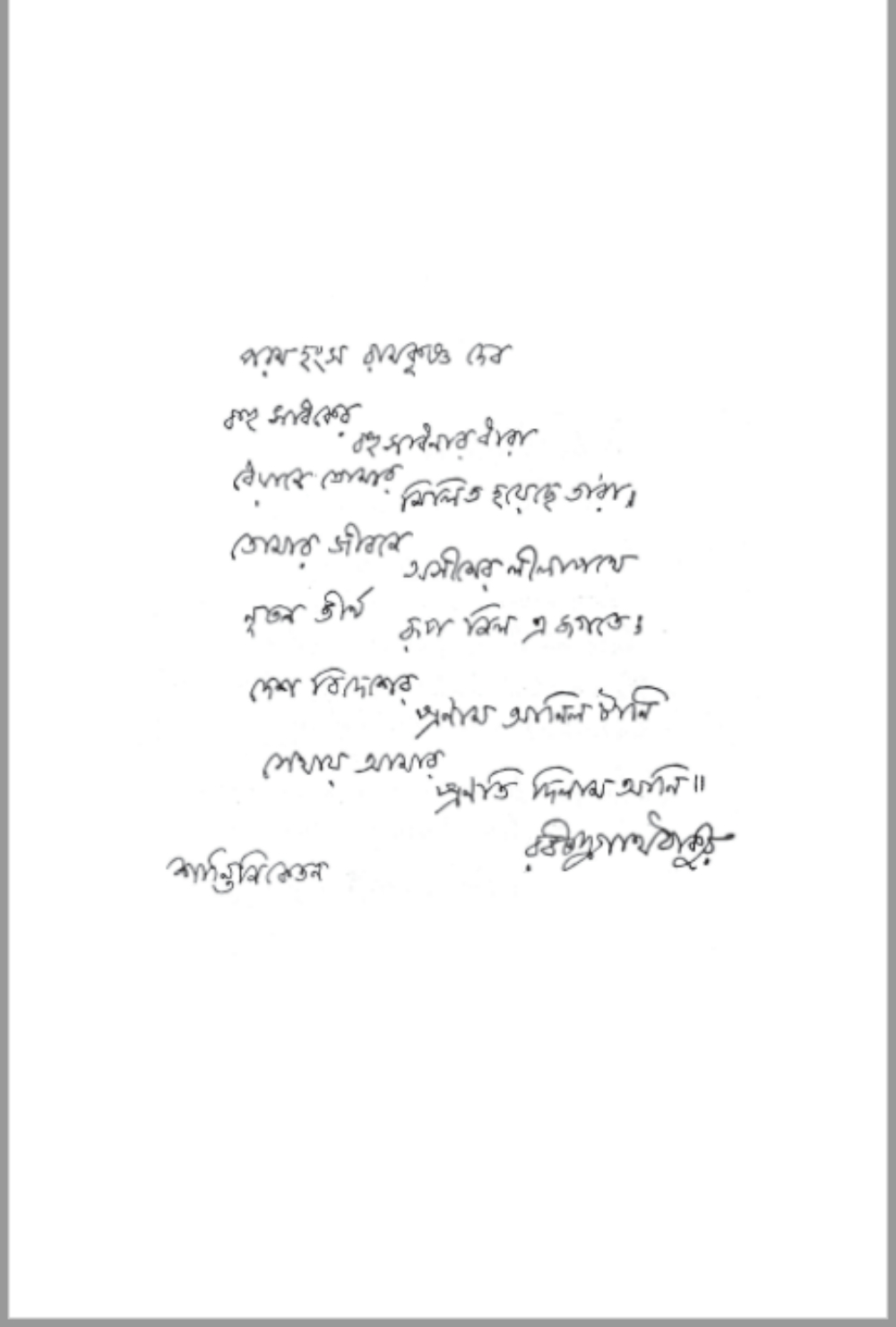
To the Paramahansa Ramakrishna Deva
Diverse courses of worship
from varied springs of fulfilment
have mingled in your meditation.
The manifold revelation of the joy of the Infinite
has given form to a shrine of unity in your life;
Where from far and near arrive salutations
to which I join mine own.[2]
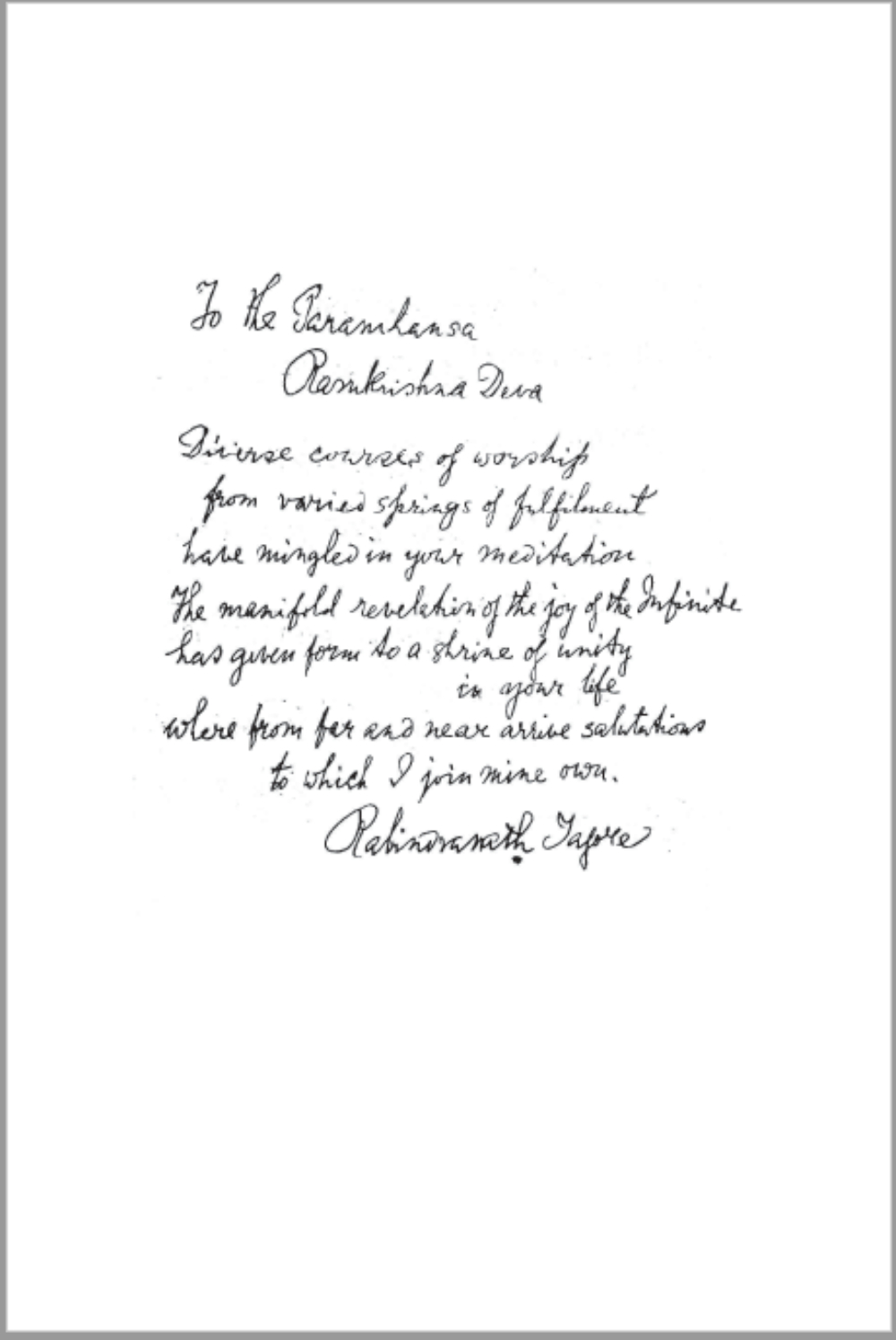
ⓘ
[1] Paramahamsa Ramakrishnadev’, Udbodhan, Phalgun 1342, p.57.
[2] ‘To the Paramahansa Ramakrishna Deva’, Prabuddha Bhārata, February 1936, p.53.
↑ Contents
RADHAKAMAL MUKERJEE
The strangest paradox was that this unsophisticated and unostentatious man of God, around whom gathered the nineteenth-century intellectuals of Calcutta, worshipped Christ and Mohammed.
Sri Ramakrishna’s religion was beatific vision, his worship the perennial realization of the immanence of the Divine in every object and relation, his whole nature the image of God in all its purity, love and beauty. When he affirmed that he followed the paths of the different sects and creeds and practised all religions, Hinduism, Islam, and Christianity, there were a strange passion and certitude from which there could be no escape even of a scoffer and an iconoclast.
India needed a tolerant and universal religion like that of Sri Ramakrishna that might found a new social ethics for our evolving welfare State on the spiritual intuition of the indwelling God in the common man, absolutely every common man, and foster infinite charity and compassion for all. Such an ethics, equalitarian, buoyant, and dynamic, emerged from every parable, every imagery, and every song of this God-intoxicated man who was as powerful in his gentle persuasions as in his unfathomable silence.
ⓘ
[1] Prabuddha Bhārata, May, 1954, p.316.
↑ Contents
RAMDHARI SINGH DINKAR
He (Ramakrishna) shone as a latest flower on the 5000 year old creeper of Indian spiritual traditions and only after coming in touch with him, the people of India regained their faith that the stories of innumerable seers and saints, who have been awakening India through ages, are true, and not lies . . . Ramakrishna and Vivekananda were two parts of a single life, two facets of one truth. Ramakrishna was realization and Vivekananda came as its interpretation . . .In fact, when Narendra Nath surrendered to Ramakrishna, then, in reality, the New India surrendered to Old India; or the Europe came to India. The meeting of Ramakrishna and Narendra Nath was a meeting between faith and reason, a meeting between mysticism and intellect. . . What new India has to say, has come out from the mouth of Vivekananda. The direction, which New India was to take, was hinted clearly by Vivekananda. Vivekananda is the bridge on which Old and New India embrace each other. Vivekananda is that ocean in which go and merge all religion and politics, nationalism and inter-nationalism, Upanishads and science. . . The cyclone, which arose from the centre of English language and European Intellectualism, and proceeded to swallow Hinduism, got subsided after hitting the Himalayan chest of Swami Vivekananda. It is a solemn duty of Hindu race that as long as it survives, it must keep the memory of Vivekananda with the same regard, as with which it remembers Vyāsa and Vālmikī.[1]
ⓘ
[1] Influence of Ramakrishna-Vivekananda on Contemporary Hindi Literature-II, Vedānta Keśarī, June, 2006, p. 21.
↑ Contents
RAMESH CHANDRA MAJUMDAR
The truth of the theoretical speculations of Bankim was demonstrated by Ramakrishna Paramahansa, the greatest saint of the 19th century. Both by precept and example of his own life Ramakrishna brought home to an incredulous world, held under the spell of natural science, the reality of spiritual life and of the means to attain it as described in ancient Hindu scriptures, both Vedic and post-Vedic. He held that not only all the different forms of Hindu religion, including the Puranic and Tantric, but all religions, such as Islam and Christianity, are true in their essence and may lead to salvation, if properly pursued. This he demonstrated by himself practising with success the diverse modes of sadhana or spiritual discipline prescribed in the different religious cults mentioned above....Ramakrishna proved in his own life that the worship of Puranic deities through their images was as good a means of salvation as the worship of one God without any form. He gave a moral sanction, a philosophical basis and a new spiritual significance to the neo-Hinduism which laid the foundation of Hindu nationalism on a secure basis.[1]
ⓘ
[1] History of the Freedom Movement in India (Firma K. L. Mukhopadhyay, Calcutta, 1971), Vol. I, p. 267.
↑ Contents
RICHARD SCHIFFMAN
If Kṛṣṇa was enough for Mīrā, and Jesus sufficient for Saint Francis, then why did Ramakrishna feel the need to cry out in turn to Kālī, to Kṛṣṇa, to Ramā, to Sītā, and even ... to Christ and the God of Mohammed? The mystics of the past had gone into the candy shop and made a single selection. Ramakrishna, on the other hand, had exited with hands and mouth and pockets overflowing.
In reflecting upon this mystery, Ramakrishna’s disciples would probably say that the Master wanted to demonstrate through his actions that all embodiments of God are great, and that devotion to any one of them ultimately reaches the one Ineffable—God beyond all names and forms, God in all names and forms. This seems reasonable enough. But still, we must wonder whether Ramakrishna was being an intentional and premeditated as all that. Or was he simply driven by a hunger that he would not have tried to rationalize or understand? One thing is certain : the spirit of creedal narrowness that seeks to imprison the Infinite within a single approved symbol for worship was completely alien to his nature. And so was the complacency that rests content with what it already knows. Even in the future, when men gathered at his feet, treasuring his every word, Ramakrishna would ask the newcomer to tell him about God, and, if he spoke from genuine experience, the Master would listen rapt with wonder.
Ramakrishna was, by nature, incapable of holding himself aloof. From the moment a newcomer arrived, the Master would be chatting with a transparent sincerity. Invariably, after the briefest civilities, the conversation would turn to God, and devotion ; everything else seemed insipid to him. It was not unusual that within minutes Ramakrishna would be taking a perfect stranger into his confidence, speaking of his most intimate visions and other spiritual experiences in the same easy manner that others talk about the weather ...but always without a hint of pride or boasting. Like the child of God he was, the Master would say, ‘Mother showed me this .... Mother told me....Mother revealed Ramakrishna’s influence on those who lived within his orbit was manifested at every level, from the most mundane to the most metaphysical. His was a flame that burned and enlightened and that melted down the fixed metal of the whole person, only to remould it again in a simpler, truer form....
This transformation of character was Ramakrishna’s greatest miracle and his most enduring legacy...To one and all, Ramakrishna offered a vision of hope. God is not only for the chosen few who become sannyāsīs, but for anyone who cries out to Him with sincere longing. ‘Wherein is the strength of a devotee?’ he once asked rhetorically. ‘He is a child of God, and his devotional tears are his mightiest weapon.'[1]
ⓘ
Sri Ramakrishna: A Prophet for the New Age (New York, Paragon House, 1989), pp. 55, 165, 181, 213.
↑ Contents
ROMAIN ROLLAND
Allowing for differences of country and of time, Ramakrishna is the younger brother of our Christ... I am bringing to Europe, as yet unaware of it, the fruit of a new autumn, a new message of the Soul, the symphony of India, bearing the name of Ramakrishna. It can be shown (and we shall not fail to point out) that this symphony, like those of our classical masters, is built up of a hundred different musical elements emanating from the past. But the sovereign personality concentrating in himself the diversity of these elements and fashioning them into a royal harmony, is always the one who gives his name to the work, though it contains within itself the labour of generations. And with his victorious sign he marks a new era.
The man whose image I here evoke was the consummation of two thousand years of the spiritual life of three hundred million people. Although he has been dead forty years, his soul animates modern India. He was no hero of action like Gandhi, no genius in art or thought like Goethe or Tagore. He was a little village Brahmin of Bengal, whose outer life was set in a limited frame without striking incident, outside the political and social activities of his time. But his inner life embraced the whole multiplicity of men and Gods. It was a part of the very source of Energy, the Divine Śakti, of whom Vidyāpati, the old poet of Mithilā, and Rāmaprasāda of Bengal sing.
Very few go back to the source. The little peasant of Bengal by listening to the message of his heart found his way to the inner Sea. And there he was wedded to it, thus bearing out the words of the Upanishads :
‘I am more ancient than the radiant Gods. I am the first-born of the Being. I am the artery of Immortality.’
It is my desire to bring the sound of the beating of that artery to the ears of fever-stricken Europe, which has murdered sleep. I wish to wet its lips with the blood of Immortality.[1]
ⓘ
The Life of Ramakrishna (Advaita Ashrama, Calcutta, 1979), pp.11-14.
↑ Contents
S.G. GOVINDARAJA IYENGAR
Sri Ramakrishna is the icon in the struggle for the revival of sanatana dharma.[1]
ⓘ
Influence of Ramakrishna-Vivekananda on Contemporary Kanada Literature, Vedānta Keśarī, January, 2006, p. 26.
↑ Contents
SARAT CHANDRA BOSE
This great teacher [Sri Ramakrishna] was Bengal’s contribution to the world in the last century....We and the rest of the world came under the influence of his teachings during his early pilgrimage and even more so, after he had completed his journey...To my mind, Sri Ramakrishna’s mode of approach to different systems of worship inculcated in the different religions of the world is his special contribution to the history of the progress of religions in the present age...Sri Ramakrishna’s teachings did not disturb a single religion of the world. ...He left no new religion as his legacy unto us. He did not ask anybody to change his religion with a view to realizing God...His teachings prove that each religion gives ample scope and opportunity to realize God. That was the distinctive peculiarity of his teachings. Towards the end of his sojourn into this world Swami Premananda, one of his disciples, heard him pray, ‘Mother, do not let me become famous by leading those who believe in beliefs! Do not expound beliefs through my voice.'[1]
ⓘ
The Religions of the World, pp.526-30.
↑ Contents
SAROJINI NAIDU
In the garden of Sir Jagadish Chandra Bose, there stands an empty temple made of stone and one day, when I was giving the Kamalā Lectures to the University, the last day it was, I walked with him in his garden. He said to me, ‘Have you found the text of today’s address?’ I said, ‘No.’ Then he said, ‘You will find the text of your address here.’ I walked with him and looked at the birds, trees, statues and at last I stood before that empty temple, when he said, ‘Poet, have you found your message?’ I said, ‘I have.’ Here is an empty temple in which there is no image because every worshipper must find in the empty temple the knowledge that he creates God in the image of his own soul. That is the message to the world of all great saints and prophets of the world and that was the message of Sri Ramakrishna. For him the temple was always empty, because it was always ready. It was always ready for him to place his deity, no matter whether for a moment he projected himself into the soul of the Mussulman or the Christian or the Confucian or the Zoroastrian or the Sikh or any other faith. He said, ‘Here is a temple of humanity and humanity must have a God. Where shall I find Him? Shall I produce Him in my limited individual consciousness? Or God shall be so infinite and so diverse that I shall seek Him in the image of the Infinite as He appears to his children in the deserts of Arabia, or on the mountaintops, in the caves and in the forests of many lands.’ And Sri Ramakrishna taught us that the temple remains empty because love alone can create an image of God and with that love, you are not limited, you become a part of the great humanity that worship God by many names."[1]
ⓘ
The Religions of the World, pp.p.149.
↑ Contents
SARVEPALLI RADHAKRISHNAN
While the sayings of Sri Ramakrishna did not penetrate so much into academic circles, they found their way into lonely hearts who have been stranded in their pursuit of pleasure and selfish desires. Under the inspiration of this great teacher there has been a powerful revival of social compassion....He has helped to raise from the dust the fallen standard of Hinduism, not in words merely, but in works also.[1]
ⓘ
[1] The Cultural Heritage of India (Ramakrishna Mission Institute of Culture, 1970), Vol. I, Introduction, p. xxxvi.
↑ Contents
SATIS CHANDRA CHATTOPADHYAY
Sri Ramakrishna lived a life of manifold spiritual realization. He approached Reality along numerous paths and had very varied experiences of it................... This is a sort of experimental verification of the truth that while Reality is one and is formless and nameless in one aspect, it may have many forms and faces in another. On the strength of such indubitable spiritual experiences and firm convictions, Sri Ramakrishna taught many truths for the good of mankind. He lived in an age in which the world was torn by conflicts of creeds and cultures, dogmas and doctrines, theologies and philosophies, and the relation between any two religious sects or communities was embittered by intolerance, jealousy and contempt of each other. It was the mission of his life to end these conflicts and bring about a reconciliation.
...In Sri Ramakrishna’s teachings we have a solution of the vexed problem of God and the Absolute, which is more satisfying than any to be found elsewhere....... Sri Ramakrishna not only preached the harmony of all religions, but his life itself was a harmony of all religions. He taught it and demonstrated it in his life by following many different religions and realizing the same God through each of them...He taught that all religions from crude image-worship to contemplation of the pure, formless Brahman are true and that they are all capable of leading their followers to the highest end of the religious life, namely, God.[1]
ⓘ
Classical Indian Philosophies: Their Synthesis in the Philosophy of Sri Ramakrishna by Satis Chandra Chatterjee (University of Calcutta, 1963), pp. 104, 107 and 142.
↑ Contents
SAYED MUJTABA ALI
Like him [Sri Ramakrishna] none had ever spoken in such a simple language. His words and the way of talking have their closest similarity with those of Christ. ...He was determined to attach greatest value to the folk religion, customs, rituals and language, and, hence, had continually used peoples’ language and the mode of talking with heart’s content.
...If for reasons of spiritual, social or political discord different sects living within the same society refuse to be cohesive among themselves, it results in an irreparable loss to that society as a whole, which may, even, lead to its enormous extinction. How many of the virtuous people in those days [We doubt] were aware of this truth?
...Paramahamsa Deva decided to do away with such discords, so he never avoided the pointless and unpopular discussion centring the Form and the Formless. As a proof of that we frequently see that he was not satisfied with the company of his Hindu disciples and followers alone, and has earnestly kept on asking - where is Vijay [Vijaykrishna Goswami], Sivanath [Sivanath Sastri] has assured me that he would come, Keshub [Keshub Chandra Sen] is very dear to me. But he hardly was willing to convert his Brahmo disciples to Kālī-worship. With his entire heart he only yearned that the conflict should disappear. It is my firm belief that for obviating the conflict, Sri Ramakrishna deserves the unique glory.
The sage who could harmonize Gītā's doctrine of Karma, Jñāna and Bhakti is, as it were, the man absolute - the Supreme man.... Ever since these three ways were introduced in the Gītā, no fourth method has yet been discovered. He, who could harmonize these three ways, becomes the companion of Kṛṣṇa - and his name is Sri Ramakrishna.[1]
ⓘ
Translated from Udbodhan Centenary Collection (Śatābd Jayantī Nirvāchita Sankalan) ed. by Swami Purnatmananda (Udbodhan Karyalaya, Kolkata, June, 1999), pp. 857-61.
↑ Contents
SIVANATH SASTRI
The impression left in my mind by intercourse with him [Ramakrishna Paramahansa] was that I had seldom come across any other man, in whom the hunger and thirst for spiritual life were so great and who had gone through so many privations and sufferings for the practice of religion. Secondly, I was convinced that he was no longer a sādhaka or a devotee under exercise but was a siddha puruṣa or one who had attained direct vision of spiritual truth. The truth, of which he had direct spiritual vision and which had become a fountain of noble impulses in his soul, was Divine Motherhood.....Yet this conception of Motherhood stretched far beyond any idol or image into a sense of the Infinite...He would say, only fools make distinction between Kālī and Kṛṣṇa, they are the manifestations of the same Power.
Speaking of the spirituality and catholicity of his conception, one incident comes to my mind. A Christian preacher of Bhowanipore, who was my personal friend, once accompanied me on my visit to Ramakrishna. When I introduced my friend to him, I said—‘To-day I bring a Christian preacher to you, who having heard of you from me, was very eager to see you’, whereupon the saint bowed his head to the ground and said, ‘I bow again and again, at the feet of Jesus.’ Then took place the following conversation :
My Christian friend—How is it, Sir, that you bow at the feet of Christ? What do you think of him?
Ramakrishna—Why, I look upon him as an incarnation of God.
My friend—Incarnation of God! Will you kindly explain what you mean by it?
Ramakrishna—An incarnation like our Rama or Kṛṣṇa. Don’t you know there is a passage in the Bhāgavatam where it is said that the incarnations of Viṣṇu or the Supreme Being are innumerable?
My friend—Please explain further ; I do not understand it quite.
Ramakrishna—Just take the case of the ocean. It is a wide and almost infinite expanse of water. But owing to special causes, in special parts of this wide sea, the water becomes congealed into ice. When reduced to ice it can be easily manipulated and applied to special uses. An incarnation is something like that. Like that infinite expanse of water, there is the Infinite Power, immanent in matter and mind, but for some special purposes, in special regions, a portion of that Infinite power, as it were, assumes a tangible shape in history, that is what you call a great man ; but he is, properly speaking, a local manifestation of the all-pervading Divine Power, in other words, an incarnation of God. The greatness of great men is essentially the manifestation of Divine Energy
During the last few years of the saint’s life, my visits became less frequent than they were before
At last when the news of his fast declining health was brought to me one day, I left all work and went to Dakshineshwar...
That was my last interview with him, after which he was removed from Dakshineshwar, was placed under the treatment of the most distinguished physicians of the town, and was devotedly nursed by his disciples ; but nothing could stay the progress of his disease and he passed away, leaving behind him a memory that is now spiritually feeding hundreds of earnest souls. My acquaintance with him, though short, was fruitful by strengthening many a spiritual thought in me. He was certainly one of the most remarkable personalities I have come across in life.[1]
* * *
After coming into contact with Ramakrishna, this one idea used to come to my mind that religion is one, only its forms are different. Every word of Ramakrishna gave utterance to this catholicity and universality of religion. I remember very clearly one of his illustrations in this connection. (Sastri then narrates the same incident as stated before)...
It was after mixing with Ramakrishna I have especially realized the spirit of universality of religion....[2]
ⓘ
[1] Men I Have Seen (Sādhāran Brāhmo Samāj, Calcutta, 1966), pp. 66-77.
[2] Atmacarit, Pravāsī Kāryālaya, Calcutta, 1328 (BS), pp. 216-17:‘...
রামকৃষ্ণের সঙ্গে মিশিয়া এই একটা ভাব আমার মনে আসিত যে, ধর্ম এক রূপ ভিন্ন ভিন্ন মাত্র। ধর্মের এই উদারতা ও বিশ্বজনীনতা রামকৃষ্ণ কথায় কথায় ব্যক্ত করিতেন। ইহার একটি নিদর্শন উজ্জ্বলরূপে স্মরণ আছে।....রামকৃষ্ণের সহিত মিশিয়া আমি ধর্মের সার্বভৌমিকতার ভাব বিশেষরূপে উপলব্ধি করিয়াছি।...'
↑ Contents
SRI AUROBINDO
When scepticism had reached its height, the time had come for spirituality to assert itself and establish the reality of the world as a manifestation of the spirit, the secret of the confusion created by the senses, the magnificent possibilities of man and the ineffable beatitude of God. This is the work whose consummation Sri Ramakrishna came to begin and all the development of the previous two thousand years and more since Buddha appeared, has been a preparation for the harmonization of spiritual teaching and experience by the avatāra of Dakshineshwar.
The long ages of discipline which India underwent, are now drawing to an end. A great light is dawning on the East, a light whose first heralding glimpses are already seen on the horizon; a new day is about to break, so glorious that even the last of the avatāras cannot be sufficient to explain it, although without him it would not have come. The perfect expression of Hindu spirituality was the signal for the resurgence of the East. Mankind has long been experimenting with various kinds of thought, different principles of ethics, strange dreams of a perfection to be gained by material means, impossible millenniums and humanitarian hopes. Nowhere has it succeeded in realizing the ultimate secret of life. Nowhere has society or politics helped it to escape from the necessity of sorrow, poverty, strife, dissatisfaction from which it strives for an outlet; for whoever is trying to find one by material means, must inevitably fail. The East alone has some knowledge of the truth, the East alone can teach the West, the East alone can save mankind. Through all these ages Asia has been seeking for a light within, and whenever she has been blessed with a glimpse of what she seeks, a great religion has been born, Buddhism, Confucianism, Christianity, Mohammedanism with all their countless sects. But the grand workshop of spiritual experiment, the laboratory of the soul has been India, where thousands of great spirits have been born in every generation who were content to work quietly in their own souls, perfect their knowledge, hand down the results of their experiments to a few disciples and leave the rest to others to complete. They did not hasten to proselytize, were in no way eager to proclaim themselves, but merely added their quota of experience and returned to the source from which they had come. The immense reservoir of spiritual energy stored up by the self-repression was the condition of this birth of avatāras, of men so full of God that they could not be satisfied with silent bliss, but poured it out on the world, not with the idea of proselytizing but because they wished to communicate their own ecstasy of realization to others who were fit to receive it either by previous tapasyā or by the purity of their desires. Of all these souls Sri Ramakrishna was the last and greatest, for while others felt God in a single or limited aspect, he felt Him in His illimitable unity as the sum of an illimitable variety. In him the spiritual experiences of the millions of saints who had gone before were renewed and united. Sri Ramakrishna gave to India the final message of Hinduism to the world. A new era dates from his birth, an era in which the peoples of the earth will be lifted for a while into communion with God and spirituality become the dominant note of spiritual life. What Christianity failed to do, what Mohammedanism strove to accomplish in times as yet unripe, what Buddhism half accomplished for a brief period and among a limited number of men, Hinduism as summed up in the life of Sri Ramakrishna has to attempt for all the world. This is the reason of India’s resurgence, this is why God has breathed life into her once more, why great souls are at work to bring about her salvation, why a sudden change is coming over the hearts of her sons. The movement of which the first outbreak was political, will end in a spiritual consummation.[1]
ⓘ
[1] Sri Aurobindo and the New Thought in Indian Politics by Haridas Mukherjee & Uma Mukherjee, Revised Second Edition, 1997, pp. 276-79.
↑ Contents
SUBHAS CHANDRA BOSE
From Vivekananda I turned gradually to his master, Ramakrishna Paramahansa. Vivekananda had made speeches, written letters, and published books which were available to the layman. But Ramakrishna, who was almost an illiterate man, had done nothing of the kind. He had lived his life and had left it to others to explain it. Nevertheless, there were books or diaries published by his disciples which gave the essence of his teachings..................... There was nothing new in his teaching, which is as old as Indian civilization itself, the Upanishads having taught thousands of years ago that through abandonment of worldly desires alone can immortal life be attained. The effectiveness of Ramakrishna’s appeal lay, however, in the fact that he had practised what he preached and that...he had reached the acme of spiritual progress.[1]
ⓘ
[1] An Indian Pilgrim (Asia Publishing House, Bombay, etc., 1965), p. 34.
↑ Contents
SUMITRANANDAN PANT
Neo-spirituality viz., Sri Ramakrishna... and Vivekananda’s books gave me immense inspiration. And the life of Paramahansaji appeared to me to be living mysticism. This spiritual quest woven in my consciousness as a silver thread, has ever existed in me as a living force. And it made my external life more and more controlled and balanced. This tendency of mine has nourished my love and craving for creation; and my solitude has been enriched by literary life, study, contemplation and experiments in creation.[1]
ⓘ
Influence of Ramakrishna-Vivekananda on Contemporary Hindi Literature-II, Vedānta Keśarī, June, 2006, p. 20.
↑ Contents
SURYAKANTH TRIPATHI (NIRALA)
Their (Sri Ramakrishna and Swami Vivekananda) supernatural power pervaded the whole world. ...Vivekananda related Advaita with labour, devotion to duty and love for humanity. From him I (Nirala), have learnt that service to man was not opposed to Vedantic ideas.[1]
ⓘ
Influence of Ramakrishna-Vivekananda on Contemporary Hindi Literature-II, Vedānta Keśarī, June, 2006, p.20
↑ Contents
T. M. P. MAHADEVAN
The sage (Sri Ramakrishna) did not have any formal education. He had dedicated his life to intense spirituality. True to India’s tradition of hospitality, Sri Ramakrishna experimented with God in a variety of ways, including the so-called alien paths, and found that all religions led to the same goal.[1]
ⓘ
India Interpreting: Vivekananda, Vedānta Keśarī, August, 2006, p. 182.
↑ Contents
TARASANKAR BANDYOPADHYAY
Sri Ramakrishna’s teachings propagate the purest and simplest truths which transcend the bounds of India and become all time relevant for the whole world.
Never has He recorded any of his teachings, nor has he ever felt the necessity of it. His teachings echo the spirit of Jesus’s gospel.
Sri Ramakrishna has presented us with the true character of religion and explained it to all to get both the society and our minds rid of all vices and impurities. Swami Vivekananda is His gift to the world. And we owe a world of debt to Him for this. Our love for Him is boundless. It is spontaneous.[1]
ⓘ
Bhābsamāhita Sri Ramakrishna, p.344.
↑ Contents
THOMAS MERTON
You have to see your will and God’s will dualistically for a long time. You have to experience duality for a long time until you see it’s not there. In this respect I am a Hindu. Ramakrishna has the solution. Don’t consider dualistic prayer on a lower level.... There are no levels. Any moment you can break through to the underlying unity which is God’s gift in Christ. In the end, praises. Thanksgiving gives thanks. Jesus prays. Openness is all.[1]
ⓘ
David Stenindl-Rast, ‘Man of Prayer’, Thomas Merton/Monk ed. by Brother Patrick Hart (London : Sheed and Ward, 1974), pp. 88-89.
↑ Contents
V. V. GIRI
What struck me most in reading about Ramakrishna was his simple and common approach to problems; and his philosophy is one which could be understood even by an ordinary man not well-versed with the nuances and technicalities of highly intellectual approach to problems of religion. The quintessence of the message of Ramakrishna, if I may sum up in one word is Humanism and that naturally has drawn me closest to his writings. What Ramakrishna preached is as relevant today as it was when he propounded them and I have no doubt in my mind they will continue to inspire mankind for ages. His many allegories and anecdotes from the day-to-day life of the people are simple, and Ramakrishna Paramahamsa, could drive a point home which even the most ordinary person could understand.
Ramakrishna Paramahamsa was indeed a realized soul who could sift the chaff from the grain and separate the pure milk from the water. The essence of all philosophies, he could sum up in a few simple words and he could draw many adherents and followers because he preached what he practised and practised what he preached. An embodiment of infinite religious ideas, Ramakrishna rendered the monastic order founded by him broad-based and comprehensive in its outlook. While many other religious movements did not succeed in full measure because of their sectarianism....Ramakrishna Paramahamsa mentioned that saintliness was not exclusive of patriotism or humanitarian service.[1]
ⓘ
All Pervading Humanism of Ramakrishna-Vivekananda, Prabuddha Bhārata, August, 1969, pp. 344, 346.
↑ Contents
WILL DURANT
[Ramakrishna] taught his followers [that] each [religion] is a way to God or a stage on the way adapted to the mind and heart of the seeker. To be converted from one religion to another is foolishness; one need only continue on his own way, and reach to the essence of his own faith. [He said,] ‘All rivers flow to the ocean. Flow, and let others flow, too.’ He tolerated sympathetically the polytheism of the people, and accepted humbly the monism of the philosophers, but in his own living faith God was a spirit incarnated in all men, and the only true worship of God was the loving service of mankind.
Many fine souls, rich and poor, Brahmana and pariah, chose him as guru, and formed an order and mission in his name.[1]
ⓘ
[1] The Story of Civilization : Our Oriental Heritage (Simon & Schuster : New York, 1954), Vol.1, p.617.
↑ Contents
WILLIAM DIGBY
During the last century the finest fruit of British intellectual eminence was, probably, to be found in Robert Browning and John Ruskin. Yet they are mere gropers in the dark compared with the uncultured and illiterate Ramakrishna of Bengal, who knowing naught of what we term ‘learning’, spoke as not other man of his age spoke, and revealed God to weary mortals.[1]
ⓘ
[1] Prosperous British India, 1901, p. 99.
↑ Contents
ZAKIR HUSSAIN
God-intoxicated Saint, Sri Ramakrishna Paramahamsa, was one of the very great ones in that great army of the spirit, marching down the corridors of time under the Indian sky... Sri Ramakrishna used to say, do not speak of love for your brother. Realize it. Do not argue about doctrine or religion. There is only one. All rivers flow to the Ocean. Flow and let others flow too. The great stream carves for itself according to the slope of its journey according to race, time and temperament, its own distinct bed. But it is all the same water. Go, flow on towards the Ocean.[1]
ⓘ
[1] Swami Vivekananda and the Present Indian Context, Vedānta Keśarī, September, 1963, p. 338.
↑ Contents
Swami Vivekananda
A. D. PUSALKER
Universally acclaimed as a pioneer in the field of national liberation in India, Swami Vivekananda was complex personality being a lover of humanity, a world teacher of religion, a great patriot, and a leader of the Indian people. Truly has he been regarded as a patriot-saint of modern India and an inspirer of her dormant consciousness, who instilled a freshness and vigour into it. He presented the rare combination of being patriot and a saint, in whom patriotism was deified into the highest saintship and loving service to fellow men into true worship.[1]
[1] Vivekananda O Samakālīn Bhāratavarṣa, ed. by Sankari Prasad Basu, 1988, Vol.7, p. 270.
↑ Contents
A. L. BASHAM
Even now, a hundred years after the birth of Narendranath Datta, who later became Swami Vivekananda, it is very difficult to evaluate his importance in the scale of world history. It is certainly far greater than any Western historian or most Indian historians would have suggested at the time of his death. The passing of the years and the many stupendous and unexpected events which have occurred since then suggests that in centuries to come he will be remembered as one of the main moulders of the modern world, especially as far as Asia is concerned, and as one of the most significant figures in the whole history of Indian religion, comparable in importance to such great teachers as Śaṅkara and Rāmānuja, and definitely more important than the saints of local or regional significance such as Kabīr, Caitanya, and the many Nāyanmārs and Ālvārs of South India.
* * *
I believe also that Vivekananda will always be remembered in the world’s history because he virtually initiated what the late Dr C. E. M. Joad once called ‘the counter-attack from the East’. Since the days of the Indian missionaries who travelled in South-East Asia and China preaching Buddhism and Hinduism more than a thousand years earlier, he was the first Indian religious teacher to make an impression outside India.[1]
[1] Swami Vivekananda in East and West (Ramakrishna Vedanta Centre, London), pp. 210-14.
↑ Contents
A. LAKSHMANASWAMI MUDALIAR
Vivekananda’s message is meant for all time and for the whole world, and it is needed much more now than at any other time.... Vivekananda had a prophetic vision of the future of India.…he advocated social evolution instead of revolution and he called his method root-and-branch reform.… with its emphasis on toleration and universality, faith and service, is urgently needed today to sustain civilization and world peace.[1]
[1] ‘The Message of Swami Vivekananda’, Prabuddha Bhārata, June 1954, pp.335-37.
↑ Contents
A. RAMASWAMI MUDALIAR
I have come under no greater influence than the influence of the life and teachings of Swami Vivekananda. ... I have spoken of that life and have testified to the great influence that that life has had on the generation which immediately succeeded the premature departure of the Swamiji from this world....
... After I began to study in the college, there were friends and elders of mine who used to tell us stories of the days in 1893 when Narendra Datta (Swami Vivekananda)—as he then was — often sat on the pials of the houses of Triplicane and began to discuss with learned pandits in Sanskrit — and some of them in Madras were very learned indeed — the great truths of our religious teaching. The exposition, the dialectic skill he showed, and the masterly way in which he analysed what even to those well-educated and learned pandits were unfathomable depths of Sanskrit literature and law, greatly attracted attention from all and sundry. ...
...Swami Vivekananda was a fighter himself. He was one who knew not any kind of physical cowardice or moral cowardice. ...He is a citizen of the world. His contribution will stay on forever. His immortal soul pervades the whole universe.[1]
[1] ‘The Message of Swami Vivekananda’, Prabuddha Bhārata, June 1940, pp.280-83.
↑ Contents
ANNIE BESANT
A striking figure, clad in yellow and orange, shining like the sun of India in the midst of the heavy atmosphere of Chicago, a lion head, piercing eyes, mobile lips, movements swift and abrupt and fast— such was my first impression of Swami Vivekananda, as I met him in one of the rooms set apart for the use of the delegates to the Parliament of Religions. Monk, they called him, not unwarrantably, but warrior-monk was he, and the first impression was of the warrior rather than of the monk, for he was off the platform, and his figure was instinct with pride of country, pride of race — the representative of the oldest of living religions, surrounded by curious gazers of nearly the youngest. India was not to be shamed before the hurrying arrogant West by this her envoy and her son. He brought her message, he spoke in her name, and the herald remembered the dignity of the royal land whence he came. Purposeful, virile, strong, he stood out, a man among men, able to hold his own.
On the platform another side came out. The dignity and the inborn sense of worth and power still were there, but all was subdued to the exquisite beauty of the spiritual message which he had brought, to the sublimity of that matchless truth of the East which is the heart and the life of India, the wondrous teaching of the Self. Enraptured, the huge multitude hung upon his words; not a syllable must be lost, not a cadence missed! ‘That man, a heathen!’ said one, as he came out of the great hall, ‘and we send missionaries to his people! It would be more fitting that they should send missionaries to us!’[1]
[1] ‘The Message of Swami Vivekananda’, Prabuddha Bhārata, June 1963, pp. 170-71.
↑ Contents
BAL GANGADHAR TILAK
It is doubtful if there is any Hindu who does not know the name of Sri Vivekananda Swami. There has been extraordinary advancement of material science in the nineteenth century. Under the circumstances, to present the spiritual science prevailing in India for thousands of years by wonderful exposition and then to kindle admiration and respect among the Western scholars, and, at the same time, to create a sympathetic attitude for India, the mother of spiritual science, can only be an achievement of superhuman power. With English education, the flood of material science spread so fast that it required extraordinary courage and extraordinary genius to stand against that phenomenon and change its direction. Before Swami Vivekananda the Theosophical society began this work. But it is an undisputed fact that it was Swami Vivekananda who first held aloft the banner of Hinduism as a challenge against the material science of the West. It was Swami Vivekananda who first took on his shoulders this stupendous task of establishing the glory of Hinduism in different countries across the borders. And he, with his erudition, oratorical power, enthusiasm and inner force, laid that work upon a solid foundation....Twelve centuries ago Śaṅkāracārya was the only great personality, who not only spoke of the purity of our religion, not only uttered in words that this religion was our strength and wealth, not only said that it was our sacred duty to preach this religion in the length and breadth of the world—but also brought all this into action. Swami Vivekananda is a person of that stature— who appeared towards the last half of the nineteenth century.[1]
ⓘ
[1] Vivekananda O Samakālīn Bhāratavarṣa, 1988, Vol.5, p. 454.
↑ Contents
BALASAHEB GANGADHAR KHER
Everything connected with the venerable name of …Swami Vivekananda is holy and sacred…The name stand for the higher values of life—for all that enriches us spiritually. …He symbolize the blend of noble thought and vigorous, purposeful activity…[1]
ⓘ
[1] Vedānta Keśarī, March 1949.
↑ Contents
BENOY KUMAR SARKAR
If we look upon Ramakrishna as the Buddha of our times, Vivekananda may pass for one or other of the great apostles of yore, say, the scholar Rāhula, the constitutional authority Upāli, the devoted lieutenant Ānanda, the sage Sāriputta, or that master of discourses, Mahākachchāyana. One can almost say that Vivekananda was all these great Buddhist preacher-organizers boiled down into one personality.
...He was much more than a mere exponent of Vedanta, or Ramakrishna, or Hinduism, or Indian Culture. ...In all his thoughts and activities he was expressing only himself. He always preached his own experiences. It is the truths discovered by him in his own life that he propagated through his literature and institutions. As a modern philosopher he can be properly evaluated solely if one places him by the side of Dewey, Russell, Croce, Spranger, and Bergson. It would be doing Vivekananda injustice and misinterpreting him hopelessly if he were placed in the perspective of scholars whose chief or sole merit consists in editing, translating, paraphrasing or popularizing the teachings of Plato, AŚvaghoṣa, Plotinus, Nāgārjuna, Aquinas, Śaṅkarācārya and others.[1]
* * *
With five words he conquered the world when he addressed men and women as ‘Ye divinities on earth,— Sinners?’ The first four words thundered into being the gospel of joy, hope, virility, energy and freedom for the races of men, and yet with the last word, embodying as it did a sarcastic question, he demolished the whole structure of soul-degenerating, cowardice-promoting, negative, pessimistic thoughts. On the astonished world the little five-word formula fell like a bombshell. The first four words he brought from the East, and the last word he brought from the West. All these are oft-repeated expressions, copy-book phrases both in the East and the West. And yet never in the annals of human thought was the juxtaposition accomplished before Vivekananda did it in this dynamic manner and obtained instantaneous recognition as a world’s champion.
Vivekananda’s gospel here is that of energism, of mastery over the world, of elan vital subduing conditions that surround life, of creative intelligence and will, of courage trampling down cowardice, of world conquest. And those who are acquainted with the trends of world-thought since the middle of the nineteenth century are aware that it was just along these lines that the West was groping in the dark to find a solution. A most formidable exponent of these wants and shortcomings was the German man of letters and critic, Nietzsche (on whom the influence of Manu was powerful), whose...works had awakened mankind to the need of a more positive, humane and joyous life’s philosophy than that of the New Testament. This joy of life for which the religious, philosophical and social thought was anxiously waiting came suddenly from an unexpected quarter, from this unknown young man of India. And Vivekananda was acclaimed as a tremendous creative power, as the pioneer of a revolution,—the positive and constructive counterpart to the destructive criticism of Nietzsche.... The key to Vivekananda’s entire life is to be found in this Śakti-yoga, energism, the vigour and strength of freedom. All his thoughts and activities are expressions of his energism. Like our Paurāṇik Viśvāmitra or the Aeschylean Prometheus he wanted to create new worlds and distribute the fire of freedom, happiness, divinity and immortality among men and women.[2]
* * *
...His [Vivekananda] politics and economics are all to be found in his social philosophy. And in this domain we encounter Vivekananda as the messenger of modern materialism. It is possible to establish here an equation between Vivekananda and Immanuel Kant. What Kant did for Euro-America towards the end of the eighteenth century was accomplished for India towards the end of the nineteenth century by Vivekananda. Kant is the father of modern materialism for the West. Vivekananda is the father of modern materialism for India. It is to them that the world is indebted for the charters of dignity for Nature, matter, material science and material welfare. India like Europe was therefore in need of a man who could say with all honesty he could command that Prakṛti was no less sacred than Puruṣa(man) and that the pursuit of material sciences and material prosperity was as godly as that of the sciences and activities bearing on the soul.[3]
* * *
The combined intelligence of the entire world assembled at Chicago listened to this uninvited and perhaps unwelcome intruder [Swami Vivekananda] from the banks of the Southern Ganges and was convinced that a new power had arisen in the international sphere and that this new power was Young India. ... Vivekananda was acclaimed as the world- conqueror for Young India.
... From 1757 down to 1893 for more than a hundred years – for nearly 140 years, the world had known almost nothing about Indian India, nothing of the creative Hindus and Mussulmans, nothing of Indian culture, nothing of India’s constructive energism. In 1893 Vivekananda threw the first bombshell that announced to mankind in the two hemispheres, to the men and the women of America, of England, France, Germany, Russia, Italy, nay, to the yellows of Japan and China that India was once more to be a power among the powers of the world. Mankind came to realize 1893 as the year No.1 of a vast empire and to recognize the founder of that empire as Vivekananda.[4]
ⓘ
[1] Creative India by Benoy Kumar Sarkar, Lahore, 1937, p. 671.
[2] Creative India by Benoy Kumar Sarkar, Lahore, 1937, pp. 672-673.
[3] Prabuddha Bhārata, July 1939.
[4] ‘What is Ramakrishna’ by Benoy Kumar Sarkar, Prabuddha Bhārata, August 1940, p. 251.
↑ Contents
BEPIN CHANDRA PAL
I
Vivekananda, however, does not stand alone. He is indissolubly bound up with his Master, Paramahansa Ramakrishna. The two stand almost organically bound up, so far as the modern man, not only in India but in the larger world of our day, is concerned. The modern man can only understand Paramahansa in and through Vivekananda, even as Vivekananda can be understood only in the light of the life of his Master. The Master was a great spiritual force. He was therefore inevitably a mystery to a generation possessed by the un-understood slogans of what is called rationalism, which really means lack of that imagination which is the soul of all spiritual life. Imagination is not fancy. It is really the power to cognize, if not to visualize, that which stands above not only the sensuous but also the intellectual plane. The generation to which Ramakrishna belonged, lacked this imagination. He was, therefore, a mystery to it. It was given to Vivekananda to interpret and present the soul of Paramahansa Ramakrishna and the message of his life to this generation in such terms as would be comprehended by them.
Ramakrishna Paramahansa belonged to no sect or denomination or to put it in another way, he belonged to all sects and denominations both Indian and non-Indian. He was a true Universalist, but his Universalism was not the Universalism of Abstraction. He did not subtract the particularities of different religions to realize his universal religion. With him the Universal and the particular always went together like the sun and shadow. He realized therefore the Reality of the Universal in and through the infinite particularities of life and thought. Vivekananda clothed this realization of his Master in the language of modern Humanism.
Ramakrishna Paramahansa’s God was not the God of logic or philosophy, but the God of direct, personal, inner experience. Ramakrishna believed in his God not on the authority of ancient scriptures or traditions, nor on the authority of any guru, but on the testimony of his own direct, personal experiences. He was a Vedantist ; because, his direct allegiance and early training was in the cult of Śakti. The Śakti cult in Bengal has been built upon Vedantism. But the Vedantism of Ramakrishna Paramahansa could hardly be labelled as Śaṅkara-Vedantism, nor could it be labelled either as any of the different schools of Vaiṣṇava-Vedanta. These labels are for those who borrow their theology from speculations of great thinkers. But Ramakrishna Paramahansa did not belong to this class. He was not a philosopher; he was not a Pundit, whether modern or ancient ; he was not a logician ; he was a simple seer. He believed in what he saw.
The seer is always a mystic. So was Paramahansa Ramakrishna: so was Jesus; so were all the great spiritual leaders of men. The crowd cannot understand them; least of all are they understood by the learned and the philosophers of their age. Yet they reveal that which all philosophies grope after. Paramahansa Ramakrishna, like Jesus Christ, needed an interpreter to explain him and deliver his message to his age. Jesus found such an interpreter in St. Paul; Ramakrishna found him in Vivekananda. Vivekananda therefore must be understood in the light of the realizations of Paramahansa Ramakrishna.
II
The story of Vivekananda’s conversion has not as yet been told. I do not know if anybody knows how this miracle happened. Vivekananda had been a rationalist and a deist, though he fancied that he was a theist. His early religious associations were with the Brāhmo Samāj. They were not very congenial to the development of faith in saints and seers. Ramakrishna Paramahansa attracted however many members of the Brāhmo Samāj by his great psychic powers and more particularly by his passionate love of God. But they never were able to open the secret springs of the life and realizations of the Paramahansa. They saw him through the prism of the intellect. The Paramahansa never really opened to most of them the secret chambers of his piety. Vivekananda was favoured by the Paramahansa in this matter.
Paramahansa Ramakrishna saw into the innermost composition of Vivekananda’s nature and spirit and recognized in him a fit instrument for delivering the message of his own life. This is the real story of Vivekananda’s conversion. It is the story of the conversion also of Soul, though it was set in a different psychological setting. Vivekananda felt drawn to his Master by what he hardly knew. It was the operation of what is now called soul-force. When one soul touches another on this deep spiritual plane, the two are united for ever by unbreakable spiritual bonds. The two henceforth become practically one; the Master working in and through the disciple, the disciple not even knowing that he is dancing to the tune of the Master. People call it inspiration. Vivekananda worked after his conversion under the inspiration of his Master.
III
The message of Vivekananda, though delivered in the term of the popular Vedantic speculation, was really the message of his Master to the modern man. Vivekananda’s message was really the message of modern humanity. His appeal to his own people was, ‘Be men.’ The man of religion in India had been a mediaeval man. His religion was generally a religion of the other world. It was a religion that enjoined renunciation of the world and all the obligations of the physical and the social life. But this was not the real message of Paramahansa Ramakrishna. He was as much a Vedāntin as a Vaiṣṇava. His ideal of piety was a synthesis between these two rival schools of Hindu religion. His cult of the Mother was really the cult of Bhakti, or love of God, realized in the terms of the human motherhood. As with the Bengal Vaiṣṇava, so with the Paramahansa, the Ultimate Reality was not an abstraction. It was not carnal, but therefore it was not without form. And the real form of the Ultimate Reality is the Human Form—not the sensuous form of man which we see with our eyes, but the spiritual form which stands behind it, invisible to mortal eye. Man and God are generically one.
To help man to realize his essential divinity is the object of all religious culture. This is what Vivekananda really meant when he appealed to his people to be men. In the ritual of divine worship of the Brahmin, is used the following text which says : ‘I am Divine. I am none other. I am not subject to grief and bereavement. I am of the form of the True, the Self-conscious and the Eternally Present. I am by nature eternally free.’ This was the message really of his Master as delivered to the modern world by Vivekananda.
It is the message of freedom, not in a negative sense, but in its positive and most comprehensive implications. Freedom means removal of all outside restraint. But constituted as we are, we cannot cut ourselves off from all outside relations, whether with our natural environments or our social environments. Such isolation spells death both physically and spiritually. The law of life is therefore not isolation, but association, not non-co-operation but co-operation. And real freedom is achieved not through war, but through peace only. War or renunciation or isolation has a place no doubt in the scheme of life, but only a temporary place as a means to the attainment of the ultimate end which is not perpetuation of the inevitable conflict of evolution, but the settlement and cancellation of these conflicts in a closer and permanent union. Freedom again is one. Freedom from the domination of our passions and appetites is the first step in the realization of the ideal. Freedom from the fear of brother-man is the next step. Freedom from the domination of any external authority must follow next. In this way from personal freedom, through social freedom including political freedom, man must attain his real freedom. And when he attains it, he realizes finally that he and his God are one. This is the message of the Vedanta as interpreted by Vivekananda. This is really the message of his Master to the modern world.[1]
Some people in India think that very little fruit has come of the lectures that Swami Vivekananda delivered in England, and that his friends and admirers exaggerate his work. But on coming here I see that he has exerted a marked influence everywhere. In many parts of England I have met with men who deeply regard and venerate Vivekananda. Though I do not belong to his sect, and though it is true that I have differences of opinion with him, I must say that Vivekananda has opened the eyes of a great many here and broadened their hearts. Owing to his teaching, most people here now believe firmly that wonderful spiritual truths lie hidden in the ancient Hindu scriptures. Not only has he brought about this feeling, but he succeeded in establishing a golden relation between England and India. From what I quoted on ‘Vivekanandism’ from The Dead Pulpit by Mr Haweis, you have already understood that owing to the spread of Vivekananda’s doctrines, many hundreds of people have seceded from Christianity. And how deep and extensive his work has been in this country will readily appear from the following incident.
Yesterday evening I was going to visit a friend in the Southern part of London. I lost my way and was looking from the corner of a street thinking in which direction I should go, when a lady accompanied by a boy came to me, with the intention, it seemed, of showing me the way She said to me, ‘Sir, perhaps you are looking to find your way. May I help you?’. She showed me my way and said, ‘From certain papers I learned that you are coming to London. At the very first sight of you I was telling my son, Look there is “Swami Vivekananda.” ’ As I had to catch the train in a hurry, I had no time to tell her that I was not Vivekananda, and compelled to go off speedily. However, I was really surprised to see that the lady possessed such great veneration for Vivekananda even before she knew him personally. I felt highly gratified at the agreeable incident, and thanked my geruà turban which had given me so much honour. Besides the incident, I have seen here many educated English gentlemen, who have come to revere India and who listened eagerly to any religious or spiritual truths, if they belong to India.[2]
ⓘ
[1] ‘Ramakrishna and Vivekananda’, Prabuddha Bhārata, July 1932, pp. 323-25.
[2] Indian Mirror, 15 February, 1898.
↑ Contents
BRAHMABANDHAB UPADHYAYA
For a few days I had been on a trip to Bolpur. On my return as I stepped down at the Howrah Station, someone said, ‘Swami Vivekananda passed away yesterday.’ At once an acute pain, sharp like a razor—not the least exaggerated—thrust into my heart. When the intensity of the pain subsided, I wondered, ‘How will Vivekananda’s work go on ? He has, of course, well-trained and educated brother-disciples. Why, they will do his work!’ Yet an inspiration flickered in me: ‘You give your best with whatever you possess by trying to translate into action Vivekananda’s dream of conquest of the West.’ That very moment I vowed I would sail to England. So long I never even dreamt of visiting England. But on that day at the Howrah Station I decided I must go to England and establish Vedanta there. Then I understood who Vivekananda was. He whose inspiration can drive a humble person like me across the seas, is not, really, an ordinary man. Shortly afterwards I left Calcutta and sailed for England with a sum of only twenty-seven rupees in my pocket. Finally, I reached England and delivered lectures at the Oxford and Cambridge Universities on Vedanta. Celebrated [British] scholars listened to my expositions and expressed their desire to learn the science of Vedanta by appointing Hindu scholars. I did not publish the letters of appreciation which those scholars wrote to me. How profound was the influence of Vedanta in England could be understood if I had published those letters. I am just an ordinary man. It was all like a dream that such a great work was accomplished by me. All these were miracles brought about by the inspiration and power of Vivekananda behind me—this is what I believe. That is why sometimes I think, who is Vivekananda ? The greatness of Vivekananda surpasses my power of assessment as I think of the stupendous programme of work he had boldly initiated.
On another occasion, I came across Vivekananda by the side of Hedua Park in Calcutta. I said to him, ‘Brother, why are you keeping silent? Come, raise a stir of Vedanta in Calcutta. I will make all arrangements. You just come and appear before the public.’ Vivekananda’s voice grew heavy with pathos. He said, ‘Brother Bhavani, I will not live long (it was just six months before his death). I am busy now with the construction of my Maṭh, and making arrangements for its proper upkeep. I have no leisure now.’ At the pathetic earnestness of his words I understood that day that his heart was tormented with a passion and pain. Passion for whom? Pain for whom? Passion for the country, pain for the country. The knowledge and culture of the Aryans were being destroyed and crushed. What was gross and un-Aryan was deflating what was finer and Aryan. And yet there is no response, no pain in your heart? —this [callous indifference of his countrymen] evoked a painful response in Vivekananda’s heart. The response was so deep that it struck at the root of the conscience of America and Europe. I think of that pain and passion in Vivekananda, and ask, who is Vivekananda? Is it ever possible that passion for the motherland becomes embodied? If it is, then only one can understand Vivekananda.
Swamiji ! a friend of your youth—how much of merry-making I have made with you ! With you I went on picnics and spent hours in talks and conversations. But then I never knew that there was a lion’s strength in your soul, a volcanic pain and passion for India in your heart. Today with all my humble strength I have come to follow your way In the midst of this fierce struggle, whenever I get torn and tossed, whenever despondency comes and overwhelms my heart, I look up to the great ideal you set forth, I recollect your leonine strength, meditate on the profound depths of your agony—then all at once my weariness withers away. A divine light and a divine strength come from somewhere and fulfil my mind and heart.[1]
ⓘ
[1] Vivekananda O Samakālīn Bhāratavarṣa, Vol. 1, 1982, pp. 351-52. : ‘দিন কয়েকের জন্য আমি বোলপুর আশ্রমে বেড়াইতে গিয়াছিলাম। ফিরিয়া আসিয়া যেমন হাবড়া [হাওড়া] ইস্টিশনে পা দিলাম অমনি কে বলিল – কাল স্বামী বিবেকানন্দ মানবলীলা সম্বরণ করিয়াছেন। – শুনিবামাত্র আমার বুকের মাঝে একটুও বাড়ানো কথা নয়— ঠিক যেন একখানা ছুরি বিধিয়া গেল। বেদনার গভীরতা কমিয়া গেলে আমার মনে হইল—বিবেকানন্দের কাজ কেমন করিয়া চলিবে। কেন— তাঁহার তো অনেক উপযুক্ত বিদ্বান গুরুভাই আছেন – তাঁহারা চালাইবেন। তবুও যেন একটা প্রেরণা হইল – তোমার যতটুকু শক্তি আছে তুমি ততটুকু কাজে লাগাও – বিবেকানন্দের ফিরিঙ্গি জয় ব্রত উদযাপন করিতে চেষ্টা করো। সেই মুহূর্তেই স্থির করিলাম যে, বিলাত যাইব। আমি স্বপ্নেও কখনও ভাবি নাই যে, বিলাত দেখিব। কিন্তু সেই হাবড়ার [হাওড়া] ইস্টিশনে স্থির করিলাম— বিলাত গিয়া বেদান্তের প্রতিষ্ঠা করিব। তখন আমি বুঝিলাম – বিবেকানন্দ কে। যাহার প্রেরণাশক্তি মাদৃশ হীনজনকে সুদূর সাগরপাড়ে লইয়া যায় সে বড় সোজা মানুষ নয় । তাহার কিছুদিন পরেই সাতাইশটি টাকা লইয়া বিলাত যাইবার জন্য কলিকাতা নগরী ত্যাগ করিলাম। অবশেষে বিলাত গিয়া উক্ষপার (Oxford) ও কামব্রজে (Cambridge) বেদান্তের ব্যাখ্যা করিলাম। বড় বড় অধ্যাপকেরা আমার ব্যাখ্যান শুনিলেন ও হিন্দু অধ্যাপক নিযুক্ত করিয়া বেদান্ত বিজ্ঞান শিক্ষা করিবেন বলিয়া স্বীকার করিলেন। ঐ অধ্যাপকেরা যে-সকল চিঠি আমাকে লিখিয়াছেন তাহা আমি ছাপাই নাই। ছাপাইলে বুঝিতে পারা যাইবে বিলাতে বেদান্তের প্রভাব কীরূপ গভীর হইয়াছিল। আমি সামান্য লোক। আমার দ্বারা যে এতবড় একটা কাজ হইয়া গেল— তাহা আমার কাছে ঠিক একটি স্বপ্নের মতো। এই সমস্তই বিবেকানন্দের প্রেরণাশক্তির দ্বারা সম্পাদিত হইয়াছে— অঘটন ঘটিয়াছে— আমি মনে করি। তাই অনেক সময় ভাবি – বিবেকানন্দ কে। বিবেকানন্দ যে প্রকাণ্ড কাজ ফাঁদিয়া গিয়াছেন তাহা ভাবিলে বিবেকানন্দের মহত্ত্বের হয়তা করা যায় না। আর একবার বিবেকানন্দের সঙ্গে কলকাতার হেদোর ধারে আমার দেখা হয়। আমি বলিলাম – ভাই চুপ করিয়া বসিয়া আছো কেন ? এসো একবার কলিকাতা শহরে একটা বেদান্ত বিজ্ঞানের বোল তোলা যাউক। আমি সব আয়োজন করিয়া দিব, তুমি একবার আসরে আসিয়া নামো। – বিবেকানন্দ কাতর স্বরে বলিল, ভবানী- ভাই আমি আর বাঁচিব না (তাহার তিরোভাবের ঠিক ছয় মাস পূর্বের কথা) - যাহাতে আমার মঠটি শেষ করিয়া কাজের একটা সুবন্দোবস্ত করিয়া যাইতে পারি তাহার জন্য ব্যস্ত আছি আমার অবসর নাই। সেই দিন তাহার সকরুণ একাগ্রতা দেখিয়া বুঝিতে পারিয়াছিলাম যে, লোকটার হৃদয় বেদনাময় ব্যথায় প্রপীড়িত। কাহার জন্য বেদনা, কাহার জন্য ব্যথা ? দেশের জন্য বেদনা, দেশের জন্য ব্যথা। আর্যজ্ঞান, আর্যসভ্যতা বিকান্ত বিপর্যস্ত হইয়া যাইতেছে— তাহার স্কুলে যাহা ইতর, যাহা অনার্য তাহাই সূক্ষ্মকে, উদার বস্তুকে, আর্যতত্ত্বকে পরাভূত করিতেছে – আর তোমার সাড়া নাই, ব্যথা নাই। বিবেকানন্দের হৃদয়ে ইহার যন্ত্রণাময় সাড়া পড়িয়াছিল। সেই সাড়া এত গভীর যে, উহাতে মার্কিন ও মুরোপের চৈতন্য হইয়াছিল। ঐ ব্যথার কথা ভাবি- বেদনার কথা চিন্তা করি আর জিজ্ঞাসা করি— বিবেকানন্দ কে। দেশের জন্য বাধা কখনও শরীরিণী হয় ? যদি হয় তো বিবেকানন্দকে বুঝা যাইতে পারে। স্বামীজী! আমি তোমার যৌবনের বন্ধু – তোমার সহিত কত আমোদ-প্রমোদ করিয়াছি — বনভোজন করিয়াছি — গল্পগাছা করিয়াছি। তখন জানিতাম না যে, তোমার প্রাণে সিংহবল আছে, তোমার হৃদয়ে ভারতের জন্য আগ্নেয় পর্বতভরা বাধা আছে। আজ আমিও আমার ক্ষুদ্র শক্তি লইয়া তোমারই ব্রত উদযাপন করিতে উদ্যত হইয়াছি।...এই ঘোর সংগ্রামে যখন ক্ষত-বিক্ষত বিধ্বস্ত হইয়া পড়ি — অবসাদ আসিয়া হৃদয়কে আচ্ছা করে— তখন তোমার প্রদর্শিত আদর্শের দিকে দেখি। তোমার সিংহলের কথা ভাবি – তোমার গভীর বেদনার অনুধ্যান করি— অমনি অবসাদ চলিয়া যায় – কোথা হইতে দিব্যালোক দিব্যশক্তি আসিয়া প্রাণমনকে ভরপুর করিয়া ফেলে।
↑ Contents
BROJENDRA NATH SEAL
When I first met Vivekananda in 1881, we were fellow-students of Principal William Hastie, scholar, metaphysician, and poet, at the General Assembly’s College. I saw and recognized in him a high, ardent and pure nature, vibrant and resonant with impassioned sensibilities. He was certainly no sour or cross-grained puritan, no normal hypochondric; in the recesses of his soul he wrestled with the fierce and fell spirit of Desire, the subtle and illusive spirit of Fancy.
...He tried diverse teachers, creeds and cults, and it was this quest that brought him, though at first in a doubting spirit, to the Paramahamsa of Dakshineshwar, who spoke to him with an authority that none had spoken before. But his rebellious intellect scarcely yet owned the Master It was only gradually that the doubts of that keen intellect were vanquished by the calm in the subsequent life-history of Vivekananda who, after he had found the firm assurance he sought in the saving Grace and Power of his Master, went about preaching and teaching the creed of the Universal Man, and the absolute and inalienable sovereignty of the Self.[1]
ⓘ
[1] Prabuddha Bhārata, April, 1907
↑ Contents
C. F. ANDREWS
I would refer in the first place to that greater word Advaitam The word Advaitam really means namely, the oneness of all spiritual life, to see (as the Upanishads tells us). The Universal self in all things and all things in the Universal self. I feel that the greatest of all debts the youths of modern India owe to Swami Vivekananda is the renewal in practical life of this faith in the Advaitam.[1]
ⓘ
[1] C. F. Andrews, ‘The Great Mantram’, Vedānta Keśarī, November, 1923.
↑ Contents
C.P. RAMASWAMI AIYAR
Swami Vivekananda...was a democratic saint. He revived for us the idea of nationhood. He was the first of those, who made it possible to think of India as a whole irrespective of the existing differences of class, creed, colour and custom. He pleaded for the driving away of everything that would prevent the union of India. He knew that unless India was one spiritually and intellectually, India could not step into the outer world. A distracted, quarrelsome, feeble minded India would not be of any assistance in the world and therefore he said, "Unite" our ship of Religion and of State is now laden full of many cargos, precious, some by no means precious, some wholly nugatory. We must throw aside such cargo. The storm is there. The great winds are blowing and unless the useless cargo is thrown aside, the ship will sink. The Swami asked of us to sink the unnecessary cargo. And unless we got that lesson India will perish as the several nations have perished. His gospel was the gospel of courage, ...of hope and admiration, ...of eschewal and assimilation.[1]
ⓘ
[1] ‘The Message of Swami Vivekananda’ – Vedānta Keśarī, April, 1929.
↑ Contents
CHAKRAVARTI RAJAGOPALACHARI
Swami Vivekananda saved Hinduism and saved India. But for him we would have lost our religion and would not have gained our freedom. We therefore owe everything to Swami Vivekananda. May his faith, his courage and his wisdom ever inspire us so that we may keep safe the treasure we have received from him![1]
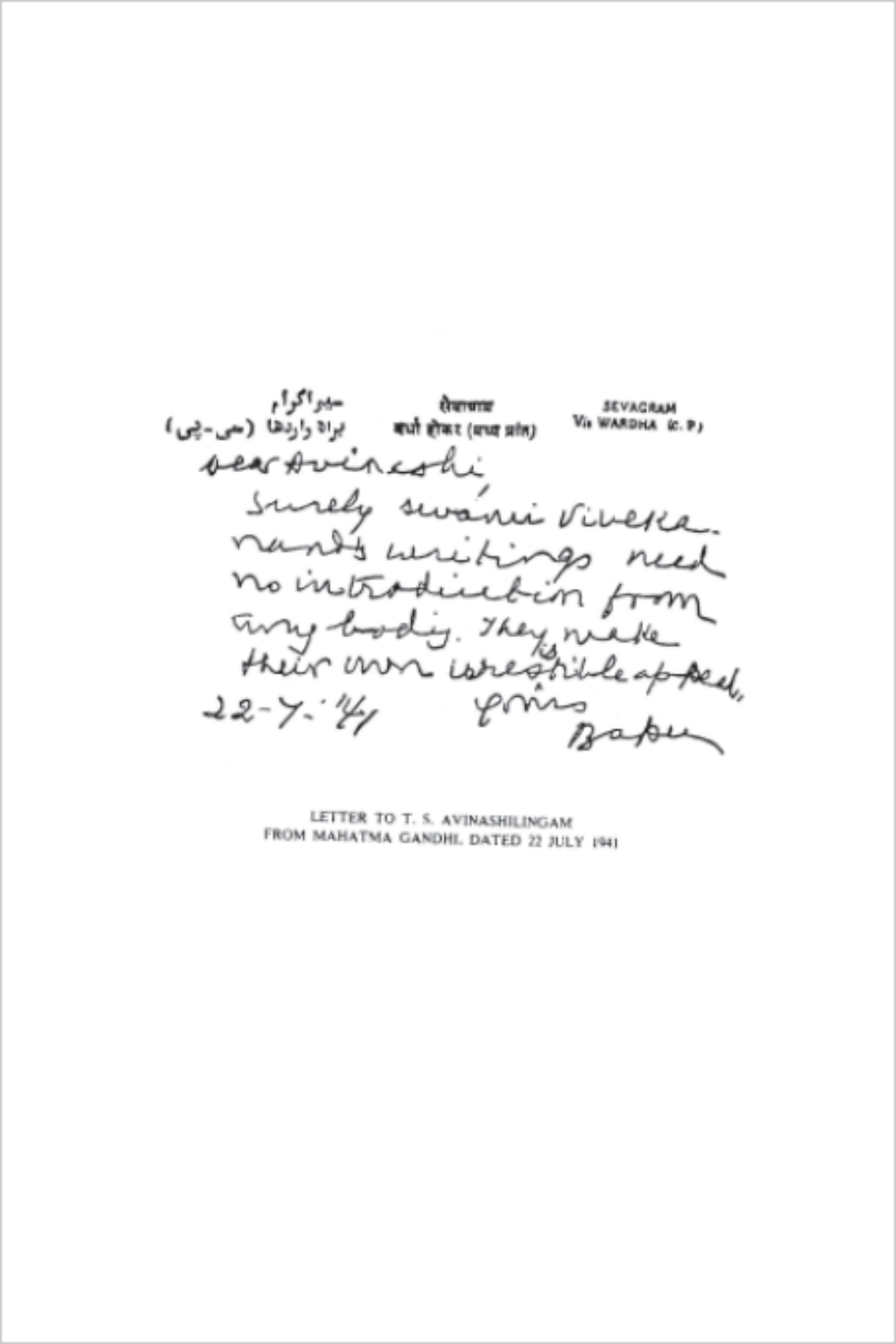
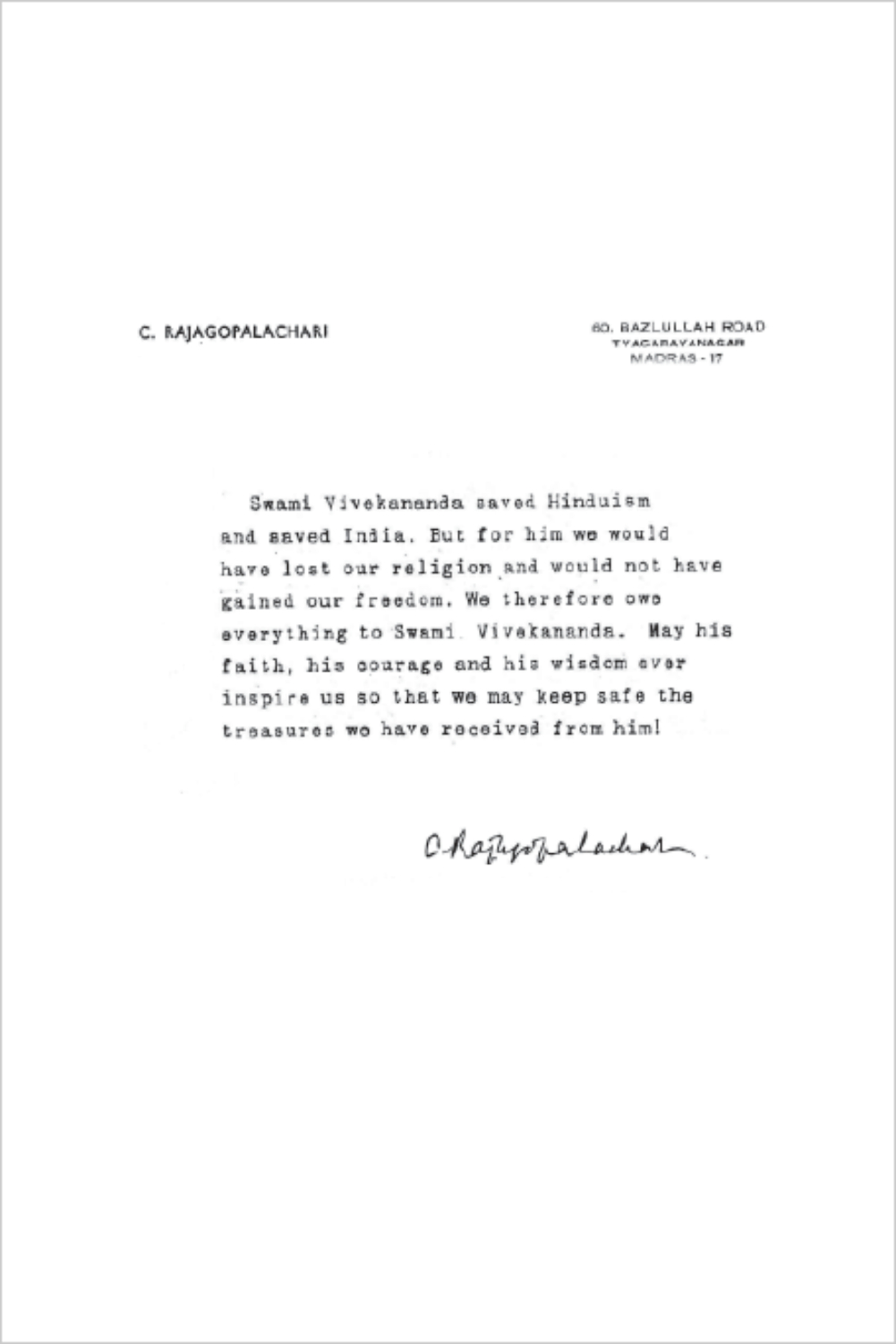
ⓘ
[1] Swami Vivekananda Centenary Memorial Volume, Calcutta,1963,p. xiii.
↑ Contents
CHRISTOPHER ISHERWOOD
Vivekananda was, as I said, profoundly moved by the realization of India’s poverty and the state of her oppression under the British colonial rule. And he proposed a revolution. The spirit of this revolution enormously influenced Gandhi and influences Indian political thought to this day. Vivekananda in this sense is a great figure in Indian history, one of the very greatest historical figures that India has ever produced. But it must always be noted that Vivekananda’s revolution, Vivekananda’s nationalism, were not like the kind of revolution, the kind of nationalism, which we associate with other great leaders, admirable and noble as they may be. Vivekananda was far greater than that. In fact, when one sees the full range of his mind, one is astounded. Vivekananda looked toward the West, not simply as a mass of tyrants exploiting various parts of Asia, and other undeveloped areas, but as future partners, people who had very, very much to offer. At the same time, without any false humility, he faced the West and said, ‘we have fully as much and more to offer you. We offer you this great tradition of spirituality, which can produce, even now, today, a supremely great figure such as Ramakrishna. You can offer us medical services, trains that run on time, hygiene, irrigation, electric light. These are very important, we want them, and we admire some of your qualities immensely.’
One of the most enchanting things about Vivekananda is the way he was eternally changing sides when he was speaking to different people ; he could denounce the British in words of fire, but again he would turn on the Indians and say, ‘You cannot manufacture one pin, and you dare to criticize the British !’ And then he would speak of the awful materialism of the United States, and on the other hand, he would say that no women in the world were greater, and that the treatment of women in India was absolutely disgraceful. And so in every way, he was integrating, he was seeing the forces for good, the constructive forces, in the different countries, and saying, ‘why don’t we exchange ?’ So Vivekananda’s revolution was a revolution for everybody, a revolution which would in the long run be of just as much use to the British as to India. Vivekananda’s nationalism, the call to India to recognize herself—this again was not nationalism in the smaller sense, it was a kind of super-nationalism, a kind of internationalism sublimated. You all know the story that Vivekananda was so fond of, about the lion that was brought up with a lot of sheep. Now another lion comes out of the forest and the sheep all run away, and the little lion that had been brought up thinks it’s a sheep and runs away too, and now the pursuing lion grabs it, takes it over to a pool of water and says, ‘Look at yourself, you’re a lion.’ This is what Vivekananda was doing to the Indian people. He remarks in one of his letters, that the marvellous thing about all of the Western nations is that they know that they are nations. He said jealousy is a curse of India. Indians cannot learn to co-operate with each other. Why can’t they learn from the co-operation of Western nations with each other? I’m quoting all this because by considering all these different attitudes that Vivekananda took, one sees the immense scope and integrity of his good will. He was really on everybody’s side, on the side of the West, and on the side of India, and he saw far, far into the future ; his political prophecies are extremely interesting, and he said repeatedly, that the great force, which would finally have to be reckoned with, was China. He also remarked on visiting Europe for the last time in 1900 that he smelled war everywhere, which was more than most professional statesmen did, at that time.[1]
* * *
[When I heard message of Vedanta as Vivekananda preaches it], I heard it with an almost incredulous joy. Here, at last, was a man who believed in God and yet dared to condemn the indecent grovelings of the sin- obsessed Puritans I had so much despised in my youth. I loved him at once, for his bracing self-reliance, his humour, and his courage. He appealed to me as the perfect anti-Puritan hero: the enemy of Sunday religion, the destroyer of Sunday gloom, the shocker of prudes, the breaker of traditions, the outrager of conventions, the comedian who taught the deepest truths in idiotic jokes and frightful puns. That humour had its place in religion, that it could actually be a mode of spiritual self-expression, was a revelation to me; for, like every small boy of Puritan upbringing, I had always longed to laugh out load and make improper noises in church. I didn’t know, then, that humour has also had its exponents in the Christian tradition. I knew nothing, for example, about, St. Philip Neri.[2]
ⓘ
[1] Swami Vivekananda Centenary Memorial Volume, Calcutta,1963,p. xiii., pp. 535-36.
[2] What Vedanta Means to Me (Doubleday and Co., Inc., Garden City, New York, 1960), p. 55.
↑ Contents
D.S. SARMA
He [Vivekananda] raised India in the eyes of the world, gave Hinduism a new turn and put a new spirit in the hearts of his countrymen. He was destined only to be a pioneer. He broke new ground and led his people across and sighted the Promised Land. ...
...Three religious movements that immediately preceded the Ramakrishna Movement were rather poor and inadequate representations of the great historic religion of the Hindus. The religion of the Bràhmo Samàj was mere eclecticism, more Christian than Hindu in character. The religion of the Ārya Samāj was mere Vedism, which ignored all the later developments in Hinduism. The religion of the Theosophical Society, with its Tibetan Masters, its occult phenomena and its esoteric teachings, was looked upon by most Hindus as a kind of spurious Hinduism. On the other hand, the fourth religious movement, of which Swami Vivekananda was the great apostle, was doubtless not only a full, but also authentic manifestation of Hinduism.[1]
ⓘ
[1] Hinduism Through the Ages by D. S. Sharma (Bharatiya Vidya Bhavan, 1961), pp.153-55.
↑ Contents
E.P. CHELISHEV
Reading and re-reading the works of Vivekananda each time I find in them something new that helps deeper to understand India, its philosophy, the way of the life and customs of the people in the past and the present, their dreams of the future. I think that Vivekananda’s greatest service is the development in his teaching of the lofty ideals of humanism which incorporate the finest features of Indian culture. ...
...In my studies of contemporary Indian literature I have more than once had the opportunity to see what great influence the humanistic ideals of Vivekananda have exercised on the works of many writers. In my opinion, Vivekananda’s humanism has nothing in common with the Christian ideology which dooms man to passivity and to begging God for favours. He tried to place religious ideology at the service of the country’s national interests, the emancipation of his enslaved compatriots. Vivekananda wrote that the colonialists were building one church after another in India, while the Eastern countries needed bread and not religion. He would sooner see all men turn into confirmed atheists than into superstitious simpletons. To elevate man Vivekananda identifies him with God. ...
Though we do not agree with the idealistic basis of Vivekananda’s humanism, we recognize that it possesses many features of active humanism manifested above all in a fervent desire to elevate man, to instil in him a sense of his own dignity, sense of responsibility for his own destiny and the destiny of all people, to make him strive for the ideals of good, truth and justice, to foster in man abhorrence for any suffering. The humanistic ideal of Vivekananda is to a certain degree identical with Gorky’s Man with a capital letter.
Such a humanistic interpretation of the essence of man largely determines the democratic nature of Vivekananda’s world outlook. ...
...Many years will pass, many generations will come and go, Vivekananda and his time will become the distant past but never will there fade the memory of the man who all his life dreamed of a better future for his people, who did so much to awaken his compatriots and move India forward, to defend his much-suffering people from injustice and brutality. Like a rocky cliff protecting a coastal valley from storm and bad weather, from the blows of ill winds and waves, Vivekananda fought courageously and selflessly against the enemies of his motherland.
Together with the Indian people, Soviet people who already know some of the works of Vivekananda published in the USSR, highly revere the memory of the great Indian patriot, humanist and democrat, impassioned fighter for a better future for his people and all mankind.[1]
ⓘ
[1] Swami Vivekananda Centenary Memorial Volume, pp.506-18.
↑ Contents
CHELISHEV FURTHER WRITES : (LETTER DATED: 28 NOVEMBER 1983)
The name of Swami Vivekananda is very popular in Soviet Russia and he is held in high esteem by our countrymen. Soviet people respect him as a great democrat, humanist and patriot who contributed immensely in the development of national consciousness and anti-colonial liberation movement in India. They also consider that his message and the message of Sri Ramakrishna, which are really one, are absolutely necessary for the survival of the human civilization which is now in great danger due to the menace of the devastating nuclear war. We believe that it is their message which can bring peace, harmony and understanding to the tormented world of today. They are not simply religious leaders, they are much more than that. They are prophets of peace, harmony and brotherhood. Their message was relevant in the past in India and in the world at large, but it is still more relevant in the present Indian context and in the context of the contemporary world. That is why a lot of Soviet research scholars and thinkers have dedicated to the study of Sri Ramakrishna and particularly Swami Vivekananda. I am proud that I happened to be one of the pioneers of this study in our country and contributed an article on Swami Vivekananda to the Swami Vivekananda Centenary Memorial Volume twenty years ago, published from Calcutta.
I consider it a great honour for me to be associated with any programme connected with Sri Ramakrishna and Swami Vivekananda. I and my colleagues will continue to devote to the Ramakrishna-Vivekananda studies with close co-operation of the scholars of India and other countries ...I will do my best to contribute to the development of the Ramakrishna-Vivekananda studies in the progressive direction. I consider this as a service to the humanity at large.[1]
ⓘ
[1] World Thinkers on Ramakrishna-Vivekananda, ed. by Swami Lokeswarananda, Ramakrishna Mission Institute of Culture, Kolkata, 2002, p.67 (footnote).
↑ Contents
ELLA WHEELER WILCOX
...We reached the hall just as Vivekananda was going on the stage in his robe and turban. We sat in the very last seat of the hall, clasping each other’s hands as the impressive orator gave a never-to-be -forgotten talk on things spiritual. When we went out my husband said: ‘I feel that man knows more of God than we do. We must both hear him again.’
My husband attended with me not only a number of evening lectures, but on several occasions came from his business office during the day to listen to the Swami. I remember him saying, as we went out on the street one day: ‘This man makes me rise above every business worry; he makes me feel how trivial is the whole material view of life and how limitless is the life beyond. I can go back to my troubles at the office now with new strength.’[1]
ⓘ
[1] The World and I, George H. Doran Co., New York,1918, pp. 110-11.
↑ Contents
EMMA CALVÉ
It has been my good fortune and my joy to know a man who truly ‘walked with God’, a noble being, a saint, a philosopher, and a true friend. His influence upon my spiritual life was profound. He opened up new horizons before me; enlarging and vivifying my religious ideas and ideals; teaching me a broader understanding of truth. My soul will bear him eternal gratitude.
This extraordinary man was a Hindu monk of the order of the Vedanta. He was called the Swami Vivekananda, and was widely known in America for his religious teachings.
...With the Swami and some of his friends and followers I went a most remarkable trip, through Turkey, Egypt, and Greece. Our party included the Swami; Father Hyacinthe Loyson; his wife, a Bostonian; Miss MacLeod of Chicago, an ardent Swamist and charming, enthusiastic woman; and myself, the song bird of the troupe.
What a pilgrimage it was! Science, philosophy had no secrets from the Swami. I listened with all my ears to the wise and learned discourse that went on around me. I did not attempt to join in their argument, but I sang on all occasions, as is my custom. The Swami would discuss all sorts of questions with Father Loyson, who was a scholar and a theologian of repute. It was interesting to see that the Swami was able to give the exact text of a document, the date of a Church Council, when Father Loyson himself was not certain.
When we were in Greece, we visited Eleusis. He explained its mysteries to us and led us from altar to altar, from temple to temple, describing the processions that were held in each place, intoning the ancient prayers, showing us the priestly rites.
Later, in Egypt, one unforgettable night, he led us again into the past, speaking to us in mystic, moving worlds, under the shadow of the silent sphinx.
The Swami was always absorbingly interesting, even under ordinary conditions. He fascinated his hearers with his magic tongue. Again and again we would miss our train, sitting calmly in a station waiting-room, enthralled by his discourse and quite oblivious of the lapse of time. Even Miss MacLeod, the most sensible among us, would forget the hour, and we would in consequence find ourselves stranded far from our destination at the most inconvenient times and places.[1]
ⓘ
[1] Prabuddha Bhārata, November, 1922.
↑ Contents
FEDERICO MAYOR
There are many aspects of Swami Vivekananda’s thought, his ideals and his social message which make UNESCO a very good setting for ... celebration in France of the centenary of his participation in the World Parliament of Religions, held in Chicago one hundred years ago.
...His (Swami Vivekananda) commitment towards universalism and tolerance, his active identification with humanity as a whole. He said from the tribune of the Parliament of Religions, and I quote : ‘I fervently hope that the bell that tolled this morning in honour of this convention may be the death knell of all fanaticism, of all persecutions with the sword or with the pen.’ I am sure all of us...would strongly identify with this aspiration, since the struggle against exclusiveness is one that must be perpetually renewed.
...The Mission he established in India, and which has now spread all over the world, is working to reduce poverty and eliminate discrimination among the different segments of society. There is no more important challenge for us all than this—striving to overcome these problems at their roots; and it is one that I believe the United Nations, working with all possible NGO partners, must take its absolute priority in the years to come.
...His preoccupation with human development and his vision of education, science and culture as the essential instruments for such development. The convergence with UNESCO’s concerns will be obvious to all.
I am indeed struck by the similarity of the constitution of the Ramakrishna Mission which Vivekananda established as early as 1897 with that of UNESCO drawn up in 1945. Both place the human being at the centre of their efforts aimed at development. Both place tolerance at the top of the agenda for building peace and democracy. Both recognize the variety of human cultures and societies as an essential aspect of the common heritage.
The world today is going through a challenging period of transition. We see many evils like racism and interethnic and religious conflict returning among us with renewed force. Celebrations like this today are a source of renewed strength and encouragement to fight against these evils.[1]
ⓘ
[1] Prabuddha Bhārata, January, 1994, p.21.
↑ Contents
FELIX MARTI-IBANEZ
[Dr Felix Marti-Ibanez was asked what he considered to be the most valuable thing in his life. He responded:]
Life itself. Health and dreams and love. If what is meant by ‘things’, however, is something concrete in physical form, then I would have to say books. I was actually once put to the test of what I value most. It was in February 1939, when I had to leave Spain because of the fall of the Spanish Republic and all I could take with me was what I could carry. I chose to take one book. From the thousands of books in the library I have so lovingly built up with my father, I selected The Universal Gospel and The Life of Vivekananda by Romain Rolland. That uniquely magnificent mystical book inspired me through the years to dedicate my life to the service of others.[1]
ⓘ
[1] The Mirror of Souls, Clarkson N. Potter Publishers, New York, 1971, p. 310.
↑ Contents
FRANCIS YOUNGHUSBAND
On the death of Ramakrishna the leadership of the little group of disciples fell to Vivekananda, still only twenty-three years of age. Though busy with his own domestic affairs he set to work to fulfil the sacred task left him by Ramakrishna. Disregarding their vacillations he would spend hours in describing the soul-stirring experiences of the Master. And after a time they set out all over India preaching the message of Ramakrishna. They left their dearest. They suffered the agonies that all saints have to endure. And Vivekananda went further still. He went to Europe and America. He became [famed] all over the world. But always he attributed every good he had or did to what his Master, Ramakrishna, had imparted to him.[1]
ⓘ
[1] Modern Mystics, New York, University Books, Inc., 1970, p. 96.
↑ Contents
GOPAL HALDER
To us the Swami is the person who called India and its people to establish themselves with courage for acquiring self-knowledge. He said—first of all I was born to this country, and that in itself has reasons to be proud of. I don’t need to feel shy or ashamed of in declaring my identity. To everyone in this world I would proclaim my identity and add that I neither am inferior to anyone, nor having a nondescript antiquity. Such utterance we first had from Vivekananda. I hardly know of any one in those days who could speak with such unhesitant bravery.[1]
ⓘ
[1] Translated from Udbodhan Centenary Collection(Śatābdī Jayantī Nirvāchita Sankalan) ed. by Swami Purnatmananda, Udbodhan Karyalaya, Kolkata, June, 1999, p. 870.
↑ Contents
HIREN MUKHERJEE
It is a blessing that we had only lately in our midst, in the cruelly inhibited conditions of foreign subjection, a truly great soul like Vivekananda, never a recluse but always with his leonine strength of character in the midst of his people . . . the monk whose heart bled for his people so that he gave his all for his country’s recovery, self-assertion, and yearning, never wholly stifled, for fulfilment. This is why one like me, a sceptic and atheist to whom the ardent assumptions and ecstasies of belief are alien, salutes this tremendous man of faith and of action who gave back to his stricken people the long-lost pride in their manhood. This is why to dive into Vivekananda’s life-story is to discover by no means just an archive but an arsenal of ideas, of instruments for refashioning ‘the human condition’ in our ancient country..
In his wisdom and his wit Vivekananda could be homely, but he could soar to the heavens even as his feet were planted on our Indian earth. In his meditations he could reach transcendental realms, but to him, as to the Atharva-Veda rishi, Ayaṁ lokaḥ priyatamaḥ (‘this, our world, is dearest of all’) and to his fellow-humans he could truly say, as some of our finest old injunctions stress, that ‘his mother was Pārvatï, his father was Maheśvara, that all men were his brothers, and that the three worlds were his home.’ It was, thus, that in his own unique way Vivekananda could, if any one person did, give a vibrant unequivocal, people-oriented colour subject India’s nationalism and will ever be remembered as one of the supreme figures in the annals of our freedom struggle. ...He knew too keenly that subject India had been debilitated and rejuvenation of her strength was imperative. ... He did say, of course: ‘We must conquer the world through our spirituality and philosophy. There is no other alternative, we must do it or die. The only condition of [Indian] national life, of awakened and vigorous national life, is the conquest of the world by Indian thought.’...
...It was this man who actively inspired a whole host of national revolutionaries in the ‘Swadeśī’ era. No wonder the sedition (Rowlatt) Committee Report (1918) affirmed that Vivekananda had an important influence on those who created a big, pro-freedom tumult in the first decade of the century. That influence continued and pervades whatever is forward-looking in the national scene even today. ...
...Vivekananda pre-eminently was a Prophet who could ascend, in contemplation, to what he sensed as the highest human end — the saint’s thought processes must be unique — and yet returns to insert himself in the sweep of time in order to reshape forces of history and create, if one can, a new world. Here is the shinning quality distinguishing Vivekananda. ...Vivekananda...will always be with us, as a great and gorgeous liberator, a man with whom indeed we can match our mountains and the sea.[1]
ⓘ
[1] Vivekananda and Indian Freedom by Hiren Mukherjee, Ramakrishna Mission Institute of Culture, Kolkata, 2005, pp.4, 6, 19, 21, 24, 32-33.
↑ Contents
HUANG XIN CHUAN
Vivekananda stands out as the most renowned philosopher and social figure of India in modern China. His philosophical and social thought and epic patriotism not only inspired the growth of nationalist movement in India, but also made a great impact abroad. In 1893, Vivekananda visited Canton and its neighbourhood. He noted his impressions of the visit in a letter addressed to the citizens of Madras. He had some knowledge and understanding of Chinese history and culture. He often cited and spoke highly of China in his writings and speeches. He made a prophecy that the Chinese culture will surely be resurrected one day like the ‘Phoenix’ and undertake the responsibility of the great mission of integrating the Western and the Oriental cultures. His biographer Romain Rolland has narrated the evolution of Vivekananda’s idea on this aspect. When Vivekananda went to America for the first time, he hoped that country would achieve this mission. But during his second visit abroad, he realized that he was deceived by dollar imperialism. He, therefore, came to the conclusion that America could not be an instrument to accomplish this task, but it was China which could do it.
Vivekananda had infinite sympathy for the Chinese people living under the oppression of feudalism and imperialism : and he pinned much hope on them. After his visit to China, he made a very interesting comment. He said: ‘The Chinese child is quite a philosopher and calmly goes to work at an age when your Indian boy can hardly crawl on all fours. He has learnt the philosophy of necessity too well.’ This shows Vivekananda’s enormous sympathy towards the miseries of the children of China in the old society.
While explaining his visionary socialism Vivekananda made an interesting ‘gospel’. He said that the future society would be ruled by the labouring people and that this would first take place in China. In Modern India he said : ‘But there is hope. In the mighty course of time, the Brahmin, and the other higher castes too, are being brought down to the lower status of the Śūdras and the Śūdras are being raised to higher ranks. Even before our eyes, powerful China with fast strides, is going down to Śūdrahood,. yet, a time will come when there will be the rising of the Śūdra class, with their Śūdrahood, a time will come when the Śūdras of every country will gain absolute supremacy in every society Socialism, Anarchism, Nihilism, and other like sects are the vanguard of the social revolution that is to follow.’
From the material cited above and his life and works, we can see at least that Vivekananda showed very much concern for, and sympathized with, the people of China who were living under the rule of feudalism and imperialism and placed great hopes on them. But we do not agree with B. N. Datta that the success of the Chinese and the Russian revolutions coming into being at concrete historical moments should be credited to the ‘gospel’ of Vivekananda. This would make him a divine mystique personality. We have seen that Vivekananda’s approach to the laws of social developments was unscientific. However, it is not possible for any advanced thinker to make a correct prediction of the phases and events of the progress of history in every minute details. We should, therefore, appraise Vivekananda in the light of seeking truth from facts.
In conclusion, Vivekananda was the most eminent figure among the democratic patriots in India. He paid high tributes to our glorious ancient culture and loved the Chinese labouring people. We pay homage to him.[1]
ⓘ
[1] Huang Xin Chuan, a professor of History of Beijing University and Deputy Director of the Institute of South Asian Studies, Beijing, delivered a speech on ‘Vivekananda and China’ at the Asiatic Society, Calcutta, on 4 January 1980. The matter reproduced is the cyclostyled summary of that speech circulated among the audience. A copy of the summary signed by Professor Chuan was presented by him to Swami Lokeswarananda, the then Secretary of Ramakrishna Mission Institute of Culture, Gol Park, on 7 January, 1980. Professor Chuan also wrote a book in Chinese on Swami Vivekananda, which was published from Beijing in May 1979. An autographed copy of the book was presented by the author to the Ramakrishna Mission Institute of Culture on 7 January 1980. Professor Chuan presented a copy of the book to Mr Nirmal Bose, Minister for Co-operatives, Government of West Bengal. He observed: ‘We in China do not consider Swami Vivekananda just a religious leader. We consider him one of the greatest social reformers of modern India. It is on record that in India he was the first to speak of socialism. He remained a source of inspiration for many revolutionaries in India.’ (The Statesman, Tuesday, 8 November, 1983, p.9) Incidentally, this copy of the book has also been presented by Mr Nirmal Bose to Swami Lokeswarananda, editor of this book.The book, entitled The Modern Indian Philosopher Vivekananda : A Study, contains six chapters dealing with the conditions in India prevailing at that time, Swamiji’s life and works, his religious and philosophical thoughts, his social and political theories, his views on China, and his contribution to the Indian liberation movement. There are some extracts from some of the important writings of Swami Vivekananda. In the appendix there is one chapter dealing in brief with the life, philosophy, and social thoughts of Sri Ramakrishna.
↑ Contents
HUSTON SMITH
Spiritually speaking, Vivekananda’s words and presence at the 1893 World Parliament of Religions brought Asia to the West decisively. For, reading correctly the spiritual hunger of the West that his words and presence brought to the surface, Vivekananda went on to found the Ramakrishna Mission whose centres in almost every major city of Europe and America launched the influx of Asian spirituality that has changed the religious complexion of those continents permanently. Buddhism, Sufism, Sikhism, Bahai and others have followed, but Vedanta was the pioneer.
The importance of this fact needs no belabouring, but I should like to expand the notion of East meeting West by pointing out that it houses a temporal as well as a spatial dimension. For though we have no time machine to set clocks back, it is possible (in our Westernized world) to break out of our modern time frame by venturing abroad. When I find Vivekananda reporting that ‘when my Master(Sri Ramakrishna) touched me, my mind underwent a complete revolution; I was aghast to realize that there really was nothing whatever in the entire universe but God’, and when he proceeds from such reports to conclude that our seeming self is not our true self, the latter being in actuality divine I hear his words echoing not only from a different land (India) but from a different time—a past when the human outlook was less hobbled by the materialistic, reductionistic styles of thought that the West has fallen into.
I grant that there is danger in stating things this way, for the cult of novelty has led many people to confuse ‘past’ with ‘inferior’. Reflective thinkers, though, are coming to recognize that one of the most important questions of life—who are we? Where did we come from? What are we supposed to do, if anything?—modern science has confused us, along with clarifying things in other respects. For in being able to deal only with things that are woven of space, time, and matter ... science has unwittingly led many people to assume that saṁsāra (the relative world) is more important and real than nirvāṇa (the experience of absolute Reality). Personally, therefore, I welcome Vivekananda as envoy, not only from a different land but from a time that was more open to ‘the breath of the eternal’ that the Upanishads attest to so compellingly.[1]
ⓘ
[1] Vivekananda : East Meets West, Swami Chetanananda (Vedanta Society of St. Louis, 1995), p. vii.
↑ Contents
INDIRA GANDHI
I had had the good fortune to know about the life and teachings of Swami Vivekananda as well as about the activities of the Ramakrishna Mission. My parents and specially my mother were very close with the Ramakrishna Mission. And I must say that the teachings of Vivekananda had inspired all the members of the Nehru family both in their political activities and day-to-day lives.
Swamiji’s teachings, writings and speeches which appear on every page of his works, are indeed stimulant. Swamiji provides us courage, strength, and faith and teaches us how to be self-sufficient. These are the basic tenets of life which India needed most and which would be relevant for all time to come.
Swamiji has taught us that we are the inheritors of a glorious and sublime culture. He has at the same time shown us and analysed the root causes of our national malady. It was Swami Vivekananda who has given us the ways and means how to reconstruct a new India. Swamiji preached the message of universal brotherhood. And a single word which echoed and reached in all his speeches, was abhīh i.e. fearlessness.[1]
ⓘ
[1] Translated from the Udbodhan Centenary Collection (Śatābd Jayantī Nirvāchita Sankalan), p.826.
↑ Contents
JAGADISH CHANDRA BOSE
What a void this makes! What great things were accomplished in these few years! How one man could have done it all! And how all is stilled now. And yet, when one is tired and weary, it is best that he should rest. I seem to see him (Swami Vivekananda) just as I saw him in Paris two years ago...the strong man with the large hope, everything large about him.
I cannot tell you what a great sadness has come. I wish we could see beyond it. Our thoughts are in India with those who are suffering July 4th 1902.
It seems to me that nothing is lost and all the great thoughts and work and service and hope remain embodied in and about the place which gave them birth. All our life is but an echo of a few great moments, an echo which reverberates through all time. That great soul is released; his heroic deeds on this earth are over. Can we realize what that work has been—how one man did all this? When one is tired it is best that he should sleep, but his deeds and teachings will walk the earth and waken and strengthen.[1]
ⓘ
[1] Letters of Sister Nivedita, Vol.1, ed. by Sankari Prasad Basu, Nababharat Publishers, Calcutta, 1982, p.529.
↑ Contents
JADUNATH SARKAR
Ninety-one years ago a boy was born who has turned the lives of millions of us in India into a new channel, and thousands in the West to find their own souls amidst the doubts and distractions of this mechanical civilization. When we calmly reflect on our social scene, we feel bound to admit that the moral revolution not merely preached but actually accomplished by his life and example, is the dominating force of Hindu Society in the 20th century.[1]
ⓘ
[1] Vivekananda O Samakālīn Bhāratavarṣa, Vol.7, p. 268.
↑ Contents
JANAB SAIYID FAZL ALI
Swami Vivekananda, have by his teachings, brought us a few steps nearer to the solution of … great mysteries of our existence by elucidating in simple and comprehensive form the highest spiritual truths contained in the Vedas, Vedanta and the Puranas and have kindled the hope in our minds that it is not altogether beyond our power to get at the ultimate Truth. We know that Swami Vivekananda’s mission in life was to make these truths accessible to the common man…. When you realize this you cannot live in this world without treating everyone with exceeding love and compassion this is indeed Practical Vedanta.[1]
ⓘ
[1] Prabuddha Bhārata, September, 1952.
↑ Contents
JAWAHARLAL NEHRU
Rooted in the past and full of pride in India’s prestige, Vivekananda was yet modern in his approach to life’s problems and was a kind of bridge between the past of India and her present. He was a fine figure of a man, imposing, full of poise and dignity, sure of himself and his mission, and at the same time full of a dynamic and fiery energy and a passion to push India forward.
He came as a tonic to the depressed and demoralized Hindu mind and gave it self-reliance and some roots in the past.[1]
I do not know how many of the younger generation read the speeches and the writings of Swami Vivekananda. But I can tell you that many of my generation were very powerfully influenced by him and I think that it would do a great deal of good to the present generation if they also went through Swami Vivekananda’s writings and speeches, and they would learn much from them. That would, perhaps, as some of us did, enable us to catch a glimpse of that fire that raged in Swami Vivekananda’s mind and heart and which ultimately consumed him at an early age. Because there was fire in his heart—the fire of a great personality coming out in eloquent and ennobling language—it was no empty talk that he was indulging in. He was putting his heart and soul into the words he uttered. Therefore he became a great orator, not with the orators’ flashes and flourishes but with a deep conviction and earnestness of spirit. And so he influenced powerfully the minds of many in India and two or three generations of young men and women have no doubt been influenced by him. ...
Much has happened which perhaps makes some forget those who came before and who prepared India and shaped India in those early and difficult days. If you read Swami Vivekananda’s writings and speeches, the curious thing you will find is that they are not old. It was told 56* years ago, and they are fresh today because, what he wrote or spoke about dealt with certain fundamental matters and aspects of our problems or the world’s problems. Therefore they do not become old. They are fresh even though you read them now.
He gave us something which brings us, if I may use the word, a certain pride in our inheritance. He did not spare us. He talked of our weaknesses and our failings too. He did not wish to hide anything. Indeed he should not. Because we have to correct those failings, he deals with those failings also. Sometimes he strikes hard at us, but sometimes points out the great things for which India stood and which even in the days of India’s downfall made her, in some measure, continue to be great.
So what Swamiji has written and said is of interest and must interest us and is likely to influence us for a long time to come. He was no politician in the ordinary sense of the word and yet he was, I think, one of the great founders—if you like, you may use any other word—of the national modern movement of India, and a great number of people who took more or less an active part in that movement in a later date drew their inspiration from Swami Vivekananda. Directly or indirectly he has powerfully influenced the India of today. And I think that our younger generation will take advantage of this fountain of wisdom, of spirit and fire, that flows through Swami Vivekananda.
...Men like Sri Ramakrishna Paramahansa, men like Swami Vivekananda and men like Mahatma Gandhi are great unifying forces, great constructive geniuses of the world not only in regard to the particular teachings that they taught, but their approach to the world and their conscious and unconscious influence on it is of the most vital importance to us.[2]
* Jawaharlal Nehru delivered this speech in 20 March1949—Editor
ⓘ
[1] The Discovery of India (Meridian Books Limited, London, 1960), p.338.
[2] Sri Ramakrishna and Vivekananda, Advaita Ashrama, Calcutta, 1960, pp. 4-13.
↑ Contents
JAY PRAKASH NARAYAN
Swami Vivekananda belongs to the class of great seers of Truth. His intellect was great, but greater still was his heart. He once told his disciples at the Belur Math that if a conflict were to arise between the intellect and the heart, they should reject the intellect and follow the heart. Many a Mahātmā has appeared in this land, and some of them understood that to meditate on the soul in the caves of the Himalayas was the correct path to follow. Swami Vivekananda’s mind also was influenced by this tradition and there arose a conflict in him early in his career; his intellect advocating the traditional absorption in self-realization and his heart bleeding for the miseries of the people around him. In the end he came to the conclusion that leaving the solitude he would enter into the soul of every being and worship his God by serving them. What attracts the poor and lowly to him is this compassionate heart which ever bled for them and exhausted itself in their incessant service in thirty-nine brief years. It was this measureless feeling for the spiritual and material poverty and misery of his fellow men, particularly of his fellow countrymen, that drove him round the world like a tornado of moral energy and gave him no rest till the end. His life’s campaigns in the East and the West, including the founding of the Ramakrishna Math and Mission, were in response to this feeling.
His life was all purity and love; his coming to and going from this world was [were] quick, sudden. But in the short period of thirty-nine years he accomplished so much by way of stirring up and infusing new life and new hope into the people that in the history of our great country we do not find a second to stand equal to him in this, except, perhaps the great Śaṅkarācārya.[1]
ⓘ
[1] Prabuddha Bhārata, May, 1952, pp. 204-05.
↑ Contents
K. M. MUNSHI
Swami Vivekananda, a brilliant product of the Gītā, trod the path of yoga. His was not the way of the iconoclast but the architect. He was not an apologist of the existing evils. At the same time he had no illusion about Western culture. He saw Aryan culture in its living greatness, as a spiritual force destined to revolutionize the world. He brought back self-respect to Indians. He also demanded and secured the world’s respect for their culture. Due to him educated India felt a glow of a fresh pride in its ever living culture which it had been taught to condemn by Christian missionaries and its social reformers of the Rationalist school.
Vivekananda was sanity itself. He declined to found sect and thereby segregate the influence of his Master’s teachings. He preferred to emphasize his experiences rather than dwell on his being an avatāra – a belief he shared with some of his co-disciples. In this way he became the voice of Aryan culture itself.[1]
ⓘ
[1] Prabuddha Bhārata, January, 1946, p. 45.
↑ Contents
K. M. PANIKKAR
What gave Indian nationalism its dynamism and ultimately enabled it to weld at least the major part of India into one state was the creation of a sense of community among the Hindus to which the credit should to a very large extent go to Swami Vivekananda. This new Śaṅkarācārya may well be claimed to be a unifier of Hindu ideology. Travelling all over India he not only aroused a sense of Hindu feeling but taught the doctrine of a universal Vedanta as the background of the new Hindu reformation. ... The Hindu religious movements before him were local, sectarian and without any all India impact. The Ārya Samāj, the Brāhmo Samāj, the Deva Samāj and other movements, very valuable in themselves, only tended further to emphasize the provincial character of the reform movements. It is Vivekananda who first gave to the Hindu movement its sense of nationalism and provided most of the movements with a common all-India outlook.[1]
ⓘ
[1] The Determining Periods of Indian History, Bharatiya Vidya Bhavan, Bombay, 1962, p.53.
↑ Contents
KAKASAHEB KALELKAR
To Swami Vivekananda belongs the honour of familiarizing India with the idea of a Parliament of Religions, and of proclaiming to the world that a Parliament of Religions would be incomplete without Hinduism being represented there as an equal partner. Educated India felt in 1893 that Hinduism had been vindicated and that day Swami Vivekananda’s name became with us a name to conjure with. I remember as a child the glowing enthusiasm of my elder brothers discussing the news and giving expression to their wild hopes for the future of Hinduism. Swami Vivekananda’s lectures were soon translated into Marathi, my mother tongue, and people read the lectures with avidity. There was nothing new in them for Vedantic India, at least so far as the substance went; but every word therein was instinct with life and hope and self-confidence. The novelty about the Swamiji’s presentation of Hinduism was its modern outlook and his application of Vedantic principles to the solution of modern, social and educational problems. The importance of his teachings grew on me as I grew in years and I looked up to the Swami as the high-water mark of Indian culture.[1]
ⓘ
[1] Prabuddha Bhārata, January 1940, p.22.
↑ Contents
LAL BAHADUR SHASTRI
I remember that in my student days I have read the speeches of the Swami and was deeply attracted to it. Its impact on my mind was so great that my perceptions were all changed, and I started to have a different idea about life. ...
When the nation was in a deep slumber, he created the stir. He talked on the Vedanta; nevertheless, this sage-philosopher aroused the people. India was like an open picture before him. He wanted that the people of our country should embark on work and be active. His Advaitism was not a passivity, and he never directed to await luck or fate. He knew that if the people of the country were not ready for toil and sacrifice, India would hardly achieve wealth and prosperity. Subjugation of the country deeply troubled him. ... He called everyone to sacrifice for the attainment of a noble goal. Aspirants of wealth and power were deeply despised by him. In a country where millions of people were living in deprivation, individual enjoyments were considered unjust by him. ...His message was to awake, arise and stop not till the goal is reached. He was a seer and a God-commanded entity.[1]
ⓘ
[1] Vivekananda O Samakālīn Bhāratavarṣa, Vol.7, p. 234.
↑ Contents
LEO TOLSTOY
Alexander Shifman writes: ‘Among the Indian philosophers of the medieval period he [Tolstoy] studied more thoroughly Śañkara and, among the more recent, Ramakrishna Paramahansa and his pupil Swami Vivekananda.
‘During his last years Tolstoy did not concern himself with Ramakrishna except selecting from his works passages for inclusion in his new collections of ancient sayings which he had compiled previously. At this time he was considerably more interested in Vivekananda’s teachings. ...
‘Tolstoy’s acquaintance with Vivekananda’s philosophy dates back to September, 1896, when for the first time he noted in his diary that he had read “a charming book on Indian wisdom” This was a series of lectures on ancient Indian philosophy delivered by Vivekananda in New York in the winter of 1895-96. A. K. Datt, the Indian scholar, who sent to Tolstoy this book, wrote to him :
‘You will be pleased to know that your doctrines are in complete agreement with the Indian philosophy at the period of its highest achievement, the most ancient to reach us.’
‘Tolstoy wrote in reply to this letter that he liked the book and he noted with approval the reasoning on what was man’s “self ”.’ [Complete collection of Works of Tolstoy, Vol. 69, p. 146]’[1]
‘In Vivekananda’s passionate tirades directed against the contemporary bourgeois civilization, in his affirmations of the priority of the spiritual essence of man over his “material cover”. Tolstoy heard the echoes of the early teachings of the ancient Indians and particularly many motifs of the Vedas which were congenial to him.
‘The second book by Vivekananda which Tolstoy read was a collection of Speeches and Articles (in English) sent to him in 1907 by his acquaintance I. F. Nazhivin. When Nazhivin asked him whether he would like to have this book, Tolstoy replied on 7 July 1907 : ‘Please send me the book by the Brahmin. The reading of such books is more than a pleasure, it is a broadening of the soul.” ’
‘In 1908, I. F. Nazhivin published a collection of articles, Voices of the Peoples, which included Vivekananda’s articles “The Hymn of the Peoples” and “God and Man”. The latter article made a strong impression on Tolstoy. “This is unusually good”, he wrote to Nazhivin, after reading it.” ’
‘Once Tolstoy praised Vivekananda for his “excellent polemics with Schopenhauer about God” and he noted the English of the Indian philosopher : “What English has Vivekananda ! He has learnt all its subtleties.” ’
‘In March 1909, preparing a list of new popular books for the people, Tolstoy also included in the plan of publication the Sayings of Ramakrishna and Vivekananda, [Works of Tolstoy, Vol. 57, p. 40] and, in April of the same year, he informed the Orientalist N.O. Einhorn : “We are preparing a publication of selected thoughts of Vivekananda whom I appreciate very much.”[Works of Tolstoy, Vol. 79, p. 142] But this publication did not materialize.’[2]
ⓘ
[1] Tolstoy and India, Sahitya Akademi, New Delhi, 1978, pp. 23, 29, 33-35.
[2] Tolstoy and India, Sahitya Akademi, New Delhi, May, 1963, p.170.
↑ Contents
MOHANDAS KARAMCHAND GANDHI
I have come here [Belur Math] to pay my homage and respect to the revered memory of Swami Vivekananda, whose birthday is being celebrated today [6 February 1923]. I have gone through his works very thoroughly, and after having gone through them, the love that I had for my country became a thousandfold. I ask you, young men, not to go away empty-handed without imbibing something of the spirit of the place where Swami Vivekananda lived and died.
Surely Swami Vivekananda's writings need no introduction from anybody. They make their own irresistible appeal.(Letter written to S. Avinashilingam by Gandhiji dated 22 July 1941).[1]
ⓘ
[1] Letter written to S. Avinashilingam from Gandhiji, dated 22 July 1941.
↑ Contents
MADHAV S HRIHARI ANEY
In the Parliament of Religions Swami Vivekananda in his first speech laid great emphasis on the importance of the principle of toleration. He maintained, and in my opinion rightly maintained, that the very idea of convening a Parliament of Religions was the vindication of the principle of toleration without which all-sided progress of entire humanity will become impossible. …It was the Parliament of Religions that revealed to India and the whole world the spiritual teacher who in later years proved to be the harbinger of a mighty intellectual revolution in India seeking for emancipation of her children from all bonds and fetters.[1]
ⓘ
[1] Prabuddha Bhārata, January, 1944.
↑ Contents
MAHENDRANATH SIRCAR
...Originally an intellectual agnostic with a heart endowed with true seeking and love, Vivekananda saw the living image of Wisdom and Love in Ramakrishna.
...Vivekananda approached religion and philosophy through an analysis of life and psychic experience and he welcomed that as the highest which gave the finest idea of freedom. Gods, angels and helpers had no fascination for him, for he felt that the bondage was self-created, and should be broken by self-possession. He maintained the heroic attitude in all concerns of life – even in spiritual life....
...Vivekananda was the spirit of selflessness incarnated in flesh. He could feel that true knowledge originated from it. It was not an ideal for him. It was his being. He could see that selfless living was better than mere speculative philosophy, and he accentuated it. This self-giving and self-opening were to him the ways to wisdom. The Vedanta was to him the gospel of life, and not mere philosophy.
Vivekananda realized the fruitfulness of...philosophical scholasticism. He wanted his. disciples to realise the illusions (Maya) of life through selfless service to the downtrodden and suffering humanity.
...Vivekananda’s policy was to bring in social reformation more by the propagation of liberal and humanistic culture rather than by positive frontal attacks. He was anxious to impart the touch of love and life to everybody, but he was equally anxious to see the spirit of self-reformation coming from within. True reformation was reformation by self-education. He concentrated his forces thereon.[1]
ⓘ
[1] Eastern Lights by Mahendranath Sircar (Arya Publishing House, Calcutta, 1955), pp. 240-45 and 253.
↑ Contents
MANABENDRA NATH ROY
Religious nationalism of the orthodox as well as reformed school had begun to come into evidence in the province of Bengal since the first years of the twentieth century. Although its political philosopher and leader were found subsequently in the persons of Aurobindo Ghosh and Bepin Chandra Pal respectively, its fundamental ideology was conceived by a young intellectual. ... Narendra Nath Datta, subsequently known as Swami Vivekananda. While still a student in the University of Calcutta, Datta felt the rebellious spirit affecting the lower middle class intellectuals. It was in the early nineties. He was moved by the sufferings of the common people. De-classed socially, possessing a keen intellect, he made a spectacular plunge into the philosophical depths of Hindu scripture and discovered in his cult of Vedantism (religious Monism of the Hindus) a sort of socialistic, humanitarian religion. He decried scathingly orthodoxy in religion as well as in social customs. He was the picturesque, and tremendously vigorous embodiment of the old trying to readjust itself to the new. ... Datta(Swami Vivekananda) was also a prophet of Hindu nationalism. He also was a firm believer in the cultural superiority of the Indian people, and held that on this cultural basis should be built the future Indian nation. But he was not a partisan of orthodoxy in religion : to social conservatism, he was a veritable iconoclast. He had the courageous foresight, or perhaps instinct, which convinced him that if religion was to be saved, it must be given a modern garb; if the priest was still to hold his sway over the millions of Hindu believers, he must modify his old crude way ; if the intellectual aristocracy of the fortunate few was to retain its social predominance, spiritual knowledge must be democratized. The reaction of native culture against the intrusion of Western education ran wild, so to say, in the person of Vivekananda and the cult of Universal Religion he formulated in the name of his preceptor, Ramakrishna Paramahansa. He preached that Hinduism, not Indian nationalism, should be aggressive. His nationalism was a spiritual imperialism. He called on Young India to believe in the spiritual mission of India. ...
This romantic vision of conquering the world by spiritual superiority electrified the young intellectuals. ... The British domination stood in the way as the root of all evils. Thus, an intelligently rebellious element. had to give in to national preoccupations, and contribute itself to a movement for the immediate overthrow of foreign rule.[1]
ⓘ
[1] India in Transition (1971), pp.190-92.
↑ Contents
MICHAEL TALBOT*
There are many parallel concepts between the ancient philosophies of the East and the emerging philosophies of the West. Certain concepts are so similar that it becomes impossible to discern whether some statements were made by the mystic or the physicist. Esalen Institute Psychologist Lawrence Leshan gives an example of such an indistinguishable statement : ‘The absolute (is)...everything that exists this absolute has become the universe...(as we perceive it) by coming through time, space and causation. This is the central idea of (Minkowski) (Advaita). Time, space and causation are like the glass through which the absolute is seen and when it is seen it appears as the universe. Now we at once gather from this that in the universe there is neither time, space nor causation. ...What we may call causation begins, after, if we may be permitted to say so, the degeneration of the absolute into the phenomenal and not before.’
The remark was originally made by mystic Swami Vivekananda in Jñāna-yoga, but the fact that the names of the mathematician who first theorized that space and time are a continuum, Hermann Minkowski, and the greatest of the historical Brahmin sages, Advaita,* are inter-changeable, demonstrates once again the confluence of mysticism and the new physics.
Vivekananda further expresses a view that has become the backbone of quantum theory : There is no such thing as strict causality. As he states, ‘A stone falls and we ask why. This question is possible only on the supposition that nothing happens without a cause. I request you to make this very clear in your minds, for whenever we ask why anything happens, we are taking for granted that everything that happened must have a why, that is to say, it must have been preceded by something else which acted as the cause. This precedence in succession is what we call the law of causation.’[1]
ⓘ
[1] Mysticism and the New Physics (Bantom Books, January, 1981), pp. 114-15.
↑ Contents
MUNSHI PREMCHAND
Among the great souls who welcomed the Indian renaissance with sounds of conch shells, Vivekananda deserves the first place. His divine message has a clear pronouncement for spiritual progress—directed not for India alone but the world at large. The Swami is no more with us today, but the glow of spirituality he lighted will always illumine the World.[1]
ⓘ
[1] Vivekananda O Samakālīn Bhāratavarṣa, Vol.7, p. 503.
↑ Contents
NAGENDRANATH GUPTA
In conversation Vivekananda was brilliant, illuminating, arresting, while the range of his knowledge was exceptionally wide. His country occupied a great deal of his thoughts and his conversation. His deep spiritual experiences were the bedrock of his faith and his luminous expositions are to be found in his lectures, but his patriotism was as deep as his religion. Except those who saw it, few can realize the ascendancy and influence of Swami Vivekananda over his American and English disciples. At the sight of this Indian monk wearing a single robe and a pair of rough Indian shoes his disciples from the West, among whom were the Consul General for the United States living in Calcutta, and his wife, would rise with every mark of respect; and when he spoke, he was listened to with the closest and most respectful attention. His slightest wish was a command and was carried out forthwith. And Vivekananda was always his simple and great self, unassuming, straightforward, earnest, and grave. ...His thoughts ranged over every phase of the future of India, and he gave all that was in him to his country and to the world. The world will rank him among the prophets and princes of peace, and his message has been heard in reverence in three continents. For his countrymen he has left priceless heritage of virility, abounding vitality, and invincible strength of will. Swami Vivekananda stands on the threshold of the dawn of a new day for India, an heroic and dauntless figure, the herald and harbinger of the glorious hour when India shall, once again, sweep forward to the van of the nations.
ⓘ
[1] Prabuddha Bhārata, March & April, 1927.
↑ Contents
P. G. SAHASRABUDDHE
‘The triumph attained by Swami Vivekananda (in America) was many times superior to that of Alexander or Napoleon. After getting the news of his victory, a defeated, depressed and dead-like nation became resurrected, as if by getting Sañjīvani (ambrosia). Its national self-esteem was awakened. A divine self-confidence sprouted in its heart; its aeons of dark-night of its history came to an end; its face began to beam by the divine lustre of the dawn of a new age; and in such environment, when Swamiji arrived at Colombo, along with his American disciples, then it appeared as if the sun of this nation had risen fully. In such a background Swamiji initiated his work'.[1]
ⓘ
[1] ‘Influence of Ramakrishna-Vivekananda on Contemporary Marathi Literature-II, Vedānta Keśarī, June, 2007, p. 23.
↑ Contents
PANDURANGA SADASIV SANE
‘The lives of Samartha (Ramdas) and Vivekananda resemble very much. Both were Tejasvī, Dispassionate, Celibate, God-realized and full of sympathy for the common folk. Both had undertaken austerities and wanderings, and later on strived hard for the emancipation of the masses.[1]
ⓘ
[1] ‘Influence of Ramakrishna-Vivekananda on Contemporary Marathi Literature-II, Vedānta Keśarī, June, 2007, p. 20.
↑ Contents
PHANISWAR NATH (RENU)
Vivekananda was far greater than all the leaders....Swamiji gave me new dimension showing that the people I have taken as men are essentially devas (gods). Today, I worship man as god in my literature.…Vivekananda has taught me two things–Love and Totality of life. He taught me also achievements and success, sorrows and failures, all are integral parts of the same life.[1]
ⓘ
[1] The Cultural Heritage of India, Vol.8, Ramakrishna Mission Institute of Culture, Golpark, Kolkata, p.1257.
↑ Contents
PRAFULLA CHANDRA RAY
It was Swamiji’s great principle that the service of daridra Nārāyaṇa. should be the real service of humanity....Swami Vivekananda’s great message was that all the low caste people should be taken as our brethren. Not only the right hand of fellowship should be extended to them, but they should be embraced as a brother embraces his fellow-brother. ...Many things come out of Swami Vivekananda’s life. He said that the temples should be thrown open to all the Hindus irrespective of caste distinction. That is a very simple thing. In the eye of God there is no distinction between one man and another The aim of Swami Vivekananda was not only to obliterate all distinctions of caste, but also to uplift the daridra Nārāyaṇa. ...Another thing he has done is propounding the principles of Vedanta in foreign countries. We are all the worshippers of the material world. We forget that there is anything good in our own teachings and literature. This is due to our illusion and ignorance. He expounded the principles of Vedanta and created not only a profound impression in the New World, but there were also many converts to it in America. Many of them came out to India, and devoted their time, energy and money to the cause of India. That was not a small service that he rendered.[1]
ⓘ
[1] Prabuddha Bhārata, May 1931, pp. 243-44.
↑ Contents
PYARELAL NAYYAR
In the brief span of barely a decade, he[Swamiji] accomplished work enough for a life-time. He gave India the expression Daridranārāyana-God incarnated as oppressed humanity. . . Vivekananda’s declaration about the futility of preaching religion to hungry stomachs, or his utterance: He alone serves God who serves all other beings. There is no other God to seek.[1]
ⓘ
[1] ‘Influence of Ramakrishna-Vivekananda on Contemporary Gujrati Literature-I, Vedānta Keśarī, February, 2006, p. 20.
↑ Contents
ROMESH CHANDRA DUTT
Since then I have heard the sad news of Swami Vivekananda’s death. I never saw the Swami, I never closely followed his teachings, but you know how sincerely I appreciated and admired his high patriotism, his genuine belief in the greatness of his country, his manly faith in the future of his countrymen if they are true to themselves. That spirit of self-reliance, that determination to work out our own salvation, that faith in our country and ourselves, that conviction that our future rests in our own hands,—are the noblest lessons that we learn from the life of him whose loss we all lament today. India is poorer to-day for the untimely loss of an earnest worker who had faith in himself. To us in Bengal the loss is more of a personal nature ; to you the bereavement is one which will cast a shadow over all your life. Only the thought of his earnestness and greatness, only the imperishable lessons which his life teaches, may afford some consolation to those who have lost in him a friend, a helper in life, a teacher of the great truths.[1]
ⓘ
[1] A letter wrote to Sister Nivedita by R. C. Datta (1902). Ref: Letters of Sister Nivedita, Vol.1, p.534.
↑ Contents
RAMESH CHANDRA MAJUMDAR
(1)
Vivekananda championed the cause of Hinduism in the Parliament of Religions held at Chicago (USA) in 1893 in connection with the celebration of the 400th anniversary of the discovery of America by Columbus. There, in the presence of the representatives of all the religions from almost all the countries in the world, the young monk from India expounded the principles of Vedanta and the greatness of Hinduism with such persuasive eloquence that from the very first he captivated the hearts of vast audience. It would be hardly an exaggeration to say that Swami Vivekananda made a place for Hinduism in the cultural map of the modern world. The civilized nations of the West had hitherto looked down upon Hinduism as a bundle of superstitions, evil institutions, and immoral customs, unworthy of serious consideration in the progressive world of today. Now, for the first time, they not only greeted, with hearty approval, the lofty principles of Hinduism as expounded by Vivekananda, but accorded a very high place to it in the cultures and civilizations of the world. The repercussion of this on the vast Hindu community can be easily imagined. The Hindu intelligentsia were always very sensitive to the criticism of the Westerners, particularly the missionaries, regarding the many evils and shortcomings of the Hindu society and religion, as with their rational outlook they could not but admit the force of much of this criticism. They had always to be on the defensive and their attitude was mostly apologetic, whenever there was a comparative estimate of the values of the Hindu and Western culture. They had almost taken for granted the inferiority of their culture vis-à-vis that of the West, which was so confidently asserted by the Western scholars. Now, all on a sudden, the table was turned and the representatives of the West joined in a chorus of applause at the hidden virtues of Hinduism which were hitherto unsuspected either by friends or foes. It not only restored the self-confidence of the Hindus in their own culture and civilization, but quickened their sense of national pride and patriotism. This sentiment was echoed and re-echoed in the numerous public addresses which were presented to Swami Vivekananda on his home-coming by the Hindus all over India, almost literally from Cape Comorin to the Himalayas. It was a great contribution to the growing Hindu nationalism.
On his return to India, Swami Vivekananda preached the spiritual basis of Hindu civilization and pointed out in his writings and speeches that the spirituality of India was not less valuable, nor less important for the welfare of humanity, than the much vaunted material greatness of the West which has dazzled our eyes. He was never tired of asking the Indians to turn their eyes, dazed by the splendour of the West, to their own ideals and institutions. By a comparative estimate of the real values of the Hindu ideals and institutions and those of the West he maintained the superiority of the former and asked his countrymen never to exchange gold for tinsels....
But Vivekananda was not prejudiced against the West nor insensible to the value of her achievements. He frankly admitted that Indian culture was neither spotless nor perfect. It has to learn many things from the West, but without sacrificing its true character.
Swami Vivekananda combined in himself the role of a great saint and fervid nationalist. He placed Indian nationalism on the high pedestal of past glory, and it embraced the teeming millions of India both high and low, rich and poor. He devoted his life to the awakening of national consciousness and many of his eloquent appeals would stir the national sentiments of India even today to their very depths. ...
Though an ascetic, Vivekananda was a patriot of patriots. The thought of restoring the pristine glory of India by resuscitating among her people the spiritual vitality which was dormant, but not dead, was always the uppermost thought in his mind. ...
This great sannyāsin who had left his hearth and home at the call of his spiritual guru, Sri Ramakrishna, and delved deeply into spiritual mysticism, was never tired of preaching that what India needs today is not so much religion or philosophy, of which she has enough, but food for her hungry millions, social justice for the low classes, strength and energy for her emasculated people and a sense of pride and prestige as a great nation of the world. He made a trumpet call to all Indians to shed fear of all kinds and stand forth as men by imbibing śakti (energy and strength), by reminding them that they were the particles of the Divine according to the eternal truth preached by the Vedanta. The precepts and example of this great sannyāsin galvanized the current of national life, infused new hopes and inspirations, and placed the service to the motherland on a religious level. ...
Swami Vivekananda thus gave a spiritual basis to Indian nationalism. The lessons of the Vedanta and Bhagavad-Gītā permeated the lives and activities of many nationalists, and many a martyr, inspired by his teachings, endured extreme sufferings and sacrifices with a cheerful heart, fearlessly embraced death, and calmly bore the inhuman tortures, worse than death, which were sometimes inflicted upon them.[1]
(2)
He (Vivekananda) was a product of the nineteenth century Renaissance in Bengal, in its initial stage, but it was his genius and personality that moulded it into the shape it finally assumed. It was a great achievement on the part of Swamiji to bring about a synthesis between the thesis and antithesis—to use a Hegelian expression—represented by the first two phases of Indian Renaissance. ...The Ideal he placed before the country was an all-round development by imbibing both the spirituality of ancient India and the material culture of the West. Such a synthesis was not only necessary for India but its scope, according to Swamiji, extended to the West also. As a matter of fact Swamiji regarded this synthesis as essential for the whole humanity It would appear that Swami Vivekananda has laid before us the final phase of the Renaissance Movement that is still leading us forward, and India will derive the fullest benefit from it if she follows the path laid down by him.[2]
(3)
His historical knowledge. was both profound and extensive. Although he wrote only one or two short essays on historical subjects, his penetrating insight into the historical evolution, not only in India but all over the world from ancient to modern times, is revealed in numerous passages scattered throughout his speeches and writings. His comprehensive grasp of the main currents of the world history and the power to express it in simple language is illustrated in his description of the Renaissance [in his book Prācya O Pāścātya]. He has given an altogether new interpretation of evolution of Indian history through ages which, considering the time in which he wrote, displays an amazing depth of knowledge and critical judgement. He emphasized the truth that ‘in ancient India the centres of national life were always the intellectual and spiritual and not political’, and interpreted on that basis the course of evolution in Indian history right up to the British period. He was also familiar with the scientific and critical method of historical research and modern developments in Archaeology and Ethnology.
...It has been very aptly said the Swami Vivekananda is a commentary on Sri Ramakrishna. But the commentator with his giant intellect and profound understanding made such distinctive contributions that his commentary becomes itself a philosophy just as Śaṅkara’s commentary on the Vedānta-Sūtra is by itself a philosophy.[3]
(4)
India has produced numerous saints and religious teachers, but it would be difficult to select in their message an appreciation of the present-day problems of life and a heart bleeding for the suffering millions of India such as we find throughout the writings and speeches of the Swami. Sometimes, he even goes to the length of subordinating religion to other interests of life...Like the most advanced political thinkers, he had no illusion of the past, but dreamt of a glorious future for his motherland.
...Diversity in the personality of the Swami, at first, appears to be somewhat puzzling. But with the advance of years and a closer study of his teachings, one slowly realizes that this apparent plurality is the real key to the proper understanding of his personality. It becomes increasingly clear that the great lesson which the Swami’s teaching holds out before us is the indivisibility of a human being, in spite of the multiple manifestations of his emotion and intellect, and the consequent unity of the problem which faces society; for society is, after all, a mere aggregate of individuals and, therefore, partakes of their essential character.
...To him [the Swami] each individual human being is not a mere bundle of different intellectual and emotional attributes, but an organic entity whose diverse component elements are bound up together by one indivisible force. This constitutes the main spring which guides his life and actions, so long as this is not brought under control, all attempts at reform are bound to prove futile.[4]
ⓘ
[1] History of the Freedom Movement in India (Firma K. L. Mukhopadhyay, Calcutta, 1971),Vol. I, pp. 316-21.
[2] Vivekananda O Samakālīn Bhāratavarṣa, Vol. 7, pp. 271-72.
[3] Vivekananda O Samakālīn Bhāratavarṣa.Vol. 7, p. 286.
[4] Prabuddha Bhārata, May 1963, pp.197-98.
↑ Contents
R. G. PRADHAN
Swami Vivekananda might well be called the father of modern Indian Nationalism; he largely created it and also embodied in his own life its highest and noblest elements.[1]
ⓘ
[1] India’s Struggle for Swaraj by R. G. Pradhan, Daya Publishing House, Delhi, 1930, p.60.
↑ Contents
R.B. RYBAKOV
Vivekananda’s Ideas Dear to Soviets
The people of the Soviet Union observed the 120th anniversary of the birth of the great Indian thinker and public figure Swami Vivekananda, whose fame has twice outlived his short and dramatic life, entirely devoted to the noble cause of awakening India. ...
I have recently been to... Yasnaya Polyana, the house of Leo Tolstoy— the great writer, whose name is equally dear to the peoples of the USSR and India. I saw a group of visitors encircling a large dinner table and my mind conjured up grey-beared, Tolstoy, reading British newspapers out loud in the light of a kerosene lamp. The British Press was full of reports about Vivekananda’s brilliant lectures. Sometimes, there was little truth in them, yet the powerful voice of the Calcutta sannyàsã did reach the writer’s mind through the filter of the British newspapers. It stirred the writer profoundly and for a while he could not continue reading. He went to the bedroom and read Vivekananda’s books all through the night. He remarked in his diary : ‘I was reading Vivekananda again. How much there is in common between the thoughts of his and mine.’
New Age
That epoch has long since gone. The people who come to the Tolstoy museum and listen to the guide’s story were born in the age of space flights, cinema and television and they do not know what colonialism is. The material culture of that time has disappeared and so have clothes and objects of everyday life. But the spiritual culture which unites all nations is alive and continues to exert powerful influence on our contemporaries. Vivekananda’s ideas were dear not only to Tolstoy. They are just as dear to the Soviet people today, primarily, because his life was filled with ardent love for India. Vivekananda had always desired to change the situation in India—the powerful and yet dependent country, fettered by the will of British colonialists, hard vestiges of the centuries-old history and rigid caste conventions and also disintegrated, oppressed and not yet strong to rebel. He had not spared efforts to awaken his countrymen’s feeling of national identity, the wish to work for the national benefit and the faith in India’s bright future. Neither had he spared sarcasm to stir up the Indians’ feeling of shame for their dependent and oppressed position, the shame, which, to quote Marx’s apt remark, ‘is already revolution of a kind. Shame is a kind of anger which is turned inward. And if a whole nation really experienced a sense of shame, it would be like a lion, crouching ready to spring’. However reluctant, Vivekananda was to get involved in politics, his entire activities were aimed against imperialism and colonialism and he had played an important role in India’s becoming an independent state and a leading power.
The essence of Vivekananda’s religion is the service to people. ‘I do not believe in God or religion which cannot wipe the widow’s tears or bring a piece of bread to the orphan’s mouth,’ he said. His doctrine was focussed on man. Everything for the good of man—how consonant this idea is with Maxim Gorky’s words spoken at about the same time : ‘The name of Man rings proud.’ Centring his attention on the Indian reality, Vivekananda explained the national degradation by the indifference of the propertied classes to the people’s needs and by the poverty and ignorance of the population. ‘Contempt for the masses is a grave national sin,’ he said.
Vivekananda had uncovered yet another cause of India’s decline, namely, the country’s isolated status. It is only natural that the voice of the man who asserted the idea of equality of all religions and the international fraternity of liberated peoples deeply moved the delegates of the world religious council in Chicago. He was not afraid of reason and relied on it.
National Sin
‘It is better that mankind should become atheist through following reason, than blindly believe in 200 million gods on the authority of anybody.’ The supernatural and miracles did not bother him and he refused to accept miracles ascribed to his teacher Ramakrishna. Isn’t it a miracle, however that he had heard the roaring of the coming social and political events of the 20th century in the slow and serene life of 19th century Europe and had aptly foreseen that the liberation would come from Russia.
That epoch is unreachably far away. Things and kingdoms have disappeared and practically the entire colonial system has collapsed. They say there are old gramophone records of Vivekananda’s ardent voice still to be found in India. His voice was admired by Ramakrishna and it produced a tremendous impression on the Chicago religious congress. Those records have not been played for a long time already, for there are no gramophones to play them on.
Still, Vivekananda’s voice keeps ringing. Celebrating the 120th anniversary of his birth, we recall Rabindranath Tagore’s words : ‘If you want to know India, read Vivekananda.’[1]
ⓘ
[1] Deccan Chronicle (Hyderabad), 11 September, 1983.
↑ Contents
RATNAMUTHU SUGATHAN
It was Swami Vivekananda who made us aware of our subjugation, and inspired for achieving the national freedom. This all, curiously enough, was done through his speeches and talks pertaining to religious and spiritual matters. It was he who first vociferously declared the impossibility of getting freedom without eradicating casteism, poverty and illiteracy among the masses....
When in Kerala, Swami Vivekananda had witnessed all and his expression was — ‘This is a lunatic asylum.’ He added that here we had only one wise man, and that was the Chattampi Swami. The stalwarts of untouchability were shaken to their cores by the Swami’s reverberating voice. ...The Hindus of Kerala were fragmented in innumerable castes and tribes, and on that social ruins comfortably sat were the high caste peoples — who, as a consequence of prolonged observance of local traditions and practices and its resultant bragging, had their souls eroding with rusts.
On his way to Kerala Vivekananda met Dr Palpu, who narrated to the Swami about Kerala’s inhuman casteism, perpetual exploitation and insult of the lower class Hindus by their upper class counterparts. Learning this entire, the Swami told Dr Palpu, ‘Find out a good sannyāsin within the country and community you belong to, and try to unite the lower class people around him and work for their uplift. Fight against untouchability, the lower class people has to undertake this task. None will come out to save the exploited and the suppressed. They have to do it for themselves. Following this, Dr Palpu went back to his State Travancore, discovered Sri Narayana Guru, and the inception of Aruvippuram Kṣetra Yogam was followed.
All the subsequent social, cultural and political movements [in Kerala] to eradicate the cumulative debris of injustice and unjustness had in its centre the meeting of Dr Palpu with Swami Vivekananda.[1]
ⓘ
Kerala Kaumudi, January 22, 1963. Translated from the Bengali rendition available in Vivekananda O Samakālīn Bhāratavarṣa, Vol.7, pp.437-38.
↑ Contents
RABINDRANATH TAGORE
Some time ago Vivekananda said that there was the power of Brahman in every man, that Nārāyaõa [i.e. God] wanted to have our service through the poor. This is what I call real gospel. This gospel showed the path of infinite freedom from man’s tiny egocentric self beyond the limits of all selfishness. This was no sermon relating to a particular ritual, nor was it a narrow injunction to be imposed upon one’s external life. This naturally contained in it protest against untouchability—not because that would make for political freedom, but because that would do away with the humiliation of man—a curse which in fact puts to shame the self of us all.
Vivekananda’s gospel marked the awakening of man in his fullness and that is why it inspired our youth to the diverse courses of liberation through work and sacrifice.[1]
In India of modern times, it was Vivekananda alone who preached a great message which is not tied to any do’s and don’ts. Addressing one and all in the nation, he said : In every one of you there is the power of Brahman (God); the God in the poor desires you to serve Him. This message has roused the heart of the youths in a most pervasive way. That is why this message has borne fruit in the service of the nation in diverse ways and in diverse forms of sacrifice. This message has, at one and the same time, imparted dignity and respect to man along with energy and power. The strength that this message has imparted to man is not confined to a particular point; nor is it limited to repetitions of some physical movements. It has, indeed, invested his life with a wonderful dynamism in various spheres. There at the source of the adventurous activities of today’s youth of Bengal is the message of Vivekananda—which calls the soul of man, not his fingers.[2]
ⓘ
[1] This brief writing of Rabindranath first appeared in Udbodhan in its Āshwin, 1348 issue. The title was ‘Vivekananda’. At the footnote it is mentioned : ‘At the request of Swami Ashokananda, formerly Editor of the Prabuddha Bhārata and the present Minister-in-charge of the Vedanta Society of Sanfrancisco, Rabindranath gave this short writing to him in the month of Phalgun, 1335.’The facsimile of Rabindranath’s original writing was available to the Ramakrishna Order by the courtesy of Viśva- Bhārata long after its publication in Udbodhan.
“কিছুদিন আগে বিবেকানন্দ বলেছিলেন, প্রত্যেক মানুষের মধ্যে ব্রহ্মের শক্তি। বলেছিলেন, দরিদ্রের মধ্যে দিয়ে নারায়ণ আমাদের সেবা পেতে চান। একে বলি বাণী। এই বাণী স্বার্থবোধের সীমার বাইরে মানুষের আত্মবোধকে অসীম মুক্তির পথ দেখালে। এ তো কোন বিশেষ আচারের উপদেশ নয়, ব্যবহারিক সঙ্কীর্ণ অনুশাসন। নয়। ছুঁৎমার্গের বিরুদ্ধতা এর মধ্যে আপনিই এসে পড়েছে। তার দ্বারা রাষ্ট্রিক স্বাতন্ত্র্যের সুযোগ হতে পারে বলে নয়, তার দ্বারা মানুষের অপমান দূর হবে বলে। সে অপমানে আমাদের প্রত্যেকের আত্মাবমাননা। বিবেকানন্দের এই বাণী সম্পূর্ণ মানুষের উদ্বোধন বলেই কর্মের মধ্য দিয়ে ত্যাগের মধ্য দিয়ে মুক্তির বিচিত্র পথে আমাদের যুবকদের প্রবৃত্ত করেছে।'
[2] Pravāsī, Jyaiṣṭha, 1335, pp. 285-86 : 'আধুনিক কালের ভারতবর্ষে বিবেকানন্দই একটি মহৎ বাণী প্রচার করেছিলেন, সেটি কোনও আচারগত নয়। তিনি দেশের সকলকে ডেকে বলেছিলেন, তোমাদের সকলের মধ্যে ব্রহ্মের শক্তি, – দরিদ্রের মধ্যে দেবতা তোমাদের সেবা চান। এই কথাটা যুবকদের চিত্তকে সমগ্রভাবে জাগিয়েছে। তাই এই বাণীর ফল দেশের সেবায় আজ বিচিত্রভাবে বিচিত্র ত্যাগে ফলছে। তাঁর বাণী মানুষকে যখনই সম্মান দিয়েছে। তখনই শক্তি দিয়েছে। সেই শক্তির পথ কেবল একঝোঁকা নয়, তা কোনও দৈহিক প্রক্রিয়ার পুনরাবৃত্তির মধ্যে পর্যবসিত নয়, তা মানুষের প্রাণমনকে বিচিত্রভাবে প্রাণবান করেছে। বাংলাদেশের যুবকদের মধ্যে যেসব দুঃসাহসিক অধ্যবসায়ের পরিচয় পাই তার মূলে আছে বিবেকানন্দের সেই বাণী যা মানুষের আত্মাকে ডেকেছে, আঙুলকে নয়।'
↑ Contents
RADHAKAMAL MUKERJEE
The fruitful movement of the dialectic of the Indian spirit towards the stress of universality of the human person is embodied in the thought and vision of Swami Vivekananda, the beloved disciple of Ramakrishna, one of the greatest saints of modern India and a living embodiment of the universality and transcendence of Vedantic humanism. Vivekananda gave to modern India the conception of the destitute, suffering and sorrowing God (ārta and daridra Nārāyaṇa) in man conceived as essentially interpersonal and at the same time ultimately cosmic-transcendent.[1]
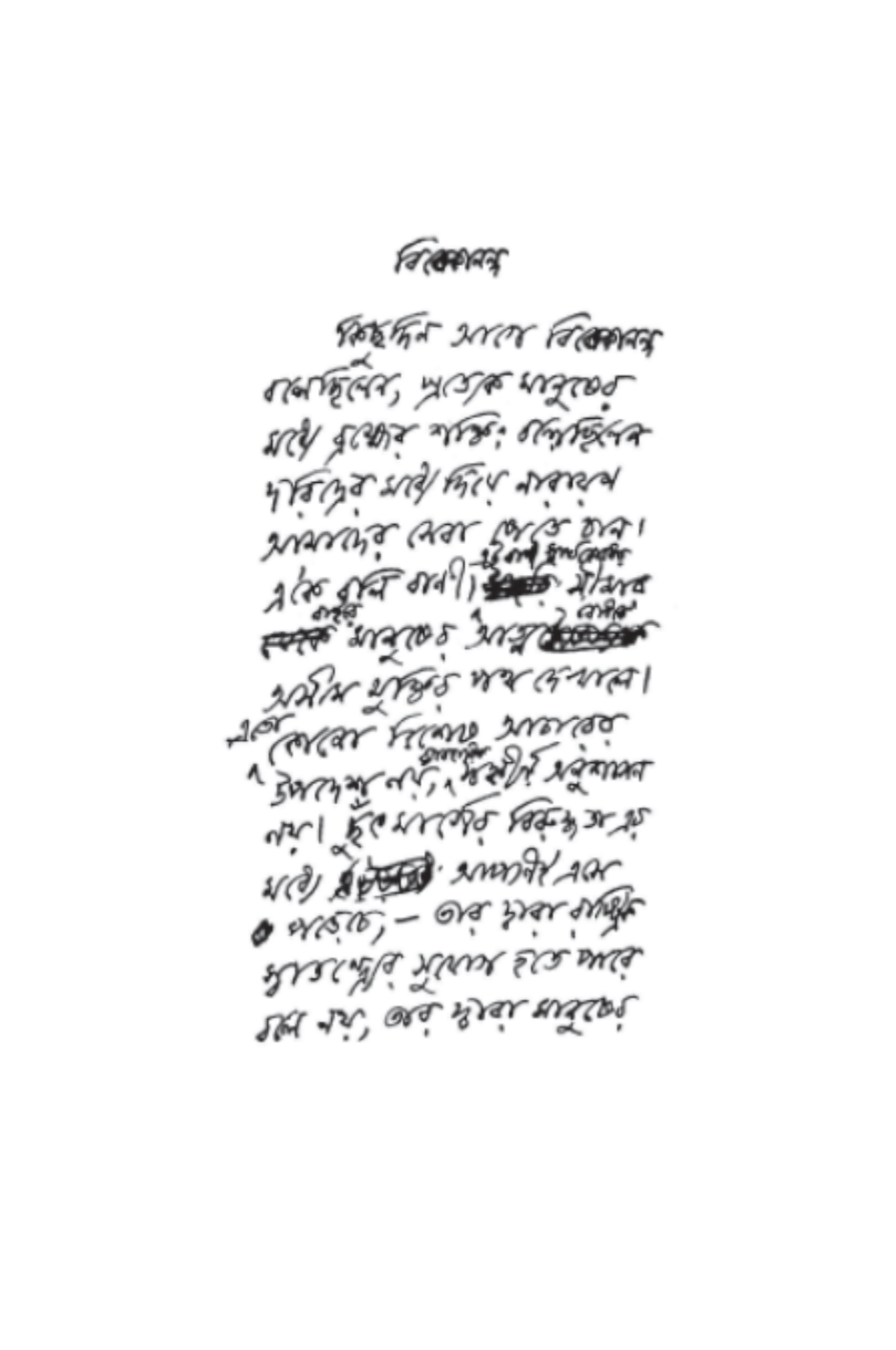
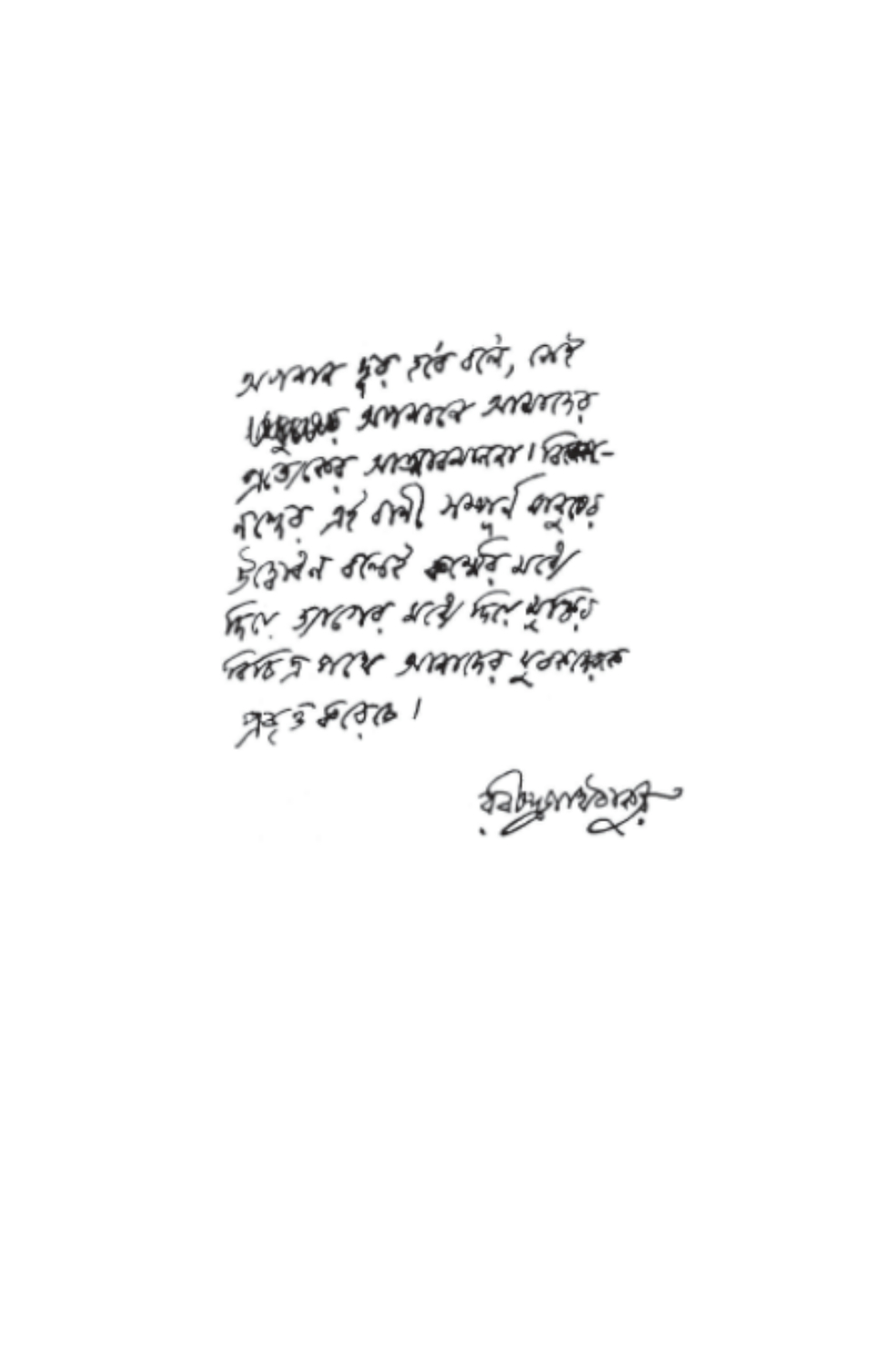
ⓘ
[1] The Way of Humanism : East and West by Radhakamal Mukerjee, Academic Books, Bombay, New Delhi, 1968, p.212.
↑ Contents
RADHAKUMUD MUKERJEE
It was only after his attainment of supreme knowledge that Sri Ramakrishna allowed his pupil to engage in external activities in the life of a teacher.
What was this Supreme knowledge which Vivekananda had lived to achieve? It was the knowledge of the ātman, of Brahman as the soul and supreme reality. He did not care for the half truths and intermediate truths which make up the body of knowledge, for which the modern world stands. He boldly stood for the knowledge of immortality as the only objective to be aimed at by mortals. ...
...Vivekananda stood out as an embodiment of a purified Hinduism, a Hinduism purged of its impurities and abuses, which are not of its essence. He was an embodiment of the religion that is founded upon character and not upon mere external forms, rituals and ceremonies. His clarion call still instigates in us a fight against illiteracy, untouchability, and other social evils which are eating into the vitals of Hinduism.
We at the modern age are too prone to modernize too much the message of Vivekananda as if he were a mere political leader. It is forgotten that his main strength lay in the depths of his soul. It was his soul force that sustained a life so rich in events and in external activities. There is hardly a life in which so much could be packed within its span so restricted. His life was cut short at the age of 39, but it is a priceless possession for India and Humanity.[1]
ⓘ
[1] Prabuddha Bhārata, April 1940, pp.156-57.
↑ Contents
RAJENDRA PRASAD
Men who lead their fellow beings in any sphere of life are rare and those that lead their leaders are rarer still.These super-guides come not very often upon this earth to uplift the sinking section of humanity. Swami Vivekananda was one of these super souls.
...It was he who could set the sceptic mind of the West at the rest in the spiritual arena. Ambassadors of spiritual missions had risen before him in the East, but none could speak to the West as he did with that voice of conviction, keeping audiences spellbound and enthralled. The worthy disciple of the worthy Master rose to the pinnacle of spiritual eminence, preaching the gospel of the innate oneness of the human race, and preaching universal love and the affinity of all human souls.
...Not only Indians but Westerners too stand indebted to Swami Vivekananda for his bequest of viveka (wisdom) to posterity.[1]
The ideal he stood for made universal brotherhood of man an understandable proposition to a world which was wedded to colour prejudice, having its route in the slavery of man. His spiritual approach roused the conscience of the thinking section of the human community all over the world and he succeeded in bringing home to the West the greatness of the Vedic civilization.
The great disciple of the great Master immortalized the fame and prestige of the land of his birth in a way which remains unrivalled even in the annals of Indian spiritualism in modern times. The sceptical youth with the intrepid spirit rose to be the ablest and wisest heir to the legacy of spiritual wealth of the great enlightened one.[2]
ⓘ
[1] Prabuddha Bhārata, May 1963, p.318.
[2] Bihar News, 1 January, 1963. Ref: Vivekananda O Samakālīn Bhāratavarṣa, Vol.7, p.196.
↑ Contents
ROMAIN ROLLAND
He [Vivekananda] was energy personified, and action was his message to men. For him, as for Beethoven, it was the root of all the virtues...
His pre-eminent characteristic was kingliness. He was a born king and nobody ever came near him either in India or America without paying homage to his majesty.
When this quite unknown young man of thirty appeared in Chicago at the inaugural meeting of the Parliament of Religions, opened in September 1893, by Cardinal Gibbons, all his fellow members were forgotten in his commanding presence. His strength and beauty, the grace and dignity of his bearing, the dark light of his eyes, his imposing appearance, and from the moment he began to speak, the splendid music of his rich deep voice enthralled the vast audience of American Anglo-Saxons, previously prejudiced against him on account of his colour. The thought of this warrior prophet of India left a deep mark upon the United States.
It was impossible to imagine him in the second place. Wherever he went he was the first. Everybody recognized in him at sight the leader, the anointed of God, the man marked with the stamp of the power to command. A traveller who crossed his path in the Himalayas without knowing who he was, stopped in amazement, and cried, ‘Śiva !. ’
It was as if his chosen God had imprinted His name upon his forehead. ...
He was less than forty years of age when the athlete lay stretched upon the pyre. ...
But the flame of that pyre is still alight today. From his ashes, like those of the Phoenix of old, has sprung anew the conscience of India—the magic bird—faith in her unity and in the Great Message, brooded over from Vedic times by the dreaming spirit of his ancient race—the message for which it must render account to the rest of mankind.
Moving as were his [Vivekananda’s] lectures at Colombo, ...and the preaching to the people of Rameswaram...—it was for Madras that he reserved his greatest efforts. Madras had been expecting him for weeks in a kind of passionate delirium....
He replied to the frenzied expectancy of the people by his Message to India, a conch sounding the resurrection of the land of Ràma, of Śiva, of Kṛṣṇa, and calling the heroic Spirit, the immortal ātman, to march to war. He was a general, explaining his Plan of Campaign, and calling his people to rise en masse :
‘My India, arise !’...
‘For the next fifty years... let all other vain Gods disappear for that time from our minds. This is the only God that is awake, our own race—everywhere His hands, everywhere His feet, everywhere His ears, He covers everything. All other Gods are sleeping. What vain Gods shall we go after and yet cannot worship the God that we see all round us, the Virāṭ ?. The first of all worship is the worship of the Virāṭ—of those all around us. These are all our Gods—men and animals, and the first Gods we have to worship are our own countrymen. ’
Imagine the thunderous reverberations of these words!...
The storm passed ; it scattered its cataracts of water and fire over the plain, and its formidable appeal to the Force of the Soul, to the God sleeping in man and His illimitable possibilities ! I can see the Mage erect, his arm raised, like Jesus above the tomb of Lazarus in Rembrandt’s engraving : with energy flowing from his gesture of command to raise the dead and bring him to life....
Did the dead arise? Did India, thrilling to the sound of his words, reply to the hope of her herald? Was her noisy enthusiasm translated into deeds ? At the time nearly all this flame seemed to have been lost in smoke. Two years afterwards Vivekananda declared bitterly that the harvests of young men necessary for his army had not come from India. It is impossible to change in a moment the habits of a people buried in a Dream, enslaved by prejudice, and allowing themselves to fail under the weight of the slightest effort. But the Master’s rough scourge made her turn for the first time in her sleep, and for the first time the heroic trumpet sounded in the midst of her dream the Forward March of India, conscious of her God. She never forgot it. From that day the awakening of the torpid Colossus began. If the generation that followed, saw, three years after Vivekananda’s death, the revolt of Bengal, the prelude to the great movement of Tilak and Gandhi, if India today has definitely taken part in the collective action of organized masses, it is due to the initial shock, to the mighty ‘Lazarus, come forth;’ of the message from Madras.
This message of energy had a double meaning : a national and a universal. Although, for the great monk of the Advaita, it was the universal meaning that predominated, it was the other that revived the sinews of India.
* * *
His words are great music, phrases in the style of Beethoven, stirring rhythms like the march of Handel choruses. I cannot touch these sayings of his, scattered as they are through the pages of books at thirty years’ distance, without receiving a thrill through my body like an electric shock. And what shocks, what transports must have been produced when in burning words they issued from the lips of the hero !
* * *
...India was hauled out of the shifting sands of barren speculation wherein she had been engulfed for centuries, by the hand of one of her own sannyāsins; and the result was that the whole reservoir of mysticism, sleeping beneath, broke its bounds and spread by a series of great ripples into action. The West ought to be aware of the tremendous energies liberated by these means.
The world finds itself face to face with an awakening India. Its huge prostrate body, lying along the whole length of the immense peninsula, is stretching its limbs and collecting its scattered forces. Whatever the part played in this reawakening by the three generations of trumpeters during the previous century—(the greatest of whom we salute, the genial Precursor : Rammohun Roy), the decisive call was the trumpet blast of the lectures delivered at Colombo and Madras.
And the magic watchword was Unity. Unity of every Indian man and woman (and world-unity as well) ; of all the powers of the spirit—dream and action ; reason, love, and work. Unity of the hundred races of India with their hundred different tongues and hundred thousand gods springing from the same religious centre, the core of present and future reconstruction. Unity of the thousand sects of Hinduism. Unity within the vast Ocean of all religious thought and all rivers past and present, Western and Eastern. For—and herein lies the difference between the awakening of Ramakrishna and Vivekananda and that of Rammohun Roy and the Brāhmo Samāj—in these days lndia refuses allegiance to the imperious civilization of the West, she defends her own ideas, she has stepped into her age-long heritage with the firm intention not to sacrifice any part of it, but to allow the rest of the world to profit by it, and to receive in return the intellectual conquests of the West. The time is past for the pre-eminence of one incomplete and partial civilization. Asia and Europe, the two giants, are standing face to face as equals for the first time. If they are wise they will work together, and the fruit of their labours will be for all.
This ‘greater India’, this new India—whose growth politicians and learned men have, ostrich fashion, hidden from us and whose striking effects are now apparent—is impregnated with the soul of Ramakrishna. The twin star of the Paramahansa and the hero who translated his thoughts into action, dominates and guides her present destinies. Its warm radiance is the leaven working within the soil of India and fertilizing it. The present leaders of India : the king of thinkers, the king of poets, and the Mahātmā—Aurobindo Ghosh, Tagore, and Gandhi— have grown, flowered, and borne fruit under the double constellation of the Swan and the Eagle—a fact publicly acknowledged by Aurobindo and Gandhi. ...
As for Tagore, whose Goethe-like genius stands at the junction of all the rivers of India, it is permissible to presume that in him are united and harmonized the two currents of the Bràhmo Samàj (transmitted to him by his father, the Maharshi) and of the new Vedantism of Ramakrishna and Vivekananda. Rich in both, free in both, he has serenely wedded the West and the East in his own spirit. From the social and national point of view his only public announcement of his ideas was, if I am not mistaken, about 1906 at the beginning of the Swadeśī movement, four years after Vivekananda’s death. There is no doubt that the breath of such a Forerunner must have played some part in his evolution.
* * *
...I was glad to hear Gandhi’s voice quite recently—in spite of the fact that his temperament is the antithesis of Ramakrishna’s or Vivekananda’s—remind his brethren of the International Fellowships, whose pious zeal disposed them to evangelize, of the great universal principle of religious ‘Acceptation’, the same preached by Vivekananda. ...
...At this stage of human evolution, wherein both blind and conscious forces are driving all natures to draw together for ‘co-operation or death’, it is absolutely essential that the human consciousness should be impregnated with it, until this indispensable principle becomes an axiom : that every faith has an equal right to live, and that there is an equal duty incumbent upon every man to respect that which his neighbour respects. In my opinion Gandhi, when he stated it so frankly, showed himself to be the heir of Ramakrishna.
There is no single one of us who cannot take this lesson to heart. The writer of these lines—he has vaguely aspired to this wide comprehension all through his life— feels only too deeply at this moment how many are his shortcomings in spite of his aspirations; and he is grateful for Gandhi’s great lesson—the same lesson that was preached by Vivekananda, and still more by Ramakrishna —to help him to achieve it.[1]
ⓘ
[1] The Life of Vivekananda and the Universal Gospel (Advaita Ashrama, Calcutta, 1970), pp. 4-7; 106-14; 146; 286-89; 307- 10.
↑ Contents
S.SATYAMURTI
Swami Vivekananda have re-created India for us and… the credit for the creation of that new independent India almost entirely goes to the great Swami’s work here and elsewhere. Swami Vivekananda was a religious monk first and last and his Advaitic note synchronised more or less with a period when India had almost lost her soul, forgotten her religion, and Ingersol and Company dominated our hearts and breaths…..The Swami was made of a more optimistic type. He believed and gloried in the past and yet he was a saint with a modem outlook, who wanted India to be not a museum of the past but a living power- house for the spiritual salvation of the entire world. That was the message of Swami Vivekananda to the world.…One beautiful feature about Swami Vivekananda, was that he again and again acknowledged that all that was good in him, was due to his Guru and that all the fault in him was his own. …He gave us not only our religion….he gave us our patriotism. He was a patriot above everything else. He gave us the Swadeshi gospel. Above all, Swami Vivekananda gave us our self-respect and he placed India on the map of the world.[1]
ⓘ
[1] Vedānta Keśarī, March 1939.
↑ Contents
SARVEPALLI RADHAKRISHNAN
When I was a student in the early years of this century, a student in high school and college classes, we used to read Swami Vivekananda’s speeches and letters which were then passing from hand to hand in manuscript form, and they used to stir us a great deal and make us feel proud of our ancient culture. Though our externals were broken down, the spirit of our country is there and is everlastingly real—that was the message which we gathered from his speeches and writings when I was a young student.
There is nothing higher than humanity. But so far as we are concerned, a human individual is a lamp of Spirit on earth, the most concrete living embodiment of Spirit. By standing up for the great ideals of Hindu religion, the great ideals that alone can save humanity, by standing up for them, Swami Vivekananda tried to lead humanity to a nobler and better path than that which it found itself in. If you really believe in the divine spark in man, do not for a moment hesitate to accept the great tradition which has come to us, of which Swami Vivekananda was the greatest exponent.[1]
* * *
We are today at a critical period not merely in the history of our country but in the history of the world. There are many people who think we are on the edge of an abyss. There is distortion of values, there is lowering of standards, there is widespread escapism, a good deal of mass hysteria, and people think of it and collapse in despair, frustration, hopelessness. These are the only things which are open to us. Such a kind of lack of faith in the spirit of man is a treason to the dignity of man. It is an insult to human nature. It is human nature that has brought about all the great changes that have taken place in this world. And if there is any call which Vivekananda made to us, it is to rely on our own spiritual resources. ... Man has inexhaustible spiritual resources. His spirit is supreme, man is unique. There is nothing inevitable in this world, and we can ward off the worst dangers and worst disabilities by which we are faced. Only we should not lose hope. He gave us fortitude in suffering, he gave us hope in distress, he gave us courage in despair. He told us : ‘Do not be led away by the appearances. Deep down there is a providential will, there is a purpose in this universe. You must try to co-operate with that purpose and try to achieve it.'[2]
ⓘ
[1] ‘Swami Vivekananda and Young India’ by Sarvepalli Radhakrishnan, Prabuddha Bhārata, May, 1963, pp. 183-84.
[2] Swami Vivekananda Centenary Memorial Volume, pp. x-xi.
↑ Contents
SATYENDRA NATH BOSE
The immesurable force having its source within him [Vivekananda], had ceaselessly strived to have emanation. Throughout his life this irrepressable force had moved him around the world. And wherever he went, people who had his contact could experience this life-force and were, consequently, rejuvenated. There hardly was anyone more capable than him to arouse the people of our country from their deep illusory slumber....It was our misfortune that like the great Vedantist Śaṅkarācārya, he had an early demise. But as the Śaṅkarācārya in his short life had moved around India for umpteen times and tried to inject a new life force among the Indians, so also was the Swami during the nineteenth century stormed around India and the Western countries and preached Sri Ramakrishna’s message of inter- religious harmony.[1]
ⓘ
[1] Vivekananda O Samakālīn Bhāratavarṣa, Vol.7, pp. 379-80.
↑ Contents
SHYAMA PRASAD MOOKERJEE
Nineteenth century had witnessed the birth of several spirited men in different corners of India. Swami Vivekananda was the greatest among them. The message of the Swami still resonates in the Indian hearts. Only in his chalked out path India can achieve absolute national rejuvenation. As the great ideals of Divine Buddha has their culmination in Emperor Aśoka’s proactive stance for his subjects, such were the spiritual tenets of Divine Sri Ramakrishna manifested through the life’s work of Swami Vivekananda. Behind Aśoka’s emissaries of peace was the political enormity of a King, but, on the other hand, Vivekananda’s message had nothing except love and sacrifice behind its sustenance. ...To build the country and the nation, it is imperative that we must adopt the ideal of Swami. People can never live without an ideal. Within the Swami’s life and message are found such timely element and ideal resorting to which we can build a strong nation and a great country.[1]
ⓘ
[1] Vivekananda O Samakālīn Bhāratavarṣa pp. 252-53.
↑ Contents
SRI AUROBINDO
‘The awakening soul of India’
It was in religion first that the soul of India awoke and triumphed. There were always indications, always great forerunners, but it was when the flower of the educated youth of Calcutta bowed down at the feet of an illiterate Hindu ascetic, a self-illuminated ecstatic and ‘mystic’ without a single trace or touch of the alien thought or education upon him that the battle was won. The going forth of Vivekananda, marked out by the Master as the heroic soul destined to take the world between his two hands and change it, was the first visible sign to the world that India was awake not only to survive but to conquer Once the soul of the nation was awake in religion, it was only a matter of time and opportunity for it to throw itself on all spiritual and intellectual activities in the national existence and take possession of them.[1]
Vivekananda was a soul of puissance if ever there was one, a very lion among men, but the definite work he has left behind is quite incommensurate with our impression of his creative might and energy. We perceive his influence still working gigantically, we know not well how, we know not well where, in something that is not yet formed, something leonine, grand, intuitive, upheaving that has entered the soul of India and we say, ‘Behold, Vivekananda still lives in the soul of his Mother and in the souls of her children.’[2]
...The visit of Swami Vivekananda to America and the subsequent work of those who followed him did more for India than a hundred London Congresses could effect. That is the true way of awakening sympathy,—by showing ourselves to the nations as a people with a great past and ancient civilization who still possess something of the genius and character of our forefathers, have still something to give the world and therefore deserve freedom,—by proof of our manliness and fitness, not by mendicancy.[3]
ⓘ
[1] Sri Aurobindo, Vol.2, 1972, pp.37-38.
[2] Prabuddha Bhārata 1963, p. 170.
[3] Sri Aurobindo, Vol.2, p.171.
↑ Contents
SUBHAS CHANDRA BOSE
In the eighties of the last century, two prominent religious personalities appeared before the public who were destined to have a great influence on the future course of the new awakening. They were Ramakrishna Paramahansa, the saint, and his disciple Swami Vivekananda. Ramakrishna preached the gospel of the unity of all religions and urged the cessation of inter-religious strife. Before he died, he charged his disciple with the task of propagating his religious teachings in India and abroad and of bringing about an awakening among his countrymen. Swami Vivekananda therefore founded the Ramakrishna Mission, an order of monks, to live and preach the Hindu religion in its purest form in India and abroad, especially in America, and he took an active part in inspiring every form of healthy national activity. With him religion was the inspirer of nationalism. He tried to infuse into the new generation a sense of pride in India’s past, of faith in India’s future and a spirit of self-confidence and self-respect. Though the Swami never gave any political message, every one who came into contact with him or his writings developed a spirit of patriotism and a political mentality. So far at least as Bengal is concerned, Swami Vivekananda may be regarded as the spiritual father of the modern nationalist movement. He died very young in 1902, but since his death his influence has been even greater.[1]
I cannot write about Vivekananda without going into raptures. Few indeed could comprehend or fathom him—even among those who had the privilege of becoming intimate with him. His personality was rich, profound and complex and it was this personality—as distinct from his teachings and writings—which accounts for the wonderful influence he has exerted on his countrymen. This is the type of manhood which appeals to the Bengalee as probably none other....Reckless in his sacrifice, unceasing in his activity, boundless in his love, profound and versatile in his wisdom, exuberant in his emotions, merciless in his attacks, but yet simple as a child—he was a rare personality in this world of ours. ...
Swamiji was a full-blooded masculine personality— and a fighter to the core of his being. He was consequently a worshipper of Śakti and gave a practical interpretation to the Vedanta for the uplift of his countrymen. ... I can go on for hours and yet fail to do the slightest justice to that great man. He was so great, so profound, so complex. A yogi of the highest spiritual level in direct communion with the truth who had for the time being consecrated his whole life to the moral and spiritual uplift of his nation and of humanity, that is how I would describe him. If he had been alive, I would have been at his feet. Modern Bengal is his creation—if I err not.[2]
How shall I express in words my indebtedness to Sri Ramakrishna and Swami Vivekananda? It is under their sacred influence that my life got first awakened. Like Nivedita I also regard Ramakrishna and Vivekananda as two aspects of one indivisible personality. If Swamiji had been alive today, he would have been my guru, that is to say, I would have accepted him as my Master. It is needless to add, however, that as long as I live, I shall be absolutely loyal and devoted to Ramakrishna- Vivekananda.[3]
It is very difficult to explain the versatile genius of Swami Vivekananda. The impact Swami Vivekananda made on the students of our time by his works and speeches far outweighed that made by any other leader of the country. He, as it were, expressed fully their hopes and aspirations. [But] Swamiji cannot be appreciated properly if he is not studied along with Sri Sri Paramahansa Deva. The foundation of the present freedom movement owes its origin to Swamiji’s message. If India is to be free, it cannot be a land specially of Hinduism or of Islam—it must be one united land of different religious communities inspired by the ideal of nationalism. [And for that] Indians must accept wholeheartedly the gospel of harmony of religions which is the gospel of Ramakrishna-Vivekananda....
Swamiji harmonized East and West, religion and science, past and present. And that is why he is great. Our countrymen have gained unprecedented self-respect, self-confidence and self-assertion from his teachings.[4]
The harmony of all religions which Ramakrishna Paramahansa accomplished in his life’s endeavour, was the keynote of Swamiji’s life. And this ideal again is the bed-rock of the nationalism of Future India. Without this concept of harmony of religions and toleration of all creeds, the spirit of national consciousness could not have been build up in this country of ours full of diversities.
The aspiration for freedom manifested itself in various movements since the time of Rammohun Roy. This aspiration was witnessed in the realm of thought and in social reforms during the nineteenth century, but it was never expressed in the political sphere. This was because the people of India still remained sunk in the stupor of subjugation and thought that the conquest of India by the British was an act of Divine Dispensation. The idea of complete freedom is manifest only in Ramakrishna- Vivekananda towards the end of the nineteenth century. ‘Freedom, freedom is the song of the Soul’—this was the message that burst forth from the inner recesses of Swamiji’s heart and captivated and almost maddened the entire nation. This truth was embodied in his works, life, conversations, and speeches.
Swami Vivekananda, on the one hand, called man to be real man freed from all fetters and, on the other, laid the foundation for true nationalism in India by preaching the gospel of the harmony of religions.[5]
[1] The Indian Struggle (Asia Publishing House, Bombay etc., 1964), p. 21.
[2] ‘Swami Vivekananda’, Prabuddha Bhārata, July, 1932, p.352.
[3] Udbodhan, Āshwin, 1354, p.459 :
"শ্রীরামকৃষ্ণ ও স্বামী বিবেকানন্দের নিকট আমি যে কত ঋণী তাহা ভাষায় কি করিয়া প্রকাশ করিব? তাহাদের পুণ্য প্রভাবে আমার জীবনের প্রথম উন্মেষ। নিবেদিতার মতো আমিও মনে করি যে, রামকৃষ্ণ ও বিবেকানন্দ একটা অখণ্ড ব্যক্তিত্বের দুই রূপ। আজ যদি স্বামীজী জীবিত থাকিতেন তিনি নিশ্চয়ই আমার গুরু হইতেন—অর্থাৎ তাঁকে নিশ্চয়ই আমি গুরুপদে বরণ করিতাম। যাহা হউক, যতদিন জীবিত থাকিব, ততদিন রামকৃষ্ণ-বিবেকানন্দের একান্ত অনুগত ও অনুরক্ত থাকিব, একথা বলাই বাহুল্য।'
[4] Udbodhan, Phālgun,1337 :
“স্বামী বিবেকানন্দের বহুমুখী প্রতিভার ব্যাখ্যা করা বড় কঠিন। আমাদের সময়ের ছাত্রসমাজ স্বামীজীর রচনা ও বক্তৃতার দ্বারা যেরূপ প্রভাবিত হইয়াছিল, সেরূপ আর কাহারও দ্বারা হয় নাই—তিনি যেন সম্পূর্ণভাবে তাহাদের আশা ও আকাঙ্ক্ষাকে ব্যক্ত করিয়াছিলেন। শ্রীশ্রীপরমহংসদেবের সহিত একযোগে না দেখিলে স্বামীজীকে যথার্থভাবে বিচার করা যাইবে না। স্বামীজীর বাণীর মধ্য দিয়াই বর্তমানের মুক্তি-আন্দোলনের ভিত্তি গঠিত হইয়াছে। ভারতবর্ষকে যদি স্বাধীন হইতে হয়, তবে তাহাকে হিন্দুধর্ম বা ইসলামের বিশেষ আবাসভূমি হইলে চলিবে না- -তাহাকে জাতীয়তার আদর্শে অনুপ্রাণিত বিভিন্ন ধর্মসম্প্রদায়ের একত্র বাসভূমি হইতে হইবে। রামকৃষ্ণ- বিবেকানন্দের যে বাণী — ধর্মসমন্বয়- -তাহা ভারতবাসীকে সর্বান্তঃকরণে গ্রহণ করিতে হইবে।... স্বামীজী প্রাচ্য ও পাশ্চাত্যের, ধর্ম ও বিজ্ঞানের, অতীত ও বর্তমানের সমন্বয় করিয়াছিলেন, তাই তিনি মহৎ। তাঁহার শিক্ষায় দেশবাসী অভূতপূর্ব আত্মসম্মান, আত্মবিশ্বাস এবং আত্মপ্রতিষ্ঠার বোধ লাভ করিয়াছে।'
[5] Nūtaner Sandhān (D.M. Library, Arya Publishing House, College Street Market, Kolkata), pp. 24-26 :
'রামকৃষ্ণ পরমহংস নিজের জীবনের সাধনার ভিতর দিয়া সর্বধর্মের যে সমন্বয় করিতে পারিয়াছিলেন, তাহাই স্বামীজীর জীবনের মূলমন্ত্র ছিল এবং তাহাই ভবিষ্যৎ ভারতের জাতীয়তার মূল ভিত্তি। এই সর্বধর্ম সমন্বয় ও সকল মত সহিষ্ণুতার প্রতিষ্ঠা না হইলে আমাদের এই বৈচিত্রপূর্ণ দেশে জাতীয়তাবোধ নির্মিত রাষ্ট্রীয় ক্ষেত্রে তখনও দেখা দেয় নাই—কারণ তখনও ভারতবাসী পরাধীনতার মোহনিদ্রায় নিমগ্ন থাকিয়া মনে করিতেছিল যে, ইংরাজের ভারতবিজয় একটা দৈব ঘটনা বা Divine Dispensation। ঊনবিংশ শতাব্দীর শেষ দিকে এবং বিংশ শতাব্দীর প্রারম্ভে স্বাধীনতার অথগুরূপের আভাস রামকৃষ্ণ-বিবেকানন্দের মধ্যে পাওয়া যায়। 'Freedom, freedom is the song of the Soul' এই বাণী যখন স্বামীজীর অন্তরের রুদ্ধদুয়ার ভেদ করিয়া নির্গত হয়, তখন তাহা সমগ্র দেশবাসীকে মুগ্ধ ও উন্মত্তপ্রায় করিয়া তোলে। তাঁহার সাধনার ভিতর দিয়া, আচরণের ভিতরদিয়া, কথা ও বক্তৃতার ভিতর দিয়া এই সত্যই বাহির হইয়াছিল। স্বামী বিবেকানন্দ মানুষকে যাবতীয় বন্ধন হইতে মুক্ত হইয়া খাঁটি মানুষ হইতে বলেন এবং অপরদিকে সর্বধর্ম সমন্বয়ের প্রচারে ভারতের জাতীয়তার ভিত্তি স্থাপন করেন।
↑ Contents
SUBRAHMANYA BHARATI
To the Bengal politicians Madras was the dark State, yet this very Madras discovered in Vivekananda the luminous light which later would throw its brilliance all over the world. Vivekananda gave birth to radical neo-Hinduism. The Tamils first accepted Vivekananda; afterwards Bengal and Maharashtra realized his greatness. ...It was Swami Vivekananda by whom the [Indian] movements for ‘Swarāj’ and independence were first had its foundation. ...He was the great inspirer of patriotism, and the fundamental power behind rousing love for the country. ...Sri Ramakrishna had shaped Swami Vivekananda and he was the foremost among the creators of modern India. ...
The very moment the Swami had reached Japan on his way to America for preaching the Vedanta religion, the mother power of India, akin to the Vedic supremacy, blessed him with the wings of ultimate wisdom. His letters from Japan were the heralds of new radiance. The fires of neo-Hinduism, as if, were dancing within his heart. It was the Divine design that at the end of the nineteenth century the triumphant flag of neo-Hinduism would be planted in America, the very country which was the ideal of the European civilization. And Vivekananda was the man chosen for that task.[1]
ⓘ
[1] Translation from the Bengali rendition available in Vivekananda O Samakālīn Bhāratavarṣa, Vol.7, pp.460, 462 and 464.
↑ Contents
SUNITI KUMAR CHATTERJI
Vivekananda appeared to me immediately to be a man who was intensely moved by the sufferings of Humanity, and particularly of Humanity in India. Some of his tirades against middle class and upper class societies in this matter moved us to the depths of our being. He discovered for us the greatness of Man, and particularly of men in the humbler walks of life who were the despised and the denied in our Indian society. At the same time, he brought home to us the value of Indian thought at its highest and pristine best, as in the Vedanta. He was able to convince us that what our ancestors had left in the Vedanta Philosophy was of permanent value, not only for us in India but also for the rest of Humanity. This put heart in us, and made us feel a new kind of elation as members of a people who have always had a mission and a sacred task to serve Humanity. The Hindus as a race were losing their nerve, and it was Vivekananda who helped us to regain this nerve which we were losing. There was a lot of unthinking and unsympathetic criticism of our ways and our life, particularly from among Christian missionaries of the older type, and this was demolished by Vivekananda. All this made us hold him very close to our heart, and to think of him as a great master and as a new kind of incarnation who came down to earth to lead us into the good life and the life of the strong man.
Vivekananda, in the first instance, knocked off a lot of nonsense in our Hindu social life, and drew our attention to the Eternal Verities and not to the ephemeral accidentals—social usages and such like—in our life. He was a sworn enemy of what we now call in India Casteism. Untouchability was something which he abhorred both as a sannyāsin and as a lay Hindu. He coined the word which is very commonly used in our Indian English—‘don’t touchism’. His heart overflowed with love and sympathy for the masses, whom he wanted to serve with religious zeal—serve as a believer in the Vedanta which sees God in all life. He coined a new word for our Indian languages— daridra-Nārāyaṇa or a ‘God in the poor and the lowly’. This word has been accepted by the whole of India, and in a way it brings in a sense of responsibility for the average man. He has to look upon the poor and the humble, the suffering ones and the frustrated ones of society, as if they were deities incarnate or fragments of God, to serve whom was to serve God. Mahatma Gandhi’s revival of the old expression which was used in Gujarati by the Vaiṣṇava poets of Gujarat, namely, Harijana or ‘the Men of God’ was a very fine expression ; but daridra-Nārāyaṇa implied or brought in an element of a sense of duty which was enjoined upon man to serve the poor if they wanted to serve God.
Swami Vivekananda is looked upon as a great religious teacher, and indeed he made a definite contribution to the study of both Hindu religion and philosophy, and also in spreading a knowledge and appreciation of this philosophy and religion. His great works on aspects of Vedanta in theory and practice still inspire hundreds and thousands of enquirers all over the world. But it has also been said that he was more a philanthropist, one who dedicated himself to the service of man, than a religious theorist or preacher. One need not seek to analyse Vivekananda’s personality in this way. It is best to take the service of man as a form of serving God, for, from the point of view of all practical religion, God and Man are the obverse and reverse of the same medal. Vivekananda may be said to have been an innovator in two matters. As his great disciple Sister Nivedita suggested—he was the first to formulate the basic character of Hinduism as a system of thought and as a way of life in the modern age. This is the first great thing we as Indians may note about Vivekananda. Secondly, Vivekananda may be said to have brought before the Western World a new point of view in religious thinking—a new approach to the problems of faith— which they needed very badly. To this also might be added as a pendant that Vivekananda, as one of the thought-leaders of modern India, gave the tone to modern Indian culture. He conceived of an integration of all human religion and culture into one entity claiming the homage of all and sundry.
I consider, and many agree with me also, that Swami Vivekananda’s participation and his magisterial and at the same time sweet and reasonable pronouncements at the International Congress of Religions at Chicago in 1893 form a very important event in the intellectual history of modern man. There he proclaimed for the first time the necessity for a new and an enlightened kind of religious understanding and toleration, and this was particularly necessary in an America which was advancing so rapidly in science and technology, and in wealth and power, which were not, however, divorced from altruistic aspirations and achievements. But apart from a few of the most outstanding figures, particularly in the New England orbit of the United States, generally the religious background was crude and primitive. It had pinned itself down to a literal interpretation of the Bible, and accepted all the dogmas with a conviction which was pathetic in its combination of sincerity and fanatic faith, of credulity and crudity. This very primitive kind of religion was not satisfying to those who were actuated by the spirit of enquiry in a higher and more cultured plane, and for them Vivekananda’s message came like rain on a thirsty soil. So in this way, we might say that quite a new type of spiritual conversion has taken place in the mind of a considerable portion of intelligent men and women in the West, beginning with America ; and here we see the leaven of Vedanta working through Vivekananda. In a novel on Mexican life by D. H. Lawrence—The Plumed Serpent—where we have the picture of a revival of the pre-Catholic Aztec religion among a section of political workers in Mexico, the mentality displayed by some of the leaders of this movement is something astoundingly modern. Many of the views expressed by one of the characters in this novel, the hero Ramon talking to the Roman Catholic Bishop, might have been taken over bodily from the writings of Vivekananda. In this way, although the ordinary run of people are not conscious of it, the message which was given out by Vivekananda to America and the Western World at Chicago in 1893, and subsequently to people in America, England and India, has been an effective force in the liberalization of the human spirit in its religious approach.
The first point in Vivekananda which I mentioned above, namely, his giving before the world a definition of Hinduism in its essence, was a service which was done not only to India but also in another way to Humanity. ...
Vivekananda was the lover of all those who had suffered through the injustice of others, and he tried his best to restore them to a sense of human dignity It is remarkable how in India in her days of political submission and spiritual inanity, when everything seemed hopeless, and the people had lost all confidence in themselves, a spirit calling us to action like Swami Vivekananda could come into being. That such a person could come at a time when the prospect was bleak, when we seemed to have lost all hope, indicated that God in His mercy never forsakes His people, and this in a way bears out the great idea behind this oft-quoted verse of the Gītā that whenever righteousness is on the decline and unrighteousness is in the ascendant, God creates Himself as a great avatāra or Incarnation—as a Leader to guide men to the right path of salvation. And in that sense Vivekananda was an avatāra, a divinely inspired and God-appointed Leader, not only for Man in India, but also for the whole of Humanity in the present age.[1]
ⓘ
[1] Swami Vivekananda Centenary Memorial Volume, pp. 228-33.
↑ Contents
T. M . P. MAHADEVAN
Before Swamiji gave his inaugural address at the Parliament of Religions, the West was under the impression that India was a land of uncivilised people, that Hinduism was a primitive type of faith, that Hindus were a superstitious race without education and culture. It was this impression that was dispelled in the twinkling of a moment when Swamiji addressed the assembled Americans as Sisters and Brothers of America.They did not find the expression of such a fraternal feeling in any other speech.
He went to the West, not with a view to educating them, not with a view even to spreading the Vedanta knowledge in occident, but with a view to gaining recognition to his own people, with a view to putting India on the map of the world. If we are free today, if India has attained independence, it is due to the strong foundations laid by Swamiji. Swamiji was a great patriot. His patriotism came out of and flowed from his intense spirituality.
India, when Swamiji appeared on the scene, was in a similar situation. There was plenty of pseudo-sannyasa. Lethargy was being mistaken for piety. So Swamiji exhorted the Indians to wake up and build a strong and vigorous nation. It was only after then that India could play her role of spiritual leadership in the world. Swamiji thus emphasized wisdom in America and work in India. Unless we take these two together and put them side by side in their proper relations we cannot understand Swamiji and his mission. Our task now is to apply the principles of Vedanta as taught by Swamiji to tackle problems of national reconstruction. Swamiji will ever be with us in spirit. Let us hope that by his grace we shall be in a position to serve humanity. If we in India can set an example for the rest of the world to follow by harmonious living and by stressing the supremacy of the spiritual view of life, we shall be paying the highest tribute to Swami Vivekananda the incarnation of our eternal culture.[1]
But the first great dynamic leader of the movement for reawakening was Swami Vivekananda. The progress that India has made in the present century, her successful struggle for Independence through non-violent means, and the stability and self-respect she has regained would have been impossible but for the pioneering work of this great soul Swami Vivekananda.
While Swami Vivekananda had the highest praise for our philosophico-religious culture, he was unsparing in his criticism of the malpractices that had crept into Hinduism. … He was one of the very first, in modern times, to raise his voice of protest against casteism and don’t touchism. Modern caste distinction, he declared, is a barrier to India’s progress; it narrows, restricts, separates; it will crumble before the advance of ideas. He worked for strengthening India’s homogeneity and her acquiring democratic idea. He insisted that intelligence should not remain the monopoly of the privileged few. He foresaw that education was coming, and that compulsory education would follow. As regards the practice of untouchability, the Swami had very hard things to say. He was convinced that it was against the very spirit of Indian thought and culture. India’s doom was sealed, he declared, the very day the word mlechchha was invented. He exhorted the children of India to save India from this doom.[2]
One of the very first nationalist leaders of modern India was Swami Vivekananda; and it is to him that we owe the unique nationalism that is India’s. Not only did he rouse the dormant spirit of India into a sense of her strength and potentialities, but he also made the West recognize the civilizing influence of India abroad in the past and her invaluable legacy which could ensure the human progress of the future. Thus he was the first to fix the tone and tenor of Indian nationalism. It was because his nationalism was rooted in the wisdom of Vedanta that it became unique, and did not set itself against internationalism or the idea of one-world. Vedanta is our national philosophy; in content it is international and universal. It is the Vedantic nationalism of Swami Vivekananda, the patriot-monk, that gave the direction to the ethical politics of Mahatma Gandhi by means of which India has become free and independent. It is the Swami’s leadership, again that has made India avoid the narrow and dangerous path of arrogant nationalism, and take to the road of peaceful co-existence and co-operative endeavour towards the goal of commonweal (sarvodaya) and spirituality.[3]
ⓘ
[1] Swami Vivekananda, What he Did for us’, Vedānta Keśarī, March 1954, pp. 463-66.
[2] ‘India, Interpreting : Vivekananda’, Vedānta Keśarī, August 1956, pp. 183-86.
[3] ‘The Vedantic Nationalism of Swami Vivekananda’, Vedānta Keśarī, August 1963, pp. 177-80.
↑ Contents
U THANT
Swami Vivekananda...was the greatest spiritual ambassador of India, if I may say so, in the history of India. And for that matter, the history of Asia. The main purpose of his historic visit to the United States ... was to find a synthesis, if I can interpret and assess his activities in this country. He was very keen to bring about this synthesis between India and the United States, between Asia and the West. To understand Swami Vivekananda it is very important to understand the cultural and spiritual background of India, and for that matter, the cultural and spiritual background of Asia.
I think if we attempt to analyze the main purpose of Swami Vivekananda’s mission to this country—my interpretation is he wanted to find a harmony, a kind of a synthesis between the Eastern concept of culture and civilization and the Western concept of culture and civilization. What we need today is not to neglect or ignore the moral and spiritual qualities of mankind left by centuries of tradition, and which is the key of all religion.
Another aspect of Swami Vivekananda’s mission is the need of tolerance in human relations. Not only religious telerance but also tolerance in all spheres of activity A few centuries ago there was no such thing as religious tolerance. Religious tolerance was unthinkable. ... Now in the twentieth century there is religious tolerance.
... Swami Vivekananda had this very significant and very pertinent message for these tense times. He said : ...‘In this country I do not come to convert you to a new belief. ... I want to make the Methodist a better Methodist, the Presbyterian a better Presbyterian, the Unitarian a better Unitarian.’ ... These are very wise words and, friends, on this auspicious occasion when we are doing honour to one of the greatest men of all time, let us dedicate ourselves anew to this pledge : to make Christians better Christians, Hindus better Hindus, Muslims better Muslims, Buddhists better Buddhists, and Jews better Jews.[1]
ⓘ
[1] Vedānta and the West, 162 , pp. 11, 13-17.
↑ Contents
V. V. GIRI
Swami Vivekananda and who brought name and fame not only to Hinduism but to India. The refreshing catholicity of thought, the capacity to perceive in every religious system sublime elements which elevate and ennoble life…..Swami Vivekananda, the cyclonic Hindu as he was called, was more concerned with removing the poverty from the earth and the emphasis he laid on his master’s teachings of work and patriotism placed him on the lofty pedestal much above the common Sannyasis.…Vivekananda did not preach a philosophy of inaction. He stressed the fact that work was worship. Work, work and work that was his motto. There is the strong current of humanitarianism and consideration for the poor and the downtrodden which runs through all his thoughts, writings and speeches. Positive fearlessness, incessant work and continuous striving towards the goal should be the guiding spirit of every activity. According to him if there is a sin in the world, it is weakness; avoid all weaknesses, weakness is sin, weakness is death. Here is a new interpretation of religion exploding the myth that religion or spirituality was only a negative approach to life. While he emphasized material progress, he did not ignore the spiritual enhancement.
Swami Vivekananda’s contribution was not only limited to a religious revival or a cultural renaissance in our country, but more in bringing about a salutary change in the attitude and approach of the people. …He ceaselessly endeavoured to give a practical orientation to religion and made the ordinary man understand the meaning and relevance of religion. The message of Swami Vivekananda can be summed up in one single sentence : Be a man. As he said his religion was man-making. According to Vivekananda, Atman was not beyond definition or understanding but was a tangible manifestation of courage and valour and he said Brahman was fearlessness…. Swamiji pointed out that what people needed first were food and employment and only then could any spiritual feeling be aroused among the masses.…His was the religion of the living for he concerned himself most with the problems that in reality afflicted the people hunger, ignorance, poverty and destitution. …He always said that to be an ideal householder was much more difficult than to be an ideal sannyasi. The true life of work was indeed as hard as, if not harder than, the equally true life of renunciation.
His religion is, to put it in one word, humanism embracing all religions of the world. He preached this great principle emphasizing the selflessness of the individual. He insisted on every individual acquiring character, integrity, truth and on the necessity of pursuing selfless service. He rightly said that the primary task was to develop individual character and if individual character was developed the character of the nation as a whole would automatically be built up. This is a lesson that we must remember every day of our lives. …Swami Vivekananda’s establishment of the Ramakrishna Mission was one of his greatest gifts to India and to the world…He had a vision not only of obtaining a proper place for India in the comity of nations but he had a total comprehension of the mission of India in the modern world. While he believed in spiritual regeneration, he also saw that this could be possible and effective only if India’s social conditions are radically altered. What Vivekananda proposed was an integration of educational, philanthropic, and religious activities; and it was thus that the Ramakrishna Mission came into existence.[1]
I would like to emphasise that Vivekananda was not only a great religious teacher. He was also a very great Indian, a patriot who passionately believed in the well-being of his countrymen. ….Swami Vivekananda was an ardent nationalist, but his nationalism was not of the narrow or parochial type. It was essentially internationalism in spirit.[2]
ⓘ
[1] ‘All Pervading Humanism of Ramakrishna-Vivekananda, Prabuddha Bhārata, August 1969, pp. 344, 346.
[2] ‘The Vision of Swami Vivekananda’, Vedānta Keśarī December 1971, pp. 333-35.
↑ Contents
VINCENT SHEEAN
The most ancient tradition [in India] ... has been one in which the good work done for the assistance of the fellow man does not necessarily have anything to do with metaphysical contemplation. As far as we know, Vivekananda was the first in India of any social influence to declare that these two things should go together. He wanted his fellow monks of the Ramakrishna Mission, not only to read Sanskrit and contemplate higher reality, but also to work in such things as famines and floods, and in the eternal poverty of the Indian cities. If you read Vivekananda you will find some excoriating remarks about those who devote themselves entirely to their own spiritual welfare and forget the existence of their fellow creatures. He introduced into the monastic system of India this principle of the assistance to those who needed it most, that principle which was never so expressed before. And so, on my first trip [to India], in 1947, before I had ever been to Belur or Dakshineshwar, I found monks of the Ramakrishna Mission taking care of the wounded and the refugees in the tremendous upheaval which followed the partition of India. Monks of the Ramakrishna Mission were doing that work in all parts of the country and on a very considerable scale, as they do in ordinary times with their schools, hospitals, and refectories.
This principle, which is implicit in everything Ramakrishna said, everything of which we have record, he was not himself fitted to carry out. It was not his quality, his nature, but it was eminently the quality of Swami Vivekananda. He was able, possibly because of his visits to the West, to introduce that element into the Mission, of which it has borne the imprint ever since and from which very great good has resulted for the most miserable of the peoples of India.[1]
ⓘ
[1] Vedānta and the West, (Hollywood)109 (September-October, 1954), p. 11.
↑ Contents
VINOBA BHAVE
Vivekananda not only made us conscious of our strength, he also pointed out our defects and drawbacks. ...India was then steeped in tamas (ignorance and unwisdom) and mistook weakness for non-attachment and peace. That is why Vivekananda went so far as to say that criminality was preferable to lethargy and indolence. He made people conscious of the tāmasika state they were in, of the need to break out of it and stand erect so that they might realize in their own lives the power of the Vedanta. Speaking of those who enjoyed the luxury of studying philosophy and the scriptures in the smugness of their retired life, he said football-playing was better than that type of indulgence. Through a series of obiter dicta, he rehabilitated the prestige of India’s soul force and pointed out to the tamoguṇa (unwisdom) that had eclipsed her. He taught us : ‘The same Soul resides in each and all. If you are convinced of this, it is your duty to treat all as brothers and serve mankind.’ People were inclined to hold that, though all had equal right to the tattva-jñāna (knowledge of the Spirit), the difference of high and low should be maintained in the day-to-day dealings and relations. Swamiji made us see the truth that tattva-jñāna, which had no place in our everyday relationship with our fellow beings, and in our activities was useless and inane. He, therefore, advised us to dedicate ourselves to the service of daridra-Nārāyaṇa (God manifested in the hungry, destitute millions) to their upliftment and edification. The word daridra-Nārāyaṇa was coined by Vivekananda and popularized by Gandhiji.[1]
* * *
... Indians had totally become slaves to the English people and considered themselves as inferiors. The entire world, as a result, began to look upon the Indians as substandard in all parameters. At this very juncture Vivekananda had stepped in, and reminded the Indians of their spiritual power. Influenced by materialism we had reached such a pit that a sense of overall degradation prevailed in every sphere of life. India was in a stupor with thoughts as if our sociology was bad, we knew nothing of politics, and, even, our religion was imperfect. But every country has its own speciality, its own power – and India was no exception to this. The only thing was we were unaware of it. ...When India was in such a state, Vivekananda went to America, and there he preached the message of Vedanta to the world. He also told everyone about India’s supreme spiritual power. And his speech over there showered elixir throughout India. Indian people could find strength to stand with their head high. It was the consequence of Vivekananda’s speech that the Indians were able to realize that they also had power and, moreover, their spirit would remain ever free even if the country were conquered by external force. The peoples of distant lands could furthermore learn about India’s long historical ancestry and they realized that the distinctive power of the land is worth assimilation.[2]
ⓘ
[1] Prabuddha Bhārata, (Jan-Dec) 1963, pp. 172-73.
[2] Translated from Bengali edition available in Vivekananda O Samakālīn Bhāratavarṣa, Vol.7, pp. 198-99.
↑ Contents
WILL DURANT
He [Swami Vivekananda] preached to his country-men a more virile creed than any Hindu had offered them since Vedic days : It is a man-making religion that we want. ... Give up these weakening mysticisms, and be strong. ... For the next fifty years... let all other vain gods disappear from our minds. This is the only God that is awake, our own race, everywhere His hands, everywhere His feet, everywhere His ears; He covers everything. The first of all worship is the worship of those all around us. These are all our gods—men and animals; and the first gods we have to worship are our own countrymen. It was but a step from this to Gandhi.[1]
* * *
The most vivid of [the followers of Ramakrishna] was a proud young Kṣatriya, Narendranath Datta, who full of Spencer and Darwin, first presented himself to Ramakrishna as an atheist, unhappy in his atheism, but scornful of the myths and superstitions with which he identified religion. Conquered by Ramakrishna’s patient kindliness, Naren became the young master’s most ardent disciple; he redefined God as ‘the totality of all souls’ and called upon his fellow-men to practise religion not through vain asceticism and meditation, but through absolute devotion to [mankind].[2]
ⓘ
[1] The Story of Civilization : Our Oriental Heritage (Simon & Schuster, New York, 1954), Vol. I, p. 618.
[2] The Story of Civilization : Our Oriental Heritage (Simon & Schuster, New York, 1954), Vol. I, p. 617.
↑ Contents
WILLIAM ERNEST HOCKING
... We all carry about with us unsolved problems of adjustment to this many-angled world—without formulating questions, we are living quests, unless by some rare chance our philosophy of life is entirely settled. And to meet some person may resolve a quest wholly without his knowledge; it may be simply mode of being that brings the release.
This was in some measure the story of my first encounter with Swami Vivekananda, though I was only one of an immense audience. I was a casual visitor at the [1893 Chicago World’s] Fair, just turning twenty, interested in a dozen exhibits on the Midway But aside from all this, I had a quietly rankling problem of my own.
I had been reading Herbert Spencer, all I could get of his works. ...I was convinced by him;...but it was somehow a vital injury to think of man as of the animals—birth, growth, mating, death—and nothing more—finis. I had had my religion—Methodism—an experience of conversion with a strange enlightenment which gave me three days of what felt like a new vision of things, strangely lifted up; Spencer had explained that all away as an emotional flurry—the world must be faced with a steady objective eye. The Christian cosmology was fancy.
But still, Christianity was not the only religion. There were to be speakers from other traditions [at the Parliament of Religions]. They might have some insight that would relieve the tension. I would go for an hour and listen. I didn’t know the programme. It happened to be Vivekananda’s period.
... He spoke not as arguing from a tradition, or from a book, but as from an experience and certitude of his own. I do not recall the steps of his address. But there was a passage toward the end, in which I can still hear the ring of his voice, and feel the silence of the crowd—almost as if shocked. The audience was well-mixed, but could be taken as one in assuming that there had been a ‘Fall of man’ resulting in a state of ‘original sin’, such that ‘All men have sinned and come short of the glory of God.’ But what is the speaker saying? I hear his emphatic rebuke : ‘Call men sinners? It is a SIN to call men sinners!’
...Through the silence I felt something like a gasp running through the hall as the audience waited for the affirmation which must follow this blow. What his following words were I cannot recall with the same verbal clarity : they carried the message that in all men there is that divine essence, undivided and eternal reality is One, and that One, which is Brahman, constitutes the central being of each one of us.
For me, this doctrine was a startling departure from anything which my scientific psychology could then recognize. One must live with these ideas and consider how one’s inner experience could entertain them. But what I could feel and understand was that this man was speaking from what he knew, not from what he had been told. He was well aware of the books; but he was more immediately aware of his own experience and his own status in the world; and what he said would have to be taken into account in any final world-view. I began to realize that Spencer could not be allowed the last word. And furthermore, that this religious experience of mine, which Spencer would dismiss as a psychological flurry, was very akin to the grounds of Vivekananda’s own certitude.[1]
ⓘ
[1] Swami Vivekananda in the West : New Discoveries by Marie Louise Burke (Advaita Ashrama, Calcutta, 1992), Vol. I, pp. 117-18.
↑ Contents
WILLIAM JAMES
The paragon of all monistic systems is the Vedanta philosophy of Hindusthan, and the paragon of Vedantist missionaries was the late Swami Vivekananda who visited our land some years ago. The method of Vedantism is the mystical method. You do not reason, but after going through a certain discipline you see, and having seen, you can report the truth. Vivekananda thus reports the truth in one of his lectures here :
Where is there any more misery for him who sees this Oneness in the universe ... this Oneness of life, Oneness of everything ?... This separation between man and man, man and woman, man and child, nation from nation, earth from moon, moon from sun, this separation between atom and atom is the cause really of all the misery, and the Vedanta says this separation does not exist, it is not real. It is merely apparent, on the surface. In the heart of things there is unity still. If you go inside you find that unity between man and man, women and children, races and races, high and low, rich and poor, the gods and men: all are One, and animals too, if you go deep enough, and he who has attained to that has no more delusion. Where is any more delusion for him ? What can delude him ? He knows the reality of everything, the secret of everything. Where is there any more misery for him ? What does he desire ? He has traced the reality of everything unto the Lord, that centre, that Unity of everything, and that is Eternal Bliss, Eternal Knowledge, Eternal Existence. Neither death nor disease nor sorrow nor misery nor discontent is there. in the centre, the reality, there is no one to be mourned for, no one to be sorry for. He has penetrated everything, the Pure One, the Formless, the Bodiless, the Stainless, He the Knower, He the great Poet, the Self-Existent, He who is giving to everyone what he deserves.
Observe how radical the character of the monism here is. Separation is not simply overcome by the One, it is denied to exist. There is no many. We are not parts of the One; It has no parts; and since in a sense we undeniably are, it must be that each of us is the One, indivisibly and totally. An Absolute One, and I that One,—surely we have here a religion which, emotionally considered, has a high pragmatic value; it imparts a perfect sumptuosity of security. As our Swami says in another place :
When man has seen himself as One with the Infinite Being of the universe, when all separateness has ceased, when all men, all women, all angels, all gods, all animals, all plants, the whole universe has been melted into that oneness, then all fear disappears. Whom to fear ? Can I hurt myself ? Can I kill myself ? Can I injure myself ? Do you fear yourself ? Then will all sorrow disappear. What can cause me sorrow ? I am the One Existence of the universe. Then all jealousies will disappear; of whom to be jealous ? Of myself ? Then all bad feelings disappear. Against whom shall I have this bad feeling ? Against myself ? There is none in the universe but me. Kill out this differentiation, kill out this superstition that there are many. ‘He who, in this world of many, sees that One; he who in this mass of insentiency sees that One Sentient Being ; he who in this world of shadow catches that Reality, unto him belongs eternal peace, unto none else, unto none else.[1]
* * *
He [Vivekananda] ... is a man of genius, even though his Absolute be not the truth. ... ‘I have been reading some of Vivekananda’s addresses. that man is simply a wonder of oratorical power. As for the doctrine of the One. I began to have some talk with that most interesting Miss Noble [Sister Nivedita] about it, but it was cut short, and I confess that my difficulties have never yet been cleared up. But the Swami is an honour to humanity in any case.[2]
ⓘ
[1] Pragmatism (Longmans, Green & Co., London, etc., 1913), pp.151-55.
[2] Marie Louise Burke, Swami Vivekananda in the West : New Discoveries, Vol.IV (Advaita Ashrama, Calcutta, 1992), Appendix B, p. 554.
↑ Contents
ZAKIR HUSSAIN
… I saw in him a religious man who did not make a narrow speciality of religion who did not exploit it to divide humanity into hostile groups each claiming the monopoly of truth and just passing it by. I felt attracted…to his austerity, his religious experience, his enormous energy that experience generates represented the engine which was placed on the rails of work for the people, by the magic spell of Sri Ramakrishna’s personality who secretly, as it were, passed on to the young disciple the keys of heaven with which could be opened also the doors of the treasures of the world. The service of mankind became the young disciple’s burning passion and he could in a moment of ecstasy say, may I be born again and again and suffer a thousand miseries so that I may worship the only God that exists, the only God I believe in, the sum total of all souls, and above all, my God the wicked, my God the miserable, my God the poor of all races and species. May these be the special objects of my worship… I sometimes wonder if we all make the India of today, the India Vivekananda yearned to see free and strong, realize the tremendous nature of the challenge with which as a free people we are faced. We cannot meet these just by words and more words. We have to learn from Swami Vivekananda the courage to put the engine of moral conviction on the rails of social service. We have to hammer ourselves into fit instruments for meeting the challenge by enabling our fellow citizens to meet them. Work, work, work, silent and sincere dedicated work, solid and steady reconstruction of the whole material and cultural life of our people.....[1]
ⓘ
[1] ‘Swami Vivekananda and the Present Indian context’, Vedānta Keśarī, September 1963, p. 338.
↑ Contents
Biographical Sketch of the Great Thinkers
A. D. PUSALKER (1905–1973)
Professor A. D. Pusalker was an Indologist and the Director and Curator, Bhandarkar Oriental Research Institute, Poona. He did his MA in Sanskrit and obtained his PhD on Bhāṣā.
He contributed profusely to the field of Indology, namely Purāṇas and Ancient Indian history and Culture.
He wrote about 100 research papers and edited first two volumes of Cultural Heritage of India (1957–59) published from the Ramakrishna Mission Institute of Culture, Golpark, Kolkata. He was awarded a silver medal by the Asiatic Society of Bombay. The President of India awarded him certificate of Honour in 1971 in recognition of ‘his erudite Scholarship and enlightening contributions to Indological Studies’.
He has authored several books which include Eminent Indians, Indian Literature etc.
↑ Contents
ARTHUR LLEWELLYN BASHAM (1914–1986)
A famous Indologist. As a visiting professor he was invited by Britain, United States, India, Pakistan and Sri Lanka. He was a recipient of Deśikottama Award from Visva-Bharati University in 1985. Formerly Vivekananda Professor in Oriental Studies at the Calcutta Asiatic Society. The Wonder that was India, he authored which is the most famous of his books.
↑ Contents
ARCOT LAKSHMANASWAMI MUDALIAR (1887–1974)
Sir Arcot Lakshmanaswami Mudaliar, FRCOG, FACS was an Indian educationist and physician with notable international and academic roles. He was also the Deputy Leader of Indian delegation to the First World Health Assembly in Geneva in 1948. He was elected chairman of the World Health Organisation (WHO) Executive Board in 1949 and 1950. He was Vice-President of the Eighth World Health Assembly in 1955 and President of the Fourteenth World Health Assembly. He was knighted in the 1945 New Year Honours list, and was awarded the Padmabhushan in 1954 and the Padmavibhushan in 1963.
↑ Contents
ARCOT RAMASAMY MUDALIAR (1887–1976)
He was the elder of a twin, the other being Arcot Lakshmanaswamy Mudaliar. Ramasamy Mudaliar was an Indian lawyer, politician and statesman. He was the General Secretary of the Justice Party (1918). He assisted in coordinating among non-Brahmins in different parts of India and also organized non-Brahmin conferences.
He served as a member of the Imperial Legislative Council (1939–41) and as a part of Winston Churchill’s war cabinet (1942–45). He was India’s delegate to the San Francisco Conference and served as the first President of the United Nations Economic and Social Council (1945). At the 1946 health conference which was inaugurated by him the World Health Organization came into being. On the completion of his one-year term he returned to India and took over as Diwan or the Chief Minister of Mysore (1946–49). He was awarded the Padmabhushan in 1954 and the Padmavibhushan in 1970.
↑ Contents
ALDOUS HUXLEY (1894–1963)
Aldous Huxley was an English writer and one of the most prominent members of the famous Huxley Family. He spent the latter part of his life in United States, living in Los Angeles from 1937 until his death in 1963. He was the author of The Perennial Philosophy.
↑ Contents
AMAURY DE REINCOURT (1918–2005)
Amaury de Reincourt was born in Orleans, France. He received his B.A from the Sorboune and his M.A from the University of Algiers. He has authored several books. Of these the most remarkable publications are The Soul of India and The American Empire, The Eye of Shiva : Eastern Mysticism and Science.
His reading of the Bhagavad-Gītā as ‘the most acute, penetrating depiction of human nature and true morality ’shows, how Reincourt has studied the Bhagavad-Gãtà as a book ‘whose soaring beauty makes it one of the monuments of world literature.’
↑ Contents
AMIYA CHANDRA CHAKRAVARTY (1901–1986)
Amiya C. Chakravarty was one of the greatest critics of the Post Tagorean period, and also a well known Poet. He was Rabindranath’s travel companion during his tours to Europe and America in 1930 and to Iran and Iraq in 1932.
↑ Contents
ANNIE BESANT (1847–1933)
Annie Wood was born in London into a middle-class family of Irish origin. In 1867 at nineteen she got married to 26-year-old clergyman Frank Besant. She then became a prominent speaker for the Fabian Society and the Marxist Social Democratic Federation (SDF).
In 1890 she met Helena Blavatsky and in 1893 she represented Theosophy at the Chicago World Fair. She travelled to India in 1893 and established the Theosophical Society Adyar in Chennai after the American section split away into an independent organization. In 1907 she became President of the Theosophical Society. When World War I (1914) broke out in 1916, she launched the Home Rule League along with Lokmanya Tilak. This led to her election as President of the Indian National Congress ( 1917).
She started a weekly newspaper, New India, criticized British rule and was jailed (1917) for sedition. The Central Hindu College (1898), Benaras Hindu University (1917), The Indian Boy Scout Association(1916), The women’s Indian Association, The Society for the Promotion of Education , National University at Adyar are all her gifts to India. After her death colleagues Jiddu Krishnamurti, Aldous Huxley, Guido Ferrando, and Rosalind Rajagopal, built Happy Valley School, now renamed Besant Hill School, in her honour.
↑ Contents
ARNOLD JOSEPH TOYNBEE (1889–1975)
Arnold Joseph Toynbee was the son of Harry Valpy Toynbee and nephew of the economic historian Arnold Toynbee (1852–83) with whom he is often confused. He was a British historian whose twelve-volume A Study of History is most remarkable.
He was a leading British consultant (1918–50) to the government on international affairs, especially regarding the Middle East. He began his career as a fellow of Balliol College (1912) and thereafter held positions at King’s College, London as Professor of Modern Greek and Byzantine History and the London School of Economics. He was director of studies at Chatham House, Balliol College; Oxford University (1924– 43).He was Director of Studies at the RIIA (1929–56). He worked for the Political Intelligence Department of the British Foreign Office during World War I and served as a delegate to the Paris Peace Conference in 1919.
↑ Contents
ASHAPURNA DEVI (1909–1995)
Ashapurna Devi was an eminent woman literateur of Bengal. She had no formal education. She was simply a housewife. But her passion for literature went a long way in shaping her literary mind. She was born in a very conservative family but it never was a hindrance to her literary practices in private. She studied the Bengali Women’s plight from her four walls. But her interior observations were so realistic that she became indeed a spokeswoman of the whole womenfolk of Bengal.
Her literary career spanned over seventy years. Naturally her literary oeuvre was vast. Among her two hundred and forty-two novels and novelletes, her trilogy, Pratham Pratiśruti, Suvarṇalatā, Bakulkathā have won the hearts of Bengal. She was a recipient of several prestigious literary prizes which include Rabīndra Puraskār, Deshikottama, Sāhitya Akādemi, Jñānapīṭha and Padmashri, in recognition of her outstanding literary contributions.
↑ Contents
BAL GANGADHAR TILAK (1856–1920)
Born at Ratnagiri, Tilak was a frontline leader of the Indian Freedom Movement. He was widely acclaimed as ‘The Father of Indian Unrest’. Influenced by Swami Vivekananda and Swami Dayananda he did a great amount of study on Vedic Philosophy. He was a scholar in Sanskrit and Mathematics. His works include books like The Gītā Rahasya and The Arctic Home in the Vedas.
↑ Contents
BALASAHEB GANGADHAR KHER [B. G. KHER] (1888–1957)
Balasaheb Gangadhar Kher was the first chief minister (then called prime minister) of Bombay State which consisted of present day Maharastra and Gujrat States of India.
He was awarded the Padmavibhushan by the Government of India in 1954. A lawyer, solicitor and social worker by choice and politician by necessity, Kher was a scholar and an accomplished orator.
↑ Contents
BENOY KUMAR SARKAR (1887–1949)
Professor Benoy Kumar Sarkar was a versatile genius with an original vision of his own. A Bengali by birth, he transcended the limits of his country and culture, thoroughly became cosmopolitan in outlook and knew the actualities of Asia and Europe in their fundamentals as few.
↑ Contents
BEPIN CHANDRA PAL (1858–1932)
Renowned leader of India’s Freedom Movement. In politics, he worked in collaboration with Tilak, Lajpat Rai, and Sri Aurobindo. In 1906, he started a daily paper, the Bande Mātaram and in 1913, a monthly journal the Hindu Review. He was a great orator, prolific writer, leader of thought. Sri Aurobindo described him as one of the mightiest prophets of nationalism.
↑ Contents
BRAHMABANDHAB UPADHYAYA (1861–1907)
Formerly known as Bhawani Charan Bandyopadhyaya, he was a classmate of Narendranath Datta (later Swami Vivekananda) at the General Assembly’s Institution. He later came in contact with Sri Ramakrishna and Keshub Chandra Sen. He turned away from Hinduism to first become a Protestant and later a Catholic, when he started Sophiā in 1894. He also started Swarāj and Sandhyā, and authored Āmār Bhārat Uddhār, Samāj Tattwa, Bilātyātrī Sannyāsīr Ciṭhi etc.
↑ Contents
BROJENDRA NATH SEAL (1864–1938)
Acharya Brojendra Nath Seal was an outstanding teacher and a philosopher of international renown. Since he was an emblem of an ideal teacher he was addressed as ācārya. He had a brilliant academic career. He stood first with first class in philosophy from the University of Calcutta in 1883. After serving different colleges for a few years, he joined the Calcutta University and headed the department of Philosophy between 1912 and 1921. In 1921, Brojendra Nath became the Vice chancellor of Mysore University where he remained till 1930. Rabindranath Tagore invited him to be the President of the inaugural ceremony of the Visva-Bharati University in 1921. He knew ten different European and Indian languages. Brojendra Nath was also adorn with the Knighthood. The highest civilian honour, Rājaratna Prabīṇ was conferred upon him by the Mysore dynasty. People admired him as a ‘Moving University’. Few of his remarkable publications are : Neo-Romantic Movement in Bengali Literature 1890-91, A Comparative Study of Christianity and Vaiṣṇavism, Introduction to Hindu Chemistry, Positive Sciences of the Ancient Hindus, Rammohan : the Universal Man, The Quest Eternal.
↑ Contents
C. F. ANDREWS (1871–1940)
C.F. Andrews was an English Priest who was an ardent admirer of both Rabindranath Tagore and Mahatma Gandhi. With Gandhi Andrews worked in the Indian Civil rights struggle in South Africa and in the Indian Independence Movement. He spent some time at Santiniketan with Rabindranath. His letters, written to Rabindranath, are priceless documents for knowing Tagore both as man and poet. He wrote many articles and authored several books like The Sermon on the Mount, The Rise and Growth of the Congress in India.
↑ Contents
C.P. RAMASWAMI IYER ( 1879–1966)
C. P. Ramaswami Iyer was a South Indian Brahmin. He had his graduation from the Presidency College, Madras. Initially he joined the Bar. Afterwards, he was much influenced by Theosophy. He actively participated in the Home Rule Movement. Between 1917-18, he was elected the General Secretary of Congress. In 1920, he became the Advocate General of Madras Presidency (1920–23) and in 1931, he was chosen the Law Minister of India. He was well-versed in both literature and philosophy. For his academic distinctions and administrative acumen, he was the Vice chancellor of Annamalai and Benaras Hindu Universities respectively at the same time. He carried out a great deal of pioneering work for the Vivekananda Rock Memorial at Cape Comorin.
↑ Contents
CHAKRAVARTI RAJAGOPALACHARI (1878–1972)
Chakravarti Rajagopalachari was the first Indian to occupy the position of the Governor-General of India in 1948 and the last person to hold the position until India became a Republic in 1950. Rajagopalachari remained in political life as a Minister of Home affairs in New Delhi and as the Chief Minister of the State of Madras. As a result of his differences with Nehru, he founded the ‘Swatantra Party’ in the mid 1950s.
He was popularly known as a man of reason and moderation rather than of ideology and populism. He was a powerful orator and writer in both Tamil and English, and among his lasting legacies are his translations of the two epics, the Rāmāyaṇa and the Mahābhārata.
Indian Nationalist Leader. Closely associated with Gandhi (from 1918); served on Working Committee of Indian National Congress (1922–42); Chief Minister of Madras(1937–39, 1952– 54); Governor General of India (1948–50); founder of conservative ‘Swatantra’ (Freedom Party, 1959). He was the recepient of the first Bharat Ratna (1954).
↑ Contents
CHRISTOPHER ISHERWOOD (1904–1986)
Christopher William Bradshaw Isherwood, the Anglo-American novelist and playwright, was born in England. He deliberately failed in his tripos and left Cambridge without a degree in 1925. For the next few years he lived in the home of the violinist André Mangeot while working as secretary to Mangeot’s string quartet. With his first two novels, All the Conspirators (1928) and The Memorial (1932), Isherwood gained a measure of recognition.
During the 1930s he collaborated with his friend W.H. Auden, the Anglo-American poet, on three verse dramas. He immigrated to the United States in 1939, settled in Southern California and was naturalized in 1946. For several years during the 1950s and early 1960s, Isherwood taught in a creative writing course at Los Angeles State College (now California State University, Los Angeles). In Hollywood he met Gerald Heard, a mystic-historian. Through Heard he had his first contact with the Vedanta Society of Southern California, and eventually with the Ramakrishna Movement through Swami Prabhavananda. With Swami Prabhavananda he produced a fine translation of the Hindu religious classic The Bhagavad Gītā (1944) and a collection of the Aphorisms of Pata¤jali. He wrote, Sri Ramakrishna and His disciples and Vedanta for the Western World.
↑ Contents
CLAUDE ALAN STARK (1935–1980)
Claude Alan Stark was once a research scholar in world religions, and a Chairman of a development company in Africa. He had his under graduation at the Clark University followed by graduation in finance at the Massachusetts Institute of Technology and the Babson College. He was attached to finance and government for eight years in Boston and Washington D. C. Later he took his BD degree from Harvard University and became ordained into the Christian ministry. From the Boston University he later got his doctorate in Christian Missions and World Religions. His most widely-read book is God of All.
↑ Contents
D. R. BENDRE (1896–1981)
Dattatreya Ramachandra Bendre was amongst the most famous of Kannada poets of the Navodaya Period. Praised as varakavi, literally gifted poet, he was the second person among eight recipients of Jnanpith Award for Kannada. He wrote under the pen-name of Ambikatanayadatta (Datta, Child of Ambika). He also held the title Karnataka kula Thilaka (The light of the Kannada Nation) conferred by Udupi Adamaru Math. He was conferred Padmashri by Government of India.
↑ Contents
D. S. SARMA (1883–1970)
D.S. Sarma joined the profession of letters as a lecturer in English and served several Govt. Colleges of Madras. Afterwards he became a Principal. He was not a professional philosopher but philosophy was in his blood. He was well versed in Vivekananda-Ramakrishna literatures and wrote many articles on them. He had books in English on the Gītā and the Upanishads. Renascent Hinduism, The Experience of Sri Ramakrishna-Vivekananda and Western Civilization, The Ramakrishna Movement, Intellectual Knowledge and Spiritual Experience etc. are some of his remarkable works.
↑ Contents
D. V. GUNDAPPA (1887–1975)
Devanahalli Venkataramanaiah Gundappa popularly known as DVG, was a prominent Kannada writer and a philosopher. He is renowned for Manku Thimmana Kagga, a collection of verses. Even though DVG did not pass matriculation exam(10th Standard), he had discontinued formal education after matriculation, his essays were selected as chapters for Graduation text books and Ph.D. thesis. His Mankuthimmana Kagga is considered a Nobel prize winning material, if it had been written in English. He was closely associated with the Gokale Institute of Public Affairs, Bangalore.
↑ Contents
DALAI LAMA (1935–)
His Holiness the 14th Dalai Lama was born to a peasant family in Northern Tibet on 6th July, 1935. In Tibetan Buddhism, the Dalai Lama is believed to be an incarnation of Avalokiteśvara, the Buddha of Compassion. When the Dalai Lama was a teenager, he became the head of the Tibetan Govt. in their fight against the occupying forces of the People’s Republic of China. Since 1959 the Dalai Lama has been the leader of the Government in exile. His travels in the cause of peace and a free Tibet have made him an international celebrity and in 1989 he was awarded the Nobel Prize for peace. The following books are in his credit : The Good Heart—A Buddhist Perspective on the teachings of Jesus; Kindness, Clarity and Insight; The Four Noble Truths etc.
↑ Contents
E. P. CHELISHEV (1921–)
A leading Indologist of Soviet Russia. Professor Chelishev is a renowned scholar of contemporary Indian, especially Hindi literature and a recipient of the Jawaharlal Nehru Peace Award. For the last thirty years, he has been connected with the spread of culture and research on Vivekananda.
↑ Contents
ELLA WHEELER WILCOX (1850–1919)
Ella Wheeler Wilcox was known for her keen interests in theosophy, New Thought and Spirituality.
Poet, Writer, born in Johnstown Centre WIS. She studied briefly at the University of Wisconsin (1867–68), and later was largely self-educated. Her sentimental and inspirational verse was immensely popular in her days. Her poems tended to be on such subjects as temperance and in later years, on religion and spiritualism. She wrote a poem daily in a newspaper for some years. She also wrote fiction and essays.
↑ Contents
EMMA CALVÉ (1858–1942)
Emma Calvé was one of the legendary singer artists of Chicago during 1890s. In fact she was equally famous for her melodious voice on opera performances in other European countries. During Swami Vivekananda’s visit to Chicago, Emma Calvé had had the opportunity to have direct contact with him, who came upon her life like a messiah. Emma Calvé received Swamiji’s blessings profusely.
↑ Contents
ERNEST CARY BROWN (1916–2007)
E. C. Brown was born in Bakersfield, California. After graduating with honours from the University of California, Berkley, he pursued studies in Economics at Berkley and latter at the Harvard University. But the World War II had interrupted his studies, and Brown served as an economist at the War Production Board in 1940–41. From 1942 to 1947 he served as an economist at the Division of Tax Research at the US Treasury Department. In 1948 he received his Ph.D. in Economics from Harvard. Cary Brown was a leading expert on fiscal policy and the economics of taxation. He was a member of the MIT economics faculty for more than 60 years, and a visiting professor at Yale and the University of Chicago as well. Brown was also a Fellow of the American Academy of Arts and Sciences. After his retirement from MIT in 1986, he served as an Emeritus Professor until his death.
↑ Contents
FEDERICO MAYOR ZARAGOZA (1934–)
He is a Spanish scholar and politician. He served as the Director General of UNESCO from 1987–99. Mayor obtained a doctorate in Pharmacy from the Complutense of Madrid in 1958. He was a member of the Honorary Board of the International decade for the Promotion of a Culture of Peace and Non-Violence for the Children of the World.
↑ Contents
FELIX MARTI-IBANEZ (1911–1972)
Born in Cartagena, Spain, Dr Felix Marti-Ibanez had his doctorate in medicine, and practised psychiatry from 1931 to 1939. Throughout Spain he lectured on Psychology, medical history, eugenics, art and literature. At the World Peace Congresses in Geneva, New York and Mexico City, he officially represented Spain in 1938.
Went to the US in 1939, and there he held many responsible positions. Participated in the International Congresses of History of Medicine, History of Science, Psychology and Psychiatry, held since 1950 in various countries. The magazine International Record of Medicine had him as its Editor-in-Chief, and he was the International Editor of the Journal of Clinical & Experimental Psychopathology. Besides, Marti-Ibanez was the co-founder and Associate Editor of two medical journals—Antibiotics & Chemotherapy and Antibiotic Medicine & Clinical Therapy. His writings on the history of medicine include Centaur: Essays on the History of Medical Ideas and Men, Molds, and History etc.
↑ Contents
FRANCIS EDWARD YOUNGHUSBAND (1863–1942)
Sir Francis Younghusband was a British Army officer, explorer and spiritualist. He is remembered chiefly for his travels in the Far East and Central Asia and his writings on the subject.
↑ Contents
FRIEDRICH MAX MÜLLER (1823–1900)
Friedrich Max Müller was a German by birth. He became the greatest of the European Indologists in the late nineteenth and early twentieth centuries. Max Müller was one of the first to evaluate properly the greatness of Ramakrishna Paramahansa and give wide publicity of his warm admiration for Ramakrishna in the West.
↑ Contents
G. V. MAVALANKAR (1888–1956)
Ganesh Vasudev Mavalankar popularly known as Dadasaheb, was an independence activist, the President of the Central Legislative Assembly, then Speaker of the Constituent Assembly of India, and later the first Speaker of the Lok Sabha, the lower house of the Parliament of India.
↑ Contents
GEORGE C. WILLIAMS (1926–2010
George C. Williams was an American evolutionary Biologist. He received a Ph.D in Biology from the University of California at Los Angeles in 1955. He was also an advocate of evolutionary medicine. He was the author of an outstanding book, Adaptation and Natural Selection.
↑ Contents
GOPAL HALDER (1902–1993)
Gopal Halder was a distinguished writer of Bengal. Before he turned to literature, he took part in the revolutionary movement of Bengal. His professional career began as a law practitioner in Noakhali. He left the profession and in 1926 he joined as the sub-editor of the ‘Welfare’ which had its link with Prabàsã. Along with this, his research in linguistics under the guidance of Acharya Suniti Kumar Chatterji continued till 1928. Afterwards, he went to Noakhali to join Fenny College as a teacher. He was there between 1929-30. He returned to Calcutta and became a research associate in the department of linguistics of the University of Calcutta. Finally he worked in Prabāsī, Hindusthan Standard, Modern Review.
Among his literary contributions, which are many, mentions could be made of Saṁskṛtir Rūpāntar, Bāṅgālī Saṁskṛtir Rūp, Bāṅglā Sāhitya O Mānavsvīkṛti, Ruś Sāhityer Rūparekhā, Iṁrāji Sāhityer Rūparekhā etc. He was awarded the D.Litt. degrees (Honoris Causa) by several universities of Bengal for his outstanding contributions to Bengali literature and criticism.
↑ Contents
GOVIND BALLABH PANT (1887–1961)
Govind Ballabh Pant had an illustrious political career. He did his graduation in Law from the Allahabad University and joined the Bar at Nainital. Subsequently he was involved in political activities and became the President of the Congress Party of his province. He was offered the Chief Ministership of Northern India in 1937 and he resigned in 1939 as protest for the anti-Indian activities of the British Government in India. He was imprisoned several times by the ruling British Government for his anti-British feelings. In 1954, following India’s political freedom, Govind Ballabh became the Home Minister of India, the post he held until his death in 1961. In 1955, the Government of India conferred the highest civilian award Bhārat Ratna upon Govind Ballabh Pant.
↑ Contents
HARLOW SHAPLEY (1885–1972)
Harlow Shapley was an American astronomer. He was born on a firm in Nashville, Missouri, and dropped out of school with only the equivalent of a fifth grade education. After studying at home and covering crime stories as a Newspaper Reporter, Shapley returned to complete a six year high school Programme in only two years graduating as class Valedictorian.
↑ Contents
HEINRICH ROBERT ZIMMER (1890–1943)
Henry R. Zimmer was an Indologist and historian of South-Asian art. He was born in Greifswald, Germany. Zimmer began his career studying Sanskrit and linguistic at the University of Berlin, where he graduated in 1913. Between 1920-24 he lectured at Ernst-Moritz-Arudt University in Greifswald, thereafter moving to Heidelberg to fill the chair of Indian Philosophy.
↑ Contents
HIRENDRANATH MUKHERJEE (1907–2004)
Professor Hiren Mukherjee was a legendary Communist Leader, an accomplished Parliamentarian and a Scholar of eminence. He taught at Rippon College, Presidency College and at the University of Calcutta before his participation in active politics. He was a man of versatile genius. Being a prolific writer he wrote both in Bengali and English for several magazines. Among his chief works one can mention the names of the following : Indian Struggle for Freedom, under Marxist Banner; Portrait of Marxism; India and Marxism.
He was honoured with the ‘Mujaffar Ahmed Smṛti Puraskār’ for his book Yuger Yantraṇā O Pratyer Saṁkaṭ. He was also the recipient of the Padmabhūṣaṇa in 1990 and the Padmavibhūṣaṇa in 1991.
↑ Contents
HUANG XIN CHUAN (N.F.)
He held a number of posts, including Professor of Philosophy in Beijing University and Deputy Director in Institute of World Religions and Institute of South Asian Studies in the Academy of Social Sciences, Beijing. Head of Centre for the Study of South Asian Cultures, Vice President of Centre for Korean Studies, CASS, Director of Centre for Oriental Studies, Senior Research Fellow of Institute of Asia-Pacific Studies and many other. His works includes: The Modern Indian Philosopher Vivekananda, Ten Major Religions of the World won him National Prize of Best Chinese Book. The article: The Buddhist relations between the Tang dynasty of China and the Silla Dynasty of Korea won the 4th International Buddhist Academic Prize. He is the leading Chinese expert who had studied on China's Hindu past.
↑ Contents
HUMAYUN KABIR (1898–1969)
Professor Humayun Kabir had an illustrious academic career. He stood first with first class in his M.A examination. Then he proceeded to Oxford where he earned a rare distinction for his outstanding academic result. After his return from Oxford, Professor Kabir joined the University of Andhra as a faculty member in the department of Philosophy. He was in service from 1932–40.
Professor Kabir became the Chairman of the University Grants Commission. Later he joined politics and became a Central Minister of the Indian Republic.
Professor Kabir was the Editor of the reputed literary journal Caturaṅga. His poetical and critical works include Swapnasādh, Sāthī, Aṣṭādaśī and Bāṅgālār Kāvya.
↑ Contents
HUSTON SMITH (1919–)
Professor Huston Smith was born at Sochou, China, and spent the first seventeen years of his life there. Between 1944 and 1947 he first taught at the University of Colorado before going to the University of Denver. During the next ten years he was attached to the Washington University in St. Louis, Missouri. Afterwards he went to the MIT as a Professor of Philosophy, and stayed there from 1958 to 1973. Finally he moved to the Syracuse University and became the Thomas J. Watson Professor of Religion and Distinguished Adjunct Professor of Philosophy until his retirement in 1983 and currently is having an Emeritus status. He also served as the Visiting Professor of Religious Studies at the University of California, Berkeley. Twelve honorary degrees were awarded to him and his fourteen books include The World’s Religions which was sold over two and a half million copies, and Why Religion Matters has won the Wilbur Award for the best book on religion published in 2001.
↑ Contents
INDIRA GANDHI (1917–1984)
Mrs Indira Gandhi was the first woman Prime Minister of Indian Republic. She studied at Santiniketan in Bengal and then left for higher studies abroad. She returned to India after her studies at Oxford and then was involved in Indian politics. She toured extensively accompanying her father Pandit Jawaharlal Nehru. Mrs Indira Gandhi became the Prime Minister of India for three consecutive terms from 1966 onwards. But she could not complete her fourth term from 1980 for her assassination in 1984. She proved her mettle as an able-bodied stateswoman during the 1965 Indo-Pak war. Nuclear weapons programme near the desert village of Pokhran was launched during her tenure in 1974. She was awarded the Bhārat Ratna in 1971.
↑ Contents
J. B. KRIPALINI (1888–1982)
Jivatram Bhagwandas Kripalini, popularly known as Acharya Kripalini, was an Indian politician, noted particularly for holding the presidency of the Indian National Congress during the transfer of power in 1947. He was a Gandhian Socialist, environmentalist, mystic and freedom fighter.
↑ Contents
JAGADISH CHANDRA BOSE (1858–1937)
Jagadish Chandra Bose was a Bengali Physicist and Science fiction writer, who pioneered the investigation of radio and microwave optics, made extremely significant contributions to plant science, and laid the foundations of experimental science in the Indian subcontinent. He is considered the father of radio science.
↑ Contents
JANAB SAIYID FAZL ALI (1886–1959)
Saiyid Sir Fazl Ali, belonging to an aristrocatic family of Bihar, was Governor of Assam and Orissa and a judge . He was knighted by the British government in 1941. He headed the Fazal Ali Commission that made recommendations about the reorganization of India’s states. He was also bestowed with Padmavibhushan by the Indian Government. He opened a college in the Naga heartland Mokokochung, which is now known as ‘Sir Fazal Ali College of Arts’. The College celebrated its 50 years anniversary in 2010.
↑ Contents
JADUNATH SARKAR (1870–1958)
Sir Jadunath Sarkar was the founder of modern, scientific, historical scholarship in India based on archival and primary sources. He received many honours including the Knighthood in Britain as well as in India. Sarkar became the most famous historian of late Mughal India and an acknowledged master of Maratha history. He authored many volumes on Aurangzeb. He was the doyen of Indian historians in the 20th century. He acquired international recognition as a profound scholar and great writer on historical and other topics of national and international interest. His researches remind us of the great work by German historian Ranke.
↑ Contents
JAWAHARLAL NEHRU (1889–1964
Famous Indian politician and the first Prime Minister of Independent India. An ardent follower of Gandhiji, he was the architect of India’s foreign policy. He was a prolific writer. Discovery of India, Glimpses of World History, Letters from a Father to a Daughter etc. are his famous publications. He was awarded the Bhārat Ratna in 1955.
↑ Contents
JAY PRAKASH NARAYAN (1902–1979)
Jay Prakash Narayan was affectionately known as J.P. Jay Prakash Narayan was born in Bihar and educated in Patna and Benaras. He was influenced by the Marxist ideas and by the writings of M. N. Roy. Soon after returning to India from USA where he was a student in 1929, he joined the Civil Disobedience Movement of 1930 led by Mahatma Gandhi. Contact with fellow prisoners Achyut Patwardhan, Ashok Mehta, and Minoo Masani strengthened J.P.’s Socialist leanings and in 1935 and 1936 they organized the All India Socialist Congress Party which was connected with the ‘Kiṣān Sabhā’ and acted as a left-inclined singer group within the Indian National Congress and general national movement.
J.P. renounced party politics soon after independence and joined Vinova Bhave, seeing in his ‘Bhūdān Movement’ ‘the germ of a total agrarian revolution’. In 1974, he became the symbol of an oppositional, if not exactly revolutionary movement.
As a man Jay Prakash Narayan commanded respect from all quarters and people reverentially called him ‘Lokanāyak’ (Leader of the People).
↑ Contents
JOSEPH CAMPBELL (1904–1987)
Professor Joseph Campbell was a writer and orator, best known for his work in the fields of comparative mythology and comparative religion. Campbell was also an accomplished athelete, receiving rewards in track and field events.
↑ Contents
K. M. MUNSHI (1887–1971)
Kannaiyalal Maneklal Munshi was born in Broach in South Gujarat in a high middle class Brahmin family. He was profoundly influenced by Sri Aurobindo Ghosh, M. K. Gandhi, Sardar Ballabhbhai Patel and Bulabhai Desai. He drew inspiration from the Vedic culture and the classic Sanskrit literature.
Munshi founded a number of academic and cultural institutions. His greatest contribution was the foundation of the Bharatiya Vidya Bhavan which brought out the History and Culture of the Indian People in eleven volumes.
Munshi was a prolific writer in Gujarati and English. His major English works are : Gujarat and its literature, The Changing Shape of Indian Politics, The Pilgrimage of Freedom. The autobiographical and literary writings of Munshi deserve an important place in Indian literature. These works have been translated in a number of Indian languages including Hindi.
He was elected to the Constituent Assembly in 1946. He was an important member of the Drafting Committee of the Constitution of India. Munshi was also the Food Minister of India and the Governor of Uttar Pradesh. In 1960, he resigned from the Congress and joined the ‘Swatantra Party’ founded by C. Rajagopalachari.
↑ Contents
K. M. PANIKKAR (1895–1963)
M. Panikkar was a scholar, journalist, historian, administrator and diplomat. Educated at the University of Oxford, Panikkar read for the Bar at the Middle Temple, London, before returning to India, where he then taught at Calcutta University. He turned to journalism in 1925 as editor of the Hindustan Times.
↑ Contents
KAKASAHEB KALELKAR[DATTATREYA BALKRISHNA](1885–1981)
Kakasaheb Kalelkar was born at Satara.He began his professional career as a school teacher.
Kalelkar became an ardent follower of Gandhi for the rest of his life and made his principal contributions to Gandhi’s Constructive Work in the field of education.
He was among those who undertook the task of popularizing Hindi as the national language, reforming the Nāgarī script in which Hindi was written. Kakasaheb Kalelkar wrote many books in English, Gujarati, Hindi, and Marathi for advancing Gandhi’s ideas at home and abroad. Honoured with the Padmabibhushan in 1964, he gradually withdrew to an increasingly simple and ascetic life.
↑ Contents
LAL BAHADUR SHASTRI (1904–1966)
Lal Bahadur Shastri was the Prime Minister of India from 1964–66. He had an unimpeachable political career and served the Central Ministry first as its Railway Minister. In 1956, he resigned in the wake of a fatal Railway accident while owing its full responsibility.
In 1958, he became India’s Commerce & Industry Minister. In 1961, he was the Home Minister of India.
During his tenure as the Prime Minister of India, the Indo-Pak war broke out. India’s victory in that war owes much to Lal Bahadur Shastri.
The surname ‘Shastri’ used after his name, was in fact a title which was conferred upon him after his graduation in Philosophy from the ‘Kāśī (Benaras) Sanskrit University.
↑ Contents
LEO TOLSTOY (1828–1910)
Russian novelist who served the Russian army from 1852 to 1854. Authored War and Peace (1865–69) and Anna Karenina (1875–77). After 1876 he developed a form of Christian anarchism and devoted himself to social reforms.
↑ Contents
LEROY S. ROUNER (1930–2005)
Leroy S. Rouner was Assistant Professor of Philosophy at the United Theological College, Bangalore. He did his undergraduate work at Harvard before taking his B.D. at Union Theological Seminary and Ph.D. at Columbia University. He has written on the Philosophy of Religion for journals in India and the United States. He contributed to Madras Christian College’s Rethinking Our Role; edited Philosophy, Religion, and the Coming World Civilization (Essays in honour of William Ernest Hocking).
↑ Contents
MOHANDAS KARAMCHAND GANDHI (1869–1948)
M. K. Gandhi was an Indian nationalist, popularly known as ‘Bāpu’—the Father of the Nation. Studied Law in London (1888–91), practised in India (1893). Championed the cause of the blacks in South Africa (1893). Presided over the Indian National Congress (1925–26). Author of Hind Swarāj (1909), The Story of My Experiments with Truth, etc.
↑ Contents
M. R. JAYAKAR (1873–1959)
Mukund Ramrao Jayakar was the Vice-Chancellor of the University of Poona. He was Director of Bombay Chronicle along with Muhammad Jinnah. In 1937 he became Judge of Federal Court of India in Delhi. In December 1946, he joined Constituent Assembly of India.
↑ Contents
MADHAV SHRIHARI ANEY (1880–1968)
Dr Madhav Shrihari Aney was an eminent disciple of Lokmanya Tilak. He was a member of Central Legislative Assembly and of Governor General’s Executive Council. He was the High Commissioner of Ceylon from 1943 to July, 1947. He joined the Constituent Assembly in 1947. After Indian independence, Dr M S Aney was Governor of Bihar from 12 January 1948 to 14 June 1952. He was also a member of the 3rd Lok Sabha from 1962 to 1967, representing Nagpur constituency. He died on 26 January, 1968 evening, the very day he was honoured with Padmavibhushan. In 1973, he was posthumously honoured with the Sahitya Akademi Award for Sanskrit for his Shritilakayashornava (1971), a Sanskrit biography of Bal Gangadhar Tilak.
↑ Contents
MAHENDRANATH SIRCAR (1882–1954)
Dr Mahendranath Sircar first taught in Sanskrit College, Calcutta and then became the Professor of Philosophy in Presidency College and the University of Calcutta respectively. He presided over the Indian Philosophical Congress held in Kasi Viswavidyalaya (1947). He had a lot of books to his credit : Upaniṣader Ālo; Tantrer Ālo; Yoga Paricaya; System of Vedantic Thought and Culture; Hindu Mysticism; Eastern Lights etc.
↑ Contents
MANABENDRA NATH ROY (1887–1954)
Manabendra Nath Roy alias Manabendra Nath Bhattacharya popularly known as M. N. Roy was a refreshingly original and creative thinker. He was a great revolutionary from his early youth and later became the founder and organizer of the Communist Movement in India. At an advanced stage he became a Radical Humanist than a professional Communist.
↑ Contents
MICHAEL TALBOT (1953–1992)
Michael Talbot was the author of a number of books highlighting parallels between ancient mysticism and quantum mechanics and espousing a theoritical model of reality that suggests the physical universe is a kin to a giant hologram.
↑ Contents
MOHITLAL MAJUMDAR (1888–1952)
Mohitlal Majumdar was an eminent poet, critic and teacher. He was known for his outspokenness. He was a regular contributor to Śanibārer Ciṭhi. His poems were published in monthly magazines like Bhāratī etc. He even edited and published Bankim Chandra Chatterjee’s magazine, Baṅgadarśan. His poetical and critical works include viz.:Vismaraṇī, Swapan Pasārī, Kāvyamañjuṣā, Sāhitya Vitān, Ādhunik Bāṅglā Sāhitya, Vividha Pravandha, Srīkānter Śaratcandra, Baṅkim Varaṇ, Kavi Śrī Madhusūdan etc.
↑ Contents
MUHAMMAD DAUD RAHBAR (1926–)
Professor Muhammad Daud was born in Lahore, Pakistan. Rahbar, meaning ‘Guide’, is a pen-name adopted by him. From his great-grandfather to his father, all were teachers of Arabic and Persian literature. Even at the age of 16, he prepared and read a research paper at an All India Oriental Conference in Benaras. He had his education at the Government College in Lahore followed by the Oriental College of the Punjab University. He then went to Cambridge University in England, and in 1953 got his Ph.D. in Oriental studies. His teaching profession took him to many places like the McGill (Canada), Ankara (Turkey), Hartford Seminary Foundation, the University of Wisconsin and the Northwestern University. In Boston University he has been Associate Professor of World Religions in the School of Theology since 1968. His area of interest and research are as varied as religion, aesthetics, folk religion, essential religious phenomena, comparative religions, folk mysticism and Muslim biography. He has some books to his credit.
↑ Contents
MUHAMMAD SAHIDULLAH (1885–1969)
Muhammad Sahidullah was an illustrious figure in the cultural domain of Bengal. He did his postgraduate in Comparative Linguistics from Calcutta University and later did his Ph.D. in Linguistics from Paris University.
Professor Sahidullah knew several languages and had a boundless love for his own mother language Bengali. He distinguished himself as a great authority on linguistics. He had written several books besides a good many highly acclaimed research papers and essays.
Professor Sahidullah taught at the University of Dacca.
↑ Contents
MUNSHI PREMCHAND (1880–1936)
Munshi Premchand (Dhanpat Roy) was an Indian author of novels and short stories in both Hindi and Urdu. He pioneered the adaptation of Indian themes to Western literary styles. Premchand’s works depict the social evils of arranged marriages, the abuses of the British bureaucracy, and exploitation of the rural peasantry by money lenders and officials.
Premchand’s novels include : Godān, Premāśram, Raṅgbhūmi, Gaban, Nirmalā, Kayākalp etc.
↑ Contents
NAGENDRANATH GUPTA (1861–1940
Nagendranath Gupta was an eminent journalist and a great writer. In 1884, he became the Editor of Phoenix which was published from Karachi. In 1891 and 1905 respectively, Nagendranath looked after the editorial works of Lahore Tribune and a weekly paper Indian People which was published from Allahabad. In 1901 Nagendranath alongwith Brahmabandhab Upadhyaya published a monthly English paper, The Twentieth Century. For sometime, he edited Pradīp O Prabhāt. He wrote many short stories and general novels. He collected and edited the verse compositions of Vidyāpati O Govindadās Jhā on behalf of the Maharaja of Darbhanga who financed the whole literary project. A few years before his death, Nagendranath joined the court of Maharaja Manindra Chandra Nandi as his private secretary.
↑ Contents
NICHOLAS K. ROERICH (1874–1947)
Born in October 1874 in St. Petersburg, Russia, his original name was Nikolay Konstantinovich Ryorikh. Once a scenic designer for Sergey Paviovich Diaghilev’s Ballets Russes, he became an archaeologist, landscape painter and popular mystic. Roerich immigrated to the US in 1920, where he became a reputed painter, seer, guru and peacenik. His more than seven thousand paintings have now their places in different museums and galleries around the globe. As a talented writer he wrote for many eminent Indian journals like Modern Review, Prabuddha Bhàrata etc. During his time, Roerich was universally revered as the greatest living Apostle of culture, and became the first President of the World of Art.
In 1929 Roerich proposed to have a pact among the countries of the world for preservation of all art and science treasures. The legal form for the pact was eventually drawn, and was accepted by the League of Nations in 1930. Later this pact, known as ‘Roerich Pact’, was accepted by various countries. ‘When I think of Nicholas Roerich’, Jawaharlal Nehru once said, ‘I am astounded at the scope and abundance of his activities and creative genius.’ During the last twenty years of his life, Roerich had his residence in India at the stunning Kulu Valley of the Himachal Pradesh. He had a wonderful book of paintings The Himalayas.
↑ Contents
PURUSHOTTAM GANESH SAHASRABUDDHE (1904–1984)
He was born at Poona. He received his M.A. and Ph.D. from Bombay University. He taught at NMV High School and later at S. P. College, Poona. At Poona University he taught Marathi. In 1969 he retired.He received Tarkhadkar Award of Bombay University , 1954. He has written widely on different subjects from social, political, biographies etc.
↑ Contents
PANDURANGA SADASIV SANE (1899–1950)
Popularly known as Sane Guruji, Sri Panduranga Sadasiv Sane was a noted writer and social worker of Maharashtra. After getting his M.A. in Sanskrit and Marathi literature in 1924, he taught in the high-school of Amalner (Jalgaon) upto 1930. In 1928 he started a monthly Vidyarthi (The Student). Under the influence of Gandhiji he participated in the ‘Non Co-operation Movement’ and was thus sacked from the school and jailed in 1931. He has written more than a hundred books in the form of stories, novels, articles, biographies, poetry, etc. His most popular novel is Shyamachi Ayi (Mother of Shyam). During the last phase of his life, he started the weekly titled Sadhana.
↑ Contents
PAUL BRUNTON (1898–1981)
Paul Brunton was born Raphael Hurst and later changed his name to Brunton Paul and then Paul Brunton. He was a British Philosopher, mystic, traveller and guru. He left a journalistic career to live among yogis, mystics and holymen and studied a wide variety of Eastern and Western esoteric teachings. His two important works : In Search of Secret India; Secret Path.
↑ Contents
PHANISWAR NATH [RENU] (1921–1977)
Phanishwar Nath ‘Renu’ was one of the most successful and influential writers of modern Hindi literature in the post- Premchand era. He is the author of Maila Anchal, which after Premchand’s Godaan, is regarded as the most significant Hindi novel. Phanishwar Nath ‘Renu’ is best known for promoting the voice of the contemporary rural India through the genre of Regional story, and is placed amongst the pioneering Hindi writers who brought regional voices into the mainstream Hindi literature.
↑ Contents
PHILIP GLASS (1937–)
Philip Glass has had an extraordinary and unprecedented impact upon the musical and intellectual life of his time. The operas—‘Einstein on the Beach’, ‘Satyàgraha’, ‘Akhnaten’ and ‘The Voyage’ among others— play throughout the world’s leading houses, and rarely to an empty seat. Born in Baltimore, he began his musical studies at the age of eight. Glass has always gone his own way.
↑ Contents
PITIRIM ALEXANDROVITCH SOROKIN (1889–1968)
Pitirim A. Sorokin was a Russian- American Sociologist. Academic and Political Activist in Russia, he immigrated from Russia to the United States in 1923. He founded the Department of Sociology at Harvard University. He is best known for his contribution to the social cycle theory.
↑ Contents
PRAFULLA CHANDRA RAY (1861–1944)
A distinguished Chemist and educationist Acharya Prafulla Chandra Roy was the founder of the ‘Bengal Chemical & Pharmaceutical Works Ltd’ in Calcutta. He was a brilliant student who was awarded the D.Sc degree from the university of Edinbourgh for his outstanding research in Chemistry. He was a recipient of the prestigious Hope prize from the said university in recognition of his thesis.
He was an outstanding teacher who chaired the post of Palit Professor of Chemistry at the Science College of the University of Calcutta. His love for the students and devotion to his research, have been proverbial.
He believed in ‘Plain living and high thinking’ and was involved in many benevolent services for the welfare of his country. He was a key figure in introducing the vernacular to teach science. Prafulla Chandra was adorn with several honours which were bestowed upon him by several Institutions and Organizations at home and abroad.
Among his important publications which of course are many, we need to mention his autobiography, Life and Experiences of a Bengali Chemist and History of Hindu Chemistry (two volumes).
↑ Contents
PRAMATHANATH TARKABHUSAN (1865–1944)
Professor Pramathanath Tarkabhusan was basically a Sanskrit Scholar. Later on he became a Professor in Indology. In 1858, he joined the Sanskrit College to teach Smṛti. When Sanskrit was introduced in the Postgraduate classes at Calcutta University, he was associated with the department. After his retirement from Sanskrit College in 1922 he went to Benaras Hindu University. He wanted to reform some social codes for the Hindus and worked with Paṇḍit Madan Mohan Malavya for the same course. In 1911 he was honoured with the title, Mahāmahopādhyāya by the Govt. of India. And the D.Litt.(Honon’s Causa) degree was conferred upon him by the Benaras Hindu University. He authored several books : Karmayoga, Sanātan Hindu, Bāṅgālār Vaiṣṇavdharma etc.
↑ Contents
PROTAP CHANDRA MOZOOMDAR (1840–1905)
Protap Chandra Mozoomdar was a member of the Hindu reform movement of the Brāhmo Samāj, and a close associate of Keshub Chandra Sen. He is best known for his research into the Oriental aspects of the teachings of Jesus. He also wrote a biography of Sri Ramakrishna of whom he expressed deep admiration.
↑ Contents
PYARELAL NAYYAR (1899–1982)
He received his B. A. from University of Punjab and quit his M.A. studies during the Non-cooperation movement of 1920. Pyarelal was active in the freedom struggle, in the footsteps of Gandhi. He participated in the Salt March to Dandi in 1930. He was the personal secretary of Mahatma Gandhi in his later years. Pyarelal continued his literary work on Gandhi until his last days.
↑ Contents
ROMESH CHANDRA DUTT (1848–1909)
Romesh Chandra Dutt was a Bengali, civil servant, economic historian and translator of the Rāmāyaṇa and the Mahābhārata. He was the President of Indian National Congress in 1899. He studied law at Middle Temple, London, was called to the bar, and qualified for the Indian Civil Service in the open examination in 1869.
↑ Contents
RAMESH CHANDRA MAJUMDAR (1888–1980)
A noted historian and academic, he was the Vice-President of the International Committee for publishing History of Mankind : Cultural and Scientific Development. Hony. D. Litt. from Calcutta University, Rabindra Bharati University and Jadavpur University. His publications include the 11 vols. History and Culture of the Indian People; History of Freedom Movement in India (3 vols.); Ancient Indian Colonies in far-East; Swami Vivekananda; History of India (4 vols.) etc.
↑ Contents
R. G. PRADHAN (n.f.)
R. G. Pradhan is an ex-administrator and bureaucrat in the Indian Government. He was the Union Home Secretary (1984-89). He was in service of the Government of India for 36 years. He later was an Indian Representative diplomat in International Trade and Commerce in Geneva for ten years. His remarkable publication is entitled, India’s Struggle for Swaraj.
↑ Contents
R. B. RYBAKOV (1908–2001)
R.Rybakov was a Russian historian who personified the Anti-Normanist vision of Russian History. Rybakov held a chair in Russian History at the Moscow University since 1939, was a deputy dean of the University in 1952-54 and administered the Russian History Institute for 40 years.
↑ Contents
RATNAMUTHU SUGATHAN (1902–1970)
He was born in a poor family in Alissery, Alleppy, erstwhile Travancore State’s nerve centre of inland water trade and the coir industry. Sugathan started his public life through social work and organized his class, the working class. Hence his pioneering work in the field of organized labour earned him the name ‘Father of The Trade Union Movement in Kerala’.
For fifteen years Sugathan (Sreedharan) taught in the Asian Primary Grant School at Kanhiramchira. During this period he was in great demand at Socio-Cultural gatherings as an effective speaker.
Sugathan was both powerful writer and a speaker. He was an equally effective columnist. His collected verses were published under the Malayalam title Proletarian. A collection of his essays has also been published under the title Janakīya Sāhitya Vicāram.
↑ Contents
RABINDRANATH TAGORE (1861–1941)
Rabindranath Tagore was a renowned literateur, philosopher and educationist. First Asian to be awarded the Nobel Prize for literature (1913). He resigned the Knighthood in protest against military atrocities at Jalianwallabagh (1919).
↑ Contents
RADHAKAMAL MUKERJEE [MUKHOPADHYAYA] (1889–1968)
Professor Radhakamal Mukerjee was a recipient of the Premchand Roychand Scholarship. He taught at Berhampur Krishnanath College. Later on he joined the University of Calcutta. Finally he moved to Lucknow for his appointment at Lucknow University as its Principal (Vice chancellor). As an eminent economist, he visited several universities both at home and abroad on invitations to deliver lectures. He wrote a good number of books which include Democracies of the East : A study in Comparative Politics, Theory and Art of Mysticism, The Social Structure of Values, The Culture and Art of India etc.
↑ Contents
RADHAKUMUD MUKERJEE [MUKHOPADHYAYA] (1884–1964)
Professor Radhakumud Mukerjee had a very distinguished academic career. He passed the B.A Honours in two subjects in 1901 and he completed even his post graduation in history in the same year. This was indeed a record in the annals of Calcutta University. In 1902 he again passed the M.A examination in English. In 1905, he was a recipient of the Premchand Roychand Scholarship. In 1905 he obtained his Ph.D. degree too.
He joined the profession of letters in 1903 and began to teach English literature at Ripon College (present Surendranath College). Later on he served several educational institutions outside Bengal. Finally he settled down in Lucknow where he joined the Lucknow University as the Head of the Dept. of History.
He received several honours from different organizations for his indefatigable endeavour to the cause of Indian History and her civilization. The Government of India conferred the Padmabhūṣaṇa Award upon him in 1957. His remarkable publications include A History of Indian Shipping, Local Government in Ancient India, Nationalism in Hindu Culture, Chandragupta Maurya & His Times etc.
↑ Contents
RAJENDRA PRASAD (1884–1963)
Rajendra Prasad was the first President of the Republic of India (1950-62). He was a comrade of Mahatma Gandhi in the earliest Non-Cooperation Movements for independence and was also the President of Congress Party (1934, 1939 and 1947). By profession he was a lawyer-turned journalist.
He was a student of Presidency College in Calcutta. He practised at the Calcutta High Court and in 1916 he moved to the Patna High Court where he founded the Bihar Law Weekly. In 1917, he was recruited by Mahatma Gandhi to help in a Campaign to improve conditions for peasants exploited by the British indigo planters in Bihar. In September, 1946 he was sworn in as Minister for Food and Agriculture in the Interim Government preceding full independence. From 1946 to 1949 he presided over the Indian Constituent Assembly and helped to shape the Constitution.
↑ Contents
RAMDHARI SINGH DINKAR (1908–1974)
Ramdhari Singh ‘Dinkar’ (1908 –1974) was an Indian Hindi poet, essayist and academic, who is considered as one of the most important modern Hindi poets. He remerged as a poet of rebellion as a consequence of his nationalist poetry written in the days before Indian independence. Dinkar was three times elected to Rajya Sabha, and was awarded the Padmabhushan in 1959. He was also the Vice Chancellor of Bhagalpur University (Bhagalpur, Bihar).
↑ Contents
RICHARD SCHIFFMAN (n.f.)
Richard Schiffman lived in India for a number of years and studied Hindu spirituality under several spiritual Masters. He is the author of Sri Ramakrishna—A Prophet for the New Age. He has an open mind and he is also knowledgeable. He examines Sri Ramakrishna’s mystic experiences.
↑ Contents
ROMAIN ROLLAND (1866–1944)
Romain Rolland was a French man of letters. Received 1915 Nobel Prize for literature. His works included Jean Christophe (1904-1912) and pacifist manifestos collected in An-dessus dѐ‚ lamelee (1915), second novel cycle L' ā’me-enchantѐ‚ (1922-1933); historical and philosophical plays collected in Le Theatre de la revolution and Les Tragedies de la foi (1913); biographies Beethoven (1903), Michel-Angelo (1905), Tolstoi (1911), and Mahatma Gandhi (1924), The Life of Ramakrishna, The Life of Vivekananda and the Universal Gospel.
↑ Contents
S. G. GOVINDARAJA IYENGAR
He belonged to the old school of Kannada poetry. He translated the Bengali, Sri Sri Ramakrishna Kathamrita into Kannada titled Sri Ramakrishna Vachanamrita. It is noteworthy that he translated the Bengali songs into old and middle Kannada metrical forms. Sri Ramakrishna’s words thus appeared in the ancient Kannada tradition.
↑ Contents
S. SATYAMURTI (1887–1943)
Sundara Sastri Satyamurti was an Indian independence activist and politician. He was acclaimed for his rhetoric and was one of the leading politicians of the Indian National Congress from the Madras Presidency, alongside S. Srinivasa Iyengar, C. Rajagopalachari and T. Prakasam. Born in 1887 in Thirumayam in the princely state of Pudukkottai, Satyamurti studied at the Maharajah’s College, Madras Christian College and the Madras Law College. Satyamurti participated in Indian National movement and was a member of the Imperial Legislative Council from 1934 to 1940 and Mayor of Madras from 1939 to 1943.
↑ Contents
SARAT CHANDRA BOSE (1889–1950)
Sarat Chandra Bose was the elder brother of Subhas Chandra Bose. He completed both his postgraduation and law in 1911. Later on he joined the Bar in Cuttack. He did the Bar at Law from England and returned to India in 1918. Soon after, he was involved in the Freedom Movement of India and was imprisoned several times for his anti-British activity. He was elected the Alderman of Calcutta Corporation.
Between the years 1937-39, Sarat Chandra was a member of the Congress Working Committee. He was a founder of the ‘Socialist Republican Party’. In 1948, he began to publish a daily newspaper Nation in English. He was an Honourable Minister of the Indian Republic, following her independence.
↑ Contents
SAROJINI NAIDU (1879–1949)
Sarojini Naidu was born to a remarkable Brahmin parents in Hyderabad. She was the daughter of Dr Aghornath Chattopadhyaya. Sarojini had a brilliant academic career at home, in London and in Cambridge and was widely acclaimed for the poetry she published between 1905 and 1917. She was popularly known as the ‘Nightingale of the East’ for her poetical compositions in English. Sarojini was elected President of the Indian National Congress in 1925 and faced imprisonment after the 1942 ‘Quit India Movement’. She became the first Woman Governor of a State in Independent India and died in office. Bird of Time, The Broken Wing, Golden Threshold, The Songs of India are some of her chief poetical works.
↑ Contents
SARVEPALLI RADHAKRISHNAN (1888–1975)
He was philosopher, humanist, educationist and orientalist. Elected the Vice-President of India (1952); unanimously elected the President of the Republic of India (1962-67). Amongst his many works are Indian Philosophy (1923-27), The Philosophy of the Upanishads (1924), Eastern Religions and Western Thought (1939), East and West (1955).
↑ Contents
SATIS CHANDRA CHATTOPADHYAY
Professor Satis Chandra was an erudite scholar of the Indian Philosophy. He had his Ph.D. in Nyaya philosophy and was the recipient of the Premchand-Raichand scholarship from the University of Calcutta. He had served the Calcutta University, as a lecturer, then as a Professor, and later Head of the Philosophy department. He was the visiting professor at the Hawai University. He had authored few valuable books: The problem of Philosophy, An introduction to Indian Philosophy, Classical Indian Philosophies: Their synthesis in the philosophy of Sri Ramakrishna. He was one of the direct disciples of the Holy Mother , Sri Sarada Devi.
↑ Contents
SATYENDRA NATH BOSE (1894–1974)
A scientist and teacher of international fame. His numerous scientific papers (published from 1918 to 1956) contributed to statistical mechanics, the electromagnetic properties of the ionosphere, the theories of X-ray crystallography and thermoluminescence and unified field theory. Bose’s Planck’s Law and the Hypothesis of Light Quanta(1924) led Einstein to seek him out for collaboration. This Indian mathematician and physicist is specifically noted for his collaboration with Albert Einstein in developing a theory regarding the gas-like qualities of electromagnetic radiation. Bosons are named after him.
↑ Contents
SAYED MUJTABA ALI (1904–1974)
Sayed Mujtaba Ali was an eminent litterateur and a distinguished linguist. At the call of Mahatma Gandhi, he left the school and joined the Non-violence Movement. Between 1921 and 26, he studied at Santiniketan. After the completion of his studies at the Visva-Bharati University, he went to Kabul where he was appointed a Lecturer in English and French in the Kabul Education Service. He was awarded a scholarship by the German Govt. Between 1928 and 30, he studied at the University of Berlin and Bonn and obtained his Ph.D. degree. Afterwards, he became an itinerant and travelled across the whole of Europe including Jerusalem and Damascus. After his return in 1936, he was invited to chair the Comparative Religion Dept. at Baroda. In 1950, he joined the All India Radio as its Station Director. He headed the Dept. of Islamic Studies at Santiniketan for a few years.
Among his notable publications mention may be made of Deśe Bideśe, Pañcatantra, Cācākāhini etc. In 1949, he was awarded the Nara Singha Das Memorial Prize for his outstanding contributions to Bengali literature.
↑ Contents
SHYAMA PRASAD MOOKERJEE (1901–1953)
Shyama Prasad Mookerjee was the son of an intellectual giant and a leading jurist Sir Ashutosh Mookerjee. He became the Vice chancellor of the Calcutta University in 1934 at the age of 33. He was elected to the Bengal Legislative Assembly in 1929 on a Congress ticket. He again returned to the Bengal Legislature in 1937. Later on he joined the Hindu Mahāsabhā in 1939 and became its President. He founded the Bhāratīya Janasaṅgha in 1951 and returned to the first Lok Sabhā in 1952. He joined the first National Government in August, 1947 as Minister for Industries and supplies. For his differences with Nehru in regard to the latter’s policy towards Pakistan, he resigned from the Government and organized opposition in Parliament.
↑ Contents
SIVANATH SASTRI (1847–1919)
Sivanath Sastri was a scholar, religious reformer, educator, writer and historian. He played an active role in the Bràhmo Samàj of his time and kept a wonderful record of events but for which it would have been difficult to know and understand his turbulent age. His views have occasionally been criticized. He was not merely a detached historian but also an active participant of the age. His books include History of the Brāhmo Samāj, Rāmtanu Lāhiḍī O Tatkālīn Baṅga Samāj etc.
↑ Contents
SRI AUROBINDO (1872–1950)
Aurobindo Ghosh successfully competed in the ICS examination but did not join the alien Government’s service to devote himself to the freedom struggle (1902-1910). He retired from politics and went to Pondicherry where he stayed till the last day of his life. Amongst his famous writings are The Life Divine, The Synthesis of Yoga and Sāvitrī.
↑ Contents
SUBHAS CHANDRA BOSE (1897–)
Indian Politician. Supported Gandhi and joined Swarāj Party (1923); Chief Executive Officer of Calcutta (1924); President of Bengal Congress (1927); led Bengal delegation to National Congress (1928); advocated complete independence for India; many times imprisoned; wrote The Indian Struggle (1935) and Taruner Swapna; President of the Indian National Congress (1938).
↑ Contents
SUBRAHMANYA BHARATI (1882-1921)
Subrahmanya Bharati was an outstanding Indian writer of the nationalist period. He was in fact the father of the modern Tamil style. He received little formal education, still he translated English writings into Tamil for several magazines and later joined the Tamil daily newspaper Swadeśamitram. This exposure to political affairs led to his involvement in the extremist wing of the Indian National Congress, and, as a result, he was forced to flee to Pondicherry, a French Colony, where he lived in exile from 1910 to 1919. During this period, Subrahmanya’s nationalistic poems and essays were a popular success. His best known works include Pāñcāli Śabadam (Pāñcāli’s vow), Kaṇṇanpāṭṭu (‘Songs to Kṛṣṇa’). Many of his English works were collected in Agni and other Poems and Translations and Essays and other Prose Fragments.
↑ Contents
SUMITRANANDAN PANT (1900-1976)
He was one of the most famous modern Hindi poets. He is considered one of the major poets of the Chhayavaadi school of Hindi literature. Pant mostly wrote in Sanskritized Hindi. Pant authored twenty eight published works including poetry, verse plays and essays. Apart from Chhayavaadi poems, Pant also wrote progressive, philosophical (influenced by Sri Aurobindo), socialist and humanist poems. He was the first Hindi poet to be awarded Jnānpeeth Award in 1968 for collection of his most famous poems, titled Chidambara. He was awarded the Nehru Peace Prize by the Soviet Union for Lokayatan. Pant received ‘Sahitya Kala Academy’ award for ‘Kala Aur Budhdha Chand’. Indian Government honoured him with ‘Padmavibhushan’.
↑ Contents
SUNITI KUMAR CHATTERJI (1890–1977)
An internationally renowned educationist, linguist and an extraordinary luminary in the academic world. Among his English publications are : Origin and Development of Bengali Language (ODBL, in several volumes), A Bengali Phonetic Reader, Indo-Aryan and Hindi, Languages and Literatures of Modern India, Africanism, Balts and Aryans in their Indo-European Background, and India and Ethiopia from the Seventh Century B.C., as well as a large number of papers and monographs.
↑ Contents
SURYAKANTH TRIPATHI [NIRALA] (1896–1961)
Suryakanth Tripathi ‘Nirala’ was one of the most famous figures of the modern Hindi literature. He was a poet, novelist, essayist and story-writer. He also drew many sketches. Through his natural intelligence and acquired knowledge, he became an authority on various languages–Bengali, English, Sanskrit, and Hindi. Growing up, he took inspiration from personalities like Sri Ramakrishna, Swami Vivekananda and Rabindranath Tagore. He wrote strongly against social injustice and exploitation in the society.
↑ Contents
T. M. P. MAHADEVAN
He was educated in Madras. Since his graduation in philosophy (1933), he was engaged in intensive research and teaching. In 1948-49 Dr. Mahadevan lectured at Cornell and other American universities on Indian Philosophy. He has participated in several international conferences, including the cultural meeting of the Royal National Foundation at Athens (1966). He was the General President of the Indian Philosophical Congress held at Nagpur (1955). He was the Area Secretary of the Union for the Study of Major Religions of the World. Later he became the Director of the Centre of Advanced Study in Philosophy, in the University of Madras. The Government of India awarded of Padmabhushan (1967).
↑ Contents
TARASANKAR BANDYOPADHYAYA (1898–1971)
Tarasankar Bandyopadhyaya was an outstanding literary figure of post Rabindranath, post Sarat Chandra of Bengal. In 1921 he was involved in the Non-violence Movement of Bengal and was imprisoned. He was in jail again in 1930. Afterwards he resolved to serve his motherland through literary practices. Until death he served Bengali literature untiringly and wrote several rewarding novels and short stories which include Hānsulībānker Upakathā, Dhātrīdevatā, Saptapadī, Gaṇadevatā, Jalsāghar, Kavi, Pañcagrām. Many of them have been filmed like his short stories, Bedenī, Ḍākharkarā. He was a recipient of Śarat Smṛti Puraskār, Jagattāriṇī Smṛti Padak, Rabāndra Puraskār, Sāhitya Academy Puraskār. India’s highest literary award Jñānapīṭha was conferred upon him along with the civilian titles the Padmaśrī and Padmabhūṣaṇa of the Govt. of India. He was the President of the Bangiya Sahitya Parishad.
↑ Contents
THOMAS MERTON (1915–1968)
Thomas Merton was one of the most influential Catholic authors of the twentieth century. A Trappist monk of the Abbey of our lady of Gethsemani, in the American State of Kentucky.
↑ Contents
U. THANT (1909–1974)
U. Thant was born in a Burmese well-to- do family at Pantanaw, Burma (now Mayanmar) (which later became Burma) in 1909. His education at the University of Yangôn (Rangoon) remained incomplete due to his father’s death. U. Thant returned to Pantanaw and started as a teacher at the National High School. Later at the age of 25 he became the headmaster of that school. During this time he grew a close friendship with U Nu, a man from neighbouring Maubin who was the local superintendent of schools. U Nu would later become the Prime Minister of Burma. U Nu as a Prime Minister of the newly independent Burma took U. Thant to Rangoon in 1948, and appointed him in an important Government post. From 1951 to 1957 U Thant acted as the Secretary to the Prime Minister. From 1957 to 1961 he served as Burma’s permanent representative to the United Nations. In the United Nations he was appointed as an Acting Secretary-General from November 3, 1961, and later became Secretary-General on November 30, 1962. He was reappointed for a second term in the UNO as its Secretary-General on December 2, 1966 and continued in that chair till his retirement on December 31, 1971. Following his farewell from the United Nations, The New York Times wrote: ‘...the wise counsel of this dedicated man of peace will still be needed after his retirement.’
↑ Contents
V. V. GIRI ( 1894–1980)
Varahagiri Venkata Giri, commonly known as V.V.Giri, was the fourth President of the Republic of India from 24 August 1969 to 23 August 1974. He was also Acting President of India from 3 May 1969 to 20 July 1969, before becoming actual president.
↑ Contents
VINCENT SHEEAN (1899–1975)
Jhon Vincent Sheean was born in Illinois, USA. Even during his Chicago University days, he worked as a reporter with the Daily Maroon. Later he took a job with the Chicago Daily News. In 1922 Vincent became a foreign correspondent of the Chicago Tribune and travelled to different countries. He had the repetitive luck of witnessing history’s most important events. He was in Italy when Mussolini’s Black Shirts took over the streets. In the early days of the Communist revolution he was in China. He witnessed the unfolding of the Bolshevism in the Soviet Russia. In 1929 he visited Jerusalem and saw the Palestinian uprising. During the Second World War his assignment with the New York Herald Tribune took him, among other places, to China and India. Purely for personal reason he revisited India in 1947, and within three days could watch the aftermath of Mahatma Gandhi’s assassination. He wrote many books of which some are novels.
↑ Contents
VINOBA BHAVE [VINAYAK BHAVE] (1895–1982)
Acharya Vinoba Bhave was a national leader and social reformer. Mahatma Gandhi’s chief aide during Nationalistic Movement. He led the life of an ascetic. After India’s Independence, Bhave started the Bhådàn (land-gift) Movement (1951) with a view to turn each village into a model which would be self-sufficient in food and clothing. He walked thousands of miles, criss-crossing India, urging landlords and wealthy peasants to give land voluntarily to poor landless peasants. Also led a nation-wide campaign against cow slaughter.
He was opposed to the Western system of education and he developed the Gandhian ideas about basic education.
↑ Contents
WILL DURANT (1885-1981)
Durant, William James, known as Will, American historian and philosopher, taught at Habor Temple School, New York city (1914-1927). After success of his Story of Philosophy (1926), he and his wife Ariel Durant, collaborated on 11-volume Story of Civilization series, comprising, Our Oriental Heritage (1935), The Life of Greece (1939), Caesar and Christ (1944), Age of Faith (1950), Renaissance (1953), Reformation (1957), Age of A Voltaire (1965), Rousseau and Revolution (1967, Pulitzer prize), Age of Napolean (1975); also wrote Dual Biography.
↑ Contents
WILLIAM DIGBY (1849–1904)
William Digby was the Editor in the Madras Times, an Anglo-Indian newspaper. In 1901 he wrote the book Prosperous India, which became a legend in the days of Indian Freedom Struggle. He became the Secretary of the British Committee of the Indian National Congress in England, and edited the Committee’s organ India (1890-98). It was due to Digby that Swami Vivekananda got an astonishing coverage in the Madras Times.
Sympathetic to the Indian cause, William Digby of England was a severe critic of British colonialism and bleeding exploitation of Indian resources. His monumental work Prosperous British India was a pioneer work on Indian’s economic history under British rule.
↑ Contents
WILLIAM ERNEST HOCKING (1873–1966)
Professor William Ernest Hocking is one of the most renowned philosophers of America of the twentieth century. He was a professor in the Department of Philosophy at Harvard. He endeavoured to blend idealism with pragmatism. Among his works are: The Meaning of God in Human Experience, Man and the State, Types of Philosophy, Living Religions and a World Faith etc.
↑ Contents
WILLIAM JAMES (1842–1910)
William James is unquestionably one of the most influential of American thinkers. He became widely known as a brilliant and original Lecturer, and his already considerable reputation was greatly enhanced in 1890 when his Principles of Psychology made his appearance. His other main works: Varieties of Religious Experience, Pragmatism etc. He came into the close contact with Swami Vivekananda, more closely with Swami Abhedananda, with whom he had hours of fruitful discussion regarding the Philosophy of Vedantic Monism and Philosophical Pluralism and Pragmatism.
↑ Contents
ZAKIR HUSSAIN (1897–1969)
Dr. Zakir Hussain was the 3rd President of India, from 13 May 1967 until his death on 3 May 1969. An educationist and intellectual, Hussain was the country’s first Muslim president. He previously served as Governor of Bihar from 1957 to 1962 and as Vice President of India from 1962 to 1967. Zakir Hussain was also co-founder of Jamia Milia Islamia, serving as its Vice Chancellor from 1928. Under Hussain, Jamia became closely associated with the Indian freedom movement. He was awarded the Bharat Ratna, India’s highest national honour, in 1963.
↑ Contents