ABOUT
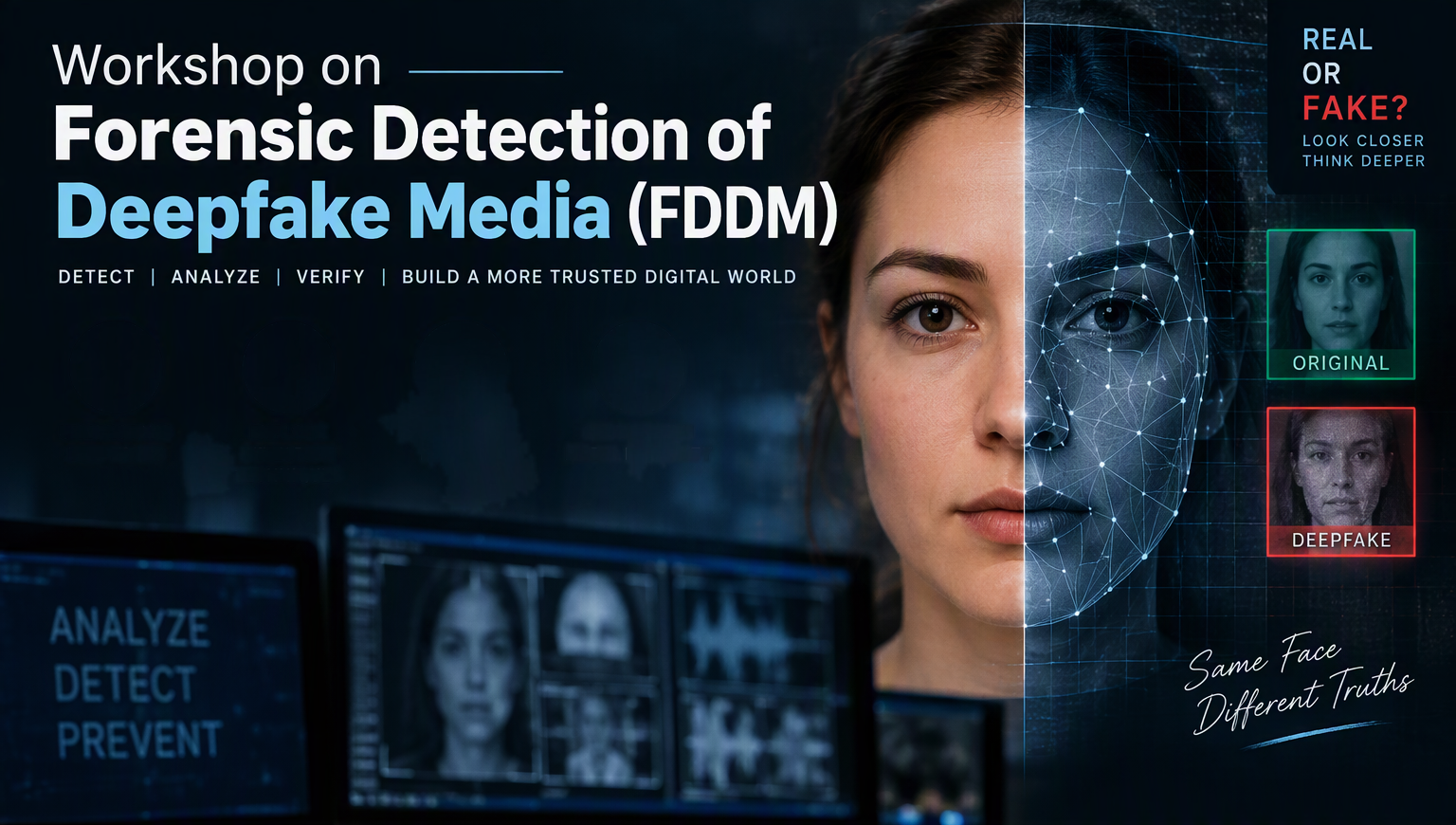
Rapid advancements in generative artificial intelligence (AI) have vastly accelerated our capacity to synthesize photorealistic media—including audio, images, and video—in mere seconds. While these breakthroughs offer unprecedented opportunities for digital content creation, weaponizing hyper-realistic deepfakes for financial fraud and institutional disruption represents an escalating security threat. Over the past few years, the academic community has developed various AI-driven detection mechanisms; however, the vast majority of these systems remain functionally inadequate for deployment in real-world forensic investigations. Current academic methodologies suffer from critical vulnerabilities, including poor cross-dataset generalizability, susceptibility to adversarial attacks, semantic context blindness, and the uninterpretable "black-box" architecture of deep learning models. To bridge the divide between theoretical research and operational utility, this workshop brings together key stakeholders who rarely interface directly: multimedia forensics experts, academic researchers, and high-level policymakers, including representatives from India’s Ministry of Electronics and Information Technology (MeitY). The core objective is to transition deepfake detection out of the isolation of the laboratory. By fostering this cross-sector collaboration, this forum aims to pivot the current research paradigm toward engineering robust, empirical tools that law enforcement agencies, forensic laboratories, and industry partners can immediately integrate into their existing workflows.
CALL FOR PAPERS
Researchers working in the domain of deepfake detection and related domains are invited to submit their original work. Selected works will appear in the ACM ICVGIP workshop proceedings or an edited volume following ICVGIP 2026.
Topics of Interest
The topics of interest include, but are not limited to:
- Detection of deepfake audio, images, and video
- Detection of deepfake signatures and handwriting
- Cross-dataset generalizability and benchmarking
- Defending against adversarial attacks on deepfake detectors
- Explainable AI in forensic deepfake detection
- AI-generated metadata verification
- Deepfake detection-based biometric identification
- Legal admissibility and compliance with Indian laws
Publication Opportunity
The extended versions of accepted papers will be published as book chapters (Approval Awaited from Springer)
Important Dates:
| Paper Submission Deadline |
|
| Notification of Acceptance |
|
| Early Bird Registration |
|
| Camera Ready Submission |
|
| Workshop | 21st December 2026 |
Submission Guidelines (same as ICVGIP 2026):
Authors must ensure that all submitted manuscripts are original and are not simultaneously under review at any other conference or journal. Submissions violating this policy will be rejected without review.
- Manuscript Preparation
- Double-Blind Review:
- Concurrent Submission Policy:
- Policy on arXiv and Technical Reports:
- Formatting and Length:
- Papers must be submitted in PDF format (maximum size: 20 MB).
- Authors are strongly encouraged to use the official LaTeX template Download the LaTeX template (ZIP) (Word template may be used if necessary).
- The main manuscript is limited to 8 pages, including text, figures, and tables.
- References may extend beyond the 8-page limit.
- Supplementary Material (Optional):
- Use LaTeX for typesetting papers into PDF format: Download the LaTeX template (ZIP)
- Submission Process All submissions must be made through the Openreview submission portal
Submissions must strictly adhere to the double-blind policy. Authors should not include names, affiliations, acknowledgments, or any identifying information. References to prior work should be written in a way that does not reveal authorship.
Submitted work must not have substantial overlap (greater than 20%) with any previously published or concurrently submitted work. For borderline cases, authors are encouraged to consult the Program Chairs.
Manuscripts previously available as non-peer-reviewed technical reports (e.g., arXiv) are not considered prior publications and are eligible for submission.
While we expect the manuscript to be self-sufficient we do understand that authors may require additional supplementary materials, e.g., codes, extra results, proof of theorems, etc. In these cases, we request the authors to please put the supplementary documents in an anonymous git repository and share the link in the paper. Such a link should only be provided at the end of references. If the paper is accepted and the authors wish to share the supplementary document in the camera ready copy, then the anonymous git link can be replaced with a regular git repository link. Alternately, the openreview submission portal directly allows uploading supplementary material in zip or pdf format upto 50mb size. Note that, no supplementary material will appear directly in the proceedings and can only be accessed via the public repository link optionally provided by the authors.
PROGRAM
TBA.KEYNOTE SPEAKERS
PROGRAM COMMITTEE (TENTATIVE)
- Dr. Pulak Purkait, Amazon, Australia
- Dr. Gaurav Jaswal, DFS Shimla, India
- Dr. Pinchu Sahu, NIT Rourkela, India
- Dr. Badri N Subudhi, IIT Jammu, India
- Dr. Karan Nathwani, IIT Jammu, India
- Dr. Parimala Kanchala, IIT Mandi, India
- Dr. Santosh Kumar Vipparthi IIT Ropar, India
- Dr. Jagabandhu Mishra, IIIT Dharwad, India
- Dr. Rajesh Verma FSL Shimla, India
- Dr. Mrinmoy Ghorai, IIIT Sri City, India
- Dr. Saiyed Umer, Aliah University, Kolkata, India
- Br. Tamal, RKMVERI, Belur, India
- Mr. Suvajit Patra, RKMVERI, Belur, India
- Swami Punyeshwarananda, RKMVERI, Belur, India
- Dr. Nitin Shelke, Bennett University, Greater Noida, India
- Dr. Bibhas Chandra Dhara, Jadavpur University, Kolkata, India
- Dr. Sk Mohiuddin, Asutosh College, Kolkata, India
- Dr. Swapna Agarwal, FlyTxt, Delhi, India
ORGANIZER
REGISTRATION
TBA.VENUE
Indian Statistical Institute, 203, B T Road, Kolkata, India
CONTACT
For any query, contact us at fddm2026@gmail.com