ABOUT
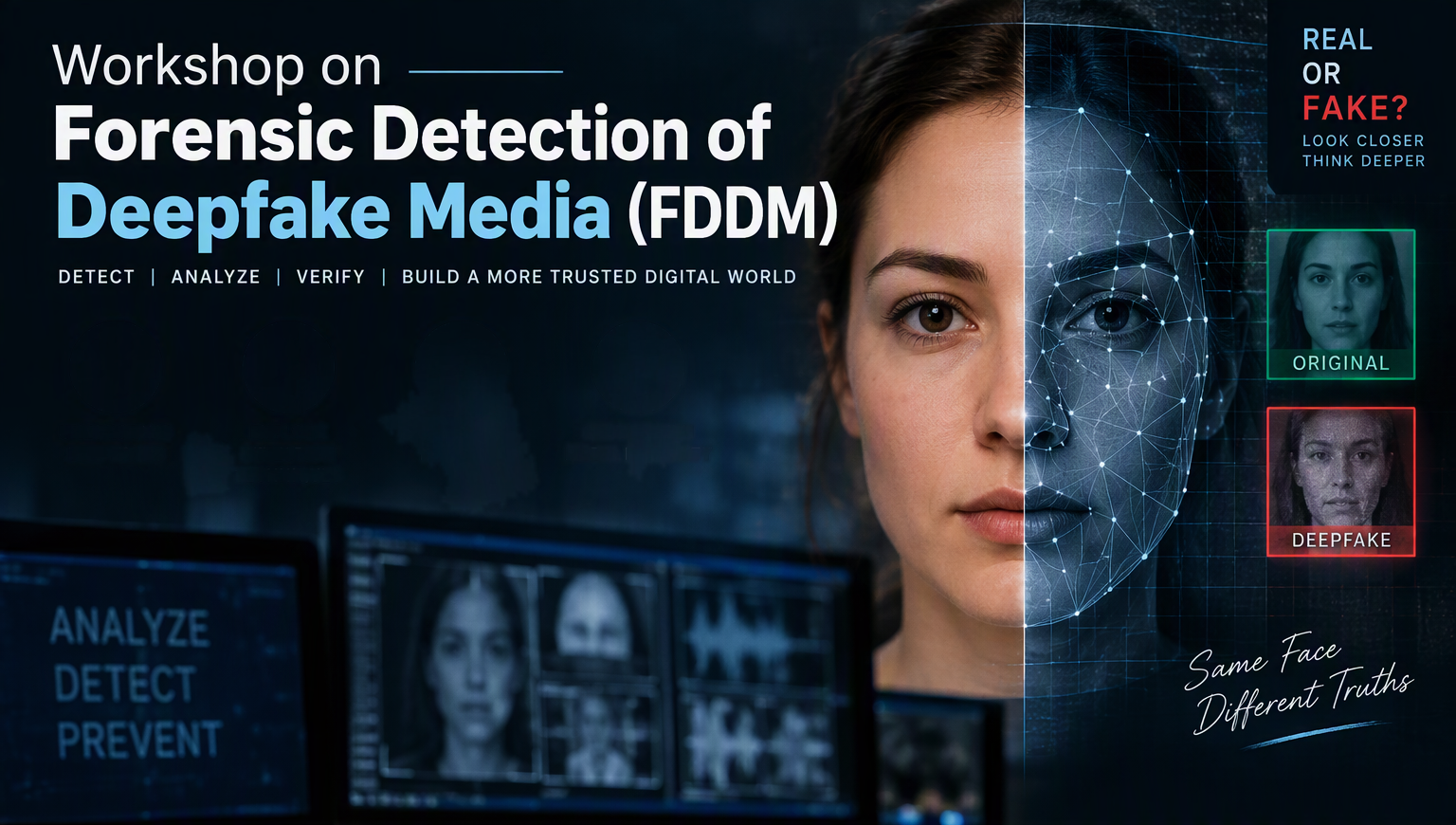
Rapid advancements in generative artificial intelligence (AI) have vastly accelerated our capacity to synthesize photorealistic media—including audio, images, and video—in mere seconds. While these breakthroughs offer unprecedented opportunities for digital content creation, weaponizing hyper-realistic deepfakes for financial fraud and institutional disruption represents an escalating security threat. Over the past few years, the academic community has developed various AI-driven detection mechanisms; however, the vast majority of these systems remain functionally inadequate for deployment in real-world forensic investigations. Current academic methodologies suffer from critical vulnerabilities, including poor cross-dataset generalizability, susceptibility to adversarial attacks, semantic context blindness, and the uninterpretable "black-box" architecture of deep learning models. To bridge the divide between theoretical research and operational utility, this workshop brings together key stakeholders who rarely interface directly: multimedia forensics experts, academic researchers, and high-level policymakers, including representatives from India’s Ministry of Electronics and Information Technology (MeitY). The core objective is to transition deepfake detection out of the isolation of the laboratory. By fostering this cross-sector collaboration, this forum aims to pivot the current research paradigm toward engineering robust, empirical tools that law enforcement agencies, forensic laboratories, and industry partners can immediately integrate into their existing workflows.
CALL FOR PAPERS
Researchers working in the domain of deepfake detection and related domains are invited to submit their original work. Selected works will appear in the ACM ICVGIP workshop proceedings or an edited volume following ICVGIP 2026.
Topics of Interest
The topics of interest include, but are not limited to:
- Detection of deepfake audio, images, and video
- Detection of deepfake signatures and handwriting
- Cross-dataset generalizability and benchmarking
- Defending against adversarial attacks on deepfake detectors
- Explainable AI in forensic deepfake detection
- AI-generated metadata verification
- Deepfake detection-based biometric identification
- Legal admissibility and compliance with Indian laws
Important Dates:
| Paper Submission Deadline | 10th November 2026 |
| Notification of Acceptance | 25th November 2026 |
| Camera Ready Submission | 30th November 2026 |
| Workshop | 21st December 2026 |
Submission Guidelines: Same as ICVGIP 2026
KEYNOTE SPEAKERS

PROGRAM COMMITTEE (TENTATIVE)
- Dr. Pulak Purkait, Amazon, Australia
- Dr. Gaurav Jaswal, DFS Shimla, India
- Dr. Pinchu Sahu, NIT Rourkela, India
- Dr. Badri N Subudhi, IIT Jammu, India
- Dr. Karan Nathwani, IIT Jammu, India
- Dr. Parimala Kanchala, IIT Mandi, India
- Dr. Santosh Kumar Vipparthi IIT Ropar, India
- Dr. Jagabandhu Mishra, IIIT Dharwad, India
- Dr. Rajesh Verma FSL Shimla, India
- Dr. Mrinmoy Ghorai, IIIT Sri City, India
- Br. Tamal, RKMVERI, Belur, India
- Mr. Suvajit Patra, RKMVERI, Belur, India
- Swami Punyeshwarananda, RKMVERI, Belur, India
- Dr. Nitin Shelke, Bennett University, Greater Noida, India
ORGANIZER
REGISTRATION
TBA.VENUE
Indian Statistical Institute, 203, B T Road, Kolkata, India
CONTACT
For any query, contact us at rajeshkumar512@gmail.com