A Gloss-driven Indian Sign Language Production System using Learned Pose Representations
Abstract
Sign Language Production (SLP) system translates spoken or written language into sign language, enabling accessible communication between the deaf/hard-of-hearing and the hearing population. Being one of the most widely used sign languages globally, Indian Sign Language (ISL) is a very low-resource language and lacks such SLP systems. This paper presents a scalable and modular SLP framework based on Sign-Pose-VQ-VAE model, designed for low-resource settings. The model learns discrete pose representations (codes) by disentangling body, left-hand, and right-hand keypoints, enabling efficient pose modeling and co-articulated sign generation. The proposed system is evaluated using a Hindi movie subtitle corpus coupled with an off-the-shelf back-translation model and achieves a gloss BLEU-4 score of 47.20. The system-generated signs are evaluated by certified ISL interpreters with an average rating of 4.33/5, and a BERT precision of 0.7683 on glosses. In addition, the proposed system achieves state-of-the-art performance among keypoint-based methods on the PHOENIX14T benchmark, attaining a BLEU-4 score of 10.03 and surpassing the previous best method by 0.67 points.
Demo Applications
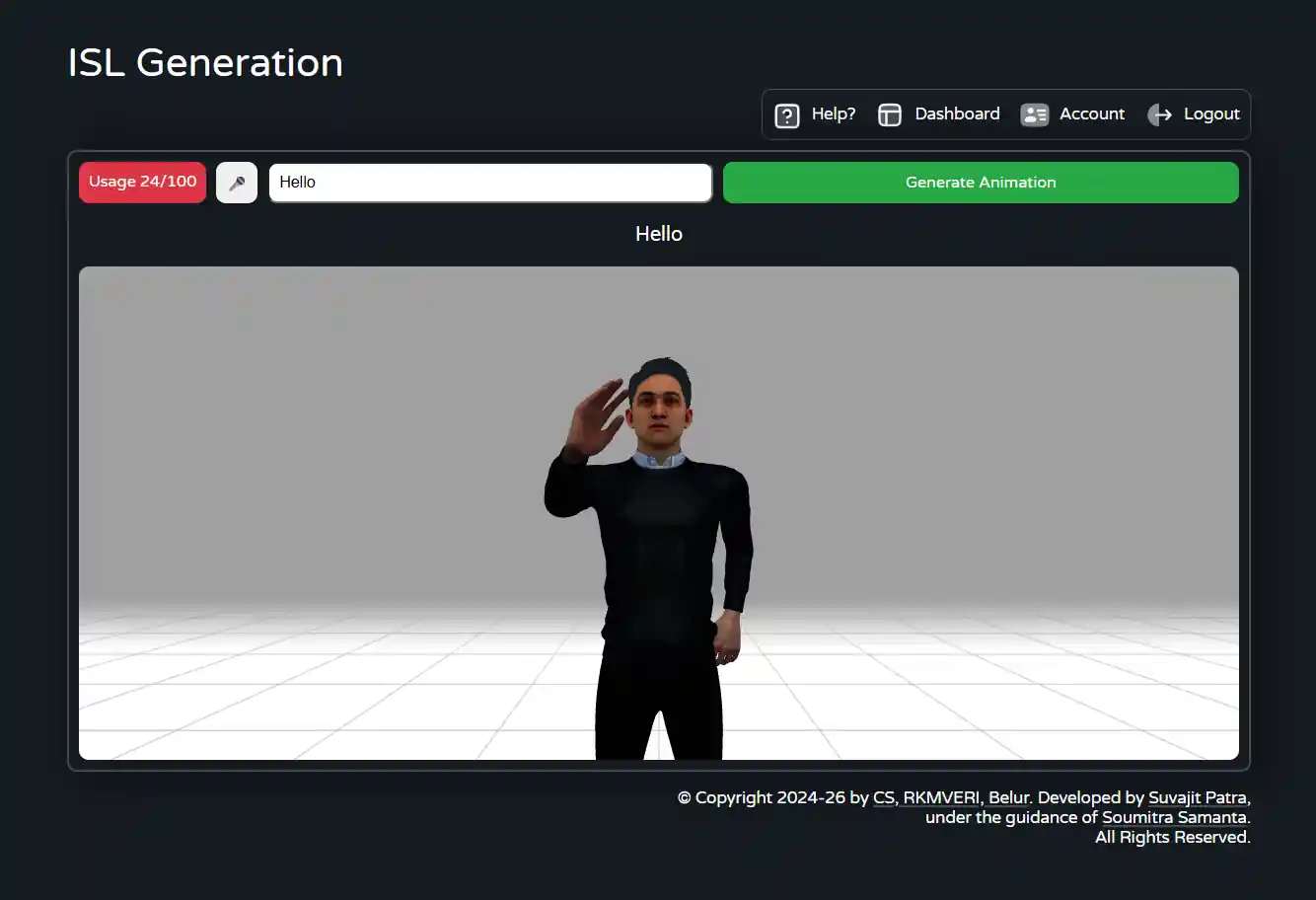
As part of the ARGISL project, we have developed a prototype applications to demonstrate how Indian Sign Language genetation can be used in practice.
Use voice or English text to translate into ISL sign.
© Copyright 2024-26 by CS, RKMVERI, Belur.
Developed by Suvajit Patra [suvajit.patra.cs20(at)gm.rkmvu.ac.in],
Under the guidance of Dr. Soumitra Samanta [soumitra.samanta(at)gm.rkmvu.ac.in].
All Rights Reserved.
